Food and Biodiversity in Action: Conversation Starter Toolkit Utrecht, February, 2026
This publication and its related outputs are licensed under Creative Commons BY-NC-SA 4.0. You may share and adapt the material for non-commercial purposes, provided you credit NFP and the collaborating partners and share any adaptations under the same licence.
This Conversation Starter Toolkit was commissioned and financed by Netherlands Food Partnership (NFP) (lead Mariëlle Karssenberg) in collaboration with glocolearning (lead Roseline Remans), and carried out by a team from KANDS Collective, technically led by Sabrina Trautman.
This Conversation Starter Toolkit accompanies Learning from Ten Journeys Toward Sustainable Futures
We deliver our work as a public good with services for all interested parties (nonexclusive and pre- and post-competitive). Our results are funded by the Netherlands’ Ministries of Foreign Affairs (MoFA) and of Agriculture, Fisheries, Food Security and Nature (MoAgri) fitting with Dutch aid and trade policy.
2026
BACKGROUND AND CONTEXT
Food systems and biodiversity are deeply interlinked. The way food is produced, processed, traded, and consumed is a major driver of biodiversity loss, affecting diversity within species, between species, and across ecosystems. At the same time, biodiversity underpins food security, resilience, and nutrition. Although these linkages are increasingly recognized, putting them into action remains a challenge.
Over the past year, the Netherlands Food Partnership (NFP), together with partners from government, business, civil society, research, and communities, explored this challenge through Food & Biodiversity in Action: Learning from Ten Journeys Toward Sustainable Futures. The ten learning journeys, brought together in a first bundle, provide examples of how biodiversity and food systems are being connected in practice across regions, scales, and entry points—including landscapes, markets, policies, finance, diets, and social organisation. This work is part of NFP’s Biodiversity and Food Systems Partnership, which brings together diverse partners to strengthen understanding, collaboration, and action at the intersection of biodiversity and food systems.
CONVERSATION STARTER TOOLKIT FOR CHAMPIONS
A consistent insight across the learning journeys was the critical role of champions. Progress depended not only on technical solutions, but on individuals and teams who catalyzed conversations, bridged perspectives, and kept biodiversity and food systems connected in everyday decision-making.
In addition, the learning journeys illustrated that the most important insights about how to integrate biodiversity and food systems do not emerge from reports alone. They
emerge through conversation: by unpacking complexity, translating between disciplines, and learning across perspectives.
This Conversation Starter Toolkit was developed directly in response to these insights. It translates the experience of the learning journeys into a practical facilitation resource, designed to support champions in turning dialogue into meaningful next steps. As the toolkit is applied in different contexts, we welcome feedback and learning from users, and will use these experiences to refine and update the toolkit over time.
WHAT SUPPORT DO I GET FROM THIS TOOLKIT?
The toolkit supports champions with:
Conversation sparks which include key definitions, facilitator resources, and learning prompts— questions designed to help facilitators guide a segment of the discussion. These activities can be done in pairs, small groups, or in plenary.
Examples from the ten learning journeys to ground discussion in real-world experience. Each of the ten learning journeys will have specific interest to each champion’s context.
WHAT DOES THIS TOOLKIT HELP ME TO ACHIEVE?
The Conversation Starter Toolkit helps you to:
Make biodiversity–food system linkages explicit
Reflect on how decisions in one part of the system shape outcomes elsewhere
A facilitation slide deck that can be adapted by champions for different facilitation settings
Identify relevant entry points for action
Translate dialogue from facilitated sessions into practical next steps
Surface different perspectives and priorities
The toolkit helps champions move from implicit understanding to explicit dialogue, and from dialogue to practical next steps that fit their context and sphere of influence.
AM I A CHAMPION?
If you are looking to initiate, catalyze, or deepen conversations and actions on how biodiversity and food systems connect in practice, then you are a champion.
Champions work in many roles and settings, often at the intersections of sectors, disciplines, or levels of decisionmaking. Champions have the ability to think differently to see an opportunity. Champions are not technical experts, they are bridge builders and have a mix of courage, agency and perseverance to sustain the spark of an idea into something concrete.
In practice, champions spark conversations and actions that might not otherwise happen—by introducing new questions into existing spaces, connecting perspectives across conservation, agriculture, nutrition, climate, finance, and policy, or helping teams reflect on how biodiversity already shapes their food systems work or vice versa.
Champions are important! They have a willingness to open and continue making space for dialogue and actions and help others make connections that perhaps already exist but are often implicit, fragmented, or siloed. This toolkit is designed for biodiversity & food champions—to equip them with a simple facilitation resource, built upon insights from the practical learning journeys.
Food and Biodiversity in Action: Learning from Ten Journeys Toward Sustainable Futures
The learning journeys provide concrete examples of how biodiversity and food systems are being linked in practice across different contexts, geographies, scale and sectors. In each conversation spark we have helped draw our key relevant lessons or insights to help champions show the diversity of possible approaches and ground the conversation in real-world experience.
The learning journeys can be used to help steer discussion, stimulate reflection, and help participants recognize where similar dynamics may exist in their own work and contexts.
The Conversation Starter Toolkit is a standalone resource, but we encourage champions to read the learning journeys, especially the key insights chapter.
HOW DO I PREPARE FOR A CONVERSATION?
Preparation can be light. You select the conversation sparks that fit your audience and purpose, decide whether to use examples from the learning journeys, and choose a convening format that suits your context.
The toolkit can be used to spark conversations in short, informal conversations—such as lunch-and-learns, brown-bag sessions, or team check-ins—as well as deepen conversations in more structured workshops, partnership meetings, or strategic reflection moments.
CLARIFY YOUR PURPOSE AND CONTEXT
y Why are you having this conversation now?
y What specific challenge or opportunity are you exploring?
y What would success look like for this session?
IDENTIFY AND INVITE PARTICIPANTS
y Who needs to be in the room for this conversation?
y How can you frame the invitation to signal that this is about learning, not decisionmaking or evaluation?
y What diversity of perspectives and expertise is needed (food systems, biodiversity, policy, finance, production, partnerships)?
y A group of 5–15 participants works well for most formats
GATHER MATERIALS
y Flip charts and a shared document to capture insights and next steps
y Optional: print some of the learning journeys to ground discussions
y For virtual or hybrid sessions, ensure good audio, clear visuals, and breakout room functionality
ROLE OF THE FACILITATOR/CHAMPION
Create a respectful, non-judgemental space for dialogue
Ask open and probing questions and invite quieter voices into the conversation
Encourage participants to speak from their own experience and to listen with curiosity
KEEPING TRACK OF YOUR SESSION
y Who will manage time?
y Who will capture key points and next steps?
y How will you signal if energy drops or discussion drifts?
y How will you handle difficult moments (dominant voices, silence, disagreement)?
Help participants reflect on what they are hearing and learning
Support participants to identify practical next steps and collectively articulate what success looks like
STARTING OR DEEPENING CONVERSATIONS?
The toolkit in action
The toolkit offers two options: to start or deepen conversations on biodiversity food system linkages depending on time, scope, and the target audience. At the core of both suggested formats is conversation sparks.
WHAT ARE THE CONVERSATION “SPARKS”?
We have provided five conversation sparks as the core of this toolkit. These are carefully designed prompts, gathered from our experience with multiple stakeholders, partnerships and contexts in compiling the learning journeys. We reflected on key areas that can help groups explore different dimensions of biodiversity–food systems integration to help spark and deepen conversations.
The conversation sparks contain some tips and facilitator prompts–these are guided questions which have to be adapted to the group context. For example you may have a targeted group in a project setting working in a specific geography–this allows you to deepen and probe to that context. However you might have a very mixed group, and have to broaden the question - this is where getting people to think about their own personal experiences and day to day settings is a good option to spark ideas.
Purpose:
Spark awareness and build interest and momentum
Suitable for:
Lunch-and-learns or brown-bag sessions
First conversations with new groups
Time-constrained settings
Icebreaker (10 minutes)
Option 1: Personal observation
“In your personal life, where do you notice food and nature showing up—for example through what you eat, where food comes from, or changes you’ve observed around you?”, “in your food system, where do you see connections with biodiversity?”
Spark 1
Core definitions and understanding (15 minutes)
Spark 2
Biodiversity–food systems entry points (20 minutes)
Spark 3
Brainstorming change (15 minutes)
LEARNING PROMPTS
y What stood out most from the conversation?
y What new perspective, connection, or insight emerged?
y What assumptions were challenged or clarified?
Purpose:
Explore linkages in more depth and identify actions
Suitable for:
Team or departmental workshops
Partnership or network meetings
Strategic reflection moments
As a working group exercise in a longer multi-day workshop
Option 2: A moment of connection
“Can you share a small story of a moment when you noticed a connection between biodiversity and food—at work or in everyday life?”
Option 3: When was the last time you enjoyed nature/ biodiversity?
Spark 1
Core definitions and understanding (20 minutes)
Spark 2
Biodiversity–food systems entry points (20 minutes)
Spark 3
Brainstorming change (15 minutes)
Spark 4
Who needs to be involved? (15 minutes)
Spark 5
How do we learn and show progress? (15 minutes)
FOLLOW-UP ACTIONS
y What is one small, practical step that could be taken?
y What conversation needs to happen next—and with whom?
FOR DEEPER REFLECTION
y Resources: Seek out additional information, case studies or examples
y Teams and partnerships: Bring new people into the discussion; connect food and biodiversity colleagues; strengthen existing collaborations
y Ways of working: Adjust how issues are framed, discussed or monitored internally
CONVERSATION SPARKS
SHARED BASICS: WHAT DO WE MEAN BY ‘BIODIVERSITY’ AND ‘FOOD SYSTEMS’?
Spark 1 helps to align on foundational definitions and create a shared understanding amongst a group.
Biodiversity is not treated as a single thing to ‘add on’ to food systems work—it shows up as genetic diversity, species diversity, and ecosystem diversity, and it is often the starting point for practical decisions.
Similarly, ‘food systems’ includes the actors, rules, incentives, and infrastructure that shape how food is produced, traded, consumed, and governed, and how benefits and risks are distributed across people and places. This baseline clarity matters most in mixed groups (e.g., conservation, private sector, government, finance, research) so that the conversation can move quickly from different vocabularies to shared problem framing and next steps.
Brainstorming change
Spark 1 Spark 2 Spark 3 Spark 4 Spark 5 Core definitions and understanding Biodiversity–food systems entry points
Who needs to be involved? How do we learn and show progress?
FACILITATOR’S RESOURCE
BIODIVERSITY
As defined in Article 2 of the Convention on Biological Diversity (CBD): “the variability among living organisms from all sources including, inter alia, terrestrial, marine and other aquatic ecosystems and the ecological complexes of which they are part: this includes diversity within species, between species and of ecosystems.”1 Since this definition in 1992, the concept of biodiversity has continuously developed, and currently many different, largely overlapping definitions exist. A common definition describes it as the variety and variability of living organisms, their habitats and their contribution and role in the ecosystem processes.2
Biodiversity is complex and operates on different levels, therefore it is often divided into three component:
Genetic diversity — referring to the variation in genes within a species.
Species diversity — referring to the variety of species in a particular region or ecosystem.
Ecosystem diversity — referring to the variety of habitats, ecological communities, and ecological processes in the biosphere.
FOOD SYSTEMS
“Food systems embrace the entire range of actors and their interlinked value-adding activities involved in the production, aggregation, processing, distribution, consumption, and disposal of food products that originate from agriculture, forestry, fisheries, and food industries, and the broader economic, societal, and natural environments in which they are embedded.”3
AGROBIODIVERSITY
“The variety and variability of animals, plants, and micro-organisms that are used directly or indirectly for food and agriculture, including crops, livestock, forestry and fisheries. It comprises the diversity of genetic resources (varieties, breeds) and species used for food, fodder, fibre, fuel and pharmaceuticals. It also includes the diversity of non-harvested species that support production (soil micro-organisms, predators, pollinators), and those in the wider environment that support agro-ecosystems (agricultural, pastoral, forest and aquatic).”4
When you hear biodiversity, what level do you think of most (genes, species, ecosystems)?
When you hear food systems, which part do you feel most familiar with (production, value chains, policy, diets, finance)?
Are you comfortable with the idea of a ‘system’?
What do we need to clarify so we don’t talk past each other today?
1. Convention on Biological Diversity. (1992). Article 2: Use of terms. https://www.cbd.int/convention/articles/?a=cbd-02
TIP
Depending on the expertise, size and background of your group you can first ask in pairs, then fours then the whole group for definition responses on key terms. The aim with unpacking core definitions is to spark dialogue, learning and ‘ah-ha’ moments very early on.
2. Biodiversity in the Food System: A preliminary exploration https://nfp-voedselpartn.files.svdcdn.com/production/documents/Biodiversity-Integration-Food-Systems. pdf?dm=1747390969
3. Scientific Group of the United Nations Food Systems Summit. (2021). Food systems definition, concept, and application for the UN Food Systems Summit (Draft paper). https:// sc-fss2021.org/wp-content/uploads/2021/01/Food_Systems_Concept_paper_Scientific_en.pdf
4. Food and Agriculture Organization of the United Nations. (1999). Agrobiodiversity (agricultural biodiversity) definition. FAO. Retrieved from https://www.fao.org/4/y5609e/ y5609e01.htm
Spark 1 Spark 2 Spark 3
Core definitions and understanding Biodiversity–food systems entry points
Spark 4 Spark 5
Brainstorming change Who needs to be involved? How do we learn and show progress?
USING THE FOOD AND BIODIVERSITY IN ACTION LEARNING JOURNEYS AS INSIGHTS
The learning journeys show that ‘biodiversity’ is not a single thing in practice. It is framed and acted upon in different ways depending on context. These examples can be used to illustrate that diversity and to prompt reflection. Use these as short anchors to ask: “Which of these feels closest to our context—and why?”
GUARDIANS PAID FAIRLY (AGUAPAN, CIP)
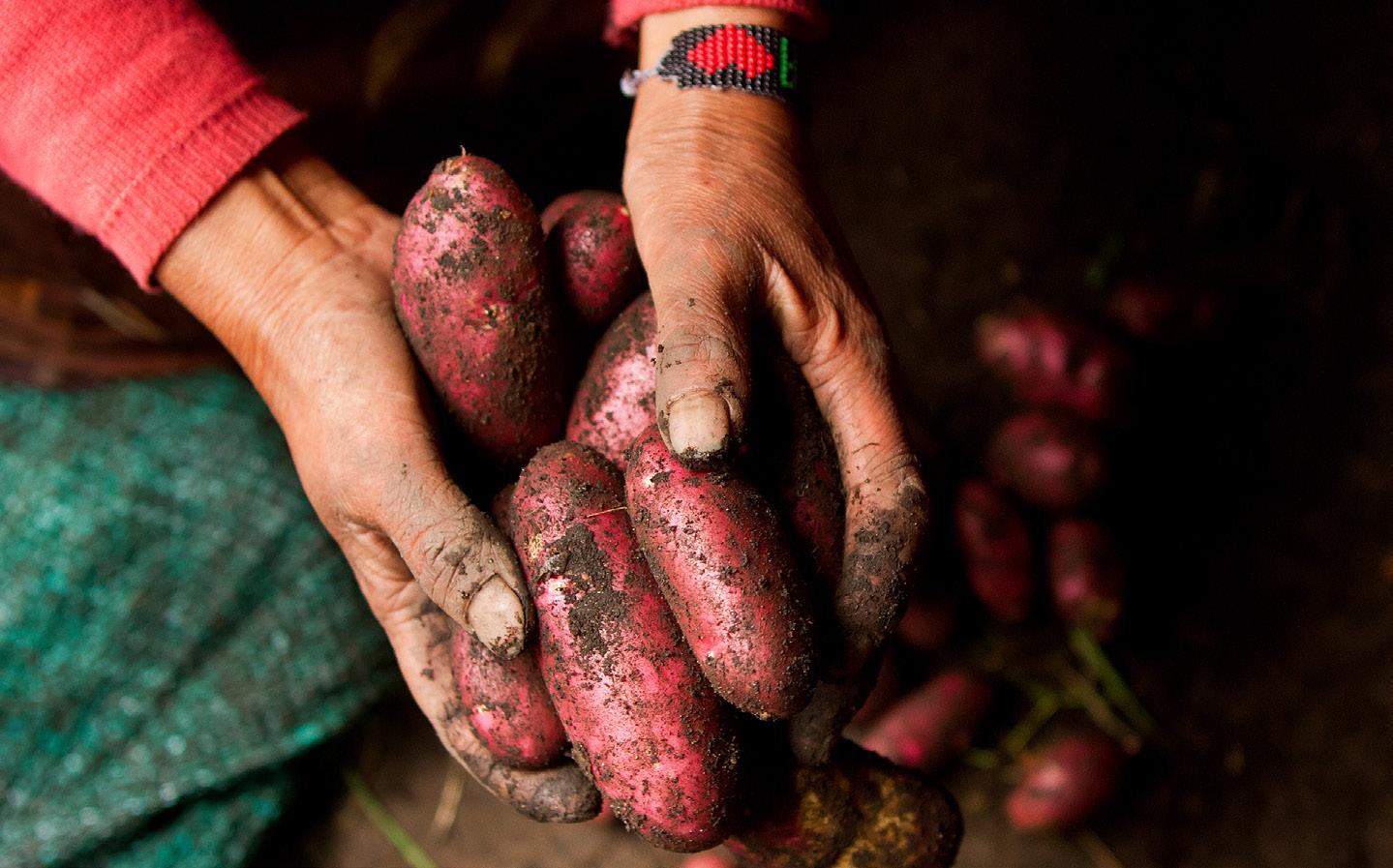
A network of Andean potato custodians conserves hundreds of native varieties through a benefit-sharing model that provides direct payments, youth training, and market development. This farmer-led governance system builds trust while sustaining agrobiodiversity critical for climate adaptation.
LEARNING PROMPT
Where do you see farmers and communities playing a role in conserving biodiversity in your context?
MARKETS HELP RESTORE WATERSHEDS (NATURE’S PRIDE)
A Dutch fresh produce importer works with suppliers in Peru and Spain to improve water stewardship in highly stressed catchments. By aligning farmer practices with biodiversity safeguards, it shows how companies can integrate ecosystem health into global value chains.
LEARNING PROMPT
What changes when catchments become the focus, and water is managed collectively rather than one farm at a time?
DESERT OASIS REVIVAL (HABIBA COMMUNITY, EGYPT)
In South Sinai, Egypt, the Habiba Community is transforming desert land into a regenerative hub, combining organic farming, women’s cooperatives, and education for Bedouin youth. Over 100 local farms now adopt biodiversity-positive practices, demonstrating how local food security, ecosystem restoration, and community empowerment can reinforce one another.
LEARNING PROMPT
What kinds of diversity in crops, species, or practices help people cope with difficult growing conditions?
SCHOOLS NOURISH BIODIVERSITY (THE ALLIANCE, SMC)
School feeding programmes are being leveraged to promote agricultural biodiversity by integrating underutilized crops into national procurement. Through the School Meals Coalition, governments source more diverse crops, linking nutrition policy with biodiversity outcomes and supporting smallholder farmers.
LEARNING PROMPT
How can consumption and purchasing decisions help create demand for more diverse and resilient foods?
SHARED BASICS: AN INTRODUCTION TO BIODIVERSITY–FOOD SYSTEMS ENTRY POINTS
Spark 2 is about unpacking biodiversity—food systems entry points. Starting to understand entry points helps to align on where to start, while still recognizing there are often multiple entry points.
y This table on the next page summarizes the entry points for integrating biodiversity into food systems as set out in Biodiversity in the food system: A preliminary exploration The entry points were identified by the authors through a review of existing literature and frameworks, and are intended to reflect the multiple ways in which biodiversity and food systems interact.
y The table is not a prescriptive framework or a checklist.
y It provides an overview of different starting points through which action on biodiversity–food system linkages can begin, depending on context, actors, and scale.
y The entry points are not mutually exclusive and are often combined in practice.
y For the purposes of this Conversation Starter Toolkit, the table has been condensed and adapted to support dialogue.
TIP
This is a great exercise if you are bringing two distinct groups into a starter conversation, with the aim to get a better grounding in components of food systems and potential ways biodiversity is impacted. There is no right or wrong on entry points, the value of the exercise is really to deepen the thinking and have a dialogue!
Spark 1 Spark 2 Spark 3
Core definitions and understanding Biodiversity–food systems entry points
ENTRY POINT
Finance and trade
Markets
Conscious consumers
Policy and governance
Science and innovation
Scaling biodiversity-positive practices
Social organisation
Landscapes and seascapes
Shifting diets
Food loss and waste
Sourcing of raw materials
Socio-economic inclusion
Commodity- or sector-based approaches
Biodiversity for resilience
Education, advocacy, and awareness
Brainstorming change
Spark 4 Spark 5
Who needs to be involved? How do we learn and show progress?
DESCRIPTION
Financial mechanisms, subsidies, investments, pricing, and trade arrangements related to food systems.
Market dynamics, standards, certification, and buyer requirements.
Consumer awareness, information, and purchasing behaviour.
Public policies, regulations, incentives, and governance arrangements.
Research, knowledge development, data, and technological innovation.
Uptake and expansion of practices such as agroecology and nature-inclusive production.
Institutions, networks, leadership, and collective action.
Spatial and place-based approaches across land and sea.
Changes in dietary patterns and food consumption.
Reduction of losses and waste along the food chain.
Sourcing of inputs such as feed, seed, and other raw materials.
Inclusion of smallholders, Indigenous Peoples, and local communities.
Focus on specific commodities or sectors.
Use of biodiversity to enhance resilience.
Learning, awareness-raising, and advocacy activities.
SYNERGIES
Financial and trade systems influence land use, production choices, and value chains, with direct consequences for biodiversity loss or conservation.
Markets shape production systems and sourcing practices that affect biodiversity outcomes.
Consumption patterns influence demand, production methods, and pressures on biodiversity.
Policy frameworks shape food system practices and their impacts on biodiversity.
Scientific knowledge and innovation inform how biodiversity is managed, conserved, and used within food systems.
These practices integrate biodiversity conservation and sustainable use into food production.
Social organisation influences how actors coordinate food production and biodiversity management.
Landscape and seascape approaches link food production with biodiversity conservation across multiple land uses.
Diets influence production systems and resource use, affecting biodiversity pressures.
Lower losses and waste reduce pressure on natural resources and biodiversity.
Sourcing decisions affect biodiversity impacts within and beyond food production systems.
Inclusive food systems are linked to more sustainable biodiversity management and livelihoods.
Commodity-based approaches address biodiversity impacts embedded in particular food value chains.
Biodiversity contributes to the resilience of food systems to shocks and stresses.
Awareness and learning influence behaviours and long-term biodiversity outcomes in food systems.
Spark 1 Spark 2 Spark 3
Core definitions and understanding Biodiversity–food systems entry points
LEARNING PROMPTS
Spark 4 Spark 5
Brainstorming change Who needs to be involved? How do we learn and show progress?
What do you think is an entry to biodiversity–food systems action in your work?
TIP
Do you start from a place, a practice, a value chain, an institution, policy, finance, or stewardship—and why?
If participants work actively in food systems you can ask for an example on where they put the most energy / budget / influence . If some of your participants are not working directly on food system activities, a prompt could be to think about a stage or area in a value chain they are familiar with, or can think of a context in their own personal setting (for example a local market).
2 Based on the food system entry points, think about the linkages to biodiversity—can you link any effects on genetic, species or ecosystem diversity?
TIP
Here is a good point to also get people to reflect and to keep it simple— if we explained our biodiversity–food connection in one sentence, what would we say?
3 What type of biodiversity change is most directly being influenced?
Genetic diversity (crop varieties, seed systems, diversity within fields)
Species diversity (wild/cultivated species, pollinators, functional diversity)
There are two questions to open up conversation on impact (how biodiversity is being changed which could be positive or negative), and also a conversation on how biodiversity might change if we were to direct activities.
5 Are there any tensions between perceived biodiversity and food system goals that might steer people away from wanting to integrate?
TIP
This question aims to spark a conversation to critically question if there is no relevant link allowing participants to surface and dialogue any tensions or doubts.
Spark 1 Spark 2 Spark 3
Core definitions and understanding Biodiversity–food systems entry points
Spark 4 Spark 5
Brainstorming change Who needs to be involved? How do we learn and show progress?
USING THE FOOD AND BIODIVERSITY IN ACTION LEARNING JOURNEYS AS INSIGHTS
The learning journeys illustrate that biodiversity–food systems integration can start from very different places. These examples provide short anchors to help participants recognize possible entry points in their own context.
MARKETS HELP RESTORE WATERSHEDS (NATURE’S PRIDE)
A Dutch fresh produce importer works with suppliers in Peru and Spain to improve water stewardship in highly stressed catchments. By aligning farmer practices with biodiversity safeguards, it shows how companies can integrate ecosystem health into global value chains.
Entry point: Finance + landscapes + value chains
GUARDIANS PAID FAIRLY (AGUAPAN, CIP)
A network of Andean potato custodians conserves hundreds of native varieties through a benefit-sharing model that provides direct payments, youth training, and market development. This farmer-led governance system builds trust while sustaining agrobiodiversity critical for climate adaptation.
Entry point: Social organization + markets
SCHOOLS NOURISH BIODIVERSITY (THE ALLIANCE, SMC)
School feeding programmes are being leveraged to promote agricultural biodiversity by integrating underutilized crops into national procurement. Through the School Meals Coalition, governments source more diverse crops, linking nutrition policy with biodiversity outcomes and supporting smallholder farmers.
Entry point: Policy + markets
BRAINSTORMING CHANGE
Spark 3 helps to move from biodiversity food systems entry points and how these translate into concrete changes—such as through changing practices, rules, procurement choices, finance conditions, or how land and water are managed.
1 What are the main practical ways in which you think change can happen?
You can make this quite practical and ask for a timebound change, for example: “What would we do differently in the next 3–6 months if biodiversity or an understanding of food systems is truly part of our work?”
Where do we already have influence or leverage? What feels like the most practical place to begin in our context?
What is holding us back from taking this further?
What kinds of change feel most relevant in our context right now?
Which of these shifts would be within our influence?
It is also useful to get participants thinking about success— what does positive change look like. This is very useful for Spark 5 to start thinking about learning and monitoring.
What would need to change for integration to become easier or more likely?
What is the main practical way(s) you think change can happen?
Spark 1 Spark 2 Spark 3
Core definitions and understanding Biodiversity–food systems entry points
USING
THE
Spark 4 Spark 5
Brainstorming change Who needs to be involved? How do we learn and show progress?
FOOD AND BIODIVERSITY IN ACTION LEARNING JOURNEYS AS INSIGHTS
The learning journeys show that entry points only matter when they lead to meaningful shifts in how systems are organized, governed, and incentivized. Change may be operational, institutional, financial, or relational—and often involves several of these at once. Use these examples to help the group move from ‘where we start’ to “brainstorm what needs to change for integration to be possible.’
FINANCE PROTECTS NATURE (SAIL INVESTMENTS)
SAIL demonstrates the power of private credit to drive biodiversity outcomes by embedding sustainability covenants into loans for agriculture and land-use sectors. By aligning financial returns with ecosystem restoration, it shows how institutional capital can be mobilized for systemic food system change.
Entry point: Finance + landscapes
Change happens when sustainability targets are embedded in loan agreements and plans, supported by verification, shifting biodiversity from a ‘nice to have’ into a performance requirement that is verified.
LANDSCAPES RESTORED TOGETHER (COMMONLAND)
Commonland applies its 4 Returns Framework to large-scale landscape restoration, linking ecological recovery with livelihoods, social capital, and sustainable business models. Operating in Africa, Europe, and beyond, it illustrates how biodiversity integration can be scaled at landscape level through long-term partnerships.
Entry point: Landscape + finance
Change happens through long-term partnership structures, investment approaches, and practical tools that support restoration and livelihoods over extended time horizons.
SCHOOLS NOURISH BIODIVERSITY (THE ALLIANCE, SMC)
School feeding programmes are being leveraged to promote agricultural biodiversity by integrating underutilized crops into national procurement. Through the School Meals Coalition, governments source more diverse crops, linking nutrition policy with biodiversity outcomes and supporting smallholder farmers.
Entry point: Policy + markets
The main lever of change happens through institutional procurement and school meals, which creates reliable markets for diversified and locally adapted foods, linking nutrition, farmer livelihoods, and environmental sustainability.
RESILIENT RANGELANDS (SNV & PARTNERS)
In Kenya’s arid and semi-arid lands, SNV and partners are piloting a rangeland management approach that integrates climate finance, biodiversity monitoring, and peacebuilding. These models provide livelihoods for pastoralists while sustaining ecosystem services across fragile landscapes.
Entry point: Landscapes + social organization
A big shift was in internal ways of working, and adopting a more interlinked approach to rangeland management. This allowed the SNV team to focus on strengthening local institutions and rangeland management approaches that link water, livelihoods, and ecosystem health.
WHO NEEDS TO BE INVOLVED?
Spark 4 focuses all on people—who needs to be involved to cause change to happen? Integration requires collaboration across silos and scales and this spark aims to deepen the conversation around multi-stakeholder roles.
You can create small groups, and based on Spark 3 and how you brainstormed change, you can ask the small groups to select one mechanism of change and ask this set of questions.
Which stakeholders are essential versus ‘nice to have’?
What is the role of these essential stakeholders?
What kind of knowledge and evidence do these stakeholders bring—scientific, local, Indigenous, practical—and how is it recognized?
Does power impact these stakeholder roles and knowledge?
What kind of partnership or collaboration structure could work in linking these stakeholders?
This can be done with a simple table of stakeholders, their role and key knowledge.
You can use a simple power and influence grid for this
TIP
TIP
TIP
Spark 1 Spark 2 Spark 3
Core definitions and understanding Biodiversity–food systems entry points
Brainstorming change
Spark 4 Spark 5
Who needs to be involved? How do we learn and show progress?
USING THE FOOD AND BIODIVERSITY IN ACTION LEARNING JOURNEYS AS INSIGHTS
The learning journeys show that biodiversity–food systems integration depends not only on technical solutions, but on how actors coordinate, share roles, and exercise influence. Progress often requires working beyond traditional mandates and forming new types of partnerships.
Use these examples to help the group reflect on who needs to be involved, how decisions are made, and where collaboration enables or constrains change.
BRIDGING THE DIVIDE (WWF COLOMBIA)
Colombia’s updated National Biodiversity Strategy and Action Plan (NBSAP), launched at COP16, explicitly mainstreams food systems into biodiversity policy. By bridging agriculture and conservation, the policy sets a precedent for integrated governance at national scale.
In the lead-up to COP16, Colombia’s National Biodiversity Strategy and Action Plan process deliberately brought together environment, agriculture, and other sectoral ministries, as well as non-traditional partners, to bridge the biodiversity–agriculture divide and keep food systems visible within national biodiversity planning.
LEARNING PROMPT
Where do governance silos limit integrated action?
GUARDIANS PAID FAIRLY (AGUAPAN, CIP)
A network of Andean potato custodians conserves hundreds of native varieties through a benefit-sharing model that provides direct payments, youth training, and market development. This farmer-led governance system builds trust while sustaining agrobiodiversity critical for climate adaptation.
The initiative centres Indigenous potato custodians as knowledge holders and rights-holders, shaping governance arrangements and benefit-sharing mechanisms around farmer-led stewardship of genetic diversity.
LEARNING PROMPT
Whose knowledge and authority need to be better recognized in our system?
COMPANIES SCALE REGENERATION
(WBCSD)
The WBCSD mobilizes corporate coalitions to advance biodiversity within food, land, and agricultural value chains. Through shared commitments and tools, it demonstrates how businesses can collaborate to shift sector norms.
Pre-competitive business collaboration helps align approaches, methods, and commitments, reducing fragmentation and lowering the barrier for companies to act.
LEARNING PROMPT
Who needs to act together for change to be possible?
LANDSCAPES
RESTORED TOGETHER (COMMONLAND)
Commonland applies its 4 Returns Framework to largescale landscape restoration, linking ecological recovery with livelihoods, social capital, and sustainable business models. Operating in Africa, Europe, and beyond, it illustrates how biodiversity integration can be scaled at landscape level through long-term partnerships.
Landscape restoration is organized through long-term, place-based partnerships that combine ecological restoration and livelihood development, supported by shared tools, agreements, and coordination structures designed for 20-year time horizons.
LEARNING PROMPT
What kinds of partnership structures are needed to sustain long-term change?
HOW DO WE LEARN AND SHOW PROGRESS
Spark 5 focuses on initial reflection about learning and monitoring. Biodiversity change is often long-term, food systems can be complex to monitor and project timelines and funding cycles are usually short.
Initial ideas on what ‘progress’ looks like are important, and how to continually learn and what evidence is needed. Otherwise investment in monitoring can result in focusing on what is easiest to measure rather than what matters.
You can probe the group for different examples of evidence they might be aware of, for example, numbers, stories, verification and community observation.
LEARNING PROMPTS
Thinking about Spark 3 and the brainstorming we did on what change we want to happen and how. What could be some indicators or signals of change we could track in the next year (even if biodiversity outcomes take longer)?
What kind of evidence do different actors (identified in Spark 4) need (community, investor, policymaker, buyer for example) require?
How will learning feed back into decisions (how will we adapt if something is not working)?
Spark 1 Spark 2 Spark 3
Core definitions and understanding Biodiversity–food systems entry points
Brainstorming change
Spark 4 Spark 5
Who needs to be involved? How do we learn and show progress?
USING THE FOOD AND BIODIVERSITY IN ACTION LEARNING JOURNEYS AS INSIGHTS
The learning journeys show that integration is not a one-off decision, but a process that requires evidence, reflection, and adaptation over time. What gets measured, learned from, and shared strongly shapes what can be sustained and scaled. These examples can be used to prompt reflection on how progress is evidenced and how learning supports long-term change.
FINANCE PROTECTS NATURE (SAIL INVESTMENTS)
SAIL demonstrates the power of private credit to drive biodiversity outcomes by embedding sustainability covenants into loans for agriculture and land-use sectors. By aligning financial returns with ecosystem restoration, it shows how institutional capital can be mobilized for systemic food system change.
Progress is supported through sustainability-linked plans and independent verification, translating biodiversity and sustainability goals into evidence that investors and companies can act on.
LEARNING PROMPT
What kinds of evidence would build confidence for action in our context?
DESERT OASIS REVIVAL (HABIBA COMMUNITY, EGYPT)
In South Sinai, the Habiba Community is transforming desert land into a regenerative hub, combining organic farming, women’s cooperatives, and education for Bedouin youth. Over 100 local farms now adopt biodiversity-positive practices, demonstrating how local food security, ecosystem restoration, and community empowerment can reinforce one another.
Monitoring and learning span multiple dimensions of restoration, including species and ecosystem recovery, grounded in practical, place-based observation.
LEARNING PROMPT
How can learning be made useful for day-to-day decision-making?
COMPANIES SCALE REGENERATION (WBCSD)
The WBCSD mobilizes corporate coalitions to advance biodiversity within food, land, and agricultural value chains. Through shared commitments and tools, it demonstrates how businesses can collaborate to shift sector norms.
Pre-competitive coalitions bring companies together to align methods, targets, and indicators for nature-positive action, including on regenerative agriculture and biodiversity in supply chains. This reduces duplication, improves comparability of evidence, and supports collective learning across sectors and geographies.
LEARNING PROMPT
What could we learn faster by learning together? How could shared methods and indicators help us learn faster and strengthen collective action?
FACILITATOR CHECKLIST
Before the session
CLARIFY YOUR PURPOSE
Why are you hosting this conversation now?
Is your aim to start a conversation or deepen an existing one?
What would success look like: shared understanding, new questions, or concrete next steps?
FRAME THE INVITATION
Signal that this is a learning and reflection space
Emphasize curiosity, dialogue, and shared exploration
CHOOSE YOUR FORMAT
Conversation Starter (≈60 minutes) or Conversation Deepener (≈90–120 minutes)
Select the conversation sparks that fit your purpose and time
PREPARE MATERIALS
Use the slide deck to adapt your key slides as a facilitation deck
Flip chart or shared document to capture insights and actions
Optional: short examples from the Food & Biodiversity in Action learning journeys
For virtual or hybrid sessions: check audio, visuals, and breakout functionality
During the session
CREATE A SAFE SPACE
Set expectations for respectful listening and openness
Encourage participants to speak from their own experience
BALANCE PARTICIPATION
Invite quieter voices
Gently manage dominant contributions
Allow space for reflection and silence when needed
Closing the session
CAPTURE KEY LEARNINGS
What stood out?
What new connections or perspectives emerged?
IDENTIFY PARTICIPANTS
Who needs to be part of the conversation to reflect different perspectives?
Is there a mix of food systems, biodiversity, policy, finance, production, or partnership experience?
Aim for 5–15 participants where possible
BRIEF A CO-FACILITATOR
Who will keep time?
Who will capture key points and follow-up actions?
How will you support the group if energy drops or discussion becomes difficult?
IDENTIFY NEXT STEPS
USE THE CONVERSATION SPARKS FLEXIBLY
Treat them as prompts, not a script
Adapt questions to the group and context
GROUND THE CONVERSATION
Use examples from the learning journeys to make ideas concrete
Encourage participants to relate insights to their own work or context
What is one small, practical action that could follow?
What conversation needs to happen next—and with whom?
SIGNAL CONTINUATION
Emphasize that this conversation is part of an ongoing process