

Biodiversity and Food Systems: Shared Messages Utrecht, May, 2026
This publication and its related outputs are licensed under Creative Commons BY-NC-SA 4.0. You may share and adapt the material for non-commercial purposes, provided you credit NFP and the collaborating partners and share any adaptations under the same licence.
The Biodiversity and Food Systems Partnership is hosted by the Netherlands Food Partnership and includes over 200 members from over 160 different organizations from across 50 countries.
This Partnership together co-created the Shared Messages Brief, including a specific Working Group established to actively contribute to the process, as well as all members of the Partnership invited to contribute direction, insights and experience. This is not a consensus document, however it does carry collective effort, commitment and vision.
The Shared Messages Working Group, listed here in first name alphabetical order:
Abaseen Ashraf, Ahmed Sherikha, Alda Tomo, Assegid Gedamu, Baijnath Kumar Paswan, Cherotich Rutto, Corien Herweijer, David Kinyua, Embalo Mama Samba, Esther Alleluyanatha, Fardous Mohammad Safiul Azam, Grace Mugo, Katie Minderhoud, Kelvin Chifulumo, Kien Nguyen Van, Michelle Eichinger, Nancy Rapando, Nicolas Domke Venegas, Ogwang Robert Rapsy, Oladoyin Ohijeagbon, Sarah Jones, Selamawit Enna, William Voorberg
The Dialogue & Communication facilitation team: Ewen Le Borgne (Convene & Process Change), Sarah Glavan (Convene), Isabel Cronin (Convene), Amanda Harding (Convene), Mariëlle Karssenberg (NFP), Roseline Remans (NFP & glocolearning), Hector Lopez (NFP & glocolearning), Abegael Kerns (NFP), Mark Fonseca Rendeiro (NFP)
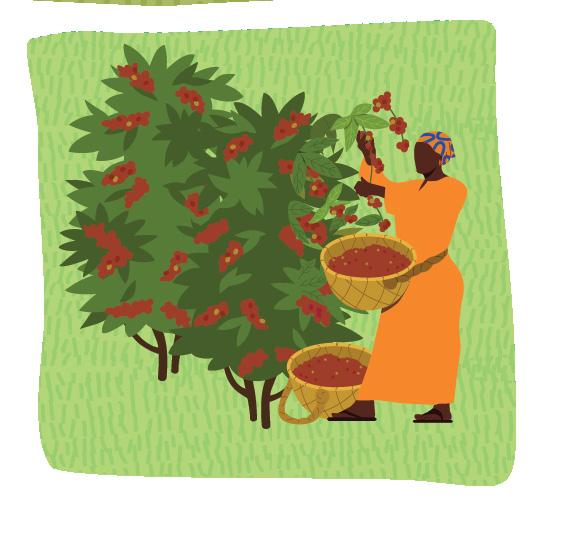
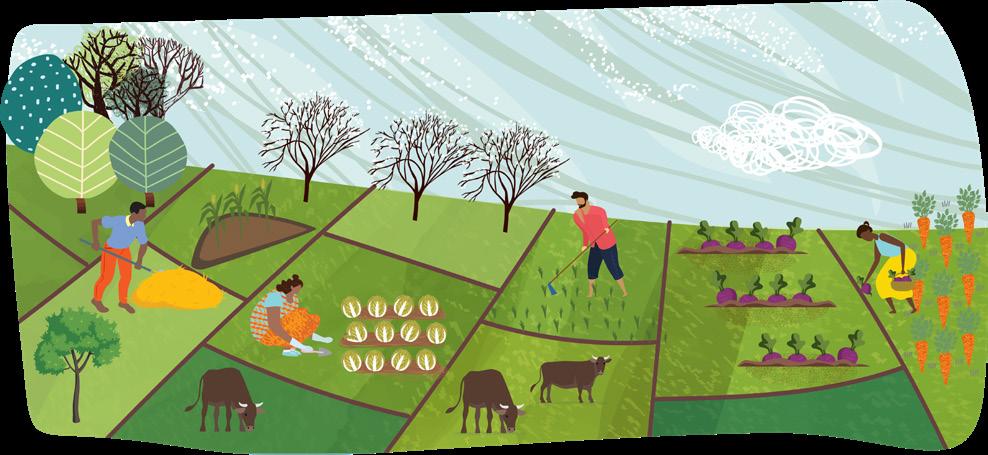
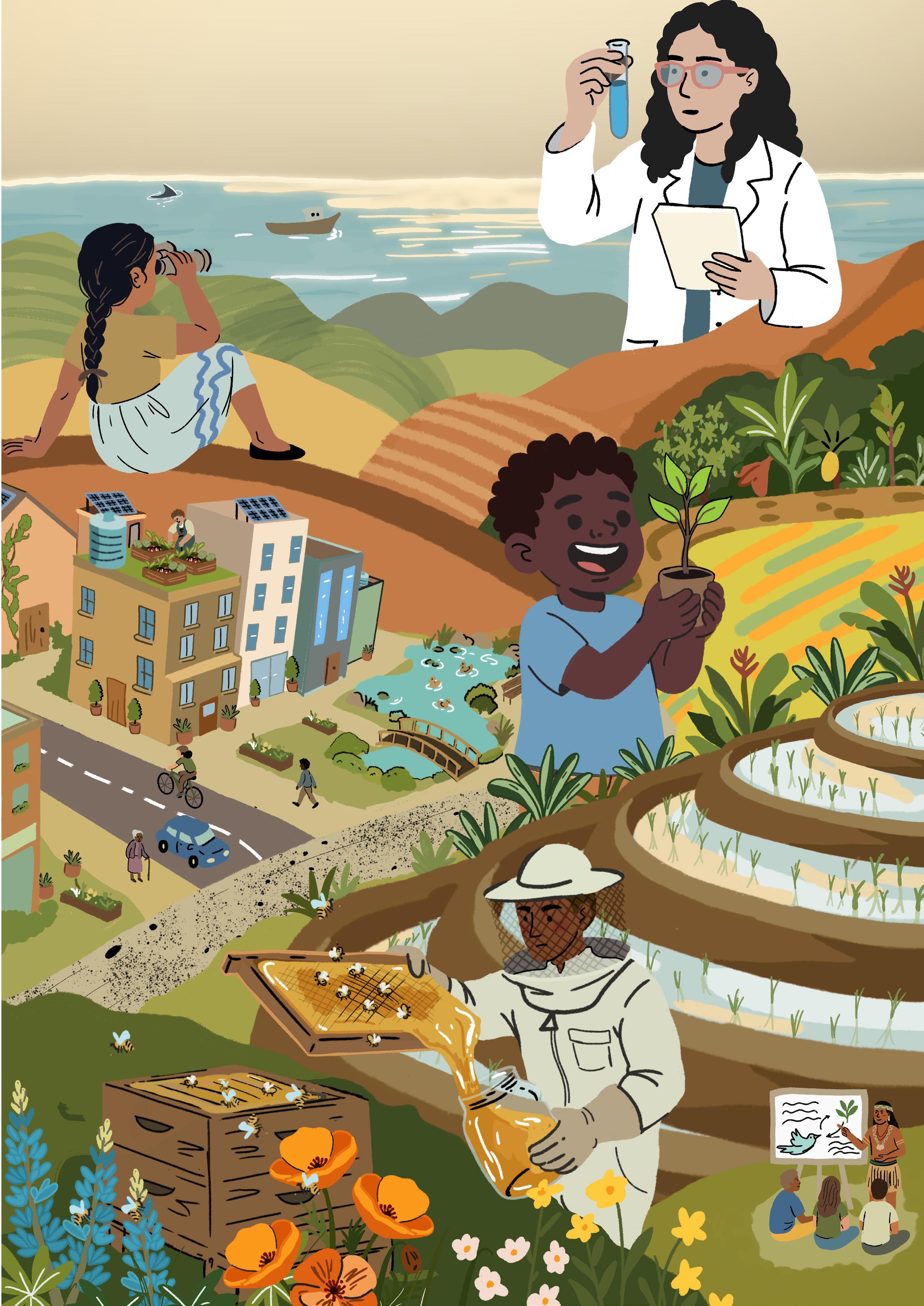
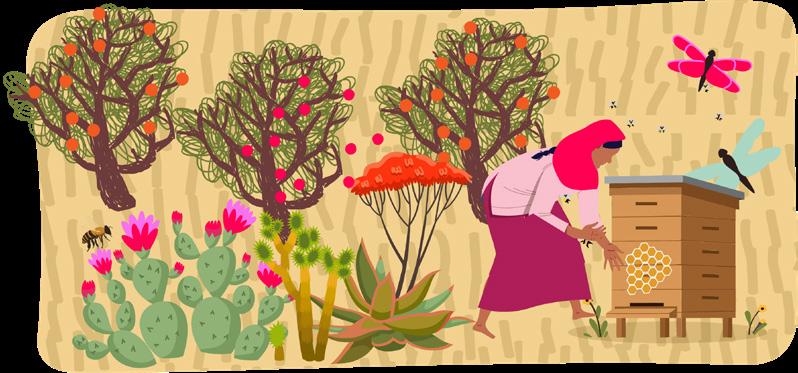
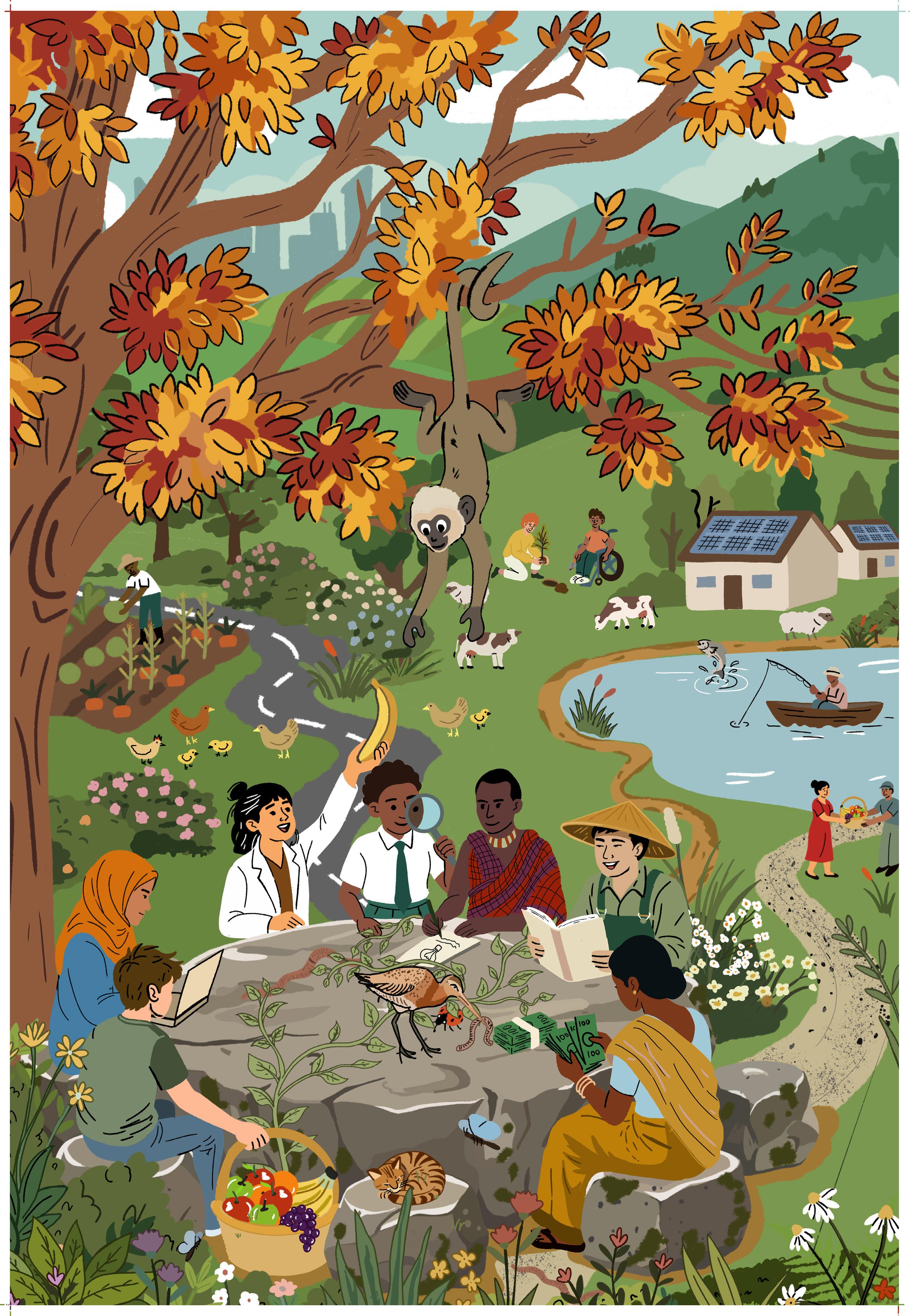
The Design and Art Team Design & layout is done by KANDS Collective. The Art illustrations for each shared message are made by artist Njung’e Wanjiru. This art work is the artist’s take of the shared messages, as an example of visualization. It is not a co-created visual.


Biodiversity loss and food system transformation are deeply interconnected, yet they are still too often addressed separately in both policy, research, and practice. At a time of accelerating ecological pressure, growing strains on food systems, and increasing calls for better coherence, there is a clear opportunity to move beyond fragmented narratives and articulate more integration between biodiversity and food systems.

This Brief is the result of an intentional communityowned co-development process called for by the Biodiversity and Food Systems Partnership convened by the Netherlands Food Partnership. It lays out a set of shared messages that articulate a common ground across sectors, actors and scales.
Each message is supported by examples of how momentum can be built by different actor groups and by ‘Stories of Progress’ from the community that depict existing experiences supporting the Shared Messages.
Together, they bring enhanced shared understanding and translate this into concrete entry points for practice, policy coherence, investment decisions, research agendas, business operations, and community leadership.
Members of the Partnership and beyond are invited to use and adapt these messages in ways that fit their own contexts - mobilising them as a joint policy advocacy tool, a framework tool to strengthen coherence and as an engagement tool that opens conversations and connections (see “how to use this brief”).
Endorsement is voluntary, allowing organisations to align with their own mandates and commitments, ensuring that shared ownership remains deliberate and credible.
Through synthesis of existing work, the mobilisation of a dedicated Working Group, and validation across the broader Partnership’s members, the Brief reflects diverse expertise and lived experience.
Both in the substance of the Messages and in how we hope this Brief will be used, the principle of ‘empowering pluralism’ is a cornerstone we wish to honour. The many stakeholders involved and concerned by the nexus of biodiversity and food systems all bring their unique perspective, way of viewing, knowing and valuing.
This Brief does not integrate these different perspectives into a compromise but hopes to weave them into a rich opportunity to learn from each other and to reveal a broader, fuller and deeper picture of the reality and of opportunities for change. That pluralism is essential to addressing today’s complex, interconnected and deeply contextual biodiversity and food systems challenges. No single knowledge system, discipline, or worldview can adequately respond to the intertwined crises of biodiversity loss, food insecurity, climate change, and social inequality.
Pluralism strengthens legitimacy and accountability, both for nature and people. Inclusive processes that respect multiple values and ways of knowing foster trust, social ownership, and long-term commitment—all critical conditions for transforming food systems towards sustaining biodiversity. Only a pluralistic approach can claim to address the thorny challenge of integrating biodiversity and food systems.

1
2
3 Changing mindsets Unlocking opportunities Altering the power web
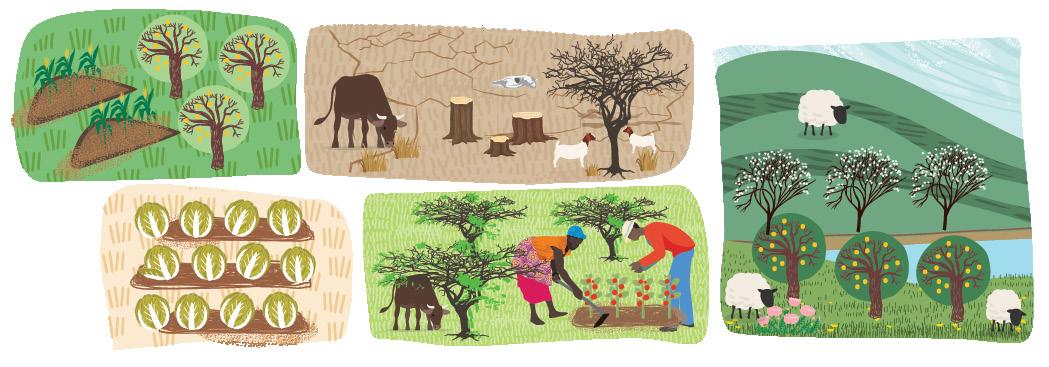
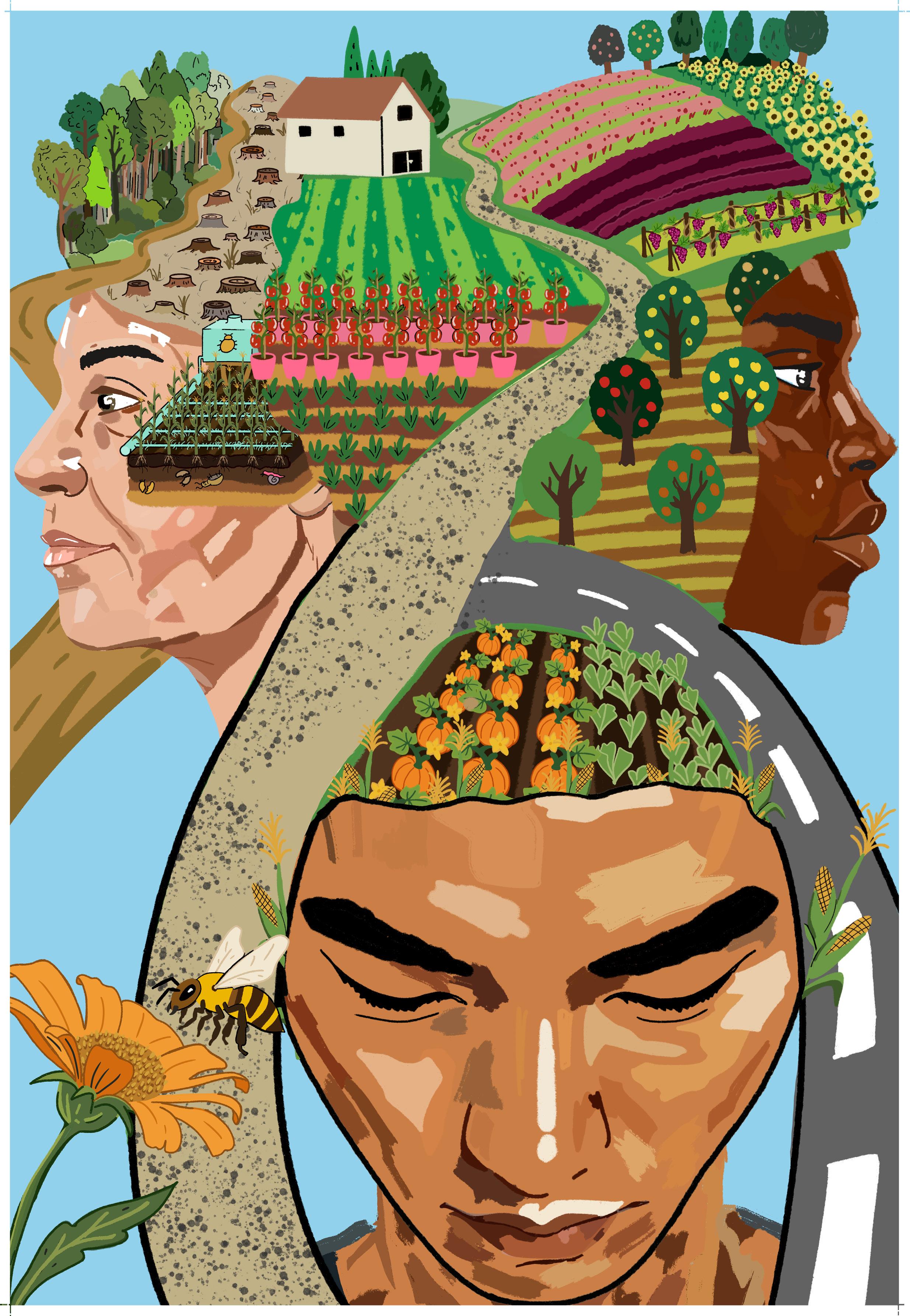
Biodiversity is the foundation of food security while, paradoxically, food systems are the primary driver of biodiversity loss. Let’s do away with the silos and see and address biodiversity and food systems together, as inseparable, in how we think, speak, organize, and act.
Current food systems are a primary driver of biodiversity loss, which they heavily depend on: pollinators, soil life, genetic diversity and wild foods (such as fruits, insects, fish) are critical for nutrition and resilience.
Yet these dependencies are largely overlooked, and ecosystems continue to be actively degraded by land use change, intensive agricultural practices (with high input, extractive and polluting agricultural models) and climate change, putting the future of our food- and eco-systems at risk.
Many of the food systems practices currently in place neglect integrating biodiversity as a key consideration. Efforts to integrate biodiversity remain timid and fragmented: in many high income countries, biodiversity is addressed through environmental mitigation strategies, disconnected from more profound food systems transformation.
Development assistance often prioritises food security over and as separate from biodiversity. In low and middle income countries, the issue of integrating biodiversity in food systems is competing with more immediate concerns, for example in places where healthy diets remain financially inaccessible. This often leads to siloed approaches where biodiversity features as a ‘nice to have’ rather than a fundamental entry point to food system solutions.
Before we can integrate biodiversity and food systems in practice, we need to shift our mindset to an understanding that they work as an integrated nexus. This means collectively rethinking the assumptions that underpin global food systems to address the triple burden of malnutrition, environmental degradation and inequalities in costs and benefits.
The numbers speak for themselves. Environmental costs of food systems are estimated at 3 trillion USD a year. Food systems are a main threat to 86% of species at risk of extinction. These global, intertwined, challenges require multiple pathways of change across different scales, with clear points of connection between biodiversity and food systems.
This necessary shift in mindset enables us to understand food systems as part of wider ecosystems, including nutrient loops and place-based conditions, climate risks and other vulnerabilities. Food systems should also be seen as part of socio economic systems and cultural identities that shape decisions around land use, rights, access and distribution and thus how biodiversity is managed, used or degraded. Recognising this full interconnectedness is essential to moving beyond siloed approaches and placing biodiversity at the heart of food systems transformation.

The following actors are listed in alphabetical order. They are identified as examples by the Working Group and do not represent an exhaustive list of all actors and options. They are intended to reflect the Working Group’s discussion and to inspire action.
Businesses: See biodiversity as part of the fundamental infrastructure for food systems, agricultural sectors and supply chains. This calls for a shift from treating biodiversity mainly as part of corporate responsibility towards embedding it in core operational strategies and Key Performance Indicators (KPIs). Biodiversity and food system performance need to be measured and managed together.
Farming communities: Put the question of biodiversity loss at the centre of rethinking food systems. Biodiversity can be perceived as a barrier to the dominant agricultural production model, but in the long run it is a key driver of resilient and sustainable food systems, offering balance and even restoration to nature.
Funders: Consider biodiversity as fundamental infrastructure for agri-food and related sectors; leverage biodiversity finance to support food systems transformation.
Multi-stakeholder collaboration opportunities: View the different actors already experimenting with biodiversity and food system transformation as valuable partners who can strengthen and complement your own efforts. New (unusual) collaborations can help address context specific food system challenges while contributing to local ecological and environmental conditions.
NGO’s: Strengthen collaboration across development silos. Together with partners and communities on the ground, identify and explicitly articulate the linkages between biodiversity and food systems. Food systems mapping and foresight tools can potentially support such efforts.
Policymakers: Prioritize and reposition biodiversity through cross-ministerial coordination, articulating synergies and trade-offs. Actively steer dialogue among policymakers and implementing partners. Shift from seeing biodiversity as just a ‘checkbox’ or add-on towards seeing it as part of the solution.
Researchers: Work across academic silos and identify opportunities for transdisciplinary collaboration. Articulate research questions and methods that help better understand biodiversity and food systems linkages, the barriers that persist, and pathways to overcome them. Governance, political economy and social power are particularly important lenses for food system transformation research. Capacity strengthening and learning curricula on systemic or transformative change can also play an important role.
Contact: Katie Minderhoud, Katie.Minderhoud@pbl.nl, Find out more here
Shifting mindsets to recognise the importance of biodiversity in food systems, and the impact of food systems on biodiversity, is critical and complex. It requires understanding their interlinkages to identify effective levers for systemic change. Narratives offer an important entry point to unpack dominant beliefs, implicit assumptions, and blind spots in systems analysis and theories of change. To explore this, we conducted a literature review and narrative analysis to make explicit how narratives shape problem analysis, solutions, and actor roles and responsibilities. We presented these findings in three dialogue sessions in the Netherlands with three actor groups: researchers in food and agriculture; policymakers in The Hague across agriculture, nature,
trade, and international cooperation; and civil society, private sector, and finance actors. In these sessions, we shared a selection of narratives and insights on their similarities and differences, highlighting how narratives steer our focus, analysis, and solutions, often in invisible ways, and encouraged participants to reflect on their own experience of working with them. The dialogues raised awareness about the power of narratives and the limited strategic positioning of biodiversity in research and policy on food system transformation. A next step is to apply this method in specific workplace contexts to strengthen reflexivity and accountability in research and policy practice, and to better leverage narratives for nature positive action.
Findings from literature review and reflections from dialogue sessions.
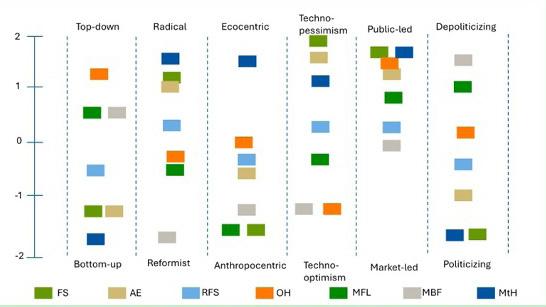
Figure 1. Overview of the selected narratives mapped on dialectic propositions. The selected narratives are Food Sovereignty (FS), Agroecology (AE), Regenerative Food Systems (RFS), One Health (OH), Multifunctional Landscapes (MFL), Market based Frameworks (MBF), More-than-Human (MtH).
This figure is based on the scoring of each article for dialectical proposition.
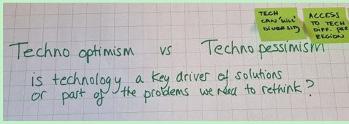
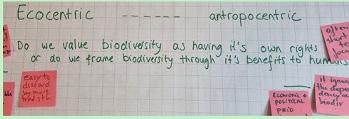
Reflections and discussion from dialogue sessions: Participants discussed the tensions around the extremes of each dialectical proposition and how they encounter this in their work environment.
Contact: Alwin Quispel, add-lvvn@minbuza.nl, Find out more here
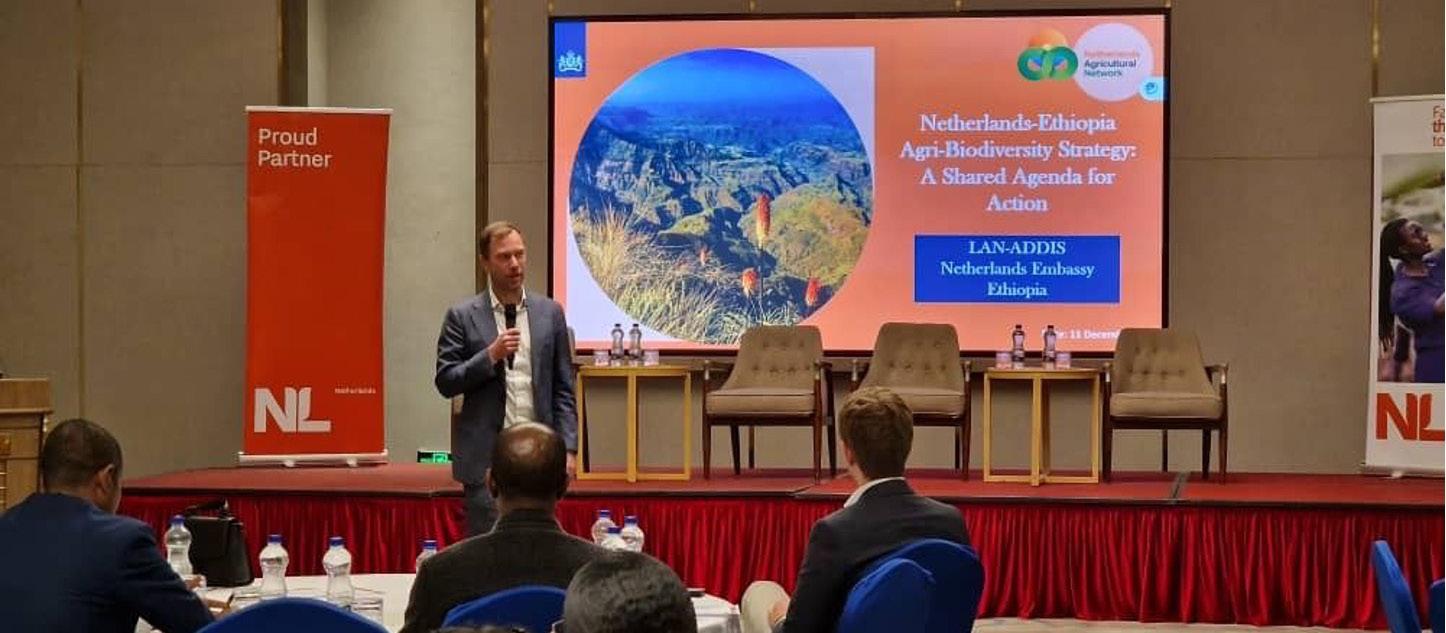
The launch of the Netherlands–Ethiopia agri-biodiversity strategy, developed by the Agricultural Department of the Netherlands Embassy in Ethiopia, signals more than a new framework; it reflects a shift in mindset. Rather than treating biodiversity and agriculture as competing priorities, the initiative shows how policy can integrate them as mutually reinforcing elements of resilient food systems. Introduced in December 2025, the strategy aims to strengthen joint action between both countries to advance biodiversity conservation, climate-resilient agriculture, and sustainable food systems through shared commitment and collaboration. This approach departs from traditional siloed thinking. By aligning Dutch-supported initiatives with Ethiopia’s national biodiversity, climate, and food systems priorities, it
Food for thought
y Defining Nature-Positive Food Systems: Background report,WUR 2024
y IPBES Nexus assessment, 2024
y IPBES Transformative change Assessment, 2024
y Delabre, I. et al. (2021).
y Why Supporting Food Systems and Protecting Biodiversity Need to Go Hand in Hand, IISD 2023
creates a unified foundation for action across sectors. Instead of addressing soil health, land restoration, or protected areas separately, it connects them through three pillars: sustainable agriculture, restoration of degraded land, and strengthened protected area systems. This design recognizes biodiversity as essential to productive agriculture, not an external constraint. Equally important is collaboration. Developed through expert consultations, stakeholder engagement, and partnerships, the strategy encourages collective ownership. By bringing government, private sector, research, and civil society together, it promotes shared responsibility for environmental and food security goals. Initial projects already highlight restoration and private sector linkages.
y The White/Wiphala Paper on Indigenous Peoples’food systems, 2021
y Shaping food security narratives (ClimateWorks Foundation)
y WWF Living Planet Report 2024
y Narrative Analysis of Biodiversity in Food SystemTransformation Literature, van Doorninck et al. 2025
y Food systems Economics Commission, 2024
The cost of inaction is enormous. At the same time, integrated and careful management can manage risks and unlock opportunities to strengthen food systems while restoring biodiversity.
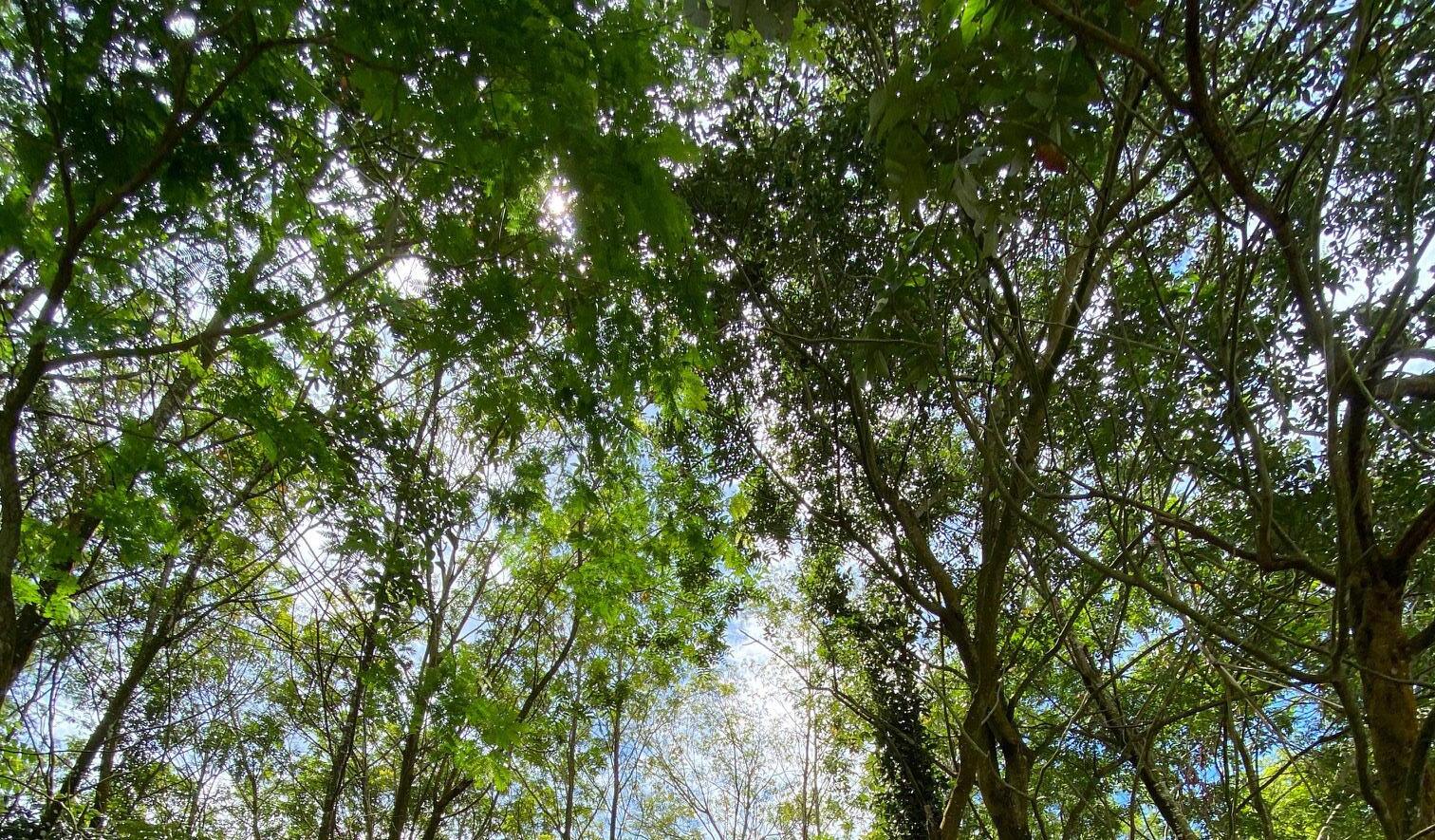
Biodiversity strengthens ecosystems and supports the connections people, particularly Indigenous people and local communities, have with their food, cultures and landscapes.
Integrating biodiversity at the heart of food system transformation offers opportunities on multiple fronts. Biodiversity strengthens ecosystems and supports the connections people, particularly Indigenous people and local communities, have with their food, cultures and landscapes. Over time, this integration can also improve agricultural productivity, enhance ecosystem services, and contribute to food and nutrition security and resilience.
At the same time, food system transformation must be managed with care. Not everyone benefits immediately or equally, some people could face critical loss of livelihoods, and timelines for change do not always align. Acting on biodiversity-food system
linkages therefore requires transition policies that support this change process and balance costs and benefits during transition.
Across farms, landscapes, and governance levels from local to global, the ability to integrate biodiversity into food systems depends on the agency, mandates and capacities of actors to enable change. Careful monitoring and management of the transition, by all actors leading such change processes, especially in redirecting financial flows and changing business models, are needed to address potential tradeoffs and support those who may be particularly vulnerable to any negative consequences of such transformations.
The following actors are listed in alphabetical order. They are identified as examples by the Working Group and do not represent an exhaustive list of all actors and options. They are intended to reflect the Working Group’s discussion and to inspire action.
Businesses: Accelerate biodiversity–food system integration by using their influence across supply chains, sourcing practices and investments to support food systems that protect and restore biodiversity while strengthening food system resilience to the benefit of the long term sustainability of their own business practices.
Farmers and food producers: Strengthen and share production practices that support biodiversity and ecosystem services while maintaining viable livelihoods. By organising collectively and engaging with value chain actors and policymakers, producers can help shape food systems that reward biodiversityfriendly production.
Funders/financial sector: Recognize biodiversity as a foundational asset for food systems and by directing finance towards investments that support this transition. Considering the costs of inaction, long-term risks and returns, and including mitigation measures in investment analysis can help unlock funding for more resilient food systems.
Humanitarian actors: Integrate biodiversity into humanitarian responses to strengthen short term resilience while supporting longer term recovery in contexts of crisis and vulnerability, where communities are often also highly exposed to biodiversity loss.
Indigenous people and local (farming) communities: Contribute to careful transition management by leading dialogue and initiatives that build on local knowledge, stewardship and governance practices to integrate biodiversity and food systems in ways that reflect local priorities and landscapes.
Multi-stakeholder collaboration opportunities: Create spaces for co-creation around shared visions for food system transformation, helping actors anticipate climate risks and integrate biodiversity into food production and governance. By aligning stakeholders across farms, landscapes and governance levels, partnerships can support transition strategies, manage trade-offs and strengthen collective action for ecosystem restoration and resilient food systems.
Policymakers: Enable biodiversity–food system integration by aligning food, nutrition and biodiversity policies and creating incentives that support transition pathways to be shaped and acted upon. In such pathways, the anticipation of short-term trade-offs while pursuing long-term benefits is essential. Policy coherence across sectors and governance levels, supported by monitoring systems, can help translate integration into practice.
Researchers: Advance biodiversity–food system integration by generating evidence, developing transdisciplinary research and applying foresight tools that deepen understanding of the linkages, trade-offs and opportunities within this nexus.
Youth: Strengthen current efforts by bringing innovation, leadership and intergenerational perspectives that consider long-term sustainability, the needs of future generations and the needs of nature.
NOURISH project | Contact: Corien Herweijer, ZOA Netherlands, c.herweijer@zoa.ngo | Find out more here
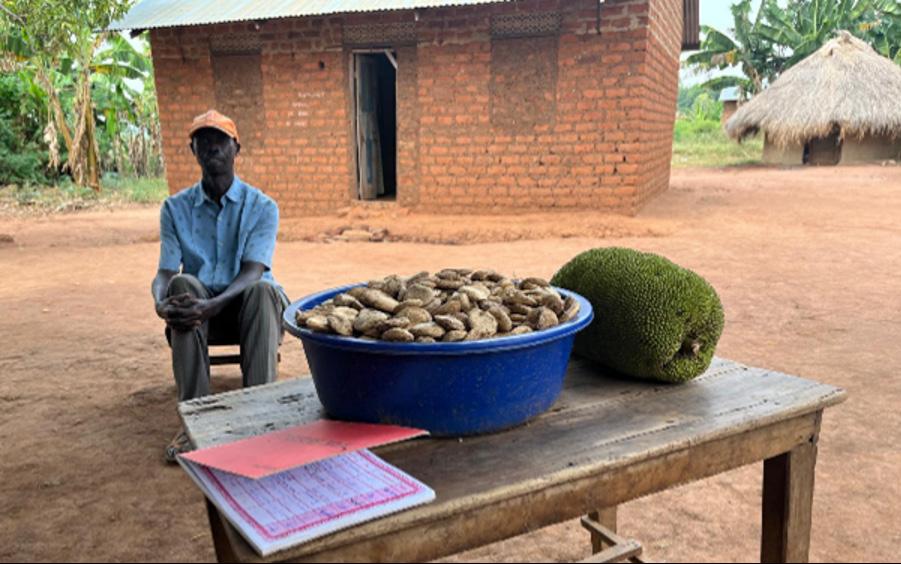
The NOURISH project, implemented by ZOA in partnership with FiberFoods, demonstrates how biodiversity positive approaches can strengthen food security and livelihoods in fragile, refugee hosting contexts. Implemented in Northern Uganda—home to one of the largest refugee populations in Africa—the project responds to widespread environmental degradation, climate variability, and declining agricultural productivity driven by unsustainable farming practices and increased population pressure.
NOURISH focuses on scaling the Oysternut (Tetracarpidium conophorum) value chain as a nature based solution that links biodiversity conservation with food system strengthening. Oysternut is an indigenous, climate resilient vine that grows on existing trees, encouraging tree preservation and maintenance while reducing pressure on degraded land around refugee settlements. The crop
thrives with minimal external inputs, supporting soil health, pollinators, and ecosystem balance.
Traditionally used as an emergency food source, Oysternut is nutrient dense and contributes directly to improved dietary diversity for refugee and host communities. Through a private sector partnership, NOURISH connects smallholder producers—particularly women—to emerging local and international markets for Oysternut oil, diversifying incomes and strengthening market access.
By integrating indigenous crops into mixed farming systems, NOURISH illustrates how promoting biodiversity provides an opportunity to enhance climate resilience, reduce reliance on single crops, and build inclusive food systems that support both immediate needs and longterm sustainability in crisis affected settings.
Rural Agroecology Network | Contact: Ogwang Robert Rapsy, ogwang.robert.rapsy@gmail.com | Find out more here & here
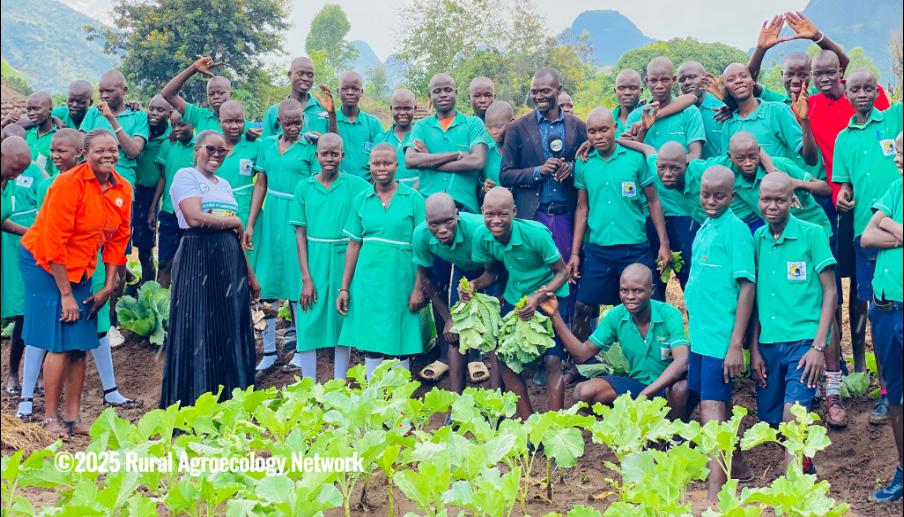
The Rural Schools’ Agroecology Programme champions the integration of agroecology into school systems. It contributes to the gap in formal biodiversity knowledge uptake in Uganda’s education curriculum, placing biodiversity conservation in the hands of youth while making it a living, practical experience. The Agroecology learning hubs are set in rural schools across Northern Uganda. They intentionally build a foundation for longterm biodiversity conservation through education, practice, and community engagement. These hubs act as microecosystems where school-going children learn about soil regeneration, crop diversity, and sustainable land use, while also influencing their households and communities
biodiversity initiatives. So far, five school-community agroecology learning hubs have been established serving as centres for demonstration, training and research. Learners are actively championing biodiversity-friendly practices. These include cultivating diverse crops, restoring soil health, and promoting indigenous species. Over 2,000 farmers per hub are engaged, learning regenerative techniques that enhance productivity while protecting ecosystems. This integrated approach is already yielding a triple win: improved nutrition and learning outcomes for children, increased resilience and livelihoods for farmers, and strengthened biodiversity for the environment.
y IPBES Nexus assessment, 2024
y IPBES transformative change assessment, 2024
y Global Landscapes Forum
y UNFSS Indigenous peoples session 2025
y Food systems countdown initiative 2024 & 2025
y EAT-Lancet v2.0 2025
y WWF Living Planet Report 2024
y Africa’s ecological food future 2023
y NFP Food and Biodiversity in Action 2025
y Mairon G. Bastos Lima, 2024.
y IPBES Business and Biodiversity Assessment, 2026
y Crenna, E. et al, 2020
Concentrated power and wealth are underlying causes of both biodiversity loss and food insecurity. Realising the benefits of addressing the food-biodiversity nexus requires challenging the structures that concentrate benefits and limit change. This calls for actors across sectors and scales to connect and work beyond their comfort zones to reshape systems so that resilience, equity, and sustainability can emerge for people and the planet.
A small number of actors control a large share of global food systems and therefore have significant responsibility and leverage in shaping both food systems and biodiversity outcomes. For example, the top 4 companies in the seed & pesticide market control 56% of the global commercial seeds market, and 61% of the pesticides market (OHCHR, 2025). In many parts of the Global South, large companies promote more mechanised approaches and fertiliser intensive practices, often marginalising local knowledge, farmers and communities in the process. Political commitment to address the biodiversity-food systems nexus and give rise to alternative more sustainable agricultural practices is essential for ensuring long-term landscape resilience as well as generating benefits for marginalized communities.
Youth, women, indigenous peoples and local communities have much to contribute to this nexus, alongside other stakeholders such as governments, businesses, NGOs and research institutions.
Everyone’s expertise, legitimacy and voice should be acknowledged and integrated within existing and new collaborations that strive for synergies, rather than creating additional layers of coordination and meetings that may not lead to meaningful action or change in practice. Youth, women, indigenous peoples and local communities have much to contribute to this nexus, alongside other stakeholders such as governments, businesses, NGOs and research institutions.
The following actors are listed in alphabetical order. They are identified as examples by the Working Group and do not represent an exhaustive list of all actors and options. They are intended to reflect the Working Group’s discussion and to inspire action.
Businesses: Support brave CEOs, public officials and entrepreneurs who dare to step up against the power of shareholders and corporate investors. Reflect on how current business models and incentives shape food system outcomes, and consider shifts that better account for biodiversity and longterm (business) resilience. Engaging with policymakers and societal actors can help strengthen accountability and support more sustainable supply chains.
Consumer organisations and NGOs: Empower consumers to make informed decisions by sharing knowledge and understanding of the risks and realities of power concentration and on the potential benefits of supporting the preservation of biodiverse food systems. Trial new ways of connecting farmers to consumers, building a sense of community and collective agency to both act at local level and advocate for national and international policy change. Leverage Behaviour Change Communication (BCC) as a tool to challenge entrenched community views and practices.
Funders: Mobilize financial instruments, including microfinance, to strengthen the agency of smallholder farmers and local communities, enabling them to invest in biodiverse food systems and participate more equitably in food system transformation.
Indigenous peoples and local communities: Share Indigenous, local and traditional knowledge and stewardship practices that already sustain biodiversity and food systems. By asserting their role in decision-making and collaborations, these communities can help ensure food system transformations, build on locally rooted solutions and respect community priorities, rights and knowledge systems.
Multi-stakeholder collaboration opportunities: Open up spaces to learn about and address concentration of power in food systems while promoting more biodiverse and equitable food systems. By bringing together diverse actors, they can amplify underrepresented voices and help connect them to decision-making processes. Joint value chain analyses can further help identify where power is concentrated, how different communities are affected, and where bottlenecks or opportunities for change exist.
Policymakers: Enable stronger biodiverse (local) production systems through public funding, market incentives and instruments such as public procurement and quality labels. Address structural barriers by promoting fairer distribution of power in food systems and by ensuring women and youth are represented in decision-making processes. Education systems can also play a role by strengthening understanding of the biodiversity food system nexus.
Researchers: Engage more actively in public discourse and knowledge communication to highlight evidence on the biodiversity food system nexus and the challenges around as well as opportunities for more distributed and equitable power within food systems.
Retailers and food companies: Use purchasing power and supply chain standards to support production systems that protect biodiversity and strengthen resilient food systems. Transparent sourcing practices and fairer value distribution can help rebalance power along food chains.


Aguapan | Contact: Stef de Haan, CIP, s.dehaan@cgiar.org
| Find
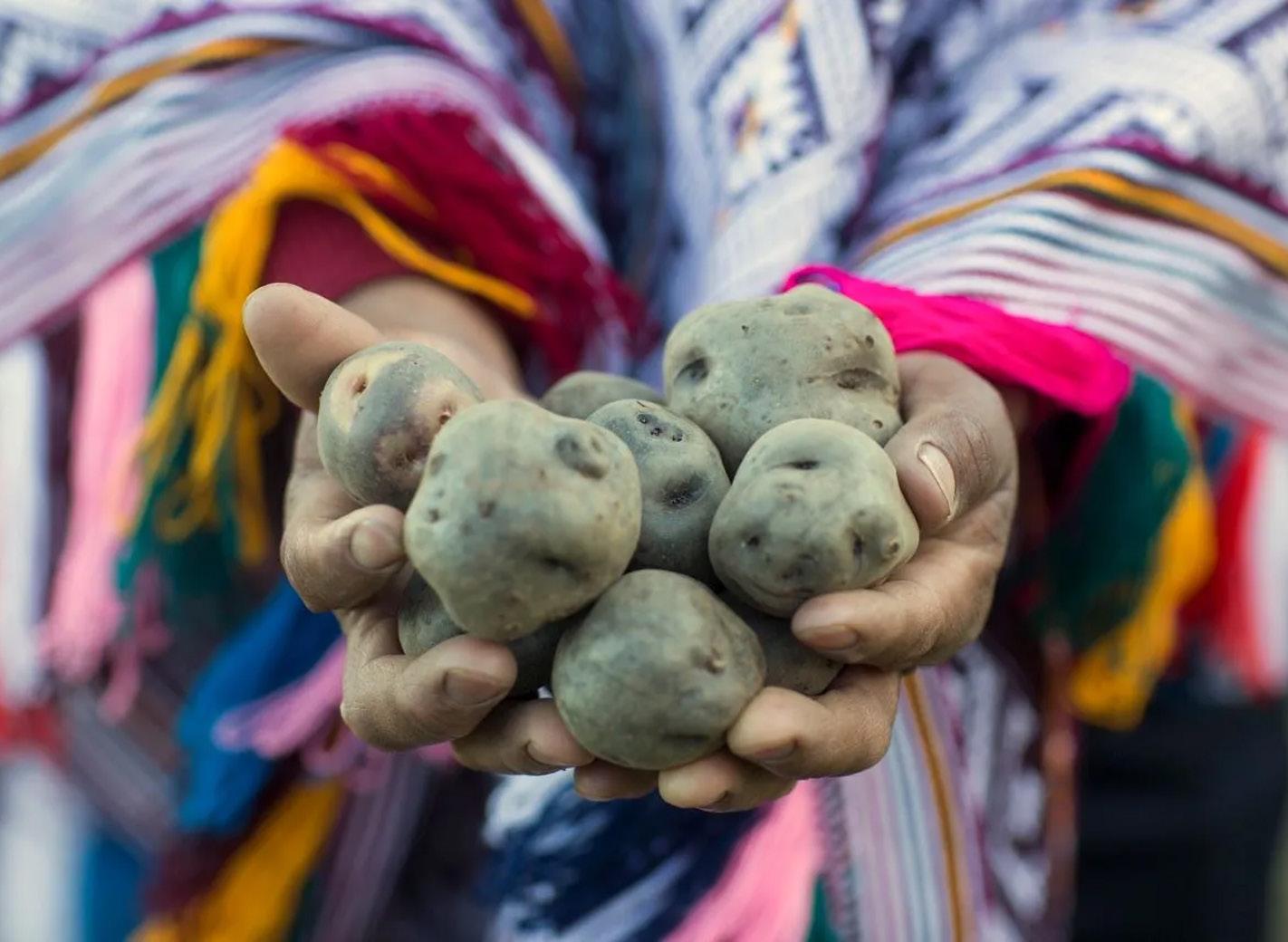
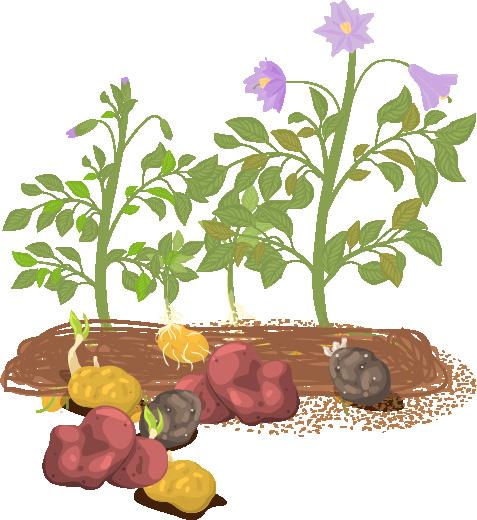
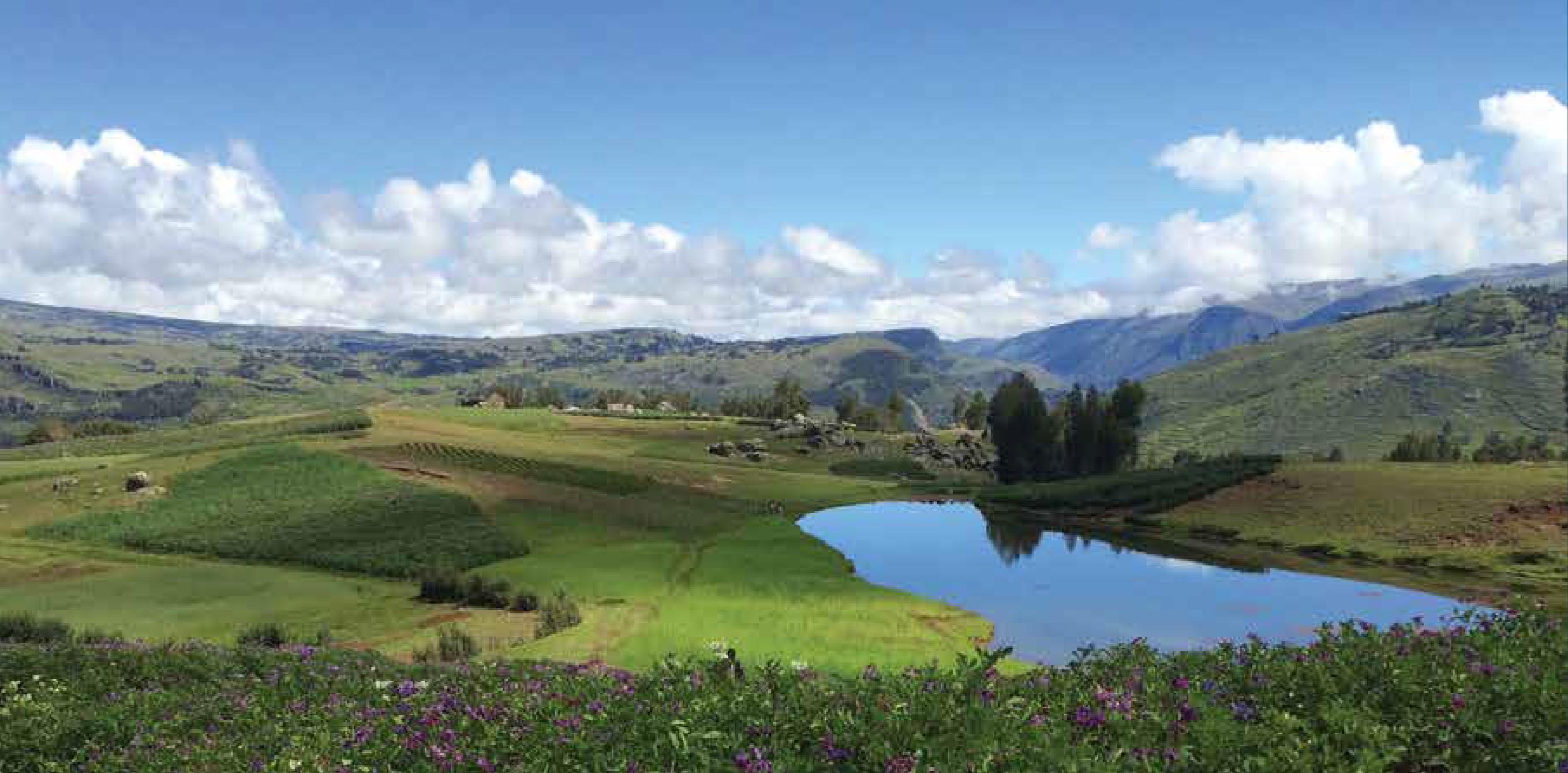
In Peru, indigenous farming communities have long conserved native potato diversity, yet the economic benefits of this biodiversity often flowed elsewhere. Through AGUAPAN’s direct benefit-sharing model, power is rebalanced by recognising communities not as passive beneficiaries, but as rightful custodians, decision-makers and innovators.
By creating unconditional annual payments linked to Dutch potato companies, the initiative decouples access from extraction: companies can support conservation without owning seeds or controlling the genetic resources held by communities. This shifts incentives away from concentration and toward reciprocity, trust and stewardship.
There have been several highlights that illustrated this shift in power dynamics, including the opening address of a young indigenous leader at the Governing Body meeting of the ITPGRFA, investment in youth and women leadership, and changes in processes like the Peruvian legislation concerning farmer seed and landraces
AGUAPAN demonstrates that addressing biodiversity loss and food insecurity requires more than technical solutions—it requires changing who holds value, voice and control. By connecting farmers, companies, researchers and institutions in a fairer system, and by investing in local leadership capacity - the initiative helps build resilience, equity and sustainability from the ground up.
Contact: Fabricio Muriana, Instituto Regenera, fabricio@institutoregenera.org.br
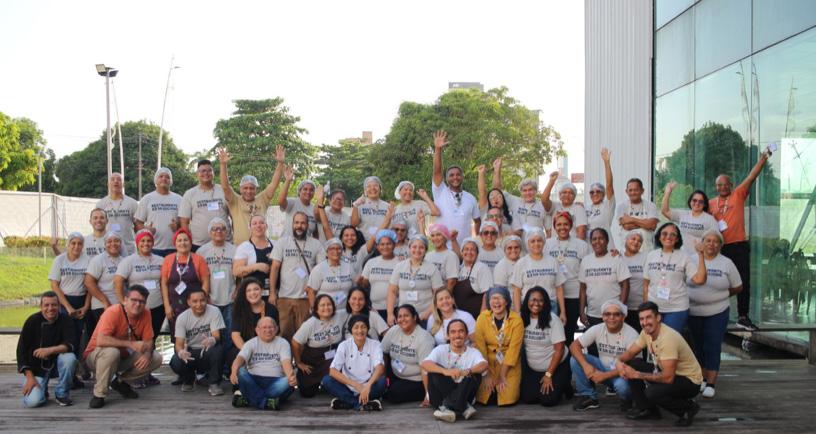
The “Na Mesa da COP30” initiative brought civil society together to place food systems at the center of the climate agenda during COP30 in Belém (2025), using food procurement as a tool for environmental and social transformation.
A key focus was the valorization of Brazil’s sociobiodiversity—ingredients from diverse ecosystems and traditional practices, such as Amazonian fruits, nuts, oils, and fish. By integrating these into menus, the initiative supported biodiversity conservation, strengthened local economies, and promoted sustainable diets. Two experiences stand out: The SocioBio Restaurant demonstrated scale and feasibility, serving about 87,500 meals with roughly 70% of ingredients
sourced from agroecological production and 37 family farming organizations. It showed that large-scale catering can align with sustainability, affordability, and territorial sourcing. Delícias Quilombolas emphasized the cultural dimension of biodiversity. Rooted in Quilombola communities, it brought traditional foods and knowledge to the conference, highlighting the role of ancestral practices in conserving ecosystems and building climate resilience. Together, these experiences show that biodiversity-based food systems are viable and strategic, contributing to climate action, food security, and the inclusion of traditional communities.
Food for thought
y Mommer et al. 2025
y Blesh, J. et al. (2023).
y IPBES Transformative change Assessment 2024
y Delabre, I. et al. (2021).
y Why Supporting Food Systems and Protecting Biodiversity Need to Go Hand in Hand, IISD 2023
y The White/Wiphala Paper on Indigenous Peoples’food systems, 2021
These shared messages are designed as a flexible resource that can be adopted and adapted across contexts while maintaining a coherent collective direction. Their value lies not only in what they say, but in how they are actively used to inspire active use, adaptation, and collective ownership. Below are some practical ways in which the messages in this brief can be used:
At sub national, national and global levels, the shared messages can inform development plans, shape policy discussions and guide agenda setting, while connecting local realities with global targets and elevating local voices within global conversations. The messages can be tailored to different policy contexts, for example to influence national food systems pathways and shape city food strategies. In global contexts, they can also connect to specific frameworks, for example by making explicit how the IPBES transformative change areas align with these messages.
The shared messages can be used as a conversation starter. They are particularly effective when adapted to specific local contexts to help shift mindsets and set common goals, for example in areas such as agroforestry. They can guide community engagement strategies and be applied in settings ranging from villages to corporate workshops. They can also enable alliance-building across diverse actors, for example between local NGO and local policymakers or a conservation focussed organisation with a value chain actor in the food system.
The messages can be integrated into organisational strategies to strengthen coherence and alignment in approaches to biodiversity and food systems transformation. They can also inform organisations’ communication strategies to guide how messages are articulated across different audiences and contexts.










A useful resource to start these conversations is this toolkit on championing biodiversity and food systems linkages and sparking conversations with your colleagues and partners.
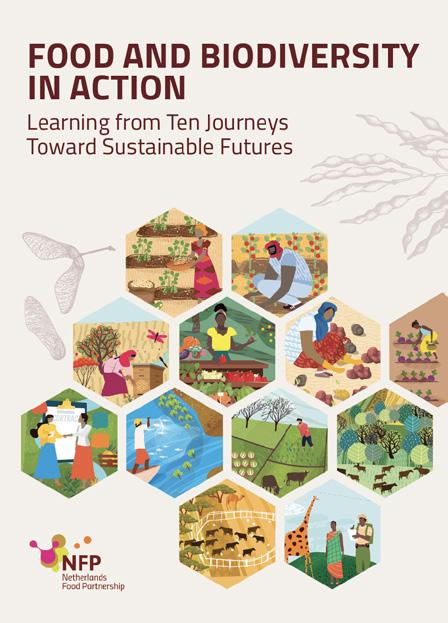
Also part of the series: Learning from Ten Journeys Toward Sustainable Futures
We welcome you to join this collective effort. By joining this effort, you help strengthen the collective voice behind the messages and contribute to building broader momentum for action.
y Opt in and show your support for the shared messages through this online sign-up, which also shows other organizations and individuals who have already opted in.
y Contribute your short “Story of Progress”, on this page, that illustrates a real-world example of how the shared messages are being applied in your context, organization, or work environment. These examples can help demonstrate practical relevance, showcase emerging action or collaboration, and bring the shared messages to life through concrete experiences and results.
y Join the NFP Biodiversity & Food Systems Partnership. More information about the partnership, our shared agenda, and how to register as a member can be found on our community page.

Scan the QR code or click here
Welcome and thank you from:
The Biodiversity and Food Systems Partnership