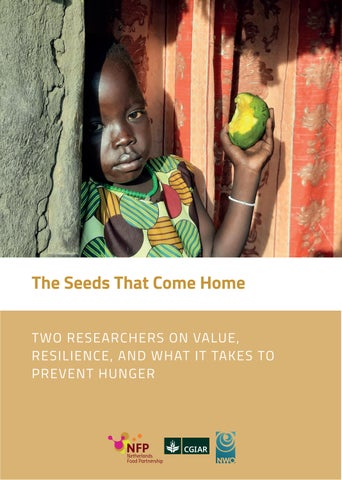
The Seeds That Come Home TWO RESEARCHERS ON VALUE, RESILIENCE, AND WHAT IT TAKES TO PREVENT HUNGER
The Seeds That Come Home TWO RESEARCHERS ON VALUE, RESILIENCE, AND WHAT IT TAKES TO PREVENT HUNGER
When families flee across the border in South Sudan, they carry seed with them. Not money, if they have any. Seeds carried among their meagre personal belongings, so that if they ever return, there is something to plant. Gerrit-Jan van Uffelen heard this from the field team he works with on the very morning of our conversation. “They try to bring seed from their home areas and maintain it while in displacement, so they can take it back with them when they return,” he says. It captures something he and his research partners try to understand better: people displaced by war often place value on things that assistance providers may overlook, even though these things matter greatly for how people live, feel and try to cope.
TEXT Jasmijn Snoijink PHOTOGRAPHY Gerrit-Jan van Uffelen Sandra Ruckstuhl © 2026 NFP - NL-CGIAR https://nlfoodpartnership.com
Gerrit-Jan van Uffelen, Senior Advisor Food Sys-
keep them functioning. Even in times of crisis,
tems Resilience & Protracted Crises at Wageningen
food sys-tems are more resilient than we often
Social & Economic Research (WSER), and Sandra
recognise.” What is missing, in his view, is a proper
Ruckstuhl, who leads the International Water
under-standing of that resilience — used as the
Management Institute (IWMI)’s research group on
starting point for engagement, in crisis and in
Fragility, Conflict, Livelihoods and Water, study how
recovery alike.
food systems survive in some of the world’s most
Gerrit-Jan arrived at this conviction through three
fragile and conflict-affected settings. Their collab-
decades of fieldwork. After graduating from Wa-
oration, brought together through the NWO NL–
geningen University & Research (WUR) in 1991,
CGIAR Senior Expert Programme, focuses on the
he joined ZOA Refugee Care in Cambodia, working
Horn of Africa, particularly Sudan and South Sudan,
with local communities in areas contested by the
and sits at the intersection of two fields not often
Khmer Rouge and government forces. From there
found in the same room: food systems resilience
his career took him to Sri Lanka, Afghanistan, and
and water security in conflict.
later to Africa, with extended periods in Ethiopia
Gerrit-Jan’s starting point is a provocation: “The
and South Sudan, first with various NGOs, then
way we provide humanitarian assistance comes from an understanding that these people are hope-
“There are local food systems, and there are people and institutions that keep them functioning. Even in times of crisis, food systems are more resilient than we often recognise.”
less, helpless, and we need to provide aid to save lives,” he says. Humanitarian assistance is essential and can be life-saving, he stresses. “But there’s another reality behind this. There are local food systems, and there are people and institutions that
3
NFP - NL-CGIAR
with WUR. He is now Senior Advisor on Food Systems Resilience at WSER, and alongside this work completed a PhD on the management of forced migration. Sandra describes her path as a winding one, though a consistent set of questions runs through it. As an undergraduate, she studied the dissolution of the Soviet Union and how political change reshaped governance and natural resource management — issues she felt were largely overlooked in analyses of transition economies. A first visit to Palestine during the early implementation of the Oslo Accords brought those questions into sharper focus. She went on to the World Bank’s water sector, completing a PhD in conflict studies on water and post-conflict redevelopment and playing a central role in shaping a 2009 study of restrictions on Palestinian water sector development that helped guide donor investment across the sector. Work with the US government and UN
The two did not know each other before the pro-
agencies broadened that perspective, exposing
gramme brought them together. For Gerrit-Jan,
her to the ways conflict and fragility shape wa-
the match was a natural one: he had been building
ter security across very different settings. When
partnerships in the Horn of Africa for years, and the
she joined IWMI about six years ago, she saw an
programme offered a way to connect that existing
opportunity to bring those dynamics more explicitly
work directly to CGIAR’s growing ambition in pro-
into the institute’s research agenda. For Sandra,
tracted food crises. For Sandra, Gerrit-Jan brings
the connection was fundamental: understanding
something that is hard to generate institution-
water systems increasingly meant understanding
ally: field experience accumulated over decades.
how they function under conditions of conflict and
“Not what we learned in a textbook or a lecture
fragility. I saw a clear need to bring conflict more
hall, but the experience in the field. That’s where
explicitly into IWMI’s water research portfolio,” she
the richness really lies,” she says. For Gerrit-Jan,
says. She now leads IWMI’s research group on
CGIAR’s scale and its smart partnerships strategy
Fragility, Conflict, Livelihoods and Water,
opens up possibilities WUR could not reach alone:
and serves as Co-Lead of CGIAR’s Area of Work on
joint publications, a joint workshop with the African
Fragile and Conflict-Affected Food Systems within
Union on scaling approaches in fragile settings, and
the Food Frontiers and Security Science Program.
a September scaling event that could bring together the Global Network Against Food Crises, government representatives and local universities around
“Not what we learned in a textbook or a lecture hall, but the experience in the field. That’s where the richness really lies.” NFP - NL-CGIAR
a shared strategy. One strand of current work stood out in the conversation. Gerrit-Jan, together with CGIAR’s
4
Women give seeds free of charge, because they are interested in maintaining relationships, and are happy to share what they have.
networks that keep communities fed when formal systems fail. For the past few years Gerrit-Jan has not been able to travel to Sudan much himself, because of the
Alliance of Bioversity International and CIAT and
war that began in April 2023. He remains closely
local partners, with Dutch government fund-
in touch remotely with partners and field teams
ing through FNS-REPRO and various NUFFIC
there. Sandra adds that Sudan’s crisis is not one
programmes, has been studying seed systems in
situation but many: the nature and geography of
fragile and conflict-affected settings. “In coun-
the violence, environmental risk, and disruptions
tries like Sudan and South Sudan, 80 percent of all
to food markets and supply chains vary sharply
seeds sourced by farmers is done so through farm-
across regions. “I don’t think that the diversity of
er-managed seed systems,” he says. “Do we realise
issues in Sudan is very well understood,” she says,
this, and what does it mean for our engagement to
noting that any shift from humanitarian to devel-
strengthen these systems?”
opment spending will need to be managed very
Earlier that morning, the field team had reported
carefully.
something else: seed distributed through the pri-
That complexity also shapes how early warning in-
vate sector, hybrid varieties, had begun to “pollute”
formation reaches the people who need it. Sandra
the local land races that communities had devel-
takes the coming El Niño as an example. The most
oped over generations. “The elders noticed the
efficient way to get forecasting information where
difference and realised the danger,” Gerrit-Jan says.
it needs to go, she argues, is to start with humani-
“They said: we should really maintain the purity of
tarian partners who are trusted sources of infor-
our land races. This is where they see a very important role for their local community seed banks.
“If you just say this much rain is going to fall, I might not know how to use that information. How that is packaged matters.”
It’s a very simple example, but with far-reaching consequences.” This connects, for Gerrit-Jan, to a broader point about how value gets defined. He gives the example of women’s social seed networks, in which women share seed within and across communities. “They say: we give the seeds free of charge, because we are interested to maintain the relationship, and we are happy to share what we have.” Designed without this in mind, seed-strengthening programmes risk missing an important mechanism through which women build trust and strengthen social cohesion. Sandra agrees this reflects a broader pattern. Well-intentioned interventions, both argue, are rarely neutral: designed without an understanding of how value actually works in these settings, they can actively undermine the mechanisms that already exist — disrupting the very
SANDRA RUCKSTUHL 5
NFP - NL-CGIAR
mation. Under IWMI’s research group, they work
ian-Development-Peace Nexus Coalition, which
closely with these partners, including the World
ceased to exist at the end of 2025. Its legacy has
Food Programme. She describes the need for
yet to be embedded institutionally in how we
impact-based forecasting: not just how much rain
understand and respond to protracted food crises,
will fall, but what impact it could have and how to
including through a food-systems perspective.
act on it. “If you just say this much rain is going to
Sandra sees a second route: connecting the food
fall, I might not know how to use that information
crisis agenda more visibly to the global climate
unless I get more specificity. How that is packaged
discourse, where finance and political attention
matters.”
currently carry more momentum. Gerrit-Jan agrees:
Both see that the international agenda on pro-
conflict displacement, weather extremes and mar-
tracted food crises is not receiving the attention
ket failures are, together, the three components
it deserves. Such crises are fundamentally differ-
that drive most protracted food crises.
ent from more stable development contexts and require different ways of working and sustained engagement. As an illustration, Gerrit-Jan points to the Fighting Food Crises along the Humanitar-
“The strongest approach is to build knowledge together, recognizing and drawing on the insight, foresight and capacity that already exist locally.”
NFP - NL-CGIAR
6
“When you live through a crisis or war as a member of that community, you come to understand the strength that takes. Our role is to work alongside that — with humility.”
“If we fail to show that this can be done in practical ways that support local communities, then the food systems agenda is yet another high-flying idea. We need to demonstrate that it can work.” Asked what has stayed with them personally, both return to what they have seen. Gerrit-Jan speaks
That need for sustained, connected engagement
about having witnessed “the massive pain of fam-
is something Sandra recognises too. For her, the
ine,” watching people lose hope for their own lives
underlying value of international collaboration is
and the lives of their children. “That’s such a deep
that ideas developed in one context can be tested,
emotional experience, it motivates me, having been
refined and adapted elsewhere. For Gerrit-Jan,
born in a very rich country, that whatever is in my
it lies in the partnerships themselves: with local
ability to contribute, however small, matters.” He
universities, national agricultural research systems,
is candid about the tension he carries: “Sometimes
and in the kind of longer-term, Dutch-govern-
I think that we have become so rich, and so full of
ment-supported funding that allows for sustained
self-pity, that we no longer see the reality of those
engagement, rather than the short project cycles
people that go hungry, and actually die in large
that rarely match the timescale of protracted
numbers, in a country like Sudan.” What keeps him
crises.
going is his respect and admiration for the resil-ience
Asked what she hopes this collaboration will have
of people in these communities, and for the
changed in five to ten years, Sandra points to local
determination of his colleagues in local institutions to
capacity, which she wants “further promoted in
find solutions. “We should give them a greater voice
every way possible.” “The strongest approach is to
and the space and opportunity to help shape
build knowledge together, recognizing and drawing
solutions that last.”
on the insight, foresight and capacity that already
Sandra’s answer comes from the places she has lived
exist locally.” Gerrit-Jan frames the same ambition:
and worked — including Amman, relatively peaceful but close to profound instability. “When you live through a crisis or war as a member of that community, you see how life continues, sometimes in surprising ways. You come to understand the strength that takes — how people draw on one another each day to navigate the challenges.” That, for her, is the reminder at the heart of the work. “The starting point is the knowledge, capacity and strength that already exist. Our role is to work alongside that — with humility.” That resilience is, in the end, what both of them keep coming back to — not as a footnote to their work,
“Having been born in a very rich country, whatever is in my ability to contribute, however small, matters.”
GERRIT-JAN VAN UFFELEN
7
NFP - NL-CGIAR
but as its starting point. It is also the main ingredient of any solution that will actually work: local knowledge, local networks, local insight, the seed carried across a border and kept for the day someone can plant it again. Once emergency assistance has done what it can, they argue, this is exactly what needs to be restored and strengthened first, not last.
Local knowledge, local networks, local insight, the seed carried across a border, are what needs to be restored and strengthened first, not last.
ABOUT THIS SERIES Food security, climate resilience, sustainable food sys-
Research Portfolio, bringing Dutch knowledge to where it
tems, these are challenges that no single country or insti-
is needed most, and bringing global insights back to the
tution can address alone. That is the driving logic behind
Netherlands. The programme is designed to strengthen
the collaboration between the Netherlands and CGIAR,
international research collaboration and ensure that sci-
the world’s largest publicly funded network of agricultural
ence leads to real-world impact.
research centres, working across low- and middle-income
This article is part of a series of interviews highlight-
countries on the most pressing challenges in food and
ing these collaborations. The series is produced by the
agriculture.
Netherlands Food Partnership in partnership with the
Through the NWO funded Senior Expert Programme in
NL–CGIAR working group, which brings together NWO,
the NL-CGIAR research programme, experienced Dutch
the Dutch Ministry of Foreign Affairs, and the Ministry of
researchers contribute their expertise to The CGIAR
Agriculture, Fisheries, Food Security and Nature.