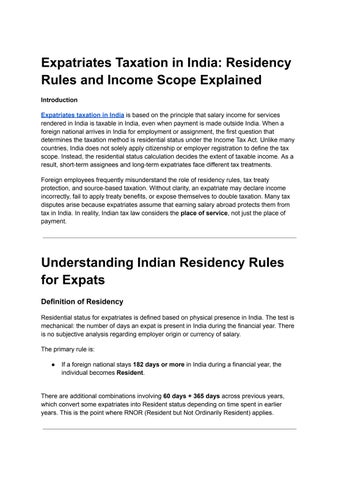
Expatriates Taxation in India_ Residency Rules and Income Scope Explained
Expatriates Taxation in India: Residency Rules and Income Scope Explained
Introduction
Expatriates taxation in India is based on the principle that salary income for services rendered in India is taxable in India, even when payment is made outside India When a foreign national arrives in India for employment or assignment, the first question that determines the taxation method is residential status under the Income Tax Act. Unlike many countries, India does not solely apply citizenship or employer registration to define the tax scope Instead, the residential status calculation decides the extent of taxable income As a result, short-term assignees and long-term expatriates face different tax treatments
Foreign employees frequently misunderstand the role of residency rules, tax treaty protection, and source-based taxation Without clarity, an expatriate may declare income incorrectly, fail to apply treaty benefits, or expose themselves to double taxation. Many tax disputes arise because expatriates assume that earning salary abroad protects them from tax in India In reality, Indian tax law considers the place of service, not just the place of payment
Understanding Indian Residency Rules for Expats
Definition of Residency
Residential status for expatriates is defined based on physical presence in India The test is mechanical: the number of days an expat is present in India during the financial year There is no subjective analysis regarding employer origin or currency of salary.
The primary rule is:
● If a foreign national stays 182 days or more in India during a financial year, the individual becomes Resident
There are additional combinations involving 60 days + 365 days across previous years, which convert some expatriates into Resident status depending on time spent in earlier years This is the point where RNOR (Resident but Not Ordinarily Resident) applies
Types of Residential Status
Classification
Non-Resident (NR) Less than 182 days in India Only Indian-source income
RNOR Limited presence history Indian income + limited foreign income
Resident Full residency Global income taxable in India
In simple terms, a short-term stay creates a limited tax base, while long-term assignments create a global income tax obligation
Tax Scope for Expatriates
Income Categories
Most expatriate income is classified as salary income under Indian law, but several components affect tax calculation:
● Basic salary
● Allowances for housing and utilities
● Relocation benefits
● Travel and hardship allowance
● Bonus and incentive pay
● Stock awards or RSUs
● Perquisites like car, accommodation, furniture
● Employer tax equalization
● Social security contributions
Each component has a different tax consideration. Incorrect interpretation creates excess tax liability, missed exemptions, or non-compliance with immigration filings
How India Taxes Expatriate Salary
Source-Based Rule
India uses the source principle:
● Income is taxable where services are performed, not where salary is paid
Therefore, salary transferred to a foreign bank account becomes taxable if the service is rendered in India When expatriates believe offshore salary is exempt, they create unintentional non-compliance
Example:
If an expat works in India for 150 days and earns a portion of salary outside India, the income corresponding to those 150 days remains taxable in India
Short-Term
Assignment Rules (DTAA Relief)
Definition of Short Stay Exemption
Many countries have a Double Taxation Avoidance Agreement (DTAA) with India Under these treaties, a short-term assignment may be exempt from tax in India if specific conditions are met:
Typical Conditions (based on most treaties):
1 Stay is less than 183 days during the fiscal year
2 Salary is paid by a foreign employer
3 Salary is not borne by a permanent establishment in India
If these are fulfilled, the expatriate may not be taxed on salary in India. However, the conditions must be proven, not assumed
Matching Income With Treaty Benefits
Matching Table
Below is a matching view showing the interaction of tax rules: Situation Tax Impact
Less than 182 days + foreign employer + no PE
Less than 182 days, but salary paid by Indian entity
More than 182 days stay
RNOR status
Salary split outside India
Possible exemption
Taxable in India
Full taxation in India
Limited foreign income taxable
Still taxable for India-based services
This table demonstrates that salary location is not the deciding factor
Taxability of Expat Perquisites
Definition of Perquisites
Perquisites are benefits provided by the employer beyond salary These include:
● House accommodation
● Car benefit
● Education reimbursement
● Meal allowances
● Relocation expenses
● Utility bills
● Driver salary
Under Indian rules, many perquisites must be included in taxable income. Some exemptions apply, but most benefits are taxed as part of salary valuation
Stock Options and RSUs for Expats
Treatment
When an expatriate receives RSUs or stock options, tax applies on exercise, not grant If the equity award relates to service performed in India, the proportion becomes taxable in India
Example:
If a 3-year vesting period includes 6 months of work in India, the India-linked portion becomes taxable
This is often overlooked, especially in multinational assignments.
Compliance Requirements for Expatriates
Reporting Obligations
Expatriates working in India must ensure:
● Correct PAN registration
● Filing of income tax returns
● Proper residency declaration
● DTAA claim with TRC
● Form 67 for foreign tax credits
● Declaration of foreign income if Resident
● TDS compliance by employer
Incorrect reporting results in penalty, interest, and complications in visa extension
How Expat Tax is Calculated (List Process)
Step-by-Step
1. Calculate number of days present in India
2 Determine residency status
3 Identify income earned for services in India
4 Apply income exemptions if applicable
5 Include perquisites and benefits
6. Calculate proportionate stock option value
7 Apply DTAA provisions
8. Compute tax on net income
9 Claim foreign tax credit through TRC and Form 67
The calculation must reflect all income components
Value of Professional Support for Expat Taxation
Professional expat tax services provide:
● Accurate residency determination
● Proper classification of allowances
● Avoidance of double taxation
● Claiming of treaty exemptions
● Correct PF social security decisions
● Stock option allocation
● Accurate tax filing with TRC
● Lower risk in immigration compliance
Expatriate taxation is complex, and guidance ensures smoother processing.
Example Scenario (Table)
Case Fact Result
Stayed 120 days
Salary paid abroad
Housing allowance
Non-resident
Taxable for India days
Partially exempt
Employer pays tax equalization Considered perquisite
RSU vesting
DTAA claim
Partial tax based on service days
Allowed with TRC
Conclusion
In conclusion, Expatriates taxation in India depends on residency rules, service location, DTAA conditions, and employer-provided benefits Expatriates must understand that salary paid abroad can still be taxable in India if work is performed in India Without proper documentation and treaty claims, foreign nationals may pay more tax than required or face compliance risk. Accurate assessment of days spent in India, correct classification of allowances, and claiming foreign tax credits are essential steps for efficient expat tax management
FAQs
Q1: Is salary received in a foreign bank account taxable in India?
Yes, if the salary relates to services performed in India.
Q2: What is the role of DTAA?
DTAA prevents double taxation by offering tax credit or exemption benefits
Q3: Which form is needed for foreign tax credit?
Form 67 is required along with a Tax Residency Certificate
Contact Details
Company Name: Neeraj Bhagat & Co.
Website: https://neerajbhagat.com/
Email: info@neerajbhagat.com
Phone: 011 4856 0000
Address: S-13, St, PVR Complex, Commercial Centre, Block G, Vikaspuri, New Delhi, Delhi, 110018