“NEPSAC” and the NEPSAC logo are registered trademarks of the New England Preparatory School Athletic Council and may not be used or displayed without permission.
New England Preparatory School Athletic Council qualifies as a public charity under Internal Revenue Code 501(c)(3).
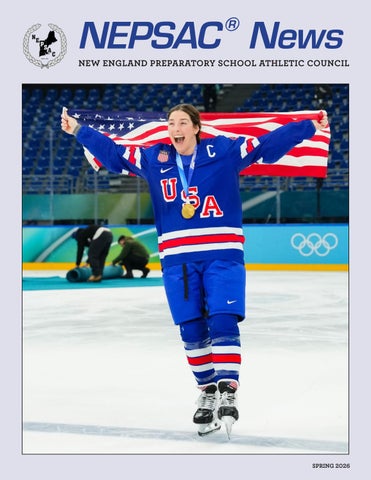
NEPSAC ® News
47 Honoring Those Who Support and Inspire at Taft
48 Moreau Leaves Lasting Mark at Belmont Hill
53 Squash Superstars from Brooks and Belmont Hill
ON
APresident’s Letter
Tim Joncas
Westminster School
s we begin the spring season, I want to first congratulate all of our student-athletes, coaches, and programs on an outstanding winter.
I also want to recognize the extraordinary work of our athletic directors and coaches. The time, care, and intentionality you bring each day in creating student-centered experiences through sport is what makes our association so strong. You are not just organizing practices and competitions, you are shaping environments where young people learn how to lead, how to serve, how to persevere, and how to be great teammates.
This work is grounded in a shared purpose. Across NEPSAC, we believe athletics are an essential part of a student’s full education, teaching the rules, fundamentals, and skills of sport while promoting wellness. We value healthy competition and cooperation, using athletics to instill the principles of fair play. We are committed to developing habits of sportsmanship and integrity that extend well beyond the field, and to maintaining the spirit of true amateur competition. Our charge, as individual schools, is to live out these ideals each day on our campuses.
We must never lose sight of the important role athletics play in supporting the broader mission of our schools. Through sport, we bring students together from different backgrounds and lived experiences
and ask them to work together, support one another, and pursue a common goal. In doing so, we help develop young people who will go on to be good, responsible, and contributing members of whatever communities and teams they become part of.
At its best, education-based athletics is about far more than winning. It is about developing character, building resilience, and helping students grow into thoughtful, disciplined, and connected individuals.
Over spring break, I had the opportunity to read On Character by Stanley McChrystal. In it, McChrystal offers a simple but powerful idea: character equals values multiplied by discipline. Athletics provide one of the most powerful arenas to hone that character—where values are tested daily and discipline is required in both the best moments and the most challenging ones. Character, then, is shaped not just by what we believe, but by our ability to consistently live those beliefs, especially when it is difficult.
In a time when it can feel like quantity is too often valued over quality, this idea resonates deeply. Our responsibility, as educators and leaders, is to help students identify their values and develop the discipline to live them out daily, in practice, in competition, and in life.
EXECUTIVE BOARD
Tuesday, April 28
Deerfield Academy 9:00
MIDDLE SCHOOLS
Thursday, April 2
Fay School 10:00
DISTRICT I
Monday, May 19
Kents Hill School 10:00
Zoom meetings may be held if needed in October, January and April
DISTRICT II
Thursday, April 30
New Hampton School 9:00
Bi-weekly meetings on Zoom from August 2025 to May 2026.
DISTRICT III
Tuesday, April 14 10:00
Phillips Academy Andover
DISTRICT IV
Thursday, April 24
Westminster School 9:00
Got news to share with other NEPSAC schools?
Send the details to communications@nepsac.org and we’ll put it in the next issue.
As we enter the spring season, I wish you all the very best. Thank you for your continued commitment to the true purpose of athletics in our schools, not simply to win, but to help our students build character, become great teammates, and develop the resilience that will serve them long after the final whistle.
The following resources are behind the password at www. nepsac.org to serve you better and streamline communication within NEPSAC:
» NEPSAC By-Law and Policy Handbook
» NEPSAC NIL Registration
» NEPSAC Grievance Form
» NEPSAC Expulsion Documentation Form
» NEPSAC NIL Policy and Registration Form
TREASURER’S REPORT
by Jamie Arsenault, New Hampton School
Over the past year, NEPSAC has continued to focus on strengthening our financial processes while also expanding opportunities and resources for our member schools. We remain committed to supporting our constituents through thoughtful planning, responsible financial management, and strategic growth.
One of our key areas of focus has been the continued development of corporate partnerships that align with our mission and values. We are actively exploring new partnerships that will benefit all of our constituents, particularly in the areas of health and wellness. In addition, we are working to build stronger connections within the world of athletic equipment and equipment management to provide schools with greater access to quality resources and support.
From an operational standpoint, we are also working to improve and simplify our online banking and payment systems. Our goal is to make financial transactions more efficient, user-friendly, and transparent for all member schools. We appreciate your patience and feedback as we continue to refine these systems.
As always, we encourage open communication and collaboration. Your feedback is invaluable as we strive to better serve our constituents.
Thank you for your continued support of NEPSAC.
PAYMENT REMINDERS/TIPS
To be most efficient it is important that schools only create one account when making their payments. If you don’t remember your login information, simply click on the “Forgot your username or password?” link to enter your email address to receive instructions to reset your password. Remember to check your spam/junk folder for these instruction emails.
Please be aware that there is a processing fee to offset our cost with every online transaction. We are not able to refund processing fees, so please be diligent about this process and your record keeping.
How To View Your Account
If you already have a Username and Password, go to “View My Account” and enter your credentials to log in. After logging in, you will have access to “Payment History.” Use the available filters to view ALL of them or choose any date range or period.
SPORTS MEDICINE ADVISORY COMMITTEE REPORT
by Grady Congleton, SMAC chair
Happy Spring, NEPSAC! I hope spring athletics are off to a great and uneventful start. It’s hard to believe we’re already speeding toward the end of the academic year.
SMAC continues to work together to develop and update policies related to health and safety for all student-athletes participating in NEPSAC athletics. As part of that work, we will be updating our concussion guidelines to reflect the latest evidence and best practices, which continue to evolve. While it is imperative that each school develops and reviews its concussion policy regularly, SMAC is happy to serve as a sounding board for member schools on this topic. We are also excited to welcome a consulting sports neurologist to the committee — Dr. Stephanie Alessi, Head of Sports Neurology at Hartford Healthcare — who will assist us in refining and developing league-wide guidance in this area.
As we look to the summer and beyond, it is with mixed feelings to share that I will be leaving Salisbury School at the end of the academic year and will hand over the reins to Vice-Chair Zac Kershaw of Phillips Andover. Zac will lead the committee into its next exciting phase as athletic trainers work to build a stronger and more meaningful relationship with the Executive Board and athletic directors. I am grateful for the 10 years I’ve served on SMAC and even more appreciative of the relationships built along the way. I wish SMAC and NEPSAC all the best going forward.
With gratitude, Grady Congleton, Chair, NEPSAC SMAC
NEPSAC Spirit Award
The NEPSAC Executive Board is excited to announce a new initiative designed to recognize the outstanding professionals within our athletic departments. We are launching The NEPSAC Spirit Award to formally acknowledge athletic department members who demonstrate integrity, sportsmanship, dedication, and positive behavior that reflects the collective values of NEPSAC.
Any NEPSAC professional community member is eligible to submit a nomination. We encourage you to recognize deserving colleagues across your staff.
Winners will be announced on a rolling basis and you will be reminded to submit nominations regularly through the year.
NEPSAC SPIRIT AWARD NOMINATION FORM
We look forward to celebrating the exceptional spirit and dedication within our NEPSAC community.
The NEPSAC Spirit Award Committee:
Andrew Mitchell, Lexington Christian Academy
Jamie Arsenault, New Hampton School
Courtney Callanan, Rectory School
Rob Feingold, Fay School
Laurie Sachs, NEPSAC, The Rivers School
Tom Frame
JANUARY 2026 | ALBANY ACADEMY
Tom has been the equipment and field house manager at Albany Academy for over 30 years. Tom goes far beyond the job description, bringing energy, positivity, pride and commitment to everything he does. From early mornings to late nights, he ensures every athlete and coach is prepared, supported and confident. His upbeat attitude, willingness to help anyone at any time, and genuine care for our program lifts the entire staff and teams. Win or lose, Tom’s spirit, dedication and behind-the-scenes leadership makes a lasting impact and truly embody what this award represents.
Steve Sughrue
FEBRUARY 2026 | TABOR ACADEMY
Aveteran coach at Tabor Academy since 1987, Steve is known for his commitment to sportsmanship. An example of this would be his tennis teams winning the ISL sportsmanship award nearly every year since 2017. He has successfully fostered a culture where student-athletes hold each other accountable to high standards of character. He values what it means to represent yourself, your team, and your school and his players know this at their core. Steve is a role model for students and faculty alike at Tabor.
Rob Quinn
MARCH 2026 | BERWICK ACADEMY
Rob was nominated by an athletic director in the Eastern Independent League who wanted to honor his legacy as a NEPSAC leader of over two decades. For 18 years, Rob has served both Berwick and NEPSAC with unwavering dedication, building a program culture rooted in sportsmanship and integrity. He has been an invaluable mentor and a tremendous colleague to other athletic directors in NEPSAC, leaving a lasting legacy of leadership and character.
by Becky Kimball, Director of Athletics, Kents Hill School
oday’s student-athlete is asked to perform a quiet, constant balancing act, one that is often invisible from the outside. They carry ambitious athletic goals, navigate increasingly rigorous academic expectations, and manage the emotional weight of simply being a teenager in a fast-moving, high-pressure world. For many, this is also the first time they are encountering direct, sometimes uncomfortable feedback about their performance, identity, and potential.
This moment, when direct feedback meets reality, can be disorienting. A student-athlete who has long succeeded on talent and effort alone may suddenly be confronted with the need for refinement, resilience, and self-awareness. At the same time, they are juggling late nights of studying, social dynamics, and the ever-present influence of comparison amplified by social media. It is no surprise that mental health can become strained under these competing demands.
What makes the high school years so delicate is not the presence of challenge, but the lack of experience in processing it. Many young athletes have not yet developed the tools to interpret critical feedback as a pathway to growth rather than a threat to identity as an athlete. Without the right support, they can begin to question their abilities, lose confidence, or disengage from the very goals they once held so tightly.
This is where the environment-and the people in the environment matters.
In a strong boarding school community, the student-athlete is surrounded by adults who see beyond the scoreboard or the transcript. Teachers, coaches, and mentors work in concert to support the whole person, not just the performer. They understand that growth is not linear and that setbacks are often the most powerful teachers. Importantly, they are willing to step into the uncomfortable role of delivering honest feedback, the kind that may initially feel discouraging, but is ultimately rooted in care and long-term development.
Being the “dark horse” in a student’s journey, offering truth when it would be easier to stay silent, is not about criticism for its own sake. It is about preparation. It is about helping young people build the resilience, perspective, and self-awareness they will need long after they leave high school. In the best environments, feedback does not end with delivery; it is followed by guidance, reflection, and a clear path forward.
When done well, this approach transforms challenge into opportunity. Student-athletes begin to understand that their worth is not defined by a single performance or moment of critique. They learn how to respond, adjust, and persist. They gain confidence not just in their abilities, but in their capacity to handle adversity.
Ultimately, the goal is not simply to develop stronger athletes or better students. It is to prepare young people for the complexities of life beyond high school, equipping them with the mindset and skills to navigate pressure, embrace growth, and continue striving with purpose.
Coaches, advisors, and administrators both witness and give hard feedback on a regular basis. In doing such, the process is never about intentionally hurting or diminishing a student-athlete who is trying to find their way through high school and, in some cases, toward collegiate athletics. Rather, it is rooted in care, responsibility, and a belief in their potential. Our hope is that within a tight-knit and trusting community, feedback may sting for a moment, but not linger as self-doubt. Instead, it becomes a catalyst for reflection, growth, and renewed purpose. By pairing honesty with support, we aim to equip our student-athletes with the mental tools to navigate challenges, grow through their sport, and carry that resilience into every aspect of their lives.
In the end, where growth meets grace suggests with the right guidance, student-athletes learn that challenge is not something to fear, but something to embrace. It is through this balance of support and accountability that they are shaped, not only into stronger competitors, but into thoughtful, resilient individuals prepared for whatever comes next.
NEPSAC Celebrated Athletic Trainers in March
From the National Athletic Trainers Association: All month long, we’re celebrating the athletic trainers who prevent injuries, respond in critical moments, guide recovery and advocate for the patients and athletes they serve every day. From secondary schools to the military from clinics to the professional and Olympic level ATs deliver expert, evidence-based health care in every setting.
Championship Ring Supplier Supplier of
Championship Trophies for over 10 years
• CH A M P ION S HI P RING S
CH A M P ION S HI P T RO P HI E S
W A RD PLA Q UE S
LASS & A CR YL IC A W A RD S
CH A M P ION S HI P BA NN E R S E CORD B O A RD S E D ALS & RI BB ON S ND M U CH MOR E UYS .CO M 695 -81 3 3 @ AWA RD-G UYS .CO M
FORMAN SCHOOL | LITCHFIELD, CONNECTICUT
Forman School Boys’ Varsity Soccer Team Earns Nationwide Recognition for Ethics and Sportsmanship
Forman School, a college preparatory boarding and day school for students with learning differences, is proud to announce that its boys’ varsity soccer team has been recognized by United Soccer Coaches with a 2025 High School Team Ethics and Sportsmanship Award, earning distinction in the Gold Category. The team is led by Head Coach Robert Andrulis and Assistant Coach Alexander Johnson.
The United Soccer Coaches High School Team Ethics and Sportsmanship Awards honor school soccer teams that exhibit fair play, good sportsmanship, and adherence to the laws of the game throughout the season. Awards are determined
by the number of yellow caution cards and red ejection cards issued relative to the total number of games played.
Forman School’s Gold Award places the program among an elite group of just 20 high school teams nationwide to earn this level of recognition during the 2025 fall season. Teams receiving the Gold Award accumulate a card percentage ranging from 1-10%.
“This recognition says a lot about who these students are as competitors and as people,” says John Strawson, director of athletics. “They play with intensity, but they also show respect for their teammates, their opponents, and the game. As
an athletic director and coach, there is nothing more rewarding than seeing student-athletes represent their school with integrity, humility, and true sportsmanship.”
In total, 69 boys’ and girls’ high school teams across the country were honored at the Platinum, Gold, Silver, or Bronze levels for the 2025 fall season, highlighting the competitive landscape of soccer teams with national recognition.
This recognition reflects Forman School’s ongoing commitment to developing student-athletes who demonstrate leadership, respect, and responsibility both on and off the field.
PHOTO COURTESY FORMAN SCHOOL
Visionary Award: Commitment to Community
Donovan Mitchell ’12 NBA All-Star
Since entering the NBA in 2017, Donovan Mitchell has cemented himself as one of the league’s most exciting stars. His explosive playstyle, consistency, and superhuman agility helped coin his nickname, Donovan “Spida” Mitchell.
The Connecticut native was drafted to the Utah Jazz as the 13th overall pick in the 2017. During his time with the Jazz, Donovan set a franchise rookie scoring record and became the first NBA rookie to have multiple 40-point games in a season since Blake Griffin in 2011. He also held the rookie record for most three-pointers made in an NBA season, earning his selection to the 2018 NBA Rising Stars game. That same year, Mitchell was unanimously selected for the NBA All-Rookie First Team, and won the NBA Slam Dunk Contest, the 2018 Best Breakthrough Athlete ESPY Award, and the NBPA Players’ Voice Award for Leader of the New School. At 21 years old, Mitchell was the fastest rookie in NBA history to hit 150 three-pointers, doing so in just 63 games.
In 2022, Donovan was traded to the Cleveland Cavaliers, where he continued to demonstrate his elite athleticism. He was awarded the 2023 AllNBA Second Team honors and set a career-high 71-point game for the Cavaliers. Mitchell was selected as a starting player for the 2026 All-Star Game, marking his seventh consecutive All-Star appearance from 2020–2026. Most recently, he earned All-NBA First Team selection and helped the Cavaliers to the best Eastern Conference regular season record for 2024-2025. Mitchell’s talents extend beyond basketball through his philanthropic work. He has integrated himself in the communities that play active roles in his life: Connecticut, Ohio, Utah, New York, and Panama. Through his mother, Nicole, a former schoolteacher in Greenwich, Connecticut, education has always been of utmost importance to the Mitchell family. Mitchell established his foundation, SPIDACARES, which aims to provide more opportunities and resources to achieve a more equitable society. The foundation prides itself on understanding the power of education to uplift underprivileged communities.
NEPSAC Winter 2025–2026 Tournament Champions
Hit the links below to see the All-NEPSAC athletes
BOYS BASKETBALL
Class AAA The Newman School
Class AA Cushing Academy
Class A Hotchkiss School
Class B Large St. Mark’s School
Class B Small Holderness School
Class C Bancroft School
GIRLS BASKETBALL
Class AAA Hoosac School
Class AA Darrow School
Class A Sacred Heart Greenwich
Class B Large Berkshire School
Class B Small Hamden Hall
Class C Berwick Academy
BOYS ICE HOCKEY
Stuart/Corkery Tournament (Open) Avon Old Farms
Martin/Earl Tournament (Large) Cushing Academy
Piatelli/Simmons Tournament (Small) The Winchendon School
GIRLS ICE HOCKEY
Chuck Vernon (Elite) Bracket Loomis Chaffee
Patsy Odden (Large) Phillips Exeter Academy
Dorothy Howard (Small) Groton School
WRESTLING
Boys Overall Greens Farms Academy
Boys Small New York Military Academy
Girls Overall Choate Rosemary Hall
Girls Small Greens Farms Academy
All-NEPSAC Recognition
SWIMMING AND DIVING
Boys Division 1 Phillips Academy Andover
Boys Division 2 Albany Academy
Boys Division 3 Hamden Hall
Girls Division 1 Phillips Exeter Academy
Girls Division 2 Miss Porter’s School
Girls Division 3 Hamden Hall
BOYS ALPINE SKIING
Class A Northfield-Mount Hermon School
Class B Holderness School
Class C Dublin School
GIRLS ALPINE SKIING
Class A Deerfield Academy
Class B Indian Mountain School
Class C The Bement School
NORDIC SKIING
Boys Belmont Hill School
Girls Holderness School
BOYS SQUASH
Class A Hotchkiss School
Class B Greens Farms Academy
Class C Milton Academy
Class D Suffield Academy
Class E St. Mark’s School
GIRLS SQUASH
Class A Hotchkiss School
Class B Greens Farms Academy
Class C Milton Academy
Class D Loomis Chafee School
Class E St. Mark’s School
NEPSAC All Time Champions List
Tabor Coach Steve Sughrue Receives NEPSAC Spirit Award
Article and photo by Rebecca Binder, Tabor Academy
Director of Athletics Kelly Walker P’12, ’13 shared outstanding news with Tabor at an All School Meeting on February 27, 2026. She announced that the New England Preparatory School Athletic Council (NEPSAC) had recognized Boys Varsity Tennis Head Coach and Mathematics and Computer Science Teacher Steve Sughrue P’16, ‘19 as one of the first winners of the NEPSAC Spirit Award. The award, established just this winter, honors coaches who demonstrate integrity, sportsmanship, dedication, and positive behavior that reflects the collective values of NEPSAC.
Sughrue has coached several different programs at Tabor. Most notably, he’s coached the boys varsity tennis team for 39 years. He also spent 15 years at the helm of the Tabor girls varsity soccer program—his first experience coaching female athletes, and coaching soccer at the varsity level. Under his tenure, the soccer team won the NEPSAC tournament twice, including an undefeated season in 2013. And, since Tabor joined the Independent School League (ISL) in 2017, Sughrue’s boys varsity tennis team has earned the ISL team sportsmanship award every year except one.
“He has always been the coach who makes sure that his teams strive to be their best selves, on and off the field or court,” Walker said at All School Meeting, reading from her nomination of Sughrue. “He ensures that his teams hold their heads up high, win or lose, look their opponents in the eye, and with a firm handshake say, ‘great game.’” Walker called Sughrue “sportsmanship personified, and a role model for all our students who have had the good fortune to play for him.”
Sughrue says that he wants his student-athletes “to have fun, enjoy the game, develop a love for the game, and enjoy the team experience.” Tennis is an individual sport, he points out, and he works hard to create an environment in which students can appreciate being part of a team. “I was lucky to play for some really good coaches,”
says Sughrue, who attended and played tennis at Belmont Hill School and Bates College. “I think the people you work with when you’re a student can impact what you appreciate from an experience. When this award was announced, I thought back to how lucky I’ve been to work with so many great students and athletes here at Tabor who really try every day to do things the right way.”
The message Sughrue tries to give his teams is that “it’s great to win, but not at the expense of cutting corners or disrespecting your opponent or the game. When you have a community that buys into that, you can do really good things.” He also strives to make practice the best part of his athletes’ days. “I want them to look forward to practice every day and enjoy the time that they have together as a team,” he says. “Every afternoon I
go out there and I look around, and I think ‘I’m so happy to be here.’” He recalls a year in which his soccer team made the postseason NEPSAC tournament: “I just remember thinking, when we had those extra days of practice, how lucky we were. When you look at it practically, you’re doing more work, but it never feels like work. I feel fortunate to be out there enjoying a sport and helping students develop passion for an activity that they’ll enjoy for the rest of their lives.”
Now that the spring season is beginning again, Sughrue says he recently held a meeting with the boys tennis team. “I looked around the room and it’s such a wonderful group,” he says, grinning. “I think everybody had the same feeling: We’re going to have a lot of fun together this spring. Who wouldn’t want to be a part of that?”
Made for the NEPSAC Athlete
Whether it’s a Lift for Life, charity game, tournament, or your own idea, Team UA gives athletes at any level the freedom to use your sport your way to create change
Build Leadership & Life Skills
Be Part of Something Bigger
An opportunity to take initiative, organize events, and inspire others all while gaining valuable leadership experience.
Contact: Jeff Baxter | Manager of Team UA
Help change lives and make a difference beyond sports by joining a movement of athletes using their platform to support the rare disease community.
Uplifting Athletes
by Jim Kelley
For athletes of all ages the primary draw beyond the thrill of competition is the desire to be a part of something greater than one’s self. That same desire spreads to elements away from the field of play and one non-profit organization leverages one of them the weight room to raise awareness for and provide support to families dealing with rare diseases.
Uplifting Athletes, a national non-profit that harnesses the power of student athletes to spread awareness for rare diseases, was recently named the Official Rare Disease Community Service Partner of NEPSAC. This partnership will ensure that experiences like UA’s Lift for Life can benefit programs throughout New England as they have for the last two years at Brunswick School.
“I was introduced to Uplifting Athletes about two years ago through one of our alumni, a former Princeton football player who served as the Princeton Uplifting Athletes Chapter President,” said Brunswick Football Coach and Director of Upper School Athletics Wayne McGillicuddy. “From the very beginning, it was clear that this was about much more than football. What stood out to me immediately was how powerfully it brings teams together around a shared purpose.
“The mission of Uplifting Athletes has allowed our program to grow not just as a team, but as people, reinforcing the importance of gratitude, perspective, and giving back to a cause that truly matters.”
After being introduced to Uplifting Athletes, McGillicuddy found that the connections between his program’s coaching staff and the organization ran even deeper. UA President Brett Brackett had played football at Penn State with a member of the coaching staff and both had been a part of the program when the early iterations of Lift for Life had been developed.
The Bruins have since incorporated the Lift for Life into the final elements of the team’s preseason lifting schedule and in August 2025 raised $40,000 to finish second nationally just behind Northwestern University.
Uplifting Athletes allowed my high school and college communities to come together and support something bigger than ourselves. ~ Mallory Lucas, Dexter Southfield ’22, University of Pennsylvania ’26
“Brett came out to speak to our team prior to this year’s Lift for Life, which was an unforgettable experience for our players,” McGillicuddy said. “We use the fundraising part to teach our guys that we can compete in everything we do! On the field, in the classroom, and even in service!”
Brunswick football alumni have gone one to start Team UA chapters at their respective colleges Boston College, Syracuse, and Notre Dame to name a few which is why Jeff Baxter, Uplifting Athletes’ Team
UA Manager, believes that the new partnership with NEPSAC and exposing more student athletes to the mission and purpose at the high school level has so much potential to amplify the organization’s work and message.
“Brunswick was really the first high school program to take it and run with it, which sort of made us think ‘if it can work there it can work at a lot of schools at this level’ and that is where the partnership with NEPSAC is huge for us,” Baxter said.
While Lift for Life is the primary way that programs are engaging with Uplifting Athletes to raise awareness, other athletes are doing so on an individual basis by dedicating elements of their performance to raise funds and awareness for rare diseases.
“We have a couple student athletes, one from Masters School in Dobbs Ferry and another at Western Reserve Academy who are pledging their saves in lacrosse games, another student-athlete is pledging their face off wins. It is nice because there is more than just one way to tell the story in a way that will resonate with people.”
Baxter is currently working with staff at Hillside School on ways to engage their student athletes in physical activity while raising awareness. Being able to engage younger students allows the variety of programming to really shine.
“The Lift for Life has been sort of our signature event but we have done different types of activations with elementary schools like a foul shot contest, a jump rope-a-thon, and a modified field goal kicking competition. At one school instead of doing something like a bench press they did a plank contest where one student athlete held a plank for eight minutes. Really
Players at Masters School and Western Reserve Academy are pledging their saves in lacrosse games.
This program gave so much to me, and bringing it back to my high school felt like the right way to give back. ~ Harrison Caponiti, Brunswick School ’18, Princeton University ’23
anything where you can engage in competition and have fun doing it works for us.”
Beyond raising awareness Uplifting Athletes also provides what they call “Uplifting Experiences” to families facing rare diseases. These experiences can be anything from an on-field experience at a professional sporting contest or just engaging with a boarding school rivalry day an provide families with a memorable experience and a break from the day-to-day battles that define so much of their lives.
UA also provides support in the form of grants to folks early in their careers in research to provide funding to get their work off the ground. To date, Uplifting Athletes has raised more than $12 million to provide Uplifting Experiences, fund Young Investigator research, and develop leadership skills.
That final element is what Baxter is most excited about. His goal is to have a critical mass of participating schools in New England to be able to bring student leaders together in one place for a leadership retreat, which is something they currently do with some of their collegiate partners.
“To bring these students who are leading the charge together and share ideas and really amplify what they are doing on their campuses is something I would love to do in the future.”
Until then, every faceoff, every save, every stroke, every mile, and every bench press that these student athletes are doing is making the lives of someone, somewhere just a little bit better.
Read more: Bruins Raise $40,000 in Second Annual ‘Lift for Life’
From the very beginning, it was clear that this was about much more than football. What stood out to me immediately was how powerfully it brings teams together around a shared purpose. ~ Wayne McGillicuddy, Brunswick School Director of Athletics
Uplifting Athletes Named Official Rare Disease Community Service Partner of New England Preparatory School Athletic Council (NEPSAC)
There are moments when sport becomes something bigger than competition. Bigger than wins and losses. Bigger than the scoreboard.
That belief sits at the heart of a new partnership between the New England Preparatory School Athletic Council (NEPSAC) and Uplifting Athletes, uniting student-athletes across New England around leadership, service, and meaningful support for the rare disease community.
At its core, this partnership is about using the platform of sport to make a difference. Not someday. Right now.
Through this collaboration, NEPSAC schools will have the opportunity to engage in Team Uplifting Athletes initiatives like Lift for Life strength challenges, performance based fundraising, leadership education, and rare disease advocacy. Each program is designed to help student-athletes grow into purpose driven leaders while creating real world impact for families facing rare diseases. Read more…
NEPSAC Goes to Milano Cortina
At least 14 NEPSAC alumni from 11 schools represented four countries in three different sports at the 2026 Olympic Games.
Three Gould alumni competed in Snowboard Cross and two from St. Sebastian’s were involved in Men’s Ice Hockey, one on the ice and one off. Other schools represented with one each were Berkshire School, Buckingam Browne & Nichols, Choate Rosemary Hall, The Governor’s Academy, The Frederick Gunn School, Hebron Academy, New Hampton School, Phillips Academy Andover, and Phillips Exeter Academy.
Please let us know if we missed anyone from your school.
NEPSAC Alumni at the 2026 Winter Games at Milano Cortina
Snowboard Cross
Nathan Pare ’23 | Gould Academy | United States
Hanna Percy ’25 | Gould Academy | United States
Brianna Schnorrbusch ’24 | Gould Academy | United States
Men’s Ice Hockey
Noah Hanifin ’15 | St. Sebastian’s School | United States
Thomas Larkin ’09 | Phillips Exeter Academy | Italy
Chris Kelleher ’94 | St. Sebastian’s School | Director of Player Personnel, United States
Bill Zito ’84 | Phillips Academy Andover | Assistant GM, United States
Women’s Ice Hockey
Cayla Barnes ’17 | New Hampton School | United States
Alex Carpenter ’11 | The Governor’s Academy | United States
Kendall Coyne-Schofield ’11 | Berkshire School | United States
Rei Halloran ’19 | Buckingham Browne & Nichols | Japan
Hilary Knight ’07 | Choate Rosemary Hall | United States
Noemi Neubauerová ’18 | The Frederick Gunn School | Czechia
Shauna Neary ’04 | Hebron Academy | Official
Knight ’07 in Shining Armor Uplifts Team USA
by Ryan Shepard
When her team needed her most, she delivered.
Deep into the third period of the Women’s Hockey Final at the 2026 Winter Olympic Games, Team USA found itself in a position that it hadn’t been throughout the entire tournament playing catch-up. Having given up its first goal in exactly two weeks, Team USA found itself down 1-0 to Team Canada with just over two minutes left in regulation, but the team in red, white, and blue refused to give in. Attacking and looking for an equalizer, Laila Edwards took her best shot at the goal, and just when it looked as if it might not reach its destination, a deflection from Hilary Knight ’07 put the puck in the net and tied the game. Knight’s late-game heroics weren’t just clutch; they were historic. Scoring the game-tying goal, she became the all-time leading Olympic goal scorer in U.S. women’s hockey history and the all-time Olympic points leader in U.S. women’s hockey history. She also adds to a growing lineage of Choate Rosemary Hall Wild Boars putting their best skate forward at the Winter Olympic Games in women’s hockey, which includes Angela Ruggiero ’98 (USA), Kim Insalaco ’99 (USA), Julie Chu ’01 (USA), Josephine CHOATE
“I had no idea,” the five-time Olympian told NBC. “I just love scoring, and that pure elation of finding the back of the net. It’s a little-kid moment. When you score, it’s pure excitement. Those are legendary players, and just to be in the same sentence as them is super special.”
However, as one five-time NBA Champion once said, the job wasn’t finished. Heading into overtime, Team USA kept its momentum, pushing the pace and going toe-to-toe with its rivals from up north. Then, it happened. Three-time Olympian Megan Keller scored the golden goal in 3-on-3 overtime, earning Team USA its third gold medal and first since 2018.
Keller and company continued their celebration as the Winter Olympic Games come to a close. Knight, who recently proposed to American speedskater Brittany Bowe, had the honor of carrying the flag for Team USA at the Closing Ceremony as the 2026 Winter Olympic Games concluded on Sunday, February 22, 2026.
PHOTO BY USA HOCKEY
The Long Game
For hockey standout Thomas Larkin ’09, the Olympics are a full-circle moment
by Brian Muldoon
Thomas Larkin ’09 arrived at the Academy as a 14-year-old who had tasted some success. As one of the better hockey players growing up in a small town north of Milan, Italy, he was scoring goals and coasting along at school.
Exeter proved to be a bit of an adjustment. “The competition was different right away,” Larkin says. “The pace, the academics, everything felt bigger. I realized quickly that this was an opportunity to grow not just as a hockey player, but as a student and as person.”
He dug in and worked hard. “Thomas Larkin is one of the most special students to come through the hockey program,” says former Big Red hockey coach Dana Barbin, who called the 6-foot-4-inch Larkin Big T. “For as talented as he was, he was that much more of a hard worker.”
play at Colgate University, where he was a captain for two years.
“I thought I was ready,” he says of the NHL. “Then you get to the next level and realize, this is bigger than I thought. You have to prove yourself again and again.”
Eventually his career carried him overseas. He spent two seasons in the Russian Kontinental Hockey League before settling in the top professional league in Germany, where he has played for nearly a decade.
THERE WAS JUST NO WAY I WAS MISSING THIS OPPORTUNITY TO
REPRESENT MY COUNTRY IN MY HOMETOWN
He played junior varsity as a prep and set a goal to make varsity his lower year. He made the team and felt on top of the world, only to realize that the varsity required much faster play and attention to detail. He played sparingly as a forward, still searching for his role.
He found it after a conversation with his coach. “I told him, ‘I think you are a defenseman,’” Barbin recalls. “‘Let’s try to move you back to the blue line.’ He just looked at me and said, ‘Let’s roll, Coach.’”
The move required humility and trust. And Larkin had to adapt to skating backward, defending under pressure and embracing a role built on discipline. He accepted the challenge.
“He was big and tough, and his compete level was off the charts,” Barbin says. “I think the young man trained 364 days a year and took Christmas Day off.”
Larkin acknowledges: “I’m not the most skilled guy far from it. But I learned how to compete, how to work and how to want it more. That started at Exeter. I’m still so passionate about the place. It really came at a pivotal time in my life and helped shape who I am.”
Two years after switching positions, Larkin caught the attention of college coaches and professional scouts. He was drafted by the NHL’s Columbus Blue Jackets after graduating from Exeter but went on to
For more than 15 years, Larkin has pursued a parallel career with Italy’s national team. It began on the junior national circuit while he was a student at Exeter. International play, Larkin says, strips the game down to its essence.
“With the national team, it’s pure,” he says. “It gives me a chance to play with guys that I have known for 20 years. We play for the love of our country and Italian hockey.”
In 2019, when Italy was selected to host the 2026 Winter Olympics, Larkin faced a decision. His injuries were mounting, and stepping away from the game was a possibility. “I remember thinking, Well, I guess I have to keep playing,” he says. “There was just no way I was missing this opportunity to represent my country in my hometown. In a sense, it gave me a new lease on my career.”
Larkin, now 35 and Italy’s captain for the past four years, will make his Olympic debut and lead his team onto the ice when the Milano Cortina Games begin in February.
“I don’t just play hockey for me, or to put food on my kids’ plates,” he says. “It’s purely for love and passion, and for my family, for my mom, my dad, my brothers and sisters. Playing in the Olympics will be something for everyone that’s helped me get to this point. I couldn’t be more excited or more proud to be a part of it.”
Three Gould Alumni Qualify for the Winter Olympic Games in Milano Cortina 2026
Nathan Pare, Hanna Percy, and Brianna Schnorrbusch are all headed to the Winter Olympics in Milano Cortina
Gould is ecstatic to announce that three recent alumni have qualified for the 2026 Winter Olympic Games in Milano Cortina, Italy. Nathan Pare ’23, Brianna Schnorrbusch ’24, and Hanna Percy ’25 will all compete in Snowboard cross (SBX) for Team U.S.A. this February.
Snowboard cross is a snowboarding competition in which athletes race four-wide over a course featuring challenging features like banked turns and jumps.
Gould SBX athletes have become regular additions to the Pro Team in recent years, and Gould was named Snowboard Club of the Year by the US Ski & Snowboard under the leadership of former Snowboard Coach KC Gandee in 2023. Tyler Hamel ’22 was
named to the team during the 2021-22 season while still a senior at Gould. He still holds a spot on the team today. Tyler’s classmate
Dali Gao ’23 of Beijing, China, took a year off from Gould to compete for the Chinese National SBX team, and continues to compete with an independent team after the Chinese national team lost funding. Now he splits time between competing globally and attending Dartmouth College.
Bri Schnorrbusch of Monroe Township, New Jersey, was named to the U.S. Pro team in 2023 while still at Gould. She credits the Gould competitive program with helping her to race at a high level and giving her the flexibility to study remotely while training and competing with the U.S. Snowboard team.
“Gould fully supported my journey to take time away from campus and complete school virtually while pursuing my dreams, and was always there when I needed them,” says Bri. “My coaches helped me grow as an athlete and as a person. They played a huge role in preparing me for the Olympics.”
Bethel native Nate Pare was named the 2024 FIS World Cup Snowboard Cross Rookie of the Year and earned his first career World Cup podium with a third-place finish at Mt. St. Anne, in Canada, in 2025. His second came just a few weeks ago in the final SBX qualifying event in Dongbeiya, China, with another third-place finish. After five years of training and competing at Gould, Nate is excited to see his highest goals realized.
“I’ve dreamt of being an Olympian as long as I can remember,” says Nate. “To have the hard work pay off is a dream come true, and I can’t wait to represent my country.”
Hanna Percy, from Truckee, California, is the youngest athlete on the Pro Team at just 18 years old. Last year, as a Gould senior, Hanna was crushing the NorAm Cup circuit before being named to the U.S. Snowboard Team. She also points to Gould as an influential and critical piece of her journey to the Olympics.
“I am so grateful for all the opportunities Gould gave me. My coaches were the best,” says Hanna. “I wouldn’t be here without all the support from Gould. It feels amazing for all my hard work to pay off.”
Having athletes competing in the Winter Olympic Games isn’t new for Gould. Freestyle skier Troy Murphy ’10 made the finals in Men’s Moguls at PyeongChang, South Korea, in 2018. Still, having three athletes competing in the same event is a special moment for Gould, none of which is lost on Head Snowboard Coach Dustin Holzweiss ’02, who has been coaching in the Gould program since 2005.
“I couldn’t be more proud of Nate, Bri, and Hanna for making the U.S. Olympic Team,” says Dustin. “They have dedicated their lives to snowboarding, and watching them grow—not only as athletes, but as people—has been an honor. I’ve witnessed the sacrifice, the hard days, and the perseverance it took to get here, and that makes this moment so special.”
Head of School Tao Smith ’90, P’23,’28, sums up the community’s excitement.
“We are so incredibly proud of Nate, Bri, and Hanna,” says Tao. “It is rare for a school to have one Olympian, much less three, in a single Olympics. Their achievements are so incredibly impressive individually and are a testament to the web of support they received along the way from their families and the team at Gould Academy. Their friends, former coaches, teachers, advisors, and dorm parents will be cheering them on to Olympic success here in Bethel. Let’s go!!!”
Nate, Hanna, and Bri all competing at World Cup events for the U.S. Snowboard Team
Gunn Alumna Noemi Neubauerová Competing in 2026 Milan Cortina Winter Olympics
Gunn alumna Noemi “Nemo” Neubauerová ’18 is competing in her second Winter Olympic Games, starting today! Neubauerová was named to the roster for Czechia’s Women’s Ice Hockey Team for the 2026 Milan Cortina Winter Games. The women’s preliminary round against Team USA is scheduled for this afternoon, ahead of the opening ceremony. Czechia is reportedly looking to bring home the first Olympic women’s ice hockey medal in that nation’s history.
Neubauerová also represented Czechia in the 2022 Beijing Winter Olympics along with her Gunn classmate and girls varsity ice hockey teammate, Kristyna “Tynka” Patkova ’18.
In her senior year at Gunn, Neubauerová was team captain and was named the team’s Most Valuable Player. As students, she and Patkova competed for three seasons with the Czechia National U18 Women’s Ice Hockey Team in the International Ice Hockey Federation (IIHF) World Championship, a precursor for selection to the Olympic team.
In 2024, Neubauerová was a Professional Women’s Hockey League (PWHL) draft pick and played in the inaugural season for the Toronto Sceptres. Neubauerová holds a bachelor’s degree in psychology from Colgate University, and played for Colgate’s NCAA Division I women’s ice hockey team. She played for a fifth
year, under pandemic rules, at Providence College while completing her MBA. Prior to entering the PWHL draft, she played professional women’s hockey for one year in Sweden.
Last spring, Neubauerová played for Czechia in the IIHF World Championship again. In an interview last March, she said she was hoping to return to the Olympics this year and after that, would like to pursue a career that will allow her to expand on the work she has been doing, providing guidance and support for young female athletes in Czechia.
“A lot of the kids are going through a pretty tough situation. A lot of them are playing boys hockey in Czechia. That’s obviously very hard. I’ve kind of gone through that myself. It seemed to me there was a need for me to start something for these girls, but also anybody else. There are so many people who need help and support. I would love to continue in that and get more education so I can be more helpful,” she said.
Nemo Neubauerová ’18 playing ice hockey for Gunn in 2018
PHOTO BY TJ SHAW, COURTESY OF THE FREDERICK GUNN SCHOOL
Shauna Neary ’04 Puts on the Stripes
by Neely Bello ’20, Alumni Engagement Associate
Shauna Neary’s journey since graduating from Hebron Academy in 2004 has taken her to one of the biggest stages in the world of sports. This winter, Shauna stepped onto the ice as an official at the 2026 Winter Olympic Games in Milan, a moment that represented years of preparation, perseverance, and a deep love for hockey.
Even with experience officiating at the highest levels of the sport, nothing quite compares to the moment the Olympics begin. “You think officiating in front of 20,000 fans in the PWHL or at a World Championship prepares you for that first Olympic step onto the ice, but it’s different,” Shauna explains. “You believe you’re ready, but when you step onto the ice for your first Olympic game, your heart races faster and emotions surface.”
As officials gathered on the ice for the opening puck drop of the 2026 Milano Games, the magnitude of the moment became real. “My Finnish referee partner said, ‘This is your puck drop.’ That’s when it hit me, I was opening the Olympic Games,” she recalls. “It was overwhelming. I’m not even sure I got the puck down flat.” Like many Olympic moments, it was emotional, and Neary shared, “There were definitely a few tears that night, and again at the opening ceremonies. As a kid, you watch these ceremonies on television and dream. Standing there thinking, ‘This is real. I’m here.’ It was overwhelming in the best way possible.”
Shauna’s path to that moment began long before Milan. After graduating from Hebron, she attended Mount Allison University in New Brunswick, where she played varsity hockey for the Mounties. Following university, she transitioned into coaching, working within Hockey Nova Scotia’s high-performance program and leading a U18 AAA female team for two seasons before becoming an associate coach at Dalhousie University, where she coached for five seasons.
While coaching, Shauna noticed something that would ultimately change the direction of her career. “There was a lack of female representation in officiating,” she says. “I decided to don the stripes and give back to the game in a different way.” What began as an effort to support the sport quickly grew into a new professional pursuit. Her officiating career accelerated through Hockey Canada’s national high-performance pathway, eventually leading her to pause coaching and dedicate herself fully to officiating.
Her debut on the international stage came at the International Ice Hockey Federation (IIHF) Women’s World Championship in Bulgaria. In 2021, she was promoted to officiate at the top division of the IIHF Women’s World Championship, where she would shine for five seasons. Along the way, Shauna also officiated the Professional Women’s Hockey League (PWHL), the former Premier Hockey Federation (PHF), the Professional Women’s Hockey
Players Association (PWHPA), the Canada-USA Rivalry Series, as well as men’s and women’s university and Junior A hockey. Each opportunity sharpened her skills and prepared her for the intense Olympic selection process. Officials from around the world progressed through multiple international championships before a final group was chosen for pre-Olympic qualifying tournaments. Shauna was assigned to Germany while other officials traveled to Japan and Sweden. From there, a smaller group of referees and linespersons advanced to officiate the Women’s World Championship in Czechia, where the final Olympic roster was ultimately selected.
MY FINNISH REFEREE
PARTNER SAID, “THIS IS YOUR PUCK DROP.” THAT’S WHEN IT HIT ME, I WAS OPENING THE OLYMPIC GAMES
Officiating at the Olympic level requires composure, confidence, and years of preparation. “It’s countless hours in rinks across your province and North America,” Neary says, adding that “It’s time in the gym, sessions with the skating coach, studying the numerous rule books, reviewing video all so that when the moment comes, you can relax and let the game come to you.” When the pressure rises, she relies on that foundation. “Confidence doesn’t appear overnight, it’s built up rep by rep, game by game.” says Shauna.
The lessons she has learned through officiating extend beyond the rink. In her professional career, Shauna serves as a Field Operations Manager with Canada’s
Department of Fisheries and Oceans, where she manages field operations, people, budgets, and complex infrastructure projects. Many of the leadership skills required in that role were shaped through her experience officiating. “Every game you step onto the ice with a different partner or crew,” she says. “No matter the language or background, you must be aligned and working as one team to protect the integrity of the game.” Those same skills, she notes, apply when leading teams and navigating complex projects in her professional life.
When Shauna reflects on her time at Hebron Academy, the memories that stand out most are the people who made the experience so meaningful. “I feel nothing but pride to be part of the Lumberjack family,” she says. “The moment I stepped on campus, I knew it was the right place for me.” Teachers, mentors, and coaches played a lasting role in shaping that experience. Julie Middleton was the first person Shauna met at Hebron and remains an important role model today. “Julie was kind and welcoming, and her family always made us feel at home, whether it was after long road trips, movie nights, or meals at the dorm house.” Heather Ferrenbach also created memorable moments for students by organizing beach trips, ball games, and other off-campus outings that gave everyone a chance to explore the surrounding community and reset outside the classroom. On the field and ice, coaches Roy
SKUNK HOLLOW
Do you need a handbook, directory or magazine? How about a postcard, invitation or stationery? Or a program brochure, fundraising appeal or search piece?
Are you overwhelmed? Do you even know where to start?
Let me help. I have over 25 years of experience with school publications and printing production, and I am accustomed to tight deadlines and equally tight budgets.
I can help you figure out what you want, pull the pieces together and deliver a final product you will be thrilled to share with parents and alumni.
and Ridley were equally influential. “They invested countless hours helping me grow not only as an athlete but as a person.” Living in a residence also played a significant role in preparing Shauna for the experiences that would follow later in life. “Living in residence taught me how to live in a community made up of different cultures, backgrounds, and values,” she says, “much like officiating, where you must quickly build trust and cohesion with a team.” Hebron also helped her develop the time-management skills needed to balance academics, athletics, and personal commitments, a foundation that would enable her to juggle a full-time career while officiating at the elite level.
For current Hebron students, particularly those who love sports but may not see a traditional path forward, Shauna encourages them to keep their options open. “Being a student-athlete gives you a foundation for life; leadership, resilience, and the ability to work towards goals individually and as a team,” she says, adding that “there are many ways to stay involved in a sport beyond being a player.” From coaching and officiating to training, performance analytics, statistics, and sport administration, there are countless opportunities to remain connected to the game. “Your path may not be traditional, and that’s okay. Sometimes the most meaningful journeys are the ones you didn’t initially plan,” Neary states.
For Shauna, the Olympic Games represent an extraordinary achievement, but she believes the journey itself holds the greatest meaning. “The Olympics may be the pinnacle, but it’s the people, mentors, teammates, and family along the way who make it meaningful,” she says. Neary added that “success doesn’t always follow a straight line. Be open to opportunity, work hard when no one is watching, and trust the foundation being built beneath you.”
Representing her sport on a global stage remains an incredible honor, but she is quick to recognize the people who helped her along the way. Shauna noted that “my family sacrificed so much to help me get here. There were countless nights away officiating and endless hours training.” She also credits Hebron as a foundational part of her journey, sharing that “friends’ families who welcomed me into their homes, teachers who pushed me academically, coaches who guided me athletically, they all played a role. No matter what stage I stand on, I am still a Lumberjack at heart.”
Stanmar Case Study: Completing the New Performance Campus
Commencing in 2021, Stanmar has partnered with Worcester Academy to plan, design, and construct a transformative new athletic facility. The Capozzoli Athletic Center, which features a three-court gymnasium, natatorium, and fitness center with views over the adjacent turf field, required a combination of patient planning and quick thinking to bring to fruition.
Over the course of nearly a decade from 2007 to 2015, Worcester Academy assembled three parcels of land from the former St. Vincents Hospital site with the dream of expanding their campus. During that time, they developed Morse Field, a premium turf field for athletics, adjacent to the shuttered hospital. The crowning project, construction of an expansive new athletic center, proved more challenging and was stalled for years.
In 2021, Worcester Academy had strong donor interest in supporting a new athletic center and performance campus. However, the Board and donors had concerns about moving forward after years of inertia and stalled attempts on the project. Stanmar was given the opportunity to work with the Academy’s leadership team to identify the right program, siting, and design for a new athletic facility to anchor the hoped for “Performance Campus.” Stanmar’s elegant design created a new, prominent presence for the Academy on Union Hill within the target budget. With the Academy’s approval, final design was completed, with each aspect of the design rigorously vetted to ensure the project’s objectives were maintained.
During the planning stages of the project, Stanmar encountered a major hurdle related to the project budget and timeline. Stanmar determined that site grading and building construction would result in over 15,000 cubic yards of excess soil. The site was formerly designated as a “BUD” site, which meant that under the watch of the Department of Environmental Protection (DEP), demolition debris had been buried there. Additionally, the site is located in what geologists call the “Arsenic Belt” soils in this zone have naturally occurring high levels of arsenic. It was determined that the cost to export these materials would jeopardize the project’s viability.
Stanmar developed a plan to divert the bulk of this excess soil to an Academy owned, adjacent parking lot in poor condition. Raising the grades and leveling the lot significantly improved its appearance and functionality. Stanmar nimbly coordinated a team to work in parallel through design, permits, city approval, and DEP approval, all of which were accomplished in under three months. As a result, Worcester Academy saved millions of dollars by shipping the excess soil across the street to the parking lot rather than out of state. Additionally, this enabled Stanmar to begin construction of the new athletic facility as scheduled in Fall 2023, preserving the project budget and momentum.
As a result of diligent planning, creative problem solving and an organized construction process and schedule, WA opened its new Capozzoli Athletic Center on time and on budget in Fall 2025.
ROBERT BENSON/BENSON PHOTOGRAPHY
To schedule your complimentary project evaluation from the Stanmar team contact: Dawson Miller, Project Development Coordinator
ROBERT BENSON/BENSON PHOTOGRAPHY
ETHAN PELLEGRINO/ET_AN
GREGG SHUPE/SHUPE STUDIOS
From the Court to the Sidelines to Life’s Game: Coach Sherry Levin’s Playbook for a Winning Mindset
For decades, Sherry Levin stood before her teams in locker rooms, delivering words that would carry them through the next 32 minutes of competition. But those pre-game speeches were never just about basketball. They were about life.
Now, the Hall of Fame coach has distilled those powerful moments into Pre-Game: A Winning Mindset, a book published in January 2026 that transforms the wisdom she shared with championship teams into a guide for anyone wanting to bring their best game.
“These talks always meant more than just pep talks. They reflected my life’s work and philosophy,” Levin explains. “Each message was tailored to the moment, sometimes fiery, sometimes calming, but always impactful. In Pre-Game, I’ve reframed these lessons for everyday life.”
A Career Built on Resilience
Levin’s credentials speak for themselves. As the all-time leading scorer at Holy Cross College, she launched a coaching career that would span continents and achieve a remarkable 420–97 record, an 82% winning percentage. She’s been inducted into four Halls of Fame and has mentored athletes who reached the pinnacle of their sport, including Aliyah Boston, the #1 WNBA draft pick and 2023 Rookie of the Year, and Oluchi Okananawa, currently the leading scorer for the University of Maryland.
Her international coaching achievements include leading Team USA to five gold medals at the World Maccabiah Games, Pan Am Maccabi, and European Maccabi Games. Beyond the court, she’s worked as an ESPN analyst, motivational speaker, and creative leader in video production.
But the resume doesn’t capture the full story. As a single mother and breast cancer survivor, Levin has faced challenges that tested the very principles she taught her players. It was during these trials, from enduring chemotherapy to reinventing her career, that she proved her philosophy wasn’t just for athletes.
PHOTO COURTESY SHERRY LEVIN
The Philosophy: Mindset as Muscle
“When facing hardships, whether the physical toll of chemotherapy or the need to reinvent my career, I turned to the same principles I instilled in my teams: resilience, focus, and optimism,” Levin says. “It’s a playbook for shifting one’s mindset toward positivity.”
That philosophy centers on a powerful concept: mindset is a muscle. Just as athletes train their bodies, Levin believes we can strengthen our mental approach to life’s challenges. This isn’t abstract theory, it’s practical wisdom forged in high-pressure moments and life-altering circumstances.
The book blends storytelling, practical insights, and uplifting perspectives honed through years of navigating both triumph and adversity. Each chapter draws from specific pre-game talks, translating optimism into actionable strategies for everyday situations.
Early Praise from the Basketball Community
The response from Levin’s peers has been overwhelmingly positive.
“Pre-Game offers sharp insights, real-world strategies, and a fresh perspective on how to show up with clarity, purpose and resilience. It goes beyond sport, reminding us that the mindset we build before we step onto the court is the same one we need to face life’s toughest moments. Sherry’s insights are invaluable for anyone looking to shift their mindset.” ~ Brenda Frese, University of Maryland Women’s Basketball; Head Coach, National Champions of 2006, 650+ wins in twenty-three years at Maryland, Two-time National Coach of the Year
“You don’t need to be in the locker room to benefit from great coaching—you just need to pick up Pre-Game. It’s like having a coach in your pocket. Coach Levin understands players deeply, and her ability to motivate, challenge, and uplift comes through on every page.” ~ Donna Orender, Founder & CEO, Generation W | Former President, WNBA | Commissioner The UPSHOT League
Perhaps even more telling is the perspective from Oluchi Okananwa, who played under Levin and now competes at Maryland: “Coach Sherry didn’t just prepare me for games, she honestly prepared me for life. Her lessons about mindset, resilience, and belief shaped the athlete I became and the woman I continue to grow into. This book captures the same wisdom she poured into me every single day.”
Beyond Basketball
Today, Levin works as a consultant, bringing her Mindset is a Muscle philosophy to schools, individuals, and executives. Her transition from coaching championship teams to coaching life represents a natural evolution of her mission.
Athletic Director Warren Perry at Newton Country Day School, where Sherry spoke to their athletes in the fall said, “Sherry Levin brought a powerful blend of science, storytelling, and heart to our athletics community. Her “Mindset Is a Muscle” message resonated deeply with our student-athletes and coaches alike, offering practical tools for building confidence, resilience, and self-awareness in both sport and life. What stood out most was Sherry’s abil-
ity to meet our young people where they are, while inspiring them to grow beyond what they thought possible. Her work doesn’t just motivate, it equips. I’m grateful for the lasting impact she’s had on our program and wholeheartedly recommend her work to anyone invested in developing strong, healthy, and courageous leaders.”
Recently Sherry worked with the Nichols College Women’s Ice Hockey team. Following their program head coach Michael Barrett wrote, “Your insights, engagement, and recommendations served our eyes, ears, minds, and hearts more. We were given useful tools that we can all apply, myself included, right now and in the future.”
And a player added, “Learning about different skills and tools to use to avoid negative self talk was so helpful. I will be using those strategies during games. There’s a great chance our confidence overall will improve.”
As Levin herself might say in one of her pre-game talks: It’s not about the scoreboard. It’s about showing up prepared, staying present in the moment, and believing in your ability to overcome whatever comes next. That philosophy worked in locker rooms across the country. Now, it’s available for anyone ready to strengthen their most important muscle, their mindset.
Reach out to Sherry at sherrylevinpregame@gmail.com
Find her book on Amazon. SherryLevin.com
Sherry Levin (right) with Aliyah Boston
PHOTO COURTESY SHERRY
Teaming Up
by Max Pearlstein, Director of Strategic Communications
Opening Assembly isn’t the only time that younger and older students collectively kick off a school event: thanks to the efforts of Physical Education Teacher and Boys Varsity Soccer Coach Oscar Zorrilla P’34, P’36, Lower Schoolers get the chance to walk out onto the field before special games each season alongside team members.
“We have something different here at Wheeler in terms of our connections to one another, and with the walkouts, I want the Lower Schoolers to envision themselves as the players someday,” Coach Z explains. “Having that time before games to communicate with the older students, to talk and joke around with them, they’ll remember that stuff when they get older. During halftime, we also invite them to play in the middle of the field, which will also bring some good memories. Hopefully, they turn those memories into a playing career at Wheeler.”
If students stick with soccer and make it into the varsity game for real some day, Coach Z says they can expect a welcoming but challenging environment at Wheeler, on the pitch and off. “I played sports at Classical, so I understand what it takes to be a high school athlete at a rigorous school, and I know that the balance between the two can be very hard,” he says. “That kind of lays my foundation for the boys, so they understand that they can come to me to discuss when they may be having a tough time and could use a break, or have other needs related to school.”
By building that trust with his players, Coach Z says, it’s easier to establish high standards for sports, as well as in the classroom. “We want them to be able to compete every day and understand what is expected of them. When I’m coaching, I make sure that the kids hold themselves and each other accountable. I’m mentoring them, but that responsibility to meet our standards is ultimately on them.”
It’s a culture that continues to permeate his program even after graduation. “When alumni come back and join us during the summertime or during any practices in the fall, we always talk about giving back and being a part of our family. We have family at home and here as well. That connects us together, just as much as our success. We’ve had a few championships under my tenure, and by building on our culture, there will hopefully be more to come.”
With his culture-building initiatives beginning in Lower School, Coach Z is able to start bringing kids into that championship envi-
BY
ronment well before they put on a varsity uniform. Consider the Middle School Basketball Tournament or the Lower School Soccer Tournament he created a few years ago to generate some of the same spirit he saw each spring at the all-school Field Day. “It’s electric on campus for Field Day, or during the Upper School Jamboree, and I thought we could expand that energy into other events, to give kids another way to participate and excel beyond the classroom.”
While there’s plenty of energy and excitement, there’s also disappointment, by design. “The tournaments are hard,” Coach Z says, “and part of it is teaching kids that sometimes things are hard. There is winning and losing. We do have a champion, and there are no consolation games. It helps them understand that there’s an expectation as you get older that things are going to get tougher, but that shouldn’t stop you from competing each year and striving for something.”
That spirit is already taking hold in Lower School, Coach Z says. “The soccer tournament doesn’t happen until March, but as early as September basically the first day of school I heard the 5th-graders in Hamilton talking about it. They had their team name, the Hamilton Bears, already picked out, and they were excited to get out there for the games that were still a few months away. It brings me joy to see how many kids are getting involved. It becomes more competitive, but with more people playing and more people coming to the games, all of the Lower School is in the gym, supporting one another and being a part of that family environment.”
PHOTO
JAMES JONES
TRUSTED AT OVER 80,000 INSTALLATIONS WORLDWIDE OVER THE LAST 25 YEARS
AT THE SURFACE OF WORLDCLASS VENUES & THOUSANDS OF HIGH SCHOOL PROGRAMS
INDUSTRYLEADING SYSTEM DESIGN WITH PROVEN DURABILITY & LONGEVITY
COMMITTED TO PROTECTING PEOPLE & PLANET THROUGH INNOVATIVE SUSTAINABILITY PROGRAM
ONE SOLUTION FOR YOUR ENTIRE VENUEEASY PROCESS FROM START TO FINISH
Official Sports Surfacing Partner
SLS Storm Athletes Thrive as FieldTurf Fields Provide Consistent Playability
A ten-year relationship has resulted in Connecticut’s St. Luke’s School installing three synthetic turf fields
One of, if not the, central question to St. Luke’s School’s (SLS) approach to education is “What will students need to thrive—now and into the future?” Founded in 1928, the New Canaan, Connecticut, school has experienced almost a century of growth and challenges, some specific to SLS and others reflecting a changing world. Its continuous evolution in response to these factors has put it in an exceptionally strong position to answer that driving question.
In its mission to equip students with the tools and skills to thrive, the school places a significant emphasis on community, emphasized in its motto “Enter to Learn. Go Forth to Serve.” That focus is even more apparent in its Prepared to Thrive strategic plan, which comprises several interconnected priorities.
One of those priorities, Leading with Humanity, highlights SLS’ long-standing commitment to leadership education. It’s also the priority most intrinsically linked to a robust athletics department, featuring 20 SLS Storm varsity teams and 18 middle school teams with access to state-of-the-art athletic facilities. Since 2015, FieldTurf, the region’s leading synthetic turf supplier, has played a key role in enhancing those facilities, specifically regarding the consistency and durability of SLS’ outdoor athletic fields.
That durability, a defining feature of FieldTurf systems, is essential for a school with over 600 students enrolled in grades 5–12. With an exceptionally high participation rate across its athletic programs, SLS Storm athletes are consistently putting its facilities to the test.
“About 90% of our students participate in athletics. But 90% of those 90% also play multiple sports, so we have very diverse and engaged student athletes,” said Darrell Maier, SLS Director of Facilities. The Storm teams also set the standard for excellence and integrity. With FAA and NEPSAC titles, regional and national honors, student-athletes prove what’s possible through dedication and teamwork. Storm athletes are consistently recognized for sportsmanship and leadership, earning league awards that reflect the school’s commitment to respect, character, and Leading with Humanity.
Many of the teams striving to continue that championship legacy currently play on one of the campus’s three FieldTurf fields, the most recent of which was installed in 2024 at Watson Field at Pedrick Stadium. The stadium’s multi-purpose field can host football, field hockey, lacrosse, and soccer activities.
“Expanding our relationship with SLS over the years has been a really meaningful experience”, said Andrew Dyjak, FieldTurf Regional Vice President, New England. “By building on the trust that was earned from the first project, we’ve been able to play an exciting role in the evolution of their athletic facilities”.
The first SLS FieldTurf project at the Class of 2015 Lower Field, enabled by the families of the Class of 2015, included installing new synthetic turf and realigning the existing surface. The Bucci Baseball Diamond at the Class of 2015 Field, as it’s also referred to following the retirements of St. Luke’s Legendary Coach and Mentor Emil Bucci, hosts baseball and various levels of boys’ and
girls’ soccer. Last season, Storm baseball triumphed as the 2025 FAA League Champions.
“We lost playing time due to mud pits on the field,” Maier said of the low-lying baseball field. “After we brought in FieldTurf for Bucci Diamond and saw how much their team delivered, and how great they were with repairs, it made it easy to use them again for future projects.”
Three years after the first project, the Class of 2018 Upper Field received its own FieldTurf upgrade. Also designed to support multiple sports, the facility enables field hockey and softball to play on a standard-sized competition field, with additional space for soccer and lacrosse practices. Storm softball, which has a long history of success, has won three FAA Tournament Championships and two FAA League Championships since the upgrade.
The evolving relationship between SLS and FieldTurf has played a critical part in ensuring that hundreds of student-athletes and their coaching staffs can rely on consistent field conditions with allweather access. “Weather conditions in New England have played a big part in an increasing adoption of synthetic turf in the region,” said Dyjak. “That, coupled with field layouts that can be optimized for simultaneous multi-sports practices, shows why schools like SLS trust FieldTurf to significantly enhance their athletic facilities.”
BAY STATE GAMES
BAY STATE GAMES
FOR THE ATHLETE IN ALL OF US
The Bay State Games are Massachusetts’ largest Olympic-style spor ts festival, bringing together athletes of all ages and skill levels from across the state. For over 40 years, the Games have provided oppor tunities to compete in a wide range of spor ts, and showcase talent. Many alumni have gone on to excel at the collegiate, national, and professional levels.
WHY BSG?
Showcase talent in front of dozens of college scouts
Compete against high level athletes from Massachusetts & New England
Unlock scholarship oppor tunities & informational webinars for BSG athletes ONLY
Join a 40+ year tradition
Take aim at qualifying for a national event (State Games of America)
Build connections, teamwork, and spor tsmanship that last beyond the competition
Become an Ambassador - Build your resume & develop leadership and business skills
Connections to “Bruno” Abound in Hockey Title Game
March 8, a title was at stake. Not just any title. The Chuck Vernon Elite 8 girls hockey championship, the name a reminder of a man who meant so much to four coaches at those schools.
Chuck, known by many as “Bruno,” was a longtime Loomis faculty member and coach and was instrumental in establishing the Loomis girls ice hockey program. Loomis head coach Liz Leyden, Loomis assistant coach Chelsea Ouellette ’08, Deerfield head coach Brooke Fernandez ’09, and Deerfield assistant coach Avery Flynn ’19 each played for Chuck or coached alongside him, or both. Chuck died in 2024.
Loomis Chaffee left the ice March 8 with a 5-1 victory and its second Elite 8 title in a row. Last year’s was the team’s first since 1989. The New England Prep School Athletic Council (NEPSAC) Elite Eight Tournament was renamed the Chuck Vernon Elite 8 in the 2019–20 season.
“To have the premier tournament in New England prep named after him speaks to his significance in growing and creating the New England Girls Prep School Ice Hockey Association,” Liz said recently. “It really hit me last year after we won the significance of this, and same this year. He would have been so happy to see Loomis win, and I know he would have delighted in giving us the trophy. He made sure to attend the championship game every year to hand out the Chuck Vernon trophy, and this gave him great joy. He loved it when Williston, his alma mater, won in 2022 and 2023. He would have been thrilled to see so many Loomis alums coaching against each other in this year’s final, and I’m sure he would have made sure to chat with each of us, to share stories, and to comment on the growth and development of the girls game.”
Liz became the varsity girls hockey coach in 2009. “Chuck served as my assistant coach the first nine years I coached at Loomis,” Liz said. “He was one of the best mentors I have ever had, and I miss him to this day.
Bruno cared deeply about others and invested in people. As a coach, he was one of the best at breaking down a game to its most basic parts and then building it back up in a way that everyone could understand. ... I look to build upon his legacy to this day. The Loomis girls hockey program is as strong as it is due to his considerable work and effort starting in the 1980s.”
Chelsea played for Chuck and coached with him.
“I always hoped we would win it while he was still with us,” Chelsea said. “But I do think it’s kind of fitting that we didn’t win it until after he passed. Bruno never liked the attention or to be in the spotlight.”
Chelsea, a three-sport athlete, started coaching and working at Loomis Chaffee in 2015. She is a database specialist in the Admission Office.
“While he went from my coach to a colleague although, and he would hate for me to say this, he always still felt like a coach to me what didn’t change was Bruno,” Chelsea said. “What has always stood out to me was how much he cared about the players in the locker room, both as players and people. He cared that way about people in general.”
Brooke played hockey for four years at Loomis, earning New England Prep Player of the Year honors in 2009. She was a fouryear standout on defense for St. Lawrence University, finishing her career second all-time at the university in career goals for a defenseman (26) and third in points (87). She also is an associate athletic director at Deerfield.
“Bruno’s legacy lives on not through the tournament named after him, but the small sometimes silly/goofy moments that you remember long after his passing and still talk about with teammates,” Brooke said. “He was warm, he cared deeply, and he always put emphasis on the positives and the learning lessons in any good/bad moment of you personally or the team generally. If I’ve embodied any of that in my own coaching, then that’s thanks to Bruno, too.
Avery played at Amherst for three seasons (she lost her sophomore season to COVID-19) and was second-team All-NESCAC (New England Small College Athletic Conference) as a senior in 2023. She played ice hockey and lacrosse at Loomis Chaffee, and club hockey for the Connecticut Polar Bears for six seasons.
“On the way to the [championship] game, Brooke and I were talking about [Bruno] and how crazy it was that we both were coached by him,” Avery said. “We shared memories of his defensive coaching and his amazing salsa that he would make for us. Graduating 10 years apart from each other at Loomis, I think it’s cool how Brooke and I both share similar experiences of who Bruno was and what he meant to the team. I think that is such a testament to who he was.”
Bruno was many things, a coach, a mentor, an inspiration who carved out quite a career at Loomis Chaffee, to say nothing of all the pieces of furniture and other items he made not only for team members but others around campus. He was a talented woodworker.
“Bruno was someone who always supported and joked around with us,” Avery remembered. “He was so dedicated to the hockey team and the players. He handmade everyone, out of wood, a push-up machine called ‘Bruno’s pec-o-maker.’ I still have it today. Doesn’t get much use, but it is a funny reminder of him, for sure.”
Chelsea remembers what Chuck did for her when she arrived as a coach.
“He made a wooden box with my initials painted on it, just so I would have a place to
put my things in the coach’s room,” Chelsea said. “When I was a student at Loomis and was out for an extended period due to injury, he sent me a copy of Endurance, the story of Ernest Shackleton’s voyage across Antarctica, along with a handwritten letter. I still have the book and the letter. It turns out I wasn’t alone: he sent copies of that book to many players who were out with injury or going through some kind of adversity. It was little things like that that made Bruno stand out.”
Those little things didn’t end just because someone’s time on the Island did.
“He kept up with players long after they graduated from Loomis, and he was always so proud to watch their lives grow and see everything they accomplished,” Chelsea said. “He would bring ‘Bruno salsa’ to former players when they played in college games locally. He made rocking chairs when they had babies. And he never forgot a face or a name. Once he knew you, he never forgot you.”
And Loomis Chaffee is sure to never forget him.
“We now have the ‘Bruno Gloves’ that go to a player after every game, a way to honor and recognize his significant contribution to our team and program,” Liz said. “These gloves go to someone who did the little things in the game that contributed to the team success, things that might not end up on a scoreboard but still matter deeply to the team. That was like him, always in the background helping out, not seeking recognition, but helping people feel and be seen.”
CHUCK SERVED AS MY ASSISTANT COACH THE FIRST NINE YEARS I COACHED AT LOOMIS. HE WAS ONE OF THE BEST MENTORS I HAVE EVER HAD, AND I MISS HIM TO THIS DAY. BRUNO CARED DEEPLY ABOUT OTHERS AND INVESTED IN PEOPLE.
LOOMIS CHAFFEE HEAD COACH LIZ LEYDEN
Loomis players with the Chuck Vernon trophy.
KO’s Renovated Squash Facility Opens
On Tuesday, January 20, KO made it official. Head of School Tom Dillow cut the red ribbon on the renovation of KO’s squash facility, which added four new all-glass courts, bringing the total to eight. Squash is having a moment; it’s now an Olympic sport (LA 2028), and college recruitment is on the rise. Our players have earned spots on top collegiate teams and deserve the facilities to match!
Last year, the board recognized the need to upgrade the squash facility to meet the teams’ growing demands. Nearly 50 Wyverns participate annually—a number that could grow to 20% of our student body. Our facilities department drew up plans to reimagine the facility’s gym area, a large underutilized space, expanding the entire facility from four to eight courts. The renovations began in the summer, and through the crew’s diligence, the project was completed in January, just in time for our teams to use for the season.
“The players are thrilled about how amazing the facility looks truly on an elite level,” said Cam Biondi, varsity girls’ squash coach. “It’s a game changer because it doubles the amount of courts, which expands the program within the school. And, since there’s more space, many more families are viewing the matches with their younger children in tow, so it feels very celebratory.”
We are grateful to our donors who recognized a need and stepped up to make the upgrade a reality. Special thanks to Gil Keegan ’88 P’22, ’25, ’27, Mark Conrad ’96 P’32, Beverly Baker (in honor of Shep Baker ’47), and the Coscarelli Family, whose vision and commitment guided the renovation to completion in record time. This will impact our players and program for years to come.
Needless to say, it’s a hit.
PHOTOS BY KRISTEN WELDON
Moove is a fun, six-week fitness competition that helps teachers, coaches, and staff connect, move more, and support each other all through a gamified experience that feels like fantasy football meets wellness Teams compete in a private league, score points for activity, in hopes of making the playoffs, where one champion will be crowned. The Moove platform helps strengthen community, boost engagement/culture, and promote wellbeing across school communities
Schools Get a Moove On
Our spirited MOOVE Competition provided the motivation we needed to continue our school wide fitness journey. While January is typically the month when New Year’s resolutions are made, our February MOOVE Challenge helped turn those resolutions into action, combining fitness with friendly competition among staff.
IWith the Super Bowl still fresh in everyone’s minds, teams embraced a Fantasy Football inspired format and enthusiastically tackled their fitness goals. The creative approach added excitement and camaraderie, making wellness both engaging and fun. As a school community, we truly valued the opportunity to bring staff together in a meaningful way while promoting a healthy and active lifestyle.
Colin Sullivan | Director of Athletics and Afternoon Programs | Pomfret School
We really enjoyed using the Moove platform at Fenn. It’s been a great addition to our community. People got super competitive in the best way, and it genuinely boosted engagement and camaraderie among the staff. It definitely met (and honestly exceeded) our expectations in terms of participation and overall enthusiasm.In terms of benefits, the biggest one has been the community-building piece. The challenges got people moving, talking, and having fun with each other in ways we didn’t totally anticipate.
really appreciate everything you’ve done to help support Marvelwood throughout our competition. The event went great. We had so many students and faculty engage with the challenge. It was really nice to see so many groups interacting over the last six weeks. It also helped make the winter go by so much faster. We didn’t take a champion shot (it was a faculty group that won), but numerous people have expressed that they already miss it and that they’re hoping we do it again next year. A few are still using the app to keep up on their workouts and are connecting with friends to maintain their efforts. Overall, I couldn’t recommend it enough. You and your team are doing a fantastic thing with this app.
(like not hoarding points or only entering on the days you did activities), because matchups or the individual season leaderboard were becoming quite competitive.
I shouted out incredible efforts in faculty meetings. People cheered for one another. We are using some athletics kick back funds (we receive from our apparel vendors) to purchase sneakers for the winning team and top performing male and female players on the non winning team. Along with long sleeve hooded “championship” t-shirts for the winners.
All in all it was a competitive, sometimes quite addicting, but a very fun engaging experience with lots of kudos given in the activity feed and really impressive workouts logged by many.
Ella Janvier,| Language Arts and Social Studies | Fenn School
Moove has been a great addition for our organization. We have used it as a community building activity to start of the new year. Hearing the chatter in the halls and friendly banter in the dining hall has been a fun way to connect people who otherwise would not get a chance to interact. The team based approach pushes you to go a little longer on the treadmill, take an extra walk with the dog or spend ten minutes stretching.
Patrick Curry MS, ATC | Director of Sports Medicine | Greenwich Country Day School
Emilie Arseneault, CSCS | French, Chemistry, Co-Athletic Director | Marvelwood School
Brooks is having a great time participating in the Moove Challenge. Departments throughout campus have come together to foster camaraderie and healthy competition with other colleagues. We did the challenge this winter, which many have shared that it has motivated them to exercise and stick to a routine during long winter days. It’s been a fun and energizing way to connect, challenge, and get moving this winter. We definitely will consider doing it again next year!
Connor Wells | Athletic Director | Brewster Academy
We absolutely love using Moove it has truly encouraged people to get up, get moving, and be more active each day. The app has created a fun, friendly sense of competition that motivates participants and keeps everyone engaged. It’s been wonderful to see how something so simple can spark so much energy and enthusiasm.
Kate Tiedemann RN, BSN | Head School Nurse | Sacred Heart Greenwich
WAndrea Heinze | Mathematics, Director of Athletics | Brooks School
So we have had a lot of fun with the game at Brewster this “season” as we head into the Championship match up today.
Bottom line the game was transformative for so many getting us MOVING way more than we would have normally. I try to stay fit and workout often, and I found myself adding 2-3 , and sometime more, separate workouts each day to my normal routine. I lost 9lbs personally. One fac member told me this is the best shape he’s been in since high school.
Folks who you wouldn’t picture as competitive took the game to another level and wouldn’t be beat. We even had to remind faculty of some rules
e ran a Moove league at Commonwealth School, and despite our small size managed to get 24 participants split into 4 teams of 6. People got really into it! It encouraged people who might not exercise regularly to make time for it, and it was a fun way for our community to get more active together.
Jackson Elliot | Director of Athletics and Wellness | Commonwealth School
Honoring Those Who Support and Inspire
For many Taft seniors, the start of the new year ushers in a time of reflection. This year, senior class members of the boys’ varsity hockey team paused to reflect not only on what their careers on the ice have meant to them, but on the totality of their Taft experiences. And to do so with gratitude.
“As student athletes, so much of our growth happens off the ice through the teachers and staff who support us, challenge us, and believe in us every day,” said Assistant Captain JT Rothstein ’26. “We wanted to take time to recognize faculty and staff members who have had a lasting impact on our lives.”
Through a new initiative dubbed Shirt Off My Back, each senior hockey player honored a community member who supported, guided, or inspired them during their time at Taft. Honorees were
Dylan Chery celebrated English Teacher Samual Rosario: “Mr. Rosario is dedicated to making his students better every day. He taught me that working hard and focusing on the process will always outweigh the results, both inside and outside the classroom. He is someone I have always been able to rely on.”
Domenico Clarizio recognized Dean of Students and Mathematics Teacher Lindsay Leal: “Ms. Leal truly cares about her students and always goes out of her way to support everyone. She makes me feel comfortable, valued, and seen.”
Tommy Drienik honored Strength and Conditioning Program Director and Admission Counselor Will Turner: “Since day one, Mr. Turner has been someone I can go to for help with anything. His kindness and genuine care make Taft a great place.”
Lincoln Durfee acknowledged English Teacher Emily Estes: “Ms. Estes is such a passionate and personable teacher. The positive impact she has had on the community is clear.”
invited to the Shirt Off My Back appreciation ceremony, which took place on the ice before a recent game. Players read words of praise and reflection, and presented their mentors and guides with gifts of gratitude—including Boys’ Hockey T-shirts.
“We wanted this project to represent gratitude and recognition and to literally give the ‘shirts off our backs’ to honor the people who helped us become better students, teammates, and people,” notes Rothstein. “It was a simple but meaningful way for our team to publicly express gratitude and celebrate the educators who have helped shape our experience at Taft.”
Congratulations and thank you to all of the honorees. Excerpts from the players words of praise, gratitude, and reflections follow.
Joe Gannon expressed gratitude to Mathematics Teacher Michael Mastrocola ’08: “Mr. Mastrocola has always made me feel welcomed and valued. He cares about everyone, and wants nothing but success for his students and athletes.”
Topher Jones recognized History Teacher Andrew Taylor ’72: “He has always been a great teacher, role model, and supporter for me. He can always put a smile on my face with his jokes and energy.”
Carson Lowry recognized History Teacher Martin Aspholm: “His head is always up, his energy high, and he has so much Taft pride. Nobody has more passion for Taft than Mr. A.”
JT Rothstein honored English Teacher Marie Butterly: “Ms. Butterly has been an amazing teacher for me over the past two years and helped me develop into a better reader and writer. She is always invested in the success of her students and is dedicated to helping us grow both academically and personally.”
Brady Smith acknowledged Assistant Director of Admissions R.J. Swift: Mr. Swift is one of my most trusted adults in the school and never fails to brighten up my day. I greatly appreciate everything that he does for me.”
Jackson Tucker celebrated English and Art History Teacher Alex Werrell: “Mr. Werrell always has my best interest at heart. He has always been there for me when I needed guidance or assistance, and I know I can count on him for anything.”
Cullen Tully honored Penn Teaching Fellow Young Hur: “Mr. Hur is genuinely interested in our lives. His energy and support around the dorms keep the vibes high.”
The Boys’ Varsity Hockey Team recognized Facilities Team Member Michael Verrastro: Mr. Verrastro treats all of us like family and takes pride in the rink and in our team.
Story and photo courtesy of The Taft School.
BELMONT HILL SCHOOL |
Scotty Moreau Leaves a Lasting Mark on Belmont Hill
by Cameron Chittock, Communications Department
Senior Scotty Moreau completed a tremendous wrestling campaign this winter, capturing the ISL title at his weight class (132 lbs.) and earning All League and All New England Honorable Mention distinctions. While these feats are in line with Belmont Hill’s tradition of wrestling excellence, Scotty’s performance is made all the more remarkable by the life changing event that occurred merely two seasons prior.
On November 20, 2023, during his sophomore year, Scotty began to lose vision in his right eye towards the end of an uneventful wrestling practice. He and his parents went to Mass Eye and Ear in Boston and by 10:00 p.m., doctors suspected he had suffered a stroke. The formal diagnosis process, which includes a comprehensive series of screenings and imagery, confirmed Scotty suffered a central retinal artery occlusion which caused him to permanently lose sight in his right eye.
A medical event of this magnitude and the intensive recovery required can alter the path of anyone, particularly a high level student-athlete. But those who know Scotty best, know how his impact and interests go far beyond the wrestling mat.
“Scotty is the kind of young man who simply lights up the room when he arrives. Even before his injury, there was not a single person in our community who did not know Scotty and smile when they saw him,” said Head Varsity Wrestling Coach Don Bradley. “He combines a rare blend of resiliency and cheerful, inclusive goodwill that makes even the youngest and the shyest of our students feel good about themselves.”
Returning to campus life after the stroke required an incredible level of mental toughness which Scotty credits wrestling for instilling in him from a young age. “Ever since I was a little kid I’ve gone to Doughboy Wrestling Club in Lowell and the motto of the club is
PHOTO BY ADAM RICHINS
‘no quit.’ So I’ve always had that mentality. It’s the mentality I keep towards things today,” Scotty said. “Just because you’re blind it doesn’t mean that everything gets sidetracked in life.”
Perhaps the most challenging adjustment came in the classroom, as Scotty struggled to read at the same pace and with the same level of comprehension as prior to the stroke. English teacher Anna McDonald worked with Scotty as he experimented with different approaches to find which helped him the most. But even as Scotty adjusted to his new normal, he still made a lasting mark on his teachers and classmates.
JUST BECAUSE YOU’RE BLIND IT DOESN’T MEAN THAT EVERYTHING GETS SIDETRACKED IN LIFE.
“Scotty is quite literally a bright spot on any day,” Mrs. McDonald said. “Even as he navigated the life-changing challenges of his injury, his unbounded energy and bubbling personality never dimmed. He has this rare talent for bringing an entire room together through laughter; he turned the classroom into a community where every subject felt fun. To witness him move forward with such grit, while still making sure everyone around him was smiling, has been nothing short of extraordinary.”
Scotty’s diligence in the classroom was mirrored by his continued attendance at wrestling commitments, despite not being able to actively participate. “Every weekend I’d always go with the team no matter where we were going. I’d travel to New Jersey, Prep Nationals in Pennsylvania I was always there.”
While wearing a heart monitor in those first months back, Scotty kept himself active to the extent that he could. For the majority of his sophomore year, that meant no more than a ten-minute run. “It was definitely hard to show up to practice every day and look at other guys wrestling and striving for the same goals you always strived for.”
But thanks to his work ethic and perseverance, Scotty was cleared to extend his run times and ease weight lifting back into his routine by February. As his teammates prepared for Prep Nationals a few weeks later, the culmination of their grueling season, Scotty began to lightly wrestle again.
Through every milestone and setback during that sophomore season, the wrestling program rallied around one of their own. “They definitely were always looking out for me and making sure everything was going well,” Scotty said. “Mr. Bradley was the coordinator of it all. He was always there. Anything I needed, he would do.”
This support extended throughout the entire staff as each coach found their own way to be in Scotty’s corner. Throughout the season, Coach Todd Davis kept close contact with Scotty’s parents with weekly updates. Coach Dave Leonardis provided a valuable outlet for Scotty to talk through how he was adjusting to everything that had happened, or take his mind off of it entirely.
“Mr. Leo was awesome,” Scotty said. “He’s the easiest guy to talk to and I could always talk about anything with him. I spent a ton of time in his room, not only talking about this but just hanging out.”
Coach Leonardis might have gotten just as much out of those visits as Scotty did. “Scotty has so much grit on the mat, but on top of that, he’s such a fun kid,” coach Leonardis said. “He loves to engage, to talk, to debate, to share hot takes. I love to hear his
laugh! In a world where most kids put on their earphones and look at their phones, Scotty wants to talk.”
Heading into his junior year Scotty was eager for a return to normal, but a separated shoulder part way through the season added to the challenges of a year where he felt he struggled by his own standards. “I don’t want to blame that I didn’t wrestle for an entire year but it had something to do with it,” Scotty said with a laugh. Even with the adjustment period and additional injury, Scotty won the Graves-Kelsey Wrestling Tournament in his weight class and placed third at the Prep New England Championships.
Thanks to Scotty’s spirit and leadership that season, he was voted by his teammates as one of the team captains for his senior year. Scotty took that responsibility to heart and saw it as an opportunity to set an example for the next crop of Belmont Hill wrestlers. “You always want to think kids are looking up to you but when you’re a captain they are literally looking up to you. Everything you do, kids are going to think about and try to follow so it’s more important to always demonstrate good character,” Scotty said. “You are devoted to something and now you get to help others get more devoted, too.”
In the aftermath of his stroke, Scotty has found even more ways to leave a profound impact on others. Serving as a youth liaison for the International Alliance for Pediatric Stroke gave him the opportunity to share his experience. On campus, Scotty took on a leadership role organizing the annual “Party with a Purpose,” a student-led event raising money for Boston Children’s Hospital where Scotty spent time during his recovery. “I wanted to do that to give back to the kids,” Scotty said. “I kind of know what they’re going through. They’re probably going through a lot worse, but at least I’m helping in a way.”
As part of Belmont Hill’s Senior Thesis program, Scotty has been researching pediatric strokes and the diagnostic challenges that arise in large part due to the incredible rarity of pediatric strokes. The exhaustive research process into the devastating potential of pediatric strokes has allowed him to reflect on his own journey. “I got lucky just being blind in one eye, the way I look at it,” Scotty shared. “You see some kids that can’t walk, they can’t talk. For me just to be blind after having a stroke, I look at it as a lucky kind of thing.”
This rare perspective and humility is part of what made Scotty’s story an inspiration. At the highly competitive Beast of the East Wrestling Tournament, Scotty received the prestigious Sayer Rhys Evans Award which honors the former Wilmington police officer who served in the U.S. Marines and lost his life to suicide. This award recognizes a wrestler who has faced adversity and shown resiliency, while keeping a positive attitude, showing bravery, and remaining kind to all. This distinction was a fitting capstone to an incredible Belmont Hill career.
Scotty will continue wrestling next year at Columbia University where he will no doubt inspire a new community.
“That a teenage boy, in the face of such adversity, could remain simultaneously so resilient, joyful, and caring for others is nothing short of remarkable,” coach Bradley said, “but that is Scotty Moreau.”
Powering What’s Next:
How NEPSAC Schools Are Getting Ahead of the EV Curve
Walk through any faculty parking lot today and you are likely to see more electric vehicles than you did even just a few years ago. For many private school staff and faculty, EVs are no longer a novelty, they are the cars in the driveway. They are increasingly prompting a practical question that lands squarely on your desk: Where will people charge?
Your faculty and staff have made a long-term investment in electric vehicles. The question for your campus is whether your facilities are ready to support them, and how to plan for that thoughtfully before it becomes an urgent need.
EV Charging as a Staff Investment
EV charging is not just an infrastructure upgrade. It is a tangible signal to your faculty and staff that your school supports the way they live and work. Schools that provide this kind of practical, forward-looking amenity reinforce their reputation as an employer that pays attention the same way a well-maintained campus, reliable equipment, and thoughtful benefits do. For NEPSAC member schools, where attracting and retaining excellent faculty is a constant priority, that signal matters.
Why Starting Early Makes a Difference
Timing is one of the most important factors in an EV charging project, and it is often underestimated. Schools that begin the evaluation process early are better positioned to capture available state and utility incentives before the window closes. They also have more flexibility in how and where charging is integrated, rather than retrofitting a solution around existing constraints.
The planning process involves more than picking a location. Electrical capacity, campus layout, usage patterns, budgets, and available incentive programs all factor in and vary by state and utility. Getting ahead of those details is what separates a smooth implementation from a costly or disruptive one.
A recent EV charging project Earthlight completed for the Connecticut DMV in Enfield offers a strong example of that kind of planning in action. Limited space near the building and existing
About Earthlight
Earthlight Technologies is a family-founded and operated company based in Ellington, Connecticut, with offices in Massachusetts and Oregon. Our in-house teams provide turnkey design-build services for EV charging, sports lighting, energy efficiency upgrades, commercial and residential solar, battery storage, and ongoing service and maintenance.
Earthlight offers all NEPSAC member schools a no-cost site inspection and energy assessment to evaluate EV charging opportunities and identify potential energy efficiency upgrades across campus.
Please call (860) 871-9700 and ask for Commercial Services or reach out to commercialservices@earthlighttech.com with any questions or inquiries. We look forward to hearing from you.
infrastructure required a different approach, so the charging station was installed more than 200 feet away from the building. Earthlight trenched through a narrow strip of dirt rather than disturb the parking lot, saving the customer significant time, cost, and disruption.
What a No-Cost Assessment from Earthlight Technologies Includes
To help NEPSAC member schools begin this process without financial risk, Earthlight Technologies offers a no-cost energy assessment specifically designed for school campuses.
Here is what that assessment covers:
» A review of your existing electrical infrastructure and capacity.
» Identification of optimal locations for EV charging installation.
» An overview of applicable state and utility incentive programs.
» Evaluation of how EV charging fits within your broader campus energy strategy.
» A clear picture of next steps, costs, and timeline with no obligation to proceed.
The assessment typically involves a site visit and a follow-up conversation with your facilities team. It is designed to give you clarity and options, not a sales pitch.
Earthlight brings direct experience with EV charging, energy efficiency, solar, battery storage, and sports lighting upgrades, giving your school a single, knowledgeable partner for evaluating how these improvements can work together across your campus.
The First Step Is Easier Than You Think
Schools that have worked with Earthlight through the assessment process consistently find that early planning surfaces opportunities they would not have identified on their own, from infrastructure upgrades that serve multiple projects at once, to incentive programs with limited enrollment windows. The evaluation stage is where good projects become great ones.
For NEPSAC member schools, the conversation starts at no cost. Request your complimentary campus energy assessment from Earthlight Technologies and find out what EV charging could look like for your school, on your timeline, within your budget, and aligned with your long-term campus goals. The first step is easier than you might think, give us a call today.
Bus Rides and Mentors
Squash superstars recall ISL lessons and memories
by Javier Mico-Crump
’16
For two players raised continents apart, Timmy Brownell (Belmont Hill School ’16) and Aly Abou Eleinen (Brooks School ’18) have followed remarkably parallel paths to the top of professional squash. Both were born into families steeped in the sport. Both sharpened their skills at ISL schools before joining Ivy League programs. And today, both rank among the Professional Squash Association’s (PSA) top 30 players in the world.
Timmy Brownell, currently ranked 27th by the PSA, is the No. 1 American player on the Tour. He is a three-time U.S. Squash National champion, a two-time collegiate national team champion at Harvard, and a recipient of Harvard’s John P. Reardon top male scholar-athlete award. He recently upset the world No. 7 Marwan El Shorbagy at the 2026 Tournament of Champions in New York City.
For Timmy, the journey to squash greatness began at a young age. He grew up half a mile from Belmont Hill’s campus, where
he spent hours in and around squash courts, learning from both his mother Chris Brownell, a highly accomplished player and coach and his father Bob Brownell, Belmont Hill’s varsity coach since 2005.
“His mother deserves the real credit for his development,” said Bob Brownell. “I was just along for the ride.
My job was just to be dad.”
While Timmy played several team sports growing up including soccer and ice hockey, he chose to focus on squash during his time at Belmont Hill, where his potential was quickly apparent. By the age of 12 he was already playing on the varsity team, competing with kids six years his senior.
“It really forced me to figure out how to play the game, to compete hard, and get the best out of myself,” said Timmy. “Without even thinking about it, I was getting better. I had all these role models at the time, and I didn’t even realize how fortunate I was to have that.”
Timmy Brownell, Belmont Hill School
Aly Abou Eleinen, Brooks School ’18
PHOTO COURTESY BELMONT HILL SCHOOL
PHOTO BY JAVIER
On the other side of the world in Alexandria, Egypt, Aly was beginning his own path to excellence. His grandfather was the vice president of the Egyptian Squash Federation and his family was fully invested in the sport. Aly grew up watching his older brother, Seif Abou Eleinen (Brooks School ’14) play. He was around the sport all the time, and whenever there was a spare court he would jump in to work on his game. Seif attended Brooks, and four years later, Aly followed in his footsteps and moved to New England.
“I always looked up to my brother, and he had such a great time at Brooks,” recalled Aly. “He was able to manage his time between academics, improving on the squash court and making friends and experiencing something completely different. Being independent, living abroad, making friends, all that was very appealing to me at a young age.”
At Brooks, Aly was a three-sport athlete who, in addition to squash, played varsity tennis and soccer. He quickly became an integral part of the squash team, where he played under veteran coach and mentor Doug Burbank.
“The thing that impressed me was how much he loves the game,” said Burbank. “He loves playing. He consistently did solo practice at 6 a.m. because he had a goal not only to play in college, but to compete on the pro tour.”
Aly was a recipient of the ISL Award of Excellence at his graduation, and he continued playing at the University of Pennsylvania where he was a three-time First Team All-American and All-Ivy League player. On the pro tour, he is ranked 13th in the world by the PSA. He has five wins against the current world top 10, including a victory over two-time world champion and PSA No. 1 Mostafa Asal. Aly was also a member of Egypt’s WSF Men’s World Team Squash Championship winning team in 2023.
Both athletes recognize the meaningful impact their prep school experiences had in the many successes they’ve achieved on and off the court. Both highlight their athletic and personal growth during these years and the strong sense of teamwork and sportsmanship that prevailed.
“It’s such an important time in your life, where you get to form your moral compass and start to consider, ‘What are your values? What do you stand for?’” Timmy said. I found the academics a bit challenging. I had to learn to be more disciplined and show up every day and bring it. It taught me a lot about my values, like loyalty or discipline, or being a good teammate, and I think those serve anybody later in life.”
Similarly, Aly remembers learning more about himself at Brooks. He also recognizes it shifted his understanding of what he was playing for.
“I learned so much because I was so young when I moved,” Aly said. “I pretty much grew up at Brooks. I learned to be independent, and all of a sudden I’m not just playing for myself, I’m playing for a team.”
While squash is an individual sport, and their PSA ranking is their own, both Timmy and Aly say the opportunity to play on a team was invaluable. Playing for something greater than yourself, learning to lead, and building relationships was just as important as any on-court achievement. When asked about their favorite squash memories from their time at Belmont Hill and Brooks, both gave the exact same answer: team bus rides.
“I think if you told me this at Brooks, I wouldn’t believe you, but it was never about the results of a certain match,” Aly said. “ I would do anything to go back with the team and just be away for a weekend. That was so fun.”
Aly Abou Eleinen, Brooks School ’18 played Paul Coll of New Zealand at the Hong Kong Squash Open, December 2025.
Timmy had similar memories of his time at Belmont Hill.
“I just remember a lot of those winters where it’d be snowing and you’re really tired coming back from a match and all the guys are cracking jokes,” Timmy said. “I used to love all those times bonding with the team. Looking back, a lot of the times I enjoyed weren’t even on the court.”
Those memorable team experiences and a desire to further grow squash in the U.S. led Timmy to co-found the National Squash League (NSL). The league is a team-based competition that has rapidly grown to 15 teams across 13 U.S. cities.
“I think for a lot of people, playing in a team gives them a feeling that you can’t really get playing for yourself,” Timmy explained. “I was brought up to be a teammate and put the team first. The name on the front of the jersey means more than the name on the back.”
Timmy says many of the top PSA players have really enjoyed the experience of playing on teams, but opportunities to do so can be few and far between.
“That’s the thing I miss the most, just playing for a team,” Aly said. “We’re all training for the same goal. It’s just learning to not be selfish and know that you’re playing the badge, you’re playing for each other. When someone’s down, you help them, and you pick them up.”
Both players recognize that part of growing the game is giving back and interacting with the community. Recently, both have attended events held by SquashBusters, an organization that serves urban youth by providing opportunities and mentoring, both academically and on the court. Burbank is one of those mentors, and he has seen firsthand the impact that athletes like Timmy and Aly can have on the SquashBuster students.
“For some of the top players in the world to come to our facility and play alongside our kids and then to spend time with them it’s just an incredible experience,” Burbank said. “To have people like Aly and Timmy, who volunteered when they were in high school and have continued to do it as pros, says a lot about them, and it says a lot about the sport.”
Aly, who played at the SquashBusters Rumble in January, joyously remembered his time at the event.
“It’s one of the most enjoyable events for me all year,” he said. “The energy in that place is unlike any I’ve ever seen in a squash event. Everybody gives 100% and you see how much of an impact it makes on those kids’ lives. It’s about giving access to people that wouldn’t necessarily have access to the sport and opening doors for them, their family, and their education.”
While born on opposite sides of the world, playing squash has given Timmy and Aly significant shared experiences, values, and goals. Both have their eyes set on the 2028 Olympics where squash will make its debut and will leverage the values and dedication that got them this far to keep improving every day.
“I couldn’t be prouder of both Timmy and Aly,” Bob Brownell said. “They’re both good fellows worthy of being recognized as good fellows. It’s astonishing how hard they work day to day just to stay competitive. It’s brutal, but they love it. I admire that of both of them.”
In the end, it wasn’t just solo hours on court that shaped Timmy and Aly, but the teammates who pushed them and the mentors who guided them along the way. From bus rides to the world stage, their journeys reflect a simple truth: greatness in squash and in life is never achieved alone.
Timmy Brownell, Belmont Hill School ’16
Why Coaches Should Let Athletes Take Risks and Make More Decisions
As a coach, you may assume that your role is to protect athletes from failure, make the decisions that you feel are in the best interest of the team, and generally keep the team’s results steady. But viewing your role in this way may be holding your athletes back from finding their true potential—and from the important growth that comes from taking risks and occasionally failing.
Here, board-certified family physician and TrueSport Expert Deborah Gilboa, MD, is sharing ways that coaches can help athletes take (safe) risks, make their own decisions, and live with the consequences.
The importance of risk and consequences
Obviously, when Gilboa is talking about risk and consequences, she doesn’t mean driving without a seatbelt or staying out past curfew. Instead, she’s speaking to the idea of taking thoughtful risks within the relative safety of an athlete’s sport life. Coaches should not only let athletes take risks and make more decisions in their athletic life but create these opportunities for athletes. Whether that means allowing athletes to
design new plays for the team or pick their own captains, decision-making opportunities are everywhere in sport. And these small-scale, lowstakes risks can teach athletes big life lessons.
“We want to find more opportunities for athletes to fail with purpose,” says Gilboa. “Every risk they take is an opportunity to stress-test their resilience. We want athletes to push themselves to the next level, because if they don’t push themselves to the point where they may fail, they don’t learn to deal with failure and navigate towards
their goals when inevitably, they hit roadblocks in life. We need to give them more opportunities to use their resilience and strengthen that muscle.”
The problem, Gilboa says, is that in the athletic world, we tend to play it safe. “For example, we won’t promote someone to be team captain unless we’re positive that the athlete is going to succeed,” she says. “But if the purpose of sport is to strengthen the athletes and not only to have a winning season, we need to give them chances to fail.”
“Our athletes’ lives will be full of risk, and if we protect them from all of these situations now, we are accidentally telling them that we don’t think they can handle risk at all,” she adds.
Progressing risk-taking
While risk and failure are important, Gilboa is quick to add that risk-taking isn’t meant to be truly risky. Rather, it should be done in a progressive, step-wise manner. Work with your athletes to determine a pathway to progress, with small risks along the way. “The process should involve small changes and gradual increases to serve a larger goal,” says Gilboa. “These steps should increase the challenge enough that failure is possible, but not an almost-certain outcome.”
Giving athletes decision-making power
We need to give our athletes more opportunities for decision-making, Gilboa says. “So many student-athletes see decision-making as very risky, because of all the social pressure that can come from it, along with the fear of failure,” she says.
Nudge your athlete to make a decision by providing direction, but not a full decision. “For example, if an athlete needs to improve their aerobic capacity, tell them that, but ask them to help create a plan for how they will do that rather than just creating a plan for them,” Gilboa says. “Or if your team needs to get better at communicating during games, point that out, but make the team decide how they’ll fix the problem.”
Finally, while empowering athletes to make decisions is important, Gilboa notes that this doesn’t mean ceding all team power to the athletes. As the coach, you do need to be part of the decision-making process in some cases. “Athletes can more often choose what, when, and how,” she says. “For example, let them make decisions about plays the team is going to try, but
About TrueSport
not the starting lineup. Or let them collectively choose the structure of team practice, but not the frequency.”
Listen to your athletes
As a coach, it’s easy to say that you’ll allow athletes to make their own decisions and take bigger risks. But often, our protective instincts kick in, and we say ‘no’ when an athlete presents a risk that they want to take.
“Listen to your athlete when they want to make a certain decision or take a new risk,” says Gilboa. “It’s okay to ask them for clarification, or to explain their strategy, or point out that their planned progression may be too aggressive. Ask questions and push them to defend their choices—but truly listen and be willing to give them the chance if they make a strong enough case.”
If you have athletes who are risk-averse or don’t want to make decisions, you may also need to nudge them to push themselves. In that case, Gilboa suggests something that seems counter-intuitive: Ask your athlete to write out all the ways that the risk or decision could go wrong. Often, considering the worst-case scenarios helps the athlete better understand the real reason they’re afraid to try something new. It also often helps show the athlete that the worst-case scenario truly isn’t as bad as they felt. “Remind athletes that developing resilience means trying new things and failing,” she adds. “And approach their failures as learning experiences.”
Preparing for and coping with consequences The final step of allowing athletes to take risks and make decisions is to make sure that they— and you—are prepared for the potential consequences when a risk doesn’t pay off, or the decision was the wrong one. “As a coach, you need to have a plan for when it is harder, scarier, or doesn’t go as well as you and your athletes thought it would,” Gilboa says.
TrueSport®, a movement powered by the experience and values of the U.S. Anti-Doping Agency, champions the positive values and life lessons learned through youth sport. TrueSport inspires athletes, coaches, parents, and administrators to change the culture of youth sport through active engagement and thoughtful curriculum based on cornerstone lessons of sportsmanship, character-building, and clean and healthy performance, while also creating leaders across communities through sport.
For more expert-driven articles and materials, visit TrueSport’s comprehensive library of resources
This content was reproduced in partnership with TrueSport. Any content copied or reproduced without TrueSport and the U.S. Anti-Doping Agency’s express written permission would be in violation of our copyright, and subject to legal recourse. To learn more or request permission to reproduce content, click here.
This could mean allowing athletes to choose to step away from a risk if they don’t feel ready. “If your athlete is up on a higher dive platform than they’ve ever been on, and they realize that they don’t actually feel ready to make that attempt, the athlete should feel comfortable saying that they’re not ready and stepping away from that dive,” she adds. “That takes a lot of courage, and it’s such an important skill.”
Athletes also need to be prepared for the chance the dive doesn’t go as planned. Before taking the risk, the athlete should understand the possible consequences, whether that means the physical risk of a dive going poorly or the emotional risk of a lower score.
While we should celebrate failure as an opportunity for growth and a sign that your athletes are pushing themselves, Gilboa also notes that if an athlete is failing consistently, you may need to work with them to create a progress plan that includes smaller steps. Failure is an important opportunity, but continuing to fail without any successes often indicates that your athlete is trying to progress too quickly.
“As adults, we try to protect young people from consequences, instead of letting those consequences play out with empathy,” Gilboa says. “Unless an athlete is in actual danger—which is different from terrible discomfort—these failure moments are where the athlete learns. It’s where they learn what they’re capable of and what strategies they can use to get themselves to a place where they’re okay again.”
Takeaway
As coaches, we need to allow kids to make decisions and take risks, even if that may impact the team’s chance of winning. Part of growth is learning to live with failure and move through it, and we do young athletes a disservice when we don’t allow them to push their limits.
Remember to tag #nepsac in your social media posts!