Coordinator of Compliance (Grievances, NIL Included)
George Tahan Belmont Hill School
Coordinator of All-NEPSAC
Andrew Mitchell Lexington Christian Academy
Past Presidents
Ryan Frost Cardigan Mountain School
George Tahan Belmont Hill School
Bob Howe Deerfield Academy
Jamie Arsenault New Hampton School
Middle School Representatives
Rob Feingold The Fay School
Courtney Callanan Rectory School
District I Representatives
Stefan Jensen Hyde School
Becky Kimball Kents Hill School
District II Representatives
Jenna Simon Holderness School
Connor Wells Brewster Academy
District III Representatives
Sean Kelly The Wheeler School
Andrew Mitchell Lexington Christian Academy
Caroline Langhurst Montrose School
District IV Representatives
Geoff Barlow Avon Old Farms School
Andy Dunn Taft School
Courtney Callanan Rectory School
Josh Balabuch Kingswood Oxford School
Communications Specialist
Laurie Sachs The Rivers School
“NEPSAC” and the NEPSAC logo are registered trademarks of the New England Preparatory School Athletic Council and may not be used or displayed without permission.
New England Preparatory School Athletic Council qualifies as a public charity under Internal Revenue Code 501(c)(3).
NEPSAC ® News
In this issue:
14 NEPSAC Annual Meeting and Awards
22 Kents Hill School Rebuilds Cross Country Trails
29Athletics as a Classroom at Newton Country Day
30 Belmont Hill: Building Culture in Middle School and JV Sports
31 Brookwood’s HEART Award Goes Beyond the Score
25 Salisbury Adds Synthetic Fields to Mix
33 Rivers’ Girls Volunteer with Boston Soccer Unity Project
34 Holderness Alumnus and his Haudenosaunee Lax Roots
40 Loomis Chaffee’s Victory Bell Rings Out
42 Have Fun First. Tabor Hosts ISL Conference
36 Lighting up Westchester High School
44 Supporting Athletes after Changes
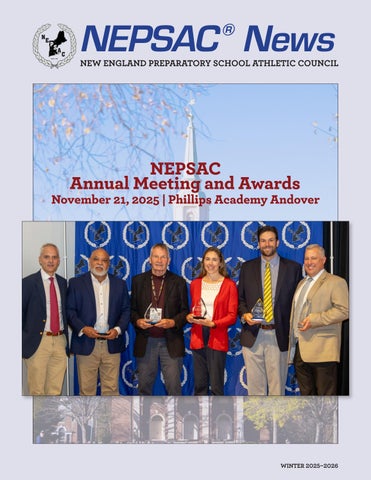
ON THE COVER (from left): incoming NEPSAC president Tim Joncas (Westminster School), Souders Award recipient Bryant McBride, Distinguished Service Award recipient Alan McCoy, Souders Award recipient Gevvie Stone, Geoff Barlow (Avon Old Farms), accepting John Gardner’s Distinguished Service Award, outgoing NEPSAC president Ryan Frost (Cardigan Mountain School).
APresident’s Letter
Tim Joncas
Westminster School
s I begin my term as President of NEPSAC, I want to wish everyone a happy new year and the very best of luck as your teams and programs prepare for the second half of the winter season.
I would also like to extend a sincere thank you to Ryan Frost for his outstanding leadership over the past two years. Ryan’s steady guidance, deep commitment to NEPSAC, and generous mentorship have left our association stronger and better positioned for the future. We are all grateful for his service and leadership.
I am excited and honored to step into this role during what are truly unique and complex times for athletics on our campuses. The pressures of sport specialization and the ever-increasing expectations placed on young athletes have reached all of our schools. As someone who has spent the last 22 years coaching, and now serves as both an athletic director and a coach, I feel these forces from multiple perspectives.
The following resources are behind the password at www.
nepsac.org to serve you better and streamline communication within NEPSAC:
» NEPSAC By-Law and Policy Handbook
» NEPSAC NIL Registration
» NEPSAC Grievance Form
» NEPSAC Expulsion Documentation Form
» NEPSAC NIL Policy and Registration Form
NEPSAC is only as strong as its membership. Our strength comes from unity, shared purpose, and a common understanding of the role sports should play in our schools. At times, that role can feel at odds with the direction youth and elite sports are moving. That makes our shared belief in NEPSAC’s principles and policies—and our collective commitment to preserving the educational value of athletics—more important than ever.
It’s worth remembering that NEPSAC itself was formed during a tumultuous time in 1942, when even something as basic as a potential bus shortage during the war threatened interscholastic competition and the team experience across New England. Schools came together then to protect something that mattered. My hope is that the moment we are living in now can serve as a similar catalyst—for thoughtful conversation, idea sharing, and meaningful growth.
The increasing professionalization of sport at the NCAA level—through revenue sharing, NIL, collectives, and even the hiring of general managers—combined with the professionalization happening at the youth level, places us at a fascinating and challenging crossroads. NEPSAC, like any healthy institution, must evolve thoughtfully and intentionally. Standing still is not an option.
I am truly excited for the opportunity ahead and grateful to work alongside Lisa Joel (Vice President), Sean Kelly (Secretary), Jamie Arsenault (Treasurer), Laurie Sachs (Communications), the entire Executive Board, and the full NEPSAC membership as we move forward together.
I am optimistic about what we can build—together.
EXECUTIVE BOARD
Tuesday, January 6
Remote 8:15
Tuesday, February 10
Remote 8:15
Tuesday, April 28
Cushing Academy 9:00
MIDDLE SCHOOLS
Thursday, April 2
Fay School 10:00
DISTRICT I
Monday, February 24
Hyde School 10:00
Monday, May 19
Kents Hill School 10:00
Zoom meetings may be held if needed in October, January and April
DISTRICT II
Thursday, February 12
Tilton School 9:00
Thursday, April 30
New Hampton School 9:00
Bi-weekly meetings on Zoom from August 2025 to May 2026.
DISTRICT III
Tuesday, April 14 10:00
Phillips Academy Andover
DISTRICT IV
Thursday, April 24
Westminster School 9:00
Got news to share with other NEPSAC schools?
Send the details to communications@nepsac.org and we’ll put it in the next issue.
TREASURER’S REPORT
by Jamie Arsenault, New Hampton School
Professional Development Opportunities
NEPSAC is pleased to introduce the NEPSAC Professional Development Series, a new initiative designed to provide athletic directors and department staff with actionable insights to support daily work and strengthen leadership practices.
We are excited to kick off the series this January with Scott Fitzgerald, who presented at the NEPSAC Annual Meeting in November. Scott will lead a session titled “A Deeper Dive into the Art and Teaching Methods of Coaching.”
This session offers a valuable opportunity to build on the foundations established in November and to bring fresh, effective coaching and leadership strategies back to your campus.
NEPSAC Corporate Sponsors
Over the course of the past year, NEPSAC has been collaborating with signature corporations whose values and missions are aligned with NEPSAC. We have identified these corporate sponsors who will help to support NEPSAC, while ensuring all relationships align with the organization’s mission and values.
» Earthlight Technologies – A family-owned solar and energy-efficiency contractor providing residential and commercial solar solutions, energy upgrades, and athletic facility lighting.
» GoPlay Sports Tours – A sports travel company that organizes international tours for high school, club, and collegiate teams, blending competition, training, and cultural experiences.
» Gipper – A digital media platform that provides customizable social-media graphics and branded content solutions for schools and athletic programs.
» BSN Sports – A leading provider of athletic apparel, uniforms, and equipment for schools, colleges, and sports organizations.
» Championship Award Guys – A supplier of championship rings, medals, trophies, and custom awards for teams and schools.
» Tarkett Sports – A global leader in sports surfacing and facility construction, offering turf, track, and athletic flooring solutions.
» Classic Turf – A sports surfacing company specializing in high-performance athletic surfaces, including tennis and field systems, and part of the Tarkett Sports family.
» Stanmar – A planning, design, and construction firm specializing in athletic, academic, and student-life facilities.
» Rocket Alumni Solutions – A technology company providing interactive digital displays and platforms for halls of fame, awards, alumni recognition, and school history.
» Moove – A fitness challenge app to promote wellbeing across your school community
SPORTS MEDICINE ADVISORY COMMITTEE REPORT
by Grady Congleton, SMAC chair
Happy New Year! As we enter 2026, the NEPSAC SMAC, we are excited to kick off the year with tremendous support and commitment from the executive board to better improve the health and safety of student-athletes across all NEPSAC schools. One of our main initiatives is to redesign the out-of-season coaching policy so that it fits all stakeholders of NEPSAC, including athletic trainers, coaches, athletic directors, and everyone else involved in NEPSAC athletics.
In addition, the main role of SMAC is to bridge the gap between medicine, best practice, and policy in partnership with the athletic directors. We also are here to support the 200 athletic trainers that work within NEPSAC, and we applaud their initiatives to make lives healthier, better, and in some cases, save lives. We applaud all of their hard work, including the heroics of athletic trainers who saved a student-athlete from cardiac arrest earlier this fall.
As we head deeper into 2026, SMAC is committed to continuing to support the larger efforts of NEPSAC and the athletic trainers, and our first priority is always the health and safety of the student-athlete. If anyone has a question or concern on that front, you can email us at smacchair@nepsac.org.
We wish you a happy and healthy 2026!
DUES & Tournament Fees
As a reminder, NEPSAC District and Coaches Association dues as well as Tournament Fees and any other payments to NEPSAC must be paid on the NEPSAC Payment Portal.
Reminders/Tips for Making Online Payments:
To ensure efficient processing, schools should create only one account when submitting payments. If you do not remember your login information, please click the “Forgot your username or password?” link and enter your email address to receive instructions to reset your password. Be sure to check your spam/junk folder for these emails.
Please note that there is a processing fee associated with online transactions to help offset costs. Processing fees are non-refundable, so please be mindful of this during payment and record keeping.
How to View Your Account
If you already have a username and password, go to View My Account and enter your credentials to log in. After logging in, you will have access to Payment History. You may view all transactions or filter by a specific date range or period.
Meet NEPSAC President-Elect Tim Joncas ’00 Westminster School
by Jim Kelley
Opportunities for leadership have never been something that Tim Joncas has gone looking for, but over the years the current Westminster School and NEPSAC President-elect has found himself in the right place at the right time to serve his community and lead. Joncas began his two-year term as NEPSAC President earlier this year, embarking on a new leg to his professional journey.
“Journey is probably the best word for it,” Joncas said reflecting on the two-plus decades he has spent at Westminster. “After graduating from Westminster and then from Trinity College, I came right back to work in admissions, live in a dorm, advise, and coach multiple sports.”
Not long after his return to campus, the school began to undergo some physical changes as well as changes to the senior leadership. When Dennis Daly decided to retire, the Head of School approached Joncas to see if he would be interested in assuming the role of athletic director.
“Athletics was such a huge part of my life at Westminster School, and if I can be of service to others and am capable I tend to say ‘yes.’ So I accepted that offer and have been doing this ever since.”
Joncas has continued to coach, leading Westy’s boys’ ice hockey program since 2007, and began his involvement with NEPSAC early in his tenure as an administrator. What began with roles at the district level soon grew into broader responsibilities within the executive structure as Secretary.
But before Joncas could make his debut as secretary one of the vice presidents elected to take time away from the board and the call to lead came once again.
“[Former NEPSAC President] Ryan Frost called me and asked if I would be willing to assume the VP role, which I accepted, and so I actually went from secretary to vice president without ever sitting in a board meeting in that role.
“If you asked me in 2012 if I would be on the NEPSAC Executive Board I would have said ‘probably not’, but I am so glad I got involved and I’m excited about the opportunities that lie ahead.”
The ground beneath athletic departments at schools throughout New England has continued to shift and that will be no different over the next two years. The expectations of student athletes and parents in the college process as well as the ever-changing world of Name, Image, and Likeness legislation means that administrators and coaches need to remain flexible and informed about how best to serve the students in front of them.
Joncas believes it will be imperative that programs look at the landscape of youth sports and collegiate sports to ensure the experience NEPSAC provides to its student athletes remains current with trends without sacrificing the history and character of the institution. In his words: Embrace innovation while honoring tradition.
“It’s a tight needle but one we must continue to thread,” Joncas said. “I do not believe that stagnation is an option. We need to continue to have these conversations about what is happening above and below us in the world of sports to keep evolving.”
Joncas also sees his role as one of a bridge between two generations of leadership. He credits much of his development to former NEPSAC Presidents such as Ryan Frost (Cardigan Mountain School) Jamie Arsenault (New Hampton School) Bob Howe (Deerfield) Martha Brousseau (Greenwich), and Mark Conroy (Williston Northampton) with his development as a leader, but with all of them now retired or approaching retirement the next generation will look for guidance from the Executive Board and Joncas as they navigate the day-to-day challenges of being an athletic administrator and school leader.
“We have incredible tradition within NEPSAC but this new generation of leaders sees things from a different perspective and it’s important that we embrace that.”
One such tradition, and one that Joncas points to as the most impactful, dating back to his days as a student at Westminster, is the power of collaboration and its embodiment: Team.
“I think it’s the power of being together with a group of people who have a similar goal and are really willing to collaborate, partner, work for the other people on their team and in the room,” Joncas said. “So much of my life and my career has been built around this concept of service beyond self and being a great teammate. When people come to the table with that understanding and that commitment, well, I think great things can be achieved.”
Questions for Coach Joncas
Q: What has changed the most from your time as a student-athlete at Westminster to now?
I think if anything, and I know it’s a little cliche, but these kids, you know, what we share in common is that we all love the game. Whatever the game is, and the joy of playing and competing and putting a jersey on. I think what’s changed from my time as a student athlete at Westminster is that we didn’t have access to what frankly all these other people were doing or not doing. I think as they get older and maybe they aspire to play at higher levels, you know, the social media piece creates this comparison constantly and comparison can be such a thief of joy. It can create a little bit of an issue around why they play the game and cause them to forget why they initially started playing whichever sport we’re talking about: Because it was fun and it brought them joy.
Q: What advice would you have for aspiring athletic administrators or independent school professionals?
I think they should do it! I think we all have slightly different understandings of what it means to be an “educator.” I understand my bias here, but I think working in these schools is being a true educator where you’re in the lives of these young people hroughout the course of the day in different settings, whether it’s a classroom or on the fields or the ice or the courts of the pool. And then maybe you’re the advisor, maybe you’re having lunch with them, or if it’s a boarding environment, maybe you live in a dorm with them. But just how incredibly rewarding it is to have what I would call “multi-dimensional relationships” with kids as you’re trying to help them figure out who they are and things they care about and how you can best support them in trying to achieve their goals.
Sacred Heart Greenwich
Debuts Monthly Online Athletics Magazine
Although the new Sacred Heart Greenwich magazine, One Roar, reports scores and awards, the school also intends to celebrate the heart of what drives their athletics program. Check out the first three issues here. SACRED
SKUNK HOLLOW
Do you need a handbook, directory or magazine? How about a postcard, invitation or stationery? Or a program brochure, fundraising appeal or search piece?
Are you overwhelmed? Do you even know where to start?
Let me help. I have over 25 years of experience with school publications and printing production, and I am accustomed to tight deadlines and equally tight budgets
I can help you figure out what you want, pull the pieces together and deliver a final product you will be thrilled to share with parents and alumni.
BAY STATE GAMES
BAY STATE GAMES
FOR THE ATHLETE IN ALL OF US
The Bay State Games are Massachusetts’ largest Olympic-style spor ts festival, bringing together athletes of all ages and skill levels from across the state. For over 40 years, the Games have provided oppor tunities to compete in a wide range of spor ts, and showcase talent. Many alumni have gone on to excel at the collegiate, national, and professional levels.
WHY BSG?
Showcase talent in front of dozens of college scouts
Compete against high level athletes from Massachusetts & New England
Unlock scholarship oppor tunities & informational webinars for BSG athletes ONLY
Join a 40+ year tradition
Take aim at qualifying for a national event (State Games of America)
Build connections, teamwork, and spor tsmanship that last beyond the competition
Become an Ambassador - Build your resume & develop leadership and business skills
Championship Ring Supplier Supplier of NEPSAC Championship Trophies for over 10 years
• CH A M P ION S HI P RING S
CH A M P ION S HI P T RO P HI E S
W A RD PLA Q UE S
LASS & A CR YL IC A W A RD S
CH A M P ION S HI P BA NN E R S E CORD B O A RD S E D ALS & RI BB ON S ND M U CH MOR E
MILLBROOK SCHOOL | MILLBROOK, NEW YORK
Ousseni Bouda ’19 Receives Community Service Award
by Aaron Case, Millbrook School
Recently, Millbrook alumnus and Major League Soccer forward Ousseni Bouda ’19 was honored with the 2025 Andrew Bedard Spirit of the Game award by his club, the San Jose Earthquakes.
Created in memory of a fan who died tragically young, the award is “presented annually to the Earthquakes player that works hard in the community and best embodies Andrew’s positive attitude both on and off the field,” per the team’s website. Bouda received the award for his work with youth in the local Bay Area community and abroad in his home country of Ghana.
Bouda, who was the No. 8 overall pick in the 2022 MLS SuperDraft, has tallied six goals and one assist in 73 games (18 starts) over his MLS career. He re-signed with the Earthquakes in June, inking a two-year extension with an option for 2028.
At Millbrook, Bouda gained nationwide attention as the Gatorade National Boys Soccer Player of the Year in his Vth form season and the USA Today All-USA High School Boys Soccer Player of the Year as a VIth former. Stanford University took notice, and he went on to play there in the 201920 and 2021-22 seasons, earning All-Pac-12 First Team honors each season.
We’re proud to see Ousseni living out the Millbrook value of community service as he thrives in his professional athletic career!
Avi Dubnov Named National Soccer Coach of the Year
Congratulations to Miss Porter’s soccer coach Avi Dubnov, who was named coach of the year for indepdendent high school soccer by the United Soccer Coaches.
“I was truly honored to receive the United Soccer Coaches National Coach of the Year Award for Independent High School Soccer, following recognition as Regional Coach of the Year and Connecticut Coach of the Year,” Dubnov said on social media. “This past season will be difficult to replicate, but the journey began for me in 2013. I’m incredibly grateful for my assistants, Michael Smith and Christian Benjamin, who help create an environment that maximizes our team events and, most importantly, keeps the experience fun and meaningful for everyone involved.
“Any recognition I receive is a direct reflection of the remarkable student-athletes in our program and the unwavering support system at Miss Porter’s School, much of which happens behind the scenes. I proudly accepted this award on behalf of everyone connected to the program.
“Our achievements this season speak to why we were honored at the United Soccer Coaches Convention and the Connecticut Girls Soccer Coaches Association this past weekend: NEPSAC Class A Champions, Founders League Champi-
ons, WWNEPSSA Class A League Champions, 1x All-American, Connecticut Player of the Year, Connecticut Goalkeeper of the Year, NEPSAC Player of the Year, 2x All-New England, and 3x All-State.
“Winning is the result of development.”
“Being named National Girls Independent Coach of the Year is a reflection of the collective efforts of our coaching staff and the many student-athletes who have helped put this program on the map,” said Dubnov.
In two decades as coach, Dubnov has built Miss Porter’s into one of the top prep programs in the region. He owns a career record of 163-4229, and his teams have won seven of the last nine titles in the Founders League. He also serves as the school’s athletic director.
“This award provides another opportunity to highlight the historic season achieved by the Porter’s varsity program,” he said. “We are immensely proud of what has been built, reshaping both the conversation and the perception of athletics at an all-girls school.”
Dubnov, who was also named the Connecticut Prep Coach of the Year, has spent 25 years coaching soccer. He holds a USSF A License, United Soccer Coaches Advanced Diploma and FA Level 2 certification.
Avi Dubnov with awards next to his name on the Wall of Champions at coaches convention.
Avi Dubnov and assistant Mike Smith after winning first NEPSAC Class A championship for girls soccer.
NEPSAC Players at Soccer All-American Game
NEPSAC was represented exceptionally well at the 2025 Boys Soccer High School AllAmerican Game in Charleston, SC. The East team won 5-2 and Gavin Baer (Suffield Academy) was named East MVP.
From left: Coach Paul Cushing (Northfield Mount Hermon), Trevor Steele (Loomis Chaffee), Gavin Baer (Suffield Academy), Anthony Marzillano (Loomis Chaffee), David Villavicencio (Choate Rosemary Hall), Bless Jeremie Mbuyi Kasongo (Northfield Mount Hermon), Vincent Levasseur (Taft), Charlie Pons (Milton Academy), Coach Jim Burstein (Northfield Mount Hermon). Missing from photo: Emmanuel Marmalejo (Berkshire School) and Danel Esprit (Berkshire School).
NEPSAC Fall 2025 Tournament Champions
Be sure to hit the links below to see the All-NEPSAC athletes
BOYS CROSS COUNTRY
Division 1 Phillips Exeter Academy
Division 2 Roxbury Latin School
Division 3 St. Sebastian’s School
Division 4 Marianapolis Prep
GIRLS CROSS COUNTRY
Division 1 Phillips Exeter Academy
Division 2 Middlesex School
Division 3 St. George’s School
Division 4 Hoosac School
GIRLS FIELD HOCKEY
Class A Phillips Academy Andover
Class B Middlesex School
Class C New Hampton School
FOOTBALL
Drew Gamere Bowl Avon Old Farms
Danny Smith Bowl Cheshire Academy
Bob Souza Bowl Berkshire School
Kevin MacDonald Bowl Milton Academy
John Mackey Bowl The Rivers School
Joe Lang Bowl Canterbury School
John Papas Bowl Tabor Academy
Leon Modeste Bowl Choate Rosemary Hall
BOYS SOCCER
Class A Taft School
Class B Mount Saint Charles Academy
Class C Millbrook School
Class D Hyde School
GIRLS SOCCER
Class A Miss Porter’s School
Class B St. George’s School
Class C Greens Farms Academy
Class D Vermont Academy
GIRLS VOLLEYBALL
Class A King School
Class B Greenwich Country Day School
Class C Hamden Hall Country Day School
Class D Covenant Christian School
BOYS WATER POLO
Brunswick School
1. Presentation session; 2. Ryan Frost, presenter Scott Fitzgerald and Tim Joncas; 3. Exhibitors and refreshments; 4 & 5. Touring the Pan Athletic Center; 6 & 7. SMAC particpants.
NEPSAC Annual Meeting
November
21, 2025 | Phillips Academy Andover
NEPSAC 2025 Distinguished Service Award
by Jim Kelley
Awarded annually to the individual who has contributed significantly to New England Independent School Athletics and Physical Education through enthusiasm, dedication, leadership and vision.
Alan McCoy Pingree School
It is not uncommon for the impact of faculty in independent schools to be felt by the communities they serve. It is, however, a rare thing for one’s legacy to be as plainly obvious as that of former Pingree School Athletic Director, Alan McCoy.
When McCoy first arrived at Pingree in the fall of 1978 as a two-season coach the small school in picturesque Hamilton, Massachusetts had just over a dozen teams plying their trade on the rolling fields of its campus. Over the years, McCoy took on further responsibilities that included student activities, a third sport, and ultimately the role of director of athletics.
In his more than two decades at the helm of the athletic program, Pingree’s athletic offerings more than tripled as the school continued to grow and thrive. While the Highlanders’ place in the landscape of NEPSAC was improving, so, too, was the physical landscape of the playing fields.
“One thing I am particularly proud of was the community project of building the athletic fields,” McCoy recalls. “All of that labor
Alan McCoy and Pingree Athletic Director Betsy Kennedy
1. Ryan Frost and Tim Joncas; 2. The Rocket table; 3. Attendees listen to the presentations; 4. SMAC instruction; 5. The Award Guys table.
was done by faculty, staff, fields of the school, students. It was such an amazing project and to see those fields which are so beautiful come to life and provide that setting for the program is what I am most proud of.”
And the fields were just the beginning. Under McCoy’s watch Pingree added eight new tennis courts, an on-campus ice rink, upgraded fitness center and finally an expansive Athletic Center that served as a fitting capstone to the transformation of Pingree’s campus.
WE ALWAYS WORKED TO FIND COMMON GROUND AND EACH TIME WE WERE ABLE TO MOVE THINGS IN A POSITIVE DIRECTION FOR THE ATHLETES, IT WAS SO REWARDING. THAT’S REALLY WHAT IT’S ALL ABOUT.
In the broader context of New England McCoy’s penchant for building spread to the formation of the Eastern Independent League, of which Pingree was a founding member alongside a number of all-girls and former all-girls schools and provided a platform from which these schools could organize, compete, and promote the common values they all shared.
For current Pingree Athletic Director Betsy Kennedy, the value she will always associate with McCoy is integrity.
“He operated with such a high level of integrity and has always kept the kids at the center of his focus,” said Kennedy, who succeeded McCoy in 2017. “In my own work I am constantly coming back to the example he set in terms of ensuring everything we do centers on the educational purpose of the program.
“He so deeply believed in the value of athletics as a tool for students to develop important skills in their lives. We always say here that ‘we stand on the shoulders of the giants who came before us’ and when it comes to Alan that couldn’t be more true.”
Away from the athletic director’s office McCoy was a transformational coach of multiple sports but none more so than his medicine game, lacrosse. For 32 years McCoy led the Highlanders lacrosse program, claiming New England titles on 12 occasions and a pair
of US Lacrosse Eastern New England Coach of the Year honors.
He brought the game with him as part of an annual service learning trip to the Rosebud Indian Reservation in Todd County, South Dakota where he helped launch their tribal lacrosse program among myriad social and civic initiatives that engaged students in true service learning. Back home, in partnership with Concord Academy, he helped launch the Chandler Bowl for Change which aligns competition with awareness for a charitable cause.
“His commitment to the value of civic engagement and service and the way that commitment has carried forward is such an incredible legacy,” said Kennedy.
For McCoy, he always valued the opportunities athletics offered to students at Pingree.
“Pingree has always been committed to offering opportunities to athletes of all abilities and interests,” McCoy said. “Lots of sports and lots of levels, which is something we have hung onto over the years and has made our program stronger.”
While firmly in retirement now, McCoy looks back at the decades spent within NEPSAC and remembers, first and foremost, the people.
“I was fortunate to work alongside so many incredible people, some who are likely more deserving of this type of honor than I am! Whether it was NEPSAC or within the EIL we always worked to find common ground and each time we were able to move things in a positive direction for the athletes, it was so rewarding. That’s really what it’s all about.”
Tina and Alan McCoy and children.
John Gardner Avon Old Farms
In the landscape of education in New England you would be hard pressed to find someone with a grander legacy than John Gardner, the legendary coach and faculty member at Avon Old Farms. In a career spanning more than 40 years, Gardner held every role you could imagine and did each and everyone of them in a way that prioritized the young men in front of him.
A 1974 graduate of Wesleyan College, Gardner arrived at Avon Old Farms in the fall of 1975 and began a storied career that would span more than four decades and feature New England championships, Olympic athletes, and tenures as both the athletic director and associate head of school. Among the hundreds of athletes who skated for Gardner is current Director of Athletics Geoff Barlow.
“I played for Coach Gardner and then had the opportunity to work with him for 23 years in various capacities,” said Barlow. “At one point I was reporting to John in his role as the associate head of school as the athletic director and I was his assistant with the hockey team, but then I was also his boss as the AD so we had an interesting dynamic. But every step of the way he was my mentor.”
IT’S HARD TO FIND
A BETTER GROUP OF PEOPLE THAN THE NEPSAC A.D.S
Over the decades Gardner found ways to stay in touch with the needs of his students and meet them where they are whether it was 1974, 1994, or 2024.
“John always said, and it was certainly true with me, that boys learn best through humor and he has a great sense of humor,” Barlow said. “If you can find a way to get some humor into every interaction you’ll be able to connect with them and get the most out of them. And he adapted, he was constantly growing as a teacher and a coach to ensure he was there for the kids to help them be successful.”
Gardner attributes his ability to keep up with the changing student body to a “Peter Pan” mindset.
“Never grow up,” Gardner said. “When I look back at all the years and the fun I had with the students I’m thankful I never had to grow up.”
While the teams on the ice were consistently finding ways to be successful, Gardner always jumped at opportunities to help his student athletes grow away from the sport. When an opportunity arose for teams to work with a sport psychologist, Gardner was first in line to have them work with his team.
In the spring of 2025 Avon Old Farms held its Hall of Fame ceremony and Gardner was among the group being inducted. While his accolades on the ice speak for themselves, the outpouring of alumni and community support at this particular event brought to the fore his legacy and the impact his dedication to the school community had left.
“For me to be able to witness that and speak to guys from the 70s and 80s as they came back to speak about how he was certainly a great hockey coach, but in terms of being a mentor and a friend and the impact he had on the rest of their lives. It’s incredible. We always say ‘you’re here for four years but we’re setting you up for the next 40’ and nobody lived that more than John.”
Reflecting on his time at Avon, Gardner pointed to his tenure as the Athletic Director as his favorite time professionally.
“Those years were among the best I had because I got to work with some excellent people and do excellent work,” Gardner recalled. “It’s hard to find a better group of people than the NEPSAC A.D.s.”
John Gardner was unable to attend the meeting because of illness and passed away on December 20, 2025. Read more about his life here.
Geoff Barlow and Tim Joncas. Geoff nominated his mentor John Gardner and accepted the award on his behalf.
NEPSAC 2025 Martin William Souders Award
by Jim Kelley
Established in 1967 in memory of Martin William Souders, Director of Physical Education at Milton Academy, 1919–1929, and at Phillips Exeter Academy, 1930–1962, and the first President of the New England Preparatory School Athletic Council. In recognition of his leadership, vision, dedication and the constant and valuable contributions which he made to the cause and stature of Physical Education and Athletics among New England Independent Schools. Awarded annually to a graduate of a New England Independent School who made a distinguished record in sports and who has since made a distinguished record in life through high ideals, leadership and accomplishments.
Gevvie Stone
The Winsor School
Dr. Genevra Stone was, in her own words, a nerd. If you told that young student arriving at Winsor School for fifth grade that she would walk out of those doors and earn an Olympic Silver medal she would have said that’s highly improbable.
“I was not an athlete at all,” said Stone, a 2003 graduate of Winsor and the 2025 Martin William Souders Memorial Award recipient. “I played town soccer, but that was it. I walked into Winsor with no athletic expectations whatsoever, and the environment was such that you were just expected to work hard, set your sights high, and everyone would support you in your path to success.”
Karen Geromini, former director of athletics and current chief operating officer at Winsor agreed.
“Gevvie was a bookworm,” Geromini said. “We had a lot of different offerings so students could really try any sport they wanted and she tried a whole lot of different sports. Then she got to high school and could try rowing and here we are!”
That path to success in Stone’s life truly began at Winsor where she learned two things that would inform the rest of her life: rowing and science. The first would lead her to multiple world championship and Olympic competitions while the second led her to pursue a career in medicine.
Both on the water and in the classroom, Stone consistently mentioned the learning environment Winsor fostered and how it brought out the best in her.
“We were having dance parties at the boathouse every day,” Stone recalls. “Rarely was there much complaining about things like carrying down launch engines. Practice was so fun and the whole time we were pushing our physical limits on the water, while enjoying each other and what everyone brought to the team while we were off it.”
Helping create that atmosphere was the team’s coach, and Stone’s mother, former Olympic rower Lisa Hansen. Hansen’s coaching combined with the team dynamics and ability in the boat for Winsor led to the school’s Youth 4+ entrant in the 2002 Head of the Charles to take first place in the high school division, marking the first of many individual and team accolades for Stone.
Upon graduating from Winsor, Stone matriculated at Princeton University and
AD
Stone.
helped her 2005 and 2006 Championship 8+ crews take first place in Boston. To this point Stone had followed in both of her parents’ footsteps for so long that the next logical step was the Olympics.
“In a way I didn’t appreciate how difficult it was to become part of a college rowing team because both of my parents and many of their friends were from that world,” Stone recalls. “So in a similar sense, because both my parents had rowed in the Olympics I had no real appreciation for what it took to row in the Olympics.”
Stone recalls walking into the locker room at Princeton and hearing a teammate talking about their experience at the Junior World Championships and rowing on the Olympic course at Athens and realizing that there were so many others out there with the same goal. Following her junior and senior years, she won gold at the Under-23 World Championships and was invited to the Team USA camp ahead of the Beijing Olympics.
“That was the first time in my life that I was training full-time with no academic responsibilities and it was hard on my body, on my mind for the first time I felt like the slow one,” Stone recalls. “It is very hard I would actually say nearly impossible to achieve at a high level when you don’t believe in yourself.”
IT IS VERY HARD — I WOULD ACTUALLY SAY NEARLY IMPOSSIBLE — TO ACHIEVE AT A HIGH LEVEL WHEN YOU DON’T BELIEVE IN YOURSELF.
Geromini and current Director of Athletics Sherren Granese recalled Stone describing the train-
Former Winsor
(now chief operating officer) Karen Geromini and Gevvie
ing “like a science project, from how and when she trained to what she ate to how and when she slept was detailed and exact.”
Stone would miss out on the 2008 Beijing Olympic team and over the next few years would balance competitive rowing with periods of time in medical school. She rowed in the 2011 World Championships but did not reach a qualifying place in the single. She was able to overcome that final hurdle by claiming a spot in the 2012 London Olympics at the Last Chance Regatta.
“There had been so many ups and downs, but getting to compete at the Olympics was a dream come true, literally.”
Stone would go on to qualify for the 2016 and 2020 Olympics as well, peaking in 2016’s games in Rio De Janeiro with a Silver Medal in the Single Sculls. When the 2020 games were postponed in the wake of the COVID-19 pandemic, Stone realized that she had postponed many elements of her own life in service of the sport she loved and decided that after the Tokyo Games the time was right to step away.
With a renewed focus on life off the water, Stone has gone on to flourish in her chosen field of medicine, completing a residency in emergency medicine at Beth Israel Deaconess Medical Center and a fellowship in sports medicine at the University of Utah. She currently practices emergency medicine in addition to sports medicine with Cambridge Health Alliance.
Reflecting on her journey, Dr. Stone is quick to reiterate how thankful she is for the environment Winsor provided for her as a young athlete.
“Winsor made it fun to play sports, no matter your technical ability. I developed into an athlete largely because of that environment. I certainly did not identify as an athlete when I went in as a fifth grader, but I certainly identified as one when I left as a senior.”
For Geromini, Stone represents the best outcome any coach or administrator could ask for.
“When people gain the success that she has in all facets of life, you really hope that deep down they’re good, quality people,” Geromini said. “Good souls. Caring, empathetic, compassionate souls. And that is Gevvie, the complete package.”
Bryant McBride Williston Northampton School
Many independent school stories begin the same way: A student, eager to challenge themselves, enters 9th grade on a new campus with ambitious goals for the next four years. For others, however, the tale does not begin until after they have already graduated from high school but nonetheless feel there is more to learn before embarking on the next phase of their life.
The latter is the story of how 2025 Martin William Souders Memorial Award recipient Bryant McBride came to enroll at Williston Northampton School in the fall of 1983 and begin a 40-year relationship with what has become a home away from home.
“In 41 years I have not gone a month without speaking to someone from Williston, and I was only there for one year,” McBride said. “That one year had such a profound impact on my life, on my career. It allowed me to stretch and think about what’s possible, what’s attainable.”
Originally from Chicago, McBride’s family relocated to Sault Ste. Marie, Ontario when he was five years old and a lifelong love affair with ice hockey began. From the Esposito brothers to a young Wayne Gretzky, McBride had a front-row seat to high level hockey and felt the weight of expectation that came with being from this cradle of on-ice excellence.
Upon graduating from high school McBride found himself in Easthampton with a recommendation from the United States Military Academy at West Point. With that lying ahead of him, McBride was able to take on all that Williston had to offer.
“Ray Brown, my soccer coach, and Al Shaylor, my track coach I had never run track before just pushed me to do more. I had never run track before, but ended up with a couple of records that stood for years. And with [coach Bob Shaw] and hockey, we had
Bryant McBride with former Williston AD Mark Conroy.
Lisa Stone, Gevvie Stone, Jonathan Pritz, and Greg Stone.
a rink on campus. We practiced every day. That just totally changed my game, what I could do, what I was capable of,” McBride recalled.
Under Brown, McBride earned AllWNEPSSA All-Star honors as a midfielder before helping the Wildcats reach the New England tournament with his tough checking and relentless play in Lossone Rink. After completing his post graduate year, he matriculated at West Point with the intention of competing for the Cadets’ soccer and ice hockey teams before a devastating injury forced him to change course. He would be named the Academy’s first black class president in 1995 before transferring to Trinity College and helping the Bantams win a trio of NESCAC titles.
IN 41 YEARS I HAVE NOT GONE A MONTH WITHOUT SPEAKING TO SOMEONE FROM WILLISTON, AND I WAS ONLY THERE FOR ONE YEAR
Unable to stay away from the sport he loved for long, McBride rose to the rank of vice president for business development for the National Hockey League in 1991 and served in that role for nine years. During that time he was the league’s highest-ranking black executive and founded the NHL/USA Hockey Diversity Task Force, now known as Hockey is for Everyone. He also began a relationship with Willie O’Ree, the league’s first black athlete, that led to O’Ree being named the league’s Diversity Ambassador and later an award-winning documentary called “Willie” that McBride produced.
“If I had to pick one thing that Williston taught me and really just hammered home, it would be that bringing your best and competing at all times is the standard, it’s what’s expected of everyone. So you have to take the opportunity to raise your level and make an impact and help others. The seeds of that attitude were planted at Williston through the coaching I received and the relationships I formed in that one year.”
Now McBride finds himself back on campus at Williston several times a year in a new capacity: a member of the Board of Trustees.
“It is such a special place in my heart,” McBride said of Williston. “Every time I am back without fail I feel rejuvenated. The whole area, but that place in particular the people, the kids just never fails to charge my battery.”
An avid runner, McBride has also been a member of the New York Runners Board since 1992 and in that time has helped the running club grow from more than 10,000 members to just over 100,000 with $100 million in revenue. He has run 26 marathons, taught courses at Trinity, MIT, and Harvard, and his TEDx Walden Pond talk debuted in December 2025.
Bryant and Tina McBride.
KENTS HILL SCHOOL | KENTS HILL, MAINE
Carving Legacy: The Revival of the Kents Hill Trail System
by Rebecca Kimball, Athletic Director
At Kents Hill School, tucked into the soft green folds of Maine, there is a trail system that feels a little bit like magic. Forty acres of paths curl through pine groves, dip past mossy boulders, rise over open ridges, and wander into quiet places where even the birds seem to whisper. These trails are not simply part of the scenery. They are part of the soul of the school.
And this fall, with the help of faculty, staff, students, and some legendary retired colleagues, these trails have burst back to life. Every path has been cleared, marked, brushed, and rediscovered. The woods feel awake again, as if they have been waiting for people to return in full force. Runners fly through with big smiles, bikers bounce over roots with a mix of bravery and questionable decisions, skiers and snowshoers dream of the first snowfall, and walkers find their perfect excuse to wander without guilt.
These trails did not appear because someone got lost and said, well, this looks good. They were created by people who saw the outdoors as a classroom without walls. Teachers, coaches, and caretakers imagined a trail system where students could find strength, peace, confidence, and a few stories worth retelling. And they built it the old fashioned way, with clippers, sweat, and a very stubborn idea that the woods can make us better.
Every trail carries a name for someone who helped make that idea real. There is Trail Mike, named for Mike Burke, who spent over forty years caring for the campus and the people who walked it. His trailhead enters behind the scoreboard, where we spent many years working and preparing the fields. There is Reverend Dr., named for Chaplain Karen Munson, whose presence offered comfort, reflection, and the kind of guidance that settles the soul.
And then there are dozens more, each one a thank you written into the land. These names remind us that people helped carve the world we enjoy. If you have ever wondered what legacy looks like, you can literally run through it here.
Anyone who has explored these woods knows their charm. In fall, they turn into tunnels of bright color that make runners forget they are tired. In winter, the snow settles like quiet magic and the ski tracks glide through the trees with a calm that feels almost unreal. Every season provides its own small gift. A breath you did not realize you needed.
The rebirth of the trail system today owes much to Mr. Jeff Munson, who took stewardship from longtime caretaker Lin Parker in 2004. At that point only the five kilometer campus loop was still in solid shape. When Jeff Munson was appointed the Kents Hill “Trail Master” he rebuilt the network, created maps, added markers that show three points at a time, and gave the system structure that makes every new traveler feel like they belong out there.
Of course Jeff is only one piece of the story. The trails owe their spirit to many hands. Diane Chick guided the Outing Club for more than twenty years, showing students the joy of discovering what is around the next bend. Todd Wheelden launched a mountain biking program that opened the woods to a whole new type of adventure.
Now the trail system is full of people again. Faculty can stroll during free periods, teams charge through during practice, students explore with friends, and community members wander for the simple pleasure of wandering. In winter the snowmobile breaks the trail and the groomer lays a clean four feet track for its cross country skiers and snowshoers. When the fire pit roars outside the Outing Cabin it indicates a green light to explore the trails and create memories with friends and family.
Restoring these trails is more than a project. It is a passing of stories from one generation of trail caretakers to the next. It is a reminder that the land remembers what we build. And if we care for it, it will carry our stories forward.
Someday a student will pause at a sign that reads Mike and ask who he was. If we have done our job, someone will tell them. And in that moment the trails will come alive all over again.
TRUSTED AT OVER 80,000 INSTALLATIONS WORLDWIDE OVER THE LAST 25 YEARS
AT THE SURFACE OF WORLDCLASS VENUES & THOUSANDS OF HIGH SCHOOL PROGRAMS
INDUSTRYLEADING SYSTEM DESIGN WITH PROVEN DURABILITY & LONGEVITY
COMMITTED TO PROTECTING PEOPLE & PLANET THROUGH INNOVATIVE SUSTAINABILITY PROGRAM
ONE SOLUTION FOR YOUR ENTIRE VENUEEASY PROCESS FROM START TO FINISH
Official Sports Surfacing Partner
FieldTurf helps make Salisbury School a top destination for New England athletics
Synthetic turf provides football, soccer, lacrosse, and baseball teams with reliable playability and safety
Several years ago, Salisbury School, the Northwest Connecticut boarding school, released a video extolling the virtues of ‘The Salisbury Gentle-man’. Brief but impactful, it represents both the playfulness (“Salisbury Gentle-man. I want that guy as a son-in-law.”), and the camaraderie (“Salisbury Gentle-man is the brother that everyone needs.”) that one hopes to find in an institution that emphasizes community, brotherhood, and the forging of lifelong friendships. It also serves as a highlight reel for the extensive facilities that have cemented Salisbury as a top New England destination for athletics.
Boasting a 725-acre campus, Salisbury School’s rural surroundings provide an idyllic setting for nurturing the mental, physical, creative, and spiritual development that helps students embody its motto of ‘Esse Quam Videri,’ which translates to ‘To
be, rather than to seem.’ More than just a motto, this mindset empowers students to pursue a wide range of academic, artistic, and athletic goals. On the latter front, Salisbury has more than 30 interscholastic teams that students can join, spanning fall, winter, and spring.
With sports and the Crimson Knight tradition being such an integral part of the Salisbury experience, the school has consistently invested in providing its student-athletes with facilities that rival or surpass those of other schools in the region. A critical part of that is responding to the challenges posed by the New England weather, which regularly places Connecticut among the rainiest states in the country. This is where the almost 20-year relationship between Salisbury and FieldTurf, the region’s leading synthetic turf supplier, comes into play.
FieldTurf first came to the Salisbury campus in 2007, when the school relocated its main playing surface, used for football, soccer, and lacrosse, and now known as Wachtmeister Field, and converted it from natural grass to synthetic turf. The change alleviated concerns about lost time due to bad weather and negated typical field maintenance issues, allowing for more uninterrupted play.
The need for reliable safety and playability in the face of unfavorable conditions has made synthetic turf an increasingly popular surface solution, especially for schools in New England. As is the case with Salisbury, consistent access to state-of-theart athletics facilities is essential to fostering leadership traits, discipline, teamwork, and respect for others.
“The synthetic turf offers flexibility that allows our students to make the most of their time on the field,” said Tim Sinclair ’91, who joined the Salisbury faculty in 1995 and has been Director of Athletics since 2000. “Our experience with it has been nothing but positive, and I would never go back to grass, given the conditions we encounter located in the Northwest corner of Connecticut.”
The importance of stable field conditions, despite unpredictable weather, was further highlighted with FieldTurf’s next installation in 2020, after the Crimson Knights lost an entire baseball season due to drainage problems that resulted in unplayable field conditions. In response, Salisbury installed new synthetic turf at Natalie Gardner Baseball Field, positioning Salisbury as an optimal host for early-season games when competitors’ fields might not yet be ready for action.
While initially unsure of how turf would perform for baseball, Sinclair quickly embraced the change. “I was somewhat skeptical, as it was my first experience with using synthetic turf for baseball. Now, I feel that we have one of the better baseball facilities in New England,” he said. “We can play home games in early spring when there’s rain and have hosted baseball showcases later in the season. Our field is always ready to go.”
When the baseball field was installed, a new soccer pitch, also featuring FieldTurf, was seamlessly incorporated into its outfield, meaning that Wachtmeister Field would only need to host football and lacrosse moving forward. This led to the most recent project, which saw Wachtmeister resurfaced with a FieldTurf Classic HD system. The system, designed to enhance durability and safety, is the latest upgrade to a venue that has also added stadium seating since its initial installation.
Providing top-quality playing surfaces is just one way that Salisbury continues to support a rich legacy of success, which has seen its teams frequently in contention for league and New England championships across multiple sports. The true foundation for the Crimson Knights’ success lies in a dedicated team of coaches and advisors who make a personal investment in their students and take on mentorship roles that can prove critical to their interpersonal and academic success.
As Salisbury prepares to celebrate its 125th anniversary later this year, its commitment to time-honored traditions, while also embracing modern education and innovation, has strengthened its reputation for creating environments that champion risk-taking in the pursuit of personal growth.
This distinct quality is highlighted in another Salisbury school video, ‘Sarum: The Spirit of Salisbury’, dedicated to an undefinable energy that is unique to Salisbury and must be experienced to be truly understood. It illustrates the passion, brotherhood, and infectious joy that permeate the sprawling campus, with no shortage of contributions from the athletics department.
The video also includes a moment when Reverend Dr. Kirk Hall, a graduate of Salisbury who served as its Chaplain for 11 years, provides a student with the following advice that further explains what makes the school such a uniquely inspirational place of learning: “Connect with your inner Sarum. That voice, that always knows the way, like a compass. The one that tells you to stop and listen.”
Moove is a fun, six-week fitness competition that helps teachers, coaches, and staff connect, move more, and support each other all through a gamified experience that feels like fantasy football meets wellness Teams compete in a private league, score points for activity, in hopes of making the playoffs, where one champion will be crowned. The Moove platform helps strengthen community, boost engagement/culture, and promote wellbeing across school communities
Athletics as a Classroom: Lessons from Kathy Delaney-Smith, legendary former head coach of Harvard Women’s Basketball
On October 7, Newton Country Day’s College Counseling and Athletics Departments co-hosted a conversation with Kathy Delaney-Smith in the Sweeney-Husson Theatre. Delaney-Smith shared lessons from her 40-year career as the head coach for Harvard Women’s Basketball, providing Newton Country Day parents and caregivers with a deep understanding of the college admissions landscape, the student-athlete experience, and the impact of parental support on the hearts and minds of young athletes.
A Newton native herself, Delaney-Smith opened her talk by explaining the connection between her personal mission, the overarching theme of her book Grit and Wit: Empowering Lives and Leaders, and the mission of Newton Country Day. “I have spent my entire professional life empowering girls and women. It’s why I was put on this earth,” she shared. “Your mantra here is ‘Courage and Confidence,’ and that’s what I wrote a book about.”
Drawing from her decades of experience mentoring student-athletes on and off the court, Delaney-Smith shared her belief that the court, field, or track is the greatest classroom in the world. Athletes, whether starting the game or sitting on the bench, have opportunities every day to practice resilience, leadership, teamwork, and accountability. “Where else can you practice leadership, succeeding and failing, communication skills, and pushing yourself to your limits daily? There’s no other environment where you can work on these skills, fail, and get up tomorrow morning and try again,” she explained.
Delaney-Smith also spoke candidly about her unconventional journey to becoming an Ivy League basketball coach. She never
YOU MUST ACT AS IF YOU HAVE THE SKILLS, ATTITUDE, AND CONFIDENCE TO ACE THE INTERVIEW, BE THE STAR PLAYER, OR GET ACCEPTED INTO YOUR DREAM SCHOOL.
“IT’S NOT PRETENDING,” SHE EXPLAINED. “IT’S CHOOSING TO SHOW UP WITH INTENTION.”
played college basketball herself, instead opting for synchronized swimming, as it was one of the only sports offered to women at her school. But a mantra she continues to keep in mind today, and encourages athletes to use, helped her land the job: act as if. She explained that you must act as if you have the skills, attitude, and confidence to ace the interview, be the star player, or get accepted into your dream school. “It’s not pretending,” she explained. “It’s choosing to show up with intention.”
While confidence and intention are essential, Delaney-Smith reminded the audience that true success requires something deeper: balance. She encouraged the parents and caregivers in attendance to teach this lesson to their children. Colleges like Harvard, she said, look for students who are “more than one-dimensional”—those who pursue various interests and passions with equal curiosity and commitment. She implored parents and caregivers to let their daughters explore and be imperfect at the things that interest them. “Perfect is boring,” she emphasized. “Encourage your daughters to take risks, to laugh at their mistakes…When you stop trying to be perfect, you make room for courage,” she said.
The event highlighted the shared commitment of the College Counseling and Athletics departments to the holistic development of Newton Country Day students. Delaney-Smith reminded the audience that, on and off the court, “with a little time management, a lot of hard work, and plenty of Courage and Confidence, you will be your best self.”
Building Culture in Middle School and JV Sports
by Cameron Chittock
After a fantastic fall athletics season at Belmont Hill, the winter teams have officially embarked on their latest campaigns. While students will rally in The Loop to cheer on the varsity programs looking to break records and capture ISL titles, the majority of athletes will be competing at the Middle School and JV levels. The legacy of these teams might not live on banners or in the annals of the Jordan Athletic Center, but the experiences create lasting memories for students and alumni.
“Year in and year out, our players are sad when the season ends, stopping the coaches in the off season and telling us it was their favorite time. Three or four years out and upper schoolers still talk about how much fun they had in middle school,” said Form III soccer and Form III squash coach Stewart Steffey. “Due to the inherent pressure both the classroom and athletic field present in the Upper School, I see it as our obligation in the Middle School to make sure the boys enjoy each other’s company and the brotherhood, focusing on the moment.”
Form I basketball and Form I baseball coach Al Murphy ‘98 takes a similar approach. “It always starts with the first rule for all my teams: sports are meant to be fun,” Mr. Murphy said. “It is important that all of the kids feel like they have a spot, from the
next varsity star to the novice player, and they walk away excited about the next day. They feel like practice is something they get to do, not something they have to do.”
The lasting appreciation for these teams extends to JV as well. While there is often disappointment from the players who do not make varsity, the surprising joy of JV athletics is a frequent topic for the Woodbury Public Speaking Contest or alumni returning to campus for Chapel Talks.
This immense pride the boys feel for all these teams below the varsity level does not happen by accident. It’s the result of the culture fostered by the teacher-coaches leading them, who know the boys and care deeply about creating a sense of belonging for every player involved.
Prior to the start of the school year, Form III hockey coach, teacher, and former USA Hockey Olympian Jamie Phinney led a workshop for coaches to share effective ways of building belonging and culture in their teams. Ms. Phinney presented examples of some of her own methods and gave the coaches the opportunity to discuss and share the strategies they’ve found to be successful with their own teams.
Ms. Phinney begins the process of building a strong team culture before even the first practice. At the start of each season, she
PHOTO BY ADAM RICHINS
gives out the same survey she distributes to her classes to understand what helps each boy learn best. “I use the survey results as my guidepost to understand each kid individually and then how we can work as a team,” Ms. Phinney said. “I ask questions like, ‘What coaching style has helped you in the past? Are you a player who responds well when a coach immediately says something to you after a shift? Some kids need it, they need to process it and then they need to be done with it. Or are you someone where that doesn’t help?’”
The ability to truly know each boy is the benefit of teaching and coaching them, bridging the two sides of campus and connecting the students’ daily experiences. The academic, athletic, and extra-
HOW FAR CAN WE REALLY STRETCH
THEM IF WE DON’T ACTUALLY KNOW THEM AS PEOPLE?
curricular components of Belmont Hill all present opportunities to discover the best ways to champion a sense of joy and community in the students. The ways in which faculty members lean on each other as resources and share best practices is not limited to only the athletic arena. Impactful methods of leadership and teambuilding from robotics, theatre, and the arts, can be used just as effectively in athletics. Understanding what motivates and inspires a particular student in one area of school life, only helps the other faculty members instill a similar sense of purpose in other fields.
“How far can we really stretch them if we don’t actually know them as people? If I only teach them hockey, I’m going to stretch their hockey, but I could actually stretch their hockey further if they knew there was more to them than just hockey,” Ms Phinney said. “That’s where I think the teacher-coach model is at its best, because we can get more out of these boys in the space that they’re really passionate about if I let them know that’s not all they are. Because if they think that’s all they are, their approach to it is, ‘I can’t mess up’.”
The pressures student-athletes place on themselves to perform is apparent even before the varsity level and Mr. Steffey noted how he and his fellow coaches work to help the boys see the bigger picture. “We strive to put ‘team’ ahead of results and personal gain. Taking care of each other, celebrating other’s success and picking each other up, ultimately leads to the overall success we seek to achieve.”
Coaches are always looking for ways to measure that the culture is clicking. For Ms. Phinney, one way to pull this off comes at the end of each practice. “We have an agreement where if we actually think that was a great practice, we will shake hands. But not every day, because there are days when that wasn’t a great practice.”
The decision of whether or not the team reached their standard of working hard and playing for one another comes from the players, not the coach. For Ms. Phinney, that sense of ownership and buy-in is what ultimately creates the bonds carried long past graduating Belmont Hill. “If you have more ways where they can see that the culture and effort matter more than the outcome, then you’re there.”
BROOKWOOD SCHOOL | MANCHESTER, MASSACHUSETTS
Noticing What Matters: The HEART Award in Middle School Athletics
by Emily Norton, Athletic Director
At the end of a middle school game, there’s a familiar energy: tired legs, flushed faces, the release that comes when the whistle finally blows. This fall at Brookwood, that moment has been intentionally slowed just long enough for students to notice something else. After the handshake, each team now names one player from the opposing side who played with heart.
The HEART Award is a small gesture by design. It asks students to look across the field and recognize effort, integrity, and generosity in someone they were just competing against. The award is grounded in Brookwood’s core values Helpful, Engaged, Adventurous, Resilient, and Thoughtful but its real work happens in the pause it creates. Instead of rushing off, students are invited to reflect: Who showed up well today? Who played the game the right way?
For middle schoolers, that moment carries weight. It shifts attention away from outcomes and toward character, reinforcing that how you play, treat others, and respond to challenge matters just as much as the final score. Coaches have noticed students listening more closely during post-game conversations, and players beginning to name qualities they admire in others with growing confidence and clarity.
“We weren’t trying to spotlight ourselves,” says Athletic Director Emily Norton. “We simply wanted to reinforce the values we talk about every day in a way that felt authentic to kids and to sport.” What’s emerged is a quiet tradition that has strengthened sportsmanship and camaraderie, often in subtle and meaningful ways.
The HEART Award isn’t presented as a solution or a model, just one school’s attempt to keep youth athletics grounded in what lasts. For those interested in exploring similar practices, Emily is always open to conversation. Sometimes all it takes is a small, thoughtful pause to remind students (and adults!) why we play in the first place.
Sharing the Sport: Girls’ Varsity Soccer Volunteers With Boston’s Soccer Unity Project
On a sunny Saturday in late September, Rivers girls’ varsity soccer team volunteered with Soccer Unity Project, an organization that creates accessible opportunities to play soccer in Boston. Working with one of the organization’s youth programs, the Rivers team spent the morning leading drills and connecting with kindergarten-aged players.
“I really wanted my team to do something that was community service but soccer-related—something that would play to their strengths,” said Susanna Donahue P’03, ’06, girls’ varsity soccer coach and upper school assistant dean of students. Soccer Unity Project states that part of its vision is “to change the culture of youth soccer from a pay-to-play model with a history of systematic racism and gender inequality to one that welcomes and develops urban youth regardless of background or experience.” When Donahue heard about volunteering with Soccer Unity Project from a colleague at another school, it sounded like a great opportunity for her team to give back.
The Rivers soccer players broke into groups to lead different drills, which the kindergarten players cycled through. Over the course of games like Red Light, Green Light and Fishy, Fishy Cross My Ocean, the team was able to encourage the kindergarteners and have fun with them.
Harper Pierce ’28 quickly bonded with a girl in one of the groups. “After the drill was done, she didn’t want to leave my side. She was like, ‘Can you come to the next drill with me?’” Pierce said. “She was really cute.”
Jasmine McNish ’26, girls’ varsity soccer co-captain, worked with Soccer Unity Project over the summer, but with young adults. She enjoyed working with the kindergarteners this time, saying, “I have a lot of younger cousins, so it was kind of like playing with them.”
Donahue heard from the staff at Soccer Unity Project afterward: They were thrilled with Rivers’ participation, commenting that the Rivers players came prepared and that they hope they will come back.
Director of Community Engagement Lucas Malo was happy to see the girls’ varsity team volunteering together. “I truly believe that volunteering provides a space to build community, and that our community has talents to be shared with others. Whatever your mission or passion, there is a way to share it,” he said.
That sentiment matches Pierce’s experience. “It felt rewarding knowing little kids look up to me because I play a sport that I love and enjoy,” she reflected.
Honoring His Roots: Hunter Thompson ’26 and the Haudenosaunee Legacy of Lacrosse
by Max Paro ’17, Communications Associate
This past spring, as Hunter Thompson ’26 made a post-study hall snack in the Woodward Dorm common room, he received a phone call he had worked a year to earn.
The General Manager of the Haudenosaunee Nationals (comprised of members of the Mohawk, Oneida, Onondaga, Cayuga, and Seneca nations) was calling to inform Hunter that he had been selected to the U20 Men’s Field Lacrosse team and earned a spot on the team that would compete at the 2025 World Lacrosse Men’s U20 Championship in Jeju, South Korea, August 15–24, 2025.
After the third tryout in the span of a year, Hunter returned to campus awaiting the announcement of the final roster: “Two nights before I got the call, I had a dream that I was going to make the team.” One of only five players from the Akwesasne Reservation to make the team, this was a special opportunity for Hunter to represent his community.
“It’s great knowing that I can play for them. Everybody here loves lacrosse. It’s an honor because all the greats played for the U20s before moving on to the men’s team. We all want to represent ourselves the best way we can.”
Playing for His People
One of the oldest team sports in North America, modern lacrosse evolved from a Native American game. Traditionally played with hundreds of players on each team on a field that spanned miles,
lacrosse served religious and social purposes for Native American tribes.
Hunter believes that the Haudenosaunee embrace the indigenous tradition in their style of play: “We don’t play very structurally. We play emotionally and let our talent shine through. Playing is an honor for our people.”
Honoring the legacy of those who came before them is central to the Haudenosaunee team mentality: “Culturally, lacrosse means a lot, because whenever we play, we play it for the Creator. He gave it to us. We play for him, but we also play for the ones that can’t play.”
For the Haudenosaunee, lacrosse unites their community: “When I was playing for the junior team, every elder that I know went to our games. They love watching us, so we play for them. It’s called the medicine game because it brings good medicine. It brings a good mind and a clear head. Everybody who watches always leaves happy.”
Holding His Own on the World Stage
At 17 years old, Hunter was one of the youngest players not only on the Haudenosaunee team but in the whole tournament. Competing against some of the best rising sophomores in all of college lacrosse, Hunter held his own. Across six games,
Hunter put up three goals and four assists, making him the fifth leading scorer on the team.
While he excelled on the field, Hunter also embraced the opportunity to bond with his opponents: “We met all these other teams. It was a cool experience to see how they lived and their different lifestyles.”
As Hunter begins his senior year at Holderness, he is intent on making the most of his time as a Bull and helping to bring the Boys Varsity Lacrosse team together as they look toward the spring: “We all need to be on the same page. We all need to be looking at one goal.”
Emphasizing this team mentality, Hunter wants the team to prioritize being a cohesive group: “We need to have the same mindset. If someone is struggling, we need to support them. The biggest thing for me is that we’re all together as one, as a team.”
Top: Hunter Thompson with the trophy. Left: The Haudenosaunee and Eire (Ireland) teams.
Planning for Performance: Sports Lighting in Action
On fall evenings, when practices run long and families gather along the sidelines, one thing quietly keeps everything in focus: a lighting system that allows the game to continue, the field to stay visible, and the experience to feel uninterrupted. Players move with confidence, officials track the play, and parents follow the action from the stands without giving much thought to what makes it all possible.
Moments like this depend on more than just a field and a schedule. They rely on lighting that keeps play consistent, helps athletes stay focused, and gives families a clear view of what’s happening on the field. When everything works as it should, the experience feels seamless, even as the evening stretches on.
Earthlight Technologies works with NEPSAC member schools to design and deliver sports lighting that supports these moments across campus. Projects are handled as turnkey, in-house efforts, tailored to the needs of each school and guided by Earthlight’s core values. The focus is simple and steady: lighting that performs
reliably, fits naturally into school life, and supports the communities that gather around the field.
As sports seasons overlap and daylight shortens, lighting moves from a background consideration to an operational priority. Shared fields see heavier use, schedules tighten, and expectations around safety and consistency rise. In these conditions, lighting performance directly affects whether athletic programs can operate as planned, and how efficiently those facilities use energy while doing so.
At Watertown High School, Earthlight helped navigate those same challenges. The goal was not only to improve visibility on the field, but to upgrade to a more efficient lighting system that could support heavy use without increasing operational strain. Efficiency mattered because it touched everything else: energy demand, reliability, maintenance, and the ability to confidently schedule practices and games throughout the season.
Modern, efficient sports lighting delivers benefits that extend well beyond brightness. Systems designed to use less energy while providing consistent performance allow schools to support more activity without increasing electrical load or maintenance demands. Immediate on/off capability eliminates warm-up time, reduces wasted energy, and ensures fields are ready exactly when they are scheduled to be used. Over time, this efficiency translates into lower energy consumption and maintenance costs, supporting athletics while helping schools manage long-term operating costs.
Understanding how much your school can benefit from that efficiency often starts with evaluating existing conditions. Many lighting conversations begin with an energy efficiency audit, which helps schools see how their current systems are performing, where energy is being used inefficiently, and what opportunities exist for improvement. Earthlight provides these audits at no cost to NEPSAC member schools, giving administrators a clear, datadriven foundation for decision-making before any upgrades are considered.
At Watertown High School, that planning phase was critical. Budget was a key consideration, and any solution needed to respect the school’s financial priorities while delivering meaningful efficiency gains. Earthlight managed this by creating three unique design proposals that utilized different manufacturers’ lighting hardware to meet budget goals for the project while ensuring the right balance of performance, efficiency, and cost. Just as importantly, the project had to move forward without disrupting the athletic calendar.
Execution followed with the same level of discipline and coordination. The lighting upgrades needed to be completed without disrupting the start of football season, only three months away from “notice to proceed,” requiring construction to account for preserving the playing surface and avoiding unnecessary disruption. Work was coordinated around existing field use, allowing practices and games to continue uninterrupted. The result was an efficient, reliable lighting system that improved field performance, reduced
energy demand, and allowed the season to proceed as planned.
Examples like this reflect a broader reality for many schools. Athletic facilities are high-use spaces, and lighting upgrades must deliver more than improved visibility; they must support efficiency, responsible energy use, and long-term stewardship. With careful evaluation and planning, schools can improve lighting performance while reducing energy consumption and operating costs, ensuring their facilities work better for athletes, families, and school communities alike.
A no-cost energy efficiency audit from Earthlight is often a practical starting point for schools considering energy efficiency projects such as replacing older existing sports lighting or installing lighting for the first time. An audit provides a clear picture of how existing lighting is performing and where efficiency gains may be possible. An audit also helps schools understand how newer lighting technologies can overcome limitations of older systems, such
About Earthlight
Earthlight Technologies is a family-founded and operated company based in Ellington, Connecticut. Our in-house teams provide a design and build turnkey service, installing sports lighting, energy efficiency audits and property upgrades, commercial and residential solar, EV charging, battery energy storage systems, and ongoing operations and maintenance for existing solar systems.
Earthlight offers all NEPSAC member schools a no cost site inspection and audit to create a custom sports lighting project proposal and identify potential energy efficacy, solar, EV charger, and energy storage property upgrades. We also offer all employees of NEPSAC member schools living in CT and MA a discount on residential solar.
Please call (860) 871-9700 and ask for Commercial Services or reach out to ElliN@EarthlightTech.com with any questions or inquiries.
as light spill restrictions or site constraints, that previously made certain lighting solutions difficult to consider. From there, schools can choose to work with a trusted partner like Earthlight, one that operates turnkey, works entirely in-house, and is prepared to plan and deliver projects within the real schedules, priorities, and constraints of an active school campus.
LOOMIS
CONNECTICUT
Object Lesson: Victory Bell
by Karen Parsons, school archivist and curator, for Loomis Chaffee Magazine
The Loomis School’s Victory Bell rang for the first time during a Friday night pep rally on October 1, 1965. The next day it rang again — two rounds of what The Loomis Log described as “crisp, clear tones sounding joyously over the Island” — signaling wins for the soccer and football teams. Sixty years later, the tradition endures. On many Wednesday and Saturday late afternoons or even early evenings as buses return from away games, the tolling bell can be heard from every location on campus, set in motion by team members tugging at its rope pull. This is one way Loomis and Loomis Chaffee teams have celebrated their successes and let their school know they notched a victory that day.
Herbert Savin ’44 and Loomis parents Arnold S. Cartin and Joseph S. Sudarsky donated the bell in 1965 as a memorial to faculty member John Anthony “Tony” Worthington. While a memorial fund had been established in Tony’s name to support a library of German books at Loomis, the three men felt that something needed to be done to preserve the memory of Tony’s impact across the campus. The gift’s accompanying citation noted his “boundless energy, enthusiasm, and good spirit [that] inspired all Loomis students who knew him to strive to do their best whether in the classroom or on the playing field.”
The bell was riveted to the west-facing exterior wall of Erickson Gym, its sturdy iron frame supporting the headstock from which the bell hangs as well as the large wheel that feeds the rope pull and guides the bell to swing back and forth. Around 2000, the bell was taken down in preparation for the wall’s demolition and construction of the Olcott Center. It was rehung slightly north of its original location after the Olcott Center’s opening.
Tony Worthington taught French, German, Spanish, and Latin at Loomis. He coached JV soccer and cooked meals for Darwin Club outings. The Loomis Bulletin described Tony as having “a
brilliant career as a teacher of languages.” He was just as well known for serving up legendary omelets and steaks with salad at the Darwin Club cabin in East Hartland, Connecticut, or playing his guitar and singing with gusto in the Faculty Follies shows staged at the Norris Ely Orchard Theater. Tony was a seasoned international traveler, having moved to England with his family as a child and lived there through college and graduate school at Oxford University. He joined the British Army during World War II, eventually serving in military intelligence units in Africa and Europe. His strong capacity for languages served him well; he was fluent in French, German, Spanish, and Swahili and was described as “acquainted” with Russian, Italian, and Dutch. Travels with Loomis faculty friends and solo journeys took him to Italy, Mexico, and Europe. Tony was in his 10th year at Loomis when he unexpectedly passed away in 1964 at age 45.
Alumni and faculty colleagues remembered Tony as someone engaged passionately in whatever he was doing: teaching, coaching, encouraging sportsmanship, smoking his pipe and telling jokes, composing long rhyming verses that mentioned every Loomis faculty member and their family as his Christmas greeting, or simply being cheerful. One student remarked the year after Tony’s death, “He was always cheerful, but more than that, he made other people cheerful, even those who barely knew him.”
As the bell signified Tony Worthington’s legacy, the families of its donors the Cartins, Savins, and Sudarskys would grow over time to include two or three generations of alumni, including Blanche Savin Goldenberg ’70, former chair of the Board of Trustees who recently received the Henry R. Kravis ’63 Distinguished Service Award, and Edith “Gay” Sudarsky ’39, who served as a Loomis Chaffee Trustee beginning in 1965 and was involved in planning for the merger of Loomis and Chaffee. She received the Distinguished Service Award in 1986.
In 1965, Loomis joined the ranks of colleges and schools with a victory bell, including Williston Northampton School, whose bell was given in 1962 to honor Chuck Vernon at the close of his senior year at the school. Chuck began his long career at Loomis and Loomis Chaffee in September of 1968, just over three years after Tony Worthington had passed away. Many remember Chuck, who died last year, for living life to its fullest, for his sense of humor, and for his good cheer. Above all, he was blessed with the gift of friendship, a characteristic he shared with Tony. Both men made the school a better place. That is clear as a bell.
This article originally appeared in Loomis Chaffee Magazine and is used with permission.
PHOTO BY JESSICA RAVENELLE
PHOTO BY STAN GODLEWSKI
Finding the Fun: Tabor Academy Hosts 4th Annual ISL Changemakers Conference
Article and photos by Caitlin Barbour-Ginter
Nearly 150 Independent School League (ISL) studentathletes, coaches, athletic directors, and diversity directors, gathered at Tabor on Monday, October 6 for the 2025 ISL Changemakers Conference.
Now in its fourth year, the annual Changemakers Conference is a partnership between ISL athletic directors and diversity directors, designed to empower student-athletes, enhance leadership skills, and foster an environment of inclusion, athletic leadership, and social responsibility.
This year’s theme was, “Have Fun First, Find Yourself Later,” focusing on the critical nature of playing for fun and building connections with teammates rather than solely on using team sports as a means to an end. Students spent the day participating in student-led workshops, engaging in discussions with their peers, hearing from athletic and diversity directors, sharing meals, and competing in a friendly game of dodgeball.
The day-long conference opened with an introduction by Tabor’s Head of School Tony Jacacci and a keynote address by Tabor alum Cassidy Yeomans ’22. Ms. Yeomans is currently a senior at Bentley
University and captain of the Bentley Women’s Basketball team. Her discussion centered on the impact that her time as a student-athlete had on her and how the lessons she learned have carried forward into her collegiate career and personal life beyond Tabor.
She remarks, “I wanted to share that success isn’t defined by one championship or one season, but by the lessons, relationships, and growth that come along the way. I talked about consistency, mindset, and the importance of knowing you’re more than your sport because those were lessons that carried me from Tabor to Bentley and beyond. It was surreal to look out and see student-athletes in the same seats I once sat in, knowing how much potential and possibility lives in that room.”
Dario Spoljaric ’26, one of a team of fifteen Tabor students responsible for planning and coordinating the event, notes that hosting the event at Tabor highlights just how much Tabor values a well-rounded athletic program. “We don’t just say it, we do it. It’s not just about winning or losing. We care about what goes into being an athlete and how beneficial athletics are for both physical and mental health,” he says.
HAVE FUN FIRST, FIND YOURSELF LATER
When the planning process for the conference began over the summer, the team knew that they wanted the day to be impactful, memorable, and “action focused.” Workshops were designed to be all inclusive and engaging. Athletic directors, diversity directors, and coaches learned alongside their student-athletes, and each session incorporated an activity related to the topic of discussion.
Kelly Walker, Tabor’s Athletic Director and RoseMarie Wallace, Tabor’s Director of Diversity, Equity, and Belonging, note that this was the first time in the four years of this event that students took the lead with adults playing a supporting role. “Our students stepped up and decided that they wanted to be in charge of the workshops and our kids, led by Dario Spoljaric, did an amazing job. The feedback I received from fellow ISL athletic directors was impressive. They loved the event and they loved our kids’ energy, impact, and enthusiasm,” remarks Walker.
Spoljaric reflects that the success of the event relied, in part, on collaboration and avoiding overthinking and micromanaging. “It needed to be from the heart and we needed to trust the session leaders to do their thing. The workshop topics were planned in advance, but once we handed them off to their group leaders they were able to run with it and make it their own.”
Workshops covered a wide range of topics including:
» Pressure to Perform: Balancing Sports, School, and Stress
» Rivalry & Respect: The DEB Behind the Competition
» Captains, Coaches, & Cliques: Building Team Culture
» What We Wear, What We Carry: Uniforms, Gear, & Representation
» Beyond the Scoreboard: Defining Success in Sports
» Playing Together, Growing Together: Shaping Equity in Our League
» Time to Warm Up: Unequal Starts in School Sports
» Faith, Fuel, & Fair Play: Supporting Athletes During Religious Observances
Each session was designed and led by a team of students and included time for learning, discussion, and an interactive element. For instance, Captains, Coaches & Cliques: Building Team Culture, led by Lily Davis ‘28 and Darian Hockney ‘28 focused on unpacking what healthy leadership looks like, how to deal with cliques or favoritism, and how every player can impact team culture. It included a game of telephone to highlight the importance of communication within a team. Rivalry & Respect: The DEB Behind the Competition, led by Angelica Smith ‘27 and Corrine Lomax ‘27, featured a relay race and explored the history of athletic rivalries through the lens of diversity, equity, and belonging, and examined how rivalries can elevate rather than divide.
Spoljaric hopes that every athlete, every coach, and every team in attendance left the conference with a sense of unity, purpose, and joy. Exchanging ideas, challenging perspectives, and finding inspiration in one another, in a celebration of diversity and leadership, certainly reaffirmed the importance of remembering to “Have Fun First, Find Yourself Later.”
How Coaches Can Better Support Athletes After Change
As a coach, helping athletes learn how to handle adversity is essential, both for their own growth and the success of the team. And change is often equivalent to adversity, especially for young athletes.
Here, board-certified family physician and TrueSport Expert, Deborah Gilboa, MD, explains exactly how change impacts athletes and shares ways that coaches can help athletes navigate change.
Understand the brain’s response to change
It’s important to understand what’s happening to an athlete’s brain when confronted with any change, whether good or bad. “Our brains have thousands of functions but only one job,” says Gilboa. “That job is to keep us alive. We are currently alive, so any kind of change is a threat to that. Picture a car’s seatbelt: When you’re driving and you hit the brakes, your seatbelt locks. It doesn’t matter if you’re avoiding a big accident or avoiding a plastic bag blowing in the road or reaching in the backseat to get something. It’s not a decision. It’s just a safety mechanism. Our brains are the same way.”
Making a team or being promoted to team captain is typically considered a positive change, but because it is still a change, it’s likely an athlete will experience stress. They may wonder if they’re up to the challenge, if their teammates will be jealous, or if everyone really believes that they can rise to the occasion.
The adolescent brain is still developing and has less experience with change, so while a change may seem minor to you as the coach, your athletes may struggle with that same small shift in the competition schedule or starting lineup. And athletes don’t just exist on the playing field: Changes in the rest of their lives can also have a major impact on their ability to perform.
But the good news is that a child reacting negatively to change is a positive thing. “All that means is that their brain is healthy,” says Gilboa. “We just see these reactions more often in kids than adults because adults have mostly learned to navigate things on the inside.”
Communicate clearly
Almost every facet of coaching can be improved by establishing clear lines of communication, and that’s especially true around change.
You can make change less traumatic by letting athletes (and parents) know exactly what’s coming and how announcements will be made. For example, if you occasionally text the starting
lineup, but sometimes email it or post it on the bulletin board, your mixed method of communication can cause athletes to feel anxiety before the lineup is even posted. Instead, your starting lineup should always come out at the same time in the same style.
Check in on athletes going through change
Whether an athlete is sidelined with an injury or you just promoted them to a leadership role on the team, it’s important to check in. “As the coach, you don’t need to present the change as positive or negative, or offer solutions,” says Gilboa. “Start with simply saying, ‘This is a big change. How are you doing?’”
Often, coaches shy away from these conversations because they don’t want to deal with the potential emotions that might come up, or they just don’t realize that a change is actually impacting the athlete. Especially when the change is positive—like a promotion to team captain—it’s easy to assume that the athlete is thrilled and that there are no issues.
Remember that it’s not about you “As a society, we tend to buy into the narrative that if a kid is stressed, we are doing a bad job,” says Gilboa. “And whether it’s the athletes themselves or their parents who are pushing back against a change you’ve made, we tend to think that the pushback is a referendum on our leadership, or we see it as a referendum on our character.’”
But Gilboa explains that a negative response to change is not a referendum, it is a reflex. The problems begin when a coach takes a situation personally, rather than acknowledging that change is hard and trying to help athletes navigate it. If you find that you’re getting pushback often, she recommends surveying your athletes to find out what’s causing the issue. You may not
About TrueSport
be communicating with them as effectively as you thought, or there might be another way for you to share information.
Build in rest days
If you’ve recently made major changes to the team, like a change in leadership or a round of cuts, your athletes may need a mental break as much as they need physical recovery time. “Recovery from change helps resilience get stronger,” Gilboa says. “This means protecting your athletes by not making any changes for a certain amount of time after a big change. For example, if you just announced a big schedule change and new starting lineup, let them know that there will be no new announcements or updates for the rest of the week, barring emergencies”
You can also ask athletes to take mental rest days on their physical rest days. That means taking a break from any strenuous mental work if possible and avoiding any big decisions or life changes. Gilboa also often reminds coaches and parents that teens need more hours of sleep than adults do—ideally 8 to 10 hours per night—and that young athletes are actually better able to bank sleep by sleeping late on weekends compared to adults.
Acknowledge and celebrate resilience
While we’re discussing ways to lower the stress athletes feel due to change, it’s important that as a coach, you don’t try to remove all change to avoid stressful situations. In short, as Gilboa says, “All change is stressful, but not all stress is bad.” Young athletes need those small doses of stress and change to develop the ability to cope. Change is part of life and sport is a great testing ground to develop resilience!
Use moments of change and stress as teaching opportunities, says Gilboa. Compare the way that athletes have handled different but similar
TrueSport®, a movement powered by the experience and values of the U.S. Anti-Doping Agency, champions the positive values and life lessons learned through youth sport. TrueSport inspires athletes, coaches, parents, and administrators to change the culture of youth sport through active engagement and thoughtful curriculum based on cornerstone lessons of sportsmanship, character-building, and clean and healthy performance, while also creating leaders across communities through sport.
For more expert-driven articles and materials, visit TrueSport’s comprehensive library of resources
This content was reproduced in partnership with TrueSport. Any content copied or reproduced without TrueSport and the U.S. Anti-Doping Agency’s express written permission would be in violation of our copyright, and subject to legal recourse. To learn more or request permission to reproduce content, click here.
struggles in the past and help them make connections.
Ask a question
If you’re dealing with an athlete who’s stressed about a change, Gilboa says that the simplest way to help them is to stop the stress response in its tracks by asking a question that requires logical thinking. “When the brain is stressed out, the amygdala—which causes our flight or fight response—is lit up,” she explains. “But when you’re answering a question, your prefrontal cortex has to come online. Both of these parts of the brain can’t be fully engaged at the same time, so as soon as your prefrontal cortex engages, it calms the brain down.”
The question you ask doesn’t have to relate to the reason for the stress; it can be as simple as asking them if they want a drink of water. “Once you’ve asked a question and they’ve answered, they’re able to decrease the stress chemicals that have flooded the brain,” Gilboa adds.
Return to or establish routines
Last winter, Gilboa saw coaches, students, and parents in Los Angeles struggle as wildfires wreaked havoc not just on homes and businesses, but on routines and schedules for student-athletes. The COVID pandemic had similar effects. In both situations, Gilboa urged coaches to help athletes find some kind of new routine based on what they were familiar with.
During the pandemic, this may have looked like virtual workouts, and during the fires, some practices were relocated or moved indoors. Instead of allowing routines to be abandoned entirely during times of extreme change and shake-up, it’s critical to help athletes find some semblance of routine. Their brains are struggling to find safety in these times of change, and any way to help them feel like they’ve returned to the status quo will be helpful.
Takeaway
When an athlete experiences any type of change, their brains will automatically go into stress mode. Understanding this can help a coach make better decisions, from how you structure team announcements to how you intervene in moments of alarm. Helping athletes develop resilience—the ability to bounce back from setbacks—is a key part of your role as a coach, and one primary way that athletes learn resilience is by moving through change and recovering from it.