

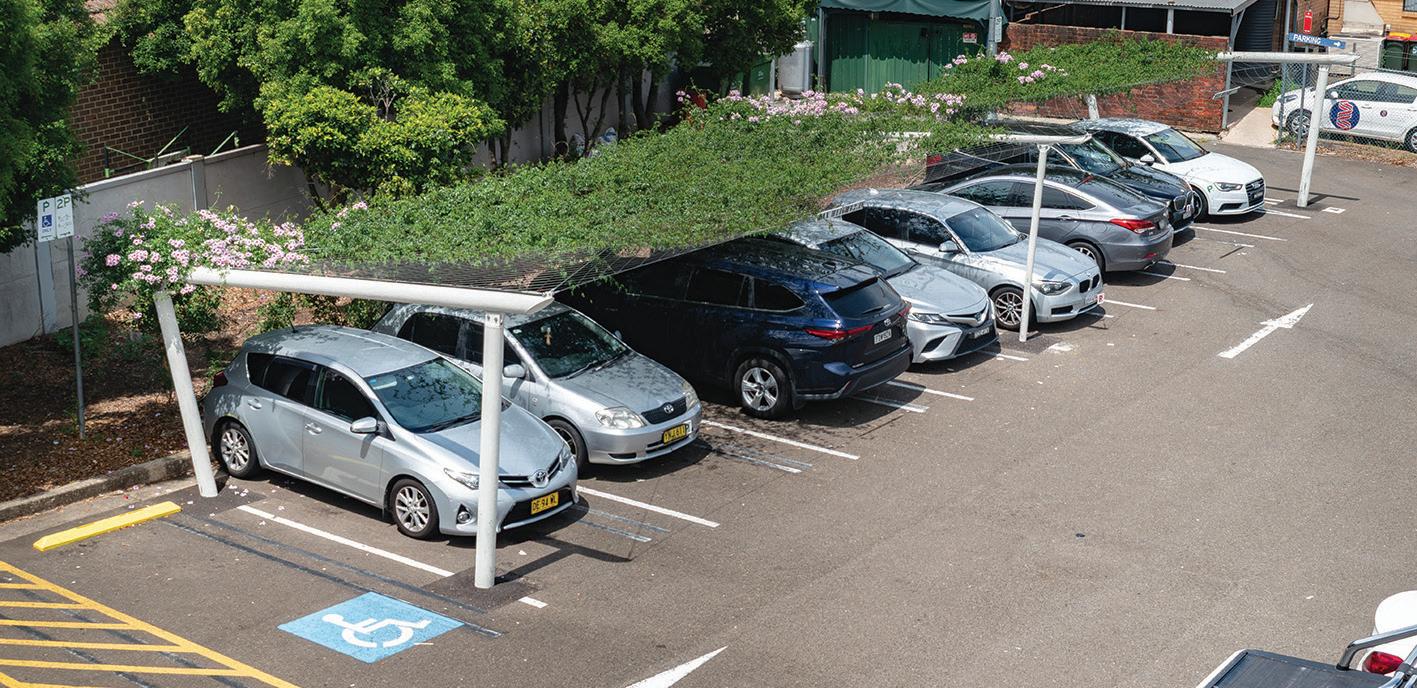
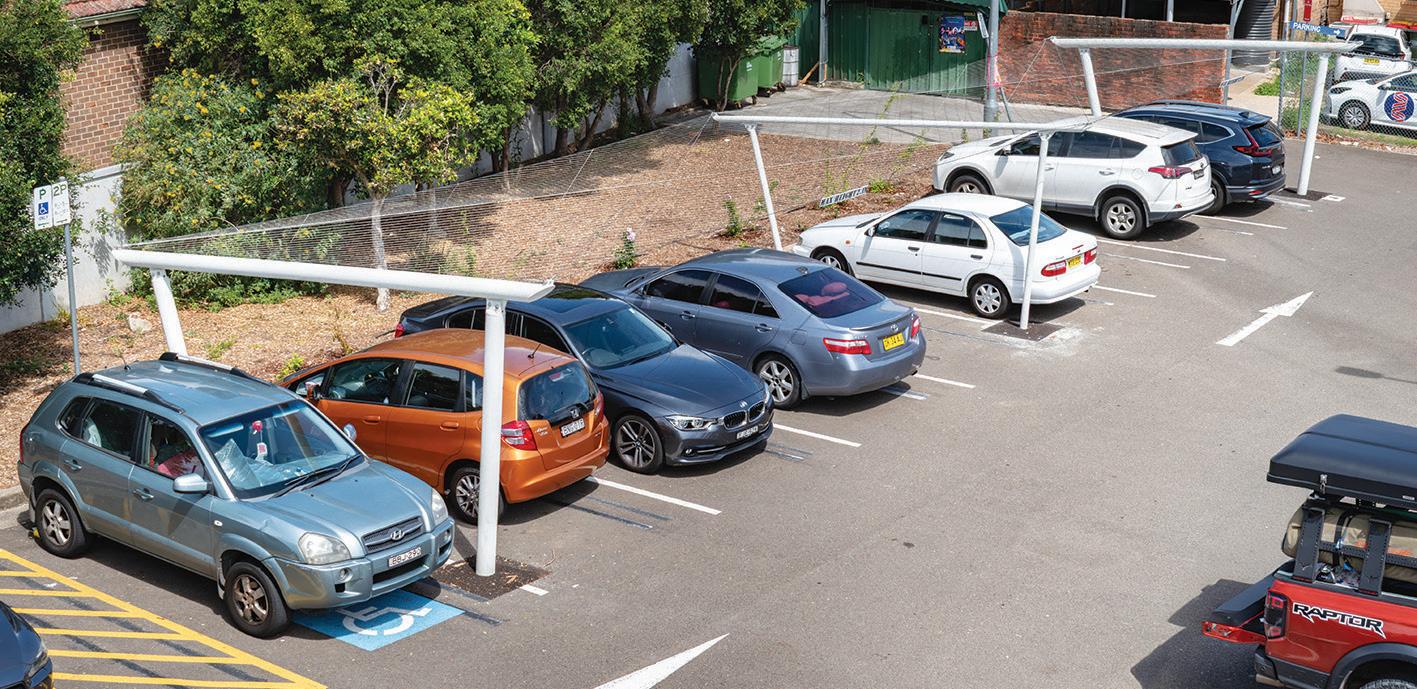
AS Australian summers get hotter and longer, a new cooling structure trialled by Western Sydney University researchers at a Wentworthville commuter carpark cooled surface temperatures by 35°C and reduced UV radiation by up to 80 per cent, a new report on the initiative has found.
On a clear summer’s day, car park surfaces can be as hot as 65-70°C, as the black asphalt is exposed to the hot sun, with 99 per cent of Western Sydney car parks lacking any shade.
Working with Tensile Design & Construct and Cumberland City Council, researchers at the University designed, built and operated a new nature-based solution – the Cool Roof System – that cools car parks in a relatively short time and without losing a single parking space.
The system has grown to provide more than 100m2 of shade in just under two years. The equivalent area of shade produced by a newly planted tree could require more than 20 years of growth.
Lead researcher, Professor Sebastian Pfautsch from the University’s School of Social Sciences said it was a simple concept – using fast-growing vines on a trellis system to grow green canopies quickly.
“We know car parks contribute to localised urban heat effects and reduced human thermal comfort. In fact, we often see many public spaces
including schools and public transport facilities also exposed to harsh conditions, making it uncomfortable during our hot and long summers,” said Professor Pfautsch.
“The design provides a solution where natural shade is needed fast and will provide benefits for years to come. It shows how easy it can be to cool surfaces, block UV radiation and improve thermal comfort, with the system easy to replicate anywhere.
“The structure can also protect cars from UV damage, while keeping the interiors cooler for their owners to return to at the end of the day, as well

as extend the life of the asphalt, saving councils money in the long run.”
The Cool Roof System was built in an existing garden bed and just required irrigation to flourish.
It improved thermal comfort by up to 10°C and its shading and cooling benefits increased when ambient air temperatures soared – the hotter the day, the more cooling from the green canopy.
“We envisage growing vines for natural shade around hospitals, public transport infrastructure, retail hubs and DIY outlets, or at early-learning centres, schools and universities or any other place where people spend much time outdoors.”
“Even where garden beds aren’t available, irrigated planter boxes are a great solution for places like the top-level parking deck of a shopping centre. As long as irrigation can be provided, our green roofs can pop-up just about anywhere.”
Cumberland City Council Mayor Ola Hamed said that finding practical solutions as the climate changes is vital.
“This new cooling structure highlights our ongoing commitment
to delivering projects that make our neighbourhoods more comfortable and resilient during hotter weather. It’s the second initiative of its kind that Council has delivered, reinforcing our focus on practical urban heat mitigation measures. We will continue to explore further opportunities to help keep our community cooler, safer, and better supported as our climate changes,” said Mayor Hamed.
Peter Bottero, Managing Director of Tensile Design & Construct, said the system could play a significant role in reshaping urban spaces.
“The solution is highly scalable and has enormous potential to help address the urban heat island effect. This is an exciting milestone as we work towards rolling the concept out further,” said Mr Bottero.
The next phase of the project will see engagement with government organisations and industry to identify opportunities to implement the Cool Roof System at scale – demonstrating that partnerships between Western Sydney University and industry can lead to scalable, low-cost solutions to combat increasingly hotter summers.
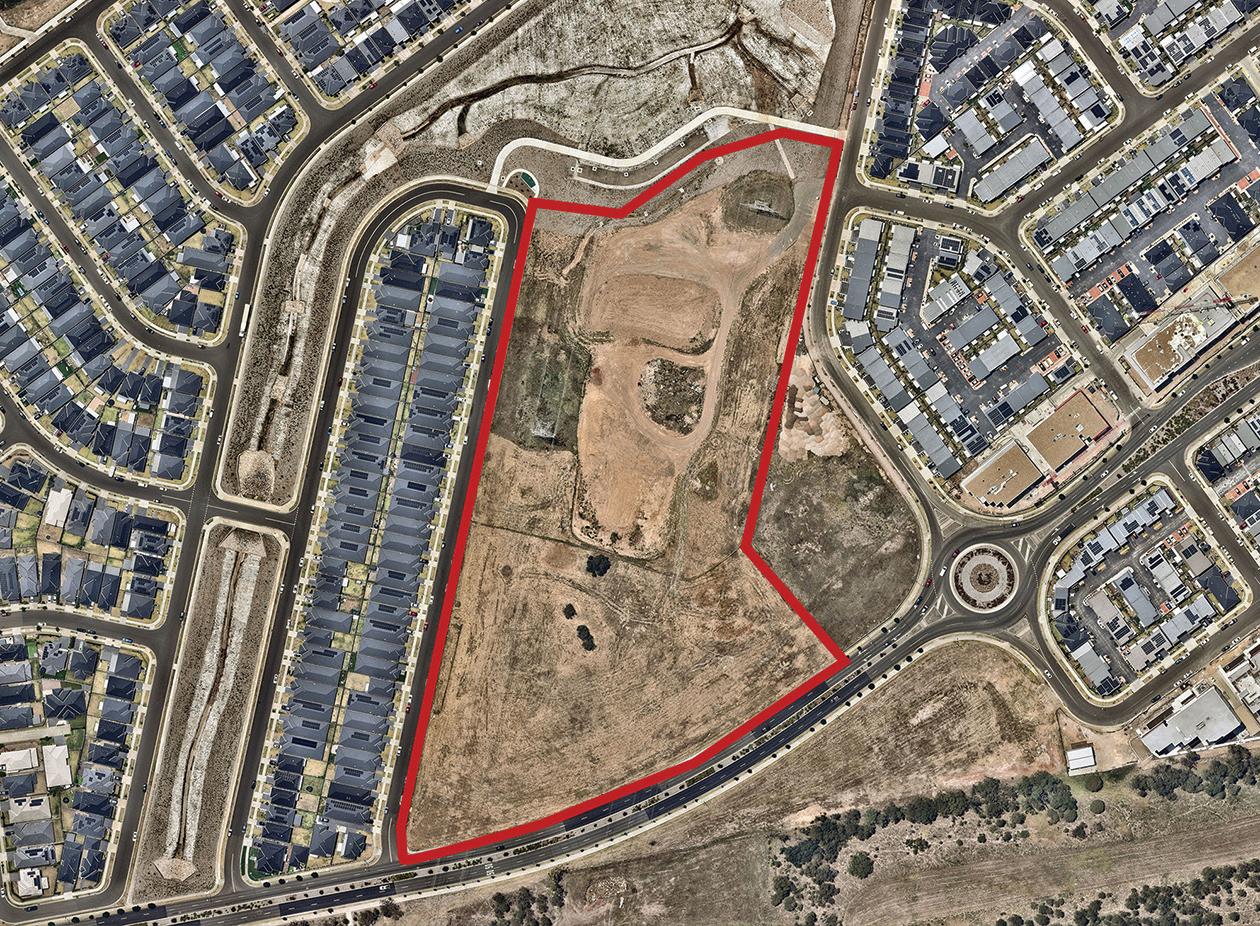
THE Reserve 996 embellishment in Marsden Park is creating a more inviting and connected open space, with new landscaping and shared pathways for residents to enjoy.
With works underway and set for completion this month, this project will deliver a functional, accessible area for relaxation, recreation and everyday use.
To find out more, visit https://shorturl. at/KT5Ba

ROOTY HILL Leisure Centre will host more than 120 gymnasts from Australia and overseas as part of a major tournament to take place in July.
The Blacktown City Council venue will be the stage for rhythmic and aesthetic group gymnastics competitions at the Marival Cup from 17 to 19 July.
The centre’s matufa floor, designed for gymnastics, was part of the venue’s appeal for joint organisers Australian Rhythmic Gymnastics and the Australian Aesthetic Group Gymnastics Federation (AAGGF).
The gymnasts and their supporters will travel from interstate, Asia and Europe for the amateur tournament.
Blacktown City Mayor Brad Bunting was delighted that Rooty Hill Leisure Centre would host the event.
“Our Council team takes great pride in providing quality venues for our community to keep active,” he said.
“The fact that Rooty Hill Leisure Centre has been chosen to host an event of this magnitude shows the high standard our staff maintains.”
The Federation has a long-standing relationship with Blacktown Council through its hiring of Rooty Hill Leisure Centre, owned and managed by Blacktown City Council. The centre hosts the Federation’s headquarters and training facility.
Rooty Hill Leisure Centre has hosted the Marival Cup before and the event is going from strength to strength.
Tickets will be available for spectators. Details are available at australianrg.com/marivalcup



Editor:
General Manager: Sales: Sales:
Sports Journalist: Graphic Design: Printer:
Letters to the Editor: Web:
Western News is not tossed onto your front lawn. Collect your crisp copy FREE from local newsagents, service stations, libraries, Council and shopping centres.
Kerrie Davies 0422 067 644
Bart Bassett 0412 955 745
Bart Bassett 0412 955 745
Malama Psarianos 0416 203 777
Noel Rowsell 0424 007 202
Stacey Fortescue 0420 319 893
Pegasus Print Group, Blacktown nepeannews@aol.com https://issuu.com/nepeannews

BY KERRIE DAVIES
Let’s not forget our homeless

S the cold weather sets in, many of us reach for an extra blanket, turn on the heater, or enjoy a hot meal in the comfort of our homes. But for far too many people in our local community, these simple comforts are out of reach.
Homelessness is not always visible. It can look like someone sleeping rough in a park, living in a car, or couch surfing from night to night. The reasons people find themselves in this position can vary and include job loss, the inability to secure a rental, or families fleeing domestic violence. What they all have in common is the daily struggle to stay warm, dry and nourished - needs that become even more urgent during winter.
Now is the time to act with compassion. Local charities are working tirelessly to support our most vulnerable, but they cannot do it alone. Donations of nonperishable food and new warm clothing - beanies, socks, gloves and jackets - can make an enormous difference.
Please consider dropping off what you can to one of the many local organisations helping those in need. Your contribution could be the reason someone receives a warm meal or dry clothes this week.
These are human beings who are down on their luck and, in the cold months ahead, they need our support more than ever.
If you are part of a charity organisation in need of products and donations, please register your interest at nepeannews@ aol.com. If you are a member of the public who would like to donate but are unsure where to contribute, feel free to send us an email at nepeannews@aol. com and we will put you in touch.


BY NOEL ROWSELL
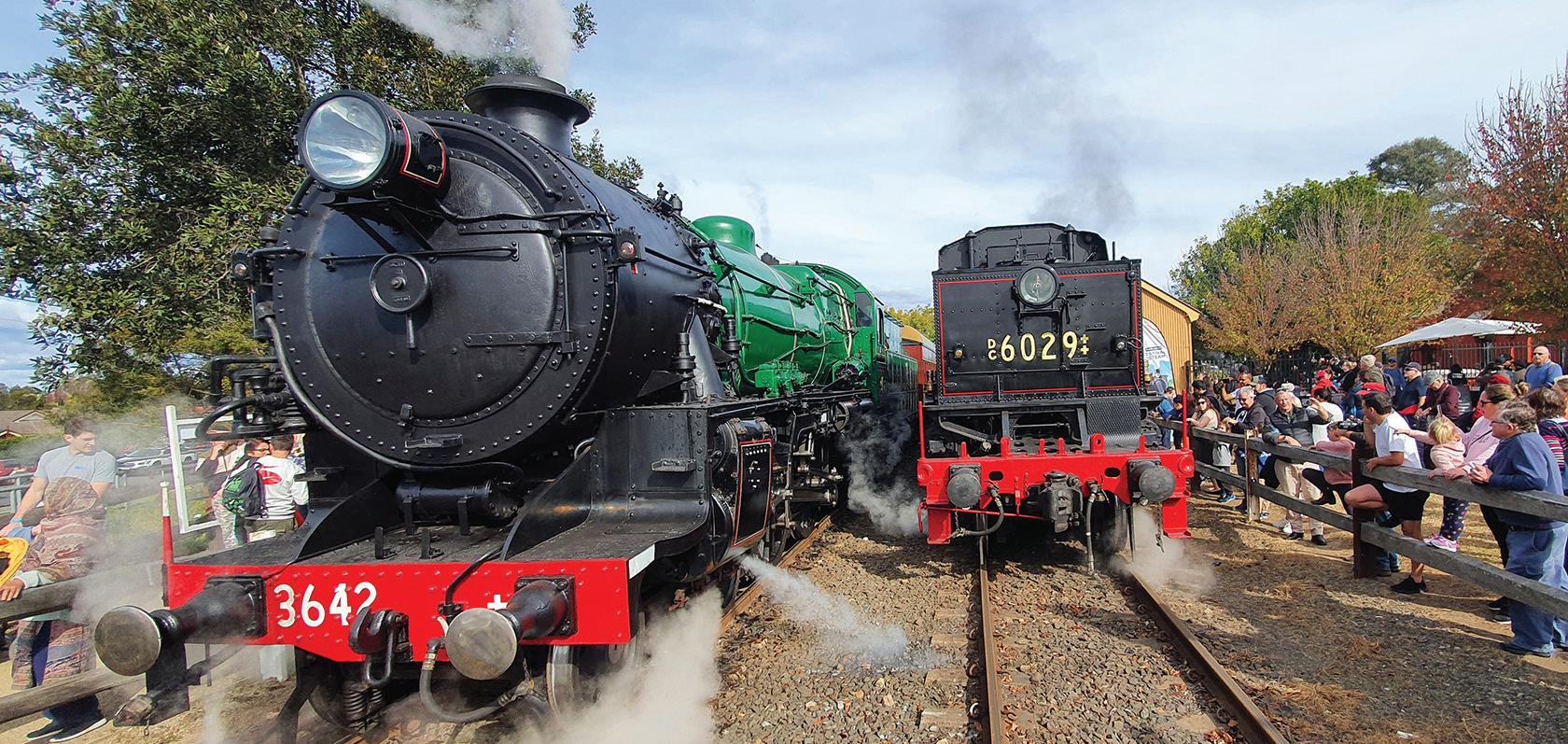
LIKE thousands of other western Sydney residents, I look forward eagerly to attending this weekend’s annual Thirlmere Festival of Steam, which has been a cherished community celebration of steam heritage and nostalgia in neighbouring Wollondilly Shire for over 30 years. The event is proudly delivered in partnership by Wollondilly Shire Council and Transport Heritage NSW, operators of the NSW Rail Museum, and runs on May 16–17.
Like many other steam enthusiasts, I look forward to climbing aboard for an authentic steam train ride, exploring vintage machinery and
enjoying the live entertainment, interactive displays and family fun at NSW’s biggest celebration of rail heritage - all in Sydney’s south-west.
On Saturday 16 May, you can explore a boutique selection of market stalls and food trucks, offering a variety of cuisines and unique products. Then, on Sunday 17 May, Thirlmere’s streets will be closed to transform into a bustling marketplace and culinary haven with Eat Street, where you can discover unique crafts, delicious treats, and one-of-a-kind finds.
The annual festival street parade is held on Sunday, when the streets of Thirlmere come alive with stilt walkers, community groups, energetic dancers and colourful characters.


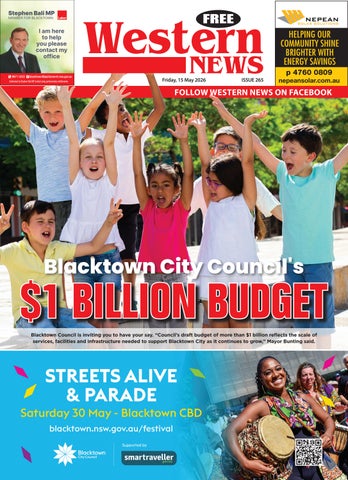
BLACKTOWN City Council has released its draft 2026/27 Operational Plan and Budget, outlining $1.011 billion in planned investment to deliver essential services, major infrastructure and community facilities for one of Australia’s fastest-growing cities.
The draft Operational Plan and Budget is the first in Council’s history to exceed $1 billion, reflecting the responsibility of providing services and infrastructure for a rapidly growing city.
The draft documents will be on public exhibition from 13 May to 9 June 2026, giving residents, businesses and community groups the opportunity to review the proposals and provide feedback.
A decade ago, Council’s budget was $563 million for a city of about 340,000 residents. Blacktown City now has more than 460,000 residents, with about 120,000 people added in that time.
The first $1 billion draft budget reflects that growth and the services, infrastructure and maintenance needed to support it.
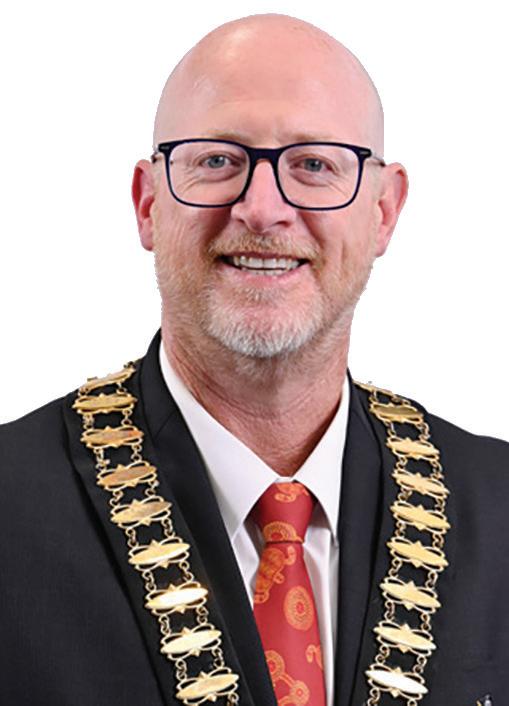
The Mayor of Blacktown City, Brad Bunting, said the draft budget reflected the size, growth and ambition of Blacktown City.
“This is a milestone budget for Blacktown City,” Mayor Bunting said.
“Blacktown City is growing quickly. That growth brings opportunity, but it also brings responsibility.
“This draft Operational Plan and Budget is about keeping essential services running, maintaining and renewing the assets our community already relies on, and delivering the infrastructure our growing city needs.
“Our job is to keep doing the everyday work people rely on, while planning properly for the future,”
Mayor Bunting said.
The draft Operational Plan and Budget builds on more than 20 years of responsible budget management by Council, while responding to the increasing cost and service pressures facing a growing city.
The draft 2026/27 Operational Plan and Budget includes more than $292 million for major capital works across Blacktown City.
Major Council projects are progressing across libraries, community hubs, aquatic centres, sporting facilities and cultural spaces, representing one of the most significant periods of investment in community infrastructure in the City’s history.
Across Mount Druitt, Council is progressing a major program of community infrastructure, including the redevelopment of Mount Druitt Swimming Centre, the expansion of the Mount Druitt Library and
Community Hub, the expansion of PCYC Mount Druitt at Shalvey and new cultural infrastructure supporting community connection, learning and participation.
At Seven Hills, the new Community Hub will provide a permanent library, study spaces, meeting rooms and community facilities in the heart of the town centre.
Council is continuing to invest in sporting and recreation facilities across the city, including Ken Birdsey Park at Schofields, the completed expansion of Kevin Betts Stadium, the new Blacktown Disability Sports Centre, and upgrades to courts and playing fields at places such as Whalan Reserve, Rosenthal Park in Doonside and International Peace Park in Blacktown.
Cultural infrastructure remains a major focus, with the new Leo Kelly Blacktown Arts Centre and First Nations Cultural Grounds supporting local artists, creative industries, First Nations culture and community participation across Blacktown City.
“These are not just buildings or projects,” Mayor Bunting said.
“They are long-term investments in our community. They are places where people will learn, connect, play sport, celebrate culture, access services and spend time together.
“This is a year of delivery for Blacktown City.”
While not part of Council’s capital works budget, Blacktown Quarter is another significant investment in the future of Blacktown City.
The privately led redevelopment is progressing in the Blacktown city centre and is expected to create jobs, attract further investment and support a more connected and walkable city centre.
The draft Operational Plan and Budget funds the essential services residents and businesses rely on every day.
This includes $95 million for waste management, supporting household and business waste collection, recycling and Council’s recently rolled out city-wide food organics and garden organics (FOGO) service.
The draft budget allocates $61 million for parks and open space, supporting the maintenance of parks, reserves, sporting fields, playgrounds and public spaces across Blacktown City.
Council manages 791 parks and other open space sites, with routine work including mowing, maintenance, turf care and playground upkeep to keep these spaces safe and usable.
Kids’ Early Learning will receive $33 million, supporting early childhood education and care for local families.
A $27 million allocation will support aquatic, leisure, arts, community and recreation facilities used by residents every day.
Council’s public libraries will receive $12 million, supporting learning, access and opportunity across 5 library branches, the temporary library at Marsden Park and the Mobile Library Service.
The draft budget includes $119 million for transport infrastructure, including roads, footpaths, cycleways and bridges, helping people move safely around Blacktown City.
The draft budget also includes $8 million for street lighting, $9 million for street cleaning, $27 million for planning services.
Mayor Bunting said, “Council’s budget funds the major projects people can see taking shape, and the everyday work that keeps our city moving.
“This is the work people see every day, from bins being collected and parks being maintained, to roads being repaired, libraries opening and children learning in our early learning centres.
“A Council budget has to fund the big projects and the everyday work that keeps the city running,” Mayor Bunting said.
The draft 2026/27 Operational Plan and Budget include income and expenditure associated with Council’s proposed Special Rate Variation, which remains subject to determination by the Independent Pricing and Regulatory Tribunal.
Council will continue to provide clear information to the community through the exhibition period.
Mayor Bunting said the budget was being developed in a challenging financial environment for local government.
“Council is managing population growth, rising costs and increasing demand for services. At the same time, councils are dealing with cost shifting from other levels of government and rules that limit our revenue to support the community, even in a fast-growing city.
“But this draft budget is not only about responding to pressure. It is about continuing delivery, maintaining essential services and planning carefully for what comes next,” Mayor Bunting said.
Have Your Say
Between 13 May 2026 and 9 June 2026 residents can have their say on Blacktown City Council’s Draft Delivery Program 2025-2029, Operational Plan 2026/27 (including the budget), Draft Works Improvement Program 2026/27 (capital works), Draft Goods and Services Pricing Schedule 2026/27 (fees and charges), and the
Draft Long-Term Financial Plan 20262036.
To view the documents and have your say, visit Council’s website at www.blacktown.nsw.gov.au, attend one of Council’s libraries or scan the QR Code below.

Blacktown City Council key 2026/27 budget points
Budget forecast spending for 2026/27, $1.011 billion
$292.2 million allocated for major capital works, including:
• $125.8 million for building improvements
• $32.7 million for road and footpath improvements across the city
• $18.2 million for upgrades to Council sporting grounds
• $7.7 million for drainage and stormwater improvements across the city
• $67.2 million for land acquisition in new release areas
• $34.6 million for office accommodation
Funding for core services consisting of:
• $95 million for waste collection and waste management services
• $61 million for open space management, including parks, reserves, sporting fields, playgrounds and other public spaces
• $33 million for Kids’ Early Learning Centres
• $27 million for aquatic and leisure centres, the Leo Kelly Blacktown Arts Centre, community centres and recreational facilities
• $12 million for Council’s public libraries
MORE motorists are claiming the Minns Labor Government’s $60 weekly toll cap, with more than 50 suburbs joining the “$1 million club” for total cashback claimed.
“We know many households are feeling the pressure, and every bit of practical support can make a difference,” it was stated in a government press release.
More than 862,000 claims have now been made, with over $284 million returned to drivers under the toll cap since it was introduced in January 2024.
Amid rising interest rates, inflation and soaring fuel bills due to global conflict, an extra $10 million has so far been claimed under the toll relief scheme in 2026 compared to the same period last year.
That translates to 9,225 more motorists claiming cash back from the $60 cap.
There are now 58 suburbs that have surpassed $1 million in total claims paid.
Mount Druitt, Bella Vista, Coogee, Austral, Kings Langey, Oakhurst, Macquarie Park, South Wentworthville and Box Hill are the latest to join the $1 million club.
Drivers in Carlingford, West Pennant Hills, Punchbowl, Greystanes, Bankstown, Kellyville, Lakemba, Quakers Hill, Marsden Park and Castle Hill have claimed more than $2 million per suburb.
Blacktown, Auburn, Baulkham Hills and Merrylands have all claimed more than $4 million.
In Blacktown, 12,030 claims have been paid out to road users, at an average of $398 per claim.
Data shows toll relief is landing hardest in the areas it is needed most, with Marsden Park, Quakers Hill, Bankstown, Kellyville, Punchbowl, Lakemba, Glenwood, Parramatta, Seven Hills and Schofields all among the top 20 suburbs claiming toll relief.
More than $100 million in toll relief remains available to be claimed for the 2025 calendar year.
“Sydney became the most tolled city in the world under the Liberal-Nationals, and the $60 cap has become a crucial safety net for drivers, particularly in Western Sydney, struggling under the pinch of petrol prices and privatised toll road bills,” it states in the press release.
“The former government saddled NSW motorists with a total toll bill of $195 billion out to 2060.

“To ensure the toll cap is sustainable and fairer over the long term, the NSW Government will proceed with the introduction of two-way tolling on the Sydney Harbour Bridge and Tunnel when the Western Harbour Tunnel, which will be tolled in both directions, opens in late 2028 - continuing the direction set under the former Liberal government.
“This corrects a long-standing inequity: Western Sydney motorists pay rising tolls in both directions on all their motorways year after year, while tolls on the Harbour Bridge and Tunnel are one-way and did not increase once between 2009 and 2023.”
Drivers and riders are encouraged to check their eligibility for toll relief on the Service NSW website to claim for the first three months of this year.
“With a rate rise yesterday, families are doing it really tough, working out how to cover the basics, so every bit of support matters,” Premier Chris Minns said.
“We made the $60 weekly toll cap permanent,
which means drivers don’t get hit with those big, unpredictable toll bills, it puts money back in people’s pockets and gives some certainty week to week.
“We’re seeing that support land where it’s needed most, across Western Sydney with suburbs like Mount Druitt, Blacktown, Auburn and Baulkham Hills claiming more than $1 million in toll relief.”
Minister for Transport John Graham said “suburbs joining the $1 million dollar club” used to be “shorthand for rampant Sydney real estate prices.”
“In 2026, it is evidence that the suburbs that need toll relief the most are claiming it.
“Mount Druitt was the 50th suburb to surpass $1 million claimed and six more quickly followed.
“To complement toll relief we are also scrapping administration fees from mid-year, going digital with communications to drivers and created an independent Ombudsman and a Customer Advocate inside NSW Motorways.”
NORTH west Sydney is a step closer to a state of the art healthcare facility, with the designs for the $910 million Rouse Hill Hospital officially locked in and early works underway.
The Minns Labor Government, in partnership with the Albanese Government, is delivering the new public hospital which will provide world class, comprehensive, integrated health care to the growing region of north west Sydney now and into the future.
Early works have started to prepare the site and with the project now approved, the construction contract is expected to be awarded later this year.
Key features of the new hospital include:
• an Emergency Department
• comprehensive birthing services including birthing rooms and a maternity inpatient unit
• inpatient beds and day surgery services
• short stay medical assessment services
• pathology, pharmacy and medical imaging services
• outpatient and ambulatory care services including paediatrics and renal dialysis
• virtual care and hospital in the home services
• prehabilitation, rehabilitation and lifestyle medicine
• The project is expected to create 1,550 construction jobs.
“This is another example of the Minns Labor Government delivering the vital infrastructure needed to support housing growth and create better communities,” said Deputy Premier and Minister for Western Sydney Prue Car.
“The Minns Labor Government has a massive $30 billion per year infrastructure program – that’s $81 million a day - building the roads, schools, hospitals, water and transport for communities.”
For more information visit: http://nsw.gov.au/ rouse-hill-hospital
“The Minns Labor Government is getting on with the job of delivering Rouse Hill Hospital for families in Sydney’s North West who waited too long after years of Liberal broken promises,” Ms Car said.
“This hospital will deliver the essential health infrastructure local residents deserve, including a full emergency department and comprehensive birthing services, which were missing under the former government’s inadequate plans, which they never delivered.
“This vital project is part of Labor’s record
investment to deliver more hospitals, more beds and better services for families in Sydney’s growing west.”
Minister for Health Ryan Park said it is a significant milestone and another step forward for the new Rouse Hill hospital, something the community has been waiting too long for.
“The Coalition’s failure to deliver on major hospital projects left parts of the state without whole hospitals, health systems under pressure, and jeopardised health services for local communities,”
Minister Park said.
“The Minns Labor Government is making record investments to deliver more hospitals and more beds to meet the health needs of more patients in our growing communities.”
Federal Member for Greenway Michelle Rowland was excited to share the update.
“I’m thrilled that families in my community are one step closer to having the high-quality hospital they deserve, close to home,” Ms Rowland said.
“This important milestone is a testament to how federal and state Labor are continuing to deliver for the North West, particularly after a decade of Liberal neglect.”
DOCTORS from Bangladesh, Egypt, Iran, Sri Lanka and Syria are fully registered after graduating from the program at Blacktown and Mount Druitt Hospitals.
For many overseas trained doctors, their qualifications are not automatically recognised in Australia. To provide an alternative pathway for these doctors to gain full registration with the Australian Health Practitioner Regulation Agency, the Australian Medical Council accredits hospitals and health services to deliver the Workplace Based Assessment program.
Western Sydney Local Health District is one of only 31 accredited providers in Australia, delivering the program from Blacktown and Mount Druitt Hospitals. Since 2024, there have been 20 graduates complete the program.
For the doctors, the program provides a crucial bridge toward general registration. For the District, the program strengthens workforce capacity and helps to retain doctors, many of whom have worked at the facilities for several years.
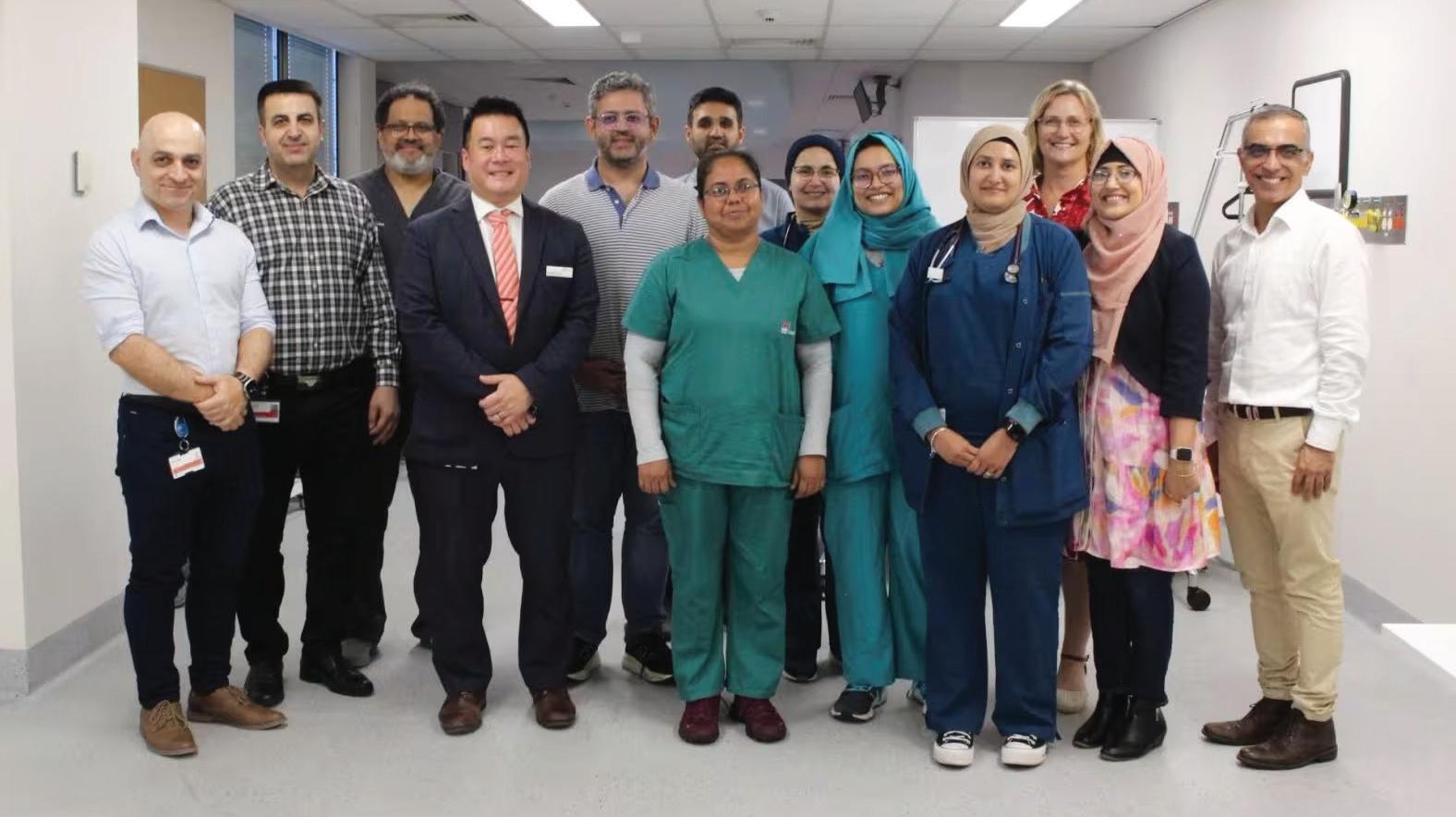
To celebrate the latest cohort, a graduation ceremony was recently held at Blacktown Hospital, with graduates, program staff and hospital executives attending.
Blacktown and Mount Druitt Hospitals Acting General Manager, Shane Widloecher commended the group for their resilience and hard work in completing the program.
It’s a wonderful achievement and you should all be proud of your efforts.
“
Dr Satish Mitter, an Emergency Physician and Toxicologist, is the Director of the Workplace Based Assessment Program for the District, helped establish the program nearly three years ago. He said it’s satisfying to see the graduating doctors progress their careers.
“It’s a really great experience to see the doctors progress through the program and then move on to the specialist programs they choose.”
Waseem Hassan is one of the nearly 40 assessors who supervise the participants in practical and on-the-job assessments. While acknowledging the considerable time and effort of his peers, he congratulated the graduates and said it was a significant moment in their careers.
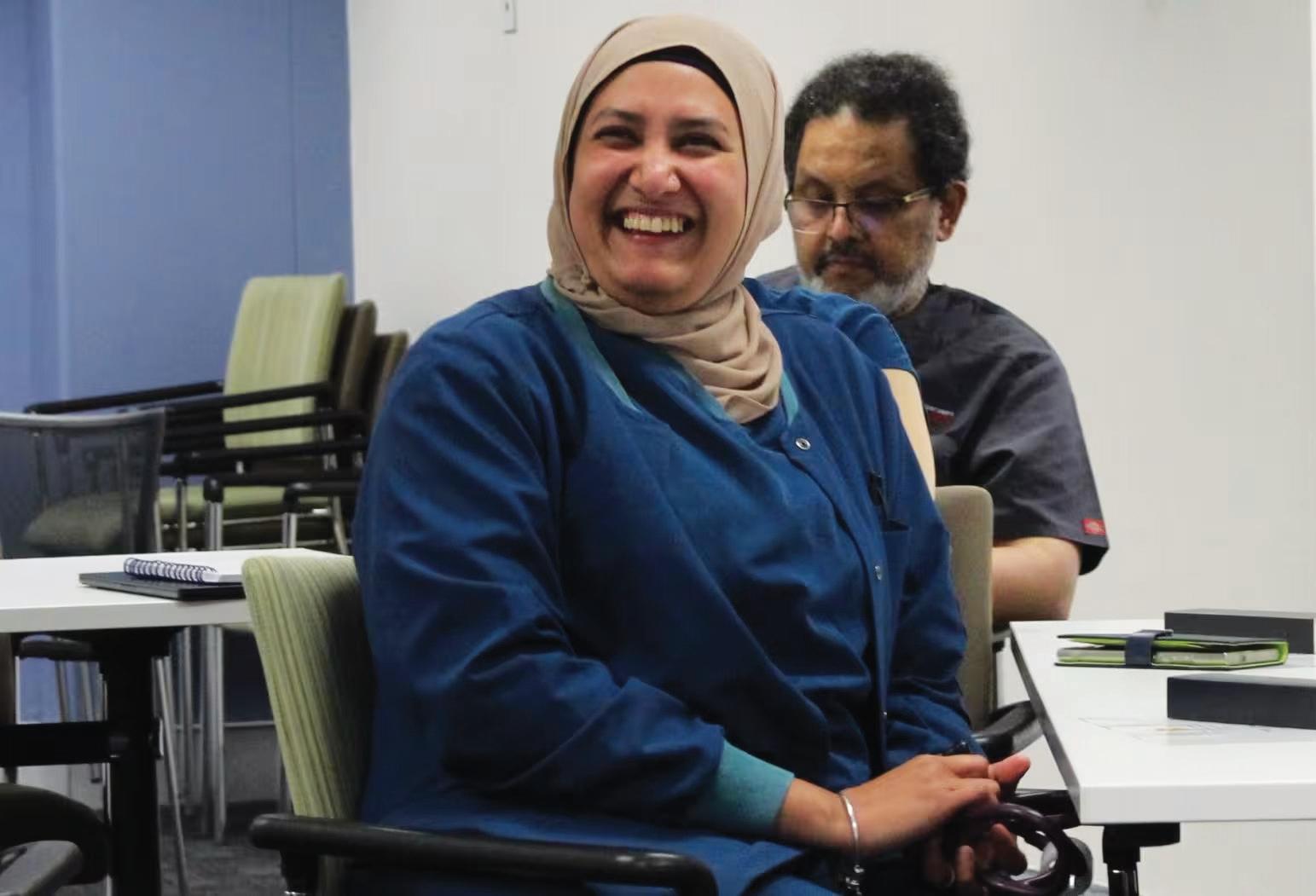
It was her late mother’s wish for her to pursue a career in medicine.
A Senior Resident Medical Officer within the Mount Druitt Hospital emergency department, she said completing the program means she can look to the future and what’s next.
“I have more opportunities in front of me.”
Fellow graduate Dr Bilkis Aktar, who completed her medical degree
in Bangladesh, works as a Senior Resident Medical Officer within the emergency departments at both Blacktown and Mount Druitt Hospitals.
She said one of the biggest challenges was juggling the demands of the program at the same time as her day-to-day role and family responsibilities.
“When I received the offer for the [Workplace Based Assessment] program my youngest child was only one-year-old,” she said.
The structure of the program helped her to complete it and gave her the confidence to take the next step in her career.
“I feel so relieved and confident. The regular assessments kept me focused and allowed me to improve throughout the year.”
As ten new graduates celebrate their achievements, the next cohort has expanded to 15, demonstrating the growth and ongoing success of the program across Western Sydney.
ASPOTLIGHT shone on diverse mental health roles as peer worker highlights the level of support in Western Sydney Local Health District.
When patients seek mental health services at a facility in Western Sydney Local Health District, there are a range of professions that work with them on their recovery journey.
In addition to the psychiatrists, nurses, allied health professionals like social workers, Western Sydney Local Health District is proud to also employ peer workers.
Peer workers are people with a lived experience of accessing mental health services who now work in that same field to help others.
Sarah Baihn joined the mental health services team in 2024 as a peer worker.
Completing the program is the launching pad for your careers and the future is up to you.
“
Among this year’s graduates are doctors from Bangladesh, Egypt, Iran, Sri Lanka and Syria.
Dr Marwa Komika came to Australia from Egypt in 2015.
Peer workers differ from other mental health staff – they don’t wear scrubs or clinical uniform, it is their lived experience which compliments the clinical expertise of other staff.
Sarah says this point of differentiation can be a powerful tool.
The District’s Mental Health Services General Manager, Juanita Taylor, says the role of a peer worker is invaluable.
“The connection of a peer worker, in comparison to a clinician, is a different level. Peer workers have a lived experience, they’ve walked a day in their shoes,” Juanita said.
Juanita says that Sarah’s work as a peer worker is well known within the organisation, being able to step into a space no one else can.
In the case of a consumer who
was experiencing high distress and needing a higher level of care, it was through Sarah’s care and compassion that the patient was able to transfer to a new unit without any further interventions.
“Sarah’s ability and skill as a peer worker made it seamless and a really easy transition for the person in what could have been a really difficult situation,” Juanita said.
Juanita says aligning someone with the right lived experience to the right place can be tricky, but has incredible power when it’s done well.
That example is exactly why it works so well, because the Peer Worker can do something a clinician can’t, Juanita said.
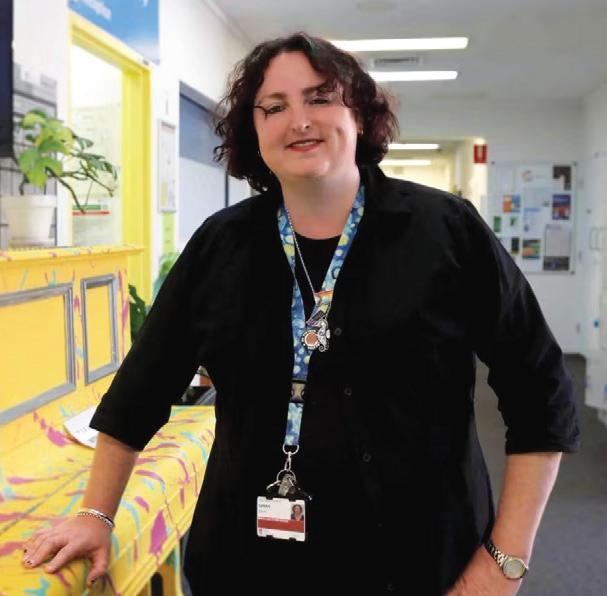
Sarah says she feels her work is valued by the mental health services team, and enjoys the chance to transform a challenging period in her life into a source of strength, connection and employment.
“At the end of the day, I get a warm feeling in my heart from what I do and knowing that I’m contributing to the community in the in the best way that I can,” Sarah said.
IN collaboration with Cancer Institute NSW, Blacktown Hospital has created a database for medical supply waste in oncological clinical trials.
The exciting new sustainability project has launched last month after being chosen as one of nine recipients of a Sustainable Futures Innovation Fund grant.
Blacktown Hospital Medical Oncology Clinical Trials Unit has partnered with the Cancer Institute NSW with the aim to reduce the unit’s environmental footprint.
It’s easy to see why Western Sydney Local Health District has been selected for the trial – as the state’s leading district for the number of cancer clinical trials conducted.
In the 10 years since the department was established, Blacktown has become a hub for novel and clinical trials with more than 200 clinical trials running in medical oncology.
Blacktown Medical Oncology Research operations manager, Raymond Tangunan, has been working in clinical trials at Westmead and Blacktown Hospitals for several decades and has seen firsthand the waste this can create.
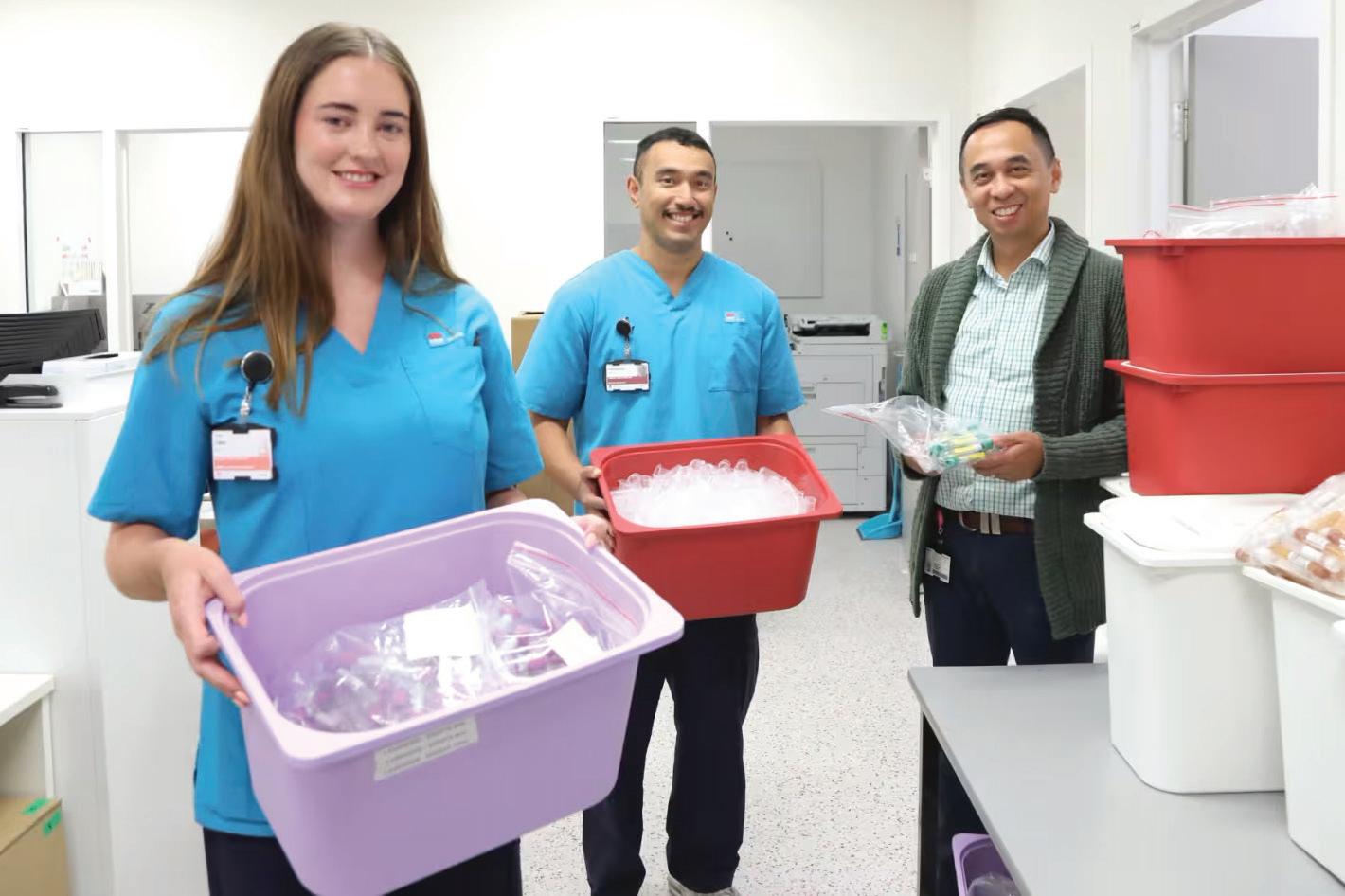
When a trial has been given approval to commence, the pharmaceutical company commonly sends the hospital supplies for the approximate number of patients the trial has been approved for.
This means the hospital can receive multiple pallets of supplies at a time.
On occasions when the number of patients enrolled in that trial are less than the quantity supplied, or if supplies expire before people have enrolled, it leaves the department with
The purpose of this study is to see how we can repurpose these supplies rather than throwing away perfectly clean and sterile items in the bin. How can we repurpose them in a way that is useful for someone else? Raymond said.
“
sterile but excess supplies.
“Because of space constraints in the hospital, we have to dismantle the boxes and dispose of them accordingly, creating a lot of unnecessary waste.” Raymond said.
Often due to the specific nature of the supplies in the kits, these medical supplies can’t be repurposed within the hospital but still hold value.
Ad-hoc solutions are developed around the hospital by resourceful staff, such as driving pipettes to the local high school to be used in science classes but require staff members to do it off their own back and in their own time.
Now, the new project has developed a database with the aim to
fulfill several purposes, the first is to catalogue the range of items and the number of items.
“When people want those items, they can log into this database and see all these supplies that are for grabs,” Raymond said.
The database being accessible also eases the pressure from those clinicians in those trials from coordinating the distribution.
“Using the database, they just need to indicate how much of it they want rather than emailing me or calling me, it’s all tracked,” Raymond said.
Raymond says this type of program doesn’t just benefit the hospital by freeing up precious space, but it can help reduce costs for the receiving organisation too.
Partnerships with local high schools as well as teaching spaces like TAFE and local universities can benefit from having visibility and access to clean, free resources.
“The supplies are all clean and unused. From a cost perspective, they could use what we’re throwing out instead of having to buy it themselves for training,” Raymond said.
The project is currently in a threemonth pilot, and Raymond is hopeful it will be extended and eventually rolled out more broadly.
“One of the endpoints of this pilot is that everything has to be weighed, so we can calculate a figure in terms of carbon emissions.”
WESTERN Sydney International (Nancy-Bird Walton) Airport (WSI) and Western Sydney Wanderers FC have launched a landmark partnership today, with Sydney’s new 24-hour global gateway becoming the club’s official Stream Champion –Inclusion & Belonging partner.
The three-year partnership marks the first time WSI has partnered with a sporting club and reflects its commitment to strengthening access, opportunity and social connection in Western Sydney – one of Australia’s most diverse regions.
WSI will be embedded across the club’s Inclusion & Belonging programs and activations, reinforcing its critical role as Greater Sydney’s newest international airport that will connect Western Sydney’s rapidly growing communities.
The partnership will also:
• Strengthen community programs delivered at Western Sydney Wanderers FC, that support multicultural communities, First Nations peoples, women and girls, and people with disability
• Support the delivery of ten annual community holiday clinics for children in Western Sydney living nearby the airport, and five annual school holiday clinics hosted at WSI, which will each cater for up to 30 children aged five to 13 and include football activities with Wanderers coaching staff
• See the Wanderers host their annual Season Launch at WSI, alongside premium client events across the 2026/27, 2027/28 and 2028/29 seasons, positioning the airport as a key civic meeting point for the region
• Support major community tournaments
including the Wanderers World Cup 2026 and the Asian Cup Community Tournament, both presented by WSI, celebrating the cultural diversity of Western Sydney through inclusive football participation, and
• Introduce an annual Impact Scorecard, developed by Impact Institute, to measure program outcomes through both data and lived experience stories to capture the full impact of participation and engagement.
Western Sydney Wanderers CEO Scott Hudson said the partnership reflects a shared focus on delivering meaningful community impact
“Western Sydney is defined by its diversity, energy and people, and we have a responsibility to ensure everyone feels they belong within it,” Hudson said.
“This partnership is about impact. Together with Western Sydney International Airport, we are creating real opportunities for connection and inclusion through football.
“What makes this partnership significant is its focus on outcomes. Through our Inclusion & Belonging programs and the Impact Scorecard, we can better understand the difference we are making and continue to strengthen how we serve our community.”
WSI CEO Simon Hickey said he was delighted to launch the new collaboration with Western Sydney Wanderers FC that would support football’s role as a unifying force across Western Sydney as the airport prepares to welcome its first customers.
“Western Sydney’s diversity is undoubtedly its greatest strength, and sport has consistently demonstrated its ability to bring people together and
create healthy, positive, shared experiences, which WSI is proud to help foster,” he said.
“Engaging with our local communities has always been a top priority for Western Sydney International Airport and we’ve been humbled to work together through community events, activities with Western Sydney schools and supporting tours and information sessions as the precinct has transformed over the last decade.
“As we now prepare for opening, we’re thrilled to partner with Western Sydney Wanderers FC to strengthen connections through sport, celebrate Western Sydney’s vibrant diversity and ensure that as this region continues to grow at a rapid rate, it also continues to embed a sense of belonging and cohesion across all communities.”
About Western Sydney Wanderers FC community programs:
The partnership launched today builds on the Western Sydney Wanderers’ established community footprint, which continues to deliver significant reach across the region. Over the past 12 months, the club has delivered more than 2,000 community coach engagements across its programs, including 2,092 coaching engagements across schools, community initiatives and activities at Wanderers Football Park. More than 1,500 of these have been delivered within school-based environments, reinforcing strong engagement with education settings across Western Sydney. Each engagement involves an average of two coaches, contributing to a total participant reach of approximately 59,200 people over the past year.

By Lyn Forde – President/Research Officer of St Marys & District Historical Society Inc.
IN January 1894 a magisterial enquiry was held at the Penrith Court House by Coroner John King Lethbridge on the body of a man found in Mulgoa Creek. Sergeant Thorndike gave evidence that he went out to the Creek and found on the bank near an oak tree, a brown check tweed coat and vest and a straw hat in the water and the dead body of a man floating with his head half out of the water and with the help of others at the scene he recovered the body. The man was about 5ft 9in and well-built with fair complexion, dark brown hair, a short clipped thick beard and reddish-brown moustache, blue eyes, thick eyebrows and a broad nose. His body was dressed in a coloured cotton shirt, cotton undershirt, drawers, thick tweed trousers same colour as coat and vest, partly worn Balmoral boots and in the coat and vest he found a white cotton handkerchief, 2 knives, a bunch of 8 keys on a white metal chain, a briar pipe, matchbox, 2 pieces of tobacco, a box of matches, a small pocketbook, pencil, a hand fishing line, a piece of paper that was apparently the top of a race book. He found no money or valuables in the pockets of the trousers or anything that would lead to his identification. Dr Brady gave evidence and said that he was a legally qualified medical practitioner, practicing in and residing at Penrith and he viewed the dead body of the man at the hospital morgue and after shifting the body he found three superficial wounds over the left eyebrow and the tongue was partly protruding, the eyes were a light hazel or grey colour, the pupils normal and from the right ear blood was exuding but there were no external marks of violence as the exuding of blood from the right ear is usually indicative of a fracture of the base of the skull but he could not ascertain what was the cause of death without a post mortem. On manipulating the head, he found no rigor mortis, the head on the neck was quite flexible and on examining this he could find no external marks or fracture. It seems at this stage after some argument and several sharp words between Coroner Lethbridge and Dr Brady, the Coroner said that he saw no occasion for a post-mortem examination and he would “give his own opinion” and he did, and found as follows “From the evidence adduced, the deceased name unknown in the Mulgoa Creek in the District of Penrith in the Colony of NSW on the 17th January 1894 was found dead without any marks of violence appearing on the body and that death was caused by suffocation by drowning, but how or by what means he came to be drowned there is not sufficient evidence to enable me to say”. On the 20th January the way the magisterial enquiry ended gave rise to reaction from the public who did not like the way it ended as there was not the slightest evidence as to who this man was. He was respectably and cleanly attired and had the appearance of having a home somewhere. The body was well nourished but still there were no papers, letters or money, or was any of his clothing marked in any way to lead to his identification. When the body was first seen by the police there were some superficial wounds and blood that was exuding from the right ear, but there did not however appear to be any marks of violence or were there any traces of a struggle. Apparently that location was known
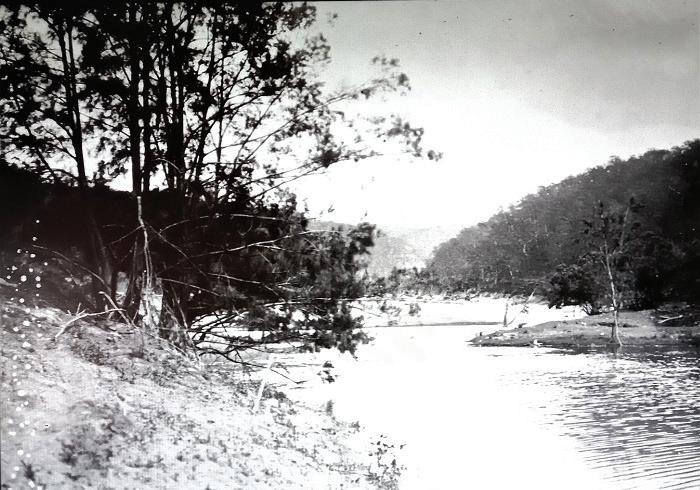
only to old fishing hands and a stranger would not likely select such a spot for fishing. With the evidence given by Dr Brady at the enquiry it was thought that Mr Lethbridge should not have so hurriedly brought the enquiry to a close by recording as he did, an open verdict on his own account, especially as the medical officer stated distinctly that the exuding of blood from the right ear is usually indicative of fracture of the base of the skull, but it was impossible for him to tell whether such was the case “without a post mortem examination” and he added that he would make the necessary examination to not further delay the finding, but the Coroner would not consent. Mr Lethbridge may or may not have been right on the score of expense, as a post-mortem cost around three guineas, but with a view of really finding out if there had been any foul play, the examination should have been made so as to clear up the mystery at once. On 27th January a connection was found to the deceased when a gentleman came to Penrith and recognised the handwriting on the letters found near the deceased was that of “Lansdell”. He was well known and well connected and in receipt of remittances from England where he had a large number of relatives. The gentleman was well acquainted with the deceased and his relatives and had no hesitation in identifying him by the particulars given by the police and his clothing, as well as by the handwriting of several torn letters in the possession of Sergeant Thorndyke. The gentleman said he saw the man a few days before his body was found, saying the deceased was of an unusually quiet disposition and he could not swim. (Ed - On doing some further digging I found:- His name was Alexander Woodward Lansdell, born in Canterbury, Kent in 1846 to Henry and Julia Lansdell. At the age of 38 he came to Australia as an unassisted immigrant on the “Port Jackson” from London to Sydney in January, 1884 (3rd class), his occupation down as “Clerk”. (furthermore - The letters play a significant part in this story, because at the magisterial enquiry they were missing from the very well documented evidence collected and remained so after the enquiry, but somehow on the 27th of January they turned up when the “gentleman” came to Penrith and were found in the possession of Sergeant Thorndyke!!). One of the letters deciphered was from William Harding in Paddington, Sydney dated 15/12/1892 to William Cuddon (Jnr) in Christchurch, NZ on behalf of Alexander who was about to go to New Zealand in search of employment there. He had been out of employment for some time here working as a canvasser and traveller for Sydney firms. The part of the river where his body was found was called Elliott Creek, part of the Mulgoa Creek. The probate wasn’t released until 1898 in London to his brother Reverend Henry Lansdell, of personal effects and £91 and it gave Alexander’s address in Sydney as 55 Elizabeth Street. ACCIDENT OR FOUL PLAY?
Sources: New South Wales, Australia, Unassisted Immigrant Passenger Lists, 1826-1922, NSW, Australian Government Gazettes, 1853-1899, Ancestry, Trove, Evening News (Sydney, NSW), Nepean Times, Sydney Morning Herald, England & Wales National Probate Calendar (Index of Wills and Administrations), 1858-1995.




ALEX SONCINI
’VE been asked many times recently — and this has prompted me to explain: what is ‘intergenerational equity’? You’ll have heard it from Prime Minister Albanese and Treasurer Chalmers in the lead-up to the May 2026 Budget — and now, on Budget night, it’s confirmed. The phrase was always the warm-up act. The tax changes are the main event. Here is my honest take on what it really means, and what the confirmed Budget measures mean for you.
Equity and Equality Are Not the Same Thing
When you pay off a mortgage, improve a property over decades, and carry all the financial risk yourself, you build equity. That is your money — earned, not gifted. The Government’s use of the word ‘equity’ means something entirely different: redistributing wealth between generations to achieve equal outcomes. These are not the same concept, and the distinction matters enormously when your savings are involved.
“The equity in your home is yours. You earned it “ Calling it unfair is a political choice, not an economic fact.
A Promise Made — And Broken
Before the 2025 election — Albanese: “Labor is not planning to revisit changes to capital gains tax or negative gearing.”
Budget night, 12 May 2026, has confirmed what was widely anticipated. Both CGT and negative gearing are being changed. This follows broken promises on Stage 3 tax cuts and superannuation. There is a pattern. If this policy was always about fairness between generations, why was it explicitly ruled out when votes were at stake?
What Is Actually Changing
THE CONFIRMED CHANGES — Budget Night 12 May 2026
• CGT Discount: 50% discount replaced with inflation-linked indexation from 1 July 2027, with a new minimum 30% tax on real gains. Applies to individuals, partnerships and trusts — not companies.
Pre-2027 gains retain the 50% discount.
• Grandfathering: Properties held at 7:30pm AEST on 12 May 2026 are fully grandfathered — existing investors are not affected. The cut-off is the time of the Budget speech, not the contract date.
• Negative Gearing: Restricted for new property purchases after Budget night. Existing investments fully grandfathered.
• New Builds: CGT and negative gearing concessions retained to encourage housing supply.
Worth noting: the 50% CGT discount and expanded negative gearing were both Howard Government changes from 1999. What Labor is now proposing for new purchases is partly a return to the pre-1999 framework — not radical, but a reversal of twodecade-old concessions.
What This Means For You
If you already own investment property, grandfathering is the key point. Properties held at 7:30pm AEST on 12 May 2026 retain the current rules in full — the changes do not affect you. Confirm the detail with your accountant as the legislation is finalised.
If you are considering a new investment, the rules have shifted. Existing properties purchased after Budget night lose both CGT and negative gearing concessions from 1 July 2027. New builds retain them — the Government is steering investors toward new construction. For young entrepreneurs, the CGT changes apply to business equity and company sales too, not just property. Some are already looking at Singapore and the UAE where capital gains treatment is more favourable.
The $250 Gift — And What It Really Costs
To soften the blow, the Government is handing every Australian worker a $250 tax offset. It sounds good. But you won’t see it until your 2028 tax return — and it does nothing for pensioners, carers or the unemployed.
The $250 offset alone costs the budget $6.4 billion.




It does not build a single house or help a first home buyer with their deposit. The CGT and negative gearing changes are a key part of how this gift gets paid for.
Call It What It Is
The budget must balance — and with a chronic shortage of housing driven by population growth and high demand, the revenue need is real. But let’s be clear: this is a revenue measure. There is no guarantee a single dollar flows to housing or first home buyers. And there is an unintended consequence nobody is talking about. Grandfathering will trigger a sell-off — investors and larger homeowners locking in the 50% discount before it disappears or policy shifts further. Who buys those properties? Not first home buyers — they can’t compete at that price point. Mostly other investors and upgrading owner-occupiers, pushing prices higher still. Those who exit the market entirely mean fewer rentals and higher rents. The very people this policy claims to help could end up priced out and paying more.
The older generation built their security without childcare subsidies, paid parental leave, or compulsory super — it did not start until 1992. They invested in property because the pension was never enough. Young entrepreneurs today are trying to do the same thing. Neither group deserves to be a budget solution dressed up as social justice.
Not Sure How This Affects you?
Whether you own investment property, are planning a purchase, or simply want to understand your position as a result of how the Budget changes affect you — we can help.
At Wealthwiz, we review your situation, explain your options in plain English, and structure your finances to work long-term. Call Alex an MFAA accredited finance broker - on 0419 600 177.
Disclaimer: General information only. Budget measures subject to legislation

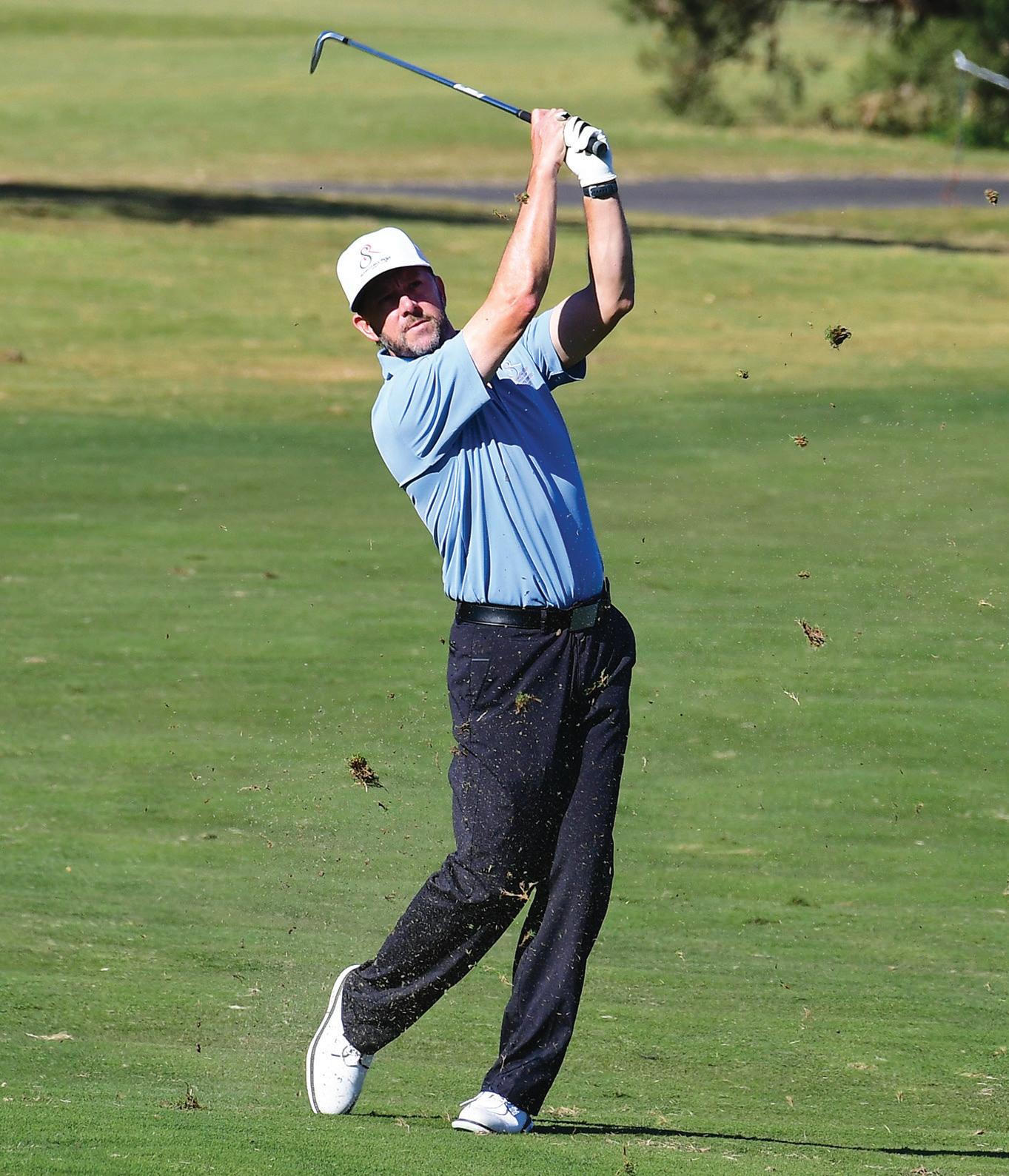
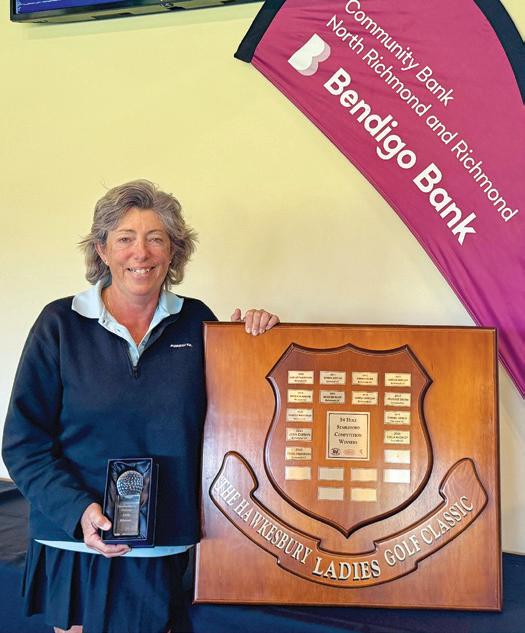
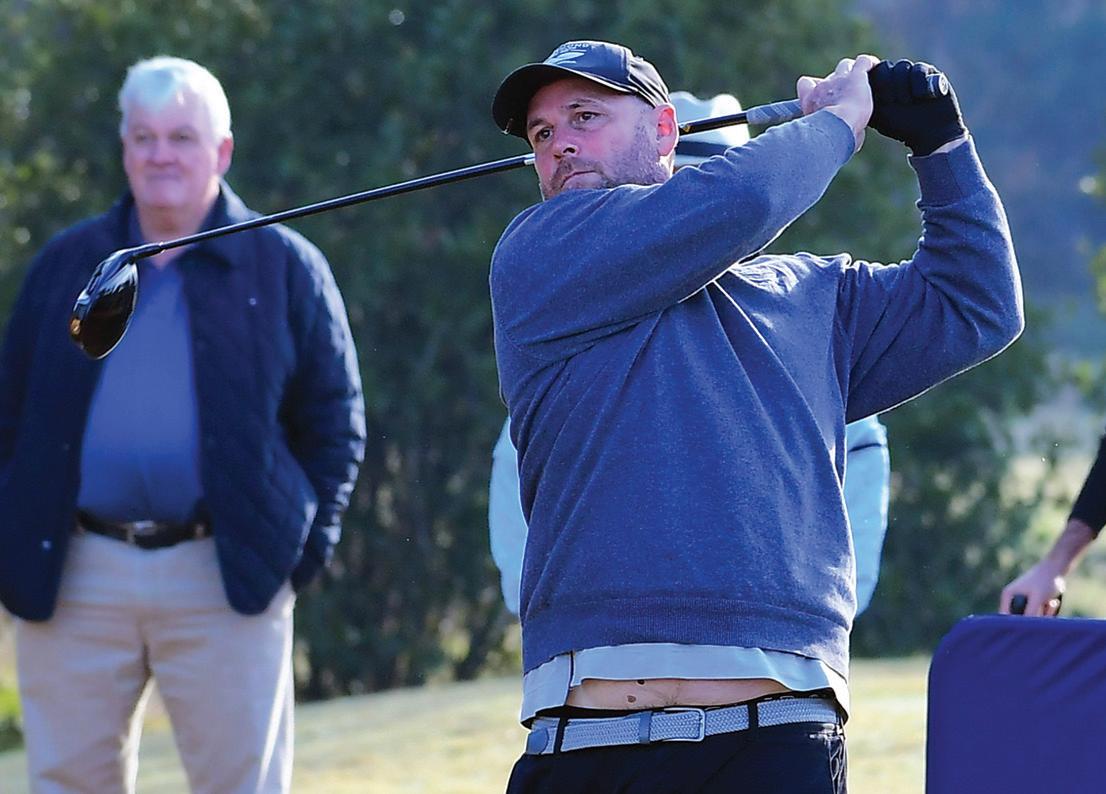
THE 2026 Hawkesbury Ladies Classic golf tournament was held last week at Windsor, Lynwood and Richmond golf clubs. It featured 120 players from 17 clubs, travelling from as far as Newcastle in the north and Mollymook in the south.
Theresa Lonergan (Newcastle) was the outright champion, whilst Sharon Blacklock (Richmond) won the Nett prize.
Division One: Deb Northwood (Lynwood) 1st, Trish Freeborn (Lynwood) 2nd; Division Two Rosemary Phillis (Richmond) 1st, Stella McGinley (Fox Hills) 2nd; Division Three – Deborah Leicester (Lakeside Camden) 1st, Rhiannon Merden (Windsor) 2nd.
BY
THE Master Pennant golf competition tees off this month, featuring 11 western Sydney golf clubs including Penrith, Stonecutters Ridge and Dunheved (Division One), Lynwood, Richmond, Springwood and Twin Creeks (Division Two), Leonay, Glenmore Heritage Valley
and Fox Hills (Division Three) and Wallacia (Division Four.
Home games in the opening round are Glenmore Heritage Valley vs Bexley (26th May), Penrith vs Cromer, Twin Creeks vs RydeParramatta and Leonay vs Warringah (all on 27th May).
Richmond won promotion from Division Four in 2025, whilst Twin Creeks and Wallacia both dropped a Division for this year’s competition.
THE Western Sydney Wanderers Academy is set for a significant month of international football in May, with both the Boys Under 16s and Girls Under 15s travelling abroad to compete against some of the world’s leading youth academies.
The international tours form a key pillar of the club’s ongoing commitment to elite player development, providing Academy players with exposure to high-performance environments and competition standards across Europe that are critical to their progression in the professional game.
The Western Sydney Wanderers Academy Under 16s travelled to London to participate in the 2026 Liam Brady Cup, hosted by the Arsenal Academy from 15–17 May 2026.
The tournament brings together an elite field of international academies in a condensed, high-intensity format designed to replicate the demands of elite European youth football. The Wanderers will compete against Arsenal FC, Club Atlético Talleres, Feyenoord Rotterdam, Independiente del Valle, Nottingham Forest FC, Panathinaikos FC and AC Sparta Prague across three days of competition.
The 8-team tournament will feature
a group stage followed by knockout and placement matches, ensuring all teams progress to final rankings from 1st to 8th. Teams will be split into two groups of four, with each side playing one another once. Standard points allocation will apply, with goal difference, goals scored and head-tohead results used as tiebreakers where required.
All teams will progress into the knockout phase, with quarter-final matchups determined by group standings (1st vs 4th, 2nd vs 3rd across groups). If matches are level at full-time in the knockout or placement rounds, they will be decided by penalties, with no extra time played.
For the Wanderers Academy, the tournament provides a valuable opportunity to test themselves against leading international opposition and measure their development within a European football context, reinforcing the club’s commitment to providing meaningful elite pathways for young players.
In parallel, the Western Sydney Wanderers Girls Academy Under 15s will embark on a European tour to Austria, culminating in participation in the 28th International Cordial Cup from May 22–25 in the Kitzbühel Alps/Wilder Kaiser region.
Prior to the tournament, the squad will gain valuable international match experience through a series of friendly fixtures against West Bavaria, FC Augsburg, Union WU15 and Sparta WU15. These matches will provide important preparation as the team adapts to European playing styles, tempo and conditions.
At the Cordial Cup, the Wanderers have been drawn into a challenging group alongside FC Bayern München, Mädchenteam Vogtland, TFV Auswahl U15 and FFC Wacker München, presenting a significant test against some of the strongest youth teams in Europe.
The tour represents an important milestone in the continued growth of the Wanderers Girls Academy, reinforcing the club’s commitment to providing international pathways and high-performance opportunities for emerging female footballers in Western Sydney.
Together, both international campaigns highlight the Wanderers Academy’s focus on creating meaningful development experiences that accelerate player growth, challenge individuals at the highest level, and prepare the next generation for professional football environments.

CAMERON Dunker and Josh Waters snared the race wins in the SW-Motech Superbike category during an electrifying Round Three of the 2026 Penrite Australian Superbike Championship, presented by Pirelli (ASBK), at The Bend from May 1-3.
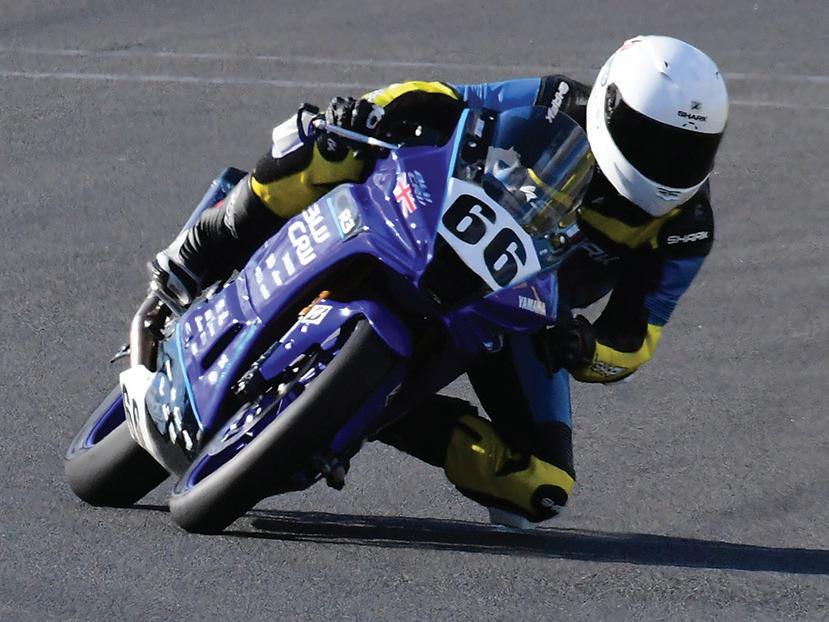
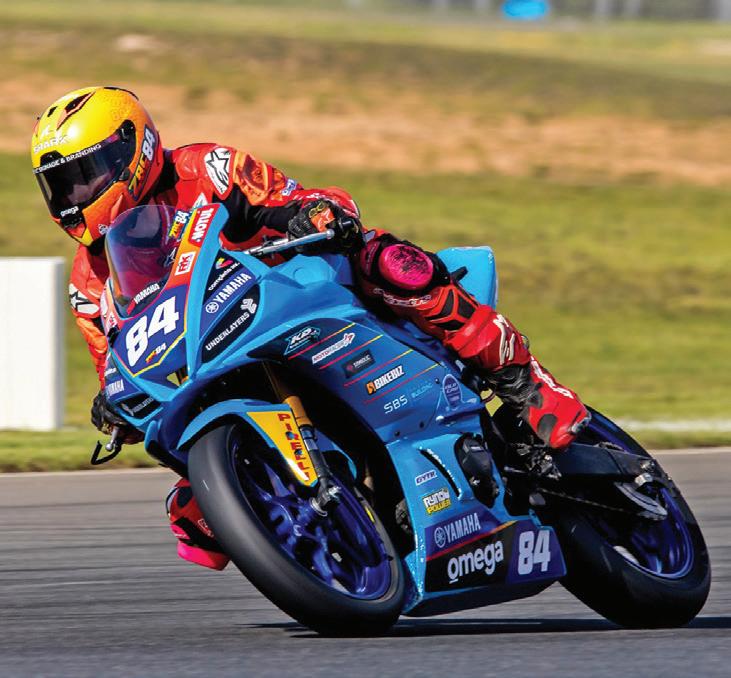
Western Sydney rider JJ Nahlous (Glenwood) finished 5th in Race One, in sodden conditions, then upped the ante on a dry track in Race Two to finish in third to secure a spot on the podium.
“What better way to finish Round Three than on the podium,” JJ said.
“I didn’t get the best start in the first race, but I got stuck in and started lapping a bit faster towards the end and managed to close the gap back up and finish in P5.
“The second race got off to a better start, and improved my pace in the first few laps, but it all came down to the last lap and the last couple of corners where I made the move up to P3. It definitely wasn’t an easy weekend, it was a lot of hard work and I cannot thank Yamaha Motor Australia and the team enough for everything they do for me, helping me get the most out of both the bike and myself.”
With seven of 11 races completed in the 2026 championship, JJ is now
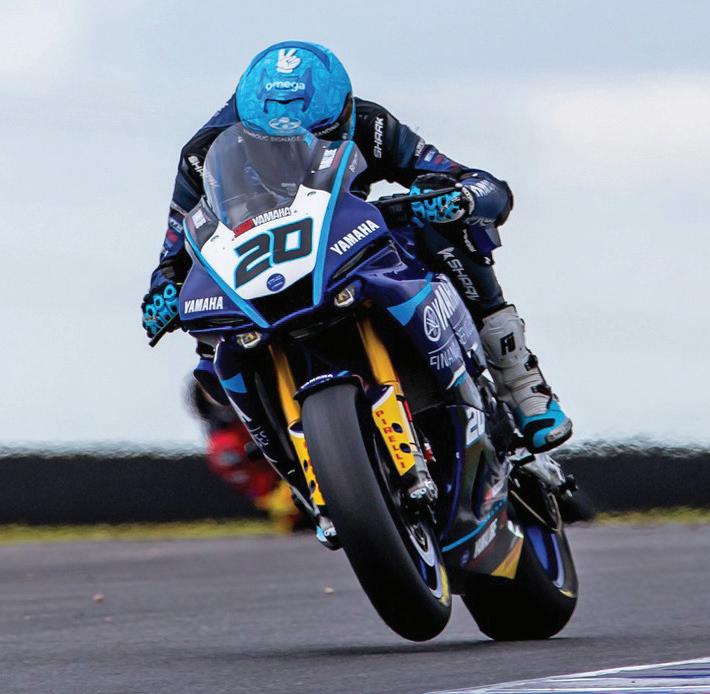
in 7th spot for the Series, whilst Jack Favelle (Cattai) is in 9th, following two 9th-placed finishes at The Bend.
Jake Farnsworth (Glenhaven) continued his good form in the Kawasaki Supersport category, finishing just behind close rival Valentino Knezovic in Race One, then turning the tables in Race Two to share the points for the weekend.“(It) Was good to take the overall victory for the round and slightly extend my championship lead. Historically this hasn’t been my best circuit so to finish like this is okay! I’m very excited and motivated for the next round in Morgan Park.
Jake maintained his two-point lead

over Valentino in the Series, promising more thrilling action between the two riders in the remaining rounds.
Xavier Curmi (Wallacia) finished 5th and DNF in the Yamaha R3 AsiaPacific Cup, whilst Adam Jordan (East Kurrajong) finished 15th and 17th. Zach Russo (Sackville North) finished 4th, 17th and 16th in Road & Race Supersport 300, ahead of Adam Jordan with a 20th and 18th.
In four-wheel action, 17 drivers contested the four races of the accompanying Radical Cup Australia, with Isaac McNeill taking the Round points, ahead of Peter Paddon in second and Christopher Perini in third.