
GIG ECONO RIDE-HAI TOWARDS EMPLOYMENT GENERATION

Proceedings Report June 19, 2026


About the Event
Nepal's gig economy is expanding rapidly, with ride-hailing emerging as one of its most visible sectors. By improving urban mobility, supporting SMEs, strengthening tourism, and creating flexible earning opportunities for youth, these platforms are becoming integral to Nepal's digital and economic infrastructure. The sector also offers one of the most practical pathways to formalization.
The potential is significant, but the key challenge now is to build a balanced and enabling policy environment that allows the sector to grow sustainably while ensuring the safety, protection, and inclusion of the workers who power it. This means moving beyond ad hoc regulation and towards a coherent national framework that recognizes the gig economy as a legitimate and growing part of Nepal's economic landscape. If Nepal can get this right, ridehailing and the broader platform economy could serve as a meaningful bridge between where the economy is today and the inclusive, employmentgenerating future it is working toward.
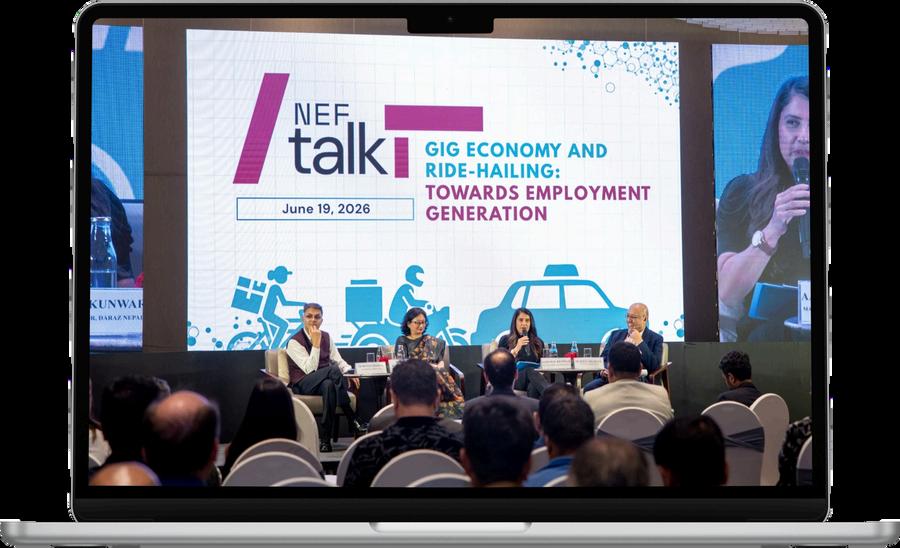
On June 19, 2026, Nepal Economic Forum (NEF) convened its signature event, NEFtalk, on the topic ‘Gig Economy and Ride Hailing: Towards Employment Generation,’ bringing together more than 100 senior policymakers, business leaders, economists, and development practitioners to discuss the policy framework for ride-hailing and the broader gig economy. The discussions, through two presentations, a panel discussion, and closing remarks, emphasized how ride-hailing and the broader platform economy could serve as a meaningful bridge between where the economy is today and an inclusive, employment-generating future.

Rojesh Bhakta Shrestha
Executive Board Member, Nepal Economic Forum
Rojesh Bhakta Shrestha opened the NEFtalk by situating Nepal's gig economy within two defining national realities: Nepal’s heavy dependence on outmigration (with remittances accounting for 36% of GDP) and a growing tourism sector supporting 1.25 million jobs, neither of which has been fully leveraged through domestic mechanisms. Against this backdrop, he presented the gig economy as an emerging pillar of economic development. With over 25 platforms, an estimated 300,000+ jobs in Nepal, and 67% growth since 2021, the gig economy contributes an estimated 7% of GDP. Shrestha argued that the sector is increasingly central to three interconnected opportunities: enhancing tourist mobility and local spending, strengthening SME market access and logistics, and expanding flexible, skillsbuilding income pathways for youth, keeping money circulating within Nepal.
On the regulatory front, Shrestha noted encouraging signs, including a draft Digital Mobility Service Operation Standard 2026, a 5% Value Added Tax / 1% advance income tax framework to bring ride-hailing workers into a formal framework, and emerging subnational regulations such as Gandaki Province's own ride-hailing rules, while flagging structural gaps that need to be addressed. These include the misclassification of platforms as traditional transport operators rather than digital intermediaries, the absence of a clear independent contractor classification for drivers, amending the proposed commission cap of 10% , and restrictions such as a 30 km per ride operating limit for two-wheelers and fixed fare structures by distance that risk undermining marketplace efficiency. He closed with a set of policy recommendations aimed at creating a more enabling regulatory environment to unlock the sector's full potential.
Rajesh Maskey
Chairman, E-Drive Nepal

In his presentation, Rajesh Maskey drew attention to the issue of increasing emigration from Nepal. In this context, he argued that creating employment opportunities through online platforms and leveraging the gig economy could be an effective way to retain individuals who otherwise migrate in search of work. He then introduced E-drive Nepal, a ride-sharing service provider and one of Nepal’s fastest-growing tech startups. He discussed its growth and role in promoting electric vehicles within ride-sharing services.
Maskey also went on to explain the expansion strategy of E-Drive Nepal from Kathmandu to other provinces gradually, underscoring the importance of platformbased mobility services for livelihoods. While emphasizing their necessity, he pointed out several concerns mainly revolving around the use of private red plate vehicles in ride-sharing services, the need for supportive government regulations and corporate policies that aid this transition, and the broader legal framework to make such platforms viable in Nepal. He described ride-sharing platforms as “employment creating machines characterized by low barriers to entry and flexibility at their core.”
Maskey also emphasized the need for clarity in our laws and a competitive market that prevents monopolies from forming while improving the quality of service. He concluded by calling for more inclusive policies for all platform drivers and rental service providers, with the aim of positioning Nepal as a leader in South Asia’s mobility sector.

Sujeev Shakya
Chair, Nepal Economic Forum
Sujeev Shakya, Chair of Nepal Economic Forum, moderated the panel discussion on gig economy, with special focus on ride-hailing, with Aanchal Kunwar, Semanta Dahal, and Jasmine Rajbhandary as the speakers. He spoke of the importance of the gig economy in supporting small and medium enterprises and in generating employment for Nepalis. He also emphasized the importance of developing a coherent national framework to better regulate the gig economy.
To guide the discussion, Shakya presented the following questions to the panelists:
What are some of the constraints on the growth of the gig economy outside of Kathmandu?
How do international companies working in the gig economy view the investment potential in Nepal?
How do these discussions on the gig economy connect with the World Bank’s work on employment creation?
There is a significant opportunity, and there are challenges with respect to the gig economy. How can we make the gig economy more inclusive? How do we look at the existing risk as the government is trying to formalize the gig economy through policy?
What is the trajectory of regulations in Nepal at the federal and provincial levels with respect to the gig economy?
Aanchal Kunwar
Managing Director, Daraz Nepal

In her remarks, Aanchal Kunwar shared insights into the integration of ride-hailing and the gig economy in the e-commerce realm. Kunwar mentioned that with the volume of orders Daraz receives each day, working with external ride-hailing partners in the past has helped maintain steady output. She emphasized that with Daraz’s expansion goals of delivering to over 400 cities in the future, she sees partnerships with ride-hailing organizations becoming more common to keep up with deliveries. Kunwar also spotlighted the importance of an emerging form of gig work: social media influencing. She emphasized that the rise of social media sales has both benefited sellers and proven challenging to keep up with.
Outside of obstructed infrastructure and order sorting logistical challenges, Kunwar highlighted that Daraz also faces an ongoing challenge of balancing nationwide expansion with rising shipping costs to reach more rural pick-up and drop-off points. Additionally, as a Foreign Direct Investment (FDI) company, Daraz also faces regulations restricting retail services. Kunwar shared that the inability to run quality checks on unopened packages created liability issues for the Alibaba-owned company. She suggested that Nepal lessen the rigid restrictions on how FDI companies may conduct sales to encourage other FDI companies to enter Nepal’s markets, boosting the nation’s economy. Kunwar raised the question of how much restriction may be too much restriction on a growing gig economy market providing jobs.

Jasmine Rajbhandary
Senior Social Protection Specialist, World Bank
Acknowledging that ride-hailing is not just a sector but an opportunity for broader sectoral growth, Jasmine Rajbhandary framed regulation as an area of learning for all stakeholders, centering key questions including: can the gig economy sustainably contribute to Nepal’s broader economic growth, and what does it mean for the young workers, their job quality, and families within it? She stressed the importance of understanding and managing the risks that accompany this growth, identifying three key concerns: who is benefiting across urban, peri-urban, and rural areas, the male skew in ride-sharing, and the need for deliberate inclusion of women, and what risks drivers face and how companies can better support their contractors. She reiterated that gig economy impacts must be measured not only at the macroeconomic level but in terms of effects on individual workers and families. On policy clarity, she called for delineated responsibilities across government, enterprises, and contractors, alongside clearer classification frameworks distinguishing self-employed individuals, contractors, and employees. She drew attention to ILO Convention No. 198 on decent work in the platform economy and raised the question of minimum wage provisions for ride-share workers. She stressed the need to update the Social Security Fund and Labor Act and called for platforms to design opportunities for female drivers, including female-only matching functionalities.
Rajbhandary closed with three priorities: fostering an enabling environment for the private sector; facilitating cross-border investment through clearer financial flow regulations; and developing policies that clarify gig worker requirements while supporting skill development.
Semanta Dahal
Chairperson, Purak Asia

Semanta Dahal drew attention to a basic tension in Nepal’s gig economy regulation. He asked whether the law should adapt to keep pace with technology or constrain it instead. He noted that under a strict reading of existing legislation, ride-hailing and services could be considered illegal in Nepal. Despite this, the sector grew fast and expanded across provinces and became part of daily life for many consumers.
Reminiscing, he traced his own work in the sector back to an early legal dispute whereby the Taxi Driver Association filed a case at the Patan High Court to bar platforms like Pathao and inDrive from operating. He recalled working with Bagmati Province on a regulatory framework for ride-hailing and noted that the draft remained under discussion for more than a year after submission.
On the topic of federal versus provincial authority for regulation of the platforms, Dahal said the federal-provincial regulatory overlap can be managed through a national transport policy, which would provide provinces with a framework to set their own regulations. Provinces held authority over transport management. He suggested a national transport policy could give provinces a framework for their own rules. He said the government was already moving in this direction and pointed to its recent digital mobility service provider operation guidelines as evidence.
He also raised concerns about the 30% local ownership requirement for ride-hailing services. The rule aimed to support technology transfer to local partners. He expressed that evidence from other sectors showed that forced local partnerships sometimes let local partners exploit foreign investors instead. As a result, he called for this provision to be reconsidered.

Pukar Malla
Member, National Planning Commission
Pukar Malla opened his closing remarks with the story of Laxman Sah, a young driver from Janakpur who splits his month as a hospital vehicle driver and as a Pathao rider. Malla reminisced about Sah's remarks about not having neither the desire nor the need to go abroad. He argued that such instances should not remain extraordinary. It must become the norm, the kind of opportunity that policies, markets, and institutions are designed to create.
He drew five core messages from the discussion. First, platform work is creating a practical entry point into the labor market. Reflecting on this, Malla noted that for many young people, including his own daughters, the first job may not begin in a formal office but with a motorcycle, a smartphone, and digital payments. Second, ride-hailing platforms support the broader economy, with linkages extending well beyond the platforms themselves. Third, electric mobility gives Nepal a strategic advantage. Fourth, uncertainty is costly, as entrepreneurs, workers, and citizens all need predictability and protection. Fifth, Nepal must avoid a false choice between innovation and regulation.
He situated these within Nepal's broader employment challenge of reducing distress-driven migration and creating dignified work. Malla added that the gig economy can serve as a bridge from informality to formalization, and from migration by compulsion to work by choice.
On the policy front, Malla offered six principles to consider. These included clarity in defining platform roles, harmonization across federal and provincial levels, proportionate worker protection, including SSF inclusion for gig workers, skills recognition, formalization through technology, and evidence-based regulation.
Malla closed by noting that Nepal already has the necessary resources for a successful gig economy-led growth: the electricity, the youth, and entrepreneurship. What is missing, as raised during the day's discussion, is the policy. He called on everyone present to work together on making this conversation more sustained and more comprehensive, including its gender dimension. He reaffirmed that this is precisely what policy is for, and extended an honest invitation from the National Planning Commission to collaborate on turning that shared ambition into action.
Key Takeaways
Ride-hailing and gig delivery platforms have become essential enablers of e-commerce and SME growth, expanding market access across sectors. However, high transport costs to rural areas and infrastructure gaps continue to limit equitable nationwide reach.
Nepal’s regulatory framework has not kept pace with the realities of the gig economy. The rapid expansion of ride-hailing services despite operating in legal grey areas highlights the need for regulations that support innovation while ensuring accountability. Restrictions on foreigninvested companies also constrain market entry, investment, and job creation.
Sustainable gig economy growth requires clear policies that define the roles and responsibilities of government, businesses, and workers. This should be supported by enabling conditions for private sector development, transparent cross-border investment rules, and skill development opportunities for gig workers.
Stronger coordination between federal and provincial governments is necessary to reduce jurisdictional inconsistencies and create a more coherent and effective regulatory environment.
Worker welfare must remain central to gig economy regulation. Policies should ensure that the benefits of platform work are distributed inclusively across gender, geography, and employment types, while strengthening social protection, updating labor and Social Security Fund provisions, clarifying worker classification, and promoting greater participation of women in platform-based work.
Click here or scan the QR code to watch the full video of the event!