
Policy Brief on Gig Economy and Ride-Hailing: Towards Employment Generation
Boosting Tourism, Strengthening SMEs, and Generating Employment Opportunities
From Dependence to Opportunity: Nepal’s Employment Imperative
Each year, approximately more than 750,000 Nepalis leave for foreign employment and nearly 2200 every day Additionally, remittances now account for 28 2% of GDP. At the same time, Nepal welcomed 1.15 million international tourists in 2025, supporting 1 25 million jobs. These two realities tell the same story: Nepal has significant economic potential, but not enough domestic infrastructure to capture it To unleash this potential, this would require a new perspective to look at emerging trends of economic opportunities and employment generation through the gig economy.

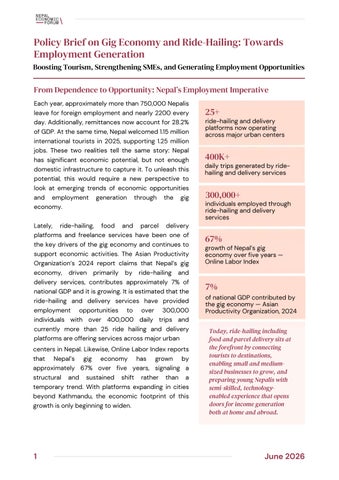
25+
ride-hailing and delivery platforms now operating across major urban centers

400K+
daily trips generated by ridehailing and delivery services

Lately, ride-hailing, food and parcel delivery platforms and freelance services have been one the key drivers of the gig economy and continue support economic activities The Asian Producti Organization’s 2024 report claims that Nepal’s economy, driven primarily by ride-hailing delivery services, contributes approximately 7% national GDP and it is growing. It is estimated that th ride-hailing and delivery services have provide employment opportunities to over 300,00 individuals with over 400,000 daily trips and currently more than 25 ride hailing and delivery platforms are offering services across major urban
300,000+ individuals employed through ride-hailing and delivery services
67%
7% of national GDP contributed by the gig economy Asian Productivity Organization, 2024 growth of Nepal’s gig economy over five years Online Labor Index
centers in Nepal Likewise, Online Labor Index reports that Nepal’s gig economy has grown by approximately 67% over five years, signaling a structural and sustained shift rather than a temporary trend. With platforms expanding in cities beyond Kathmandu, the economic footprint of this growth is only beginning to widen

Today, ride-hailing including food and parcel delivery sits at the forefront by connecting tourists to destinations, enabling small and mediumsized businesses to grow, and preparing young Nepalis with semi-skilled, technologyenabled experience that opens doors for income generation both at home and abroad.
1
Ride-Hailing Amplifies Tourism’s Economic Multiplier
Tourism creates economic value only when visitors can move easily, explore destinations, and spend across local economies In Nepal, ride-hailing platforms such as Pathao, InDrive, Yango, and Tootle has allowed tourists to move across the country with ease. By offering safe, app-based, and cashless transport, these platforms address one of the most common frustrations among international travelers: unreliable and non transparent local transport At the same time, app-based transactions improve traceability, accountability, and user confidence
Better mobility also increases tourism spending International tourists across the country are more likely to extend their trip to more places, generating additional spending at local hotels, restaurants, handicraft shops, and tourism businesses. Furthermore, it allows them to travel at a lower cost with much needed safety and predictability As ride-hailing platforms make travel more accessible, affordable, and reliable, they directly improve the overall tourist experience, and a better experience means more time spent, more places visited, and more money circulating in the local economy This is how platform-based mobility has amplified the tourism sector’s economic potential in Nepal.
Vietnam provides a useful regional example, where rapid tourism growth and digital adoption have expanded the ride-hailing market significantly to an estimated USD 880 million in 2024, with projections reaching USD 2.16 billion by 2029. Ride-hailing has transformed Vietnam’s tourism landscape by eliminating language and navigation barriers, enabling independent exploration of cities like Hanoi and Ho Chi Minh City, and evolving into integrated digital tourism platforms making Vietnam a more welcoming and navigable destination for international visitors As Nepal is working towards its target of attracting 3 5 million international tourists by 2032, ride-hailing services can play an important role in improving accessibility and converting tourist arrivals into broader economic activity. Further, domestic tourism has seen to be positively impacted in areas where there is easy availability of vehicles through ride-hailing platforms.
2 Delivery Services are Driving Nepal's SME Ecosystem
According to UNESCAP (2020), SMEs in Nepal contribute 22% to Nepal’s GDP, yet they consistently struggle with limited market reach, weak logistics, and low formalization Ridehailing and delivery platforms like Upaya are directly changing that. Upaya a tech-driven logistics service provider is operating its services all over Nepal with over ten thousand delivery partners and over five million orders delivered Likewise, foodmandu, one of Nepal’s leading food delivery platforms, has employed over 370 individuals and has a customer base of over 270,000 The food delivery industry is expected to generate USD 263 90 million revenue, showing that platform-enabled distribution works at scale.
Delivery services are empowering SMEs through several channels:
Market access: A clothing seller in Bhaktapur or a homemade food producer in Kirtipur can now reach customers across Kathmandu within 30 minutes, without renting expensive commercial space.
Formalization: Delivery platforms require digital payments, business registration, and customer accountability, giving SMEs a practical incentive to formalize and become eligible for credit and government support.
Logistics for essential goods: As platforms expand into delivering pharmaceutical and fresh products, they are building the supply chain infrastructure that health businesses and agro-enterprises need to scale up.
Inclusive entrepreneurship: Women, persons with disabilities, and rural youth with a smartphone but without formal qualifications can access platform-based income on their own terms
3 Building Skills and Expanding Opportunities through Gig Work
Nepal’s migration crisis is driven less by a lack of ambition and more by limited economic opportunities at home. However, in the past decade, engaging in gig work like ride-hailing and delivery services has been able to generate economic opportunities Moreover, it has created accessible income opportunities for young people entering the labor market. For many, this provides immediate earnings, flexible working hours, and practical skills in navigation, customer communication, and digital payments These capabilities represent valuable semiskilled work experience that is increasingly recognized both within Nepal and in international labor markets
Unlike remittances earned abroad, income generated through ride-hailing, delivery, and other gig economy services circulates within the local economy, supporting sectors such as retail, food services, and digital payments. Gig work is also expanding opportunities for women, students, and digitally connected youth who may not have access to formal employment As Nepal’s economy continues to grow, gig work has emerged as a scalable and accessible source of income that can help retain talent, strengthen local economic activities and reduce distress-driven migration
In addition, these platforms help workers develop transferable skills that are increasingly valued in labor markets abroad, including in Gulf countries and European destinations. In a study conducted by Nepal Economic Forum (NEF) on European Union (EU) migration, it has been observed that young Nepalis were using the skills they acquired in engaging in ridehailing services to be able to engage in similar activities after they have migrated. Since ridehailing and delivery businesses are expanding across the globe, there will be more demand in the future. It is equally important to consider the economic impact created when gig workers choose to stay in Nepal
Regulatory Landscape: Towards an Enabling Environment
Nepal’s digital mobility sector is growing rapidly, and it is a positive step that the Government of Nepal has recognized the need for a dedicated regulatory framework, introducing the draft “Digital Mobility Operation Standard 2026”. At the same time, the recent national budget signals fiscal intent, formalizing the sector by introducing a 5% Value Added Tax (VAT) and a 1% advance income tax on app-based trips However, the pace of fiscal integration has outrun the development of sound operational rules. To ensure compatibility and support, several provisions in the draft framework require further consultation and structured dialogue with industry players and ecosystem stakeholders before enactment.
This concern is compounded by an emerging sub-national regulation: Gandaki Province was the first government to regulate ride-hailing, introducing its own framework ahead of any federal legislation While that reflected genuine regulatory initiative, subsequent amendments to the Gandaki regulation, combined with a new provincial directive on minimum fares, have introduced compliance layers that diverge from what the federal draft proposes. For platforms operating across multiple provinces, this gap between sub-national and national frameworks creates compounding bottlenecks, and without a coherent federal standard to anchor them, the risk of further regulatory fragmentation across other provinces remains real
In its current draft form, the proposed standard may create unintended challenges that could hinder continued growth and development of the digital mobility sector Rather than enabling dynamic formalization, several provisions introduced could create counterproductive compliance burdens and discourage innovation and investments
Some of the provisions that might deter organic growth of the sector are outlined here:
1 The draft misclassifies platforms as traditional transport operators, exposing them to liability for passenger safety and mandatory Accident Fund contributions that are more appropriate for fleet operators than digital intermediaries.
2 It fails to define drivers clearly as independent contractors, creating ambiguity around wages and social security that would raise costs and reduce flexibility for the majority who work part-time
3 A proposed 10% commission cap falls well below the 12%-20% range that reflects global industry norms, and restrictions on surge pricing and rigid fare controls in ride-hailing, food delivery, and logistics platforms, which function as two-sided marketplaces connecting customers with drivers and delivery workers, can weaken essential market signals that balance demand and supply; by limiting dynamic, market-based pricing through fixed base fares or standardized per-km rates, such measures risk reducing driver incentives during peak periods, leading to shortages, longer wait times, and reduced service reliability, whereas allowing flexible pricing and healthy competition helps ensure efficient matching, sustained supply availability, and improved overall marketplace performance.
4 A range of excessive operational requirements, including a 30 KM distance limit on twowheelers, mandatory uniforms, data-exposing QR codes, local server infrastructure, and government API integration, add friction and cost without corresponding benefit to users. Moreover, the draft has failed to recognize three wheelers which have significant potential to June 2026
serve the market. Taken together, these provisions could make Nepal’s digital mobility sector instantly hostile to both existing operators and prospective national and international investors.
Policy Recommendations
To maximize the potential of ride-hailing and the broader gig economy, policymakers should consider the following:
1. Enact an enabling and harmonized regulatory framework:
Operation Standard 2026 should be revised to clearly classify platforms as digital intermediaries, with a clear distinction between the platforms and fleet companies that work as partners and intermediaries that connect drives with platforms. Likewise, define drivers as independent contractors, adopt market-determined commission rates, and replace data localization mandates with internationally recognized standards. Concurrently, the federal government should work with provincial governments to align sub-national regulations on licensing, fare directives, and operational standards, reducing fragmentation and compliance burdens for platforms operating across multiple provinces.
2. Integrate ride-hailing into Nepal’s tourism and SME ecosystems:
Ride-hailing platforms should be formally incorporated into airport systems, hotel networks, and official tourism channels to improve visitor mobility and accessibility. Policymakers should simultaneously strengthen delivery access and digital integration for SMEs, enabling businesses to expand market reach, adopt digital payments, and participate more effectively in the platform economy
3. Extend skills recognition to gig workers:
Gig workers should have their skills formally recognized, particularly competencies gained through ride-hailing and delivery work such as navigation, customer service, and digital payment usage. The government, platforms, and training institutions should work together to certify and validate these skills, creating stronger employment pathways within Nepal and abroad
4. Leverage platforms as instruments of tax compliance and formalization:
Rather than imposing parallel compliance infrastructure, policymakers should work with platforms to act as digital tax agents for gig workers, streamlining the calculation, withholding, and remittance of applicable taxes. This approach uses existing platform technology to bring informal workers into the fiscal system efficiently and at low administrative cost
5. Build proportionate evidence systems for the platform economy:
The government should develop structured and anonymized data-sharing arrangements with digital platforms to generate periodic, aggregated insights on the gig economy ' s contribution to employment, income generation, and digital economic activity Such systems should prioritize aggregate reporting over individual-level tracking, ensuring that data is used strictly for statistical and policy analysis to support evidence-based decision-making and improve regulatory design.
Nepal’s gig economy is growing rapidly, and ride-hailing has emerged as one of its most visible and impactful drivers These platforms are becoming an important part of Nepal's digital and economic infrastructure, improving urban mobility, supporting SMEs, strengthening tourism, and creating flexible income opportunities for youth who might otherwise have very valuable options at home As ride-hailing attracts a large number of workers who currently operate outside formal frameworks, and because withholding tax at source through platforms is far less costly than pursuing individual enforcement, the sector represents one of the most practical and low-barrier entry points for bringing informal workers into the formal economy. Beyond this, ride-hailing and delivery platforms are also beginning to systematize parts of Nepal's broader informal transport sector, bringing greater accountability, price transparency, and digital integration to an industry that has long lacked them In doing so, they are not only creating income opportunities for drivers and small-scale entrepreneurs but also laying the groundwork for a wider shift toward a more formalized and digitally connected economy.
The potential is significant, but the key challenge now is to build a balanced and enabling policy environment that allows the sector to grow sustainably while ensuring the safety, protection, and inclusion of the workers who power it This means moving beyond ad hoc regulation and toward a coherent national framework that recognizes the gig economy as a legitimate and growing part of Nepal's economic landscape

If Nepal can get this right, ride-hailing and the broader platform economy could serve as a meaningful bridge between where the economy is today and the inclusive, employment-generating future it is working toward.