An Emerging Strategic Partnership Space
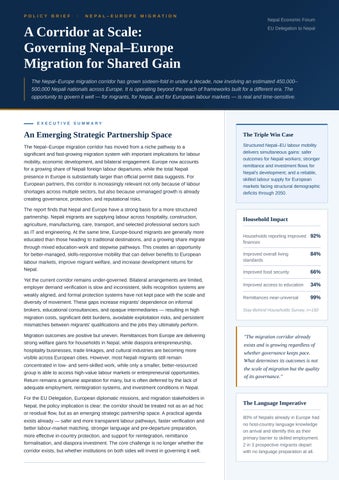
The Nepal–Europe migration corridor has moved from a niche pathway to a significant and fast-growing migration system with important implications for labour mobility, economic development, and bilateral engagement Europe now accounts for a growing share of Nepali foreign labour departures, while the total Nepali presence in Europe is substantially larger than official permit data suggests For European partners, this corridor is increasingly relevant not only because of labour shortages across multiple sectors, but also because unmanaged growth is already creating governance, protection, and reputational risks
The report finds that Nepal and Europe have a strong basis for a more structured partnership Nepali migrants are supplying labour across hospitality, construction, agriculture, manufacturing, care, transport, and selected professional sectors such as IT and engineering At the same time, Europe-bound migrants are generally more educated than those heading to traditional destinations, and a growing share migrate through mixed education-work and stepwise pathways This creates an opportunity for better-managed, skills-responsive mobility that can deliver benefits to European labour markets, improve migrant welfare, and increase development returns for Nepal
Yet the current corridor remains under-governed Bilateral arrangements are limited, employer demand verification is slow and inconsistent, skills recognition systems are weakly aligned, and formal protection systems have not kept pace with the scale and diversity of movement These gaps increase migrants' dependence on informal brokers, educational consultancies, and opaque intermediaries resulting in high migration costs, significant debt burdens, avoidable exploitation risks, and persistent mismatches between migrants' qualifications and the jobs they ultimately perform
Migration outcomes are positive but uneven Remittances from Europe are delivering strong welfare gains for households in Nepal, while diaspora entrepreneurship, hospitality businesses, trade linkages, and cultural industries are becoming more visible across European cities However, most Nepali migrants still remain concentrated in low- and semi-skilled work, while only a smaller, better-resourced group is able to access high-value labour markets or entrepreneurial opportunities Return remains a genuine aspiration for many, but is often deferred by the lack of adequate employment, reintegration systems, and investment conditions in Nepal
For the EU Delegation, European diplomatic missions, and migration stakeholders in Nepal, the policy implication is clear: the corridor should be treated not as an ad hoc or residual flow, but as an emerging strategic partnership space A practical agenda exists already safer and more transparent labour pathways, faster verification and better labour-market matching, stronger language and pre-departure preparation, more effective in-country protection, and support for reintegration, remittance formalisation, and diaspora investment The core challenge is no longer whether the corridor exists, but whether institutions on both sides will invest in governing it well
The Triple Win Case
Structured Nepal–EU labour mobility delivers simultaneous gains: safer outcomes for Nepali workers; stronger remittance and investment flows for Nepal's development; and a reliable, skilled labour supply for European markets facing structural demographic deficits through 2050
Stay-Behind Households Survey, n=150
"The migration corridor already exists and is growing regardless of whether governance keeps pace. What determines its outcomes is not the scale of migration but the quality of its governance."
The Language Imperative
80% of Nepalis already in Europe had no host-country language knowledge on arrival and identify this as their primary barrier to skilled employment 2 in 3 prospective migrants depart with no language preparation at all
Six Findings from the Research
The corridor is expanding rapidly and is already structurally significant Permit approvals for Europe rose from 4,585 in FY 2016/17 to 77,181 in FY 2024/25, and Europe now accounts for nearly one in ten Nepali labour departures Official figures still undercount the real scale, which also includes students, family members, onward movers from third countries, and migrants in irregular or semi-regular situations
Nepal–Europe migration is dual-track: low-wage concentration alongside a smaller skilled stream. The larger stream is concentrated in hospitality, construction, agriculture, factory work, and care Alongside it, a smaller but growing cohort is entering professional and technical roles in IT, engineering, nursing, and finance Europe-bound migrants are often more educated than those heading to traditional destinations, yet many still experience de-skilling after arrival benefits are distributed unevenly depending on education, language, documentation, and entry route.
Existing systems do not yet connect Nepali skills with European labour demand effectively Strong complementarities between Nepali labour supply and European shortages in hospitality, construction, agriculture, care, transport, and technical sectors are not translating efficiently into safe and productive mobility Weak qualification alignment, limited recognition of prior learning, insufficient language preparation, and a lack of structured employer linkages all contribute to persistent skills mismatch Many migrants leave without destination-country language skills, realistic information on conditions, or credentials legible to European employers
Recruitment and migration costs are high, opaque, and often debtfinanced Costs commonly range between NPR 5–15 lakhs and are often financed through savings, household assets, and informal or high-interest loans This creates a strong economic filter favouring households with more resources, while exposing migrants to significant pre-departure debt In the absence of efficient attestation and trusted information systems, migrants rely heavily on manpower agencies, consultancies, and informal brokers enabling mobility but reproducing fraud, misinformation, and exploitation risks
The corridor is improving household welfare and generating broader economic linkages. Remittances from Europe are near-universal among surveyed households and support daily consumption, debt repayment, education, savings, and asset-building Beyond remittances, Nepali-owned restaurants, hotels, food supply chains, and trade businesses are expanding across Europe this is not only a labour-export story, but also a platform for entrepreneurship, trade promotion, and longer-term diaspora investment
EUR 3,000+/month
Cite contributing to Nepal as a motivation
Remit EUR 10,000+/year 12%
Nepalis in Europe Survey, n=60
Nepal's Case for the EU Talent Pool
The EU Talent Pool is a skills-first platform connecting employers in shortage occupations with partnercountry candidates Nepal presents a strong case: a rapidly growing, educated outbound cohort; supply in the sectors where EU shortages are most acute; an explicit national commitment to skills-based migration; and a governance track record comparable with current South Asia partner countries
The EU already has Talent Partnerships with Pakistan and Bangladesh Engaging Nepal would extend this regional framework to a country with a distinct, complementary skills profile and a corridor already operating at scale
Foundations: Nepal–Germany BLA (2023) · Nepal–Romania BLA (2023) · Israel–Nepal care scheme · UK–Nepal nursing MOU 1 2 3 4 5 6
Return is a real aspiration, but not yet a reliable policy outcome. Many migrants indicate they would consider returning if Nepal offered more credible employment opportunities, better wages, and stronger reintegration support In the absence of these conditions, return is often postponed and re-migration becomes the more rational option The realistic policy objective is to support brain circulation, skills transfer, and forms of circular engagement particularly relevant for Europe-based Nepalis with capital, experience, and interest in investment
The Corridor in Numbers
77,181
Labour permits issued for Europe in FY 2024/25, up from 4,585 in FY 2016/17
Share of Nepali foreign labour departures now going to Europe
76%
Estimated actual Nepali population in Europe (excl UK) vs 248,585 cumulative official labour permits
Of official European labour approvals concentrated in Romania, Croatia, Cyprus, Malta, and Poland 52%
Of prospective migrants intend to settle permanently in Europe; only 6% plan to return
Of Nepalis surveyed in Europe initially arrived on student visas
Of Nepalis surveyed in Europe work in IT and engineering
Of Nepalis in Europe identify language as their main barrier to integration and better employment
Of prospective migrants to Europe have completed at least Class 12
Of prospective migrants report taking loans to finance migration; costs typically NPR 5–15 lakhs
Of prospective Europe-bound migrants expect to work in lowwage sectors (agriculture, factories, construction, cleaning)
92%
Of stay-behind households report improved financial conditions; 84% report improved living standards
Supply–Demand Complementarities and the Barriers to Realising Them
Europe faces structural labour shortages across healthcare, construction, hospitality, agriculture, transport, and ICT driven by ageing populations and the demands of green and digital transitions Nepal's workforce profile aligns closely with these categories Threequarters of prospective Europe-bound migrants hold at least upper-secondary qualifications; yet the majority are absorbed into lowwage, low-barrier roles bearing little relation to their credentials
The single highest-impact pre-departure intervention is language training Two in three prospective migrants depart with no knowledge of the host-country language, and 80% of Nepalis already in Europe identify this as their primary barrier to employment and integration. It is the gateway through which all other skills investments become productive.
The principal barrier to skills mobility is not the absence of skills but the absence of comparability Nepal's NQF and NVQS reference ISCED levels; the EU's ESCO framework references ISCO-08 No designated actor in Nepal is currently mandated to drive alignment between these systems and without it, Nepali credentials remain largely invisible to European selection mechanisms despite strong underlying human capital
A Dual-Track Corridor: Enclave Work and a Growing Professional Cohort
Nepal–Europe migration operates on two distinct tracks Understanding both is essential for designing targeted interventions
The majority track essential services and manual work. Among prospective migrants surveyed, 52% expect to enter manual or low-skilled roles: factory work, agriculture, cleaning, and construction Stay-behind household data confirms this, with families most commonly reporting migrants in hospitality (34%), factory work (26%), and agriculture (10%) Country-specific demand shapes these flows: Bulgaria's Schengen integration is drawing construction workers; Cyprus and Malta's tourism sectors generate sustained demand for hospitality and care workers; Romania channels migrants into food processing and manufacturing
The emerging professional track A smaller but significant cohort is accessing skilled employment Among Nepalis already in Europe, IT and engineering account for 28% of the survey sample, 57% earn over EUR 3,000 per month, and 88% planned their migration independently Nepali entrepreneurs are also establishing a visible presence, with diaspora-owned restaurants, hotels, and food-supply chains generating employment and contributing to local economies across multiple European cities
The gig economy as an emerging third tier. In Malta, Portugal, and Romania, a growing number of Nepalis work in platform-based delivery and ride-hailing providing immediate income and a foothold in European cities, but without employment protections or statutory benefits
Six Structural Constraints Shaping Every Stage of Migration
Six durable constraints shape outcomes across the migration cycle and concentrate the worst risks among already-disadvantaged groups:
1 Informational asymmetry Migrants rely on brokers and social media for destination knowledge Shadow recruitment agencies filing permits as "individual" applications to avoid oversight have filled the governance vacuum left by an under-resourced attestation system.
2. Regulatory fragmentation. Nepal's governance frameworks were designed for Gulf migration No dedicated Nepal–EU mobility partnership exists; the two bilateral agreements (Germany, Romania) are unimplemented without adequate resourcing Attestation bottlenecks in Nepali missions drive migrants toward informal, higher-risk routes
3 High and opaque migration costs Total migration costs to Europe range from NPR 8 5 to 14 lakhs (~EUR 600–1,000), financed largely through informal loans at 18–36% interest These costs create pre-departure debt traps and restrict access to safer, formal pathways
4. Skills-systems misalignment. Nepal's TVET system remains oriented toward Gulf markets Approximately half of training institutions are unregistered A concrete friction: Nepal's 10+2 qualification is not fully recognised in several EU countries, notably Germany, forcing students into additional bridging years that erode willingness to use formal channels
5 Unequal access the aspiration–capability gap Access to safe, legal pathways is filtered by education, financial capital, and social networks When formal channels feel slow, opaque, or inaccessible under household debt pressure, semi-formal agencies and irregular strategies become the default documented in the December 2025 Albacete case, in which 322 Nepali workers were found in Spanish agriculture under exploitative conditions
6. Reintegration neglect. The corridor functions efficiently as an exit pathway but poorly as a circular one 60% of returnees re-migrate not by choice, but because institutional conditions for productive reintegration do not yet exist
Five Priority Areas for EU Delegation Action
Pillar 1 · Strengthening Governance, Accountability, and Monitoring
Fast-track Bilateral Labour Agreements with priority EU countries, embed minimum protections for employer-tied visas, establish labour attachés in Nepali missions across Europe, and streamline attestation processes to cut delays and reduce irregular migration
Develop an EU-funded digital platform for real-time employer demand verification, reducing processing from months to days; fund Nepali-language information platforms with verified visa, fee, and rights content; and require the 'employer pays' principle across all EU-funded schemes
Launch a Nepal–EU Talent Partnership in hospitality, agriculture, construction, and care work, with pilot schemes featuring capped fees, standardised contracts, and in-country helpdesks for dispute resolution
Pillar 2 · Aligning Skills, Qualifications, and Labour Market Pathways
Implement and align Nepal's NQF with EU ESCO standards, enabling pre-validation of Nepali credentials and reducing costly recredentialing abroad
Launch skills mobility pilots in hospitality, construction, and care work using ESCO occupational mapping and modular bridging courses; establish EU Labour and Skills Mobility Officers within the EU Delegation to coordinate matching and bilateral recruitment
Prioritise destination-specific language training as the single highest-impact pre-departure intervention, paired with realistic orientation on wages, costs, rights, and gender-specific risks
Pillar 3 · Reintegration and Circular Migration
Operationalise Nepal's Reintegration Programme with clear institutional mandates, dedicated funding, and integrated one-stop services combining job-matching, skills recognition, psychosocial support, and entrepreneurship assistance across federal, provincial, and local levels
Formally recognise and certify skills acquired abroad; target the 48% of Europe-based Nepalis undecided about return with concrete incentives for circular engagement and diaspora investment linkages
Pillar 4 Promoting Remittances and Diaspora Investment
Create a sub-FDI investment tier for NRN investors (below NPR 20 million), fast-track NRN citizenship processing through European embassies, and extend NID and PAN access to unlock routine financial participation including fixed deposits and formal banking
Strengthen formal remittance channels by reducing transaction costs and expanding digital financial products; conclude DTAAs with Belgium, Germany, Netherlands, Portugal, and France to remove a documented deterrent to diaspora investment and profit repatriation
Treat political and regulatory stability anti-corruption frameworks, transparent business registration, judicial enforcement of contracts as non-negotiable preconditions for large-scale diaspora capital flows
Pillar 5 · Research and Knowledge Development
Reform DOFE's skill classification methodology to align with the NQF and collaborate with Nepal Rastra Bank to establish disaggregated, Europe-specific remittance data as a foundation for evidence-based policy
Digitise migration processes end-to-end and build an integrated returnee data system linking DOFE-FEIMS with the Departments of Immigration and Labour, underpinned by robust data governance and privacy frameworks
Conduct sector-specific skills mapping to guide partnership design and assess the feasibility of large-scale training institutions capable of placing 50,000–100,000 workers annually to international standards