

July 9, 2026


On July 8, 2026, Nepal Economic Forum convened its signature event, NEFtalk, on the findings of an EU-commissioned report ‘Nepal-Europe Migration Corridor.’ bringing together senior policymakers, diplomats, migration experts, and development practitioners to discuss the fastgrowing Nepal–Europe migration corridor and the policy framework needed to govern it.
The Nepal–Europe migration corridor has expanded twenty-one-fold in under a decade, with an estimated 450,000–500,000 Nepali nationals across Europe. Labor permits issued for Europe rose from 4,585 in FY 2016/17 AD to 77,181 in FY 2024/25 AD, and Europe now accounts for nearly one in ten Nepali labor departures. However, migration outcomes remain uneven. While remittances from Europe are delivering strong welfare gains for households in Nepal, and diaspora entrepreneurship is becoming more visible across European cities, the gains remain narrow. Weak skills recognition between Nepal and Europe keeps many migrants locked out of higher-value jobs that match their qualifications. High and opaque migration costs limit access to safer pathways for those with resources or connections. Fragmented governance and limited bilateral agreements leave most migrants dependent on informal brokers. As a result, only a smaller, better-resourced group is able to access high-value labor markets or entrepreneurial opportunities. These conversations have so far stayed confined to small, closed-off cohorts of experts and officials. Hence, NEF convened this event to open the discussion to a wider set of stakeholders. The goal of the event was to bring stakeholders from both sides of the corridor into a shared platform and widen the ground for closing these gaps.

NEF Chair Sujeev Shakya opened the NEFtalk by welcoming guests and situating the event within Nepal Economic Forum’s (NEF's) broader approach to convening dialogue, i.e. to contextualize, converse, and consume. He described the discussion as the culmination of nearly a year of work built around the EU-commissioned study on the Nepal-Europe migration corridor. Shakya traced NEF's growing engagement on the topic of remittances and migration from its work with the Non-Resident Nepali Association (NRNA) on skills and diaspora funds to NEF’s current position of an emerging knowledge repository, looking across dimensions including investment opportunities, reintegration, skilling, and policy. He also introduced NEF's Global Nepali Network (GNN), one of the institution's centers, describing its work reshaping the dialogue around Nepalis across the world in partnership with nonresident Nepali groups, the diaspora, and other institutions, and pointing to sizable connected communities.
Shakya then laid out the structure of the day's program in three parts: presentations from Rojesh Bhakta Shrestha, Manju von Rospatt, Giuseppe Savino, and Rojika Maharjan to set the context; a conversation with H.E. Veronique Lorenzo, Ambassador of the European Union to Nepal; and closing remarks by Rojina Tamrakar, Executive Director at the Institute of Foreign Affairs. He closed his remarks by introducing a short video on NEF's work.
Rojesh Bhakta Shrestha opened the presentations by setting the context for the Nepal-Europe migration corridor, presenting three key trends on overall foreign labor migration, Nepali migration to Europe, and the remittance landscape to explain why the corridor matters for Nepal's economy.
Shrestha traced Nepal's foreign employment permits over the past 15 years, noting a rebound to an average of around 750,000 departures annually after a dip in 2021, alongside a gradual shift in destinations. He also noted that the share of people migrating to the GCC has fallen from 77% to 64% this fiscal year due to the West Asia crisis, while the share of people migrating to East Asia has grown by around 10%. Against this, he pointed to Europe as the corridor reshaping the picture, with permits growing almost 21-fold over the past decade and NEF estimating 550,000 to 600,000 Nepalis currently working there, well above the 303,000 officially recorded.

Turning to remittances, Shrestha noted that Nepal is on course to cross USD 16 billion this fiscal year, around 32% of GDP, with 25% year-on-year growth. He also noted that the "others" category, which includes Europe, has grown nearly fivefold to 20.4%, pointing to an estimated USD 1.5 to 2 billion flowing from the corridor annually. He concluded that Nepal's migration and remittance story is diversifying, and Europe is increasingly at the center of that shift.

Manju von Rospatt presented the core findings of the study on Nepali migration to Europe conducted by NEF with the support of the European Union Delegation in Kathmandu, drawing on fieldwork across eight European countries, surveys with around 400 Nepalis intending to migrate, interviews with 60 diaspora members in Europe, and consultations with 150 households with a family member abroad.
As per the research conducted, Rospatt noted that Nepalis migrating to Europe are younger, more educated, and more gender-balanced than those heading to traditional destinations, with a median age of 28.4 and around one in three being women. She also highlighted that the pull factors for these migrants include EU wages, which is around five times higher than Nepal's median; strong social security protections; and active recruitment in sectors facing labor shortages, with a little over half of prospective migrants aspiring to settle long-term rather than return.
Rospatt was candid, however, about the costs and governance gaps that accompany this growth. She noted that people are paying between NPR 1 million to NPR 1.5 million to access this corridor, three to five times what they would pay for traditional destinations, with around 73% taking on loans. She cautioned that the corridor's rapid growth has outpaced the policy frameworks around it, pointing to a 43% deskilling rate among prospective migrants and two in three leaving with little to no language preparation. As a result, she called for stronger bilateral agreements, better intermediary oversight, and investment in skill certification.

Giuseppe Savino, in his presentation, gave insights into Europe’s changing labor market and the growing need for migrant workers within the European Union (EU). He examined how Europe’s reshapen labor demands come not from population decline alone but also from a shrinking workforce. He explained that while the EU’s total population is projected to fall by 6.7 million by 2050, the working-age population will shrink by nearly 30 million, with over 130 million people aged 65 or above.
This 25% workforce replacement deficit has already slowly begun, according to Savino. He noted that 2.1% of jobs across the EU were vacant in the first quarter of 2026, with particularly high need spanning healthcare, manufacturing, cybersecurity, data analytics, and AI. Healthcare and longterm care face double the challenge, as a rising demand for services happens to coincide with high retirement rates throughout the sector.
Savino cautioned that migration is not an all-encompassing solution. However, he also argued that without migration, the EU population would decline by over 10% by 2050. He concluded that Europe’s demographic challenges are quickly becoming migration policy challenges, requiring systems that are responsive, targeted, and efficient.

In her presentation, Rojika Maharjan emphasized the need for Nepal to strengthen frameworks supporting the reintegration of Nepali returnees from labor migration. She noted that Nepal would not have to start from scratch, as there currently exists a three-tier government reintegration system. Within this framework, she identified four priority areas: skills recognition and utilization, entrepreneurship support, employment and job-matching services, and family-centered social reintegration policy.
She cautioned that limited implementation and accessibility to returnee support, particularly for the often-overlooked Nepal-Europe cohort, may carry high costs. According to Maharjan, the chances of unemployment, frustration, and repeat or onward mobility with high migration costs increase with weak reintegration policy. She reminded policymakers that returnee profiles often differ, and the generalized profile of the Nepal-Europe cohort presents unique needs, markedly different from the more commonly addressed Gulf and Southeast Asia returnee groups.
From survey data, Maharjan also explained that intentions to return are shaped less by dissatisfaction abroad, as 92% reported being satisfied with their jobs in Europe, and more by family obligation or pulls toward civic identity. She highlighted the 48.3% of respondents that were still undecided about returning as the most actionable group for policy engagement. With political stability, a conducive business environment, and targeted diaspora outreach, she argued that Nepal has a great opportunity to urge active return and reinvestment from this undecided cohort.
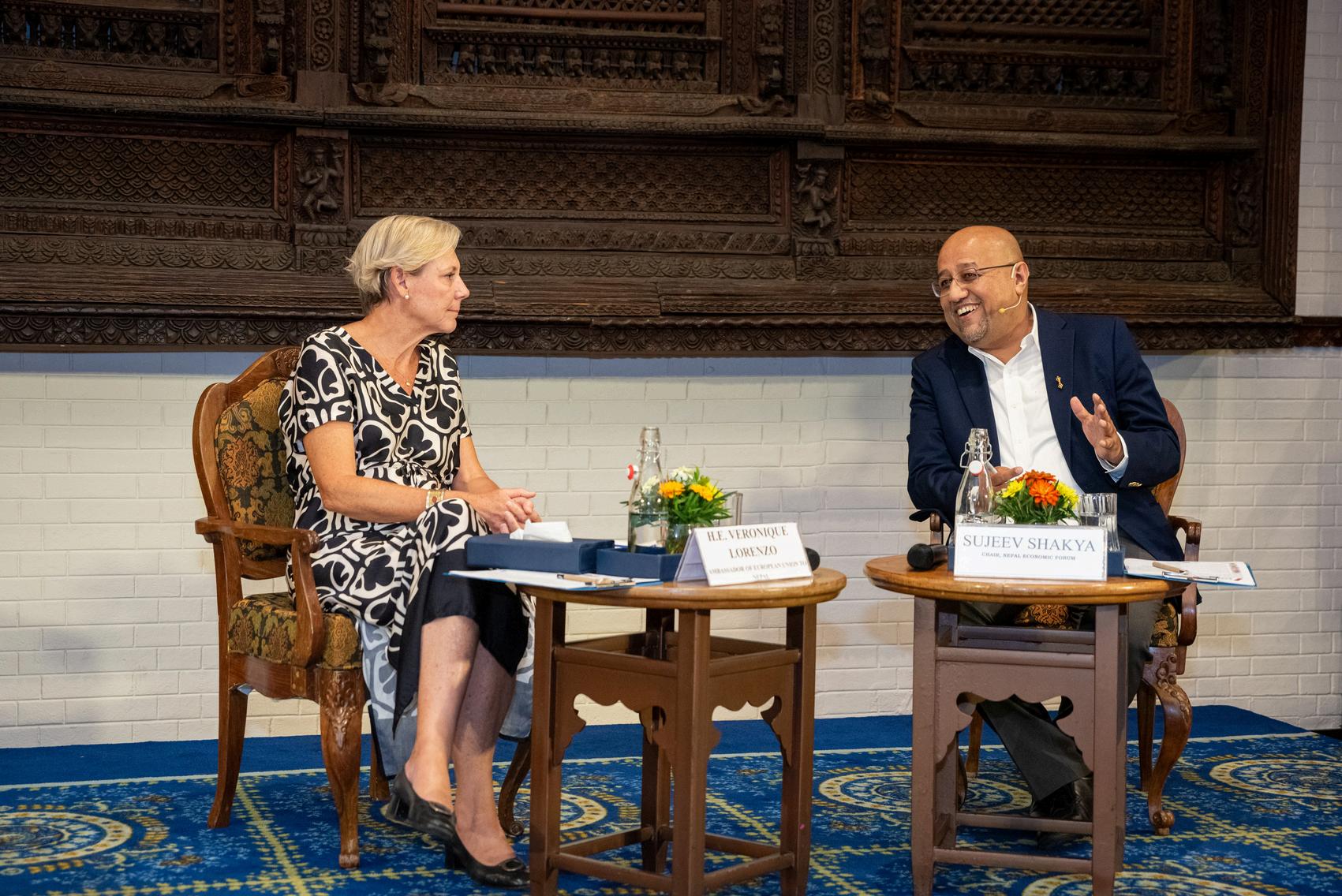
comparatively hard to capture, keeping it off the EU s radar even as Nepali workers are widely valued for their reliability. She noted that the high levels of education and skill among Nepali migrants in Europe were notable but not entirely unexpected, and pointed to a persistent disconnect between the skills migrants bring and the jobs they end up in, adding that EU Blue Card numbers remain small relative to the real scale of labor demand.
When Shakya questioned the reason behind the gap between recorded labor permits and the actual number of Nepalis living in Europe. Lorenzo explained that a significant share of this gap traces back to secondary migration: countries such as Romania, Croatia, Cyprus, and Bulgaria often serve as entry points rather than final destinations, with many migrants later moving on within the Schengen area toward higher-wage economies, a dynamic she said makes official figures only partially reflective of reality. On why the EU should engage more deliberately with this trend, she was direct that immigration remains a politically sensitive, largely national competence, but argued the growth of Nepali migration is exponential and difficult to reverse, so countries should move to capture the opportunity rather than let it pass.
On reintegration and skills, Lorenzo observed that Nepal does not need to build new mechanisms from scratch, since much of the institutional framework already exists; the more pressing gap is weak private-sector participation in skills development. Turning to agreements between Nepal and European states, she described two complementary tracks: bilateral labor agreements, of which Nepal currently has one with Germany, and the EU Talent Pool, a mechanism for matching skilled individuals with participating member states. She encouraged Nepal to take the lead in pursuing bilateral agreements with the six to ten European countries that receive the largest numbers of Nepali workers. On reintegration specifically, she cited findings that a high share of respondents (around 48%) were open to return. However, she also cautioned about a generational pattern in the willingness to return. According to her, first-generation migrants are far more likely to consider returning than the second generation, leaving Nepal a short window to act before the openness fades.
In her closing remarks, Lorenzo returned to the theme of risk, warning that migration without a governing framework tends toward abuse, and that the current window following a political upheaval is the moment to get ahead of the issue rather than react to it later.

Rojina Tamrakar framed migration as a foreign policy and economic diplomacy priority rather than a purely labor issue. Citing figures shared earlier in the forum, she noted Nepal's migration corridor to Europe has grown by around 21% over the past decade, from roughly 4,500 departures in FY 2016/17 AD to nearly 77,000 in FY2023/24 AD with an estimated 500,000 Nepalis now across Europe.
Tamrakar outlined Nepal's institutional response rooted in Foreign Employment Act, National Labor Migration Policy, and a labor migration and diaspora division the Ministry of Labor, Employment and Social Security (MOLESS) created in 2024. However, she cautioned that agreements with countries like Germany and Romania are only a starting point. She flagged high recruitment costs, irregular pathways, short-term contracts, and skill mismatches as recurring problems, urging stronger governance and closer cooperation between origin and destination countries.
Beyond remittances, Tamrakar urged Nepal to capture returning skills and networks, shifting from "brain drain" toward "brain gain" and circulation. She named Nepal's lack of an integrated migration database as a major constraint and announced IFA's plan to build one, inviting partners to collaborate.
Nepal's migration to Europe has grown 21-fold over the past decade, with remittance flows from the corridor estimated at USD 1.5 to 2 billion annually, making it a critical pillar of Nepal's economic diversification beyond the Gulf.
Europe faces a working-age population decline of nearly 30 million by 2050, creating structural labor demand that Nepali workers are increasingly well-positioned to fill, particularly in healthcare, manufacturing, and skilled sectors.
Nepali migrants heading to Europe are younger, more educated, and more gender-balanced than those in traditional corridors, yet 43% expect to work below their qualification level and two in three leave with little to no language preparation.
Nepal's reintegration framework exists on paper but remains weakly implemented, and the 48% of Europe-based Nepali migrants who are undecided about returning represent the most actionable group for targeted policy engagement.
Nepal currently has only one bilateral labor agreement with a European country, and despite exponential growth in migration flows, most Nepalis remain dependent on informal brokers due to the absence of stronger governance frameworks.
Migration must be treated as a foreign policy and economic diplomacy priority, and Nepal's lack of an integrated migration database remains a fundamental constraint to evidence-based policymaking on the corridor.

Click here or scan the QR code to watch the full video of the event!