
February 2026
February 2026






© 2026 Nepal Economic Forum
Nepal Economic Forum
P.O. Box 7025, Krishna Galli, Lalitpur 3, Nepal www.nepaleconomicforum.org
Nepal Economic Forum (NEF) is a not-for-profit organization aiming to be Nepal’s premier private sector-led economic policy and research institution. We are an impact-driven economic and development think tank that seeks to redefine Nepal’s development discourse by analyzing, facilitating and disseminating contemporary issues on society and the economy.
Please write to info@nepaleconomicforum.org if you have questions or comments with respect to the document.
NEFsearch is an academic research paper published by Nepal Economic Forum that aims to create a platform for cutting-edge and robust economic research. NEF has earned a worldwide reputation for conducting theoretical, high-quality and evidence-based research studies with Nepal at the core. The aim of the NEFsearch is to draw attention towards contemporary issues that are important and relevant for economic development and societal growth of Nepal.
Title – Unpacking Climate Change-Induced Migration: Impacts, Patterns, and Policy Responses in the Himalayan Region and Beyond
Authors –
Aashutosh Sharma (Intern, Nepal Economic Forum (NEF))
Heykha Rai (Fellow, NEF)
Laboni Pradhan (HFF Fellow, NEF)
Manju von Rospatt (Fellow, NEF)
Sampada Regmi (Former Intern, NEF)
Edited by – Manju von Rospatt (Fellow, NEF) and Suyasha Shakya (Consultant, NEF)
Cover design by – Aashima Chalise (Social Media Consultant, NEF)
Coordination by – Salina Kafle (People and Programs Coordinator, NEF) and Suyasha Shakya (Consultant, NEF)
Published by Nepal Economic Forum on February 13, 2026
ASEAN AssociationofSoutheastAsianNations
GLOF GlacialLakeOutburstFlood
GCF GreenClimateFund
HKH HinduKushHimalaya
ICIMOD InternationalCentreforIntegratedMountainDevelopment
IDP InternallyDisplacedPerson
IDMC InternalDisplacementMonitoringCentre
IPCC IntergovernmentalPanelonClimateChange
NAP NationalAdaptationPlan
NDC NationallyDeterminedContribution
SAARC SouthAsianAssociationforRegionalCooperation
UNFCCC UnitedNationsFrameworkConventiononClimateChange
UNEP UnitedNationsEnvironmentalProgramme
UNHCR UnitedNationsHighCommissionerforRefugees
Asclimatechangeacceleratesglobally and key planetary tipping points are crossed, the Himalayan region is increasingly experiencing glacial melt, changing weather patterns, land degradation, and increased extreme weather events From the rapidly warming Hindu Kush Himalaya to lowlying deltaic and coastal zones along the Bay of Bengal and the Mekong, climate impacts are intersecting with entrenched poverty, conflict, and uneven development to drive both internal and cross-border movement. Recent estimates suggest that South Asiaalonecouldseetensofmillionsof internal climate migrants by midcentury, with Bangladesh and parts of India projected as major hotspots of origin and in-migration. In parallel, the broader Asia-Pacific region already accounts for a disproportionate share ofglobalclimate-relateddisplacement, and one in three climate migrants worldwide is Asian, underscoring the strategic importance of regional responses.
This NEFSearch examines these dynamics of climate-induced mobility across the countries in the Himalayan belt, including Afghanistan, Bhutan, China,India,Nepal,andPakistan,aswell
ascountriesaffectedbytheHimalayas, including Bangladesh, Cambodia, Laos, and Myanmar. Understanding climate changeasadriverofmigrationrequires situating it within a broader context shaped by social, economic, and political factors. Climate-induced displacementisnolongeradistantrisk butapresentgovernancechallengefor these ten countries, with implications for national budgets, development priorities,urbanplanning,labormarkets, social protection, and regional crossborder cooperation. For policymakers and think tanks in this region, the central question is how states and regionalinstitutionswillshapemobility throughlaw,planning,andinvestment.
This report is based on a desk-review of available literature from relevant NGOs,intergovernmentalorganizations, and research bodies as well as academicliteratureonclimatechange and mobility. The study also includes analyses of international and national policiesandofficialbudgetdocuments.
Chapter 1 provides an overview of climate risk dynamics in the region including slow-onset and extreme processes. Chapter 2 provides an overview of the overall trends of climatemobilityintheregion. Chapter 3 examines extreme event-induced
mobilityandslow-onsetenvironmental change induced mobility. Chapter 4 focuses on rural-urban migration in specific, while Chapter 5 examines cross-border and transnational climate-induced migration in the region. Chapter 6 examines climateinducedmobilityfromanintersectional
perspective. Chapter 7 examines the institutionalframeworksandpoliciesof the countries as well as budget priorities in the region with respect to climatemobility Finally,theNEFSearch closes with a conclusion and policy recommendations for regional stakeholdersandpolicymakers.
Theconceptofclimaterisk,asdefined in the Intergovernmental Panel on Climate Change’s (IPCC’s) Sixth Assessment Report, encapsulates the likelihood of climate-related hazards and their potential impacts on natural and human systems, shaped by exposure, vulnerability, and adaptive capacity. 1 Climate change influences human mobility not through a single pathway, but through a complex interaction of environmental, hydrological,and ecologicalprocesses thatprogressivelyerodetheconditions necessary for stable livelihoods and settlement.Inregionscharacterizedby high climate sensitivity, such as the HinduKushHimalaya(HKH)systemand its downstream river basins, these processes operate across multiple scales. Sudden-onset disasters such as floods, cyclones, landslides, and glacial lake outburst floods (GLOFs) interact with slow-onset changes, including glacier retreat, drought, desertification, salinity intrusion, and sea-level rise. Together, these forces reshapelandscapes,disrupteconomic systems, and erode the adaptive capacityofcommunities.
This section examines the causes of climate change-induced migration by focusing explicitly on the climatic and environmental phenomena that generate vulnerability across South and Southeast Asia. It identifies and categorizes the major climate hazards and processes that create the conditions under which migration becomes a necessary coping or adaptation strategy. By tracing how climate change manifests through interconnected hazards across mountain, river basin, and coastal systems, this section provides the foundation for the discussion on migration trends, impacts, and policy responses.
Climate change refers to long-term shifts in temperatures and weather patterns. While such shifts can occur naturally due to changes in solar radiation or large volcanic eruptions, scientific studies confirm that human activities have been the dominant driverofclimatechangesincethemidnineteenth century. 2 The large-scale burning of fossil fuels such as coal, oil,
andgas,alongwithdeforestation,landuse change, industrial processes, and intensive agriculture, has significantly increased greenhouse gas concentrationsintheatmosphere.
The IPCC concluded that humaninduced climate change has already altered weather and climate extremes in every region of the world. These changes include more frequent and intense heatwaves, heavier precipitation events, prolonged droughts, stronger tropical cyclones, andacceleratingsea-levelrise.Climate change has also triggered widespread and rapid transformations in the atmosphere, oceans, cryosphere, and biosphere, undermining ecological stabilityandhumanwell-being.3
Between 2015 and 2025, each year ranksamongtheelevenwarmestyears in the 176-year observational record, withthemostrecentthreeyearsbeing the warmest on record. These trends indicate not a temporary fluctuation but a structural shift in the global climate system. The humanitarian consequences are already evident. Climatechangedirectlycontributesto humanitarian emergencies linked to floods, droughts, heatwaves, storms, and food insecurity. The World Health Organization estimates that between 2030and2050,climatechangecould
cause approximately 250,000 additional deaths per year due to undernutrition,heatstress,malaria,and diarrheal diseases, with the greatest impacts concentrated in low- and middle-incomecountries.4
Climate change and the migration causedbyitisnotanewphenomenon. Asearlyas1990,theIPCCwarnedthat humanmigrationcouldbecomeoneof themostsignificantimpactsofclimate change, driven by shoreline erosion, coastal flooding, and agricultural disruption. This warning has become increasingly relevant as climate hazards intensify across vulnerable regions.
Climate-related drivers of migration are commonly categorized into extreme events and slow-onset processes.Thisdistinctionhelpsclarify howdifferenttypesofclimatehazards operate over time, although these processes often overlap one another. Sudden-onset events refer to hazards that occur rapidly and cause immediate damage. These include floods, cyclones, storms, landslides, and glacial lake outburst floods (GLOFs). Such events can destroy homes, infrastructure, crops, and assets within hours or days, often
overwhelming local coping capacity. Slow-onset processes involve gradual environmental change that unfolds over months or years. These include sea-level rise, salinization of agricultural land, desertification, prolongeddrought,decliningsnowand ice reserves, and growing water scarcity.Whilelessimmediatelyvisible, slow-onsetprocessessteadilydestroy livelihoods, reduce food and water security, and weaken household resilience.Listedbelowaresomeslowonsetandextremeprocessesinduced byanthropogenicclimatechange.
1.2.1.CryosphereChange:GlacierMelt andHigh-MountainHazards
1.2.1.1.AcceleratedGlacierRetreat
TheHinduKush-Himalayaregion,often referredtoasthe“ThirdPole,”contains the largest reserve of ice outside the polar regions and supplies water to major river systems across South and EastAsia.Thisregioniswarmingfaster than the global average due to altitude-related amplification effects. Evenifglobalwarmingislimitedto1.5°C, average temperatures across the Himalayan region areprojected torise by approximately 1.8°C. 5 This accelerated warming has already triggered rapid glacier retreat across Bhutan,Nepal,NorthernIndia,Pakistan, Afghanistan, and Tibet. Glacier loss
alters river flow regimes, increases seasonalvariabilityinwateravailability, and contributes to the formation and expansionofglaciallakes.
1.2.2. Glacial Lake Outburst Floods (GLOFs)
A glacial lake outburst flood (GLOF) occurs when a moraine (glacial till) or ice-dammed glacial lake suddenly releases large volumes of stored meltwater due to structural failure. GLOFs typically involve abrupt water release, extremely high downstream discharge,andseveregeomorphicand socioeconomic damage. In Bhutan, more than 70% of agricultural and infrastructure settlements are located within major glacier drainage basins, making them highly vulnerable to GLOFs. The country has already experiencedGLOFeventsin1957,1960, 1968, and 1994. The 1994 GLOF from LuggyeTshokilled21people,damaged 91houses,anddestroyed1,781acresof agriculturalland.6
Similarly,Nepalfacesoneofthehighest GLOF risks globally. The Himalayan districts of Solukhumbu, Mustang, Dolpa, and Manang are particularly exposed. There are 42 potentially dangerous glacial lakes in the Koshi River basin alone, including Imja, Tsho Rolpa, Lower Barun, and Hongu. Moreover. Nepal has identified 21
glacial lakes at imminent risk, threatening entire downstream settlements. 7 Cross-border GLOFs originating in Tibet have historically caused significant damage in Nepal, such as the 1981 Zhangzangbo glacial lake outburst that damaged the Sun KoshiHydropowerProjectandsections oftheArnikoHighway.
Additionally, with more than 7,000 glaciers, Pakistan also faces a growing GLOF risk, particularly in GilgitBaltistan and Khyber Pakhtunkhwa. These events threaten mountain communities, transport corridors, and hydropower infrastructure, particularly asglacierretreataccelerates.8
Flooding is among the most destructive and widespread climate hazards across South and Southeast Asia. Climate change intensifies flood risk by altering precipitation patterns, increasing the frequency of extreme rainfall events, and accelerating snow andglaciermeltinupstreammountain regions. Warmer air holds more moisture,leadingtoheavierdownpours over shorter periods, while rising temperatures also increase meltwater contributions during the monsoon season. Together, these processes raise river discharge beyond natural
channel capacity, heightening the likelihood of both riverine floods and flashfloodsacrossmajorbasins.
Historically, large-scale flooding has played a significant role in shaping population vulnerability. The catastrophic Yangtze River floods of 1931 in China, among the deadliest floodsinrecordedhistory,forcedover 40 million people to relocate and caused immense loss of life and livelihoods. This event illustrates the long-standing relationship between hydrological extremes, environmental disruption,andhumandisplacementin denselypopulatedriverbasins.9
In Bangladesh, flooding remains a recurring and defining climate hazard due to the country’s location at the downstream end of the GangesBrahmaputra-Meghna basin. Major flood events occurred in 1988, 1998, 2004, 2007, and 2020, each causing extensive damage to agriculture, housing, and infrastructure. The 1998 floods were particularly severe, submerging approximately 68% of the country and disrupting food systems andlivelihoodsonanationalscale.10
More recently, Pakistan’s 2022 floods represent one of the most severe climate disasters in the country’s history. Unexpected intense monsoon rainfall, combined with glacier melt in
the Hindu Kush-Karakoram region, led to widespread flooding across Sindh and Balochistan. The floods displaced an estimated eight million people, destroyedlargeareasofcropland,and damaged housing and transport networks, highlighting the growing scale and severity of climate-related flooding.11
In India, recurrent flooding affects multiple regions through different mechanisms. The Ganga-Brahmaputra basin and Assam experience seasonal river floods, while Himalayan states face flash floods triggered by intense rainfallandrapidsnoworglaciermelt.12 These events frequently damage rural infrastructure, agricultural land, and transport corridors, disrupting local economies, and access to essential services.
1.2.3. Landslides and Terrain Instability
Landslides involve the downslope movement of soil, rock, or debris and are commonly triggered by heavy rainfall, rapid snowmelt, or seismic activity. Climate change increases landslide risk by altering precipitation patterns, intensifying rainfall events, and weakening vegetation cover that normally stabilizes slopes. Shorter but moreintenserainfallepisodessaturate soils quickly, reducing cohesion and
increasingthelikelihoodofslopefailure, particularly in mountainous and hilly terrain.
Across Afghanistan, Bhutan, India, Myanmar, and Nepal, rising temperatures and shifting rainfall regimes have affected forest and soil moisture composition. Changes in foresthealthreducerootstrengthand soil binding capacity, while increased erosion and sediment movement destabilize slopes. These processes heightenthefrequencyandseverityof landslides,particularlyalongsteepriver valleys and transport corridors. Landslides frequently damage roads, bridges,andhydropowerinfrastructure, disrupting access to markets, health services,andeducation,andincreasing the isolation of already vulnerable communities.
In several regions, landslides also interactwithotherclimatehazards.For example, intense monsoon rainfall following prolonged dry periods can trigger slope failures on already weakened terrain. Similarly, glacier retreat and rapid snowmelt increase water flow in mountain catchments, further destabilizing slopes and increasing sediment loads in rivers. These chain reactions amplify the destructive potential of landslides beyondtheirimmediatefootprint.
In Afghanistan and Myanmar, for example, landslides in mountainous catchmentsfrequentlydestroyhomes and farmland and cut off critical road links, particularly during intense monsoon periods. Such events can isolateentiresettlementsforextended periods, limiting access to emergency assistance and essential supplies. The sudden and localized nature of landslides causes immediate disruption, often adding to other environmental stresses and forcing communitiestorelocate.
In meteorological terms, a drought is defined as a prolonged absence or significant deficiency of precipitation that results in hydrological imbalance, affecting surface water, groundwater, and soil moisture availability. 13 Desertification refers to land degradation in arid, semi-arid, and dry sub-humid regions caused by a combination of climatic variation and human activities, including unsustainable land use and overexploitation of natural resources.14 Both processes are closely linked and represent some of the most prevalent slow-onset climate hazards affecting humanandecologicalsystems.
Across climate-vulnerable regions, rising temperatures increase
evapotranspiration, intensify soil moistureloss,andprolongdryperiods. When combined with declining or erratic rainfall, these changes reduce agricultural productivity, degrade rangelands,andweakenfoodsystems. Unlike sudden disasters, drought and desertification often unfold gradually, making their impacts less visible but deeplyentrenchedovertime.
In Afghanistan, recurrent drought and advancing desertification have severely undermined rain-fed agriculture livelihoods. Large portions of the country depend on seasonal rainfallforcropcultivationandgrazing. Prolonged dry spells reduce harvests, degrade pasture quality, and increase livestock mortality, leaving rural households highly exposed to environmentalstress.Theseconditions are exacerbated by limited irrigation infrastructure and weak natural resource management, amplifying the long-termimpactsofdrought.15
In Nepal’s hill districts, including Khotang and Okhaldhunga, climate change has altered local hydrological cycles.Dryingsprings,erraticmonsoon rainfall, and watershed degradation have reduced both agricultural productivity and access to reliable water sources. Traditional subsistence farming systems, which depend on
predictable rainfall and spring-fed irrigation, have become increasingly difficult tosustain aswater availability declines.16
Meanwhile northern China faces expanding desertification as arid regions increase in extent. In several areas, population density exceeds the ecologicalcarryingcapacityoftheland, intensifyingpressureonalreadyfragile ecosystems. Overgrazing, land conversion, and unsustainable agricultural practices interact with climatic stress to accelerate soil erosionandlanddegradation,reducing long-term productivity and increasing exposuretoenvironmentalshocks.17
Similarly, in northwest Bangladesh, particularly in Rangpur and Rajshahi, seasonal drought and irregular rainfall patterns reduce crop yields and increase livelihood insecurity. Agriculture in these regions remains highly dependent on rainfall, and prolonged dry periods weaken household food security and income stability. Limited access to irrigation and groundwater further restricts adaptive capacity, intensifying the impactsofrecurrentdrought.18
1.2.5.CoastalHazards,Sea-LevelRise, andSalinityIntrusion
Coastal regions across South and SoutheastAsiafaceescalatingclimate risks due to the combined effects of sea-level rise, storm surges, coastal erosion, and salinity intrusion. These hazards disproportionately affectlowlying deltaic systems where high population density, climate-sensitive livelihoods, and limited elevation interacttoproduceacutevulnerability. Climatechangeamplifiestheserisksby raising mean sea levels, increasing sea surfacetemperatures, andintensifying tropical cyclones, thereby extending the reach and impact of coastal floodingevents.
Sea-level rise acts as a risk multiplier. Evenmodestincreasesinbaselinesea levelallowstormsurgesandhightides to penetrate further inland, amplifying erosion, overwhelming embankments, and accelerating saline contamination of freshwater systems. In many delta regions, sinking land, caused by groundwater extraction and reduced sediment deposition, amplifies the effectsofsea-levelrisebeyondglobal averages.
IncoastalBangladesh,salinityintrusion hasadvancedapproximately30to50 kilometers inland in several districts, particularly in Khulna, Satkhira, and
Bagerhat. Salinity affects both surface waterandgroundwater,contaminating drinking water supplies and reducing the suitability of land for crop cultivation. Rice production, which depends heavily on freshwater availability, has become increasingly unreliable, while soil salinization reduces long-term agricultural productivity. Beyond livelihoods, salinity exposure has been linked to significant public health risks. For example, research has documented associations between saline drinking water and increased rates of hypertensionandpreeclampsiaamong pregnant women, highlighting how slow-onset coastal hazards directly affecthumanhealthoutcomes.19
In Pakistan’s Indus Delta, progressive salinization and coastal erosion have reduced arable land and degraded mangrove ecosystems that traditionally served as buffers against storm surges. Reduced freshwater flows from upstream river regulation, combined with sea-level rise, have allowed seawater to encroach further inland. As agricultural land becomes less productive, households shift from farming to fishing-based livelihoods, oftenundermoreprecariouseconomic conditions. Land loss and declining cropyieldshavefundamentallyaltered
theecologicalandeconomiccharacter ofthedelta.20
Similarly, India’s Sundarbans region, shared with Bangladesh, represents one of the most climate-exposed coastal landscapes in the world. Sealevel rise, increased cyclone intensity, andchroniccoastalerosionhaveledto the gradual loss of inhabited islands and agricultural land. Mangrove degradation further weakens natural coastal defenses, increasing exposure tostormsurges.Repeatedfloodingand soil salinity damage agriculture and reduce access to freshwater, placing long-established communities under ongoingenvironmentalstress.21
In Vietnam’s Mekong Delta, one of the world’s most productive rice-growing regions,climatechangehasintensified saltwater intrusion events, most notably in 2016 and 2020. These events caused extensive crop losses, reduced freshwater availability, and disrupted livelihoods across multiple provinces.Saltwaterintrusionhasbeen worsened by land subsidence and reduced sediment flow caused by upstream dams and altered river systems. As a result, the delta’s ability to naturally counter sea-level rise has weakened,acceleratinglong-termland degradation.22
Across South and Southeast Asia, climate change manifests through sudden-onset disasters and slowonset environmental degradation. Glacier retreat, floods, cyclones, landslides, drought, desertification, sea-level rise, and salinity intrusion collectively reshape environmental conditions and undermine livelihood systems.Theseprocessesrarelyoccur
in isolation; instead, they compound over time, progressively reducing resilienceandadaptivecapacity.
While this section has focused on the climaticandenvironmentaldriversthat create conditions of vulnerability, the following section examines how these drivers translate into patterns of internal and cross-border migration, differentiated impacts across social groups, and broader human developmentissues.
With the increasing frequency and intensity of extreme weather events and slow-onset climatic changes, widespread population displacement, both recorded and unrecorded in the officialdata,istakingplaceintheworld. The idea of “environmental refugees” first emerged in 1970 when Lester Brown drew attention to people displaced by environmental degradation and was further elaboratedbyEssamEl-Hinnawiofthe United Nations Environmental Programme (UNEP) in 1985, who described environmental refugees as those forced to leave their traditional habitats due to significant environmental disruption.23 The United Nations High Commissioner for Refugees(UNHCR)reportsin2016that an average of 21.5 million people have beenforciblydisplacedeachyeardue to weather-related events since 2008. 24 Similarly, the Internal Displacement Monitoring Centre (IDMC) estimates that an average of 21.9millioninternaldisplacementshave occurred annually as a result of weather-relatedhazardsoverthepast decade. 25 By the end of 2023, approximately 6.6 million people were living in internal displacement caused by such disasters, and this figure is expected to increase if no effective interventionismade.26 Additionally,the World Bank’s 2021 Groundswell report further warns that climate change could force up to 216 million people across six regions to migrate within their own countries by 2050.27 UNHCR also projects that the number of countriesexposedtoextremeclimaterelated hazards will increase from 3 to 65 by 2040, with most of these countries already hosting displaced populations.28
Figure1.InternalDisplacementbyCountry inSouthAsia(2024)
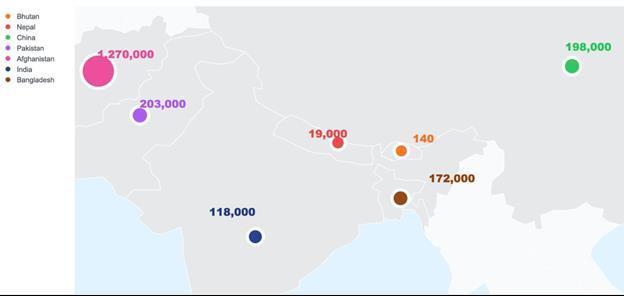
Source: Internal Displacement Monitoring Centre 2025’s Global Report on Internal Displacement29
Regionally, Asia remains the global hotspotfornaturaldisasters,outpacing allotherregionsintheirfrequencyand scale.In2015,85%ofpeopledisplaced by sudden-onset disasters were in SouthandEastAsia.30 Inthatyearalone, devastating floods that swept through TamilNaduandAndhraPradeshinIndia displaced around 1.8 million people, while Cyclone Komen and monsoon flooding displaced approximately 1.6 million in Myanmar and 1.2 million people in India. 31 South Asia faces particularly high levels of disasterrelated displacement, and projections suggestthattheregioncouldseeupto 40millioninternalclimatemigrantsby 2050. 32 Across this area, internal relocation stands out as the predominantmigrationpattern.InIndia, around 29% of the population are internal migrants, with most movements occurring within states. 33 Comparable trends of rural-to-urban and rural-to-rural flows prevail in Bangladesh, Pakistan, and Afghanistan, often stemming from degradation and desertification of climate-vulnerable agriculturalareas.34
Among the countries under review, AfghanistanandBangladeshemergeas the most climate-vulnerable countries intheHimalayanbelt,rankingloweston the The University of Notre Dame GlobalAdaptationInitiative(ND-GAIN) index. 35 Internal Displacement MonitoringCentre’s(IDMC)datashows
millions of internal disaster displacements per decade in Bangladesh, with dominant seasonal migration from drought-prone northwest to cities like Dhaka, Khulna, and Chattogram. Likewise, in 2024, climate change and natural disasters displaced 1,377,925 people in Afghanistan from their communities, with 710,647 individuals internally displaced across the country. Approximately 75% of these displacements are attributed to environmental hazards such as floods and droughts, underscoring the dominant role of climate-related factors in shaping mobility patterns.36 Similarly, Pakistan is confronting an impending migration crisis, with projections indicating that nearly two million people could be displaced by climate-relatedfactorsby2050.37 This outlookarisesagainstthebackdropof an estimated two million individuals already at risk from GLOFs across the country. 38 Climate-induced migration is rising steadily in Nepal as well, with extremeweathereventslikelandslides, floods, and droughts displacing an average of 96,000 people annually. Reliable data on climate-induced migration in Bhutan remains limited, although records indicate that 3,573 people were displaced by climaterelatedeventsin2022.39
Such climate-driven displacements disproportionately affect developing countries.Economicfragilityandsocial vulnerabilities amplify environmental risks. Scarce infrastructure and weak resilience mechanisms in these areas reduce their ability to respond effectively to climate stress, making affected populations more vulnerable to displacement and forced migration.40
3.1.ExtremeEvent
Climate change-induced migration is increasingly driven by extreme environmental events that disrupt livelihoods and erode communities’ adaptive capacities. Upstream Himalayanwarmingacceleratedglacial meltandintensifiedmonsoonpatterns have altered hydrological systems, increasing floods, sedimentation, riverbank erosion, and landslides across the region. IDMC has consistently highlighted a rising trend of climate-induced displacement, particularly in countries within the Himalayan belt. Across the Himalayan and downstream river basins, climate risksarecloselylinkedtoglacialretreat, GLOFs,intensifiedmonsoons,andsealevel rise. These hazards interact with
socio-economic vulnerabilities, pushing households into different formsofmigration,rangingfromshortterm displacement to permanent relocationandseasonallabormigration.
Short-term displacement is most commonly triggered by sudden-onset disasters such as landslides, flash floods, and riverine flooding. In Nepal, climatechangedisplacesanestimated 100,000 people annually due to landslides, floods, droughts, and riverine flooding linked to GLOFs. Average annual losses from extreme climate events already exceed USD 17 millioninNepal,andtheselossescould tripleby2030.41
InIndia,regionssuchasJoshimathand Uttarkashi in Uttarakhand have experienced repeated landslides in recent years, forcing families to relocate temporarily as a precautionary measure. 42 Historical and contemporary examples from the seismic abandonment of Lakhpat in Gujarat to drought-induced desertion inMeenakshipuram illustrate howrural communities are repeatedly exposed toclimateextremes.43
In Bhutan, a flash flood in Jasabi and Kurtoe in 2022 caused fatalities and
destroyed homes, farmland, irrigation systems, and stored food. Survivors initiallyreliedongovernmentreliefand social networks in nearby villages for shelter. However, by 2024, some households were still living with relatives, highlighting the prolonged nature of “temporary” displacement andthegrowingstrainoncommunitybasedsupportsystems.44
When disasters repeatedly destroy housing and livelihoods, displacement becomes increasingly permanent. As households experience repeated displacement due to recurring floods, riverbank erosion, and landslides, their assets are eroded, social ties weakened, and coping capacity reduced as communities are trapped into a state of chronic insecurity 45 Repeated displacement, as documentedinIDMCcountryanalyses and field research, significantly increaseslong-termvulnerability.
In India, Cyclone Fani(2019) displaced over 1.2 million people in Odisha, with manyunabletoreturnduetoextensive damagetohomesandincomesources.
The 2018 Kerala floods and Cyclone Amphan (2020) in West Bengal and Odishasimilarlyresultedinlarge-scale
displacement and long-term resettlement challenges. 46 Bangladesh also faces compounded risks from mountain-driven hydrology and coastal climate hazards, including cyclones, storm surges, salinity intrusion,andsea-levelrise.Permanent migration has been observed from salinity-affectedcoastalzonessuchas SatkhiraandKhulna,aswellaserosionproneriverineareaslikeGaibandhaand Jamalpur. Similarly, Pakistan
experiencedoneofthelargestclimate displacement events in recent history during the 2022 floods, which displaced nearly 8 million people and resulted in over 1,700 deaths. 47 The country’s vulnerability is further heightened by its more than 7,000 glaciers, one of the largest glacier concentrations globally. The exposure to such vulnerability is estimated to affect approximately 2 million people toGLOFs.48
3.2. Slow-Onset Environmental PressureonSustainableLivelihoods
Beyond extreme weather events, changing weather patterns and temperatures, salinization, land degradation,waterstressanddroughts, etc. manifest as the slow effects of climate change. These have a direct impact on the gradual erosion of agrarianlivelihoods,therebyprompting widespread rural-urban migration globally.Theecologicalfactorsinteract with existing individual, communitylevel, and systemic socio-economic vulnerabilities such as poor infrastructure,lackofqualityeducation and healthcare services, and governance challenges.49 As much of the population in the studied Hindu Kush Himalayan Region is agriculturedependent, climate change has significant ramifications on their livelihoods.Particularlythosewhohave less assets and income are vulnerable to the impacts of crop failures, water scarcity, and compounded food insecurity. 50 This prompts people in rural areas to migrate to other regions inthecountryoracrossborders.These migrants may not be counted in the data as climate change-induced migrants.
Asclimatepressureserodetheviability of farming and livestock-based
livelihoods,migrationemergesasakey strategy for risk management, income diversification, and adaptation. Households facing repeated crop losses, water scarcity, and falling returns from agriculture increasingly relyonseasonal,circular,orpermanent migration, often to nearby towns and cities,asawaytostabilizeincomesand meetbasicneeds.51 Thereby,migration decisions are shaped not only by environmental change but also by access to social networks, financial capital,labordemandinurbancenters, and the availability of education and servicesalongrural-urbancorridors.
In Tibet, for instance, warmer temperatures have degraded traditional grazing lands, forcing Tibetan pastoral nomads to move herds to higher, harsher grasslands or leave pastoralism, with important implications for culture and land rights. 52 Throughout China, limited prospects of agriculture in rural areas have led to an increased outflow of youngpeopletocitiesandaremaining agricultural workforce consisting largely of older people. Thus, climate change is compounding the crises the villages are facing: aging populations, agricultural restructuring, and shortages of transportation and healthcare. 53 Increased flooding and drought have also led to a decline in
agriculturalproduction,increasingfood insecurity and inviting the spread of diseasessuchasdengueandmalaria.54
Bangladeshisfacedwithchangingriver flow patterns and increased salinity in agricultural lands, leading to reduced agricultural yields each year. This
impactsthelivelihoodsoffarmersand increases rural indebtedness, particularly in Satkhira, Khulna, and erosion-prone river islands, and undermines fisheries. These financial pressures push people towards urban areas searching for livelihoods, both seasonallyandpermanently.55
CaseStudy:SeasonalandCircularMigrationintheContextofClimateChange
Seasonal and circular migration has long served as an important livelihood and adaptationstrategyintheHKHregion.Communitieshavehistoricallybeenmobile fortrading,pilgrimage, herding,and seasonallabormigrationfrom colderareasto warmerareas,suchastheBhutanesewhoseasonallytraveltoAssamandArunachal Pradesh, India.56 Seasonal migration is a common adaptive response to climate stress, particularly wherelivelihoods aretied toagricultureand fisheries. InSouth Asia, annual seasonal monsoon flooding in the Ganges-Brahmaputra-Meghna (GBM) basin pushes thousands of people each year, especially in Assam, India, toward urbancenters suchasGuwahati and Kolkata.57 Bangladesh, located at the confluence of the GBM basin, is similarly affected by upstream hydrological changes.InNepalandnorthernIndia,ruralhouseholdsoftensendfamilymembers to work in cities on a seasonal basis. Climate variability, particularly shifts in monsoontiming,reducedagriculturalreliability, and waterscarcity, isalteringthe rhythm of these traditional circulations. In some contexts, formerly seasonal migration is evolving into permanent moves as households lose the capacity to returntoclimate-stressedrurallivelihoods.
Climate-induced internal migration is both an adaptation and social protection mechanism as well as a manifestation of distress. Climatelinked migration typically manifests as displacement and livelihood-driven mobility rather than one-time, permanent relocation. Importantly, class, caste, gender, (dis)ability, and location are key factors shaping the experiencesofclimatemigrants.Those with fewer resources may be pushed
intolow-paid,insecureurbanworkand precarious living conditions, while better-off households can leverage migration to access higher-return opportunities and education for youngergenerations.58 AcrosstheHKH, these dynamics are increasing the amountofinternallydisplacedpersons (IDPs) reconfiguring the relationship between rural livelihoods, agrarian change,andurbanization
Most movement in the HKH occurs within national borders, primarily from rural areas to urban centers and secondary towns, rather than across borders. Disasters such as floods and landslides account for a large share of internal displacements across the region,highlightingthatthemajorityof climate-induced movement remains domesticandshort-distance.59 InIndia, climate-induced internal migration is attributed to the displacement of at least 56.23 million between 2008 to 2023. 60 Studies show a strong influenceofclimateimpactsoninternal migration from Rajasthan, Uttar Pradesh and Madhya Pradesh. 61 In SoutheastAsiatoo,shiftsinHimalayan
and Tibetan Plateau hydrology are reshaping the Mekong River system and the livelihoods of communities in Laos, Cambodia, and Vietnam. Increasedfloodanddroughtfrequency, combined with more erratic monsoon patterns, has intensified seasonal migration to Thailand, especially in droughtyears.TheLowerMekongBasin remains highly sensitive to these upstream hydrological changes. Declining fisheries driven by altered riverflowintheTonleSaphaveresulted in significant rural livelihood losses in Cambodia. As a result, rural-to-urban migration to Phnom Penh and Siem Reaphasincreased,alongsideseasonal migration to Thailand and Vietnam. Additionally, the Mekong Delta faces severe risks from upstream flow reduction and sea-level rise. Saltwater intrusion events in 2016 and 2020 extended far inland, undermining agriculture and freshwater availability. Out-migration from the Mekong Delta is now one of Asia’s largest climaterelatedmigrationflows,withmovement concentratedtowardHoChiMinhCity inVietnamandotherindustrialzones.
Internal mobility is especially high in Bhutan, with one of the highest net internal migration rates with respect to its population in South Asia.62 Internal mobility in Bhutanisexpectedtogrowrapidlyfrom6%ofthepopulationin2009to70%by 2040 63 Indeed,basedoffofthe2017census,49.7%oftheresidentpopulationhas
repopulatedinternally.64 Acrosswesternandcentraldistricts,farmersinruralareas believe migration to an urban area is a better option for adapting to the new realitiesofclimatechangethanstayingintheirareas.65 Thesampled farmersalso cited untimely rainfall (57%) and droughts (45%) as the most common weather events faced.66 These livelihood pressures combine with migration aspirations to liveinurbanenvironmentswithbetterinfrastructurefacilitiesandmoreaccessible highereducationbothinurbanBhutanandabroad,mostlyinAustralia.67
Megacities and Urban Vulnerability
Megacities continue to attract large numbersofinternalmigrants,including those displaced by climate-related events. However, these inflows often absorb workers into expanding informal economies characterized by lowwagesandweaklaborprotections. Migrants, whether displaced due to extreme weather events or labor migrants from rural areas increasingly faced with climate change pressures, face more insecurity and difficulty in accessing employment, shelter, food, healthcare,andformalstateservices.68
In China’s western regions, statesponsored ecological migration policies have sought to resettle populations from fragile ecological zonesintodesignatedtowns.69 Inparts of Tibet and Qinghai, rising temperatures have enabled limited agricultural expansion and infrastructural development, drawing migrants from other provinces. Yet, as studies on pastoralist resettlement show, these state-led ecological migration schemes can produce complex outcomes, altering livelihood systems, eroding customary land use rights, and deepening socioeconomic inequalitiesamongrelocatedgroups.70
The concentration ofinternal migrants in urban informal settlements intensifies urbanvulnerability. Thereby migration may also deepen precarity and multidimensional poverty, particularly when migrants lack skills, savings, or access to formal labor markets.
Case Study: Urbanization and Multi-Dimensional Vulnerability of Rural-Urban MigrantsinIndia
InIndia,studiesshowthatinterstateandrural–urbanmigrants,predominantlyfrom states like Rajasthan, Uttar Pradesh, and Madhya Pradesh, are concentrated in unorganized sectors offering little job security or social protection. 71 The Indian Periodic Labour Force Survey (2017-18) found that over 70% of non-agricultural workers with regular wages, largely migrants, had no written contracts, and half lacked access to any social security schemes. 72 The National Human Rights Commissionindicatewidespreaddiscriminationagainstinterstatemigrantworkers with 57% migrant workers in Delhi, 65% in Gujarat, 59% in Haryana, and 69% in Maharashtra experiencing discrimination at work. 73 Furthermore, despite urban housinginitiativessuchasthe nationalPradhanMantriAwasYojana(urban), poor migrant workers continue to face high levels of insecurity in securing adequate shelter and basic amenities.74 Significant shares of migrant workers reported low confidence in accessing urban health services, including 32% in Delhi, 42% in Gujarat,30% inHaryana,and41%inMaharashtra.75
ThoughfreedomofmovementisconstitutionallyguaranteedinIndia,accesstokey entitlements remains tied to place-based eligibility. Migrant workers often face restrictionsinaccessingbenefitsunderthePublicDistributionSystemandnational welfare schemes due to residential requirements, documentation constraints, or language barriers at destination locations.76 These conditions increase economic insecurityandlimitmigrants’abilitytorecoverfromclimate-relatedshocks.Thus, these occupational transitions rarely lead to immediate economic improvement and instead tend to increase long-term economic insecurity and pull displaced familiesdeeperintopoverty.77
In Bangladesh, climate-affected migrantshavesignificantlycontributed totheexpansionofinformalhousingin Dhaka’s Korail, Mirpur, and Mohammadpur settlements. Migrants from salinity-affected districts like Satkhira and Khulna, or erosion-prone regions such as Gaibandha and Jamalpur, often settle inmarginal low-
lying urban zones that are themselves at risk of flooding. This produces a situation where migration initially intended as an adaptive strategy exposes people to further environmental hazards. This structural informality both reflects and reproduces urban precarity, particularly for climate-displaced
populations who arrive with limited resourcesorsocialcapital.
Across the HKH region, rural-urban migration thus operates as a dynamic process influenced by climatic stress and livelihood loss. Seasonal, circular, and permanent mobilities coexist and blurinpractice,whilesecondarytowns emerge and urban centers expand. Theseinternalmigrationsreshaperural and urban labor markets, expanding urbanizationandfeedingtheexpansion of low-wage informal work. Understanding these evolving dynamics is central to designing equitableadaptationandlaborpolicies that recognize mobility as a response to climate and development transformations in the Hindu Kush Himalaya.
2.3. Cross-Border and Transnational Migration
Climate stress increasingly interacts with economic, social, and political factors to shape cross-border and transnational migration across South Asia.Whilemigrationacrossbordersis rarely recorded as being driven solely by climate change, environmental stressactsasanimportantpushfactor by eroding livelihoods, education pathways, and long-term human security. Informal cross-border migration to India, for instance, has
been linked to declining rural livelihoods and environmental stress. Since1947,Indiahasremainedamajor destination for displaced populations fromacrosstheSouthAsianregion.78
International labor migration to Gulf countriesfromcountriessuchasNepal, India, Pakistan, and Bangladesh also function as an indirect adaptation strategy, with remittances used to offset climate-related income losses and household vulnerability. Although such movements are not explicitly categorized as climate migration, climatestressplaysasignificantrolein shaping migration decisions, including education and employment-related mobility. In Bhutan’s case, outward migration has increasingly taken educationalandpermanentsettlement forms.79 Australia has emerged as the primarydestination,hostingthelargest Bhutanese diaspora, with 27,810 Bhutan-born residents recorded in June 2023 and 13,406 Bhutanese international students enrolled between January and September 2024. 80 While these movements are often framed in educational or economic terms, such migration is influenced by broader structural pressures, including climate-induced livelihood constraints and limited domesticopportunities.
However, cross-border and transnational migrants often face legal andsocialprotectiongaps,particularly where movements occur through informal channels. Border regulations, visaregimes,andlimitedrecognitionof climate-related drivers further shape therisksandvulnerabilitiesassociated withtheseflows
Climate change-induced mobility is stronglyshapedbyexistinginequalities in income, assets, social position, and access to resources. That is, environmentalstressdoesnotaffectall populations equally and not all populationsareequallyabletomovein responsetoclimatestress.Whilesome householdsareabletousemigrationas acopingoradaptationstrategy,others remain trapped in high-risk environments due to poverty, social marginalization, or limited mobility options.
3.1. Poverty, Inequality, and Adaptive Capacity
Vulnerability to climate change is highest among populations whose livelihoods depend directly on natural resources and who have limited incomediversification.InBhutan,World Bank research shows that agriculturedependent areas and households with fewer sources of income face greater climate vulnerability. 81 Emerging research indicates that districts experiencingnetout-migrationtendto have a higher share of agricultural employment and greater climate sensitivity. 82 This suggests that
livelihoodstructureplaysanimportant role in shaping who migrates and who remains.
Furthermore, evidence from Nepal shows that natural calamities like floods, landslides, and riverbank erosionrepeatedlydestroyarableland and productive assets. As land and income sources are lost, the ability to adaptlocallydiminishes,increasingthe likelihood of displacement. Assessments by the IDMC and Asian DevelopmentBank(ADB)indicatethat theseprocessescontributetoalackof assetsandfoodinsecurity,particularly among rural households that rely on agriculture, thereby pushing people to migrate to seek better and more secureliveselsewhere.83
3.2. Impacts on Marginalized and IndigenousCommunities
Marginalized groups and indigenous communities face disproportionate risks from climate-induced livelihood loss and mobility constraints. Householdswithassets,education,and social networks are better positioned tomigratesafelyandsecureimproved outcomes or secure the assets
necessary to remain. By contrast, poorer households, indigenous populations,marginalizedcommunities, andinformalworkersoftenexperience repeated displacement, precarious employment, and declining well-being inurbancontextsormaynothavethe assetsnecessarytomigrateinthefirst place. For example, Tibetan pastoral nomads are among the most affected inChinaastheirlivelihoodsandculture dependonthenomadiclifestyleonthe Tibetan Plateau. Warmer and drier climatic conditions on the Tibetan Plateau have degraded grazing pastures, forcing herders to move livestock to higher and more fragile grasslands. 84 These changes disrupt long-established nomadic practices, weaken cultural systems, and reduce economic security. Similar vulnerabilities affect riverine, coastal, and indigenous communities across the HKH region, where historical marginalization intersects with environmental exposure and limited access to state support. Over time, such dynamics deepen spatial and socio-economic inequality and entrench vulnerability in climate vulnerablecommunities.
Research consistently shows that womenandgirlsfacedisproportionate climate impacts, including heightened exposure to poverty, food insecurity, and care responsibilities as environmental stress intensifies, increasing social inequality and reversing hard-won human development gains. 85 Climate-related livelihood shocks often increase women’s unpaid work in water collection, fuel gathering, caregiving, andmanaginghouseholdconsumption, even when they also take on more income-generating activities. 86 Furthermore, female-headed householdsaremorevulnerabletothe impacts of climate change on their livelihoods and assets. Male outmigration often leaves women managing households and agricultural work, facing increased care and social reproductionburdens.87
Climate-induced mobility is also associated with increased risks of gender-based violence, harassment, andexploitationalongmigrationroutes and in destination areas. For girls and young women, climate-related livelihood stress is linked to school
dropout,earlymarriage,andchildlabor as families need to cope with income loss. 88 LGBTQ+ people on the move also face layered vulnerabilities, including discrimination during the migration and upon arrival in the destination such as in labor markets andhousing,whicharerarelycaptured in official data or social protection frameworks. 89 These intersecting risks meanthatclimatemobilitycannarrow, rather than expand, life chances for many gender-marginalized groups unlessaddressedexplicitly.
Furthermore,casteandclassdynamics impactthetreatmentofpeopleonthe move due to environmental and climate stressors. Studies from the plainsofNepal,forinstance,showhow MadhesiDalitwomenatthebottomof class, caste, and gender hierarchies experience compounded vulnerabilities when climate stress drivesmigration.90 Limitedcontrolover land,discriminatorylabormarkets,and social norms restricting mobility can mean that these women are simultaneously overburdened with care work, excluded from safer migration channels, and exposed to exploitativeworkorviolencewhenthey do migrate. Similar intersectional patterns are likely across the HKH regionbut remainunder-documented, reinforcing the need for gender- and
sexuality-sensitive approaches to climate and mobility policy. Climate andmigrationassessmentsflagaclear gapingender-disaggregatedevidence, despite observed patterns of climate change differentially impacting people ingenderedways.
ClimatemobilityinSouthAsiatendsto exacerbate pre-existing exclusionsfor personswithdisabilities, who often have lessaccessto early warning, evacuation, and assistance when climateshockstrigger displacement, thereby undermining their human andsocial rights.91 Emerging work from the HKH regionfurther highlightsthat climate policy, adaptation planning, andhuman-mobilitydiscussionsrarely includedisabilityperspectives,despite growing acknowledgement that personswithdisabilitiesare among those most at risk from cascading climate hazardsand related migration pressures. 92 Evidence from Nepal, Bangladesh, India, and Pakistanshowsthat people withdisabilitiesface heightened barriersto fleeing unsafe areas, including inaccessibleshelters, communication barriers, and discriminatory attitudeswithin householdsand communities, which can trap them in place even
asothersmove. 93 Once displaced,disabled people are more likely to experience interrupted health care, lossof assistive devices, and exclusion fromhousing and livelihoodsupport, deepening poverty and dependence in both temporary campsand urban destinationsacrosstheregion.94
Climate impacts shape mobility patterns in ways that can fuel or prolong conflict, while conflict in turn intensifies the human insecurity of climate displaced communities. Conflict-induced displacement is further exacerbated by extreme weathereventsandslowonsetclimate change dynamics, undermining livelihoods and reducing human security. 95 Resource conflicts and displacement as well as internal antistate grievances can be exacerbated bywaterscarcity,increasedprolonged droughts, and food insecurity. 96 For example, in Pakistan, riots have been spurredbyfoodinsecurityinpolitically volatile regions facing communal violenceandterrorism.97 Studiesonthe climate-conflict-migration nexus in Afghanistan emphasize that livelihood loss and water stress intersects with weak governance and militarization by
displacing people and feeding into militia recruitment and local resource violence.98
The climate-conflict-migration nexus has particularly impacts on marginalized and impoverished communities as well as refugees who have less entitlements to social protection. 99 In particular, persecuted minorities,internallydisplacedpersons, and cross-border refugees in conflict settings are more vulnerable to the risks of climate change on their security, health, wellbeing, and livelihoods due to their marginalized status and unequal access to assets and resources. 100 For example, upon displacementfromtheRakhinestateof Myanmar due to the military-led genocide, as of 2020, an estimated 890,000 Rohingya settled in Cox’s Bazar, Bangladesh for safety.101 Due to theCox’sBazarbeingadisaster-prone and climate-vulnerable low-lying area at risk of landslides, cyclones, flashfloods, and earthquakes, the Rohingya refugees are further impacted by climate change and face increasing pressure to settle in other areas of Bangladesh, such as Bhasan Char.102
Beyond reshaping livelihoods, climate change erodes cultural heritage,
In Bhutan, climate change threatens a distinctive convergence of culture, agriculture, and spirituality. The concept of dru-na-gu refers to nine basic crops thatarerituallyofferedtodeitiesandgods,symbolizingtheintegrityoflocalagrobiodiversityandculturalpractice.107 Whenclimatestressandcropfailuresmakeit impossible to cultivate all nine crops, the ritual value of dru-na-gu is weakened, puttingcultureandtraditionthemselvesatrisk.108 Ascommunitieslosetheability toperformritualsintheirfullform,attachmenttoancestrallandcandiminish,and migrationbecomesamoreacceptableoptionforyoungergeneration.
identities, and place-based meanings that are deeply rooted in local landscapeswhenpeopleareforcedto move.Overtime,thecombinedeffects of livelihood stress, disrupted ritual practices, and physical separation from ancestral landscapes can erode the cultural foundations that historically anchored people to mountain environments, making future returns less likely and deepening the sense of cultural dislocation. 103 These losses are often invisible in economic statistics but are central to how communities experience climate risk anddecidewhethertostayormove.104
Moving away from ancestral villages entails the loss of social networks, customary institutions, and everyday practices tied to specific sites. 105 Climate-related displacement also reshapes how cultural knowledge is transmitted across generations. When families leave ancestral villages, children grow up disconnected from traditional farming systems, sacred sites, and seasonal rituals that once structuredcommunitylife.Community testimonies and recent reporting from Himalayan regions describe grief over retreating glaciers, submerged or abandonedhomes,anddisruptedritual landscapesasintangiblebutreallosses that are hard to compensate through materialsupportalone.106
Internationally, countries and international organizations have not necessarily recognized climate change-induced mobility as of now. Therearecurrentlylimitedframeworks or policies that work on this issue and rathersimply focusonclimate change mitigation and adaptation. Thus, listed below are some international, regional, and national frameworks and policies that directly or indirectly work on the issue of climate-change induced migration.
4.1. Multilateral and International Organizations
The United Nations Framework Convention on Climate Change (UNFCCC)istheprincipalglobaltreaty for coordinating international responses to climate change. 109 It provides the foundation for subsequent legal instruments, including the Kyoto Protocol and the landmark Paris Agreement. The UNFCCC has 198 Parties, comprising 197 States and the European Union, making it one of the most widely ratifiedinternationaltreaties.Whilethe UNFCCC mainly works on climate
mitigation and adaptation, it also recognizesthathumanmobilityisakey issue caused by climate change. Through the Warsaw International Mechanism for Loss and Damage, the UNFCCC studies climate-related displacement. It provides guidance to countries on policy and planning. The mechanism promotes knowledgesharing and helps governments consider climate migration in their plans. 110 As part of UNFCCC commitments, countries like Nepal, Bhutan, and Pakistan have included human mobility in their National Adaptation Plans (NAPs).111 These plans guide national strategies to reduce displacement risks. Despite these steps, challenges remain. Translating global guidance into practical protection for people is difficult. More coordination, financing, and inclusive policy-makingisneeded.
International organizations beyond the UNFCCC also play a central role in nationaland regionalcoordinationand advocacy around the climate and migration nexus. Particularly, the International Organization of Migration (IOM) plays an important role in
discussions around human mobility and climate change. In 2007, the IOM proposed a working definition of “environmental migrants,” encompassing individuals compelled or choosing to move, temporarily or permanently,withinorbeyondnational bordersduetoenvironmentalchanges adversely affecting their lives or livelihoods. IOM cooperates with governments and civilsocietytobring attention to the issue of climate migration.
Existing regional frameworks in South Asia primarily focus on disaster risk reduction and emergency response, early warning and information sharing systems, and broader climate adaptation, infrastructure, and resilience measures. None of these arrangementsexplicitlydefine“climate migrants” or“climaterefugees,” nordo they establish binding obligations regarding crossborder protection, admission, or legal status for people moving mainly because of climate impacts. As a result, climate related displacement is generally handled through conventional disasterresponse cooperation, such as evacuation, relief, and searchand rescue operations, and through development and adaptation
programs that may lessen the pressures to move but still do not regulate climate mobility as a distinct legalorpolicycategory.Herearesome regionalorganizationsinSouthAsiaand their work related to climate change andmobilitycausedbyit.
SAARC: The South Asian Association for Regional Cooperation’s (SAARC’s) cooperation frameworks, like the SAARCActionPlanonClimateChange and related declarations, encourage member states to enhance regional disaster risk management, early warning cooperation, and shared climate resilience measures that can indirectly help address climate induced displacement pressures by improving preparedness and information exchange. 112 Furthermore, the SAARC Disaster Management Centre provides policy advice, technical support, capacity building, and information exchange on comprehensive disaster risk managementformemberstates.113
ASEAN: The Association of Southeast Asian Nations (ASEAN)’s 2005 Agreement on Disaster Management and Emergency Response (AADMER) requiresASEANstatestocooperateon natural hazards with transboundary impacts and to prepare standard operating procedures for
transboundarymovementofpersonnel, equipment, goods, and services. 114 Though ASEAN has no explicit legal recognition of climate migrants, AADMER and related climate change cooperation require states to collaborate in responding to mass population influxes caused by environmental disasters, offering a temporary framework for support and assistancetoclimatemigrants.115
ICIMOD: The International Centre for Integrated Mountain Development (ICIMOD) promotes science-based regional cooperation among HKH countries to address climate change impacts on fragile mountain ecosystems and downstream communities. Through transboundary river-basin initiatives, shared data platforms, and collaborative research, ICIMOD supports harmonized monitoring of glacier melt, extreme events, and climate-induced hazards that shape mobility trends across borders. Its programs on climate-resilient livelihoods and risk-informed planning help governments and local partners to reduce displacement pressures while expanding safe, adaptive mobility options for mountain populations. By convening HKH states, regional organizations,andglobalclimatefunds, ICIMOD strengthens multi-level
governance frameworks that integrate climate adaptation, disaster risk reduction, and human mobility into a commonregionalagenda.
BIMSTEC: The Bay of Bengal Initiative for Multi-Sectoral Technical and Economic Cooperation Centre (BIMSTEC) for Weather and Climate aims to strengthen regional cooperationinweatherpredictionand climate modelling among member statesofSouthandSouth-EastAsia,by focusing on shared data and research, improved early warning systems, and collaborative tools to reduce disaster risksandclimate-relatedlosses.116
RIMES: The Regional Integrated Multi‑Hazard Early Warning System (RIMES)strengthensmulti hazardearly warning systems, impact forecasting, datasharing,andcommunityoutreach across Asia, helping member states anticipate climatehazards and reduce disasterdriven displacement and climate inducedmigrationriskthrough moreeffectiveanticipatoryaction.117
Mekong River Commission: The Mekong River Commission Climate ChangeAdaptationInitiative,launched in 2009 has enhanced climate resilience in the Lower Mekong Basin across Cambodia, Laos, Thailand, and Vietnam through joint transboundary projectsonclimatechangeadaptation
along with enhancing the access to international climate finance for its memberstates.118
The term "climate refugee" is not a legally recognized category under international law. There are currently several gaps to the recognition of climate migrants, including the difficulty involved in determining criteria of climate migrants and differentiating the many factors influencingmigration.The1951Refugee Convention requires persecution based on race, religion, nationality, membership of a particular social group, or political opinion, criteria that exclude climate-related displacement. 119 Also, as the legal definition for refugees under the 1951 Refugee Convention requires the actions of a human agent persecuting theaggrievedindividualorcommunity, climate migrants do not qualify under this definition. 120 Furthermore, since refugees are only considered as such under the 1951 Refugee Convention if they are displaced outside of their countryoforigin,climatemigrants,who arepredominantlydisplacedinternally, do not qualify for international recognitionasrefugees.121
Despite this gap in international recognition of climate-displaced individuals,recentdevelopmentsinthe international legal arena may provide grounds for legally recognizing climate migrants and their right to protection. For example, ruled by the United Nations Human Rights Committee (UNHRC), the Teitiota v. New Zealand (2020) case set the precedent that countries may not deport individuals facing climate change-induced conditions that violate the right to life, establishing the principle of nonrefoulement inclimatecontexts.122 This ruling is important for legally establishingthattheeffectsofclimate change are grounds for international protection in cases of life-threatening risks. 123 In the 2025 Advisory Opinion ontheObligationsofStatesinrespect to Climate Change of the United Nations International Court of Justice affirmed that people displaced by climate change may be entitled to international protection where climate effects expose them to lifethreateningrisks,butstoppedshortof creating a formal legal category. Though the court was not formally requested to issue an official opinion on climate induced displacement, several country and civil society submissions to the ICJ include mentions of displacement and the subsequent undermining of the
realization of human rights. The advisory opinion affirmed that “States have obligations under international humanrightslawtorespectandensure the effective enjoyment of human rightsbytakingnecessarymeasuresto protect the climate system and other partsoftheenvironment.”124
In regions outside of the study area, other legal frameworks are also emerging which recognize climate migrants. For example, the African Union’s Kampala Convention recognizes environmental disasters as grounds for internal displacement protection.125 Particularly in the Pacific Islands where rising sea levels are necessitatingmassmigration,newlegal bilateral schemes with Australia and New Zealand for humanitarian settlement are emerging. 126 For example, the world’s first climate resettlement treaty is between AustraliaandTuvalu(2023)facilitating the settlement of Tuvalu citizens in Australia without necessarily recognizingthemasclimatemigrants.
Despite increasing climate mobility in theHKHregion,however,thereisalack of a comprehensive regional climate mobility framework. The Platform on Disaster Displacement and IOM's technical guidance provide frameworks, yet implementation lags.
The ASEAN Climate Finance Access and Mobilization Strategy (December 2024) emphasizes loss and damage but does not establish migrationspecific financing windows. 127 Across theregion,civilsocietycoalitions,think tanks, and transnational campaigns have been urging states to adopt regional norms on issues such as humanitarian visas, temporary protection, and cross‑border evacuationorrelocationinthecontext of slowonset processes and sudden‑onset disasters. These advocacy efforts stress that climate mobility must be understood broadly, covering internal displacement, crossborder movements, and labor migration pathways, rather than being reduced to a narrow “climate refugee” label that many governments resist. They also emphasize that climate mobility policy should be grounded in climate justice, highlighting the disproportionate impact on poor and marginalized communities and the responsibilityofhigher emittingstates and wealthier groups to contribute more to adaptation and relocation costs.128
Analysts have also proposed climate multilateralism to be institutionalized within existing frameworks such as SAARC and to ensure climate cooperation is separated from
geopoliticalimperatives.129 SouthAsian parliamentarians from Bhutan, India, Nepal,SriLanka,andtheMaldiveshave endorsedtheideaofajointmultilateral institutionalmechanismforaddressing climate change and renewable energy cooperation, such as the proposed South Asian Climate Cooperation Council or the South Asian Climate Change Coalition. 130 Such institutions would also be responsible for formulating cross-border protection mechanisms and policies for climate migrants.
A comprehensive table overview comparing the national policies and institutionalprioritiesofthecasestudy countriescanbefoundintheAnnex.
Bhutan: Bhutan is looking at the issue ofclimatechangeandclimate-induced mobility as a development challenge thatitneedstoaddressparallellywhile moving towards sustainable development, leading it to integrate these issues into its 5-year national plans and allocated budget accordingly.131 So far, the country has implemented equity-based approaches to limit rural to urban mobility for access to services, connection to markets, income support and subsidies, human capital
development, etc. 132 However, these policies have been criticized for limitedcoordination,limitedfundsand technical capacity on climate issues, lack of climate-resilient infrastructure such as hydro, insufficient data on climate impacts on agriculture and human mobility, and limited disaster knowledgeandinformation.
133
Nepal: Nepal is currently working on preventing and mitigating the impacts of climatic disasters like GLOFs and floodsthatcouldleadtoforcedhuman mobility. For this, it is seeking and receiving financial assistance from international organizations like the United Nations Development Programme (UNDP), Global Environment Facility, and the Green Climate Fund (GCF).134 In Nepal, case studiesandfieldprojectsdocumented byIOMandtheInternationalCentrefor Integrated Mountain Development (ICIMOD)haveshownthatcommunityled relocation pilots, livelihood diversification efforts, and participatoryplanningareunderwayin pockets,butneedscaling,funding,and formal policy links to national instruments.
135 China: China is currently focused on buildingdisasterresilientinfrastructure for reducing the damages from extremeclimaticevents.136 Thecountry
has formulated the National Climate ChangeAdaptationStrategy2035with the main goal of keeping strong infrastructures and systems in place for disaster response along with the motive to promote sustainable development. 137 Within this, some of China’s policies termed as “ecological migration policies” are themselves aimed at conducting climate-induced migration in order to promote sustainability and conservation of nature.
138 China’s Environmental Migration Policy relocates Tibetan pastoralists from grazing lands to towns, offering housing and ecosystem-service payments to restore degraded grasslands and support urban integration. However, this policy is criticized for pressuring nomadic communities to abandon their traditional pastoral culture and wayoflife.
139
Afghanistan: Before the Taliban takeover, the Afghan government worked with UNEP on the National Adaptation Programme of Action, which identifies urgent climate risks, vulnerable sectors, and adaptation projects in agriculture, water, rangelands,anddisasterpreparedness alongwithindirectlyreducingclimaterelateddisplacementrisks.140 InAugust 2021, Taliban seized power in Afghanistan. Since then, the
international community has reduced their aid to Afghanistan. The country hasalsofacedseveralsanctionswhich haveshattereditseconomy.Therefore, the Taliban-led government has become unable to deal with climate migration.
Pakistan: Pakistan plans to reduce greenhousegasby50%by2030andis also working on giving formal legal recognitiontotheclimaterefugeesand their rights. 141 The government has acknowledged climate-induced displacement through multiple policy instruments at federal and provincial levels, but these frameworks remain fragmented, lack explicit definitions or dedicated protections for climatedisplacedpersons,andfacesignificant implementation gaps. The policy landscape comprises three main elements: the National Action Plan (NAP) 2023, the Sindh Resettlement andRehabilitationPolicy2022,andthe proposed Climate Refugee Bill 2024 (tabledintheNationalAssemblyon22 October2024, but notyetenacted as of February 2026). 142 The 2022 Sindh ResettlementandRehabilitationPolicy is a promising example of emerging frameworks for managing displacement and resettlement. The policycoversalltypesofdisplacement in Sindh: development-induced displacement, displacement from
freeingpubliclandorevictinginformal settlers, and displacement caused by natural or climate-related disasters.143
Furthermore, the proposed Climate Refugees Rights and Protection Bill 2024 represents a historic attempt to create the world's first national legal frameworkspecificallyrecognizingand protecting "climate refugees." If enacted, Pakistan would become the first country to formally recognize climaterefugeesunderdomesticlaw.
India: India’s approach to climateinduced migration remains largely reactive, focusing on post-disaster relief through the Disaster Management Act of 2005. 144 India currently lacks a dedicated national regime for climate‑induced migration, with no legal category or enforceable framework specifically protecting climate migrants. A key attempt to fill this gap, the Climate Migrants (Protection and Rehabilitation) Bill, 2022, remains a private member’s proposalandhasnotbeenenacted,so its envisioned institutions and safeguards have no legal force. 145 In practice, climate‑related mobility is mediated indirectly through social protection and development schemes (likeruralemploymentguaranteesand urban housing programs), as well as state level climate and disaster plans, whichmayeasedistressmigrationbut
do not explicitly recognize or govern climate migrants as a distinct policy category.146
Bangladesh: Bangladesh has made progress by integrating climate migrationintonationalstrategies,such as the Bangladesh Climate Change Strategy and Action Plan 147 and the National Action Plan (NAP), 148 which acknowledges displacement risks and implements adaptation measures like resilient housing and livelihood diversification. In 2021, Bangladesh adopted the National Strategy on Internal Displacement Management through the Ministry of Disaster Management and Relief. This comprehensive policy acknowledges the vulnerabilities of climate migrants in Bangladesh from a rights-based strategy. 149 The NAP 2023-2050, formulated by the Ministry of Environment, Forest and Climate Change, further represents Bangladesh's most recent comprehensive adaptation framework. It aims to mitigate vulnerability and risks to climate change through effective adaptation measures that enhance societal and ecological resilience while promoting sustainable economic growth. The document acknowledges that approximately 19.9 million individuals may be internally displacedby2050.150
Myanmar: Myanmar’s climate adaptation strategy is mostly fragmentedwithlimitedearly-warnings during disasters, though some climate programs have been conducted through donations from humanitarian international organizations, UNDP and USAID.151 TheMyanmarClimateChange Policy and Myanmar Climate Change Strategy 2018-2030 set the overall direction for climate adaptation and mitigation, linking climate action to national development plans, but they do not identify climate‑induced migration or planned relocation as a distinct policy area. Myanmar’s updated Nationally Determined Contribution (NDC) of July 2021 remainsthekeyformalclimatepledge. However, after the 2021 military coup and change in political leadership under the Tatmadaw as well as increasing internal conflict, the implementation of these climate commitments has stalled, environmental governance has weakened, and state capacity to plan for or manage climate related displacementhasfurthereroded.152
Laos: Laos has developed a national climate adaptation plan and is implementing it through donor-led projects. 153 The government has adopted an NDC and a NAP that prioritizeresilienceinagriculture,water
management, forests and infrastructure, and commit to measures such as expanding forest cover, renewable energy and climate resilient rice cultivation. 154 However, Laos does not have a dedicated national policy on climate induced migration; climate related mobility is addressed only indirectly through climate, disasterandmigrationpolicies.
Cambodia: Though Cambodia has made some efforts at climate adaptation like fisheries reform, floodplain management and Mekong transboundarywork;itsfinancingisstill insufficient for rural adaptation.155 The Cambodian government has put in place the NDC, Cambodia Climate Change Strategic Plan, and NAP which address climate migration and adaptation, but there is no dedicated policyforclimatemigrants.
Vietnam: Vietnam has strong adaptation policies and large investments in delta restructuring. 156 Vietnam’s climate policies such as the NationalClimateChangeStrategy,NAP, and NDC are ambitious in mitigation and adaptation. Vietnam’s climate policy also acknowledges the impacts of climate change on mobility, particularly in the Mekong Delta, though in practice concrete measures
to manage climaterelated mobility remainfragmentedacrosssectors.157
CaseStudy:NewFrontiers:Technology,AnticipatoryAction,andInnovation
Smart applications of emerging innovations in technology in combination with rigorouspolicymakingcanbeaveryusefultoolforcountriesintheHKHregionas they face increasing risks of climate change. Early warning systems enabled by satellitedatamonitoringand applicationsofartificialintelligenceareofparticular benefit to governments, multilateral organizations, and (international) nongovernmental organizations concerned with issues pertaining to climate-induced displacement.
China is particularly leading the region with its AI-powered early-warning and forecasting systems that assist in early assessment and evacuation of communities.158 China has also adopted sponge-city measures which will reduce flood and heat risk in cities and lower the forced displacement after climate shocks.159
InNepal,pilotsaroundanticipatoryactiontowarnriverinecommunitiesoffloodsin different regions have been deployed. Furthermore, Nepal is using drones and geospatial technologies in order to assess climate and disaster risk impacts includingflooddamageandfuturelandsliderisks.160
Bangladesh has similarly adopted the following innovative and technological modelstocopeupwiththeimpactsofclimatechange:salt-tolerantcropvarieties, raisedhomesteadmodels,mangroverestoration,ROandrainwaterharvesting,and improvedirrigationefficiency.161
Pakistanusestechnology likeimproved climate monitoring,forecasting,and early warningsystems,includingplanstoinstallautomaticweatherstationsandenhance ICT‑basedmobilealerts,tohelpcommunitiesprepareforextremeeventsthatdrive climate induceddisplacement.162
Bhutan’s National Technology Needs Assessment identifies climate resilient infrastructure (e.g., automated weather stations and community early warning
systems) as priority technologies to improve real time hazard monitoring and disasterresponsecapacity.163
A USD 7.82million Climate Risk and Early Warning System (CREWS) project launchedforCambodiaandLaoswillstrengthenend toendearlywarningsystems for floods and other extreme weather, enhancing forecasting and community alerts.164
ThroughtheSERVIR Mekongproject,Vietnam,withregionalpartners,usessatellite dataand advanced geospatialtechtomap climate hazards and support disaster preparednessacrosstheMekongregion.165
The state of climate migration spending in South and Southeast Asia can be characterized as profoundly inadequate and increasingly urgent. Climate-vulnerable populations in South and Southeast Asia face a double penalty as they bear disproportionate climate impacts despite minimal historical emissions, yet receive inadequate finance for adaptation, with migration dimensions systematically excluded. Climate inaction carries staggering economic costs. South Asia could lose 1.8% of GDPby2050,potentiallyescalatingto 8.8% by 2100. 166 Pakistan alone faces USD 250 billion in costs by 2030 and USD 1.2 trillion by 2050.167 South Asia's climatefinancedeficitreflectsbroader political-economy dynamics. Governments operating under fiscal stress and political instability and transition prioritize immediate economic growth over long-term resilienceinvestments.
The major institutional donors for climatefundsinthisregionaretheGCF, World Bank, and Asian Development Bank (ADB). South Asia's climate finance flows increased from USD 26 billiontoUSD41billioninrecentyears, yet this growth masks a deepening
crisis. 168 The issue is urgent, with a projected 40 million climate refugees by2030andaprojectedescalationof 62.9millionby2050.169 TheHKHregion in particular exemplifies this financing chasm. 170 Countries including Nepal, Bhutan, Pakistan, Afghanistan, India, Bangladesh, Myanmar, and China collectivelyrequireapproximatelyUSD 12.05 trillion between 2020 and 2050 forclimatemitigationandadaptation.171 The region serves as a critical water source for billions of people. ICIMOD researchers estimate the annual climate finance requirement for the eight HKH countries is approximately USD 768.68 billion. China and India account for 92.4% of the total projected financial need, with other countriesrequiringUSD62.16billionper yearandUSD170millionperday.172
No dedicated international financing mechanism exists specifically for climate-induced migration and displacement. The UNFCCC technical guide on accessing finance for displacement identifies operational approaches, minimizing displacement, enabling safe migration, implementing planned relocations, preparing for and respondingtodisplacement,yetthese remain aspirational frameworks rather than funded programs. Among 71 GCF projects implemented in Asia-Pacific since2015,only14%includeexplicit
displacement-responsive measures suchascyclonesheltersinBangladesh or flood protection in Vietnam. 173 The ClimateInvestmentFunds'Asia-Pacific portfolioidentifiedmerelytwoprojects addressing displacement: hospital relocation and evacuation roads in Tonga,andflood-relateddisplacement reduction in Cambodia.174 Similarly, the Global Environment Facility documented only one project in Sri Lanka considering resettlement, related to post-conflict recovery rather than climate. 175
Government spending on climate change can be tracked by analyzing national budgets and policies to understand how public resources are allocated and used. In this context, Climate Public Expenditure and Institutional Reviews provide a structured framework for systematically assessing such spending,bylinkingclimatepoliciesto budgets.176 A table with an overview of national budgets of the case study countriescanbefoundintheAnnex.
Basedontheresearchoutlined above, here are some policy recommendations in regards to climatechange-inducedmobility.
5.1.StrengthenEvidenceandAnalysis
A critical gap in the topic of climate change-inducedmobilityisthelackof reliable data to inform policy and action. Thus, it is first important to conduct in-depth cross-border research to underpin policy design, including comparative policy document analysis for each country and systematic mapping of regional institutional capacities and gaps. Further, governments and regional organizations working on the matter should undertake targeted interviews with key stakeholders and policymakers to understand implementation challenges, political incentives, and feasible reform pathways. Moreover, stakeholders must improve data collection on climate-induced migrants through harmonized definitions, standardized indicators, and integrated climatemigration modules in existing statistical systems. Finally, equally important is developing clear monitoring, evaluation, and learning (MEL)frameworksforclimate-mobility
interventions, with disaggregated indicators (gender, age, ethnicity, disability)andregularpublicreporting.
5.2.EnhanceLegalProtection
Legal recognition and protection for climate-affected migrants should be pursued by adapting migration, disastermanagement,andasylumlaws to reflect climate-related drivers of movement. It is essential to clarify rights and entitlements across the mobility continuum, from rural adaptation and planned relocation to internal displacement and crossborder movement, in order to ensure rights-based access to social security andotheressentialservices.
Major climate funds should establish explicit displacement-oriented priorities, with grant-based climate finance earmarked for the prevention of displacement, preparedness measures, and protection of climateaffected populations. Human mobility should be systematically integrated into existing climate finance mechanisms, including the Loss and Damage Fund and the Green Climate
Fund, supported by clear eligibility criteria and operational guidance for mobility-related proposals. Direct accesstofinanceforcommunitiesand civil society organizations should also be enabled to reduce reliance on central governments and empower localactorstodesigncontext-specific solutions. Furthermore, private sector engagement should be strengthened, including through blended finance instruments that support resilient infrastructure, housing, and livelihood diversification in high-risk areas. In addition, a Hindu Kush Himalayan Climate Finance Network should be established, building on proposals by ICIMOD, to enhance regional collaboration and knowledge-sharing onmobility-relatedinvestments.
National cross-sectoral coordination mechanisms on climate and human mobility should be established to link ministriesresponsibleforenvironment, migration, labor, planning, social protection, and disaster risk management. Joint plans with clearly defined roles, financing arrangements, and simulation exercises should be developed to test anticipatory action and the scale-up of social protection systemsinresponsetoclimate-related
displacement scenarios. Human mobility priorities should also be integrated into National Adaptation Plans and related strategies under the UNFCCC, including comprehensive human mobility needs assessments andclear,time-boundimplementation roadmaps.
5.5.
Regional mobility frameworks should be developed for South Asia and neighboring regions, drawing lessons fromthePacificIslandsForum’sPacific Regional Framework for Climate Mobilityandadaptingthemtoregional political realities. Multilateral dialogue on climate and mobility should be launched to address protection standards,humanitarianvisas,planned relocation protocols, and equitable burden-sharing arrangements among states. Conflict-sensitive approaches must also be ensured, with dedicated mechanisms to channel climate finance and technical assistance to conflict-affected contexts such as Afghanistan and Myanmar, including through United Nations agencies, international non-governmental organizations, and multilateral development banks when state intermediationisnotfeasible.
5.6. Design People-Centered Social ProtectionPolicies
Anticipatory and proactive policies should be adopted to treat human mobility as an integral component of climate-resilient development rather thanalast-resortemergencyresponse. Social protection systems should be expanded for rural-urban migrants through inclusive urban planning and improved access to housing, health care, education, and social security, thereby supporting the socioeconomic integration of displaced populations. Policies and programs mustcentermarginalizedcommunities, with particular attention to women, girls, young people, people living in poverty, and persons with disabilities. At the same time, sustained investmentinruralresilience,including livelihood diversification, climateresilient agriculture, education, health services,andcommunitydevelopment initiatives,isessentialtoreduceforced displacement and enable voluntary, well-plannedmobility.
5.7. Invest in Anticipatory Action and Shock-ResponsiveSocialProtection
National early warning systems should be systematically linked to social protection and disaster risk management systems, with preagreed trigger thresholds that
automaticallyactivateearlyassistance before climate shocks affect high-risk areas. Existing social protection schemes should be equipped to scale up rapidly in response to climate emergencies, both by providing temporary top-ups to current beneficiaries and by enrolling newly affected households to ensure timely andinclusivesupport.
Climate change is already reshaping humanmobility acrossSouthAsiaand the Hindu Kush Himalaya, operating throughincreasingextremeeventsand slow-onset processes that erode livelihoods, destabilize settlements, anddrivediverseformsofinternaland cross-border movement. Climaterelated mobility remains predominantlyinternalandrural-urban, with seasonal, circular, and permanent migrationpatternsincreasinglyblurring as repeated shocks, agrarian distress, and urban informality trap many households in cycles of precarity ratherthandeliveringupwardmobility. These dynamics are profoundly unequal: poorer households, women and girls, indigenous peoples, persons withdisabilities,andothermarginalized groups face the greatest barriers to
safemigration,theharshestconditions at destinations, and the deepest cultural and psychosocial losses when displacement severs ties to land, livelihoods, and heritage. Yet mobility also functions as a critical adaptation and risk-management strategy, with remittances, diversified incomes, and planned relocation offering pathways toclimate-resilientdevelopmentwhen supportedbyrobustlegalprotections, inclusiveurbanplanning,andadequate finance. Addressing climate-induced displacement in this region therefore requires a shift from crisis-driven, ad hoc responses to anticipatory, rightsbased governance that strengthens data and evidence, expands social protection, integrates mobility into climateanddevelopmentplanning,and embedshumanmobilitywithinregional cooperation and climate finance architectures.
Annex 1: Overview of Institutional Frameworks and Policies on Climate Change and Migration in Case Study
Countries
Country Key Institutional Framework Primary Climate Policy MigrationSpecific Policy
Cross-Border Migration Framework Legal Status for Climate Migrants Status and Challenges
Nepal
National Disaster and Risk Reduction Management Authority; Climate Change Management Division; Ministry of Forests & Environment; Three-tier federal governance
National Climate Change Policy 2019; National Adaptation Plan (NAP 20212050)177; Environment Protection Act 2019
No dedicated climate migration policy; integrated in adaptation frameworks; No bilateral climate migration framework; SAARC engagement only
No formal legal status for climate migrants; Lacks dedicated legal framework for climate migrants Fragmented approach; no central migration authority; federal structure creating coordination gaps
India
National Disaster Management Authority
National Action Plan on Climate Change Climate Migrants (Protection and Rehabilitation) Proposed interministerial task force; South No formal legal status for climate migrants; Major gap between climate vulnerability and
(NDMA); State Disaster Management Authorities; proposed National Climate Migration Authority (NAPCC)178; National Disaster Management Act 2005; National Policy on Disaster Management 2009; State Action Plans on Climate Change (SAPCC)
Bill 2022 (draft/proposed) Asian climate mobility pact remains theoretical
Proposed 2022 Climate Migrants (Protection and Rehabilitation) Bill, 2022 in India seeks to provide legal recognition, protection, and rehabilitation for climate migrants179 ; Climate displacement addressed within disaster management framework; legal recognition; 4+ million climate IDPs without formal protections
Bangladesh Bangladesh Center for Advanced Studies (BCAS); Disaster Management Bureau; Ministry
National Adaptation Programme of Action (NAPA); Disaster Management Act 2012; Bangladesh Delta Plan 2100;
Integrated within NAPA and disaster management policies; Climate Displacement Sector focus
Cross-border agreements with India minimal; significant IndiaBangladesh migration remains undocumented No formal legal status for climate migrants; ; climate displacement is treated under the Disaster Management Act Global pioneer in climate migration response; however, implementation gaps and corruption concerns;
of Water Resources Bangladesh Climate Change Strategy and Action Plan (BCCSAP)180 and humanitarian relief systems.181 Rohingya relocation raises climate vulnerability questions
Pakistan Ministry of Climate Change; Provincial governments; NDMA
National Climate Change Policy (NCCP) 2012 and 2021; National Water Policy 2018; National Disaster Management Authority Act 2010; Pakistan National Adaptation Plan, 2023182
No standalone climate migration policy; addressed through water security and agriculture adaptation
No bilateral framework with Afghanistan/Iran for climate migrants despite significant flows
No formal legal status for climate migrants; Lacks dedicated framework; In 2024, the Climate Refugees Rights and Protection Bill was introduced in Pakistan’s National Assembly.183 If enacted, Pakistan will be the first country to formally recognize and protect climate refugees through
Growing recognition of need but policy vacuum; 2 million climate migrants by 2050 unprepared for
Bhutan
National Centre for Hydromet Research & Development; Ministry of Agriculture & Forests
National Adaptation Programme of Action (NAPA); Climate Change Policy 2012; National Adaptation Plan (NAP)185 Not explicitly addressed; integrated within NAPA framework Regional adaptation within Mekong/South Asian context only
a legal framework.184
No formal legal status for climate migrants; Limited information on migrationspecific policies; climate change addressed through adaptation and biodiversity conservation
Climate change primarily addressed through conservation and carbon-neutral development; limited migration focus
China
National Rural Revitalization Bureau; Provincial governments (Guizhou, Qinghai focus); Central government coordination
Climate Change Adaptation Framework; Ecological Migration Program (1983present);
National Climate Change Ecological Migration Initiative (1983)world's largest climate migration programme; Poverty Alleviation
Limited crossborder consideration; focus on internal redistribution Formal status as ‘ecological migrants in policy frameworks
World's largest programme; 2+ million displaced; mixed results: cultural erosion, industrial pollution in some sites; mixed evaluation of success
Adaptation Strategy, 2035186 Strategy integration
Vietnam Ministry of Natural Resources & Environment; Provincial governments; Disaster Management Committees
National Climate Change Strategy 2011-2020, 20212030; National Adaptation Programme; Vietnam National Adaptation Plan (NAP) 2021–2030, Vision to 2050187, Mekong River Commission engagement
Integrated within disaster management and livelihood adaptation strategies Mekong Basin cooperation through Mekong River Commission; limited bilateral frameworks for permanent displacement
No formal legal status for climate migrants; Informal recognition of climate migrants within disaster management
Seasonal migration recognized; Mekong Delta adaptation ongoing; coordination mechanisms emerging
Laos Ministry of Natural Resources & Environment; Mekong River Commission
Climate Change Policy Framework (draft); Laos
National Adaptation Plan (NAP)188; National
Adaptation Programme;
Not explicitly addressed; Mekong-focused adaptation approach Mekong River Commission framework; limited bilateral agreements No formal legal status for climate migrants
Weak institutional capacity; hydropower impacts conflated with climate change; limited migrationspecific policy
Myanmar Ministry of Natural Resources & Environmental Conservation; Disaster Management Department
integration with hydropower development
Climate Change Strategy & Action Plan 2013-2025; National Environmental Policy 2012; Disaster Management Act; Myanmar Climate Change Master Plan (2018–2030)189
Afghanistan Ministry of Agriculture, Livestock & Environment; Provincial Nationally Determined Contribution (NDC) 2021; National
Not explicitly addressed; addressed within disaster relief and postconflict displacement responses Regional efforts through ASEAN; Myanmar largely excluded due to military junta
No formal legal status for climate migrants; conflated with conflict-induced displacement; weak institutional response due to ongoing conflict and Rohingya crisis overshadow climate migration consideration; limited policy coordination
Institutional collapse limits policy development; climate migration secondary to conflict/humanita rian crises
No dedicated climate migration policy; addressed through livelihood and Regional migration agreements through IOM/UN; bilateral
No formal legal status for climate migrants; Postconflict fragmentation limits climate Political fragmentation and ongoing conflict override climate migration policy
governments; NDMA (nascent) Environmental Action Plan drought management frameworks frameworks weak migration governance development; estimated climate contribution to migration increasing but undocumented
Cambodia National Committee for Disaster Management (NCDM); Cambodia Climate Change Office
CCCSP 20242033; NDC 3.0 (2025); Cambodia National Strategic Plan on Green Growth 2013–2030190
Measure 60: Mainstream migration/displa cement in disaster preparedness; Measure 70: Child protection for climatelinked migration Mekong River Commission (MASAP); ASEAN AADMER 2015 No formal legal recognition
179 displacement events (20082023)191; Ranked 12th most vulnerable globally; No dedicated climate migration legislation
Annex2:PublicSpendingonClimateAdaptationandMitigationinSelectedCaseStudyCountries
Pakistan
ThelatestreviewofPakistan’snationalCPEIRshowedthatabout8.4%ofnationalexpenditurewas climate-related with federal climate spending equivalent to 6.5 % of budget. 192 The World Bank agreed to provide USD 20 billion over 10 years (2026–2035) to strengthen Pakistan’s climate resilience and infrastructure, aiming to reduce climate-induced migration from floods, droughts, coastal erosion, and other hazards. In addition, in 2025 the IMF approved USD 1.2 billion, including USD 200 million specifically for climate-focused resilience under the Resilience and Sustainability Fund.
193
India
Bangladesh
IndiaestimatesitwillneedaroundUSD684billionby2030forclimateaction,coveringadaptation and mitigation to address impacts that drive rural-to-urban climate migration. In 2021–22, India spent about USD 162 billion (≈5.6 % of GDP) on climate adaptation, directing domestic financing toward resilience measures that help reduce displacement pressures from extreme weather events.194
ForBangladesh,theBangladeshDeltaPlan-2100outlinesmulti-billionUSDinvestmentneeds;current adaptationspendingisinsufficient,causingheavyrelianceondonors.195 Bangladeshcurrentlyspends USD 1 billion a year, 6-7% of its annual budget, on climate change adaptation; three-quarters of money spent on climate change in the country comes directly from the government, while onequartercomesfrominternationaldonors.196
Nepal The government budget tagging and CPEIR assessment found that Nepal’s annual climate related public expenditure stood at around USD 3.6 billion.197 These expenditures were either directly or indirectly climate linked. Whereas allocation of budget directly to climate-responsive activities stoodataround6%.198 In2025,theGCFapprovedUSD36.1milliontoaddressfouradditionallakes with high risk exposure to GLOF (Thulagi, Hongu 2, Lower Barun, Lumding Tsho), thus enabling the Nepaleseauthoritiestodevelopeffectiveriskmitigationplansandearlywarningsystemsforallby 2030.199
China Between 2020–2022, China spent about USD 436.7 billion on domestic climate mitigation and adaptation measures aiming to build resilience against extreme weather events that can force internalpopulationmovements.200 Since2016,ChinahasprovidedandmobilizedoverUSD24billion inclimatefinancetootherdevelopingcountries, reflectingitsroleasbothaclimateactionfunder andrespondertosharedclimaterisksthatinfluencecross-bordermigrationpatterns.201
Bhutan Bhutan secured USD 20 million to build urban climate resilience in Thimphu‑Paro, strengthening infrastructureagainstfloodsandlandslidesthatcanpushpeopletorelocatewithinthecountry.202
The World Bank also approved USD 40 million to strengthen Bhutan’s climate and disaster risk management (including early warning systems), helping reduce climate shocks (e.g., floods, landslides) that can displace vulnerable rural and urban households. 203 Bhutan participates in regionalUNFCCCclimatefinancetracking;however,specificnationalspendingfiguresarenotreadily reported.204
Myanmar The Global Environment Facility has allocated USD 5.57million to climate change adaptation and resilience projects under the Least Developed Countries Fund in Myanmar. 205 Myanmar is listed underUNFCCCregionalneeds;detailednationalclimatespendingdatanotpubliclyavailable.206
Cambodia In 2023, Cambodia’s total climate change expenditure was about USD 685 million, equivalent to roughly2.1%ofGDP,fundingflood/droughtinfrastructureandresiliencemeasures.207
Laos The GCF pledged USD 28.2million for a project in Laos to strengthen climate resilience of health systemsandvulnerablecommunitiesoverfiveyears.208 LaosisincludedinUNFCCCclimatefinance needsestimates;however,specificdomesticspendisnotpubliclyreported.209
Vietnam Vietnam’s CPEIR reported that over USD 6.5 billion was budgeted/expended on climate-related issuesbetween2016–2020,withtheclimatechangebudgetrepresenting16–21%oftotalprovincial budgets. 210 In FY2024, the International Finance Corporation committed over USD 1.6billion in climate finance to support Vietnam’s green transition, including renewable and resilience‑oriented projects.211
Afghanistan The UNDP secured USD 3.2 million from the Global Fund’s Climate and Health Catalytic Fund to supportclimate impactedcommunities(includingIDPs)across15provincesofAfghanistan,linking climate impacts to vulnerabilities and displacement.212 Afghanistan is a part of UNFCCC regional climatefinanceestimates;however,officialnationalspendingandbudgetsharedataisscarce.213
1 Intergovernmental Panel on Climate Change (IPCC). The Concept of Risk in the IPCC Sixth Assessment Report. Geneva: IPCC, 2021. https://www.ipcc.ch/site/assets/uploads/2021/01/The-concept-of-risk-in-the-IPCC-SixthAssessment-Report.pdf
2 Intergovernmental Panel on Climate Change (IPCC). “Climate Change in Data.” AR6 Working Group I. Accessed January 21, 2026. https://www.ipcc.ch/report/ar6/wg1/resources/climate-change-in-data/.
3 Intergovernmental Panel on Climate Change (IPCC). Climate Change 2021: The Physical Science Basis—Chapter 11: Weather and Climate Extreme Events in a Changing Climate Geneva: IPCC, 2021. https://www.ipcc.ch/report/ar6/wg1/downloads/report/IPCC_AR6_WGI_Chapter11.pdf
4 World Health Organization (WHO). “Climate Change and Health.” Accessed January 21, 2026. https://www.who.int/news-room/fact-sheets/detail/climate-change-and-health.
5 Mountain Research Initiative. “Landmark Study Warns Two-Degree Temperature Rise Could Melt Third of Himalayan Glaciers.” Accessed January 21, 2026. https://mountainresearchinitiative.org/news/landmark-study-warns-two-degreetemperature-rise-could-melt-third-of-himalayan-glaciers/
6 National Center for Hydrology and Meteorology (NCHM), Bhutan. “Webpage on Climate and Meteorological Information.” Accessed January 21, 2026. https://www.nchm.gov.bt/home/pageMenu/781.
7 United Nations Office for Disaster Risk Reduction (UNISDR) and International Centre for Integrated Mountain Development (ICIMOD). Glacial Lake Outburst Floods (GLOFs) and Climate Change: Himalayan Case Studies. Geneva and Kathmandu: UNISDR and ICIMOD, 2011. https://www.unisdr.org/files/14048_ICIMODGLOF.pdf
8 “Millions at Risk as Melting Pakistan Glaciers Raise Flood Fears.” Al Jazeera. June 9, 2020. https://www.aljazeera.com/news/2020/6/9/millions-at-risk-as-melting-pakistanglaciers-raise-flood-fears.
9 “Yangtze River Floods.” Encyclopaedia Britannica. Accessed January 21, 2026. https://www.britannica.com/science/Yangtze-River-floods.
10 Internal Displacement Monitoring Centre (IDMC). “Bangladesh.” Accessed January 21, 2026. https://www.internal-displacement.org/countries/bangladesh/.
11 United Nations Framework Convention on Climate Change (UNFCCC). Third National Communication (TNC) Report. Bonn: UNFCCC, 2025. https://unfccc.int/sites/default/files/resource/TNC%20Report%2027-6-25.pdf.
12 World Bank Group. “India.” Climate Knowledge Portal. Accessed January 21, 2026. https://climateknowledgeportal.worldbank.org/country/india
13 World Meteorological Organization (WMO). “Drought.” Accessed January 21, 2026. https://wmo.int/topics/drought.
14 United Nations Office for Disaster Risk Reduction (UNDRR). “Hazard.” Accessed January 21, 2026. https://www.undrr.org/understanding-disaster-risk/terminology/hips/en0206.
15 World Bank Group. “Afghanistan.” Climate Knowledge Portal. Accessed January 21, 2026. https://climateknowledgeportal.worldbank.org/country/afghanistan
16 “Drying Springs, Abandoned Farms: Nepal’s Land-Use Crisis.” MyRepublica. Accessed January 21, 2026. https://myrepublica.nagariknetwork.com/news/drying-springsabandoned-farms-nepals-land-use-crisis-19-18.html.
17 United Nations Convention to Combat Desertification (UNCCD). China Country Profile: Action Programme (ACP). Bonn: UNCCD, 2000. https://www.unccd.int/sites/default/files/praislegacy/China/2000/China%20-%20ACP%20-%202000%20eng.pdf
18 International Organization for Migration (IOM). “Bangladesh.” Displacement Tracking Matrix (DTM). Accessed January 21, 2026. https://dtm.iom.int/bangladesh.
19 Devkota, Shiva, Govind Nepal, Suman Bhatta, and Suresh Kumar Sharma. “Climate Change and Out-Migration: Evidence from Mountain Areas of Nepal.” PLOS ONE 9, no. 9 (2014): e108715. https://doi.org/10.1371/journal.pone.0108715.
20 “‘Water Has Surrounded Us’: The Slow Disappearance of Pakistan’s Indus Delta.” HICGI News Agency. August 5, 2025. https://hicginewsagency.com/2025/08/05/water-hassurrounded-us-the-slow-disappearance-of-pakistans-indus-delta/
21 Kumar, Sanjay, Aditi Mukherjee, and Ramesh Singh. “Climate Change, Environmental Stress, and Human Mobility in South Asia.” Environmental Development 45 (2025): 101410. https://doi.org/10.1016/j.envdev.2025.101410.
22 Alam, Md. Mahmudul, Md. Enamul Hoque, Md. Saidur Rahman, and Md. Shafiqul Islam. “Climate Change, Water Stress, and Human Mobility: Evidence from South Asia.” Water 17, no. 9 (2025): 1355. https://doi.org/10.3390/w17091355
23 Massey, Douglas S., William G. Axinn, and Dirgha J. Ghimire. 2010. “Environmental Change and Out-Migration: Evidence from Nepal.” Population and Environment 32 (2–3): 109–136.
24 “Frequently asked questions on climate change and disaster displacement”, UNHCR, 2016, https://www.unhcr.org/news/stories/frequently-asked-questions-climate-change-anddisaster-displacement
25 “Internal Displacement in 2024”, IDMC, 2024, https://story.internaldisplacement.org/internal-displacement-in-2024-monitoring-the-crisis-measuringprogress/
26 Ibid
27 “Climate Change Could Force 216 Million People to Migrate Within Their Own Countries by 2050”, World Bank, 2021,https://www.worldbank.org/en/news/pressrelease/2021/09/13/climate-change-could-force-216-million-people-to-migrate-withintheir-own-countries-by-2050
28 “How climate change impacts refugees and displaced communities”, UNHCR, 2024, https://www.unrefugees.org/news/how-climate-change-impacts-refugees-and-displacedcommunities/
29 “Global Report on Internal Displacement” 2025, Internal Displacement Monitoring Centre, https://api.internal-displacement.org/sites/default/files/publications/documents/idmcgrid-2025-global-report-on-internaldisplacement.pdf?_gl=1*1rfoo4*_ga*Nzk1ODU4MTI2LjE3NjI0MzA0MjE.*_ga_PKVS5L6N8V*cz E3NjI3NzA0ODEkbzIkZzEkdDE3NjI3NzEyMTEkajYwJGwwJGgw
30 “Frequently asked questions on climate change and disaster displacement”, UNHCR, 2016, https://www.unhcr.org/hk/en/news/stories/frequently-asked-questions-climate-changeand-disaster-displacement
31 Ibid
32 “Climate Change Could Force 216 Million People to Migrate Within Their Own Countries by 2050”, World Bank Group, 2021, https://www.worldbank.org/en/news/pressrelease/2021/09/13/climate-change-could-force-216-million-people-to-migrate-withintheir-own-countries-by-2050
33 “Migration in India 2020-2021 Periodic Labour Force Survey (PLFS)”, Government of India, Accessed on November 22, 2025, https://www.mospi.gov.in/sites/default/files/publication_reports/Migration in India RL16082023.pdf
34 “World Migration Report 2024”, IOM UN Migration, 2024, https://publications.iom.int/books/world-migration-report-2024
35 “ND-GAIN Country Index”, University of Notre Dame, Accessed on November 26, 2025, https://gain.nd.edu/our-work/country-index/rankings/
36 “Afghanistan Climate Vulnerability Assessment,” IOM UN Migration, 2025, https://crisisresponse.iom.int/sites/g/files/tmzbdl1481/files/appeal/documents/Afghanistan %20Climate%20Vulnerability%20Assessment%20_Round%201.pdf
37 Waqas Alam Angaria, “Karachi expected to receive 2.3 million climate migrants by 2050: Report”, MONGABAY, 2024, https://news.mongabay.com/short-article/2024/11/karachiexpected-to-receive-2-3-million-climate-migrants-by-2050-report/
38 Eric Shahzar, “The Broken Ground: Unpacking Pakistan’s Climate Displacement Crisis”, Jinnah Institute, 2025, https://www.preventionweb.net/media/105987/download?startDownload=20251204
39 “Climate Risk Country Profile: Bhutan ”, World Bank Group, 2021, https://climateknowledgeportal.worldbank.org/sites/default/files/country-profiles/15874WB_Bhutan%20Country%20Profile-WEB.pdf
40 Prasanta Moharaj, Dillip Kumar Muduli, Dibakar Sahoo, “Climate induced migration and internal displacement in rural India”, Discov Environ 3, 169, 2025, https://doi.org/10.1007/s44274-025-00312-9
41 “Disaster Displacement: Nepal country briefing” IDMC and ADB, 2022, https://www.adb.org/sites/default/files/publication/845106/disaster-displacement-nepalcountry-briefing.pdf
42 Devangana Gupta, Pankaj Kumar, Naoyuki Okano, Manish Sharma “Climate-Induced Migration in India and Bangladesh: A Systematic Review of Drivers, Impacts, and Adaptation Mechanisms.”, Climate, 13(4), 81, 2025, https://www.mdpi.com/2225-1154/13/4/81
43 Prasanta Moharaj, Dillip Kumar Muduli, Dibakar Sahoo, “Climate induced migration and internal displacement in rural India” Discov Environ 3, 169, 2025, https://doi.org/10.1007/s44274-025-00312-9
44 Tashi Paldon, Choeying Seldon, and Jelle J P Wouters, “Migration, Climate Change, and Adaptive Capacity in Bhutan”, The Druk Journal, Accessed on December 8, 2025, https://drukjournal.bt/wp-content/uploads/2025/05/Migration-Climate-Change-andAdaptive-Capacity-in-Bhutan.pdf
45 “COP 26: UN climate change conference UK 2021” United Nations CLimate Change , 2021, https://marine.copernicus.eu/events/cop-26-un-climate-change-conference-uk-2021
46Ibid
47 “2022 Pakistan floods: 1,700 killed and millions affected”, Red Cross, Accessed on Novemebr 28, 2025, https://www.redcross.org.uk/stories/disasters-andemergencies/world/climate-change-and-pakistan-flooding-affecting-millions
48 Eric Shahzar, “The Broken Ground: Unpacking Pakistan’s Climate Displacement Crisis”, Jinnah Institute, 2025, https://www.preventionweb.net/media/105987/download?startDownload=20251204
49 Prasanta Moharaj, Suvashisa Rana, Dibakar Sahoo, Karnati Kiran Kumar, Gajendra Nagaraj, Navaruna Borah, Sanjay Utagi, “Dynamics of water stress in Bangalore, India: exploring the confluence of geopolitical, climatic, and anthropogenic factors”, Journal of Asian and African Studies, 2025, https://doi.org/10.1177/00219096251336374
50 Gupta, D., Kumar, P., Okano, N., and Sharma, M. “Climate-Induced Migration in India and Bangladesh: A Systematic Review of Drivers, Impacts, and Adaptation Mechanisms.”, Climate, 13(4), 81, 2025, https://www.mdpi.com/2225-1154/13/4/81
51 Prasanta Moharaj, Dillip Kumar Muduli, Dibakar Sahoo “Climate induced migration and internal displacement in rural India.” Discov Environ 3, 169, 2025, https://doi.org/10.1007/s44274-025-00312-9
52 Ibid
53 Cui Qiwen, “China’s rural communities are adapting to climate change”, Dialogue Earth, 2025, https://dialogue.earth/en/climate/chinas-rural-communities-are-adapting-toclimate-change/
54 Paul G. Harris, “Climate Change and Human Rights: Climate Change and Human Rights in East Asia”, Global Policy, 2015, https://www.globalpolicyjournal.com/blog/19/11/2015/climatechange-and-human-rights-climate-change-and-human-rights-east-asia
55 “Country Overview - Bangladesh”, World Bank, Accessed on 12 December 2025, https://climateknowledgeportal.worldbank.org/country/bangladesh
56 Raghubir Chand, “Labour Migration as a Livelihood Strategy in Far East Bhutan: a Case Study of a Marginal Bhutanese Community,” 2013, Hrvatski geografski glasnik, 75(2). https://hrcak.srce.hr/clanak/167816.
57Devangana Gupta, Pankaj Kumar, Naoyuki Okano, Manish Sharma “Climate-Induced Migration in India and Bangladesh: A Systematic Review of Drivers, Impacts, and Adaptation Mechanisms.”, Climate, 13(4), 81, 2025, https://www.mdpi.com/2225-1154/13/4/81
58 Devangana Gupta, Pankaj Kumar, Naoyuki Okano, Manish Sharma, "Climate-Induced Migration in India and Bangladesh: A Systematic Review of Drivers, Impacts, and Adaptation Mechanisms" Climate 13, no. 4: 81, 2025, https://doi.org/10.3390/cli13040081
59 “Country Profile Nepal,” Internal Displacement Monitoring Centre, https://www.internaldisplacement.org/countries/nepal/
60 Prasanta Moharaj, Suvashisa Rana, Dibakar Sahoo, Karnati Kiran Kumar, Gajendra Nagaraj, Navaruna Borah, Sanjay Utagi, “Dynamics of water stress in Bangalore, India: exploring the confluence of geopolitical, climatic, and anthropogenic factors.” Journal of Asian and African Studies., 2025, https://doi.org/10.1177/00219096251336374
61 Markos Ezra, “Demographic responses to environmental stress in the drought and famine prone areas of Northern Ethiopia,” 2001, Population, Space and Place, 7(4). 259–279. https://doi.org/10.1002/ijpg.226
62 Mayur Gosai and Leanne Sulewski, “Internal Migration in Bhutan,” in Internal Migration in the Countries of Asia, ed. Martin Bell, Andrew Bernard, Elin Charles-Edwards, and Yu Zhu (Cham: Springer, 2020), doi:10.1007/978-3-030-44010-7_12; Tashi Paldon, Choeying Seldon, and Jelle J P Wouters, “Migration, Climate Change, and Adaptive Capacity in Bhutan”, The Druk Journal, Accessed on December 8, 2025, https://drukjournal.bt/wp-
content/uploads/2025/05/Migration-Climate-Change-and-Adaptive-Capacity-inBhutan.pdf; Katel, Om N., Anooja Nair, Ugyen Yangchen, and Chogyel Wangmo. 2024. "Climate Change, Agriculture, and Internal Human Mobility in the Bhutan Himalayas." In Climate-Related Human Mobility in Asia and the Pacific: Interdisciplinary Rights-Based Approaches, edited by Susannah Jolly, Noman Ahmad, and Michael Scott, 105–20. Singapore: Springer Nature. https://doi.org/10.1007/978-981-97-3234-0
63 Katel, Om N., Anooja Nair, Ugyen Yangchen, and Chogyel Wangmo. 2024. "Climate Change, Agriculture, and Internal Human Mobility in the Bhutan Himalayas." In Climate-Related Human Mobility in Asia and the Pacific: Interdisciplinary Rights-Based Approaches, edited by Susannah Jolly, Noman Ahmad, and Michael Scott, 105–20. Singapore: Springer Nature. https://doi.org/10.1007/978-981-97-3234-0
64 Bhutan National Statistics Bureau, 2017 Population and Housing Census of Bhutan, 2017 https://www.nsb.gov.bt/wp-content/uploads/dlm_uploads/2020/07/PHCB2017_wp.pdf
65 Om N. Katel, Anooja Nair, Ugyen Yangchen, Chogyel Wangmo, “Climate Change, Agriculture, and Internal Human Mobility in the Bhutan Himalayas.” In: Stellina Jolly, Nafees Ahmad, Matthew Scott, “Climate-Related Human Mobility in Asia and the Pacific”, Sustainable Development Goals Series Springer, 2024, https://doi.org/10.1007/978-981-973234-0
66 Ibid
67 Tashi Paldon, Choeying Seldon, Jelle Wouters, “Migration, Climate Change, and Adaptive Capacity in Bhutan.” The Druk Journal, 2024, 11(1), https://drukjournal.bt/wpcontent/uploads/2025/05/Migration-Climate-Change-and-Adaptive-Capacity-inBhutan.pdf; Mayur Gosai and Leanne Sulewski, “Internal Migration in Bhutan,” in Internal Migration in the Countries of Asia, ed. Martin Bell, Andrew Bernard, Elin Charles-Edwards, and Yu Zhu (Cham: Springer, 2020), doi:10.1007/978-3-030-44010-7_12.
68 Arushi Raj, “Interstate Migration: The Need for Integrated Policy and Governance Approach,” Social Policy Research Foundation, 2023, https://sprf.in/wpcontent/uploads/2023/07/Inter-state-Migration.pdf
69 Tsering Bum, “Translating Ecological Migration Policy: A Conjunctural Analysis of Tibetan Pastoralist Resettlement in China.” Critical Asian Studies 50 (4): 518–36. 2018, doi:10.1080/14672715.2018.1515028. ; Alex Randall, “Climate change driving migration into China’s vulnerable cities,” Climate and Migration Coalition. https://climatemigration.org.uk/climate-change-driving-migration-chinas-vulnerable-cities
70 Tsering Bum, “Translating Ecological Migration Policy: A Conjunctural Analysis of Tibetan Pastoralist Resettlement in China.” Critical Asian Studies 50 (4): 518–36. 2018, doi:10.1080/14672715.2018.1515028.
71 Jacob John, Naveen Joseph Thomas, Megha Jacob, Neha Jacob, “A Study on Social Security and Health Rights of Migrant Workers in India,” Kerala Development Society, 2020, https://nhrc.nic.in/assets/uploads/training_projects/Approved_Health%20and%20social%2 0security%20ISMW_KDS-NHRC.pdf; Asma Khan, H. Arokkiaraj, “Challenges of reverse migration in India: a comparative study of internal and international migrant workers in the post-COVID economy.” Comparative Migration Studies, 2021, 9(49). https://link.springer.com/article/10.1186/s40878-021-00260-2
72 Indian Ministry of Statistics and Programme Implementation, “Annual Report Periodic Labour Force Survey,” 2018, https://www.mospi.gov.in/sites/default/files/publication_reports/Annual%20Report%2C%2 0PLFS%202017-18_31052019.pdf
73 Arushi Raj, “Interstate Migration: The Need for Integrated Policy and Governance Approach”, 2023, https://sprf.in/wp-content/uploads/2023/07/Inter-state-Migration.pdf
74 Ibid
75Arushi Raj, “Interstate Migration: The Need for Integrated Policy and Governance Approach”, 2023, https://sprf.in/wp-content/uploads/2023/07/Inter-state-Migration.pdf
76 Zovanga L. Kone, Maggie Y. Liu, Aaditya Mattoo, Çağlar Özden and Siddharth Sharma, “Internal borders and migration in India” Journal of Economic Geography, 18(4), 729–759, 2017, https://documents1.worldbank.org/curated/en/389841511186819498/pdf/WPS8244.pdf
77 “COP 26: UN climate change conference UK 2021” United Nations CLimate Change , 2021, https://marine.copernicus.eu/events/cop-26-un-climate-change-conference-uk-2021
78 “Migration in South Asia”, IMISCOE, 2023, https://www.imiscoe.org/publications/library/9imiscoe-regional-readers/196-migration-in-south-asia
79 “Statistics on Australia's estimated resident population by country of birth”, Australian Bureau of Statistics, 2024, https://www.abs.gov.au/statistics/people/population/australiaspopulation-country-birth/latest-release#data-downloads
80 “International student numbers by country, by state and territory”, Department of Education Australian Government, Accessed on November 26, 2025, https://www.education.gov.au/international-education-data-and-research/internationalstudent-numbers-country-state-and-territory; “Bhutan country brief” Department of Foreign Affairs and Trade, Accessed on November 26, 2025, https://www.dfat.gov.au/geo/bhutan/bhutan-country-brief
81 “Climate Risk COuntry Profile: Bhutan” , World Bank Group and ADB, 2021, https://climateknowledgeportal.worldbank.org/sites/default/files/country-profiles/15874WB_Bhutan%20Country%20Profile-WEB.pdf
82 “Climate change, agriculture and internal human mobility in the Bhutan Himalayas”, weAdapt, 2024, https://weadapt.org/?case-study=climate-change-agriculture-andinternal-human-mobility-in-the-bhutan-himalayas
83 “Country Profile: Nepal”, IDMC, Accessed on November 28, 2025,, https://www.internaldisplacement.org/countries/nepal/
84 Master Catherine Jigme, “Tibetan Nomads: Guide to The Unique Nomadic Tribe Living on the Tibetan Plateau”, Tibet Vista, 2025, https://www.tibettravel.org/tibetan-nomad/
85 Sara Duerto-Valero, Sneha Kau. “Gendered Impacts of Climate Change: Empirical Evidence From Asia,” UN Women, https://data.unwomen.org/sites/default/files/documents/Publications/2023/impactclimate-change-gender-asiapacific.pdf#page=26.14; Chanda Gurung Goodrich, Abid Hussain, Binaya Pasakhala, Kosar Bano, Sanjeev Bhuchar, Vishwas Sudhir Chitale, Suman Bisht, Aditya Bastola, and Simran Silpakar. “State of Gender Equality and Climate Change in South Asia and the Hindu Kush Himalaya”. International Centre for Integrated Mountain Development (ICIMOD), 2022.https://lib.icimod.org/records/q8rjz-a1f89
86 Sara Duerto-Valero, Sneha Kau. “Gendered Impacts of Climate Change: Empirical Evidence From Asia,” UN Women, https://data.unwomen.org/sites/default/files/documents/Publications/2023/impactclimate-change-gender-asiapacific.pdf#page=26.14; Aneire Ehmar Khan, Pauline Franka Denise Scheelbeek, Asma Begum Shilpi, Queenie Chan, Sontosh Kumar Mojumder, Atiq Rahman, and Paolo Vineis. “Salinity in Drinking Water and the Risk of (Pre)Eclampsia and Gestational Hypertension in Coastal Bangladesh: A Case-Control Study.” PLOS ONE 9(9), (2014): e108715.
https://doi.org/10.1371/journal.pone.0108715.
87 Marie McAuliffe and Linda Adhiambo Oucho, “ World Migration Report 2024,” 2024 International Organization for Migration (IOM), Geneva. https://publications.iom.int/books/world-migration-report-2024
88 Marie McAuliffe and Linda Adhiambo Oucho, “ World Migration Report 2024,” 2024 International Organization for Migration (IOM), Geneva. https://publications.iom.int/books/world-migration-report-2024
89 Lilly O’Mara, “When Disaster Strikes: 4 Ways the Climate Crisis Impacts LGBTQI+ People,” Earth.org, 2024, https://earth.org/climate-inclusion/
90 Sine Plambech, Sofie Henriksen, Benedikte Raft and Kolja Dahlin, “Climate migration amplifies gender inequalities,” DIIS Policy Brief, 2024, https://reliefweb.int/report/nepal/climate-migration-amplifies-gender-inequalities.
91 Jennifer M’Vouama, Mosharraf Hossain, Sukharanjan Sutter, Mahesh Ghimire, Persons with disabilities and climate change in Nepal: humanitarian impacts and pathways for inclusive climate action, Lyon: Humanity & Inclusion, 2023, https://www.hi.org/sn_uploads/document/Persons-with-disabilities-and-climatechange-in-Nepal.pdf; Eman Shaukat. “Dancing in the Rain: A Study on the Inclusivity and Participation of Persons with Disabilities in Disaster Programming Floods in IslamabadPakistan 2023”. Governance and Development Policy (GDP), 2023. http://hdl.handle.net/2105/70989; Zawad Ibn Farid, Muhammad Awfa Islam, Patrick S. Roberts, Jeffrey Glick, “Disability Inclusive Disaster Risk Reduction (DIDDR) in South Asia: Status, Prospects, and Challenges,” https://hdl.handle.net/10919/124180
92 Zawad Ibn Farid, Muhammad Awfa Islam, Patrick S. Roberts, Jeffrey Glick, “Disability Inclusive Disaster Risk Reduction (DIDDR) in South Asia: Status, Prospects, and Challenges,” https://hdl.handle.net/10919/124180
93 Jennifer M’Vouama, Mosharraf Hossain, Sukharanjan Sutter, Mahesh Ghimire, Persons with disabilities and climate change in Nepal: humanitarian impacts and pathways for inclusive climate action, Lyon:Humanity & Inclusion, 2023, https://www.hi.org/sn_uploads/document/Persons-with-disabilities-and-climatechange-in-Nepal.pdf; Tanjir Hossain, Anhara Rabbani, Maria Aktar, Md. Tariqul Hasan Rifat (2021) Addressing Climate Change Induced Displacement and Migration in Bangladesh: Taking a Human Rights Based Approach; ActionAid Bangladesh. https://cansouthasia.net/wp-content/uploads/2021/10/AAB-Climate-inducedMigration-and-Displacement-report_Final.pdf
94 Tanjir Hossain, Anhara Rabbani, Maria Aktar, Md. Tariqul Hasan Rifat (2021) Addressing
Climate Change Induced Displacement and Migration in Bangladesh: Taking a Human Rights Based Approach; ActionAid Bangladesh.https://cansouthasia.net/wpcontent/uploads/2021/10/AAB-Climate-induced-Migration-and-Displacementreport_Final.pdf; Ritu Bharadwaj, Saleemul Huq, Climate-induced migration and health issues: a toolkit for policymakers. IIED, (2022), London. https://www.iied.org/sites/default/files/pdfs/2022-12/21256IIED.pdf
95 Sara Vigil, Andreea Raluca Torre, and Dayoon Kim, “Exploring the Environment-ConflictMigration Nexus in Asia,” Danish Refugee Council, 2022, https://www.sei.org/wpcontent/uploads/2022/06/drc-ro-asia-sei-research-report-exploring-the-environmentconflict-migration-nexus-in-asia-may-2022.pdf
96 Dhanasree Jayaram, “Climate-Fragility Risk Brief: South Asia,” Adelphi Research, 2019, https://climate-diplomacy.org/sites/default/files/202101/CSEN%20Climate%20Fragility%20Risk%20Brief%20South%20Asia.pdf#page=7.84
97 Edward Newman, “Hungry, or Hungry for Change? Food Riots and Political Conflict, 2005–2015.” Studies in Conflict & Terrorism 43 (4): 300–324. 2020, doi:10.1080/1057610X.2018.1454042.
98 Maria Khoruk, “Illicit Economies in Afghanistan under the Taliban,” UNSC Illicit Economies Watch Series, 2024, https://globalinitiative.net/analysis/illicit-economies-in-afghanistanunder-the-taliban/; Sara Vigil, Andreea Raluca Torre, and Dayoon Kim, “Exploring the Environment-Conflict-Migration Nexus in Asia,” Danish Refugee Council, 2022, https://www.sei.org/wp-content/uploads/2022/06/drc-ro-asia-sei-research-reportexploring-the-environment-conflict-migration-nexus-in-asia-may-2022.pdf
99 Arpita Bhattacharyya and Michael Werz, “Climate Change, Migration, and Conflict in South AsiaRising Tensions and Policy Options across the Subcontinent,” Center for American Progress, 2012, https://www.americanprogress.org/wpcontent/uploads/sites/2/2012/11/ClimateMigrationSubContinentReport_small.pdf.
100 Guy S Goodwin-Gill and Jane McAdam, “UNHCR and climate change, disasters, and displacement,” UNHCR, 2017, https://disasterdisplacement.org/wpcontent/uploads/2018/04/unhcr_climate_change_disasters_and_displacement.pdf.
101 Sara Vigil, Andreea Raluca Torre, and Dayoon Kim, “Exploring the Environment-ConflictMigration Nexus in Asia,” Danish Refugee Council, 2022, https://www.sei.org/wp-
content/uploads/2022/06/drc-ro-asia-sei-research-report-exploring-the-environmentconflict-migration-nexus-in-asia-may-2022.pdf
102 Sara Vigil, Andreea Raluca Torre, and Dayoon Kim, “Exploring the Environment-ConflictMigration Nexus in Asia,” Danish Refugee Council, 2022, https://www.sei.org/wpcontent/uploads/2022/06/drc-ro-asia-sei-research-report-exploring-the-environmentconflict-migration-nexus-in-asia-may-2022.pdf
103 “Loss, Migration, Displacement, and Human Mobility” Climate Heritage Network, https://www.climateheritage.org/humanmobility; UNFCCC, “Non-Economic Losses,” 2024, https://unfccc.int/sites/default/files/resource/nels_paper_2024.pdf
104 Ibid.
105 Kerianne Leibman, “In Nepal, Scientists and Spiritual Leaders Honor a Dying Glacier,” Columbia Climate School 2025, https://news.climate.columbia.edu/2025/09/18/in-nepalscientists-and-spiritual-leaders-honor-a-dying-glacier/
106 Ibid.
107 Om N. Katel, Anooja Nair, Ugyen Yangchen, Chogyel Wangmo, “Climate Change, Agriculture, and Internal Human Mobility in the Bhutan Himalayas.” In: Stellina Jolly, Nafees Ahmad, Matthew Scott, “Climate-Related Human Mobility in Asia and the Pacific”, Sustainable Development Goals Series Springer, 2024, https://doi.org/10.1007/978-981-973234-0
108 Ibid
109 Md Shamsuddoha et al., “Climate Induced Displacement and Migration: Policy Gaps and Policy Alternative”, 02 February 2018, Executive Committee of the Warsaw International Mechanism for Loss and Damage associated with Climate Change Impacts under the United Nations Framework Convention on Climate Change (UNFCCC), https://unfccc.int/sites/default/files/resource/briefing_paper_climate_induced_displacem ent_and_migration.pdf
110 Ibid.
111 Ibid.
112 “SAARC Action Plan on Climate Change,” SAARC Secretariat, July 2008, https://www.saarc-sec.org/images/areas-ofcooperation/ENB/SAARC%20ACTION%20PLAN%20ON%20CLIMATE%20CHANGE.docx
113 “Saar Regional Centers,” SAARC Secretariat, https://www.saarcsec.org/index.php/regional-centres/33-about
114 TA Khanh-Linh, “ASEAN’s Response to “Climate Refugees:” Challenges and Prospects,” in Rethinking Economic Borders, ed. Richard Ouellet, LY Van Anh, Nguyen Ngoc Ha & HA Cong Anh Bao https://www.teseopress.com/repenserlesfrontiereseconomiques/chapter/aseansresponse-to-climate-refugees-challenges-and/
115 Ibid.
116 “BIMSTEC Centre for Weather and Climate”, The Bay of Bengal Initiative for Multi-Sectoral Technical and Economic Cooperation (BIMSTEC), BIMSTEC, https://bimstec.org/bimsteccentre-for-weather-and-climate
117 “Overview | Regional Integrated Multi Hazard Early Warning System (RIMES),” RIMES, accessed January 14 2026, https://rimes.int/aboutus/overview
118 “Climate Change – Mekong River Commission”, Mekong River Commission, https://www.mrcmekong.org/climate-change/
119 Raoul Wallenberg Institute, “Climate refugees: Towards recognition of their legal status?” 2023, https://rwi.lu.se/blog/climate-refugees-towards-recognition-of-their-legal-status/
120 Ibid.
121 Ibid.
122 Jane McAdam, “How the ICJ’s Advisory Opinion on Climate Change Addresses Displacement, International Protection, and Ongoing Statehood.” 2025, Researching Internal Displacement. https://researchinginternaldisplacement.org/short_pieces/how-the-icjsadvisory-opinion-on-climate-change-addresses-displacement-international-protectionand-ongoing-statehood/
123 Ibid.
124 International Court of Justice, “Advisory Opinion Obligations of States in Respect to Climate Change,” 2025, https://www.icj-cij.org/sites/default/files/case-related/187/18720250723-adv-01-00-en.pdf
125 African Union, “Kampala Convention: African Union Convention for the Protection and Assistance of Internally Displaced Persons in Africa,” 2009,https://au.int/sites/default/files/treaties/36846-treaty-kampala_convention.pdf
126 Raoul Wallenberg Institute, “Climate refugees: Towards recognition of their legal status?” 2023, https://rwi.lu.se/blog/climate-refugees-towards-recognition-of-their-legal-status/
127 “Climate Finance Access and Mobilization Strategy for the member States of the Association of Southeast Asian Nations,” ASEAN & UNFCCC, 2024, https://unfccc.int/sites/default/files/resource/ASEAN_CF%20Strategy_Dec%202024.pdf
128 Bhumika Sharma, Climate Displacement in South Asia and India’s Imperative to Act, 2023 https://southasianvoices.org/climate-displacement-in-south-asia-and-indias-imperativeto-act/
129 Aditya Valiathan Pillai, “Reviving South Asian cooperation, climate first,” Dialogue Earth, 2021, https://dialogue.earth/en/climate/climate-south-asian-cooperation-saarc/
130 Sanjay Jaiswal, Ugyen Tshering, LM Abeywickrama and Mohamed Ibrahim, “Climate multilateralism in South Asia,” 2025, https://kathmandupost.com/columns/2025/11/28/climate-multilateralism-in-south-asia
131 Katel, Om N., et al., “Climate change, agriculture and internal human mobility in the Bhutan Himalayas,” 2 Dec 2024, https://weadapt.org/?case-study=climate-change-agricultureand-internal-human-mobility-in-the-bhutan-himalayas
132 “Climate change, agriculture and internal human mobility in the Bhutan Himalayas”, 2 Dec 2024, weADAPT, https://weadapt.org/?case-study=climate-change-agriculture-andinternal-human-mobility-in-the-bhutan-himalayas
133 Ibid
134 “Building climate resilience in Nepal’s mountains and plains,” 7 Nov 2025, United Nations Development Programme (UNDP) Climate Promise, https://climatepromise.undp.org/newsand-stories/building-climate-resilience-nepals-mountains-and-plains
135 “Research on Human Security-Centred and Gender-Responsive Migration, Environment and Climate Change in Nepal”, 2024, International Organization for Migration (IOM), https://publications.iom.int/system/files/pdf/pub2024-001-r-research-report-meccnepal-en.pdf
136 “National Climate Change Adaptation Strategy 2035,” May 2022, National Center for Climate Change Strategy and International Cooperation (NCSC), http://www.ncsc.org.cn/SY/syqhbh/202206/W020221026516413083356.pdf
137 “National Climate Change Adaptation Strategy 2035”, May 2022, National Climate Strategy Center (NCSC), People’s Republic of China, http://www.ncsc.org.cn/SY/syqhbh/202206/W020221026516413083356.pdf
138 Wu Yanhong, “Ecological Migration A Different Version of ‘Climate Migration’ in China?”, December 2019, Heinrich Böll Stiftung China, http://cn.boell.org/sites/default/files/202009/Ecological%20Migration_Final%200902.pdf
139 Tsering Bum, “Translating ecological migration policy: a conjunctural analysis of Tibetan pastoralist resettlement in China”, 2018, Critical Asian Studies, http://www.machikkhabda.org/uploads/1/2/4/1/124140194/tsering_bum_translating_policy.p df
140 “Afghanistan National Capacity Needs Self Assessment for Global Environmental Management (NCSA) and National Adaptation Programme of Action for Climate Change (NAPA) Final Report”, February 2009, National Environmental Protection Agency (NEPA) and United Nations Environment Programme (UNEP), https://www4.unfccc.int/sites/NAPC/Country%20Documents/Parties/napa-afghanistanfinal.pdf
141 “Pakistan: Updated Nationally Determined Contributions 2021,” 21 October 2021, Government of Pakistan / UNFCCC, https://unfccc.int/sites/default/files/NDC/202206/Pakistan%20Updated%20NDC%202021.pdf; Shahzar, Eric, “The broken ground: unpacking Pakistan’s climate displacement crisis,” 2025, Jinnah Institute / PreventionWeb, https://www.preventionweb.net/media/105987/download?startDownload=20251204
142 Refugee Solidarity Network, Climate REACH, Clyde & Co LLP, Climate Displacement in Pakistan: A Review of Law, Policy, and Comparative Contexts (2025).
143 Ibid.
144 “Disaster Management Act, 2005,” 23 December 2005, Government of India (National Disaster Management Authority), https://ndma.gov.in/sites/default/files/PDF/DM_act2005.pdf
145 S. P. Boro, “The Climate Migrants (Protection and Rehabilitation) Bill, 2022,” 12 December 2022, Parliament of India (Lok Sabha),
https://sansad.in/getFile/BillsTexts/LSBillTexts/Asintroduced/160%20OF%202022%20AS121 22022113734AM.pdf?source=legislation
146 Rishu Garg, Dipak Zade, Jayanta Basu, Hridayesh Joshi, Sanjay Vashist, Rushati Das, Nakul Shandily & Santosh Patnaik, “Climate-Induced Displacement and Migration in India,” 2021, Climate Action Network South Asia, https://cansouthasia.net/wpcontent/uploads/2021/02/Migration_India_20_02_2021.pdf
147 “Bccsap 2009”, MoEF Bangladesh, Ministry of Environment, Forest and Climate Change, Government of the People’s Republic of Bangladesh, https://moef.gov.bd/pages/staticpages/694032cb35ce18e1c0562825
148 “National Adaptation Plan of Bangladesh (2023-2050)”, 2022, Ministry of Environment, Forest and Climate Change, Government of the People’s Republic of Bangladesh, https://moef.portal.gov.bd/sites/default/files/files/moef.portal.gov.bd/npfblock/903c6d55_ 3fa3_4d24_a4e1_0611eaa3cb69/National%20Adaptation%20Plan%20of%20Bangladesh%2 0%282023-2050%29%20%281%29.pdf
149 Tasneem Siddiqui, Md. Ekhtekharul Islam and Tamim Billah, “Policy Architecture to Address Disaster and Climate ChangeInduced Displacement in Bangladesh,” Researching Internal Displacement, 2023, https://researchinginternaldisplacement.org/wpcontent/uploads/2023/03/Siddiqui_Bangladesh_090323.pdf
150 Ministry of Environment, Forest and Climate Change, Government of the People's Republic of Bangladesh, “National Adaptation Plan of Bangladesh,” 2023, https://bangladeshbiosafety.org/wp-content/uploads/2024/07/National-Adaptation-Planof-Bangladesh-2023-2050.pdf.
151 “Myanmar gears up for action on climate change,” United Nations Environment Programme, 21 April 2020, https://www.unep.org/index.php/news-andstories/story/myanmar-gears-action-climate-change
152 Helene Maria Kyed & Justine Chambers, “Climate change actions in conflict affected contexts: Insights from Myanmar after the military coup,” Danish Institute for International Studies ( 2023), https://reliefweb.int/report/myanmar/climate-change-actions-conflictaffected-contexts-insights-myanmar-after-military-coup
153 “National Adaptation Plan – Lao People’s Democratic Republic,” UNFCCC, 16 October 2025, https://unfccc.int/sites/default/files/resource/NAP_Lao_P.D.R_2025.pdf
154 World Vision, “Laos climate changecontributes to unsafemigration: addressing theimpacts for vulnerablechildren and youth,” World Vision, 2024, “https://www.wvi.org/sites/default/files/202410/Policy%20Brief_Climate%20Migration%20%20Vulnerability_LAOS.pdf
155 World Bank, “Cambodia Country Climate and Development Report,” 2023, World Bank, https://openknowledge.worldbank.org/server/api/core/bitstreams/4e1e95be-7f61-45cd996b-2bb393accd56/content
156 United Nations Development Programme, “2024 Update Viet Nam NAP 2021 2030 with Vision to 2050,” 15 November 2024, UNDP, https://www.undp.org/sites/g/files/zskgke326/files/202411/2024_update_viet_nam_nap_2021-2030_with_vision_to_2050_final_small.pdf
157 World Vision, “Viet Nam climate changecontributes to unsafemigration: addressing theimpacts for vulnerable children and youth,” 2024, https://www.wvi.org/sites/default/files/202410/Policy%20Brief_Climate%20Migration%20%20Vulnerability_VIET%20NAM.pdf
158 Jiang Zhiqing, “China’s early warning practice focuses on personnel and technology combination and prioritizes system”, 07 February 2023, China Meteorological Administration, https://www.cma.gov.cn/en/special/20230203/2023020303/202302/t20230207_529273 4.html
159 Xiawei Liao & Marcus J. Wishart, “Nature‑based solutions in China: Financing ‘sponge cities’ for integrated urban flood management”, 02 August 2021, World Bank Group, https://blogs.worldbank.org/en/eastasiapacific/nature-based-solutions-china-financingsponge-cities-integrated-urban-flood
160 “Drones, Reaching New Heights in Nepal’s Fight Against Climate Change”, 26 July 2023, World Bank Group, https://www.worldbank.org/en/news/feature/2023/07/26/dronesreaching-new-heights-in-nepals-fight-against-climate-change
161 Khan A.E. et al., “Salinity in Drinking Water and the Risk of (Pre)Eclampsia and Gestational Hypertension in Coastal Bangladesh: A Case Control Study”, 30 September 2014, PLOS ONE, https://journals.plos.org/plosone/article?id=10.1371/journal.pone.0108715
162 “Pakistan – Technology Needs Assessment,” Technology Needs Assessment (UNEP Copenhagen Climate Centre / UN Environment Programme), https://tech action.unepccc.org/country/pakistan/
163 "Technology Needs Assessment and Technology Action Plans for Climate Change Adaptation," March 2013, National Environment Commission, Royal Government of Bhutan, https://unfccc.int/ttclear/misc_/StaticFiles/gnwoerk_static/TNR_CRE/e9067c6e3b974599 89b2196f12155ad5/80f54165656545208036620f04b9cf2b.pdf
164 “New Project Launches to Strengthen Early Warning Systems in Cambodia and Lao People’s Democratic Republic,” 09 December 2025, World Meteorological Organization, https://wmo.int/media/project-update/new-project-launches-strengthen-early-warningsystems-cambodia-and-lao-peoples-democratic-republic
165 “SERVIR Mekong Project,” Wikipedia, last edited 18 July 2025, https://en.wikipedia.org/wiki/SERVIR_Mekong_Project
166 Apoorva Pathak, “Climate Migration in South Asia: Challenges, Impacts and Policy Responses,” https://www.freiheit.org/sites/default/files/2025-08/climate-migration-insouth-asia-challenges-impacts-and-policy-responses.pdf; Asian Development Bank. (2013, March). The economics of climate change in South Asia: Adaptation and impact assessment background. https://www.adb.org/sites/default/files/ publication/39302/casa-update-3economics-climate-change_2.pdf
167 Akhtar, Shamshad and Memosh Khawaja (2025). UN Common Country Analysis (CCA) 2024 update: Climate financing and policy recommendations – Policy brief. Islamabad: United Nations Pakistan.
https://pakistan.un.org/sites/default/files/202503/CCA%202024%20update_UN%20Pakistan_climate%20financing_CLEAN_ed_26feb25 _.pdf#:~:text=US%24250%20billion%20by%202030%20and%20US%241.2%20trillion%20by %202050
168 CPI. 2024. Global Landscape of Climate Finance 2024: Insights for COP 29. Available online:
climatepolicyinitiative.org/publication/global-landscape-of-climate-finance-2024
169 Soumya Sarkar, “South Asia could see 40 million climate migrants by 2030,” Dialougue Earth, 2020 https://dialogue.earth/en/climate/south-asia-could-see-40-million-climatemigrants-by-2030/#:~:text=18%20million%20climate%20refugees
170 ICIMOD, (2025). Climate Finance Synthesis Report: Assessing the needs, flows and gaps in climate financing in the HKH countries. ICIMOD, Kathmandu https://doi.org/10.53055/ICIMOD.1106
171 ICIMOD, (2025). Climate Finance Synthesis Report: Assessing the needs, flows and gaps in climate financing in the HKH countries. ICIMOD, Kathmandu https://doi.org/10.53055/ICIMOD.1106; India Development Review, “IDR Explains | The Loss and Damage Fund,” India Development Review, 2024 https://idronline.org/features/climateemergency/idr-explains-the-loss-and-damage-fund/
172 ICIMOD, (2025). Climate Finance Synthesis Report: Assessing the needs, flows and gaps in climate financing in the HKH countries. ICIMOD, Kathmandu https://doi.org/10.53055/ICIMOD.1106;
173 Steven Goldfinch, “Reducing Displacement Risk – Is Climate Finance (Part of) the Answer?”
Center for Global Development, 2024, https://www.cgdev.org/blog/reducing-displacementrisk-climate-finance-partanswer#:~:text=10%20projects%20(or%2014%20percent%20of%2071%20projects%20revie wed)
174 Ibid.
175 Ibid.
176 "Climate Public Expenditure and Institutional Review (CPEIR) – Methodological Note," June 17, 2015, United Nations Development Programme, https://files.acquia.undp.org/public/migration/asia_pacific_rbap/APRC-DG-2013-CPEIRMethodological-Note.pdf
177 “National Adaptation Plan (NAP) 2021–2050”, 30 October 2021, Government of Nepal, Ministry of Forests and Environment, https://unfccc.int/sites/default/files/resource/NAP_Nepal_2021.pdf
178 “National Action Plan for Climate Change & Human Health”, October 2018, Ministry of Health & Family Welfare, National Centre for Disease Control, Government of India, http://ncdc.mohfw.gov.in/wp-content/uploads/2024/04/27505481411548674558.pdf
179 Pradyut Bordoloi, “The Climate Migrants (Protection and Rehabilitation) Bill, 2022” , 12 December 2022, Parliament of India (Lok Sabha), https://sansad.in/getFile/BillsTexts/LSBillTexts/Asintroduced/160%20OF%202022%20AS121 22022113734AM.pdf
180 “Bangladesh Climate Change Strategy and Action Plan 2009”, September 2009, *Ministry of Environment and Forests, Government of the People’s Republic of Bangladesh, https://policy.asiapacificenergy.org/sites/default/files/Bangladesh%20Climate%20Change% 20Strategy%20and%20Action%20Plan%202009.pdf
181 “Climate Change and Displacement”, UNHCR, https://www.unhcr.org/what-we-do/buildbetter-futures/climate-change-and-displacement
182 “National Adaptation Plan Pakistan”, 15 August 2023, Government of Pakistan, Ministry of Climate Change & Environmental Coordination, https://unfccc.int/sites/default/files/resource/National_Adaptation_Plan_Pakistan.pdf
183 Eric Shahzar, “The broken ground: unpacking Pakistan’s climate displacement crisis” , 2025, Jinnah Institute / PreventionWeb (United Nations Office for Disaster Risk Reduction), https://www.preventionweb.net/media/105987/download?startDownload=20251204
184 Ibid
185 “National Adaptation Plan of the Kingdom of Bhutan 2023”, 22 September 2023, Department of Environment and Climate Change, Ministry of Energy and Natural Resources, Royal Government of Bhutan, https://unfccc.int/sites/default/files/resource/NAP-Bhutan2023.pdf
186 “National Climate Change Adaptation Strategy 2035”, May 2022, Ministry of Ecology and Environment & National Development and Reform Commission et al., People’s Republic of China, http://www.ncsc.org.cn/SY/syqhbh/202206/W020221026516413083356.pdf
187 “UNFCCC Publishes Vietnam’s National Adaptation Plan”, 16 September 2025, Ministry of Foreign Affairs, Socialist Republic of Vietnam, https://en.mae.gov.vn/climatechange/unfccc-publishes-vietnams-national-adaptation-plan-9015.htm
188 “National Adaptation Plan – Lao People's Democratic Republic (2025)”, 16 October 2025, Lao People’s Democratic Republic, Ministry of Agriculture and Environment / Prime Minister’s Office (submitted to UNFCCC), https://unfccc.int/sites/default/files/resource/NAP_Lao_P.D.R_2025.pdf
189 “Myanmar Climate Change Master Plan (MCCMP) 2018 2030”, 27 May 2019, United Nations Human Settlements Programme (UN Habitat) & Government of the Republic of the Union of Myanmar, https://unhabitat.org/sites/default/files/2019/10/mccmp_eng_ready-toprint_27-may-2019.pdf
190 “National Strategic Plan on Green Growth, 2013 2030”, 01 March 2013, National Council on Green Growth / Royal Government of Cambodia, https://lpr.adb.org/resource/nationalstrategic-plan-green-growth-2013-2030-cambodia
191 Othering & Belonging Institute, "Cambodia Case Study," Climate Refugees, University of California, Berkeley, https://belonging.berkeley.edu/climatedisplacement/casestudies/cambodia.
192 "Chapter 16: Climate Change," Pakistan Economic Survey 2017-18, Government of Pakistan, Ministry of Finance (2018), https://www.finance.gov.pk/survey/chapters_18/16Climate_change.pdf
193 Greenfield, “World Bank makes 10-year plan with Pakistan for $20 billion in funding,” January 15, 2025, Reuters, https://www.reuters.com/world/asia-pacific/world-bank-makes10-year-plan-with-pakistan-20-billion-funding-2025-01-15/; “Pakistan receives $1.2bn as IMF releases EFF, climate-finance funds,” December 11, 2025, The Express Tribune, https://tribune.com.pk/story/2581603/pakistan-receives-12bn-as-imf-releases-effclimate-finance-funds/
194 “India’s Long-Term Low-Carbon Development Strategy,” 14 November 2022, United Nations Framework Convention on Climate Change (UNFCCC), https://unfccc.int/sites/default/files/resource/India_LTLEDS.pdf
195 “Bangladesh Delta Plan 2100 (BDP 2100): Abridged Version (English)”, October 2018, General Economics Division, Bangladesh Planning Commission, Government of the People’s Republic of Bangladesh, https://oldweb.lged.gov.bd/UploadedDocument/UnitPublication/1/756/BDP%202100%20Abr idged%20Version%20English.pdf
196 “Bangladesh Uncovers the Crippling Cost of Climate Change Adaptation,” 23 May 2014, United Nations Environment Programme, https://www.unep.org/news-and-stories/pressrelease/bangladesh-uncovers-crippling-cost-climate-change-adaptation
197 “Fourth (2020) Biennial Assessment and Overview of Climate Finance Flows: Technical Report,” 29 October 2021, United Nations Framework Convention on Climate Change, https://unfccc.int/sites/default/files/resource/Fourth_BA_2020_technical_report-V21.pdf
198 Singh, Dikshya, “Nepal’s financing needs to fight climate change,” May 2024, South Asia Watch on Trade, Economics and Environment (SAWTEE), https://sawtee.org/opinion-inlead/nepal%E2%80%99s-financing-needs-to-fight-climate-change.html
199 “Building climate resilience in Nepal’s mountains and plains”, 7 November 2025, UNDP Climate Promise (United Nations Development Programme), https://climatepromise.undp.org/news-and-stories/building-climate-resilience-nepalsmountains-and-plains
200 Naran et al., “Global Landscape of Climate Finance 2024: Insights for COP29,” October 2024, Climate Policy Initiative, https://www.climatepolicyinitiative.org/wpcontent/uploads/2024/10/Global-Landscape-of-Climate-Finance-2024.pdf
201 “China Is Providing Billions in Climate Finance to Developing Countries,” November 14, 2024, World Resources Institute China, https://wri.org.cn/news/china-isproviding-billions-in-climate-finance
202 “Bhutan secures US$20M from GEF Least Developed Countries Fund for a new urban resilience project,” January 21, 2025, United Nations Development Programme, https://www.undp.org/bhutan/news/bhutan-secures-us20m-gef-least-developedcountries-fund-new-urban-resilience-project/
203 “World Bank Helps Bhutan Enhance Climate and Disaster Resilience,” December 11, 2024, World Bank, https://www.worldbank.org/en/news/press-release/2024/12/11/world-bankhelps-bhutan-enhance-climate-and-disaster-resilience/
204 “Needs based Finance (NBF) Project,” United Nations Framework Convention on Climate Change, https://unfccc.int/NBF_Project
205 “Myanmar | GEF,” Global Environment Facility, https://www.thegef.org/projectsoperations/country-profiles/myanmar
206 Ibid
207 Ministry of Environment & Ministry of Economy and Finance, “Cambodia Climate Expenditure Review 2023,” November 2024, National Council for Sustainable Development (NCSD), Government of Cambodia, https://ncsd.moe.gov.kh/resources/document/cambodia climate expenditure review 2023
208 “Major climate resilience project launches in Lao PDR,” 6 November 2023, World Health Organization (WHO), https://www.who.int/laos/news/detail/06 11 2023 major climate resilience project launches in lao pdr
209 Ibid
210 "Over 70% of the climate budget for climate change adaptation expenditure in Viet Nam from 2016 to 2020," March 11, 2022, United Nations Development Programme, https://www.undp.org/vietnam/press-releases/over-70-climate-budget-climate-changeadaptation-expenditure-viet-nam-2016-2020
211 “IFC’s Record Climate Financing in Viet Nam Supports Green Transition, Private Sector Resilience,” November 14, 2024, International Finance Corporation (IFC), https://www.ifc.org/en/pressroom/2024/ifc‑s‑record‑climate‑financing‑in‑viet‑nam‑support s green transition private sector resilience/
212 “UNDP Secures $3.2 Million for Climate and Health Funding in Afghanistan,” October 8, 2025, United Nations Development Programme (UNDP), https://www.undp.org/afghanistan/press releases/undp secures 32 million climate and heal th funding afghanistan/
213 “Needs based Finance (NBF) Project,” United Nations Framework Convention on Climate Change, https://unfccc.int/NBF_Project