
Doing Bu siness in Nepal

Issue 65: July 2026
Publisher: Nepal Economic Forum
Website: www.nepaleconomicforum.org
P.O Box 7025, Krishna Galli, Lalitpur – 3 Nepal Phone: +977 1 554-8400
Email: info@nepaleconomicforum.org
Contributors:
Aaryan Kuikel
Anushka Tuladhar
Ankit Ghimire
Ashley Dangol
Grishma Dhungel
Isham Sapkota
Mahotsav Pradhan
Manju von Rospatt
Nasala Prajapati
Prasidha Sangat
Sanjit Tuladhar
Suyasha Shakya
Peer Reviewers: Arya Awale
Rojesh Bhakta Shrestha
Salina Kafle
Sujeev Shakya
Special Section – Authors:
Aaryan Kuikel, Research Fellow, beed management
Ankit Ghimire, Editorial Assistant, Nepal Economic Forum
Arvind Nair, Lead Country Economist for Maldives, Nepal, and Sri Lanka, World Bank
Ashley Dangol, Research Intern, Nepal Economic Forum
Manju von Rospatt, Research Fellow, Nepal Economic Forum
Prasidha Sangat, Research Fellow, Nepal Economic Forum
Salina Kafle, People and Programs Coordinator, Nepal Economic Forum
Sujeev Shakya, Chair, Nepal Economic Forum
Design & Layout:
Thuprai Solutions support@thuprai.com
Coordinators: Salina Kafle
Cover Design:
Suyasha Shakya
Editor:
Ankit Ghimire and Suyasha Shakya
This issue of Nefport takes into account news updates from March 1, 2026 to May 31, 2026.
The USD conversion rate for this issue is NPR 149.94 to a dollar, the quarterly average for this issue.
Reproduction is authorized provided the source is acknowledged.
The views and opinions expressed in the article/publication are those of the author(s) and do not necessarily reflect the official opinion of Nepal Economic Forum. Neither the organization nor any person acting on their behalf may be held responsible for the use which may be made of the information contained therein.
Executive Board Members:
Alpa B. Shakya
Shayasta Tuladhar
Sudip Bhaju
Sujeev Shakya
Advisory Board:
Elisabeth von Capeller
Francois-Xavier Leger
Giuseppe Savino
Kenichi Yokoyama
Kul Chandra Gautam
Mahendra Krishna Shrestha
Saloni Sethia
Shraddha Gautam
Sneh Rajbhandari
Senior Fellows:
Aman Pant
Apekshya Shah
Sijan Thapa
Suman Basnet

Editorial
In our last editorial in this publication, we expressed our optimism toward the new government led by the Rastriya Swatantra Party (RSP), and rightfully so. Nepal's March 2026 elections were the first time any single party gained a majority in the House of Representatives. The parliamentary strength RSP commands is historically unusual for Nepal, and the opportunities it holds are unlike any government that has preceded it. In such a context, the next five years of this government will be an exciting time to watch. We are eager to see what they do to realize the promises they have made to the Nepali public, on whose trust they have built this historic government. We at NEF have an optimistic outlook for the RSP government to bring about a positive change in the country.
Early actions by the government signaled just this. The RSP government's first Cabinet meeting laid out a blueprint of 100 reforms spanning areas such as administration, good governance, and digital transformation, at a pace that suggested its eagerness to spearhead change. The government's commitment to reform did not stop at its own electoral promises. Going further, the RSP government consolidated electoral promises from six major parties into an 18-point national policy framework. This is a step in the right direction. Nepal's political culture has long suffered from a kind of post-election amnesia where parties achieve their power on the strength of their manifestos and allow their promises to gradually expire once in office. A policy commitment holds parties across the board accountable regardless of their size in governance.
These are laudatory developments, but their impact will remain limited until the government demonstrates that these aspirations can be translated into meaningful action. The 100-point reform agenda entails streamlining processes and making state institutions more accountable, with emphasis on digitization of services, reforms to public procurement and investment rules, and a downsizing of the government apparatus. Similarly, the 18-point policy framework spans economic stability, reform, agricultural self-reliance, tourism, energy development, infrastructure, employment, education, health, good governance, anti-corruption, digital governance, social justice, international diplomacy, and utilization of Nepali diaspora's knowledge and capital. Both of these sit within the larger strategic frame of the 16th Five-Year Plan running from 2024/25 AD (2081/82 BS) to 2028/29 AD (2085/86 BS), with a target of 7.3% economic growth by its conclusion. The RSP, in its own manifesto and reform plan, has similarly targeted a 7% growth rate. This is a herculean feat to accomplish when looking at the current growth rate figure, which stands at 3.85%. How the government doubles this to meet its target is contingent on its policy decisions and political will.
The RSP government is a government of firsts: the first single-majority in the HoR, a cabinet among the youngest in Nepal's history, and a governing energy that has made the world take notice. Nepal cannot afford to lose this attention. Investors, be it domestic, diaspora, or foreign, are signaling genuine

interest. It is high time the country capitalizes on this interest and turns it into investment, and that is only possible when the governance environment gives it a credible destination. If the RSP government can continue to uphold regulatory certainty, anti-cartel enforcement, and commercial dispute resolution on par with its emphasis on the budget, then we can expect to see real changes within the investment industry and in the grander scheme.
The Federal Budget for Fiscal Year 2083/84 BS (2026/27 AD) has been a step toward realizing this goal. Sitting at a total of NPR 2.12 trillion (USD 13.85 billion), this is the largest budget in Nepal's history. Remarkably, the budget has ventured into territories that previous budgets have largely avoided, such as Nepal's AI and technology sector, where the country has a lot of untapped potential. The special section of this publication has a deeper examination of the budget, its scope, and implications for different sectors within Nepal, and what it means for doing business in Nepal. In large, we see this as a manifestation of the scale and scope of the government's ambitions. The long-term plan needs a starting point, and this gargantuan budget can act as that starting point, responding to political pressures to deliver results. What this government has that eluded previous governments is the parliamentary strength to back it up.
However, we must also consider the historical imperative of the budgetary control process in Nepal. A problem that has haunted a plethora of governments in the past is the underutilization of fiscal expenditure. The 63rd Report of the Auditor General of Nepal has documented, with the precision of repetition, the same problems of irregular expenditure, project delays, under-spending, and weak internal controls, in every predecessor report. Planning the budget is the easy part. Turning those plans into reality is where the new RSP government will be tested.
We are well aware of the phenomenon of fourth-quarter spending compressed into the final weeks of Ashadh (June/July), justly named asaare-bikas (roughly translating to development in Ashadh). This isn't a consequence of negligence per se, but rather a predictable response to poorly timed capital releases, lackluster procurement rules designed for only compliance and not speed, and project selection based on political geography. A larger budget comes with a larger risk of this implementation problem. Breaking free from this vicious cycle of asaare-bikas would be another task for the RSP government, if it really wants to succeed in bringing forth reforms.
There is genuine reason to believe this government is better positioned to address this than its predecessors. This government, for the first time in Nepal's history, commands a stable parliamentary majority with no coalition constraints. Similarly, the Finance Ministry has the ministerial and parliamentary support it needs to enable reform. The reform of the Public Procurement Act, expansion of the Integrated Financial Management Information System, and strengthening of audit and oversight capacities are institutional infrastructure on which every budget commitment ultimately depends. A government with this parliamentary strength has fewer excuses for failing to pursue them.

Yet again, we at NEF are cautiously optimistic, more so than when we wrote our last editorial, because this government has shown signs of accountability beyond just mere electoral promises. The government's intent to make amends with the Nepali public is visible, albeit plagued by problems such as parliamentary disruptions and a bureaucracy that is struggling to keep pace. The government has a huge mountain ahead of it; it is imperative it treads carefully while maintaining a good pace.
However, the fast-paced manner in which the government is working has sometimes resulted in instances where their haste jeopardizes their original intent, while trying to make their work visible. What we expect the government to do is excel in slower, less visible work, such as modernizing public finance, executing capital budgets on time, and creating a business environment that welcomes investment and growth. The audit reports filed during and after the government's term will tell us whether it was able to honor this historic mandate. Until then, we will keep track of the records closely and report them honestly.
NEFport 65 tracks the RSP government's entry into office and the reform architecture it has brought with it. We begin by examining the manifesto on which the RSP contested the elections, before dissecting the 100-point reform agenda the government unveiled in its first days in office and assessing its record 60 days into governing. From there, we turn to Nepal's evolving economic standing, as captured in the government's 2026 White Paper, and what it means for the business environment. Building on that foundation, this issue takes a close reading of Nepal's largest budget to date, NPR 2.12 trillion (USD 13.85 billion), its provisions across sectors, and what they mean for doing business in Nepal. Rounding out this edition, Arvind Nair of the World Bank contributes his perspective on the three structural reforms he sees as necessary for Nepal to sustain 7% growth, while NEF Chair Sujeev Shakya reflects on the seven structural challenges that have long haunted economic reform in Nepal.
As always, we would like to express our gratitude to everyone who has contributed voluntarily, as well as to our readers and patrons who have supported and engaged with us throughout our journey. We are working continuously on recalibrating our NEFports to make them more useful to our readers. Please feel free to write to us at info@nepaleconomicforum.org or to any of our social media handles for further comments or feedback.
Sujeev Shakya Chair, Nepal Economic Forum
1 General Overview

Political Overview
The review period, from March to May 2026, covered the first three months of Nepal’s new government under Prime Minister Balendra Shah. The government moved fast as it unveiled a 100-point reform agenda within 48 hours of taking office, then paired it with executive ordinances, an anti-corruption drive, and the country’s largest-ever budget. The period also saw the seventh House of Representatives convene with the youngest, most gender-balanced membership in Nepal’s history. This new parliament solidified its leadership with the election of Dol Prasad (DP) Aryal from the Rastriya Swatantra Party as House Speaker on April 5 and Ruby Kumari Thakur from the Shram Sanskriti Party as Deputy Speaker on April 10, later working through a first budget session marked by opposition floor protests. During the review period, the constitutional council also appointed a new Chief Justice as Manoj Kumar Sharma took office in May, ending the prolonged judicial vacancy. Diplomatic outreach to India and China produced introductory meetings between the new government and the two neighbors. The period closed with the government’s first budget on May 29.
KEY DEVELOPMENTS
Balendra Shah Takes Office as New Cabinet Reshapes Government
On March 27, 2026, Balendra Shah was sworn in as Nepal's 47th Prime Minister at Shital Niwas, two weeks after the Rastriya Swatantra Party's landslide election win.5 RSP Chair Rabi Lamichhane. coordinated
formation of the cabinet with 17 new ministers. The government moved fast to reshape the state it now ran. Within 30 days, it cut the number of federal ministries from 22 to 17, later settling at 18 by May 13, folding some portfolios together to signal a leaner administration.6 The restructuring also dissolved the Ministry of Women, Children and Senior Citizens and replaced it with the Ministry of Women, Children,
Gender and Sexual Minorities and Social Security, the first Nepali federal ministry to name gender and sexual minorities directly in its mandate.7
Government Unveils 100-points Reform Agenda
At its first Cabinet meeting on March 29, the government approved a 100-point reform agenda with time-bound targets and designated
officials reporting to the Prime Minister's Office.8 Its headline commitments include replacing political student unions with non-partisan Student Councils within 90 days, banning political affiliations for civil servants and teachers, and forming a HighPowered Asset Investigation Committee within 15 days to probe illicit wealth accumulated since 1990 AD (2046/47 BS).9 It also commits the government to full e-governance rollout and faceless public service delivery.10 Individual ministries submitted their own 10-point reform plans by April 6, and the government issued standardized Business Process Re-engineering guidelines the following day.11 On April 14, the government released a National Commitment Paper drawing on the manifestos of all six nationally recognized parties, organized around 18 thematic points spanning the economy, education and health, good governance and anti-corruption, e-governance, foreign relations, and social inclusion, meant to be implemented through the coming fiscal year’s policies program, and budget.12 NEF is tracking progress against all 100 commitments on an ongoing basis; a detailed assessment appears in this issue's special section.13
Government Acts on Gen Z Accountability Findings
The new government also moved on accountability commitments tied to last year's Gen Z uprising. The inquiry commission investigating the unrest, chaired by former Special Court judge Gauri Bahadur Karki, submitted its 907-page report to then-interim Prime Minister Sushila Karki on March 8, after interviewing
roughly 200 individuals.14 The report recommended criminal investigation into several former officials, including former Home Minister Ramesh Lekhak, over the state's response on September 8, and largely cleared the Nepali Army of criminal liability.15 The new government acted within weeks. Lekhak was arrested and held for 13 days before his release on bail under a Supreme Court directive.16 Former Kathmandu Chief District Officer Rijal was arrested on March 31.17 Former Prime Minister KP Sharma Oli was arrested on March 28 and transferred directly to Tribhuvan University Teaching Hospital for treatment of an irregular heartbeat.18 He remained hospitalized under custody for 13 days before his release on April 9 following judicial review.19
NHRC Releases Its Findings on September Protests
The National Human Rights Commission released a second, independent investigation into the September 2025 unrest on May 27, the product of a sixmonth review spanning roughly 1,000 pages.20 It recommended new legislation to penalize the decision to ban social media during the protests, naming three former officials including KP Oli, with penalties of up to six months in prison, a fine of up to NPR 300,000 (USD 2,001) each, and a five-year ban from public office.21 It also called for departmental action against two police chiefs and issued a formal warning to the Army for failing to protect parliament and the presidential residence.22 Its review extended to 49 other individuals, including former interim Prime Minister Karki and several Gen Z activists,
and cleared Prime Minister Shah of complicity after reviewing three allegations from his time as Kathmandu mayor.23 The government must report back on implementation within three months.24
LEGISLATIVE UPDATES
Parliament Convenes and Takes Shape
Nepal's seventh House of Representatives convened its inaugural session on April 2, called by President Ramchandra Paudel on the government's recommendation.25 The newly elected lawmakers, who had taken their oath of office on March 26, brought a markedly different parliament with them. Fifty-nine MPs, or 38%, are under the age of 40, more than triple the share in the previous House, and 96 women hold seats, 34.9% of the chamber, meeting the constitutional one-third quota.26
On April 5, Dol Prasad (DP) Aryal of the RSP was elected Speaker unopposed. The party's dominant 182-seat presence deterred rival candidates from the outset.27 Ruby Kumari Thakur of the Shram Sanskriti Party was elected Deputy Speaker on April 10.28 Parliament constituted its key committees on April 6 and required members to submit formal asset declarations by May 24.29
Government Advances Reforms Through Executive Ordinances
With the budget session delayed for additional preparation, the government turned to executive ordinances to keep its reform agenda moving. The Cabinet recommended ordinances on Constitutional Council quorum
rules and cooperatives sector regulation on April 28.30 The Cooperatives Ordinance issued April 30, tightened oversight of a sector long prone to loan fraud.31 The Public Procurement Act was amended by ordinance on May 1, its first amendment in two decades, easing rules to speed up public spending.32 The Constitutional Council Ordinance proved more contentious, changing the quorum needed for the Council to make senior judicial and commission appointments, which opposition parties argued bypassed standard parliamentary scrutiny.33 President Paudel initially returned it for revision before signing it after the Cabinet resubmitted it unchanged.
Government Opens Budget Session for Fiscal Year 2083/84 BS (2026/27 AD)
The government opened its budget session on May 12 by presenting policies and programs for Fiscal Year 2026/27 AD (2083/84 BS).34 The session grew adversarial almost immediately. Prime Minister Shah delegated responses to opposition questions to Finance Minister Swarnim Wagle under Rule 38 of the House Regulations, prompting opposition calls for him to respond personally, and the Shram Sanskriti Party held floor protests throughout the session that Speaker Aryal worked around by allotting opposition members additional floor time.35 The government presented its budget on May 29: at NPR 2.12 trillion (approximately USD 13.85 billion), it is the largest in Nepal's history, a 25.2% increase over the current year's revised estimates.36 Nearly 60% goes to recurrent spending such
as salaries, leaving about a fifth for the capital projects that build roads, bridges, and hydropower; a split critics say favors bureaucracy over development.37
Constitutional Amendment Taskforce Begins Work
Alongside its legislative work, the government formed a multiparty taskforce, led by the Prime Minister’s adviser Asim Shah, to draft a constitutional amendment discussion paper.38 By May 25, the taskforce had circulated 54 proposals across seven categories, including the governance system, the electoral model, and federalism.39 The most debated proposals include a directly elected executive and voting rights for Nepalis abroad. Nepali Congress and CPNUML leaders raised concerns about both the process and its proposals.40
EXECUTIVE UPDATES
Government Reviews Cabinet Asset Disclosure
All members of the PM Shah-led cabinet published mandatory asset declarations on April 12, meeting an early transparency commitment on schedule.41 The disclosures drew scrutiny to one minister in particular: Home Minister Sudan Gurung's filing revealed share investments in two firms he had omitted, along with links to a businessman under a money-laundering investigation.42 A separate land dispute at Phewa Lake had already drawn attention to Gurung in April.43 He resigned on April 22, citing the need for an impartial investigation free of conflict of interest, and Prime Minister Shah retained the Home
Ministry portfolio in the interim.44
A government-appointed inquiry panel cleared Gurung of the allegations on June 6, and he returned to the Home Ministry on June 9.45
Government Advances AntiCorruption and Administrative Reforms
The government paired its anti-corruption push with administrative restructuring. Within its first week, it formed a High-Powered Asset Probe Commission to investigate illicit wealth accumulated since 1990 AD (2046/47 BS), then issued national standards for consistent public service delivery on April 14, after a reshuffle of ministerial precedence on April 7.46 The National Vigilance Centre deployed monitoring teams to government offices nationwide by April 6, and the Chief Secretary directed office heads to take direct accountability for corruption in their departments.47 By May 14, the Asset Probe Commission had ordered highranking officials to disclose their assets within a month, and the government blocked more than 10,000 online betting websites and applications by April 15.48
Government Expands Digital Services and Strengthens Business Climate
In the past quarter, the government took several steps to expand digital services and strengthen the business climate. On April 15, the Nagarik app was updated with integrated national registration data, giving citizens a single digital record across agencies.49 The Home Ministry directed all district
offices to adopt a one-door public service system by May 18, though implementation remains uneven.50 For businesses, the Investment Board of Nepal opened a dedicated investor desk on April 4 to fast-track approvals, and Rapid Response Mechanisms for industrial security were established in all districts by May 6.51 The government also moved to open ambassadorial appointments to competitive selection, a departure from the traditional practice of political appointment.52
JUDICIAL UPDATES
Manoj Kumar Sharma
Appointed as Chief Justice
On May 19, President Ram Chandra Paudel appointed Manoj Kumar Sharma as Nepal's 33rd Chief Justice, ending a twomonth vacancy at the top of the judiciary.53 The seat had opened when Chief Justice Prakash Man Singh Raut retired on March 31, leaving Senior Justice Sapana Pradhan Malla in acting oversight while appointments requiring the Constitutional Council stalled for lack of quorum under the old rules.54 The Council, newly empowered by the ordinance signed the week before, convened on May 7 under Prime Minister Shah's chairmanship and recommended Sharma from a roster of six eligible candidates, citing his aboveaverage case disposal rate.55 The recommendation was notable in itself: Sharma's nomination was the first in Nepal's judicial history to bypass three more senior justices, a break from the seniority convention that normally governs the appointment. It drew resistance accordingly,
though the Parliamentary Hearing Committee endorsed him unanimously on May 19 after reviewing 16 complaints, clearing his appointment the same day, for a full six-year term.56
Supreme Court Issues Key Rulings
The Supreme Court issued several notable rulings tied to the government’s accountability push. On April 27, it struck down a provision allowing state-funded foreign medical treatment for former VVIPs, closing off a benefit long criticized as an elite privilege.57 Three days later, it issued a mandamus, a court order compelling the government to act, directing officials to conclude Nepal's long-pending transitional justice process.58 Its most closely watched rulings came in cases tied to the Gen Z accountability drive itself. It stayed the arrest of former Prime Minister Sher Bahadur Deuba and former Minister Arzu Rana Deuba on May 25, preventing their detention pending review, a decision that stood in contrast to its treatment of former minister Rajkumar Gupta, who remained in custody until the Court granted him NPR 5 million (approximately USD 33,347) bail on May 20 in a separate case.59
BILATERAL / MULTILATERAL UPDATES
Nepal and India Discuss a Prime Ministerial Visit as a Border Dispute Resurfaces
Indian Prime Minister Narendra Modi telephoned Prime Ministerelect Shah to offer congratulations soon after the RSP's election win, and on April 11, Foreign Minister Khanal confirmed that Modi
had invited Shah for an official visit, which Shah accepted.60 A planned visit to Kathmandu by Indian Foreign Secretary Vikram Misri was postponed in May, a deferral India attributed to other commitments, with a visit expected to be rescheduled.61 Two issues preceded the postponement: Shah's policy of not receiving foreign officials below ministerial rank, and India's announcement of the 2026 Kailash Mansarovar Yatra route through the Lipulekh Pass, an area both Nepal and India claim, without consulting Kathmandu first.62
Nepal and China Reaffirms the One China Policy and Advance Infrastructure Cooperation China expressed early support for Nepal's new government after the election.63 Foreign Minister Khanal met the Chinese Ambassador on April 8 and reaffirmed Nepal's commitment to the One China policy, a position Speaker Aryal echoed in an April 28 meeting that also advanced talks on projects under China's Belt and Road Initiative (BRI).64 Nepal has taken a more cautious approach to the BRI than in the past, favoring a project-byproject assessment of whether each proposal warrants a grant or a loan rather than the broad framework agreement signed in December 2024.65 On May 19, Nepal and China confirmed a grant agreement for the fourth phase of the Araniko Highway maintenance project.66
Outlook
The Shah government's opening months set a fast pace, but the implications cut in different directions. Executive ordinances signal a government willing to move ahead of Parliament's ordinary calendar, a pace which reform advocates will welcome, and opposition parties will keep contesting on procedural grounds. Chief Justice Sharma's appointment removed one source of institutional uncertainty, but the break from seniority convention could invite closer scrutiny of future appointments and test perceptions of the Constitutional Council's independence. The scale of the FY 2026/27 AD (2083/84 BS) budget, at nearly NPR 2.12 trillion (USD 13.85 billion), raises the stakes on implementation: revenue targets and capital spending execution will be watched closely for their effect on the investment climate. The constitutional taskforce's 54 proposals represent the most structurally ambitious reform process since 2015, and how the government builds crossparty consensus, or forces it, will shape whether the amendment process strengthens or further polarizes its relationship with the opposition. On the bilateral front, the Lipulekh dispute suggests India ties may need more deliberate management than the early Modi-Shah rapport implied, even as the China relationship advances more predictably on a project-by-project basis. For the private sector, the period points to a government still defining its regulatory rhythm, likely meaning continued opportunity alongside continued unpredictability, particularly where ordinance-based lawmaking and BRI terms remain unsettled.
International Economy
The international economy between March and May 2026, was dominated by the fallout from the military conflict in the Middle East, which escalated further following the U.S.-Israeli strikes on Iran on February 28, 2026. Iran's closure of the Strait of Hormuz triggered the largest oil supply disruption in recorded history, with global oil supply falling by 10.1 million barrels per day in March alone and prices surging roughly 65% over the month, while the World Bank projected energy prices to rise 24% and fertilizer prices 31% for full-year 2026, threatening food security across Sub-Saharan Africa and South Asia. In response, the International Monetary Fund (IMF) downgraded its 2026 global growth projection to 3.1% and revised headline inflation upward to 4.4%, reversing the recent disinflation trend. Geoeconomic tensions also intensified as the United States strengthened Section 232 tariffs on steel, aluminium, and copper, prompting retaliatory measures from Canada and the European Union. Amid this instability, structural shifts continued to unfold. While BloombergNEF's New Energy Outlook 2026 projected solar would become the world's largest electricity source by 2032, the World Bank's expanded Multidimensional Poverty database found 16.7% of the global population multidimensionally poor, and Chinese AI startup DeepSeek advanced talks to raise up to USD 10 billion at a valuation reaching USD 45 billion by May 2026, a move that triggered a major U.S. stock selloff, even as American rival OpenAI's earlier USD 40 billion raise at a USD 300 billion valuation underscored the scale of capital flowing into the global AI race.
ECONOMIC CRISIS UPDATES
US-Iran Military Stalemate Persists; Ceasefire Remains Fragile as Economic Costs
Mount
As of mid-May 2026, a conditional two-week ceasefire brokered by Pakistan on April 8 remained in effect, having been extended beyond its initial expiry, but no comprehensive agreement had been reached between the United States and Iran.75 A Congressional Research Service report confirmed that Iran's de facto closure of the Strait of Hormuz continued alongside a US blockade of Iranian ports and coastal shipping, compounding economic disruption that persisted.76 The US Pentagon's Acting Comptroller testified before Congress on May 12 that operational costs of the conflict had reached an estimated USD 29 billion (NPR 4.35 trillion), with a supplemental appropriations request pending full cost assessment.77 Congress has been rejecting legislative measures related to the conflict since early March 2026.78 Key issues under negotiation, including freedom of navigation through the Strait, Iran's nuclear and ballistic missile programmes, sanctions relief, and reconstruction, remained unresolved.79 Earlier, President Trump had communicated his willingness to discuss tariff and sanctions relief with Iran, but Iranian officials publicly rejected claims that substantive negotiations were underway.80 Markets maintained elevated war-risk premiums on oil and commodities as the uncertainty persisted as of the time of this publication.81
Strait of Hormuz Closure Triggers Largest
Oil Supply Disruption in Recorded History
Following the outbreak of USIsraeli military action against Iran on February 28, 2026, Iran effectively closed the Strait of Hormuz to commercial shipping, precipitating the largest oil supply disruption in recorded history.82 The International Energy Agency's (IEA's) April 2026 Oil Market Report documented that global oil supply fell sharply in March as shipments through the Strait collapsed from over 20 million barrels per day in February to a fraction of that by early April.83 Brent crude prices surged by roughly 65% over the course of March, the highest monthly rise ever recorded, before moderating partially in early April following a Pakistanbrokered conditional ceasefire announced on April 8, though prices remained well above January levels by mid-April.84 The World Bank's April 2026 Commodity Markets Outlook subsequently revised its full-year Brent forecast sharply upward, citing the largest quarterly oil supply decline since the COVID-19 pandemic.85
The disruption's effects rippled unevenly across importdependent economies. Sri Lanka, still recovering from its earlier financial crisis, declared Wednesdays public holidays for schools and state institutions to cut commuting and energy use, alongside reintroduced fuel rationing for private vehicles.86 Bangladesh closed universities for an early holiday and rationed fuel for most vehicles amid more frequent power blackouts, while the Philippines, which imports
roughly 98% of its oil from the Middle East, declared a national energy emergency, cutting ferry services and moving civil servants to a four-day work week.87 India, despite holding comparatively sufficient reserves, saw its crude import basket price nearly double within a month, prompting the government to cut excise duties on petrol and diesel by INR 10 per litre. Despite this, unfounded panic led to long queues at filling stations and delayed LPG deliveries, given that 60% of the country's LPG demand is met by imports routed through the Strait.88 Meanwhile, Slovenia became the first European Union (EU) country to impose fuel rationing, limiting private drivers to 50 litres per day, underscoring how the shock extended well beyond Asia's traditional importdependent economies.89
INTERNATIONAL FINANCIAL UPDATES
US Federal Reserve Holds Interest Rates for Third Consecutive Meeting Amid Unusual Dissent
The US Federal Open Market Committee (FOMC), at its April 28-29, 2026 meeting, voted to keep the federal funds rate unchanged at 3.5% to 3.75% for the third consecutive meeting since December 2025.90 The vote was 8-4, the first time since October 1992 that four officials had dissented against an FOMC decision.91 Dissenting members, including Governors Hammack, Kashkari, and Logan, argued for removing language suggesting an easing bias from the postmeeting statement.92 Chair Jerome Powell, in what was likely his final press conference before
stepping down in mid-May, cited a recent uptick in inflation driven in part by elevated global energy prices as a central factor in the pause decision.93 The post-meeting statement noted: "Inflation is elevated, in part reflecting the recent increase in global energy prices."94 A majority of Fed officials highlighted in the meeting minutes that some policy firming could become appropriate if inflation were to run persistently above 2%.95 Markets were fully pricing in no rate changes through the remainder of 2026 and well into 2027, reflecting expectations that the energy-driven inflation surge would delay any resumption of the easing cycle initiated in late 2025.96
ECB Holds Deposit Rate at 2% as Eurozone Faces Simultaneous Inflation and Growth Pressures
The European Central Bank (ECB) held its benchmark deposit facility rate, i.e. the eurozone’s benchmark borrowing cost, at 2% at its April 30, 2026 Governing Council meeting, marking the third consecutive hold since the ratecutting cycle that began in June 2024.97 ECB President Christine Lagarde confirmed the decision was unanimous, while noting that policymakers had debated a range of options including a potential rate hike given sharply rising energy prices.98 Eurozone headline inflation came in at 3% in April 2026, the highest since mid-2024, driven primarily by energy costs, while core inflation, stripping out energy and food, held at 2.2%.99 Meanwhile, GDP growth in the first quarter of 2026 slowed to 0.8% year-on-year.100 Likewise, The ECB's March 2026
staff projections revised headline inflation upward to average 2.6% in 2026.101 As a result, major eurozone economies, including Germany and Italy, cut their individual growth forecasts as energy costs climbed.102 Markets were pricing in three ECB rate hikes in 2026 as of end-April, with the first potentially arriving as early as June.103
Reserve Bank of India Intervenes Amid Global Shocks
During the review period, the Indian Rupee (INR) depreciated against the USD reaching a critical threshold of INR 95 per USD. This depreciation was driven by intense geopolitical conflicts in West Asia, surging crude oil prices, and massive Foreign Portfolio Investment (FPI) outflows.104 With Brent crude prices spiking to between USD 111 (NPR 16,643) and USD 121 (NPR 18,142) per barrel, India's merchandise trade deficit widened sharply to USD 28.38 billion (NPR 4,255.29 billion) in April 2026, exacerbated by an all-time high in electronics imports reaching USD 7.6 billion (NPR 1.14 trillion).105 To stabilize the currency and mitigate imported inflation, the Reserve Bank of India (RBI) executed a multipronged defense strategy during this period.106 This included daily spot market sales, a buy-sell currency swap auction, and the tactical monetization of roughly USD 12 billion (NPR 1.80 trillion) in sovereign gold reserves to boost foreign currency liquidity without permanently depleting long-term reserves.107 The RBI's calibrated interventions successfully smoothed short-term volatility, preventing a disorderly slide toward INR 100 (NPR 160) per
USD, but structural balance-ofpayments pressures persist for FY 2025/26 AD (2082/83 BS) and beyond.108
INTERNATIONAL TRADE UPDATES
WTO MC14 Closes in Yaoundé Without Breakthrough on E-Commerce Moratorium or Agriculture
The World Trade Organization’s (WTO's) 14th Ministerial Conference (MC14), held from March 26 to 30, 2026, in Yaoundé, Cameroon, concluded with several limited procedural decisions but without the substantive "Yaoundé package" that Director-General Ngozi Okonjo-Iweala had signalled as a possibility.109 The package is composed of five draft instruments: a proposed ministerial declaration on WTO reform, along with decisions covering electronic commerce, TRIPS-related moratoriums, fisheries subsidies, and a dedicated support package for least developed countries (LDCs).110 The conference also failed to reach an agreement on extending the e-commerce moratorium on customs duties, a measure in place since 1998, as well as on WTO institutional reform, investment facilitation, and agricultural subsidies, including the Permanent Solution on Public Stockholding for food security purposes.111 The European Union (EU) described the failure to extend the e-commerce moratorium as "regrettable" and said the outcome did not reflect the "strong and consensual call from members for reform."112 On positive outcomes, MC14 advanced the environmental
agenda on fisheries subsidies and adopted decisions aimed at strengthening the integration of small and vulnerable economies into the multilateral trading system.113 The European Union (EU) described the failure to extend the e-commerce moratorium as "regrettable" and said the outcome did not reflect the "strong and consensual call from members for reform."114
US 15% Universal Tariff Destabilizes Prior Trade Agreements with Key Allies
Following the US Supreme Court's ruling on February 20, 2026, that President Trump had exceeded his legal authority under the International Emergency Economic Powers Act (IEEPA) in imposing sweeping global tariffs, the Trump administration invoked Section 122 of the Trade Act of 1974 to establish a 15% universal tariff on most imports, raised from an initial 10% on February 24.115 The European Union, United Kingdom, Japan, South Korea, Australia, and India all raised concerns that the 15% universal rate disrupted or effectively nullified the bilateral trade deals they had separately concluded with Washington.116 Trade-weighted average tariff rates for the UK, EU, Japan, and South Korea increased under the new framework, while some countries that had previously faced higher IEEPA-linked tariffs, including Brazil, China, and India, saw net reductions.117 J.P. Morgan estimated the effective US tariff rate at approximately 15.8% as of mid-April 2026, compared to 2.3% at end-2024, with expectations of a rise to 18-20% upon implementation
of pending sectoral tariffs on pharmaceuticals and electronics.118
World Bank Projects 60% Urea Price Surge in 2026, Threatening Agricultural Inputs in Developing Economies
The World Bank's April 2026 Commodity Markets Outlook projected that global urea prices would surge by nearly 60% in 2026 year-on-year, with market prices potentially exceeding USD 700 (NPR 104,958) per metric tonne under adverse conditions, a level that would represent the heaviest fertilizer affordability burden since 2022.119 The Gulf region accounts for a significant share of global urea and ammonia exports; with natural gas comprising 80-90% of ammonia production costs, the energy price shock is directly transmitted into fertilizer input markets.120 The World Bank noted the sharp increase in fertilizer prices is set to place the heaviest burden on farmers, as overall fertilizer prices were forecast to rise 31% in 2026..121 The disruption to fertilizer supply chains from the Strait of Hormuz, which the WTO noted in its March 2026 Global Trade Outlook handles roughly one-third of global fertilizer exports, was identified as a compounding risk on top of the direct energy price shock.122 The World Bank noted that while overall food price inflation was expected to remain relatively moderate, the rising cost of inputs could reduce crop yields and worsen food insecurity in vulnerable and importdependent settings, particularly in Sub-Saharan Africa and parts of South Asia.123
KEY HIGHLIGHTS OF INTERNATIONAL REPORTS
Global Growth Curbs Amid
Conflicts
In April 2026, the International Monetary Fund (IMF) and the Asian Development Bank (ADB) released their economic outlooks. Both institutions projected a slowdown in global and regional economic growth. The IMF projected global growth to slow to 3.1% in 2026 compared to the 3.4% projected in 2025.124 Similarly, the ADB projected economic growth in developing Asia and the Pacific to moderate to 5.1% in 2026 compared to the 5.4% projected in 2025.125 The institutions downgraded their forecasts as a result of the military conflict that erupted in West Asia at the end of February 2026 which caused the closure of the Strait of Hormuz, the route for 20% of the world’s oil trade, and damaged critical energy infrastructure resulting in higher oil prices.126 For West Asia and North Africa specifically, the 2026 growth forecast was among the most severely revised. Growth in Nepal and Sri Lanka was also projected to slow in 2026, partly due to the impact of the West Asia conflict, before accelerating in 2027, while inflation in South Asia was set to rise from 2.9% in 2025 to 5.0% in 2026, reflecting higher food and energy prices. The ADB cautioned that more severe and protracted disruptions in the Middle East could lead to 1.3% points lower growth in developing Asia and the Pacific over 2026–27.127
BloombergNEF Highlights Shift Towards Clean Energy
In May 2026, BloombergNEF (BNEF), a member of World Economic Forum’s (WEF’s) Center for Energy and Materials, published its New Energy Outlook 2026 report.128 The report noted that three major shocks, including the COVID-19 pandemic, the war in Ukraine, and the recent conflict in West Asia, severely disrupted the global energy system, exposing the inherent volatility of fossil fuels.129 Accordingly, BNEF projected solar power would become the single largest source of electricity in the world over the next six years, given its falling costs and noted the rapid nuclear expansion ongoing in the Asia Pacific.130 The report is grounded in BNEF's assessment of current and future technologies and energy system costs, drawing on more than 20 years of primary research across new energy technologies, including wind, solar, batteries, nuclear power, and electric vehicles. Its base-case Economic Transition Scenario (ETS) is technology-led, making no major assumptions about new climate policy. Instead, it reflects a world where technologies compete on cost to meet rising energy demand, with the most efficient, least-cost options scaling while higher-cost, legacy alternatives decline.131 Despite these advances, the report noted that the window for limiting warming to 1.5°C has passed. BNEF’s updated Net Zero Scenario forecasts peak warming reach 1.81°C, compared with 1.75°C in the 2024 edition, with 1.5°C no longer considered feasible given persistently high emissions
and continued investment in emissions-intensive assets.132
IMF Projects Global Public Debt on Course to Reach 100% of GDP by 2029
The IMF's April 2026 Fiscal Monitor, titled ‘Fiscal Policy under Pressure: High Debt, Rising Risks,’ projected global public debt at close to 94% of global GDP in 2025, with a trajectory set to breach 100% of global GDP by 2029, one year earlier than projected in April 2025.133 The report attributed the acceleration to mounting spending pressures in major economies across social protection, defence, and strategic industrial policy, compounded by rising interest burdens and the direct fiscal costs of the Middle East conflict.134 When it came to the world’s two largest economies, the US general government debt reached 121% of GDP in 2025, while China's rose to 88%.135 The global primary-deficit-to-GDP ratio was projected to narrow by only about half a percentage point by 2031, insufficient to stabilize the debt ratio.136 The report further identified structural shifts in sovereign debt markets, including the growing role of leveraged nonbank financial intermediaries and erosion of the US Treasury's safehaven premium, as amplifying vulnerability to abrupt debt repricing.137 The IMF called for credible, well-sequenced fiscal adjustment across all country groups.138
KEY DEVELOPMENTS
Hungary’s Orban Defeated After 16 Years
On April 12, 2026, Hungarian Prime Minister Viktor Orbán conceded
defeat in parliamentary elections, ending 16 years in power following a landslide victory for opposition leader Péter Magyar and his Tisza party.139 With 93% of the vote counted, Tisza secured over 53% of the popular vote against 37% for Orbán's Fidesz party, winning 94 of Hungary's 106 voting districts and projecting a near-supermajority of 135 of 199 parliamentary seats, a margin that could enable Magyar to reverse constitutional changes Orbán used to weaken judicial independence.140 Voter turnout reached nearly 80%, the highest in Hungary's post-communist history.141 Orban’s loss came as a shock to the US as US Vice President JD Vance had visited Budapest days before the vote to campaign alongside Orbán and President Trump had also called into a Fidesz rally.142 Magyar, a former Orbán loyalist who split from Fidesz in 2024, campaigned on anti-corruption and pro-EU platforms, pledging to restore Hungary's relationships with the European Union and NATO and to raise defence spending to 5% of GDP by 2035.143
India’s State Elections Signal Shifting Political Landscape
In the past quarter, results of India's state legislative assembly elections were declared on May 4, following elections held across West Bengal, Tamil Nadu, Kerala, Assam, and Puducherry on April 9, 2026. The results delivered a sweeping anti-incumbency verdict across multiple states.144 In the most significant outcome, the Bharatiya Janata Party (BJP) scored a major upset in West Bengal, crossing 200 seats in the 294-seat assembly and ending Trinamool Congress (TMC) Chief
Minister Mamata Banerjee's 15-year rule. Banerjee lost her own Bhabanipur constituency to BJP's Suvendu Adhikari by a margin of 15,000 votes.145 In Tamil Nadu, incumbent Chief Minister MK Stalin of the DMK lost his own stronghold constituency of Kolathur to Tamilaga Vettri Kazhagam's VS Babu by 8,795 votes, in what analysts described as a political earthquake in the state.146 In Kerala, the Congressled United Democratic Front (UDF) returned to power, ending two consecutive terms of the CPI(M)-led Left Democratic Front under Pinarayi Vijayan.147 The 2026 state elections are widely regarded as a key political barometer ahead of India's general elections in 2029.148
UAE Ends 59-Year OPEC Membership
The United Arab Emirates (UAE) announced on April 28, 2026, that it would withdraw from the Organization of the Petroleum Exporting Countries (OPEC) and the broader OPEC+ framework effective May 1, ending a 59-year membership and marking the most significant departure from the cartel since its founding.149 The UAE is OPEC's third-largest producer, with an output capacity of approximately 4.8 million barrels per day (mb/d) prior to the conflict, against an OPEC quota that restricted it to 3.2 mb/d, a longstanding source of friction with the organisation.150 UAE officials publicly framed the withdrawal as a decision taken in the country's "national interest," following a comprehensive review of its production policy and future capacity.151 Meanwhile, analysts cited additional political factors including that the UAE had come
under sustained Iranian missile and drone attacks during the ongoing US-Israel-Iran conflict, deepening its estrangement from fellow OPEC member Iran and widening strategic divergences with Saudi Arabia, OPEC's dominant member, across Yemen, regional security, and investment policy.152 The UAE's exit weakens OPEC's institutional cohesion at a critical moment for global energy markets, reducing the organization’s remaining spare capacity and raising questions about its long-term relevance as a pricecoordination mechanism.153 OPEC has previously absorbed the departures of Angola, Ecuador, Qatar, Indonesia, and Gabon. However, the UAE's production scale and spare capacity made it a uniquely significant pillar of the cartel's market management architecture.154 US President Donald Trump publicly welcomed the news, with analysts noting the White House's interest in both a weakened OPEC and the prospect of lower oil prices once the Hormuz blockade ends.155
DeepSeek Explores
Major Funding and Valuation
In April and May 2026, the Chinese artificial intelligence company DeepSeek engaged in advanced funding discussions. The company sought to raise USD 10 billion (NPR 1.5 trillion) in its first round of outside capital to fund its goal of achieving artificial general intelligence. Bloomberg reported that DeepSeek’s fundraising may set a record for a first-time financing by a Chinese tech startup.156 For two years, DeepSeek turned down all outside investment, even from top venture capital
firms and major tech companies. High-Flyer reportedly posted a 56.6% return in 2025, which had funded DeepSeek's research thus far.157 DeepSeek first drew global attention in January 2025, when it released its R1 reasoning model. The company claimed that training costs for its V3 model, on which R1 is based, were only USD 6 million — a fraction of the estimated costs of OpenAI's GPT-4, which amounted to USD 100 million in 2023. Following the release of DeepSeek-R1, fears that it heralded the end of the AI bubble led to the US stock market shedding more than USD 1 trillion (NPR 150 trillion), with Nvidia experiencing its biggest one-day sell-off in history.158
Open AI Closes Largest Tech Deal Raising USD 40 Billion (NPR 6 Trillion)
On March 31, ChatGPT maker OpenAI announced the closure of a USD 40 billion (NPR 6 trillion) funding round, making it the largest sum ever raised by a private company. Following this, the company was valued at USD 300 billion (NPR 45 trillion), nearly double its previous valuation of USD 157 billion (NPR 23,540 billion) in October 2024.159 SoftBank Group served as the lead investor, committing USD 10 billion (NPR 1.49 trillion) in mid-April and an additional USD 30 billion (NPR 4.4 trillion) in December, contingent on OpenAI completing its restructuring into a for-profit entity by December 31, 2025.160 Besides this, the other co-investors in the round included Microsoft, Coatue Management, Altimeter Capital, and Thrive Capital, with USD 10 billion (NPR 1.49 billion) of the SoftBank tranche syndicated
out to the group.161 SoftBank's total stake in OpenAI rose to approximately 11% following the deal, potentially making it the company's largest investor ahead of Microsoft.162
GLOBAL EVENTS UPDATE
IMF Convenes Spring Meetings
From April 13 to 18, 2026, the International Monetary Fund
Outlook
(IMF) hosted its 2026 Spring Meetings in Washington, DC to evaluate international financial stability, coordinate economic policies, and address the war in West Asia.163 The event brought together representatives of 191 member countries and thousands of policymakers, journalists, and civil society leaders through numerous seminars, regional briefings, press
conferences, and other events.164 The war in West Asia dominated deliberations throughout the week. Participants swung from gloom over a worsening global economic outlook to tentative optimism as it appeared Iran may reopen the Strait of Hormuz and allow of oil, gas, fertilizer, and other commodities to resume.165
As we approach the second half of 2026, the global economy meets conditions simultaneously more volatile and more consequential than at any point since the COVID-19 pandemic. The macroeconomic baseline predicted by major institutions as early as the start of the year has altered due to the conflict in West Asia and its fallout, including the closure of the Strait of Hormuz, disruption in oil supplies, and cascading price shocks in energy and fertilizer, among others. With the IMF having revised global growth down to 3.1% and headline inflation upward to 4.4%, and with adverse scenarios placing growth as low as 2.0% should the ceasefire collapse, the margin for policy error across both advanced and developing economies has narrowed considerably. Energy and commodity market shocks are likely to persist well into the rest of the year, even after the gradual reopening of the Strait of Hormuz. The projected surge in energy and fertilizer prices for the full year reflects structural dislocations that will not reverse quickly. For emerging markets, the combination of sustained dollar strength, elevated commodity imports costs, and tighter financing conditions will test reserve adequacy and debt-servicing capacity, particularly for economies already carrying elevated post-pandemic debt levels. Taken together, the outlook for the international economy is one in which near-term stabilization depends heavily on geopolitical resolution. At the same time, structural transformation across energy, trade, and technology continues to reshape the medium-term landscape.
2 Macroeconomic Overview
Macroeconomic Overview
Nepal’s macroeconomic situation from March to May 2026 was marked by a gradual rise in inflation alongside a still-comfortable external and financial position, underpinned by ample foreign exchange reserves, strong remittance inflows and supportive domestic liquidity conditions. However, the uptick in inflation over the past quarter, driven in part by higher global oil prices and their pass-through to domestic fuel and transport costs, signals emerging pressures on household purchasing power after an extended period of subdued price growth.
Gross Domestic Product (GDP)
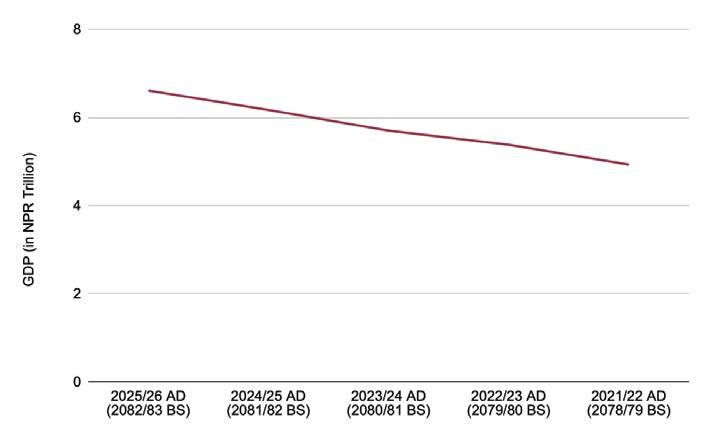
According to official government metrics presented in the late-May Economic Survey FY 2025/26 AD (2082/83 BS), Nepal’s total nominal Gross Domestic Product (GDP) at current market prices is estimated to reach NPR 6.6 trillion (USD 44.02 billion) this year.169 In real terms, the national economic growth rate for the current fiscal year is projected to be 3.85%.170
The agricultural sector, which accounts for 24% of Nepal’s GDP, has dampened the current year's growth path.171 Climate anomalies, including floods that depressed paddy yields, have contributed to a reduction in the projected growth rate. Simultaneously, strong output gains in electricity and hydropower infrastructure have offset this impact.172 The
government's preliminary domestic indicators contrast with the more conservative projections issued by international financial institutions during this period. Specifically, the World Bank April 2026 Update forecast a lower real growth rate of 2.3% for FY 2025/26 (2082/83 BS) due to disruptions in West Asia and the lingering effects of the youth-led September 2025 protests.173 Concurrently, the Asian Development Bank (ADB) Asian Development Outlook expected economic expansion to settle at 2.7%.174 The International Monetary Fund (IMF) Country Portal came closest to the domestic prediction and pegged Nepal's real growth rate at 3.0% for 2026.175
Figure 1. GDP in Current Prices over the Past Five Years (in NPR Trillions)
Source: Current Macroeconomic and Financial Situation of Nepal (Annual Data), Nepal Rastra Bank (NRB); Economic Survey FY 2025/26, Ministry of Finance.176
Inflation
According to the Nepal Rastra Bank's (NRB) mid-April 2026 report, year-on-year (y-o-y) consumer price inflation (CPI) stood at 4.47%.177 This marks an acceleration in price pressures compared to the 3.39% inflation recorded during the same review period last year, although the nine-month average remains at 2.39%.178 The inflation and pressure on prices are due to the war in West Asia and the increasing fuel prices globally.179 Food and beverage inflation accelerated to 4.01% in mid-April 2026, up from 2.45% a year ago. The highest price hikes were
recorded in Ghee & Oil (12.87%), Fruits (11.67%), and Vegetables (9.18%). Conversely, Pulses and Legumes (-2.78%), Cereal Grains and their products (-1.68%), and Spices (-1.64%) experienced deflationary trends.180 The nonfood and services category grew at a faster pace of 4.72%, compared to 3.90% in the previous year. The sharpest spikes occurred in Miscellaneous Goods & Services (19.94%), Transportation (12.03%), and Education (7.46%).181 Additionally, inflation varied significantly across geographies. The Terai region recorded the highest price pressures at 4.83%, followed
by the Kathmandu Valley at 4.69% and the Hill region at 4.18%. The Mountain region recorded the lowest inflation at 3.20%.182 According to the Asian Development Bank’s (ADB) Asian Development Outlook (ADO), published in April 2026, Nepal's annual average inflation is projected to moderate to 3.7%.183 According to the World Bank, however, consumer price inflation is expected to increase from 4.1% in FY 2024/25 AD (2081/82 BS) to 4.3% in FY 2025/26 AD (2082/83 BS), before rising further to 5.1% in FY 2026/27 AD (2083/84 BS), moderating only in FY 2027/28 AD (2084/85 BS).184
Table 1. Consumer Price Index over Two Consecutive Periods (in percentage)
Source: Current Macroeconomic and Financial Situation of Nepal (Annual Data), Nepal Rastra Bank (NRB); Economic Survey FY 2025/26, Ministry of Finance.185
GOVERNMENT FIGURES
Government Reserves
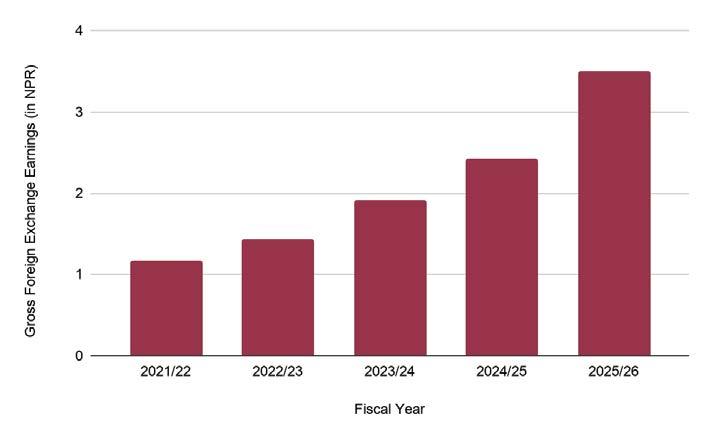
Nepal’s foreign exchange reserves have reached NPR 3.39 trillion (USD 23.31 billion) by mid-April 2026.186 This increase of 30.5% from NPR 2.43 trillion (USD 16.19 billion) a year earlier reflected a period of sustained inflows and relative macroeconomic stability.187
Among the composition of these reserves, Nepal Rastra Bank continued to hold the dominant share, with reserves rising to NPR 3.08 trillion (USD 20.57 billion) from NPR 2.41 trillion (USD 16.10
Figure 2. Gross Foreign Exchange Reserves in Mid-April of the Last Five Consecutive Years (in NPR trillion)
Source: Current Macroeconomic and Financial Situation of Nepal (based on nine months data, FY 2025/26 AD (FY2082/83 BS)191
Government Debt
billion) in mid-July 2025. At the same time, reserves held by commercial banks and financial institutions grew even more rapidly, increasing by 56.8% from NPR 263.04 billion (USD 1.75 billion) in mid-July 2025 to NPR 412.32 billion (USD 2.75 billion).
In practical terms, these reserve levels translate into a significantly strengthened buffer against external shocks. As of mid-April 2026, Nepal’s foreign exchange reserves were sufficient to cover 21.8 months of merchandise imports and 18.4 months of combined goods and services imports.188 This marked a notable
improvement compared to the previous year, when reserves covered 17.1 months of goods imports and 14.2 months of total imports.
Key macroeconomic ratios reinforced this trend. The reserves-to-GDP ratio rose to 57.2% while the reserves-toimports ratio stood at 153.1% and reserves-to-broad money (M2) at 41.2%.189 Each of these indicators has improved consistently over time, up from 39.7%, 118.7%, and 32.8% respectively in mid-April 2025.190
Nepal's total domestic debt stood at NPR 1.383 trillion as of mid-April 2026, up from NPR 1.298 trillion a year earlier, an increase of roughly 6.5 percent.192
Commercial banks remain by far the largest source of domestic borrowing, holding NPR 991.45 billion, though this represents a decline from NPR 1.073 trillion in mid-April 2025.193
Borrowing from the Nepal Rastra Bank fell sharply, nearly halving from NPR 22.66 billion to NPR 10.69 billion, while development banks' holdings also dipped slightly from NPR 90.57 billion to NPR 86.32 billion.194 Finance companies' exposure stayed roughly the same, reducing only marginally from NPR 18.67 billion to NPR 18.2 billion.195
The most notable shift came under "Others," which nearly tripled from NPR 92.91 billion to NPR 276.29 billion, a change that appears to be absorbing much of the reduction seen in commercial bank and central bank holdings, suggesting a reallocation of domestic debt sources over the year rather than a simple acrossthe-board increase.196
Table 2. Outstanding Domestic Debt as of midApril (in NPR million)
Source: Current Macroeconomic and Financial Situation of Nepal (based on nine months data, FY 2025/26 AD (FY2082/83 BS)197
Government Spending and Revenue
The Government of Nepal’s fiscal position over the first nine months of FY 2025/26 AD (2082/83 BS) reflected both the scale and structure of its spending priorities. Total expenditure reached NPR 1.06 trillion (USD 7.07 billion), with the bulk directed toward recurrent spending at NPR 747.52 billion (USD 4.99 billion), while capital expenditure
Table 3. Government Expenditure and Revenue based on Nine Months’ Data (in NPR billion)
remained comparatively modest at NPR 96.20 billion (USD 0.64 billion) and financial expenditure stood at NPR 216.23 billion (USD 1.44 billion).198 This continued dominance of recurrent expenditure highlighted the persistent challenge of translating public spending into long-term productive investment.
On the revenue side, the government mobilized NPR 886.28 billion (USD 5.91 billion)
during the same period.199 Tax revenue formed the backbone of this total at NPR 798.77 billion (USD 5.33 billion), supplemented by NPR 87.51 billion (USD 0.58 billion) in non-tax revenue.200 Despite steady revenue collection, the gap between expenditure and income (NPR 173.67 billion/USD 1.16 billion) underscores ongoing fiscal pressures and the need for more balanced public financial management.201
FINANCE STATUS
Investments
In the month of Falgun (midFeb to mid-March), 30 projects were approved, amounting to a total FDI commitment of NPR 386 million (USD 2.57 million).
xl This was followed by a rise in Chaitra (March/April), with 61 approved projects and total FDI commitments reaching NPR 1.13 billion (USD 7.53 million).
xli The ICT sector recorded its largest increase between Falgun and Chaitra, with 39 approved projects with a total investment of NPR 150.8 million (USD 1.01 million).xlii The upward trend continued in Baisakh (April/ May), where 113 projects were approved, bringing total FDI commitments to NPR 3.52 billion
(USD 23.49 million).xliii The ICT sector saw a further increase of 75 projects compared to Chaitra, with approved investments amounting to NPR 286.6 million (USD 1.91 million).xliv During the review period, NPR 14.55 billion (USD 97.04 million) in FDI (equity only) was received. In the same period of the previous year, FDI inflows (equity only) amounted to NPR 8.94 billion (USD 59.64 million).
FOREIGN ASSISTANCE
Aid Disbursements from Donor Agencies
By May 2026, the Ministry of Finance’s Development Finance Information Management System (DFIMS) recorded a total commitment of USD 369.3 million
(NPR 55.37 billion) across six major projects.203 Concessional lending from multilateral development banks accounts for the majority of this portfolio, led by the Asian Development Bank (ADB) with a combined commitment of USD 210.0 million (NPR 31.49 billion). The amount has been split between the Rural Connectivity Improvement Project (USD 110.0 million; NPR 16.49 billion) and the Urban Resilience and Livability Project (USD 100.0 million; NPR 14.99 billion).204 The World Bank's International Development Association (IDA) marked the single largest project-specific commitment with a USD 120.0 million (NPR 17.99 billion) loan dedicated to the School Sector Transformation Program (SSTP).205
Table 4. Commitments
Recorded by DFIMS as of May 2026
BILATERAL AND MULTILATERAL AID
Project / Program-specific Aid Nepal and China Advance Second Phase of Kathmandu Ring Road Expansion
On April 29, 2026, the second phase of Kathmandu’s Ring Road expansion formally moved forward as the Government of Nepal and the Government of China signed a crucial assistance agreement in Kathmandu.207 Minister for Physical Infrastructure, Transport, and Urban Development Sunil Lamsal and Chinese Ambassador to Nepal Zhang Maoming signed the agreement to upgrade the 8.2-kilometer road stretch from Kalanki to Basundhara.208 The project, fully funded by an NPR 11 billion (USD 73.36 million) grant from the Government of China, aims to improve urban mobility and alleviate traffic congestion in the capital city.209 210The comprehensive construction plan included widening the existing road, building a new concrete bridge at Dhungedhara, and installing three disability-friendly pedestrian bridges at the high-traffic intersections of Sitapaila–Balaju, Balaju–Machhapokhari, and Samakhusi–Basundhara Police Post.211 Additionally, the project incorporated the installation of streetlights from Kalanki to Basundhara Chowk to enhance nighttime road safety. Following the completion of the first phase from Koteshwar to Kalanki in 2019, this second phase emphasized the government's ongoing prioritization of north-south connectivity and sustainable urban infrastructure development.212
MCA-Nepal Introduces Sustainable Construction Methods for Highway Upgrades
In late May 2026, the Millennium Challenge Account (MCA) Nepal started construction on the highway upgrade project, which is co-funded by the Government of Nepal and a grant from the United States’ Millennium Challenge Corporation (MCC).213 For the first time in Nepal's infrastructure history, the project utilized Full Depth Reclamation and Superpave construction methods.214 The implementation plan detailed that the designated highway section would be widened to a total of 12 meters, featuring a 7-meter central carriageway designed to accommodate heavy commercial traffic and improve cross-border trade logistics.215
GRANTS AND CONCESSIONAL LOANS
World Bank Approves Credit to Combat Air Pollution in Nepal
On March 11, 2026, the World Bank’s Board of Executive Directors in Washington approved a USD 52 million (NPR 7.80 billion) credit for the Nepal Clean Air and Prosperity Project.216 The initiative aims to drastically reduce air pollution and strengthen national air quality management systems by assisting industries in transitioning away from traditional fossil fuel-based operations.217 The project specifically targets the reduction of fine particulate matter (PM2.5) emissions across the Kathmandu Valley, the Terai, and surrounding foothill regions, which were identified as public health risk zones.218 Because air pollution
costs Nepal over 6% of its gross domestic product annually through healthcare expenses and lost labor productivity, the project focuses on economic resilience alongside environmental health.219 Through capital incentives, clean technology financing, and technical assistance, the program will support approximately 400 industrial and commercial enterprises.220 The Department of Industry and the Department of Environment will jointly implement the project, while Rastriya Banijya Bank serves as the handling bank for the financial facility. This credit was further supported by an additional USD 5 million (NPR 749.70 million) grant from the Resilient Asia Program.221
REMITTANCE AND MIGRATION
Remittance inflows increased by 39.1% to NPR 1.66 trillion (USD 11.1 billion) during the first nine months of FY 2025/26 AD (2082/83 BS), compared to a 10.2% increase in the same period of the previous year.222 In the month of Chaitra (midMarch to mid-April), remittances totaled NPR 209.75 billion (USD 1.4 Billion), up from NPR 139.54 billion (USD 0.93 Billion) in the corresponding period last year.223 These record inflows, while providing support to Nepal’s external sector and household consumption, also underscore the country’s growing dependence on foreign labor income at a time of heightened geopolitical uncertainty in West Asia224 225
Top Ten Labor Destinations
According to the Nepal Rastra Bank’s FY 2025/26 AD (2082/83 BS) nine-month data, a total of
294,186 new work permits were requested, a 17.9% reduction from last year’s 358,222 in the same period.226 Renewed work permit entries totaled 293,259, an increase of 15% from 249,652 in the same period of the previous year.
The top 10 labor destinations, as per the nine months data, are the United Arab Emirates, Malaysia, Saudi Arabia, Qatar, Kuwait, Romania, Japan, South Korea, Oman, and Cyprus. Work permits
for GCC states declined, with UAE recording approximately a 50% reduction compared to the first nine months of FY 2081/82 BS (2024/25 AD). This is due to the conflict in West Asia and temporary blocking of labor permit approvals from March 1 to mid-April 2026.227 Labor permits for South Korea also 228 reduced by around 41%.229 In contrast, work permits for Oman and Romania increased by 64.81% and 25.36% respectively.
Other countries, not in the top 10 labor destinations, also saw a surge in increased work permits over the first nine months of FY 2025/2026 (BS 2082/83)230 231 Work permits toward Turkey increased by 211.65%, while Poland saw a surge of 127.95%, Israel an increase of 85.52%, and Malta an increase of 20.65%.232
Source: Current Macroeconomic and Financial Situation of Nepal FY
Table 5 Top 10 Labor Destinations of Nepali Migrant Workers (As per Nine Months Data)
TRADE STATUS
Foreign Trade Scenario
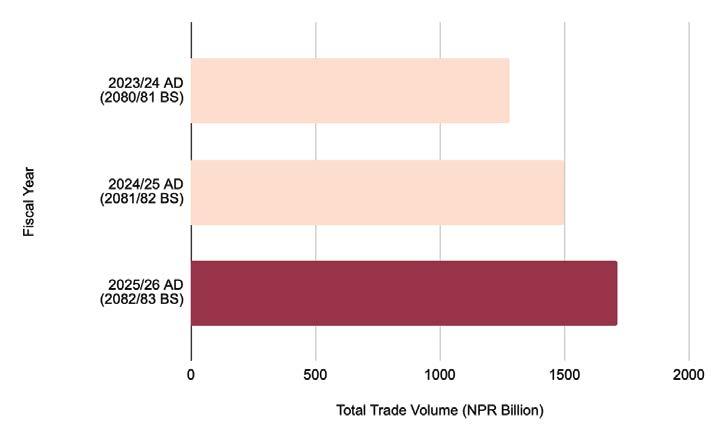
During the first nine months of FY 2025/26 (BS 2082/83), merchandise imports grew by 13.8% to reach NPR 1.49 trillion (USD 9.94 Billion), driven by increased imports of chemical fertilizers, transport equipment, and petroleum products.234
Concurrently, merchandise exports surged by 18.5% to NPR 222.94 billion (USD 1.49 Billion), supported by the export of
soybean oil, cardamom, and jute goods.235 Net services for the review period recorded a deficit of NPR 67.54 billion (USD 450.45 Million), on par with the NPR 67.45 billion (USD 449.85 Million) deficit from the previous year.236 The total trade deficit increased by 13.0% to NPR 1.27 trillion (USD 8.45 Billion), increasing from 6.4% during the corresponding period of the previous year.
Concurrently, the export-import ratio increased to 15.0% in the review period from 14.4% in the corresponding period of the
previous year.237 India remains the dominant trading partner. Over the review period, merchandise exports to India grew by 22.6%, while imports increased by 7.8%.
China is the second-largest partner, with imports growing by 21.3%, though Nepali exports to China contracted, by 46.8%, during this period.238
Figure 3 Total Trade Volume (in billions)
Source: Current Macroeconomic and Financial Situation of Nepal (based on nine months data, FY 2025/26 AD (FY2082/83 BS)239
Top Imports and Exports
During the review period, the top commodities Nepal exported were soybean oil, cardamom, polyester yarn and threads, woolen carpets, and jute goods. In terms of market dominance, Soybean oil accounted for the largest share of total exports at 40.7%, followed by cardamom at 4.8%, polyester yarn and threads at 4.6%, woolen carpets at 3.3%, and jute goods at 3.2%.240 The highest growth of exports was
recorded in palm oil, which surged by 223.9%, followed by shoes and sandals (76.9%), cardamom (71.2%), and noodles (66.6%).241 In contrast, exports of several key commodities contracted; zinc sheets recorded the largest decline at 86.9%, while particle board exports dropped by 34.2%, tea decreased by 19.3%, and woolen carpets decreased by 8.1% compared to the corresponding period of the previous fiscal year.242
Similar to the previous year, Nepal continued to import petroleum products in the highest volume, accounting for 14.9% of total imports.243 Following petroleum products, the other top imports were crude soybean oil (6.1%), transport equipment and vehicle spare parts (5.8%), other machinery and parts (4.6%), and chemical fertilizers (3.3%).244 Silver saw the largest growth in imports, which surged by 463.3%, followed by chemical fertilizers
(142.6%), crude soybean oil (40.0%), vegetables (34.0%), and telecommunication equipment and parts (32.5%).245 On the
Figure 4 Total Imports, Exports, and Trade Balance during the First Three Months of the Last Five FYs
Source: Current Macroeconomic and Financial Situation of Nepal (based on nine months data, FY 2025/26 AD (FY2082/83 BS)247
Balance of Trade
other hand, imports of edible oil decreased by 34.7%, hot rolled sheet in coil fell by 32.9%, and medicine experienced a decline of 1.0% during the review period compared to the previous fiscal year.246
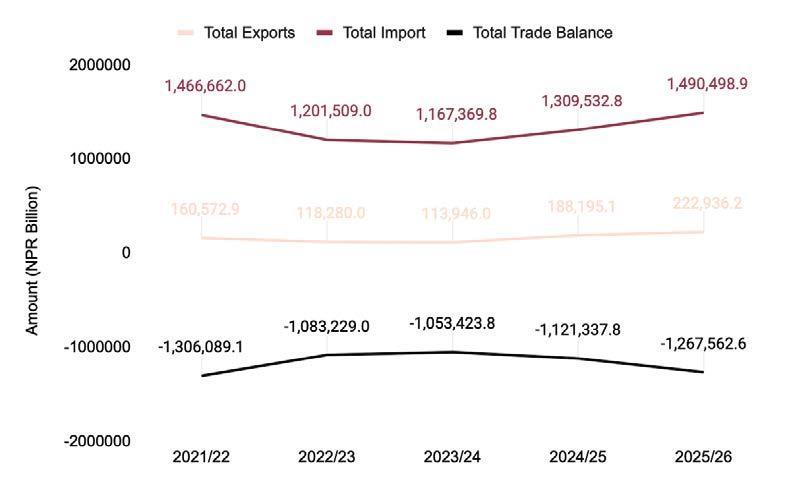
During the review period, Nepal’s trade deficit expanded to NPR 1.49 trillion (USD 9.94 billion), driven by a 13.8% increase in total imports. Similarly, exports grew by 18.5%, totaling NPR 222.94 billion (USD 1.49 billion).248 India remained Nepal’s largest trading partner, absorbing 82.5% of Nepal's total exports (NPR 183.94 billion; USD 1.23 billion) and supplying 56.8% of Nepal’s imports (NPR 847.06 billion; USD 5.65 billion).249 Exports to India increased by 22.6%, while imports from India rose by 7.8%, causing the bilateral trade deficit with India to expand by 4.3% to NPR 663.12 billion (USD 4.42 billion).250 Meanwhile, trade dynamics with China showed contrasting trends, exports to China declined by 46.8%, dropping to NPR 1.20 billion (USD 8 million). Conversely,
imports from China grew by 21.3%, reaching NPR 300.72 billion (USD 2.01 billion).251 Consequently, the trade deficit with China widened by 21.9%, amounting to NPR 299.52 billion (USD 2.00 billion).252 Commerce with other countries saw substantial broadbased growth. Imports grew by 24.2% to NPR 342.72 billion (USD 2.29 billion), while exports grew by 5.1% to NPR 37.80 billion (USD 252.07 million).253 This resulted in a 27.1% surge in the thirdcountry trade deficit, finishing at NPR 304.93 billion (USD 2.03 billion).254
Gold/Silver Updates
According to the Federation of Nepal Gold and Silver Dealers’ Association (FENEGOSIDA), the price of standard gold reached a record high at NPR 328,600 (USD 2191.54) per tola (11.66 grams) as of early March 2026, due to
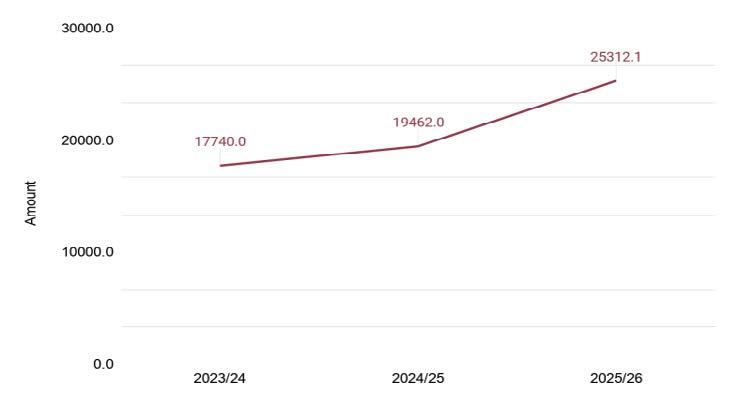
global inflation.255 This domestic peak was driven by a rally in the international market, where gold prices surged to USD 4,722.65 per ounce (NPR 708,114.14) by midApril 2026, a 46.19% year-onyear increase from USD 3,230.50 (NPR 484,381.17) during the same period last year.256 Despite these record-high prices, domestic gold imports increased by 30.1%, totaling NPR 25.31 billion (USD 168.80 million) in the first nine months of FY 2025/26 AD (2082/83 BS), compared to NPR 19.46 billion (USD 129.79 million) during the same period last year.257 Similarly, the price of silver reached NPR 5,985 per tola (USD 39.92) in early March 2026, which was the maximum for this quarter.258
Figure 5. Gold Imports in the First Three Months of the Last Five FYs
Source: Current Macroeconomic and Financial Situation of Nepal (based on nine months data, FY 2025/26 AD (FY2082/83 BS)259
Exchange Rate
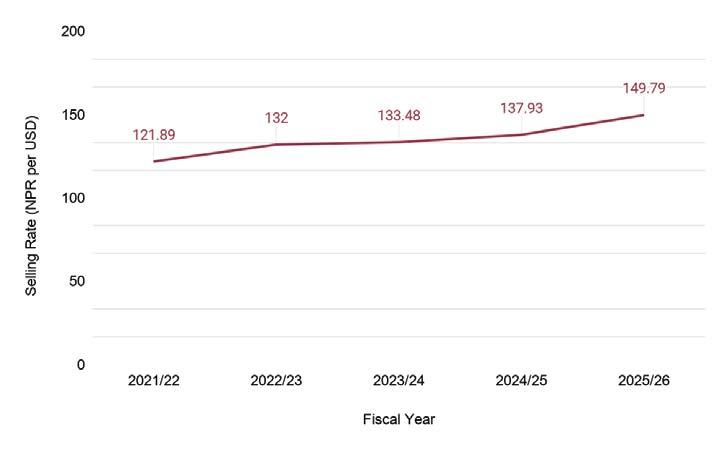
The Nepali currency depreciated by 8.6% against the USD from mid-July 2025 to mid-April 2026. The selling exchange rate per US dollar stood at NPR 149.79
in mid-April 2026 compared to NPR 137.89 in mid-July 2025.260 Of the total foreign exchange reserves, the reserves held by the central bank and Banks and Financial Institutions (BFIs)
grew as gross foreign exchange reserves increased by 15.4% to USD 23.55 billion (NPR 3.39 trillion) in mid-April 2026 from USD 19.5 billion (NPR 2.92 trillion) in mid-July 2025.261
Figure 6. Average Selling Rate of USD in NPR in the First Three Months over the Last Five Fiscal Years
Source: Current Macroeconomic and Financial Situation of Nepal (based on nine months data, FY 2025/26 AD (FY2082/83 BS)262263
Outlook
Nepal enters the coming year with a mix of resilience and vulnerability: a still-comfortable external and financial position, but only moderate and uneven growth prospects. Strong foreign reserve accumulation, now exceeding 18 months of goods and services imports, together with record remittance inflows and rising FDI commitments in ICT, infrastructure, and green projects provide substantial policy space to support activity and smooth external shocks. At the same time, real GDP growth is projected to remain below 4% and could underperform official estimates if West Asia disruptions, domestic political unrest, or climate-related shocks further weigh on agriculture, services, and investment sentiment. The near-term outlook is also complicated by a widening merchandise trade deficit, persistent reliance on petroleum and fertilizer imports, and a structural tilt toward recurrent over capital spending that constrains productivity-enhancing public investment. Inflation, while still moderate, is on a rising path as higher global oil prices, exchange-rate depreciation, and sector-specific spikes in transport, education, and miscellaneous services erode household purchasing power. To convert today’s macro-financial buffers into durable, inclusive growth, policymakers will need to deepen domestic credit to productive sectors and accelerate export diversification and labor-market reorientation away from high-risk Gulf destinations toward more stable, higher-skill corridors. Going forward, the key policy priority will be to leverage this external and financial cushion to sustain real economic activity and employment, while carefully managing imported price shocks and a persistent fiscal deficit to preserve overall macroeconomic stability.
3 Sectoral Review
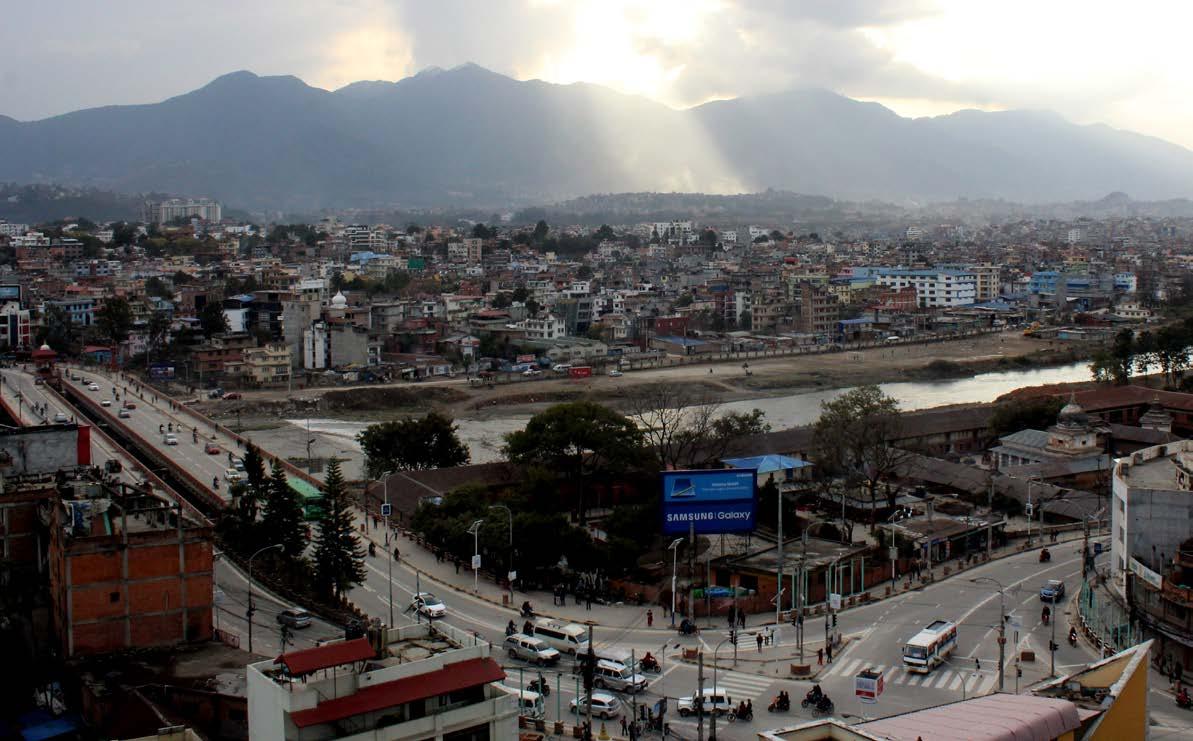
Agriculture and Livestock
Nepal's agriculture, forestry, and fishing sector contributed 24.03% of GDP in FY 2025/26 AD (FY 2082/83 BS), with gross value-added reaching NPR 1.39 trillion (USD 9.27 billion) and a sectoral growth rate of 1.58%. The past quarter was defined by a change in government that brought institutional restructuring and new ministerial leadership, alongside a policy agenda spanning Minimum Support Prices (MSPs) and agro-processing tax incentives. This quarter also saw a structural fertilizer shortfall ahead of the paddy transplantation season, with only around 183,000 tonnes available against a minimum requirement of 250,000 tonnes. This shortage comes from Nepal’s reliance on fertilizer from various countries in the Persian Gulf, which are vulnerable to global shipping interruptions and conflict. This quarter also faced challenges with a recurring payment crisis at the Dairy Development Corporation and a rapidly escalating avian influenza outbreak across Koshi Province and beyond.
Top 5 agricultural commodities imports (based on nine months’ data ending in mid-May 2026)278
Crude Soyabean Oil: NPR 91.14 billion (USD 610 million)
Chemical Fertilizer: NPR 49.16 billion (USD 330 million)
Rice/Paddy: NPR
32.33 billion (USD 220 million)
Vegetables: 15.17 billion (USD 110 million)
Edible Oil: NPR 15.11 billion (USD 110 million)
Soyabean Oil: NPR 90.72 billion (USD 610 million)
Top 4 agricultural commodities exports (based on nine months’ data ending in mid-May 2026)279
Cardamom: NPR 10.70 billion (USD 7 million)
Jute Goods: NPR
7.05 billion (USD 5 million)
Palm Oil: NPR 5.95 billion (USD 4 million)
GOVERNMENT PLAN UPDATE
President Names New Agriculture Minister, Later Ministries combine into MoAFE
The Ministry of Agriculture and Livestock Development saw a change in leadership following the formation of a new government under Prime Minister Balendra Shah.281 Geeta Chaudhary was appointed Minister for Agriculture and Livestock Development on March 27, 2026, succeeding Madan Prasad Pariyar, who had held the post under the caretaker government of Prime Minister Sushila Karki since September 2025.282 Upon assuming office, Minister Chaudhary directed ministry officials to work with "continuous dynamism," citing the new government's fiveyear majority mandate as a basis for reform.283 Notably, the ministry itself underwent a structural change on May 13, 2026, as part of Prime Minister Shah's administrative overhaul to consolidate federal ministries from 22 to 18. The Ministry of Agriculture and Livestock Development was dissolved and merged with the Ministry of Forests and Environment to form the new Ministry of Agriculture, Forests and Environment (MoAFE), with Chaudhary continuing as minister of the consolidated portfolio. This merge aimed to streamline government operations, promote collaboration between two interrelated subjects: forests and agriculture, and ultimately cut costs.284
Government Unveils Annual Policy and Program
On May 11, 2026, the President announced the government’s Policy and Program for FY 2026/27 AD (2083/84 BS) to a joint session of the Federal Parliament.285 The agriculture and livestock cluster outlined Minimum Support Prices (MSP) for major crops to be fixed before the sowing season, with payments to be made directly into farmers’ bank accounts digitally to eliminate intermediaries.286 The programs also included an establishment of public-private agriculture companies and cold chain networks to reduce post-harvest losses, with international quality standards and border laboratory testing for pesticide-residue certification of export produce.287 Similarly, the Food Management and Trading Company is also to be strengthened. Further announcements include an activation of a land bank system to channel fallow land to youth, women, and marginalized farmers and the promotion of contract farming, cooperative farming, and agro-forestry systems.288 Crop and livestock insurance are also to be digitalized and broadened, with every stage of the insurance lifecycle managed through a technology platform.289
Tax and Investment Incentives for Agro-Processing
Under the FY 2026/27 AD (2083/84 BS) budget (presented 290 29, 2026), the government announced several incentives specifically targeting agriculture and agro-processing.291 The
incentives aim to encourage the growth of the agriculture sector and produce high-value crops within the country. The changes also effectively support job creation and Nepal’s economy. A 10-year income tax holiday was granted to agro-processing industries, and a full Value Added Tax (VAT) exemption will be provided on machinery and equipment for cold storage, packaging, and quality testing laboratories.292 Additionally, the budget mentioned a pilot program offering 40% capital subsidy to farmers that invest a minimum of NPR 20 million (USD 133,400) in agricultural or livestock production. The 40% subsidy is reduced by 10% points annually over a span of four years.293 Finally, a special monitoring mechanism will be in place to ensure the proper utilization of agricultural grants.294
Minimum Support Price and Purchase Price Determination Directive
On 1 May 2026, Minister Geeta Chaudhary released the Minimum Support Price (MSP) and Minimum Purchase Price Determination Guidelines, 2082 BS (2026 AD).295 Farmers will be informed of the MSP for paddy, maize, and millet before each crop’s sowing season commences, enabling better crop planning and reducing market uncertainty.296 For sugarcane, field surveys and data collection will conclude by 15 September, with a final price recommendation due by 16 November.297 For wheat, the price will be determined through surveys, technical
recommendations, and final approval stages.298 The guidelines were formulated under the Right to Food and Food Sovereignty Act 2018 AD (2074/2075 BS), and aim to stabilize agricultural market fluctuations, encourage investment, and ensure minimum profit margins for farmers.299
PRODUCTION UPDATES
Government of Nepal Aims to Bridge Fertilizer Supply Gap Ahead of Paddy Season
As of mid-May, the Agriculture Inputs Company (AIC), Nepal’s state-owned enterprise in charge of buying and distributing subsidized chemical fertilizers, reported holding about 171,000 tonnes of chemical fertilizer in stock. In contrast, a minimum requirement of 250,000 tonnes is required during paddyplanting season alone throughout the country.300 This signals a shortfall of 79,000 tonnes. The AIC additionally had pending contracts for a further 94,450 tonnes. However, these contracts are likely to be cancelled due to global value chain pressures in the context of the war in West Asia.301
Issuing fresh global tenders was not a viable short-term solution, as officials noted the process took at least 225 days.302 In response, in early May the Cabinet approved a plan to procure 80,000 tonnes of fertilizer, comprising 60,000 tonnes of urea and 20,000 tonnes of diammonium phosphate. This was arranged under a governmentto-government arrangement, with Nepal formally requesting
India for expedited delivery from Rashtriya Chemicals and Fertilizers Limited.303 The bilateral agreement underpinning this arrangement, signed in February 2022 and guaranteeing at least 30% of Nepal's annual fertilizer requirement, had expired on March 31, 2026, before it was renewed. 304
The government allocated NPR 28.82 billion (USD 192 million) in subsidies for fertilizer imports in the current fiscal year, initially targeting 550,000 tonnes, though rising global prices reduced Nepal's purchasing capacity to around 440,000 tonnes.305 Subsidized urea is currently available at NPR 18 per kg and DAP at NPR 46 per kg through government-designated cooperatives.306 Nepal's chronic fertilizer shortage continues to affect thousands of farmers already struggling with climate risks such as droughts and floods.307
LIVESTOCK UPDATE
Government Intervention Offers Some Relief to Dairy Farmers
As of February 2026, the stateowned Dairy Development Corporation (DDC) cleared its outstanding dues, and the domestic market was receiving around 3.6 million liters of milk daily, with private processors also reporting no pending payments to farmers.308 That recovery proved short-lived. By late May, the DDC had accumulated around NPR 580 million (USD 3.87 million) in outstanding liabilities to dairy farmers over
four months, of which only NPR 120 million (USD 800,320) had been cleared, leaving roughly NPR 460 million (USD 3.07 million) still unpaid.309 Private dairy industries across the country were also reported to owe farmers nearly NPR 3 billion (USD 20.01 million).310 The DDC relies solely on sales revenue to pay farmers, meaning any drop in sales directly widens the payment gap, and rising milk prices exceeding NPR 110 per liter have contributed to declining consumer demand.311
The new government directly intervened in the DDC payment crisis during the past quarter. Based on a reforms action plan enforced by MoAFE, Minister Geeta Chaudhary, DDC was paying dairy farmers NPR 10 million (USD 66,700) daily by May 25, 2026, with preparations underway to clear a month’s worth of dues by end of June, and the remaining NPR 460 million (USD 3.07 million) within two months.312 On the policy side, the FY 2026/27 AD (2083/83 BS) budget included NPR 2.19 billion (USD 14.6 million) for agricultural insurance premium subsidies and a new commitment to digitalize crop and livestock insurance, measures that will directly benefit dairy farmers exposed to seasonal production risks and payment volatility.313 The government's MSP directive, which requires minimum prices to be set before the sowing/ production season, and the broader cold chain investment agenda also carry implications for the dairy value chain, particularly in reducing post-harvest losses and improving price
transparency for smallholder dairy producers.314
Nepal Sees Renewed Avian Influenza (H5N1 / H9N2) Outbreak after Eight Months
The review period saw an escalation of the outbreak of highly pathogenic avian influenza (HPAI) in Nepal’s poultry sector, which had been free of such outbreaks for approximately eight months prior.315 The timeline of the outbreak is as follows:
Date Description
March 10-15, 2026316
March 18, 2026317
March 27, 2026318
April 6, 2026319
May 8, 2026320
The first four outbreaks of H5N1 HPAI were detected in commercial layer farms in Koshi Province (three in Morang, one in Sunsari), affecting 10,316 birds.
The Department of Livestock Services (DLS) confirmed the outbreak officially, first identified in Sundarharaicha-4 and Urlabari-8 of Morang district.
Simultaneous confirmation of both A(H5N1) and A(H9N2) viruses in Jhapa, Morang, and Sunsari districts; over 100,000 domestic birds were culled. Authorities noted unusual bird deaths had begun approximately three weeks earlier during the parliamentary election period.
H5N1 HPAI spread confirmed across 23 farms in four districts – Sunsari (12 farms), Morang (8 farms), Jhapa (2 farms), and Chitwan (1 farm). Total culls reached 113,608 birds (chickens and ducks) and 211,867 eggs destroyed.
Research efforts paused as all birds raised for the research of the outbreak at the National Poultry Research Program died from the disease.
According to the World Organization for Animal health, contact with wild migratory birds led to the primary spreading of H5N1.321 The outbreak raised public health concerns given that H5N1 can, in rare cases,
Outlook
infect humans.322 Department of Livestock Services (DLS) authorities mobilized multilevel (local, provincial, federal) coordination to work on controlling the outbreak.323 Furthermore, bird owners
affected by the cull were set to receive up to 75 percent of their losses as government compensation.324 By mid-April, no new farms had reported cases, suggesting containment measures were taking effect.325
In the context of global fuel and supply chain pressure, Nepal’s fertilizer-dependent agriculture sector remains vulnerable to further potential exogenous shocks. With only around 171,000 tonnes of fertilizer available against a 250,000-tonne transplantation-season requirement, paddy yields in the next harvest will hinge on the timely delivery of the Cabinet-approved 80,000-tonnes emergency procurement from India. The avian influenza outbreak appeared to be subsiding in midApril, though poor farm-level biosecurity and wild bird migration routes leave the poultry sector exposed to recurrence. The dissolution of the Ministry of Agriculture and Livestock Development into a consolidated Ministry of Agriculture, Forests, and Environment, also introduces a new institutional architecture with great potential for streamlined implementation in the agriculture sector, but also transition risks that could delay program implementation in the quarters ahead.
Table 6. Timeline of Avian Outbreak.
Education
The review period, from March to May 2026, extended the regulatory tightening seen in the previous quarter into broader structural reform across Nepal's school and higher education systems. Building on the Ministry of Education, Science, and Technology’s (MoEST's) earlier push for institutional accountability, the government moved to overhaul long-standing examination practices, abolishing internal examinations for students up to Grade 5, and forming a nine-member task force to revise the National Curriculum Framework 2076 for the first time in five years. The Cabinet also introduced a two-day weekend for schools and offices, a measure driven by fuel shortages linked to the US-Iran conflict rather than education policy itself, but one that reopened debate over curriculum completion within a shortened teaching week. Meanwhile regulatory enforcement carried over from the previous quarter's focus on foreign-affiliated colleges to private schools, with the Supreme Court and MoEST acting against early admissions, illegal fee collection, and unregistered entrance preparation classes. Meanwhile, efforts toward institutional efficiency, echoing the prior quarter's administrative planning around examination schedules, advanced further as the National Examination Board cut SEE result turnaround from three months to under a month, and MoEST completed full digitization of the No Objection Certificate (NOC) process for students headed abroad. The quarter closed with the government's FY 2026/27 AD (2083/84 BS) budget, which raised the education allocation in nominal terms to NPR 218.305 billion (USD 1.45 billion), even as its share of total national spending slipped further below the 20% commitment.
FACTSHEET
Government Scraps Internal Examinations for Students Up to Grade 5
In its 100-point agenda for governance reform released by the Cabinet on March 27, 2026, the Government of Nepal abolished internal examinations for students up to Grade 5, effective from the upcoming academic session.331 Listed as Point 89 of the agenda, the decision was taken to reduce the psychological fear, stress, and pressure that traditional written examinations created for young children, and to encourage natural learning.332 The government also committed to developing alternative evaluation methods, including psychological and continuous assessment, to replace conventional testing.333 The announcement, however, drew mixed reactions. While some welcomed it as a studentfriendly step, others raised concerns over the lack of clear standards, tools, and trained personnel needed to implement alternative assessments effectively, and noted that many parents continued to view marks and grades as the primary indicators of learning.334
Government Introduces TwoDay Weekend for Offices and Schools
The Cabinet, on April 4, 2026, decided to close all government offices and educational institutions on both Saturdays and Sundays, introducing a two-day weekend.335 Education Minister Sasmit Pokharel, who is also the official government spokesperson, announced
the decision, stated that the measure was taken to reduce fuel consumption amid disruptions to petroleum supply caused by the US-Iran conflict, which had driven up petrol prices in Nepal. The Center for Education and Human Resource Development subsequently directed local governments and schools to revise their academic calendars accordingly.336 The decision, however, drew concern from educators and parents, who warned that limiting schools to five teaching days a week, compounded by a two-week delay in school admissions and a one-week delay in the commencement of teaching, would make it difficult to complete prescribed curricula and could disrupt the academic calendar. Both the Headteachers' Association and Tribhuvan University's Faculty of Education flagged that existing curricula were designed around a sixday teaching week and called for either a reduction in course content or an extension of daily teaching hours to compensate.337
Supreme Court and Ministry Move to Curb Illegal Fee Collection by Private Schools
On April 3, 2026, the Supreme Court issued an interim order prohibiting private schools from enrolling students before the formal start of the academic session, challenging the longstanding practice of early admissions and entrance exams that critics said created unfair advantages in the sector.338 Two days later, the Ministry of Education, Science and Technology issued a
directive requiring all private schools to comply with the Institutional (Private) School Fee Determination Criteria Directive, 2015, and refund any fees collected outside its provisions, citing complaints that some schools had begun enrolling students and collecting fees before annual results were published.339 On April 8, through the Ministry of Federal Affairs and General Administration, the government extended the directive to all 753 local governments and instructed them to act against noncompliant schools.340 Under the 2015 directive, private schools may collect fees under 14 approved categories; admission fees are capped at one month's approved tuition and may be charged only once, annual fees may not exceed two months' tuition, and examination fees are capped at 50% of monthly tuition per grade.341 Schools that fail to comply face fines of up to NPR 25,000 (USD 185) and, for repeat offences, cancellation of their operating license. Private school associations pushed back, with the Higher Institution and Secondary School Association arguing that schools had collected fees in accordance with local government approvals and calling for the decade-old directive to be revised to reflect Nepal's federal governance structure.342
Government Bans Entrance Preparation and Bridge Courses
At a ministerial-level decision on March 26, 2026, the Ministry of Education, Science
and Technology (MoEST) ordered private institutions to stop entrance examination preparation classes and bridge courses ahead of school and higher education admissions, citing negative effects on students' psychology and equitable access to education, and the added financial burden on families.343 Ministry spokesperson Shiva Kumar Sapkota announced the decision in a press release on March 29, 2026, setting Baisakh 1, 2083 (April 14, 2026) as the closure deadline and directing district administration offices to monitor compliance and take legal action against violators under the Education Act's Section 16 and the Educational Consultancy Services, Preparatory Classes and Language Teaching Guidelines, 2073.344 The same night, Education Minister Sasmit Pokharel narrowed the ban's scope to classes for students moving from the Secondary Education Examination (SEE) into Grade 11, contradicting the ministry's broader release, which had also covered higher education admissions. The next day, the ministry withdrew the original notice from its website and Facebook page, citing a lack of coordination.345 And on March 31, 2026, the ministry further clarified that only school-level entrance and bridge courses would close, while higher education preparatory programs and coaching centers for medical and engineering entrance examinations could continue if registered and operating within the law. According to reports, of the roughly 1,500 institutions registered to provide such
services, only about 700 had renewed their registration since 2081 BS (2024/25 AD) renewal call covering institutions lapsed since 2075 BS (2018/19 AD).346
NEB Speeds Up SEE Results as Ministry's Inspire Series Guides Graduates through the Wait
The National Examination Board (NEB) published the results of the Secondary Education Examination (SEE) 2082 on the night of May 11, 2026, 29 days after the exams concluded, after the government directed the board to release results within a month instead of the usual three, with answer sheets checked at examination centers within days of completion.347 Of the 512,421 students who registered for the exam, 430,667 sat for the exams across 1,966 centers, including 23 students at a center in Japan, and 284,160 passed, giving an overall pass rate of 65.98%, up from 61.81% the previous year.348
A total of 146,507 candidates received a Non-Graded result, while 48,392 students achieved the highest grade point average band of 3.60 to 4.00.349 Students could check their results through SMS, IVR, and official websites, including those of the Office of the Controller of Examinations and the board.350 During the month-long wait between the exams' conclusion and the results, the Ministry of Education, Science and Technology (MoEST), through Education Minister Sasmit Pokharel, launched the Inspire Series on April 16, 2026.351 The series was a set of video programs featuring established personalities from various fields sharing their experiences,
struggles, and achievements, aimed at guiding SEE graduates toward productive use of their free time and responsible use of social media while they awaited their results.
Ministry Makes NOC Process Fully Online for Students Going Abroad
In the past quarter, the No Objection Certificate (NOC) branch of the Ministry of Education, Science and Technology (MoEST), based in Sanothimi, Bhaktapur, took measures to make the process of obtaining the NOC fully online and free of office visits. To allow for this to take place, the ministry signed an integration agreement with Tribhuvan University (TU) on April 17, 2026, while a similar agreement with Kathmandu University (KU) had been completed earlier to integrate its online portal through API links.352 Along with the new integration, the system was also linked to the Financial Comptroller General Office's Revenue Information Cashless Management System, allowing NOC fees to be paid entirely online, and each approved certificate carried a QR code for verification.353 With the integration in place, students can apply for the NOC entirely from home and once approved, download and print the certificate themselves.354 Previously, applicants had to visit the office in person to verify citizenship and academic details, and those pursuing postgraduate or higher studies faced mandatory in-person verification because university records were not yet linked to the system.
Ministry Forms Task Force to Revise National School Curriculum Framework
At its 98th meeting on April 24, 2026, chaired by Education, Science and Technology Minister Sasmit Pokharel, the National Curriculum Development and Evaluation Council decided to revise Nepal's National Curriculum Framework (NCF) 2076, covering education from Early Childhood Development through Grade 12, and formed a nine-member task force to carry out the review.355 The task force, which began work on June 4, 2026, is coordinated by Professor Dr. Bal Chandra Luitel, Dean of the School of Education at Kathmandu University, with Director General of the Curriculum Development Centre Yubaraj Paudel serving as member secretary.356 The review was undertaken because the five-year cycle of the NCF 2076, implemented in the 2080 BS (2023/24 AD) academic year, had ended, and aimed to align school education with changing social, political and technological needs.357 The task force was mandated to submit its recommendations through consultations with students, teachers, education experts, policymakers, and other stakeholders, combining thematic studies with both online and in-person engagement.358
Budget for FY 2026/27 AD (2083/84 BS) Allocates NPR 218.305 billion (USD 1.45 Billion) for the Education Sector
In the budget for FY 2026/27 AD (2083/84 BS), the government allocated NPR 218.305 billion (USD 1.45 billion) to the Ministry of Education and Sports, an increase of NPR 7.135 billion (USD 47.25 million) from the previous fiscal year.359 This allocation, however, represented only 10.28% of the total national budget, down from 10.75% in FY 2025/26 AD (2082/83 BS), and continued to fall short of the longstanding commitment to allocate 20% to education. Nonetheless, the education sector received the second-highest ministry-wise allocation, after the Ministry of Infrastructure Development. Among its provisions, the government moved to restructure the education system into a "school-centric" model, empowering School Management Committees as the primary vehicle for quality assurance, and commissioned national school mapping, infrastructure audits, teacher capacity testing, and an assessment of artificial intelligence and ed-tech readiness. Legal frameworks were also introduced to grant universities educational, administrative, and financial autonomy under a cost-sharing model. For scholarships from
school level to higher education, NPR 8.60 billion (USD 56.95 million) was earmarked, while NPR 1 billion (USD 6.62 million) was set aside to map community school infrastructure needs. Additionally, the budget introduced a Clean Toilet Campaign across educational institutions and provided residential schools to serve communities lagging on the Human Development Index, beginning with the Chepang community in Chitwan. In higher and medical education, quotas for medical, nursing, and information technology disciplines were increased, and Tribhuvan University Teaching Hospital, the National Academy of Medical Sciences, and the Patan Academy of Health Sciences were designated for development into internationallevel universities. The budget further set targets of raising the basic-level completion rate from 74% to 78% and the secondarylevel completion rate from 42% to 45% by the end of the fiscal year.
Outlook
The coming quarter's outcomes will hinge on implementation capacity across multiple fronts. The shift away from internal examinations up to Grade 5 could ease psychological pressure on young students, but its success depends on whether MoEST develops the continuous assessment tools and trained personnel needed to replace conventional testing. Without these, schools may default to informal grading that undermines the reform's intent. Similarly, the curriculum task force's recommendations will shape classroom practice for years, and delays or weak stakeholder consultation could limit the reform's relevance. The two-day weekend, though framed as a fuel-saving measure, risks compounding into a broader academic calendar disruption if schools cannot extend daily teaching hours or trim course content to offset lost instructional days. On enforcement, the private school fee crackdown could improve transparency in the sector if the 2015 fee directive is revised to reflect Nepal's federal governance structure, as school associations have demanded, but continued ambiguity may fuel further disputes between schools and local governments. Meanwhile the NOC system's digitization and faster SEE result processing point toward incremental gains in administrative efficiency that could reduce delays for students at key transition points. On the other hand, the marginal decline in education's budget share, despite a nominal increase, suggests that structural underfunding relative to the 20% commitment will likely persist, constraining the government's capacity to fully implement its stated reforms around teacher capacity, school infrastructure, and AI readiness in the year ahead.
Energy and Environment
Nepal’s energy and environment landscape shifted notably between March and May 2026, shaped by a new federal government and an evolving institutional architecture around the power and water sectors. The administration has placed stronger emphasis on expanding generation capacity, clearing long-stalled projects and reforming sector laws, fueling renewed optimism among policymakers and investors about Nepal’s ability to harness its hydro and renewable resources. Across this period, authorities announced a series of new plans and targets for the coming financial year, ranging from power export ambitions to “green” infrastructure, signaling an intent to accelerate implementation rather than only add to policy statements. At the same time, these developments are unfolding in a context of heightened global fuel-price volatility linked to the war in West Asia, underscoring Nepal’s continued exposure to imported fossil fuels even as it seeks to scale low-carbon domestic energy.
ENVIRONMENT AND ECOLOGY
Nepal and India Sign MoU for Transboundary Ecosystem Conservation
On February 25, 2026, Nepal’s Ministry of Forests and Environment and the Indian Ministry of Environment, Forest and Climate Change came together in New Delhi to sign an institutional framework for bilateral management and conservation of shared forests, wildlife, environment, and biodiversity. The agreement
entails commitment from both sides to restore wildlife corridors, improve habitat connectivity, and adopt landscape-level conservation approaches beyond the boundaries of designated national parks and reserves. Six priority species, including tigers, elephants, one-horned rhinoceros, snow leopards, Gangetic dolphins, and vultures, were named for prioritization in conservation alongside an agreement to enhance the capacity of field staff working in conservation areas.360 The MoU also enables both countries to share wildlife
FY 2025/26 AD (2082/83 BS)
Total petroleum product imports (Total petroleum product imports (First six months data of FY 2025/2026 AD (2082/2083 BS))431
National Peak Demand432 (FY 2024/25 AD (2081/82 BS))
Total Peak Demand433 (FY 2024/25 AD (2081/2082 BS)) 2,021 MW
Hydropower generation capacity434 (FY 2024/25 AD (2081/2082 BS))
Increase in Hydropower production435 (FY 2024/25 AD (2081/82 BS))
Power Generation in Solar Energy436 (FY 2024/25 AD (2081/82 BS))
Population Receiving Access to Electricity from the National Grid437 (FY 2024/25 AD (2081/82 BS))
Total Domestic Electricity Consumption438
%
GWh
Per Capita Electricity Consumption439 465 kWh
Economic Loss from Natural Disasters440 (Magh 1-Chaitra 31, Fiscal Year 2082/83)
(USD 1.01 million)
crime information through the South Asia Wildlife Enforcement Network. In Nepal, the Ministry of Forests and Environment (now Ministry of Agriculture, Forests and Environment), along with related departments and provincial agencies, will coordinate its implementation. The agreement is set to renew automatically every five years unless terminated through diplomatic channels, and it will be reviewed every three years.361
Kathmandu Valley Air Pollution Reaches Hazardous Levels
Kathmandu ranked among the world’s top ten most polluted cities, reaching a hazardous Air Quality Index (AQI) score of 247 on April 2026.362 In the smog season lasting March to May, wildfire smoke from hundreds of forest fires compounded year-round pollution from vehicles, brick kilns, and construction dust.363 The World Bank’s projections predicted Kathmandu Valley’s average PM 2.5 concentration to reach 52µg/m³ by 2035, an increment from the WHO’s interim target of 35µg/m.364 In Nepal, air pollution has resulted in approximately 26,000 premature deaths per annum and a decrease in life expectancy by 3.4 years.365 Apart from health repercussions, air pollution has caused economic losses estimated to exceed 6% of GDP annually, primarily through its impact on labor productivity, aviation operations and tourism.366 Though a 100-point governance reform agenda released in late March has acknowledged the aforementioned areas as growth priorities, environmentalists have raised concerns over a lack of a
government’s attention toward for air quality management.367
Forest Fire Season Intensifies Nepal’s forest fire season, peaking from mid-March to mid-May, began in 2026 against a backdrop of prolonged drought, below-normal winter precipitation, and gaps in risk management.368 According to government records, there were 13,622 forest fire incidents across Nepal between 2013 and 2026, with April accounting for 57.7% of the annual incidents.369 An additional 282 incidents were recorded between April 2025 and March 2026, including 82 fires within protected areas. Among them, 27 fires occurred in Chitwan National Park and 24 in Shuklaphanta National Park.370 The National Disaster Risk Reduction and Management Authority (NDRRMA) released a national action plan for forest fire prevention, identifying nine highrisk districts, including Surkhet, Bardia, Chitwan, Dang, Banke, Kailali, Kanchanpur, Parsa, and Salyan, and directed coordination strategies across central, provincial, and local government agencies.371 Similarly, fire incidents have caused average economic losses of over NPR 2 billion (USD 13.34 million) annually and claim approximately 77 lives per year, while the Nepal Disaster Report 2024 placed cumulative losses from fire incidents at NPR 26.71 billion (USD 178.14 million).372
Risks Increase Amid Glacial Retreat
Research published in early April 2026 in the EGUsphere showed that Nepal’s central and eastern Himalayas lost approximately
30% of their snow over three decades due to accelerating climate change and rising temperatures.373 Nepal’s total number of glacial lakes has grown from 1,926 in 2005 to 2,631 as of 2024, a net increase of 705 lakes, with 47 classified as potentially dangerous for downstream communities and infrastructure.374 Similarly, a USD 36.1 million (NPR 5.413 billion) Green Climate Fund (GCF) project, led by the Department of Hydrology and Meteorology (DHM), under the Ministry of Energy, Water Resources and Irrigation (MoEWRI), is under implementation since March 12, 2026, to reduce the risks of Glacial Lake Outburst Floods (GLOFs) at four priority lakes located in central-eastern Nepal: Thulagi, Lower Barun, Lumding Tsho, and Hongu 2, through a combination of water-level management interventions, early warning systems, and eco-engineering, with project completion targeted for March 2033.375
RENEWABLE ENERGY
Financing Confirmed for 670 MW Dudhkoshi Storage Hydropower
Around mid-February, six multilateral and bilateral financiers confirmed their joint participation in the 670 MW Dudhkoshi Storage Hydroelectric Project.376 The co-financing structure, which is the largest assembled in Nepal’s history, brings together the Asian Development Bank (ADB), World Bank (WB), Asian Infrastructure Investment Bank (AIIB), European Investment Bank (EIB), OPEC Fund for International Development (OFID), and Saudi Fund for
Development (SFD), as well as USD 670 million (NPR 100.46 billion) equity contributions from the Government of Nepal and the Nepal Electricity Authority (NEA), totaling USD 2.32 billion (NPR 347.86 billion) project cost.377 The project, set to begin in 2026, involves the construction of a 220-meter dam, two powerhouses, a 600 MW underground facility, and a 70 MW ecological flow power station on the Dudhkoshi River across Okhaldhunga, Khotang, and Solukhumbu districts in Koshi Province.378 The ADB has categorized the project as highrisk given its location in the Himalayan terrain, and social safeguards for approximately 3,300 affected households will require sustained oversight through construction and resettlement phases.379
Construction Preparation
Underway for 1,200 MW
Budhigandaki Reservoir Project
The Office of the Prime Minister and Council of Ministers formally confirmed a Cabinetapproved investment modality for the 1,200 MW Budhigandaki Reservoir Project in late February 2026.380 Under the modality, the Government of Nepal will hold an 80% stake in Budhigandaki Company Limited, with NEA owning the remaining 20%, financed through a 70:30 debtequity ratio. The total project cost is estimated at USD 2.77 billion (NPR 415.33 billion) with an eight-year construction period beginning from Poush 2084 (December-January 2027).381
Approximately 90% of land acquisition was completed by 2025, with NPR 42 billion (USD 280.1 million) already disbursed to
around 8,117 affected households across Gorkha and Dhading districts, of whom 3,560 will be fully displaced.382Budhigandaki is projected to generate 3.38 billion units annually, providing dry-season baseload capacity from a 263-meter arch dam that will create a 63 square-kilometer reservoir.383 The project had been designated as a National Pride Project for over a decade without substantive mobilization.384
Solar Energy Pipeline Expands as NEA Promoted Plants
Projected to Surpass 1,000 MW Within Two Years
During the review period, NEA held active Power Purchase Agreement (PPAs) for 56 solar projects, totaling 835.5 MW, and the Energy Consumption and Export Strategy 2083, released in April, projecting that NEA-promoted solar projects alone would surpass 1,000 MW within two years.385 There is a growing private sector interest toward investing in solar energy generation, as seen during the recent Nepal Clean Energy Week, May 2026.386 Industrialists reported that solar electricity costs 30–40% less than hydropower-based grid supply, though policy and grid constraints, including a 500 kW cap on industrial solar connections to the national grid, continue to limit uptake.387 Nepal’s run-ofriver hydropower fleet generates its peak output during the June-October monsoon, while demand peaks in winter, which creates a seasonal mismatch resulting in electricity imports from India during dry months.388 The RSP government’s manifesto committed to introducing a rooftop solar net-metering
system enabling households to sell surplus electricity back to the grid, alongside promotion of large-scale solar farms on nonarable hilly terrain.389
NON-RENEWABLE ENERGY
West Asia War Leads to Hikes in Oil Price
Since early March 2026, the war in West Asia generated one of the most severe oil supply shocks in modern market history, driven largely by disruptions and perceived risks around the Strait of Hormuz.390 Nepal Rastra Bank’s nine-month data revealed that the price of Brent crude oil increased from NPR 66.83 (USD 0.45) per barrel in mid-April 2025 to NPR 123.28 (USD 0.82) per barrel in mid-April 2026, an increase of 84.5%.391 Diesel and kerosene prices increased by NPR 30 (USD 0.20) per liter in mid-April, the fifth upward revision in roughly a month.392 Nepal has no control over the price it pays for fuel, and simply adjusts retail fuel prices in line with import costs from Indian Oil Corporation (IOC). Consequently, Nepal Oil Corporation indicated that it continued to face financial pressure, with an estimated loss of NPR 1.81 billion (USD 12.07 million) due to elevated import prices.
Nepal
Faces Liquid Petroleum Gas Shortage
Globally, liquefied petroleum gas (LPG) markets faced supply constraints and price hikes. From early May, the government raised the retail price of the standard 14.2 kg cylinder by NPR 150 (approximately USD 1) to around NPR 2,160 (USD 14.41) of grid electricity comes from
renewable sources. To discourage stockpiling, NOC mandated, as of mid-March, 2026, the sale of 7.1 kg half filled cylinders at a reduced price of NPR 955 (USD 6.37) per cylinder. Though the import of LPG via India continued as regular in Nepal, reports of the war and global shortages led to mass purchasing and storing of gas cylinders.393 Nepal lacks significant storage capacity for LPG, amplifying vulnerability to supply shocks.394
KEY DEVELOPMENTS
Geeta Chaudhary Appointed Minister of Merged Ministries of Agriculture, Forests, and Environment
Nepal’s new government merged the former Ministry of Agriculture and Livestock Development and Ministry of Forests and Environment into the Ministry of Agriculture, Forests and Environment, now headed by Geeta Chaudhary.395 Chaudhary, sworn in on March 27, 2026, is a lawyer and advocate for human rights and a social work.396 This restructuring was an attempt to tackle long standing policy fragmentation between agricultural growth, forest governance, and environmental protection by bringing them under one integrated institutional umbrella.397 This signaled a broader trend of administrative consolidation in Nepal’s natural resource sectors, which could either streamline climate and environmental policy implementation or create new bottlenecks depending on how mandates, staffing and inter ministerial coordination are operationalized in the coming months.398 While most
welcomed the move, civil society stakeholders expressed concerns over how effectively a merged ministry can coordinate cross sectoral programs on issues like land use, climate adaptation, and biodiversity.399
Government Launches Local Climate Adaptive Living (LoCAL) Facility
On April 9, 2026 the Government of Nepal launched the Local Climate Adaptive Living (LoCAL) Facility in Kathmandu, in partnership with the United Nations Capital Development Fund (UNCDF), as a national mechanism to channel performance based climate resilience grants to local governments.400 Under LoCAL, grants will be disbursed to municipalities, particularly with better performing municipalities receiving larger allocations in subsequent cycles, thereby incentivizing stronger local planning, budgeting and accountability for climate results. The initiative was piloted with five local governments in Lumbini Province, to test and refine the model before scaling.401 The launch marks a federal decision to integrate local climate adaptation finance with the National Adaptation Plan and updated Nationally Determined Contributions, focusing on climate resilient agriculture, water systems, and infrastructure that can better withstand floods, droughts, and landslides.402.
Government
Fast-Tracks PPAs
to
Unlock Exports
On March 30, 2026, the federal government set a 180 day deadline to clear pending power purchase agreements (PPAs)
and licensing decisions, as part of its 100 point work plan.403 The government aims to resolve PPAs for around 13,000 MW of projects pending with the Nepal Electricity Authority (NEA) since 2018 and to unblock long standing transmission, distribution and export bottlenecks, which have constrained both domestic supply and export ambitions.404 The government is signaling a continued export oriented energy strategy at a time when domestic demand growth remains modest and new large scale loads (including data centers) are only beginning to materialize.405
Government Launches National Carbon Registry and Announces Nepal Carbon Authority
In April 2026, the Government of Nepal, together with the United Nations Development Programme’s (UNDP’s) Climate Finance Network, launched a new National Carbon Registry, a digital ledger system to record and manage carbon credit deals with other countries.406 The registry is a government managed platform designed to register, track, authorize, issue, transfer, and retire carbon credits, helping to prevent double counting and strengthen transparency in carbon transactions. Officials say it should help bring more climate related funding into areas like renewable energy, forests and nature based projects, and clean cooking by giving buyers a reliable record of Nepal’s emission reduction efforts.407 As part of the launch in April, the Alternative Energy Promotion Centre (AEPC) registered the first carbon project in the
new system.408 Furthermore, the government’s Policy and Programs for FY 2026/27 AD (2083/84 BS), presented before a joint sitting of Parliament on May 11, 2026, announced the establishment of the dedicated Nepal Carbon Authority and formal expansion of the Reducing Emissions from Deforestation and Forest Degradation (REDD+) carbon credit program.409 With this new institutional and digital system in place, Nepal positions itself to tap additional climate finance and to show it is ready to contribute to global climate goals through more credible carbon markets.410
PLANS AND PROGRAMS
Government Targets 30,000 MW Power Generation in the Next Decade
The newly elected Rastriya Swatantra Party (RSP) government declared in their 100-point governance reform agenda, published on March 27, 2026, a goal of installed electricity capacity of 30,000 MW within the next decade.411 The 30,000 MW target is a 6% increase over the previous government’s 28,500 MW goal outlined in the Energy Development Roadmap 2081, becoming one of the most ambitious energy production pledges in Nepal’s democratic history.412 In their 100 points plan, the government also committed to replacing the current multiagency approval process in which energy developers must navigate up to 23 different government bodies with a streamlined onewindow service delivery system, and pledged legal amendments to land acquisition, forest, and environmental clearance laws
to reduce project timelines.413 Furthermore, the government further committed to assuming full responsibility for security arrangements throughout hydropower project construction, addressing a longstanding concern of private developers operating in remote areas.414 This came as a candid institutional acknowledgement that Nepal’s approximately 83,000 MW of theoretical hydropower potential remained largely unharnessed.415
Ministry of Finance Launches Climate Finance Access for Private Sector Green Energy Projects
On February 18, 2026, the Ministry of Finance issued the Climate Finance Mobilization Guidelines, a regulatory framework that formally enables private sectorled green energy projects to access portions of governmentheld climate funds for the first time.416 These exist with the stated objective of expanding private sector engagement and accountability in climate adaptation and mitigation activities.417 The measure built on the National Carbon Trade Action Plan approved by the Cabinet in December 2025, which opened Nepal’s commercial carbon credit market to private developers across agriculture, forestry, energy efficiency, clean energy transition, renewable energy, transport, and waste management sectors.418 For the private sector, this creates additional revenue opportunities from selling carbon credits across sectors such as energy, transport, agriculture, and waste, making climate-aligned investments more commercially attractive.
New Policies for Water Quality and Restoration
As a part of the May 11, 2026 Government of Nepal's Policy and Programme announcement for FY 2026/27 AD (2083/84 BS), the government envisioned a multi-pronged water quality and river restoration agenda centered on the Bagmati and other ecologically degraded urban rivers.419 The plans commit to developing integrated sewage treatment plants in major urban centers, with treated wastewater to be reused for agriculture and industrial purposes, framing wastewater as a recoverable resource.420 Furthermore, plans include ecological rehabilitation of the Bagmati and other rivers and climate adaptation measures including groundwater recharge systems, rainwater harvesting, reservoir-based water projects, and the conservation of natural springs.421 The announcement also included a water quality monitoring framework with dedicated testing laboratories, alongside Nepal's intention to market its water resources internationally under a "Himalayan Origin Certified Water" identity.422
Budget for Energy and Environment
The FY 2026/27 (FY 2083/84) federal budget, announced on May 29, 2026, allocated NPR 12.31 billion (USD 81.36 million) for the forestry, climate, and environment sector. This is a significant reduction from NPR 18.75 billion (USD 123.92 million) last year. Within the allocated budget, NPR 10 billion (USD 66.7 million) was under the functional heading of Environment Protection, covering waste and sewage management,
biodiversity and soil conservation, environmental research, and general environment protection activities (cross-sectoral issues such as air quality, resource management, and legislation, etc.). Key initiatives within the budget included amendments to environment and forest laws, issuance of green energy bonds and mobilization of climate finance, deployment of drones and satellites for forest fire monitoring, upgrades to laboratories and air-quality monitoring, and integration of forest carbon and ecosystem service valuations into national planning.
Together, the budget for environmental protection, on the other hand, was around 0.47% of the total federal budget. Overall, 6.5% of the total budget was tagged as highly climaterelevant, referring to mitigation and adaptation programs.423 Another 37.82% of the total budget was tagged as indirectly climate-relevant, referring to development projects' secondary impacts on climate resilience.²424 Meanwhile, 55.50% of the overall budget had no direct or indirect link to climate goals. The budget earmarked NPR 12.31 billion (USD 82.1 million) for the forest, environment, and climate sector, and around NPR 1 billion (USD 6.7 million) for Chure and Terai water-source protection, ponds, and landslide control. It also earmarked NPR 4.19 billion (USD 28.0 million) for
urban greening and integrated waste management, including dust-free river campaigns and riverbank greenery in major cities.
On the energy side, the government allocated a total of NPR 85.54 billion (USD 570.5 million) for energy production, transmission, and distribution line construction, making up 4.03% of the total federal budget. Additionally, the government set a target of adding 1,040 MW of new capacity to the national grid during the fiscal year, comprising 670 MW from hydropower projects and 370 MW from solar, which would bring total installed capacity to approximately 5,535 MW.425 The budget also included construction commitments, including the completion of the Rahughat Hydropower Project (40 MW) within the fiscal year, and financial closure of large projects such as Upper Arun (1,061 MW), Uttarganga (828 MW), Chainpur Seti (210 MW), Tamakoshi-5 (99 MW), and Ghunsakhola (77 MW). Similarly, tendering processes started for the Budhigandaki Storage Project (1,200 MW) and the Dudhkoshi Storage Project (210 MW).426 On transmission, the government allocated NPR 70 billion (USD 466.8 million) to complete under-construction lines and substations.427
The budget also introduced a structural reform within the Nepal Electricity Authority (NEA), splitting it into three separate companies for generation,
transmission, and trading and distribution, to improve efficiency and accountability.428 Similarly, there were newly announced private sector permissions to trade electricity directly in international markets. On green energy innovation, a 2.5 MW green hydrogen pilot plant in Hetauda and a 100 MW battery energy storage system in Kathmandu were proposed, with the intent to address dry-season peak demand.429 To promote a shift from traditional fossil-fuel boilers to electric or biomassbased alternatives, incentives of NPR 220 million (USD 1.47 million) were allocated for converting 100 industrial units to rely on electricity or biofuel.430
Figure 7. Percentage of Overall FY 2026/2027 AD (2083/2084 BS) Budget Relevant to Climate Sector
Source: Budget Statement for Fiscal Year 2083/2084 BS (FY 2026/2027 AD)441
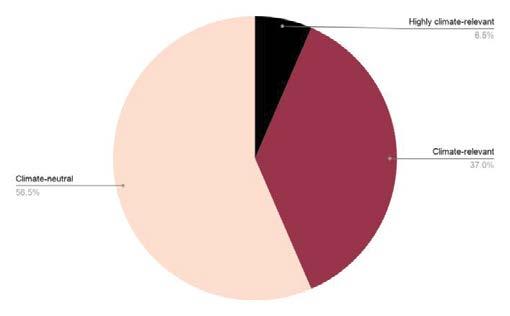
Figure 8. Budget Allocation for Environmental Protection
Source: Budget Statement for Fiscal Year 2083/2084 BS (FY 2026/2027 AD)442
Outlook
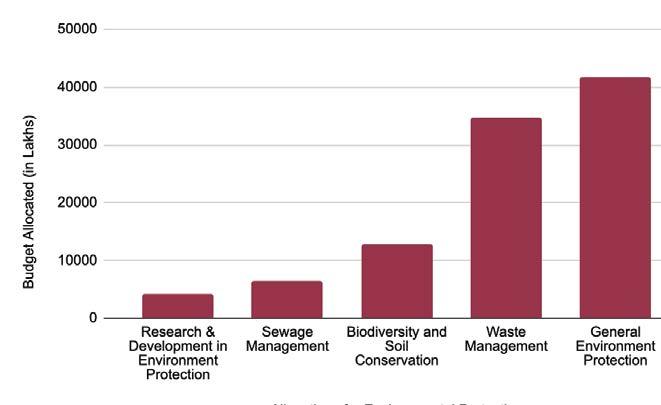
Nepal’s energy and environment sector enter the second half of 2026 with a rare alignment of political will, institutional momentum, and external pressure to create both the opportunity and the obligation for the government to act decisively. The government’s target to reach 30,000 MW power generation, and the steps taken to realize that goal, such as acceleration of mega electricity projects, and reforms to increase private sector participation come as substantive commitments in Nepal’s recent history. Whether these commitments translate to ground-level progress is dependent on the government’s implementation of the one-window clearance reform of PPAs.
On the environment front, despite the urgency and necessity, institutional reform remains uneven. The budget's allocation of less than half a percent of federal expenditure to environmental protection creates a gap between stated ambition and committed resources that will need to be closed if Nepal is to credibly leverage the LEAF Coalition agreement, the new National Carbon Registry, and the LoCAL Facility to attract climate finance. The mergers of two ministries, Forests and Environment with Agriculture, brings with it new integration opportunities, challenges and risks. The outlook for the remainder of 2026 will depend on the scale of energy sector reforms, and sustained political pressure ensuring environmental protection, is not lost in the race toward development ambitions.
Health
Nepal’s health sector witnessed a quarter marked by renewed reform efforts alongside challenges that persisted from the previous quarter. Concerns over the financial sustainability of the national health insurance program, shortages of health personnel, and gaps in service delivery continued to shape the sector, prompting the government to introduce a fast-track reform agenda focused on improving healthcare governance, strengthening hospital operations, expanding digital health systems, and increasing access to affordable care. New hospital regulations, increased investment in health insurance and health infrastructure, workforce training initiatives, and the development of Nepal’s first National Oxygen Roadmap reflected a broader effort to strengthen health system resilience. However, implementation challenges remained evident, as the two-day weekend policy disrupted public healthcare services and exposed chronic workforce shortages. At the same time, Nepal missed its measles elimination target due to immunization gaps among marginalized communities, while dengue alerts and enhanced Ebola surveillance underscored the continued importance of disease preparedness and emergency response capacity.
KEY DEVELOPMENTS
Government Prioritizes Health System Reforms Under New Minister
On March 27, 2026, Nisha Mehta of the Rastirya Swatantra Party (RSP) was appointed the Minister of Health and Population (MoHP) and Water Supply by President Ram Chandra Poudel .449 Mehta replaced the interim minister Dr. Sudha Sharma Gautam following the general elections held on
Two-Day Weekend Policy Disrupts Public Healthcare Services
In April 2026, the Government of Nepal introduced a two-day
March 5, 2026.450 The newly formed majority government was tasked with implementing the 18 point National Commitment, a government-wide reform agenda aimed at improving governance, public service delivery, and economic recovery.451 Within the health sector, the agenda prioritizes strengthening disease prevention and management through enhanced disease surveillance, expanded access to treatment services, and greater integration of healthcare systems for communicable and non-communicable diseases.452 These priorities were subsequently reinforced through the government's broader 100-point Governance Agenda, which introduced time-bound health sector reforms, including hospital service improvements, digital health systems, and expanded access to affordable healthcare. 453
weekend policy, designating Saturday and Sunday as public holidays, which disrupted healthcare access for lowincome patients who rely on public health services. 454 The policy was initially introduced as a measure to conserve energy in response to the global fuel shortage associated with the conflict in West Asia and required government offices to operate from 9 am to 5 pm weekdays.
455 Public hospitals adopted the revised schedule, leading to the closure of Sunday outpatient services and potential delays in surgeries and other nonemergency healthcare services. 456 The MoHP ordered doctors to keep services open on Sundays after being overwhelmed by public complaints. 457 The Nepal Medical Association (NMA) rejected the counter directive, arguing that chronic manpower shortages and deep-rooted problems in Nepal’s healthcare system make it impractical to implement. 458 The dispute highlights persistent capacity constraints in the public health system, including workforce shortages and limited service delivery resources, which continue to affect access to affordable healthcare services, particularly for marginalized populations.459
PLANS AND PROGRAMS
Government Approves SixPoint Health Sector Reform Under Broader 100-Point Governance Agenda
In May 2026, the Council of Ministers approved a six-point fast-track health sector reform package under the government’s 100-point Governance Agenda
to address longstanding gaps in healthcare service delivery and restore public confidence in the health system. 460 The package requires public and private hospitals to reserve 10% of their beds for the treatment of poor and abandoned patients. 461 It also directs the MoHP to operationalize a Free Health Portal for real-time hospital bed monitoring, establish provincial burn wards within 30 days of the reform package's approval, and integrate a digital health information framework within three months. 462 Within 100 days of the reform package's approval, the government also plans to establish Affordable Pharmacies to provide lowcost generic medicines through public health facilities. 463 A sixmember High-Level Reform Committee has been formed to oversee implementation and monitor compliance. 464 Initial monitoring showed that 109 hospitals nationwide had adopted the 10% bed reservation requirement within the first week of implementation, the MoHP had begun preparations for the Free Health Portal and the digital health information framework. 465
Health Budget Prioritizes Insurance Reform and Service Expansion
On 29 May 2026, Finance Minister Swarnim Wagle presented the federal budget for FY 2026/27 AD (2083/84 BS) to a joint session of the Federal Parliament, allocating NPR 101.95 billion (USD 679.94 million) to the health sector.466 The allocation prioritizes expanding service delivery and reforming health insurance financing amid continued pressure on the national health
insurance program, which faced liquidity constraints in the previous quarter. Of the total amount, NPR 15 billion (USD 100.04 million) has been allocated for the national health insurance program, alongside NPR 13.15 billion (USD 87.7 million) for treatment of indigent citizens, safe motherhood services, and free essential medicine.467 To address infrastructure gaps, the government has set a threeyear deadline to complete 336 under-construction basic hospitals.468 The budget also includes provisions for free childhood cancer treatment at government hospitals, expansion of telemedicine services to Karnali and Sudurpaschim provinces, and mandates Nepal Aushadhi Limited to expand domestic production of essential medicines supplied free of cost under the government's essential medicines program.469 These include commonly distributed drugs such as paracetamol, amoxicillin, iron and folic acid supplements, and selected antihypertensive medicines under the free essential medicines program. In addition, the government aims to expand health insurance coverage to 90% of the population within three years, while restructuring the program toward a more unified health financing model.470
Government Introduces Hospital Service Reform Procedure 2082
On 11 April 2026, the Government of Nepal brought the Hospital Service Reform Procedure 2082 into effect under the Public Health Service Act, 2075 BS, making its provisions immediately applicable to all registered
public and private healthcare institutions.471 The procedure seeks to strengthen service delivery, improve accountability, and curb commercial practices that may undermine patient care. Under the new provisions, hospitals are required to maintain integrated electronic patient records, ensure roundthe-clock laboratory services to support timely diagnosis and treatment, and implement daily stock management systems for essential medicines.472 Medical practitioners may prescribe medicines available through hospital pharmacies, provided that prescribing decisions are not influenced by financial interests or pricing-related incentives.473 The procedure also prohibits pharmaceutical company representatives from meeting medical practitioners during working hours and requires formal transfer of referral documentation between healthcare institutions to improve continuity of care and patient flow management across the health system.474
Health Workers Receive Training on New Drug-Resistant Tuberculosis Treatment Guidelines
The National Tuberculosis Control Center (NTCC), in collaboration with the World Health Organization (WHO), conducted advanced training on Drug-Resistant Tuberculosis (DR-TB) care for 24 medical doctors and provincial TB focal persons from treatment centers across all seven provinces.475 The training aimed to strengthen the capacity of healthcare professionals responsible for implementing DR-TB treatment
services and introduced a new clinical guideline promoting a short-course, all-oral treatment regimen.476 The curriculum focused on clinical decisionmaking, management of treatment-related side effects, and the use of digital reporting systems.477 The initiative supports Nepal’s goal of eliminating tuberculosis by 2035.478 According to health authorities, Nepal records approximately 70,000 new TB cases and 17,000 TB-related deaths annually, while treatment success rates remain at around 76%.479 Health officials have also highlighted the continued challenge of undetected and unreported TB cases, which hinder disease control efforts.480
Nepal Advances Development of First National Oxygen Roadmap
By late May 2026, following a provincial consultation in Sudurpashchim Province, MoHP and WHO completed the situational analysis phase for Nepal's first National Oxygen Roadmap.481 The roadmap is a strategic framework to strengthen the production, storage, and distribution of medical oxygen while improving the reliability of supporting infrastructure in health facilities.482 Field assessments teams were deployed to hospitals in Baitadi, Dadeldhura, Kanchanpur and Seti to evaluate existing oxygen systems, including Pressure Swing Adsorption (PSA) plants, gas distribution pipelines, and electricity reliability, which are critical for uninterrupted oxygen supply.483 The assessment identified key priority areas, including strengthening the maintenance
of oxygen infrastructure, training specialized technical staff, and installing dedicated power lines for oxygen plants in hospitals.484 To reduce the risk of future supply disruptions and prevent avoidable deaths from respiratory illnesses, the MoHP also disseminated hospital-level energy audit reports to align oxygen generation systems with reliable and sustainable energy sources and integrate energy resilience into broader health system planning.485
HEALTH RISKS
Nepal Misses 2026 Measles Elimination Target Amid Outbreaks
In April 2026, Nepal was reported to have missed its 2026 measles elimination target following outbreaks in Sarlahi and Baglung districts, highlighting persistent gaps in immunization coverage and vaccination tracking systems.486 The outbreaks were concentrated among marginalized Muslim communities in Malangwa Municipality and Dalit communities in Dhorpatan, Nishikhola, and Badigad in Baglung, where immunization records were insufficient to verify vaccination status in real time. 487 By late March, Baglung reported 136 confirmed measles cases.488489 Health officials reported that the absence of emergency reserve stocks of measles-rubella vaccines delayed outbreak response efforts, allowing transmission to continue in affected areas of Baglung for several weeks.490 Public health authorities warned that delays in supplementary immunization campaigns, combined with inadequate
vaccine reserves, could increase the risk of larger outbreaks and undermine progress toward measles elimination. 491
Dengue Alert Issued in HighRisk Areas Ahead of Monsoon Season
Kathmandu Metropolitan City (KMC) was among 15 local governments placed under a formal dengue alert by the Epidemiology and Disease Control Division (EDCD) ahead of Nepal’s monsoon season, which typically begins in mid-June and is associated with increased mosquito breeding and dengue transmission.492 Although reported dengue cases declined marginally from 155 in January to 152 in February and 149 in March, health officials warned that many infections remain undetected, as an estimated 90% of infected individuals are either asymptomatic or do not seek medical care. 493
Outlook
Based on worst-case scenario projections by the EDCD, dengue infections could exceed 60,000 cases nationwide over the following three months if preventive measures are not strengthened. 494 In response, the federal government allocated NPR 80 million (USD 0.53 million) to support local search-and-destroy campaigns targeting mosquito breeding sites. Municipal authorities also deployed personnel to highrisk areas to eliminate standing water, install mosquito traps, and remove potential breeding habitats. 495
Nepal Strengthens Ebola Surveillance Amid Regional Outbreak Concerns
In May 2026, EDCD strengthened surveillance and outbreak preparedness measures in response to the Ebola (Bundibugyo strain) outbreak in Uganda and the Democratic Republic of the Congo (DRC). 496
Concerns were heightened by the presence of approximately 970 Nepali peacekeepers stationed in Ituri Province, DRC, one of the areas affected by the outbreak, raising the risk of the disease being introduced into Nepal through international travel.497
In response, the Nepal Army announced a mandatory 21-day isolation period for peacekeepers returning from Ebola-affected mission areas, while health screening and surveillance measures were reinforced at Tribhuvan International Airport (TIA). 498 Public health experts, including former EDCD Director Dr. Baburam Marasini, noted gaps in Nepal’s preparedness, citing the lack of specialized isolation facilities, diagnostic capacity, and adequately trained personnel to respond to a potential Ebola case.499
The next quarter will be critical in determining whether recent health sector reforms translate into measurable improvements in service delivery. The implementation of the Hospital Service Reform Procedure 2082 and the six-point health sector reform package including the Free Health Portal, provincial burn wards, and digital health information systems will test the capacity of healthcare institutions to comply with new operational requirements. While the rapid adoption of the 10% bed reservation policy by over 100 hospitals indicates initial momentum, sustained implementation may be constrained by workforce shortages and limited institutional capacity. Public health risks are also likely to remain a priority, with the onset of the monsoon season increasing the likelihood of dengue transmission. Recent measles outbreaks further highlight persistent gaps in immunization coverage, vaccine preparedness, and disease surveillance systems.
Information and Communication Technology
During the March-May 2026 quarter, Nepal's Information and Communication Technology (ICT) sector was defined by a decisive policy shift, with the government formally designating information technology as a strategic export industry in the Policy and Program for FY 2026/27 AD (2083/84 BS), as well as proposing the country's first sovereign AI compute center, and allocating 1% of capital expenditure for science, technology, research, and innovation in the National Budget for FY 2026/27AD (2083/84 BS). Reinforcing this institutional push, the government formed a new Ministry of Science, Technology and Innovation, tasked with overseeing policymaking, research, and regulation across the sector. With USD 90 million (NPR 13.49 billion) in concessional financing from the Asian Development Bank (ADB) and World Bank for the Nepal Digital Transformation Project, ICT is poised to become a core driver of economic transformation in Nepal. The private sector moved in the same direction, with Nepal's first Tier Four data center in the pipeline, digital fare payments rolling out commercially in public transport, and Uber entering the ride-hailing market. Further, to regulate the digital mobility platforms, the government also unveiled the draft for Digital Mobility Service Operation Standards, 2026 for public consultation. Nepal also strengthened its international ICT engagements through forums in India, Europe, and the United States, even as rising cybercrime complaints underscored the governance challenges that accompany rapid digital expansion.
Figure 9. Market Share of Telephone Operators (based on SIM subscriptions)
Source: Nepal Telecommunications Authority, Telecommunication Indicators, Chaitra 2082512
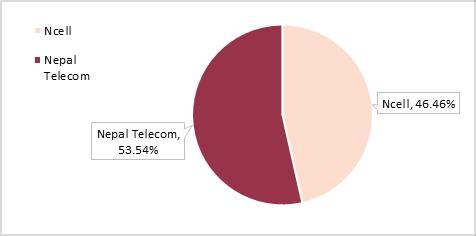
Figure 10. Market Share of Internet Service Providers (ISPs) in Nepal
Source: Nepal Telecommunications Authority, Telecommunication Indicators, Chaitra 2082513
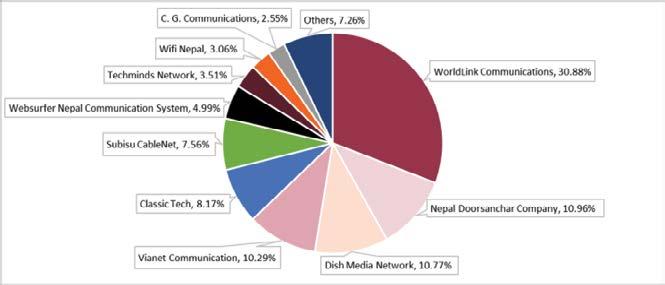
Figure 11. Broadband Service Technologies and User Distribution in Nepal Telecom Services
Source: Nepal Telecommunications Authority, Telecommunication Indicators, Chaitra 2082514
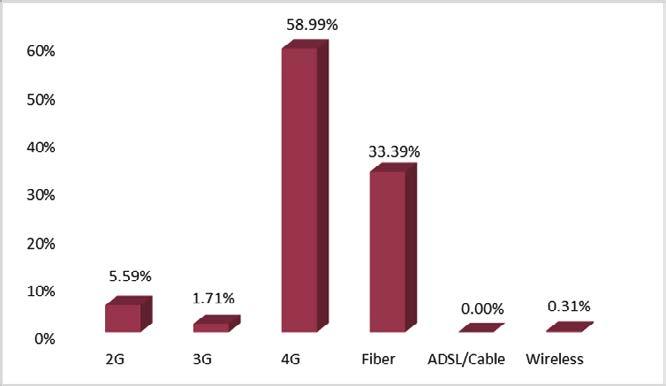
POLICIES AND REGULATIONS
Government Establishes New Ministry of Science, Technology and Innovation
The Council of Ministers approved formation of the Ministry of Science, Technology and Innovation on May 13, 2026, under the Government of Nepal (Division of Work) Regulations 2026 515 The ministry was initially led by Prime Minister Balendra Shah.516 Later, Mahabir Pun, an independent Member of Parliament (MP) representing Myagdi-1, assumed the office on June 9, 2026.517 The ministry is tasked with policymaking, research, and regulation covering nuclear technology, space science, industrial innovation, and related national institutions.518
National Budget Prioritizes Digital Infrastructure Expansion
The National Budget for FY 2026/27 AD (FY 2083/84 BS), presented on May 29, 2026, emphasized the potential of artificial intelligence, information technology, and digital transformation to drive economic growth, expand digital governance, and position Nepal as a competitive player in the regional technology landscape.519 The budget proposed establishing Nepal’s first Sovereign Artificial Intelligence (AI) Compute Center in Syuchatar, Kathmandu.520 The initiative aims to convert the country's hydropower potential into high-value AI computing services, while providing subsidized computing resources to local entrepreneurs and startups to spur digital exports and skilled employment.
The budget further proposed fellowship programs to bring back Nepali AI researchers from abroad, the prioritization of AIenabling academic disciplines like mathematics, all toward the overarching goal of entering the AI era on Nepal's own sovereign terms. It also prioritized expanding digital public infrastructure, centralizing government software procurement, and adding new services to the Nagarik App, the official mobile application operated by the Government of Nepal to provide governmentrelated services in a single online platform, including obtaining Permanent Account Number (PAN) card, maintaining digital records of citizenship certificate and driving license, and accessing other public services.521 In addition, the budget introduced tax concessions to promote the growth of exportoriented information technology services and digital trade.522 The government has also allocated a minimum of 1% of capital expenditure for science, technology, research, and innovation.523
Government Designates IT as a Strategic Export Industry in Policy and Program
On May 11, 2026, the government unveiled its policy and program for FY 2026/27 AD (FY 2083/84).524 Among its key provisions was formal recognition of information technology (IT) as a national strategic industry.525 Aiming to reduce dependence on foreign employment, President Ram Chandra Poudel announced that software development, digital services, cybersecurity, and artificial intelligence (AI) would be promoted as export-oriented
sectors.526 The government also outlined plans to develop digital parks, high-capacity data centers to position Nepal as a regional technology hub.527 Additionally, a "digital governance blueprint" was announced to integrate public services into a unified platform, expand the Nagarik App, and gradually transition all economic transactions to digital platforms in pursuit of a cashless, and transparent economy.528
Nepal Moves to Regulate Digital Mobility
The Ministry of Physical Infrastructure and Transport, on April 20, 2026, unveiled the draft for Digital Mobility Service Operation Standards, 2026 for public consultation.529 The draft formally defined ridesharing, ride-hailing, and digital mobility services.530 The draft proposed the requirement for operators to obtain licenses, register in a centralized digital system, share operational data, and comply with tax and service standards.531 The proposal also introduced annual license renewal requirements, vehicle classification provisions for ride-hailing services, and enforcement measures.532 This is the first federal framework by the Government of Nepal after Nepal’s ride-sharing ecosystem began in 2017.533 The draft aims to make ride-hailing through electronic platforms safe and reliable, regulate and manage service providers and vehicles, improve service quality and accessibility for citizens, and ensure uniformity across laws made by all three levels of government.534
KEY DEVELOPMENTS
Nepal Secures Digital Transformation Financing from ADB and the World Bank
The Government of Nepal signed a USD 40 million (NPR 5.99 billion) concessional loan agreement with the ADB on April 27, 2026, to implement the Nepal Digital Transformation Project.535 The project also received concessional financing worth USD 50 million (NPR 7.49 billion) from the World Bank (WB).536 The project aims to strengthen government data hosting and cybersecurity infrastructure and develop an integrated citizen service portal.537 It also seeks to improve national social registry and digitize high-impact public services, including land administration, with other services being added in a phased approach.538 These initiatives align with Nepal’s 16th periodic plan, Digital Nepal Framework 2.0, the e Governance Blueprint, and ADB’s country partnership strategy for Nepal, 2025-29, which together aim to grow Nepal's ICT sector by improving public services and strengthening the country's digital economy.539
BDV Announces Nepal’s First Tier Four Data Center
Bichuten Data Vault (BDV), a Nepal-based private company building a digital infrastructure ecosystem, announced plans to develop Nepal’s first tier four data center operating from Kathmandu and Birgunj to strengthen digital infrastructure, enhance data security, and reduce reliance on
foreign servers.540 The tier four data centers’ features include 48 hours of power backup for all equipment inside the data center and downtime of less than 26.3 minutes per year.541 The company said the facility would provide 99.995% uptime for critical sectors such as banking and telecommunications and expand from 240 kilowatts to 5 megawatts by 2030.542 It partnered with Google Cloud, AMD, Micron, and VVDN Technologies for technical expertise and infrastructure development.543 The project is expected to support in-country data storage, generate skilled employment, and advance Nepal’s digital transformation agenda.544
Nepal Leads Fixed Internet Speed in SAARC
Nepal ranked first among South Asian Association for Regional Cooperation (SAARC) countries for fixed-line internet speed, referring to broadband delivered over a wired connection to a fixed location such as a home or office, as opposed to mobile broadband over cellular networks, in Ookla’s April 2026 report, recording a median download speed of 86.05 Mbps.545 The country placed 92nd globally, ahead of Bangladesh, which recorded 67.41 Mbps and ranked 99th globally.546 India followed in third place within the SAARC region with 61.74 Mbps, while Sri Lanka ranked fourth with 36.72 Mbps547 548This performance can be attributed to Nepal's growing adoption of fiber technology, which accounted for 15.05 million of the country's 45.09 million total fixed
broadband subscriptions.549
FinTech International Launches Smart Card Fare Payment for Public Transport
FinTech International, a Nepalbased private company licensed by the Nepal Rastra Bank (NRB) for digital payment services, launched a smart card and offline QR-based digital fare payment system, Yatra Card, for Nepal's public transport sector.550 The system uses validator machines integrated with GPS and geofencing technology installed inside buses.551 Passengers tap a smart card to pay the fare (a 'tap in / tap out' model), with the backend preset with the fare structure for each route.552 The system was inspired by transit payment models in Singapore and was developed to address persistent cash-payment disputes between passengers and co-drivers.553 FinTech International conducted POSbased trials even before the COVID-19 pandemic; this launch represents the full commercial deployment.554 Currently, 39 buses operated by Riddhi Siddhi Yatayat on the Nepal Engineering College route use the service, with signed agreements with Nepal National Public Transport and Machhe Rajdhani Yatayat for future technology adoption.555
Nepal Police Cyber Bureau Briefing Warns of an Increase in Digital Fraud
On March 29, 2026, the Superintendent of Police (SP) at Nepal Police Central Cyber Bureau held a public briefing on the alarming surge in digital fraud
in Nepal.556 The SP identified user negligence as the primary driver behind rising social media account hacking.557 Data shared at the briefing indicated that approximately 4,600 cybercrime complaints had already been registered in FY 2082/83 BS (2025/26 AD) (by the end of March 2026).558 The SP further noted that many attackers operate from international jurisdictions and use 'money mules', described as individuals whose bank accounts are used to launder stolen funds, complicating prosecution.559 The SP urged the public to activate two-step verification on all major platforms and warned against sharing OTPs or security codes.560 The SP identified clicking suspicious links as the most common way users lose control of their accounts.561
Ride Sharing Platform Uber Enters Nepal
On May 21, 2026, Uber, a global ride-hailing app, soft launched its ride-hailing services in the Kathmandu Valley, with an official launch scheduled for June 1, 2026. The platform entered Nepal via a strategic partnership with local operators such as TaxiMandu, Book Cabs Now, and Eco Incorporation Group.562 Under the arrangement, Uber provides its technology platform, global mapping systems, and mobile applications, while local companies like TaxiMandu manage local operations, driver onboarding, and service expansion.563
Approximately 1,000 drivers across cars, taxis, and motorcycles joined the platform via Taximandu ahead of launch.564
Initial promotional discounts of NPR 30 (USD 0.20) and NPR 15 (USD 0.10) were offered to passengers through a zerocommission model for drivers during the launch phase.565 Uber's entry intensifies an already competitive ride-hailing landscape that includes Pathao, inDrive, Yango, Tootle, and the F1Soft-backed JumJum.566 The service is expected to particularly benefit foreign tourists, who are already familiar with the Uber app globally.567
At the time of the soft launch, the Department of Industry noted that formal company registration under Uber's name had not yet been processed.568 The company entered via local vendor channels instead.569
PROGRAMS, EVENTS, AND CAMPAIGNS
ICT Week and AI Summit Promote Digital Transformation
The ICT sector witnessed a number of domestic events during the review period. On April 5, 2026, AI Summit Nepal 2026 was held at The Plaza, Lalitpur, organized by The Startup Network Nepal.570 The summit convened global tech leaders and local innovators, featuring panelists from Amazon Web Services (AWS), Bosch, and WorldLink, among others, to discuss Nepal's technological trajectory over the coming decade.571 The focus on digital innovation continued through ICT Week 2026, organized annually by the Computer Association of Nepal Federation, which commenced on April 24, 2026, and culminated in the state-recognized National ICT Day on May 2, 2026, under the
theme ‘Expansion of Information Technology: The Basis for Sustainable Development.’572 The week included digital awareness programs extended to remote villages across Nepal.573 During the event, Senior Vice President of the Computer Association of Nepal Federation (CAN Federation) highlighted issues including skilled workforce retention, startup incentives, cybersecurity education, and digital infrastructure development.574
This quarter also saw a series of international engagements focused on Nepal's ICT sector. The Nepal–India Tech Forum 2026, held in New Delhi, discussed digital infrastructure development, AI Excellence Centers in Nepal's four provinces, cloud computing, FinTech, 575 collaboration, and investment opportunities Similarly, the Nepal–EU Tech Forum 2026, organized in Brussels by the Embassy of Nepal in collaboration with Genese Solution576 an IT consulting company, brought together policymakers, investors, tech entrepreneurs, and members of the Nepali diaspora to discuss ICT cooperation and Nepal's growing presence in cloud computing, AI, and software services 577organized by the Nepal Association for Software and IT Services Companies (NAS-IT) in collaboration with the Nepalese American Chamber of Commerce (NACOC), was held in San Francisco and Dallas in May 2026 to promote Nepal as a destination for software development, AI, data, and digital transformation outsourcing578579580581582.
Outlook
Nepal’s ICT sector is expected to build on the momentum generated this quarter through recent government policy commitments, infrastructure development, and international engagement. The newly formed Ministry of Science, Technology and Innovation can play a coordinating role in translating these commitments into implementation. The proposed Sovereign AI Compute Center and tax concessions for export-oriented IT services in the National Budget for FY 2026/27 signal the government's intent to position Nepal as a regional technology hub, though effective implementation and private sector uptake will determine their impact. The implementation of the USD 90 million (NPR 3.49 billion) Nepal Digital Transformation Project and the government’s decision to designate information technology as a strategic export industry are likely to drive further progress in digital governance, public service delivery, and the expansion of digital services. Planned investments in digital parks, data centers, cybersecurity infrastructure, and integrated digital platforms are expected to strengthen the country's digital ecosystem. However, realizing this potential, particularly data centers, will depend on overcoming power, water-intensive cooling, capital, and regulatory constraints. Nepal’s fixed broadband speeds, while leading within the SAARC region, remain modest at the global level (92nd), pointing to continued headroom for improvement.
The growing focus on AI, cloud computing, software services, and digital outsourcing reflected in various domestic and international ICT forums may contribute to greater collaboration, investment, and market opportunities in the coming quarter. At the same time, the rise in cybercrime complaints highlighted by the Nepal Police Cyber Bureau suggests that cybersecurity will remain a key concern as digital adoption expands. The rollout of digital fare payment systems in public transport and the entry of Uber into Nepal’s ride-hailing market may gradually encourage wider adoption of digital platforms and services, though their broader impact will depend on the pace of scale-up and regulatory clarity for emerging digital business models. The finalization of the Digital Mobility Service Operation Standards, 2026 will be a critical near-term milestone, as clearer federal regulation is expected to bring greater accountability and stability to Nepal's ride-hailing ecosystem, which has operated in a legal grey area since 2017.
Infrastructure and Real Estate
The review period from March to May 2026 saw Nepal's infrastructure and real estate sectors shift from postcrisis recovery toward institutional reform and longterm planning. While major infrastructure projects continued to advance, including the signing of a longdelayed agreement for the second phase of Kathmandu's Ring Road expansion, policymakers increasingly focused on addressing structural constraints that have historically slowed project implementation. To this end, the government-initiated plans for a specialized Infrastructure Tribunal to expedite disputes related to development and construction projects. Urban resilience also gained prominence, with Japan and the United Nations Development Programme (UNDP) launching a climate-resilient infrastructure initiative in Dhangadhi. In the real estate sector, market activity continued to recover, with property transactions rising to 58,886 and transaction-related revenue reaching NPR 6.26 billion (USD 45.67 million) in Baisakh (mid-April to mid-May 2026). The Nepal Rastra Bank (NRB) further strengthened market oversight by publishing its first quarterly real estate market report, providing a more comprehensive assessment of transaction trends, lending patterns, and regional disparities. At the same time, the government's eviction of informal settlements along the Bagmati corridor brought renewed attention to unresolved land management and housing challenges, culminating in Supreme Court intervention. These developments coincided with the unveiling of the FY 2083/84 BS (2026/27 AD) budget, which allocated substantial resources for transport, energy, urban development, and land administration reforms, signaling a greater emphasis on improving both physical infrastructure and the institutions that support it.
FY 2025/26 AD (2082/83 BS) up to mid-March
Nepal and China Sign Agreement for Ring Road's Second Phase
On April 29, 2026, Minister for Physical Infrastructure, Transport and Urban Development Sunil Lamsal and Chinese Ambassador to Nepal Zhang Maoming signed an implementation agreement in Kathmandu, clearing the way for the Department of Roads to begin the contracting process for the second phase of the Ring Road's expansion.584 Under the agreement, the Department set out to widen the 8.2-kilometre Kalanki-Basundhara section, building a concrete bridge over the Dhungedhara stream, three disability-friendly pedestrian bridges at Sitapaila-Balaju, Balaju-Machhapokhari, and Samakhusi-Basundhara Police Post, and installing streetlights from Kalanki to Basundhara Chowk, following a design that a visiting Chinese survey team completed after arriving in Nepal in April 2025. As per the deal, China also committed a grant of approximately NPR 11 billion (USD 80.25 million) toward the project, extending assistance it had provided since building the original Ring Road in 1977 and completing the road's first phase, from Koteshwar to Kalanki, in 2019.585 The second phase had stalled for years after Nepal and China signed a government-to-government agreement in 2018, due to the COVID-19 pandemic, delays in Nepal's preparatory work, and a Chinese demand for customs exemptions on construction materials repeatedly pushing back the timeline until the
Cabinet approved a tax waiver on February 12, 2026.586
Japan and UNDP Launch Climate-Resilient Urban Infrastructure Project
On April 28, 2026, the Government of Japan and the United Nations Development Programme (UNDP) launched the Smart Buildings and Green Infrastructure for Improved Human Security and Sustainable Development project to strengthen climate resilience in Dhangadhi SubMetropolitan City, one of Nepal's most heat-vulnerable urban areas.587 The initiative committed USD 1.296 million (NPR 177.64 million) to help the city respond to rising temperatures through climate-resilient infrastructure, improved urban planning, and capacity building at the local level. The project was introduced in response to increasing urban heat risks driven by rapid and unplanned urbanization, shrinking green spaces, and limited energy-efficient infrastructure, with temperatures in Dhangadhi frequently exceeding 40°C during the summer months. As part of the initiative, public buildings and community infrastructure will undergo thermal retrofitting, urban wetlands will be restored, and nature-based cooling solutions will be implemented to reduce heat exposure while improving the city's long-term resilience to climate change. The project is expected to directly benefit around 4,000 people, at least half of them women, while demonstrating integrated urban resilience measures that could be replicated in other climate-
vulnerable municipalities across Nepal.
Government Moves to Establish Infrastructure Tribunal to Expedite Development Project
Amid growing concerns that lengthy court proceedings were delaying major infrastructure projects across the country, the Ministry of Law, Justice and Parliamentary Affairs began work in April 2026 to establish a specialized Infrastructure Tribunal and prepare the legal framework needed for its operation.588 On April 8, 2026, the ministry formed a high-level task force led by Secretary Uday Raj Sapkota and comprising representatives from the judiciary, the Office of the Attorney General, the Public Procurement Monitoring Office, the Investment Board Nepal, and key infrastructure agencies to study the issue and draft the necessary legislation.589 The initiative came in response to persistent delays in nationally significant projects caused by prolonged disputes over procurement decisions, contract termination, land acquisition, compensation, and environmental clearances, which had stalled construction and increased project costs.590 Following its review, the task force recommended in May 2026 the establishment of dedicated infrastructure benches and a specialized tribunal that would hear only development and construction-related cases, with the goal of resolving disputes within 60 days.591 The proposed mechanism sought to provide technical expertise,
accelerate dispute resolution, and prevent legal bottlenecks from obstructing the timely implementation of public infrastructure projects.
NRB Publishes First Quarterly Real Estate Market Report
To improve transparency and strengthen monitoring of Nepal's property market, the Nepal Rastra Bank (NRB) published its first quarterly Report on the Status of the Real Estate Market in Nepal on April 13, 2026, and announced that it would release similar reports every quarter going forward.592 The report analyzed real estate trends over the previous three fiscal years using data from the Department of Land Management and Archive, the Inland Revenue Department, and NRB's banking statistics, covering transaction volumes, declared transaction values, land area traded, government revenue, and real estate lending. The findings showed that Nepal's real estate market had gradually recovered, with transaction volumes, declared values, and land area traded increasing over the review period, although activity continued to follow a seasonal pattern, declining during the first quarter and peaking in the third and fourth quarters. The report also highlighted widening regional disparities, a continued concentration of high-value transactions in urban areas, and rising exposure of the banking sector to real estate lending, underscoring the need for regular monitoring of the sector's implications for financial stability and the broader economy.
Government Evicts Squatter Settlements Along the Bagmati Amid Rights and Land-
Ownership Disputes
Beginning on April 25, 2026, the government launched an eviction drive to remove informal settlements built along riverbanks and other public land in Kathmandu Valley, starting with Thapathali and later extending to areas including Sinamangal, Shantinagar, Manohara, and Balkhu, citing the need to reclaim public land, reduce disaster risks, and restore river corridors.593 The operation followed public notices instructing residents to vacate the settlements and was carried out under heavy security, with many displaced households subsequently relocated to temporary accommodation while longer-term resettlement arrangements remained under discussion.594 The evictions, however, drew criticism from rights organizations, including Amnesty International, which called for the government to halt the removals until adequate consultation and resettlement measures were in place, while affected residents also staged protests demanding permanent housing solutions.595 On May 8, 2026, the Supreme Court issued an interim order directing the government not to evict or displace squatters without following due legal process and instructed authorities to ensure access to housing, education, healthcare, and food support for those who had already been displaced, while giving priority to hearing the case.596
Real Estate Transactions and Revenue Continue to Recover
Official data from the Department of Land Management and Archive showed that Nepal's real estate market continued to recover during the fourth quarter of FY 2025/26 AD (2082/83 BS), with both transaction volumes and government revenue increasing after fluctuating earlier in the fiscal year.597 During Baisakh (mid-April to mid-May 2026), 58,886 land and property transactions were registered nationwide, up from 55,531 in Chaitra (mid-March to midApril), while government revenue from property transactions increased to NPR 6.26 billion (USD 45.67 million) from NPR 6.16 billion (USD 44.94 million) over the same period.598 Registration fees accounted for NPR 3.31 billion (approximately USD 24.15 million) of the total revenue, followed by NPR 2.55 billion (USD 18.60 million) from capital gains tax and NPR 344 million (USD 2.51 million) from service tax. The increase extended the market's gradual rebound after revenue had fallen to NPR 4.14 billion (USD 30.20 million) in Falgun (mid-February to mid-March), indicating improving confidence and higher property transaction activity across the country.599
Budget for FY 2083/84 BS (2026/27 AD) Sets Out Infrastructure and Real Estate Priorities
The budget for FY 2083/84 BS (2026/27 AD) placed infrastructure development at the center of the government's growth strategy, allocating NPR
286.48 billion (USD 2.09 billion) for road and urban development and setting ambitious targets for transport, energy, water, and urban infrastructure.600 The government aimed to blacktop 1,000 kilometers of roads and construct 275 bridges, while accelerating work on strategic projects including the East-West Highway, Kathmandu-Terai Fast Track, Hulaki Highway, and MidHill Highway. The budget also prioritized the operation of the Nagdhunga Tunnel, expansion of transmission lines and substations, and the addition of 1,040 MW of electricity generation capacity, comprising hydropower and solar energy. In urban areas, the government advanced its Vision Kathmandu 2040 agenda through plans for underpasses, flyovers, integrated utility corridors, and improved public transportation, while also allocating resources for airport upgrades, railway construction,
Outlook
drinking water systems, irrigation infrastructure, and nationwide road maintenance to improve connectivity and service delivery across the country.
Alongside infrastructure spending, the budget introduced a range of measures aimed at modernizing land administration, stimulating investment, and improving housing and land management. The government announced the expansion of integrated digital land administration services, including online property registration and revenue payments, to 35 municipalities, while introducing landowner identification numbers and increasing the use of the National Identity Card (NID) in property transactions. To encourage investment in the housing sector, it proposed legal amendments allowing foreign investors and international organizations to lease apartments
on a long-term basis, with leases permitted for up to 25% of units in a residential building. The budget also allocated NPR 1.83 billion (USD 13.35 million) for infrastructure and land development in 12 designated smart cities, supported the construction of public housing projects, and committed to completing the management of landless Dalits, squatters, and unorganized settlers within the fiscal year. Additional measures included tax relief on land acquired for development projects up to the government's official valuation, incentives for residential building insurance, mandatory building insurance during map approval in urban areas, and the establishment of local land banks to promote the productive use of idle land.
The coming months will test Nepal's ability to translate policy commitments and institutional reforms into tangible improvements in project delivery and urban development. The proposed Infrastructure Tribunal, if implemented, could reduce one of the most persistent obstacles to infrastructure execution by shortening dispute resolution timelines and improving legal certainty for contractors and investors. Similarly, the expansion of digital land administration services and greater transparency through regular real estate market reporting may strengthen market confidence and improve the quality of data available to policymakers. The FY 2083/84 BS (2026/27 AD) budget also set ambitious targets across transport, energy, housing, and urban infrastructure, making effective implementation a key determinant of future sector performance. At the same time, the controversy surrounding recent squatter evictions highlighted the growing need for clearer land-use planning, affordable housing solutions, and more effective mechanisms for managing competing claims over public land. As urbanization accelerates and infrastructure investment expands, Nepal's ability to balance development objectives with legal, environmental, and social considerations will increasingly shape the sustainability and inclusiveness of growth in both the infrastructure and real estate sectors.
FACTSHEET
Tourism
Nepal’s tourism sector experienced a mixed quarter, spanning from March to May 2026, as external disruptions tempered what had been a strong start to 2026. The escalation of the conflict in West Asia in late February led to slower visitor arrivals in March and April due to disrupted air connectivity and higher travel costs, particularly affecting long-haul markets.601 However, growth in arrivals from the South Asian Association for Regional Cooperation (SAARC) countries, especially India, helped offset these declines and supported a recovery in May.602 At the same time, Nepal strengthened its tourism offering through record-breaking mountaineering activity, the launch of the National Wellness Tourism Strategy (2026-2035), and extensive international promotion campaigns in key source markets. New measures to improve adventure tourism regulation, environmental sustainability, and airport services further reflected efforts to enhance the sector’s competitiveness and visitor experience.
Visitor Arrivals Shift Amid West Asia Conflict
Nepal’s tourism sector showed mixed performance during the review quarter, between March to May 2026, following the escalation of the conflict in West Asia in late February.613 After steady growth in early 2026, arrivals slowed in March and April. Nepal received 120,516 visitors in March 2026, a 1% decline compared to March 2025, 614 due to the West Asia conflict, which disrupted global travel routes and reduced long-haul demand. Notably, however, while arrivals from the Middle East, Europe, the Americas, and Africa declined, inflows from
SAARC countries rose by 20.9% compared to previous year, helping reduce overall decline in tourist arrivals.615
The decline in tourist arrivals continued in April 2026 with a total of 107,934, down by 7.3% compared to corresponding month in 2025.616 However, the sector rebounded in May 2026, recording 102,626 arrivals, a 19.03% increase in comparison to previous years as shown in Figure 12. This was supported by strong regional demand, particularly from India, and sustained interest in trekking and mountaineering activities during the peak season.617
International Visitor Arrivals (March 2026 – May 2026)603 331,076
Proposed FDI Commitments in Tourism (mid-July 2025 – mid-May 2026)604
27.68% of total FDI
NPR 12.55 billion (USD 83.37 million)
Number of FDI Projects in Tourism605
25.96% of total projects 189
Foreign Exchange Earnings from Tourism (mid-July 2025 to midApril 2026)606
NPR 64.09 billion (USD 427.43 million)
Average Length of Stay (2025)607 16.34 days
Total Tourism Revenue (2025)608 USD 628.40 million (NPR 94.16 billion)
Average Daily Spending per Tourist (2025)609
USD 33.09 (NPR 4,960.54)
Number of Registered Star Hotels (2025)610 222
Government Royalty from Mountaineering Expeditions (2025)611
NPR 1.26 billion (USD 8.40 million)
Number of Registered Travel Agencies (2025)612 5,099
Figure 12. Tourist Arrivals to Nepal in May (2015 to 2026 AD)
Source: Current Macroeconomic and Financial Situation (Based on nine months data of FY 2025/26)618
MOUNTAINEERING UPDATES
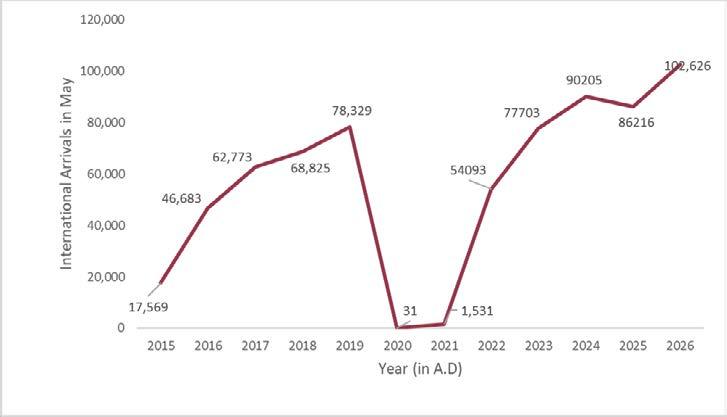
Mount Everest Sees Record Single-Day Ascent
On May 20, 2026, 274 climbers 619summited Mount Everest from the Nepal side. This broke the previous record for ascents from the Nepal side of 223 climbers on May 22, 2019. The spring climbing season, starting in March 2026, also set a record for royalty revenue. By May 21, 2026, the government earned more than NPR 1.24 billion (USD 8.27 million) in royalty 620, with Everest alone contributing NPR 1.07 billion (USD 7.14 million). Government officials attributed the increase in climbers to rising incomes in neighboring countries, growing global interest in adventure tourism, and improved mountaineering infrastructure.621
POLICIES
AND REGULATIONS
Budget Prioritizes Tourism and Aviation Development
The budget for FY 2026/27 AD (2083/84 BS) allocated NPR 7.34
billion (USD 48.95 million) for the culture and tourism sector and NPR 2.93 billion (USD 19.54 million) for civil aviation to support tourism-led economic growth.622 The government announced Nepal Visit Year 2085 BS and Wellness Year 2027 AD, alongside tourism corridor development, destination promotion, and heritage conservation programs.623 Furthermore, the budget allocated NPR 1.53 billion (USD 10.20 million) to upgrade Tribhuvan International Airport (TIA), planned private-sector management of Gautam Buddha and Pokhara international airports, expanded regional airports, and committed to finalizing the construction modality of Nijgadh International Airport within six months.624
Tourism Department Tightens Adventure Sports Regulation
The Department of Tourism directed operators conducting adventure and recreational sports without permits to immediately cease operations on May 4, 2026.625 Through a public notice issued by the Adventure
and Recreational Tourism Section, the department instructed such operators to obtain licenses within 30 days.626 The department cited complaints regarding unauthorized activities across Nepal and warned of legal action if organizations failed to begin the licensing process.627 Overall, the directive covered activities including bungee jumping, canyoning, skydiving, ziplining, jet skiing, and motorboating, requiring operators to comply with safety standards and permit provisions under existing tourism laws and guidelines.628
SPCC Introduces New Climbing Rules
To address environmental concerns in the Everest region, the Sagarmatha Pollution Control Committee (SPCC), 629introduced 630 The revised provisions require climbers and highaltitude Sherpas to bring back at least 2 kg of garbage from areas above Camp II and a minimum of 8 kg from above Everest Base Camp.631 The committee also mandated the use of approved human waste bags, enforced
waste segregation, and campcleaning requirements.
Additionally, SPCC introduced a USD 600 (NPR 89,964) Khumbu Icefall route fee for foreign climbers on Mt. Everest, Mt. Lhotse, and Mt. Nuptse.632 The organization stated that violations would result in denial of the Garbage Clearance Letter required to conclude expeditions.633
SPCC was established in 1997 and is contracted by the Ministry of Culture, Tourism and Civil Aviation (MoCTCA) to set the climbing route, check climbing permits, monitor illegal climbing, and implement waste management strategies at the base camps of the Khumbu area’s mountains and peaks, including Mt. Everest.634
Government Launches Wellness Tourism Strategy
The Government of Nepal unveiled the National Wellness Tourism Strategy (2026–2035 AD) and Action Plan (2026–2030 AD) on April 15, 2026, aiming to position Nepal as a global wellness tourism destination.635 The strategy targeted attracting more than 10,000 wellness tourists annually after 2030 and generating USD 20 million (NPR 2.99 billion) to USD 30 million (NPR 4.49 billion) in annual revenue.636 The strategy also outlined plans to develop wellness infrastructure in selected locations, launch the “Arogya Nepal” marketing campaign, establish accreditation standards for wellness 637, and expand workforce training. The initiative coincided with Nepal’s recognition of April 15 as the International Day of Wellness and
the government’s announcement of “Nepal Wellness Year 2027.”638
KEY DEVELOPMENTS
Government Mandates Breastfeeding Rooms at Airports
On April 11, 2026, the MoCTCA directed all airports across Nepal to establish or upgrade breastfeeding and infant care rooms within 24 hours.639 The ministry also directed airports to operate primary healthcare facilities for sick passengers, senior citizens, and persons with disabilities, maintain cleanliness in line with international standards, and provide free sanitary pads in women’s restrooms.640 The ministry introduced the measures in response to passenger feedback regarding inadequate facilities and instructed airport authorities to submit progress reports on implementation.641
PROGRAMS, EVENTS, AND CAMPAIGNS
NTB Promotes
Nepal Across Three Cities in China
During the review period, the Nepal Tourism Board (NTB) promoted Nepal across three cities in China. Firstly, the Consulate General of Nepal in Guangzhou, in coordination with NTB, organized a tourism promotion and Business-toBusiness (B2B) networking program at The Ritz-Carlton, Shenzhen, on May 20, 2026.642 The event was attended by around 80 participants from media, travel trade, business, and Non-Resident Nepali (NRN) communities.643 At the event, NTB highlighted Nepal’s unique
tourism experiences, growing wellness tourism opportunities, and Nepal Wellness Year 2027.644
NTB also coordinated Nepal’s participation in the Guangzhou International Travel Fair from May 21–23, 2026, where Nepal received the “Most Charming Tourism Destination” recognition.645 Eight Nepali travel and tourism companies participated, showcasing Nepal’s wellness, cultural, pilgrimage, adventure, outdoor, and luxury tourism experiences.646
Lastly, NTB participated in ITB China 2026 at the Shanghai World Expo Exhibition and Convention Center from May 26-28, 2026, alongside seven Nepali tourism companies.647 The participation promoted Nepal Wellness Year 2027 and included business meetings with Chinese outbound tour operators, travel agencies, Meetings, Incentives, Conferences, and Exhibitions (MICE) planners, and international partners to strengthen Nepal’s presence in the Chinese travel market.648
NTB Participates in ITB Berlin and MITT Moscow
NTB participated in Internationale Tourismus-Börse Berlin (ITB Berlin) 2026, an international travel trade show, at Messe Berlin, Germany, from March 3–5, 2026, alongside 31 private sector Destination Management Companies (DMCs649 In the backdrop of ITB Berlin, The Embassy of Nepal in Berlin and NTB also jointly hosted a Nepal Evening on March 3, 2026, attended by around 200 delegates and tourism professionals.650
The events promoted Nepal’s tourism, culture, art, and foreign investment opportunities. On March 4, 2026, a Senior Officer of NTB also delivered a destination pitch at ITB Spati, highlighting Trail-Based Tourism and four new trekking routes spanning nearly 400 kilometers across the midhill regions of Koshi Province.
Furthermore, NTB, alongside seven Nepali tourism companies, also participated in MITT Moscow 2026 at the Crocus Expo International Exhibition Center, international travel and tourism exhibitions651 from March 11–13, 2026. The participation aimed to strengthen Nepal’s presence in the Russian and Commonwealth of Independent States (652) travel markets while showcasing Nepal’s adventure, cultural, and naturebased tourism experiences.653
B2B Programs Conducted in Japan and the US to Promote Tourism and Collaboration
NTB, Nepal Airlines Corporation (NAC), and Pacific Asia Travel Association (PATA) Nepal Chapter jointly organized tourism promotion and business-tobusiness (B2B654 exchange programs in Tokyo, Japan on April 2, 2026, and in Osaka, Japan on April 5, 2026. 655The programs engaged Japanese
tour operators, travel agencies, and media representatives, promoting Nepal's cultural heritage, adventure tourism, and wellness experiences.656 Twelve Nepali travel and hospitality companies took part in the programs, which included a destination presentation by NTB Senior Manager and a briefing on flight connectivity by Nepal Airlines Corporation.657 The Tokyo event was also attended by Deputy Chief of Mission, who reiterated the importance of such programs for tourism promotion.658 Similarly, NTB, alongside five Nepal travel companies, also participated in the Los Angeles Travel and Adventure Show 2026 at Los Angeles, California, a consumer travel and tourism expo, on March 7–8, 2026.659 The participants promoted trekking packages of around two weeks and Everest and other mountain expedition programs of up to eight weeks to the US travel market.660 The Nepal Pavilion drew steady visitor traffic and strong interest from the US travel market throughout the two-day event.661 NTB was represented two senior officials, who also engaged with media professionals, content creators, and travel bloggers to expand Nepal's presence in the US market.662
NTB Observes International Wellness Day 2026 Following Nepal’s First UN Resolution
On April 15, 2026, NTB, in coordination with the MoCTCA, observed International Wellness Day 2026 at Sainik Manch, Tundikhel, Kathmandu.663 The event brought together government officials, tourism stakeholders, wellness practitioners, and members of the public664 and featured mantra chanting, guided yoga and meditation sessions, and the official launch of the Wellness Tourism Strategy.665 The United Nations (UN) General Assembly passed a resolution on March 11, 2026, based on Nepal's proposal, designating April 15 as International Wellness Day.666 It is Nepal's first resolution to be passed by the UN.667 Additionally, the Minister of Culture, Tourism and Civil Aviation, Khadak Raj Paudel and the Speaker of the House of Representatives, Dol Prasad Aryal also addressed the gathering.668 Deepak Raj Joshi, former CEO of NTB facilitated the program, reaffirming Nepal's commitment to positioning itself as a premier global wellness destination ahead of Nepal Wellness Year 2027.669
Outlook
Nepal’s tourism sector is expected to remain resilient in the next quarter, supported by strong regional demand, continued interest in adventure tourism, and growing efforts to promote wellness tourism ahead of Nepal Wellness Year 2027. Record Everest activity and international marketing campaigns could help sustain visitor growth and tourism earnings. At the same time, stricter regulations for adventure tourism operators and Everest waste management are likely to strengthen the sector’s long-term sustainability and reputation. However, geopolitical tensions, rising fuel costs, and higher airfares may continue to constrain long-haul travel demand. Overall, the quarter highlighted Nepal’s growing dependence on regional markets to cushion external shocks while long-haul travel remains sensitive to global instability.
4 Market Review
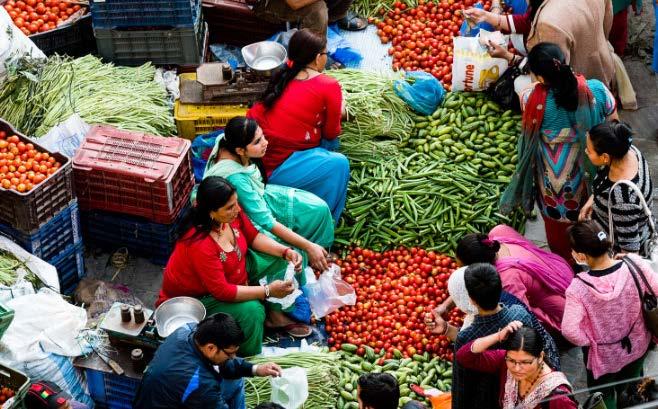
Financial Market
During the review period (March 1 to May 31, 2026), based on the nine months’ data of FY 2025/26 AD (2082/83 BS), Nepal's Balance of Payments (BoP) recorded a surplus of NPR 731.16 billion (USD 4.88 billion), reflecting continued strength in the external sector supported by high remittance inflows and comfortable foreign exchange reserves. Nepal Rastra Bank (NRB), through the third quarter review of the monetary policy, maintained its flexible monetary policy stance, citing inflation and foreign exchange reserves remaining within target despite low economic growth. However, domestic financial challenges persisted, as weak private sector borrowing and rising non-performing loans continued to limit credit expansion and keep excess liquidity within the banking system. While accommodative policy measures have supported financial stability and investor confidence, structural weaknesses in productive sector lending and cautious market sentiment continue to constrain broader economic recovery.
Third Quarter Performance Analysis of Commercial Banks670
As per the unaudited thirdquarter results of commercial banks for FY 2025/26 AD (2082/83 BS), the operating profit of commercial banks increased by 11.69%, while net profit grew by 19.30% compared to the same period in previous FY 2024/25 AD (2081/82 BS).
In the third quarter of FY 2025/26 AD (2082/83 BS), Nabil Bank reported the highest net profit of NPR 6.76 billion (USD 45.08 million), followed by Global IME Bank with NPR 4.40 billion (USD 29.35 million) and Kumari Bank
with NPR 4.18 billion (USD 27.88 million). Additionally, compared to the same period in the previous FY 2024/25 AD (2081/82 BS), Kumari Bank recorded the highest year-on-year growth in net profit of 1,361.76%, reaching NPR 4.18 billion (USD 27.88 million). Meanwhile, NIC Asia Bank recorded the lowest net profit of NPR 140.32 million (USD 0.94 million).
In terms of reserves and surplus, Rastriya Banijya Bank led with NPR 39.09 billion (USD 260.70 million), followed by Nepal Investment Mega Bank (NIMB) with NPR 37.14 billion (USD 247.40 million), and Nabil Bank at NPR
Consumer Price Index (mid-April 2026) 4.47%
Gross Foreign Exchange Reserve (mid-April 2026) NPR 3.49 trillion (USD 23.55 billion)
Buying Exchange Rate per USD (mid-April 2026) NPR 148.07
Weighted Average 91-day Treasury Bill Rate (mid-April 2026) 2.61%
Weighted Average Interbank Transaction Rate (mid-April 2026) 2.75%
Weighted Average Deposit Rate (mid-April 2026) 3.40%
Weighted Average Lending Rate (mid-April 2026) 6.77%
Average Base Rate of Commercial Banks (mid-April 2026) 5.06%
34.40 billion (USD 229.43 million). Overall, eight banks surpassed the reserves and surplus industry average of NPR 19.38 billion (USD 129.25 million).
According to the third quarter data of the current FY 2025/26 AD (2082/83 BS), deposits at commercial banks grew by 15.90% compared to the corresponding period in FY 2024/25 AD (2081/82 BS). Global IME Bank mobilized the highest deposits of NPR 626.00 billion (USD 4.18 billion), followed by Rastriya Banijya Bank with NPR 597.96 billion (USD 3.99 billion) and Nabil Bank with NPR 578.35 billion (USD 3.86 billion). Meanwhile, Standard
Chartered Bank reported the lowest customer deposits at NPR 145.01 billion (USD 967.12 million).
Compared to the same period in the previous FY 2024/25 AD (2081/82 BS), Agriculture Development Bank recorded the highest deposit growth of 29.84%, reaching NPR 330.73 billion (USD 2.21 billion).
Total credit growth expanded by 5.92% compared to the same period in the previous FY 2024/25 AD (2081/82 BS). Nabil Bank held the largest loan portfolio of NPR 447.94 billion (USD 2.99 billion), followed by Global IME Bank at NPR 439.04 billion (USD 2.93 billion) and Nepal Investment Mega Bank (NIMB) with NPR 326.13 billion (USD 2.18 billion).
Meanwhile, Standard Chartered Bank had the lowest credit
disbursement of NPR 68.48 billion (USD 456.72 million).
Lastly, the average NonPerforming Loan (NPL) ratio of commercial banks increased to 5.25% from 4.83% in the same period last FY 2024/25 AD (2081/82 BS), while the average cost of funds declined to 3.53% from 4.60%. Similarly, the average base rate stood at 5.15% during the review period, down from 6.22% in the same period in FY 2024/25 AD (2081/82 BS). Citizen Bank International recorded the highest base rate at 6.32%, while Rastriya Banijya Bank had the lowest at 4.21%.
KEY INDICATORS
Some of the key banking sector indicators as per the Current Macroeconomic and Financial
Situation report published by NRB are highlighted below. These are based on the nine months’ data of FY 2025/26 AD (2082/83 BS) ending in mid-April of 2026 AD.671
Deposit and Credit Mobilization
The deposits at BFIs grew by 8.5% in the review period as compared to 5 .7% in the same period last FY 2024/25 AD (2081/82 BS). Among the total number of deposits, demand deposits, saving deposits and fixed deposits accounted for 7.0%, 45.3%, and 38.9% respectively. These proportions have experienced a change compared to a year ago when the respective shares were 5.7%, 35.8%, and 51.0%.
Figure 13. Deposit Mix at Banks and Financial Institutions by mid-April (Percentage Share)
Source: Current Macroeconomic and Financial Situation based on nine months’ data, Nepal Rastra Bank, FY 2025/26 AD (2082/83 BS)673
Similarly, in the review period, credit provided to the private sector by BFIs witnessed a rise of 5.7%, compared to the corresponding period last year. This increase contrasts with the nine months’ data of FY 2024/25 AD (2081/82 BS), where credit grew by 7.1%.
Additionally, BFIs witnessed an increase in outstanding loans to various sectors. The consumable sector witnessed a rise of 11.7%; construction sector increased 10.7%; the transportation, communication and public sector increased 10.1%; industrial production sector increased 6.5%; finance, insurance, and fixed assets sector increased 5.7%; the service industry sector increased 3.1%, while the agriculture sector decreased 2.3% compared to the nine months’ data of last FY 2024/25 AD (2081/82 BS).
Figure 14. Sectorwise Outstanding Credit of Banks and Financial Institutions (Amount in NPR billions)
Source: Current Macroeconomic and Financial Situation based on nine months’ data, Nepal Rastra Bank, FY 2025/26 AD (2082/83 BS)674
Compared to the corresponding period of last FY 2024/25 AD (2081/82 BS), trust receipt loans for import extended by BFIs increased by 32.0%, margin nature loan increased by 13.4%, hire purchase loan increased 8.5%. Moreover, real estate loans, including residential personal home loans extended by BFIs increased by 4.6%, followed by demand and other working capital loan at 4.3%, term loan at 3.7%, cash credit loan by 2.8%, and overdraft loan at 0.3%.
Liquidity Management
In the first nine months of FY 2025/26 AD (2082/83 BS), NRB absorbed a total liquidity of NPR 35.41 trillion (USD 236.16 billion) on transaction basis. This liquidity absorption consisted of NPR 2.31 trillion (USD 15.41 billion) through the deposit collection auction and NPR 32.90 trillion (USD 219.42 billion) through the Standing Deposit Facility (SDF) and NPR 200.00 billion (USD 1.33 billion) through NRB bond. NRB
also injected NPR 12.50 billion (USD 83.37 million) on turnover basis through Overnight Liquidity Facility (OLF). In conclusion, NPR 35.40 trillion (USD 236.09 billion) was absorbed through various monetary instruments in the review period. In the corresponding period of the previous year, NPR 17.18 trillion (USD 114.58 billion) net liquidity was absorbed through various instruments of monetary operations on transaction basis.
Moreover, NRB injected liquidity amounting to NPR 757.77 billion through the net purchase of USD 5.27 billion from the foreign exchange market. In comparison, in the corresponding period of the previous year, a liquidity of NPR 484.71 billion was injected through the net purchase of USD 3.62 billion.
Additionally, NRB purchased Indian currency (INR) equivalent to NPR 431.06 billion through the sale of USD 3.00 billion in the review period. Comparatively, in
the corresponding period last year, INR equivalent to NPR 386.81 billion was purchased through the sale of USD 2.84 billion.
Foreign Exchange Reserves and Adequacy
According to the nine months’ data of FY 2025/26 AD (2082/83 BS), the total value of foreign exchange reserves rose by 30.5% to NPR 3.49 trillion (USD 23.28 billion) in mid-April 2026, compared to NPR 2.68 trillion (USD 17.87 billion) in mid-July 2025. Moreover, the reserves held by BFIs, excluding the NRB, increased by 56.8% to NPR 412.32 billion (USD 2.75 billion) in mid-April 2026 from NPR 263.04 billion (USD 1.75 billion) in mid-July 2025. Within this, the proportion of Indian currency in the total reserves amounted to 20.4% as of mid-April 2026.
Table 7. Foreign Exchange Adequacy Indicators
Source: Current Macroeconomic and Financial Situation based on nine months’ data, Nepal Rastra Bank, 2025/26 AD (2082/83 BS)675
Additionally, based on the imports of the nine months of FY 2025/26 AD (2082/83 BS), the foreign exchange reserves of the banking sector have been deemed sufficient to cover approximately 21.8 months of prospective merchandise imports and 18.4 months of both merchandise and services imports.
Interest Rates
The weighted average rate for the 91-day treasury bills declined to 2.61% as of mid-April 2026 AD, compared to 3.06% in the
corresponding month of the previous fiscal year. Meanwhile, the weighted average interbank transaction rate among BFIs, which was 3% a year ago, decreased to 2.75% as of midApril 2026.
In the same period, the average base rate of commercial banks experienced a decrease, falling from 6.29% a year ago to 5.06% by mid-April 2026. Furthermore, the weighted average deposit rate and lending rate of commercial banks stood at 3.40% and 6.77% respectively. Comparatively, these rates were 4.45% and
8.22% respectively a year ago.
Balance of Payment
According to the nine months’ data of FY 2025/26 AD (2082/83 BS), ending in mid-April 2026 AD, the BoP was at a surplus of NPR 731.16 billion (USD 4.88 billion), which witnessed an increase of 111.17% compared to the corresponding period of the previous year, where the BoP was at a surplus of NPR 346.23 billion (USD 2.31 billion).
Key Highlights from the Third Quarter Review of the Monetary Policy 2025/26 AD (2082/83 BS) Published on May 15, 2026676
The average Consumer Price Inflation (CPI) for the third quarter stood at 4.47%, remaining within the NRB’s target of 5%.
The policy rate (repo rate) has been kept unchanged at 4.25%.
The deposit collection rate under the lower bound of the interest rate corridor has been maintained at 2.75%, while the bank rate under the upper bound has remained unchanged at 5.75%.
Key Highlights from the Third Quarter Review of the Monetary Policy
Both the mandatory Cash Reserve Ratio (CRR) and Statutory Liquidity Ratio (SLR) have been kept unchanged.
Nepal Rastra Bank (NRB) announced that the existing Standing Deposit Facility (SDF) arrangement will be reviewed to make the interest rate corridor more effective and systematic amid persistent excess liquidity in the banking system.
NRB projected Nepal’s economic growth rate at 3.85% for the current fiscal year based on preliminary estimates from the National Statistics Office (NSO), while acknowledging risks from weak domestic demand and global uncertainties, including tensions in the Middle East.
KEY DEVELOPMENTS
Government Introduces FDI Reforms to Ease Repatriation and Strengthen Investor Confidence
The Government of Nepal on May 29, 2026 introduced a key reform in the budget for FY 2026/27 AD (2083/84 BS) aimed at simplifying the foreign investment repatriation process, marking a significant step toward improving the country’s investment climate and attracting higher foreign direct investment (FDI).677 As per the latest fiscal policy announcement, foreign investors will now be able to repatriate capital, dividends, and profits through a more streamlined mechanism, with reduced bureaucratic requirements. A notable change is the removal of the requirement for prior approval from NRB whereby investors will now only need to notify the central bank after completing repatriation, significantly reducing procedural delays and uncertainty.678 The reform is part of a broader policy shift toward liberalizing foreign exchange management and aligning Nepal’s investment framework with global best
practices. It is expected to improve ease of doing business, encourage reinvestment, and strengthen investor confidence at a time when Nepal is actively seeking greater capital inflows to support economic growth and industrial expansion.679 Amid an evolving political environment and ongoing focus on economic reform ahead of elections, the policy also signals continuity in pro-investment reforms despite political transitions. Overall, the measure is likely to enhance Nepal’s attractiveness as an FDI destination, though its impact will depend on consistent implementation and broader macroeconomic and political stability.
NRB Eases SME Loan Capital Rules to Boost Productive Sectors
NRB introduced a key regulatory relaxation on April 6, 2026, lowering the risk weight to 60% on loans up to NPR 30 million (USD 200,080) extended to small and medium enterprises (SMEs).680 Incorporated via amendments to the Capital Adequacy Framework, this policy specifically targets SMEs operating in agriculture, information technology (IT),
and manufacturing. The Capital Adequacy Framework is a regulatory standard established to ensure that financial institutions maintain a sufficient cushion of capital to absorb unexpected losses and remain solvent during economic stress. By lowering the risk weight, banks and financial institutions (Class A, B and C) require less capital to back these loans, making SME financing structurally more attractive. The strategic move aims to counter a persistent credit slowdown in Nepal’s real sector by incentivizing banks to channel liquidity into productive, employment-generating, and import-substituting industries.681 However, to maintain financial stability, the central bank has also embedded strict risk controls. To qualify for the reduced risk weight, loans must meet stringent conditions including mandatory guarantees from the Deposit and Credit Guarantee Fund, or full collateralization via land and buildings with at least a 25% margin on fair market value. Also, projects must secure insurance coverage.682 Ultimately, this directive allows banks to rebalance portfolios without capital pressure while granting
vital credit access to SMEs to aid Nepal's economic recovery.
Government Delegates Excise Enforcement Powers to Strengthen Tax Compliance
The Government of Nepal introduced a regulatory amendment on May 29, 2026, granting excise-related enforcement powers to officials under the Ministry of Finance (MoF), marking a significant step toward strengthening tax administration and improving revenue compliance.683 The reform was approved as the third amendment to the Financial Procedures and Fiscal Responsibility Regulations. It is designed to enhance the government’s ability to monitor, regulate, and enforce excise duty collection more effectively, particularly in sectors prone to underreporting and tax leakage. Under the revised framework, designated finance ministry officials will now be empowered to carry out inspections, verify compliance, and take necessary enforcement actions related to excise duties. This decentralization of authority is expected to reduce procedural delays and improve onground monitoring, allowing for quicker identification and resolution of non-compliance cases.684 The move also aims to strengthen coordination between tax administration units and enforcement agencies, thereby improving overall fiscal discipline. The reform comes at a time when Nepal is focusing on revenue mobilization amid rising expenditure pressures. By expanding the operational authority of tax officials, the government seeks to
curb revenue leakages and enhance efficiency in excise administration. Over the medium term, the measure is expected to contribute to a more robust tax system, improved compliance culture, and stronger domestic revenue generation capacity.685
Banking Sector Speeds Up Branch Consolidation Amid Digital Shifts
In March 2026, nine commercial banks announced plans to merge a total of 137 branches, following regulatory flexibility introduced by NRB in its first quarterly review of the monetary policy for FY 2025/26 AD (2082/83 BS). The central bank permitted commercial banks in metropolitan areas to consolidate nearby branches, citing rising digital transactions, increased deployment of deposit machines, and declining in-branch customer activity.686 NIC Asia Bank is leading the consolidation with 44 branches to be merged across six metropolitan cities: Kathmandu, Lalitpur, Pokhara, Biratnagar, Birgunj, and Bharatpur, followed by Kumari Bank with 24, Nepal Investment Mega Bank with 18, Prabhu Bank with 14, Himalayan Bank and Global IME Bank with 8 each, Nabil Bank and Prime Bank with 7 each, and NMB Bank with 4.687 Bank executives note that foot traffic at physical branches has dropped sharply, with some branches that previously processed around 400 daily transactions now handling fewer than half that number. The current phase of consolidation is focused on metropolitan areas, though banks have indicated that similar mergers could expand to sub-metropolitan and municipal
levels subject to further NRB approval.688
Government Moves to Repeal 15 Laws in Major Economic Deregulation Push
On March 27, 2026, newly appointed Finance Minister Swarnim Wagle announced the outright repeal of 15 existing laws identified as barriers to economic growth, taking the decision immediately after assuming office at the Ministry of Finance.689 The move was framed as consistent with reform commitments made by the Rastriya Swatantra Party during the election. The laws targeted for repeal span several decades of accumulated legislation and include the Income Ticket Fee Act (2019 BS), the Black Marketing and Social Offenses Act (2032 BS), the Private Forest Nationalization Act (2013 BS), the Revenue Leakage Control Act (2052 BS), and the Foreign Investment Restriction Act (2021 BS), among others.690 Many of these statutes are considered outdated, legally redundant, or actively deterrent to private sector activity and foreign investment.691 Alongside the legislative repeals, Wagle announced the abolition of the Revenue Investigation Department, arguing it has undermined a business-friendly environment. The reform agenda also commits to implementing recommendations from the Public Expenditure Review Commission and the High-Level Economic Reform Commission and includes a planned white paper on the state of the economy.692
Outlook
A broad package of regulatory, financial, and governance reforms is laying out the groundwork for a more competitive and investment-friendly economy. Recent measures to simplify foreign investment repatriation, incentivize lending to small and medium enterprises, strengthen tax enforcement, and repeal outdated laws reflect a growing emphasis on private sector development and economic liberalization. These initiatives are complemented by governance and anti-money laundering reforms that seek to improve transparency, regulatory oversight, and institutional credibility. The financial sector is also undergoing structural transformation. Bank branch consolidation and increasing digitalization are expected to improve operational efficiency, while preferential capital treatment for SME lending could encourage greater credit flows to productive sectors such as agriculture, manufacturing, and information technology. Together, these developments have the potential to support investment, employment generation, and economic diversification. Despite the positive reform momentum, challenges remain. The IMF’s revised growth forecast of around 3% highlights persistent structural bottlenecks, subdued private sector activity, and external economic uncertainties. The ultimate success of these reforms will depend on effective implementation, institutional capacity, and policy continuity. As Nepal navigates an evolving political landscape, maintaining reform momentum and macroeconomic stability will be essential to translating policy changes into sustainable long-term growth.
Capital Market
During the review period, from March 1, 2026, to May 31, 2026, the secondary market recorded a growth of 4.04%, compared to the modest 0.37% growth during the previous quarter. The Nepal Stock Exchange (NEPSE) index remained volatile throughout the period, initially witnessing fluctuations in March before gaining strong momentum following the federal elections held on March 5, 2026. Improved investor sentiment after the elections contributed to a sharp rise in the market, although the surge also reflected speculative trading activity and heightened short-term volatility rather than purely fundamentals-driven growth. During the review period, the Securities Board of Nepal (SEBON) introduced several reforms aimed at improving market efficiency, transparency, and investor participation in NEPSE, which helped support market confidence. However, the leadership vacuum at SEBON created uncertainty among investors, contributing to a market downturn during April before the index recovered toward the end of the review period.
Table 8. Key Market Indicators
Secondary Market
During the review period, from March 1, 2026, to May 31, 2026, the NEPSE index closed at 2,782.10 points, reflecting a rise of 108.13 points (4.04%) with a peak on March 24, 2026, at 2,960.40 points. Within this, the total market capitalization at the end of the review period was NPR 4.75 trillion (USD 31.68 billion).697 Among the main indices, the Sensitive index increased by 3.43% to 475.51 points, while
15. NEPSE Movement Over the Review Period
Source: Nepal Stock
the Float Index rose by 2.61% to 188.96 points. In the sub-indices, the Banking sub-index increased by 6.39%, Development Banking sub-index by 3.80%, Hydropower sub-index by 12.77%, and Hotels and Tourism sub-index by 9.29%. Similarly, the Manufacturing and Processing sub-index recorded the highest growth of 22.60%, while the Trading sub-index increased by 3.30% and the Mutual Funds sub-index by 3.82%. Meanwhile, several sub-
indices registered a decline. The Finance sub-index decreased by 4.54%, Microfinance subindex by 0.64%, Life Insurance sub-index by 2.31%, Non-Life Insurance sub-index by 0.33%, Investment sub-index by 1.06%, and Others sub-index by 13.32%.
Figure 15 shows the daily changes of the NEPSE index during the review period.
Figure
Table 9. Public Issue Size of IPO-Approved Companies
Source: SEBON, Initial Public Offerings Approved
KEY DEVELOPMENTS
NEPSE Expands Price Bands, Extends Trading Hours, and Introduces After-Market Orders
Nepal Stock Exchange (NEPSE) has announced a comprehensive set of market reforms aimed at improving liquidity, price discovery, and trading efficiency. A key change is the expansion of the daily price movement limit for listed securities from 10% to 15%, allowing stock prices to respond more freely to market developments and reducing the likelihood of shares remaining locked at upper or lower circuit levels.700 To complement the wider price band, NEPSE has introduced a revised market-
Name of the company
wide circuit breaker mechanism. The new framework will temporarily halt trading when the benchmark index experiences significant intraday fluctuations, helping to contain panic-driven trading and maintain orderly market conditions. NEPSE has also extended the regular trading session from 11:00 AM–3:00 PM to 11:00 AM–4:00 PM, providing investors with an additional hour of trading. Pre-open and closing sessions have been adjusted accordingly to support smoother order execution.701 Another major reform is the introduction of an after-market order system. Investors will now be able to place buy and sell orders after the closing of the trading session, which will be queued
for execution on the next trading day.702 Orders entered through this facility can be placed within the revised 15% price band, enabling investors to react to market developments outside trading hours and improving market accessibility.703
Nepal Moves Closer to Margin Trading as NEPSE Approves Operational Framework
NEPSE has approved a comprehensive operational framework for margin trading, marking a pivotal shift toward modernizing Nepal's capital market. Endorsed by NEPSE's board, the system is expected to roll out shortly, pending minor technical upgrades by stockbrokers.704 Aligned
with SEBON's 2082 Directive, the framework establishes strict guidelines for investor due diligence, margin calls, settlement processes, and risk mitigation. Brokerage firms must secure formal NEPSE approval and renew their licenses annually to offer this leveraged trading facility. To protect the market, margin trading is restricted to financially robust companies. Eligible firms must have at least 2.5 million publicly floated shares, a net worth exceeding their paidup capital, and a two-year postIPO listing history with consistent profitability.705 If investors fail to meet maintenance margins, brokers can issue margin calls. Investors will then have seven days to restore funds before brokers can liquidate shares on the eighth day. While margin trading promises to boost market liquidity and align Nepal with international practices, it also introduces leverage-driven risks. Consequently, robust regulatory oversight and heightened investor awareness will be critical during the initial implementation phase.706
Capital Gains Tax Declared
Final
The government has officially announced that the capital gains tax on the sale of shares of listed companies will now be treated as a final tax, addressing a long-standing demand of capital market investors. The measure is expected to simplify tax compliance, provide greater certainty for investors, and enhance confidence in Nepal’s capital market.707 Presenting the national budget for the FY 2026/27 AD (2083/84 BS), the finance minister confirmed this
significant policy shift, ensuring that securities transactions will no longer be subject to additional layers of taxation. Previously, ongoing uncertainty regarding whether the capital gains tax was final or subject to further adjustments had been a recurring concern among market participants.708 A delegation of stock market investors had recently met with the finance minister to formally request this change, and the new budget delivers the assurances made during that meeting. Market stakeholders have welcomed the announcement. Broker representatives noted that the provision resolves a historical dispute and provides muchneeded clarity, which is expected to make the secondary market more active and dynamic. Analysts believe this reform will enhance investor confidence by improving the predictability of post-tax returns. Furthermore, treating the tax as final will significantly reduce compliance complexities for both individual and institutional investors, paving the way for long-term market growth and improved liquidity.709
Stricter Financial Scrutiny
for IPOs
SEBON has introduced a stringent framework to review the financial statements of companies planning Initial Public Offerings (IPOs). Effective mid-April 2026, these updated guidelines aim to enhance market transparency, protect public investors, and ensure only fundamentally sound companies can raise capital.710 Under the new rules, regulators will mandatorily scrutinize applicants if significant financial red flags appear. For
example, reviews are triggered if uncollected trade receivables exceed 75% of total revenue or if adjusting contingent liabilities drops a company's net worth to half its paid-up capital. Deeper forensic analysis will also apply to firms where related-party transactions make up over 30% of total assets, or where accounting policies are strategically altered merely to qualify for an IPO. Recognizing different business models, the framework includes sector-specific thresholds.711 The uncollected revenue limit is set at 75% for manufacturing but lowered to 50% for the hospitality industry. Furthermore, regulators retain discretionary authority to launch investigations based on formal grievances or internal assessments. While these tighter controls might temporarily slow down new listings, analysts expect the policy to significantly boost investor confidence, curb aggressive accounting maneuvers, and align local regulatory oversight with international best practices.712
Share-Backed Lending Surges 11% Amid Market Recovery
Lending against share collateral by banks and financial institutions has increased significantly during the FY 2025/26 AD (2082/83 BS), signaling a robust revival in stock market activity. According to recent central bank data, total share-backed loans reached NPR 156.15 billion (USD 1.04 billion) by the end of the seventh month of the current FY 2025/26 AD (2082/83 BS).713 This represents an 11% increase from the previous fiscal year, successfully injecting an additional NPR 15.45 billion (USD 103.04 million) into the equity market. The surge is
primarily driven by declining interest rates and improved market liquidity, which have encouraged investors to leverage their portfolios. Large-ticket loans exceeding NPR 10 million (USD 66,693) dominate the segment, growing by 10.9% to NPR 109.68 billion (USD 731.49 million) and highlighting the strong participation of high-networth investors. Furthermore,
Outlook
loans in the NPR 5 million (USD 33,347) to NPR 10 million (USD 66,693) bracket saw the highest growth rate at 15.5%, reflecting increased activity from mid-level retail investors.714 This financial momentum coincides with a broader equity market recovery. Following a brief period of political uncertainty triggered by the youth-led protests in September 2025, recent successful
parliamentary elections in March have restored clarity and investor sentiment. Consequently, both market indices and daily turnover are trending upward. Regulators continue to closely monitor this increased leverage as trading activity strengthens the postelection environment.715
Nepal’s capital market is entering a phase of accelerated structural change driven by simultaneous regulatory liberalization and tighter risk governance. NEPSE’s reforms, including wider daily price bands, extended trading hours, and the introduction of after-market order placement, are expected to improve liquidity and enhance price discovery. These changes will likely increase participation by allowing investors greater flexibility in responding to market developments, while circuit breaker mechanisms help preserve stability during periods of volatility. The approval of the margin trading framework marks another major shift toward market sophistication. By enabling leveraged investing under stricter eligibility criteria and defined risk controls, it is expected to boost trading volumes and deepen market participation. However, it also increases sensitivity to price swings, requiring strong oversight to prevent excessive risk accumulation. Investor sentiment is further supported by policy clarity on capital gains tax being treated as final, reducing uncertainty and improving post-tax return predictability. At the same time, stricter IPO scrutiny will likely slow listings in the short term but improve overall market quality. Rising share-backed lending signals improving liquidity but also highlights growing leverage in the system. Following recent political developments and elections, confidence is gradually recovering. Overall, the market outlook is cautiously positive, with stronger activity balanced by elevated risk management needs.
5
Special Section
Doing Business in Nepal: Decoding the New Governement's Actions and What They Mean for Business
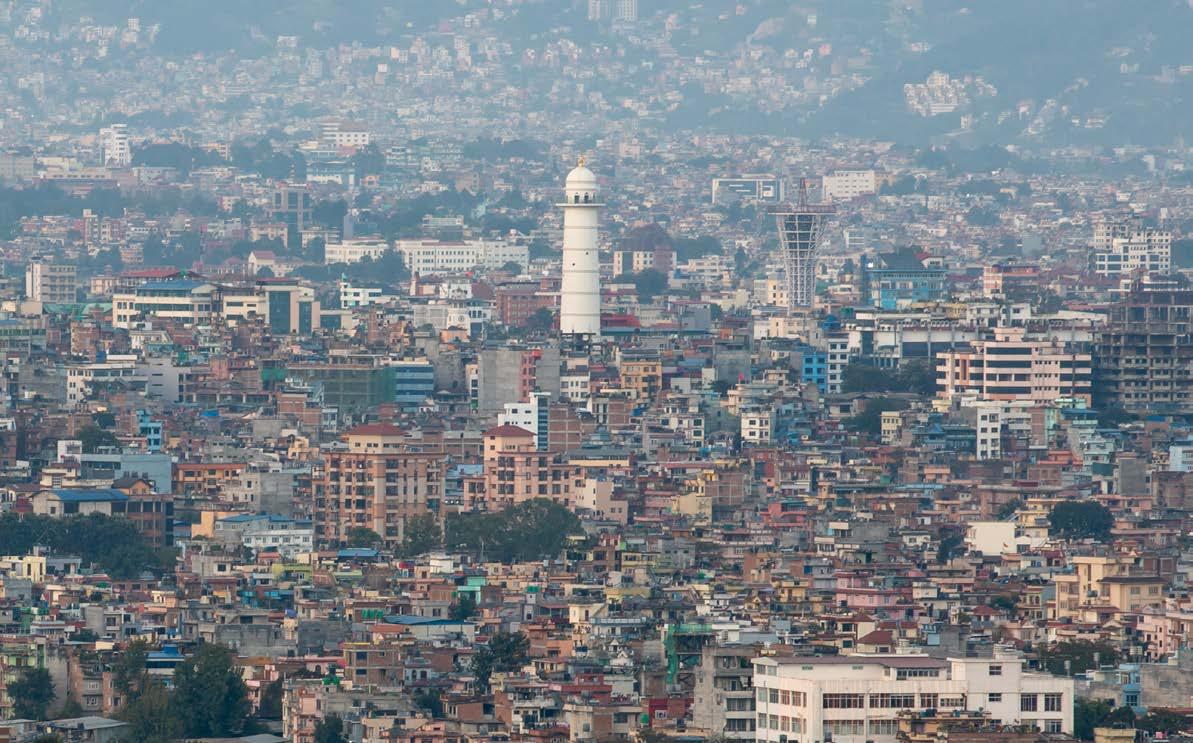
Introduction
Nepal entered its fiscal year 2026/27 AD (2083/84 BS) at an inflection point rarely seen in its political and economic history. The Rastriya Swatantra Party's (RSP's) landslide March 2026 election victory, born out of the Gen Z protests of September 2025, delivered the country's first single-party parliamentary majority since 1959. In the months that followed, the new government under Prime Minister Balendra Shah moved quickly to translate its campaign promises into governing architecture: a 100-point reform agenda, an overhauled investment approval system, and Nepal's largest-ever national budget. For businesses and investors, these developments raise a pressing question: does this moment of political consolidation translate into a genuinely more investible Nepal, and if so, where?
This Special Section of NEFport 65, "Doing Business in Nepal: Decoding the New Government's Actions and What They Mean for Business," brings together six perspectives that examine this question from complementary angles, moving from the RSP's founding vision through its early governing record to the granular, sector-by-sector implications of its first budget.
• "Nepal at a Crossroads: Reading the RSP's Reform Agenda" by Manju von Rospatt (Research Fellow, Nepal Economic Forum) traces the RSP's reform vision as articulated in its election manifesto and 100-point Governance Reform Action Agenda, outlining the party's macroeconomic targets and its priorities across the private sector, digital economy, infrastructure, agriculture, tourism, and social welfare.
• "The RSP Government at 60 Days: Reform Delivery, Accountability, and the Budget's Strategic Signal" by Prasidha Sangat (Research Fellow, Nepal Economic Forum) assesses the government's first 60 days in office, distinguishing between reforms that required only executive will and those, such as constitutional amendment and accountability for the September 2025 protest deaths, that remain constrained by structural and political realities.
• "What Does Nepal's 2026 White Paper Mean for Investors?" by Aaryan Kuikel (Research Fellow, beed management) and Salina Kafle (People and Programs Coordinator, Nepal Economic Forum) unpacks the Ministry of Finance's Current Economic Status of Nepal 2026 report, examining what its findings on fiscal execution, financial depth, and investment climate mean for prospective investors ahead of the budget.
• "Nepal's FY 2026/27 AD (2083/84 BS) Budget: Growth Ambition Meets Fiscal Reality" provides a sectorby-sector breakdown of Nepal's largest-ever budget, covering the capital market, financial market, agriculture, infrastructure and real estate, ICT, health, tourism, education, environment, energy, and administrative reforms, with implications for businesses operating in each space.
• "Seven Key Issues for Economic Reform in Nepal" by Sujeev Shakya (Chair, Nepal Economic Forum) distills seven structural fault lines that have historically undermined Nepal's reform efforts, from the implementation gap and vested political financing to financial sector weaknesses and the capture of private sector bodies, arguing that political will alone cannot resolve challenges that require systemic change.
• "Getting Nepal to 7%: Three Reforms That Cannot Wait" by Arvind Nair (Lead Country Economist for Maldives, Nepal, and Sri Lanka, World Bank) sets Nepal's growth ambitions against its long-run divergence from comparator economies, proposing three interconnected reform pillars, business predictability, infrastructure and skills, and sector-specific catalytic investment, needed to sustain 7% growth.
Read together, these six articles suggest that Nepal's new government has built genuine reform architecture in a remarkably short span, from the Investment Board Nepal's one-stop portal to the FY 2026/27 AD (2083/84 BS) budget's Investment Express system and capital market liberalization. Yet each article, in its
own way, returns to the same caution: announcements and legal frameworks are not outcomes. Whether patronage removal holds, whether constitutional negotiations survive the two-thirds threshold, whether capital budget execution improves beyond its historic 12–32% range, and whether reform benefits reach beyond Nepal's urban middle class will determine whether this period marks a durable structural turning point or another chapter in Nepal's long history of ambitious but unrealized reform. For businesses weighing decisions in Nepal today, the articles in this section collectively argue that the coming fiscal year, not the reform announcements themselves, will be the real test.

Editorial Note: This article is an adaptation of and addition to the NEFtake “Nepal at a Crossroads: Reading the RSP’s Reform Agenda” published on March 30, 2026.
The Rastriya Swatantra Party’s (RSP’s) landslide victory in Nepal's March 2026 elections marks a turning point in the country's political landscape and economic trajectory. RSP’s victory emerged from the Gen Z protest of September 8-9, 2025, which culminated in the dissolution of parliament, the resignation of Prime Minister KP Sharma Oli, and the formation of an interim government under former Chief Justice Sushila Karki. The March snap elections where RSP won, following all of this, showed a popular verdict against a mode of governance characterized by impunity, institutional decay, and the capture of the state by partisan interests. The RSP tactfully captured the public appetite for change and disruption, securing 182 of 275 parliamentary seats, the best electoral performance by any single party since the Nepali Congress in 1959.
From Vision to Roadmap: Manifesto and 100-Point Plan
The RSP's expressed their reform vision across two complementary documents. First was the election manifesto, released in
Nepal at a Crossroads: Reading the RSP’s Reform Agenda
By Manju von Rospatt (Research Fellow, Nepal Economic Forum)
February 2026, which articulated the party's overarching policy philosophy and sector-by-sector priorities. And second was the 100-point Governance Reform Action Agenda, synthesized from across political parties and endorsed at the Cabinet's first sitting on March 28, 2026, then translated the vision into a timebound operational roadmap with specific deadlines.
Through the two documents, the RSP set ambitious macroeconomic targets: reaching a national GDP of USD 100 billion and per capita income of USD 3,000 within five to seven years, sustained by an annual growth rate of 7%, double the current growth rate. The new government envisions a modern, marketoriented, industrial, and digital Nepal, positioned as the engine of growth, job creation, and broader welfare gains. Thereby the articulated policy priorities focus on market-oriented reform, streamlining bureaucracy, improving governance, increasing investment in infrastructure, and supporting private sector development. Central to this effort is digitization, with plans including expanded digital public service delivery, one-stop service centers across government departments, digitized paperless administration, and the institutionalization of digital signatures.
These administrative reforms are underpinned by a broader anti-corruption agenda. In the manifesto, the RSP commits to acting on the findings of the judicial inquiry commission formed to investigate the use of force during the September Gen Z protests. Meritocracy is also a stated priority in the manifesto, with plans to eliminate partisan influence from government bodies and trade unions alike. In the economic sphere, the manifesto pledges to dismantle cartels, curb rent-seeking behavior, and address unfair competition in sectors such as transportation. Rounding out this agenda, the RSP pledges to turn its attention inward, introducing measures to regulate internal party governance.
Private Sector and the Digital Economy
In the realm of private businesses and the digital economy, the manifesto envisions a strategy focused on increasing productivity, expanding highvalue exports, and fostering the digital economy. Improving the ease of doing business is a recurring priority, supported by plans to introduce investmentfriendly policies, streamline administrative processes, and enable international payment gateways to better integrate domestic startups into the global market.
The 100-point plan operationalizes this vision with concrete mechanisms. A "Startup Fast Track" system is pledged to enable business registration within two days. A One Door Business Platform is pledged to help integrate business registration, tax, bank accounts, and all necessary permits within 45 days. A One Door Approval System under the Investment Board Nepal is to be operational within one month for foreign investors, while a National Structured Project Pipeline will classify all national projects by investment modality, public, Public-Private Partnership (PPP), private, or mixed, within 90 days, with the explicit aim of making projects "bankable" and accelerating capital mobilization. The PM Delivery Unit, established immediately under the Prime Minister's Office, operates a central dashboard for KPItracking across priority projects and ministries.
The RSP places the digital economy at the heart of its growth strategy, calling for investment in data centers, cybersecurity, and digitized public services to advance Nepal toward higher-value, exportoriented IT activities. The party envisions the IT sector as a key source of employment for young workers. The party also has ambitions to include the sale of high-value server processing time and the positioning of IT as a leading export industry. To enable this, the manifesto proposes labour law reforms, cross-border payment liberalization, digital nomad provisions, and expanded access to global payment gateways
Domestic Industry, Infrastructure, Agriculture, and Tourism
In parallel with its investment liberalization agenda, the manifesto places strong emphasis on building out domestic industrial capacity, with a particular focus on energy-intensive sectors. The RSP's industrial policy centers on mining, steel, cement, herbal processing, data server operations, and fertilizer production, with expanded use of wind and solar power to meet industrial energy demand.
The party also seeks to more actively commercialize land, forests, and environmental resources. This is planned through the streamlining of procedures related to environmental impact assessments, land acquisition, and infrastructure development. These measures will require the government to vigilantly and carefully balance its productionoriented goals with Nepal's environmental and climate commitments.
Infrastructure investment is identified as a clear cross-cutting priority. The manifesto calls for fast-tracking stalled national pride projects and launching ten new sector-diversified initiatives, including an international sports city, a higher education research center, specialized healthcare facilities, and cultural tourism infrastructure. Physical connectivity is to be enhanced through highway expansion, airport modernization, and the development of both crossborder and domestic railways, including the Mechi-Mahakali electric line and links to India
and China. Proposals also include integrating the use of digital technologies such as drones and satellite systems for forest fire management, AI-based traffic cameras, and GPS tracking of public vehicles.
The 100-point plan reinforces this agenda with a project management overhaul. It introduces Fast-Track Mechanisms for national priority projects to bypass chronic approval bottlenecks, establishes data-based end-to-end e-procurement monitoring within 90 days, and creates a dedicated Project Facilitation umbrella law within 60 days to resolve the multi-agency approval gridlock that has historically delayed infrastructure delivery by years.
Agriculture is presented in the manifesto as a core priority for production, trade, and food security. The RSP proposes a wide toolkit such as subsidies, import substitution, valueadded agro-industries, FinTech and AgriTech integration, and agricultural insurance to make farming more commercially viable and resilient. The 100-point plan adds operational specificity with minimum support price mechanisms for major food crops to be initiated within 30 days, a National Agricultural Market Information System to deliver daily price updates to farmers via SMS and digital platforms, and a "One Palika, One Cold Storage" program to begin with feasibility studies within ten days. The party's land use agenda, opening forest areas to broader economic uses and incentivizing consolidation of barren land, points toward a more marketoriented agricultural system,
though how the government reconciles this with ecosystem protection and climate obligations will be an important development to monitor closely.
In tourism, the government sets out an optimistic agenda of doubling tourist arrivals and per capita spending, while extending average length of stay within five years, reflecting confidence in tourism as a potential driver of growth and foreign exchange. The 100-point plan also outlines a plan to boost Nepal’s wellness tourism for “Nepal Wellness Year 2027” as well as studies on tourism in specific areas.
Social Welfare, Foreign Employment, and Diaspora Relations
On the social welfare front, the RSP’s manifesto has envisioned a shift away from Nepal’s current universally applicable social security entitlements toward a more targeted needs-based social security system. However, this was not articulated in the 100-point plan. The RSP pledged a redesigning of the social security system by creating a database to facilitate this process, particularly to reduce double benefits and potential misuse. How criteria are determined and how this will be implemented in practice as well as how civil society stakeholders will respond and engage on this matter will be a development to keep an eye on.
In terms of healthcare, the 100-point plan articulates reforms for a digitally integrated platform for tracking patient records, ensuring 10% of public and private hospital beds are free, monitoring and audits of government hospitals, affordable medicines, burn wards, and
air ambulances. In terms of education, the 100-point plan articulates ridding party interference in education, discontinuation of internal exams for students up to Class 5, streamlined publishing of exam results, and removal of citizen documents needed for university enrollment.
On the topic of foreign employment, the RSP’s manifesto makes claims for stronger regulation of recruitment or “manpower” agencies to curb fraud and exploitation, concessional loans for marginalized groups to finance migration, and targeted support for returnees through subsidies, market access, and technical assistance to foster entrepreneurship. It also envisioned an ID system for returnees to access selected government services at concessional rates. However, these are not articulated yet in the 100-point plan. Implicit within the RSP’s broader economic reform agenda is the expectation that as domestic opportunities expand, reliance on foreign employment will gradually decline.
With diaspora, the government positions the Nepali diaspora as a key driver of economic transformation, focusing on attracting both domestic and diaspora investment into priority sectors. The RSP manifesto proposes voting rights for NonResidential Nepalis and supports dual citizenship in principle, while removing administrative barriers around property ownership. To encourage diaspora investment, it plans to introduce legal protections, simplify the use of dollar accounts, and ensure easy repatriation of returns. The manifesto also aims to
better utilize diaspora expertise through a proposed “National Knowledge Bank,” linking global skills and knowledge with sectors like education, health, and industry in Nepal. In addition, it envisions Nepalis abroad acting as informal ambassadors to promote tourism, culture, and investment, helping strengthen Nepal’s global presence and soft power. However, the 100-point plan does not focus much on these elements of diaspora engagement. Rather, one of the 100 points articulates including diaspora finance for the energy sector in Nepal.
Looking Onwards
The 100-point plan and manifesto together envision an ambitious agenda for Nepal. The timelines are tight and independent analysts remain cautious on the feasibility. Nevertheless, from the perspective of the private sector, the party’s vision provides an encouraging roadmap for private sector growth, infrastructure investment, improved physical and digital connectivity, and expansion of the digital economy. RSP’s vision emphasizes expanding Nepal’s middle class, but without intentional inclusion of socially marginalized groups, such growth risks exacerbating existing socio-economic inequalities.
Whether the government’s plans survive contact with the structural realities of Nepal's federal polity, the capacity constraints of its civil service, and the political pressures that have historically derailed reform will be among the central questions for the Nepal Economic Forum to track across the quarters ahead.

The RSP Government at 60 Days: Reform Delivery, Accountability, and the Budget's Strategic Signal
Prasidha Sangat (Research Fellow, Nepal Economic Forum)
The previous section traced the RSP's path from campaign manifesto to governing agenda: an anti-corruption mandate, a 100-point governance reform plan, and a pledge to convert Nepal's Gen Z protest energy into institutional change. It also posed the question that follows from those promises. Would the RSP's reform plans survive the structural realities on the ground, the constraints on its civil service capacity, and the political pressures that have historically derailed reform? The first 60 days of the Balendra Shah government are the first empirical answer. The RSP's reform record so far is neither black nor white. It is something more useful: a map of where the RSP's reform capacity is strong, where it is thin, and where conditions for a genuine economic pivot are beginning to take shape.
This article is simply a snapshot of the 60 days of the government. For a more detailed understanding of what happened in the 60 days, please refer to the sectoral reviews in this edition of the NEFport as well as to NEF’s 100-point reform tracker.
What the First 60 Days Built
60 days in, the government's completed reforms share a common logic. They require
executive will, not crossinstitutional negotiation. Three examples show the pattern. Reducing federal ministries from 22 to 18 took a cabinet order.716 Publishing Nepal's first Business Process Re-engineering Implementation Guidelines took a directive from the Office of the Prime Minister.717 Removing over 1,200 political appointees from state-owned enterprises, universities, regulatory bodies, and media institutions took an executive ordinance.718 These actions show that the significance of the actions do not lie in their complexity but in what they signal: a government willing to act on commitments that previous administrations avoided because the political costs were unevenly distributed.
The appointment removals carry the deepest structural implications. Patronage networks in Nepal's public sector have historically operated as the infrastructure of coalition survival. The RSP, holding a single-party majority, does not need those networks to govern. Removing them is both a reform commitment and a rational political act. Depoliticization of public institutions may be more durable under this government than under any of its predecessors.
The Investment Board Nepal's (IBN) one-stop service portal, launched April 28, integrates 14 government agencies into a single digital platform covering the investor journey from proposal to approval.719 The core problem for investment in Nepal has not been the absence of approvals. It has been the multiplication of approval windows across agencies with no interoperability. A single digital platform reduces the points at which bureaucratic discretion can be exercised against an investor. That reduction, if the portal sustains its integration, is the most substantive improvement to Nepal's investment interface in recent memory.
The Asset Probe Commission's May 14 directive, requiring senior officials to disclose assets within 30 days, establishes a formal, time-bound transparency mechanism.720 This is structurally new. Previous anti-corruption drives in Nepal operated through ad hoc investigations of specific individuals. A blanket disclosure requirement with a fixed deadline applies pressure across the senior public service, not selectively. If enforced, it builds a baseline data set future accountability processes can reference.
These completed reforms share a second feature. They are all preconditions for what comes next. The patronage removal clears the appointments infrastructure for merit-based recruitment. The IBN portal creates the interface the budget's Investment Express system will later consolidate legally. The asset disclosure directive creates the transparency baseline the Asset Probe Commission's deeper investigation will require. The first 60 days built the architecture. The test is whether the government can now occupy it.
Where Reform Stalled
Not every commitment kept pace with these completed reforms. Digital governance is the clearest example. Plans to upgrade the Hello Sarkar (1111) grievance hotline, a citizen complaint line the Office of the Prime Minister has run since 2011, remain unconfirmed. The Nagarik app, the government's single mobile platform for citizenship, tax, and other official documents, was expanded to include birth and marriage registration data in April. However, government offices still demanded paper originals as of late as March.721
The gap in digital governance is not technical. Nepal's bureaucratic incentive structure has historically treated service discretion as a resource. Digital platforms that automate service delivery reduce that resource. Mandating adoption without restructuring the incentive removes the tool without addressing the motive. UNDP Nepal made this point on April 13, cautioning that the RSP's
one-stop pledge risks excluding citizens with limited digital access unless new platforms come paired with procedural change, not directives alone.722 This is compounded by the fact that the 100-point agenda lacks cybersecurity provisions despite its digital emphasis, exposing the entire digital layer to breach and data loss just as it expands.723
The Dalit institutional reform commitments reveal a deeper stall. Item 5 of the 100-point agenda promised more than a formal state apology to the Dalit community within 15 days of assuming office. It paired the apology with a reform program addressing Dalit communities' living conditions.724 RSP Chairman Rabi Lamichhane delivered the apology verbally in parliament on April 2, but no government notification of the reform program followed within the deadline. The institutional commitments have produced no visible output. An apology without institutional follow-through is a symbolic gesture. For communities long denied state recognition, that gap will be measured against the RSP's stated commitment to equity-cantered governance.
Constitutional Reform: Genuine Redesign and Its Constraints
The constitutional amendment process is the most consequential reform thread of the RSP's first 60 days that has not received adequate analytical attention. Item 4 of the 100-point agenda committed the government to preparing a discussion paper on amendment, a commitment the RSP set for itself, not one carried over from the previous parliament's unmet pledges.
The Cabinet formed a taskforce under Prime Minister Balen Shah's political advisor, Asim Shah, with representation from parties across the House.725 Its mandate is to consult experts and parties and draft a discussion document, not to amend the constitution itself. By May 25, it had surfaced 54 proposed agenda items.726 These include a directly elected executive president, a fully proportional parliament, restructured provinces, and overseas voting rights. Taken as a package, they represent a structural redesign of Nepal's governing architecture, not incremental adjustment.
The intent reflects genuine institutional reform logic. A directly elected executive would shift democratic accountability from coalition arithmetic to direct popular mandate, fundamentally altering the incentive structure for governance. A fully proportional parliament would eliminate the first-past-the-post component that has historically over-represented entrenched party networks. These changes, if enacted, would produce a governing system better aligned with the popular mandate that brought the RSP to power.
The binding constraint is the National Assembly. Constitutional amendment requires a twothirds majority in both houses and ratification by at least half of Nepal's seven provincial assemblies.727 The Nepali Congress holds the largest single opposition bloc in the National Assembly, 24 of 59 seats, and has not committed to the RSP's most transformative proposals.728 Its seat count alone can block the two-thirds threshold, though it is
not the RSP's only obstacle in the upper house. The amendment discussion paper, due in late June 2026, will be the first concrete test of the RSP's negotiating capacity beyond its lower house majority. Overseas voting rights are the likeliest bridge item. Unlike the presidential system question, they carry a decadeold Supreme Court directive to enfranchise Nepalis abroad and cross-party pressure from the Gen Z movement.729 That reform depends on administrative capacity more than ideology, which may draw floor votes from parties that reject the RSP's broader design. The implication is direct: the reform agenda's success depends less on RSP intent than on its willingness to sequence concessions and secure consensus.
Accountability: A Structural Dilemma
When it comes to the accountability for the September 2025 protests, which was the driving force behind the entry of the RSP into power, the actions by the new government seem to lack a structural form. Accountability for the September 2025 protest deaths began with the protests themselves. Security forces killed dozens of demonstrators on September 8, 2025, prompting then-Prime Minister KP Sharma Oli's resignation the next day. Interim Prime Minister Sushila Karki formed a commission on September 21, 2025, under former Special Court judge Gauri Bahadur Karki, to investigate both days of violence.730 The Commission's 1,000-page report, submitted March 8, assigned primary institutional blame
for 77 deaths to Nepal Police and the Armed Police Force, clearing the Nepal Army.731 The findings triggered arrests: former energy minister Deepak Khadka remanded multiple times, former PM Oli detained and released on April 9, and arrest warrants issued against former PM Sher Bahadur Deuba and former FM Arzu Rana Deuba on April 8.732 The Supreme Court issued an interim order on May 25 barring the Deuba couple's arrest pending a constitutional hearing.733
The picture is more structurally complicated than the arrests suggest. On May 27, the National Human Rights Commission, a constitutional body working independently of the Karki Commission, publicized its own findings on the same two days.734 Its list of individuals whose conduct warrants scrutiny extends beyond those the Karki Commission named. Significantly, it implicated Gauri Bahadur Karki himself, the Commission's own chair, over social media posts made during the September events. This creates a direct conflict of interest at the center of the accountability process. If the government implements the Karki Commission's findings and leaves the NHRC's findings on figures tied to that Commission unaddressed, it converts a rule-of-law narrative into a political neutralization exercise. That distinction matters for democratic legitimacy and for the investment environment. Credible, non-selective accountability builds stronger institutional foundations for longterm private investment than accountability applied unevenly.
The Budget as Strategic Signal
On May 29, 2026, the new government also announced its first budget, the fuel for its reform plans. Finance Minister Swarnim Wagle's FY 2083/84 BS budget is Nepal's largest in history at NPR 2.12 trillion, and it sets a 7% GDP growth target with private sector investment at its center.735 As it allocates funds for the RSP's reform agenda, it connects directly to the architecture the first 60 days built. Together, they sketch the private sector pivot the RSP's broader agenda has been building toward.
Building on that IBN foundation, the Investment Express one-stop system, to launch within three months of the budget's passage, extends its logic further.736 The portal was the proof of concept: 14 agencies on a single platform. The Investment Express is the legal consolidation: projects the Investment Board approves will no longer need separate approvals from other government bodies. This eliminates what investors call Nepal's second-window problem, where IBN approval was followed by a fresh approval queue at the agency level. Removing that second window restructures the fundamental transaction between the state and foreign capital, among the most meaningful single measures Nepal could take to reduce the cost of investment entry.
The commercial dispute resolution legal framework provision is underappreciated relative to the attention the portal and approvals have received. Nepal has no independent commercial court and no
specialized arbitration framework aligned with international standards. This absence has been among the most persistent structural deterrents to foreign direct investment. The budget's commitment to that legal infrastructure signals an understanding that investment climate reform is not only about reducing entry friction. It is equally about the credibility of contract enforcement and exit options. Without enforceable dispute mechanisms, reduced entry barriers lower friction without addressing the risk calculus that deters long-term capital.
The 7% growth target is the most demanding of the three provisions. Capital budget execution stood at only 12.1% in the first half of FY 2026.737 The
chronic concentration of public spending in the final months of the fiscal year has consistently meant that ambitious budget allocations produce limited productive investment. Achieving 7% growth requires capital budget execution to improve substantially and private investment to compensate for the gap public underspending creates. The budget addresses the supply side of investment: reducing friction, improving legal infrastructure, streamlining approvals. Execution remains the government's most persistent structural challenge.
Nepal at a Structural Inflection Point
Reform delivery, constitutional negotiation, contested accountability, and a budget
built around private investment all bear on one question. The RSP holds a parliamentary majority no government has held since 1959. Whether its capacity for fast announcements translates into the slower work of execution, meaning ordinances ratified, asset disclosures enforced, the digital governance gap closed, and the amendment negotiated rather than imposed, will determine whether the first 60 days mark Nepal's structural turning point or its most sophisticated reform cycle to date.


Economic Snapshot738
What Does Nepal's 2026 White Paper Mean for Investors?
Aaryan Kuikel (Research Fellow, beedmanagement) & Salina Kafle (People and Programs Coordinator, Nepal Economic Forum)
On April 27, 2026, Finance Minister Swarnim Wagle presented the Current Economic Status of Nepal 2026 (White Paper), a status paper prepared by the Ministry of Finance that provides a factual overview of Nepal's macroeconomic and social condition to inform policy priorities, to the parliament. The report painted a picture of an economy marked by modest progress. With 4.2% average annual Gross Domestic Product (GDP) growth over the past decade, the White Paper documents that, as of FY 2024/25 AD (2081/82 BS), Nepal's economy is undergoing premature de-industrialization, with the services sector dominating at 62% of GDP while industry has shrunk to 12.8% and manufacturing contributes a mere 5.4%. Agriculture, despite employing 62% of the population, contributes only 25.2% to GDP, with productivity remaining below the South Asian average.
On the international stage, Nepal has been on the Financial Action Task Force (FATF) Grey List since February 2025 with 16 reform areas identified. This
designation flags weaknesses in a country's anti-moneylaundering and counter-terrorist financing controls, alongside increased scrutiny on crossborder financial transactions. The country holds a Fitch credit rating of BB- (double B minus) at speculative grade, scores 34 out of 100 on Transparency International's Corruption Perceptions Index ranked 109th out of 182 countries, and carries a Human Development Index (HDI) of 0.622 ranked 145th out of 193 countries. Nepal is scheduled to graduate from the Least Developed Country (LDC) status in November 2026, but at a per capita Gross National Income (GNI) of USD 1,404 (NPR 210,516), the transition risks stripping Nepal of critical trade concessions before its economy is ready.
The savings and investment picture is equally concerning. Domestic savings average only 8.5% of GDP against an investment requirement of 33.9%, creating a wide financing gap. Private sector investment has dropped sharply from 19.6% to 14.7% of GDP post-COVID, and total investment has fallen from 39.5%
to 28.1%, despite the availability of national savings, signaling that the business environment itself is the constraint. On the fiscal side, revenue mobilization has consistently undershot the annual targets set in the national budget, achieving only 87.6% of those targets over the decade. Furthermore, revenue growth has halved to 8.7% postCOVID from 14.9% prior to the pandemic, and approximately 45% of tax revenue is importdependent, making the fiscal position structurally vulnerable to external shocks. Around 40% of the economy remains informal and untaxed. Capital expenditure accounts for only 19% of total spending, with just 64.1% of capital allocation spent, and the federal consolidated fund stands negative by NPR 117 billion (USD 780.4 million). Public debt has nearly doubled over the decade from 22.5% to 43.8% of GDP, with debt repayment consuming 24% of total expenditure and 35% of all revenue. Arrears across all three tiers of government have reached NPR 7.33 trillion (USD 48.89 billion), a figure that reflects systemic fiscal stress rather than isolated shortfalls.
The financial sector shows a similarly mixed picture. Private sector credit at 91.6% of GDP is the highest in South Asia, yet NPR 9 trillion (USD 60.02 billion) in excess liquidity sits idle at Nepal Rastra Bank (NRB), as banks have money but cannot find creditworthy borrowers. Non-performing loans have risen to 5.42%, and Foreign Direct Investment (FDI) over the entire decade amounts to just USD 1.13 billion (NPR 169.43 billion), representing a mere 0.2% of South Asia's total. The trade deficit averages 29.7% of GDP, with exports covering only 14.8% of imports. The external position is kept afloat almost entirely by remittances, which grew 37.7% in eight months of FY 2025/26 AD (2082/83 BS) to NPR 1.449 trillion (USD 9.67 billion) and equal 28.2% of GDP, with foreign exchange reserves at USD 23.08 billion (NPR 3.46 trillion) covering 18.5 months of imports. On the positive side, digital payments are booming. During a single month of Falgun 2082 (mid-February to midMarch 2026), NPR 540 billion (USD 3.60 billion) was transacted via mobile banking, reflecting rapid adoption of phone-based transfers and bill payments. Similarly, insurance access has reached 49.92%, and the banking sector has consolidated from 178 to 106 institutions through mergers.
Infrastructure has also improved, with blacktopped roads growing from 11,798 km in 2072 BS (2015 AD) to 20,202 km by 2082 BS (2025 AD). Furthermore, basic water access stands at 96.85%, and internet subscriber density exceeds 144%, reflecting that many users hold multiple
Subscriber Identity Module (SIM) cards or connections. However, rural broadband remains very weak and high-quality water access is available to only 28.5% of the population. Meanwhile, energy is a genuine bright spot, as installed electricity capacity has grown sixfold to 4,105 Megawatt (MW), access has reached 99% of the population, and Nepal is now a net electricity exporter, though transmission bottlenecks and dry season import dependence remain unresolved. Human development indicators have improved, with literacy (above the age of 6) rising from 58% in 2011 AD to 76.3% in 2021 AD, maternal mortality falling dramatically from 539 to 151 per 100,000, and the doctorto-population ratio improving from 1 to 3,975 to 1 to 735. Yet youth unemployment stands at 22.7%, the education-to-market skills mismatch is worsening, the health insurance system is in crisis with unpaid claims forcing hospitals to halt services, and 20.27% of the population, around 6 million people, remain below the poverty line. With 839,000 labor permits issued in a single fiscal year, workforce outflow at scale continues. Looking ahead, the government targets 7% GDP growth, per capita income exceeding USD 3,000 within five to seven years, and an economy approaching USD 100 billion, anchored by expanding electricity capacity to 15,000 MW, modernizing agriculture, growing the digital economy, and channeling remittances into productive investment.
What Nepal's Economic Snapshot Means for Investors
In Nepal, the energy sector
has seen the most significant shift over the past decade. The Electricity Act of 1992 AD ended the monopoly of the Nepal Electricity Authority (NEA) and opened the sector to private participation.739 Over the years, this has helped Nepal expand generation capacity and access. The installed capacity, which stood at 855.89 MW in FY 2015/16 AD (2072/73 BS) has now exceeded 4,000 MW in 2026 AD.740 The Independent Power Producers (IPPs) contribute over 80% of this installed capacity.741 Load shedding across Nepal has largely disappeared.742 Further, at 99%, electricity access is nearuniversal.743 Since FY 2023/24 AD (2080/81 BS), Nepal also became a net exporter of electricity and in FY 2024/25 AD (2081/82 BS) Nepal exported electricity to India and Bangladesh worth NPR 17.45 billion (USD 116.41 million)744
Recent reforms in 2026 AD sought to further liberalize Nepal's electricity market and address long-standing sectoral bottlenecks. In January 2026, the Electricity Regulatory Commission (ERC) issued the Directive on Open Access in Electricity Transmission and Distribution System, 2026 AD (2083 BS).745 This established a framework that allows eligible producers, traders, and large consumers to access transmission and distribution networks on a non-discriminatory basis upon payment of prescribed charges.746 The directive is expected to facilitate direct electricity sales, expand private sector participation in power trading, and support domestic and cross-border electricity markets. In April 2026,
the Ministry of Energy, Water Resources and Irrigation followed with a 32-point directive aimed at addressing implementation bottlenecks.747 The directive instructed the ERC to determine wheeling charges for open access, directed the NEA to classify and resolve pending issues related to Power Purchase Agreement (PPA), proposed extending the license period for reservoir-based hydropower projects to 50 years, and required the availability of grid evacuation infrastructure prior to the issuance of new construction licenses.748
Building on these reforms, the FY 2026/27 AD (2083/84 BS) budget announced plans to allow private sector participation in international electricity trading, including private transmission infrastructure and crossborder energy markets through wheeling charge mechanisms, allowing private producer or trader to pay a regulated fee to use the national grid's existing transmission and distribution lines to move electricity to a buyer, without needing to build its own dedicated transmission network.749 These reforms suggest a broader policy direction toward a more competitive and marketoriented electricity sector.
Human Capital
If Nepal has one undeniable advantage, it is the vitality of its young population. With a mean age of just 29.4 years, a median age of 26, and a working-age population share of 65.2% in 2021 AD, Nepal is, at its core, a young nation with youth as its most valuable asset.750
For businesses and investors, this demographic profile is not just encouraging, it is a genuine structural advantage as this is a generation that has grown up online, fluent in technology, comfortable with change, and hungry for opportunity. They are quick to adapt, eager to learn new skills making natural innovators in a world being reshaped by digital tools, Artificial Intelligence (AI), and global connectivity.
This potential already shows in global rankings, with the 2026 Global Outsourcing Talent Index placing Nepal 19th out of 193 countries in outsourcing competitiveness, with standout scores in labor cost competitiveness (96/100) and English proficiency (80/100), outperforming the United States (US), Germany, Japan, and 25 of 27 European Union (EU) states.751
With nearly two-thirds of Nepal's citizens in the prime years of their productive lives, the challenge, and the opportunity, is building the systems, training, and jobs worthy of this potential.
Digital Economy and Financial Services
Nepal's digital economy has expanded rapidly in recent years, supported by broadband penetration exceeding 146% of the population.752 Mobile banking transactions reached NPR 5.96 trillion (USD 39.75 billion) in FY 2024/25 AD (2081/82 BS), up from NPR 3.45 trillion (USD 23.01 billion) in FY 2023/24 AD (2080/81 BS), a 72% increase in a single year.753 Building on these advancements, on the credit access front, NRB has recently allowed Micro, Small, and Medium
Enterprises (MSMEs) to access collateral-free working capital loans of up to NPR 500,000 (USD 3,335) for short-term needs and up to NPR 1 million (USD 6,671) for long-term working capital requirements, broadening formal financial access for smaller businesses.754 Together, these trends point to a deepening digital financial services market with meaningful growth potential.
Remittances and Consumer Demand
Remittances anchor Nepal’s domestic demand. In FY 2024/25 AD (2081/82 BS), Nepal's workers’ remittance as percentage of GDP stood at 28.2%.755 These inflows create a stable consumer demand base supporting retail, housing, financial services, Fast-moving consumer goods (FMCG), and digital platforms in Nepal. However, with the workforce heavily concentrated in the West Asia (75% of all Nepali workers), Nepal faces a meaningful concentration risk, as any regional disruption transmits directly into consumer demand, financial sector deposits, and fiscal revenues.756
Fiscal Execution and Public Management
On the macroeconomic front, Nepal's buffers are notably strong. Foreign exchange reserves stand at USD 24.19 billion (NPR 3.63 trillion) as of mid-May, 2026, sufficient to cover prospective imports for 19.2 months.757 This figure is well above the traditional benchmark of 3 months.758 According to the April 2026 Nepal Development Update, the World Bank maintains Nepal at low risk of debt distress,
with public debt at moderate levels of GDP.759 Together, these indicators provide meaningful macroeconomic reassurance in a frontier market context.
Fiscal execution, however, is a systemic weakness. With one month remaining for the completion of the FY 2025/26 AD (2082/83 BS), the government spent only 32.53% of the amount allocated for development projects.760 Further, the federal consolidated fund remains negative at NPR 117 billion (780.31 million), reflecting a persistent gap between revenue collection and expenditure.761
These execution weaknesses are compounded by poor financial accountability. The Office of the Auditor General's 63rd annual report outlines cumulative outstanding arrears to NPR 755.17 billion (USD 5.04 billion) across 5,526 public offices, with NPR 88.09 billion (USD 587.50 billion) irregularities in FY 2024/25 AD (2081/82 BS) alone.762
Investment Environment, FDI, and Global Compliance
The investment environment in Nepal is deeply challenged. Private sector investment has fallen from 21.7% of GDP in FY 2020/21 to 14.7% in FY 2024/25.763 This is not for lack of capital, as deposits at Banks and Financial Institutions (BFIs) have crept near NPR 8 trillion (USD 53.35 billion) as of mid-May 2026, pointing instead to a lack of investor confidence.764
A similar pattern holds at the regional level. In 2024, South Asia received USD 34.57 billion (NPR 5.18 trillion) in FDI inflows, of which Nepal received a mere USD
57 million (NPR 8.55 billion).765 A considerable discrepancy also exists between approved FDI and actual net FDI inflows received by Nepal. Between FY 1995/96 AD (2052/53 BS) and FY 2023/24 AD (2080/81 BS), actual net FDI inflows amounted to only about 31.9% of total approved FDI.766 Six investment summits held between 2017 and 2026 have consistently failed to either convert pledges into capital or lift Nepal's share of regional FDI inflows beyond a negligible fraction.767
Nepal's Fitch rating of BB(speculative grade), a Corruption Perception Index score of 34/100, and FATF Gray List status since February 2025 collectively deter foreign investors.768
Strategic Outlook
Nepal's economy presents two parallel truths. Its genuine strengths include its energy sector, a young and globally competitive workforce, an accelerating digital economy, and a durable remittancebacked consumer base. These coexist with equally real frictions, including chronic fiscal underdelivery, idle capital amid weak investor confidence, a decade of negligible FDI, and FATFdriven compliance risk. Neither narrative cancels the other. The National Budget of FY 2026/27 AD (2083/84 BS), unveiled roughly ten weeks after the White Paper, reads as Nepal's policy answer to these diagnostics.
Success in Nepal is unlikely to come from entering broadly across the economy. It is more likely to come from sectorspecific clarity, namely energy,
Information Technology (IT) outsourcing, digital finance, and remittance-linked consumer businesses, paired with longterm local partnerships and active management of regulatory delay. The budget's provisions for NEA restructuring and cross border power trading build on electricity liberalization in the energy sector, while simplified approvals and easier repatriation aim to address the investment confidence gap constraining private capital.
New instruments introduced in the budget, including a Sovereign Wealth Fund and a Remittance Investment Matching Fund, target the idle liquidity and remittance dependence described above, aiming to mobilize both toward productive investment. Whether these measures can close the execution gap the White Paper identifies is the question the budget analysis below takes up.
With the new government now targeting 7% GDP growth against a current trajectory of just 3.5%, closing this gap requires converting Nepal's genuine advantages into sustained investment. Nepal has not been an easy market. But it offers genuine, largely untapped opportunities. The newly formed government is actively engaging with these structural hurdles through regulatory intervention and policy commitments, signaling its intent to make Nepal a more investible economy.
Nepal's FY 2026/27 AD (2083/84 BS) Budget: Growth Ambition Meets Fiscal Reality
The NEF Team
Ankit Ghimire (Editorial Assistant, Nepal Economic Forum); Ashley Dangol (Research Intern, Nepal Economic Forum); Isham Sapkota (Research Intern, Nepal Economic Forum); Manju von Rospatt (Research Fellow, Nepal Economic Forum); Prasidha Sangat (Research Fellow, Nepal Economic Forum)
On May 29, 2026, Finance Minister Swarnim Wagle laid out Nepal's federal budget for Fiscal Year 2026/27 AD (2083/84 BS) before a joint session of parliament. It is a budget that broke new ground as the largest in the country's history. In his speech, Wagle framed the country as standing at a decisive crossroads of economic reform, arguing that the preceding period of political turmoil had finally given way to stability, and the budget focuses on sweeping administrative reforms, tax relief, and structural consolidation. The total budget size is set at NPR 2.124 trillion (USD 13.85 billion), reflecting an 8.1% increase from the previous
fiscal year's allocation of NPR 1.96 trillion (USD 12.80 billion).769
But size alone doesn't tell the full story. To what degree does this budget move beyond ambitious rhetoric to fund the government's reform agenda, and where, in practice, does the money flow once the words on paper meet fiscal reality?
This analytical piece examines the budget by sector, breaking down what this may mean for businesses in Nepal. Starting from a big picture overview, the article then provides a sectoral analysis aligned with the rest of NEFport 65’s sectoral reviews.
Overview of the Budget
Of the total NPR 2.124 trillion budget (USD 13.85 billion), recurrent expenditure claims the largest share, followed by capital and financing expenditure, as shown in Table 1. To fund this, the government is banking on higher revenue mobilization and foreign grants, as shown in Table 2. Even so, spending continues to outpace income: the resulting deficit is wider than last year's, bridged through a mix of domestic borrowing and foreign loans.
Table 1. Budget Financing and Revenue Overview
Table 2. Budgetary Priorities across Sectors
Table 3. Expenditure Type and Allocations with Year-on-Year Comparison
Additionally, Finance Minister Wagle introduced several sweeping changes aimed at modernizing the economy and streamlining bureaucracy. The individual income tax exemption threshold has been doubled to NPR 1 million.770 Moreover, customs were simplified into a 7-slab system.771 Minister Wagle also announced plans to establish a “Sovereign AI Compute Center” in Syuchatar to provide affordable AI computing power to
local startups.772 The budget also seeks to rationalize the public sector. 31 government boards, committees, and other public bodies are to be abolished, while 6 overlapping institutions will be merged to reduce administrative duplication and improve efficiency.773 In the energy sector, the Nepal Electricity Authority (NEA) will be unbundled into three specialized entities responsible for electricity generation, transmission, and distribution
and trading, respectively.774
Financial devolution continues to grow, with total fiscal transfers to provincial and local governments reaching NPR 600 billion (USD 4 billion) (an increase from last year’s NPR 582.8 billion (USD 3.89 billion)). An additional NPR 175 billion (USD 1.14 billion) is allocated for revenue sharing between the two sub-national tiers.
Capital Market
The FY 2026/27 AD (2083/ 84 BS) budget introduces a significant package of reforms aimed at deepening Nepal’s capital market and broadening investor access. On market structure, the Nepal Stock Exchange (NEPSE) will undergo formal restructuring.775 Intraday trading, short selling, and derivatives will be introduced in phases.776 These instruments expand the toolkit for risk management and price discovery. They also create conditions for greater institutional participation. However, regulatory capacity and investor literacy remain limited and needs to be developed in parallel for these tools to function effectively. The budget also signals a firmer stance on market integrity. A zero-tolerance policy against share cornering and insider trading has been announced.777 This addresses a long-standing concern for both domestic and foreign investors.
New securities supply is also planned. The government will
divest a portion of Nepal Telecom shares while retaining 66%, ensuring it remains the majority shareholder. The remaining 34% of shares will be offered to investors with the sale targeted for completion by mid-January 2027.778 National Life Insurance Company and Bishal Bazar Company will conduct public share issuances for the first time.3 Private hydropower developers will be permitted to offer up to 40% of shares to the public from a project’s first year.779
NEPSE-listed companies will be permitted to issue Global Depositary Receipts (GDRs), a negotiable financial instrument issued by a bank that represents shares in a foreign company, allowing that company's stock to be traded on international stock exchanges without a direct listing there, enabling capital raising in international markets.780 Non-Resident Nepalese (NRNs) will be allowed to participate in the secondary market, with laws governing investment
What this Means for Doing Business in Nepal
approval, profit repatriation, and capital gains tax to be amended accordingly.781 Hedging services will be formally introduced, allowing investors to protect their portfolios against potential losses, hedging services mark a shift toward more sophisticated risk management tools in Nepal's capital market782 Capital gains tax will be treated as a final withholding tax: 5% for holdings above 365 days and 7.5% for shorter periods.783
One structural risk warrants attention. The government plans to raise NPR 410 billion (USD 2.67 billion) through domestic borrowing.784 This may crowd out private capital, placing upward pressure on interest rates and reducing banking system liquidity. If unmanaged, it could dampen private-sector investment in the securities market and partially offset the reforms outlined above.
The phased introduction of intra-day trading, short selling, and derivatives marks a structural shift in NEPSE's market design. Combined with GDR access for Nepali companies and a stable capital gains tax rate, these measures open new financing channels and signal policy continuity to institutional investors.
State divestment of National Life Insurance, Bishal Bazar, and a portion of Nepal Telecom injects new equity supply. The Nepal Telecom proceeds, earmarked for tech hub development, directly link capital market activity to the digital economy agenda.
Simplified cross-border investment arrangements for Nepali citizens and NRNs, alongside planned hedging services, reduce repatriation risk for diaspora capital. Taken together, these provisions extend the IBN one-stop portal's investment climate logic into the financial sector.
Financial Market
The FY 2026/27 AD (2083/84 BS) budget positions the state as a more active shaper of Nepal’s financial system, pairing balance sheet clean up with financial inclusion and digital innovation. The government will establish a National Asset Management Company by mid January 2027 to take over non performing loans and non banking assets from banks and financial institutions, freeing space for new lending. It also earmarks NPR 730 million (USD 4.76 million) in startup loans at a concessional 3% interest rate, easing early stage capital constraints for new firms.
On foreign investment, the government has proposed significant reforms to make investing in Nepal easier and simpler. Amendments to the Foreign Investment and Technology Transfer Act (FITTA), 2075 would allow foreign investors to repatriate their capital without obtaining prior approval from Nepal Rastra Bank, only a notification shall suffice. The definition of foreign investment would also be expanded to include convertible and hybrid financial instruments, as well as project-linked funding. With this, an automatic approval mechanism would replace prior approval requirements for these investments and for outbound payments such as royalties, service fees, and technology transfer payments. A parallel amendment to the Industrial Enterprises Act will let existing
foreign-invested businesses expand capacity, change ownership, or raise capital simply by notifying the Department of Industry, rather than seeking fresh approval.
The government also moved towards delivering a longstanding investor ask. The capital gains tax on listed share sales will now be final, per Finance Minister Wagle's budget speech. This ended years of uncertainty that market groups like the Nepal Stock Brokers Association had flagged with successive finance ministers. The government also introduced the Anti-Money Laundering Prevention (Third Amendment) Bill, 2026, which the House of Representatives passed for consideration. This comes with Minister Wagle’s commitment to exit the FATF grey list within 18–24 months. On retail finance, the budget announces a fixed interest personal credit scoring system and regulation of peer to peer lending, bringing alternative credit channels under clearer supervision. Digital financial inclusion is reinforced by exempting e payments from VAT, reducing the cost of using formal digital channels.
For the real economy, long term fixed rate credit will be facilitated for agriculture, industry, tourism, and hydropower, improving planning certainty for long gestation investments. NRB licensed hire purchase companies may deduct up to 5% of outstanding and written off loans and non banking assets
as provisions, easing pressure in interest sensitive sectors. Risk management is tightened through mandatory insurance for residential building construction and a higher third party liability ceiling of NPR 1 million (USD 6,519.13 per person)) , expanding basic protection.
Finally, Nepal Rastra Bank will establish and supervise a fintech marketplace, creating a controlled space for experimenting with new digital financial products under regulatory oversight. For businesses in Nepal, easier access to credit, lower cost digital payment options, more structured mechanisms for borrowing without substantial collateral, and stricter insurance obligations are significant. These measures are all nudging the economy away from informal practices and toward a more formal, rule-based financial system.
What this Means for Doing Business in Nepal
• VAT free e payments lower transaction costs and nudge businesses toward formal, digital channels, which can improve cash flow management and make it easier to demonstrate audited revenues to lenders.
• Promised long term fixed rate loans for agriculture, industry, tourism, and hydropower reduce interest rate uncertainty, making it slightly easier to green light investments with long payback periods.
• The NPR 730 million (USD 4.87 million) startup loan fund at 3% interest will can significantly reduce the cost for qualifying firms in terms of early stage debt and can crowd in co financing.
• Mandatory insurance for residential construction and higher third party liability limits expand baseline protection but also increase compliance costs; builders, developers, and transport adjacent businesses will need to budget for higher premiums and factor insurance into project pricing.
• Final capital gains tax and easier repatriation together make post-tax, post-exit returns more predictable for investors.
Agriculture
The FY 2026/27 AD (2083/84 BS) fiscal budget has allocated NPR 46.92 billion (USD 305.85 million) toward the Ministry of Agriculture, Forest and Environment (MoAFE), a reduction of approximately NPR 10.5 billion (USD 68.44 million) from the previous fiscal year While the overall budget shrank, there was an increase in chemical fertilizer procurement , at NPR 32.46 billion (USD 211.59 million), up from NPR 28.82 billion (USD 187.86 million) the year prior. This is due to the ongoing war in West Asia and the closure of the Strait of Hormuz. Fertilizer now makes up 70% of the total
agricultural allocation, up from last fiscal year’s 50%, and begs the question of how irrigation, research, livestock development , extension services, and market infrastructure may find sufficient capital support. 785
This structural imbalance is exacerbated by an already heavily centralized budget distribution pattern: in FY 2025/26 AD (2081/82 BS), 92.35% of the MoAFE (then, Ministry of Agriculture and Livestock Development (MoALD)) budget remained at the federal level, leaving local governments with 5.64%, and provinces with just 2.02%.786 A reduced overall
What this Means for Doing Business in Nepal
budget distributed in the same pattern risks deepening the gap between the promised Decade of Investment in Agriculture by the government in FY 2024 AD (2081 BS) and on-the-ground implementation.
The budget also introduces a new capital grant program, which rewards initial agricultural and livestock production capital investment of at least NPR 20 million (USD 130.37 million) with a grant of up to 40% of the initial investment in 10% increments for four consecutive years once production begins.
There is significant value to devoting capital resources to agriculture and livestock production for those who can afford the steep startup cost of NPR 20 million, as agriculture currently contributes to about 24% of Nepal’s total GDP.
The increased fertilizer budget does not completely ensure timely procurement due to trade fluctuations. This creates an opportunity for private distributors to capture market share if able to import fertilizer on a more predictable cycle for farmers.
Infrastructure and Real Estate
The Government of Nepal has allocated NPR 286.48 billion (USD 1.87 billion) for road and urban infrastructure, the largest capital commitment in the FY 2026/27 AD (2083/84 BS) budget. Priorities include blacktopping 1,000 km of roads and building 275 bridges, and ensuring every citizen is within 30 minutes of a suspension bridge. NPR 5.14 billion (USD 33.50 million) is dedicated to bridge construction alone. The East-West Highway four-lane expansion receives NPR 37.46 billion (USD 244.18 million) and is the largest individual infrastructure line item.
On real estate, the largest policy shift would be an amendment proposed to Civil Code 2074, allowing foreign investors, international organizations, and multinational branches to lease apartments long-term for residence, capped at 25% per building. This could stimulate demand in urban property markets, but the actual impact will depend on the implementation of regulations that are not yet specified. Supporting measures include mandatory building insurance during urban map approval. The NPR 10,000 (USD 65.18) income tax deduction on residential insurance premiums and the capital gains exemption
What this Means for Doing Business in Nepal
on land acquired for development projects aim to encourage infrastructure development. However, this exemption only applies to the government’s assessed value, not market value, which limits its practical benefit in high demand areas where these values may diverge more greatly.
Land administration modernization through online services across 35 municipalities, the establishment of local Land Banks to mobilize idle land, and public pilot residential build projects demonstrate steps toward lowering barriers in Nepal’s property market.
While the pilot residential build project remains a public government project, it may present an opportunity for private sector involvement. Whether it be constructing new homes, finding use for currently idle land, or building new long-term apartments, the private sector may have an opportunity to create long-term build contracts.
The capital gains exemption on land acquired for development projects is narrower than it appears and only applies to the government's assessed value. In high-demand areas like Kathmandu, this value can be significantly below market value, meaning developers may still face substantial tax liability on the difference.
Information and Communications Technology (ICT)
The FY 2026/27 AD (2083/84 BS) budget allocated NPR 5.93 billion (USD 38.65 million) to the Information and Communications Technology (ICT) sector, a notable reduction from the allocated NPR 7.72 billion (USD 51.49 million) last fiscal year. Despite the government positioning ICT as central to Nepal’s economic transformation, the budget for this sector is relatively modest, taking up approximately 0.28% of
total expenditure.
The government has committed to expanding AI Infrastructure, with Nepal’s first Sovereign AI Computing Center planned to be built in Syuchatar, Kathmandu, though a specific timeline or capital allocation has not been given. Powered by clean hydropower, the government plans to purchase “thousands” of AI processing units to offer subsidized computing capacity to startups and entrepreneurs. To boost research, a fellowship will bring 15 Nepali AI researchers
back from abroad, supporting what the government calls an “AI Era”. However, funding for these long-term technology investments relies heavily on the divesting of remaining Nepal Telecom shares. Relying on major one-time revenue to fund longterm change may cause fiscal dependency, putting investment commitments at-risk if market demand is low.
For connectivity, the budget aims to expand telephone and network services to remote provinces and double 5G services to reach 10%
of the population. Human capital is incentivized through a 100% tax exemption on IT sweat equity and a 50% tax exemption on IT service export income, alongside early AI-readiness evaluations for educational institutions.
Nepal’s goals for the ICT sector
are ambitious. The successful launch of the “AI Era” depends greatly on the execution of using incentives to raise human capital, the sustainability of new technology, and building a longterm funding framework. However, the reliance on Nepal Telecom, as well as a decreased allocation
What this Means for Doing Business in Nepal
compared to last year, detracts from the ongoing rhetoric from the government about turning Nepal into a regional “tech hub”.
With the government’s goals for the large-scale integration of technology and AI into the productive economy, there is an opportunity for businesses specializing in research, production, or distribution within the sector.
Major tax exemptions reduce the cost of competing internationally as well as lower the cost of compensating employees with equity stakes. Macroeconomically, this leads to consumers with more disposable income and likely increased spending.
Health
The allocation of the health budget for the FY 2026/2027 AD (2083/84 BS) stands at NPR 101.95 billion (USD 664.61 million), up in absolute terms from NPR 95.81 billion (USD 624.53 million). However, the relative portion of the budget allocated to health with respect to the overall budget remains marginal, at around 4.8%. Shortly before the budget was officially announced, the Nepal Medical Association issued a press release on May 28, 2026, demanding 10% of the national budget be allocated toward the health sector, as is recommended best practice by the World Health Organization.787 In the 100 point plan, the government had also acknowledged the need to increase federal spending; pledging to reach 8% of government spending for health by 2031 AD (2088 BS).788 This will increase the health budget by around 60% from FY 2025/2026 AD (2082/83 BS) levels.789
Overall, the budget reflects
ambition in tackling health insurance reform, stalled infrastructure, and pharmaceutical self-reliance. Within the existing FY 2026/2027 AD (2083/84 BS) budget, a significant move within this sector is to restructure the state health insurance program with the aim of bringing 90% of the population under health insurance within three years. Furthermore, the mandate for Nepal Medicine Limited to domestically produce 25 types of essential medicines is also a welcome step in the budget. The budget also mandates the creation of a National Health Accreditation Authority and a Food and Drug Administration for quality measurement and regulation as well as a digital onestop service profile for patients. The budget also commits to completing the construction of 336 under-construction basic hospitals within the next three years, addressing a longstanding backlog in local health infrastructure. A further
NPR 5.9 billion (USD 38.46 billion) is allocated for the construction of basic hospitals. The budget also announced NPR 13.15 billion (USD 85.72 million) for treatment support for poor citizens, safe motherhood, and free medicines.790 Minister Wagle announced free cancer treatment for children at government hospitals, increased burn treatment capacity at Kirtipur and Bir Hospitals, a NPR 320 million (USD 2.09 million) capital grant for the B.P. Koirala Memorial Cancer Hospital to purchase a PET scan and cyclotron machine, telemedicine capacity increased for Sudurpaschim and Karnali, and a trauma center and kidney transplant hospital in Madesh, air ambulance services for Karnali, transportation allowance doubled for Female Community Health Volunteers, and the wage of night duty nurses to be doubled. Whether that ambition translates into outcomes will be visible in expenditure releases and program data in the quarters ahead.
What this Means for Doing Business in Nepal
Telemedicine platforms, connectivity providers, and digital diagnostics companies can position as implementation partners to government hospitals and as vendors to provincial and local governments.
Announced measures focus attention and funding on specific high cost service lines. These create niches for suppliers of oncology, dialysis, and transplant related equipment and medicines and private providers offering referral diagnostics, lab services, and follow up care around these government flagship services.
Tourism
The FY 2026/27 AD (2083/84 BS) budget allocated NPR 7.34 billion (USD 47.85 million) to culture and tourism and NPR 2.93 billion (USD 19.10 million) to civil aviation.
Nepal announced preparations for Wellness Year 2027 AD (2084 BS) and Visit Nepal Year 2028 AD (2085 BS): the former positioning Nepal as a healing sanctuary beyond its allure to altitude-adventurers, and the latter a campaign to expand tourism infrastructure ahead of a hopefully tourism-heavy 2028 AD (2085 BS).
The budget also proposed naming previously unnamed peaks about 6,000 meters and
marketing them for climbers. This could open new revenue streams while simultaneously reducing crowding and damage on routes like Everest.
On aviation, NPR 1.53 billion (USD 9.97 million) is held for upgrading Tribhuvan International Airport, with publicprivate partnerships proposed for operational management of Gautam Buddha and Pokhara International Airports, and a sixmonth deadline to finalize an implementation model for the long-delayed Nijgadh airport. The budget also proposed splitting the Civil Aviation Authority into separate regulatory and operational entities that, if
What this Means for Doing Business in Nepal
implemented, would eliminate conflicts of interest and support Nepal's removal from the 12year long EU Air Safety Blacklist. However, previous attempts at this have stalled. 791
Despite these tourism measures, the hospitality sector’s growth is not guaranteed. A proposed value-added tax (VAT) on electricity risks higher operating costs for hotels and resorts.
The Hotel Association of Nepal (HAN) argues that, despite being classified as productive, hotels and resorts lack the electricity subsidies available to manufacturing industries, effectively reducing investment incentives.792
The budget seeks to diversify Nepal's tourism sector by designating 2027 as "Wellness Year" and laying the groundwork for the Visit Nepal 2085 (2028/29 AD) campaign to boost international arrivals. At the same time, plans to name additional unnamed peaks above 6,000 meters and expand mountaineering infrastructure reaffirm adventure tourism as a key pillar of Nepal's tourism strategy. Ultimately, the budget’s success in building the tourism sector depends on timely implementation and finding a balance between government revenue interest and the operating costs facing the hospitality industry.
Education
The FY 2026/27 AD (2083/84 BS) budget has allocated 10% of its spending, NPR 218.305 billion (USD 1.42 billion) to Education and NPR 4.03 billion (USD 26.27 million) to Sports, a slight increase from the FY 2025/2026
(2083/84 BS) NPR 211.17 billion (USD 1.38 billion). The overarching goal is to restructure the current system to a model prioritizing quality, skill development, and alignment with the large-scale AI integration throughout Nepal.
The government allocated NPR 1 billion (USD 6.52 million) to ensure school quality through systematic national school mapping and infrastructure audits. Further investment decisions will be guided by different teacher competency
testing and AI/Ed-Tech readiness evaluations. To support communities not yet at nationally set standards, residential schools will be established in areas lagging according to the Human Development Index, first with a pilot in the Chepang Chitwan community.
To boost work in high-demand fields, a mandated increase in admission quotas for fields such as Medicine, Nursing, and Information Technology (IT) will
go into effect by the end of the year. The government also aims to turn higher education into hubs for research and knowledge production, supported by developing programs such as T.U. Teaching Hospital and Patan Academy of Health Sciences to international standards to attract foreign students. The budget also plans to create targeted scholarships across schooling levels and charge a 3% “Equality Fee” on private educational institutions.
What this Means for Doing Business in Nepal
To ease entry into the workforce, the government will introduce a paid internship program, bridging the gap between education to the workforce, a National Qualification Framework to formally recognize skills of informal, experienced, and returnee migrant workers, and the expansion of the Open University for youth working abroad.
The 3% equality fee poses an additional financial burden on parents with children within the private school systems of Nepal. The sector-specific tax may affect expansion decisions into underserved areas.
The National Qualification Framework and expansion of the Open University program may introduce a larger pool of skilled workers entering the labor market for businesses.
Environment
The budget for the forestry, environment, and climate sector reduced by around a third from NPR 18.75 billion (USD 122.7 million) in FY 2025/2026 AD (2082/2083 BS) to NPR 12.31 billion (USD 80.24 million) in FY 2026/2027 AD. Indeed, together, the budget for environmental protection is only around 0.47% of the total federal budget.
Within the budget, spending within environmental protection leans toward foundational services such as waste and sewage management. New and proposed instruments, environmental levies, green energy bonds, and greater use of climate funds signal intent to mobilize climate finance, yet analysts argue that the overall budget remains primarily economic growth driven, falling
short of the scale and urgency of Nepal’s escalating climate and environmental risks.793
Nepal is the first country in the world to pursue climate budget tagging.794 Overall, only 6.5% of the total budget is tagged as highly climate-relevant, referring to mitigation and adaptation programs.795 Another 37.82% of the total budget is tagged as indirectly climate-relevant, referring to development projects’ secondary impacts on climate resilience.796 A larger 55.50% of the overall budget has no direct or indirect link to climate goals. Environmental analysts also warn that the budget places disproportionate emphasis on economic growth over environmental stewardship and any climate-related investment as separate from related issues of disasters, agriculture, and energy
systems.797 Taken together, the environment provisions suggest a budget that is climate aware but only cautiously commits resources to the environment and climate relative to the scale of Nepal’s risks. For example, the budget issues green energy bonds and forest carbon and ecosystem valuation as well as mandates on usage of drones and satellites for forest fire monitoring, and upgrades to laboratories and air-quality monitoring.
What this Means for Doing Business in Nepal
Nepal's climate agenda is evolving but remains in a transitional phase. Businesses should build climate resilience and engage with emerging green finance and policy initiatives, as implementation is likely to strengthen over time.
Climate risks are becoming a material business consideration. Firms in agriculture, energy, infrastructure, and tourism should strengthen risk management and resilience planning, while opportunities are emerging in climate-risk analytics and insurance.
Green infrastructure and environmental services present new growth opportunities. Increased spending on waste management, urban greening, forest-fire monitoring, and environmental data systems is expected to create demand for recycling, biogas, GIS, remote sensing, and related technology solutions.
Energy
The budget allotted NPR 85.54 billion (USD 557.61 million) to the energy sector for FY 2026/27 AD (2083/84 BS). With NPR 70 billion (USD 456.35 million) reserved for the completion of the 400 kV Hetauda-Dhalkebar-Inaruwa line and the construction of new 400 kW lines, there is increased reliability of transmission lines and substations for local communities. International trade markets are also considered, with research to build lines to Kerung, China, and the completion of Butwal-Gorakhpur and InaruwaPurnia lines prioritized.
There are attempts to capitalize on the vast solar and hydropower
potential within the country with a goal to add about 1,040 MW to the national grid this fiscal year, including an estimated 670 MW from hydropower and 370 MW from solar power. Environmentforward plans to focus on green hydrogen production and battery storage are indicative of the government’s plans for increased energy reliability and resilience. A green hydrogen plant for commercial use in Hetauda, and a 100 MW Battery Energy Storage System (BESS) in Kathmandu will both support peakhour shortages experienced throughout the country. A valueadded tax (VAT) on electricity consumption above 50 units per month will help broaden the
What this Means for Doing Business in Nepal
revenue base while subsidizing costs for lower-income and small-scale consumers below this threshold.
With such large plans in place, the government plans to boost implementation efficiency by restructuring the Nepal Electricity Authority into 3 companies, each focused on production, transmission, and distribution, respectively. Additionally, the government plans to introduce private sector competition in the trade, transmission, and sale of electricity through the national grid for the first time. This supports the country’s goal to engage in international electricity trade with nearby nations.
The new opening for the private sector in the energy space shifts energy distribution from a monopolized operation to a more competitive one. Allowing private companies to generate and trade electricity helps the government offset costs from introducing new technology while simultaneously earning revenue from sharing the national grid. Private companies benefit from the ability to tap into this rapidly expanding market demand.
The changes in VAT support the growth of small businesses but may increase costs for larger operations. Depending on price fluctuations due to the introduction of competition from private energy enterprises, these rising costs could be slightly offset.
Administrative Reforms and Social Security
The FY 2026/2027 AD (2083/84 BS) budget introduces a rationalization of government structure alongside an expansion of social protection.
On governance, the number of federal ministries has reduced from 22 to 18.798 As part of the government’s plan to streamline federal administration effective from the start of FY 2083/84 BS (Mid-July 2026), thirty-one government entities will be abolished, six will be merged and 18 will be restructured..799 Three embassies, in Denmark, Brazil, and South Africa, and three consulates, including those in San Francisco and Chengdu, will be closed. Though the final list has not been formally confirmed
within the review period800 These measures are aimed at reducing administrative overhead and recurrent expenditure.
Civil servants, security personnel, and teachers will receive a net compensation increase of approximately 21%.801 This consists of a 10% base salary rise and a 10% performance-linked incentive.802 It is the first increase in four years. The performancelinked component introduces conditionality into public-sector pay. Its effectiveness will depend on whether functional appraisal systems are put in place.
On social protection, NPR 120 billion (USD 782.22 million) has been earmarked for social security programs.803 The child nutrition grant for Dalit children has been doubled to NPR 1,000
What this Means for Doing Business in Nepal
per month.804 Health insurance coverage is targeted to reach 90% of the population within three years.805 Gig workers and informal sector employees will be formally registered in social security systems for the first time through a separate contributionbased which was introduced in this budget.806 A national campaign is being launched to encourage wealthier citizens to voluntarily renounce their social allowances.807 Financial support and free healthcare will be extended to families of those affected by the Gen-Z political movement that preceded the current government’s rise to power, signaling an attempt to consolidate political legitimacy alongside policy reform.
The “Investment Express” initiative aims to integrate business registration, financial service, tax compliance, and visa applications into a single automated route within three months. This reduces red tape and allows for faster approvals.
By moving toward “faceless and contactless” revenue administration, the budget seek to minimize human intervention, thereby reducing opportunities for corruption and administrative harassment.
Conclusion
For businesses operating in or considering Nepal, the FY 2026/27 AD (2083/84 BS) budget marks a genuine shift in the terms of engagement. The direction is clear: compressed customs tariffs, the elimination of prior Nepal Rastra Bank (NRB) approval for profit and capital repatriation, a single-window registration system, and a modernized insolvency regime together suggests that the
machinery of doing business is being rebuilt, not just adjusted at the margins. Investors and firms should read this as an invitation to re-examine old assumptions about regulatory friction in Nepal, particularly around capital mobility and dispute resolution, since those assumptions may no longer hold if these reforms are implemented as designed.
The more consequential question is not what the budget promises but how it will be executed.
Businesses planning around this budget should watch three things closely. First, whether merged and restructured ministries can manage expanded mandates without the administrative drag that has undercut past reforms. A slow ministry can be just as costly to an investor as an unfavorable policy. Second, whether the infrastructure allocation, the budget's single largest sectoral commitment, translates into bankable, execution-ready projects rather
than announcements, since firms in construction, logistics, and adjacent sectors will price their exposure to Nepal accordingly. Third, whether the formal-economy orientation of this budget, including tax relief, ICT incentives, and the planned Sovereign AI Computing Centre, begins to build real linkages with the informal economy that still employs most of Nepal's workforce. Firms that depend on local supply chains, distribution,
or labor will feel the effects of that gap directly.
For businesses weighing nearterm decisions, the practical signal is this: the regulatory and fiscal environment is moving in a more permissive direction, and it will be the coming fiscal year, not the budget document itself, that determines whether that direction becomes durable.
Firms that engage early, particularly in sectors aligned
with the budget's infrastructure, ICT, and capital-market priorities, may be well positioned to benefit from first-mover advantages as implementation unfolds. Those taking a wait-and-see approach should treat the government's execution record over the next 12 months, rather than this budget speech, as the real signal of whether Nepal's business environment has structurally changed.

Seven Key Issues for Economic Reform in Nepal
Sujeev Shakya (Chair, Nepal Economic Forum)
Nepal has no shortage of reform proposals. What we lacked until now is the political will to implement them. With the new government showing intent to provide political will, there is hope for change. Based on my work over the past several years at the Nepal Economic Forum (NEF), and through my writing, I have distilled seven interconnected challenges that I believe any serious reform agenda must confront. These are not abstract concerns, they are the fault lines along which Nepal's economic potential keeps breaking.
1. The Implementation Gap
The most persistent feature of Nepal's reform landscape is the distance between what is proposed and what is done. In April 2025, the High-Level Economic Reform Advisory Commission submitted a 447-page report containing 408 specific reform actions. The report is rigorous and comprehensive. The challenge, as always, is not diagnosis. It is action.
Nepal has produced reform blueprints for decades. Committees are formed, experts are consulted, reports are filed, and then the system moves on, relieved that the exercise has been completed. The act
of documenting a problem has become a substitute for solving it. Until we build accountability mechanisms that track implementation, and not just the formulation of policy, this pattern will persist.
2. The Political Financing of Vested Interests
It is tempting and convenient to blame government inertia for Nepal's reform failures. The harder truth is that the private sector, or a significant portion of it, had actively funded the political system that blocked reform. Businesses that finance politicians cannot then claim to be innocent bystanders when regulatory reform stalls, when competition policy is weakened, or when trade barriers are erected in the name of national interest. The recent slew of arrests of prominent businesspeople, connected agents and politicians speaks volumes about how deep these interests were intertwined.
I have described this phenomenon as cartelpreneurship: a culture in which every incumbent seeks to protect its position through barriers rather than through productivity improvement. The result is an economy insulated from competitive pressure that is comfortable for those inside the fence, deeply damaging
for everyone else. Any serious reform agenda must confront the reality that the private sector is not a monolithic force for change. Some of it is the problem. Business associations that genuinely want a better business environment must be willing to distinguish themselves from those that do not.
3. Remittance Changes Nepal’s Economy
Nepal has become structurally dependent on remittances. Remittances now account for approximately a quarter of GDP. They have sustained household consumption, funded private education and healthcare, and reduced poverty significantly. Treatments like hip replacement, knee replacement, and dental treatments, once considered luxuries, have now become mainstream. Remittances have provided equity and credit to fund MSMEs. Billions of dollars entering Nepal each year, formally and informally, have helped growth go beyond Kathmandu and urban centers.
Now, the channeling of investment must be made more formal with incentives for investments from the diaspora. This should be recognized through tax benefits when diaspora members invest directly in corporate structures,
which would also expand the tax net.
4. Financial Sector Reform and the FATF Challenge
Nepal's financial sector sits in a paradox: we have one of the highest domestic credit-toGDP ratios among comparable economies yet rank near the bottom on the International Monetary Fund’s (IMF's) Financial Development Index, which measures the depth, access, and efficiency of financial systems. Nepal has a substantial amount of credit, but it is not being efficiently or equitably deployed. It flows to connected borrowers, to real estate, and to consumption, not to the productive investments that would grow the economy.
The Financial Action Task Force (FATF) grey-listing is a direct consequence of these structural weaknesses, compounded by inadequate anti-money laundering frameworks and regulatory gaps in the cooperative sector. I have argued consistently that the costs of grey-listing, including financial exclusion, reputational damage, higher transaction costs, are far greater than any shortterm discomfort of compliance. There is no substitute for aligning Nepal's financial system with international standards. Nationalist arguments against compliance are, in practice, arguments for continued financial isolation.
5. The Capture of Private Sector Bodies
Private sector bodies in Nepal have increasingly become political outfits rather than
platforms for economic advocacy. Millions of rupees are spent getting elected to positions in these associations, and the return on that investment surfaces later in ways that are not always visible. It is telling that almost every major private sector body leader in recent years has been linked to one scandal or another. The problem runs deep, and it begins with these bodies' entanglement with regulation itself. It is also worth dispelling a persistent myth that these bodies represent the private sector at large. Nepal's economic census would show how small a fraction of the ecosystem they actually speak for. Facilitation should instead be built around the tax base itself, with sector- or scale-based councils functioning as knowledge-sharing platforms rather than gatekeepers. As a matter of principle, every instance where private sector bodies sit inside government structures should be reviewed and, wherever possible, phased out, replaced by professionals or by a dedicated team of private sector specialists within the Ministry of Finance.
6. Foreign Investment in Nepal
Attracting foreign investment will require dismantling some of the arbitrary constraints Nepal has built into its system. The negative list for FDI still carries provisions, such as the requirement for ride-hailing companies to have a 30% local partner, that serve no real economic purpose. Global investors want the option of full ownership, and if they choose to bring in a local partner, that should be their decision, not a rule imposed so that a handful of well-connected individuals could
collect a free equity stake for facilitating the deal.
The one-stop-shop model also needs to go further than it currently does. It should include liaison with local government requirements too, through a dedicated portal that lets FDI and other companies pay taxes, duties, and government fees online, with funds routed automatically to the relevant agencies. As it stands, simple payments like rent tax or municipal license fees have become instruments of harassment, forcing companies to hire agents just to get routine paperwork done, agents who exist mainly to collect a fee, or worse, a bribe.
Visa policy is a third basic that needs fixing. FDI companies need a more liberal visa regime, one that follows global practice by scaling visa access to the nature and size of the investment being made. This does not mean abandoning due process, only ensuring that due process serves genuine investment rather than obstructing it.
7. Tackling the Basics
If Nepal is serious about integrating into the global economy, a few basic practices need to be brought in line with global norms. Communication is one. Internal communication should continue to reflect the country's linguistic diversity, but external communication must be conducted mandatorily in English, with materials also made available in key regional and international languages given how accessible translation services now are.
Time is another, oddly persistent, irritant. Nepal's clock sits on an unusual 45-minute offset from GMT, a quirk that investors and global partners running virtual schedules find genuinely disruptive. It should be rounded to either +5:30 or +6:00.
The fiscal year is third. Nepal's cultural calendars are a source of pride and should remain so in cultural life, but the fiscal year itself should be realigned to the Gregorian calendar, running 1 July to 30 June, to match how global firms operate. An accounting
year built around months of variable length adds real cost and complexity for any business operating across borders.
Conclusion
In Nepal’s history, there have been times when opportunities arose for governments with a strong mandate to rewrite the economic reform agenda and implement it. We should not forget that Nepal’s transformation in the past year has been on the foundations of unprecedented public uproar and a revolution through the ballot box. No sensible politician or
political party should squander it. What needs to be done is known, it is about actually implementing.
For businesses and investors, a new phase of reforms is on the horizon, it is to start thinking about getting ready for the transformations. Change or adapt as if one does not change one can perish. There is hope and it is for the private sector and the investment community to ride the wave.

Getting Nepal to 7%: Three Reforms That Cannot Wait
Arvind Nair
(Lead Country Economist for Maldives, Nepal, and Sri Lanka, World Bank)
In 1990, Nepal and Vietnam had similar starting points. Nepal's GDP per capita stood at USD 423; Vietnam's at USD 688, a gap of less than two to one. By 2024, Vietnam’s GDP reached USD 4,018 while Nepal’s stood at USD 1,180, a gap of nearly four to one. The divergence is not a mystery: Vietnam connected to the world, built an export machine, and attracted foreign capital. Nepal did not. Its exports as a share of GDP have collapsed from around 26% in the late 1990s to just 7.6% today; Vietnam's now exceed 90%. FDI into Nepal remains at 0.1% of GDP, nearly twenty times lower than the emerging market average.
Nepal’s growth trajectory has a direct impact on jobs. Every day, roughly 2,000 Nepalis leave the country in search of work. Remittances, now equivalent to approximately 25% of GDP, have had a positive impact: poverty reduction over the past two decades has been impressive, and household consumption has held up during periods of slow growth. But dependence on remittances sent home by workers employed across the Gulf and Southeast Asia is not a development model. It is also fragile: a regional recession, a
policy shift by a host government, or an acceleration of automation in low-skill manufacturing could reverse those gains faster than they accumulated.
Nepal needs growth that creates jobs at home, which requires sustained, private-sector-led growth. To achieve such goals, the growth rate must sit closer to 7%. This is achievable. Nepal has real assets: a young population, a strategic location between two of the world's largest- and fastest-growing economies, and promise in service sectors like tourism and digital services. What has been missing is the policy environment that would allow these assets to generate returns. Three interconnected reforms can change that.
Pillar One: Making Nepal a Predictable Place to Do Business
The single largest brake on private investment in Nepal is not capital scarcity, it is uncertainty. The World Bank’s 2023 Enterprise Survey shows that 41.2% of Nepali firms cite policy unpredictability as a major obstacle, compared to just 12% across the rest of South Asia. That is a significant gap, which reflects the reality of retrospective
taxation, inconsistent regulatory interpretations, and a foreign investment regime that leaves investors without clear rules of the game.
The legal framework is the right place to start. Nepal's Foreign Investment and Technology Transfer Act (FITTA) and its implementing regulations need to be amended to guarantee automatic foreign exchange repatriation, a basic condition that most competitor economies already meet. Alongside this, business registration should be consolidated into a single window, and a genuine onestop shop for investors should replace the current multiagency maze. These are standard features of investmentfriendly environments across Asia. Critically, they need to be implemented, not merely legislated. Nepal has announced reforms before. The real test is the lived experience of an investor: whether a company can be registered in a day, whether approvals arrive without unnecessary friction, and whether contracts can be enforced through a functioning commercial bench.
Over the medium term, Nepal also needs to address its
trade competitiveness with seriousness. The real exchange rate has appreciated roughly 35% since 2013 under the peg to the Indian rupee, contributing to a 10% decline in exports. Nepal is one of the most trade-protected economies in the region, and its export base has suffered accordingly. Simplifying the tax code, which currently contains multiple overlapping taxes and exemptions, would reduce compliance costs and level the playing field between formal and informal firms. Modernizing the insolvency framework would allow unproductive firms to exit efficiently, freeing capital and labor for more productive uses.
Pillar Two: Infrastructure and Skills as an Economic Enabler
Nepal's physical and human infrastructure gaps are large and well-documented, and the economic costs are significant. The country ranks 114th out of 167 globally on logistics performance. Only half of national highways provide all-weather access. Nepal has been on the European Union's aviation safety blacklist since 2013, a designation that directly limits high-value international tourism and raises air freight costs for exporters.
The good news is that targeted, administratively feasible reforms can unlock substantial gains without requiring massive fiscal outlays. On transport and connectivity, the bottleneck is often not funding but process: tree-cutting approvals, utility relocation procedures, and land acquisition disputes delay capital expenditure and inflate project costs. Standardizing and speeding up these administrative
steps could materially accelerate the delivery of infrastructure already in the pipeline.
Aviation reform is more structural, but the payoff is correspondingly large, and Nepal’s new budget for 2026/27 AD has made it a centerpiece. Nepal has recorded 40 aviation accidents over 25 years and has been blacklisted by the EU. The 2026 budget's most consequential move in this space is the long-promised splitting of Civil Aviation Authority of Nepal (CAAN) into an independent safety regulator and a separate airport and air-navigation operator. This is the right structural reform. But passing the bill is necessary, not sufficient: exit from the EU blacklist depends on European Union Aviation Safety Agency (EASA) audit cycles that can take a year or more, and the new regulator will need genuine technical capacity and real independence, not simply a reorganization of the same institutional culture under a new name. Bringing private partners into the underused Gautam Buddha International Airport and Pokhara international Airport, alongside upgrades to Tribhuvan International Airport, would help mobilize capital and operational expertise that the state cannot supply on its own.
On skills, the gap between what firms need and what the education system produces requires a more systematic response than ad hoc training schemes. Implementing the National Qualifications Framework (NQF) and scaling onthe-job training would help align skill supply with labor market demand, particularly for sectors like construction, hospitality, and IT services, where shortages are
acute and the payoff to training is high.
Pillar Three: Catalyzing Private Investment
in Sectors of Promise
Even with a better business environment and improved infrastructure, private investment at scale will not materialize without targeted interventions to de-risk and catalyze entry into priority sectors. Two services sectors stand out: tourism and digital services.
Tourism is currently underperforming relative to potential. Average visitor spending stands at just USD 41 per day, against a regional average of USD 125. The gap is not mainly about arrivals, it is about product quality, market segmentation, and enabling conditions. Among other reforms, improving domestic aviation safety and investing in accommodation standards and connectivity could significantly shift the yield per visitor.
For digital and IT services, Nepal has articulated an ambitious USD 30 billion, 10-year sector target. Reaching it requires closing basic regulatory gaps: passing data protection and cybersecurity legislation, both prerequisites for scaling exports.
Cutting across all these sectors is the question of financial market depth. Nepal's banking system is shallow in long-term finance, and its FATF grey-list status raises the cost of international transactions. Accelerating exit from the grey list, resolving the system's nonperforming loan overhang, and introducing warehouse receipt financing for agribusiness are complementary measures that
would meaningfully lower the cost and risk of private investment.
The Window Is Now
Reform is urgent. The World Bank's modelling suggests that a sustained 7% growth path would deliver a GDP per capita of approximately USD 3,483 by 2040 AD, roughly 50% higher than the USD 2,279 projected under
a continuation of the current 4% trajectory. That difference is not an abstraction; it is the gap between a lower-middle-income economy and one approaching the threshold of upper-middleincome status.
The 7% target is achievable. It is what Nepal's demographics demand, what its asset base can support, and what the right policy
choices can deliver. Ambition now needs to be matched by execution, the one variable that has most consistently separated countries that transformed their trajectories from those that did not. The question is not whether Nepal can afford to reform. It is whether it can afford not to.
Learn more about other work produced by Nepal Economic Forum
This edition examines how climate change is reshaping human mobility across the Himalayan region and beyond. It explores how slowonset processes like glacier retreat, drought, and sea-level rise, alongside extreme events such as floods and landslides are eroding livelihoods and driving internal and crossborder migration.
Click here to get the report.
On May 27, 2025, Nepal Economic Forum (NEF) hosted its flagship event, NEFtalk, on the theme ‘Rethinking Migration and Remittance in Nepal’. The event disseminated the findings of NEF’s research on migration and remittances in Nepal, funded by the United Kingdom’s Foreign, Commonwealth & Development Office (FCDO), and conducted over a period of eight months.
Click here to watch the video.

The NEFsearch presents a comprehensive overview of Nepal’s Artificial Intelligence (AI) landscape, highlighting how the country can harness AI to drive economic and social transformation despite structural constraints. The paper argues that, by building on recent gains in digital infrastructure, policy momentum, and a growing innovation ecosystem, Nepal can expand AI adoption across key sectors such as finance, healthcare, and public services.
Click here to read the report.
We are delighted to announce the culmination of the Agri DigiTech Challenge (ADTC), a yearlong journey of learning, iteration, and collaboration that has accelerated homegrown digital technology solutions for Nepal’s agriculture sector.
Click here to watch the video.

Amid intensifying climate risks, shifting geopolitical dynamics, and evolving patterns of mobility and connectivity, NEFport 64, titled ‘Himalayan Future Forum 2026 Special: Climate, Community, and Connectivity in a Changing World,’ situates the Himalayan region at the center of global conversations on resilience, cooperation, and sustainable development.
Click here to read the report.

The Himalayan Future Forum (HFF), convened by the Nepal Economic Forum, is a platform dedicated to amplifying Himalayan perspectives on climate, community, and connectivity. Building on its inaugural edition in 2024, HFF 2026 brought together policymakers, experts, youth, and practitioners in Lalitpur, Nepal
Clike here to find out more about HFF or here to watch the videos of the event.
Support Us
Since its inception in 2009, Nepal Economic Forum has been producing free, accessible and informative evidence-based research to redefine Nepal’s development discourse. Over the past 15 years, we have published 57 Nefports, 225+ Neftakes, 15+ Nefsearches and multiple annual publications.
Our work has earned us recognition as one of the top 100 think tanks in Southeast Asia and the Pacific since 2016, and we have attained NGOSource verification, making NEF equivalent to a US 501c charity.
Help us continue this private sector-led premium research work on Nepal by Nepalis. Your support would help us achieve even more in the years ahead.
To learn more, do visit our website here
Endnotes
1 Nepal Development Update: Reforms to Accelerate Public Investment, World Bank, November 1, 2025, https:// documents.worldbank.org/en/publication/documents-reports/ documentdetail/099548411112541261
2 Human Development Report 2025, UNDP, May 6, 2025, https://hdr.undp.org/content/human-development-report-2025
3 Current Macroeconomic and Financial Situation (Based on four months data of 2025/26), Nepal Rastra Bank, December 15, 2025, https://www.nrb.org.np/category/current-macroeconomic-situation/?depart ment=red&fy=2082-83&subcategory=four-months
4 Current Macroeconomic and Financial Situation (Based on Annual Data of 2024/25), Nepal Rastra Bank, August 24, 2025, https://www.nrb.org.np/category/current-macroeconomic-situation/?depart ment=red&fy=2081-82&subcategory=annual
5 "A New Generation Takes Power in Nepal," Carnegie Endowment for International Peace, March 27, 2026, https:// carnegieendowment org/research/2026/03/balen-shah-nepal-electionRSP-gen-z
6 "Nepal Government Approves New Ministry Structure, Reducing Total to 18," Ratopati (English), May 13, 2026, https://english ratopati com/story/62577/
7 "Nepal Cuts Federal Ministries to 18 in Administrative Overhaul," The Kathmandu Post, May 14, 2026, https://kathmandupost com/national/2026/05/14/nepal-cuts-federal-ministries-to-18-inadministrative-overhaul
8 "Government unveils ambitious 100-point roadmap for effective governance," The Kathmandu Post, March 29, 2026, https:// kathmandupost com/national/2026/03/29/government-unveilsambitious-100-point-roadmap-for-effective-governance
9 "Government's 100 to-do list," The Rising Nepal, March 31, 2026, https://risingnepaldaily com/news/78024
10 "Nepal PM Balen Shah's 100-Point Plan: Ban on Student Politics Among Key Reforms," Republic World, March 30, 2026, https:// www republicworld com/world-news/nepal-pm-balen-shahs-100-pointplan-ban-on-student-politics-among-key-reforms
11 "Business Process Re-engineering Implementation Guidelines 2083," Office of the Prime Minister and Council of Ministers, April 7, 2026, https://opmcm.gov.np/content/514/regarding-the-implementation-ofbusiness-process-re-engineering/.
12 "The Government Has Made Public the Draft of the 'National Commitment Letter': What Is in the 18 Points?," Lagani News, April 14, 2026, https://laganinews com/en/2026/04/14/the-government-hasmade-public-the-draft-of-the-national-commitment-letter-what-isin-the-18-points-full-text-2/
13 NEF, "100-Point Reform Tracker," Nepal Economic Forum, accessed June 2026, https://nepaleconomicforum org/tracking-thegovernments-100-point-plan-50-days/?utm
14 "Karki-led commission submits report on Gen Z uprising," The Kathmandu Post, March 8, 2026, https://kathmandupost com/ national/2026/03/08/karki-led-commission-submits-report
15 "Leaked Gen Z revolt probe report holds Oli, Lekhak liable to prosecution," The Kathmandu Post, March 25, 2026, https:// kathmandupost com/national/2026/03/26/leaked-gen-z-revolt-probereport-holds-oli-lekhak-liable-to-prosecution
16 "Karki commission's recommendations on the Gen Z protests, explained in 10 points," The Kathmandu Post, March 25, 2026, https:// kathmandupost com/national/2026/03/25/karki-commission-srecommendations-on-the-gen-z-protests-explained-in-10-points
17 "Former Kathmandu CDO Rijal arrested," My Republica, March 31, 2026, https://myrepublica nagariknetwork com/news/formerkathmandu-cdo-arrested-after-ex-pm-and-home-minister-66-95 html
18 "Nepal's Former Prime Minister KP Sharma Oli Arrested Over Deaths During Gen Z Protests," CNN, March 28, 2026, https://edition.cnn. com/2026/03/28/asia/nepal-kp-sharma-oli-arrested-protests-intl-hnk; "Former PM KP Sharma Oli Hospitalized at TU Teaching Hospital for Heart Condition," Ratopati (English), March 29, 2026, https://english ratopati
com/story/56161/how-is-uml-chairman-olis-health
19 "Former PM KP Sharma Oli released from police custody," Online Khabar, April 9, 2026, https://english onlinekhabar com/formerpm-kp-sharma-oli-released html
20 "NHRC recommends action against former PM Oli, security chiefs and RSP leaders," Clickmandu, May 27, 2026, https://english clickmandu com/2026/05/8957/
21 "NHRC recommends action against Oli, Lekhak, Gurung over Gen Z protest rights violations," The Kathmandu Post, May 27, 2026, https://kathmandupost com/national/2026/05/27/nhrc-recommendsaction-against-oli-lekhak-gurung-over-gen-z-protest-rights-violations
22 "NHRC makes its report on GenZ movement public, recommends enforcement," Radio Nepal, May 27, 2026, https:// radionepalonline com/en/2026/05/27/430469 html
23 "Everything You Need to Know About NHRC's Gen Z Protest Report," Nepal News, May 2026, https://english nepalnews com/s/ explainers/everything-you-need-to-know-about-nhrcs-gen-z-protestreport/
24 Ibid.
25 "First Session of New Parliament Begins Today," New Business Age, April 2, 2026, https://www newbusinessage com/news/48042/firstsession-of-new-parliament-begins-today/
26 "Young Representatives of a Young Country," The Kathmandu Post, March 9, 2026, https://kathmandupost com/national/2026/03/09/ young-representatives-of-a-young-country. ; "Parliament Shows Gaps in Inclusion," Khabarhub, April 1, 2026, https://english khabarhub com/2026/01/541695/
27 "Understanding the Speaker of Nepal: What It Means and Why It Matters," Nepal News, April 5, 2026, https://english nepalnews com/s/ explainers/the-custodian-of-the-house-a-comprehensive-explaineron-the-speaker-of-nepal /
28 "Election for deputy speaker on April 10," Setopati (English), April 8, 2026, https://en setopati com/political/166221
29 "House of Representatives forms key committees and approves ordinances," Ratopati (English), April 6, 2026, https://english. ratopati.com/story/57598/2-committees-formed-in-house-ofrepresentatives-3-ordinances-approved; "MPs asked to submit asset details by May 24," My Republica, March 30, 2026, https://myrepublica nagariknetwork com/news/mps-asked-to-submit-asset-details-bymay-24-71-27 html
30 "Cabinet recommends issuance of two ordinances to President," My Republica, April 28, 2026, https://myrepublica nagariknetwork com/news/cabinet-recommends-issuance-of-twoordinances-to-president-79-73 html
31 "President issues Cooperatives Ordinance," Baahrakhari, April 30, 2026, https://baahrakhari com/detail/486235
32 "Government Amends Public Procurement Act After 20 Years Via Ordinance," Ratopati (English), May 1, 2026, https://english ratopati com/story/61099/
33 "RSP Government Doubles Down on Ordinances as Opposition Cries Foul," The Kathmandu Post, April 30, 2026, https:// kathmandupost com/national/2026/04/30/rsp-government-doublesdown-on-ordinances-as-opposition-cries-foul
34 "Govt unveils policies and programmes of 2026/27," The Rising Nepal, May 12, 2026, https://risingnepaldaily com/news/80101
35 "PM Shah skips HoR reply again, Finance Minister steps in," My Republica, May 14, 2026, https://myrepublica nagariknetwork com/news/ pm-shah-skips-hor-reply-again-finance-minister-steps-in-38-75 html
; "Parliament Proceedings Continue Amidst Opposition Obstruction," Ratopati (English), May 21, 2026, https://english ratopati com/ story/63652/speaker-moves-forward-despite-opposition-obstruction
36 "Everything You Need to Know About Nepal's Budget for FY 2026/27," Nepal News, May 29, 2026, https://english nepalnews com/s/ explainers/everything-you-need-to-know-about-nepals-budget-forfy-2026-27/
37 "Everything You Need to Know About Nepal's Budget for FY
2026/27," Nepal News, May 29, 2026, https://english nepalnews com/s/ explainers/everything-you-need-to-know-about-nepals-budget-forfy-2026-27/
38 "Everything You Need to Know About Nepal's Constitutional Amendment Debate," Nepal News, April 28, 2026, https://english nepalnews com/s/explainers/everything-you-need-to-know-aboutnepals-constitutional-amendment-debate/
39 "Taskforce floats directly elected president and overseas voting in constitutional reform push," The Kathmandu Post, May 25, 2026, https://kathmandupost com/politics/2026/05/25/taskforce-floatsdirectly-elected-president-overseas-voting-in-constitutional-reformpush
40 "Constitution Amendment Taskforce holds interaction," Radio Nepal, May 10, 2026, https://radionepalonline com/ en/2026/05/10/429701 html
41 "Why Home Minister Sudan Gurung Resigned Over Wealth Disclosures and Alleged Business Ties," Nepal News, April 22, 2026, https://english nepalnews com/s/politics/why-home-minister-sudangurung-resigned-over-wealth-disclosures-and-alleged-business-ties/
42 "Why Home Minister Sudan Gurung Resigned Over Wealth Disclosures and Alleged Business Ties," Nepal News, April 22, 2026, https://english nepalnews com/s/politics/why-home-minister-sudangurung-resigned-over-wealth-disclosures-and-alleged-business-ties/
43 "We were deceived, will seek legal remedy: Gurung on Phewa Lake land issue," Setopati (English), April 6, 2026, https://en setopati com/ political/166203
44 "Home Minister Gurung resigns amid scrutiny over financial conduct," The Kathmandu Post, April 22, 2026, https://kathmandupost com/national/2026/04/22/home-minister-gurung-resigns-amidscrutiny-over-financial-conduct
45 "Inquiry Panel Clears Sudan Gurung; Return as Home Minister Likely," MyRepublica, June 5, 2026, https://myrepublica nagariknetwork com/amp/news/inquiry-panel-clears-sudan-gurung-return-as-homeminister-likely-23-39 html
46 "Government to form High-powered Property Investigation Committee within 15 days," Online Khabar, March 29, 2026, https:// english onlinekhabar com/government-to-form-high-powered-propertyinvestigation-committee-within-15-days html
; "Nepal Government Introduces National Standards for Administrative Restructuring," Ratopati (English), April 14, 2026, https://english ratopati com/story/58975/
47 "National Vigilance Centre deploys teams to monitor service delivery across Nepal," Ratopati (English), April 6, 2026, https:// english ratopati com/story/57630/. ; "Office heads held accountable for corruption in their offices: Chief Secretary," My Republica, April 2, 2026, https://myrepublica nagariknetwork com/news/office-heads-will-beheld-accountable-for-corruption-in-their-offices-chief-74- 31 html
48 "Asset Probe Commission orders high-ranking officials to disclose assets within a month," My Republica, May 14, 2026, https:// myrepublica nagariknetwork com/news/asset-probe-commissionorders-high-ranking-officials-to-disclose-assets-wit-66-68 html. ; "Over 10,000 online betting apps and websites blocked," The Rising Nepal, April 15, 2026, https://risingnepaldaily com/news/78780
49 "Nepal Integrates National Registration Data into Nagarik App," Ratopati (English), April 15, 2026, https://english ratopati com/ story/59137/
50 "Nepal built a digital identity app. So why do government offices still want the paper?," The Kathmandu Post, March 23, 2026, https://kathmandupost com/national/2026/03/23/nepal-built-a-digitalidentity-app-so-why-do-government-offices-still-want-the-paper
51 "IBN sets up sinvestor desk," The Rising Nepal, April 4, 2026, https://risingnepaldaily com/news/78230. ; "Rapid Response Mechanism Formed in All Districts for Industrial Security," Ratopati (English), May 6, 2026, https://english ratopati com/story/61716/
52 "Nepal to appoint ambassadors through open competition for the first time," Online Khabar, April 29, 2026, https://english onlinekhabar com/ambassadors-through-open-competition html
53 "Manoj Kumar Sharma Assumes Office as 33rd Chief Justice," Khabarhub, May 19, 2026, https://english khabarhub com/2026/19/549655/
54 "Nepal's President Signs Constitutional Council Ordinance, Clearing Path for Appointment," Law Street, May 2026, https://lawstreet co/international/nepals-president-signs-constitutional-councilordinance-clearing-path-for-chief-justice-appointment
55 "Justice Manoj Sharma recommended for chief justice," The Kathmandu Post, May 7, 2026, https://kathmandupost com/
national/2026/05/07/justice-manoj-sharma-recommended-for-chiefjustice
56 "Parliamentary hearing committee endorses Manoj Kumar Sharma as chief justice," The Kathmandu Post, May 19, 2026, https:// kathmandupost com/national/2026/05/19/parliamentary-hearingcommittee-endorses-manoj-kumar-sharma-as-chief-justice
57 "SC strikes down provision allowing state-funded foreign treatment for former VVIPs," My Republica, April 27, 2026, https:// myrepublica nagariknetwork com/news/sc-strikes-down-provisionallowing-state-funded-foreign-treatment-for-forme-82-13 html
58 "SC issues mandamus to conclude long-pending transitional justice issue," My Republica, April 30, 2026, https://myrepublica nagariknetwork com/news/sc-issues-mandamus-to-conclude-longpending-tj-issue-13-88 html
59 "Supreme Court orders no arrest of Deuba couple," Online Khabar, May 25, 2026, https://english onlinekhabar com/sc-orders-noarrest-of-deuba-couple html. ; "SC orders former minister Rajkumar Gupta's release on Rs 5 million bail," Setopati (English), May 20, 2026, https://en setopati com/political/166470
60 "Modi Has Invited Balendra Shah to Visit India, Reveals FM Khanal," The Kathmandu Post, April 11, 2026, https://kathmandupost com/ national/2026/04/11/modi-has-invited-balendra-shah-to-visit-indiareveals-foreign-minister-khanal
61 "India-Nepal Relations: Nepal PM Balen Shah Rocks the Boat," Eurasia Review, May 11, 2026, https://www eurasiareview com/11052026india-nepal-relations-nepal-pm-balen-shah-rocks-the-boat-analysis/ ; "Indian Foreign Secretary Vikram Misri's Kathmandu visit postponed," The Kathmandu Post, May 9, 2026, https://kathmandupost com/ national/2026/05/09/indian-foreign-secretary-vikram-misri-skathmandu-visit-postponed-1778302871
62 "India-Nepal Diplomatic Relations Face Setbacks Amidst Unresolved Border Disputes," Ratopati (English), May 2026, https:// english ratopati com/story/63705/first-congratulations-and-invitationsnow-chaos
63 "China Vows Support for Nepal's Economic Transformation Under New Government," The Annapurna Express, March 25, 2026, https://theannapurnaexpress com/story/63173/
64 "Nepal's Position on China Won't Change, Foreign Minister Assures Envoy," The Kathmandu Post, April 8, 2026, https:// kathmandupost com/national/2026/04/08/nepal-s-position-on-chinawon-t-change-foreign-minister-assures-envoy. ; "Nepal News Evening Briefing," Nepal News, April 28, 2026, https://english nepalnews com/s/ main-left/nepal-news-evening-briefing-tuesday-april-28-2026/
65 "Nepal's Political Reset and the Limits of Change in NepalChina Ties," Observer Research Foundation, April 10, 2026, https://www orfonline org/expert-speak/nepal-s-political-reset-and-the-limits-ofchange-in-nepal-china-ties
66 "What Foreign Donors Are Promising Balen Shah's Government and What It Means," Nepal News, May 2026, https://english nepalnews com/s/business/what-foreign-donors-are-promising-balen-shahsgovernment-and-what-it-means/
67 International Monetary Fund, "World Economic Outlook: Global Economy in the Shadow of War," International Monetary Fund, April 2026, https://www imf org/-/media/files/publications/weo/2026/april/english/ text pdf
68 Ibid
69 OPHI and UNDP, "Global Multidimensional Poverty Index 2025 – Overlapping Hardships: Poverty and Climate Hazards," Oxford Poverty and Human Development Initiative and United Nations Development Programme, 2025
70 Worldometers, "World Population," Worldometers, https:// www.worldometers.info/world-population/
71 International Energy Agency, "Oil Market Report: May 2026," International Energy Agency, May 13, 2026, https://iea blob core windows net/assets/2b89a47b-34a2-40e0-90ff68f7ccd80715/-13MAY2026 OilMarketReport publicversion pdf
72 Food and Agriculture Organization of the United Nations, "FAO Food Price Index," FAO, March 6, 2026, https://www fao org/ worldfoodsituation/foodpricesindex/en
73 International Monetary Fund, "Global Price of Energy Index (PNRGINDEXM)," FRED, Federal Reserve Bank of St. Louis, April 15, 2026, https://fred stlouisfed org/series/ PNRGINDEXM
74 Institute of International Finance. "Publication ID 6550." IIF. https://portal iif com/Security/ Members-Only-Content-Sign-
in?returnurl=https%3a%2f%2fwww iif
75 Institute for the Study of War. "Iran Update Special Report, May 21, 2026." May 21, 2026. https://understandingwar.org/research/ middle-east/iran-update-special-report-may-21-2026/.
76 Congressional Research Service. Report R48887. Congress. gov. Accessed May 27, 2026. https://www.congress.gov/crs-product/ R48887.
77 Congressional Research Service. U.S. Aircraft Combat Losses in Operation Epic Fury: Considerations for Congress. CRS In Focus No. IN12692. Washington, DC: Library of Congress, 2026. https://www. congress.gov/crs_external_produc,ts/IN/PDF/IN12692/IN12692.2.pdf
78 The Guardian. "Republicans Cancel Vote on War Powers for Iran". May 21, 2026. https://www.theguardian.com/us-news/2026/may/21/ republicans-cancel-vote-war-powers-iran.
79 CNN. "Iran-US Proposed Deal”. CNN May 24, 2026. https:// edition.cnn.com/2026/05/24/middleeast/iran-us-proposed-deal-wwkintl.
80 Stephen N.R., "Iran Says Trump's Hormuz Reopening Claim 'Far from Reality'," Gulf News, May 24, 2026, https://gulfnews com/ world/mena/iran-says-trumps-hormuz-reopening-claim-far-fromreality-1.500551409-1.500551409
81 Una Hajdari. "Global Markets Rise as Iran War Uncertainty Keeps Oil Elevated." Euronews. May 22, 2026, https://www euronews com/ business/2026/05/22/global-markets-rise-as-iran-war-uncertaintykeeps-oil-elevated
82 Reuters. "Biggest Global Oil Supply Disruptions in History." Reuters, March 13, 2026. https://www reuters com/business/energy/ biggest-global-oil-supply-disruptions-history-2026-03-13/
83 International Energy Agency, "Oil Market Report - April 2026," IEA, April 14, 2026, https://www iea org/reports/oil-market-reportapril-2026
84 U.S. Energy Information Administration, "Crude Oil and Petroleum Product Prices Increased Sharply in the First Quarter of 2026," Today in Energy, April 7, 2026, https://www eia gov/todayinenergy/detail php?id=67424
85 World Bank, Commodity Markets Outlook: April 2026 (Washington, DC: World Bank, April 2026), https://openknowledge worldbank org/server/api/core/bitstreams/a384bcad-abc5-4b9b-9c1d35f374581024/content
86 Regit, "Global fuel shortages 2026: How countries are reacting to the Strait of Hormuz crisis," April 25, 2026.
87 Max Zhan and Britt Clennett, “Philippines declares national energy emergency as Asia risks energy crisis amid Iran war”, ABC News, March 26, 2026.
https://abcnews com/ Business/philippines-declares-national-energyemergency-asia-risks-energy/story?id=131397194
88 Observer Research Foundation, "The Strait That Shakes Prices: Impact of the Hormuz Disruption on Inflation in India," May 15, 2026.
https://www orfonline org/research/the-strait-that-shakes-pricesimpact-of-the-hormuz-disruption-on-inflation-in-india
89 Regit, "Global fuel shortages 2026," April 25, 2026.
https://www.regit.cars/car-news/global-fuel-shortages-2026-howcountries-are-reacting-to-the-strait-of-hormuz-crisis?__cf_chl_f_tk= WpnM2Krw0mLqKWTUHoRzLfbZFCJdUQjz31Og9ErWI6A-17829696021.0.1.1-h5mVlti75I1PfUXpzFSkqZNA4Qc5Iw_ChPigoUMCYEY
90 Board of Governors of the Federal Reserve System. "Minutes of the Federal Open Market Committee, April 28–29, 2026." May 20, 2026. https://www.federalreserve.gov/monetarypolicy/ fomcminutes20260429.htm.
91 CNBC. "Fed Dissenters Explain No-Votes, Saying They Disagreed with Hinting Next Move Would Be a Cut." CNBC. May 1, 2026. https://www.cnbc.com/2026/05/01/fed-dissenters-explain-no-votessaying-they-disagreed-with-hinting-next-move-would-be-a-cut.html
92 Ibid.
93 Archie Mitchell. “ Four key takeaways from Jerome Powell's final rate decision as Fed chair”. BBC News, April 30, 2026.
94 Board of Governors of the Federal Reserve System. "Federal Reserve Issues FOMC Statement." Press Release. April 29, 2026. https://www.federalreserve.gov/newsevents/pressreleases/ monetary20260429a.htm
95 CNBC. "Fed Officials See Rate Hike Ahead If Inflation Stays Elevated, Minutes Show." CNBC. May 20, 2026. https://www.cnbc. com/2026/05/20/fed-officials-see-rate-hike-ahead-if-inflation-stayselevated-minutes-show.html
96 Ibid.
97 European Central Bank. "Monetary Policy Decisions." Press Release. April 30, 2026. https://www ecb europa eu/press/pr/date/2026/ html/ecb mp260430~81b7179e6f en html
98 Reuters. "ECB Holds Rates Steady, Keeps Hikes Firmly on Table." Reuters. April 29, 2026. https://www.reuters.com/business/ecbhold-rates-steady-keep-hikes-firmly-table-2026-04-29/
99 Eurostat. "GDP Flash Estimate — First Quarter of 2026." May 20, 2026. https://ec.europa.eu/eurostat/web/products-euro-indicators/ w/2-20052026-ap
100 Trading Economics. "Euro Area GDP Growth Annual." Trading Economics. May 13, 2026. https://tradingeconomics.com/euro-area/gdp-growth-annual/ news/550317
101 European Central Bank. "ECB Staff Macroeconomic Projections for the Euro Area, March 2026." March 2026. https://www. ecb.europa.eu/press/projections/html/ecb.projections202603_ ecbstaff~ebe291cd3d.en.html
102 CNBC. "Fed Holds Interest Rates Steady amid Middle East Uncertainty." CNBC. April 29, 2026. https://www cnbc com/2026/04/29/ fed-interest-rate-decision-april-2026 html ;
Reuters. "Italy Cuts Growth Forecasts as Eurostat Delivers Deficit Verdict." Reuters. April 22, 2026. https://www.reuters.com/world/europe/italycut-growth-forecasts-eurostat-delivers-deficit-verdict-2026-04-22/
103 European Central Bank. "Monetary Policy Decisions." Press Release. April 30, 2026. https://www.ecb.europa.eu/press/pr/date/2026/ html/ecb.mp260430~81b7179e6f.en.html
104 Ankit Jaiswal, "Indian Rupee Depreciation 2026 and Why It Crossed Rs 94 and What Comes Next", Univest, May 01, 2026, https:// univest in/blogs/indian-rupee-depreciation-2026-causes-impact-inroutlook
105 Kanika Pasricha, "Trade Deficit for Apr'26 widens sharply to $28.38bln as West Asia conflict fuels import surge", Union Bank of India, May 16, 2026, https://www unionbankofindia bank in/pdf/trade-dataapr26 pdf
106 Reuters, "India RBI's Rupee Defence Persists After at Least 2 Bln Intervention Thursday", Reuters, May 22, 2026, https://ww w reuters com/world/india/india-rbis-rupee-defence-persists-afterleast-2-bln-intervention-thursday-2026-05-22/
107 Ankit Jaiswal, "Indian Rupee Depreciation 2026 and Why It Crossed Rs 94 and What Comes Next", Univest, May 01, 2026, https:// univest in/blogs/indian-rupee-depreciation-2026-causes-impact-inroutlook; India Info Online, "Gold News - Did RBI sell Gold to defend Forex Reserves? BE report coverage", India Infoline, June 3, 2026, https://www indiainfoline com/news/gold/gold-news-did-rbi-sell-gold-to-defendforex-reserves-be-report-coverage
108 Ashwani Mahajan, "Rupee under pressure: How RBI stabilised currency amid war, oil shock and capital flight", ETGovernment, April 12, 2026, https://government economictimes indiatimes com/blog/ rupee-stability-amid-global-crisis-rbis-strategic-interventionsexplained/130201503
109 World Economic Forum. "MC14 in Yaoundé: What the WTO Ministerial Conference Means for Global Trade." World Economic Forum. April 2026 https://www.weforum.org/stories/2026/04/mc14-yaounde-wto-trade/
110 Mercy Fosoh “WTO MC14 Ends in Yaounde with Partial Agreements, Key Trade Issues Deferred to Geneva”. Business in Cameroon, accessed May 22, 2026, https://www.businessincameroon.com/governance/3103-15959-wtomc14-ends-in-yaounde-with-partial-agreements-key-trade-issuesdeferred-to-geneva
111 European Policy Centre. "WTO Conference Fails to Deliver: What Comes Next?" EPC. April 1, 2026.
https://www.epc.eu/publication/wto-conference-fails-to-deliver-whatcomes-next/
112 European Commission Directorate-General for Trade. "Outcome of the 14th WTO Ministerial Conference." March 30, 2026. https://policy.trade.ec.europa.eu/news/outcome-14th-wto-ministerialconference-2026-03-30_en
113 Alice Tipping, Tristan Irschlinger, Rashmi Jose, Nathalie Bernasconi-Osterwalder. "WTO MC14: Wins, Progress on Reform, Digital Trade Deal-Breaker." IISD. March 30, 2026. https://www.iisd.org/articles/insight/wto-mc14-wins-progress-reformdigital-trade-deal-breaker
114 European Commission Directorate-General for Trade. "Outcome of the 14th WTO Ministerial Conference." March 30, 2026. https://policy.trade.ec.europa.eu/news/outcome-14th-wto-ministerialconference-2026-03-30_en
115 U.S. Supreme Court. [Case Title for No. 24-1287]. October Term 2025 https://www supremecourt gov/opinions/25pdf/24-1287_4gcj pdf; Congressional Research Service.”Supreme Court Rules Against Tariffs Imposed Under the International Emergency Economic Powers Act (IEEPA)”. Congress.gov. 23 February, 2026.
116 New York Times. "Trump Moves to Impose Tariffs on EU Cars". New York Times. May 1, 2026. https://www nytimes com/2026/05/01/us/ politics/trump-tariffs-eu-cars html ; Deutsche Welle. "Trump Tariffs: New Levies Hit EU, Japan, South Korea." DW. 2026. https://www dw com/en/trump-tariffs-new-levies-hit-eujapan-south-korea/live-73550668; India Briefing. "US Supreme Court Tariff Ruling: India Impact." India Briefing. Accessed May 27, 2026. https://www india-briefing com/news/ us-supreme-court-tariff-ruling-india-impact-43006 html/
117 CNBC. "Trump Announces Higher Tariffs on US Allies and Rivals." CNBC. February 23, 2026. https://www.cnbc.com/2026/02/23/ trump-higher-tariffs-us-allies-rivals-trade-relief.html
118 J.P. Morgan. "US Tariffs." J.P. Morgan Global Research. Accessed May 27, 2026. https://www.jpmorgan.com/insights/globalresearch/current-events/us-tariffs
119 World Bank. Commodity Markets Outlook April 2026: Executive Summary. Washington, DC: World Bank, April 2026. https:// thedocs worldbank org/en/doc/
120 CAPTS-NDSU. "Breaking Down the March 2026 NDSU Agricultural Trade Monitor: The Strait of Hormuz Closure and Global Agricultural Trade." Center for Agricultural Policy and Trade Studies, North Dakota State University. 2026. https://www capts-ndsu com/post/ breaking-down-the-march-2026-ndsu-agricultural-trade-monitorthe-strait-of-hormuz-closure-and-globa ; United Nations Framework Convention on Climate Change. Article 6.4 Mechanism: Supplementary Information, PMM006. UNFCCC Secretariat. https://unfccc.int/sites/ default/files/resource/A6.4._PMM006_Supplementary_Information.pdf
121 World Bank. "Commodity Markets Outlook April 2026." Press Release. April 28, 2026. https://www.worldbank.org/en/news/pressrelease/2026/04/28/commodity-markets-outlook-april-2026-pressrelease
122 World Trade Organization. Global Trade Outlook and Statistics, March 2026. Geneva: WTO, March 2026. https://www.wto.org/english/res_e/publications_e/gtos0326_e.htm
123 Ibid.
124 International Monetary Fund, “World Economic Outlook, April 2026: Global Economy in the Shadow of War,” International Monetary Fund, April 14, 2026, https://www imf org/en/publications/weo/ issues/2026/04/14/world-economic-outlook-april-2026
125 Asian Development Bank, “Asian Development Outlook April 2026 Highlights,” Asian Development Bank, April 2026, https://www adb org/sites/default/files/publication/1135881/ado-april-2026-highlights pdf
126 International Energy Agency, "Oil Market Report – April 2026," International Energy Agency, April 14, 2026, https://www iea org/reports/ oil-market-report-april-2026
127 Asian Development Bank, "Asia and Pacific Growth to Slow to 5.1%, Weighed Down by Middle East Conflict," Asian Development Bank, April 10, 2026, https://www adb org/news/asia-and-pacific-growth-slow5-1-percent-weighed-down-middle-east-conflict
128 World Economic Forum, “BloombergNEF,” World Economic Forum, 2026, https://www weforum org/organizations/bloombergnef/
129 Bloomberg NEF, “BloombergNEF's New Energy Outlook 2026: Transition to Newer Technologies, Expanded Electrification to Strengthen Nations' Energy Security,” BloombergNEF, May 19, 2026, https://about bnef com/insights/clean-energy/bloombergnefs-new-energy-outlook-
2026-transition-to-newer-technologies-expanded-electrification-tostrengthen-nations-energy-security/
130 David Hostert, “New Energy Outlook 2026,” BloombergNEF, May 19, 2026, Pg: 7, https://assets bbhub io/professional/sites/44/ NEO 2026 Executive Summary pdf
131 BloombergNEF, "New Energy Outlook 2026 Executive Summary," BloombergNEF, May 19, 2026, https://assets bbhub io/ professional/sites/44/ NEO 2026 Executive Summary pdf
132 Ibid.
133 International Monetary Fund. Fiscal Monitor: April 2026. Washington, DC: IMF, April 15, 2026. https://www.imf.org/en/publications/ fm/issues/2026/04/15/fiscal-monitor-april-2026
134 Ibid.
135 Vitor Gaspar, Carlos Eduardo Goncalves, and Marcos Poplawski-Ribeiro. "Global Debt Remains Above 235% of World GDP." IMFBlog. International Monetary Fund, September 17, 2025
136 International Monetary Fund (IMF). 2026. Fiscal Monitor: Fiscal Policy under Pressure: High Debt, Rising Risks. Washington, DC: IMF, April https://www.imf.org/en/publications/fm/issues/2026/04/15/fiscalmonitor-april-2026
137 Ibid.
138 Ibid.
139 “Hungary's Viktor Orbán, Ally of Trump and Putin, Concedes Election Defeat”, Washington Post, April 12, 2026. https://www washingtonpost com/world/2026/04/12/hungary-election-viktor-orbantrump
140 “Hungarian Prime Minister Viktor Orbán Ousted After 'Painful' Election Result”, PBS NewsHour April 13, 2026. https://www pbs org/ newshour/world/hungarian-prime-minister-viktor-orban-ousted-afterpainful-election-result-ending-16-years-in-power
141 “Hungarian Prime Minister Viktor Orbán Ousted After 'Painful' Election Result”, PBS NewsHour April 13, 2026. https://www pbs org/ newshour/world/hungarian-prime-minister-viktor-orban-ousted-afterpainful-election-result-ending-16-years-in-power
142 “Hungary's Viktor Orbán, Icon of the Far Right, Loses Election. Here's What That Means”, TIME April 14, 2026. https://time com/ article/2026/04/12/viktor-orban-election-loss-trump/
143 “Hungary's Viktor Orbán, Ally of Trump and Putin, Concedes Election Defeat”, Washington Post, April 12, 2026. https://www washingtonpost com/world/2026/04/12/hungary-election-viktor-orbantrump
144 “2026 State Legislative Assembly Elections in India”, Encyclopedia Britannica, May 5, 2026. https://www britannica com/ topic/2026-State-Elections-in-India
145 “Assembly Election Results 2026 Live: BJP Crosses 200 in West Bengal, Stalin Loses Kolathur” Business Today, May 4, 2026. https:// www businesstoday in/elections/story/assembly-election-results-2026live-updates-west-bengal-tamil-nadu-assam-kerala-puducherry-votecounting-bjp-congress-nda-india-tmc-left-front-dmk-aiadmk-ldfudf-528605-2026-05-04
146 “Assembly Election Results 2026 Live: BJP Crosses 200 in West Bengal, Stalin Loses Kolathur” Business Today, May 4, 2026. https:// www businesstoday in/elections/story/assembly-election-results-2026live-updates-west-bengal-tamil-nadu-assam-kerala-puducherry-votecounting-bjp-congress-nda-india-tmc-left-front-dmk-aiadmk-ldfudf-528605-2026-05-04
147 “2026 State Legislative Assembly Elections in India”, Encyclopedia Britannica, May 5, 2026. https://www britannica com/ topic/2026-State-Elections-in-India 148 Ibid.
149 Virginia Pietromarchi, “UAE Quits OPEC: What That Means for the Gulf, Energy Markets and Beyond”, Al-Jazeera, April 29, 2026. https://www aljazeera com/news/2026/4/29/uae-quits-opec-what-thatmeans-for-the-gulf-energy-markets-and-beyond
150 “UAE Announces Exit from OPEC Effective 1 May 2026 After 59 Years,” Enerdata, April 30, 2026. https://www.enerdata.net/ publications/daily-energy-news/uae-announces-exit-opec-effective-1may-2026-after-59-years.html
151 Virginia Pietromarchi, “UAE Quits OPEC: What That Means
for the Gulf, Energy Markets and Beyond”, Al-Jazeera, April 29, 2026. https://www aljazeera com/news/2026/4/29/uae-quits-opec-what-thatmeans-for-the-gulf-energy-markets-and-beyond
152 “The UAE's Exit from OPEC: When Politics and Oil Mix”, Middle East Council on Global Affairs, May 2026. https://mecouncil.org/ publication/the-uaes-exit-from-opec-when-politics-and-oil-mix/
153 “UAE Announces Exit from OPEC Effective 1 May 2026 After 59 Years,” Enerdata, April 30, 2026. https://www.enerdata.net/ publications/daily-energy-news/uae-announces-exit-opec-effective-1may-2026-after-59-years.html
154 Virginia Pietromarchi, “UAE Quits OPEC: What That Means for the Gulf, Energy Markets and Beyond”, Al-Jazeera, April 29, 2026. https://www aljazeera com/news/2026/4/29/uae-quits-opec-what-thatmeans-for-the-gulf-energy-markets-and-beyond
155 Middle East Council on Global Affairs, The UAE's Exit from OPEC: When Politics and Oil Mix, May 2026. https://mecouncil.org/ publication/the-uaes-exit-from-opec-when-politics-and-oil-mix/
156
157
158
159 CNBC, OpenAI Closes $40 Billion in Funding, the Largest Private Fundraise in History, March 31, 2025. https://www cnbc com/2025/03/31/openai-closes-40-billion-infunding-the-largest-private-fundraise-in-history-softbank-chatgpt html
160 Bloomberg, OpenAI Finalizes $40 Billion SoftBank-Led Funding at $300 Billion Valuation, April 1, 2025. https://www bloomberg com/news/articles/2025-03-31/openai-finalizes-40-billion-funding-at300-billion-valuation
161 TechCrunch, OpenAI Raises $40B at $300B Post-Money Valuation, March 31, 2025. https://techcrunch.com/2025/03/31/openairaises-40b-at-300b-post-money-valuation/
162 CNBC, SoftBank Has Fully Funded $40 Billion Investment in OpenAI, December 30, 2025. https://www.cnbc.com/2025/12/30/ softbank-openai-investment.html
163 International Monetary Fund, “IMF / WORLD ECONOMIC OUTLOOK PRESSER,” UNifeed - UN Media, April 14, 2026, https://media un org/unifeed/en/asset/d355/d3555916
164 International Monetary Fund, “IMF - 2026 Spring Meetings B-roll,” IMF Media Center, April 2026, https://mediacenter imf org/news/ imf 2026-spring-meetings-broll/s/7ba491df-7fe8-49af-bb06c459b128a23c
165 Reuters, "IMF and World Bank Meetings Reveal Limitations in Global Shock Mitigation," Business Day, April 19, 2026, https://www businessday co za/world/americas/2026-04-19-imf-and-world-bankmeetings-reveal-limitations-in-global-shock-mitigation/
166 Nepal Rastra Bank, “Current Macroeconomic and Financial Situation of Nepal (Based on Nine Months' Data of 2082/83)”, Nepal Rastra Bank, May 2026, https://www.nrb.org.np/contents/ uploads/2026/05/CMEFs_Eng_Nine-Months_2082.83.pdf
167 Public Debt Management Office, Public Debt Bulletin, 2082 Shrawan - 2082 Poush https://giwmscdntwo.gov.np/media/files/Half%20 Yearly%20Bulletin%202082%20Shrawan-%202082%20Poush_jel6wcw. pdf
168 Nepal Rastra Bank, “Current Macroeconomic and Financial Situation of Nepal (Based on Nine Months' Data of 2082/83)”, Nepal Rastra Bank, May 2026, https://www.nrb.org.np/contents/ uploads/2026/05/CMEFs_Eng_Nine-Months_2082.83.pdf
169 TRN Online, “Economic Survey made public: growth estimated to be 3.85%,” The Rising Nepal, May 27, 2026, https:// risingnepaldaily.com/news/80968
170 Government of Nepal Ministry of Finance, "Economic Survey 2082-83", Ministry of Finance, May 27, 2026, https://mof gov np/ content/1738/economic-survey-2082-83/
171 TRN Online, “Economic Survey made public: growth estimated to be 3.85%,” The Rising Nepal, May 27, 2026, https:// risingnepaldaily.com/news/80968
172 Binod Dhakal, “Everything You Need to Know About Nepal's Economic Survey for FY 2025/26”, Nepal News, May 27, 2026, https:// english.nepalnews.com/s/business/hed-everything-you-need-to-knowabout-nepals-economic-survey-for-fy-2025-26/
173 World Bank, “Nepal's Growth Projected to Moderate in
FY26 Amid Middle East Conflict and Lingering Effects of Domestic Disruptions,” World Bank, April 8, 2026, https://www.worldbank.org/ en/news/press-release/2026/04/08/nepal-s-growth-projected-tomoderate-in-fy26-amid-middle-east-conflict-and-lingering-effectsof-domestic-disruptions
174 Asian Development Bank, “Nepal's Economy to Slow in FY2026, Potentially Rebound in FY2027”, Asian Development Bank, April 10, 2026, https://www.adb.org/news/nepal-economy-slow-fy2026potentially-rebound-fy2027
175 International Monetary Fund, "Nepal: 2026 Article IV Consultation and Seventh Review Under the Extended Credit Facility Arrangement-Press Release; Staff Report; Staff Supplement; and Statement by the Executive Director for Nepal", International Monetary Fund, June 8, 2026, https://www imf org/en/publications/cr/ issues/2026/06/08/nepal-2026-article-iv-consultation-and-seventhreview-under-the-extended-credit-facility-576691
176 Nepal Rastra Bank, “Current Macroeconomic and Financial Situation of Nepal (Based on Nine Months' Data of 2082/83)”, Nepal Rastra Bank, May 2026, https://www.nrb.org.np/contents/ uploads/2026/05/CMEFs_Eng_Nine-Months_2082.83.pdf
177 Nepal Rastra Bank, “Current Macroeconomic and Financial Situation of Nepal (Based on Nine Months' Data of 2082/83)”, Nepal Rastra Bank, May 2026, https://www.nrb.org.np/contents/ uploads/2026/05/CMEFs_Eng_Nine-Months_2082.83.pdf
178 Ibid.
179 Krishana Prasain, “Global oil prices tumble, but Nepal unlikely to see major fuel price cuts soon,” The Kathmandu Post,
180 Ibid.
181 Ibid.
182 Nepal Rastra Bank, “Current Macroeconomic and Financial Situation of Nepal (Based on Nine Months' Data of 2082/83)”, Nepal Rastra Bank, May 2026, https://www.nrb.org.np/contents/ uploads/2026/05/CMEFs_Eng_Nine-Months_2082.83.pdf
183 Asian Development Bank, “Nepal: Economy,” Asian Development Bank, n.d., https://www.adb.org/where-we-work/nepal/ economy
184 World Bank, “Nepal Development Update: Growth Under Pressure: Navigating Domestic and Global Shocks,” World Bank, April 8, 2026, https://documents1.worldbank.org/curated/ en/099315004072621459/pdf/IDU-5fbb7a2f-51fb-4e48-aadc2a447660fbe1.pdf
185 Nepal Rastra Bank, “Current Macroeconomic and Financial Situation of Nepal (Based on Nine Months' Data of 2082/83)”, Nepal Rastra Bank, May 2026, https://www.nrb.org.np/contents/ uploads/2026/05/CMEFs_Eng_Nine-Months_2082.83.pdf
186 Ibid...
187 Ibid.
188 Ibid...
189 Ibid.
190 Ibid.
191 Ibid.
192 Ibid.
193 Ibid.
194 Ibid.
195 Ibid.
196 Ibid.
197 Ibid.
198 Ibid.
199 Ibid.
200 Ibid.
201 Ibid.
202 Ibid.
203 Ministry of Finance, “Agreements and Commitments,” Ministry of Finance, n.d., https://dfims.mof.gov.np/agreementscommitments
204 Ibid.
205 Ibid.
206 Ibid.
207 Post Report, "Nepal, China sign agreement for second phase of Ring Road expansion," The Kathmandu Post, April 29, 2026, https://
kathmandupost com/national/2026/04/29/nepal-china-signagreement-for-second-phase-of-ring-road-expansion
208 Ibid.
209 Ibid.
210
211 Ibid.
212 Ibid.
213 Millennium Challenge Account Nepal, “MCA-Nepal Signs
Two Contracts for Road Maintenance Project,” Millennium Challenge Account Nepal, December 22, 2025, https://www.mcanp.org/en/Content/ IndividualData/News/31428
214 Nepali Times, “MCA highway,” Nepali Times, May 1, 2026, https://nepalitimes.com/mca-highway
215 Millennium Challenge Account Nepal, “MCA-Nepal Signs
Two Contracts for Road Maintenance Project,” Millennium Challenge Account Nepal, December 22, 2025, https://www.mcanp.org/en/Content/ IndividualData/News/31428
216 World Bank, “World Bank Supports Nepal's Clean Air and Prosperity Project to Reduce Air Pollution from Industries, Strengthen Air Quality,” World Bank, March 11, 2026, https://www.worldbank.org/en/ news/press-release/2026/03/11/world-bank-supports-nepal-s-cleanair-and-prosperity-project-to-reduce-air-pollution-from-industriesstrengthen-air-qual
217 Ibid.
218 Urja Khabar, “World Bank Approves $52 Million to Decarbonize Nepal's Industrial Sector and Combat Air Pollution,” Urja Khabar, March 11, 2026, https://urjakhabar.com/en/news/1103262106
219 ShareSansar, “World Bank Approves Rs 7.7 Billion for Nepal's Clean Air Project,” ShareSansar, March 11, 2026, https://www.sharesansar. com/newsdetail/world-bank-approves-rs-77-billion-for-nepals-cleanair-project-2026-03-11
220
221 Ibid.
222 Nepal Rastra Bank, “Current Macroeconomic and Financial Situation of Nepal (Based on Nine Months' Data of 2082/83)”, Nepal Rastra Bank, May 2026, https://www.nrb.org.np/contents/ uploads/2026/05/CMEFs_Eng_Nine-Months_2082.83.pdf
223 Ibid.
224
225 The Himalayan Times, “Remittance inflow surges 41.2 pc to Rs. 1.92 trillion in 10 months,” June 10, 2026, https://thehimalayantimes. com/business/remittance-inflow-surges-412pc-to-rs-192-trillion-in-10months
226 Nepal Rastra Bank, “Current Macroeconomic and Financial Situation of Nepal (Based on Nine Months' Data of 2082/83)”, Nepal Rastra Bank, May 2026, https://www.nrb.org.np/contents/ uploads/2026/05/CMEFs_Eng_Nine-Months_2082.83.pdf
227 Hom Karki, “Labour permits reopened for 12 countries, including Gulf states,” The Kathmandu Post, April 20, 2026, https:// kathmandupost.com/national/2026/04/20/labour-permits-reopenedfor-12-countries-including-gulf-states
228
229 Nepal Rastra Bank, “Current Macroeconomic and Financial Situation of Nepal (Based on Nine Months' Data of 2082/83)”, Nepal Rastra Bank, May 2026, https://www.nrb.org.np/contents/ uploads/2026/05/CMEFs_Eng_Nine-Months_2082.83.pdf
230
231 Ibid.
232 Ibid.
233 Ibid.
234 Ibid.
235 Ibid.
236 Ibid.
237 Nepal Rastra Bank, “Current Macroeconomic and Financial Situation of Nepal (Based on Nine Months' Data of 2082/83)”, Nepal Rastra Bank, May 2026, https://www.nrb.org.np/contents/ uploads/2026/05/CMEFs_Eng_Nine-Months_2082.83.pdf
238 Ibid.
239 Ibid.
240 Ibid.
241 Nepal Rastra Bank, “Current Macroeconomic and Financial
Situation of Nepal (Based on Nine Months' Data of 2082/83)”, Nepal Rastra Bank, May 2026, https://www.nrb.org.np/contents/ uploads/2026/05/CMEFs_Eng_Nine-Months_2082.83.pdf
242 Ibid.
243 Ibid.
244 Ibid.
245 Ibid.
246 Ibid.
247 Nepal Rastra Bank, “Current Macroeconomic and Financial Situation of Nepal (Based on Nine Months' Data of 2082/83)”, Nepal Rastra Bank, May 2026, https://www.nrb.org.np/contents/ uploads/2026/05/CMEFs_Eng_Nine-Months_2082.83.pdf
248 Ibid.
249 Ibid.
250 Ibid.
251 Ibid.
252 Nepal Rastra Bank, “Current Macroeconomic and Financial Situation of Nepal (Based on Nine Months' Data of 2082/83)”, Nepal Rastra Bank, May 2026, https://www.nrb.org.np/contents/ uploads/2026/05/CMEFs_Eng_Nine-Months_2082.83.pdf
253 Ibid.
254 Ibid.
255 Federation of Nepal Gold and Silver Dealers' Association, “Rate History by Day,” Federation of Nepal Gold and Silver Dealers' Association, n.d., https://fenegosida.org/rate-history.php
256 Nepal Rastra Bank, “Current Macroeconomic and Financial Situation of Nepal (Based on Nine Months' Data of 2082/83)”, Nepal Rastra Bank, May 2026, https://www.nrb.org.np/contents/ uploads/2026/05/CMEFs_Eng_Nine-Months_2082.83.pdf
257 Ibid.
258 Federation of Nepal Gold and Silver Dealers' Association, “Rate History by Day,” Federation of Nepal Gold and Silver Dealers' Association, n.d., https://fenegosida.org/rate-history.php
259 Nepal Rastra Bank, “Current Macroeconomic and Financial Situation of Nepal (Based on Nine Months' Data of 2082/83)”, Nepal Rastra Bank, May 2026, https://www.nrb.org.np/contents/ uploads/2026/05/CMEFs_Eng_Nine-Months_2082.83.pdf
260 Ibid.
261 Ibid.
262 Ibid.
263
264
“Understanding Nepal’s GDP: Recent Growth Trends and Sector Performance,” Nepal News, April 2026. https://english nepalnews com/s/business/understanding-nepals-gdp-recent-growth-trendsand-sector-performance/
265 Ibid.
266 Ibid.
267
“Current Macroeconomic and Financial Situation,” Nepal Rastra Bank, June 2026. https://www nrb org np/category/ current-macroeconomic-situation/?department=red&fy=208283&subcategory=ten-months
268 Ibid.
269 Ibid.
270 Ibid.
271 Ibid.
272 Ibid.
273 Ibid.
274 Ibid.
275 Ibid.
276 Ibid.
277 Ibid.
278 Ibid.
279 Ibid.
280
“Current Macroeconomic and Financial Situation,” Nepal Rastra Bank, May 2026. https://www nrb org np/category/ current-macroeconomic-situation/?department=red&fy=208283&subcategory=nine-months
281 "Agriculture Minister Chaudhary assumes office," Rising Nepal Daily, March 29, 2026. https://risingnepaldaily com/news/77835
282 Ibid.
283 "New Agriculture Minister Directs Civil Servants to Work Dynamically," Ratopati, March 27, 2026. https://english ratopati com/ story/55873/it-is-ironic-that-farmers-are-not-getting-fertilizerminister-chaudhary
284 "Nepal Cuts Federal Ministries to 18 in Administrative Overhaul," Kathmandu Post, May 14, 2026.
285 “Everything You Need to Know About Nepal’s Policy and Programme for FY 2026/27,” Nepal News, May 2026.
286 Ibid.
287 Ibid.
288 Ibid.
289 Ibid.
290
291 "Government Grants 10-Year Tax Holiday and VAT Exemptions to Modernize Agro-Processing Sector," Clickmandu, May 29, 2026. https://english clickmandu com/2026/05/9163/
292 Ibid.
293 "Everything You Need to Know about Nepal's Budget for FY 2026/27," Nepal News, May 29, 2026. https://english nepalnews com/s/ explainers/everything-you-need-to-know-about-nepals-budget-forfy-2026-27/; "Agriculture Investment Subsidy, Fertilizer Budget, and Irrigation Expansion Announced," The Farsight Nepal, May 29, 2026. https://farsightnepal com/news/agriculture-investment-subsidyfertilizer-budget-and-irrigation-expansion-announced/
294 "Budget 2026/27: Government Sets Priority to Recovery of Agricultural Sector," Ujyaalo Nepal, May 29, 2026. https://www ujyaalonepal com/2026/357376/
295 "Minimum Support Price Guidelines Introduced,” Radio Nepal Online, May 1, 2026. https://radionepalonline com/en/2026/05/01/429145 html
296 Ibid.
297 "Nepal News Evening Economic Brief – May 01, 2026," Nepal News, May 1, 2026. https://english nepalnews com/s/business/nepalnews-evening-economic-brief-may-01-2026/
298 "Minimum Support Price Guidelines Introduced," Khabarhub, January 2026.
299 Ibid.
300 "Nepal Seeks Urgent Fertilizer Imports from India Ahead of Paddy Season," Kathmandu Post, May 19, 2026. https://kathmandupost com/money/2026/05/19/nepal-seeks-urgent-fertiliser-imports-fromindia-ahead-of-paddy-season
301 Ibid.
302 Ibid.
303 Ibid.
304 Ibid.
305 Ibid.
306 Ibid.
307 “The Global Fertilizer Crisis May Hit Nepal Hard this Plantation Season," Kathmandu Post, April 1, 2026.
308 "DDC Clears Dairy Dues, Private Processors Report No Pending Payments," Kathmandu Post, February 19, 2026. https:// kathmandupost com/money/2026/02/19/ddc-clears-dairy-duesprivate-processors-report-no-pending-payments
309 "DDC Pays Rs 120 Million to Dairy Farmers," Ujyaalo Nepal, May 27, 2026. https://www ujyaalonepal com/2026/356912/
310 Ibid.
311 "Flush Season Deepens Dairy Crisis as Farmer Dues Mount," Kathmandu Post, April 28, 2025. https://kathmandupost com/ money/2025/04/28/flush-season-deepens-dairy-crisis-as-farmerdues-mount
312 "DDC Paying Dairy Farmers Rs 10 Million a Day," Radio Nepal Online, May 25, 2026. https://radionepalonline com/ en/2026/05/25/430367 html
313 Ibid.
314 Ibid.
315 "More Avian Flu Outbreaks on Nepal's Poultry Farms," WATTPoultry, April 15, 2026. https://www wattagnet com/poultry-meat/ diseases-health/avian-influenza/news/15822272/more-avian-fluoutbreaks-on-nepals-poultry-farms
316 "Nepal – Bird Flu Outbreak in Poultry 2023–2026," FluTrackers News and Information, Accessed June 4, 2026. https:// flutrackers com/forum/forum/asia/h5n1-h5n8-h1n08-tracking/ nepal/968130-nepal-bird-flu-outbreak-in-poultry-2023-2026
317 "Bird Flu Outbreaks Confirmed in 23 Farms across Four Districts," Kathmandu Post, April 6, 2026. https://kathmandupost com/ health/2026/04/06/bird-flu-outbreaks-confirmed-in-23-farms-acrossfour-districts; "Four Districts in Nepal Affected by Bird Flu Outbreak, Raises Concern," Assam Tribune, April 7, 2026. https://assamtribune com/health-and-fitness/four-districts-in-nepal-affected-by-bird-fluoutbreak-raises-concern-1610311
318 "100,000 Fowls Culled after Bird Flu Hits Farms in Jhapa, Morang and Sunsari," Kathmandu Post, March 27, 2026. https:// kathmandupost com/national/2026/03/27/100-000-fowls-culled-afterbird-flu-hits-farms-in-jhapa-morang-and-sunsari
319 "Bird Flu Outbreaks Confirmed in 23 Farms across Four Districts," Kathmandu Post, April 6, 2026.
320 “Research Affected After All Birds in Avian Research Program Die of Bird Flu,” eKantipur, May 8, 2026.
321 "Avian Flu Confirmed in 7 Poultry Flocks in Nepal," WATTPoultry, April 27, 2026. https://www wattagnet com/poultry-meat/ diseases-health/avian-influenza/news/15823280/avian-flu-confirmedin-7-poultry-flocks-in-nepal
322 "More Avian Flu Outbreaks on Nepal's Poultry Farms," WATTPoultry, April 15, 2026. https://www wattagnet com/poultry-meat/ diseases-health/avian-influenza/news/15822272/more-avian-fluoutbreaks-on-nepals-poultry-farms
323 "Bird Flu Outbreaks Confirmed in 23 Farms across Four Districts," Kathmandu Post, April 6, 2026.
324 "Nepal News Evening Economic Brief – April 06, 2026," Nepal News, April 6, 2026. https://english nepalnews com/s/business/nepalnews-evening-economic-brief-april-06-2026/
325 Ibid.
326 Ministry of Finance,”
,Government of Nepal, Accessed on February 28 https://mof.gov.np/content/1520/economic-survey-2081-82/
327 Ibid
328 Ibid
329 Ibid
330 Ibid 331
Office of the Prime Minister and Council of Ministers, March 27, 2026, https://opmcm gov np/ content/497/government-of-nepal council-of-ministers-dated/
332 "Government Scraps Internal Exams up to Grade 5 from Next Academic Year," Nepal News, March 28, 2026, https://english nepalnews com/s/politics/government-scraps-internal-exams-up-to-grade-5from-next-academic-year/
333 "Nepal Government Abolishes Internal Examinations for Primary School Students Starting Next Academic Session," Ratopati, March 29, 2026, https://english ratopati com/story/56045/governmentannounces-suspension-of-internal-exams-for-students-up-to-grade-5
334 "Nepal's Education Reform: Is Abolishing Exams the Right Path?" Ratopati, April 5, 2026, https://english ratopati com/story/57323/ instead-of-eliminating-exams-up-to-grade-5-lets-implementscientific-assessment-methods
335 "Government Announces Two-Day Weekend Amid Fuel Crisis," The Kathmandu Post, April 5, 2026, https://kathmandupost com/ national/2026/04/05/government-announces-two-day-weekend-amidfuel-crisis
336 Sudip Kaini, "Two-Day Weekend Raises Fears of Incomplete Courses in Academic Institutions," The Kathmandu Post, April 12, 2026, https://kathmandupost com/national/2026/04/12/two-day-weekendraises-fears-of-incomplete-courses-in-academic-institutions
337 Ibid
338 "SC Bars Schools from Early Admissions Before Academic Session Starts," Republica, April 3, 2026, https://myrepublica nagariknetwork com/index php/news/sc-bars-schools-from-earlyadmissions-before-academic-session-starts-37-70 html
339 "
," Ministry of Education, Science and Technology, April 5, 2026, https://moest gov np/content/13582/ pressrelease/
340 Sudip Kaini, "Government Reinforces 2015 Fees Guidelines for Private Schools," The Kathmandu Post, April 8, 2026, https://
kathmandupost com/national/2026/04/08/government-reinforces2015-fees-guidelines-for-private-schools
," Ministry of Education, Science and Technology, March 20, 2024, https://moest gov np/content/10645/10645-
342 Sudip Kaini, "Government Reinforces 2015 Fees Guidelines for Private Schools," The Kathmandu Post, April 8, 2026, https:// kathmandupost com/national/2026/04/08/government-reinforces2015-fees-guidelines-for-private-schools
343 "Government Bans Entrance Exam Prep Classes and Bridge Courses Starting April 14," Ratopati, March 29, 2026, https://english ratopati com/story/56214/governments-decision-to-close-entranceexam-preparation-classes-and-bridge-courses-in-educationalinstitutions ; "Entrance Preparation and Bridge Courses to Be Banned from Baisakh 2083," Edusanjal, March 29, 2026, https://edusanjal com/ news/entrance-preparation-and-bridge-courses-to-be-banned-frombaisakh-2083/
344 "Government Bans Entrance Exam Prep Classes and Bridge Courses Starting April 14," Ratopati, March 29, 2026, https://english ratopati com/story/56214/governments-decision-to-close-entranceexam-preparation-classes-and-bridge-courses-in-educationalinstitutions ; "Government Orders Shutdown of Unregulated Bridge Courses from Baisakh 1," OnlineKhabar, March 31, 2026, https://english onlinekhabar com/government-orders-shutdown-of-unregulatedbridge-courses-from-baisakh-1 html ; Sudip Kaini, "Decision to Close Only School-Level Entrance Preparatory Classes and Bridge Courses," eKantipur, March 31, 2026, https://ekantipur com/news/2026/03/31/en/ decision-to-close-only-school-level-entrance-preparation-classesand-bridge-courses-56-59 html
345 "Confusion Mounts as Education Ministry Withdraws Notice on Entrance Course Ban," Nepal Khabar, March 30, 2026, https:// en nepalkhabar com/news/detail/17771/ ; "Education Ministry Announces Ban on Bridge Courses and Entrance Preparation Classes for SEE Graduates," Techpana, April 1, 2026, https://techpana com/2026/155969/ education-ministry-announces-ban-on-bridge-courses-and-entrancepreparation-classes-for-see-graduates
346 Sudip Kaini, "Decision to Close Only School-Level Entrance Preparatory Classes and Bridge Courses," Ekantipur, March 31, 2026, https://ekantipur com/news/2026/03/31/en/decision-to-close-onlyschool-level-entrance-preparation-classes-and-bridge-courses-56-59 html
347 "NEB Publishes SEE 2082 Results, Nearly 66 Percent Pass," Republica, May 11, 2026, https://www myrepublica nagariknetwork com/ news/neb-publishes-see-2082-results-nearly-66-percent-pass-73-28 html ; "SEE 2082: 146,507 Students in 'Non-Graded,'" Ekantipur, May 11, 2026, https://ekantipur com/ Education/2026/05/11/en/see-2082146507-students-in-non-graded-48-36 html
348 "SEE 2082: 146,507 Students in 'Non-Graded,'" Ekantipur, May 11, 2026, https://ekantipur com/ Education/2026/05/11/en/see-2082146507-students-in-non-graded-48-36 html
349 Ibid
350 Office of the Controller of Examinations, "SMS, IVR and Website: Notice on Viewing SEE-2082 Results," see.gov.np, May 10, 2026, https://see gov np/content/38/information-regarding-see-2082-resultscan-be-viewed/
351 "Education Ministry Brings 'Inspire Series' for SEE Students," Techpana, April 16, 2026, https://www techpana com/2026/156192/ inspire-series for-see-students-nepal
352 "NOC Goes Fully Online – No Office Visit Required for Foreign Studies," Edusanjal, April 19, 2026, https://edusanjal com/news/noc-goesfully-online-no-office-visit-required-for-foreign-studies/ ; "Students Can Now Obtain NOC from Home," Republica, April 19, 2026, https:// myrepublica nagariknetwork com/amp/news/students-can-now-obtainnoc-from-home-38-49 html
353 "NOC Goes Fully Online – No Office Visit Required for Foreign Studies," Edusanjal, April 19, 2026, https://edusanjal com/news/noc-goesfully-online-no-office-visit-required-for-foreign-studies/ ; "Students Can Now Obtain NOC from Home," Republica, April 19, 2026, https:// myrepublica nagariknetwork com/amp/news/students-can-now-obtainnoc-from-home-38-49 html ; "Students Can Now Obtain No Objection Certificate Online from Home," Ratopati, April 19, 2026, https://english ratopati com/story/59663/inter-affiliation-with-tribhuvan-universityand-ku-now-no-objection-letter-from-home
354 Ibid
355 "New School Curriculum Likely from Next Academic Session,"
Nepal News, May 20, 2026, https://english nepalnews com/s/nation/newschool-curriculum-likely-from-next-academic-session/ ; "Task Force Begins Review of Nepal's National Curriculum Framework for School Education," Edusanjal, June 4, 2026, https://edusanjal com/news/taskforce-begins-review-of-nepals-national-curriculum-framework-forschool-education/
356 "Government Initiates Revising School Level National Curriculum Framework," Radio Nepal, June 4, 2026, https:// radionepalonline com/en/2026/06/04/430814 html
357 "Task Force Begins Review of Nepal's National Curriculum Framework for School Education," Edusanjal, June 4, 2026, https:// edusanjal com/news/task-force-begins-review-of-nepals-nationalcurriculum-framework-for-school-education/ ; "Govt Initiates Revising the School-Level National Curriculum Framework," Republica, June 4, 2026, https://myrepublica nagariknetwork com/news/govt-initiatesrevising-the-school-level-national-curriculum-framework-65-56 html
358 Ibid
359
(Budget Speech, Fiscal Year 2083/84)," Ministry of Finance, Government of Nepal, May 29, 2026, https://mof gov np/content/1741/budget8384/
360 Ministry of Forests and Environment, Government of Nepal. "Signing of Memorandum of Understanding on Biodiversity Conservation between the Governments of Nepal and India (Press Release)," February 26, 2026, https://mofe.gov.np/content/327/signing-of-memorandum-ofunderstanding-on-biodiversity/#flipbook-flipbookContainer/2/
361 The Himalayan Times, “Nepal and India Sign MoU on BioDiversity Conservation.” The Himalayan Times. February 26, 2026, https://thehimalayantimes.com/nepal/nepal-and-india-sign-mou-onbio-diversity-conservation
362 Ani News “Air quality in Kathmandu deteriorates to "very unhealthy", ranking second most polluted in the world.” Ani News. April 23, 2026, https://www.aninews.in/news/world/asia/air-quality-in-kathmandudeteriorates-to-very-unhealthy-ranking-second-most-polluted-in-theworld20260423151241/
363 Arjun Poudel, "After Brief Relief, Kathmandu Air Slips Back to Unhealthy." The Kathmandu Post, April 15, 2026, https://kathmandupost.com/health/2026/04/15/after-brief-reliefkathmandu-air-slips-back-to-unhealthy
364 World Bank. Towards Clean Air in Nepal: Benefits, Pollution Sources, and Solutions. Washington, DC: World Bank, 2025, https:// documents1 worldbank org/curated/en/099060525033528377/pdf/ P176456-fd25d1c4-c05a-4740-9984-ada6a89056a2 pdf
365 Ibid.
366 Astha Guragain, "The Economic Costs of Nepal's Air Quality Crisis," The Kathmandu Post, April 30, 2026, https://kathmandupost.com/columns/2026/04/30/the-economiccosts-of-nepal-s-air-quality-crisis
367 Bidhya Rai "100-Point Government Agenda Fails to Address Deadly Air Pollution Threat," Nepal News, https://english nepalnews com/s/health/100-point-government-agenda-fails-to-address-deadlyair-pollution-threat/
368 Department of Hydrology and Meteorology, Government of Nepal, Winter Season Climate Outlook (December 2025–February 2026): 15 Mangsir–16 Falgun 2082 BS. Kathmandu: DHM, December 1, 2025, https://dhm.gov.np/uploads/dhm/ climateService/1764737083_79707b3cb101a0b2aa67.pdf
369 Khabarhub, "Forest Fire Risks Rising in Nepal: 13-Year Satellite Data Shows Urgent Need for Community Preparedness," Khabarhub, March 19, 2026, https://english.khabarhub.com/2026/19/540007/
370 Ibid.
371 National Disaster Risk Reduction and Management Authority, Government of Nepal," National Action Plan for Forest Fire Prevention, Preparedness, and Response, 2082 BS NDRRMA, January 25, 2026, https://ndrrma gov np/en/all-publications/231
372 Indira Aryal, "Peak Forest Fire Season Begins amid Prolonged Drought," The Rising Nepal, March 15, 2026, https://risingnepaldaily.com/news/77150
373 Javed Hassan, Karina Nielsen, William Colgan, Rijan Bhakta Kayastha, Mira Khadka, and Shfaqat Abbas Khan, “Rising Lake Levels Across High Mountain Asia,” Preprint, EGUsphere, April 2, 2026,
https://doi.org/10.5194/egusphere-2026-808.; Aastika Bhujel, "Nepal's Glacial Crisis," The Annapurna Express, March 20, 2026, https:// theannapurnaexpress.com/story/63070/
374 Bhandari, Khomendra, Mahendra Acharya, Suraj Belbase, Anil Ghmire, Parbin Shrestha, and Sandesh Dhakal, "Impacts of Climate Change on Glacial Lake Formation and GLOF Risks in the Nepal Himalaya (2005–2024): A Geospatial and Statistical Analysis," Earth Sciences 14, no. 6 (December 2025): 261–281, https://doi.org/10.11648/j. earth.20251406.15.
375 Bhandari, Khomendra, Mahendra Acharya, Suraj Belbase, Anil Ghmire, Parbin Shrestha, and Sandesh Dhakal, "Impacts of Climate Change on Glacial Lake Formation and GLOF Risks in the Nepal Himalaya (2005–2024): A Geospatial and Statistical Analysis," Earth Sciences 14, no. 6 (December 2025): 261–281, https://doi.org/10.11648/j. earth.20251406.15.
376 Anil Giri, "World's Top Lenders Join Hands to Build 670MW Dudhkoshi," The Kathmandu Post, February 15, 2026, https://kathmandupost.com/national/2026/02/15/world-s-top-lendersjoin-hands-to-build-670mw-dudhkoshi
377 Ibid; Urgewald, "Nepal: Dudhkoshi Storage Hydroelectric Project," AIIB Watch, Last modified March 26, 2026, https://www.urgewald.org/en/aiib-watch/nepal-dudhkoshi-storagehydroelectric-project
378 Urgewald, "Nepal: Dudhkoshi Storage Hydroelectric Project," AIIB Watch, Last modified March 26, 2026, https://www.urgewald.org/en/aiib-watch/nepal-dudhkoshi-storagehydroelectric-project; Anil Giri, "World's Top Lenders Join Hands to Build 670MW Dudhkoshi," The Kathmandu Post, February 15, 2026, https:// kathmandupost.com/national/2026/02/15/world-s-top-lenders-joinhands-to-build-670mw-dudhkoshi
379 Asian Infrastructure Investment Bank, "Nepal: Dudhkoshi Storage Hydroelectric Project," Project No. 001047, AIIB, February 11, 2026, https://www.aiib.org/en/projects/details/2026/proposed/nepaldudhkoshi-storage-hydroelectric-project.html
380 New Business Age, "Cabinet Approves Financial Modality of 1,200 MW Budhigandaki Hydropower Project," New Business Age, March 2026, https://www.newbusinessage.com/news/47550/cabinetapproves-financial-modality-of-1-200-mw-budhigandaki-hydropowerproject/
381 Ibid.; Ekantipur "Budhi Gandaki Hydropower Company Invites Bids for Construction of Camp and Bridge," Ekantipur, April 13, 382 Nepal News, "Budhigandaki Hydropower Cost Revised to USD 2.77 Billion," Nepal News, November 5, 2025, https://english.nepalnews. com/s/business/budhigandaki-hydropower-cost-revised-to-usd-2-77billion/
383 Ekantipur, "Budhigandaki Hydropower Cost Revised to USD 2.77 Billion." Nepal News, November 5, 2025. https://english.nepalnews. com/s/business/budhigandaki-hydropower-cost-revised-to-usd-2-77billion/
384 Ekantipur, "Budhi Gandaki Hydropower Project Investment Framework Certified, Paving the Way for Construction." Ekantipur, March 27, 2026, https://ekantipur.com/business/2026/03/27/en/budhi-gandakihydropower-project-investment-framework-certified-paving-the-wayfor-construction-49-31.html
385 Ministry of Energy, Water Resources and Irrigation, Government of Nepal, Energy Consumption Growth and Export Strategy, 2083 [
]. Kathmandu: MoEWRI, 2026, https://moewri.gov.np/content/408/energy-consumption-growthand-export-strategy-2083/
386 Sangita Shetty, “Nepal’s Energy Transition Hits a Critical Moment — Industry Leaders to Convene in Kathmandu in 15 Days,” Solar Quarterly. 4 May, 2026, https://solarquarter.com/2026/05/04/nepals-energy-transition-hits-acritical-moment-industry-leaders-to-convene-in-kathmandu-in-15days/
387 Mukesh Pokhrel, "Solar Energy in Nepal: Potential, Challenges and Policy Reforms." The Climate Watch, May 8, 2026, https://theclimatewatch com/solar-energy-in-nepal-potentialchallenges-and-policy-reforms/
388 Nepal Energy Forum, "NEA's Open Power Purchase Call Draws No Interest from Indian Firms," Nepal Energy Forum, January 29, 2026, http://www.nepalenergyforum.com/neas-open-power-purchase-calldraws-no-interest-from-indian-firms/
389 Nepal Energy Forum, "Energy Development Decade: RSP Targets 30,000 MW and Regional Power Trade," Nepal Energy Forum,
March 8, 2026, http://www.nepalenergyforum.com/energy-developmentdecade-rsp-targets-30000-mw-and-regional-power-trade/
390 https://kathmandupost.com/money/2026/03/04/nepalbraces-for-impact-as-gulf-crisis-pushes-oil-prices https:// kathmandupost.com/money/2026/03/04/nepal-braces-for-impact-asgulf-crisis-pushes-oil-prices; The Kathmandu Post, “Nepal braces for impact as Gulf crisis pushes oil prices,” The Kathmandu Post, March 4, 2026
https://kathmandupost.com/money/2026/03/04/nepal-braces-forimpact-as-gulf-crisis-pushes-oil-prices
391 Nepal Rastra Bank, Current Macroeconomic and Financial Situation- English (Based on nine months data of 2025-2026), Nepal Rastra Bank April, 2026, https://www.nrb.org.np/contents/ uploads/2026/05/CMEFs_Eng_Nine-Months_2082.83.pdf
392 Pritam Bhattarai, “Petroleum Prices Increased fro Fifth Time in 31 days,” The Kathmandu Post, April 16, 2026, https://kathmandupost. com/money/2026/04/16/petroleum-prices-increased-for-fifth-time-in31-days
393 Laxman Kafle, “NOC to distribute half-filled gas cylinders from today,” The Rising Nepal. 13 March, 2026, https://risingnepaldaily.com/ news/77041.
394 Prashant Khadka, US-Iran War Raises Concerns Over Nepal’s Energy Security Amid Limited Oil Storage Capacity, New Business Age, March 2, 2026, https://www.newbusinessage.com/news/47633/us-iran-war-raisesconcerns-over-nepals-energy-security-amid-limited-oil-storagecapacity/
395 Daya Dudraj, Chaudhary in Charge of Merged Agriculture and Forest Ministry, The Kathmandu Post, March 28, 2026, https:// kathmandupost.com/national/2026/03/28/chaudhary-in-charge-ofmerged-agriculture-and-forest-ministry
396 eKantipur, 33-year-old advocate Geeta appointed as Agriculture and Forestry Commissioner,” eKantipur, March 27, 2026, https://ekantipur com/politics/2026/03/27/en/33-yearold-geeta-chaudhary-appointed-as-agriculture-and-forestrycommissioner-59-45 html
397 Ibid.
398 Ratopati, “Nepal's Budget Criticized for Overlooking Climate Crisis and Social Inclusion,” Ratopati, June 1, 2026. https://english.ratopati.com/story/65011/budget-fails-to-addressclimate-crisis-and-disaster-management-risk-of-missing-a-majoropportunity-for-green-investment
399 Daya Dudraj, “Chaudhary in Charge of Merged Agriculture and Forest Ministry”, The Kathmandu Post, March 28, 2026, https:// kathmandupost.com/national/2026/03/28/chaudhary-in-charge-ofmerged-agriculture-and-forest-ministry
400 Republica, Nepal launches initiative to finance local climate action, MyRepublica, April 10, 2026, https://myrepublica.nagariknetwork. com/news/nepal-launches-initiative-to-finance-local-climateaction-65-42.html
401 Republica, Nepal launches initiative to finance local climate action, MyRepublica, April 10, 2026, https://myrepublica.nagariknetwork. com/news/nepal-launches-initiative-to-finance-local-climateaction-65-42.html
402 UNCDF, Nepal Launches Initiative to Finance Local Climate Action, UNCDF Press Release, 9 April, 2026, https://www.uncdf.org/ article/9157/nepal-launches-initiative-to-finance-local-climate-action
403 Seema Tamang, “Government sets 180-day deadline to clear stalled power deals, eyes export push,” The Kathmandu Post, March 30, 2026, https://kathmandupost.com/national/2026/03/30/governmentsets-180-day-deadline-to-clear-stalled-power-deals-eyes-export-push
404 Seema Tamang, “Government sets 180-day deadline to clear stalled power deals, eyes export push,” The Kathmandu Post, March 30, 2026, https://kathmandupost.com/national/2026/03/30/governmentsets-180-day-deadline-to-clear-stalled-power-deals-eyes-export-push
405 MyRepublica, “Nepal's new energy strategy targets growth, exports and reform push,” April 26, 2026, https://www.myrepublica. nagariknetwork.com/amp/news/challenges-and-opportunities-thegovernment-sees-in-nepals-energy-sector-30-11.html
406 UNDP, “Nepal launches National Carbon Registry to bridge climate goals and local action,” UNDP Press Release, April 10, 2026, https://www.undp.org/asia-pacific/climate-finance-network/pressreleases/unlocking-green-investment-nepal-launches-national-carbonregistry-bridge-climate-goals-and-local-action
407 UNDP, Nepal launches National Carbon Registry to bridge
climate goals and local action, UNDP Press Release, April 10, 2026. https:// www.undp.org/asia-pacific/climate-finance-network/press-releases/ unlocking-green-investment-nepal-launches-national-carbon-registrybridge-climate-goals-and-local-action
408 UNDP, Nepal launches National Carbon Registry to bridge climate goals and local action, UNDP Press Release, April 10, 2026. https:// www.undp.org/asia-pacific/climate-finance-network/press-releases/ unlocking-green-investment-nepal-launches-national-carbon-registrybridge-climate-goals-and-local-action
409 Khabarhub, “Nepal Receives First Results-Based Payment under REDD+ Initiative,” Khabarhub, February 11, 2026, https://english.khabarhub.com/2026/11/548336/
410 Usha Khatiwada, ”Harnessing the Himalayas: Nepal’s Strategic Leap into Carbon Markets as a Catalyst for Regional Decarbonization,” IPPAN, https://www.ippan.org.np/7057
411 Election Commission, Nepal, "Vote Count Progress Details"
]: House of Representatives Election, 2082 BS. https://result.election.gov.np/ ; Nepal News "Government Unveils 100-Point Governance Reform Agenda (Full Text)." Nepal News, March 29, 2026,
412 Nepal Energy Forum, "Nepal Targets 30,000 MW Power Generation in 10 Years," Nepal Energy Forum, April 15, 2026, http://www. nepalenergyforum.com/nepal-targets-30000-mw-power-generationin-10-years/
413 Nepal Energy Forum, "Energy Development Decade: RSP Targets 30,000 MW and Regional Power Trade." Nepal Energy Forum, March 8, 2026, http://www.nepalenergyforum.com/energy-development-decade-rsptargets-30000-mw-and-regional-power-trade/ 414 Ibid.
415 Krishna Neupane and Laxman Neupane, "Reforming Hydropower Sector in Nepal," New Spotlight, May 21, 2026, https://www.spotlightnepal.com/2026/05/21/reforming-hydropowersector-nepal/
416 Ministry of Finance, Government of Nepal, Climate Finance Mobilisation Guidelines, 2026 [
Kathmandu: MoF, February 2026. https://mof.gov.np/content/1691/ jalbayu-bitta-parichalan/
417 Republica, "Govt Opens Climate Finance Window to Private Sector," myRepublica, February 18, 2026, https://myrepublica. nagariknetwork.com/news/private-sectors-green-energy-projectspermitted-to-mobilize-govt-received-c-52-80.html
418 Government of Nepal, Carbon Trading Rules, 2082 BS [
]. Kathmandu: Government of Nepal, December 2025, https://lawcommission.gov.np/content/13554/carbon-tradingrules--2082/
419 Khabarhub, "Govt Presents Policy and Program for FY 2026/27," Khabarhub, May 11, 2026, https://english khabarhub com/2026/11/548336/
420 Ibid.
421 Ibid.
422 TRN Online, "Govt to Certify Nepal's Himalayan Origin Water," The Rising Nepal, May 11, 2026, https://risingnepaldaily.com/news/80080 423 Ratopati, "Nepal's Budget Criticized for Overlooking Climate Crisis and Social Inclusion," Ratopati, June 1, 2026, https://english ratopati com/story/65011/budget-fails-to-address-climate-crisis-anddisaster-management-risk-of-missing-a-major-opportunity-for-greeninvestment
424 Ibid.
425 Nepal News, "National Grid Targeting 1,040 MW Addition Next Fiscal Year as Mega Project Pipeline Unveiled," Nepal News, May 30, 2026, https://english nepalnews com/s/business/national-grid-targeting-1040mw-addition-next-fiscal-year-as-mega-project-pipeline-unveiled/
426 Ibid.
427 myRepublica, "Govt Allocated Rs 70 Bn for Transmission Lines and Substations under Construction," myRepublica, May 29, 2026, https://myrepublica nagariknetwork com/news/govt-allocated-rs-70-bnfor-transmission-lines-and-substations-under-constr-84-29 html
428 New Business Age, "Nepal to Restructure NEA into Three Companies," New Business Age, May 29, 2026, https://newbusinessage com/news/48844/nepal-to-restructure-nea-into-three-companies/
429 Ekantipur, "Rs 85.54 Billion to Build Energy Production, Transmission and Distribution Lines," Ekantipur, May 29, 2026, https:// ekantipur com/business/2026/05/29/en/8554-billion-to-build-energyproduction-transmission-and-distribution-lines-29-46 html
430 Modnath Dhakal, "Budget Outlines Series of Business, Investment Reforms," The Rising Nepal, May 31, 2026, https:// risingnepaldaily com/news/81165
431 Nepal Rastra Bank, Current macroeconomic and financial situation- English (Based on six months data of 2025-2026), Nepal Rastra Bank February 2, 2026, https://www.nrb.org.np/red/current-macroeconomic-and-financialsituation-tables-based-on-six-months-data-of-2025-26/currentmacroeconomic-situation-,,tables-based-on-six-month-dataof-2082-83/
432 Nepal Electricity Authority, A Year in Review- Fiscal Year 2024/2025, Kathmandu: Nepal Electricity Authority, 2025, https://www.nea.org.np/admin/assets/uploads/supportive_ docs/77022320.pdf
433 Nepal Electricity Authority, Homepage, accessed on February 28, 2026, https://www.nea.org.np/
434 Nepal Electricity Authority, A Year in Review- Fiscal Year 2024/2025, Kathmandu: Nepal Electricity Authority, 2025, https://www.nea.org.np/admin/assets/uploads/supportive_ docs/77022320.pdf
435 Ibid.
436 Nepal Electricity Authority, A Year in Review- Fiscal Year 2024/2025, Kathmandu: Nepal Electricity Authority, 2025, https://www.nea.org.np/admin/assets/uploads/supportive_ docs/77022320.pdf
437 Ibid.
438 Ibid.
439 Ibid.
440 National Disaster Risk Reduction and Management Authority, Proactive Disclosure from Magh 1 to Chait end of the Fiscal year 2082/83, Government of Nepal, 2026, https://ndrrma.gov.np/en/all-publications/245
441 Ministry of Finance, “Budget Statement for Fiscal Year 2083/84” https://giwmscdnone.gov.np/media/pdf_upload/budget%20 speech%202083_nz9wmgt.pdf
442 Ministry of Finance, “Budget Statement for Fiscal Year 2083/84” https://giwmscdnone.gov.np/media/pdf_upload/budget%20 speech%202083_nz9wmgt.pdf
443 Government of Nepal, Ministry of Finance. Economic Survey 2082/83. Kathmandu: Ministry of Finance, 2026. https://mof gov np/ content/1738/economic-survey-2082-83/
444 Ministry of Health and Population and ICF. "Nepal Demographic and Health Survey 2022." Kathmandu: Ministry of Health and Population, 2023. https://dhsprogram com/pubs/pdf/ FR379/ FR379 pdf
445 Ibid
446 Government of Nepal, Ministry of Finance. Economic Survey 2082/83. Kathmandu: Ministry of Finance, 2026. https://mof gov np/ content/1738/economic-survey-2082-83/ 447 Ibid.
448 Ibid.
449 The Himalayan Times, “Nisha Mehta Assumes Office as Health and Water Supply Minister,” accessed June 2, 2026, https:// thehimalayantimes com/nepal/nisha-mehta-sssumes-office-as-healthand-water-supply-minister
450 Onlinekhabar, “Five Women Ministers Included in New Cabinet,” accessed June 2, 2026, https://english onlinekhabar com/fivewomen-ministers html
451 Ibid.
452 “Nepal’s push for reform: Explaining the National Commitment,” Nepal News, accessed June 23, 2026, https://english nepalnews com/s/politics/nepals-push-for-reform-explaining-thenational-commitment
453
454 Kathmandu Post, “Two-Day Weekend Policy Intensifies Nepal’s Healthcare Problems,” April 20, 2026, https://kathmandupost com/editorial/2026/04/20/two-day-weekend-policy-intensifies-nepals-healthcare-problems-will-hospitals-listen-though 455 Ibid.
456 Ibid.
457 Ibid.
458 Ibid.
459 Dahal, Prakriti. “Two Decades Without New Health Staff; Patients Suffer in Public Hospitals.” The Kathmandu Post, April 7, 2026. https://kathmandupost com/health/2026/04/07/two-decades-withoutnew-health-staff-patients-suffer-in-public-hospitals
460 Khabarhub, “The 100 Point Governance Agenda Approved 6-Point Health Sector Reform,” accessed June 2, 2026, https://english khabarhub com/2026/30/541800/ 461 Ibid
462 Nepal News, “Government to Enforce 10 Percent Free Hospital Beds, Launch Digital Health Reforms Nationwide,” accessed June 2, 2026, https://english nepalnews com/s/health/government-toenforce-10-percent-free-hospital-beds-launch-digital-health-reformsnationwide/
463 Ratopati, “Government Reform Agenda: Digital System to be Streamlined in Health Sector,” accessed June 2, 2026, https://english ratopati com/story/56358/government-reform-agenda-digital-systemto-be-streamlined-in-health-sector
464 Khabarhub. “The 100 Point Governance Agenda Approved 6-Point Health Sector Reform.” Accessed June 2, 2026. https://english khabarhub com/2026/30/541800/
465 Ratopati, “Government Reform Agenda: Digital System to be Streamlined in Health Sector,” accessed June 2, 2026, https://english ratopati com/story/56358/government-reform-agenda-digital-systemto-be-streamlined-in-health-sector
466 Government of Nepal, Ministry of Finance, Budget Statement for the Financial Year 2083/84, Kathmandu: Ministry of Finance, May 29, 2026, https://mof gov np/content/1741/budget-statement-for-thefinancial-year-2083-84/ 467 Ibid 468 Ibid 469 Ibid
470 Ibid
471 Radio Nepal, “Hospital Service Reform Procedure 2082 Comes into Effect,” April 11, 2026, https://radionepalonline com/ en/2026/04/11/428000 html
472 Ujyaalo Nepal, “Hospital Service Reform Procedure in Effect,” accessed June 2, 2026, https://www ujyaalonepal com/2026/350404/
473 Public Health Update, “Nepal Government’s Health Sector Policies and Programmes for Fiscal Year 2025/26,” accessed June 2, 2026, https://publichealthupdate com/nepal-governments-healthsector-policies-and-programmes-for-fiscal-year-2025-26/ 474 Radio Nepal. “Hospital Service Reform Procedure 2082 Comes into Effect.” April 11, 2026. https://radionepalonline com/ en/2026/04/11/428000 html
475 World Health Organization Nepal, “Health Workers Trained on Advanced DR-TB Care,” May 11, 2026, https://www who int/nepal/news/ detail/11-05-2026-health-workers-trained-on-advanced-dr-tb-care
476 Ibid.
477 Ibid.
478 The Himalayan Times, “Health Workers Trained in Advanced Drug-Resistant Tuberculosis Care,” accessed June 2, 2026, https:// thehimalayantimes com/ampArticle/1037487
479 Kathmandu Post, “Nepal Is Nowhere Close to Ending Tuberculosis,” March 23, 2026, https://kathmandupost com/ national/2026/03/23/nepal-is-nowhere-close-to-ending-tuberculosis 480 Ibid.
481 World Health Organization Nepal, “Nepal Advances First National Oxygen Roadmap Through Sudurpashchim Provincial
Consultation,” May 26, 2026, https://www who int/nepal/news/detail/2605-2026-nepal-advances-first-national-oxygen-roadmap-throughsudurpashchim-provincial-consultation
482 Ibid
483 Ibid.
484 Ibid.
485
World Health Organization Nepal, “Hospital Energy Audits Disseminated to Support Nepal’s National Oxygen Roadmap,” May 28, 2026, https://www who int/nepal/news/detail/28-05-2026-hospitalenergy-audits-disseminated-to-support-nepal-s-national-oxygenroadmap
486
Poudel, Arjun. “Nepal’s Measles Elimination Goal Is Slipping Away.” The Kathmandu Post, April 13, 2026. https://kathmandupost com/ health/2026/04/13/nepal-s-measles-elimination-goal-is-slipping-away 487 Ibid.
488 Poudel, Arjun. “18 Infected in Measles Outbreak in Dhorpatan.” The Kathmandu Post, March 10, 2026. https://kathmandupost com/ health/2026/03/10/18-infected-in-measles-outbreak-in-dhorpatan 489
490 Poudel, Arjun. “Nepal’s Measles Elimination Goal Is Slipping Away.” The Kathmandu Post, April 13, 2026. https://kathmandupost com/ health/2026/04/13/nepal-s-measles-elimination-goal-is-slipping-away 491 Ibid.
492 Kathmandu Post, “15 Local Levels on Dengue Alert as Infections Rise in March,” April 15, 2026, https://kathmandupost com/ health/2026/04/15/15-local-levels-on-dengue-alert-as-infections-risein-march
493 Ibid.
494 Ibid.
495 World Health Organization Nepal, “WHO Provides IRS Pumps to Accelerate the Elimination of Vector-Borne Diseases,” April 10, 2026, https://www who int/nepal/news/detail/10-04-2026-who-provides-irspumps-to-accelerate-the-elimination-of-vector-borne-diseases
496 Kathmandu Post, “Nepal Steps Up Ebola Surveillance as WHO Declares Public Health Emergency,” May 17, 2026, https://kathmandupost com/health/2026/05/17/nepal-steps-up-ebola-surveillance-as-whodeclares-public-health-emergency
497 Ibid.
498 Ibid.
499 eKantipur, “Nepal at Risk of Ebola; Treatment System and Preparedness Weak,” May 25, 2026, https://ekantipur com/ health/2026/05/25/en/nepal-at-risk-of-ebola-treatment-system-andpreparedness-weak-41-58 html
500 Kate Iida et al., “Government AI Readiness Index 2025,” Oxford Insights, Accessed on June 2, 2026, https://oxfordinsights com/ ai-readiness/government-ai-readiness-index-2025/
501
“Telecommunication Indicators Chaitra, 2082,” Nepal Telecommunications Authority, Accessed on June 2, 2026, https://www nta gov np/uploads/contents/ MIS 2082%20Chaitra pdf
502
503 Ibid
504 Ibid
505 Ibid
506 Ibid
507 Ibid
508
“Monthly Payment Systems Indicators: Chaitra, 2082 (MidApril 2026)” Nepal Rastra Bank, May 14, 2026, https://www nrb org np/ contents/uploads/2026/05/2082_12 PS-Updated-Format pdf
509 Ibid
510 Ibid
511 Ibid
512
“Telecommunication Indicators Chaitra, 2082,” Nepal Telecommunications Authority, Accessed on June 2, 2026, https://www nta gov np/uploads/contents/ MIS 2082%20Chaitra pdf
513 Ibid
514 Ibid
515
“Jurisdiction for newly formed Ministry of Science, Technology and Innovation,” The Rising Nepal, May 15, 2026, https:// risingnepaldaily com/news/80321
516 Ibid
517
“Gurung returns as Home Minister, Pun takes charge of Science and Innovation portfolio,” The Annapurna Express, June 9, 2026, https://theannapurnaexpress com/story/64917/
518
“Jurisdiction for newly formed Ministry of Science, Technology and Innovation,” The Rising Nepal, May 15, 2026, https:// risingnepaldaily com/news/80321
519
,” Government of Nepal, May 29, 2026, https://giwmscdnone gov np/media/pdf upload/ budget%20speech%202083 nz9wmgt cix58wu pdf
520 Ibid
521 Ibid
522
523
524
Ibid
Ibid
“Govt unveils policy and programme for FY 2083/84, prioritises reforms, growth and digital transformation,” The Himalayan Times, May 12, 2026, https://thehimalayantimes com/business/govtunveils-policy-and-programme-for-fy-208384-prioritises-reformsgrowth-and-digital-transformation
525 “IT sector declared national strategic industry,” Artha Sarokar, May 11, 2026, https://english arthasarokar com/2026/05/it-sectordeclared-national-strategic-industry-2 html
526 “Govt unveils policy and programme for FY 2083/84, prioritises reforms, growth and digital transformation,” The Himalayan Times, May 12, 2026, https://thehimalayantimes com/business/govtunveils-policy-and-programme-for-fy-208384-prioritises-reformsgrowth-and-digital-transformation
527
“Government Announces Legal Recognition for International Payment Gateways, “ TechPana, May 11, 2026, https://techpana com/2026/156605/government-announces-legal-recognition-forinternational-payment-gateways
528 “Govt unveils policy and programme for FY 2083/84, prioritises reforms, growth and digital transformation,” The Himalayan Times, May 12, 2026, https://thehimalayantimes com/business/govtunveils-policy-and-programme-for-fy-208384-prioritises-reformsgrowth-and-digital-transformation
529
Government of Nepal, April 20, 2026, https://mopit gov np/content/139/ standards-for-operation-of-digital-mobility-services-/
530 Ibid
531 Ibid
532 Ibid
533 Krishana Prasain, “Nepal moves to regulate ride-sharing, ride-hailing after nearly a decade,” The Kathmandu Post, April 24, 2026, https://kathmandupost com/money/2026/04/24/nepal-moves-toregulate-ride-sharing-ride-hailing-after-nearly-a-decade 534 “आआआआआआ
Government of Nepal, April 20, 2026, https://mopit gov np/content/139/ standards-for-operation-of-digital-mobility-services-/ 535 “Loan Agreement (Ordinary Operations [Concessional]) for Loan 4759-NEP: Nepal Digital Transformation-FMRF,” Asian Development Bank, April 27, 2026, https://www adb org/projects/documents/nep59512-001-lna
536 Ibid
537 Ibid
538 “Nepal signs $40m concessional loan with ADB for digital transformation,” Business 360°, April 27, 2026, https://www b360nepal com/detail/28470/nepal-signs-40m-concessional-loan-with-adbfor-digital-transformation; The World Bank Group, “Nepal: World Bank Approves $50 Million Digital Transformation Project,” The World Bank Group, February 9, 2026, https://www worldbank org/en/news/pressrelease/2026/02/09/nepal-world-bank-approves-50-million-digitaltransformation-project
539 Ibid
540 “Bichuten Data Vault Unveils Plan for World-Class Digital Hub in Nepal,” ShareSansar, May 8, 2026, https://www sharesansar com/ newsdetail/bichuten-data-vault-unveils-plan-for-world-class-digitalhub-in-nepal-2026-05-08
541 “Data Center and Cloud Service (Operation and Management) Directives, 2081,” Ministry of Communication and Information Technology, Accessed on June 21, 2026, https:// giwmscdnone gov np/media/pdf upload/data%20center%20translation bhnhhri pdf
542 Bichuten Data Vault Announces Plans for High-Grade Data Centre in Nepal,” New Business Age, May 7, 2026, https://www
newbusinessage com/news/48531/bichuten-data-vault-announcesplans-for-high-grade-data-centre-in-nepal/
543 Ibid
544 Ibid
545 “Median Country Speeds Updated April 2026,” Ookla, Accessed on June 2, 2026, https://www speedtest net/globalindex#fixed
546 Ibid
547 Ibid
548
549 Nepal Telecommunications Authority, “Telecommunication Indicators Chaitra, 2082,” Nepal Telecommunications Authority, Accessed on June 2, 2026, https://www nta gov np/uploads/contents/ MIS 2082%20Chaitra pdf
550 "FinTech International Launches Smart Card and Offline QRBased Digital Fare Payment System for Nepal's Public Transport Sector," Techpana, May 27, 2026, https://techpana com/2026/156867/fintechinternational-launches-smart-card-and-offline-qr-based-digital-farepayment-system-for-nepals-public-transport-sector
551 Ibid
552 Ibid
553 Ibid
554 Ibid
555 Ibid
556
"Nepal Police Central Cyber Bureau SP Deepak Raj Awasthi Warns of Rising Social Media Hacking," ICT Frame, March 29, 2026, https://ictframe com/sp-deepak-raj-awasthi-warns/
557 Ibid.
558 Ibid.
559 Ibid.
560 Ibid.
561 Ibid.
562 Sajana Baral, "Uber Launches Ride-Sharing Service in Kathmandu Valley," The Kathmandu Post, May 21, 2026, https:// kathmandupost com/money/2026/05/21/uber-launches-ride-sharingservice-in-kathmandu-valley; "Uber Launches in Nepal: Ride-Hailing Service Enters Kathmandu," ICT Frame, May 21, 2026, https://ictframe com/uber-launches-in-nepal/
563 Ibid
564 Ibid
565 Ibid
566 Ibid
567 Ibid
568
Sajana Baral, "Uber Launches Ride-Sharing Service in Kathmandu Valley," The Kathmandu Post, May 21, 2026, https:// kathmandupost com/money/2026/05/21/uber-launches-ride-sharingservice-in-kathmandu-valley
569 Ibid
570 "AI Summit Nepal 2026: Visionaries Gather to Chart Nepal's AI-Powered Future," ICT Frame, April 1, 2026, https://ictframe com/aisummit-nepal-2026/
571 Ibid
572 "National ICT Day 2026: Policy Reforms, AI, and Software Exports in Nepal," ICT Frame, May 2, 2026, https://ictframe com/ national-ict-day-2026/; nepalontheweb.com, "National Information and Communication Technology Day 2026: The Digital Foundation of a Prosperous Nepal," N O W, May 2, 2026, https://nepalontheweb com/ national-information-and-communication-technology-day-2026-thedigital-foundation-of-a-prosperous-nepal/
573 Ibid.
574 Ibid.
575
"Nepal-India Tech Forum 2026 Was Held in New Delhi to Strengthen Bilateral Cooperation in Digital Innovation, Infrastructure, and Investment," New Spotlight Magazine, March 1, 2026, https://www spotlightnepal com/2026/03/01/nepal-india-tech-forum-2026-washeld-new-delhi-strengthen-bilateral-cooperation-digital-innovationinfrastructure-and-investment; Liron Segev, "3 Tech Developments Reshaping Nepal's Digital Economy in 2025-2026," MobileMall Blog, March 28, 2026, https://mobilemall co/blog/3-tech-developmentsreshaping-nepals-digital-economy-in-2025-2026
576 "Nepal, EU Call for Closer Cooperation in ICT Sector," myRepublica, April 28, 2026, https://myrepublica nagariknetwork com/ news/nepal-eu-call-for-closer-cooperation-in-ict-sector-59-40 html
577 Sajan Prasad Subedi, "Nepal Tech Roadshow USA 2026 to Connect Nepal's IT Sector with the U.S. Market and Strengthen Global Collaboration," Technology Khabar, April 28, 2026, https://www technologykhabar com/2026/04/28/238152; Sajan Prasad Subedi, "Nepal Tech Roadshow USA 2026 Concludes," Technology Khabar, May 20, 2026, https://www technologykhabar com/2026/05/20/240763; Techpana, "NAS-IT Announces Nepal Tech Roadshow Across the United States in May," Techpana, April 28, 2026, https://techpana com/2026/156389/nasit-announces-nepal-tech-roadshow-across-united-states-in-may 578 Ibid
579 Ibid 580 Ibid 581 Ibid 582 Ibid
583
“Economic Survey 82/2081 (FY 25/2024),” Ministry of Finance, May 29, 2025, https://mof gov np/content/1520/economicsurvey-2081-82/
584 "Nepal, China Sign Agreement for Second Phase of Ring Road Expansion," The Kathmandu Post, April 29, 2026, https://kathmandupost com/national/2026/04/29/nepal-china-sign-agreement-for-secondphase-of-ring-road-expansion ; Bimal Khatiwoda, "Implementation Agreement Signed for Expansion of Second Section of Ring Road," Ekantipur, April 30, 2026, https://ekantipur com/business/2026/04/30/ en/implementation-agreement-signed-for-expansion-of-secondsection-of-ring-road-32-30 html
585 "Nepal, China Sign Agreement to Advance Second Phase of Ring Road Expansion," Nepal News, April 29, 2026, https://english nepalnews com/s/diplomacy/china-to-provide-rs-11-billion-for-ringroad-expansion-project/
586 Bimal Khatiwoda, "Implementation Agreement Signed for Expansion of Second Section of Ring Road," Ekantipur, April 30, 2026, https://ekantipur com/business/2026/04/30/en/implementationagreement-signed-for-expansion-of-second-section-of-ringroad-32-30 html
587 "Japan and UNDP Partner to Strengthen Urban Resilience to Climate Risks in Nepal," United Nations Development Programme Nepal, April 28, 2026, https://www undp org/nepal/news/japan-and-undppartner-strengthen-urban-resilience-climate-risks-nepal
588 Bimal Khatiwada, "Nepal Weighs 'Infrastructure Court' to FastTrack Dispute Resolution," The Kathmandu Post, April 13, 2026, https:// kathmandupost com/national/2026/04/13/nepal-weighs-infrastructurecourt-to-fast-track-dispute-resolution ; Preparations Underway to Form Infrastructure Court to Resolve Construction Sector Cases Quickly," eKantipur, April 12, 2026, https://ekantipur com/business/2026/04/12/ en/preparations-underway-to-form-infrastructure-court-to-resolveconstruction-sector-cases-quickly-51-32 html 589 Ibid
590 Bijay Damase, "Nepal Moves Toward Specialized Court to Unblock Stalled Development Projects," New Business Age, April 13, 2026, https://newbusinessage com/news/48203/nepal-moves-towardspecialized-court-to-unblock-stalled-development-projects/ 591 "Infrastructure Tribunal to Hear Only Development and Construction Cases," eKantipur, May 19, 2026, https://ekantipur com/ business/2026/05/19/en/infrastructure-tribunal-to-hear-onlydevelopment-and-construction-cases-33-04 html
592 "A Report on the Status of Real Estate Market in Nepal," Nepal Rastra Bank, April 13, 2026, https://www nrb org np/contents/ uploads/2026/04/A-Report-on-the-Status-of-Real-Estate-Market-inNepal pdf
593 "Demolition of Riverbank Squatter Settlements Begins in Kathmandu Valley," The Kathmandu Post, April 25, 2026, https:// kathmandupost com/national/2026/04/25/demolition-of-riverbanksquatter-settlements-begins-in-kathmandu-valley ; "Explained: What's Behind Nepal's Landless Settlers Crisis?" Nepal News, May 2026, https:// english nepalnews com/s/explainers/explained-whats-behind-nepalslandless-settlers-crisis/
594 Binod Ghimire, "Evicted Squatters Shifted to Temporary Lodgings, but Resettlement Remains Uncertain," The Kathmandu Post, May 4, 2026, https://kathmandupost com/national/2026/05/04/evictedsquatters-shifted-to-temporary-lodgings-but-resettlement-remainsuncertain
595 “Authorities must stop forced evictions and ensure dignified resettlement for all displaced families,” Amnesty International, May 26,
2026, https://amnestynepal org/press release/authorities-must-stopforced-evictions-and-ensure-dignified-resettlement-for-all-displacedfamilies ; "Landless Squatters Descend on Kathmandu to Protest Evictions," The Kathmandu Post, May 12, 2026, https://kathmandupost com/national/2026/05/12/landless-squatters-descend-on-kathmanduto-protest-evictions
596 Durga Dulal, "Supreme Court Orders Government Not to Evict or Displace Squatters Without Due Process," The Kathmandu Post, May 8, 2026, https://kathmandupost com/national/2026/05/08/supremecourt-orders-government-not-to-evict-or-displace-squatters-withoutdue-process
597 Department of Land Management and Archive, "Monthly Revenue Collection," Government of Nepal, accessed July 2026, https://dolma gov np/office/dept/content/monthly-revenuecollection-1698574893
598 Department of Land Management and Archive, "Monthly Revenue Collection," Government of Nepal, accessed July 2026, https://dolma gov np/office/dept/content/monthly-revenuecollection-1698574893 ; "Revenue from Real Estate Transactions Rise to Over Rs 6.26 Billion in Baisakh," myRepublica, May 20, 2026, https:// www myrepublica nagariknetwork com/news/revenue-from-real-estatetransactions-rise-to-over-rs-626-billion-in-baisak-56-10 html
599
"Land Sales Increase, More People Repay than Take Out New Loans," Ratopati English, May 2026, https://english ratopati com/ story/63138/land-sales-increase-more-people-repay-than-take-outnew-loans
600 "Budget Speech for Fiscal Year 2083/84," Ministry of Finance, Government of Nepal, May 29, 2026, https://mof gov np/content/1741/ budget8384/
601 Deepak Pariyar et al., “West Asia Tensions Hit Nepal’s Tourism Hard as Bookings Tumble,” The Kathmandu Post, April 21, 2026, https:// kathmandupost com/money/2026/04/21/west-asia-tensions-hit-nepals-tourism-hard-as-bookings-tumble
602
“Nepal Welcomes Over 120,000 Foreign Tourists,” Tourism Info Nepal, accessed June 22, 2026, https://tourisminfonepal com/nepalwelcomes-over-120000-foreign-tourists/
603
“Nepal Tourism Insights (March 2026),” Nepal Tourism Board, Accessed on June 2, 2026, https://trade ntb gov np/wp-content/ uploads/2026/04/march-2026-1 pdf; “Nepal Tourism Insights (April 2026),” Nepal Tourism Board, Accessed on June 2, 2026, https://trade ntb gov np/wp-content/uploads/2026/06/April-2026-scaled-1 pdf; “Nepal Tourism Insights (May 2026),” Nepal Tourism Board, Accessed on June 2, 2026, https://trade ntb gov np/wp-content/uploads/2026/06/ May-2026 jpg pdf
604
“Monthly Report of Foreign Direct Investment Approval of Baisakh - 2083,” Ministry of Industry, Commerce and Supplies, 15 May 2026, https://doind gov np/detail/6cfef7d0-3c46-41b4-aca5b7566b31dbeb
605 Ibid
606
“Current Macroeconomic and Financial Situation (Based on nine months data of 2025/26),” Nepal Rastra Bank, May 11, 2026, https:// www.nrb.org.np/category/current-macroeconomic-situation/?departme nt=red&fy=2082-83&subcategory=nine-months
607
“Nepal Tourism Statistics 2025,” Ministry of Culture, Tourism & Civil Aviation, Accessed on June 2, 2026, https://giwmscdnone gov np/media/pdf upload/ Nepal%20tourism%20statistics%202025 ibddtm6 pdf
608 “Nepal Tourism Statistics 2025,” Ministry of Culture, Tourism & Civil Aviation, Accessed on June 2, 2026, https://giwmscdnone gov np/media/pdf upload/ Nepal%20tourism%20statistics%202025 ibddtm6 pdf
609 Ibid
610 Ibid
611 Ibid
612 Ibid
613
Sangam Prasain, “Middle East war triggers cancellations in Nepal’s peak spring season,” The Kathmandu Post, March 7, 2026, January 30, 2026. https://english khabarhub com/2026/30/546492/ 614
“Tourism Statistics Report: March 2026,” Nepal Tourism Board, accessed June 5, 2026, https://trade ntb gov np/wp-content/ uploads/2026/04/march-2026-1 pdf
615
“Danger Bell in the Arrival of Expensive Tourists,” Ratopati, accessed June 5, 2026, https://english ratopati com/story/56726/ danger-bell-in-the-arrival-of-expensive-tourists
616
“Tourism Statistics Report: April 2026,” Nepal Tourism
Board, accessed June 5, 2026, https://trade ntb gov np/wp-content/ uploads/2026/06/April-2026-scaled-1 pdf
617
“Nepal Tourism Statistics: May 2026.” NTB Trade Portal. Accessed June 5, 2026. https://trade ntb gov np/wp-content/ uploads/2026/06/ May-2026 jpg pdf
618
“Current Macroeconomic and Financial Situation (Based on nine months data of 2025/26),” Nepal Rastra Bank, May 11, 2026, https:// www.nrb.org.np/category/current-macroeconomic-situation/?departme nt=red&fy=2082-83&subcategory=nine-months
619 Suraj Kunwar, "Everest Sets Triple Record in Permits, Revenue, and Single-Day Summits," The Kathmandu Post, May 22, 2026, https:// kathmandupost com/money/2026/05/22/everest-sets-triple-record-inpermits-revenue-and-single-day-summits
620 Ibid
621 Ibid
622
"Budget Speech 2083/84," Ministry of Finance, Government of Nepal, May 29, 2026, https://giwmscdnone gov np/media/pdf upload/ budget%20speech%202083 nz9wmgt cix58wu pdf 623 Ibid
624 Ibid
625
," Department of Tourism, May 4, 2026, https:// tourismdepartment gov np/content/159/notice-regarding-nonoperation-of-adventure-and-recreational/ 626 Ibid
627
"Get Permits or Shut Down: Tourism Department Tells Adventure Operators," The Himalayan Times, May 6, 2026, https:// thehimalayantimes com/nepal/get-permits-or-shut-down-tourismdepartment-tells-adventure-operators
628 Ibid
629 "Strict Waste Rules and $600 Icefall Fee Imposed for Everest Climbers," Bizness News English, March 18, 2026, https://english biznessnews com/posts/strict-waste-rules-and-600-icefall-feeimposed-for-everest-climbers
630
631 Ibid 632 Ibid
633 Ibid
634
“About SPCC,” Sagarmatha Next, Accessed on July 3, 2026, https://www sagarmathanext com/sustainable/spcc/; “About Us,” The Sagarmatha Pollution Control Committee, Accessed on July 3, 2026, https://spcc org np/about
635 "Nepal Unveils Wellness Tourism Vision, Announces Nepal Wellness Year 2027," Nepal Tourism Board, April 15, 2026, https://trade ntb gov np/nepal-unveils-wellness-tourism-vision-announces-nepalwellness-year-2027/
636 "Government Unveils 10-Year National Wellness Tourism Strategy, Aims to Attract 10,000 Visitors Annually," New Business Age, April 28, 2026, https://www newbusinessage com/news/48400/ government-unveils-10-year-national-wellness-tourism-strategy aims-to-attract-10-000-visitors-annua/
637 "
," Ministry of Culture, Tourism and Civil Aviation, April 28, 2026, https://tourism gov np/ content/693/national-health-tourism-strategy-and-action-plan/
638 "
," Ministry of Culture, Tourism and Civil Aviation, April 28, 2026, https://tourism gov np/ content/693/national-health-tourism-strategy-and-action-plan/ 639 "Government Directs Airports to Set Up Breastfeeding Rooms Within 24 Hours," Public Service Broadcasting, Radio Nepal, April 11, 2026, https://radionepalonline com/en/2026/04/11/427985 html
640 "Ministry of Tourism and Civil Aviation Issues 24-Hour Ultimatum to CAAN to Upgrade Airport Facilities," Tourism Mail, April 11, 2026, https://tourismmail com/news/detail/110159/ 641 Bishwo Bhandari, "Ministry Directs CAAN to Upgrade Airport Services Within 24 Hours," Tourism Info Nepal, April 12, 2026, https:// tourisminfonepal com/ministry-directs-caan-to-upgrade-airport/ 642 "Nepal Showcases Tourism and Wellness Prospects in Shenzhen Ahead of GITF 2026," Nepal Tourism Board, May 21, 2026, https://trade ntb gov np/wellness-prospects-2026/ 643 "Nepal Showcases Tourism and Wellness Prospects in Shenzhen Ahead of GITF 2026," Nepal Tourism Board, May 21, 2026, https://trade ntb gov np/wellness-prospects-2026/
644
"Nepal Showcases Tourism and Wellness Prospects in Shenzhen Ahead of GITF 2026," Nepal Tourism Board, May 21, 2026, https://trade ntb gov np/wellness-prospects-2026/
645
"Nepal Wins 'Most Charming Tourism Destination' Recognition at GITF 2026," Nepal Tourism Board, May 23, 2026, https://trade ntb gov np/nepal-wins-tourism-destination-gitf-2026/
646
"Nepal Wins 'Most Charming Tourism Destination' Recognition at GITF 2026," Nepal Tourism Board, May 23, 2026, https://trade ntb gov np/nepal-wins-tourism-destination-gitf-2026/
647
"Nepal Reinforces International Tourism Partnerships in ITB China 2026!" Nepal Tourism Board, May 28, 2026, https://trade ntb gov np/partnerships-in-itb-china-2026/
648 Ibid
649
"Nepal to Mark Its Strong Presence at the 60th Edition of ITB Berlin 2026," Nepal Tourism Board, February 27, 2026, https://trade ntb gov np/nepal-to-mark-its-strong-presence-at-the-60th-edition-ofitb-berlin-2026/
650 "Nepal Evening in Berlin Promotes Nepal's Tourism at ITB Berlin 2026," Nepal Tourism Board, March 8, 2026, https://trade ntb gov np/nepal-evening-in-berlin-promotes-nepals-tourism-at-itbberlin-2026/
651
“Nepal Tourism Board Participating in MITT Moscow 2026,” Nepal Tourism Board, March 9, 2026, https://trade ntb gov np/nepaltourism-board-participating-in-mitt-moscow-2026/
652
653 Ibid
654
"B2B Exchange Program in Tokyo and Osaka, 2026," Nepal Tourism Board, April 6, 2026, https://trade ntb gov np/b2b-exchangeprogram-in-tokyo-and-osaka-2026/
655 "B2B Exchange Program in Tokyo and Osaka, 2026," Nepal Tourism Board, April 6, 2026, https://trade ntb gov np/b2b-exchangeprogram-in-tokyo-and-osaka-2026/
656
657 Ibid
658 Ibid
659
"Nepal Showcases Himalayan Adventure at Los Angeles Travel & Adventure Show 2026," Nepal Tourism Board, March 9, 2026, https://trade ntb gov np/nepal-showcases-himalayan-adventure-at-losangeles-travel-adventure-show-2026/
660 Ibid
661 Ibid
662 Ibid
663
"Nepal Unveils Wellness Tourism Vision, Announces Nepal Wellness Year 2027," Nepal Tourism Board, April 15, 2026, https://trade ntb gov np/nepal-unveils-wellness-tourism-vision-announces-nepalwellness-year-2027/
664
665 Ibid
666 “UN Adopts Resolution on International Day of Health Proposed by Nepal,” Ratopati, March 11, 2026, https://english ratopati com/story/53151/nepals-resolution-passed-by-the-united-nations-asignificant-diplomatic-achievement-for-the-country
667 Ibid
668 Ibid
669 Ibid
670
“Nepse Alpha Earnings Scoreboard”, nepsealpha, accessed 26 May, 2026, https://nepsealpha com
671
“Nepal Rastra Bank, Current Macroeconomic and Financial Situation of Nepal Based on nine months’ data Ending Mid-April, 2025/26”, May 11, 2026.
https://www nrb org np/contents/uploads/2026/05/CMEFs Eng NineMonths 2082.83 pdf
672
“Nepal Rastra Bank, Current Macroeconomic and Financial Situation of Nepal Based on nine months’ data Ending Mid-April, 2025/26”, May 11, 2026.
https://www nrb org np/contents/uploads/2026/05/CMEFs Eng NineMonths 2082.83 pdf
673 Ibid
674 Ibid
675 Ibid
676
“Monetary Policy 2082-83 Third Quarter Review”, Nepal Rastra Bank, May 15, 2026.
https://www nrb org np/contents/uploads/2026/05/ Monetary-Policy3rd-Qtr-Review-2082-83 pdf
677 “Government Moves to Ease Foreign Investment Exit Rules”, New Business Age, May 31, 2026. https://newbusinessage com/news/48863/government-moves-to-easeforeign-investment-exit-rules/ 678 Ibid
679 Ibid
680 “NRB eases capital rules for SME lending up to Rs 30 million, Signals push for credit expansion in productive sectors”, Fiscal Nepal, April 6, 2026.
https://www fiscalnepal com/2026/04/06/25403/nrb-eases-capitalrules-for-sme-lending-up-to-rs-30-million-signals-push-for-creditexpansion-in-productive-sectors/ 681 Ibid
682 Ibid
683
“Finance Ministry officials given excise powers under new regulatory amendment”, Fiscal Nepal, April 16, 2026. https://www fiscalnepal com/2026/04/16/25590/finance-ministryofficials-given-excise-powers-under-new-regulatory-amendment/ 684 Ibid
685 Ibid
686 Ibid
687 Ibid
688
689
“Finance Minister Swarnim Wagle moves to scrap 15 laws to boost Nepal’s economy”, Fiscal Nepal, March 27, 2026.
https://www fiscalnepal com/2026/03/27/25181/finance-ministerswarnim-wagle-moves-to-scrap-15-laws-to-boost-nepals-economy/
690 Ibid
691 Ibid
692 Ibid
693
“Current Macroeconomic and Financial Situation (Based on Nine Months’ Data Ending Mid-April 2026)”, Nepal Rastra Bank, May 11, 2026. https://www.nrb.org.np/contents/uploads/2026/05/CMEFs_Eng_NineMonths_2082.83.pdf
694 Ibid
695 Ibid
696
“Datewise Indices”, Nepal Stock Exchange, May 27, 2026. https://www nepalstock com np/indices
697
“Market Capitalization”, Nepal Stock Exchange, May 27, 2026. https://www nepalstock com np/marcap
698 Ibid
699
“IPO Approved by SEBON”, SEBON, May 28, 2026. https://www sebon gov np/ipo-approved
700 “NEPSE expands daily price movement limit to 15%, Introduces new circuit breaker rules”, Fiscal Nepal, April 17, 2026. https://www fiscalnepal com/2026/04/17/25634/nepse-expands-dailyprice-movement-limit-to-15-introduces-new-circuit-breaker-rules/
701 Ibid
702 https://www.sharesansar.com/newsdetail/amo-approvedyou-no-longer-have-to-be-free-between-11-and-3-2026-04-07
703 Ibid
704
“Nepal moves toward margin trading as NEPSE approves framework, Brokers ready for rollout”, Fiscal Nepal, March 26, 2026. https://www fiscalnepal com/2026/03/26/25164/nepal-moves-towardmargin-trading-as-nepse-approves-framework-brokers-ready-forrollout/
705 Ibid
706 Ibid
707 “CGT on share sales declared final, Investors’ longstanding demand addressed”, Fiscal Nepal, May 29, 2026.
https://www fiscalnepal com/2026/05/29/26276/cgt-on-share-salesdeclared-final-investors-longstanding-demand-addressed/
708 Ibid
709
710
Ibid
“SEBON tightens IPO financial scrutiny in Nepal, New review standards effective from Mid-April”, Fiscal Nepal, April 9, 2026. https://www fiscalnepal com/2026/04/09/25478/sebon-tightens-ipofinancial-scrutiny-in-nepal-new-review-standards-effective-from-midapril/
711 Ibid
712 Ibid
713
“Share-Backed lending rises 11% in Nepal as banks inject Rs 15.45 billion in seven months”, Fiscal Nepal, March 15, 2026. https://www fiscalnepal com/2026/03/15/24911/share-backed-lendingrises-11-in-nepal-as-banks-inject-rs-15-45-billion-in-seven-months/
714 Ibid
715 Ibid
716
"Cabinet Reduces Federal Ministries from 22 to 18," Ratopati English, May 13, 2026, https://english ratopati com/story/62672/whichministries-were-merged-and-which-were-abolished
717 Government of Nepal, Office of the Prime Minister and Council of Ministers, Business Process Re-engineering Implementation Guidelines 2083 (Kathmandu: OPMCM, April 7, 2026), https://opmcm gov np/content/514/regarding-the-implementation-of-business-processre-engineering/
718
"New Nepal Government Strikes Down Most Major Appointments Made Prior to March 26," Kathmandu Post, May 3, 2026, https://kathmandupost com/national/2026/05/03/new-nepalgovernment-strikes-down-most-major-appointments-made-prior-tomarch-26
719
"Investment Board Launches One-Stop Service Center Portal to Facilitate Investors," My Republica, April 28, 2026, https://myrepublica nagariknetwork com/news/investment-board-launches-one-stopservice-center-portal-to-facilitate-inve-21-41 html
720 "Asset Probe Commission Issues 30-Day Asset Disclosure Directive," My Republica, May 14, 2026, https://myrepublica nagariknetwork com/news/asset-probe-commission-orders-highranking-officials-to-disclose-assets-wit-66-68 html
721 "Nagarik App Integrated with Birth and Marriage Registry," Ratopati English, April 15, 2026, https://english ratopati com/story/59137/ birth-and-marriage-registration-certificates-will-also-be-available-onthe-nagarik-app; "Government Offices Still Demanding Paper Despite Nagarik App," Kathmandu Post, March 23, 2026.
722
UNDP Nepal, "One-Stop Service Reform: Must Walk the Talk," April 13, 2026, https://www undp org/nepal/stories/one-stop-servicereform-must-walk-talk
723
"Digital Delivery Among Government’s 100-Point Priorities, Cybersecurity Overlooked," Ekantipur, March 29, 2026, https://ekantipur com/news/2026/03/29/en/17747557296456536 html
724
"Former Secretaries Applaud Time-Bound Reform Plan," The Rising Nepal, March 31, 2026, https://risingnepaldaily com/news/78038 725 "Taskforce on Constitution Amendment Meeting Today," The Himalayan Times, April 8, 2026, https://thehimalayantimes com/ kathmandu/taskforce-on-constitution-amendment-meeting-today 726 "Taskforce Floats Directly Elected President, Overseas Voting in Constitutional Reform Push," Kathmandu Post, May 25, 2026, https:// kathmandupost com/politics/2026/05/25/taskforce-floats-directlyelected-president-overseas-voting-in-constitutional-reform-push
727 "What Can—and Cannot—Be Achieved with a Two-Thirds Majority," Kathmandu Post, March 7, 2026, https://kathmandupost com/ politics/2026/03/07/what-can-and-cannot-be-achieved-with-a-twothirds-majority
728
"Everything You Need to Know About Nepal’s Constitutional Amendment Debate," Nepal News, April 27, 2026, https://english nepalnews com/s/explainers/everything-you-need-to-know-aboutnepals-constitutional-amendment-debate/ 729 "Out-of-Constituency, Diaspora Voting Not Possible in March," Kathmandu Post, January 10, 2026, https://kathmandupost com/national/2026/01/10/out-of-constituency-diaspora-voting-notpossible-in-march
730 Human Rights Watch, "Nepal: Publish Reports on Violent Crackdowns on Protests," February 13, 2026, https://www hrw org/ news/2026/02/12/nepal-publish-reports-on-violent-crackdowns-onprotests
731 "Karki-Led Commission Submits Report on Gen Z Uprising," Kathmandu Post, March 8, 2026, https://kathmandupost com/ national/2026/03/08/karki-led-commission-submits-report; "Leaked Karki Commission Report Flags Excessive Force, Leadership Failures in Deadly Gen Z Protests," My Republica, March 26, 2026, https://www myrepublica nagariknetwork com/news/leaked-karki-commissionreport-flags-excessive-force-leadership-failures-in-72-29 html
732 "Arrest Warrants Issued Against Deuba Couple in Money Laundering Probe," Kathmandu Post, April 8, 2026, https:// kathmandupost com/national/2026/04/08/arrest-warrants-issuedagainst-deuba-couple-in-money-laundering-probe; "Oli, Lekhak Released Following Court Order," Kathmandu Post, April 9, 2026, https:// kathmandupost com/national/2026/04/09/oli-lekhak-releasedfollowing-court-order
733 "Supreme Court Bars Arrest of Deuba Couple in Money Laundering Case," Kathmandu Post, May 25, 2026, https:// kathmandupost com/national/2026/05/25/supreme-court-bars-arrestof-deuba-couple-in-money-laundering-case
734 National Human Rights Commission of Nepal findings, reported in "NHRC Recommends Action Against Oli, Lekhak, Gurung over Gen Z Protest Rights Violations," Kathmandu Post, May 27, 2026, https:// kathmandupost com/national/2026/05/27/nhrc-recommends-actionagainst-oli-lekhak-gurung-over-gen-z-protest-rights-violations
735 Government of Nepal, Ministry of Finance, Budget Statement for the Financial Year 2083/84 (Kathmandu: MoF, May 29, 2026), https://mof gov np/content/1741/budget-statement-for-the-financialyear-2083-84/
736 Ibid.
737 World Bank, Nepal Development Update, April 2026, https://www worldbank org/en/country/nepal/publication/ nepaldevelopmentupdate
738 "Nepal's Current Economic Situation Report 2083," Ministry of Finance, April 27, 2026, https://mof gov np/content/1719/currenteconomic-status-of-nepal april-2083/;
739 Rajan Shah et al., "Electricity Policies and Market Dynamics in Nepal: Implications for Renewable Integration and Regional Trade," Energy Reports, 2026, June 25, 2026, https://www sciencedirect com/science/ article/pii/S2352484726004762
740 "Economic Survey 2073/74," Ministry of Finance, January 11, 2025, https://mof gov np/content/223/economic-survey-2073-4/; "Nepal's Electricity Generation Capacity Reaches 4,200 MW," myRepublica, April 14, 2026, https://myrepublica nagariknetwork com/ news/nepals-electricity-generation-capacity-reaches-4200-mw-withadditional-532 77-97 html
741 "Energy Statistics of Nepal," Independent Power Producers' Association, Nepal (IPPAN), Accessed on June 25, 2026, https://www. ippan.org.np/wp-content/uploads/2026/03/Energy-statics-ofNepal-2026.pdf
742 "Nepal's Current Economic Situation Report 2083," Ministry of Finance, April 27, 2026, https://mof gov np/content/1719/currenteconomic-status-of-nepal april-2083/; 743 Ibid
744 "Nepal Becomes Net Electricity Exporter for the First Time in FY 2023/24," myRepublica, July 29, 2024, https://www.myrepublica. nagariknetwork.com/news/nepal-becomes-net-electricity-exporterfor-the-first-time-in-fy-2023-24; "Nepal's Annual Electricity Export Hits NPR 17.5 Billion," Nepal Energy Forum, August 6, 2025, http://www. nepalenergyforum.com/nepals-annual-electricity-export-hits-npr-17-5billion/
745 Prashant Khadka, "ERC Opens Nepal's Power Grid to Producers and Consumers," New Business Age, January 16, 2026, https:// www newbusinessage com/news/47027/erc-opens-nepals-power-gridto-producers-and-consumers/ 746 Ibid
747 "Govt Issues 32-Point Directive to Increase Hydropower License Period to 50 Years," Artha Sarokar, April 16, 2026, https:// english arthasarokar com/2026/04/govt-issues-32-point-directive-toincrease-hydropower-license-period-to-50-years-2 html 748 Ibid
749 "Budget Speech (English) 2026/27," Ministry of Finance, Government of Nepal, May 29, 2026, https://mof gov np/content/1754/ budget-speech english 2026-27/
750 "Demographic Dividend in Nepal, National Population and Housing Census 2021, Thematic Report VII,” National Statistics Office, Accessed on June 25, 2026, https://giwmscdnone.gov.np/media/pdf_ upload/VII-Demo%20Dividend%20in%20Nepal-Updated%20final%20
Web%20Version-26-03-25_jeblo8y.pdf
751 Krishana Prasain, "Nepal Enters Global Top 20 in Outsourcing Competitiveness Index," The Kathmandu Post, May 12, 2026, https:// kathmandupost com/money/2026/05/12/nepal-enters-global-top-20in-outsourcing-competitiveness-index
752 "Telecommunication Indicators, Jestha 2083," Nepal Telecommunications Authority, Accessed on June 25, 2026, https://www nta gov np/uploads/contents/ MIS_%20Jestha 2083 pdf
753
"Current Macroeconomic and Financial Situation (Based on Ten Months' Data of 2025/26)," Nepal Rastra Bank, June 9, 2026, https:// www.nrb.org.np/category/current-macroeconomic-situation/?departme nt=red&fy=2082-83&subcategory=ten-months
754 "NRB Amends Digital Lending Guidelines to Support MSMEs," New Business Age, June 8, 2026, https://www.newbusinessage.com/ news/48975/nrb-amends-digital-lending-guidelines-to-supportmsmes/
755
"Current Macroeconomic and Financial Situation (Based on Ten Months' Data of 2025/26)," Nepal Rastra Bank, June 9, 2026, https:// www.nrb.org.np/category/current-macroeconomic-situation/?departme nt=red&fy=2082-83&subcategory=ten-months
756 "Nepal Resumes Issuing Permits for Workers Headed to Middle East," Reuters, April 21, 2026, https://www reuters com/world/ asia-pacific/nepal-resumes-issuing-permits-workers-headed-middleeast-2026-04-21/
757
"Current Macroeconomic and Financial Situation (Based on Ten Months' Data of 2025/26)," Nepal Rastra Bank, June 9, 2026, https:// www nrb org np/contents/uploads/2026/06/Current-Macroeconomicand-Financial-Situation-English-Based-on-Ten-Months-dataof-2025.26 pdf
758 "IMF Survey: Assessing the Need for Foreign Currency Reserves," International Monetary Fund, April 7, 2011, https://www imf org/ en/news/articles/2015/09/28/04/53/sopol040711b
759 "Nepal Development Update: Growth Under Pressure — Navigating Domestic and Global Shocks," World Bank, April 8, 2026, https://www worldbank org/en/country/nepal/publication/ nepaldevelopmentupdate
760 "Daily Budgetary Comparative Analysis," Financial Comptroller General Office, June 14, 2026, https://old fcgo gov np/daily-budgetaryanalysis?date type=bs&eng search date=&np search date=208302-31&submit=
761
"Nepal's Current Economic Situation Report 2083," Ministry of Finance, April 27, 2026, https://mof gov np/content/1719/currenteconomic-status-of-nepal april-2083/;
762 Matrika Dahal, "Unsettled Amount Hit Rs755 Billion as Rs88 Billion Added in a Year," The Kathmandu Post, May 15, 2026, https:// kathmandupost com/money/2026/05/15/arrears-hit-rs-755-billion-asrs88-billion-added-in-a-year
763 "Macroeconomic Report: Analysis and Outlook, February 2026," Nepal Rastra Bank, Economic Research Department, Accessed on June 25, 2026, https://www nrb org np/contents/uploads/2026/03/ Macroeconomic-Report-February-2026 pdf
764 "Current Macroeconomic and Financial Situation (Based on Ten Months' Data of 2025/26)," Nepal Rastra Bank, June 9, 2026, https:// www nrb org np/contents/uploads/2026/06/Current-Macroeconomicand-Financial-Situation-English-Based-on-Ten-Months-dataof-2025.26 pdf
765 "World Investment Report 2025: International Investment in the Digital Economy," UNCTAD, June 19, 2025, https://unctad org/system/ files/official-document/wir2025 en pdf
766 "A Survey Report on Foreign Direct Investment in Nepal (2023/24)," Nepal Rastra Bank, Economic Research Department, Accessed on June 25, 2026, https://www.nrb.org.np/contents/ uploads/2025/09/FDI-Report-2081.pdf
767 Ashmita Gautam, "Promises Versus Reality: The Discrepancy in Nepal's Investment Summits," The Kathmandu Post, April 25, 2026, https://kathmandupost.com/columns/2026/04/25/promises-versusreality-the-discrepancy-in-nepal-s-investment-summits
768 Anil Giri, "Nepal Still on 'Grey List' as FATF Shares Its Review Report," The Kathmandu Post, June 20, 2026, https://kathmandupost com/money/2026/06/20/nepal-still-on-grey-list-as-fatf-shares-itsreview-report
769 N.B. The USD conversion for this article is set at 1 USD = NPR 152.81, the conversion rate on May 29, 2026 during the FY 2026/2027 AD (FY 2083/84 BS) budget announcement. If the USD conversion rate were from May 29, 2025, the USD calculation for the FY 2025/2026 AD (FY 2082/83 BS) would be USD 14.35 billion.
770 Post Report, “Finance Minister Wagle unveils budget for fiscal year 2026-27, announces tax relief and ministry cuts,” The Kathmandu Post, May 29, 2026, https://kathmandupost.com/money/2026/05/29/ finance-minister-wagle-unveils-budget-for-fiscal-year-2026-27announces-tax-relief-and-ministry-cuts
771 Republica, “Govt cuts customs slabs to 7 levels, abolishes excise duty on 360 items,” MyRepublica, May 29, 2026, https:// myrepublica.nagariknetwork.com/news/govt-cuts-customs-slabs-to-7levels-abolishes-excise-duty-on-360-items-52-87.html
772 Kantipur Correspondent, “31 agencies will be abolished, 6 agencies will be merged, and 18 agencies will be restructured.,” Kantipur, May 29, 2026, https://ekantipur.com/business/2026/05/29/en/ employee-administration-to-be-streamlined-estimated-to-save-20billion-39-42.html
773 NewBiz Report, “Sovereign AI Compute Center to Be Established in Syuchatar, Kathmandu,” New Business Age, May 29, 2026, https://www.newbusinessage.com/news/48824/sovereign-ai-computecenter-to-be-established-in-syuchatar--kathmandu/
774 ShareSansar, “Nepal Electricity Authority (NEA) to Be Divided into Three Separate Entities,” ShareSansar, May 29, 2026, https://www sharesansar com/newsdetail/nepal-electricity-authority-nea-to-bedivided-into-three-separa-te-entities-2026-05-29
775 Government of Nepal, Ministry of Finance, Budget Speech for Fiscal Year 2083/84 (Kathmandu: Ministry of Finance, 2026), https:// giwmscdnone gov np/media/pdf upload/budget%20speech%202083 nz9wmgt cix58wu pdf. “.
776 Nepal Budget 2083/84,” Attorney Nepal, May 30, 2026, https://www attorneynepal com/blog/nepal-budget-208384
777 Ibid
778 . PKF TRU, Nepal Budget Statement Highlights 2026–27 (Kathmandu: PKF TRU, 2026), https://pkf.trunco.com.np/files/ publications/1780322646_PKF_%20TRU%20Nepal%20Budget%20 Statement%20Highlights_2026-27.pdf
779 Government of Nepal, Ministry of Finance, Budget Speech for Fiscal Year 2083/84 (Kathmandu: Ministry of Finance, 2026), https:// giwmscdnone gov np/media/pdf upload/budget%20speech%202083 nz9wmgt cix58wu pdf
780 Ibid
781 PKF TRU, Nepal Budget Statement Highlights 2026–27 (Kathmandu: PKF TRU, 2026), https://pkf.trunco.com.np/files/ publications/1780322646_PKF_%20TRU%20Nepal%20Budget%20 Statement%20Highlights_2026-27.pdf
782 Attorney Nepal, May 30, 2026, https://www.attorneynepal. com/blog/nepal-budget-208384
783 Ibid
784 Government of Nepal, Ministry of Finance, Budget Speech for Fiscal Year 2083/84 (Kathmandu: Ministry of Finance, 2026), https:// giwmscdnone gov np/media/pdf upload/budget%20speech%202083 nz9wmgt cix58wu pdf
785 Suraj Kunwer, “What's in the budget for farmers?” Ekantipur, May 29, 2026. https://ekantipur.com/business/2026/05/29/en/whats-inthe-budget-for-farmers-05-47.html.
786 Prabin Khadka, "Where Does the Agriculture Budget Go?" The Kathmandu Post, January 22, 2025. https://kathmandupost.com/ columns/2025/01/22/where-does-the-agriculture-budget-go
787 Nepal News, “Nepal Medical Association demands 10% budget allocation and structural reforms,” Nepal News, May 28, 2026, https://english.nepalnews.com/s/health/nepal-medical-associationdemands-10-budget-allocation-and-structural-reforms/
788 Business 360, “Govt pledges to raise health sector share of national budget to 8 pc by 2031,” Business 360, April 15. 2026, https://www.b360nepal.com/detail/28338/govt-pledges-to-raisehealth-sector-share-of-national-budget-to-8-pc-by-2031
789 Gyanendra Ghale, “Nepal's health-budget promise: Can it become real care?,” The Himalayan Times, May 15, 2026, https://thehimalayantimes.com/opinion/nepals-health-budget-promisecan-it-become-real-care
790 Khabar Hub, “Govt allocates Rs 13.15 billion for free medicines and maternal health program,” Khabarhub, May 29, 2026, https://english.khabarhub.com/2026/29/551442/
791 Suraj Kunwar, "Government Aims to Remove Nepal from EU Air Safety List by Mid-January 2027," The Kathmandu Post, May 30, 2026. https://kathmandupost.com/money/2026/05/30/government-aims-toremove-nepal-from-eu-air-safety-list-by-mid-january-2027
792 “Hotel Association says: Budget is tourism-oriented, implementation is a challenge”, eKantipur, May 31, 2026. https://ekantipur. com/business/2026/05/31/en/hotel-association-says-budget-istourism-oriented-implementation-is-a-challenge-50-50.html.
793 Ratopati, “Nepal’s Budget Criticized for Overlooking Climate Crisis and Social Inclusion.” Ratopati, June 1, 2026, https://english. ratopati.com/story/65011/budget-fails-to-address-climate-crisis-anddisaster-management-risk-of-missing-a-major-opportunity-for-greeninvestment
794 Anurag Gupta,“Climate Change Budgeting in Nepal,” Nepal Economic Forum, February 24, 2025, https://nepaleconomicforum.org/ climate-change-budgeting-in-nepal/
795
Ibid
796 Ibid
797
Ibid ; Sony Gauli, “Protecting Nepal’s Natural Capital.” Nepali Times, June 5, 2026, https://nepalitimes.com/protecting-nepals-naturalcapital
798 Government of Nepal, Ministry of Finance, Budget Speech for Fiscal Year 2083/84 (Kathmandu: Ministry of Finance, 2026), https:// giwmscdnone gov np/media/pdf upload/budget%20speech%202083 nz9wmgt cix58wu pdf
799 “Nepal Budget 2083/84,” Attorney Nepal, May 30, 2026, https://www attorneynepal com/blog/nepal-budget-208384
800 Ibid; "Foreign minister at odds with ministry officials downsizing Nepal's diplomatic outreach," Kathmandu Post, May 20, 2026, https://kathmandupost com/national/2026/05/20/foreign-minister-atodds-with-ministry-officials-downsizing-nepal-s-diplomatic-outreach; "How far does Nepal's diplomacy reach?," Nepal News, June 3, 2026, https://english nepalnews com/s/explainers/how-far-does-nepalsdiplomacy-reach/
801 Ibid
802 “Nepal Budget 2083/84,” Attorney Nepal, May 30, 2026, https://www attorneynepal com/blog/nepal-budget-208384
803 Government of Nepal, Ministry of Finance, Budget Speech for Fiscal Year 2083/84 (Kathmandu: Ministry of Finance, 2026), https:// giwmscdnone gov np/media/pdf upload/budget%20speech%202083 nz9wmgt cix58wu pdf
804 Ibid
805 Ibid
806 Ibid
807 Ibid

P . O . B o x 7 0 2 5 , K r i s h n a G a l l i , L a l i t p u r - 3 , N e p a l
P h o n e : + 9 7 7 1 5 5 4 8 4 0 0 i n f o @ n e p a l e c o n o m i c f o r u m . o r g w w w . n e p a l e c o n o m i c f o r u m . o r g