Nitin Pai, Co-founder and Director, Takshashila Institution
Design & Layout:
Thuprai Solutions support@thuprai.com
Coordinators:
Salina Kafle and Suyasha Shakya
Cover Design:
Aashima Chalise
Editor:
Suyasha Shakya
This issue of Nefport takes into account news updates from December 1, 2025 to February 28, 2025.
The USD conversion rate for this issue is NPR 144.55 to a dollar, the quarterly average for this issue.
Reproduction is authorized provided the source is acknowledged.
The views and opinions expressed in the article/publication are those of the author(s) and do not necessarily reflect the official opinion of Nepal Economic Forum. Neither the organization nor any person acting on their behalf may be held responsible for the use which may be made of the information contained therein.
Executive Board Members:
Alpa B. Shakya
Shayasta Tuladhar
Sudip Bhaju
Sujeev Shakya
Advisory Board:
Elisabeth von Capeller
Francois-Xavier Leger
Giuseppe Savino
Kenichi Yokoyama
Kul Chandra Gautam
Mahendra Krishna Shrestha
Saloni Sethia
Shraddha Gautam
Sneh Rajbhandari
Senior Fellows: Aman Pant
Apekshya Shah
Sijan Thapa
Suman Basnet
Editorial
There are moments that make it important to write special editorials. The verdict by the Nepali people in the March 2026 parliamentary elections is a defining moment, and we at Nepal Economic Forum (NEF) are excited to see Nepal begin a new phase of economic growth and prosperity. The biggest transformation we expect is the separation of politics from institutions, be it business, professionals, or diaspora. As a non-political, non-partisan thought center, NEF has continued to advocate against political interference in institutions, and if action is taken in that direction, this would be the best reward for our persistent advocacy on this front.
NEF, since its inception in 2009, has been pushing for politics to focus on economic growth and development with private sector led growth. The Nepali private sector has the opportunity to rechart the future by focusing on investment, growth and expansion, embracing global culture in governance, pushing against crony capitalism, and breaking free from reliance on cartels and syndicates. The Rastriya Swatantra Party (RSP) won the elections promising jobs and economic growth while tackling cartels and corruption. Right steps in this direction will stimulate not only domestic investments, but also investment from diaspora and foreign investors. In Nefport 62, we discussed the need to implement the recommendations of the High-Level Economic Reforms Commission. We saw what an interim government can deliver in six months, and the expectations for reform delivery are high. Our Center for Private Sector Development (CPSD) will continue to work with the government and other bilateral and multilateral institutions to help implement those reforms.
One of the major drivers of the election results is the agenda of the Nepali diaspora, who are demanding more participation in the Nepali economy. The Global Nepali Network (GNN), another vertical of NEF, is emerging as not only a knowledge repository but also a platform for Nepalis, especially investors, businesspeople, and professionals spread around the world, to connect. We also hope the long-standing legislative and institutional framework will be changed to ensure Nepalis are able to invest outside Nepal and travel for business, profession and leisure easily.
The world after the West Asia war is witnessing constant re-globalization. At Nepal and The World, we have been pushing for more engagement for Nepal with the world, as Nepalis live in 180 countries. We need more embassies to open in Nepal and more Nepali embassies abroad. Tourism and investments have to be the agenda for Nepali embassies abroad, apart from services to the diaspora. What is required is a complete overhaul of how we approach foreign policy, ensuring we build strong bilateral, regional and multilateral engagements. Nepal can still position itself as a convening venue when restrictions imposed by different countries necessitates neutral places for people to meet and convene. The Himalayan Future Forum (HFF), hosted by NEF, aspires to be such convening platform. This issue of the NEFport, therefore, outlines contributions
from different speakers at the HFF 2026.
NEFport 64 centers on the Himalayan Future Forum 2026, held on February 6-7, a moment we at NEF have been building towards for some time. The Himalayas sit at the intersection of some of the most pressing challenges of our time, including climate change, migration, shifting geopolitics, and economic transitions, and yet the region continues to be spoken about rather than spoken from. HFF is our attempt to change that. The Himalayas are not just geography. They are a living system that sustains communities, cultures, and ecosystems whose future will be shaped by decisions made far beyond their borders. We believe that must change, and forums like HFF are one way to push that agenda forward.
The conversations in this edition reflect the richness of what emerged at the Forum. Policymakers, academics, industry leaders and practitioners came together around themes that rarely get addressed in the same room, carbon markets, disaster resilience, digital inclusion, migration, and the global positioning of Himalayan enterprises. Voices like H.E. Véronique Lorenzo, Professor Mahendra P. Lama and Mahendra K. Shrestha brought both geopolitical weight and developmental urgency to the discussions, and their contributions reminded us why regional voices need to be louder in global conversations. We have tried to capture the depth and range of those exchanges in this edition.
As always, we would like to express our gratitude to everyone who has contributed voluntarily, as well as to our readers and patrons who have supported and engaged with us throughout our journey.
We are working continuously on recalibrating our NEFports to make them more useful to our readers. Please feel free to write to us at info@nepaleconomicforum. org or to any of our social media handles for further comments or feedback.
Sujeev Shakya Chair, Nepal Economic Forum
1 General Overview
Political Overview
The review period, from December 1, 2025, to March 31, 2026, witnessed a historic realignment of Nepal’s political landscape following the Gen Z movement and the interim government’s preparations for the March 5, 2026, elections. The quarter was dominated by the successful conduct of federal and provincial elections, the conclusion of National Assembly contests, and significant legislative and executive reforms. The elections delivered a landslide victory for the Rastriya Swatantra Party (RSP), which, with former Kathmandu mayor Balendra Shah as the prime ministerial candidate, secured 182 of 275 House of Representatives seats, signaling a decisive shift away from traditional parties. Concurrently, the National Assembly ratified key legislation, including the Tourism Bill and Film Bill, while repealing the contentious Social Media Regulation Bill that had triggered the September unrest. Executive actions included the appointment of a new Madhesh Province Chief Minister, the signing of a ten-point reform accord with Gen Z representatives, and formal recognition of September 8 as Gen Z Martyrs’ Day. Meanwhile, judicial oversight continued to assert institutional independence, exemplified by the Supreme Court’s revocation of the government’s Land Commission dissolution. Furthermore, on the international front, Nepal advanced labor and trade agreements, strengthened bilateral legal cooperation with India, navigated the US visa bond program, and signed a labor protection accord with Saudi Arabia, reflecting a period of intense domestic and foreign policy activity.
KEY DEVELOPMENTS
Rastriya Swatantra Party Secures Landslide Victory in Elections
As a result of the September protests and unrest, on March 5, 2026, the interim government of Nepal conducted federal and provincial elections in a largely free, fair, and peaceful manner.11 To facilitate voter participation and electoral logistics, the government also declared a three-day public holiday from
March 4 to March 6.12 However, due to the short electoral timeline and the absence of implemented provisions for diaspora voting, voter turnout stood at 60%, marking the lowest level in recent years.13
The elections marked a tectonic shift in Nepali politics. The Rastriya Swatantra Party (RSP), formed just four years prior, secured a landslide victory with 182 seats in the House of Representatives, falling just two seats short of a two-thirds majority.14 Within this, the party won 125 seats under the first-past-the-post (FPTP)
system and 57 seats under the proportional representation (PR) system. The party had been rising in popularity, particularly because of the former Kathmandu mayor Balendra Shah, popularly known as Balen, formally joining the party as its prime ministerial candidate on December 28, 2025.15 Balen won his seat by a margin reaching almost 50,000 votes against former Prime Minister KP Oli who was in charge during the September protests. Additionally, RSP consolidated its reform-oriented base through a merger with the Bibeksheel Sajha Party on November 30, 2025.16
Table 1. 2026 Elections Party Seat Distribution
The election results reflected substantial losses for traditional political parties, signaling widespread public dissatisfaction with longstanding political dynamics. Several high-profile candidates were defeated, including Gagan Thapa, who lost for the first time in his political career despite recently becoming president of the Nepali Congress, and Kulman Ghising, who had gained national recognition for ending scheduled power cuts during his tenure at the Nepal Electricity Authority (NEA).
Assembly Elections
On January 25, 2026, the National Assembly elections took place, filling 18 of the 19 seats set to fall
vacant due to terms expiring on March 4, 2026.18 The elections were conducted using an electoral college composed of provincial assembly members and local government representatives. Of the contested seats, the Nepali Congress and the Communist Party of Nepal - Unified Marxist Leninist (CPN-UML) alliance won
Party Name
Total Seats Won Seats Won through FPTP Seats Won through PR
17, including one unopposed seat, while smaller parties and independents won the remaining seats.19
LEGISLATIVE UPDATES
National Assembly Advances Key Legislative Measures
During the review period from December 1, 2025, to February 28, 2026, the National Assembly passed several important bills and ordinances. On February 9, 2026, the upper house ratified the Tourism Bill - 2081, which introduced stricter regulations for Mount Everest and other high-altitude trekking regions.20 The legislation requires climbers to be accompanied by certified guides, increases penalties for environmental violations, and mandates insurance and health clearances for all foreign climbers.21 It also establishes clearer responsibilities for expedition operators and local authorities to improve safety and environmental management in Nepal’s trekking and mountaineering sectors. After gaining endorsement from the newly elected lower house, the legislation will yet again need to be confirmed by the National Assembly and will then be sent to the President for authentication. On the same day, the upper house also formally retracted the Social Media Regulation Bill – 2081, which was one of the triggers behind the September protests.22 Shortly after, on February 11, 2026, the National Assembly unanimously passed the Film Bill - 2081, establishing a legal framework for film production, distribution, and exhibition in Nepal.23 The legislation set
content standards, promoted domestic film production, and provided mechanisms for industry support.24
Government Appoints New Madhesh Chief Minister
On December 3, 2025, Saroj Kumar Yadav, from the CPN-UML, resigned as Chief Minister of the Madhesh Province, following the Supreme Court ordering him to seek a vote of confidence within 24 hours on December 1.25 Serving as chief minister for only 22 days, Yadav resigned citing a lack of support to win the vote of confidence. As a result, on December 5, 2026, the Province Head appointed Krishna Prasad Yadav of the Nepali Congress as the new chief minister.26 Yadav had the support of a seven-party coalition.27
EXECUTIVE UPDATES
Interim Government and Gen Z Representatives Sign 10-Point Reform Accord
On December 10, 2025, around three months after the September protests, the interim government and Gen Z leaders signed a ten-point accord outlining a set of governance and reform commitments.28 The agreement, finalized after weeks of negotiations, was signed by Prime Minister Sushila Karki and Bhoj Bikram Thapa, a Gen Z martyr’s family representative.29 Notably, the accord recognized the Gen Z movement as a people’s movement and included provisions on accountability for protest-related casualties, relief and compensation for victims, and investigation of excessive use of force.30 It also outlined
anti-corruption measures, including the establishment of a high-level commission to review public officials’ assets, abolish partisan appointments, and address illegally acquired property.31 In addition, the agreement called for proportional and inclusive representation of marginalized groups, protections for freedom of expression and digital rights, the formation of a Constitution Amendment Suggestion Commission, and the creation of a Gen Z Council to monitor implementation. Both parties committed to coordinate across government institutions to implement the accord’s provisions.
Government Declares September 8 as Gen Z Martyrs’ Day
On December 1, 2025, the Cabinet of Nepal decided to observe September 8 annually as Gen Z Martyrs’ Day, commemorating individuals who lost their lives during the Gen Z movement protests.32 Furthermore, the Ministry of Home Affairs was tasked with issuing identification cards with photographs to the parents, spouses, or unmarried children of the martyrs.33 This decision formally recognizes the sacrifices of those killed during the movement and establishes an official mechanism to honor their families.
Karki-Led Commission Submits Report on September Unrest
On March 8, 2026, a highlevel commission investigating the September 8-9 incidents submitted a comprehensive 1,000-page report to Prime Minister Sushila Karki.34
The commission, formed in September 2025, was under the leadership of former Justice Gauri Bahadur Karki and included former Additional Inspector General of Police Bigyan Raj Sharma and legal expert Bishweshwar Prasad Bhandari.35 It had been originally given a three-month mandate but this was extended multiple times. Over the course of its inquiry, the three-member panel interviewed around 200 individuals, reviewed official documents, and consulted technical and legal experts to ensure factual accuracy.36 The report acts only as an investigation, with the implementation to be carried out by the relevant authorities.
JUDICIAL UPDATES
Supreme Court Revokes Government Decision to Dissolve Land Commission
On December 1, 2025, the Supreme Court of Nepal annulled the government’s October 9, 2025 decision to dissolve the Land Commission, including its central office and 77 district offices.37 The government had moved to abolish the commission, arguing that its functions overlapped with other ministries and that consolidating responsibilities would improve efficiency in land administration. The Supreme Court, in a joint bench of Justices Sharanga Subedi and Shreekanta Paudel, ruled the action invalid on procedural grounds, noting that the government had failed to consult the commission, provide an opportunity for response, or follow due process as required under law. The decision followed a writ petition filed on October 26 by former chairman Hari
Prasad Rijal, whose arguments emphasized the commission’s constitutional mandate and the legal requirement for proper procedure.38 Interim orders issued on October 28 and October 30 had already prevented the immediate implementation of the dissolution. The ruling allowed Rijal and other officials to resume their duties, ensuring continuity in key operations, including the issuance of land ownership certificates to landless Dalits, squatters, and unorganized settlers, which had reached 8,848 certificates since the promulgation of the Constitution.
BILATERAL / MULTILATERAL UPDATES
Nepal Terminates DTAA with Mauritius
In early December 2025, the Government of Nepal officially notified Mauritius of the termination of the bilateral Double Taxation Avoidance Agreement (DTAA) signed on August 3, 1999.39 The government cited issues of the treaty being prone to misuse, enabling tax avoidance, and facilitating the flow of untraceable capital through Mauritius into Nepal. The government argued that the agreement no longer aligned with Nepal’s revised Income Tax Act and broader tax reform objectives, including efforts to strengthen revenue collection and curb illicit financial flows.40 The termination was communicated through diplomatic channels and will take effect in Nepal from the first day of FY 2083/84 BS (2026/27 AD).41 Officials emphasized that ending the outdated treaty would allow Nepal to negotiate future agreements that reflect
current economic and regulatory realities while continuing bilateral economic cooperation with Mauritius.
US Adds Nepal to Visa Bond Requirement Program
On January 7, 2026, the US State Department announced that Nepal was added to a pilot program requiring certain visa applicants to post bonds of USD 5,000, USD 10,000, or USD 15,000 for B1 and B2 visitor visas.42 The policy, which took effect on January 21, 2026, applies to Nepali citizens otherwise eligible for US visitor visas and is intended to mitigate risks of visa overstays.43 Applicants must submit the Department of Homeland Security Form I 352 only after instruction from a consular officer, with payments processed through the official US Treasury platform, Pay.gov.44 The bond is automatically refunded if visa holders depart the US on or before the authorized stay, fail to enter before visa expiration, or are denied entry.45 This measure was introduced as part of an expanded pilot program covering 38 countries, selected based on reported overstay rates.
Nepal Signs Agreements with India on Export Information and Legal Assistance
Between January and February 2026, Nepal and India finalized two bilateral agreements to strengthen cooperation in legal and trade matters. On January 21, 2026, the two countries signed a memorandum of understanding (MoU) on the exchange of prearrival information for exported goods, allowing customs authorities to share advance
data to facilitate trade, reduce clearance times, and enhance risk management.46 The agreement was signed by Nepal’s Director General of Customs, Shyam Prasad Bhandari, and India’s Central Board of Indirect Taxes and Customs Chairperson, Vivek Chaturvedi, and initially applies on a pilot basis to selected categories of goods, with provisions for later expansion.47
On February 17, 2026, meanwhile, Nepal and India signed a Mutual Legal Assistance Agreement on criminal matters, concluding years of negotiations.48 The agreement provides a legal framework for cooperation in investigations, prosecutions, and the exchange of evidence, strengthening judicial collaboration between the two countries and ensuring compliance with domestic and international legal standards.49 Both agreements were endorsed by the Government of Nepal and aim to improve operational efficiency in trade facilitation and cross-border criminal justice cooperation.
Outlook
Foreign Minister Attends Bangladesh Oath-Taking Ceremony
On February 16, 2026, Nepal’s interim Foreign Minister Bhalananda Sharma led a high-level delegation to Dhaka to attend the swearing-in ceremony of Bangladesh’s newly elected government, following the parliamentary elections after the protests.50 The delegation was received at Hazrat Shahjalal International Airport by Nepali Ambassador Ghanashyam Bhandari and Bangladesh’s Foreign Ministry Secretary Dr. Mohammad Nazrul Islam. The visit followed earlier congratulations from Prime Minister Sushila Karki, who commended the successful completion of Bangladesh’s elections and extended special recognition to Tarique Rahman and the Bangladesh Nationalist Party for their electoral victory.
Nepal and Saudi Arabia Sign Labor Agreement to Protect Migrant Workers
On January 25, 2026, Nepal and
Saudi Arabia signed a bilateral labor agreement in Riyadh aimed at improving transparency in the recruitment of Nepali workers and safeguarding their rights.51 The agreement, signed by Nepal’s Minister for Labour, Employment and Social Security Rajendra Singh Bhandari and Saudi counterpart Ahmad bin Sulaiman AlRajhi, formalizes legal protections for Nepali workers, including standardized wages, meal allowances, recognition of Nepal-issued contracts, and access to justice in the host country. It also addresses issues such as duplicate contracts, excessive recruitment costs, and human trafficking risks. A joint technical committee comprising officials from both countries will monitor and evaluate implementation to ensure compliance and effective enforcement.
The political shifts of the quarter establish both opportunities and challenges for Nepal’s governance trajectory. The RSP’s near two-thirds majority provides an avenue for accelerated reforms but may also test mechanisms for checks and balances. The decline of traditional parties, coupled with the institutionalization of Gen Z demands through the reform accord and martyr recognition, indicates rising expectations for transparency, accountability, and youth-inclusive policymaking. Meanwhile, legislative and executive actions suggest continued prioritization of sectoral reforms, including tourism, media, and film, while judicial independence will remain critical in shaping governance norms. International agreements, particularly in labor and trade, may strengthen Nepal’s economic diplomacy and protect migrant workers’ rights, but will require careful implementation oversight. In the coming quarters, political stability, party consolidation, and public responsiveness to reform commitments will influence both domestic policy credibility and Nepal’s international engagements.
International Economy
The international economy during the review period was influenced by a series of geopolitical, economic, and trade developments. Military developments in Venezuela and diplomatic tensions surrounding Greenland tested alliance dynamics among Western countries. At the same time, rising tensions between the United States, Israel, and Iran affected global energy markets and maritime trade routes. Changes in U.S. tariff policy also introduced uncertainty across global trade relationships. During the period, several economies pursued new trade arrangements, including the India-European Union free trade agreement, expanded economic engagement between the United Kingdom and China, and Canada's efforts to diversify its trade partnerships. International institutions including the International Monetary Fund (IMF), World Bank, the Organisation for Economic Cooperation and Development (OECD), and the United Nations Conference on Trade and Development (UNCTAD) also highlighted structural challenges facing the global economy, including elevated public debt levels, slowing trade momentum, and increasing fragmentation within the international trading system.
KEY GLOBAL DEVELOPMENTS
U.S. Intervention in Venezuela and Greenland Tensions Signal Heightened Geopolitical Uncertainty
On January 3, 2026, following months of military buildup, the United States launched a large-scale military operation in Venezuela, resulting in the capture of President Nicolás
Maduro and his wife.57 The Trump administration justified the move by citing longstanding U.S. indictments accusing Maduro of narco-terrorism and cocaine trafficking, portraying the operation as a law enforcement action against a national security threat.58 Under the operation, the two were transferred to New York to face these charges.59 Following the capture, Venezuela's Vice President Delcy Rodríguez was
sworn in as interim president, with the United States indicating it would oversee the country's governance until a formal transition could take place.60 This move of the US triggered widespread global reaction, with the United Nations describing this as a violation of international law, particularly the UN Charter’s prohibition on the use of force against another state’s sovereignty.61
During the same period in early January, tensions also emerged regarding Greenland. U.S. President Donald Trump publicly expressed interest in annexing Greenland, framing it as a strategic move to strengthen U.S. control over Arctic resources, security routes, and counter growing Russian and Chinese influence in the region.62 He signaled that tariffs could be imposed on several European members of the North Atlantic Treaty Organization (NATO) if they did not support the U.S. position.63 However, later in January 2026, following diplomatic pushback from European allies and discussions on Arctic security at the World Economic Forum in Davos, the United States rescinded its tariff threats. The shift reflected both resistance from allies, leading the U.S. to instead emphasize cooperation on Arctic governance and security.64
U.S.-Israeli Military Action Against Iran Escalates Global Tensions
Tensions between Iran, the United States, and Israel intensified in early 2026 following the collapse of nuclear negotiations mediated by Oman in Geneva. The talks focused on limiting Iran’s uranium enrichment, expanding international inspections, and easing sanctions. However, as diplomatic discussions failed to reach an agreement, it lead to an escalation in regional tensions.65 On February 28, the United States and Israel conducted coordinated airstrikes targeting Iranian military and political leadership, with Washington justifying the attack as a preemptive measure to prevent Iran
from advancing toward nuclear weapons capability and to counter regional security threats. Among those killed was Iran’s Supreme Leader, Ali Khamenei, reportedly struck in a highprecision attack on a secured compound.66 This marked an unprecedented escalation. In response, Iran launched retaliatory strikes against several countries hosting U.S. military bases, including Bahrain, Kuwait, Qatar, and the United Arab Emirates.67
Following Khamenei's death, Iran's Assembly of Experts convened and on March 9 announced the appointment of his son, Mojtaba Khamenei, as the Islamic Republic's new Supreme Leader.68 However, the conflict continued, spilling into Lebanon and raising fears of a wider regional war. Additionally, the situation disrupted maritime trade through the Strait of Hormuz, a major shipping route responsible for a significant share of global seaborne oil trade.69 Iran's closure of the Strait of Hormuz sent oil prices above USD 120 per barrel, their highest levels since 2022.70 These developments contributed to volatility in global energy markets.71 Amidst the growing concerns about the ongoing conflict and its potential constraints on the global energy supply chain, many countries and multilateral institutions are closely monitoring the situation. Despite Washington's appeals, countries including China, France, Japan, South Korea, the United Kingdom, as well as NATO, declined the United States's request to send warships and minesweepers to help reopen the Strait of Hormuz, with most
citing the need for a diplomatic resolution over direct military involvement.72
Bangladesh, Japan, and Denmark Hold Key Elections
Between December 2025 and February 2026, several countries across Asia and Europe experienced political transitions, reflecting a broader phase of leadership change occurring alongside economic and geopolitical uncertainty. In Bangladesh, the election on February 12, 2026 was the first general election since the July 2024 uprising that ended the 15year rule of Sheikh Hasina. The election was held 18 months after the protest with the Bangladesh Nationalist Party (BNP) alliance winning 212 of the 299 parliamentary seats. Following the election results, Tarique Rahman, son of former Primer Minister Khaleda Zia, became the new prime minister. 73
At the same time in East Asia, Japan underwent a rare snap general election on February 8, 2026, called by Prime Minister Sanae Takaichi to consolidate political authority after coalition instability. The election delivered a historic landslide victory to the ruling Liberal Democratic Party (LDP). Takaichi’s LDP won 316 seats securing a two-thirds supermajority in the 465-seat lower house. Together with coalition partner the Japan Innovation Party's 36 seats, the ruling bloc held 352 seats overall. 74 Meanwhile, in Europe, Denmark’s Prime Minister Mette Frederiksen called a snap election for March 24, 2026, capitalizing on a surge in support stemming from her firm stance
against Donald Trump's push to take over Greenland. The election also centered on debates over defense spending and Arctic security, with Frederiksen framing it as a moment for Danes to define their relationship with the United States and defend national sovereignty.75
World Economic Forum Annual Meeting 2026 Urges Global Economic Resilience
The World Economic Forum's 56th Annual Meeting, held in Davos, Switzerland from January 19–23, 2026, drew nearly 3,000 participants from over 130 countries, including close to 65 heads of state and government, around 850 CEOs and chairs, and over 400 senior political leaders in total. The meeting's theme, A Spirit of Dialogue, underscored the urgency of multilateral cooperation at a time of significant geopolitical friction.76 Notably, during the meeting US President Donald Trump softened his earlier position, acknowledging he would not use military force to acquire the territory of Greenland.77 On the other hand, Canadian Prime Minister Mark Carney used the forum to call on middle and smaller powers to form new alliances and push back against the use of tariffs and supply chain pressure as tools of geopolitical leverage.
The substantive discussions centered on three themes: the resilience of the global economy following a turbulent year of geopolitical and trade disruption, the role of AI in reshaping global trade, and the growing burden of public debt.
During the discussions around emerging technologies such as artificial intelligence (AI), the World Trade Organization (WTO) projected that AI could increase global trade by 40% by 2040, but only if its benefits are distributed equitably, warning that the unequal adoption could further deepen global economic disparities and leave emerging markets behind.78 On the third theme, the discussion centred around public debt approaching 100% of GDP in several economies, leaders warned that heavily indebted governments would be ill-equipped to respond to future shocks.79 The overarching message from Davos was one of preparedness, diversifying economic dependencies, strengthening fundamentals, and building resilience for a more volatile global environment.
KEY HIGHLIGHTS OF INTERNATIONAL REPORTS
IMF Projects Resilient but Uneven Global Growth
The International Monetary Fund (IMF), in its January 2026 edition of the World Economic Outlook Update, projected global growth at 3.3% in 2026 and 3.2% in 2027, reflecting modest resilience despite persistent geopolitical tensions and trade fragmentation.80 The report noted that while global economic activity has remained relatively stable, growth dynamics remain uneven across regions, with advanced economies experiencing slower momentum compared to several emerging markets.81 Inflation is expected to moderate further in 2026 as supply chain pressures ease and
monetary tightening continues to transmit through economies.82
However, the IMF emphasized that elevated public debt levels, particularly in low-income and vulnerable economies, remain a significant concern.83 Global debt sustainability risks persist amid high borrowing costs and limited fiscal buffers.84 IMF also underscored the importance of fiscal consolidation, improved debt transparency, and coordinated multilateral action to prevent financial stress from spreading across developing economies.85
OECD Warns of Slowing Trade and Investment Momentum
In its December 2025 Economic Outlook, the Organisation for Economic Co-operation and Development (OECD) projected global GDP growth to slow from 3.2% in 2025 to 2.9% in 2026, before a marginal recovery to 3.1% in 2027.86 The report attributed this deceleration to weakening global trade flows, subdued private investment, and lingering policy uncertainty in major economies.87 Although inflationary pressures have moderated in several advanced economies, the OECD noted that interest rates remain elevated relative to pre-pandemic levels, thereby constraining borrowing and investment.88 The report also highlighted that productivity growth remains weak across advanced economies, limiting medium-term expansion prospects.89 Moreover, it noted that fiscal space has narrowed in many countries as governments continue to manage postpandemic debt burdens while
responding to climate and geopolitical shocks.90
WORLD BANK HIGHLIGHTS STRUCTURAL HEADWINDS FOR DEVELOPING ECONOMIES
The World Bank’s January 2026 edition of Global Economic Prospects indicated that growth in emerging markets and developing economies remains constrained by volatile capital flows, weaker investment growth, and recurring external shocks.91 While commodity prices have stabilized compared to earlier peaks, investment levels remain below historical averages, particularly in lowincome economies.92 The report underscored those fragile financial conditions, rising climate-related disruptions, and limited fiscal buffers are increasing vulnerability across developing regions.93 The World Bank also emphasized the need for policy reforms that strengthen macroeconomic stability and enhance domestic revenue mobilization to ensure sustained development gains.94
UNCTAD Flags Growing Trade Fragmentation Risks
The United Nations Conference on Trade and Development (UNCTAD), in its February 2026 Trade and Development Report Update, warned that global trade expansion remains subdued amid rising geopolitical tensions and an increase in trade-restrictive measures.95 The report noted that export growth in several developing economies has stagnated, particularly in commoditydependent regions vulnerable
to price volatility.96 UNCTAD also highlighted that ongoing supply chain realignments and protectionist measures are contributing to fragmentation within the multilateral trading system.97 The report cautioned that sustained trade deceleration could undermine industrialization efforts in developing economies and exacerbate global inequality.98
INTERNATIONAL TRADE UPDATES
U.S. Tariff Upheaval Rattles Global Trade Landscape
On February 20, 2026, The U.S. Supreme Court ruled that President Donald Trump exceeded his legal authority by imposing sweeping global tariffs last year. The court decreed that the International Emergency Economic Powers Act (IEEPA) of 1977 could not be used to levy tariffs on imports from nearly all countries.99 In response, the administration turned to Section 122 of the Trade Act of 1974 to establish a 10% universal tariff, which was subsequently raised to 15% on February 24.100 The provision grants the president authority to impose tariffs of up to 15% in response to significant balanceof-payments deficits. However, any tariffs imposed under this provision are limited to 150 days unless Congress votes to extend them.101 Certain categories of goods remain exempt, such as critical minerals, metals, and pharmaceuticals. Whereas tariffs on steel, aluminium, lumber, and automotive parts, enacted under Section 232 of the Trade Expansion Act of 1962, are unaffected by the ruling.102
This decision significantly disrupted ongoing trade negotiations with the United States. U.S.-India trade talks was postponed despite months of negotiations that had produced a tentative agreement reducing U.S. tariffs on Indian goods from 50% to 18%.103 Indonesia had reached terms lowering its tariff rate from 32% to 19% in exchange for preferential U.S. market access. Taiwan had secured a 15% rate in return for substantial investment commitments, while Japan concluded a late-2025 agreement centred on rare earth production cooperation. The revised 15% baseline also introduced uncertainty for the United Kingdom and Australia, both of which had previously agreed on a 10% tariff rate with Washington.104 The European Union similarly warned that the newly announced 15% global tariff may violate the terms of the trade deal agreed with Washington at Turnberry, Scotland, last year.105 This volatile and shifting nature of U.S. tariff policy generated considerable uncertainty among key trading partners, particularly across the Asia-Pacific region.
India-EU Free Trade Agreement Creates World's Largest Free Trade Zone
On January 26, 2026, India and the European Union (EU) concluded a landmark free trade agreement, widely described as the “mother of all deals.”106 The agreement aims to eliminate trade barriers and expand export opportunities, forming the world's largest free trade zone that covers two billion people and approximately 25% of global gross domestic product (GDP).107 Under this agreement, India will
eliminate or reduce tariffs on 96% of EU exports by value, while the EU will reciprocate by cutting tariffs on 99.5% of Indian goods.108 In specific sectors, India agreed to reduce car tariffs from as high as 110% to 10% over five years, with quota-based access for 250,000 EU vehicles annually.109 In return, the EU granted immediate zero-duty access for Indian labour-intensive exports, including textiles, apparel, leather, footwear, and gems and jewellery. India's agricultural and food sector is also expected to benefit, with the country securing preferential market access for processed food exports.110 The services component of the deal is equally significant. The EU committed to opening 144 subsectors while also facilitating greater labour mobility between the two economies.111 Following this trade agreement, the European Commission estimated annual duty savings of around USD 4 billion, with bilateral exports potentially doubling by 2032.112
UK and China Expand Economic Engagement Through New Trade and Investment Agreements
During UK Prime Minister Keir Starmer's four-day state visit to China from January 28–31, the two countries reached a series of trade and investment agreements, marking a significant step in resetting bilateral economic ties.113 Chinese businesses pledged hundreds of millions of pounds in investment in the United Kingdom, alongside new partnerships with British counterparts. The visit yielded GBP 2.2 billion in export deals between the two nations and GBP
2.3 billion in market access gains, representing the value of barriers China agreed to lower to allow British companies to sell more easily into the Chinese market.114 Another notable outcome for the UK was China's agreement to halve tariffs on Scotch whisky from 10% to 5%, a concession estimated to be worth GBP 250 million to the British economy over five years.115 While no sweeping free trade agreement was concluded, several major Chinese companies announced significant investments and partnerships, including toy manufacturer Pop Mart, e-commerce group JD.com, battery maker CATL, and automaker Chery Commercial Vehicles. Notably, Chinese energy storage firm HiTHIUM committed to investing GBP 200 million in the UK and creating 300 jobs.116
Canada Calls for Middle-Power Alignment Amid Emerging Trade and Geopolitical Fragmentation
On January 20, 2026, Canadian Prime Minister Mark Carney called on middle and smaller powers to unite and chart an independent course amid increasing geopolitical pressure from major economies.117 Speaking at the World Economic Forum in Davos, he urged mid-sized and smaller countries to form new alliances and push back against the use of tariffs and supply chain pressure as tools of geopolitical leverage. Facing sustained economic pressure from the United States, including tariff threats and supply chain disruptions, Canada moved decisively in early 2026 to diversify its trade relationships away from its southern neighbor.
Subsequently, on January 29, 2026, Canada announced an agreement with South Korea to explore bringing Korean automotive manufacturing to the country.118 Similarly, Canada agreed to allow a limited number of Chinese electric vehicles into the country at a reduced tariff rate, a notable shift from its earlier position, which had mirrored the U.S. policy of imposing a 100% tariff on Chinese EVs.119 The most significant step came with Prime Minister Carney's official visit to India from February 27 to March 2, 2026, the first bilateral visit by a Canadian prime minister since 2018 and one that also served as a diplomatic reset after years of strained relations. The two countries set a goal to more than double two-way trade to CAD 70 billion by 2030, and announced five memorandums of understanding spanning energy, critical minerals, technology, AI, and defense.120 Together, these moves reflect Canada's broader effort to diversify its trade relationships away from the United States.
GLOBAL MARKET DEVELOPMENTS
Gold Prices Reach Record High Amid Geopolitical and Trade Uncertainty
Gold prices reached a historic high in January 2026, crossing USD 5,100 per ounce as investors increased demand for safe-haven assets amid rising geopolitical tensions and global trade disruptions. Spot gold, which refers to the current market price for immediate delivery, rose above USD 5,100 during trading, while U.S. gold futures, or contracts to buy gold at a
predetermined price in the future, also recorded gains, indicating strong investor expectations of sustained price increases.121 The surge follows an extended trend throughout 2025, driven by safehaven demand, expectations around U.S. monetary policy, and continued gold purchases by
Outlook
central banks seeking to diversify foreign exchange reserves. Recent geopolitical tensions and escalating tariff disputes have further heightened market uncertainty, weakening business confidence and increasing demand for gold as a hedge against financial and geopolitical
risks. In addition, a relatively weaker U.S. dollar during the review period made gold more affordable for investors using other currencies, further supporting price growth.122
The global economy is entering a period increasingly shaped by geopolitical developments and evolving trade relationships. Recent escalations involving the United States, Israel, and Iran have significantly heightened uncertainty across global energy markets and key maritime trade routes, particularly around the Strait of Hormuz. The conflict has disrupted oil flows and increased volatility in global commodity markets. These developments have exposed vulnerabilities in energy supply chains and international logistics networks, as tensions extend beyond Iran to affect Gulf economies such as Saudi Arabia, the United Arab Emirates, and Qatar, where energy infrastructure has come under direct threat. Trade tensions, shifting supply chains, and ongoing regional conflicts continue to influence economic conditions, while elevated public debt levels and uneven productivity growth constrain policy flexibility in many countries. In the coming months, the trajectory of the global economy will depend not only on monetary policy decisions across major economies but also on the evolution of this multi-country geopolitical conflict, particularly in energy-sensitive regions. Prolonged instability could lead to continuous increases in energy prices, disruptions in trade flows, and inflationary pressures, with cascading effects on global economic stability.
2 Macroeconomic Overview
Macroeconomic Overview
Nepal's economy in the first half of FY 2082/83 BS (2025/26 AD) presented a mixed picture. GDP at current prices stood at NPR 6.107 trillion (USD 42.25 billion), but underlying performance was weaker than expected.123 The government also revised its GDP growth forecast down from 6% to 3.5%, citing declining paddy production, a sluggish construction sector, and weak real estate activity.124 On the other hand, inflation remained low at 2.42% year-on-year, well below the 5.5% monetary policy target, pointing to subdued domestic demand.125 On the external side, remittance inflows of NPR 1,062.93 billion (USD 7.35 billion) continued to anchor the economy, supporting a positive current account of NPR 429.91 billion (USD 2.97 billion) and a healthy balance of payments surplus of NPR 501.24 billion (USD 3.47 billion).126 Foreign exchange reserves stood at NPR 3,242.45 billion (USD 22.43 billion), covering 18 months of good and services imports, well above the 7-month benchmark.127 However, the trade deficit remained wide at NPR 797 billion (USD 5.51 billion), with imports of NPR 939.02 billion (USD 6.50 billion) vastly outpacing exports of NPR 142.02 billion (USD 98 million), reflecting Nepal's continued dependence on foreign goods and weak export base.128
Gross Domestic Product (GDP)
According to the Nepal Rastra Bank’s (NRB’s) Current Macroeconomic and Financial Situation report, Nepal’s GDP stood at NPR 6.107 trillion (USD 42.25 billion) in FY 2024/25 (2081/82 BS), up 4.61% from the previous fiscal year.130 However, growth is expected to slow. The World Bank projected GDP growth to fall to 2.1% in FY 2026, down from 4.6% in FY 2025.131 The
downgrade reflects the economic impact of the September 2025 public unrest and the ensuing political instability. Growth is then expected to recover to 4.7% in FY 2027, supported by reconstruction efforts.132
Similarly, the Asian Development Bank (ADB) forecasted growth of 3% for FY 2025/26 AD (2082/83 BS).133 It attributes the slowdown to continued political uncertainty, weak tourism and real estate
sectors, and the economic effects of heavy flooding in early October, although they were more contained than initially anticipated.134 Domestically, the government's own mid-term
budget review also revised Nepal's GDP growth forecast for FY 2025/26 AD (2082/83 BS) down to 3.5%, from an original target of 6%, citing declining paddy production, a sluggish
construction sector, weak real estate activity, and the ongoing political transition period.135
Figure 1. GDP in current prices over the last five years (in NPR trillion)
Source: Current Macroeconomic and Financial Situation of Nepal (based on annual data, FY 2024/25 AD (2081/82 BS)136
Inflation
Nepal’s Consumer Price Index (CPI) stood at 2.42% in midJanuary of FY 2025/26 AD (2082/83 BS), a sharp decline from 5.41% recorded during the same period last year.137 The moderation reflects a broad easing of price pressures, driven primarily by falling food prices. Food and beverages, which carry a 35% weight in the CPI basket, recorded a 0.09% decline, compared to a 7.67% increase a year earlier. Deflation in key staples pulled overall inflation down, particularly in pulses and legumes (-5.52%), spices (-3.92%), and cereal grains and their products (-3.70%). However, not all food categories softened, such as fruit (+5.20%), ghee and oil (+4.96%), and nonalcoholic drinks (+3.04%).138 The data suggests that while supply conditions for major staples improved, price pressures persist in select imported and
climate-sensitive items. In contrast, non-food and services inflation remained elevated at 3.81%, though lower than 4.19% a year ago.139 Within this category, the sharpest increases were observed in the miscellaneous goods and services sub-category (+21.75%), education (+7.56%), and clothes and footwear (+5.29%). Insurance and financial services were the only subcategory to record a marginal decline (–0.03%).140
External factors also played a role. Inflation in India softened, helping moderate imported price pressures. Food and beverage inflation in India stood at 1.33% in December 2025, close to Nepal’s overall inflation rate of 2.42% in mid-January 2026, suggesting spillover effects.141 Regionally, inflation trends varied. Consumer price inflation stood at 2.48% in the Kathmandu Valley, 2.65% in the Terai, 1.94% in the Hill region, and 2.66% in the Mountain region.
Province-wise, Madhesh (3.37%), Koshi (3.25%), and Lumbini (2.62%) recorded the highest food inflation, while Sudurpaschim saw the lowest at 1.27%. In most provinces, urban food inflation outpaced rural inflation, except in Sudurpaschim.142
Looking ahead, the World Bank expects inflation to remain within the central bank’s 5% ceiling over the medium term, supported by easing global commodity prices and softer regional inflation.143 Meanwhile, the Asian Development Bank projected a slight price increase in FY 2025/26 AD (2082/83 BS) due to flood-related crop losses and a delayed monsoon, but still below the 5% threshold. Overall, inflation appeared more contained than last year, though weather-related shocks and services-sector costs remain key risks.144
Table 2. Consumer Price Index over Two Consecutive Periods (in percentage)
Source: Current Macroeconomic and Financial Situation of Nepal (based on six-month data, FY 2025/26 AD)145
Figure 2. Gross Foreign Exchange Reserves in Mid-January of the Last Five Consecutive Years (in NPR trillion) GOVERNMENT FIGURES
Government Reserves
Nepal’s gross foreign exchange reserves increased to NPR 3,242.45 billion (USD 22.43 billion) in mid-January 2026, up 21.1% from NPR 2.68 trillion (USD 18.52 billion) in mid-July 2025. Based on imports in the first six months of FY 2025/26 AD (2082/83 BS), reserves are
sufficient to cover 21.4 months of merchandise imports and 18.1 months of combined goods and services imports, well above standard adequacy thresholds.146 By institution, reserves held by the Nepal Rastra Bank increased by 19.4% to NPR 2,884.08 billion (USD 19.95 billion), while those held by banks and financial institutions increased by 36.2% to NPR 358.37 billion (USD 2.48 billion).147
Likewise, other reserve indicators also improved, with the reservesto-GDP ratio rising to 53.1%, reserves-to-imports to 150.7%, and reserves-to-M2 to 40.5%. All are higher than their midJuly 2025 levels.148 Such ratios were 43.8%, 128.1%, and 34.1%, respectively.149
Government Debt
According to the Public Debt Management Office, Nepal’s total public debt reached NPR 2.86 trillion (USD 19.77 billion) by mid-February of FY 2025/26 AD (2082/83 BS).151 Total public
debt thus equaled 46.81% of GDP, compared to 44.61% in mid-October 2025.152 Out of the total public debt, external debt accounted for 52.81% at NPR 1.51 trillion (USD 10.44 billion), while domestic debt made up 47.19% at NPR 1.35 trillion (USD 9.33
billion), indicating a slightly higher reliance on external borrowing.153 Domestic and external debt represented 22.09% and 24.72% of GDP, respectively.154
By the end of the second quarter, NPR 255.48 billion (USD 1.77
billion) in loans was mobilized. This represented 42.89% of the annual borrowing target of NPR 595.66 billion (USD 4.12 billion).155
However, disbursements of new foreign loans were sluggish this fiscal year, despite a significant rise in external debt. Debt mobilization was primarily driven by domestic borrowing, which reached 60.13% of its annual
target. In contrast, external borrowing achieved only 16.18%, reflecting significant delays in foreign loan disbursement.156 Debt servicing pressures also increased. Of the NPR 411.01 billion (USD 2.84 billion) allocated for debt repayment in FY 2025/26 AD (2082/83 BS), NPR 203.65 billion (USD 1.41 billion) was spent by mid-year. This amounted to
3.33% of GDP, underscoring the growing fiscal burden. During the same period, the government secured NPR 255.48 billion (USD 1.77 billion) in new loans while spending NPR 163.52 billion (USD 1.13 billion) on debt servicing, highlighting the tightening fiscal space.157
Table 3. Outstanding Domestic Debt as of midJanuary, 2026 (in NPR billion)
Source: Current Macroeconomic and Financial Situation of Nepal (based on six-month data, midJanuary FY 2025/26 AD)158
GOVERNMENT SPENDING
According to the Financial Comptroller General Office (FCGO), total government expenditure reached NPR 690.22 billion (USD 4.78 billion) in the first six months of FY 2025/26 AD (2082/83 BS). This represented a 3.4% increase compared to NPR 667.60 billion (USD 4.62 billion) in the same period of FY 2024/25
AD (2081/82 BS).159 Of the total expenditure, recurrent spending amounted to NPR 487.14 billion (USD 3.37 billion), marking a 7.8% increase compared to the same period last year. The rise reflected higher allocations toward salaries, pensions, social security, and administrative expenses including the additional resources directed toward preparatory and operational
costs ahead of the elections. Financial expenditure stood at NPR 153.65 billion (USD 1.06 billion), down 3.2% year-on-year. However, capital expenditure remained notably weak at NPR 49.43 billion (USD 342 million), a 13.2% decline from NPR 56.94 billion (USD 394 million) a year earlier.160
Table 4. Government Expenditure based on Six Months’ Data (in NPR billion)
Source: Current Macroeconomic and Financial Situation of Nepal (based on six-month data)161
Government Revenue
In terms of revenue mobilization, the Government of Nepal collected NPR 577.40 billion (USD 3.99 billion) in total revenue in the first six months of FY 2025/26 AD (2082/83 BS), including amounts to be transferred to provincial
and local governments.162 This was a sharp decline in growth compared to the 12.7% increase recorded during the same period in FY 2024/25 AD (2081/82 BS). Of the total revenue, tax revenue accounted for most of the collection at NPR 516.12 billion (USD 3.57 billion), while
non-tax revenue contributed only NPR 61.28 billion (USD 424 million) during the review period. Furthermore, non-tax revenue declined by 12.7% compared to NPR 70.21 billion (USD 486 million) in the same period last year.163
Figure 3. Government Revenue based on Six Months' Data (in NPR billion)
MID-TERM BUDGET REVIEW FOR
FY 2024/25 AD (2081/82 BS)
Following weak revenue and expenditure performance, the Ministry of Finance (MoF) revised the federal budget for FY 2082/83 AD (2025/26 BS) on February 10, 2026. The Government of Nepal (GoN) downsized the budget by 14.04% from the original NPR 1.96 trillion (USD 13.59 billion) to NPR 1.7 trillion (USD 11.68 billion).165 According to the 'Mid-Term Evaluation Report of the Budget
of FY 2025/26 AD (2082/83 BS), the revision was driven by political disruptions following the Gen Z protests in September 2025. Additional factors included cabinet-level expenditure cuts, project reprioritization, and spending pressures ahead of the House of Representatives election scheduled for March 5, 2026.
The mid-term review highlighted severe underperformance in capital expenditure. As of February 10, only 14.98% of the capital budget had been spent.166
Of the NPR 287.7 billion (USD 1.99 billion) allocated to provinces, just 14.16% had been utilized by mid-January 2026, with capital spending at 9.33% and recurrent spending at 21.43%.167
Moreover, provinces did not utilize any funds from the NPR 975 million (USD 6.75 million) allocated for provincial financial management, underscoring implementation bottlenecks. Reflecting these constraints, the government sharply revised its budget. Current expenditure was trimmed from NPR 1.18 trillion (USD 8.17 billion) to NPR 1.13 trillion (USD 7.79 billion), capital expenditure cut sharply from NPR 407.88 billion (USD 2.82 billion) to NPR 243.30 billion (USD 1.68 billion), and fiscal management reduced from NPR 375.24 billion (USD 2.60 billion) to NPR 319.04 billion (USD 2.21 billion).168
Revenue performance also fell short. By mid-January, the Government of Nepal collected
only NPR 577.39 billion (USD 3.99 billion), achieving 81.75% of the revenue target for this period.169 The original revenue target of NPR 1,480 billion (USD 10.24 billion), intended to finance 67.49% of the federal budget, was thus revised downward to NPR 1.298 trillion (USD 8.98 billion).170
According to the report, weak income tax, capital gains tax, and tourism receipts contributed to the shortfall.
The cumulative effect of these execution failures is now reflected in the growth outlook. The government also revised its economic growth forecast for FY 2025/26 AD (2082/83 BS) down to 3.5%, from the original target of 6%.171
Table 5. Revised Budget Estimates for the FY 2025/26 AD (2082/83 BS)
Source: Mid-Term Review of Budget FY 2025/26 (2082/83 BS), Ministry of Finance172
MID-TERM REVIEW OF THE MONETARY POLICY FOR FY 2025/26 AD (2082/83 BS)
Nepal Rastra Bank (NRB) released the mid-term review of the Monetary Policy for FY 2025/26 AD (2082/83 BS) on February 25, 2026. The review maintained an accommodative stance, keeping the policy rate at 4.25%, the standing deposit facility
rate at 2.75%, and the standing liquidity facility rate at 5.75%, all unchanged.173 The original monetary policy had projected average inflation of 5%, broad money supply growth of 13%, and private sector credit expansion of 12%. Against these targets, performance was mixed. Broad money supply (M2) grew 14.2% year-on-year, above the target.
Private sector credit, however, grew only 6.5% on a year-onyear basis, well below the 12% target. Meanwhile, average inflation stood at just 1.70% in the first six months, well below the 5% annual target.174 Meanwhile, foreign exchange reserves also comfortably exceeded the seven-month import coverage benchmark.
On the policy action side, the review's most significant move was relaxing working capital loan rules, allowing Banks and Financial Institutions (BFIs) to independently determine repayment periods based on borrowers' cash flow and financial conditions. The threshold for the annual loan balance reduction requirement was also eased from 10% to 30%.175 Moreover, priority sector lending was expanded to cover tourism, IT, and export-oriented industries using domestic raw materials, alongside agriculture, energy, and small enterprises. The NRB also raised the non-deliverable forward (NDF) transaction limit for BFIs from 25% to 30% of
core capital. NDFs are shortterm forward contract used to hedge or speculate currency exchange rates, particularly for currencies that are restricted or not freely tradable. Additionally, NRB announced measures to facilitate foreign investment in data centres, cloud computing, and AI infrastructure through co-financing arrangements. The central bank further allowed borrowers facing genuine repayment difficulties to suspend blacklisting for up to six months, responding to record-high blacklisting cases driven by the domestic economic slowdown.176
Despite NRB's easing measures, structural excess liquidity of
over NPR 838 billion (USD 5.80 billion) accumulated in the banking system, as BFIs remained reluctant to expand credit into productive sectors. This was reflected in the lending imbalance. BFIs disbursed NPR 1,261 billion (USD 8.72 billion) in consumption loans by mid-January against only NPR 965.25 billion (USD 6.68 billion) in agriculture, forestry, and production-related lending.177 With GDP growth now revised down to 3.5% for FY 2025/26 AD (2082/83 BS) against the original 6% target, the review's measures were aimed at redirecting credit toward productive sectors.178
Table 6. Progress Status and Revised Targets for the FY 2025/26 AD (2082/83 BS)
Source: Mid-Term Review of Monetary Policy FY 2025/26 AD (2082/83 BS), Nepal Rastra Bank179
FINANCE STATUS
Investments
According to the Department of Industry (DoI), Foreign Direct Investment (FDI) commitments reached NPR 40.28 billion (USD 279 million) in the first seven months of FY 2025/26 AD (2082/83 BS). This represented a substantial increase from NPR 26.84 billion (USD 186 million) in commitments during the same period last year.180 However,
NRB data under the balance of payments showed that only NPR 8.17 billion (USD 56.5 million) in FDI equity was actually realized in the first six months of the fiscal year. Although this is slightly higher than the NPR 6.48 billion (USD 44.8 million) recorded a year earlier, it remains far below the level of commitments.181
Monthly data from the DoI further illustrated the volatility of pledges. Commitments stood at NPR 1.54 billion (USD 10.65 million)
in Kartik (mid-October to midNovember), NPR 1.91 billion (USD 13.21 million) in Mangsir (midNovember to mid-December), NPR 599 million (USD 4.14 million) in Poush (mid-December to mid-January), and NPR 1.04 billion (USD 7.20 million) in Magh (mid-January to mid-February). The wide disparity between commitments and realized inflows underscores structural bottlenecks in project execution and investor confidence, limiting
the tangible impact of announced investments.182
FOREIGN ASSISTANCE
BILATERAL AND MULTILATERAL
AID
India’s Budgetary Allocation for Nepal’s Development
The Government of India, on February 10, 2026, announced a grant of NPR 12.8 billion (USD 88.55 million) for Nepal on its annual budget for the FY 2026/2027 AD183. This grant was provided to strengthen bilateral ties, support infrastructure projects, and foster economic development under its “Neighborhood First” Policy. Compared to previous FY 2025/2026, the grant increased from NPR 11.18 billion (USD 77.34 million) to NPR 12.8 billion (USD 88.55 million).184
World Bank Approves USD 95 Million (NPR 13.73 Billion) for Nepal’s Small and Medium Enterprises
The World Bank's Board of Executive Directors approved a USD 95 million (NPR 13.73 billion) operation on February 3, 2026 to help expand access to finance for more than 100,000 small and medium enterprises (SMEs) in Nepal.185 This was done as part of the “Sustainable and Inclusive Finance Project” (SIF) which aims to strengthen Nepal’s Deposit and Credit Guarantee Fund (DCGF) to expand risk-sharing, enhance financial sustainability, and introduce new guarantee products for underserved segments such as women-led businesses.186 David Sislen, World Bank Country Division Director for Maldives, Nepal, and Sri Lanka, stated that the operation will broaden financial inclusion and
support the integration of MSMEs into regional and global value chains.187 The project builds on reforms concluded in 2024 and will also invest in the technology and institutional capacity of the Credit Information Bureau of Nepal. According to the Senior Financial Sector Specialist, to address the barriers caused by insufficient collateral that SMEs face, the initiative will modernize the DCGF through improved management systems and a shift to risk-based pricing.188
GRANTS AND CONCESSIONAL LOANS
Nepal Government and ADB sign USD 100 Million (NPR 14.46 Billion) Concessional Loan Deal
The Government of Nepal and the Asian Development Bank (ADB) signed a USD 100 million (NPR 14.46 billion) concessional loan agreement on December 17,2025 to support the Strengthening Public Finance Management and Devolved Service Delivery Programme.189 The policy-based facility featured a 24-year repayment period, including an eight-year grace period. The interest rate for the loan is set at 1% during the grace period and 1.5% thereafter.190 The program aims to improve Nepal’s expenditure and public financial management system, as well as intergovernmental fiscal management.
Nepal recorded a surge in remittance inflows during the
first six months of FY 2025/26 AD (2082/83 BS), with total receipts rising 39.1% to NPR 1.06 trillion (USD 7.35 billion).191 This marked a sharp acceleration compared to the 4.2% growth observed in the same period last year. Monthly data showed sustained momentum, with NPR 192.62 billion (USD 1.33 billion) received in Poush (mid-December to mid-January), compared to NPR 122.44 billion (USD 85 million) in the same period last year. Inflows also reached NPR 183.18 billion (USD 1.27 billion) from midNovember to mid-December and NPR 133.8 billion (USD 93 million) from mid-October to midNovember.192 This strong inflow significantly supported Nepal’s external position. Meanwhile, foreign employment trends were mixed. First-time approvals declined to 207,341 from 230,439 a year earlier, while re-entry approvals rose to 194,733 from 162,628, indicating continued outmigration and stronger repeat migration.193
Top Ten Labor Destinations
In the first six months of FY 2025/26 AD (2082/83 BS), a total of 207,341 Nepali migrant workers left for foreign employment, slightly declining from 230,439 during the same period last year. The Gulf region remained the main destination, with 55,454 workers going to the United Arab Emirates (UAE), 32,173 to Saudi Arabia, and 22,747 to Qatar. However, the share of workers heading to the Gulf declined overall, with Saudi Arabia, Qatar, and Kuwait recording falls of 35.72%, 17.97%, and 7.84%, respectively. Other destinations, Including Romania and South Korea, also recorded notable decreases of 10.07% and
18.93%, respectively. In contrast, Oman, Japa, and Cyprus experienced significant growth of 119.07%, 8.49% and 12.19%, respectively194 Overall, the data indicate emerging alternatives and diversification of destination preferences for Nepali migrant workers.
Table 5. Three Months’ Data for Top 10 Labor Destinations of Nepali Migrant Workers
TRADE STATUS Foreign Trade Scenario
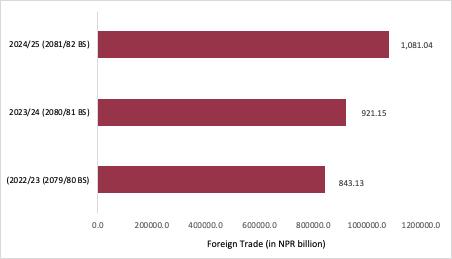
During the first six months of FY 2025/2026 AD (2082/83 BS), Nepal’s total foreign trade increased to NPR 1.08 trillion (USD 7.47 billion) from NPR 921.15 billion (USD 6,372.54 million) in
Source: Current Macroeconomic and Financial Situation of Nepal FY 2025/26 AD (Six Months Data)195
FY 2024/2025 AD (2081/2082 BS).196 The increase in trade was driven by rises in both imports and exports. Imports exceeded exports, totaling NPR 939.02 billion (USD 6.5 billion) and NPR 142.01 billion (USD 982.43 million), respectively.197 In terms of trading partners, India continued to be
Nepal's largest partner, making up 60% of total trade, followed by China with 18.2% and other countries with 21.8%. Notably, Nepal’s total foreign trade with China and India witnessed a surge of 21% and 12.4% respectively, compared to the previous FY 2024/25 AD (2081/82 BS).198
Figure 4. Total Annual Foreign Trade in the First Six Months for the Past Three FYs (in NPR Billion)
Source: Current Macroeconomic and Financial Situation, First Six months data for FY 2025/26 AD (2082/83 BS)199
Top Imports and Exports
During the first six months of FY 2025/2026 AD (2082/2083 BS), petroleum products were the leading import commodity, accounting for 14.3% of total imports, followed by crude soybean oil (6.1%), Transport Equipment, Vehicle & Other Vehicle Spare Parts (6.0%), other
Figure 5. Total Imports, Exports, and Trade Balance during the First Six Months of the Last Five FYs
Source: Current Macroeconomic and Financial Situation, First Six months data for FY 2025/26 AD (2082/83 BS)203
machinery and parts (4.4%), and chemical fertilizer (4.1%).200
Meanwhile, in terms of exports, the top five commodities were soybean oil (39.5%), cardamom (5.1%), polyester yarn and thread (4.7%), jute goods (3.6%) and woolen carpets (3.4%) respectively.201 The largest growth in terms of the top imports was silver (362.3%) and chemical
fertilizer (156%), while in exports it was palm oil (176.5%) and ginger (87.3%) as compared to FY 2024/25 AD (2081/82 BS). At the same time, edible oil (37.7%) and readymade garments (3.8%) witnessed the largest decline in imports while zinc sheet (84.4%) and particle board (49.2%) saw a drastic decline in exports.202
Balance of Trade
Nepal continued to experience a significant trade deficit. Figure 5 depicts the merchandise trade data of Nepal in the last five fiscal years starting from FY 2021/2022 AD (2078/2079) to FY 2025/2026 AD (2082/2083). In the first six months FY 2025/2026 AD (2082/2083 BS), the trade deficit of Nepal increased to NPR -797 billion (USD 5.51 billion), compared to NPR -723.58 billion (USD 5.01 billion) in the first six months of previous FY 2024/2025 AD (2080/2081 BS).205
The export-to-import ratio of 15.1% highlighted weak performance of
exports compared to the rising imports. Within this deficit, India accounted for 52.3% and China 24.5%, compared to 59.3% and 21.9%, respectively, during the same period in FY 2024/25 AD (2080/81 BS). In terms of trade deficit with other countries, there was an increase from 18.8% during the first six months of FY 2024/2025 AD (2080/2081 BS) to 23.2% in the first six months of FY 2025/2026 AD (2081/2082 BS).206
Gold/Silver Updates
The Federation of Nepal Gold and Silver Dealers’ Association reported that 24K gold prices surged from NPR 253,600 (USD
1,754.41) for 11.66 grams (one tola) on December 1, 2025, to NPR 313,500 (USD 2,168.80) by late February 2026. 207Similarly, the price of silver increased from NPR 3,535 (USD 24.46) for 11.66 grams on December 1, 2025, to NPR 5,595 (USD 38.71) by late February 2026. In the first six months of FY 2082/83 BS (2025/26 AD), the import of gold and silver increased 137.7% and 362.3% respectively, compared to mid-July 2025.208
Figure 6. Gold Imports in the First Six Months of the Last Three Fiscal Years
Source: Federation of Nepal Gold and Silver Dealers' Association 204
Exchange Rate
The Nepali currency depreciated 4.9% in mid-January 2026 from 2.8% in mid-July 2025. The buying exchange rate per US dollar stood at NPR 144.01 in midJanuary 2026, rising from NPR 137.00 in mid-July 2025.209 This depreciation lowers the cost of
Nepal’s exports but raises the price of imports, making them less competitive in the market. Foreign exchange reserves held by the central bank increased 19.4% to NPR 2.88 trillion (USD 19.92 billion) in mid-January 2026, up from NPR 2.41 trillion (USD 16.67 billion) in mid-July 2025.210 While the reserves held by banks and financial institutions increased from NPR 263.04 billion (USD 1,819.72 million) in mid-July 2025 to NPR 358.37 billion (USD 2,479.21 million) in mid-January 2026, marking a 36.2% increase.211
Figure 7. Average Selling Rate of USD in NPR in the First Six Months over the Last Five Fiscal Years
Source: Current Macroeconomic and Financial Situation, First Six months data for FY 2025/26 AD (2082/83 BS)212
Outlook
Nepal's near-term economic outlook remains cautious. With GDP growth revised down to 3.5% and capital expenditure at just 14.98% of budget by mid-year, the second half of FY 2082/83 BS (2025/26 AD) will require a meaningful acceleration in execution to meet annual targets. The government will need to sharply accelerate capital spending to make a dent in the growth shortfall. On the monetary side, NRB's accommodative stance and revised working capital guidelines are steps in the right direction, but the structural imbalance remains a major constraint. Remittances and strong forex reserves provide a degree of macroeconomic stability. However, net FDI remains thin at NPR 8.17 billion (USD 56.5 million). This highlights the challenge for Nepal to strengthen investor confidence in productive sectors, following the political unrest in the country. With total domestic debt at NPR 1.31 trillion (USD 9.06 billion) and external debt at NPR 1.48 trillion (USD 10.24 billion), fiscal space is narrowing. The March 2026 elections introduced a period of transition, with election-driven recurrent spending having further constrained capital investment. Therefore, a sustained recovery will require both stronger budget execution and a meaningful shift in credit toward productive sectors in the months ahead.
3 Sectoral Review
Agriculture and Livestock
During the review period from December 2025 to February 2026, Nepal’s agriculture and livestock sector continued to operate under structural constraints while showing gradual progress in modernization and market integration. Climate variability, dependence on imported inputs, and price fluctuations remained key factors shaping production outcomes. Developments in high-value export crops, trade promotion, and regional cooperation indicated efforts to strengthen competitiveness and diversify market access. Policy activity also increased, reflected in data modernization initiatives, fertilizer import planning, and targeted government programs aimed at improving sector performance. However, continued reliance on imported fertilizers, feed inputs, and food commodities highlighted persistent gaps in domestic production capacity and supply chain efficiency. The period reflected a sector navigating short-term production
while attempting to build stronger institutional and market foundations.
Paddy Output Set to Decline Following Crop Damage from Unseasonal Rains
Nepal’s paddy production declined in FY 2025/26 AD (2082/83 BS), marking the first drop in output in four years, with total production estimated to fall by around 4% compared to the previous fiscal year.227 The decline followed crop damage caused by unseasonal rainfall in October 2025, which affected paddy fields in major riceproducing districts during the harvesting period, particularly in the Terai region. Heavy and untimely rains led to flooding and lodging of crops, reducing both yield and grain quality across key agricultural areas. In addition to weather-related disruptions, delays in fertilizer distribution also contributed to lower output, as procurement bottlenecks and logistical challenges limited timely access to inputs during critical planting stages.228 While the total cultivated area remained largely unchanged, per-hectare productivity declined due to the combined impact of adverse weather conditions and input constraints.
Cardamom Value Chain
Expands through Youth-Led Innovation
In December 2025, the Food and Agriculture Organization (FAO) conducted a week-long learning mission in eastern Nepal under its “One Country One Priority Product” (OCOP) initiative, aimed at strengthening the large cardamom value chain through knowledge exchange and capacity building.229 The program brought together government officials and young agricultural
researchers to observe improved cultivation practices, disease management techniques, and post-harvest processing methods in key production areas. The OCOP initiative, a global FAO program, supports countries in developing a priority agricultural product to enhance productivity, value addition, and market competitiveness. In Nepal, large cardamom was selected due to its importance as a highvalue export crop concentrated in eastern hill districts. The learning mission facilitated the transfer of technical knowledge from established production zones to emerging areas, supporting the expansion of cardamom cultivation toward western regions and improving coordination across the value chain.230
Nepal
Showcases
Tea and Agricultural Products at Berlin Trade Fair
In January 2026, Nepal participated in the Grüne Woche international trade fair in Berlin, where it showcased tea and other agricultural products to promote exports and expand access to global markets.231 The event brought together producers, exporters, and policymakers, providing Nepal with a platform to highlight the quality and diversity of its agricultural products, particularly orthodox tea. The participation aimed to strengthen international market linkages and attract potential buyers and investors. Nepali representatives also promoted traditional cuisine and agricultural products to enhance branding and visibility in European markets. The engagement formed part of broader efforts to position
Nepal’s high-value agricultural products in international markets and diversify export destinations.232
Nepal’s livestock sector recorded remarkable export performance in first seven months of FY 2082/83 BS (2025/26 AD), with total livestock-related exports topping NPR 15 billion (USD 103.8 million), according to the Department of Customs.233 Processed and value-added products like woolen carpets and chhurpi (traditional hardened cheese, also used as dog chews) led the export surge, together making up a significant share of the total export value. Woolen carpets alone accounted for about NPR 6.4 billion (USD 44.3 million) and wool NPR 3.4 billion (USD 23.5 million), while dog chew exports showed continued demand growth internationally with NPR 2.3 billion (USD 15.9 million) worth of chews exported during the review period.234 Animal feed and leather products also contributed to expanding market access. This growth highlighted the livestock value chain’s rising competitiveness and export diversification.
During late 2025 and early 2026, Nepal’s poultry sector experienced rising domestic demand for meat and eggs, while producers faced continued structural pressures affecting profitability.235 Poultry
consumption gradually recovered to near pre-pandemic levels; however, feed costs remained elevated, with maize and soybean prices accounting for nearly 70% of total production costs, increasing overall expenses for farmers. The sector also faced ongoing disease management challenges and price volatility, which affected farm-level earnings and discouraged small-scale producers from expanding operations.236 Industry reports indicated that fluctuations in market prices and input costs led to uneven returns across producers, contributing to consolidation in some areas. In addition, limited access to affordable credit and insurance services constrained investment, particularly among small- and medium-scale farms. Dependence on imported feed inputs further exposed the sector to external price shocks and foreign exchange fluctuations, adding to production uncertainty.
African Swine Fever Affects 10,000 Pigs in Kathmandu Valley
In early 2026, African Swine Fever (ASF) outbreaks affected approximately 10,000 pigs across farms in the Kathmandu Valley, raising concerns over disease management in Nepal’s livestock sector.237 The outbreak was reported in multiple locations, prompting authorities to issue alerts and urge farmers to adopt biosecurity measures to contain further spread. ASF, a highly contagious viral disease affecting pigs, does not pose a direct threat to human health but causes significant economic
losses due to high mortality rates among livestock.² The spread of the disease disrupted local pork supply chains, affected farm incomes, particularly among small and medium-scale producers, and highlighted ongoing vulnerabilities in livestock disease surveillance and response systems. Veterinary authorities initiated monitoring and containment efforts, including movement restrictions and farm-level inspections, to prevent further transmission.
GOVERNMENT PLAN UPDATES
Nepal Launches Nationwide Agriculture Survey for
Data
Modernization
In December 2025, the Ministry of Agriculture and Livestock Development (MoALD) launched a nationwide agricultural survey to modernize data collection and replace traditional estimatebased reporting systems.238 The survey aimed to cover approximately 700,000 agricultural households across the country, with around 51,000 farmers selected for detailed sampling. It collected data on crop production, livestock, irrigation, input costs, market access, and agricultural services. The initiative used tablet-based digital tools and statistically validated methodologies to improve data accuracy and reliability. Local and provincial governments were engaged in the implementation process to ensure broader coverage and representativeness. The survey was introduced to address longstanding gaps in agricultural
data systems, where reliance on estimates had limited effective planning and monitoring. The findings are expected to support more accurate agricultural statistics and improve policy formulation and sectoral planning.239
Government Allocates NPR 28.82 Billion (USD 199.4 million) for Fertilizer Imports to Boost Crops
To address persistent input shortages ahead of upcoming cropping seasons, the Government of Nepal, via the Ministry of Agriculture and Livestock Development (MoALD), allocated NPR 28.8 billion (USD 199.4 million) for chemical fertilizer imports in the current fiscal year, FY 2082/83 BS (2025/26 AD).240 The plan targets the import of 550,000 metric tons of chemical fertilizer to stabilize supply chains. As of early December, tenders had been issued for 465,000 metric tons, of which 266,510 metric tons had already entered the supply chain, including 180,491 metric tons imported by the Agriculture Inputs Company Limited (AICL) and 86,016 metric tons by the Salt Trading Corporation. Government warehouses also held an additional 86,333 metric tons for distribution. Ensuring timely fertilizer distribution remains a longstanding challenge in Nepal’s agricultural sector, with delays in procurement and distribution often affecting planting schedules. The current import plan therefore aims not only to increase fertilizer availability but also to improve delivery timelines so that farmers
can access inputs during critical cropping periods.
Government Plans ClimateFriendly Agricultural Village in Kanchanpur
In early 2026, the Government of Nepal announced plans to establish a climate-friendly agricultural village in Kanchanpur district to promote sustainable and climate-resilient farming practices.241 The initiative aimed to introduce environmentally sustainable agricultural techniques, including efficient water management, organic farming practices, and climateadaptive crop systems. The project also planned to integrate renewable energy use and modern irrigation methods to improve productivity while reducing environmental impact. The proposed village was designed as a pilot model to demonstrate climate-resilient agriculture at the local level, with potential for replication in other regions. Government agencies indicated that the initiative would involve coordination with local authorities and farmers to implement improved farming practices and strengthen resilience against climate variability.242
KEY DEVELOPMENTS
Nepal and India Advance Agricultural Cooperation Through Joint Working Group and Ministerial Engagements
In late December 2025, Nepal’s Ministry of Agriculture and Livestock Development (MoALD) and India’s Department of Agriculture and Farmers Welfare held the 9th Nepal–India Joint Agriculture Working Group
meeting in Kathmandu, where both sides agreed to prepare a biennial action plan within three months to operationalize existing cooperation frameworks.243 The discussions focused on strengthening collaboration in areas such as technology transfer, joint research, capacity building, and knowledge exchange in crop production, as well as expanding cooperation in livestock, poultry, and fisheries sectors.
In early February 2026, Interim Agriculture Minister Dr. Madan Prasad Pariyar further advanced these engagements during his visit to India, where he reviewed ongoing agreements with his Indian counterpart and discussed potential amendments to enhance bilateral cooperation.244 He also participated in the First South Asian Agroforestry and Trees Outside Forests Congress in New Delhi, which focused on sustainable land use and regional collaboration.
Government Disburses NPR 6.3 billion (USD 43.6 million) in Farm and Livestock Insurance Subsidies
The Government of Nepal disbursed NPR 6.3 billion (USD 43.6 million) in farm and livestock insurance premium subsidies over a 12-year period from FY 2013/14 AD (2070/71 BS) to FY 2024/25 AD (2081/82 BS), under its agricultural insurance subsidy program implemented by the Ministry of Agriculture and Livestock Development.245 Of the total, NPR 5.8 billion (USD 40.1 million) was allocated to crop and livestock insurance, while NPR 464.8 million (USD 3.2 million) was disbursed under other insurance categories. During the same period, insurance companies
collected NPR 8.3 billion (USD 57.4 million) in premiums and paid NPR 7.2 billion (USD 49.8 million) in claims.246 The subsidy program, introduced to encourage farmers to adopt insurance by covering a portion of premium costs, aimed to reduce production risks associated with climate variability, disease outbreaks, and natural disasters.
Agricultural Imports Surge to NPR 150 Billion (USD 1.04 billion) in Five Months
Nepal’s agricultural and livestock imports reached NPR 150 billion (USD 1.04 billion) in the first five months of FY 2025/26 AD (2082/83 BS), reflecting continued dependence on external supply to meet domestic demand.247 According to official trade data, imports of key commodities such as rice, maize, vegetables, fruits, and livestock products contributed significantly to the overall import bill. Rice alone accounted for a substantial share, driven by declining domestic production and price differentials with neighboring markets. The increase in imports was observed despite ongoing efforts to promote domestic agricultural production, indicating persistent supply gaps and structural constraints within the sector. Higher imports of animal feed ingredients, including maize and soybean, also contributed to the rise, reflecting growing demand from the livestock and poultry industries.248
Outlook
Looking ahead, the performance of Nepal’s agriculture and livestock sector will depend on how effectively recent policy measures translate into improved production outcomes and supply stability. Input management, particularly fertilizer availability and feed supply, will remain central to short-term performance, while disease control and climate variability will continue to influence livestock and crop productivity. The post-election policy environment will play a key role in shaping sector priorities, with political commitments around agricultural transformation, irrigation expansion, and farmer support likely to influence budget allocation and program implementation. Improvements in data systems, value chain development, and export promotion could support gradual gains in efficiency and market access. However, continued reliance on imports and exposure to external price movements may limit short-term gains, making implementation capacity and policy consistency critical for sector stability.
Education
The review period, from December 2025 to February 2026, reflected a phase of regulatory tightening and gradual modernization in Nepal’s education sector. The Ministry of Education, Science and Technology (MoEST) intensified oversight of foreign-affiliated colleges through a 10-point directive aimed at improving transparency and accountability. At the same time, developments such as Tribhuvan University’s improved global ranking in medical education and Higher Institutions and Secondary Schools' Association Nepal’s (HISSAN’s) initiative to train teachers in Artificial Intelligence (AI) highlighted growing efforts to strengthen academic competitiveness and modernize teaching practices.
However, persistent structural challenges continued to shape the sector. Rising expenditure on foreign education exceeding NPR 42 billion (USD 290.56 million) within four months of FY 2025/26 AD (2082/83 BS) signaled continued student outmigration, while shortages of subject teachers in Karnali Province highlighted regional disparities in access to quality education. Meanwhile, administrative developments such as the announcement of SEE and Grade 12 examination schedules and efforts to develop a national school sports curriculum indicated ongoing attempts to improve institutional planning.
KEY DEVELOPMENTS
NEB Announces SEE and Grade 12 Examination Schedule for 2026
The National Examination Board (NEB) released the schedule for the Secondary Education Examination (SEE) and the Grade 12 board examinations for the academic year 2082. The SEE examination schedule was published on January 21, 2026.254 According to the published routine, the SEE
examinations will begin on April 2, 2026 and continue until April 12, 2026, with exams conducted daily from 8:00 AM to 11:00 AM across examination centers nationwide.255 The SEE schedule was originally planned for the second week of March 2026, but was postponed by two weeks due to the elections held on March 5, 2026.256
Similarly, the Grade 12 annual examinations which was published on February 17,2026
administered by NEB were scheduled to commence on April 27, 2026 and conclude on May 10, 2026, with exams taking place from 8:00 AM to 11:00 AM for students enrolled in general, technical and traditional streams.257 The publication of these routines provides clarity for students preparing for the country’s two major national school-level examinations, enabling schools and examinees to plan their preparation and logistics accordingly.258
MoEST Enforces 10-Point Directive to All Private Schools and Colleges Nationwide
The Ministry of Education, Science, and Technology (MoEST) continued its monitoring of 69 higher educational institutions operating in Nepal that are affiliated with foreign academic bodies. This action followed former interim Education Minister Mahabir Pun's decision on December 29, 2025, to implement a 10-point directive aimed at ensuring transparency and quality.259 After complaints about rule violations like lack of transparency in fee structures and scholarship policies, and negative effects on student learning, the ministry took these actions. The 10-point directive mandated several reforms, including the immediate removal of Discipline In-charges (DIs), individuals responsible for monitoring the discipline and behaviour of students, and the establishment of grievancehandling mechanisms.260 The directive also required institutions to display fee structures transparently on their notice boards and websites, and submit certified copies to the ministry.261 Additionally, the ministry warned that operational permissions may be suspended if educational institutions fail to meet the standards.
Nepal Spends Over NPR 42 Billion (USD 294 Million) on Foreign Education in Four Months
Nepal Rastra Bank (NRB) revealed that Nepalis spent NPR 42.53 billion (USD 294.23 million) on
foreign education during the first four months of the current fiscal year 2025/26 AD (2082/83 BS).262 This marked a 25.1% increase compared to the NPR 34 billion (USD 235.21) spent during the same period last year.263 The surge in spending reflected a growing trend of Nepali students seeking higher education abroad, which has significantly contributed to the country's service trade deficit. This upward trajectory persisted throughout the first six months of the FY 2025/26 AD (2082/83 BS), with the total debit for foreign education reaching NPR 64.01 billion (USD 442.82 million).264
TU Ranks Among World’s Top Institutions
for Medical Education
In the Times Higher Education (THE) World University Rankings 2026, Tribhuvan University (TU) showed its strongest performance in medical education. Programs under TU’s Institute of Medicine performed at a level comparable to leading global universities, ranking within the top 601 and top 28% to 37% globally in medical subjects.265 This achievement comes despite significant resource constraints. TU spends an average of only NPR 57,000 (USD 394.33) per student annually, compared to much higher spending at international institutions. Additionally, the university faces challenges with research funding, which was reduced from NPR 100 million (USD 691,802.14) until 2023 to NPR 10 million (USD 69,180.21) in 2025/2026 266. To further improve its 2027 ranking, TU intends to modernize teaching methods
and incorporate research outputs from affiliated campuses in future assessments.
PLANS AND PROGRAMS
HISSAN to Launch AI Literacy Program for 50,000 Teachers
The Higher Institutions and Secondary Schools' Association Nepal (HISSAN) , a private organisation funded by the Secondary Schools' and higher institutions, unveiled a nationwide program on February 17, 2026 to train 50,000 teachers in basic Artificial Intelligence (AI) skills.267 The association plans to select five educators from each of the 10,000 schools including public schools268 operating up to the Secondary Education Examination (SEE) level to participate in the training.269 The president of HISSAN announced that the organization seeks to collaborate with the government to include public school educators in the initiative, ensuring that the workforce is equipped to meet the technological demands of modern education. HISSAN also introduced a reform roadmap that proposes increased autonomy for higher education institutions in addition to the AI literacy campaign. The program proposes allowing private institutions to design their own curriculum, conduct examinations, and publish results independently270. To supervise these initiatives, HISSAN formally established three leadership bodies: a Steering Council, an Advisory Council, and an Academic and Research Council. These councils will be responsible for facilitating institutional administration and
pushing for the enactment of the School and Higher Education Acts starting mid- 2026.
MoU Signed to Develop National School Sports Curriculum
Nepal School Sports Federation (NSSF), an association which is the sole governing body for school sports in Nepal, and the Faculty of Education at Kathmandu University (KU) signed a Memorandum of Understanding (MoU) on January 22, 2026, to jointly develop a comprehensive school sports curriculum aimed at strengthening physical education and promoting holistic child development nationwide.271 Under the agreement, NSSF will lead the identification of curriculum needs, define priority areas, facilitate coordination with schools and stakeholders, and support pilot testing and implementation of the developed curriculum.272 Meanwhile, KU will contribute academic and technical expertise in areas such as sports science, coaching fundamentals, school sports management, and child development through sports, while ensuring that the curriculum aligns with Nepal’s national education framework and international best practices.273 The partnership will also include capacity-building programs for teachers, trainers, and coaches, along with research, monitoring, and evaluation mechanisms to assess the impact of sports education.274 A joint coordination committee will oversee planning, implementation, and periodic review of the initiative, which will remain valid for five years.275
PABSON and OUP India Partner to Promote Reading
Culture in Schools
The Private and Boarding School’s Organization Nepal (PABSON) and Oxford University Press (OUP) India signed a Memorandum of Understanding in Kathmandu in January 2026 to promote reading culture and improve the quality of education in Nepal.276 The partnership aims to address declining reading habits and gaps in quality learning resources by expanding access to internationally recognized reading materials and improving teaching practices.277
Under the agreement, OUP India will provide graded reading materials, including the “Read with Oxford” series, along with teacher training and support for resource centers, to strengthen both teaching capacity and student learning environments.278 The initiative is expected to institutionalize reading practices in schools and enhance overall learning outcomes across Nepal’s private education sector.279
Government Announces Education Support for Injured Gen Z Protesters
The Government of Nepal, under the coordination of officials including Interim Minister for Communications and Information Technology, Jagadish Kharel, introduced a support program to provide education, health, and employment assistance to individuals injured during the Gen Z uprising.280 This program focuses on ensuring continuity in education for affected youth. The decision was made through a Cabinet meeting in Kathmandu on
December 8, 2025, approving the ‘Gen Z Injured Relief Assistance Procedure 2082’.281
The scheme targets individuals injured or disabled during the September 2025 protests, many of whom are students whose studies were disrupted, and aims to facilitate their return to education through structured support mechanisms coordinated by the government.282
Shortage of Subject Teachers
in Karnali Forces SEE Students to Depend on Private Tuition Schools across Karnali Province faced a severe shortage of subject-specific teachers, particularly in core subjects such as English, mathematics and science, significantly affecting students preparing for the Secondary Education Examination (SEE).283 Due to the lack of qualified teachers, many schools were unable to complete the syllabus on time, forcing students to rely heavily on private tuition to prepare for the national exam.284 In several cases, teachers from unrelated subjects were required to teach specialized courses, further affecting the quality of instruction and learning outcomes.285
The problem reflects a broader structural challenge in Karnali’s education system, where thousands of teaching posts remain vacant and schools in remote districts struggle to attract and retain qualified educators.286 Difficult geography, limited infrastructure and a lack of incentives for teachers to work in remote areas have contributed to the persistent shortage.287
In the coming quarter, the impact of recent reforms will depend largely on implementation. The enforcement of MoEST’s directive on foreign-affiliated colleges may improve accountability and transparency in higher education. Additionally, it could also place operational pressure on institutions that fail to meet compliance requirements. Similarly, HISSAN’s large-scale AI literacy program has the potential to accelerate digital transformation in education if participation extends across both private and public schools. At the same time, structural challenges such as teacher shortages in remote provinces and the rising number of students pursuing education abroad are likely to remain pressing concerns. Unless policy measures improve teacher, deployment and strengthen domestic higher education opportunities, these issues may continue to influence educational outcomes and student mobility trends in near future.
Energy and Environment
Nepal entered 2026 with a dry winter drought, worsening air pollution, and growing water stress. At the same time, new conservation and biodiversity initiatives, from human-wildlife coexistence projects in tiger landscapes to the declaration of the country’s first fish sanctuary, signaled a more proactive approach to safeguarding ecosystems and community livelihoods. Recent policy shifts on air quality management, carbon trading, and climate transparency began to translate to high-level climate commitments into institutional frameworks and financing pathways. Good progress was also made on the renewable energy front, particularly in terms of solar energy, and reduction of fossil fuel imports from India by enhancing local ethanol blending with petroleum. However, these improvements are occurring against a backdrop of heightened global oil price volatility and macroeconomic uncertainty.
Nepal experienced an unusually dry and warm winter between December 2025 and February 2026, marking at least the fourth consecutive winter with below-normal precipitation and above-average temperatures.297 Seasonal forecasts from the Climate Division of the Department of Hydrology and Meteorology had anticipated below-average rainfall and higher-than-normal minimum and maximum temperatures
across all provinces, with many regions showing a 45-55% probability of deficient winter rain.298 Preliminary data indicated that December recorded almost no rainfall nationally, and by late January the country received only about 6% of its normal winter precipitation, creating drought-like conditions. These anomalies affected soil moisture, winter crops, and hydropower generation, while also heightening risks of forest fires and air pollution. Meteorologists and national media repeatedly linked climate change to the increasingly warm dry winters and increasingly erratic rainfall patterns.299
FY 2025/26 AD (2082/83 BS) (First Six Months of the FY 2025/2026 AD (2082/2083 BS)
Total petroleum product imports (First six months data of FY 2025/2026 AD (2082/2083 BS))288
Depleting Groundwater in Nepal: ADB Release of Water Development Outlook 2025
The Asian Development Bank (ADB) released the Asian Water Development Outlook 2025 on December 8, 2025. The report found that over-pumping of groundwater in the Terai, hills, and the Kathmandu Valley has severely depleted aquifers and spring water.300 The study found
that a mere 25% of the population of Nepal has access to robust drinking water systems.301 The report further identified areas for greater policy attention including improved rural and urban water systems, pollution reduction, strengthened implementation of the Integrated Water Resources Management policy, and greater focus on disaster resilience.302
Kathmandu Records Hazardously High Winter Air Quality
Kathmandu’s winter of 2025–2026 again saw persistently unhealthy air, with only brief improvement in early winter before pollution rebounded sharply in January. Data from International Centre for Integrated Mountain Development’s (ICIMOD’s) Khumaltar station showed that average fine particulate levels (PM2.5) between December 2025 and February 2026 were around 50 µg/m³, a clear reduction compared to the previous winter when mean concentrations for December 2024 to February 2025 were about 1.3 times higher.303 However, this respite was short-lived. By the end of January 2026, PM2.5 values climbed again, peaking at 85 µg/ m³, even higher than the maximum for the same period in 2025, keeping Kathmandu firmly within the World Health Organization’s (WHO’s) “unhealthy” range and prolonging serious respiratory and cardiovascular risks.304 The air pollution throughout Nepal was further exacerbated by the seasonal opening of coaldependent brick kilns on January 15, 2026.305 These kilns use lowgrade coal and release toxins and pollutants into the air. A
December 2025 CESIF analysis labeled the smog season as a “macro-economic liability,” and found that the hospitality sector is significantly affected by the air pollution and cold wave in Nepal with estimated losses in the millions of Nepali rupees.306
New Global Environment Facility Project Launched on Human-Tiger Interface in Nepal
On February 9, 2026, Nepal’s Ministry of Forests and Environment and World Wildlife Fund (WWF) Nepal signed a Project Implementation Agreement for a new Global Environment Facility funded initiative titled “Managing HumanTiger Interface in Nepal.”307 The five-year, USD 4.5 million (NPR 650.48 million) project will be implemented by the ministry with WWF, building on a financing agreement signed on January 25, 2026. The agreement aims to reduce human-tiger conflict and foster coexistence in key tiger-bearing parks and buffer zones through improved habitat management, livelihood alternatives, and stronger knowledge-based management.
308
Nepal Launches First Fish Sanctuary
On January 9, 2026, Rajapur and Tikapur municipalities in Bardiya and Kailali, respectively, jointly declared Nepal’s first fish sanctuary in the lower Karnali River, protecting 3.9 km of critical habitat for indigenous fish, dolphins, gharials, and otters under a co-management model with river-dependent Sonaha and Tharu communities.309 Backed technically and financially
by a Darwin Initiative project implemented by WWF Nepal and local partners, the sanctuary aims to conserve aquatic biodiversity while also contributing to food security, livelihoods, and the preservation of local culture.310
InDrive Organizes Dialogue on Clean Air in Kathmandu
On February 23, 2026, InDrive Nepal organized the Kathmandu Clean Air Dialogue which brought together government leaders including the newlyappointed Minister for Forest and Environment Madhav Chaulagain, civil society, experts, and the private sector. The Dialogue focused on bringing together and coordinating relevant stakeholders, reviewing the current state of deteriorating air quality in Kathmandu Valley. The event discussed identifying solutions and opportunities and engaging the private sector in the fight to curb air pollution through decarbonizing public and private transportation.311
HYDROPOWER
Flood-damaged 111 MW Project Restores 68 MW Supply to National Grid
The Rasuwagadhi Hydropower Project (RHP) successfully resumed electricity generation of 68 MW from its 111 MW project located in Rasuwa district. The project had been nonoperational since July 8, 2025, due to a flood in the Lhende River caused by a Glacial Lake Outburst Flood (GLOF). The floodwaters severely damaged the project's headworks and submerged the powerhouse, halting production. According to the RHP, restoration work on the
remaining turbines is ongoing as two out of three of its damaged turbines have been repaired.312 Likewise, maintenance of the canal and the project's main dam was completed, and the project is expected to reach its full 111 MW capacity in June 2026. According to the Nepal Electricity Authority (NEA), once the project is fully operational, it is expected to generate 613.87 million units of electricity annually, bringing in an estimated NPR 3.25 billion (USD 22.48 million) in yearly revenue for the company.313
Government Permits Differentiated PPA Rates for Reservoir-Based Hydropower Projects
The Government of Nepal officially approved on February 15,2026 a differentiated Power Purchase Agreement (PPA) rate for reservoir-based hydropower projects, marking a significant policy shift aimed at achieving energy self-sufficiency. This policy shift by the Ministry of Energy, Water Resources, and Irrigation allows the Nepal Electricity Authority (NEA) to move away from fixed pricing to a structure that varies by season.Reservoir projects will receive NPR 12.40 (USD 0.084) per unit during the dry season (December to May) and NPR 7.10 (USD 0.048) per unit during the wet season (June to November) under the new guidelines.314 PPAs for projects up to 100 MW will be capped at a maximum of NPR 14.80 (USD 0.10) per unit in winter and NPR 8.45 (USD 0.06) per unit in the rainy season.
The move is designed to incentivize the private sector to invest in storage-type
schemes, which have higher construction costs and longer gestation periods compared to run-of-river projects. Previously, the lack of a dedicated PPA rate for reservoirs had stalled private investment in largescale storage. The Electricity Regulation Commission (ERC) has now established a costplus model, where rates for projects exceeding 100 MW can be determined based on actual construction and operation costs, providing a more viable financial environment for developers.315
The directive divides the PPA process into three phases: the initial Detailed Project Report stage for securing loans, the construction stage to update rates based on actual contracts, and a final review within one year of project completion. This approach allows the NEA to provide financial stability to developers while ensuring that the final PPA rate reflects the true capital cost of the project, with a cap of 25% set on potential capital cost increases.
RENEWABLE ENERGY
Nepal to Become Global Leader in Solar Tech through LONGi and MOGHA Renewables Partnership
Global leaders LONGi and MOGHA Renewables, a Nepali company, announced a strategic partnership and the launch of HiMO X-10 solar panels, marking a significant step towards boosting Nepal’s transition to clean energy. The partnership made Nepal one of the first countries worldwide to adopt LONGi’s latest solar technology.316 Compared to standard modules,
the recently introduced Hi-MO X-10 is powered by HPBC 2.0 technology and generates about 9% more energy while occupying 8% less land.317 The module features improved fire safety, anti-dust/snow capabilities, and exceptional performance under partial shading, all part of its design for challenging environments. The partnership aims to make MOGHA renewables the biggest participant in both EPC (Engineering, Procurement, and Construction) and RESCO (Renewable Energy Service Company) solar projects, ensuring lower energy costs and long-term resilience for Nepal’s energy sector. Currently, 1 GW of capacity is planned for Nepali factories.318 By combining LONGi's global leadership in high-efficiency solar technology with MOGHA Renewables' strong on-ground leadership and execution, the partnership is set to accelerate clean energy adoption and support a more sustainable, resilient energy future for Nepal.319
GIZ Nepal Mobilizes EUR 21.3 Million (NPR 3.62 Billion) to Promote Energy Efficiency Initiatives
Over the past three years, GIZ Nepal and the Alternative Energy Promotion Centre (AEPC) raised a total of EUR 2.13 million (NPR 3,618.23 million) for energyefficiency and renewable energy projects throughout Nepal.320 Through the Renewable Energy and Energy Efficiency Programme - Green Recovery and Empowerment with Energy in Nepal (REEEP-GREEN), Nepal is set to reach important energy efficiency goals. Supported by GIZ Nepal and the German
Government, the program projected annual electricity savings equivalent to 7 MW of generation capacity.321 The fund catalyzed investment and innovation in energy delivery, strengthening public-private partnerships to advance national priorities like NDC 3.0, the 2081 Roadmap, and the SDGs.
By implementing the Sustainable Energy Challenge Fund (SECF), the initiative already benefited nearly 60,000 people through the promotion of clean energy technologies across various sectors.322 The promotion of solar water pumps, biogas systems, induction cookstoves, and the restoration of micro-hydropower projects for connection to the grid are some of the major accomplishments. By focusing on industrial energy efficiency and market-based clean energy solutions, REEEP-GREEN aims to strengthen Nepal's energy security and support long-term development goals through increased private sector participation.323
Nepali Delegation at IRENA Outlines 2035 Roadmap and Calls for International Climate Finance
In the past quarter, Nepal participated in the 16th Assembly of the International Renewable Energy Agency (IRENA), held from January 11, 2026, in Abu Dhabi, UAE. The event was attended by 1500 delegates from 171 countries. The assembly, themed "Powering Humanity: Renewable Energy for Shared Prosperity," saw a fourmember Nepali delegation led by embassy officials.324 During the event, Nepal presented its strategic roadmap for the
energy sector. According to the roadmap, Nepal set ambitious targets for 2035, aiming to reach an installed electricity generation capacity of 28,500 MW, an annual per capita energy consumption of 1,500 kWh, and electricity exports of 15,000 MW.325 This is in line with Nepal’s Nationally Determined Contributions (NDC) which, by 2035, are estimated to cost approximately USD 7.374 billion (NPR 1.07 trillion), with 85% of this funding expected from international climate finance and development partners.326
NON-RENEWABLE ENERGY
Nepal Approves EthanolBlended Petrol Policy to Cut Fuel Imports and Boost Domestic Production
On December 26, 2025, the interim Cabinet approved the Order on the Use of Ethanol Blended in Petrol, 2026, permitting the Nepal Oil Corporation (NOC) to mix up to 10% locally produced ethanol with imported petrol.327 A government-led committee will propose ethanol procurement prices for Cabinet approval, with stringent quality standards to be enforced to ensure fuel consistency. According to Industry, Commerce, and Supplies Minister Anil Kumar Sinha, this initiative could cut Nepal’s annual petrol import bill by about NPR 6 billion (USD 41.51 Million).328 Stakeholders believe ethanol mixing would not only benefit the economy by cutting import costs but also stimulate jobs and income in the agriculture and manufacturing sectors for the production of sugarcane, maize, grass, and other biomass. Media reports underscore the importance of strengthening
domestic production facilities and modernizing sugar mills to increase ethanol output.329 According to news reports, relevant companies will be selected for ethanol production based on their production capacity.330 India too has mixed ethanol with oil but faced backlash amongst farmers and communities for the diversion of food grains towards fuel. Responding to such concerns, government stakeholders in Nepal have reiterated that grains and biomass intended for food production are not to be used for ethanol mixing. Managing director of Nepal Oil Corporation, also stated that ethanol mixing is a step towards cleaner energy use in Nepal. Key concerns remain around the price competitiveness with petrol and Nepal’s domestic capacity to produce ethanol at scale. Nepal’s 12 sugar mills have the potential to produce around 360,000 liters of ethanol each day, which could substitute approximately 3% of national petrol consumption.331 Consumer groups also called for strict quality monitoring of the E10 blend in terms of vehicle mileage and performance.332
India Renews Nepal’s Winter Power Import Approval
India renewed approval at the end of December 2025 for NEA to import up to 654 MW of electricity through the Indian Energy Exchange during January to March 2026, to cover winter demand when domestic hydropower generation drops.333 Under this deal between the NEA and India’s Central Electricity Authority (CEA), the NEA can bring in 600 MW of power via the Dhalkebar–Muzaffarpur 400 kV
line and up to 654 MW through the Tanakpur–Mahendranagar line.334 The authority stated that electricity supplied on the 132 kV line costs NPR 8.10 per unit (USD 0.056) or NPR 12.96 (USD 0.0897) after adding all charges, while power on the 33 kV line is priced at NPR 8.78 per unit (USD 0.0607) (NPR 14.04 (USD 0.097) with charges).335 For imports or exports using the 11 kV line, the rate is NPR 9.41 per unit (USD 0.065), rising to NPR 15.05 (USD 0.10) once additional charges are included.336 These electricity imports are partially backed by India’s coal- and gasbased generation, indirectly tying Nepal’s winter supply security to regional non-renewable energy.337 As a result, even with growing domestic hydropower, Nepal’s seasonal energy security remains tied to a fossil-fuel-heavy regional grid, leaving it vulnerable to cost spikes and disruptions in India’s thermal power sector during the dry season.
NOC Adjusts Fuel Prices Amid Rising Global Oil Costs
On January 31, 2026, Nepal Oil Corporation (NOC) raised diesel and kerosene prices by NPR 3 (USD 0.0208) per liter but simultaneously lowered aviation fuel tariffs.338 These opposing adjustments reflected updated import costs from Indian Oil Corporation due to increasing global oil prices. Following this revision, petrol was priced at NPR 156 (USD 1.08) per liter in Kathmandu, Pokhara, and Dipayal, NPR 155 (USD 1.07) in Category B cities like Surkhet and Dang, and NPR 153.50 (USD 1.06) at Category A depots such as Charali, Biratnagar, Amlekhgunj, Bhalbari, Nepalgunj, Dhangadhi,
and Birgunj. Domestic aviation fuel was reduced by NPR 1 (USD 0.0068) per litre, while international aviation fuel in Kathmandu is cheaper by USD 7 (NPR 1,030.1) per kilolitre, bringing the rates to NPR 127 (USD 0.86) per litre for domestic flights and USD 966 (NPR 142,800) per kilolitre for international flights.339
KEY DEVELOPMENTS
Nepal Ranks Second Globally in Electric Vehicle Sales Share in 2025
Nepal recorded roughly 73% of new car sales as electric, placing second globally behind Norway for new electric car sales, which remained at the top with an estimated 97% of new vehicle sales being electric, according to global EV market estimates for 2025, released by International Energy Agency on May 14, 2025.340 Nepal’s quick rise in EV adoption represents a remarkable shift over a short period of time. In 2019, electric vehicles accounted for only 8% of new car sales in the country.341 The jump to 73% by 2025 indicates one of the fastest EV transitions recorded globally, driven by policy incentives, tax benefits, rising fuel costs, and growing consumer awareness. Nepal’s position near the top of the global ranking is primarily due to its heavy reliance on hydropower-based electricity, high import taxes on fossil-fuel vehicles, and strong price competitiveness of EVs compared to petrol and diesel models. The country’s geography and urban congestion challenges have also made small and midrange electric cars particularly attractive for consumers.
Government Allows Private Sector to Sell Hydropower Directly
The Nepal government approved the Open Access Directive 2025 on February 15, 2026, which allows private hydropower producers to sell electricity directly to domestic manufacturing and commercial enterprises that meet the requirement of a minimum capacity threshold of 5 MW.342 Additionally, producers are required to provide foreign buyers with at least 10 MW for cross-border sales to sell directly. Although the private sector will not be able to sell electricity independently, the directive appoints NEA’s System Operation Department as the nodal agency that oversees these transactions.343 The department will be in charge of accepting applications, identifying the supply capacity of the power plants, and issuing licenses for the use of the open access system. Meanwhile, buyers using the open access system for buying electricity will be required to pay fees.
Nepal Becomes First Asian Country to Sign Historic LEAF Coalition Agreement for USD 55 Million (NPR 8.09 billion) Climate Finance
On January 23, 2026, Nepal signed a landmark agreement with the Lowering Emissions by Accelerating Forest finance Coalition to access up to USD 55 million (NPR 8.09 billion) in climate finance for reducing emissions from deforestation and forest degradation, becoming the first Asian country to join LEAF and the first globally to offer “correspondingly
adjusted” forest carbon credits for international compliance markets.344 LEAF is a global public-private initiative that finances efforts by tropical and subtropical forest governments to reduce deforestation and associated emissions. The deal builds on Nepal’s strong track record in community-based forest management, where forests now cover over 46% of the country, and is expected to benefit more than 3 million households through an inclusive benefit-sharing mechanism developed with indigenous people and communities.345 Under the agreement, Nepal plans to supply millions of tons of high-integrity emissions reduction and removal credits from 2022–2026 AD (20782083 BS), with initial purchase guarantees from the UK and Norway.346 These funds will be disbursed to Nepal based on verified emissions reductions achieved in community forests over the 2022–2026 AD (20782083 BS) period, building on more than 50 consultation events to develop a fair Benefit Sharing Plan and grievance mechanisms with local and municipal stakeholders.347
Government Approves National Carbon Trade Action Plan to Monetize Emission Reductions
On December 8, 2025, the Government of Nepal opened a formal commercial pathway for carbon trading by approving the "National Carbon Trade Action Plan."348 The Interim Council of Ministers approved this decision, which creates the legal and administrative framework required for the country to sell carbon credits on
the global market. So far, Nepal attracted NPR 5.5 billion (USD 40 million) through carbonemission reduction projects, but every carbon-related initiative has required separate cabinet approvals. Under the new regulations, government agencies, state-owned institutions, and private-sector entities may implement carbonreduction projects in sectors including agriculture, forestry, energy efficiency, clean energy transition, renewable energy, transport, waste management, and climate adaptation.349 With this carbon trading plan, project developers directly enter agreements with third parties for carbon trading, with the government functioning as a facilitator. This action plan allows the entrance of private entities into Nepal’s carbon market. The Ministry of Forests and Environment (MoFE) will issue an authorization certificate that permits the sale of credits on voluntary and international markets after project operators pay the Government of Nepal NPR 100 (USD 6.8) per ton of carbon credits.
PLANS AND PROGRAMS
Ministry of Finance Issues
Access to Climate Finance for Private Sector
On February 16, 2026, the Ministry of Finance issued for the first time a guideline which enables private sector-led green energy projects to access climate finance. The Climate Finance Mobilisation Guidelines allows private projects to utilize specified portions of the government’s climate funds. This initiative seeks to foster greater private sector engagement and
accountability in addressing the challenges of climate change.350
Nepal Initiates First National Air Quality Management Plan to Tackle Worsening Pollution
Nepal is developing its first National Air Quality Management Action Plan (NAQMAP), led by the Department of Environment in collaboration with ICIMOD and supported by UK International Development. Launched at an inception workshop in Kathmandu on August 29, 2025, the process aims to create a national roadmap to tackle the country’s severe air pollution, which exposes nearly 89% of the population to PM 2.5 levels above WHO interim targets.351 The NAQMAP will map existing data and regulations, identify sectoral emission sources, and establish an inclusive, evidence-based framework for coordinated action across government, drawing on lessons from India’s National Clean Air Programme and China’s air quality reforms.352 By aligning stakeholders around a common framework and monitoring system, the plan is expected to guide long-term investments, policy reforms, and city-level clean air measures that protect public health, productivity, and climate.
UNFCCC and ICIMOD Launch HKH Transparency Hub for Mountain Climate Action
On December 2, 2025, the United Nations Framework Convention on Climate Change (UNFCCC) and International Center for Integrated Mountain Development (ICIMOD) launched the Hindu Kush Himalaya (HKH) Regional Climate Action
Transparency Hub (HKHRCATH) during a regional stakeholders’ consultation workshop in Paro, Bhutan.353 This decision comes after the June 2025 signing of a Memorandum of Understanding (MoU) between the UNFCCC and ICIMOD to enhance climate action in the Hindu Kush Himalayan region.354 The newly launched transparency hub provides a dedicated platform for the eight ICIMOD regional member countries over the next three years to strengthen data systems, share experience, and coordinate implementation of the Paris Agreement’s Enhanced Transparency Framework.355 As a regional gateway for cooperation and capacity building, the hub will help countries track progress on their climate commitments, identify challenges, and jointly address cross-border
Outlook
climate risks in this highly vulnerable mountain region.356 The transparency hub is also intended to better equip national decision-makers, investors, and stakeholders with timely, reliable information to accelerate mitigation and adaptation action and unlock climate finance.357
ERC Publishes New Procurement Governance
Rules Under Development for Energy Companies
The Electricity Regulatory Commission (ERC) published a draft on February 24, 2026 titled “Institutional Governance Standards for Licensed Entities 2025,” which would require even private energy companies to follow core principles of the Public Procurement Act to ensure transparent and
competitive procurement. The draft se detailed rules on board structure (including women’s representation and independent directors), conflict-of-interest safeguards, double-entry accounting, mandatory internal and external audits, risk and insurance management, and transparent HR and procurement regulations.358 It also introduced provisions on corporate social responsibility, grievance redress, disclosure of financial statements, and enhanced inspection powers for the regulator, with the aim of making generation, transmission, and distribution utilities more professional, transparent, and effective.359
Energy and environment are set to remain high on Nepal’s political and policy agenda throughout 2026, as elections converge with ambitious plans to scale up hydropower, expand electricity exports, and tackle worsening air pollution. Major parties, including the winning RSP party, had all centered the energy sector in their manifestos, promising to rapidly increase generation capacity, double per capita electricity consumption over time, and position Nepal as a clean energy export hub, making delivery on these pledges a key test of the new government’s credibility. At the same time, implementation of the LEAF Coalition forest carbon deal, the emerging National Air Quality Management Action Plan, and continued public concern over toxic winter smog will keep environmental issues, especially air quality, climate resilience, and land/forest regulation, firmly in the spotlight. Solar is also likely to emerge as a key frontier alongside hydropower in 2026, with recent revisions to solar development procedures and environmental thresholds, growing interest in utility scale and rooftop systems. The outlook for 2026 is one of both opportunity and risk. If the political transition helps clear long standing bottlenecks around project approvals, transmission, and environmental safeguards, Nepal could make real progress toward its 10,000 MW capacity targets and cleaner air. Global energy markets are also likely to influence Nepal’s policy space, with the Israel US Iran war in West Asia threatening to drive up oil prices and heighten fuel price volatility both globally and domestically, putting additional pressure on Nepal’s trade balance and inflation outlook.
Health
Between December 2025 and February 2026, Nepal’s health sector showed signs of institutional stabilization following disruptions in the previous quarter. While the earlier period was marked by political unrest, disease outbreaks, and strain on health infrastructure, recent developments reflected renewed efforts to strengthen governance and improve system coordination. Key initiatives included advancing antimicrobial stewardship, improving compliance with International Health Regulations, expanding mental health integration, and launching a Nepal–Germany partnership to strengthen health quality systems. Despite this progress, structural challenges persisted. Financial strain within the National Health Insurance Program highlighted ongoing imbalances between premium collections and claims payouts, raising concerns about sustainability. Cross-border disease risks and food safety concerns also continued to expose vulnerabilities in both communicable and noncommunicable health management.
KEY DEVELOPMENTS
MoHP and WHO Strengthen Antimicrobial Stewardship Efforts in Nepal
In February 2026, the Ministry of Health and Population (MoHP), in collaboration with the World Health Organization (WHO) Nepal, organized a national-level orientation on the Antimicrobial Stewardship Program aimed at strengthening implementation across federal and provincial health institutions.366 The program brought together policymakers, clinicians, pharmacists, and laboratory professionals to reinforce coordinated action
under Nepal’s National Action Plan on Antimicrobial Resistance (AMR).367 The orientation focused on operationalizing stewardship practices within hospitals, including establishment of multidisciplinary stewardship teams, promotion of evidencebased prescribing, and improved coordination between clinical and laboratory services.368 Strengthening surveillance systems and ensuring rational antimicrobial use were identified as critical components of preventing further escalation of drug-resistant infections. AMR continues to pose a significant threat to Nepal’s health system,
particularly in the context of high antibiotic consumption and limited regulatory oversight. Institutionalizing stewardship mechanisms not only improves clinical treatment outcomes but also supports long-term sustainability of essential medicines. By reinforcing governance structures and technical capacity within hospitals and other healthcare facilities, the initiative represents an important step toward mitigating resistance trends and strengthening national infectious disease control strategies.369
Liquidity Pressures Emerge in National Health Insurance Program Amid Structural Financing Gaps
Nepal’s National Health Insurance Program (NHIP), launched in 2016 to expand access to affordable healthcare through pooled contributions, faced growing liquidity pressures during the review period as hospitals reported delays in reimbursement payments from the Health Insurance Board.370 These delays, particularly evident in late 2025 and early 2026, disrupted hospital operations and raised concerns over the continuity of insured service delivery. The challenges stem from structural weaknesses within the scheme, including a persistent gap between premium collections and rising claims payouts, low enrollment of healthier contributors, and inefficiencies in claims management and oversight mechanisms.371 Reports indicate that the program has struggled to maintain financial balance, with increasing dependence on government subsidies to meet obligations. In response, the Government of Nepal released emergency funds in early 2026 to clear outstanding dues and prevent further disruption in service provision, highlighting both the scale of the financing gap and the program’s reliance on periodic fiscal intervention.
MoHP Launches National Mental Health Campaign 2025 to Strengthen Youth-Focused Care
In December 2025, the MoHP launched the National Mental Health Campaign 2025 to
strengthen awareness, early identification, and access to mental health services, particularly for children and adolescents.372 The campaign aimed to address gaps in mental health care and limited access to structured support services, with a focus on reducing stigma and promoting help-seeking behavior through nationwide communication campaigns, community engagement initiatives, and school-based outreach programs.373 It was aligned with the National Mental Health Strategy and Action Plan (2020–2025) and included efforts to integrate mental health services into primary healthcare systems, expand referral mechanisms, and strengthen psychosocial support at the community level.374 The World Health Organization (WHO) and the United Nations Children’s Fund (UNICEF) endorsed the initiative and supported its implementation, including contributions to integrating mental health into general healthcare services and strengthening outreach and early identification mechanisms.375
Advancing Multisectoral Compliance with International Health Regulations
In February 2026, the MoHP finalized Nepal’s State Party SelfAssessment Annual Reporting (SPAR) under the International Health Regulations (IHR 2005), a global framework that requires countries to regularly assess their capacity to prevent, detect, and respond to public health threats.376 The report, submitted to the WHO as part of Nepal’s annual reporting obligation, evaluated national systems
across key areas including disease surveillance, laboratory capacity, emergency preparedness, risk communication, and coordination mechanisms. The assessment process involved multiple government agencies, reflecting a coordinated approach to strengthening national health security. The reporting was undertaken to identify gaps in preparedness and guide improvements in public health systems, particularly in managing cross-border health risks. By completing the SPAR process, Nepal strengthened its compliance with international health regulations and established a clearer basis for future investments in health system resilience and emergency response capacity.377
PLANS AND PROGRAMS
Health Ministry Seeks Budget for Nationwide Japanese Encephalitis Vaccination Drive
In December 2025, the MoHP announced plans to seek budget allocation for a nationwide Japanese Encephalitis (JE) vaccination campaign in 2026, following continued reports of seasonal outbreaks and JErelated fatalities, particularly in the Terai and other endemic districts.378 The proposed campaign aims to expand immunization coverage to children and other at-risk populations in areas where vaccination efforts have been inconsistent or incomplete, despite JE vaccines being introduced in previous immunization programs. Health officials noted that while earlier campaigns had reduced incidence in several districts, sporadic cases and deaths
persist due to gaps in routine immunization, uneven geographic coverage, and challenges in surveillance and vector control. The planned drive is expected to focus on high-risk districts with recurring outbreaks and strengthen preventive measures ahead of the monsoon season, when transmission typically increases.379 As of early 2026, the program remains at the proposal stage pending government budget approval, with no confirmed timeline for nationwide rollout, indicating that implementation will depend on fiscal allocation and prioritization in the upcoming budget cycle.
NTCC Introduces Costing and Planning Tool for National Tuberculosis Strategic Plan
During the review period, the National Tuberculosis Control Center (NTCC) under the Ministry of Health and Population introduced a World Health Organization (WHO)-supported costing and planning tool through a national-level training program to support the preparation of Nepal’s National Tuberculosis Strategic Plan (2026–2031), a multi-year framework that outlines priorities, targets, and interventions for tuberculosis (TB) prevention, detection, and treatment.380The tool was introduced in early 2026 to help estimate program costs, align available resources with planned activities, and support evidence-based budgeting for TB control efforts. This comes as tuberculosis remains a significant public health concern in Nepal, with ongoing challenges in case detection and treatment coverage. The introduction of the tool is expected to support
more structured planning by identifying funding needs and improving coordination in the development of the upcoming national TB strategy.
Nepal and Germany Launch Project to Strengthen Health Quality Systems
The Government of Nepal, in collaboration with the Government of Germany, launched a EUR 1.5 million (NPR 254.81 million) project in February 2026 to strengthen health quality systems and improve service delivery across Nepal’s healthcare sector. The initiative aims to enhance the quality of care by supporting the development of national standards, strengthening regulatory frameworks, and improving monitoring and evaluation mechanisms within health institutions. It also focuses on building institutional capacity through technical assistance and training, particularly in areas related to quality assurance and health system governance. The project is expected to support the MoHP in institutionalizing quality improvement processes across different levels of care, contributing to more standardized and accountable healthcare delivery. This initiative reflects ongoing efforts to strengthen health system performance through international partnerships and targeted investments in quality and regulatory systems.
HEALTH RISKS
Cross-Border Vulnerability to Nipah Virus Transmission
Nepal’s vulnerability to Nipah virus transmission increased following an outbreak reported
in West Bengal, India, in January 2026, raising concerns due to open borders and frequent cross-border movement in bordering districts.381 Nipah virus is a zoonotic disease transmitted through contact with infected animals, contaminated food, or human-to-human transmission, and is associated with severe respiratory illness and encephalitis, with high fatality rates in past outbreaks. Although no confirmed cases were officially reported in Nepal during the review period, health authorities and experts warned of a high risk of spillover given limited surveillance at entry points and informal crossborder mobility. In response, the Government of Nepal heightened monitoring and surveillance measures, particularly in border areas, and issued public health advisories to increase awareness and preparedness.382 However, gaps in diagnostic capacity and cross-border coordination continued to pose challenges in effectively managing potential transmission risks.
Government Tightens Food Safety Checks Following Trans Fat Recall
Nepal’s food safety authorities intensified monitoring and testing of processed food products after a popular Khajurico snack brand was recalled for exceeding permissible limits of industrial trans fats, in December 2025.383 In response, the Department of Food Technology and Quality Control (DFTQC) expanded market inspections, increased laboratory testing of edible oils and packaged foods, and strengthened compliance checks across manufacturers
and distributors. The incident drew attention to enforcement gaps in Nepal’s existing food safety regulations, which set limits on trans-fat content in line with global guidelines aimed at reducing non-communicable
Outlook
disease risks. Despite these provisions, inconsistent surveillance and limited testing capacity have allowed noncompliant products to remain in circulation. The recall highlighted challenges in regulating Nepal’s
growing processed food market, where rising urban consumption has increased exposure to unhealthy dietary components.384
Nepal’s health sector is entering a phase where institutional progress must be matched by consistent implementation and financial stability. Recent initiatives to strengthen antimicrobial stewardship, improve international health reporting, expand mental health services, and enhance health system quality through international partnerships indicate a shift toward a more coordinated and accountable system. However, persistent financing challenges within the National Health Insurance Program continue to pose risks to service delivery and long-term sustainability. Growing exposure to zoonotic diseases and dietary health risks further highlights the need for stronger preventive measures and regulatory enforcement. Going forward, progress will depend on consistent policy implementation, improved coordination across government levels, and adequate budgetary support. Strengthening health information systems, improving regulatory compliance, and ensuring financial discipline will be critical to building a more resilient and sustainable health system.
Information and Communication Technology
Between December 2025 and February 2026, Nepal’s ICT sector gained noticeable momentum across investment, infrastructure expansion, and export growth. The period saw a strong rise in foreign investment commitments, nationwide expansion of 4G coverage, and progress on large-scale digital public infrastructure projects supported by multilateral development partners. Increased private-sector engagement in strengthening digital infrastructure, particularly in sectors such as financial services, pointed to a growing role of technology providers in supporting sectoral digitization. Together, these developments reflect a growing effort to position ICT not simply as a supporting industry, but as a core pillar of Nepal’s broader economic transformation. At the same time, shifts in policy, such as the withdrawal of the Social Media Bill and regulatory easing for IT exporters, suggested a changing governance approach that seeks to balance digital freedom with economic growth. Parallel regulatory efforts to introduce minimum standards for online platforms further indicate a move toward structuring and formalizing Nepal’s expanding digital economy. Furthermore, industry estimates indicating IT service exports approaching USD 1 billion (NPR 144.5 billion) highlighted the sector’s increasing role in generating foreign exchange and high-skilled employment. However, several structural challenges remain that could influence the pace and inclusiveness of ICT sector growth in the coming years. Overall, the period reflected both rising optimism and ongoing institutional adjustment as Nepal worked to strengthen ICT as a driver of jobs, exports, and public sector modernization.
According to data released in the month of Magh 2082 (Jan/ Feb 2026) by the Department of Industry, in the first seven months of FY 2082/2083 BS (2025/26 AD), 288 ICT projects received foreign investment commitments amounting to NPR 1.2 billion (USD 8.3 million), reflecting increasing and sustained investor interest.399 This reflected a wider trend in Nepal in which IT exports
are surging and foreign direct investment (FDI) interest in the IT industry is rapidly growing. The first seven months of the financial year already showed a significant increase in FDI commitments from last year, during which 384 ICT projects were committed to over the FY 2081/82 BS (2024/2025 AD), with a total of NPR 1.9 billion (USD 13.6 million).400 That is, in the span of the first seven months of the financial year, already 75% of the previous year’s FDI IT sector commitment was reached.
Government Officially Overturns Social Media Bill
Nepal’s interim government decided in a cabinet meeting on February 3, 2026, to withdraw the contentious Social Media Bill (2025) from the Upper House, ending the previous administration’s effort to pass the law.401 The bill had been registered in the National Assembly on January 28, 2025, presented on February 9, 2025, and debated on August 9, 2025, but faced widespread criticism for its vague provisions and was widely
seen as a tool to silence dissent online, thereby contributing to the triggering of the September 2025 Gen Z protests against corruption.402 The policy was critiqued for its attempt to control online expression by banning broadly defined harmful or inappropriate content, without clear legal standards or strong judicial oversight. The policy also concentrated licensing and takedown authority in the executive, obliged platforms to closely cooperate and share user data, and enforced heavy fines and prison sentences, with free speech concerns for journalists, activists, and ordinary users.403
Unclear Developments Around 5G Rollout in Nepal
Nepal Telecom (NTC) said that it has finished studying the 5G proposals submitted by equipment vendors and that the project has moved into an internal review stage, suggesting that preparations for possible commercial deployment are approaching a critical decision point, even though the ultimate rollout timeline remains uncertain.404 The government’s aims to introduce 5G first in selected urban areas, especially Kathmandu and Pokhara, during FY 2082/83 BS (2025/2026 AD), with Nepal Telecom evaluating vendors in preparation for a nation-wide rollout.405 Although Nepal Telecom and the government initially signaled a prompt 5G launch after trial approvals in 2021–2022 AD and even achieved around 1 Gbps in internal 2023 tests on the 2600 MHz band, repeated regulatory delays, unresolved long-term spectrum allocation, high rollout costs, and disputes
over technology vendors have kept commercial deployment on hold.406 As of early 2026, there is still no commercial 5G service available in Nepal; users continue to rely on 4G while operators finalize the technical and regulatory conditions needed to launch 5G in these pilot locations. 407 Comparatively, in the region Maldives and India have already rolled out 5G with Pakistan and Sri Lanka also preparing for 5G rollout.408
World Bank Approves Digital Transformation Project
On February 9, 2026, the World Bank approved a USD 50 million loan (NPR 7.2 billion) for the Nepal Digital Transformation Project to strengthen digital public infrastructure and digitize public services.409 The project will finance an integrated online citizen service portal, integrated social registry, secure government-wide data exchange, and a digital locker/digital wallet for verifiable credentials. An additional USD 40 million (NPR 5.7 billion) will come from the Asian Development Bank in concessional loans. The project aims to support the digital public infrastructure of Nepal and digitize government services, with implementation led by the Ministry of Communications and Information Technology and the Department of National ID and Civil Registration.410
IT Exports Approaches USD 1 Billion (NPR 145 Billion)
Recent expert industry estimates estimate that Nepal’s annual IT service exports have reached about NPR 145 billion (USD 1 Billion per year, more than double
the roughly NPR 67 billion (USD 463.5 million) identified in a 2022 IIDS study.411 At a program organized by the Society of Economic Journalists-Nepal, Nepal Association for Software and I.T. Services (NAS-IT) President Gaurav Raj Pandey explained that although a new comprehensive survey has not yet been conducted, various internal industry assessments and informal surveys indicate a sharp rise in export earnings from Nepali IT professionals and firms working for overseas clients.412 Nepali developers and IT specialists provide services such as software development, outsourcing, and remote technical support for markets in North America, Europe, Australia, and elsewhere, often through online platforms and company contracts. Stakeholders maintained that with better digital infrastructure, payment systems, and government recognition of IT freelancing and service exports, Nepal could further expand this export base and position IT services as a key pillar of foreign exchange earnings and highskilled employment.
Ncell Partners with Digital Agriculture Platform
Ncell announced in February 2026 their partnership with Super Krishak, a digital agriculture platform by Gham Power Nepal, to provide premium mobilebased agriculture services to farmers nationwide.413 Farmers can subscribe via mobile balance to access online training, an AIpowered “Krishi Doctor” for pest and disease diagnosis, and satellite-based “Krishi Cheena” crop monitoring with localized advisory. The collaboration
targets over 120,000 farmers in the first year to help digitize agriculture and narrow the sector’s digital divide.414
Huawei Strengthens Digital Infrastructure in the Financial Sector
Huawei Enterprise expanded its role in Nepal’s financial sector by supporting banks and financial institutions (BFIs) with advanced ICT infrastructure solutions aimed at improving system efficiency, security, and scalability.415 The initiative focuses on strengthening data storage capacity, enhancing cybersecurity systems, and deploying cloud-based technologies to support the growing volume of digital financial transactions. By collaborating with financial institutions, Huawei is helping modernize digital banking infrastructure at a time when demand for reliable and secure digital services is increasing due to the rapid adoption of mobile banking and online financial platforms. This development highlights the rising role of private-sector technology providers in upgrading critical financial infrastructure, particularly in areas where system reliability and data protection are essential. It also indicates Nepal’s gradual integration into global ICT networks through partnerships with international firms, which could support knowledge transfer, improved service standards, and increased resilience of the financial system.416
PLANS AND PROGRAMS
NRB Eases Investment Rules for IT Sector
Nepal Rastra Bank’s easing of FDI and outbound IT investment rules came into effect with a bylaw amendment issued on December 30, 2025, under the fifth amendment to the Foreign Investment and Foreign Loan Management Bylaw, 2021.417 The amendment removed the priorapproval requirement for foreign investors to bring in or repatriate funds, allowing transactions to be handled directly through commercial banks. The same amendment relaxed conditions for Nepali IT firms to invest abroad and opening a special window of up to USD 20,000 (NPR 2.96 million) even for companies without prior foreign-currency earnings.418 These regulatory changes operationalized a broader legal reform package adopted in January 2025 that created a formal path for Nepali companies to invest overseas, marking a significant liberalization of Nepal’s investment regime.
Government Introduces ICT Minimum Standards for Online Businesses
The Government of Nepal, in the past quarter, introduced ICT minimum standards for online business platforms to strengthen regulatory oversight and enhance consumer protection in the country’s rapidly growing digital economy.419 The policy requires e-commerce platforms and digital service providers to meet
defined technical, data security, and operational benchmarks, creating a more uniform and accountable framework for digital transactions. By formalizing these compliance requirements, the government aims to address risks associated with fraud, data breaches, and unreliable service delivery, while also improving transparency and user trust in online platforms. The introduction of these standards comes amid the expansion of digital commerce and increasing participation of businesses and consumers in online markets, necessitating clearer rules for operation.420
Outlook
Nepal’s IT sector entered 2026 positioned as a flagship engine for jobs, exports, and state modernization. Across major political parties, including the winning RSP, manifestos committed to turning IT into a second economic pillar after remittances, with targets of around NPR 3 trillion in IT exports over the next decade and hundreds of thousands of new tech-enabled jobs, echoing government policy documents and industry expectations. Foreign Direct Investment is also surging in the IT sector. This convergence increases the likelihood of continued incentives for IT exporters, startup support, and relaxed capital controls, especially given recent central bank moves and industry estimates that IT exports are already approaching USD 1 billion annually. At the same time, the approval of the World Bank and Asian Development Bank-funded Nepal Digital Transformation Project signals a state-led drive to build core digital public infrastructure (citizen service portals, social registries, secure data exchange, and digital wallets), with associated reforms in e-signatures, cybersecurity, and data governance that will shape the enabling environment for private IT growth. In parallel, increasing private-sector participation in areas such as financial infrastructure and the introduction of regulatory standards for digital platforms suggest that both market-driven and policy-led mechanisms will shape the sector’s trajectory. If investment trends, infrastructure expansion, and policy support continue, Nepal’s ICT sector could play an increasingly important role in the country’s economic modernization and export diversification strategy.
Infrastructure and Real Estate
The review period from December 2025 to February 2026 marked a transition from the impact of the Gen Z movement toward recovery and structural oversight. While the September protests caused losses exceeding NPR 84.71 billion (USD 586 million), the period saw a 301% surge in real estate transactions by mid-December 2025 as the market corrected. To address the destruction, the government established the Physical Infrastructure Reconstruction Fund, collecting NPR 120.70 million (USD 835,005.19) to repair over 2,600 buildings. On the real estate front, 198 businesses applied for new licenses as the government intensified efforts to formalize high-value transactions, even as land revenue saw a slight dip from NPR 5.17 billion (USD 35.77 million) in the month of Poush of FY 2082/2083 BS (2025/2026 AD) to NPR 5 billion (USD 34.59 million) in the month of Magh of FY 2082/2083 BS (2025/2026 AD) during the administrative restart. On the connectivity side, national projects remained a priority, with the Asian Highway reaching 35% completion and the Kathmandu-Terai Expressway hitting the 45% mark, while the Narayanghat-Butwal road expansion entered its final phase with 77-80% progress, with completion extended to August 2026. Reconstruction efforts were further supported by the allocation of NPR 2.19 billion for flood-damaged roads and bridges in Ilam, alongside MCC-backed contracts signed by MCA-Nepal to upgrade sections of the Mahendra Highway and maintain the Narayangadh-Mugling road. The Rasuwagadhi border fully resumed operations via a new China-supported Bailey bridge, restoring trade links after a six-month disruption that cost the treasury NPR 22 billion (USD 152.20 million). Overall, these developments reflect a strategic pivot from crisis management toward the steady execution of longterm national infrastructure goals.
FY 2024/25 AD (2081/82 BS) up to mid-March 2025421
INFRASTRUCTURE UPDATES
Asian Highway Section, Kathmandu-Terai Expressway, and East-West Highway Sees Progress
According to officials, 35% of construction on the Kakadbhitta, Jhapa - Laukahi, Sunsari section of Asian Highway-02 (AH-02) was completed as of January 2026, nearly two years after work began on February 2, 2024.422 The 120-kilometre corridor, financed by the Asian Development Bank (ADB) at a cost of USD 300 million (NPR 43.37 billion), aims to strengthen regional road connectivity between South Asia and Southeast Asia through eastern Nepal, linking Kakadbhitta and Laukahi.423
According to the Nepal Army, physical progress of the Kathmandu-Terai Expressway reached 45.16% as of mid-January 2026 with financial progress at 45.33%.424 Against the estimated cost of NPR 211.93 billion (USD 1.47 billion), the 70.97 km project’s expenditure to date amounted to NPR 82.97 billion (USD 573.99 million).425 Of the seven tunnels spanning 10.97 km, four breakthrough points at Dhedre and Lendanda in Makwanpur were completed, while work continued at other sites. Bridge construction progressed at 85 of 89 locations.426 Additional 13 special bridges were completed.427 Despite the deadline being extended to midApril 2027, more than 54% of the work remains due to delays resulting from land acquisition issues, Covid-19 pandemic, and
other bureaucratic hurdles.428 The project aims to link Khokana, Lalitpur to Nijgadh, Bara.429
Similarly, officials reported that the Narayanghat - Butwal road expansion project, part of the East–West Highway, reached its final phase.430 As of midFebruary 2026, physical progress stood at 80% in the eastern section and 77% in the western section.431 The 114 km project, funded by a NPR 16.99 billion (USD 117.54 million) loan from the Asian Development Bank (ADB), aims to ease congestion and improve connectivity.432 However, the project faced delays due to tree-felling issues and COVID-19 disruptions, and the completion deadline was extended to August 5, 2026.433
Infrastructure Reconstruction Fund Raises NPR 120.7 Million (USD 835,005.19) after Gen Z Protest Losses
The Physical Infrastructure Reconstruction Fund, launched by the Ministry of Finance to rebuild public structures damaged during the Gen Z protests, collected NPR 120.70 million (USD 835,005.19) from 404 contributors, including private sector, diaspora, and Nepali citizens.434 The donation period ended on December 31, 2025.435 The Ministry of Finance announced the Fund on September 24, 2025, and sought support from stakeholders. Contributions to the Fund were eligible for tax deductions.436 The Fund was established in accordance with the 2025 Physical Infrastructure Reconstruction Committee (Formation) Order.437
According to a government assessment released on December 10, 2025, government property worth NPR 84.45 billion (USD 584.27 million) was damaged during the Gen-Z protest in September.438 Similarly, the private sector suffered NPR 33.54 billion (USD 232.03 million) in damages, while community and other sectors incurred losses of NPR 5.97 billion (USD 41.30 million).439 The unrest killed 77 people and injured over 2,000, while damaging 2,671 buildings across 54 districts.440 Key public infrastructure, including Singha Durbar, courts, and ministry offices, sustained heavy damage.441 Reconstruction costs were estimated at over NPR 36.3 billion (USD 251.12 million).442 The government sought NPR 570 million (USD 3.94 million) for the first phase.443
Rasuwagadhi Border Fully Resumes Operations
The Rasuwagadhi checkpoint, connecting Nepal and China, fully resumed operations on January 1, 2026, nearly six months after floods on July 8, 2025 swept away the Miteri Bridge over the Bhotekoshi River.444 A 91-metre Bailey bridge was built with support from the Government of China.445 This restored cross-border cargo movement, allowing vehicles up to 55 tons.446 According to customs officials, the prolonged closure resulted in revenue losses exceeding NPR 22 billion (USD 152.19 million) compared to the revenue collected in FY 2023/24 AD (2080/81 BS).447
Road Reconstruction and Maintenance Works Expand
The Ministry of Finance Nepal approved NPR 2.19 billion (USD 15.15 million) on October 4-5, 2025 for reconstruction of roads and bridges in Ilam damaged by floods.448 Of the total, NPR 1.5 billion (USD 10.38 million) was allocated for the Mechi Highway, while NPR 540 million (USD 3.74 million) was released for immediate repair works.449
Meanwhile, Millennium Challenge Account Nepal (MCA-Nepal) signed two contracts under the Millennium Challenge Corporation (MCC) Nepal Compact to upgrade and maintain key highways.450 A USD 20 million (NPR 2.89 billion) contract was signed for the Dhankhola - Lamahi section of the Mahendra Highway, while another USD 3.66 million (NPR 529.05 million) agreement covered periodic maintenance of the Narayangadh - Mugling road section.451
REAL ESTATE UPDATES
Land Revenue Offices Collect NPR 5 Billion (USD 34.59 Million)
According to the Department of Land Management and Records (DoLMR), land revenue offices across Nepal collected NPR 5 billion (USD 34.59 million) from real estate transactions in Magh 2082 BS (Mid-January to Mid-February 2026 AD).452 This represents a decline from Poush 2082 BS (Mid-December 2025 to Mid-January 2026 AD), when revenue collection stood at NPR 5.17 billion (USD 35.77 million). The real estate sector
recorded NPR 11.91 billion (USD 82.39 million) in transactions during the first four months of FY 2025/2026 AD (2082/2083 BS), while it recorded NPR 15.01 billion (USD 103.84 million) in transactions during the three months of Mangsir, Poush, and Magh of FY 2025/2026 AD (2082/2083 BS).453According to DoLMR, the offices collected over NPR 315.8 million (USD 2.18 million) from service tax, more than NPR 2.68 billion (USD 18.54 million) from registration fees, and over NPR 1.96 billion (USD 13.56 million) from capital gain tax 454 In Poush 2082 BS (Mid-December 2025 to MidJanuary 2026 AD), a total of 50,837 real estate properties were traded, which was slightly more than the same month of the last FY 2081/2082 BS (2024/2025 AD).455
198 Companies Seek Licenses for Real Estate Transactions
According to the Department of Land Management (DoLM), 198 companies applied for licenses to operate real estate businesses by the December 13, 2025 deadline following a new government regulation released on October 13, 2025.456 This regulation issued by DoLM requires property transactions of more than NPR 30 million (USD 207,540.64) to be conducted through registered firms. This helps DoLM to regulate the real estate transactions. Following this, the department will examine the applications and issue licenses to companies that have completed the required procedures, including registration with the Office of the Company Registrar and tax clearances.
Companies must pay a standard fee of NPR 500,000 (USD 3,459.01) for transactions over NPR 50 million (USD 345,901.07) and NPR 1 million (USD 6,918.02) for those exceeding NPR 100 million (USD 691,802.14) to obtain operating licenses.457
Real Estate Transactions Surge as Deals Jump 301% After the September Protests
Real estate transactions in Nepal saw a 301% increase in Mangsir compared to the preceding month, Kartik, of the FY 2082/2083 BS (2025/2026 AD). The Department of Land Management (DoLM) reported that transactions increased sharply after a period of stagnation, following the Gen Z movement. According to the data from 135 land revenue offices, 20,539 transactions were reported from Kartik 1 to 15 of the FY 2082/2083 BS (2025/2026 AD). Whereas, 82,427 transactions were reported from Mangsir 1 to 15 of the FY 2082/2083 BS (2025/2026 AD).458 According to the Ministry of Land, Cooperatives and Poverty Alleviation, 14 survey offices and 22 land revenue offices were vandalized and set on fire during the Gen Z movement. Of these, eight survey offices had full damage, and six had partial damage, while five land revenue offices had complete damage and 17 had partial damage. Now, all impacted offices are operating again.459
Outlook
Following a period of disruption and heightened activity, Nepal’s real estate and infrastructure sectors now appear to be moving toward a more balanced phase. The formalization of the real estate market through the new licensing system is expected to improve market confidence and transparency over time. Transaction volume of real estate is likely to stabilize in the coming period. This is due to the cooling down of pent-up demand that drove the surge observed between mid-October and mid-November after the period of unrest and office closures in Nepal. At the same time, continued delays in major infrastructure projects pointed to enduring inefficiencies in project execution and coordination, raising concerns over slower progress in enhancing national connectivity. As Nepal heads into its polls on March 5, 2026, the incoming leadership carries the responsibility of advancing reconstruction efforts. It also holds the responsibility of addressing the costs associated with delays in critical national infrastructure projects, such as the KathmanduTerai Expressway.
FACTSHEET
Tourism
Nepal’s tourism sector ended the past quarter (December 2025 to February 2026) with steady progress, combining slow recovery growth with new reforms and stronger international promotion efforts. International visitor arrivals in 2025 grew marginally by 0.95% to 1,158,459 reaching 96.8% of 2019 pre-pandemic levels reflecting both the sector’s vulnerability and resilience. The sharp dip in September due to the Gen-Z protest that disrupted momentum was countered by record-breaking mountaineering numbers, policy reforms, digital system upgrades, and aggressive international promotion efforts, signaling a sector repositioning itself for sustainable growth. Compared to the previous quarter, marked more by operational disruptions and weather-related setbacks, this period showed a stronger policy push and clearer institutional direction.
International Visitor Arrivals Grow Marginally In 2025
International visitor arrivals reached 1,158,459 in 2025, reflecting a 0.95% increase compared to 2024.460 The figure also indicated a 96.8% recovery compared to pre-pandemic arrivals recorded between in 2019.461 In 2025, the highest inflow was recorded in October with 128,443 visitors, while July saw the lowest arrivals at 70,193.462 In September 2025, arrivals declined significantly to 78,711 compared to 96,305 in September 2024.463 This sharp drop was largely attributed to the Gen-Z protest in Nepal during that period.464 Of the total arrivals in 2025, 25.2% were from India.465 Similarly, 9.7% of visitors were
from the USA, 8.2% from China, 5.1% from the United Kingdom, and 5.0% from Bangladesh.466 In January 2026, Nepal welcomed a total of 92,573 foreign tourists which is a 15.7% increase compared to the same month in 2025 and 13.9% above the prepandemic arrivals of the same month in 2019.467 In February 2026 alone, Nepal recorded a total of 105,441 foreign tourists, which shows an 8.8% increase compared to same month last year and a 2.9% rise over prepandemic levels of February 2019.468 India has remained the largest source market for both the first months of 2026. This reflects a sustained global confidence in the country as a premier travel destination.469
International Visitor Arrivals (2025)516 1,158,459
Proposed FDI Commitments in Tourism (mid-July 2025 – mid-January 2026)517
26.9% of total FDI
NPR 28.69 billion (USD 198.48 million)
Number of FDI Projects in Tourism518
30.5% of total projects 475
Average Length of Stay (2024)519 13.3
Foreign Exchange Earnings from Tourism (mid-July 2025 to midJanuary 2026)520
NPR 42.21 billion (USD 292.00 million)
Total Tourism Revenue (2024)521
NPR 90.12 billion (USD 623.40 million)
Average Daily Spending per Tourist (2024)522
NPR 5,897.64 (USD 40.8)
Number of Registered Star Hotels (2024)523 214
Government Royalty from Mountaineering Expeditions (2024)524
NPR 0.93 billion (USD 6.43 million)
Number of registered Travel Agencies (2024)525 4,963
Figure 10. Tourist Arrivals to Nepal (from Jan 2025 to Dec 2025 AD)
Source: Nepal Tourism Insights (December 2025)526
MOUNTAINEERING UPDATES
Annapurna Region Sees Record Tourist Arrivals
In 2025, the Annapurna region recorded 299,831 foreign tourist arrivals.470 According to the Annapurna Conservation Area Project (ACAP), this marked the highest number of foreign tourist arrivals to date.471 South Asian countries recorded the highest arrivals, at 177,628, whereas 122,203 were from other countries.472 This reflected steady growth from 244,045 in 2024 and 191,558 in 2023.473 Officials attributed this surge to rising Indian pilgrim visits, improved access, and post-pandemic recovery.474 The region recorded 181,000 tourists in 2019, before the COVID-19 pandemic, which caused the number of visitors to plummet to 18,836 in 2020.475
CIB arrests six mountain rescue operators in 'fake helicopter rescue' scam
Nepal Police’s Central Investigation Bureau (CIB)
Month (Jan 2025 - Dec 2025)
POLICIES AND REGULATIONS
National Assembly Unanimously Passes Tourism Bill
On February 9, 2026, the National Assembly, the Upper House of the Nepali parliament, unanimously passed the Tourism Bill, 2025.483 The bill was tabled by the Minister of Culture, Tourism and Civil Aviation of the Interim Government, Anil Kumar Sinha.484 It introduced reforms aimed at diversifying and regulating the country’s tourism sector, including stricter mountaineering provisions.485 These included mandatory health certificates, prior highaltitude experience for Everest climbers, and clearer rescue and insurance obligations.486 The bill also established an Environment Protection and Mountaineers’
uncovered a large-scale fake helicopter rescue scam in early 2026, leading to multiple arrests of individuals linked to trekking, rescue and aviation companies.476 On January 25, 2026, six operators were arrested in Kathmandu for allegedly defrauding international insurance companies with more than USD 19.65 million (NPR 2.84 billion) through staged evacuations.477 Investigations showed that companies created false medical emergencies to justify helicopter rescues and submitted fake documents, including hospital reports and flight records, to claim insurance payouts.478 Out of more than 2,300 rescue operations reviewed, over 300 were found to be fraudulent.479 In some cases, trekkers with minor symptoms were pressured into evacuation, while multiple passengers were billed separately for a single flight.480 The crackdown continued in February 2026 as well, with additional arrests bringing the total number of detainees to at least eight as authorities expanded the investigation.481 The case exposed gaps in oversight in Nepal’s rescue and insurance systems and raised concerns about practices within the mountaineering sector.482
pr May JunJ ul AugS eptO ct NovD ec
Welfare Fund to support conservation efforts and climber welfare.487 Tourism Ministry officials estimated that it would take at least three months for the bill to become an official Act.488 The legislation will first move to the House of Representatives (the Lower House) for final endorsement following the March 5 elections.489 It will then return to the National Assembly before being sent to the President for authentication.490
Ministry of Culture, Tourism and Civil Aviation Approves Mountain Cleanliness Plan
On December 14, 2025, the Ministry of Culture, Tourism and Civil Aviation approved the Mountain Cleanliness Action Plan for FY 2025/26 to 2029/30 AD (2082/83 to 2086/87 BS) to address rising waste and safety concerns in Nepali mountains.491 Between 2019 and 2024, the Nepali Army’s "Clean Mountain Campaign" alone collected a total of 119,056 kg of waste from various peaks.492 In response, the plan introduced permit limits based on a mountain’s carrying capacity, available climbing windows, and preferred timeframes of the climbers.493 The plan also mandated compulsory waste collection and disposal during climbs to ensure waste management alongside climber regulation.494 For Mount Everest, the plan included setting up a temporary garbage collection center at Camp II, where climbers and support staff deposited waste during descent.495 It further
proposed feasibility studies on using ropeways and drones to transport waste from highactivity base camps.496
KEY DEVELOPMENTS
Foreign National Management Information System (FNMIS) Launched
The Department of Immigration (DoI) implemented the mandatory Foreign National Management Information System (FNMIS) on January 1, 2026.497 The system was developed as a nationwide platform to maintain records and coordinate data, integrating existing information on foreign nationals and their movements within Nepal.498 FNMIS was introduced to monitor visa compliance, curb criminal misuse, and improve tourism data management following rising cases of visa violations and fraud.499 The system integrates hotels, airlines, travel agencies, and financial service providers into a central database, enabling real-time tracking of foreign nationals from entry to departure.500 FNMIS, however, does not collect any additional personal data beyond the data obtained through existing immigration procedures and lawful service provider records.501 In the first phase, hotels and trekking agencies in the Kathmandu Valley were connected to the system.502 According to the DoI spokesperson, the department planned nationwide expansion to airlines, money exchange centers, and other service providers starting March 1, 2026.503
PROGRAMS, EVENTS, AND CAMPAIGNS
Nepal Tourism Board Announces Nepal - ASEAN Tourism Year
On December 31, 2025, during its 27th anniversary celebration in Kathmandu, the Nepal Tourism Board (NTB) announced the Nepal - Association of Southeast Asian Nations (ASEAN) Tourism Year 2026, aiming to strengthen tourism promotion in Southeast Asia.504 NTB stated that, throughout 2026, it would work on implementing promotional campaigns, tourism activities, and destination branding across ASEAN countries.505 During the event, NTB also identified seven travel trends for 2026.506 This included peace-focused travel, the use of Gen-AI in administration, trust-based services, a preference for road travel over air travel, demand for personalized experiences, growing interest in off-grid destinations, and culture as a priority.507
NTB and NAC Sign Tourism MoU
On December 2, 2025, NTB and the Nepal Airlines Corporation (NAC) signed a Memorandum of Understanding (MoU) to jointly promote Nepali tourism in international markets.508 The agreement aimed to strengthen tourism diplomacy through global tourism fairs, digital campaigns, familiarization trips (FAM trips), joint publicity, mega events, and branding activities.509 Both organizations agreed to work together on FAM trips
involving influential personalities, journalists, bloggers, tour operators, and celebrities to promote Nepal’s positive image globally.510 Furthermore, the agreement included cooperation in digital advertising, promotional videos, joint branding, website link support, production of joint hoarding boards for Nepal’s destinations and tourism products, joint brochures production, guidebooks, posters, and culturally rich promotional materials.511 In addition, they agreed to collaborate on national day celebrations abroad, trade events, and mega events in
Outlook
Nepal featuring foreign artists, filmmakers, athletes, and celebrities, for which NAC would provide concessionary tickets.512
Nepal Tourism Board Expands MICE Outreach in India and Russia
The NTB participated in Mice Travel Mart and Luxury and Leisure Travel Mart 2026 held at Pullman New Delhi Aerocity on January 8-9, 2026 in New Delhi, India and the Meet Global MICE Congress (MGMC) 2025 organized at the World Trade Center Congress Centre on December 17-18 in Moscow.513 In
India, NTB engaged with corporate buyers, wedding planners, and Meetings, Incentives, Conferences, and Exhibitions (MICE) decision-makers through networking sessions and a reverse marketplace format, promoting Nepal as a preferred destination for corporate events, incentive travel, conference, and celebration tourism.514 In Russia, the board interacted with hosted buyers from over 35 countries, showcasing Nepal’s modern event facilities, scenic landscapes, rich cultural heritage, and an expanding hospitality sector.515
The tourism sector is likely to maintain its recovery momentum in the coming quarter, supported by strong arrivals at the start of 2026 and continued confidence from key source markets such as India. While 5earlier disruptions showed that the sector remains sensitive to political instability, the recent rebound suggests that demand remains resilient. At the same time, incidents such as the fake helicopter rescue scam have highlighted governance gaps in the mountaineering segment, reinforcing the need for stronger oversight and accountability. In this context, upcoming reforms under the Tourism Bill and the Mountain Cleanliness Action Plan are expected to tighten regulations. Although these may initially slow some activities, they are likely to enhance safety, transparency, and Nepal’s long-term credibility as a destination.
Alongside regulatory improvements, ongoing initiatives such as the rollout of the Foreign National Management Information System (FNMIS) and the Nepal-ASEAN Tourism Year 2026 campaign are expected to strengthen data management, promotion, and market diversification. If supported by stable conditions and improved coordination across stakeholders, these efforts could sustain growth during the upcoming peak trekking season and gradually move the sector beyond prepandemic performance levels.
4 Market Review
Financial Market
During the review period (December 1, 2025 to February 28, 2026), based on the six months’ data of FY 2025/26 AD (2082/83 BS), Nepal's Balance of Payments (BoP) recorded a surplus of NPR 501.24 billion (USD 3.54 billion), reflecting continued external sector resilience supported by strong remittance inflows and comfortable foreign exchange reserves. However, domestic challenges persisted, as rising non-performing loans and weak private sector credit demand kept a large volume of liquidity idle within the banking system. Despite accommodative measures introduced through the monetary policy and its first-quarter review to ease borrowing conditions, credit growth remains subdued due to cautious investor confidence. Overall, while macroeconomic stability improved, the financial system continues to face structural constraints, requiring stronger credit uptake, improved asset quality, and sustained policy support.
Second Quarter Performance Analysis of Commercial Banks528
As per the unaudited secondquarter results of commercial banks for FY 2025/26 AD (2082/83 BS), operating profit of commercial banks increased by 6.60%, while net profit grew by 11.51% compared to the same period in previous FY 2024/25 AD (2081/82 BS).
In the second quarter of FY 2025/26 AD (2082/83 BS), Nabil Bank reported the highest net profit of NPR 4.76 billion (USD 32.93 million), followed by Global IME Bank with NPR 3.25 billion (USD 22.50 million) and Kumari Bank with NPR 2.72 billion
(USD 18.82 million). Additionally, compared to the same period in the last FY 2024/25 AD (2081/82 BS), Kumari Bank recorded the most significant year-on-year growth in net profit of 886.50%, reaching NPR 2.72 billion (USD 18.82 million). On the other hand, Laxmi Sunrise Bank reported a net loss of NPR 273.62 billion (USD 1.89 million).
In terms of reserves and surplus, Rastriya Banijya Bank led with NPR 38.65 billion (USD 267.38 million), followed by Nepal Investment Mega Bank (NIMB) with NPR 35.96 billion (USD 248.78 million), and Nabil Bank at NPR 33.43 billion (USD 231.27 million). Overall, seven banks surpassed the reserves and surplus industry
2026) 3.56%
Weighted Average Lending Rate (mid-January 2026) 7.12%
Average Base Rate of Commercial Banks (mid-January 2026) 5.29%
average of NPR 18.65 billion (USD 129.01 million).
According to the second quarter data of the current FY 2025/26 AD (2082/83 BS), deposits at commercial banks grew by 15.23%, compared to the corresponding period in FY 2024/25 AD (2081/82 BS). Global IME Bank mobilized the highest deposits of NPR 605.88 billion (USD 4.19 billion), followed by Nabil Bank with NPR 566.06 billion (USD 3.92 billion) and Rastriya Banijya Bank with NPR 560.66 billion (USD 3.88 billion). Whereas Standard Chartered Bank reported the lowest deposits from customers at NPR 137.43 billion (USD 0.95 billion). Meanwhile, compared to the same period in the previous
FY 2024/25 AD (2081/82 BS), Machhapuchchhre Bank recorded the highest deposit growth of 23.30%, reaching NPR 204.05 billion (USD 1.41 billion).
Total credit growth expanded by 5.08% compared to the same period in the previous FY 2024/25 AD (2081/82 BS). Nabil Bank held the largest loan portfolio of NPR 434.74 billion (USD 3.01 billion), followed by Global IME Bank at NPR 432.97 billion (USD 3.00 billion) and NIMB with NPR 328.16 billion (USD 2.27 billion). Meanwhile, Standard Chartered Bank had the lowest credit disbursement of NPR 68.54 billion (USD 0.47 billion).
Lastly, the average NonPerforming Loan (NPL) ratio of
Figure 11. Deposit Mix at Banks and Financial Institutions by mid-January (Percentage Share)
Source: Current Macroeconomic and Financial Situation based on six months’ data, Nepal Rastra Bank, FY 2025/26 AD (2082/83 BS)530
Similarly, in the review period, credit provided to the private sector by BFIs witnessed a rise of 3.6%, compared to the corresponding period last year. This increase contrasts with the six months’ data of FY 2024/25 AD (2081/82 BS), where credit grew by 5.2%.
commercial banks rose to 4.95% from 4.49% in the same period last FY 2024/25 AD (2081/82 BS), while the average cost of funds declined to 3.71% from 4.88%. Similarly, the average base rate stood at 5.33% during the review period, down from 6.72% in the same period in FY 2024/25 AD (2081/82 BS). NIC Asia Bank recorded the highest base rate at 6.41%, and while Rastriya Banijya Bank had the lowest at 4.36%.
KEY INDICATORS
Some of the key banking sector indicators as per the Current Macroeconomic and Financial Situation report published by NRB are highlighted below. These are based on the six months’ data of FY 2025/26 AD (2082/83
BS) ending in mid-January of 2026 AD.529
Deposit and Credit Mobilization
The deposits at BFIs grew by 5.7% in the review period as compared to 3.7% in the same period last FY 2024/25 AD (2081/82 BS). Among the total number of deposits, demand deposits, saving deposits and fixed deposits accounted for 6.9%, 41.3%, and 42.8% respectively. These proportions have experienced a change compared to a year ago when the respective shares were 5.6%, 34.1%, and 52.6%.
Additionally, BFIs witnessed an increase in outstanding loans to various sectors. The consumable sector witnessed a rise of 9.5%, construction sector increased 7.5%; the transportation, communication and public sector increased 6.6%, industrial production sector increased
4.5%, the service industry sector increased 1.3%, while the agriculture sector decreased 1.2% compared to the six months’ data of last FY 2024/25 AD (2081/82 BS).
DEMAND
Figure 12. Sector-wise Outstanding Credit of Banks and Financial Institutions (Amount in NPR billions)
Source: Current Macroeconomic and Financial Situation based on six months’ data, Nepal Rastra Bank, FY 2025/26 AD (2082/83 BS)531
Compared to the corresponding period of last FY 2024/25 AD (2081/82 BS), margin nature loan extended by BFIs increased 8.6%, trust receipt loans for import increased by 7.8%, hire purchase loan increased 7.1%, cash credit loan increased 3.2%, demand and other working capital loan increased 3.0%. Moreover, real estate loans, including residential personal home loans extended by BFIs increased by 2.1%, followed by term loan at 2.9%, while overdraft loans declined by 2.9%.
Liquidity
Management
In the first six months of FY 2025/26 AD (2082/83 BS), NRB absorbed a total liquidity of NPR 28.71 trillion (USD 198.62 billion) on transaction basis. This liquidity absorption consisted of NPR 1.43 trillion (USD 9.89 billion) through the deposit collection auction and NPR 27.09 trillion (USD 187.41 billion) through the Standing Deposit Facility (SDF) and NPR 200.00 billion (USD 1.38
billion) through NRB bond. NRB also injected NPR 12.50 billion (USD 86.47 million) on turnover basis through Overnight Liquidity Facility (OLF). In conclusion, NPR 28.69 trillion (USD 198.48 billion) was absorbed through various monetary instruments. In the corresponding period of the previous year, NPR 13.99 trillion (USD 96.78 billion) net liquidity was absorbed through various instruments of monetary operations.
Moreover, NRB injected liquidity amounting to NPR 493.04 billion through the net purchase of USD 3.47 billion from the foreign exchange market. In comparison, in the corresponding period of the previous year, a liquidity of NPR 340.06 billion was injected through the net purchase of USD 2.52 billion.
Additionally, NRB purchased Indian currency (INR) equivalent to NPR 292.91 billion through the sale of USD 2.06 billion. Comparatively, in the
corresponding period last year, INR equivalent to NPR 256.51 billion was purchased through the sale of USD 1.90 billion.
Foreign Exchange Reserves and Adequacy
According to the six months’ data of FY 2025/26 AD (2082/83 BS), the total value of foreign exchange reserves rose by 21.1% to NPR 3.24 trillion (USD 22.47 billion) in mid-January 2026, compared to NPR 2.68 trillion (USD 19.50 billion) in mid-July 2025. Moreover, the reserves held by BFIs, excluding the NRB, increased by 36.2% to NPR 358.37 billion (USD 2.48 billion) in mid-January 2026 from NPR 263.04 billion (USD 1.82 billion) in mid-July 2025. Within this, the proportion of Indian currency in the total reserves amounted to 22.3% as of mid-January 2026.
Table 8. Foreign Exchange Adequacy Indicators
Source: Current Macroeconomic and Financial Situation based on six months’ data, Nepal Rastra Bank, 2025/26 AD (2082/83 BS)532
Additionally, based on the imports of the six months of FY 2025/26 AD (2082/83 BS), the foreign exchange reserves of the banking sector have been deemed sufficient to cover approximately 21.4 months of prospective merchandise imports and 18.1 months of both merchandise and services imports.
Interest Rates
The weighted average rate for the 91-day treasury bills declined to 2.35% as of mid-January 2026 AD, compared to 2.81% in the
corresponding month of the previous fiscal year. Meanwhile, the weighted average inter-bank transaction rate among BFIs, which was 3.00% a year ago, decreased to 2.75% as of midJanuary 2026.
In the same period, the average base rate of commercial banks experienced a decrease, falling from 6.65% a year ago to 5.29% by mid-January 2026. Furthermore, the weighted average deposit rate and lending rate of commercial banks stood at 3.56% and 7.12% respectively. Comparatively, these rates were
4.75% and 8.69% respectively a year ago.
Balance of Payment
According to the six months’ data of FY 2025/26 AD (2082/83 BS), ending in mid-January 2026 AD, the Balance of Payment (BoP) was at a surplus of NPR 501.24 billion (USD 3.54 billion), which witnessed an increase of 101.09% compared to the corresponding period of the previous year, where the BoP was at a surplus of NPR 249.26 billion (USD 1.85 billion).
The average Consumer Price Inflation (CPI) for the second quarter stood at 1.70%, well below the target of 5%.
The policy rate (repo rate) has been reduced from 4.50% to 4.25%.
The deposit collection rate, under the lower bound of the interest rate corridor, remains unchanged at 2.75%, while the bank rate, under the upper bound of the corridor, has been reduced to 5.75%.
Both the mandatory Cash Reserve Ratio (CRR) and Statutory Liquidity Ratio (SLR) have been kept unchanged.
The limit for Non-deliverable Forward (NDF) transactions has been increased from 25% to 30% of core capital for BFIs to enhance flexibility in foreign exchange risk management.
Priority sector lending has been expanded to include tourism, information technology and export-oriented industries based on domestic raw materials.
The requirement for borrowers to reduce their outstanding working capital loan balance to below 10% for at least seven consecutive days annually has been relaxed to 30% to improve liquidity flexibility for businesses.
The process of bringing in foreign loans and repatriating earnings from foreign earnings has also been streamlined. BFIs are encouraged to provide co-financing, and facilitation will be provided for foreign investment in Data Centres, Cloud Computing, Robotics Labs, and Artificial Intelligence (AI) infrastructure.
KEY DEVELOPMENTS
Banks Shift Toward Consumer Lending as Risks Rise in Productive Sectors
BFIs in Nepal are increasingly prioritizing consumer lending over financing productive sectors, reflecting a cautious response to rising non-performing loans and recovery risks. As of midFebruary, of the current FY 2025/26 AD (2082/83 BS), BFIs had disbursed approximately NPR 1.274 trillion (USD 8.81 billion) in consumption loans, significantly higher than credit extended to production-oriented sectors such as agriculture, forestry, and manufacturing, which stood at around NPR 969.05 billion (USD 6.70 billion).534 The contrast is further evident within subsectors. Lending to wholesale and retail trade reached about NPR 1.039.83 trillion (USD 7.19 billion), indicating that a large share of credit continues to support trading activities, including imports, rather than domestic production. Meanwhile,
agriculture and forestry received only NPR 353.54 billion (USD 2.45 billion), with minimal growth over recent years, highlighting the sector’s relatively low priority for lenders.535 This divergence underscores a structural shift in Nepal’s credit allocation. Consumer loans, often smaller and easier to recover, are perceived as lower risk compared to long-gestation investments in production sectors. While this strategy helps banks manage asset quality pressures, it may constrain industrial expansion, domestic value creation, and long-term economic growth, reinforcing the need for policy measures to rebalance credit toward productive activities.
In the review period, NRB introduced stricter regulations on cash transactions by prohibiting cash withdrawals exceeding NPR 500,000
(USD 3,459) through cheque encashment and mandating the use of account-payee cheques for larger payments.536 Under the new directive, cheques issued above this threshold must be deposited directly into the beneficiary’s bank account rather than being withdrawn in cash. The measure reduces the earlier cash transaction ceiling from NPR 1 million to NPR 500,000 (USD 6,918 to USD 3,459) and forms part of the government’s broader effort to strengthen financial transparency and curb illegal financial activities.537 Any payment above the limit must now be conducted through formal banking channels such as account-payee cheques, bank transfers, or other approved financial instruments. Banks and financial institutions (BFIs) were instructed to strictly enforce the rules across the sector, including cheques issued in the name of companies, institutions, or organizations.538 The directive also extends to microfinance institutions to ensure
consistency across the financial system. Authorities state that the policy aims to discourage large cash transactions, improve traceability of financial flows, and reduce the risk of money laundering.539 By requiring highvalue transactions to pass through formal banking channels, the regulation is expected to strengthen compliance, increase accountability, and encourage greater use of digital and bankbased payments in Nepal’s economy.
Bank Deposits Reach Historic High, Signalling Rising Confidence in Nepal’s Financial System
Deposits in BFIs have reached a historic high, reflecting improving public confidence in the country’s financial system and strengthening liquidity conditions. Total deposits climbed to about NPR 7.26 trillion (USD 50.23 billion) in FY 2024/25 AD (2081/82 BS), continuing a steady upward trend in the banking sector over recent years. The deposit base has expanded significantly over the past several years, rising from around NPR 3.23 trillion (USD 22.35 billion) in FY 2018/19 AD (2075/76 BS) and steadily increasing through the pandemic period and the subsequent economic recovery.540 The continued growth suggests that households and businesses are increasingly placing their savings in formal financial institutions rather than relying on cash holdings or informal channels. Analysts attribute this rise partly to the expansion of digital banking and payment systems, which have made it easier for individuals to manage savings and conduct
financial transactions.541 The broader shift toward digital financial services has contributed to deeper financial inclusion and a gradual transition away from cash-based economic activity. Overall, the strong growth in deposits reflects a structural shift in Nepal’s financial landscape. Increasing reliance on the banking system indicates growing trust in regulated financial institutions and highlights the evolving role of formal finance in supporting savings, liquidity, and economic stability.542
Suspicious Financial Transactions Rise Sharply as Money Laundering Risks Intensify in Nepal
Suspicious financial transactions in Nepal’s formal financial system rose significantly in the review period, raising concerns about money laundering risks and regulatory oversight. According to the latest annual report of the Financial Information Unit (FIU) under NRB, the value of suspicious transactions reported in the last fiscal year surpassed NPR 42 billion (USD 290.6 million), marking a sharp increase compared to the previous year.543
The number of Suspicious Transaction and Activity Reports submitted by financial institutions also increased notably, reflecting heightened monitoring and compliance efforts across the financial sector. Reports rose by more than 30% year-on-year, indicating that banks, financial intermediaries, and other reporting entities are identifying and flagging a larger volume of irregular financial activities.544 Commercial banks accounted for the majority of these reports, while development
banks, finance companies, share brokers, payment service providers, insurance firms, and remittance companies also contributed to the reporting process. Financial intelligence reports generated from these cases were forwarded to law enforcement agencies for further investigation and potential legal action.545 The rising trend is particularly concerning as Nepal continues to face international scrutiny regarding its anti–money laundering and counterterrorist financing framework. Strengthening regulatory oversight, improving institutional compliance, and enhancing cooperation among financial institutions and enforcement agencies will be essential to mitigate risks and safeguard the integrity of Nepal’s financial system.546
Nepal Removes Ceiling on Online FDI to Attract Larger Foreign Investments
The Government of Nepal removed the upper ceiling on foreign direct investment (FDI) commitments made through its online approval system, marking a significant policy shift aimed at attracting larger inflows of foreign capital.547 Previously, investors could pledge up to NPR 500 million (USD 3.46 million) through the automatic online route, after which additional investment required a more complex approval process. With the new provision, this cap was eliminated, allowing foreign investors to bring in unlimited capital through the digital approval system.548 The reform was implemented through a notice published in the Nepal Gazette by the Ministry of Industry, Commerce and
Supplies, following a cabinet decision to simplify investment procedures and improve Nepal’s attractiveness as an investment destination. Under the updated framework, foreign investors can apply online and receive approval after completing required documentation and meeting eligibility criteria set by
Outlook
the Department of Industry.549
The automatic route covers a wide range of sectors, including energy, agriculture and forestbased industries, infrastructure, tourism, information technology, services, and manufacturing. While the upper limit has been removed, a minimum investment threshold still applies in most
sectors, except for information technology-related industries where the minimum requirement has been waived. The policy is expected to streamline procedures, encourage largescale investments, and strengthen Nepal’s efforts to attract foreign capital and technology for economic development.550
Nepal’s financial market reflects a mix of strengthening fundamentals and emerging structural risks. Rising deposits and tighter cash transaction regulations indicate growing confidence in the formal financial system and a continued shift toward transparency and digital financial channels. However, the increasing concentration of bank lending toward consumer credit, alongside limited financing for productive sectors, signals potential constraints on long-term economic growth and domestic value creation. At the same time, the rise in suspicious financial transactions highlights the need for stronger regulatory oversight and enforcement to maintain financial integrity, particularly amid ongoing international scrutiny. The removal of the ceiling on online foreign direct investment presents a positive step toward attracting larger capital inflows, which could support investment and economic expansion if effectively implemented. Recent political developments and electoral transitions may introduce short-term uncertainty, potentially delaying policy execution and investor decision-making. However, if political stability improves and reform momentum is sustained, Nepal’s financial market could benefit from increased investment, improved governance, and stronger institutional confidence over the medium term.
Capital Market
During the review period, from December 1, 2025, to February 28, 2026, the secondary market recorded a modest growth of 0.37%. The NEPSE index remained relatively volatile throughout the period, initially declining in December before gaining momentum in January, peaking in late January, and moderating again towards February to close slightly higher by the end of the review period. This movement reflects cautious investor sentiment amid evolving policy and regulatory developments. Market activity saw a notable uptick, particularly between early January and early February, driven by investor anticipation of regulatory reforms and improving political outlook ahead of the federal elections. Regulatory measures including revisions to margin trading rules, easing of investment fund requirements, and increased share-backed lending and rising capital gains tax collection, contributed to improved liquidity, stronger participation, and gradually rebuilding investor confidence.
Table 9. Key Market Indicators
Nepal Stock Exchange554
Secondary Market
During the review period, from December 1, 2025, to February 28, 2026, the NEPSE index closed at 2,654.93 points, reflecting a rise of 9.69 points (0.37%) with a peak on January 25, 2026, at 2,772.17 points. Within this, the total market capitalization at the end of the review period was NPR 4.47 trillion (USD 31.63 billion).555 Among the main indices, the Sensitive index increased by 0.27% to 456.51 points, while the
Float Index rose by 1.03% to 182.91 points. In the sub-indices, the Development Banking sub-index increased by 3.96%, Finance sub-index by 6.16%, Hydropower sub-index by 2.57%, and Hotels and Tourism sub-index by 2.44%. Similarly, the Manufacturing and Processing sub-index recorded the highest growth of 14.82%, while the Mutual Funds sub-index increased by 5.74%. Meanwhile, several sub-indices registered a decline. The Banking
sub-index decreased by 0.10%, Microfinance sub-index by 2.94%, Life Insurance sub-index by 4.19%, Non-Life Insurance sub-index by 0.39%, Trading sub-index by 4.32%, Investment sub-index by 1.04%, and Others sub-index by 2.93%. Figure 13 shows the daily changes of NEPSE index during the review period.
Source: Nepal Stock Exchange (NEPSE)556
Primary Market
During the review period, the Securities Board of Nepal (SEBON) granted Initial Public Offering (IPO) approval to several
Closing Date
companies, including Ridge Line Energy Ltd., Suryakunda Hydro Electric Ltd., Super Khudi Hydropower Ltd., Palpa Cement Industries Ltd., Shikhar Power Development Ltd., Hotel
Capital Gains Tax Collection Surges Amid Spike in Stock Market Activity
Capital gains tax (CGT) revenue from Nepal’s stock market recorded a sharp month-onmonth increase, reflecting heightened trading activity and improved investor participation. During the period between midJanuary and mid-February, CGT collection more than doubled to NPR 1.29 billion (USD 8.93 million), up from NPR 584.3 million (USD 4.04 million) in the previous month.558 The surge was primarily driven by a significant rise in turnover at the Nepal Stock Exchange, where
daily trading volumes increased substantially during the review period. Higher market activity directly translated into greater tax collection, highlighting the strong linkage between stock market performance and government revenue from capital gains.559 Short-term investors contributed the largest share of CGT, accounting for most total collections, followed by longterm and institutional investors. This indicated that much of the recent market momentum has been driven by short-term trading behavior rather than long-term investment strategies.560 Despite the monthly improvement, cumulative CGT revenue for the fiscal year remains lower compared to the previous year,
reflecting broader volatility in market conditions. The trend underscores the sensitivity of government revenue to fluctuations in stock market activity.561
Share-Backed Lending Expands as Banks Redirect Credit Toward Capital Markets
Large-value margin lending rose sharply since Nepal Rastra Bank (NRB) removed limits on sharebacked loans on September 2025. By mid-December 2025, banks and financial institutions had extended NPR 148.78 billion (USD 1.03 billion) in margin loans, a 5.7% increase from mid-July.562 Growth was strongest in the NPR 5 million (USD 34,590) to NPR 10 million (USD 69,180) bracket,
which jumped 11.7%. Loans between NPR 2.5 million (USD 17,295) and NPR 5 million (USD 34,590) rose 6.7%, while those below NPR 2.5 million (USD 17,295) grew 4.1%, pointing to a clear tilt toward higher-value borrowing. NRB lifted the NPR 2.5 million (USD 17,295) ceiling on individual margin loans in late September 2025, having already removed the cap for institutional investors in July 2024.563 The restrictions were originally introduced in the FY 2021/22 AD (2078/79 BS) monetary policy, which capped individual borrowing at NPR 40 million (USD 276,720) per institution and NPR 120 million (USD 830,160) system wide. Following their introduction, loans above NPR 10 million (USD 69,180) fell by 39.15%. The reversal has been equally dramatic. Within a year of scrapping the institutional cap, margin loans above NPR 10 million (USD 69,180) doubled.564 A similar trend is now emerging among individual investors. With excess liquidity in the financial system and subdued demand across other credit segments, share-backed lending has become a key growth channel for Nepal's banks.
SEBON Overhauls Margin Trading Rules, Expanding Broker Lending Power
The Securities Board of Nepal (SEBON) issued a revised Margin Trading Facility Directive, 2025, significantly expanding the scope and scale of broker-led margin lending. The directive took effect from February 13, 2026. The most notable change was the increase in the lending ceiling: brokers may now extend margin facilities up to five times their certified net worth, up from
the previous limit of two times.565 The cap on exposure to a single client and their immediate family, however, remained at 10% of net worth. Brokers offering margin services must now maintain a minimum paid-up capital of NPR 200 million (USD 1.38 million), a steep rise from the earlier NPR 50 million (USD 345,900) net worth requirement.566 They must also hold clearing membership and meet additional depository-related conditions. Funding sources were broadened considerably. Previously restricted to internal resources and commercial bank loans, brokers can now also tap unsecured loans from their own shareholders and directors. Total borrowings from all such sources must not exceed 4.5 times net worth.567 On margin requirements, brokers must collect an initial margin of at least 30% of the prevailing market value of pledged securities, with investors required to maintain a minimum maintenance margin of 20% throughout the loan tenure.568 A maximum facility tenure of one year was also formally introduced, a duration that was previously unspecified. Despite around three dozen brokers obtaining margin trading licenses since 2017, only one firm had ever operationalized the service, largely due to funding constraints the new directive now seeks to address.569
SEBON Eases Seed Capital Requirements While Strengthening Governance
for Investment Funds
During the revie period, SEBON amended the Collective Investment Schemes (Regulated Fund) Regulations, 2010. Under
the revised provisions, fund managers or sponsors that meet SEBON’s specified criteria related to experience, fund size, NAV performance, rating, and compliance are allowed to maintain reduced seed capital of 10% or 5%, compared to the earlier requirement of 15%.570 Entities that do not meet these criteria are required to continue maintaining seed capital at 15%. The amendment also set a maximum scheme size limit of NPR 10 billion (USD 69.18 million) for funds operating under the revised framework. In addition, openended schemes are permitted to adjust previously maintained seed capital when increasing the size of their schemes.571 The amendment further strengthens risk management and governance requirements by mandating SEBON-approved risk management policies, semi-annual stress testing, and enhanced regulatory reporting to SEBON.572
NEPSE Revises IPO Pricing Rules, Shifts Focus to Face Value
The Nepal Stock Exchange (NEPSE) revised its IPO opening price mechanism, marking a shift toward a simpler and more standardized pricing framework based on face value. Under the updated rule, newly listed shares will now begin trading closer to their face value, replacing the earlier system that allowed a wider price discovery range based on net worth and other financial indicators.573 Previously, IPO opening prices were determined within a broad band, often leading to significant volatility and inflated initial valuations.
The new approach aims to reduce excessive speculation during early trading sessions and create a more stable entry point for investors.574 By anchoring prices closer to face value, the reform is expected to improve transparency and make the IPO process more predictable,
Outlook
particularly for retail investors. It also seeks to align market behavior with fundamental valuation principles rather than short-term speculative sentiment. However, the change may initially dampen listingday price surges, which have traditionally attracted short-
term traders. Over time, the revised mechanism is expected to support healthier price discovery, reduce volatility, and contribute to more sustainable development of Nepal’s capital market.575
Nepal’s capital market remains cautiously optimistic, supported by regulatory easing, rising liquidity, and renewed investor activity. Recent surges in capital gains tax collection and margin lending signal strong short-term market momentum, though this is largely driven by speculative trading rather than long-term investment flows. Policy measures by SEBON and NRB, particularly the expansion of margin lending and reforms in IPO pricing and fund regulations are likely to deepen market participation and improve structural efficiency over time. However, the broader outlook remains closely tied to Nepal’s evolving political landscape. Ongoing political realignments and uncertainty surrounding governance stability may influence investor confidence, delay policy continuity, and affect capital inflows. While excess liquidity in the banking system will continue to support market activity in the near term, sustained growth will depend on political stability, stronger institutional credibility, and a gradual shift toward fundamentals-driven investment behavior rather than leverage-fueled speculation.
5 Special Section
Himalayan Future Forum 2026 Special: Climate, Community, and Connectivity in a Changing World
Introduction
The Himalayan region is increasingly emerging as a critical node in global conversations on climate change, human security, and geopolitical transformation. Long perceived as remote and peripheral, the region is now being recognized for its centrality to environmental stability, regional connectivity, and strategic balance across Asia and beyond. As climate risks intensify, mobility patterns evolve, and infrastructure and investment flows shift, the Himalayas are no longer shaped solely by geography or ecology, but by the intersection of global systems, regional cooperation, and local resilience. For Nepal, this changing context presents both heightened vulnerability and a strategic opportunity to position itself within emerging frameworks of cooperation, finance, and governance.
These dynamics were at the core of the Himalayan Future Forum (HFF) 2026, convened by the Nepal Economic Forum (NEF) on February 6 and 7, 2026, in Lalitpur, Nepal. Anchored around the three pillars of climate, community, and connectivity, the Forum brought together policymakers, private sector leaders, academics, practitioners, creatives, and youth to deliberate on long-term regional challenges and opportunities. Discussions throughout the Forum highlighted the urgency of coordinated action on climate risks, the need to strengthen community resilience amidst demographic and economic transitions, and the importance of building sustainable and strategic connectivity in a complex geopolitical environment. By integrating high-level dialogue with initiatives such as the Himalayan Haat and youth fellow engagement, HFF 2026 reinforced its role as a platform that bridges policy discourse with lived realities and regional collaboration. A detailed account of these discussions is available in the Forum’s proceedings report (https:// issuu.com/nepaleconomicforum/docs/hff_2026_proceedings_report), while all session recordings can be accessed through the official video playlist (https://youtube.com/playlist?list=PLxa0JT_pebsgOcvXS4THZ qXpqIQi9reO8&si=vUltpa9-VCJtb2bG).
Recognizing the significance of this moment, this Special Section of NEFport 64, as an HFF 2026 special, brings together diverse perspectives that situate the Himalayan region within evolving global, regional, and local contexts. The three articles collectively examine how geopolitical shifts, climate risks, financial mechanisms, and structural transformations are redefining the region’s development trajectory. Together, they move beyond framing the Himalayas as a site of vulnerability, instead positioning it as a space of strategic importance, innovation, and potential leadership in addressing shared global challenges.
• ‘The Himalayas at the Center: Climate, Community, and Connectivity in a New Geopolitical Era’ by H.E. Veronique Lorenzo (Ambassador of the European Union to Nepal) situates the Himalayan region within an evolving geopolitical landscape, highlighting its growing importance to climate security, economic integration, and regional stability, while emphasizing the role of international partnerships, including the European Union’s engagement through climate action, connectivity investments, and cooperation frameworks.
• ‘Protection Against the Unexpected: Reimagining Insurance as Climate Resilience Infrastructure in the Himalayas’ by Mahendra Krishna Shrestha (Chairman, Himalayan Everest Insurance; Advisory Board Member, Nepal Economic Forum) reframes disasters as multidimensional economic, social, and fiscal shocks, arguing for the transformation of insurance from a post-disaster compensation tool into a proactive instrument of climate resilience, emphasizing risk prevention, financial inclusion, and the integration of insurance into broader adaptation and development strategies.
• ‘How Himalayan Futures Can Confront Our Deep Challenges’ by Nitin Pai (Co-Founder and Director, Takshashila Institution) expands the discussion beyond immediate regional concerns to examine structural global shifts driven by technological concentration, geopolitical change, and evolving power dynamics, proposing the principles of community, ownership, openness, and pluralism as essential foundations for building resilient and cooperative futures in the Himalayan region and beyond.
Taken together, the articles in this section argue that the future of the Himalayas will be shaped not only by how effectively the region responds to climate and development challenges, but by how it navigates broader transformations in global governance, technology, and geopolitics. As the region becomes increasingly central to questions of climate security, human mobility, and strategic connectivity, the need for coordinated, forward-looking, and locally grounded approaches is becoming more urgent. The discussions emerging from HFF 2026 underscore that the Himalayas are no longer at the margins of global change, but at its center, making deliberate policy choices, regional cooperation, and innovative mechanisms critical to shaping a resilient and inclusive future.
The Himalayas are often described as remote or peripheral. But we are now realizing they are strategic —to climate outcomes, to economic connectivity, and to security considerations across Asia and beyond. From the European Union’s perspective, this region matters not only because it is vulnerable, but because what happens here will define patterns of cooperation, stability, and resilience in the decades ahead. I would like to offer some reflections to frame your discussions around the Forum’s three themes — Climate, Community, and Connectivity —and to position them within today’s evolving geopolitical and security context.
The Himalayas in a New Geopolitical Moment
We are living through a period of accelerated geopolitical change. You must have heard that many times over the past months!
The challenges to the international order have spurred a reshaping of trade relationships and a redefinition of strategic partnerships, and this at a time when global challenges, climate change foremost among them, require deeper cooperation.
Just on January 27, 2026, the European Union and India
The Himalayas at the Center: Climate, Community, and Connectivity in a New Geopolitical Era
By H.E. Veronique Lorenzo (Ambassador of the European (Union to Nepal
took a significant step in this direction with the completion of a Free Trade Agreement, alongside a Defense and Security Partnership Agreement. This marks a new phase in the EUIndia partnership; one that links economic integration, strategic trust, and shared responsibility for regional and global stability.
Why is this relevant for the Himalayan region?
Because deeper EU-India economic and security cooperation inevitably brings greater attention to the spaces that connect us. The Himalayas sit at the heart of this evolving relationship: as a climate hotspot, as a corridor of connectivity, and as a region where stability or instability has far-reaching implications.
At the same time, the European Union continues to engage with China on global public goods, including climate action. While differences exist, cooperation remains essential, particularly in regions where shared risks, such as climate change, transcend borders.
The Himalayas therefore sit at the intersection of major geopolitical relationships. They are no longer shaped only by domestic or environmental factors; they are
increasingly part of the strategic equation.
Forums like the Himalayan Future Forum allow regional perspectives, evidence, and lived realities to inform larger geopolitical and security conversations — before crises force decisions under pressure.
Climate: From Environmental Challenge to Climate Security
The program’s exploration of disasters, insurance mechanisms, and intergovernmental coordination are essential discussions. The Himalayan region is warming faster than the global average. Glacial retreat, extreme weather events, floods, landslides, and droughts are becoming more frequent and more severe.
But climate change in the Himalayas is no longer only an environmental or development issue. It is increasingly a security issue.
Water variability affects agriculture, hydropower, and urban supply. Disasters strain governance capacity and public trust. Competition over land, water, and energy can amplify social and political tensions — within countries and across borders.
In the Himalayas, water security is conflict prevention: when rivers are governed cooperatively and transparently, they become sources of stability rather than triggers of tension.
From the European Union’s perspective, climate action is, therefore, also about conflict prevention and long-term stability. Through the European Green Deal, the EU has committed to climate neutrality by 2050, while ensuring a just transition. Internationally, we see climate cooperation as an investment in peace, resilience, and human security.
In Nepal and across the region, EU support spans climate adaptation, disaster risk reduction, biodiversity protection, and renewable energy. These efforts are not just projects; they seek to strengthen institutions, reduce vulnerability, and help societies withstand shocks.
At the same time, global climate governance is changing. Traditional aid-based models are gradually giving way to approaches centered on investment, markets, and partnerships.
This shift creates real opportunities for the Himalayan region, particularly in the area of carbon markets and carbon credits. The EU-supported GRAPE project, which is part of this Forum, reflects this transition. The logic is clear: if Himalayan communities are protecting forests, restoring ecosystems, and managing landscapes sustainably, they should be able to access global climate finance
— credibly, transparently, and at scale.
Well-designed carbon mechanisms can support livelihoods, attract investment, and strengthen environmental governance. Poorly designed ones can undermine trust and equity. That is why strong institutions, safeguards, and informed dialogue are essential — and why discussions at this Forum are so timely.
Community: Human Security, Migration, and Stability
Climate change ultimately affects people. And it is at the community level that security is either reinforced or eroded. Across the Himalayas, climate stress intersects with limited economic opportunity, unequal access to services, and demographic change. These pressures are reshaping livelihoods and social structures.
One of the most significant consequences is migration and displacement.
Climate-induced displacement is likely to become one of the defining global challenges of this century — larger in scale than anything we have faced before. In the Himalayan context, this includes rural-to-urban migration and international labor migration.
Nepal’s migration story increasingly has a European dimension. Nepali citizens are present in Europe as workers, students, and contributors to our societies. This creates shared responsibilities but also shared opportunities.
Migration has a clear security dimension, but it is also an economic and social reality that must be managed rather than feared.
From the European Union’s perspective, the challenge is to ensure that mobility pathways are safe, legal, and dignified. But equally important, is to address root causes through climate adaptation and local economic opportunity. This development must be people centered. Growth without inclusion breeds instability.
Empowering women and youth is particularly crucial. Women play a central role in managing natural resources, sustaining households, and preserving cultural traditions. Young people bring innovation, energy, and new perspectives. Investing in their education, skills, and leadership is not just a social priority, it is an economic and political necessity. This is also why the participation of the Youth Fellows at this Forum is so important.
Community resilience is also closely linked to local economies. Strengthening local value chains, supporting small and medium enterprises, promoting sustainable tourism, and adding value to local products can create jobs while preserving cultural identity. I am so pleased the Forum’s second day will feature the “Himalayan Haat,” showcasing products, food, and art from across the region. This is a powerful reminder that culture and creativity are not side issues, but central pillars of sustainable development.
Connectivity: Strategic Infrastructure and Trust
Connectivity is the third pillar of this Forum — and one of the most sensitive.
Infrastructure and connectivity are essential, they can unlock opportunity, reduce isolation, and integrate markets. But in fragile mountain ecosystems and complex geopolitical environments, they also carry strategic and security implications.
Poorly planned infrastructure can increase disaster risk, environmental degradation, financial vulnerability, and ultimately political tension. Connectivity is not neutral, it must be designed carefully.
This is why the European Union promotes high-quality, sustainable connectivity, through our Global Gateway investments. Our focus is on transparency,
environmental and social standards, financial sustainability, and local benefits.
Connectivity must serve people — not create new dependencies.
Digital connectivity deserves particular attention. For remote communities, digital tools can transform access to education, healthcare, finance, and markets. But digital inclusion requires investment in skills and governance, so technology narrows gaps rather than widening them.
Connectivity is also about people-to-people ties. Academic exchanges, research partnerships, tourism, and cultural cooperation build trust — the most precious resource in an uncertain world.
As development finance models evolve, trade and investment will increasingly replace traditional aid. This makes governance,
predictability, and regional cooperation more important than ever.
Conclusion
The Himalayas matter — not only because they are vulnerable, but because they are central. Central to climate security, to human security,
And increasingly central to regional stability.
Through the Forum, I hope your conversations move beyond diagnosing problems toward identifying new mechanisms, new partnerships, and new ways of managing shared risks.
From the European Union’s perspective, partnership is the guiding principle. We come not with ready-made answers, but with a commitment to listen, to learn, and to act together.
Protection Against the Unexpected: Reimagining Insurance as Climate Resilience Infrastructure in the Himalayas
As Chairman of Himalayan Everest Insurance and as an Advisory Board Member of Nepal Economic Forum, I see climate change not just as a theory or a declaration - but as assets damaged, livelihoods disrupted, and recovery delayed.
That is the lens I bring in this article.
For generations, disasters in the Himalayas - earthquakes, floods, landslides, glacial events - were largely seen as acts of God.
Climate change today has rewritten that story.
• Floods are no longer seasonal; they are sudden and urban.
• Landslides are no longer isolated; they are cascading.
• Glacial risks are no longer distant projections; they are fast approaching realities.
• Heat stress, extreme cold, drought, fire and water scarcity are quietly compounding risks.
What has changed most is not just frequency or intensity.
What has changed is Uncertainty.
And uncertainty is the most corrosive risk for households, businesses, governments, as well as for insurers.
Disasters today are no longer only “Natural.” Climate change blurs the line between natural and man-made disasters. A flood becomes a financial disaster when
Homes are uninsured
Supply chains break
Livelihoods disappear
Migration accelerates
A landslide becomes a social disaster when
Informal settlements sit on unsafe slopes
Women and the poor bear the longest recovery
Rebuilding pushes families into generational debt
A climate shock becomes a development setback when scarce capital is diverted from growth to recovery.
Disasters today are not just
environmental events, they are economic shocks, social shocks, and fiscal shocks.
Let me share a brief, very human moment with you.
After a localized flood, a few years ago, one small business owner told us: “The water receded in two days, but it took two years for me to recover!” Not because the damage was extraordinary, but because there was no financial buffer. No insurance. Negligible external support. No safety net.
What followed was predictable: Borrowing at high interest, selling assets, disruption of children’s education - decisions that had nothing to do with the flood itself and everything to do with financial vulnerability.
This is how climate events quietly become life-altering events.
So Where Does Insurance Fit into This Reality?
Insurance is often misunderstood. People think it is about compensation after loss. In reality, Insurance is about Confidence before Loss.
At its core, insurance answers one simple human fear:
What happens if the unexpected happens?
Will my family be protected?
Will my business survive?
Will I be able to recover?
Those questions lie at the heart of insurance.
That is why I summarize insurance in four simple words: Protection Against the Unexpected.
But here is another reality.
In a climate-stressed Himalayan region, protection cannot remain static. It must evolve. We must recognize that the traditional model of insurance, built on stable patterns and predictable risk, is no longer sufficient. Climate change breaks those assumptions. Past data no longer reliably predicts future risks.
• Losses cluster instead of spreading
• Extreme and unforeseen events increasingly strain the financial resilience of insurers themselves.
So the real question is no longer:
Can insurance pay claims?
The real question now is:
Can insurance help societies adapt?
Can insurance act as a tool for climate resilience?
My answer is - -
Yes, it can; but to do so, it must evolve. It must move upstream, not just downstream. Not only paying claims after disasters, but reducing risks before disaster.
And that means changing how we think and how we act.
First, from compensation to prevention. Premiums should reward safer construction, better land use, and resilient infrastructure.
Second, from exclusion to inclusion. Micro-insurance, parametric insurance, and community-based risk pools can protect farmers, informal workers, and small businesses.
Third, from individual loss to systemic resilience. Insurance data can guide urban planning, infrastructure investment, and disaster preparedness.
And finally, from national silos to regional cooperation. Climate risk does not respect borders - neither should risk-sharing mechanisms.
And this is where partnership really matters.
Because climate adaptation requires strong policy and climate finance requires international cooperation. But resilience at the household and enterprise level requires risk transfer.
That is where insurance quietly does its work – often invisible, but absolutely essential.
We must all be clear. Insurance cannot work in isolation.
It requires
Sound regulation,
Climate informed policy, Public trust, and,
Financial literacy
As we set the tone for this forum,
my call to action is simple:
Let policymakers see insurance not only as a financial product but as risk infrastructure
Let insurers see climate change not as an uninsurable threat, but as a call to innovate.
Let development partners integrate insurance into adaptation and resilience planning.
Let this region lead - not followin designing Himalayan-specific solutions.
The Himalayas have always taught us humility. They remind us that human ambition must respect natural limits. They also remind us of resilience, of communities that rebuild, adapt, and endure. Insurance, at its best, is a quiet partner in that resilience. Not dramatic. Not visible. But present when everything else fails.
In an age of climate uncertainty, insurance is no longer optional.
It is Protection Against the Unexpected!
How Himalayan Futures Can Confront Our Deep Challenges
Nitin Pai Co-Founder and Director, Takshashila Institution
There is a photograph that captures the spirit of our times better than any policy document or think tank report. It shows a tech billionaire strutting around in the Oval Office, his young son perched on his shoulders while the President of the United States grins at the camera. The boundaries between corporate power and sovereign authority, between private ambition and public governance, have become so blurred that we can no longer pretend they are separate things. Perhaps less starkly than in the United States, technological power first captured economic power and then political power, concentrating it in the hands of a very small number of people.
This is perhaps the most important of our deep challenges. There are others.
We are living through a yuganta, where one age is making way for another. Several tectonic shifts are happening simultaneously, and our mental models and our policy frameworks are not keeping pace.
The planet is being wrapped in a cocoon of tens of thousands of satellites, most of which are controlled by one man and one country. Private firms have
decided, on behalf of all of us, that putting implants in human brains is a good idea. Lethal autonomous weapon systems are rewriting the grammar of warfare. AI systems have already been deployed, with a veneer of human control, in warfare, killing thousands of people. Energy-guzzling data center complexes are sprouting across continents to feed the insatiable appetite of artificial intelligence, at a time when the world is in a climate crisis. There is an emerging divide between technological frontrunners who capture economic benefits and the rest of the world who have to suffer the environmental, social and security consequences.
Most of the world is not even being consulted on matters that concern the future of the planet and of the human species. Most sovereign states, like those in the Himalayan neighborhood, are left standing as mere spectators in a show that affects their present and their future. At the same time, the very freedom to think — the most fundamental of all human liberties — is under siege from algorithms that know us better than we know ourselves.
Any one of these would be a generational challenge. Together, they constitute something we do
not even have a proper word for.
Many young people in Nepal and its neighboring countries working on noble causes like human development, climate change adaptation, and democracy must be aware of big picture.
What can we do about the big challenges? I offer four principles.
The first is Community. The atomization of society — into isolated individuals staring at screens, into filter bubbles that tell us only what we want to hear, into gated communities both physical and digital — is not merely a social problem. It is a strategic vulnerability. Societies that lack cohesion cannot respond effectively to crises. They cannot build the trust necessary for collective action. They cannot sustain the social contracts that make governance possible. Rebuilding community is not nostalgia; it is a national security imperative. This does not mean returning to some imagined golden age of village solidarity. It means creating new forms of community that work in a networked, urbanized, mobile world. It means investing in the physical and digital commons where people actually encounter each other as citizens rather
than as consumers or content creators.
Community is also about finding common causes with neighboring countries and people who might be divided by a political border but share a common future. A Himalayan community of nations will be stronger than any single one.
The second is Ownership. In the age of platforms and clouds, the question of ownership has become surprisingly urgent. Who owns the data that your phone generates? Who owns the algorithms that decide what you see, what you buy, what you believe? Who owns the critical infrastructure — the satellites, the undersea cables, the data centers — on which modern life depends? The drift towards a world where a handful of corporations own everything that matters, while the rest of us merely rent access, is not a natural law. It is a policy choice, and it can be reversed. Ownership is not just about property rights in the narrow legal sense. It is about agency. People and communities that own their tools, their data, their infrastructure have the capacity to shape their own futures. Those that do not are subjects, not citizens.
The third is Openness. Openness — of information, of standards, of protocols, of borders — has been one of the great engines
of human progress. The internet itself was built on open protocols. Scientific advance depends on open publication. Democratic governance requires open debate. Yet we are witnessing a worldwide retreat from openness. Governments are building digital walls. Companies are locking users into proprietary ecosystems. Knowledge is being paywalled. The case for openness needs to be made again, not as naive idealism but as hard-headed strategy. Open systems are more resilient, more innovative and more adaptable than closed ones. This has been demonstrated so many times in so many domains that it should not need restating, and yet it does.
The fourth is Pluralism. The concentration of power — whether in the hands of a single government, a single company, a single ideology or a single technology stack — is dangerous. Pluralism is not just a nice liberal value. It is an engineering principle. Systems with a single point of failure are fragile. Systems with diversity and redundancy are robust. This applies to everything from the global financial system to the architecture of artificial intelligence to the structure of international relations. A world dominated by one or two superpowers is not stable. An economy dominated by a handful of tech giants is not
competitive. An information ecosystem dominated by a single algorithm is not healthy. Pluralism is a design principle for a resilient civilization.
Lining up the four principles we get Cooperate. Let me admit that this is hard, because cooperation requires trust, and trust is in short supply. But the challenges we face — from climate change to AI governance to pandemic preparedness to the regulation of autonomous weapons — cannot be addressed by any single nation or any single institution acting alone. The mathematics of these problems demands cooperation, even among estranged neighbors. The good news is that cooperation does not require friendship or even mutual affection. It requires only a shared recognition that the alternative is worse. Game theory has shown us, repeatedly, that cooperation can emerge among self-interested actors when the shadow of the future is long enough. As individuals and civil society groups, maybe our job is just to make sure that the shadow stays long — that leaders and citizens alike understand that the choices we make today will reverberate for decades.
Learn more about other work produced by Nepal Economic Forum
NEF’s publication, ‘Introspecting Change’ probes into Nepal’s socioeconomic journey from 2006 to 2021 – of what has been achieved and what is yet to be achieved. The publication presents a wealth of data spanning over a decade, covering diverse sectors such as tourism, agriculture, energy, and more.
Click here to get the report.
The Nefsearch titled, “Dissecting Nepal’s Trade: Trends, Challenges, and Future Potentials” analyzes the trends of trade in Nepal along with its future prospects.This Nefsearch has been authored by Pooja Suwal, Pratisha Lakhey and Sagar Jung Karki.
Click here to read the report.
Amid surging global AI investments, evolving regulations, and geopolitical tensions, NEFport 63, titled 'Artificial Intelligence in Nepal: Charting the Next Frontier,' provides a multidimensional assessment of what it will take for Nepal to harness AI in a manner that is inclusive, secure, and economically sustainable. Besides this, the NEFport spotlights key developments in multiple sectors from September 1 to November 30, 2025.
Click here to read the report.
NEF has launched its Economic Dashboard - NEFData! It covers three sectors with a vast array of economic data. Additionally, for the first time, get insights into capital and recurrent expenditure for defense.
Click here to start exploring.
"NEFmeet 2024, ‘Towards Connected Economy’ concluded on November 11 with experts discussing the current scenario and prospects of an increasingly interdependent world.
Click here to watch the event.
The Himalayan Future Forum (HFF), convened by the Nepal Economic Forum, is a platform dedicated to amplifying Himalayan perspectives on climate, community, and connectivity. Building on its inaugural edition in 2024, HFF 2026 brought together policymakers, experts, youth, and practitioners in Lalitpur, Nepal
Clike here to find out more about HFF or here to watch the videos of the event.
Support Us
Since its inception in 2009, Nepal Economic Forum has been producing free, accessible and informative evidence-based research to redefine Nepal’s development discourse. Over the past 15 years, we have published 57 Nefports, 225+ Neftakes, 15+ Nefsearches and multiple annual publications.
Our work has earned us recognition as one of the top 100 think tanks in Southeast Asia and the Pacific since 2016, and we have attained NGOSource verification, making NEF equivalent to a US 501c charity.
Help us continue this private sector-led premium research work on Nepal by Nepalis. Your support would help us achieve even more in the years ahead.
To learn more, do visit our website here
Endnotes
1 Nepal Development Update: Reforms to Accelerate Public Investment, World Bank, November 1, 2025, https:// documents.worldbank.org/en/publication/documents-reports/ documentdetail/099548411112541261
2 Human Development Report 2025, UNDP, May 6, 2025, https://hdr.undp.org/content/human-development-report-2025
3 Current Macroeconomic and Financial Situation (Based on four months data of 2025/26), Nepal Rastra Bank, December 15, 2025, https://www.nrb.org.np/category/current-macroeconomic-situatio n/?department=red&fy=2082-83&subcategory=four-months
4 Current Macroeconomic and Financial Situation (Based on Annual Data of 2024/25), Nepal Rastra Bank, August 24, 2025, https://www.nrb.org.np/category/current-macroeconomic-situatio n/?department=red&fy=2081-82&subcategory=annual
5 “Democracy Index,” Economist Intelligence Unit, Accessed on January 3, 2026, https://www.eiu.com/n/globalthemes/democracy-index/
6 “Nepal: Freedom in the World 2024 Country Report,” Freedom House, Accessed on January 3, 2026, https:// freedomhouse.org/country/nepal/freedom-world/2024
7 “Nepal,” Reporters Without Borders, Accessed on January 3, 2026, https://rsf.org/en/country/nepal
8 “Index of Economic Freedom: All Country Scores,” The Heritage Foundation, Accessed on January 3, 2025, https:// www.heritage.org/index/pages/all-country-scores
9 “Fragile States Index: Country Dashboard,” The Fund for Peace, Accessed on January 3, 2026, https:// fragilestatesindex.org/country-data/
10 “2024 Corruption Perceptions Index,” Transparency International, Accessed on January 3, 2026, https://www. transparency.org/en/cpi/2024/index/npl
12 “Government announces three-day holiday for HoR election,” The Rising Nepal, February 24, 2026, https:// risingnepaldaily com/news/76104
13 Binod Ghimire, “Voter turnout revised to 60 percent, lowest since 1991,” The Kathmandu Post, March 12, 2026, https:// kathmandupost.com/national/2026/03/12/voter-turnoutrevised-to-60-percent-lowest-since-1991
15 “Rabi and Balen reach seven-point agreement to forge electoral alliance during HoR poll,” Republica, December 28, 2026, https://myrepublica nagariknetwork com/news/rabiand-balen-reach-seven-point-agreement-13-58.html
16 “Rastriya Swatantra Party and Bibeksheel Sajha announce merger,” November 30, 2025, https://kathmandupost com/politics/2025/11/30/rastriya-swatantra-party-andbibeksheel-sajha-announce-merger
18 “Power Shift In NA,” The Rising Nepal, January 27, 2026, https://risingnepaldaily com/news/74732
19 Ibid
20 Sangam Prasain, “Upper house passes tourism bill with tougher Everest rules,” The Kathmandu Post, February 14, 2026, https://kathmandupost com/money/2026/02/14/upperhouse-passes-tourism-bill-with-tougher-everest-rules
21
,” Federal Parliament Secratariat, Accessed on March 24, 2026, https://na parliament gov np/uploads/ attachments/okdonvorvihyp8in pdf
22 RSS, “National Assembly Unanimously Approves Withdrawal of Social Media Bill,” Ratopati, February 9, 2026, https://english ratopati com/story/47638/decision-to-withdrawsocial-media-bill-passed-unanimously
23 “National Assembly passes film bill,” Onlinekhabar, February 11, 2026, https://english onlinekhabar com/nationalassembly-passes-film-bill html
24
“National Assembly unanimously passes Film Bill 2081,” The Himalayan Times, February 11, 2026, https:// thehimalayantimes com/nepal/national-assemblyunanimously-passes-film-bill-2081
25 Ajit Tiwari, “Madhesh Chief Minister Saroj Kumar Yadav resigns,” The Kathmandu Post, December 3, 2025, https:// kathmandupost com/province-no-2/2025/12/03/madheshchief-minister-saroj-kumar-yadav-resigns
26 Ibid
27 “NC leader Krishna Yadav appointed Chief Minister of Madhesh,” Republica, December 5, 2025, https://myrepublica. nagariknetwork.com/news/nc-leader-krishna-prasad-yadavappointed-chief-minister-of-madhesh-30-10 html
28 “Govt, Gen-Z sign 10-point accord,” The Rising Nepal, December 11, 2026, https://risingnepaldaily.com/news/72430
29 Anil Giri, “Government, Gen Z leaders sign pending blueprint for reforms,” The Kathmandu Post, December 11, 2026, https://kathmandupost.com/politics/2025/12/11/governmentgen-z-leaders-sign-pending-blueprint-for-reforms
30 Kaushal Kaphle, “Government takes ownership of the Gen Z Movement, announces 10-point agreement,” Onlinekhabar, December 11, 2026, https://english.onlinekhabar. com/government-takes-ownership-of-the-gen-z-movementannounces-10-point-agreement html
31 Bal Krishna Sah, “Gen Z representatives and govt ink 10-point pact,” The Himalayan Times, December 11, 2026, https://thehimalayantimes com/kathmandu/gen-zrepresentatives-and-govt-ink-10-point-pact
32 “Cabinet decisions: Gen Z Martyr Day on Bhadra 23,” The Rising Nepal, December 2, 2025, https://risingnepaldaily com/news/72031
33 “Government to mark September 8 as Gen-Z Martyrs’ Day,” Khabarhub, December 1, 2025, https://english. khabarhub com/2025/01/509737/
34
“Karki-led commission submits report on Gen Z uprising,” The Kathmandu Post, March 8, 2026, https:// kathmandupost com/national/2026/03/08/karki-ledcommission-submits-report
35 “Karki Commission submits report to Prime Minister,” The Rising Nepal, March 8, 2206, https://risingnepaldaily.com/
news/76805
36 “Probe panel submits report on Bhadra 23–24 incidents to prime minister,” The Himalayan Times, March 8, 2026, https://thehimalayantimes com/kathmandu/probepanel-submits-report-on-bhadra-2324-incidents-to-primeminister
37 Ajit Tiwari and Durga Dulal, “Supreme Court orders Madhesh CM to seek vote of confidence within 24 hours,” Kantipur, Mangsir 15, 2082, https://ekantipur.com/ news/2025/12/01/en/supreme-court-orders-madhesh-cm-toseek-vote-of-confidence-within-24-hours-25-22 html
38 “Supreme Court revokes government's decision to dissolve Land Commission,” Setopati, December 1, 2026, https://en setopati com/political/165522
39 “Nepal terminates Double Taxation Avoidance agreement with Mauritius,” Republica, December 11, 2026, https://myrepublica nagariknetwork com/news/nepalterminates-double-taxation-avoidance-agreement-withmauritius-46-59 html
40 “Nepal notifies Mauritius of DTAA termination,” The Himalayan Times, December 10, 2026, https:// thehimalayantimes com/nepal/nepal-notifies-mauritius-ofdtaa-termination
41 Yagya Banjade, “Government informs Mauritius of termination of tax exemption agreement,” Mangsir 24, 2082, https://ekantipur com/business/2025/12/10/en/governmentinforms-mauritius-of-termination-of-tax-exemptionagreement-57-42 html
42 “Countries Subject to Visa Bonds,” Travel State Government, US Department of State, March 18, 2026, https:// travel state gov/content/travel/en/ News/visas-news/countriessubject-to-visa-bonds html
43 “US adds Nepal to visa bond list, expands pilot programme to 38 countries,” The Kathmandu Post, January 7, 2026, https://kathmandupost com/nepali-diaspora/2026/01/07/ us-adds-nepal-to-visa-bond-list-expands-pilot-programmeto-38-countries
44 “US imposes visa bond requirement on Nepali visitors,” The Himalayan Times, January 7, 2026, https:// thehimalayantimes com/nepal/us-imposes-visa-bondrequirement-on-nepali-visitors
45 Sudip Shivakoti, “Nepali applicants now have to deposit $15,000 for US visas,” Kantipur, Poush 24, 2082, https:// ekantipur com/world/2026/01/08/en/nepali-applicants-nowhave-to-deposit-15000-for-us-visas-19-30.html
46 “Nepal, India sign MoU to exchange export information,” The Rising Nepal, January 22, 2026, https:// risingnepaldaily.com/news/74455
47 “Nepal-India agreement on exchange of information before arrival of exported goods,” Kantipur, Magh 7, 2082, https://ekantipur com/business/2026/01/21/en/agreementbetween-nepal-and-india-on-exchange-of-informationbefore-the-arrival-of-exported-goods-32-30 html
48 Anil Giri, “Nepal and India sign mutual legal assistance deal after years of talks,” The Kathmandu Post, February 18, 2026, https://kathmandupost com/national/2026/02/18/nepaland-india-sign-mutual-legal-assistance-deal-after-years-oftalks
49 “Nepal, India sign Mutual Legal Assistance Agreement on Criminal Matters,” Republica, February 18, 2026, https:// www myrepublica nagariknetwork com/news/nepal-indiasign-mutual-legal-assistance-agreement-on-criminalmatters-30-36 html
50 “Press Release-Hon. Foreign Minister to attend the oath-taking ceremony of the new Government of Bangladesh,”
Ministry of Foreign Affairs, February 16, 2026, https://mofa gov np/content/1756/press-release-hon foreign-minister-toattend-the/
51 “Press Release-Hon. Foreign Minister to attend the oath-taking ceremony of the new Government of Bangladesh,” Embassy of Nepal in Saudi Arabia, January 26, 2026, https:// sa nepalembassy gov np/content/16/a-bilateral-agreement-onworkers-recruitment-between/
52 International Monetary Fund, World Economic Outlook Update: January 2026,International Monetary Fund, 2026, https://www imf org/en/ Publications/WEO/ Issues/2026/01/19/world-economic-outlook-updatejanuary-2026
53 Ibid
54 “World Population Clock: 8.2 Billion People (LIVE, 2026).” n.d. Worldometer. Accessed November 19, 2025. https:// www worldometers info/world-population/
55 United Nations, "FAO Food Price Index declines in January for fifth consecutive month," Food and Agriculture Organization of the United Nations, February 6, 2026, https:// www fao org/newsroom/detail/fao-food-price-index-declinesagaininjanuary/en
56 Institute of International Finance, "Global Debt Monitor: Escalating Tensions and Trade Policy Shifts," IIF, February 25, 2026, https://www iif com/ LinkClick aspx?fileticket=tEhC0oymVlM%3D
57 Congressional Research Service, "U.S. Military Action in Iran: Legal and Policy Issues," CRS Reports, January 3, 2026, https://www congress gov/crs-product/ IN12618
58 Council on Foreign Relations, "U.S. Confrontation With Venezuela," January 9, 2026, https://www.cfr.org/globalconflict-tracker/conflict/instability-venezuela?
59 U.S. Department of Defence, "Trump announces US military’s capture of Maduro," War.gov, January 20, 2026, https:// www war gov/ News/ News-Stories/Article/Article/4370431/ trump-announces-us-militarys-capture-of-maduro/ 60 Ibid
61 UN Office of the High Commissioner for Human Rights, "UN Experts Condemn US Aggression Against Venezuela," OHCHR, January 2026, https://www.ohchr.org/en/pressreleases/2026/01/un-experts-condemn-us-aggressionagainst-venezuela
62 Issy Ronald and Kara Fox, "Why Does Trump Want Greenland and Why Is It So Important?," CNN, January 6, 2026, https://edition cnn com/2026/01/06/europe/why-trump-wantsgreenland-importance-intl
63 The Guardian, "Trump targets European countries with new tariffs over Greenland dispute," January 17, 2026, https://www theguardian com/us-news/2026/jan/17/trumptariff-european-countries-greenland
64 AP News, "Trump discusses Davos, housing, Greenland, and Gaza," Associated Press, February 2026, https:// apnews com/article/trump-davos-housing-greenland-gazaa2f3f4c18ba321c8025a3e208fc0ddf6
65 Al Jazeera, "Oman’s foreign minister meets with US’s Vance as Middle East tensions rise," February 27, 2026, https:// www aljazeera com/news/2026/2/27/omans-foreign-ministermeets-with-uss-vance-as-middle-east-tensions-rise
66 Tal Shalev, Jeremy Diamond, and Abbas Al Lawati, "Iranian Leader Khamenei Is Dead, Trump and Israeli Sources Say. Here's What We Know.," CNN, February 28, 2026, https:// edition cnn com/2026/02/28/middleeast/ayatollah-khameneiiran-killed-airstrike-intl-latam
67 Al Jazeera, "Multiple Gulf Arab states that host US
assets targeted in Iran retaliation," February 28, 2026, https:// www.aljazeera.com/news/2026/2/28/multiple-gulf-arab-statesthat-host-us-assets-targeted-in-iran-retaliation
68 Al Jazeera, "Iran Names Mojtaba Khamenei as New Supreme Leader," March 2026 https://www.aljazeera.com/ news/2026/3/8/iran-names-khameneis-son-as-new-supremeleader-after-fathers-killing-2
69 Reuters, "Oil, gas majors, traders suspend shipments via Hormuz after US attacks Iran, sources say," February 28, 2026, https://www reuters com/business/energy/oil-gasmajors-traders-suspend-shipments-via-hormuz-us-attacksiran-sources-say-2026-02-28/
70 Osmond Chia and Dearbail Jordan, “Oil price back above $100 despite deal to release record amount of reserves”, BBC News, March 2026, https://www.bbc.com/news/articles/ c1w5141vx53o
71 Financial Times, "Markets react to escalating conflict in the Middle East," February 28, 2026, https://www ft com/ content/f5563121-d6e7-4c26-ba31-7a09993753d2
72 Robbie Gramer, "Trump Asked Allies to Send Warships to Hormuz. They Refused.," Foreign Policy, March 16, 2026, https://archive.ph/20260316230410/https://foreignpolicy. com/2026/03/16/trump-strait-hormuz-help-europe-nato-iranwar-china/
76 World Economic Forum, "Economic growth: 5 takeaways from Davos 2026," January 23, 2026, https://www. weforum.org/stories/2026/01/economic-growth-takeawaysfrom-davos-2026/.
77 Elizabeth Melimopoulos, "'I Won't Use Force' for Greenland: Key Takeaways from Trump's Davos Speech," Al Jazeera, January 22, 2026, https://www.aljazeera.com/ news/2026/1/22/i-wont-use-force-for-greenland-keytakeaways-from-trumps-davos-speech
78 Ibid
79 Ibid
80 International Monetary Fund, World Economic Outlook Update: January 2026,Washington, DC: International Monetary Fund, 2026, https://www imf org/en/ Publications/ WEO/ Issues/2026/01/19/world-economic-outlook-updatejanuary-2026
81 Ibid.
82 Ibid.
83 Ibid.
84 Ibid.
85 Ibid.
86 Organisation for Economic Co-operation and Development, OECD Economic Outlook, Volume 2025 Issue 2 (, 2025 https://www oecd org/en/publications/oecd-economicoutlook-volume-2025-issue-2_9f653ca1-en html
87 Ibid.
88 Ibid.
89 Ibid.
90 Ibid.
91 World Bank, Global Economic
Prospects: January 2026,Washington, DC: World Bank, 2026, https://thedocs.worldbank.org/en/ doc/399f7262c01cf21e4918b6b22627ac19-0050012026/ original/Global-Monthly-January-2026 pdf
92 Ibid.
93 Ibid.
94 Ibid.
95 United Nations Conference on Trade and Development, Global Trade Update: February 2026 – Who Wins When Trade Policies Shift,Geneva: UNCTAD, 2026, https:// unctad org/publication/global-trade-update-february-2026who-wins-when-trade-policies-shift
96 Ibid.
97 Ibid.
98 Ibid.
99
BBC News, "Global markets react to new US trade policies," February 2026, https://www bbc com/news/articles/ c8r1e327z46o
100 Ibid
101 Al Jazeera, "Trump tariff chaos: What does 15% levy mean for trade deals the US signed?”, February 22, 2026, https://www.aljazeera.com/news/2026/2/22/trump-tariffchaos-what-does-15-levy-mean-for-trade-deals-the-ussigned
102 BBC News, "Trump tariffs ripped up global trade order. What now?," February 2026, https://www.bbc.com/news/ articles/cvgvn810njpo
103 BBC News, "India and US defer trade talks after Supreme Court's tariff ruling,", February 2026, https://www.bbc. com/news/articles/cp8r6g6mgjxo
104 BBC News, "What tariffs has Trump introduced and why?," BBC News, February 2026, https://www.bbc.com/news/ articles/cn93e12rypgo
105 Bloomberg, "EU Set to Freeze US Trade Deal Approval Over Trump Tariff Risk," February 23, 2026, https://www bloomberg com/news/articles/2026-02-23/eu-set-to-freezeus-trade-deal-approval-over-trump-tariff-risk
106 European Commission, "EU-India Trade Agreement," February 2026, https://commission europa eu/topics/trade/euindia-trade-agreement en
107 World Economic Forum, "India-EU ‘mother of all trade deals’: What to know," World Economic Forum, February 15, 2026, https://www weforum org/stories/2026/02/india-eumother-of-all-trade-deals-what-to-know/
108 European Commission, "EU-India Trade Agreement," February 2026, https://commission europa eu/topics/trade/euindia-trade-agreement en
109
Bloomberg, "India offers EU auto quota six times larger than UK deal," January 27, 2026, https://www bloomberg com/news/articles/2026-01-27/india-offers-eu-auto-quotasix-times-larger-than-uk-deal
110 Ministry of Commerce & Industry, "Factsheet on India-EU trade deal," Government of India, January 27, 2026, https://www commerce gov in/wp-content/uploads/2026/01/ Factsheet-on-India-EU-trade-deal-27.1.2026 pdf
111 World Economic Forum, "India-EU ‘mother of all trade deals’: What to know," February 15, 2026, https://www weforum org/stories/2026/02/india-eu-mother-of-all-trade-dealswhat-to-know/
112 European Commission, "EU-India Agreements," Directorate-General for Trade, February 2026, https://policy trade ec europa eu/eu-trade-relationships-country-andregion/countries-and-regions/india/eu-india-agreements en
113
Prime Minister's Office, "Billions in exports and investment deals secured as PM concludes visit to China," Gov.uk, January 2026, https://www gov uk/government/news/ billions-in-exports-and-investment-deals-secured-as-pmconcludes-visit-to-china
114 Ibid
115 Ibid
116 Ibid
117 World Economic Forum, "Davos 2026: How middle powers are reading the global moment," January 2026, https:// www.weforum.org/stories/2026/01/davos-2026-how-middlepowers-are-reading-the-global-moment/.
118 The New York Times, "Canada and South Korea Reach Auto Deal Amid Tariff Concerns," January 29, 2026, https:// www.nytimes.com/2026/01/29/world/canada/canada-southkorea-auto-deal-tariffs.html.
119 Ibid
120 Ministry of External Affairs, Government of India, "Visit of the Prime Minister of Canada to India, February 27 – March 2, 2026," Ministry of External Affairs, Government of India, March 2026, https://www.mea.gov.in/press-releases. htm?dtl/40825/Visit_of_the_Prime_Minister_of_Canada_to_ India_February_27__March_02_2026
121 Al Jazeera, “Gold Prices Cross $5,100 for the First Time Amid Geopolitical Uncertainties,” January 26, 2026, https://www aljazeera com/economy/2026/1/26/gold-pricescross-5100-for-the-first-time-amid-geopolitical-uncertainties 122 Ibid.
123 “Current Macroeconomic and Financial SituationEnglish (Based on six months data of 2025/26)”, Nepal Rastra Bank, February 16, 2026, https://www nrb org np/category/ current-macroeconomic-situation/?department=red& fy=2082-83&subcategory=six-months
124 “Mid Term Review of Monetary Policy FY 2082/83,” Nepal Rastra Bank, February 2026. https://www nrb org np/ contents/uploads/2026/02/ MP-Mid-Term-Review-2082-83 pdf; “Mid Term Review of Budget FY 2082/83,” Ministry of Finance, February 2026. https://giwmscdntwo gov np/media/ pdf upload/ MOF-Mid%20Term%20Inside%202082-83%20 Book%20for%20WEB xfmonfr.pdf
125 “Current Macroeconomic and Financial SituationEnglish (Based on six months data of 2025/26)”, Nepal Rastra Bank, February 16, 2026, https://www nrb org np/category/ current-macroeconomic-situation/?department=red& fy=2082-83&subcategory=six-months
126 Ibid
127 Ibid
128 Ibid
129 “Current Macroeconomic and Financial SituationTables (Based on six months data of 2025/26)”, Nepal Rastra Bank, February 16, 2026, https://www.nrb.org.np/category/ current-macroeconomic-situation/?department=red& fy=2082-83&subcategory=six-months
130 “Current Macroeconomic and Financial SituationTables (based on annual data, FY 2024/25 AD)”, Nepal Rastra Bank, August 24, 2025 https://www nrb org np/red/currentmacroeconomic-and-financial-situation-tables-based-onannual-data-of-2024-25/current-macroeconomic-situationtables-based-on-annual-data-of-2024-25-8/
131 “Nepal Development Update”, November 13, 2025, World Bank Group https://www worldbank org/en/country/ nepal/publication/nepaldevelopmentupdate
132 Ibid
133 “Asian Development Outlook- December 2025,” Asian Development Bank, Accessed February 26, 2026. https://www adb org/sites/default/files/publication/1102431/ ado-december-2025 pdf
134 Ibid
135 “Mid Term Review of Monetary Policy FY 2082/83,” Nepal Rastra Bank, February 2026. https://www nrb org np/ contents/uploads/2026/02/ MP-Mid-Term-Review-2082-83 pdf; “Mid Term Review of Budget FY 2082/83,” Ministry of Finance, February 2026. https://giwmscdntwo gov np/media/ pdf upload/ MOF-Mid%20Term%20Inside%202082-83%20 Book%20for%20WEB xfmonfr pdf
136 “Current Macroeconomic and Financial Situation - Tables (Based on Annual data of 2025/26)”, Nepal Rastra Bank, November 16, 2025, https://www nrb org np/category/ current-macroeconomic-situation/?department=red&fy=208182&subcategory=annual
137
“Current Macroeconomic and Financial SituationEnglish (Based on six months data of 2025/26)”, Nepal Rastra Bank, February 16, 2026, https://www nrb org np/category/ current-macroeconomic-situation/?department=red& fy=2082-83&subcategory=six-months
138 Ibid 139 Ibid
Ibid
143 “Nepal Development Update”, November 13, 2025, World Bank Group https://www.worldbank.org/en/country/ nepal/publication/nepaldevelopmentupdate
144 “Asian Development Outlook- December 2025,” Asian Development Bank, Accessed February 26, 2026. https://www adb org/sites/default/files/publication/1102431/ ado-december-2025 pdf
145 “Current Macroeconomic and Financial SituationTables (Based on six months data of 2025/26)”, Nepal Rastra Bank, February 16, 2026, https://www nrb org np/category/ current-macroeconomic-situation/?department=red& fy=2082-83&subcategory=six-months
146 “Current Macroeconomic and Financial SituationEnglish (Based on six months data of 2025/26)”, Nepal Rastra Bank, February 16, 2026, https://www nrb org np/category/ current-macroeconomic-situation/?department=red& fy=2082-83&subcategory=six-months
147 Ibid
148 Ibid
149 Ibid
150
“Current Macroeconomic and Financial SituationTables (Based on six months data of 2025/26)”, Nepal Rastra Bank, February 16, 2026, https://www nrb org np/category/ current-macroeconomic-situation/?department=red& fy=2082-83&subcategory=six-months
151 “Government Debt Statistics For the month of Magh 2082 (Mid-February, 2026) ”, Public Debt Management Office, Accessed February 27, 2026, https://giwmscdntwo gov np/media/files/Government%20Debt%20Statis%20 Report2082%20Magh vjszdt3.pdf
152 “Nepal’s public debt hits Rs 2.858 trillion, reaches nearly 47% of GDP”, myRepublica February 27, 2026, https:// myrepublica.nagariknetwork.com/news/nepals-publicdebt-records-rs-2858-trillion-reaching-4681-percent-ofgdp-92-67 html
153
“Government Debt Statistics For the month of
Magh 2082 (Mid-February, 2026) ”, Public Debt Management Office, Accessed February 27, 2026, https://giwmscdntwo. gov np/media/files/Government%20Debt%20Statis%20 Report2082%20Magh vjszdt3 pdf
154
“Government Debt Statistics For the month of Magh 2082 (Mid-February, 2026) ”, Public Debt Management Office, Accessed February 27, 2026, https://giwmscdntwo gov np/media/files/Government%20Debt%20Statis%20 Report2082%20Magh vjszdt3 pdf
155 Ibid
156 Ibid
157 Ibid
158
“Current Macroeconomic and Financial SituationTables (Based on six months data of 2025/26)”, Nepal Rastra Bank, February 16, 2026, https://www nrb org np/category/ current-macroeconomic-situation/?department=red& fy=2082-83&subcategory=six-months
159 “Current Macroeconomic and Financial SituationEnglish (Based on six months data of 2025/26)”, Nepal Rastra Bank, February 16, 2026, https://www nrb org np/category/ current-macroeconomic-situation/?department=red& fy=2082-83&subcategory=six-months
160 Ibid
Ibid
Ibid
165
“Mid Term Review of Budget FY 2082/83,” Ministry of Finance, February 2026. https://giwmscdntwo gov np/media/ pdf upload/ MOF-Mid%20Term%20Inside%202082-83%20 Book%20for%20WEB xfmonfr pdf
166 Ibid
167 Ibid
168 Ibid
169 Ibid
170 Ibid
171 Ibid
172 Ibid
173
“Mid Term Review of Monetary Policy FY 2082/83,” Nepal Rastra Bank, February 2026. https://www nrb org np/ contents/uploads/2026/02/ MP-Mid-Term-Review-2082-83 pdf
174 Ibid
175 Ibid
176 Ibid
177 Ibid
178 Ibid
179 Ibid
180 “Monthly Report of Foreign Direct Investment Approval- Kartik, Mangsir, Poush, Magh” Department of Industries, Accessed 18 November, 2025, https://www doind gov np/g?q=Monthly+Report+of+Foreign+Direct+Investment
181 “Current Macroeconomic and Financial SituationTables (Based on six months data of 2025/26)”, Nepal Rastra Bank, February 16, 2026, https://www nrb org np/category/ current-macroeconomic-situation/?department=red& fy=2082-83&subcategory=six-months
182 “Monthly Report of Foreign Direct Investment Approval- Kartik, Mangsir, Poush, Magh” Department of Industries, Accessed 18 November, 2025, https://www doind gov
183 Kathmandu Post,” India allocates Rs12.8 billion aid for Nepal “, February 1, 2026, https://kathmandupost com/ money/2026/02/01/india-maintains-rs12-8-billion-aid-fornepal
184 Newbusinessage, “India Allocates Rs 11.18 Billion in Annual Grant to Nepal”, February 1, 2025, https:// newbusinessage com/news/42260/india-allocates-rs1118-billion-in-annual-grant-to-nepal/#:~:text=Nepal%20 remains%20the%20second%2Dlargest ,billion%20in%20aid%20 from%20India
185 World Bank,” Nepal: World Bank Approves $95 Million to Support Sustainable and Inclusive Finance”, February 3, 2026, https://www worldbank org/en/news/pressrelease/2026/02/03/nepal-world-bank-approves-95-millionto-support-sustainable-and-inclusive-finance
186 Ekantipur, “World Bank approves $95 million for small and medium enterprises”, February 3, 2026, https://ekantipur com/business/2026/02/03/en/world-bank-approves-95million-for-small-and-medium-enterprises-56-22 html
187 World Bank,” Nepal: World Bank Approves $95 Million to Support Sustainable and Inclusive Finance”, February 3, 2026, https://www worldbank org/en/news/pressrelease/2026/02/03/nepal-world-bank-approves-95-millionto-support-sustainable-and-inclusive-finance
188 Ibid
189
Ministry of Finance,
December 17, 2026, https://mof gov np/content/1663/press-release-2082-09-02/
190 Kathmandu Post,” Nepal signs $100 million concessional loan deal with ADB”, December 17, 2026, https://kathmandupost com/national/2025/12/17/nepal-signs100-million-concessional-loan-deal-with-adb
191 Current Macroeconomic and Financial SituationTables (Based on six months data of 2025/26)”, Nepal Rastra Bank, February 16, 2026, https://www nrb org np/category/ current-macroeconomic-situation/?department=red& fy=2082-83&subcategory=six-months
192 Ibid
193 Ibid
194 Ibid
195 Ibid
196
“Current Macroeconomic and Financial Situation of Nepal (Based on six-months data ending mid-January 2025/26),” Nepal Rastra Bank, February 2026. https://www nrb org.np/category/current-macroeconomic-situation/?departme nt=red&fy=2082-83&subcategory=six-months
197 Ibid
198 Ibid
199 Ibid
200
“Current Macroeconomic and Financial Situation of Nepal (Based on six-months data ending mid-January 2025/26),” Nepal Rastra Bank, February 2026. https://www nrb org np/category/current-macroeconomic-situation/?departme nt=red&fy=2082-83&subcategory=six-months
201 Ibid
202 Ibid
203 Ibid
204
“Federation of Nepal Gold and Silver Dealers' Association”, https://www fenegosida org/
205
“Current Macroeconomic and Financial Situation of Nepal (Based on six-months data ending mid-January
2025/26),” Nepal Rastra Bank, February 2026. https://www.nrb. org.np/category/current-macroeconomic-situation/?departme nt=red&fy=2082-83&subcategory=six-months
206 Ibid
207 “Federation of Nepal Gold and Silver Dealer’s Association”, https://www.fenegosida.org/
208 Ibid
209 “Current Macroeconomic and Financial Situation of Nepal (Based on six-months data ending mid-January 2025/26),” Nepal Rastra Bank, February 2026. https://www nrb org np/category/current-macroeconomic-situation/?departme nt=red&fy=2082-83&subcategory=six-months
210 Ibid
211 Ibid
212 Ibid
213
,” Taksar News, February 1, 2026, https://taksarnews com/2026/02/73582/
214 Ibid.
215 Nepal Rastra Bank, Current Macroeconomic Situation: Tables Based on Six-Month Data of 2082/83 (Kathmandu: Nepal Rastra Bank, 2026), https://www nrb org np
216 Ibid.
217 Ibid.
218 Ibid.
219 Ibid.
220 Ibid.
221 Ibid.
222 Ibid.
223 Ibid.
224 Ibid.
225 Ibid.
226 Ibid.
227 Sangam Prasain, “Nepal’s Paddy Output Set to Fall for First Time in Four Years”, The Kathmandu Post, January 20, 2026, https://kathmandupost com/money/2026/01/20/nepal-spaddy-output-set-to-fall-for-first-time-in-four-years.
228 “Paddy Production Down by Four Percent,” MyRepublica, 2026, https://myrepublica nagariknetwork com/ news/paddy-production-down-by-four-percent-75-10 html
229 Food and Agriculture Organization of the United Nations (FAO), “Young Professionals Carry Cardamom Success from East to West Nepal”, FAO, 2026, https://www fao org/onecountry-one-priority-product/news-and-events/news/youngprofessionals-carry-cardamom-success-from-east-to-westnepal/en
230 Ibid.
231 “Nepal Showcases Tea and Cuisine at Berlin’s Grüne Woche,” Nepal News, January 30, 2026, https://english nepalnews com/s/diaspora/nepal-showcases-tea-and-cuisineat-berlins-grune-woche/
232 Ibid.
233 Laxman Kafle, “Livestock sector exports cross Rs. 15 billion,” The Rising Nepal, February 25, 2026, The Rising Nepal. https://risingnepaldaily.com/news/76132
234 Ibid.
235 Ramesh Kumar Paudel,“Nepal’s Poultry Sector Faces Post-Covid Challenges Despite Growing Demand,” The Kathmandu Post, December 31, 2025, https://kathmandupost com/money/2025/12/31/nepal-s-poultry-sector-faces-post-
covid-challenges-despite-growing-demand
236 “Nepal’s Poultry Sector Faces Challenges Reminiscent of Post-Covid Era Despite Growing Demand,” The Star, January 2, 2026, https://www thestar com my/aseanplus/aseanplusnews/2026/01/02/nepals-poultry-sector-faces-challengesreminiscent-of-post-covid-era-despite-growing-demand
237
“African Swine Fever Detected in 10,000 Pigs Around the Valley,” MyRepublica, 2026, https://www myrepublica nagariknetwork.com/index.php/amp/news/african-swinefever-detected-in-10000-pigs-around-the-valley-farmersurged 80-88 html
240 “Rs 28.82 billion set for 550,000 metric tons of fertilizer import,” My Republica, February 5, 2026, https:// myrepublica nagariknetwork com/news/rs-2882-billion-setfor-550000-metric-tons-of-fertilizer-import-79-14.html
241 “Climate-Friendly Agricultural Village to Be Established in Kanchanpur,” Nepal News, January 22, 2026, https://english nepalnews com/s/society/climate-friendlyagricultural-village-to-be-established-in-kanchanpur/.
242 Ibid.
243 “IND–NEP Agriculture Working Group Discusses Future Collaboration,” SASEC, December 2025, https://www sasec asia/index php?page=news&nid=1684 &url=ind-nep-agriwg-dec2025
244 Ministry of Agriculture and Livestock Development, “Interim Minister’s India Visit and Regional Engagements,” Government of Nepal, February 2026, https://moald gov np/ carousel-detail/29/
245 “Govt disburses Rs 630 billion for farm insurance subsidies in 12 years,” My Republica, February 8, 2026, My Republica.https://myrepublica nagariknetwork com/news/govtdisburses-rs-630-billion-for-farm-insurance-subsidies-in-12years-20-68.html
246 “Government Disburses NPR 630 Billion in Agricultural and Livestock Insurance Subsidies Over 12 Years,” Nepse Trading News, 2026, https://news.nepsetrading.com/ government-disburses-npr-630-billion-in-agricultural-andlivestock-insurance-subsidies-over-12-years?lang=en
247 Dilip Paudel,“Nepal’s Farm and Livestock Imports Hit Rs 150 Billion in Five Months,” MyRepublica, 2026, https:// myrepublica nagariknetwork com/news/nepals-farm-andlivestock-imports-hit-rs-150-billion-in-five-months-asdepe-42-88 html
248 Ibid.
249 Ministry of Finance,”
८२,Government of Nepal, Accessed on February 28 https://mof.gov.np/content/1520/economic-survey-2081-82/
250 Ibid
251 Ibid
252 Ibid
253 Ibid
254
National Examination Board. “Notice Regarding the Schedule of Grade 12 Examination.” National Examination Board. Accessed March 19, 2026. https://neb gov np/detail/174
256 “Grade 12 Final Exams to Start April 27.” The Kathmandu Post, February 17, 2026. https://kathmandupost com/national/2026/02/17/grade-12-final-exams-to-start-
april-27
257 Ibid
258 Ibid
259 Ministry of Education, Science and Technology,”
”, December 30, 2025. https://moest.gov.np/content/13552/regarding-guidance-toeducational-institutions-conducting-higher/
260 Republica,”Schools, colleges banned from appointing DIs as Minister Pun acts tough to curb irregularities”, January 1, 2026.
261 Republica,”Ministry continues monitoring of colleges with foreign affiliation”, January 3, 2026. https://myrepublica.nagariknetwork.com/news/ministrycontinues-monitoring-of-colleges-with-foreignaffiliation-41-28.html
262 Nepal Rastra Bank, Current Macroeconomic and Financial Situation of Nepal (Based on Six Months Data of FY 2082/83), accessed March 12, 2026, https://www nrb org np/ category/current-macroeconomic-situation/?department=red &fy=2082-83&subcategory=six-months
263 Ibid
264 Ibid
265 Times Higher education, “World University Rankings 2026, accessed on February 28, 2026, https:// www.timeshighereducation.com/world-university-rankings/ tribhuvan-university
266 Republica,”Tribhuvan University ranked among world’s top in medical education“, February 26,2025. https://myrepublica.nagariknetwork.com/news/tribhuvanuniversity-ranked-among-worlds-top-in-medicaleducation-80-84.html
267 Ruby Rauniyar, “HISSAN plans AI training for teachers“,MyRepublica, February 18,2026 https://myrepublica.nagariknetwork.com/news/hissan-plans-aitraining-for-teachers-28-11.html
268 Ibid
269 Ibid
270 Collegenp, “HISSAN Urges AI Training and Autonomy in Higher Education”, February 19,2026, https://www.collegenp. com/news/hissan-urges-ai-training-and-autonomy-in-highereducation
271 “MoU Signed to Develop School Sports Curriculum in Nepal.” MyRepublica, January 22, 2026. https://myrepublica nagariknetwork com/news/mou-signed-to-develop-schoolsports-curriculum-in-nepal-59-17 html
272 Ibid
273 “MoU Signed Between NSSF and Kathmandu University for School Sports Curriculum Development.” KhabarSewa, January 22, 2026. https://en.khabarsewa. com/2026/01/22/mou-signed-between-nsssf-andkathmandu-university-for-school-sports-curriculumdevelopment/
274 Ibid
275 “MoU Signed to Develop School Sports Curriculum in Nepal.” MyRepublica, January 22, 2026. https://myrepublica nagariknetwork.com/news/mou-signed-to-develop-schoolsports-curriculum-in-nepal-59-17 html
276 “PABSON and OUP India Sign MoU to Promote Reading Culture.” The Rising Nepal, January 14, 2026. https://
risingnepaldaily com/news/74072
277 “PABSON and Oxford University Press India Collaborate to Promote Reading Culture and Quality Education.” OnlineKhabar, January 13, 2026. https://www onlinekhabar com/2026/01/1848215/pabson-and-oxford-university-pressindia-collaborate-to-promote-reading-culture-and-qualityeducation
278 Ibid
279 “PABSON and OUP India Sign MoU to Promote Reading Culture and Quality Education.” NepalNews, January 13, 2026. https://english nepalnews com/s/nation/pabsonand-oup-india-sign-mou-to-promote-reading-culture-andquality-education/
280 “Govt Promises Study, Health and Job Support for Gen Z Uprising Injured.” MyRepublica, December 9, 2025. https://www.myrepublica.nagariknetwork.com/index.php/amp/ news/govt-promises-study-health-and-job-support-for-genz-uprising-injured-94-70 html
281 “Govt to Provide Education, Health and Employment Support for Those Injured in Gen Z Uprising.” The Himalayan Times, December 9, 2025. https://thehimalayantimes com/kathmandu/govt-to-provide-education-health-andemployment-support-for-those-injured-in-gen-z-uprising
282 “Govt to Provide Education, Health and Employment Support for Those Injured in Gen Z Uprising.” NepalNews, December 9, 2025. https://english nepalnews com/s/politics/ govt-to-provide-education-health-and-employment-supportfor-those-injured-in-gen-z-uprising/
283 “Shortage of Subject Teachers Hits Karnali Schools, Forcing SEE Students to Rely on Private Tuition.” The Kathmandu Post, December 20, 2025. https://kathmandupost com/ national/2025/12/20/shortage-of-subject-teachers-hitskarnali-schools-forcing-see-students-to-rely-on-privatetuition
284 Ibid
285 “Education Affected Due to Lack of Subject-Specific Teachers in Karnali; SEE Based on Tuition.” eKantipur, December 20, 2025. https://ekantipur com/karnali-pradesh/2025/12/20/ en/education-affected-due-to-lack-of-subject-specificteachers-in-karnali-see-based-on-tuition-55-27 html
286 “Teacher Shortage Persists in Karnali Province.” The Rising Nepal, February 4, 2025. https://risingnepaldaily com/ news/56564
287 Ibid
288 Nepal Rastra Bank, Current macroeconomic and financial situation- English (Based on six months data of 20252026), Nepal Rastra Bank February 2,2026. https://www.nrb.org.np/red/current-macroeconomic-andfinancial-situation-tables-based-on-six-months-dataof-2025-26/current-macroeconomic-situation-,,tables-basedon-six-month-data-of-2082-83/
289 Nepal Electricity Authority, A Year in Review- Fiscal Year 2024/2025, Kathmandu: Nepal Electricity Authority, 2025. https://www.nea.org.np/admin/assets/uploads/supportive_ docs/77022320.pdf
290 Nepal Electricity Authority, Homepage, accessed on February 28,2026. https://www.nea.org.np/
291 Nepal Electricity Authority, A Year in Review- Fiscal Year 2024/2025, kathmandu: Nepal Electricity Authority, 2025. https://www.nea.org.np/admin/assets/uploads/supportive_ docs/77022320.pdf
292 Ibid.
293 Nepal Electricity Authority, A Year in Review- Fiscal Year 2024/2025, kathmandu: Nepal Electricity Authority, 2025. https://www.nea.org.np/admin/assets/uploads/supportive_ docs/77022320.pdf
294 Ibid.
295 Ibid.
296 Nepal Electricity Authority, A Year in Review- Fiscal Year 2024/2025, kathmandu: Nepal Electricity Authority, 2025. https://www.nea.org.np/admin/assets/uploads/supportive_ docs/77022320.pdf
297 New Business Age. “Updated Rainfall Outlook Forecasts Below-Average Winter Precipitation in Nepal.” New Business Age. Accessed February 26, 2026. https://newbusinessage.com/news/46860/updated-rainfalloutlook-forecasts-below-average-winter-precipitation-innepal/.
298 New Business Age. “Updated Rainfall Outlook Forecasts Below-Average Winter Precipitation in Nepal.” New Business Age. Accessed February 26, 2026. https://newbusinessage.com/news/46860/updated-rainfalloutlook-forecasts-below-average-winter-precipitation-innepal/.
299 Kathmandu Post. “Dry, Warm Winter Likely for Fourth Year in a Row.” The Kathmandu Post, December 8, 2025. https://kathmandupost.com/climate-environment/2025/12/08/ dry-warm-winter-likely-for-fourth-year-in-a-row.
300 Kathmandu Post. “Springs and Groundwater Shrinking across Nepal, ADB Assessment Warns.” The Kathmandu Post, December 8, 2025. https://kathmandupost.com/ money/2025/12/08/springs-and-groundwater-shrinkingacross-nepal-adb-warns
301 Kathmandu Post. “Springs and Groundwater Shrinking across Nepal, ADB Assessment Warns.” The Kathmandu Post, December 8, 2025. https://kathmandupost.com/ money/2025/12/08/springs-and-groundwater-shrinkingacross-nepal-adb-warns
302 Asian Development Bank, https://www.adb.org/sites/ default/files/2026-02/awdo2025-nep-score-card.pdf
303 ICIMOD, “No Respite from Choking Air for Valley Dwellers, Actionable Anti-Emission Policies Are the Need of the Hour.” International Centre for Integrated Mountain Development (ICIMOD), February 12, 2026. https://www.icimod.org/press-release/no-respite-fromchoking-air-for-valley-dwellers/.
304 Chhatra Karki, “Kathmandu’s Silent Killer: The Air We Cannot Escape.” The Himalayan Times, Opinion section, 2025. https://thehimalayantimes.com/opinion/kathmandus-silentkiller-the-air-we-cannot-escape
305 Arjun Poudel, “Smog Alert: Nearly 1,200 Brick Kilns Nationwide Start Firing Today.” The Kathmandu Post, January 15, 2026. https://kathmandupost.com/climateenvironment/2026/01/15/smog-alert-nearly-1-200-brick-kilnsnationwide-start-firing-today
306 Centre for Social Inclusion and Federalism (CESIF). “December 2025 Analysis.” CESIF Nepal, January 6, 2026. https://cesifnepal.org/060126-december-2025-analysis.
307 WWF Mongolia, “Ministry of Forests and Environment and WWF Nepal Sign Project Implementation Agreement to Advance Human-Tiger Coexistence in Nepal.” WWF Mongolia, February 8, 2026. https://mongolia.panda.org/en/?395780.
308 WWF Mongolia, “Ministry of Forests and Environment and WWF Nepal Sign Project Implementation Agreement to Advance Human-Tiger Coexistence in Nepal.” WWF Mongolia, February 8, 2026.
https://mongolia.panda.org/en/?395780.
309 The Rising Nepal Online, “Nepal’s first Fish Sanctuary announced,” The Rising Nepal. January 9, 2026. https:// risingnepaldaily.com/news/73875
310 The Rising Nepal Online, “Nepal’s first Fish Sanctuary announced,” The Rising Nepal. January 9, 2026. https:// risingnepaldaily.com/news/73875
311 Lagani News, “inDrive Organizes ‘Kathmandu Clean Air Dialogue’ for Integrated Air Quality Improvement.” Lagainews, February 23, 2026.
”, Electricity Regulatory Commission, February 15,2026. https://erc.gov.np/detail/34
316 UrjaKhabar,“Nepal to Become Global Leader in Solar Tech through LONGi and MOGHA Renewables Partnership”, Urjakhabar, January 2,2026.https://www.urjakhabar.com/en/ news/0201187848
317 Shivangi Agarwal, “LONGi, MOGHA Renewables announce strategic partnership, launch Hi-MO X-10 Solar Panels in Nepal”, The Himalayan Times, January 1,2026. https://thehimalayantimes.com/business/longi-mogharenewables-announce-strategic-partnership-launch-hi-mo-x10-solar-panels-in-nepal
318 UrjaKhabar,“Nepal to Become Global Leader in Solar Tech through LONGi and MOGHA Renewables Partnership”, Urjakhabar, January 2,2026.https://www.urjakhabar.com/en/ news/0201187848
319 Shivangi Agarwal, “LONGi, MOGHA Renewables announce strategic partnership, launch Hi-MO X-10 Solar Panels in Nepal”, The Himalayan Times, January 1,2026. https://thehimalayantimes.com/business/longi-mogharenewables-announce-strategic-partnership-launch-hi-mo-x10-solar-panels-in-nepal
320 Republica,”GIZ Nepal mobilized 2.13 million euros to promote energy efficiency initiatives in three years”, December 20,2025. https://myrepublica.nagariknetwork.com/news/ giz-nepal-mobilized-213-million-euros-to-promote-energy-
efficiency-initiati-58-33.html
321 Urjakhabar, “REEEP-GREEN Programme Projection: Electricity Savings Equivalent to 7 MW Annually”, Urjakhabar, December 20,2025. https://www.urjakhabar.com/en/ news/2012790918
322 Republica,”GIZ Nepal mobilized 2.13 million euros to promote energy efficiency initiatives in three years”, December 20,2025. https://myrepublica.nagariknetwork.com/news/ giz-nepal-mobilized-213-million-euros-to-promote-energyefficiency-initiati-58-33.html
323 Republica,”GIZ Nepal mobilized 2.13 million euros to promote energy efficiency initiatives in three years”, December 20,2025. https://myrepublica.nagariknetwork.com/news/ giz-nepal-mobilized-213-million-euros-to-promote-energyefficiency-initiati-58-33.html
324 Republica,”Nepal participates in IRENA in Dubai”, MyRepublica,January 12, 2026.https://myrepublica. nagariknetwork.com/news/assembly-of-the-internationalrenewable-energy-agency-irena-48-64.html
325 Urjasanchar,”Nepal Highlights Ambitious Renewable Energy Goals at IRENA 16th Assembly”,Nepal Energy Forum, January 12,2026 http://www.nepalenergyforum.com/nepal-highlights-ambitiousrenewable-energy-goals-at-irena-16th-assembly,/
326 Ibid
327 Sangam Prasain, “Nepal Clears Way for E10 Petrol Blend, Eyes Rs6 Bn Yearly Savings.” The Kathmandu Post, February 23, 2026.
330 “Nepal Set to Implement 10% Ethanol in Petrol, Cuts Fuel Imports by Rs 6 Billion.” Nepal Energy Forum, 2026. http:// www.nepalenergyforum.com/nepal-set-to-implement-10ethanol-in-petrol-cuts-fuel-imports-by-rs-6-billion/
331 “Government Clears Ethanol Blending in Petrol.” Meroauto, January 4, 2026. https://www.en.meroauto.com/nepal-prepares-for-10-ethanolblended-petrol/.
332 Ojha, Birat Bijay. “Nepal Eyes Massive Fuel Savings with Ethanol Blend.” NepalConnect, February 23, 2026. https://nepalconnect.world/nepal-eyes-massive-fuel-savingswith-ethanol-blend/
333 India Renews Approval to Import 654 MW of Electricity under RTC Mode.” Republica, December 31, 2025. https://www.myrepublica.nagariknetwork.com/news/indiarenews-approval-to-import-654-mw-of-electricity-under-rtcmode-96-59.html
334 “India Renews Approval to Import 654 MW of Electricity under RTC Mode.” Republica, December 31, 2025. https://www.myrepublica.nagariknetwork.com/news/indiarenews-approval-to-import-654-mw-of-electricity-under-rtcmode-96-59.html
335 NEA's Open Power Purchase Call Draws No Interest from Indian Firms." Nepal Energy Forum. Accessed February 26, 2026. http://www.nepalenergyforum.com/neas-open-powerpurchase-call-draws-no-interest-from-indian-firms/
336 NEA's Open Power Purchase Call Draws No Interest
from Indian Firms." Nepal Energy Forum. Accessed February 26, 2026. http://www.nepalenergyforum.com/neas-open-powerpurchase-call-draws-no-interest-from-indian-firms/
337 Subedi, Subarna. "Is Coal, Simply a Barrier to 100 Percent Renewable Energy in Nepal?" Urja Khabar. Accessed February 26, 2026.https://www.urjakhabar.com/en/ news/2909211782
338 "NOC Hikes Diesel and Kerosene Prices, Cuts Aviation Fuel Rates." The Kathmandu Post, January 31, 2026. https:// kathmandupost.com/money/2026/01/31/noc-hikes-diesel-andkerosene-prices-cuts-aviation-fuel-rates
339 "NOC Hikes Diesel and Kerosene Prices, Cuts Aviation Fuel Rates." The Kathmandu Post, January 31, 2026. https:// kathmandupost.com/money/2026/01/31/noc-hikes-diesel-andkerosene-prices-cuts-aviation-fuel-rates
340 Ember Energy,” The EV leapfrog - how emerging markets are driving a global EV boom”, Ember Energy, December 16,2025. https://ember-energy.org/app/uploads/2025/12/TheEV-leapfrog-PDF.pdf
341 Fiscal Nepal,”Nepal ranks world’s second in electric vehicle sales share as EV adoption surges”, Fiscal Nepal, February 23, 2026. https://www.fiscalnepal.com/2026/02/23/24614/nepal-ranksworlds-second-in-electric-vehicle-sales-share-as-evadoption-surges/
342 Election Regulatory Commission,”Directive on Open Access in Electricity Transmission and Distribution System, 2082”, February 15,2026. https://erc.gov.np/detail/31
343 Republica,”NEA’s power trade monopoly ends as private hydro firms gain direct sales rights”, MyRepublica, January 18,2026. https://myrepublica.nagariknetwork.com/news/govt-allowsprivate-power-producers-to-sell-electricity-directlybreaking-n-97-80.html
344 Urja Khabar, “Nepal Becomes First Asian Country to Sign Historic LEAF Coalition Agreement for $55 Million Climate Finance.” Urja Khabar. Accessed February 26, 2026.https://www. urjakhabar.com/en/news/240151624
345 Urjan Khabar, “Nepal Becomes First Asian Country to Sign LEAF Coalition Agreement for $55 Million Climate Finance.” New Business Age, January 23, 2026. https://www.urjakhabar. com/en/news/240151624
346 Kathmandu Post. “Nepal Signs LEAF Coalition Deal That Could Bring Up to $55 Million in Climate Finance.” The Kathmandu Post, January 24, 2026. https://kathmandupost.com/national/2026/01/24/nepal-signsleaf-coalition-deal-that-could-bring-up-to-55-million-inclimate-finance
347 Urjakhabar,”Nepal Becomes First Asian Country to Sign Historic LEAF Coalition Agreement for $55 Million Climate Finance.” Urja Khabar. Accessed February 26, 2026.https:// urjakhabar.com/en/news/240151624
348 Law Commission, “Carbon-trading-rules—2082”, Law Commission, December 18,2025. https://lawcommission.gov.np/ content/13554/carbon-trading-rules--2082/
349 Shree Ram Subedi,”Nepal opens commercial pathway to facilitate carbon trading”, MyRepublica, December 6,2025. https://myrepublica.nagariknetwork.com/news/nepal-openscommercial-pathway-to-facilitate-carbon-trading-74-87.html
350 myRepublica. “Govt Opens Climate Finance Window to Private Sector.” MyRepublica, February 18, 2026. Accessed February 27, 2026. https://myrepublica.nagariknetwork.com/ news/private-sectors-green-energy-projects-permitted-tomobilize-govt-received-c-52-80.html
351 ICIMOD, "Developing the National Air Quality Management Action Plan." International Centre for Integrated Mountain Development (ICIMOD). Accessed February 26, 2026. https://www.icimod.org/event/air/developing-the-national-airquality-management-action-plan/.
352 ICIMOD, "Nepal Initiates Development of National Air Quality Management Action Plan." International Centre for Integrated Mountain Development (ICIMOD), September 1, 2025. https://www.icimod.org/press-release/nepal-initiatesdevelopment-of-national-air-quality-management-actionplan/.
353 ICIMOD, "New Regional Hub Launched to Strengthen Climate Action and Reporting Across the Hindu Kush Himalaya." International Centre for Integrated Mountain Development (ICIMOD), December 3, 2025.
354 ICIMOD, ICIMOD Partners with UN Climate Change to Strengthen Region’s Climate Action and Ambition." International Centre for Integrated Mountain Development (ICIMOD), June 24, 2025.
355 ICIMOD, “New Regional Hub Launched to Strengthen Climate Action and Reporting Across the Hindu Kush Himalaya.” International Centre for Integrated Mountain Development (ICIMOD), December 3, 2025.
360 Ministry of Finance. “Economic Survey 2081/82.” Government of Nepal, Accessed on August 20, 2025. https:// mof.gov.np/content/1520/ economic-survey-2081-82/
361 Ibid.
362 Ibid.
363 Ibid.
364 Ibid.
365 Ibid.
366 World Health Organization Nepal, “Orientation on Antimicrobial Stewardship Program Held,” February 20, 2026, https://www who int/nepal/news/detail/20-02-2026orientation-on-antimicrobial-stewardship-Program-held.
367 Ibid.
368 Ibid.
369 Ibid.
370 Shankar Aryal, “Health Insurance Program Becomes a Chronic Disease: Neither a Correct Diagnosis nor a Sustainable Solution,” Ratopati, 2026, https://english ratopati com/ story/47074/health-insurance-program-becomes-a-chronicdisease-neither-a-correct-diagnosis-nor-a-sustainablesolution
371 “Insurance Without Assurance,” MyRepublica, February 2026, https://www myrepublica nagariknetwork com/ news/insurance-without-assurance-11-72 html
372 “UNICEF, WHO Applaud Launch of National Mental Health Campaign,” The Rising Nepal, December 10, 2025, https:// risingnepaldaily com/news/72427
373 United Nations Children’s Fund (UNICEF) and World Health Organization (WHO), “UNICEF and WHO Applaud Launch of Government’s National Mental Health Campaign,” UNICEF,December 10, 2025, https://www.unicef. org/nepal/press-releases/unicef-and-who-applaud-launchgovernments-national-mental-health-campaign.
374 Ibid.
375 Ibid.
376 World Health Organization Nepal, “Nepal Finalizes IHR Annual Report,” February 13, 2026, https://www who int/nepal/ news/detail/13-02-2026-nepal-finalizes-ihr-annual-report
377 Ibid.
378 “Health Ministry to Seek Budget for Mass JE Vaccination Drive in 2026,” The Kathmandu Post, December 18, 2025, https://kathmandupost.com/health/2025/12/18/healthministry-to-seek-budget-for-mass-je-vaccination-drivein-2026
379 Ibid.
380 “NTCC Conducts Training on WHO Tool to Support TB Strategic Plan,” Diplomat Nepal, 2026, https://diplomatnepal com/news/ntcc-conducts-training-on-who-tool-to-supporttb-strategic-plan/.
381 Pabitra Sunar,“Nepal at High Risk of Nipah Virus Spread in West Bengal,” MyRepublica, 2026, https:// myrepublica.nagariknetwork.com/news/nepal-at-high-risk-ofnipah-virus-spread-in-west-bengal-45-75.html.
382 Ibid.
383 “Nepal Tightens Trans Fat Checks After Recall of Popular Snack Brand,” The Kathmandu Post, February 27, 2026, https://kathmandupost com/money/2026/02/27/nepaltightens-trans-fat-checks-after-recall-of-popular-snackbrand.
384 Ibid.
385 Government of Nepal Ministry of Industry, Commerce & Supplies, “Monthly Report of Foreign Direct Investment Approval of Magh -2082,” February 13, 2026 https://doind.gov. np/detail/6644ad56-7b45-4c6a-892a-449df236b083
386 Nepal Telecommunications Authority, MIS Report 2082 Mangsir (Telecommunication Indicators), Nepal Telecommunications Authority, Paush 2082, https://nta gov np/ uploads/contents/ NTA MIS_%202082Mangsir pdf
387 Ibid.
388 Ibid.
389 Ibid.
390 Ibid.
391 Ibid.
392 Ibid.
393 Payment Systems Department, Monthly Payment Systems Indicators: Pus 2082 (Mid-January 2026), Nepal Rastra Bank,, https://www nrb org np/contents/ uploads/2026/02/2082_09 PS-Updated-Format pdf
394 Ibid.
395 Ibid.
396 Ibid.
397 Nepal Telecommunications Authority, MIS Report 2082 Mangsir (Telecommunication Indicators) (Kathmandu: Nepal Telecommunications Authority, Paush 2082), https://nta gov np/uploads/contents/ NTA MIS_%202082Mangsir pdf
398 Ibid.
399 Department of Industry, Monthly Report of Foreign Direct Investment Approval of Magh, Ministry of Industry, Commerce, and Supplies, February 2026 https://doind.gov.np/ detail/6644ad56-7b45-4c6a-892a-449df236b083
400 B.K. Hima, “Foreign Investors Show Growing Interest in Nepal’s ICT Sector.” New Business Age, February 25, 2026. https://www.newbusinessage.com/news/46701/foreigninvestors-show-growing-interest-in-nepals-ict-sector/
401 Bal Krishna Sah, “Interim Government Withdraws Contentious Social Media Bill 2025.” The Himalayan Times, January 3, 2026.
403 Pioneer Law Associates, “Analysis of the Social Media Bill,” Pioneer Law Associates, https://pioneerlaw com/resource/ analysis-of-the-social-media-bill-2081/
404 “Nepal Telecom Expands 4G to all 77 Districts; 5 G rollout preparation in final review stage,” Fiscal Nepal, February 5, 2026, https://www.fiscalnepal.com/2026/02/05/24305/ nepal-telecom-expands-4g-to-all-77-districts-5g-rolloutpreparation-in-final-review-stage/
405 5G Network in Nepal | Features, Trial, Spectrum, Availability .” Nepali Telecom, updated January 2026. https://www.nepalitelecom.com/5g-in-nepal
406 Ibid.
407 “Three Years After Trials, Nepal Telecom Remains Silent on 5G Rollout,” New Business Age, February 6, 2026, https://www newbusinessage com/news/47312/three-yearsafter-trials nepal-telecom-remains-silent-on-5g-rollout/
408 Ibid.
409 “Nepal: World Bank Approves $50 Million Digital Transformation Project.” World Bank.d, February 9, 2026. https://www.worldbank.org/en/news/pressrelease/2026/02/09/nepal-world-bank-approves-50-milliondigital-transformation-project
410 Ibid.
411 Fiscal Nepal, “Nepal’s IT Service Exports Reach Estimated Rs145 Billion Annually.” Fiscal Nepal, February 12, 2026.
413 Ncell, “Ncell, Super Krishak App join forces to provide digital agriculture services to farmers across Nepal,” https:// www ncell com np/en/about/media-room/press-release/ncellsuper-krishak-app-join-forces-to-provide-digital-agricultureservices-to-farmers-across-nepal
414 Ibid.
415 “Huawei Enterprise Strengthens Nepal’s Financial Sector with Advanced ICT Infrastructure,” The Himalayan Times, February 2026, https://thehimalayantimes com/business/ huawei-enterprise-strengthens-nepals-financial-sector-withadvanced-ict-infrastructure
416 Ibid.
417 “NRB Eases Overseas Investment Rules for IT Sector,”New Business Usage, December 29, 2025 https:// newbusinessage.com/news/46798/nrb-eases-overseasinvestment-rules-for-it-sector/ 418 Republica, “NRB eases FDI rules, allows Nepali IT firms to invest abroad,” December 31, 2025, My Republica https://myrepublica nagariknetwork com/news/nrb-easesfdi-rules-as-it-relaxes-noose-for-nepali-it-firms-to-investabroa-62-53 html
419 “Online Business Platforms Come Under ICT Minimum Standards,” The Kathmandu Post, January 10, 2026, https:// kathmandupost com/money/2026/01/10/online-
420 Ibid.
421 “Economic Survey 82/2081 (FY 25/2024),” Ministry of Finance, May 29, 2025, https://mof.gov.np/content/1520/ economic-survey-2081-82/
422 “Asian Highway construction project sees 35 per cent progress in two years,” The Himalayan Times, January 27, 2026, https://thehimalayantimes com/nepal/asian-highwayconstruction-project-sees-35-per-cent-progress-in-twoyears
423
“Asian Highway construction project sees 35 per cent progress in two years,” The Rising Nepal, January 27 2026, https://risingnepaldaily.com/news/74752
424 “Progress Reaches 45% on Kathmandu-Terai Expressway Project Managed by Nepali Army,” Ratopati, January 31, 2026, https://english.ratopati.com/story/46334/this-is-whatthe-fast-track-looked-like-when-45-percent-of-the-workwas-completed-photos
425 “Kathmandu-Tarai Fast Track Achieves 45.33 Percent Progress with About 14 Months to Deadline,” New Business Age, February 1, 2026, https://www newbusinessage com/ news/47237/kathmandu-tarai-fast-track-achieves-45-33percent-progress-with-about-14-months-to-deadline/
426 Ibid
427 Ibid
428 “Covid-19 Pandemic Delays Construction of Kathmandu-Tarai Fast Track,” New Business Age, December 14, 2020, https://www newbusinessage com/news/12802/covid19-pandemic-delays-construction-of-kathmandu-tarai-fasttrack/; “Kathmandu-Tarai Fast Track Achieves 45.33 Percent Progress with About 14 Months to Deadline,” New Business Age, February 1, 2026, https://www newbusinessage com/ news/47237/kathmandu-tarai-fast-track-achieves-45-33percent-progress-with-about-14-months-to-deadline/
429
“Kathmandu-Tarai Fast Track Achieves 45.33 Percent Progress with About 14 Months to Deadline,” New Business Age, February 1, 2026, https://www newbusinessage com/ news/47237/kathmandu-tarai-fast-track-achieves-45-33percent-progress-with-about-14-months-to-deadline/
430
“Narayanghat-Butwal Road Expansion Nears Final Stage, Officials Target Completion Before Monsoon,” Ratopati, February 17, 2026, https://english ratopati com/story/49040/ narayangadh-butwal-road-expansion-in-full-swing-the-dayof-traveling-on-smooth-roads-is-approaching
431 Ibid
432 Ibid
433 Ibid
434 Physical Infrastructure Reconstruction Committee, “Donation History,” Ministry of Urban Development, Accessed on March 1, 2026, https://www rebuildnepal gov np/donationhistory/
435 Physical Infrastructure Reconstruction Committee, “Homepage,” Ministry of Urban Development, Accessed on March 1, 2026, https://www rebuildnepal gov np/ 436
/०६/०८,” Ministry of Finance, September 24, 2025, https://mof.gov.np/content/1615/ ministry-press-press-release which-is-released/ 437 Ibid
443 “Nepal seeks 570 million in first phase to rebuild damage from Gen Z protests,” Online Khabar, February 3, 2026, https://english onlinekhabar com/nepal-570-million-gen-zprotests html
444 “Rasuwagadhi Border Reopens After Six Months, Cross-Border Trade to Resume from New Year,” New Business Age, December 29, 2025, https://www newbusinessage com/ news/46787/rasuwagadhi-border-reopens-after-six-months cross-border-trade-to-resume-from-new-year/
445 “Rasuwagadhi border point reopens after sixmonth closure,” The Himalayan Times, January 1, 2026, https:// thehimalayantimes.com/nepal/rasuwagadhi-border-pointreopens-after-six-month-closure
446 Ibid
447 Ibid
448 “Rs. 2.19B secured for reconstruction of Ilam infrastructure,” The Rising Nepal, December 30, 2025, https:// risingnepaldaily com/news/73345
449 “Rs 2.19bn sanctioned for Ilam roads,” The Annapurna Express, December 30, 2025, https://theannapurnaexpress com/story/61008/; “Rs. 2.19B secured for reconstruction of Ilam infrastructure,” The Rising Nepal, December 30, 2025, https:// risingnepaldaily com/news/73345
450 “MCA-Nepal signs $23.66 million contracts for road maintenance project,” The Kathmandu Post, December 23, 2025, https://kathmandupost com/national/2025/12/23/mcanepal-signs-23-66-million-contracts-for-road-maintenanceproject
451 “MCA-Nepal Signs Two Contracts for Road Maintenance Project,” Millennium Challenge Account Nepal (MCA-Nepal), December 22, 2025, https://www mcanp org/en/ Content/ IndividualData/ News/31428
452 “Revenue from real estate transactions reaches Rs. 27 billion in 7 months,” Kantipur, February 16, 2025. https://ekantipur.com/business/2026/02/16/en/revenuefrom-real-estate-transa actions-reaches-rs-27-billion-in-7months-03-10.html
453 “Real Estate Transactions Decline in Four Months of Current Fiscal Year,” New Business Age, November 21, 2025, https://newbusinessage com/news/46291/real-estatetransactions-decline-in-four-months-of-current-fiscal-year/ 454 Republica,”Land revenue offices collect Rs 5 billion last month”, MyRepublica, February 16, 2025,
“License mandatory for real estate transactions: 198 companies apply,” Kantipur, December 22, 2025, https://ekantipur.com/business/2025/12/22/en/licensemandatory-for-real-estate-transactions-198-companiesapply-13-32.html
457 Bhuwan Sharma,”Around 200 companies seek licenses for real estate transactions”, MyRepublica, December 24, 2025, https://myrepublica.nagariknetwork.com/news/around-200companies-seek-licenses-for-real-estate-transactions-79-11. html
458 Bhuwan Sharma, “Real estate transactions surge as deals jump to 301% after Gen Z movement lull”, MyRepublica, December 10, 2025, https://myrepublica.nagariknetwork.com/ news/real-estate-transactions-surge-as-deals-jump-to-301after-gen-z-movement-lu-33-59.html
459 Ibid 460 Ibid
464
Tamish Giri, “Tourist Arrivals Plunge in Nepal After Gen Z Protests,” New Business Age, September 18, 2025, https:// www.newbusinessage.com/news/45508/tourist-arrivalsplunge-in-nepal-after-gen-z-protests/
465
“Nepal Tourism Insights (December 2025),” Department of Tourism, Accessed on March 1, 2026, https:// trade.ntb.gov.np/wp-content/uploads/2026/01/Nepal-TourismInsights-December.pdf
466 Ibid
467 “Nepal Tourism Insights (January 2026),” Department of Tourism, Accessed on March 1, 2026, https://trade.ntb.gov. np/wp-content/uploads/2026/01/Nepal-Tourism-InsightsDecember.pdf
468 “Nepal Tourism Statistics,” Nepal Tourism Board, Accessed on March 19, 2026, https://trade.ntb.gov.np/ downloads-cat/nepal-tourism-statistics/
469
“International Visitor Arrivals to Nepal Rise 8.8% in February 2026,” ShareSansar, March 3, 2026, https://www. sharesansar.com/newsdetail/international-visitor-arrivals-tonepal-rise-88-in-february-2026-2026-03-03
470 Rastriya Samachar Samiti (RSS), “Around 300,000 foreign tourists visit Annapurna area in 2025,” Online Khabar, January 2, 2026, https://english.onlinekhabar.com/around300000-foreign-tourists-visit-annapurna-area-in-2025.html
471
Santosh Pokharel, “Annapurna region sees ‘recordbreaking’ tourist arrivals,” myRepublica, January 2, 2026, https://myrepublica.nagariknetwork.com/index.php/amp/ news/annapurna-region-sees-record-breaking-touristarrivals-24-60.html
472 Ibid
473 Ibid
474 Ibid
475
Santosh Pokharel, “Annapurna region sees ‘recordbreaking’ tourist arrivals,” myRepublica, January 2, 2026, https://myrepublica.nagariknetwork.com/index.php/amp/ news/annapurna-region-sees-record-breaking-tourist-
arrivals-24-60.html; “Annapurna Conservation Area receives 246,000 tourists in 10 months,” myRepublica, November 12, 2025, https://myrepublica.nagariknetwork.com/news/ annapurna-conservation-area-receives-246000-tourists-in10-months-70-16.html
476
“CIB Arrests Six Mountain Rescue Operators in MultiMillion Dollar Fake Rescue Scam,” The Himalayan Times, January 25, 2026, https://thehimalayantimes.com/nepal/cib-arrestssix-mountain-rescue-operators-in-multi-million-dollar-fakerescue-scam
477 Ibid
478
“Two More Held in Nepal’s Fake Rescue Insurance Scam,” The Kathmandu Post, February 25, 2026, https:// kathmandupost.com/national/2026/02/25/two-more-held-innepal-s-fake-rescue-insurance-scam
479
“CIB Arrests Six Mountain Rescue Operators in MultiMillion Dollar Fake Rescue Scam,” The Himalayan Times, January 25, 2026, https://thehimalayantimes.com/nepal/cib-arrestssix-mountain-rescue-operators-in-multi-million-dollar-fakerescue-scam
480 “Nepal Police Arrest Rescue Operators in Alleged Fake Helicopter Evacuation Scam,” ExplorersWeb, January 26, 2026, https://explorersweb.com/nepal-police-arrest-rescueoperators-in-alleged-fake-helicopter-evacuation-scam/
481 “Two More Arrested in Fake Rescue Scam,” OnlineKhabar, February 25, 2026, https://english.onlinekhabar. com/two-more-arrested-in-fake-rescue-scam.html
482 “Two More Held in Nepal’s Fake Rescue Insurance Scam,” The Kathmandu Post, February 25, 2026, https:// kathmandupost.com/national/2026/02/25/two-more-held-innepal-s-fake-rescue-insurance-scam
483 “पय्थटन विधयक, २०८१,” National Assembly, Accessed on March 1, 2026, https://na.parliament.gov.np/np/bills/yZP38v3o
484 Sangam Prasain, “Upper house passes tourism bill with tougher Everest rules,” The Kathmandu Post, February 14, 2026, https://kathmandupost.com/money/2026/02/14/upperhouse-passes-tourism-bill-with-tougher-everest-rules
485 “पय्थटन
, २०८१,” National Assembly, Accessed on March 1, 2026, https://na.parliament.gov.np/np/bills/yZP38v3o 486 Ibid
487 Ibid
488 Sangam Prasain, “Upper house passes tourism bill with tougher Everest rules,” The Kathmandu Post, February 14, 2026, https://kathmandupost.com/money/2026/02/14/upperhouse-passes-tourism-bill-with-tougher-everest-rules
489 Ibid
490 Ibid
491 “Government Approves Five-Year Action Plan to Keep Mountains Clean, Ensure Safe Climbing,” New Business Age, December 17, 2025, https://www.newbusinessage.com/news/46644/governmentapproves-five-year-action-plan-to-keep-mountains-clean-ensure-safe-climbing/
492
,” Ministry of Culture, Tourism and Civil Aviation, December 23, 2025, https:// tourism.gov.np/content/672/action-plan-for-keeping-themountains-clean-2082/
493 Ibid
494 Ibid
495 Ibid
496 Ujjwal Satyal, “Nepal unveils new policy to curb Himalayan waste, enforcement looms as key test,” myRepublica,
December 17, 2025, https://www.myrepublica.nagariknetwork. com/news/nepal-unveils-new-policy-to-curb-himalayanwaste-enforcement-looms-as-key-t-81-81.html/
497 Tapendra Karki, “National Information System now tracks foreigners in Nepal,” myRepublica, January 3, 2026, https://myrepublica.nagariknetwork.com/news/nationalinformation-system-now-tracks-foreigners-in-nepal-41-50. html
498
“Public Notice on the Implementation of the Foreign Nationals Management Information System(FNMIS),” Department of Immigration (DoI), January 28, 2026, https:// www.immigration.gov.np/post/public-notice-on-theimplementation-of-the-foreign-nationals-management
499 Tapendra Karki, “National Information System now tracks foreigners in Nepal,” myRepublica, January 3, 2026, https://myrepublica.nagariknetwork.com/news/nationalinformation-system-now-tracks-foreigners-in-nepal-41-50. html
500 Ibid
501
“Public Notice on the Implementation of the Foreign Nationals Management Information System(FNMIS),” Department of Immigration (DoI), January 28, 2026, https:// www.immigration.gov.np/post/public-notice-on-theimplementation-of-the-foreign-nationals-management
502 Sangam Prasain, “Why Nepal is launching a system to track foreign nationals,” The Kathmandu Post, December 24, 2025, https://kathmandupost.com/money/2025/12/24/whynepal-is-launching-a-system-to-track-foreign-nationals
503
“DoI to Launch Foreign Citizen Management System from January 1,” The Himalayan Times, December 29, 2025, https://thehimalayantimes.com/nepal/doi-to-launch-foreigncitizen-management-system-from-january-1
504
“27th Anniversary of Nepal Tourism Board: Announcement of Nepal ASEAN Tourism Year,” Nepal Tourism Board, December 31, 2025, https://trade.ntb.gov.np/27thanniversary-of-nepal-tourism-board-announcement-ofnepal-asean-tourism-year-2026/
505 Ibid
506 Ibid
507 Ibid
508
“Nepal Tourism Board and Nepal Airlines Sign MoU for Joint International Tourism Promotion,” Nepal Tourism Board, December 2, 2025, https://trade.ntb.gov.np/nepal-tourismboard-and-nepal-airlines-sign-mou-for-joint-internationaltourism-promotion/
509 Ibid
510 Ibid
511 Ibid
512 Ibid
513
“Nepal promotes MICE and wedding tourism,” The Annapurna Post, January 11, 2026, https://theannapurnaexpress.com/story/61256/; “Nepal Tourism Board Showcases MICE Potential at Meet Global
MICE Congress 2025,” Nepal Tourism Board, December 19, 2025, https://trade.ntb.gov.np/nepal-tourism-board-showcasesmice-potential-at-meet-global-mice-congress-2025/
514
“Nepal promotes MICE and wedding tourism,” The Annapurna Post, January 11, 2026, https://theannapurnaexpress. com/story/61256/
515
“Nepal Tourism Board Showcases MICE Potential at Meet Global MICE Congress 2025,” Nepal Tourism Board, December 19, 2025, https://trade.ntb.gov.np/nepal-tourismboard-showcases-mice-potential-at-meet-global-mice-
congress-2025/
516
“Nepal Tourism Insights (December 2025),” Department of Tourism, Accessed on March 1, 2026, https:// trade.ntb.gov.np/wp-content/uploads/2026/01/Nepal-TourismInsights-December.pdf
517 “Nepal Tourism Insights (January 2026),” Department of Tourism, Accessed on March 1, 2026, https://trade.ntb.gov. np/wp-content/uploads/2026/01/Nepal-Tourism-InsightsDecember.pdf
518 Ibid
519 “Nepal Tourism Statistics, 2024,” Ministry of Culture, Tourism and Civil Aviation, Accessed on November 24, 2025, https://giwmscdnone.gov.np/media/pdf_upload/Nepal%20 tourism%20statistics%202024_w3mv58k.pdf
520 “Nepal Tourism Insights (October 2025),” Department of Tourism, Accessed on November 24, 2025, https://trade.ntb. gov.np/downloads-cat/nepal-tourism-statistics/ 521 “Nepal Tourism Statistics, 2024,” Ministry of Culture, Tourism and Civil Aviation, Accessed on November 24, 2025, https://giwmscdnone.gov.np/media/pdf_upload/ Nepal%20tourism%20statistics%202024_w3mv58k.pdfhttps:// giwmscdnone.gov.np/media/pdf_upload/Nepal tourism statistics 2024_w3mv58k.pdf
522 Ibid
523 Ibid
524 Ibid
525
526
“Nepal Tourism Insights (December 2025),” Department of Tourism, Accessed on March 1, 2026, https:// trade.ntb.gov.np/wp-content/uploads/2026/01/ Nepal-TourismInsights-December.pdf
527
“Nepal Rastra Bank, Current Macroeconomic and Financial Situation of Nepal Based on six months’ data Ending Mid-January, 2025/26”, February 02, 2026. https://www nrb org np/contents/uploads/2026/02/CurrentMacroeconomic-and-Financial-Situation-English-Based-onSix-Month-data-of-2025.26 pdf
Circular No. 9 (A, B, C): Amendments/modifications/ additions to the Integrated Instructions issued by Nepal Rastra Bank to “A”, “B” and “C” class licensed institutions, 2081, January 9, 2026.
540 “BFIs deposits surge to Rs 7.26 trillion, signaling renewed confidence in Nepal’s economy”, January 19, 2026. https://www fiscalnepal com/2026/01/19/23980/bfis-depositssurge-to-rs-7-26-trillion-signaling-renewed-confidence-innepals-economy/ 541 Ibid
542 Ibid
543
“Suspicious transactions in Nepal’s financial system cross Rs 42 billion as AML risks intensify”, January 14, 2026. https://www fiscalnepal com/2026/01/14/23843/suspicioustransactions-in-nepals-financial-system-cross-rs-42-billionas-aml-risks-intensify/
544 Ibid
545 Ibid
546 Ibid
547
“Government removes cap on FDI to attract higher foreign investment”, February 19, 2026. https://myrepublica nagariknetwork com/news/govt-removesceiling-of-fdi-limit-pledged-via-online-channel-24-40 html?utm source=chatgpt com
548 Ibid
549 Ibid
550 Ibid
551
“Current Macroeconomic and Financial Situation (Based on Six Months’ Data Ending Mid-January 2026)”, Nepal Rastra Bank, February 02, 2026. https://www.nrb.org.np/contents/uploads/2026/02/CurrentMacroeconomic-and-Financial-Situation-English-Based-onSix-Month-data-of-2025.26 pdf
552 Ibid
553 Ibid
554
“Datewise Indices”, Nepal Stock Exchange, February 26, 2026. https://www.nepalstock.com.np/indices
555 “Market Capitalization”, Nepal Stock Exchange, February 26, 2026. https://www.nepalstock.com.np/marcap
556 Ibid
557
“IPO Approved by SEBON”, SEBON, March 02, 2026. https://www sebon gov np/ipo-approved
558
“CGT collection jumps to more than double to Rs 1.29 billion in a month”, MyRepublica, 21 February 2026. https://www myrepublica nagariknetwork com/news/cgtcollection-jumps-to-more-than-double-to-rs-129-billion-ina-month-43-75 html
559 Ibid
560 Ibid
561 Ibid
562
“Share-backed lending surges to Rs 148.78 billion as banks shift focus”, Fiscal Nepal, January 27, 2026.