
Financial Trauma IS Trauma
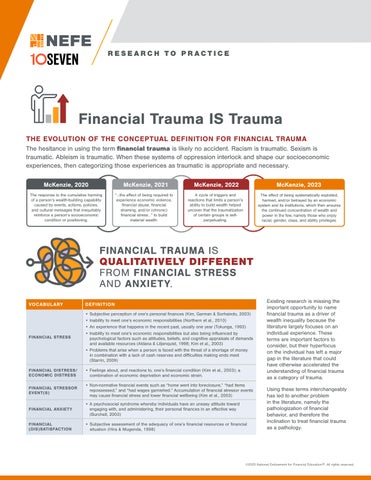
THE EVOLUTION OF THE CONCEPTUAL DEFINITION FOR FINANCIAL TRAUMA
The hesitance in using the term financial trauma is likely no accident. Racism is traumatic. Sexism is traumatic. Ableism is traumatic. When these systems of oppression interlock and shape our socioeconomic experiences, then categorizing those experiences as traumatic is appropriate and necessary.
McKenzie, 2020 McKenzie, 2021
McKenzie, 2022
The response to the cumulative harming of a person’s wealth-building capability caused by events, actions, policies, and cultural messages that inequitably reinforce a person’s socioeconomic condition or positioning.
the response to cumulative harming of a person’s wealth-building capability caused by events, actions, policies, and cultural messages that inequitably reinforce a person’s socioeconomic condition or positioning
VOCABULARY
FINANCIAL STRESS
FINANCIAL DISTRESS/ ECONOMIC DISTRESS
FINANCIAL STRESSOR EVENT(S)
FINANCIAL ANXIETY
FINANCIAL (DIS)SATISFACTION
“the effect of being required to experience economic violence, financial abuse, financial shaming, and/or (chronic) financial stress...” to build material wealth.
“...the effect of being required to experience economic violence, financial abuse, financial shaming, and/or (chronic) financial stress…” to build material wealth.
a cycle of triggers and reactions that limits person’s ability to build wealth helped uncover that the traumatization of certain groups is selfperpetuating.
A cycle of triggers and reactions that limits a person’s ability to build wealth helped uncover that the traumatization of certain groups is selfperpetuating.
FINANCIAL TRAUMA IS QUALITATIVELY DIFFERENT FROM FINANCIAL STRESS AND ANXIETY.
• Subjective perception of one’s personal finances (Kim, Garman & Sorhaindo, 2003)
• Inability to meet one’s economic responsibilities (Northern et al., 2010)
• An experience that happens in the recent past, usually one year (Tokunga, 1993)
• Inability to meet one’s economic responsibilities but also being influenced by psychological factors such as attitudes, beliefs, and cognitive appraisals of demands and available resources (Aldana & Liljenquist, 1998; Kim et al., 2003)
• Problems that arise when a person is faced with the threat of a shortage of money in combination with a lack of cash reserves and difficulties making ends meet (Starrin, 2009)
• Feelings about, and reactions to, one’s financial condition (Kim et al., 2003); a combination of economic deprivation and economic strain.
• Non-normative financial events such as “home went into foreclosure,” “had items repossessed,” and “had wages garnished.” Accumulation of financial stressor events may cause financial stress and lower financial wellbeing (Kim et al., 2003)
• A psychosocial syndrome whereby individuals have an uneasy attitude toward engaging with, and administering, their personal finances in an effective way (Burchell, 2003)
• Subjective assessment of the adequacy of one’s financial resources or financial situation (Hira & Mugenda, 1998)
The effect of being systematically exploited, harmed, and/or betrayed by an economic system and its institutions, which then ensures the continued concentration of wealth and power in the few, namely those who enjoy racial, gender, class, and ability privileges.
Existing research is missing the important opportunity to name financial trauma as a driver of wealth inequality because the literature largely focuses on an individual experience. These terms are important factors to consider, but their hyperfocus on the individual has left a major gap in the literature that could have otherwise accelerated the understanding of financial trauma as a category of trauma.
Using these terms interchangeably has led to another problem in the literature, namely the pathologization of financial behavior, and therefore the inclination to treat financial trauma as a pathology.
FINANCIAL TRAUMA IS TRAUMA.
“ I
urge the field to stop considering financial trauma as a pathology because it participates in victim-blaming and refuses the idea that there are multiple ways of validating people’s post-trauma responses.”
-CHLOE B. MCKENZIE
Conceptualizations like “disordered money behaviors” and the “money script inventory” (Klontz, 2009; Klontz, Britt, Archuleta, & Klontz, 2012) can lead some to pathologize the financial decisions of others without any context. Given this, some researchers and practitioners may become more accustomed to asking, “What is wrong with you?” as opposed to, “What happened to you?” Even as the research acknowledges that being poor or having low financial knowledge itself cannot explain disordered money behavior (Klontz, Britt, Archuleta, & Klontz, 2012), describing financial behavior as disordered in response to people’s and communities’ unique struggle against wealth inequality provides little etiological or conceptual utility outside of the individual’s perception of experience. When financial trauma is not treated as a pathology, it requires researchers and practitioners to define “normal behavior” in a situational, historical, and anti-oppressive perspective. This means the notion of trauma will be more inclusive of purposely ignored groups’ experiences, especially those who are targeted by various forms of oppression.
ABOUT OUR FORTHCOMING RESEARCH
OVERVIEW
Chloe B. McKenzie, a former visiting scholar at NEFE, is currently conducting a study in collaboration with NEFE that aims (1) to properly capture and explain the phenomenon of financial trauma as it occurs to individuals and communities through systems level policy and procedures embedded in the intersections of antiBlackness and misogyny; and (2) to offer and begin dismantling white supremacist ideals through a taxonomy of rhetoric and/ or a conceptual framework to prompt action. Our study will specifically focus on Black women, as Black women’s unique struggle against wealth inequality continues to deviate from much of what researchers consider to be the universal findings about socioeconomic position and mental health—that as socioeconomic position improves, mental health improves. Financial trauma offers us important insights as to why Black women’s experiences deviate from universal findings.
Just as Maria Root criticized Caruth for focusing on a single event of magnitude as the locus of trauma, Chloe B. McKenzie’s (2021) conceptualization of financial trauma identifies that the hyperfocus on individual financial experiences and behaviors fails to acknowledge that 1) trauma can be located throughout the lives of oppressed groups and 2) the effects of trauma in the context of socioeconomic experiences are cumulative and directed toward a community of people. When research only considers the effect of socioeconomic inequities on the individual, it becomes easier to normalize the experiences of insidious traumas—like financial trauma—and dismiss them from mainstream discussions of trauma studies (Root, 1992; McKenzie, 2023).
Pathologizing
RESEARCH QUESTIONS
1. How do Black women in the United States make meaning of and navigate through the lasting effects of financial trauma?
2. What are the primary mechanisms through which economic violence contributes to financial trauma for Black women at the individual and community level? Our literature review on