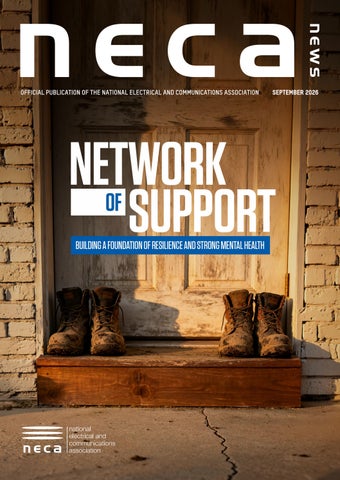
OFFICIAL PUBLICATION OF THE NATIONAL ELECTRICAL AND COMMUNICATIONS ASSOCIATION
September 2026
When trust When trust is aamust is must Tried,tested tested and backed by businesses Tried, and backed by businesses just just like yours, the HiLux is a leader in its field for a reason. thethe New Toyota HiLux is no is no reason.And And New Toyota HiLux different. Born from generations of hard work, it’s designed to offer unparallelled performance and that’s second to none. andreliability reliability that’s second to none. When areare high, and and trust trust is a must, Whenthe thestakes stakes high, is a must, choose forfor Business. To unlock your your chooseToyota Toyota Business. To unlock Association Fleet Discount, visit visit your local Association Fleet Discount, your local Toyota ToyotaDealer. Dealer. Pre-production model shown Pre-production model shown
Find about Findout outmore more about the HiLux theNew NewToyota Toyota HiLux
IN THIS ISSUE September 2026
A MESSAGE FROM THE CEO Advocacy that delivers for our industry
8
FEATURE
NETWORK OF SUPPORT
22
Resilience starts with the workplace, not the employee
10
Designing workplace conditions to enhance individual well-being and organisational results
12
Redefining resilience
14
How NECA helps small businesses – a journey that never stops evolving
16
SA/NT BRANCH Branch update
18
TAS BRANCH Branch update
22
VIC BRANCH
14
Branch update
26
Experience builds confidence, safe habits build resilience
28
Why we need more than resilience
29
NECA News is the official publication of the National Electrical and Communications Association
PEFC Certified Paper from sustainably managed forests and controlled sources PEFC/21-31-119
pefcaustralia.org.au
NECA NATIONAL OFFICE
NECA WA BRANCH
122 Hume Highway, Chullora NSW 2190 1300 361 099 memberservices@neca.asn.au
1300 361 099
NECA News is published four times per year for NECA members, industry providers, wholesalers and manufacturers. Your input is important. To contribute article suggestions or to advertise, contact necanews@neca.asn.au
DISCLAIMER Opinions expressed by contributors in articles, in reproduced articles and advertisements are the individual opinions of such contributors or the authors of such reproduced articles or advertisements and not necessarily those of NECA, which does not hold itself responsible for correctness of any statement contained herein.
memberservices@neca.asn.au
NECA VIC BRANCH Level 12, 222 Kings Way, South Melbourne VIC 3205 1300 300 031 necavic@neca.asn.au
36 WA BRANCH Branch update
NECA FOUNDATION 30
Business resilience – can you prevent failure being your only option?
34
GOVERNMENT AND ADVOCACY
51
42
ACT BRANCH Branch update
Data centres need more than power, they need electricians
56
NSW BRANCH Branch update
36
GTO update – thinking about doing an electrical apprenticeship?
40
Who is NECA Training?
42
Don’t let the monopolies take the work or make consumers pay for it
58
44
NECAGUARD WTW and NECAGuard – 10 years of helping members build resilient businesses
QLD BRANCH Branch update
TECHNICAL
60
44
ACRS NEWS Director’s report
48
OPINION Why good people walk away
50
NECA TAS BRANCH
NECA QLD BRANCH
NECA ACT BRANCH
1300 361 099
Suite 1.5 Ian Barclay Building, 460-492 Beaudesert Road, Salisbury QLD 4107 1300 361 099 memberservices@neca.asn.au
49 Tennant Street, Fyshwick ACT 2609 PO Box 298, Fyshwick ACT 2609 1300 361 099 memberservices@neca.asn.au
memberservices@neca.asn.au
NECA SA/NT BRANCH 213 Greenhill Road, Eastwood SA 5063 PO Box 47, Fullarton SA 5063 (08) 8272 2966 neca@necasa.asn.au
NECA NSW BRANCH
AUSTRALIAN CABLER REGISTRATION SERVICE
122 Hume Highway, Chullora NSW 2190 1300 361 099 memberservices@neca.asn.au
1300 667 771 enquiries@acrs.com.au www.acrs.com.au
BUILDING RESILIENCE, TOGETHER Mental health is not something we should only talk about when things go wrong, or once a year on ‘R U OK? day’. Just as we invest in physical safety, training and wellbeing in the workplace, we also need to create environments where people feel supported, valued, and comfortable asking for help when they need it. For many of us, a trusted colleague, manager, or employee can sometimes be the person who notices something isn’t quite right and encourages you to start a conversation. Being there for the people around us doesn’t mean having all the answers. Sometimes, simply listening, checking in, and knowing when to encourage someone to seek professional support can make an enormous difference.
The same applies to business owners and leaders. It is easy to fall into the trap of believing that, because others rely on us, we have to remain strong all the time. But pressure, uncertainty, financial concerns, long hours, and the responsibility of leading others can take a significant toll on business owners too. Recognising when you are struggling is not a weakness. Reaching out to someone you trust, speaking with a professional, and taking steps to look after yourself are signs of strength and good leadership. In this edition, we explore resilience and mental health through the experiences of people who have faced their own challenges and successfully taken steps towards better mental wellbeing. Their stories demonstrate that there is no
single path to recovery or resilience, but there are lessons we can all learn from their experiences. We also explore practical ideas and strategies to help promote positive mental health practices in your workplace. This includes building stronger connections, encouraging open conversations, and creating a culture where asking for help is accepted. A mentally healthy workplace doesn’t happen by accident. It starts with all of us looking out for one another and remembering that it’s also okay to ask someone to look out for us, too.
The NECA News team
GET IN TOUCH TELL US WHAT YOU THINK Share your feedback via email necanews@neca.asn.au
GOT A STORY IDEA? Share your ideas for content via email necanews@neca.asn.au
ARE YOU A NECA MEMBER? We’re looking to showcase NECA member stories in each issue. Reach out to your NECA Branch or email necanews@neca.asn.au
SIGN UP TO NECA NEWS ONLINE If you’d like to join more than 30,000 of your industry peers and receive a digital version of NECA News, sign up at www.neca.asn.au/necanews
06
|
September 2026
NECA membership isn’t a luxury, it’s a business essential.
We have the experts in-house to provide you with the support you need to thrive in this industry.
NECA MEMBERSHIP INCLUDES: Free 24/7 access to view technical standards at your fingertips with NECA’s Knowledge Base
Access to discounts or benefits for Fuel, Fleet, Insurance, and Health Cover
Free access to Technical experts for on the job support
Industry representation at all levels of Government and key industry groups
Free access to NECA Workplace Relations specialists
Access to education and training events, workshops,seminars and industry conference
Free access to Workplace Health and Safety advice
Access to enter NECA’s prestigious Excellence and Apprentice Awards
Expert Legal advice on contract disputes and negotiation, debt recovery, and representation
Access to industry networking opportunities
NOT A MEMBER? GIVE YOUR LOCAL NECA BRANCH A CALL NECA ACT
1300 361 099
NECA NSW
1300 361 099
NECA QLD
1300 361 099
NECA SA & NT
(08) 8272 2966
NECA TAS
1300 361 099
NECA VIC
1300 300 031
NECA WA
1300 361 099
NECA is the peak body representing the electrical and communications industry Australia-wide | www.neca.asn.au
ADVOCACY THAT DELIVERS FOR OUR INDUSTRY Stewart Joyce NECA Chief Executive Officer
The electrical and communications contracting industry is entering a period of extraordinary opportunity. Artificial intelligence, data centres, renewable energy, transmission, housing, advanced manufacturing, and defence are all creating demand for the skills, capability, and experience of NECA members. That opportunity also brings a clear responsibility. Australia cannot approve and attract major new projects without ensuring that the workforce, training system and competitive market settings can deliver them. This has been a central focus of NECA’s advocacy, and we are now seeing important elements of that work reflected in national policy. In July, the Prime Minister announced the development of clear, consistent and mandatory national standards for artificial intelligence and large data centres. The framework will be coordinated through a new Office of AI within the Department of the Prime Minister and Cabinet, with national oversight across planning, energy, water, infrastructure, skills and investment. The Prime Minister also recognised that artificial intelligence has a substantial physical footprint and that data centre companies will need to invest in skills and training. This direction is significant for our industry. NECA has consistently argued that data centres are not merely digital assets. They are complex electrical infrastructure requiring licensed electricians, apprentices, and electrical contractors to design, construct, connect, commission, maintain and upgrade their power, communications, control, and backup systems. 08
|
The investment pipeline is substantial. In New South Wales, 15 major data centre projects valued at approximately $51.9 billion are progressing through the Investment Delivery Authority. Around 90 data centres already operate across the state, and the sector accounts for approximately 12 per cent of non-residential building investment. This will create major opportunities for NECA members. However, data centre growth cannot be sustained by transferring electricians and apprentices away from housing, renewable energy, transmission, manufacturing, commercial construction, and essential maintenance. Moving a limited
workforce between sectors does not create new capacity. It increases labour pressure, disrupts existing projects, and places additional strain on the small and medium contractors that train much of our future workforce. Our position is straightforward. Governments and data centre proponents must invest in growing the electrical industry that will deliver their projects. That means genuine new apprenticeship commencements, support for first-year and mature-age apprentices, stronger completion and retention measures, increased female participation, and investment
September 2026
InstalTest XD in industry-based registered training organisations and group training organisations. Major proponents should also prepare workforce development plans that set out how they will expand the national skills pipeline, engage local contractors and create lasting capability rather than simply recruit from existing employers.
Multi-Function Installation Tester A MESSAGE FROM THE CEO
Shared Asset Guideline. The review will consider whether the current arrangements adequately manage cross-subsidisation, discrimination, and unfair competitive advantage, while ensuring consumers receive appropriate benefits where regulated assets are also used for other purposes.
These developments demonstrate what focused industry advocacy can achieve. Policy progress rarely occurs through one meeting or one submission. It requires persistence, evidence, credible solutions, and sustained engagement with governments, regulators and stakeholders.
This review is timely. Ring fencing is essential to maintaining confidence in contestable markets. Regulated network businesses must not be able to use monopoly revenue, information, assets, or customer relationships to gain an unfair advantage over independent electrical contractors.
There is still substantial work ahead. National data centre standards must translate into practical workforce investment, and the ring-fencing review must produce reforms that are effective in practice. NECA will remain at the table, representing members and ensuring that the electrical contracting industry is recognised as central to Australia’s economic, energy and digital future.
<Record Keeping & Reporting <Touch Screen <AS/NZS3000 NECA will continue pressing for these requirements to be embedded in the emerging national framework. The goal must be to ensure that data centre investment strengthens the entire electrical contracting industry and leaves Australia with more skilled people, stronger businesses, and greater delivery capacity. We are also seeing momentum on another major NECA priority, electricity distribution ring fencing The Australian Energy Regulator has commenced a comprehensive review of the Electricity Distribution Ring Fencing Guideline and the
< Installation Verification & Compliance Testing Pass/Fail limits and “Auto Sequences” set to AS/NZS3017 Our industry is not simply and AS/NZS3019.supporting the transition. We are
NECA will participate strongly and constructively in the review. We will advocate for clearer separation between regulated and competitive activities, stronger transparency, effective compliance and enforcement, and a framework that protects genuine competition while supporting efficient investment.
XD_NECA2021_Optima_Aus.qxd 24/08/2021 12:18 PM Page 1
IT-XD_NECA2021_Optima_Aus.qxd 24/08/2021 12:18 PM Page 1
building it, and NECA will make sure we have the industry’s back during the whole process.
< Single Test Functions Voltage, Mohm & Ohms, RCD, Loop Impedance, Line Impedance, Earth Resistance, Power & Harmonics, Light, Wire Tracing.
InstalTest XD Installation Tester InstalTest XD Multi-Function
< Site Schematics & Installation Reports Multi-Function Save test results to the Site Schematic or Tree Structure. Start Installation with Site Name and Address. TestTester reports output to PDF or Excel. <Record Keeping & Reporting <Touch Screen <AS/NZS3000
<<High Volume RCD Testing System Installation Verification & Compliance Testing Pass/Fail limits and “Auto Sequences” to AS/NZS3017 < Complete high volume RCD< testing &setlogging solution with and AS/NZS3019. < Single Test Functions bar-code scanner input of RCD IDs and logging of RCD Voltage, Mohm & Ohms, RCD, Loop Impedance, Line Impedance, Earth Resistance, Power & Harmonics, Light, push button tests. Wire Tracing.
<Record Keeping & Reporting Touch Screen AS/NZS3000
Sydney
Tel 02 9519 3933 Fax 02 9550 1378 Sydney
Melbourne
Brisbane
Tel 03 9889 0427 Tel 07 3392 7170 Fax 03Melbourne 9889 0715 Fax 07Brisbane 3848 9046
Tel 02 9519 3933 Fax 02 9550 1378
email testinst@emona.com.au
Tel 03 9889 0427 Fax 03 9889 0715
email testinst@emona.com.au
Tel 07 3392 7170 Fax 07 3848 9046
<<Installation Verification & Compliance Site Schematics & Installation Reports Testing Save testlimits results to the SiteSequences” Schematic orset Tree Structure. Pass/Fail and “Auto to AS/NZS3017 Start with Site Name and Address. Test reports output to and AS/NZS3019. PDF or Excel.
Adelaide< Single TestPerth Functions
EMONA EMONA
< High Volume RCD Testing System Complete high volume RCD testing & logging solution with bar-code scanner input of RCD IDs and logging of RCD push button tests.
Voltage, Mohm & Ohms, RCD, Loop Impedance, Line Tel 08 8363 5733 Tel 08 9361 4200 Impedance, Earth Resistance, Power & Harmonics, Light, FaxAdelaide 08 83635799 Fax 08 9361 4300 Wire Tracing. Perth Tel 08 8363 5733 Fax 08 83635799
Tel 08 9361 4200
Fax 08 9361 4300 < SitewebSchematics & Installation Reports www.instaltest.com.au web www.instaltest.com.au Save test results to the Site Schematic or Tree Structure. Start with Site Name and Address. Test reports output to PDF or Excel.
RESILIENCE STARTS WITH THE WORKPLACE NOT THE EMPLOYEE
STRONGER SYSTEMS, SAFER CONVERSATIONS, PRACTICAL SUPPORT, AND LEADERS WHO ACT EARLY BUILD LASTING RESILIENCE BEFORE PRESSURE TAKES A TOLL. What if telling a team member to be resilient is adding to the burden they are already carrying? Across the electrotechnology sector, electrical contractors, technicians, line workers and apprentices operate in high-consequence environments where concentration, sound judgement and reliability are critical. Resilience is rightly valued in this work. The ability to adapt, recover, and continue operating under demanding conditions is important. However, resilience becomes unhelpful when it is reduced to enduring greater strain, suppressing distress, or recovering quickly from trauma. For an employee navigating a serious incident, intense stress or emotional exhaustion, advice about bouncing back can feel invalidating and disconnected from their immediate reality. It may also send the wrong message that the conditions are acceptable, and the individual’s response is the problem. Business owners face their own commercial pressures, including tight
deadlines, workforce shortages, client expectations, and project risks. However, expecting employees to continually absorb those demands without adequate support does not build resilience. It delays the point at which risks become visible.
Survival mode cannot absorb a lecture During a crisis, the brain prioritises immediate safety. The fight, flight, or freeze response can reduce a colleague’s capacity to process complex information, consider long-term strategies, or act on well-intentioned advice. Emotional distress also consumes considerable energy. A lecture about mindset, perspective or personal strength creates another demand when a team member may already be using every available resource to remain focused and functional. Consider an electrical apprentice who has experienced a serious near miss. Telling them to toughen up or return to work will not rebuild confidence. It may
increase anxiety, shut down an important safety conversation and teach the apprentice that fear should be concealed. A stronger response begins with listening: ‘I am here. I am listening. What would help right now?’ A calm and non-judgemental conversation can reduce the immediate sense of threat and create the safety required for an employee to explain what has happened. It may also give the business clearer insight into whether fatigue, supervision, training, workload, or site culture contributed to the incident. Listening is not passive. It is often the first step towards identifying the right response.
Positivity can become another pressure Business owners and management may reach for optimism because witnessing distress can be uncomfortable. Encouraging a colleague to look on the bright side may ease the listener’s discomfort, however it can leave the team member experiencing the pain feeling unseen. Fear, anger, exhaustion, and uncertainty are understandable responses to difficult circumstances. They are not signs of weak character. Telling an employee to be stronger can imply they are failing to cope, particularly when the distress is being driven by excessive overtime, bullying, commercial demands, isolation or unsafe workloads. Team members cannot think their way out of conditions they lack the authority or resources to change. This is where resilience messaging can drift into toxic positivity. A complex issue becomes a motivational
10
|
September 2026
FEATURE
phrase, and responsibility quietly shifts from the organisation to the employee expected to endure it.
Reduce the load before offering advice A colleague experiencing severe stress may need validation, stability and practical assistance before an action plan. Instead of telling an exhausted electrician to manage stress better, a business owner could review the roster, redistribute urgent work, or temporarily remove the employee from a high-pressure task. For a team member on a remote project, meaningful support may involve examining fatigue cycles, travel demands, access to family contact and whether the roster allows genuine recovery. When an apprentice becomes withdrawn or begins making unusual mistakes, the right response may be a private conversation, closer supervision or additional mentoring rather than criticism in front of the crew. These actions do not remove personal responsibility. They give employees the support and capacity required to exercise it safely. The question should shift from ‘Why are you not coping? to ‘What is creating this strain and what can we change?’
Build resilience into the way work is delivered The electrotechnology sector carries distinct physical and psychological demands. Vigilance around live assets, high-voltage infrastructure and complex systems creates cognitive fatigue. Rigid deadlines, financial penalties, labour shortages and changing site demands can intensify that load. Fly-in, fly-out (FIFO) and distant projects may bring isolation, disrupted sleep and fractured family routines. A traditional culture of toughness can also discourage employees, particularly apprentices and younger tradespeople, from admitting they are struggling. Resilience cannot rely on personal endurance. It must be built into scheduling, supervision, site safety and daily operations.
WWW.NECA.ASN.AU
Mental wellbeing and fatigue checks can sit within toolbox talks alongside physical safety discussions. These conversations do not need to become lengthy or intrusive. A brief and consistent check can identify distress or fatigue before either affects judgement and safety.
rewarding harmful behaviour. Celebrating relentless overtime, contacting colleagues during recovery time, or treating exhaustion as evidence of commitment can reinforce the conditions that eventually undermine safety and performance.
First-year apprentices can be paired with experienced mentors who understand the transition into a highconsequence trade. Peer support champions can provide an accessible first point of contact, while pathways to professional assistance should remain visible across worksites, vehicles, break rooms and internal systems.
Support should remain visible throughout the year rather than appearing only during awareness campaigns or after a serious incident.
Employees also need trusted channels to report unmanageable workloads, unsafe behaviour or psychological hazards without fearing lost shifts, damaged prospects or judgement from colleagues.
Business owners set the standard Team members take their cues from those leading the business. Business owners, project managers and supervisors who acknowledge strain, respect boundaries and respond constructively give employees permission to speak early. Business owners and management should recognise warning signs such as withdrawal, irritability, declining concentration, unusual mistakes or a sudden drop in performance. These signs should prompt a private conversation rather than an immediate judgement about attitude or capability.
Resilience is a business capability Trusted reporting channels, realistic project schedules, effective fatigue management, capable supervision, and genuine recovery time turn resilience from a personal expectation into an organisational capability. This approach protects employees and strengthens the business. Team members who feel safe raising concerns are more likely to identify risks early, seek clarification, and request support before fatigue or distress compromises their judgement. A resilient electrical business does not measure how much its employees can withstand. It creates the conditions in which colleagues can work safely, remain well, and continue contributing over the long term. Before asking a team member to become stronger, business owners should ask: ‘What can we change so our employees do not have to carry this alone?’
Leadership also requires examining whether the business is unintentionally
Lina Altarifi Executive Director, Business Solutions Hub (an initiative of NECA Victoria)
| 11
DESIGNING WORKPLACE CONDITIONS
TO ENHANCE INDIVIDUAL WELL-BEING AND ORGANISATIONAL RESULTS WHEN I ASKED A BUSINESS OWNER WHAT FINANCIAL RETURN HE EXPECTED FROM MY CONSULTING WORK WITH HIS PEOPLE, HE SAID, I AM NOT INTERESTED IN A FINANCIAL RETURN. MY TEAM MEANS EVERYTHING TO ME AND IF THEY WILL BE BETTER OFF FROM YOUR WORK THEN THAT IS ALL I WANT. HE THEN SENT AN EMAIL TO THEM INTRODUCING ME, IN PART WHICH SAID,…I AM KEEN TO UNDERSTAND WHAT MAKES YOU FEEL GREAT ABOUT YOUR JOB, WHAT MOTIVATES YOU, AND, OF COURSE, WHAT FRUSTRATES YOU….PLEASE CONSIDER IT A GREAT OPPORTUNITY TO MAKE THIS A BETTER PLACE TO WORK! At the time, I thought it extraordinary he never mentioned productivity, profitability, or performance. His focus was simply on creating a better workplace for his people. As it turns out, his instinct was well founded. A meta-analysis (a comprehensive review) of 339 studies encompassing over 1.8 million employees found a strong relationship between employee well-being and organisational performance. High satisfaction at work correlated with higher productivity, increased customer loyalty, longer employment tenure, and higher profitability for their organisations. The research suggests that well-being and organisational performance are not competing outcomes. My experience has been that both are often the result of how work is designed, and how people are supported. This connection between wellbeing and organisational performance is becoming increasingly relevant as Australian workplaces navigate the new psychosocial health and 12
|
September 2026
FEATURE
safety requirements. The regulations recognise that psychological risks can arise from many aspects of work, including work design, systems of work, management practices, how work is carried out, and workplace interactions. While psychosocial hazards can arise from many different sources, they share a common outcome: they can negatively affect people’s psychological health and safety. This requires leaders to consider the broader factors within the workplace that influence people’s experience of work. One important part of this is how work is designed. The way roles are structured, workloads are managed, expectations are communicated, and autonomy is provided can significantly impact both wellbeing and performance. Importantly, leaders can shape these conditions. At one time, a business owner called and asked if I could help one of her
team raise their productivity. When I asked what the issue was, the owner said the employee, who started at 7.30 am, didn’t really start firing until late morning. Rather than assuming the issue was motivation, I explored the conditions affecting her work and discovered that an element of her personal life was having a major impact. Once we identified that her start time wasn’t aligned with her personal challenges, we redesigned her workday with a later start and finish time. Both her wellbeing at work and her productivity improved significantly: a simple fix that benefited everyone involved. In another situation, there was a growing level of negativity and stress being generated by the senior manager of three other managers. I noticed that the unhappiness and stress factors multiplied significantly when the senior manager didn’t give appreciation, talked over them and didn’t implement the things he said he would do. Rather than coaching the managers to become more resilient, I examined the leadership behaviours that were creating unnecessary
stress and then redesigned his approach. When he followed through, the stress dissipated, and again, wellbeing and productivity increased. What both stories have in common was the observation and consultation with the people involved—stage 2 in the psychosocial hazard identification process—and then controlling for those psychological risks. In this case it was done through the redesign of conditions that were affecting the individuals involved. Designing workplace conditions is not necessarily about creating an easier workplace or lowering expectations. It is about creating an environment where people can personally thrive and perform highly. The new psychosocial requirements invite organisations to look more closely at how work is designed, managed and experienced. Rather than seeing this as just another compliance obligation, leaders have an opportunity to improve both wellbeing and organisational performance by intentionally shaping the conditions in which people work.
Ray Hodge rayhodge.com.au Ray Hodge consults to businesses, including NECA members, to help assess and manage psychosocial risks. He specialises in collaborating to create psychologically safe workplaces.
WWW.NECA.ASN.AU
| 13
REDEFINING RESILIENCE RESILIENCE IS NEVER SOMETHING THAT APPEARS NEATLY PACKAGED AS A PROFESSIONAL SKILL. IT IS FORGED THROUGH ADVERSITY, TESTED THROUGH PERSONAL AND PROFESSIONAL UPHEAVAL, AND ULTIMATELY BECOMES ONE OF THE FOUNDATIONS ON WHICH SOMEONE CAN BUILD THEIR CAREER. FOR CHRIS MATTNER, BUILDING RESILIENCE TOOK A MUCH SIMILAR PATH AND IT CONTINUES TO BE SOMETHING HE BUILDS UPON EVERY DAY. once viewed as weaknesses eventually became central to his success. “At school, I was always told if I applied myself, I could be anything”, he recalls. That was always hard for Chris, though. “I was very disruptive to the class, but my maths reports were always very good.” The difference emerged when he found something he cared about. “If you’re passionate about something when you’re neurodivergent, you hyper-focus.” At trade school, the student who had struggled within the traditional education system began achieving credits and distinctions. He embraced increasingly difficult work and responsibility, including a major commercial fit-out in an operational hotel environment while still a third-year apprentice. “I just loved getting more and more responsibility and just pushing myself,” said Chris.
Chris’ journey into the electrical industry was hardly conventional. “I didn’t choose this industry, it chose me.” Said Chris. At nine years old, he was diagnosed with A.D.D. School was a difficult environment for Chris, who attended four different schools before eventually being expelled at 16. His father, who ran an electrical business, gave him an ultimatum: find a job within two weeks, or start working for him. Chris chose neither. Two weeks later, his father knocked on his door. “Get up, you’re working for me. We’ll sign your apprenticeship papers today.” Chris describes that morning as “the best decision that I never made”, because what began as an enforced apprenticeship with his dad would ultimately lead to running a global stadium lighting business. The significance of that story is not simply that Chris overcame a difficult start. It is that the traits that were 14
|
Today, Chris is the driving force behind CME. The company has evolved dramatically from its beginnings, as a small electrical operation, to delivering major electrical and lighting projects across Australia and internationally, with sports and stadium lighting becoming a particular speciality. CME’s work has included the Adelaide Oval LED Lighting Tower Upgrade, a technically complex project that went on to receive multiple industry awards. But the growth of the business has not been a straight line. Shortly after Chris took over the business in 2012, the company lost its biggest client, representing approximately 80 per cent of its total revenue. “It was basically a full restructure and reset,” Chris says. What followed was significant growth. Chris separated the sports lighting division into a separate entity in 2014, and the business began recording periods of 100 per cent year-on-year growth.
“Building a good team is obviously a really important thing to do,” Chris said. “That’s part of my main goal, which is always targeting relentless improvement.” For Chris, resilience is not simply about surviving difficult circumstances. It is about developing the capacity to learn from them and emerge stronger. Perhaps the most important lesson from Chris’ story is that professional success can conceal enormous personal adversity. In 2024, he delivered a presentation at the ATEC Awards titled “Redefining What’s Possible”. He began by showing a highlight reel of the previous year, featuring company awards and individual recognition, showing the audience what appeared to be a highly successful business leader at the top of his game. But Chris then challenged that perception. “Everyone looks at it going, ‘Oh, wow, like this guy’s successful and a star, like he must have it easy.’” The reality was very different. “You’ve just seen my highlight reel. It’s pretty cool. But here’s my story.” Chris describes five major adversities occurring simultaneously in 2019: he was going through a divorce, fighting for custody of his children, dealing with a serious family incident involving his two sons, supporting his terminally ill mother and running a rapidly expanding business. The experience fundamentally changed his perspective. “You get through it, and you’re like, okay, well, I don’t reckon I’ll ever come up against something as hard as that again ever.” The adversity did not make subsequent challenges disappear. It changed his ability to face them. “Every challenge or bit of adversity that I faced from there onwards was a lot easier to confront and to deal with.” September 2026
FEATURE
“It’s tough work, like the probing and the pushing and the growth that I have had since starting has been significant.” That willingness to seek support represents another important element of Chris’ approach. Resilience is not about carrying every burden alone. It can also mean recognising when you need another perspective, developing systems that support you and being prepared to confront uncomfortable truths. That may be one of the clearest definitions of resilience in Chris’ story: adversity does not necessarily make the next challenge smaller, but it can make the person facing it stronger. For Chris, the period after 2019 became about more than simply getting through adversity. It became a deliberate process of redefining what was possible, both personally and professionally. He began putting systems around himself to support the person he wanted to become; from structured morning and evening routines to meditation, training, self-awareness and, later, working with a high-performance coach. The shift was from simply surviving difficult circumstances to taking ownership of how he responded to them. It was a mindset built around relentless improvement: recognising that growth often happens outside your comfort zone and that asking for support is not a weakness, but part of building the capacity to perform at your best. Along the way, Chris’ motivation has evolved. The doubters who once told him he would not amount to much became fuel to prove them wrong, but today, Chris is more interested in using what he has learned to help others succeed. For the apprentices and young people entering the electrical industry, that message may be the most powerful part of his story: your starting point does not determine your destination. What matters is your willingness to learn, challenge yourself, seek support and keep redefining what you believe is possible.
Chris’ experiences have also shaped his desire to speak openly about men’s mental health, particularly within the construction and trade industries. He believes many men can find themselves facing relationship breakdowns, family conflict, financial pressure and isolation simultaneously, without feeling they have anywhere to turn. His own experience has made the subject personal. That is why he has chosen to talk publicly about the difficult parts of his story, rather than presenting only the polished version of success. “I was self-taught, and it wasn’t easy, so in terms of other people I think it’s really important that I can give them the skills of what I’ve learned and what’s worked for me, and set them up.” At CME, Chris says he looks for people with a growth mindset; people who want to improve themselves, not simply their technical skills. That philosophy is reflected in the company’s ambition to innovate, its focus on developing people and its efforts to broaden participation in the electrical and construction industries. It is a philosophy that extends beyond mental wellbeing and into his approach to leadership. There is a consistent theme running through Chris’ story: the refusal to
accept somebody else’s definition of what is possible. It began with teachers who doubted him. It continued through the challenges of learning in a system that did not suit him, the uncertainty of taking over a struggling business, and the personal adversity that followed. “I thank the doubters for pushing me, saying I wasn’t going to be anything special”, he says. “Because I’ve turned out to do not too bad.” His advice to the next generation is equally direct. “Never let anyone tell you that you cannot do something; you CAN do ANYTHING!” What he once considered a deficit has become, in his words, his “biggest superpower”. “The world belongs to those who show up relentlessly.” For an industry undergoing enormous technological and cultural change, that mindset may be as valuable as any technical skill. Chris sees the future of stadium lighting being shaped by artificial intelligence, immersive technology, data, sustainability and increasingly sophisticated fan experiences. However, his own journey suggests that innovation is not just about technology. It is about people willing to challenge assumptions, learn from setbacks and keep moving forward. From a teenager who struggled to find his place in school, to an apprentice who discovered a passion for electrical work, and a business leader navigating extraordinary personal and professional adversity, Chris’ journey has been defined by an unwillingness to remain where he is. Perhaps that is the real meaning behind his philosophy of “Redefining What’s Possible”: not that adversity can be avoided, but that it does not have to determine where you ultimately end up.
Chris is also candid about the fact that resilience is not simply a matter of being tough enough. During his first separation, his mother was his primary sounding board, despite being seriously ill herself. By the time he experienced his second separation, he had engaged a high-performance coach. WWW.NECA.ASN.AU
| 15
HOW NECA HELPS SMALL BUSINESSES
A JOURNEY THAT NEVER STOPS EVOLVING SMALL BUSINESS IS THE LIFEBLOOD OF THE NATIONAL ECONOMY AND DOMINATES THE ELECTRICAL AND COMMUNICATIONS CONTRACTING SECTOR. AS A SMALL BUSINESS OWNER, YOU KNOW THE CHALLENGES OF MANAGING, PROTECTING, AND GROWING YOUR BUSINESS. YOU’VE WORKED HARD TO GET WHERE YOU ARE TODAY – YOU DON’T HAVE TIME TO WORRY ABOUT NAVIGATING COMPLEX INDUSTRY REGULATIONS OR STAYING UP-TO-DATE ON THE LATEST CHANGE TO SAFETY COMPLIANCE. That’s why NECA is such an invaluable resource for you. With our network of services, benefits, resources and above all expertise in all aspects of the electrotechnology industry, we help give your business the power it needs to succeed. From technical advice to work, health and safety support to expert Legal and Workplace Relations advice,
it’s only a phone call away as a NECA member. This allows you to focus on what you do best — running your business.
needed to take your business forward and stay compliant with industry standards and regulations.
With NECA in your corner, no matter where you are on your small business journey — starting out or moving up — NECA is here to provide you with the guidance, knowledge and confidence
Take advantage of all that NECA has to offer and let us be your partner in success. With our support, you can be sure that your business is ready for whatever roadblocks stand in your way.
Advocacy & Support Industry representation at all levels of government and key industry groups.*
Events
Benefits & Discounts Discounts and other benefits on business essentials including fuel, fleet vehicle purchases, insurances, and more.*
Industry Accredited Training Training and skills industry accredited courses through NECA’s Post-Trade training partners.*
Access to education, training, events, workshops, seminars, industry conferences, NECA Awards, webinars, industry nights and networking opportunities.*
NOT A MEMBER? GIVE YOUR LOCAL NECA BRANCH A CALL NECA ACT 1300 361 099
16
|
NECA NSW 1300 361 099
NECA QLD 1300 361 099
NECA SA & NT (08) 8272 2966
NECA TAS 1300 361 099
NECA VIC 1300 632 247
NECA WA 1300 361 099
September 2026
FEATURE
NECA Technical Support & Advice
NECA’s Knowledge Base
NECA Workplace Relations
A centralised hub of the best source of industry information, privileged only to NECA members. The NECA Knowledge Base includes industry Australian Standards, technical articles and more. Log into the Knowledge Base in your NECA state to view the full suite of resources available.*
Our technical experts are trained electricians. NECA Members get access to unlimited phone and email support on Australian Industry Standards including Wiring Rules and State Electricity Rules.*
Workplace Health and Safety Advice Phone and email advice on all safety issues. Our Work, Health and Safety team specialise in the electrical industry to assist our members with their questions and challenges.*
Basic phone and email support on all matters including pay rates, award rates, termination, travel allowances and leave entitlements specific to your business.*
Expert Legal Advice Expert legal advice on matters such as contract disputes and negotiation, debt recovery and representation.*
Safety Systems Choose from a range of Safety Systems based on your business size and needs.*
Apprenticeships Group training organisations takes a hassle out of paperwork and payroll for electrical contracting businesses, allowing you to focus with on-the-job training.*
NECA Guard NECAGuard has developed an industry specific insurance program that is specifically tailored for electrical contractors and can be customised to meet the specific needs of your business including:* combined professional indemnity, public liability and management liability; ½ NECAGuard essentials; ½ cover for working at mine sites; ½ builders home warranty; ½
WWW.NECA.ASN.AU
cover for power pole inspectors; ½ commercial motor; ½ trade packages; ½ workers compensation; ½ personal accident and illness; ½ marine transit and general property. ½
Industry updates Industry specific eNewsletters, eAlerts and quarterly NECA NEWS magazine.*
Member Services Support line A dedicated member services telephone support line.*
*Support, advice, member services and benefits may vary within each State. Please contact your NECA State Branch for more information.
| 17
BRANCH UPDATE Dain Venning NECA SA/NT Executive Director
THE YEAR IS SHOWING NO SIGNS OF SLOWING DOWN, WITH OUR MEMBERS CONTINUING TO NAVIGATE A BUSY AND EVOLVING INDUSTRY LANDSCAPE. AS WE MOVE INTO THE FINAL MONTHS OF 2026, IT IS ENCOURAGING TO SEE THE CONTINUED STRENGTH OF THE ELECTROTECHNOLOGY SECTOR, WITH BUSINESSES EMBRACING INNOVATION, INVESTING IN THEIR PEOPLE, AND FINDING NEW OPPORTUNITIES FOR GROWTH. I would also like to take this opportunity to formally introduce myself to the NECA SA/NT membership as your new Executive Director. Having joined the branch in 2023 as Workplace Relations Advisor, I have had the privilege of working closely with many of our members and gaining a firsthand understanding of the challenges and opportunities facing our industry.
Scan here to visit the NECA SA/NT homepage
SA/NT BRANCH
I officially stepped into the role of Executive Director in July and am honoured to lead the branch into its next chapter. While my responsibilities
have expanded to include government engagement, advocacy, and strategic leadership, one thing remains unchanged – my commitment to providing direct workplace relations advice and support to our members. I look forward to continuing to work alongside our dedicated team and membership base to strengthen our industry, grow our branch, and ensure NECA SA/NT continues to deliver the high level of service and representation our members have come to expect.
18
|
September 2026
SA/NT BRANCH
Master Builders Northern Territory Excellence in Building and Construction Awards In August, Craig Mitchell, Manager of Electro Careers & Apprenticeships, and I travelled to Darwin to attend the Master Builders Northern Territory Excellence in Building and Construction Awards, the construction industry’s largest event in Northern Australia, at the picturesque Mindl Beach Casino, of which we are a proud Silver Sponsor. It was an excellent event, with over 700 attendees, making for the perfect setting to catch-up with several of our Darwin-based members – it was pleasing to hear that they are all extremely busy with work.
WWW.NECA.ASN.AU
| 19
BRANCH UPDATE
Darwin Independent Suppliers Tradeshow Jamie Phillips, Marketing, Communications and Membership Manager, travelled to Darwin in early September and participated in a locally run trade show at Darwin Greyhounds in Winnellie with some of our fantastic partners, including Clipsal by Schneider Electric and NHP. It was excellent opportunity to catch up with most of our Darwin-based members and meet some new, friendly faces.
20
|
Save the date! Specialist Contractors Association Luncheon The Specialist Contractors Association Luncheon has a new look in 2026! This year it will be held at the iconic Jolley’s Boathouse on Friday 6 November from 12:30pm to 3:30pm. The event is one of the most well-attended gatherings on our calendar and provides a fantastic opportunity to connect with colleagues across South Australia’s sub-contracting sector. We look forward to welcoming members for
an afternoon of networking, industry insights, and great company in a spectacular riverside setting. For further information or assistance with any of the above, please contact the NECA SA/NT team on (08) 8272 2966.
September 2026
2026 NECA SA/NT INDUSTRY GALA DINNER
SA/NT BRANCH
THE PREMIER EVENT IN THE ELECTROTECHNOLOGY SECTOR, THE NECA SA/NT INDUSTRY GALA DINNER, WILL BE HELD ON FRIDAY 11 SEPTEMBER 2026 AT THE ADELAIDE CONVENTION CENTRE. WE ARE ON TRACK FOR A BRILLIANT EVENING WITH OVER 400 ATTENDEES SET TO ENJOY AN EVENING FILLED WITH GREAT ENTERTAINMENT, FANTASTIC FOOD AND WINE, AND INDUSTRY ACHIEVEMENTS ON DISPLAY BY BOTH MEMBERS AND THEIR APPRENTICES.
Our sincere thanks to each of our fantastic sponsors, because quite simply this event could not run without their generous support. Our sponsors, this year, are: Perpetual Sponsor Electro Careers & Apprenticeships National Sponsors Clipsal by Schneider Electric and MMEM Apprentice Sponsor MAS National Gold Sponsors ACRS, Cbus Super and Clevertronics Product Sponsor Milwaukee Tools Silver Sponsor Portable Long Service Leave Award Sponsors Energy Skills Australia, Lynch Meyer Lawyers, NHP, and PEER Bronze Sponsor Bianco
our members who are making an impact in the industry and deserve to be acknowledged at the highest level. The Apprentice Awards commends the top apprentices in our industry based on their technical abilities, general knowledge, attitude, passion, and desire to succeed in their career.
If you have a project, small business, or apprentice you’re proud of, we encourage you to enter the 2027 Awards, where the rewards are significant. It’s worth starting to think about your submission now, and for the fourth year running we’re pleased to offer the free submission writing service to all members.
The full write-up on this year’s NECA SA/NT Excellence, Small Business, and Apprentice Awards will be featured in the December edition of the NECA NEWS magazine.
For more information on entering, contact the NECA SA/NT office and speak to Jamie Phillips, Marketing, Communications and Membership Manager.
The Excellence Awards provide an opportunity for electrical and communications contractors to showcase the high-quality work they perform daily. The Small Business Awards recognises
WWW.NECA.ASN.AU
| 21
BRANCH UPDATE Ben Shaw NECA TAS Executive Director
Welcome to the September 2026 edition of NECA News. We’ve had a busy quarter, highlighted by our 2026 NECA TAS Awards in August. We’ll cover the awards more closely in our next edition, so for now, read on and catch up with all the need-to-know details from the Tasmanian Electrotechnology industry!
Fire safety servicing changes – what members need to know
Inspection and testing frequencies vary depending on the system, ranging from monthly through to annual activities, with some components requiring longterm replacement cycles (e.g. 25 years).
Building owners are responsible for ensuring contractors are competent and appropriately licensed for the task. Contract structuring must also comply with state legislation, with written agreements required above certain thresholds. For further guidance, NECA’s technical team is available to support members with compliance and interpretation. A full fact sheet detailing your requirements can be found on the NECA MKB.
Scan here to visit the NECA TAS homepage
TAS BRANCH
NECA members should be aware of updated fire safety servicing requirements impacting Class 1b and Class 2–9 buildings across Australia. All essential fire safety measures must now be inspected, tested, and maintained in accordance with AS 1851 2012, which sets out requirements for routine servicing of fire protection systems.
Importantly, there is no single licence covering all AS 1851 activities. While inspection and testing are generally unlicensed, maintenance work involving alterations or exceeding state thresholds may require a builder’s or trade-specific licence. Electrical work such as exit and emergency lighting must be undertaken by a licensed electrician or appropriately qualified technician.
22
|
September 2026
TAS BRANCH
NECA TAS Women in Electro Awards Recently, NECA Tasmania Women in Electro Advisory hosted the 2026 Women in Electro Awards. This was a successful event, and it was great to see so many people supporting women in the industry! Congratulations to our winners: Leadership and Mentorship Award Teena Smith Commitment to Women in Trades Elise Nowell Best Workplace Culture Contact Group Excellence on the Tools Erin Cottuli Rising Spark Award Holly Frankcombe We are proud to announce that we have also raised $1,452 for our charity partner Dress for Success Tasmania. This charity is dedicated to empowering women to overcome employment barriers. WWW.NECA.ASN.AU
Thank you to everyone and our sponsors who supported the event. We look forward to hosting more events like this in the future.
NECA has a complete guide to electrical work in medical areas We have seen an increase in inquiries regarding the installation of electrical equipment in medical areas such as hospitals, medical centres and dental practices. This is a very specialist area, and NECA’s technical team have reviewed AS/ NZS3003:2018 to provide a detailed summary of the key areas to ensure you are compliant when you complete work under AS/NZS3003. This Body Cardiac Protect Tech Requirements guide provides practical guidance on complying with AS/NZS 3003:2018 for electrical installations in patient areas, particularly body-protected and
cardiac-protected environments. It clarifies classification responsibilities, installation requirements, and the importance of aligning electrical design with medical procedures and risk levels. Key focus areas include: ½
dedicated circuits;
½
10mA RCD protection;
½
socket-outlet compliance;
½
accessibility for clinical staff.
Additional requirements for cardiac areas, including equipotential earthing systems, are detailed to minimise shock risk. The document emphasises testing, verification, documentation, and clear labelling to ensure safe, compliant installations in healthcare environments. The full document can be found on the NECA Member Portal.
| 23
BRANCH UPDATE
Why every electrical business needs an annual safety review Safety compliance isn’t something you set up once and forget. As legislation, Australian Standards and industry expectations continue to evolve, even well-managed businesses can develop compliance gaps without realising it. Throughout 2025, the NECASafe Team completed more than 430 Annual Safety Reviews across Australia. These desktop reviews consistently identified common issues, including outdated Safe Work Method Statements, expired licences and competencies, incomplete training records, missing calibration registers and limited evidence supporting critical safety decisions such as energised work and safety observer requirements. While these gaps are often unintentional, they can expose businesses to improvement notices, regulatory action and increased liability if an incident occurs. An Annual Safety Review provides an independent assessment of your safety management system, helping identify areas for improvement before they become compliance issues. It also ensures your documentation remains current, your registers are up to date, and your business is meeting legislative and industry requirements. More importantly, an Annual Safety Review provides peace of mind. It gives business owners confidence that their safety systems are protecting both their workers and their business. If you haven’t booked your 2026 Annual Safety Review, now is the time. Contact the NECASafe Team to schedule your review and ensure your business remains compliant, organised and ready for the year ahead.
Key requirements include: ½
½
½
Hand dryers in accessible bathrooms – what electricians need to know Installing hand dryers in accessible bathrooms requires more than simply mounting the unit on a wall. Compliance with both AS/NZS 3000 (Wiring Rules) and AS 1428.1 (Design for Access and Mobility) is essential to ensure safe and accessible installations. 24
|
maintaining correct clearances from sinks, walls, benches and doorways; installing hand dryers at accessible heights between 900mm and 1100mm above finished floor level, and; ensuring isolation switches or socket outlets remain accessible to users.
When designing installations, adopting the more stringent clearance requirements can help avoid compliance issues and ensure accessibility for all occupants. For more information, call NECA Member Services at 1300 361 099, or find the full fact sheet on the NECA Member Portal. September 2026
TAS BRANCH
NECA challenges proposed trust tax changes
Our primary position is that the broad measure should not proceed.
NECA is taking a firm stand against the Australian Federal Government’s proposed 30 per cent minimum tax on discretionary trusts on behalf of members.
NECA proposes that if the Government proceeds, existing active trading trusts should be protected. Any required restructuring must be supported by comprehensive rollover relief, automatic continuity of licences and approvals, adequate implementation time, and full compensation for professional costs, transfer duties, contract changes, business interruption, and other unavoidable expenses imposed on contractors.
Many electrical and communications contracting businesses use trusts for legitimate commercial reasons, including asset protection, succession planning, business continuity, risk management and family enterprises. Treating these structures as a proxy for tax avoidance is unjustified and risks penalising businesses that have operated lawfully for many years. NECA has told Treasury that the proposal would increase tax liabilities, reduce working capital, discourage investment and create significant legal, accounting, financing, licensing, insurance, procurement and contractual disruption. These impacts would fall on businesses already managing rising costs, workforce shortages and demand for skilled labour across housing, data centres, renewable energy and electrification.
WWW.NECA.ASN.AU
REC requirements 2026: what electricians need to know Residual Current Device (RCD) requirements continue to be a key area of compliance under AS/NZS 3000, and NECA’s latest fact sheet provides a practical guide to understanding where RCD protection is required for new work, alterations, switchboard upgrades and repairs. A major reminder is that Type AC RCDs can no longer be installed, with electricians required to select compliant alternatives. The fact sheet
also clarifies that for domestic and residential installations, 30 mA RCD protection is required on all final subcircuits, including lighting, socketoutlets and fixed-wired equipment . For commercial and industrial installations, 30 mA RCD protection is generally required on final subcircuits rated at 32 A or less supplying socket-outlets, lighting and certain equipment, while recognising specific exceptions for dedicated equipment circuits, repairs, and situations where RCD operation could create a greater safety risk. The guide also explains when RCD upgrades are triggered by alterations, switchboard replacements and repair work, helping contractors determine their obligations and avoid common compliance mistakes. NECA members are encouraged to review the fact sheet to ensure installations remain compliant and to better understand the practical application of current RCD requirements across residential, commercial and industrial projects.
| 25
BRANCH UPDATE John Sofarnos NECA VIC Executive Director Dean Spicer NECA VIC President
Supporting our industry through connection, resilience and practical support The September edition of NECA News gives us an important opportunity to reflect on mental health and resilience across our industry. While resilience is often spoken about as an individual responsibility, we know that strong businesses are built by creating supportive workplaces, practical systems and connected communities that help people thrive. At NECA Victoria, our commitment extends beyond technical advice and advocacy. We continue to invest in services, events, and resources that make it easier for members to run safer, more efficient businesses while ensuring they have access to support when they need it most.
Scan here to visit the NECA VIC homepage
VIC BRANCH
Celebrating our industry at the 2026 NECA Victoria Awards
26
|
We proudly welcomed over 600 guests this year at the 2026 NECA Victoria Awards and once again demonstrated what makes our industry so special. It was fantastic to see contractors, apprentices, suppliers and industry partners come together to celebrate the outstanding achievements of our members. This year’s event was made even more memorable with the return of crowd favourite Dermott Brereton as MC, bringing his trademark energy and humour to the evening. We also enjoyed plenty of laughs thanks to comedy magician Anthony De Masi. Combined with fantastic networking opportunities, the evening provided the perfect chance for members to reconnect with industry colleagues, strengthen relationships and celebrate together. Congratulations to all finalists and winners, whose commitment to quality, innovation and professionalism continues to raise the standard of our industry.
Keep connected with upcoming events Our calendar of events continues throughout spring, providing members with opportunities to stay informed, build capability and connect with industry peers. Our popular Industry Nights will continue across Victoria, delivering practical updates on the latest technical developments, compliance requirements, and industry issues affecting electrical contractors. We’re also looking forward to our annual Golf Day in November, one of the most anticipated networking events on the NECA calendar. Whether you’re catching up with long-standing industry colleagues or building new connections, it’s a great opportunity to step away from the worksite and spend time with the wider NECA community. We encourage members to keep an eye on upcoming event announcements and to register early to avoid missing out.
New member services and benefits designed to make business easier NECA Victoria continues to expand the practical support available to members with the introduction of new services designed to save time, reduce admin and support business growth. NECA Finance We are excited to introduce a brand-new service created to help NECA members access specialist finance solutions with confidence. Whether buying a home, refinancing, investing in your business or purchasing new equipment, NECA Finance partner Picket Fence Home Loans understands the unique financial needs of self-employed electrical contractors and can help find the right solution.
September 2026
VIC BRANCH
With personalised support from enquiry through to settlement, NECA Finance makes the lending process simple, so members can spend more time focusing on their business. HSEQ+ We’re excited to introduce the next generation of HSEQ+, our upgraded health, safety, environment, and quality management platform built specifically for electrical and communications contractors has now gone digital. The new HSEQ+ has been designed to make safety and compliance easier, faster, and more practical than ever before. Members can complete forms, inspections, SWMS, permits, and checklists directly from their phone or tablet, while benefiting from automated registers, digital recordkeeping and real-time workforce visibility. With online and offline functionality, AI-powered tools, automated workflows and regular legislative updates, HSEQ+ reduces administration while helping businesses stay compliant across every project. It also makes document sharing simpler, allows workers to review and sign documents without creating accounts, and provides ongoing support from NECA’s HSEQ specialists. Whether you’re managing a small team or a large workforce, HSEQ+ helps bring safety and compliance together in one easy-to-use platform. To enquire about HSEQ+ contact the NECA Victoria Member Experience Team for more information.
WWW.NECA.ASN.AU
Repco & Tint a Car Trade Discount with the MyNECA app Members can now access their digital Repco & Tint a Car Trade Discount Card directly within the MyNECA app, making it easier than ever to receive exclusive trade pricing at Repco and Tint a Car stores across Victoria. The MyNECA app also provides convenient access to member resources, NEON technical support, event registrations and important industry updates, ensuring your membership is always at your fingertips.
Looking after mental health This edition reminds us that looking after mental health is just as important as managing physical safety on site. Victoria now requires businesses to manage psychosocial hazards as part of their workplace health and safety obligations, making employee wellbeing an increasingly important part of running a compliant business. NECA Victoria members have access to our Employee Assistance Program through Hunterlink, providing confidential, professional support for members, their employees, and immediate family members. Whether someone is experiencing work pressures, financial stress, relationship challenges, or simply needs someone to talk to, Hunterlink offers practical support whenever it’s needed.
Strong businesses start with healthy people, and we encourage all members to make use of this valuable service.
Looking ahead We are excited to announce that our Office will be undergoing a major renovation and look forward to welcoming members and key stakeholders to our newly refurbished premises from mid-October. As we move into the final months of 2026, our focus remains on delivering practical support that helps members build stronger, safer and more resilient businesses. From new digital services and specialist business support to industry events, advocacy and wellbeing initiatives, NECA Victoria is committed to helping members navigate an evolving industry with confidence. We thank all members for their ongoing support and look forward to connecting with many of you over the coming months at our Industry Nights, Golf Day and other upcoming events. If you’d like to learn more about any of the services or member benefits featured in this edition or need assistance finding the right support for your business, please don’t hesitate to contact the NECA Victoria team—we’re here to help.
| 27
EXPERIENCE BUILDS CONFIDENCE
VIC BRANCH
SAFE HABITS BUILD RESILIENCE At Energy Safe Victoria, prevention is our goal. We know every worker who returns home safely does so because of countless decisions made long before an incident occurs. Experience and technical knowledge are among the greatest strengths of our electrical workforce, but in a high-risk industry, this alone doesn’t prevent incidents. Safe outcomes also depend on our ability to recognise when human factors begin to influence our judgement. We often think of resilience as recovering after something goes wrong, but in a safety context it also means managing influences like complacency, time pressure and overconfidence before they affect our decisions. The latest data from Monash University’s Victorian Injury Surveillance Unit paints a sobering picture. In 2024–25, 556 workers were treated in Victorian public hospital emergency departments for electrical injuries, 100 more than the previous year.
the kind of people building their confidence, taking on greater responsibility and balancing the everyday pressures of getting the job done. That matters because it reinforces a key finding from Energy Safe’s community behavioural research: recognising a risk doesn’t always translate into safe decision-making. Across multiple studies, we’ve found Victorians generally understand the hazards of electricity. The challenge isn’t awareness; it’s the false confidence that familiarity can create. As tasks become familiar, shortcuts creep in, assumptions replace safety checks, and people begin to underestimate risk: I’ve done this a hundred times before. Every incident has its own circumstances, and statistics tell only part of the story. In the past 12 months, two Victorian
For electrical workers, recognising how familiarity can influence judgement is a professional safety skill just as important as technical competence. This kind of resilience isn’t about pushing through. It means resisting the pressure to rush, slowing down to confirm safety controls, pausing to reassess when conditions change, and speaking up when something doesn’t look right. Experience builds confidence. Safe habits build resilience. And taking the time to make the safest decision isn’t hesitation, it’s professionalism.
Leanne Hughson CEO, Energy Safe Victoria energysafe.vic.gov.au
Many weren’t inexperienced workers. Half were aged between 25 and 39:
“
workers lost their lives after contacting overhead powerlines. While neither was an electrician, both tragedies reinforce a simple truth: electricity doesn’t distinguish between trades, experience, qualifications, or good intentions.
When severance contributions are defined in your industrial agreement, choosing the security of Protect provides the surety that your business is competitive in recruiting the best trades staff. Enhancing your employee value proposition through a Protect account provides workers with financial security and stability, increasing engagement, retention and organisational performance.
“
MIKE PURNELL - Protect Group Director Employer Representative
SEVERANCE & REDUNDANCY FUND • INCOME PROTECTION INSURANCE • FREE COUNSELLING SERVICES
protect.net.au
WHY WE NEED
VIC BRANCH
MORE THAN RESILIENCE Resilience has become a common workplace solution for many challenges. Are people overwhelmed? Build resilience. Is mental health declining? Build resilience. Are small businesses drowning in compliance? Build resilience. But it’s time we start asking whether resilience is really the problem we’re trying to solve. There is no doubt resilience is valuable. The ability to recover from setbacks, adapt to uncertainty and continue moving forward is essential. Life is unpredictable, and no workplace can eliminate adversity altogether. The word resilience comes from the Latin resilire, meaning “to rebound”, it was first used in engineering to describe materials that could absorb force and return to their original form. In psychology, the concept developed in the 1970s through research into children who overcame extraordinary adversity. Researchers found that resilience wasn’t simply an inborn characteristic but developed through protective factors such as supportive adults, stable relationships, and safe environments.
You cannot resilience your way out of chronic understaffing, poor leadership or a toxic workplace culture.
workplaces. That support doesn’t remove responsibility; it makes responsible compliance and success achievable.
Healthy and balanced organisations understand this. They invest in employee wellbeing while also designing work that is psychologically safe, manageable and supported.
Perhaps resilience has become so popular because it feels empowering. It suggests there is something individuals can do when life becomes difficult. But it can also distract us from a more important question: what responsibility do organisations, governments and regulators have to create the conditions that support people’s mental health and wellbeing?
The demands placed on businesses continue to grow. New regulatory requirements, evolving client expectations and economic pressures all require additional time, expertise and investment. While large and well-established businesses may have dedicated teams to manage these obligations and the ability to deal with additional workload, many small and medium-sized businesses are expected to achieve the same outcomes with limited resources. If resilience depends on supportive environments, then businesses also need support.
Resilient employees are built by resilient organisations. Resilient organisations are built on systems that are practical, fair and supportive. Systems that enable success rather than expecting endless adaptation and imposing sanctions when businesses don’t comply. Resilient industries are created when businesses are given the tools, guidance and environment they need to succeed—not simply expected to absorb ever-increasing demands.
This is where NECA plays a vital role. By providing practical guidance, training, resources and advocacy, NECA help businesses navigate their obligations and build safer, healthier
Alexia Renoult HSEQ Manager, NECA Victoria
In other words, resilience wasn’t about enduring unhealthy conditions indefinitely. It was about recovering because healthy systems existed around people. Somewhere along the way, however, resilience stopped being about recovering from hardship and started becoming about tolerating it. Today, we often use the concept in ways that overlook its original purpose.
We’reWe’re taking We’re taking taking the stress outstress the the stress out out of renewing of renewing of renewing your licence licence youryour licence
When workloads become excessive, deadlines tighten, and staff burnout increases, the solution is often to encourage people to be more resilient. While coping strategies can certainly help individuals, they should never be a substitute for addressing the underlying causes of stress. Breathing exercises alone won’t resolve systemic pressures.
Too often, organisations ask why people aren’t coping instead of asking why work has become so difficult to cope with. is bringing electrical CPD training to NECA is bringing electrical CPD trainingNECA to NECA is bringing electrical CPD training to Recent occupational health and safety regional Victoria, cutting the travel, the time off regional Victoria, cutting the travel, the time off regional Victoria, cutting the travel, the time off legislation seems to reflect this shift the tools, the tools, and the pressure that comes with both. and the pressure that comes with both. in thinking. Psychosocial hazards the tools, and the pressure that comes with both. such as excessive jobtodemands, Coming to Horsham in October Coming Horshampoor in October support, bullying, poorly managed Coming to Horsham in October change and low organisational justice are now recognised as workplace risks that employers are expected to manage, just like physical hazards. ABN: 53 054 944 | RTO: 21098 ABN: 53 054 944 | RTO: 21098
ABN: 53 054 944 | RTO: 21098
Resilience is not a control measure.
Find out more
Fi
BRANCH UPDATE Kelly Dewar-Matusik NECA WA Executive Director
WELCOME TO THE WA SECTION OF NECA NEWS. WE’VE STARTED THE SECOND HALF OF THE YEAR WITH A BANG, WITH LOTS TO BE PROUD OF ACROSS THE WESTERN AUSTRALIAN ELECTROTECHNOLOGY INDUSTRY. OUR INDUSTRY’S SUCCESS WAS RECENTLY HIGHLIGHTED AT OUR 2026 NECA WA AWARDS CEREMONY IN JULY, AND I’D LIKE TO ISSUE SPECIAL CONGRATULATIONS TO ALL THE NOMINEES AND WISH ALL OUR WINNERS THE BEST OF LUCK WHEN THEY FEATURE IN THE NATIONAL AWARDS IN NOVEMBER THIS YEAR. MEN connection The Multiple Earthed Neutral (MEN) connection is a critical safety requirement in every electrical installation.
A missing or defective MEN connection can result in high earth fault loop impedance, exposed conductive parts becoming live, failure of protective
Verification should include confirming the MEN link is correctly installed, checking the earthing system, verifying the operation of protective devices, and ensuring the earth fault loop impedance is within acceptable limits. As a final check before leaving the installation, an Earth Fault Loop Impedance (EFLI) test is strongly recommended to confirm the MEN connection is present and operating effectively.
Scan here to visit the NECA WA homepage
WA BRANCH
The MEN connection provides the essential fault current path, allowing protective devices to operate rapidly during an earth fault.
devices to disconnect the supply, and a serious risk of fatal electric shock.
30
|
September 2026
WA BRANCH
Most Critical Defects The importance of the MEN connection and the bonding of a steel switchboard enclosure cannot be overstated. Both are critical electrical safety requirements, and the significant penalties imposed for non-compliance reflect the seriousness of these obligations. Failure to comply can place lives at risk and result in substantial penalties.
Bonding steel switchboard enclosure Correct bonding of a steel main switchboard is an essential electrical safety requirement. The steel switchboard enclosure must be bonded with an earth conductor having the same cross-sectional area as the main neutral conductor. When upgrading older timber main switchboards with a steel DIN kit, correct bonding is especially critical when unprotected consumer mains are present.
WWW.NECA.ASN.AU
Failure to bond the steel enclosure can result in a dangerous voltage being present and may result in someone receiving a fatal electric shock if they were to touch the switchboard. Continuity testing is essential to verify that the bonding conductor is correctly installed. Test results should be accurately recorded on the test sheet, with photos submitted as evidence of compliance and verification.
Are you seeing the risks before they become incidents? Every electrical business has hazards. What separates high-performing contractors from everyone else is their ability to identify risks early, learn from industry incidents, and put practical controls in place before something goes wrong. Throughout the year, NECASafe reviews hundreds of incidents, near misses, investigations, safety observations, and industry
trends across the electrical and communications sector. While every event is different, the same themes continue to emerge: inadequate planning, incomplete isolation, asset strikes, working-at-heights issues, poor testing and verification processes, and assumptions that lead to unintended consequences. The challenge for many businesses is not knowing where to start. That’s why NECASafe provides members with practical resources designed specifically for electrical contractors. Tools such as our Risk Focus program, Annual Safety Reviews, investigation support, safety management systems, and advisory services help businesses identify weaknesses before they result in injuries, regulatory action, equipment damage, or project delays. An Annual Safety Review is often the best starting point. It provides an opportunity to sit down with a NECASafe Advisor, review your current systems, identify improvement opportunities, and develop a practical pathway forward.
| 31
BRANCH UPDATE
2026-2027 Award Guide The Western Australian Electrical Contracting Industry Award and the Federal Electronic and Communications Contracting Award were updated effective from the first full pay period on or after 1 July 2026. The changes to the WA award apply to state system electrical contracting businesses and cover electricians, electrical fitters/installers, linespersons, cable jointers, electrical assistants, and apprentices. NECA is pleased to advise that the following updated resources are available for members: ½ ½
½
½
2026–2027 Electrical Award Guide; 2026–2027 Electrical Award Wage Rate Bulletin; 2026–2027 Clerks Award Wage Rate Bulletin; 2026-2027 WA Electrical Contracting Industry Award summary, accessible on the WA government website.
WA BRANCH
The updated wage rates apply from the first full pay period on or after 1 July 2026. Members should ensure they review the relevant resources and update their payroll systems accordingly. If you have any questions regarding the updated award rates or any other queries, please contact the NECA Legal Workplace Relations Team to discuss.
Battery energy storage systems (BESS) – location requirements you need to know With battery installations continuing to grow across Australia, it’s critical that electricians understand the location restrictions and safety requirements of AS/NZS 5139, including the latest Amendment 1 updates. Our updated fact sheet provides a practical guide to compliant BESS placement, exclusion zones, fire barriers and signage requirements. The fact sheet explains where a BESS cannot be installed, including near exits, windows, ventilation openings, hot
water systems, air-conditioning units, evacuation routes, ceiling spaces, wall cavities, roofs, under stairways, and within habitable rooms. It also highlights requirements for noncombustible barriers when batteries are installed adjacent to habitable rooms or combustible building surfaces. Special attention is given to installations near gas cylinders and gas meters, with clear guidance on the exclusion zones required under AS/NZS 3000. Understanding these clearances is essential to ensuring both electrical and gas safety compliance. Refer also to the NECA Fact Sheet titled Gas Meter Location Requirements WA, on the NECA Member Knowledge Base. The fact sheet also covers battery location signage, restricted access requirements, and environmental considerations such as temperature limits, protection from weather, and avoidance of combustible materials. Before installing any battery system, make sure you understand both the Standard and the manufacturer’s instructions. This fact sheet provides a simple reference to help ensure your next BESS installation is safe, compliant, and inspection-ready.
We’re reaching out to regional members We’re keen to get to know our regional members better and make it easier for you to connect with your NECASafe Advisor. If you’re based in a regional area, this is a great opportunity to book a free meeting to discuss your business’s safety needs, ask questions, and get practical support. These meetings can be used for an Annual Safety Review, safety system demonstrations, a general advisory discussion, or practical ideas to make safety management easier. If you’re within travelling distance, your NECASafe Advisor may be able to meet with you in person. Online meetings via Microsoft Teams are also available. While we’re focusing on connecting with regional members, any member is welcome to book a meeting.
32
|
September 2026
ELECTRICAL APPRENTICESHIPS national electrical and communications association
ARE YOU AN ELECTRICAL CONTRACTOR? Become a host trainer and take on a NECA Apprentice Why not take the effort out of employing your own apprentice and employ an apprentice from NECA. NECA Electrical Apprenticeships employ qualified apprentices and place them with host companies, for any amount of time from 3 months to 4 years, providing you with a flexible workforce. By becoming a Host company you only pay a fixed charge out rate, whilst NECA takes on all the added costs and responsibilities. Build your future, have time to grow your company and let us take on the risk. Contact us today or register your interest at necatraining.com.au
NECA Electrical Apprenticeships provide
NECA’s fixed charge out rates include
● Advertising ● Recruitment ● Interviews, Selection and Medicals ● Record Keeping and Payroll ● Ongoing Monitoring and Mentoring
● Annual Leave Days ● Sick Days ● Public Holidays ● Training Fees ● Superannuation ● Workers Compensation ● Off The Job Training Days ● Uniforms and PPE
● Training
Perth office now open
Connect with your local NECA centre WA (08) 6117 3017 necatraining.com.au
WE ARE NOT-FOR-PROFIT | PASSING THE BENEFITS ON TO YOU
BRANCH UPDATE Mark Stedfut NECA ACT/NSW Executive Director
WELCOME TO THE ACT SECTION OF THE SEPTEMBER 2026 NECA NEWS. IT’S BEEN A FAST START TO THE FINANCIAL YEAR, WITH LOTS OF CHANGES AND EVENTS, HIGHLIGHTED BY OUR NECA ACT 2026 AWARDS, WHICH WILL BE COVERED IN THE NEXT EDITION. Keep a close eye on your email inboxes, and read on to make sure you don’t miss any important information!
The Clean Energy Regulator has recently revoked the accreditation of solar installers The CER has recently released findings into two investigations that were carried out. Both investigations have resulted in the cancellation of a solar installer’s ability to supply renewable energy products such as batteries or solar PV panels. The reasons highlighted by the CER include: ½
Scan here to visit the NECA ACT homepage
ACT BRANCH
½
34
|
½
½
½
failed to provide a certificate of electrical safety to Access Canberra and/or Actew AGL;
Did you know? Included in your NECA membership, you have access to Workplace Relations support from our team of industry specialists. Whether you need assistance with pay rates, awards, leave entitlements, employment contracts, performance management, disciplinary matters, or employee issues, expert advice is just a phone call or email away. Access hundreds of professionally drafted HR templates, policies, letters, forms, and workplace
provided false or misleading written statements on multiple occasions; installation was completed with a material breach of local, state or Territory government requirement; did not meet the requirements of the accreditation scheme; did not meet the onsite attendance requirements of the accreditation scheme on multiple occasions.
These cancellations are in effect for up to two years, and the person is not eligible to install solar PV systems or batteries under the SRES. Any installations they complete during the period of ineligibility are not eligible to receive STCs. The CER reminds scheme participants that information provided to the CER must be true and accurate, and installers must ensure that all local and state or territory government requirements are met for an installation to be eligible for STCs. September 2026
ACT BRANCH
resources through the NECA Member Knowledge Base to help you save time, reduce risk, and stay compliant. From employment contracts and warning letters to leave forms and workplace policies, the resources you need are available at your fingertips.
NECA advocacy gains traction in data centre policy NECA’s advocacy on data centres, workforce capacity and electrical skills is gaining national recognition. In a speech on artificial intelligence and data centre development, Prime Minister Anthony Albanese recognised that data centres require land, energy, infrastructure and skilled workers. He also confirmed that companies must invest in skills and training. This reflects the position NECA has consistently advanced to governments across Australia. Data centres are fundamentally electrical infrastructure and depend on licensed electricians, apprentices and electrical contractors to design, construct, connect, commission, and maintain them. For NECA members, the investment pipeline presents commercial and employment opportunities. In New South Wales alone, 15 data centre
WWW.NECA.ASN.AU
projects valued at approximately $51.9 billion are progressing. However, this growth cannot come at the expense of the wider electrical contracting industry. Transferring electricians and apprentices from existing employers and projects will not expand national workforce capacity. NECA is calling for genuine new apprenticeship commencements, support for first-year and mature-age apprentices, stronger retention, increased female participation and investment in industry-based training providers. Major data centre proponents should prepare workforce development plans that expand the electrical skills pipeline, engage local contractors and create lasting industry capacity.
Winter roof work – don’t let the cold catch you out Winter brings more than just colder mornings - it introduces additional hazards that can quickly turn routine roof work into a high-risk activity. Frost, dew, black ice, strong winds, and wet roofing materials can significantly reduce footing and increase the likelihood of slips and falls. Before accessing a roof, workers should assess current and forecast
weather conditions, inspect roof surfaces for moisture or ice, and confirm whether conditions remain safe to proceed. If high winds, storms, or icy conditions develop, work should be stopped and reassessed. No deadline is worth risking a serious injury. Our NECA Risk Focus Toolbox Talk – Radiation & Extreme Temperature Hazards: Extreme Weather provides practical guidance on planning work around hazardous weather, including cold conditions, high winds, rain, lightning, and snow. It also reinforces the importance of pre-start risk assessments, using the hierarchy of controls and knowing when to postpone work until conditions improve. Take the opportunity this winter to discuss cold weather hazards with your team and ensure everyone understands when conditions are no longer safe to work. A proactive toolbox talk today could prevent a serious incident tomorrow. Need help reviewing your extreme weather procedures or accessing the latest Risk Focus Toolbox Talks? Contact the NECASafe Team on 1300 361 099 or speak with your local NECASafe Advisor for practical guidance and support.
| 35
BRANCH UPDATE Mark Stedfut NECA ACT/NSW Executive Director
WELCOME TO THE NSW SECTION OF NECA NEWS. IT’S BEEN A FAST-PACED START TO THE FINANCIAL YEAR, WITH LOTS OF UPDATES AND CHANGES COMING INTO PLACE. IF YOU HAVEN’T ALREADY, I URGE YOU TO KEEP AN EYE ON THE FORTNIGHTLY NECA NSW ENEWS TO STAY ON TOP OF ALL YOUR MEMBER BENEFITS, UPDATES, AND IMPORTANT EVENTS.
As our industry continues to evolve, it’s also important that we, as tradespeople, stay current with new and
emerging technologies such as solar PV and battery energy storage systems (BESS), EVs, and smart automated controllers, etc. Keeping our skills and knowledge up to date not only helps us work safely and confidently with new technologies but also ensures we can continue to effectively mentor and support the next generation of apprentices. Post-trade training, continuing professional development (CPD) programs, and industry webinars are practical and effective ways to stay informed, maintain competency, and remain ready for the opportunities and challenges ahead. For more information, you can email us at necatech@neca.asn.au or call us on 1300 361 099.
Scan here to visit the NECA NSW homepage
NSW BRANCH
In consultation with Powering Skills Organisation (PSO), NECA is inviting members to share their feedback to help shape the future of Australia’s electrical industry. NECA and PSO are working closely with industry, training providers, unions, and government to understand the workforce challenges and skills needs facing our sector today and into the future. By sharing your experiences and insights, you’ll help identify opportunities to improve training, attract and retain skilled workers, and support a strong and sustainable electrical industry for years to come. The PSO’s public consultation can be found via the QR code or visiting www.bit.ly/uee3082x
36
|
September 2026
NSW BRANCH
Important reminder: CCEW submissions fully online from 1 July 2026 From 1 July 2026, electricians in NSW are only able to submit a Certificate of Compliance for Electrical Work (CCEW) through BCNSW eCert. This means PDF and paper CCEW submissions are no longer be accepted. A CCEW confirms that electrical work has been tested and completed in line with safety and legal requirements. Once a job is finished, you must test the work and submit the CCEW within seven days. The responsibility for submitting the CCEW sits with the individual electrician completing the work. If you’re not already using BCNSW eCert, now is the time to get set up and familiar with the platform. What this means for members: ½
½
½
½
CCEWs must be submitted online via BCNSW eCert from 1 July 2026; paper and PDF forms will no longer be accepted; CCEWs must still be submitted within seven days of completing work; solar and battery installation CCEWs must also be submitted through BCNSW eCert.
More than 70,000 CCEWs have already been submitted through the platform. Need help getting started? The BCNSW User Guide for Electricians is available to support registration and submissions. Submitting a CCEW is a legal requirement and an important part of keeping electrical work in NSW safe, compliant and trusted. For more information or support, contact NECA Technical on 1300 361 099.
WWW.NECA.ASN.AU
NECA has a complete guide to electrical work in medical areas We have seen an increase in inquiries regarding the installation of electrical equipment in medical areas such as hospitals, medical centres and dental practices. This is a very specialist area, and NECA’s technical team have reviewed AS/NZS3003:2018 to provide a detailed summary of the key areas to ensure you are compliant when you complete work under AS/NZS3003. This Body Cardiac Protect Tech Requirements guide provides practical guidance on complying with AS/NZS 3003:2018 for electrical installations in patient areas. It clarifies classification responsibilities, installation requirements, and the
importance of aligning electrical design with medical procedures and risk levels. Key focus areas include: ½
dedicated circuits;
½
10mA RCD protection;
½
socket-outlet compliance;
½
accessibility for clinical staff.
Additional requirements for cardiac areas, including equipotential earthing systems, are detailed to minimise shock risk. The document emphasises testing, verification, documentation, and clear labelling to ensure safe, compliant installations in healthcare environments. The full document can be found on the NECA Member Portal.
| 37
BRANCH UPDATE
Busting the myth: is group training more expensive? One of the most common misconceptions in the electrical industry is that hosting an apprentice through a Group Training Organisation (GTO) is significantly more expensive than employing an apprentice directly. In reality, the difference is often much smaller than many businesses realise. When comparing costs, the only real additional expense associated with a GTO such as NECA Electrical Apprenticeships is the payroll and administrative management of the apprentice. These are costs every employer incurs in some form, whether they manage them internally or outsource them through a professional organisation. NECA simply takes these responsibilities off your plate, handling wages, leave, superannuation, workers compensation, training coordination and compliance requirements. The real value of the NECA Electrical Apprenticeships model lies in its flexibility and reduced risk for host employers. Workloads in the electrical industry can fluctuate. If your business experiences a downturn or a project finishes unexpectedly, directly employed apprentices can become a significant challenge to manage. With NECA Electrical Apprenticeships, you have the flexibility to host an apprentice when work is available. If circumstances change and you no longer have sufficient work, NECA can
38
|
arrange for the apprentice to be placed with another host employer, ensuring their training continues uninterrupted. This arrangement benefits both businesses and apprentices. Employers gain access to skilled apprentices without the long-term employment risk, while apprentices receive continuity of employment and exposure to a broader range of projects and work environments. Rather than being an added cost, NECA Electrical Apprenticeships provides a practical, flexible workforce solution that helps businesses develop the next generation of electricians while reducing administrative burden and employment risk.
Residential works in NSW: how to not get paid in three easy steps Is your business undertaking residential building work in NSW? If so, are you compliant with the Home Building Act 1989 (NSW) (HB Act)? Non-compliance with HB Act can significantly affect your ability to recover unpaid monies from a residential building works client or sue for damages under a contract. The three biggest mistakes you can make are as follows: 1. Do residential works without a licence THE RULE: A company cannot undertake residential building work or specialist work when it does not hold a company contractor licence,
but the director holds an individual contractor licence. The company itself must hold a contractor licence. Rights under SOPA are not available to companies not holding a licence. 2. Don’t have a written contract in place THE RULE: For any residential works over the value of $5,000, a written contract must be in place. Note that it does not have to be provided where your business is being subcontracted by a principal contractor (such as a builder), only when your business is being contracted directly by the homeowner (including if the homeowner is an owner-builder). Remember, if the value of the works starts out lower but increases due to variations, the requirements are triggered as soon as the contract value thresholds are hit! 3. Don’t have Home Building Compensation (HBC) Insurance THE RULE: An HBC insurance policy is required when doing residential works beyond $20,000. An HBC Insurance policy is not required where your business is being subcontracted by a principal contractor (such as a builder), only when your business is being contracted directly by the homeowner (including if the homeowner is an owner-builder). If unsure, don’t get caught out. Reach out to NECA Legal for any questions they may have with regards to residential building works.
September 2026
NSW BRANCH
NECA advocacy gains traction in data centre policy NECA’s advocacy on data centres, workforce capacity and electrical skills is gaining national recognition. In a speech on artificial intelligence and data centre development, Prime Minister Anthony Albanese recognised that data centres require land, energy, infrastructure and skilled workers. He also confirmed that companies must invest in skills and training. This reflects the position NECA has consistently advanced to governments across Australia. Data centres are fundamentally electrical infrastructure and depend on licensed electricians, apprentices and electrical contractors to design, construct, connect, commission and maintain them. For NECA members, the investment pipeline presents commercial and employment opportunities. In New South Wales alone, 15 data centre projects valued at approximately $51.9 billion are progressing.
However, this growth cannot come at the expense of the wider electrical contracting industry. Transferring electricians and apprentices from existing employers and projects will not expand national workforce capacity. NECA is calling for genuine new apprenticeship commencements, support for first year and mature age apprentices,
stronger retention, increased female participation and investment in industry based training providers. Major data centre proponents should prepare workforce development plans that expand the electrical skills pipeline, engage local contractors and create lasting industry capacity.
Save up to
6c
per litre* with AmpolCard
Be rewarded with Everyday Rewards points^ This offer is only available to NECA members in ACT, NSW, QLD, TAS and WA. *AmpolCard Terms and Conditions, eligibility criteria and fees apply. ^Everyday Rewards Membership and points Terms and Conditions apply. Please see, https://www.ampol.com.au/ business/products-andservices/fuel-cards/ampolcard
Visit the NECA website for more information.
GTO UPDATE
NSW BRANCH
THINKING ABOUT DOING AN ELECTRICAL APPRENTICESHIP? NECA Electrical Apprenticeships is a not-for-profit registered Group Training Organisation (GTO), building the next generation of Australia’s most indemand tradespeople. With over 800 apprentices employed across NSW, QLD, ACT, and WA, NECA Electrical Apprenticeships is helping highpotential Australians join thousands of NECA graduates as quality electricians driving our industry’s future. NECA is now taking applications for 2026, as the nationwide demand for quality electricians continues to rise. With the majority of our yearly intake beginning their training in the December to January window, we are currently looking for candidates to begin the next chapter of their lives in a wellpaid, secure industry. Many of our best apprentices were referred to us by family and friends in the industry. If you know someone ready to launch their career in our industry with an electrical apprenticeship, now is the perfect time to let them know we’re hiring. NECA Training and Apprenticeships offer electrical group training across four states. Our recruitment expertise, coupled with our ongoing mentoring and support, forms the foundations of our industry-leading completion rates. While the industry standard completion rates typically hover around 55%, NECA Training and Apprenticeships exceeds 90%. By identifying the most suitable candidates during the recruitment process, coupled with the outstanding support from our field officers and access to ideal work opportunities through NECA Members, our students have the best foundation to complete their apprenticeship and launch their career in our industry. The best time to become an apprentice is now. By 2030, Australia is predicted to be short over 42,500 electricians. As the apprenticeship typically takes four years to complete, this means an apprentice commencing now will
40
|
graduate when demand for their skills is at a record high. To apply, simply complete the expression of interest form on the NECA Training website. After that, we will run a pre-selection test to ensure that candidates meet the levels of proficiency in mathematics and literacy required to be an electrician. The successful applicants are then invited to an interview. For NECA Members, our support extends beyond recruitment. As a leading employer of apprentices in the industry, becoming a host with us de-risks recruiting and employing an apprentice in your business. NECA’s current hosts range from small companies with minimal employees to the industry’s largest. NECA apprentices will have the opportunity to work on sites of all
sizes, giving them the best possible working experience as a foundation for success as a licensed electrician on completion. As a NECA host, we manage recruiting, employment, navigating the training system, monitoring TAFE/RTO progress and addressing any issues that arise for you If you want to become an apprentice with NECA, apply now directly on necatraining.com.au with an easy expression of interest form. If you want to take one on as a host, contact NECA Member Services at 1300 361 099, or email us at contact@necatraining.com.au We look forward to taking this next step in your careers together!
September 2026
HAVE ALL THE BENEFITS OF AN
ELECTRICAL APPRENTICE WITHOUT TAKING ON THE RISK
NECA Electrical Apprenticeships employ quality apprentices and place them with host companies for any amount of time from 3 months to 4 years. whilst we take on all the added costs, responsibilities and risk. Build your future: 97% of our graduating apprentices are employed by their host on completion
NECA ELECTRICAL APPRENTICESHIPS PROVIDE Advertising Recruitment Interviews and selection Medicals to all current requirements Payroll aligned with your business On-going monitoring and mentoring Lorem ipsum by licensed electrical field officers All administration and paperwork TAFE/NECA Tech (monitoring)
COSTS INCLUDED IN THE CHARGE OUT RATE Mandatory training to industry requirements Annual Leave days Sick days Public holidays TAFE/Tech days (40/yr) Tech and mandatory training costs Superannuation Uniforms and PPE Workers Compensation
WE ARE NOT-FOR-PROFIT | PASSING THE BENEFITS ON TO YOU
Connect with your local NECA centre ACT (02) 6280 5580 NSW (02) 9744 2754 QLD (07) 3276 7950
necatraining.com.au Lic No: 91632 NECA TRAINING LTD
ELECTRICAL APPRENTICESHIPS national electrical and communications association
WHO IS NECA TRAINING? NECA Training is a not-for-profit charity and Registered Training Organisation (RTO), wholly owned by NECA. We’ve grown from a team of one 10 years ago to being a multi-state RTO, training apprentices and supporting members across four campuses, as well as bringing the training to you. As an RTO registered with the Australian VET Regulator, ASQA, we deliver a suite of nationally accredited PreApprenticeship, Apprenticeship and Post-trade training courses, ‘NAT’ courses and industry-developed non-accredited courses in the ACT, NSW, Queensland, Tasmania, and WA.
Apprenticeship training We deliver the Certificate III trade course in Chullora, Fyshwick and Moruya and construction of our new training centre in Archerfield, Brisbane, is underway. We can also deliver the linework, cable jointing and communications trade qualifications.
Post Trade training NECA’s suite of over 30 post-trade training courses will keep you up to date with emerging technologies and enable you to expand the services you can offer your customers. NECA
NSW BRANCH
Training’s focus on post-trade training is meeting members’ skills needs. Each one of our courses has been developed in response to industry demand. This includes ASP, smart metering, telecommunications, solar, safety refreshers, testing, and more. For a full list of our courses, please visit our website: necatraining.com.au, where you can also book directly. For many of the courses, we can bring the trainer to you and customise our delivery to match your business’s workforce development and training needs.
Not exactly what you need? If you need something that’s not on our list, please reach out to our Strategic Development Manager, Renard Saunders, at renard.saunders@necatraining.edu.au.
Online short-course training Our online platform, NECALearn, continues to grow, with more than 20 courses now on offer. Most are set up to take 45min-1hr to complete, and your team can run them from their phone, tablet, or laptop. These are short, sharp, contemporary, interactive programs that build your knowledge, confirm your understanding with a short quiz, and allow a certificate to be produced upon completion. We’ve built this platform to help members utilise time that might otherwise be unproductive, including during site interruptions or between jobs. We’re regularly expanding the range of courses on offer and are happy to hear from you if there’s a course you’d like to see included.
42
|
September 2026
NECA TRAINING NECA TRAINING TRAINING NSW COURSES NECA TRAINING NSW COURSES COURSES
TRAINING
TRAINING national electrical and communications association TRAINING national electrical and communications association national electrical and communications association
NSW COURSES
TRAINING
national electrical and communications association
Electrical Supply Industry (ESI)/Accredited Service Provider
Supply Industry Service Provider - Electrical UETDREL005 - Work safely in(ESI)/Accredited the vicinity of live electrical apparatus Electrical Supply Industry (ESI)/Accredited Service Provider UETDREL005- -Work Worksafely safely in electrical apparatus - -UETDREL006 in the thevicinity vicinityofoflive live electrical apparatus as a non-electrical worker - UETDREL005 - Work safely in the vicinity of live electrical apparatus UETDREL006- -Install Work safely in the vicinity of live electrical apparatus a non-electrical worker - --UETDRIS010 maintain low voltage overhead servicesas as UETDREL006Supply -Install Work and safely in the vicinity of live electrical apparatus a non-electrical worker Electrical Industry (ESI)/Accredited Service Provider UETDRIS010 and maintain low voltage overhead services - -UETDRIS011 - Install and maintain low voltage underground services UETDRIS010 Install and maintain low voltage overhead services UETDRIS011 - Install andsafely maintain low voltage - UETDREL005 - Work in the vicinity of underground live electrical apparatuselectrical apparatus - --UETDRMP001 access authority procedures to workservices on/near UETDRIS011- -Apply -Apply Install and maintain low voltage underground services - UETDRMP001 access authority procedures to work on/near electrical - UETDREL006 -safety Work safely in vicinity of liveorelectrical apparatus as a apparatus non-electrical worker - -UETDRMP002 - ESI rulesauthority forthe work on, near inwork the vicinity of electrical apparatus UETDRMP001 Apply access procedures to on/near electrical apparatus - UETDRMP002 ESI safety rules for work on, near or in the vicinity of electrical apparatus UETDRIS010 Install and maintain low voltage overhead services - --UETDRMP015 - -Perform elevated work platform controlled descent escape apparatus UETDRMP002 -Perform ESI safety rules for work on, near or in thedescent vicinity of electrical UETDRMP015 elevated work platform controlled escape - UETDRIS011 - Install and maintain low voltage underground services - --UETDRMP016 - -Perform work platform rescue descent escape UETDRMP015 -Perform Performelevated elevatedwork workplatform platform controlled UETDRMP016 elevated rescue - UETDRMP001 - Apply access authority procedures to work on/near electrical apparatus UETDRMP016 -Perform Perform elevated work platform rescue - --UETDRMP017 - -Perform pole top rescue UETDRMP017 pole top rescue - UETDRMP002 - ESI safety rules for work on, near or in the vicinity of electrical apparatus UETDRMP017 -Identify, Perform pole top rescue - --RIICCM202E - -Identify, locate and protect underground services RIICCM202E locate and protect underground services - UETDRMP015 - Perform elevated work platform controlled descent escape RIICCM202E Identify, locate and protect underground services - --UETDREL004 – Operate plant and equipment in the vicinity of live electrical apparatus UETDREL004 – Operate plant and equipment in the vicinity of live electrical apparatus - UETDRMP016 - Perform elevated work platform rescue UETDREL004 – Operate plant and equipment in the vicinity of live electrical apparatus UETDREL001 Apply environmental requirements - -UETDREL001 ––Apply environmental requirements - UETDRMP017 - Perform pole top rescue -
UETDREL001 – Apply environmental - RIICCM202E - Identify, locate andrequirements protect underground services - UETDREL004 – Operate plant and equipment in the vicinity of live electrical apparatus - Health UETDREL001 – Apply environmental requirements Work Safety Work Health &&&Safety Work Health Safety - Provide First Aid (HLTAID011) - --Provide First AidAid (HLTAID011) Providefirst Firstaid Provide in(HLTAID011) an ESI environment (UETDRMP010) - --Provide first aid in an (UETDRMP010) Apply health safety regulations, codes and practices in the workplace (UEECD0007) Provide first aid& inand anESI ESIenvironment environment (UETDRMP010) Workwork Health Safety - --Apply work health and safety regulations, codes andpractices practices the workplace (UEECD0007) Follow work and safety and environmental and procedures (ICTWHS204) Apply work health safety regulations, codespolicy and ininthe workplace (UEECD0007) - Provide First Aid (HLTAID011) - --Follow work health and safety and policyand andprocedures procedures (ICTWHS204) CPR-LVR (HLTAID009 & UETDRMP018) Follow work health and safety andenvironmental environmental policy (ICTWHS204) - Provide first aid in an ESI environment (UETDRMP010) - --CPR-LVR (HLTAID009 &&UETDRMP018) Work safely at heights (RIIWHS204E) CPR-LVR (HLTAID009 UETDRMP018) - Apply work health and safety regulations, codes and practices in the workplace (UEECD0007) Enter and work in confined spaces (RIIWHS202E) - --Work safely at heights (RIIWHS204E) - Follow work health and safety and environmental policy and procedures (ICTWHS204) Work safely at heights (RIIWHS204E) Silica -and Work with products and materials containing crystalline silica (CPCSIL3001) - and CPR-LVR (HLTAID009 & UETDRMP018) Enter work confined spaces (RIIWHS202E) - --Enter work inin confined spaces (RIIWHS202E) Conduct manual tasks safely (HLTWHS005) Work safely at heights (RIIWHS204E) Silica - Work with productsand andmaterials materials containing containing crystalline (CPCSIL3001) - -Silica - Work with products crystallinesilica silica (CPCSIL3001) Operate elevating work platform (RIIHAN301E) Enter and work in confined spaces (RIIWHS202E) Conduct manual tasks safely (HLTWHS005) - Conduct manual tasks safely (HLTWHS005) - Silica - Work work with products and materials containing crystalline silica (CPCSIL3001) Operate elevating work platform (RIIHAN301E) - -Operate elevating platform (RIIHAN301E) - Conduct manual tasks safely (HLTWHS005) - Health Operate & elevating platform (RIIHAN301E) Work Safetywork - NAT Courses
Work Health &Safety Safety--NAT NATCourses Courses Work Health - 11348NAT –&Course in Working Safely with Asbestos Containing Materials -
11084NAT – Course in Asbestos Awareness
-
11084NAT – Course in Asbestos Awareness
Work Health & in Safety - NAT Courses - --11084NAT – Course Asbestos Awareness 10830NAT Silica Exposure Prevention 11348NAT––Course CourseininCrystalline Working Safely with Asbestos Containing Materials - -11348NAT – Course ininWorking Safely with Asbestos Containing Materials - 11084NAT – Course in Asbestos Awareness 10830NAT – Course Crystalline Silica Exposure Prevention 11348NAT – Course in Working Safely with Asbestos Containing Materials - 10830NAT – Course in Crystalline Silica Exposure Prevention ...And so many more! -
10830NAT – Course in Crystalline Silica Exposure Prevention
...And so many more! ...And so many more! so many more!aren’t exactly what your If the above...And listed training courses
business needs, reach out to us! We can design and If the above listed training courses aren’t exactly what your deliver customised training programs to meet business needs, reachtraining out to us! We can design and If the above listed training courses aren’t exactly what your your development and Ifworkforce the above listed courses aren’t exactly what your deliver customised training programs to meet business needs, reach out to us! We can design and training requirements. business needs, reach out to us! We can design and yourdeliver workforce development and deliver customised training programs to meet customised training programs to meet training requirements. your workforce development your workforce development and and training requirements. training requirements.
neca neca a nnee cc a
02 9188 4424 skills@necatraining.edu.au 02 9188 4424 ABN: 97 138 173 289 skills@necatraining.edu.au 9188 02 91884424 4424 RTO:02 91632 ABN: 97 138 173 289 skills@necatraining.edu.au skills@necatraining.edu.au RTO: 91632 173 289 ABN: ABN:9797138 138 173 289 RTO: 91632
RTO: 91632
BRANCH UPDATE Patrick Murphy NECA QLD Executive Director
Welcome to the September edition of the 2026 NECA News. Three-quarters down, one to go, and we’ve got some amazing things to show for our work thus far. We’ve cracked some amazing goals and accomplished so much to be proud of, much of which was highlighted at our 2026 NECA Queensland Awards in July. We wish the very best of luck to our award winners who will be competing as finalists at the NECA National Awards in Adelaide at the end of this year. Be sure to keep an eye out for our December edition where we will cover the national awards in full. For now, read on and stay up to date with the latest need-to-know info within our industry.
NECA QLD Awards wrap
Congratulations to all of our award winners! Your hard work and commitment have truly been recognised, and we’re excited to see you represent us at the National Awards in November. We wish you the very best of luck! A special thank you to our valued National Sponsors and Partners for your ongoing support. Your contribution made this day possible, and we truly appreciate your commitment to our industry and our members. National Sponsors/Gold Partners Schneider, and MMEM Silver Partners CSQ, and NECA Trade Services Bronze Partners ACRS, NESS Super, NECA Training, and JETCO State Partners IPD, and MEGGER
Scan here to visit the NECA QLD homepage
QLD BRANCH
The 2026 NECA Queensland Awards took place on the 17th of July, at the W Brisbane. With over 300 attendees and 15 major award winners, the night was a fantastic success and a highlight of the year in the Queensland Electrotechnology industry. Thank you again to everyone
who attended and helped make the day such a memorable celebration.
44
|
September 2026
QLD BRANCH
NECA Queensland welcomes new executive appointments and honours life members NECA Queensland is pleased to announce the appointment of Cam Stanfield as Vice President and Keola Westcott as Councillor. We congratulate both Cam and Keola on their appointments and look forward to their valuable contributions in helping shape the future of our industry and supporting our members across Queensland. We are also proud to recognise two outstanding individuals, David James and Russel Thompson, who have both been awarded Life Membership of NECA Queensland. This prestigious honour acknowledges their exceptional dedication, leadership, and long-standing commitment to NECA and the electrical industry. A sincere thank you to IPD for generously hosting the NECA Queensland Board Meeting at their Head Office. It is always a pleasure working alongside our valued partners, and we greatly appreciate IPD’s ongoing support and hospitality. Strong partnerships like these play an important role in helping NECA deliver value to our members and the broader electrical industry.
Queensland training centre and ground team expansion Quality training and a skilled workforce are fundamental to business success. Our members frequently tell us that a key way NECA can offer better support is through the provision of locally accessible training that keeps pace with technology. We have been listening to your feedback, and as a result, NECA QLD president, Michael Davis, announced earlier this year that we’re opening a Centre of Excellence in Archerfield. Building on our success interstate, the site will be home to all of our Queensland-based services. We’ve been delivering training to Queensland members for several years with support from the ACT & NSW teams. Last year we secured Construction Skills Queensland support, meaning the levies you pay on major projects are flowing back to you through heavily
WWW.NECA.ASN.AU
subsidised courses made possible by our agreements with CSQ. We also employed our first Queenslandbased trainer, David Elliott, who recently commenced our first preapprenticeship program, with 16 Year 12 students who are now keen to kick off their career in our industry with work experience and then an apprenticeship. Between now and the end of the year, we’ll be fitting out Archerfield to deliver both our full range of post-trade courses, as well as the Certificate III apprenticeship, with a full launch planned in 2027. Although we’re building our own centre, in many cases we can already bring the
training to you. Post-trade training is available now, as is our growing range of short, online refresher courses through our online platform, NECALearn. Our team is well set up to develop and deliver customised training too; we’re happy to hear from you about your training needs, and there’s plenty of information on the NECA Training website. We’ll keep you informed as our Brisbane Centre of Excellence and our training offerings evolve, and we look forward to supporting excellence in our industry, as showcased in today’s awards, through high-quality skills training right here in Queensland.
| 45
QLD BRANCH
BRANCH UPDATE
NECA has a complete guide to electrical work in medical areas We have seen an increase in inquiries regarding the installation of electrical equipment in medical areas such as hospitals, medical centres and dental practices. This is a very specialist area, and NECA’s technical team have reviewed AS/NZS3003:2018 to provide a detailed summary of the key areas to ensure you are compliant when you complete work under AS/NZS3003. This Body Cardiac Protect Tech Requirements guide provides practical guidance on complying with AS/NZS 3003:2018 for electrical installations in patient areas, particularly body-protected and cardiac-protected environments. It clarifies classification responsibilities, installation requirements, and the importance of aligning electrical design with medical procedures and risk levels. Key focus areas include: ½
dedicated circuits;
½
10mA RCD protection;
½
socket-outlet compliance;
½
accessibility for clinical staff.
Additional requirements for cardiac areas, including equipotential earthing systems, are detailed to minimise shock risk.
46
|
The document emphasises testing, verification, documentation, and clear labelling to ensure safe, compliant installations in healthcare environments. The full document can be found on our Member Portal.
NECA action alert: defending contestable electrica The Australian Energy Market Commission is currently considering rule change proposals from the Energy Networks Association and the Department of Climate Change, Energy, the Environment and Water that could significantly impact the future of contestable electrical work. The proposals would make it easier for Distribution Network Service Providers to own, install and operate EV charging infrastructure through arrangements linked to Commonwealth grant funding. NECA opposes these proposals because they weaken ring-fencing protections that have long separated monopoly network businesses from competitive commercial markets. This is not simply an EV charging issue. Electrical contractors across
Australia have invested heavily in EV charging capability, workforce training, equipment and accreditation on the understanding that this work would remain open to competition. The proposed changes risk allowing monopoly network businesses to further expand into markets traditionally serviced by private electrical contractors and small businesses. NECA is also concerned that the proposals could ultimately increase energy costs for consumers. When commercial infrastructure is supported by regulated network businesses, there is a risk that costs and commercial risks are shifted onto electricity consumers through network charges rather than being borne by private investors. Consumers should not be required to fund infrastructure that can and should be delivered through competitive markets. NECA supports the alternative rule change submitted, which strengthens competitive neutrality protections, preserves effective ring-fencing arrangements and maintains a level playing field for electrical contractors and other private sector participants.
September 2026
ed Spaces) NECA Training Training QLD QLD --first firstclass classelectrical electrical&&communications communicationstraining. training. NECA NECA Training QLD first class electrical & communications training. NECATraining Training QLD QLD - first class NECA class electrical electrical&&communications communicationstraining. training. NECA Training QLD - first class electrical & communications training. With established establishedtraining trainingfacilities facilitiesacross acrossNSW NSWand andthe theACT, ACT,NECA NECATraining Trainingisis With With established training facilities across NSW and the ACT, NECA Training is is is With established training facilities across NSW and the ACT, NECA Training With established training facilities across NSW and the ACT, NECA Training proud to expand expandits its industry-leading post-trade training intoQueensland. Queensland. With established training facilities across NSW and the ACT, NECA Training is proud to industry-leading post-trade training into proud to expand its industry-leading post-trade training intointo Queensland. proud to expand its industry-leading post-trade training Queensland. proud to expand its industry-leading post-trade training into Queensland. Our brand-new Queensland facilitydelivers delivers state-of-the-art, hands-on Our brand-new Queensland facility state-of-the-art, hands-on proud to expand its industry-leading post-trade training into Queensland. OurOur brand-new Queensland facility delivers state-of-the-art, hands-on Our brand-new Queensland facility delivers state-of-the-art, hands-on brand-new Queensland state-of-the-art, hands-on practical training designed facility to builddelivers the skills and confidence you need to Our brand-new Queensland facility delivers state-of-the-art, hands-on practical training designed to build the skills and confidence you need practical training designed to build the skills and confidence you need to to practical training designed to build the skills and confidence you need toto practical training designed to build the skills and confidence you need take the next step in your electrical career. take the next step in your electrical career. practical training designed to build the skills and confidence you need to take thethe next stepstep in your electrical career. take thenext next step in your your electrical career. take in electrical career. takea the nexttime, step Construction in your electrical career. For limited Skills Queenslandisisproviding providingsupport supporttoto For a limited time, Construction Skills Queensland ForFor aFor limited time, Construction Skills Queensland is providing support to toto a limited time, Construction Skills Queensland is providing support aalimited time, Construction Skills is providing support select training courses! Accessthese theseQueensland benefitsnow now via ourwebsite!* website!* select training courses! Access benefits via our For limited time, Construction Skills Queensland is providing support to select training courses! Access these benefits now via our website!* select training courses! Access these benefits now via our website!* select our website!* website!* selecttraining trainingcourses! courses!Access Accessthese these benefits benefits now now via via our Courses include: include: Courses Courses include: Courses include: Courses include: Confined Spaces*(RIIWHS202E (RIIWHS202EEnter Enterand andWork WorkininConfined ConfinedSpaces) Spaces) Confined Spaces* Courses include: Confined Spaces* (RIIWHS202E Enter Work in Confined Spaces) Confined Spaces* (RIIWHS202E Enter andand Work in Confined Spaces) Height Safety* (RIIWHS204E – Work Safely atHeights) Heights) Confined Spaces* (RIIWHS202E Enter and Work in Spaces) Height Safety* (RIIWHS204E – Safely at Confined Spaces* (RIIWHS202E Enter and Work in Confined Confined Spaces) Height Safety* (RIIWHS204E – Work Work Safely at Heights) Height Safety* (RIIWHS204E – Work Safely at Heights) + + + AS3000 + AS3017 Installation Testing andVerification* Verification* Height Safety* (RIIWHS204E ––Testing Work Safely at Heights) AS3000 + Installation and + + Height Safety* (RIIWHS204E Work Safely at Heights) AS3000 + AS3017 AS3017 Installation Testing and Verification* AS3000 + AS3017 Installation Testing and Verification* + + + + AS3012 Construction Wiring* + AS3012 Wiring* AS3000 +Construction AS3017 Installation and Verification* +Testing + AS3000 + AS3017 Installation Testing and Verification* AS3012 Construction Wiring* AS3012 Construction Wiring* +Not nationally accreddited +Not + +Not nationally nationally accreddited accreddited +Not nationally accreddited AS3012 Construction +Not nationally accreddited AS3012 ConstructionWiring* Wiring*+ +Not nationally accreddited +Not nationally accreddited
Join the the best. best. Train Trainwith withthe thebest. best.Power Poweryour yourfuture futurewith withNECA NECATraining Training Join the Train the best. Power future with NECA Training JoinJoin the best.best. Train withwith the best. Power youryour future with NECA Training Join Power your future with Training *Eligibility criteria apply - Organisations must be located in the Greater Brisbane region criteria apply -- Organisations must be located in Greater Brisbane region Jointhe thebest. best.Train Trainwith withthe thebest. best.*Eligibility Power your Training *Eligibility criteria apply Organisations must beNECA located in the the Greater Brisbane region *Eligibility criteria apply - Organisations must be located in the Greater Brisbane region and active in in the Queensland Construction Industry. Participant eligibility criteria alsoalso applies and active the Queensland Construction Industry. Participant eligibility criteria applies
*Eligibility - Organisations must be located the Greater Brisbanecriteria regionalso applies and criteria active inapply the Queensland Construction Industry.inParticipant eligibility RTO RTO Number: Number:91632 91632 and active in the Queensland Construction Industry. Participant eligibility criteria also applies RTO Number: 91632 and active in the Queensland Construction Industry. Participant eligibility criteria Brisbane also applies RTO Number: 91632 *Eligibility criteria apply Organisations must be located in the Greater region *Eligibility criteria apply Organisations must be located in the Greater Brisbane region RTO Number: 91632 and active in the Queensland Construction Industry. Participant eligibility criteriaalso alsoapplies applies and active in the Queensland Industry. Participant eligibility criteria Visit our for Visit our website website formore moredeails, deails, RTO Number: 91632 RTO Number: 91632 Visit our website for more deails, Visit our website for more deails, Visit our website forand more deails, course times costs. course times and costs. course times and costs. course times and costs. course times costs. Visit our website for Visit ourand website formore moredeails, deails, necatraining.com.au course times and costs. Online: course times and costs. necatraining.com.au Online: necatraining.com.au Online: necatraining.com.au necatraining.com.au courses-qld@necatraining.edu.au Online:Online: Email: courses-qld@necatraining.edu.au Email: courses-qld@necatraining.edu.au Email: TRAINING courses-qld@necatraining.edu.au Email: Email: necatraining.com.au necatraining.com.au Online: courses-qld@necatraining.edu.au Online: courses-qld@necatraining.edu.au courses-qld@necatraining.edu.au Email: national electrical and communications association Email:
NECA TRAINING NSW COURSES
nneeccaa n enceac a neca
DIRECTOR’S REPORT Larry Moore Managing Director, ACRS larryjmoore@gmail.com
The Australian Cabler Registration Service (ACRS) welcomes our new Managing Director Larry Moore to the management team of ACRS. Larry comes to the organisation with a wealth of experience in the electrical & communications industry as Executive Director of the NECA SA/NT Branch for some 29 years. Larry also has significant trade experience in the comms sector working for over 28 years in the GMH plant in Elizabeth where he managed all of the communications infrastructure that included a cad/ cam manufacturing network and the plant fire and security/alarm systems.
Larry is looking forward to building on the good work undertaken by the ACRS since inception with growth and the establishment of the ACRS as the lead agency for the communications sector as a key objective.
The Australian Communications and Media Authority (ACMA) is currently seeking feedback on proposed changes to three instruments under their regulatory arrangements for telecommunications customer equipment and cabling. What ACMA is proposing is: ½
½
½
amendments to the Telecommunications (Labelling Notice for Customer Equipment and Customer Cabling) Instrument 2025 (the TLN); to remake the Telecommunications (Customer Equipment Safety) Technical Standard 2018 (the 2018 Safety Standard); to remake the Telecommunications (Mobile Equipment Air Interface) Technical Standard 2022 (the 2022 Air Interface Standard).
These instruments are part of ACMA’s framework for ensuring that items of customer equipment and customer cabling comply with specified technical requirements, prior to being supplied to the Australian market. ACMA makes technical standards with the objective of managing specified
Scan here to visit the ACRS website
ACRS NEWS
Larry was also instrumental in the establishment and growth of the Cert III Data Communications Trade in South Australia and the Cert II data and Voice plus Cisco Accreditation Secondary education pathway in South Australia.
ACMA consultation on telecommunications technical standards
48
|
September 2026
IS YOUR BUSINESS
ACRSBUSINESS NEWS BUSINESS
consumer risks and network risks, and the TLN imposes testing, labelling and record-keeping requirements in relation to an item’s compliance with applicable technical standards.
current arrangements for equipment regulation could be improved to provide further assurances that mobile phones will continue to provide durable connectivity to Triple Zero over time.
ACMA’s proposed changes focus on 3 key areas: Thinking about about aa move move into into data data and and Thinking ½ extending record-keeping communications as as aa way way to to diversify diversify your your communications timeframes for standards contracting business? business? Here Here are are aa few few critical critical contracting compliance under the TLN; questions to to ask ask before before you you get get started. started. questions ½ limiting the grandfathering Amarrangements registered to to do the work? work? Am II registered the indo relation to standards compliance for mobile phones and, In Australia, Australia, all cabling cabling work, including including In subject to all a 6-month work, or 12-month telephone, data, data, fire fire and and security security alarm alarm telephone, transition period, mandating system cabling, cabling, that that connects connects with with the the system compliance with the latest industry telecommunications network network must must be be telecommunications standard for emergency call access; performed by by aa registered registered cabler, cabler, or or under under performed ½ adopting a revised industry standard the direct supervision supervision of of aa registered registered cabler. cabler. the direct for the safety of customer equipment What is required to toabecome become registered What required aa registered andis introducing provision to remove cabler? cabler? duplicative compliance obligations.
A consultation paper has been released by ACMA and comments are being sought by 17th September 2026. A Registration and 360 hours hours for Open Open Registration and 360 for copy of the consultation is Registration. Holding an anpaper electrical Registration. Holding electrical available on the ACMA website. licence, Security Security licence or enAbleTM enAbleTM licence, licence or NBN Card Card will will suffice. suffice. NBN
To become become aa registered registered cabler cabler you you must must To ACMA is proposing these changes complete the appropriate appropriate trainingto course complete the training course strengthen existing framework for aa for the the work workthe to be be undertaken through for to undertaken through telecommunications devices supplied Registered Training Training Organisations Organisations (RTO). (RTO). Registered to the Australian market. The reason An Open Open Registrationthis is required required for ACMA is undertaking consultation An Registration is for commercial and domestic premises commercial premises is, followingand the domestic Optus outage on 18 work. For For work work in domestic domestic premises you work. in you September 2025, there havepremises been only require require Restricted Registration. only aa about Restricted Registration. issues raised whether the ACMA’s
No. To To ensure ensure compliance with the Sender IDs are the names that appear No. compliance with the ACMA guidelines, cablers must be be either at the top of some SMS messages to either ACMA guidelines, cablers must registered or, directly directly supervised at all all identify the or, sender, such as a business, registered supervised at government agencywho or organisation times by by aa cabler cabler who is registered registeredname. for times is for the type type of of work work being being done. done. the From 1 July, SMS messages sent using registered Sender IDs will continue to appear with the business or organisation’s name.
SMS messages sent using unregistered Sender IDs must be labelled by the telco carrier as ‘Unverified’. These will be grouped in a single message thread, making it easier for consumers to identify potential scams.
COMPLIANT FOR CABLING?
You must must also also have have aa minimum minimum of of 80 80 You hours cabling cabling experience experience for for Restricted Restricted hours
SMS ID register Oncesender I’ve completed completed the training, training, who who do do Once I’ve the has now with? commenced II register register with? You mayare have noticedof something There are number of Cabling different There aa number Cabling when you receive an SMS message after 1 Registrars authorised authorised by by the Australian Australian Registrars the July 2026. Well, the Federal Governments Communications and Media Authority (ACMA) Communications and Media Authority (ACMA) new SMS Sender ID Register has now in Australia, including ACRS, that can in Australia, including ACRS, that can commenced, providing an important new verify aa cabler’s cabler’s eligibility for registration. registration. verify eligibility for measure to help protect Australians from Do all all my staff staff need to to be be registered? registered? text message impersonation scams. Do my need
The Australian Communications and WhatAuthority are the the consequences consequences of doing doing Media (ACMA), says that having What are of cabling work without being registered? cabling work without registered? the register in place willbeing give Australians anThe additional andavailable check to ACMA has hasprompt rangeto ofstop options The ACMA aa range of options available to whether message isThese legitimate. enforceacompliance. compliance. These include: formal formal enforce include: warnings; non-compliance non-compliance notices notices to to the the warnings; From 1 July, if a message is marked telecommunications carrier, carrier, which which may may telecommunications asresult ‘Unverified’ it should be treated in disconnection disconnection from the network; network; result in from the with extra caution. It may be from notices anotices telecommunications infringement telecommunications infringement legitimate business or organisation (on-the-spot fine fine of of $2,040); $2,040); and and ifif the the (on-the-spot that has is not yet registered sender matter is serious serious enough,its taking court matter enough, taking court ID,action, or it may be amay scam message action, which may result in aa conviction conviction which result in and/or aa fine fine of of up to to $20,400. $20,400. impersonating a trusted brand. and/or up
The biggest biggest consequence is that, that, should should The is Either way, theconsequence message is simple anything go wrong wrong or your your workais islink found or work found –anything stop and go think before you click to be faulty, faulty, your business business insurance is is be your orto provide information to the insurance sender. unlikely to to cover cover you. you. This This could could lead lead to to unlikely litigation and substantial substantial financial loss loss litigation and financial While the register grows, messages for your your business. for business. from unregistered sender IDs are being labelled rather than blocked. This gives Not being being registered is not not worth worth the risk. risk. Not registered is the businesses and organisations time to register their legitimate sender IDs, while giving consumers a clear signal to pause and verify messages marked ‘Unverified’.
Peter Lamont Lamont Peter Director, ACRS ACRS Director, www.acrs.com.au www.acrs.com.au
Cabling Registration run Cabling run Registration by the theCabling industry, for industry by for the therun industry by the industry, for the industry
TheAustralian AustralianCabler Cabler Registration Registration Service The Service (ACRS) (ACRS)provides providesaafast, fast,reliable reliableand and low-cost registration service for the electrical and communications industry. The Australian Cabler Service (ACRS) provides a fast, reliable and low-cost registration service forRegistration the electrical and communications industry. low-cost registration service for Peace of mind mindcosts costsless lessthan than60c 60caaaweek! week! Register with ACRS and reap thetheofelectrical and communications industry. Peace of mind costs less than 60c week! Register with ACRS and the Peace of of mind Register with ACRS and reap reapreap the benefits benefits Peace costs less less than than 60c aaweek! Register with ACRS and the of Peace of mind costs 60c week! Register with ACRS and reap the fine. benefits ofthe being with the only only Australian electrical specialist registry while benefits of being with the Australian electrical specialist registry while being with with only Australian electrical specialist registry while avoiding heftyand being the only Australian specialist while avoiding hefty fine. Peaceelectrical of mind mind costs costs less than thanregistry 60c aa week! week! Register withaaACRS ACRS and reap the the of less 60c Register with reap avoiding heftywith fine. benefits ofaabeing the Peace only Australian electrical specialist registry while avoiding hefty fine. benefits ofregistered being with with the the only Australian Australian electrical specialist registry while benefits being only specialist registry is illegal illegal for anyone anyone other than aof a registered cabler to install installelectrical or maintain maintain cabling thatwhile ItIt is for than cabler to or cabling that avoiding a hefty fine. other avoiding aa hefty hefty fine. fine. avoiding tofor the telecommunications network. So So you are installing any equipment equipment Itconnects is illegal illegalto for anyone other than aa registered registered cabler toare install or maintain maintain the telecommunications network. ifif you installing any Itconnects is anyone other than cabler to install or that will connect to the network – from smart home systems to extra extra phone lines illegal for anyone anyone other than a registered registered cabler to install install or maintain maintain that willthat connect to the –afrom smartother home systems to phone lines –– cabling that connects tonetwork the telecommunications network. So ifcabler you are ItIt isis illegal for than ato to or to the telecommunications network. So ifor you are It cabling is illegal for connects anyone other than registered cabler install maintain cabling that connects to the telecommunications network. So if you are you need a current cabling registration. cabling that connects to the telecommunications network. So if you are you need a current cabling registration. installing any equipment that will connect to the network – from smart home cabling that connects to the telecommunications network. So if you are installing any equipment installing that willany connect to the network – from smart home equipment that that will will connect connect to to the the network network –– from from smart smart home home installing anyneed equipment systems extra phone lines – you a current cabling registration. systems extra phone lines – you need a current cabling registration. Carryingany atocurrent current cabling registration card confirms you have completed the installing equipment that will connect to the network – from smart home Carrying ato cabling registration card confirms you have completed the systems to to extra extra phone phone lines lines –– you you need need aa current current cabling cabling registration. registration. systems relevant training and gained the professional experience to complete the work to the systems to extra phone lines – you need a current cabling registration. relevant training and gained the professional experience to complete the work to the Carrying current cablingCarrying registration card confirms you card haveconfirms completed thecompleted Carrying current cabling registration card confirms you have have completed the the Carrying aa current cabling registration card confirms you have completed the aa current cabling registration you customer’s expectations. customer’s expectations. relevant training and gained gained the professional professional experience complete the the relevant and the experience complete relevanta training training and gained gained thetraining professional experience to complete complete thetotothe relevant and the professional experience to the Carrying current cabling registration card confirms you have completed For more more information information visit visit www.acrs.com.au www.acrs.com.au or call call 1300 667 667 771. 771. work to to the customer’s customer’s expectations. For or 1300 work expectations. work totraining the customer’s expectations. work to the customer’s expectations. relevant and gained the the professional experience to complete the work to the customer’s expectations.
OPINION
WHY GOOD PEOPLE WALK AWAY The electrical industry has never been short of resilient people. Every day, workers face demanding environments, challenging conditions, changing technologies, and the pressures that come with delivering essential services that keep Australia running. They are the ‘Australians powering the nation’. But as our industry navigates a once-in-a-generation energy transformation, it’s worth rethinking what resilience really means. For a long time, resilience was often viewed as an individual characteristic. If someone was struggling, the focus was on helping them become more resilient. While personal resilience matters, the evidence increasingly tells us that workforce resilience is built just as much by the environment around people as it is by the individual themselves. Research consistently links supportive workplaces, strong supervision, mentoring and psychological safety with better wellbeing, stronger retention and greater workforce participation. This matters because the energy sector’s workforce challenge is not simply about attracting new people into the industry. It is about keeping them. Employers are competing for skilled workers while simultaneously trying to grow apprentice intakes and prepare the workforce for
50
|
the demands of electrification, renewable generation, battery storage and emerging technologies. The workforce pipeline cannot succeed if people leave the industry before reaching their full potential. One of the strongest messages emerging from PSO’s workforce research is that workplace culture directly influences who enters the industry, who stays and who progresses. Experiences of bullying, exclusion, poor workplace behaviour and a lack of psychological safety continue to be raised across trades and technical occupations. These issues affect not only wellbeing but also productivity, retention and workforce supply. Importantly, this is not confined to any one demographic group. Young men, apprentices and early-career workers can be particularly vulnerable to poor mental health outcomes and workplace pressures. A culture that encourages people to simply “push through” can prevent workers from seeking support until problems become much harder to address. But it’s not all bad news - many of the solutions are practical and achievable. Good supervision matters. Mentoring matters. Clear expectations matter.
Creating workplaces where people feel respected, supported and comfortable raising concerns matters. Apprentice survey data shows a strong relationship between feeling cared for and supported at work and positive wellbeing outcomes. Workers who feel connected to their workplace are more likely to succeed, remain in the industry and develop into the skilled professionals our sector needs. The reality is that resilience is not built by asking people to absorb more pressure. It is built by creating workplaces that help people manage that pressure effectively. For employers, investing in mental health and workplace culture is not separate from workforce development. It is workforce development. If we want a larger, more capable and future-ready workforce, we need to focus on the conditions that allow people to thrive. The businesses that do this well will be best placed to attract talent, retain skilled workers and meet the growing demands of Australia’s energy transition. The industry’s future depends not only on training more people, but on creating workplaces where those people want to stay.
Steve Hall GM Projects - Powering Skills Organisation Ltd
September 2026
BUSINESS RESILIENCE
NECA FOUNDATION
CAN YOU PREVENT FAILURE BEING YOUR ONLY OPTION? IT’S CHALLENGING KEEPING AN ELECTRICAL CONTRACTING BUSINESS GOING, EVEN IN GOOD TIMES. YOU HAVE TO FIND AND KEEP CUSTOMERS – AND GET THEM TO PAY ON TIME! – SO YOU CAN PAY YOUR STAFF AND BILLS. YOU NEED TO FIND GOOD PEOPLE, GET THEM TRAINED IN YOUR SYSTEMS, DEVELOP THEIR SKILLS AND, CRUCIALLY, KEEP THEM. AND THAT’S JUST THE BEGINNING! Failure is not an option – or is it? We would all like to run our businesses the way Gene Kranz (Flight Director at NASA) did in the movie Apollo 13, when he said, “Failure is not an option!” But when facing big challenges, failure sometimes is an option. Business resilience is the ability to prepare for, recover from, and adapt to sudden changes and crises. You obviously don’t want to fail, but you also don’t want to just bounce back to how things were before, once the crisis is over. You want to run things better – but that’s easier said than done. Right now, keeping good staff is a key challenge, particularly for smallto-medium sized contractors. Some contractors with data centre contracts are poaching your staff by paying wages and benefits you cannot match. Facing that threat, other contractors are letting you develop apprentices and early career electricians, then luring them away with wages, benefits, or roles you can’t offer. Staff you lose may then try to convince others in your business to follow them to ‘greener pastures’. This presents a resilience crisis. The vast majority of NECA members are small-to-medium sized contractors, who may struggle to see how to combat this crisis if they can’t match wages. NECA Foundation is offering two things to help you – Careers Pathway tools and scholarships.
What is the NECA Foundation? NECA Foundation is the charitable arm of NECA nationally. It is registered as a charity with the ACNC (Australian Charities & Not-for-profits Commission) and has Deductible Gift Recipient status with the ATO, meaning donations are tax deductible. Its purpose is to advance the interests of the Australian
WWW.NECA.ASN.AU
electrotechnology industry by, among other things, developing educational and business resources for use by contractors, and supporting education of employees at eligible contractors through scholarships. (See more details at necafoundation.com.au).
NECA Foundation’s Electrotechnology Careers Pathway toolkit NECA Foundation launched its Electrotechnology Careers Pathway toolkit in March 2026. An important part of its purpose is to help contractors attract, develop, and retain good staff. Part of creating a great work environment – which is key to attracting and retaining staff – is showing potential and current staff how your business can offer career pathways, including developing new skills. At the very least, it gives you a card to play in the face of job offers with big headline dollars! The Careers Pathway tool has three parts: A visualisation tool, where you can explore with your staff more than 70 roles in the industry, map possible pathways to get to those roles, see role requirements and expectations, and quickly find training options to help them progress (see necafoundation.com.au/careerspathway).
to the channel, so you can see new videos when they are launched. Whether during recruitment, interviews, induction, or performance reviews, the toolkit gives you an easy way to have career conversations with your staff. We know that not all contractors can offer all the roles in the Careers Pathway. But we think it is better to initiate and guide the conversation with your staff to what you CAN offer, rather than hear that your best employee has left for a new role, when you might have been able to retain them with a career plan.
But can I afford the costs of developing my staff? We know that many small-to-midsized electrical contractors struggle to pay for the training and development of staff to match a career plan. NECA Foundation offers a small number of scholarships annually to employees who meet certain criteria and who work for electrical contractors of between five and 50 employees. These can part-fund or fully fund relevant courses. (See necafoundation.com.au/scholarships)
NECO, an AI chat tool built for NECA Foundation, using only approved data sources, to answer questions about careers in the industry (see necafoundation.com.au/neco).
NECA Foundation is currently offering contractors a chance to apply for a scholarship for an eligible staff member to complete a project management course. Applications close at the end of September 2026. These will be reviewed at the December 2026 Board Meeting, with notification to successful applicants soon after.
Videos about career pathways and specific roles in the industry (see youtube.com/@NECAFoundation). Check out what is there and subscribe
If you have any questions about the Careers Pathway toolkit or NECA Foundation scholarships, please contact the NECA Foundation
Peter Evans Company Secretary & Acting Executive Officer, NECA Foundation peter.evans@neca.asn.au
| 51
DATA CENTRES NEED MORE THAN POWER THEY NEED ELECTRICIANS
The debate about artificial intelligence often focuses on software, algorithms and computing power. For the electrical industry, however, artificial intelligence has a very physical footprint. Every major artificial intelligence system depends on data centres. Those facilities require generation, transmission, substations, high voltage connections, backup power, energy storage, cooling, communications infrastructure, sophisticated control systems, and continuous maintenance.
Artificial intelligence may operate in the cloud, but the infrastructure supporting it must be designed, installed, tested, commissioned, and maintained on the ground. And much of that work requires licensed electricians. That creates both an extraordinary economic opportunity and an increasingly serious workforce challenge for Australia. In July this year, the Prime Minister announced that the Australian
Scan here to visit the NECA National website
GOVERNMENT AND ADVOCACY
AUSTRALIA’S DATA CENTRE PIPELINE REPRESENTS ONE OF THE LARGEST ELECTRICAL CONSTRUCTION OPPORTUNITIES IN A GENERATION. IT ALSO REPRESENTS A MAJOR NEW SOURCE OF DEMAND ON AN ELECTRICAL WORKFORCE THAT IS ALREADY SIGNIFICANTLY CONSTRAINED. REALISING THE OPPORTUNITY WILL REQUIRE A NATIONAL WORKFORCE STRATEGY THAT GROWS THE NUMBER OF ELECTRICIANS, PROTECTS THE BUSINESSES THAT TRAIN THEM AND ENSURES THE NEXT GENERATION OF APPRENTICES RECEIVES THE BREADTH OF EXPERIENCE REQUIRED TO BECOME HIGHLY SKILLED ELECTRICIANS.
52
|
September 2026
GOVERNMENT AND ADVOCACY
Government would introduce national standards for large data centres. The proposed framework includes a legal obligation for major facilities to underwrite new power supply, pay their full share of grid connection costs, reduce electricity consumption when necessary to support the grid and operate as efficiently as possible in their use of water. These commitments are an important foundation. They recognise that data centre investment must not increase electricity costs for households and existing businesses, overwhelm infrastructure or consume scarce resources without making a proportionate contribution. But electricity and water are not the only constrained resources that data centres will require. Skilled electrical labour must now be treated as an equally important infrastructure constraint. Australia is already facing a shortage of electricians. The unprecedented data centre construction pipeline will add another major source of demand at precisely the time electricians are also required to deliver housing, renewable generation, transmission, batteries, electric vehicle infrastructure, defence projects, advanced manufacturing, and the broader electrification of the economy. Unless governments act now, data centres could become a major drain on an already constrained electrical workforce.
A major electrical construction pipeline The scale of the opportunity is already apparent. In March 2026, the NSW Government announced that 15 data centre projects, collectively valued at $51.9 billion, and this is replicated around Australia and particularly acute now in Victoria. Data centres now account for approximately 12 per cent of all non-residential building investment in the state. Nationally, the Australian Energy Market Operator reports that Australia has 162 operational data centres, accounting for approximately 2 per cent of current grid supplied electricity consumption. AEMO projects data centre electricity consumption to increase to approximately WWW.NECA.ASN.AU
12 terawatt hours, or around 6 per cent of grid supplied electricity, by 2030. By 2050, it could reach approximately 34 terawatt hours, or 12 per cent. These are not ordinary commercial buildings. Data centres are large, concentrated and continuously operating electrical loads. Their location, connection requirements, and technical performance can have significant implications for system strength, voltage stability, network investment, and electricity reliability. They are also exceptionally electrically intensive construction projects. For electrical contractors, the work can include substations, transformers, switchgear, protection systems, uninterruptible power supplies, batteries, generators, power distribution units, busway systems, earthing, communications cabling, fibre, fire systems, security, access control, and building management systems. Reliability must be engineered into every stage of the project. Installation is only one part of the task. Integrated testing and commissioning must demonstrate that the entire facility can continue operating during equipment failures, network disturbances and planned maintenance. In this environment, the electrical contractor is not simply another subcontractor. Electrical capability is central to the resilience, security, and commercial performance of the asset.
identified a critical shortage of electrical workers in the energy sector by 2030. And these pressures are converging while Australia needs electricians to build housing, to construct renewable energy projects, transmission, and storage. Australia needs electricians for electric vehicle infrastructure, defence, manufacturing, rail, hospitals, commercial construction and essential maintenance. Now Australia is proposing tens of billions of dollars of additional data centre construction. Every one of those objectives is legitimate. The problem is that they are drawing from substantially the same skilled workforce. Data centres therefore cannot be considered in isolation from the wider construction and energy workforce. If major projects simply compete for the existing pool of electricians, the likely result will be escalating labour costs, delayed housing, project delays and electricians moving from one essential part of the economy to another. That does not solve Australia’s skills shortage. It simply moves it around. We cannot build tomorrow’s infrastructure by hollowing out today’s contractors and this issue impacts disproportionally small and medium electrical contractors.
When projects of this scale are replicated nationally, the question is no longer simply whether Australia has sufficient electricity generation and network capacity to accommodate them. We must also ask whether Australia has enough electricians to build them and Australia is already short of electricians and this predates the present data centre investment boom.
These businesses are fundamental to Australia’s electrical apprenticeship system. They recruit young people, provide their first exposure to the trade, supervise them closely and invest considerable time and money developing their skills. The early years of an electrical apprenticeship require substantial supervision. Electrical work is safety critical and apprentices cannot simply be placed on a job and expected to become immediately productive. The employer carries much of that investment before receiving the full productive benefit of the apprentice’s developing skills.
More importantly, Australia is not starting this investment cycle with excess workforce capacity. Jobs and Skills Australia modelling has identified electricians as potentially the largest single occupational gap associated with the clean energy transformation. Its modelling indicates Australia will require approximately 32,000 additional electricians by 2030. The Powering Skills Organisation has separately
NECA members are increasingly concerned about major projects recruiting second, third and fourth year apprentices after smaller contractors have undertaken much of the initial training and supervision. The attraction is understandable. Major projects can offer wages, allowances and conditions that a small electrical contractor cannot reasonably match but can it match the experience the apprentice receives.
| 53
DATA CENTRES NEED MORE THAN POWER, THEY NEED ELECTRICIANS
Apprentices must, of course, remain free to make lawful employment choices. But there is a much larger public policy problem if major infrastructure projects satisfy apprenticeship or workforce targets predominantly by recruiting workers and apprentices who are already employed elsewhere. A project may report that it employs hundreds of apprentices. But if those apprentices have simply been transferred from smaller contractors, Australia’s apprenticeship capacity has not increased. Worse, the businesses that traditionally employ first year apprentices may eventually decide that taking on new entrants is no longer commercially viable if they repeatedly bear the cost of early training only to lose apprentices once they become more productive. That would have consequences well beyond the data centre sector. Small and medium contractors deliver housing, maintenance, commercial construction, renewable installations, and essential services in communities across Australia. Weakening their capacity to employ apprentices ultimately weakens the pipeline of electricians available to the entire economy. Apprentices need breadth of experience, not simply hours on a project and that is another workforce issue that should not be overlooked. Creating more apprenticeship positions is important, but the quality and breadth of those apprenticeships matters just as much. Data centres are highly sophisticated electrical environments and can provide apprentices with exposure to complex electrical infrastructure, major power systems, communications, controls and large scale construction. That experience can be extremely valuable but an electrical apprenticeship is intended to produce a broadly competent tradesperson, not simply a worker experienced in one type of project. An apprentice who spends most of their apprenticeship working exclusively on data centres, particularly on a single large project or a limited range of repetitive tasks, may not receive the breadth of practical experience that can be gained by working across different electrical environments. 54
|
Smaller and medium electrical contractors can provide precisely this diversity. An apprentice may undertake installation work one day, testing and fault finding the next, followed by maintenance, switchboard work, alterations, or work on an entirely different type of electrical system. That breadth matters. Australia does not simply need more people completing electrical apprenticeships. We need competent, adaptable, and well-rounded electricians who can work safely across the electrical industry for decades after their apprenticeship has finished in a high risk environment. This is another reason major data centre projects should work with industry registered training organisations, group training organisations, and electrical contractors rather than developing their apprenticeship workforce in isolation. Structured apprentice rotations should form part of a national workforce response. Where necessary, apprentices employed on major data centre projects should have opportunities to rotate through other employers, projects and work environments to ensure they develop appropriate breadth of occupational experience. Equally, apprentices employed by small and medium contractors could undertake structured placements on data centre projects, giving them valuable exposure to major infrastructure without permanently removing them from the businesses training them. If this is done properly, this creates benefits in both directions. Data centres gain access to a developing workforce with broader industry experience. Apprentices gain exposure to some of Australia’s most sophisticated electrical infrastructure. Smaller contractors retain an incentive to continue employing and training first year apprentices. And Australia produces electricians with both broad trade competence and experience in emerging critical infrastructure. The objective should therefore not simply be to count apprentices on data centre sites. It should be to ensure those apprentices emerge as highly skilled, broadly experienced and nationally valuable electricians. Data centres must add electricians, not simply attract them. This is why workforce additionality must become a central principle of Australia’s data centre policy.
NECA has written to the Prime Minister and State Governments calling for electrical workforce requirements to be embedded within the national artificial intelligence and data centre strategy. NECA supports a nationally consistent framework and the requirement for major developers to meet their connection, generation, water, and infrastructure costs. The same principle should apply to workforce capacity. If a project creates extraordinary new demand for a nationally constrained skilled workforce, it should also make a reasonable contribution to expanding that workforce.
NECA has proposed a National Data Centre Electrical Skills Framework. The framework should be built around three fundamental principles: additionality, training quality, and retention. It should focus on genuine new apprenticeship commencements, completion and retention, mature age pathways, increased female participation, specialist post trade skills, and protection of the training capacity of small and medium electrical contractors. Critically, apprenticeship targets should distinguish between a new apprentice entering the electrical trade and an existing second, third or fourth year apprentice recruited from another electrical contractor. A data centre developer should not receive the same workforce credit for moving an existing apprentice between employers as it receives for creating a genuinely additional apprenticeship opportunity. Major Data centre developments should also prepare an electrical workforce development plan as part of planning approval and government facilitation processes. It should deliver responsibly as a corporate citizen, These plans should demonstrate how the project will contribute to new apprenticeship commencements, local contractor participation, structured apprentice rotations, engagement with industry registered training organisations and group training organisations, workforce diversity, specialist skills development, completion, and retention. Where a proponent receives accelerated approvals, public infrastructure access or other government assistance, it is reasonable for government to require evidence September 2026
GOVERNMENT AND ADVOCACY
that the project will increase Australia’s total electrical workforce capacity. The principle should be straightforward. Major projects should leave Australia with more electricians, and better trained electricians, than we would otherwise have had. Australian contractors and SME’s must share in the opportunity. The development of data centres should also strengthen Australia’s domestic electrical contracting industry. Proponents should engage Australian contractors early, provide transparent procurement pipelines and structure work packages so that capable local businesses have a genuine opportunity to compete. Local participation must mean more than awarding minor works after the largest and most valuable electrical packages have already been committed internationally. Procurement decisions should recognise technical capability, safety, apprenticeship development, commissioning expertise, and whole of life performance. A data centre may operate continuously for decades. Poor installation, incomplete documentation or inadequate commissioning can create lasting operational and safety consequences. Contract conditions must also be commercially responsible. Electrical contractors should not be expected to finance multinational infrastructure projects through excessive payment periods, disproportionate indemnities, unreasonable security requirements or the transfer of risks they cannot control. Investment certainty for developers should not be achieved by transferring uncertainty to the contractors and businesses responsible for delivering the project. NECA supports responsible investment in artificial intelligence, and data centre infrastructure. Australia should want this investment. Data centres can create skilled employment, support productivity and economic growth, enable artificial intelligence and strengthen Australia’s digital capability. Indeed, the Prime Minister has recognised that companies will need to invest in skills and training if Australia’s data centre ambitions are to succeed. But there is an important distinction between supporting investment and WWW.NECA.ASN.AU
allowing that investment to consume existing national capability without replenishing it. Australia cannot build data centres by stripping electricians from housing. It cannot deliver artificial intelligence infrastructure by weakening the contractors training tomorrow’s electricians. Nor should Australia increase apprenticeship numbers only to produce apprentices whose practical experience has been unnecessarily confined to one type of project. The answer is not to slow investment. The answer is to grow the workforce and improve the way we train it. That requires governments, data centre developers, electrical contractors, unions, registered training organisations, and group training organisations to work together before the workforce constraint becomes a brake on investment itself. The Government’s proposed national data centre standards provide an important starting point. A National Data Centre Electrical Skills Framework would provide the workforce architecture needed to make those ambitions deliverable. The objective must be bigger than completing individual projects. Australia
should use this investment cycle to increase first year apprenticeship commencements, improve completion and retention, provide apprentices with broader workplace experience, attract more women and mature age entrants, expand specialist electrical capability, and strengthen the small and medium contractors who have traditionally trained much of the industry’s workforce. If we get this right, the data centre boom can help build Australia’s next generation of electricians. If we get it wrong, these projects could simply compete for an already inadequate workforce, drive costs higher, shift electricians and experienced apprentices away from the housing, energy and infrastructure projects Australia also urgently needs, and undermine the businesses responsible for training the next generation. Artificial intelligence may transform the digital economy. But there is nothing virtual about the workforce required to make it happen. AI may live in the cloud. Australia’s electricians, apprentices and electrical contractors will build the infrastructure beneath it.
Kent Johns NECA Head of Government Relations and Policy
| 55
DON’T LET MONOPOLIES TAKE THE WORK
Scan here to visit the NECA National website
NATIONAL TECHNICAL UPDATE
OR MAKE CONSUMERS PAY FOR IT
56
|
Australia’s energy transition means more work for everybody in the supply chain of electrical services. More EV chargers, batteries, consumer energy resources, smart homes, commercial upgrades, and grid-connected infrastructure are creating a strong pipeline of work for licensed electricians and specialist contractors. But monopolies are now aiming to encroach into competitive markets for specific services rather than concentrate on their mandated scope. A major regulatory fight is underway over who gets to deliver the next generation of electricity services, and who pays for them. The Australian Energy Market Commission is considering Energy Networks Australia’s rule change request to enable distribution network service providers, or DNSPs, to roll out kerbside EV charging infrastructure as a regulated service. The AEMC is also undertaking its Electricity Network Regulation Review, which is looking at what services should be regulated monopoly services and what services should remain contestable. At the same time, the Australian Energy Regulator is reviewing the Ring-fencing Guideline and Shared Asset Guideline, which are supposed to stop network monopolies from using their regulated position to gain an unfair advantage in competitive markets. For electricians, the issue is simple. If a job can be done safely and effectively by the competitive market, it should not be handed to a monopoly network business and paid for through everyone’s electricity bills. NECA supports the energy transition. Our members are already delivering it. Electrical contractors are installing chargers, batteries, solar, switchboards, metering, control systems, communications systems, building upgrades, and new energy infrastructure across the country.
The industry does not need monopoly businesses taking over these markets. It needs fair access, clear rules, faster connections, and a level playing field. The current EV charging proposals show why this matters. The DCCEEW request and ENA request both seek to expand the role of DNSPs in EV charging infrastructure, with costs recovered at least in part through regulated electricity charges. The DCCEEW proposal contemplated substantial program expenditure being recovered from electricity consumers, including through the regulatory asset base, while ENA’s proposal would allow DNSPs to roll out kerbside EVCI using existing distribution assets, workforce and systems, with costs recovered from consumers through regulated charges. That is unfair to consumers. Many electricity consumers do not own an EV, will not own one for many years, or may never own one. Some are renters, pensioners, small businesses, apartment residents, regional consumers, or households already under pressure from rising energy costs. It is hard to justify asking those consumers to subsidise kerbside EV charging assets they may never use, especially where private operators and electrical contractors are already capable of delivering much of the work through competitive markets. It is also unfair to EV owners. People who have already bought an EV, installed home charging, paid for their own electrical upgrades, or use commercially provided charging services should not be forced to contribute through network charges to low-efficiency infrastructure that may not meet real-world charging needs. NECA has argued that slow kerbside AC charging can be a poor fit for many urban parking situations, particularly where dwell times are short, parking is not dedicated, and utilisation is low. The phrase “chicken and egg” sounds neat, but it is doing too much work. It
September 2026
TECHNICAL
suggests there is a simple deadlock: people will not buy EVs without more chargers, and businesses will not build chargers until there are more EVs. That may have been a more plausible argument in the early stages of the market, but it is now weak and increasingly obsolete. The evidence does not support the idea that broad public kerbside charging, especially slow AC kerbside charging, is the main driver of EV uptake. NECA’s submission points out that EV adoption is influenced by vehicle affordability, model availability, incentives, fuel prices, emissions policies and access to home charging, not simply the number of public chargers. International evidence also shows that home charging remains the dominant charging pathway, with the IEA identifying private chargers as far more common than public chargers globally. The “chicken and egg” evidence also confuses correlation with causation. Countries with higher EV uptake often have more public chargers, but that does not prove the chargers caused the uptake. Both outcomes can be driven by broader policy settings, consumer incentives and vehicle market conditions. NECA’s submission uses Norway as a strong counterexample: EV uptake surged even though public charging growth lagged behind, with most EV kilometres charged at home. The argument is also becoming outdated because charging solutions are changing quickly. Apartment charging, shared chargers, smart load management, EV-ready buildings, strata reforms, and home energy systems are improving the ability of people to charge where they park. As those options expand, the case for a large, consumer-funded rollout of slow kerbside AC chargers becomes weaker, not stronger. Most importantly, the phrase hides the real problem. Where there are barriers to EV charging deployment, many of them sit with the networks themselves: slow connection approvals, unclear pole access, opaque pricing, inconsistent technical requirements, limited network information, and delayed energisation. The answer is not to reward the gatekeeper by letting it own the market. The answer is to fix those barriers for everyone. Every electrician understands the difference between a useful installation and a bad one. If a charger is in the
WWW.NECA.ASN.AU
wrong place, blocked by parking arrangements, too slow for the use case, or not matched to customer behaviour, it does not become good infrastructure just because a DNSP installed it. It becomes another cost sitting on the bill. Kerbside EV charging should create real opportunities for local electrical contractors. Properly delivered, it means work in site assessment, design, installation, testing, commissioning, maintenance, fault response, communications and future upgrades. It also gives contractors the chance to partner with legitimate charge point operators, councils, technology providers, and fleet operators. If the networks get their way, much of that opportunity could be pulled inside the monopoly business model. DNSPs and their related entities may use their own workforce, preferred arrangements, internal systems, and access to regulated assets to deliver work that should have been open to the market. That means fewer partnerships for local contractors, fewer maintenance contracts, fewer opportunities to build capability, and fewer apprentices gaining experience in one of the fastestgrowing areas of electrification. Networks have an important role, but it should be to enable the market, not replace it. They should provide timely connections, clear technical requirements, transparent access to infrastructure and neutral network information. They should not use their regulated position to take over customer-facing services that electrical contractors and competitive providers are ready to deliver. That is the core problem. DNSPs already control many of the things that contractors and charge point operators need to get projects moving: connection approvals, energisation, technical requirements, network information and access to poles and other infrastructure. If those same businesses, or their related companies, are also allowed to compete for the work, the playing field is no longer level. That is why ring-fencing matters. Ring-fencing is supposed to keep the
regulated monopoly business separate from its related competitive businesses. But NECA’s recent submissions show the current framework is not strong enough. NECA has identified staff sharing involving technical, trade, field, engineering, and project staff, including the kinds of skilled workers independent contractors rely on to compete. The concern is not only whether a particular worker misuses confidential information. The bigger issue is that a related business can draw on the workforce capability of the regulated monopoly network. That capability has been developed inside a business funded by electricity consumers. It should not become a support platform for a related company competing against private contractors. The risk is that consumers pay twice. First, they pay through regulated electricity charges that fund the network business. Then they pay again if competition is weakened, private investment is crowded out, and the market ends up with fewer independent providers, less innovation and less price discipline. NECA’s message is straightforward: monopoly networks should focus on their core job. They should build, maintain, and operate safe and reliable networks. They should provide fair, timely, and transparent access to the grid. They should not use their regulated position to move into markets that electrical contractors and other competitive providers can deliver. Members can help stop the rot. Write to your local federal MP. Tell them monopoly businesses need to stay out of competitive markets. Tell them consumers should not be lumbered with higher electricity bills to fund misguided infrastructure builds. Tell them the “chicken and egg” excuse is weak, outdated, and no justification for handing contestable work to monopoly networks. The energy transition will need electricians at its centre. But that will only happen if the rules are fair. Keep the markets open. Keep the rules fair. Keep the work contestable. Keep consumers protected.
Neil Roberts Director of Policy, Technical and Safety
| 57
WTW AND NECAGUARD
NECAGUARD
10 YEARS OF HELPING MEMBERS BUILD RESILIENT BUSINESSES WTW HAS BEEN WORKING WITH NECA FOR 10 YEARS, BUILDING THE NECAGUARD INSURANCE PROGRAM. THROUGH THIS TIME, WE HAVE SEEN MANY CONTRACTORS GO FROM A SOLE TRADER JUST STARTING OUT TO RUNNING LARGE BUSINESSES WITH MANY EMPLOYEES OR NICHE BOUTIQUE BUSINESSES WITH MARKET-LEADING EXPERTISE. The road is not always easy and, in fact, knowing that you will face challenges is key to building a resilient business. Resilience is not about avoiding disruption. It is about recovering and learning from it. It is impossible to eliminate all risk and foolish to think that you can. True resilience is recognising that prevention is only part of the equation. Equally important is having a plan for what happens next.
In each of the above cases, good risk management may help reduce the impact or chance of occurrence, but it does not take the chance to zero. When they do occur, what may have seemed like a high cost will seem small compared to the cost of recovery, and crucially, the ability to move on.
Prevention, preparation, and protection.
The full cost of such events may not be well understood in advance. One good example is Public Liability. It may be that because this is a licence requirement for electricians, they haven’t always taken the time to understand what it is for and what it covers.
Insurance is frequently viewed as a compliance requirement or a cost of doing business. Yet its real value lies in the role it plays during recovery. Importantly, insurance is not designed to prevent an incident from occurring. Its purpose is to help businesses recover from the financial consequences of that incident.
Public Liability covers you if you are alleged to have caused someone bodily injury or damaged their property. “Alleged” is a very important part of this sentence. Public Liability covers the actual cost you are liable for, but importantly, a good policy will also cover the cost to investigate and defend a claim.
We often get asked: What is the bare minimum insurance I must have to operate as an electrical contractor? Or do I only need this policy for my licence or because it’s required in a contract?
Over our 10 years, we have worked through multiple challenging liability claims. Including a number where the NECA member has done very little, if anything, wrong. Yet the costs of defending can still be very high, and cases can take many years to resolve.
While no business can predict every disruption, every business can improve its preparedness.
Prevention can only go so far; even the safest driver can still be involved in a car accident. A well-built house can burn down, thieves can break into locked cars, a cybercriminal can hack systems with even the best security measures, a healthy person can be diagnosed with an illness that requires them to stop work, or someone can accuse you of causing them an injury. 58
|
A good example is the case of a carpenter’s apprentice who was injured when they were climbing down a ladder and stood in a bucket. The injury was so severe that they may not be able to work in the industry again. A claim was made against an electrical contractor also working on site, as they were accused of leaving
the bucket there unsafely. They were identified by the claimant just from a logo on their electrical contractor’s clothing. At one point, damages of up to $1.1m were being claimed. The electrical contractor was able to evidence that, whilst they were working on the project, they were working in a different part of the building, and they don’t even own or use buckets. Even with this evidence, this claim still took several years to resolve. Fortunately, eventually it was a positive result, with the contractor successfully proven not to be at fault, assisted by the insurer’s defence team, who are very experienced in these types of claims. There were still significant defence and investigation costs, but these were covered by the policy. This claim was successful because the NECA Member had good risk management strategies, took the risk seriously by documenting evidence at the time of the incident, had a quality insurance policy in place and engaged with us early in the process. By combining strong safety practices, effective planning and appropriate insurance protection, NECA Members can build businesses that are not only successful during good times but capable of thriving through the challenges that inevitably arise. Because resilience is not measured by what happens when everything goes right. It is measured by how well we recover when things go wrong.
September 2026
THE COMPLETE EV CHARGING SOLUTION FOR APARTMENTS unGdoinvgPArovjaeiclat ble
inCharge
Level 1 and 2 Charging
Cost Recovery and Billing
F
ide
Nationw
Partners n io t a ll a t Ins Needed
inCharge EV Outlet - 10A or 15A
Dynamic Load Management
Intuitive Customer App Simple Installation
Power Line Communications
No Wi-Fi No Ethernet
Combined Energy inCharge takes the headache out of apartment EV charging. Level 1 charging is the ideal low-cost high-access solution for apartments. The inCharge EV Outlet provides 10A and 15A charging for as many parking bays as required.
Fob, QR or App Authentication
Limited supply capacity? The inCharge load management gateway
coordinates all chargers to operate within the limits of electrical constraints, providing fair access to all users.
Charging from common-area power? Energy accounting, customer billing, and building reimbursement is all handled seamlessly by inCharge. Management behind resident meters is supported too. Multi-story underground car park? inCharge uses Power Line Communications to link all devices over the primary electrical wiring. No parallel communications infrastructure required: no data cables, no Wi-Fi, no cellular link to every charger.
One system to manage Level 1 and Level 2 Chargers
Need to add Level 2 chargers? inCharge integrates with a wide range of Level 2 chargers. Level 2 chargers can be connected to the Power Line Communications backbone via a short data cable to the nearest inCharge EV outlet. Site Internet down? The inCharge load management gateway runs
locally at the site, ensuring continuity of service during Internet outages.
Locked/private garages? Charge Points can be locked to individual residents and set to start charging automatically. Looking beyond EV charging? inCharge can integrate non-EV loads such as pool heat pumps, air-conditioning, solar and batteries under one unified monitoring, load management, and cost-optimisation strategy. EESS Supplier number: E6807 - inCharge EV Outlet CoC: EESS-251137-0 Deployed in compliance with AS/NZS 3000:2018 Appendix P and NECA Technical Fact Sheet "Level 1 EV Charging Outlets in Multi-Tenancy & Public Installations"
Scan the QR to book a demo with our team
Electrical constraint monitoring and upgrade planning
combined.energy/incharge
PowerValue 11RT G3 LIB Uninterrupted power. Advanced Lithium-ion technology. Built for critical demands. ABB’s PowerValue 11RT G3 LIB delivers uninterrupted power protection for your most critical single-phase applications. This advanced system provides robust surge and outage protection, customisable configurations, and intuitive controls – all while optimising energy efficiency and minimising downtime. Trust ABB’s expertise to maintain seamless performance for your essential operations. Equipped with an advanced Battery Management System (BMS) for predictive health monitoring, instant power transfer, cold start capability, and Remote Power Off (RPO) for enhanced safety, the 11RT G3 LIB combines technical excellence with operational versatility. Its compact 1U external battery option supports up to four EBMs for extended runtime. With high efficiency (up to 97% in ECO mode), flexible installation as tower or rack, and a robust 5-year warranty, the PowerValue 11RT G3 LIB is engineered to outrun.
Download brochure to learn more about PowerValue 11RT G3 LIB
ENGINEERED TO OUTRUN