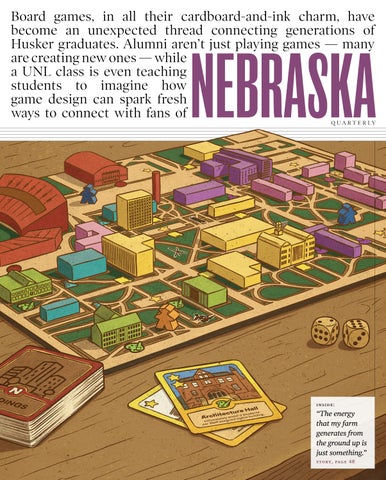
Board games, in all their cardboard-and - ink charm, have become an unexpected thread connecting generations of Husker graduates. Alumni aren’t just playing games — many are creating new ones — while a UNL class is even teaching students to imagine how game design can spark fresh ways to connect with fans of
“The energy that my farm generates from the ground up is just something.”
Get together.
Sheldon Museum of Art is a place for people of all ages to engage with art—and, most importantly, with one another.
This spring, bring your friends and family to Sheldon for art-making activities and gallery games at intergenerational Family Days from 2 to 4 p.m. on Sundays April 19 and June 21.
Be moved at Sheldon Museum of Art.
MENDING MUELLER
Restoration of the Mueller Tower on City Campus continues with crews reinstalling the limestone bricks on the outside.
WHAT’S NEW?
Along with replacing the exterior limestone, the project has installed new steel supports for the stonework, refreshed mortar throughout the structure where needed, added screens and a door at the top, and upgraded the sound system.
WHAT’S ITS HISTORY?
The bell tower was built in 1949 through a gift from electronics pioneer Ralph Mueller, who graduated in 1898.
Students in the College of Architecture reshape Elmwood, Nebraska’s future through resident input.
Game designer Marcus Ross prefers to play games in person at a table. “I want to roll lots of dice and look my opponents in the eyes,” he says.
Games Budget cuts
Why
A Fourth of July ballgame in a tiny Nebraska town may have shown America what is possible.
Find Archie!
Morrill Hall’s Archie is hiding somewhere in the magazine, like only a 20,000-year-old mammoth can. Find him, email mia.everding@huskeralum. org with his location and you’ll be entered into a drawing for a fabulous Husker prize. Congratulations to Jane Carpender Jameson (’54), who found Archie dancing with Kyle Perry on page 51 of the winter magazine. A proud former Lincolnite, Jane was a member of Kappa Alpha Theta in college and worked at the Nebraska Alumni Association following her graduation. She now spends her days reading, planning luncheons and spending time with friends in her retirement community in Wichita, Kansas.
Alumnus Tony Gevo was on campus in 1972 when the Apollo 009 space capsule arrived at Morrill Hall.
NEBRASKA
QUARTERLY
Spring 2026
VOLUME 122 NO. 1
Shelley Moses Zaborowski, ’96, ’00 EXECUTIVE DIRECTOR
ASSISTANT DIRECTOR OF ALUMNI RELATIONS AND PROGRAMS
Katie Mahar-Flock, ’18
ASSISTANT DIRECTOR OF ALUMNI ENGAGEMENT
Mimi Manivong, ’24
ASSISTANT DIRECTOR OF VENUES OPERATIONS
Derek McConnell, ’06, ’13
ASSOCIATE EXECUTIVE DIRECTOR, OPERATIONS
Grace Mosier Puccio, ’19
ASSOCIATE DIRECTOR, ALUMNI & STUDENT ENGAGEMENT
Lexi Quarles, ’20 OFFICE COORDINATOR
Heather Rempe, ’03 DIRECTOR, DIGITAL COMMUNICATIONS
Ethan Rowley, ’03, ’13
SENIOR DIRECTOR OF MEMBERSHIP
Viann Schroeder ALUMNI CAMPUS TOURS
Jeff Sheldon, ’04, ’07
ASSOCIATE EXECUTIVE DIRECTOR, MARKETING & BUSINESS RELATIONS
Nicole Josephson Sweigard
ASSOCIATE EXECUTIVE DIRECTOR, ALUMNI ENGAGEMENT
Sharon Walling DIRECTOR OF DESIGN
CONTRIBUTORS
Nebraska Quarterly is published quarterly by the Nebraska Alumni Association, the known office of publication is 1520 R St., Lincoln NE 68508-1651. Alumni association dues are $65 annually. Requests for permission to reprint materials and reader comments are welcome.
AMY STRUTHERS
Amy Struthers (’76, ’79, ’16) entered the university’s experimental Centennial Education Program in 1972. Thanks to study abroad classes, she flew in an airplane for the first time, traveled internationally for the first time and saw an ocean for the first time. She retired from the university after teaching in the College of Journalism and Mass Communications for 21 years, including a stint as interim dean. Find her scrapbook clippings on page 19.
ANANDA WALDEN
Ananda Walden (’06) is an illustrator and UNL graduate whose work explores the hidden stories tucked inside the small details of our world. Her work can be seen in national magazine such as Allrecipes regularly, and her fine art project about shifting perspective and empowering others hangs at Drake University. She lives and works in Des Moines, Iowa. She created the illustration on page 30.
FLOYD TESMER
Floyd Tesmer arrived at the university for his freshman year in the back of Chevy Nomad. He would eventually earn three degrees in 1971, 1972 and 1976. He taught courses in education and social work at UNL and UNO for many years before embarking on a career in Washington, D.C. He lives in Virginia with his wife, Rosana. Read about his prized record collection on page 59
PAIGE BROPHY
Paige Brophy graduated in 2024 with a bachelor of journalism degree. She currently works as an account coordinator at OBI Creative, an advertising agency in Omaha, supporting client strategy and project execution. She is also the founder of The Day Of Co., a wedding content creation business specializing in real-time, behind-the-scenes coverage for couples. A photo she took of her mother is on page 7.
SEND MAIL TO: Nebraska Quarterly Wick Alumni Center / 1520 R Street Lincoln, NE 68508-1651
Views expressed in Nebraska Quarterly do not necessarily reflect the official position of the Nebraska Alumni Association. The alumni
association does not discriminate on the basis of gender, age, disability, race, color, religion, marital status, veteran’s status, national or ethnic origin, or sexual orientation.
ADVERTISING QUERIES: Jeff Sheldon (jeff.sheldon@huskeralum.org)
“I wanted to connect students to industry mentors because I didn’t really have that growing up. This program and its mentors help build students’ confidence in taking risks and putting themselves out there.”
Doug Waggoner and his wife, Karin, provided philanthropic funding to help establish the College of Business’ Investors With Purpose program, which launched in 2020.
The wealth management course brings together high-achieving business majors with global investment professionals for a unique learning experience.
Just like the Waggoners, you have the ability to change students’ lives.
Connecting and Investing. Like Only Nebraska Can.
- UNL College of Business alumnus Doug Waggoner
- Doug Waggoner with College of Business students
KAYAKING WITH JESSIE
What has surprised you most in your elected role?
A: When I stepped into the position of Staff Senate President, I expected to learn about higher education governance and policy. What I did not expect, and what has surprised me most, is the incredible resolve and sense of community among our staff members. Time and again, I have witnessed people come together with strength and perseverance, especially when times are challenging.
Challenges have a way of testing us. Whether we are navigating budget constraints, adapting to leadership changes or addressing concerns that shape our daily work, these moments could easily divide or discourage. Instead, I have seen
the opposite. When things are difficult, our staff show up for one another and for the students. Colleagues share ideas, offer support and lean in with a level of collaboration that reminds me why this university is so special. There is a deep belief here that we are stronger together and that every voice matters.
One of the clearest examples was the turnout for our Staff Senate Town Hall Listening Sessions. Nearly 600 staff employees came forward to share their experiences, concerns and ideas. That level of engagement speaks volumes about our collective commitment to shaping our future and improving the student experience.
I have also been inspired by the generosity and compassion that define this community. During the Husker Pantry food drive, staff rallied to support students facing food insecurity, donating items to make a
tangible difference. These moments remind me that our strength is not just in what each of us does individually, it is in what we accomplish together.
And I continue to be moved by the creativity and determination of those who refuse to let obstacles define them. Solutions emerge, not because the path is easy, but because people care enough to keep moving forward. That perseverance is powerful. It reflects the character of our staff and the pride we take in contributing to something larger than ourselves.
Serving as Staff Senate President has been an honor. This experience has reinforced a truth I will carry with me: strength is not just found in individuals — it is found in community. And at the University of Nebraska, that community is truly extraordinary.
—Jessie Brophy (’95) Staff Senate President
Jessie Brophy started kayaking 10 years ago when she was 42. She owns five kayaks and enjoys taking them out to local lakes. Her favorite rafting trip was to the Cache la Poudre River in Colorado.
READING
Teachers aim to build better bookworms.
GUARDIANS
Rural attorneys advocate for children.
GROOVY
Reminisce about campus in the 1970s.
SPRING
BUSINESS
BIG BRAG
The university climbed seven spots to rank No. 35 globally in the 2026 Princeton Review and Entrepreneur magazine list of the Top 50 Undergraduate Entrepreneurship Programs. Nebraska remains the topranked university in the state and No. 10 in the Midwest.
Students, from left, Jadyn Buckendahl, business administration major; Brooke Hicks, business and law major; Katie Murray, business and law major; Natalie Brand, actuarial science major and Kaia Cook, finance major. received a Business Battle challenge coin from MotoAmerica for completing the challenge.
FIELDS
Teaching AI to justify farming advice.
Revved for Day One
FIRST-YEAR STUDENTS JUMP INTO REAL WORLD CHALLENGES WITH COACHES AND PROS
Arecord 975 first-year business students began tackling real-world challenges on their first day of college last fall.
In Introduction to Business, the first course in the college’s new undergraduate curriculum, students explored different areas of business before teaming up with peer coaches and business professionals for their first collegiate competition, the inaugural Business Battle.
“Most business schools wait until junior and senior year before introducing students to industry professionals, but we wanted to do that for our freshmen,” said Laurie Miller, associate dean of undergraduate programs and curriculum. “Day one, we introduced them to corporate partners, real-world business challenges and mentors from our business community.”
Taught by Shawntell (Hurtgen) Kroese (’96), assistant professor of practice in management, the course replaces a traditional textbook with industry speakers, business faculty and an applied case study.
“The goal is to show them the opportunities available and build their confidence as they figure out which path makes the most sense for them,” Kroese said.
Sponsored by MotoAmerica, the premier motorcycle road racing series in North America, the Business Battle is a fast-paced, highstakes challenge developed in partnership with the organization.
SPRING
Richard Varner (’76), chief financial officer of MotoAmerica, emphasized the importance of this early exposure to business.
“My first class was a 7:30 a.m. accounting course, with no context for how that fit into business,” he said. “New students need to learn the different facets of business and then figure out where they might fit best. They need to find out early, not wait until they’re a junior and have to change majors.”
The course features a multi-level mentorship model that includes 27 upper-class students serving as Management 101 coaches and more than 60 business professionals who volunteer as business consultants during the competition phase.
“Richard Varner believed so deeply in this course that he wanted to help fund the student coaches,” said Jess Fernau, assistant director of experiential learning. “It’s incredible to have an industry partner who not only sponsors the competition but invests in developing freshmen.”
Varner, a former Nebraska football player and longtime member of the Dean’s Advisory Board, said coaches are critical to helping teams make decisions, just like in the business world.
“I wanted to be part of something that will keep building momentum down the road,” he said.
Coaches led weekly recitations in which students applied course concepts through activity-based assignments, including analyses of strengths, weaknesses, opportunities and threats, as well as AI-driven decision-making exercises. They also met one on one with students to support them as they navigated campus life.
“As coaches, we also help freshmen connect with campus resources,” said Christian Newcomer, a junior management major from Lincoln. “We’re someone they can turn to with questions they might be nervous to ask in class.”
Kapil Mansinghani, a senior international business major from Muscat, Oman, said coaches also helped students plug into organizations and engagement opportunities across campus.
“We help create a safe place for students to ask questions and find their community on campus,” he said.
The consultants also met with each team during the final weeks of the course to offer strategic guidance as the freshmen prepared their pitches.
“In their first semester, there is a lot of change, so establishing connections and relationships is very important,” said Erika Casarin (’22), Ameritas recruiter and course mentor. “My experience at the College of Business was so special that I want
to help support students as they go through this hands-on experience.”
Varner, who cofounded MotoAmerica in 2014, returned to his alma mater in November to present the Business Battle. He tasked freshmen with developing a fresh ticket-sales strategy for MotoAmerica’s Circuit of the Americas race in Texas, one of the nation’s premier racing venues, which is near a crowded entertainment marketplace.
“It’s like yelling in a canyon,” Varner said. “You can spend a fortune on advertising, and no one hears you.”
Teams of six or seven students presented multiple times: first for consultant feedback; then in practice rounds for peers; and finally in the competition round for Varner, consultants, faculty, staff and classmates.
“The winning teams gave us insight on how to reach audiences differently, and their strategies demonstrated the greatest empathy and the most bravery. Curiosity drove all those things,” Varner said.
Kroese reflected on the first-semester course with pride. “Taking this course early in their college careers should help students throughout their time at the college as they take new courses, internships or get involved on campus,” she said. “The students’ energy is contagious, and I can’t wait to see where they go next as they race toward their future.”
—Sheri Irwin-Gish
OVERHEARD
“Getting this level of recognition helps me know that if I can do this type of work here at Nebraska, then there’s really no stopping me from being able to do it anywhere.”
—LAILA DOYLE, a senior nutrition and health sciences major, was honored as the 2025 National Residence Hall Honorary President of the Year at the student organization’s nationwide conference.
FINE & PERFORMING ARTS
Cosmic Communications Crew
PROFESSOR BLENDS THEATER AND TECH WHILE TRAINING AS AN ANALOG ASTRONAUT
Dan Novy, assistant professor of emerging media arts in the Johnny Carson School of Theatre and Film, participated last fall as a communications officer in the analog astronaut mission with the Armenian Space Forum in Armash, Armenia, at the Mars Analog Research Station.
“I was like Uhura (from Star Trek),” Novy said. “I was in charge of communications between the habitat and our local mission control (MCC), and then that MCC was in contact with the main MCC in Vienna, Austria, run by the Austrian Space Forum.”
The station is one of the flagship independent habitats for the World’s Biggest Analog (WBA) initiative. Analogs help scientists prepare for space by simulating missions on Earth. The WBA is an international collaboration of researchers, educators and entrepreneurs that embarked on a mission to unite the world’s analogs through a single mission coordinated around the globe for two weeks in October. The mission integrated more than 40 elite analog astronauts at 16 analog research stations worldwide.
Novy’s mission simulated planetary surface operations under isolated, confined and extreme conditions, reflecting the challenges of future Martian expeditions.
“The mission was a transformative and life-changing experience,” Novy said. “I was challenged in ways I never thought possible. Even though it was a simulation, stepping out onto the surface wearing a full spacesuit and hearing nothing but the sound of my life-support system and the crunch of rocks beneath my feet, as I performed my first Extra-Vehicular Activity, widened my understanding of what I was capable of and what more I could achieve. It’s a feeling I want every student of mine to experience, whether it’s space exploration or the work they’re doing at the Carson Center.”
Exploration is an important theme in Novy’s research. “As a student at the MIT Media Lab, I was involved in the Space Exploration Initiative, which began in 2017. In fact, I helped plan and execute the very first Beyond the Cradle space exploration conference at the MIT Media Lab, and ever since then, I was just involved, as a student, doing all sorts of things with space exploration while I was also doing ocean exploration, so exploration is sort of a theme within my research. Action, adventure, exploration — it’s what I love. It’s what drives me.”
“I really wanted my students to see that space or exploration, in general, is something that they can do, especially as emerging media artists,” he said. “A lot of people might say, what is an artist doing working in the space industry? But if you look very closely at what space analog is, it’s a simulation. It’s very much a form of immersive theatre, and there are some elements of role-playing, and that’s something I study as a theatre and media professional. The idea is how can we apply things like escape room mechanics and virtual production methodologies and technologies to increase the fidelity of the simulation and thereby get better results.”
Novy’s ultimate goal would be to establish a ground-based analog research station in Nebraska.
“Nebraska does not yet have a space analog habitat, and yet, in the western part of the state, we have something that is analogous to Mars,” he said. “We have decommissioned missile silos, which could be refactored, reformed, redecorated and turned into either transit vehicles or habitat.” —Kathe C. Andersen
The university’s six-year graduation rate hit an all-time historical high of 67%, an increase of 3% over last year.
Professor Dan Novy was part of an analog astronaut mission last fall in Armenia.
BIG BRAG
SPRING
JOURNALISM AND MASS COMMUNICATIONS
Perfect Partners
STUDENT RECRUITS HER PARENTS FOR BROADCAST TEAM AT LAS VEGAS BOWL
As a child of two seasoned sports journalists, Arden Louchheim was practically raised in the broadcast booth. Now a student in the College of Journalism and Mass Communications, she was ready to chase her own moment.
When she saw a last-minute opportunity to call the Las Vegas Bowl for the 90.3 KRNU student radio station, Louchheim ended up asking for more than just advice from her parents.
A student-athlete on the golf team and regular KRNU broadcaster, Louchheim was already in Phoenix for a tournament, so she asked her professor, Bill Doleman, if she could travel to Las Vegas to call the game for the radio station.
Doleman worked with the college’s staff to get KRNU accredited and sent Louchheim off with the proper gear for the broadcast. When Louchheim could not find another student to call the game, she turned to the next available sports journalist for a broadcast partner: her dad.
BIG BRAG
February’s Glow Big Red campaign, 24 hours of financial giving to the university, didn’t just top last year’s $1 million record — it skyrocketed past the record with more than $3.6 million, powered by 8,080 gifts.
“We’ve always talked about calling a game together — it’s kind of been a big dream of ours forever, but we never really saw how we could make it happen,” Louchheim said.
The radio voice for the Utah Jazz, Louchheim’s father David Locke worked the bowl game broadcast — and his Husker football homework — into his tight professional schedule between NBA games. She said they both viewed it as a professional job.
They required a professional spotter — someone who supports the on-air broadcasters — so they brought in Louchheim’s mother, a former sports journalist in Seattle, to fill the role. A veteran of the Seattle professional sports beat before retiring when she had a child, Louchheim’s mother Akemi Louchheim has been a continued influence on her daughter’s development as a journalist.
“Watching old videos of my mom and talking with her helps me a lot,” Louchheim said. “She’s been great at giving me different cues to help my personality come through, like telling me to pretend I’m telling the story to her.”
In the booth with both her parents in Las Vegas, the insights kept coming. Having listened to her dad on the radio her whole life, Louchheim said broadcasting with him was a special learning experience.
While it was all business on the air, it was another thing when the game clock hit zero.
“We’re both big saps — the second the game ended we both took off our headsets and started crying.”
—Matthew Strasburger
“Stunned.”
— PROFESSOR OF PHYSICS HERMAN BATELAAN, upon learning he won the 2026 Davisson-Germer Prize for his cutting-edge work revealing how electrons behave in the world of quantum physics. It is the most prestigious honor bestowed in atomic physics.
Junior sports media and communication major Arden Louchheim poses with her father in the broadcast booth at the Las Vegas Bowl.
ARCHITECTURE
Bright Ideas Bloom
STUDENTS RESHAPE ELMWOOD’S FUTURE THROUGH RESIDENT INPUT
Eleven students from the Community and Regional Planning Program spent the fall semester transforming classroom concepts into real-world impact by creating an economic development plan for the village of Elmwood, Nebraska. This collaborative initiative aims to chart a community-driven roadmap for economic growth while preserving Elmwood’s unique character.
Under the guidance of Professor Zhenghong Tang, students worked closely with residents to ensure the plan reflected local priorities. “Our Community and Regional Planning students in the planning studio class contributed to every part of the planning process for Elmwood’s development plan,” Tang said.
The process began in September with a walking tour and listening session, where students learned about Elmwood’s strengths, challenges and aspirations. To deepen community input, they designed a survey that garnered responses from more than half of Elmwood’s residents — a level of engagement that became the foundation for the plan. Community members shared with students they believed their biggest asset for economic development was the small-town character and their public facilities such as parks, a community center and the school. They also shared concerns about the declining downtown activity and limited job opportunities.
“We’re very thankful for the strong support from the Village Board, local residents, community members and the Cass County Nebraska Economic Development Council,” Tang said. “This project gave our students
real hands-on experience, and shows how the university and local communities can team up to strengthen Nebraska’s small towns.”
In November, students presented a draft of their plan during an interactive open house at the Elmwood Learning Center. Approximately 35 community members explored poster stations highlighting different sections of the plan, asked questions and shared feedback. Poster stations focused on downtown infrastructure and downtown boundary map updates captured the most attention.
Residents also explored ideas around creating matching façades on Main Street, gave input on preferred signage for the community, and explored zoning updates to enhance the parks and trails system within the village.
Over the course of the evening, students gained valuable experience for their future careers as they fielded questions and shared their perspectives on opportunities for growth.
“I’m excited to see people collaborating,” said BJ Burrows, a local business owner. “I’m especially looking forward to seeing improvements and renewed efforts to reestablish our business district.”
Feedback from the open house was collected through conversations, comment cards and stickers on poster boards. All comments will guide the final version of the economic development plan. Proposed ideas — such as creating more downtown apartments above main street businesses and developing a coffee house cooperative — sparked positive responses, while others will be re-evaluated based on community input.
The final report will provide actionable strategies and resources to help Elmwood pursue grants and implement projects that align with its vision for growth.
—Karly Black
The university continues to build out its lineup of expertise in quantum materials, with a new $2.5 million grant to investigate the use of ferroelectric oxides for exploring emergent quantum phases and designing more powerful and energy-efficient electronic devices.
Elmwood, Nebraska, was the location for the students’ latest collaboration.
BIG BRAG
Nebraska Alumni at a winery in San Gimignano, Italy, 2025.
EDUCATION AND HUMAN SCIENCES
Building Better Bookworms
INTENSIVE TRAINING PREPARES TEACHERS TO SUPPORT STRUGGLING READERS
While the state of Nebraska urgently works toward addressing literacy needs and improving the reading proficiency of the state’s third graders, the college is elevating its current efforts to ensure its preservice teachers are equipped to meet those needs.
As part of their preparation, students studying elementary education receive at least 19 credit hours in literacy-focused courses and practicum experiences, beginning with two core content courses and culminating in providing one-on-one tutoring to a struggling reader prior to student teaching.
“I think the biggest strength of our program in terms of its design is when you are done with our sequence of courses, it’s not just that you can teach reading, but you can teach readers,” said Nick Husbye, associate professor in teaching, learning and teacher education.
Husbye instructs two courses on teaching reading and language arts in elementary that lay the foundation for students to teach children how to read. This includes things like how words are divided into syllables, what sounds certain letters make, the difference between phonological and phonemic awareness, and how to help children write simple sentences.
“My job in the literacy block is to equip our students
with as much core content knowledge as possible,” Husbye said. “In that core space, I’m working with getting students who are going to be teachers prepared to teach 90% of kids, 90% of the time.”
Students gain additional instruction and experience through courses in children’s literature and teaching multilingual learners. For the final course of the sequence, students learn to adapt what they have learned to fit the needs of students who need more support.
Emily Fisher, assistant professor of practice in teaching, learning and teacher education, says reading struggles in children are the rule, not the exception.
“Sometimes when students come to my class, we have to address this misconception that they’re not going to have as many students who struggle with reading in their classrooms if they’re going to be general educators,” Fisher said. “That is not the case at all. We know that reading difficulties are prevalent. We dive deeper into the content, thinking about how you make decisions, how you can be a reflective practitioner, and how you use that data and content knowledge to then make instructional choices.”
At the Schmoker Reading Center, students studying elementary education, early childhood education and special education all put their skills into practice by providing one-on-one tutoring for children who need extra support in reading. During the fall and spring semesters, students tutor twice a week for their practicum experience. This experience helps prepare pre-service teachers while providing much needed literacy support to area K-12 students. —Kelcey Buck
A pilot program led by the University Libraries is expanding access to no-cost or lower-cost course materials for thousands of Nebraska students — building on a program that has already saved students more than $3 million since its launch.
Students participate in a classroom activity during their Teaching Language Arts in the Elementary School class.
TRAINING EQUIPS RURAL ATTORNEYS TO BETTER ADVOCATE FOR VULNERABLE CHILDREN LAW
FGuardians of Justice
ifteen rural Nebraska attorneys recently completed the College of Law’s Children’s Justice Attorney Education Fellowship program. The program provides participants with extensive education on state and federal child welfare and juvenile justice laws, along with insight into the subjects necessary to become strong advocates, including trauma and child development, substance use, domestic violence, complex family dynamics and specialized Indian Child Welfare Act training.
Over the course of eight months, participants attended in-person workshops and trainings and developed relationships with other juvenile justice attorneys and professionals.
In addition to the education-based workshops, participants worked with other child welfare and juvenile justice experts to evaluate cases as they learned to integrate social and psychological factors into the legal issues arising in their cases. Attorneys also participated in a relationship-based exercise known as reflective practice. This exercise mitigates the effects of emotionally intrusive work by helping individuals examine their current and past actions, emotions, experiences and responses to evaluate their performance and learn to improve.
“The attorneys who have participated in this program have an enhanced knowledge of the underlying family dynamics and circumstances that can affect children and families,” said Michelle Paxton,
director of the Nebraska Children’s Justice and Legal Advocacy Center. “Increasing the number of highly trained advocates to support Nebraska’s most vulnerable populations has always been one of our top priorities.”
According to data reported by past participants, completion of the program has led them to spend a greater number of hours working on juvenile court cases. “In our first four years, the program has trained attorneys in 77 of Nebraska’s 93 counties,” Paxton said. “We are changing the way children are represented in Nebraska.”
—Amber Wolff Ediger
OVERHEARD
“For the past 100 years, the Ruth Staples Lab has been honored to grow alongside Nebraska’s children, families, and early childhood teachers, building lasting connections and impacts.”
—JENNY LEEPER MILLER (’03, ’09), director of the Ruth Staples Lab and lecturer in child, youth and family studies, reflecting on the century mark for the high-quality educational experience for children located on East Campus.
ARTS & SCIENCES
Edit to Credit
UNDERGRADS BECOME PUBLISHED EDITORS
BY RESTORING A CENTURY-OLD NOVEL
An undergraduate class project from spring 2024 is now a published book and brings forth a forgotten story from Pulitzer Prize-winning playwright and novelist Susan Glaspell.
Twenty-seven students and alumni are listed as associate editors for the new annotated edition of Glaspell’s 1915 novel, Fidelity, published last fall.
“We got to work on something that now exists in the world, not just in the classroom,” said Sarah Danielson (’25), who is now a graduate student. “It’s real, and our names are on it.”
The annotations and new introduction were a semester-long project in Kevin McMullen’s course, Editing and the Publishing Industry. McMullen wanted a project that would show the breadth of work editors do. “I think most students think of editing as correcting a draft,” said McMullen, research associate professor in English. “I wanted to instill in the class the idea that editing is very important. As an editor, you have the potential to bring a whole new thing into the world.”
McMullen made the class the scholarly editors for an out-of-print and out-of-copyright literary work, researching and writing a critical introduction and contextual annotations.
McMullen pitched the project to several publishers. “When we started the class, there was some fairly strong interest, but we had not yet gotten a commitment or contract,” McMullen said. “That was both nerve wracking, but also kind of cool, because we got to have a big moment where, a few weeks in, we got to say, ‘We got a contract!’”
The students dove into research on Glaspell and the time period in which the novel was written. The annotations students wrote touch on the author’s biography, societal references of the time period and divorce law in the early 1900s, and recommend sources for further reading. “It was the most fun class I’ve ever had,” said Bella Hardy, a senior majoring in English and film studies. —Deann Gayman
BIG BRAG
The university has been named a Lincoln Family Friendly Workplace, joining the inaugural cohort of employers recognized for policies and practices that support working families. The designation affirms the university’s long-standing commitment to offering a family-centered workplace.
Sophie Anderson (’25) signs a copy of Fidelity. She was one of the students who edited and annotated the book.
PLAY
Foosball
Check out the foosball table in the lounge area of your dormitory. Best of luck to you and your roommate if you compete in the dorm complex’s tournament.
1970s
RETRO DEVOUR
IN HUSKER COUNTRY
BUY
Pet Rock
No food, no water, no commitment: the perfect gift for your roommate in Sandoz Hall.
SHOP
Hitchin’ Post and Wooden Nickel
Pick up the newest bell bottoms and paisley shirts at this downtown store where men’s threads are on one side and women’s on the other.
LISTEN
Cat Stevens
When morning has broken in your room, slip a vinyl on your record player and listen to the latest songs by the British singer-songwriter and musician.
EAT
Cinnamon Rolls or Chicken Pot Pies
Mosey on over to Miller & Paine department store on 13th and O streets and visit the Tea Room for an afternoon pick-me-up. Or stay for dinner and enjoy the chicken pot pie.
ATTEND Concerts
WATCH
Walter Cronkite Tune in to the CBS Evening News in Neihardt’s TV room and hear Cronkite signing off with “And that’s the way it is...” before rushing off for dinner at the Cather and Pound dining hall.
JOIN
Pershing Auditorium hosted all the hip crooners including Arlo Guthrie and John Denver. Don’t wait to buy tickets until you get to the Pershing Auditorium door: prices (in the $4 range) will jump by $1.
Women’s Athletic Scholarships
Following Title IX’s passage in 1972, Nebraska started awarding athletic scholarships to women. In 1975, 56 women received partial scholarships.
swanky Tony and Luigi’s on O Street and imbibe the latest cocktail sensation.
Indulge your inner thespian and perform in this popular club’s spring theatrical show held at the Lincoln
downtown to catch the latest Paul Newman film at one of the numerous movie theaters that dot the Lincoln landscape.
1975 women’s volleyball team
SPRING
WORK HOUND
Dodger dog
The UNL police department has added a two-year-old Malinois mix named Dodger to its explosives detection team.
WHO’S HIS PERSON?
Sgt. Anderson Delgado, who joined the UNL police force in 2017. Dodger is the third explosives-trained K-9 he has worked with. “Building a good bond with your dog is key to a successful team,” Delgado said.
WHAT’S DODGER’S MAIN ROLE?
To help sweep facilities before campus athletic and other big events, including concerts at Pinnacle Bank Arena. Dodger also responds to reports of unattended items.
The university added 21 weather stations to the Nebraska Mesonet network in 2025 through $1.48 million in funding from the U.S. Army Corps of Engineers, U.S. Department of Agriculture’s Farm Service Agency and Lower Loup and Upper Elkhorn Natural Resources Districts.
BIG BRAG
Women’s flag football will be added as the 25th varsity sport with its inaugural season being played in spring 2028. Flag football is the first sport Nebraska has added since beach volleyball began competition in the spring of 2013.
ENGINEERING
Sensors, Science, Sense
AI INTEGRATES ENGINEERING AND HUMAN
FEEDBACK TO PERFECT INDOOR COMFORT
At the Peter Kiewit Institute in Omaha stands a 1,000-square-foot building that appears nondescript. But in reality, it is a state-ofthe-art laboratory, designed to simulate the construction of modern commercial buildings and equipped to allow researchers to manipulate various parameters — like lighting, acoustics and temperature — and assess occupants’ response, including physiological parameters like heart rate and skin temperature. The facility, called the Human-centered Integrated Building Operations (HIBO) Laboratory, is home to University of Nebraska–Lincoln researchers who are working to shape the next generation of smarter, more sustainable and more comfortable buildings.
“This building is among only a few in the United States that allow us to study human-building interaction, smart building technologies and human perception of indoor environments,” said Iason Konstantzos, founder and director of the HIBO Lab and assistant professor in the Durham School of Architectural Engineering and Construction. Xiaoqi (Clare) Liu, also an assistant professor in the Durham School, co-directs the lab.
Now, researchers can to use the laboratory, constructed in 2023, for a new project. The team recently received a three-year, $1.2 million grant from the National Science Foundation to develop an artificial intelligence algorithm that dynamically and autonomously operates building systems in a way that strikes a balance between energy efficiency and occupant comfort. The algorithm will merge three types of information: data from building sensors; knowledge about building systems, engineering and physics; and human feedback from building occupants.
Integrating these different elements into a single algorithm distinguishes the approach from other AI-based smart building strategies and paves the way for a tool flexible enough to work in a wide range of
buildings, which as a sector are responsible for over 35% of the nation’s carbon emissions.
Exclusively data-driven control is a challenge because even in a modern commercial building, there are not enough sensors to paint a complete picture of the building’s operation and to account for external factors like the weather or shade from neighboring structures, for example. And there is no easy way to continuously collect occupants’ opinions: Is the building too hot or cold? Too bright or dim?
That’s why the team is not only embedding engineering knowledge into the AI tool; they’re also accounting for people’s preferences. Integrating human perspectives into the tool is key because energy efficiency means little without occupant comfort. The researchers will collect input through surveys and observation of occupants.
“In any automated control system in the real world, people can override the settings if they don’t like them,” Konstantzos said. “If people continuously override the settings, you then have a very expensive, big commercial building that is running without consideration of energy objectives at all — and then we are back 50 years in terms of our energy footprint.”
The tool will also provide occupants real-time updates about the building’s energy performance and inform them about how they can boost energy efficiency. If successful, the algorithm would overcome one of the most persistent hurdles to developing smart building technology: scalability. Because buildings are vastly different in terms of design, location, occupancy and more, researchers have struggled to generate a broadly functional AI tool. But a “smarter” algorithm may be a step toward a solution. —Tiffany Lee
OVERHEARD
“The relationships I’ve built with other veterans at Nebraska are so special.”
—BRETT KLEIN (’25), a December accounting graduate who served four years of active duty in the U.S. Army, followed by a year in the Minnesota National Guard before enrolling at UNL.
BIG BRAG
AGRICULTURAL SCIENCES AND NATURAL RESOURCES
Fields of Reason
RESEARCHERS TEACH AI TO JUSTIFY FARMING ADVICE
Sruti Das Choudhury, a research associate professor, is developing artificial intelligence that can give farmers the reasoning behind its answers.
Scientists such as Das Choudhury use farm data and artificial intelligence to recommend important farming decisions, but how can farmers trust those decisions? Farmers can see the information entered into AI and can see the answer or recommendation AI spits out, but they cannot see how AI came to that decision or whether it is just hallucinating.
Das Choudhury is leading two projects related to this. In the first project, her team aims to make AI explain its decisions and what factors influenced those decisions most. For example, if AI is asked to recommend a crop to plant in a field and is fed about 50 pieces of information about the field, like pH level, rainfall and temperature range, explainable AI will reveal which factors influenced its decision most and to what extent.
“We will have an answer, an explanation of the output of the model, and we can verify that explanation with the existing knowledge of the farmers,” Das Choudhury said.
Explainable AI has been used in other fields, but if Das Choudhury’s two projects are successful, she will be one of the first to use it for neural-network-based phenotype-genotype mapping using a
realistic time-series multimodal image dataset. She said she expects explainable AI to build farmers’ trust in its answers.
Working with her on the project are two senior undergraduate students at the Institute of Engineering and Management in Kolkata, India. The team started the research last year and already has begun seeing results.
All of the scientists have been working on the project as volunteers because they have been unable to secure funding. Das Choudhury said she hopes that once they have an established groundwork and preliminary results, that will strengthen their applications for funding. She has been seeking grants to compensate the students beyond the opportunity to learn from her.
Das Choudhury said her goal is to build a team of AI scientists to work on applying explainable AI in different fields such as agriculture. She has started four explainable AI projects in agriculture, including the one using AI to recommend crops to plant.
She has developed a machine learning model to predict a crop’s genotype from its phenotypes. She said she would like to use explainable AI to ensure the model is predicting the right output. Das Choudhury said successful research of explainable AI in agriculture would be a novel contribution that would make AI’s ethical aspects more apparent to users.
—Ronica Stromberg
Associate Professor Sruti Das Choudhury is developing artificial intelligence that uses farm data to recommend important farming decisions.
Funded and Fearless
STUDENT TEAMS SECURE $100,000 TO BUILD REAL-WORLD STARTUPS
For the current academic year, four student-led startups each received an investment of $100,000 in partnership with Invest Nebraska and support of community investors. The funding is part of a joint university and wider community effort in fostering the growth of Nebraska’s startup ecosystem through supporting early founders and entrepreneurs.
The investments are part of the Startup Studio capstone program offered through the Jeffrey S. Raikes School of Computer Science and Management. The school provides students access to honors-level courses that focus on integrating topics in computer science, business, leadership, communication and engineering.
Branching off from the Design Studio’s emphasis on connecting students with industry leaders to solve real-world problems, Startup Studio gives students a chance to build their own companies to meet graduation requirements.
Raikes School Assistant Director of Startup Studio Jake Koperski (’20, ’24) said he joined the Design Studio team about three years ago to help form startup programming. Koperski said the recent collaboration with Invest Nebraska created the official rendition of Startup Studio active today.
Invest Nebraska is a nonprofit venture development organization that partners with the Nebraska Department of Economic Development to support entrepreneurs in the state. What Koperski said began as a lunch conversation with then Invest Nebraska Principal and General Partner Ben Williamson (’12, ’15) has led to a collaboration where each student-led startup receives a $100,000 Simple
Agreement for Future Equity (SAFE) note and access to Invest Nebraska’s professional network. The 2025-26 Startup Studio is the second cohort to receive these investments.
Shelby Strattan, investment manager at Invest Nebraska, said the investments are divided between Invest Nebraska and community co-investors, such as Nelnet and Hudl. The shared goal, she said, is to develop the state ecosystem with different pathways for the rise of scalable ventures. “We want to see people of all ages and all backgrounds feeling empowered to start viable businesses here.”
Instead of having students see the course as simply a requirement for graduation, she said the investments convince students that the community is interested in their solutions and success.
The capstone, a two-year course, requires students to be individual contributors their first year and team leaders their second. Topics covered in the program include the fundamentals of investing, going to market and applying the scientific method for business and innovation strategies.
The current four student-led startups:
Creevo: AI-assistive developer tools to help game developers and lower the level of entry for making video games.
DineU: A platform that enables third-party campus dining providers to offer delivery services through meal plans and student delivery drivers.
FindU: A platform that helps students discover and match with schools that fit their needs and career goals.
Reach: An ACT prep platform sold directly to schools to gamify and optimize studying.
—Ben Goeser/Silicon Prairie News
An economic impact analysis by national consulting firm Tripp Umbach found that the Institute of Agriculture and Natural Resources generated an estimated $849.3 million in statewide economic and public value in 2024.
BIG BRAG
RAIKES SCHOOL
Creevo co-founder Amir Tarkian, center, works with his startup team.
SHARING THE VIEWPOINTS OF OUR ALUMNI, FACULTY AND STUDENTS
Spring is here! And for much of the country still recovering from winter’s grip, that means outdoor sports are back. For more than a decade, students have headed to Georgia to assist with the Masters golf tournament. And if baseball is more your style, an alumnus has shared a story about a game that brought everyone to the field.
GUSTAVE BAUMANN RAIN IN THE MOUNTAINS, (1926), DETAIL Color woodcut, 9 1/8 × 11 inches, Sheldon Museum of Art, University of Nebraska–Lincoln, Anna R. and Frank M. Hall Charitable Trust, H-2124.1975
Mastering an opportunity Student Life
Augusta reveals heart and heritage
BY ELLIE VOLK Junior, advertising and public relations major
Aday at Augusta National Golf Course contains cold lemonade, excited chatter, colorful outfits and fans who have waited their whole lives for an opportunity like this. It contains the wood clicking sounds from the scoreboard falling into rhythm as the first holes are played. It contains the feeling of pulling your first Masters polo over your head and never wanting to take it off. Last spring I traveled with 13 other Nebraska students who attended the Masters where we worked as servers in hospitality suites.
I applied to work at the Masters as a fun idea — a simple “what if?” moment. It is a dream of millions to attend just one day at this prestigious golf tournament, and I got to work the entire event. When I found out I had been selected to work at the 2025 Masters Tournament, I was in class and my professor was mid-lecture, so I had to contain my excitement. But I could have jumped for joy. Being chosen to work at the Masters was an honor. For more than 90 years, the tournament has helped define the game of golf, preserving tradition while remaining timeless. To play even a small role in such a historic and respected legacy was something I will always be proud of.
Each day in Augusta, I was able to spend a little time on the course, and in those moments, I learned the true magic of the Masters. Every patron feels connected to the event, there are no phones in sight. All eyes are on the course, unwilling to let a single moment slip away. People laugh and talk with those around them, simply grateful to be there together. What surprised me most was how deeply everyone appreciated the opportunity to be there.
While serving in the suite, I saw firsthand how every employee helps bring the Masters to life, and in doing so, I found a place that will always stay with me. I even discovered a new love for the game of golf in my own life. After the tournament, I received my first set of clubs and headed straight to the nearest course.
Experiencing the Masters gave me a deeper appreciation for the skill and patience the game requires, and I was eager to hone my form and become part of it.
I learned an incredible amount from my experience working for a week in Georgia. Above all, I learned the value of tradition and how even the smallest details can transform an event into something truly unforgettable. I discovered the beauty of working alongside people I had never met before, coming together with a shared purpose. Traveling from all across the United States, our team quickly got to know one another and found a natural rhythm, working seamlessly to ensure every patron felt welcomed and cared for. Through it all, I gained a deeper understanding of the power of sports — the love for the game, the sense of community it creates, and the passion of fans who make moments like these so meaningful. I am incredibly grateful for my experience at the 2025 Masters Tournament — an opportunity defined by tradition, energy, and a sense of purpose.
For the past decade, students (primarily from the Hospitality, Restaurant & Tourism Management program) have traveled to the Masters Tournament at Augusta National Golf Club to provide hospitality services. Students serve around 120 patrons each day, serving breakfast, lunch and a late-afternoon snack. About 2,000 hospitality professionals are needed to provide service to participants, members and patrons of the golf club during the tournament.
Ellie Volk served at the Masters in 2025.
Alumni author
A STORY WORTH CHASING
A Fourth of July ballgame in a tiny Nebraska town may have shown America what was possible
BY JON VOLKMER (’87) | ILLUSTRATION BY ANANDA WALDEN (’06)
Three years after Jackie Robinson integrated baseball, and 13 years before Martin Luther King Jr. dreamed of a table of brotherhood, the residents of a tiny town in Nebraska may have accomplished both. A Black railroad repair crew. A bunch of baseball-mad white farm boys. A schoolyard picnic and a spirited 4th of July ball game. Put all these together, and the result may have been a significant encounter — fostered by sports and occurring well before the Civil Rights era — across a deep racial divide.
I first heard the story of this baseball game while I was growing up in Nebraska City in the 1960s. I’d love to say that 10-year-old me rec ognized its broader socio-cultural implications, but of course it wasn’t like that. The story was a whimsical legend from a generation gone by, like my grandpa Mike “borrowing” grandma’s egg money to run down to the Talmage tavern in the Model T. But it lodged in my mind. I was
captivated by the thought of the Black gandy dancers — that’s what rail repair workers were called — who were stationed for a time in Julian, ten miles south of Nebraska City. They were said to have lived in old bunk cars parked on the side rail, the same one that fronted my father’s grain elevator a few yards down the track.
Twenty years later, while pursuing a Ph.D. in English in the 1980s, I told the story to friends in Lincoln. They were fascinated, but when they pressed me for details, I didn’t have many. They urged me to go digging. And so I did, intermittently and haphazardly, as I worked my way through my literary studies and a creative dissertation.
In 1987, I was fortunate to join the faculty at Ursinus College near Philadelphia, the prototype of all those lovely leafy liberal arts colleges back east. Being far from home somehow enhanced my fascination with the old story. When a sabbatical leave came my way, I vowed to finally track down the facts of that quietly momentous
Brave in Season: A Novel of Race, Railroads and Baseball (Sunbury Press, 2023) has won awards from the Society of Midlands Authors, Best Independent Book Awards, and others. Available in print, digital and audio formats.
ball game in Julian. My quest was enabled by two stints at the Kimmel Harding Nelson Center for the Arts in Nebraska City (bless them). It felt surreal to be a called a “visiting artist” — alongside a photographer from Brooklyn and a composer from Taiwan — at a house that was once on my paper route, but I seized the opportunity and dove in.
I was almost too late. In the decades since I’d first heard about the legendary game, an entire generation of potential witnesses had passed on, including my own parents. I crisscrossed the country roads and retirement homes, seeking out anyone who might remember, my way smoothed by a Nebraska doctorate and by a last name familiar in those parts. I found the old-timers to be generous and unguarded, and especially eager to tell stories about the great ball players of the 1940s and ’50s. With a special twinkle they told me about “Speedo,” which turned out to be a nickname for my father.
Recollections of the Black railway workers, however, were scant and contradictory, filtered by time, perspective and prejudice. The gandy dancers were troublemakers. They were model citizens. They drank and fought among themselves. They laughed and joked with the Julian kids.
A baseball game, with white and Black players? Might have happened. Never could have happened. My research took me to the Nebraska State Historical Society in Lincoln and to Union Pacific Headquarters in Omaha. I spent hot days in Arkansas, seeking gandies’ hometowns, and cold days in Chicago at the archives of the Brotherhood of Maintenance of Way Employees. I squinted across six years of decaying microfiche of The Nebraska City News-Press.
My sabbatical ended, but my search went on. After more than a decade, I had to face the cold reality that a definitive historical account would never spring forth from my crates of notes and photocopies. But wait — picture the light bulb over my head — there was abundantly enough material for a novel. So, I changed course. A novelistic treatment allowed me to tie 1950 to the present, and fiction to nonfiction, by embedding glimpses of the search for the story inside the story itself. In 2023 the book I’d dreamed of for so long hit the shelves. My passion is that readers of Brave in Season get caught up in the story, and also that they view Julian, Nebraska, as exemplary; that it can stand as archetype for an America where racial divides can be, must be, and in fact have been transcended.
Soon after the publication, I was honored to present aspects of my research to scholars of Negro Leagues baseball at the National Baseball Hall of
“A novelistic treatment allowed me to tie 1950 to the present, and fiction to nonfiction, by embedding glimpses of the search for the story inside the story itself.” — Jon Volkmer
Fame in Cooperstown, New York. Today, as I recall strolling the imposing gallery there, my mind replaces the bronze plaques of Gibson, Mays and DiMaggio with those of All-Star 1980s Nebraska English professors — scholars who taught me to reason, to research, and to write. I see the faces of Fred Link, Norman Hostetler and Robert Stock; Paul Olson, Les Whipp and Hilda Raz; Lee Lemon, Robert Haller and Oyekan Owomoyela; Fran Kaye and Linda Pratt; Robert Brooke, Bud Narveson and Kate Ronald. And at the end of the grand hall, I envision a statue of that most gentle of gentlemen, Charlie Stubblefield, who guided my dissertation and, as a bonus, taught me how to read the racing form at Ak-Sar-Ben — with crucial scholarly proficiency.
How tabletop games quietly endure and connect
Story by LAURYN HIGGINS (’18) Illustration by QUENTIN LUENINGHOENER (’06)
Ona Friday night in the College of Business, the fluorescent lights hum, a clatter of dice skips across a tabletop, and laughter — big, bright, unselfconscious — echoes across the room. Students huddle around maps, shuffle cards, hover over rulebooks and push tiny 3D printed miniature figurines into place. Just outside the door, the rest of campus feels quiet, almost dreamlike. But inside this corner of Hawks Hall, it’s another world entirely — dragons to battle, cities to build, friendships to forge.
It’s nearly 9 p.m., but nobody seems ready to pack up. Someone shouts for a reroll. Another group debates the ethics of stealing sheep in Catan. A pair of freshmen who only met an hour earlier are already negotiating an uneasy alliance in Magic: The Gathering. In a digital age of endless screens, the glow here is different — warmer, louder, grounded.
Board games, in all their cardboard and ink glory, have become a surprising throughline between generations of Huskers. And as the Nebraska Alumni Association launches a four-part, playable board game series inside Nebraska Quarterly this year, it’s clear that tabletop gaming isn’t just back. It never really left.
BEYOND THE SCREEN
If the last decade has belonged to streaming and esports, it has quietly belonged to board games, too — maybe even more than most people realized.
Nationally, tabletop games have surged. Sales for board and card games grew steadily throughout the 2010s before exploding during the pandemic, when families rediscovered the joy of gathering around a physical table instead of a digital one. Kickstarter, once known for quirky gadget campaigns, now hosts thousands of tabletop projects each year, and board games routinely dominate the platform’s top-funded list. In 2023, Gen Con — North America’s largest tabletop game convention — set an all-time attendance record.
Yet the appeal isn’t a reaction to screens so much as a counterbalance to them. In an era where entertainment is frictionless, instant, and often solitary, “analog fun” offers something technology can’t replicate.
“No matter how good the digital versions are,”
says Nebraska-based designer Marcus Ross (’03), “I personally, deeply, prefer to play games in person at a table. I want to roll lots of dice, move chunky pieces, and look my opponents in the eyes.”
Ross’s love of board games goes back to childhood, but when he arrived at UNL in 1999, the landscape looked very different from today’s booming hobby. “Designer board games were really just not a thing in the broader U.S. at that time,” he recalls. “Settlers of Catan and Carcassonne were out, but they were so niche I didn’t find out about them until I got my first job after college — and I was a nerd.”
Like most students living in small dorm rooms — with even smaller budgets — he gravitated to what was accessible. That meant the occasional collectible card game, though Magic: The Gathering was too expensive to dive into. Store shelves were dominated by Monopoly variants and a handful of mass-market staples. “You simply could not walk into a place like Target and find
a board game made for anyone over 12 years old unless it was Trivial Pursuit,” he says.
One exception was a cult favorite: Cheapass Games. Ross ordered several of these minimalist, black-and-white titles by mail — games that arrived in envelopes, included only the printed components, and required players to supply their own dice, pawns, or chips. “These were not deluxe productions,” he says. “Most were black text and minimal illustrations on cheap cardstock. I probably had a dozen in a box under my bed.” He studied them more than he played them, since few classmates were willing participants, though his copy of Kill Doctor Lucky was popular enough to disappear after a party.
That early constraint — limited space, limited money, limited access — makes today’s explosion feel even more striking to him. “You can only learn so much from reading rules,” he says. “You really have to play the games to understand the experience.”
Ross, who now designs games professionally, sees the resurgence as part of a broader cultural appetite for tactility and presence. “Playing a modern, complex game like this is a choice and a commitment,” he says. “The players have set aside this time in their day, physically occupying the same space and mutually agreeing to take on these hyper-specific ‘fun problems’ together.”
Even TikTok has had a hand in the renaissance, reviving classics like Clue, fueling obsessions over indie titles such as Wingspan, and turning board game influencers into mini-celebrities.
HUSKERS BEHIND THE BOARDS
To understand how deeply Nebraska roots run in this analog revival, look no further than the fourpart game series in this year’s Nebraska Quarterly. Designed by alumnus John Shulters (’00), the project is equal parts playful and historical — an experiment in whether a magazine can double as a game table.
The inaugural installment (see page 40) centers on University Hall, the university’s first building, completed in 1868.
“It’s a simple pencil-and-scratch puzzle — kind of like Sudoku — but thematically tied to the issues of the building and the people involved,” Shulters explains. “I want readers to feel the history while also having fun. And I wanted each game to build just a little on the last, so readers learn that they can play something they thought might be too complicated.”
Though Shulters didn’t discover the modern hobby games scene until after college — his gateway game was Ticket to Ride at a friend’s house — he’s quick to point out that UNL shaped the way he thinks about designing games.
“The reason I kind of found my way down the path of doing game design was because of my background in graphic design and arts,” he says. “All those drawing, photography and sculpture courses — they trained me to think in systems, in composition, in how people interact with visual information. There’s a really logical chain between what I was studying at UNL and the skills I rely on now.”
He says those foundational skills became essential once he started prototyping his own puzzles and layouts. “When you’re designing a game, especially
Marcus Ross is a game board designer and the founder, operations manager and lead game designer of Water Bear Games in Omaha.
Shulters
one that has to live on a printed page, clarity is everything. You’re constantly asking: Does this feel intuitive? Does the eye go where I need it to go? That’s straight out of design school.”
Soon after his entry into the hobby, he and his wife were attending game conventions, playtesting with established designers, and sketching prototypes on poster boards in hotel rooms. Their first published game — an abstract strategy title called Crackles — was a co-design.
From there, Shulters worked with Foxtrot Games and traveled internationally to industry events, including the massive Spiel Essen, a fair in Germany.
Yet despite the global influence, there’s still something special in Nebraska’s gaming community, if you ask those here.
Ross attributes it partly to the landscape.
“We don’t have mountains or beaches or professional sports teams,” he says. “And we have weather extremes that keep us indoors. So, people build these incredible game libraries. A well-curated collection is like an enthusiast wine cellar — you want the right selection for the audience and the moment.”
Both designers agree: Nebraska punches far above its weight in creativity, passion and play.
“Nebraska is kind of nuts,” says Ross. “I personally own something like 700 board games, and I know half a dozen people locally with collections that dwarf mine.”
THE POWER OF PLAY
If Nebraska alumni are shaping the analog game world at large, then students are busy shaping its future.
The UNL Games Guild has exploded in size and scope since its founding in 2018. What began as a niche group focused on strategy titles like Axis & Allies and Risk has grown into a full-fledged campus hub for everything from Magic: The Gathering to Dungeons & Dragons to contemporary board games.
“Games Guild was originally founded as the War Games Club,” says Victoria Markwell (’24, ’25), the current president. “But in 2022 we rebranded to UNL Games Guild to have a general focus on many different games, including Dungeons and Dragons, Magic: The Gathering, as well as the original war board games and other various board games that were brought to meetings.”
Today, D&D and Magic are the two major draws, with entire tables dedicated to character sheets, spell cards, and multi-hour campaigns. But plenty of members still gravitate toward cardboard classics. “We encourage students to bring their own games,” Markwell says. “We have our supply — party games, staples like Catan and Uno, things like that. But the real magic comes from the variety people bring.”
The club’s mission is simple: create a place on campus where anyone can sit down, unwind, and feel welcome. “We aspire to create a safe space for students to sit back, relax, and play their favorite games,” she says. “There’s something special about
coming together to learn a new game or revisit an old one with friends.”
Markwell says newcomers often feel intimidated at first — especially at tables where players have been immersed in a campaign for months. But the club intentionally cultivates an open-door culture. “We invite new and experienced players to all our events,” she says. “And if D&D or Magic isn’t their thing, students jump in to show them the ropes on something else.”
The Games Guild isn’t just for fun, it’s a lifeline for many students navigating college stress. “Compared to videogaming, there is not a special need for having the best board game out there, or that competitiveness or toxicity,” Markwell explains. “Just the old-fashioned love of cardboard and paper and making memories behind each game we play, especially with the stress of current events.”
One of her favorite moments happens not during tournaments or special events but on ordinary meeting nights. “The best meetings are when we have a few Magic games going in one area, a few D&D tables scattered around, and other board games full of laughter,” she says. “Seeing all those different types of games happening at once, that’s what the Guild is all about.”
FACE-TO-FACE IN A DIGITAL AGE
Walk into any game night — whether in the Student Union or a living room — and it’s easy to understand why board games continue to thrive. The speed of modern life rarely allows room for slow, shared experiences. Board games force us into them.
Experts point to several reasons tabletop gaming remains culturally resilient: it’s intentional, social, tactile and intergenerational. “Most people who think board games are irrelevant only remember the mass market stuff — Clue, Risk, Monopoly,” Ross says. “But at this point there are thousands of new games introduced every year. Modern games are deeply-crafted experiences.”
He sees them as both art and engineering: “Full of bespoke art illustration, human interaction design, interesting mechanics. Releases from notable designers are met with the same enthusiasm an accomplished author gets — preorders, limited editions, signing events.”
For many players, board games act as a rare refuge from the omnipresence of screens. Even in digital versions, Ross argues, something essential gets lost. “There’s a social intimacy present when you play with friends that’s difficult for other forms of entertainment to emulate,” he says.
That desire for connection echoes what Aubrey (Birch) Crooks (’18), volunteer coordinator and board member at the Great Plains Gaming Project, sees across the community. “I think there’s a trend of people wanting to step away from screens and do something more tangible with family and friends,” she says. “Pop culture plays a role — shows like Stranger Things made role-playing games (RPGs)
more mainstream — but social media has also helped people see others playing and think, ‘Hey, I want to try that.’”
Crooks believes digital platforms haven’t undermined analog play — they’ve amplified it. “Digital platforms don’t just show off the games — they also make it easier to learn them,” she says. “It’s common now for games to have a QR code you can scan to watch a quick video instead of reading a rulebook.” Online tools like Tabletop Simulator or Board Game Arena, she adds, give people a way to gather virtually “at a table as yourself, not as a video game character,” creating a different kind of closeness.
Markwell sees similar value on campus. “It’s the sense of community,” she says. “There’s something special about learning a new game with friends or playing an old favorite. It brings people together who might never have crossed paths otherwise.”
Meanwhile, tabletop play has its own gravitational pull. D&D in particular has seen a renaissance thanks to Stranger Things, Critical Role, Dimension 20, and other media — what Crooks calls a broadening of the genre. “It breaks down the idea that RPGs are only about wizards and fantasy,” she says. “I have family who aren’t your usual suspects for an RPG campaign, but they found out there was a Power Rangers RPG and were excited to jump in.”
Shulters believes that accessibility is part of board gaming’s enduring charm. “If the rules are too complicated, people won’t play,” he notes. “So, my goal with the magazine games is to onboard people easily, to surprise them with what they can do.”
Crooks sees similar innovation in mainstream trends. “One big one is the rise of cooperative play,” she says. “Older games were mostly competitive, but now there are so many where you team up to complete an objective.” Another, she notes, is the way platforms like Kickstarter allow ultra-niche fandoms — “Stardew Valley, Terraria, anything” — to become fully realized games.
And in the Midwest, she adds, community is its own special ingredient. “We’ve got this welcoming, cozy atmosphere, and that definitely comes through in our game festival. People from New York or California come to Nebraska to play board games and say it’s the friendliest place they’ve played — the truest definition of Midwest nice.”
For Crooks, that’s the heart of it: “It’s less about the themes of the games and more about how we connect around them and build up a cardboard community.”
Alumni share memories of favorite games played in college.
Page 60
FROM HUSKER-OPOLY TO WHAT’S NEXT
In dorm rooms and dining rooms across the state, generations of Huskers have gathered around well-worn boards. Some remember family battles over Monopoly or the Nebraska-themed Huskeropoly that made its way into campus bookstores in the 1990s. Others fondly recall late-night rounds of Scattergories or dorm tournaments of Catan.
The joy, as it turns out, hasn’t changed much. Today’s students trade plastic trains for dice towers and character minis. Alumni prototype new games on kitchen tables or pitch them at conventions around the world. And Nebraska, known for its open skies, its long winters, and its tight-knit communities, continues to be fertile ground for game lovers and creators alike.
“Games are as old as human beings and competition,” Ross says. “I promise there’s a game for you out there. And if not, you might make it yourself.”
For Shulters, designing a game series for the alumni magazine is both a tribute and an invitation. “I hope people realize they’re capable of more than they think when it comes to play,” he says. “And I hope they have fun with it. That’s the whole point.”
Markwell hopes the Games Guild continues to grow, offering even more students the sense of belonging she’s found. “Creating a safe space for anyone to game — regardless of personal differences— that’s the goal,” she says. “And we’re just getting started.”
In the end, whether it’s a cutting-edge indie game or a decades-old favorite pulled from a dusty closet, the magic of tabletop gaming remains delightfully the same: people sitting around a table, sharing time, sharing space, sharing stories. For Huskers past, present and future, that’s a tradition worth keeping.
“I think a key element, and maybe the simplest thing of it is just that play is a critical part of the human condition,” Shulters says. “It’s how we learn. It’s how we can push against the world in different ways without major consequence. You can go on an adventure. It just doesn’t make sense to me that that is only for kids. I think it’s so important that for all of us as we go through life that play still remains important.”
Game Changers Ahead
Students craft games that spark imagination and story
Students aren’t just playing board games — they’re starting to design them. In Games, Play and Performance, a required course for Emerging Media Arts majors, students move from analyzing how games work to creating original tabletop prototypes of their own.
“The goal for me is to introduce games — specifically various mechanics and utilities — to students as ways to understand how they impact audience experience, play experience, and can be used to create impactful and collaborative entertainment and story moments,” says JD Madsen, associate professor of scenic design in the Emerging Media Arts program
For first-year student Brett Zimmerman, that approach reshaped how he thought about games from the very beginning. “The part I most loved about the class was the structure and how it was taught,” Zimmerman says. “For every class our teacher would bring in a new game for us to learn how to play and the core mechanics that were involved in that game.”
“He would then have us write a reflection about the game and make us think about what story took place in the game, the minimum amount of stuff to play the game, and what the mechanics of the game were,” Zimmerman says. “This gave our class a great understanding of a lot of mechanics so that when we made our game we knew how to make it playable.”
Madsen says the course is designed to push students beyond familiar creative habits. “The goal by the end is to hopefully break stereotypes that impede students from using all available tools to develop their ideas and engage with audiences and explore means beyond their comfort zones,” he says. “Play as a human being is fundamental to engaging imagination and creating memories which form new neural pathways that aid in abstract thought and learning.”
That foundation led Zimmerman and his classmates to build their own game world, which they showcased alongside their other classmates at the end of the semester.
“The game that me and my friends ended up making was called Humans vs. AI,” Zimmerman says. “For us that created a world where AI and humans are fighting over the cups of water that are on the Earth. From there it was play testing that we did during class and then making balance changes to the teams and then we had a prototype ready that was put out at open studios,” he says.
For Madsen, those moments point toward a future where today’s students become tomorrow’s designers. “Games require key buy-in and investment from the players,” he says. “Very few things we do in the entertainment world bond people through shared experience deeper than play.”
—Lauryn Higgins
Madsen
Students envisioned and created these various games that were displayed at the conclusion of fall semester.
UNIVERSITY HALL GAMES
CREATION AND DESIGN BY JOHN SHULTERS (’00)
# OF PLAYERS: 1 • AGE: 8+ • TIME: about 10 min
In 1862, Congress passed the Morrill Act, granting land to states and territories to build colleges focused on agriculture and the arts. Nebraska benefited, merging its proposed university and agricultural college into a single institution.
The university’s first building, University Hall, was commissioned by Governor David Butler, designed by J. M. McBird, and constructed by Silver & Sons — all from Indiana. The project was plagued by shoddy materials and scandals that ultimately led to Butler’s impeachment. The building opened on Sept. 7, 1871, to 20 collegiate students. Tuition was free, except for specialized instruction in the fine and performing arts, which cost $30 per year. Students made use of study rooms, laboratories, a library, an armory and a chapel — along with pig pens housed in the basement.
Although political and agricultural interests repeatedly attempted to relocate the campus to other Nebraska cities, the university remained in Lincoln. University Hall was gradually dismantled over the decades before being demolished in 1948.
This is the first in a series of four games publishing in the magazine this year, each exploring a part of university history. You’ll see some game elements you’re familiar with, but hopefully you’ll discover something fun and surprising in each game that you haven’t seen before. These games are inspired by several great modern boardgames, so if you like this kind of thing, find your local game store and explore.
While this particular game is a “solo” game, you can print off copies of the game sheet on the right if you’d like to play with others. All players will share the dice results each turn. Then compare your final scores.
WHAT YOU’LL NEED TO PLAY
• 2 standard dice
• a pencil or pen
• a penny (used as a token to track the seasons)
EACH SEASON (one game turn)
• Roll two dice.
• Shade an area of grid squares. Choose 1 die for the width of the area and the other for the height.
FUN EXTRAS
Need to print more game sheets? Looking for an online dice roller?
Check out the bonus content by scanning this QR code.
• Advance the token to the next season and start a new turn.
USE ALL YOUR TOOLS TO HELP YOU BUILD
BRICKS You may mark off one of your available bricks to shade a single supported square in the building grid. (max once per turn) Spaces showing a Lock icon are not yet available.
BOARDS You may mark off one of your available boards to double a single die value of a 1, 2, or 3, or halve a single value of 2, 4, or 6. Spaces showing a Lock icon are not yet available.
RING THE BELL When you shade the square containing the Bell icon, all Brick and Board spaces with a Lock icon are immediately available to use as normal.
CAPSTONES When you shade a square containing a +3, you may immediately shade any three supported squares of your choice in the grid.
YOUR GOAL
By the end of fall 1871 (9 turns), complete as much of University Hall as you can by shading in squares on the building grid. Unshaded squares in the grid will determine your final score. It’s up to you to prove to the citizens of Nebraska that you have what it takes to prepare our future generations!
NOTE: All shaded squares MUST be supported by either the ground level of the building or by previously shaded squares, with no “overhangs”.
Example; You roll a 2 & a 3. You decide to use one of your available bricks to shade in a single square in column 4 so that you can shade in a 2 by 3 rectangle in columns 4 & 5 (shown here in red), covering a Capstone bonus that lets you immediately shade any three squares (except for those with Xs in column 6, which were damaged by a previous “Summer Rain” event).
END OF THE GAME
After your final turn (fall 1871), you may use any remaining available bricks to shade one supported square per brick, and any available boards to shade two connected supported squares per board.
Now count up all your unshaded squares (and any Xs from challenge mode) to determine your final score!
0 Perfection! Maybe you shoud run for mayor?
1-10 You managed to keep the students safe and dry.
11-20 The town may be losing faith in you.
21+ You should probably move back to Indiana!
Need some help?
Ask a favor of Governor Butler
If you don’t want to (or can’t) use the results you rolled this turn, record them in the boxes below, then reroll the dice and continue with the new results. On any future turn, you may ignore the results you roll and use these stored resuts instead. Cross them off once used.
Looking for a bigger challenge?
Try building in the harsh Nebraska weather
With no railroad line to Lincoln at the time, University Hall’s walls and foundation had to be constructed with low quality local brick and limestone, and the original tin roof leaked continuously. Heavy rains deteriorated the walls from above, and the thawing ground in spring shifted the building’s foundations. Here’s how to play with those challenges:
SPRING THAW
Before your token moves to spring, roll two dice, and check the columns labeled with their sum. If ANY squares in those columns have been shaded, mark an X in any unshaded squares above the shaded ones. These Xs will count against your final score. You may mark off 2 available boards to avoid this penalty.
SUMMER RAIN
Before your token moves to fall, roll two dice, and check the columns labeled with their sum. Mark an X in any unshaded squares in these columns. These Xs will count against your final score. You may mark off 3 available bricks to avoid this penalty.
STORY BY NATALIA ALAMDARI, FLATWATER FREE PRESS ILLUSTRATION BY QUENTIN LUENINGHOENER (’06)
Inthe past decade, the University of Nebraska has cut about $130 million in recurring costs out of its budget. Jeffrey Gold, university president, predicts another $40 million more in the coming years. State appropriations lag behind inflation, university officials say, and federal research dollars are suddenly uncertain as the Trump administration overhauls higher education funding. Every time the university faces cuts, the question comes up: Why can’t the university spend more of its $1.9 billion endow-
WHAT IS THE UNIVERSITY OF NEBRASKA FOUNDATION?
The University of Nebraska started seeking private support as a way to financially survive the Great Depression. By 1936, the University of Nebraska Foundation was created with the goal of funding top-notch programs at the university that wouldn’t be possible through just state funding.
Today, the NU Foundation is a nonprofit that supports NU by raising and managing philanthropic dollars.
That can take a number of shapes. Donors can pledge money for specific construction projects, or scholarships for students in a particular degree program. They can commit to gifting money to the foundation in their will, and can fund endowed faculty positions.
The foundation takes the lead from university leadership on what to prioritize when fundraising, said Brian Hastings, president and CEO of the foundation.
Today, the foundation manages $3.6 billion in assets across more than 11,000 donor funds. The largest of those funds is the endowment, valued at $1.9 billion at the end of the 2024 fiscal year.
>> HOW DOES THE ENDOWMENT WORK?
Think of the endowment as a giant investment fund.
Say you were to donate money through the foundation. That money could then go into the endowment. The money gets invested, and the annual return — the money that investment generated over the year — is what goes to the university.
Different endowments have different formulas to calculate how much that ends up being. For NU, about 4% of the initial donation gets returned to the university each year.
For example, if you set up an endowed scholarship fund of $50,000, that would typically generate $2,000 a year for a student scholarship.
The endowment’s investment portfolio is managed by the foundation, and the goal is to have it exist and grow in perpetuity. Essentially, your $50,000 donation would sit in the endowment and would keep on creating a $2,000 scholarship year after year.
Last year, $650 million in trust funds went into the university budget, the bulk of that coming from the endowment.
“The foundation is basically balancing the current needs of the institution with all of the future needs,” said Todd Ely, a professor at the University of Colorado Denver and expert on higher education finance.
WHAT CAN THE UNIVERSITY SPEND FOUNDATION MONEY ON?
There are limits to this. Money that comes into the foundation has to be spent in line with the donor’s intent. For example, if a donor gives money to fund a construction project, that money can’t go to scholarships or a professor.
“Ninety-nine percent of the gifts that we get are restricted for a specific purpose,” Hastings said. “That’s not a very commonly understood thing.”
And since most philanthropic gifts to the foundation go into the endowment, it’s only the annual earnings that get spent. The $416 million in committed funds the foundation raised last year isn’t immediately spendable cash.
“You’ll most often hear (universities) say, ‘People don’t understand that our endowments are not a piggy bank,’” Ely said. “Endowed funds tend to be spoken for already.”
Endowments also aren’t a quick fix for an institution’s financial challenges. They tend to be much smaller than a university’s operating budget. At NU, the operating budget is $3.6 billion. The endowment is $1.9 billion.
And using the endowment to fill a structural deficit one year doesn’t solve the deficit in the long term — it just kicks it down another year.
“The dollars are often enhancing and support-
“Ninety-nine percent of the gifts that we get are restricted for a specific purpose. That’s not a very commonly understood thing.”
— Brian Hastings, president and CEO, University of Nebraska Foundation
ing the activities on campus,” Ely said. “They tend not to be a good tool for plugging holes in the budget or addressing long-term structural budget challenges. It’s really difficult to shift dollars from the endowment to different uses when things are changing quickly.”
The Flatwater Free Press is Nebraska’s first independent, nonprofit newsroom focused on investigations and feature stories that matter.
Budget pressures prompt program cuts, consolidations
The NU Board of Regents voted in December to eliminate four academic programs and combine four others into two interdisciplinary schools.
The units approved for elimination — Earth and Atmospheric Sciences; Educational Administration; Statistics; and Textiles, Merchandising and Fashion Design — were proposed by then-Chancellor Rodney Bennett as part of an effort to achieve $6.74 million in academic program cuts, contributing to a broader goal of $27.5 million in budget savings across the campus. Those cost-saving measures also include a voluntary separation incentive plan, the extension of a hiring freeze and other cost-reduction actions.
In addition, the board approved plans to merge the Departments of Entomology and Plant Pathology to create one interdisciplinary school, and to combine the Departments of Agricultural Economics and Agricultural Leadership, Education and Communication into a second interdisciplinary school. The framework and naming for both new schools will be developed this spring.
UNL faculty, staff, students, alumni and com-
munity members testified regarding the programs slated for elimination during the meeting, citing the history of the programs and the benefits they provide to students and to the state of Nebraska.
NU Regent Tim Clare (’85) acknowledged the programs slated for elimination are valuable. However, he said, the university faces serious budget challenges that threaten the future of the institution. The cuts, he said, are necessary to ensure the future sustainability and viability of the university, he said.
“Our state-aided budget relies almost entirely on two sources: state appropriations and tuition. These are the funds that sustain our day-to-day academic operations,” Clare said. “The simple truth is that our current revenues are not sufficient to cover our costs.”
The Earth and Atmospheric Sciences program is one of four programs that is slated for closure. In this photo, students lead an ambitious dronebased investigation of severe storms and tornadoes while chasing supercells for more than 9,000 miles across five states.
University of Nebraska System President Jeffrey Gold spoke to the difficulty of the reductions during the meeting, emphasizing the human impact behind the decisions. “Today is a meaningful and highly impactful day for our university and for the communities we serve, as we address academic changes that touch real people, real programs, and real futures,” he said.
—Staff Reports
NEBRASKAAuthorsKA
FEATURED BOOKS BY NEBRASKA
ALUMNI,
FACULTY AND STAFF
The EagleBoy Exploits: The Great Friend Feud
Lacey Markt (’10)
Sixth-grade superhero Clark Keane’s real life and comic book life collide when a ght with his best friend awakens a menacing enemy. Can the friends put hurts behind them and join forces before the whole neighborhood is destroyed? Find out in this funny, action-packed Christian novel for kids ages 10-12!
Available at Amazon
North Platte’s Keith Blackledge: Lessons from a Community Journalist
Carol Lomicky (’96)
A chronicle of the life and career of the longtime editor of the North Platte Telegraph. From 1967 to 1992, Blackledge’s editorials and columns provided readers with a civic connection as he worked mostly behind the scenes to make the town better. Available at Amazon and Barnes & Noble
Husker Domination: A Big Red Journey
Steve Kruse (’94)
A profound collection of untold stories from the heart of Husker Nation. Gathered meticulously over 50+ years, it presents exclusive accounts from legendary players, coaches, and fans. Each narrative is rich in history and emotion, celebrating the Big Red’s enduring legacy. Available at Amazon
Unraveling the Mysteries of Time, Space and the Unexplained
Robert Darrol Shanks, Jr. (’87)
A series of short stories from the pen of Col. Bob Shanks USAF (Ret.) The author grew up in Nebraska and served in the USAF as an intelligence analyst and as a professor at the USAF Air War College as well as Embry-Riddle Aeronautical University in Prescott, AZ. Available at RobertDarrolShanks.com
57
MYSTERY PHOTO
Do you know any of these alumnae hanging out in the Union in 1964?
59 ITEMIZED
Vinyl 45 rpm records, in pristine condition, are a treasure for this alumnus.
60
CLASS QUOTES
Alumni from all eras tell us what games they played during their college days.
64
CORN-UNDRUM
Solve this poetic crytopgram which pays tribute to our alma mater.
BULLETIN
Katherine Adkins and Kevin Biggers first crossed paths on campus in the early 1980s. He played on the football team; she was active in the Innocents Society. Today, their shared passions have taken root on a two-acre organic garden just outside Albuquerque, New Mexico, where they cultivate a landscape of vegetables, fruit trees and lavender.
EVENTS
MARCH 13-15
LINCOLN
Midwest Fit Fest
The university will host an education fitness conference that allows students to present, learn and network with their Midwest peers.
APRIL 9-12
LINCOLN
Capital City
Don’t miss seeing this original play inspired by Nebraska author Mari Sandoz’s novel Capital City. It is being performed at the Lied Center for Performing Arts on campus.
MAY 13
VIRTUAL Rural Rendezvous
Nebraska Extension hosts a monthly virtual meeting to discuss educational topics related to economic development and rural outreach.
JUNE 11 & 13
LINCOLN Savannah Bananas
Get ready for some barnstorming fun when the Savannah Bananas take on the Firefighters at Haymarket Park and in Memorial Stadium.
Alumni Profile
Biggers and better than ever
Flowers,
vegetables and generosity abound on Huskers’ New Mexico farm
BY MIA EVERDING (’20,
’22)
At first blush, it might not seem that a small-town Nebraska girl and a big-city California boy would have much in common. Surely, a farm nestled in the desert of New Mexico, several hundred meters away from the Rio Grande River, is not what first comes to mind.
Yet that’s just one part of the story Katherine Adkins (’84) and Kevin Biggers (’84) have been writing together since the summer of 1983, when they met on a blind date in Omaha. The date, orchestrated by Biggers’ football teammate Turner Gill and his then girlfriend, now wife, Gayle (Debrie) Gill (’86), went well and the rest is history. Their adventures first took them to California, where Adkins completed a juris doctor from Loyola Law School and they raised their two children. Around eight years ago, they moved to Corrales, New Mexico, where they embarked on another chapter of their story together.
Before the move to Corrales, just north of Albuquerque, Biggers pulled the grass out of their house in Palos Verdes, California, to install 13 garden boxes in their backyard. Growing up in central Los Angeles, Biggers said he was used to the idea of cultivating food in the backyard. His mom raised eight kids, and they all played their own part in providing for the family, digging in with dirty hands.
Those memories of growing his own food stuck with Biggers.
As a child with a green thumb and a heart for service, Biggers knew he wanted to be a public servant. He did that in a public-facing way, working in politics in California for 20 years. After losing the California state senate election in 2008, he realized he could still serve people without all the bureaucracy.
“The sun shone on my head, (the skies) opened, I said, ‘OK, I’m here, I’m serving people and I don’t have to ask for permission,’” he said.
Following their move to Corrales, Biggers’ space went from backyard grow boxes to a sprawling set of two acres he could transform into an organic garden. Biggers started his project as a regular farm, growing vegetables, fruits and lavender, but following a chat with two visiting students, he set his sights on a new venture: flowers.
On a school trip to Biggers Farm, the students excitedly told Biggers that their mom was starting a flower shop and she’d sell his flowers if he started growing them for her. What started as an idea morphed into a full-fledged operation — Biggers now grows tulips, hyacinths, crocuses, gladiolas, roses, daffodils, dahlias and of course, the lavender that was there from the very beginning.
There’s something almost magical walking through the lavender fields on the farm, he said. Around seven types of lavender make up the 150+ plants he grows.
“People come here and feel like they’re on another planet, they feel so warm, so comforted, so full of
Katherine Adkins and Kevin Biggers met on campus in the early 1980s. Today, Biggers tends their farm in New Mexico.
A Fresh New Look in the Heart of Lincoln
love,” Biggers said. “The energy that my farm generates from the ground up is just something.”
He attributes part of the farm’s success to his “secret weapons:” a handful of worms he bought that became a thriving host transforming the dirt into rich soil. Thanks to the worms (and lots of elbow grease), Biggers Farm produces a variety of vegetables and fruits, from apples to zucchinis. Plum, peach, pear and pomegranate trees grow abundantly, and raspberries, blackberries, watermelons, cantaloupes and strawberries curl their vines on the farm as well. For produce, Biggers grows lettuce, radishes, mustard and collard greens, beets, carrots, squash, eggplant, onions, garlic, tomatoes, radishes and turnip greens. The list continues: multiple types of cucumbers, kale, Brussels sprouts, cabbages, beans, kohlrabi, yellow and sweet potatoes. The herb garden is equally vast, boasting three types of rosemary, oregano, thyme and basil, among others.
He admits his seed categorization isn’t the best; he’ll harvest the seeds at the end of the season when he’s cleaning out the plants, tucking them into his pockets to put in the garage later, where they’ll wait to be planted the following year.
Biggers eventually stopped providing flowers for the shop, but he now has a flower club of two dozen people, who, for a monthly fee, receive a fresh bouquet every week. The circle is small to make sure he’s growing enough for others to enjoy his award-winning flowers. (Biggers used to show his flowers at the local state fair, where he’d win ribbons and accolades. He gets a kick out of being able to say Biggers Farm grows award-winning flowers.)
The reduction in the flower business allowed Biggers more space and time to devote to his produce garden. In 2018, the first year he sold produce at a local farmers’ market, he ended up giving away a lot of food. That brought lots of sideways looks from other vendors, who were not keen on the idea of Biggers giving away fresh produce for free while they tried to sell similar vegetables for a cost. At another market, he was encouraged to raise his prices to be competitive with the other farmers; they wanted him to make more money, but that wasn’t an issue for him.
“People need to eat,” he said. “That’s when I realized that it’s bigger than making $900, $1,000 a week while people out there are really starving.”
The idea of giving the produce to local foodbanks was mostly his wife’s.
He’s always been generous, according to Adkins, a chief legal officer at financial technology company Affirm. That’s one of the qualities that first endeared
him to her when they met before their senior year at Nebraska. Adkins said they were both very busy during their last year of college, between her involvement with her sorority, academics and the Innocents Society and Biggers’ athletic responsibilities on the football team. They had to be creative with the time they spent together, she said. Studying at Love Library and taking walks, quizzing each other on various topics, is how they’d spend some weekends.
Cynthia Moore (’85, ’91) lived in the Kappa Alpha Theta house with Adkins, where she said they became fast friends. She remembered the couple sharing similar values even as college students. Adkins was focused on her academics and Biggers on his athletics, but they were both philanthropic, too.
As students, Adkins said she began to see his character, adventurous and fun-loving as well as generous.
“Kevin is just very, very kind,” Adkins said. “You can see and hear and feel the passion and commitment behind the things he gets involved with and I found that very telling.”
But that generosity comes at a cost. It’s a lot of physical work to plant, weed, cultivate, harvest, clean and transport the produce to foodbanks. It’s just Biggers doing the work alone; Adkins said it would be nice if he had several hired hands.
Her own role on the farm is harvesting a small portion of the produce that the two of them eat. That and mowing the land, which can take hours. She’s the mower, a job she gave herself. After all, she didn’t see an agricultural future when she was in college.
“I never expected to be a farmer’s wife,” she said, laughing. “I was a town kid from Minden; I wasn’t supposed to marry a farmer.”
But she’s content cultivating “Kathy’s garden,” she said, canning and pickling the tomatoes and cucumbers. She imagines making tomato sauce that she’ll donate to the local foodbank.
In many ways, the couple sees the farm continuing to benefit others, either from the nourishment of fresh vegetables or the beauty of a dahlia bouquet. The couple’s philanthropic calling is something Moore remembers from when she met them in college.
“Biggers Farm is really emblematic of who they are as people — they really are about giving back,” Moore said. “They have really generous spirits.”
Biggers’ mission of feeding people is very in line with his character, Adkins says.
“There are people who say, ‘Oh, this is what I’m supposed to do, so I’m going to do it’ — that’s not Kevin,” Adkins said. “I love that about him.”
Alumni Profile
Cosmic Course Corrections
Three unexpected guides helped him chart his true north
BY KEVIN WARNEKE (’85, ’12)
Tony Gevo (’73) sends his gratitude to three people from his college days whom, he figures, may have helped save his life but no doubt gave it direction.
“I never asked myself at the time ‘Where do you think you’re going? What are you?’ I never gave these questions much thought because I didn’t think I was going to make it past 19 anyhow. So why worry too much about the future?”
But he did — and 50 years later, the retired technology sales and marketing manager and current volunteer chaplain sends his thanks to the hospital nurse who fetched him a Bible, the Husker football player who shared his faith in Jesus Christ with him, and the director of the university’s planetarium who took a chance on a troublemaker from South Omaha.
Gevo can’t imagine how anyone from his high school days viewed him as college material. He grew up, he said, in a rough part of South Omaha during the 1960s and found himself in constant trouble. “A very, very bad little strip of Omaha. One block long. It probably had more felons and miscreants than most federal prisons per square foot.”
He graduated from Omaha Central only after being expelled from Omaha South early his senior year. His status as a high school graduate, he suggests, comes with a disclaimer. “It really wasn’t as much of a graduation as it was a mutual agreement that it was in everyone’s best interest that I was not at that high school anymore.”
His initial days at UNL, he said, were much of the same. This was the early 1970s — a time when students protested just about everything. Gevo admits he was more of a follower. “I was against everything and for nothing.”
He recalls the time when he and others occupied the Military and Naval Science Building, home to
the ROTC program. This protest came shortly after the 1970 Kent State shootings. “The university was long-suffering after that. In the end, they were getting ready to call in the National Guard and that news, plus the fact that we had run out of donuts and Coke, made us all disperse.”
Gevo earned a 0.7 grade-point average his first semester in college — which makes him recite some familiar lines from the movie Animal House between Dean Wormer and the Deltas about their mid-term grades. “I thought, ‘I’ll just party on until they either kick me out or I find something better to do.’ Then, I got a letter from the draft board.”
Time to find direction. And definitely time to raise his grade-point average.
Gevo found himself joining another protest the next semester — but this one had a different outcome. He saw a group of people gathering and asked “Where are you guys going? Oh, they were going to the steps of the state capitol building. ‘OK, I’m with you guys.’ It turned out to be a march for Jesus. I didn’t read the signs. I should have known something was up because they were a lot more clean-cut and the girls were better looking.”
And he met Husker I-back Joe Orduna (’74). “We were pretty opposite. Joe was clean-cut. He was athletic. I had hair to the middle of my back. I had a beard. But he was friendly to me. He invited me to a campus prayer and praise meeting.”
Gevo became a regular at the meetings, Orduna said. The prayer meetings started small and grew, courtesy
then spread to other college campuses. Orduna said he initially thought Gevo’s attendance was due to his interest in the sister of two of the group’s organizers. Maybe he was wrong, Orduna said.
“My recollection: Tony was a person full of fire. He had some strong passions. I didn’t know what his walk was with the Lord.” Learning that Gevo serves as a chaplain in retirement causes Orduna to offer praise: “Wonderful to hear.”
During Easter weekend a year later, Gevo found himself in a Lincoln hospital’s emergency room after his motorcycle collided head-on with a car. He sustained a shattered right arm, and broken ribs and a leg. His care team, he said, pumped him with Demerol to lessen the pain. “They didn’t know that I had done some other things myself prior to that. I was just lying in the bed, thinking, ‘This is it. This is the end.’”
A nurse entered his room, looked at his medical chart and just said, “Wow.” She asked Gevo if he needed anything. Without thinking, he asked for a Bible. She found one, set it on his lap and the book fell open. “I figured, like in the movies, there’d be a ray of light and, you know, ‘This is my beloved son.’” Instead, the Bible opened to the book of Chronicles. “You ever read Chronicles? It’s just one begat this guy and he had this son. There was nothing there.”
Not finding inspiration in scripture, Gevo turned to prayer. He told God he was sorry and promised to
straighten out if he lived. “And the miracle was I fell asleep and I didn’t overdose. Things just started getting really good after that.”
The high point came when he met Jack Dunn, director of Mueller Planetarium. Gevo landed in a work-study program and was assigned to Morrill Hall. He assisted faculty and graduate students assemble dinosaur skeletons. Dunn eventually asked Gevo if he would like to learn how to run the planetarium’s Spitz star projector. Dunn would work the console and show Gevo how to dial up constellations and meteor showers. “If we wanted to see what the sky looked like at the time of Christ’s birth, there it was.”
Dunn said Gevo’s desire to learn was his calling card. “If someone is interested in learning, I am all in it with them.” Dunn quickly discovered his student worker had a way with people, especially students.
“One thing I noted about Tony was when a school group arrived, he could figure out those kids fast — which ones needed extra attention.”
During Gevo’s time at Nebraska, NASA sent the Apollo 009 unmanned space capsule to UNL. Dunn asked Gevo to help him ready the capsule for public display. At one point, the two crawled inside the capsule, which was not designed to accommodate two people. “There’s a photo out there, somewhere, of us in that space capsule,” Dunn said. “I’d sure like to have it.”
Workers install the Apollo 009 space capsule on the north side of Morrill Hall in 1972.
Gevo, who graduated with a 3.1 grade-point average, would attend graduate school, join Vista (a national service program designed to alleviate poverty), teach high school English in rural Nebraska before becoming a computer programmer for National Cash Register Corp. He later switched to sales and worked for NCR, Unisys and General Electric Medical before starting his own consulting firm.
In retirement, Gevo earned a master’s degree in theology and now serves as a volunteer chaplain at a nursing home in St. Petersburg, Florida. He said he enjoys every minute. “It’s a blessing to go there, give the residents a smile, give them a blessing and just visit. ‘What’s going on? What are you thinking about? What are you worried about?’”
When Gevo thinks back to how his college days influenced his life, he references the Apostle Paul found in the Book of Romans: “Paul talks very methodically and incessantly that we should exult in our trials because it is only through our trials that we grow stronger. Faith not challenged never grows.”
Stunning Venues
FOR ANY EVENT
“It’s a blessing to go there, give the residents a smile, give them a blessing and just visit. ‘What’s going on? What are you thinking about? What are you worried about?’”
–Tony Gevo
With experienced and knowledgeable staff, each of our venues will provide a beautiful backdrop for your next event.
AKRS Champions Club
Wick Alumni Center
Nebraska Innovation Campus Conference Center
NEBRASKA’S WELCOME WAGON
From her roots in Fairbury, Nebraska, to her years in the Hospitality, Restaurant and Tourism Management (HRTM) program in the College of Education and Human Sciences, Madison Johnson has always been driven by a desire to make people feel welcome. Today, as passport coordinator at Visit Nebraska, she helps thousands of travelers discover hidden gems across the state.
How did your major shape your path?
AN ALUM ASK
Back in high school I told my mom, “I want to make people happy for a living.” We talked about the things that bring people joy — food, community, travel, family—and she suggested looking into HRTM. The program clicked right away with my personality and career goals. Exploring the many facets of hospitality helped me understand which areas energized me and which didn’t. The hands-on learning was invaluable in clarifying the direction I wanted to pursue.
Were there classes or mentors who influenced you?
I served as a teacher’s aide for Dr. Ajai Ammachathram in his catering course for two semesters. His kindness and mentorship made a lasting impression on me, both personally and professionally. I loved the hands-on nature of his class — floral design, catering projects, real events — experiences that helped me build practical skills and confidence.
What does your role as passport coordinator involve?
I get to create and manage a program that encourages people to explore 70 unique destinations across the state each summer. Each location typically sees 2,500 to 5,000 additional visitors from May through September. That extra foot traffic can be transformative, especially for rural businesses or lesser-known gems in metro areas. It’s rewarding to know the program directly supports communities.
WITHJohnsonMadison(’19)
What is the Nebraska Passport program?
The Passport is an annual summer travel initiative featuring 70 destinations across every corner of Nebraska — restaurants, parks, retail shops, museums, roadside attractions and more. Travelers visit stops, collect stamps and earn prizes as they go. The entire program is free for both participants and destinations. People can request a booklet or download the Passport app each spring when the new season launches. We also run a Nebraska Holiday Passport from November to January. It’s a smaller version with 24 festive stops that celebrate the holiday season.
Which college skills helped you most in this role?
Running the summer and holiday Passports is like managing two large-scale events. They require careful planning and attention to detail. My college coursework sharpened my time-management, prioritization and communication skills. You need to be able to talk with anyone, anywhere, and clearly share your message. My events and communication classes were crucial, as were my internships and industry interactions.
What does being a Husker alumna mean to you?
I loved my time in Lincoln. The HRTM program felt personal and connected, yet it also gave me access to amazing clubs, opportunities and people. My experience strengthened my pride in being a Nebraskan and helped me grow through both the highs and challenges of college.
—Elie Mapes
JOIN US!
YOU WON’T WANT TO MISS THE NINTH ANNUAL FUTURE HUSKER UNIVERSITY!
Future Huskers, Nebraska alumni and friends will experience a fun day on UNL’s campus lled with tours, lunch in a dining hall, and classroom activities. You can even choose to stay the night before in a residence hall!
FRIDAY, JULY 10, 2026
Visit huskeralum.org/fhu for more details. Registration will open March 2026.
CARRYING FORWARD WHAT MATTERS. ONLY IN NEBRASKA.
Charlotte Perry has always believed in the power of education to change lives. Guided by that belief, she included a future gift in her will to support student scholarships at the University of Nebraska–Lincoln — helping future teachers pursue their dreams.
Her commitment shows us that legacy isn’t about wealth. It’s about purpose. It’s about gratitude. And it’s about ensuring what matters most in your life continues to make a difference long into the future. Take the
A handful of enthusiastic alumni identified the students dancing at the Phi Kappa Psi Shipwreck Party in 1961. In the white sailor outfit is the late Susan (Cole) Wright (’65), whose date Stephen North (’64) is behind her in the dark sweater and glasses. Phi Psi Allen Thomsen (’64) remembered the themed dance was in December 1961 and the fraternity would host a band to perform live music at the event. He noted that the ship “wasn’t the only thing that got wrecked.”
University Libraries Archives & Special Collections has many photos that could be enhanced with more information about who, what, when, where or why the photograph was taken. We’re hoping you will help us play detective. Do you recognize any of these students from the 1960s? If so, help us fill in the details of this mystery photograph. We’ll publish our findings in the summer edition of Nebraska Quarterly
LET US KNOW
Email your educated guesses or concrete identifications to mia.everding@huskeralum.org.
Protect Their Future in Minutes
Imagine securing your family’s future with up to $250,0001 in life insurance coverage—all without the need for a medical exam and in just a few quick minutes. With AlumniTerm Life from MetLife, you can access this exclusive opportunity, complete with competitive rates, thanks to the collective power of thousands of alumni.
Why Wait? Secure Your Future Now
Experience the simplicity and speed of AlumniTerm One Step Express. The application process for life insurance is now incredibly straightforward, requiring2 just a few minutes and no medical exam—simply answer a few questions. It’s designed to be hassle-free, ensuring your convenience and peace of mind. Learn more and apply now.*
ITEMIZED: A look at a treasured college relic
RECORD COLLECTION
BY FLOYD TESMER (’71, 72, ’76)
Those of us in our 70s likely recall The Mamas & the Papas’ song Monday, Monday. We all faced a week of work until the blessed weekend arrived, giving us respite. Those seven days all delivered a sunrise and sunset which appeared differently to the observers in the Great Plains.
“Panoramic” is how I’d describe the sunset in our beloved Nebraska. Like a wide overarching bowl dropped over the countryside, the sky filled with the almost unimaginable, indescribable beauty of unobstructed sunrises and sunsets. As the sun set one day in August 1966, I traveled from St. Paul, Nebraska, in the back of a 1950s Chevrolet Nomad with my vinyl 45 rpm record collection packed alongside clothes and books. My destination was Lincoln, and I was headed to the university to join the freshman class. A decade later, I had earned my bachelor’s and master’s degrees and a Ph.D. to boot. I was also a faculty member in Lincoln and at the University of Nebraska Omaha. But that’s still 10 years out — I had many lessons to learn before that became my reality.
title of the song on the flip side, etc. I had piles of scratch-free records, which to this day are still pristine. We had a blast jamming, but as Abel Hall was not yet co-ed, there wasn’t much dancing.
On campus, I became acclimated with my future friends in Abel Hall. With a record player spilling tunes down the floor’s hall, good friendships developed. Yet after the first semester, with my grade point average of 1.357 — just about the worst GPA possible — my prospects looked bad. But I persevered with an overriding “can do” sense instilled by my family. I was, after all, a son of the Nebraska soil fearlessly trying to make a societal contribution.
In an upper floor of Abel Hall my buddies would listen as I played my collection of records — James Brown, The Righteous Brothers, Motown Sound, Ray Charles — one by one. A competition quickly emerged: after playing just a few notes, I’d lift the needle and see who could identify the song, the singer, writer, recording company, color of the label,
The Abel Hall residence assistants keeping an eye on students made sure the game wasn’t getting too loud for the rest of the building. One day, residence assistant Mickey Brazeal (’69) entered my room and observed the music competition. I knew 99% of the info on each record in the pile. With my “can do” attitude, I challenged him to pick out any record from the collection and I’d “Name That Tune.” He did and I did. Brazeal looked me in the eye and said, “You are going to do well in college with your ability.” I still figured I was going to succeed at Nebraska, but with that abysmal GPA, how exactly would I do it? At that moment something in my mind clicked and I suddenly realized the ability to memorize and organize information on records was like memorizing and organizing academic lessons. I later retook Introduction to Italian, changing an F to an A. Academically, the rest followed.
With three Nebraska diplomas in hand, I moved to Washington, D.C., where I served as a professor at four more colleges and worked as a federal government principal investigator for the National Institute on Alcohol Abuse and Alcoholism. I later moved to Richmond, Virginia, receiving several awards as a professor teaching until I retired in 2012. Now, at age 78 with terminal cancer, I look back on my life’s youth, education and career not fearing death; rather with the panoramic view of a Great Plains sunset.
SHARE YOUR TREASURE
Do you still have a cherished object from your college days? Tell us about it and we may feature you on this page. Email: mia.everding@huskeralum.org
Class Quotes
QUESTION
What was a favorite game you played during college?
My husband taught me to play cribbage when we were in college. We played together, and with our friends and neighbors. I rarely beat him, but I can still beat my grandchildren.”
Lois Brehm Kiester (’72) spent part of her professional career creating family and consumer science positions for the Nebraska Department of Agriculture, the Iowa Egg Council and the Iowa Pork Producers. She then spent 26 years as a continuing education coordinator at the Des Moines Area Community College before retiring in 2013. She and her late husband, Jerry Kiester (’73, ’74), have three daughters (two are UNL graduates along with their spouses) and nine grandchildren. She calls Waukee, Iowa, home.
1960s
My Phi Delt brothers (no pledges allowed) always had time to play a hand or two of nine-man pitch during lunch at our fraternity house. You needed a table large enough for nine players — three teams of three. The scoring was a bit different than other versions of pitch, but I wonder if they still play today?”
Alan Plummer (’62) practiced pulmonary and critical care medicine at Emory University in Atlanta during his 49 years on faculty. He retired from Emory in 2019 as a professor of medicine. He and his wife, Virginia Pansing Plummer (’64), traveled extensively in retirement and now call the Lenbrook retirement center in Atlanta home. They have four children and 12 grandchildren.
Cather Hall was new in my freshman year. Several guys on our sixth
floor frequently played Hearts in the afternoons. Yes, we should have been studying, but as college freshmen not all of us were yet able to discipline ourselves to use our time outside of class in a more constructive way. Not much money was involved, but the games were competitive.”
Roy Baker (’67, ’70, ’77) retired in 2010 after a 43-year career in education, serving as a high school basketball coach, junior high science teacher, principal and superintendent. In retirement, he served a term in the Nebraska Legislature. Baker and his wife, Paula, split their time between Cave Creek, Arizona, and Lake Elmo, Minnesota. They have two sons and two grandchildren.
1970s
After morning classes, many of my Phi Delt fraternity brothers would come back to the chapter house to compete against one another in Jeopardy when it came on TV. We also played the game version, as we could buy a new edition each year at department stores. The only issue was that whoever drew the short straw had to be Art Fleming, the emcee, and facilitate the entire game.”
George Howard (’75, ’76) worked in commercial banking for more than 50 years, focusing on business and home mortgage loans. He retired in 2022 and spends his time volunteering for his local Kiwanis Club, the Masonic Temple and Tehama Shrine. He and his wife, Jeni Lloyd Howard (’77, ’78) live in Hastings, Nebraska, and have two children and four grandchildren.
A group of my friends would play pick-up flag football games on the field in Memorial Stadium. It was mostly my roommates from my hometown, but anyone was welcome to join. The stadium was unlocked during offseason and empty. I’m not sure we were supposed to be there, but no one ever ran us out.”
Clark Hervert (’78) worked in agricultural banking in central Nebraska most of his
career. Now retired, he remains active in his church and his community. He and his wife have three children and 10 grandchildren, and call Ord, Nebraska, home.
1980s
In the early 1980s, Pac-Man was considered high-tech. It was all the rage, and my wife and I played it all the time. When we married in 1982 we even played Pac-Man on our honeymoon.”
Jim Henscheid (’82) moved to Des Moines, Iowa, after graduating from law school and worked for Wells Fargo’s Law Department for 30 years. In retirement, he continues to practice law and assists the homeless in Des Moines. He and his wife, Joan (Finken) Henscheid (’82) have three grown children.
My roommates and I often played quarters with the three women who lived a floor below in our apartment building. Our guests usually won because their technique was better than ours.”
Bob Glissmann (’83) serves as an editor for the Nebraska Journalism Trust, a nonprofit that publishes Flatwater Free Press, Silicon Prairie News and Nebraska Documenters He joined Nebraska Journalism Trust after spending much of his journalism career reporting and editing for the Omaha WorldHerald. He and his wife, Sandra, live in Omaha and have five grown children.
Room 23 at FarmHouse Fraternity was a hotbed for Nerf basketball. We had our own version of the game. We placed the hoop above a mirror and the person on defense had to face the mirror. He had his back to the person with the ball and played defense watching the reflection. A missed shot always resulted in a free-for-all for the loose ball.”
Lane Handke (’83) has practiced family medicine in Pierce, Nebraska, for the past 15 years. He practiced in Papillion and Lincoln before returning to his hometown. He also serves as medical director of the Faith Regional
Nothing compared to the fun of spontaneous snowball fights between the Burr and Fedde residence halls on East Campus. A fight in February 1978, after a blizzard dumped so much snow that the university shut down, stands out. The fight was at first confined to the commons area between the dorms but soon reached into the lounges of both Burr and Fedde, then the halls and into the basements. The fight went on for a good two hours before a truce was called as water from the melting snow was cascading down the steps of both dorms into the basements.”
Barb Bierman Batie (’80) spent the past 45 years working for various Nebraska weekly and daily newspapers, and farm publications. For the last 15 years, she served as a writer-photographer and columnist for Midwest Messenger, a farm magazine based in Tekamah, Nebraska. Batie farmed northeast of Lexington, Nebraska, with her husband, Don (’81). They have two adult daughters, both UNL graduates. In 2022, the Baties were selected for membership in the Nebraska Hall of Agricultural Achievement. She died in December.
Physicians’ Services in Norfolk. Handke and his wife, Cathleen, have five children and two grandchildren.
I didn’t play Bridge while I was in college, but my mother, Charlene (Rajewich) Gangel (’52) who died last year, did. She told me she would race home from classes and wedge in as many Bridge hands as possible at her sorority house before heading back to
class. She learned to play at age 14 and continued into her 90s. She convinced me and a daughter-in-law to learn Bridge, and now we love the game.”
Jane (Gangel) Slezak (’83), who has lived in Omaha since graduation, first worked as a certified public accountant for Deloitte & Touche, then in Union Pacific Railroad’s Finance Department before retiring. She and her husband, Bob Slezak, have three grown children and one grandchild.
SHARE YOUR MEMORIES
Tell us about your favorite summer during your college days.
To be featured in the summer issue, email your answer to kwilder@huskeralum.org.
Class Quotes
QUESTION
What was a favorite game you played during college?
Intramurals were big. I remember the co-ed softball games under the lights next to Abel Hall, the basketball games in the Coliseum and playing flag football on the really nice field next the tennis courts on 17th Street. We had team jerseys and played in tournaments. It was a great way to feel part of university.”
Casey Karges, (’85) serves as executive director of the Mediation Center in Lincoln, a nonprofit organization that provides Lancaster County residents with access to professional mediation services regardless of their ability to pay. Karges also is an ordained Methodist pastor, and has served congregations in Lincoln, Falls City-Rulo and Gretna. He currently serves as pastor for Cortland United Church. He has two grown children.
1990s
During my college days, I worked as a page in the Nebraska Legislature. I enjoyed participating in the annual
page-senator softball game. One year we played at the old Buck Beltzer Field at night. Security showed up, but a state senator arranged for us to be able to finish our game.”
Suzanne Rogert (’95) serves as director of development for the CHI Health Foundation in Omaha. In her role, she is responsible for securing major gifts, matching donors and projects, and promoting the health system. Rogert, with 25 years of nonprofit fundraising and management experience, previously worked for the Children’s Nebraska Foundation, the University of Nebraska Foundation and Ronald McDonald House Charities in Omaha.
2000s
My favorite was always Delta Gamma’s Anchor Splash. It was so much fun to watch everyone show off their skills in the campus pool — always with plenty of humor mixed in. Even better, it supported a great cause
through the Delta Gamma Foundation’s work serving those with vision loss and blindness.”
Emily Poeschl (’06) serves as manager of brand communications for Mutual of Omaha. In her role, she leads the marketing and communication for the relaunch of Mutual of Omaha’s Wild Kingdom Protecting the Wild . She recently attended the Daytime Emmy Awards in Los Angeles as the show received its fifth nomination in two seasons. Fellow alumna Jen Joseph Wulf (’02) serves as executive producer for the show.
2010s
My sorority sisters and I loved playing a game we called Compliment Circle in the Phi Mu living room. We would sit together and share something we admired about each person, ending with one thing we loved about ourselves. It always sparked laughter and heartfelt moments.”
Sarah Berger (’18) was recently recognized by the Publicity Club of Chicago with its 30 Under 30 Award, which celebrates rising stars in the public relations and communications industry. Berger serves as a digital media manager for Carol Fox & Associates, an arts and entertainment public relations and marketing agency. Berger calls Chicago home.
—Compiled by Kevin Warneke
Playing co-ed intramural soccer in the Cook Pavilion was memorable in many ways. I played on the Neihardt P4/ P1 team during second semester of my freshman year. I became friends with another player. We dated and eventually got married. Coincidentally, our friends, Alex (’08) and Jaime (Zebill, ’08) Haueter, also met on the team and later got married.”
Joe Schaefer (’08) worked for Boeing Research & Technology, starting as a principal investigator on composite structure-related computational tool development. He has led technology teams across its commercial, defense and space business units. Schaefer earned master’s and doctoral degrees in mechanical engineering. His work has resulted in more than 18 patents and 49 inventions. He and his wife, Kelly (Wagnitz) Schaefer (’07) have three children and call Richmond Heights, Missouri, home.
julia deese
Obituaries
1940s
Wilbur Bluhm (’47), Tualatin, Ore., Sept. 25; Mary Wherry York (’49), Kearney, Oct. 31; Frances Buell (’49), Elmwood, Dec. 5
Jim Hartung (’83), two-time Olympic gymnast and national champion during his college days at Nebraska, died Jan. 10 at age 65. Hartung had been a Nebraska assistant gymnastics coach for the past 19 seasons. He earned 22 All-America awards and seven NCAA individual titles during his collegiate career from 1979 to 1982. His accolades included a pair of NCAA all-around titles in 1981 and 1982. Hartung also led the Huskers and Coach Francis Allen to their first four NCAA team titles (1979-19801981-1982) and became Nebraska’s first Nissen-Emery Award winner in 1982. He was a two-time member of the United States Olympic team, helping the U.S. to its first and only team gold medal at the Los Angeles 1984 Summer Olympic Games. Hartung was a member of the inaugural Nebraska Athletics Hall of Fame class in 2015 and was a part of the first College Gymnastics Association Hall of Fame Class in 2024.
1960s
Harold Hoff (’60), Omaha, Nov. 21; Scott Tefft (’61), Georgetown, Texas, Sept. 15; Sharon Preston Hinkle (’62), San Diego, Aug. 24; Arthur Anderson (’64), Genoa, Sept. 18; Larry Grage (’64), West Chester, Ohio, Nov. 16; James Lindeen (’64), Sylvania, Ohio, Nov. 21; William Buckley (’64), Ottawa
Hills, Ohio, Nov. 30; Nancy Kozak Gillespie (’64), Council Bluffs, Iowa, Nov. 23; Harry Culpen (’65), Stuart, Fla., Nov. 17; Cheryl Warden Lamme (’65), Fremont,
Oct. 4; Richard Adkins (’65), Laurel, Nov. 29; Stuart Embury (’66), Holdrege, Nov. 5; Richard Vogt (’67), Prescott, Ariz., Sept. 4; Linda Ward Reitan (’68), Katy, Texas, Nov. 11; Ronald Niederhaus (’68), Omaha, Oct. 16; Mary Steinbrook (’69), Lincoln, Nov. 23; Ernest Sigler (’69), Lincoln, Oct. 31
1970s
Thomas Hansen (’70), North Platte, Oct. 11; Walter Koers (’70), Salina, Kan., Sept. 28; Gayle Malmquist (’70), La Vista, Nov. 8; Fernando Godinez (’71), Omaha, Oct. 28; Floyd Pohlman (’71), Kapaa, Hawaii, Oct. 30; Donald Spinar (’72), Lincoln, Oct. 18; Dennis Schumm (’74), North Charleston, S.C., Sept. 6; Dennis Arfmann (’74), Boulder, Colo., Oct. 21; Mary Lou Rogers Fredrickson (’74), Bennet, Sept. 14; John Hahn (’76), Lincoln, Nov. 11; David Burden (’76), Lincoln, Dec. 4; Suzanne Schepers Nielsen (’76), West Lafayette, Ind., Oct. 1; Ray Coffey (’77), Manhattan, Kan., May 8; Thomas Becker (’77), Lincoln, Dec. 8; Todd Adams (’78), Ogallala, Nov. 6; Tasmen Yauney (’78), Huntsville, Ala., Nov. 13
1980s
Curt Brown (’82), Omaha, Nov. 1; Bettie Bauer Butts (’82), Lincoln, Nov. 3; Robert Green (’82), Springfield, Dec. 10; Patricia Morin (’82), Lincoln, Sept. 30; Jon Walker (’83), Valley, Oct. 7; Roger Lewis (’85), Omaha, Oct. 15; William Reisdorff (’86), Omaha, Nov. 17; Patricia Behrendt (’88), Lincoln, June 17; Susan Morris Keuter (’89), Gilbert, Ariz., Nov. 28
1990s
Carol Dworak (’96), Omaha, Sept. 25; Travis Brandt (’97), Las Vegas, Oct. 2
2010s
Shari Lynn Hannah (’11), Wisner, Oct. 20
BY BAILEE GUNNERSON (’22)
CORNUNDRUM GAMES
CRYPTOGRAM
A cryptogram is a puzzle made from a short encrypted message. Each letter has been substituted with a different letter. Use the cipher to decode the message and reveal the original text.