
It Is Finished

Page 1


IT IS FINISHED

The Cross and the Resurrection of Christ

From the Teachings of

IT IS FINISHED

The Cross and the Resurrection of Christ

Copyright © 2026 by Feed the Hunger. All rights reserved. No part of this book may be reproduced in mechanical or electronic form without the express permission of the copyright holder. Unless otherwise noted, Scripture is taken from the Holy Bible, New International Version®. Printed in the USA.

Introduction

Christianity stands or falls on the resurrection of Jesus Christ. If you could disprove the resurrection of Christ, you would undercut Christianity. Many skeptics through the centuries have tried to do exactly that. They have presented theories to try to explain away the resurrection, knowing that if they could successfully refute it, they would literally cut the nerve of Christianity and, like dominoes, the rest would fall.

Atheists, agnostics, unbelievers, and even liberal theologians struggle against belief in the resurrection of Christ, the greatest miracle that has ever occurred. But once you accept the miracle of the resurrection, none of the other miracles are hard to accept.

Biblically, historically, and intellectually, none of the theories that refute the resurrection stand up under scrutiny. This study of the resurrection will strengthen the security of your faith and your witness before those who are lured by faulty theorists and theories. First Peter 3:15 admonishes us to be ready with our witness for this kind of opposition: “Always be prepared to give an answer to everyone who asks you to give the reason for the hope that you have.”

To study the resurrection, we must first take an extensive look at crucifixion and some events leading up to it. The resurrection of Christ from the dead was not a resuscitation, a

spiritual resurrection, or merely a resurrection of Christ’s ideals. Instead, it was his physical, bodily resurrection after death. It was his return to life after death.

There are three events that are central to Christianity: the cradle, or Christ’s incarnation; the cross, or salvation; and the crown, or glorification. However, the New Testament is even more resurrection-oriented than cradle- or cross-oriented because it is the resurrection that validates and interprets the other events of Christ’s life.

The Christian faith is resurrection faith. It is a guarantee that life continues after death (John 11:25–26; 14:19). Jesus has given us irrefutable evidence that death is not the end. This is our verification. And it is a guarantee of the judgment to come (Acts 17:31). “Just as people are destined to die once, and after that to face judgment, so Christ was sacrificed once to take away the sins of many” (Hebrews 9:27). This is our vindication.

One of the earliest problems the church had to confront was a disbelief in a physical resurrection after death. Some of the Jews didn’t believe (Luke 20:27), nor did the Greeks (Acts 17:32) or the Gentiles (1 Corinthians 15:12). They believed in immortality but not resurrection.

Paul clearly stated the spiritual consequences of rejecting the resurrection of Christ (1 Corinthians 15:12–19). It means there is no resurrection of the dead (vs. 13, 16). Christian preaching is in vain (vs. 14). Faith is in vain (vs. 14, 17). Christians are false witnesses (vs. 15). We are still dead in our sins (vs. 17). And the dead in Christ have perished (vs. 18). Christians are to be most pitied for their false hope in Christ (vs. 19).

In this study we will see that Jesus was truly crucified, dead, and buried. On the third day, he triumphantly rose again from the dead through the power of the Holy Spirit! Before his ascension back to heaven, he spent 40 days on earth appearing to many different people, as the carefully preserved biblical records attest. Let’s get started on our spiritual journey.

Key Preludes

The Raising of Lazarus

Let’s go back a little before the final week of Jesus’ life to examine a key prelude. There were three resurrections performed by Jesus that are recorded in the Bible: Jairus’ daughter (Mark 5), the widow of Nain’s only son (Luke 7), and Lazarus (John 11). In the first two, the resurrection was performed rather quickly after the person’s death, within 12 hours of dying. It would be easy to explain away. In the case of Lazarus, however, it is harder to explain away a four-day-old decomposing and stinking body.

The raising of Lazarus was a prelude to the passion events in Christ’s own life. It was a precursor to his death and resurrection. Christ’s resuscitation of Lazarus was also a catalyst, a spiritual event, that galvanized Jesus’ enemies against him.

There was no doubt Lazarus was truly dead; four days had passed. Jewish tradition held that the widow or family must remain confined in the house mourning for seven days. Martha—ever the activist—broke tradition and “went out to meet him” (John 11:20). She was upset with Jesus, angry, and disappointed. She had mixed feelings of expectancy and hope, as well as disappointment and hurt. So, she was going to get in his face and confront him.

Mary was also upset: “When Jesus saw her weeping, and the Jews who had come along with her also weeping, he was deeply moved in spirit and troubled” (verse 33). In the King James Version, he “groaned in the spirit, and was troubled,” and in verse 38, he was “again groaning in himself.” Jesus was not confronting a hopeless situation. As Incarnate God, he was confronting death in its worst manifestation in the life of one of his beloved people.

Jesus was sad and angry too. Why? As the Author of life, he knew death was an alien, hostile invader into the human condition, the “last enemy” (1 Corinthians 15:26). The friends and family of Lazarus were also wailing, and Jesus wept with them. The Greek word means that tears flowed down his cheeks.

“Jesus called in a loud voice, ‘Lazarus, come out!’ The dead man came out, his hands and feet wrapped with strips of linen, and a cloth around his face” (John 11:44). The Jews had copied the mummification process while in bondage in Egypt. Therefore, they prepared the body for burial like the Egyptians. They would take long pieces of linen, wrap them around the body, and interweave spices to preserve the body, sort of like a cocoon. Remember this when we look at Jesus’ burial.

Now, fast-forward to six days later. Jesus arrived in Bethany to visit Lazarus. The chief priests also found out he was there and made plans to kill them both (John 12:9–11). Now not only did they need to get rid of Jesus, but Lazarus was “Exhibit A.” Because of his identification with Jesus, Lazarus now became almost as dangerous as Jesus. This set the stage for the big events to come.

Mary Anoints Jesus

“Six days before the Passover, Jesus came to Bethany, where Lazarus lived, whom Jesus had raised from the dead. Here a dinner was given in Jesus’ honor. Martha served, while Lazarus was among those reclining at the table with him. Then Mary took about a pint of pure nard, an expensive perfume; she poured it on Jesus’ feet and wiped his feet with her hair. And the house was filled with the fragrance of the perfume” (John 12:1–3). When Mary, sister of Martha and Lazarus, anointed Jesus, it was one of the last acts of love, one of the last deeds of kindness shown to Jesus before the cross.

In the Middle East, diners reclined at the table. With the left arm under them, propping them up, they ate with the right hand (which was traditionally considered clean), partaking from a common bowl. Eating and dinner conversation were much closer and more intimate.

While Jesus was reclining at the table, it was easy for Mary to approach him with a jar of nard, which would have come all the way from India. Out of love, Mary lavished this costly perfume on the feet of the Lord Jesus.

Every time we see Mary, she is at the feet of Jesus. In Luke 10, she is sitting at his feet, listening and learning. In John 11,

she is falling at his feet, grieving and laboring. In John 12, she is bathing his feet, loving.

“But one of his disciples, Judas Iscariot, who was later to betray him, objected, ‘Why wasn’t this perfume sold and the money given to the poor? It was worth a year’s wages’” (John 12:4–5). John tells us further that “he did not say this because he cared about the poor but because he was a thief; as keeper of the money bag, he used to help himself to what was put into it” (verse 6). Here we have the excuse of false love. Concern for the poor was just a smokescreen on Judas’ part. What a contrast between the perfume jar of Mary and the money bag of Judas!

Jesus responded, “Leave her alone. It was intended that she should save this perfume for the day of my burial” (John 12:7). Her heart was broken like the jar of nard, and the fragrance of brokenness flowed out and filled the room.

Mary became the great example of the evening. Her selfless act of worship continues to model devotion to Jesus Christ and the recognition of his perfect, sinless sacrifice on our behalf. May you be like Mary and the perfume: full of an incredible fragrance of love, worship, and adoration for the Lord Jesus.

Prophecies of the Final Week

Let me specifically outline for you the major prophecies about Christ’s final week. Space will only permit me to cite the prophecy with its Old Testament reference and New Testament fulfillment. And I will only cite one reference for each, as most of these prophecies have multiple references. I hope you will take the time to look up each one of these for further study.

Prophecy OT Reference NT Fulfillment

Triumphantly enter Jerusalem Zech 9:9 Luke 19:28–44

A stumbling stone to Jews Ps 118:22 Rom 9:32–33

Rejected by his own people Ps 69:8 Matt 21:42–43

Hated without cause Isa 49:7 John 15:25

Betrayed by a close friend Ps 41:9 John 13:21

Sold for 30 pieces of silver Zech 11:12 Matt 26:15 The money would be thrown Zech 11:13 Matt 27:5 into the temple

Used to buy the potter’s field Zech 11:13 Matt 27:7

Forsaken by his disciples Zech 13:7 Matt 26:31

Accused by false witnesses Ps 35:11 Matt 26:59–61

Silent before his accusers Isa 53:7 Matt 27:12–14

Prophecy OT Reference NT Fulfillment

Wounded and bruised Isa 53:5 Matt 27:26

Smitten and spit upon Isa 50:6 Matt 26:67

Mocked Ps 22:7–8 Matt 27:31

Fall beneath the cross Ps 109:24–25 Luke 23:26

His hands and feet Ps 22:16 Luke 23:33 would be pierced

Crucified between thieves Isa 53:12 Mark 15:27–28

Pray for his persecutors Isa 53:12 Luke 23:34

Friends would stand afar off Ps 38:11 Luke 23:49

Be stared at on the cross Ps 22:17 Luke 23:35

His garments would Ps 22:18 John 19:23–24 be gambled for Suffer thirst on the cross Ps 22:15 John 19:28

Gall and vinegar would Ps 69:21 Matt 27:34 be offered him

Cry out a forsaken cry

Ps 22:1 Matt 27:46

Commit himself to God Ps 31:5 Luke 23:46

None of his bones Ps 34:20 John 19:33 would be broken

His side would be pierced Zech 12:10 John 19:34

Darkness would Amos 8:9 Matt 27:45 cover the land

Buried in a rich man’s tomb Isa 53:9 Matt 27:57–60

Resurrected from the dead Ps 16:10 Matt 28:6

Just a cursory examination of these many prophecies is overwhelming from our human perspective. The specificity of these many prophecies and fulfillments is mind-boggling to say the very least. There can be no other logical conclusion from any objective study of them other than the fact that Jesus was who he claimed to be—and that the Bible is what it claims to be!

The Triumphal Entry

It was Passover time, the highest, most holy week of the Jewish year. Jerusalem was crowded with a huge influx of Jewish pilgrims. Historians tell us that between two and two and a half million Jews flooded into the city and overflowed into the surrounding villages. Jewish law mandated that every male Jew who lived 20 miles or less from Jerusalem must come to Passover. In addition, Jews from all over the world would make their pilgrimage there. It was the great desire of every Jew to make a pilgrimage to Jerusalem for Passover at least once in their lifetime.

The Passover revolved around the sacrificed lamb, which reminded them of the lamb that was slain and of the blood that was put on their door that caused the angel of judgment and death to pass over them when he slew the firstborn of the Egyptians. Historians tell us that a quarter of a million lambs were sacrificed in Jerusalem during Passover at that time.

There was great joy, excitement, anticipation, and celebration in the city. Religious expectation was high. Jesus could not have picked a more dramatic moment to enter Jerusalem. It was an emotionally charged time of religious intensity.

It is also interesting to note that this did not seem to be

a sudden decision on Jesus’ part but one he had planned and prepared for. He apparently arranged in advance with a friend in the nearby village of Bethany for the loan of a donkey. Isn’t it amazing how the Lord Jesus chose simple things? He used a borrowed stable to be born in, a borrowed boat to ride in and teach from, a borrowed donkey to ride on, and a borrowed tomb to be buried in.

Jesus’ entry into Jerusalem was a direct Messianic fulfillment from Zechariah 9:9: “Rejoice greatly, Daughter Zion! Shout, Daughter Jerusalem! See, your king comes to you, righteous and victorious, lowly and riding on a donkey, on a colt, the foal of a donkey.” When a king came riding into a city on a donkey, it was a symbol that he was coming in peace and not in war. The horse was the mount of war. So, when Jesus rode a donkey in on Palm Sunday, he was saying, “I am coming to you, Jerusalem, City of Peace, not in war but in peace.”

The crowd received Jesus just like a king. They met him and spread their cloaks in front of him. They greeted Jesus with the words of Psalm 118:26: “Blessed is he who comes in the name of the Lord.” They shouted “Hosanna!” which means “Save now!”

Do you know that you will never have to experience the wrath of God because Jesus faced it for you? Have you received him as he comes to you as your Savior, “lowly and riding on a donkey?” If yes, you will never have to face him as the coming King of kings and Lord of lords, riding on the white horse of war (Revelation 19:11, 15–16). Christ’s triumphal entry on Palm Sunday can be your own triumphant entry into a new life and a new way of living.

Washing the Disciples’ Feet

Ifwe are going to understand the significance of the Lord Jesus washing his disciples’ feet at the Last Supper, we need to study the significance of washing in the Bible. Washing is basic to life, and it also has great biblical significance. God is very practical, so Christianity is not an ethereal, abstract, philosophical religion. It is practical. God takes basic, downto-earth, everyday examples to teach us great spiritual truths. Just as an unwashed person is physically dirty, so a spiritually unwashed person is defiled.

Foot washing symbolized a cleansing of pride, self-seeking, arrogance, haughtiness, self-importance, conceit, position, ambition, and all the things that create such strife and division in the body of Christ. In Eastern culture, it was most important to call for water to wash the guests’ feet as a first act of humility and hospitality. This humbling of oneself symbolized the welcoming of the guest into the home.

In the Old Testament, the people were instructed to wash themselves, symbolizing the holiness they were to have before God (Exodus 19:10). Jesus’ first public miracle is detailed in John 2:6, when he supplied wine at the wedding feast at Cana

of Galilee. There were six stone water pots there for the Jewish rites of purification. Each held 20 to 30 gallons. It took a lot of water to keep things cleansed in a Jewish home!

Unfortunately, in the religious establishment, washing also became associated with hypocrisy. If they were keeping up with the external cleaning, they thought it made them internally clean before God. The Pharisees and the religious leaders were against Jesus because he did not always observe the ritualistic cleansings nor force his disciples to observe them.

In the Upper Room, Jesus washed his disciples’ feet. When he prepared to wash Peter’s feet, Peter rebelled: “No,” said Peter, “You shall never wash my feet” (John 13:8). Jesus knew who he was, and that’s why he was willing to be a servant.

When Jesus replied, “Unless I wash you, you have no part with me,” Peter went to the other extreme. “Then, Lord, not just my feet but my hands and my head as well!” (John 13:8–9). The Lord had to explain further: “Those who have had a bath need only to wash their feet; their whole body is clean” (John 13:10). In other words, “You’re missing the point. We only need to wash the dirty part.” This is the washing of sanctification.

Jesus had to help Peter understand that he was already clean because of the word he had spoken to him (John 15:3). The word used here in the Greek translated “clean” is where we get the word catharsis . The washing of sanctification washes specific areas of uncleanliness in our lives, as the outer person manifests the inner cleansing. Its agent is the Holy Spirit and the Word. It is an ongoing, lifelong process that we will continue until we are taken home to heaven.

Ask the Lord to spiritually wash you clean of every stain of sin and self that is a blight and blemish on your new nature in Christ Jesus. The cleansing power of his blood, his Word, and the Holy Spirit eternally washes away all the dirt. “If we confess our sins, he is faithful and just and will forgive us our sins and purify [“cleanse” NASB] us from all unrighteousness” (1 John 1:9).

The Last Supper

AsI mentioned a couple of days ago, Passover is the foundational feast of Judaism. It is their corporate salvation event as a nation. Unless you understand the historic origin of the Passover, you will not fully understand the spiritual significance of Christ’s sacrifice on the cross. The two are inseparably connected historically and spiritually.

On this special day, the Jews commemorate their liberation from Egypt after God instructed them to kill a pure lamb and put the blood on their doorposts so that he would pass over their houses and only kill the firstborn among the Egyptians. So, this feast was the defining event for every Jew spiritually, ethnically, and nationally.

It was the Passover feast that Jesus celebrated with his disciples the night before he went to the cross. According to the Gospel of John, this was the final of three Passover feasts that Jesus celebrated during his three years of public ministry. And this last Passover held special significance for Christ and his disciples.

From the Christian perspective, this was the very last Passover God accepted. The long spiritual prelude was over. The foreshadowed was replaced by reality. This is because the

“set time had fully come” (Galatians 4:4) for the long-awaited “Lamb of God who takes away the sin of the world” (John 1:29).

Now that Jesus was about to shed his blood and die for the sins of the whole world, no more animal sacrifices would be necessary. His shed blood and broken body would now supersede the blood of animals. The perfect sacrifice “once for all” was about to take place (Hebrews 7:27).

It was on that Thursday night in the Upper Room that Jesus inaugurated the “new covenant.” He had begun it by saying: “I have eagerly desired to eat this Passover with you before I suffer” (Luke 22:15).

Having said this, Jesus then broke the bread and passed the cup to his disciples for the last time on this earth. In doing so he said to them: “Take and eat; this is my body. . . . This is my blood of the new covenant, which is poured out for many for the forgiveness of sins. I tell you, I will not drink from this fruit of the vine from now on until that day when I drink it new with you in my Father’s kingdom” (Matthew 26:26–29; see also Mark 14:22–25; Luke 22:13–20; 1 Corinthians 11:23–26).

This, then, was the last Passover feast as well as the first Lord’s Supper or Communion. This was the night that the original Passover that liberated the Jews from Egypt had always pointed to. This was one of the last acts in the eternal drama of salvation that God had been preparing since before the world began. After this final act, the curtain would literally come down. Or to quote the historical account of Doctor Luke: “The curtain of the temple was torn in two (Luke 23:45). And when that happened, the principle of the cross was fully revealed and perfectly fulfilled. No longer was man required to atone for his sins. You could approach God directly thanks to Christ’s sacrifice.

The Garden of Gethsemane

Gethsemane means “oil press.” Since this was a wellestablished garden near Jerusalem, there would have been a large oil press there used for extracting the oil from the olives. How fitting that in such a place the Lord Jesus was put into the oil press of God’s judgment so that from him would flow the oil of salvation.

However, it would not be oil that would flow from Jesus during his passion. It would be blood, as he would be deeply distressed under the weight of the sins of the whole world. He would literally be pressed unto death as the wrath of a holy God executed judgment upon the sin Jesus was about to take upon himself.

We need to understand the utter sense of aloneness and abandonment by Christ’s closest friends who slept through his agonizing time of sorrow. None of them could watch with him for even one hour. Jesus was absolutely alone, and there was even a greater spiritual and emotional agony he was going through. It was his struggle before his Father concerning the “cup” that was before him to drink.

Physical death was not something that was unanticipated for Christ. He knew that he was “born to die” with a purpose no other human being ever had. So, there is something far deeper and more mysterious here about Christ’s agony.

In the garden, we see both the majesty of Christ’s incarnation and the mystery of his humiliation. We get a brief glimpse into the uniqueness of the God-Man Jesus Christ, who is one person with two natures. In his hours of agony in the oil press of the garden, we hear both natures speaking. As perfect man, he did not want to die. But as perfect God, he knew that he had to die, for that was the reason for his coming.

Jesus prefaced his prayer to the Father in the garden with “if it is possible, may this cup be taken from me” (Matthew 26:39). There was neither faithlessness nor sin in his life as a result of this prayer. Just as Jesus taught his disciples and demonstrated through his prayers in the garden, we are to pray that the Father’s will would be done “on earth as it is in heaven” (Matthew 6:10).

Christ’s human nature ultimately acquiesced and totally submitted to his divine nature. And in doing so, his human will totally surrendered to the divine will. From that moment on, he was the only one who had peace and poise in the garden. With his agony in the garden completed, he could now say with calm confidence: “Rise! Let us go! Here comes my betrayer!” (Mark 14:42).

His journey then shifts from his betrayal and arrest in the garden to the home of Annas and the first of his six trials. And after the mockery of those trials ended, Jesus began his slow death march to Golgotha to be crucified.

Jesus was willing to be separated from the Father through death because that was the only way he could satisfy the justice and holiness of God and bring salvation to humankind. Such love! Such mercy! Such grace! I cannot even begin to comprehend it.

Crucifixion

The Torture Prior to Crucifixion

In the Garden of Gethsemane, Christ was under so much spiritual and emotional travail and anguish that he literally sweated bloody sweat (Luke 22:44). It is significant that this aspect of Christ’s agony in the garden was recorded only by Dr. Luke, the beloved physician (Colossians 4:14). This phenomenon is known as hematidrosis, which means that under great emotional stress, tiny capillaries in the sweat glands break, thus mixing blood with sweat. This could easily have produced great physical weakness and even shock.

After Christ was taken into custody, he was struck in the face (John 18:22), and spat on, punched, and slapped (Matthew 26:67–68). Early the next morning before Pilate, Jesus was battered, bruised, dehydrated, and exhausted from a sleepless night. He had been emotionally humiliated as they mocked and spat upon him.

Then, he was taken across Jerusalem to the Praetorium (Pilate’s residence) of the fortress Antonia, where Pilate first interrogated him (Luke 23:1–7). Pilate then sent Christ to Herod, who then interrogated him and mocked him, yet Jesus answered nothing as the chief priests and scribes were “vehemently accusing him”

(Luke 23:10). Then Herod and his soldiers made sport of Jesus (Luke 23:11) before sending him back to Pilate.

For the third time, Pilate sought to release Christ. He released Barabbas in his place and turned Christ over to the soldiers for scourging and crucifixion (Matthew 27:26). The scourging was done by means of a leather flagellum, composed of several thongs with small pieces of metal or bone embedded in its ends.

The person was tied to a pillar and whipped repeatedly across the shoulders, back, buttocks, and legs. At first the heavy thongs cut through the skin only; then, as the blows continued, they would cut deeper into the subcutaneous tissues, producing first an oozing of blood from the capillaries and veins of the skin, and finally spurting arterial bleeding from vessels in underlying muscles. The small balls of lead and bone first produced large, deep bruises, which were broken open by subsequent blows.

Finally, the skin of the back would hang in long ribbons, and the entire area became an unrecognizable mass of torn, bleeding tissue. When it was determined by the centurion in charge that the prisoner was near death, the beating finally ceased. The Romans used this method only on murderers and traitors.

Afterwards, they took Christ to the Praetorium, where the soldiers were stationed. This Roman battalion was one-tenth of a legion, or about 300–600 men: “They stripped him and put a scarlet robe on him, and then twisted together a crown of thorns and set it on his head. They put a staff in his right hand. Then they knelt in front of him and mocked him. . . . They spit on him, and took the staff and struck him on the head again and again. After they had mocked him, they took off the robe and put his own clothes on him. Then they led him away to crucify him” (Matthew 27:27–31).

I’ll leave you with Isaiah’s prophecy about this horrible reality: “His appearance was so disfigured beyond that of any human being and his form marred beyond human likeness” (Isaiah 52:14). And he went through this to die for your sins and mine.

The Crucifixion of Christ

Part One

Wehave romanticized and glamorized the cross and the crucifixion. It was not a beautiful bronze cross like the ones we affix in our churches as a symbol. Jesus was not crucified between two bronze candelabras on an altar. He was crucified on a rough wooden cross between two common criminals.

Crucifixion was a horrible means of execution that the Romans learned from the Carthaginians. The upright (vertical) post of the cross was generally permanently fixed in the ground at the site of execution, and the condemned man was forced to carry the horizontal cross-arm, probably weighing about 110 pounds, from the prison to the place of execution.

The heavy cross-arm was tied across the shoulders of Jesus, and the procession of the condemned Christ, two thieves, and the Roman soldiers headed by a centurion began its slow journey along the Via Dolorosa (or Way of Sorrow). The distance from the Antonia fortress to where Jesus was crucified was about 650 yards, or nearly 2,000 feet. It proved to be more than Christ could bear, as an onlooker from North Africa named Simon of Cyrene had to carry the cross for him (Matthew 27:32).

The procession arrived at a place called Golgotha. Some scholars say Golgotha (meaning “skull”) derives its name from its appearance. It may have been a regular site of execution in a prominent public place outside the city. Executions held there would serve as a deterrent to criminals.

As the crucifixion begins, Jesus is offered wine mixed with myrrh, a mild analgesic mixture, to help him stand the pain. He refuses to drink (this was the only act of mercy by the soldier).

Jesus is forced to lie with his shoulders against the wood. The soldier feels for the depression at the front of the wrist. Most painters and sculptors from the Medieval and Renaissance periods show the nails through the palms. However, Roman historical accounts and archaeological evidence have shown that the nails were driven between the small bones of the wrists and not through the palms because nails driven through the palms would strip out between the fingers under the weight of a human body.

This misconception may have come about through a misunderstanding of Jesus’ words to Thomas after his resurrection when he told him, “See my hands” (John 20:27). However, modern and ancient anatomists and doctors have always considered the wrists as part of the hand.

The soldier drove a heavy, square, wrought-iron nail through the wrist and deep into the wood. Quickly, he moved to the other side and repeated the action, being careful not to pull the arms too tightly, but allowing some flexion and movement. The left foot was pressed backward against the right foot, and with both feet extended, toes down, a nail was driven through the arch of each, leaving the knees moderately flexed. Christ is now crucified. Let these sights and sounds sink in before we move on.

Seven Messages from the Cross

Thewords of any dying person are extremely important. When we hear of a person’s death we often intently ask, What did he say before he died? What were the last words she spoke? Were there any “death bed” confessions or revelations? What were their last words to the family?

There were seven different messages from Jesus while he suffered on the cross. We must do a study of the four Gospels because none of them report all these words in a sequential fashion. But when we harmonize the accounts and compare Scripture with Scripture, we get the full message. Let’s briefly look at them now.

1. “ Father, forgive them, for they do not know what they are doing ” (Luke 23:34). There are three aspects to Jesus’ first recorded words. He expresses here the Father’s role, the forgiveness of the Son, and the folly or foolishness of man.

2. “I tell you the truth; today you will be with me in Paradise” (Luke 23:43). The conversion of the thief on the cross has given countless believers hope that their unsaved loved ones can meet Jesus all the way up to the point of death.

3. “Woman, here is your son, . . . here is your mother ” (John 19:26–27). Jesus asks the Apostle John to take over the care of his mother. The cross transforms human relationships and all believers into one spiritual family.

4. “My God, my God, why have you forsaken me? ” (Matthew 27:46). Jesus went through the hell of separation for us. Paul’s words in 2 Corinthians 5:21 ring true here: “God made him who had no sin to be sin for us.”

5. “I am thirsty ” (John 19:28). During his anguish on the cross, Jesus needed some relief and perhaps the strength to say his final words. We will cover this briefly tomorrow.

6. “It is finished ” (John 19:30). The Good Shepherd laid down his life for his sheep (John 10:1–18). The penalty had been paid. The work of redemption is completed! We will cover this more the day after tomorrow.

7. “Father, into your hands I commit my spirit” (Luke 23:46). Earthly death was upon him. Christ came to earth from the Father, lived by the Father, and died in the Father.

The cross proves that God was thinking about you before time began. And be assured that if you know Jesus Christ as your Savior and Lord, then know also that God loved you and made a way for salvation before he spoke the worlds into existence. He had made provision for his perfect Lamb to be “slain from the creation of the world” (Revelation 13:8). Your salvation, then, did not begin at the time you first believed. No, as John rightly said, “We love because he first loved us” (1 John 4:19).

God’s unmerited love, mercy, and grace were provided for you before you were ever born. That’s why Paul reminds us that “this grace was given us in Christ Jesus before the beginning of time” (2 Timothy 1:9). God unconditionally loves you and has fully provided for your forgiveness through his Son, all because of his beloved Son’s death on your behalf.

The Crucifixion of Christ

Part Two

AfterJesus has been nailed to the cross and in between his final messages, here is something of what he went through on the cross. I must warn you that this will be graphic, but it will be for the purpose of being realistic.

The nails in his wrists put pressure on the median nerves, and pain would be felt from the fingers through the arms. His body would begin to sag, and he would have to put more weight on the wounds in his wrists. If he tried to push himself up to relieve his upper body, it would put immense pressure on the wounds in his feet, which already had nerve and bone damage. And don’t forget about his shredded back from the torture prior to the crucifixion now rubbing against the cross.

As Jesus’ arms grew weary, ongoing waves of muscle cramps would commence and add even more throbbing pain. No amount of repositioning would bring relief. His chest and rib muscles would become paralyzed and unable to help. Getting air in and especially out of the lungs would become more challenging. This would lead to carbon dioxide building up in the lungs and bloodstream. Interestingly, this would bring

periods when the cramps would subside, and he would be able to breathe better and utter the brief words recorded in the Gospel accounts.

After some hours of these horrible cycles of resisting and contorting, pain in his chest would grow. The pericardium, the sac that surrounds the heart and protects it, would begin to fill with fluid and compress the heart. Notice these prophetic words in Psalm 22:14: “I am poured out like water, and all my bones are out of joint. My heart has turned to wax; it has melted within me.”

It wouldn’t be long now, as the weakening lungs, loss of blood, and compressed heart are reaching irreversible levels. Jesus asks for water (John 19:28). The very next verse in Psalm 22 shares, “My mouth is dried up like a potsherd, and my tongue sticks to the roof of my mouth; you lay me in the dust of death” (verse 15). The next two verses in John share that Jesus is given cheap wine commonly used by the Roman soldiers. Perhaps this gives him the ability to say his final words, “It is finished” (John 19:30) and, “Father, into your hands I commit my spirit” (Luke 23:46, quoting Psalm 31:5).

The Jewish leaders wanted Jesus’ body taken down since the Sabbath was about to begin. Jesus was already dead, so the soldiers only broke the legs of the other two crucified men hanging next to Jesus to speed their impending deaths. Still, to make sure Jesus was dead, they instead pierced his heart, “bringing a sudden flow of blood and water” (John 19:34). The “water” would have been the fluid that had built up around the heart as described above.

A person who was crucified usually died of asphyxiation. It is likely that Christ died of heart failure. You could also say he died of a broken heart that was then ruptured. And he did it all because it was the will of God the Father that he died so that we may live.

It Is Finished

TheBible is very clear that it is only the blood of Christ that cleanses us from all sin. Good Friday and Easter assure us of that fact. It is only the cross of Christ that brings salvation. Suspended between heaven and earth, Jesus spoke the last word about sin. Finally, there was the true incarnate Deity, the dying God, who brought complete salvation. His death brought closure to endless religious rituals. His shed blood brought finality to the sin issue.

There’s a slang expression that says “it ain’t over until it’s over!” When Jesus cried out from the cross “it is finished,” it was over! The sin problem was dealt a fatal blow. The salvation issue was eternally secured. From that moment on there was no need for continued trying, only trusting.

It is crucial for us to realize that when Jesus cried out these words from the cross, they were words of victory. They were not the muffled cries of despair or the whimpers of defeat. They were decisive words of triumph. He did not say “I am finished.” He loudly cried out “it is finished!” The “it” he was referring to was salvation. With his shout of triumph, the work of redemption was complete. “God made him who had no sin to be sin for us, so that in him we might become the righteousness of God” (2 Corinthians 5:21).

These three words (in English) from the lips of Christ are a translation of the Greek word tetelestai . Archaeologists have found ancient papyrus tax receipts with this exact word written across them. It means “paid in full.” The Apostle Paul summarized this great spiritual transaction and triumph with these words: When you were dead in your sins and in the uncircumcision of your flesh, God made you alive with Christ. He forgave us all our sins, having canceled the charge of our legal indebtedness, which stood against us and condemned us; he has taken it away, nailing it to the cross. And having disarmed the powers and authorities, he made a public spectacle of them, triumphing over them by the cross. (Colossians 2:13–15)

When he cried out tetelestai , there were four things that were provisionally “finished.” These are the spiritual and physical benefits provided in the Atonement, each sovereignly bestowed in God’s perfect time and providential way. Salvation was finished (Hebrews 5:9), sin was finished (John 8:46; Hebrews 4:15; 1 Peter 2:22; 1 John 3:5), Satan was finished (1 John 3:7–8), and self was finished (Galatians 2:20).

Only Jesus has spoken the last words about the enemies of our spirit, soul, and body. As the Alpha, he spoke the first word of creation. As the Omega, he spoke the last word of re-creation. It is only his death, burial, and resurrection that assures us that “it is finished!” No other religious leader in history brought finality in these areas.

Only by being in Christ is a person freed from endless religious ritualism and righteousness by works. Neither will these life and death issues be dealt with through a life of asceticism, mysticism, or legalism. The conclusions are clear: “Salvation is found in no one else, for there is no other name under heaven given to mankind by which we must be saved” (Acts 4:12). Therefore, when Jesus said “it is finished,” be assured it was finished!

Sin and Death

Let’s start by reading this passage in Hebrews 2 that sets the stage for today’s focus: “Since the children have flesh and blood, he too shared in their humanity so that by his death he might break the power of him who holds the power of death— that is, the devil—and free those who all their lives were held in slavery by their fear of death” (verses 14–15).

The most universal fear of mankind is the foreboding fear of death. Consciously or unconsciously, the fear of death is never far from our minds. It has often been said that you are not ready to live until you are ready to die. Mankind both fears and hates death. That’s because we intuitively know that it is unnatural, alien, and parasitic. It is a hostile invader to our lives.

We all somehow know in the depth of our being that we were not created for death but for life. However, the death statistics are still universal and absolute. There is one death for every life. None of us gets out of here alive. Sooner or later, all of us must pass through death’s doors. This is why the Bible clearly calls death our “last enemy” (1 Corinthians 15:26).

Down through the ages, every religion and philosophy has struggled—all unsuccessfully—with the issue of death. Then Christ came. While all other world religions commemorate in some way the life and death of their founder, only Christianity

has a resurrection to celebrate. No other religious leader in history was resurrected from the grave. When it comes to the resurrection, Jesus has no peer or equal.

As the writer of Hebrews says, one of the primary purposes for Christ’s coming to this earth was to square off with death and its sinister master, Satan (2:14–15). This is why the true and living God did not come as a spirit or as an angelic being. Rather, he came as a human being made of flesh and blood just like the rest of us. He fully shared our humanity so that we can fully share his deity.

For the divine-human exchange of natures to take place, the power of death had to be broken. That could only happen if a greater power lived, died, and rose again. If death could have held Christ in its grip, then he would have been no different than all other religious leaders. In addition, Satan would have remained master over death and the grave, a position granted him by the permissive will of the sovereign God.

However, even though Jesus Christ fully died on the cross, his body did not suffer decay. His dead body did not go from dust to dust in the grave like every other human body. His body was destined for resurrection—not rotting! This was a fulfillment of God’s promise that he would not allow his holy one to undergo decay (Psalm 16:8–11; Acts 2:27, 31), which was another verification of Christ’s deity.

On that first Easter, Jesus conquered our two greatest enemies: sin and death. Through his death on the cross he defeated sin, and through his glorious resurrection he defeated death. This is the wonderful message we should be sharing with the world.

Death and Resurrection

In this study, we are trying our best to understand the incomprehensible, fathom the unfathomable, and grasp what we cannot in this lifetime: “how wide and long and high and deep is the love of Christ, and to know this love that surpasses knowledge” (Ephesians 3:18–19). Christ died so that we might live with him forever. It will take an eternity to explore the truths of the cross, which we will start looking at tomorrow.

Matthew’s account shares this ending to Jesus’ life: “From noon until three in the afternoon darkness came over all the land. About three in the afternoon Jesus cried out in a loud voice, ‘Eli, Eli, lema sabachthani? ’ (which means ‘My God, my God, why have you forsaken me?’) . . . And when Jesus had cried out again in a loud voice, he gave up his spirit” (27:45–50).

It was during those three dark hours while Jesus was hanging in physical and spiritual darkness that he fully experienced the judgment our sin deserved. It was when God “made him sin who knew no sin” and then poured out all his wrath on him that Jesus experienced the hell that you and I deserved.

It was because he fully consumed the wrath of God in our place that we need never fear the wrath of God (1 Thessalonians 1:10; 2:16; 5:9). This is why Paul could confidently write, “Therefore,

there is now no condemnation for those who are in Christ Jesus” (Romans 8:1).

What then happened after Christ’s death but before the resurrection? The three silent days were not a period of waiting or inactivity. It was not a “soul sleep.” Christ was very conscious after death, as you and I will be. Christ gave up his spirit on the cross and went to paradise. Remember, he said to the thief on the cross, “Truly I tell you, today you will be with me in paradise” (Luke 23:43).

Christ preached both doom and deliverance. Read these words from Peter: “For this is the reason the gospel was preached even to those who are now dead, so that they might be judged according to human standards in regard to the body, but live according to God in regard to the spirit” (1 Peter 4:6). He also triumphed fully over death and the powers of darkness: “Since the children have flesh and blood, he too shared in their humanity so that by his death he might break the power of him who holds the power of death—that is, the devil” (Hebrews 2:14). Christ’s exploits in the grave/in hell were an important part of his earthly ministry.

As believers, we no longer need to fear death because it is no longer unknown. We need not fear hell because there is no condemnation. And there should be no fear in this life because we reign with Christ. We have the assurance that if we die before the Lord Jesus returns a second time to this earth, we too will one day be physically raised from the dead just like he was. We have further assurance and the blessed hope that we too will be given a resurrected, glorified, powerful, and eternal body just like his.

Until that time, may we live the resurrected life of the Lord Jesus through the power of his Holy Spirit for his honor and glory.

Truths About the Cross

The Sovereignty of the Cross

Thecross was not some kind of unpredictable event that interrupted the life of the Lord Jesus and cut it short. Calvary was not ultimately orchestrated by capricious circumstances such as man’s sinfulness, the corruption of Judaism, or Roman tyranny. It did not take place because of the sinfulness of mankind but because of the sovereignty of God. The Bible is unmistakably clear in teaching that Calvary was ordained by God before the creation of the world.

The word sovereign means above or superior to all others, chief, greatest, supreme, supreme in rank, power, and authority. God is in absolute control, and there is not a man, mouse, or molecule outside his control.

Hundreds of years before the birth of Jesus, the prophet Isaiah wrote about the sovereignty of the cross: “Surely he took up our pain and bore our suffering, yet we considered him punished by God, stricken by him, and afflicted. But he was pierced for our transgressions, he was crushed for our iniquities; the punishment that brought us peace was upon him, and by his wounds we are healed. . . . Yet it was the Lord’s will to crush him and cause him to suffer” (Isaiah 53:4–5, 10).

In one of his last parables, Jesus spoke about the final judgment and the separation of the sheep and goats. To the sheep, the King will say, “Come, you who are blessed by my Father; take your inheritance, the kingdom prepared for you since the creation of the world” (Matthew 25:34). The reason that Jesus could speak of the “kingdom prepared since the creation of the world” was because he was the “Lamb that was slain from the creation of the world” (Revelation 13:8). Think of that! Before he created the world, he knew you, he chose you, and he ordained you.

Jesus defined his earthly life not by his teaching, parables, or healing, but by his sacrificial death: “The Son of Man did not come to be served, but to serve, and to give his life as a ransom for many” (Matthew 20:28). That’s why he identified with the Passover and the slain lamb and said to his disciples in the Upper Room: “This is my blood of the covenant, which is poured out for many for the forgiveness of sins” (Matthew 26:28).

On the cross, Jesus quoted portions of Psalm 22, known as the Crucifixion Psalm. We looked at this earlier. In graphic prophetic prediction of the cross, we read: “I am poured out like water, and all my bones are out of joint. My heart has turned to wax; it has melted within me. My mouth is dried up like a potsherd, and my tongue sticks to the roof of my mouth; you lay me in the dust of death” (Psalms 22:14–15).

So, the cross was not capricious, circumstantial, or coincidental. It was sovereignly ordained in the council of the Godhead before the creation of the world! Jesus did not die simply at the hand of the Jews, Romans, or Gentiles but in accordance with God’s “deliberate plan and foreknowledge” (Acts 2:23).

The Sacrifice of the Cross

Tounderstand the significance of the sacrifice of the cross, we must first understand the meaning of biblical sacrifice. A sacrifice is the offering of the life of an animal or person to God in place of someone else.

We cannot separate the love of God from the holiness of God. What his holiness demanded, his love provided. God is both just and the justifier: “God presented Christ as a sacrifice of atonement, through the shedding of his blood . . . to demonstrate his righteousness at the present time, so as to be just and the one who justifies those who have faith in Jesus” (Romans 3:25–26). This is why theologically we speak of the substitutionary sacrifice or substitutionary atonement. It means that one life is substituted for another.

The Scriptures are unmistakably clear that Jesus was the sacrifice made in our place. Paul reminds the Corinthians that “Christ, our Passover Lamb, has been sacrificed” (1 Corinthians 5:7). In Romans, he writes: “God presented Christ as a sacrifice of atonement, through the shedding of his blood— to be received by faith” (Romans 3:25). And in Ephesians, Paul

teaches that “Christ loved us and gave himself up for us as a fragrant offering and sacrifice to God” (Ephesians 5:2). The writer of Hebrews assures us that “unlike the other high priests, he does not need to offer sacrifices day after day, first for his own sins, and then for the sins of the people. He sacrificed for their sins once for all when he offered himself” (Hebrews 7:27).

The writer of Hebrews goes on to say, “He has appeared once for all at the culmination of the ages to do away with sin by the sacrifice of himself. . . . So Christ was sacrificed once to take away the sins of many” (Hebrews 9:26, 28; see also 10:12–14).

The Apostle John spoke of Jesus this way: “He is the atoning sacrifice for our sins, and not only for ours but also for the sins of the whole world” (1 John 2:2). John concludes by saying, “This is love: not that we loved God, but that he loved us and sent his Son as an atoning sacrifice for our sins” (1 John 4:10).

Therefore, Jesus did not come to the world to be a miracle worker, a wonderful teacher, a good moral example, a great prophet, or a religious leader. He came to be the final, perfect, complete, once-for-all-time sacrifice for the sins of the world. To quote his own words, “The Son of Man did not come to be served, but to serve, and to give his life as a ransom for many” (Matthew 20:28).

Jesus further said, “I am the good shepherd . . . and I lay down my life for the sheep. . . . I lay down my life—only to take it up again. No one takes it from me, but I lay it down of my own accord. I have authority to lay it down and authority to take it up again” (John 10:14–18). Note that they did not take Jesus’ life. He gave his life.

At the heart of Christianity there is an altar, because the essence of our faith is based upon sacrifice. And without an altar, there can be no sacrifice. Without a sacrifice, there can be no atonement. And without the Atonement, we are still “dead in our trespasses and sins” (Ephesians 2:1).

The Salvation of the Cross

came as God’s perfect sacrifice, the sacrifice that was substituted in our place, once for all. However, we must also clearly understand the essential substance of the sacrifice. We must never forget, regardless of how distasteful, uncivilized, or uncultured it may seem, that the essence of the sacrifice is the blood. Simply put: no blood, no sacrifice.

The Bible clearly links life and blood together. There is no animal life without blood because it is the blood that sustains the life. Therefore, in the Bible, blood speaks of life and blood is synonymous with life. “The life of a creature is in the blood, and I have given it to you to make atonement for yourselves on the altar; it is the blood that makes atonement for one’s life” (Leviticus 17:11; see also Genesis 9:4–6).

Blood is also linked to the holiness of God and the seriousness of sin. “The blood will be a sign for you on the houses where you are, and when I see the blood, I will pass over you” (Exodus 12:13). This is why it is called the “blood of the covenant” (Exodus 24:8). A covenant is ratified by blood, and as Jesus said at the Last Supper, “This is my blood of the

covenant, which is poured out for many for the forgiveness of sins” (Matthew 26:28; see also 1 Corinthians 11:25).

The writer of Hebrews speaks of how Jesus took his own blood into the Holy of Holies for us: “He did not enter by means of the blood of goats and calves; but he entered the Most Holy Place once for all by his own blood, thus obtaining eternal redemption. . . . The law requires that nearly everything be cleansed with blood, and without the shedding of blood there is no forgiveness” (Hebrews 9:12, 22).

Paul wrote to the saints at Colossae, “For God was pleased to have all his fullness dwell in him [Christ], and through him to reconcile to himself all things . . . by making peace through his blood, shed on the cross” (Colossians 1:19–20). Likewise, Peter wrote, “For you know that it was not with perishable things such as silver or gold that you were redeemed [or purchased] . . . but with the precious blood of Christ, a lamb without blemish or defect” (1 Peter 1:18–19). John reminds us that “the blood of Jesus . . . purifies us from all sin” (1 John 1:7; see also Revelation 1:5), and he foresaw God’s people in heaven declaring: “You are worthy . . . because you were slain, and with your blood you purchased for God persons from every tribe and language and people and nation” (Revelation 5:9).

Therefore, the essential distinguishing feature of the sacrifice of Christ was his perfect sinlessness. As the spotless and holy Lamb of God, he alone was qualified to give his life for our life, his blood for our blood, to give us salvation.

The Shame of the Cross

Since a sacrifice means the giving of a life in exchange for another, there is no such thing as a painless sacrifice. However, for the animals that were sacrificed, the pain was quickly over, and it was not surrounded by shame. But the sacrifice of Christ involved both pain and shame.

Crucifixion was a long, painful, agonizing death. The Romans had devised crucifixion to be the most horrible means of public execution that humanity had ever conceived. It was a gruesome reminder to obey them.

King David foretold the shame of the cross in Psalm 22, sometimes known as the Crucifixion Psalm: “My God, my God, why have you forsaken me? Why are you so far from saving me, so far from my cries of anguish? My God, I cry out by day, but you do not answer, by night, but I find no rest. . . . I am a worm and not a man, scorned by everyone, despised by the people. All who see me mock me; they hurl insults, shaking their heads . . . All my bones are on display; people stare and gloat over me. They divide my clothes among them and cast lots for my garment” (Psalm 22:1–2, 6–7, 17–18).

These details should sound familiar to you. Quite literally the people added insult to Christ’s injuries (Matthew 27:29, 39–44). And from what happened to his clothes (verse 35) to the words Jesus said on the cross (verse 46), this prophetic psalm was realized.

Psalm 69 also emphasizes the shame associated with the cross: “I endure scorn for your sake, and shame covers my face. . . . Scorn has broken my heart and has left me helpless” (verses 7, 20). And Hebrews 12:2 tells us to fix our eyes on Jesus, “the pioneer and perfecter of faith. For the joy set before him he endured the cross [pain], scorning its shame.”

But all is not lost. Peter makes the analogy that Christ is the living Stone with a capital S who was “rejected by humans but chosen by God” (1 Peter 2:4). Those who believe in him are living stones with a lowercase s. He goes on to quote Isaiah’s 700-year-old prophecy in verse 6 that Jesus is our “chosen and precious cornerstone, and the one who trusts in him will never be put to shame.” Paul quotes the same prophecy in Romans 9:33 and 10:11.

Christ went through shame so that you won’t be put to shame before God. And his shame was thorough. It was horrible enough to go through the beatings, scourging, and torture of the crucifixion, to be stripped naked and hung on a cross as an object of shame. This is something to which we can scarcely relate. It reminds us of the photographs of naked Holocaust victims who were stripped of all dignity. However, as painful and shameful as the cross was, it was not the full extent of his sacrifice for you and me.

The Suffering of the Cross

Wenow move from the physical and emotional shame to the depth of Christ’s spiritual suffering. Here is the deepest mystery of the cross. Only Christianity reveals a suffering God. Because Jesus was fully human in every sense, except sin, he fully partook of the human condition. He not only suffered physical pain on the cross, he suffered unimaginable spiritual pain.

Once Peter and the other apostles realized at Caesarea Philippi that he was “the Messiah, the Son of the living God,” Jesus began to clearly reveal his coming suffering: “From that time on Jesus began to explain to his disciples that he must go to Jerusalem and suffer many things at the hands of the elders, chief priests and the teachers of the law, and that he must be killed” (Matthew 16:16–21).

After his resurrection, he still had to explain the significance of his suffering to his followers, like the couple on the Emmaus road: “How foolish you are, and how slow to believe all that the prophets have spoken! Did not the Messiah have to suffer these things and then enter his glory? And beginning with Moses and all the Prophets, he explained to them what was said in all the Scriptures concerning himself” (Luke 24:25–27).

Later, Jesus explained the same thing to the disciples: “He opened their minds so they could understand the Scriptures. He told them, ‘This is what is written: The Messiah will suffer and rise from the dead on the third day, and repentance for the forgiveness of sins will be preached in his name to all nations” (Luke 24:45–47).

Hebrews also reminds us: “But we do see Jesus, who was made lower than the angels for a little while, now crowned with glory and honor because he suffered death, so that by the grace of God he might taste death for everyone. In bringing many sons and daughters to glory, it was fitting that God . . . should make the pioneer of their salvation perfect through what he suffered” (Hebrews 2:9–10). Peter likewise wrote of his suffering, which becomes a model for us: “Christ suffered for you, leaving you an example, that you should follow in his steps” (1 Peter 2:21; see also 4:1; Philippians 3:10).

The prophet Isaiah, through inspiration of the Holy Spirit, wrote of the coming suffering of the Messiah: “He was despised and rejected by mankind, a man of suffering, and familiar with pain . . . the Lord has laid on him the iniquity of us all . . . for the transgression of my people he was punished . . . Yet it was the Lord’s will to crush him and cause him to suffer” (Isaiah 53).

Paul referred to this when he wrote that “Christ redeemed us from the curse of the law by becoming a curse for us, for it is written: ‘Cursed is everyone who is hung on a pole” (Galatians 3:13, quoting Deuteronomy 21:23). Perhaps the most succinct verse in all of Scripture describing the spiritual suffering of Christ is in Paul’s words to the Corinthian church: “God made him who had no sin to be sin for us, so that in him we might become the righteousness of God” (2 Corinthians 5:21).

There have always been those who are uncomfortable with the message of the cross, claiming Christianity is a bloody religion. They do not like to deal with a God who demands sacrifice, especially the suffering of his own sinless Son!

The Stumbling Block of the Cross

Paul wrote to the church at Corinth that the cross is a “stumbling block.” It is an offense to the senses of the unbeliever. He said, “For the message of the cross is foolishness to those who are perishing, but to us who are being saved it is the power of God” (1 Corinthians 1:18).

He later went on to say, “Jews demand signs and Greeks look wisdom, but we preach Christ crucified: a stumbling block to Jews and foolishness to Gentiles, but to those whom God has called, both Jews and Greeks, Christ the power of God and the wisdom of God. For the foolishness of God is wiser than human wisdom, and the weakness of God is stronger than human strength” (verses 22–25). To the Jew who wanted to work their way to heaven and to the Gentile who wanted to think their way to heaven, the cross was and is both a stumbling block and foolishness.

To the Jew, if Jesus was hung on a tree, he was under God’s curse. Old Testament law was clear: “If someone guilty of a capital offense is put to death and their body is exposed on a pole, you must not leave the body hanging on the pole overnight. Be

sure to bury it that same day, because anyone who is hung on a pole is under God’s curse” (Deuteronomy 21:22–23). Someone like this could not possibly be the Messiah! He must be a sinner. Jesus is a stumbling block to the Jews.

The Gentiles, especially the Greeks of the day, were devoted to philosophy and wisdom. The thought of someone who was supposedly a king being crucified would certainly seem foolish to them. But as Paul shared in 1 Corinthians 1:25, “the foolishness of God is wiser than human wisdom, and the weakness of God is stronger than human strength.” Jesus is a stumbling block to the Gentiles.

Regardless of how unpopular the cross was to the Jews and Gentiles of his day, Paul never compromised his preaching of the cross. And he had the proper perspective on who God often calls to be his own:

Brothers and sisters, think of what you were when you were called. Not many of you were wise by human standards; not many were influential; not many were of noble birth. But God chose the foolish things of the world to shame the wise; God chose the weak things of the world to shame the strong. God chose the lowly things of this world and the despised things—and the things that are not—to nullify the things that are, so that no one may boast before him. (verses 26–29)

Like Paul, we must never compromise the preaching of the cross. Without it at the heart of our faith, we have no faith to share with a dying and morally bankrupt world.

The Supremacy of the Cross

Thecross is the supreme symbol of redemption in the world today. It is the cross that makes Christianity the supreme religion because in it is found the supreme relationship. When we remove it from the heart of our gospel, we have robbed Christianity of its saving power. This is why Paul wrote, “For Christ did not send me to baptize, but to preach the gospel— not with wisdom and eloquence, lest the cross of Christ be emptied of its power” (1 Corinthians 1:17). Paul reminds us here that the very essence of the gospel, the very supremacy of the gospel, is the cross of Christ.

A cross-less Christianity is a contradiction in terms and is nothing more than a pathetic and powerless religion that cannot save anyone. But Paul proclaimed, “I am not ashamed of the gospel, because it is the power of God that brings salvation to everyone who believes: first to the Jew, then to the Gentile” (Romans 1:16).

After writing to defend the centrality of Christ and the supremacy of his life and death over law and tradition, he concludes: “May I never boast except in the cross of our Lord

Jesus Christ, through which the world has been crucified to me, and I to the world” (Galatians 6:14).

As we stand at the foot of the cross, we realize that we are standing before the greatest event of human history. If God gave us a thousand lifetimes, we could never fully comprehend the mystery of the cross. As Peter reminds us, it is the great event into which even the angels long to look (1 Peter 1:12). What mystery! What grace!

On Golgotha’s hill we see the convergence of divine love, human sin, and satanic evil. But this study on the cross has clearly reminded us that the cross was not some unexpected human event that Jesus got caught up in. Nor was it an unpredictable event perpetrated by the Romans or the Jews. This was the decisive, supreme salvation event that God had been preparing and orchestrating from the very foundation of the world. This was the saving purpose for which he sent his Son into this world.

I hope that these great truths we have studied about the cross will become more personal and real in your lives this Easter than ever before. May your lives become indelibly stamped with the cross of the Lord Jesus.

Since he fully gave his life for us, we should fully give our lives to him. And just as he obediently walked the Calvary road, may we also walk that same road in love and obedience. As Paul said, may each of us die daily, so that we can live each day for his glory. May each of us learn afresh at the foot of the cross that the crucified life is the only way to holiness and happiness.

The Resurrection

Believing Is Seeing

Canyou believe everything you see? We verify many things through our senses and experiences. However, they sometimes fool us. Magicians, illusionists, and hypnotists operate on this principle. They make us see things that are not there and not see things that are.

We can also sometimes either see and not understand or see and still not believe. In the first case we can’t see, but in the second case we won’t see. Let me share an important principle with you that will help explain this: Our insight determines our sight. Our subjective feelings can color what we see with our physical eyes.

In John 20, we find several reactions to Christ’s resurrection. Mary Magdalene was the first one to the tomb on that first Easter morning. When she saw that it was empty, she drew the wrong conclusion: “They have taken the Lord out of the tomb” (verse 2). She took her confusion and inadequate understanding to the other disciples.

After hearing Mary’s report, Peter and John decided to go to the tomb. John stooped and looked in. The Greek word for John’s looking in is the same word that is used for Mary’s quick look into the tomb. It is the word blepo and refers to the physical act of seeing; that is, taking a single look. John did not

understand the significance of what he saw through his quick glance either.

By now Peter had arrived, and his usual boldness compelled him to go inside for a closer look. A different Greek word is used for his seeing. It is the word theoreo , which means a careful perusal of the details, a critical scrutiny, an intense gaze, or a close contemplation. Peter’s observation gave him more insight than the glances of either Mary or John. The body could not have been taken, as Mary thought, or the grave clothes would not have been left behind and neatly folded.

Peter’s closer examination was still incomplete. John went in for an even further look. This time yet another Greek word, eidon , is used, which implies apprehension and understanding of the thing seen. John understood the significance of what he saw. The Bible says “he saw and believed” (verse 8). The Lord was truly resurrected! This was believing that led to seeing. Tragically, most people do not take time to really look at the evidence for the resurrection of Christ. Others look only casually. Jesus warned about people who have “closed their eyes” (Matthew 13:15). This attitude causes spiritual blindness. Spiritual seeing comes through believing. As Peter said one day to Christ on another occasion, “We have come to believe and to know that you are the Holy One of God” (John 6:69).

Looking with the eyes of faith is not looking blindly, nor is it based on spiritual naivete or wanting to see something so badly that we see it despite the evidence. This is wishful seeing or fantasy. Rather, it involves taking the time to carefully examine the evidence. It also calls for an attitude of faith, rather than one of doubt and disbelief. Insight determines sight. Then and only then will you, like John, see and believe. And I remind you that there is no salvation outside of this belief. As Paul said, “If you declare with your mouth, ‘Jesus is Lord,’ and believe in your heart that God raised him from the dead, you will be saved.” (Romans 10:9).

Evidence for the Resurrection

Before we thoroughly examine inadequacies of the various theories attempting to explain away the resurrection of Christ, let’s look at several facts that strongly substantiate the resurrection.

Dr. Luke summarized Jesus’ appearances following his resurrection: “After his suffering, he presented himself to them and gave many convincing proofs that he was alive. He appeared to them over a period of forty days and spoke about the kingdom of God” (Acts 1:3). Further, “God has raised this Jesus to life, and we are all witnesses of it” (Acts 2:32).

Here is some additional evidence. The Church was born on the exact soil and under the same situations that were hostile to Christ and which crucified him. It was therefore very unpopular and unhealthy to be a Christian. Despite all this, the Church still grew and flourished. Today, almost anywhere on the globe one can find a church.

What could unite so many millions of people from every walk of life, every culture, every race, and every language? It would require nothing less than the living presence of the resurrected Christ to transcend all these barriers of race, culture,

economics, politics, and even time. Christians are united into the universal spiritual brotherhood. This is in fulfillment of what Christ said: “I will build my church, and the gates of Hades will not overcome it” (Matthew 16:18).

The existence of Christian Sunday is also evidence. Jews were commanded by God to observe the Sabbath day (Saturday) as their holy day (Exodus 20:11). A legalistic, often fanatical attachment to the Sabbath developed. Since the first Christians were converted Jews, only something supernatural could cause them to discontinue worship on the Sabbath in favor of Sunday.

Jesus was resurrected on the first day of the week (Matthew 28:1; Mark 16:1; Luke 24:1; John 20:1, 19, 26). The Holy Spirit also came at Pentecost on the first day of the week. Even though the first Jewish Christians continued to worship the Lord on the Sabbath for a while, the first day of the week gradually replaced it as their holy day. See Acts 20:7, 1 Corinthians 16:1–2, and Revelation 1:10 for examples. Nothing short of the Easter event of the resurrection of Christ could have caused the early Christians to give up Sabbath observance with all its legalistic restrictions for worship on the Lord’s Day with all its glorious liberties.

The transformation of Peter and the other disciples is further evidence. What caused these men—all of whom had denied Christ during his arrest, trial, and crucifixion—to change from cowardice to bold fearlessness?

Within three decades, most of the disciples were violently killed for adhering to and preaching the resurrection of Christ. What could have changed Paul from a young, zealous Pharisee trying to forever stamp out the name of Christ to the greatest Christian missionary of all time? The only power to give them this boldness unto death was the living presence of the resurrected Christ!

Finally, there is the fact that millions (perhaps billions) of Christians across 2,000 years have all testified to the reality of the resurrected Christ in their lives. All these people from every culture, tribe, race, and nation uniformly affirm: He is risen!

The Substitutionary Theory

Perhaps you have heard of the Liar/Lunatic/Lord argument: Jesus is either a lying imposter, a deluded megalomaniac, or the Messiah (Romans 1:4). We firmly believe by faith that he is not the greatest liar the world has ever known or the greatest lunatic the world has ever known—but is the Lord of the universe!

God through his prophets spoke of the death, burial, and resurrection of Jesus hundreds of years before they happened. And we have over 25,000 manuscripts and fragments of the New Testament. Many of these documents were written close to the events surrounding the resurrection. In comparison, the second most documented manuscript in history is Homer’s Iliad , with only 1,900 manuscripts.

Repeatedly, Scripture tells us that Jesus Christ was delivered up by the foreknowledge and predetermination of God. It was God’s deliberate, omniscient, saving act. The Bible is crystal clear on this. The Apostle John states in Revelation 13:8 that Jesus is “the Lamb who was slain from the creation of the world.”

There have been some theories through the centuries that try to refute this greatest of moments. We cannot be afraid to stare these lies in the face and reject them with Scripture. Over the next few days, we will examine five of them, starting with the substitutionary theory.

The substitutionary theory is typically a Muslim view, which believes that someone else was substituted for Christ on the cross while he was translated to heaven. They suggest that either a disciple, Simon of Cyrene, a Jew, a rabbi, or Judas took his place.

The fallacy of this view is that there was no possible time for a substitution to take place. Jesus was always in the presence of people who knew him. He was with the Jewish authorities, Peter and John (who tarried nearby), Pilate, Herod, the soldiers who executed him, the women (and John) who followed him to the cross, and Joseph of Arimathea and Nicodemus. There was an unbroken chain of eyewitnesses who knew Jesus, thus preventing a substitution or switch of persons.

There was also an unbroken chain of places starting with Jesus’ arrest in the garden, then imprisonment in the house of Annas, followed by the house of Caiaphas the high priest for the whole night. He was brought before the Sanhedrin in the morning and then the courts of Pilate and Herod before his public execution.

The substitutionary theory substitutes fiction for fact. Besides the evidence of Scripture, it simply defies logic.

The Stolen Body Theory

This theory is probably one of the earliest attempts to explain away the empty tomb because we have a record of it in Matthew 28:11–15. In short, the chief priests bribed the soldiers who had guarded the tomb to lie and report that Jesus’ disciples stole the body overnight while they were asleep. Few, if any, rational people accept this theory because of the psychological and ethical incongruities involved. If true, it would refute all we know of human nature. This theory would mean that the disciples were telling a deliberate lie—the biggest lie in history—and then dying for that lie. However, over 500 men and women (1 Corinthians 15:6) gave the world its highest ethical teachings and lived them out. So, what would have transformed a small band of defeated people, hiding in an upper room, into a company of committed believers that no amount of persecution could silence other than a physical resurrection? A lie? Impossible! People just do not knowingly die for a lie that they have concocted.

A more plausible suggestion explaining the missing body would be to say that someone other than the disciples removed it. The Jewish authorities feared that the disciples would steal the

body, so they secured guards from Pilate to guard the grave. Within seven days, Jerusalem was alive with Christians proclaiming the resurrection. If Jewish authorities had removed the body, they could have produced it and destroyed Christianity in its infancy.

Jerusalem was a politically troubled spot for Roman officials, so perhaps Pilate removed the body to head off conflict. For instance, in AD 44 a man named Theudas promised a crowd that he would divide the waters of the Jordan River. In AD 52–54, an unnamed Egyptian “messiah” gathered a crowd of 30,000 Jews and told them that at his command the walls of Jerusalem would fall. Both incidents ended in ignominious failure, accompanied by bloodshed at the hands of Roman soldiers (Acts 5:33–39).

There was no severe conflict between the Jews and Christians over the resurrection. If Pilate had the body of Christ, he could have easily brought it forth and obtained political peace.

Perhaps Joseph of Arimathea moved the body of Christ for some personal reason. This is highly unlikely because he never would have taken that liberty without first consulting Peter and the other disciples. If he had removed the body, surely he would have come forth with the truth to keep Christians from persecution and death for their belief in the resurrection.

None of these people could produce a body, simply because they did not have one. The disciples would never have believed in the resurrection solely on circumstantial evidence of the empty tomb. They saw and still did not believe the report by Mary Magdalene, Joanna, and Salome (Mark 16:9–11; Luke 24:8–11).

Peter didn’t understand at the tomb (Luke 24:12; John 20:9–10), the eleven disciples did not believe the witness of the two who encountered Jesus on the road to Emmaus (Luke 24:33–35), and they didn’t believe it when he appeared to them (Luke 24:36–41).

Nothing short of the many personal resurrection encounters over the subsequent 40 days, accompanied by “many convincing proofs” (Acts 1:3), would have convinced these tough-minded fishermen that Jesus was really alive.

The Swoon Theory

This theory was put forth first by the German rationalist Karl Venturini several centuries ago. According to this theory, Christ did not really die on the cross but went into a death-like coma, or swoon. This pseudo-death was either brought on by shock from the pains, wounds, and loss of blood through Christ’s ordeal of scourging and crucifixion or it was induced by a drug in the wine-vinegar administered to him on the cross. Then, in the cool restfulness of the tomb, he was revived.

There was not the slightest possibility that Christ just swooned on the cross. These Roman soldiers had witnessed hundreds of crucifixions. They were hardened professional soldiers who were familiar with death by crucifixion, and if they said Christ was dead, we can be sure he was.

Joseph of Arimathea and Nicodemus secured permission from Pilate to bury Christ. If there had been any life left in his body, they would probably have noticed it and attempted some form of resuscitation. If perchance Christ had still been alive when they took his body from the cross, and it had gone

unnoticed by Joseph and Nicodemus, then the burial procedure would have certainly resulted in death.

How can any rational person believe that after beatings, whippings, six hours of torture on the cross, and profuse loss of blood from head wounds, back lacerations, nails pierced into his hands and feet, and a spear wound into his heart cavity, lying unattended with no medical help in a rock-hewn tomb in Palestine where it is cold at night in April that Christ was revived? If he had swooned while on the cross into some state of unconsciousness, then that time in the tomb certainly would have snuffed out any flicker of life left in him, rather than reviving him.

For the sake of argument, let’s say he did revive in the tomb. Where, then, did he gain the strength to unwind yards of grave clothes (remember the mummy wrap), which were further weighted down and bound by 75 pounds of spices?

And to top it all off, where could he have gotten the strength in his weakened condition to single-handedly roll away the stone that sealed the mouth of his tomb, a stone that three women felt incapable of moving by themselves (Mark 16:3). Then, Christ’s final feat would have been to walk miles on wounded feet that had been pierced by spikes.

Who could have imagined a person in such a weakened, anemic, emaciated, and pathetic condition convincing those tough-minded disciples that he had truly conquered death? He would have looked like death warmed over, not like one who had defeated it. This theory is impossible in view of the extreme physical passion Christ endured. It takes far more faith to believe in the swoon theory than it does in the resurrection!

The Mass Hallucination Theory

Thetheory that we consider today states that the resurrection of Jesus Christ was not the greatest miracle of history, but rather the greatest delusion of history. This theory says that the disciples and followers of Christ wanted him to return so desperately from the dead that they imagined he had done so. The desire for his resurrection was so strong they actually saw him after his crucifixion and burial. This theory would perhaps be more believable had the people involved been nervous, high-strung, highly excitable, emotional people. But even at a superficial glance, the people involved do not appear to be in the emotional category. On the contrary, they were tough-minded, practical fishermen, tax collectors, and farmers. These men were so devoid of imagination that Christ often explained his most simple parables to them before they understood (Matthew 13:10–23).

Identical hallucinations occur only when the people involved are identical psychological types. As previously pointed out, the disciples were a diverse group of men. And what about the more than 500 witnesses (1 Corinthians 15:6) who saw Jesus after his resurrection? Five hundred people of such heterogeneous

composition just do not have hallucinations that are identical!

Another fallacy of this theory is the nature of hallucinations. Any psychiatrist or psychologist will verify that one only hallucinates when they anxiously desire and expect such an experience. Also, one must be in a state of expectancy for a prolonged period before hallucinating. But as we saw yesterday, the disciples were in no way expecting Christ to return from the dead.

The disciples and followers of Christ were anything but emotionally predisposed toward hallucinating over the resurrection, either individually or collectively. The crucifixion had totally destroyed their hopes of Christ being the Messiah. As far as they were concerned, the whole thing was over. All that remained were broken hearts, shattered dreams, doubtful minds, and disillusioned spirits. If they were expecting anything, it was persecution because they were Christ’s disciples. This is why we read in John 20:19 that they were hiding behind closed doors “for fear of the Jewish leaders.”

It should be noted that mass hallucinations only take place in similar circumstances and conducive settings. We find no such pattern in Scripture. Note carefully the vast differences in Christ’s resurrection appearances: early morning at the tomb (John 20:11–17), during an afternoon walk in the country (Luke 24:13–35), to individuals (1 Corinthians 15:5, 7), in an upper room in the evening (John 20:19–23), at a lakeside in the early morning (John 21:1–24), and to the eleven disciples at the Ascension (Acts 1:9).

By no stretch of the imagination could these appearances be molded into some pattern conducive to hallucinations. And hallucinations are generally experienced over a period and then gradually cease. In this case, all encounters occurred over a 40-day period and then suddenly ceased. None of the men and women involved ever claimed to have experienced the physical presence of Christ again. The mass hallucination theory is a delusion. It is a spiritual hallucination, arising from a mind predisposed to willful blindness toward irrefutable historical and psychological facts.

The Legend Theory

There is now one final theory we want to consider. Although it is not widely held by serious thinkers, it has been put forth from time to time. This theory basically says that the resurrection of Christ is just a pious religious legend. After all, the history of man is rich in legendary events and stories, especially in religion. Could not, then, the resurrection of Christ be just one of those religious legends or myths instead of an actual historical fact?

On the surface, this theory may appear to have some plausibility. However, when one takes the time to dig objectively beneath the surface, one soon finds that these accounts do not look or sound like legend. The scriptural accounts are far too reserved, too dignified, and too human to be fabricated legends. They are much too true to life, and too consistent with the laws of psychology as we know them to instead be myths.

For example, a legend-monger would have greatly expanded and expounded the details concerning the resurrection and would have told us exactly how it took place. He surely would have Christ appearing to some of his enemies to confound and

shame them. Had you or I made up this story, which of us could have withstood the temptation of having Christ appear before Pilate, Herod, or Caiaphas to humiliate them and convince them of his divinity like we would hope to see in a movie. Instead, we find nothing but extreme restraint in the accounts, with only the barest of details given.

A few centuries later we do in fact find just this sort of human, non-inspired, fanciful amplification of the facts in the apocryphal writings. In comparison to the Gospel accounts, however, they are rich with imagination and imagery and have the sound of legends.

And what legend-monger of the first century would have reported that Christ’s first resurrection appearance was to a woman, especially a woman like Mary Magdalene who had no significance or standing in the early church? In view of the lowly position of women in those days, it is hardly likely that anyone writing a legend would have said that Christ appeared to a woman at all. If he had for some strange reason appeared to a woman, certainly it would have been to Mary, his mother, not to a previously demon-possessed woman of such poor reputation.

Instead, a producer of legends would have told that Christ first appeared to his leading disciple, Simon Peter, or to John, his beloved disciple. But this is not the case. Christ does just what we least anticipate. This is consistent with his selfrevelation: “As the heavens are higher than the earth, so are my ways higher than your ways and my thoughts than your thoughts” (Isaiah 55:9).

So, neither the substitutionary theory, stolen body theory, swoon theory, mass hallucination theory, nor legend theory could be intellectually, historically, or psychologically feasible. The facts overwhelmingly and conclusively prove: Christ is risen indeed!

Conclusion

In Matthew 28:5–7, we read this account: “The angel said to the women, ‘Do not be afraid, for I know that you are looking for Jesus, who was crucified. He is not here; he has risen, just as he said. Come and see the place where he lay. Then go quickly and tell his disciples.’”

We can see that this very first Easter sermon was preached by an angel of the Lord who descended from heaven and, “going to the tomb, rolled back the stone and sat on it.” (Matthew 28:2). This was good news of such eternal proportions that the angelic host could not keep silent!

This angelic sermon to the women who came seeking Jesus’ body is such a beautiful summary of the gospel message. The angel spoke four key, action-packed verbs that literally changed the world: come, see, go, and tell.

Easter is first an invitation . The angel lovingly challenged the women to come. He did not bid them stay away. He did not say, “Stay back, this is not a place for sinners—this is holy ground!” He gave them an invitation to come. Why? Because that is the message of the God of the Bible: “I am the bread of life. Whoever comes to me will never go hungry” (John 6:35), and ”Come to me, all you who are weary and burdened, and I will give you rest” (Matthew 11:28).

Easter is also a revelation . The angel said to the women, “Come, see the place where he lay.” In essence, he was saying, “Don’t take my word for it that Jesus is resurrected. Come closer, look into the empty tomb, and see the place where you watched Joseph of Arimathea place his dead body. Investigate for yourselves!” He wanted them to see what mankind had always longed to see but could not see—what was on the other side of death. It is only because of Christ’s resurrection that we can see and know for sure that death is not the end. The grave is not a tomb but a tunnel!

Thirdly, Easter is a motivation . Immediately after the women had come and seen the significance of the empty tomb, the angel said, “Go quickly” (Matthew 28:7). The revelation of the empty tomb was not just for them alone. The good news must be shared with others! They were to first “go quickly and tell his disciples.” Then the disciples were to “go and make disciples of all nations” (Matthew 28:7, 19). It must be taken into all the world.

Finally, Easter is a communication . The women were to go and tell his disciples “he has risen from the dead” (Matthew 28:7). But this wonderful message must not stop with the disciples. It was a commission to tell those living “in Jerusalem, and in all Judea and Samaria, and to the ends of the earth” (Acts 1:8). The whole world was to be told that the tomb was empty. The first part of the angelic message was to come and see and then it was to go and tell. The two are equally important and inseparable. We can’t be silent about an empty tomb. The resurrection of Jesus is a secret that can’t be kept. It must be shared with the whole world. The resurrection must be communicated both by our lips and our lifestyle. Come, see, go, and tell!

Jesus’ Passion Week

Sunday (Palm Sunday)

Triumphal entry

Monday

Temple cleansed

Tuesday

Fig tree cursed

Sanhedrin challenges Jesus

Matthew 21:1–9

Matthew 21:10–17

Matthew 21:18–22

Matthew 21:23—22:14

Tribute to Caesar Matthew 22:15–22

Authorities’ trick questions

Jesus’ last sermon

Jesus foretells future events

Judas arranges the betrayal

Wednesday (The Silent Day)

Thursday (Preparation Day)

Preparation for Passover

Matthew 22:23–46

Matthew 23:1–39

Matthew 24, 25

Matthew 26:14–16

Matthew 26:17–19

Passover eaten Luke 22:14–30

Disciples’ feet washed

John 13:1–17

Judas revealed Matthew 26:21–25

Lord’s Supper

Matthew 26:26–29

Grief of Gethsemane Luke 22:39–46

Friday (Good Friday)

Betrayal, arrest, and desertion

Matthew 26:47–56

Examined by Annas John 18:12–14, 19–23

Trial by Caiaphas

Peter’s denial

Matthew 26:57–68

Matthew 26:58, 69–75

Condemned by Sanhedrin Luke 22:66–71

Suicide of Judas Matthew 27:3–10

Appearance before Pilate Luke 23:1–7

Before Herod Luke 23:6–12

Before Pilate again Luke 23:13–25

Mocked by soldiers

Led to Golgotha

Matthew 27:27–30

Mark 15:21–22

Events on the cross Matthew 27:35–56

Burial of Jesus John 19:38–42

Tomb sealed Matthew 27:61–66

Saturday (The Day of Rest)

Sunday (Easter)

Women visit the tomb Matthew 28:1–10

Peter and John see tomb John 20:1–10

Jesus appears to Mary John 20:11–18

Jesus appears to women Matthew 28:9–10

Guards’ report

Matthew 28:11–15

Jesus appears to two disciples Luke 24:13–35

Jesus appears to ten disciples Luke 24:36–43

IT IS FINISHED

Time and culture have distanced us from the reality of the cross. We often overlook its cruel purpose and instead view it as merely an abstract symbol of our faith. Some still scoff at the cross as the ultimate defeat—a shameful death for a so-called Messiah—while others dismiss the possibility of the resurrection. Yet a proper scriptural understanding of the events surrounding the cross of Christ will dramatically illuminate the most consequential week in human history. From the teachings of Dr. J.L. Williams, It Is Finished walks you through the crucifixion, burial, and resurrection of the Son of God, who took our place as the once-for-all sacrifice for sin and opened the way of salvation to all who believe. May this journey bless you and strengthen your faith in the one who defeated sin and death on our behalf!

About the

Author

J.L. wanted his readers to be challenged to deepen their walk with the Lord and expand their Christian worldview. At the time of his death in 2016, he regularly corresponded with over 60 international leaders in 18 countries. He and his wife, Patt, were married for 52 years (plus one day!) and have 4 married children and 12 grandchildren.

Turn static files into dynamic content formats.
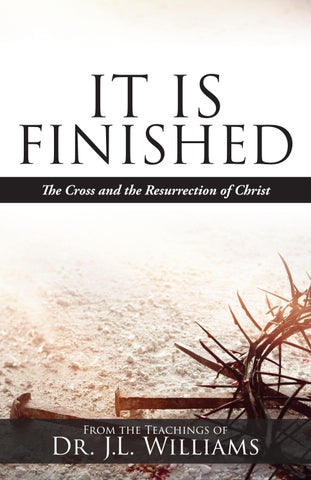
Create a flipbook