Editor: North Dakota OUTDOORS: Ron Wilson, Bismarck
Communications Specialist: Zach Eshleman, Bismarck
Marketing Coordinator: Cayla Bendel, Bismarck
Digital Media Editor: Lara Anderson, Bismarck
Photographer/Videographer: Ashley Peterson, Bismarck
Marketing Specialist: Jackie Ressler, Bismarck
Information Specialist: Dawn Jochim, Bismarck
Graphic Artist: Kristi Fast, Bismarck
Education Supervisor: Marty Egeland, Bismarck
Education Coordinator: Jeff Long, Bismarck
Hunter Education Coordinator: Brian Schaffer, Bismarck
Outreach Biologists: Doug Leier, West Fargo; Greg Gullickson, Minot; Jim Job, Grand Forks
Conservation Supervisor: Patrick Isakson, Bismarck
Conservation Biologists: Sandra Johnson, Elisha Mueller, John Schumacher, Aaron Larsen, Greg Schonert, Bismarck
Administrative Assistant: Amber Schroeter, Bismarck
ENFORCEMENT DIVISION
Division Chief: Scott Winkelman, Bismarck
Investigative Supervisor: Jim Burud, Kenmare
Investigator: Blake Riewer, Grand Forks
Operations Supervisor: Jackie Lundstrom, Bismarck
Warden Pilot: Mike Linden, Bismarck
Region No. 1 Warden Supvr: Michael Sedlacek, Jamestown
District Wardens: Corey Erck, Bismarck; Andrew Dahlgren, Milnor; Erik Schmidt, Linton; Greg Hastings, Jamestown; Noah Raitz, LaMoure; Gavin Herbert, Steele; Nick Tschepen, Fargo
Region No. 2 Warden Supvr: Paul Freeman, Devils Lake
District Wardens: Jonathan Tofteland, Bottineau; Jonathan Peterson, Devils Lake; James Myhre, New Rockford; Alan Howard, Cando; Drew Johnson, Finley; Sam Feldmann, Rugby; Gage Muench, Grand Forks; Dale Skalicky, Langdon; James Myhre, Sheyenne
Region No. 3 Warden Supvr: Joe Lucas, Riverdale
District Wardens: Michael Raasakka, Stanley; Shawn Sperling, Minot; Keenan Snyder, Williston, Josh Hedstrom, Tioga; Riley Gerding, Kenmare; Clayton Edstrom, Turtle Lake; Conner Folkers, Garrison; Luke Aamold, Watford City
Administrative Assistant: Lori Kensington, Bismarck
WILDLIFE DIVISION
Division Chief: Bill Haase, Bismarck
Assistant Division Chief: Levi Jacobson, Bismarck
Game Mgt. Section Leader: Stephanie Tucker, Bismarck
Pilot: Jeff Faught, Bismarck
Upland Game Mgt. Supvr: Jesse Kolar, Dickinson
Upland Game Mgt. Biologist: Rodney Gross, Bismarck
Migratory Game Bird Mgt. Supvr: John Palarski, Bismarck
Migratory Game Bird Biologist: Mason Ryckman, Bismarck
Big Game Mgt. Supvr: Bruce Stillings, Dickinson
Big Game Mgt. Biologists: Brett Wiedmann, Dickinson; Jason Smith, Jamestown; Ben Matykiewicz, Bismarck
Survey Coordinator: Chad Parent, Bismarck
Wildlife Veterinarian: Dr. Logan Weyand, Bismarck
Wildlife Health Biologist: Ryan Herigstad, Bismarck
Game Management Biological Technician: Vacant
Wildlife Resource Management Section Leader: Kent Luttschwager, Williston
Wildlife Resource Mgt. Supvrs: Brian Prince, Devils Lake; Brian Kietzman, Jamestown; Dan Halstead, Riverdale; Blake Schaan, Lonetree; Judd Jasmer, Dickinson; Jens Johnson, Bismarck
Wildlife Resource Mgt. Biologists: Randy Littlefield, Lonetree; Rodd Compson, Jamestown; Todd Buckley, Williston; Jake Oster, Riverdale; Andrew Ahrens, Devils Lake; Broden Ullyott, Dickinson Wildlife Biological Technicians: Tom Crutchfield, Jim Houston, Bismarck; Dan Morman, Robert Miller, Riverdale; Jason Rowell, Jamestown; Scott Olson, Devils Lake; Zach Eustice, Williston; Colton Soiseth, Quentin Corcoran, Lonetree
Private Land Section Leader: Kevin Kading, Bismarck
Habitat Manager: Nathan Harling, Bismarck
Private Land Field Operation Supvrs: Curtis Francis, East Region, Andrew Dinges, West Region, Bismarck
Private Land Biologists: Zach Johnson, Colin Penner, Bismarck; Jaden Honeyman, Ben Reith, Dickinson; Ryan Huber, Riverdale; Renae Schultz, Jeff Williams, Jamestown; Terry Oswald, Jr., Harvey; Erica Sevigny, Williston; Brandon Ramsey, Matthew Parvey, Devils Lake
Procurement Officer: Dale Repnow, Bismarck
FISHERIES DIVISION
Division Chief: Greg Power, Bismarck
Fisheries Mgt. Section Leader: Scott Gangl, Bismarck
Fisheries Biologists: Todd Caspers, Devils Lake; Mike Johnson, Jamestown; Jeff Merchant, Dickinson; Zach Kjos, Riverdale
Fisheries Biological Technicians: Phil Miller, Devils Lake; Justen Barstad, Bismarck; Brian Frohlich, Riverdale; Ethan Krebs, Jamestown, Sanden O’Connell, WIlliston
Production/Development Section Supvr: Jerry Weigel, Bismarck
Aquatic Nuisance Species Coordinator: Benjamin Holen, Jamestown
Aquatic Nuisance Species Biologists: Mason Hammer, Jamestown; Kyle Oxley, Bismarck
Fisheries Development Supvr: Bob Frohlich, Bismarck
Fisheries Dev. Proj. Mgr: Wesley Erdle, Bismarck
Fisheries Development Specialist: Kyle Hoge, Jacob Heyer, Joe Fladeland, Bismarck
Administrative Assistant: Janice Vetter, Bismarck
ADVISORY BOARD
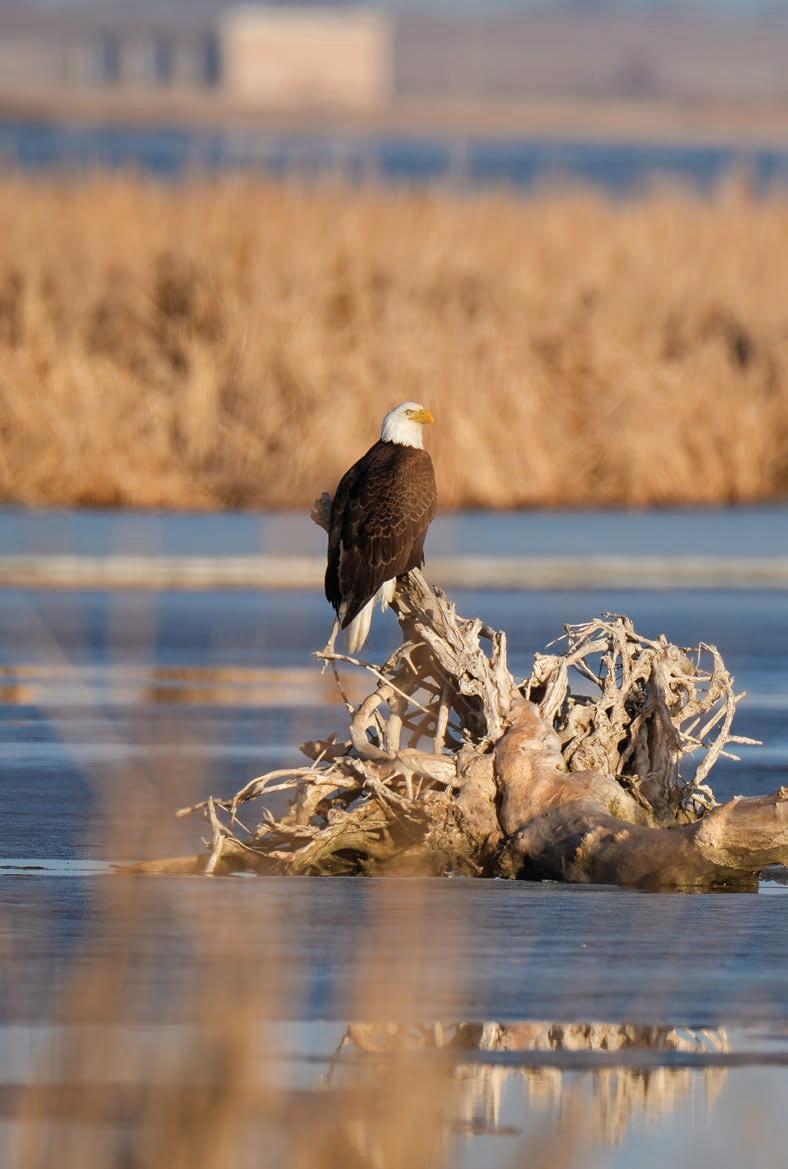
Bald eagles are frequent visitors in spring to Long Lake National Wildlife Refuge near Moffit. The attraction is winterkilled common carp that make for an easy meal for the majestic birds at ice out.
PHOTO BY SANDRA JOHNSON, BISMARCK.
Nathan Hovde, Alexander
Travis Leier, Velva
Edward Dosch, Devils Lake
Karissa Daws,
Jordan Svenningsen, Luverne
Jody Sommer, Mandan
Rob Brooks, Rhame
Contributing photographers for this issue: Mike Anderson, Sandra Johnson, Paul Bailey, Ty Stockton, Jesse Kolar and Ashley Peterson.
Official publication of the North Dakota Game and Fish Department (ISSN 0029-2761)
100 N. Bismarck Expressway, Bismarck, ND 58501-5095
Website: gf.nd.gov • Email: ndgf@nd.gov
• Information 701-328-6300 • Licensing 701-328-6335
• Administration 701-328-6305
• North Dakota Outdoors Subscriptions 701-328-6363
• Hunter Education 701-328-6615
• The TTY/TTD (Relay ND) number for the hearing or speech impaired is 800-366-6888
Report All Poachers (RAP) 701-328-9921
Periodical Postage Paid at Bismarck, ND 58501 and additional entry offices. Printed in the United States
POSTMASTER: Send address changes to: North Dakota OUTDOORS 100 North Bismarck Expressway Bismarck, ND 58501-5095
In cooperation with North Dakota Wildlife Federation and North Dakota State Radio.
The mission of the North Dakota Game and Fish Department is to protect, conserve and enhance fish and wildlife populations and their habitats for sustained public consumptive and nonconsumptive use.
Editor: Ron Wilson Graphic Designer: Kristi Fast Circulation Manager: Dawn Jochim
North Dakota OUTDOORS is published 10 times a year, monthly except for the months of April and September. Subscription rates are $15 for one year or $30 for three years. Remittance should be by check or money order payable to the North Dakota Game and Fish Department. Indicate if subscription is new or renewal. The numbers on the upper right corner of the mailing label indicate the date of the last issue a subscriber will receive unless the subscription is renewed.
Permission to reprint materials appearing in North Dakota OUTDOORS must be obtained from the author, artist or photographer. We encourage contributions; contact the editor for writer and photography guidelines prior to submission.
The NDGFD receives Federal financial assistance from the US Fish and Wildlife Service and the US Coast Guard. In accordance with Title VI of the Civil Rights Act of 1964, Section 504 of the Rehabilitation Act of 1973, Title II of the Americans with Disabilities Act of 1990, the Age Discrimination Act of 1975, and Title IX of the Education Amendments of 1972, the NDGFD joins the US Department of the Interior and its Bureaus and the US Department of Homeland Security in prohibiting discrimination on the basis of race, color, national origin, age, disability, sex (in education programs or activities) and also religion. If you believe you have been discriminated against in any program, activity, or facility as described above, or you desire further information, please write to: ND Game and Fish Department, Attn: Chief of Administrative Services, 100 N. Bismarck Expressway, Bismarck, ND 58501-5095 or to: Office of Civil Rights, Department of the Interior, 1849 C Street, NW, Washington, DC 20240.
PHOTO BY JESSE KOLAR, DICKINSON.
My 2 Cents from the DIRECTOR
North Dakotans continue to care deeply about the future of both agriculture and wildlife habitat and understand that the two can successfully work hand in hand.
Jeb Williams DIRECTOR, NORTH DAKOTA GAME AND FISH DEPARTMENT
Government doesn’t normally work this fast. It’s not designed nor intended to. Less than six months into the Governor’s Legacy Soil Health and Habitat Program, a lot has transpired in a short amount of time since funding was awarded from the Outdoor Heritage Fund to pilot a project to improve soil health and put more grass on the landscape. It is already clear that this initiative has struck a chord with North Dakota landowners and producers. While I have written previously about the creation of the program and its goals, the early success and overwhelming interest deserve recognition.
In just two enrollment periods, the program generated applications from 46 counties across North Dakota, representing nearly 20,000 acres of interest. That kind of response speaks volumes. Unfortunately, available funding allowed for only about 10,000 acres to be approved, but the demand itself highlights how strongly producers value voluntary conservation opportunities that fit alongside working agricultural operations.
While hunting access isn’t required for this program, it is incentivized and landowners responded to that as over half of the 10,000 acres being enrolled will also be enrolled in the Game and Fish Department’s Private Land Open To Sportsmen program.
One of the reasons for the Legacy Program’s early success has been its simplicity. In a world where paperwork and regulations can often discourage participation, landowners appreciated the straightforward, one-page application process. The ability to quickly understand the program and apply without unnecessary complications made participation much more approachable for producers already balancing countless responsibilities.
Another major factor has been the
customer service provided through the program’s many partners. Landowners consistently praised the responsiveness and willingness of staff to answer questions, assist with enrollment and help producers navigate the process. Good conservation programs are built on trust and relationships, and that has clearly been a strength of this effort.
Equally important has been the flexibility offered within the program. Producers value the ability to make management decisions that fit their operations, timelines and local conditions. The flexibility to establish habitat acres in a way that works best for individual landowners helped create buy-in and enthusiasm rather than frustration.
From a conservation standpoint, the benefits are substantial. Additional grass and habitat on the landscape provide critical nesting cover for upland birds, valuable habitat for pollinators,and much-needed fawning cover for deer populations. At the same time, soil health practices improve water infiltration, reduce erosion and strengthen the long-term productivity and resiliency of working lands.
Perhaps the greatest takeaway from the program’s first six months is this: North Dakota landowners want to be part of conservation solutions when those solutions are practical, voluntary and respectful of agriculture. The response proves that conservation works best when partnerships, flexibility and local stewardship lead the way.
The Governor’s Legacy Soil Health and Habitat Program is still in its infancy, but the early returns are extremely promising. The interest shown across our state demonstrates that North Dakotans continue to care deeply about the future of both agriculture and wildlife habitat and understand that the two can successfully work hand in hand.
By Greg Power
The classroom is very large when it comes to fishing in North Dakota, encompassing everything from a bait dealer netting minnows for customers, to boat sales, to finding fishing solitude on one of the hundreds of backroad waters across the state. While we often think of fishing as just a quiet hobby, the “business of fishing” is actually a serious economic engine for our state. Anglers fishing in state waters pour nearly $800 million into North Dakota’s economy through the purchase of gear, bait, boats, and travel. In addition, fishing generates over $42 million in state taxes annually, helping to support general funding across the state.
However, for most, the benefits of fishing are not about the dollars and cents but rather something deeper. We all can relate to the real value found in those “perfect days,” perhaps a glass-calm lake, the sound of meadowlarks at sunrise, and a walleye on the end of the line. For seasoned North
anglers, these “perfect days” have shifted from hopes of just catching a fish or two to a common expectation of harvesting limits over the last quarter-century. If your target is the in-demand walleye, North Dakota is currently experiencing a genuine golden age of angling. And if you’re chasing the kitchen-staple yellow perch, the aggressive northern pike, or the hard-fighting smallmouth bass, opportunities still abound.
For the sixth time since 2008, it’s time to step back into the classroom, and once again adopt the teacher role to issue the 2026 North Dakota Fishing Report Card. It’s time to report to the parents — the angling public — on how our classroom is performing.
Access and Opportunity
AIf this feels like a broken record, it’s one you’ll want to keep playing. The North Dakota classroom is made up of nearly 450 managed fishing waters, covering nearly 800,000 acres.
Obtaining and maintaining access to these waters is critical for angler opportunities. Since the last report card, both Game and Fish Department fisheries development staff have been busy ensuring the doors to these waters remain wide open for all. Some of their activities in the past three years include:
• 65 boat ramps were constructed, upgraded, or extended.
• 44 new courtesy docks were built and installed.
• Six new floating fishing piers were constructed and installed to provide shore-fishing access.
• 13 existing fish cleaning stations were upgraded.
• Nine new precast vault toilets were installed, and porta potty toilets were deployed at more than a dozen lakes.
• Ongoing maintenance across the state replacing, upgrading and modernizing existing facilities.
• And more for shore-anglers — from excavating cattails, to installing stairways over highway riprap, to partnering with local towns to create community ponds to solidify the fact that you don’t need a $50,000 boat to bring home dinner.
Fish Abundance and Health
It’s a constant story, but a positive one: our fish populations and water levels continue to hover near record highs. From walleye and pike to paddlefish and trout, the state provides top opportunities for every skill level.
Walleye, of course, remains North Dakotas’ popular student. The addition of nearly 90 new fisheries across the central and eastern regions over the last 25 years has fundamentally changed the fishing map of North Dakota. Anglers have successfully harvested more than 1 million walleye from these “new” waters that, in virtually all cases, didn’t even exist as viable fisheries a generation ago.
And the Big 3 — Lake Sakakawea, Devils Lake and the Missouri River/Lake Oahe — remain the heart of North Dakota fishing, supporting 50% of all angling activity. Both Sakakawea and Devils Lake maintain very solid catches of walleye, continuing a long-term upward trend. And the Missouri River/Lake Oahe continues its impressive rebound.
While it’s been a walleye world for the past 10-plus years, many would love to see northern pike and yellow perch make a comeback to their 2010-15 levels. In the big picture, these respective populations are driven by Mother Nature. The lack of periodic flooding and a strong stocking program have allowed walleye to take over many of our former pike and/or perch fisheries. Unless we receive a significant “recharge” of water to create new spawning/rearing habitat (including more groceries), the pike and perch outlook will likely remain as it has been the past few years.
Looking ahead, our success is naturally linked to the environment. Due to extremes in weather, water levels, and so on, North Dakota fisheries always have extreme ranges in the respective fish populations. While recent wet cycles have set the stage for years of great fishing, we know that the eventual return of a long-term drought will pose a significant challenge to these record-setting populations. Fortunately, that shift appears to be a long way off.
Management
AManaging North Dakota’s ever-growing fishing waters is a balancing act of science and resources. Because we can’t be everywhere at once, Department biologists utilize a three-tier priority system to maximize our field staff’s influence. While we lack the personnel to sample every lake annually, this system ensures the higher priority waters are surveyed at least once a year. These frequent check-ins are vital for shaping stocking plans and making informed regulation changes.
The Department’s regulation philosophy is simple: keep the rules straightforward while fostering healthy fish populations. This approach has allowed us to protect and improve our fisheries without frequent regulatory shifts. Because both our climate and fish populations are constantly changing, we prioritize a long-range view when considering updates to our
state’s fishing regulations.
The fisheries division’s sampling and monitoring goes far beyond just counting fish. Our crews are consistently engaged in many other activities including water quality monitoring, creel surveys to understand angler success, specialized research, and ramped-up walleye tagging projects the past few years to gather high-precision data for management purposes.
Stocking is often the public’s favorite topic, but it doesn’t happen in a vacuum. There is a direct link between Department netting surveys and stocking recommendations. The data tells us what and how many fish a lake needs. And to meet these needs, we rely on our invaluable partnership with the Garrison Dam and Valley City national fish hatcheries. The ongoing good news: around 33 million adult and fingerling fish, representing 13 species, were stocked into more than 300 North Dakota waters in the past three years.
The bully in the hallway remains aquatic nuisance species. In recent years, we’ve ramped up watercraft inspections, monitoring, enforcement, and education to keep our waters free of ANS. For example, in the past three years, the Department has inspected over 30,000 watercraft and collected thousands of early detection samples from hundreds of water bodies. So far, the defenses are holding, as greater than 95% of the lakes in North Dakota have no ANS … but we can’t afford to look away.
Habitat
B 2026 Final A-
As noted in past report cards, habitat can be a rather vague word but put simply, the quality of North Dakotas fishing waters is predicated upon both the quality and quantity of water. In terms of water quality, its long-term performance in the classroom is struggling to maintain a satisfactory grade. Nutrients and blue-green algae blooms continue to cause headaches. For some of our fishing lakes, blue-green algae blooms have resulted in advisories and warnings issued by the Department of Environment Quality. Since we can’t control the outside environment or the global economics of the farm bill, finding long-term solutions for our watersheds remains our biggest extra credit challenge for the coming decades.
The other portion of the fish habitat formula is water quantity. As stated earlier, conditions have never been better as we currently have a near record number of fishing lakes dotting our landscape. Periodic large precipitation events, including what was witnessed in western North Dakota in spring of 2025, have benefited our lakes greatly. Going into summer, we continue to be in good shape as most of our waters are full or nearly full.
Of all the subjects to be graded in the classroom, habitat is the most difficult to improve upon; reason being, is both parameters, water quantity and quality, are far outside our ability to adequately address. Water quantity is determined by Mother Nature who doesn’t attend school. And issues dealing with water quality, although within human hands, involve macro-economic issues including the farm bill. As mentioned, finding long-term solutions to landscape use will be one of the largest challenges facing many resource professionals in the years and decades to come.
Overall
An overall A- signifies that our outdoor classroom is not just surviving — it is still flourishing. Thanks to a long-running assist from Mother Nature and a Department staff that is quick to capitalize on every opportunity, North Dakota remains a premier destination for anglers.
R3 efforts (recruitment, retention and reactivation) are, more than ever, foundational to the Departments mission. We want to help anglers find the right spot for their specific style, whether that’s a quiet afternoon on a community pond, snagging paddlefish on the Yellowstone River, angling for catfish on the Red, or a weekend of boat fishing on Sakakawea.
For 2026, the message remains simple: Take the time to wet a line . For the older generation, it’s a chance to enjoy the golden age. For the newcomer, the experience of a perfect morning on a North Dakota lake might be transformative. And while you’re at it, take out someone new to fishing. It’s a long-term investment that will pay dividends for future generations.
GREG
POWER is the Game and Fish Department’s fisheries chief.
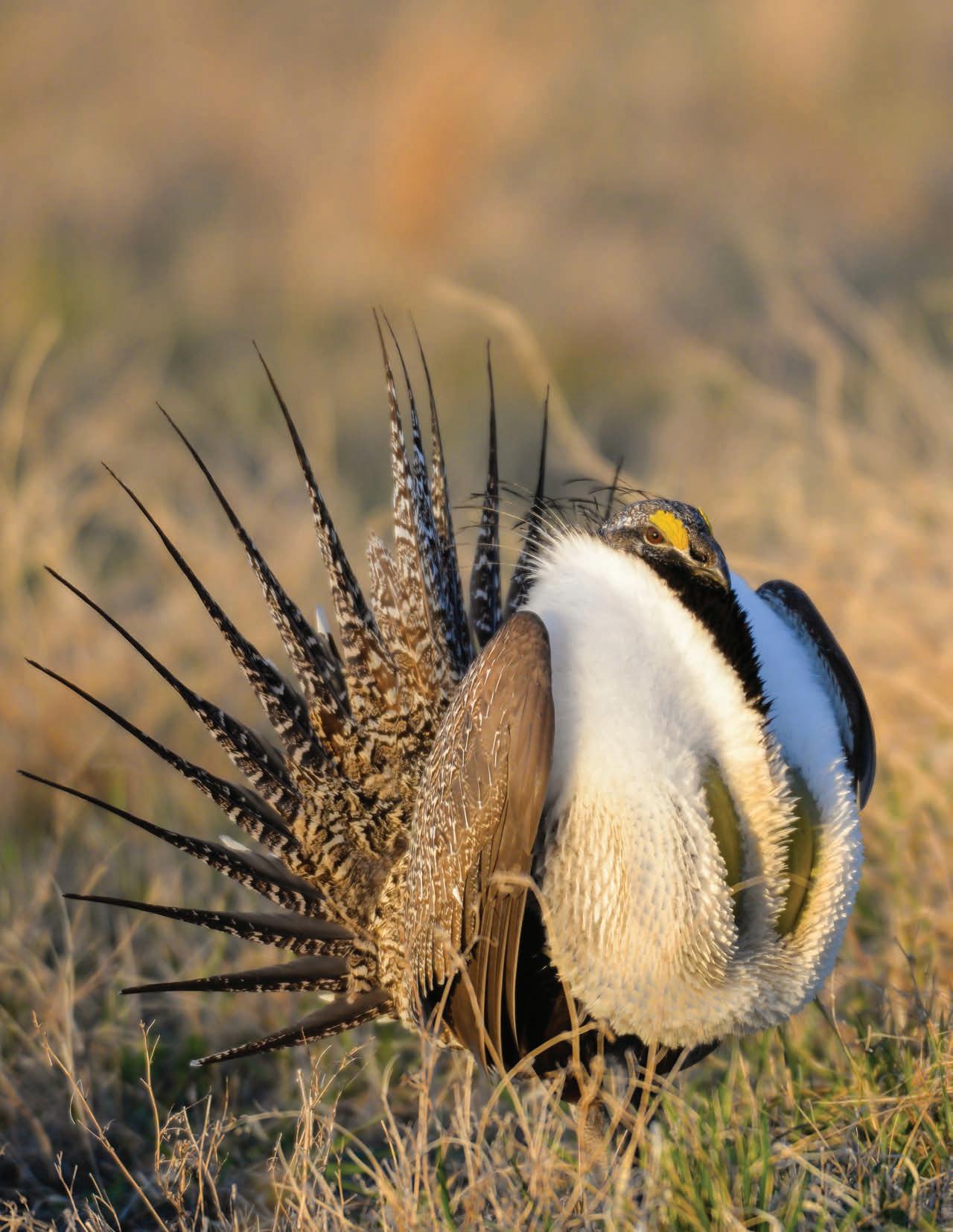
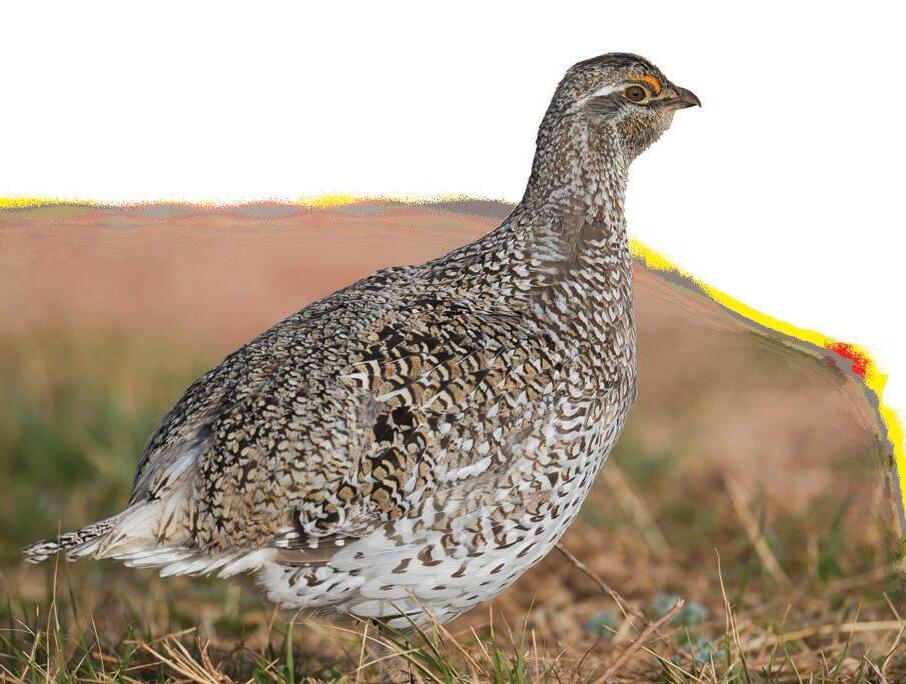
Male sage grouse in western North Dakota.
By Sandra Johnson
“The region should be a place of pilgrimage for thousands every year, for the sake of what it meant in the life of Roosevelt and for its own wild and exhilarating beauty. Someday the multitudes will discover it. Meanwhile it waits, grim, fantastic, magical,” wrote Herman Hagedorn in the Oct. 19, 1921, issue of The Outlook. This prediction will come true when the Theodore Roosevelt Presidential Library opens in Medora on July 4, 2026. Roosevelt came to North Dakota just after the near-complete extermination of buffalo from the plains, and shortly before he expected the land would be “broken up into small patches of fenced farm land and grazing land.” Most North Dakotans have visited Medora or Theodore Roosevelt National Park, hunted or recreated in the badlands. The region draws about 800,000 visitors annually, but still, the multitudes have not yet experienced the fantastic, magical badlands as the 26th president once did. The most amazing North American big game species Roosevelt hunted and observed still live there: elk, bighorn sheep, mule deer, pronghorn and mountain lions. Other wildlife species he encountered had different fates. Some species are thriving. Others are far less common. A few are gone forever.
Roosevelt’s rich narratives about hunting buffalo and big game have been retold countless times. Lesser chronicled are his anecdotes on birds in the badlands, particularly shorebirds and songbirds that “the ordinary wilderness dweller, whether hunter or cowboy, scarcely heeds them; and in fact knows but little of the smaller birds. If a bird has some conspicuous peculiarity of look or habit he will notice its existence, but not otherwise.” It is also worth noting that during Roosevelt’s time in western North Dakota, game laws, seasons, and harvest limits did not yet exist, and wildlife was often taken in ways that reflected the realities and attitudes of that era, rather than the modern conservation ethics of today that Roosevelt was integral in establishing.
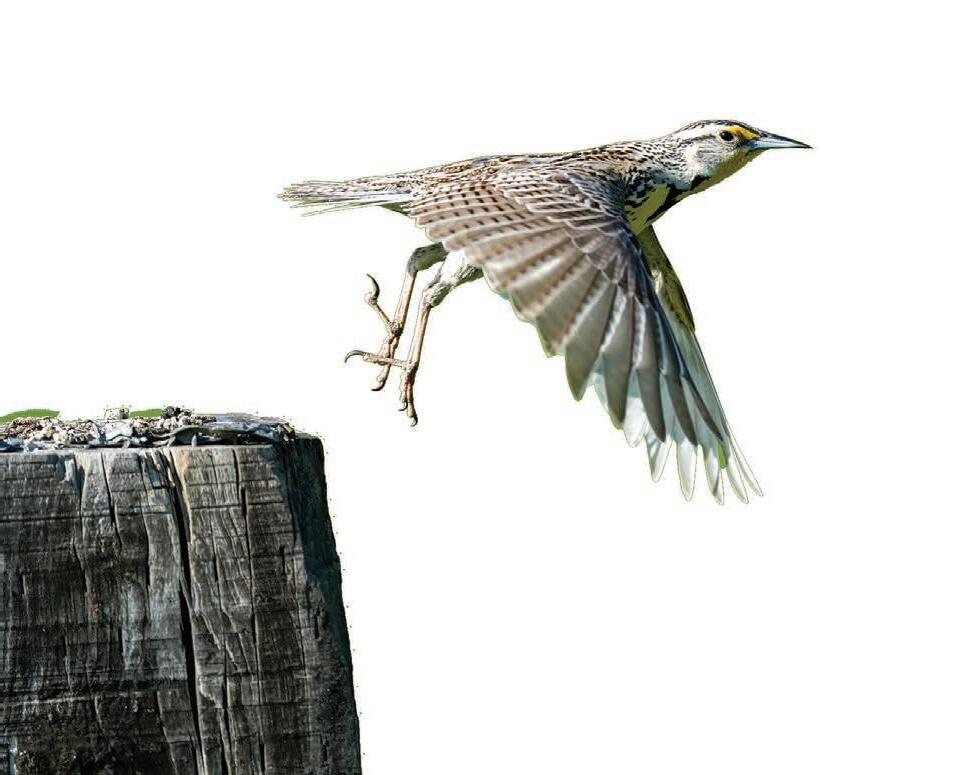
Roosevelt, before any other title, was a birder. As a young boy he was fascinated with birds and amassed an extensive collection of taxidermy specimens. He was ever the observer of nature. Not just viewing and hearing birds but immersing in the experience of being in their company. Growing up in the East, he knew the Eastern meadowlark well, which looks identical to a Western meadowlark, but “utters nothing but a harsh, disagreeable chatter.” How could two birds so alike sound so different. The Western meadowlark being “one of our sweetest, loud-
est songsters … the plains air seems to give it a voice, and it will perch on the top of a bush or tree and sing for hours in rich, bubbling tones.” The multitudes that visit the library can still immerse themselves in the meadowlark song if they take a moment to listen to the badlands. However, meadowlarks, like so many other grassland birds, are less common today than when Roosevelt had an ear tuned to the landscape.
Roosevelt was captivated with another bird of the badlands more often heard than seen.
“Sometimes in the early morning, when crossing the open, grassy plateaus, I have heard the prince of them all, the Missouri skylark. The skylark sings on the wing, soaring over head and mounting in spiral curves until it can hardly be seen, while its bright, tender strains never cease for a moment.”
On one occasion, Roosevelt sat on his horse and listened to the bird singing overhead, nonstop, for 15 minutes. Today, biologists have documented this bird, currently named Sprague’s pipit, continuously displaying in the sky for nearly 3 hours. It is indeed a sweet songster, and once you recognize its song, a stiff neck is sure to follow trying to spot the resilient little bird, often 50 to 100 yards overhead. In Roosevelt’s era, pipits were much more common in the western two-thirds of the state, even abundant in places. Today, they
“The sharp-tailed prairie fowl is much the most plentiful of the feathered game to be found on the northern cattle plains…it is, however, essentially a bird of the wilds, and it is a curious fact that it seems to retreat before civilization, continually moving westward as the wheat fields advance.”
Native sharp-tailed grouse.
“I heartily enjoy this life, with its perfect freedom, for I am very fond of hunting, and there are few sensations I prefer to that of galloping over these rolling limitless prairies, rifle in hand, or winding my way among the barren, fantastic and grimly picturesque deserts of the so-called Bad Lands.”
(letter to Henry Cabot Lodge, August 24, 1884).
are few and far between, but in the expansive native grasslands bordering the badlands, one might still listen to the sky and with a bit of luck, hear the prince sing.
Sharp-tailed grouse were “the most plentiful of the feathered game to be found on the northern cattle plains” and remain fairly common today, where intact grasslands persist. Roosevelt enjoyed eating grouse, noting they were “very good eating from about the middle of August to the middle of November, after which it is a little tough.” Today, this native upland game bird is pursued far less frequently than the nonnative ring-necked pheasant, which did not become established in the state until the 1930s. Visitors to almost anywhere in the badlands will likely encounter both sharp-tailed grouse and pheasants. What they will not find, but Roosevelt often did, are greater sage grouse. “It is only found where the tough, scraggly wild sage abounds, and it feeds for the most of the year solely on sage leaves, varying this diet in August and September by quantities of grasshoppers.” Roosevelt said sage grouse were “very easy marks, but require hard hitting to bring them down, for they are very tenacious of life.” Today, sadly, these big upland birds have all but disappeared and none were counted on traditional leks in North Dakota in spring 2025.
Mallards, widgeon, pintails, teal, shovellers and wild (Canada) geese were frequent sources of fresh meat. Some waterfowl were found in little pools or the streams near Roosevelt’s Elkhorn Ranch, but Roosevelt would often make trips farther east where “The prairie round about is wet, at times almost marshy, especially at the borders of the great reedy slews. These pools and slews
are favorite breeding-places for water-fowl, especially for mallard, and a good bag can be made at them in the fall, both among the young flappers (as tender and delicious birds for the table as any I know), and among the flights of wild duck that make the region a stopping-place on their southern migration.”
Roosevelt shot his first white goose (unknown if it was a snow or Ross’s) in the badlands. Geese were far less abundant in his time, partly from market hunting, but also the natural constraints of their habitat. Historically, snow geese fed on short grasses and sedges in the marshes of the Gulf Coast. In the 1970s, snow and Ross’s geese discovered waste grain in harvested rice, corn and wheat fields. This new food source led to improved body condition, increased survival, and a population explosion with numbers reaching 20 million birds by 2007, levels that greatly damaged the Arctic breeding grounds. One can only imagine what Roosevelt would say about this
“To be remarkably successful in killing game a man must be a good shot; but a good target shot may be a very poor hunter, and a fairly successful hunter may be only a moderate shot.”
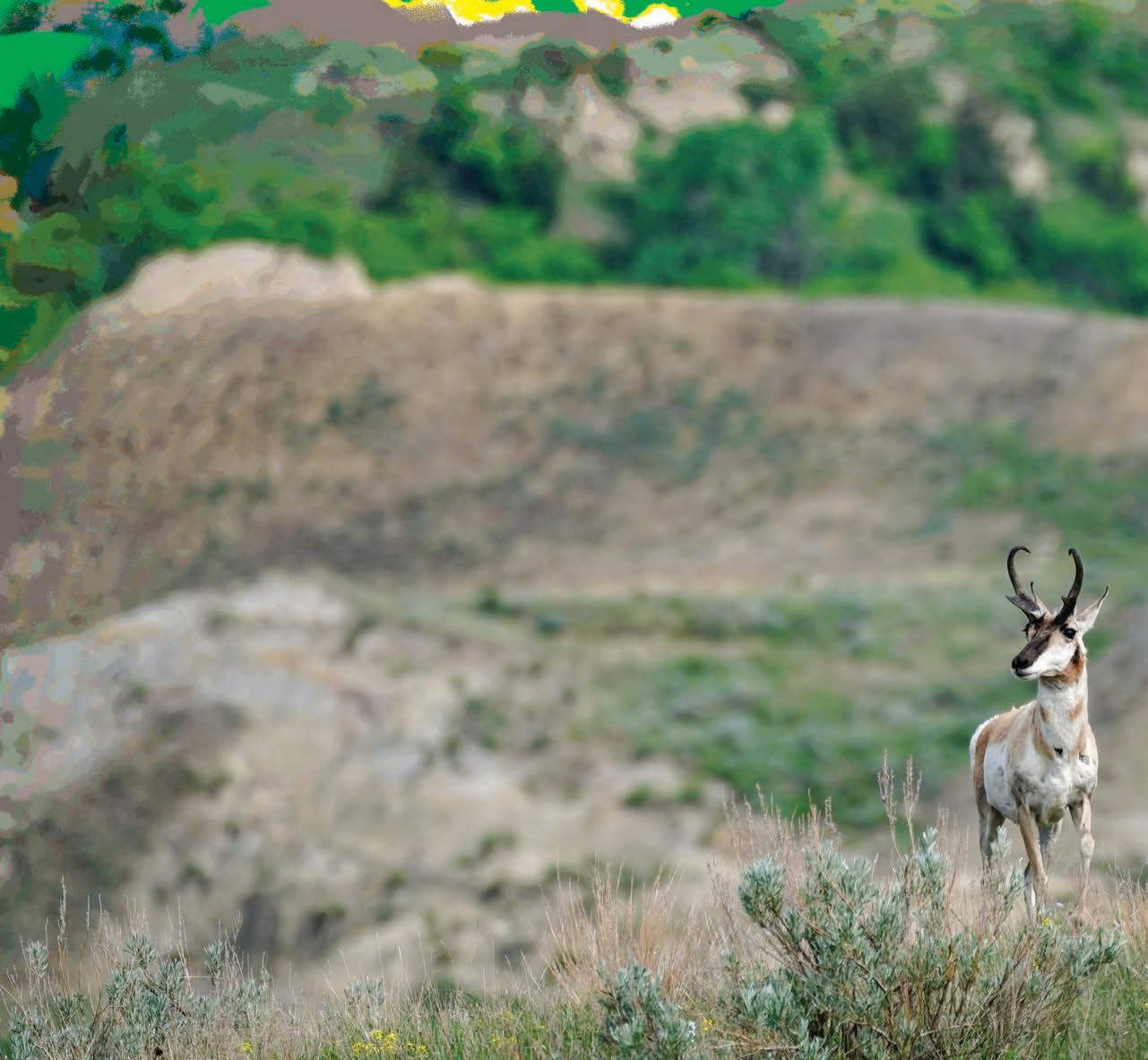
Pronghorn in western North Dakota.
situation. He would have surely marveled at the clever endurance of the geese, while alerting the unintended consequences that follow when we reshape the land.
The latter half of the 19th century was a period when unregulated market hunting fueled the decline of many bird species. Shorebirds, in particular, were shot not by the hundreds per shooter, but by the thousands. Their fate was unfortunate, sealed by their own natural instincts to flock tightly together, yielding large returns with one shot, but also because they are delicious. Roosevelt said “There are two or three species of birds tolerably common over the plains which we do not often regularly hunt, but are occasionally shot for the table. These are the curlew, the upland or grass plover, and the golden plover.”
Long-billed curlews were “one of the most conspicuous features of plains life.” By the end of Roosevelt’s presidency, they had nearly vanished from the East. Yet he had observed them near Elkhorn Ranch, and numerous accounts from naturalists in the late 1800s and early 1900s located them across many parts of the state. Today, long-billed curlews are primarily found in Golden Valley, Billings, Slope and Bowman
counties. They’re easy to identify because “they are never silent, and their discordant noise can be heard half a mile off. Whenever they discover a wagon or a man on horseback, they fly toward him, usually taking good care to keep out of gunshot. They then fly over and round the object, calling all the time, and sometimes going off to one side, where they will light and run rapidly through the grass; and in this manner they will sometimes accompany a hunter or traveller for miles, scaring off all the game.” Curlews behave much the same today, but now it’s your vehicle if you stop along the road, or a rancher on an ATV. You know one when you see one.
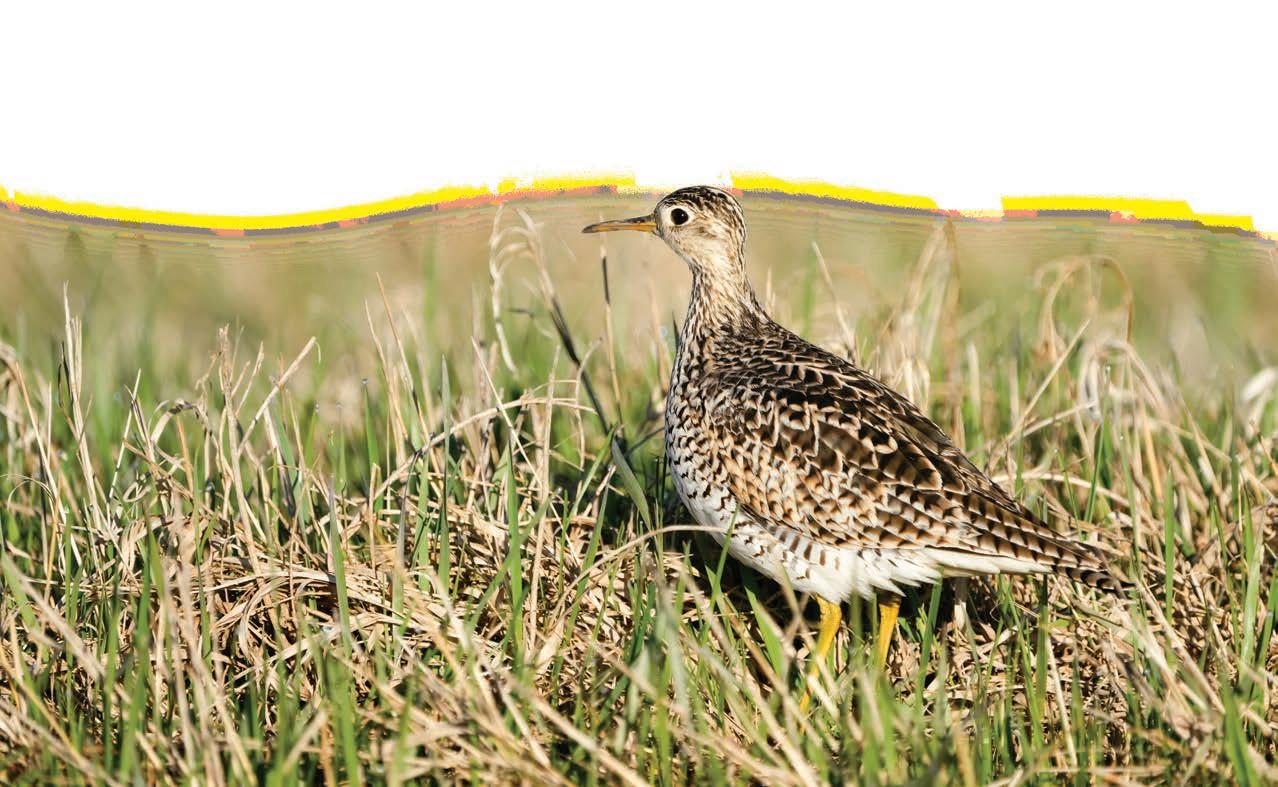
The grass plover, now named upland sandpiper, was found in the same places as the curlew but Roosevelt considered them “less wary, noisy and inquisitive.” Upland sandpipers were one of the most sought-after game by market hunters, some later acknowledging it is a wonder the species survived at all. Today, the Central Flyway is the stronghold for this bird and North Dakota ranks second out of 22 states for hosting the highest percent of the global population. Upland sandpipers are commonly seen perched on fenceposts in North Dakota today, a sight that Roosvelt likely never witnessed
“One of our sweetest, loudest songsters is the meadow-lark;…the plains air seems to give it a voice, and it will perch on the top of a bush or tree and sing for hours in rich, bubbling tones.”
Western meadowlark
due to the scarcity of fences at the time.
The golden plover, now known as American golden-plover, “is only found during the migrations, when large flocks may sometimes be seen. They are delicious eating, the only ones I have ever shot have been killed with the little ranch gun, when riding around the ranch, or travelling from one point to another.” Golden plovers have never been seen in abundance during migration, but today it would be challenging to find one within the vicinity of Roosevelt’s ranches.
Other shorebirds Roosevelt found were “yellowlegs, yelper (lesser yellowlegs), willet, marlin (marbled godwit), dough bird, stilt, and avocet” though they were more plentiful east of the badlands. Of these, one is gone forever, the Eskimo curlew. Dubbed the dough bird because when shot their skin would split open, revealing so much fat it resembled bread dough. Smaller than a long-billed curlew but larger than an upland sandpiper, Eskimo curlews migrated north from South America and made stopovers in the central Great Plains, especially on burned prairies, on their way to northern breeding grounds.
While North Dakota was not a primary
hunting was a leading cause for the decimation of this bird. However, plowing of the prairie, cessation of grassland wildfires, and extermination of an important food source, the Rocky Mountain grasshopper, also contributed to their demise. Eskimo curlews were a highly social species, their migrating flocks described as swirling, shifting clouds. The last confirmed observation was in 1963. Though some species of birds have made epic recoveries from just a handful of individuals, such as giant Canada geese and whooping cranes, others simply cannot endure in small numbers, isolated, and alone.
While Roosevelt too felt alone after the loss of his wife and mother, the badlands transformed that loneliness into solitude. For many of us today, the badlands still offer that same gift of solitude, the chance to hunt, or simply observe and be in the company of the wildlife Roosevelt knew, save for a few notable absences.
SANDRA JOHNSON, North Dakota Game and Fish Department conservation biologist.
Upland sandpiper
Fishing on Devils Lake.
LENGTHY LOOK AT THE BIG
BY PAUL BAILEY, TODD CASPERS AND RUSS KINZLER.
Fishing regulations are important tools that biologists can use to limit harvest to maintain the health and quality of fish populations. At the North Dakota Game and Fish Department, our philosophy is to keep fishing regulations as simple and consistent as possible for anglers by only implementing regulations that will provide a benefit to fish populations or anglers.
Length limits are designed to restrict harvest of certain sizes of fish, and come in three basic types: 1) minimum length limits prohibit harvest of fish under a specific size, 2) maximum length, or “one-over” limits restrict harvest of large fish, and 3) slot limits restrict harvest on a specific size-range of fish.
To properly assess the need for length limits, biologists examine the primary population functions that shape fish populations: reproduction or recruitment (the rate at which fish are added to a population), growth (the rate at which fish are increasing in size) and mortality (the rate at which fish are leaving a population). Would a
These questions, and more, are considered by biologists tasked with managing the state’s fisheries. When the criteria for an effective regulation are met, it may be proposed for implemening as a new regulation. But implementing a regulation that doesn’t meet specific criteria for success may be ineffective or outright harmful to the fish population.
Referred to colloquially as the Big 3 walleye fisheries, Devils Lake, Lake Sakakawea, and the Missouri River and Lake Oahe below Garrison Dam, are the most intensively managed walleye
fisheries in North Dakota. Due to their importance as angling destinations, both locally and nationally, our biologists review their data every year to determine if a length limit regulation is necessary to protect or improve walleye fishing on the Big 3. On the following pages, biologists breakdown their length limit evaluations for 2025 data.
MISSOURI RIVER AND LAKE OAHE
Seeing good recruitment of new fish into a population is most often a welcome event by both fisheries biologists and anglers as it signals that fish should be abundant for years to come. This is especially true for the walleye population in the Missouri River and North Dakota portion of Lake Oahe where the Department relies on natural reproduction to maintain this fishery. However, excellent walleye recruitment over the last dozen or so years exemplifies too much of a good thing.
The good news regarding this excellent recruitment is that it indicates that there are plenty of mature female walleye to maintain this population, which is certainly welcome news as we can then devote our hatchery resources elsewhere.
The other side of this double-edged sword is that small walleye have been extremely abundant and taxed
from a fishery without jeopardizing the sustainability of that population. The Department collaborated with South Dakota Game, Fish and Parks in 2025 to estimate walleye angling mortality between Garrison and Oahe dams and found that anglers harvested approximately 17% of the walleye in the North Dakota portion of this fishery. This indicates that walleye angling mortality is acceptably low.
Collectively, this indicates that the Missouri River and Lake Oahe walleye fishery is currently characterized by excellent recruitment, slow growth, and low walleye angling mortality. This information then allows us to assess the potential benefits (or detriments) of various length limits.
Applying a minimum length limit (15 inches for example) would likely be detrimental to this fish population. Excellent recruitment and slow growth have led to an abundance of small walleye and restricting harvest of these small fish would likely exacerbate these issues. In fact, the Department has encouraged anglers to “not feel bad” about harvesting the 12- to 15-inch fish they encounter as, under the present conditions, may benefit this fish population by reducing the abundance of small fish, providing more forage for those that remain, and improving growth rates.
Considering the opposite end of the spectrum, would a maximum (or one-over) length limit benefit this fishery in some way? That answer is a clear no from a recruitment perspective as there is no indication that the reproductive potential of walleye in this fishery is in any way limited by the abundance of mature female fish. Information from the most recent creel survey (2024) also indicates that anglers seldom harvest more than one walleye over 20 inches per trip. Rather, most angler harvest is focused on walleyes between
13-20 inches and anglers elect to release many of the larger walleye that they catch. Thus, applying a maximum (or one-over) would likely not reduce the harvest of large walleye.
That brings us to slot length limits. The first type to consider is a protected slot whereby fish of a certain size range, say 15-20 inches, would be protected from harvest. The current low rate of walleye angling mortality indicates that this type of regulation is unnecessary. Additionally, such a regulation is likely to be enormously unpopular with anglers as these are the sizes of fish that many prefer to harvest.
The other type of slot length limit to consider is a harvest slot, whereby the harvest of fish both below and above a certain size range would be restricted. For example, harvest would only be allowed on fish from 15-20 inches. Thus, a harvest slot is really a combination of both a minimum and maximum length limit and (as described earlier) neither is currently warranted for this fishery. (Furthermore, results from recent tagging studies and creel surveys indicate that many North Dakota walleye anglers voluntarily adhere to a selfimposed slot limit by focusing their harvest on “eatersized” fish while releasing the small and large fish they catch.)
This routine analysis of recruitment, growth and mortality of Missouri River and Lake Oahe walleye indi cates that this fishery is unlikely to benefit from a more restrictive length limit. Understanding this, the Depart ment prefers to give individual anglers the freedom to make their own decisions on the sizes of walleye they choose to harvest within our five fish daily limit.
DEVILS LAKE
Currently, the Devils Lake walleye population does not meet some of the criteria necessary to benefit from a minimum length limit. In Devils Lake, walleye recruitment is typically good and young walleye are usually abundant, so protecting them isn’t necessary. There are usually good numbers of 12- to 15-inch walleye in the lake, and a minimum length limit would needlessly restrict harvest opportunities for anglers and could decrease growth due to increased competition between small fish if they were protected by a minimum size limit.
Angler harvest of young fish also isn’t a problem, as total mortality (which is due to harvest as well as natural causes) for the population is lower than what is considered normal. In general, Devils Lake walleye will grow from about 13 inches at age 3 to 15 inches at age 4, so it only takes them about 1 year to grow from being a “small keeper” to a “quality keeper.” This means that the smaller fish are usually only susceptible to harvest for about 1 year before they become quality-sized fish, and most of them can grow into quality-sized fish without being protected.
Devils Lake’s walleye population does not meet the criteria necessary to see a benefit from some type of maximum length limit. Large walleye hatches in the
The spring walleye bite on the Missouri River.
of adults in the lake to reproduce successfully. Moreover, there have been times when there have been so many small walleye in the lake that their growth rates have slowed down.
Many anglers release large walleye voluntarily as well. We see evidence of this in our creel surveys as well as in tagging data. For example, for walleye that were tagged in Devils Lake in 2025, so far about 95% of the fish that were 13-20 inches when tagged were harvested if caught. This harvest probability dropped to 78% for fish that were 20-22 inches when tagged, 66% for fish that were 22-24 inches when tagged, and 32% for fish that were longer than 24 inches when tagged. Basically, walleye over 20 inches will be released more often than fish less than 20 inches, and the likelihood of getting released increases as length increases.
Since the Devils Lake walleye population does not meet the criteria for either a minimum or a maximum length limit, a harvest slot limit would not be appropriate either. Also, when considering a protected slot, there are a couple of necessary criteria lacking for this type of regulation to be successful at Devils Lake. The criteria not being met to see success from this type of length limit is that small fish need to have slow growth and high mortality. Small walleye in Devils Lake have adequate growth and their mortality rate isn’t particularly high. This type of regulation would work well in a situation where it’s necessary
to protect moderate-sized fish while forcing anglers to mostly harvest abundant, small, slow-growing fish that are likely to die of natural causes anyway. Those conditions don’t exist on Devils Lake. The small fish can grow into the moderate-size group on their own, so forcing anglers to harvest these small fish wouldn’t be wise. Additionally, it is the moderate-sized walleye in Devils Lake that display slower growth, so protecting all of those fish from harvest may lead to a further reduction in their growth rates.
Another potential use of a protected slot limit could be to save larger fish (20- to 26-inch walleye for example) for the purposes of having more large females available to spawn. However, as previously discussed, Devils Lake walleye already exhibit the ability to reproduce successfully, so this use of a protected slot limit isn’t necessary.
We have seen that the current walleye population of Devils Lake is not really suited to any type of length limit. However, the North Dakota Game and Fish Department will continue to monitor the fishery, and if conditions change, we will consider whatever regulation is deemed necessary to protect this valuable resource.
LAKE SAKAKAWEA
Lake Sakakawea is approximately 178 miles long and covers 382,000 surface acres when full. Due to Sakakawea’s size, we often divide the lake when looking at data. Reproduction is very different from the upper portion (west end) compared to the lower portion (east end). The west end is shallower and warms up quicker in spring and we do see some natural reproduction in this part of the lake, whereas the east end is much colder and deeper with little to no natural reproduction. The lack of reproduction on the lower end is not limited by the number of adult walleye but likely due to the colder temperature that can impact egg survival and limit food for newly hatched fry.
On Lake Sakakawea, stocking of fingerlings has been used to supplement natural reproduction or the lack of natural reproduction in the middle and lower portions of the lake. A natural spawn or stocking is generally considered successful once enough of the young fish have survived and have been recruited to the adult population. At least some reproduction has been documented every year dating back to 1972 on Lake Sakakawea and more than half of the top 12 year-classes have been documented in the past 12 years.
Walleye growth on Lake Sakakawea can vary with
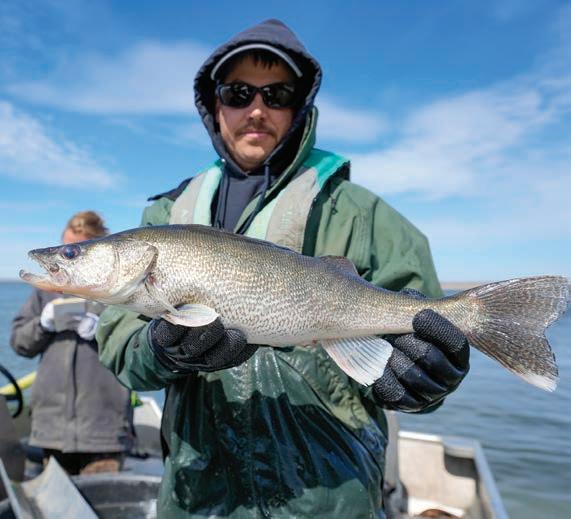
Zach Kjos, Department fisheries biologist, with a Lake Sakakawea walleye.
slower growth during drought periods and good growth under normal and high lake elevations. Currently, walleye growth is considered good as they usually reach 14 inches by age 3 and 16 inches by their fourth year.
Walleye on Lake Sakakawea can live a very long time with fish up to 20 years old being documented most years. The oldest walleye documented during annual sampling was a 27-year-old fish sampled in 2018. Total annual mortality for walleye ages 3 to 15 was estimated at 35% in 2025 and is considered acceptable for maintaining the long-term sustainability of the population. Angler exploitation on Lake Sakakawea ranged from 14% to 22% during a 2019 to 2022 tagging study indicating angling mortality was low. This study also indicated walleye were more likely to die from natural causes than harvest from anglers. Would some sort of length limit benefit Lake Sakakawea?
Lake Sakakawea has had a 14-inch minimum length limit in the past, but it currently is not needed. The lake has good reproductive success due to a combination of natural reproduction and stocking when needed. Walleye growth is good and angling mortality is low, especially on small fish. A creel survey conducted in 2024 indicated that walleye anglers do no tend to keep fish under 14 inches. Creel clerks measured 7,230 walleyes during the survey and only 334 (4.6%) were less than 14 inches.
Would Lake Sakakawea benefit from a maximum or one-over length Limit?
Recruitment on the upper portion of the lake is generally good. Recruitment in the middle and lower portions is generally limited in years when fish are not stocked and when needed, stocking has proven to be successful in augmenting the population. The poor recruitment in non-stock years is due to environmental conditions and not low numbers of large, mature fish. A one-over 20 inches regulation is often suggested by anglers as a regulation that would benefit Lake Sakakawea. Yet both creel surveys in 2021 and 2024 showed that such a regulation would not impact the fishery. In 2021, only 4% of individual anglers harvested more than one walleye over 20 inches and only 1.8% of angler parties who had their limits of fish measured harvested more walleye over 20 inches than the
number of anglers in their party. During the 2024 creel survey, 9% of individual anglers harvested more than one walleye over 20 inches and 2.9% of angler parties who had their limits of fish measured harvested more walleye over 20 inches than the number of anglers in their party. In 2021, fish over 20 inches accounted for 4% of the total harvest and in 2024, fish over 20 inches accounted for 7% of the total harvest. Currently, a maximum or one-over limit would not significantly reduce the harvest of large walleye
Finally, let’s consider slot limits. The most likely slot limits for Lake Sakakawea would be either 14-20 inches or a 15- to 20-inch harvest slot. This is what anglers on Lake Sakakawea are already doing. Data from the last two creel surveys showed that 82% of the walleye harvested in 2021 and 86% of the walleye harvested in 2024 were 14-20 inches. In 2021, 64% of the walleye harvested were 15 to 20 inches and in 2024, 81.5% of the fish harvested were from 15 to 20 inches. A harvest slot, is not necessary but is basically what most anglers are already voluntarily doing.
Considering a protected slot — such as the eatersized fish Sakakawea anglers harvest — current angling mortality does indicate this is needed but would likely be very unpopular with anglers.
The Lake Sakakawea walleye population is monitored yearly and the information we have gathered on reproduction, recruitment, growth, and mortality indicate the current walleye fishery would not benefit from any type of length limit.
NORTH DAKOTA GAME AND FISH DEPARTMENT fisheries supervisors, Paul Bailey, Bismarck, and Russ Kinzler, Riverdale, and fisheries biologist, Todd Caspers, Devils Lake, authored this piece. The introduction was written by Scott Gangl, fisheries management section leader, Bismarck.
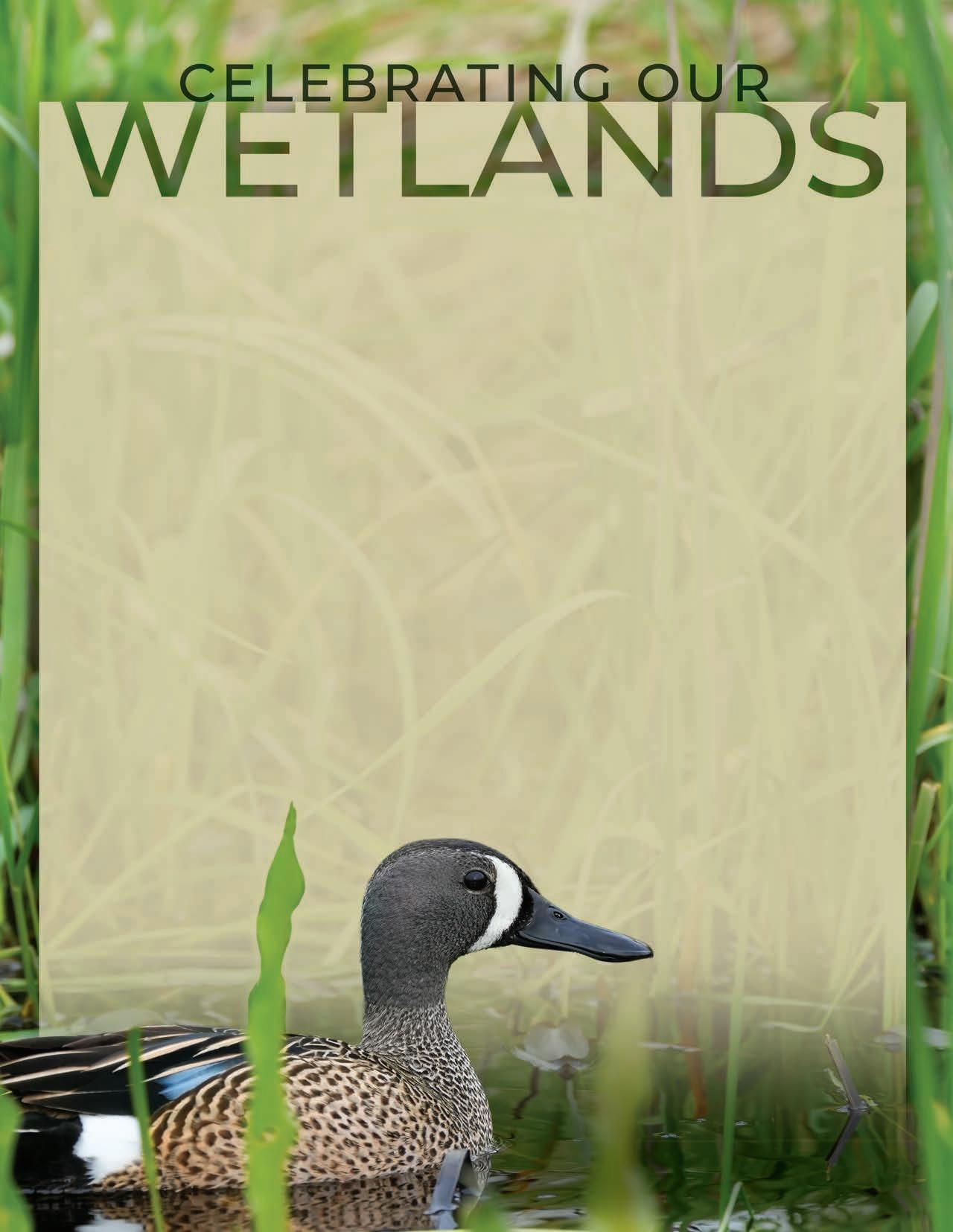
Created more than three decades ago, American Wetlands Month is a celebratory nod to the importance of these often overlooked but highly productive ecosystems.
While American Wetlands Month is celebrated in May, wetlands are a vital part of North Dakota’s fabric no matter what the calendar reads.
“Wetlands are incredibly important to North Dakota, not only for wildlife species, but also for humans in the state,” said John Palarski, North Dakota Game and Fish Department migratory game bird management supervisor. “And really, wetlands are a big part of what makes the state incredibly unique. The Prairie Pothole Region runs through the majority of North Dakota, which is really highlighted by the density of wetlands that we have.”
Wetlands provide a number of benefits for wildlife, particularly waterfowl and other shorebird species, and humans as well.
“Regarding the human population, wetlands are fantastic for flood mitigation, increasing water quality and cycling through nutrients,” Palarski said. “They provide a whole host of benefits to humans that go largely unseen but are important to North Dakotans nonetheless.”
Palarski said wetlands are the habitat backbone in North Dakota.
“In North Dakota, wetlands are the foundation of which all other things really derive from. In spring and summer, wetlands provide the foundation for waterfowl and shorebirds nesting and breeding in the state,” he said. “As we move through summer and into fall as things start to dry up again, they also provide some excellent habitat for deer and pheasants. And during winter, wetlands surrounded by cattails provide thermal refuge for these animals and others as well. Wetlands are probably the most critical habitat type we have in North Dakota.”
BY RON WILSON
While Palarski said North Dakota has its share of big, permanent wetlands, many of which are waters that anglers like to fish, the bulk of the wetlands in the state are temporary.
“They undergo a wet and dry cycle, which is important for maintaining fertility of these wetlands,” he said. “Often, by August and September, they’re actually dry. But in spring and early summer, they provide a lot of value for migrating waterfowl and nesting waterfowl that we have in the state. Temporary wetlands are productive for the invertebrates favored by nesting waterfowl. Because raising a brood of ducks is energetically taxing, those bugs and invertebrates provide a whole host of nutrients for our nesting waterfowl and helps increase production.”
Over time, North Dakota has lost a little over half of its wetlands, and that rate of loss has actually been speeding up in recent years.
“Considering the threats with urbanization, development and agriculture, there are a lot of demands in North Dakota and wetlands have declined largely in part to a lot of those factors,” Palarski said. “Wetlands are incredibly important to have on the landscape. It’s important for people to realize, too, that just because a wetland is dry, it’s still a wetland. When the rains do return, when we get a lot of snow in winter, they provide a lot of value for wildlife.”
If you drive up to one of North Dakota’s many wetlands during American Wetlands Month, or other times of the year, it’s only a guess what you’ll find.
“The really cool thing is that you actually don’t know what you’re going to see. There’s a whole host of species that you could encounter, such as waterfowl and many different shorebird species,” Palarski said. “Wetlands, like the unexpected wildlife species you may encounter, are unique and are a big part of what makes our state so special.”
RON WILSON is editor of North Dakota OUTDOORS.
BUFFALOBERRY PATCH
Record Count of Bighorn Sheep
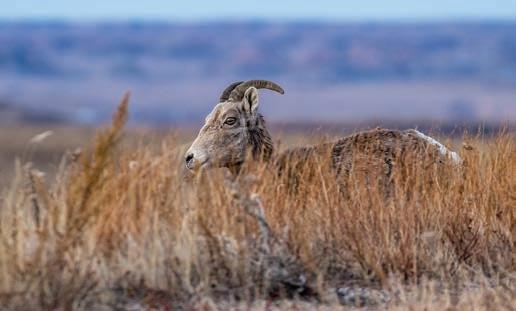
The North Dakota Game and Fish Department’s 2025 bighorn sheep survey, completed by recounting lambs in March, revealed a record 378 bighorn sheep in the badlands of western North Dakota, up 8% from 2024 and 10% above the five-year average. The 2025 survey was the fifth record count in the past six years.
Brett Wiedmann, Department big game biologist, said 104 rams, 234 ewes and 40 lambs were counted. Not included are approximately 40 bighorn sheep in the North Unit of Theodore Roosevelt National Park and bighorns introduced to the Fort Berthold Indian Reservation in 2020.
The northern badlands population increased by 8% from 2024 and was the highest count on record. The southern badlands population remained near its lowest level since bighorns were reintroduced there in 1966.
“Adult rams were near record numbers, but the ewe count surpassed the previous record by an impressive 14%,” Wiedmann said. “Lamb recruitment and winter survival of lambs were both unfortunately well below average.”
Wiedmann said numerous lambs were observed with clinical signs of pneumonia during the summer survey, which was likely the primary contributor to the poor lamb recruitment observed in 2025.
According to Department veterinarian, Logan Weyand, it is not uncommon to experience episodes of low lamb survival when a population of bighorn sheep is exposed to certain pathogens.
“We know from annual disease testing that the state’s population of bighorn sheep has not cleared bacteria introduced in 2014 that predisposes bighorn lambs to pneumonia, so highly variable rates of lamb recruitment in recent years are not surprising,” he said.
Department biologists count and classify all bighorn sheep in late summer, and then recount lambs the following March, as they approach one year of age to determine recruitment.
Currently, about 500 bighorn sheep comprise the populations managed by the North Dakota Game and Fish Department, National Park Service and the Three Affiliated Tribes Fish and Wildlife Division.
A bighorn sheep hunting season is tentatively scheduled for 2026. The status of the season will be determined Sept. 1, following the 2026 summer population survey.
Game and Fish issued eight licenses in 2025, and the Three Affiliated Tribes Fish and Wildlife Division issued two licenses, one to a tribal member and the second to a non-tribal member selected from the Department’s pool of applicants. All hunters were successful in harvesting rams.
2025 CWD Test Results
The North Dakota Game and Fish Department tested 1,224 animals for chronic wasting disease during the 2025 sampling season. Game and Fish confirmed 16 deer tested positive for CWD, all of which were taken by hunters.
Deer that tested positive for CWD came from the following units:
• 3A1 (five mule deer, one whitetail)
• 3D2 (two mule deer)
• 3E1 (one mule deer and one whitetail)
• 3E2 (one mule deer)
• 3F1 (one whitetail)
• 3F2 (two mule deer and one whitetail)
• 2B (one whitetail)
CWD was not previously detected in units 2B and 3D2.
Game and Fish will use its 2025 surveillance data to guide CWD management moving forward. Regulations related to CWD are set annually by proclamation.
CWD is a fatal disease of deer, moose and elk that remains on the landscape and can cause long-term population impacts as infection rates climb.
More information about CWD can be found on the Department’s website, gf.nd.gov/cwd.
New Licenses Needed
North Dakota anglers, hunters and trappers should note that new licenses are required beginning April 1.
Licenses can be purchased online on the North Dakota Game and Fish Department website, gf.nd.gov. Once the license is processed, hunters and anglers will have the option to print a hard copy and/or download the license to a smart phone or mobile device, which is helpful when asked by a game warden to show proof while hunting or fishing in rural areas that lack cellular service.
Licenses can also be purchased at more than 80 vendor locations throughout the state. The 2026-27 small game, fishing and furbearer licenses are effective April 1, 2026 to March 31, 2027.
2025 Big 3 Harvest Statistics
North Dakota Game and Fish Department harvest statistics show overall success for the 2025 season was 100% for bighorn sheep, 87% for moose and 62% for elk.
Bighorn Sheep
The Department issued eight bighorn sheep licenses, one of which was an auction license. The Three Affiliated Tribes Fish and Wildlife issued two licenses in 2025, one to a tribal member and one to a Game and Fish Department applicant. All 10 hunters were successful.
Moose
The Department issued 292 moose licenses last year. Of that total, 281 hunters harvested 245 animals – 147 bulls and 98 cows/calves. Harvest for each unit follows:
Record Tiger Trout
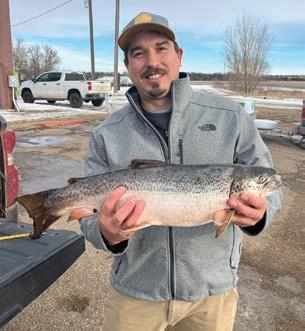
Minot angler Evan Trottier caught a state record tiger trout through the ice in January at Hooker Lake in Rolette County.
Trottier’s 6-pound, 2-ounce trout was verified by North Dakota Game and Fish Department personnel. This fish also measured in at 24.75 inches
The Game and Fish Department started stocking tiger trout in 2023 as a novel sport fish in select lakes. Tiger trout are a hybrid between a brown trout and brook trout, known for their namesake striped coloration and fast growth rates in the right environments. Only a handful of lakes in North Dakota contain the right combination of habitat, water quality and forage for tiger trout to thrive.
In spring, the Game and Fish Department plans to stock tiger trout in Hooker Lake and Strawberry Lake in the Turtle Mountains, Moon Lake near Valley City, and the Garrison Dam Tailrace.
Tiger trout stocked in North Dakota waters are obtained through a working partnership with the Wyoming Game and Fish Department.
Earth Day Contest Winners
The North Dakota Game and Fish Department announces the 2026 winners of the Earth Day Patch Contest. Over 1,600 students from 61 schools entered this year’s contest.
Elk
The Department issued 1,021 elk licenses last year. Of that total, 929 hunters harvested 576 elk – 280 bulls and 296 cows/calves. Harvest for each until follows:
Winners in four age categories are Ainsley Wolsky, Carrington (K-3); Carson Moon, Stanley (4-6); Jace Heinrich, Velva (7-9); and Eve Eaton, Hazelton (10-12). Heinrich’s design was chosen as the overall winner and will be made into the 2026 Earth Day Patch.
Youth and adults who participate in public land clean up and improvement will receive the 2026 Earth Day patch to celebrate Earth Day and their service. Projects that qualify for the Earth Day patch include cleaning up a local, state, or federal property or planting trees, shrubs, or native plants on public property.
Contact Sherry Niesar, contest coordinator, to receive patches for your group’s service projects. Niesar can be reached at 701-527-3714 or sniesar@nd.gov.
New State Record Yellow Perch
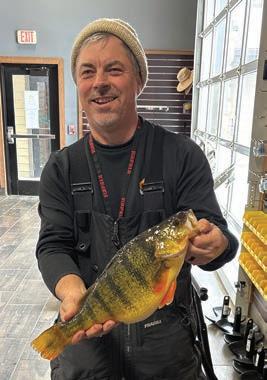
A 3-pound yellow perch caught March 1 by Wisconsin angler Alan Hintz is the new state record, according to North Dakota Game and Fish Department personnel.
Hintz caught the 16.5-inch perch through the ice in the Pelican Bay area on Devils Lake.
The previous record of 2 pounds, 15 ounces, also from Devils Lake, was set in 1982 by Kyle Smith of Carrington.
2026 Waterfowl Hunting Season
North Dakota’s waterfowl season opens for residents Sept. 26, while nonresidents may begin hunting waterfowl Oct. 5.
The resident-only portion of the season has been extended from seven days in previous years to nine days in 2026. This change, which was first presented to the public starting summer 2025, provides additional early season opportunities for resident hunters.
The zones and overall season structure for nonresident hunters will remain the same as the 2025 hunting season.
The North Dakota 2026-27 Hunting and Trapping Guide will be available this summer and will provide further details on the waterfowl hunting season.
Agency Vols Honored
Volunteer instructors for the North Dakota Game and Fish Department were recognized at the annual banquet in Bismarck.
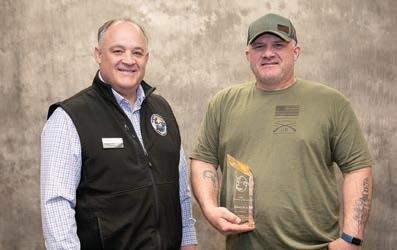
Bruce Baer, Belfield, was recognized as Hunter Education Instructor of the Year, while the Hunter Education Team of the Year went to Johnathan Bahm, Michael Bahm, Kevin Lech and Leah Vantilborg, all Mandan, and Mike Hinrichs, Brock Larson and Earl Torgerson, all Bismarck. Robert Ell Jr., Wilton, was awarded the Volunteer of the Year award.
Longtime volunteers were also recognized for their service:
5 Years – Brayden Barnhart, Dickinson; Casey Bernard, Mandan; Baron Blanchard, Bismarck; Dan Brown, Williston; Penny Brown, Williston; Travis Dalby, Surrey; Kody Faul, McClusky; Tim Fiebiger, Valley City; Phillip Hatcher, Valley City; Jesse Herman, Gwinner; Ashley Lee, Portland; Trevor Levenseller, Reynolds; Matthew Liebel, Williston; Barbara Martin, Anamoose; Andrea Martinez, New Town; Brian Mattson, Hillsboro; Rob Owens, Hillsboro; Derek Plautz, Thompson; Alicia Randall, Minot; John Reimche, Bottineau; Jay Roemmich, Spiritwood; Michael Schirado, Linton; Rachel Spear, Drake; and Barbara Tessier, Belfield.
10 Years – Robert Curl, Beach; Don Frost, West Fargo; Lisa Goldade, Wishek; Henry Juntunen, Bismarck; Brian Miller, Heaton; Jared Nygaard, Bismarck; Earl Torgerson, Bismarck; Bradley Veith, Bismarck; and Lonnie Wertz, Hoarce.
15 Years – Travis Anderson, Grand Forks; Damon Bosche, Medina; Mark Crosby, Bowbells; Kendon Faul, McClusky; Stephen Hunt, Reynolds; Richard Lehmann, Towner; Kellen Leier, Bismarck; Roger Longnecker, New Rockford; Melanie Nelson, Harvey; Antoine Smith, New Town; Matt Webster, Jamestown.
20 Years – Jerod Basol, Portland; Daniel Duchscherer, Towner; Justin Hughes, Minot; Perry Johnson, Northwood; Ruth Johnson, Belfield; Suzanne Kersting, Kindred; Roger Norton, Kindred; David Sardelli, Hebron; John Schwalk, Milnor; Rick Tischaefer, Butte; and Charles Wilkinson, Garrison.
25 Years – Bruce Baer, Belfield; Darren Benneweis, Lisbon; Larry Brooks, Valley City; Corinne Engen, Anamoose; Sean-Padric Hagan, Walhalla; Jeremy Haugen, Max; Rodney Howatt, Langdon; Grant Johnson, Almont; Darrell Kersting, Kindred; Daniel Narum, LaMoure; Chris Pulver, Stanley; Jerry Schroeder, Horace; and Wayne Stanley, Minot.
30 Years – Lynn Baier, Fordville; Glen Fuhrman, Bismarck; Larry Leier, Hague; Larry Nagel, Shields; Darris Olson, Bowbells; Don Underwood, Grand Forks; Larry Viall, Epping; and Mark Volk, Bismarck.
From left. Bruce Baer, Hunter Education Instructor of the Year, and Casey Anderson, Department deputy director.
From left: Jeb Williams, Department director, and Robert Ell Jr., Volunteer of the Year.
Casey Anderson, Department deputy director, third from the left, with five of the seven members of the Hunter Education Team of the Year. Team members, from left, include Kevin Lech, Michael Bahm, John Bahm, Leah Vantilborg and Earl Torgerson.
STAFF NOTES
Ullyott Joins Dickinson Staff
Broden Ullyott was hired as a wildlife resource management biologist for the Game and Fish Department in Dickinson.
A North Dakota State University graduate, Ullyott worked for the U.S. Fish and Wildlife Service and Ducks Unlimited as a conservation specialist before joining the agency.
Herigstad Fills Bismarck Position
Ryan Herigstad was promoted to the Game and Fish Department’s wildlife health biologist position in Bismarck.
Herigstad, a University of North Dakota graduate, joined the agency in 2014 as a migratory game bird technician and has worked as a game management technician since 2016.
O’Connell Named Fisheries Tech
Sanden O’Connell was hired as a fisheries biological technician in Williston.
A graduate of Valley City State University, O’Connell has prior seasonal experience with the Game and Fish Department and was working as an assistant fisheries biologist for Indiana Department of Natural Resources before his Williston appointment.
PF Partner of the Year
Erica Sevigny, North Dakota Game and Fish Department private land biologist in Williston, was awarded the North Dakota Pheasants Forever’s Partner of the Year Award in January.
“When the MonDak Habitat Incentive Outdoor Heritage Fund proposal was first developed, Erica didn’t hesitate to jump in and ask, “How can I help?” From there, she consistently showed up to every meeting with thoughtful ideas that strengthened the program, always balancing what is best for wildlife and staying rooted in the reality of what landowners are looking for in a program,” said Renee Fladeland, Pheasants Forever senior field representative.
Fladeland said PF is grateful to work alongside Sevigny and Game and Fish in the effort, which has already resulted in new access to 3,145 Private Land Open To Sportsmen acres, with 1,576 of those acres featuring new habitat.
Fryda Earns MRNRC Honor
Dave Fryda, former Missouri River System supervisor for the North Dakota Game and Fish Department, was awarded posthumously the Missouri River Champion Award.
The award was presented by the Missouri River Natural Resources Committee at their annual conference. The MRNRC is a multi-state consortium of state and federal biologists with fish and wildlife management responsibilities for the Missouri River from its headwaters to the confluence with the Mississippi. Fryda served as the Department’s delegate on the MRNRC during his time as Missouri River System supervisor.
Fryda’s professional career started with the Department in 2000 working as a fisheries biologist in Riverdale. In 2007, he was promoted to Missouri River System supervisor where he supervised the management of the Missouri River, Lake Sakakawea, and the North Dakota portion of Lake Oahe. The Missouri River System in North Dakota includes some of the state’s most important fisheries and is well known for its trophy walleye and northern pike. In 2023, Fryda transferred to the north central district fisheries supervisor position.
“Throughout his 25-year career, Dave expressed his passion for the outdoors in the work that he did. He could be counted on to be brutally honest in the expression of his views and passion for the resource,” said Russ Kinzler, Department Missouri River System supervisor. “Dave had a no-nonsense approach to fisheries management, which produced effective results that our anglers could enjoy.”
BACK CAST
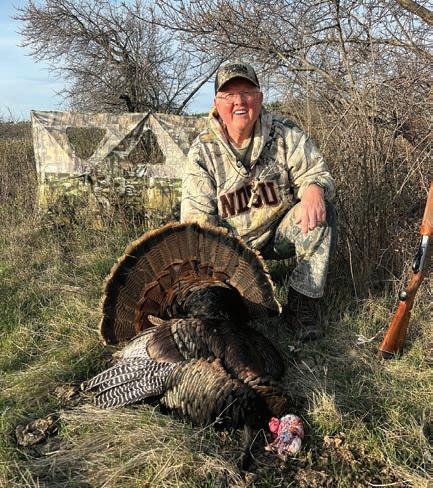
I’ll remember this morning because we don’t get many like this, especially in spring. I don’t need my jacket but I’m wearing it because it’s camouflage and I want to blend in. If there’s a breeze, I’m not feeling or seeing it, as the tail feathers of a jake shot seasons ago and slipped into the rear of the decoy aren’t moving, not even a little.
It’s a half hour or more before sunrise and the ringnecked roosters are the first to open the day in this neck of Morton County with their loud and unmistakable cawcawk crows to advertise to hens their whereabouts and to warn other males to keep their distance.
Not nearly as loud, but noticeable, is the traffic on I-94 running east and west about a mile south of here. People heading to work, trucks hauling freight … and I’d guess that only a minority of the commuters know it’s turkey season in North Dakota and understand the want and need to purposefully roll out of bed at an unlikely hour to hide in ambush of a big bird that spent its night up a tree.
We’re hiding in a brush thicket on top of a hill that allows a decent view into the many deep folds in the land. Yet, some of the draws are steep enough that if birds don’t come in making a noisy fuss, they could be on us with little or no notice. To add more concealment to our setup, we staked a ground blind on the east side of the thicket that reminds me of small fence if that small fence had three triangular shooting windows.
While I haven’t shot a turkey in a number of years, it doesn’t feel like that long ago, which likely has much to do with the fact that I’m hunting the same piece of property where I last pulled the trigger and the same buddy sitting behind me will be working his turkey call just like he did in 2021.
Good vibes, if nothing else.
As we inch closer to sunrise, the turkeys start talking. We converse in low voices and wonder when they’ll leave their roosts and mentally cross our fingers that they venture our way when they do. Like tennis fans, we turn our heads left, right and left again as the seemingly warring rafters of turkeys call back and forth from different roosts.
We’re not close enough to hear the big birds thumping to the ground when they leave the trees, but their dark shapes are easy to see in the low light when they do at 400-plus yards. The big toms, having played this
My
hunting partner.
spring courting ritual before, don’t waste time spreading their wings and tailfeathers to impress the hens, while the younger birds are seemingly more interested in stretching their legs after a night of doing very little off the ground.
We have until noon. That’s when we need to fold our chairs, collect the decoys, take down the ground blind and hike out of here. As we watch the flock of turkeys slowly move maybe 15 yards in our direction, we question if at this pace they’ll make it to us by our noon deadline.
I’ve killed a lot of time in turkey hides over the years — in buffaloberry patches, leaning against trees, hunkered in an abandoned hog barn once — and there a far worse places and ways to while away a spring morning on the prairie. Part of me doesn’t want this to end. I could do this tomorrow morning or the next if the weather holds, if work doesn’t get in the way, if my retired hunting buddy is free, and if the landowner is amenable once again to our company.
Turns out, that’s a lot of “ifs” we won’t have to answer today.
RON WILSON is editor of North Dakota OUTDOORS.
North Dakota Outdoors Magazine
North Dakota Game and Fish Department
100 N. Bismarck Expressway
Bismarck, ND 58501
To renew your subscription or change your address, call 701-328-6300 or go to gf.nd.gov/buy-apply.
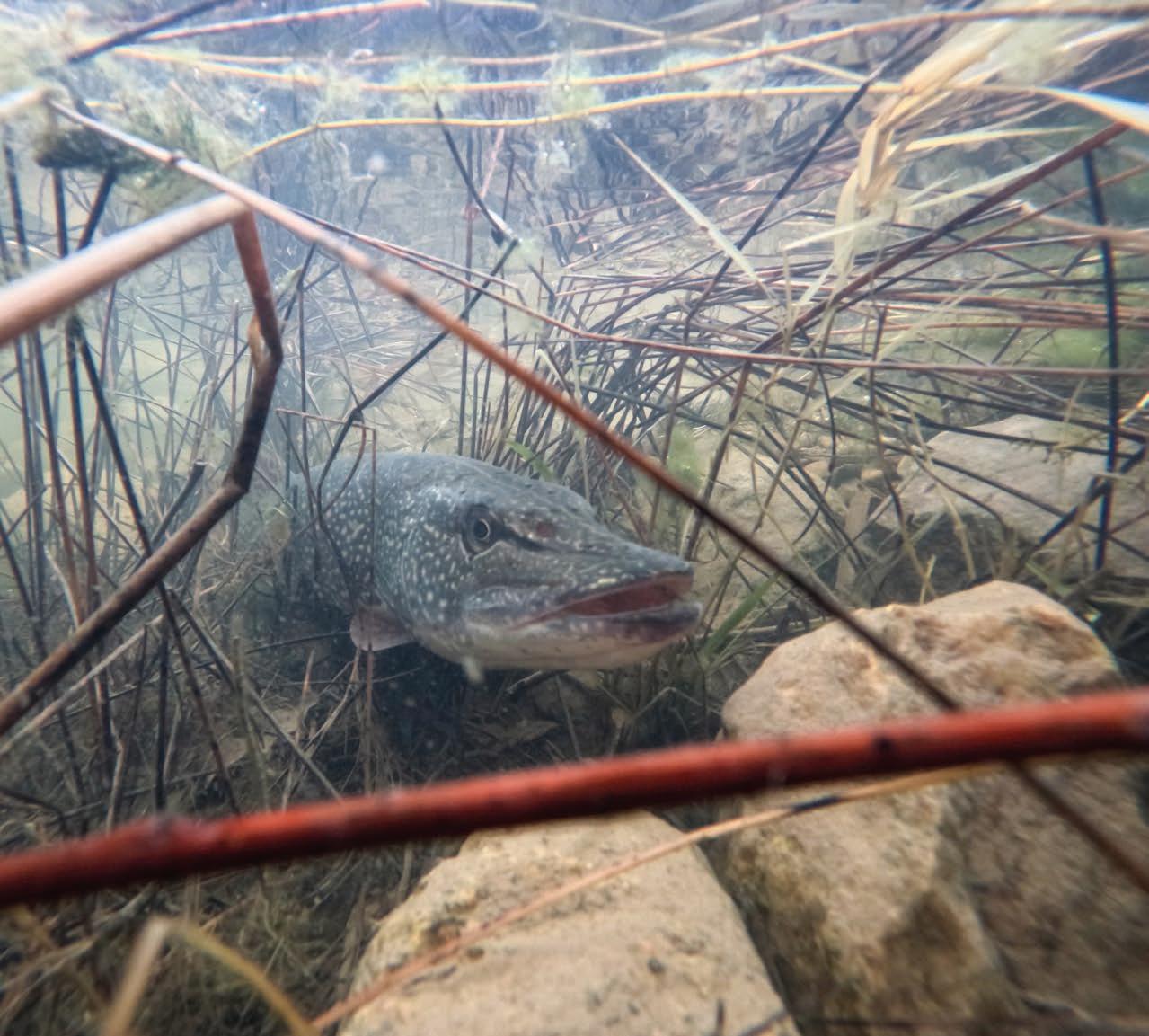
This northern pike was one of nearly 1,000 pike stocked in Cottonwood Park Pond in south Bismarck by mid-April. The fish were trapped and transported to Cottonwood from Lake Oahe and Horsehead Lake. Cottonwood Park Pond is one of 40-plus community fisheries found around the state.