DEPARTMENT DIRECTORY Governor Kelly Armstrong ADMINISTRATIVE DIVISION Game and Fish Director: Jeb Williams Deputy Director: Casey Anderson Chief, Administrative Services: Brian Hosek Grant Management Services Manager: Corey Wentland Administrative Staff Officer: Justin Mattson Administrative Assistant: Lynn Timm Building Maint. Supervisor: Brandon Diehl Human Resources Services Manager: Melissa Long Administrative Officer: Alan Peterson Financial Services Manager: Angie Morrison Accountants: Kelly Wike, Ashley Hillerson Business Services Manager: Alison Kammer Technical Operations Lead: Alan Reile Data Scientist: Shane Wegner Licensing Services Manager: Randy Meissner Assistants: Amanda Anstrom, Tracy Price, Tana Bentz, Tanya Mikkelsen, Elizabeth Klein Administrative Assistant – Dickinson: Stephanie Richardson Administrative Assistant – Devils Lake: Lisa Tofte Administrative Assistant – Jamestown: Tonya Kukowski Administrative Assistant – Riverdale: Mattea Bierman Administrative Assistant – Williston: Stephanie Wellman CONSERVATION AND COMMUNICATIONS DIVISION Division Chief: Bruce Kreft, Bismarck Communications Supervisor: Mike Anderson, Bismarck Editor: North Dakota OUTDOORS: Ron Wilson, Bismarck Marketing Coordinator: Cayla Bendel, Bismarck Digital Media Editor: Lara Anderson, Bismarck Video Project Supervisor: Vacant Photographer/Videographer: Ashley Peterson, Bismarck Marketing Specialist: Jackie Ressler, Bismarck Information Specialist: Dawn Jochim, Bismarck Graphic Artist: Kristi Fast, Bismarck Education Supervisor: Marty Egeland, Bismarck Education Coordinator: Jeff Long, Bismarck Hunter Education Coordinator: Brian Schaffer, Bismarck Outreach Biologists: Doug Leier, West Fargo; Greg Gullickson, Minot; Jim Job, Grand Forks Conservation Supervisor: Patrick Isakson, Bismarck Conservation Biologists: Sandra Johnson, Elisha Mueller, John Schumacher, Aaron Larsen, Greg Schonert, Bismarck Administrative Assistant: Amber Schroeter, Bismarck ENFORCEMENT DIVISION Division Chief: Scott Winkelman, Bismarck Investigative Supervisor: Jim Burud, Kenmare Investigator: Blake Riewer, Grand Forks Operations Supervisor: Jackie Lundstrom, Bismarck Warden Pilot: Mike Linden, Bismarck Region No. 1 Warden Supvr: Michael Sedlacek, Jamestown District Wardens: Corey Erck, Bismarck; Andrew Dahlgren, Milnor; Erik Schmidt, Linton; Greg Hastings, Jamestown; Noah Raitz, LaMoure; Gavin Herbert, Steele; Nick Tschepen, Fargo Region No. 2 Warden Supvr: Paul Freeman, Devils Lake District Wardens: Jonathan Tofteland, Bottineau; Jonathan Peterson, Devils Lake; James Myhre, New Rockford; Alan Howard, Cando; Drew Johnson, Finley; Sam Feldmann, Rugby; Gage Muench, Grand Forks; Dale Skalicky, Langdon Region No. 3 Warden Supvr: Joe Lucas, Riverdale District Wardens: Michael Raasakka, Stanley; Shawn Sperling, Minot; Keenan Snyder, Williston, Josh Hedstrom, Tioga; Riley Gerding, Kenmare; Clayton Edstrom, Turtle Lake; Conner Folkers, Garrison Region No. 4 Warden Supvr: Dan Hoenke, Dickinson District Wardens: Kylor Johnston, Hazen; Zachary Biberdorf, Bowman; Courtney Sprenger, Elgin; Zane Manhart, Golva; Jerad Bluem, Mandan; Zachary Schuchard, Richardton; Luke Aamold, Watford City Administrative Assistant: Lori Kensington, Bismarck WILDLIFE DIVISION Division Chief: Bill Haase, Bismarck Assistant Division Chief: Levi Jacobson, Bismarck Game Mgt. Section Leader: Stephanie Tucker, Bismarck Pilot: Jeff Faught, Bismarck Upland Game Mgt. Supvr: Jesse Kolar, Dickinson Upland Game Mgt. Biologist: Rodney Gross, Bismarck Migratory Game Bird Mgt. Supvr: John Palarski, Bismarck Migratory Game Bird Biologist: Mason Ryckman, Bismarck Big Game Mgt. Supvr: Bruce Stillings, Dickinson Big Game Mgt. Biologists: Brett Wiedmann, Dickinson; Jason Smith, Jamestown; Ben Matykiewicz, Bismarck Survey Coordinator: Chad Parent, Bismarck Wildlife Veterinarian: Dr. Logan Weyand, Bismarck Wildlife Health Biologist: Vacant Game Management Biological Technician: Ryan Herigstad, Bismarck Wildlife Resource Management Section Leader: Kent Luttschwager, Williston Wildlife Resource Mgt. Supvrs: Brian Prince, Devils Lake; Brian Kietzman, Jamestown; Dan Halstead, Riverdale; Blake Schaan, Lonetree; Judd Jasmer, Dickinson; Jens Johnson, Bismarck Wildlife Resource Mgt. Biologists: Randy Littlefield, Lonetree; Rodd Compson, Jamestown; Todd Buckley, Williston; Jake Oster, Riverdale; Andrew Ahrens, Devils Lake Wildlife Biological Technicians: Tom Crutchfield, Jim Houston, Bismarck; Dan Morman, Robert Miller, Riverdale; Jason Rowell, Jamestown; Scott Olson, Devils Lake; Zach Eustice, Williston; Colton Soiseth, Quentin Corcoran, Lonetree Private Land Section Leader: Kevin Kading, Bismarck Habitat Manager: Nathan Harling, Bismarck Private Land Field Operation Supvrs: Curtis Francis, East Region, Andrew Dinges, West Region, Bismarck Private Land Biologists: Zach Johnson, Colin Penner, Bismarck; Jaden Honeyman, Ben Reith, Dickinson; Ryan Huber, Riverdale; Renae Schultz, Jeff Williams, Jamestown; Terry Oswald, Jr., Harvey; Erica Sevigny, Williston; Brandon Ramsey, Matthew Parvey, Devils Lake Procurement Officer: Dale Repnow, Bismarck FISHERIES DIVISION Division Chief: Greg Power, Bismarck Fisheries Mgt. Section Leader: Scott Gangl, Bismarck Fisheries Supvrs: Russ Kinzler, Riverdale; Paul Bailey, Bismarck; Brandon Kratz, Jamestown; Aaron Slominski, Williston; Bryan Sea, Devils Lake; Lucas Rott, Riverdale Fisheries Biologists: Todd Caspers, Devils Lake; Mike Johnson, Jamestown; Jeff Merchant, Dickinson; Zach Kjos, Riverdale Fisheries Biological Technicians: Phil Miller, Devils Lake; Justen Barstad, Bismarck; Brian Frohlich, Riverdale; Ethan Krebs, Jamestown Production/Development Section Supvr: Jerry Weigel, Bismarck Aquatic Nuisance Species Coordinator: Benjamin Holen, Jamestown Aquatic Nuisance Species Biologists: Mason Hammer, Jamestown; Kyle Oxley, Bismarck Fisheries Development Supvr: Bob Frohlich, Bismarck Fisheries Dev. Proj. Mgr: Wesley Erdle, Bismarck Fisheries Development Specialist: Kyle Hoge, Jacob Heyer, Joe Fladeland, Bismarck Administrative Assistant: Janice Vetter, Bismarck ADVISORY BOARD District 1 ....................................................................................................Nathan Hovde, Alexander District 2 ..................................................................................................................Travis Leier, Velva District 3 ................................................................................................ Edward Dosch, Devils Lake District 4 ....................................................................................................... Karissa Daws, Michigan District 5 ............................................................................................... Doug Madsen, Harwood District 6 ......................................................................................Jordan Svenningsen, Luverne District 7 ..................................................................................................Jody Sommer, Mandan District 8 .............................................................................................................. Rob Brooks, Rhame
According to North Dakota Game and Fish Department fisheries managers, roughly 25% of the year’s fishing effort is earned by ice anglers when access to state lakes in winter is good. PHOTO BY ASHLEY PETERSON, BISMARCK.
Contributing photographers for this issue: Mike Anderson, Sandra Johnson and Ashley Peterson. Official publication of the North Dakota Game and Fish Department (ISSN 0029-2761) 100 N. Bismarck Expressway, Bismarck, ND 58501-5095 Website: gf.nd.gov • Email: ndgf@nd.gov • Information 701-328-6300 • Licensing 701-328-6335 • Administration 701-328-6305 • North Dakota Outdoors Subscriptions 701-328-6363 • Hunter Education 701-328-6615 • The TTY/TTD (Relay ND) number for the hearing or speech impaired is 800-366-6888
Periodical Postage Paid at Bismarck, ND 58501 and additional entry offices. Printed in the United States POSTMASTER: Send address changes to: North Dakota OUTDOORS 100 North Bismarck Expressway Bismarck, ND 58501-5095
Report All Poachers (RAP) 701-328-9921 In cooperation with North Dakota Wildlife Federation and North Dakota State Radio.
The mission of the North Dakota Game and Fish Department is to protect, conserve and enhance fish and wildlife populations and their habitats for sustained public consumptive and nonconsumptive use. ■ Editor: Ron Wilson
■ Graphic Designer: Kristi Fast
■ Circulation Manager: Dawn Jochim
JANUARY 2026 • NUMBER 6 • VOLUME LXXXVIII
CONTENTS 2
My 2 Cents
4
2025 Year in Review
10
Watchable Wildlife
21
Buffaloberry Patch
25
Back Cast
North Dakota OUTDOORS is published 10 times a year, monthly except for the months of April and September. Subscription rates are $15 for one year or $30 for three years. Remittance should be by check or money order payable to the North Dakota Game and Fish Department. Indicate if subscription is new or renewal. The numbers on the upper right corner of the mailing label indicate the date of the last issue a subscriber will receive unless the subscription is renewed. Permission to reprint materials appearing in North Dakota OUTDOORS must be obtained from the author, artist or photographer. We encourage contributions; contact the editor for writer and photography guidelines prior to submission. The NDGFD receives Federal financial assistance from the US Fish and Wildlife Service and the US Coast Guard. In accordance with Title VI of the Civil Rights Act of 1964, Section 504 of the Rehabilitation Act of 1973, Title II of the Americans with Disabilities Act of 1990, the Age Discrimination Act of 1975, and Title IX of the Education Amendments of 1972, the NDGFD joins the US Department of the Interior and its Bureaus and the US Department of Homeland Security in prohibiting discrimination on the basis of race, color, national origin, age, disability, sex (in education programs or activities) and also religion. If you believe you have been discriminated against in any program, activity, or facility as described above, or you desire further information, please write to: ND Game and Fish Department, Attn: Chief of Administrative Services, 100 N. Bismarck Expressway, Bismarck, ND 58501-5095 or to: Office of Civil Rights, Department of the Interior, 1849 C Street, NW, Washington, DC 20240.
Front Cover
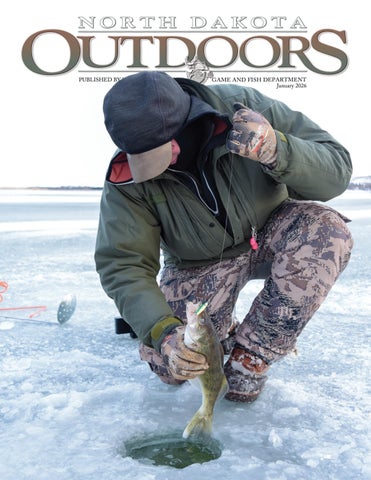
Walleye through the ice from Lake Oahe’s Cattail Bay. PHOTO BY ASHLEY PETERSON, BISMARCK.
My 2 Cents from the
A Year Worth Noting
Sometimes, progress shows up quietly, through cooperation, patience, and a shared understanding that healthy land benefits everyone.
Jeb Williams
DIRECTOR, NORTH DAKOTA GAME AND FISH DEPARTMENT
2 ■ ND OUTDOORS ■ JANUARY 2026
DIRECTOR
As another year begins, it’s worth pausing — if only briefly — to take stock of where we’ve been and where we’re headed. For those of us who care deeply about North Dakota’s outdoors, this past year offered a reminder that meaningful conservation doesn’t always come with headlines or controversy. Sometimes, progress shows up quietly, through cooperation, patience, and a shared understanding that healthy land benefits everyone. It all started with the Habitat and Access Summit a year ago in December where newly elected Gov. Armstrong spoke passionately to approximately 300 participants wanting to contribute to how we can all keep North Dakota a great place to hunt and fish. One of the many ideas shared that evening was how all groups can work together to put additional grass on the landscape and one of the most encouraging developments this year was the approval and forward movement of the Governor’s Legacy Soil Health and Habitat Program. In a time when natural resource conversations can feel increasingly divided, this effort stood out for what it represented: common ground. At its core, soil health may not sound like a wildlife issue, but anyone who spends time afield knows better. Healthy soil supports diverse plant communities, holds moisture longer during dry periods, and reduces runoff during heavy rains. That translates directly into better nesting cover for upland birds, improved forage for deer, and more resilient habitat across the landscape. In short, soil health is habitat health. What made this initiative particularly noteworthy was the broad coalition involved in the discussions to build it. Farm and ranch groups, energy entities, conservation interests, and state agencies all came to the table with different priorities — but with a shared goal of keeping lands productive while improving long-term outcomes for wildlife and water quality. That balance matters in a state like North Dakota, where agriculture and outdoor recreation aren’t competing interests — they’re intertwined. From a Game and Fish perspective, this initiative reinforces an approach we’ve long believed in: conservation works best when it complements, rather than conflicts with private land stewardship. Programs that incentivize voluntary practices — grass plantings, cover crops, tree/shrub plantings, and improved grazing management — help landowners succeed while quietly delivering benefits to pheasants, ducks, deer, and countless other species. This past year wasn’t without challenges. Weather variability, changing land use, and increasing pressure on habitats remain real concerns. But the approval of the Governor’s LegacySoil Health and Habitat Program offered a reason for optimism. It showed that conservation doesn’t have to be an all-or-nothing proposition. Progress can be practical, locally driven, and rooted in trust. As we look ahead, the true measure of this initiative will be seen over time — in healthier fields, more resilient landscapes, and stronger wildlife populations. For now, it stands as a reminder that when we invest in the land itself, everyone benefits.
SEARCH
ND OUTDOORS ON YOUR FAVORITE PODCAST PLATFORM
ND
podcast
ND OUTDOORS
PODCAST
HOSTED BY:
CAYLA AND CASEY
GF.ND.GOV/NDO-PODCAST THE OFFICIAL PODCAST OF THE NORTH DAKOTA GAME AND FISH DEPARTMENT.
5 2 20 YEAR IN
REVIEW By Casey Anderson
Well, if I were to sum up 2025 in the Game and Fish world it would be the year of “implementing change.” Internally, we had many new hires and even more internal shifts of personnel into different positions. Knowledge and expertise were lost but new blood and new ideas haven’t skipped a beat. The Department continued to work hard toward improving fish and wildlife populations and opportunities for those public resources. I am not sure how it will all shake out in the end, but the Department is full of dedicated employees who love to hunt, fish, and enjoy the outdoors as much as anyone. The landscape in 2025 implemented its own changes as we started with a fairly dry, mild winter, yet by the end of October it was abundantly wet in most parts of the state. Some wildlife populations have been struggling as of late mainly due to limited habitat, but the moisture improvement helped what habitat was available on the landscape to stay in relatively good condition throughout the year. Which is good news with another winter upon us. On the fishing side of things, without being too obvious, the added moisture means many of our
4 ■ ND OUTDOORS ■ JANUARY 2026
prairie lakes benefited from the water and fishing opportunities will remain high. Our fisheries crews, and those who build and maintain boat ramps and access opportunities, will continue to have work to do. When things aren’t froze up, these individuals put in more hours in a day than anyone I know. On the habitat side of things, the Department continued to work diligently internally and with partners to come up with a myriad of different options to try to get more habitat on landscape, as well as access to some of that habitat to increase opportunities. Hopefully, many of those projects will start to come to fruition in spring 2026. On our WMAs, Department managers continued to maximize the habitat and opportunities on lands that remain the postage stamp of wildlife habitat. Without question, things are being done to optimize what opportunities are out there but with a state that is mostly privately owned, it will take willing landowners to utilize some of the options to help implement meaningful change. CASEY ANDERSON is the Game and Fish Department’s deputy director.
HABITAT AND ACCESS WORK Following the North Dakota Habitat and Access Summit held in December 2024, the Game and Fish Department continued to ramp up its habitat message in 2025 to remind North Dakotans of the importance of having quality habitat on the landscape and its positive influence on wildlife populations. In concert with that effort, the agency also gathered input on ways to improve the state’s hunting and outdoor traditions that many hold so dear. Department staff continued to work on many of the recommendations from the summit with Gov. Kelly Armstrong and his staff to help turn the tide. We have been and will continue to make progress on many of these recommendations but notably five large action items rose to the top. 1. Reach 1 million acres of PLOTS by 2028 with an emphasis on new grass plantings. This year hunters saw an additional 40,000 Private Land Open To Sportsmen acres on the landscape for a total of 880,000 acres. Included in that acreage total was 5,000 acres of new grass planted. 2. The hunting heyday of the early 2000s was in response to a flush of new grass on the landscape from the federal Conservation Reserve Program. But since, North Dakota has dropped from 3 million CRP acres, to just 1 million with more expected to expire. The CRP program, as successful as it was, is determined through the federal Farm Bill and can be difficult to be accepted into and somewhat restrictive for landowners. The Department partnered with the North Dakota Association of Soil Conservation District to apply for Outdoor Heritage Fund monies to pilot the Governor’s Legacy Soil Health and Habitat Program; a state-level program to improve wildlife habitat on marginally productive cropland with broad support from agricultural groups. The goal is to eventually seek dedicated funding to implement the program on a larger scale.
3. Many are familiar with the years of debate that led up to the 2021 legislative session and the resulting electronic posting system we’ve now adopted. Each year there has been an increase in use of electronic posting as hunters and landowners alike have gotten comfortable with the process and compliance. This year, eposting topped 14 million acres. In an increasingly digital world, many have suggested allowing customization within this system, such as dates, species, reservations, and so on. As a starting point, the most feasible option to begin to allow some customization, is to allow landowners to preselect the date windows they would like their land to be electronically posted versus an entire season. Hunters should note that if a property remains physically posted, this would not negate that, just as a currently electronically unposted piece could still be physically posted. This option will be available for the 2026 electronic posting season, which begins on Feb. 1 and ends July 1. 4. The Department has long worked to connect landowners with depredation issues to hunters seeking opportunity, specifically for coyotes, antlerless deer, and sometimes geese and turkeys. New in fall 2025, the Department developed an application called HuntLink that digitizes this process by providing a species-specific map for landowners who have expressed interest in wanting hunters. At any time, landowners can access their account and remove their listing if their needs have been met or they no longer want to be contacted. The application easily replaces these somewhat manual processes of connecting the two but also has the potential to expand to other species-specific landowner requests. 5. With a mission to increase transparency, understanding and communication regarding Department habitat and conservation programs and hunting access initiatives on private lands, the Habitat and Access Stakeholder Group was formed. This
880,000
Approximate number of PLOTS acres in 2025, up from 837,000 acres in 2024. ND OUTDOORS ■ JANUARY 2026 ■ 5
8 BIGHORN SHEEP
Number of bighorn sheep licenses made available for the 2025 hunting season, up one from 2024.
group is made up of 24 individuals — six representatives, consisting of three hunters and three landowners, from four districts nominated by the Department. This group will serve as a sounding board for many of the aforementioned initiatives and those forthcoming. This group will serve only as an informational forum with no formal recommendations, voting or lobbying. District meetings were held in October 2025, and the first statewide meeting is slated for early 2026.
BIG GAME WORLD The big game hunting world in North Dakota is an interesting one and it was no different in 2025 when deer licenses were cut by nearly 8,000 compared to 2024. Adequate habitat remains in short supply for deer in the state. To stimulate a rebound, deer, compared to other hunted species, not only need larger expanses of habitat during the hunting season, but need it year-round. While Mother Nature helped us out with back-to-back mild winters, the process is slow, and without adequate habitat that process is even slower.
A successful hunter thanks a landowner in southwestern North Dakota during the 2025 deer gun season.
Also, based on scattered reports of white-tailed deer mortality caused by epizootic hemorrhagic disease that began in early September 2025, the Department allowed hunters with whitetail or “any” deer gun licenses in five units in western North Dakota the option of turning those licenses in for refunds. Hunters who return their licenses had their bonus points restored, if applicable, to the same number of points prior to the 2025 deer gun lottery. Mule deer continued to hold their own, but some drought conditions, EHD, and maybe even some competition from elk in the badlands continued to slow their rebound. The 2025 mule deer spring index was 14% lower than 2024 and 18% below the long-term average. Mule deer have been stable to declining in the badlands since 2018 due to below average fawn production. Elk and moose continued to do well, and those unique hunting opportunities were still good in the state. Pronghorn benefited from the easy winter, but they did have some EHD problems last summer and fall that influenced the number of licenses made available to hunters compared to 2024.
69TH LEGISLATIVE ASSEMBLY Game and Fish Department officials in 2025 tracked as many as 20 bills at the 69th legislative assembly that had the potential to influence, either directly or indirectly, how the Department conducts business into the future. Notable bills that passed include: • HB 1470 — Increases the fees of some hunting and fishing licenses, and changes hunting guide and outfitter requirements. • SB — A waterfowl habitat restoration electronic stamp is required for every resident and nonresident to hunt waterfowl at a fee of $5. In addition, creates a waterfowl habitat improvement fund for improving and restoring waterfowl habitat and supporting youth hunting programs.
NOT ALL GLOOMY NEWS The North Dakota Game and Fish Department’s 78th annual breeding duck survey, which started May 6, was
6 ■ ND OUTDOORS ■ JANUARY 2026
the earliest on record, to match the settling patterns of waterfowl in the state. The May index was 2.6 million ducks; a notable drop and the lowest count since 1994. Still, this number was 7% above the long-term (19482024) average, but down 34% from the 1994-2016 average. Breeding duck numbers typically follow wetland conditions. In 2025, the wetland index was down 38% from 2024 and 33% below the long-term average. Most dabbler species, with the exception of wigeon, saw declines compared to 2024. Mallards were down 26%, and blue-winged teal dropped nearly 16%. The mallard count, while lower than usual, was still the 33rd highest in survey history. Not all the news was gloomy, though. Diving duck species showed a strong increase, with redheads up 23%, the highest count on record. The total diver index was the highest since 2020 and the second highest in the past two decades. Spring started off dry, with poor to fair wetland conditions noted across much of the state in early May. After the survey, another challenge arrived as several days of 90-degree temperatures and strong winds dried out the landscape even further. Fortunately, nearly a week of steady rain arrived in the third week of May. Many western and central areas received 4 to 7 inches. Although some large basins remained dry, smaller wetlands were replenished, providing good pair habitat for ducks that stayed in the state. The timely rains helped move wetland conditions back to fair-to-good levels for late-nesting birds, even if the earlier dry spell likely limited how many ducks settled here. Total wetlands observed during the July duck brood survey were down 50% from an unusually wet 2024 and 22% below the long-term average. Many northern areas of the state remained dry through June and July, but south-central areas received enough rain for good brood habitat. The number of duck broods was up 28% from last year and just 2% below average. Overall, the fall flight forecast was expected to be up 2% from 2024, ranking as the 30th highest in 61 years. Canada geese that largely nested in North Dakota were down slightly from last year but remained plentiful. Goose production was fair across most of the state, with certain areas experiencing higher nesting success. Other goose species, such as Western Prairie and Tallgrass Prairie Canada geese, snow geese, and Ross’s geese, showed similar trends.
A Devils Lake walleye tagged for study purposes.
FUTURE FISHING OPPORTUNITIES During a time when the Game and Fish Department manages about 450 fishing waters in the state and interest from anglers to pursue walleye and other species remained high, Department fisheries personnel continued efforts in 2025 to increase angling opportunities into the future. For example, Department fisheries personnel took the first eggs during the walleye spawn on April 29 at Lake Sakakawea and Devils Lake. The spawning operations were shut down as egg goals were met at Devils Lake on May 5 and two days later on Sakakawea. Fisheries crews collected 41.2 million eggs at Sakakawea and 28.3 million at Devils Lake. In spring 2025, fisheries personnel stocked nearly 300,000 4- to 5-inch chinook salmon smolts into Lake Sakakawea. The fish were raised from eggs in the Garrison Dam National Fish Hatchery. To repeat this annual process without pause, Department spawning crews collected 1.2 million salmon eggs in October 2025. The 4- to 5-inch smolts from that batch of eggs will be released into the big lake in spring 2026. On another fisheries management note, a three-
ND OUTDOORS ■ JANUARY 2026 ■ 7
year walleye tagging study was started in spring 2025 on Devils Lake to gain a deeper understanding of how anglers are utilizing the state’s most sought-after species. It had been nearly 20 years since Department fisheries personnel had initiated a study using marked walleyes on this popular fishery. In addition, fisheries biologists from around North Dakota also initiated one-year walleye tagging studies on six other waters: Lake Addie, Griggs County; Mosher WPA, Barnes County; Horsehead Lake, Kidder County; Davis WPA, Sheridan County; Heart Butte Dam, Grant County; and the Missouri River System from Garrison Dam to Oahe Dam. The latter study was a team effort between the Game and Fish Department and South Dakota Game, Fish and Parks.
MIXED BAG FOR UPLAND BIRDS Following another mild winter, the availability of above average nesting cover, but somewhat scattered and sketchy weather events in summer, North Dakota’s roadside surveys conducted in late July and August indicated pheasant numbers were relatively the same as 2024, while gray partridge and sharptailed grouse numbers were down. Total pheasants observed (91.6 per 100 miles) were down 3% from last year and broods (11.4) per 100 miles were down 1%. The average brood size (5.1) was down 6%. The statewide number of pheasants observed per 100 miles was 48% above the 10-year average. Observers in the northwest counted 14.7 broods and 115 pheasants per 100 miles, down from 20.8 broods and 164 pheasants in 2024. Average brood size was 4.3 chicks.
Zach Schuchard, Game and Fish Department warden, Richardton, checks successful pheasant hunters in his patrol district. 8 ■ ND OUTDOORS ■ JANUARY 2026
Results from the southeast showed 9.6 broods and 73 pheasants per 100 miles, up from 7.9 broods and 57 pheasants in 2024. Average brood size was 4.7 chicks. Statistics from southwestern North Dakota indicated 14.8 broods and 125 pheasants per 100 miles, up from 13.8 broods and 119 pheasants in 2024. Average brood size was 5.8 chicks. The northeast district, generally containing secondary pheasant habitat with lower pheasant numbers compared to the rest of the state, showed 4.9 broods and 37 pheasants per 100 miles, compared to 4.3 broods and 37 pheasants last year. Average brood size was 4.4 chicks. Sharptails were down 38% statewide (12 sharptails per 100 miles), and 30% below the 10-year average. Brood survey results showed 2.1 broods per 100 miles and an average brood size of 4.4. Partridge observed per 100 miles were down 26% (16 partridge per 100 miles). Observers recorded 1.8 broods per 100 miles, and 8.1 chicks per brood.
ZEBRA MUSSELS FOUND The Game and Fish Department confirmed the presence of invasive zebra mussels in Smishek Lake, Burke County, after detecting zebra mussel veligers in routine plankton tow net samples. Subsequent follow-up sampling also found additional adult mussels in the lake. The 195-acre lake is a popular recreation destination located 4.8 miles north of Powers Lake. Smishek Lake is now considered a Class I ANS infested water. Emergency rules went into effect immediately to prohibit the movement of water away from the lake, including water for transferring bait. In response to the unwanted discoveries, the Department, in cooperation with state and federal partners and local stakeholders, devised a plan to eradicate zebra mussels from the lake to protect the downstream waters of Lake Sakakawea and lakes in northwestern North Dakota. In mid-October, Department staff applied an EPA-registered copper-based molluscicide called EarthTecQZ. The product, when applied safely, causes mussel mortality while sustaining other aquatic life. Following the treatment, Game and Fish and Department of Environmental Quality personnel monitored copper concentrations in Smishek Lake.
88,000
The number of Canada geese counted during the Department’s 2025 midwinter waterfowl survey, down from a record 300,000-plus in 2024. The number of geese counted was not unexpected following cold temperatures in late November and early January.
BIGHORN COUNT NEAR RECORD The North Dakota Game and Fish Department’s 2024 bighorn sheep survey, completed by recounting lambs in March 2025, revealed a minimum of 350 bighorn sheep in the grasslands of western North Dakota, down 4% from 2023 and 6% above the five-year average. Despite a slight decrease from the record count in 2023, the 2024 survey was still the second highest count on record. Altogether, biologists counted 105 rams, 199 ewes and 46 lambs. Not included are approximately 40 bighorn sheep in the North Unit of Theodore Roosevelt National Park and bighorns introduced to the Fort Berthold Indian Reservation in 2020. Department big game biologists were pleased to see the population remain near record levels for the seventh consecutive year. The northern badlands population declined by 4% from 2023 but was the second highest count on record. The southern badlands population increased slightly but remained near its lowest level since bighorns were reintroduced there in 1966. Biologists were encouraged to see adult rams and adult ewes near record numbers. The streak of four consecutive record counts was broken due to below-average lamb recruitment in 2024, as lambs recruited into the population declined 21% compared to 2023. The decline in lamb recruitment was likely not related to disease, but a combination of drought, predation and ewes recovering after several years of high lamb recruitment. The state’s adult ewes have invested a lot of energy in rearing lambs the last four years, so sometimes they just need to take a break and concentrate on improving body condition. Department biologists count and classify all bighorn sheep in late summer, and then recount lambs the following March, as they approach one year of age, to determine recruitment. Currently, about 480 bighorns make up the populations managed by the Game and Fish Department, National Park Service and the Three Affiliated Tribes Fish and Wildlife Division, just shy of the benchmark of 500 bighorns in the state. The Game and Fish Department allocated eight bighorn sheep licenses for the 2025 hunting season, one more than 2024.
2024-25 LICENSES AND PERMITS ISSUED Resident Nonresident Individual Fishing 44,249 20,586 Married Couple Fishing 11,762 6,921 Senior Citizen Fishing 16,334 Disabled Fishing 288 Short-Term Fishing 10-Day 6,385 3-Day 23,995 Paddlefish Tags 3,454 698 Commercial Tags 10 Retail Bait Vendor 243 Wholesale Bait Vendor 37 3 Fish Hatchery 4 2023 Boat Registrations 10,389 (second year of 3-year decal) General Game Hunting 40,384 49,624 Small Game Hunting 13,699 27,796 Combination License 60,575 Waterfowl Hunting 28,174 Furbearer Hunting/Trapping 5,932 2,841 Fur Buyer 14 4 Deer Gun Hunting 37,231 368 Deer Gun Hunting (Gratis) 11,919 251 Deer Bowhunting 23,993 3,113 Moose Hunting 204 Moose Hunting 34 (Preferential Landowner) Elk Hunting 707 Elk Hunting 136 (Preferential Landowner) Turkey Hunting (Spring) 7,758 Turkey Hunting (Fall) 4,229 Turkey Hunting (Gratis Spring) 706 Turkey Hunting (Gratis Fall) 336 Habitat Stamp 100,959 Shooting Preserve 12 Fishing/Hunting Guide 368 57 Taxidermist 267 17 Falconry 4 Scientific Collector 29 22 Swan 1,340 860 Sandhill Crane 3,073 3,227 2025 SPECIAL BIG GAME LICENSES Licenses Applications Available Received Moose 288 27,279 Elk 956 25,338 Bighorn Sheep 7 21,221 FINANCIAL STATEMENT July 1, 2024 to June 30, 2025 Income $45,448,826 Expenses $55,295,472 FUND BALANCES, FIXED ASSETS AND LONG-TERM DEBT Game and Fish General Fund $18,409,091 Habitat and Depredation Fund $1,861,789 Nongame Wildlife Fund $128,596 Aquatic Nuisance Species Program $402,057 Fishing Conservation Fund $145,315 TOTAL ALL FUNDS $20,946,848 FIXED ASSETS $66,978,359 DEPARTMENT NET WORTH $87,925,207 ND OUTDOORS ■ JANUARY 2026 ■ 9
OVERALL WINNER WOOD DUCK Lisa Buchweitz, Langdon Photo taken in Pembina County.
10 ■ ND OUTDOORS ■ JANUARY 2026
By Patrick T. Isakson
A
n adult male wood duck in spring plumage is easy on the eyes. Often regarded, and arguably so, as the handsomest of waterfowl, you could make a case it’s one of the most beautiful birds no matter the species. Lisa Buchweitz of Langdon photographed this winning image for the 2025 Watchable Wildlife Photo Contest in Pembina County. While the male wood duck is elaborately marked, the female is rather plain by comparison. She is grayish-brown, with a crest and a conspicuous white eye ring. Scientists tell us the wood duck is native to only North America and is found over much of the United States and southern Canada. In North Dakota, wood ducks breed mainly along wooded rivers, streams, lakes and ponds from the Missouri River east to Minnesota. They are early migrants and leave North Dakota by early October to more suitable winter climates in Arkansas, Alabama, Mississippi and Louisiana.
PATRICK T. ISAKSON is a Game and Fish Department conservation supervisor.
GAME WINNER RED FOX Harlan Nelson, Kenmare Photo taken in Ward County. ND OUTDOORS ■ JANUARY 2026 ■ 11
GAME RUNNER-UP SHARP-TAILED GROUSE Tangula Unruh, Bismarck Photo taken in McLean County.
GAME RUNNER-UP MULE DEER Bryan Lind, Epping Photo taken in Williams County.
GAME RUNNER-UP MOOSE David Schultz, Minot Photo taken near Upper Souris NWR.
12 ■ ND OUTDOORS ■ JANUARY 2026
GAME RUNNER-UP STRIPED SKUNK Daniel Mason, Fargo Photo taken in Cass County.
GAME RUNNER-UP WHITETAIL BUCK John Gulleson, Rutland Photo taken in eastern North Dakota.
GAME RUNNER-UP COYOTE John Gulleson, Rutland Photo taken in eastern North Dakota.
ND OUTDOORS ■ JANUARY 2026 ■ 13
GAME RUNNER-UP WHITETAIL FAWN Gregory Jessen, Powers Lake Photo taken near Powers Lake.
GAME RUNNER-UP PRONGHORN Gregory Jessen, Powers Lake Photo taken near Coulee.
14 ■ ND OUTDOORS ■ JANUARY 2026
NONGAME WINNER SHORT-EARED OWL Annie Laughlin, Fargo Photo taken near Fargo.
NONGAME RUNNER-UP GREAT GRAY OWL Annie Laughlin, Fargo Photo taken near Fargo.
NONGAME RUNNER-UP BLACK-NECKED STILT Dale Rehder, West Fargo Photo taken at Meadow Lake.
ND OUTDOORS ■ JANUARY 2026 ■ 15
NONGAME RUNNER-UP WESTERN GREBE AND CHICKS Nora Kane Photo taken at Long Lake.
NONGAME RUNNER-UP FEMALE RUBY-THROATED HUMMINGBIRD Tangula Unruh, Bismarck Photo taken in Burleigh County.
NONGAME RUNNER-UP WESTERN MEADOWLARK Christopher Well, Jamestown Photo taken in Stutsman County.
NONGAME RUNNER-UP LEAST BITTERN Terry Johnson, East Grand Forks, Minn. Photo taken at Ryan Lake.
NONGAME RUNNER-UP BLACK-TAILED PRAIRIE DOG Troy Gunderson, Jamestown Photo taken at Theodore Roosevelt National Park.
NONGAME RUNNER-UP PLAINS GARTER SNAKE Sharon Watson, Buxton Photo taken near Buxton.
ND OUTDOORS ■ JANUARY 2026 ■ 17
PLANTS AND INSECT WINNER JUMPING SPIDER Mark Broden, Grand Forks Photo taken in Grand Forks.
PLANT AND INSECT RUNNER-UP GREEN SWEAT BEE Brandee Hoyt Photo taken in Jamestown.
PLANT AND INSECT RUNNER-UP BLACK-EYED SUSAN Peg Anderson, Bismarck Photo taken in Stutsman County.
PLANT AND INSECT RUNNER-UP WILD ONION Tricia Bentz Photo taken near Bismarck.
PLANT AND INSECT RUNNER-UP HONEYBEE ON SILVERY LUPINE Nancy Secrest, Hettinger Photo taken is Adams County.
PLANT AND INSECT RUNNER-UP PLEATED PLUTEUS MUSHROOM Mike Saunders, Fargo Photo taken at Sheyenne National Grassland.
ND OUTDOORS ■ JANUARY 2026 ■ 19
PLANT AND INSECT RUNNER-UP NORTHERN AMBER BUMBLEBEE ON BOTTLE GENTIAN Shelly Wasylow, Arvilla Photo taken near Walhalla.
PLANT AND INSECT RUNNER-UP PAINTED LADY BUTTERFLY Sharon Watson, Buxton Photo taken near Buxton.
PLANT AND INSECT RUNNER-UP ORANGE SULPHUR BUTTERFLY AND DRONEFLY ON THISTLE Daniel Mason, Fargo Photo taken at Orchard Glen Nature Park.
20 ■ ND OUTDOORS ■ JANUARY 2026
BUFFALOBERRY PATCH HuntLink to Help Landowners Huntlink is a new voluntary program designed to help North Dakota landowners easily connect with hunters and trappers. The program offers a simple way to allow managed access for antlerless deer, coyotes, turkeys, and other species. For landowners experiencing wildlife depredation or looking for additional management tools, HuntLink can help. Landowners can enroll through their North Dakota Game and Fish My Account page and may remove their listing at any time once they’ve connected with enough participants. Hunters can view landowner requests across the state through the HuntLink map, but they must contact landowners directly to obtain permission before hunting or trapping.
Hunter Education Classes If you were born after 1961, are 12 years or older, you must take a home study or traditional classroom certified hunter education course before you can get a firearm or bowhunting license in North Dakota. The home study, or hybrid course, requires 7-10 hours of online and six hours of in-person classroom time. The six hours of classroom time consists of an in-person session prior to starting the online class and at the end of the class to complete testing. Traditional classroom courses require at least 14 hours of in-person class time, and most classes are held from January through May. Individuals interested in taking a hunter education class in 2026 must click on the education link at the North Dakota Game and Fish Department website, gf.nd. gov. To register for a class, click on “enroll” next to the specific class, and follow the simple instructions. Personal information is required. Classes are listed by city and can also be sorted by start date. Classes will be added throughout the year as they become finalized. Individuals interested in receiving a notice by email or SMS text message when each hunter education class
is added, can click on the “subscribe to news and alerts” link below the news section on the Game and Fish home page. Check the box labeled “hunter education” under the education program updates. Participants must turn 12 during the calendar year to take the home study course, and age 11 during the calendar year to take the traditional class.
2026-28 Watercraft Registrations North Dakota watercraft owners should note that 2026 is the first year of a new three-year registration period. The price to register motorboats under 16 feet in length in North Dakota, and all canoes, is $30; motorboats from 16 feet to less than 20 feet in length is $45; and motorboats at least 20 feet in length is $60. Fees are prorated. In addition, a $15 aquatic nuisance species fee will be required with each watercraft registration. The 2026-28 watercraft registration cycle runs through Dec. 31, 2028. New watercraft owners can attach the required documentation, such as the bill of sale or proof of taxes paid, with the online purchase, or send in the required documentation via standard mail. A 10-day temporary permit will be issued to allow for processing and delivery of registration and decals. For timely processing, Game and Fish encourages watercraft owners to submit attachments online.
Contest Entry Deadline Nears The North Dakota Game and Fish Department’s annual Earth Day Patch Contest is an effort to heighten awareness about the environment. Students who participate will develop a patch design using five colors incorporating an aspect of Earth Day such as environmental awareness, respect Earth, water quality, wildlife, or habitat conservation in North Dakota. The contest is open to students in grades K-12. Winners are chosen from four grade categories (K-3, 4-6, 7-9 and 10-12). Each winner will receive an outdoor kit, which includes a pair of binoculars and field guides. The grand prize patch design winner is chosen from one of the four winning age categories. The entry deadline is March 1. Refer to the Department’s website, gf.nd.gov, for more information about the contest. ND OUTDOORS ■ JANUARY 2026 ■ 21
STAFF NOTES Communications Supervisor Retires Greg Freeman retired in January after more than 30 years with the North Dakota Game and Fish Department. Freeman began working with the agency in 1991. At the time of his retirement, he was the agency’s communications supervisor, a position he held since 2020. Mike Anderson, who started with the agency in 1995 and was named video project supervisor in 2017, has filled Freeman’s position.
Agency Employees recognized Jeb Williams, North Dakota Game and Fish Department director, recently honored employees with performance-based awards. The following special recognition awards were presented during the Department’s staff meeting in December. Blake Riewer, enforcement division investigator, Grand Forks, was recognized for consistently providing assistance on complex investigations and handling a significant amount of the behind-the-scenes technical work that is essential in today’s digital investigative environment. Brian Frohlich, fisheries biological technician, Riverdale, was recognized for stepping in when the Riverdale office was understaffed to oversee all fall sampling for the fisheries district. Frohlich not only met but exceeded expectations by ensuring that sampling was conducted on every district lake that required survey work
Rott Fills Fisheries Post Lucas Rott was named Game and Fish Department north central district fisheries supervisor in Riverdale. Rott has worked in the Department’s fisheries division since 2018, starting out as a seasonal in Riverdale before moving to Jamestown in 2023 to work as a fisheries technician in the southeast district.
Amanda Anstrom, assistant licensing manager, Bismarck, was recognized for her exceptional leadership, dedication and service by skillfully leading the licensing staff, overseeing complex front-end operations including licensing, lotteries and registrations.
Jeff Long, education coordinator, Brian Schaffer, hunter education coordinator, and Amber Schroeter, administrative assistant, all Bismarck, were recognized for their outstanding contributions to the Department’s education section by consistently executing large, complex events essential to the agency, such as NASP tournaments, volunteer banquet and volunteer training.
Holen Named Agency Employee of the Year
Shane Wagner, data scientist, Colin Penner, private land biologist/GIS specialist, and Kevin Kading, private land section leader, all Bismarck, were recognized for reducing the extensive amount of administrative work required in delivering private land programs in North Dakota. The private land technical teams worked together to optimize workflows by, for example, integrating electronic signatures for contracts and management plans.
22 ■ ND OUTDOORS ■ JANUARY 2026
Ben Holen, aquatic nuisance species coordinator, Jamestown, received the agency’s Director’s Award for professional excellence at the Department’s annual staff meeting in December. Since stepping into the role of ANS coordinator, Holen has demonstrated exceptional leadership, technical expertise, and commitment to protecting North Dakota’s aquatic resources. “What truly sets Ben apart is his leadership style. In a program that is often thankless and rarely acknowledged, he maintains an unwavering positive attitude,” said Jeb Williams, Department director. “This positivity is reflected in his team and in the army of temporary staff who feel supported, informed, and valued under his guidance. Ben has become the Department’s go-to source for all things ANS, providing clarity, insight, and stability in a volatile and high-stakes program.”
Poachers steal your catch.
Make the call! 701-328-9921
BACKCAST I
n an abbreviated version of a quote I remember, it’s said that things change and life doesn’t stop for anybody.
Hard to argue with that.
Looking back at 2025, Casey Anderson, Game and Fish Department deputy director, wrote in this issue of NDO that last year was about change inside the agency’s walls and across the landscape. He wasn’t wrong. We experienced it while wandering around the outdoors and others likely did, too. It didn’t feel right hunting in fog that mostly secreted the deep draws that ran downhill from the shin-high native grasses to rugged badlands landscape we couldn’t see but knew without visual proof was certainly there. While chasing sharp-tailed grouse in fog in early September across country that mostly leans hard to the arid side of things was unusual, so too was the flush of just a single bird. Considering the amount of ground we’d covered, and memories of past hunts in the same haunts, we anticipated a covey here, a covey there. Not a loner bent on getting out of shotgun range in a hurry. We heard going into the season that disease, weather, or a combination of the two, had negatively influenced sharptail numbers in parts of western North Dakota, but we weren’t buying it. Too many seasons of spent shotgun shells and ample opportunities at young birds didn’t prepare us for the reality of a single flush of a grouse we dubbed the loneliest sharptail in McKenzie County. Back home in Burleigh County, hunting land more familiar and appealing in its own way, we found grouse in abundance. It was as if whatever hardships the
birds in western North Dakota endured during nesting and the months that followed had hit an invisible wall somewhere west of the Missouri River. Proof was in the number of birds bagged per miles hiked closer to home, which was certainly the kind of change we had no trouble getting behind. With the killing winter of 2022-23, which reduced the deer population by 50% in the area we hunt, we were banking on change in 2025. We expected things to be different. Not counting a troubling lack of wildlife habitat on the landscape and the difficulty in accessing places that hold deer, we were hopeful for a bump in deer numbers following back-to-back mild winters. It turned out we experienced the change we were hoping for. We saw plenty of deer, more than the last two seasons combined. Yet, the way the season unfolded after days in the field, one deer is all our small hunting party earned. I’ve been writing about the outdoors, with the occasional high school sporting event, school board and city council meeting back in my early newspaper days, for nearly 40 years. The changes in game populations and the landscape that I’ve written about and readers have experienced have been considerable in both good and disturbing ways. Who knows where we’re headed, what 2026 will bring. Even though things change and life doesn’t stop for anybody, I’m hopeful.
RON WILSON is editor of North Dakota OUTDOORS.
ND OUTDOORS ■ JANUARY 2026 ■ 25
North Dakota Outdoors Magazine North Dakota Game and Fish Department 100 N. Bismarck Expressway Bismarck, ND 58501 To renew your subscription or change your address, call 701-328-6300 or go to gf.nd.gov/buy-apply.
While hunting seasons for pheasants, grouse and other more notable species have closed, squirrels remain fair game for hunters through Feb. 28 looking to pursue an often-overlooked game animal. PHOTO BY ASHLEY PETERSON
connect with us gf.nd.gov/connect