NORTH CAROLINA STATE UNIVERSITY | RALEIGH, NC | THENUBIANMESSAGE.COM | Wednesday, march 30, 2016
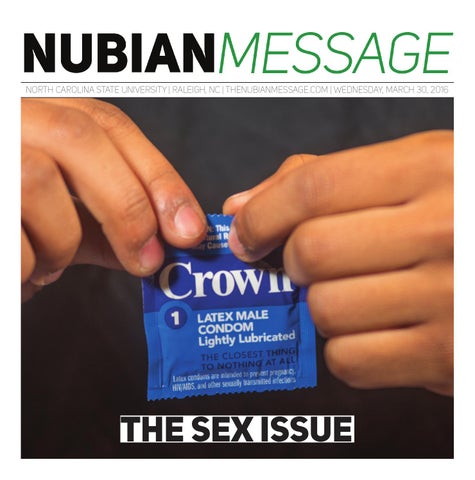
the sex issue
wednesday, march 30, 2016 | 2
Letter from the Editor Hey fam, In this issue, we’re going deep, exploring issues of sexual health and wellness. We often avoid these conversations for fear that they will be awkward or uncomfortable or just plain weird, and honestly they sometimes are. Nonetheless, they are important conversations to have. Sometimes it’s good to be a little bit uncomfortable, most times, it means you’re learning, adjusting and becoming a bit more mature. We’ve gathered some expert opinions on what sexual health acutally is, how you can achieve it, maintain it and we also have some great pieces on how to just have fun. Speaking of having fun, one topic we did not have the opportunity to cover is the “slut shaming” culture many women often face on college campuses. This is a prevelant issue that we need to address because along with sexual health, sexual empowerment is incredibly important. Rather than judging individuals that are not afriad to embrace and enjoy their sexuality, we need to become a community that empowers its members in all ways, including sexually. Whether you choose to do it or not is totally your choice. Whether you choose to do it a lot or a little is totally your choice. Personally, I think it’s high-time we begin respecting that fact a little bit more. I also think that in the midst of all the taboo and the hush-hush attitudes surrounding sex, we have lost one very important aspect of it: IT’S GOOD FOR YOU! Sex is completely natural and there are many benefits that are rarely discussed both on our campus and in the wider community. That’s why we felt the need to do it here. In this issue you will find a variety of articles that will hopefully answer some of those burning questions you haven’t asked anyone and give some insight into why and how sex can be great. So take some alone time and peruse the pages. You never know, you might learn something new.
THISISSUE
3 UNDERSTANDING CONSENT Enthusiastic consent: yes means yes.
3 RISING STI RATES Unpacking the risks.
4 WHAT IS SEXUAL HEALTH? The many elements of sexual health.
4 ON-CAMPUS RESOURCES Where to go on campus.
5 NM YOUR VOICE Sexual education in the home.
Enjoy! Jillian
6 CELIBACY AND ABSTINENCE Choosing to abstain from sex.
7 OVERSEXUALIZING COLOR The Sentinel of the African -American Community at N.C. State Since 1992. Editor-in-Chief Jillian Smith
Managing Editor Stephanie Tate
Only with the permission of our elders do we proudly produce each edition of the Nubian Message. Dr. Yosef ben-Yochannan: Dr. John Henrik Clark: Dr. Leonard Jeffries: The Black Panther Party: Mumia A. Jamal: Geronimo Pratt: Tony Williamson: Dr. Lawrence Clark: Dr. Augustus McIver Witherspoon: Dr. Wandra P. Hill: Mr. Kyran Anderson: Dr. Lathan Turner: Dr. M. Iyailu Moses: Dokta Toni Thorpe and all those who accompany us as we are STILL on the journey to true consciousness.
Racialized sexual stereotypes.
.
7 LOVE THY SELF The best lover you will ever know.
cover photo:kai McneIl | STAFF PHOTOGRAPHER
news
wednesday, march 30, 2016 | 3
Consent and conversation: why enthusiasm matters benyame assefa staff writer April is Sexual Assault Awareness Month and we are talking about a topic that seems to be left as a mere whisper: consent. Consent, according to the Oxford Dictionary, is defined as “Permission for something to happen or agreement to do something.” Being on a college campus, the topic of consent is not always discussed in an open and welcoming environment. The discussion of this topic that needs to flourish often takes backseat when discussing sexual education and conduct. Sara Forcella, Rape Prevention Education Coordinator, along with other members of the Women’s Center are actively pushing for the consent conversation to be a larger topic of discussion in the community. “I think that in any kind of relationship, whether it be a friendship, a
friends with benefits relationship, or a romantic relationship, dialogue is important,” said Forcella. In the past, consent was seen as “No means no”, but simply put, that ain’t cuttin’ it anymore. This outdated pitch leaves many holes in the argument of what is considered consent and what is not. “It’s really changing the idea of consent, which we used to have as “no means no” and shift that into “yes means yes” because just because someone can’t say no doesn’t mean that they’re giving consent. Just because someone is indecisive (I don’t know, maybe, I guess) doesn’t mean it’s consent; they’re not enthusiastic,” said Forcella. This idea of an enthusiastic approach towards not only the topic but even the mood really allows for a positive
spin and, hopefully, a positive trend in conversations in consent. Often the application of mutual understanding is overlooked in the most likely place, an actual relationship. Conversations on consent are sometimes disregarded in established relationships, due to some implication that consent is null once you’ve committed to one another. “It doesn’t matter if you’ve been married all your life, you should never put your significant other in an uncomfortable position or take advantage of their body. Consent should always be practiced prior to the relationship and continued throughout the extent of the relationship,” said Mark Curley, a junior studying biology with a minor in environmental science. Benefits from consent conversations involve stronger communication and
an understanding that just cannot be gathered or comprehended by physical encounters. “If both partners comfortable and wanting to engage in that behavior then it should make the experience better and a safe open space where you can talk about what feels good, what you do or don’t like, what are your boundaries, etc. and those are things you want to discuss beforehand,” said Forcella Undoubtedly, a healthy mixture of communication and cuddling will lead to a far more enjoyable and even perhaps educational experience with the individual laying next to you and vice versa. Suggestions for beginning this presumably awkward conversation can be something as simple as discussing it amongst friends you are close with.
realities of sexually transmitted infections on campus elon price correspondent The frequency of sexually transmitted diseases on college campuses continues to rise rapidly with an estimated 10 million infections affecting young people every year in America, according to the Journal of National Society of Allied Health. In order to understand why this statistic is rising, it is important to first know what STDs/STIs are and how you can protect yourself and others. Despite the prevalence of STDs, many people hold damaging misconceptions about them such as the belief that they are permanent or untreatable. “Most bacterial infections are readily treatable with antibiotics. They can be cured…but you have to get tested [to] know that you’re infected, in order to get [the proper] treatment,” says Adam Ward, a previous graduate assistant for
the GLBT center, currently working towards a Ph.D. in Infectious Disease Epidemiology. Without proper treatment, STIs can become serious diseases. For example, women can contract pelvic inflammatory disease (PID) from an untreated STI, which may cause infertility. Similarly for men, untreated chlamydia can lead to epididymitis which also can lead to infertility. According to the Centers for Disease Control and Prevention, since 2013, there has been a 2.8 percent increase in the rate of contracting chlamydia, a 5.1 percent increase for gonorrhea, a 15.1 percent increase for primary and secondary syphilis and a 27.5 percent increase for contracting congenital syphilis. Studies show that one in four college
students are infected with an STD and an estimated 80 percent of people who have an STD show no symptoms. Does this mean you should live in fear of contracting an STD? The answer is no. Many STDs are easily treatable and are not permanent, but it’s still important to protect yourself and those around you. You must be active about attacking this issue and you should not assume that your current physician will automatically know you’re sick. According to a national survey by the American Sexual Health Association, only one-third of US physicians actually routinely screened their patients for STIs. “Well I know when I went to the doctor to get tested they only tested me for some of the more common types
of STIs and not all of them...which bothered me,” said Leslie Shannon, a sophomore studying genetics. It is important to consistently (recommended every three months) get tested for STIs to prevent further spreading of an infection. You can also get treated and protect yourself from developing a more serious disease. Some good tips for prevention include: sticking to one sexual partner at a time, being comfortable enough to talk with your partner about STIs, getting tested, consistently using condoms or dental dams, and avoiding alcohol or recreational drug use while engaging in sexual activities. Feel free to visit the Student Health Center located at 2815 Cates Ave for more information regarding your sexual health.
wednesday, march 30, 2016 | 4
features
What is sexual Health? sexual health Resources available on our campus
tiera george correspondent We often hear the words “sexual health,” but what does that really mean? As the rates of sexually transmitted diseases and infections skyrocket among college aged adults, it is more important than ever to know and understand your sexual health status. Contrary to popular belief, sexual health extends far beyond the realm of intercourse. It includes being mentally, emotionally and physically well. The American Sexual Health Association also defines sexual health as a “state of physical emotional, mental, and social well-being in relation to sexual health.” Exploring these different elements that comprise sexual health is essential to having enjoyable sexual experiences and being comfortable with yourself and your partner. “Sexuality is more than what you do with another person sexually. It is an important aspect of your wellness,” according to NC State’s Counseling Center webpage. “Elements of your sexuality include the person you feel you are, your body, how you feel as a man or woman, the way you dress, move, and speak, the way you act, and how you feel about other people.” Being comfortable with who you and where like to be around are is a large part of personal mental health. Knowing and understanding yourself is also key to having comfortable intimate interactions. “Despite the ubiquity of sexual images and messages in our culture, there’s still a lot of shame attached to talking openly and frankly about sex,” Sinikka Elliott, an Associate Professor in Sociology and Anthropology wrote in The Abstract, NC State’s research blog. This is another important, often
ignored element of sexual health: discussing what will and what won’t happen. “Having good sexual health is making sure that you are having safe and consensual sex and getting tested
keilah davis correspondent The Student Health Center offers a variety of services for students regarding sexual health. Outreach and Student Engagement
The student health center offers a variety of products for purchase to maintain sexual health. They also offer some free products and services such as three free condoms each day. Kai McNeil | Staff Photographer
regularly to ensure that you have not become infected,” said Miranda DiSanti, the 2016-2017 President of P.L.E.A.S.E. (Positive Loving Empowered Advocates for Sexual Education). Students need to maintain physical, emotional and mental health in order to achieve a healthy sex life. Resources are available at Student Health, the GLBT center, and from P.L.E.A.S.E.
Coordinator for Student Health Services Heather Vernier believes sexual health education is extremely important for students on campus. “A lot of students come into college misinformed or with no information at all about sexual health,” she said. Student Health is dedicated to providing easily accessible resources to maintain sexual health to students.
Although the women’s health department does not have an obstetrician, it is staffed with a gynecologist and nurse practitioners. The department also offers annual wellness exams, contraceptive counseling, and general birth control prescriptions including intrauterine device implants. Heather Spencer, Associate Director of Student Health Services said, “[Our student patients] say that our practitioners are really nonjudgmental and they feel comfortable coming there, [which is] something we are really proud of.” The primary care services department offers STI or STD testing and contraceptive counseling. “Ill-informed individuals are at a higher risk of contracting STI’s and unintended pregnancy,” said Vernier. Prescribed contraceptives can be purchased from the pharmacy at the Student Health Center. Over-thecounter Plan B and free condoms are also offered there. Students are allowed to get 3 free condoms per day. On the first and third Thursday of every month, Student Health offers free and confidential STI testing through Wake County Health and Human Services. These tests are completely anonymous and do not appear on insurance billing statements. “We don’t want there to be any barriers for STI testing,” Spencer said. Spencer and Vernier encourage students to make appointments online or by phone if they want to seek sexual health services. The cost of these services varies with an individual’s insurance policy. In addition to offering health services, the Student Health Center also hosts outreach programs to help educate and dispel- con’td on pg. 6
features
NM
Wednesday, March 30, 2016 | 5
What was sex education like in your family and how has this influenced you in college?
Your Voice Quianne’ holmes staff writer
“I had some form of the [sex] talk with my mom, but it happened at an age where I could answer the questions myself or with research. The lack of communication about sex did not affect my current perspective on sex. But I will definitely will be having the talk with my own children because I think it’s extremely necessary.”- Breanna Powell, senior, social work
“Sex education in my household was abstinence based. My parents were like ‘It’s probably in your best interest to wait until marriage but if you do we’re not going to be mad at you. But they totally gave me all the advice and insight I need to make a decision whether I wanted to be sexually active or not. It really stuck with me through college. You choose abstinence and if you don’t want to be completely safe about it.” - Elliott Holliday, sophomore, physics
“I had the birds and bees talk with my parents and it helped me see the significance it has to impact someone’s life. Personally, I believe that the sex talk is necessary during childhood. Providing clarity to the topic, contrary to what the youth hear or see through social media, music, and/or are told through their peers is very important.”- Imani Allen, junior, nutrition science
“When I was younger, due to my Christian beliefs, I felt like you should not have sex before marriage. However, my perception has changed now that I am in college. My christian beliefs have not changed but I do think that people can make their own safe decisions when it pertains to sex. Along with this, kids should be educated about sex because it is a natural part of life and they need to be aware of all precautions.”- Nyla Ruiz, junior, human biology
wednesday, march 30, 2016 | 6
opinion
The not sex talk we need to have Anahsza jones correspondent As a 20 year old female college student that has chosen abstinence, I know a thing or two about the subject. It’s not the most popular decision, and it definitely isn’t a hot topic for conversation. It seems like people are no longer scared to talk about sex, they’re scared to talk about no sex. Dr. Kami Kosenko, an associate professor in communication here at NC State, noticed the silence and decided to investigate. Back in 2014, Dr. Kosenko conducted a study to see if talking about abstinence actually helped people stay abstinent. The first thing she had to do of course, was define what abstinence is, as well as its sister term, celibacy. The two are often mentioned in the same breath, so much so that people don’t really know the difference. According to Kosenko, “Celibacy refers to abstaining from marriage, sexual relations, or both, and it’s usually driven by one’s religious beliefs. Abstinence gets defined in various ways but is usually associated with not having sex until marriage.” Why someone chooses to be abstinent or celibate varies from person to person, and it’s important to keep that in mind. It is also important to remember that not everything you hear or think about abstinence is the truth. “Some common misconceptions about abstinence are that it’s not a choice (i.e., that someone isn’t attractive enough to have a sex partner so he or she has no choice but to abstain),
that only religious individuals decide to abstain (when, in reality, people make the decision to abstain for various reasons), and that abstinence is unrealistic (when, in reality, many people are able to adhere to their decisions to abstain),” said Dr. Kosenko. Responses to the choice of abstinence range from “That makes sense,” to “Bruh, couldn’t be me,” and both are understandable. I’ve experienced both ends of the spectrum, those that think it’s a good decision, and those that think it’s unrealistic. I’ve been told both ‘more power to you’ and ‘you need to get laid.” Clearly, there are varying opinions on the subject. The question becomes, in our effort to create a sexually free and tolerant society, have we created a new stigma against those who choose not engage in sexual activity? Dr. Kosenko seems to think so. “We hope that our findings help “normalize” abstinence. In today’s society, abstinence and virginity are stigmatized, and people who decide to abstain are sometimes made fun of because of their decsion,” she said. We live in a society where it’s okay to turn on Netflix with one hand and pull out a condom with the other, no questions asked, so of course there’s pressure on people to just go with what’s deemed “normal.” On the other hand, there’s been a real push for acceptance and conversations on topics like slut shaming and sexual assault that emphasize a person’s right to say no. At the same time, sex has become such a norm that people have come to expect it in a relationship, so much so, that they feel they deserve to be warned of abstinence beforehand. I asked a few students if they were in
a relationship and their partner told them they were abstinent, how would they respond? “I would try to accept it, but I don’t think I would be able to unless I already had serious feelings for this person, like, I love this person. I don’t think I could do it. I think I would have to end the relationship just because having a physical connection in a relationship is very important to me,” said Rebekah Pinion, a junior studying animal science. With responses like that, I don’t think it’s any mystery why people who are abstinent choose not to mention it. Personally, I don’t think it’s any of your business, unless I decide to make it your business, but that isn’t the world we live in. It’s all about who you’re with and how much you want to be with them. Trevor Jenkins, a sophomore studying finance, said “Abstinent, if it was like, until marriage, I could definitely respect that. If you care about that person enough, it’s something you would respect.” We have to find a balance between what we want and what we’re expected to want. Relationships are about both people involved, so keeping an open dialogue and communicating is incredibly important. No one wants to feel pressured, but no one wants to be blind-sided either. Jenkins put it best in my opinion. “If sex is something someone values in a relationship, that’s just like any other factor they would need, or they feel they would need, so that’s just something you need to think about. And if that’s something that one person wants and the other person doesn’t want, then that might not be the relationship for you, and that’s perfectly fine.”
continued from pg. 4 misinformation. On Halloween, staff members walked around campus with condoms and candy. In February, the Student Health Center hosted Sex Ed Boot Camp and brought in two national experts to speak at the event. There will be more community engagement initiatives in the fall semester. The Student Health Center also offers a pre-PACKaged program called “The Challenge” to resident advisors and other student organization leaders. “The Challenge” also has all of the resources students need to self-facilitate a program or presentation about sexual health. For STD Awareness Month, the Student Health Center will post a fact of the day on all of their social media platforms. “We’re just trying to reach students where they are and tell them about the resources that we have,” said Vernier. The Student Health Center has also begun partnerships with the GLBT Center, Women’s Center, and Counseling Services. “We want sexual health to be an inclusive conversation,” Spencer said. For more information on the Student Health Center and sexual health resources, visit their website at healthypack.dasa.ncsu.edu.
opinion
wednesday, march 30, 2016 | 7
How women of color are oversexualized in media jessica stubbs staff writer Does the name Sara Baartman ring a bell? Sara “Saartjie” Baartman was one of at least two Khoikhoi women who were subjected to life in human zoo exhibits in 19th-century Europe. Nicknamed “Hottentot Venus”, Sara’s large buttocks and deeply pigmented skin made her an object of fascination to colonial Europeans. She was placed in a cage and her “trainer” would order her to sit or stand like a circus animal. Sara Baartman is just one famous example of objectification, but the
problem continues today. The oversexualization of black females is something that I personally have to battle. There have been countless times that I’ve been referred to as “the girl with the big butt” or I have gotten unwanted attention due to my physical appearance. Brandon Coates from P.L.E.A.S.E, Positive, Loving, Empowered Advocates for Sexual Education, gave his opinion on the issue. “Black women suffer from every issue of sexism that white women do but with an added helping of racism and colorism,” said Coates. In American culture, the black female body is considered free ground to tread upon, harm and ignore. Anybody in this country can say anything about black women that they want to
but black women themselves.” The issue is that for black women, we are never beautiful. We are either, bad, sexy, fine, “slim-thick witcha cute a**,” or anything other than beautiful. Why is it that Kylie Jenner looks good with her lip implants, but Aamito Stacie Lagum, the black woman featured in the MAC lipstick ad was the joke of the internet? Coates said, “Bodily characteristics that are associated with black women are valued so highly on women that are not black. When on black women, these characteristics are considered anywhere between disgusting and extremely sexy but almost never beautiful.” The issue is deeper than what I have exposed today. Black women are seen as property
that others can pick and choose what features they find attractive on them, but not us. When Sara Baartman died in 1816, George Cuvier obtained her remains from local police and dissected her body. He made a plaster cast of her body, pickled her brain and genitals and placed them into jars which were placed on display at the Musée de l’Homme (Museum of Man) until 1974. It wasn’t until 2002 that her remains were repatriated to her homeland in South Africa. We have to overcome and reverse these age-old stereotypes to improve the condition of the black woman. We are much more than baby mamas, hoes, “ole ladies”, and jezebels. Women are more than just their bodies.
Solo play: Achieving self love through masturbation nyna nickelson correspondent Why is it when thinking about sex and love, the most important person is often left out: yourself. Sure when daydreaming we think of ourselves with that special someone doing the deed, but we hardly imagine ourselves, alone. After all real love involves another person, right? Wrong! Real love begins with YOU. Masturbation, to most, is a dirty word reserved only for horny teenagers, tube socks in the hush hush of the
night and middle-aged women on late night HBO. This stereotype could not be farther from the truth. According to Planned Parenthood’s website, seven out of ten males masturbate and only three out of ten women do. Masturbation has been linked to improving confidence and creating a high sense of well-being for individuals. Unfortunately, the stigma behind masturbation is more talked about than the benefits, especially for woman. While men may not always be vocal about what they do alone behind closed doors there is more of an acceptance of masturbation for them than there is in female communities. Masturbation is often seen as a
shameful act. However, masturbation is sexual autonomy. Allowing people the express themselves sexually can facilitate positive feelings about sexual awareness and can to safer choices down the line. Perhaps, you’re thinking something along the lines of: “I don’t need to masturbate for sex because I can get a willing participant any time I want!” First, let’s come down off our high horse, shall we. Second, it is time to dispel the myth that masturbation equals desperation. Masturbation is the epitome of self love and taking the time to understand one’s own body and sexual needs on a deeper level. Sources on Planned Parenthood
state, “Masturbation can enhance our physical, mental, and sexual health in addition to the health of our sexual relationships.” Those who masturbate are more likely to have greater sexual experiences and more likely to climax. Another key point for masturbation, not that it needs much more selling, is how it helps the ability for individuals to understand their likes and dislikes before another person ever enters the bedroom. This way, sex is less awkward when a new partner is introduced because you will be more confident, and with a little communication a pleasant and comfortable sexual experience can occur. So go ahead and try it, the only person that has to know is you.
wednesday, march 30, 2016 | 8
Off-Campus sexual health Resources Zoe Wilson | Correspondent A Preferred Women’s Health Center of Raleigh Address: 1604 Jones Franklin Rd. Raleigh, NC 27606 Distance from campus: 4.4 miles Services:Abortion, ultrasound, pregnancy test, abortion counseling Phone: 919-854-7888 Alliance of AIDS Services-Carolina Address: 1812 Tillery Pl, Raleigh, NC, 27604 Distance from campus: 1.6 miles Services: Chlamydia Test, Conventional HIV Blood Test, Free HIV Testing, Gonorrhea Test, Hepatitis B Test, Hepatitis C Test, Rapid HIV Blood Test, Syphilis Test Phone: 919-856-5520 Ceiba Counseling Center Incorporated Address: 214 W Millbrook Rd, Raleigh, NC, 27609 Distance from campus: 2.6 miles Services: Chlamydia Test, Conventional HIV Blood Test, Free HIV Testing, Free STD Testing, Gonorrhea Test, Syphilis Test. Phone: 919-844-6348 Gateway Campus Address: 1306 Hillsborough St, Raleigh, NC, 27610 Distance from campus: 2.5 miles Services: Chlamydia Test, Conventional HIV Blood Test, Free HIV Testing, Free STD Testing, Gonorrhea Test, Syphilis Test Phone: 919-250-3950
LGBT Center of Raleigh Address: 324 S Harrington St, Raleigh, NC, 27603 Distance from campus: 3 miles Services: Chlamydia Test, Conventional HIV Blood Test, Free HIV Testing, Free STD Testing, Gonorrhea Test, Rapid HIV Blood Test, Syphilis Test Phone: 919-832-4484 Planned Parenthood Health Systems Incorporated Raleigh Health Center Address: 100 S Boylan Ave, Raleigh, NC, 27603 Distance from campus: 2.7 miles Services: Chlamydia Test, Gonorrhea Test, HPV Vaccine, Herpes Test, Rapid HIV Blood Test, Syphilis Test Phone: 919-833-7526 Urban Ministries of Wake Counry Open Door Clinic Address: 1390 Capital Blvd, Raleigh, NC, 27603 Distance from campus: 1.5 miles Services: Chlamydia Test, Conventional HIV Blood Test, Free HIV Testing, Gonorrhea Test, Hepatitis A Vaccine, Hepatitis B Vaccine, Herpes Test, Syphilis Test Phone: 919-832-0820 Wake Health Services Rock Quarry Road Family Medicine Address: 1001 Rock Quarry Rd, Raleigh, NC, 27610 Distance from campus: 3.9 miles Services: Chlamydia Test, Conventional HIV Blood Test, Gonorrhea Test, Hepatitis A Vaccine, Hepatitis B Vaccine,
Hepatitis C Test, Herpes Test, Syphilis Test Phone: 919-833-3111 Wake County Human Services Millbrook Human Services Center Address: 2809 E Millbrook Rd, Raleigh, NC, 27616 Distance from campus: 4 miles Services: Chlamydia Test, Conventional HIV Blood Test, Free HIV Testing, Free STD Testing, Gonorrhea Test, Syphilis Test Phone: 919-250-3950 Womens Center of Wake County Incorporated Address: 112 Cox Ave, Raleigh, NC, 27601 Distance from campus: 2.6 miles Services: Chlamydia Test, Conventional HIV Blood Test, Free HIV Testing, Free STD Testing,| Gonorrhea Test, Hepatitis A Vaccine, Hepatitis B Vaccine Phone: 919-829-3711 Your Choice Pregnancy Address: 1701 Jones Franklin Rd, Raleigh, NC, 27606 Distance from campus: 6.4 miles Services: Chlamydia Test, Conventional HIV Blood Test, Free HIV Testing, Free STD Testing, Herpes Test, Syphilis Test Phone: 919-250-3950