TECHNICIAN
vol.
xcvi cxviii issue
technicianonline.com
tuesday april
12 2016
Raleigh, North Carolina
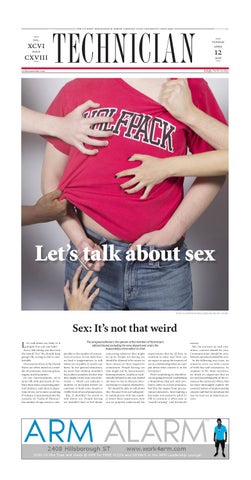
Let’s talk about sex PHOTO ILLUSTRATION BY BANU GANESHAN AND KAI F. MCNEIL
Sex: It’s not that weird L
et’s talk about sex, baby. Is it alright if we call you baby? Sorry, did asking you that ruin the mood? No? We should keep going? OK, as long as you’re comfortable. Discussions of sex in the United States are often mired in a muddle of confusion, misconception, stigma and discomfort. In our entertainment, we’re more OK with portrayals of violence than those concerning physical intimacy, and often in depictions of sex, we’re more accepting if violence is incorporated into the scenario. In “Game of Thrones,” the number of rape scenes is com-
The unsigned editorial is the opinion of the members of Technician’s editorial board, excluding the news department, and is the responsibility of the editor-in-chief. parable to the number of consensual sex scenes. In our daily lives, we find it inappropriate to talk about sex in public in nearly any form. In our general education, we insist that children shouldn’t learn about sexuality, for fear that they might evolve into sexual deviants — which can indicate a number of mistaken beliefs we continue to hold onto despite a visible front of social progression. But, it shouldn’t be weird to talk about sex. People having sex shouldn’t have to feel shame
concerning whatever they might be up to. People not having sex should be allowed to be secure in their choices or their respective orientation. People having sex who might not be heterosexual, heteronormative, vanilla or traditionally defined in any way should not have to run to obscure internet forums to express themselves. We should be able to talk about this. Because if we can’t adequately communicate with one another about these experiences, how can we properly understand the
2408 Hillsborough ST
expectations that we all have to confront in some way? How can we expect to grasp the nuances of sex in a relationship when we can’t pin down what consent is in the first place? That’s something we should focus on going forward: establishing a foundation that not only promotes safety in sexual situations, but lifts the stigma from precautionary measures. Interrupting a hot make-out session to ask if it’s OK to continue is often seen as “mood-ruining” and distinctly
unsexy. But, for partners in such situations, consent should be sexy. Communication should be sexy. Mutual enjoyment should be sexy. In the following sexy issue, we aimed to cover sex with a sense of both fun and seriousness. As students at NC State ourselves, we think it’s important that we are each knowledgeable of the resources the university offers, that we more thoroughly explore the essential nature of understanding consent and that we reevaluate the way we treat sex in American society.
www.work4arm.com
JOIN US this Tues and Weds @ 6PM for FREE PIZZA and DRINKS in the ARM Leadership Lounge!
Sex Issue
PAGE 2 • TUESDAY, APRIL 12, 2016
TECHNICIAN
NCSU provides resources to promote sexual health Hessa Al Maghlouth Correspondent
NC State of fers ma ny sexual health services to students and can be divided into three main branches: the Women’s Clinic at the Student Health Center, the Women’s Center and the GLBT Center. Each works to educate students about sexual health. The Women’s Clinic at the Health Center The Women’s Clinic provides a wide range of health services, including gynecological care. Patients are guaranteed confidentiality in a judgment-free zone in the clinic, where they are encouraged to ask questions and take advantage of the available services. He at he r Ve r n ie r, t he Health Center’s outreach coordinator, said the Health Center’s focus is educating students on the importance of hav ing hea lt hier and safer sexual relations and providing them the tools they need to make healthy decisions. “W hether that’s abstinence or whether someone is sexually active, we’re just trying to educate on every different aspect of sexual health,” Vernier said. The services the Women’s Clinic provides include routine checkups and exams, such as pap smears, pelvic and breast exams and STD testing. They provide different types of contraceptives, pregnancy testing and ultrasounds. Plan B is available at the Health Center’s
pharmacy without a prescription. During normal business hours, female survivors of rape or sexual assault can go to the Women’s Clinic to receive a forensic exam. The Women’s Clinic staff will perform STD screening and treatment at no cost, and they will refer survivors to the Counseling Center. Male students who are survivors of rape and sexual violence can go to the clinic on the first f loor of the Health Center. “Ever y student pays a student health fee in their tuition that covers the expense to be seen by our provider,” Vernier said. Students can also receive up to three free male or female condoms per day as well as free tampons at the check-in desk. The Health Center is organizing programs such as Pack Peers, which launches next fall and aims to promote sexual health among students. In this program, students who are interested in educating their peers on health topics can join a group for a semester and shadow clinicians. T he Hea lt h C enter is ranked as the number one best student health service i n Nor t h Ca rol i na a nd number nine nationwide in the Princeton Review’s annual “Best Colleges Guide.” Students can make appointments to see a healthcare provider at the Women’s Clinic through healthweb.ncsu.edu or by calling 919-515-2563.
PHOTO ILLUSTRATION BY KAYDEE GAWLIK
The Women’s Center The Women’s Center, located on the fifth f loor of Talley Student Union, provides interpersonal violence advocacy services and confidential support to survivors of domestic violence, sexual assault and rape. Unlike the Women’s Clinic, which is focused on medical service, the Women’s Center is focused on social justice and gender equity. As Sara Forcella, rape prevention education coordinator at the Women’s Center, points out, its services are directed toward students of all genders and sexual orientations. “Men think they’re not welcome here and that’s not the case,” said Forcella. “We’re a welcome space for both men, women and folks that are gender non-
conforming.” According to Forcella, the center is focused on working with survivors who experienced violence, whether it is in the form of stalking or relationship violence or sexual assault, and helping them make decisions about their reporting options and the resources they have. “We can provide advocacy services and support services and really be there through the entire process of healing whatever that might look like for them,” Forcella said. The Women’s Center is open from 9 a.m. to 5 p.m., Monday through Friday. The center can be reached at 919-515-2012, or online oied.ncsu.edu/womenscenter. For 24-hour assista nce operators w it h the Relationship & Sexual
Violence Phone Line can be reached at 919-618-7273. The GLBT Center In addition to engaging a nd empower i ng members of t he GLBT community and their allies on campus, the GLBT Center hosts identity-based healthrelated educational events and programs, It provides free latex and non-latex male and female condoms, lubricant and gloves. Andy DeRoin, program director of the GLBT Center, said that there is an issue of access when it comes to safe sex options. “We decided as a center that it is important for us to offer a wide variety of safer sex supplies and internal condoms are one of many options that we provide,” DeRoin said. On April 27, the GLBT
Center is collaborating with the Alliance of AIDS Services, Carolina, to provide free and confidential HIV and STD testing for students at Talley 4132 from 1-4 p.m. No insurance is required. “We, as staff members, we have an open door policy,” DeRoin said. “We’re always happy to pull out as much material as someone would need or want. We have loads of brochures and pamphlets and informational things that people can pull at their leisure on the counter.” The GLBT Center can be reached at 919-513-9742 or found online at oied.ncsu. edu/glbt.
Greek Life works to prevent sexual assault through education Ashleigh Polisky Correspondent
NC State’s Sorority and Fraternity Life is taking measures to prevent sexual assault from occurring, according to Chris Jefferson, the associate director of Fraternity and Sorority Life. “Fr ater n it ie s a nd s o rorities have ver y strict policies in place to assist in the facilitation of safe socia l events,” Jef ferson said. “Many f raternities and sororities follow social event guidelines established under the Fraternal Information and Programming Group, better k now n as
FIPG.” FIPG does not tolerate or condone any form of sexist or sexually abusive behavior on the part of its members, whether physical, mental or emotiona l. This a lso includes any actions, activities or events, whether on-campus or off-campus which are demeaning to women or men, including but not limited to verbal harassment and sexual assault. The Fraternal Health and Safety Initiative, a risk prevention program, stresses the importance of Greek Life taking a stand against sexual assault. FHSI works
on educating fraternity and sororit y members about strategies for identification and prevention of dangerous issues that commonly happen on college campuses, such as alcohol and drug use, sexual misconduct and assault and hazing. FHSI also stresses the importance of defining consent in a relationship. “Consent is def ined as a positive, unambiguous and voluntary agreement to engage in specific sexual activity throughout a sexual encounter,” said Drew Hunter, support consultant for FHSI. He said consent is not
the absence of a no, and if a person is unable to say yes, then they are not able to consent. Consent can be taken away at any time during the encounter, and previous consent to a sexual act does not mean current or future consent for the same sexual act. “Once a person says ‘no,’ it does not matter if or what k ind of sexua l behav ior happened previous to the current event, earlier in the day, or daily for the previous six months. It does not matter if it is a current longterm relationship, a broken relationship, or marriage. If one partner says, ‘No,’ and
WHAT IS SEXUAL ASSAULT? Any forced or manipulated sexual activity with a lack of consent.
the other forces penetration, it is rape,” Hunter said. FHSI suggests that fraternities and sororities review their chapter’s traditions and eliminate sexist or degrading practices and host educational programs on sexual assault and harassment in order to prevent sexual assault. “I believe the conversation regarding the prevention of sexual assaults is helping our students identif y concerning behaviors and intervening in questionable situations,” Jefferson said. Because only one in four sexual assaults go reported,
Police Chief Jack Moorman said he cannot report any data on sexual assaults. “It is very important to remember that, as we all k now, sex ua l assau lt is extremely under-reported across a l l c a mpu ses i n the U.S.,” Moorman said. “Therefore, any percentages that I could give you are only the percentage of reported incidents that are related to Greek Life. This is not the same thing as the percentage of actual sexual assaults that are related to Greek Life. This actual percentage, of course, will remain as an ‘unknown.’”
WHAT TO DO IF YOU ARE RAPED OR SEXUALLY ASSAULTED: + GET TO A SAFE PLACE Seek a safe area and try not to isolate yourself. Find someone you trust and are comfortable with so they can support you emotionally.
+ SEEK MEDICAL ATTENTION To address injury, pregnancy or sexually transmitted diseases, do not shower or discard your clothing to preserve evidence of the assault.
WHAT IS CONSENT? Enthusiastic agreement to participate in a form of sexual activity. This can be verbal or non-verbal.
CONSENT IS NOT... “She was dressed like she wanted it.” “He looked like he was interested.” “Well, they didn’t stop me.”
The absence of “no” does not mean “yes.” You must get consent before each step of sexual activity.
Appointments are available and confidential at NC State’s Counseling Center. It is not required to report the assault if you seek counseling. Even if it happened a while ago, it’s never too late to seek assistance for sexual assault.
APPOINTMENTS AT THE COUNSELING CENTER
To schedule your first appointment, you should go to the Counseling Center in person Monday–Friday between 9 a.m. and 3 p.m. (11 a.m. to 3 p.m. on Wednesdays). For appointments after your first, you may schedule by calling 919515-2423. For counseling emergencies during office hours, please come to the Counseling Center and ask to be seen. For after-hours emergencies, please call 919-515-2423 and speak to the counselor on call.
TECHNICIAN
Sex Issue
TUESDAY, APRIL 12, 2016 • PAGE 3
76130
WE HELP THOSE WHO DO GOOD DO WELL. Rediscover what makes us a different kind of financial partner at the new TIAA.org
INVESTING
ADVICE
BANKING
RETIREMENT
BUILT TO PERFORM. CREATED TO SERVE.
C28789
5021A0113 Campus News_WE HELP THOSE WHO DO GOOD DO WELL_REDISCOVER_C28789_9.8x15_Various_1.indd Cyan Magenta Yellow Black
Opinion
PAGE 4 • TUESDAY, APRIL 12, 2016
TECHNICIAN
Why is violence more acceptable than sex? T
he world of entertainment has left us all virtually numb to violence. Video games, movies, songs, even your favorite television program is filled w ith violence and suspense. We stare vacantly at a screen, not even f linching at “The Chauncey Wa l k i ng Dead ” Bowden Staff Columnist a n d t h e n e w est “Grand Theft Auto” video game. PsychologyToday.com released an article that states that science has developed mounting evidence that says that violent forms of entertainment can lead to brain changes,
aggressive behavior and poor decision-making. Don’t worry, this isn’t another piece about how the media has trained us to be desensitized killing machines — or at least that isn’t all this column is about. We are perfectly comfortable poised on our couches watching movies that depict (often senseless) acts of violence. Yet, discussions on sexuality are often shunned and considered taboo. Perhaps I should clarify: certain discussions within the realm of sexuality are considered to be taboo. Sex and violence are all over our TV screens. Usually, these sexual relationships are between heterosexual couples that society has re-
need to be made for trans, queer and lesbian actors and actresses in the entertainment industry. Apart from society’s discomfort in watching these dynamics on television, we are not as a whole comfortable discussing sexuality in everyday life. The ramifications for this refusal to address this subject include slut shaming, the over-sexualization of the female body, and ignorant laws such as House Bill 2. If you want to make sex a political issue, let’s talk about the number of politicians who rape and molest innocent people, yet face absolutely no repercussions. Our society has a strange approach to discussing sexuality. I fi nd it bizarre that something that
garded as “acceptable.” In recent years, television programs have taken great strides to challenging many of the standards about sex on television. We all fell in love with “modern family) Cam and Mitch from ABC’s “Modern Family.” Well, we didn’t all fall in love with them. Some argued that the show was an “abomination” and went against Christian values. Yet, primetime television continued to challenge the standard, and shows like “How to Get Away with Murder” and “Scandal” feature main, gay male characters. While these are great strides, there is certainly more work left to be done. There is a lot more to sexuality than gay male sex. Ways
is the basis for the creation of most life is such a prohibited topic. The further you stray away from gender binaries, the more at risk you are for being shamed. Many cultures differ in regards to their views on sexuality. The same often follows for different religions, races and age groups. What is okay for the college student may be different for a baby boomer. But, if your moral compass tells you that there is absolutely nothing wrong with watching a film in which people engage in senseless acts of violence, but two fully grown, consenting adults engaging in a non-conforming sexual relationship keeps you up at night, then you may need to check yourself.
It’s on us: the stepping stones toward social awareness “
Women aged 18–24 who are enrolled in college are three times more likely than women in general to suffer from sexual violence.” “M a le c ol le ge Aditi aged students are Dohlakia 78 percent more Correspondent likely than nonstudents to be a victim of rape and sexual assault.” “8 percent of all [reported] sexual assaults occur while victim is attending school.” These statistics, taken from the Rape, Abuse and Incest National Network (RAINN) website, represent the cold, hard facts of what it’s really like to be a college student, or even just a human being in America. Whether we as a nation like to admit it or not, sexual assault and rape have become extremely problematic epidemics that plague everyone, from children to adults of all ages, races, genders and socioeconomic statuses. In September of 2014, President Barack Obama launched the “It’s On Us” campaign to “end sexual assault on college campuses.” As he said in his speech at the launch, “An estimated one in five women has been assaulted during her college years … Of those assaults, only 12 percent are reported, and of those reported assaults, only a fraction of the offenders are punished.” The well-intentioned initiative garnered extensive media attention within the fi rst couple of months, with celebrity support, public service announcements to raise awareness and encouragement to pledge and advocate on college campuses across the nation. The campaign focuses on turning the perception of sexual assault around, specifically concentrating on eliminating the bystander effect by encouraging citizens to step forward in dicey situations to prevent potential sexual assault from happening. So far, in cases of rape and sexual assault, the questions have always been about what the survivor was wearing, what the survivor was doing, how much the survivor had to drink. The intention of the “It’s On Us” campaign is to turn the interrogation on the perpetrators, and to focus the education on stopping potential rapists from rap-
“The ‘It’s On Us’ campaign is what some would call first-grade-level awareness and proactivity.” ing rather than using fear tactics to ensure survivors are not in the wrong place at the wrong time doing the wrong thing while wearing the wrong clothes. NC State caught on to the movement pretty quickly, with thenStudent Body President Rusty Mau publicly pledging to the initiative and reminding fellow students to do the same in his weekly update emails. The university also hosts a Week of Action in November, with awareness events across campus, and educational workshops on awareness and prevention. What’s lacking is the continuous advocacy and support before and after the Week of Action to remind students that the pledge is not a one-time thing, but rather an ongoing lifestyle choice to do whatever it takes to prevent even just one instance of rape or sexual assault from happening. Is the initiative enough to create a big enough change on college campuses nationwide? One of the reasons sexual assault and rape are such big problems in this country — especially at colleges and universities — is the perpetuation of victim blaming, and the resulting fear-mongering that stops survivors of rape and sexual assault from reporting these crimes. The “It’s On Us” campaign is what some would call first-gradelevel awareness and proactivity. People sign the pledge and feel good about themselves for having done something constructive. It’s just heavy enough for people to understand, and to agree with — there does need to be a change in the way sexual assault and rape are dealt with. The campaign provides a kind of illusion of positive change; beyond that, however, the initiative lacks the follow-up that such movements require.
Empowerment
Aditi Bahali, senior studying political science
{
IN YOUR WORDS
}
How should entertainment ratings (e.g. G, PG, PG-13, R, etc.) be decided? BY MARY GOUGHNOUR
“I think the rating system now is a good way for rating entertainment. I feel like they could have more specific ratings, though. For example, television shows will sometimes be specific and have ratings of TV-14.” Leighton Telling sophomore, genetics
“The rating agencies we use now that determine what is acceptable for a certain age group is fine.” Jake Marthinsen freshman, psychology
“It should depend on the language, sexual content and the message trying to be displayed.” Bianca Pearson junior, history
Chronicles of Lara in College
Zeenat Aasim Nadvi, freshman studying engineering
Editor-in-Chief Kaitlin Montgomery technician-editor@ncsu.edu
323 Witherspoon Student Center, NCSU Campus Box 7318, Raleigh, NC 27695 Editorial Advertising Fax Online
515.2411 515.2029 515.5133 technicianonline.com
Features Editors Sam Roberson Emma Cathell (Bienvenidos Editor)
Managing Editor Megan Ellisor
technician-features@ncsu.edu
technician-managingeditor@ ncsu.edu
Projects Manager technician-projects@ncsu.edu
Sports Editors Drew Nantais Daniel Lacy technician-sports@ncsu.edu
Opinion Editor Mary Anna Rice technician-opinion@ncsu.edu
News Editor Inez Nicholson
Copy Desk Manager Kelly McNeil
technician-news@ncsu.edu
technician-copydesk@ncsu.edu
Design Editor Devan Feeney
Social Media Editor Sarah Catherine Smith
technician-design@ncsu.edu
technician-digitalcontent@ ncsu.edu
Photo Editor Banu Ganeshan technician-photo@ncsu.edu
Video Editor Julia Kenny technician-video@ncsu.edu
Business Manager Mark Tate advertising@sma.ncsu.edu
The Technician (USPS 455-050) is the official student newspaper of N.C. State University and is published every Monday through Thursday throughout the academic year from August through May except during holidays and examination periods. Opinions expressed in the columns, cartoons, photo illustrations and letters that appear on the Technician’s pages are the views of the individual writers and cartoonists. As a public forum for student expression, the students determine the content of the publication without prior review. To receive permission for reproduction, please write the editor. Subscription cost is $100 per year. A single copy is free to all students, faculty, staff and visitors to campus. Additional copies are $0.25 each. Printed by The News & Observer, Raleigh, N.C., Copyright 2011 by North Carolina State Student Media. All rights reserved.
Opinion
TECHNICIAN
TUESDAY, APRIL 12, 2016 • PAGE 5
Taking control of birth control S
ince the invention of the pill in 1951, its usage has been a public controversial dispute between women’s rights, politics and medicine. Common reasons individuals pursue Amanda t h i s opt ion i nReza clude preventing Correspondent pregnancy, regulating periods and health benefits. However, since its creation, over 1,000 lawsuits have been filed against different manufacturers of birth control due to complications of blood clots, heart attacks and strokes caused. In order to fully realize the extent of the controversy, it is important to understand what birth control pills are. Despite the myth that the pills are artificial chemicals, the pills are made of hormones already naturally produced in our bodies. Taking these pills allows women to have a healthy level of
hormones to prevent pregnancy. Some people think that interfering with potential conception is “playing God.” Yes, birth control does work by altering biological functions. It prevents the egg cells from leaving the ovaries, thus preventing pregnancy. But it is widely used for purposes other than sexual intercourse. Like many treatments used to minimize sy mptoms or pain, birth control is used to mitigate women’s health. In 1957, the FDA approved the birth control pill as a treatment for severe menstrual disorders before it was widely used as a contraceptive. So does an alternative to keep someone safe or usage as medical treatment defy religion? In addition to extreme menstrual cycles, there are many reasons to take the pill. According to Planned Parenthood, more than
6 out of 10 women use it to treat conditions such as endometriosis, regulating their cycle or reducing the risk of ovarian cancer. It reduces pain induced by cramps that cause lighter periods and offers protection against pelvic inf lammatory disease. Other benefits range from assisting with acne, iron deficiency, headaches and even depression. While the pill may be a solution offered to many individuals, it is not guaranteed to be magical. There is a possibility for side effects such as bleeding between periods, nausea and vomiting. These consequences usually clear up after two or three months. Fatal situations are rare, but this risk tends to be greater for individuals that have blood clotting disorders, diabetes or high blood pressure. This should not discourage women from seeking help for alleviat-
“In addition to extreme menstrual cycles, there are many reasons to take the pill.” ing menstrual symptoms, but it is important to acknowledge, like any medicine, unwanted side effects can happen. Birth control falls under the “pink tax” — an extra amount women are charged for certain products or services. This product can cost anywhere from $0 to $50 a month, according to Planned Parenthood. As it can be a necessity for some women to adequately
function at certain times, some employers offer coverage of this expense. However, not all companies agree to do so, which has led to a public conf lict of interest. An example of this is the Hobby Lobby Case of June 2013, which ruled in favor by the Supreme Court to let a company withhold coverage due to religious rights — the reason being that taking the pill should not be enforced by a company, but instead between an individual and their doctor. And health insurance should provide the pill for women to allow them to maintain a functional wellbeing. Even though women may have different reasons for taking birth control, it should be accessible to treat symptoms, protect bodies and help women function.
Re-examining hookup culture I
am not a fan of the show “Grey’s Anatomy.” The show’s gone on for about five seasons too long and killed more main characters than a daytime soap opera. But one of the dominant themes in Shonda Rimes’ Drew popu la r “med iNantais cal” drama is sex. Sports Editor Attractive people having sex with other attractive people while also doing their actual jobs in between all the sex. I honestly think all those doctors at Seattle Grace went through all that schooling just to jump in bed with their coworkers. But alas, my distaste for the show isn’t the point here. With me being a male and all, one of the pervading stereotypes is that all guys think about is sex. Sex, all the time, 24 hours a day, seven days a week. And while my roommates have an uncanny ability to turn anything into a sexual innuendo or euphemism, the stereotype just isn’t true. Well, at
least for me it isn’t. Sex is everywhere, and it’s becoming harder and harder to avoid it. It’s on television, in movies, in music, in books and on the Internet. Over the past 50 years, sex went from a cultural taboo to one of the dominant themes in Western popular culture. It’s even inf luenced how people approach dating. Based off themes in television and movies, if two individuals aren’t having sex by the third date, many people would look and say, “Well, what’s the problem?” That’s the thing: There isn’t a problem. This “hookup culture” that’s perpetuated throughout this generation is so entrenched in the minds of teenagers and young adults, it may never go away. Say whatever you want, but hookup cultures only hurt relationships in the long run. I’ve never had a girlfriend, nor have I ever found the necessity to find one. I’ll find the right girl in time; at least I think I will. But that’s not the point. I am a virgin, and I’m not ashamed to be.
I’m still trying to figure out how being a virgin went from a common theme among young adults to a taboo subject. I believe sexual intercourse is the most intimate experience one human being can share with another. Even though virginity is entirely fabricated by society and doesn’t mean a thing in the long run, an individual’s first sexual experience is a pivotal moment in his or her life. According to a study done by researchers at the University of Tennessee and Mississippi, an individual’s first sexual experience has more of an impact on the rest of their sexual lives than they were first led to believe. The results of the study showed individuals who had a positive firsttime sexual experience had higher sexual satisfaction later in life and experienced less “sexual depression.” Feeling loved and respected by one’s partner led to more emotional and physical satisfaction later on in life. On the f lip side, when one experienced negativity and anxiety when losing one’s virginity led to an overall lower
sexual satisfaction. You wouldn’t share pivotal moments in your life with complete strangers. So why would you share one that’s arguably one of the most important in your life with someone you don’t know? I want to share that experience with someone I trust and love with all my being. I just don’t understand how an experience that makes someone so sensitive and vulnerable has been relegated to something expected on a first or second date. When did it come to this? Why is it so frowned upon to wait and have sex? What happened to getting to know someone before taking it to the next level? You could probably find thousands of blog posts on hookup culture and how it’s bad and it needs to stop. But they’re all just rhetoric. It’s one thing to write about it, and it’s another thing to do something about it. When you share an anti-hookup culture posts on social media, it’s going to be just as effective as my aunt’s last 34 requests for me to play Candy Crush Saga: It won’t
change many minds. I’m a firm believer that there’s someone out there from everyone. Whether or not you agree with me is entirely up to you. But as we move forward with the hookup culture we live in, finding that someone may become harder to do so. While the hookup culture isn’t going away anytime soon, you shouldn’t let it dictate every aspect of your romantic life. Because that’s the thing: Your romantic and sexual life is nobody’s but yours.
‘Let’s Talk About Sex’: a seductive selection of sexy, sexy songs Mary Anna Rice Opinion Editor
In compiling this list of 69 songs, I wanted to combine the classic with the new (compare “What’s Going On” by Marvin Gaye w ith “Waves” by Kanye West), and the hard with the soft (compare “R U Mine” by Arctic Monkeys with “Try to Be” by Blue Hawaii). What follows is a selection of songs from a diverse array of music acting as an encompassing sexual experience. What I’m trying to say is, I hope at least some of this playlist can put you in a mood. Follow the Technician Spotify at @NCSU_Technician to listen to all the sexy songs. Warning: Some of the songs contain explicit content. Featured tracks from the playlist: “Get on Your Knees,” Nicki Minaj feat. Ariana Grande To start off the list, we have the contemporary sex icon herself, Nicki Minaj, whose sexuality is often the source of controversy, undeser vedly so. Blatantly in charge, Minaj and Grande command attention in “Get on Your Knees” — a strong and unabash-
edly feminine assertion of power and respect in a sexual situation. Minaj’s cool language pairs with Grande’s crooning to provide an empowering and original anthem. “Edie’s Dream,” Suuns Weird and magnetic in its synth pulses, “Edie’s Dream” by the Canadian band Suuns haunts you after a first listen. “I had a dream, do you know what I mean?” the singer warbles in the opening lines in a voice that seems to be doubting itself. The single is definitely dreamlike and lends itself perfectly to fogging up windows midday. “Pusher Love Girl,” Justin Timberlake A more mature and refined Justin Timberlake emerged with his album, “The 20/20 Experience,” as did his take on sexuality. Gone is the resentful Justin who simultaneously wants to scorn and cry a river; here now is the Justin who murmurs, “All I want is you, babe.” One of his lesser-known successes, “Pusher Love Girl” is sweet and indulgent with its talk of mutual pleasure and candy metaphors. “Pony,” Ginuwine
BRYAN MURPHY/TECHNICIAN
Old-school cool featured here, amidst a sweet record player, a poised Lionel Richie and the ghost of Louis Armstrong’s trumpet. We couldn’t show a more sexual picture than this.
Recently popularized by the “Magic Mike” soundtrack, the sure-to-be-timeless “Pony” by Ginuwine was actually released back in 1996. The song embodies what was best about ‘90s R&B and what has been sustained in current musical trends; it is erotic without being demeaning to women, funny without being
disgusting and self-aware without being obnoxious. “Brooklyn Baby,” Lana Del Rey Lana Del Rey has a great number of sensual singles, and “Brooklyn Baby” is one of her best. Documenting the blossoming romance of two innocent hipsters in Brook-
lyn, Lana tackles her subject with careful lyricism and dreamy relish. A summer track as much as anything, the song conjures images of youth, foolishness, beauty, hope and temporality all at once. It makes you want to set up a hammock next to a record player, despite how pretentious such a set up would be.
Sex Issue
PAGE 6 • TUESDAY, APRIL 12, 2016
TECHNICIAN
Professor Crane-Seeber talks male feminism, rape culture Samuel Griffin Staff Writer
Taped on the door to professor of public and international affairs Jesse Crane-Seeber’s office is a Black Lives Matter sticker, an Alan Rickman quote and a feminist cartoon about women’s empowerment. In his lectures to his freshman classes, Crane-Seeber unabashedly brings up questions about controversial topics such as war, racism, LGBT rights, women’s rights and sexual assault, always expecting an answer. His passion about social issues cannot help but bleed into his seminars, where he challenges his students to talk about issues he considers not discussed enough, especially rape. Crane-Seeber describes himself as a feminist and a staunch fighter against rape and sexual assault. As a student attending Ithaca College in New York in 1999 and 2000, Crane-Seeber was involved in a men’s group against sexual violence called the Men’s Circle. “My activism was about transforming rape culture by trying to get men to talk to each other,” Crane-Seeber said. “While both women and men get raped, men still do almost
all of the raping, so we always thought this was a men’s problem and something we need to fix.” Crane-Seeber said the Men’s Circle was focused on having discussions about taboo subjects that men don’t always openly talk about, such as sexual consent. “We needed to have a place to talk as men about those weird, gray-zone, creepy places where you’re a little bit too drunk and you’re making out with someone you really wanted to make out with and ‘Is she too drunk to consent?’” Crane-Seeber said. Crane-Seeber described these “gray zones” as situations where one or both persons in a sexual relationship feel uncomfortable about a situation but they are not sure it is sexual assault. Men’s Circle focused on bringing these gray zones to light. Crane-Seeber said his passion for feminism and social justice comes from his mother, who was an avid feminist and activist during the AIDS epidemic of the 1980s. CraneSeeber said he attended the funerals of many “lovely people” who died of AIDS, many of whom were gay men. With tears in his eyes, Crane-
Seeber described a gay couple buying him a Star Wars Christmas set as a child, when his single mother had no money. This is the childhood that Crane-Seeber says began his activism. Crane-Seeber said the lack of dialogue about sexual assault today reminds him of the lack of dialogue about sexually transmitted diseases in the 1980s and that people, especially men, need to start talking. “Men need a safe space to talk to each other about these issues in an age of ubiquitous pornography and so much objectification of women,” Crane-Seeber said, and he put special emphasis on the fact that men are often sexually assaulted in jail and in the military, but these issues are rarely addressed. Crane-Seeber said that open discussion of rape has gotten more complicated due to Title IX, a law that deals with sexual harassment, discrimination and sexual assault. Under Title IX, colleges are expected to take immediate and effective steps to end sexual harassment and sexual violence. A failure to do so can result in a college being fined by the U.S. Department of Education. This includes mandatory
reporting of sexual assault by staff members. Crane-Seeber supports the law because it requires colleges to follow through when students report rape; however, he believes the law may cause both survivors and potential perpetrators of rape not to speak out because of fear over police involvement. “There’s a difference between ‘I was raped, press charges now,’ and ‘that was kind of icky,’” Crane-Seeber said. “In the middle, there’s other stuff. It’s essential that you talk to someone, but under Title IX, if you talk to [almost] any staff member, they must report it to the university, go through all this paperwork ... It doesn’t acknowledge the complexity of experiences.” When a discussion about potential sexual assault occurs, both a law enforcement investigation and a student conduct investigation is initiated, according to Jordyne Blaise, a deputy Title IX officer for the Office for Institutional Equity and Diversity. Staff required to report on these discussions are classified as campus security authorities and include resident advisers, campus police, academic advisers and more. Students of any gender wish-
ing to discuss their experiences without an investigation can speak with the Counseling Center and the Women’s Center, according to Blaise. However, these institutions are required to submit anonymous details for data collection purposes. “While we would like the opportunity to respond to incidents of sexual violence at NC State through our various adjudication processes, ultimately, if confidentiality is a concern, we would much rather the affected individual seek counseling than not seek assistance at all,” Blaise said. Crane-Seeber said communication is vital in the fight against rape. “I think too often men talk about sex as something you’re supposed to get as opposed to something you do with a person,” Crane-Seeber said. “It should be a shared activity, and instead, it’s treated as a goal, a score or a point. All of that language contributes to what you might call ‘rape culture.’ It treats women as objects, and sex as something that she shouldn’t enjoy, and focuses all about you.” Crane-Seeber said one of the ways Men’s Circle attempted to fight rape was through semi-
nars the group ran on Ithaca’s campus. They would host male-only events marketed with titles like “How to Have Better Sex,” which would attract a lot of men, only for the event to be about rape prevention. “That’s what we would call it because rape prevention and better sex are the same thing,” Crane-Seeber said. “Rape is not good sex. Drunk non-consenting sex is not good because if you’re that drunk, you’re not going to enjoy it anyway.” Crane-Seeber said that he has dated sexual assault survivors. He said seeing what rape does to a person’s ability to trust and communicate is heartbreaking and that survivors of sexual assault deserve more. These experiences led to Crane-Seeber joining Men’s Circle. Crane-Seeber said he feels that it is his responsibility, as a straight white male, to talk about rape and other controversial topics. “If I can’t take this risk, then how the hell do I expect a queer student of color to take the heat?” Crane-Seeber said. “We are at a university, and as a university, we have a responsibility to talk about these subjects even if it makes people uncomfortable.”
Professor teaches Women and Men in Society without using ‘he’ and ‘she’ Anna Bringle Correspondent
When Rachel Powell began teaching SOC 304, Women and Men in Society, in the fall semester of 2013, she wanted to create a classroom environment that broke down the barriers of patriarchal language to create an inclusive and nonsexist learning environment. “We associate men with power when we use words like ‘chairman’ instead of ‘chairperson,’” Powell said. “It’s not just anyone in an organization, it’s someone at the top, it’s the way we demarcate a male nurse or a female doctor. We’re attaching gender to a particular status.” At the start of the semester, each student received a document written by Powell, a sociology graduate teaching assistant, titled “Language Matters! Sensitivity and Inclusion Tips” describing appropriate and inoffensive ways to talk about gender, sexuality and ethnicity. For example, she discourages the use of gender-specific pronouns and outdated terms such as “hermaphrodite” or “colored people.” She suggests words such as “partner” to replace “husband/wife” and “boyfriend/girlfriend” in order to avoid language that implies gender or marks a status. Though the new language in
Powell’s class could be something to get used to, it seemed to positively affect class discussion, according to Marshall Chappell, a senior studying sociology, who took the course last fall. “I think Rachel [Powell]’s lack of gendered language aided discussion by not alienating anyone from it, which created an environment where everyone could feel included and comfortable to contribute regardless of gender identity,” Chappell said. When language was misused during class discussions, it was not punished, but instead the class would stop and discuss the word or phrase, its origins, what it means, why it is important to avoid it and find a suitable alternative. “Students were reaching for language that wouldn’t offend their classmates, but not knowing what to replace it with,” Powell said. “It was a matter of integrating male generics into instructions on how to have a conversation using language that was inoffensive and got to the point.” Powell’s interest in gender studies stemmed from the intersection of family and inequality in sociology. She said she learned a lot about issues for women when she worked at an abortion clinic and real-
ized that despite our advances in gender equality, these issues still persist. She also found that gender issues are especially relevant on college campuses where usually over half the population is made up of women. “There’s not nearly as much resistance now to the idea that women should have equal access to reproductive healthcare, to the idea of gay marriage,” Powell said. “Ten years ago, it would have been a different conversation in the classroom.” During the first semester, students were not as receptive to these tips as Powell had hoped, so at the start of the second semester, she put more emphasis on the importance of the document by discussing it with the class and allowing students to personalize it according to their own preferences and experiences. As new words become popular and the meanings of old words changed, Powell said she saw the necessity for occasional revisions and edits. For instance, the first version of the document included how to address Native Americans. A student in Powell’s class pointed out that this group preferred to be called American Indian or “part of a nation.” “Getting that feedback from students, and growing the
document and changing it over time has helped because now it’s even more accessible,” Powell said. “The attitude of the students has improved each time as they’ve gotten to own the document and put in their input.” As an English major, Claire Healey, a 2015 alumna of NC State, noticed the dichotomy of language even before taking Powell’s class during the fall 2015 semester. One example that she said stood out to her was the big orange signs at construction sites that say, “Caution, men working.” In Powell’s class, she became more cognizant of students’ efforts, as well as her own, to use gender-neutral language. “People were very conscientious about what they were saying because there are touchy subjects, and you never wanted to offend anyone, so I think that people were more thoughtful about the specific words they used when we were having a discussion,” Healey said. At first, Powell was worried that students would be resistant to the idea of integrating non-gendered language into their everyday lives, but she has been impressed with how willing they have been to consider these ideas. She said she has found that most students, including Healey, were engaged
Catalina Morris, junior studying business administration
and open-minded. “This class certainly reinforced my desire to be more aware of how I speak about things and to understand how a lot of times people’s ideas about gender are created based on gendered language,” Healey said. “It has made me want to be more inclusive and more considerate when I choose words.” Chappell said he noticed a similar effect as Healey did after he took SOC 304 with Powell. He specifically noted how he could utilize this kind of inclusive language in future discussion. “The class reaffirmed and
deepened my pre-existing understanding of gender and gave me the tools to better participate in discussions about important gender issues,” Chappell said. Powell said she believes that language should be all-inclusive, non-offensive and move toward gender-neutrality, but that we will probably not see the demise of sexist language. “Our language is so ingrained in how we think and there are real obstacles standing in the way, but that doesn’t mean that we aren’t making progress,” Powell said. “It just means that we have to be aware of the fight in front of us.”
GLBT Center offers safe space, counseling for all Corey White Correspondent
When someone walks into the GLBT Center, they are greeted with brochures, free contraceptives and a small library. Similarly, the GLBT Center’s website features events, education and resources. Events & Organizations There are many organizations that act as resources for students in the GLBT umbrella. The GLBT Community Alliance meets every Tuesday at 7 p.m. in 3285 Talley. T-Files, a safe space for anyone that is gender nonconforming, questioning or transgender, has meetings on the first Wednesday of every month at 6 p.m. in the center, but participants must check in first. Additionally, there are organizations such as Queer People of Color, Graduate Students and Young Professionals
Network, and out in Science, Technology, Engineering and Mathematics which focus on specific groups of people and their individual situations. Likewise, there are organizations for current faculty, staff and alumni. “Many of these events provide community, which is very hard to find when the majority of campus is not in this umbrella,” said J Hallen, a junior studying business administration and the president elect of GLBTCA. “It’s important for people to gain support and friends among communities of people that are facing the same discrimination and issues that they are.” To hear about more organizations and events, Hallen and the current president of GLBTCA, Armando Cardoso, a senior studying middle grades education, urge anyone interested to get more information by coming to the GLBT Center. Education
The GLBT Center hosts informative workshops, such as an upcoming workshop Saturday for “voice training for trans individuals that are MTF (Male to Female),” explained GLBT Center student assistant, Ashton B. Teach, a junior studying political science. Teach said that this specific workshop “focuses on MTF trans individuals because when FTM (Female to Male) individuals undergo transitioning, it often involves using the hormone testosterone, and the hormones themselves change the man’s voice to be more masculine. But if an MTF individual undergoes transitioning with testosterone blockers and estrogen, it doesn’t make their voice any higher. Voice training helps with passing.” Every year, the center hosts multiple Trans* 101 and Project SAFE Ally Workshops to educate participants on issues GLBT individuals face and how
to be more inclusive. Some of the upcoming workshops that will be hosted before the semester ends are Interpersonal & Sexual Violence in the GLBT Community on Tuesday at 9 a.m. in 4140 Talley and GLBT-Inclusive Healthy Relationships on Wednesday at 4:30 p.m. in the GLBT Center Lounge. Additionally, anyone can request educational presentations and workshops through the GLBT Center’s website. Also, there is a GLBT Advocate Program to keep faculty and staff learning, engaged and showing support. The Advocate Program is a new initiative for the 2015-16 school year and requires members to complete at least one workshop and attend at least one GLBT event each year. Resources Every Tuesday from 2-4 p.m. there is drop-in counseling at the center. Kelly McConkey, a counselor at the center,
said she believes that the drop-in counseling “expands reach to the students because not everyone automatically knows about or feels comfortable coming to the center.” Alyssa Hartzheim, a freshman studying zoology, believes that “there is a good variety of resources that are good for any comfort level — from those who want to self-learn to those who want to communicate with others.” Other important resources include sexual health resources. The GLBT website has information on STD testing sites and PrEP, a medicine that helps prevent an individual from getting HIV. Throughout the year, there have been free and confidential testing sites set up in Talley Student Union and the next date for this service will be April 27 in 4132 Talley from 1 to 4 p.m.
PAGE 6 • TUESDAY, APRIL 12, 2016
Sex Issue
TECHNICIAN
Sex Issue
TECHNICIAN
TUESDAY, APRIL 12, 2016 • PAGE 8
SEXUAL ASSAULT BY THE NUMBERS 10% in a fraternity
One
in four university women will be a victim of attempted or completed rape. SOURCE: U.S. DEPARTMENT OF JUSTICE
LOCATIONS OF COMPLETED, ONCAMPUS RAPE
60% in the victim’s residence
44%
of victims are under the age of 18
80%
47% 30% in another residence SOURCE: U.S. DEPARTMENT OF JUSTICE
of victims are under the age of 30
Every 107 seconds
of rapists are a friend or acquaintance
another American is sexually assaulted SOURCE: RAINN (RAPE, ABUSE AND INCEST NATIONAL NETWORK)
SOURCE: RAINN (RAPE, ABUSE AND INCEST NATIONAL NETWORK)
GRAPHIC BY DEVAN FEENEY
Sexual com class to host ‘kinky science fair’ Megan Ellisor Managing Editor
A lube taste-testing, penisshaped cakes, a spread of sex toys. These are common sights at the Sexual Communication Fair, hosted by students in associate professor Kami Kosenko’s Com 498 special topics course about sexual communication. “It’s kind of like a kinky science fair where all the students present information on a topic of their choosing related to sex and communication,” Kosenko said. Kosenko first implemented this class assignment in 2012, and this year’s Sexual Communication Fair will take place April 26 from 2–3:30 p.m. in the Caldwell Lounge. Attendees vote on their fa-
vorite booth to choose the winner. The prize? An automatic A+ on the final exam. Kosenko said the high stakes of the assignment have resulted in many memorable projects throughout the years. “Last year when we had the Sex Fair, a group was putting on a demonstration involving the use of beer goggles and trying to get people to put condoms on wooden penises with the beer goggles on,” Kosenko said. “So we had a lot of very confused and off-balance individuals walking around with condoms and wooden penises.” Although the fair tends to highlight the fun aspects of sex, Kosenko said her initial interest in sexual communication stemmed from trag-
edies. While in college, her high school’s prom queen died from cancer caused by HPV. Later, during her graduate studies at the University of Texas at Austin, she worked at an AIDS hospice. “I watched over 50 individuals die of HIV and AIDS during my time there,” Kosenko said. Seeing the effects of sexually transmitted infections influenced Kosenko to focus her work on sexual communication. “A s a commu nicat ion scholar, I became particularly interested in how communication plays a role in sexually transmitted infections, both in their prevention and in bringing greater awareness to them and in just the overall management
of those diseases and infections,” Kosenko said. According to Kosenko, sexual education should start much earlier in life than it does and should include topics such as foreplay and masturbation. Kosenko said establishing national standards regarding how sexual education is taught in the United States can help in the efforts toward erasing the stigma around sex. “In other countries where they do have more standardized sex ed that occurs earlier in a child’s educational experience, they certainly have lower STD and teen pregnancy rates than we see in the United States, which would suggest that we would benefit from following suit,” Kosenko said.
ARCHIVE/PATRICK WHALEY
Philip Misklow, a then-senior studying communication, and Thy Bui, a then-junior studying communication, display ways to spice up sex life during the Sexual Communications Fair in Talley Student Center on the evening of Thursday, Nov. 30, 2012. The Sexual Communication Fair will take place April 26 from 2–3:30 p.m. in Caldwell Lounge and is free and open to the public. To watch a video of Kami Kosenko discussing common questions and misconceptions related to sex, visit technicianonline.com/multimedia.
SOURCE: AMAZON
Amazon’s top 10 best-selling sex toys for online shoppers Staff Report
It can be an awkward experience to go out into public to shop for the toys that fulfill your sexual needs. However, Amazon.com offers plenty of the same toys that allow you to order them from the comfort of your own home. Here are Amazon’s 10 best-selling sex toys. Bombex Temptation Collection 3 This is a three-pronged clitoral teaser that offers dual-action rotating and clit-stimulating vibrations. It is 4.9 inches in length with a 1.42-inch diameter that is hypoallergenic and latex-free. The top customer review gave it five stars and said, “if you are considering purchasing this, do it! You will not regret it! It’s smooth and has the three different setting for both the vibration and the rotation which means there are so many ways to use this.” Utimi Double Vibrating Female Vibrator This product’s emulational penis design on the top-end has a soft vibration that has a soft feeling and can effectively massage the G-spot. Its double
motor design gives stimulations to both the clitoris and G-spot. However, some customers found that it was very loud and disturbing. “This thing was so noisy for such a small vibe, it was impossible to use. It sounded like sirens on some of the pulsating choices. Not possible to use this and maintain a level of privacy.” Utimi Fetish Under Bed Restraint Kit This is a bondage collection for male and female couples that has both handcuffs and ankle cuffs made that have a nylon texture. While most found this product to be satisfactory, some customers have experienced trouble with the restraints. “The prisoner escaped from my dungeon…” Naughty Cock 6.5” Realistic Suction Cup Dildo (Flesh): This is a realistic dildo that was crafted from a real penis. It has a suction cup base for hands-free business that acts as a substitute for a normal sized man or can be used as an anal dildo. The majority of users have enjoyed good experiences with the product. “‘Realistic Cock,’ no kidding... the level of detail on this thing
is nuts. Veins, ball-wrinkles, etc... it’s all here. I’m a dude... bought this for the Mrs so we could have some fun and do something different in the bedroom. I don’t mind my lady getting pounded by a fake johnson; it was just slightly important to my self esteem that we find a toy that looked sexy without being more impressive than -I- am down in the meat locker. Mission accomplished.” Vibrator Oomph! Powerful WaterProof Single-speed Massager: This is a powerful and long-lasting vibrator that is also small and lightweight that can fit in your pocket for discreet but satisfied use. The waterproof use allows the user to wash it after every use. It also comes with a one-year warranty. Users have claimed that this product can really pack a punch. Do not let the small size fool you. It is no bigger than a lipstick, but can send you up the wall with its powerful vibrations. Pure Silicone Vibrating Anal Plug and Prostate Massager: Though this product is made for Adam, Eve can use it too. This product lifts the taboo of anal play with its
wireless anal vibrator that’s ergonomically designed for maximum pleasure and stimulation, and the pure silicone prostate massager is soft and flexible yet firm. Amazon user, Cheeseman, said, “I’m a straight guy but i really love buttplay. This is incredible … The vibe is strong, and I definitely get off from this.” Tracy’s Dog Rabbit Vibrator: This product’s soft silicone combined with strong power motor creates long-lasting fun. Its powerful rotating bullets, along with the unique flapping wings help you heat up the night, but despite the power packed in this rabbit, Tracy’s Dog boasts its commitment to “green, safe and smart energy.” Amazon user Michael described the vibrator as a “good price and a guaranteed good time.” Shibari Mini Halo 20x Power Wand Massager: Size matters, but this multi-speed wireless massager proves big pleasure can come in a small package. Its 20x pulsations help you relax in no time. Amazon user memo said, “If you need super strong vibrations, this is one of the best I’ve tried. Easy to grip and
wireless.” Sexbaby Silicone Realistic Mouth Male Masturbator: This silicone mouth goes the extra mile for realism, complete with silicone teeth and a stimulating tongue to feel like a “real woman’s mouth” for those nights when your partner isn’t around but you’re craving some oral stimulation. Amazon user Jorge recommends it “if you want a side chick,” and an anonymous customer expressed joy that they “don’t need to bother with the wife for anything anymore,” but purchase with caution, as some reviewers say this silicone satisfier is difficult to clean. NewMagic Double Vibrating Female Vibrator: This silent but powerful massager is perfect for a girl’s night in. Its double stimulation of the g-spot and clitoris is specially designed to to provide a deeper-reaching and more satisfying massage. Amazon user Kamie said, “This is great for beginners who just want to add a little spice in their life, or for those who are experienced with the varieties of toys.”
Sports
TECHNICIAN
MOORE
continued from page 10
fifth in the ACC with Miami. Miami gets a five-seed, and [we] don’t even get a 10- or 11seed. Some things are hard to understand, but at the same time, I look back and see that we had opportunities to make it even more of a no-brainer. We blew some leads in the fourth period that could have removed any doubt.” It is no mystery who won the women’s NCAA tournament this season. Moore, as many coaches often do, took a trip to the Final Four to scout out the action. “[UConn’s program] is unbelievable,” Moore said. “They’ve had an incredible run. They do a great job recruiting and a great job developing players and molding them into a team. Incredible accomplishment and it’s up to the rest of us to catch up. They’re fun to watch as long as you’re not on the other bench.”
While Moore hasn’t said he has immediate plans to turn NC State into the next UConn, he certainly has a ton of confidence in the team going into next season and feels that they can compete at an even higher level than last season. “We’re excited about [next season],” Moore said. “We’ve got our top-five scorers back, some young players that got some great experience last season, and we’ve got some young kids coming in that we think will be able to make an impact. We have four rising seniors returning, and I think they’ll be hungry and have a chip on their shoulder. They’ll be ready to do some special things.” As Moore is soon to enter his fourth season as head coach of the Pack, the chip on his shoulder as well as the chips on his players’ shoulders could become very apparent by next season’s performance. Fans should be excited for what may be in store.
POLICY
The Technician will not be held responsible for damages or losses due to fraudulent advertisements. However, we make every effort to prevent false or misleading advertising from appearing in our publication.
DEADLINES
Our business hours are Mon.-Fri., 9 a.m. to 5 p.m. Line ads must be placed by noon the previous day.
TUESDAY, APRIL 12, 2016 • PAGE 9
DEFENSE
continued from page 10
Tocho and junior Mike Stevens, who split time opposite Burris last year but struggled, started for the Red team and played well. Stevens had three tackles and Tocho had two, while the White team had just 40 passing yards. However, senior Johnathan Alston, who saw time at wide receiver the past two years, could push for playing time after switching to corner in spring workouts; although it could take time for him to learn the position. At nickel, senior Dravious Wright had a strong performance at the Spring Game, recording one tackle, one interception, one fumble recovery and one pass breakup. He will likely retain his starting job, with redshirt senior Niles Clark, who had two tackles, one TFL and a forced fumble in the Spring Game, coming off the bench on passing downs. At safety, redshirt junior Josh Jones will likely start at one spot, as he did for the majority of last
Classifieds
season. Junior Shawn Boone looks as if he is currently the frontrunner for the other safety spot, seeing most of the first-team snaps in the Spring Game, tallying one tackle and one interception. “It’s good to see the defensive kids play the ball in the air the way they did,” head coach Dave Doeren said. “We dropped a lot of [interceptions] last year, so seeing them make those plays was positive.” Kicking Could there be a battle for the kicking job? Returning starter and sophomore Kyle Bambard missed the Spring Game due to injury, but struggled his freshman season. Bambard made only 7 of 14 field goals with a long of 37 last season; although he did end on a high note, making four of his last five attempts. Senior Connor Haskins, a UNC-Pembroke transfer, kicked in his place Saturday and made all five extra point attempts, as well as a 42-yard field goal. This could be another interesting spot to watch come fall.
RATES
For students, line ads start at $5 for up to 25 words. For non-students, line ads start at $8 for up to 25 words. For detailed rate information, visit technicianonline.com/classifieds. All line ads must be prepaid.
To place a classified ad, call 919.515.2411, fax 919.515.5133 or visit technicianonline.com/classifieds AIR POLLUTION RESEARCH STUDY
Veterinary Assistant/Kennel
North Ridge Country Club, located 20
Housecleaner $15/hour. For laundry and
PT or FT Veterinary Assistant/Kennel
minutes from campus, is currently seeking
light housecleaning duties. Flexible hours
THE US EPA IS SEEKING INDIVIDUALS
Sammy’s Tap & Grill Now Hiring
Worker needed for one of the best
Turf grass Management/ Service students,
- weeknights after 7 and weekend days.
LEASE NOW for Fall 2016 at Campus
BETWEEN THE AGES OF 18 TO 33; NON-
Sammy’s Tap & Grill is hiring servers
equipped animal hospitals in the state.
as well as anyone interested in gaining
Female preferred. Email: 4househelp@
Edge Raleigh! Great leasing specials, NO
SMOKERS & HEALTHY NEEDED FOR AIR
& food runners for spring/summer
Clayton Animal Hospital can provide an
golf course experience at a premier club.
gmail.com.
OVERAGES, Internet and Cable Included
POLLUTION RESEARCH STUDY. YOU
employment. Work in a fun location,
ideal learning experience for individual
North Ridge is managed at an extremely
Email 4househelp@gmail.com
with Individual Leasing! CALL NOW
WILL RECEIVE 1 FREE PHYSICAL EXAM,
make good money, and have a flexible
with veterinary school aspirations. Driven
high level, allowing students to be
BLOOD WILL BE DRAWN, & BREATHING
schedule!
Apply online at www.
employee will have an opportunity to
exposed to all the details that go into
TESTS WILL BE PERFORMED. THIS
sammysncsu.com, in person, or email
acquire significantly more technical skills
maintaining a golf course. This is a hands
STUDY REQUIRES 5 VISITS IN 6 WEEKS.
your resume.
than at most animal hospitals. Applicant
on/ laborious, learning, part time position.
(855) 296-5954.
must be able to work at least two full
Students will be expected to work 4-5
PART – TIME YARD WORK/HANDYMAN
Great 3BD/2.5BA townhome on Wolfline!
MORE INFORMATION PLEASE CALL FEFA
days during the week and on weekends.
days during the week and every other
$11/hour
Great 3BD/2.5BA townhome near NCSU
EPA RECRUITMENT AT 919-966-0604 OR
Veterinary school scholarship available
weekend. Student will be exposed to:
Seeking reliable/detail-oriented student
and Downtown Raleigh! Bright open
VISIT WWW.EPASTUDIES.ORG
for FT employee after working 1 year.
-green and bunker maintenance
who is HANDY and experienced w/
floorplan, spacious living room w/
Contact Debra at 919-553-4601 or 919-
-irrigation repair and troubleshooting
mower, blower, power washer, chain
fireplace, separate dining room, and
889-9764.
-proper hand watering on bent grass
saw. 4 – 6 hours/week, Friday or
washer/dryer provided. All rooms are
Email debra@claytonanimalhospital.com
greens
Saturday. 10” from Centennial Campus.
begin repainted to neutral colors. Very
-personnel management
Must have own car + good work ethic.
convenient location on Wolfline!
-equipment operation and maintenance
Email drsusanalex@aol.com or text 919-
Compensation: $9.00/hr. with lunch
622-2323.
COMPENSATION PAID UP TO $1500. FOR
Email sammystapandgrill@gmail.com
$420 rental rate -All 3 bedrooms must be
served. Interested applicants may contact
rented at the same time. Lease through
NRCC at (919)848-2778, or by email - n_
07/31/2017. All utilities are paid by the
ridgec@bellsouth.net
tenants. $250 security deposit per tenant w/ parent co-signer. Email rpmrentalinquiry@gmail.com or call 919-794-4104. Website: www. raleighpropmgmt.com
FOR RELEASE APRIL 12, 2016
Los Angeles Times Daily Crossword Puzzle Edited by Rich Norris and Joyce Lewis
ACROSS 1 Gearshift letters 6 Where a baby develops 10 Largemouth fish 14 Pianist Chick with 22 Grammys 15 Sheltered, at sea 16 Johnson of “Laugh-In” 17 Banjo sound 18 Org. with many long missions 19 Whopper maker? 20 “Fine, don’t listen to me” 23 Old TV-top receiver 26 Calms 27 Lobster-steak combo 31 Prefix with -logue 32 “Airplane!” actor Robert 33 “We don’t know yet,” in a TV schedule 36 Corner-to-corner line: Abbr. 37 Accustom (to) 39 Timely blessing 40 Some MIT grads 41 Tabloid twosome 42 Lull in a cradle 43 Two-rope jumping 47 Texas landmark 51 Two-man Army helicopters 52 Nonverbal communication ... and what the starts of 20-, 27and 43-Across can be 56 Spirited horse 57 Like some dorms 58 PlugIns Scented Oil maker 62 Multigenerational tale 63 Sharpen 64 Haunted, say 65 Marked, as a ballot 66 Squeezed (out) 67 Ward off DOWN 1 Tipper’s 15: Abbr. 2 Use oars 3 Org. promoting hunter safety 4 Navigational hazard
4/12/16
By Janice Luttrell
5 Southern California’s __ Beach 6 Classified listing 7 Skin care brand with an Active Botanicals line 8 Middle: Pref. 9 Sweetheart 10 Lightweight wood 11 Ram in the sky 12 Like bread made into stuffing, perhaps 13 Feudal servants 21 What a keeper may keep 22 Two-legged zebras? 23 Remark to the audience 24 Film with nakedness 25 Financial dept. 28 Green digit? 29 Onetime EgyptSyria fed. 30 Sandwich bread 33 Place for a crown or cap 34 Lawn bowling game 35 Pharaohs’ crosses
Monday’s Puzzle Solved
©2016 Tribune Content Agency, LLC
37 Norah Jones’ “What Am __ You?” 38 Modern, in Munich 39 “Enter the Dragon” martial artist 41 Hollywood favorite 44 Praised 45 Waste watchers: Abbr. 46 Cloak’s partner
4/12/16
47 Put down 48 Seuss’ environmental advocate 49 Words of wisdom 50 “Oops, sorry” 53 Yearn (for) 54 Corner for breakfast 55 Trait carrier 59 Dadaist Jean 60 Yahtzee cube 61 Slender fish
Sports
ATHLETIC SCHEDULE Tuesday
Wednesday
Friday
Women’s tennis at Duke 3 p.m.
Softball vs Campbell 4 p.m.
Women’s tennis vs Wake Forest 2 p.m.
Baseball at Elon 6:30 p.m.
PAGE 10 • TUESDAY, APRIL 12, 2016
Baseball at Georgia Tech 7 p.m.
TECHNICIAN
Moore looks to take team to next level Mitchell Davis Correspondent
Cheerleading wins national title The NC State cheerleading team won the 2016 Small Coed Cheer Division IA national championship Friday at NCA College Nationals in Daytona Beach, Florida. Additionally, the team earned a second-place finish in all-girl stunt and fourth in coed partner stunt. In the mascot finals, Mr. and Ms. Wuf both earned top-10 finishes, with Ms. Wuf placing second and Mr. Wuf placing sixth. These stellar finishes make NC State the only program with topfive finishes in the team, mascot, group stunt and partner stunt categories.
SOURCE: NC STATE ATHLETICS
Pack softball falls to No. 9 Florida State The NC State softball team lost in the series finale to No. 9 FSU Sunday, 12-4. The Wolfpack also lost the first two games of the series, dropping Game One 10-2 and Game Two 5-4. In the final game, the Seminoles showed why they were the seventh-ranked offense in the NCAA, earning a 5-0 lead in the first inning alone, which proved to be too much for the Pack to recover from.
SOURCE: NC STATE ATHLETICS
Wes Moore just completed his third season as the head coach of the NC State women’s basketball team. Moore plans to use his experience and unique coaching qualities to take the team to new heights. Moore has completed 27 seasons as a head coach and his total record is 621-302 (.753). His teams have tallied at least 20 wins in 22 of the 27 seasons. With a record of 63-34 (.649) in three years with NC State, Moore is looking to compete at the highest level in the coming seasons. Though Moore has only been the head coach of the team for three seasons, he has been familiar with NC State since 1993, as he served as assistant women’s basketball coach to the late and legendary Kay Yow until 1995. Coaching under Yow has helped shape the coach and man that Moore is today. “[Kay Yow] is obviously one of the great legends of not only women’s basketball, but basketball in general,” Moore said. “The biggest thing that impressed me about coach Yow is how she always made each person feel so special. No matter your position or status, she really cared about people and took the time to listen. You’d never find a player, peer or coach that would have anything bad to say about coach Yow.” The influences of coaches such as Yow, along with many years of experience, have helped to mold Moore into a coach with unique qualities. Character building is something that he finds to be just as important
NICK FAULKNER/TECHNICIAN
Head coach Wes Moore enters through the alumni tunnel at the Hoops 4 Hope game on Feb. 14 in Holliday Gymnasium at Broughton High School. The Wolfpack put up a tough fight against No. 22 Syracuse, but was unable to come out victorious, ending 55-52.
as player development. This mindset is why Moore attributes his success as a coach to the good people as well as the good players he puts around him. “I try to surround myself with great players and great people,” Moore said. “I want to enjoy the journey. I want our players to feel like it’s the best four years of their lives. To accomplish that, you have to be around good people with good character that obviously excel at basketball as well.” This past season, NC State fin-
ished with an overall record of 20-11 (10-6 ACC). The team swept rival UNC-Chapel Hill while also achieving solid wins over conference rivals Duke and Georgia Tech. The team’s season ended after a loss to Syracuse in the third round of the ACC tournament. “I’m proud of this team,” Moore said. “We started out really slow and lost a game or two that we shouldn’t have. At times, it wasn’t real pretty to watch. For them to bounce back and go 10-5 after that first ACC loss [73-44 to Miami], to sweep Caro-
lina, beat Duke and win 20 games overall, this team accomplished a lot and grew up a lot.” Although the team notched a 20win season that included wins over rivals and solid opponents, it didn’t earn a spot in the NCAA tournament. This was a surprise to the fans, players and even to Moore. “I did feel like we were going to get a bid,” Moore said. “You can look at a lot of things. We finished tied for
MOORE continued page 9
NFL rule changes cause more harm than good Matthew Simpson Correspondent
NICHOLAS FAULKNER/TECHNICIAN
Junior running back Jacob Davis runs out of the backfield pinned near the end zone as Red team’s junior defensive tackle Kentavius Street makes his pursuit. The Red team won the Kay Yow Spring Game 47-0 Saturday in Carter-Finley Stadium.
Positon breakdown of the defense post-Spring Game Daniel Lacy Sports Editor
With the Red team shutting out the White team 47-0 in the 2016 Kay Yow Spring Game, here are some takeaways at each defensive position. Defensive Line This unit could go toe-to-toe with the running backs as the most talented position group on the team. While both teams combined for only four sacks, they did a good job pressuring the opposing quarterbacks. The Red team forced 13 incompletions and three interceptions. Additionally, it constantly blew up the backfield, holding opposing rushers to -42 yards, with the longest rush being eight yards on one of Frasier’s two carries against the unit (the other was a fouryard loss). The D-line returns all but one starter, with junior stud and All-ACC snub B.J. Hill poised to have a breakout season at defensive tackle. Additionally, the unit has a formidable rotation, with senior Monty Nelson and junior Kentavius Street each recording a sack, and junior Justin Jones and sophomore Eurndraus Bryant set to be part of that rotation as well. At defensive end, junior Bradley Chubb is also poised for a breakout year after ending the 2015 season on a high note. On the other side, redshirt freshman Emmanuel Olenga led the Red team with six tackles, two tackles for a loss and one pass breakup. He will likely split time with sophomore Darian Roseboro, who showed promise in limited snaps as a freshman and had two tackles, one TFL and one pass breakup in
the Spring Game. Linebackers This is another group that is young but full of potential. Junior Airius Moore, who led the team in tackles while starting games at both linebacker spots last season, tallied two tackles, one TFL, one interception and one pass breakup. At this point, who starts next to him could be a mixed bag. Redshirt junior Jerod Fernandez started most of last season at middle linebacker, but was sidelined by injuries down the stretch and didn’t participate in the spring game. Sophomore Riley Nicholson, who started four of the last five games in his place, played well at the end of last season and led the White team with seven tackles, a forced fumble and a pass breakup, and added two tackles for the Red team in the Spring Game. Nicholson’s strong play could prompt the coaching staff to rotate the linebackers like they did at the end of last year. A dark horse candidate here for playing time is redshirt junior Ford Howell. In snaps for both the Red and White team, he tallied six tackles, one TFL and one pass breakup. Like Nicholson, he has a nose for the ball and has a shot at getting in the linebacking rotation next season. Secondary In addition to its struggles throughout last season, this unit lost long-time starters Juston Burris and Hakim Jones to graduation, causing more worry for this position group. Senior Jack
DEFENSE continued page 9
If it seems like NFL games have become more complicated and therefore slower and longer to watch, it’s because they have. The average NFL game has only 11 minutes of liveball action, which makes sense considering that the majority of the clock is run off between plays, but the increase in game stoppages has caused the total viewing times to increase substantially while the amount of live-ball action has remained the same. The number of penalties called, official reviews and coaches’ challenges have increased, and it’s making football harder to watch. The root problem that has caused the increase in these game stoppages though, is the NFL rulebook. The NFL rules have become unnecessarily complicated. Many of t hese rules were created for a good reason, to maximize players’ safety in an inherently dangerous sport. However, some rules, such as the catch rule, have become more complex, and all they are doing is hurting the game itself. The catch rule has become much too complicated, and it has led to entirely too many official reviews in the past couple of seasons. There’s already enough official reviews that come about on first downs and scoring plays that with the additional reviews for nearly every catch, football fans have become accustomed to waiting for a f lag
or a review before they can celebrate. The NFL needs to simplify the catch rule to avoid all these unnecessary game stoppages and to bring more excitement back to big plays. Player safety rules are obviously necessary in contact sports such as football, and some things are common sense, such as penalizing helmet-to-helmet contact and grabbing of the facemask. On the other hand, the recent trend toward creating rules to protect “defenseless” players has led to more controversial penalties. Now a d a y s , d e fe nd e r s have to be very careful to avoid unnecessary roughness and unsportsmanlike calls, while still making split-second decisions in the fast paced game of football. The addition of these new rules to protect receivers and quarterbacks has put a lot of defensive players in the NFL in a difficult position, and some players on both sides of the ball don’t think that the game is necessarily safer as a result. Wide receiver Brian Hartline said the new rules encourage defenders to go low to avoid getting called for a penalty, and that this leads to more knee injuries. He said he would rather suffer a concussion than a torn ACL. Safety Michael Griff in agreed that the new rules encourage defenders to tackle low and said that from his perspective, he doesn’t like tackling low either because it makes him more susceptible to a head injury. The bottom line is that footba l l is a da ngerous
sport, and no matter what rules are created to make it safer, there is going to be an element of danger involved. When football players sign up to play, they know that they are putting themselves at risk. When a receiver runs a route across the middle of the field, he knows that he’s doing so at the risk of taking a big hit; and fans love to see this. Likewise, kick returners and their blockers know that kickoff plays are dangerous, but a kickoff return for a touchdown is one of the most exciting plays in football. While it is the league’s dut y to minimize t hese risks, it must do so while preserving the element of excitement that players and fans love so much. There needs to be more research done on the longter m ef fec t s of play i ng football on players’ brains and bodies, but at the end of the day the sport cannot be made completely safe. It will eventually reach a point where the question will be asked, is it even football a ny more ? If f ut u re research proves that football is too harmful to its players, then they ought to abolish the sport altogether before they turn it into something that is not truly football. There should definitely be rules to protect the players, but without the element of danger that is inherently involved, football is no longer football. The NFL needs to simplify its rules and perhaps abolish some of its rules altogether in order to bring more fun and excitement back to the game.