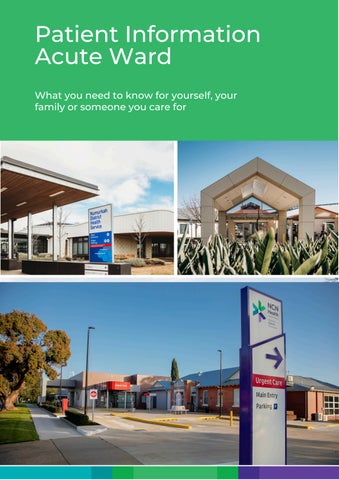
Patient Information Acute Ward What you need to know for yourself, your family or someone you care for
Welcome
Welcome to NCN Health, a small rural health service providing a range of health programs for our local community. This booklet will provide you with important information for before, during your stay and discharge from our health service. It is designed to help consumers, their families, carers and other support people get the most out of their health care. Being actively involved, and working in partnership with healthcare providers can help ensure you get the care that is right for you. You can use the information in this booklet when you talk to your doctors and healthcare providers, including nurses, pharmacists, specialists, allied health and mental health workers.
We hope you find this booklet useful, if you need any more information the staff will be happy to help.
Interpreters Please let us know if you need an interpreter. Printed information is available in many languages from the Department of Health website www.health.vic.gov.au. If you require copies please let us know and we will arrange this 2 for you.
Contents Page General Information Wayfinding Maps Fire and Emergency Response
Preparing for Admission Acute Ward information Health and Safety Hospital Admission Private Patients What to Bring What not to Bring Pharmacy and Medication Visiting Hours Meal Times Aboriginal Liaison Officers (ALO) Advocacy My Health Care Rights Feedback Advanced Care Directive Goals of Care
During Your Stay What to expect during your care Assessments Safe Patient Handling Clinical Handover Discharge Planning Communicating for Safety Comprehensive Care Preventing and Controlling Infections Blood Management Medication Safety
Leaving the Acute Ward What happens during hospital discharge Forms and Payments Health Information Privacy
3
Fire and Emergency Response If YOU or your visitors observe a fire or smoke, please alert the staff within the department immediately and follow their instructions. If you are alerted to an emergency via the audible alarm (you will hear - Siren - “Code Red” etc) please do the following: Stop what you are doing immediately Remain calm and remain where you are Staff will provide you with information Follow instructions exactly as given to you by the staff If you are directed to evacuate, leave personal belongings and proceed as instructed by the staff/CFA Officer People who need help to move will be given help by staff to evacuate NCN Health tests the fire and emergency equipment regularly. Any testing is announced just before the test.
7
Hospital Admissions
8
NCN Health Acute Wards NCN Health acute care services include; general medicine, recovery from surgeries including patients who have been transferred to one of our facilities closer to their home, following a surgery at a major health service and palliative care. Our acute services are supported by a range of staff across many disciplines, including GPs, registered and enrolled nursing staff, Rural and Isolated Practice Endorsed Registered Nurses (RIPRN nurses), allied health and support staff. NCN Health Nathalia is a 6-bed acute facility, Cobram is a 12- bed acute facility and Numurkah is a 16-bed acute facility with one shared room and 14 single rooms. Each room at NCN Health has a television and telephone for patients to use. WI-FI access is available on request. In the event of a child/ren admitted to Acute Ward under 12 years of age, it is desirable that a parent or carer (aged over 18 years) be in attendance throughout the child’s admission. A bed in the child’s room and meals will be made available.
Health and Safety NCN Health is committed to ensuring a healthy and safe environment for its staff, patients and visitors. Electronics: Any personal electrical items, for example; electric shavers, laptops, iPads etc, are to be electronically tested and tagged prior to use within the health service. Please advise the nursing staff on admission if you have any of these items so that testing can be arranged. Reporting a Hazard: If you observe a condition or activity that you believe has the potential to cause harm, please report this immediately to a staff member.
General Information Clergy: Clergy from different denominations can be contacted at any time by request. Please ask our staff. Smoke and Vape Free: Smoking or vaping is not allowed in any of the buildings or on the hospital grounds. It is illegal to smoke or vape within 4 meters of any doorway. Patients who smoke may speak to staff to discuss their needs and access support. We can also provide you with resources to stop or vaping.
9
Hospital Admission Admissions can sometimes be pre- arranged on a convenient date for doctors and patients, with priority being given to patients with more urgent conditions. Patients can be admitted through our Urgent Care Centre as an emergency (unplanned) admission if the treating doctor decides an admission is necessary, or the patient has been referred for admission from another doctor. The treating doctor will complete a patient history and examination prior to the patient being admitted.
Private Patients When being admitted to one of our facilities please consider using your private health cover. Patients who choose to use their private health insurance are a great help to NCN Health. This is because using your private health insurance means the insurer will contribute to the cost of your care. This means NCN Health has more resources to; Upgrade facilities and equipment Attract and retain services for the local community Maintain high standards of service. If you decide to to use your private insurance at NCN Health we guarantee you will not have any out of pocket expenses related to your admission. This does not include fees for any medicine you may require after leaving the hospital.
What to Bring Medications in original packaging, or a list of your usual medications Medicare or entitlement cards Day clothes Clean pyjamas Safe, well-fitting footwear Toiletries (toothpaste/brush, hair brush, shampoo / conditioner, moisturizer, deodorant, etc) Mobility Aids (if appropriate) Please make sure your personal items are labelled. NCN Health is not responsible for your personal items.
10
What not to Bring Large amounts of money Items of sentimental value Valuable jewellery, make up or nail polish. NCN Health will not take responsibility for items of value that patients bring to the health service.
Pharmacy and Medications Please bring your current medications, if possible, or a list of your medications on admission. Your medicines should be checked on arrival. Patients are asked to bring in their regular medications in the original boxes from home. These may be used in the hospital with your permission. If patients have multi- dose Webster Packs please get the original boxes from the pharmacy, where the medication was dispensed, and bring the boxes to the hospital. If patients decide to bring in their own medication, NCN Health requires the signing of the Medication Consent form. Newly prescribed medications are administered from the hospital supply if available. Discharge medications can be dispensed by the patient’s preferred pharmacy at normal Pharmaceutical Benefits Scheme (PBS) prices.
Visiting Hours
Nathalia
Visitors are welcome anytime, until 8pm each day, including public holidays. Visitors should phone ahead on (03) 5866 9444 if they need to visit outside of these hours.
Cobram
Visitors are welcome anytime, until 8pm each day, including public holidays. Visitors should phone ahead on (03) 5871 0777 if they need to visit outside of these hours.
Numurkah
Visitors are welcome between 11am and 8pm each day, including public holidays. Visitors should phone ahead on (03) 5862 0555 if they need to visit outside of these hours.
11
Meal Times Patients are encouraged to sit out of bed for meals if they are medically able to. Visitors are welcome to visit during mealtimes to encourage and assist patients to eat their meals. If having a visitor present during a meal disrupts the patient while they are eating, then visitors may be asked not to attend during mealtimes.
Meal Breakfast
(continental and cooked)
Morning Tea
(scone, cheese and biscuits, fruit, yoghurt and more)
Lunch
(cooked meal)
Afternoon Tea
(cheese and biscuits, fruit, yoghurt and more)
Dinner
(Soup, Cooked meal and dessert)
Supper
(cheese and biscuits, fruit, yoghurt and more)
Times 8:00 am
10:15 am
12:00 noon
2:15 pm
5:00 pm
7:00 pm
12
Are you of Aboriginal or Torres Strait Islander origin?
Why asking the question is important for you Why am I being asked this question? The question ‘Are you of Aboriginal or Torres Strait Islander origin?’ is one of the routine questions that we ask of everybody using our services. Whether you are a non-Indigenous person, an Aboriginal person, a Torres Strait Islander person, or both Aboriginal and Torres Strait Islander, your response is equally important. Information is important We have a responsibility to collect data from all our patients, so we can better understand how health issues for Indigenous Australians might be the same as, or different to, other Australians. It also helps the governments use data to plan for better health services.
Will I be treated differently depending on my answer? Different choices for different needs Some patients with more complex needs or at higher risk of certain health conditions - such as older patients, pregnant women, or Aboriginal and Torres Strait Islander patients - might be offered some different choices or provided with information. Support for any that need it We encourage you to ask questions, request information, and to talk with staff about any issues and concerns you may have. Some patients may require some additional support to do this, such as Aboriginal and Torres Strait Islander patients, or patients from different cultural backgrounds and language groups.
We cannot rely on appearances or assumptions The best way to get this information right is for us to ask and let you answer for yourself. It isn’t right for us to guess or make assumptions, we need you to tell us.
All our patients have the right to be treated fairly and with respect.
Because we care about our patients From the evidence we have, we know that many Aboriginal and Torres Strait Islander people are at greater risk of some health problems.
They can provide advocacy support by helping to understand medical procedures, routines and help to participate in decisions about their care. Including helping make arrangements for admission to hospital and discharge including transport and equipment.
We want to make sure Aboriginal and Torres Strait Islander patients have the option to access some of the services that can help to reduce these risks - such as health checks or immunisations.
February 2025
Aboriginal Liaison Officer (ALO) Support Aboriginal Liaison Officers can help our patients, clients, residents and their families during care.
They can also help link our patients to appropriate community support programs, agencies and services. The Aboriginal Liaison Officers (ALO's) are located at Goulburn Valley Health in the Minya Barmah room and are available from 8:30am to 5pm, Monday to Friday. They can be contacted on 03 5823 8659 or 03 5823 8658
Did you know NCN Health has access to Aboriginal Liaison Officers (ALO)? In partnership we are improving care for Aboriginal and Torres Strait Islander patients, clients and residents
What is an Aboriginal Liaison Officer (ALO)? Aboriginal Liaison Officers provide emotional, social and cultural support to Aboriginal and Torres Strait Islander patients and their families when they use our hospitals or are living in our residential aged care facilities.
How can an Aboriginal Liaison Officer (ALO) help?
Being in hospital can be a worrying time, with feelings of fear, sadness, home sickness and isolation; Goulburn Valley Aboriginal liaison Officers are available to help.
Aboriginal Liaison Officers can help our patients, clients, residents and their families during their care. They can provide advocacy support by help our consumers.
How do I contact an Aboriginal Liaison Officer?
They also provide information and support to NCN Health staff to help them provide culturally sensitive health services. ALOs can help make arrangements for admission to hospital and discharge including transport and equipment. They can also help link our consumers to appropriate community support programs, agencies and services. 'A little yarn goes a long way' ALO's can be available to consumers to yarn with.
NCN Health is working collaboratively with Goulburn Valley Health to provide Aboriginal Liaison Officers to people seeking such services to NCN Health. The Aboriginal Liaison Officers (ALO's) are located at Goulburn Valley Health in the Minya Barmah room and are available from 8:30am to 5pm Monday to Friday. They can be contacted on 03 5823 8659 or 03 5823 8658 Aboriginal Liaison Officers (ALO) service can be accessed via a referral pathway, this document is located on PROMPT.
Advocacy An advocate is someone you choose to have support you when accessing services. The aim is to protect you if you are not able to speak up for yourself or to help you receive equal rights. Not everyone needs or wants an advocate, but it is important to know it is an option for you.
Rights Information & Advocacy Centre 72 Wyndham Street Shepparton Victoria 3630 (03)5822 1944 www.riac.org.au
Advocates Can: Support you to speak out on your own behalf Speak for you to service providers and other groups Refer you to other services Ensure you are being listened to Provide information on rights.
Who can be an Advocate? Anyone can be an advocate. An advocate does not need to be an expert. They need to be able to listen and follow steps to resolve a complaint. They are not a legal representative and do not receive payment. An example is a good friend who you trust and will have your best interest at heart. The Older Persons Advocacy Network (OPAN) is funded to provide free, confidential and independent advocacy support to older people, their families and representatives across Australia. For more information, speak to the nursing staff or contact one of the services listed on the right of this page.
Senior Rights Victoria Level 4, 98 Elizabeth Street Melbourne Victoria 3000 1300 368 821 www.seniorsrights.org.au
Elders Rights Advocacy Level 2, 85 Queen Street Melbourne Victoria 3000 1800 700 600 www.era.asn.au
Office of the Public Advocate Level 5, 436 Lonsdale Street Melbourne Victoria 3000 1300 309 337 www.publicadvocate.vic.gov.au
15
Feedback (Concerns, Complaints and Suggestions) NCN Health is dedicated to providing quality care and service to our community. We appreciate all feedback about the services and care provided, including; compliments, complaints and suggestions. All feedback helps improve our service to you. All feedback including complaints are managed to ensure your confidentiality is maintained. You may choose to remain anonymous when providing feedback, however providing contact details allows us to discuss your feedback with you and advise you of the actions taken in response to your feedback.
Feedback can be given in the following ways; By speaking directly to the Nurse Unit Manager or relevant health care provider in your area. Paper copies of the consumer feedback form are available in each reception area, you can also download a printable copy from our website under Contact Us. By using the Electronic Feedback Hubs available in some receptions and waiting rooms, you may choose to be anonymous or leave your contact details so we can follow up with you.
Feedback can also be provided to the Feedback Officer via the following options:
Nathalia Complaints Officer NCN Health Nathalia 36-44 McDonell Street Nathalia Victoria 3638 T (03) 5866 9444 E: ncnhealth@ncnhealth.org.au
Cobram Complaints Officer NCN Health Cobram PO Box 252 Cobram, Victoria, 3644 T (03) 5871 0777 E: ncnhealth@ncnhealth.org.au
By scanning the Feedback QR Code displayed in most waiting
Numurkah
rooms and receptions. You may
Complaints Officer NCN Health Numurkah PO Box 128 Numurkah, Victoria, 3636 T: (03) 5862 0555 E:ncnhealth@ncnhealth.org.au
choose to be anonymous, or leave your contact details so we can follow up with you.
If you believe your concerns have not been addressed, you may contact: Health Complaints Commissioner Level 26, 570 Burke Street Melbourne Vic 3000
Phone: 1300 582 113 Email: hcc@hcc.vic.gov.au
17
Advance Care Directive What is an Advance Care Directive Advance Care Directive is for everyone. It is a way to let your family and doctors know how you want to be cared for if you become unable to make decisions. If you are sick or injured and cannot make your own decisions about treatment, your family may be asked to make decisions about your care such as;
What are the benefits of an Advance Care Directive? Peace of mind Makes things easier for your family Helps doctors and others who care for you to know what you want and what you do not want.
Resuscitation and life support
How do I do an Advance Care Directive?
High risk surgery Permanent tube feeding
There are four (4) key steps you can take now:
Hospital or nursing home admissions How can an Advance Care Directive help me? You can make these decisions ahead of time, or you can discuss and write down your preferences so these can be followed. When should I start an Advance Care Directive? Most people do not make good decisions during a time of stress. It is a good idea to plan when you are well and your health is stable. This gives you enough time to think clearly and talk about your preferences with your family and doctor.
Talk about your views and preferences with your family, doctor, carers and close friends. Appoint an Enduring Power of Attorney (medical) who can make health care decisions on your behalf if needed. Write down your views and preferences for your family and doctors in a document called an ‘Advance Care Directive’. Give copies of your Advance Care Directive to your family, doctor and hospital staff on admission.
18
What is a Substitute Decision Maker / Power of Attorney? A Substitute Decision Maker / Power of Attorney is a legal document where you can nominate a person to manage your medical or financial decisions. It is advised that this is completed
If you still need further information, staff will be available to discuss an Advance Care Directive with you during your admission, if you wish to take the Advance Care Directive Form home please discuss this with the staff.
before any acute medical illness or condition occurs. It may not be possible for this document to be attended to once you become unwell. You can get the forms to fill out an Enduring Power of
Website: www.publicadvocate.vic.gov.au Telephone: 1300 309 337
Attorney from the Office of the Public Advocate website. You can also speak with nursing staff or your medical officer for more information.
19
Goals of Care Goals of care describe what a patient wants to achieve during an episode of care, within the context of their clinical situation. Goals of care are the clinical and personal goals for that patient’s episode of care that are determined through a shared decision making process.
Identify goals of care when the patient is admitted The treating team works with the patient and family to identify goals of care Goals of care inform medical decision-making and limitations of medical treatment (resuscitation plan). Medical management aligns with the patient’s values and preferences from the point of admission. Revisit goals of care when: The patient is readmitted to hospital There are significant changes in the patient’s condition or circumstances The patient, substitute decision maker or family request it The patient, substitute decision maker or family expresses concerns.
About goals of care Active medical treatments and end of life care are not mutually exclusive Goals of care are reflected in the clinical treatment plan, limitations of medical treatment (resuscitation plan) and advance care planning. Goals of care guide treatment in times of crisis Crises often occur after hours. Without documented goals of care, clinicians who don’t know the patient are forced to make decisions in the heat of the moment and without the input of the patient or substitute decision maker.
20
During Your Stay in the Acute Ward
21
What to expect during your care During your stay there will be several staff who will care for you, this may include: Nursing staff Your doctor or the doctor providing after hours coverage Allied health professionals While you are here, a nurse will come and check on you on at least an hourly basis to address positioning, pain management, toileting, personal needs and to review your plan of care. If you are asleep, we will not wake you unless necessary. This is an important part of our patient safety process. If you need help outside these regular visits, simply press the call bell on the remote located on the side of your bed. Use this button to call for assistance whenever you feel you need help. For example; when you are getting out of bed, it is easy to slip and fall. If you feel weak or unfamiliar with the room, press the button to let us know you need assistance. Each day your care will be discussed with you and staff will ask the question “What matters to you today?” This is a good opportunity to tell us of any concerns or questions so we can address them.
Assessments Assessments are performed by hospital staff during your admission and your hospital stay. They are done to explore your medical, physical and well-being needs. Assessments help to find the cause of your illness and check your ability to do ‘day to day’ tasks. Assessment help to keep you safe by identifying areas of potential risk or deterioration in your health. They are particularly valuable for older people, who may decline more rapidly when they are admitted to hospital. During your assessment, it is essential you let your doctor and nursing staff know if you have an implantable device. Please bring any information about the device to hospital with you. Implantable devices may include; pacemakers, heart valves, neuro stimulators, medication pumps, lap bands or prostheses.
22
Safe Patient Handling On admission to the Acute Ward your ability to move yourself in bed, sit up, stand up and walk will be assessed. If you require assistance with any of these activities, the nursing staff will use devices that will aid your movement, making it more comfortable and safer while helping protect everyone from possible injury.
23
Clinical Handover Patients in hospital receive 24-hour nursing care. In the Acute Ward there are three shifts each day: morning, afternoon and night. It is essential that each nurse involved in your care has up to date information about your health, treatment and discharge plan. Communication of this information occurs at the end of each shift through ‘clinical handover’. What is bedside clinical handover? Bedside clinical handover is the sharing of clinical information about you between you, your nurse and the person who will be taking over your care. Performing the handover at your bedside allows the nurse to include you in the discussion and to ensure continuity in your care. What happens during the handover? We aim to perform handover with minimal disruption. Visitors and those visiting others in your room may be asked to leave while personal information about you is discussed. Parents, carers and family members can stay during your handover if you choose. During handover you will be introduced to your nurse for the next shift. Information shared during handover may include:
Your medical history and current clinical condition. Tests and procedures that you have had or that are scheduled. Your need for assistance with everyday tasks such as showering and toileting. Plans for your discharge, even if it is a few days away. The nurses will review your medical charts together and check any drips or drains that you may have. You may be asked to comment on the information discussed. Nurses will use discretion when discussing sensitive information Your involvement in the care planning process.
Questions you can ask during clinical handover: Can you explain to me what treatment I need now, and in the future? When are my follow up appointments? Will I be given a Discharge Plan? Will you send my Discharge Plan to my GP? Do I need care from family members? If so, has there been a family meeting, and does everyone understand their roles and responsibilities?
24
Clinical Handover Other services provided by NCN Health that you may be referred to include: Community Midwife Diabetes Education Social Support and Counselling District Nursing Cardiac Rehabilitation Pulmonary Rehabilitation Home and Community Care Support At Home National Disability Insurance Scheme (NDIS) Podiatry and Footcare Occupational Therapy Palliative Care
Discharge Planning Planning ahead can make your transition from hospital seamless and safe. Your care team will start discussing your goals and planning your discharge with you and your family from the time you are admitted to the Acute Ward. We encourage participation and involvement from patients and family members when coordinating discharge planning. Where possible, we will help you with planning your support needs from community service agencies. Discharge times are usually planned for between 10.30am - 1 1.30am.
Specialist Doctors Physiotherapy Dietitian Transitional Care Program
25
Communicating for Safety Consumer Communication Board
•
Be involved in all aspects of your care.
•
In your room you will have a care board. The care board is updated each nursing shift to help you and everyone involved in your care remain informed regarding your daily plan of care. This includes any tests or conditions we are monitoring that day. Patients and their families are encouraged to also update and change the board.
•
Be involved in planning for services you may require when you go home.
You can assist staff to provide better care by informing staff about your preferences, usual abilities and routines. All patients are encouraged to be involved in decisions about their treatment and care. Staff will provide information to help you do this.
Staff will:
•
•
What can you do when you are in hospital? •
•
During your stay, you may be connected to a heart monitor, intravenous pump and other equipment. These devices are all monitored at all times. You may hear beeps or sounds from the medical equipment in your room or in the hall. Please ask if you would like us to explain any sounds to you. Ask questions at any time to help you understand your care and treatment.
Patient Identification When you are admitted to the Acute Ward an identification band will be attached to your wrist or ankle. The ID band will include your name, date of birth, address and your GP.
• Check your personal details are correct • Ask if you have any allergies. If you do you will receive a red band. The identification band alerts all staff of your allergy. What can you do when you are in hospital? •
Check your details and let us know if any of your personal information is wrong
•
If you have an allergy and do not receive a red band please let the nursing staff know as soon as possible
•
Do not remove your ID bands during your stay If your ID band becomes hard to read, please ask for a new band.
•
26
Communication Board Consumer Fact Sheet The Consumer Communication Board helps you, your loved ones and your healthcare team stay connected and informed during you stay in hospital. It is updated as things change as well as at every shift change. The board is not there to replace talking with staff or your clinical record. Using the board is your choice - and you can change your mind at any time.
Your Privacy Only your preferred first name is written No private medical details (like what’s wrong with you) are included If you choose not to use the staff will write “NOT IN USE” Staff will always consult with you when writing on the board
Who updates it? Staff will ask your consent on admission and update the board with your details Staff will update the board when things change or at the start of every shift Doctors and other staff such as your physio may add information You and your family can update as you think of questions or things you want to remember
Tips for using the Board! What matters to me: Your goals, preferences and what’s important to you! Examples: “I want to get home to water my plants” “I really want to watch the footy on Friday night” “Please help me with my menu, it is so confusing” “Today I want to focus on walking an extra 50 metres” “I am worried about my dog at home alone - who will feed him?” Reminders/Communication: This can be anything you want to include! Examples: Please bring in my reading glasses I need some shampoo brought in Ask the doctor what the new medication is I started
Your voice is important!!
Still Worried? Call REACH Still Worried? Cobram: 0459 895 214 Call REACH Nathalia: 0419 554 083 Numurkah: 0418 502 168 Cobram: 0459 895 214 Nathalia: 0419 554 083 Numurkah: 0418 502 168
Dementia
Delirium
Dementia is a collection of symptoms caused by disorders affecting the brain and is not one specific disease. The early signs of dementia are very subtle and vague and may not be very obvious. Some of the common signs of dementia include memory loss, confusion, unable to do daily tasks etc. You can contact National Dementia Helpline on 1800 100 500 if you have any questions regarding Dementia.
Delirium is a serious disturbance in mental abilities that results in confused thinking and reduced awareness of the environment. It can be caused by many reasons including infection, fever, intoxication etc. If you are concerned about yourself or your loved one having any signs of dementia or delirium, please talk to your nurse or treating doctor.
29
Delirium
A guide for consumers and families of NCN Health
What is delirium? Delirium isa temporarystate of confusion which cause’s a person’s mind to become clouded and makes it hard to pay attention and focus thoughts. Delirium is common in hospital patients. Delirium develops quickly over hours or days and can last a few days or weeks. This is different from dementia which has a gradual onset and is a lasting condition. Delirium can slow the recovery process and can lead to serious complications and longer stays in hospital.
What causes delirium?
Who is at risk?
Therearemanydifferentcausesof delirium including: infections side effects of medications Suddenly stopping of drugs or alcohol major surgery dehydration pain constipa tion any serious illness
Anyone in hospital is at risk of delirium but especially people who: are older have a serious illness have dementia or depression need help with activities like showering, walking or going to the toilet have poor eyesight or hearing do not eat or drink a lot take multiple medications have had delirium before
What are the symptoms?
People with delirium may: have changes in their sleeping patterns feel fearful, upset, angry or sad see things that are not there worry that other people are trying to harm them
be different than theirnormalself be forgetful and confused be agitated or sleepy be unsure of the time of day or where they are
How can I help? bring in personal items like hearing aids, glasses, walking aids and familiar items have someone they know stay with them identify yourself by name and remind them where they are let them know the time of day &
open the curtains in the daytime
assist staff to complete the patient’s “About me” information of their communiction board watch the news or favourite show with them to connect to the outside world Help them to sit out of bed or go for a walk if safe to do so
If you are concerned about your loved one REACH out to your nurse
Comprehensive Care Preventing Falls What can you do before being admitted? • • •
Bring a walking aid, glasses and hearing aids if you use them. Bring comfortable clothing that is not too long, too loose or too tight. Bring comfortable, well fitting, flat, non-slip shoes or slippers.
Staff will help you to stop falling by: • • • •
Assessing your risk of falling and discuss the results with you Developing a falls prevention care plan suited to your needs Refer you to other staff who specialise in different areas Organise visits by Occupational Therapists or Physiotherapists to your home before or after discharge, to help make your home safer, or to suggest changes to it or equipment to help you move safely.
What can you do when you are in hospital? • • • • • •
Wear the hospital non-slip socks if provided. Wear laced up or snug fitting shoes or slippers with rubber soles. Use your usual walking aids and if you need any assistance, tell us. Don’t rush – take your time. Get your balance before moving away from the bed or chair. Be careful walking around in the dark, especially going to the toilet at night.
31
Comprehensive Care Preventing Pressure Ulcers What can you do before being admitted? • • • •
Keep your skin clean and dry. Avoid any products that dry out your skin. Apply moisturizer to dry skin. Protect bony areas like your ankles, shoulder blades or elbows. Avoid anything that causes friction or shearing (pulling)
Staff will: • • •
Encourage and assist you to change positions frequently Provide you with a special mattress or cushion for support Encourage you to look at your skin daily and let the nurse know about any change you see.
What can you do when you are in hospital? • • • •
Call us if you are uncomfortable. Sit out of bed rather than sitting up in bed. Move as frequently as possible. Even small changes in how you sit or lie makes a difference. Walk around the ward every few hours if you can.
32
Preventing and Controlling Infections Hand hygiene is an important factor in reducing hospital acquired infections. Our hands may look clean but germs are invisible to our eyes. What can you do before being admitted? • • •
Use soap and water when hands are visibly dirty. Use alcohol-based hand rub when hands are visibly clean. Tell us if you have diarrhoea or vomiting.
Staff will perform the ‘Five Moments’ of hand hygiene: • Before touching a patient • Before clean / aseptic procedures • After body fluid exposure / risk • After touching a patient • After touching patient surroundings. How can you prevent infections? • • •
Wash hands regularly, or use an alcohol-based product to help stop the spread of infections. Wash your hands before and after visiting the toilet, and before all meals. Do not hesitate to ask our staff if they have washed their hands.
33
Blood Management Preventing Blood Clots What can you do before being admitted? • • • •
Drink plenty of fluids prior to admission. Participate in daily exercise. Bring comfortable clothing that is not too long, too loose or too tight. Bring comfortable, well fitting, flat, non-slip shoes or slippers.
Staff will help you to prevent blood clots by: • • •
Advising you to sit out of bed and mobilise frequently. If you are unable to get out of bed, move your legs frequently in bed and rotate your ankles at least hourly. Refer you to other staff who specialise in different areas.
What can you do when you are in hospital? • Wear the hospital stockings if you’ve been advised to. • Move as often as you can. This helps to keep the blood flowing in your leg veins. • Try to do simple leg and ankle exercises. • Drink fluids as recommended
34
Medication Safety Medications Doctors and nurses need to know about all the medicines you use so they can make the right decisions about your health. Medicines include prescription, over the counter, herbal and natural medicines, and come in different forms such as tablets, lotions and patches. What can you do before being admitted? •
Please bring your current medications in the original boxes from home, if possible, or a list of your medications on admission.
Staff will: • • •
Check your medication on arrival Explain what medications you are taking and why Provide you with the correct medication during your stay.
What can you do when you are in hospital? • • • • •
Tell us if you don’t understand what your medicines are for. Tell us if you have any allergies. Tell us if you do not feel well. Tell us if you think your condition has changed. Tell us if you think your medications have been missed.
35
Leaving the Acute Ward
What happens during hospital discharge? When you leave a hospital after treatment, you go through a process called hospital discharge. We will discharge you when you no longer need to receive inpatient care and can go home, or if we need to send you to another facility for treatment. After you leave the hospital, you will need to make sure to take care of yourself as instructed. This will help ensure you don’t need to come back into the hospital. During the discharge process, members of our team will provide you with the information you need to make this transition successfully. Our team should discuss the following with you: Your medical condition at the time of discharge. What kinds of follow-up care you will need, such as physiotherapy. What medications you need to take, including why, when, and how to take them, and possible side effects to watch for. How to dispose of medicines you no longer need to take. What medical equipment you will need, and how to get it. When and how you will receive test results. Instructions on food and drink, exercise, and activities to avoid. What you can expect at your new facility, if you’re not going home. Phone numbers to call if you have a question or problem. Days and times of your follow-up appointments, or information about how to make appointments.
37
Ask to have your family, carer and/or representative involved in discussions about your discharge from hospital.
Questions you can ask: • • • • •
•
Can you explain to me which treatment I need now - and in the future? When are my follow-up appointments? Will I be given a discharge plan? Will you send my discharge plan to my GP? Do I need care from family members? If so, has there been a family meeting? Does everyone understand their roles and responsibilities? Do I have transport arranged?
Leaving Hospital – Forms and Payments Patients admitted through NCN Health Urgent Care are admitted under the doctor on call. Your usual doctor may take over your care when available. NCN Health accounts can be paid at the front reception. All patients are responsible for the payment of their accounts, and any questions regarding accounts can be answered at front reception. Public patients have their medical costs, except for discharge medicines, covered by Medicare. Private patients can be admitted using their private health insurance. There will be no out of pocket expenses if you choose to
use your private health insurance. Further information is available on request. Compensable patients will be admitted under either Workcover or TAC. It is important that you provide your claim number on admission or pre-admission. Veteran’s Affairs patients should supply their DVA details on admission or pre-admission. Patients that are not registered with Medicare Australia may be required to pay the full fee for their stay at NCN Health. This applies to Urgent Care Centre and Acute Ward. If you are concerned about this issue please ask to speak to the Nurse Unit Manager.
38
Health Information Privacy Protecting patient privacy is something we value at NCN Health. Throughout the service patients, clients, residents and visitors are made aware of why their information is collected, used, and disclosed. Wherever possible, we will provide patients, residents and clients with choices about how their information is used and to whom it is disclosed. Confidentiality of health information is assured. Information is stored in a secure manner, both paper-based and electronically. We support, promote and comply with the 11 Health Privacy Principles.
Client information will only be used and disclosed for the purposes for which it was collected and be protected from misuse. The collection or sharing of information is limited to that which is necessary, rather than what may be useful in the future. We make every effort to be clear about the purposes for which information is being shared. We will also be open with patients, clients, residents, visitors, family members and other stakeholders about why information is being shared and with whom, what will happen to it, and how it may be accessed and corrected it if necessar y.
Use of Your Medical Records During your treatment doctors, nurses and other health care professionals will need to collect information about you. This information is important because it will assist in planning your treatment. Information relating to your health care may be shared with other health care professionals or other health care facilities where they are continuing with your care.
The information may also be used in reviews and audits, in which case all information remains confidential and is not identified. Your information cannot be released to any person(s) not involved in your continuing care unless your consent is obtained, or if it is required by law. All medical records remain the property of NCN Health.
39
Access to your Medical Records and Disclosure of your Information Your information can only be accessed and/or disclosed by your treatment team for the purpose of your ongoing care. It cannot be accessed by your relatives or friends without your consent. Your information may also be shared with external organisations as a requirement by law. If you have any concerns about your information being shared with other health care providers or services, please speak to a member of the health care team.
Freedom of Information Act 1982 People may have access to information held in their medical record through the Freedom of Information Act. All applications for information must be processed by the Freedom of Information Officer. These incur a request / application fee and may take up to 45 days to process.
Inquiries can to be made in person or in writing addressed to: Nathalia
Cobram
Numurkah
The Freedom of Information Officer NCN Health Nathalia 36-44 McDonell Street Nathalia Victoria 3638
The Freedom of Information Officer NCN Health Cobram PO Box 252 Cobram Victoria 3644
The Freedom of Information Officer NCN Health Numurkah PO Box 128 Numurkah Victoria 3636
40
Nathalia Campus 36-44 McDonell St, Nathalia VIC 3638 T (03) 5866 9444 E ncnhealth@ncnhealth.org.au Cobram Campus 24-32 Broadway St, Cobram VIC 3644 PO Box 252, Cobram VIC 3644 T (03) 5871 0777 E ncnhealth@ncnhealth.org.au Numurkah Campus 2 Katamatite Rd, Numurkah VIC 3636 PO Box 128, Numurkah VIC 3636 T (03) 5862 0555 E ncnhealth@ncnhealth.org.au