Employer-Sponsored Health Insurance: Already Poor Access Dwindles Further for Working Latino Families Background Access to affordable health insurance is a pressing concern for all Americans, but it is an especially urgent problem for Latinos.* Disparate access to employer-sponsored insurance (ESI) is one of the primary factors driving the high uninsurance rates in the Hispanic community. ESI is not available to many Latino families despite the robust Figure 1
presence of Hispanics in the workforce. Public safety-net programs, such as Medicaid and the Children’s Health Insurance Program (CHIP), give some help to low-and moderate-income Latino families without ESI, but millions more Latinos in working households simply do not have access to any affordable coverage.
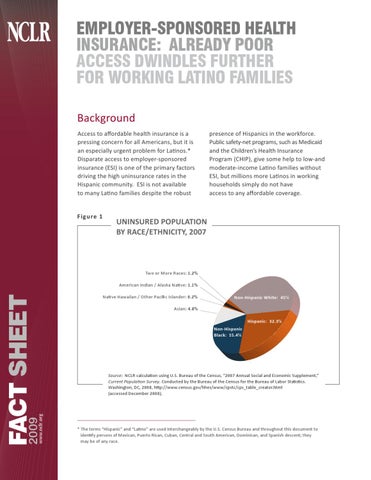
UNINSURED POPULATION BY RACE/ETHNICITY, 2007
65.6 Two or More Races: 1.2%
61.3
www.nclr.org
FACT SHEET 2009
American Indian / Alaska Native: 1.1% Native Hawaiian / Other Pacific Islander: 0.2%
Non-Hispanic White: 45%
Asian: 4.8% Hispanic: 32.3% Non-Hispanic Black: 15.4%
Source: NCLR calculation using U.S. Bureau of the Census, “2007 Annual Social and Economic Supplement,” Current Population Survey. Conducted by the Bureau of the Census for the Bureau of Labor Statistics. Washington, DC, 2008, http://www.census.gov/hhes/www/cpstc/cps_table_creator.html (accessed December 2008).
* The terms “Hispanic” and “Latino” are used interchangeably by the U.S. Census Bureau and throughout this document to identify persons of Mexican, Puerto Rican, Cuban, Central and South American, Dominican, and Spanish descent; they may be of any race.
EMPLOYER-SPONSORED HEALTH INSURANCE: ALREADY POOR ACCESS DWINDLES FURTHER FOR WORKING LATINO FAMILIES
Hispanics have a higher rate of uninsurance than any other ethnic group. 2
The Latino community has the highest uninsurance rates of any racial or ethnic group in the U.S.*
Foreign-born Latinos are less likely than U.S.-born Latinos to be insured.
• In 2007, 32.1% of Hispanics were uninsured for the full year, compared with 10.4% of non-Hispanic Whites and 19.3% of nonHispanic Blacks.¹
• While more than one-fifth (21.2%) of U.S.-born Hispanics were uninsured during 2007, about half (49.3%) of foreignborn Hispanics—including naturalized citizens—had no health coverage.⁴
• While approximately one in seven (15%) Americans is Latino, Latinos made up nearly one-third (32.3%) of the nation’s uninsured in 2007 (See Figure 1).² • Among nonelderly Hispanic adults (ages 18–64), 41.1% were uninsured in 2007. By comparison, 13.7% of non-Hispanic Whites and 25% of non-Hispanic Blacks in the same age group were uninsured.³
Figure 2
• Of the nation's 14.8 million uninsured Hispanics, 8.8 million (59.6%) were foreign-born. Of these foreign-born Hispanics, more than four in five (85%) were noncitizens; the remainder (15%) were naturalized citizens. (See Figure 2).⁵
UNINSURED HISPANIC POPULATION BY NATIVITY, 2007
U.S.-born: 40.4%
Foreign-born: 59.6%
Noncitizen: 85%
FACT SHEET 2009
Naturalized Citizens: 15%
Source: NCLR calculation using U.S. Bureau of the Census, “2007 Annual Social and Economic Supplement,” Current Population Survey. Conducted by the Bureau of the Census for the Bureau of Labor Statistics. Washington, DC, 2008, http://www.census.gov/hhes/www/cpstc/cps_table_creator.html (accessed December 2008).
* Estimates from the U.S. Bureau of the Census' Current Population Survey do not include the 3.9 million residents of Puerto Rico.
EMPLOYER-SPONSORED HEALTH INSURANCE: ALREADY POOR ACCESS DWINDLES FURTHER FOR WORKING LATINO FAMILIES
Hispanics are less likely than non-Hispanics to have employer-sponsored insurance coverage. 3
Hispanics are less likely than non-Hispanics to have health coverage offered to them through the workplace despite the fact that Hispanic workers have high workforce participation rates and are just as willing to purchase ESI as their peers. Hispanics are more likely to be actively employed (64.9%) than non-Hispanic Blacks (58.4%) and non-Hispanic Whites (63.8%), but they are generally concentrated in firms and industry sectors that are less likely to offer ESI to workers.⁶ When employers do offer ESI, Hispanic workers—both U.S.- and foreign-born—take up coverage at rates similar to non-Hispanic workers, even though Hispanic workers’ wages and incomes are lower on average than their peers’.⁷ With already limited access to health coverage, Latinos’ access to ESI is further hindered by recent overall declines in employer sponsorship. Latinos are less likely to be offered ESI than their non-Hispanic peers. • In 2007, only 40.3% of all Hispanics (workers and their families) had ESI coverage, compared with approximately two-thirds (61.2%) of non-Hispanic Whites and almost half (49%) of non-Hispanic Blacks (See Figure 3).⁸
FACT SHEET 2009
• Latinos are offered ESI less frequently than their non-Hispanic peers. One study found that in 2005, 65.9% of Hispanics worked for an employer that offered ESI coverage to its employees, compared with 85.9% of nonHispanic Black and 87.7% of non-Hispanic White workers.⁹ • The same study found that when ESI was offered, Hispanics were just as likely as
non-Hispanics to be eligible for the benefit and sign up for coverage.¹⁰ However, in 2005, a little more than half (54.0%) of Hispanic workers had ESI coverage, compared with 72.7% of non-Hispanic Black workers and 82.8% of non-Hispanic White workers.¹¹ • Latinos are less likely to be offered ESI across all industries. A Commonwealth Fund study (2001) found that in the agriculture sector, 64% of non-Hispanic Whites and 38% of Hispanics were offered ESI. The study also found that among construction workers, employers offered ESI to 67% of non-Hispanic White workers and 47% of Hispanic workers; in retail services, employers offered ESI to 77.1% of non-Hispanic Whites and 56.9% of Hispanics.¹² Hispanics are often underrepresented in industries that pay higher median wages. There is a gap in offerings between Whites and Hispanics in all industries, but it is noticeably reduced in industries that pay higher wages. In “professional services,” which generally include white-collar occupations, 79.3% of Hispanics and 88.1% of Whites were offered ESI. In government agencies, 93% of Hispanic and 96.4% of White workers were offered ESI.¹³ • The gap in ESI offerings is even wider for foreign-born Latino workers. The Commonwealth Fund found that, overall, employers offered ESI to 80.9% of U.S.-born Hispanic workers, 75.3% of naturalized citizen Hispanic workers, and 49.9% of noncitizen Hispanic workers. When offered and eligible, noncitizen Hispanics signed up for coverage at rates comparable to citizens of all races and ethnicities.¹⁴
EMPLOYER-SPONSORED HEALTH INSURANCE: ALREADY POOR ACCESS DWINDLES FURTHER FOR WORKING LATINO FAMILIES
Figure 3
PERCENTAGE OF INDIVIDUALS WITH ESI COVERAGE BY RACE/ETHNICITY, 2007
70%
4
60% 50%
65.6%
40%
61.3% 49.5%
30%
40.3%
20% 0 10% 10% 0 20% 30%
Non-Hispanic Non-Hispanic White Black
Hispanic
Asian
40%
FACT SHEET 2009
50% Source: NCLR calculation using U.S. Bureau of the Census, “2007 Annual Social and Economic Supplement,” Current 60% Population Survey. Conducted by the Bureau of the Census for the Bureau of Labor Statistics. Washington, DC, 2008, http://www.census.gov/hhes/www/cpstc/cps_table_creator.html (accessed December 2008). 70%
Foreign-born Hispanics represent 7.6% of the total workforce and half of all foreign-born workers; however, they are least likely to be covered by employer-sponsored insurance.
Nationwide declines in employer-sponsored coverage are affecting Hispanic workers more than non-Hispanics workers.
• Foreign-born Hispanics were less likely than their U.S.-born peers to have ESI despite the fact that they were more likely to be employed (71.3% and 66%, respectively).¹⁵ While 45.4% of Hispanic natives had employer coverage in 2007, only 31.9% of foreign-born Hispanics had ESI.¹⁶
• There has been a general decline of ESI over the past several years. In 2000, 69% of U.S. employers offered health insurance; this proportion had dropped to 61% by 2006.¹⁸
• Among foreign-born Latinos, naturalized citizens were twice as likely as noncitizens to have ESI. Nearly half (47.9%) of Hispanic naturalized citizens had ESI, compared with approximately one-quarter (26.1%) of Hispanic noncitizens.¹⁷
• This erosion has disproportionately impacted Hispanics. One analysis found that between 2001 and 2005, the proportion of overall workers whose employers offered ESI dropped by 2.3%. The decline for Hispanic workers was 4.4%, nearly two and a half times the decline for non-Hispanic White workers (1.8%) and about three and a half times the decline for non-Hispanic Black workers (1.2%).¹⁹
EMPLOYER-SPONSORED HEALTH INSURANCE: ALREADY POOR ACCESS DWINDLES FURTHER FOR WORKING LATINO FAMILIES
Latino Children and Health Coverage
5
The high rate of uninsurance among Latino children is largely connected to their families’ poor access to the traditional employer-based health coverage system. Compared with non-Latino children, a much smaller proportion of Latino children have coverage through ESI, leaving millions of low-
and moderate-income Hispanic families to rely on public safety-net programs or accept the risks of going without health insurance. The high uninsurance rate for Latino children is a problem that will persist as long as their working parents continue to have disparate access to employer-based coverage.
Latino Children are much less likely to have employer-based coverage than their non-Hispanic peers. • Only 37.9% of Hispanic children were covered by employer-based health insurance in 2007, compared with 45.6% of non-Hispanic Black children and 71% of non-Hispanic White children.²⁰ • An Urban Institute study of low-income working families—defined as families living under 200% of the federal poverty level (FPL)
with at least one family member in the workforce—found that Hispanic ethnicity was a significant predictor of children’s access to ESI. Researchers found that 53.1% of low-income working families had access to ESI, but only 41.4% of Hispanic families had access to health coverage through their employers.²¹
Conclusion: Latinos have inadequate access to employer-sponsored insurance.
FACT SHEET 2009
Many Americans rely heavily on employer-based health coverage to access the most affordable care. Millions of Latinos are not able to obtain employer-sponsored coverage, however, and few alternatives are available. Purchasing insurance through the nongroup market is beyond the financial means of even moderateincome households, and public insurance programs are designed to cover only certain populations of poor people, such as children and the disabled.
As a result, nearly 15 million Hispanics— including 3.2 million children and 7 million adults working full-time jobs—are going without health coverage, which has serious implications for the health and well-being of the Latino community. If the Hispanic population, the largest minority group in the United States, continues to increase in size while ESI offerings decrease, the nation as a whole will find itself in more dire circumstances than it does today.
EMPLOYER-SPONSORED HEALTH INSURANCE: ALREADY POOR ACCESS DWINDLES FURTHER FOR WORKING LATINO FAMILIES
Endnotes 1. NCLR calculation using U.S. Bureau of the Census, “2007 Annual Social and Economic Supplement,” Current Population Survey. Conducted by the Bureau of the Census for the Bureau of Labor Statistics. Washington, DC, 2008, http:// www.census.gov/hhes/www/cpstc/cps_table_creator.html (accessed December 2008).
6
2. Ibid. 3. Ibid. 4. Ibid. 5. Ibid. 6. U.S. Department of Labor, Bureau of Labor Statistics, Current Population Survey. Table 3. Employment status of the civilian noninstitutional population by age, sex, and race; Table 4. Employment status of the Hispanic or Latino population by age and sex, Annual Averages 2007.
13. Ibid. 14. Ibid. The authors found that, when offered and eligible for ESI coverage, 87.4% of White workers, 87.0% of Black workers, and 85.7% of Hispanic workers took up coverage. Of the Hispanic workers, 86.6% of U.S.-born workers, 89.8% of naturalized citizen workers, and 81.4% of noncitizen workers took up coverage when offered. 15. U.S. Department of Labor, Foreign-born Workers: Labor Force Characteristics 2007 Annual Averages, Table 1, Employment Status of Foreign-born and Native-born Populations by Selected Characteristics, 2006-2007 Annual Averages. Conducted by the Bureau of the Census for the Bureau of labor Statistics. Washington, DC: Government Printing Office, 2007. 16. U. S. Bureau of the Census, "2007 Annual Social and Economic Supplement." 17. Ibid.
7. In 2007, half (50.6%) of all Hispanics’ households incomes fell under 200% of the federal poverty level, a threshold that policymakers often use to define low-income families, compared with slightly less than one-quarter (22.8%) of Whites. NCLR calculated these figures using U.S. Bureau of the Census, "2007 Annual Social and Economic Supplement." 8. Ibid. 9. Lisa Clemans-Cope and Bowen Garrett, Changes in Employer-Sponsored Health Insurance Sponsorship, Eligibility, and Participation: 2001 to 2005 (Washington, DC: Kaiser Commission on Medicaid and the Uninsured, December 2006). 10. Ibid. In 2005, 93.6% of non-Hispanic White, 92.9% of nonHispanic Black, and 92.6% of Hispanic workers whose firms offered ESI were eligible for the benefit. That year, 83.9% of Whites, 82.8% of Blacks, and 78.7% of Hispanics took up coverage when offered and eligible.
FACT SHEET 2009
11. Ibid. 12. Claudia L. Shur and Jacob Feldman, Running in Place: How Job Characteristics, Immigrant Status, and Family Structure Keep Hispanics Uninsured (Washington, DC: The Commonwealth Fund, 2001, http://www.cmwf.org/usr_ doc/schur_running_453.pdf (accessed December 2008).
18. Kaiser Family Foundation and Health Research and Educational Trust, Employer Health Benefits Annual Survey: 2007, http://www.kff.org/insurance/7527/upload/7527.pdf (accessed December 2008). 19. Clemens-Cope and Garrett, Changes in Employer-Sponsored Health Insurance. As a result of declines in sponsorship, eligibility, and take-up between 2001 and 2005, the share of Hispanic workers with ESI coverage dropped by 6.4%, compared with 6.3% of Black workers and 2.6% of White workers. Changes in employer sponsorship resulted in 3.3% decrease in Hispanic workers’ ESI coverage, a larger share than Black (1.0%) and White (1.4%) workers. Worker take-up explained most of the remaining change (-2.6%) in Hispanic workers’ ESI coverage. 20. NCLR calculation using data from U.S. Bureau of the Census, "2007 Annual Social and Economic Supplement." 21. Lisa Clemens-Cope, et. al, Access to Employer-Sponsored Health Insurance Among Low-Income Families: Who Has Access and Who Doesn’t? (Washington, DC: The Urban Institute, 2007), http://www.urban.org/UploadedPDF/ 411533_fringe_benefits.pdf (accessed December 2008).