NCLR
NATIONAL COUNCIL OF LA RAZA
FAC T S H E E T
2006
Key Facts on Food Insecurity and Hunger Among Latino Children Despite the abundance of resources within the United States, it is difficult for many Americans to put food on the table. More than 13.4 million households in the United States are food insecure, meaning that more than one in ten families does not have adequate access to nutritious food. Further, nearly one in five U.S. children (19.0%) are food insecure. Latino families face disproportionate levels of food insecurity and hunger, threatening their
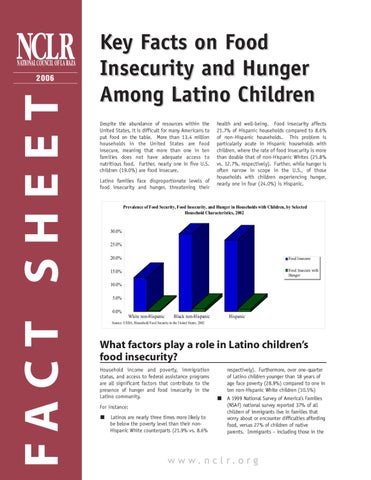
health and well-being. Food insecurity affects 21.7% of Hispanic households compared to 8.6% of non-Hispanic households. This problem is particularly acute in Hispanic households with children, where the rate of food insecurity is more than double that of non-Hispanic Whites (25.8% vs. 12.7%, respectively). Further, while hunger is often narrow in scope in the U.S., of those households with children experiencing hunger, nearly one in four (24.0%) is Hispanic.
Prevalence of Food Security, Food Insecurity, and Hunger in Households with Children, by Selected Household Characteristics, 2002
30.0% 25.0% 20.0%
Food Insecure
15.0%
Food Insecure with Hunger
10.0% 5.0% 0.0% White non-Hispanic
Black non-Hispanic
Hispanic
Source: USDA, Household Food Security in the United States, 2002
What factors play a role in Latino children’s food insecurity? Household income and poverty, immigration status, and access to federal assistance programs are all significant factors that contribute to the presence of hunger and food insecurity in the Latino community. For instance: ■
Latinos are nearly three times more likely to be below the poverty level than their nonHispanic White counterparts (21.9% vs. 8.6%
respectively). Furthermore, over one-quarter of Latino children younger than 18 years of age face poverty (28.9%) compared to one in ten non-Hispanic White children (10.5%) ■
A 1999 National Survey of America’s Families (NSAF) national survey reported 37% of all children of immigrants live in families that worry about or encounter difficulties affording food, versus 27% of children of native parents. Immigrants – including those in the
w w w. n c l r. o r g
F a c t
S h e e t
■
United States legally – face numerous restrictions to food stamps and other federal safety-net services, due to measures that were passed under welfare reform in 1996. ■
A Wake Forest University Baptist Medical Center study of food security among Latino migrant and seasonal farm workers in North Carolina concluded that more than 47% could not afford enough food for their families and 15% have to resort to measures such as cutting the size of their child’s meals or not eating for an entire day.
■
H e a l t h
The Children’s Nutrition Assessment Project (C-SNAP) found that Latino infants and toddlers whose family food stamp benefit was sanctioned were more than twice as likely to be food insecure than those whose family benefit was not sanctioned. Further, Latino infants and toddlers whose families were potentially eligible but did not receive access to the Special Supplemental Women, Infants, and Children’s program (WIC) were more likely to have a lower weight and be shorter in height than Latino infants and toddlers who received WIC.
What are the consequences of hunger and food insecurity? People who experience hunger are at increased risk of anxiety, depression, chronic illness, reduced immune function, iron deficiency, and abnormal growth. In addition, homes with food insecurity often rely on more high-fat, high-calorie ‘convenient’ and cheaper foods with less nutritional value to meet caloric intake, putting them at higher risk of being overweight or obese, as well as malnourished.
■
Poor nutrition leading to sickness and lowered cognitive development affects children’s ability to succeed in school and perform daily activities.
■
Further, more sicknesses increase absenteeism, which is directly related to academic performance and can also have an impact on state funding for schools and thus limit their ability to provide services.
In particular, children need proper nourishment to develop and grow and stay healthy; however, having inadequate access to food impedes their growth both physically and mentally, weakening their ability to fight diseases and infections and limiting and slowing brain development. Being affected at an early age can last a lifetime.
The negative health outcomes associated with hunger and food insecurity in children, raise significant concerns for the future well-being and economic security of our country. In particular, because Latino children are the fastest growing racial and ethnic group of children, it is alarming that food insecurity and hunger are commonly found within many Latino homes. Further, the higher health risks, effects on mental and behavioral function, and developmental issues that result from poor nutrition will make it more difficult for children to achieve their full potential, widening education gaps and inhibiting their chances to succeed later in life.
■
Food insecurities and hunger can limit cognitive development and overall learning potential and is associated with behavior problems, especially among young children.
Definitions Food Insecurity occurs when access to nutritionally adequate and safe foods is either limited or uncertain, or the ability to obtain foods occurs in socially unacceptable ways. Hunger
is the painful or uneasy sensation caused by a recurrent or involuntary lack of food. Over time, hunger may result in malnutrition, but often food insecurity and hunger occur without the visible signs of stark malnutrition often associated with impoverished nations.
Mild malnutrition occurs when intake of either energy or specific nutrients is less than the recommended daily allowance; it is associated with suboptimal growth, and/or changes in metabolism, but does not lead to significant wasting.
Sources:
Childhood Hunger, Childhood Obesity: An Examination of the Paradox, Center on Hunger and Poverty, Tufts University.
For more information on hunger in the Latino community, please contact Emilia Gianfortoni, Assistant Project Coordinator, or Jennifer Ng’andu, Health Policy Analyst, at (202) 785-1760.
NCLR
■
Page 2