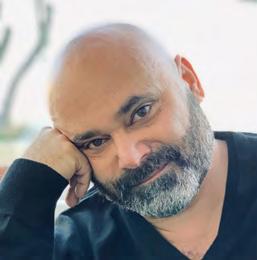
Dr. Merrin Guice Gill is the Director of Choral Activities at Bethel University. Her choirs have received international awards including first and second prizes in the Riva Del Garda International Choral Competition, Silver Medal at the World Choir Games, and as finalists in the American Prize for Choral Performance. She is an accomplished soprano in opera and new music, frequent guest clinician, and scholar whose research has been presented widely. With NCCO, she has served on the National Board, published in The Choral Scholar, and presented “Feldenkrais Method and Mental Health in the Choral Room” at the 2023 National Conference.
Jonathan Talberg PRESIDENT-ELECT
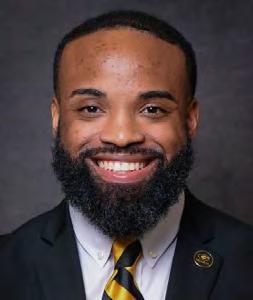
Dr. Jonathan Talberg is the Director of Choral Studies at California State University, Long Beach, where he conducts the internationally acclaimed Bob Cole Chamber Choir. His ensembles have appeared at three NCCO Conferences, multiple Western regional and national ACDA conventions, and won numerous first-place awards at international competitions. A devoted mentor to emerging conductors and educators, Dr. Talberg’s teaching has shaped a generation of collegiate choral artists. He is invited frequently as a guest conductor and clinician, and CSULB alums hold significant positions nationwide. He is committed to advancing artistic and scholarly excellence, equity, and collaboration in higher education, which reflects the values and mission that define and guide the National Collegiate Choral Organization.
Hana Cai VICE PRESIDENT
I currently serve as the Associate Director of Choral Activities at Harvard University, where I conduct the Radcliffe Choral Society and co-conduct the Harvard–Radcliffe Collegium Musicum alongside my colleague, Andy Clark. Before joining Harvard, I held faculty appointments at Lehigh University and Ithaca College. I gave a presentation at NCCO10 on breaking down the choral hierarchy and cultivating the morale of treble choirs and am serving as a National Board member for the Eastern Division. In that capacity, I was on the adjudication panels for the conducting masterclass and scores for NCCO11. My Mandarin diction guide for choral conductors and singers is published in The Choral Scholar & American Choral Review
Jenny Bent TREASURER
Dr. Jenny Bent is Director of Choral and Voice Activities at Sonoma State University and Choral Director of the Santa Rosa Symphony. Dr. Bent’s contributions to the field of choral music have been recognized through accolades including the 2019 CMEA Bay Section Outstanding Choral Educator Award and the 2023 CMEA Pearson/Scott Foresman/Silver Burdett Choral Educator Award. The San Francisco Classical Voice described her symphony chorus as “superb” with “excellent diction and well-controlled dynamics,” and her ensemble SonoVoce performed at the 2023 California All State Music Education Conference. Dr. Bent is currently Repertoire & Resources Collegiate Choirs Coordinator for National ACDA and Western Region Representative for NCCO. From 2007 to 2014, Dr. Bent enjoyed hosting The Choir Loft on the Sonoma County NPR affiliate, KRCB-FM. She holds degrees from Boston University and the University of Illinois at Urbana-Champaign.
Cordara Harper SECRETARY
Dr. Cordara Harper is a native of Cove City, North Carolina, the Director of Choral Activities, Voice Area Coordinator, and Assistant Professor of Music Education at Grambling State University. Harper is an international presenter and acclaimed versatile musician active as a music educator, choral conductor, instructional leader, and vocal musician. Dr. Harper completed a Ph.D. in Music Education with a cognate in Choral Conducting at the University of Memphis.
Angelica Dunsavage
CHIEF EDITOR OF PUBLICATIONS
Dr. Angelica Dunsavage (she/they) serves as Artistic Director for the Phoenix Girls Chorus and Valley Women’s Ensembles in Phoenix, AZ. She has previously taught at the K-12 and university levels in Ohio, Arizona, Washington, and Tennessee. She received her DMA in Choral Conducting and Music Education from University of Arizona. Dr. Dunsavage currently serves as Chief Editor of Publications for the National Collegiate Choral Organization. She has presented posters and interest sessions for ACDA, NCCO, NAfME and College Music Society conferences. She remains in demand as a clinician, composer/ arranger, vocal teacher, professional chorister, and mezzo-soprano soloist. Her primary research interests are early secular music and Alexander Technique.
Naming and Legacy
Angelica Dunsavage
“Legacy is not leaving something for people. It’s leaving something in people.”
—Peter Strople
The choral field is one built on legacy. Choral giants who have come before us have paved the way for our views on gesture, pedagogy, and repertoire. Each of us has the name and face of a mentor that has shaped our perspective on the profession. This edition of The Choral Scholar and American Choral Review highlights the profound effect of legacy, tradition, and naming.
scholars. In this framework, we are excited to announce the following changes to our submission guidelines present on our website, https://nccousa.org/publications/the-choral-scholar-americanchoral-review:
Our second feature article, Singing Together, Worlds Apart: Participation, Classification, and the Case for African Choral Music, delves in-depth into the importance and problems of labeling African choral traditions in a similar manner to Western classical traditions. Is the term art music for these works accurate? Is it even necessary? Does it fully represent of tradition of the works and their social performance practice? Read Alfred Patrick Addaquay’s thoughtful article to learn more!
writing, and podcasts. If you have an idea to share, or want to get involved, please see our website or email editor@ncco-usa.org
• Peer-reviewed articles will remain a feature of this publication. Authors who wish to submit completed articles for peer review are encouraged to do so but will have the option for additional feedback from an Editorial Mentor if requested.
• Submissions are now open for article ideas and works in progress. We would like to hear from a growing number of authors, particularly those who may have been uninspired to submit an article, and commit to guiding groundbreaking ideas into publication.
• The Choral Scholar will be expanding to include new methods of scholarship, including interviews, videos, creative
Our first feature article by Andrew Bruhn highlights the rich legacy of America’s first DMA program in choral conducting, University of Illinois Urbana-Champaign. Bruhn identifies UIUC’s choral leaders through the years, finding throughlines of pedagogy and purpose that serve as a model for other institutions since its founding. In Score and Recording Reviews, the University of Arizona choral graduate program, led by Elizabeth Schauer, shares its legacy of research in under-represented choral composers and compositions. Students from Arizona’s masters and DMA programs, as well as recent graduates, have contributed to this edition. This “program takeover” is one I hope to be the first of many, as The Choral Scholar can serve the NCCO community by providing an outlet for our graduate programs to engage in publication. If your program would like to participate in a similar project, please reach out!
The Choral Scholar and American Choral Review is a reflection of NCCO: it is our organization’s mission and vision put into the practice of research. As such, this edition challenges us to move forward into change. Patrick Freer’s article A Beloved Community reminds that there is much work to be done to align the choral field’s values with its research. Kirsten Hedegaard’s article Environmentalism through Choral Music highlights how choral music can be a message for social change. Nicholas Sienkiewicz combines psychology with musical analysis to unpack the emotional impact of Considering Matthew Shepard We hope that this publication continues to expand what is possible in choral scholarship and be the change we seek.
The Choral Scholar and American Choral Review is always looking for new ideas, writers, and creative expansions to our offerings. If you have a passion you wish to share, please reach out to us at editor@ncco-usa.org! If you are interested in submitting an article or becoming a review writer, please visit https://ncco-usa.org/publications/ the-choral-scholar-american-choral-review to view our submission guidelines.
Sincerely,
Sincerely,
Angelica Dunsavage Chief Editor of Publications
Angelica Dunsavage Chief Editor of Publications
Celebrating 65 Years: The University of Illinois Urbana–Champaign Graduate Choral Music Program, 1958–2023
Andrew Bruhn
In 1958, the University of Illinois Urbana–Champaign (UIUC) established the first Doctor of Musical Arts (DMA) degree in Choral Music in the United States.1 Since that time, the program has educated generations of conductors whose influence can be seen across collegiate, professional, and community choral institutions. Alumni of the program have gone on to lead major university choirs, professional ensembles, and national organizations, shaping choral music both in the United States and abroad. Despite this far-reaching influence, little published work exists that reflects on the program’s long-term impact and the values that have sustained it across more than six decades. This article examines the UIUC graduate choral program as a model of enduring institutional influence. Rather than offering a comprehensive history or promotional account, it interprets how the program’s guiding values have contributed to its longevity and relevance.
The UIUC choral legacy rests on three interconnected pillars: scholarship, leadership, and community. First, the program’s identity is grounded in a broad conception of scholarship that integrates historical, analytical, and performance-based inquiry. This focus is evident in the extensive body of scholarship the program
1 Marvin E. Latimer, “The Nation’s First DMA in Choral Music: History, Structure, and Pedagogical Implications,” Journal of Historical Research in Music Education 32, no. 1 (2010): 20, accessed March 28, 2020, https://doi. org/10.1177/153660061003200103
has produced, particularly through dissertations.2 Second, its leaders have consistently embodied the ideal of the conductor-scholar, shaping not only curriculum but institutional culture. Finally, the program’s alumni community extends Illinois’s influence far beyond campus, sustaining the program’s ethos across generations.
My aim is not only to document the Illinois model but also interpret how these values can serve as points of inspiration for choral educators seeking to build or sustain meaningful graduate choral programs. By reflecting on Illinois’s history, readers are invited to consider how intentional curricular design, leadership continuity, and community building contribute to lasting artistic impact.
Historical Foundations
The origins of the DMA in Choral Music at UIUC are thoroughly documented in Marvin Latimer’s dissertation on Harold Decker (1914–2003),
2 XXX, “The History of the University of Illinois UrbanaChampaign Graduate Choral Music Program, 1958–2023” (DMA diss., University of Illinois Urbana-Champaign, 2023), 125.
the program’s founder.3 Portions of that work appeared in Choral Journal in 2008 and remain an essential resource for understanding the program’s early development.4 Latimer attributes Decker’s success to a rare combination of institutional opportunity, personal vision, and an unwavering commitment to student growth. Building on Latimer’s work, this article focuses primarily on the program’s evolution after Decker’s retirement in 1981.
From its earliest years, UIUC demonstrated a progressive stance toward music education, particularly in its inclusion of women. Charlotte E. Patchin, hired in 1872 as the university’s first female faculty member, conducted a choir and taught piano, helping establish music as a serious academic discipline at Illinois. 5 Alice Putnam became the School of Music’s first graduate in 1897. Although women were active in music at UIUC early on, the DMA Choral Music program itself remained male-dominated until Sylvia Ross became its first female graduate in 1972—a milestone that opened the door for future leaders such as Ollie Watts Davis, Ann Howard Jones, and Andrea Solya.6
The DMA Choral Music program was conceived not merely as professional training in conducting technique, but as an academically rigorous degree grounded in historical understanding. The initial mission of the program at UIUC, as Latimer states, was “to provide a terminal degree specifically suited to choral musicians and to improve the quality of choral performance at large.” 7 This
3 Marvin E. Latimer, Jr., “Harold A. Decker (1914–2003): American Choral Music Educator” (Ph.D. diss., University of Kansas), 2007.
4 Marvin Latimer, “Harold A. Decker (1914–2003): Ethics, Dedication, Musicianship, and ACDA Citizenship,” Choral Journal 48, no. 11 (2008): 42-59.
5 “University’s First Woman Teacher Dies in California,” Daily Illini (Champaign, IL), February 14, 1933.
6 XXX, “The History,” 126.
7 Latimer, “The Nation’s First,” 34.
philosophy resisted the pursuit of a singular choral “sound” and instead encouraged conductors to engage deeply with the historical, textual, and stylistic contexts of the repertoire they performed.8 Over time, this approach became a defining characteristic of the Illinois model.
Curricularly, this philosophy took shape through a required sequence of choral literature and conducting seminars organized by historical period. 9 Expanded to four semesters in the 1980s under Don V Moses, this structure aligned literature and conducting study in a way that reinforced stylistic literacy and interpretive responsibility. From my perspective, this alignment reflects one of Illinois’s most instructive contributions to graduate choral education: the belief that artistry deepens from sustained engagement with musical context rather than isolated technical training.
Admission to the DMA Choral Music degree assumed that students already possessed conducting experience, as many of the first students held high-profile positions in the field. 10 The residency requirement was therefore minimal, with students completing their coursework through a one-year residency at Illinois, followed by summer sessions. 11 This format allowed many students to take a sabbatical from their teaching positions to complete the program. Kenneth Jennings (DMA 1966) for example, a faculty member at St. Olaf College since 1953, was able to join the inaugural 1958 class despite his long-standing professional commitments. This design proved foundational to the program’s early reputation, positioning Illinois as a place where established
8 Chester Alwes, “A View from the Bridge: Reflections on the University of Illinois Choral Program,” Sonorities (Winter 2015): 19–25.
9 Alwes, “A View,” 22.
10 Alwes, “A View,” 21.
11 Alwes, “A View,” 22.
conductors could deepen their artistry while remaining active in the field.
The establishment of the Master of Music (MM) in Choral Music in 1972 further strengthened the program’s identity.12 Conceived as a preparatory pathway to the DMA, the MM degree created a cohesive graduate sequence that emphasized continuity and depth. This structure proved critical in cultivating a community of conductor-scholars who shared a common educational foundation.
Leadership as Legacy
Leadership continuity has played a central role in shaping the UIUC graduate choral program. Although this article focuses primarily on the Directors of Choral Activities (DCAs), it is important to recognize that leadership influence extended beyond individual tenures, shaping the program’s values, expectations, and institutional culture over time. The following table highlights UIUC’s leadership from the development of the graduate choral program to the present:
NAME YEARS SERVED
Harold Decker
Leonard Rumery
Louis Halsey
Ralph Woodward
Don V Moses
Ann Howard Jones
Fred Stoltzfus
Kristina Boerger
Andrew Megill
Andrea Solya
12 Latimer, “Harold,” 288.
NOTES
1957–1981
1981–1982
1982–1985
1985–1986
1986–1988
1988–1991
1991–2013
2013–2014
2014–2023
2023–Present
Interim
Interim, and the first DMA Choral Music graduate (1964)
Director of SoM (1988–1999)
Interim, and DMA (2000), MM (1992), and BME (1989)
Interim (2023-2024), DCA (2024-Present) and DMA (2010)
Harold Decker’s founding vision established the model of the conductor-scholar that continues to define the program. Like F. Melius Christiansen at St. Olaf College and John Finley Williamson at Westminster Choir College, Decker helped transform technically proficient conductors into reflective artists. His students, such as Kenneth Jennings and Joseph Flummerfelt, carried this philosophy into their own influential careers, reinforcing Illinois’s national reputation and demonstrating the generational reach of his approach.
Louis Halsey’s (b. 1929) appointment as DCA (1982–1985) marked a turning point in the program’s international visibility.13 As the first Illinois DCA with established international renown, Halsey brought a distinctly English choral perspective shaped by his work as a conductor, composer, and BBC producer. His emphasis on historical awareness and stylistic breadth aligned closely with Decker’s ideals, while his presence signaled the program’s growing global stature. Halsey’s tenure also introduced students to the rich traditions of English choral music, expanding the artistic breadth of the program Don V Moses (1936–2025) further strengthened the program’s academic profile. Moses served as DCA from 1986 to 1988 before assuming the role of Director of the UIUC School of Music from 1988 to 1999. As a scholar of Haydn, Moses articulated a philosophy that balanced scholarship and performance, describing their relationship as a “wonderful spiral.”14 His alignment of the conducting and literature sequences by historical period became one of the program’s most influential structural contributions, reinforcing Illinois’s commitment to developing conductor-scholars grounded in historical understanding.
Ann Howard Jones (b. 1943) served as DCA from 1988 to 1991, continuing the program’s lineage as a student of Don V Moses and bringing with her a deep artistic connection to Robert Shaw. At the time of her appointment, Jones was already working closely with Shaw as his assistant conductor, a relationship that elevated the program’s national visibility and affirmed its artistic stature. Her invitation for Shaw to conduct Bach’s St. John Passion at UIUC—performed in 1990 in Foellinger Great Hall and featuring Donald Nally as Pilate—solidified the program’s standing within the broader choral community.15 Although her tenure was brief, it marked the end of the rapid turnover that followed Harold Decker’s retirement and set the stage for the longterm leadership that would follow.
Fred Stoltzfus (b. 1944) served as DCA from 1991 to 2013, the longest tenure since Harold Decker, and his leadership defined a new era of stability and artistic growth for the program. A student of Don V Moses, Stoltzfus embraced a philosophy centered on broad repertoire exposure, scholarly inquiry, and multiple analytical entry points into masterworks, integrating conducting technique, historical context, and vocal pedagogy. 16 His approach reinforced Illinois’s identity as a place where intellectual curiosity and artistic ambition coexist. Under his direction, the UIUC Chorale performed at the 1997 ACDA National Conference, reflecting the program’s continued national prominence and lineage of excellence established by Decker. Stoltzfus’s influence endures through the many students he mentored, including current DCA Andrea Solya, exemplifying the pedagogical continuity that has characterized the Illinois choral tradition.
Andrew Megill (b. 1965) served as DCA from 2014 to 2023, carrying forward Decker’s philosophical
13 Dorothy Williams, “New Director Brings Rich Tradition to UI,” Illiniweek (Champaign, IL), December 2, 1982, 2.
14 Jessica Waldoff, “New Director/New Directions: A Conversation with Don Moses,” Music Alumni News (Fall 1988).
15 Ann Howard Jones (former DCA at UIUC) in discussion with the author, January 12, 2021, transcript, XXX dissertation, 151.
16 Fred Stoltzfus (former DCA at UIUC) in discussion with the author, January 14, 2021, transcript, XXX dissertation, 168.
legacy while shaping the program’s identity for a new generation. A longtime faculty member at Westminster Choir College and an internationally active conductor, Megill was drawn to Illinois by Decker’s vision of Choral Music (rather than Choral Conducting) as a discipline broader than technique—a distinction he emphasized throughout his tenure.17 He encouraged students to approach music as an art of inquiry rather than a craft of answers, framing the program as a place where curious musicians gather to ask meaningful questions.18 Megill also upheld the program’s tradition of rigorous scholarship, underscoring the importance of full dissertations as a means of cultivating historically informed, artistically grounded musicianship.19 In addition to his pedagogical influence, Megill significantly strengthened the program’s financial foundation by securing the Harold Decker Fund for Choral Excellence, the Joseph Flummerfelt Fund for Graduate Study, and the Robin Sahner Choral Engagement Fund. Together, these funds raised nearly $1 million to support commissioning, graduate education, and expanded access to choral music.20 His tenure continued the program’s blend of artistry, scholarship, and community, shaping a new generation of conductor-scholars whose work now extends the Illinois legacy across the country.
Alumni and Community Impact
The enduring influence of the UIUC graduate choral program is most visible through its alumni. Rather than offering an exhaustive list, this section highlights representative figures whose careers demonstrate the breadth of Illinois’s impact. Jameson Marvin’s (DMA 1971) leadership at Harvard University, Anton Armstrong’s (MM
17 Andrew Megill (former DCA at UIUC) in discussion with the author, January 8, 2021, transcript, XXX dissertation, 155.
18 Megill interview.
19 Megill interview.
20 “Fund Created by Late Choral Conductor and Alumnus to Benefit Future Students,” University of Illinois Urbana-Champaign Advancement, accessed January 26, 2023, https://advancement. illinois.edu/late-choral-conductor-and-alumnus-left-a-gift-tobenefit-future-students/.
1980) transformative work at St. Olaf College, and André J. Thomas’s (DMA 1983) long-term influence at Florida State University exemplify Illinois’s commitment to combining scholarship, artistry, and community building in higher education. Similarly, Donald Nally’s (DMA 1995) work with The Crossing and René Clausen’s (DMA 1999, MM 1977) contributions as a composer and conductor illustrate how Illinois-trained musicians shape contemporary choral practice at the highest levels. More recent graduates, including JeanSébastien Vallée (DMA 2008) and current UIUC DCA Andrea Solya (DMA 2010), extend this legacy into the present, reflecting the program’s pedagogical continuity across generations.
What unites these diverse careers is not a uniform aesthetic, but a shared educational ethos: rigorous engagement with repertoire, commitment to community, and a belief that interpretation grows from deep musical understanding. In this way, Illinois’s legacy functions less as a brand than as a lineage transmitted through mentorship, shared values, and sustained professional relationships.
Conclusion: Interpreting the Illinois Model
The UIUC graduate choral program offers a compelling model for how institutions cultivate enduring artistic influence. Its legacy rests not on a single figure or methodology, but on an intentional integration of scholarship, leadership, and community. A strong musicological foundation, a succession of conductor-scholar leaders, and a global network of alumni who actively carry Illinois’s values forward together form a sustainable educational ecosystem.
For institutions seeking to build or reimagine graduate choral programs, the Illinois model suggests several guiding principles: prioritize depth over trend, align curriculum with artistic values, invest in leadership continuity, and view alumni not as endpoints but as ongoing participants in a program’s life. Legacy, as the
Illinois story demonstrates, is not accidental—it emerges from a long arc of intentional choices, shared values, and committed people. My hope is that the program’s history, in some small measure, offers perspective and inspiration to those shaping the future of our profession.
— Andrew Bruhn
Andrew Bruhn is Director of Choral Activities at Illinois State University (ISU), where he conducts
Concert Choir, Belle Voix (advanced treble), and teaches conducting. In 2025, the ISU Choirs under his direction received Honorable Mention for The American Prize in Choral Performance, and he was awarded the ISU Creative Activity Initiative Award. He holds degrees from the University of Illinois Urbana-Champaign (DMA), Luther Seminary and St. Olaf College (MSM), and Wheaton College (BM). A published composer, his works appear with major publishers.
Bibliography
Alwes, Chester. “A View from the Bridge: Reflections on the University of Illinois Choral Program.” Sonorities (Winter 2015): 19–25.
Alwes, Chester Lee. A History of Western Choral Music. New York, NY: Oxford University Press, 2015.
Beethoven, Ludwig van, Patrizia Metzler, and Fred Stoltzfus. Grasnick 5: Beethoven’s Pocket Sketchbook for the Agnus Dei of the Missa Solemnis, Opus 123. Urbana: University of Illinois Press, 2016.
Decker, Harold A., and Julius Herford. Choral Conducting: A Symposium. Englewood Cliffs, N.J: Prentice-Hall, 1973.
“Fund Created by Late Choral Conductor and Alumnus to Benefit Future Students.” University of Illinois UrbanaChampaign Advancement. Accessed January 26, 2023. https://advancement.illinois.edu/late-choral-conductorand-alumnus-left-a-gift-to-benefit-future-students/.
Latimer, Marvin E. “Harold A. Decker (1914–2003): American Choral Music Educator.” Ph.D. diss., University of Kansas, 2007.
Latimer, Marvin E. “Harold A. Decker (1914-2003): Ethics, Dedication, Musicianship, and ACDA Citizenship.” Choral Journal 48, no. 11 (2008): 42–59.
Latimer, Marvin E. “The Nation’s First DMA in Choral Music: History, Structure, and Pedagogical Implications.” Journal of Historical Research in Music Education 32, no. 1 (2010): 20. Accessed March 28, 2020, https://doi. org/10.1177/153660061003200103.
“Legacy Awards.” University of Illinois Urbana-Champaign. Accessed January 14, 2023. https://dimension.faa. illinois.edu/legacies/.
Moses, Don V., and Robert W. Demaree, and Allen F. Ohmes. Face to Face with an Orchestra: A Handbook for Choral Conductors Performing Handel’s Messiah, Bach’s Magnificat, Vivaldi’s Gloria, and Other Works. Princeton, NJ: Prestige Publications, 1987.
“Moses, Don V.” University of Illinois Archives. Accessed January 20, 2023. https://archon.library.illinois.edu/ archives/index.php?p=creators/creator&id=3177.
Silverberg, Ann Louise. A Sympathy with Sounds: A Brief History of the University of Illinois School of Music to Celebrate Its Centennial 1995. Urbana: School of Music, University of Illinois at Urbana-Champaign, 1995.
Thomas, André J. Way Over in Beulah Lan’: Understanding and Performing the Negro Spiritual. Dayton, OH: Heritage Music Press, 2007.
“University’s First Woman Teacher Dies in California.” Daily Illini (Champaign, IL), February 14, 1933.
Waldoff, Jessica. “New Director/New Directions: A Conversation with Don Moses.” Music Alumni News (Fall 1988).
Williams, Dorothy. “New Director Brings Rich Tradition to UI.” Illiniweek (Champaign, IL), December 2, 1982, 2.
XXX. “The History of the University of Illinois Urbana-Champaign Graduate Choral Music Program, 1958–2023.” DMA diss., University of Illinois Urbana-Champaign, 2023.
Research Reviews
Dr. Kimberly Dunn Adams, editor
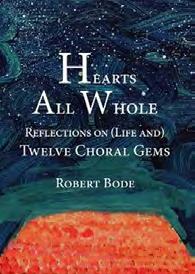
Hearts All Whole:
Reflections on (Life and)
Twelve Choral Gems
Robert Bode
GIA Publications, 2023
In this brief but rich text, Robert Bode reflects on his nearly four decades-long career as a choral director in his 2023 publication, “Hearts All Whole.” He shares each of these reflections through the lens of twelve choral works that made a deep impact on his life. With each choral work, Bode chose to not only focus on his pedagogical approaches for each piece, but also the stories, people, and experiences that were formative to his musical perspective and philosophy. In each chapter, Bode places a choral “gem” as a centerpiece to which he interweaves his personal stories and anecdotes. He organizes and presents the choral gems in chronological order, each piece placed within its own chapter, starting in the early renaissance and making his way through each musical era. Bode chooses to end his musical journey with Morten Lauridsen’s Sure on This Shining Night, in which Bode has beautifully lifted the phrase, “hearts all whole,” from the original poem by James Agee. In this review, I have chosen to include some of these choral gems and Bode’s stories that had an impact on me as a reader, choral director, and musician.
Robert Bode begins the first chapter with a seminal choral gem, Josquin’s Ave Maria, which he connects to his admiration of architecture designed by Frank Lloyd Wright, both representing a clear structure or blueprint for individuals to experience their artistic mastery. Next, Bode returns to his years as a student under the direction of Dr. Beachy at the University of Texas, where Bode developed his value for specific tonal colors and timbres to best express pieces such as Palestrina’s Alma Redeptoris Mater . We fast forward to Bode’s first years as Artistic Director of Choral Arts Northwest, where he compares programming a concert to touring a museum, each piece of repertoire helping to move the listener through a tonal landscape. Relating Monteverdi’s madrigal, O Mirtillo, to an art exhibit one would find in such a museum, Bode emphasizes the need for both director and ensemble to clearly understand how both the lyrical story and musical context are communicated to the listener. These first three choral gems provided a beautiful balance of both Bode’s musical approach to proper performance of the pieces while also relating them to allegories and anecdotes found within his early years as a choral artist.
Following these first three pieces, Bode takes the reader along on a chronological journey of his musical career and continued growth as a director,
featuring choral standards such as Mozart’s Ave Verum Corpus , Brahms O Schöne Nacht! , Bruckner’s Os Justi. Each piece is accompanied by narratives that provide insight into Bode’s musical discoveries such as singer Joyce Farwell’s philosophy of singing with honesty to build connection. Or, how baking the perfect pumpkin spice muffin is similar to rehearsing a piece of music—it is not about the printed ingredients on the page or the notes in the score, but rather knowing where and how to prioritize certain elements to get the best “flavors” out of the sound.
As a reader, I found myself resonating more deeply with Bode’s journey in two chapters found in the second portion of the book. In chapter seven, focused on Rachmaninoff’s stunning setting of the Ave Maria text, Bogoroditse Devo, Bode focuses on what he defines as “coloring the sketch,” which refers to how both conductor and musician make choices to try and communicate what a piece is really trying to say and how might the audience potentially receive this information. As we continue through the final gems of Robert Bode’s career, he continues to deepen vulnerability in what he shares, especially as he recounts his time working through Maurice Duruflé’s Ubi Caritas. In the penultimate chapter, Bode explores his own process of letting go of musical control, allowing himself to be lost in the “magical now” that requires a level of trust in those around him. As we enter the final chapter, focused on Morten Lauridsen’s Sure on This Shining Night, Bode shifts from the more pedagogical perspectives of the first chapters to a more internal meditation on the impact of choral music. It is in these final pages that Robert Bode really drives home the apt title of this book; how music truly can make one’s heart whole.
— Evan Stoor
Evan Stoor, Ph.D. in Music Education, is the Director of Choral Activities at University of Idaho. His rehearsal pedagogy and research focus both center around empathy-promoting practices and development of rational compassion.
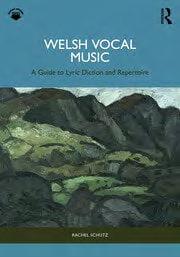
Welsh Vocal Music: A Guide to Lyric Diction and Repertoire.
Welsh Vocal Music: A Guide to Lyric Diction and Repertoire (Routledge, 2025), written by Rachel Schutz, is an invaluable resource for choral conductors and vocalists seeking to approach Welsh repertoire with integrity and expand their knowledge of its composers and vocal works.
Wales, known as ‘the land of song,’ possesses a rich body of vocal art music not frequently performed outside the country. In the introductory pages, Schutz observes that barriers to performance perpetuate barriers to awareness and responds with a resource to help singers confidently engage with this literature. Her credentials as a Welshborn performer, teacher, and linguist—with advanced degrees in music and linguistics—are evident throughout this deeply researched and meticulously organized volume. The volume is arranged in two parts: “Part I: Welsh Lyric Diction” followed by “Part II: Vocal Repertoire.” It elegantly equips musicians with tools for accurate pronunciation and informed programming while contextualizing the musical selections within Wales’s linguistic and cultural history.
Part I opens with “An Introduction to the Welsh Language,” asserting the inseparability of language from history and culture. Schutz traces the influence of Welsh occupation and
independence on linguistic development from ancient Celtic tribes to the present, noting that Welsh was not recognized as an official language until 2011. Descriptions of central linguistic features help the reader understand the mechanics of the Welsh language.
The following chapters center on the details of Welsh diction. Schutz’s diction guide is practical for conductors and vocalists, employing IPA for examples with diction exercises accompanied by sound files. Comparative references to Italian, German, and English pronunciation enhance accessibility for conductors and singers trained in the diction of those languages. Especially helpful are the rule-based tables and flow charts which enable singers to apply Welsh diction principles independently to texts not covered in the volume. Chapter 5 summarizes key differences among regional dialects of Welsh for musicians seeking to use colloquial pronunciations. Schutz’s multimodal approach (integrated IPA, musical examples, and sound examples) is effective and user-friendly.
Part II surveys Welsh vocal and choral repertoire, beginning with an introduction to Welsh music history that parallels Part I’s linguistic contextualization. The catalogue is divided into sections: the first (Chapter 7) comprises traditional folk songs, hymns, and patriotic songs. Schutz includes notable collections of Welsh folksongs for solo voice and lists individual song titles with information about the composer, poet, place of origin, first publication, and brief annotations on text and music. Each entry concludes with a list of published arrangements specifying voicing and instrumentation.
The next category, “Yr Hen Ganiadau” (“The Old Songs”) is described in Chapter 8 as the Welsh equivalent of the Great American Songbook. Subsequent chapters highlight significant Welsh composers such as Grace Williams, William Mathias, and Karl Jenkins and conclude with contemporary Welsh composers. Each section includes biographical and stylistic overviews of
the composers followed by several selected works, including art songs, choral works, and operas. A concise critical analysis and commentary of each is included alongside practical details – tempo, range, length, and availability. Directors of TTBB choirs will find this resource particularly valuable given Wales’s strong low-voice choral tradition.
The book includes numerous supplementary resources. The introduction offers a glossary of relevant Welsh terms and a guide to British vocabulary and spellings. Appendices are clear and thorough: Appendix II includes instructions to create a Welsh IPA transcription; Appendix III aids in programming with repertoire lists of art songs and choral works arranged by difficulty; Appendix I includes the rubric for difficulty rankings. In addition to a substantial bibliography, Appendix IV compiles dictionaries, libraries, archives, publishers, books, language courses, cultural societies, and media recommendations. Robust online support includes IPA transliterations, translations, and pronunciation recordings for selected works. A hard copy of the translations and transliterations is not currently available for purchase and is only available as a digital download.
Welsh Vocal Music deserves inclusion in university libraries alongside other essential diction and repertoire resources. It illuminates Welsh diction, celebrates a vibrant musical heritage, and equips musicians to engage with this repertoire with integrity and artistry. In this volume, Rachel Schutz skillfully shares her expertise in Welsh language, music, and culture while also imparting a deep and compelling appreciation for the subject.
— Kimberly Dunn Adams
Kimberly Dunn Adams is the Director of Choral Activities at West Chester University. She serves as NCCO’s Associate Editor for Research Reviews.
Singing Together, Worlds Apart: Participation, Classification, and the Case for African Choral Music
Alfred Patrick Addaquay
Debates over the labeling of African choral traditions as “art music” transcend mere semantic disputes; they fundamentally address the classification, interpretation, and valuation of music within academic and cultural contexts. In music studies, labels significantly impact research, funding, publication, and historical retention. 1 Classifying choral compositions based on communal involvement and improvisation as “art music” may undermine their dynamic, community-oriented nature, reducing them to a static, composer-centric artifact. This categorization can mask the fundamental elements—audience engagement, call-and-response structures, and spontaneous embellishment—that endow these performances with social and cultural significance.
Smiraglia examines the classification, labeling, and retrieval of musical works in information systems, highlighting the fact that labelling is not merely a technical issue but rather has a substantial impact on concert programming, educational curricula, and archival documentation by influencing how musical works are perceived, accessed, and contextualized. 2
1 Fabbri, Franco. “Genre theories and their applications in the historical and analytical study of popular music: a commentary on my publications.” PhD diss., University of Huddersfield, 2013; Lihus, and Lihus Valentyn. “The Problem of Genre in Music Research of The 20th–21st Centuries. Bulletin of the KNUKiM.” Series “Art Studies,” (38), (2018). 188–195; Thomas, Rob. “Major Labels: A History of Popular Music in Seven Genres, Kelefa Sanneh (2021).” Punk & Post Punk 11, no. 3 (2022).
2 Smiraglia, Richard P. “Musical works and information retrieval.” Notes 58, no. 4 (2002): 747-764.
When a composition is categorized as “art music,” scholars and practitioners may prioritize its harmonic complexity or formal organization over all other aspects. Over time, essential participatory aspects of the tradition—such as collective innovation, communal cohesion, and shared ownership—may diminish in scholarly and public consciousness. Neglecting participatory elements in African choral repertoires has significant consequences, such as the erosion of local epistemologies, the reinforcement of colonial hierarchies, and the misrepresentation of musical traditions that are rooted in dialogue among composer, performer, and audience.
Moreover, neglecting to examine the foundations and consequences of labels results in a missed chance to enhance our comprehensive understanding of music. Researchers engaged in decolonial frameworks highlight the importance of critically examining Western-centric categories that may not be relevant in various cultural
contexts. 3 The classification of African choral compositions as “art music” might marginalize the communities for whom this music is a vital experience, as it implies certain assumptions regarding creative authority and the legitimacy of performance methods. Therefore, critically interacting with labeling not only maintains cultural specificity but also encourages a reevaluation of the frameworks employed in music study.
The classification of ‘art music’ may either elucidate or obfuscate the comprehension of choral traditions. Neglecting this discussion would permit singular preconceptions to remain unexamined, potentially skewing aspects from repertoire selection to historical accounts. A meticulous analysis of labeling—and its social, artistic, and epistemological implications—promotes more inclusive practices and a greater awareness of the dynamic participation aspects that characterize numerous African choral traditions.
However, it is important to note that while numerous choral compositions in African church and community contexts emphasize strong participatory elements, the presence of extended choruses reminiscent of opera or oratorio within African repertoires must be recognized in this context. The primary focus here does not encompass these larger-scale, often nonparticipatory works. This discussion focuses on compositions that incorporate communal singing, ad lib improvizations, and audience engagement.
During a performance by a university choir in Africa, the audience, initially silent, began clapping, ululating, and harmonizing with the choir by the second stanza. The spontaneous participation, typical of African choral traditions, transformed the event from a formal “art music” performance into a collective expression of cultural reaffirmation. When this composition is transcribed into Western notation, stripped of its improvisational call-and-response elements, and categorized in academic archives as “choral art music,” its participatory nature is diminished. This contradiction is central to a critical issue in music scholarship: the ongoing misrepresentation of African participatory traditions within Eurocentric frameworks that prioritize compositional stability over performative variability.
Traditional musicology, which emerged from 19th-century European epistemologies, 4 has predominantly emphasized the work-concept, viewing music as a static, authored entity, rather than acknowledging the dynamic social processes inherent in non-Western traditions. Western musicology evolved in alignment with dominant philosophical and scientific paradigms, as demonstrated in Baroni’s study.5 Guido Adler defined Musikwissenschaft in 1885 as a systematic science focused on analysis, classification, and historical study. The Eurocentric perspective on music as a static, constructed entity, rather than a socially embedded and evolving practice, was further solidified by the later incorporation of non-European music, which remained constrained by the same structuralist framework. Killick demonstrates that the integration of Korean sanjo
3 Sims, Danica Anne, and Thirusha Naidu. “How to… do decolonial research.” The clinical teacher 21, no. 6 (2024): e13806; Emmanuel, Blessing T. “Decolonizing the Academic Study of Science and Religion? Engaging Wynter’s Epistemic Disobedience.” Religions 15, no. 10 (2024): 1259; Alvarez, Silvia. “Decolonial studies: Contributions to the construction of global history.” Drustveni horizonti (2022); Mabvira, Agrippa. “Deconstructing otherness: A decolonial inquiry into the experiences of immigrant students.” (2024); Hassan, Syed Wajeeh ul, and Sajjad, Fatima. The decolonial turn: new challenges to international relations traditions. Journal of Contemporary Studies, 11(2), (2022): 23–41.
4 Caporaletti, Vincenzo. “Some Remarks on the Epistemological Basis for a Musicology of Popular Music.” ANALITICA 9 (2016): 1–27.; Golding, Rosemary. “Finding Musicology in nineteenthcentury Britain: contexts and conflicts.” (2018).
5 Baroni, Mario. “On the concept of interdisciplinarity in the study of music.” In Worldwide Music Conference, pp. 3–10. Cham: Springer International Publishing, 2021.
into a Western-style framework exemplifies this trend, underscoring the significant global impact of Western musicological paradigms.6
Recent initiatives aimed at decolonizing musicology have revealed the constraints imposed by Eurocentric frameworks on our comprehension of non-Western musical experiences.7 In various African cultural contexts, music serves as a communal and dialogic practice, as demonstrated by collective performance traditions like Yoruba àpàlà and Xhosa imbongi poetry.8 This paradigm misrepresents and undermines the cultural significance of participation. The result is a disciplinary myopia: African choral compositions in SATB are either exoticized as “folk art” or forced into the “art music” category as illustrated by Addaquay 9 and Euba, 10 in a classification laden with colonial implications of complexity, permanence, and individual genius By isolating music from its sociocultural context and
upholding hierarchies that marginalize African epistemologies in international academia, such classifications amount to epistemic violence.
This argument has implications that extend beyond simple semantics. By uncritically adopting the term “art music,” scholars risk oversimplifying the complexity of African choral traditions, reducing them to mere aesthetic objects and obscuring their roles as dynamic, participatory practices that engage with identity, resistance, and collective memory. Analyzing African choral music from the standpoint of Western art music, which emphasizes harmonic complexity and notated scores, undermines its political importance. The presence of colonial influences in musicological frameworks requires a shift that emphasizes participation as a crucial methodological approach and a means of decolonization.
6 Killick, Andrew. “Traditional Music and the Work-Concept: The Kayagŭm Sanjo of Hwang Byungki.” Yearbook for Traditional Music 49 (2017): 1–25.
7 Addaquay, Alfred Patrick. “Integrating critical thinking into advanced musical analysis in Ghanaian Music Education.” PAN African Journal of Musical Arts Education 2, no. 2 (2024): 1–9; Addaquay, Alfred Patrick. “Beyond the Blueprint: Tailoring Research Frameworks to Music Theory and Composition Scholarship in Ghana.” Philosophy of Music Education Review 33, no. 2 (2025 a): 178–198; Mackinlay, Elizabeth, and Katelyn Barney. “Decoloniality and the Disappearance of Ethnomusicology in Australian Universities: Where Are we Now?.” In Cultures of Work, the Neoliberal Environment and Music in Higher Education, pp. 141–162. Cham: Springer Nature Switzerland, 2024; Karantonis, Pamela. “A Bran Nue Dae? Decolonising the musical theatre curriculum.” (2023); Human, René, and Emily Achieng’Akuno. “Indigenising music education: The cross-cultural transfer of African Indigenous concepts and practices.” In Decolonising and Indigenising Music Education, pp. 88–107. Routledge, 2024.
8 Chukwuma, Marian Edohan. “The significance of music in African culture: A study of Ogbanigbe Festival in Ukwu-Nzu Aniocha Local Government, Delta State.” UJAH: Unizik Journal of Arts and Humanities 24, no. 2 (2023): 296–333; Bayley, Amanda, and Chartwell Dutiro. “Developing dialogues in intercultural music-making.” In The Routledge international handbook of intercultural arts research, pp. 391–403. Routledge, 2016.
9 Addaquay, Alfred Patrick. “African vocal art music and a proposed guideline for singing: Ghanaian context.” Journal of African Arts and Culture 6, no. 3 (2023): 45–76.
10 Euba, Akin. “Text setting in African composition.” Research in African Literatures 32, no. 2 (2001): 119–132.
Scholars like Donin 11 and McCormick 12 may contest the arguments presented here, as they assert that music should be categorized based on its societal function rather than its appeal or degree of participation. Euba argues that the church significantly influenced the development of neo-African art music, particularly in sub-Saharan areas like southeastern Nigeria and Ghana, where choral music integrating European harmony with African languages is popular and valued. Euba categorizes this style as art music. Addaquay’s use of diverse examples categorized as art music complicates the subject under critique here.13
Nzewi characterizes African Art music as a genre that incorporates scientific concepts in both its creative process and performance. 14 It
11 Donin, Nicolas. “The musicology of composition processes. Between history and cognition.” Transposition. Hors-série no. 1 (2018).
12 McCormick, Lisa. “Music as social performance.” In Myth, Meaning and Performance, pp. 121–144. Routledge, 2015.
13 Addaquay, Alfred Patrick. “African vocal art music and a proposed guideline for singing: Ghanaian context.” Journal of African Arts and Culture 6, no. 3 (2023): 45–76.
14 Nzewi, Meki. “African musical arts creativity and performance: The science of the sound.” Nigerian Music Review, 6, no.1 (2005), 1–8.
places emphasis on spiritual well-being, melodic frameworks, and instrument technology, setting it apart from traditional conceptions of art music. According to Patterson, art music refers to concert music that possesses both a high level of literary excellence and specific accompaniment. 15 In contrast to art music, he describes African art music as one that is like the African-American art song and combines indigenous components with created music, resulting in a distinctive hybrid style. Agawu characterizes contemporary art music as the execution of musical compositions derived from written scores with the intention of engrossing observers that do not engage actively throughout the performance.16 The classification of art music as laid out by Drummond will continue to be the focus of our investigation.
1. Professionals who have undergone disciplinary training perform it.
2. It has a canon of traditional musical works, usually by identified composers.
3. There is a notation through which these works are preserved.
4. It has a theory of music.
5. It claims to be ‘artistic’.17
Drummond argues clearly that these characteristics (especially, perhaps, the last one) make ‘it ‘serious music’, in contrast to ‘popular’ or ‘folk’ musics.
It is evident that considerable scholarly attention has been devoted to this topic in recent years, and explanations for its existence vary considerably.18
15 Patterson, Willis. “The African-American art song: A musical means for special teaching and learning.” Black Music Research Journal (1996): 303–310.
16 Agawu, Kofi. On African Music: Techniques, Influences, Scholarship. Oxford University Press, 2023.
17 Drummond, John. “Re-thinking Western Art Music: a perspective shift for music educators.” International Journal of Music Education 28, no. 2 (2010): 117–126.
18 Breznica, Rreze Kryeziu. “Art Music of Albanians in Kosovo: First steps towards initiation and development phase division.” Rast Müzikoloji Dergisi 11, no. 1 (2023): 1–29.
The academic community engages in a contentious and intricate discussion regarding the definition of art music, which is influenced by the interpretive frameworks utilized by scholars to examine the musical domain. These complexities are highlighted in Jullander’s article through the introduction of five significant problem areas in artistic research in music.19 Scholarly contributions from Nzewi, Patterson, Agawu, and Drummond, among others, exemplify the diversity of perspectives that contribute to the formation of the identity of the subject.
Every scholarly assertion makes substantial contributions while also posing challenges to the definition of art music in the twenty-first century. Academics’ propensity to categorize and delineate ought to take into consideration the complexities that arise from a culturally diverse and abundant environment. The process of delineating art music presents a complex challenge, as it necessitates harmonizing diverse scholarly viewpoints with the ever-evolving and pluralistic nature of African musical expression.
Acknowledging the fluidity and progression of musical genres is equivalent to accepting a variety of definitions. The dynamic and developing characteristics of musical genres are highlighted in contemporary genre theory.20 African art music, as defined by Nketia, is concert music composed for attentive listening or performance.21 It combines aesthetics, technical prowess, and emotional expression while remaining true to African traditions.
The classification of African choral traditions as “art music” reveals a tension between Eurocentric frameworks and participatory musical cultures.
19 Jullander, Sverker. “Introduction: Creating dialogues on artistic research.” Svensk tidskrift för musikforskning 95 (2013): 11–24.
20 Fram (2023); Østergaard et al. (2015); Prandi et al. (2009).
21 Nketia, J. H. The creative potential of African art music in Ghana. Afram pub., 2004.
The notion of “art music” emphasizes the importance of notated repertoire, composer authorship, and formal complexity, as evidenced by Drummond’s criteria. These standards are not inherently flawed; numerous musical cultures globally depend on compositional clarity, structured training, and intentional performance practices. Conversely, scholars such as Agawu argue that these criteria frequently fall short in explaining or acknowledging the collaborative influence of audiences and performers on music in African contexts in real time. This participatory model blurs the distinctions between performer, listener, and composer; the function of music transcends aesthetic presentation, incorporating social bonding, political expression, and spiritual connection.
The label “art music” can be problematic when applied uncritically to African choral forms characterized by improvization, audience involvement, and the fluidity of oral transmission. Such traditions may be conceptually reduced to static subjects of academic inquiry, which diminishes their fundamental principle of collective engagement. It is also essential to recognize that various positions, including Agawu’s, illustrate enduring discussions regarding the usefulness of “art music” as a classification. Agawu’s assertion is defensible: in contexts of minimal audience interaction, the term “art music” effectively encapsulates a fundamental aspect of the performance’s structure and reception.
Importantly, a scholar’s preference for specific labelling does not invalidate alternative perspectives. Nzewi, Patterson, and Drummond emphasize differing aspects, including the scientific and spiritual underpinnings of music, as well as the concepts of canon and cultural prestige. Their viewpoints highlight the complexity and diversity inherent in African musical traditions, which encompass both participatory communal practices and contemporary choral
compositions intended for concert settings. To effectively address these tensions, scholars must recognize that terms like “art music,” “folk music,” and “popular music” not only denote musical characteristics but also represent varied histories of cultural valuation, power relations, and intellectual frameworks.
The confusion occurs when this label is perceived as universally applicable to all instances of African choral performance, rather than as one valuable perspective among several. The debate illustrates that musicological categories operate not as fixed truths but as dynamic heuristics influenced by disciplinary objectives, cultural contexts, and scholarly priorities.
From a methodological perspective, acknowledging the multiplicity and fluidity in African choral practices does not undermine the legitimacy of scholarly categorization; instead, it advocates for more careful, context-sensitive approaches that respect the significance of participation—and occasionally its absence—in shaping a performance’s aesthetic. An evolving and pluralistic perspective on African musical expression acknowledges the interactive nature of these traditions alongside the potential for composed, concert-oriented works. Scholars and practitioners should consider the coexistence of various categorizations, as each may reveal unique values or purposes that the music serves.
Instead of rejecting one framework for another, a prudent approach is to maintain these perspectives in a state of productive tension. This approach enhances our comprehension of the complex nature of African choral music and contributes to contemporary musicological discussions by challenging the foundational assumptions of established categories such as “art,” “folk,” and “popular.” In this context, the paradoxes associated with “African art music” represent not an impasse but an opportunity—to engage
in careful listening, respectful discourse, and ongoing refinement of the frameworks through which we interact with global musical diversity.
Traditional Musicology and the “Art Music” Paradigm: Origins and Limits
Addressing the classification of African choral music necessitates an examination of the intellectual framework that generated the category of “art music.” Traditional musicology, influenced predominantly by nineteenth-century European thought, has created evaluative assumptions that persist in shaping the analysis, archiving, and valuation of music worldwide. The concept of art music—a canonized repertoire of notated works whose value is frequently determined by standards of formal complexity and adherence to composerly intent—has been given significant weight in the development of Western music study by traditional musicology. Stefani provides compelling evidence in favour of this claim. 22 The claim is further supported by Bashford et al., who highlight how art music (classical music) was historically framed within an aesthetic ideology of “art for art’s sake” while simultaneously interacting with commercial forces.23 On the other hand, Drummond criticizes how Western art music is taught more than other styles, which supports its status as a canonized repertoire supported by traditional musicology.24 He also calls for a change in ethnomusicology that puts Western art music in the same category as other global musical traditions instead of seeing it as inherently better.
This approach gained traction in the latter nineteenth century and reached its conceptual pinnacle in what Lydia Goehr has dubbed the
22 Stefani, Wolfgang Hans Martin. The Psycho-Physiological Effects of Volume, Pitch, Harmony and Rhythm in the Development of Western Art Music: Implications for a Philosophy of Music History. Andrews University, 1981.
23 Bashford, Christina, and Roberta Montemorra Marvin. The Idea of Art Music in a Commercial World, 1800-1930. Boydell Press, 2016.
24 Drummond, John. “Re-thinking Western Art Music.
“imaginary museum of musical compositions,” where music is reified as a distinct artefact deserving of critical examination that borders on museology.25 This paradigm is thus defined by three fundamental ideas: the “work concept,” the importance of composerly intention, and the relationship between formal complexity and aesthetic value.
1. The Work Concept—Core
Tenets of Traditional Musicology: The musical “work” has been given special status by traditional musicology, which views it as an independent artefact with a distinct personality that is usually recorded in a score. By promoting an idealized version of the work that transcends any specific performance, this viewpoint supports the academic emphasis on textual authenticity. In this ontology, the composerapproved written score serves as the storehouse of musical truth, reifying intricate melodic, harmonic, and formal structures while ignoring the whims of live performance.
Composerly Intention: The idea that a composer’s vision is very important goes hand in hand with the work concept. The “great composer” is typically valued by academics as the source of musical meaning; analysis thus turns into an endeavor to discover or explain that meaning through the tracing of structural coherence, harmonic logic, or motivic unity. Although such an approach can be enlightening in some situations, it may obscure the fact that the importance of music frequently emerges in the collaborative performance processes or in the situational reactions of the audience.
Formal Complexity: Lastly, traditional musicology has long associated musical value with structural complexity, such as complex harmonic syntax, intricate thematic development, or contrapuntal
25 Goehr, Lydia. The imaginary museum of musical works: An essay in the philosophy of music: An essay in the philosophy of music. Clarendon Press, 1992.
intricacy. Under this limited evaluative framework, forms that lack these characteristics—such as call-and-response, repetitious chant, or unison congregational singing—run the risk of being written off as archaic or unsophisticated.
2. Consequences of the Art Music Paradigm:
Marginalizing Performance and Participation: There is analytical coherence in the art music model for some repertoires, but its flaws become clear when music is mainly looked at as an independent object. There are big problems with these limits when it comes to how scholars understand performers, audiences, and social settings. The traditional paradigm frequently minimizes the agency of performers and listeners by emphasizing the autonomous work and the composer’s objectives. The performative moment—the intersection of music, physicality, and social engagement—becomes less important, if not invisible. Additionally, this disdain weakens comprehension of the larger social, cultural, and political contexts that influence musical significance. The depth of this error is shown by Christopher Small’s concept of “musicking” which shows that audience and performer interaction is essential to the life of music and not only an addition to a pre-constituted text.26
The traditional paradigm, which has its roots in Eurocentric intellectual histories, successfully imposes its aesthetic standards on non-Western and vernacular musics. This is the privilege of Western art music traditions. It is common for practices that do not emphasize a single composer, a notated score, or extensive formal development to continue to be marginalized. For example, in the African choral realm, the collaborative and improvised aspects that drive performances
could be eclipsed once these pieces are preserved or analysed exclusively using Western theoretical frameworks.
Traditional musicology has strengthened hierarchies that pit “high culture” against “low” or “popular” forms by elevating the Western classical canon to the pinnacle of academic study. Our collective awareness of how music functions throughout communities is diminished by the near-exclusive emphasis on intricacy, authorship, and textual faithfulness, which pushes a wide variety of participatory, orally transmitted, or improvisatory musics to the margins.
3. Different Views on Musical Worth: More expanded conceptions of musical worth that take into account context-driven practices and participatory traditions have been made available in recent decades by ethnomusicology, sociology of music, and performance studies. Ethnomusicologists use comparative and fieldwork-based approaches to examine music as a cultural and social phenomena, emphasising how music is incorporated into daily life.27 This method shows that what might seem theoretically straightforward on paper can actually be extremely complex in practice, where call-andresponse, collective improvisation, and repetition serve essential social purposes.
The field of “Sociology of Music” studies how social factors both influence and are influenced by music. 28 By addressing issues of identity,
27 Martí, Josep, and Peter Collins. “Ethnomusicology, folklore, and social relevance. By josep martí. Translated by peter collins.” Ethnomusicology Translations 15 (2024): 1–20; Engelhardt, Jeffers. “9. An Ethnomusicology of Spiritual Realities.” Music and Spirituality (2024): 193.
26
University Press, 1998; Cohen, Mary L. Christopher Small’s concept of musicking: Toward a theory of choral singing pedagogy in prison contexts. University of Kansas, 2007.
28 Zhang, Xiaowei, Wentao Dong, Yucai Dong, Yuanyuan Lin, Haiyu Zhao, and Zhenyu Li. “A Study of Music Genres Based on Social Networks and Statistical Methods.” In 2023 4th International Conference on Intelligent Computing and Human-Computer Interaction (ICHCI), pp. 366–371. IEEE, 2023; Back, Les. “What sociologists learn from music: identity, music-making, and the sociological imagination.” Identities 31, no. 4 (2024): 446–465.
Small, Christopher. Musicking: The meanings of performing and listening. Wesleyan
power, and community building, they bring attention to the cultural function that music serves, whether it is bringing a diaspora together, signifying resistance, or indicating socioeconomic standing. This viewpoint clarifies why some participation traditions—like African choral practices—may be difficult to categorize into distinct “works” or composer-centric narratives since they are intricately linked to collective memory and social ownership.
A performance-centered perspective highlights the embodied reality of music, which includes the facial expressions, body language, and interactions that bring life to a live performance. 29 In this case, meaning arises from the dynamic interaction of performers, participants, and the space they occupy rather than just from the notated text. The ephemeral dimension of a choral performance in an African church setting, for instance, may carry rich layers of cultural affirmation, shaped moment by moment through call-and-response patterns and congregational input. This paradigm enables scholars to view “mistakes,” improvisations, and audience engagement as primary sites of musical creativity rather than as departures from a notated ideal.
When taken as a whole, these methods represent a significant break from the dominance of the independent work and its purported aesthetic standards. They show that the comprehension of musical value can depend on participation, social function, and collective agency as much as on compositional originality or formal design. To analyse these processes within a paradigm that prioritizes solely the completed score or the lone “genius” composer is to ignore essential elements
29 Tong, Fei. 2024. “Human Motion and Musical Expression: Exploring the Link Between Physical Movement and Emotional Resonance in Performance”. Molecular & Cellular Biomechanics 21 (2), 401. https://doi.org/10.62617/mcb.v21i2.401. Martin, Remy, and Nanette Nielsen. “Enacting musical aesthetics: The embodied experience of live music.” Music & Science 7 (2024): 20592043231225732.
of their artistry and cultural significance, as many musical traditions around the world place more value on collaborative participation than solo authorship.
Overall, the art music paradigm of traditional musicology fails to capture the dynamic reality of participatory traditions, despite its historical influence and analytical utility for certain repertoires. In addition to ignoring important performative and social aspects, its appreciation of stable works, individual authorship, and formal intricacy also upholds hierarchies that mask the true diversity of musical life.
However, it must be noted here that although entertainment and participation are not typically included in definitions of art music, scholars such as Prévost-Thomas,30 Muchsin,31 and Price32 provide instances in which art music fulfils these purposes. Yet, scholars can reinterpret music as a socially and materially rooted activity that is influenced equally by performers, listeners, and cultural context by adopting ethnomusicological, sociological, and performance-centered viewpoints. This inclusive reorientation allows a respectful engagement with the various ways communities around the world use communal singing, drumming, or dancing to define identity, solidarity, and transcendence. It also provides a richer, more compassionate explanation of why and how people create music.
30 Prévost-Thomas, Cécile. “The participatory concert. An efficient form for sharing the mediation of classical music.” OICRM Musical Review, 7(2), (2020): 36–52.
31 Muchsin, Misri A. “Art and Entertainment in Islam.” Jurnal Ilmiah Peuradeun 3, no. 1 (2015): 133–146.
32 Price, Sarah M. “Risk and reward in classical music concert attendance: Investigating the engagement of ‘art’and ‘entertainment’audiences with a regional symphony orchestra in the UK.” PhD diss., University of Sheffield, 2017.
Reconceptualising Musical Value beyond the Work-Concept
A number of disciplinary viewpoints that contest the work-concept’s primacy have surfaced in reaction to these constraints. Participation, embodiment, and social function are reoriented as key elements of musical meaning in ethnomusicology, music sociology, and performance-based methodologies. The constraints of the conventional “art music” designation become especially clear when examining the dynamic and engaging characteristics of numerous African choral traditions. Instead of focusing solely on the composer-centric approach that values harmonic complexity and textual fidelity, a participatory musicology would highlight the extent to which listeners, performers, and composers engage in a dynamic interaction. This change in viewpoint necessitates a reassessment of academic methodologies that transcends the dichotomy of “high culture” art music and “low culture” folk or popular traditions and instead acknowledges the complex social and cultural contexts in which a significant amount of choral music flourishes.
This new framework emphasizes the evaluation of various musical forms based on the degree of audience involvement they elicit or necessitate. Instead of presuming that the audience merely consumes the performance passively, as frequently observed in Western concert halls, participatory traditions actively engage listeners to sing, clap, dance, or otherwise contribute to the musical experience. Placing these forms within their social and cultural contexts highlights the primary role of the music’s function. The intended purpose of music—be it entertainment, worship, social cohesion, or political protest—plays a crucial role in shaping the composition, transmission, and experience of music within a community, highlighting the importance of underlying motivations.
This approach inherently prompts a reevaluation of the terminology used. Instead of broadly categorising any SATB composition based on Western notation as “choral art music,” it would be more prudent for scholars to adopt descriptors that are more attuned to the specific context. For example, “community music” illustrates the capacity of groups to assume control over performances, whereas “participatory performance” emphasizes the crucial influence of the audience in determining the ultimate sonic result. Terms such as “culturally embedded music” highlight the fact that these compositions are inseparable from their wider communal practices and belief systems. Similarly, “hybrid music” recognizes that numerous African choral works selectively incorporate both Western and indigenous elements, resulting in a synthesis that resists straightforward categorization.
The relabelling efforts carry significant consequences for pedagogy, performance, and research. In music education, shifting away from restrictive “art music” frameworks can broaden the curriculum to include a wider range of musical traditions beyond established Western compositions. Educators might be more motivated to investigate the various methods of teaching, sharing, and performing musical concepts within orally orientated communities. This exploration could enhance the understanding of how collective involvement promotes creativity and learning. Similarly, performance practice stands to gain from this new perspective. Concert formats could be modified to enhance audience engagement, thereby questioning the traditional separation between the stage and the seating area. In academic research, a decolonizing impulse emerges as scholars utilize frameworks that emphasize lived cultural contexts and communal authorship, rather than applying value judgements rooted in the Western classical tradition. This inclusive approach effectively acknowledges the significance of participatory, social, and improvisational elements that contribute to the most dynamic instances of African choral music.
Ultimately, these alternative frameworks promote a more nuanced and comprehensive understanding of choral traditions that resist simplistic categorizations as “art music.” By examining the participants, their methods of engagement, and the significance of a particular piece of music to its community, participatory musicology uncovers aspects that traditional classifications may miss. This approach enhances a global musicological dialogue focused on equity and cultural sensitivity, acknowledging the diverse methods through which individuals engage with and create music across the globe.
Western Hymnody as a Counterexample to Art Music Assumptions
After defining the boundaries of the art music paradigm and the rise of participation-centered perspectives, it is valuable to analyze a repertoire in Western musical history that challenges strict classificatory limits. Western hymnody exemplifies a synthesis of notation and authorship alongside continuous communal engagement, all while refraining from categorizing itself as “art music.” The examination of Western hymnody offers a valuable perspective in contrast to African choral traditions within the current discourse surrounding labelling and classification. Despite a rich history of crafted melodies and established notation, hymns are seldom clearly categorized as “art music.” In contrast to classical choral compositions often confined to concert venues or prestigious choirs, hymns are intricately integrated into the communal experience of worship, moulded by the voices and active involvement of congregants from various Christian traditions.33 This tension between composed formalism and communal participation highlights the adaptability of hymnody and the complexities involved in categorizing music as merely “art” or “folk.”
33 Roberts, Mikie. “Hymnody and identity: congregational singing as a construct of Christian community identity.” PhD diss., University of Birmingham, 2014; Kloppers, Elsabe. “’Elkaar zijn wij gegeven tot kleur en samenklank...’Die rol van sang in die vorming en opbou van die geloofsgemeenskap.” HTS: Theological Studies 71, no. 3 (2015): 1–7.
The heritage of Western hymnody can be traced to the early Christian Church, where the practices of psalm-singing and plainsong established a liturgical basis.34 During the sixteenth century, with the onset of the Protestant Reformation, the practice of communal singing of metrical psalms and hymns emerged as a fundamental aspect of worship. 35 Early Reformers such as Martin Luther promoted active involvement from congregations, employing vernacular lyrics and accessible melodies to engage and unify the faithful.36 Throughout the following centuries, hymnals became increasingly abundant, gathering compositions from notable figures such as Isaac Watts and Charles Wesley— individuals whose contributions navigated the delicate line between personal artistic expression and a fundamentally communal performance environment.
37 Some hymns displayed a remarkable musical sophistication, characterized by elaborate harmonic progressions and complex textual arrangements, while others took on a more straightforward, folk-inspired quality. This historical interplay between folk and formal sources infused hymnody with fluid stylistic boundaries.
Hymns generally utilize concise strophic structures, uncomplicated harmonic sequences,
34 Webb, Philip W. “A Defense of Psalm Singing: Solutions to Contemporary Practice.” (2023); Warson, Gillian Ruth. “From psalmody to hymnody: the establishment of printed hymnbooks within hymn singing communities.” PhD diss., University of Sheffield, 2001.
35 Romey, John. “Polluted Soundscapes and Contrepoison in Sixteenth-Century France: The Sonic Warfare Leading to the First War of Religion.” Yale Journal of Music & Religion 9, no. 1 (2023): 5; Thianto, Yudha. “The Significance Of Psalm Singing In Calvin’s Liturgy Of The Lord’s Supper And Its Relevance Today.” Verbum Christi: Jurnal Teologi Reformed Injili, no. 8, no. 2 (2021).
36 Brubaker, Emily A. “Music as a Means to Spread Martin Luther’s Message.” Musical Offerings 11, no. 2 (2020): 71–81.
37 Kolodziej, Benjamin A. “Isaac Watts, the Wesleys, and the evolution of 18th-century English congregational song.” Methodist history 42, no. 4 (2004): 236–249; King, Giovan Venable. “Psalms in the Key of Life: Isaac Watts and the Composers of Negro Spirituals.” International Congregational Journal 4, no. 2 (2005).
and moderate vocal ranges.38 These selections are deliberate: they promote communal singing, enabling a substantial assembly of worshipers— many with minimal formal training—to engage with assurance. Nonetheless, some hymn collections display “artful” traits, including extended harmonies or complex modulations, especially in traditions where a robust choral culture flourished (for instance, the English cathedral tradition or the Methodist choral heritage in North America). Consequently, the identical hymn may seem “straightforward” in one setting and “sophisticated” in another, showcasing the performance practice, the proficiency of the congregation, and the instruments used. This variability highlights the difficulty of imposing strict classifications: although certain hymns evidently draw from sophisticated musical traditions, they still maintain a connection to a communal and inclusive spirit.
A significant characteristic of Western hymn singing is its communal and participatory essence. In customary worship environments, the distinction between performer and audience blurs, as the whole congregation is anticipated to participate in song. Numerous congregations integrate impromptu harmonizations, lively variations, and call-and-response techniques— though these are frequently less formalized compared to their African counterparts. In specific evangelical or Pentecostal gatherings, participants might incorporate spontaneous vocal embellishments or remarks, thereby further merging the boundaries between the established framework of the composer and the impromptu expressions of the congregation. Published notation, often considered “fixed,” still allows for local interpretation: variations in tempo, accompaniment style, and stanza selection can differ from one gathering to the
38
Journal of Research in Music 2, no. 2 (2024); Bigler, Nathan Robert. Musical Form in Hymns of the Church of Jesus Christ of Latter-Day Saints. Northern Arizona University, 2018.
next. Therefore, the focus is on communal devotion rather than presenting the hymn as a refined performance work.
Hymns occupy a unique space that blurs the lines between structured composition and communal engagement, thereby illuminating the constraints of tidy classifications such as “art,” “folk,” or “popular.” Certain academics observe that any music featuring a recognizable composer and a documented structure might be interpreted as “art music” according to traditional definitions. For instance, the paper by Gangelhoff & LeGrand delves into the contributions of Joseph Bologne, Chevalier de Saint-Georges, and various Caribbean composers, emphasizing the manner in which their works—marked by distinct authorship and formal frameworks—are categorized as “art music” according to conventional musicological criteria, notwithstanding their varied cultural backgrounds.
39
Nevertheless, the essential role of a hymn— fostering community, facilitating worship, and encouraging spiritual reflection—stands in stark contrast to the aesthetic appreciation typically linked with classical concert compositions. Furthermore, the essence of a hymn lies not solely in its harmonic or melodic structure but in the collective experience: the vibrant communal singing that nurtures both emotional and social unity. Similar to numerous African choral traditions, hymns intertwine composition and performance within a wider cultural context, questioning the belief that notated works are necessarily less engaging.
In this context, Western hymnody challenges binary classifications: it uncovers the intricate social and cultural significance that can be found even in ostensibly “simple” strophic songs. A hymn
39 Gangelhoff, Christine, and Cathleen LeGrand. “Art music by Caribbean composers: Haiti.” (2011): 25–42.
Sujatha, T. K. L. “Study of Musicality in the Recitation of Religious Hymns.”
tune from the Victorian era,40 when performed in a majestic cathedral with a robed choir, may evoke the essence of a formal choral anthem. Conversely, the same tune, when sung a cappella in a quaint rural chapel, can reveal profound connections to folk traditions. This dual identity highlights the notion that any system of classification—especially one that aligns “art music” with structural intricacy or the authority of the composer—can obscure the experiential and communal aspects of music creation. By emphasizing the involvement of the congregation, Western hymns reveal that a tradition rich in notation and melodic structure can still be deeply participatory.
Western hymns serve as a rich tapestry, illustrating the intricate interplay between “participatory” and “artful” impulses that can both harmonize and clash within a unified repertoire. Their capacity for historical inquiry and musical examination is matched by the strength they gain from collective singing and communal dedication. In this context, hymns reflect other traditions, such as African choral practices, which navigate the spectrum between structured composition and collective, impromptu performance. Their uncertain position within established classification systems highlights a deeper reality: musical genres seldom conform to rigid categories, and the interaction among composer, performer, and audience is frequently more fluid—and more engaging—than traditional labels suggest.
African Choral Practices and the Limits of the “Choral Art Music” Label
Western hymnody demonstrates the instability of art music classifications within European-derived traditions, while African choral practices further complicate this issue. In numerous African church and community settings, choral compositions
40 Purbasari, Dina Maulida, and Syahfitri Purnama. “Register Language in the Victorian Era As Reflected in the Charles Dickens” Oliver Twist”.” Inference: Journal of English Language Teaching 5, no. 3 (2023): 209–215.
merge Western harmonic structures with participatory performance practices that challenge composer-driven, presentational approaches.
In numerous African church and community contexts, one can observe a dynamic array of choral compositions organized in SATB format, notated and occasionally echoing the harmonic language of Western hymnody. Upon initial examination, these works may appear to fit harmoniously within the European “art music” tradition: they showcase meticulously crafted vocal lines, frequently depend on a conductor, and utilize notated scores. However, a more thorough analysis uncovers that communal participation—manifested through call-andresponse, spontaneous solos, and interactive engagement with the audience—continues to be fundamental to their performance methodology. This participatory ethos contrasts sharply with the conventional “presentational” norms of Western choral art music, where audiences tend to adopt a largely passive role. Thus, designating these African creations with the term “choral art music” may inadvertently obscure the vibrant, collaborative aspects that are integral to their cultural identity.
The choral practices under consideration emerge from diverse geographical regions, notably in nations such as Ghana, Nigeria, Kenya, South Africa, and Zimbabwe, where Christian missions during the 19th and early 20th centuries facilitated the introduction of hymns and Western harmonic traditions.41 Throughout history, African composers and communities have skillfully modified these musical forms to align with local languages, indigenous rhythms, and communal traditions. In certain churches in Ghana, for example, danceable SATB choruses
41 Ademiluka, Solomon O. “Music in Christian worship in Nigeria in light of early missionary attitude.” Verbum et Ecclesia 44, no. 1 (2023): 2796; Jedwab, Remi, Felix Meier zu Selhausen, and Alexander Moradi. “Christianization without economic development: Evidence from missions in Ghana.” Journal of Economic Behavior & Organization 190 (2021): 573–596.
may enhance worship services, blending Western four-part harmony with the intricate polyrhythms and responsorial singing that are deeply embedded in Akan, Ga, or Ewe traditions. Indeed, certain compositions exhibit a pronounced Western influence, featuring chord progressions and phrasing reminiscent of European works—yet they still encourage spontaneous communal engagement, including dancing and handclapping.
While a Western-styled hymn or anthem may be executed with meticulous, formally rehearsed choral discipline, numerous African choral works exhibit a more adaptable approach to performance. Essential elements of participation frequently encompass:
1. Call-and-Response Structures—A designated soloist, or song leader, commences a line, prompting a response from the choir, or potentially the entire congregation. This engagement can persist throughout the work, transforming the performance into a continuous exchange rather than a one-sided presentation.
2. Spontaneity and Embellishment —Even in the presence of a meticulously notated composition, vocalists may instinctively enhance melodic phrases or incorporate novel rhythmic accents in the moment—particularly when the music possesses a compelling danceable quality. This is what Addaquay may refer to as opinionated delivery. 42 A soloist may engage in brief ad lib breaks “above” the choir’s harmonic foundation, crafting instances that are unexpected and intimate.
3. Engagement of the Audience —Rather than remaining passive, individuals within the congregation or community typically engage actively through clapping, ululation, swaying,
42 Addaquay, Alfred Patrick. “The Intentions and Positive Effects of an Opinionated-Delivery in the Performance of Music in Ghana.” Woeli publishing services (2023).
or dancing. This dynamic interaction occasionally obscures the distinction between the performer and the audience. In particular spirited melodies, the whole gathering may rize in unison, thereby elevating the composition into a shared manifestation of belief or jubilation.
While SATB harmony and Western instruments, such as the organ or keyboard, continue to be utilized, these engaging components anchor the music within a specific local context. The outcome is a hybrid form that resists reduction to “art music” in the Western classical tradition, as it emphasizes collective, spontaneous creativity.
Classifying these participatory works as “choral art music” presents several challenges:
1. Minimizing Collective Achievement
Classical traditions of “art music” generally establish a distinct division between those who perform and those who listen, emphasizing the significance of the composer’s score. In contrast, African choral compositions frequently encourage the participation of all individuals present to collaboratively engage in the musical experience. Classifying them as “art music” diminishes the crucial communal aspect that is fundamental to their identity.
2. Disregarding Cultural Context—Terms such as “choral art music” are laden with historical implications from the European tradition, which frequently prioritizes intricacy, esteemed culture, and the brilliance of the composer. In the context of Africa, music often plays a pivotal role in fostering community cohesion and facilitating worship, extending far beyond mere aesthetic appreciation. Referring to them as “art music” may obscure or diminish their socio-cultural significance.
3. Establishing Western Aesthetic Standards
African choral traditions often emphasize rhythmic vitality, engagement of the audience, or a sense of spiritual connection rather than focusing solely
on harmonic sophistication. Utilizing the Western notion of “art music” may inadvertently obscure these alternative aesthetics, suggesting they are of lesser validity or merely imitative. Indeed, numerous composers, including Ephraim Amu and J.H. Kwabena Nketia from Ghana, intentionally weave indigenous motifs and cultural idioms into their works to establish a unique musical identity that surpasses Western formal conventions.
Furthermore, it has been observed by various scholars that specific African choral compositions
closely resemble Western styles, whether in the use of textual language (such as English or Latin) or in the organization of strophic, four-part harmonies. For instance, an original composition, as illustrated in excerpt one, can be transformed into the style of excerpt two, resembling a pure Western hymn, potentially obscuring its African origins to the listener. Let us examine the original work in excerpt one and its transformation in the subsequent excerpt.
Excerpt 1
Certain compositions exhibit a distinctly Western sound and rhythm, with the text serving as the sole exception, as illustrated in excerpt 3 below.
However, the mere inclusion of Western idioms should not inherently confer the designation of “art music” if the performances embody the communal engagement typical of gospel, folk, or popular traditions. Indeed, a single composition may fluctuate between what external observers consider a “classical” aesthetic and a participatory style that resonates more closely with local traditions.
Numerous contemporary pieces cited by Addaquay illustrate the manner in which an SATB composition may embody a “Western” harmonic progression while simultaneously being profoundly anchored in African performance traditions. Certain works, when divested of their native language and rhythms and reinterpreted
in English, could be perceived as anthems of Euro-American origin. Nevertheless, within their specific setting, these performances incorporate spontaneous call-and-response, dynamic physical movements, and immediate elaborations of the melody, emphasizing collective engagement over rigid concert presentation.
African choral compositions in SATB may appear similar to Western hymns or classical chorales in written form, yet their actual performance frequently diverges significantly, emphasizing spontaneity, interaction, and collective ownership. This disjunction illustrates how the designation of “choral art music,” while practical for archival or educational purposes, has the potential to obscure a listener’s or scholar’s comprehension. Viewed through a broader perspective that appreciates engagement, these creations exist in a space that bridges “art music” and “communitybased music,” embodying characteristics of both while remaining entirely distinct from either
Excerpt 3
category. Understanding that the classification of “art music” may be insufficient allows for the development of more sophisticated and culturally considerate methodologies. By highlighting the participatory foundations and recognizing the blend of Western and indigenous influences, we start to grasp the profound importance of these choral traditions within African spiritual, social, and artistic contexts.
As previously stated from the beginning, some African composers have created lengthy compositions—similar to Western oratorios or operatic choruses—that deliberately avoid direct engagement with the audience. This repertoire is not within the direct focus of this critique, as it is more aligned with presentational art music traditions and significantly diverges from the participatory models emphasized in this discussion.
The classification of African choral works as “art music” versus other categories is a contentious issue, significantly impacting their reception, research, and performance. The label ‘art music’ often prioritizes composer-centric analysis and notated fidelity, frequently neglecting participatory and communal musical dynamics. Western hymnody serves as a contrasting example, illustrating that participatory elements can flourish even within ostensibly “simple” or “folk-like” frameworks, thereby challenging conventional assumptions regarding complexity and the authority of the composer.
There exist choral compositions throughout Africa that feature prolonged, non-participatory structures similar to oratorios and operatic choruses. These compositions do not easily align with the community-driven, improvisatory model and may instead represent a more traditional perspective on “art music.” The occurrence of a composition performed in SATB harmony without audience participation—due to unfamiliarity with the music or lack of desire to engage—does
not inherently categorize it as “art music.” The reluctance to engage may arise from novelty, stylistic preference, or sociocultural barriers; however, the differentiation between active and passive listening is not the only factor influencing classification. This presents an unresolved issue for further discussion: if a traditionally participatory piece is met with silence, can it be reclassified as art music, or does it retain its essence as ‘African choral music’? This question may not have a definitive answer, yet it emphasizes the fluid nature of musical categories and the necessity for context-sensitive approaches.
Given these complexities, a strategic approach for scholars, practitioners, and community members aiming to honour both the cultural origins and the dynamic nature of this repertoire may involve eliminating the “art music” designation entirely, unless a compelling, context-specific rationale exists for its use. Designating a work as “African choral music” without the implications and historical context associated with the “art music” tradition provides a more objective foundation for analysis. This approach recognizes the integrative capacity of these works, which combine Western harmonic elements with indigenous participatory practices, while also honouring the independence of African musical epistemologies. Rethinking classification systems facilitates a more inclusive musicology and promotes continuous discourse regarding the factors that influence musical meaning across global communities.
— Alfred Patrick Addaquay
Alfred Patrick Addaquay, PhD, serves as a Senior Lecturer in the Department of Music at the University of Ghana, Legon. His research investigates music theory and analysis, African and diasporic music scholarship, as well as the aesthetics and politics of musical classification, with particular emphasis on participatory performance and choral practice. He has published in reputable outlets such as Music Analysis, Music Education Research, and Philosophy of Music Education Review.
Bibliography
Addaquay, Alfred Patrick. “African vocal art music and a proposed guideline for singing: Ghanaian context.” Journal of African Arts and Culture 6, no. 3 (2023): 45–76.
Addaquay, Alfred Patrick. “The Intentions and Positive Effects of an Opinionated-Delivery in the Performance of Music in Ghana.” Woeli publishing services (2023).
Addaquay, Alfred Patrick. “Integrating critical thinking into advanced musical analysis in Ghanaian Music Education.” PAN African Journal of Musical Arts Education 2, no. 2 (2024): 1–9.
Addaquay, Alfred Patrick. “Beyond the Blueprint: Tailoring Research Frameworks to Music Theory and Composition Scholarship in Ghana.” Philosophy of Music Education Review 33, no. 2 (2025 a): 178–198.
Addaquay, Alfred Patrick. “Reconceptualising literature reviews in Ghanaian music theory and composition: a path toward academic rigour and creative engagement.” Music Education Research 27, no. 5 (2025 b): 604–621.
Ademiluka, Solomon O. “Music in Christian worship in Nigeria in light of early missionary attitude.” Verbum et Ecclesia 44, no. 1 (2023): 2796.
Agawu, Kofi. On African Music: Techniques, Influences, Scholarship. Oxford University Press, 2023.
Alvarez, Silvia. “Decolonial studies: Contributions to the construction of global history.” Drustveni horizonti (2022): n. pag.
Back, Les. “What sociologists learn from music: identity, music-making, and the sociological imagination.” Identities 31, no. 4 (2024): 446–465.
Baroni, Mario. “On the concept of interdisciplinarity in the study of music.” In Worldwide Music Conference, pp. 3–10. Cham: Springer International Publishing, 2021.
Bashford, Christina, and Roberta Montemorra Marvin. The Idea of Art Music in a Commercial World , 1800–1930. Boydell Press, 2016.
Bayley, Amanda, and Chartwell Dutiro. “Developing dialogues in intercultural music-making.” In The Routledge international handbook of intercultural arts research, pp. 391–403. Routledge, 2016.
Bigler, Nathan Robert. Musical Form in Hymns of the Church of Jesus Christ of Latter-Day Saints . Northern Arizona University, 2018.
Breznica, Rreze Kryeziu. “Art Music of Albanians in Kosovo: First steps towards initiation and development phase division.” Rast Müzikoloji Dergisi 11, no. 1 (2023): 1–29.
Brubaker, Emily A. “Music as a Means to Spread Martin Luther’s Message.” Musical Offerings 11, no. 2 (2020): 71–81.
Caporaletti, Vincenzo. “Some Remarks on the Epistemological Basis for a Musicology of Popular Music.” ANALITICA 9 (2016): 1–27.
Chukwuma, Marian Edohan. “The significance of music in African culture: A study of Ogbanigbe Festival in Ukwu-Nzu Aniocha Local Government, Delta State.” UJAH: Unizik Journal of Arts and Humanities 24, no. 2 (2023): 296–333.
Cohen, Mary L. Christopher Small’s concept of musicking: Toward a theory of choral singing pedagogy in prison contexts University of Kansas, 2007.
Donin, Nicolas. “The musicology of composition processes. Between history and cognition.” Transposition. Horssérie no. 1 (2018).
Drummond, John. “Re-thinking Western Art Music: a perspective shift for music educators.” International Journal of Music Education 28, no. 2 (2010): 117–126.
Emmanuel, Blessing T. “Decolonizing the Academic Study of Science and Religion? Engaging Wynter’s Epistemic Disobedience.” Religions 15, no. 10 (2024): 1259.
Engelhardt, Jeffers. “9. An Ethnomusicology of Spiritual Realities.” Music and Spirituality (2024): 193.
Euba, Akin. “Text setting in African composition.” Research in African Literatures 32, no. 2 (2001): 119–132.
Fabbri, Franco. “Genre theories and their applications in the historical and analytical study of popular music: a commentary on my publications.” PhD diss., University of Huddersfield, 2013.
Fram, Noah R. “Genredynamics: a perceptual calculus of genre.” Journal of Mathematics and Music 17, no. 3 (2023): 351–370.
Gangelhoff, Christine, and Cathleen LeGrand. “Art music by Caribbean composers: Haiti.” (2011): 25–42.
Goehr, Lydia. The imaginary museum of musical works: An essay in the philosophy of music: An essay in the philosophy of music. Clarendon Press, 1992.
Golding, Rosemary. “Finding Musicology in nineteenth-century Britain: contexts and conflicts.” (2018).
Hassan, Syed Wajeeh ul, and Sajjad, Fatima. The decolonial turn: new challenges to international relations traditions. Journal of Contemporary Studies, 11(2), (2022): 23–41.
Human, René, and Emily Achieng’Akuno. “Indigenising music education: The cross-cultural transfer of African Indigenous concepts and practices.” In Decolonising and Indigenising Music Education, pp. 88–107. Routledge, 2024.
Jedwab, Remi, Felix Meier zu Selhausen, and Alexander Moradi. “Christianization without economic development: Evidence from missions in Ghana.” Journal of Economic Behavior & Organization 190 (2021): 573–596.
Jullander, Sverker. “Introduction: Creating dialogues on artistic research.” Svensk tidskrift för musikforskning 95 (2013): 11–24.
Killick, Andrew. “Traditional Music and the Work-Concept: The Kayagŭm Sanjo of Hwang Byungki.” Yearbook for Traditional Music 49 (2017): 1–25.
King, Giovan Venable. “Psalms in the Key of Life: Isaac Watts and the Composers of Negro Spirituals.” International Congregational Journal 4, no. 2 (2005).
Kloppers, Elsabe. “’Elkaar zijn wij gegeven tot kleur en samenklank...’Die rol van sang in die vorming en opbou van die geloofsgemeenskap.” HTS: Theological Studies 71, no. 3 (2015): 1–7.
Kolodziej, Benjamin A. “Isaac Watts, the Wesleys, and the evolution of 18th-century English congregational song.” Methodist history 42, no. 4 (2004): 236–249..
Lihus, and Lihus Valentyn. “The Problem of Genre in Music Research of The 20th–21st Centuries. Bulletin of the KNUKiM.” Series “Art Studies,” (38), (2018). 188–195.
Mabvira, Agrippa. “Deconstructing otherness: A decolonial inquiry into the experiences of immigrant students.” (2024).
Mackinlay, Elizabeth, and Katelyn Barney. “Decoloniality and the Disappearance of Ethnomusicology in Australian Universities: Where Are we Now?.” In Cultures of Work, the Neoliberal Environment and Music in Higher Education, pp. 141–162. Cham: Springer Nature Switzerland, 2024.
Martí, Josep, and Peter Collins. “Ethnomusicology, folklore, and social relevance. By josep martí. Translated by peter collins.” Ethnomusicology Translations 15 (2024): 1–20.
Martin, Remy, and Nanette Nielsen. “Enacting musical aesthetics: The embodied experience of live music.” Music & Science 7 (2024): 20592043231225732.
McCormick, Lisa. “Music as social performance.” In Myth, Meaning and Performance, pp. 121–144. Routledge, 2015.
Muchsin, Misri A. “Art and Entertainment in Islam.” Jurnal Ilmiah Peuradeun 3, no. 1 (2015): 133–146.
Nketia, J. H. The creative potential of African art music in Ghana. Afram pub., 2004.
Nzewi, Meki. “African musical arts creativity and performance: The science of the sound.” Nigerian Music Review, 6, no.1 (2005), 1–8.
Østergaard, Svend, and Peer F. Bundgaard. “The emergence and nature of genres–a social-dynamic account.” Cognitive Semiotics 8, no. 2 (2015): 97–127.
Patterson, Willis. “The African-American art song: A musical means for special teaching and learning.” Black Music Research Journal (1996): 303–310.
Prandi, Giorgio, Augusto Sarti, and Stefano Tubaro. “Music genre visualization and classification exploiting a small set of high-level semantic features.” In Proceedings of the 12th International Conference on Digital Audio Effects , DAFx 2009, pp. 510–516. 2009.
Prévost-Thomas, Cécile. “The participatory concert. An efficient form for sharing the mediation of classical music.” OICRM Musical Review, 7(2), (2020): 36–52.
Price, Sarah M. “Risk and reward in classical music concert attendance: Investigating the engagement of ‘art’and ‘entertainment’audiences with a regional symphony orchestra in the UK.” PhD diss., University of Sheffield, 2017.
Purbasari, Dina Maulida, and Syahfitri Purnama. “Register Language in the Victorian Era As Reflected in the Charles Dickens” Oliver Twist”.” Inference: Journal of English Language Teaching 5, no. 3 (2023): 209–215.
Roberts, Mikie. “Hymnody and identity: congregational singing as a construct of Christian community identity.” PhD diss., University of Birmingham, 2014.
Romey, John. “Polluted Soundscapes and Contrepoison in Sixteenth-Century France: The Sonic Warfare Leading to the First War of Religion.” Yale Journal of Music & Religion 9, no. 1 (2023): 5.
Sims, Danica Anne, and Thirusha Naidu. “How to… do decolonial research.” The clinical teacher 21, no. 6 (2024): e13806.
Smiraglia, Richard P. “Musical works and information retrieval.” Notes 58, no. 4 (2002): 747–764.
Stefani, Wolfgang Hans Martin. The Psycho-Physiological Effects of Volume, Pitch, Harmony and Rhythm in the Development of Western Art Music: Implications for a Philosophy of Music History. Andrews University, 1981.
Sujatha, T. K. L. “Study of Musicality in the Recitation of Religious Hymns.” Journal of Research in Music 2, no. 2 (2024).
Thianto, Yudha. “The Significance Of Psalm Singing In Calvin’s Liturgy Of The Lord’s Supper And Its Relevance Today.” Verbum Christi: Jurnal Teologi Reformed Injili, no. 8, no. 2 (2021).
Thomas, Rob. “Major Labels: A History of Popular Music in Seven Genres, Kelefa Sanneh (2021).” Punk & Post Punk 11, no. 3 (2022).
Tong, Fei. 2024. “Human Motion and Musical Expression: Exploring the Link Between Physical Movement and Emotional Resonance in Performance”. Molecular & Cellular Biomechanics 21 (2), 401. https://doi.org/10.62617/ mcb.v21i2.401.
Warson, Gillian Ruth. “From psalmody to hymnody: the establishment of printed hymnbooks within hymn singing communities.” PhD diss., University of Sheffield, 2001.
Webb, Philip W. “A Defense of Psalm Singing: Solutions to Contemporary Practice.” (2023).
Zhang, Xiaowei, Wentao Dong, Yucai Dong, Yuanyuan Lin, Haiyu Zhao, and Zhenyu Li. “A Study of Music Genres Based on Social Networks and Statistical Methods.” In 2023 4th International Conference on Intelligent Computing and Human-Computer Interaction (ICHCI), pp. 366-371. IEEE, 2023.
Choral Reviews
Nathan Reiff, editor
Miserere (2013)
Mark Butler
SATB, divisi (ca. 5:20)
Text: Latin (from the Gloria of the Mass)
Recording: Formosa
Singers (Julian Su, conductor)
Colla Voce Music
Recording: Florida State University (Felicia Barber, conductor)
Dr. Mark Butler is a composer, conductor, music educator, pianist, and baritone. He serves as the Director of Choral Activities and Studies at Florida A&M University, and he also is in demand as a choral consultant, guest conductor, and adjudicator for festivals and competitions. He currently has over twenty published compositions. His works have been performed throughout the U.S. and abroad, and also have been commissioned by organizations including American Choral Directors Association and the Grady Rayam Vocal Competition and Master Class series. Butler composes in multiple genres, among them Spiritual arrangements, gospel music, and original, non-idiomatic works. Miserere is a Latin-texted motet and is one of these original, non-idiomatic works. It is part of The Jeffery Redding Choral Series, published by Colla Voce, and is “dedicated to the choral contributions of Dr. Jeffrey Redding.” Redding is a 2019 GRAMMY Music Educator Award Recipient and serves as the Director of Choral Activities at the University of Central Florida.
Butler’s compositional style varies by genre, but typically is harmonically intricate and texturally varied, and often features ostinati. Miserere exhibits these characteristics. It is set for unaccompanied SSAATTBB voices (the score includes a piano reduction). For the text, Butler includes excerpts from the Gloria portion of the Latin Mass: “Miserere nobis, Domine Deus Filius, Quoniam tu solus sanctus.” It is throughcomposed, is set in B-flat major, and features metrical shifts throughout. Butler indicates that it should be performed “espressivo tranquillo, molto legato,” at a tempo of 64 beats per minute. It is divided into seven sections, and Butler employs varied textures between and within the sections. His textures include homophony, one melodic voice set against three in homophony that provide harmonic support, paired voices, antiphony, and one full section of layered ostinati. The seven sections are quite varied in phrase structure as well. The work features melodic and rhythmic motives that recur throughout the piece, providing unity. Although the work is set in B-flat major, Butler’s adventurous harmonic language includes extended tertian harmonies such as seventh and ninth chords, added seconds, and temporary tonicization of other key areas, creating a colorful and dramatic effect.
The centerpiece of the work is the fourth section, which features layered ostinati, each in a fourmeasure unit, beginning with a chant-like melody in the altos, set to a syncopated rhythm. The other voices are added one at a time, each with their own varied ostinato, creating tension and contrasting with the surrounding sections. The final two sections incorporate portions of the melodic/ rhythmic motives from throughout the rest of the piece, bringing the work to a rounded close. This outstanding motet is well-suited for performance by advanced collegiate and community ensembles. The challenges lie in the divisi, soft dynamics and lush harmonic language, but the effort to prepare it is well worth the experience.
— Brandon Brown
Brandon Brown is a doctoral student in Choral Conducting at the University of Arizona.
Recording: Choir of the Queen’s College, Oxford; Owen Rees, director
Cecilia McDowall (b. 1951) is considered one of the leading composers of both sacred and secular choral music from the United Kingdom. She has earned numerous awards for her works, including the 2014 British
Composer Award in the choral category, and the annual commission to write a piece for the Festival of Nine Lessons and Carols of King’s College, Cambridge, a service which is broadcast worldwide. Her works have been commissioned by leading and globally renowned ensembles and organizations including Oxford and Cambridge Choirs, Westminster Cathedral, and The Sixteen, and for festivals worldwide.
McDowall currently has composed over two hundred works, including music for orchestra, chamber instrumental groups, solo voice, and choir, as well as four stage works. Choral works comprise nearly half of her output. For these works, McDowall often sets original or lesser-known texts. McDowall emphasizes her commitment “to communicate in the best way possible… with such integrity that does not get in the way of the words, so that they can be expressed and understood.”1 Cecilia McDowall claims J.S. Bach and Benjamin Britten as her greatest musical influences. She finds the voice to be malleable and often constructs her melodies in a way that is reminiscent of Bach’s instrumental solos. 2 Britten’s influence is apparent in her balance of contemporary harmonic approaches and traditional forms.
McDowall’s setting of I know that my Redeemer liveth was commissioned by the Epsom Choral Society, to be performed with Brahms’ Ein deutsches Requiem in 2009. In the first performance of Brahms’ six-movement version of Ein deutsches Requiem at the Bremen Cathedral in 1868, music director Carl Reinthaler interpolated Handel’s aria of the same name into the performance to add a Christian element to the work. McDowall
1 Cecilia McDowall, “Chris Chats with Ola Gjielo and Cecilia McDowall,” interviewed by Christopher Gabbitas, Youtube livestream, Phoenix Chorale, March 30, 2021, https://www. youtube.com/watch?v=OqilA0dZ0dc
2 Cecilia McDowall, “Composer Spotlight: Cecilia McDowall in Conversation,” interviewed by Jacob Gramit, Youtube video, musica intima, December 26, 2020, https://www.youtube.com/ watch?v=IDwnMdujggc
intended her composition to be an homage to Handel on the 250th anniversary of his death. Handel set this text (a poetic adaptation of scripture by Charles Jennens) as a soprano aria to open Part III of Messiah. Although commissioned for the 2009 performance, McDowall’s setting is a powerful stand-alone work and an intentional representation of the redemption of the soul after death in the context of Christ’s sacrifice.
“I know that my Redeemer liveth” is throughcomposed and is set in five large sections, each with a unique musical setting of its portion of the text. The text includes verses from Job in the first two sections, 1 Corinthians in the third and fourth sections, and a restatement of the opening Job text in the fifth section. The texts from Job are set in mixed meter, a prevalent feature of McDowall’s compositions. This allows the text to be set more freely and naturally. The third and fourth sections are set in 3/4, creating a stronger sense of stability and certainty for the text from Corinthians.
The first section opens with text from Job 19:25, which McDowall sets to modal harmony tonicizing D. The opening staggered polyphonic entrances build into a near-homophonic declaration of “I know that my redeemer liveth” in mm. 5-17, conveying a unified belief. For the next text phrase, “and that He shall stand at the latter day, upon the earth,” the text is set in an augmented rhythm, depicting the passing of time to that “latter day.” This rhythmic treatment also contributes to a strong cadence and close to this section.
To open the second section McDowall musically depicts the text “and though worms destroy this body”: the sopranos and altos sing sustained lines, while the lower voices sing the text with a repeated descending motif, representing the decaying flesh. For the second half of this section, the voices join together to confidently declaim “Yet in my flesh shall I see God,” first sung at a forte dynamic, and then reiterated at a piano dynamic,
which colors the statement with humility. The word “God” is set with a shimmering cluster chord made up of whole steps to represent the mystery and incomprehensibility of the deity. The third section includes text derived from
1 Corinthians: “For now is Christ risen from the dead.” McDowall moves into a bright D major and away from the modality of the previous sections. The voices are set in imitation in an ascending figure to depict the risen Christ. Following this phrase, McDowall slips back into modal harmony for the second half of this section, setting “and become the first-fruits of them.” She employs echoes and varied imitation in this passage, building to the word “first” and then waning to the end of the phrase. For the penultimate section, McDowall turns to a homophonic, lullaby-like setting for the text “them that sleep.” She repeats the word “sleep” in a legato lilt in 3/4, which rocks and descends in stepwise motion. McDowall rounds out the piece by restating the opening text (“I know that my Redeemer liveth”) using similar motives as in the opening section and concluding on a triumphant A major chord.
Saturated with harmonic intervals of 2nds and 9ths, modal fluidity, and a soprano tessitura that mostly resides above C5, this setting lives on an ethereal plane. I know that my Redeemer liveth exemplifies Cecilia McDowall’s dedication to the text and her mission to create a musical vessel through which the meaning of the text reaches the audience. The challenges of this work include wide ranges, outer tessituras for sopranos and basses, long vocal phrases, part independence, and complex harmonic language. Those willing and able will find this beautiful setting to be worth the challenge.
— Abe Gibson
Abe Gibson is a doctoral student in Choral Conducting at the University of Arizona.
春游/Spring Outing (1913)
Shutong Li
SAB (ca. 2:14)
Text: Mandarin (Shutong Li)
Score: Public domain and free, included following review
Recording: China National Centre for the Performing Arts Chorus (Miao Jiao, conductor)
春游 ” (Spring Outing) is the earliest known choral composition in China.1
Composed by Li Shutong in 1913, it was published in Baiyang, the journal of the Zhejiang Provincial Two-Level Normal School. It was later recognized by the Chinese National Culture Promotion Association as a 20th-Century Chinese Music Classic. “春游” features an elegant melody, a traditional Western harmonic approach, and a poetic text. It is a model of high artistic standards and a significant representative work of the interaction between Chinese literature and Western musical styles.
This landmark experiment laid an important foundation for the development of choral music in modern China. The classical poetry and artistic musical setting supported the cultivation of aesthetic awareness among young people, who learned it in school. The composer, Li Shutong (October 23, 1880–October 13, 1942), was born in Tianjin, Hebei Province. He was the first person to introduce Western music theory to China and one of the earliest promoters of School Songs ( 学堂乐歌), which were early educational songs composed for use in schools in the late nineteenth and early twentieth centuries in China. Li Shutong also achieved considerable success in calligraphy, painting, drama, and Buddhist studies. The preservation of century-old classics like “Spring
1 Yuhe Wang..中国近现代音乐史[A History of Modern Chinese Music]. Beijing: People’s Music Publishing House, 2002.
Outing” helps foster the inheritance of Chinese culture and the development of Chinese music education and composition.
The text of “Spring Outing” employs the basic seven-character verse structure of Chinese folk poetry. It is shown below with an English translation by the author. 春游
Spring Outing
1. 春风 / 吹面 / 薄于纱,
1. The spring breeze / brushes my face / softer than a veil,
春人 / 装束 / 淡于画。
Springtime promenaders/ dress in / colors more delicate than a painting.
2. 游春 / 人在 / 画中行,
2. We roam in spring / as if / walking through a painting,
万花 / 飞舞 / 春人下。
Blossoms / swirl / beneath the springtime promenaders’ feet.
3. 梨花 / 淡白 / 菜花黄,
3. Pear blossoms/ are pale white / cauliflowers flowers yellow,
柳花 / 委地 / 芥花香。
Willow blossoms/ spread to the ground / and rapeseed flowers scent the path.
4. 莺啼 / 陌上 / 人归去,
4. The orioles sing along the roadside as people return home,
花外 / 疏钟 / 送夕阳。
Beyond the flowers / occasional bell chimes / seem to see off the setting sun.
The poetry features elements like spring breezes, tourists, flowers, orioles singing, bells ringing, and sunset to vividly depict a spring scene and convey the composer’s hope for a better future for the Chinese nation. The melody incorporates
a combination of repetition, leaps, and stepwise progressions, resulting in a calm, flowing, and natural feeling. The 6/8 meter imbues the work with a vibrant rhythmic flow of varying strengths and weaknesses. This perfect blend of melody and poetic rhythm makes it easy for young people to learn and for the general public to sing. This piece has important aesthetic value and educational significance in the history of modern Chinese music education.
“ 春游 ” is sixteen measures long and is in the key of E-flat major. It has four musical phrases, each four measures long, and the musical phrases correspond to the four lines of text as seen above, with one line of text for each musical phrase. In Chinese, the four musical phrases would be referred to as 起承转合 (introduction, development, transition and conclusion). The opening phrase is set in mm. 1-4 at a mezzo forte dynamic, and the key of E-flat is established. The second phrase is set in mm. 5-8. It is a
parallel phrase to the first, with only one small difference at the end of the phrase (the absence of G1 in the melody/soprano). A contrasting musical phrase is found in mm. 9-12. This phrase represents the development of the piece, and it includes a shift in harmonic color and dynamics. It begins in the dominant and concludes on a dominant seventh chord, which is prepared by a secondary dominant. The first half of the phrase is indicated to be sung piano and the second half mezzo piano . The final line of text is set in mm. 13-16. It returns to mezzo forte , and features the same musical setting as the second phrase. The phrase ends on the tonic of the mode, creating unity and echoing the introduction and development phrases. The work features a regular and balanced structure, with repeated and contrasting phrases. It showcases the symmetry of classical Western musical form and Western functional harmony.. It is also a concrete example of the Chinese nationalization of Western creative techniques, which make the work accessible and communicative.
“ 春游 ” is set for SAB voices, and is suitable for middle school, high school, and amateur choirs. The style of the work reflects the fresh and bright mood of a spring outing, creating a light, lively and beautiful choral atmosphere. On the score the text is only included in Mandarin characters. Conductors who are not fluent in Mandarin can refer to a pronunciation recording created by the author at https://youtube.com/ shorts/ESe01uphjNA?feature=share . It is also recommended that the conductor engage a native Mandarin speaker to coach the choir on pronunciation.
— Yani Jiang
Yani Jiang is a DMA student in Choral Conducting at the University of Arizona.
For purchase, please contact Guarionex Morales Matos directly: gmm@orfeonsjb.org
For score perusal
Recording: Orfeón San Juan Bautista (Dr. Daniel Alejandro Tapia Santiago, conductor)[1]
Guarionex Morales Matos (b. 1968) is a prolific and celebrated Puerto Rican composer. His works have been performed throughout the world, and international collaborations include commissions
and projects with Seraphic Fire (USA), Vassar College Women’s Chorale (USA), Exaudi (Cuba), the Choir of the Central University of Venezuela, The Elm City Girls’ Choir (USA), SoliTutti (France), Yale Alumni Chorus (USA), and Boğaziçi Jazz Choir (Turkey). In Puerto Rico, the leading national choirs sing and frequently commission his works.
In 2001 Morales Matos founded the professional secular ensemble, Orfeón San Juan Bautista, and he has served as the co-director and composerin-residence since its inception. This ensemble has an impressive discography, including twenty albums released over two decades. Morales Matos conceives his choral works with Orfeón San Juan Bautista in mind, and the choir’s identity, sound, skill, and the cultural make-up of the group shape much of his work.
Morales Matos’s compositional output includes art songs, choral-instrumental works, film music, a ballet, and a symphonic work, but his primary compositional focus is unaccompanied choral music. His choral catalog includes twenty-five original compositions for choirs, as well as over a hundred choral arrangements of Ibero-American popular and folk songs.
His original choral works are settings of sacred texts in Latin, and both sacred and secular texts in Spanish. Among the Latin works is “Ficus enim non florebit,” with text from the book of Habakkuk, the eighth book of the Twelve Minor Prophets of the Hebrew Bible, attributed to the prophet Habakkuk. In Chapter 3 of this book, Habakkuk lists a series of devastating losses that would have devastated an ancient agricultural society. The text of this piece is from Chapter 3, verses 17 and 19, and is translated as follows:
“Though the fig tree does not bud and there are no grapes on the vines, though
the olive crop fails and the fields produce no food, though there are no sheep in the pen and no cattle in the stalls, yet I will rejoice in the Lord, I will be joyful in God my Savior.”
Regarding the text, Morales Matos states:
It’s a text of hope in adversity, which in my context (as an artist practicing in a nation under the control of a despotic colonial regime) takes on a political tone, where faith (regardless of religion) is the support and hope of the oppressed. It’s a ‘universal’ theme. Although it’s a young work, and rebellious in its technical compositional approach, today it acquires a relevance and pertinence beyond the territorial confines of the island: today, when the fragile global political order is collapsing, and when the planet is suffering the most brutal ecological crisis any living generation has ever seen (‘If the fig tree does not blossom…’).”
“Ficus enim non florebit” is a homophonic, unaccompanied work for SATB choir with divisi. The motet is divided into three major sections plus a coda. Each section is clearly delineated by text and harmony. Marked “molto espressivo, poco rubato, quarter note = 64, ” this piece moves at a moderate pace throughout. Morales Matos’s compositional style is evident in this work in the extended tertian harmonies he includes and in the inversions he employs to create seamless voice-leading. The first section begins in measures 1 through 7 with the text “For the fig tree shall not blossom, and there shall be no bud in the vines, and the work of the olive shall be forgotten.” Although the text paints a hopeless and desolate scene, Morales Matos begins the work in G Major and, in the first two measures, moves to a half cadence on
the dominant, representing Habakkuk’s hope in God amidst trouble and hardship.
The second section, measures 8 through 15, is marked by a surprising shift in tonality to C# minor. The basses lead the two homophonic phrases that make up this section, which is marked by a feeling of heaviness and burden for the text, “And the fields shall yield no food and the flock shall be cut off from the fold.” The harsh tonal shift and the predominance of the bass register compel the listener to understand the grimness of the text and Habakkuk’s descent into hopelessness.
The third section features the same musical material as measures 1 through 7, now with a new text. Here, Habakkuk continues reflecting on his bleak circumstance (“And there shall be no herd in the stalls”), but remains steadfast in his hope and faith (“I however will rejoice in the Lord”). Like the opening measures, this section is rooted in G major. Morales Matos cadences on F#7 before the start of the final section of the work.
The fourth and final section of this work is an extension of four measures on the word “Amen.” It begins in A minor, moves through colorful extended chords, and interestingly concludes on a D major 7th chord, creating an uplifting and steadfastness that extends beyond the piece. This work is compelling and adventurous, with challenges that make it well-suited for advanced high school choirs, collegiate ensembles and professional groups.
— Omaris Torres-Frey
Omaris Torres-Frey is a DMA student in Choral Conducting at the University of Arizona.
Stay With Me (2020)
Guanyu Cao
SATB, unaccompanied (ca. 5:30)
Text: English, Guanyu Cao
To purchase the score, please contact Xinke Shen directly: xinkeshen1@outlook.com
Recording: Örebro Chamber Choir & South China Normal University Choir (Fred Sjöberg & Yanhui Su, conductors)
Stay With Me is a touching unaccompanied choral work by contemporary Chinese composer Guanyu Cao, known for her ability to integrate Chinese traditional musical elements with modern composing techniques, creating works that combine Chinese lyricism with global resonance. Her music is celebrated for its expressiveness, refined harmonic color, and humanistic depth.
Cao wrote Stay With Me in early 2020, during the lockdown of Wuhan, her hometown. She recalled: “The winter in Wuhan is always cold and damp. But this particular winter, beyond the virus, the air was filled with sadness, fear, and helplessness. When the city went silent, I wrote the text for Stay With Me and decided to set it for unaccompanied choir.”
The text is simple yet profoundly moving:
Stay with me, Stay together. Stay with me, Stay stronger.
Face the sun, the shadows will be behind you. It is still the most beautiful place in my heart.
The piece opens with a gentle layering of voices, beginning in A melodic minor. The basses introduce a short motif of three sustained tones, then are gradually joined by the upper voices until the full choir enters. This ascending texture symbolizes the collective awakening of humanity, growing in harmonic richness and spiritual unity. The gradual voice-layering technique reflects the influence of Chen Yi, Cao’s former teacher, whose music often explores cumulative textures and timbral expansion as a means of expressive development. In Stay With Me, this technique becomes not only a structural device, but also a metaphor for solidarity across individual voices and nations.
Following this atmospheric introduction, the choir shifts into a homophonic texture for the first “Stay with me” section. The text “Stay with me / Stay together / Stay with me / Stay stronger” is set twice. While both statements are homophonic, the first remains calm and grounded in A minor, while the second ascends in pitch and intensity, reaching a dramatic peak on “stay stronger.” The effect mirrors emotional renewal and collective empowerment. In a few brief lines, the composer expresses a universal longing for unity and resilience. Cao further explained that, “In facing this invisible virus, regardless of race, nationality, or gender, we share one name: humanity. God has given us a rest, allowing us to rethink how we treat the air, sunlight, and all living things that share this planet with us.”
At m. 30, the texture changes on the text “Face the sun.” Each voice enters sequentially, like sunflowers turning toward the light, symbolizing an image of global solidarity and shared hope. By m. 42, the music returns to homophony, suggesting that humanity, though diverse, is united in facing the same light.
A chromatic descent in mm. 42–47 evokes the setting sun, depicting a moment of reflection and temporary darkness. The ascending canon beginning at m. 48 on the words “the sun,”
however, suggests rebirth and the rising of new light. This text painting beautifully conveys the idea that hope endures through struggle.
Beginning in m. 52, a gradual increase in tempo heightens the sense of urgency and determination, as if the world collectively gathers strength to move forward. The soprano solo at m. 63 pierces through the choral texture like a ray of sunlight. In the final phrase, “It is still the most beautiful place in my heart,” the harmonic shift from minor to major symbolizes healing and renewal, and faith that light will return after darkness.
Stay With Me is set primarily for SATB choir and soprano soloist, with eight-part divisi in the final 16 measures of the 76- measure piece. It is particularly suitable for medium-to-large advanced ensembles. The primary challenge of this work lies in intonation and harmonic sensitivity, especially within slow-moving chordal passages and on close dissonances. Each voice part must maintain precise tuning and tonal awareness to achieve the shimmering, resonant sonority intended by the composer.
Additionally, the piece demands:
• Careful balance among voices, as inner lines often carry essential harmonic color
• Controlled breath management, due to the sustained phrases
• Expressive phrasing and dynamic nuance, ensuring emotional depth without exaggerated dramatization
In Stay With Me, Guanyu Cao captures the shared emotional experience of humanity during a time of isolation and fear, transforming it into a message of unity, compassion, and strength.
— Xinke Shen
Xinke Shen is a masters student in Choral Conducting at the University of Arizona.
Ranges:
Solo: E4 – G5
Light of the Northern Frontier (2024)
Lyrics and Music by Surigalatu (b. 1997)
SSAATTBB and soprano soloist, a cappella
Duration: 12:30
Recording: https://youtu. be/HK7fXX8--us
Tenor: B♭2 – B4
Soprano: C4 – A5 Bass: F2 – D4
Alto: G3 – E5
Born in 1997, Surigalatu represents a new generation of composers who are formally trained but deeply rooted in tradition. He is studying composition in the China Conservatory of Music for his master’s degree. He has written for orchestra, chamber groups, and choir.
Surigalatu 1 is a four-movement work of considerable scope. It is both programmatic and virtuosic, demanding a choir capable of timbral flexibility, accuracy in non-metered and mixed-meter passages, and sustained rhythmic vitality. The composer integrates ethnographic elements: Mongolian khoomei (throat singing), long song, and the Horqin khuurin üliger narrative chant within a contemporary choral composing technique. The result is a significant contribution to global choral repertoire, particularly suited for advanced university or professional ensembles.
I. Vast Desert (SATB, onomatopoeia text)
The opening movement functions as a study in texture and extended vocal technique. The sustained A–E drone in the bass provides resonance and establishes a sense of vast stillness. Tenor and alto contribute controlled,
1 “Morin Khuur - Horse Fiddle: Mongolian Traditional Musical Instrument,” UNESCO Intangible Cultural Heritage, https://www. unesco.org/archives/multimedia/document-3754.
wind-like sounds that require precise shaping and consistency of timbre. The inclusion of low-pitch khoomei in the bass line necessitates either specialized performance practice or careful assignment of parts. The shifting blocks of sound evoke the auditory impression of a mirage.
II. Distant Melody (SATB + Soprano solo, Mandarin text)
The second movement introduces a contrasting focus on melodic and narrative material, derived from Mongolian long song and storytelling chant. The soprano solo, marked Narrativo e Cantabile, must embody the expansive, ornamented character of the long song tradition. A subsequent Con Brio section features rhythmic “dong dang” syllables that emulate the timbre of the morin khuur, a two-stringed fiddle whose scroll is traditionally carved into the form of a horse’s head. This passage demands sophisticated dynamic control, moving from pianissimo openings through climactic fortissimo gestures before returning to extreme softness.
III. Nomadic Dance (SSAATTBB, onomatopoeia text)
The third movement presents a virtuosic exploration of rhythm and ensemble coordination. It depicts galloping horses through alternating 8/8 and 6/8 meters, supported by the onomatopoeic syllables “tam-taga.” The integration of clapping and stomping expands the choir’s function into that of a percussive ensemble. The rapid
tempo and sustained rhythmic density impose significant demands on articulation, endurance, and precision.
IV. Frontier Forest
(SSAATTBB + Soprano solo, Mandarin text)
The final movement returns to an atmospheric sound world. Sustained vowel production and gradual harmonic shifts establish a tone of stillness and introspection. A soprano solo introduces irregular, birdsong-like motifs, functioning as a counterpoint to the harmonic foundation of the choir. The movement intensifies toward a climactic statement of the text “Love is endless” (爱无尽, ai wu jin), before resolving in a subdued and tranquil conclusion.
This suite may be performed in its entirety for maximum impact, yet each individual movement can also stand alone and contribute distinctive character to a concert program. An English version of the score, prepared by the composer, is also available. Scores may be obtained by contacting the composer directly at surgaltumgl@gmail.com
— Mengda Jiang Bilinski
Mengda Jiang Bilinski received her DMA in Choral Conducting from the University of Arizona in 2024 and is currently the Music Director at The Good Shepherd United Church of Christ and the Tucson Sino Choir.
Recording Reviews
Morgan Luttig, editor
I Sing of a Maiden
Kevin Allen
Schola Immaculata
Kevin Allen, conductor (2023, 57:00)
Kevin Allen is a Chicago native and prominent Catholic composer who is committed to promoting Gregorian chant and creating music for Catholic worship that is historically grounded yet accessible. His works include motets and mass settings. Heavily involved in music of the Roman Catholic rite since childhood, Allen dedicated his life early on to composing music that honors the historical treatises about music in the mass. I Sing of a Maiden , available in CD and DVD formats, primarily features a festival concert including his choral and organ music. It also includes performance examples with Allen conducting, practice recordings for choirs learning the music, and a thirty-minute interview with the composer. Honoring Kevin Allen’s stated philosophical approach to composition and lifelong vision for his work, this educational resource is a comprehensive introduction to the composer and his beautiful yet accessible music.
The choral works on this album feature modal writing and lyrical melodies. The vocal lines are predominantly stepwise and feature skips that
are firmly grounded in the intentional harmonic structure. Allen hints at historical church modes through mode mixture. The motets included on this recording, with the exception of one, do not feature dense divisi. In his authentic and personal interview, Allen provides the background and inspiration for his life’s work and how he weaves this purpose into a unique style. Three tracks are Gregorian chant recordings. Six tracks feature organ music alone. The remaining nine tracks are Allen’s motets.
The title track, I Sing of a Maiden is wonderfully representative of the choral writing featured. The work is accompanied by organ, and the vocal parts and organ lines are closely related with voice parts often doubled. This work is unique as the only English text offered on the album. In fact, this makes it stand out in Allen’s portfolio. The weaving melodic lines beautifully compliment Allen’s simpler and quieter moments. I Sing of a Maiden is an individual composition among the composer’s masses and motets. At eight minutes long, it can easily be programmed in concert settings or longer meditative church service moments such as the prelude or during communion in larger parishes.
Allen conducts several Chicago-area choirs committed to the performance of sacred music and holds conducting positions within the Catholic church. Schola Immaculata , featured on this album, is a Chicago-based professional choir dedicated to preserving and performing sacred Catholic music, including Gregorian chant and polyphony. The singing is passionate and energetic, and particularly impressive is the powerful and guiding bass section. Kevin Allen leads his ensemble with clarity and vigor, but models sensitivity as well. The singers, so clearly in sync with Allen and his vision, offer a balanced, musical, and passionate example of the work.
The organ works include Pater de Caelis, Spiritus Sancte Deus, Sancta Trinitas, Jesu Fili Dei Vivi, Jesu Splendor Patris, Victimae Paschali Laudes. Each of these works features compositional approaches that convey the meaning of the texts referenced in the titles. Registration changes reflect the contrast, and the organist plays with clarity and
conviction. Jesu Splendor Patris is representative of the organ selections in the set. It opens with an ornamented flourish, then the organist ably changes registrations and keeps the music moving without hesitation. The set registrations feature a principal chorus from 8-foot foundation pitches through mixtures. The performer then adds reeds to the louder and more majestic sections. While active rhythmically and often rich harmonically, the cadences are composed of simple perfect intervals that end the phrases stoically, setting up the next contrasting musical idea.
This album is sure to benefit ensembles and conductors who are interested in exploring and programming the music of this wonderful composer.
— Chad Pittman
Chad Pittman is a doctoral student in Choral Conducting at the University of Arizona.