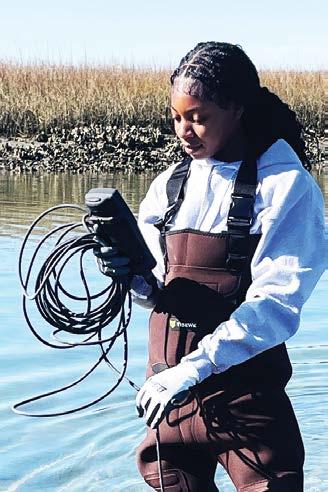
GRADUATE STUDENT HELPS BUILD RESILIENCE in Puerto Rico
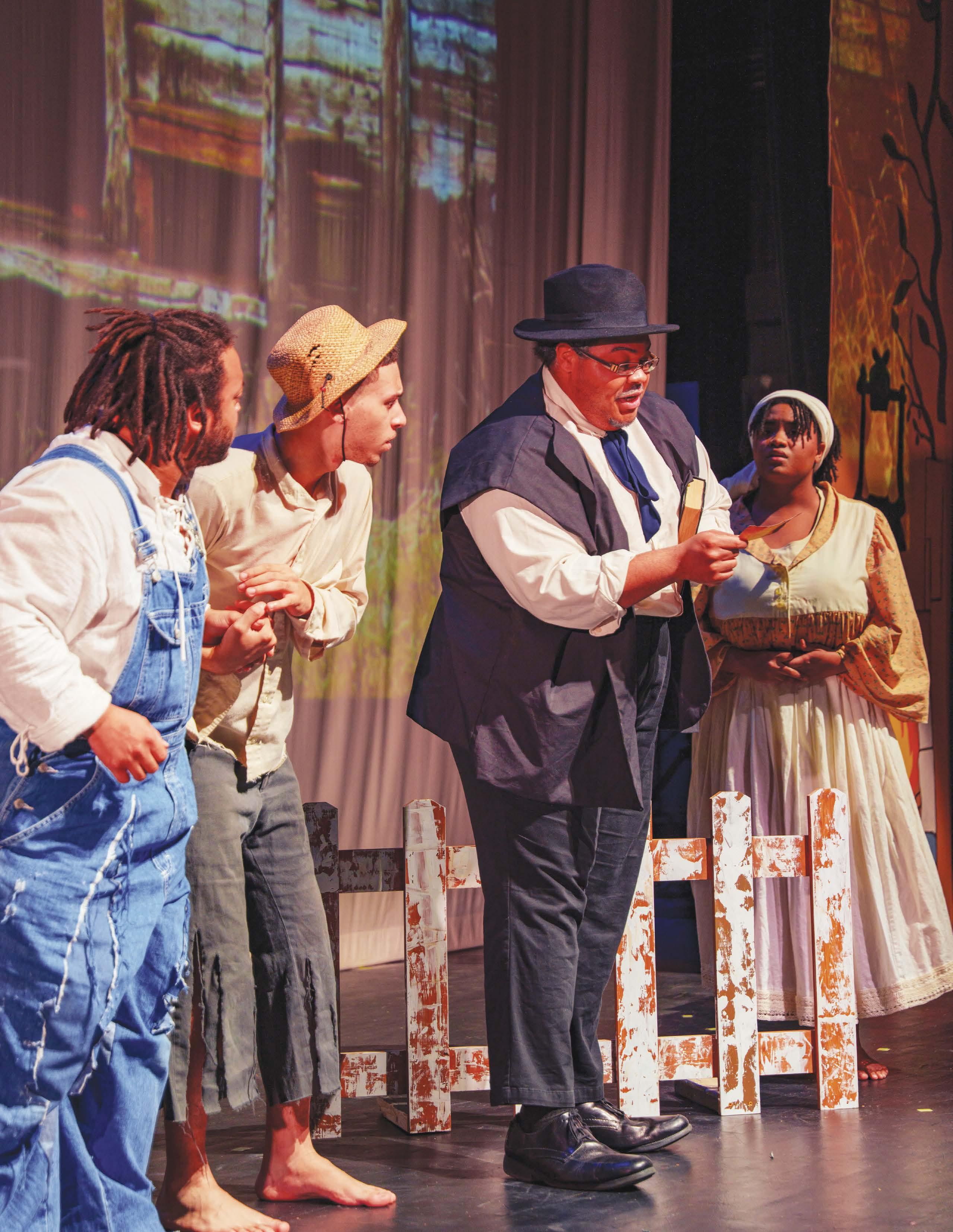
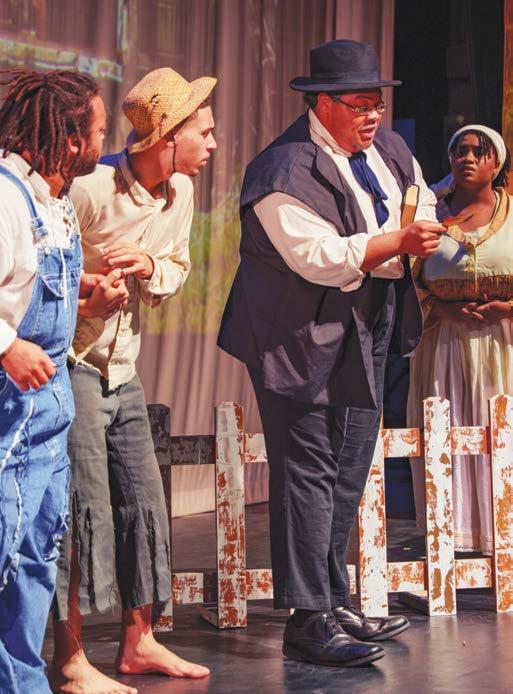
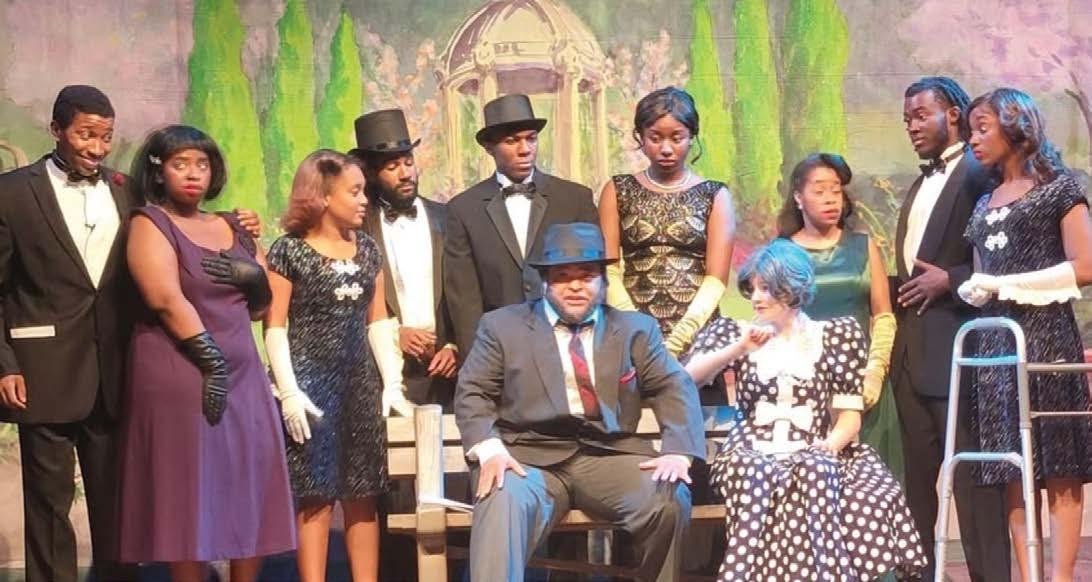
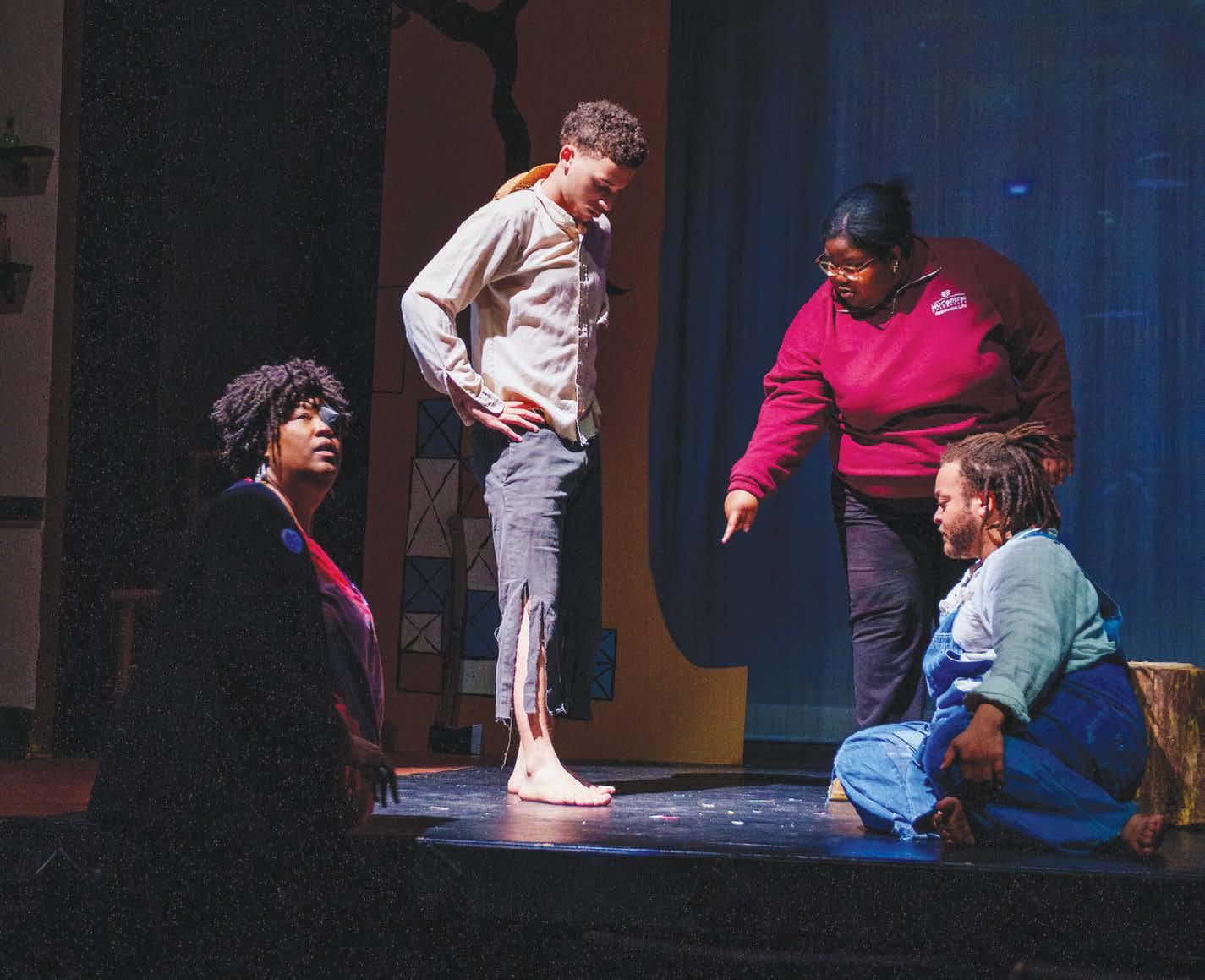
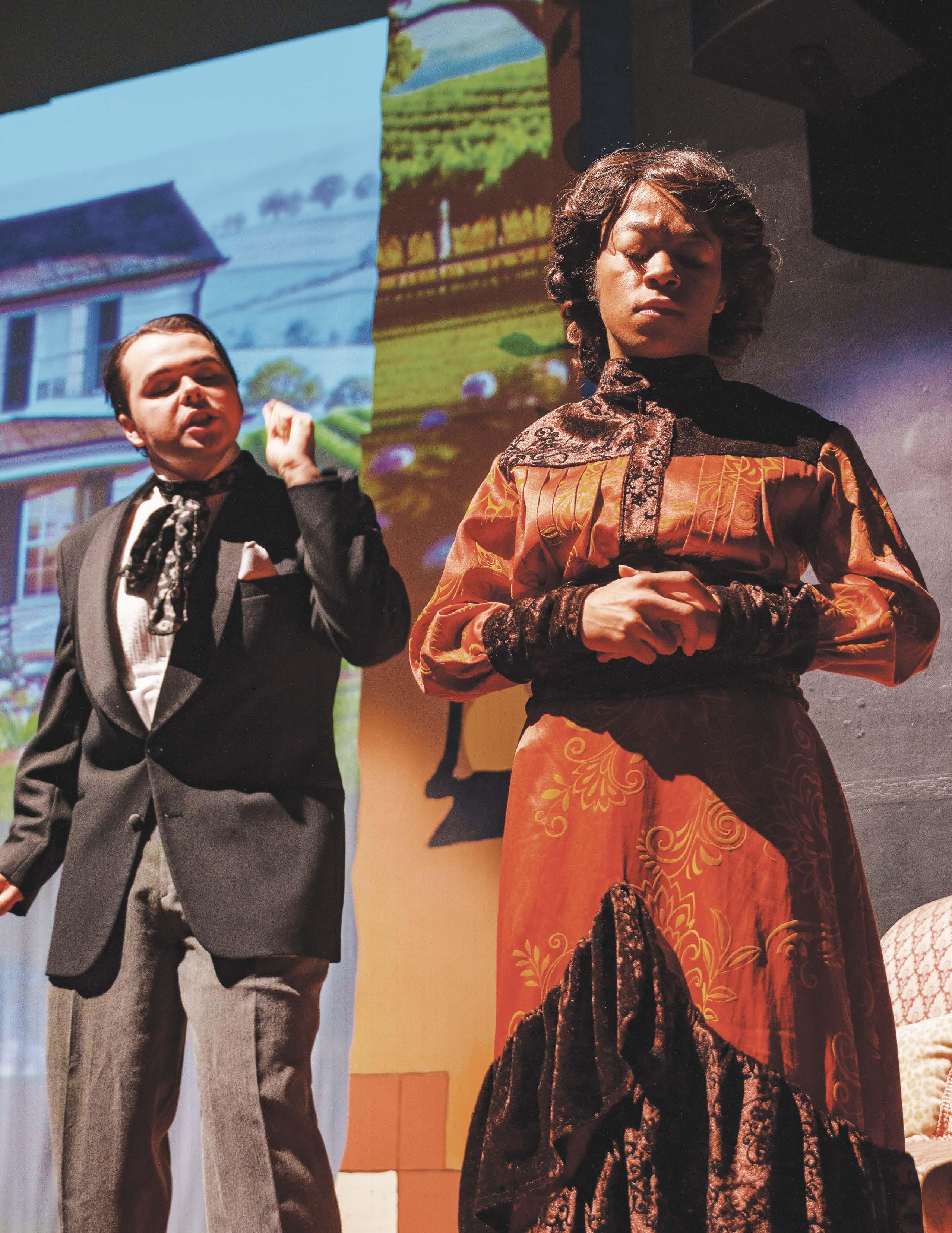
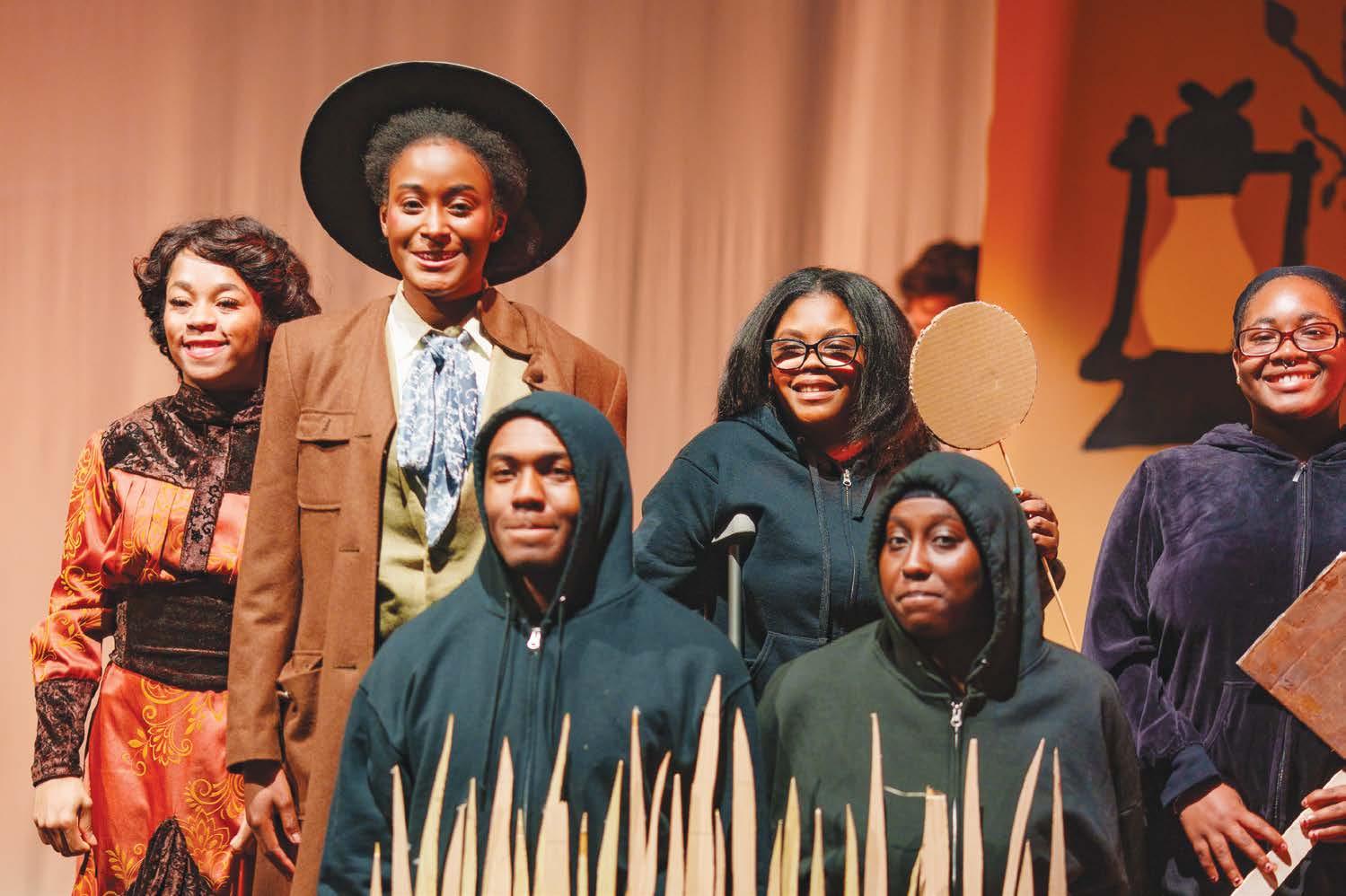
Steal Away Home
The department of theatre at NCCU presented a play for children, albeit one with a weighty plot.
NORTH CAROLINA CENTRAL UNIVERSITY
Photo by DeAndres Royal ’10
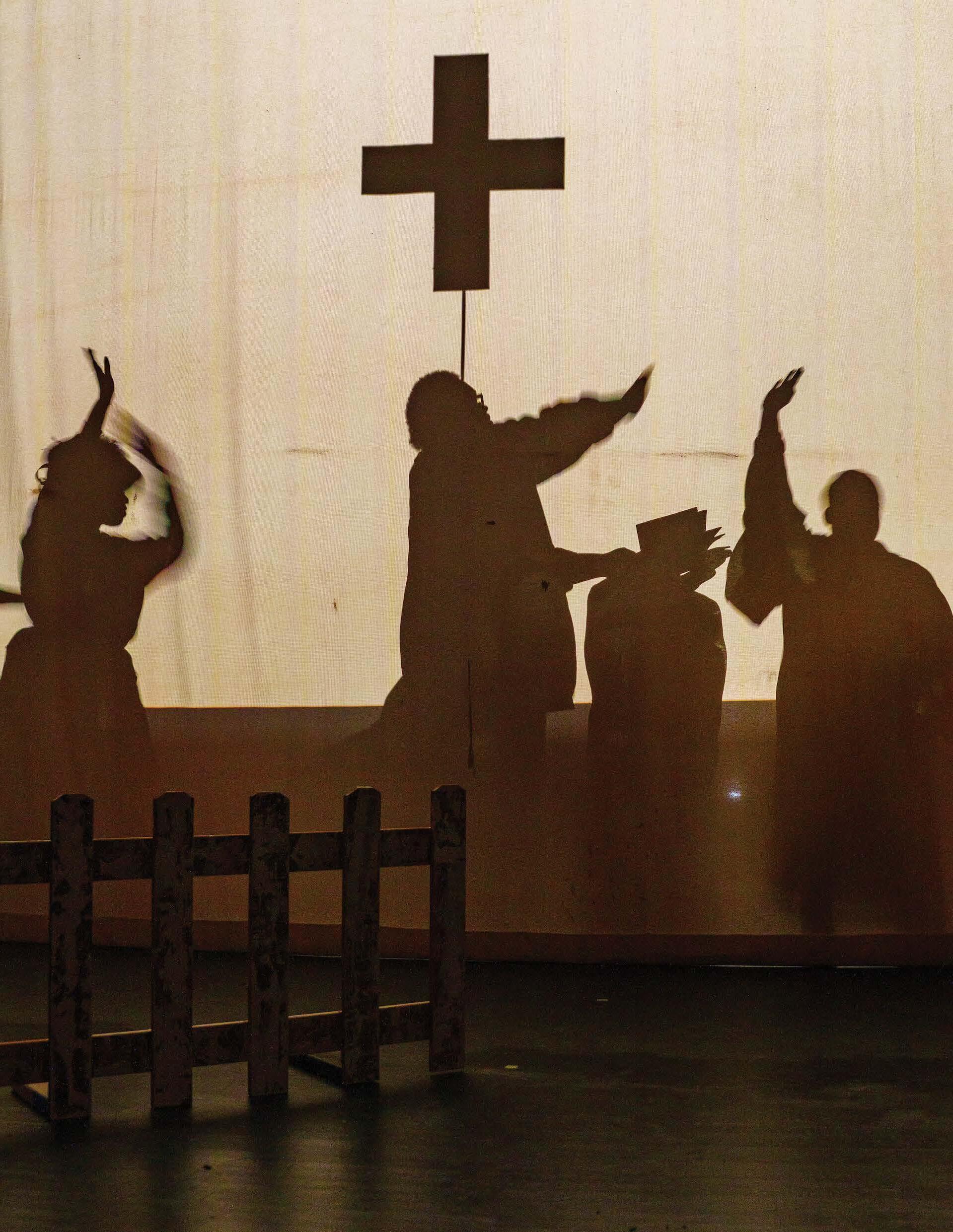
Photo by DeAndres Royal ’10
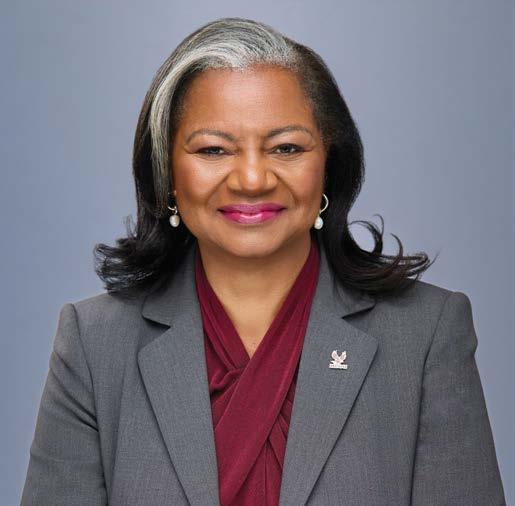
MESSAGE from the CHANCELLOR
Dear Eagles,
Spring at North Carolina Central University brings renewed energy across campus and throughout our Eagle community. It is a season that reminds us why NCCU continues to soar as a place where ambition is nurtured and talent is cultivated.
In this edition of NCCU Now, you will discover the stories that define this moment in our university’s journey. Each page reflects the determination, creativity and service that make NCCU such a special place to learn, lead and grow.
Our students continue to rise to new challenges and seize opportunities that expand their horizons. Their achievements in the classroom, in research and in communities across the nation demonstrate the power of an NCCU education and the promise of the next generation of Eagle leaders.
You will also read about the faculty and staff whose commitment fuels that success every day. Through innovative teaching, groundbreaking scholarship and meaningful mentorship, they create an environment where students can thrive and pursue their passions with confidence.
Across our alumni network, Eagles are making a difference in industries, organizations and communities around the world. Their accomplishments reflect the enduring impact of an NCCU education and the values of truth, service and leadership that unite us.
As you explore this issue, I invite you to celebrate these stories and the remarkable people behind them. Their journeys remind us that the strength of North Carolina Central University lies in our shared commitment to excellence and opportunity.
Thank you for continuing to support NCCU and the generations of Eagles who will follow. Together, we will continue building a future where our students and our university soar.
In Truth and Service,
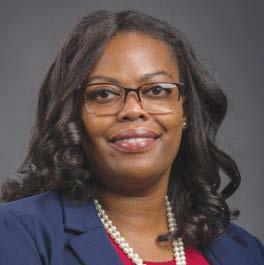
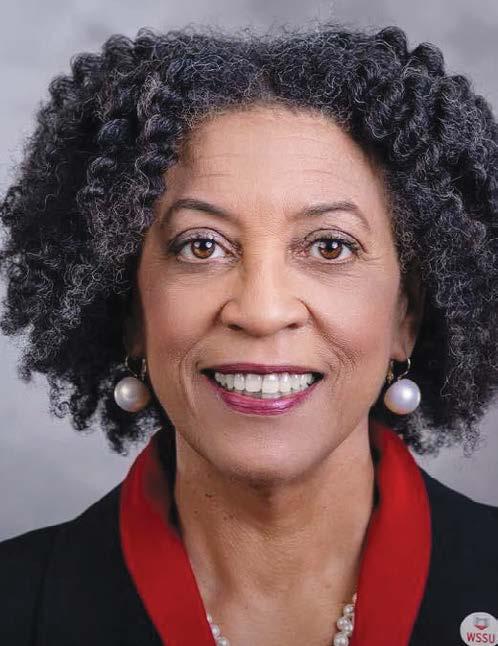
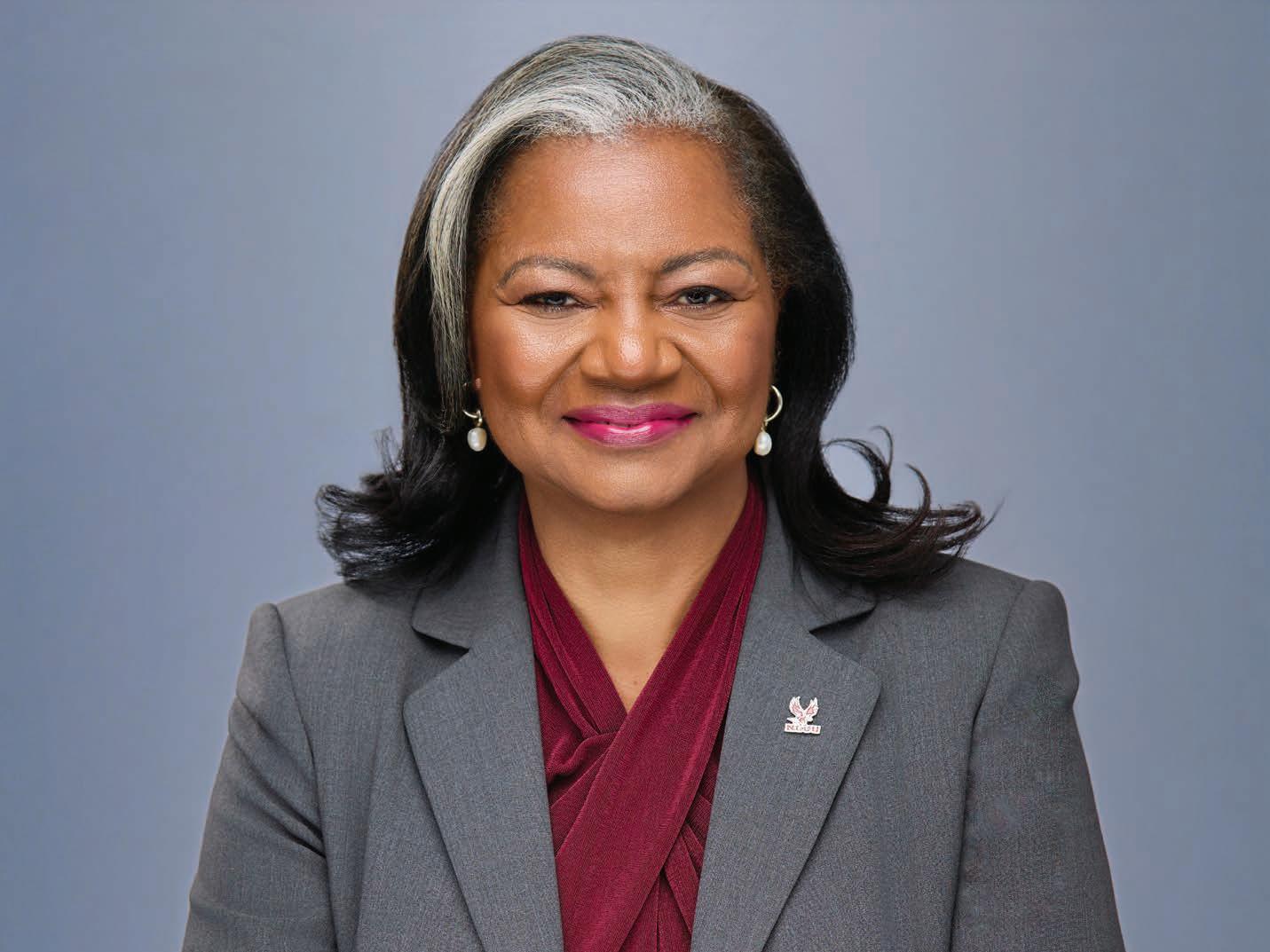
Karrie G. Dixon, Ed.D. Chancellor North Carolina Central University
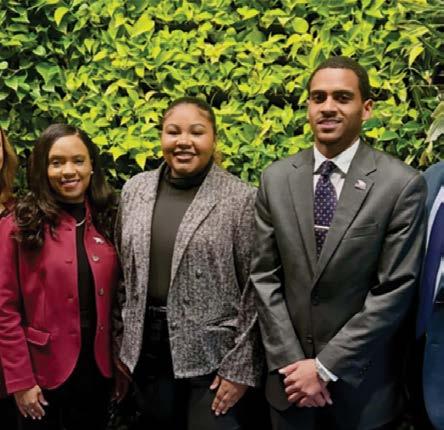
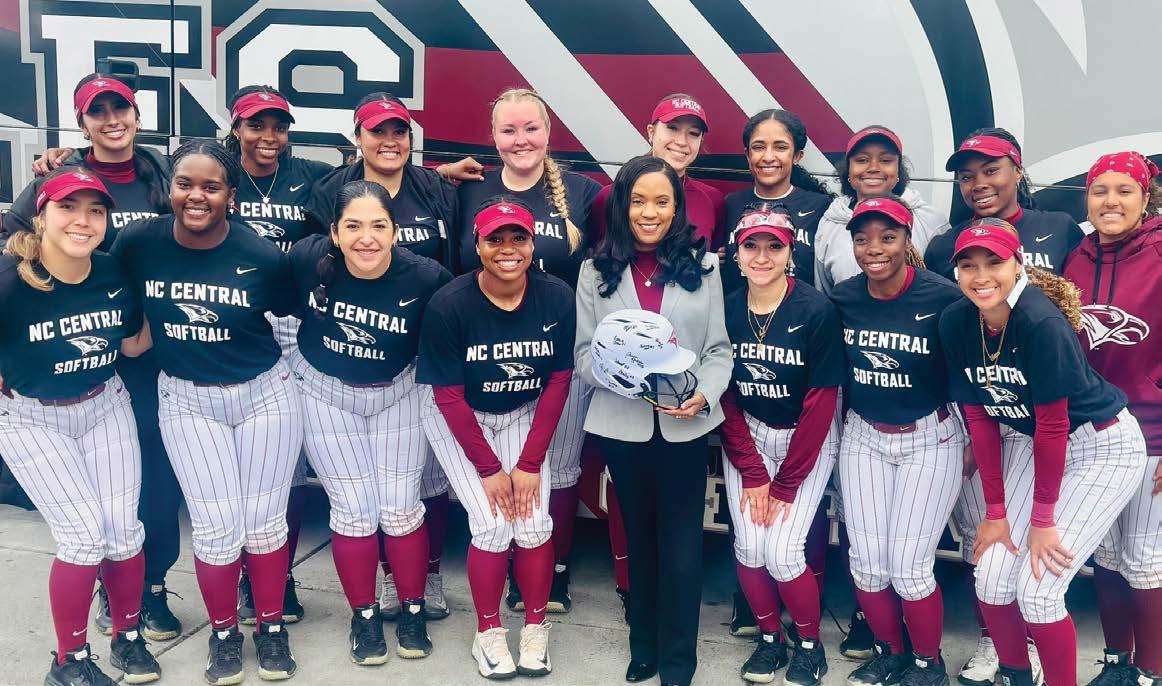
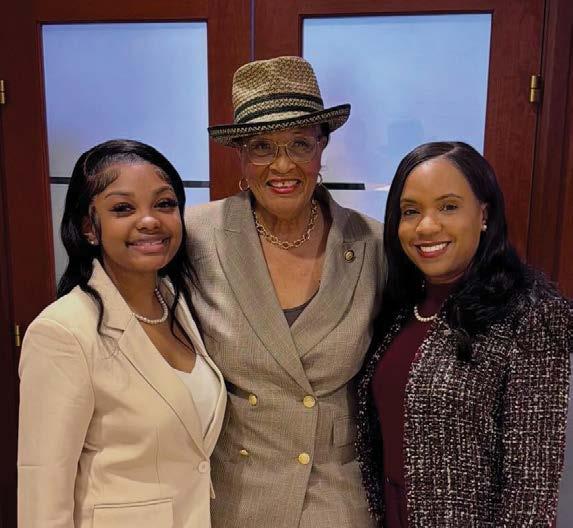
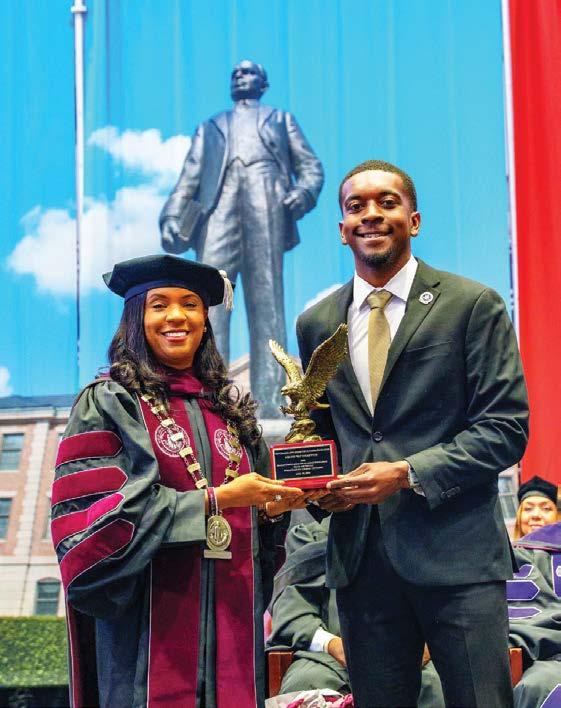
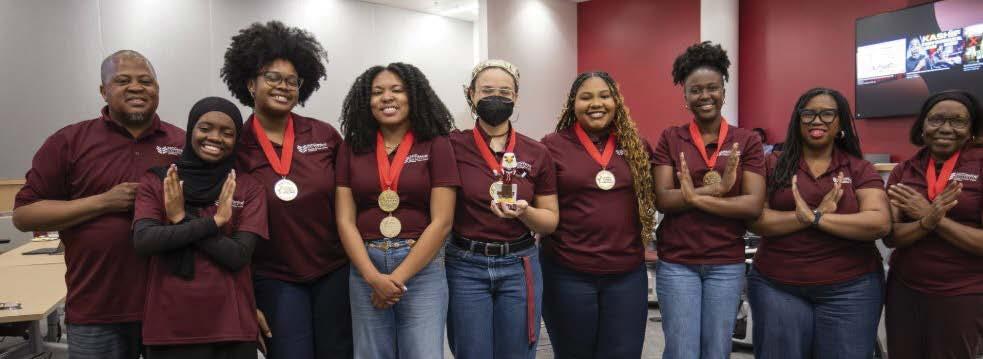
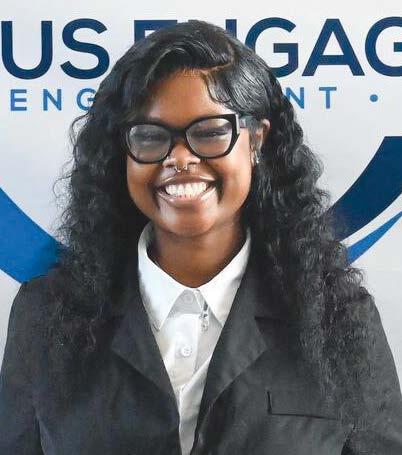
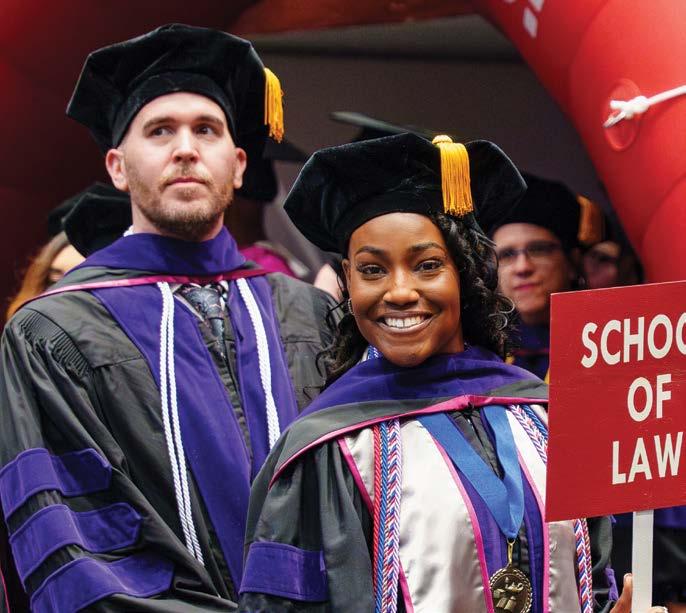
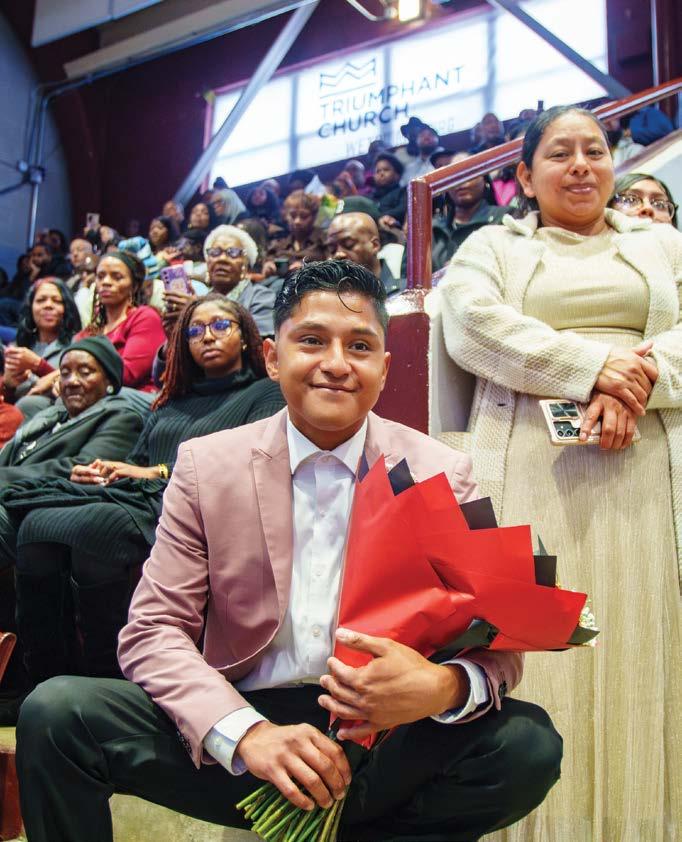
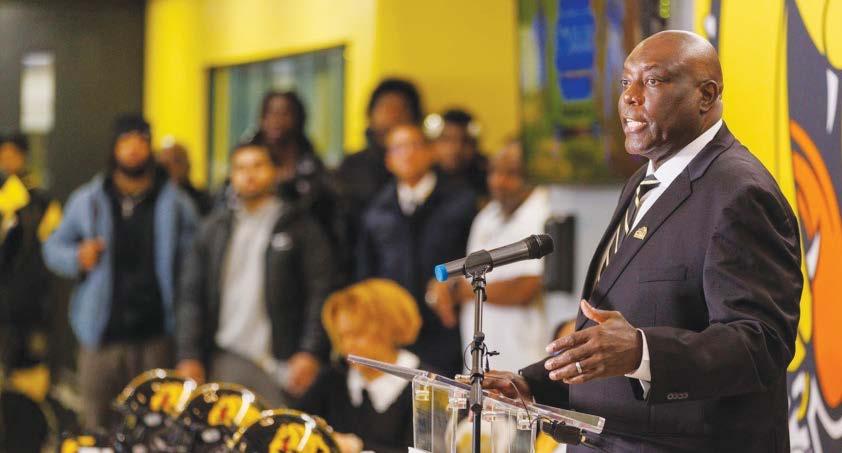
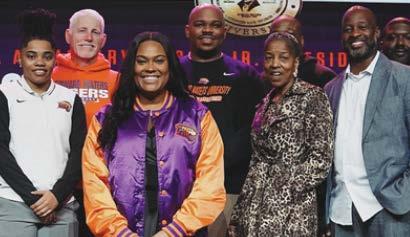
/1/ NCCU celebrates Chantel Chestnutt ’27 as a 2026 Marian Drane Graham Scholar with the UNC System Office /2/ Chancellor Dixon at sendoff for this season's home opener for NCCU Softball. /3/ Sha’lexus Sanders was recognized by the ALL IN Campus Democracy Challenge for her outstanding leadership in civic engagement. /4/ K.J. Chadwick received the Chancellor's Award at Honors Convocation /5/ NCCU wins the Honda Campus All-Star Challenge national championship for the first time.
NCCU NOW MAGAZINE
is published by North Carolina Central University’s Office of Communications and Marketing, 1801 Fayetteville Street, Durham, NC 27707.
View the Spring 2026 digital version and past issues at issuu.com/nccentraluniv
NCCU NOW CONTRIBUTORS
CHIEF BRAND OFFICER Stephen W. Fusi
EDITOR Mark Lawton
SENIOR GRAPHIC DESIGNER Pandora Frazier ’82
WEB CONTENT MANAGER Jay Morrow ’95
WRITERS Attiya Dunn ‘25, Stephen W. Fusi, Syria Gilmore ’21, Terri Godwin Hyman '99, '03, Anthony Jeffries, Mark Lawton, Quiana Shepard, André D. Vann '93, ’95
COPY EDITOR Cassandra Harper
PHOTOGRAPHY DeAndres Royal ’10
NCCU BOARD OF TRUSTEES
CHAIR Courtney Crowder ’00
MEMBERS
David Alexander ’94, ’99
Farad Ali
Roderick G. Allison, JD, '95
William V. Bell
G. Keith Chadwell
Ryan Combs
Francesca D. Gary
Michael Goodmon
Lisa F. Martinez
Sha‘lexus Sanders ’26
Dr. Orlando R. Stovall '76
Antwan Thornton, JD, '15
CHANCELLOR'S CABINET
CHANCELLOR Karrie G. Dixon, Ed.D.
EXECUTIVE VICE CHANCELLOR
Alyn Goodson, JD, '11
PROVOST AND VICE CHANCELLOR FOR ACADEMIC AFFAIRS
Ontario S. Wooden, Ph.D.
VICE CHANCELLOR AND CHIEF OF STAFF
Gary L. Brown, Ph.D., ’02
VICE CHANCELLOR FOR BUSINESS AND FINANCE
Laurie Wilcox
VICE CHANCELLOR FOR STUDENT AFFAIRS
Angela Alvarado Coleman, Ed.D.
VICE CHANCELLOR FOR INSTITUTIONAL ADVANCEMENT
Susan Hester
DIRECTOR OF ATHLETICS
Louis "Skip" Perkins, Ph.D., ’94, ’98, ’00
FAST-TRACKING A PATH FOR LIFE SCIENCE
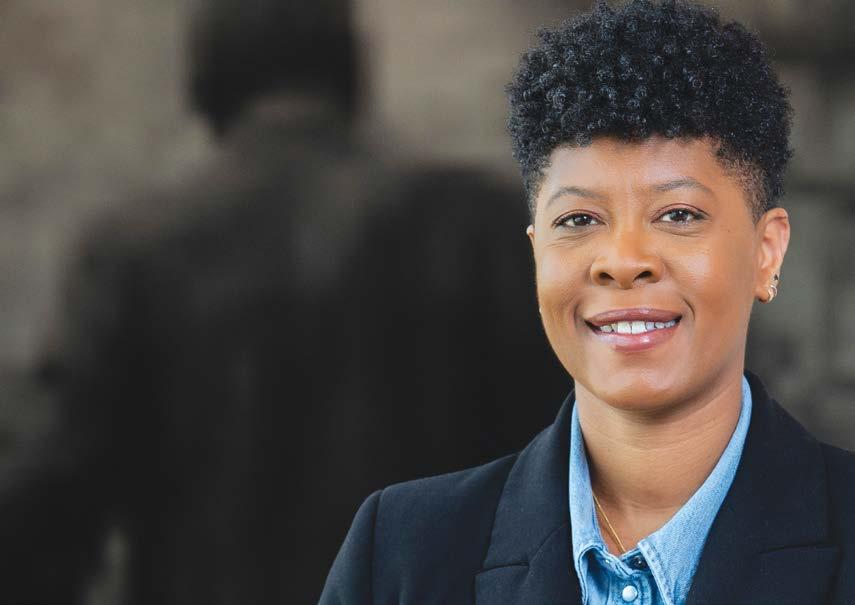
North Carolina Central University (NCCU) is taking the lead in life sciences
education
with an agreement that gives Durham Technical Community College students a fast-track into some of the region’s most in-demand fields.
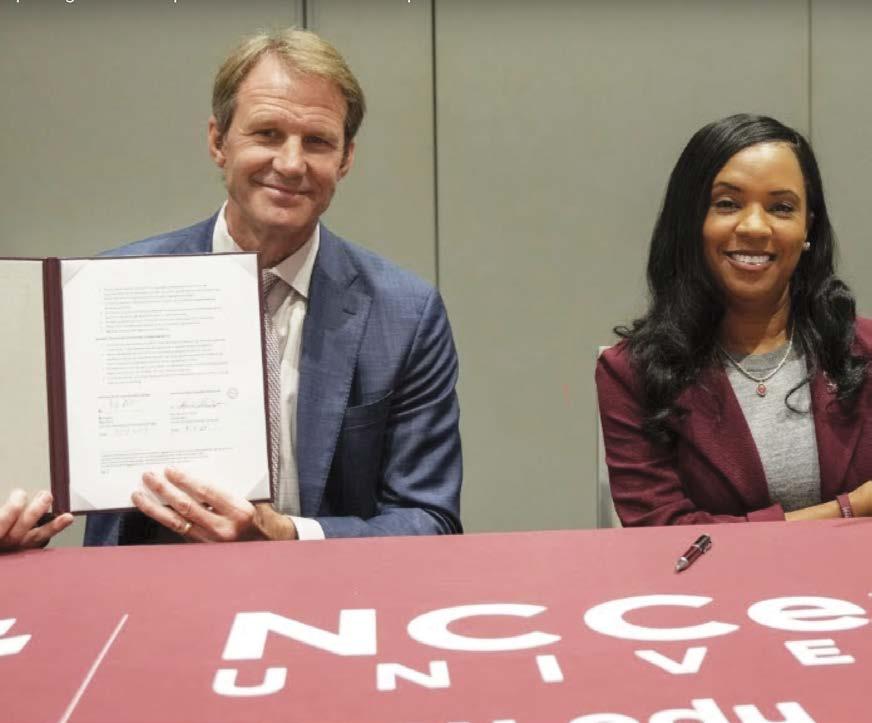
The memorandum of understanding (MOU) between the two institutions better aligns the courses required for an associate degree in applied sciences at Durham Tech with those required at NCCU, said Cindy Love, Ph.D., NCCU director of transfer services.
It also replaces the need for multiple bilateral agreements, allowing the institutions to quickly create new pathways in high-demand fields that drive the local economy.
Impacting the Community
When Ayana Dennis learned she had been selected for the Community Impact Student Award from NC Campus Engagement, her first reaction was disbelief, followed quickly by gratitude.
Dennis, a senior social work major, was honored at the 2025 Citizenship, Service, Networking and Partnerships (CSNAP) Student Conference on Nov. 8, 2025. The award recognizes one student at each participating institution for outstanding leadership, service and sustainable community impact.
Senegal and France for Fulbright Awardee
James Ham ’93 , director of NCCU’s Office of International Affairs, has been selected as a Fulbright U.S. International Education Administrators (IEA) HBCU awardee for the 2026–27 academic year, a prestigious honor recognizing senior higher education leaders advancing international education.
Administered by the U.S. Department of State through the Institute of International Education, the Fulbright IEA Award supports a two-week immersion in Senegal and France in March 2026. The experience brings together global education leaders to explore internationalization strategies, higher education leadership and partnership development.
During the program, Ham will engage with universities, government agencies and international education to strengthen NCCU’s global partnerships and expand opportunities for students.
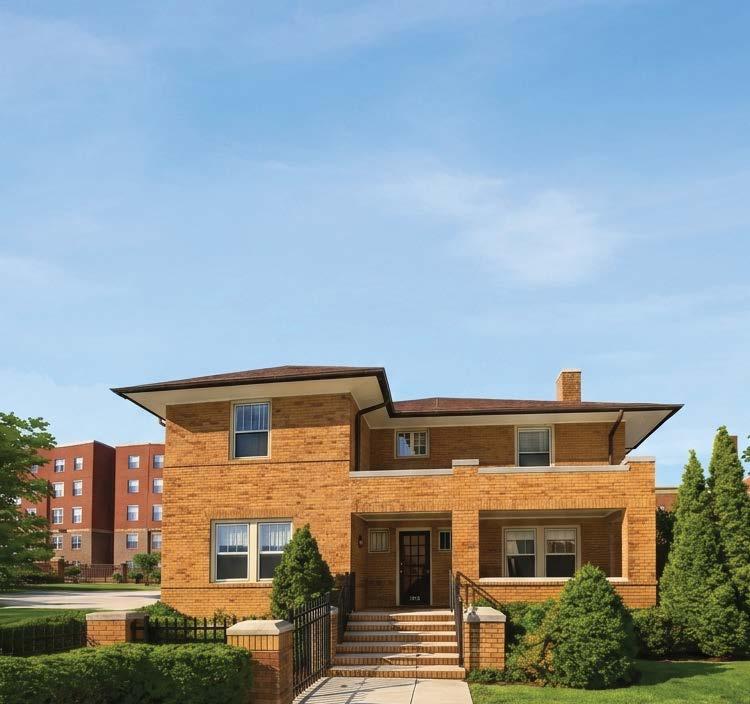
Shepard House Turns 100
The James E. and Annie Day Shepard
House at 1902 Fayetteville Street celebrated its 100th anniversary last year. Constructed in 1925, it was the home of the university founder and his family. It is the oldest building on the campus of NCCU and is listed on the National Register of Historic Places.
BUILT IN 1925
Improvements to Campus Grant for Interdisciplinary Effort
BY SYRIA GILMORE
Stipend
for Field Experience
NORTH CAROLINA CENTRAL UNIVERSITY HAS RECEIVED A GRANT OF $1,273,500 from the National Institute of Biomedical Imaging and Bioengineering (NIBIB), part of the National Institutes of Health (NIH). The grant will launch the NCCU Biomedical Engineering, Imaging and Technology Acceleration (BEITA) Initiative.
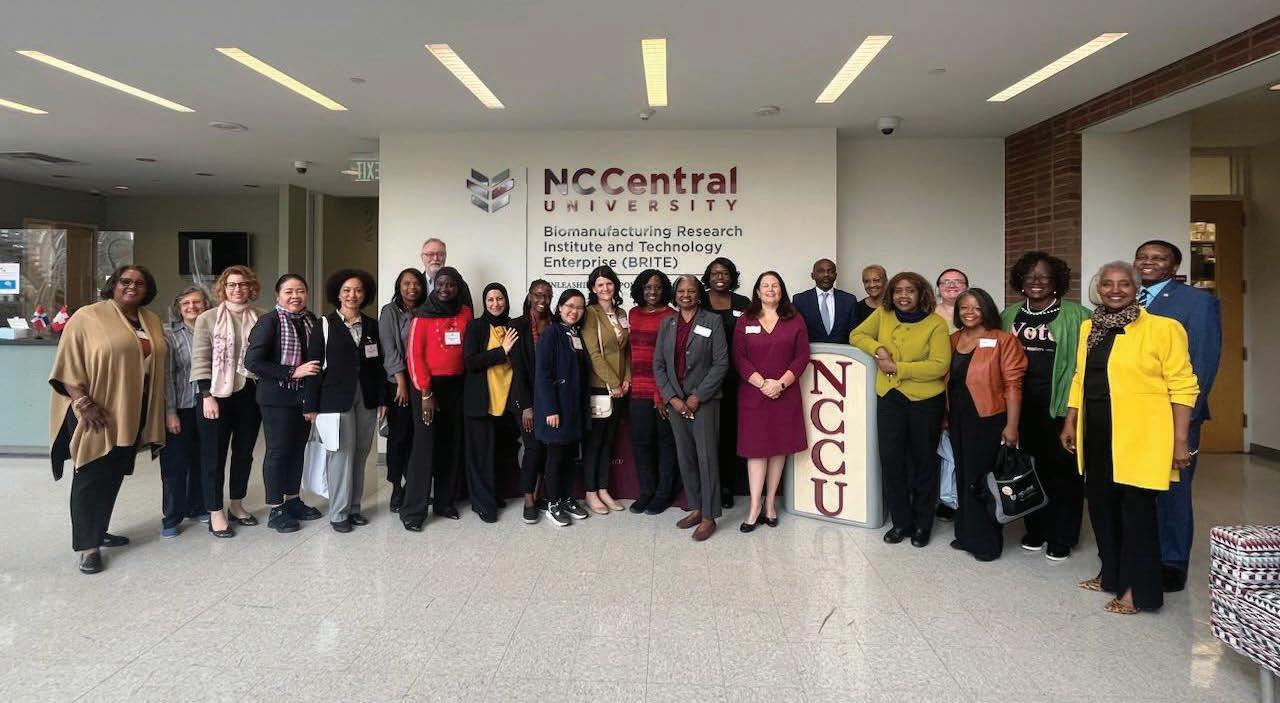
The BEITA program's vision is to establish NCCU as a hub for bioengineering research and education. The goal is to create an interdisciplinary ecosystem that merges biology, chemistry, computational science and engineering to solve complex health problems, particularly in cancer research.
The School of Education at North Carolina Central University (NCCU) received a $2.3 million federal grant for graduate students to complete their field experience in integrated care settings.
The four-year grant, known as IMPACT NC, was awarded by the Health Resources and Services Administration. Over half of the grant award is used to provide stipends for master’s and doctoral students studying to become professional counselors, counselor educators and clinical supervisors.
The $25,000 stipend is used to subsidize students’ fieldwork in primary care, school and telehealth in underserved settings where counseling and behavioral health services are offered. The remaining portion of the funding is used for faculty and student training, course enhancements and administration of the grant.
Helping Mental Health Clinicians in Secondary Schools
An assistant professor in counselor education plans to use a grant to understand and assist mental health clinicians in K-12 schools.
Taheera Blount, Ph.D. , received a grant of $83,634, which originated with the National Institutes of Health and was awarded through the Research Centers in Minority Institutions (RCMI) at North Carolina Central University (NCCU).
Blount’s research will take part in three phases.
• Exploring how school-based clinicians collaborate with school counselors, social workers and administrators in meeting the needs of students.
• Working with an agency to test a data tracking system that evaluates the effectiveness of school-based mental health services.
• Developing a mental health toolkit that clinicians can share with parents, teachers and school administrators.
ONE-STOP RESOURCES FOR STUDENTS
NCCU was selected by the Thurgood Marshall College Fund (TMCF) as one of eight member institutions to RECEIVE $2 MILLION as part of the Project HBCU Capacity Building: Maximizing HBCU Institutional Performance through Investments in Research, Operations and Innovation initiative, funded by Lilly Endowment Inc.
NCCU’s winning proposal is for a One-Stop Student Success Center, which will bring student success resources currently physically and operationally dispersed across the campus into a shared space. NCCU’s students will benefit from improved access to and enhanced coordination among these resources.
FACULTY LEADER
Jayla Moody Marshall, Ph.D., assistant professor of higher education in NCCU School of Education, has been selected as one of just eight faculty members nationwide for the NASPA (National Association of Student Personnel Administrators) Student Affairs Administrators in Higher Education 2026–27 Emerging Faculty Leader Academy.
A faculty member in NCCU’s higher education administration program, Marshall will represent the university as part of NASPA Region III. She will attend the 2026 NASPA Annual Conference in Kansas City, Missouri, where she will present a scholarly paper alongside one of her higher education administration students, highlighting NCCU’s commitment to faculty-student scholarship and leadership development.
Howard University–based national research collaboration to explore how artificial intelligence will influence future jobs and prepare students for success in an AI-driven economy.
The initiative unites scholars from multiple institutions to examine how artificial intelligence is transforming work and higher education.
VALUING HBCUS
Dawn Matthews, Ph.D. , associate dean of University College, and Yang Liu, Ph.D. , assistant professor in the department of computer information systems, have been named HBCU Center Fellows by The Center for HBCU Research, Leadership and Policy at Howard University. The national program spotlights scholars and practitioners whose work advances opportunity, innovation and community impact.
Through the fellowship, Matthews and Liu will each lead a research project examining the influence and value of historically Black colleges and universities. Their findings will be shared with a national audience, highlighting how HBCUs shape education, leadership and community progress.
DOUBLE EAGLE SCORES SCHOLARSHIP
NCCU’s Ariel Germain ’06, ’17, director of marketing and communications for the Division of Student Affairs, has been awarded the Janet B. Royster Memorial Staff Scholarship.
The scholarship, established in 2011 in memory of UNC-TV leader Janet B. Royster, supports professional development for permanent, full-time University of North Carolina System staff and honors those demonstrating leadership and dedication.
THE SOCIAL IMPACT OF TECHNOLOGY
Erezi Ogbo-Gebhardt, Ph.D., assistant professor of information science and program director of online and extended studies in NCCU’s School of Library and Information Sciences, has been selected as one of only 20 fellows nationwide for the year-long Public Voices Fellowship on Technology in the Public Interest.
The fellowship, an initiative of The OpEd Project in partnership with the MacArthur Foundation, supports leaders who are shaping national conversations about the social impact of technology. Fellows receive training, mentorship and a platform to share their expertise on critical issues at the intersection of technology and society.
REBEL RESHAPES LEGAL PROFESSION
Professor April Dawson has been named a 2026 ABA Legal Rebel, a national honor from the American Bar Association recognizing individuals who are reshaping the legal profession through innovation and leadership.
The designation recognizes Dawson’s work at the crossroads of legal education and technology, including her leadership in advancing national conversations around artificial intelligence, academic integrity and preparing law students for a technology-driven legal profession.
Dawson serves as associate dean of the NCCU Law and Technology Center, where she helps position the law school as a leader in technology-focused legal education
FROM TANZANIA TO NCCU
Elsie Sia Kanza, Tanzanian Ambassador to the United States, took part in a roundtable discussion with representatives of NCCU and the Triangle area of North Carolina.
The 90-minute meeting on Aug. 13 in the nursing building covered a variety of topics, including questions about the Tanzanian economy, and discussions about tourism, potential students interacting with the NCCU website, a “drone academy” taught by NCCU faculty and the NCCU nursing program.
The roundtable was organized by the NCCU Office of International Affairs and Sister Cities International of Durham.
What still surprises people is that what you do as an adolescent has long-term effects.”
S. ALEX MARSHALL, PH.D. professor, biological and biomedical sciences
Associate Professor Studies Causes of Alcohol Abuse
BY MARK LAWTON
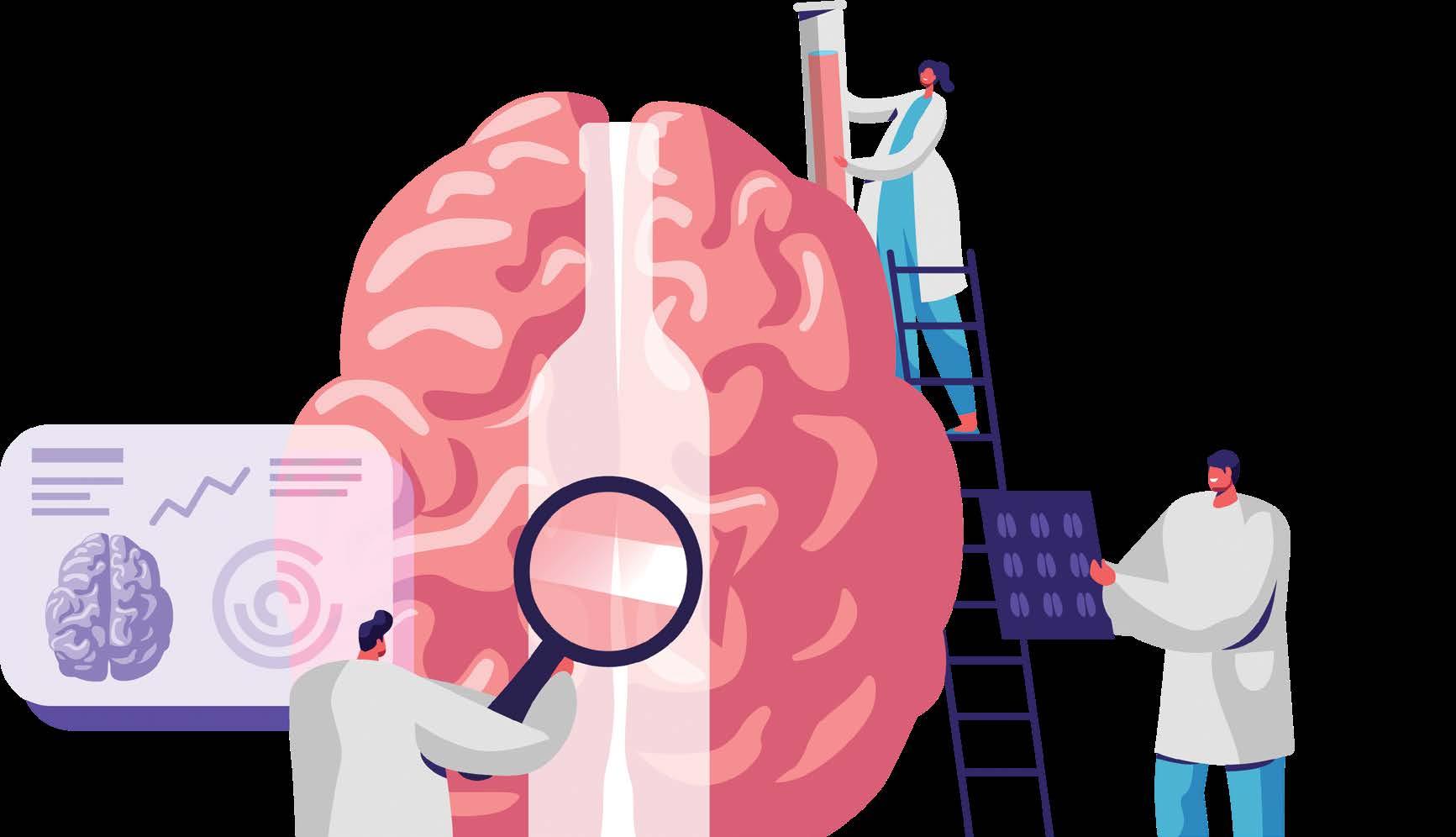
For some people, alcohol abuse starts in their brain. At least that is where Associate Professor S. Alex Marshall, Ph.D., is looking.
Marshall, who has a joint appointment between the department of biological and biomedical sciences and the Julius L. Chambers Biomedical and Biotechnology Research Institute (JLC-BBRI), became interested in the cause of alcohol abuse in West Columbia, South Carolina.
“Substance abuse disorders and alcohol use disorders were common where I grew up,” Marshall said.
Marshall’s labs are primarily focused on understanding the neuronal mechanisms that contribute to and result from alcohol abuse.
“Neurons are the (brain) cells responsible for relaying messages and telling the other parts of the body how to respond, and sensations,” Marshall said.
The Marshall lab focuses on three areas of the brain:
• Frontal cortex, where executive decision-making takes place. That includes reasoning, making decisions, problem solving, controlling emotions and behavior.
• Hippocampus, which is responsible for memory (short and long term) and learning. It also helps people learn more about their environment and remember what words to say.
• Amygdala, which is important for emotional regulation and stress response.
“People drink for so many reasons,” Marshall said. “If people are drinking because they are stressed, there may be issues in the amygdala. If they are drinking because of poor decision-making, there could be issues in the frontal cortex.”
More specifically, the Marshall lab looks at two aspects of alcohol abuse: what causes binge drinking and brain damage caused by binge drinking. “Can we curb binge drinking but also prevent brain damage?” said Marshall.
WHAT DRINKERS DON’T KNOW
So, why do some people get addicted to alcohol while others don’t?
“That’s the milliondollar question,” Marshall said, adding that it has something to do with the differences in brain networks.
“Some people drink because they find it rewarding,” Marshall said.
“Some people drink because they don’t feel the
negative effects.”
Asked what most people don’t know about alcohol abuse, Marshall highlighted two key
“What still surprises people is that what you do as an adolescent has long-term effects,” Marshall said. “A lot of people say I only drank heavily in college or high school, but they may have long-term damage.”
Second, “Our brain is malleable,” Marshall said. “It does try to fix itself. A lot of things we study can be reversed with diet and exercise.”
The impact of alcohol consumption appears to be a popular area of research at North Carolina Central University (NCCU).
• Xiaohe Yang, a professor in biological and biomedical sciences, researches the mechanism of alcoholassociated breast cancer risk.
• Lindsey Constantini, an assistant professor in biological and biomedical sciences, conducts research on some of the impacts of alcohol on viral infections.
• Ju-ahng Lee, an associate professor, and Greg Cole, a professor – both in the department of biological and biomedical sciences – study the impact of fetal alcohol exposure on development.
• Kevin Williams, a professor at the Biomanufacturing Research Institute and Technology Enterprise (BRITE), examines the impact of alcohol on cancer.
NCCU Leads State with First University Nursing Program to Open Immersive Interactive Room
BY MARK LAWTON
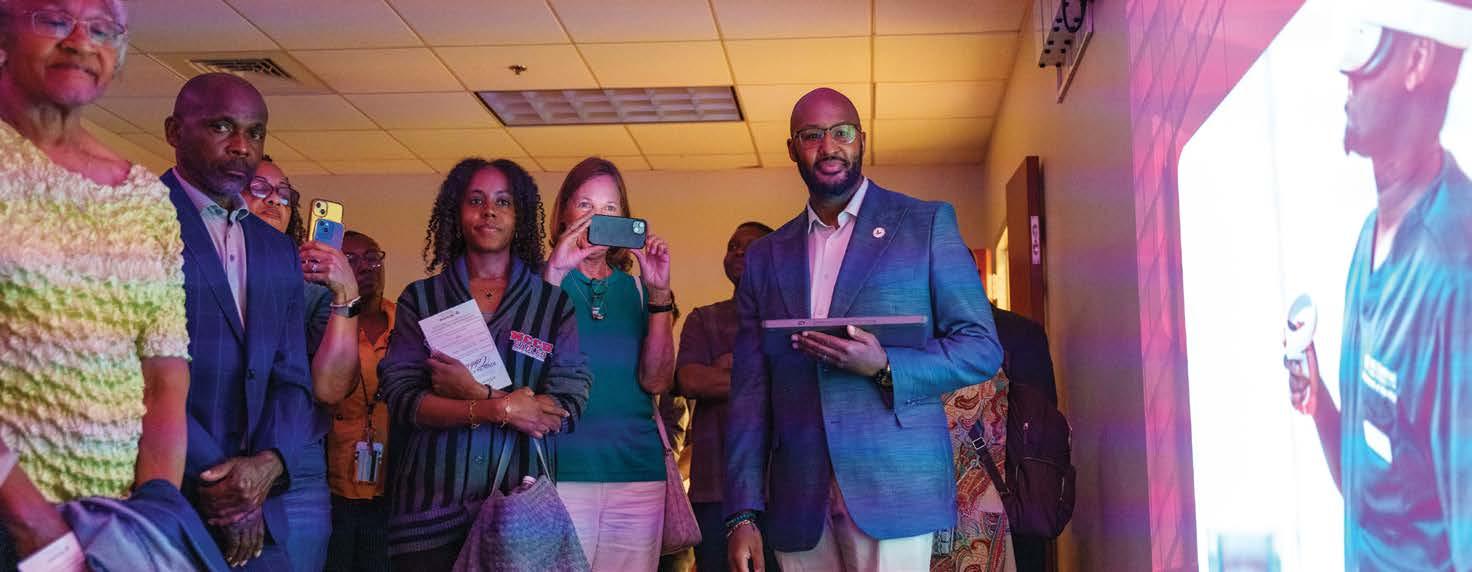
HE DEPARTMENT OF NURSING at NCCU has advanced simulated training for nursing students by opening an immersive interactive room.
On the second floor of the nursing building, the immersive interactive room will allow students to engage in virtual medical training scenarios.
NCCU’s nursing program is the first at a university in North Carolina to adopt this technology.
Among those are training scenarios on therapeutic communication, mental health, post-operative complications and rural community health simulation.
“We have access to more than 2,000 scenarios,” said Tina Scott, DNP, director of experiential learning.
Ceiling projectors project images onto three walls of the room. Nursing students in the immersive interactive room can also experience touch and smell.
Say, for example, there is a scenario about a 14-car pile-up, complete with police, paramedics, injured people on the ground and vehicles on fire.
“There are scent diffusers in the room and fans on the ceiling that will pipe in smoke, burning rubber and smells from the environment,” said Scott.
In another scenario, “(students) are immersed in a virtual hospital,” Scott said.
“They can see a virtual patient in a bed. It’s a replica of a hospital setting. It has monitors and a sink. They can also see other nurses. They can see the patient’s chart and look up other assessments.”
If that’s not real enough, nursing students can also talk with the virtual patients in real time.
When each scenario is over, instructors review the student’s actions.
In addition, the nursing department has obtained 360-degree cameras so they can create their own scenarios.
“We can be really specific to the community,” Scott said.
In summer 2024, the department introduced virtual reality equipment to its students.
Students wear an Oculus (headgear covering the eyes) and handheld controls. The gear allows them to view and interact with simulated medical training scenarios, including having real-time conversations.
“We will produce nurses in quality and quantity that are needed in North Carolina and the United States,” said Mohammad Ahmed, Ph.D., dean of the College of Health and Sciences. “This is part of our expansion.”
Faculty Research Materials 1,000 Times Smaller than a Strand of Human Hair
BY MARK LAWTON
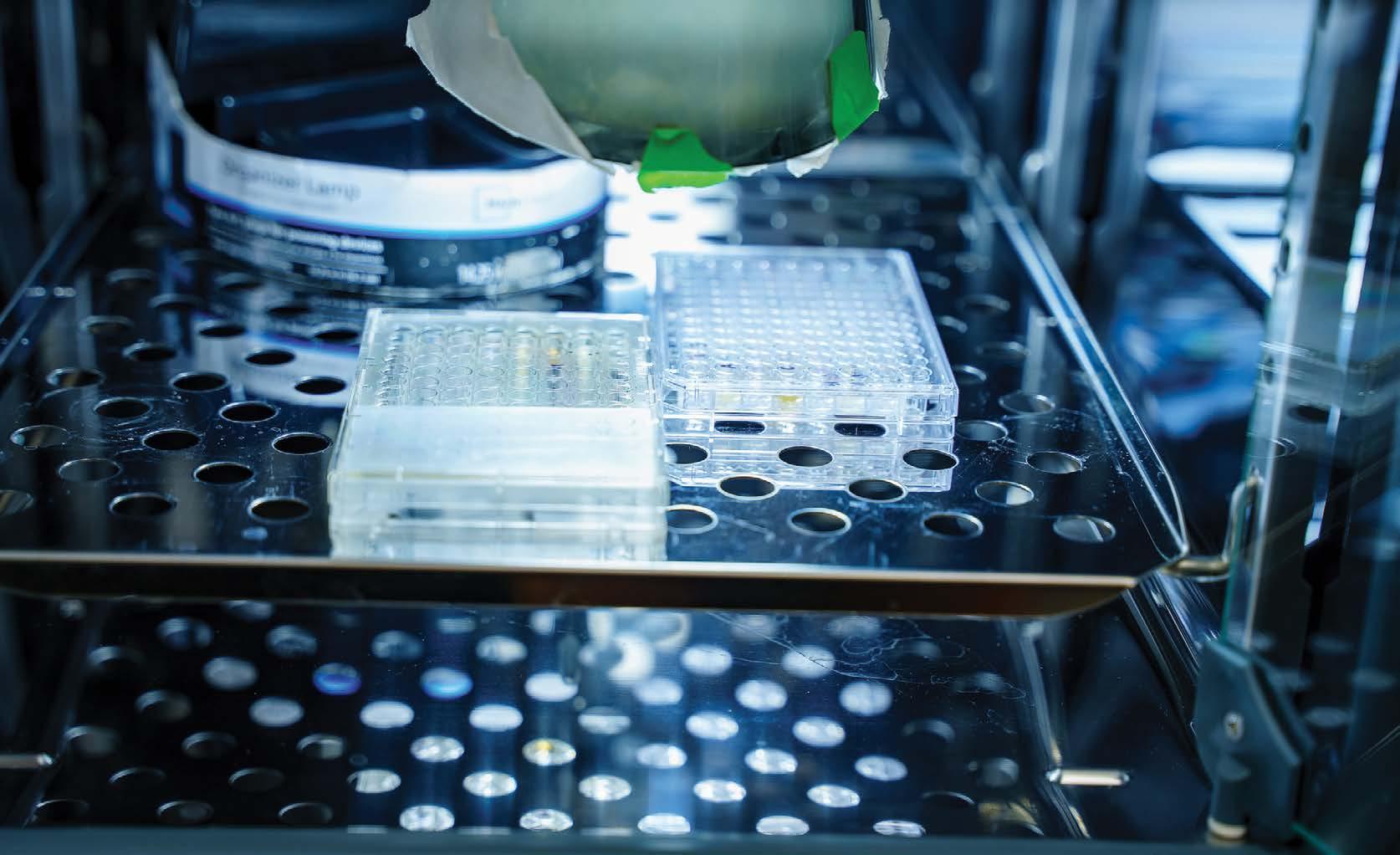
Some faculty at North Carolina Central University (NCCU) conduct research on materials so small that they cannot be seen through a conventional microscope.
How small is that? A single strand of human hair is 80 microns across.
“The particles we work with are a thousand times smaller than a strand of human hair,” said Fei Yan, Ph.D., professor of chemistry and biochemistry. Yan and his students work on a variety of projects involving nanomaterials. Those include:
• Using visible light to speed up the process of breaking down "forever chemicals” and detecting harmful compounds released by factories.
• Detecting dopamine and glucose in sweat and urine to create quick, non-invasive medical tests for conditions like Parkinson's disease and diabetes.
• Making materials that can detect infrared light for military night vision equipment.
• Using visible light to speed up the process of breaking down plastics.
“We do everything under the sun,” said Yan. Research on nanomaterials came into its own in the 1980s. In the early years, researchers created nanoparticles either from the bottom-up – by adding atoms together – or from the top-down – by making something “big” – and breaking it down into smaller pieces.
“The science has evolved,” said Yan. “We can now create nanoparticles in different shapes and sizes by controlling their growth with heat, pressure and simple chemical solutions.”
Yan became interested in nanomaterials while conducting post-doctoral research in the early 2000s.
“My post-doctoral mentor was a physical chemist and one of the pioneers of nanomedicine,” Yan said. “I went to Oak Ridge National Laboratory, where I was also dealing with nanomaterials.”
Yan’s team also collaborates with Pennsylvania State University through a National Science Foundation Partnership for Research & Education in Materials (PREM).
For the future, Yan anticipates a greater incorporation of artificial intelligence (AI) to accelerate his research.
“In many of our projects, we deal with a high volume of data that can effectively be processed using AI,” Yan said. He believes incorporating AI will ultimately speed up the discovery of new materials and life-saving diagnostics.
KILLING BACTERIA WITH EXCITED PARTICLES
Meanwhile, Liju Yang, Ph.D., professor of pharmaceutical sciences, is conducting research in nanobiotechnology, using nanoscale materials to study and solve biological problems.
”In many of our projects, we deal with a high volume of data that can effectively be processed using AI.”
—Fei
Yan,
Ph.D. professor of chemistry and biochemistry
Yang joined NCCU in 2006, when research with nanomaterials was a quickly developing field. Over the last 10 to 20 years or so, nanobiotechnology has developed rapidly, Yang said.
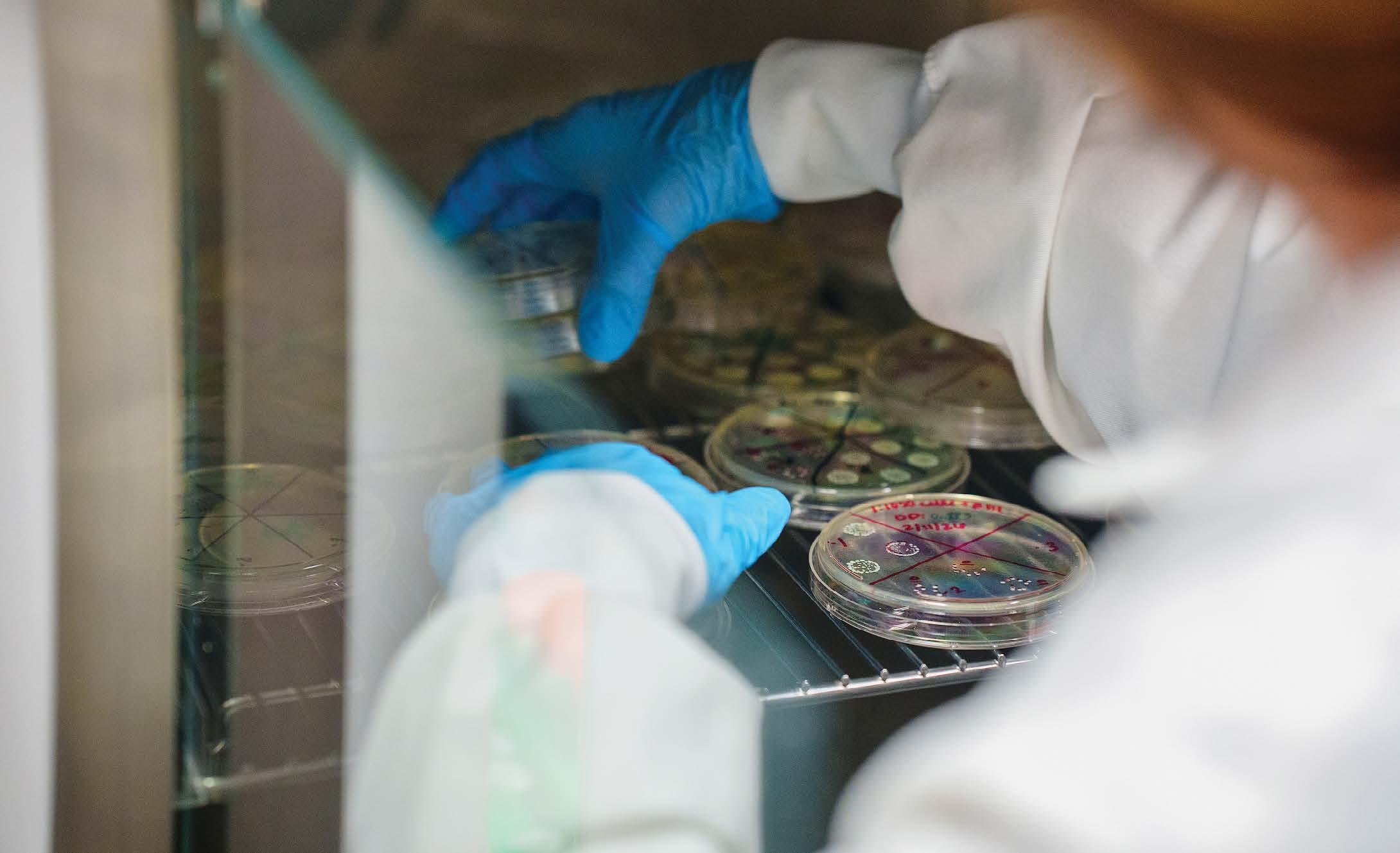
Yang collaborates with a professor of chemistry at Clemson University who creates nanomaterials. She then tests those materials to see whether they can kill bacteria, particularly those that can cause foodborne illness, such as pathogenic Listeria or Salmonella.
The nanoparticles that Yang works with are composed of carbon inside and organic materials on the outside, called either carbon dots or carbon quantum dots, she said. Their diameters are less than 10 nanometers.
“We use the outside layer to modify the properties of the material,” Yang said. “It’s about the optical properties and the ability to interact with bacterial cells.”
The carbon nano “dots” can absorb light. “When they interact with bacteria and interact with light, they can generate reactive oxygen species, which are very effective at killing bacteria,” Yang said.
Yang has worked on multiple projects in collaboration with the Clemson professor and supported by the National Institutes of Health (NIH), National Science Foundation (NSF) and U.S. Department of Agriculture (USDA).
The work is gradually moving from fundamental research to practical applications. For example, the USDA project is incorporating the bacteria-killing nanodots into food packaging to develop self-cleaning films.
The research can be challenging. Sometimes experiments offer inconsistent results.
(continued on page 16)
(continued from page 15)
Liju Yang, Ph.D. professor of pharmaceutical sciences
“It can come from many different factors,” Yang said. “Sometimes the material isn’t working. Or the bacteria are supposed to grow and they’re not. Sometimes there is contamination. We need to figure out what the conditions are that will make the experiment work correctly and consistently.”
While the bacteria can be seen under an optical microscope, viewing the carbon dots requires a scanning electron microscope.
Yang also collaborates with Yan in the PREM projects to research the potential of nanomaterials made in Yan’s lab for killing different species of bacteria.
YANG (CENTER) AND SEVERAL OF HER STUDENTS.
CSmart Canes Tested by NCCU
BY MARK LAWTON
ANES FOR THE BLIND HAVE GOTTEN SMARTER – SORT OF.
“It’s kind of a misnomer,” said Sean Tikkun, Ph.D., an assistant professor in the department of curriculum and instruction, who instructs teachers of the blind and visually impaired.
“A smart cane is a standard white cane, but its handle is jam-packed with all the technology you can put in there,” said Tikkun.
Tikkun first became aware of smart canes during his annual visit to the Consumer Electronics Show five or six years ago. The manufacturer WeWALK sent North Carolina Central University (NCCU) its initial version of the cane for testing and review.
The program has now purchased and implemented the WeWALK 2 cane for instruction and evaluation. The devices are paid for out of a $1.25 million federal grant from the Office of Special Educations Programs. Sixty percent of the grant will be used to educate 24 graduate students.
The smart cane can assist users in accessing buses and trains, offer turn-by-turn navigation assistance while walking and has voice assistance. It can also detect objects and warn the user before they hit them.
“While the technology has been around for at least 30 years, it’s been bulky,” Tikkun said. “This is the first time anyone has used miniaturization.”
The smart cane also has benefits for trainers. It has an accelerometer to measure motion.
“If you register the cane with a training app, the trainer can see how you are using the cane,” Tikkun said. “We’ve never been able to capture that data with a human. It could vastly improve training.”
The grant will also be used to train graduate students on other technologies, such as bone-induction headphones – which allow users to hear directions and traffic at the same time – and miniature video cameras that can be worn on a hat or lanyard.
It's not yet clear whether smart canes will become the standard for blind people. The current models cost between $850 and $1,150. A conventional cane can be
found online for as little as $10.
“Most people rely on rehabilitative services to purchase their canes,” said Tikkun. “We don’t know if they will pay for smart canes.”
CANE TRAINING
While all the graduate students earning a Master of Education in special education–visual impairment have been issued smart canes, they also continue to train on conventional white canes.
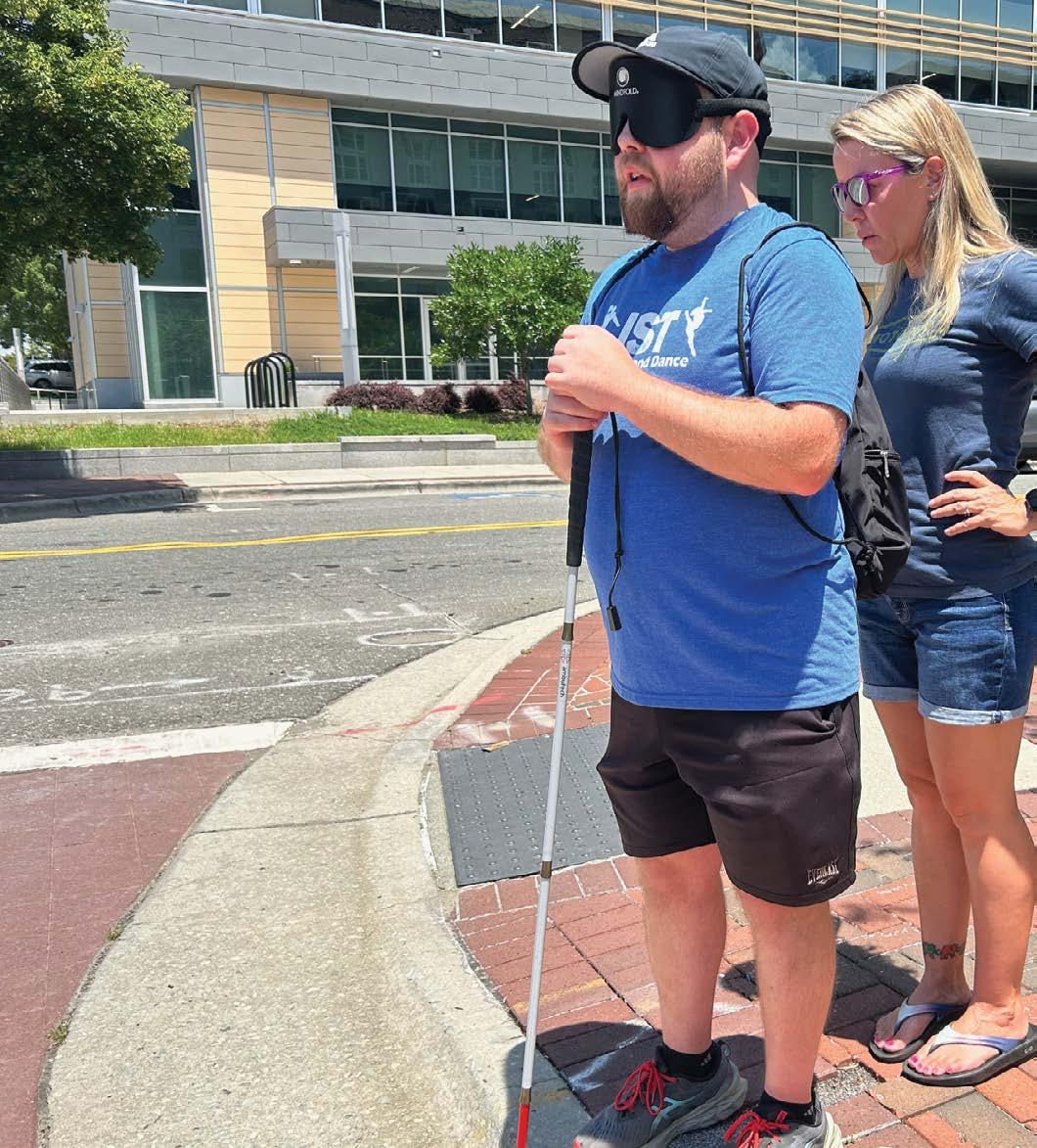
In June 2025, 10 graduate students were training on Main Street in downtown Durham. One of them, Doug Lockard of McLean, Virginia, was wearing a blindfold while seeking to navigate his way down the sidewalk.
“It’s a little nerve-wracking,” Lockard said. “Once you get disoriented, it can be hard to realign.”
Lockard works with adults who have mental illness, but
he aims to become a certified orientation and mobility specialist. To do so, he has to understand the equipment that his clients will use, including white canes.
With an instructor close by, Lockard swishes his cane back and forth, occasionally getting delayed by a UPS box, business entryways, garbage cans and a pedestrian’s ankle. One of the techniques for staying aligned on the sidewalk is to listen carefully to traffic.
Like blind or visually impaired people, the students will have to become proficient at navigation without using their eyes or asking for directions. The final test will involve Lockard and the other graduate students being dropped off in downtown Raleigh and being told to navigate to a destination.
NCCU School of Law’s
Impact on North Carolina’s
Judiciary
BY TERRI HYMAN
What truly sets North Carolina Central University (NCCU) School of Law apart is its extraordinary influence on the state’s judiciary.
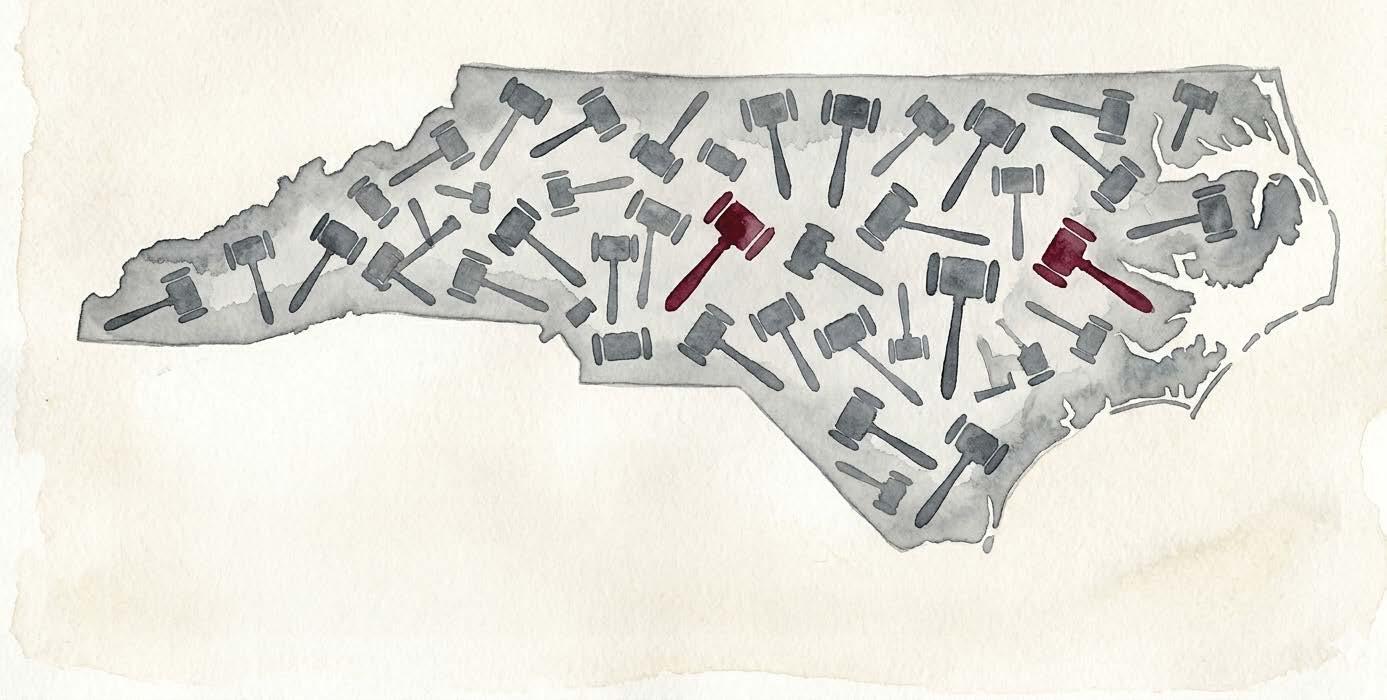
There are 170 sitting judges in North Carolina who are NCCU School of Law alumni, according to an internal database maintained by the law school. There is a total of 421 judges in North Carolina (not including state Supreme Court judges), according to the fiscal 2023-2024 annual report by the North Carolina Judicial Branch.
That means two out of every five judges currently serving across the state’s district, superior and appellate courts earned their law degrees from NCCU School of Law.
Since 1939, NCCU School of Law has been committed to its mission of providing
access to an exceptional legal education for those who have historically been marginalized and excluded from the profession. That mission has produced generations of leaders who have gone on to shape the legal and civic landscape in North Carolina and beyond.
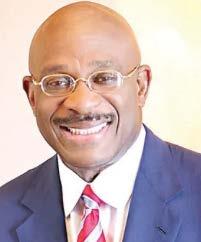
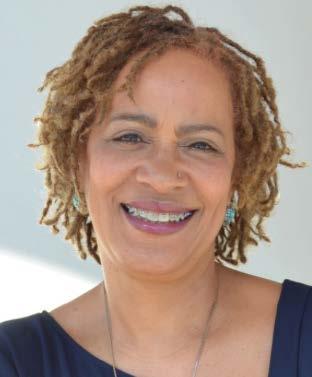
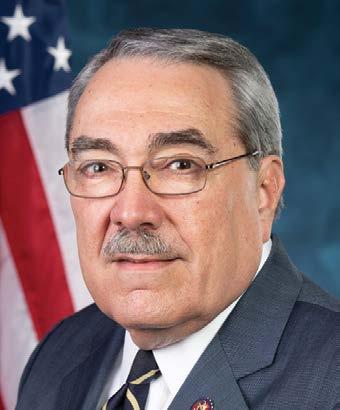
Among NCCU Law’s distinguished alumni are retired Congressman GK Butterfield, former Governor Mike Easley, retired Justice Michael R. Morgan, former N.C. Rep. H.M. "Mickey Michaux Jr. and the late Attorney Floyd B. McKissick., (former Durham) Mayor Elaine O’Neal and Attorney Willie E. Gary, whose life story inspired the 2023 film “The Burial” starring Jamie Foxx. Together, their remarkable achievements reflect NCCU Law’s influence not only in the courtroom but across every level of public service and advocacy.
North Carolina is home to six American Bar Association-accredited law schools: Campbell University, Duke University, Elon University, NCCU, the University of North Carolina at Chapel Hill and Wake Forest University.
WILLIE E. GARY
ELAINE O’NEAL
G.K. BUTTERFIELD
Preparing Leaders for the Bench NCCU School of Law’s reputation for cultivating judges is no accident. The school’s practice-ready curriculum, hands-on clinical training, and emphasis on public service prepare students for the real work of justice. Many graduates begin their careers as prosecutors, public defenders and legal aid attorneys, roles that naturally lead to judicial appointments or elections.
The school’s proximity to Raleigh and the state’s judicial hub provides students with access to mentors and professional networks that strengthen their readiness for the bench.
THERE ARE 170 SITTING JUDGES IN NORTH CAROLINA WHO ARE NCCU SCHOOL OF LAW ALUMNI.
“Our students come to NCCU Law with purpose,” said Donald Corbett, interim dean of NCCU School of Law. “They are drawn to law because they want to serve those in marginalized and underrepresented communities. We build on that foundation by giving them the tools, skills and confidence to lead. It’s no surprise that so many of our graduates go on to become judges. They see the law as a calling, and they carry that purpose with them to the bench.”
While the statistics are remarkable, the real significance lies in what they represent: a judiciary that reflects the communities it serves. NCCU Law graduates bring a wealth of experience and perspective that helps strengthen public trust in the justice system.
NCCU SCHOOL OF LAW’S REPUTATION FOR CULTIVATING JUDGES IS NO ACCIDENT. THE SCHOOL’S PRACTICE-READY CURRICULUM, HANDS-ON CLINICAL TRAINING, AND EMPHASIS ON PUBLIC SERVICE PREPARE STUDENTS FOR THE REAL WORK OF JUSTICE.
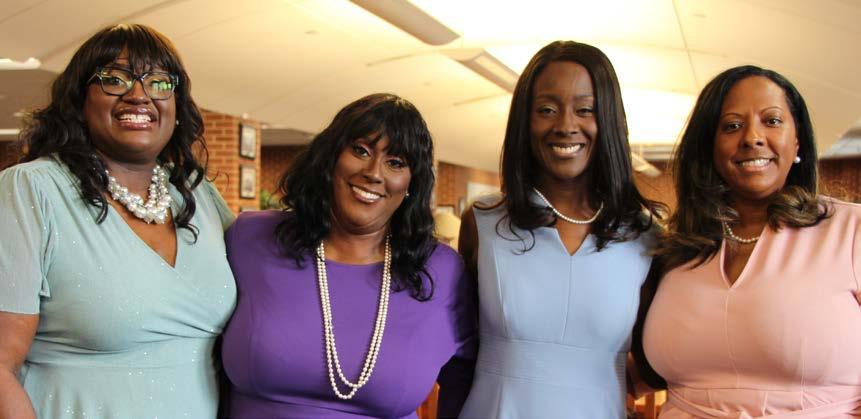
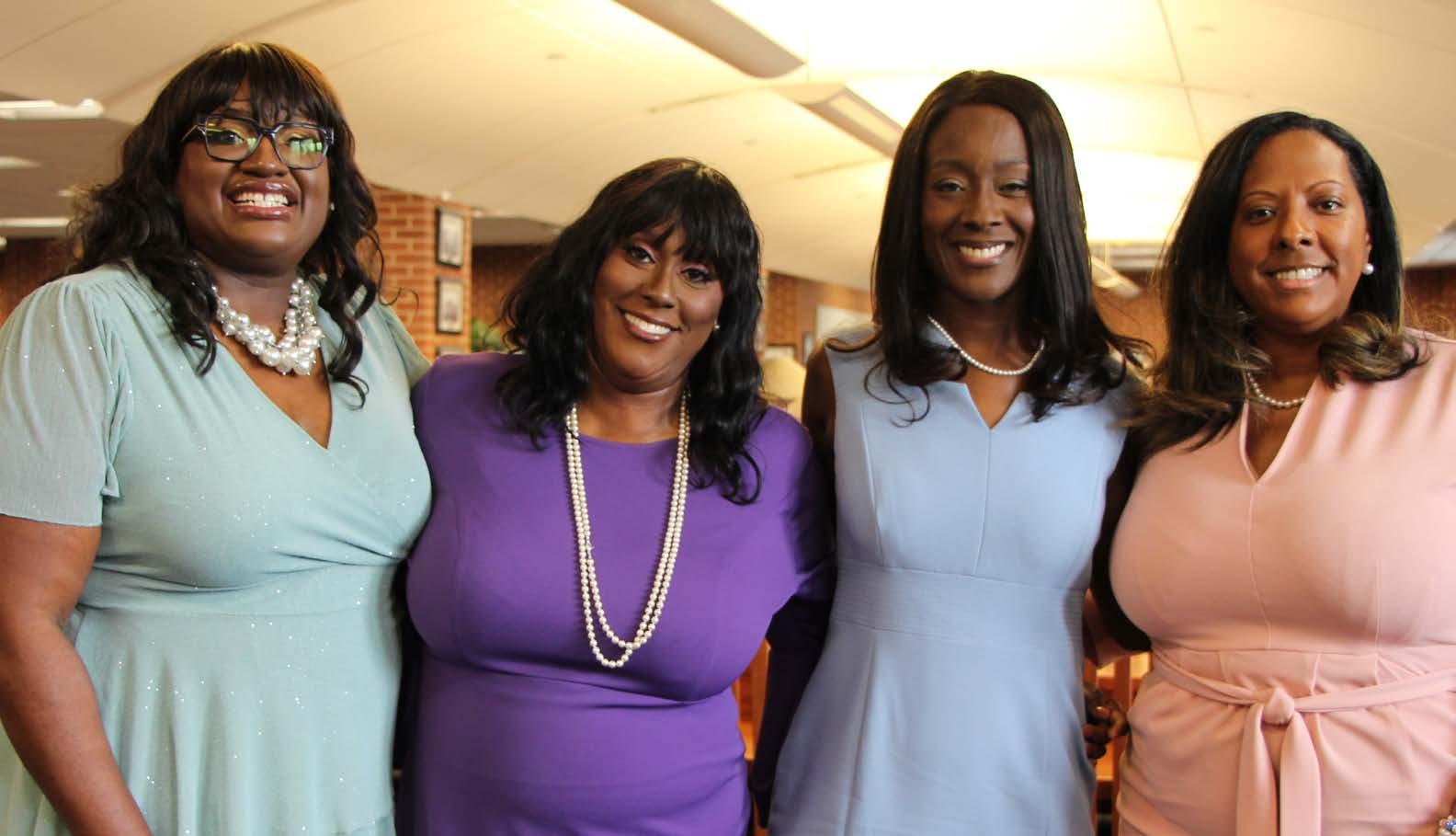
Four women who forged a lasting bond as law school roommates at North Carolina Central University in 1998—and who all went on to become judges—are pictured left to right: Judges Keisha Wright Hill, Shamieka L. Rhinehart, Camille Banks-Prince and Teresa Raquel Robinson-Freeman.
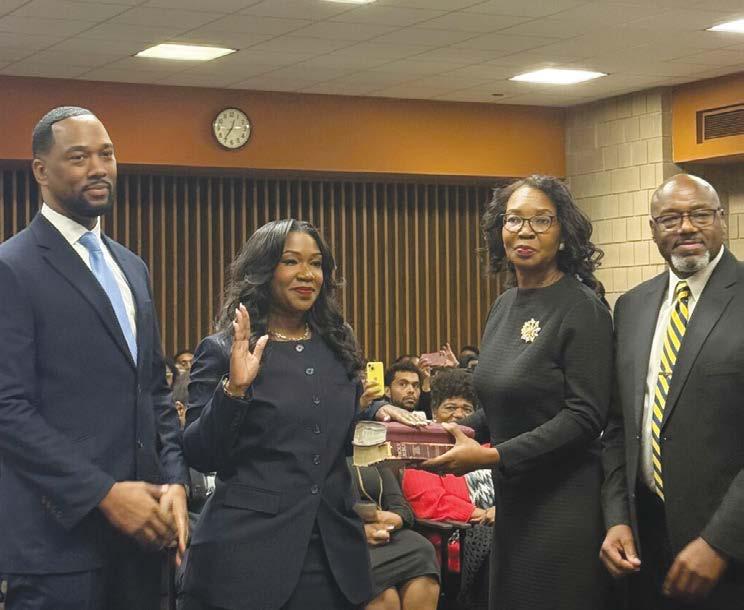
At the swearing-in ceremony of Judge Alicia Marks Flowers were her husband, Terry Flowers, and her parents, Pamela Marks and Michael Marks.
The Signs of Silence: NCCU Resurrects Sign Language Course
BY MARK LAWTON
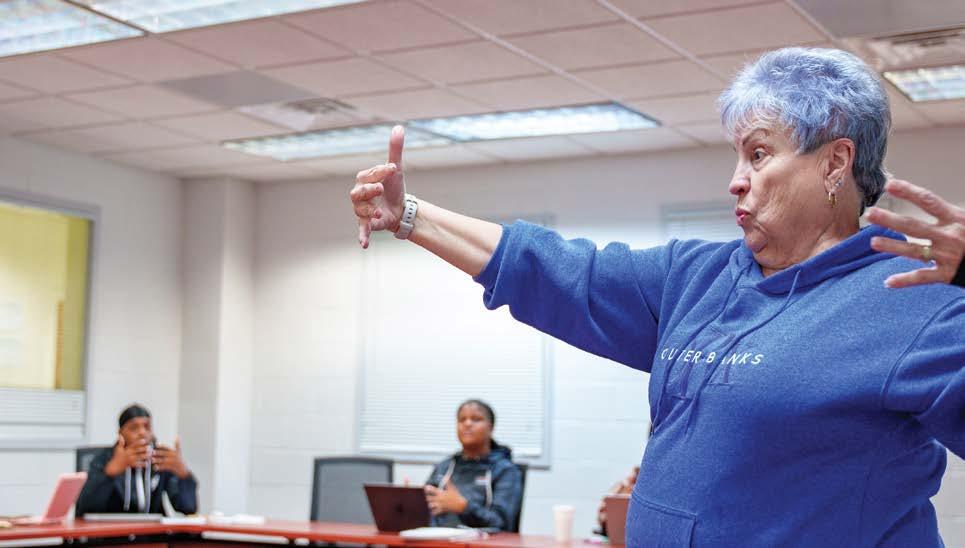
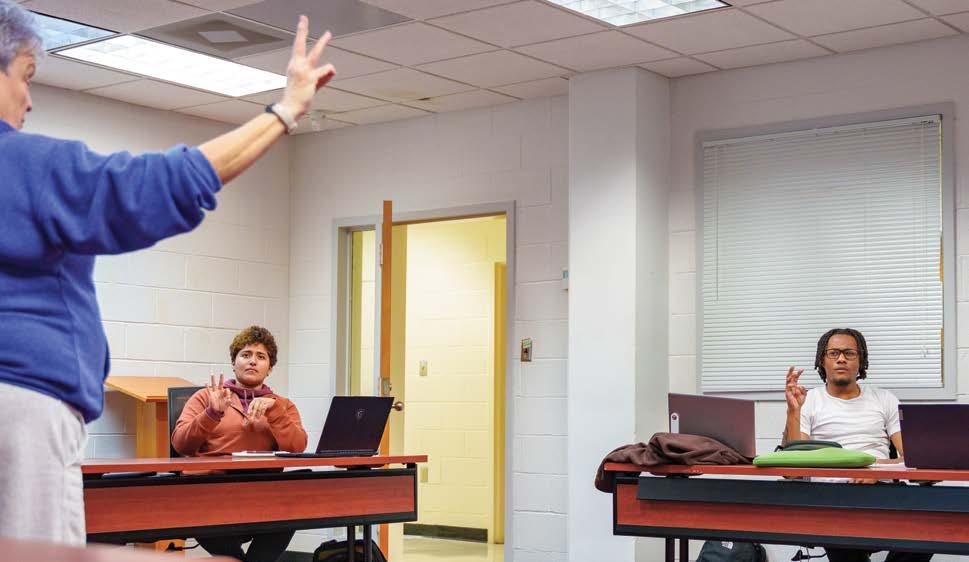
There are 15 students in room 339 of the Farrison-Newton Communications Building on late Tuesday afternoons, but the only person speaking is “Kaky” McPeak, Ph.D.
“This is an immersion class,” McPeak said. “From day one, we sign. I give them a short period of time at the end of class where they can voice their questions.”
The course is American Sign Language (ASL), which was taught in the department of kinesiology and recreation administration until 2021. The department chair at the time decided to discontinue the course so McPeak could teach graduate courses.
ASL returned in the fall semester of 2025 under the auspices of the department of language and literature. Sonya Scott, a graduation specialist in political science and criminal justice, connected McPeak with John Prince, Ph.D., chair of language and literature.
“I took sign language when I was in my master’s program,” Scott said, adding that knowledge of ASL could be an advantage for the students she counsels. “You have a whole lot of people graduating in (political science and criminal justice). When looking for employment, what will separate you from someone else?”
Among the students is sophomore Sydney Mitchell, who initially registered for the course because it counts as a foreign language credit. While she is majoring in mass communication with the goal of becoming a sports commentator or news anchor, interpreting for deaf people could be a job, too.
“I would like to see if I have the aptitude and keep learning the language,” Mitchell said.
THE STATE OF HEARING
There are about 1.35 million people in North Carolina who have some level of hearing loss. That is projected to increase to 1.65 million by 2030, according to the Division of Services for the Deaf and Hard of Hearing, part of the North Carolina Department of Health and Human Services.
Is there a shortage of ASL interpreters in North Carolina? The answer is more complex than yes or no.
There is a shortage of qualified ASL interpreters available to work in certain settings – particularly for in-person work versus virtual work. Other factors impacting the availability of ASL interpreters include interpreter pay, interpreter service agency practices, specialized needs in certain settings and credentialing requirements that can vary by setting.
In most settings in North Carolina, ASL interpreters must be licensed by the North Carolina Interpreters and Transliterators Licensing Board.
LaBrian Pittman, a sophomore majoring in criminal justice at NCCU, previously studied French but over the summer saw an advertisement for the ASL course.
“French, it’s just hard to get my mouth to say the words,” Pittman said. “I thought it would be easier to sign than speak another language.”
AND IS IT?
“It’s getting easier as I practice with other people,” Pittman said. “The first class was really hard. We couldn’t talk. I had a lot of questions and couldn’t ask them.”
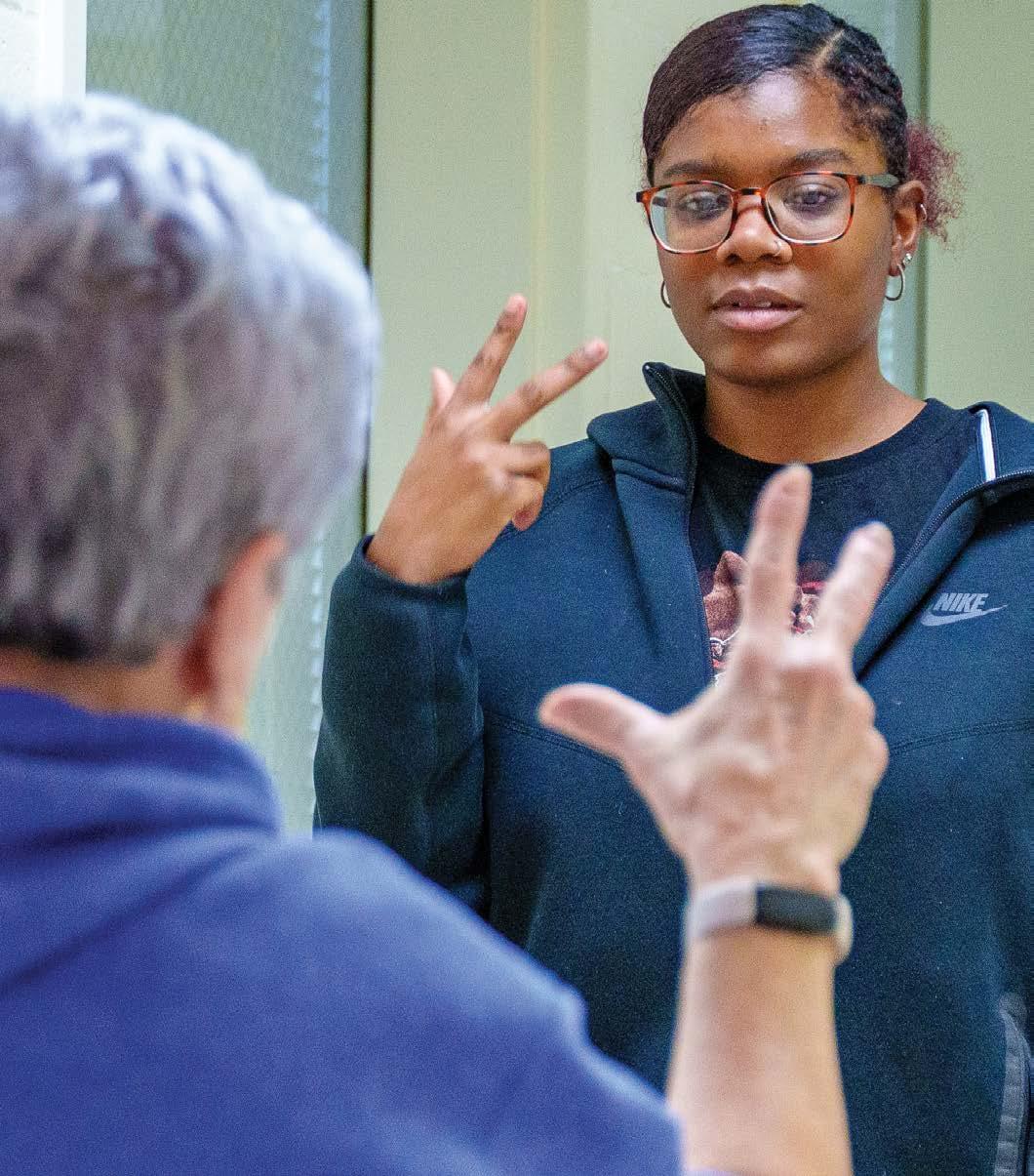
Students also learn to sign from a website, LifePrint. com. In addition to signing (the larger motions) and fingerspelling (using fingers only to represent letters), students also learn about deaf culture, the history of deaf education in North Carolina, Black ASL and ASL grammar rules.
Students present their midterm and final assignments in ASL. Each presentation is captured on video and then evaluated. They leave the course having learned hundreds of signs, said McPeak.
During spring 2026, American Sign Language I and American Sign Language II – which require instructor permission – will be offered at NCCU.
There are about 1.35 MILLION PEOPLE in North Carolina who have some level of hearing loss.
That is projected to increase to 1.65 million by 2030, according to the Division of Services for the Deaf and Hard of Hearing, part of the North Carolina Department of Health and Human Services.
Kaky McPeak instructs students in the revived American Sign Language class.
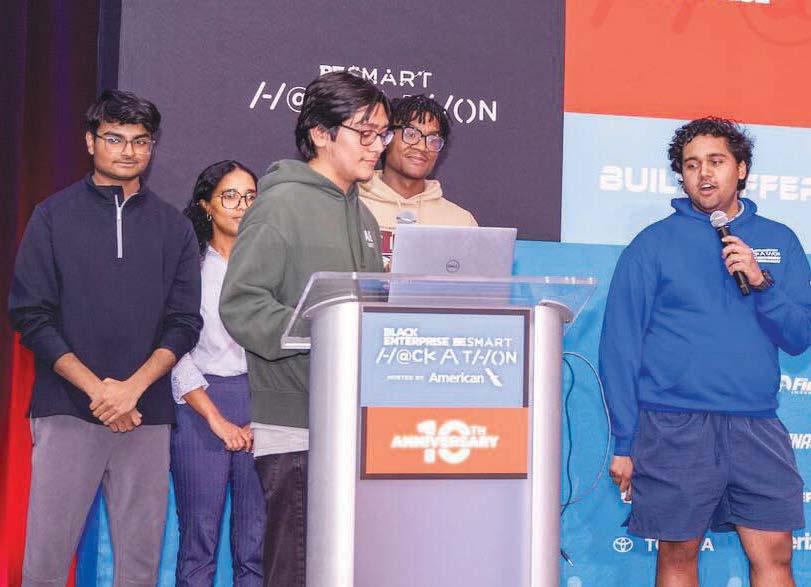
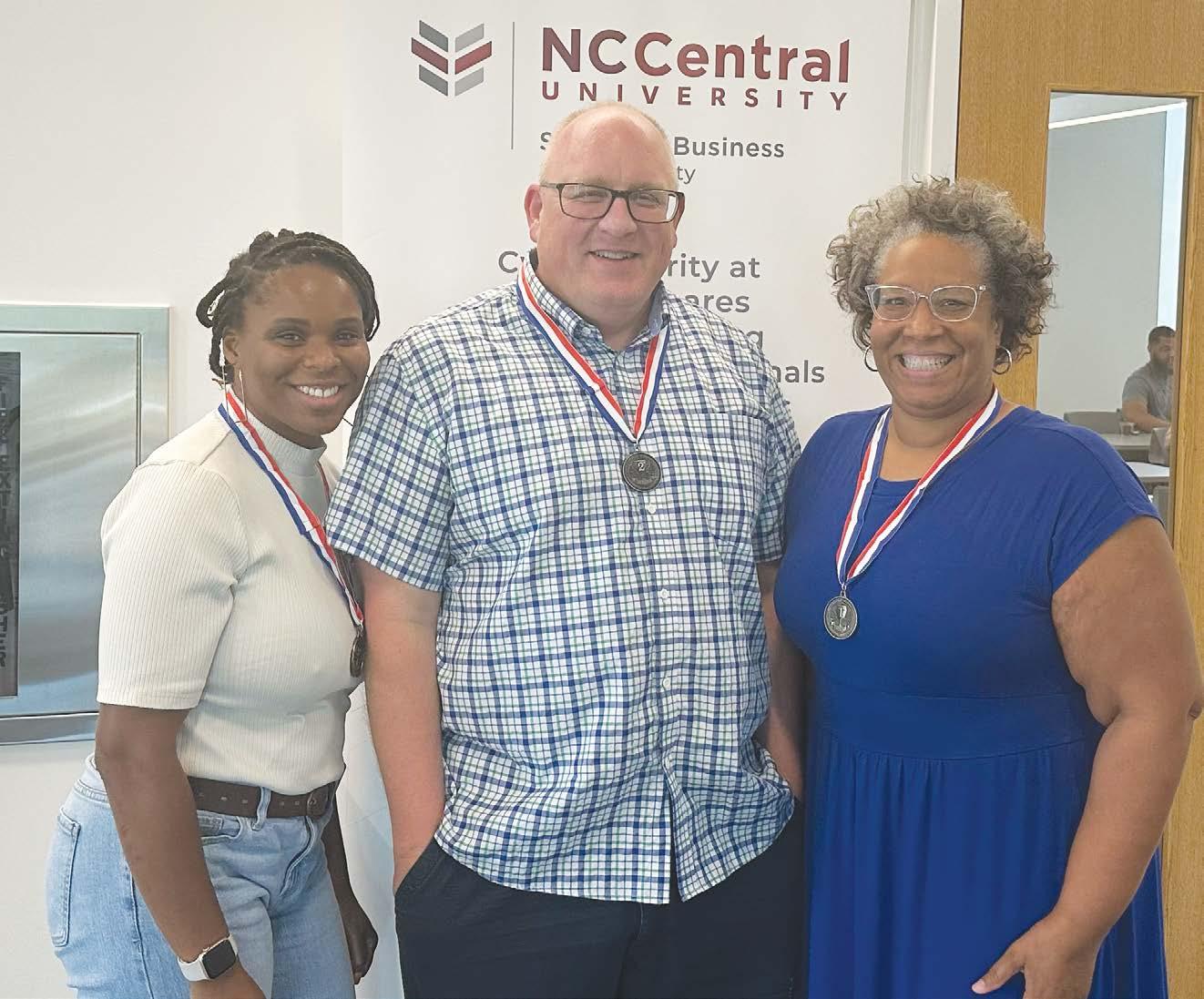
STUDENTS WERE TIRED but pleased after placing second in a 24-hour competition to design an app to solve a social challenge.
From Nov. 5–8, 2025, five students from North Carolina Central University (NCCU) competed in the BE Smart Hackathon in Charlotte.
A hackathon is an event where people engage in rapid and collaborative engineering over a short period of time, in this case, 24 hours. Hackathons originated in June 1999 in Calgary, Alberta, Canada, according to the website Hackernoon.com.
The members of “Team Albert and Friends” from NCCU compet-
A HACKATHON is an event where people engage in rapid and collaborative engineering over a short period of time, in this case, 24 hours.
ed against 61 other teams from 43 historically Black colleges or universities (HBCUs).
Their task: develop an app that uses artificial intelligence (AI) and allows people to search for food pantries near them. In addition, their app can scan receipts, offer recipes based on the food items found, and even show nearby stores that accept Supplemental Nutrition Assistance Program (SNAP) benefits.
Manuj Mishra, a sophomore majoring in mathematics with an emphasis in programming, focused on connecting the AI component. The NCCU team also had to figure out how to connect Google Maps to the app.
“We did stuff we had never done before,” Mishra said. “Everyone in their respective areas gained a new level of skills.”
The NCCU team made sure their app was smartphone-friendly.
“Most people of low income don’t have a computer,” said Ahsan Nadeem, a junior majoring in mathematics and computer engineering. “The app is also friendly on older phones.”
Nadeem helped make the website user-friendly and functional. As for sleep, he didn’t get any during the 24-hour competition.
“I usually don’t sit at a computer for 24 hours,” Nadeem said. “You have a first time for everything.”
Other members of Team Albert and Friends were Betelihem Wereta, Jaylen Johnson and Albert Pena-Charrez.
“None of them had competed before in anything of this nature,” said Professor Alade Tokuta, Ph.D., who accompanied the team to Charlotte and stayed awake for the 24-hour competition.
Teams were judged on the impact of their app, presentation, technical complexity, documentation, look, feel and quality, according to the Black Enterprise website.
Placing second in the hackathon came with rewards, including $2,000 per team member from McDonald’s and $30,000 shared among the team from PepsiCo. Mishra plans to spend his winnings on a trip to India, while Nadeem intends to buy a new computer.
Grant Deepens Training Pathology Students
BY MARK LAWTON
A $1.19 MILLION GRANT WILL ASSIST GRADUATE STUDENTS IN BECOMING SPEECH-LANGUAGE PATHOLOGISTS.
The U.S. Department of Education awarded a five-year grant to the department of communication sciences and disorders at North Carolina Central University (NCCU).
At least 60% of the grant will be used to support 18 graduate students with tuition assistance, stipends, professional development (workshops and conferences) and materials for their clinical practicum.
“One of the barriers of going to graduate school is (sometimes) financing,” said Yolanda Keller-Bell, Ph.D., interim department chair and project director for the grant.
The grant, SLP Preparation in Evidence-based Approaches for Children with Disabilities (Project SPEAC), is aimed at teaching the graduate students to provide services to school-age children with disabilities who experience delays in literacy and communication skills. Those disabilities include children with autism, intellectual disabilities like Down syndrome, speech and language disorders, and emotional or behavioral disorders.
There will also be an opportunity for graduate students to complete a multilingual concentration, so they can serve children with disabilities who are non-English speakers.
“This grant is especially focused on extending and providing more in-depth services to children with disabilities,” said Keller-Bell.
YOLANDA KELLER-BELL, PH.D. associate professor, interim department chair, communication sciences and disorders
At least 60% of the grant will be used to support 18 graduate students with tuition assistance, stipends, professional development (workshops and conferences) and materials for their clinical practicum.
Aw Shucks: GRADUATES WIN AWARD FOR RESEARCH WITH OYSTERS
BY MARK LAWTON
Carresse Gerald, Ph.D. associate professor environmental, earth and geospatial sciences
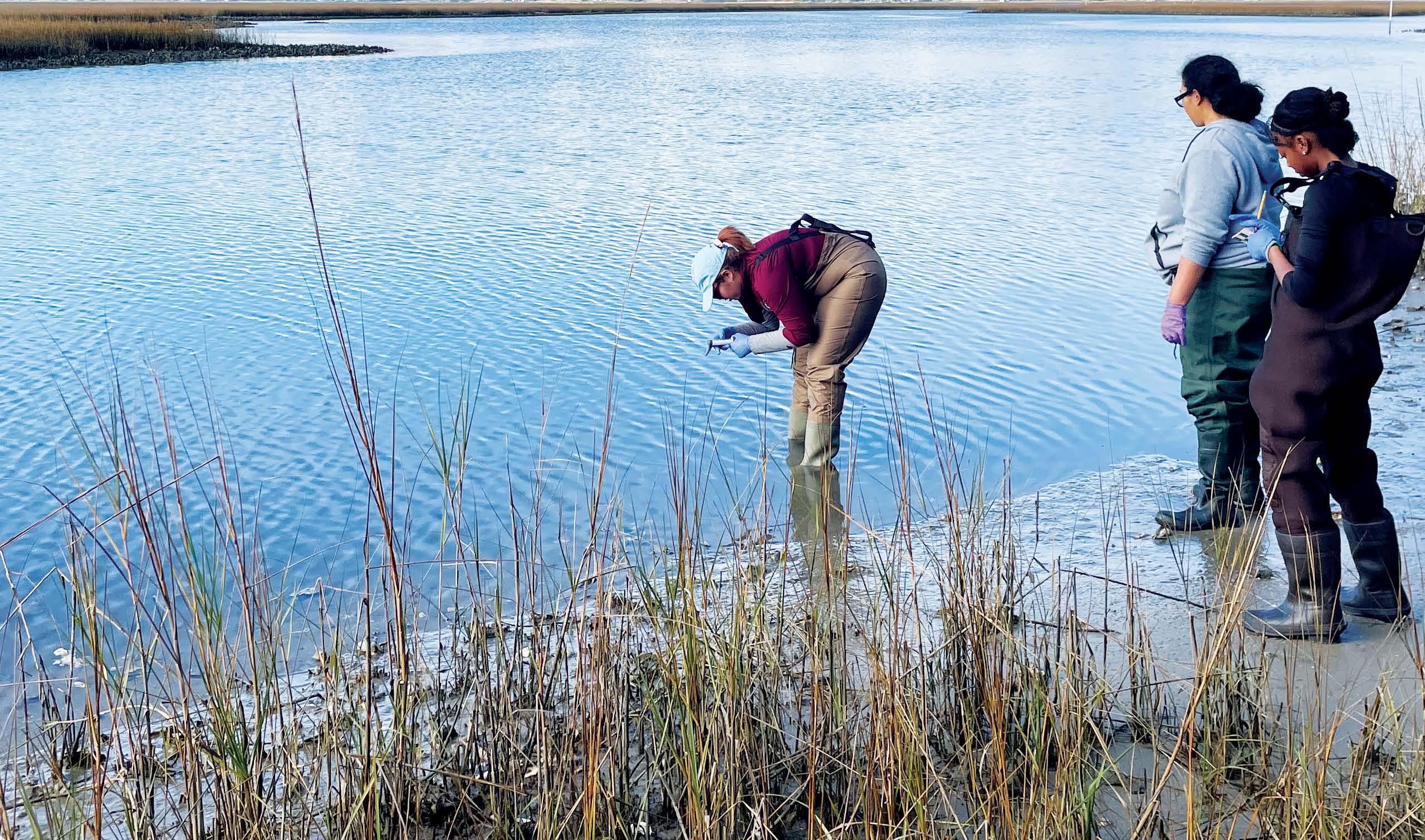
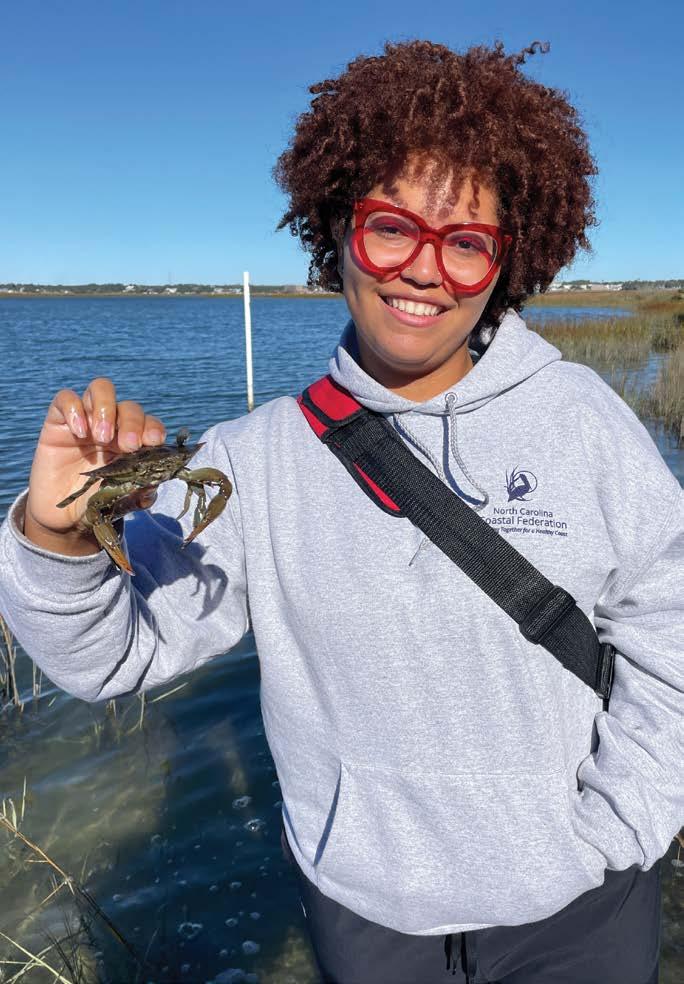
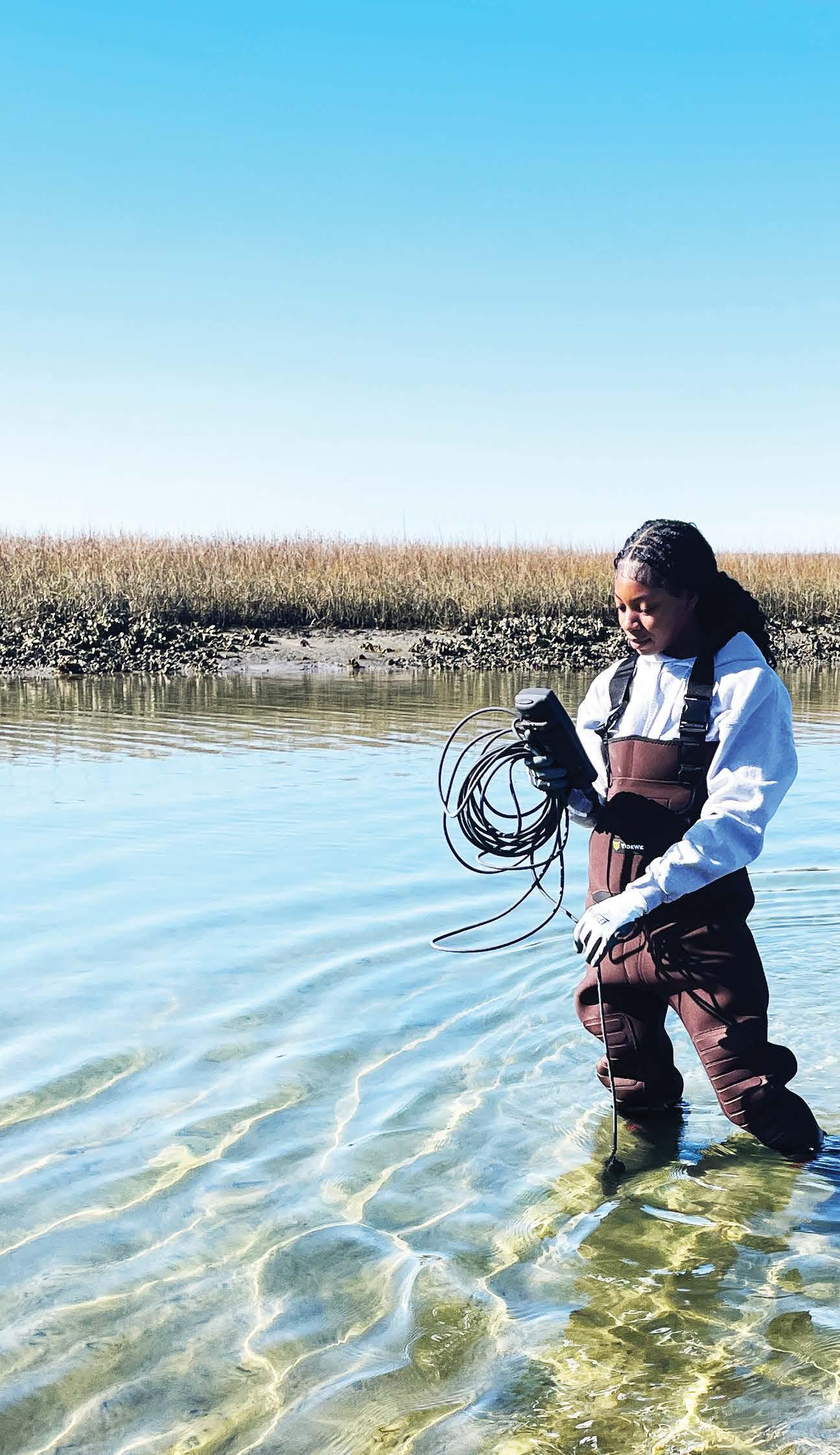
HILE OTHER STUDENTS WERE ATTENDING CLASSES or studying in the library during the 2024-2025 school year, Lauren Johnson and Tamarr Moore were wearing waders and collecting oysters about three hours southeast of campus.
On September 20, 2025, their research efforts were recognized by the North Carolina Coastal Federation with the Pelican Award.
Johnson and Moore, who both completed an accelerated bachelors to master’s degree in earth, environmental and geospatial sciences in May 2025, conducted research on PFAS (sometimes called “forever chemicals”) and heavy metals found in oysters in the Pamlico Sound, a 500-acre oyster sanctuary.
“We like to use oysters,” said Carresse Gerald, Ph.D., an Associate Professor and advisor to the research project. “Oysters filter water. They are a bio indicator.”
Johnson and Moore were the first students from North Carolina Central University (NCCU) to take part in this research, which was paid for by a grant from the National Oceanic and Atmospheric Administration (NOAA).
The two lived in student housing owned by North Carolina State University in Morehead City. Monthly, they would check the NOAA tide and currents webpage, travel ten minutes and arrive at low tide at four marsh sites.
They would put on gloves and collect six to ten oysters at each site. Along the way they would test the pH level of the water, salinity, dissolved oxygen and temperature.
Back at the lab, they would shuck the oysters and put the tissue in tubes, which were transported to a laboratory in Raleigh.
When not wading in estuaries, they took part in educational activities led by NC Coastal Federation’s Environmental Educator, Rachel Bisesi.
“We went to a STEM camp,” Moore said. “We talked about what it is like being a Black scientist and women in the science fields.”
They also spoke about oysters and coastal restoration during Earth Day, did a presentation to the board of the North Carolina Coastal Federation and helped perform a necropsy –similar to an autopsy – on a beached whale.
“It was a pygmy sperm whale,” Moore said. “The animal had unfortunately beached. It wasn’t that big.”
The research had its challenges. Neither had previously spent any time on a coast. As the first students on this research project, it initially took some time to figure things out.
“This was my first time leading research,” Moore said. “It took me a while to get into that kind of groove.”
Besides learning more about PFAS and heavy metal levels in the environment, the research is important.
“We want to increase the number of students, especially minorities, who are in theses spaces,” said Gerald.
Since graduating, Johnson has found employment as an earth science teacher at a high school in Alexandria, Virginia. Moore is back at NCCU where she works as a lab assistant to Gerald and also teaches an undergraduate course in biology.
æLAUREN JOHNSON and TAMARR MOORE
were the first students from NCCU to take part in this research, which was paid for by a grant from the National Oceanic and Atmospheric Administration.
LAUREN JOHNSON
TAMARR MOORE
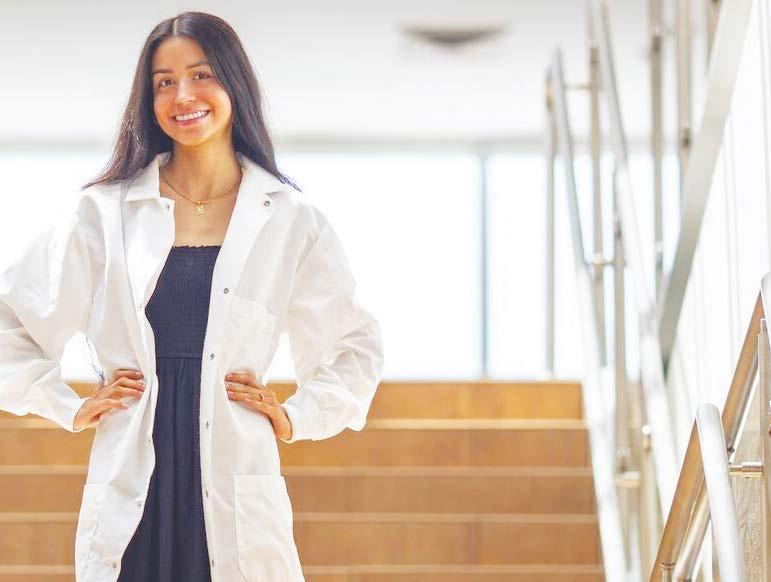
GRAD STUDENT HELPS BUILD RESILIENCY IN PUERTO RICO
AYA PEYTON
spent part of July helping Puerto Rico by documenting challenges and opportunities for local community to better prepare for future emergencies.
Peyton is an online student who lives in Columbia, Maryland. She is in her second year of a master’s program in environmental sciences at North Carolina Central University (NCCU).
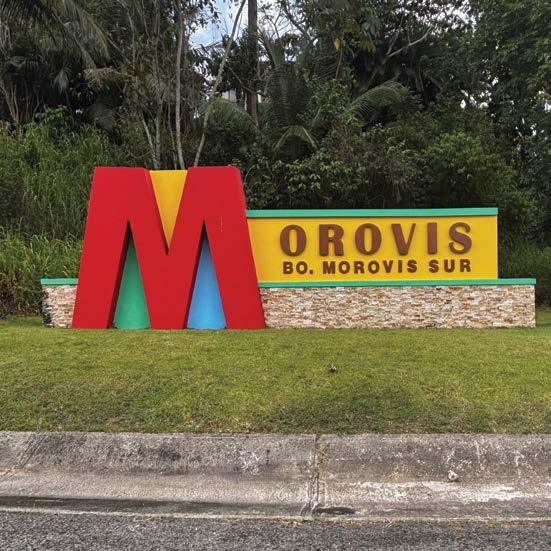
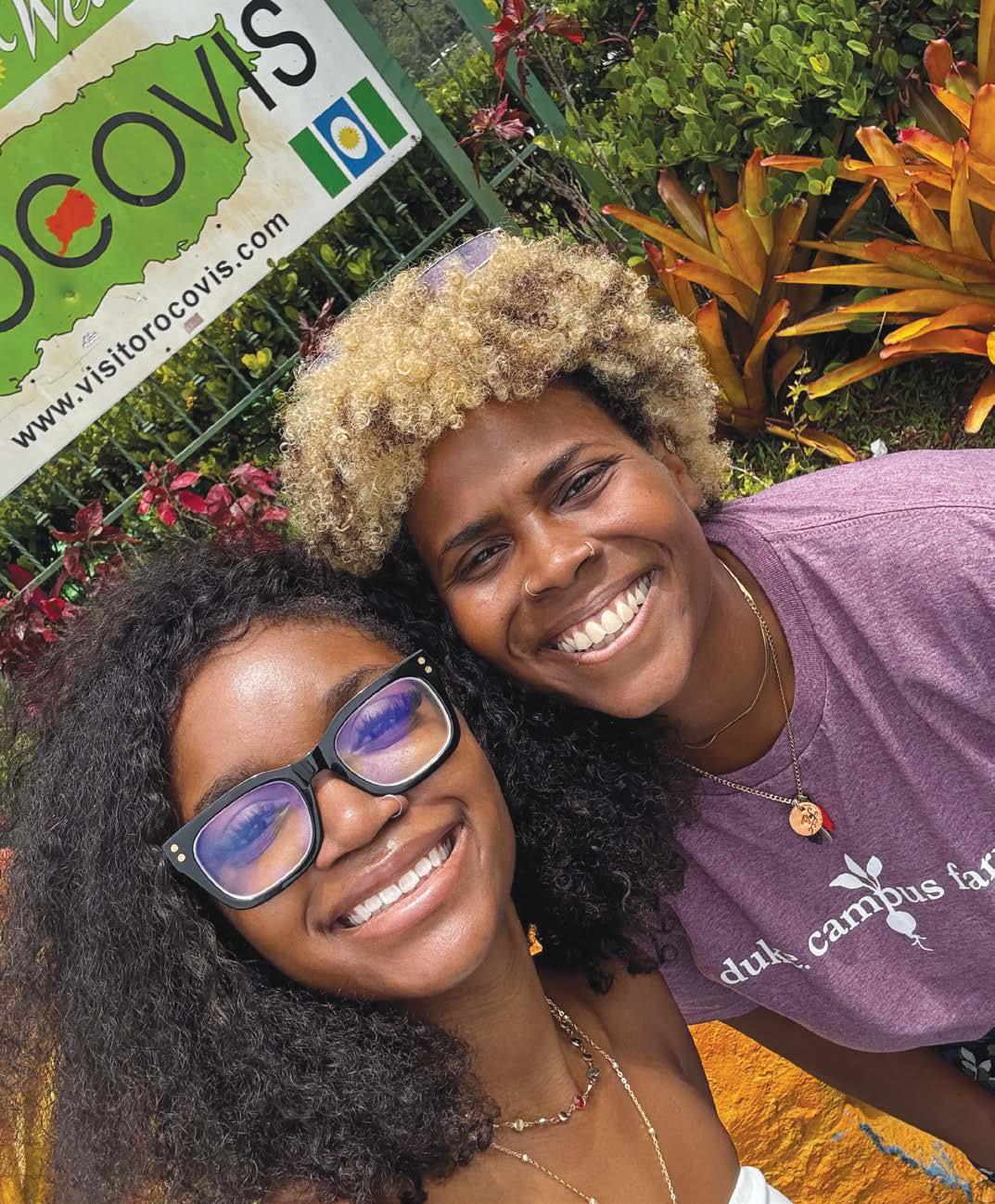
In Puerto Rico, Peyton interviewed local residents in the community of Cabachuelas. She was accompanied by Anais Roque, Ph.D ., academic mentor who interpreted Spanish and supported her research project.
Roque is an environmental social scientist at the Nicholas School of the Environment at Duke University.
“I study how households and communities respond in the wake of emergencies and disasters,” said Roque in a Zoom call from Puerto Rico.
Puerto Rico is an unincorporated territory of the United States located in the Caribbean. Residents are U.S. citizens but cannot vote in federal elections.
Puerto Rico regularly experiences natural hazards, and over the past eight years has experienced a series of climate disasters, with Hurricane Maria in 2017 perhaps being the worst in recent years.
“It went through the middle of Puerto Rico,” said Peyton. “It was the longest power outage of any U.S. territory at that time,” Roque said. There were issues with “water access, food quality and access. An estimated 4,000 people died. Recovery has been slow.” During her visit to the community, Peyton interviewed a resident who said that after Hurricane María, the flooding was so high that “People had to take a refrigerator and float it
over to her house,” she said. This resident said she had climbed on top of her refrigerator and floated out of her house atop it.
Other residents told Peyton about their towns being flooded, their water drainage systems clogged, their animals getting lost or having drowned, and their houses being destroyed.
“They are deeply rooted in helping each other,” Peyton said.
“Even though they are a U.S. territory, they don’t get the same benefits as here.”
Peyton’s biggest challenge was not speaking Spanish. She was pleased, however, by how welcoming residents were to her and Roque, both strangers. “An older lady made us food, a traditional dish with cheese and ground beef,” Peyton said.
“That was really nice.”
Peyton’s ultimate goals are to report back to the Puerto Rican community with a list of organizations or government offices that can assist them, creating a plan to support capacity for community resilience and a developing a GIS map to better illustrate challenges and pathways forward for future emergencies.
KAYA PEYTON, NCCU student, pictured left, and ANAIS ROQUE, PH.D., academic mentor interviewed residents of Puerto Rico, who regularly experience natural hazards, and over the past eight years has experienced a series of climate disasters, with Hurricane Marie in 2017 perhaps being the worst in recent years.
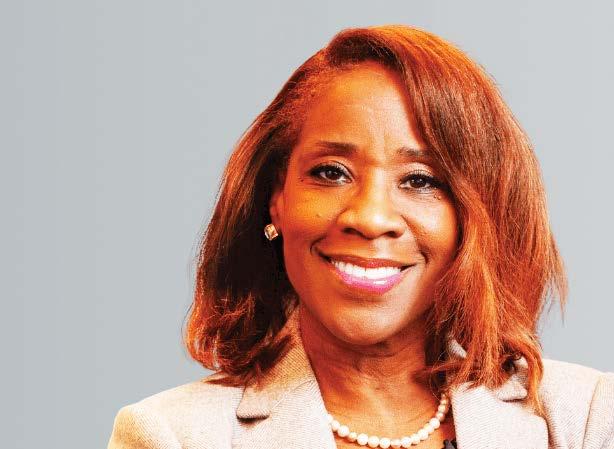
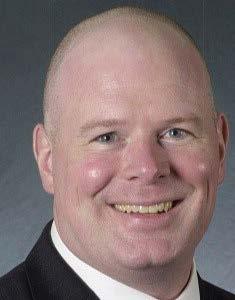
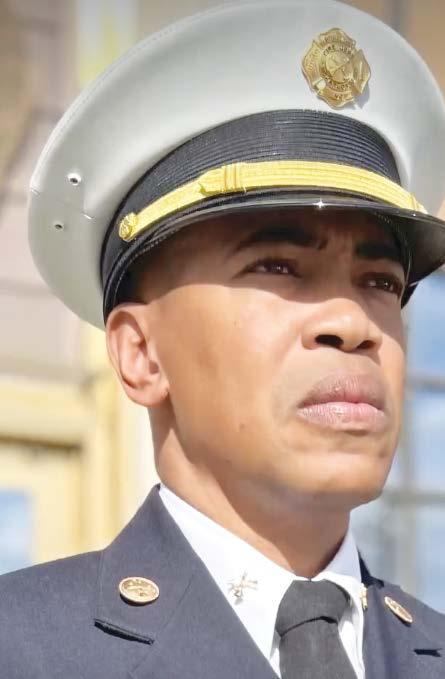
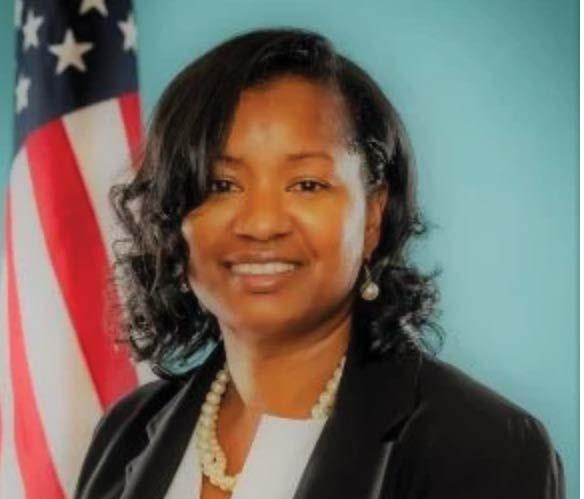
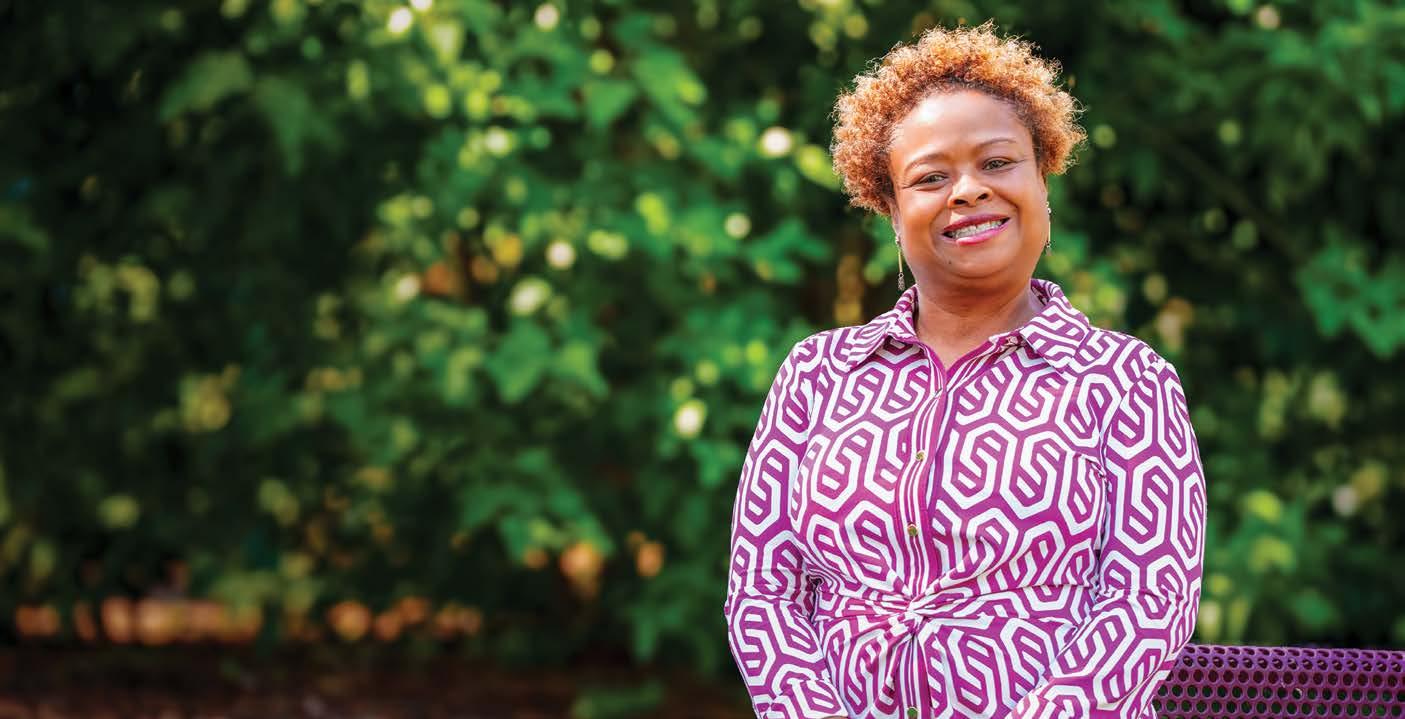
Charise Reid
CHIEF HUMAN RESOURCES OFFICER
Charise Reid served as vice president of human resource at the Cleveland Institute of Art. She has worked in higher education and the nonprofit sector
Robert Gaddy Jr.
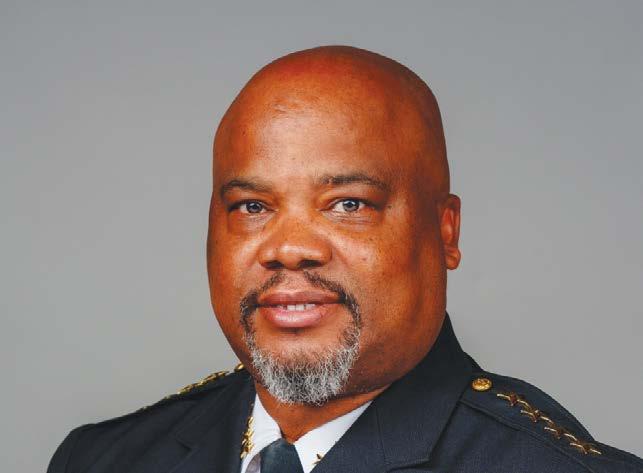
CHIEF OF POLICE
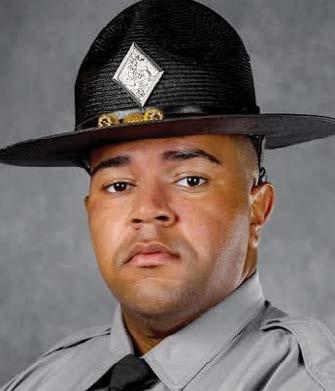
Gaddy ’93, served in the Durham Police Department for 27 years and led the NCCU Patrol Division for four years.
Angelique D. Stallings
DEPUTY CHIEF OF STAFF
Stallings '97 has more than two decades of experience leading mission-driven organizations, most recently serving as vice president of the Greater Durham Chamber of Commerce.
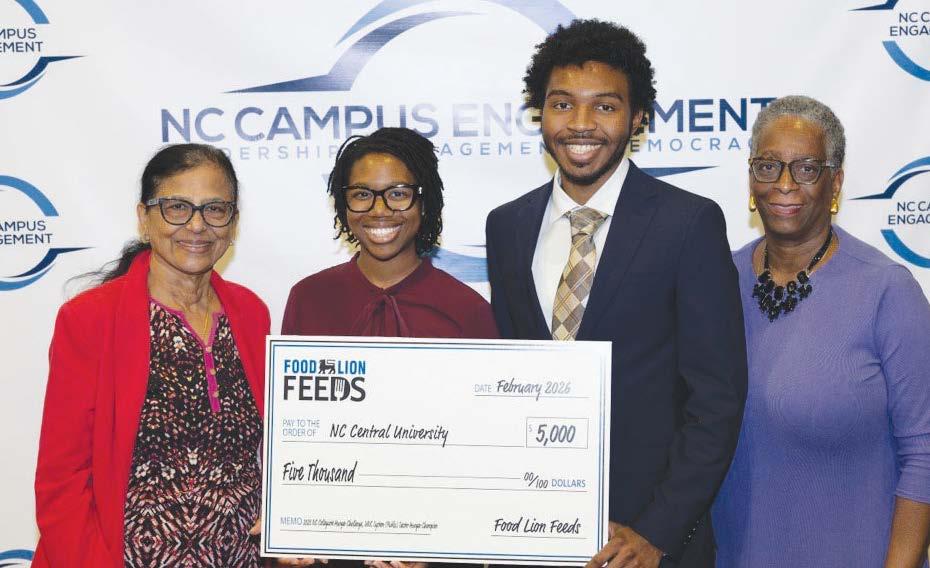
TWO NCCU STUDENTS WIN $5,000 IN NC HUNGER CHALLENGE
NCCU HAS FIVE FOOD PANTRIES.
Its community garden teaches people how to grow food. College students in North Carolina are eligible for the Supplemental Nutrition Assistance Program or SNAP (sometimes called food stamps) benefits.
From Sept. 8-Dec. 18, students Zorah Bynum and Jordan White (pictured center, left to right) shared this valuable information and more. They also solicited food and monetary donations. As a result of their efforts, NCCU was named the Sector Hunger Champion for Public Campuses in the NC Collegiate Hunger Challenge.
Fourteen higher education institutions competed in fall 2025 in a competition organized by North Carolina Campus Engagement, a network of colleges and universities that aims to educate students for civic and social responsibility.
White and Bynum held 11 events, frequently partnering with other campus entities.
• On Sept. 8, they set up a table at a Counseling Center event, gave out items and told attendees about food insecurity.
• During the week of The Ultimate Homecoming Experience, they partnered with the Campus Pantry on a pumpkin painting event, where White spoke about hunger awareness.
• Bynum hosted a food and faith panel with three community members.
• During a Nov. 14 NCCU football game, they collected more than 600 food items plus monetary donations.
“Hunger is an issue in general,” said Bynum. “It is everywhere, including on our campus.”
Bynum and White were advised by Sujaya Devarayasamudram, Ph.D., (pictured far left) associate professor of nursing. Calleen Herbert (pictured far right), director of community engagement and service, also oversaw the effort.
The two students were also recognized for their use of social media and for the most innovative event. For the latter, the two partnered with the department of hospitality and tourism administration, where they conducted a demonstration on how to prepare basic foods for Thanksgiving.
Being named Sector Hunger Champion comes with a $5,000 prize. The two plan to donate the money to a campus effort aimed at alleviating hunger.
Teaching High School Teachers How to Teach Cybersecurity.
BY ATTIYYA DUNN
K–12 EDUCATORS OFTEN FACE WHAT PROGRAM LEADERS
DESCRIBE AS A “KNOWLEDGE LAG,” where classroom instruction struggles to keep pace with rapidly evolving technology and security landscapes.
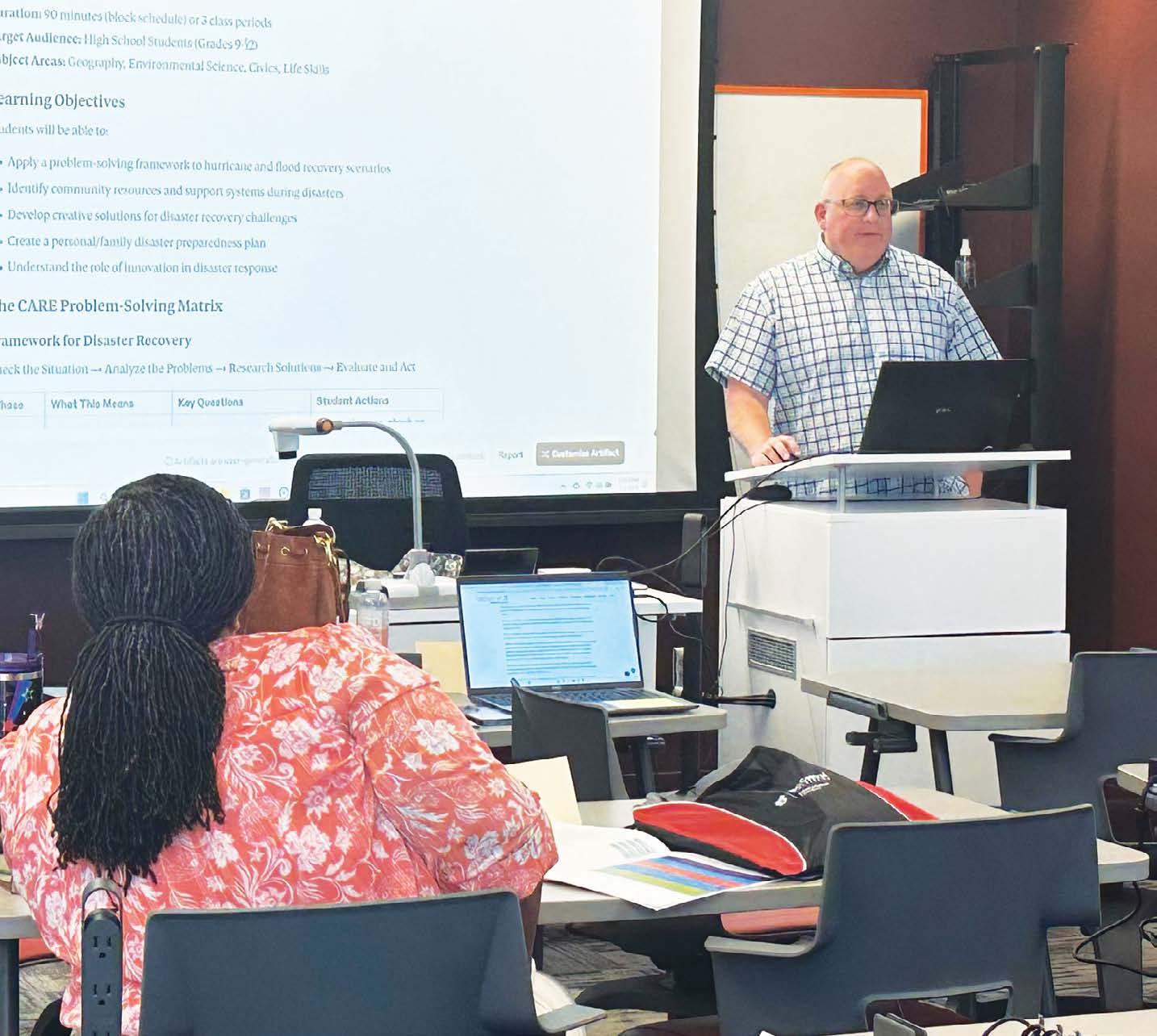
North Carolina Central University (NCCU) School of Business and cybersecurity program brought together educators from across North Carolina for a hands-on training experience designed to strengthen how technology, AI, and cybersecurity are taught in the classroom.
The Tech Sentinels Educator Training Initiative was designed to address that gap directly,
Deanne CranfordWesley, Ph.D. director cybersecurity lab School of Business
aligning training with the Microsoft Certified Educator framework while supporting practical classroom application.
“As a Center of Academic Excellence in Cyber Defense, NCCU is uniquely positioned to bridge the gap between academic theory and classroom practice,” said Deanne Cranford-Wesley, Ph.D., director of cybersecurity at NCCU.
The initiative was developed through collaboration between NCCU leadership, including Cranford-Wesley, alongside partners such as the North Carolina Department of Public Instruction and national faculty development leaders.
K-12 educators from rural communities across North Carolina were selected, ensuring the program reached classrooms where access to advanced technology training is often limited.
DESIGNING FOR REAL CLASSROOMS
One of the program’s central challenges was balancing technical depth with classroom practicality.
To meet that need, NCCU and its partners implemented a scaffolded learning approach, providing structured lesson materials, handson activities, and continued access to resources beyond the training. Educators were given time to adapt content, reflect on their learning and collaborate with peers.
Secondary school teachers from around North Carolina learned how to teach their students about cybersecurity.
Kristine Christensen, professor of computer information systems and director of faculty development at Moraine Valley Community College, served as a consultant supporting curriculum design and facilitation.
“It was a lot of fun working together and learning from one another throughout this program,” Christensen said. “My role focused on helping educators translate cybersecurity, AI and 21st century skills into practical classroom activities. It also created a network of educators who can continue to share ideas and support one another beyond the workshop.”
A TRANSFORMATIVE EXPERIENCE FOR EDUCATORS
Early indicators of success have been strong. Educators report increased confidence, greater student engagement, and a renewed interest in integrating technology into their teaching.
“This was the kind of training I have been seeking,” one educator shared. “We did more than simply learn about the subject — we took an active part in it. Ideas and experiences were meaningfully shared, and every aspect of the design was thoroughly explored.”
Another participant reflected on the immediate value of the experience: “This was an excellent and very informative session. I learned more about AI, technology for our classrooms, and cybersecurity in this class than I have in the last couple of years.”
Educators who completed the program received a $300 stipend, a certificate of completion and a Microsoft Educator exam voucher — removing barriers to participation while supporting professional advancement.
The impact of the Tech Sentinels initiative is already extending beyond the training sessions.
Several participants have successfully passed the Microsoft Certified Educator exam, while others have begun integrating AI, cybersecurity and digital literacy into their classrooms. One educator has already presented on AI in skilled trades at a statewide career and technical education conference, sharing insights gained through the program.
LEADING WITH PURPOSE
Programs that focus on training educators in cybersecurity and artificial intelligence remain limited nationwide, making NCCU’s Tech Sentinels initiative especially impactful.
For NCCU Dean Anthony Nelson, the program reflects a broader vision for how universities can influence workforce development long before students arrive on campus.
“If we want to prepare students for the future of work, we have to start by preparing the educators who guide them — and that has to happen well before they reach this campus,” Nelson said. “This program reflects our commitment to expanding access to high-quality technology education across the state and within our community.”
BUILDING A STRONGER FUTURE
The program was made possible through the support of Cisco Systems, whose investment helped provide training resources, certification access and stipends for participating educators.
Looking ahead, NCCU plans to continue and expand the initiative, with educators expressing interest in future topics such as AI safety, cybersecurity advancements, and real-world learning applications.
Secondary school teachers from around North Carolina learned how to teach their students about cybersecurity.
NCCU Helps Public with Mental Health Challenges
BY MARK LAWTON
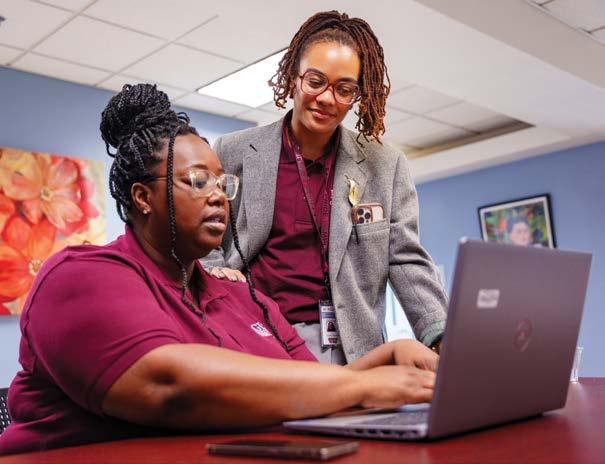
THREE-PLUS YEARS AFTER OPENING, A MENTAL HEALTH
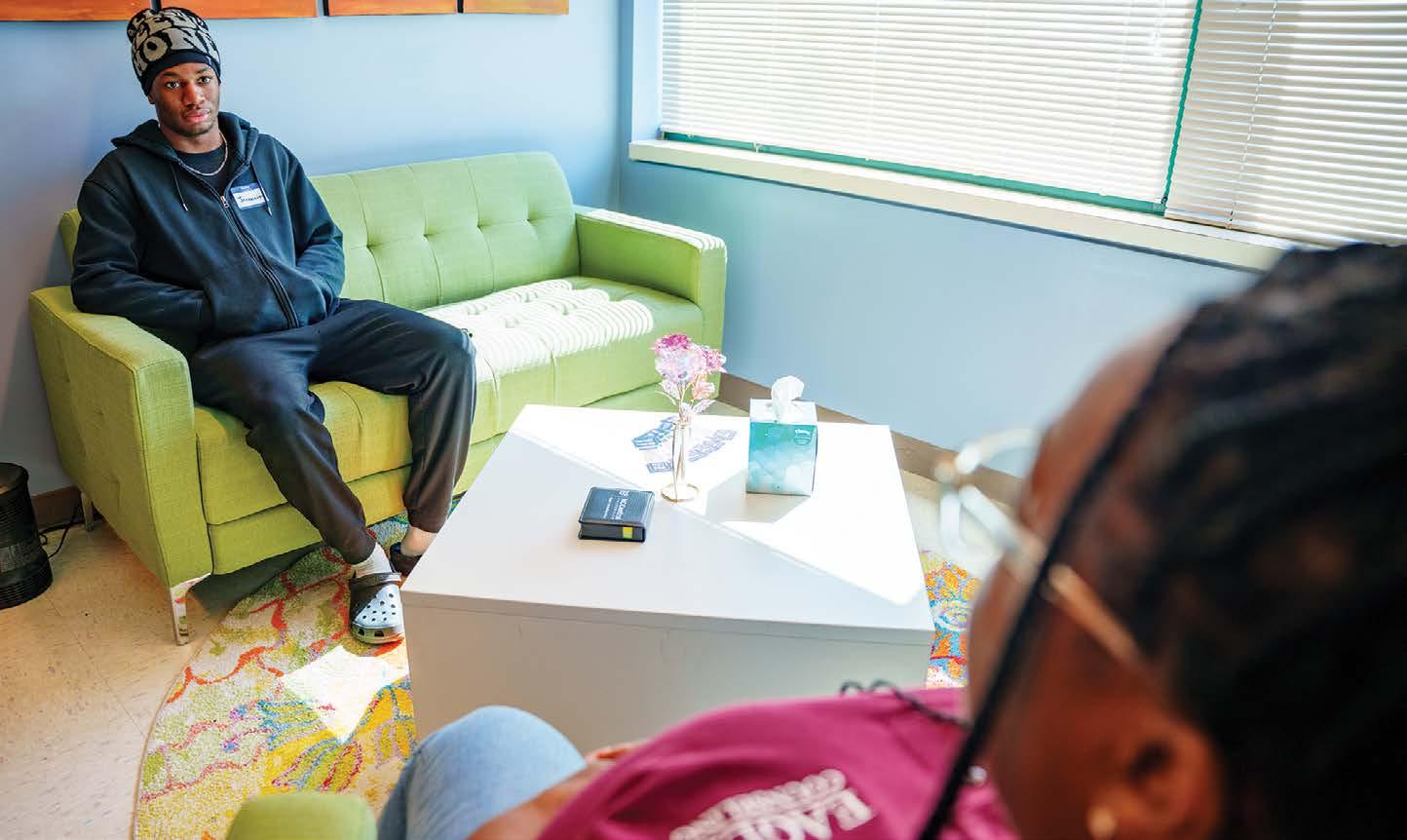
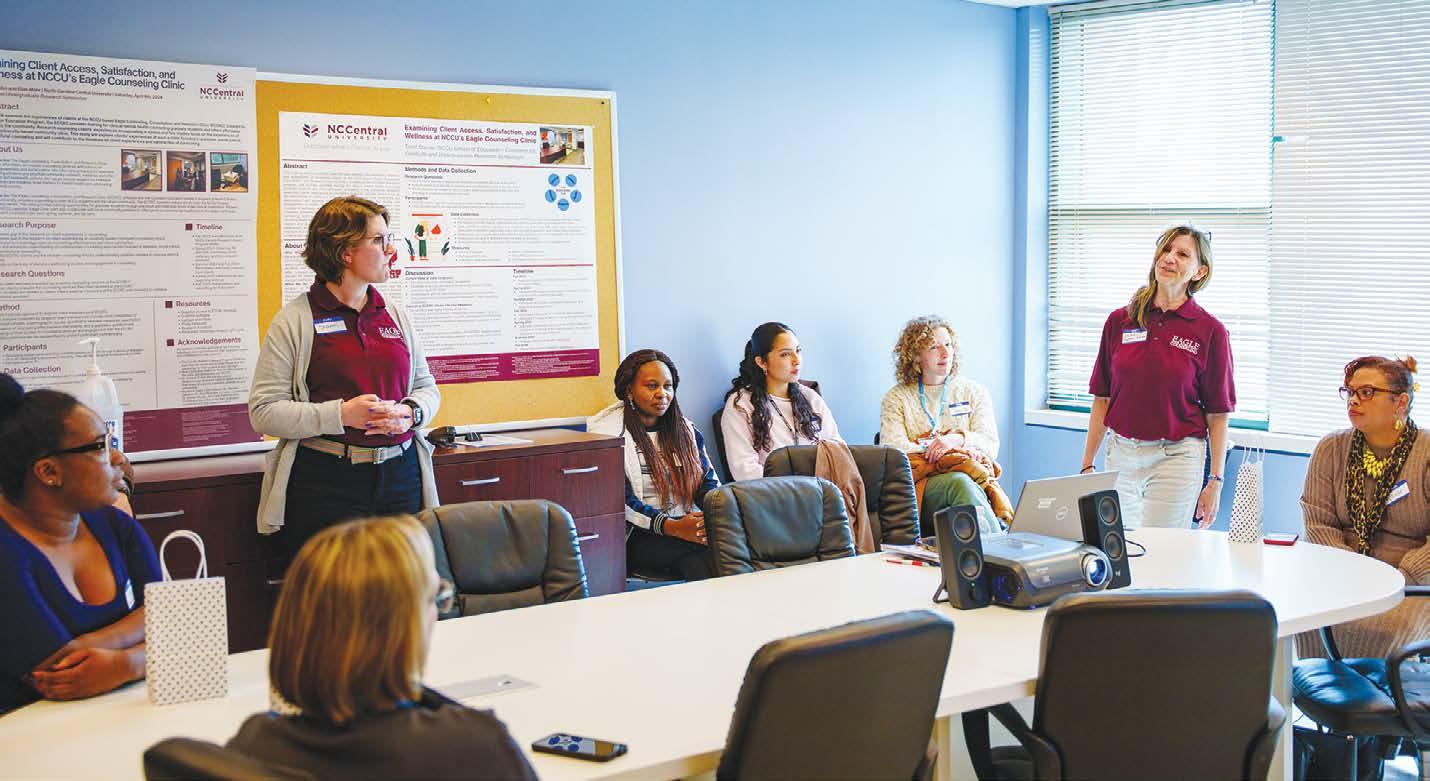
CLINIC based in the North Carolina Central University (NCCU) School of Education continues its dual mission of helping the public and educating future counselors.
The Eagle Counseling, Consultation and Research Clinic opened in August 2022. While members of the counselor education program had considered opening a clinic for some time, it was the hiring of Alyx Beckwith, Ph.D., and Helen Lupton-Smith, Ph.D., in January 2021 that got things moving.
“We both had been involved with a similar clinic at NC State,” said Lupton-Smith. “For over a year, we met every week with other faculty as well as administrators.”
Blue Cross Blue Shield and the Julius L. Chambers Biomedical and Biotechnology Research Institute (JLC-BBRI) provided funding, and the School of Education supplied a suite on its second floor with six counseling rooms.
Clients are seen by students earning a master’s degree in clinical mental health counseling. Among them is Trent Stamer, who became interested in mental health counseling while growing up in Illinois just outside St. Louis.
“I grew up in very rural Illinois,” Stamer said. “Suicide was all over the place in the town I was from. There was a suicide once a year in my high school.”
He studied psychology at Illinois College in Jacksonville and then began a three-year master’s program at NCCU. He started seeing clients at the Eagle Counseling Clinic in May 2025.
The clinic operates on a sliding scale, with 95% of its clients paying nothing. Those clients are mostly without insurance or the money to pay for therapy.
“The clients we see typically don’t know the basics of mental health,” Stamer said. “A lot of my work is working with trauma. We get them up to speed on what trauma is.”
Trauma examples include childhood, sexual, parental, near-death and those connected to challenging economic situations.
Student counselors also reach out to the Durham community and beyond. That includes public and charter schools, the Durham Performance Learning Center and the Durham Center for Senior Life.
In November, Stamer was providing counseling at a high school with a student body primarily of Hispanic students.
“With all the ICE (Immigration and Customs Enforcement) raids happening recently, we had a lot of extra work to do,” he said.
Clients visit the mental health clinic for a variety of reasons. Among them are anxiety, depression, relationship issues, loss, career concerns, family dynamics, couples counseling and transitions.
“There is quite a need,” said Kelsey Hargrove, Ph.D., assistant professor and director of clinical supervision. “There are high suicide rates and higher opioid use. People are struggling in the current socioeconomic and political environment.”
THERE IS QUITE A NEED. THERE ARE HIGH SUICIDE RATES AND HIGHER OPIOID USE. PEOPLE ARE STRUGGLING IN THE CURRENT SOCIOECONOMIC AND POLITICAL ENVIRONMENT.”
KELSEY HARGROVE, PH.D., assistant professor and director of clinical supervision
NEED FOR MENTAL HEALTH THERAPISTS
There are “probably not enough” mental health therapists in the state of North Carolina, said Kelly Crosbie, director of the Division of Mental Health, Developmental Disabilities and Substance Abuse Services in the North Carolina Department of Health and Human Services (NCDHHS).
NCDHHS is partnering with the University of North Carolina at Chapel Hill to conduct a county-by-county analysis of the number of licensed mental health therapists. That analysis is scheduled for publication in March 2026.
There are not enough mental health therapists working for the division, which helps North Carolinians who are under- or uninsured or on Medicaid.
“What happens historically in the public system is that we don’t pay very much,” said Crosbie. “We are chronically struggling to get enough mental health therapists. There certainly appears to be a need for more mental health therapists in North Carolina. Crosbie said
somewhere between 1 in 5 and 1 in 4 state residents have some form of mental health concern – not necessarily a lifelong mental illness but perhaps something milder like anxiety or depression – and could benefit from mental health therapy.
In related news, NCDHHS announced a loan forgiveness program at 25 schools, including NCCU, in December 2025 for students studying social work. Up to $50,000 of loans can be forgiven if graduates agree to work in a rural county for up to three years.
NO ADVICE
Hargrove oversees the graduate student counselors. During the 2024-2025 school year, there were 12 student counselors.
People are sometimes hesitant about seeing mental health therapists.
“Stigma plays a part,” she said. “With communities, you have to educate around the stigma that there’s something wrong with taking care of your mental health.”
continues on page 32
NCDHHS ANNOUNCED A LOAN FORGIVENESS PROGRAM
at 25 schools, including NCCU, in December 2025 for students studying social work. UP TO $50,000 OF LOANS CAN BE FORGIVEN if graduates
agree to work in a rural county for up to three years.
In addition to Hargrove, graduate student counselors can also seek supervision from a licensed clinical mental health counselor who is a doctoral student, as well as from two faculty members.
Clinic staff screen potential clients to make sure the clinic can best meet their needs.
“If a client is in an active crisis (i.e., risk of harming self or substance abuse interfering with daily functioning) when they request services or need more round-the-clock care, we refer them to the appropriate service,” said Lupton-Smith. “We also want to make sure the client’s needs fit with the scope of counselors in training.”
If a client that a counselor is already working with experiences
a crisis, the staff helps them through it and may then connect them with additional resources beyond what the clinic can provide.
More common are clients who feel “stuck” in their lives, said Michelle Martells, who is scheduled to graduate in May 2026.
“Their living situation, job or housing,” said Martells. “A lot of clients feel like they are not reaching
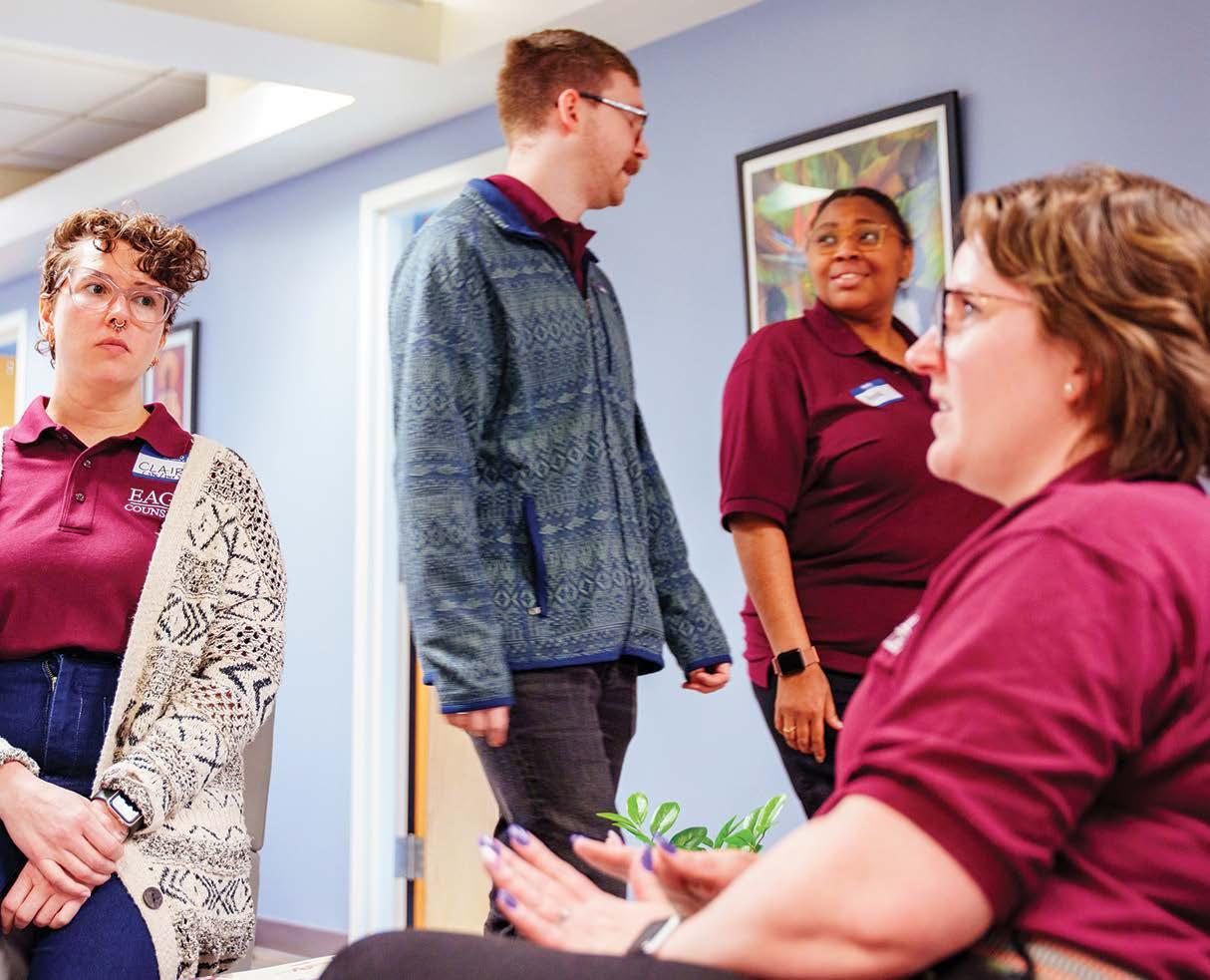
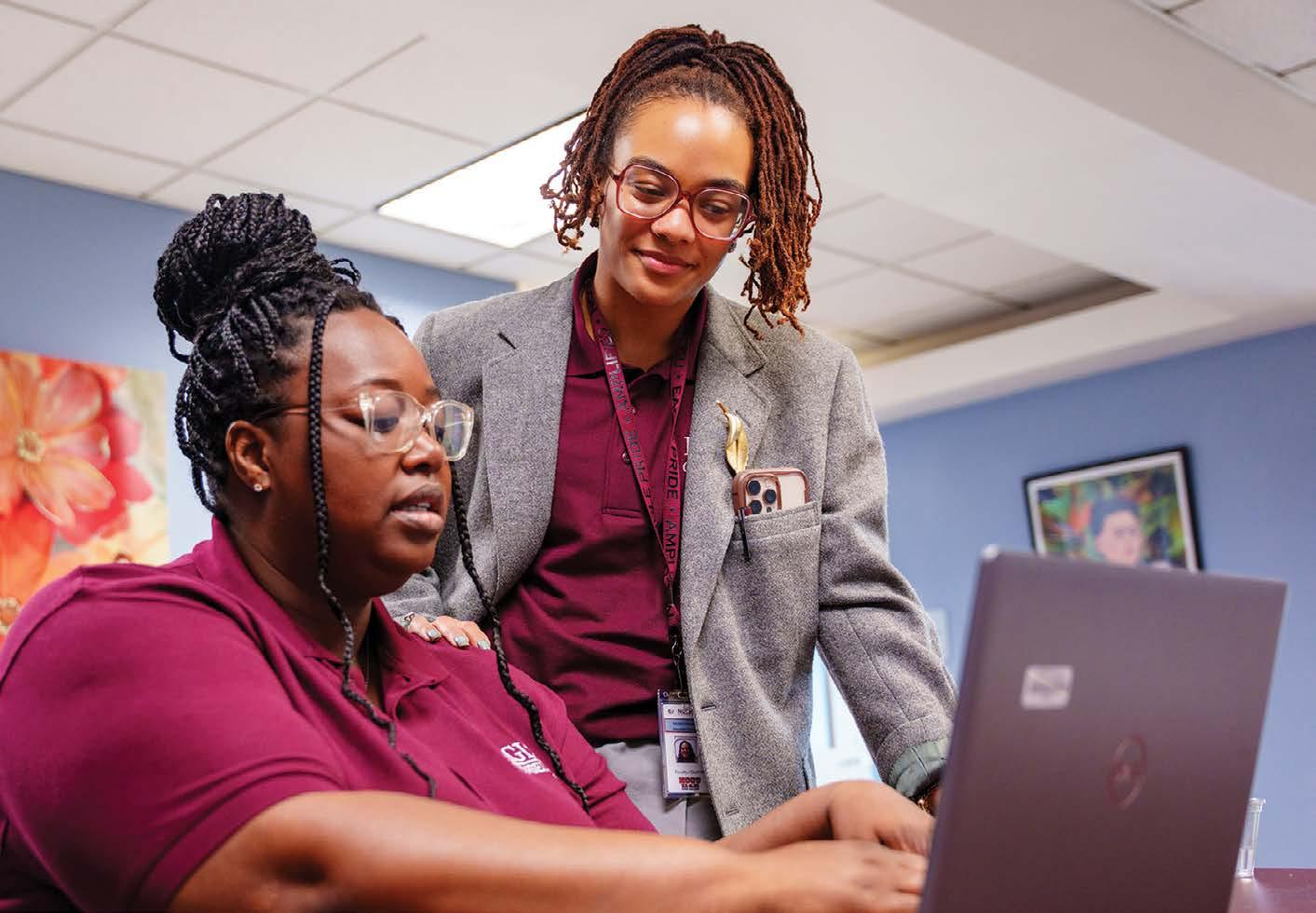
Two graduate students in one of the counseling rooms at the Eagle Counseling, Consultation and Research Clinic.
their full potential and don’t know what is stopping them. They want help identifying their dreams, goals and achievements.”
So, what do student counselors actually do when sitting in those counseling rooms with clients?
“Most people think we give advice,” Martells said. “That is the antithesis of the job.”
Martells compares therapy to bringing in a toolbox.
“This is the toolbox, and it has your name on it,” Martells said. “My job is to help you put more tools and resources in that box to make your life easier.”
Those “tools” could include coping skills, self-awareness skills, boundary-setting, goal-setting and communication skills.
“Sometimes counselors are just there to listen,” Martells said. “Showing up empathetically and building rapport.”
PRO BONO CLINIC ADVANCES ACCESS TO JUSTICE THROUGH PARTNERSHIP
BY TERRI HYMAN
AS DEMAND for civil legal services continues to rise across North Carolina, the Pro Bono Clinic at North Carolina Central University (NCCU) School of Law is expanding access to justice through its longstanding partnership with Legal Aid of North Carolina.
The collaboration addresses critical legal needs in underserved communities. Through joint initiatives focused on housing stability, estate planning and services for seniors, the partnership reflects a shared commitment to public service and equitable access to legal support.
One initiative is the housing advice line, where law students under attorney supervision assist tenants facing unsafe or unstable living conditions. Students help provide legal information, referrals and advocacy support—empowering residents with knowledge of their rights in an increasingly complex housing landscape.
Under the leadership of Lakethia Jeffries, the Pro Bono Clinic also partners with Legal Aid to serve Durham’s senior community through its Wills Clinic. Many older adults face financial and structural barriers to accessing basic estate plan-
LAKETHIA JEFFRIES director pro bono clinic and externships
AALYIAH
LECOMPTE second-year law student
ning services. Through this initiative, NCCU Law students assist seniors with wills and advance directives while developing skills in client counseling, professionalism and ethical lawyering.
For second-year law student Aalyiah LeCompte, the clinic provides practical experience. “I’ve gained hands-on experience working directly with clients, particularly learning how to explain legal concepts and jargon in a way that’s clear and accessible,” LeCompte said. “The clinic has helped me build rapport with clients while walking them through legal documents, explaining different provisions and discussing their options.”
LeCompte noted that access to wills and estate planning services is especially critical for the communities the clinic serves. “Cost is often a major barrier,” she said. “In my experience, I’ve also seen that some minority clients can be reluctant to engage in wills and estate planning due to limited access, uncertainty about the process or discomfort discussing these issues.”
At the Durham Center for Senior Life, students primarily serve individuals over the age of 60 by offering a one-stop opportunity to receive guidance and assistance. Legal Aid of North Carolina confirms client eligibility and prepares documents in advance. Students then work directly with clients to review those documents, explain key provisions and ensure their wishes are accurately reflected.
The partnership strengthens both service delivery and student learning by combining Legal Aid’s deep community expertise with the law school’s commitment to experiential education. Students gain exposure to real-world legal challenges while learning to pair legal analysis with empathy, cultural humility and professionalism.
Through this initiative, NCCU law students assist seniors with wills and advance directives while developing skills in client counseling, professionalism and ethical lawyering.
BY MARK LAWTON
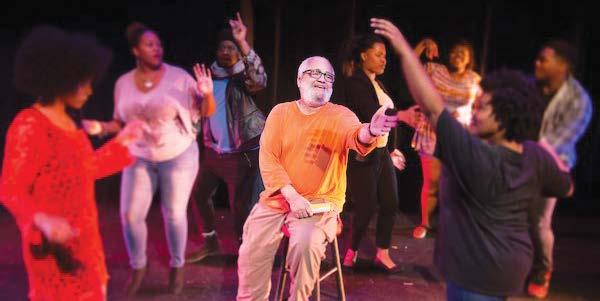
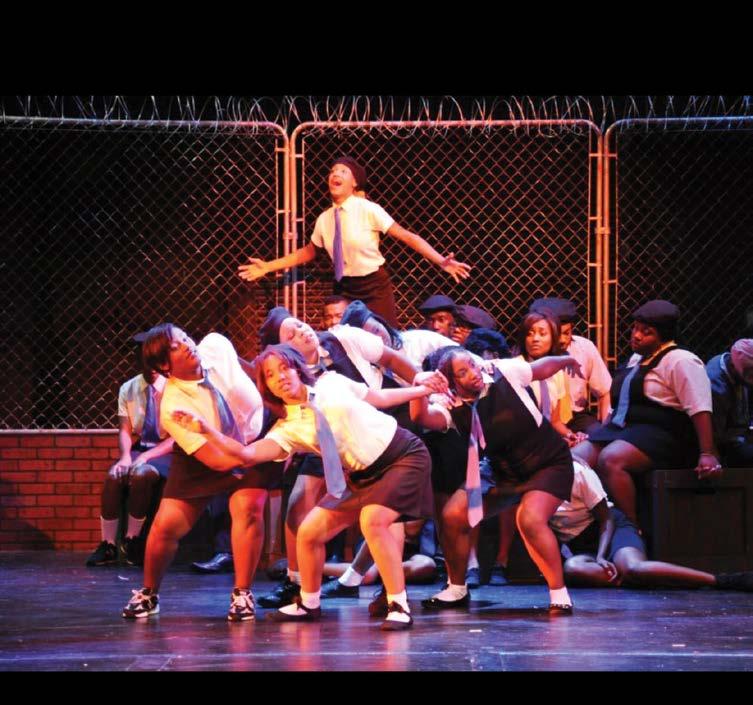
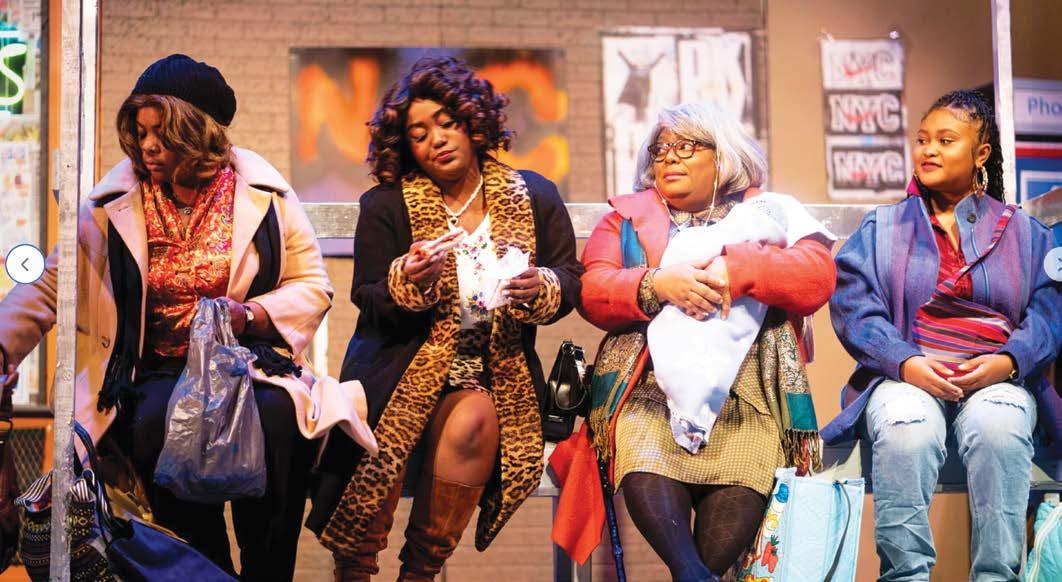
THE DEPARTMENT OF THEATRE at North Carolina Central University (NCCU) celebrated its 75th anniversary with a season of performances that referenced its history.
It was a busy season for the almost 60 students majoring in theatre.
“Four plays are ambitious for us,” said Stephanie “Asabi” Howard, Ph.D., department chair.
THE PERFORMANCES:
"FAME."
“It was the last show directed by Dr. Linda Kerr Norflett, the former chair and later dean,” Howard said. “She brought me into the fold in 2007.”
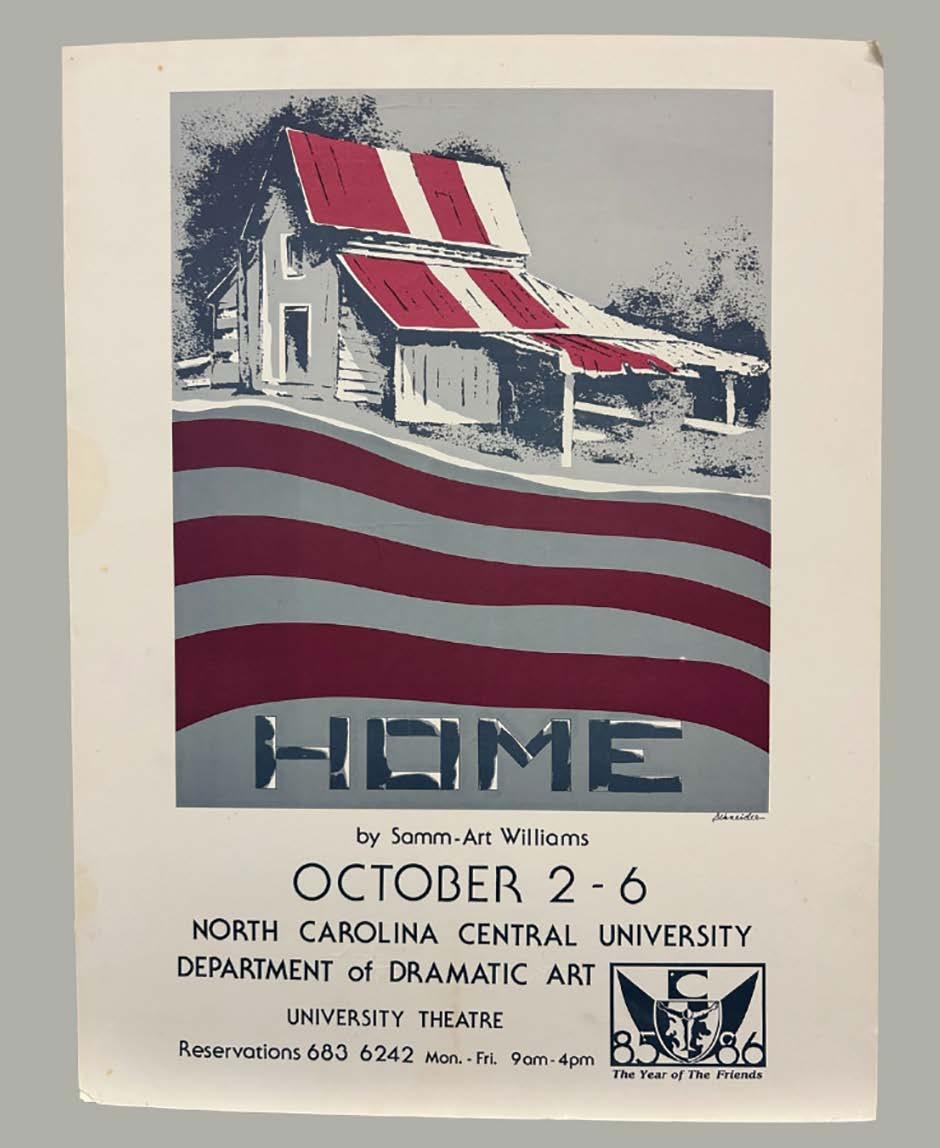
"HOME."
By former faculty member Samm-Art Williams. The play premiered on Broadway in 1980 and was nominated for a Tony Award for best play.
“He worked with us to stage it in 2008,” Howard said.
"STEAL AWAY HOME."
By Aurand Harris, a children’s show. “We haven’t done a children’s show in years,” Howard said. “In the past that was a staple of our department.”
"Their Eyes Were Watching God."
Based on the novel by Zora Neale Hurston, a writer, anthropologist and folklorist who taught drama at NCCU during the 1939-1940 school year but left the university before staging any plays.
TODAY, THE
THEATRE DEPARTMENT
HAS FOUR FACULTY MEMBERS AND FIVE ADJUNCT INSTRUCTORS.
A HISTORY OF PERFORMANCE
While theatre courses have been taught at NCCU since 1935-1936, the (then named) department of dramatic arts didn’t have a chair until Mary Bohanon was appointed in the 1948-1949 school year.
The department staged two major productions a year, always European or American classics such as Glass Menagerie, King Lear, Antigone, Murder in the Cathedral and Medea.
Several of Bohanon’s students became successful theatre professionals. Those included
Jacqueline Barnes, who performed off-Broadway and Ivan Dixon, an actor, director and producer (and part of the cast of Hogan’s Heroes TV show).
Helen Edmonds, who served as professor and chair of the history department and later as dean of the Graduate School of Arts and Sciences, staged plays including a pageant titled “The Life and Times of Dr. James E. Shepard,” which featured 200 characters and a 40-person choir.
continues on page 36
continued from page 35
ABOUT 90% OF THEATRE GRADUATES EITHER WORK IN THE FIELD OR GO TO GRADUATE SCHOOL.
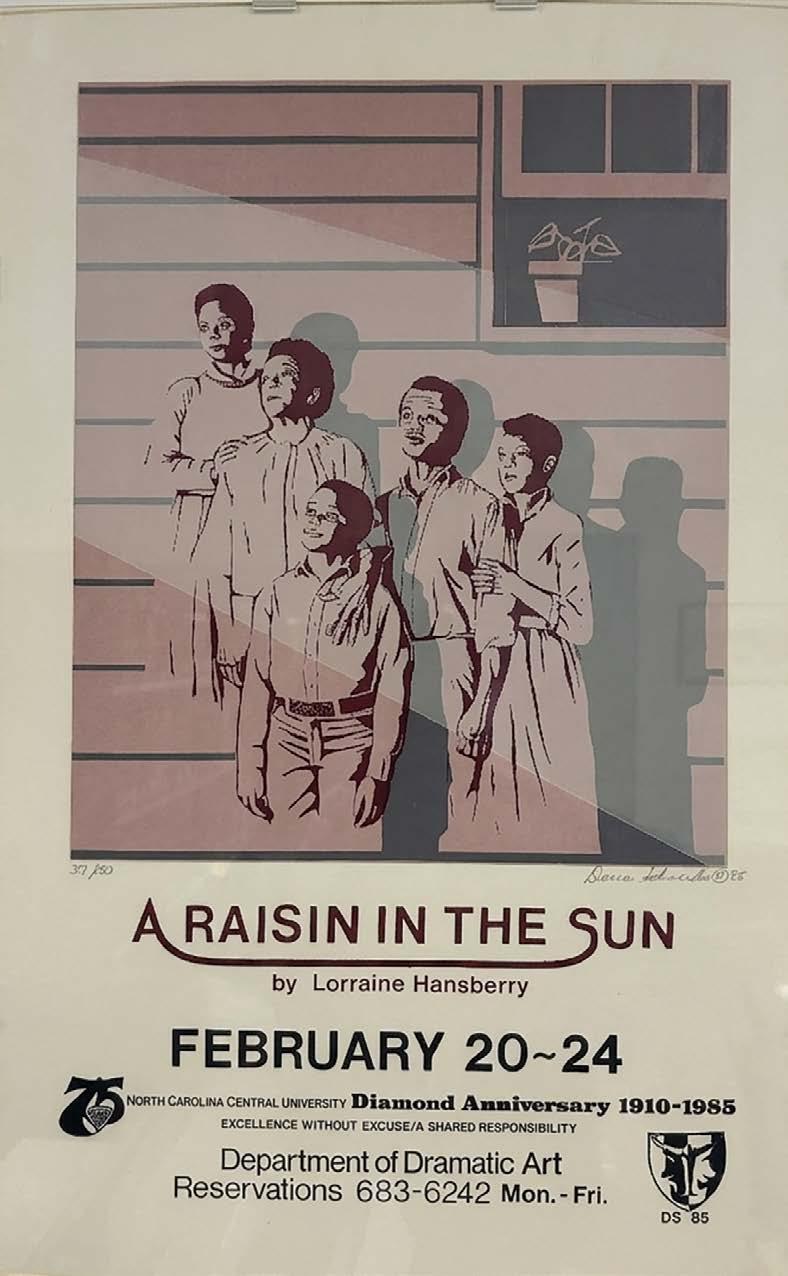
By the mid-1960s, the faculty started including the works of African American playwrights. Those included A Raisin in the Sun by Lorraine Hansberry, The Baptism by Leroi Jones and The Amen Corner by James Baldwin. Under the chairmanship of Randolph Umberger from 1970-1975, the faculty was increased to four full-time and one “borrowed” position. A theatre education concentration was initiated, and a new university theatre was built.
By the mid-1970s, the department began to participate and win awards in regional, state and national programs, including the National Association of Drama and Speech
STEPHANIE
“ASABI” HOWARD, PH.D.
chair and associate professor theatre and dance
Arts, North Carolina Theatre Conference, Southwestern Theatre Conference, Black Theatre Network and American College Theatre Festival.
In 1996, the name was changed to the department of theatre, and the next year it was accredited by the National Association of Schools of Theatre.
In 2015, following Johnny Alston’s long chairmanship, Howard became department chair. Today, the theatre department has four faculty members and five adjunct instructors.
It also has a “very strong technical theatre program,” Howard said. “Areas like design and theatre management. These are valuable areas for jobs.”
About 90% of theatre graduates either work in the field or go to graduate school.
“We pride ourselves on that,” Howard said.
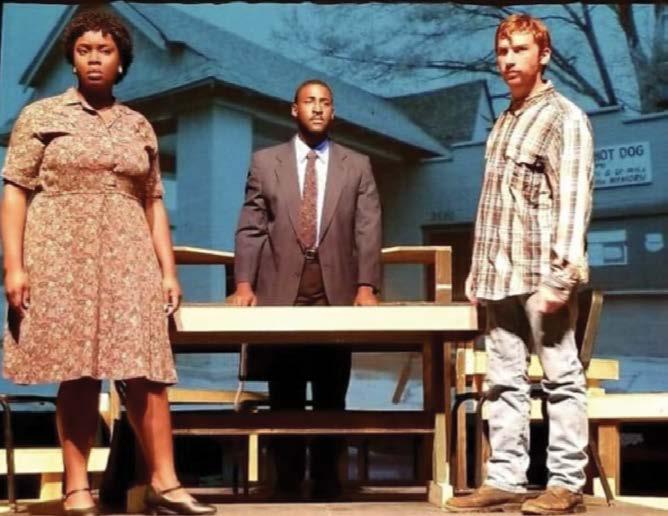
CHILDREN GET GLIMPSE OF UNDERGROUND RAILROAD IN Steal Away Home
BY MARK LAWTON
For the first time in some years, the theatre department at NCCU presented a play for children, albeit one with a weighty plot.
In “Steal Away Home,” Amos, 12, and Obie, 10, run away from enslavement on a plantation in South Carolina and journey to Philadelphia, where their freed father lives.
The play is set in 1854, pre-emancipation.
“There is no GPS and no maps, a detail rendered irrelevant by the fact that they cannot read,” said Assistant Professor Nadia Bodie-Smith, Ph.D., who directed the play. “We learn more and more about how perilous this journey is for them.”
“Steal Away Home” was adopted by Aurand Harris from a 1969 book by Jane Kristof. The department chose to revive it during its 75th- anniversary season, in part, because it was presented 20 years earlier by former department chair Rev. Linda Kerr-Norflett.
The play, which ran from Feb. 26-March 1, also overlapped with Black History Month.
“It’s an opportunity to share a powerful story that carries a deeply positive message,” Bodie-Smith said. “Even in the darkest chapters of history, there has always been a light – people who chose courage over compliance and refused to uphold laws they knew were morally wrong and violated humanity.”
Presenting this play has its challenges. It can, for example, be difficult for adult actors to act like children.
“I have to take myself back to when I was 12 and let myself go,” said Tyrone Andrews, a senior majoring in theatre performance who performs the role of Amos. “We work so hard to become adults that sometimes we forget what it’s like to be a child and the beauty that is childhood.”
Adult audiences, said Bodie-Smith, understand the etiquette of theatre space. They might gasp, laugh or chuckle when appropriate.
“Children don’t filter their reactions,” said Bodie-Smith. “They are fearless enough to laugh when something is truly funny, and just as honest when they’re confused or don’t like what they see. They bring a kind of innocence that rises above everything else. If you can captivate them, you know you’ve done something right.”
Durant Long, a transfer student from the University of North Carolina at Asheville and a student in the department of language and
(continues on page 40)
“Steal Away Home” was adopted by Aurand Harris from a 1969 book by Jane Kristof. The department chose to revive it during its 75th-anniversary season, in part, because it was presented 20 years earlier by former department chair Rev. Linda Kerr-Norflett.
BODIE-SMITH, PH.D. assistant professor department of theatre
literature, is one of the busier actors in the production. He plays three characters, both positive – like a Quaker who is a conductor on the underground railroad – and negative – like a civilian who tries to apprehend Amos and Obie.
“The biggest challenge is carrying yourself with age,” Long said. “How does someone move who has worked on a farm for 60 years? Or a young spry lawyer who hasn’t had to do anything (physical) with his life?”
“It’s a challenge to find white actors who are willing to step into stories like this one,” Bodie-Smith said. “Often, it’s because of the subject matter – being asked to portray the
We are creating pictures with our bodies. Trees, hills, houses. It encompasses how we use movement and dance to tell the story.”
— MALACHI MOORE ’26
slave owner or the man who commits violence on stage.”
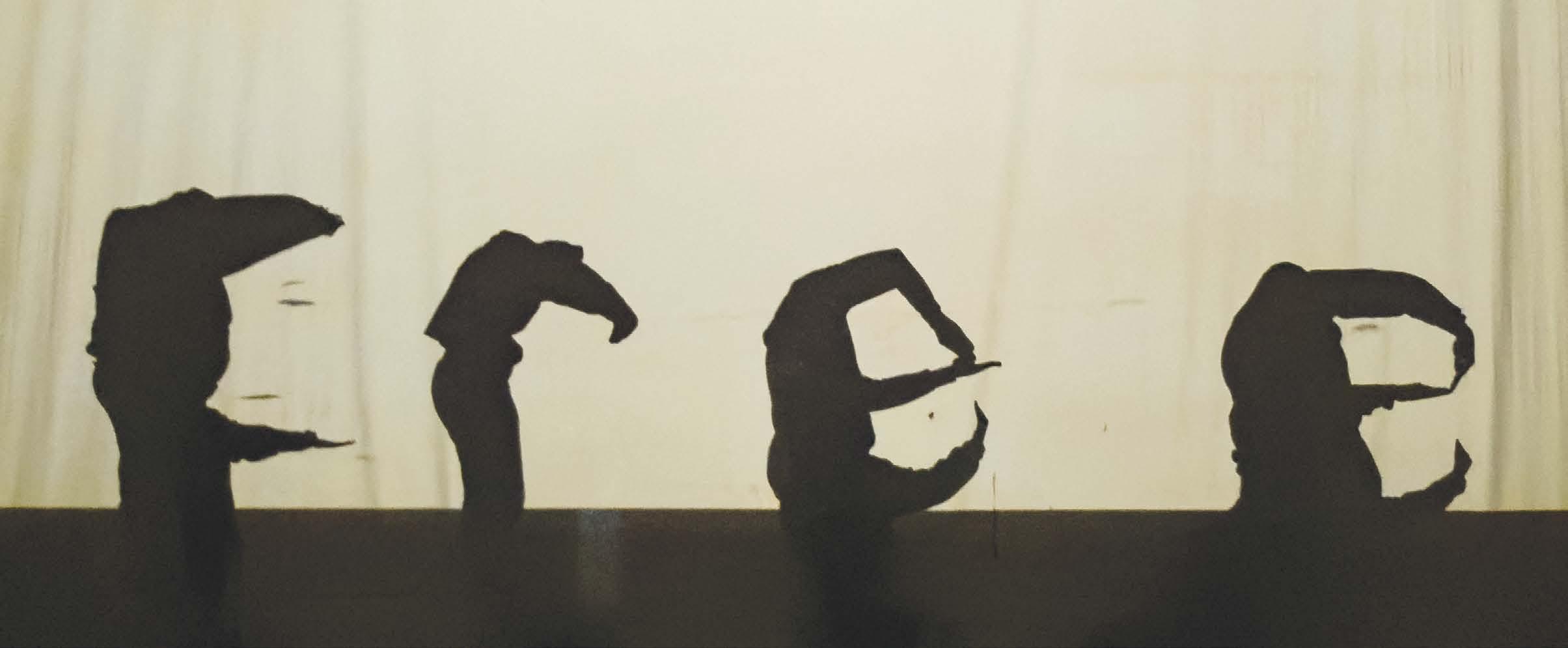
Intermixed with the stage scenes are shadow projections featuring both actors and cutouts. The projection mostly occurs at the end of each scene transition and continues the story once the lights go down.
Malachi Moore, a senior majoring in theatre performance who plays Preacher Prentice – a conductor on the underground railroad –particularly likes the shadow projections.
“We are creating pictures with our bodies,” Moore said. “Trees, hills, houses. It encompasses how we use movement and dance to tell the story.”
NADIA
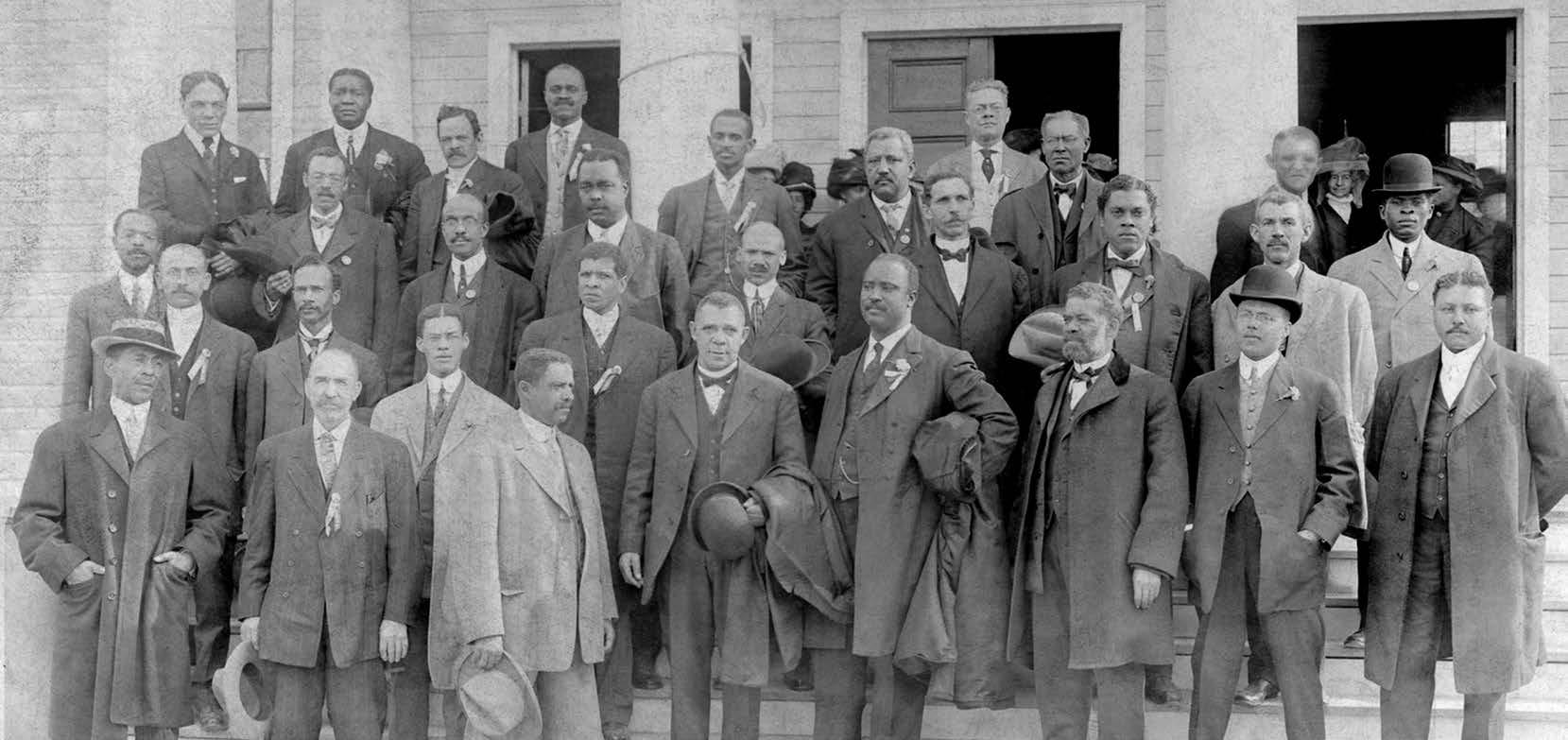
The Upbuilding of Hayti &Black Wall Street
BY ANDR É D. VANN ’93, ’95
“Go to Durham…You need the inspiration. Go to Durham and see Negro business with an aggregate capital of millions.”
— St. Luke Herald, 1928
HE STORY
of African Americans on Durham’s Parrish Street— later celebrated as “Black Wall Street”—is the story of a determined commu nity that used self‑help, collective economics, and visionary leadership to build institutions that thrived despite the strictures of Jim Crow. Beginning in the late nineteenth century, Durham emerged as a model of the “New South,” where both Black and white leaders recognized the value of economic cooperation and community uplift.
(continues on page 42)
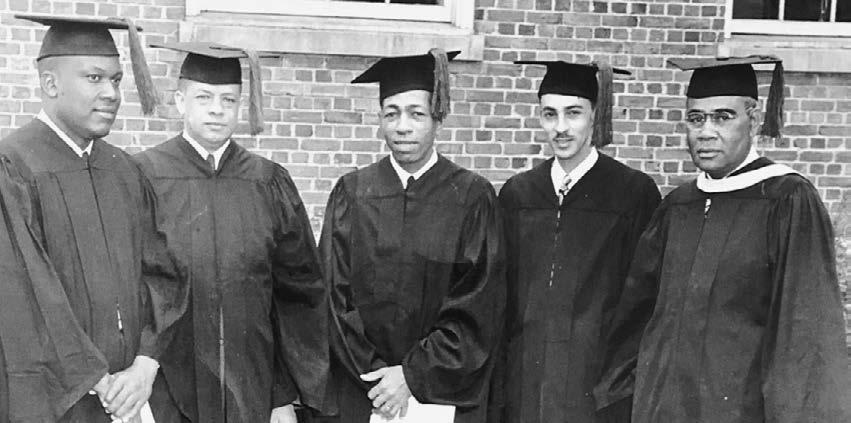
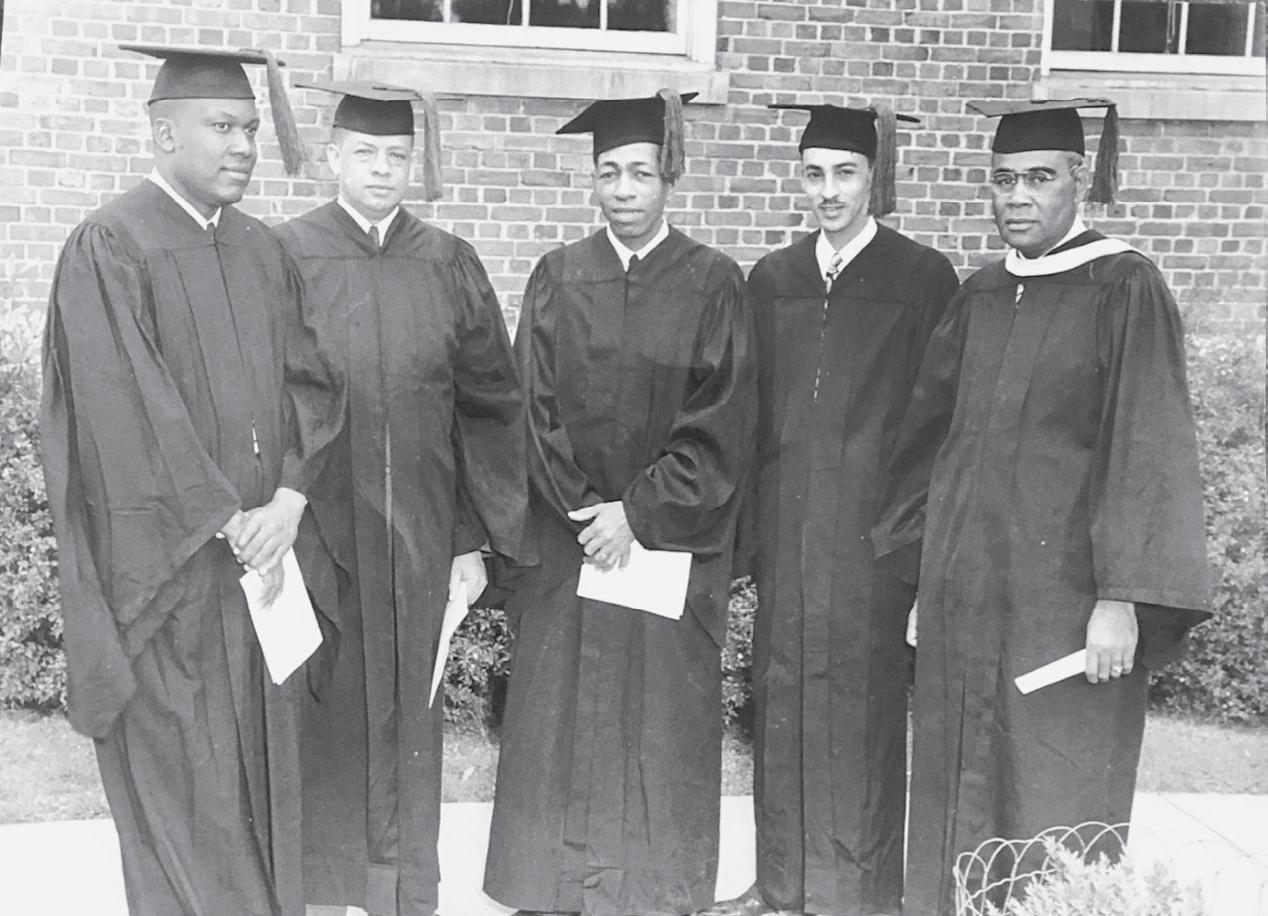
NCCU School of Law class of 1947 included John Hervey Wheeler, and James Joseph “J.J.” Sansom Jr. who
migrated to Durham seeking better op portunities, especially in the booming tobacco industry created by the Duke, Carr, and Watts families. By the 1880s, the Hayti district—named in an 1877 deed as a “settlement of colored people”—became the epicenter of Black life. Early families such as the Amey’s, Markham's, Pearson’s, Fitzgerald’s, Whitted’s, Merrick’s, Moore’s, Spaulding’s and O’Daniels established homes, churches, schools, and businesses, laying the groundwork for a robust Black
Hayti grew rapidly after its 1901–1903 annexation into the city. By the 1920s it contained more than 120 Black‑owned businesses, including restaurants, grocer ies, drugstores, tailoring shops, funeral homes, and professional offices. Its Vic torian homes and institutions—churches, civic clubs, lodge halls, a hospital, and a library—anchored a culturally rich and so cially cohesive community.
The Emergence of Black Wall Street
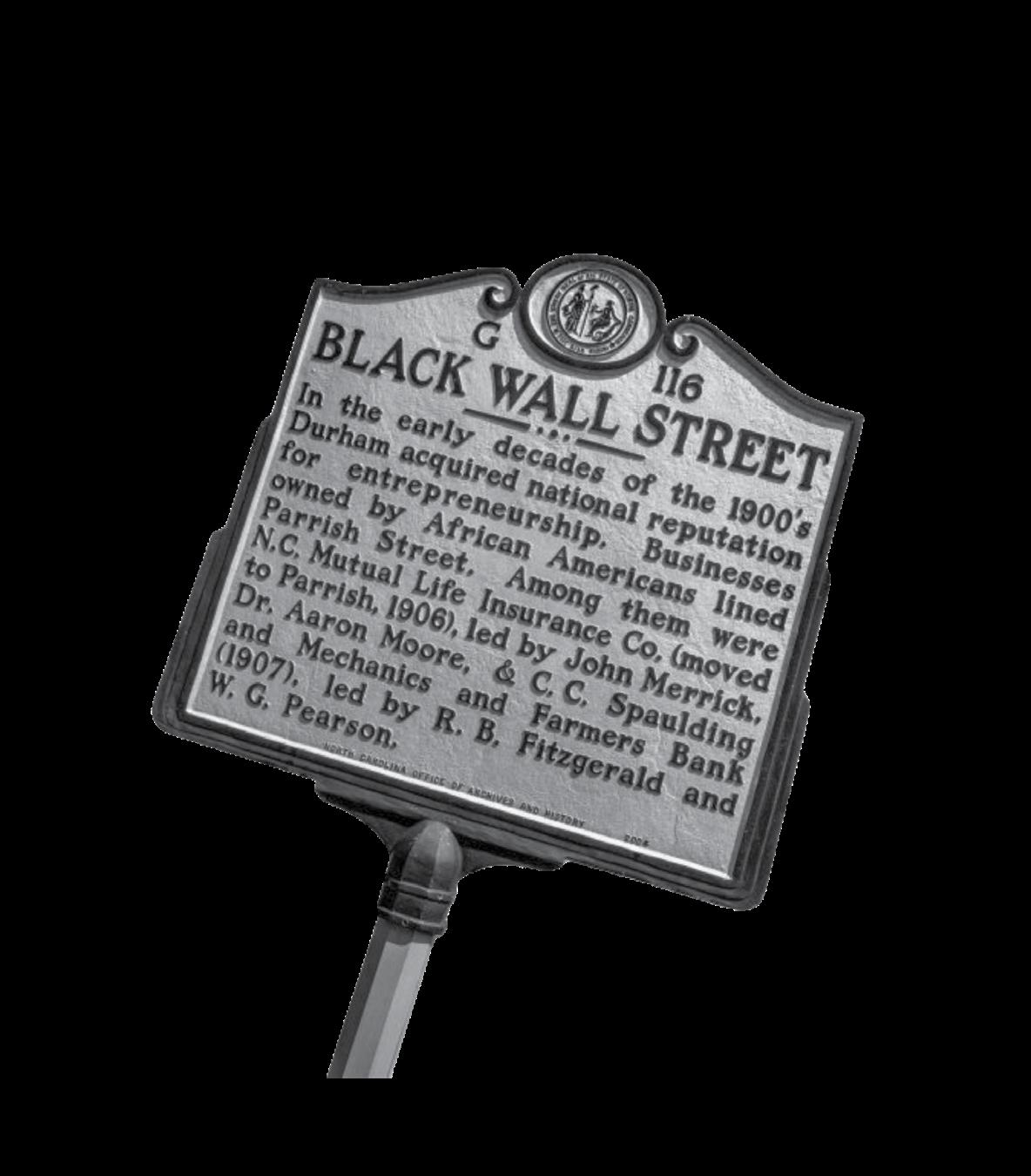
Parrish Street, located downtown, de veloped into the commercial heart of Black Durham. At its center stood the partnership of three visionary leaders:
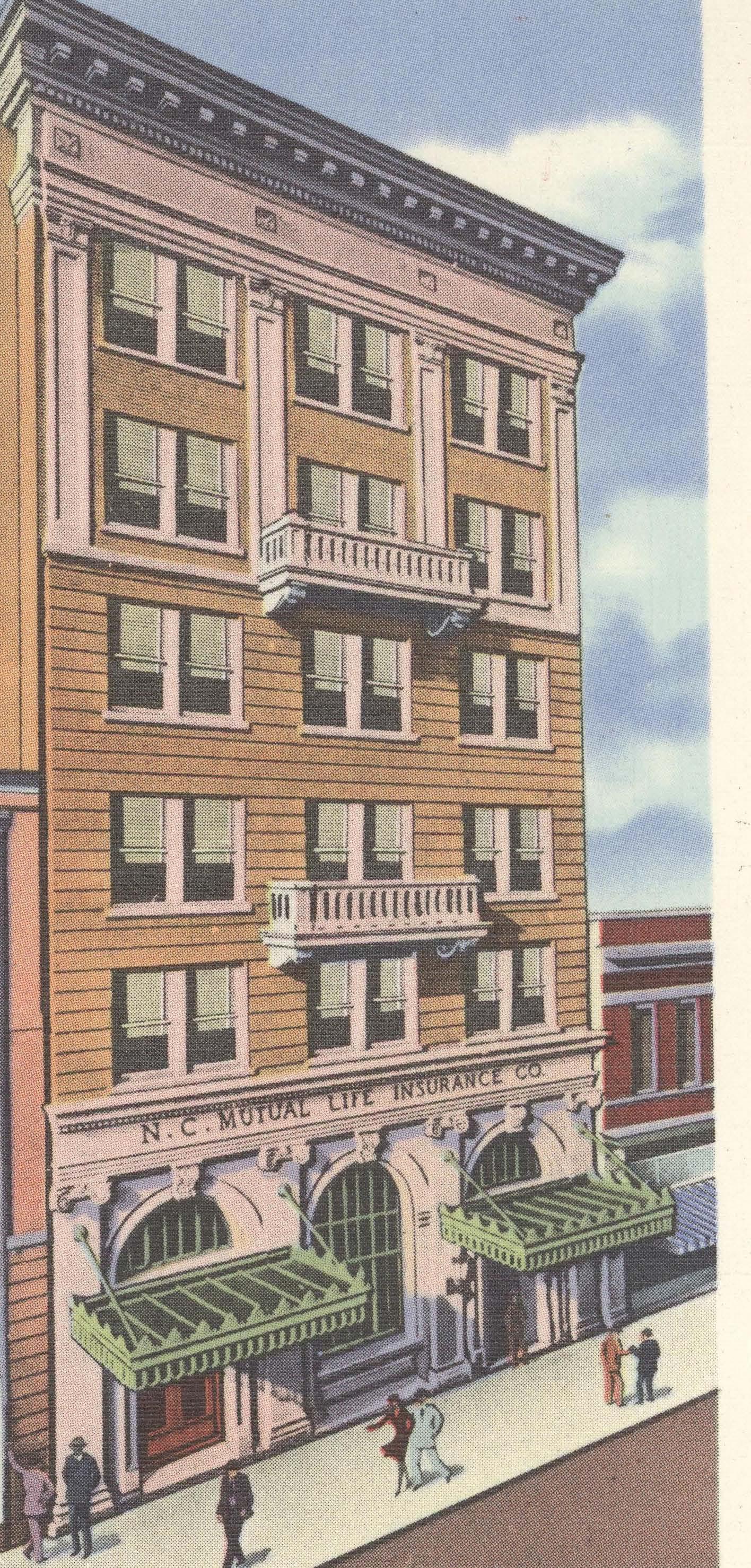
John Merrick, Dr. Aaron M. Moore, and Charles C. Spaulding. Together they founded the North Carolina Mutual and Provident Association in 1898. Born from the need for burial and sickness insurance unavailable from white firms, North Car olina Mutual expanded into the largest Black‑owned business in the United States. The company embraced a philosophy of corporate responsibility, symbolized by the idea of the “Double‑Duty Dollar”—money spent within the Black community that cir culated to support jobs, investments, social services, and community development.
In 1907, Mutual affiliates chartered Mechanics and Farmers Bank, strengthen ing the financial infrastructure of the Black community. Within a decade the Mutual complex on Parrish Street included cloth ing stores, a drugstore, a real estate com pany, a barbershop, a tailoring shop, the Durham Negro Observer, and a hosiery mill. Additional Black enterprises soon followed: the Royal Knights of King David (1883), People’s Building and Loan (1915), Banker’s Fire Insurance (1920), and many others. By the 1920s, Parrish Street was firmly established as “Black Wall Street.”
This achievement drew national praise. Booker T. Washington lauded Durham as a city offering rare opportunities for Black economic advancement, remarking on the “sanest attitude among white people to ward the blacks.” W. E. B. Du Bois called Durham the “Negro business Mecca of the South,” and the Black press celebrated it as “The Capital of the Black Business Class.”
Institutions of Uplift
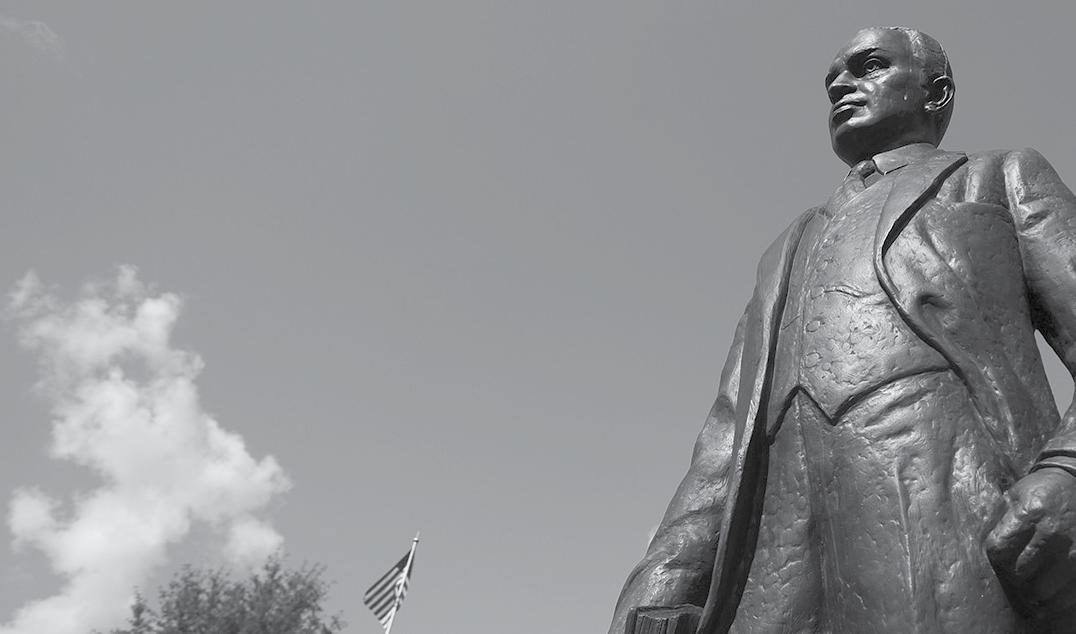
The durability of Black Durham rested equally on its churches, schools, and civic organizations. White Rock Baptist Church (1866) and St. Joseph A.M.E. Church (1869) served as spiritual, cultural, and educational centers. In 1910 Dr. James E. Shepard founded the National Religious Training School and Chautauqua for the Colored Race, later evolving into North Carolina Central University (NCCU)—the first state‑supported liberal arts college for African Americans in the nation. He is
also a founder of the NC Mutual and Prov ident Association and the Mechanics and Farmers Bank, both economic engines in the African American community. NCCU educated generations of teachers, clergy, business leaders, and professionals who strengthened Hayti and Black Wall Street.
Segregation, while oppressive, also forced African Americans to rely on one another, fostering a thriving internal econ omy. Black Durham supported barber shops, beauty salons, groceries, funeral homes, law practices, construction firms, and countless small businesses. This eco system created employment, circulated capital, and reinforced community pride.
Civic and Political Progress
Black Durham’s civic life was equally strong. The Civic League (1909) promot ed public health and cleanliness, while the Durham Committee on Negro Affairs (1935), founded at the Algonquin Tennis Club, became one of the most influential Black political organizations in the nation. Leaders such as Dr. Shepard, Spaulding, William J. Kennedy Jr., Louis Austin, and R. N. Harris spearheaded voter regis tration and legal challenges that laid the groundwork for the Modern Civil Rights Movement.
In the 1950s and 1960s, some young er activists turned to the NAACP, CORE, SCLC, and SNCC, seeking more progres sive tactics. Yet the Durham Committee’s steady engagement ensured African Amer ican political influence remained strong.
The Durham Business and Professional Chain, founded in 1938, encouraged coop eration among Black businesses through networking, training, and trade promo tion. After the 1960s, the Chain helped
administer federal programs that support ed minority‑owned firms.
Legal and Business Leadership: Wheeler and Sansom
Two NCCU School of Law graduates stand out for their impact on Black Wall Street: John Hervey Wheeler and James Joseph “J.J.” Sansom, Jr., both Morehouse College alumni and members of the NCCU Law Class of 1947.
Wheeler—banker, intellectual, civil rights strategist, and advisor to national leaders—used his legal training to chal lenge segregated schools and discrimina tory admissions policies. His leadership of Mechanics and Farmers Bank and the Durham Committee solidified Durham’s reputation for Black political and econom ic power. Wheeler’s contributions were later honored with the naming of the John Hervey Wheeler U.S. Courthouse (2019).
Sansom’s 37‑year career with Mechan ics and Farmers Bank culminated in his service as president and chairman. Under his leadership, the bank became one of
the nation’s largest Black‑owned financial institutions, enabling homeownership, business expansion, and financial stability for thousands.
Decline and Legacy
The success of Black Wall Street met pro found challenges in the mid‑twentieth century. Desegregation allowed Black consumers to patronize white‑owned es tablishments, weakening the once‑captive Black business market. Urban renewal— often termed “Negro Removal”—devastat ed Hayti. The construction of the Durham Freeway displaced more than 500 fami lies and over 120 businesses, destroying much of the community’s physical fabric. Promised redevelopment assistance rarely materialized.
Despite these losses, the legacy of Hayti and Black Wall Street endures. The sur viving buildings—especially the former North Carolina Mutual and Mechanics and Farmers Bank structures—stand as monuments to a remarkable experiment in Black enterprise, civic leadership, and community resilience.
BOOKER T. WASHINGTON [ pictured first row, center] lauded Durham as a city offering rare opportunities for Black economic advancement, remarking on the “sanest attitude among white people toward the blacks.” W. E. B. DU BOIS called Durham the “Negro business Mecca of the South,” and the Black press celebrated it as “The Capital of the Black Business Class.”
LEARNING TO PIVOT: MPA GRADUATE ADJUSTS TO CHANGE
BY MARK LAWTON
HEN CHRISTOPHER SHEARIN WAS ATTENDING HIGH SCHOOL
, a counselor told him he was “not college material.” In December 2025, Shearin completed a master’s in public administration at North Carolina Central University (NCCU), his third college degree. Shearin grew up in public housing in Durham. “You saw so many people with talent in basketball, football, etc.,” he said. “They didn’t have the work ethic, opportunity or grades to go to the next level. When you are in that type of environment, you always have to look for a way out or risk being trapped.”
Shearin’s way out was the U.S. Navy. He enlisted on June 25, 1991, and served for the next 27 years.
During those years, he took part in drug interdiction, patrolling 110 by 61 nautical miles between several Caribbean islands and part of Colombia.
“A P3 (plane) would fly over and spot a drug boat,” Shearin said. “We would intercept the boat.”
Later, while based in the Middle East, he provided intelligence to ships at risk of being hijacked by Somali pirates.
Besides Augusta, Georgia, he was based in Norfolk, Virginia; Sasebo, Japan; Bahrain; Naples, Italy; and Puerto Rico. At the height of his career, he was in charge of 180 to 225 people.
He retired from the Navy on January 31, 2018, as a senior chief, the second-highest pay grade for enlisted personnel.
LET’S GET COOKING
He returned to Durham with the intention of training as a chef and opening a restaurant. He completed a year in a culinary arts program, but during win-
ter break, he found out the school had declared bankruptcy and was closing.
“I had to pivot,” Shearin said. He recalled NCCU from his early teenage years, when he would walk up and down Fayetteville Street. His younger sister, wife, wife’s sister and brotherin-law all attended NCCU.
Enrolling, however, was not an easy decision.
Shearin aims to earn a doctorate, perhaps in organizational leadership or public administration.
“I was going to be one of the oldest people in any program,” Shearin said.
“I was a little afraid. Oh man, can I do it?”
The answer was yes. He completed a bachelor’s degree in interdisciplinary studies in 2021 and a second bachelor’s degree in political science in 2023, summa cum laude.
MOVING FAST
He planned to follow up on his bachelor’s degrees by earning a master’s in political science at James Madison University in Virginia. But he changed his mind after conversations with faculty mentors Sandra Rogers, Ph.D., and Emmanuel O. Oritsejafor, Ph.D., chair of the department of political science.
“Dr. O, he was like, ‘You love Durham,’ ” said Shearin. “Your ultimate goal is to be mayor of Durham. Why would you leave?’ ”
With the help of Oritsejafor and Rogers, Shearin completed his application, letters of recommendation and other tasks and was admitted to the NCCU Master of Public Administration program in a record five days.
In addition to coursework, he became president of Democracy Matters, a nonpartisan club that promotes voter registration. He also became a fellow at Courageous Conversations, a nonprofit that promotes hard conversations about race and racism.
RALLYING AROUND
In August 2024, about one year into his master’s program, Shearin was diagnosed with prostate cancer. When it was discovered, the cancer was on the border between stages 2 and 3 in severity.
Shearin had his doubts about being a graduate student while being treated for cancer. He reached out to S. Nicole Diggs, Ph.D., a faculty member in public administration.
“I said, I’m going to drop out, because I need to fight this fight,” Shearin said.
“She looked at me and said, ‘You are not dropping out. You are an excellent student. We know the type of work you do. We are going to rally around you.’”
And they did. Though mentally and physically drained from radiation treatment, Shearin still completed all his assignments – although he occasionally missed classes and sometimes needed extensions on assignments.
On June 2, 2025, Shearin was declared cancer-free.
NEXT STEPS
Short of being elected mayor, Shearin would like to work for the City of Durham in urban development and public housing.
Along the way, he aims to earn a doctorate, perhapsin organizational leadership or public administration.
He is going to meet with several NCCU faculty to develop a plan.
Now 53 and having earned three college degrees, Shearin is asked what he thinks about that high school counselor who declared him “not college material.”
“Nobody can define who you are,” he said.
“You get to define who and what you are over and over and over.”
S. Nicole Diggs, Ph.D.
Sandra Rogers, Ph.D. faculty mentor
Emmanuel O. Oritsejafor, Ph.D. chair department of political science
faculty department of public administration
Graduate Recovers Lost Year — Twice
BY MARK LAWTON
THOUGH LOURDES FLORES WAS BORN IN THE UNITED STATES, HER PARENTS HAD IMMIGRATED FROM MEXICO.
“In kindergarten, I was thrown in without a single word of English,” said Flores, who completed a bachelor’s degree in biomedical sciences in summer 2025. “My mom wanted us to learn the native language, so I had to repeat kindergarten.”
That “lost” year weighed on Flores as she grew up in Roxboro, North Carolina. In eighth grade, when she met with an advisor to map out her high school career, she asked if it would be possible to complete high school in three years.
“The advisor said, ‘No, not really,’ that it was very unrealistic,” Flores said. “I said I would like to give it a shot.”
She took as many classes as she could each semester and was among the few who benefited from being forced to take online classes during the COVID-19 outbreak.
“The times were more flexible,” she said. “I was able to take classes remotely, which I would not regularly be able to do.”
Many of those classes were dual credit, earning her credits at both Person High School and Piedmont Community College. As a result, she entered North Carolina Central University (NCCU) in August 2023 as a sophomore.
She chose NCCU, in part, for its joint bachelor’s and master’s program, and, in part, for other reasons.
“NCCU was small and felt more like a community college rather than really big,” Flores said. “Everyone was willing to help you.”
She had to figure out the best way to study and get used to 16-week classes – twice as long as her eightweek high school courses. She did well enough to become an honors student and earn a partial scholarship.
Along the way, she completed an internship in evolutionary anthropology at Duke University and also worked as a nursing assistant at Duke Regional Hospital.
“She’s very determined and ambitious,” said Shynese Hockaday, a graduation specialist at NCCU.
“She was never really intimidated by the work or complained about how hard the classes were.”
Now age 20, Flores has been admitted to an MBA program at NCCU and is studying for the Dental Admissions Test to attend dental school after her MBA, perhaps at Rutgers School of Dental Medicine.
Students Awarded Degrees During Fall Commencement
BY MARK LAWTON
HUMAN CONNECTION STILL MATTERS.
That was one of three “unshakeable truths” shared by Anne Sempowski Ward, chairwoman of CURiO Brands, during her speech to graduate and professional students at NCCU during its 146th commencement exercises on Dec. 12, the largest fall class in the history of the university.
“Our world is crying out for leaders who are connected, compassionate, courageous and capable of critical thought,” Ward said. “To propel our world forward, you must lead with purpose, include the forgotten and speak the unspoken, both individually and collectively. No matter your field or how technology evolves, people will always matter.”
Ward’s next truth was that good soil enables greatness to take root.
“If we were farmers like our ancestors, to have a good harvest, the first thing one must know is to understand the quality of the soil,” she said. “Know that you are and have been sitting in exceptional soil. What has been cultivated in you will last a lifetime. It also means you must become good soil for others. You can now be a source of nourishment for others through your knowledge, advice and expertise to the greater good.”
(continues on page 48)
ANNE SEMPOWSKI WARD
(continued from page 47)
Her final unshakeable truth was that someone is always watching you.
“You are now role models, light bearers, truth tellers and proof of what is possible,” said Ward. “To earn a graduate or professional degree puts you in rarified air. To whom much is given, much is required. When you believe in yourself, others take notice. They see you take a road less traveled, manage hard times with grace and bring light in dark times. Trust me, they remember.”
She added, “Stop. Take in what you have accomplished. Sometimes we can get so busy chasing the next that we forget the now.”
Chancellor Karrie G. Dixon underlined that thought.
“Reaching this moment took years of discipline, sacrifice and unwavering focus,” Dixon said. “It represents more than an academic achievement.”
Among the graduates were two who earned doctorates in integrated biosciences.
The dissertation of Jeffrey Shipman is “Mechanisms for vaping-dependent pulmonary inflammation.” The dissertation of Ezekiel Wamble is “Exploring the impact of inflammation and immune function.”
NCCU also conferred two posthumous degrees in honor of students whose lives and legacies continue to uplift the Eagle community.
Kelly Bryant, Master of Library Science, left a lasting impact through her humility, service and global learning. Joshua Tillman, Master of Public Administration, inspired peers through leadership, compassion and commitment to community and economic development.
BACCALAUREATE
Rob Robertson, a former NFL fullback for the Baltimore Ravens and an executive in the financial
To propel our world forward, you must lead with purpose.”
ANNE SEMPOWSKI WARD commencement speaker
492
UNDERGRADUATE DEGREES
2
DOCTORAL DEGREES
14
JURIS DOCTORATE DEGREES
234
MASTER’S DEGREES
742
TOTAL GRADUATES
services field for more than 24 years, opened his talk to baccalaureate students with an old saying.
29,687
COMMUNITY SERVICE HOURS
“Sticks and stones may break my bones, but words will never hurt me,” he said, adding, “That is a bald-faced lie.”
Robertson wrote a memoir titled “Persevering through Purpose,” which is partially about how one’s circumstances should never dictate one’s destiny. He speaks from experience as his mother died when he was 10 and his grandmother raised him.
“Never say what you can’t do,” said Robertson repeatedly, using the statement like a chorus in a song. “Your thoughts become things, and your words create the world.”
He spoke of keeping a positive attitude. “Life is 10% what happens to me and 90% how I respond to it,” Robertson said. “We have a choice every day for the attitude we will have that day.”
He offered graduates seven “plays” for life:
• Take meaninful risks.
• Never stop learning.
• Avoid the possibility of amnesia.
• Build a purpose-driven network.
• Lead with integrity. Never prostitute your character.
• Fight for equal access and justice.
• Pick the words for your life.
There were 742 graduates at the 146th commencement exercises at NCCU.
Of the graduates, 639 were from North Carolina, 23 from Maryland, 19 from South Carolina, 12 from Virginia, 11 from Georgia and eight from Washington, D.C.
Undergraduates collectively engaged in 29,687 hours of community service, valued at an estimated $994,242.
Never say what you can’t do. Your thoughts become things, and your words create the work”
ROB ROBERTSON commencement speaker
ROB ROBERTSON
TELL US YOUR STORY
à Did you land a new job, receive a promotion or earn a degree or professional award? These are accomplishments we want to announce. Email now@nccu.edu with a 300 dpi photo and include your graduation year, college and major.
NEWS I EVENTS I IN MEMORIAM
I ’78 I DIANNE PLEDGER was named director of the Diggs Art Gallery at Winston-Salem State University in Winston-Salem, North Carolina.
I ’83 I South Carolina Youth ChalleNGe Academy (SCYCA) welcomed RONNIE D. McNEILL as its new program director. He earned a degree in history from NCCU.
I ’93 I REVEREND DR. DARRYL W. AARON celebrated 10 years as pastor of Providence Baptist Church in Greensboro, North Carolina. He studied dramatic literature at NCCU.
I ’99, ’04 I RICHARD BARNES, was appointed as associate vice president for human resources and talent development at Fayetteville Technical Community College in Fayetteville, North Carolina.
I ’00, ’11 I Benson Elementary Principal TAKICEY DUNSTON was recognized as the Johnston County Public Schools (in Benson, North Carolina) 2025-26 Principal of the Year.
I ’97 I DAWSON ODUMS was named head football coach at Bowie State University in Prince George’s County, Maryland.
ALUMNI RELATIONS
à NATIONAL ALUMNI ASSOCIATION
Alumni Relations serves to develop, coordinate and foster programs to keep you informed and involved with NCCU. For information, call 919-530-6363, email alumni@nccu.edu or visit nccu.edu/alumni
à For news, information and or to join a local alumni chapter, visit nccualumni.org or email info@nccualumni.org or call 919-530-5222.
I ’04 I AARON STEWART was appointed chief operating officer of Legacy Community Health in Houston, Texas. He earned a bachelor's degree in business administration from NCCU.
I '11 I OLUWASEUN “SEUN” WILLIAMS was appointed to the District 15 Trial Courts Judicial Nominating Commission, representing Charles County, Maryland. Williams graduted with a Juris Doctorate from NCCU School of Law.
I '11, '17 I SHANETTA BURRIS was elected to the Durham City Council representing Ward 2. She earned a bachelor’s degree and a Master of Public Administration.
I ’14 I ASHLEY CONNER was named vice president and director of intercollegiate athletics at Edward Waters University in Jacksonville, Florida.
I'15, '23 I JALEN R. BAKER was appointed associate vice president of student engagement at Livingstone College in Salisbury, North Carolina.
(continues on page 52)
WILLIAMS
BAKER
DUNSTON
CONNOR (CENTER)
SOLOMON III TEAGUE
BURRIS
(continued from page 51)
I ’81 I ROD WALLACE (pictured above) was promoted to battalion chief in the Charlotte Fire Department in Charlotte, North Carolina
I ’17 I DWAIN POSEY TEAGUE, SLIS, hosted a virtual presentation for the Florida Library Virtual Campus (FLVC) on Oct. 21, 2025. His session was entitled “Short- and Long-Term Strategies for Significant Philanthropic Library Support.”
I ’25 I DARLEY BO J. SOLOMON III, has joined Fox Rothschild in Greensboro, North Carolina, as an associate in the taxation & wealth planning department. He isa graduatet
‹ DARNELL DEAN, ED.D. was recognized as a 2026 Principal of the Year by the Department of Defense Education Activity in Europe. She holds a bachelor of science degree in political science from NCCU.
NICHOLE GIBBS was recognized as Warren County Schools’ Teacher of the Year. She majored in theatre arts education at NCCU.
Governor Josh Stein appoints DR. THERESA MCCOY, Durham Tech biology instructor, to the North Carolina State Museum of Natural Sciences Advisory Commission.
The Lakewood Local Schools Board of Education (Ohio) has hired DR. BRAYBOY-HEDGEPETH as the district's new superintendent, starting Aug. 1.
Alumna Celebrates 35th Reunion with Donations to Local Shelters
I ’91 I To celebrate her 35th class reunion, SONYA SCOTT has worked to serve homeless and disadvantaged communities. She donated 35 toiletry bags to HEART program, Families Moving Forward and the Durham Rescue Mission. She also donated 35 blankets to the Durham Rescue Mission.
Scott next aims to help homeless people struggling with transporting their belongings from one place to another. She seeks donations to buy 350 storage bags.
Share photos of your milestones— such as weddings, births, legacy announcements, reunions with classmates — or memories from your days on campus for potential publication online, on social media and/or in our magazine. Photos must be digital and 300 dpi or higher and can be submitted by emailing to now@nccu.edu.
GOLDEN EAGLE CLASS OF 1975
’63 | YVONNE SIMMONS PETTIS, 83, was a proud graduate of J.W. Ligon High School and NCCU, where “Truth and Service” guided her life. She was a dedicated member of numerous organizations including Alpha Kappa Alpha Sorority Inc., NAACP and NCCU Alumni Association Inc. She earned the Order of the Longleaf Pine, and championed political engagement and social community justice in Charlotte.
’45 | WILLIE MAE GEORGE, 83, Silver Springs, MD, Aug. 26, 2025
’48 | EMMA LEE LOVICK KING, 99, Washington, NC, Jan. 29, 2026
’51 | DAVID LEE HARRISON, 100, Durham, NC, Nov. 23, 2025
’71 | CALVIN KEARNEY, 76, Washington, DC, Dec. 6, 2025. Kearney earned a bachelor's degree in history. from NCCU in 1971 and served the NCCU Alumni Association Inc. with distinction. His accomplishments over the years have included Alumnus of the Year Award, National President's Award and Mr. Alumni Association. Kearney held leadership roles including director of operations for the D.C. Department of Health and consultant to national organizations. He retired in 2007 after a dedicated public service long career.
’79 | GLENDALE BASS, 68, Durham, NC, Jan. 5, 2026
’79 | MATTHEW RAY GOODMAN, 68, Greensboro, NC, Jan. 8, 2026
’80 | HELEN MARIE WILLIAMS HUDSON, 94, Durham, NC, Sept. 1, 2025
’14 | SHAWDAE E. PINKNEY, 35, Durham, NC, Aug. 29, 2025
’64 | GWENDOLYN C. CHUNN, 83, of Raleigh, NC, passed March 7, 2026. Born September 28, 1942, in Rowan County, she was the eldest of seven and helped operate her family’s Big V Grocery, a vital community hub during segregation. A valedictorian of Price High School (1960), she earned degrees from North Carolina Central University and UNC–Chapel Hill. She began her career in education before rising to become the first African American director of North Carolina’s Division of Youth Services. A nationally respected leader in juvenile justice, she received the Order of the Long Leaf Pine.
Norma Brown Pearl Fryar
LaVerne Harrison
Mary Sawyer Marsh
’50 | OLLIE MADGIELENE BOWSER HUGHES, 99, Silver Spring, MD, Jan. 26, 2026. A proud member of Alpha Kappa Alpha Sorority Inc., she was a dedicated librarian, serving at Morgan State University and D.C. Public Schools, retiring in 1993 as head librarian at Spingarn High School after distinguished service.
’68 | THOMAS E. WOOLFOLK, 96, of Williamsboro Street, transitioned on January 20, 2026, at Granville Medical Center. Born in Richmond, VA, to Samuel Woolfolk and Mary Branch, he was a gifted autodidact who mastered languages, piano, archery, and earned a pilot’s license. A graduate of North Carolina Central University, he earned a Master of Theology from Sacred Heart Seminary and served 21 years as a federal investigator. He later served 46 years as Presiding Bishop and 43 years as pastor of Refuge Temple.
’73 | ELTON O’NEAL, 74, of Durham, NC, transitioned peacefully on September 16, 2025. O'Neal graduated from NCCU, earning bachelor’s and master’s degrees in education, and pledging Omega Psi Phi Fraternity Inc. in 1970. He served Durham Public Schools as a teacher, assistant principal, instructional supervisor and founding principal of Lakeview School. He was a devoted deacon at Morehead Avenue Baptist Church.
’18 | MASTER TROOPER STEVEN J. PERRY, 30, Raleigh, passed away on Sunday, March 1, 2026, following a car crash. Perry played football at North Carolina Central University.
In Loving Memory:
Mourning the loss of our NCCU Students
’28 | ZYARRE ZAKARI PRINCE , a sophomore criminal justice major passed on March 28, 2026. Prince served as Mister Freshman for the 2024-2025 academic year.
’27 | CARRIE EVERETTE, 22, passed on April 4, 2026. A native of Seattle, Washington, Everette will be remembered as a trailblazer who shared her inspirational talent and leadership with so many.
As a sophomore in 2024, she became the first current HBCU student to be named Miss North Carolina. Her platform, We Need Equity to Build Communities, sought to make pageants more accessible to young people.
Her work to recruit young women who may not consider pageants due to the expensive entry fees and wardrobes was commendable. Everette selected NCCU because of the university's music program - she enjoyed singing gospel music - and regularly graced NCCU occasions with her beautiful singing voice. Her ambition, grace, tenacity and talent will be deeply missed.
The NCCU Alumni Association is your lifelong connection to the Nest, a powerful network rooted in purpose, pride, and impact!
Whether you’re a recent graduate or a seasoned alumnus, there’s a place for you to CONNECT, ENGAGE, and SERVE!
JOIN
News, Events, information or to find a local chapter visit www.nccualumni.org
THE ‘ALL IN’ MEMBERSHIP IS $100.
Membership includes one-year membership to the NCCU National Alumni Association, Inc., a one-year membership to a local NCCU Alumni Chapter, AND a tax-deductible donation toward the annual scholarship fund for the University.
OTHER MEMBERSHIP OPTIONS
The NCCU Alumni Association is your lifelong connection to the Nest, a powerful network rooted in purpose, pride, and impact. Whether you’re a recent graduate, a seasoned alum, or a proud supporter, there’s a place for you:
• Annual Membership
• Life Membership
• Young Alumni Memberships
• New Graduate - Complimentary Don’t wait, BE ALL IN! Visit nccualumni.org
MONA PARKS
Lifetime Achievement
The NCCU Alumni Association Memorials and Awards Committee is proud to announce Alumna Mona Parks '75 as the 2026 Alumni Association Lifetime Achievement Honoree.
A proud graduate of the North Carolina Central University Class of 1975, Parks is a living example of “Truth and Service.” Her lifelong dedication to NCCU is reflected through decades of alumni leadership, sustained financial support, mentorship and civic engagement.
For more than 25 years, Parks has served the NCCU Alumni Association at the local, regional and national levels, including leadership roles as president of the Raleigh Wake County Alumni Chapter and Region IV vice president. Under her guidance, the Raleigh Wake Chapter earned its first Chapter of the Year recognition, and her work as a Class Reunion Coordinator helped gener-
ate more than half million a dollars for the 2025 Reunion.
As a Life Member of the Alumni Association, Parks has consistently invested in scholarships, alumni initiatives and student support. She is equally known for her commitment to mentorship, serving as a trusted advisor and connector to students, young alumni, and emerging leaders.
Beyond the University, Parks has demonstrated courageous civic leadership through board service and her 2019 mayoral campaign in Garner, North Carolina, where she brought integrity, advocacy and purpose to local leadership.
Alumna Parks embodies the highest ideals of the Alumni Lifetime Achievement Award. Her legacy of leadership, service, and generosity continues to uplift NCCU and future generations of Eagles.
Awards Banquet
FRIDAY
June 26, 2026
MERTIE V. SNEAD
Seeds of Service: How Mertie V. Snead Is Cultivating Future Leaders
BY SYRIA GILMORE ’21
As a global health leader, Mertie V. Snead ’84 continues to shape the future of North Carolina Central University (NCCU) through philanthropy. In honor of her mother, she established the Mertie Viola Snead and Elouise Yelverton Snead Endowed Scholarship Fund for $40,000. The endowment will support undergraduate students with demonstrated financial need.
“I see it as dividends; a return on the investment that the University made in me,” she said.
Raised in Snow Hill, a small agricultural town in eastern North Carolina, Snead grew up surrounded by family, farmland and a close-knit community that valued education. Many of her teachers were graduates of historically Black colleges and universities.
“My parents instilled the importance of commitment and doing your best,” Snead said. “That mindset has carried me through every stage of my life.”
Her fascination with science began early, nurtured by time spent gardening
with her grandmother and observing the natural world.
Choosing NCCU: A Defining Decision
Snead enrolled at NCCU in 1980 as a science major, drawn by the University’s strong programs in biology, chemistry and physics, as well as personal connections with alumni and recruiters who emphasized the institution’s supportive environment.
“I immediately sensed that NCCU was a place where students mattered,” she said. At NCCU, she found mentors who pushed her to excel. Professors helped sharpen her analytical skills. Courses outside her major, such as French, later proved unexpectedly valuable when she relocated to Belgium for three years to lead international operations for research quality.
Leadership in Global Vaccine Safety
After graduating, Snead embarked on a career in the pharmaceutical and biotechnology industries, including GlaxoSmithKline, Merck & Co. and AstraZeneca.
Until recently, she served as executive director, Global Vaccine Safety Compliance at Novavax, Inc., overseeing programs that monitor the safety of vaccines from clinical trials through public use.
Her work involves interfacing with regulatory health agencies worldwide, ensuring that the safety profile of vaccines meets stringent national and international standards. Snead has been a member of research development teams addressing Ebola, Malaria and COVID-19.
Truth and Service in Action
Snead remains actively engaged in advancing the University’s mission.
It’s rewarding to know that the work we do helps to protect people around the world.”
MERTIE V. SNEAD / global health leader
She has served in leadership roles supporting research and innovation, particularly in biomedical research and STEM advancement. She serves as a current member and previous co-chair of the Advisory Committee for NCCU’s Biomanufacturing Research Institute & Technology Enterprise (BRITE).
In November 2024, she hosted an International Delegation of Women in STEM on the University campus to showcase the University’s outstanding research and STEM education to world leaders.
Rooted in NCCU’s motto, Truth and Service, Snead’s engagement reflects a lifelong commitment to community uplift and institutional excellence.
Education changed the trajectory of my life. I’ve always believed it should do the same for the next generation.”
Marilyn Sutton-Haywood, Ph.D.
How Keith and Marilyn Haywood Turned Opportunity Into Impact
BY SYRIA GILMORE ’21
Long before their names were placed on the walls of the School of Business, Keith Haywood and Marilyn Sutton-Haywood, Ph.D., were building something far more enduring — a legacy rooted in gratitude, leadership and access.
In 2012, the couple created the Dr. Marilyn Sutton-Haywood and Keith Haywood Endowed Scholarship Fund, committing $25,000 to support student success at North Carolina Central University (NCCU). More than a decade later, they made a $200,000 gift to the School of Business. In recognition of that contribution, the dining room now carries their name, the Keith J. and Dr. Marilyn Sutton-Haywood Dining Room.
“We wanted students to see what’s possible,” Haywood said. “Sometimes all it takes is one opportunity, one open door to change everything.”
Dr. Marilyn Sutton-Haywood: Leading Through Scholarship and Strategy
After graduating magna cum laude from NCCU with a degree in biology, Sutton-Haywood earned her master’s and doctorate in biology before completing executive leadership training at Harvard University’s Institute for Educational Management. Her career would span more than four decades in higher education.
She began in the classroom, teaching biology and mentoring students in foundational and advanced sciences.
Over the years, she served in executive academic positions overseeing faculty affairs, curriculum development, accreditation compliance and institutional strategic planning.
She strengthened academic infrastructures
“Business is about building relationships that last. If you create opportunities for others, success becomes shared.”
and supported faculty development initiatives designed to improve student outcomes.
She brought in millions in grants that supported STEM education, biomedical research pathways and mentoring programs for underrepresented students pursuing science careers.
“Education changed the trajectory of my life,” she said. “I’ve always believed it should do the same for the next generation.”
Keith Haywood: Expanding Enterprise, Creating Access
Haywood moved from Indianapolis to Durham to attend NCCU, where he pursued a Bachelor of Science in Business Administration with a concentration in Marketing. Athletics, including time on the tennis team, reinforced discipline and teamwork.
He later received a scholarship for the Minority Business Executive Leadership Program at the Tuck School of Business at Dartmouth College.
In the early 1980s, Haywood oversaw large-scale dining operations for college campuses and corporate clients throughout the Southeast. As his responsibilities expanded, he led corporate banquet and catering operations serving major national organizations in sports, finance and media. In the 1990s, he transitioned into sales and marketing leadership, cultivating partnerships that expanded his company’s reach across public schools, universities and healthcare systems through joint ventures with national hospitality firms.
He helped launch Bojangles® into airport dining, and most recently, led a joint venture introducing Eataly’s first North American airport restaurant at John F. Kennedy International Airport.
Today, Haywood serves as owner and president of FDY, Inc., providing strategic oversight and long-term planning. He has served in civic and industry leadership roles, including advisory positions supporting minority business participation in airport contracting and scholarship initiatives for aspiring entrepreneurs.
“Business is about building relationships that last,” Haywood said. “If you create opportunities for others, success becomes shared.”
Your gift to the Dr. Marilyn SuttonHaywood and Keith Haywood Endowed Scholarship Fund directly empowers the next generation of Eagles with the resources, encouragement and opportunity they need to soar. Give today — and help turn promise into achievement.
Keith Haywood
FORTITUDE PROPELS STAR ATHLETE AFTER CAR ACCIDENT
BY ANTHONY JEFFRIES
1984, ACTOR ROBERT REDFORD STARRED IN THE CLASSIC SPORTS MOVIE THE NATURAL.
The title is an apt description of Rena Armwood ‘00. “She was a great athlete,” said Ingrid Wicker McCree, Ed.D., former athletic director at North Carolina Central University (NCCU). “Things came very easily for her.”
Armwood was a dynamic two-sport star under McCree and helped lead NCCU to some of its highest moments in the school’s women’s sports history.
The Durham native was the Tournament MVP when NCCU captured its first Central Intercollegiate Athletic Association (CIAA) volleyball championship in 1999 and became the first player in school history to surpass 1,000 kills (a ball the opposite team can’t return) and 1,000 digs in a career.
The Eagles also made history in softball during Armwood’s career. She helped lead NCCU to three CIAA championships, including its first in 1998. Armwood ended her career ranked in the program’s Top 10 in batting average and home runs. The gifted Armwood was selected for the All-CIAA first team twice in volleyball and once in softball.
couldn’t push, so I just lay there. My head had hit the steering wheel, and that’s when I broke my neck.”
After the wreck, Armstrong rehabilitated in Atlanta for a year before returning home. Since then, she has used a wheelchair.
In 2017, Armwood was inducted into the NCCU Alex M. Rivera Athletics Hall of Fame for her athletic exploits. She and Catherine Armwood (2005) are the first mother-daughter duo inducted into the NCCU Hall of Fame.
While Armwood was blessed with God-given athletic abilities, her greatest strength is her fortitude. This trait has inspired many, including her, particularly after a car accident left her paralyzed from the waist down.
The near-fatal crash occurred on March 8, 2014.
“It was about 7 in the morning, and I was driving on Stallings Road in Durham headed to my sister's house to go watch her jump out of a plane,” Armwood said. “As I drove up a hill, my car rode over black ice, and it slid off the road. I slowly moved it back onto the road, but the sheet of ice was long, sending my car spinning out of control back down the road. My car landed in a ditch and stopped on a light pole.”
Armwood didn’t realize how badly she was injured.
“I didn’t know I was paralyzed until I tried to push and reach for my phone,” Armwood said. “I realized I
Most people would be devastated, but Armwood still has the same vigor she had as a player. She coached volleyball briefly at Lowe's Grove Elementary and continues to teach physical education at R.N. Harris Elementary in Durham.
Catherine Pugh, the former principal at Harris Elementary, held Armwood’s P.E. position while she was rehabbing.
“I could always count on Rena for whatever we needed done,” Pugh said. “What impressed me more was after the accident. She never let her inability to walk hold her back. When she got a car, Rena was able to drive to work. A lot of people become depressed. I never saw that in Rena.”
Spectacular Magazine named Armwood the magazine’s 2017 Woman of the Year, three years after her accident, and the same year, she was inducted into the NCCU Hall of Fame.
Armwood has been teaching for 11 years since the accident. The only adjustment in her classes is having students demonstrate exercises and techniques while she instructs from her wheelchair.
(continued on page 66)
Rena Armwood ’00 became the first player in school history to surpass 1,000 kills (a ball the opposite team can’t return) and 1,000 digs in a career.
When you are paralyzed, you start thinking like an athlete because you want to get better. It’s just being able to have a strong mind to keep pushing.
“I was definitely nervous (when I returned to the classroom),” Armwood said. “When I came back, I didn’t know how these kids were going to take me. My wheelchair doesn’t even faze them. One student is in a wheelchair, and she chose the school because I was in a wheelchair. I mentor her to help her become more independent.”
Armwood’s personal life has also returned to normal. She cooks, lives independently and handles most daily tasks such as grocery shopping. “It started with my son (age 8 at the time of the accident) being my motivation,” Armwood said. “I wanted to be there for him. I didn’t want to feel I needed to depend on people.”
Her athletic career also played a big role in her recovery.
“In sports, they teach you to never give up,” Armwood said. “It is mind over matter. If not for sports, I don’t think I would have recovered as I did. When you are paralyzed, you start thinking like an athlete because you want to get better. It’s just being able to have a strong mind to keep pushing.”
Former volleyball teammate and good friend Davida (Watson) Morant says Armwood has not changed since her days as a two-sport star at NCCU.
“She was a passionate leader,” said Morant. “She is one of those people who motivated the team verbally and by her actions. She is the first one cheering, the first one saying, ‘We got this’, ‘suck it up’, and ‘we are going to win’.”
Morant, an NCCU Hall of Famer and 1998 CIAA Volleyball Player of the Year, remembers Armwood’s tenaciousness on the court.
“She talked a lot of smack,” Morant added. “She never backed down. She would look across the net after she got blocked, thinking, you might have gotten me this time, but you won’t get me again. Rena would hit the ball hard and scream like Serena [Williams] – Aaah!”
Rena comes from an athletic family. Her mom, Catherine, is considered one of Durham’s greatest female athletes. Rena’s sister Kelli played volleyball at Winston-Salem State University, and her other sister, Ketrelle, was a high school track standout before attending Tennessee State University. Her brother Curtis was a prep basketball player.
In high school, Rena excelled in basketball and track and field. Basketball may have been her best sport. She was so good that she played at Southern Durham High School,
where she made the Herald-Sun All-Area Team and was named conference player of the year.
In track and field, Rena earned all-conference honors in four events for Southern Durham, which won the 3-A state title.
“I am really amazed at her resilience,” McCree said. “She did not let the accident define her. She still has the same spirit as before. Even when I saw her in Atlanta, she was still the same – asking about the family. She is very compassionate and thoughtful. I never had any doubt whether she walked or not that her son would have a quality life as well.”
Added Pugh: “If you had met Rena without seeing her, you would never have thought she had a disability. She didn’t let that wheelchair stop her. It is a true example of willpower, determination and perseverance to go through this and still raise her son, without missing a beat.”
Please send address corrections to Advancement Services, Phone: 919-530-7399 / E-mail: rgallow7@nccu.edu or mail to 1801 Fayetteville Street, Durham, NC 27707. At a cost of $2.08 each, 10,000 copies of this public document was printed for a total of $20,865 in the Spring of 2026 and distributed to NCCU supporters and donors. NCCU is accredited by the Southern Association of Colleges and Schools Commission on Colleges to award baccalaureate, master’s, education specialist and doctoral degrees. Contact the SACSCOC at 1866 Southern Lane, Decatur, GA 30033-4097 or call 404-679-4500 for questions about the accreditation of NCCU. Copyright 2024, North Carolina Central University.