
QUALITY CARE AND YOUNG FIRST NATIONS
CHILDREN: Summary of findings from the quality
ELCC programming study REPORT SUMMARY
Introduction
In 2022, the National Collaborating Centre for Indigenous Health (NCCIH) initiated the Quality ELCC programming for First Nations children on reserve study to explore and accentuate the qualities that First Nations people value and believe are important for their children in early learning and child care (ELCC) settings on reserve. The research was one of three interrelated qualitative studies that, together, formed part of a larger project partnership focused on informing and strengthening programs and policies designed to serve families with young children (birth to six years) in First Nations communities.
This report summary provides a broad overview of the main findings from the Quality ELCC programming study. Based on the stories and perspectives shared by policy makers,
program administrators, early childhood educators, and parents and grandparents with first-hand knowledge, experience, and insight related to ELCC programming in First Nations communities, the reported findings offer a general description of important factors that contribute to the optimal learning, development, and care of First Nations children in early childhood program settings on reserve. More detailed results
from this study can be found in Sections 3 (Qualitative interviews and group discussions subsection) and 4 (Quality ELCC programming for First Nations Children on reserve subsection) of the larger project report, Quality care and young First Nations children: An exploration of optimal learning and development in early childhood settings on reserve, which may be accessed through the QR code provided at the end of this resource.

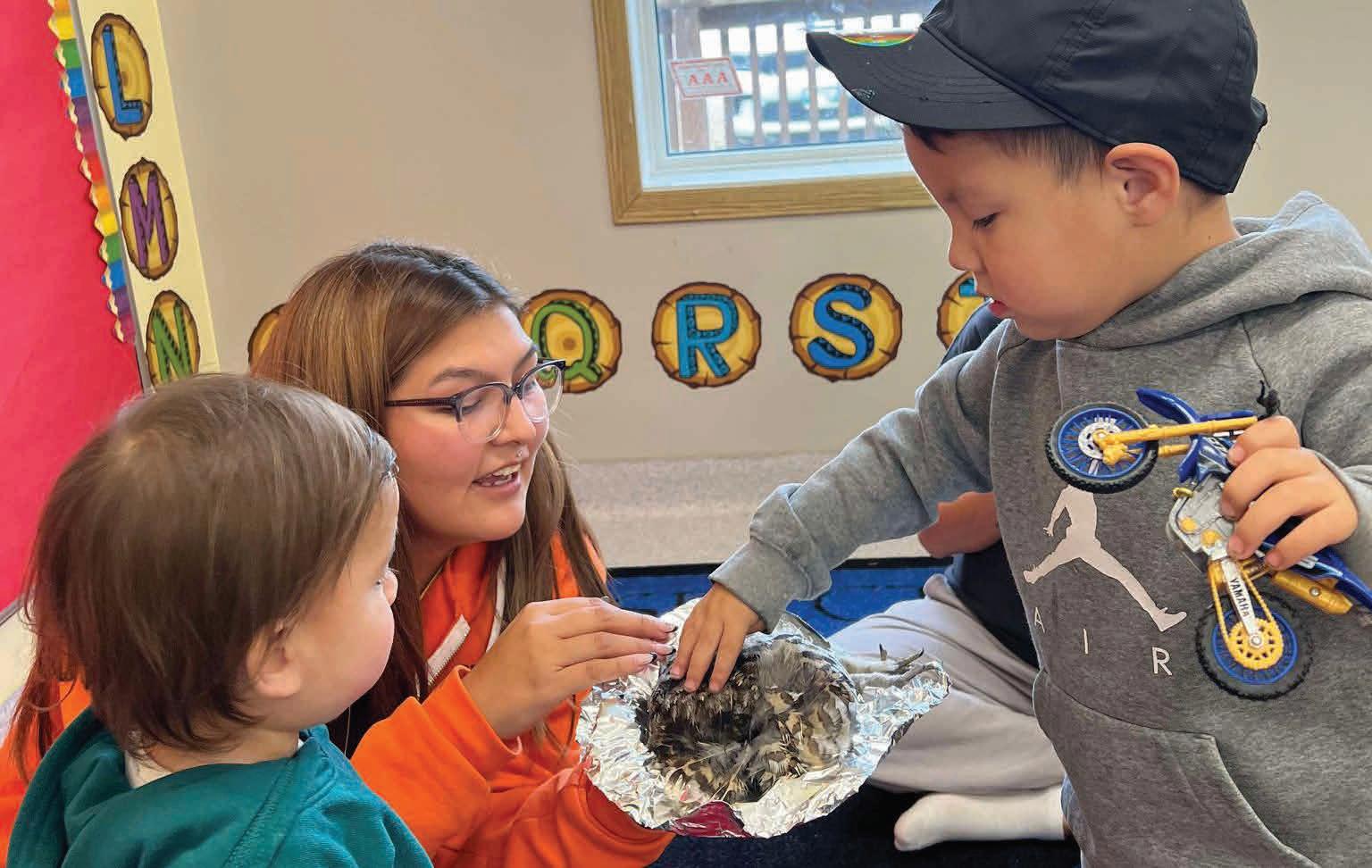
© Lesli Fenner, 2025
Methods
The Quality ELCC programming study sought to answer the question, “What constitutes quality care of young First Nations children?” The study used interviews and group discussions to engage multiple First Nations partners in conversations about the early childhood learning, development, and care of First Nations children on reserve, and explore their thoughts and perceptions on quality ELCC programming in First Nations communities. Qualitative data were collected from study participants between December 2022 and December 2023. A thematic approach was then taken to identify, interpret, and report on relevant information shared by participants.
The participants
Twenty-seven participants from British Columbia (BC), Alberta (AB), Saskatchewan (SK), Manitoba (MB), Quebec (QC), and New Brunswick (NB) volunteered to take part in the study. This included 12 ELCC program administrators, seven frontline ELCC practitioners, one post-secondary ELCC training instructor, five parents and two grandparents of children involved in ELCC programming on reserve. Participants were most familiar with Aboriginal Head Start on Reserve (AHSOR) programs and reserve-based child care programs. One participant was also connected to a schoolbased preschool centre on reserve.
ELCC programming in First Nations communities
One of the key findings from the Quality ELCC programming study was that early childhood programming in First Nations communities is notably limited, both in number and capacity. Despite widespread health and social services for First Nations families with young children on reserve, AHSOR was identified as the main — and in some cases the only — source of early childhood programming, especially for families with children in the one to four years age range who fall outside the realm of home-based infant development consultative services for families with children aged birth to three years; parent and baby programs for babies
in the prenatal and postnatal periods up to age one year; and school-based preschool programs, typically offered to four and five-years-olds, pre-kindergarten. Besides needing more ELCC programming opportunities and early learning resources for First Nations families with young children on reserve, participants recognized the need for First Nations communities to evaluate what their ELCC programs are actually doing on an ongoing basis.
The daycare’s more of just a child care facility. It’s not really a program for the community. Only a listed amount of people can actually go there. … It’s supposed to be profit services. It’s a service. It’s not a program.
— Study participant.
If we could successfully support parents and intervene with parents — decreasing their stress where possible, increasing their knowledge of basic early childhood development, and supporting their access to existing services — we would, over time, see improvement in overall childhood development at school entry.
— Study
participant
Quality ELCC program curriculum and activities
Participants were asked to describe the concept of quality ELCC programming, particularly as it relates to dimensions of program curriculum that are critical to healthy child development and the well-being of First Nations children on reserve. For the most part, participants talked about high-quality early childhood educational programs that are connected to the land and territory, immersed in local First Nations languages, and rooted in family and community teachings. They described culturally safe, culturally appropriate, and culturally responsive program environments that are respectful of First Nations values, customs,

traditions, and cultural protocols; reflective of the unique history, culture, language, and needs of the community; and representative of the children and families who participate in their ELCC programs.
Families are intergenerational, so quality care does also include involving other members of the family. The primary caregiver may not be mom. That might not mean mom isn’t involved, but it might be a kokum or a grandmother or grandfather, an auntie and uncle, another sibling.
— Study participant
Participants described quality ELCC programming as flexible, inclusive, and accommodating, where all children, regardless of aptitude or capabilities, have an opportunity to grow, develop, explore, and learn at their own pace. Instead of taking a one-size-fits-all approach to early childhood learning and development, quality ELCC programs acknowledge the individualization of children. Program activities are structured, intentional, and focused on the whole child, the whole family, and all areas of early childhood development, including children’s physical, cognitive, socialemotional, cultural, spiritual,
and language development. Quality early childhood program activities are designed to expand and enhance children’s knowledge, experiences, skills, and abilities; inspire curiosity in children; and set the stage for children’s lifelong learning. They give priority to the exploratory and interest-based needs of children, while also facilitating teacher-led support to ensure children achieve certain developmental milestones.
Participants described quality ELCC program activities that involve observation, monitoring, and specialized early intervention therapy and support. By watching and assessing where children are at developmentally, ELCC program practitioners can help to identify potential disabilities or developmental delays in children, before they enter the school system. ELCC practitioners can then work with different specialists or special educators and parents, early-on, to ensure children get the support they need to flourish in school, especially with respect to the social-emotional aspects of learning. Although these intervention activities were described as promising, participants also brought up the growing number of First Nations children with “more special problems,” and the capacity constraints of doing skills-based assessments and developmental screening as part of their ELCC program curricula and activities.
Sometimes there’s a little bit of a misunderstanding at the educational level because they have an expectation that the whole school readiness thing, as much as we’d like to check all the little boxes, sometimes it’s just not possible. We have 18 children in the classroom and sometimes there’s six or eight special needs children in the classroom; one non-verbal, one with cerebral palsy, two with autism, and we do the best we can.
— Study participant
Participants described parentand family-oriented ELCC programming that includes both child-only and parent-only activities, as well as parentchild activities in which parents and their young children engage in quality early learning experiences together. Through guided, intentional, and focused parent-child activities and parent mentoring, parents and families have an opportunity to fully participate in the early childhood development of their children. They learn about healthy parenting techniques and strategies, and the importance of attachment and bonding with their children. By fully engaging parents in their children’s early learning journeys from the outset of programming, quality ELCC programs work to ensure families feel as supported as possible in their parenting role.
The Elders told us, ‘Don’t take that responsibility away from [‘the parents’]. They are their child’s first teacher and you are there to walk with them and support them.’
—
Study participant
Participants highlighted other quality ELCC program activities as well, such as parent education workshops and peer networking opportunities for parents to meet and connect with other parents, without their children being present. They mentioned outreach activities to support healthy child development and enhance the parenting capacity of families in their home environments. They talked about Elder participation in ELCC programming, mainly with respect to storytelling, language revitalization, sharing cultural teachings, and healthy role modeling. Participants also stressed the importance of landbased learning activities to teach young children and their families about cultural pride and their identity as First Nations people, to strengthen their connections to the land and their territory, and to instill social responsibility and respect for themselves, for others, for their environment, and for the natural world. Here, the importance of having
not only traditional foods and feasts for participating families, but food in general was noted. A big part of quality ELCC programming practices involves health promotion through food and nutrition:
There’s a knowledge and understanding — shared with families to learn and understand — of opportunities for children through nutrition. So, learning what are some good foods and practices for children and modeling that in the program, being able to offer healthy meals and snacks in the program, and adults role modeling that sit down, familystyle, sitting and eating, sharing stories while enjoying and benefiting from the nutrition.
— Study participant
I always try to find opportunities for [my staff] to learn about their culture, like women’s gatherings. We went to the fasting ceremonies. They were learning different cultural things out there. A lot of my staff, too, don’t know. Some are learning more than others. If you provide that, then it’s helping them to feel, like for their wellness.
— Study participant
Last, but not least, participants acknowledged that quality ELCC programming would not be possible without supportive workplace activities to ensure children are learning and developing in an environment that’s reflective of healthy ELCC program practitioners and a supportive workplace for program staff. Participants shared different ways in which quality ELCC programs work to ensure ELCC program practitioners are fully supported in their work roles so they can then, in turn, fully and effectively support the children and families who participate in their ELCC programs. They explained how these quality ELCC program activities can foster healthy interpersonal relationships among program staff; build open and positive team environments; and inspire ELCC program practitioners to work together and support one another, especially when facing difficult situations. Program staff are encouraged to learn about First Nations cultures, and be mindful of their own self-care to ensure that they “ don’t get burned out.” Participants also discussed other supportive workplace activities, like daily debriefings, open-door policies, supervisory role modeling, and having ample opportunities for training and professional development.
We always made sure that our centre was fully staffed, that our staff didn’t burn out. … Another piece that was really valuable as well is making sure that we look after our staff. We had quarterly conferences that we’ve traveled to so that staff get that break, and go out to conferences, and learn new skills, and network with other ECEs [early childhood educators], and plus get a hotel and some nice food out there. They come back refreshed.
— Study participant
Key attributes of quality ELCC program structures and centre operations
Participants were asked about the everyday operations and related decision-making processes that come with delivering quality ELCC programs in First Nations communities. They discussed First Nations autonomy and decisionmaking authority, stating that Chief and Council have ultimate authority — and an ethical responsibility — over the ELCC programming that’s happening in their communities. Still, regardless of how these ultimate decisions are made, decisionmaking processes usually involve some manner of input from the frontline ELCC program leaders who are tasked with managing the day-to-day affairs of their respective ELCC programs.
Sometimes, the Chief and Council’s right in there because that’s important. They want their children to thrive and there is a good connection happening. Everyone’s involved — daycare, Head Start, the Chief and Council. They’re aware of what’s happening in the community. That is a really good model to have where you have leadership understanding the needs of families with young children. … I do know if you have leadership involved and it’s in a supporting and understanding role, that is half the battles in these small communities.
— Study participant
Participants acknowledged that the quality and success of ELCC programming on reserve is strongly influenced by the integrity, accountability, transparency, and support provided by local First Nations leadership. First and foremost, good quality leadership is reflected in the First Nation’s spending authority over allocated funding. Specifically, this indicator of good quality leadership demands that all the funding that’s allotted for ELCC programming actually goes to supporting First Nations families with young children
on reserve, as intended. Under these circumstances, good quality leadership is also reflected in the consistency and visibility of ELCC programming in First Nations communities.
Sometimes money comes down and it has to go through one organization, and then it has to go through another organization. … 10% just went there; 15% just went there. By the time the money actually comes for families … it’s not the intended amount. … Organizations — especially political — shouldn’t be able to touch any of those funds for any reason. … That money is intended for families. … Leadership can play an important role in there and not have those scenarios or situations. Ultimately, it lies with leadership.
— Study participant
Participants talked about having good quality ELCC program management structures in place, on the ground, to capably and efficiently manage the administrative functions of ELCC program delivery and centre operations. This includes overseeing the dayto-day activities of ELCC programming and keeping the First Nation’s leadership apprised of the program’s progress and any emerging patterns or trends. It involves ensuring program staff feel valued and get the guidance
and support they need — like on-the-job training, mentorship, and professional development — to positively and effectively fulfill their ELCC programming roles and responsibilities. Moreover, it includes building and fostering trusting relationships, both with and among program staff, and with participating families.
When I meet a family for the first time and I’m going to do the intake process, that [intake process] doesn’t even come up. I once had a visit to do an intake with the family. It ended up being just a two-hour long visit and just sitting there and listening to them. I didn’t even take out the form that I needed to fill out. I just sat and listened to them. Sometimes, that’s important because all families need to be heard. … They need to know that their voice matters. … We try to empower them to be able to be those advocates for their children.
— Study participant
Another identified characteristic of quality ELCC program structures and operations is having skilled and knowledgeable ELCC program practitioners who can adequately guide and support the early childhood learning, development, and care of First Nations children on reserve. Participants confirmed that, at a minimum, ELCC program practitioners should have a basic understanding of early
childhood development and some knowledge of the role of an early childhood educator. Though not a requirement, they also noted a number of other competencies that could enhance children’s early learning experiences, like knowing about behaviour management, conflict resolution, relationship building, landbased learning, and even how to connect with other community programs and navigate grant applications. Above everything else, however, participants asserted that good quality ELCC program practitioners must be “the right fit ” to work with First Nations children and families in early childhood program settings on reserve. That is, they should possess the care, passion,
and dedication to want to be there, actively participating in quality ELCC programming and contributing to the healthy early childhood development and wellbeing of First Nations children.
The success behind your program is your staff. Is your heart here? Or is this just a job? … You have to have the heart and the soul to be here with them day-in-day-out, because not every day is a good day for everybody. … Children are gifts. Children are sacred. … If you’re coming into your job with a not good mindset, they know that. They’re not going to have a good day.
— Study participant
One last distinguishing feature of quality structures and operations pertains to the design, delivery, and environment of ELCC programming on reserve. Participants explained how quality ELCC programs are designed to be accepting, inclusive, and universally available at no cost to families. They are located in safe, accessible, and well-maintained buildings, with adequate space for programming, quality furnishing, quality educational materials, plenty of natural light, safe indoor and outdoor play spaces, and a place and space for families to be involved in their children’s early learning journeys. Participants considered how quality designed and delivered ELCC programs are best placed within the health sector and rely on multi- and cross-departmental collaboration
and partnerships among health, education, and social services sectors to fill gaps and ensure early childhood programs remain flexible and responsive to the existing and emergent wholistic needs of First Nations families with young children on reserve.
We have good success now where they have this reflex to call the daycare. ‘Hey, we have a specialist going down from … a big centre. We need not to miss it. Can we do something together so that that’s better for the kid?’ ‘That’s great.’ … Let’s say that you have a language or a speech specialist coming over because there are not so many. Now, you won’t have this trouble, like forgetting those kids at daycare.
— Study participant
For many parents, this is not their first experience with the education system, but their first experience with children in any kind of education system. … This is the front door to that child’s education journey. … It’s the foundational piece of quality.
— Study participant

Major obstacles and critical hindrances to ELCC program progress
Participants identified major obstacles and critical hindrances to ELCC program access and utilization by First Nations families on reserve. Some of these barriers include socioeconomic challenges like poverty and food insecurity, addictions, and social isolation; employment and transportation issues; intergenerational trauma and mistrust; and restrictive program policies concerning snack provisions, expectations for toilet training, and cut-off times for arrival.

If it’s after 10:00, that’s it. You can have great programs, but if you have some things in place like that, that are so incredibly damaging, where there’s even been phone calls made, ‘Look, I’ve got a flat tire. I’ve got three minutes to get there. I could drive 90 miles an hour and try to make it’ … and is told, ‘Don’t bother because you’ll be past 10:00.’ Or gets written up and threatened with the ministry because one of the kids was sick and she was in an exam at the university at the time and the professor wouldn’t let her out or she would fail. Like, you know? … [Families] need to see that their community and the systems and everything are really there in their best interest. That includes having that respect for their parents and what their needs are. That’s first and foremost because even a bad program, if it has that respect around it, will do more good than having an award-winning something or other but you can’t get through the doors.
— Study participant
Participants spoke of bureaucratic and regulatory challenges, leadership burnout, and strained nation-to-nation relationships. They explained how the lack of regard for transparency and timely information sharing with First Nations communities impedes the quality and success of ELCC programs on reserve. Participants shared stories about the cultural clash between program funders and First Nations program administrators regarding practice standards, policy expectations, and funding and reporting requirements. They discussed provincial legislation and licensing issues, mainly focused on health and safety standards, use of traditional foods, engagement in landbased activities, and staffing requirements for qualified and specialized ELCC program practitioners. Participants talked about how under-education, lack of access to education and training opportunities, and rules and regulations related to academic qualifications and background checks are all major concerns in meeting the staffing requirements for quality ELCC programs on reserve. Criminal record and vulnerable sector checks are especially challenging, not only for recruiting ELCC program staff, but also for Elder participation in ELCC programming activities.
Through the regulatory body of the ministry, they would expect that anybody spending time with children would have to have a police check. These are our Elders who we respect in the highest that we’re — what an insult to our Elders, when they’re coming in to be with these little kids. They’re not alone with them. But at the same time, it’s like, I would just feel like a total jerk if I turned around and said, ‘But that’s the rule. That’s the law. That’s the regulation.’ But, I wouldn’t [‘ask them for a police check’].
— Study participant
ELCC quality enhancement
Despite ongoing challenges, participants acknowledged that much progress has been made in recent decades to advance the early childhood learning, development, and care of First Nations children on reserve. The Indigenous ELCC Framework 1 and related funding, specifically, was identified as a contributing factor to advancements in onreserve ELCC programming. Participants talked about being able to hire needed qualified and specialized staff and fulfilling practitioner training requirements and salary expectations. They

shared stories about how they are now meeting equipment and supply needs, enhancing space and capacity for quality programming, and developing culturally relevant and meaningful ELCC program curriculum.
The Indigenous Early Learning and Child Care funding and that has been a God-sent. … The core funding that we’re getting for our other programs was so low that I don’t even know how we kept staff back then. Like, honestly, how we could have bought groceries, because it was really, really difficult. We had to really be creative and scrape. But now, it’s still not a lot of money, but for us, it feels like a lot of money because we’re just not used to having it. … We needed it really badly.
— Study participant
Participants shared thoughts on the possibilities that can come with continued Indigenous ELCC funding and related supports. They talked about further enhancing the quality and success of on-reserve ELCC programs by taking on some of their more pressing concerns, like tackling issues of time restrictions on programming, challenges with land-based programming practices and the use of traditional foods, and onerous application and reporting processes. They emphasized the need for culturally relevant and practical First Nationsspecific programming and funding guidelines, as well as for First Nations-specific ELCC legislation and licensing entities, to ensure equitable resource distribution, culturally insightful and meaningful oversight and advocacy, and consistency in high-quality ELCC
1 Employment and Social Development Canada (ESDC). (2018). Indigenous Early Learning and Child Care Framework. Government of Canada. The Indigenous Early Learning and Child Care Framework includes distinctions-based approaches for First Nations, Inuit, and Métis children and families.
©
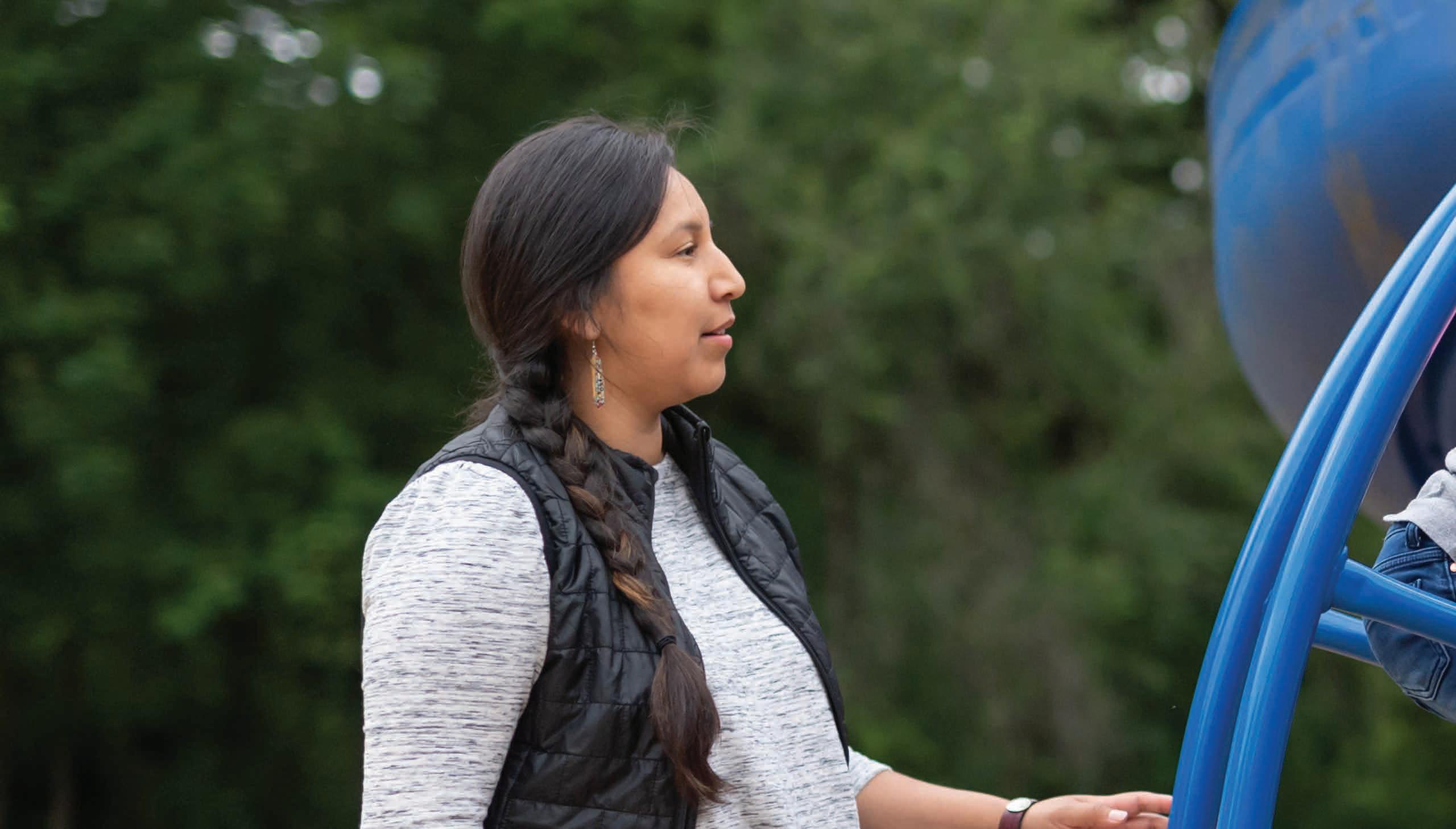
Gloria Cochrane, 2025
programming across all First Nations communities in Canada. Participants also expressed the desire to implement some type of First Nations-controlled ELCC surveillance system to evaluate, monitor, and guide ELCC programming progress. Lastly, participants talked about expanding the AHSOR program, both in capacity and numbers, within communities and across the country.
At a broader scale, the Head Start, what they’re doing, it needs to expand. … There has to be more money going into it. In that way they could get bigger. They can accommodate more children, have more parents coming in. Because if we bring in more parents, then we’re creating a better network, a better web of people. Then those children, we won’t have to worry. … They’re going to have a better childhood because they know that they’re safe. They know that they’re being looked after properly. It’s benefitting everybody because these are going to be our future leaders. This is going to be our future bosses and managers and stuff. It needs to get bigger. It has to because it’s essential.
— Study participant
Conclusion
The Quality ELCC programming for First Nations children on reserve study highlighted common concepts that are crucial to ensuring high-quality ELCC programming in First Nations communities. Written in narrative format from multiple points of view, the reported results of this study showcase the collective thoughts, opinions, and stories shared by participants in a meaningful and respectful way — by integrating their words and voices directly into the reported text. Interesting and informative, the findings from this research lend support to other works on the early learning experiences, healthy development, and quality care of First Nations children in early childhood program settings on reserve (Greenwood & Shawana, 2000; Halseth & Greenwood, 2019 2).
Besides sharing their knowledge, experiences, and insight on quality ELCC programming as it relates to the early childhood learning, development, and care of First Nations children on reserve, participants expressed sincere gratitude for having had the opportunity to contribute to this research. They disclosed that it is important for them to share
what they know and understand of quality ELCC programming in First Nations communities. Moreover, the study provided participants with an opportunity to revisit and reflect on current ELCC programming practices. It also gave them a chance to reflect on the significant moments of not only their time spent with First Nations children in early childhood settings on reserve, but also their journeys into ELCC programming practice.
One of the reasons why I do what I do is because my parents couldn’t. We want our kids to feel the same way. They each come with a gift … and those gifts are called their strengths. We build on those strengths. Every person has a strength and a gift that need to be shared. Their words need to be heard. Even the kids. … They need to feel safe and secure. They need to know that they’re important. That’s what I tried to create with my own kids. That’s what I think about when I think about quality programming.
— Study participant
For more information about this study and the stories and perspectives shared by participants, see the back cover of this report summary.
2 See: Greenwood, M., & Shawana, P. (2000). Whispered gently through time, First Nations quality child care: A national study. Human Resources Development Canada.; and Halseth, R., & Greenwood, M. (2019). Indigenous early childhood development in Canada: Current state of knowledge and future directions. National Collaborating Centre for Indigenous Health.
NCCIH INDIGENOUS EARLY LEARNING AND CHILD CARE KNOWLEDGE RESOURCES
The National Collaborating Centre for Indigenous Health (NCCIH), with support from Employment and Social Development Canada (ESDC), has developed a series of knowledge resources to inform and strengthen programs and policies designed to serve families with young children in First Nations communities. The knowledge resources feature a comprehensive report, Quality care and young First Nations children: An exploration of optimal learning and development in early childhood settings on reserve, which presents the collective results of three interrelated qualitative studies examining different aspects of early learning and child care (ELCC) programming for First Nations children on reserve:
1. concepts of quality ELCC programming,
2. existing post-secondary ELCC education and training programs, and 3. ELCC legislation and regulations.

nccih.ca/485/NCCIH_in_ the_News.nccih?id=562
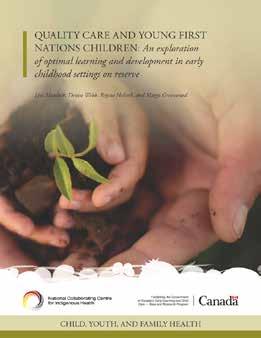
Quality care and young First Nations children: An exploration of optimal learning and development in early childhood settings on reserve
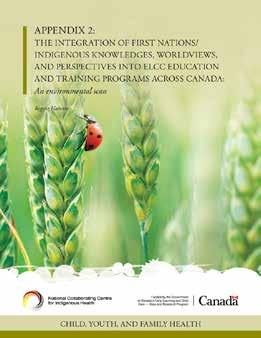
Appendix 2 - The integration of First Nations/ Indigenous knowledges, worldviews, and perspectives into ELCC education and training programs across Canada: An environmental scan
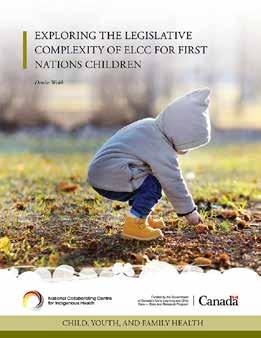
Exploring the legislative complexity of ELCC for First Nations children
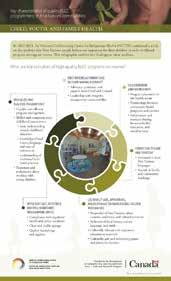
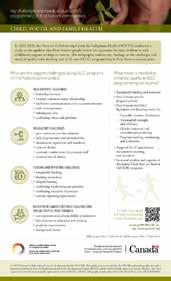
A summary and two infographics outlining qualities that First Nations people value for, and challenges faced by, ELCC programs on reserve.
A plain language summary covering the integration of Indigenous perspectives into ELCC education and training.
A fact sheet and infographic summarizing on reserve ELCC legislative complexities and regulations.

© 2025 National Collaborating Centre for Indigenous Health (NCCIH). This publication was funded by the NCCIH and made possible through a financial contribution from the Employment and Social Development Canada (ESDC) and the Public Health Agency of Canada (PHAC). The views expressed herein do not necessarily represent the views of ESDC or PHAC. Report summary header photo © Credit: iStockPhoto.com, ID 2200389840.