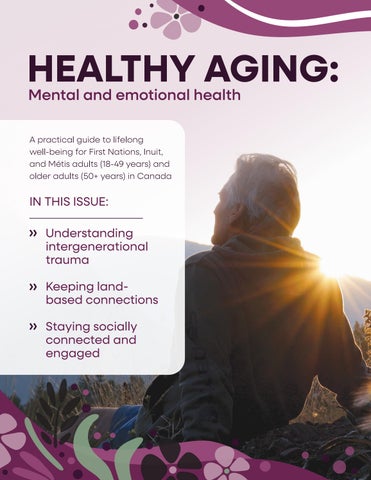
HEALTHY AGING: Mental and emotional health A practical guide to lifelong well-being for First Nations, Inuit, and Métis adults (18-49 years) and older adults (50+ years) in Canada
IN THIS ISSUE: Understanding intergenerational trauma Keeping landbased connections Staying socially connected and engaged
How this resource was developed This resource is one of a series of six healthy aging booklets for First Nations, Inuit, and Métis adults (aged 18 to 49 years) and older adults (aged 50+ years) in Canada. It was developed in response to expressed interest from Indigenous families and community partners for useful, culturally appropriate information to improve and protect the health and well-being of First Nations, Inuit, and Métis people throughout the aging process. The healthy aging booklets in this resource series include: • Healthy aging: Physical activity and exercise • Healthy aging: Food, diet and nutrition • Healthy aging: Preventative health behaviours
• Healthy aging: Mental and emotional health • Healthy aging: Life stages and wellness • Healthy aging: Financial wellness
The resources were developed using information from print and digital publications, webinars, conferences, and online forums. A number of First Nations, Inuit, and Métis people from across Canada helped with the development of the healthy aging booklets by sharing their knowledge, insights, ideas, stories, health tips, and feedback to improve the quality and value of the resources.
We want to thank the following people for assisting with the editing of our healthy aging booklets:
• April Tucker, Cayuga Nation Member of the Haudenosaunee Confederacy, ON
• Jolyne Knockwood, Mi’kmaq, Amlamgog First Nation, NB
• Belinda Vandenbroeck, Ininiw Grandmother, Opaskwayak Cree Nation, MB
• Karyn Davis, Anishinaabe, Ebb and Flow First Nation, MB
• Clayton Sandy, Sioux Knowledge Keeper, Sioux Valley Dakota First Nation, MB • Dawn Cardinal, Cree, Whitefish Lake #128 (Good Fish Lake/Saddle Lake First Nation), AB • Franny Alec, Stati’mc Knowledge Keeper, Xaxli’p First Nation, BC • Gloria Cochrane, Cree Grandmother, Fisher River Cree Nation, MB • Jack Mercredi, Cree Métis, Fond du Lac Denesuline Nation, SK
• Julie Carmichael, Red River Métis, MB
• Kathleen (Kathy) Mallett, Anishinaabe‑Cree Grandmother, Fisher River Cree Nation, MB • Levinia Brown, Inuk Elder, Rankin Inlet, NU • Linda Nobiss Campbell, Red River Métis Grandmother, MB • Myrtle Beaulieu, Métis Cree, AB • Roselyn (Fern) Bear, Dakota Grandmother, Standing Buffalo First Nation, SK
Table of contents Introduction........................................ 4 About this booklet............................................. 4 Acknowledging diversity................................ 6 What is healthy aging?................................... 7
Mental and emotional health....... 8 Understanding intergenerational trauma............................... 8 Coping with intergenerational grief and loss......................................................12 Managing stress and anxiety......................15 Keeping land-based connections.............18 Staying socially connected and engaged.....................................................22
How you can learn more.............. 25
© 2026 National Collaborating Centre for Indigenous Health (NCCIH). This publication was funded by the NCCIH and made possible through a financial contribution from the Public Health Agency of Canada (PHAC). The views expressed herein do not necessarily represent the views of PHAC. ISBN (print): 978-1-77368-774-2
ISBN (online): 978-1-77368-775-9
Introduction About this booklet Historically, First Nations, Inuit, and Métis people comprised sovereign, autonomous, and resourceful nations with well-established social systems, rich cultural knowledges, strong oral traditions, and profound connections to the lands and waters that ensured their health and survival as distinct peoples. Because of the processes of colonization — including forced relocations and loss of lands, environmental harms, and disruption of traditional hunting, gathering, and land stewardship — the structures and well-being of First Nations, Inuit, and Métis societies were adversely affected and forever changed. Many Indigenous people today still grapple with the lasting effects of ongoing colonialism and intergenerational trauma, which have resulted in overly high rates of chronic diseases, mental health struggles, and mood disorders.
4
We didn’t know very much illness in those days when we lived in igloos. … But today, major, major mental illness. … And the same thing with the medication. When I was a young girl, I never ever saw medication. Not at all. … Today, my cupboard is a pharmacy. It’s quite a scary thing to have so many pills I have to take everyday for my type 2 diabetes. — Inuk advisor
This booklet is intended to promote healthy lifestyle habits to improve and protect the health and wellbeing of First Nations, Inuit, and Métis adults (aged 18 to 49 years) and older adults (aged 50+ years) in Canada. Learning how to take care of your mental and emotional health will boost your overall health and quality of life. This includes learning about intergenerational trauma, coping with intergenerational grief and loss, and managing stress and anxiety. It also involves keeping land-based connections and staying socially connected and engaged. These topics are discussed in this booklet.
Throughout this booklet, you will find external links to additional knowledge resources that you can check out for more information. You can also refer to the list of national organizations at the end of this booklet for culturally appropriate services, links to local programs, and online knowledge resources to support your best health, wellbeing, and quality of life through healthy aging.
Healthy aging: Mental and emotional health
5
Acknowledging diversity Indigenous people across Canada are not all the same. First Nations, Inuit, and Métis people comprise three completely distinct cultural groups with their own unique histories, languages, cultural heritages, and spiritual beliefs. They have different worldviews, ambitions, and lived realities. There are also differences within each First Nations, Inuit, and Métis cultural group, depending on regional geography, constitutional rights and entitlements, and whether residing in urban centres, rural or remote areas, on reserve, or in Inuit Nunangat. Many factors shape the aging processes of First Nations, Inuit, and Métis people and their ability to age well. Experiences of colonization and ongoing colonialism, political and economic structures, proximity to healthcare services and specialized
6
care, connections to community and family, connections to the lands and waters, and even sex and gender identities all play a role in the lived realities of healthy aging. For example, First Nations, Inuit, and Métis adults and older adults in rural communities face a very different reality than Indigenous people living in cities, especially if they are trying to manage chronic health conditions, struggle with physical disabilities or accessibility limitations, or have lost their ability to drive. All First Nations, Inuit, and Métis people have different health realities and mental and physical capabilities. The information in this booklet provides a foundation for healthy aging and well-being in later life. You are encouraged to adapt these guidelines to fit your own needs, physical abilities, and personal circumstances.
What is healthy aging? Aging is a natural part of our life cycle. It begins at conception and continues until death. Still, we usually do not start thinking about the health aspects of aging until we are in our 40s or 50s and changes in our bodies, health, and functional abilities become more apparent.
I have lived a really good, healthy life. I like to role model my life to my children. And living our cultural way of life is a big part of who I am and the way I live. — First Nations advisor
Healthy aging is about aging well, actively and successfully, by living well, staying positive and productive, and keeping good physical, mental, and social functioning. It focuses on what matters for your overall health and well-being in older age, like lowering your risk of chronic diseases and age-related disabilities and building a strong sense of life satisfaction and happiness. Healthy aging is about shifting the narrative, where growing older is not about decline, loss, and insignificance but rather, about dignity, connection,
and purpose. It is about gaining wisdom, strengthening your social connections, and finding new and meaningful ways to not only extend your lifespan (to live longer), but also enhance your healthspan (to live longer in good health). Healthy aging is a lifelong process that can start at any age. You are never too old — or too young — to start taking care of your mind, body, and spirit. This booklet is the fourth in a six-part series of guides to healthy aging.
Healthy aging: Mental and emotional health
7
Mental and emotional health Understanding intergenerational trauma Taking care of your mental health and emotional well-being is an important part of healthy aging. This is of particular importance for First Nations, Inuit, and Métis people who may struggle with severe mental health challenges and emotional distress due to historical impacts of colonization and ongoing colonialism. For example, residential schools, ‘Indian’ hospitals, and the Sixties Scoop involved prolonged and
repeated incidents of abuse, neglect, and violence on First Nations, Inuit, and Métis people, especially when they were children. The trauma stemming from these tragic experiences is linked to many mental and emotional health concerns among Indigenous people, including posttraumatic stress disorder (PTSD), depression, anxiety, and substance use disorders.
As Indigenous people, we are great forgivers of people who hurt us but it hurts us internally, forever. So, this is very important that I keep educating myself about how to help myself. You know? — Métis advisor
8
Colonization caused serious harms — such as family breakdown, community disruption, erosion of language and ancestral knowledge, and loss of identity and belonging — that have had long-lasting effects on multiple generations of First Nations, Inuit, and Métis people. With no support to process their traumatic experiences, Indigenous people passed a great deal of emotional pain, loss, and grief from one generation to the next — not by choice, but as unavoidable consequences of historical colonial policies. This is intergenerational trauma.
Final reports of the Truth and Reconciliation Commission of Canada bit.ly/HA04-nctr-trcreport Reclaiming power and place: The final report of the National Inquiry into Missing and Murdered Indigenous Women and Girls bit.ly/HA04-GovCan-mmiwgreport The impact of intergenerational trauma bit.ly/HA04-intergentrauma
9
MY STORY OF TRADITIONAL ROLES AND FAMILY LOVE I've always felt, because of colonization, all Indigenous people lost their traditional role for life; their role of being healthy grandparents, parents, mothers, fathers, uncles, aunties, brothers, sisters, and especially knowing what a healthy family unit was supposed to be in life. Not knowing how to love and pass down natural ways of family love never existed in most family units. Men were supposed to be taught this way in life, and this never existed amongst generations of men, from my own experience. When I look back at the men I grew up with — grandpa, father, uncles, brothers, and most of my male friends — we were taught women were objects you owned and you kept them in place by threats and violence. I feel this was handed down from non-
10
Indigenous male settlers — that the man was the ruler of his house — which in my life wasn't right and never felt right with my Spirit. Just observing this was not the male way of the circle of life for Indigenous men. Everything I have learnt from my way of traditional life/role was the seven ways of living, which love and respect were the top ones of having a healthy family, especially for my boys and the males that watched me as a male role model in life. Traditional roles for men were supposed to be as providers, protectors, leading a path for generations of males to follow, and for living a healthy way of looking after the body. This was lost when the role of provider disappeared. I'm sure not being able to leave the reserve stopped men from feeling good as being a provider and protector, as well.
Having the ability to go out and hunt and chase down your prey was a natural way of staying healthy and fit. Sitting on the reserve doing nothing and eating whatever rations the government provided shows us now, eating processed food is not good for everyone, especially being forced to didn't help men feel good about their natural ways of being a healthy male provider. I can go on further, but I'll stop here and say, everything that was taught to Indigenous men was wrong. We see that on the streets, jails, CFS systems. I believe Indigenous people in Canada are one of the largest economy driver systems this government has going for itself. — First Nations advisor
Healthy aging: Mental and emotional health
11
Coping with intergenerational grief and loss Grief is a natural, healthy mix of emotions that people usually experience in response to a specific loss such as the death of a loved one, the end of a relationship, the loss of a job, or a major life change. It can include feelings of pain and sadness, as well as anger, confusion, guilt, and numbness. Everyone deals with loss differently but for most people, the emotional pain and sadness tied to grief generally comes in waves and lessens over time with increasing moments of joy, laughter, or comfort. For First Nations, Inuit, and Métis people, grief and loss is not tied to a single event but, rather, to a series of endless traumatic experiences that are often interrelated and span many lifetimes over several generations. Some of these tragic losses include: loss of ancestral lands and connections to traditional territories loss of language, ancestral knowledge, identity, and belonging disruption of traditional ceremonies and cultural practices erosion of family and community structures
12
?
loss of First Nations, Inuit, and Métis women, girls, and Two-Spirit people to historical violence individual, family, community, and nation level losses involving death, injury, suffering, and diminished quality of life from suicide, substance use disorders, domestic violence, and mental health issues
Intergenerational grief happens when the overwhelming emotional pain and grief experienced by older generations is not properly dealt with, causing ripple effects that pass down to subsequent generations. With each successive generation, the emotional pain of unresolved trauma is further intensified with an added layer of their own experiences of grief and loss. It is a vicious cycle of compounded, unresolved historic trauma that First Nations, Inuit, and Métis people will inherently carry until this emotional burden is properly dealt with, mentally, emotionally, physically, and spiritually. The healing process is difficult but necessary for ensuring the health, safety, and resilience of future generations. Despite profound intergenerational trauma caused by colonial policies and ongoing colonialism, First Nations, Inuit, and Métis people are driving incredibly positive changes, revitalizing their cultures, and making foundational contributions across all sectors of Canadian society. Still, some Indigenous
people use destructive behaviours such as substance use, selfharm, gambling, and domestic violence as a survival response to numb, suppress, and manage the unresolved grief, loss, and pain they feel from intergenerational trauma. These unhealthy coping strategies — which have also been unconsciously passed down from one generation to the next as normalized behaviours — have made First Nations, Inuit, and Métis people more prone to mental illnesses like PTSD, chronic depression, anxiety disorders, substance use disorders, and chronic suicidal ideation.
I learned to not be afraid to reach out for help. That was a big thing for me. … A lot of us are afraid to reach out for help. So, having the right people that will really listen to you is important. — Métis advisor
Talk with your doctor or local healthcare provider, Indigenous health navigator, community wellness worker, or cultural support worker to learn more about intergenerational trauma and grief and what this means for your overall health and well-being. You can also check out your local friendship centre, recreational facility, health or wellness centre, or Elders lodge for free, traumainformed healing initiatives. It is never too late to get the help you need to start your healing journey.
Hope for Wellness Helpline bit.ly/HA04hopeforwellness Missing and Murdered Indigenous Women and Girls Crisis Line Toll free: 1-844-413-6649 National Indian Residential Schools Crisis Line Toll-free: 1-866-925-4419 Suicide Crisis Helpline bit.ly/HA04-988helpline
14
Managing stress and anxiety In addition to the loss of language, culture, and land-based connections, First Nations, Inuit, and Métis adults and older adults face unique challenges that make dealing with everyday life overly stressful. Some of these daily stressors include: • difficulties accessing critical health and social services due to geographic location, racism, and discrimination • unstable housing, irregular income, and food insecurity • risk of disability and chronic conditions — such as frailty, diabetes, arthritis, and heart disease — at younger ages Major life stressors — such as changes at home, a recent medical diagnosis, or things that are happening with your body — can trigger your body’s natural stress response. Dealing with too many stressors at once
Healthy aging: Mental and emotional health
15
can cause emotional overload and overwhelming stress that can easily leave you feeling unable to think clearly or function properly. Common signs of being overwhelmed can include: • rapid heartbeat and difficulty breathing • headache or body pain • feeling weak, tired, and irritable • difficulty concentrating • trouble sleeping or sitting still • feeling tense, worried, or anxious Dealing with stress and mental health concerns such as anxiety and depression early, before they become overwhelming, is crucial for healthy aging. Your mental health directly affects your physical health, brain function, and quality of life. When mental health issues become chronic or severe, they weaken your immune system and cause or worsen other health problems like obesity, digestive issues, diabetes, heart disease, Alzheimer’s disease, and dementia.
16
I’ve known people from my hometown who had diabetes and every time you see them, every six months or so, a piece of their body would be gone. It’s almost like they were slowly disappearing. But they never complained. … I suppose you just have to accept what’s happened and just move forward as best as you can. — Métis advisor
Getting proper sleep, practicing healthy eating habits, and exercising regularly help reduce stress and anxiety, prevent burnout, and keep your mind, body, and spirit healthy. See the Healthy aging: Physical activity and exercise booklet, the Healthy aging: Food, diet, and nutrition booklet, and the Healthy aging: Preventative health behaviours
booklet in this resource series for more information about these topics. Other things you can do to manage stress and anxiety include: practicing breathing, relaxation, mediation, and spiritual grounding (e.g., smudging, qulliq-lighting)
limiting your time spent on social media (e.g., Facebook, Instagram, TikTok)
participating in cultural practices (e.g., drumming, throat singing, round dancing, square dancing, storytelling)
setting personal limits on your time and energy and saying “no” to excessive or unreasonable expectations
going outside to ground yourself in fresh air
volunteering or engaging in meaningful activities that bring you comfort, happiness, and personal satisfaction
singing or listening to music that calms or relaxes you (e.g., powwow music, drumming, Inuit throat singing, Métis fiddle tunes) spending time with your grandchildren, having weekly phone calls with family, and regularly sharing a meal together journaling and other creative arts (e.g., sketching, painting, crafting, songwriting)
telling your family “I love you” and reminding yourself of things to be grateful for, everyday practicing positivity and approaching daily challenges with a positive outlook, optimistic thinking, and healthy attitude
Healthy aging: Mental and emotional health
17
Keeping land-based connections First Nations, Inuit, and Métis people share deep connections with the lands, waters, and their territories. As Indigenous people, there is an understood responsibility to respect, give back, and take care of your natural environment. In return, the lands and waters will take care of you. They are good medicine. The lands and waters play a vital role in healthy aging. Different dialects of First Nations, Inuit, and Métis languages are connected to specific lands, waters, and territories. Distinct cultural
18
worldviews, ancestral knowledges, spiritual beliefs, and ceremonies are also deeply embedded in specific lands and waters. Keeping land-based connections helps preserve cultural continuity, identity, and pride, which act as a buffer against social isolation, emotional distress, and mental health issues. It also empowers healing from intergenerational trauma and other mental health challenges like racism and discrimination, which are chronic stressors that can severely heighten your risk for depression, anxiety, PTSD, and substance use disorders.
Harvesting of traditional medicine: A mindful – and healing – exercise bit.ly/HA04sharedhealth
Medicine gardens and the four directional teachings bit.ly/HA04-winnipegfourteachings
La michinn: Traditional Metis medicines and healing bit.ly/HA04metismuseum-healing
The four sacred medicines bit.ly/HA04-ahtmedicines
Our spirituality plays a big part because when we practice our culture, our sweatlodges, that helps with a strong mind and a strong body. It all relates in that way because a long time ago, we never had certain things, but we always had ceremonies and sweatlodges. … Our oral history, where we came from, what we used to eat, that all pertains to our health today. … Some of us don’t know our language. That’s a big part of our mental health too, that it helps us with our memory, right? Like, praying in our own language will help us with our mentality, but also to walk a balanced life. It’s all tied together within those four quadrants. … Memory is tied to the spirituality part too, where we can sit in the sweatlodge and pray to remember and things like that. I have a strong thing to praying in our language and praying for what it is that we want in our lives, and one is to live a long, good life. — First Nations advisor
Healthy aging: Mental and emotional health
19
Simply being on the land and spending time in nature is a profound and natural way to boost your mood and greatly reduce stress, anxiety, and depression. Whether you are residing on reserve, in Inuit Nunangat, in an urban setting, or away from your own territory, there are numerous land-based activities you can do to improve and protect your mental and emotional health. For example, you can: • consume traditional or country foods such as wild game, fish, and edible plants • go fishing, birdwatching, or foraging for traditional foods and medicines (e.g., berries, edible greens, medicinal herbs, tundra plants) • grow a garden using a garden box, create a windowsill herb garden, or participate in community gardening (see the Healthy aging: Food, diet, and nutrition booklet in this resource series for more information about these topics) • practice cultural performing arts (e.g., singing, dancing, drumming, fiddling, musical spoons) • share your crafting skills (e.g., carving, beadwork, quillwork, weaving, textiles and clothing traditions, regalia making)
20
• cleanse your mind, body, and spirit by smudging with sacred medicines (e.g., sage, cedar, sweetgrass, tobacco), lighting the qulliq (oil lamp), or participating in sacred ceremonies (e.g., pipe, water, sweatlodge, sunrise) • share stories or learn about your traditional territory and landbased connections (e.g., the natural laws, traditional ways of being, proper ways of gathering and harvesting traditional foods and medicines) • attend or participate in cultural events (e.g., powwows, round dances, drum dances, square dances, hand/stick games, tipi teachings, sharing circles, community feasts) • visit your traditional territory
Connecting with culture: Growing our wellness activity guide bit.ly/HA04-cyfnactivityguide Dene medicine: On the land healing resources for Dene communities bit.ly/HA04-denenationhealing
Eco-Indigenous gardening guide bit.ly/HA04-efclgardening Traditional plants bit.ly/HA04-AB metis-plants
Healthy aging: Mental and emotional health
21
Staying socially connected and engaged Social isolation (lack of social contact) and loneliness (the feeling of being alone) can pose serious threats to your overall health and quality of life. In fact, some studies indicate that chronic social isolation and loneliness can be as harmful to your health as smoking because it speeds up aging and
greatly increases your risk of heart disease, stroke, depression, anxiety, Alzheimer’s disease, dementia, and premature death. The best way to increase your chances of living a long, active, and healthy life is through a combination of healthy, productive behaviors and staying socially connected and engaged.
There’s a lot of things that you can’t do anymore. … As a 77-year-old, I think I’m pretty active. I can do things for myself. I can drive and all of that, but as you get older, it’s a little bit harder for the elders to get out and do those things. So, having someone that’s available to help you would be very important. — First Nations advisor
22
Living life to the fullest is crucial for boosting your immunity, combatting loneliness, and improving your mental and emotional health. This means doing what makes you happy, keeping strong and meaningful relationships with family and friends, and finding purpose and gratitude in everyday moments. There are many healthy things you can do to not only stay socially connected and engaged, but also live longer and better. For example, you can: • get up early and stay active throughout the day • go for a walk outdoors, everyday • create healthy relationships with your children and grandchildren by spending time with them, sharing your stories with them, teaching them, and role modeling respect and productive behaviours to them
• have regular kitchen table talks or fireside chats with your friends and peers • find a hobby you like to do every season and do it all the time (e.g., birdwatching, foraging, photography) • participate in cultural workshops that offer support and guidance for personal wellness, selfcare, and whole health (e.g., Indigenous traditional teachings workshops, Métis whole wellness circles, art-based cultural safety workshops, smudging and medicine wheel workshops, land-based healing programs, Indigenous wellness workshops) • retire but keep active; volunteer, do mentoring, or do something else that keeps you engaged
• join a music class and learn to play a musical instrument
Healthy aging: Mental and emotional health
23
I had some tragic things happen in my life. … My losses happened after my retirement and then I got depression. Then my coworker that I used to work for before, she asked me to come to work. Now, returning back to work, I feel more better, more motivated, because I’m walking around doing stuff, doing anything. It really helps me in my aging process. — First Nations advisor
24
Canadian seniors directory: Discover seniors services and events in your area bit.ly/HA04canseniorsdirectory Find a local friendship centre bit.ly/HA04-nafc-find Find a local library bit.ly/HA04-GovCanlibraries
How you can learn more Several national organizations in Canada offer culturally appropriate services, links to local programs, and online knowledge resources to help you maintain your best health, well-being, and quality of life. Some of these organizations are listed below. 211 at United Way Centraide Canada is a primary source for provincial/territorial government and community-based health and social services. Resources for older adults include programs and services related to housing, food, housekeeping, mental health supports, and much more.
Canadian Mental Health Association offers inclusive, evidence-based information on mental health and connects people in Canada to local mental health programs, services, and supports.
Phone: 211 211.ca/#find
Canadian Network for Mood and Anxiety Treatments provides clear and useful information about anxiety, depression, and bipolar disorder for people living with mood disorders.
Alzheimer Society of Canada provides links to local Alzheimer Society programs, knowledge resources, and referral services to support people with Alzheimer’s disease and dementia, their families, caregivers, and healthcare providers. Phone: 416-488-8772 admin.alzheimer.ca/en Canadian Centre on Substance Use and Addiction provides guidance, tools, and knowledge resources to help people learn about substance use and make informed decisions about addictionsrelated harms.
cmha.ca
canmat.org Healthy Aging CORE Canada provides event information, knowledge resources, and training opportunities for people working or volunteering to support healthy aging and older-adult independent living. Online resources include a curated list of toolkits, webinars, reports, and videos related to Indigenous older adults. Phone: 613-232-0727 healthyagingcore.ca
Phone: 613-235-4048 Toll free: 833-235-4048 ccsa.ca/en Healthy aging: Mental and emotional health
25
Indian Residential School History and Dialogue Centre at the University of British Columbia provides access to historical records, knowledge resources, and information about programs and events for Survivors and Intergenerational Survivors of the residential school system in Canada.
National Association of Friendship Centres provides a link to over 100 Friendship Centres and Provincial/Territorial Associations offering culturally appropriate programs and access to vital health, education, and social services for Indigenous people in urban settings across Canada.
Phone: 604-822-6941 irshdc.ubc.ca
Phone: 613-563-4844 Toll free: 877-563-4844 nafc.ca/friendship-centres
McMaster Optimal Aging Portal provides direct and easy access to a vast array of evidencebased information, videos, and e-learning resources to help older adults, their families, and caregivers stay healthy, active and engaged. Phone: 905-525-9140 ext. 22121 mcmasteroptimalaging.org/age-well Mental Health Commission of Canada provides a variety of fact sheets, videos, guides, and other practical mental health resources to help people better understand mental health, recognize challenges, and find support for themselves or others. Phone: 613-683-3755 mentalhealthcommission.ca
26
National Centre for Truth and Reconciliation offers a rich, dynamic, and vast collection of documents, oral histories, photos, and other important records related to the truths of the residential school experience in Canada. Phone: 204-474-6069 Toll free: 855-415-4534 nctr.ca National Collaborating Centre for Indigenous Health is a source for many reliable, current, and culturally appropriate health-related knowledge resources to support the best health and well-being of First Nations, Inuit, and Métis people. Phone: 250-960-5250 nccih.ca
Native Women’s Association of Canada serves as a hub for online knowledge resources and programming opportunities to enhance, promote, and foster the social, economic, cultural, and political well-being of Indigenous women, girls, Two-Spirit, transgender, and gender-diverse people, including publications related to healthy aging in Indigenous populations. Phone: 613-707-7716 nwac.ca Pauktuutit Inuit Women of Canada serves as a powerful voice for Inuit women, girls, and gender-diverse Inuit by working to improve their social, cultural, and economic well-being. The website offers publications, podcasts, guidance, resources, and information to connect Inuit women and gender-diverse Inuit to local community-based services. Toll free: 800-667-0749 pauktuutit.ca
Public Health Agency of Canada offers a range of programs, services, and knowledge resources to promote and support the health and socio-economic well-being of Indigenous Peoples and communities. Toll free: 844-280-5020 canada.ca/en/services/indigenouspeoples.html Volunteer Canada works with many corporate, charity, nonprofit, municipal and education partners from coast to coast to coast to strengthen the quality, quantity, and accessibility of volunteering across Canada, while supporting connection, community, and belonging through volunteerism. Phone: 613-231-4371 Toll free: 800-670-0401 volunteer.ca
© Credit: (Front cover) iStockPhoto.com, ID 2241055624; (p. 4) iStockPhoto.com, ID 166678591; (p. 9) USAY, 2025; (p. 10-11) iStockPhoto.com, ID 1358470200; (p. 14-15) iStockPhoto.com, ID 1395953618; (p. 18) USAY, 2025; (p. 21) USAY, 2025; (p. 22) Lesli Fenner, 2025; (p. 14-15) iStockPhoto.com, ID 2232762659.
Healthy aging: Mental and emotional health
27
The booklets in this series include:
Healthy aging: Physical activity and exercise
Healthy aging: Food, diet and nutrition
Healthy aging: Preventative health behaviours
Healthy aging: Mental and emotional health
Healthy aging: Life stages and wellness
Healthy aging: Financial wellness
You can view all of the English booklets online at nccih.ca. Aussi disponibles en français: ccnsa.ca. For more information: 3333 University Way Prince George, BC, V2N 4Z9 250-960-5250 nccih@unbc.ca nccih.ca
nccih.ca/485/Launchhealthy-aging.nccih?id=624