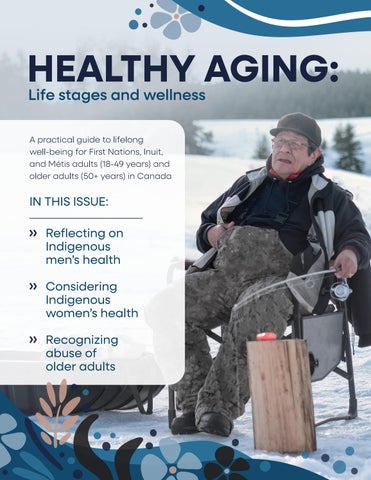
HEALTHY AGING: Life stages and wellness A practical guide to lifelong well-being for First Nations, Inuit, and Métis adults (18-49 years) and older adults (50+ years) in Canada
IN THIS ISSUE: Reflecting on Indigenous men’s health Considering Indigenous women’s health Recognizing abuse of older adults
How this resource was developed This resource is one of a series of six healthy aging booklets for First Nations, Inuit, and Métis adults (aged 18 to 49 years) and older adults (aged 50+ years) in Canada. It was developed in response to expressed interest from Indigenous families and community partners for useful, culturally appropriate information to improve and protect the health and well-being of First Nations, Inuit, and Métis people throughout the aging process. The healthy aging booklets in this resource series include: • Healthy aging: Physical activity and exercise • Healthy aging: Food, diet and nutrition • Healthy aging: Preventative health behaviours
• Healthy aging: Mental and emotional health • Healthy aging: Life stages and wellness • Healthy aging: Financial wellness
The resources were developed using information from print and digital publications, webinars, conferences, and online forums. A number of First Nations, Inuit, and Métis people from across Canada helped with the development of the healthy aging booklets by sharing their knowledge, insights, ideas, stories, health tips, and feedback to improve the quality and value of the resources.
We want to thank the following people for assisting with the editing of our healthy aging booklets:
• April Tucker, Cayuga Nation Member of the Haudenosaunee Confederacy, ON
• Jolyne Knockwood, Mi’kmaq, Amlamgog First Nation, NB
• Belinda Vandenbroeck, Ininiw Grandmother, Opaskwayak Cree Nation, MB
• Karyn Davis, Anishinaabe, Ebb and Flow First Nation, MB
• Clayton Sandy, Sioux Knowledge Keeper, Sioux Valley Dakota First Nation, MB • Dawn Cardinal, Cree, Whitefish Lake #128 (Good Fish Lake/Saddle Lake First Nation), AB • Franny Alec, Stati’mc Knowledge Keeper, Xaxli’p First Nation, BC • Gloria Cochrane, Cree Grandmother, Fisher River Cree Nation, MB • Jack Mercredi, Cree Métis, Fond du Lac Denesuline Nation, SK
• Julie Carmichael, Red River Métis, MB
• Kathleen (Kathy) Mallett, Anishinaabe‑Cree Grandmother, Fisher River Cree Nation, MB • Levinia Brown, Inuk Elder, Rankin Inlet, NU • Linda Nobiss Campbell, Red River Métis Grandmother, MB • Myrtle Beaulieu, Métis Cree, AB • Roselyn (Fern) Bear, Dakota Grandmother, Standing Buffalo First Nation, SK
Table of contents Introduction........................................ 4 About this booklet............................................. 4 Acknowledging diversity................................ 6 What is healthy aging?................................... 8
Life stages and wellness................ 9 Reflecting on Indigenous men’s health..... 9 Considering Indigenous women’s health.................................................13 Understanding menopause and the menopausal journey................................15 Recognizing abuse of older adults............21
How you can learn more.............. 29
© 2026 National Collaborating Centre for Indigenous Health (NCCIH). This publication was funded by the NCCIH and made possible through a financial contribution from the Public Health Agency of Canada (PHAC). The views expressed herein do not necessarily represent the views of PHAC. ISBN (print): 978-1-77368-778-0
ISBN (online): 978-1-77368-779-7
Introduction About this booklet First Nations, Inuit, and Métis people hold distinct yet interconnected heritages that are deeply rooted in inherent rights, cultural knowledge, relational worldviews, and notions of collective abundance. Historically, these core values formed the basis of Indigenous identity and traditional wellness. For example: • balance and connection between the physical, mental, emotional, and spiritual dimensions of health were deeply tied to the environment, fostering a sense of personal purpose and hope • teachings and oral traditions around harvesting, diet, and hygiene ensured nutritious, diverse diets and protected communities from common modern ailments
4
• traditional healing practices involved highly effective plantbased medicines, physical therapies, and ceremonies that supported preventative care and recovery • shared resources prevented food scarcity, ensured social safety networks, strengthened community bonds, and minimized daily stressors Because of the processes of colonization — including the introduction of infectious diseases, forced displacement from
traditional lands, and disruption of traditional hunting, gathering, and land stewardship — First Nations, Inuit, and Métis societies were adversely affected and forever changed. Many Indigenous people today struggle with the lasting effects of ongoing colonialism, systemic racism, unequal access to quality healthcare, and socioeconomic disparities that continue to drive high rates of chronic illnesses like diabetes, heart disease, stroke, arthritis, lung disease, cancer, and mental health issues.
When we’re out of balance, that’s when we start to feel unwell. Walking in balance, in those four quadrants, we have to take care of our body, our mind, our spirituality, and maintaining a healthy diet. … That’s what’s helping me live a good life and have good health. I’m not diabetic. I’m not sick in any way. Maybe because I’m only 58 but I do believe it’s all tied to that. — First Nations advisor
Healthy aging: Life stages and wellness
5
This booklet is intended to promote healthy lifestyle habits to improve and protect the health and wellbeing of First Nations, Inuit, and Métis adults (aged 18 to 49 years) and older adults (aged 50+ years) in Canada. Learning to deal with life stages can improve your physical vitality, mental clarity, emotional resilience, and overall quality of life. This includes learning about specific health conditions — like heart disease, stroke, prostate cancer, and menopause — that biologically affect males and females differently. It also involves understanding the multiple, often overlapping forms of abuse of older adults. These topics are discussed in this booklet. Throughout this booklet, you will find external links to additional knowledge resources that you can check out for more information. You can also refer to the list of national organizations at the end of this booklet for culturally appropriate services, links to local programs, and online knowledge resources to support your best health, wellbeing, and quality of life through healthy aging. 6
Acknowledging diversity Indigenous people across Canada are not all the same. First Nations, Inuit, and Métis people comprise three completely distinct cultural groups with their own unique histories, languages, cultural heritages, and spiritual beliefs. They have different worldviews, ambitions, and lived realities. There are also differences within each First Nations, Inuit, and Métis cultural group, depending on regional geography, constitutional rights and entitlements, and whether residing in urban centres, rural or remote areas, on reserve, or in Inuit Nunangat. Many factors shape the aging processes of First Nations, Inuit, and Métis people and their ability to age well. Experiences of colonization and ongoing colonialism, political and economic structures, proximity to healthcare services and specialized care, connections to community and family, connections to the lands and waters, and even sex and gender identities all play a role in
the lived realities of healthy aging. For example, First Nations, Inuit, and Métis adults and older adults in rural communities face a very different reality than Indigenous people living in cities, especially if they are trying to manage chronic health conditions, struggle with physical disabilities or accessibility limitations, or have lost their ability to drive.
All First Nations, Inuit, and Métis people have different health realities and mental and physical capabilities. The information in this booklet provides a foundation for healthy aging and well-being in later life. You are encouraged to adapt these guidelines to fit your own needs, physical abilities, and personal circumstances. Healthy aging: Life stages and wellness
7
What is healthy aging? Aging is a natural part of our life cycle. It begins at conception and continues until death. Still, we usually do not start thinking about the health aspects of aging until we are in our 40s or 50s and changes in our bodies, health, and functional abilities become more apparent.
There’s a lot of us who are too shy to ask for services so we just end up staying sick or ignorant to what we don’t know. … This is something that’s very valuable to our people that we see stuff like this. … But again, I know my relatives wouldn’t dare ask about how to stop dementia. You know? — Métis advisor
Healthy aging is about aging well, actively and successfully, by living well, staying positive and productive, and keeping good physical, mental, and social functioning. It focuses on what matters for your overall health and well-being in older age, like lowering your risk of chronic diseases and age-related disabilities and building a strong sense of life satisfaction and happiness. Healthy aging is about shifting the narrative, where growing older is not about decline, loss, and insignificance but rather, about dignity, connection, 8
and purpose. It is about gaining wisdom, strengthening your social connections, and finding new and meaningful ways to not only extend your lifespan (to live longer), but also enhance your healthspan (to live longer in good health). Healthy aging is a lifelong process that can start at any age. You are never too old — or too young — to start taking care of your mind, body, and spirit. This booklet is the fifth in a six-part series of guides to healthy aging.
Life stages and wellness Reflecting on Indigenous men’s health Since time immemorial, First Nations, Inuit, and Métis communities have possessed healing traditions and sophisticated systems of resilience and wholistic well-being that are intertwined with the health of one's family, community, natural environment, and future generations. Still, First Nations, Inuit, and Métis men experience a higher burden of ill health than nonIndigenous men across nearly all physical and mental health categories. This includes: • premature death • suicide, suicidal ideation, and attempts
• sexually transmitted and bloodborne infections such as HIV, gonorrhea, and infectious syphilis
• chronic diseases such as diabetes, arthritis, heart disease, stroke, respiratory illnesses, and cancer
• problematic substance uses and severe gambling problems
Manitoba 2SGBQ+ men's health study bit.ly/HA05-villagelabmenshealth
Men’s mental health and suicide in Canada bit.ly/HA05-mental healthcommmenshealth
• loneliness, loss of purpose, and psychological distress
Healthy aging: Life stages and wellness
9
Many of the health challenges facing First Nations, Inuit, and Métis men are closely tied to the forced removal of Indigenous children from their families and communities through residential schools and the Sixties Scoop, which disrupted First Nations, Inuit, and Métis cultural continuity, traditional roles and values, and family structures. See the Healthy aging: Mental and emotional health booklet in this resource series for more information about this topic. Other barriers that drastically impact the healthy aging processes of First Nations, Inuit, and Métis men include:
• interpersonal violence — both as perpetrators and victims of violence — which is often tied to substance abuse and unresolved trauma • lack of culturally safe support services explicitly tailored to the needs of First Nations, Inuit, and Métis men, fathers, and 2SLGBTQI+ people • negative stereotypes that undermine the abilities of First Nations, Inuit, and Métis men to fulfil their traditional and modern roles as fathers and role models
• intergenerational trauma and systemic racism • geographic isolation and physical distance to healthcare facilities • overrepresentation in the criminal justice system • socio-economic disadvantages like lower levels of education, chronic underemployment, and persistent issues with homelessness
10
men&: Connecting men in Canada with tools and support for mental and social health bit.ly/HA05-menandconnectingmen MIYKIWAN: Life fact book bit.ly/HA05-abopeoplesmiykiwan
Because of these structural and systemic barriers, First Nations, Inuit, and Métis men often delay going to the doctor and accessing preventive screening programs such as for prostate testing and colorectal exams. As a result, they face poorer health outcomes than non-Indigenous men. For example, First Nations, Inuit, and Métis men who have prostate cancer are usually diagnosed with higherstage, more aggressive tumors. Since diagnosis often happens at later stages, the cancer is more likely to spread to other parts of
Health stories: Prostate cancer bit.ly/HA05-metis nation-healthstories
their bodies, resulting in higher chances of death. Prostate cancer is often referred to as a “silent” cancer because most men with prostate cancer do not have any clinical symptoms of the disease. Prostate cancer is usually discovered by chance, following a blood test or routine prostate examination. First Nations, Inuit, and Métis men are strongly advised to start screening for prostate cancer at 45 years of age, or even earlier if they have a family history of the disease.
Symptoms of prostate cancer bit.ly/HA05-cancerprostatecancer
Healthy aging: Life stages and wellness
11
Some First Nations, Inuit, and Métis men believe their health conditions are unavoidable due to their family history. However, many chronic conditions — including diabetes, heart disease, stroke, and certain cancers — can be prevented, delayed, or successfully managed if caught early through consistent primary care and regular preventive screenings. See the Healthy aging: Preventative health behaviours booklet in this resource series for more information about this topic.
HIM: Health initiative for men bit.ly/HA05checkhimout-him Rebuilding strength: First Nations men’s health in Northern BC bit.ly/HA05indigenousnh-rebuilding The don’t change much podcast bit.ly/HA05-menshealth foundation-podcast 12
Considering Indigenous women’s health First Nations, Inuit, and Métis women face unique health challenges. Besides reproductive health concerns like gestational diabetes and maternal death, Indigenous women experience considerably high burdens of heart disease, stroke, high blood pressure, and diabetes. Signs and symptoms of certain chronic conditions can be different for females compared with males. For example, with heart attacks, most males experience crushing chest pain as a key warning sign that they are having a heart attack. For females, however, the symptoms of heart attack are
A closer look: Indigenous women’s health risks bit.ly/HA05heartandstrokeindigwomenshealth
much more subtle and frequently mistaken for heartburn, stress, or the flu. As a result, their medical intervention is typically delayed. Common symptoms of heart attack in females include: • severe, unusual fatigue • sudden shortness of breath • nausea or indigestion • dizziness or light-headedness • extreme sweating • upper back and stomach pain • pain radiating to the jaw and neck
Understanding First Nations women’s heart health bit.ly/HA05-nccihwomenshearthealth
Healthy aging: Life stages and wellness
13
The distinct health challenges experienced by First Nations, Inuit, and Métis women stem from the lingering impacts of colonization and ongoing colonialism — particularly systemic racism, gender-based violence, and socioeconomic marginalization — which continue to negatively affect their mental, physical, and social well-being. Some of the health disparities facing First Nations, Inuit, and Métis women include overly high rates of: • chronic illnesses and sexually transmitted and bloodborne infections
• maternal mortality, preterm birth, and infant mortality • chronic anxiety, depression, complex post-traumatic stress disorder (PTSD), substance use, and suicide • physical and sexual assault, misogyny, and exposure to homophobia and transphobia • unequal access to culturally safe care, systemic mistreatment, misdiagnosis, and mistrust of western healthcare systems • housing insecurity, unsafe living conditions, and homelessness • unemployment, poverty, and food insecurity
Aboriginal women in Canada: Gender, socio-economic determinants of health, and initiatives to close the wellness gap bit.ly/HA05-nccih-aboriginalwomencanada The colonial wounds on Indigenous women’s health bit.ly/HA05-healthydebate-colonialwounds Understanding Indigenous health inequalities through a social determinants model bit.ly/HA05-nccih-indighealthinequalities 14
Understanding menopause and the menopausal journey Menopause is a completely natural part of healthy aging. It involves a biological process that affects all individuals with ovaries who live into midlife. Menopause is considered a biological milestone that marks the permanent end of menstrual cycles and natural fertility. Menopause can carry long-term health risks for First Nations, Inuit, and Métis women (and anyone with ovaries) because it involves hormonal changes — such as a significant drop in estrogen and progesterone — that increase the risk of chronic conditions like osteoporosis, heart disease, stroke, Alzheimer’s disease, and dementia.
Menopause itself refers to the specific point in time when women (and anyone with ovaries) have gone 12 consecutive months without a period. The menopausal journey, however, is much broader. It begins with a menopausal transition leading up to the menopause milestone and ends with a postmenopausal phase that lasts for the rest of life. The next page describes the three phases of this biological transition.
Healthy aging: Life stages and wellness
15
Phases of the menopausal journey PERIMENOPAUSE (THE TRANSITION) • Ovaries gradually produce less estrogen and menstrual cycles become irregular (e.g., heavier, lighter, missed). • Menopausal symptoms begin and typically last for three to 10 years (four years on average). • Symptoms are most severe or disruptive during this phase.
MENOPAUSE (THE MILESTONE) • Ovaries stop releasing eggs entirely. • Menopause is a single event (not an ongoing phase), confirmed in hindsight. • The exact moment menopause occurs is marked by 12 consecutive months without a menstrual period.
POSTMENOPAUSE (THE REST OF LIFE) • Hormone levels stabilize at a significantly lower baseline. • This phase begins exactly 12 months after the final menstrual period and lasts for the rest of life. • Most disruptive symptoms ease or completely stop. Hot flashes can continue for several more years.
16
The hormonal changes that go with menopause can cause uncomfortable — and at times, unbearable — menopausal symptoms that can heavily impact First Nations, Inuit, and Métis women’s overall quality of life. For example, symptoms can disrupt daily functioning, impact work productivity, and in some cases, cause Indigenous women (and anyone with ovaries) to reduce their work hours or leave their jobs entirely. Symptoms of menopausal transition are highly individual. They vary in intensity and often overlap
across the different phases of the menopausal journey. Common symptoms include: • hot flashes and night sweats • insomnia, fatigue, and difficulty staying asleep • irregular bleeding, vaginal dryness, painful intercourse, and urinary urgency • mood swings (e.g., irritability, anxiety, rage, depression) and trouble concentrating or remembering • weight gain, thinning hair, decreased libido, dry skin, and joint pain
There’s a silence surrounding women’s health. As women and the matriarchs of our communities, growing up, nobody ever talked about menopause or perimenopause. It was always something that you didn’t discuss. In my generation, it’s something that we’re talking about more. ... Sometimes women feel like when we’re going through menopause, it’s a bad thing, but it’s a new transition. It’s a new stage of, you know, knowledge and wisdom, as far as our Indigenous communities go. And as grandmothers and, you know, our role to our community as matriarchs. — First Nations advisor
Healthy aging: Life stages and wellness
17
Menopause represents a major life-stage transition for many First Nations, Inuit, and Métis cultures. It is often seen as an empowering transition into a respected stage of life. It is a time for: • increased wisdom and leadership • stronger family and community roles • reflection, healing, and community teaching • greater freedom, self-discovery, and reconnection with culture There is no one “right” way of coping with menopause. First Nations, Inuit, and Métis women (and anyone with ovaries) often use a combination of traditional, integrative, and western approaches to menopause care. What matters is that your menopause care feels safe, accessible, and right for you.
18
Many traditional approaches to coping with menopause support spiritual, emotional, and community well-being and help to alleviate mental and physical symptoms. Some of these traditional ways of coping with menopause include: participating in grounding ceremonies — like smudging, qulliqlighting, talking circles, and sweatlodges — to process emotions, reduce anxiety, and foster a sense of belonging engaging in cultural practices and intergenerational knowledgesharing — like throat singing, round dancing, square dancing, and storytelling — to elevate your sense of purpose and self-worth spending time in nature or participating in outdoor activities to improve your mood and alleviate symptoms of depression keeping an active lifestyle to reduce stress and boost your mood using traditional medicines — like black cohosh, sage, and Hawthorne — to alleviate mood disturbances, depression, hot flashes, and anxiety eating a balance of different coloured vegetables and fruits, whole grains, lean proteins, and healthy fats to stabilize your mood and manage weight fluctuations connecting with other women to share your experiences of menopause and gain community support seeking support from culturally informed healthcare providers who understand the wholistic intersections of cultural identity, biology, and mental health Healthy aging: Life stages and wellness
19
If you are experiencing symptoms of menopause or think you are going through “the change,” talk with your doctor or local healthcare provider. Do not suffer in silence. Your doctor, local healthcare provider, or gynecologist can properly assess your symptoms and check your hormone levels; discuss suitable treatment options with you based on your individual
medical profile, health needs, and lifestyle factors; and help manage your symptoms and long-term health. You can also talk with an Elder, Auntie, Knowledge Keeper, Indigenous health navigator, or community wellness worker for culturally grounded resources to support your personal healing and life-stage transition.
Life-stage transitions and hormonal change: An inclusive Indigenous perspective on menopause bit.ly/HA05-indigperspectivemenopause Menopause: A factsheet for Indigenous women, girls, TwoSpirit, transgender, and gender-diverse+ (IWG2STGD+) people to gain knowledge and awareness of menopause bit.ly/HA05-nwac-menopause Menopause and Indigenous persons bit.ly/HA05-menopauseandu-indigenous
Menopause and Indigenous women in Canada: The state of current research bit.ly/HA05-nccih-indigmenopause
20
Recognizing abuse of older adults Abuse of older adults — also known as elder abuse or older adult abuse — occurs when someone in a position of trust (e.g., family member, friend, or paid caregiver) causes harm or distress to an older adult. Abuse of older adults can involve a single incident of harmful behaviour or numerous acts of harm that take place separately or at the same time. The following section describes various forms of abuse that are commonly inflicted on older adults.
Forms of older adult abuse FINANCIAL ABUSE: The illegal, unethical, or unauthorized use of an older adult’s money, property, or assets for personal gain. Examples • using an older adult’s debit/credit card without permission • coercing an older adult to open a joint bank account, apply for credit, or take out a loan • forging an older adult’s signature, misusing legal documents, or making financial decisions for an older adult without consent • taking or selling an older adult’s property or other assets without permission • moving into an older adult’s home and not helping with shared living expenses
Healthy aging: Life stages and wellness
21
EMOTIONAL AND PSYCHOLOGICAL ABUSE: Any verbal or non-verbal behavior that diminishes an older adult’s dignity, self-worth, or well-being. Examples • treating an older adult like a child • not allowing an older adult to make decisions • yelling, swearing, insulting, or saying hurtful things that make an older adult feel scared, ashamed, humiliated, unwanted, or unloved • invading an older adult’s privacy and personal information (e.g., mail, email, bank statements) • not allowing an older adult to see family or friends, go to public places, or attend social gatherings • threatening to harm an older adult’s pets, property, or loved ones
ABANDONMENT: The desertion or deliberate leaving of a vulnerable older adult by a person who has assumed responsibility for their care or custody. Examples • leaving an older adult at an emergency room and providing false contact information for pick-up • deserting an older adult in a public location without making plans for their continued care • completely ridding oneself of an older adult without having someone to take over caregiving responsibilities
22
MEDICATION ABUSE: Taking, withholding, denying, or misusing an older adult’s needed medication. Examples • refusing to provide, refill, or administer an older adult’s prescribed medications • taking an older adult’s pain pills to get high or sell them
• intentionally administering too much medication or the wrong drugs to quiet or control an older adult
• altering dosages or skipping doses of prescribed medications needed for an older adult’s health management
NEGLECT: Failure or refusal by a caregiver or responsible party to fulfill their obligations to provide an older adult with basic necessities. Examples • not providing basic necessities to an older adult (e.g., food, water, clothing, shelter, required medications, medical attention) • not assisting an older adult with personal hygiene and housekeeping • not ensuring an older adult has needed utilities, transportation, and protection from health and safety hazards
Healthy aging: Life stages and wellness
23
PHYSICAL ABUSE: The intentional use of physical force on an older adult, causing illness, injury, functional impairment, or death. Examples • hitting, kicking, slapping, burning, pushing, shaking, biting, or rough handling an older adult • confining an older adult to a room • tying an older adult to a chair or bed • exposing an older adult to extreme weather conditions
SEXUAL ABUSE: Any sexual behaviour directed toward an older adult without their full knowledge and consent. Examples • making sexually suggestive comments or inappropriate sexual remarks toward an older adult • fondling, kissing, or having intercourse with an older adult without consent • coercing an older adult to engage in sexual acts through the use of threats, trickery, power, or physical force • forcing an older adult to view pornography • taking sexually explicit photos of an older adult without permission
24
SPIRITUAL ABUSE: The exploitation, manipulation, restriction, or violation of an older adult’s spiritual beliefs, traditions, and practices. Examples • preventing an older adult from attending their chosen place of worship, observing cultural traditions, or engaging in private prayers • using an older adult’s religious or spiritual beliefs to exploit them, induce guilt, or force compliance • ridiculing, devaluing, or destroying an older adult’s sacred objects, books, or ceremonial items
Abuse of older adults can increase in frequency and severity over time. Regardless of form, it can have profound consequences for older adults. Many indicators of older adult abuse are often confused with age-related conditions such as frailty, Alzheimer’s disease, and dementia. However, there are distinct physical, behavioral, and financial warning signs that abuse of older adults is happening. Some of these tell-tale signs are listed in the following section.
Signs and symptoms of older adult abuse FINANCIAL ABUSE Warning signs: Unexplained disappearance of money or valuable possessions • sudden change in bank accounts or banking practices • unpaid bills despite adequate income • sudden or unexplained transfer of assets to someone in or outside the family • sudden or suspicious changes to a will or power of attorney Healthy aging: Life stages and wellness
25
EMOTIONAL AND PSYCHOLOGICAL ABUSE Warning signs: Sudden withdrawal from social activities • lack of interest in usual activities • fear around specific caregivers or family members • feeling emotionally upset or agitated • fear of speaking • being extremely withdrawn, quiet, and nonresponsive • demonstrating symptoms of trauma, like rocking back and forth • insomnia, fatigue, low self esteem
NEGLECT AND ABANDONMENT Warning signs: Poor hygiene • unusual weight loss • malnutrition or dehydration • infection • untreated health problems • hazardous, unsafe, or unsanitary living conditions
MEDICATION ABUSE Warning signs: Worsening health conditions • severe pain • emergency department visits • long-term hospital stays • memory problems, seizures, rapid physical decline • prescriptions not being filled or being filled too often • changes in sleeping habits • seemingly groggy or dopey • irritability, sadness, depression • unexplained chronic pain • changes in eating habits • wanting to be left alone often • losing touch with loved ones
PHYSICAL ABUSE Warning signs: Unexplained injuries or physical pain • difficulty walking or sitting • changes in mood or appearance • broken or missing glasses or hearing aids • refusal to see visitors
26
SEXUAL ABUSE Warning signs: Bruising of breasts or genitals • unexplained vaginal or anal bleeding • unexplained venereal disease or genital infections • torn, stained, or bloody underclothing
SPIRITUAL ABUSE Warning signs: Loss of spiritual practices and traditions • loss of language • loss of cultural practices and protocols • impaired sense of dignity, identity, and security
Abuse of older adults is a serious (and often hidden) health problem that is not easy for First Nations, Inuit, and Métis older adults to accept or talk about, especially when it is carried out by a loved one who is taking care of you. There are many different situations that can lead to the mistreatment of Indigenous older adults by family members, friends, and paid caregivers, including:
• caregiver stress and burnout • mental health and addictions issues • history of domestic violence and learned behaviour • social isolation of older adults • ageism (prejudice against older adults) • cross-cultural or culturally incompetent caregiving
How can we keep our Elders healthy is by remaining to respect them and take care of them. It’s having that as a resource, our younger people. — First Nations advisor
Healthy aging: Life stages and wellness
27
First Nations, Inuit, and Métis older adults often feel afraid or ashamed to report experiences of abuse, especially when a family member is the perpetrator of harm. Talk with your doctor, local healthcare provider, Indigenous health navigator, community support worker, or another family member or friend if you are experiencing any forms, signs, or symptoms of abuse. Reaching out for help and talking with someone you trust is the first step to stopping this harm.
28
Hidden – Elder abuse in Aboriginal communities bit.ly/HA05-hiddenelderabuse National First Nations re:act: Recognize, report and act on older adult abuse and neglect bit.ly/HA05-vch-react Seniors’ guidebook to safety and security bit.ly/HA05-rcmpseniorssafety
How you can learn more Several national organizations in Canada offer culturally appropriate services, links to local programs, and online knowledge resources to help you maintain your best health, well-being, and quality of life. Some of these organizations are listed below. 211 at United Way Centraide Canada is a primary source for provincial/territorial government and community-based health and social services. Resources for older adults include programs and services related to housing, food, housekeeping, mental health supports, and much more.
Canadian Centre for Elder Law provides educational tools about legal and policy issues related to aging, as well as information about federal, provincial/territorial, and on-reserve laws related to older adult abuse and neglect occurring anywhere in Canada.
Phone: 211 211.ca/#find
Phone: 604-822-0142 ccelderlaw.ca
Canadian Anti-Fraud Centre provides information on recent and current frauds affecting adults and older adults in Canada, as well as information and online resources about protecting yourself, reporting fraud, and what to do if you’re a victim of identity theft and fraud.
Canadian Network for the Prevention of Elder Abuse offers reliable information to prevent older adult abuse and promote the rights of older adults. Online resources include links to knowledge exchange events, provincial/territorial older adult abuse networks, and local community support programs and services.
Toll free: 1-888-495-8501 antifraudcentre-centreantifraude.ca/ index-eng.htm
cnpea.ca/en
Healthy aging: Life stages and wellness
29
First Nations Health Authority offers a variety of tips, guides, and knowledge resources to support healthy aging, quality of life, Elder wellness, and end-of-life care for First Nations people. Phone: 604-693-6500 Toll free: 866-913-0033 fnha.ca Government of Canada offers many federal programs, services, and resources designed specifically for older adults, including information about income supplements and benefits, caregiving benefits, retirement planning, money management, and Veteran services. Toll free: 800-622-6232 canada.ca/en/employment-socialdevelopment/campaigns/seniors.html Indigenous Services Canada offers information about many health and socio-economic programs and services to support Indigenous people and communities. Toll free: 800-567-9604 canada.ca/en/indigenous-servicescanada.html
30
National Association of Friendship Centres provides a link to over 100 Friendship Centres and Provincial/Territorial Associations offering culturally appropriate programs and access to vital health, education, and social services for Indigenous people in urban settings across Canada. Phone: 613-563-4844 Toll free: 877-563-4844 nafc.ca/friendship-centres National Collaborating Centre for Indigenous Health is a source for many reliable, current, and culturally appropriate health-related knowledge resources to support the best health and well-being of First Nations, Inuit, and Métis people. Phone: 250-960-5250 nccih.ca
Pauktuutit Inuit Women of Canada serves as a powerful voice for Inuit women, girls, and gender-diverse Inuit by working to improve their social, cultural, and economic well-being. The website offers publications, podcasts, guidance, resources, and information to connect Inuit women and gender-diverse Inuit to local community-based services. Toll free: 800-667-0749 pauktuutit.ca Public Health Agency of Canada offers a range of programs, services, and knowledge resources to promote and support the health and socio-economic well-being of Indigenous Peoples and communities. Toll free: 844-280-5020 canada.ca/en/services/indigenouspeoples.html
© Credit: (Front cover) iStockPhoto.com, ID 1436929441; (p. 4) USAY, 2025; (p. 7) iStockPhoto.com, ID 2252110834; (p. 11) iStockPhoto.com, ID 1470932535; (p. 12) iStockPhoto.com, ID 1470932535; (p. 15) iStockPhoto.com, ID 2247385042; (p. 18) iStockPhoto.com, ID 2190478369; (p. 18) iStockPhoto.com, ID 2268599926.
Healthy aging: Life stages and wellness
31
The booklets in this series include:
Healthy aging: Physical activity and exercise
Healthy aging: Food, diet and nutrition
Healthy aging: Preventative health behaviours
Healthy aging: Mental and emotional health
Healthy aging: Life stages and wellness
Healthy aging: Financial wellness
You can view all of the English booklets online at nccih.ca. Aussi disponibles en français: ccnsa.ca. For more information: 3333 University Way Prince George, BC, V2N 4Z9 250-960-5250 nccih@unbc.ca nccih.ca
nccih.ca/485/Launchhealthy-aging.nccih?id=624