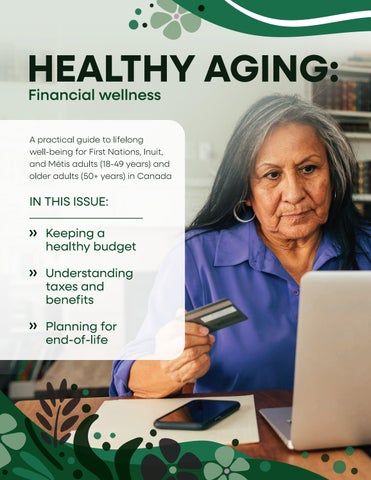
HEALTHY AGING: Financial wellness
A practical guide to lifelong well-being for First Nations, Inuit, and Métis adults (18-49 years) and older adults (50+ years) in Canada
IN THIS ISSUE: Keeping a healthy budget Understanding taxes and benefits Planning for end-of-life
How this resource was developed This resource is one of a series of six healthy aging booklets for First Nations, Inuit, and Métis adults (aged 18 to 49 years) and older adults (aged 50+ years) in Canada. It was developed in response to expressed interest from Indigenous families and community partners for useful, culturally appropriate information to improve and protect the health and well-being of First Nations, Inuit, and Métis people throughout the aging process. The healthy aging booklets in this resource series include: • Healthy aging: Physical activity and exercise • Healthy aging: Food, diet and nutrition • Healthy aging: Preventative health behaviours
• Healthy aging: Mental and emotional health • Healthy aging: Life stages and wellness • Healthy aging: Financial wellness
The resources were developed using information from print and digital publications, webinars, conferences, and online forums. A number of First Nations, Inuit, and Métis people from across Canada helped with the development of the healthy aging booklets by sharing their knowledge, insights, ideas, stories, health tips, and feedback to improve the quality and value of the resources.
We want to thank the following people for assisting with the editing of our healthy aging booklets:
• April Tucker, Cayuga Nation Member of the Haudenosaunee Confederacy, ON
• Jolyne Knockwood, Mi’kmaq, Amlamgog First Nation, NB
• Belinda Vandenbroeck, Ininiw Grandmother, Opaskwayak Cree Nation, MB
• Karyn Davis, Anishinaabe, Ebb and Flow First Nation, MB
• Clayton Sandy, Sioux Knowledge Keeper, Sioux Valley Dakota First Nation, MB • Dawn Cardinal, Cree, Whitefish Lake #128 (Good Fish Lake/Saddle Lake First Nation), AB • Franny Alec, Stati’mc Knowledge Keeper, Xaxli’p First Nation, BC • Gloria Cochrane, Cree Grandmother, Fisher River Cree Nation, MB • Jack Mercredi, Cree Métis, Fond du Lac Denesuline Nation, SK
• Julie Carmichael, Red River Métis, MB
• Kathleen (Kathy) Mallett, Anishinaabe‑Cree Grandmother, Fisher River Cree Nation, MB • Levinia Brown, Inuk Elder, Rankin Inlet, NU • Linda Nobiss Campbell, Red River Métis Grandmother, MB • Myrtle Beaulieu, Métis Cree, AB • Roselyn (Fern) Bear, Dakota Grandmother, Standing Buffalo First Nation, SK
Table of contents Introduction........................................ 4 About this booklet............................................. 4 Acknowledging diversity................................ 6 What is healthy aging?................................... 7
Financial wellness............................ 8 Keeping a healthy budget............................. 8 Understanding taxes and benefits.............11 Planning for end-of-life..................................13
How you can learn more............... 17
© 2026 National Collaborating Centre for Indigenous Health (NCCIH). This publication was funded by the NCCIH and made possible through a financial contribution from the Public Health Agency of Canada (PHAC). The views expressed herein do not necessarily represent the views of PHAC. ISBN (print): 978-1-77368-782-7
ISBN (online): 978-1-77368-783-4
Introduction About this booklet Historically, First Nations, Inuit, and Métis people existed as distinct, self-governing societies. They exercised inherent sovereignty and self-determination of the lands and waters, which ensured their health, cultural identity, and survival as distinct peoples. This included having: • their own governance structures, customary laws, and legal systems • expert knowledge of their geographic territories and local ecosystems • well-established trading patterns, trade alliances, and trade routes • deep, reciprocal relationships with their lands, waters, and territories
4
Living healthy lifestyles is a lifelong journey. … It’s a good way to prevent a lot of problems when you get older. … This should start early on in life, and it should be a pattern that should be followed. — First Nations advisor
Because of the processes of colonization — including forced relocations and loss of lands, destruction of community networks and family structures, and restrictive colonial policies involving the disruption of Indigenous governance, trade economies, and economic independence — the structures and well-being of First Nations, Inuit, and Métis societies were adversely affected and forever changed. Many Indigenous people have experienced the adverse effects of ongoing colonialism, systemic racism, and socio-economic marginalization, which have resulted in overly high rates of poverty, food insecurity, and financial stress.
This booklet is intended to promote healthy lifestyle habits to improve and protect the health and wellbeing of First Nations, Inuit, and Métis adults (aged 18 to 49 years) and older adults (aged 50+ years) in Canada. Learning how to take care of your financial wellness will boost your overall health and quality of life. This includes learning about the importance of keeping a healthy budget and doing taxes, taking advantage of available health and social benefits, and planning for retirement and end-of-life. These topics are discussed in this booklet.
Throughout this booklet, you will find external links to additional knowledge resources that you can check out for more information. You can also refer to the list of national organizations at the end of this booklet for culturally appropriate services, links to local programs, and online knowledge resources to support your best health, wellbeing, and quality of life through healthy aging.
Healthy aging: Financial wellness
5
Acknowledging diversity Indigenous people across Canada are not all the same. First Nations, Inuit, and Métis people comprise three completely distinct cultural groups with their own unique histories, languages, cultural heritages, and spiritual beliefs. They have different worldviews, ambitions, and lived realities. There are also differences within each First Nations, Inuit, and Métis cultural group, depending on regional geography, constitutional rights and entitlements, and whether residing in urban centres, rural or remote areas, on reserve, or in Inuit Nunangat. Many factors shape the aging processes of First Nations, Inuit, and Métis people and their ability to age well. Experiences of colonization and ongoing colonialism, political and economic structures, proximity to healthcare services and specialized care, connections to
6
community and family, connections to the lands and waters, and even sex and gender identities all play a role in the lived realities of healthy aging. For example, First Nations, Inuit, and Métis adults and older adults in rural communities face a very different reality than Indigenous people living in cities, especially if they are trying to manage chronic health conditions, struggle with physical disabilities or accessibility limitations, or have lost their ability to drive. All First Nations, Inuit, and Métis people have different health realities and mental and physical capabilities. The information in this booklet provides a foundation for healthy aging and well-being in later life. You are encouraged to adapt these guidelines to fit your own needs, physical abilities, and personal circumstances.
What is healthy aging? Aging is a natural part of our life cycle. It begins at conception and continues until death. Still, we usually do not start thinking about the health aspects of aging until we are in our 40s or 50s and changes in our bodies, health, and functional abilities become more apparent.
We have to be mindful of those things. Like, even this morning. I made scrambled eggs for my husband and I went and gave it to him. About an hour later, he was in the kitchen and he said, ‘Do you know that you left the stove on?’ It wasn’t on high, but you know what I mean? I did that. Those are the kinds of things now that, in aging, you will forget things. — First Nations advisor
Healthy aging is about aging well, actively and successfully, by living well, staying positive and productive, and keeping good physical, mental, and social functioning. It focuses on what matters for your overall health and well-being in older age, like lowering your risk of chronic diseases and age-related disabilities and building a strong sense of life satisfaction and happiness. Healthy aging is about shifting the narrative, where growing older is not about decline, loss, and insignificance but rather, about dignity, connection, and purpose. It is about gaining wisdom, strengthening your social connections, and finding new and meaningful ways to not only extend your lifespan (to live longer), but also enhance your healthspan (to live longer in good health). Healthy aging is a lifelong process that can start at any age. You are never too old — or too young — to start taking care of your mind, body, and spirit. This booklet is the last in a six-part series of guides to healthy aging. Healthy aging: Financial wellness
7
Financial wellness Keeping a healthy budget Keeping a healthy budget is an important part of healthy aging. It involves keeping track of all sources of income and expenses, and making sure your expenses do not exceed your income. Reviewing your finances regularly and living within your means helps ensure you can afford safe housing, nutritious food, and transportation. Controlling how and where you spend your money also reduces financial stress and anxiety, which can directly impact your physical and mental health. Financial pressures are a major cause of stress. When financial stress is high, it can cause sleep
problems, headaches, high blood pressure, and mental health concerns like anxiety and depression. It can also lead to unhealthy coping habits such as emotional eating, misuse of drugs or alcohol, compulsive shopping, hoarding, and continued gambling — whether through video lottery terminals (VLTs)/slot machines, bingo, online gaming, or scratch tickets — despite repeated losses and accumulating debt. Creating and sticking to a healthy budget is a major stress reducer. It can improve your overall health, well-being, and quality of life.
Essential elements of a healthy budget INCOME Net (after-tax) income: The total money you take home after taxes and deductions • Salary, contract pay, bonuses, government transfer payments, income tax refunds 8
Follow a 50-30-20 rule for spending
30% of total net/ after-tax income
50% of total net/ after-tax income
EXPENSES Fixed expenses (needs): Set costs that are the same every month • Rent/mortgage, utilities, phone, internet, insurance premiums (e.g., home, auto, content), banking fees Varying expenses (needs): Costs that change from month to month based on choice and situation • Groceries, toiletries, bottled water, household supplies, pet food and supplies, gas/transportation, clothing, laundry Debt repayments: Payments on money owed • Credit cards, auto loans, personal loans Irregular expenses: Costs that do not occur every month • Driver’s license and vehicle registration, auto repairs, home maintenance, vet costs, birthday and holiday spending, personal grooming (e.g., haircut, pedicure) Optional expenses (wants): Extra costs that vary from month to month based on choice and behaviour • Alcohol, tobacco/nicotine, cannabis, gambling (e.g., bingo, VLTs, online gaming, scratch tickets), entertainment (e.g., movies, concerts, restaurants), hobbies, subscriptions, membership fees, “coffee money”
20% of total net/ after-tax income
SAVINGS/INVESTMENTS Emergency funds: Money set aside for future unexpected expenses • Medical emergencies, major repairs, funerals Retirement savings: Money set aside for retirement • RRSP or other retirement plans Goal-focused savings: Money set aside for long-term goals • New vehicle, new boat, trips, home renovations Healthy aging: Financial wellness
9
When planning your monthly budget: • Try to account for every dollar of after-tax income and everything you spend money on. This will help control how and where you spend your money.
• Adjust your budget as your situation changes. Personal/ discretionary expenses (wants) offer the greatest opportunity to cut costs.
• Food, housing, utilities, and transportation are absolute necessities to keep your life functioning, especially during a financial crisis. Prioritize these expenses to ensure these needs are met.
• For debt repayments, focus on paying high-interest debts first to reduce overall interest costs.
Budget planner bit.ly/HA06-GovCanbudget
• Be realistic in your budget planning. A budget that is too loose or restrictive can lead to frustration and failure, hindering balanced budgeting.
Making a budget bit.ly/HA06-GovCanmakeabudget
Canadian seniors directory: Seniors deals and discounts bit.ly/HA06-canseniors-directory
10
Understanding taxes and benefits Regardless of where you reside in Canada, it is important that you file a tax return for each year — usually before April 30th of the following year — even if you have no income or your income is tax-exempt. Filing an annual tax return involves reporting your income, expenses, and other financial information to the government. This determines whether you owe taxes or are entitled to a tax refund. Doing your taxes is not only about paying or receiving tax monies; it is also about boosting your income and strengthening your financial
Benefits finder bit.ly/HA06-GovCanbenefits Programs and services for seniors — CPP, OAS, GIS bit.ly/HA06-GovCanseniorprograms
stability. Filing your annual tax return makes you eligible for a range of government benefits — like the family caregiver tax credit, medical expenses claim, disability tax credit, home accessibility credit, and home renovation tax credit — that are intended to put more money in your pockets and enhance your quality of life. Filing your taxes each year also ensures that existing government payments — such as Canada Pension Plan (CPP) benefits, Old Age Security (OAS) benefits, the Guaranteed Income Supplement (GIS), and the Canada Groceries and Essentials Benefit (CGEB) — are not interrupted.
Services for people with disabilities guide bit.ly/HA06-GovCandisabilityservices Taxes and benefits for Indigenous Peoples bit.ly/HA06-GovCantaxesbenefits
Healthy aging: Financial wellness
11
There are several ways you can file your annual tax return or catch up on outstanding tax returns from previous years. You can: • contact your local band office, friendship centre, northern services centre, or community support worker to get help with completing a simplified paper tax return • file your tax return online using one of several free certified tax software packages
12
• get in-person help with doing your taxes from one of many free tax clinics offered in your area • go to a professional tax preparer who will prepare your tax return and electronically send it to the Canada Revenue Agency (CRA) for a fee
Find a free tax clinic bit.ly/HA06-GovCanfreetaxclinic
Find certified tax software bit.ly/HA06-GovCanfindtaxsoftware
Find a tax preparer bit.ly/HA06-GovCantaxpreparer
“Let us help you get your benefits!” Indigenous credit and benefit short return bit.ly/HA06-GovCangetyourbenefits
Planning for end-of-life Another essential part of healthy aging involves end-of-life planning. Proactive, early, and ongoing planning for your final stages of life is crucial for your own dignity, quality of life, and peace of mind. End-of-life planning — which can be done at any age — also helps to: • ensure your family and loved ones are aware of your wants and wishes in the event of your illness, injury, or death • support your family in making decisions that align with your values, customs, traditions, and personal preferences
• create certainty and prevent family conflict after you have passed • make sure your final wishes are honoured and respected • reduce anxiety and provide emotional closure for your family and loved ones Healthy aging: Financial wellness
13
My mom planned for her funeral prior. … My mom went in and had a will and all of those things. … She picked her own coffin and prepaid for a lot of it. … It alleviated lots of the stress and stuff from me having to do it, or my brother. It helps, especially when their kids and grandkids don’t know how to do that. It makes it easier if you’ve already got those things in place. — First Nations advisor
End-of-life planning focuses on what you want to happen, both in the event of your inability to function and after your death. It maps out your decisions and any arrangements made for your medical care (e.g., personal care home, respite, life-saving measures), power of attorney, funeral and burial, and financial affairs. Following is a helpful checklist for end-of-life planning.
14
End-of-life planning checklist WILL: A legal document outlining your final wishes concerning your appointed executor(s) and beneficiaries, distribution of assets, care for dependents/pets, and instructions for your funeral and burial or handling of cremated remains HEALTHCARE DIRECTIVE: A legal document outlining your final wishes concerning your medical treatment, life-saving interventions, and appointed person(s) who will speak/act on your behalf if you are unable to do so POWER OF ATTORNEY: A legal document granting one or more designated people the power to manage your money, property, and financial affairs on your behalf
PERSONAL AND FINANCIAL INFORMATION: A comprehensive listing of all your personal and financial information, including: • property, investments, other assets • loans/mortgages, credit cards, other debts • bank accounts, retirement accounts, pensions, insurance policies • employer information
BENEFICIARIES DESIGNATION: Specific people, charities, or trusts that you appoint to receive assets from your life insurance policies, retirement accounts, or other designated plans upon your death LEGACY LETTERS: Letters, audio recordings, video messages that you leave for your family and loved ones
• passport, driver’s license, health and status cards, social insurance number • birth certificate, marriage license, divorce papers • usernames and passwords for online accounts • veteran affairs information (e.g., benefits, cemetery plot) • list of people (and contact information) that you want to be notified in the event of your passing
Healthy aging: Financial wellness
15
End-of-life planning bit.ly/HA06-niceendoflife
One of the most important reasons for end-of-life planning is to relieve stress and emotional strain on your loved ones. Endof-life planning allows you to determine what happens to you and your assets after you die. Talking openly with your family members — and your appointed executor — about your end-oflife plans helps prevent family conflicts during an emotionally challenging time. It also gives your loved ones clear direction to ensure your final medical and legal wishes are respected and properly followed. For this reason, it is a good idea to review your end-of-life documents annually to make sure they accurately reflect your current circumstances.
16
End-of-life planning: A practical guide and checklist bit.ly/HA06-SKhealthendoflifeguide Medical assistance in dying: Support and resources bit.ly/HA06-GovCanmaid My funeral plan bit.ly/HA06-commlegalfuneralplan My voice: Expressing my wishes for future health care treatment – Advance care planning guide bit.ly/HA06fraserhealth-myvoice Wills and estate planning bit.ly/HA06-get smart-wills
How you can learn more Several national organizations in Canada offer culturally appropriate services, links to local programs, and online knowledge resources to help you maintain your best health, well-being, and quality of life. Some of these organizations are listed below. 211 at United Way Centraide Canada is a primary source for provincial/territorial government and community-based health and social services. Resources for older adults include programs and services related to housing, food, housekeeping, mental health supports, and much more. Phone: 211 211.ca/#find
Assembly of First Nations Veteran’s Council works to ensure adequate, equitable recognition and support for First Nations Veterans. Phone: 613-241-6789 Toll free: 866-869-6789 afn.ca/about-us/councils/veteranscouncil
Aboriginal Veterans Autochtones provides advocacy and support on all issues related to the needs, interests, and rights of Indigenous Veterans in Canada, serving members who are of Indigenous descent, and their families.
Benefits Wayfinder by Prosper Canada is a one-stop portal for finding federal and provincial/ territorial government benefits designed specifically for Indigenous people, as well as free local services offering oneon-one help with benefits applications, financial counselling services, and income tax filing.
aboriginalveterans.info@gmail.com avavets.com
benefitswayfinder@prospercanada.org benefitswayfinder.org
Healthy aging: Financial wellness
17
Canadian Disability Resources Society helps remove barriers by connecting people with disabilities, families, caregivers, providers, and communities to local trusted supports, accessible services, equipment, benefits, and inclusive resources.
Government of Canada offers many federal programs, services, and resources designed specifically for older adults, including information about income supplements and benefits, caregiving benefits, retirement planning, money management, and Veteran services.
Toll free: 888-909-8974 disabilityresources.ca/home
Toll free: 800-622-6232 canada.ca/en/employment-socialdevelopment/campaigns/seniors.html
Centre for Education and Research on Aging and Health at Lakehead University offers research, digital stories, and knowledge resources about dementia, aging in place, caring for Indigenous people with advanced illness, and end-of-life care. Phone: 807-343-8010 ext. 7271 cerah.lakeheadu.ca First Nations Health Authority offers a variety of tips, guides, and knowledge resources to support healthy aging, quality of life, Elder wellness, and end-of-life care for First Nations people. Phone: 604-693-6500 Toll free: 866-913-0033 fnha.ca
18
Indigenous Services Canada offers information about many health and socio-economic programs and services to support Indigenous people and communities. Toll free: 800-567-9604 canada.ca/en/indigenous-servicescanada.html Just for You – People with Disabilities, by Health Canada, offers links to a wide range of online resources for people with disabilities, including supports for accessibility/autonomy, violence and abuse, work-life balance, seniorspecific services. Toll free: 866-225-0709 canada.ca/en/health-canada/ services/healthy-living/just-for-you/ people-disabilities.html
Last Post Fund works to ensure that no Veteran is denied a dignified funeral and burial, as well as a military gravestone, due to insufficient funds at the time of death. Toll free: 800-465-7113 lastpostfund.ca National Collaborating Centre for Indigenous Health is a source for many reliable, current, and culturally appropriate health-related knowledge resources to support the best health and well-being of First Nations people, Inuit, and Métis people.
Public Health Agency of Canada offers a range of programs, services, and knowledge resources to promote and support the health and socio-economic well-being of Indigenous Peoples and communities. Toll free: 844-280-5020 canada.ca/en/services/indigenouspeoples.html
Phone: 250-960-5250 nccih.ca Pauktuutit Inuit Women of Canada serves as a powerful voice for Inuit women, girls, and gender-diverse Inuit by working to improve their social, cultural, and economic well-being. The website offers publications, podcasts, guidance, resources, and information to connect Inuit women and gender-diverse Inuit to local community-based services. Toll free: 800-667-0749 pauktuutit.ca
© Credit: (Front cover) iStockPhoto.com, ID 1298002356; (p. 5) USAY, 2025; (p. 10) iStockPhoto.com, ID 1070912244; (p. 13) iStockPhoto.com, ID 639003210; (p. 15) iStockPhoto.com, ID 461259909.
Healthy aging: Financial wellness
19
The booklets in this series include:
Healthy aging: Physical activity and exercise
Healthy aging: Food, diet and nutrition
Healthy aging: Preventative health behaviours
Healthy aging: Mental and emotional health
Healthy aging: Life stages and wellness
Healthy aging: Financial wellness
You can view all of the English booklets online at nccih.ca. Aussi disponibles en français: ccnsa.ca. For more information: 3333 University Way Prince George, BC, V2N 4Z9 250-960-5250 nccih@unbc.ca nccih.ca
nccih.ca/485/Launchhealthy-aging.nccih?id=624