which are Inuit focused, and two additional field placements that may occur in an Inuit setting.
The Early Childhood Education Administrative Leadership Advanced Diploma program is one of two streams that can build on the diploma program and be used as the third year of a Bachelor of Early Childhood Education degree. It is offered online in an asynchronous format and requires completion of 10 courses, none of which focus exclusively on Inuit ELCC contexts. One course – EE3020: Culture & Diversity –may include some Inuit content related to issues of equity and social justice, but this is not explicitly stated in the course description.
The Early Childhood Education Advanced Studies in Inclusive Practice Advanced Diploma program is the second of two streams that can build on the diploma program and be used as the third year of a Bachelor of Early Childhood Education degree. It is delivered online in an asynchronous format and includes 10 mandatory extra courses, none of which focus specifically on ELCC in an Inuit context.
One course – EE 3120: Trauma and Loss – may cover some Inuit content related to traumainformed practice, but this is not explicitly stated.
Lastly, the Bachelor of Early Childhood Education builds on either of the two advanced
diploma streams by requiring students to complete a fourth year of study, with 10 additional courses. Of these courses, one is Indigenous – but not Inuit –focused (EE 4040: Indigenous Peoples and Education). It covers the Truth and Reconciliation Commission, the United Nations Declaration on the Rights of Indigenous Peoples, colonialism and its impacts, Indigenous created media and resources, and culturally appropriate curriculum and practice. The program is available online in asynchronous delivery.
Labrador Institute, Memorial University
The Labrador Institute at Memorial University has recently developed a community-based teacher education option – the Bachelor of Education (Primary/ Elementary for Nunatsiavut) program (Memorial University, n.d.). Developed in partnership between Memorial University, the Nunatsiavut Government, the Labrador Institute, the College of the North Atlantic’s Faculty of Education, and the Newfoundland and Labrador English School District, the four-year (150 credit) program is delivered in Happy Valley-Goose Bay, Labrador and includes an Inuktitut language component; however, it is unclear whether the program can be tailored to an early learning context, as the course calendar is not readily accessible to individuals external to the university community.

Inuvialuit
Aurora College
The most accessible ELCC training program for Inuit living in the Inuvialuit region is offered by Aurora College. Not only is the College the closest post-secondary institution geographically, but accessibility is also enhanced through other means. Aurora College offers one-year certificate and two-year ELCC diploma training programs that can be accessed either through distance delivery or in-person at the North Slave Campus in Yellowknife, Northwest Territories. Further, Inuit living in the Inuvialuit region may receive funding support from the Inuvialuit Regional Corporation to complete their training through Aurora College (ITK, 2023). Nevertheless, the extent to which the College offers culturally appropriate training for aspiring Inuit educators is difficult to ascertain, based on program and course descriptions.
Aurora College’s certificate program includes 10 mandatory courses, two of which are focused on Indigenous ELCC contexts. ELCC 0101: Cultural Competency in Early Learning and Child Care focuses on the incorporation of Indigenous cultural understandings and teachings into daily practice, while ELCC 0112: Applied on the Land Learning focuses on Indigenous land-based learning,
interactions with local Elders and Knowledge Holders, the revitalization of Indigenous languages and cultures, and understanding the foundations of Indigenous Knowledge. Neither of these courses are specifically Inuit focused but they may incorporate some Inuit content. The certificate program also includes one field placement that may occur in an Inuit ELCC setting.
Aurora College’s ELCC diploma program builds on the certificate with a second year of instruction. Students are required to complete nine additional courses, two of which are focused specifically on Indigenous ELCC contexts. ELCC 0201: Cultural Competency in Early Learning and Child Care II includes content on Northwest Territories history, current cultural contexts, Indigenous relations, government policies and agreements that impact Indigenous families and communities, the rights of Indigenous people, and the design of educational activities based on northern Indigenous curriculums. ELCC 0214: Applied on the Land Learning II includes content on Indigenous experiences on the land, Indigenous cultures and traditional ways of life, revitalization of Indigenous languages and cultures, and application of Western and Indigenous pedagogical approaches. Three additional courses include explicitly stated Indigenous content, including ELCC 0205: Philosophy of Early Learning and Child Care, ELCC 0206: Ecology of the Family
and Community, and ELCC 0213: Applied Play-Based Learning II. While none of the courses focus exclusively on Inuit, these courses may include some Inuit content. Students are also required to complete one field placement, which may occur in an Inuit ELCC setting.
Nunavut
Nunavut Arctic College
Nunavut Arctic College is the most accessible ELCC training program for Inuit living in Nunavut. As a publicly funded post-secondary institution in a predominantly Inuit region, the College’s ELCC programs can be considered Inuit-led or directed, despite the programs not being specifically identified as Inuit ELCC programs. The College provides community-based training or distance delivery in some regions across the territory (ITK, 2023).
Nunavut Arctic College offers two Early Childhood Education programs: an ECE Applied Certificate Program and a Diploma program (Nunavut Arctic College, n.d.-a). The Applied Certificate Program is tailored to meet the logistical needs of Nunavut communities, with training provided onsite through a series of intensive, three-week accredited courses, delivered in Kivalliq and Qikiqtaaluk regions (Rankin Inlet, Arviat, Coral Harbour, and
the College’s mission and vision statements, its ECE programs are likely to be infused with and led by Inuit content. Students may also be required to complete field placements in an Inuit context.
Inuit content in ELCC curriculum at other postsecondary institutions
In addition to the programs above, Inuit students may also have some options to learn about Inuit children and ELCC contexts in programs offered by other mainstream post-secondary institutions across Canada,
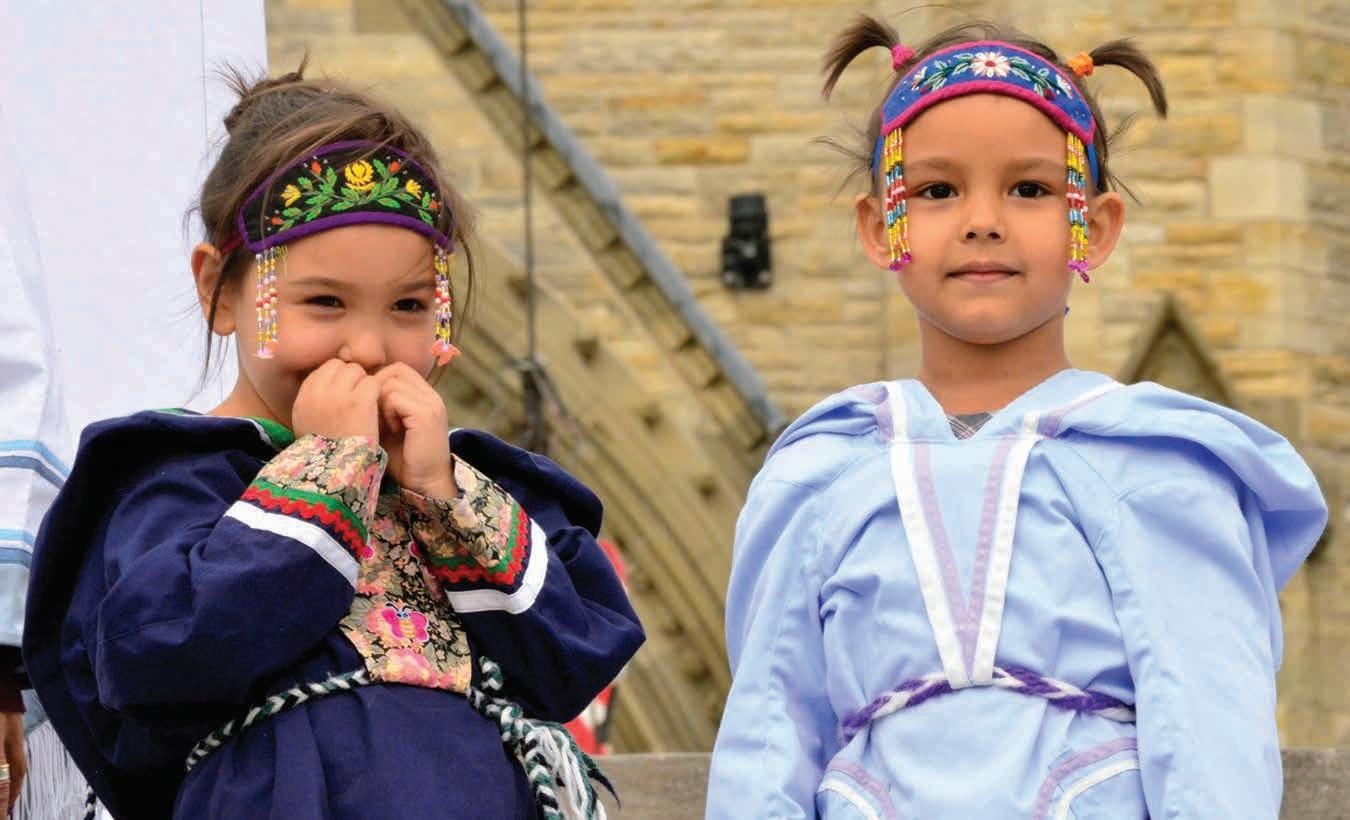
© 2018 Nunatsiaq News and photographer Jim Bell. Young Inuit throat singers who performed at the Sept. 10, 2018, Embrace Life event in Ottawa. Reproduced with permission. Source: https://nunatsiaq.com/stories/article/65674itk_president_praises_new_indigenous_early_ learning_and_child_care_fra/ Iqaluit). The Diploma Program is a two-year, accredited program that builds on the certificate program with a second year of instruction. While no course descriptions for these programs are readily accessible online, the College’s mission includes “making the benefits of Inuit traditional knowledge and southern science more accessible,” and its vision includes promoting “opportunities, innovation and leadership while enhancing knowledge of Inuit language and culture to permit all learners to proudly take their place in Nunavut and beyond” (Nunavut Arctic College, n.d.-b). Based on
through their choice of electives and/or decisions about where to complete their field experiences or practicums. For example, the University of Saskatchewan (n.d.) offers a teacher education program that can be tailored to an Indigenous ELCC context and offers a wide range of electives that incorporate Indigenous content, including EIND 380, which incorporates cultural arts of First Nations people, Inuit, and Métis people into school programs. However, these programs would not be targeted specifically at Inuit ELCC contexts and entail aspiring students to leave their communities to pursue their education.

Conclusion
This review found 17 ELCC training programs, offered by six post-secondary institutions, that either were or could be tailored to an Inuit ELCC context. Most of these programs were delivered locally in communities or allowed for distance learning. In some cases, accessibility to these programs was further enhanced through funding support for students. Nine of these programs clearly described including Inuitspecific curriculum, while another three programs included Indigenous-specific curriculum.
Of the culturally appropriate curriculum described in these programs, the focus was most often on Inuit language development, with some inclusion of land-based learning and Inuit pedagogy, cultural values and skills, and Inuit learning contexts. Less attention was given to learning about Inuit music, art, dancing, health, and trauma-informed practices. Indigenous-specific curriculum tended to focus on Indigenous rights, reconciliation, and the impacts of colonialism. As such, existing ELCC training programs for Inuit somewhat align with the characteristics of high-quality, culturally relevant ELCC programs for Indigenous children and families identified in research and policy (Elek et al., 2020; ESDC, 2018; Murdock et al., in press). Nevertheless, access to high-quality ELCC programs for Inuit children and families could be further enhanced by incorporating more Inuit perspectives, worldviews, and approaches into ELCC training
programs offered via distance delivery, such as those offered by Aurora College and the College of the North Atlantic, Newfoundland and Labrador, and by including a greater focus on ELCC contexts in Inuit-focused teacher training programs, such as those offered by McGill University and UQAT.
Outside of the 17 training programs identified above, access to culturally relevant ELCC training for aspiring Inuit ELCC students were exceptionally limited at other mainstream, publicly funded postsecondary institutions across Canada. While these mainstream programs may offer some opportunities to learn about Inuit ELCC contexts, the degree to which they are able to meet the needs of Inuit children and families is uncertain (Murdock et al., in press). Inuit-specific ELCC training programs are much better suited to provide culturally relevant training for ELCC educators who want to work in their home communities. As such, addressing barriers to culturally relevant training for aspiring Inuit ELCC educators, including enhanced access to community-based and distance learning opportunities; increased incorporation of Inuit knowledges, worldviews, and perspectives in curriculum; and increased funding support; is key to building Inuit ELCC workforce capacity and, subsequently, enhancing access to high quality, culturally appropriate, early learning opportunities for young Inuit children and their families.

References
Childcare Section. (2023). Nunavik childcare curriculum. https://www.nunavikchildcare.ca/en/childcare-curriculum
Elek, C., Gubhaju, L., Lloyd-Johnsen, C., Eades, S., & Goldfeld, S. (2020). Can early childhood education programs support positive outcomes for Indigenous children? A systematic review of international literature. Educational Research Review, 31, 100363.
Employment and Social Development Canada (ESDC). (2018). Indigenous Early Learning and Child Care Framework. Government of Canada. https://www.canada.ca/en/ employment-social-development/programs/indigenous-earlylearning/2018-framework.html
Ezekwem-Obi, A., Blythe, S., & Grace, R. (2025). “Your culture is in you”: Cultural identity and connection for children from diverse backgrounds in care: A scoping review of child perspectives. Child Protection and Practice, 5, 100134.
Freeborn, C., Mardhani-Bayne, A., & Soetaert, C. (2023). Quality and educator dispositions for Indigenous families in the urban early learning and child care context: A scoping review. International Journal of Child Care and Education Policy, 17, 6.
Gerlach, A., Gulamhusein, S., Varley, L., & Perron, M. (2021). Structural challenges and inequities in operating urban Indigenous early learning and child care programs in British Columbia. Journal of Childhood Studies, 46(2), 1-19.
Inuit Tapiriit Kanatami (ITK). (2023). Understanding the training needs of early childhood educators across Inuit Nunangat. https://www.oise.utoronto.ca/home/sites/default/ files/2023-09/nu_01_07_14_-_understandingtraining_ needs-final.pdf
Inuit Tapiriit Kanatami (ITK), Pauktuutit Inuit Women of Canada, & Tungasuvvingat Inuit. (2017). Inuit submission to Employment and Social Development Canada regarding National Indigenous Early Learning and Childcare Framework. https://www.itk.ca/wp-content/uploads/2018/04/NationalIndigenous-Early-Learning-and-Child-Care-Report.pdf
Memorial University. (n.d.). Teachers Encourage: Bachelor of Education (Primary/Elementary) for Nunatsiavut. https:// www.mun.ca/educ/media/production/memorial/facultyof-education/media-library/programs/undergraduate/ primaryelementary/Nunatsiavut.pdf
Murdock, L., Webb, D., Halseth, R., & Greenwood, M. (In Press). Quality care and young First Nations children: An exploration of optimal learning and development in early childhood settings on reserve. National Collaborating Centre for Indigenous Health.
Nunavut Arctic College. (n.d.-a). Programs: Education. https:// www.arcticcollege.com/education
Nunavut Arctic College. (n.d.-b). About us. https://www. arcticcollege.com/about-2
Tagalik, S. (2010). Inuit Qaujimajatugangit: The role of Indigenous knowledge in supporting wellness in Inuit communities in Nunavut. National Collaborating Centre for Aboriginal Health.
Université du Québec en Abitibi-Témiscamingue (UQAT). (2025). Indigenous students. https://www.uqat.ca/en/ indigenous-programs/
University of Saskatchewan. (n.d.). Indian Teacher Education Program (ITEP): Bachelor of Education (B.Ed.) – Early/ Middle Years. University Catalogue 2025-2026. https:// programs.usask.ca//education/itep/bed-itep-early.php