NORT H C ASC A DES INST I T U T E
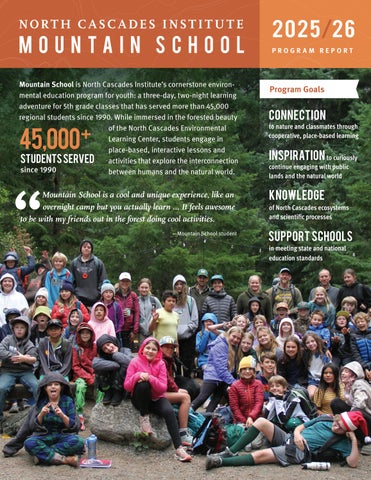
MOUNTAIN SCHOOL Mountain School is North Cascades Institute’s cornerstone environmental education program for youth: a three-day, two-night learning adventure for 5th grade classes that has served more than 45,000 regional students since 1990. While immersed in the forested beauty of the North Cascades Environmental Learning Center, students engage in place-based, interactive lessons and STUDENTS SERVED activities that explore the interconnection since 1990 between humans and the natural world.
45,000+
“
Mountain School is a cool and unique experience, like an overnight camp but you actually learn ... It feels awesome to be with my friends out in the forest doing cool activities. —Mountain School student
2025/26 PROGRAM REPORT
Program Goals
CONNECTION
to nature and classmates through cooperative, place-based learning
INSPIRATION to curiously
continue engaging with public lands and the natural world
KNOWLEDGE of North Cascades ecosystems and scientific processes
SUPPORT SCHOOLS in meeting state and national education standards
Statewide Collaboration for Program Improvement The Washington Outdoor Schools Learning Network (WOSLN) is a group of 15 outdoor school sites and other partners across the state that are working together on a three-year project of surveying, collaborating, and learning from one another in an effort to strengthen each organization's program and provide more effective environmental education programming to Washington youth. Facilitated by researchers at Virginia Tech and Clemson University, WOSLN is collecting student survey data from each outdoor school program, focusing on seven student outcome areas: Understanding Systems, Science Practices, Interest in Learning, Connection with Nature, Personal Development, Social Development, and Sense of Belonging. WOSLN provides the framework for our organizations to work together to share the most effective program strategies and structures, as backed up by the survey data. Evaluation results from the survey data show each site the outcome areas in which their program scored in comparison to the other programs. Mountain School, for instance, showed strong student outcomes related to Understanding of Systems. When compared to the average of all students surveyed across the network, Mountain School students showed greater knowledge of ecological systems, understanding of how their actions impact the environment, and interest in spending time in the natural world. “The first round of WOSLN surveys demonstrated the value of combining evaluation, reflection, and adaptive management to support continuous improvement. While Mountain School's evaluation results affirmed our strengths in systems thinking, environmental literacy, and stewardship, they also highlighted opportunities where we can improve. Rather than viewing those findings as deficiencies, it provided us with the framework to develop an adaptive management plan that offers a clear pathway for continued growth while remaining grounded in Mountain School's mission and values.” —Megan Carter, Mountain School Manager
Through this data-driven approach, WOSLN is elevating the overall field by helping Mountain School and other similar programs continuously improve using proven approaches to curriculum development, staff training, and program design.
“
We learned about watersheds, rivers, wildfires, decomposition, and skulls. I think the most important thing I learned was that no matter what you do, it always impacts the environment, good or bad. —Mountain School student
Outcomes & Evaluations To gauge Mountain School’s effectiveness and student impacts, we conduct postprogram teacher surveys. During the 2025-26 school year, teachers found the program very/highly effective (4 or 5 on a 5-point scale) at achieving the curriculum outcomes:
Empathy & Collaboration: 94%
ECOSYSTEM INTERACTIONS: 75%
CLIMATE CONNECTIONS: 88%
Practice empathy for others' viewpoints by collaborating in discussions, participating in team building, and sharing perspectives
Demonstrate interactions using abiotic and biotic factors in an ecosystem to develop and compare models that connect a variety of Earth’s systems
Explain the climate in the North Cascades and then make connections about how changes in climate influence phenomena seen in the area
Outdoor School Funding Challenges
Participant Snapshot
In the late spring of 2025, Washington State budget cuts eliminated nearly all state financial support for outdoor education, including funds that had been allocated to schools for multiday programs for 5th/6th graders. This sudden loss of funding had significant ramifications for local school district budgets, many of which were already stretched thin. Though we immediately began offering additional tuition subsidies to decrease costs for schools, some district budgets could not absorb even heavily discounted Mountain School tuition and have been forced to discontinue participation. This challenge is not unique to Mountain School – outdoor school providers across the state are reporting decreased enrollment and lower participation as public school districts grapple with challenging budgets and state funding cuts.
Participant demographics represent public school students only; data aggregated from Washington Office of Superintendent of Public Instruction.
1,390 233 33
“
Youth Participants Teachers & Chaperones Schools in the North Cascades ecosystem served
100%
Public schools received tuition subsidies
45% Students are low-income 51% from households
Students identify as people of color
(qualifying for free and reduced lunch)
16% language learners Students with 19% disabilities
Students are English
Mountain School is always an incredible experience for our students, especially those furthest from educational justice. Newcomers and students receiving special education services often thrive in the different space and it really brings the learning to life for them. It is an unforgettable experience, as well as a way to tie science concepts to our local environment. —Madison Elementary teacher
Our focus, alongside our statewide community of outdoor school providers, remains unchanged: creating equitable access to opportunities for young people to build meaningful connections to the natural world. Collectively, there is ongoing advocacy work to lobby for restoring state funding in the long term, while we continue to explore the possibilities of additional subsidies, modified programming, and other alternatives to provide access to outdoor education for youth.
REAL-WORLD PROBLEM SOLVING: 88%
INDIGENOUS STEWARDSHIP: 88%
Explore real world problems by designing solutions that integrate science, engineering, and care for their natural and human communities
Understand indigenous presence in the North Cascades region since time immemorial and how indigenous land stewardship practices can be applied during their time at Mountain School
Teachers found the program most helpful in enhancing science learning (94% ranked 4 or 5 on a 5-point scale) and equalizing the learning environment for students from different backgrounds (88%). They also reported a variety of student impacts, including growth in understanding/awareness of conservation issues (88%) and the connection between the North Cascades and their local ecosystem (88%), as well as increased comfort and enjoyment spending time outdoors (75%).
Expanding Mountain School Accessibility At the Institute, we strive to improve accessibility to the benefits of naturebased learning for ALL young people. This spring, we offered two opportunities for Seattle Children’s Hospital patients, who are less likely to be able to participate in traditional Mountain School, to engage with the program: on-site at the hospital and a special weekend at the Learning Center for patients and their families. Mountain School staff traveled to Seattle Children’s Hospital in April, bringing a bit of the North Cascades to in-patient youth. Through the hands-on examination of wildlife skulls, taking a close-up look at plant and rock specimens with microscopes, and decorating their own “wood cookie” nametag (a long-running Mountain School tradition), young patients were able to experience the magic and wild wonder of the North Cascades as a brief respite to their ongoing medical care. Later in the spring, we offered the first-ever Mountain School Family Camp: a weekend at the Learning Center just for Seattle Children’s Hospital patients and their families. Participants engaged in classic Mountain School lessons while immersed in the quiet beauty of the North Cascades —a chance for patients and caregivers to experience the peace and healing benefits of the natural world while connecting with each other through interactive activities.
“
Mountain School was the best three days of my life. —Mountain School student
Partners & Supporters Mountain School is made possible with the generous support of hundreds of organizations and individuals, including:
PARTNERS
MAJOR FUNDERS Anonymous Foundation Brian Scheuch Memorial Fund The Eleanor and Henry Jansen Foundation First Fed Foundation Lummi Nation The Peach Foundation Quest for Truth Foundation Rotary Club of La Conner Skagit Community Foundation: The Fisher Family Donor Advised Fund, The George B. & Ruth Elizabeth Ferguson Donor Advised Fund, and The ERAC Donor Advised Fund Skagit Environmental Endowment Commission
NORT H C A SC A DES I NST I T U T E
ncascades.org/schools | (360) 854-2599