Summer/Fall 2026
BOARD OF TRUSTEES, 2026-2027 R. Davis Webb, Chair
Edward M. Howland
Mark L. Schmid
Bernadette Souza, Vice Chair
Jim Hughes
Nancy L. Shanik
Ricardo Bermudez, Treasurer
Michael Keating
Wick Simmons
Paulina R. Arruda, Clerk
Betts Howes Murray
Ellen Stone
Gilbert Perry
Carol M. Taylor James D. Treco
Susan Costa
Victoria Pope
Douglas Crocker II
Maria A. Rosario
Lisa Whitney
Betsy Fallon
Anthony R. Sapienza
Susan Wolkoff
David A. Gomes
Tricia Schade
With Support From: Marion Antique Auctions • Eldred’s • Boston Marine Society • Michael J. Dury The activity that is the subject of this publication has been financed in part with Federal funds from the National Maritime Heritage Grant program, administered by the National Park Service, U.S. Department of the Interior, through the Massachusetts Historical Commission, Secretary of the Commonwealth William Francis Galvin, Chairman. However, the contents and opinions do not necessarily reflect the views or policies of the Department of the Interior, or the Massachusetts Historical Commission, nor does the mention of trade names or commercial products constitute endorsement or recommendation by the Department of the Interior, or the Massachusetts Historical Commission. This program received Federal financial assistance for preservation of historic maritime resources and for increasing public awareness and appreciation for the maritime heritage of the United States. Under Title VI of the Civil Rights Act of 1964, Section 504 of the Rehabilitation Act of 1973, and the Age Discrimination Act of 1975, as amended, the U.S. Department of the Interior prohibits discrimination on the basis of race, color, national origin, disability or age in its federally funded assisted programs. If you believe you have been discriminated against in any program, activity, or facility as described above, or if you desire further information, please write to: Office of Equal Opportunity National Park Service 1849 C Street, NW Washington, DC 20240
Vistas: A Journal of Art, History, Science and Culture Copyright © 2026 New Bedford Whaling Museum All rights reserved. No part of this publication may be reproduced, distributed, or transmitted in any form or by any means, including photocopying, recording, or other electronic or mechanical methods, without the written permission of the publisher, except in the case of brief quotations embodied in reviews and certain other non-commercial used permitted by copyright law.
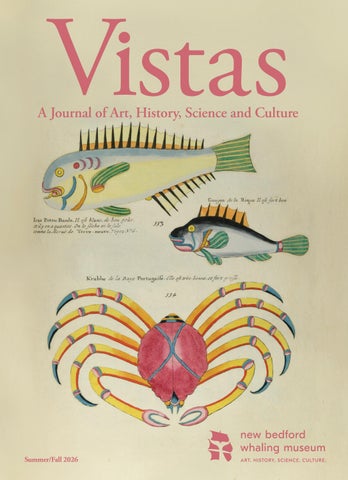
Front Cover Image: Detail, page from Louis Renard (French/Dutch, ca. 1678-1746), Poissons, ecrevisses et crabs (Fish, crayfish, and crabs), 2nd ed. (A Amsterdam [sic], Chez Reinier & Josué Ottens, 1754 [1719]). New Bedford Whaling Museum collection. Table of Contents/Foreword Images: Details from Louis Renard (French/Dutch, ca. 1678-1746), Poissons, ecrevisses et crabs (Fish, crayfish, and crabs), 2nd ed. (A Amsterdam [sic], Chez Reinier & Josué Ottens, 1754 [1719]). New Bedford Whaling Museum collection. Back Cover: Duke Riley (American, b. 1982), If It Feels Good, Do It, 2019. Found plastic mosaic on panel, private collection
Summer/Fall 2026
President & CEO Amanda McMullen
Photography Emma Rocha
Managing Editor Marina Dawn Wells
Editor Naomi Slipp
Design and Production Brian Bierig, Graphic Designer
1
| Summer/Fall 2026
Contents Summer/Fall 2026
Foreword Amanda McMullen.......................................................4
Viewing Shells from Every Angle Emma Rocha...............................................................37
Feature Articles
NBWM on the Road
Getting Outside Heads in Benito Cereno Recopied by Matt Kish Ben Bristol.....................................................................9
Apprentices in Focus
Boundless: The Book as Art Exhibition Ymelda Rivera-Laxton and Marina Dawn Wells..........5
Natchiq | Onkeehq | Isuwiq: Indigenous Artists Honor the Seal Nadia Jackinsky-Sethi, Erin Ggaadimits Ivalu Gingrich, and Elizabeth James-Perry...........................................39
Behind the Scenes
Through Our Eyes: Peer Portraiture Erika Fernandes...........................................................41
A Page from the Past: Finding a Letter from the HMS Wager Samantha Santos.........................................................15
Book Talk
A Voyage of Digitization: New Ports and Portals for Logs and Journals Melanie Botvin............................................................17 Conserving Treasures by SouthCoast Artists ....................................................................................21
In the Galleries
Sailor’s Valentines: Maritime Art from the Heart ....................................................................................27
Fresh Perspectives
Sails and Shadows: How the Portuguese Opened the Atlantic and Launched the Slave Trade Gabriel Rocha.............................................................45
Soundings
An Archive of Sound: The Foundational Repository of Marine Mammal Bioacoustics Research Robert Rocha..............................................................47
Looking Back
"Something worth while": Mary Schwall at Grenfell Mission Naomi Slipp................................................................51
Knitting Needles in Ivory and Wood Livia Smolizza..............................................................29 Fish Scales and Flowers: The Sanctity of Feminine Craft Eliza Sullivan...............................................................33
2
3
| Summer/Fall 2026
Foreword
T
he New Bedford Whaling Museum has many ties to the written word. The most obvious, perhaps, are our whaling logbooks and journals with the vast stories contained within. One would also have a good argument that Melville’s classic tale Moby-Dick has a close identification with our corner of the world. Our collection includes over 28,000 books that span over 500 years and range from rare folios and first editions to scrapbooks and artist journals. Each one fascinating and many of them printed around the globe and in numerous languages, these works detail topics as diverse as shipbuilding, natural history, global exploration, visual arts, poetry, and literature. This includes our earliest book, Theobaldus’s Phisiologus Theobaldi Episcopi de naturis duodecim animalium, produced in Cologne in 1494, as well as astoundingly illustrated volumes like one from 1754 by Louis Renard that details vividly colored fish and other aquatic lifeforms. This and many other rare treasures will be on display at the New Bedford Whaling Museum this coming fall in our exhibition, Boundless: The Book as Art, which aims to celebrate the beauty of the vessel of the book.
Speaking of beauty, on the following pages you will enjoy a dive into the restoration of one of the museum’s most magnificent paintings and its stunning frame. Gosnold at Cuttyhunk by Albert Bierstadt (1830-1902) has been brought back to its once luminousness. This breathtaking painting and frame caught the eye of a seasoned collector who cared deeply. With immense appreciation to Samuel Lehrman, our painting and frame have returned to our walls in spectacular fashion. They are not to be missed. When I studied in Florence, I purchased correspondence paper with classic Florentine designs: colorful, marbleized swirls adorning the edges and lining the envelopes. My time there was more than three decades ago, yet I still have a few pieces left because I treasure their beauty and, at this point, can’t imagine parting with any more. Taking time to let beauty wash over you is a worthwhile reminder for us all.
Amanda McMullen President & CEO New Bedford Whaling Museum
4
Feature Articles
Boundless: The Book as Art October 16, 2026-February 15, 2027
Ymelda Rivera-Laxton, Curator of Contemporary Art & Community Projects and Marina Dawn Wells, Assistant Curator of History & Culture
W
hat does “art” mean in the context of bookmaking? How do design, structure, and materiality determine how a book is really a work of art? How are books received, read, understood, translated, or shaped and reshaped over time? These questions underlie Boundless: The Book as Art, a major exhibition in the Wattles Family Gallery set to open in October 2026 that celebrates the inherent artistry of bookmaking. It highlights the creativity in traditional book arts, including the complex work that readers may take for granted: aspects such as typography and illustration, bookbinding and design. Hundreds of examples from the Museum collection will be in conversation with works from contemporary artists who negotiate the idea and format of the book. Through this exciting pairing, the exhibit creates a dialogue around the boundaries and boundlessness of traditional bookmaking and its relationship to art. The exhibition follows the general life of a book from creation to circulation. It highlights mark marking, including printing and ornamentation; it considers the physical construction of a book, such as binding and materials; and it asks how the aesthetics and contents of a book impact its public and private reception. A book may or may not be judged by its cover. Of course, many books are aesthetically astounding. Louis Renard’s Poissons, ecrevisses et crabs (Fish, crayfish, and crabs) is the first known publication to include colorful illustrations of fish (Figure 1). Originally printed in Amsterdam in 1719, its vibrant, 5
| Summer/Fall 2026
hand-colored copper engravings would have been particularly striking, a spectacle of bold pigments and forms. Close examination shows how the lines of engraving plates sometimes appear around a page’s edge, revealing how its designs came to be from intaglio impressions. The creatures are hand-painted, sometimes with color bleeding beyond their outer limits. In its own time, the book was valuable for its communication of ichthyological knowledge. Today it is perhaps more of an indication of how imprecise that knowledge was. It includes striking illustrations of tropical fish and invertebrates, although some species are not known to exist—including a mermaid. This is a strange and beautiful example of a book that is also art—and we can imagine that it put the work in artwork. The whimsical tunnel books by visual artist Andrea Dezsö (b. 1968) (Figure 2) form a strong complement, representing an adjacent world of bright underwater forms. When physically expanded, multi-layered paper tunnel books reveal miniature worlds viewers can peek into like dioramas. Some of the earliest moveable book forms were constructed in Europe as early as 1240 and served as useful aids in understanding lunar movements, time, and human anatomy. Tunnel books, carousel books, and toy theaters gained popularity in England in the early to mid-1800s. Sometimes called “paper peepshows,” tunnel books were traditionally created as hand-colored engraved plates, mounted on stiff cardstock, and designed to fold completely flat for storage or shipping. The term “tunnel” may have been associated not just with their telescopic form, but also with the Thames Tunnel, constructed under the river of the same name starting in 1825. Book
Figures 1 and 2. Pages from Louis Renard (French/Dutch, ca. 1678-1746), Poissons, ecrevisses et crabs (Fish, crayfish, and crabs), 2nd ed. (A Amsterdam [sic], Chez Reinier & Josué Ottens, 1754 [1719]). New Bedford Whaling Museum collection.
6
Figure 3. Andrea Dezsö (b. 1968), The Diver’s Clothes Lying Empty, 2022. Cotton watercolor paper, linen thread, acrylic color. Laser and hand-cut, collaged and sewn, collapsible, multi-layered one-of-a-kind tunnel book. 18 x 30 x 6 inches. Courtesy of the artist.
constructions became ideal devices for visualizing the underground tunnel construction.1 Andrea Dezsö’s work reflects her interest in representations of nature, this type of “underground” interior, and the spirit world in folk traditions and related visual narratives. These pieces also demonstrate how bookmaking can employ whimsical visuality and skillful work in various media, including painting, drawing, cut paper, and sculpture.
the human face and eye. Beyond the confines of a traditional paper page, this foldable component adds information, dimensionality, and physical engagement. Other similar books of the era could be manipulated to show the many systems of the human body or mechanical workings of a machine or tool. Whether meant to edify, disgust, or delight, this custom construction expands the bounds of what readers expect from the form of the book.
Dezsö’s tunnel books correlate with another wonderfully fascinating moveable paper construction, the 1835 A Treatise on the Physiology and Diseases of the Eye by English surgeon John Harrison Curtis (17781860). This publication outlines the anatomical structure and physical workings of the human eye. The frontispiece—the illustration opposite the title page—illustrates a woman’s face. She represents the period ideal of virtuous beauty, but her face features a flap with a shocking contrast beneath. When opened, the flap reveals the bright, bold inner workings of
Historic and contemporary works point to various forms of artistry in book arts, whether considered “art” in their own era or not. The skill and craft of bookmaking has evolved over time as a creative practice. These pages highlight only a few examples, but hundreds more will be on display in the exhibition. This exhibition underscores and celebrates the pleasures of reading and feeling, hearing, and viewing books—as skillful objects, material constructions, artworks, and tools for communication and knowledge sharing. Lose yourself in a book with us this fall with Boundless: The Book as Art, opening October 16th, 2026, at the New Bedford Whaling Museum.
Alice Austin and Emily Martin, “Book Theater: The History of the Tunnel Book,” in Suave Mechanicals: Essays on the History of Bookbinding, Vol. 4, ed. Julia Miller (Ann Arbor, Michigan: The Legacy Press, 2017), 252-53.
1
7
| Summer/Fall 2026
Figure 4. John Harrison Curtis, A Treatise on the Physiology and Diseases of the Eye 2nd ed. (London: Longman, Rees, Orme, Brown, Green, and Longman, 1834).
8
Getting Outside Heads in Benito Cereno Recopied by Matt Kish Ben Bristol, participant in the 2024 National Endowment for the Humanities Summer Institute “Moby-Dick and the World of Whaling in the Digital Age,” organized and hosted by the New Bedford Whaling Museum in collaboration with the Melville Society Cultural Project
Figure 1. Two-page spread from Matt Kish (b. 1969), Benito Cereno Recopied, 2017-2018. Pen and ink on paper in Moleskine journal, Melville Society Cultural Project Collection.
9
| Summer/Fall 2026
T
ucked away in the Melville Society Archive at the New Bedford Whaling Museum, Matt Kish’s (b. 1969) Benito Cereno Recopied (2017-2018) is a deceptively humble work of art. At first glance it looks like a diary or sketchbook, a mere Moleskine among the Archive’s remarkable array of prints and paintings. Unpublished and only visible by appointment at the Museum’s research room, it almost seems indifferent to its readers. But this is by appearance only. Like Herman Melville’s Benito Cereno, which Kish’s book recreates, Benito Cereno Recopied is acutely conscious of its audience—and waits for readers equal to its art. Matt Kish’s work foregrounds the relationship between writer and reader, artist and audience, in several striking ways. His illustrations stage a reading practice that is both daring and disciplined, making vivid what only the best literary criticism can: that reading is collaborative and that imaginative literature, to be understood, must be reimagined. Kish’s illustrations do much more than ornament their texts. They infiltrate and extend them. In Benito Cereno Recopied Kish copied the story out by hand before composing the companion images. Using only red, blue, and black ink, Kish drew seventy-two images which grow out of the abutting text into a narrative of their own. The visual style is spare and restrained, even skeletal by comparison with Kish’s other illustration projects. The product is a hauntingly intimate tribute to Melville’s tale. The original Benito Cereno was also a kind of copy—a peculiar, Melvillian kind. First published anonymously in the autumn of 1855 and reprinted in the collection The Piazza Tales a year later, the story rewrites an 1817 chapter of the memoirs of a Massachusetts man actually named Amasa Delano. The captain’s book reports that on a gray morning he went to the aid of a strange ship in distress and spent a day interfacing with its crew and human cargo. Unknown to Delano, a slave revolt has occurred aboard the ship known as the Tryal—offstage, before Delano appears on the scene—and, rather than attack the unsuspecting American, the rebellion’s leaders orchestrate an elaborate masquerade to conceal their mutiny from him, successfully convincing him that the ship remains under the command of the Spanish
captain Benito Cereno. Despite many signs and hints that things are not as they seem, the upbeat Delano manages not to see that hierarchies have been inverted, and that, despite his assured sense of command, he is playing a carefully scripted part. Rather than representing the horrors and violence of the slave trade, the story focuses on the self-deceptions that enable the liberal Delano to take pleasure in the spectacle of suffering he finds aboard the ghostly ship. Melville is notorious for incorporating factual materials into his fictions, real events “suggestive” of wider significance. He once memorably described the fiction writing process as giving symbolic flesh to a skeleton of factual truth. Yet, as critic Catherine Toal has observed, something stranger happened with the writing of Benito Cereno that challenges anatomically precise distinctions between fact and fiction.1 Melville found thick layers of fiction already lurking in Delano’s 1817 matter-of-fact narrative, and it was this uncanny insight that appears to have motivated his appropriation of the captain’s story more than the spectacular events it records. Indeed, the novella engages more with the ways slavery warped Americans’ sense of reality than in the realities of slavery, though the story ultimately prevents us from making such separations. The masquerade of the Tryal’s revolutionaries would not have been possible, Melville seems to say, without America’s devotion to its own deception. Delano’s commitment to racial hierarchy keeps him from even suspecting a revolt, from even imagining that a slave could want to be free. Amasa Delano is, in other words, a very bad reader (the sort who would likely blink at Moby-Dick). The unforgiving, even vengeful wager of Melville’s narrator is that readers of Benito Cereno will be just as bad as its protagonist.2 After teasing the limits of Delano’s perception at the start of the story, the narrator dissolves seamlessly into his perspective, tempting readers to partake in his supremacist 1
Catherine Toal, “‘Some Things Which Could Never Have Happened’: Fiction, Identification, and ‘Benito Cereno.’” Nineteenth-Century Literature 61, no. 1 (2006): 32-66.
2
S ee Peter Coviello, “‘The American in Charity’: ‘Benito Cereno’ and Gothic Anti-Sentimentality,” Studies in American Fiction 30, no. 2 (2002): 155-180.
10
Figure 2. Two-page spread from Matt Kish (b. 1969), Benito Cereno Recopied, 2017-2018. Pen and ink on paper in Moleskine journal, Melville Society Cultural Project Collection.
certainties. As his unease escalates over the course of the story, as one “queer” occurrence after another breaks upon his mind and his racism becomes more explicit, the reader can begin to untangle themself from Delano. But if the narration permits readers to separate themselves from Delano’s standpoint, it also refuses to offer a stable alternative. The unidentified narrator lingers in the background, like Delano’s unconscious or the surrounding seascape, periodically surfacing to muddle the American’s gaze.3 Sometimes this shapeless otherness even resembles the God that Amasa Delano imagines at his side in his most uneasy moments: a viciously receding point of transcendence.
seems to refuse it—to refuse, really, any form of identification or organic intimacy.4 The text resists collaboration. In skewering Americans’ default modes of identification, many of them compressed in the ideology of whiteness, the story quietly calls for a different style or even a different genre of reading.5 Perhaps it asks for us to rethink reading itself—not in the abstract, as though the story’s historical setting were merely an allegorical scaffold, but in light of that history’s overbearing weight, the immense material pressure it exerts on our imaginations to this day. As historian Greg Grandin observes in his excavation of Benito Cereno’s contexts, slavery was never just about slavery.6 For Melville, reading was never
If Delano takes the sympathy of others, including God, for granted, the narrator of Benito Cereno
4
Toal, “Some Things Which Could Never Have Happened,” 53.
5
Toni Morrison, “Unspeakable Things Unspoken,” in The Sources of Self-Regard: Selected Essays, Speeches, and Meditations (Vintage International, 2020), 177.
6
G reg Grandin, The Empire of Necessity: Slavery, Freedom, and Deception in the New World (Metropolitan Books, 2014), 10.
3
Eric J. Sundquist, To Wake the Nations: Race in the Making of American Literature (Harvard University Press, 1993), 150.
11
| Summer/Fall 2026
Figure 3. Two-page spread from Matt Kish (b. 1969), Benito Cereno Recopied, 2017-2018. Pen and ink on paper in Moleskine journal, Melville Society Cultural Project Collection.
just about reading. It was a peculiar way of incorporating the past into the present, a way of looking past long-held beliefs and, just maybe, seeing what is right in front of us. This returns us to Matt Kish. Kish’s work fits uneasily in the long reception history of Benito Cereno. If antebellum readers hurtling toward civil war missed Melville’s maneuver, and many (but certainly not all) Cold War-era readers, in search of elevating allegories, fell right into his trap, twenty-first century readers tend to celebrate the story’s radical reckoning with white supremacy and its subtle treatment of slavery—its attunement to the immense sweeps of space and time collapsed by the thing called “race.” Next to this voluble archive, there is something brutally and bracingly austere about Kish’s strictly visual interpretation. His work restores some of the text’s alien energy that moves us to read so far past
the words on the page in the first place. Perhaps just as striking as his illustrations are Kish’s handwritten words. The script lends the narrative an unsettling proximity and vitality, reminding us that the canonical text is the extension of human hands. Kish’s written, scratched out, and rewritten words remind us that Benito Cereno was not only written but labored. Yet, there is something illusory in any sense of immediacy created by Kish’s hand-copied version of the text. The seemingly unrefined form of Benito Cereno Recopied foregrounds the physical work of accessing such a text in the first place, let alone the work of assimilating its subversive spirit. The visceral qualities of Kish’s book only sharpen our sense of Melville’s defiant distance. It makes Benito Cereno even harder to read, suggesting with its seventy-two companion images how many more layers there might be to Melville’s text than we realize. 12
Figure 4. Two-page spread from Matt Kish (b. 1969), Benito Cereno Recopied, 2017-2018. Pen and ink on paper in Moleskine journal, Melville Society Cultural Project Collection.
The style of the illustrations works toward a similar effect. The images are representational, far more faithful to physical appearances than Kish’s other illustrated books. Yet this more figurative style only heightens the vertiginous effect of the illustrations’ frequent departures from mere depiction. Not only do his pictures constantly shift scale from page to page, from claustrophobic close-ups, which seem to reflect Delano’s perspective, to zoomed out views of the ship swallowed by a menacing sky, which suggest the view of the amorphous narrator. The scales and structures of perception within individual images are often heavily distorted. Heads separated from bodies loom monstrously over a diminished version of the ship; skulls—always out of place among the living—appear everywhere, but most strikingly in the place of the sun, as if light itself has been warped by slavery’s global reach (as in figures 2 and 3). Kish makes vivid with Melville that any perspective that would fix something in place and sever it from 13
| Summer/Fall 2026
time, confine the significance of something to its skin or shape, is doomed to gothic disturbances. The contact between Kish’s images and their corresponding pages can be oblique. Often the illustrations answer to minor textual moments that seem incidental to the flow of plot, either building on a striking turn of phrase or abstractly recreating a page’s “mood.” This interpretive approach—the same he takes in Moby-Dick in Pictures as well as his illustrated edition of Heart of Darkness (2013)— honors the immense productivity of Melville’s (or Joseph Conrad’s) language. Kish’s illustrations converse with the same sorts of unsettling intimations that so disturb Delano over the course of his day aboard the slave ship. Where Delano zealously looks away from the deviant moments that crack at his mind, Kish scrutinizes and distends them, giving shape to their passing possibilities, asserting their salience without defining their significance.
The illustrated Heart of Darkness is the project in Kish’s corpus most similar to Benito Cereno Recopied. It’s another playful rendition of a canonical text featuring an illustration per page of text, and brimming with skulls. Kish describes this project’s style, which is far more abstract and impressionistic than those of Benito Cereno Recopied, as aspiring to illuminate the terrifying universality of Joseph Conrad’s story. Kish intended readers to feel the horrors of the historically-situated narrative as their own.7 Benito Cereno Recopied apparently has other aims. It embraces as fully as possible the particularity of its source material, resisting any temptation to recoil from its densities. It does not, like Delano or any number of critics and scholars, take refuge in grand generalizations or comfort in tidy conclusions. Instead, it stresses the intimate, almost physical burdens of interpretation itself. As I have already suggested, Benito Cereno seems to foreclose any promise of human recognition. But it is especially hostile toward claims to universality. The most distinct species of universality Melville attacks is whiteness—the hazy omnipresent force that Delano equates with divine protection. And there may be no more potent emblem of this dubious force than the human skull that crowds the pages of Benito Cereno Recopied and looms over Melville’s Benito Cereno in the figure of the slaveowner’s skeleton, which the rebels have converted into their ship’s figurehead. The skull evokes the popular racist epistemologies of Melville’s day, notably those of phrenology and ethnology, which claimed to map human hierarchies onto skin and bone.8 Alongside Melville’s image of the figurehead skeleton, whose “whiteness” serves Black liberation, Kish’s out-of-place skulls ridicule such claims as cannibalistic fantasies. They repel the search for absolute knowledge, turning readers onto a fraught social terrain, where word and image convolve in unsteady union. 7
Matt Kish, introduction to Heart of Darkness (Tin House Books, 2013).
8
See James Poskett, Materials of the Mind: Phrenology, Race, and the Global History of Science, 1815-1920 (University of Chicago Press, 2019); Samuel Otter, Melville’s Anatomies (University of California Press, 1999), 101-171.
Kish’s skulls also have origins apart from their visceral relevance to Benito Cereno. Skulls have been a fixture in Kish’s work for decades, and their meaning has evolved over the course of his eclectic career.9 Taken together, they do not perform a specific symbolic function in his work, but rather reflect an ongoing reckoning with the limits of human minds and bodies. They express a lively, almost collaborative relationship to death. In this light Kish’s skulls might represent something like an inversion of Delano’s mind, which, as literary scholar Eric Sunquist observes, contains and represses the whole history of a hemisphere in its drama of failed self-mastery.10 Benito Cereno Recopied dramatizes the work of writing oneself into a shared history without the support of prepackaged universals—with no promise and little hope of recognition; the work, maybe, of converting pain into perception. It gives us an artist working his way out of his own head, into something far more frightening and far more beautiful than a personal narrative. And it suggests that the path to universality might begin not with telling one’s own story, but with rewriting someone else’s. 9
Matt Kish, email message to author, March 17, 2025.
10
Sundquist, To Wake the Nations, 149-151.
14
Behind the Scenes
A Page from the Past: Finding a Letter from the HMS Wager Samantha Santos, former Curatorial & Museum Learning Assistant
I
n 1741, the British Royal Navy vessel HMS Wager wrecked off modern-day Chile. The crew feared they were stranded on the desolate island for the rest of their lives. Some men resigned to their fate quickly, taking to prayer in what might have been their final days. Others struggled for power, fighting over how to allocate meager resources and make it off the island. After the nearby Kawésqar people offered some assistance, the crew found themselves with a renewed sense of hope. They thought it possible they could see their native England again—that is, if they managed to survive another perilous journey on the open ocean. The group fought starvation, mutiny, and death for months, and finally separated into two factions. The overthrown captain, David Cheap, and a few loyal crew members wanted to complete their naval mission of intercepting Spanish interests in Patagonia. The remaining crew of roughly thirty mutineers ditched the mission and headed straight home for England, planning to reach the safety of Brazil through the Strait of Magellan. One officer on the Wager, Lieutenant Robert Baynes, wrote to his brother in York and informed him of the traumatic events the group had endured. In this letter, the Lieutenant described the harsh conditions they survived and how they made it to Brazil without “Cloaths, Money or Health.” At the end of the letter, he hints at cannibalism, explaining “two people of the fattest were pointed out for Slaughter but the Next Day we got to Rio Grande to our great Happiness.”
15
| Summer/Fall 2026
The crew had nearly succumbed to the most drastic measures to survive. Of 160 men on the Wager, just thirty-six made it back to England. The mutineers arrived in England in 1743, but the loyalists did not arrive for another three years. After the arrival of Captain Cheap and two remaining survivors, all of whom were presumed dead for years, a highly public court martial ensued to determine who was at fault for the shipwreck. Various survivors shared their accounts of what happened, chiefly to clear their own name and avoid punishment for wrongdoing. The letters, court records, and published accounts of the mutiny on the Wager vividly document the experiences of the crew and provide a tantalizing window into this historical event. The New Bedford Whaling Museum is home to a period transcription after Lieutenant Baynes’s historical letter to his brother, the original being housed in the collections of the East Riding Archives in England. While reviewing hundreds of rare books for the upcoming special exhibition, Boundless: The Book as Art, staff found the copy of the letter from Baynes tucked inside Awnsham Churchill’s A Collection of Voyages and Travels (London, 1732), published about ten years before the Wager expedition. Ironically, and perhaps the reason an unknown previous owner filed the letter in that volume specifically, the book includes a reprint of Brawern and Herckemann’s voyage to Chile in 1642 and 1643.
Upon inspection, it was determined this letter was a contemporaneous copy, made around the same time as the original. The paper is from the 1740s with a consistent British watermark from the period. I quickly recognized the Wager name from the New York Times bestseller The Wager: A Tale of Shipwreck, Mutiny and Murder by David Grann. At its core, the purpose of archives is to preserve history and make it accessible. The Whaling Museum
does this through exhibiting and stewarding an archival collection and using that collection to tell stories—of people and places. We do not know who transcribed this copy of the Wager letter. However, it reflects aspects of maritime life and the dangers of a career at sea. As demonstrated, remnants of the archive can highlight shocking stories from the past. On the Whaling Museum’s social media, you can find author David Grann speaking more about the letter by Lieutenant Baynes and his bestselling book.
16
A Voyage of Digitization: New Ports and Portals for Logs and Journals Melanie Botvin, Associate Curator of Collections & Exhibitions
Figure 1. Logbook of the brig A.J. Ross, of Boston, Mass., captained by Benjamin Lothrop, keeper unknown, on voyage from May 17-Nov. 3, 1876. Kendall Whaling Museum Transfer, KWM 8.
17
| Summer/Fall 2026
Figure 2. Logbook of the ship Frances, of New Bedford, Mass., captained by John Briggs, kept by Charles Pierce and Jedediah Whipschild, on voyage from Aug. 1, 1831-Feb. 23, 1832. Kendall Whaling Museum Transfer, KWM 90.
T
he Museum collections team continues to make steady progress in its Whaling Logbook and Journal Digitization Project, a two-year project funded through the National Historical Publications and Records Commission (NHPRC). This work is keeping pace with the grant timeline and goals, which include digitizing over 1,200 logbooks, creating catalog records in the Museum’s collections management system for each volume, uploading digital surrogates to the web, and promoting the project. The NHPRC grant also allowed the museum to review, streamline, and formalize our digitization
process to align with museum-wide guidance and preservation standards. Today, the museum adheres to FADGI guidelines. A collaborative government effort, FADGI sets standardized technical guidelines for digitizing and preserving cultural, historical, and archival records including image resolution, color accuracy, and file formats. As of this writing, over 1,200 logbooks have been digitized under this grant. This is a major milestone, and adds to previous digitization efforts, making a grand total of 1,949 logbooks and journals publicly 18
Figure 3. Logbook of the ship Warrens of London, captained by George Grey, kept by Robert Smith Owen, on voyage from April 5, 1837-February 12, 1840. Kendall Whaling Museum Transfer, KWM 98.
accessible through our collections webpage and through Internet Archive, a non-profit digital library offering free universal access to digitized media from thousands of public collections worldwide. Launched last year, the museum’s new public-facing collections search portal eMuseum makes the museum collection widely available to the public through our own website. Through this platform, we’ve created a Logbooks & Journals highlights page containing a curated selection of 71 examples of this category of the collection; other logbooks and journals are discoverable through our general search function. The Highlights group presents casual viewers with an 19
| Summer/Fall 2026
entry point into the collection, representing breadth and variety of a given category. Each item-level record includes a textual description, caption information about the object, images of it, and—in the case of a bound manuscript—a PDF of the entire scanned volume. Making digitized collection materials available online increases the volume of people who will be impacted by the valuable insights contained within this group of artifacts. The Logbook & Journals highlights page was viewed 1,085 times over a twelve month period, from its publication in April 2025 through March 2026. Based on the Museum’s web analytics, the
Figure 4. Logbook of the ship Monticello of Nantucket, Mass., and bark Sea Queen of Westport, Mass., captained by John M. Folger and Charles C. Mooers, kept by William A. Folger, on two voyages from September 10, 1850-September 5, 1869. Kendall Whaling Museum Transfer, KWM 822.
eMuseum collections portal on our website has seen over 394,000 visits during that same period (this refers to people who organically navigate from our website to the collections search page). Additionally, 66% of eMuseum users came from direct traffic, meaning they found one of our collection objects through an organic web search on a browser like Safari or Chrome. Finally, the logbooks and journals from our collection that are shared on Internet Archive have been viewed 113,818 times. It is clear from these statistics that the NHPRC-funded effort to digitize our logbook and journal collection is making major strides and allowing for greater access to these incredible historical documents. The collection is
being used by researchers in many different areas, from history and science, from genealogists and professionals to students. This project, and the digitization of our collections more broadly, ensure materials are more readily available to a wider audience. Readers can explore digitized logbooks and journals on Internet Archive via the NBWM collections portal at newbedford.emuseum.com.
20
Conserving Treasures by SouthCoast Artists
Figures 1 and 2. William Bradford, sketchbook before and after conservation, 1856, NBWM 2001.21.1. The sketchbook contains sketches of the coast of New Brunswick and Maine: Grand Manan at Northern Head, Beal’s Head, Little Dark Harbor, Long Eddy, Swallowtail Light and Mt. Desert. It will be installed in the exhibition Melting Glaciers, Rising Seas: William Bradford (1823 1892), Climate Change, and the Contemporary at the New Bedford Whaling Museum in 2027.
21
| Summer/Fall 2026
C
hoosing objects for an exhibition isn’t always simple. Sometimes, a gem in the collection needs special attention before it can go on display. While preparing for upcoming exhibitions, museum staff pull and examine objects to identify any concerns about putting it on view. This includes checking condition and the stability of the item, noting changes from the last time it was examined, and checking for any aesthetic issues. We also review existing cataloguing information, address any questions about the item, confirm materials and measurements, and take new object photography, when necessary. When we decide an item requires conservation, we work with the appropriate conservators. A “conservator” carries a graduate degree in conservation and trains in a material specialization like paper, objects, furniture, or paintings. Their practice combines knowledge in art history, studio art, chemistry, and material science. Conservators aspire to the long-term preservation of the object, focus on stabilization and halting further damage, fill and in-paint in ways that are identifiable, and take actions that are reversible. Overall, they act “conservatively” in their treatment. Conservation science is a constantly evolving field and best practices change regularly. We rely on a stable of trained and accredited conservators to help us care for our collections. Sometimes one object requires work by multiple kinds of conservators. A conservator submits a detailed treatment plan and itemized costs, and— once approved—submits regular updates and visual documentation during the process, and a full report of the actions undertaken at the end. Conservation treatment reports go into an object’s permanent record, allowing us to understand the history of that object and its care. In 2027, the New Bedford Whaling Museum will open Melting Glaciers, Rising Seas: William Bradford, Climate Change, and the Contemporary, a 6,000 square foot exhibition placing historical American art by painter William Bradford in conversation with contemporary artists working today across the Arctic circle, especially in Inuit Nunaat, Kalaallit Nunaat and Sami territories. NBWM holds over 500 works by or about the Fairhaven-born painter and his
teacher Albert Van Beest (1820-1860). To prepare for the project, condition assessments were undertaken and three paintings and seven sketchbooks were identified for priority conservation. Seven of Bradford’s sketchbooks were sent to Northeast Document Conservation Center (NEDCC), a national leader on paper conservation. One had no cover and its binding was completely separated. Because the book was disbound, NEDCC identified the correct order of the pages based on the orientation of sewing stations, locations of stains and offset images, and the paper color and texture, created a custom cover, and rebound the sketchbook. Another sketchbook had a loose binding and a leather cover that showed wear and loss. Conservators consolidated the leather cover with a solution and flattened it and repaired the binding with goat skin. They mended the tears of the pieces of paper and filled in losses with toned Japanese kozo paper; they also guarded the folds along the binding. Together, these changes made for more sturdiness and resilience. Typically, conservators maintain the story of an object’s life and don’t aim to restore an item to “as new” condition, like a restoration specialist would. In the case of Bradford’s sketchbooks, NEDCC stabilized each one and repaired losses that would have contributed to further damage. But, they did not cover over existing stains or wear to make it look as it did when Bradford bought it off the shelf in 1860. Bradford himself did not treat these sketchbooks as finished works of art, but rather as practice materials for note taking and sketching. Relative to a painting on canvas, they were seen as ephemeral. The sketchbooks may have traveled in a pocket and were used daily until full. As such, they received ample wear and tear. Part of the story of this object, and others in the collection, is that it was used and we don’t want to erase that story. However, we do want to make sure that it survives for the future. Another recent conservation project, generously underwritten by Samuel Lehrman, was on the Albert Bierstadt (1830-1902) painting of Bartholomew Gosnold at Cuttyhunk (1858). Gifted to the Old Dartmouth Historical Society in 1904 and still in its original 19th-century frame, this important painting 22
Figure 3. Albert Bierstadt (1830-1902), Bartholomew Gosnold at Cuttyhunk, 1858. Oil on canvas. Gift of Miss Emma B. Hathaway, 1904.63.
had undergone conservation treatments in the past, including in 1972 when the canvas was removed from a masonite panel and mounted onto an aluminum panel by a respected Boston-area conservator. The surface was very dirty, and the painting had lost its luminosity. The original wood, gilt, and gesso neoclassical frame had also been worked on several times over the years, had some losses, and showed separation in the corner miters and elements. It was also discolored from where it was over-painted with radiator paint sometime in the 1900s—a typical cost-saving treatment since true gold gilding is very expensive. This was a two-part conservation project, where the painting was removed from the frame to be treated by a paintings conservator and the frame was sent to a specialized frame conservator. The painting conservator removed the canvas from the aluminum backing and restretched it, allowing the painting to flex and breathe. They removed old varnish and did retouching and a surface cleaning. Likewise, the frame conservator cleaned and repaired cracks, filled losses, cast new components, and removed old 23
| Summer/Fall 2026
paint. They then regilded the entire frame with new burnished gold leaf. This brought the historical frame back to life. Thanks to this conservation effort, this highlight of our collection can safely hang on our walls, to be enjoyed by visitors for generations to come. The average museum only displays about 10% of its collection at any given time. Reasons some objects go out on view and others stay in storage vary. An item may not fit with a gallery theme, be too fragile, heavy, or large for public view or less interesting than a comparable example, or have condition issues that makes it unsuitable for exhibition. While funds for conservation are often limited, museums are custodians and carry a responsibility of care. If a museum is a good steward, an object should last for generations. These examples of recent conservation initiatives—all undertaking in 2026—showcase some of the important work that happens behind the scenes to make that possible.
Detail, William Bradford, sketchbook, 1856, NBWM 2001.21.1.
24
Detail: Duke Riley (American, b. 1982), If It Feels Good, Do It, 2019. Found plastic mosaic on panel, private collection.
In the Galleries
Sailor’s Valentines: Maritime Art from the Heart June 19 – November 9, 2026, Upper-level galleries
Figure 1. Barbadian maker once known, Sailor’s Valentine, 1800s. Shells, wood, and glass, NBWM 00.223.4.
F
rom June 19 to November 9, 2026, the New Bedford Whaling Museum hosts the special exhibition Sailor's Valentines: Maritime Art from the Heart, showcasing approximately 50 works of art, including historical items from the NBWM collection, loans from private collections, and modern examples of the art form from the Cahoon Museum of American Art. The exhibition was organized, in part, by Leeann Ream, Curator, Cahoon Museum of American Art. Shellwork mosaics, known as sailor’s valentines, consist of colorful shells in intricate arrangements, often housed in octagonal wooden boxes. Created primarily between 1830 and 1890, their designs incorporate hearts, flowers, and nautical symbols like anchors and compass roses. Sometimes they carry romantic messages written out in tiny shells. Despite their name, sailor’s valentines were not made
27
| Summer/Fall 2026
by sailors at sea. Instead, they were produced for the tourist trade by Barbadian women from locally sourced shells. In the 1800s, Barbados, located at the easternmost part of the Caribbean, was a center of maritime supply and distribution. US ships often stopped at the small island, where sailors purchased keepsakes, like valentines, for loved ones at home. This cottage industry for locally made goods provided crucial economic opportunities for women of color under British colonial occupation. The Slavery Abolition Act came into effect in Barbados in 1834, and previously enslaved Barbadians needed work. While Barbadian men traveled and labored off island, women provided for their families. In this context, shellwork craft production was a lifeline. The popularity of sailor’s valentines emerged concurrently with the rise of a new scientific
some shells were souvenirs, serious shell collectors could order shells from around the world, expanding their collections to be truly comprehensive. As with other forms of scientific collecting, the demand for shells and shellwork did contribute to the decline of certain species of mollusks.
Figure 2. Detail, Barbadian maker once known, detail of reverse side of Sailor’s Valentine, 1800s. Shells, wood, and glass, NBWM 00.223.4.
discipline—conchology, or the study of shells, the popular pastime of amateur shell collecting, and the domestication of the seaside for tourism. Common shells in sailor’s valentines include Barbados keyhole limpets, purple sea snails, King Venus clams, cockles, and colorful small cowries. Shells could evoke a personal trip to the beach, a voyage further afield, scientific interest, or international knowledge. While
In the 1900s, American women adopted shellwork as a form of artistic expression. Collector and artist Evelyn Way Kendall (1893-1979) summered in Marion, MA starting in 1926 and made numerous sailor’s valentines, two of which are on view in the exhibition. Between 1977 and 1982, Cape Cod folk artists Ralph Cahoon (1910-1982), Martha Cahoon (1905-1999), and Bernard “Bernie” Woodman (1920-1986) further developed this artistic tradition. Viewers will see their delicate and charming sailor’s valentines on view, which combine Bernie’s beautiful shellwork with Ralph and Martha’s whimsical, nautical fantasy paintings. Contemporary maker Sandi Blanda (b. 1959) follows a traditional format, while artist Duke Riley (b. 1972) creates oversize vividly colored compositions from plastic trash collected on East coast beaches. Riley’s work educates audiences about environmental pollution and marine debris, while also referencing the important folk-art form of the sailor’s valentine. Figure 3. Duke Riley (American, b. 1982), If It Feels Good, Do It, 2019. Found plastic mosaic on panel, private collection.
28
Fresh Perspectives
Knitting Needles in Ivory and Wood Livia Smolizza, Undergraduate student, College of the Holy Cross
In 2025, collections from the New Bedford Whaling Museum were an important component of a seminar taught by Patricia Johnston, Professor of Art History and Rev. J. Gerard Mears, S.J., Chair in Fine Arts at the College of the Holy Cross. The following two articles are by students in the course who took an interest in organic materials and women’s artforms from the 1800s.
K
nitting, a craft often associated with domesticity, has a rich history that transcends simple household utility. A pair of knitting needles in the collection of the New Bedford Whaling Museum exemplify the intersection of utility and craftsmanship in maritime communities. Their construction, material choice, and intricate detailing suggest they were not merely tools but also objects of personal significance, reflecting the skill and resourcefulness of whalers and their families. In whaling communities such as New Bedford, knitting was a practical skill that reflected economic interdependence between seafaring men and the women who remained ashore. The connection between knitting and whaling reveals how traditional gender roles adapted in response to economic necessities and maritime culture. The museum’s knitting needles are crafted from whale ivory, baleen, and wood, fastened together in bands. Alternating bands of darker and lighter materials create a striking contrast. The thin dark bands are made from baleen and the broader dark brown bands and the tip ends are carved from wood. The meticulous alignment of these segments suggests craftsmanship likely by an artisan or whaleman wellpracticed in scrimshaw techniques.
29
| Summer/Fall 2026
The polished surface of the needles would ensure that yarn could glide effortlessly without snagging, and their taper to fine points indicates their function for intricate knitting. The pommel ends flare out to form carved finials, which prevent stitches from slipping off while knitting. Originally topped with a loop to accommodate a lanyard, one of them has broken off. These end details not only enhance functionality but also add a decorative element, suggesting these needles may have been personalized or given as a cherished gift. In early European and American societies, men and women alike participated in knitting, particularly in professions requiring durable, warm garments. Sailors and fishermen could knit their own clothing, including socks and caps, as part of their trade. However, by the nineteenth century, shifting gender ideologies—particularly those associated with Victorian “separate spheres”—relegated knitting primarily to women, reinforcing its association with domesticity and femininity.1 This shift was influenced by the industrialization of textile production, which made commercially produced goods from factory work more accessible and further solidified the perception of home knitting as a domestic, sentimental craft rather than a practical or economic 1
A lla Myzelev, “Whip Your Hobby into Shape: Knitting, Feminism, and the Construction of Gender,” Textile: The Journal of Cloth and Culture 6, no. 2 (2008): 148-163.
Figure 1. Maker once known, Pair of Banded Knitting Needles, 1800s. Whale ivory, wood, and baleen, Gift of Mr. Weston Howland, NBWM 1948.30.431.
30
pursuit. While knitting had once been a practical skill for both sexes, it became emblematic of middle-class femininity and leisure. Publications and etiquette guides from the period emphasized knitting as a modest pastime for women, contrasting it with the masculine, dangerous, and physically demanding labor of whaling.2 The nineteenth-century whaling industry was a cornerstone of economic development in coastal towns like New Bedford, and voyages could be lengthy, sometimes lasting several years. During these periods, men pursued dangerous and grueling work at sea, leaving women to manage households, businesses, and community affairs. The absence of men necessitated a reconfiguration of traditional gender roles, with women often assuming responsibilities beyond domestic duties, including running local businesses and participating in textile production for financial sustenance. Whaling created demand for durable, warm clothing, which reinforced the role of knitting as both an economic and practical necessity. Woolen garments such as sweaters, mittens, and stockings were crucial for whalers who faced harsh weather conditions at sea. Women knitted these items for their husbands, sons, and brothers, not only as acts of care but also as a form of emotional connection to transcend physical distance. Some also sold knitted goods to contribute to household incomes. In some cases, women formed knitting cooperatives or participated in cottage industries that supplied garments to commercial ship outfitters. This knitting helped create a financial safety net in case of a whaler’s injury, loss, or prolonged absence.3 Artifacts from the New Bedford Whaling Museum provide tangible evidence of the role knitting played in maritime communities. Items such as knitting needles, yarn samples, and completed garments help illustrate the craft’s importance in nineteenthcentury seafaring culture. For instance, woolen caps commonly found among whalers’ personal 2
Rozsika Parker, The Subversive Stitch: Embroidery and the Making of the Feminine (London: Bloomsbury Visual Arts, [1984] 2019).
3
Susan Strasser, Never Done: A History of American Housework (New York: Henry Holt, 1982).
31
| Summer/Fall 2026
items, sometimes featured personal, hand-knitted patterns. A particularly noteworthy example of essential knitted clothing in the Museum is a set of nineteenth-century woolen mittens with reinforced cuffs and tightly woven fibers, designed to endure prolonged exposure to frigid ocean temperatures. These artifacts underscore the necessity of knitted garments in sustaining whalers’ physical well-being and reveal how the labor of women on land directly influenced the success of maritime ventures. Despite this cultural shift, knitting remained a critical industry, one that blurred gender boundaries in practice. Even as knitting was coded as feminine, its output—clothing for whalers—was essential to the work of men at sea. This contradiction highlights how economic and practical necessities often overrode rigid gender distinctions in maritime communities. The interweaving of knitting, gender, and the whaling industry in the 1800s reveals a nuanced social fabric. Knitting served as a vital economic activity for women, a means of emotional expression, and a necessary support system for the whaling industry. Artifacts preserved in institutions like the New Bedford Whaling Museum, such as the knitting needles, may have been made by men who carved and converted ivory and wood into gifts for women in their lives. They provide a window into this interconnected world, highlighting the resilience and adaptability of these maritime communities. Traditional crafts like knitting are embedded within broader socio-economic and cultural contexts, shaping and reflecting the lived experiences of those who practiced them.
Figure 2. Maker once known, Swift for spinning yarn, 1800s. Whale ivory, whale skeletal bone, tortoise shell, metal, ribbon, Kendall Whaling Museum Collection Transfer, 2001.100.684.
32
Fish Scales and Flowers: The Sanctity of Feminine Craft Eliza Sullivan, Undergraduate student, College of the Holy Cross ‘25
Figure 1. Maker once known, “Basket of Flowers,” 1800s. Gift of Mrs. George F. Weeden, NBWM 1935.46.
33
| Summer/Fall 2026
I
n a multimedia assemblage, fish scales, fabric scraps, embroidery, beads, and metal coil appear to form a basket of flowers. Beading, embroidery, and metalwork combine with layered fish scales to create three-dimensionality and imitate the look of real spring flowers with delicate petals. Red beads look like berries or buds and the cherry-blossom pink flowers in the center are reminiscent of late spring or summer. The handles of the basket are molded from a long circular vine with flowers. The orange stamens and cream petals also form a cross standing in the basket. The textural complexity of this work is dynamic; the flowers almost seem like they are blowing in a breeze. Yet, the petals are the rounded shape of fish scales. “Basket of Flowers” showcases the natural idiosyncrasies and lively materiality of the organic material and provide insights into women’s artmaking. Very little is known about the creation date or the maker of the “Basket.” It was given to the museum in 1935 by Mrs. George. F. Weeden, and museum records date it to circa 1890. It is possible this work held certain religious or aesthetic meanings when it was first created and displayed. However, without further information, we can only interpret it through visual details and its relationship to women’s creative practices of the time. Similar pieces were made by women in convents and Victorian middle-class domestic spaces. Nuns in convents in Portugal and its territories were known to work with fish scales. Perhaps a Portuguese woman made this floral design.1 A related artform called “quilling” refers to pictures and objects created by rolling, pleating, or folding strips of paper. In the historical practice of reliquary quilling, nuns would adorn the rolled paper with materials including beads, shells, coral, fabric, and perhaps even fish scales to create religious reliquaries. These intricate handmade creations were a form of devotional craftwork.2 With this background in mind, the fish scale work at the museum gains an impression of sanctity. A shape in the center of the composition reads more 1
Conversation with Naomi Slipp, February 4, 2025.
2
Pilar Viladas, “Soul Sisters,” New York Times Magazine (April 2012), 22.
like a cross than a flower arrangement in a basket. The crossbars angle slightly upward, not unlike petals of a flower, but they are also reminiscent of Jesus’s outstretched hands on a crucifix. The fish scales were placed deliberately—perhaps a meditative experience for the maker, creating an abstraction of a holy cross. The materials also gesture toward scripture, since fish are a potent symbol for representing Christ. Furthermore, the materials are modest, and may have been sourced from a variety of scraps—salvaged from embroidery projects, or from a fish that became a Lenten supper. This piece is feminine, spiritual, and ecological. If not originating from a religious order as a part of a devotional project, it may be representative of a vibrant tradition of lay people’s Victorian era “fancywork” that was centered around nature in theme and material. It is unknown when or why fish scales became a medium in these works, but the makers may have been attracted to their glittery appearance and sequin-like shape. It was primarily women who took up these crafts—often uppermiddle class Victorian women with time for lengthy, intricate projects. Many of these handicraft works might have been purely for one’s aesthetic enjoyment as home decorations or they may have been made as gifts or for sale.3 A rich symbolic tradition of crafts made from unlikely natural materials persisted throughout the Victorian era. These works often included elements of embroidery and floral subjects like the “Basket of Flowers.”4 Other objects in the NBWM collection build a larger story about domestic art, such as seashells appearing in other constructions and human hair arranged into wreaths. Women used vernacular materials to create unique sculptural forms. Some items may have been less well preserved over time, and many of these crafts were likely fleeting, like flower arrangements or table settings that women constructed in their homes and communities. These 3
4
Marilyn Casto, “Nineteenth-Century Nature Crafts.” Southestern College Art Conference Review 16, no. 3 (December 2013): 273–92. M ary Brooks, “Silent Needles, Speaking Flowers: The Language of Flowers as a Tool for Communication in Women’s Embroidery in Victorian Britain," Textiles as Cultural Expressions: Proceedings of the 11th Biennial Symposium of the Textile Society of America (2008).
34
works offer a glimpse into how women sought to represent devotion or capture the beauty and mystery of the natural world around them. Historically, women’s domestic arts were not always held in as high esteem as fine art. Many works in the Museum’s collection were produced by people who were not trained as professional artists and only had access to common natural and domestic materials. However, they made objects demonstrating high levels of skill. In the context of the museum these items call viewers to enjoy the artistic merit of the work, but also to question the context. These objects reveal how different forms of craftsmanship (and craftswomanship) were creative activities of everyday life.
Today, we can appreciate artworks like Basket of Flowers as windows into the past. When the voices and words of women are lost to time, their material histories fill in the gaps in knowledge about their daily lives. Preserving these items illustrates that “domestic” art making holds no less value than works made with the backing of rigid training and societal esteem. It is important to continue breaking down a hierarchy of what is considered fine art and worthy of a museum. Basket of Flowers shows how nature can be both the subject and object of everyday art and captures the historical voices of Victorian-era women, whose lives may not have been represented as holistically in the past.
Figure 2. Sarah Amelia Poole (1851-1918), Shell wreath floral arrangement, ca. 1880. Assorted shells, dried flowers, textile, seaweed (Irish moss), and cotton batting and wire, Gift of Elizabeth S. Sanford and Gerrit Sanford, 2021.39.2.
35
| Summer/Fall 2026
Detail: Maker once known, “Basket of Flowers,” 1800s. Gift of Mrs. George F. Weeden, NBWM 1935.46.
36
Viewing Shells from Every Angle Emma Rocha, Exhibition & Collection Associate
R
esearcher Rachel Mulroy, an urban planner from New Bedford, first encountered highlights from the NBWM shell collections in the Museum’s 2024-2025 natural history exhibition Up From the Depths: Natural Selections from our Collections. She became curious as to where the shells came from and how they ended up in New Bedford. Using the shells themselves, historical accounts of whaling voyages, and maps, she set out to answer these questions, as much as was possible, considering a lack of provenance for some of the shells. This research resulted in an impressive threedimensional online exhibition combining twentythree shells from the NBWM collection with maps of whaling grounds from the Leventhal Map Collection of the Boston Public Library. Each shell can be fully rotated in 3-D and is placed on the map where its species is from. This exhibition is called “Seashells & Whaling Grounds” and may be explored on the Leventhal Collection’s website.
37
| Summer/Fall 2026
To create these three-dimensional images of the Museum’s shells, Rachel visited the Museum’s Research Room to view the shells in person and took photographs of every angle of each shell. She then used a photogrammetry application to combine the 2-D photographs to create 3-D versions. Visitors to the Museum’s online collections page can now access the 3-D views of these shells by visiting the “highlights” tab and choosing “3-D Imaged Shells.” Click on the shell you are interested in to access a video of a full view around the shell. This is a great way to get a fuller experience of the shells than what is possible with traditional two-dimensional photography. One of the major goals for any collecting institution is to ensure that its collections are available to researchers. One of the most rewarding aspects of doing so is seeing how researchers connect with the objects they are interested in. Rachel’s project, now featured on the highlights section of our collections webpage, connects visitors with fascinating objects within the museum’s collection, and with more dimensionality than ever before.
Various seashells from the NBWM collection, rendered in three dimensions.
38
NBWM on the Road
Natchiq | Onkeehq | Isuwiq: Indigenous Artists Honor the Seal April 4 - October 25, 2026 — RISD Museum
Figure 1. Indigenous Arctic maker once known, Seal Scratcher, ca. 1800–1900. Seal claws, wood, and twine, NBWM 00.200.320.
39
| Summer/Fall 2026
A
ll seafaring peoples hold relationships to the wild beings living in the waters they call home. Many Indigenous peoples maintain deep ancestral connections with seals. This exhibition witnesses those relationships across many coasts, honoring everything seals give to us. This exhibition highlights seals as a cultural connector for Native communities in Alaska and Inuit Nunangat, showcasing works from the early 1900s to the present. Inuit prints, drawings, and carvings from Kinngait and Labrador, Canada, are presented in conversation with contemporary textiles, photographs, and installations by Alaska Native and Inuit artists, exploring new and traditional technologies and personal narratives.
Seals are comforted and attracted by the sound of other seals scratching on the ice. Natchiq | Onkeehq | Isuwiq: Indigenous Artists Honor the Seal was organized by guest curators Nadia Jackinsky-Sethi (Alutiiq), Erin Ggaadimits Ivalu Gingrich (Inupiaq), and Elizabeth James-Perry (Wampanoag). Other contributors include RISD Museum curators María Fernanda Mancera, Conor Moynihan Bonacossa, Kate Irvin, and Dominic Molon. The exhibition was first conceived by RISD faculty member and former curator Laurie Brewer.
Two ice scratchers are on loan for this exhibition from the New Bedford Whaling Museum collection. These hunting decoys are made of seal claws, wood, and twine, and were used by Inupiaq seal hunters along the North Slope of Alaska to mimic the sound of seals on the ice and draw other seals to the water’s surface.
Figure 3. Gallery view of Sealskin Used for Mitts after Kanangiak Pootoogook (2025) and Pair of Sealskin Mitts (2025) by Couzyn van Heuvelen (Canadian Inuk; b. 1987 in Iqaluit, Nunavut, Canada; works in Southern Ontario, Canada). Image courtesy of RISD Museum.
Figure 2. Gallery view including seal scratchers. Image courtesy of RISD Museum.
40
Apprentices in Focus
Through Our Eyes: Peer Portraiture Erika Fernandes, Manager of Young Adult Programs
Figure 1. “Still in My Heart,” Subject: Amanda Ojeda (Apprentice Class of 2028), 2026. Digital print.
41
| Summer/Fall 2026
Figure 2. “The Gilded Ribbon,” Subject: Briseyda Nataren Melara (Apprentice Class of 2026), 2026. Digital print.
What can a portrait tell us about its subject? About its viewers? About the photographer? In the spring of 2026, the portraits of nineteen high school students—photographed in various poses, lighting, clothing, and places—went on exhibition at the New Bedford Whaling Museum. Through Our Eyes: Peer Portraiture ran until July 6, 2026 and was a project of New Bedford Whaling Museum High School Apprentices. During this three-year program,
apprentices think critically about topics related to art, history, science, and culture and learn about and contribute to exhibits. Inspired by the 2025-26 exhibition “Look pleasant, please”: Early Portrait Photography in New Bedford, high school apprentices learned about the history of photography and explored how this technology transformed the world. They attended a series of workshops on the history of photography with 42
Hine's documentary images of child labor in the early 1900s, they learned how photography was used as a tool to promote social change. Students thought deeply about the purposeful choices of historic and contemporary photographers, as visual storytellers. During their discussions, apprentices reflected on the tangible impacts photographs can have on our understanding of history, culture, and the human experience. They were also introduced to cameras as tools, and learned about lighting, shutter speed, exposure, and aperture on digital and analog cameras. Michael helped apprentices recognize the visual impact technical adjustments can have on the resulting photographs.
Figure 3. “YES… tacos,” Subject: Bricia Sam (Apprentice Class of 2028), 2026. Digital print.
Marina Wells, Assistant Curator of History and Culture, and learned how power dynamics and identity politics have played out through this medium. Apprentices also discussed the science of light and the development of various kinds of early photography, including daguerreotypes and tintypes. They explored how cultural shifts have been reflected in portraiture over time and thought critically about the portrait studio as a space where both photographers and sitters have represented personal identities together. Apprentices used photography and painted portraits in the museum collection to practice analyzing historical imagery and understand and interpret the past. Moreover, they reflected on the strengths and limitations of portraits as primary sources. They investigated how historical portraits show us more than just the sitter’s physical attributes; they can reveal power, status, and social hierarchies. They are glimpses into past cultural and political landscapes. Workshops with Victoria Hughes, Associate Director of Museum Learning, and Michael Lapides, Director of Digital Engagement, allowed apprentices to take their learning in new directions. By looking at Lewis 43
| Summer/Fall 2026
Ultimately, apprentices worked in pairs and used their research on photography—both as a technology and as an historically and culturally reflective art— to plan for and shoot portraits of their peers. They made intentional creative and technical choices about lighting, composition, and posing. These choices were made in collaboration with an apprentice partner and required multiple considerations: what emotions do they intend to convey? What story do they want to tell? What elements of their peer’s life or identity do they want to highlight? What techniques do they want to use and why? What audiences do they have in mind? Through this project, which combined hands-on research, directed inquiry, personal exploration, and reflection, our apprentices had the opportunity to imagine, plan for, and create portrait photographs of themselves and their peers. Today, photography is almost entirely digital and rarely a physical printed object. In contrast, these printed photographs—on
Figure 4. “Untitled,” Subject: Jonathan Lopez Simaj (Apprentice Class of 2027), 2026. Digital print.
display at the Museum—celebrated thoughtful representation of and by modern teenagers. What do you think these portraits say about their subjects, their viewers, or the photographers?
Figure 5. “Opening Up a World of Creativity & Possibilities,” Subject: Rey Ferreira (Apprentice Class of 2028), 2026. Digital print.
44
Book Talk
predicted: the launch of global European empires and the transatlantic trade in enslaved Africans.
Sails and Shadows: How the Portuguese Opened the Atlantic and Launched the Slave Trade
In telling a fresh version of a tale told many times over the past centuries, Seed aims to strike a balance between explaining the technicalities of navigation and reflecting on their human consequences. At one end––the Sails part of the book’s title––Seed examines the suite of accumulated knowledge and technical innovations that fifteenth-century seafarers pioneered. Sails and Shadows likely has the greatest amount of detail on this of any English-language account to date. Mariners accumulated experience and knowledge of new routes in a span of only a few generations. They devised new instruments and calculations that allowed them to contend with formidable atmospheric and oceanic forces, and to arrive with some degree of confidence to what were then, to them, new ports of destination. At the other end––the Shadows part of the book’s title––Seed tells the human stories of sea crossings and encounters on land. In this, pilots and sea captains on Portuguese vessels occupy center stage. These tales are consistently marked by mindboggling feats of physical endurance, mixed efforts of cross-cultural communication, and all too often, gratuitous violence. Like a sailboat tacking against contrary winds, the book zig-zags between these two points. Seed’s book challenges readers to consider how two very different poles of historical experience are indelibly linked––that without navigators’ advances in measuring latitude and distance, mapping the stars and coasts, and understanding oceanic currents and wind patterns, the human stories of early Atlantic slavery and empire simply would not have happened. Without sails, there would have been no shadows.
Reviewed by Gabriel de Avilez Rocha, PhD, Vasco da Gama Assistant Professor of Early Modern Portuguese History, Department of History and Department of Portuguese and Brazilian Studies, Brown University University of California Press, 2026
P
atricia Seed’s newest book, Sails and Shadows: How the Portuguese Opened the Atlantic and Launched the Slave Trade, tackles questions that have long vexed maritime historians of the early Portuguese empire. How did seafarers learn to steer through Atlantic winds and currents? How did they chart reliable paths across the ocean in the fifteenth century? What do their navigational accomplishments represent for our world today? Previous generations have celebrated these maritime feats as a contribution to nautical science and cartography. However, Seed’s account stresses that the first Portuguese voyages to venture to West Africa, the South Atlantic, and the Indian Ocean inaugurated a grim chapter in global history. They did so in ways that the mariners at the forefront of navigational innovation could not have
45
| Summer/Fall 2026
The duality is reflected in the book’s title as well as in the yarns that Seed weaves from the limited number of sources that remain for this time period. This marks a measured departure from standard accounts of fifteenth-century Atlantic navigations. The book’s greatest accomplishment is to bring readers into the complex technicalities of navigation in a way that will be enlightening for maritime history buffs, both of the landlubber and seafaring variety. Seed synthesizes a vast trove of information by oceanographers, marine biologists, and experienced
mariners of today’s ocean to fill in the gaps left by lost archives and partial tellings. She offers vivid descriptions of coastlines, storms, and creatures of the sea. Meanwhile, the human stories of cross-cultural encounters and frequent violence tend to rely more directly on fifteenth- and sixteenth-century accounts, complemented in some instances by historical or anthropological scholarship that gives context for the cultural, social, and economic worlds of the different people encountered by the Portuguese. Here, Seed’s account could have benefitted from insights advanced by Mary Hicks, Kevin Dawson, Joshua Reid, and Andrew Lipman, among other scholars in recent years who have brought new light to the dynamic maritime histories of Africa, the Black Atlantic, and the Indigenous Americas. The book recognizes at various points how many of the peoples European mariners encountered in the fifteenth century were fisherfolk and mariners in their own right, independently of the Portuguese, and they would ultimately incorporate and alter European navigational traditions. In Seed’s account, their knowledge of the sea, their technological innovations, their tales of courage and hardship, and the different ways that they contributed to early Atlantic history largely stay in the shadows.
46
Soundings
An Archive of Sound: The Foundational Repository of Marine Mammal Bioacoustics Research Robert Rocha, Associate Curator of Science & Research
I
n July 1949, marine mammalogist Barbara Lawrence and Woods Hole Oceanographic Institution (WHOI) marine biologist William Schevill captured the first ever underwater recording of any marine mammal: a beluga whale. That recording launched the field of marine mammal bioacoustics, which investigates how marine mammals hear and communicate underwater. The animal group “marine mammals” include manatees and dugongs; seals, sea lions and walruses; and dolphins, porpoises and whales. The new field of bioacoustics research was aided by advancements in undersea research methods, recording technologies, and sonar systems – much of it initially developed by the Navy during and after WWII and spurred by Cold War defense and development research. These improved technological capabilities combined with an increasing interest in the oceans and their inhabitants created the perfect environment for this new subfield of scientific research to flourish. Between 1934 and 2001, WHOI scientists built the largest collection of underwater marine mammal field recordings in the world. The scientists included William Watkins, William E. Schevill, Barbara Lawrence, Peter Tyack, and Melba Caldwell. William Schevill is now widely considered the founder of the
47
| Summer/Fall 2026
Figure 1. Melba Caldwell and husband David recording vocalizations of a bottlenose dolphin at Marineland of Florida in the late 1960s. Dave and Melba studied marine mammal sounds for many years and authored books on the subject. This scene is at a holding tank adjacent to the laboratory. Photo from Marineland of Florida Sonar Research.
field of marine mammal bioacoustics, and along with lab partner William Watkins, who joined WHOI in 1958, changed the face of marine mammal science and laid the groundwork for modern bioacoustics science. Today, we assume people know the haunting song of a humpback whale or the distinct whistles of
Figure 2. Examples of audio tapes in the NBWM collection.
dolphins. But that was not always the case. This cultural ubiquity is because marine mammal bioacoustics filtered into mainstream popular visual culture and media in the second half of the 1900s, from the American television program Flipper (19641967) to Roger Payne’s multi-platinum 1970 album Songs of the Humpback Whale to the 1986 feature length movie Star Trek IV: The Voyage Home. Each example made marine mammal communication a central plot feature. They also made bioacoustics an
integral aspect of an animal’s identity and cultural status. Indeed, if you think about a dolphin you might even conjure their distinctive clicking calls in your mind. Beyond linking marine mammals with the sounds they make, these examples of popular culture also helped establish the idea of marine mammals as sentient and human-like within the popular imagination. Aristotle defined humankind’s ability 48
to communicate as separating us from animals. However, when Melba Carstarphen Caldwell (19211991) discovered dolphins’ signature whistles, the groundbreaking discovery confirmed marine mammals have self-awareness and sophisticated communication, making them like us.
collection database and make the digital files publicly discoverable, accessible, and downloadable through NBWM’s public-facing digital collections platform, eMuseum. The Museum is committed to preserving this invaluable repository of marine mammal bioacoustics recordings, in partnership with WHOI.
This research helped spur the Marine Mammal Protection Act passed in 1972, transformed public opinion and awareness of marine mammal conservation, and propelled Save the Whales, the most iconic environmental movement in history. Melba Caldwell’s research into dolphin communication likewise prompted the “dolphin-safe” tuna movement. Would such conservation measures with real impact have been possible without humpback whale songs in living rooms or dolphin calls on TV? Would it have been possible without scientists and researchers, like Caldwell, boldly developing a new science?
Some aspects of the William A. Watkins Collection of Marine Mammal Recordings and Data remain undigitized, like the work of Melba Caldwell. While female scientists like Melba have made important contributions to marine mammal research and science, they remain underrecognized. Melba Caldwell determined that the vocalizations of dolphins are as unique as human fingerprints, allowing other dolphins to identify calls miles away underwater. Caldwell studied at the University of Georgia and University of California, Los Angeles, and worked at the Duke Marine Biological Lab, US Fish and Wildlife, Natural History Museum of L.A. County, and Allan Hancock Foundation at USC. A dolphin communication expert, she became the founding staff member at the University of Florida’s Whitney Marine Research Laboratory. Over her impressive career, she authored and co-authored over forty-five scientific publications, many in the sub-field of marine mammal bioacoustics. Through her important research, Caldwell forever changed our understanding of dolphin communication and socialization. Future projects will allow us to continue this work in partnership with WHOI and other scientific partners.
In 2016, WHOI transferred the William A. Watkins Collection of Marine Mammal Recordings and Data to the New Bedford Whaling Museum, to ensure its long-term preservation and access. The collection of over 18,000 unique recordings of marine mammal species drawn from over 1,800 master tapes will soon be accessible on our online collections page. The group documents the individual calls and vocalizations of more than 60 species recorded over seven decades by bioacoustics researchers and marine mammal scientists in a wide range of geographic areas. These important early, foundational recordings form one of the most comprehensive archives of marine mammal acoustic data in the world, and are crucial for studying ocean bioacoustics, marine animal behavior, and communication. The archive supports breakthrough publications in marine mammal science and data; works that have established new patterns for behavioral and communication models of marine mammals, among other topics. The collection also includes scientific papers, journals, research files, paper ephemera and documentation, original images, and instruments. In 2026 with support from Island Foundation, a project will complete the transfer of these unique audio recordings to the Whaling Museum’s 49
| Summer/Fall 2026
The Museum proudly works to create a greater public understanding of our region’s stories through increased access to our collections. Digital access to the collection serves as a learning opportunity for the community and scientific institutions across the world. Through this initiative, we aim to safeguard and ensure public access to this historic collection, while supporting research projects in oceanography and bioacoustics now and far into the future. Editor's note: Since the time of writing, WHOI research staff have unearthed a recording of a humpback whale from March 1949, four months before the beluga recording mentioned here.
Figure 3. Audio recordings in New Bedford Whaling Museum storage.
Figure 4. Items on display at the New Bedford Whaling Museum related to the Watkins-Schevill Collection.
50
Looking Back
"Something worth while": Mary Schwall at Grenfell Mission Naomi Slipp Douglas and Cynthia Crocker Endowed Chair for the Chief Curator and Director of Museum Learning (Eva) Mary Schwall was a school principal at the Dartmouth Street Primary School and then the George H. Dunbar School, both in New Bedford, Massachusetts. Schwall’s mother, Eleanor (Ellen) (McNutt) Schwall was born in Onslow, Nova Scotia in 1827, before she emigrated to New Bedford, MA in 1849. Her father George was born in Germany in 1826. For most of her adult life, Mary lived at 21 Bonney Street in New Bedford with her aging parents and sister Sarah (1864-1940), who went by “Sally” and was a bookkeeper at the New Bedford Standard newspaper. Sometime after 1917, the sisters moved to Pasadena, CA. In the summer of 1913 at the age of 54, Mary travelled with her sister Sally as a volunteer to the Grenfell Mission in St. Anthony in the then-British colony of Newfoundland. The sisters returned in the summer of 1915. While Sally worked as a housekeeper, Mary assisted in the weaving workshop. Grenfell was an evangelical mission that provided medical care to migratory deep-sea fishermen and local AngloAmerican populations residing in the rural areas along Newfoundland’s Northern Peninsula and the Labrador coast. The Mission operated hospitals and a hospital ship; nursing stations; industrial workshops focused on craft production; agricultural and animal husbandry programs and gardens; a children’s home; day, boarding, and summer schools; lending libraries; a clothing exchange; cooperative stores; and a seaman’s institute. 51
| Summer/Fall 2026
At Grenfell Mission, Mary served as Director of the Loom Room under Jessie Luther. The Loom Room provided a centralized location for weaving, gave local people alternative economic opportunities, and nurtured skills, artistry, and industriousness. Luther had introduced a significant craft program at the Mission, harnessing existing mat-hooking practices popular with local British, Irish, and Scottish settler communities. Mission craft workshops––often associated with the Arts & Crafts movement––were popular between 1880 and 1940 and cut two ways: they created economic opportunities for underresourced communities but also enforced paternalism and altered authentic cultural practices. A portion of the proceeds from the sale of these goods went to the makers. The rest supported the Mission. Industriousness was positioned as a method to combat period prejudices about the poor that believed laziness and intemperance were innate to poverty. At Grenfell, Luther provided standardized materials (like dyed silk stockings) and introduced Northern-themed imagery, like polar bears, dogsleds, and local wildlife, to appeal to southern buyers. Local Anglo-American women, girls, and the elderly learned homespun, weaving, hooked rug making, and basketry. Today, Grenfell’s Industries hooked floor mats are particularly prized. Over two summers in 1913 and 1915, Mary maintained a photographic travelogue that documented her experiences, the landscape, and the people she met in Northern Newfoundland and Labrador. Today, the Memorial University
of Newfoundland Special Collections holds 135 of her photographs. In addition, NBWM holds at least thirteen original photographs by Mary Schwall. They document Mary’s childhood home in New Bedford, a WWI-era youth knitting class she organized, the sisters’ residence in Pasadena, a coverlet woven by Mary, three interiors of The Loom Room at Grenfell (reproduced here), and five landscapes around Labrador and Newfoundland. These intimate photographs reveal how two New Bedford women
maintained their independence, navigated new opportunities, leveraged volunteerism, and––for Mary––found a creative outlet in the practice of weaving and newfound connection to a community, far from home. As she wrote, speaking of Miss Luther, but perhaps also of herself, “[this work] has also given a feeling of interest, self-reliance, and a consciousness of ability to do something worth while in the world. … [and brought] happiness and self-respect to the people of the North.”
For more about Mary’s life, photographic archive, and experience as a missionary, see: Katherine Side, “E. Mary Schwall: Traveler, Mission Volunteer, and Amateur Photographer,” Newfoundland and Labrador Studies 30, no. 1 (2015): 1719-1726; Katherine Side, “Socio-Spatial Distances at the Grenfell Mission: The Louise and Edith Hegan Photograph Collection, 1909,” Journal of Feminist Scholarship 18 (Spring): 78-96; Mary E. Schwall, “Industrial work in northern Newfoundland and Labrador,” Among the Deep Sea Fishers 14, no. 1 (April 1916), 3-4. The photographs at NBWM are 2000.100.2788-2800.
Figures 1 and 2. Mary Schwall (American, 1859-1949), “The Loom Room at Grenfell Mission, St. Anthony, British Newfoundland,” 1913-1915. Gelatin silver photographs, 2000.100.2788 (left) and 2000.100.2790 (right).
52
18 Johnny Cake Hill New Bedford, MA 02740 www.whalingmuseum.org