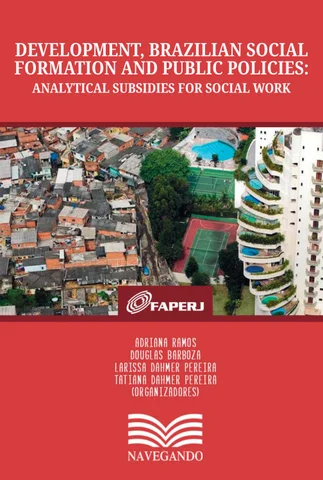
DEVELOPMENT, BRAZILIAN SOCIAL FORMATION AND PUBLIC POLICIES: ANALYTICAL SUBSIDIES FOR SOCIAL WORK
DEVELOPMENT, BRAZILIAN SOCIAL FORMATION AND PUBLIC POLICIES: ANALYTICAL SUBSIDIES FOR SOCIAL WORK
Adriana Ramos Douglas Barboza Larissa Dahmer Pereira Tatiana Dahmer Pereira Organizers
DEVELOPMENT, BRAZILIAN SOCIAL FORMATION AND PUBLIC POLICIES: ANALYTICAL SUBSIDIES FOR SOCIAL WORK First Edition
Uberlândia / Minas Gerais Navegando Publicações 2019
Navegando Publicações
www.editoranavegando.com editoranavegando@gmail.com Uberlândia – MG, Brasil
Copyright © by autor, 2019.
D4893 – Ramos, Adriana et al. (Organizers) Development, brazilian social formation and public policies: analytical subsidies for social work. Uberlândia: Navegando Publicações, 2019.
ISBN: 978-65-81417-10-9 10.29388/978-65-81417-10-9-0 1. Social Work. 2. Public Policies. II. Navegando Publicações. Title. CDD – 360 CDU – 36 Cover Page: Paulo Bonatti Diagram: Lurdes Lucena Photo: Paraisópolis, Brasil, 2004 Photographer: Tuca Vieira
Índice para catálogo sistemático Social Work 360
Navegando Publicações
www.editoranavegando.com editoranavegando@gmail.com Uberlândia – MG Brasil
Publishers Carlos Lucena – UFU, Brasil José Claudinei Lombardi – Unicamp, Brasil José Carlos de Souza Araújo – Uniube/UFU, Brasil
Editorial Board Multidisciplinary
National Researchers
International Researchers
Afrânio Mendes Catani – USP – Brasil Anselmo Alencar Colares – UFOPA – Brasil Carlos Lucena – UFU – Brasil Carlos Henrique de Carvalho – UFU, Brasil Cílson César Fagiani – Uniube – Brasil Dermeval Saviani – Unicamp – Brasil Elmiro Santos Resende – UFU – Brasil Fabiane Santana Previtali – UFU, Brasil Gilberto Luiz Alves – UFMS – Brasil Inez Stampa – PUCRJ – Brasil João dos Reis Silva Júnior – UFSCar – Brasil José Carlos de Souza Araújo – Uniube/UFU – Brasil José Claudinei Lombardi – Unicamp – Brasil José Luis Sanfelice – Unicamp – Brasil Larissa Dahmer Pereira – UFF – Brasil Lívia Diana Rocha Magalhães – UESB – Brasil Mara Regina Martins Jacomeli – Unicamp, Brasil Maria J. A. Rosário – UFPA – Brasil Newton Antonio Paciulli Bryan – Unicamp, Brasil Paulino José Orso – Unioeste – Brasil Ricardo Antunes – Unicamp, Brasil Robson Luiz de França – UFU, Brasil Tatiana Dahmer Pereira – UFF - Brasil Valdemar Sguissardi – UFSCar – (Apos.) – Brasil Valéria Forti – UERJ – Brasil Yolanda Guerra – UFRJ – Brasil
Alberto L. Bialakowsky – Universidad de Buenos Aires – Argentina. Alcina Maria de Castro Martins – (I.S.M.T.), Coimbra – Portugal Alexander Steffanell – Lee University – EUA Ángela A. Fernández – Univ. Aut. de St. Domingo – Rep. Dominicana Antonino Vidal Ortega – Pont. Un. Cat. M. y Me –, Rep. Dominicana Carolina Crisorio – Universidad de Buenos Aires – Argentina Christian Cwik – Un. of the W. I., St.Augustine – Trinidad & Tobago Christian Hausser – Universidad de Talca – Chile Daniel Schugurensky – Arizona State University – EUA Elizet Payne Iglesias – Universidad de Costa Rica – Costa Rica Elsa Capron – Université de Nimés / Univ. de la Reunión – France Elvira Aballi Morell – Vanderbilt University – EUA. Fernando Camacho Padilla – Univ. Autónoma de Madrid – Espanha Francisco Javier Maza Avila – Universidad de Cartagena – Colômbia Hernán Venegas Delgado – Univ. Autónoma de Coahuila – México Iside Gjergji – Universidade de Coimbra – Portugal Iván Sánchez – Universidad del Magdalena –Colômbia Johanna von Grafenstein, Instituto Mora – México Lionel Muñoz Paz, Universidad Central de Venezuela – Venezuela Jorge Enrique Elías-Caro – Universidad del Magdalena – Colômbia José Jesus Borjón Nieto – El Colégio de Vera Cruz – México José Luis de los Reyes – Universidad Autónoma de Madrid – Espanha Juan Marchena Fernandez – Universidad Pablo de Olavide – Espanha Juan Paz y Miño Cepeda, Pont. Univ. Católica del Ecuador – Equador Michael Zeuske – Universität Zu Köln – Alemanha Miguel Perez – Universidade Nova Lisboa – Portugal Raul Roman Romero – Univ. Nacional de Colombia – Colômbia Ronny Viales Hurtado – Universidad de Costa Rica – Costa Rica Rosana de Matos Silveira Santos – Universidad de Granada – Espanha Rosario Marquez Macias, Universidad de Huelva – Espanha Sérgio Guerra Vilaboy – Universidad de la Habana – Cuba Silvia Mancini – Université de Lausanne – Suíça Teresa Medina – Universidade do Minho – Portugal Tristan MacCoaw – Universit of London – Inglaterra Victor-Jacinto Flecha – Univ. Cat. N. Señora de la Asunción – Paraguai Yoel Cordoví Núñes – Instituto de História de Cuba v Cuba
This book was funded by FAPERJ and is freely available to the public on the Navegando Publishing website.
SUMMARY Preamble
1
Marilda Villela Iamamoto
Presentation
5
Part I – Capitalist Development and Brazilian Social Formation
9
Adriana Ramos – Douglas Barboza – Larissa Dahmer Pereira – Tatiana Dahmer Pereira
Chapter I
11
Brazilian dependent capitalism: social setbacks and the advance of reactionary conservatism in times of capital crisis Ana Cristina Oliveira – Gisele Souza – Marcela Soares
Chapter II
25
Chapter III
43
About humans and dismissal of humanities, from construction of the hate to the difference in peripheral modernity Marcia Brasil – Denilson Oliveira– Guilherme Almeida – Silvia Carvalho – Tatiana Dahmer. Urban issue– territory and right to the city Eblin Farage – Francine Helfreich – Isabel Cardoso
Chapter IV
59
Part II – Public Policies– Higher Education and Formation in Social
77
The agrarian issue in the Brazilian social formation: contemporary challenges of the Agrarian Reform Douglas Ribeiro Barboza – Jacqueline Aline Botelho Lima Barboza – Maria das Graças O. P. Lustosa – Raquel Santos Sant’Ana Service
Chapter V
79
Chapter VI
97
Capitalist particularity and public university in times of neoliberal counter–revolution Simone Silva – Lalo W. Minto– Katia Lima Dependent capitalism– Brazilian social formation and lowered educational standard: allowances for a reflection on the training of Brazilian social workers Andréa Araujo do Vale – Fabíola Bouth Grello Kato – Larissa Dahmer Pereira
Part III – Public Policies and Professional Work
113
Chapter VII
115
The ideological–political theoretical debate of the contemporary Social Work: critical approaches Adrianyce A. Silva de Sousa – Ivy Ana de Carvalho – Morena Marques
Chapter VIII
133
Chapter IX
147
Study Center of Fundamentals of Social Work: a proposal of studies about the work of the social worker in the health policy Adriana Ramos – Luciana Gonçalves Advance of the conservatism, regressiveness– and attacks to the National Mental Health– Alcohol, and Drug Policy Rachel Gouveia Passos – Tathiana Meyre da Silva Gomes
Chapter X
159
About the authors
179
Human rights, childhood and youth and Social Work in Rio de Janeiro Rodrigo Lima – Fábio Simas – Fabiana Schimdt
PREAMBLE* This book reflects the academic production of professors of the Postgraduate Program in Social Work and Regional Development of the Fluminense Federal University, in a collective work with researchers from other Brazilian public universities (UERJ, UFRJ, UniRIO, UFRRJ, UNESP and UFPA). It is organized in three parts, namely: I. Capitalist development and Brazilian social formation; II. Public policies, higher education and training in Social Work; and III. Public policies and professional work. Preamble the collection “Development, Brazilian social formation and public policies: analytical subsidies for Social Work�, organized by Adriana Ramos, Douglas Barbosa, Larissa Dahmer Pereira and Tatiana Dahmer Pereira, it is certainly a privilege. It is a privilege to know, firsthand, the result of research gathered around the particularities of capitalist development in the Brazilian social formation and the debate on Social Work, public policies and university education. These are dense essays of historicity, performed with competence, keen criticism and unpublished, which bring to the public scene the serious and enriching scientific work that has been developed in the Brazilian University. In these times of obscurantism and profoundly conservative regression of civilizing achievements, this book bears witness to the defense of human rights, social rights, and the free public university, of autonomous quality and focused on the interests of the majority of Brazilians. This collection thus challenges current government policies for higher education, science and technology that drive the commodification of the public university, compromising the exercise of its primary functions of teaching, research and extension. Budgetary pressures and constraints foreshadow another business-driven university project, driven by the pursuit of profitability, which subordinates commitment to the public interest and national dilemmas in a peripheral and dependent country to world hegemonic centers. This collective production of teachers in Social Work condenses themes that are representative of the research agenda of this profession and area of knowledge today. There is a fine tuning of the Brazilian Social Work with great dilemmas that cross society and the government in the country, which allows us to affirm that Social Work is immersed in the reality of its time: in the relations between social classes in their inequalities, differences and contradictions in a capitalist and peripheral country; and its implications for individual and collective subjects, giving visibility to their needs and struggles. The emphasis on the history of society enriches the analysis undertaken here, as a fundamental resource to elucidate its dynamics and tendencies present in it. The theoretical orientation that informs the analysis "questions the real and the thought, both the points of view of groups and classes understood in the research and the elaborate interpretations about them", as Ianni *DOI
– 10.29388/978-65-81417-10-9-0-f.1-4
_____ 1
states1 in the tracks of Florestan Fernandes's work (IANNI, 1968 p. 16). Subjecting the real and the thought to critical reflection “allows us to unveil diversity, inequality and antagonism as core moments of relations, processes and structures of political domination and economic appropriation” (idem, p. 17). This analytical perspective also allows us to situate Social Work in the social division of labor within the framework of relations between the Government and class society by taking the historical totality as a unit of the diverse. The elaborations of this collection contemplate the historical particularities of the bourgeois revolution in Brazil 2, distinct from the classic European cases. Here it is marked by the agro-export and slave-colonial colonial past, founded on the great territorial property, which attributes particularities to the formation of social classes in Brazil. It is a bourgeois revolution accompanied by frequent outbreaks of counter-revolution, with strong limits to democratic achievements, especially with regard to the universe of workers and subordinate segments. A restricted democracy conforms: from the democracy of the oligarchs to the democracy of big capital, according to Fernandes (Op. Cit). The bourgeois domination radiates heteronomously - “from the outside” - with an associated and dependent bourgeoisie - and “from the top down” with government self-protection mechanisms in the name of abourgeois autocracy, excluding workers from the circuit of influence of power, deepening internal inequalities between regions, classes, races, ethnicities, gender and generations. This historical formation reverberates in the “social question”, as a historical condensation of inequalities and struggles in the various moments of the historical formation whose fundamental landmark is the urban-industrial development and the process of constitution of the working class. The multiple expressions of the “social question” that emerge in the early decades of the twentieth century are at the root of the constitution and development of Social Work as a profession. They are mediated by the responses triggered by the Catholic Church, the Government, and their public policies - with the privilege of social policies -; and by the collective demands of urban and rural worker segments expressed in defense of their collective needs and interests, expressed through forms of organization, struggles and social movements in the public scene. The Social Work asserts itself as a profession in the social and technical division of labor, having as its "matter" of its performance the expressions of the "social question" as lived by the individual and collective subjects, being public policies one of the fundamental mediations of this activity professional. Social policies as proposals and actions of government are not confused with the profession. The Social Work, as a profession, preserves its intellectual and practical-professional autonomy before them, even if the social worker is a salaried worker in this field. It operates the formulation, implementation, evaluation and financing of public policies, dimensions of competencies and duties of the social worker, whose main employers are the government (at different levels of the federation), non-profit civil organizations and business bodies. Brazilian social workers, four decades ago, collectively constituted a 1 2
IANNI, O. (Org.) Florestan Fernandes. Sociologia. São Paulo: Ed. Ática, 1986. FERNANDES, F, A revolução Burguesa no Brasil. 2 ed. São Paulo: Zahar Ed., 1976.
_____ 2
professional ethical-political project, founded on the highest values of freedom, equality, democracy, human and social rights with a privileged option for the interests of the working group. Such ethical principles, inseparable from the “great politics� in Gramscian terms, imprint the work of Brazilian social workers and reverberate in the academic, technical and political requirements of their conduct, involving the zeal for the quality of the services provided and the identification with the interests of the subordinate classes. These times of counter-reform, universal commodification, the cult of individualism, and the undeniable advance of conservatism are also times of encouragement to violence, the practices of extermination of poor, black youth, with serious violations of social and human rights. These violations affect urban and rural workers struggling for land, work, housing and the right to the city; indigenous nations in preserving their people and their traditions; of the African descendants fighting against the historical marks of the slave heritage, for the preservation of their roots and rights; children and adolescents from poor families in urban peripheries; women in the fight against femicide, oppression, harassment and the legalization of abortion; LGBTTQis for respect for differences and recognition of their humanity, among many other social segments. Such violations are the subject of analysis and serious denunciations in this collection. Critical considerations about the Public University in times of neoliberal counter-revolution are the subject of attention, which unfolds in the problematization of higher education and, in particular, of the academic-professional formation in Social Work, providing an elucidative framework of it. It highlights the expansion profile of this area of education in Brazil, with a significant incidence of distance learning structured in business capitalist, at the undergraduate level, with deleterious repercussions in a lowered educational pattern. The work of social workers in the context of public policies today is the subject of questions and provocations to the debate highlighting two trends present in the universe of the profession in Brazil: the "reformist socialist" and the "neoconservative". In the context of the foundations of Social Work, the trajectory of a research group on the subject is socialized, with emphasis on Social Work in the area of public health. The debate extends to the national mental health policy and the implications of the conservative and ultra-liberal project on psychiatric reform and antimanicomial struggle. The work ends with the work of the social worker in relation to the human rights of children and adolescents, based on the issue of the infraction in Brazil. I invite the readers to enjoy the pleasure of reading this book: a journey that contemplates dilemmas of the Brazilian society and emerging concerns in contemporary Social Work.
_____ 3
Finally, I thank the invitation to preface this collection and express my congratulations to the authors for their invaluable contribution. Juiz de Fora (MG), October 08, 2019 Dra. Marilda Villela Iamamoto Retired Full Professor of UFRJ and UERJ. Visiting Scholar of UFJF Researcher of CNPQ
_____ 4
PRESENTATION* Adriana Ramos Douglas Barboza Larissa Dahmer Pereira Tatiana Dahmer Pereira The work that we present to the reader results from a collective effort of teachers from Postgraduate Program in Social Work and Regional Development [Programa de Pós-Graduação em Serviço Social e Desenvolvimento Regional PPGSSDR], from Federal Fluminense University [Universidade Federal Fluminense - UFF], to present a partial overview of what we have been producing under the Program together with researchers from others Post-graduation Programs. Although is a Program relatively recent, created in 20, the different re search and extension centers linked to it have been seeking articulation with other centers, aiming at the strengthening of the research in the Social Work field, and a greater interdisciplinary interlocution with researchers. Therefore, the present collection expresses such articulation, once all chapters were written by several institutional hands, with participation of researchers from, besides UFF, more eight de Educational Institutions with highlighted work in research in Social Work: UERJ, UFRJ, UniRIO, UFRRJ, UFJF, UNICAMP, UNESP, UFPA. Organized as a thematic collection, its analytical axes correspond to what we approach in the formation of Masters from two great lines from PPGSSDR: “Capitalist Development and Brazilian Social Formation” and “Social Work, Public Policies and Professional Training”. It is worth mentioning that the two lines are dialectically articulated, being a priority from Program the training of Masters in Social Work and Regional Development with solid knowledge on Brazilian social formation. We understand the need to do a review to the concept of “development” in the capitalism and related to the his torical relationship of the State with the social classes, facing the “social issue” by first front to the conflict between capital and work, through the predominant use of the force and the authoritarianism in the Brazilian history, especially considering the position of the country while a dependent capitalist country and with colonialist and slavocratic background. From a critical reading about the capitalist development and the Brazilian social formation, seeks to problematize face to the future Masters the limits and possibilities of public policies and their implications on formation and the work of the Brazilian Social Workers. In coherence with the Program lines, we organize the present collection in three parts. In the first part, titled “Capitalist Development and Brazilian Social Formation”, we have four chapters. The first, called “Brazilian dependent capitalism: social setbacks and the advance of reactionary conservatism in times *DOI
– 10.29388/978-65-81417-10-9-0-f.5-8
_____ 5
of capital crisis”, whose authors are the researchers Ana Cristina Oliveira (UFF), Marcela Soares (UFF) and Gisele Souza (UniRio), discusses the reactionary conservatism in the current days, analyzing its intrinsic relationship with the country's position as a dependent capitalism country. Initially, the authors bring an important discussion about the Brazilian particularities through the interlocution with Brazilian thinkers, like Florestan Fernandes and Ruy Mauro Marini. In a second moment, they analyze the impacts of the capital crisis, the counter-reforms that hit the public fund and the working conditions and, lastly, they point the legitimation and rise of the reactionary conservatism. The second chapter, written by five researchers - Denilson Oliveira (UERJ); Guilherme Almeida (UFRJ); Marcia Brasil Santos (UERJ); Silvia de Sousa Carvalho (UFRJ) and Tatiana Dahmer Pereira (UFF) – does an important reflection about the current national context, marked by hate speeches, breaches and practices of extermination against black people, indigenous, LGBTTQis and women. The chapter titled “About humans and dismissal of humanities- from construction of the hate to the difference in peripheral modernity” analyzes the deepening of the capitalist crisis and its destructive potential, especially aimed at those who do not fit to the “universal” normative standard, considering the specificities of the Brazilian social formation. The third chapter - “Urban issue, territory and right to the city” -, from researchers Eblin Farage (UFF), Francine Helfreich (UFF) and Isabel Cardoso (UERJ), analyzes, based on a critical apprehension of the Brazilian social formation, the urban issue from determinations of the use of the urban land, the formation of the pauperized territories, especially the favelas and, lastly, discusses the challenges of the professional formation and the political ethical project of the Social Work. Finishing the first part of the collection, we have the fourth chapter, “The agrarian issue in the Brazilian social formation: contemporary challenges of the Agrarian Reform”, from Douglas Ribeiro Barboza (UFF), Jacqueline Aline Botelho Lima Barboza (UFF), Maria das Graças O. P. Lustosa (UFF), Raquel Santos Sant’Ana (UNESP), presents a brief history of the Agrarian Reform in Brazil, relating it with the condition of dependency of the country, the governmental violence and problematize, especially in the current historical frame, how the fight by land is umbilically linked to the right to the life. In the second part of the collection, titled “Public Policies, Higher Education and Formation in Social Service”, two papers analyze how the Brazilian particularities, while a dependent capitalist country, comply with our higher education which, on its turn, brings substantial impacts on the training of the social workers in the country. The first, “Capitalist particularity and public university in times of neoliberal counter-revolution”, from Simone Silva (UFRJ), Lalo Minto (UNICAMP) and Katia Lima (UFF), realizes brief reflections on new expressions of the dependent capitalism in Brazil of the new century, interacting with the work of Florestan Fernandes. Then, it aims to contribute for educational policies analysis, with emphasis in the higher education, conducted by federal government from 2003 to 2016. _____ 6
The second paper, Dependent capitalism, Brazilian social formation and lowered educational standard: allowances for a reflection on the training of Brazilian social workers, from Andréa Araujo do Vale (UFF), Fabíola Bouth Grello Kato (UFPA) and Larissa Dahmer Pereira (UFF), discusses about the profile of the expansion of the higher education in the country, as well as the function of the education and the formation of the complex workforce in a country whose social formation is marked by historical relationship of dependency with the central capitalist countries. Thus, based on such considerations, come to the discussion of the formation of the Brazilian social workers, presenting some data related to the growth of the Distance Learning in this course and problematizing the professional profile then formed. The third part of the collection, lastly, problematizes and approaches the work of the Social Work under certain social public policies. Titled “Public Policies and professional work”, it is composed by three chapters. The first, called “The ideological-political theoretical debate of the contemporary Social Work: critical approaches”, from researchers Adrianyce Silva de Sousa (UFF), Ivy Ana de Carvalho (UFF), and Morena Marques (UniRio) analyzes two trends present in the theoretical and ideological-political discussion of the contemporary Social Work: a reformist socialist trend and other, (neo)conservative, expressed in the empowerment as a methodology of professional intervention. For the authors, such trends only are possible of apprehension if understood at light of the analysis about particularities of the Brazilian capitalism in the 2000`s, which they seek to perform. The following chapter, from teachers Adriana Ramos (UFF) and Luciana Gonçalves Pereira de Paula (UFJF), presents the proposal of the Center both in relation to the activities performed, and the results of the research performed by them about the work of the Social Work in the Public Health, extremely necessary, considering the importance of the Health as a social right and, yet, as a significant employer field of social workers in the country. The second to last chapter, titled “Advance of the conservatism, regressiveness, and attacks to the National Mental Health, Alcohol, and Drug Policy”, written by researchers Rachel Gouveia Passos (UFRJ) and Tathiana Meyre da Silva Gomes (UFF), intends to reflect on the consequences of the capital crisis, the advance of a conservative and ultra neoliberal project in Brazil and its incidence in the Brazilian psychiatric reform and the antimanicomial fight movement. Lastly, the paper “Human rights from children and teenagers: an issue of the breach in Brazil”, from teachers Rodrigo Lima (UFF), Fábio do Nascimento Simas (UFF) and Fabiana Schmidt (UFRRJ), problematizes the treatment given to poor teenagers in Brazil with focus on thematic of the socio-educational system almost three decades after the approval of the Child and Adolescent Statute. They note deep breaches of human rights from more different natures, what holds connections with the historical legacy dismissed to this public marked by authoritarianism and violence of the government and the dominant classes. _____ 7
We thank to everyone involved and, especially, to the Rio de Janeiro State Research Support Foundation [Fundação de Amparo à Pesquisa do Estado do Rio de Janeiro - FAPERJ], which made resources available for publishing of the work. We hope that the present work will contribute to the strengthening of research in the area and a greater interlocution with other researchers, strengthening the research field on Brazilian social formation, public policies, professional training and work, especially in such dark times and that require of all critical reading of the reality, collective work and courage.
_____ 8
PART I Capitalist Development and Brazilian Social Formation
_____ 9
Chapter I
Brazilian dependent capitalism: social setbacks and the advance of reactionary conservatism in times of capital crisis* Ana Cristina Oliveira (UFF) Giselle Souza (UNIRIO) Marcela Soares (UFF)
Introduction This chapter aims to present some elements of the dependent capitalism and is divided in two analysis axes: the first with the discussion about the Brazilian particularities, through the interlocution with Brazilian thinkers, like Florestan Fernandes and Ruy Mauro Marini. We discuss some elements founders of the dependent capitalism, from apprehension of the dynamic of the international division of the work and, consequently, of the unequal development of the capitalism. The second axis points the impact of the capital crisis in the life of the working class through the counter-reform reaching the public fund and the work conditions. Yet in this second axis, we point the legitimation and the rise of the reactionary conservatism1 founded in the classic conservative thinking articulated with the postmodern thinking. This paper intends to start a reflection about the disputes for hegemony full of obscurantism, disarticulation and concealment of the reality. On its turn, it should be noted that the aggravation of the social inequality and the widening of overwork, as signaled Marx, are characteristics inherent of the way of capitalist production with particular expressions for Brazilian reality. The particular condition of the Brazilian dependency never allowed a hegemonic standard of the rights of work, and, today, we have a widening of the work with no rights, which has led to the illness and/or suffering of the working class. A long counter-revolutionary period2, which added to an un*DOI
– 10.29388/978-65-81417-10-9-0-f.11-24 The term “reactionary conservatism” may seem a contradiction, since they would be like two different movements in bourgeois social thought. However, the modern conservatism presents in some of their strands as a reaction to the Enlightenment and the French Revolution, but with the defense of maintenance of several elements of the bourgeois society. For more clarifications, see Netto (2011). 2 The Brazilian scenario since the civil-military dictatorship sets up in a period of “counter-revolution”, “because it was not really a ‘self-defense of the democracy against the international communism’. [...] What was sought to prevent was the transition from a restrict democracy for a broader participation democracy, which promised not to be a ‘populist democracy’ or a ‘mass democracy’ (as many people proclaim), but that threatened the beginning of the consolidation of a bourgeois democratic regime, in which several sectors of the working classes (and even of the more or less marginalized popular masses, in the countryside and in the city) had an own growing political space. Set a whereabouts to this process and reverse it, eliminating such political space of direct or indirect participation of the working classes and the popular masses, would say not only brake 1
____ 11
precedented counter-reformism, tears the life and work conditions of the workers The labor counter-reform brought huge setbacks and brings the working conditions closer to the concept of “21st century slavery” (ANTUNES, 2018). Contrary to what was postulated by its defenders, this counter-reform has exacerbated the possibilities of the precariousness and deregulation of the working conditions of about 36 million of workers,3 and does not generate more jobs. According to IBGE, in the first quarter of 2019, the unemployment reached 13.4 million people (12.7%), besides the 6.8 million people who worked less hours than they could and the 4.8 million who gave up looking for a job, the discouraged unemployment. In Brazil, 28.3 million people are ranked by IBGE as underused, but President Jair Bolsonaro prefers to state that there is a methodological error4 from traditional federal institute of research, and that, indeed, the unemployment reduced. In the wake of the fake news, resurrects forcefully the old and fallacious argument of the “rhombus” of the social-security and the supposed privilege of the workers who are beneficiary of the INSS (National Social Security Institute), legitimizing the urgent goal of the current government, which corroborates with the interests of the local and external bourgeoisies, which is the counter-reform of the social-security. So, based on Marxist tradition and on Marxist Theory of Dependence (MTD), we aim at learn some of the processes that are managed in the present historical time of the capital and its expressions in our social formation. We analyze since the central elements that set up the condition of the dependency in our social formation; in the same way, the contemporary elements, especially the public debt - central mechanism of expropriation of the public fund - and its functionality for maintenance of the dependency face to the financialized capitalism. In the setting political and economical setting, we have the assumption that the deepening of the negative effects, for workers, of our peripheral and dependent insertion has support and legitimation in the reactionary conservative thinking.
Conceptual elements of the Brazilian dependent capitalism The insertion of Latin America in the capitalist dynamic expresses itself in a dependent way. By learning the unequal development of the capitalism and the determinants of the concreteness of the countries, while particular social formations in the international division of labor, the peripheral and dependent condition of Brazil becomes intelligible. the revolution inside the order’, but also restore a status quo ante, in whiche the called ‘democratic franchises’ only would have effectiveness for possessing classes and their political elites” (FER NANDES, 2011, p.157-158). 3 According to Pnad Contínua (IBGE - 1st quarter of 2019), there are 36 million hired workers among private, public and domestic sectors. 4 See the news: <https://www.redebrasilatual.com.br/economia/2019/04/bolsonaro-descobriuo-responsavel-pelo-desemprego-elevado-o-ibge : Access in April 30, 2019.
____ 12
The Brazilian peripheral and dependent condition allowed, and yet allows the existence of a productive process that seems a consolidation of different historical temporalities, in which the supposedly obsolete aspects are not a “failure” in the way of capitalist production or product of the “inability” of the local bourgeoisies, but set up in the formation of a standard of accumulation anchored in the “shared over-appropriation of the economic surplus” (FERNANDES, 2009, p.62). The capitalist modernization established with the external domain avoided the independent development and the national integration, consequently with no real autonomy. However, that does not mean that the internal social sectors do not benefit of this situation because dependency and underdevelopment are profitable both for external domain as for internal (Idem, p. 3). For Florestan Fernandes (2009), the essence of the Latin-American underdevelopment is the capitalist over-appropriation and the dependency. The work relationships of colonial origin were crucial for an outbreak of modern capitalist market, and, on its turn, the insertion in the world market and the scheme of production-export-import. When the commercial revolution accelerated the internal modernization, the typical work relationships of colonial origin have become an obstacle to the internal market expansion, requiring the commercialisation of the workforce. So, for Fernandes (2009, p.66), the precapitalist work relationships remained only in the places where the national economy redefined “[...] its neocolonial condition from inside, although the standard of shared accumulation of the economic surplus impose, in an universal way, a strong relative depression in the compensation for work (involve, therefore, the combination of the paid work with precapitalist compensations)”. For the author, when started the industrialization, only the economic sectors and regions with greater vitality were able to adjust and normalize the work relationships to the capitalist standards of commercialisation of the workforce. Other economic sectors “[...] that, by lack of vitality, convert in the internal focus of dependency and underdevelopment”. And “suffer from inside what was described above, like over-spoliation and over-appropriation, through internal or external economic agents” (FERNANDES, 2009, p. 67, emphasis ours). The over-appropriation ensures the sharing of the surplus with the dominant external bourgeoisies and the over privileges of the internal dominant classes. Indeed, the dependent capitalist economy is subject, as a whole, to a permanent depletion of its wealth (existing or potentially accumulable), which exclude the monopolization of the economic surplus by its privileged agents. Actually, however, the depletion of wealth takes place at the expense of the paid sectors and removed from population, submitted to permanent mechanisms of capitalist over-appropriation and over expropriation (FERNANDES, 2009). Related to this condition of the unequal development between the countries and the dependent condition of the Latin America, Ruy Mauro Marini highlights that the mechanism used by Latin American bourgeoisies to ____ 13
compensate their loss of profit in this relationship with the external and imperialist bourgeoisies is the overexploitation of the workforce. The main discovery of the Marxist Theory of Dependence (MTD) was to show that the antagonism capital-work and the contradictions between production and appropriation of wealth, between production and consumption and between production and circulation are fierce in our Latin-American countries. This occurs in the context of the capitalist world economy and its unequal development relations. Its principle is that the systematic and structural trends - the transfers of value - express relationships of unequal exchange and the overexploitation of the workforce related to the divorce between the productive structure and the mass needs. With these formulations, MTD helps to unveil the meaning of redoubled exploration and the threats to the sovereignty (both from the point of view of the national sovereignty, as from popular sovereignty), as in our country subsumed to the imperialist relationships, which take roots in our social formation. Among the original categories of MTD, Mathias Luce (2018) highlights: the overexploitation of the workforce; the transfer or value; the spin-off in the capital cycle; the pattern of capital reproduction; the dependency and the sub-imperialism. The main sources of MTD are Marx's theory of value, the imperialism theory, the discussion about the differentiation of the economic and social formation, and the unequal development in Lenin5. In this view, the mark of the development grounds in the colonial past and the insertion subordinated of the former colony in the international division of the work and by qualitative transformations that this suffered with the emergence of imperialism as monopolist stage of the capitalist development. This would not mean lack of capitalism, but the formation of a dependent capitalism. Therefore, the architectural formation of the dependency and the imperialism consider the region in the development capitalist in a world scale, in their internal and external determinations. The deepening of the capitalist relationships in Europe in the XVIII and XIX centuries had an important flow of food and raw materials, sold below their value from Latin America. So, the essential factor for lowering of the workforce value and for the predominance of extraction of surplus value from European workers were set. Highlighted, Mathias Luce (20) draws attention that the dependency, like all category in Marxism, is the synthesis of multiple determinations. The dependent capitalism would be marked by three elements, all interlinked and in constant reconfiguration in their mutual interaction: a) by transfer of value to the central economies; b) by overexploitation of the workforce; c) by sharpening of the contradictions inherent to the capital cycle, once the determinant of accumulation in the dependent economies produce, in general, goods intended to the export and to the elites (LUCE, 2018). The category overexploitation of the workforce is crucial to explain the “[...] 5
About the discussion of the similarities and the discussion with the thesis of the unequal and combined development, see in TheotĂ´nio dos Santos (1978 and 1991, apud MARTINS, 2009).
____ 14
unequal economic relationships between the producers supported by high technology and the economies specialized in secondary activities”, which finds the ground of the unequal relationships in the world economy (MARINI, 2000, p. 22-23). For Marini, the accumulation process has as main role the export and the high consumption (SADER, 2009). The author realizes the distinct ways by which different nations and regions insert in the capitalist accumulation process in a world scale. Alongside the macroeconomic gains from exploration of workforce, the working classes experience, increasingly, the intensification of the work processes, occupational accidents, turnover of their workforce and jobs with lowered compensation. Elements that, before denying, reinforce the presence of the overexploitation of the workforce. The particulars determinants of the dependent and peripheral capitalism remain and are deepened by neoliberal politics. Although occurs the widening of the productivity of the work and the relative surplus value, the overexploitation of the workforce develops and reproduces, which means the compensation of the workforce below its value through mechanisms used by Government and/or by capital, being the structural base of the cycle of the capital in the dependent economies. The real base on which it develops are the links that connect Latin American economy with world capitalist economy. Born to meet to the requirements of the capitalist circulation, whose axis of articulation is appointed by industrial countries, and, therefore, focused on world market; the Latin American production does not depend of its internal capacity of consumption for its realization. So, operates since the point of view of the dependent country, the separation of the two essential moments of the capital cycle - the production and the circulation of goods -, whose effect is to do that appears in a specific way in the Latin American economy the contradiction inherent to the capitalist production in general, i.e., oposes the capital to the worker while seller and buyer of goods (MARINI, 2011, p. 155). Here we have the essence of the pattern of accumulation of capital typical of the unequal relationship between the hegemonic external and the internal dependent bourgeoisies, in which the production of the latter is subordinates to the first. In this regard, it is required an overexploitation of working class of the periphery. The way of production capitalist, in the capital cycle in the dependent economies, to ensure the maximum exploration of the workforce, enables means to increases to work hours, the intensity and the productivity of the paper, but also expropriates part of the consumption fund of the workers, to make it an additional source of capital that is added to the accumulation fund. In the countries of dependent capitalism “[...] it was imposed a reality marked by specific trend laws - like the transfer of value as unequal exchange, the spin-off in the stages of the capital cycle and the overexploitation of working class, which crystallized while systematic and structural characteristics” (LUCE, 20, p.162, emphasis of the author). MTD defines the overexploitation of working class as a mechanism of setoff, which is triggered by peripheral capitalists aiming to replace the loss of ____ 15
surpluses suffered due its subordinated integration in the international division of the work. The peripheral countries, including those who experienced an industrialization process, are submitted to unequal relationships in the international plan. Thereby, they tend to make structural mechanisms to transfer values between the periphery and the center. The materialization of this mechanism can operate under four main ways of overexploitation of the workforce with the (i) increase of the intensity of work; (ii) the extension of the working hours; (iii) the appropriation, by capitalist, of part of the consumption fund of the worker, i.e., the reduction of the compensations; and (iv) the widening of the value of the workforce without the compensations follow this rise (AMARAL, 2014). In this course, there is a wear of the workforce that is not replaced, causing a premature wear. The meaning, in this process, is, including, the possibility to consume the strictly necessary to safeguard your workforce in a normal status. With some similarities to MTD of apprehension of the dependent capitalism, Florestan Fernandes states that there was in the Latin American social formation the articulation of the “modernization of the archaic” with the “archaization of the modern”, allowing the permanent mechanisms of over-appropriation and over expropriation capitalist, which reaches the industrial stage in large scale and the export of industrialized products. However, the innovation is embedded in a socioeconomic reality that has not changed or that only superficially changed, once the material and moral degradation of work persists and with them, the despotism of human relations, the privilege of the possessing classes, the income overconcentration, the social and power prestige, the controlled modernization from outside, dependent economic growth, etc (FERNANDES, 2009, -). The destructive consequences of this peripheral and dependent integration deepen according to the particularities of each country, articulated to the social need of the capital and to the geopolitical conditions of these countries. The current political driving of the government express the history of our social formation, subordinated to the imperialist driving of the central countries, with a political culture of suppression of dissent by repression or enchantment. Since 1970, we experience a very deep bourgeois counter-revolution. And we reached to the more destructive period of the capitalism history, in which the neoliberal barbarism has been promoting the dismantle and privatization of everything possible. (ANTUNES, 2017). It was in the 1990`s that occurred the development of the neoliberal macroeconomic policy in Brazil, with the widening of the internationalization of the economy and, consequently, the privatization of the Government productive sector (steel industry, telecommunications, electric power, banks, among others) and with the expansion of the commodities market, resuming the agroexport boost. In the course of “[...] a powerful bourgeois counter-revolution, whose first objective was destroyed all organization of the working class, the socialist and anti-capitalist movement”. (ANTUNES, 2017, p. 257, emphasis from author). ____ 16
The ideological-political apparatus of the neoliberalism ensured the transformation of the productive processes, as well as the work relationships, with the increase of the informality, the precariousness and the outsourcing, reducing the ways to contract the workforce with a guarantee of labor rights and expanding the temporary and/or intermittent contracts. All this broad and long attack to the working class resulted in the increase and incentive to the self-employment (entrepreneurship) and to the voluntary work, the weakening of the unions, and the increase of the breaches of the human rights, as in the case of the “contemporary slave labor� 6. In the current mark of exacerbation and defense of neoliberal politics and the reactionary conservative thinking, it is encouraged the censorship and persecutions in education as strategies of attack of the reactionary movements to freedom of education and to the pluralism of pedagogical conceptions, provided in the Constitution. Added to this, there is the cut of the public transfers for institutions of higher education, federal public schools and federal public institutes. The neoliberal dismantle promoted by the last Brazilian governments was increased during the period of the coup government of Temer (with the impeachment) of the President Dilma, in 2016) and in the current government, which presents a media centrality with emphasis in the social networks, disseminating fake news. Precisely to ensure eligibility and popular acceptance, it uses these current devices to express negatively the social struggles and all that is public, reinforcing the defense of the counter-reforms. That occurs to the detriment of the interests of the working class and with a reactionary speech in all aspects of the social life, coherent with the autocratic profile of the Brazilian bourgeoisie. This government meets to the interests of the local and external bourgeoisies, enabling the best conditions to the financial capital with the suction of the fund public of the surplus value socially produced.
The dependent condition in the contemporary capitalism and the ways consolidated by reactionary conservative thinking The analysis of the peripheral and dependent condition brings the fundamental bases for understanding the dynamic of organization of bourgeois organization in Brazil in a context of capital crisis. Now, we will address the role of the Government in the guarantee of the general conditions of accumulation and in the containment of the immediate effects of the crisis through fiscal adjustments in these countries. If in general terms the role of the Government in the contemporary capitalism is to provide to the capital optimal valuation conditions, to dampen the effects of the crisis - do it through resources of the public fund - today, this Government has in the expropriations the leverage for profitability of the capital face the overaccumulation and its obstacles. The public fund has been an essential instrument in the development 6
From 1995 to December 2018, more than 53 thousand people were rescued from conditions analogous to slavery throughout Brazil. See more detailed data in: <https://observatorioescravo.mpt.mp.br/> Access in April 2019.
____ 17
of the capitalist production relationships. Therefore, its indispensability to the capital is from structural nature. However, it is with the monopolist capitalism that we understand that the public fund gains greater centrality and begins to attend more systematically to the general conditions of production, a structural and irreplaceable component to the capital. According to Oliveira (1997, p. 21.), “[...] the contemporary public financing became broad, stable and marked by rules ensured by main social and political groups”. The public fund sets up by resources both from overwork, which means from surplus value from exploitation of the work of others, as from necessary work, via taxation, which, in Brazilian context, is regressive and burdens the working class - for MTD would be one of the current mechanisms of the overexploitation of the workforce. The strategies to raise these resources by the most fetishized form of the capital in the current days has been, among others, the dismantling of the historically constituted social rights and the perverse financialization of the Social Security, which has one of its main counter-reform instruments in the budget. They are drained from public fund, which means that great part of the re sources from working class, great amounts for compensation of the capital with interests. This is done through fictitious capital, exacerbated form of the Capital fetish interest and that has in the public debt its main way of operation. The public indebtedness has become a manipulation and control mechanism of the Government who uses the bourgeois oligarchy, amid the correlation of forces present in the contemporary scenario which is more favorable to the attention of the interests of the great capital. The called hypertrophy of the financial sphere – allowed both by elimination of rules and controls as by international opening – it is noted in the disparity between the flow of capital from productive activities and the financial activities. The public debt and the domain of the financial oligarchy reinforce the peripheral and dependent condition of the Latin-American countries. In the Brazilian case, the trap of the debt reaffirms the autocratic nature of our social formation, whose essential characteristic of the bourgeoisie is to extract the biggest profitability possible via speculative and rentier activities. It presents a financial neocolonialism that is against the political and economic decisions to the dictates of the international parasites, articulated to the Brazilian bourgeoisie. The way by which the over-appropriation will occur will be the expropriation of work rights. Fontes (2010) presents the discussion of the new expropriations (added to the primary expropriations, reference to what Marx analyzed as the period of primitive accumulation) show that for the existence of the capital and its reproduction, it is necessary to permanently throw the population in critical conditions of intense and exasperated availability to the market. For the author, today, the expropriations consist in the fact that the whole population depends on mercantile relations to survive and covers almost all dimensions of the social life. The author defines these new ways of expropriations as secondary expropriations: new way of exasperation of the availability of the worker to the ____ 18
market. For Fontes (2010), the expropriations also reach the social rights, which open space for capitalist accumulation. They concern to the concentration and centralization: it addresses to raise growing resources, of salary origin, and convert them on capital, as in the case of the retirements. We could state that comes to consolidate the overexploitation of the workforce by removing from it the structuring elements of its social reproduction. In this case, it is made a double movement: threat to the retirements and incentive to the private social-security. In addition to the expropriation of rights, the author says that are also reached natural goods, like water, historical and cultural heritage, patenting of genetic codes, air quality, expropriation of the rural community and original people of the land in relation to their traditional rights, like use communal lands, customary rights, more extended family relationship and mutual help, knowledge about local plants and herbs, etc. So, we conceived that today the secondary expropriations have in the attack to the public fund its main way to act. The expropriation of rights, conquered by the working class and largely financed by it, becomes the fundamental instrument to guarantee the capital appreciation: by one side, sending resources for feeding of the capital with interests - via public debit - and, on the other side, opening space for the mercantilization of the social reproduction in its entirety. Dialoging with Oliveira and agreeing with good part of his conceptual reasoning regarding to the public fund, it is up to contextualize his analysis in the current days. The author addresses the structural nature of the public fund in the guarantee both of the capital reproduction as the workforce. He states that the indirect salary (i.e., social policies) has a fundamental role in the constitution of the abstract work in some societies and complements: “The presence of the public funds, by one side, this time, of the reproduction of the workforce and the public social expenses, is structural to the contemporary capitalism, and, until proven otherwise, irreplaceable� (OLIVEIRA, 1997, p. 23). The evidences to the contrary that, in times of crisis, to the capital no longer indispensable visibility of guarantee of the workforce reproduction conditions since the 1980`s and in Brazil, from 1990`s, with the implementation of the neoliberal measures. If it is impossible to affirm the return of the Government to its previous level, of a mere guardian of the external conditions to the production, if is clear the structural role that the public fund plays in the general process of accumulation, it is no longer possible sets up it as irreplaceable in the reproduction of the workforce. To the capital, in an attempt to resolve the barriers of overaccumulation generated and amid the crisis, the public fund will be its lifeline. Reducing its action as indirect salary and expanding its role of financier and subsidiary of its accumulation and appreciation process, especially while feeder of the capital with interests. The counter-reforms started in Brazil since the government of Fernando Henrique Cardoso, passing through the PT governments and sharpened to maximum power in the current government (fascist and liberal) are clear evidences that the public fund, in the dispute between capital and work, has been the main instrument of salvation face of the capital crisis and the reaffirmation of our dependent condition. ____ 19
In this clear counter-revolution path to implement the counter-reforms, Brazilian capitalism in crisis shows that its antinational and antisocial bourgeoisie7 brutally forwards all charges for working class. The labor counterreform approved by the coup government changed 117 articles of the Consolidation of Labor Laws. These changes strengthen and legitimize old practices of atypical hiring, besides introducing the intermittent contract and the permanent freelance. Expand and legalize the unrestricted outsourcing and the new definition of self-employment, which can enhance the phenomenon of “independent-contractors-only hiring policy” (WELLE et al., 2018). This macroeconomic policy is implemented and reinforced, in current government, under a “smoke screen” that enhances the conservative and reactionary thinking of the Brazilian dominant classes articulated to the most irrational of postmodern theories. The “enthusiasts”, like the leaderships of the Brazilian far right, approach from defense of the conservative traditional values, 8 reactionaries and from Christianity, like the valuation of the traditional bourgeois family and the creationist and earth planner theories that has been reinforcing the structural sexism and racism. Added to the rise of the authoritarianism and of a nationalism (which in the essence of the dependence is antinational) as a solution to the problems of today's world, like the immigration crisis9. Since the 2000`s, the conservative cultural broth has been updated, and cannot be understood in itself. It is the expression of something deeper that determines it, because represents the class struggle and – “not only a discussion of values” (IASI, 2015). This conservative broth lined in the present concep7
According to its condition of associated bourgeoisie and with the needs of the “[…] standard of capital accumulation imposed by capital monopolist and with the exploration of the surplus value [...]. Antisocial, with reference to the expropriation of the work, the export of the economic surplus, the intensification economic inequalities, [...] antinational, with reference to the abrupt expulsion of radical groups, the union movement and the political vanguards of the working classes for out of the political society, which deteriorated or crushed the weak political dynamics that linked the nation and the Government, as well as avoided the formation of new political dy namisms that seemed detached from the gradual consolidation of the broader participation democracy” (FERNANDES, 2011, p.161-162). 8 In this context and tradition, we live the defense of a pre-enlightenment view in the contemporary global scenario, close to the defense of the Ancien Régime (centralized and absolutist aristo cratic social and political system), established in France against the movement of the French Revolution in the 19th century mechanism. This tradition is based on classic conservatism defended by Edmund Burke, Visconde de Bonald, Joseph-Marie de Maistre, August Comte, Tocqueville and Durkheim, in the defense of the status quo and the reformism, composed of empiricist liberals, rationalist liberals to intuitive antiliberals (NETTO, 2011). The classic conservatism is present in the thinking of Robert Nisbet and Anthony Guiddens. In an attack to the Enlightenment grounded on Social Contract of Rousseau, the classic conservatives introduce two disgusting elements against the popular sovereignty: (i) the full laicization of the policy (separation between Church and Government), where none society can exist without religion (Burke, Bonald and Maistre) and; (ii) base the freedom in the autonomy of the individuals means, for Burke, spread the social unit. Therefore, lays in the conservative in an anti-modern and prolonged crusade, including in work of Durkheim. (NETTO, 2011). For more clarifications, see the work of Leila Escorsim Netto (2011). 9As was the case of Venezuelan refugees in the municipality of Pacaraima (RR), who had their goods burned by Brazilians. See the news: <https://congressoemfoco.uol.com.br/especial/noticias/moradores-de-roraima-ateiam-fogo-a-abrigo-de-venezuelanos/>Access in: 30 Apr. 2019.
____ 20
tions of the postmodern thought, advanced from 1980`s, has printed a legitimizing speech. We consider that are grounded, indeed, in the counter-reform and counter-revolutionary forces in Latin America, moving away from the proposal of the Federal Constitution of 1988 and the consolidation of the social rights and, in the context, depoliticizing the social policies. It's about repolitizing the “civil society” in the ethical and political direction for the construction of a hegemonic bourgeois culture based on a reactionary conservatism, of world expression. The social, ethics and politics direction of the materialization of the capitalist project and its measures represent a new mark of adjusts in the dynamic of the hegemony of the neoliberal project. Seeks to capture, face this current scenario, some preliminary elements of how the dominant conservatism reiterates the overexploitation of the workforce. The attack against the working class rises and brings perverse consequences for your everyday life. The breach to the human rights, like the “contemporary slave labor”, which formerly was recurring only in rural areas and in certain urban productive sectors, like construction and the textile industry. Currently, there are ways of “contemporary slave labor” in areas in which they were not usual10. The atypical, intermittent, outsourced contract, which are precarious forms of work, legalized with the work counter-reform, many times are very similar to the typifications of the forms analogous to slavery, according to the Article 149 of the Brazilian Penal Code (BPC). However, the reactionary sectors of the antisocial Brazilian bourgeoisie represented in Brazilian Congress by OBB (ox, bullet and bible) caucus, dispute the chance/removal of the typifications of the work analogous to slavery in the BPC. In this regard, we are facing a huge challenge to understand the intraclass bourgeois disputes and the battle of the ideas in the dispute by hegemony of class and their grounds in the set of their representative strategies. However, we know that the reactionary conservative thinking in Brazil strengthens in the roots of the autocratic culture of our social formation, and, on its turn, in how crystallized our dominant classes. A bourgeoisie with a profile of oligarchic mandonism and that never was the paladin of the civilization, makes increasingly clear its antisocial and antinational mark. It is in this spirit that we propose here to point out the conservative interpretations.
10
In 2017, we can mention the case of 17 (seventeen) workers in situation analogous to slavery in the case of a company that sold french fries in Rock in Rio (2017) and another case of 3 (three) people in a pastry of Copacabana, in the city of Rio de Janeiro. See the news: <https:// www.poder360.com.br/justica/lista-do-trabalho-escravo-pastelarias-e-lanchonete-do-rock-in-rioincluidas/.> Access in May 2018). In the beginning of 2019, 10 (ten) workers were rescued from a restaurant in downtown of Rio de Janeiro for an operation of Labor Prosecution Office and the Labor Regional Superintendency. See the news: <https://www1.folha.uol.com.br/mercado/ 2019/04/trabalhadores-sao-resgatados-em-condicoes-analogas-a-escravidao-em-restaurante-norj.shtml> Access in 30 Apr. 2019.
____ 21
Final Considerations The counter-revolutionary scenario expresses in the reactionary conservative thinking, which legitimates the counter-reforms of the workk and the social-security, in addition to dismantle the entire Social Security. What we brought as a debate, in these few pages, illustrates the elements present in dependent capitalism in the current historical moment of the capitalism. Thereby, we address here, to point out that the dependency analyzes developed both by Florestan Fernandes, as by Ruy Mauro Marini confirm that dependency can change the form or level, but it only will be overcome with the confrontation of the imperialist relations, that take root in our economies, requiring a project that question the capitalism in its entirety. The elements of the current tendency of economic and social policies for countries of dependent capitalism and, its version in Brazil, faces an environment that installs in a more regulative, repressive character, with restrictions of the social and ideological diversity rights, and an increase of the intolerance and an unprecedented conservatism. The socio-historical processes go from sharpening of the dependent condition of Brazilian society to the frontal attack on labor rights, way by which the working class partially receives the part of the wealth that produces by way of overexploitation. If the indirect salaries (social policies) are a way to return the wealth fruit that it produces to the working class, in crisis time, the Government seeks to reduce this quantum for the working class while extending it to capital. It does this by feeding the financial capital, form of capital that strengthens and amplifies the dependent and peripheral condition of our country. The public debt sets up as an instrument of expropriation of the resources of the paper work (by way of public fund) that reinforces the dependent condition of our society. We should learn about all tis articulated obscurantism during a long political process. This means recognize that the current barbarization of the worker lives is insignificant to our local bourgeoisie with antisocial and antinational profiles. It is clear that, hegemonically, “(...) Latin American bourgeoisies move from presidential authoritarianism to fascism” (FERNANDES, 2009, p.141).
References AMARAL, Marisa. Superexploração do trabalho. In: Ruy Mauro Marini e a Dialética da dependência. São Paulo: Expressão Popular – Escola Nacional Florestan Fernandes 2014, p.63-73. ANTUNES, Ricardo. 2017. O ano que não deveria ter existido. Entrevista com Ricardo Antunes. Instituto Humanitas Unisinos. Adital. 04/01/2018. Available in:< http://www.ihu.unisinos.br/78-noticias/574907-2017-o-ano-que-nao-deveria-ter-existido-entrevista-com-ricardo-antunes.> Acess: 05 June 2018 _________. O privilégio da servidão. São Paulo: Boitempo, 2018. ____ 22
BAMBIRRA, Vânia. O capitalismo dependente latino-americano. 2.ed. Florianópolis: Insular, 2013. CARCANHOLO, Marcelo. Dependencia, superexplotación del trabajo y crisis. Madri: Maia ediciones, 2017. FERNANDES, Florestan. Brasil: em compasso de espera - pequenos escritos políticos. Rio de Janeiro: Editora UFRJ, 2011. ____________. Capitalismo Dependente e Classes sociais na América Latina. 4ª Ed. São Paulo: Global Editora, 2009. ____________. A revolução Burguesa no Brasil - Ensaio de interpretação sociológica. 5ª Ed. São Paulo: Editora Globo, 2006. FONTES, Virgínia. O Brasil e o capital imperialismo: teoria e história. Rio de Janeiro:EPSJV, UFRJ, 2010. IASI, Mauro. De onde vem o conservadorismo? Available in: <https:// blogdaboitempo.com.br/2015/04/15/de-onde-vem-o-conservadorismo/>Access in: 15 Apr. 2017 LUCE, Mathias Seibel. A superexploração da força de trabalho no Brasil. REVISTA Soc. Bras. Economia Política, São Paulo, nº 32, p. 119-141, junho-2012, ______. Teoria Marxista da Dependência. Problemas e categorias - Uma visão histórica. São Paulo: Expressão Popular. 2018. MANDEL, Ernest. Capitalismo Tardio. São Paulo: Abril Cultural, 1982. MARINI, Ruy Mauro. Subdesenvolvimento e revolução. Florianópolis: Insular, 2013. _____. A crise do desenvolvimento. In: CASTELO, R. (org.). Encruzilhadas da América Latina no século XXI. Rio de Janeiro: Pão e Rosas, 2010. MARTINS, Carlos Eduardo. Globalização, dependência e neoliberalismo na América Latina. São Paulo: Boitempo, 2009. MARTINS, Carlos Eduardo. O pensamento social de Ruy Mauro Marini e sua atualidade: reflexões para o século XXI. Rev_Critica_Marxista. n. 32, p. 127-146, 2011,. MARX, Karl. O capital, V. I, t. 2, São Paulo: Abril Cultural, 1984. _______. O capital, V. I, t. 1, São Paulo: Abril Cultural, 1983. NETTO, Leila Escorsim. Pensamento Conservador: determinações histórico-conceituais. In: _____. O Conservadorismo Clássico: elementos de caracterização e crítica. São Paulo: Cortez, 2011, p. 35-70. OLIVEIRA, Francisco de. Os Direitos do Antivalor: a economia política da hegemonia imperfeita. Petrópolis: Editora Vozes, 1998. OSÓRIO, Jaime. Sistema mundial e formas de capitalismo. A teoria marxista da dependência revisitada. Rio de Janeiro: Revista Direito e Práxis, Vol. 7, nº13, 2016. PRADO, Fernando Correa; GOUVEA, Marina Machado. Texto escrito para o verbete sobre “Dependência” para o documentário Ruy Mauro Marini e a Dialética da dependência. São Paulo: Expressão Popular - Escola Nacional Florestan Fernandes, 2014. Available in: <http://www.unirio.br/unirio/cchs/ess/Members/rodrigo.castelo/formacao-social-politica-e-economica-do-brasil-2016-1/fernando-correa-prado-e____ 23
marina-gouvea-verbete-sobre-dependencia/view>Access in: 09 Sept. 2017. PRADO, Fernando Correa. História de um não-debate: a trajetória da teoria marxista da dependência no Brasil. Comunicação & política, v.29, nº2, p.068-094, 2010. SANTOS, Theotonio dos. Ruy Mauro Marini: um pensador latino-americano. In: MARTINS, Carlos Eduardo; VALENCIA, Adrián Sotelo. A América Latina e os desafios da Globalização: ensaios dedicados a Ruy Mauro Marini. Editora PUC Rio - Boitempo Editorial, 2009, p. 21-26. SADER, Emir (org.). Dialética da Dependência: uma antologia da obra de Ruy Mauro Marini. Petrópolis: Vozes, Buenos Aires: CLACSO, 2000. p. 11-104. WELLE, Arthur et al. Reforma trabalhista e Financiamento da previdência Social: simulação dos impactos da pejotização e da formalização. In: KREIN, José Dari et al. (orgs.). Dimensões Críticas da Reforma Trabalhista no Brasil. Campinas, SP: Curt Nimuendajú, 2018.
____ 24
Chapter II
About humans and dismissal of humanities - from construction of the hate to the difference in peripheral modernity* Denilson Araújo de Oliveira (UERJ) Guilherme Almeida (UFRJ) Márcia Cristina Brasil Santos (UERJ) Silvia de Sousa Carvalho (UFRJ) Tatiana Dahmer Pereira (UFF)
Presentation This reflection is a joint work product developed over the last years articulating teachers and researchers from different institutions. Written by five people, its focus is to problematize the determinations of the current national context, marked by hate speeches and some connivance of Brazilian society in general around breaches and practices of extermination against black people, indigenous, LGBTTQIs1 and women. The “hanger” that unites us problematizes the relationship between the deepening of the capitalist crisis and its destructive impacts on people that do not fit in the “universal” normative standard – and the specificities of this issue in a country that modernized over archaic, elitist, racist and colonialist patriarchal structures, like Brazil. The purpose is to show how race, social class and social relationships of gender and based on gender identities are not of distinct “thematic”, nor sums of dimensions or – much less parallel or secondary approaches of readings over the real. They are part of the structural conformation of our peripheral social formation in the historical dynamic of capitalist accumulation - by founder aspects of the Eurocentric modern notion of planning, progress and, later, development of the western world. This reading that problematizes the imposition of formatting of existence versus struggles for rights to exist and deconstructions of identity associates such contradictions to the dynamic of formation of a sociability marked by centrality of things subjugating lives. The focus seems essential to us so that we can understand not only the prejudices and discrimination, Siamese sisters of the racism (CARDOSO DE OLIVEIRA, 2004), but their origins and harmful effects on people's lives and their materiality in current speeches, hate acts and support of the society, altogether, as well as racist and sexist issues of the territories by the Government - defining who is killable and must live a subordi*DOI
– 10.29388/978-65-81417-10-9-0-f.25-42 The acronym refers to the identities of Lesbians, Gays, Bisexuals, Transvestites, Transgender, Queers & Intersex and identity expressions, being fruit of historical construction by right to exist by social movements and entities related to the field of the sexual diversity. For a contextualiza tion about this construction, read Facchini (2005). 1
____ 25
nate life2. In this regard, we organize the reflection, beyond this presentation, with a core moment and other of a conclusive nature. We present the bases of understanding of how these statements of hate and naturalization of extermination policies (either by deliberate actions of the Government, or by explicit manifestations or silent adhesions with the connivance of society in general) are in their origins from euro centered incidents, structures of western modernity. Among several determinations, we consider three: (i) events of conformation of the hegemony of the Christianity in the West (especially from Inquisition and Protestant Reforms); (ii) the slave colonialism; (iii) the diffusion of the Enlightenment, based on universalization of the mercantile relations as social mediation. Lastly, we reflect on this specific way of conformation of the urban intersected with multiple patterns of exploration and oppression in Brazil, related to our peculiar fetish by development and how, in a frame of deepening of the capital crisis, from 1970's, such expressions intensify and counter first and specifically in people that are made invisible by an idea of universality and homogeneity regarding to the definition of the human. We draft brief considerations with no conclusive nature, but with an indication about the relevance of different view that do not incur in the risk of the construction of a single history (ADICHIE, 2009), neither treat in a fragmented or hierarchical way the different dimensions of human life, the socially constructed markings and the consequences that these bring to the people in each culture, time and place.
Elements of the human construction and the destitution of humanity The modern world, especially in its peripheral western social form experienced by us, has its bases imposed over long and conflicting processes in Europe. Despite the agreements regarding the division of history into pieces (GRATALOUP, 2006), we recognize what we should call as “modern age� (HOBSBAWN, 2011) - a period that begins from the own crisis of feudalism and its political regime, the Absolutism and the creation of the modern-colonial world-system (QUIJANO, 2000) to the modern times. More explicitly, when modernity brings with it the invented construction of a world history and geography, defining itself from euro centering of world (Idem). In the context of European territories marked by intense disputes and wars between reigns, the permanent search for affirmation of power by the Government / Catholic Church / rising bourgeoisie, feeds and disseminates values and builds, with no predictions about what would be produced, a 2
Note that although racism is often associated with prejudice and racial discrimination, they are not synonyms. Racism is a pattern of power that hierarchizes the human by the idea of race. The prejudice express the symbolic refusal of the other from preconceived ideas by an individual. In its turn, the discrimination causes in the daily life prejudices and racist practices. Cf. Sant’ana (2008).
____ 26
certain ideal of being human, emblematically drawn in the figure of the “Vitruvian man”3. Since the Inquisition,4 from the 13th century, through to the late of the Middle Age5 and beginning of this Modern Age, the shocks around the suitability of what should be human from Renaissance influences (between 14th and 16th centuries, nearly) and, later, of the turns in the meaning and form of the knowledge from enlightenment ideals (between the 17th and 18th centuries) 6, gain strength from the war power of the European reigns by silencing other social and territorial experiences. The need of territorial expansion and the scientific discoveries of the 15th century in Europe disclose: (i) the cultural appropriation of the knowledge of the Muslim world that dominated part of Europe until the 13th century; (ii) the instituting colonial project of European modernity; (iii) the invention of the colonial difference that boosts racial slavery initiatives on “African” peoples due to their vast knowledges in agriculture in equatorial and tropical environments, mining techniques, metallurgy to fuse precious metals, to commercialize these people destitute by Europeans, treated as objects7. Within the movement between the colonization of lands in the ‘Americas’, marked by the extermination and imprisonment of its original 3
The figure of the vitruvian man is a drawing of Leonardo da Vinci, in the Italian context of Renaissance, dated from about 1490. It exposes a naked white male figure with his arms and legs open in the center of a circle and a square. It is considered a “canon of the proportions” and per sonifies, over the years, a reference that inspires the universal notion of humanism. 4 The Inquisition refers to a period of the Catholic Church after the 13th century in which eccle siastical courts were created to investigate, prosecute and penalize summarily people accused of committing heresies and witchcraft as a way to confront the syncretism and the loss of control of the power of the Catholic Church in the European territories. It occurred of distinct ways in each catholic place and reign. Federici (2017) explores historically this movement and problematizes its meaning in the frontal attack to the women that rebelled against the control of the Government/ Church over their bodies and knowledges. 5 Eurocentrism also colonized the clippings of the time. So, the periodization that divides time into Old Age or Antiquity, Middle Ages or Medieval, Modern Age or Modernity and Contempo rary or Postmodern Age are interpretations that do not are not appropriate to understand the whole, but a small region of this whole, the Europe (OLIVEIRA, 2018). In other words, they are insufficient clippings of time to understand other experiences besides Europe (GRATALOUP, 2006). This way, we understand that is important not (re)produce a kind of chronological framing, which many times is considered universal, for different regions of the world reduced to the European particularism (Idem). 6 We draw attention fro an understanding not stagist over the historical processes. The distinctions between the construction of the knowledges in the Renaissance and the Enlightenment, two centuries later, are important elements. Gay (2001) states that “an important ingredient for the revolution in knowledge in the 19th century was the division of labor clearly intensified. The specialization left its mark on the cultural landscape from everywhere; the training and the professions changed almost to the point of no longer being recognized. But the new division of labor proved to be a dubious blessing. By promoting specialized training and rewarding specialized activities, it made the domain of the man over the world firmer, but shook the Renaissance ideal of the full generalist” (p.474). 7 The documents about the slaves of the area now known as West Africa define them as pieces of Guine. Namely, beings with no subjectivity and humanity. Guine refers to the Western part of the African continent known in the 16th century.
____ 27
people, the indigenous8 of several ethnicities, to the diaspora brought by European colonialism against “African” people” 9, something common guided these practices: the sure of the absence of humanity, ratified by Catholic Church under the argument that blacks and indigenous had no soul. These Christian theological principles that had great validity in the Middle Ages were dominated by Camita theory. According to this theory, the descendants of Cam were cursed beings, being Africa their main locus 10. So, the race slavery was the salvation of the Africa`s people. The Christian religion contributed to forge the goods (the enslaved) that would not only make the profit itself viable, but would produce more goods by forced labor in the colonies. It is based on this that Carvalho (2017, p. 296) explicits how “[...] race relations in the capitalist society were forged under a fetishized discourse of progress and civilization through a colonial expansion in the late of the 15th century, and, later, through the enlightenment principles of the bourgeois revolutions of the 18th century whose has as end of the accumulation of wealth”. As a materiality of this come permanent actions of subjugation, segregation, extermination and imprisonment of what was seen as the “other”, in the nomination of people who lived in different African villages by Europeans11. These actions and ventures of the Eurocentrism, of slaughters, genocides, incentive of divisions, physical, symbolic, and psychological violences, sexual, moral and physical abuse of all kind, are in the hegemonic history as “conquests” and “civilizing actions”, positivizing by the Enlightenment rationality something intrinsic and clearly violent and subjugator. Impacts were generated in short, medium and long term.
8
Achilles Mbembe (2013) states that in Africa, in the indigenous colonial times was the term used by Europeans to refer to the local people. Mbembe (Idem) understands that indigenous means the non-subject. For this author, even after the end of the colonialism, wastes of this idea of non-subject remained in the imaginary over black people in Africa [and in the diaspora] yet today. 9 Lima (2017) states que the enslaved in Brazil until 19th century did not call theirselves African. This reveals the diversity of people who were homogenized by the idea of race by Eurocentrism. 10 The Camita theory refers to the interpretations of the book of Genesis of the Bible. According to this Cam tradition, Noah's youngest son would have caught his father drunk and naked after a grape harvest, in the period after the Flood Age. Their brothers Jafet and Sem tell to Noah his brother's disrespect and, as punishment, his descendants would be cursed. There is a long and in tense debate about the location of the descendants of Cam. Nevertheless, in the medieval times, the interpretations of Noah's sentence released harmful interpretations of Africa and its inhabitants. In this period, all that was black was the symbol of the darkness. The descendants of Jafet, Noah's firstborn, would have populated Europe and the descendants of Sem would have populated Asia. With Modernity, Christianity already had theological arguments to ground the racial slavery of the African people. Cf. Oliva (2008). 11 Carvalho (2017) recoveries as “the eurocentric values strive to naturalize and universalize the domination. Mbembe (2014, p. 84-85) – analyzing the United States settlement colonies – affirm that the “white” category was “patiently built at the crossing between the law and the regimes that practices the labor force extortion”. The “black”, points out Fanon (2008 apud MBEMBE, 2014), is a figure invented by “white”, fixed by their looks, gestures, attitudes woven into a daily life” (p.300).
____ 28
Let`s see here the paradigmatic case (AGAMBEN, 2009) of the Lynch method, in the middle of 1712. Lynch was an owner of enslaved people in the Caribbean, admired by slaveholding farmers from United States for keeping their slaves submissive and under strict discipline. Lynch (for some scholars, from his name would derive the terms lynch and lynching) goes on to visit several farms in the United States disclosing how he realized this feat. He wrote a letter to teach his methods. We understand that his ideas reverberate throughout the colony, including Brazil. Let`s see some parts of this historical document: I have with me a method to control the black slaves. I ensure that if you implement it in the right way, you will control the slaves at least during 300 years. My method is simple and all family members and white employees can use it. I choose a number of differences between slaves; I take these differences and make them bigger, I exaggerate them. Them, I use the fear, the mistrust, the envy, to control them. I used this method in my farm and worked; not only there, but in the entire South. [...] In the first row of my list is ‘Age’, but this only because starts with the letter ‘A’. In the second row, I put ‘Color’ or ‘Nuances’. There is also ‘intelligence’, ‘size’, ‘gender’, ‘plantation size’, ‘plantation status’, ‘owner attitude’, ‘if lives in the valley or on the hill’, ‘East or West’, ‘North or South’, if there is ‘straight or curly hair’, if is ‘tall or short’. Now that you have a list of differences, I will give some instructions, but before I should ensure that the mistrust is stronger than trust and that envy is stronger than flattery, respect and admiration. The black slave, after receiving this indoctrination or brainwashing, will perpetuate himself and will develop these feelings that will influence his behavior for hundreds, even thousands of years, without us having to intervene again. Their submission to us and to our civilization will be not only total, and also deep and durable. Do not forget that you must turn the old black against the young black. And the young black against the old black. You should turn dark-skinned black against light-skinned black. And the light-skinned against the darkskinned. The black man against the black woman. It is necessary that the slaves trust and depend on us12.
We noted that the colonial slavery, besides being a long-term project, required different control and security devices that, in defense of the white society (FOUCAULT, 2005) either signatory as beneficiary of racism (MILLS, 2013), created a managed policy of death (MAC GREGOR, 2013). Mills (2013) states that is necessary in the analysis about the history of the race and genre subordination rethink, holistically, the political theory based on Rousseau's social contract theory. My argument is that the concept of “contract of domination” can be used productively to overcome the mismatches of the general assumptions of the hegemonic theory of the social contract and, so, we have 12Available
2019.
in: https://www.geledes.org.br/carta-de-willie-lynch/ 10/11/2012. Access in: 10 May
____ 29
better conditions to deal with the pressing questions of a “not ideal” theory that, far from marginal, in fact determines the destiny of the majority of the population (Mills, 2013, p. 1.). This warning in the construction of political theory also intersects with other forms of exploration and oppression, like class and sexuality, in the regulation and confrontation to the contract of domination (Idem).
The forced labor from colonial slavery was established by race showing the exercise of the bio-politics in the production of the wealth as a device. However, inherent to the bio-power, the imposition of the terror by necro power was articulated against those who generated the white fear of the black wave, this was the social pathology of the white, remembers Guerreiro Ramos (1957). The hierarchy of the human by race, that is, coloniality, began to organize space-time. Achilles Mbembe (2014, p.26), Cameroonian philosopher, states that race was constituted with modernity as a useful fiction that does not exist as a “natural physical, anthropological or genetic fact 13”. Race is not a natural element but a political, ideological construct historically created to disguise political projects of domination. Fanon (apud MBEMBE, 2014, p. 26) states that [...] race is also the name that must be given to bitter resentment, the ir reproachable desire for revenge, that is, to the anger of those who fought subjection and were, not infrequently, bound to suffer a worm of injuries, all of them, all types of violations and humiliations and numerous offenses14.
This project of domination mobilizes, besides race, different hierarchical principles that seeks, in our formation, a naturalizing efficacy (LANDER, 2000) of their effects. This naturalization materializes in monuments in countries colonized with memorials and monuments of honor to the discoverers and explorers of the seas - not for nothing, all men, whites, Europeans. We argue here that among the complexity of events, confrontations, and processes originated in Europe and imposed on the world during the Middle Ages, three of them at different times and places centrally feed the constitutive values of present times, almost as foundational acts of the modern era: the Inquisition, Slave Colonialism and the Protestant Reforms.
13
Karen E. Fields e Bárbara J. Fiels propõem distinções úteis entre ‘raça’ (a ideia segundo a qual a natureza teria produzido humanidades distintas, reconhecíveis por traços inerentes e características específicas que consagrariam as suas diferenças, ordenando-as segundo uma escala de desigualdade), ‘racismo’ (o conjunto das práticas sociais, jurídicas, políticas, institucionais e outras fundadas na recusa da presunção de igualdade entre os seres humanos) e o que eles chamam ‘ racecraft’ (o repertório de manobras que pretendem situar os seres humanos assim diferenciados em grelhas operatórias). Karen E. Fields e Barbara J. Fields, Racecraft. The Soul of Inequality in American Life, Verso, Nova Iorque, 2012 (ver nomeadamente a introdução e a conclusão). Ler, ainda, W.J.T. Mitchell, Seeing through Race, Harvard University Press, Cambridge, Mass., 2012. 14 James Baldwin, Nobody Knows My Name, First Vintage International, Nova Iorque, 1993 (1961).
____ 30
The first, based on a chronological reading, refers to the Inquisition. Federici (2017) carefully explores its relevant role in a context of profound crisis in medieval sociability, expressed by questions about the legitimacy of kings and the values of Christianity. The government policy of the Inquisitions in the specific forms of each reign, sustained the reordering and formatting of values based on the control of women's bodies, knowledge and behavior in the famous persecution of witches. This model of regional domination stands out as universal in the construction of gender coloniality in the modern system-world invention process (LUGONES, 2008). This “war on women” (SEGATO, 2016) and the reorientation of this sense of the feminine in the constitution of what the author calls the “modern patriarchate”, specifically imposes on women the subjugation of the Christian aegis in control of reproductive work as a key to the constitution of wealth. Women are under an obligation to take responsibility for the care and reproduction of life, gradually building the foundations of what we now recognize as this structuring form of social relations, the modern patriarchate, with its clear marks of coloniality. These sexist and racist constructions are marked by economic distinctions in some way, but by racial inequality absolutely in modernity. As an expression, constitutive values of a universal ideal of a hetero-normative, monogamous bourgeois family submissive to the figure of the homeland power are naturalized. Based on these universally imposed life forms, “civilizing” standards were imposed on the enslaved indigenous and black people, not recognizing their specific forms and experiences and destroying them in the processes of domination.. With this model of Christian Eurocentric family in formation being the reference in relation to other peoples, Davis (2016) shows us how in the United States of America, during the 18th and 19th centuries, precisely howthe colonizers action were fundamental to tear the relatives ties of the enslaved people and compel them to build new forms of resistance, existence and meaning of parental relations - being discriminated and stigmatized in these conformations. In this imposing and violent formation of territorial identities in the West, it was the scientific discoveries of the Renaissance era that drive slavecolonialism - and this is, as we have already mentioned, what we can consider as another 'advent' of shaping values in modernity. Race is the center of the modern project defining the West (Europe) and the rest (MBEMBE, 2014). The idea of overseas expansion associated with the pursuit of territorial conquest, in what Harvey (2014) named as our first globalization from 1492 onwards, carries with it the self-centered reading of "discovery", as if something were only endowed with life and sense from the attribution given by those who invaded these lands. On the other hand, Santos (2004) points out that the idea of discovery is a knowledge-power relationship since it is a mutual relationship. Those who put themselves as discoverers and those who were discovered discover this relationship of a project of domination. For this author, theoretical discovery preceded empirical discovery by instituting its imperial character. ____ 31
At the same time, this shift from the centrality of history to Europe (considering that the beginning of the formation of continents and the very life of homo sapiens would have taken place from what is today the African continent) expresses the economic and warlike force of this episteme. Eurocentric that imposes itself on the narratives of the world. Fanon (1968) and Mbembe (2014), in the near but distinct times, they undress the rational naturalization of this logic and bring elements to its deconstruction, demonstrating how in the dehumanization imposed by slavery, based on Christian humanism, it is possible to read what is considered as a human being and what is not is the figure of the "other" in relation to white, the black. This construction of alterity, of difference, of the “other”, is also recovered by Beauvoir (2009), based on a different perspective, when she exposes how an essentialist idea of feminine constitutes as the reverse, the inessential, what is lacking in the which is central - the very definition by absence, the feminine, the other sex, the second sex. Within the limits of the historical time in which Beauvoir situates the feminine inessentiality in a binary reading, we must project how much, in a world that advances predatorily increasing archaic and mystifying values, the impacts on the diversity of gender identities are intensely strong and distinct and affect orientations. These existence forms focus on the complexity of the masculinities and femininities, making visible other forms of identity constructions beyond these poles - intersexual, non-binary, queer, transsexual, transvestite, among others, further stressing the universal humanist forms imposed by Eurocentrism. The Inquisition and Slave Colonialism, in addition to instituting a prescribed geography for the enslaved and women, concurrently create a geography from beyond (LE GOFF, 1995), which establishes a spiritual imaginary of hell and purgatory as disciplines of conduct in the earthly world to define the ways for these cursed beings (blacks and women). Last but not least, the Protestant Reforms that took place from the 16th century, in different parts of Europe and the result of the clashes around the sociability imposed by Christianity, resignify the meaning of the work as the foreshadowing of what it comes to be in Europe the Modern Era From the notion of punishment, inscribed in traditional Catholicism, as work being relegated to those who do not have “noble blood”, nor were born privileged and need to work, passing their fruits to the Government / Church and the landowners in Europe, with the Reforms Especially since the German Reformation with Martin Luther, work becomes a dignified element of the human being, something that constitutes its existence, assumes an ontological dimension, constitutive of the dimension of humanity. This is one of the elements that leads Benjamin (2013) to consider that “at the time of the Reformation, Christianity did not favor the emergence of capitalism, but became capitalism” (p.24). This social form, marked by all these hierarchies and prejudices, consists of our sociability and materializes in their institutions and life forms. ____ 32
The constitutive (and daily) violations of our social formation Based on what we signal as hegemonic structuring elements of this sociability, we reflect on how they delineate a particular construction of urban space in Brazil and, over the years, how our peculiar notion of citizenship has harsh implications for their own sense of existence, who are recognized as “unworthy of life” (ZACCONE, 2015) and against whom hate acts and discourse are currently directed by instituting an urban geochronopolitics in the use of space by economic, racial, gender and sexuality criteria (OLIVEIRA, 2014). This colonial imagery that imposes norms for the use of city spaces blames them for their own rape and / or death for not adopting a behavior of submission to blacks and modesty to women in their clothing. This colonial imagination defines the moments of the day (especially the night) when blacks and women will have an even more normalized use of space, directly interfering with their trajectories (Idem, p. 106). We reinforce how historical and structural these marks of our “modern Brazil” (IANNI, 2004) project are, and not evolutionary, to understand how they manifest in the capitalist crisis. We understand this not only as an economic crisis, but as the total limit of this sociability built on values mentioned above. Our social formation, as a slave and extractive colony in our origins of colonialism, tells us much of what Oliveira (2015) recovers as Mbembe's notion of “necro power”. For Oliveira (Idem), racism is not a moral issue, but in its modern constitutive form. He understands it as spatially segregating those who should have a longer life and spatiality, those who are treated as disposable and should be limited to a restricted spatiality (p. 3). He reinforces that “racism by spatially inscribing creates fields, that is, territories 'outside / within' the juridical-political order, which allow materializing the state of exception (AGAMBEM, 2004)” (p.4). Cities are the materialization of this bio-necropolitan project (Idem). In the line of consistently denouncing, making visible and qualifying the category of genocide as a deliberate action of extermination and annihilation of forms of existence related to black people, as an entrenched and stateassumed colonial project (CARVALHO, 2018). If it was once the quarters that spatially separated the enslaved black people from the big house, this segregation is a permanent mark, modernizing itself by blending the archaic and the modern in our order. Confinement (incarceration) and territorial containment (constrain and/or prevent the use of space) are the expression of racist space management. Oliveira (2015) demonstrates this racist management of space by stating that Racialized examples pointed out as symbols of the disorder to be eliminated from both the material and the symbolic plan are numerous: the 'farofeiros' and the funkeiros going to the city's beaches and / or shop windows, the homeless population, the Cracklands, among others, are widely used (Idem p.5). ____ 33
However, racist space management engages and intersects other hierarchical principles (gender, sexuality and class) building a bio necro political space management (Idem). Physical segregation, although visible, strong and oppressive, is not the only mark of the stigma attached to prejudice that materializes an imposition of what is human over other forms that are not recognized. As we have mentioned, oppressions lie above all forms that dare to constitute themselves as the “other” in relation to the cutting ruler that measures normality, in the constitution of subjects who materialize as human beings with skin colors (named colonially). by “race”); sexual characteristics, orientations distinct from their affections; singular performatives as people and social class belongings - established by concrete material conditions, but also by spatially constructed sociocultural identities. It is important to highlight how, when the markings of these distinctions overlap, being experienced in a unique way, but having something in common: the criminalization that deprives the “other” of humanity. In the middle of the last century, Simone de Beavoir (1967) expounded this view of the other not by recognizing and affirming otherness, but by devaluing, disqualifying, and debauching: American racists and French settlers also want the black man to be sneaky, lazy, liar: this proves his unworthiness, puts law on the side of the oppressors; if you insist on being honest and loyal, you look upon him as a rebel. The woman's shortcomings are exaggerated, as much as she tries not to fight them but, on the contrary, makes them an adornment (p.381).
This reflection also fits into the established form of how racists, sexists and elitists in capitalism everywhere, but especially in Brazil, materialize the patriarchal assumption of ranking, ridicule and disregard for the figure of the "other.". Therefore, even though it causes us indignation, it is not surprising that orientations that affect that depart from this hetero normativity (and its specific, dual, and related forms of masculinity and femininity) imposingly naturalized since the formation of our modern era as a constitutive element of the human being. Western civilized, express themselves legally to various countries and places still as something criminal or pathological, subject to punitive and / or coercive investments of "recovery." Even when not clearly inscribed in the legislation, the recurring presence of debates about “gay healing” in Brazil in present times is one of the clear examples of how far this issue is to us. Along with this, the confrontation of a binary imposition on the forms of existence of the subjects is structuring not only the daily coexistence between people, but especially, is present in the care and support of transgender people who seek, for example, transitional services. of gender in the country. The need to submit to reports that must attest to pathology called ____ 34
“gender dysphoria” implies an acceptance of the pathologization of its condition and expresses the government sexist policy in the mediation of the contradictory dynamics of this peripheral western society. The overlap of these markings further sharpens the concrete conditions for existence. For transgender or transvestite black people from the most impoverished working class, access to health care, education and other services, as well as to their own attendance in public processes of sexual reassignment assistance, is an objective obstacle. They are beings regarded as unworthy and abnormal, susceptible to contempt and hatred, and soon killable. In this line, Mascaro (2017) explains how: [...] human rights are a quantum of specific subjective rights that come from the general form of the subject of law. For human rights to exist, natural individuals must first be considered subjects of law. So, after this formative quality, the so-called human rights are a group of specific political and legal guarantees backed by the same individualities (p.117).
This condition is neither minor, secondary, nor accidental, nor incidental - so far as we have argued, it is central in subjugating to the idea of who is in fact considered human and by what criteria in a universalized and naturalized mercantile social form. Thus, in this mercantile sociability, the current context of intensifying racial conflicts “restores colonial situations (FANON, 2008) that impresses blacks as rogues (those who have learned their place in the racist spatial structure) and the loutishes (those who do not know, but they will learn - for better or for worse - their place in the racist structure)” (OLIVEIRA, 2015 p. 2). An important element in this reflection is how much violence, lynching, extermination and the choice of who should live or die integrate this form of imposing a racist spatial order and the conception of the urban and the civilizing. In fact, also as an expression of this imposing violence around a hegemonic and abstract idea of humanity, reflecting on the forms of existence of this human condition, the very constitution of human beings beyond masculinity and normative femininity stands as a substantial risk to the existence of people, as their transit through spaces, especially the urban, becomes a risk to life itself. We are not just referring to the movement for demand for public services, but to simple everyday issues, such as the use of public toilets - when people who do not fit the “masculine” and “feminine” nomenclatures feel repelled from these spaces. It is important to point out that, as a consequence and material expression of existing LGBTTQiphobias, there are records and reports of how Brazil is one of the countries that most kills transgender and transvestite people 15 15
The collective effort of LGBTTQi social movements and academics committed to this issue is expressed in the methodological presentation of the dossier “Murders and Violence against Transvestites and Transsexuals in Brazil in 2018”, organized by Bruna G Benevides and Sayonara Naider B. Nogueira ( 2019). Working in accordance with the methodology and in partnership with Trangender Europe (TGEU), the authors address the challenges of obtaining data on the real situation generated from LGBTTphobia, an expression of a deeply sexist society. The au thors state that they begin “this work by discussing the attempt to delegitimize the work that has
____ 35
(with the clear mark of hatred for LGBTTQi identities and orientations) in the world. If we qualify who are those people who have a gender identity distinct from the hetero normative pattern most exposed to violence, we find that nonwhite, black or indigenous LGTTBQi are in the highest mortality rates from violence. We reinforce the materiality of the sexist hatred of strong racist and misogynist accent by exposing “Gender issues are reinforcing and show that 97.5% (3% increase over 2017) of the murders were against trans female (158 cases)�(BENEVIDES and NOGUEIRA, 2019, p.20). In addition, in 2018, 163 transgender and transvestite people were murdered in Brazil - 82% of them black. According to the authors (BENEVIDES and NOGUEIRA, 2019) Transfeminicide has been reproducing among all age groups. A trans person is more likely to be murdered than a cisgender person. But these deaths occur most intensely among transvestites and black transgender women. As black women have the least education, the least access to the formal job market and public policies (p.20).
These cruel statistics are expressions of the naturalization of a particular form of modern-day hatred on the foundations of patriarchy, racism, and elitism that materialize particularly cruelly in a peripheral capitalist society. We draw attention to the special historical commitment of the Brazilian Governemnt to this policy of death, the necro politics - by daily observing the extermination of black, slum and peripheral people, for example, in the State of Rio de Janeiro. Although this form was originally constituted as our civilizing modus operandi, as we have previously problematized, it is visible to the naked eye and official statistics how much it has been increasing considerably in recent years and assuming unreasonable proportions in the first three months of 2019 under the new governments of Jair Messias Bolsonaro (president elected in 2018) and Wilson Witzel (governor of the State of Rio de Janeiro, elected in 2018). From the open defense of weapons and the criminalization of the been carried out on the survey of the transvestite and Brazilian shemale murders and which in 2018 started to rely on the IBTE partnership in order to work with the data linked to the media, under the same criteria adopted by the NGO TGEU, which takes into account absolute data be cause of the difficulty of collecting data proportional to the population, since there are no data about the trans population in the country, besides those estimated by both institutions. It should be clarified that the methodology used is not a lie or manipulation of data as various channels have disclosed. There are two different ways to do the analysis. Taking into account the total (ab solute) numbers, in which Brazil has 41% of all transgender murders in the world, this method is used by NGOs and TGEU and places it as the country that kills most transvestites and transgender people. transgender people in the world (TGEU), precisely because of more reported cases; and another taking into account the population number of transgender people in the country. TGEU's Transrespect versus Transphobia in the World (TvT) Transgender People's Murder Observatory systematically monitors, collects and analyzes reports of transgender and / or genderdiverse homicides around the world. The reports provide contextual information on monitoring and reporting murders of trans and / or gender-diverse people and summarize the results. The tables present statistics on the region of the world, country, date, location and cause of death, age and occupation of the victims. � We reinforce the importance of strengthening and recognizing this paper. To do so, access <https://antrabrasil.files.wordpress.com/2019/01/dossie-dos-assassinatos-e-violencia-contra-pessoas-trans-em-2018.pdf>
____ 36
poor, from racist, elitist and sexist speeches, President Jair Bolsonaro is elected “not in spite of, but precisely from a platform of attack on human rights, as an explicit profession of hate speech, defense of the free armament of the population, racist, misogynistic and sexist speech” (PEREIRA, 2019, p. 9). This representative deliberation, embodied in the formal channels of modern bourgeois democracy, which enters into its social form outflows of hatred towards a significant part of humanity, exposes [...] political and legal stabilizations backed by necessary social forms and in reasonable quantities. Thus, precisely the movement that guarantees capital and its holders is also the one that guarantees or denies freedom of expression, social rights, associative and political freedoms (MASCARO, 2015, p.115).
These pacts around institutional stability of this social form, in contexts of controlling the permanent crisis in the predatory dynamics of accumulation, make us seem to have a reasonableness in the pacts expressed by the current institutions, a logic of system reproduction, against fight for "adjustments". If it is in the contexts of apparent normality that we move further from understanding this social form as barbaric in its essence - in what Marildo Menegat insists as its substance - it is in the moments of what appears as an expression of the crisis (and not as crisis itself), in the great economic destabilization, in the expression of the loss of the ballast of money, that imposes forms destitute of minimum agreements of institutionality. In our reading, the misconception is to emphasize their adjectives as barbarism, as somehow we do not see this essence in the conformation of this sociability. Menegat (2019) exposes the apparent and ideological way he sees himself "at this time in all its violence." In that appearance, [...] the age of capitalism would be a successful way of controlling the daily destructiveness of human beings, having as its masterpiece the monopoly on the use of violence by the government, which, according to its acolytes, seems to have suppressed the barbarism of the past (p. 149150).
The author argues how essential in the “preservation of this cult of progress” is the continuing technical revolution that proves to be an astonishingly destructive force (p. 150). Therefore, accurate and sensitive counter-reading about our social formation is critical as a critique of ongoing modernity not by the imposition of worsening chaos from the capital crisis we plunged into in the 1970s, but by its own assumptions that form it, by the encircling elements that make capitalism as a religion (BENJAMIN, 2013), as a permanent form of worship, its gods, taboos and, especially, sacrifices. Finally, it is based on this adherence to the idea of progress, of the development, of the acceptance of violence as a constitutive form of this sociability that we identify even among part of social movements, entities and intel____ 37
lectuals who have always positioned themselves against relations of oppression and violence exploitation of social class, silences or naturalized constructions of hierarchies starting from an adherence to the notion of the universal human being of the Enlightenment. A cynical adherence, in our reading, to its announced civilizing values with its inherent violence - toasted by the positivizing mystification of the government in this social form as a universal entity of social protection or as a mediator of violence and a guarantor of rights. Therefore, the perception of “rights” as it stands - set out ambiguously in the letter of the law, guided by this universal but totally stray understanding of concrete materialization in and for life, turns out to be, with the best of in tentions, mystified as capable of restoring or mitigating a structurally imposed dehumanization as a condition of this modern formation.
References ADICHIE, Chimamanda Ngozie. A Essência das Coisas Não Visíveis. Conferência anual – TED global 2009 – de 21 a 24 de julho. Oxford, Reuno Unido. Acessível em https://www.geledes.org.br/chimamanda-adichie-o-perigo-de-uma-unica-historia/ Acesso em 20 May 2019. AGAMBEN, G. O estado de exceção: homo sacer II. São Paulo: Boitempo, 2004. AGAMBEN, G. O que é contemporâneo? E outros ensaios. Chapecó, SC: Argos, 2009. ALMEIDA, Guilherme ‘Homens trans’: novos matizes na aquarela das masculinidades? Estudos Feministas, Florianópolis, v. 20, n. 2, maio-ago./2012. BENJAMIN, Walter. O capitalismo como religião. São Paulo: Boitempo editorial, 2013. BEAUVOIR, Simone. O segundo sexo. Rio de Janeiro: Editora Nova Fronteira, 2009. _____. O segundo sexo. São Paulo: Difel, 1967. BENEVIDES, Bruna G. e NOGUEIRA, Sayonara Naider Bomfim. Dossiê – Assassinatos e violências contra travestis e transexuais no Brasil em 2018. Associação Nacional de Travestis e Transexuais do Brasil (ANTRA)/ Instituto Brasileiro Trans de Educação (IBTE), 2019. Available in: <https://antrabrasil.files.wordpress.com/2019/01/dossie-dos-assassinatos-e-violencia-contra-pessoas-trans-em2018.pdf>Access in 05 Oct. 2019. CARDOSO DE OLIVEIRA, Luís R. Racismo, Direitos e Cidadania. Revista Estudos Avançados 18 (50), 2004. CARVALHO, Silvia Cristina de Sousa. Eurocentrismo e racismo: o fetiche nas relações sociais da sociedade capitalista. SER Social, Brasília, v. 19, n. 41, p. 296-313, jul.-dez./ 2017. Available in: <http://periodicos.unb.br/index.php/SER_Social/paper/view/ 14941/13260>Access in: 24 Apr. 2019. DAVIS, Angela. Mulheres, raça e classe. São Paulo: Boitempo editorial, 2016. FACCHINI, Regina. Sopa de letrinhas?: movimento homossexual e produção de identidades coletivas nos anos 1990 – Rio de Janeiro: Garamond, 2005. Available in: ____ 38
<https://repositorio.ufsc.br/bitstream/handle/123456789/1232/facchini-regina.pdf ? sequence=1> FANON, Frantz. Os condenados da terra. Rio de Janeiro: Civilização Brasileira, 1968. Available in: <https://www.kilombagem.net.br/wp-content/uploads/2015/07/ Os_condenados_da_Terra-Frantz-Fanon.pdf>Access in 05 Jan. 2019. _____. Pele negra, máscaras brancas. Salvador: EDUFBA, 2008. FEDERICI, Silvia. O Calibã e a bruxa. Mulheres, corpo e acumulação primitiva. São Paulo: Fundação Rosa Luxemburgo: Editora Elefante: Tradução: Coletivo Sycorax. 2017. FOUCAULT, Michel. Em defesa da sociedade. São Paulo: Editora Martins Fontes, 2005. GAY, Peter. O cultivo do ódio – a experiência burguesa da rainha Vitória a Freud. São Paulo: Companhia das Letras, 2001. GRATALOUP, C. Os períodos do Espaço. In: GEOgraphia, v. 8, n.16, 2006. GUERREIRO RAMOS, A. Sobre a crise brasileira e a sociologia no Brasil, In: Guerreiro RAMOS, A. Introdução Crítica à Sociologia Brasileira. Rio de Janeiro, Editora Andes, 1957. 205-216 p. HARVEY, David. Espaços de esperança. Trad. de Adail Ubirajara Sobral e Maria Stela Gonçalves São Paulo: Edições Loyola, 2004 _______. A produção capitalista do espaço. São Paulo: Annablume, 1995 HOBSBAWM, Eric J. A era das revoluções – 1789-1848. São Paulo Editora Paz e Terra, 2011. IANNI, Octavio. A ideia de Brasil moderno. São Paulo: Brasiliense, 2004. LANDER, Edgardo. Ciências Sociais: saberes coloniais e eurocêntricos. In: LANDER, Edgardo (org.) A Colonialidade do saber: eurocentrismo e ciências sociais. Perspectivas latino-americanas. Buenos Aires: CLASCO, 2000. LE GOFF, J. O nascimento do purgatório. Lisboa: Estampa, 1995. LIMA, Mônica. Como os tantãs na floresta: reflexões sobre o ensino de História da África e dos africanos no Brasil. In: Saberes e fazeres, v.1: modos de ver / coordenação do projeto Ana Paula Brandão. - Rio de Janeiro: Fundação Roberto Marinho, 2006. LUGONES, Maria. Colonialidad y género. Tabula Rasa. Bogotá - Colombia, No.9: 73101, julio-diciembre 2008 MASCARO, Alysson Leandro. Estado e forma política. São Paulo, Boitempo editorial, 2015. MBEMBE, A. Necropolítica. Sevilla: Fundación BIACS. 2006. _______. Crítica da razão negra. Lisboa: Antígona, 2014 _______. África Insubmissa: Cristianismo, poder e Estado na sociedade pós-colonial. Mangualde: Edições Pedago, junho de 2013. MENEGAT, Marildo. A crítica do capitalismo em tempos de catástrofes – o giro dos ponteiros do relógio no pulso de um morto. Rio de Janeiro: Editora Consequência, 2019. ____ 39
_______. Estudos sobre ruínas. Rio de Janeiro: Revan. Coleção Pensamento Criminológico, 2012. MILLS, Charles W. O Contrato de Dominação. Meritum – Belo Horizonte – v. 8 – n. 2 – p. 15-70 – jul./dez. 2013 OLIVA, Anderson Ribeiro. Da Aethiopia à África: as idéias de África, do medievo europeu à Idade Moderna. Fênix – Revista de História e Estudos Culturais, Vol. 5 Ano V nº 4. Out./Nov./Dez. 2008 OLIVEIRA, Denilson Araújo Por uma geografia nova do ensino de África no Brasil. In: Gênero e diversidade na escola: espaço e diferença. In Costa, Carmem Lúcia (org) Abordagens geográficas da diferenciação étnica, racial e de gênero. Goiânia UFG, 2018. Available in: <https://producao.ciar.ufg.br/ebooks/genero-e-diversidadena-escola/conteudo/parte1/01.html.> Access in: 20 may 2019. ______________. Gestão racista e necropolítica do espaço urbano: apontamento teórico e político sobre o genocídio da juventude negra na cidade do Rio de Janeiro. Nova Iguaçu. Anais… Rio de Janeiro. Nova Iguaçu. 2015. Available in: <https://www.academia.edu/36614907/GEST%C3%83O_RACISTA_E_NECROPOL %C3%8DTICA_DO_ESPA%C3%87O_URBANO_APONTAMENTO_TE %C3%93RICO_E_POL%C3%8DTICO_SOBRE_O_GENOC %C3%8DDIO_DA_JUVENTUDE_NEGRA_NA_CIDADE_DO_RIO_DE_JANEIRO_1_Denilson_Ara%C3%BAjo_de_Oliveira_Professor_Adjunto_do_Departamento_de_Geografia_FFP-UERJ_Coordenador_do_NEGRA> ______________. O marketing urbano e a questão racial na era dos megaempreendimentos e eventos no Rio de Janeiro. Revista Brasileira de Estudos Urbanos e Regionais. v. 16, n. 1, p. 85-106, May 2014. PEREIRA, Tatiana Dahmer. Sobre resistências, medo e esperança em tempos de colapso. Argumentum: Vitória, v. 11, n. 1, p. 8-21, jan./abr. 2019. Available in: <http://www.periodicos.ufes.br/argumentum/paper/view/23883/16690 >
Access in 10 maio 2019
QUIJANO, Aníbal. Colonialidad del poder y clasificasión social. Journal of world-systems research, vi, 2, summer/fall 2000, 342-386 special issue: festchrift for immanuel wallerstein – part i. Available in: <http://www.ram-wan.net/restrepo/poscolonial/ 9.2.colonialidad%20del%20poder%20y%20clasificacion%20social-quijano.pdf >Access in 20 May 2019. RAMOS, A. G. Introdução crítica à sociologia brasileira. Rio de Janeiro: Andes, 1957. SANTOS, Boaventura de Souza. O Fim das Descobertas Imperiais, Jornal da AGB, 2004. SANTOS, M.C.B. Entrevista “Sobre como é ser LGBT negro no Brasil Available in http://agenciaaids.com.br/noticia/artigo-fala-sobre-como-e-ser-lgbt-negro-no-brasil/ SEGATO, Rita Laura. La guerra contra las mujeres. Madrid: Traficante de sueños, 2016. Available in https://www.traficantes.net/sites/default/files/pdfs/ map45_segato_web.pdf. Access in 05 May 2019. SANT’ANA, Antônio Olímpio de. História e Conceitos Básicos sobre Racismo e seus Derivados. In: MUNANGA, Kabengele. (org.) Superando o Racismo na Escola. Brasília: Ministério da Educação, Secretaria de Educação Continuada, Alfabetização e Diversidade, 2008. ____ 40
ZACCONE, Orlando. Indignos de vida – a forma jurídica de extermínio de inimigos na cidade do Rio de Janeiro. Rio de Janeiro: Revan Editora, 2015.
____ 41
Chapter III Urban issue, territory and right to the city* Eblin Farage (UFF) Francine Helfreich (UFF) Isabel Cardoso (UERJ)
Introduction We began a historical in which the achievements, even partial and still timid, guaranteed by the struggles waged in the democratic regime that began after Brazil's corporate military dictatorship (1964-1985), are at risk. We are experiencing a process of unprecedented setbacks in the recent history of our colonized country, already marked by patriarchy, racism, machismo and slavery. A history that forges the social structure imposed by capitalism, not only to manage production, but essentially to manage a way of life in different dimensions, whether at work, education, culture in the form and form of rural space and urban, among other dimensions. The set of ongoing withdrawal of rights, the destruction of some achievements of the 1988 Federal Constitution , in particular the dismantling of social security, the destruction of the sense of government and free public, has profound impacts on policy disruption public and social issues, including education, as well as aggravating the daily crisis on the poor. Impacts that are expressed in the housing issue in its different faces, such as the housing crisis, the depletion of the public health system, the difficulty for urban mobility of the poor, the increase of violence in cities, the unemployment that reaches about 23 millions of Brazilians, underemployment, the demeaning of living conditions of refugees / migrants and so many other expressions of the urban issue present in cities. This scenario worsens with the worsening of the conjuncture, which is added by a strong resurgence of conservatism, highlighting the cyclical and structural crisis of capitalism that imposes reconfiguration to the role of the government, in order to meet the immediate demands for the recovery of the capitalist system, in particular especially from trying to raise their profit rates. With each crisis, alternatives in the political and economic field are being gestated, with important changes in the social, cultural and political life of the working class. Different ways of managing the capitalist crisis and social inequality across the government have already been sought and fall upon workers in the form of withdrawal of rights, the commodification of social rights and the criminalization of those who struggle.
*DOI
– 10.29388/978-65-81417-10-9-0-f.43-58
____ 43
This reality is linked to the way the city is organized and commodified on the demands of capitalist development, expressing the aggravation of the urban issue. It also focuses on the vocational training of social workers, since higher education passes - from the 1989 Washington Consensus, the 1999 Bologna Process, and the impositions of international bodies such as the World Bank (WB) and the International Monetary Fund (IMF) - for the profound process of commodification and disruption of public education. It is from these elements that this paper will bring, still provocatively, elements for analysis of the urban issue from the determinations of the use of urban land, the constitution of the pauperized territories, especially the slums and the challenges posed to the professional formation and the Political Ethical Project of Social Work from the perspective of contributing to human emancipation.
Territories, space and urban land use To understand the social production of space, it is necessary to go beyond what we see as the urban landscape, as the morphology of the city space in order to understand what Milton Santos (2004) calls theoretically and methodologically the form-content of space. From this assumption comes his proposal to conceive of space as an inseparable set of object systems and action systems. That is, space is the set of forms that accumulate throughout history and that express different times and relationships between man and nature. Under this record we have space as landscape. But space is not only the landscape, but the life that animates it, so space is the set of social relations that make it up and give meaning to its landscape. Therefore, before being synonymous, landscape and space define the dialectical terms of form-content. Also for Lefebvre (2001) the city and the urban form a dialectical relationship between a double morphology: the practical-sensitive or material and the social. The city congregates, gathers the social structure, and it is in this scope that the said structures become the sensible reality. At the same time, the city is also contained in the social order and reveals it in its different practicalsensitive forms. Crossing these two levels of the city - which can also be understood as the near and far orders - is daily life giving density to human praxis. Therefore, space is fundamental to the knowledge of social life because it constitutes social reality and, once socially produced, reacts on social relations as a limit and / or possibility to the conditions of emancipation of social being and social life itself. Therefore, space is not an “inert” or just a “background” of history. As Lefebvre teaches us, more important than knowing the products of and in space, it is essential to know their social production process, or the social space. It is from concrete positions in space that intertwine and intersect social relations of class, race and gender that we produce the “territories” of our cities and the “territorialization practices” of social relations. Therefore, it is through the daily practices of housing, work, unemployment, affection, party, locomotion, violence, study, absence, necessity, discrimination and prejudice, ____ 44
experiences and resistance to forms. of exploitation and oppression we can catch and analyze a praxis also of the history of social space and its territorial and territorial forms and contents. After all, as Santos and Silveira (2001) teaches: “By territory is generally understood the appropriate and used extension [...]. But human territoriality also presupposes a concern with destiny, the construction of the future, which, among living beings, is the privilege of man.” (2001, p.19). So, in space there are content forms and not just forms. And this applies to the daily experiences of living and realizing the various social needs and institutional forms of coping and public and private regulation of these same needs in the urban space, such as housing policy and other social and urban policies. its different spatial and temporal records accumulated in the urban landscape of the city. From the time-spatial point of view, the form-content of housing, or the “housing issue”, dialectically carries the contradictions of social relations that socially produce space and underlie the contents of practices and forms of living and inhabiting the city. as not only different but, above all, unequal experiences. Thus, housing, besides being a necessity of social reproduction and a historical-cultural manifestation of ways of life, is articulated to the historical process of material and symbolic production of social life and, as such, becomes a social and urban issue. Notably, the way in which we historically and spatially realize the realization of the need for housing is an important “interpretive key” for the analysis of the social history of land and property in Brazil and, therefore, for the understanding of the urban issue. For the unraveling of this process the theoretical and historical consideration of what Marx (2017a) calls primitive accumulation is equally necessary, particularly the violent processes of land expropriation and the means and ways of life that underlie the capitalist transformation of the earth. and the ownership and historical formation of the social issue in Brazil. The contradictions arising from this process express the movement of a struggle between different logics: the logic of production of housing and land as commodities subordinated to the exchange value; and the logic of affirmation and defense of the value of use of housing and the social function of land and property. As there is no access to housing without access to land, it is soon understood that the issue of housing is also the issue of land in Brazil. According to Cardoso (2018), the process of land use and occupation in Brazil, from colony to republic, is expressed from the dynamics of strong land concentration, as the foundation of both the political and sociocultural relations of the dominant and dominant power - in their different manifestations monarchical, oligarchic, bourgeois and the Catholic Church - as the economic practices of domination and exploitation of land and labor. In his words, The land was intended for the use of monocultures of large crops and livestock, organically associated with the slave system, with extensive and predatory use of land and natural resources and assets located there, which were depleted after intensive use cycles, which led to the occupation of new portions of land, always expanding the border, without su____ 45
pervision of the Portuguese Crown or even of the imperial government after independence. Such a process is the origin of the large governments that will be deepened after the Land Law of 1850, when regulating private property. [...] territorial occupation through the land-grabbing of large portions of vacant or already demarcated public lands, but without the effective territorial control of the government - which aroused many land conflicts over ownership - was the principal form of tenure allowed by the Government, throughout the history of colonial occupation, with or without law to legitimize it. Thus, landlordism and land grabbing are founding and founding practices of the so-called ‘land and property issue’ in Brazil” (2018, pp.56-57).
Marx (2017), in 1842, analyzes the process of expropriation of the peasantry in a Rhine province, Germany, by enclosing communal lands and criminalizing what was previously legitimized by the “custom” or “customary law” of peasant use. of these lands, such as the collection of green wood. We can also analyze our historical process of “fencing of land”, notably from the second decade of the 19th century, from the suspension of the institution of allotment of uncultivated lands, more fundamentally from 1850, with the promulgation of the Land Law and the institution from the legal subordination of land to a new logic, that of commodity, where land ownership was detached from the formal necessity of its actual occupation (process of absolutization of private property). Thus, the lack of access to land was intensified as a condition of the formation of expropriated workers of the livelihoods, notably the free and white impoverished workers in the countryside and the city, the freed black workers and those who came out of slavery only from 1888, and with the immigrant workers. At the same time, as Cardoso states (2018, p.58), "the institution of private land ownership has capitalized the land as the 'new heritage' of the ranchers and laid the groundwork for slave replacement as the main heritage." It is also worth mentioning the particularity of the process of land formation of cities, in terms of the processes and mechanisms of land distribution and domain, during and after the system of allotment of uncultivated lands, and the preponderance of three land instruments: religious heritage 1, responsible for the concentration of urban land in Brazil, the lay heritage and the subdivision, the latter disseminated from 1850 2. It is also worth mentioning the system of distribution of dates and grounds of land or grounds of allotment of uncultivated lands, a kind of distribution of urban lots in the Rocio das Vilas, by the city councils, which, according to Rolnik (2003), functioned as a type of distribution of allotment of urban uncultivated lands.
1
The study by Fridman (1999) illustrates the political and economic importance of religious her itage for the social production of urban space in Brazil, especially Rio de Janeiro, the object of his study. 2 To deepen the question of the transformation of the forms of appropriation of space and construction of the city, the reading of Murilo Marx (1991) is indicated; Rolnik (1997); Fridman (1999).
____ 46
The transformation of land into private property has also produced profound transformations in the production of cities, increasingly towards their legal, aesthetic, urbanistic and land subordination to the interests of capital development. Not casually, the demarcation of boundaries between public servitude land and privately owned land, the creation of street plans, the elaboration of municipal postures, the (re)definition of the most valued locations for economic activities and housing and the expulsion processes and social and spatial segregation of residents and traders, control over street uses, the former working territory of the urban slave, in particular the gain slave and those already freed, the disciplining of common and public spaces will be fundamental for formalization and appreciation of private property and its sale or rent in the urban land and real estate market. Far from constituting an original and past moment of capitalist relations, this process constitutes the structuring force of violence on which both the origin of simple reproduction of capital and the development of expanded reproduction, as well as the historical process of formation, rest of the working class in Brazil built on the still exercise of slavery and its subsequent formal abolition. Thus, at the base of the formation of this working class are the impoverished and dispossessed social segments, consisting of immigrants or not, blacks already liberated or just out of official slavery, on the eve of the 20 th century, who did not have any measure of social protection of the imperial government, or republican for the insertion in the society of “free labor� and private property, and which still suffer, until the present day, structural and institutional racism as a form of daily and lasting oppression. Therefore, at the base of the formation of our working class is a liability of violence, inequality and oppression, and it was from this deep social inequality that entered the twentieth century and moved to a new urban-industrial dynamic. The formation of housing as a social and urban issue, in the transition to the twentieth century, follows this process and explains the unequal conditions facing the social need for housing, by the working class, which materialized in the nascent Brazilian capitalist city, from the century, through the structural housing deficit, particularly driven by urban reforms undertaken in different historical contexts of the early decades of the twentieth century in Rio de Janeiro, such as the reforms of the mayors Pereira Passos (1902 and 1906) and Henrique Dodsworth (1937-1945). As we look at the 21st century, we identify that the historical continuity of the process of successive expropriations of different social segments of the working class leads the movement of reproduction of the expressions of the social question, however, under conditions of exponential deepening of the contradictions of the general law of capitalist accumulation (MARX, 2017b). Notably the expanded reproduction of the workforce under increasingly precarious conditions and exposed to the experiences of poverty and pauperism. This is how we face the rise in national unemployment, which in the first quar ter of 2019 reached 13.4 million people 3. Thus, it is through this contradictory 3
According to data from the National Continuous Household Sample Survey (Continuous PNAD), from the Brazilian Institute of Geography and Statistics (IBGE), released in April 2019.
____ 47
process that we can understand the issue of unemployment, the formation of relative overpopulation (under the various shades designated by Marx as a floating, latent and stagnant population), and the expansion of the social experience of pauperism4 as elements also constituting the urban expressions of the social question and the dynamics of social production of the urban space of our cities, concomitant with the process of social production of national wealth and its private and rentier appropriation. Thus, the articulation between the announcement of the 14.6% increase in the financial gain margins in 2017 of the four largest banks operating in Brazil, Itau, Bradesco, Banco do Brasil and Santander, and the rising unemployment and pauperism in the country, must be understood as an expression of the expanded process of the contemporary contradictions of capitalist social relations, especially the exhaustion of its civilizing promise. Nevertheless, the analysis of such a process of reproduction of the working class must also contemplate an intersectional look at these same data. Thus, when we look at the intersections of social relations of class, race and gender, we understand that unemployment is an individual and social experience marked by profound inequalities that reproduce the hierarchies of oppression and that definitively mark the horizons of expectations of poor youth. Brazil. Thus, according to an article in the electronic newspaper “globo.com”, from May 16, 2019,5 the IBGE survey indicators, previously mentioned, [...] show that unemployment remains higher among young people, women and blacks. [...]. Women follow as the majority (52.6%) of the unemployed population and the population outside the workforce (64.6%) [...]. Of the 13.4 million unemployed, browns accounted for the largest share (51.2%), followed by whites (35.2%) and blacks (10.2%).
These elements converge to the social (re) production of space and its contradictions, which sociological language seeks to analyze from the concept of the “urban question”, such as those manifested in the housing deficit and the inadequacy of housing conditions, criminalization of poverty and its territories of life and housing, such as the slums and peripheral subdivisions where the majority of black workers and their youth reside, who are daily exposed to state violence, primarily in the form of of public security policy, which now claims, in fact and in law, through the current governor of Rio de Janeiro, Wil son Witzel, the "policy of slaughter" and extermination, which has the power to kill from above and at a distance, with snipers, who makes themselves suspi4
Still regarding Continuous PNAD / IBGE, “5.2 million unemployed have been looking for a job for over 1 year. This universe represents 38.9% of the unemployed in the country. Of the total number of unemployed people, 3.3 million (24.8%) have been unemployed for two years or more, a rise of 9.8% compared to According to the IBGE, 6 million people (45.4% of the total) have been looking for a job for more than 1 month and less than 1 year, and 2.1 million have been in the job queue for less than 1 month. month.". Available at: <https://g1.globo.com/ economia/noticia/2019/05/16/52-milhoes-de-emempregados-search-work-ha-mais-de-1-anoaponta-ibge.ghtml> 5 Available at: <https://g1.globo.com/economia/noticia/2019/05/16/52-milhoes-de-emempregados-search-work-ha-mais-de-1-ano-aponta-ibge.ghtml>
____ 48
cious in those territories. But the forms of violation of rights by the government are also present by the policy of the absence or precarious presence of social and urban public policies in the territories of slums, peripheral allotments and popular housing estates, which feeds other forms of government action considered illegal, like the militias, revealing how porous the urban boundaries between illegal, informal and illicit activities, which also produce the space of our cities6 expose the most impoverished segments of the working class to reactualized forms of oppression and violence.
Possible mediations between the Social Work and the slum 7 space: challenges to the political and ethical project The work of social workers in the urban space is marked by their insertion in the institutional structures that provide services and social policies in the public, private or organized civil society. It is a profession that falls predominantly in the sphere of activities that are not directly linked to material production, but to the regulation of social relations, the creation of necessary conditions for the process of social (re) production, through actions that intervene on living conditions, primarily, of the most impoverished segments of the working class. From this social and technical insertion, the social worker also intervenes in social relations that set in motion the dynamics of the social production of space, from the contradictions of urban space, which manifest themselves in the capitalist city. Historically, it was about the social-spatial expressions of the social reproduction of the working class, manifested in the ambit of both the housing of the urban poor working families and the popular territories of these dwellings, that the Social Service produced its theoretical and practical trajectory along the slums and other experiences of territorialization of the population popular housing, such as subdivisions, riverside areas, tenements, housing estates, among other experiences. The work of Social Work professionals in slums and popular living spaces is not recent and historically focuses on this diversity of working-class social segments that are unequally inserted in the world of work, in institutional forms of social protection, in the legal order of law and in the production of the urban space of the capitalist city. Thus, the history and memory of Social Work enable us to state that it is one of the oldest professions to develop actions in the popular media. Nevertheless, researching, systematizing and teaching such a trajectory and legacy is a pressing need and a challenge to the profession. For the purposes of the text we will prioritize reflecting on the territories of the slums and the professional performance of Social Work in these popular urban spaces. 6
The collapse of housing in the Muzema favela, in the ItanhangĂĄ neighborhood, in the western region of Rio de Janeiro, in April 2019, built under a vertical, illegal and precarious pattern from the point of view of constructive, urban and environmental conditions, evidenced the dynamics of real estate and land ownership of the militia in the West Region of the City. 7 N.T.: we are using the word “slumâ€? to refer to the Brasilian favelas. However, we decided to maintain the original titles of public policies (like Favela Bairro).
____ 49
The tension of industrialization and the capitalist transformation of the urban space of the city, the slums, for their residents, constituted a “solution” to the housing shortage of low-income housing arising from unequal access and occupation of land for housing purposes, deepened throughout the nineteenth century, and already analyzed by the text. For the government, slums were understood as an urban and social problem that challenged public administration in the early decades of the twentieth century and which became significantly more significant from the second half of that century. At this juncture, the country produced profound political, economic, social and territorial changes in the urban-industrial axis and in the rural-urban relationship. Such transformations, supporting the “conservative modernization” of the country, according to Fernandes (1987), were based on expropriations of the peasants' means and ways of life (MARTINS, 1980) and of different forms of small family production in the countryside, deepened by “green revolution” of the agribusiness, from the 1970s onwards. Thus, the expansion of capitalist social relations boosted both rural-urban and intra-urban migratory processes, directed spatially unbalanced towards the metropolitan regions of the country, with greater demographic emphasis on the capitals of the South and Southeast regions, giving rise to the slums and developing them exponentially in these regions. Thus, throughout the 20th century, the process of creation and expansion of the slums became the object of public intervention, albeit unevenly and discontinuously in terms of actions and policies. Social workers as well as doctors and journalists became important actors in the early experiences of social policy in the s. During the first half of the 20 th century, actions took place, for example, in Rio de Janeiro, then the Federal District, in the early 1940s, under the administration of Mayor Henrique Dodsworth, through the governmental project for the construction of Provisional Proletarian Parks, as coping with the “slum problem”. The population of the delimited slums should be removed to temporary areas around the Proletarian Parks, and, after a social, moral and hygienic educational process of the residents, permanently resettled in economic and hygienic proletarian housing, as defined by the Code of Works 1937, preferably in suburban areas. What never happened and, provisionally, the “proletarian parks” became permanent for many decades in the city's urban landscape. The action of the Social Work occurred from the first moment of the development of the policy of the Proletarian Parks, starting in the territory of the slums to be removed, along with the families, with actions of integration with the initiatives of the public power and gathering information about the families to be removed8. The relevance of social work in the development of housing policy can be expressed in the fact that social worker Maria Esolina Pinheiro, later director of the School of Social Service Cecy Dodsworth, now UERJ's School of Social Service, becomes coordinator of Proletarian Park number one, around the neighborhoods of Lagoa and Leblon. 8
The conclusion work of the social worker Maria Hortência Silva, from 1942, about the Largo da Memoria slum, one of the first slums to have its residents removed to Parque Proletário I, systematizes the profile of this population.
____ 50
The “social dimension of education” was ruled as a possibility to recover the moral values of the current society. It pointed to a perspective of transformation in the mentality of the residents that occurred, not only by the governmental and institutional apparatus, but, above all, by the relationships established with the social agents, among them the social worker (IAMAMOTO, 1995), configuring what Valla (1986) will call it "permanent education of the slums." In this period of the social workers' initial approach to the slums and the issue of popular housing, the theoretical and methodological foundations of the profession were still linked to the Church's social doctrine, but also incorporated scientific academic references, such as those of the American Social Work. and Social Medicine, which were expressed in the concern of conducting research and survey on the social and territorial reality of housing, the profile of the population served and living conditions, through social surveys, to support professional action. Phenomena such as misery and poverty of the urban proletariat were seen as a pathological and social situation of behavioral maladjustment, reinforced by the crisis of moral formation and the lack of education of behavior and mentality for social integration. Thus, the action of professionals was characterized as “[...] of modern agents of charity and social justice” (IAMAMOTO, 1995), or, according to Gomes and França (2012, p. 180), defined as “[...] a tutelary practice exercised through the educational action and the viability of the assistance and other concrete services ”. It is interesting to highlight here a brief excerpt from the document “Internal Regulations of the proletarian parks” produced by the Social Work of the General Secretariat of Health and Social Assistance that exemplifies the “educational” actions carried out by the Social Work in the proletarian parks. 3rd. Take care of the house, always bringing it in perfect cleanliness, washing the floor at least once a week. 5th. Collect the waste in a container that you will put in the rubbish dumps at the right time, as well as dump the urinals in the latrines, transporting them in appropriate boxes as long as they are between 8 a.m. and 7 p.m. 8th. Do not spit or consent to spit on floors or walls, keeping spittoons in good condition, with sand always renewed. 13th. Attend and have your family attend when you are called to celebrate Motherland, Christian tradition, and Park parties. 16th. Seek by all means a job that will ensure your family's decent livelihood. 17th. Do not allow to reside in the house where you live, strangers or family members who are not registered by the Census Service, when handed over. 12th. Legalize in time that will match and assisted by the administration your marital status before the laws of the country and professed religion, as well as adjusting to the military and labor laws. (Silva and Barbosa, 2005: 55)
It is noteworthy that the professional work of the social worker was ____ 51
still confused with the development of public policy of social assistance, carried out at the time. The first actions of Social Work in the area of popular housing were largely linked to the Secretariats of Social Welfare or Assistance. Such a feature is still present today. Thus, the control and disciplining devices on the poor population appeared prominently in the work of social workers, seen as the arm of the government in the slums primarily through welfare and welfare institutions, as was the case of the Leo XIII Foundation. The understanding about the slum and the segments of the working class that live there has changed along the trajectory of the profession and society. The critical legacy of the Reconception movement and the current prerogatives of the profession's ethical-political project express a quality leap in redefining the explicit commitment to workers' interests, demanding professional practice to materialize theoretical and methodological knowledge, technical-operative procedures and principles and values that underlie the work and materialize such commitment9. Similarly, urban social struggles, notably from the process of re-democratization of Brazilian society in the transition to the 1980s, were responsible for the construction of the national agenda for urban reform that influenced the text of the Constitution of 1988, the definition of democratic municipal master plans, and the late regulation of the constitutional provisions of the Urban Policy through the approval of the City Statute in 2001, the legal framework of the urban public policies of the Government. However, it is noted that the professional practice in these territories of the city still presents many challenges and some setbacks as the residents, mostly black and black (demographically classified as black and brown), are daily exposed to government violence, not only for practices of armed civilian / paramilitary groups, which makes the slum an increasingly dominated territory through the use of weapons. In addition to these practices, the incessant and always renewed production of ideological forms of association of the slum as a “risk area”, “conflicted territory”, a place to be “pacified” and influ encing public policies and their way of thinking and plan the relationship with the slums and their residents. Therefore, one of the challenges of Social Work in the field of knowledge and professional intervention is to understand that the slum is fundamentally a racial territory, with the hegemonic presence of the black working population and that, thus, the analytical category of race is the structuring of the social production of the population. urban space. The set of these practices deepens the precariousness of working conditions that impairs the work of the social worker and his presence in the territory, fundamental for the creation of professional ties with the residents, the construction of theoretical and practical knowledge about the slums as territories of life and creation and not only death, absence and segregation. The beginning of the 21st century draws attention to professional actions in slums: in the field of urban policy, it has brought the hallmarks of guidelines from multilateral agencies such as the Inter-American Development 9
An expression of this process of change can be evidenced in the document of the Federal Council of Social Work, prepared in 2016, entitled “Performance of social workers in urban pol icy”.
____ 52
Bank and the World Bank. Such projects can be exemplified as the IDB Brazil Housing Program, the Favela Bairro Program, the Morar Carioca Program, the Morar Melhor Program, where the social work component, in which the social worker is inserted, focuses on achieving three objectives: “Mobilization of community participation and organization, health and environmental education and generation of work and income”. Similarly, looking at the axes of action of social work in urban policies, defined by Ordinance 464 of July 2018, by the then Ministry of Cities, are defined: mobilization, organization and social empowerment; monitoring and social management of the intervention; environmental and heritage education; and socioeconomic development. Without going into the merits of evaluating these programs and the axes of action of social work in housing and sanitation policies, each of them, in their different historical temporalities, presupposes professional action in the territory. However, it is up to the social worker to ask which conception of territory is starting theoretically and practically? The territories of life or territories used that teaches us Santos and Silveira (2001), full of contradictions and, therefore, also produce “residues” of and in space, in the Lefebvrian sense (LEFEBVRE, 1991), which resist, escape and are irreducible to the discipline of bodies and practices, ways of thinking and desiring, in the plane of daily life and the exercise of their overcoming? Or we start from abstract territory thought, represented, scanned and projected from the offices of the secretariats of government, from top to bottom, without the participation of the population and, many times, of the professionals who will perform their actions, whether they are from public or private careers of outsourced social work teams? In order to answer this question, it is necessary to deepen research processes on the long history of Social Work in the territories of popular housing and of the urban policies directed to these territories in order to know and thus disseminate and teach within the profession about the theoretical foundations. methodological and ethical-political aspects of these experiences and how much they reveal of the creative capacity of Social Work, without forgetting that this is also a capacity built collectively and in an interdisciplinary way, in the direction of the struggle for the right to the city (LEFEBVRE, 2001), starting from the “Used territory” (SANTOS and SILVEIRA, 2001) and their subjects. If historically the social worker was one of the first professionals who approached the slums and built reflections on it, today this professional writes little, systematizes and publishes about the urban space and especially about slums. It is important to note that this low production occurred even with the expansion of the labor market, with the request of professionals to work in slums with educational, housing, social assistance and sanitation policies. It is important to relate this phenomenon to the structural limits imposed by neoliberal policies and the processes of precarious working conditions that are expressed in the wide outsourcing of social work within the Urban and Social Policies, the consequent high turnover of professional teams and the discontinuity and fragmentation. of its actions in the “independent-contractor-only hiring policy of the social worker” (ANTUNES, 2018), leading to the absence and ____ 53
precariousness of ethical and technical conditions 10 faced by social workers in their social occupational spaces, in addition to the violence already mentioned. But it is necessary to deepen this diagnosis so that it becomes possible to think of action fronts in the field of teaching and professional practice. Other elements that deserve to be highlighted in the limited production and reflection on professional work and the urban issue can be identified in the significant absence of the theme in the scope of vocational training, as well as in the process of depoliticization of the professional category, in its intervention base, in the face of contradictions imposed by the capital x labor relationship. This last phenomenon shows that the challenges of deepening the ethical-political project of Social Work, in contemporary times, are large and even more complex when articulated to the defense of a societal project.
Professional training and the right to the city: challenges to the ethical and political project Social work, like all other professions, must be understood in contemporary times, from the metamorphoses of the world of work and the new “morphology of work”, as expressed by Antunes (2018). Thus, the transformations in vocational training, impacted by the dynamics of capitalist social relations, the needs of state reconfiguration in the face of the structural crisis of capital, and the implications for class struggle, must also be understood. In other words, Social Work and vocational training do not hover and do not even have independence from capitalist social relations. On the contrary, as Iamamoto (1995) states, the great advance of our profession was to recognize that history is the ground of our professional practice. Given the reflections so far exposed, three elements stand as fundamental to the social direction of the professional practice of social workers in order to contribute to the struggle for the right to the city of the most impoverished segments of the working class. The first is the recognition that the capital-labor contradictions imposed by the capitalist system define a class place for social workers, which should imply for social workers their recognition as workers; The second element refers to the challenge of inserting in the vocational training the qualified and transversal debate about the right to land and its fundamental role in the logic of capitalist development, which implies the deep debate of the uneven and combined development of capitalism as the foundation for the development. territorial inequality, according to Harvey (2006), giving rise to the urban issue; third, the understanding that the ethical-political project of Social Work is not given and is not independent from social relations, which implies the recognition that it must be built and legitimized by the political ori-
10
An expression of this process of change can be evidenced in the document of the Federal Council of Social Work, prepared in 2016, entitled “Performance of social workers in urban pol icy”.
____ 54
entation of professional practice and the class commitment of the category 11. It is from this perspective that we understand that vocational training plays a central role in the social and ethical commitment of social workers. Therefore, reflect on the impositions of the capital project, through international organizations such as World Bank (IBRD), Organization for Economic Cooperation and Development (OECD) and International Monetary Fund (IMF), in the educational guidelines implemented from the Washington Consensus(1989) and the Bologna Process (1999). A massified, homogenized educational project that imposes the easing of training (with reduced curriculum hours), large-scale certification (which diffuses distance education / DE), the commodification of higher education as one of the strategies in an attempt to recover capital profit levels. In this regard, we understand that vocational training should incorporate the debate on the social production of space and the urban issue in an ar ticulated way with the unequal and combined development of capitalism, as determined and determinant dimensions of this process, based on the debate on the social function of society. Earth. In addition to recognizing that the debate on the right to the city implies recognizing the social and political subjects of the working class and their housing territories. For which it is essential to unveil the new forms of vilification of the value of labor, from the different dimensions of the overexploitation of the labor force in formality and informality to the new and present forms of slave-like labor increasingly present in cities. Therefore, sharing the analysis that the city is the result of the logic of unequal and combined capitalist development and that society is divided into classes, with private property at the center of the maintenance of power and social segregation, is understood as important for explain the everyday logic built in the slum the study of the different dimensions of everyday life, as teaches Martins (2009). Silva and Barbosa (2005) state that slums are seen as a space of absence, precariousness and lack of resources. In this sense, they are considered a “city” apart from the formal city. A space that is constituted with its own rules, in which the government cannot intervene. It has been considered by common sense as a place for prostitution, vagrancy, roguery and disorder, its residents end up being placed in a position of non-subjects and non-citizens 12. This historically and culturally constructed image of Rio's slums contributes to the reproduction of stigmas and stereotypes that ultimately alienate its residents from the opportunities, services and rights the city offers its inhabitants. As Paulo Lins states, in the preface to Silva and Barbosa's book “Slum Joy and Pain in the City” (2005), a once slave society and now racist and self11
The class commitment of the professional category here is not used in the messianic perspec tive so well crafted by Iamamoto (1994), but in the recognition, in Marx's terms (2009), that class identity is built and only a societal project that seeks to overcome the order of capital can indeed guarantee human emancipation, as indicated in the social worker code of ethics (1993). That is, the social direction of professional doing is given, to some extent, by the class consciousness of professionals. 12 Understanding as Citizen the being of the city, the polis, who can enjoy all spaces, services and rights.
____ 55
ish”. The stigmas and stereotypes that guide the analysis and also some studies about the slums direct the relationship between the public power and residents living in the slums. At the same time, influenced and sometimes even 'formed' by a stereotypical view, social workers base their professional interventions on the logic constructed by common sense from the mass media that slums are the site of violence. The combination of stigma production, precarious vocational training, lack of continuing education undermines the orientation of professional action towards mediation of rights and the fight against prejudice and oppression, which ultimately lead to more denial and violation of rights. In this regard, we understand that the struggle for the right to the city, which will not be a concession of capital, but part of the class struggle, must be on the horizon of the professional work of social workers. Not only because it is an area that demands public policies, in which we are professionally in serted, but, above all, because the current stage of capitalist development requires organized reactions in the city space, not only in the context of resistance, but essentially for the construction of an alternative project to the hegemonized by capital for the unequal territorial division of space and its urban and rural manifestations, in the sense of creating a new emancipating praxis of and in space. According to Haesbaert (2006, p. 16), the territory is analyzed in an “intrinsically integrative” perspective, which sees territorialization as the process of (political-economic) and / or (symbolic-cultural) appropriation of space by human groups". Thus, the territory is concomitantly a product and producer of social relations, expressing contradictions, disputes, tensions and resistances. These disputes and tensions are the expression of the urban issue, hence the expression of the ongoing social struggles. In this sense, we understand that addressing the urban issue within the framework of the struggle for the right to the city13 is a prerogative for understanding the different historical and spatial dimensions of daily life in the city, the disputes over social rights and public policies conquered by the workers. For Social Work to think of the urban issue and the right to the city not as “themes”, but as structuring dimensions of social life is an imperative task. The working class is today mostly in urban territories, where social work13
According to Lefebvre, “The right to the city manifests itself as a superior form of rights: the right to liberty, individualization in socialization, habitat and housing. The right to work (to participating activity) and the right to appropriation (quite distinct from the right to property) are implicated in the right to the city” (LEFEBVRE, 2001, p.135). Thus, the right to the city is not a reformist agenda, but rather a task of the emancipating praxis of the social being, which calls us from the present time to think and elaborate the strategies of its experimentation and creation, because “the right to the city (not the archaic city but the urban life, the renewed centrality, the meeting places and exchanges, the rhythms of life and use of time that allows the full and full use of these moments and places, etc). The proclamation and realization of urban life as a realm of use (exchange and encounter apart from exchange value) requires the mastery of the economic (exchange value, market and commodity) and therefore inscribe themselves in the prospects of revolution. under the hegemony of the working class” (LEFEBVRE, 2001, p.143).
____ 56
ers are professionally inserted. The urban issue and the capitalist construction of cities engender daily conflicts, making the binomial city / urban phenomenon the locus and the fundamental subject of social struggles. The training can provide an apprehension of the dynamics of the real, have a generalist nature, be articulated with the exploited layers of society and their forms of struggle and organization. Thus, vocational training should be combined with the principles contained in the Code of Ethics and in the indications of the ABEPSS Curriculum Guidelines, which constitute resistance in the scope of training. Faced with the advances of conservatism and the neoliberal offensive, it is imperative to strengthen the current ethical-political project that depends, as stated by Duriguetto (2014), on the progress of the struggle of the subordinate classes and the majority will of the professional body.
References ANTUNES, Ricardo. O privilégio da servidão. O novo proletariado de serviços na era digital. São Paulo, Boitempo, 2018. BRASIL. Constituição Federal de 1988 ________. Código de Ética do Assistente Social Lei 8.662/1993 CARDOSO, Isabel C. Costa. Terra e propriedade como fundamentos da análise das questões agrária, urbana e ambiental. In: SANTANA, Joana Valente (org.). Habitação e Serviço Social. São Paulo, Papel Social, 2018. DARLAN, Alvarenga. 5,2 milhões de desempregados procuram trabalho há mais de 1 ano, aponta IBGE. G1.Globo.Com., 16 de maio de 2019. Available in: <https:// g1.globo.com/economia/noticia/2019/05/16/52-milhoes-de-desempregados-procuram-trabalho-ha-mais-de-1-ano-aponta-ibge.ghtml.>Access in: 20 May 2019. DURIGUETTO, M. L. Movimentos Sociais e Serviço Social no Brasil pós 1990. In: Movimentos Sociais e Serviço Social: uma relação necessária. SP: Cortez, 2014. FERNANDES, Florestan. A revolução burguesa no Brasil. Ensaio de interpretação sociológica. Rio de Janeiro, Editora Guanabara, 1987. FRANCO, Maria Sylvia de C. Homens livres na ordem escravocrata. São Paulo: Editora Unesp, 1997. FRIDMAN, Fania. Donos do Rio em nome do Rei. Uma história fundiária da cidade do Rio de Janeiro. Rio de Janeiro, Garamond, 1999. FERNANDES, Florestan. A revolução burguesa no Brasil. Ensaio de interpretação sociológica. Rio de Janeiro, Editora Guanabara, 1987. GOMES, Maria de Fátima C. M. e FRANÇA, Bruno Alves. SAGMACS, Serviço Social e favelas cariocas: referência e/ou produto de um contexto histórico? In: MELLO, Marco Antonio da S. (et ali). Favelas cariocas. Ontem e hoje. Rio de Janeiro, Garamond, 2012. HARVEY, David. A produção capitalista do espaço. São Paulo: Editora Annablume, 2006. HAESBAERT, Rogério. O mito da desterritorialização- do "fim dos territórios" a ____ 57
multiterritorialização. Rio de Janeiro: Edtora Bertrand Brasil, 2006 IAMAMOTO, Marilda V. e CARVALHO, Raul de. Relações Sociais e Serviço Social. Esboço de uma interpretação histórico-metodológica. São Paulo, Cortez, 1995. IAMAMOTO, Marilda Villela. Renovação e Conservadorismo no Serviço SocialEnsaios críticos. São Paulo: Editora Cortez, 1994. LEFEBVRE, Henri. A vida cotidiana no mundo moderno. São Paulo, Editora Ática,1991. ______. O direito à cidade. 2a ed. São Paulo, Centauro, 2001. MARTINS, José de S.. Expropriação e violência. A questão política no campo. São Paulo, Hucitc, 1980. ______. Fronteira - a degradação do outro nos confins do humano. São Paulo: Editora Contexto, 2009. MARX, Karl. Debates sobre a lei referente ao furto de madeira. In: KARL, Marx. Os despossuídos. São Paulo, Boitempo, 2017. ________. “A chamada acumulação primitiva”. In: Marx, Karl. O Capital. Crítica da economia política. São Paulo, Boitempo, Livro 1, 2017a. _________. A lei geral da acumulação capitalista. In: Marx, Karl. O Capital. Crítica da economia política. São Paulo, Boitempo, Livro 1, 2017b, capítulo 23. MARX, Murilo. Cidade no Brasil: terra de quem? São Paulo, Nobel/EDUSP, 1991. ____________. A Ideologia Alemã. São Paulo: Editora Expressão Popular, 2009. PRIETO, Gustavo Francisco T.. Sob o império da grilagem. Os fundamentos da absolutização da propriedade privada capitalista da terra no Brasil (1822-1850). Terra Brasilis. [on line]. nº8, p1-18, 2017. Available in:<file:///C:/Users/Isabel/Downloads/terrabrasilis-2137%20(2).pdf .> Access in: 24 Aug 2017. ROLNIK, Raquel. A cidade e a lei. Legislação, política urbana e territórios na cidade de São Paulo. São Paulo, Studio Nobel, 2003. SANTOS, Milton. A natureza do espaço. São Paulo, Edusp, 2004 SANTOS, Milton e SILVEIRA, Maria L. O Brasil: território e sociedade no Início do Século XXI. Rio de Janeiro, Editora Record, 2001. SILVA, Maria Hortência do Nascimento e. Impressões de uma assistente sobre o trabalho na favela. Rio de Janeiro: Instituto Social, Prefeitura do Distrito Federal/Secretaria Geral de Saúde e Assistência, 1942 (Trabalho de conclusão de curso). SILVA, Jailson de Souza, BARBOSA, Jorge Luiz, BITETI, Mariane de Oliveira, FERNANDES, Fernando Lannes (orgs). O que é Favela, Afinal?. Rio de Janeiro: Observatório de Favelas, 2009. SILVA, Jailson de Souza e BARBOSA, Jorge Luiz. Favela- alegria e dor na cidade. Rio de Janeiro: Editora Senac Rio, X Brasil, 2005. VALLA, Victor V. Educação e favela. Petrópolis, Vozes, 1986.
____ 58
Chapter IV The agrarian issue in the Brazilian social formation: contemporary challenges of the Agrarian Reform* Douglas Ribeiro Barboza (UFF) Jacqueline Aline Botelho Lima Barboza (UFF) Maria das Graças O. P. Lustosa (UFF) Raquel Santos Sant’Ana (UNESP)
Introduction Research the agrarian question in Brazil requires considering the complexity of our social and historical formation, which will provide the class struggle with a particular dynamic, especially by the characteristics of the consolidation of capitalism in the country and the formation of urban classes, tuned in their emergence with the dominant rural sectors. It will be the peculiarity of the Brazilian social formation, constituted by the rural seal, that will help us understand the Government as an agent of the legal practice of violence against the poor, using ideologies capable of justifying any coercive action in the name of private property. In the apprehension of “non-classical” transition processes to capitalism (ie, processes that did not follow the transition forms that occurred in the 17th century English or the 18th century French Revolution) one can use two important concepts elaborated in the Marxist tradition. The first refers to the perspective brought by Lenin called the “Prussian way”, which serves, above all, to define the processes of transition to capitalism in the countryside, in which, in the new order founded by capital, clear survivals are preserved precapitalist forms, such as the use of extra-economic coercion in extracting the surplus produced by rural workers. The second refers to the notion of “passive revolution” elaborated within Antonio Gramsci's thought, which refers to processes of modernization promoted from on high, in which the conciliation between different fractions of the ruling classes is a resource to remove the participation of popular masses on the move to capitalist “modernity”. From the grounding in such concepts, Coutinho (2005) reveals an important direction for us to direct the analyzes of the Brazilian specificity in relation to the “non-classical” transition paths to capitalism. Whereas in Germany the “Prussian” solution to national unification is preceded by the equally “Prussian” solution of the agrarian question, and in Italy both issues are simultaneously “passively” resolved, the Brazilian case reveals a different logic. Here the “top-down” solution to the unified national Government issue precedes and conditions the “Prussian” solution of agrarian modernization: the “passive revolution” begun with Independence and consolidated with the Majority Coup *DOI
– 10.29388/978-65-81417-10-9-0-f.59-76
____ 59
retained the great rural exploitation and domination landowners and the enslaved population, and prepared the “Prussian” outcome for the question of adapting the agrarian structure to capitalism domestically when the potentialities of slave labor relations are exhausted. In this sense, “both movements were important steps in Brazil's slow and 'non-classical' march towards capitalism, leaving deep marks on our present” (Ibidem, 2005, p. 234). The rural world reveals the weight of Government violence as a mark of dependent capitalism, advancing workers' rights, incorporating and overcoming pre-capitalist forms of exploitation and their conservation ideologies that hold rural workers exploited for their social and economic condition. In the process of building our social formation, rebellions that brought any shadow of popular nonconformities and claims were drowned out with extreme violence on the grounds of the need to train a “disorderly and savage” people, disaggregating and disorganizing their movements so as to to shape a scenario in which it was possible to argue the (constructed) appearance of a “passive and apolitical” people, inclined to conformism and conciliation, whose aspiration was to obey the constitution and the laws. Landlord economic power needed order and peace of mind for its business. It needed a scenario where the diverse economic, social and cultural differences and divergences would not be a hindrance for dominant minorities and their succeeding generations to conceal the rights of the castrated and bloodied "multitudes" without leading them to despair. Thus, under brutal violation of human rights, the agrarian question emerges in Brazil, revealing the Capital x Labor conflict in the countryside, imposing great land concentration and misery on rural workers, plucking those who live and work from it. A pattern of “agrarian modernization” where the public function of the Government in regulating land ownership has its links with the market increasingly fierce throughout the history of Brazilian social formation. The controversies over workers' rights in bourgeois society - which, in essence, stem from the development of capitalist relations of production are most evident in these socio-historical particularities, which Florestan Fernandes conceived as subservient capitalism. This logic of relations between capital, labor and the Government delineate different and unequal forms in the appropriation, exploitation and extraction of wealth, despite the precarious conditions of production and reproduction of significant segments of rural workers. This condition also serves to define proletarianization and modern slavery as alternatives to rural men and women. In a process of incorporating and overcoming past production relations, violence has been growing in the countryside as a result of the deepening of historical forms of domination reiterated by institutional violence and denial of political and social rights to this population, especially represented by women, poor, black people (as) illiterate, whose voting rights were only acquired in Brazil in 1934. Guimarães bluntly criticized the long history of this land tenure regime in Brazil, when in the 15th and 16th centuries the genesis of the formation of property. For him, there was born the germ of a regime of economic and political rule of the rich class over the poor, translated by the unequal appropriation of "[...] large territorial exten____ 60
sions given to the lords endowed with absolute powers over people and things" (GUIMARÃES, 1989, p.46). For decades workers have organized themselves in the country in response to the agrarian question, demanding the implementation of agrarian reform in the countryside, in the struggle for labor rights of the rural population and for access to natural resources such as land for planting and water. This paper aims to demonstrate how the Brazilian Government has historically served as a privileged agent in defending the interests of landowners; that is, how the political and juridical superstructure that is part of the capitalist mode of production operates in the different sectors and relations of production - the basis of origin of social and human rights in bourgeois society -, given the antagonisms involved in these relations with a view to guaranteeing conditions for your own reproduction. In addition to fostering the structuring of capital, it constitutes a space for maintaining the material and objective basis of this mode of production, especially in guaranteeing the conditions for the “[...] extraction of surplus labor [...]” (MÉSZÁROS apud PANIAGO, 2012, p. 82-83), and, in particular, the right to property. Conversely, this government acts directly in the deepening of land concentration, despite the direction of governments in their relations with social classes, where the impoverishment of the countryside, the aggravation of agrarian conflicts, in recent decades, points to a phenomenon: the abandonment of the historical agenda of land reform. The privileged position of agribusiness and the ruralist stand in the state-civil society relationship demonstrates that the contradictions of the rural world advance towards the city as a strategy of hegemonic dispute of the dominant sectors.
Brief history of the struggle for Agrarian Reform in the country The defense of agrarian reform in the country does not thrive without criticism from the ruling classes, gathered in a multi-organizational manner in Brazil, with a view to strengthening vigorous resistance processes against the workers' struggle for this policy. Thus, these sectors are sparing no efforts to make the fight for access to land in Brazil (and its combatants) fall into illegality, operating a historic process of criminalization of peasant movements. Rural patronage is still associated in building the interests of all over the interests of fractions, with the requirement of a provider and protector Government to strengthen the market and land ownership as absolute rights, bringing a discourse of solidarity between social classes in the world field and imprinting violence as a class practice (BRUNO; LACERDA and CARNEIRO, 2012). In this sense, agribusiness is organized in Brazil, in spite of the social and human rights of thousands of rural workers, attacked in their diversity by the characteristics of productive activities with the family workforce (babassu coconut breakers, chestnut trees, rubber tappers, farmers, settlers, small farmers, country men, sharecroppers, settlers); the social and historical condition without definition of property (quilombolas, squatters, households, tenants, sharecroppers, landless, camped); by geographic and residential location (riverside, wood gatherers, extractivists, cizaleiros, pasture background); by the condi____ 61
tion of temporary and self-employed wage earners living on earth (day laborers, cowboys, and pawns); including indigenous communities (BOGO, 2008). Considering the diversity of rural working men and women in Brazil, we can identify that the struggle for land is much older than agrarian reform and that its organicity helped to build resistance elements of a political reaction capable of defining projects of land reform to be implemented as a public policy by the Brazilian Government. Resistances built by the black people, by the traditional and peasant populations, which in their various denominations, throughout the Brazilian formation, contested the power of the landlord and the private ownership of the land. As a result of the accumulation of land struggle experiences organized in the rural unions and the Peasant Leagues (in 1946), the PCB's bench presented a proposal considered the first broad Agrarian Reform Law, with a speech delivered at the Constituent National Assembly by Senator Luiz Carlos Prestes, in which the denunciation of the high concentration of land in Brazil is present. At the time, the 1940 census published the reality that just over 1% of the camp's inhabitants owned 2/3 of the total area of rural properties. In 1954, the land reform project presented by Congressman Coutinho Cavalcanti (PTB /SP), highlighted the concern to “fight against the large governments and the small governments”, through measures that prevented the small landowner from proletarianising, and highlighted the conditions where the land expropriation process could be carried out, defining the terms of the compensation to the landowners. Between 1961 and 1962, the conservative Catholic Church's proposal is striking in the criminal connotation conferred on socialists and communists who “refuse man ownership of the land. In the following year (1963), Deputy Leonel Brizola and other members of the nationalist parliamentary front presented a proposal for agrarian reform, which set as objectives the creation of means of access to own land for rural workers and those able to exploit it. In March 1964, at the Central Brazilian Rally, President João Goulart announced to an audience of more than 200,000 people that he would send to the National Congress a draft Agrarian Reform Law providing for the establishment of a maximum size of 1,000 hectares for rural property and the consequent expropriation of all farms above this limit, along 10 kilometers of the federal roadside for rural property (OLIVEIRA; STÉDILE, 2004). Such a project represented an attempt at classical agrarian reform in Brazil, with a view to the expropriation and massive distribution of land to strengthen the internal market, expressing a project organized by the then Minister of Planning Celso Furtado. It is important to remember that, from the second half of the twentieth century, the national bourgeoisie of the central countries, fearing new socialist revolutions, accepted to negotiate reforms with the proletariat. In the Brazilian particularity, the communist threat was answered with dictatorship and repression of social struggles, such as the extinction of the Peasant Leagues in 1964 (ARCARY, 2011). In this period occurs what is conventionally called “painful modernization” (or “conservative modernization”), where the emphasis on increasing ____ 62
productivity will be sought by modifying the technical basis of agriculture. This leads to a broad process of agricultural modernization with heavy use of heavy machinery, chemical inputs and poisons to enable large-scale monocultural production. While thousands of peasants became indebted to government-provided technology packages in partnership with the banks - and thus lost their land - the big landowners were fed up with the rural credit policy that benefited them with low interest rates and reassembly debts. During the military business regime, twenty years of expulsion of the population from the countryside followed, and, as a counterpoint, the prioritization of colonization programs, with the distribution of public lands on the frontier of the Legal Amazon to the landless peasants, large farmers and capitalist companies of the South Center (STÉDILE, 2012). In other words, agrarian reform is inaugurated in a timely manner in order to cool social conflicts in the countryside and avoid the most vigorous reactions of the peasants. Subsequently, this device was taken by the strong boiling of social movements in the countryside between 1979-1983, with many struggles of the squatters of the Amazon and the resurgence of the struggle for land throughout the national territory. The great urbanization on the periphery of capitalism, the increase of agricultural production with the introduction of modern technologies - albeit absurdly contrary to food sovereignty -, the fall of real socialism, the rise of neoliberalism, as well as the expansion of global agribusiness conglomerates were building orchestrated the formation of public opinion regarding land redistribution. In reaction to this process, a new cycle of land struggles broke out in the early 1980s, especially in the southern part of the country, with the support of a progressive religious network and the assistance of several rural workers unions, in a scenario of intense agricultural modernization, increasing demands in civil society for the restoration of democracy and the gradual decline of the military regime. This was the formal establishment process of the MST that took place nationwide in January 1984. A year later, the country witnesses the inauguration of a new civil government, under the promise of carrying out a comprehensive land reform program. The popular land struggle movements (such as the Peasant Leagues, extinguished by the military business dictatorship), the rural unions and their leaders (constantly persecuted by government police forces) were avenged by the resurgence of the land struggle movements during this period. In 1979, the Nacional Agriculture Workers Confederation (CONTAG) held its 3rd National Congress of Agricultural Workers, which claimed that agrarian reform should not only be understood as a process of colonization, but as a set of measures that should seek to promote better land distribution by changing ownership and use in order to comply with the principles of social justice and increased productivity. In 1984, the Landless Social Movement (MST) defined its Agrarian Reform Program, spelling out the extremely heterogeneous identity of the rural worker: partners, sharecroppers, tenants, householders, squatters, occupiers, permanent and temporary wage earners, small landowners under 5 hectares, taking as general principles the struggle for an egalitarian society, clearly defining the search for the end of capitalism. ____ 63
In 1985, the election of Tancredo Neves for president for the Electoral College marked the end of the military civil dictatorship and the new period of civilian governments, when the Ministry of Agrarian Reform was created. With his death, José Sarney came to power, which launches in 1986 the 1st National Plan of Agrarian Reform; even with modest goals of settling 1000 families, at the end of his term he executes only 1% of the proposed target1. It was in the 1990s that there was a multiplication of peasant movements fighting for land, increasing conflict and the creation of rural settlements, with the Landless Social Movement (MST) leading this process. Also at this time national and transnational corporations expand the agro-export model through agribusiness that agglutinates, with different weights, the agricultural, livestock, industrial, market, financial, technological, scientific and ideological systems (FERNANDES, 2008). The period of 1990 and 1991 was emblematic for rural workers, as the consequences of the so-called “Green Revolution” (introduced in Brazil in the 1950s and 1960s) that led to the implanted modernization that created dependence became even more evident genetically modified seeds and large-scale use of chemicals. In this context peasant agriculture was abandoned, without subsidies, without accessible credits, which translated into the difficulty of organizing production with autonomy 2. Despite the promises of the Collor de Mello government (1990-1992), land reform did not leave the paper, making only 8 expropriations, one in Marabá (PA), the other three in Bataiporã (MS). Three others were areas whose Sarney expropriation decree expired. This government's stance on Agrarian Reform was an expression of the “prescription of dependence” assumed by its government, in view of its commitment to the IMF's economic policy which provided for: the devaluation of the local currency; decreased government spending on public services; control over wages; the reduction of control over trade and international exchange; the restriction on local credit and the reduction of government intervention in the economy (National CPT, 1991) 3. Even 1
Between 1985 and 1986, in the face of popular pressure for a democratizing project, the “New Republic” could not go back by making Minister Dílson Funaro's Cruzado Plan and the I National Agrarian Reform Plan appear in this context. The plan, which had not been implemented, was intended to contain the alarming violence in the countryside, killing dozens of workers whose death was legitimized by the label of private property invaders, while also increasing the ability to organization and mobilization. Although the Second National Plan for Agrarian Reform (2003-2006) presented elements of classical land reform, this social policy in Brazil was merely occasional expropriations, stemming from the pressures of social movements. This process was followed by Amazon colonization programs that did not promote changes in the concentration of land ownership in Brazil, which, on the contrary, intensified with the process of denationaliza tion for international capital in a clear movement of capital against agrarian reform. 2 The intensification of the social issue in the countryside, the increase in regional inequalities and the gap between the poor and rich put the promises of development in jeopardy. This context generated the rise of social struggles in the 1970s and 1980s. 3 A paradigmatic example took place in 1991, in Paraná. In the conflict at Fazenda Santana, Campo Bonito municipality, the farm lawyer challenged the government by saying that if it did not authorize the police to evict, the farmers themselves would do so using armed men, who were supported by the UDR and the Rural Society. The newspapers Folha de Londrina and O Estado do Paraná published at the time the statement by Ernesto Hauer, president of the Rural Patronal union of Ribeirão do Pinhal: “The security market is inflated in Ribeirão Pinhal. The salary of a
____ 64
in the face of harsh repression, land occupations increased significantly from 1991 onwards, reaching 398 occupations in 1996. Figure 1 400 350 300 250 200 150 100 50 0
398
77
81
89
119
146
Ocupações de Terras no país
1991 1992 1993 1994 1995 1996
National CPT chart reproduction, 1996.
Between 1989 and 1991 a new historical period is shaped, marked by a new phase of world capitalism, increasingly moving away from the welfare state standards and removing workers' social, economic and labor rights through the neoliberal adjustment of the 1990s and, in the most recent context, the indebtedness of national governments arising from government aid policies to the bank and company breakdowns opened by the 2008 world crisis (FERNANDES, 2008). The social, economic and political determinations embedded in these class relations point to complexities in the reality of rural workers, such as the significant increase in land conflicts, whose disputes over natural resources with landowners are not reduced to land, but include minerals, vegetation, water, etc4. In 2003 Luis Inácio Lula da Silva assumed the Presidency of the Republic. He is from Workers Party and remains in power until 2011, when he is also replaced by a candidate of his party, Dilma Rousseff. Although the party has historically defended land reform when it comes to power, Lula does so through a very conservative political arrangement. With this, the concrete possibilities of redirecting the democratization of access to land are practically depleted, in fact, on the contrary, the great emphasis of his government will be on agribusiness. Although, in this period, several public policies were created and the 2nd National Plan of Agrarian Reform was launched, in almost nothing the land bases of the country changed. Even so, the Dilma government cannot remain in power and, in 2016, from a media institutional coup, the president is gunman, free from home and food, is 110,000 cruises. Who can stand to keep these outsiders in full coffee harvest? (Folha de Londrina 08/27/91 and O Estado do Paraná, 08/27/91 apud National CPT, 1991). 4 Such conflicts result in aggravations in the levels of social inequalities, as well as processes of overexploitation of the workforce. As Oliveira shows, in 2015 there were 1,217 conflicts in the countryside, with an average of more than three agrarian conflicts per day, involving more than 816 thousand people (OLIVEIRA, 2015, p.30).
____ 65
deposed. Meanwhile, however, the struggle for land continues to be carried out by thousands of landless individuals throughout the country. At the V National Movement Congress (2007), the Landless Social Movement (MST) approves its agrarian reform proposal and then complements it in 2012 with proposals made by the national production sector. This document sets out some objectives: to eliminate poverty in the countryside, to combat all forms of peasant exploitation, to guarantee work and education for all people living in the countryside, to guarantee food sovereignty for the entire Brazilian population, to ensure equal participation for all women living in the countryside, preserving the plant, animal and cultural biodiversity of each region of Brazil, guaranteeing conditions for the improvement of life for all people and equal opportunities for work, income and education, encouraging their stay in the countryside. Currently, the Landless Social Movement (MST) continues to defend its popular agrarian reform proposal that seeks the construction of “a new agricultural model for the Brazilian countryside, going beyond a process of land democratization and proposing as a strategy the establishment of an agricultural system in opposition to the agribusiness” (MST, 2016). This model will seek agro-ecological production as an alternative to life in the countryside, with the production of healthy food without pesticides, aimed at agro-industrialization of the countryside, with a view to the development of the country. From the dynamics of the class struggle in Brazil, we should analyze the real possibilities of starting this project in front of the agribusiness attacks, which gains expressive action even through education, acting under the private hegemony apparatus, being the school the space privileged. Various rural social movements linked to the Via Campesina - such as the Landless Social Movement (MST), the Quilombola Communities Movement [Movimento das Comunidades Quilombolas] and the Brazilian Fishermen Movement [Movimento dos Pescadores do Brasil], the Small Farmers Movement [Movimento dos Pequenos Agricultores – MPA], the Peasant Women Movement [Movimento das Mulheres Camponesas - MMC Brazil], the Affected Movement by Dams [Movimento dos Atingidos por Barragens – MAB] - they are united in defense of Popular Agrarian Reform, understood as processes of massive distribution of land to peasants, especially in times of power changes, where an alliance between popular governments and peasants is formed. It is up to us to analyze the Brazilian reality and the limits to the implementation of a popular agrarian reform in Brazil, considering the financialisation process of the economy that organizes social life since the 1970s.
The countryside-city relationship and contemporary challenges to the struggle for land: between access to land and the right to life Following Caio Prado Jr.'s line, we can say that the precapitalist survivals in the working relations of Brazilian agriculture, far from generating obstacles and contradictions opposed to capitalist development, have, on the contrary, contributed to it. Often, the “business” of agriculture is sustained by the ____ 66
low living standards of workers and the low cost of labor it employs. In his analysis of the “Brazilian revolution�, Prado identified that the genesis of the agrarian economy was an important basis for the transition from the agro-export economy pattern towards the Brazilian capitalist model. One of the fundamental peculiarities of the configuration of the agrarian question in Brazil's social formation was the fact that there was no feudalism-based mode of production in Brazil, since the exploitation of large property had already begun on the basis of large-scale commercial exploitation. That is, the historical basis of this development model was not based on the peasant economy, which demanded land parceling as the central issue. In Brazil this process occurred differently from the classical form of the European model, in which development would occur in the transition between modes of production: feudalism for capitalism (PRADO JR., 2004, p. 35-39). The fall in prices of their agricultural surpluses is fatal to this worker who has reduced his ability to buy those items that supplement his subsistence and cannot produce directly. This worker directly suffers the social effects of small and large calamities - such as disease and drought - requiring the peasant to live on the line between staying and leaving permanently (MARTINS, 1988, p.52-53). To the extent that the migrant's wage only complements his reproduction and that of his family as a labor force, the migrant recreates himself as a laborer for capital, remaining ready for work again. Migration before the end of the agricultural cycle and the replacement of the peasant by women and children are the best expression that capital thereby invades the very core of peasant production, removing its most vital workers from it and forcing it to premature entry of children into agricultural production. And this is the production that will guarantee the subsistence and reproduction of the migrant, not only as a peasant, but as a worker for capital (Ibid., p.54).
In Marx's analysis of the production process as a capital and capital production process, the necessary labor time and the excess labor time are moments of the same process. However, in the reality presented by Martins (ibid.), we realize that the dividing line of these two times is no longer invisible to common sense and is now largely visible. However, this visible is at the same time false when: [...] deceptively, migrant workers are repulsed by capitalist labor relations, which they find on the farm and factory, claiming that they are unaware of the fate of their product, that they do not know the boss, that they do not dominate the set of relationships in which they intuitively, know that they are immersed. At the same time, they value the personal relationships they have in the field, when they are there, they value the knowledge of what they produce and the destiny of what they produce. But what they see is only apparent. They think the product of their agricultural work and their family is beans, corn, pork, food. In fact, from the moment they become temporary migrants, the real production of the ____ 67
peasant family is the cheap labor force that will feed the production and reproduction of capital on coffee, sugarcane, and building industry farms (MARTINS, 1988, p.57).
This condition creates a singular alienation in this worker who recreates himself as a peasant to be a worker, as the destruction of family ties, the increasing incorporation of the child into productive work, illness, poverty and illiteracy do not appear as a result of exploitation of labor by capital, but as insufficiencies of agricultural labor, as a product of the peasant condition itself 5. According to Bogo (2008), another element to be highlighted in the violent process of capitalist overexploitation that advances the destruction of class identity is the issue of the loss of food sovereignty. The author denounces that, in our society, companies neglect that rural workers represent more than one profession, when, essentially, it is a culture in which practices and feelings that give identity to the work of rural men that for years have been intertwined produces food (Ibid., p.77). In turn, research highlights that food production, in the limit, is a despised action in Brazil; rather, “[...] it is no longer a national priority, but a commodity wherever it is produced” (OLIVEIRA, 2012, p. 6). In this sense, it is also important to highlight the unequal forms in the production processes, from the size of the land, the available techniques and technologies. As the last agricultural census shows us, the occupation of the Brazilian territory by large properties with more than one thousand hectares started to dominate, since it owns 47.5% of the land for agricultural production, while the smaller establishments, from one hundred to one thousand hectares, reduced their size. participation from 33.8% to 32%. This modernization of agriculture reveals advances in technology, mechanization, but also devastating effects on the world of work, such as the reduction of the workforce, precariousness, outsourcing of labor, and its overexploitation”6. In this way, farm workers lose their identity, and peasant utopia and culture collapse through the strong process of identity manipulation, where the loss of control over food represents the loss of the right to produce it. Food sovereignty itself is lost, with companies imposing import policies on governments that favor exorbitant monopoly gains. The sovereignty of humanity over the imperialism of a small group of 5Martins
(1986) brings us some important elements to think about this issue by presenting the sit uation of temporary migrations in our country (a striking feature in the field work). The author points us to the historical process in which the worker and the peasant mingle in the same figure as the exploited man, divorced from his place and deprived by the capital of his peasant identity. This identity is kept alive by the farm worker on his return home after hard days working on company land - whose capitalist owner is not immediately seen by the worker as his tormentor. Responsibility for his poverty is, for him, defined by his naturally wretched countryman's status, uneducated, bumpkin and backward. 6According to research (Cesit) authored by Vitor Filgueiras of Unicamp, “[...] from ten largest rescues of workers in slave-like conditions in Brazil, between 2010 and 2013, in 90% of the flagrant workers were outsourced workers”. Available in: http://www.mst.org.br/2015/04/13/ sindicatos-e-movimentos-sociais-vao-as-ruas-dia-15-por-direitos-trabalhistas.html. Access in 09/24/2017.
____ 68
nations is endangered, because it depends not only on economic and technological development, but on the ability to produce autonomously, that is, on the ability to preserve the natural reserves of forests, minerals, oil, freshwater sources and educating their people to produce livelihoods so that future generations are better able to manage their own existence (BOGO, 2008, p.88-89).
Following the neoliberal reforms that took place in the 1990s, the World Bank (IBRD) intervened in Latin American, Asian and African countries through a set of programs and policies (including landlords) aimed at developing the land market. , having the “agrarian market reform” as the hard core of this project (PEREIRA, 2006, p.7). The limits of this paper do not allow stretching, but it is known that the point of attack of these strategies was “[replacing redistributive land reform]” based on land expropriation, by market land reform; that is, the purchase and sale of land whose argument was to deconcentrate rural property and enforce the social function of land in unequal societies (PEREIRA, 2006, p. 22). That is, the reforms envisaged in the IBRD agenda for changes in the organization of land ownership had the purpose of "[...] liberalizing land markets". From the institutional point of view the objective was: [...] increase land productivity, favor the free flow of labor in the countryside, attract private capital to the rural economy, and leverage the subordinate integration of specific portions of the poor peasantry to the accumulation regime run by the agro-industrial bourgeoisie” (PEREIRA, 2006 p. 16-17).
International financing agencies have demanded from developing countries a reorganization of the functioning of markets, especially the private land ownership regime, whose agencies have now exerted bigger control over the functioning of the land purchase and sale market. In short, the purpose was to remove the role of the government and give way to the market, decreeing the bankruptcy of “government-led” land reform, a “dispossession” model as it has been happening (Idem, p. 22). In this sense, financial limits are placed on land acquisition, especially for the poor workers who live and work there. This has become an unfortunate scenario, as access to land for peasants represents the right to life, the right to work, to healthy food, to their culture. The struggle for land in Brazil has been on the opposite side of the right to life as rural workers need to organize collectively to denounce that fighting is not a crime. The slowness in the process of land regularization and the increased concentration of land in the hands of the few has ensured an environment of daily conflict in the countryside, increasing the number of murders, threats and aggressions against rural workers each year.
____ 69
Figure 2 - Types of land conflict in absolute numbers per year. CPT, National, 2012. Conflicts 2007 2008 2009 2010 2011 2012 Land Labor Conflicts Water Others Total:
1027 416 87 8 1538
751 373 46
854 285 45
1170
1184
853 242 87 4 1186
1035 260 68 1363
1067 182 79 39 1364
Land occupations by the Landless Social Movement (MST) and the landless mass of workers in the countryside are the main collective action strategy in the struggle for agrarian reform in Brazil. In the last quarter of the twentieth century, occupations were transformed into a fundamental instrument for claiming the structure of rural property in the country and social transformation. (ROSA, 2012) In the first decade of the 21st century, the conjuncture changes in the agrarian question, with the strengthening of agribusiness, generated different conflicts, as the peasant movements were now confronted with transnational corporations and less and less with landlords. This process was stimulated by the territorialization of transnational corporations to various countries and, in contrast to this process, by the creation of a worldwide organization of peasant movements, the Via Campesina (Ibid.) The ruralists of the 1980s, in part, integrated agribusiness by producing or leasing land to corporations and are largely made up of ranchers, producers of soy and sugar cane. The large landowners found in agribusiness a way "to use their land for the expansion of soy and sugar cane, leasing or producing". Despite the Lula administration's dialogue with the peasant movements, this government created a new agrarian policy that paradoxically advanced and reflected the struggle for land and agrarian reform, as agribusiness is one of the forces of the alliance arc that supported it (FERNANDES, 2008). In this way, the Lula administration did not disallow land in the regions of interest of corporations to guarantee the political support of agribusiness. The most amazing thing is that “even in areas of openly land grabs, that is, public lands under the control of landowners and agribusiness, the government has not acted intensely to expropriate land” (Ibid.p.6). From the perspective of Gilmar Mauro (2008), one of the national leaders of the Landless Social Movement (MST), the Lula administration made very little progress in the process of expropriation for agrarian reform, despite the Movement's expectations that this process could proceed. Contrary to expectations, Gilmar Mauro states that small advances are stifled by the growth of agribusiness in the government, as the slow settlement of some families is combined with the strong process of agribusiness evacuation from the territories occupied by workers. From the second Lula government onwards there will be a regression in settlement policy - which will intensify in the first Dilma government - representing “the abandonment of the policy of establishment of settlements by supposed leftist governments, resulting from the structural blockade of agrarian reform in favor of agribusiness expansion” (ALENTEJANO, P. mimeo). ____ 70
The Dilma administration followed even worse than the Lula administration regarding the government's expropriations. From 1985 to 2011, we realized that the expropriations in the Dilma administration appear to represent 1% of the set of expropriations, against 17% in the Lula administration, 42% in the FHC government, 1% in the Collor government, 5% in the Itamar government and 34% in the government. Sarney. (Alentejo, s / d). These setbacks allow us to identify that the reduction in the volume of land expropriation by these governments points to the bankruptcy of the land reform model conducted by the modern State via the expropriation of land destined for viability of land reform in the “traditional model”, which has been in force since the creation of the Land Statute in 1964. However, the strong arguments of the ruling classes about these disassemblies leave no doubt as to the emergence of criticism of these offensives of imperialist capitalism, in the domain that is not reduced to land but also to other sources. biodiversity, the production of goods, profits and wealth (such as water, minerals, vegetation, etc.), despite the aggravation of inequalities in the regulation of the interests of the poor workers in this sector. In this context of intensification of these economic imperatives, Marx's critique of the place of rights in his conception should be remembered: “[...] private law in capitalist society emanates from private property” (MARX, 1991 apud LUSTOSA, 2012, p.203). In the context of political relations, this process promoted by the classconciliation governments contributed to the promotion of the depoliticization of poverty, which allowed Brazilian parliamentarians, expressing in large numbers the most traditional patronage, to transform in 2016 into an instrument accounting system widely used by several previous governments to decree a president-elect. (Ibid.) This political breakdown strengthened the banking-financial fraction that established the Expenditure Ceiling (Constitutional Amendment No. 95/2016), which limits social spending by generating balance for payment of public debt services; attacked labor rights with the ill intention of rebalancing the rate of profit in the face of reduced consumption capacity; and, of course, strengthened commodity production / export as the main underpinning of the financial enhancement project. Rentism became the consensus among the ruling classes (MALHEIRO; MICHELOTI; PORTO-GONÇAVES, 2018, p.29-30.)
In one of its first acts, the Temer government extinguishes the Ministry of Agrarian Development, canceling demarcation of indigenous and quilombola lands. In this direction it sought to meet the demands of the Ruralist Bench. According to Paulo Alentejano, “in August 2016, the Parliamentary Front of Agriculture (FPA) - official name of the Ruralist Bench - and the Instituto Pensar Agropecuária (IPA) launched a document called “Positive Tariff - Biennium 2016-2017”, which besides being signed by both entities, it was legitimized by 38 more agribusiness associations, headed by ABAG - Brazilian Agribusiness Association. In the Temer government, the FPA had 214 deputies and 24 sena____ 71
tors, respectively 41.7% of deputies and 29.6% of senators (ALENTEJANO, p. 310, 2018). The PT class reconciliation project brought compensatory social policies, with emphasis on the field of education, including as Quota Law in Federal universities, affirmative action policies in basic education, with laws 10.639/03, 11.645/08, and also for health. Even not guaranteeing effective conditions for the strengthening of social movements and social struggles in defense of the expansion of democracy, the Temer and Bolsonaro governments inaugurate an extremely new scenario, defining the attack on social rights as an alternative to the capitalist crisis, presented as a management crisis to be overcome with budget cuts for public social policies and the fight against corruption, with the use of violence against working class organizations. The persecution of social movements and the attack on social rights continue as a fundamental mark of the Bolsonaro government, with a strong disregard for democracy and equality. We emphasize the seriousness of these relations, especially in view of the intolerable conservatism of this government, which is subject to the radical criticism of the capitalist State in its political, social and legal form as a “product of the division of labor”. But, it must be remembered that “the subject of law does not come from the Government, [...] but from capitalist relations of production (MASCARO, 2013, p. 40). In this case, the Government enforces class interests, where the legality of the right to private property conceals the law in general law, or "[...] equal for all", as it is "bourgeois law". Which, like every right in this sociability, “[...] presupposes inequality”, “that is, uses the same rule for different men [...]” (MARX, 1984 apud LUSTOSA, 2019, p. 81 – in press). The first and most aggressive aspect of this government was established by rigid political-ideological connections, with the slogan "homeland above all, God above all." As the main enemy to be eliminated, the government appoints communism, socialism and petismo as equal. The apparent fight against corruption also stands out, with Sérgio Moro taking over the Ministry of Justice, producing silence on the complaints that fall on the governing group (FONTES, 2019). The management of the economy in the current government is integrated by the Ministry of Agriculture, which was handed over to an agribusiness leader, Teresa Cristina, who issued pronouncements against demarcation of indigenous lands, favoring the sale of land to foreigners, as well as approval almost unrestricted use of pesticides. Teresa Cristina is a former head of the Parliamentary Front of the Agribusiness, known as the 'ox stand', which incorporates much of the so-called 'bullet stand', as it preaches to address social issues through the use of direct violence, which contributes to your increase (ibid.)7. 7
On March 22, 2019, MAB's leadership in Pará, Dilma Ferreira Silva, was one of the victims of the massacre that killed three people in Salvador Allende Settlement, Baião municipality, about 60 kilometers from Tucuruí (PA). Dilma, her husband, Claudionor Amaro Costa da Silva, 42, and an acquaintance of the couple, Milton Lopes, 38, were found dead at the entrance of the residence, where a market / bar operated. The three were tied, gagged and possibly stabbed, the technical report has not yet been completed. Dilma's body was found in a bed. According to MAB, in 2011
____ 72
The killings in the countryside demonstrate the strategy of silencing the struggles of rural workers by the landowners represented by loggers, mining companies, against the claim of labor rights as a way of imprinting rural terror and accommodation processes. “On March 24, 2019, three charred bodies were found on a farm located near the vicinal from Martins in rural Baião, in southeastern Pará”. In 2018, when analyzing Land and Water Conflicts, we reached a total of 73.5% of the cases throughout Brazil, where Traditional Populations predominated as protagonists, with 20.5% of Posseiros, 14.8% of Indigenous, 14.3% Quilombolas and 26.9% other Traditional Populations (Riverside, Fishermen, Farmers and Pasture Cluster, among the different formations). Landless workers, Settlers and Small Owners had a 25.3% share of land and water conflict, respectively 16.5%, 6.5% and 2.5%, in all Brazilian regions. In recent years many conflicts over land have explicitly involved one of its main metabolic qualities, namely water. Since 2005, the number of localities involved in water-related conflict has increased exponentially from 71 registered localities to 276 in 2018, an increase of over 289%. The year 2018 showed a 40.1% increase over the previous year (PORTO-GONÇALVES, et.al., 2018, p. 102).
The research data from the Pastoral Land Commission also showed that “486 women suffered some kind of violence (torture, assault, attempted murder, abortion, intimidation, etc.) in rural conflicts” in 2018. In this context, two women landless people died from the conflict in the camps they lived in, six other women suffered assassination attempts, 37 suffered death threats and 16 were wrongfully arrested (BASTER, R., 2018, p.84). In this scenario, we can see that the agrarian question is not a theme only for those who want to study the field. It is also the object of those who recognize the need to deal deeply with the structural roots of the particularity of capitalism in Brazilian social formation, which bear in the rural seal the fundamental manifestation of its contradiction. At the current juncture, the suspension of land reform under the Bolsonaro government happens ipsis litteris, with the militarization of INCRA and its control by the UDR, demanding radicalism of social movements in defense of land reform, an agenda to be strengthened by the Social Service. The attack on Quilombola communities and indigenous peoples, opened by the ruling group in the current government since the candidacy in 2018, continues robust with the destruction of historical social rights won by these peoples in the name of a national development project that imprints human emptying of the countryside and strengthening agribusiness.
she attended an audience with then-President Dilma Rousseff, when she handed over a document calling for a national rights policy for those affected by dams and special attention to women affected (CPT, 2019).
____ 73
Final Considerations Capitalist interests, especially in their phase of domination by finance capital and transnational corporations, are not aimed at the necessary democratization of land ownership as a driving force for the development of the internal market and productive forces in the countryside. In Brazilian particularity, dependent capitalism deepens inequalities in the countryside and defines overexploitation of labor as a rule for the accumulation of appropriated wealth privately by large transnational corporations and Banks. We are seduced daily by a media campaign that wants us to believe that agribusiness is largely responsible for Brazil's development and progress: “Agro é Tech. Agro é Pop. Agro é Tudo”, when in fact agribusiness is synonymous with homicide, due to the high number of murders of indigenous people, peasants, and whole families registered annually (CANUTO, 2018). Impunity also appears as one of the main causes of the continued murder in the countryside, acting as a kind of “license to kill” (AFONSO, J. P, 2018, p.115). In Brazil, we have seen that the government acts openly to the benefit of the dominant sectors in the countryside and in the city, which imposes limits on the organization of workers, the realization of agrarian reform, translated into the criminalization of social struggles in defense of access to land, in defense. water, and the murder of landless, quilombola, indigenous, squatter families led by police and armed groups, in the vast majority of cases without government punishment. Agribusiness operates in Brazilian society beyond food poisoning. It prints processes of deterritorialization, high land concentration, soil depletion and environmental contamination, slave labor, violence, political persecution, illness capable of representing death in the countryside. This is the development project strongly encouraged by the latest governments in Brazil and strongly supported by the current government. It will be up to the defenders of agrarian reform to recover the fundamental strategies for their advance, present in the pedagogy of rural and urban occupations. The struggle for political emancipation is still a flag capable of wounding death who dares to fight for the right to life in the countryside. Overcoming this condition is everyone's job.
References AFONSO, J.P A difícil luta para punir os responsáveis pelos crimes no campo. In: CEDOC Dom Tomás Balduino – CPT, 2018. Available in: <www.cptnacional.org.br.> ALENTEJANO, P. A política agrária do governo Temer: a pá de cal na agonizante reforma agrária brasileira? Revista OKARA. Geografia em Debate, João Pessoa/PB. OGEOC/CCEN/UFPB v 12, n.2., 2018. ______. A centralidade da questão fundiária no cenário agrário brasileiro do século xxi. Observatório Geográfico da América Latina. (mimeo) ARCARY, V. O encontro da Revolução com a História: socialismo como projeto na tradição marxista. 1.ed. São Paulo : Instituto José Luís e Rosa Sundermann; Xamã, ____ 74
2006. BATER, R. O silenciamento das mulheres camponesas em situação de conflitos no campo e as sementes que anunciam suas resistências. In: CEDOC Dom Tomás Balduino – CPT, 2018. Available in: <www.cptnacional.org.br.> BRUNO; LACERDA e CARNEIRO, 2012. Organizações da Classe dominante no campo. In Caldart,Roseli Salete, Pereira, Isabel Brasil, Paulo Alentejano e Frigotto, Gaudêncio. Orgs: Dicionário da educação do Campo. RJ: EPSJV, SP: Expressão Popular, 2012 CANUTO A. A invisibilidade da morte de trabalhadores na cadeia do agronegócio. In: CEDOC Dom Tomás Balduino – CPT, 2018. Available in: <www.cptnacional.org.br.> CARTER, M. Desigualdade social, democracia e reforma agrária no Brasil. In: Combatendo a Desigualdade Social: o MST e a reforma agrária no Brasil. São Paulo: UNESP, 2010. CERQUEIRA, G.C; FIGUEIRA, R.R; SHARMA, B. A Anti-Slavery Internacional e o combate ao trabalho escravo. In: CERQUEIRA, G. (et.al).Trabalho Escravo Contemporâneo no Brasil: contribuições críticas para sua análise e denúncia. Editora UFRJ: RJ, 2008. COMISSÃO PASTORAL DA TERRA. Terra, Água e Paz: viver é um direito. RJ: Editora Loyola, 1991 ______. Conflitos no Campo- Brasil, 1996. FERNANDES, B. M. O MST e as Reformas Agrárias no Brasil. Boletim DATALUTA – Artigo do mês: dez. 2008. FERNANDES, F. Capitalismo Dependente e Classes Sociais na América Latina. R.J: ZAHAR Ed, 1981 FONTES, V. O Núcleo central do governo Bolsonaro: o proto-fascismo. Esquerda Online, 2019. Disponível em: <https://racismoambiental.net.br/2019/01/11/onucleo-central-do-governo-bolsonaro-o-proto-fascismo-por-virginia-fontes/> GUIMARÃES, A. P. Quatro Séculos de Latifúndio. 6.ed. Rio de Janeiro: Paz e Terra,1989. LUSTOSA, Maria das Graças O. P. Reforma Agrária à Brasileira. Política Social e Pobreza, São Paulo, Cortez, 2012. MALHEIRO, B MICHELOTI, F; PORTO-GONÇAVES, C.W. Mais além da conjuntura: por outros horizontes de sentido. . In: CEDOC Dom Tomás Balduino – CPT, 2018. Available in: <www.cptnacional.org.br.> MARTINS, J. de S. A reforma Agrária e os limites da democracia na Nova República. São Paulo: HUCITEC, 1986. MARX, Karl. Ideologia Alemã. (I-Feuerbach). 8.ed. Trad. José Carlos. B. Marco A. Nogueira. São Paulo: HUCITEC, 1991. MASCARO, Alysson L. Estado e forma política. São Paulo: Boi Tempo, 2013. OLIVEIRA, Ariovaldo U. A Mundialização da Agricultura Brasileira. VII COLÓQUIO INTERNACIONAL DE GEOCRÍTICA. Bogotá. Anais… Bogotá, May, 2012. ____ 75
________. Camponeses, indígenas e colombolas em luta no campo: A barbárie aumenta. In: Conflitos no Campo - Brasil 2015. [Coordenação: Antonio Canuto, Cássia R. da S. Luz, Tiago V. P. Andrade- Goiania]: CPT Nacional-Brasil, 2015. PANIAGO, Maria Cristina S. Mészáros e a incontrolabilidade do capital. São Paulo: Instituto Luckács, 2012. PEREIRA, João M. M. Ajuste Estrutural e Políticas Pró-Mercado de Terras do Banco Mundial. In: Sergio S. João M. M. Pereira (Orgs). Capturando a terra: banco mundial, políticas fundiárias neoliberais e reforma agrária de mercado. Trad. Werner F. e Sergio S. SP: Expressão Popular, 2006. PORTO-GONÇALVES, C. W.; CUIN, D. LADEIRA, J; SILVA, M.; LEÃO, P. Terra em Transe: geografia da expropriação e da r-existência no campo brasileiro 2018. . In: CEDOC Dom Tomás Balduino – CPT, 2018. Available in: <www.cptnacional.org.br.> PRADO Jr., C. A questão agrária. Brasiliense: São Paulo, 1987. _____. A Revolução Brasileira. 7. ed. São Paulo: Brasiliense, 2004. STÉDILE, J. P. Reforma Agrária. In: CALDART, R; PEREIRA, I; ALENTEJANO, P; FRIGOTTO, G.(orgs.). Dicionário da educação do Campo. SP: Expressão popular; RJ: EPSJV, 2012 ______; OLIVEIRA, A, U; Fórum Nacional de Reforma Agrária. O agronegócio X Agricultura familiar e a reforma agrária. Brasília: Concrab, 2004.
____ 76
PART II Public Policies, Higher Education and Formation in Social Work
____ 77
Chapter V Capitalist particularity and public university in times of neoliberal counter-revolution* Simone Silva (UFRJ) Lalo W. Minto (UNICAMP) Katia Lima (UFF)
Introduction This chapter is the result of reflections collectively constructed in the research groups COLEMARX, GEPESS and GEPECS and in the political actions of the trade union movement in defense of public and free education in our country. We start from the consideration that it is essential to analyze the ongoing changes in the Brazilian conjuncture and how these changes affect the policy of higher education as a field of dispute between antagonistic university projects and sociability. This conjunctural analysis starts from the conception of an urgent and necessary task: to identify the structuring axes of our historical dependent capitalist insertion in the world economy and its dynamic manifestations in each historical time. Thus, dependent capitalism and cultural heteronomy are two faces of the bourgeois project of sociability, configuring a specific role for university, science and technology. In a first moment, the text presents brief reflections on the new expressions of dependent capitalism in Brazil of the new century, dialoguing with the work of the late militant intellectual Florestan Fernandes. Recovering the debate on the new faces of preventive counter-revolution, it aims to contribute to the analysis of policies conducted by the federal government in the period 2003-2016. Such reflections lead us to question the role of the public university in a dependent capitalist country. In the second part of the text, therefore, we identify the different phases of Higher Education alignment with the conditions of dependent capitalism. From the reforms carried out in the period of the bourgeois-military regime to the government counter-reform process, intensified in the Fernando Henrique Cardoso governments and deepened in the following period, with Lula da Silva and Dilma Rousseff, we observe a clear process of reordering the university's functions in a dependent capitalism in the framework of the current reconfigurations of capitalism. In the item “The university at the crossroads: maintaining its social function or researching for capital”, we present a set of analyzes on the role of science and technology, showing how the public universities in Brazil constitute the privileged locus of research, even under reduced public funding. In the new *DOI
– 10.29388/978-65-81417-10-9-0-f.79-96
____ 79
century, as part of the shaping of a new funding and research pattern, innovation is now part of the scope of the government's main political intentions, replacing science and technology research with research, development and innovation that should be carried out within the private productive sector. Such process intensifies the possibilities of deepening the dependent capitalist insertion of the country in the world economy by the limit that this policy makes in the expansion of the scientific and technological research and in the production of the critical and creative knowledge, fundamental foundations for a break with the dependent capitalism and the cultural heteronomy associated with it. This text aims, therefore, to contribute to the intense struggles that await us in these times of intensification of the ongoing bourgeois counter-revolution in Brazil.
Neoliberal counter-revolution in Brazil The analysis of the development of capitalism in Brazil must consider the country's integration into the international economy, an insertion subordinated to the economic and political interests of the imperialist countries and, at the same time, articulated to the interests of the Brazilian bourgeoisie in reproducing, internally, the relations of ideological domination and economic exploitation. Florestan Fernandes (1975), analyzing this development, inscribes it in the configuration of the composite pattern of bourgeois hegemony that makes the bourgeoisie associate historically with imperialism and, simultaneously, with the most archaic sectors of the Brazilian economy, as well as dual pattern of expropriation of the economic surplus. Thus, the wealth collectively produced by the workers in Brazil is divided between the international bourgeoisie and the Brazilian bourgeoisie, two sides of a project of domination. We should not, therefore, understand the Brazilian bourgeoisie as a “weak� bourgeoisie, but which has a certain degree of relative autonomy to negotiate the terms of the established dependence with the imperialist countries, as they nowadays need and need strong partners in the periphery of capitalism to consolidate his hegemonic project. In this sense, the agreements of domination or conservative pacts between fractions of the ruling class, rather than marks of certain historical moments, demonstrate the characteristics of the Brazilian bourgeoisie: consenting submission to international capital; negotiations with internal conservative layers and the struggle for their particularist interests, which only deepen our dependence on the central countries of capitalism and internally widen economic and social inequality. This political composition among conservative sectors, including accommodating the most archaic interests of particular class fractions and the exclusion or pursuit of passive and / or active consensus among workers, are not historically dated phenomena but are inherent in the nature of the bourgeoisie of the working class. dependent capitalist countries. Thus, the composite pattern of bourgeois hegemony is a constitutive, structuring feature of class domi____ 80
nation that cuts across our economic and social formation and denotes the ultra-conservative profile of the Brazilian bourgeoisie and its antisocial and antinational actions of increasing exploitation of the labor force; exporting part of the economic surplus to the imperialist centers, privileging the profitability of capital and intensifying economic, political and social inequalities. The violent and conservative nature of the Brazilian bourgeoisie thus finds its roots in the articulation of the composite pattern of hegemony with the dual pattern of expropriation of the economic surplus that structured the development of capitalism in our country. While in hegemonic capitalist economies colonial appropriation was one of the factors that generated the original accumulation of capital, in dependent capitalist societies the non-classical transition to capitalism was due to the constant and growing loss of a substantial part of its economic surplus. In this analytical framework, the systematic crises of capitalism, which constitute an insoluble contradiction of this system, make the counter-revolution, conceived as a set of political and economic actions carried out by the bourgeoisie to guarantee the reproduction of the bourgeois project of sociability, a permanent process that now it materializes in ostensibly repressive and authoritarian practices, and sometimes it is metamorphosed and recycled through projects of restricted democracy, according to the historical and spatial configurations of the class struggle. In a country marked by its dependent capitalist insertion in the world economy, the composite pattern of bourgeois hegemony and the dual pattern of expropriation of the economic surplus, the bourgeois counter-revolution takes on very definite contours. Retrieving Florestan Fernandes's analysis (1975a, p. 362), we can identify bourgeois counter-revolution in Brazil in two ways: “hot” and “cold”. The first expresses violent action associated with the bourgeois-military regime and the bourgeois autocratic Government. The current regime, instituted in 1964 by a military coup and in the name of “revolutionary ideals”, is in fact a counter-revolution. Its counter-revolutionary character is specifically evidenced both in terms of its internal meaning and in light of the world situation. (FERNANDES, 1980, p. 113).
The second form of identification is articulated with the existence of “safe and constructive phases of counter-revolution” (FERNANDES, 1975a, p.347). “Cold” counter-revolutionary actions demonstrate the ability of the Brazilian bourgeoisie to broaden the political participation of workers without jeopardizing the essence of capitalist exploitation / domination. In these phases, along with the persisting inhibitory and destructive controls, appears a deeper and broader effort, seeking the efficacy of counterrevolution, the stability of bourgeois domination and the aggrandizement of bourgeois power. These efforts include the creation and application of new legal and political structures, the modernization of pre-existing legal and political structures, the renewal and rationalization of government oppression and re____ 81
pression machinery, and the adaptation of the entire ideological and utopian apparatus. the bourgeoisie to a counter-revolutionary situation that aims to “come to stay” (FERNANDES, 1975, p. 347). In order to carry out the “cold” counter-revolutionary actions, the Brazilian bourgeoisie adopted a preventive and prolonged counter-revolution strategy in which three aspects were fundamental: (i) to establish a pact of domination between the fractions of the bourgeoisie, in its double face: Brazilian and International; (ii) build alliances with the working class and partisan bureaucracy; and (iii) limit workers' struggles to constitutional and parliamentary action, encouraging the bourgeoisie of their trade union and partisan bureaucracies, working a metamorphosis into class consciousness. Florestan Fernandes's analyzes show that the “cold” counter-revolution was ongoing in the 2003/2016 period, indicating new configurations in the class struggle and highlighting the ability of the bourgeois sociability project to present “the old under the appearance of the new”, therefore, “it is sufficient to incorporate a broader sector of the working-class avant-garde and of the proletariat's trade union or partisan bureaucracies into the middle classes to make them bourgeois and walking knights of bourgeois democracy” (FERNANDES, 1991, p.82-83, emphasis ours). These analyzes help us to understand the constitutive axes of the class struggle configuration in a dependent capitalist country, highlighting the impossibility of constituting a class coalition government by the alliances established with a bourgeoisie that historically conducts capitalism in a heteronomous way, reconciling the two imperialist countries' interests with the most archaic internal sectors, which are reluctant to promote even the breakdown of expropriation based on landlordism and slave labor. The class coalition policy acquires a specific character: it is the manifestation of the preventive and prolonged counter-revolution in Brazil in the period of 2003/2016. This unfolding of the counter-revolutionary process was possible to the extent that the Brazilian bourgeoisie combined repression with broadening the political participation of the working class, but a widening of the limits of a legal and formal political equality that coexisted with socioeconomic inequalities. A restricted expansion led by the working class union and party leaders organized in the Workers' Party / PT (from Lula da Silva to Dilma Rousseff) in association between 2003 and 2005 with the Liberal Party / PL (José Alencar, vice-president). President); from 2005 to 2010 with the Brazilian Republican Party/PRB (also with José Alencar as Vice President of the Republic) and from 2011 to 2016 with the Brazilian Democratic Movement Party / PMDB (Michel Temer, Vice President of the Republic). Examination of the political action agenda of the aforementioned governments shows that fiscal adjustment has been constituted as a structuring feature, associated with Brazil's own place in the world economy, that is, [...] External control of the “export and import business,” as well as the construction of a modern network of commerce, banks, and other services, resulted in a process of capitalizing outward, that is, exporting the ____ 82
economic surplus as a consequence of dependent integration in the world capitalist economy (FERNANDES, 1968, p.46).
It is noteworthy that maintaining the fiscal adjustment and primary surplus for interest payments and public debt repayments is a key element of the historical pattern of external domination that organizes relations between hegemonic and dependent capitalist countries, even if conducted internally by the Brazilian bourgeoisie. At the root of these particular characteristics are the form of insertion of the Brazilian economy in the world economy and the deepening of this form of insertion in the current stage of capitalist accumulation. Since ancient times, Brazilian governments have applied for loans to cover unpaid interest on previously made loans. These loans benefited both international bankers and the Brazilian bourgeoisie who shared with the working class the payment of interest on debt. This process was deepened enormously with the establishment of the bourgeois military regime and the international and national crises of the 1980s, causing this pattern of development to push the central countries to undertake a devastating incorporation of the dependent capitalist countries into their expansionist project. In this sense, the colonial tribute to public debt was one of the main actions of the neoliberal counter-revolution conducted by the Federal Government in the period 2003/2016, materializing the composite pattern of bourgeois hegemony and the dual pattern of expropriation of the historically prevailing economic surplus in Brazil. This colonial tribute was maintained throughout the class coalition government (2003/2016), demonstrating that the ongoing project did not indicate any break with Brazil's historical dependent capitalist insertion into the world economy1. Although the political agenda of the class coalition government (2003/2016) meets the interests of the bourgeoisie, in its double face, local and international, ultra-conservative fractions of the Brazilian bourgeoisie have claimed a new momentum in the class domination pact. “I agree from above� the working-class, labor-union bureaucracy converted to the order of capital. In this internal context of economic and political crisis, as an expression of the broader crisis of capitalism in the world context, the Federal Government, despite maintaining the policy of making concessions to capital, with fiscal adjustment as its central agenda, was pressured by new disputes. By mid-2016, the exhaustion of a phase of neoliberal counter-revolution was announced. The fractions of the Brazilian bourgeoisie led especially by the contractors and agribusiness and commanded by finance capital operated the classic form of confronting capital with crises: impeachment became a coup conducted without any material proof. The political crisis brought about by the end of a phase of preventive counter-revolution was not because the coalition government had extended rights for the workers, but rather because of the policy of apparently reconciling the irreconcilable class interests (SAMPAIO JR., 2017). 1
The analysis of data on fiscal adjustment conducted in the period 2003/2016 is available in Lima (2017).
____ 83
The class coalition policy has opened the door of the anteroom to the ultra-conservative offensive, which seeks to restore its agenda of political action more profoundly and quickly, and thus to ensure that the falling profit rates are tackled. These fractions no longer need the negotiations conducted in the previous phase of the counter-revolution: co-optation of the working class leaders and their bourgeoisie. They highlight the whole antinational, antisocial, and undemocratic nature of the Brazilian bourgeoisie, rekindling the foundations of “savage capitalism� in its purest expression (FERNANDES, 1995, p. 141). These analyzes show that the fiscal adjustment tripod, the payment of interest and amortization of public debt and the reduction of public financing of public policies is a structuring axis of the political action agenda of neoliberalism in Brazil and in the world. The variation between the two phases of the neoliberal counter-revolution (2003/2016 and 2016/ongoing) is in the calibration of this agenda. With the impeachment and breaking of the pact between the different factions of the bourgeoisie and the working class union and partisan leaders converted to the bourgeois order, the new power bloc seeks to restore its political action agenda more deeply and quickly. Thus, ensuring the coping with the fall in profit rates and maintaining the policy of self-privilege historically in force in the country. It was not, as it is not yet, a dispute between antagonistic projects of sociability, but disputes between fractions of the bourgeois class for the occupation of power to guarantee their economic and political interests. It is in this context that a set of reorientations in the policy of higher education and science and technology is inscribed and that underlies the analysis of the role of the public university in dependent capitalism as we will analyze next.
Dependent capitalism and public university At least since the 1968 reforms, the ruling classes and class fractions have been fighting harder and harder for any form of higher education that may play an active and innovative role in building a more autonomous capitalism in Brazil. Higher education under conditions of dependence has been structured to function on the basis of minimal effort: on the one hand, to produce the necessary and sufficient knowledge for the development of dependent capitalism, as well as to form skilled labor for certain niches (basically a task public sector and small private sector); On the other hand, supplying part of the social demand for access to higher education, a task that has been outsourced to the private sector and, more recently, has also been achieved through the precarious expansion of the public network (with Reuni and distance learning, above all). The first moment of this change that aligns higher education with the conditions of dependent capitalism thus refers to the dictatorship reforms. Two of them stand out: the systematic effort to create an even more fragmentary pattern of higher education, with universities on one side and isolated higher schools on the other; and the process that gave materiality to this second trend, ____ 84
which was the option of the government, and also of large sectors of the Brazilian bourgeoisie, to expand higher education through privatization. With the "conservative modernization" of Brazilian capitalism, the scientific and technological requirements that had characterized the period of socalled national developmentalism were altered, but without dismantling its institutional structure, in which public universities had a central role. The Higher Education project that had become dominant with the dictatorship contemplated a university that was still preserved as a privileged institution for the production of science and technology. critical sectors that could have some autonomy from imperialism. Systematic repression of the most advanced and critical thinking in all areas was one of the most driven strategies. A university aligned with imperialism, in this view, was also an institution whose options for research and development would increasingly follow the logic of detachment from national problems: Contrary to what happened in the 1940s, 1950s and 1960s, the hallmark of success is not to turn inward and to produce inward, but to “win” outside. The university adheres to internationalization, shifting the critical confrontation with society to the ideal and abstract plane, losing density and substance, as if history from within was extemporaneous and marginal. There were huge leaps, both quantitative and qualitative, but without maturing the militant awareness that Brazil is not a passive diner of the civilization consumed here (FERNANDES, 1989, p. 84).
This reorientation meant channeling the efforts of the most advanced sectors of knowledge production (including public universities) to the strategic objectives of the new project underway. Thus, if with the II PND there was a boom in Brazilian scientific research, it was not in the sense of an autonomous production, which could increase the conditions of scientific-cultural emancipation of the country. On the contrary, there was an intensification of the university's cultural heteronomy. For this, the adhesion of the university professors had to be fomented by mechanisms that surpassed the mere repression and the dictatorship's strategy was to remove from the control of the universities the resources of research promotion, concentrating them in the Ministry of Planning, where they went. cadres brought close to the regime or at least not critical enough to make their positions (LEHER, 2010, p. 37). Already in the 1980s, as the debt crisis unfolded, a change began that would erode even a part of the dominant dictatorship project instituted by the dictatorship. This was a change in the conception of development associated with multinational capital, which made room for a progressive adherence (also a re-accommodation) of the dominant sectors to neoliberalism, at which time the format of a public university, based on the inseparable teaching, research and extension, in gratuitousness and in the public character, would definitely cease to be the objective of the ruling classes, being, moreover, increasingly fought as the great problem to be faced (LEHER, 2010, p. 40). Public antiuniversity appeals were growing, via attacks on its supposed inefficiency, its “archaism” and ____ 85
“irrelevance”, almost always translating into proposals such as the end of free teaching. The second moment came with the government reform process, intensified in the Fernando Henrique Cardoso governments and deepened in the following period, with Lula and Dilma. In this context, the differentiating tendency of Higher Education was reinforced and its increasing commercialization was also promoted, pushing it to be placed on the list of “negotiable services”, nationally and internationally. These movements opened the door to the subordination of higher education to one of the main characteristics of capital in times of structural crisis: attempts to recompose profitability by the predominance of fictitious forms of capital. In the period being called neoliberal counter-revolution, particularly with Lula and Dilma, some changes were crucial to reinforce the trend indicated above, such as those that fostered the leverage of corporations active in higher education. Policies of public resource transfers to the private sector were the biggest expression of this: the PROUNI and FIES programs, to name but the best-known, made the private higher education sector even more powerful. And this was not just because there was an increase in tuition income for these institutions: the exponential volume of resources was decisive for the greater concentration and centralization of capital in the sector, in order to make the larger higher education conglomerates more powerful, more efficient. able to impose their lobbies and pressures on the Government 2. PROUNI and FIES, therefore, they are not “government” programs, but government programs, whose role was to alter the nature of the sector's operation, composition and profitability. Policies, moreover, that respond to class recompositions in the context of neoliberalism, favoring those sectors that have become hegemonic. The successive financial cuts made in favor of the “fiscal adjustment” since 2015, in a movement combined with the elaboration of the projects that would culminate in the Constitutional Amendment n. 95 further harmed public universities by contingency of public resources for their policies. The damage, however, was not equally distributed between public and private higher education. For all these reasons, we could say that the crisis of the contemporary public university is not just a crisis of financing or even of a “model”, as many of its opponents want. Its context is that of the new form of social insertion of HEIs, nationally and internationally, in which the relationship with the development of the productive forces has shifted to a new strategic axis. An increasingly globally organized axis, in two main areas: the commercialization of higher education services and the global standardization of training policies, curricula and institutional management and teaching work. This reinforces divisions between the public universities (the "excellent" and the "mass") and also 2
According to Burgarelli (2017), in 2010, for every 100 reais spent by the federal government with federal universities, another 13 reais went to FIES. In 2014, this proportion was overturned and FIES spending exceeded total spending on Feds. According to the author, between 2004 and 2014, spending on the program jumped from 0.19% to 1.36% of the federal government's net revenue.
____ 86
within them: between areas of knowledge; between undergraduate and postgraduate; among the new units of the IES, built in the processes of the socalled internalization of the campuses. One cannot forget that one of the irradiating centers of the (re) construction of the heteronomy of higher education, in the years of neoliberal counter-revolution, was precisely the postgraduate degree. With strategies little different from those of the late dictatorship, via centralizing control over the resources available for research. In this sense, the encouragement of the presence of private foundations and the elevation of innovation to the main purpose of research activities were decisive mechanisms for the establishment of a new logic of appropriation and management of resources in public universities. Thus, in terms of a renegotiation among the fractions of the ruling classes with regard to a project for the public university, we have seen a clear process of reordering dependent capitalism: at one end, “excellence” HEIs provide strategic services to companies who do not have (or do not want to incorporate into their production costs) R&D departments such as the adequacy of technology packages in specialized university departments or related private foundations (LEHER, 2010, p. 21-22) . That is, university HEIs as a whole are not part of the strategic interest of the dominant bourgeois sectors in countries such as Brazil. Agribusiness, the financial sector, and commodities generally do not require the development of their own science and technologies, and are closely connected to this process on a global scale, functioning as subsidiaries of the global corporate interests. At the other end, the space for higher education businesses was preserved, with wide freedom of regulation and government support in the forms of transfer of the public fund, enabling the linkage of these capitals with the international financial sector. In the lexicon of policies in force today, internationalization is the way to refer to this objective of making institutions specialize in producing the knowledge for the country's adaptation to the dominant forces of global capitalism. The Law no. 13.005/2014, which approved the National Education Plan (2014-2024), established a set of goals and strategies for this education that is basically based on this logic; for public higher education, from: 1) internationalized expansion of the so-called “excellence” areas in universities, with a view to increasing the competitiveness of the knowledge produced in them; 2) cheap expansion and no permanent guarantee of resources - in the REUNI mode for the non-strategic sectors of the public network, which are also subordinated to productivity and “efficiency” instruments; and for the private sector, 3) privatization of mass education, with broad public support for more commercialized and financial sector-associated higher education. In addition to the patent flexibility of the notion of "public", tinted by other notions such as "public good" and "civil service", strategic notions to legitimize private mediation in the provision of education, including by business institutions that receive public money to offer “free” teaching. As already stated in the first part, at the juncture that opened after Dilma Rousseff's impediment, these problems intensified, altering the calibration of certain guidelines, but not establishing a new starting point. Therefore, ____ 87
it is essential that the analysis of education and its policies be made more globally, avoiding the misunderstandings that arise when seeking to periodize such analyzes only by government mandates. In the following section, the aspects of science and technology policies will be treated starting from a more complex evaluation, seeking to identify the elements of its constitution in the country and the tensions and contradictions that are peculiar to dependent capitalism in times of neoliberal counter-revolution.
The university at the crossroads: maintaining its social function or searching for capital The public universities of Brazil are the privileged locus of the research. Unlike the central capitalist countries, the private sectors did not invest and do not invest in the construction of research centers in Brazil, confirming the option of the Brazilian bourgeois fractions for any autonomous nation development project. On the other hand, the scientific community suffers from another illness of the same origin. By not developing policies in the country to build this autonomous project and being enchanted by the ideology of development under the central countries, it does not consolidate the defense of the public university and public policies for science and technology. Portions of the community sometimes accept gambling and negotiate funding crumbs for silence or even support for privatist policies and corroborating with heteronomy. For a long time, universities and state-owned companies have been constituted as spaces par excellence for creation and research. With the privatization of important state-owned enterprises in the 1990s, the volume of this activity on public university postgraduate education increases even more. Although the government counter-reform was trying to transform the public university into a social organization and subject it to substantial budget cuts, they continued their research activities. Neoliberal policies hit funding agencies, which had a difficult time not only in terms of funding, but also in politics, with the attempt to abolish Capes in the early 1990s and the attempt to control CNPq when the Minister of Science and Technology at the time, Bresser-Pereira, takes over his presidency, which generated much discontent in the scientific community. However, even in the midst of this crisis, evaluation policies remained and gained new status with the creation of Proex (1996), which provided for the definition of some programs under the criterion of excellence, extending certain guarantees to them in the face of drastic financial situation through which public policies. The measure to overcome the crisis in which the graduate program was enrolled, and the research was the creation, in 1998, of the Sectorial Funds 3. At this moment, with this relevant change in the pattern previously used for research funding in the country, the establishment of a new research standard is 3
The source of its income is the contributions levied on the result of the exploitation of natural resources belonging to the Union, portions of the Industrialized Products Tax (IPI) of certain sectors and the Economic Intervention Contribution (CIDE) levied on the amounts paid the use or acquisition of technological knowledge/technology transfer from abroad.
____ 88
beginning. The eventual changes expected in this field with the election at the beginning of the new century, namely the Workers' Party, did not materialize in policies opposed to this pattern. In the case of the research, what was confirmed was the deepening of neoliberal intentions, stimulating public-private partnerships based on new measures and legislation and, mainly, the use of public funds. In the new century, as part of the shaping of a new pattern of funding and research itself, innovation is now part of the scope of the government's main political intentions. It has taken the place of the keyword in the face of the new technological revolution in countries that seek a better location in the world economy, consequently an obligation for policies that aim to achieve “progress”. However, by recognizing that the main ballast of science and technology in the country is located at the postgraduate level of public universities, its application seems to interfere with its character. Drawing on the fetishization of today's capitalism, the scientific-technological revolution is sustained as a concept valid also for the periphery and the semi-periphery. Universal reach is claimed for seductive intellectual capitalism. Thus, dominant ideologies have advocated that the benefits of the new economy will be for all who prepare for it, and therefore hold that education will be the key to the nation's development, prosperity, and future. However, the "old" universities need to be convinced that it is not academic knowledge. The market requires operational and pragmatic knowledge. It is in this context that technological innovation is inserted in the agenda of higher education on the periphery of capitalism (LEHER, 2004, p.15, emphasis ours). The issue is not in realizing innovation but in doing it within public universities, changing its social function by replacing science and technology research, which seeks new discoveries ensured in the study of the basic sciences, by research, development and innovation, a process that should be carried out within the private productive sector. Certainly, the measures built during the 1990s, more effectively at the end of it, were consolidated in the following years. The approximation of the public university with the company, the risk sharing of the latter with the Government, solidifying the public-private partnership, and the leading role of research and development in universities continue to be applied and, more vigorously, through legislation and regulations financing policies. However, it seems that private sectors, even with such an incentive, do not change their mind when it comes to research investment. The creation of the “Law of Good” (Law No. 11.196 / 2005), which deals with tax incentives for companies that practice research, development and innovation, was not enough to change the course of this history. According to the 2014 Annual Tax Incentive Report, one hundred and thirty companies invested in PD&I in 2006, the year after the creation of the Good Law; eight years later, in 2014, the number increased to 1,200 companies, corresponding to only 3.2% of the productive park's potential in the country. Business sector investments went from R$ 2.19 billion to R$ 8.19 billion, equivalent to 0.09% and 0.15% of Gross Domestic Product - GDP, respectively. Meanwhile, the tax waiver grew in the same ____ 89
period, from USD23 million to USD1.71 billion. With the Technology Parks and the Brazilian Company for Industrial Research and Innovation - EMBRAPII, the process was not different. According to the Analysis of the Secretariat of Technological Development and Innovation, in partnership with the Center for Technological Development Support of the University of Brasilia, published in 2014, between 2000 and 2013 the number of parks already installed amounted to 94, in operation or in projects. Of these, 5.3% are located in the Northern Region; 5.5% in the Northeast; 8.5 in the Midwest; 37.2% in the South and 41.5% in the Southeast. The participation of sectors involved in investment follows the same logic of public incentive to the private sector. In the project and implementation phase, most resources are public, R$ 29.7 million, while the private sector invested R$ 3.8 million. In the implementation phase, public resources reached R$ 1,935.90 million and private investment R$ 15.7 million. The values are only inverted in the operation phase, in which the private sector invests R$ 2,094 million, while the Government contributes R$ 1,709.10 million. In the case of EMBRAPII, a social organization focused on the research, development and innovation demands presented by companies and which is based on ensuring risk sharing with them, the funding is divided between the three sectors involved, namely: EMBRAPII itself, accredited companies and research units. However, it should be noted that EMBRAPII resources come from the Ministry of Education and the Ministry of Science and Technology, Innovations and Communications; Of the 28 accredited institutions, two are research units in the State of São Paulo, one is an MCTIC unit, ten are research centers linked to public university postgraduate programs. Among the others there is a social organization, an Oscip, three “System S” units, a private university, and nine private or nonprofit private research institutions. It is noteworthy that some of the private institutions accredited to EMBRAPII were of public origin, such as the Telecommunications Research and Development Center (CPqD), a Telebrás research center created in 1976, which after the company was privatized in 1998, became a foundation. CNPEM - National Center for Energy and Materials Research, which was transformed into a social organization and houses the Synchrotron Light Laboratory, which has existed since the 1980s at Unicamp and operated through a partnership between this institution and the CNPq. In addition to universities, and not counted among the 28 accredited, EMBRAPII also has six centers of Federal Institutes of Science and Technology. That is, in the division into three parts, the government assumes almost two thirds. The new science and technology framework (Law No. 13.243/2016) is nothing more than the deepening of the Technological Innovation Law. If the justification of the first law was to speed up public-private partnerships between the university and the company, the new milestone allows this operation to be carried out disregarding university autonomy. In addition to amending the Constitution, it amends ten other laws dealing with hiring, bidding and importation (Law on Public Procurement and Procurement, Law No. 8.666 / 93, the Differential Regime for Public Procurement - RDC, Law No. 12.462 / 11, the ____ 90
Law on Imports of Goods for Scientific Research, Law No. 8.010 / 90, the Law on Exemptions or Reduction of Import Taxes, Law No. 8.032 / 90). And others that directly affect public educational institutions (Law of Innovation, Law No. 10,973 / 04; Law of Temporary Employment in the Public Service, Law No. 8,745 / 93; Laws of Relations between Universities, Law No. 8,958 / 94; Career Plan of the Universities, Law No. 12,772 / 12; Law of the Federal Institutes, Law No. 11,892 / 08; and also the Statute of the Foreigner). With the approval of the milestone, the company will be allowed to use spaces, equipment and servers of public institutions; The establishment of contracts between these institutions and the companies will be simplified, as will the bidding process. The law also authorizes the direct receipt of funds from federal funding agencies (Capes, CNPq and Finep) by the support foundations and also promotes the integration of private companies into the National Public Research System, allowing them access to public resources. Between 2004 and 2016, therefore, a striking policy framework was designed and approved to prioritize public-private partnerships in the research field in the country. This has led to a new typification of research carried out at public universities: the replacement of science and technology research by research, development and innovation undoubtedly represents a redefinition of the university's social function, which in many ways confirms the choice for subordinate association of local bourgeois fractions, undermining the possibility of an autonomous development project. Developed capitalist nations, and especially the hegemonic nations of the modern world, can finance the global advances in science and advanced technology. One way or another, they discover and take advantage of certain devices that allow them to commercialize - economically, politically and culturally - the discoveries and the advances made. Underdeveloped nations need to put their national goals at the forefront, and therefore the process is of interest to them as, by modernizing or rationalizing teaching and expanding scientific and technological research, they achieve better conditions for participation in the flow of the civilization pattern in which they participate. This means that for them, what comes into play in the phase of negation and overcoming underdevelopment is the degree of relative cultural autonomy that they achieve (or can achieve) through school education, science, and advanced technology. Therefore, the integrated and multifunctional university sets itself the objective of modernizing and intensifying education, as well as imposing the mission of producing scientific and technological knowledge independently. It does not seek, and would be a suicide if it sought it (at least at this stage), becomes a patron of the growth and improvement of science and scientific technology. (FERNANDES, 1975b, p. 88-89).
The new funding pattern based on the Triple Helix model establishes a relationship between the public university and private companies, where the government has the role of operator and financier of stimulating and executing research, development and innovation. For Etzkowitz (2009), in innovation, ____ 91
there is no longer a linearity from science to technology. University-businessgovernment interaction gives rise to different starting points, such as marketing activities, research and development departments at universities. In the name of supporting the development of the productive sector and stimulating innovation, the Government operates a deconfiguration of the public university, changing its social function and its basic teaching, research and extension activities and submitting them to a functional activity to the pattern of accumulation of the capital. Greater interaction between university, industry, and government as relatively equal partners is at the heart of the Triple Helix model of economic and social development. The Triple Helix thesis takes this model of interaction between institutional spheres a step further towards new innovation strategies and practices resulting from this cooperation. The Triple Helix also becomes a platform for “institutional training”, that is, the creation of new organizational formats to promote innovation, eg incubators, technology parks and venture capital firms. These new organizations emerge from the interaction between university, industry and government to foster innovation and are themselves a synthesis of the elements of the Triple Helix (ETZKOWITZ; ZHOU, 2017, p. 31). In this sense, Constitutional Amendment No. 95 represents a not yet measurable setback, but it is already foreseeable that in the case of health and education, including scientific production, the effects will be catastrophic. The process of deterioration of public education through the reduction of investments happens in parallel with a process of reconfiguration of all education in Brazil, from the characterization of a new type of commodification enhanced by the hypertrophy of financial capital. Since the middle of the first decade of the present century, such funds have acquired an extraordinary number of educational institutions, constituting large economic groups, forming monopolies in higher education, editorial groups, language courses, and so on. Which drove the education sector from the definition of “Other” in 2003 to the third most traded item on the stock exchange. Acquisitions and mergers during the period led to the largest education company in the world being the "Brazilian" Kroton. Undoubtedly, in this field was also decisive. Researches have confirmed that investment funds require permanent (and growing) public fund resources through policies justified by their supposedly democratizing and inclusive character, such as Prouni and Fies for higher education and Pronatec in vocational training. Accumulation demands, led by the financial sectors, reach public universities, forming large university coalitions. Moreover, they seek to influence research through public-private partnerships, aiming at the realization of a new research pattern within the programs. In addition, the “new tax regime” provided for by Constitutional Amendment no. 95 predicts no increase in public spending for two decades and, based on diagnoses such as the World Bank's, that the country is said to spend too much (and badly) on social policies, points to measures that focus on reducing spending, including those guaranteed by the 1988 Constitution. [...] Such measures are not discussed in detail in this report, but should ____ 92
be part of the fiscal adjustment strategy. However, these additional measures do not replace tackling the root causes of rising public spending and reviewing the excessive responsibilities / obligations associated with the Brazilian Government (WORLD BANK, 2017, p.8, emphasis ours)
Lowering the spending limit, as indicated in the report, means reducing budget spending on education at all levels, including providing for the non-replacement of retired teachers to increase the student-teacher ratio in the classroom; in health; in the salaries of civil servants and, as an essential condition, the application of the social security counter-reform. About the university, the report only makes reference to indicate it as an element of expense and ineffi ciency. The social function of the university is not mentioned, nor is science and technology and their connection with the complexification of production chains. These indications highlight the struggles that await us in the defense of the public university and the production of science and technology in times of intensification of the bourgeois offensive.
Final considerations The crisis experienced by the public university, due to the few investments for decades, gains a more dangerous dimension, when added to a change in its essential characteristics and social function. The government counter-reform holds that public universities, like research, should be transformed into social organizations. Resistance from the university community and from the scientific community prevented this attack from succeeding. However, the reduction of public resources, both for university funding and postgraduate support, has created a situation of shortage for the institutions, making room for co-optation of sectors of the community, aiming at their support to the new standard, based on the triple helix model, which, due to its characteristics, imposes a new type of research. At the core of the neoliberal policies of public-private partnerships, what came out of the Labor Party governments was a vigorous deepening. The political crisis instituted in 2016, which resulted in Dilma Roussef's impeachment by questionable means, did not change the course of policies. At most, it can be said that there was an acceleration to comply with the requirements of the bourgeois factions, who in exchange for supporting impeachment required the labor counter-reform, the fiscal adjustment, already approved, and the Social Security counter-reform, which despite several attempts have not yet succeeded. The whole work for public education is extremely disastrous. The structure, already compromised by the reality of a country of dependent capitalism, whose need to institute a self-propelled development project, concerned with human formation based on the country's social and cultural demands and wealth, has never been taken into account by those that historically make up the power bloc. The historic lack of concern by most of the scientific community for the elaboration of an autonomous national project based on the issues necessary for the quality of human life, a nation development project that is not ____ 93
based on the requirements of the international organizations representing the countries of central capitalism. The use of scientific authority to discuss minor and palliative issues and even individualized interests is evident, instead of entering the dispute of political projects imbued with seeking new discoveries that may contribute to the improvement of human life, whether in the exercise of formation and search, whether in applying search results. The analyzes presented in our research show, therefore, that studying, debating and fighting for free and public education and for the critical and creative production of knowledge is an urgent and necessary task, particularly in these times of intensification of the ongoing counter-revolution in the country.
References BANCO MUNDIAL. Um ajuste justo. Análise da eficiência e equidade do gasto público no Brasil.2017. Available in <https://bit.ly/2sx4hQz>. Access in : 03 July 2018. BURGARELLI, Rodrigo. Explosão e implosão do Fies: como o ensino superior privado virou o centro dos gastos com educação do governo federal. In: MARINGONI, G. (Org.). O negócio da educação: aventuras na terra do capitalismo sem risco. São Paulo: Olho d’Água, 2017. p. 37-54. ETZOKOWITZ, Henry; ZHOU, Chunyan. Hélice Tríplice: inovação e empreendedorismo universidade-indústria-governo. Estudos Avançados, São Paulo, v. 31, n. 90, p. 23-48, mai 2017. ETZKOWITZ, Henry. Hélice Tríplice: Universidade-Indústria-Governo: Inovação em Movimento. Porto Alegre: EDIPUCRS, 2009. FERNANDES, Florestan. Sociedade de classes e subdesenvolvimento. RJ: Zahar Editores, 1968. ______. Capitalismo dependente e classes sociais na América Latina. 2ª. Ed. RJ: Zahar editores, 1975. ______. A Revolução Burguesa no Brasil. Ensaio de interpretação sociológica. 2ª. Edição. Rio de Janeiro: Zahar, 1975a. ______. Brasil: em compasso de espera. Pequenos escritos políticos. SP: HUCITEC, 1980. ______. O PT em movimento: contribuição ao I Congresso do Partido dos Trabalhadores. São Paulo: Autores Associados, 1991. (Coleção Polêmicas do Nosso Tempo; v. 43). ______. Em busca do socialismo: últimos escritos e outros textos. (Introd. Osvaldo Coggiola). SP: Xamã, 1995. ______. O desafio educacional. São Paulo: Cortez: Autores Associados, 1989. ______. Universidade Brasileira: reforma ou revolução. São Paulo. Ed. Alfa-Omega, 1975b. LEHER, Roberto. Capitalismo dependiente y educación: propuestas para la problemática universitaria. In: ______. (Compilador). Por una reforma radical de las universidades latinoamericanas. 1. Ed. Rosario: Homo Sapiens Ediciones, 2010. p. 19-93. ____ 94
______. Para silenciar os campi. Educação e Sociedade, v.25, n.88, p.867-891, Campinas, out. 2004. Available in: <http://bit.ly/2FGnAQ3>. Access in: 26 Sept. 2017. LIMA, Kátia. Brasil em tempos de contrarrevolução. Revista Universidade e Sociedade. V.59. p.92-103, Brasília, Jan. 2017. Available in: <http://portal.andes.org.br/imprensa/publicacoes/imp-pub-2086732538.pdf>. Access in: 27 Apr. 2019. SAMPAIO JR., Plínio de Arruda. Crônica de uma Crise Anunciada. SP: Amarante Editorial, 2017
____ 95
Chapter VI Dependent capitalism, Brazilian social formation and lowered educational standard: allowances for a reflection on the training of Brazilian social workers* Andréa Araujo do Vale (UFF) Fabíola Bouth Grello Kato (UFPA) Larissa Dahmer Pereira (UFF)
Introduction Historically, access to higher education in Brazil has been extremely elite. Only in the last three decades has the country witnessed a significant expansion process and a significant change in the student profile in public institutions (although unequal in access to careers), but remains far below countries such as Chile, Argentina and Uruguay as to educational statistics 1. Despite the expansion and greater access of young people to higher education in the country, such access is not a social right here, 2 that is, higher education is not offered by the government as a citizen's right, being mostly accessible as a commercial service and with strong public subsidies to the private sector3. To understand this process of expansion of Brazilian higher education, it is necessary to understand what is the function of education and the formation of the complex workforce, in a country whose social formation is marked by the historical relationship of dependence with the central capitalist countries. With this foundation, it is possible, in our view, to understand why Brazilian higher education has a very marked profile: historically elitized, mostly private, increasingly concentrated in mega-companies (educational conglomerates), devoid of the inseparable dimension of teaching, extension, and also with the *DOI
– 10.29388/978-65-81417-10-9-0-f.97-112 According to the survey, Brazil has only 15% of students aged 25-34 in higher education. This number is lower than the average of OECD countries at 37% and countries such as Argentina (21%), Chile and Colombia (22%). See OECD (2017).) 2 The 1988 Constitutional Charter is clear that access to higher education is meritocratic. That is, this is not configured as a universal right, but accessible through evidence - the National High School Exam (ENEM) is the exam that young people need to take in Brazil for access to higher education (https: // enem.inep.gov.br/faq#exame) - and no public places for all the demand from high school youth. According to art. 208: “Art. 208. The State's duty to education will be fulfilled by ensuring: [...] V - access to the highest levels of education, research and artistic cre ation, according to one's capacity ”(BRASIL, 1988, s / p). Regarding the relation between demand and public vacancies, in the case of new vacancies, the demand was 17.4 candidates per va cancy in IFES for face-to-face courses and 3.4 in the case of distance graduation in 2017. See the last Census Higher Education (BRAZIL, 2017). 3 Such grants may be direct - directing from the public fund to the private sector, as in the case of Student Financing (FIES) - or indirect, such as tax and tax exemptions. 1
____ 97
strong use of Distance Learning as a means for the expansion, especially of the private-market segment. Such analysis is of paramount importance for a greater understanding of the impacts on the training process of Brazilian social workers: professionals who deal directly with numerous expressions of the “social issue�, work in various sectoral social policies and whose training has been operated mostly in educational institutions. Private, profitable higher education institutions that use distance education as a means of expanding their consumer. The present work results from the immersion in bibliographical studies and data collection of documental and statistical nature. The bibliographical research was based on classic Brazilian thinkers about social formation and its relationship with capitalist development. Then, we discuss the formation of Brazilian social workers, presenting some data related to the growth of DE in this course and problematizing the professional profile then constituted.
Lower educational standards, complex job training, and the expansion of higher education under finance capital Thus, it is clear that in a dependent capitalist confirmation such as the Brazilian, two traits are articulated: the place occupied by such an economy in the international division of labor and the kind of human and professional formation derived from it. It is a social formation marked by heteronomy, according to Florestan Fernandes, whose place is determined from an organic and subordinate bond that the local bourgeoisie creates with the bourgeoisie of the hegemonic centers, defining, from this point, the character education in general and higher education in particular. As Fernandes shows (apud CARDOSO, 1978): [...] Indeed, the dependent capitalist economy as a whole is subject to a permanent depletion of its wealth (existing or potentially accumulable), which excludes the monopolization of the economic surplus by its privileged agents. In reality, however, the depletion of wealth takes place at the expense of the wage-earning and destitute sectors of the population, subjected to permanent mechanisms of capitalist overexpropriation.
In the quote above, the way of organizing internal class relations from external domination is clear: the local bourgeoisie commands the over-appropriation and over-expropriation necessary to compensate for this form of domination by subjecting the working-class and subordinate groups to something like a "Overdomination". It means that, among others, the wage and worker protection pattern is overdetermined, leading to very low salaries and the limited extent and scope of labor and social rights, as well as the allocation of very significant portions of the labor force in the realization simple work, 4 separat4
Simple work is characterized by the fact that it does not require special and / or specific train ing, being pure expenditure of workforce. Complex work is specialized in nature and requires more systematic training.
____ 98
ing the complex work for the elites. This points to the fact that training for simple work and complex work is structured in this way, even if it follows the movement of capitalism, as historically configured. Synthetically: A society that produces more and more wealth - the tenth in terms of Gross Domestic Product (GDP) - and that is adapting to technical-scientific and cultural methods that are common to world capital, but unevenly. A society dependent on and associated with big capital, with uneven and combined development, whose dominant role in the international division of labor, even with the redefinition of simple work and the expansion of complex work, is to exercise neuromuscular activities and, therefore, of low aggregate value (FRIGOTTO, 2008, p. 14).
In the history of Brazilian education, 5 It can be observed that until the early years of the twentieth century, in an agro-export economy, training for the execution of simple work was late in development, while training for complex work formed elites predominantly for military exercise, for the administration of labor, and for the so-called liberal professions. From the development of urbanization and industrialization, training for simple work requires other degrees of systematization, taking place increasingly in schools and technical-vocational training centers that also expand The formation for complex work was then also reordered, as Neves and Pronko (2008) show during the Vargas administration, with the reaffirmation of the regulation of the university model as a reference in higher education, as prefigured in Statute of Brazilian Universities 6. On the other hand, the Government organized in a dual structure for the formation of a technological nature in which it was divided between the organization and direct implementation of technical and vocational education and the one in which, together with the employers' unions, it offered training for the workforce already employed in industry and commerce, mainly. In the years following the period of the Second World War, a new rearticulation of the international division of labor - now under US hegemony marks a new moment of capitalist development in Brazil. This period is marked by heavy industrialization, greater government intervention in the economy and in another relationship with the social classes. It was still a more complex and diversified economy - in the midst of spreading the logic of monopoly capital demanding a new arrangement between government, foreign capital and na5
It is important to emphasize that the school, in capitalist social formations, has a twofold pur pose: to form for work and to forge human formation out of bourgeois sociability, producing the social cohesion necessary for social reproduction. 6 Decree 19,851 dated from April 11, 1931. It should be noted, however, that this university ori entation towards higher education is more formal than real, especially if one thinks in terms of the number of institutions. In 2017, there are 305 public and private university institutions in a universe of 2,448 institutions, according to the Higher Education Census. In terms of enrollment concentration, the situation is better: 53.5% of enrollments (face-to-face and distance) are located in universities (BRAZIL. MEC. INEP, 2017). It is noteworthy that public institutions predominantly adopt the university model, while the same is not true of the private sector..
____ 99
tional capital for a developmental project,7 in addition to an expansion of the government's social coverage as an attempt to limit bourgeois institutionality and sociability molds to the civil society organization. This frame meant, as Neves and Pronko (2008) show, an increase in enrollment for all levels of education. This fact results in the expansion of primary school education to simple work, the expansion of high school - in its dual structure - and the expansion of higher education, with the movement of federalization and horizontal and vertical diversification 8 of the institutions, constituting the Government's responsibility for the formative process in the context of the complex work. It is important to say, still following Neves and Pronko (2008), that this period marks the insurgency of popular demands regarding the educational field in the sense of social transformation, in a mobilization of civil society that thrived to widen the narrow limits of democracy in the country. This process is violently interrupted by the 1964 Coup. The bourgeois autocracy would impose a conservative modernization in the country, that is, a modernizing economic policy combined with a selective expansion of the government, marked by the precarious and disqualified character of services linked to social policies at the same time as the social productivity of labor is being sought. Obviously, such a process increases the demand on the school's ability to systematize scientific and technological knowledge while maintaining the educational process permeated by the exclusion and reproduction of inequality within the school system. As Neves and Pronko state (2008, p. 44-45): The period 1964-1985 was characterized, in the educational field, by the selective extension of educational opportunities, by the refunctionalization of the popular education movements and by the privatization of education, constituting a redistribution of tasks in the educational area.
Regarding to the formation for complex work, the institutional school order has been greatly modified. In the case of higher education, the first major wave of private expansion was experienced (VALE, 2011), in the midst of the 1968 University Reform, in turn loaded with the guidelines derived from the MEC-USAID agreements. Thus, there is a privatization expansion of higher education, as well as the development and consolidation of Graduate Programs - usually in public institutions - combined with a huge repression against students, teachers and researchers. This Reform also focused on the technological branch of training for complex work, which was already undergoing changes. At the limit, then, a new school duality was created: the corporate and catholic private way is with the propaedeutic education, sending the middle class and the bourgeoisie to higher education in their most prestigious courses and institutions, while the public 7
Cf. Cardoso (1978). Horizontal diversification, according to Neves and Pronko (2008), is expressed by the increase of courses and specialties. The vertical, in turn, refers mainly to the creation of hierarchical de grees of higher education, such as graduation and postgraduation. 8
____ 100
high school network, obligatorily professionalized, led her graduates from the working class and the lower middle class to the lower-rated spaces of higher education, to training courses or even directly to the labor market 9. In analyzing higher education, Florestan Fernandes characterizes what he called the dependent pattern of higher education in one of its central brands: a propagation of private colleges took place, without the requirement of adequate conditions in terms of infrastructure, especially with regard to teachers. This led to a fragmentary expansion of higher education, led by the private sector, which, of course, favored the courses that yielded the greatest returns in terms of profit, without broad commitments to the formation of the workforce, much less. with the constitution of subjects of critical conscience. In this context, we had, in the area of Social Work, also the first major expan sion of the courses, inserted in isolated and private colleges, partially moving away from their confessional origin and moving towards a process of entrepreneurial formation (PEREIRA, 2007)10. The 1980s marked the exhaustion of the economic model implemented by the dictatorship, the political organization of the working class, the exhaustion of the dictatorial government model and the crisis of the Brazilian bourgeoisie due to the dispute between its different factions. It is from the Fernando Henrique Cardoso administration that the project of bourgeois society and sociability was reconfigured for the new century, appropriate to the new moment of capitalist accumulation and, therefore, requiring adjustments in terms of training for simple work and complex work. In the political sphere, Brazil entered more fully, since 1995, in the socalled “neoliberal era”, guided by a country project that leads to the neoliberal management of the Brazilian government, implying the conduct of this government as if it were a business (PAULANI, 2008). According to the author, “[...] it is in the Itamar government that the first major measures are taken in order to prepare the country for its insertion in the international circuit of financial valorization”. At the very beginning of his administration, in late 1992, the Central Bank's external directorate [...] took charge of the change he promoted in the so-called CC5 accounts, 11 in the measures to open the Brazilian capital market, removing obstacles that prevented the free outflow of re9
Neves and Pronko (2008) draw attention to the emergence of Technical Schools and their im portant role in technological higher education. 10 Netto (1998) analyzed the process of professional renewal in Brazil, which also included the insertion of formerly isolated courses in university institutions, giving rise to graduate programs in social work in various federal and confessional institutions (usually Catholic ones). 11 In the Itamar Franco government, the Central Bank's external board of directors, under the responsibility of Armínio Fraga at the time, changed the operation of CC5 accounts - accounts ex clusive to non-residents of the country - without passing through the National Congress. Such changes consisted in the expansion of the concept of non-resident, including from there free accounts of financial institutions abroad, which will gain strength with Gustavo Franco in the direction of this area. The second change is made in 1996, when CC5 accounts were able to send any balance abroad, allowing any agent to remit hard currency out of the country by simply deposit ing local currency into these accounts.
____ 101
sources from the country (PAULANI, 2008, p.134).
For the country's adhesion to the neoliberal project, a set of structural changes were imposed, previously agreed at the time of the Washington Consensus. These adjustments, mainly of a legal nature, still inconclusive in the current stage of capitalist development in the country, had the central objective of transforming the country into a legally attractive economy for new forms of capital appreciation, based mainly on labor deregulation, monetary management of the economy and attracting Foreign Direct Investment (FDI) (PAULANI, 2008). The country's main priority in this adhesion to financial capital is to be based on macroeconomic stability, fiscal and monetary discipline, the adoption of an agenda that provides for a constitutional revision involving tax reforms, a new federative pact reviewing the role of federated entities and their relationship with society and the new relations with financial capital (SILVA JUNIOR, 2012; KATO 2013). Some measures were already taking shape during this period, such as the securitization of public debt, the Real Plan, the sale - to international capital - of public companies in strategic sectors, such as electricity and telecommunications companies, interest rate hikes, approval of the Fiscal Responsibility Law, approval, by Constitutional Amendment, of exemption from Provisional Contribution on Financial Movement (CPMF) of resources applied in the Stock Exchanges and, more significantly, granted income tax exemption to the remittance of profits abroad and the distribution of corporate profits to its Brazilian or foreign partners (PAULANI, 2008). The adoption of these policies has induced the country's legal preparation for the circuit of financial appreciation and has elevated the intertwining between the expansion of private-mercantile higher education and the financing of the economy. Notably, until the 1990s, the education sector was very unattractive to national and international investors. The reasons for this low attractiveness can be understood by the very legal structure and administrative regulations that involved the creation of Higher Education Institutions (HEIs): the legislation prior to the 1988 Constitutional, which disciplined Brazilian higher education, advocated the creation of a higher education institution. higher education structure focused on the university standard from the teaching, research and extension agreement, with strong government regulation and without constitutionally disciplining profit measurement. By stipulating that private colleges were not for profit purposes, legislators were not meant to prevent profit — which is not feasible in any capitalist business — but to alter the appropriation of profit. This could not be private but could be reinvested in the production itself. Even so, there were scams. Maintaining groups performed various legal maneuvers to take over the surplus, such as overworking by contractors linked to the owners, intragroup transactions, etc. One of the maneuvers was to rent the physical headquarters - owned by some member of society - as if it was a third party business. For two decades, this panorama has remained the same. Private expansion has taken place through denominational es____ 102
tablishments, foundations governed by private or public law, and family businesses (NAPOLITANO, 2017, p.14).
In the case of higher education, even though in previous decades we have tried reforms guided by the privatist logic, as in the 1968 university reform that introduced changes in the extension, organization and university management (NAPOLITANO, 2017), it is from the Constitution of 1988 important constitutional changes initiate a process of legal paving to make the education sector, especially higher education, a profitable and fruitful option for mainly financial investments. In Paper 209 of the Constitution, for example, there is already a clear indication of the modus operandi when decreeing freedom of education to private initiative “[...] education is free to private initiative, provided the following conditions are met: I- compliance with norms of national education; II- Authorization and quality assessment by the government” (BRASIL, 1988). Complementing, the Law of Guidelines and Bases of National Education – [Lei de Diretrizes e Bases – LDB] No. 9.394/1996 -, contemplated this assertion, when defining, in Paper 19, the diversification between administrative categories for “I - public educational institutions thus understood as those created or incorporated, maintained and administered by the Government; II - private, understood as those maintained and administered by individuals or legal entities governed by private law”, and by introducing, in Paper 20, the differentiated categories for private HEIs: I - individuals in a restricted sense, thus understood as those established and maintained by one or more individuals or legal entities under private law that do not have the characteristics of the items below; II - community, meaning those established by groups of individuals or by one or more legal entities, including cooperatives of teachers and students that include representatives of the community in their maintaining entity; III - confessional, thus understood as those instituted by groups of individuals or by one or more legal entities that meet the specific confessional orientation and ideology and the provisions of the previous item; IV philanthropic, in the form of the Law (BRASIL, 1996)
An addition to these legal adaptations of the various organizational forms for HEIs, other changes in LDB 9.394 / 96 and the ensuing legislation paved the way towards the commodification of higher education and its attractiveness and adaptability to the financial market, creating the occasion for a new privatization expansion cycle, with broader commercial and business outlines. From the point of view of the academic-administrative organization, it allowed the flexibility of university academic prerogatives by creating the University Centers,12 the creation of various types of courses: undergraduate (baccalaureate, degree, technology); Lato sensu and Stricto sensu postgraduate studies, residences and extensions; besides course modalities, such as classroom and distance learning. 12
Decree No. 5,773, of May 9, 2006.
____ 103
The legal format that private-market HEIs used for financial market entry is important [...] At the outset it is necessary to remember that prior to the 1988 Constitution, it was not legally possible to make profits (disregarding fraud) with a particular HEI , the legislation of the dictatorial period that provided for their legal nature was Law 5540/68 (BRASIL, 1968), which provided in its art. 4º “The universities and the isolated higher education establishments will be constituted, when official, in special regime municipalities or foundations of public law and, when private, in the form of foundations or associations”. This caused confusion even after the new Constitutional regime began, as the repeal of such a law only occurred with the LDB (Law No. 9,394 / 96). Thus, considering that the possibility of profitability was incorporated into the Constitution, the fact that the institutions could only assume two legal natures, both of which were not allowed for profit, created some inconstancy. Therefore, entry into the financial market, even after 1988, was not initially possible in Brazil for private HEIs, as this would require the legal nature of a company. Subsequent legislation was important in overcoming the constraints of educational entrepreneurship, but not only that, it was also crucial to the very evolution of financially predominant capitalism, which always aims to reach new markets. This was done in the legislation related to the current LDB, after 1996 [...] decrees 2,207 / 97 and 2,306 / 97 and mainly in art. 9 of Law 9.870 / 1999, which allowed the possibility of Brazilian private HEIs to assume the form of Commercial Companies, provided for in item II of art. 16 of the Civil Code of 1916 (BRAZIL, 1916), which subsequently, after the promulgation of the new Civil Code of 2002, became the business corporations in accordance with its art. 982 (BRASIL, 2002). Thus, the limits of commercialization were surpassed with all the legal adaptation of the Brazilian Government, which served to encourage the growth of private enterprise in higher education. These changes were necessary for the evolution of the exploitation of education as a commodity, because besides the numerical growth of institutions and enrollment, the conception of education as a service, therefore, salable was rooted in the legal system. (SOUZA, 2018, p.65).
These were some of the main legal changes that allowed changes in the offer features and objectives of the higher education field, allowing, from 2007,13 which the educational companies to begin their first movements on the stock exchange, in another round of privatist expansion, to a new level. Lavinas, Araújo and Bruno (2017, p.06) conceptualize the financialisation process: Basically, financialisation portrays a process in which financial markets, financial institutions, and financial elites have an increasing weight on economic policies and their effects (PALLEY, 2007). [...] one can add flatters to the different facets of this accumulation regime, which also means: the extraordinary expansion of financial assets vis-à-vis the real economy; proliferation of different types of assets amid the ascendancy 13
Many of these companies begin to prepare well before the beginning of the decade, adopting, among other measures, the hiring of consulting firms that specialize in preparing companies for Exchange (IPO).
____ 104
of the stock logic; primacy of speculation rather than investment, which tends to retreat; change within the private sector, with financial imperatives prevailing over the interests of production; increased inequality as a result of elite financial gains; credit-based household consumption booms, in particular by those who used to be unbanned; rapid and sharp increase in the level of household indebtedness, compromising a growing and high share of disposable income; penetration of finance into all dimensions of the reproduction of life, re-commodifying what had been commoditized, in particular by replacing public provision with a myriad of imperfect insurance for the risks they intend to cover; risk in numerous unknown ways, as well as more unstable macroeconomic environments.
That is, according to Lavinas; Araújo and Bruno (2017), this face of the financialization of the Brazilian economy, largely backed by the development of bank accumulation and the strengthening of rentier elites, allowed by advances in the interconnection between global financial markets and government action, now disregards the pact signed with the Constitution of 1998, redefining the role of social policy, above all, "[...] the services traditionally provided by national governments such as health, education and social security systems" which, previously guided by universal logic, are swept away by the financial logic of insurance (LAVINAS; ARAÚJO; BRUNO, 2017, p. 17) “[...] pushing the population towards private provision while at the same time favoring the capture of social policy by the financial sector” (LAVINAS; ARAÚJO; BRUNO, 2017, p. 18). By analyzing the data from the 2017 Higher Education Census, it can be noted that, in relation to the provision of higher education, the table presented is that 87.9% or (2,152 institutions) of the HEI are in the sector. Of which 1,878 are colleges (87.3%) and 12.1% (296) are public institutions, demonstrating a predominance of the private sector in relation to the provision of higher education. Based on student numbers in 2007, enrollment totaled 5,302,373 and in 2017 it totaled 8,290,911, an increase of 56.4% in enrollment in a decade. When we look at public-private provision in 2017, 75.3% of these enrollments (6,241,307) are in the private sector, with only 24.7% (2,045,356) in the public sector and mostly in isolated institutions (BRASIL. MEC. INEP, 2018). Lavinas, Araújo and Bruno (2017) highlighted a broad process of financialisation of higher education provision. They pointed out that, although during the period of the Workers Party (PT) administration, there were investments in the public sectors, with emphasis on the creation of 14 public universities located in different regions of the country, contradictorily, the expansion of the number of vacancies in the Higher education was pursued by a policy of expansion driven by the induction of family indebtedness and the drainage of investments by the public fund through programs such as the Student Financing Fund (FIES) and the University for All-ProUni Program. This strategy of expanding the supply of places in higher education has ____ 105
been ambiguous at least: the percentage of university students in private institutions already high, from 70% in 2003 to 75% in 2015 (INEP 2016). What is striking, however, is that spending on FIES in the same year reached just over USD 15 billion, compared with USD 1.3 billion in 2003 and now accounts for 46% of all central government spending on federal public universities in 2015 (NATIONAL TREASURE, 2016). This geometric progression of student credit in a short time spurred the formation of large conglomerates in the field of education, such as the Kroton / Anhanguera group, Estácio Participações S.A., Ser Educacional S.A. or Anima, to stick to the largest. In addition, it allowed them to consolidate market positions through aggressive takeover and merger strategies, supported by IPOs starting in 2007 (LAVINAS; ARAÚJO; BRUNO, 2017, p. 17).
Complementing the speech by Lavinas, Araújo and Bruno (2017), the results presented in the final report of the research “Financialization and expansion of private-market higher education in Brazil”, coordinated by Professor Vera Jacob Chaves, revealed through the analysis of the resources implemented by the Federal Government: [...] that the federal government has expanded the capital appreciation space when it allocates public resources to the large financial / educational groups through the Fies and Prouni and privileges the payment of public debt. [...] Process that stimulates the transformation of educational policy into a space of capitalist accumulation, largely backed by mercantile strategies capable of creating large financialized and concentrated educational conglomerates. Thus, higher education, commercialized by private educational institutions, deliberately constitutes, with direct government incentive, a highly profitable business in Brazil. (CHAVES, 2019, p.116).
On the other hand, the research also presented data revealing that the entrance of financial capital in the educational area, in addition to the political strategies, via FIES and PROUNI, gave a new form to higher education policies, now as a requirement to maintain the social pact established with predominantly financial capital: The educational space itself becomes a space of capitalist accumulation, largely backed by mercantile strategies capable of creating large financialized and concentrated educational conglomerates; PROUNI and FIES have contributed to increase the profitability and net worth of educational groups, favoring the private / market expansion of educational oligopolies, with the acquisition of smaller institutions, in a process of concentration in the private education sector. FIES is one of the main sources of corporate profits accounting for almost 50% of net income. The exorbitant profit margins of the private and commercial sector are closely related to the high volume of students benefiting from FIES, since a significant portion of the revenues from the tuition payment is guaranteed. more than 4 million; In 2014, FIES accounted for 72.7% of ____ 106
Kroton Group's on-campus undergraduate net revenue, equivalent to approximately R USD 1.8 billion. The fourth quarter 2016 financial report shows that the group received R$ 2.4 billion via FIES. It can be said that the large volume of resources associated with FIES and PROUNI that go to private institutions has contributed in a fundamental way for the number of enrollments to continue to increase more in the private sector than in the public (CHAVES, 2019, p.117).
This picture points to the fact that, in recent times, the bourgeoisie has sought to stun any experience of school education beyond capital, keeping the pattern dependent on higher education in its central features: the predominance of the private sector, non-university institutions, with the wide use of distance education as an expansion strategy, favoring a broadening of training for complex work that does less, that is, to combat the possibility that training for complex work is accompanied by criticality and transformative capacity, delimiting human and selectively demanded by and for the labor market, fostering the bourgeois sociability of the new century and paving social cohesion with an increasingly precarious, commodified education - and shaped by the central demands of the societal capital project - for the working class and for those who will work with her, as the social workers.
Final considerations: on the training of social workers in the context of counter-reform of Brazilian higher education The reflection on the relationship between dependent capitalist development, Brazilian social formation and the lowered educational pattern, held in the previous item, helps us to understand the characteristics of Brazilian educational policy. That is, as the Brazilian Government has been operating a policy necessary to the patterns of development of Brazilian capitalism, dependent type. As we have seen, the training needs of the workforce from the dominant segments of the economy historically point to training essentially for simple (limited to basic education) and non-complex (higher education) work. Thus, higher education in Brazil is a huge market: instead of training professionals for the production of science and technology (S&T), most enrollments in higher education are concentrated in courses that require low investment in the area of S&T. These are usually courses in the area of Humanities, which require little investment from educational companies, and are an interesting “niche” for profitable HEIs, as they extract significant overwork from teachers and are widely used digital platforms (EaD) and maximize their profits while draining public resources (such as tax exemption). The complex work formed here must be expanded to “less”, 14 devoid of any criticism, aimed at meeting the demands of the labor market and also for the formation of higher education consumers. Therefore, within the scope 14
Algebaile (2009) realiza uma interessante discussão sobre a ampliação da escola pública, nos anos 1990, para “menos”, sendo possível também pensar tal processo para o ensino superior brasileiro.
____ 107
of Social Work, we have dramatically expanded our courses and enrollments, the formation of which is appropriate to a minimalist, focused social policy of mere “fighting poverty”, without the prospect of universal rights 15. Thus, Social Work is born through the articulation between the Catholic Church and the Vargas Government in the 1930s, mostly in confessional HEIs and suffers the influences of educational policy that is developed and analyzed in the first moment of this work: its courses are expanded in the period of the civil-military dictatorship, starting a process of commercialization, which will be intensified in the 1990s and deepened in the 2000s, with intense use of Distance Learning. It is not new, however, that training in the area of Social Work takes place mostly in the private sector: what is “new” here is its intertwining with the deepening of the process of commercialization and its exploitation by educational conglomerates related to financial sector, especially after the emergence of the Social Work courses offered in the Distance Learning. Looking at the growth of Social Work courses in a decade (200716 2017), the expressive growth of such modality is verified, especially when we observe the growth rates (Table 1). Although in-person courses are the majority, in absolute terms, vacancies, enrollment, admissions and graduates in distance education in 2017, they surpass such categorizations in the presential modality. A striking figure refers to the graduates: in a decade, the growth rate was 32.225%, while the classroom courses grew 58.13%. Table 1 – Courses, vacancies, enrollment, tickets and graduates by type of education Social Work - Synopsis Statistics 2007 to 2017 Presential/Distance 2007 2017 Growth Rate E Learning Presentil Course Presential Vacancy Presentiaal Entrollment Presential Ticket Presential Conclusions
DL Course
262
5
418
33
60%
560%
DL Vacancy DL Enrollment
30.331
51.836
49.081
132.895
61,81%
156,37%
52.768
31.115
60.767
92.781
15,15%
198,18%
DL TIcket
18.282
37.727
16.517
40.848
-9,65%
8,27%
DL Conclusions
7.876
4617
12.455
32.225
58,13%
32.225%
Source: Own preparation, based on Synopsis Statistics INEP/MEC 2007-2017, worked in Pereira and Vianna (2019). 15
Regarding the focus of Brazilian social policy and its restriction on the “fight against poverty”, there is wide debate in the Social Work area. See, among others, with emphasis on Assistance, Mota (2010). 16 We use the statistical synopses for the years 2007 to 2017. The time frame in 2007 is justified because the first enrollment in distance education courses appeared in this year (2007), updating the data collection and its analysis until the year of 2017. 17 Graduates of Social Work courses offered in the modality Distance Learning begin to appear only in the year 2008.
____ 108
The data provided in Table 1 indicates that soon we may have more professionals working in the labor market with distance learning than in faceto-face courses. This situation has profound implications for the profile of social workers working in the labor market, given the particularities of distance education: a distance-educated professional, without the intense pedagogical relationship with diverse teaching staff, with a tripod-deprived training teachingresearch-extension and daily contact with important social movements, such as the teaching and student movements. Added to this are the problems related to the Supervised Internship in Social Work, already pointed out by the Brazilian Association of Teaching and Research in Social Work (ABEPSS), the set of Federal Council and Regional Councils of Social Work (CFESS / CRESS set) and ENESSO (National Executive of Social Work Students). It should also be noted that the characteristics of distance education and its limitations have already been studied by a number of researchers within the scope of graduate programs in social work, at the national level, which demonstrate the weakness of training in such modality, since precariousness of the tutors' work bonds until the absence of academic internship supervision, as well as the reading of handouts without the use of classical sources, which will tell the effective lack of debate and problematization, especially considering the advance of conservatism/reactionaryism in Brazilian society. How to discuss with students about the moralization of the "social issue" without close dialogue? How to deconstruct such ingrained values, based on common sense, since many students come to the Social Work course with the idea of “helping others”? From a distance the Herculean task of deconstructing common sense and constructing / forming on the basis of scientific and moralistic debate undoubtedly becomes quite limited. It is clear, therefore, that distance education thus becomes functional to the kind of complex labor education that the labor market wants: lacking in criticality, but “able” to do something so necessary for the advancement / maintenance of dependent capitalism. Brazilian: to train professionals without the solidity and theoretical-methodological criticism necessary, to passivate the working class and its different segments, to individualize and moralize the various expressions of the “social question”, to spread such fashionable terms as “entrepreneurship”, “empowerment” users, etc., without a critical approximation of what the University has been discussing and problematizing for decades. It is not a matter, it is essential to emphasize once again, to criticize the subjects who perform the DE, in legitimate search for improvements in their lives. What we seek to emphasize is to grasp the logic that crosses higher education in the country, its relationship with Brazil's position as a dependent capitalist country and, thus, capture/understand the rapid growth of distance education in the country, as a commodity. In these terms, it is possible to dive into Social Work and realize how such a distance-learning professional is interesting to feed precarious, underpaid jobs, where professionals are required to be resilient and resilient to the increasing loss and denial of users' rights. ____ 109
Finally, we emphasize the need, both by researchers in the area of Social Work, and by the entities of the category, to remain broadly problematizing with the professional category the formative conditions of such teaching, which point to a weak for mation, with several limitations and articulate such criticism of the defense of the universal right to higher education in a country with the most privatized higher education system in the world. That is, it is essential to demonstrate that it is in a markedly unequal country such as Brazil fighting for social rights - among them that of Public and Quality Education - so that both social workers the right to training with effective quality and in line with the project. of ABEPSS, when the users of social policies have the right to care for professionals trained with critical theoretical-methodological, ethical-political and technical-operative basis, which requires intense work, teaching, research, extension, much debate in class direct academic and internship supervision, and diverse faculty. Reality, therefore, radically different from the formative conditions provided by the large companies that exploit the Distance Learning. Political action to combat educational inequality - and distance education is one of its expressions, since the government is not responsible as it should, with sufficient public resources, to ensure the education of all at the right age and for universal access to education. higher quality and face to face and the deepening of studies / researches on the directions of the professional formation of Social Work and its implications for the professional exercise are therefore indispensable to resist and advance in the fight for a profession of Social Work committed to the principles and values of our Code of Ethics (CFESS, 1993).
References ALGEBAILE, E. Escola pública e pobreza no Brasil: a ampliação para menos. Rio De Janeiro: Lamparina, 2009. ANDIFES. FONAPRACE. Relatório Executivo da V Pesquisa Nacional de Perfil Socioeconômico e Cultural dos (as) Graduandos (as) das IFES - 2018. Uberlândia: maio de 2019. Available in: <http://www.andifes.org.br/wp-content/uploads/ 2019/05/V-Pesquisa-do-Perfil-Socioecon%C3%B4mico-dos-Estudantes-de-Gradua %C3%A7%C3%A3o-das-Universidades-Federais-1.pdf>. Access in: 06 Mar. 2019. BARRETO, R. G. A formação de professores a distância como estratégia de expansão do ensino superior. Educ. Soc.,Campinas, v. 31, n. 113, p. 1299-1318, Dec. 2010. Available from <http://www.scielo.br/scielo.php?script=sci_arttext&pid=S010173302010000400013&lng=en&nrm=iso>. Access on 27 Nov. 2019. BRASIL. Lei nº 9.394, de 20 de dezembro de 1996 [1996a]. (LDB). Estabelece as diretrizes e bases da educação nacional. Diário Oficial da União. Brasília (DF), 23 dez.1996. Available in: <http://www.planalto.gov.br/ccivil_03/Leis/L9394.htm>. Access in: 02 Feb. 2018. BRASIL. MEC. INEP. Ministério da Educação. Censo da Educação Superior: notas estatísticas 2017. Available in: <http://download.inep.gov.br/educacao_superior/ censo_superior/documentos/2018/censo_da_educacao_superior_2017-notas_estatisti____ 110
cas2.pdf.> Access in: 06 Feb. 2019. CARDOSO, M. L. Ideologia do desenvolvimento, Brasil: JK-JQ. 2.ed. Rio de Janeiro: Paz e Terra, 1978. Conselho Federal De Serviço Social (Cfess)/Associação Brasileira de Ensino e Pesquisa em Serviço Social (ABEPSS)/Executiva Nacional de Estudantes de Serviço Social (ENESSO). Sobre a incompatibilidade entre graduação à distância e Serviço Social. Brasília: CFESS/CRESS/ABEPSS/ENESSO, 2010. Available in: <http:// www.cfess.org.br/arquivos/incompatibilidade_ead_e_ss_cfesscress.pdf >Access in: 07 Feb. 2019. ______________. Sobre a incompatibilidade entre graduação à distância e Serviço Social. Volume 2. Brasília: CFESS/CRESS/ABEPSS/ENESSO, 2014. Available in: <http://www.cfess.org.br/arquivos/CFESS_incompatibilidadevolume2_2014.pdf >Access in: 07 Feb. 2019. CHAVES, V. L. J. Relatório técnico científico final. Financeirização e expansão do ensino superior privado-mercantil no Brasil. 2019. Belém, Pará, 146p. KATO, F. B. G. A Nova Política de Financiamento de pesquisas: reforma no Estado e no novo papel do CNPq. 179f. Tese (Doutorado em Educação) - Centro de Educação e Ciências Humanas, Universidade Federal de São Carlos, São Carlos, 2013. LAVINAS, L.; ARAÚJO, E.; BRUNO, M. Brasil: vanguarda da financeirização entre os emergentes? Uma análise exploratória. Texto de Discussão 032. Instituto de Economia da UFRJ, 2017. MOTA, A. E. O mito da Assistência Social: ensaios sobre Estado, Política e Sociedade. São Paulo: Cortez, 2010. NAPOLITANO, C. Os tortuosos caminhos de uma mina de dinheiro. In: MARINGONI, Gilberto (Org.). O Negócio da Educação: aventurar na terra do capitalismo sem risco. São Paulo: Olho d’Água, 2017. p. 07-26. NEVES, L. M. W.; PRONKO, M. A. O mercado do conhecimento e o conhecimento para o mercado: da formação para o trabalho complexo no Brasil contemporâneo. Rio de Janeiro: EPSJV, 2008. PAULANI, L. Brasil Delivery. São Paulo: Boitempo Editorial, 2008. PEREIRA, L. D.; VIANNA, A. C. V. de. Formação profissional em Serviço Social no contexto de expansão mercantilizada: análise de uma década. In: VALE, A, A. do; PEREIRA, L. D. O Ensino à Distância na formação em Serviço Social: análise de uma década. Rio de Janeiro: Editora E-Papers, 2019. OECD. Education at a Glance 2017: OECD Indicators, OECD Publishing, Paris, 2017. Available in: <http://dx.doi.org/10.1787/eag-2017-en >. Access in: 06 Mar. 2019. SOUSA. J. A. E. Financeirização da educação superior privado-mercantil e sua (não) legalidade. 2018. 110f. Dissertação (Mestrado em Educação) Universidade Federal do Pará, Belém, 2018. VALE, A. A. do. “As faculdades privadas não fazem pesquisa porque não querem jogar dinheiro fora”: a trajetória da Estácio de Sá da filantropia ao mercado financeiro. 2011, 446f. Tese (Doutorado em Políticas Públicas e Formação Humana) – Faculdade ____ 111
de Educação, Universidade do Estado do Rio de Janeiro, Rio de Janeiro, 2011.
____ 112
PART III Public Policies and Professional Work
____ 113
____ 114
Chapter VII The ideological-political theoretical debate of the contemporary Social Work: critical approaches* Adrianyce A. Silva de Sousa (UFF) Ivy Ana de Carvalho (UFF) Morena Marques (UNIRIO)
Introduction In the present essay we seek to establish some approximations with what we understand to be two trends present in the theoretical and ideological debate of the contemporary Social Work, namely: a reformist socialist tendency, which would be linked to a part of the progressive segment of the profession with an expression at the forefront. This category is a (neo) conservative tendency expressed in empowerment as a methodology of professional intervention. These trends are only possible to apprehend, in our view, if understood in the light of the deleterious traits assumed, in the particularity of Brazilian capitalism in the 2000s, and which give vicissitudes to the conservatism proper to our social formation. What seems to us is that in this process, the passive ideological mechanisms of the workers, which become expressive within the scope of social policies, professional categories (such as Social Work) and some social movements are being reinforced. Particularly in Social Work, the result of these social processes experienced in Brazilian society in the 2000s is a dispute over the social direction of the profession of "ideological [...] content, but embedded in the theoretical-epistemological and operative" (NETTO, 1996, p. 119).
The "PT heritage" and the foundations of the Brazilian ultra-conservative rise The PT's rise to the presidency is marked by the Fernando Henrique Cardoso-era neoliberal heritage. This party takes over the federal government amid a brutal dilapidation of public assets via privatization, increased informality and unemployment, increased net public sector debt (FHC's first term amounted to 31.36% of GDP and last year (55.5%) and the increase in the percentage of Brazilians below the indigence and poverty lines. These consist in marks of the deepening of economic heteronomy favorable to the interests of big capital. As analyzed by Netto (2004, p.07) "[...] if, since the agony of the dictatorship established in April 1964, parasitic-financial capital was directly represented in the heart of the Executive, with FHC he appropriated the command. state-owned". *DOI
– 10.29388/978-65-81417-10-9-0-f.115-132
____ 115
LuĂs InĂĄcio Lula da Silva is then elected president in 2002, inheriting a period in which "[...] in the Brazilian society the financial oligarchy could never satisfy its voracity in such magnitude" (NETTO, idem, p. 08 - emphasis from author). And here lies one of the important elements of this electoral victory, since the Workers' Party has stood as a criticism and resistance to the macroeconomic orientation of the preceding period. After all, those who do not remember the "Letter to the Brazilian People" of 2002, where the newly elected president, by expressing his commitment to changes within the framework of institutionality and the honor to the contracts signed points out that the "[...] The prevailing feeling in all classes and in all regions is that the current model has run out. " To this end, another prescription would be needed: overcoming external vulnerability by increasing and improving the quality of exports and the competitive substitution of imports, both aimed at valuing agribusiness and family farming; recovering public investment capacity and income redistribution. Thus, economic growth and stability would ensure a consistent and lasting fiscal balance. In short, the PT laid the foundations for a "new social contract" via the "commitment to production, employment and social justice" 1. However, the early years of Labor Party management and its subsequent development made it clear that far from effecting a shift in the FHC administration's macroeconomic orientation, it was deepened in its counter-reformist, privatist, and strong ties to finance capital, whose changes were In fact, in the productive base, especially via the increase in agribusiness and the consequent boom in commodities. Phenomenon that reoriented the country's insertion in the international division of labor from a primary performance. In this context, two other elements of significant relevance stand out: the expansion of domestic consumption to the bottom of the social pyramid via access to credit; and the resignification of the meaning of "social justice" from a strong market bias (see the example of the expansion of higher education through strong private ties with PROUNI and FIES or the housing policy of "My House My Life"), and the adoption of focused and compensatory measures to combat extreme poverty, conceived as "income redistribution" policies. Petra shows such an economic choice when, in analyzing of the Labor Party governments, she identifies that the country has become one of the world's leading exporters of primary goods from soybeans, red meat, iron and metals. According to the author's data, in 2005 Brazil exported USD55.3 billion in raw materials and USD44.2 billion in manufactured goods; In 2011, exports of raw materials were already USD162.2 billion, while that of manufac-
1
According to Sitcovsky (2013, p.118-119): "[...] the trajectory of the Workers Party during the 1990s was built under a critical discourse of capitalism and, in particular, neoliberalism. The resolutions of the PT and the CUT set out a political agenda to confront neoliberalism, which translated into the fight against privatization, outsourcing, the managerial government model and the defense of universal public social policies and the responsibility of the government to provide care to social needs ".
____ 116
tured products grew by only USD60.3 billion. This phenomenon the author calls "extractive capitalism". Contrary to what was claimed as the growth of a "national sector" the country's dependence on commodity exports was aided and offset by the "massive [...] influx of imperial multinational corporations and financial flows from foreign banks. International markets and Foreign banks have become the driving force of extractive growth and industrial bankruptcy" (PETRA, 2013, p. 12-13). At the same time, "in the particularity of the Labor Party management", as used by Behring (2018), positive results were found in access to consumption and formal work of the most impoverished social segments between 2004 and 2015: There was, in fact, a special expansion of low-paid jobs - up to 1.5 times the minimum wage - at the base of the Brazilian social pyramid [...]. In this context of low-wage employment expansion, there was a clear reduction in extreme and absolute poverty. This process, therefore, was based on falling unemployment, the formalization of employment (seven out of 10 open positions), the increase in the minimum wage, and the expansion of credit, especially from 2004 onwards, combined with the transfer programs. income - PBF, BPC and Social Security - with greater weight in the last two, considering their link with the minimum wage. [...] One result of this change was the resulting expansion of the domestic market and impetus to the so-called “virtuous growth cycle� [...] with strong government support for financial capital and agribusiness, but also for the impetus for domestic consumption. [...]. Tax waiver mechanisms were activated, such as the IPI for the automobile and home appliance industry, and PAC mechanisms (BEHRING, 2018, p. 53-54).
We understand that it is these objective determinations, previously summarized, that made possible the construction of an ideological broth to support the PT project. On the grounds that we would have lived a "neo-developmentalism"2 and the constitution of a "new middle class" via "full employment" obscured the heteronomous relationship of the national bourgeoisie to transnational capital. In this sense, neo-developmentalist ideology supported the thesis of a redirection of government action through the resumption of industrialization, valorization of the internal market and national 2
"Neo-developmentalism refers to the development policy proper to the neoliberal limit and the subordinate insertion of the country in the international division of labor. As one of its precur sors, Bresser Pereira (apud CASTELO, 2002, p.654), conceptualizes it as a 'strategy'. to break the conventional orthodoxy of neoliberalism ', and whose claims to' greater openness of international trade, greater private investment in infrastructure, and greater concern for macroeconomic stability 'are very different from those of the predecessor model. Among its main characteristics we can list: economic growth (although shy compared to the old developmentalism, but higher than that seen in the 90's), the lower importance to the domestic market and national productive capital, the reactivation of the primary function export through the boost to commodities, the lower distributive capacity of the nda with focused attention to the most impoverished sectors and punctual social gains; and the protagonism of a bourgeois faction that has lost all capacity to act from an anti-imperialist perspective " (MARQUES, 2016).
____ 117
industry. If in terms of industry, its growth would be organically linked to action on primary goods - the so-called "semi-manufactured" products (such as bottled orange juice or canned foods); regarding work, despite the positive indicators, the pillars of its marginal treatment remained intact: the overexploitation of the workforce and the constant denunciation of living and working conditions. This fact is well regarded in the leveraging sectors of government programs, outlined complaints and manifestations of outsourced workers in the actions of the Growth Acceleration Program - GAP. Regarding Social Policy, we have an agreement with Behring when she points out that, even with the reduction in the debt-to-GDP ratio, accompanied by a relative temporary fall in interest rates, debt spending remained a priority object of the public budget. According to Behring (2018, p. 60), based on data from ANFIP, from 2006 to 2012 "[...] 'R $ 309,941 billion was expropriated from the Social Security Budget'. In this logic, what developed was the opposite of universality, equity and comprehensiveness in access to social policies. But their focus with high selectivity and low cost, while privatizing processes (directly and indirectly) were constituted on the objective basis of fundamental social rights, as seen in the area of education, health and social assis tance Therefore, Social Policy in the PT governments, even though it has expanded its reach and coverage - an undeniable fact from the Unified Social Assistance System or the Family Health Strategy - did not overcome the structural limits that are the same as those of the FHC era: macroeconomic in the privilege of the big rentiers. The analytical element that allows us to interpret this scenario is the appeal to the foundations of Brazilian social formation. In our understanding, one result that develops as historical procedure is the reinforcement of dependency relations sustained by a "co-optation democracy". According to Fernandes (2009) the process of internationalization of the capitalist mode of production was constituted from relations of dependence from peripheral to central countries: along with the other Latin American countries we went from colonial to peripheral. Accordingly, Brazil, as an underdeveloped country, is born under domination and develops pari passu to the demands imputed by the changes arising from the different phases of international monopolistic capitalism, dominated by European powers and the United States. However, considering the particularities of our social formation, it should be noted that whatever pattern of external domination prevails here, an "aristocratic, oligarchic or [...] plutocratic organization of society has always concentrated extremely much on wealth, social prestige and power in some privileged strata" (idem, p. 21). Because of this, the institutionalization of political power took place excluding the "low" and sacrificing the process of democratization. Here, the dominant sectors have called themselves government power over any "social pact" initiative to legitimize order. In these terms, in abdicating a bourgeois revolution and its structural reforms, the combination of "archaic" with "modern" or "ultra-modern" forms of capitalist exploitation is therefore inseparable in our country. In the words of Fernandes (1980, p. 48), all these forms of exploitation "[...] could be kept in the historical circuit thanks ____ 118
to various combinations of the despotic or oligarchic power of the capitalist classes". In this sense, it constitutes an autocratic nature of class domination, whose functionality of the Government is [...] to ensure the reproduction of dependent and associated development, assuming, when directly intervening in the economy, the role of income-sparing monopolies, and politically mediating sectoral and intersectoral conflicts to the strategic benefit of transnational corporations, as capital native or is coordinated with them or with them cannot compete (NETTO, 2006a, p. 27-28 – emphasis of the author).
Thus the post-1964 autocratic government, securing the counter-revolutionary pact, is essentially undemocratic. The economic-political articulations of this dictatorial period were driven by monopolies through what Netto (2006a) characterized as "conservative modernization." However, as it was gaining momentum and the great capital was losing its political legitimacy, the possibility for the protagonism of the workers and their historically repressed civilizational agenda, such as the defense of sanitary reform, agrarian, etc. It is in this context that "democracy of co-optation" emerges as a possibility of sterilizing integration of the pressures of the "low", allowing the political articulation "between the most equal" in a new form; and at the same time it promotes the consent of the classes and presupposes varied conflicting interests-values in the political scene (FERNANDES, 1976, p.421). It is a reconfiguration of political power from the institutionalization of surplus political power, coexisting the maintenance of dependence with a restricted democratic system. The dynamics of the real showed us that "co-optation democracy", as a means of preserving the interests of the autocratic bourgeoisie, was established by establishing a democratic (mass co-optation) and autocratic regime (the privilege and maintenance of the interests of the national and international bourgeoisie). And all this under the facet of building a participatory democracy whose genesis lies in the People's Democratic Strategy, set in motion by the Workers' Party (Partido dos Trabalhadores - PT)3. 3
According to Marques (2015), by "Popular-Democratic Strategy" we will understand the main tactical-strategic debate built by the working class after the end of the autocratic-bourgeois cycle between the 1970s and 1980s - and which remains confident among a significant part of the population. Brazilian social movements to this day. Despite the contribution of important authors in their formulation as Prado Jr. (1966) and J. Chasin (2000), it is to the sociologist Florestan Fer nandes that we attribute the construction of his genesis and theoretical foundations. For him, the socialist strategy of the "Brazilian revolution", given our particularity as a dependent and underdeveloped nation, acquires the character of a "democratic revolution", which foresees two levels of action: short and long term, "within" and "out of order". The first, short-term tasks would be to break our "colonial chains" by leading the workers into the so-called "backward bourgeois revolution," that is, the completion of our pending civilizational reforms. The second is the other society, socialism. In Fernandes's view, given the totalitarian character of our bourgeoisie, these rev olutions would be confused and the struggle for liberation from imperialist tutelage would link the national-democratic revolution with the socialist victory. Despite the influence of the theory of the "Democratic Revolution", this program will only acquire the nomenclature "PopularDemocratic" from the 5th National Meeting of the PT (1987). The meaning of the PopularDemocratic alternative would be precisely from the perspective of building a "democratic, popu-
____ 119
Fernandes, although he envisioned the breakthrough of a "co-optation democracy" in Brazil and was assertive in its future, "[...] errs only in his conclusions, in the skeptical stance in believing that coexistence between bourgeois democracy and democracy is possible. of co-optation" (MARQUES, 2015, p. 179). In the author's analysis, the latter would only be effective as a permanence and / or recycling of the bourgeois autocracy. However, when faced with the present, we consider that not only "political distension" took place but, during the Labor Party cycle, bourgeois democracy has never been so happy to guarantee the profitable return of capital by opening few concessions to labor. The concretization of the "democracy of co-optation" was not only due to the maintenance of an autocratic profile in the political and especially economic institutionalization "within the" capitalist order; like, the political program built by the working class [...] favored "downward" co-optation (Idem, 2012, p. 97).
The PT governments, unable to break with the structuring elements of an autocratic pattern of class domination, have made an extraordinary contribution to the ultra-conservative Brazilian bourgeoisie. In Netto's statement "[...] in power the left does not differ substantially from those to which it succeeds" (NETTO, 2004, p. 19). Perhaps the change was constituted by the appeasement of the class struggle through new consensus, materialized in ideological mechanisms that fostered the resignation of citizens (the consumer citizen, devoid of any class identity) and the pacification of the organized vanguards of the workers and socialists respective struggle instruments. We cannot forget that, in view of the need for self-privilege and bourgeois self-protection, this class periodically recycles its instruments of domination and, [...] on behalf of the political stability, it states the systematic violence against the lower, overstepping the limits of its armed arm and condensing it into social policies and other public spheres of dialogue with workers. Proof of this is the resignification of fundamental rights and the relaxation of constitutional principles, reinterpreted from the perspective of ancient mystifications such as the protection of the democratic regime or the defense of order. If we go to the root of this phenomenon we find that its validity is founded on two aspects of our contemporaneity: the maintenance of dependence and the recycling of the counter-revolutionary period (MARQUES, 2016, p. 140).
What we are facing in the contemporary period is the request for the monopoly of government power by the "in natura" bourgeoisie in its patrimolar and anti-imperialist" strategy hegemonized by the workers, through two concomitant actions: the mass action in the streets and the occupation of positions of the public administration within the government. Democratic, because it proposed a development and socialization of the national economy for all those harmed by the backward characteristics of Brazilian capitalism. People, for bringing together the workers and their "allies" affected by the monopoly groups - the petty bourgeoisie or a pseudo-bourgeoisie linked to productive capital.
____ 120
nial, archaic and slave-like face. The motivation for this request was compounded by the international crisis of 2008/2009, whose impacts were felt in Brazil years later and deepened after 2013. This process culminates in the recent parliamentary, corporate, legal and media coup against a democratically elected president, exposing the fragility of the "Brazilian Eldorado". In this way, a new historical block opens, marked by a double aspect: on the one hand, the burden to the left mortgaging for any years any socialist project for the country; on the other, the overwhelming progress of the bourgeois struggle in regaining its profit rates and adapting to the new demands of international capitalism. In short, it is a brutal offensive against the public fund, social rights and workers (and their organizational instruments).
Theoretical and ideological and political tendencies of the Social Service: critical approaches The synthesis presented above demonstrates a broad and complex process of social reorganization operated in the country, in which there was a deepening of the particularities of our social and historical formation; at the same time, its social and cultural heritage strongly affects the profession in the short or medium term, expressing itself in all its determinations.
Reform socialist tendency4 Since the late 1960s, the profession has developed a process of rupture with conservatism that has enabled the constitution of a professional avant-garde committed to deciphering the determinations of the Brazilian social dynamic and its impact on the profession. This construction is as much a legacy of the professional development developed from the democratization process of post-dictatorship society of 1964, as of the influence of critical thinking linked to the Marxist tradition5. 4
By "reformist socialism" we mean a given strategic conception in reforms, in the improvement of democracy, and in their respective modern (more developed bourgeois citizenship) conforma tion. This conception of socialism has gained different versions from particular socio-historical formations, such as Eurocommunism in European countries, the Popular-Democratic Strategy in Brazil or the controversial Chavismo in Venezuela and, in general, can be understood from the Marx and Engels (2008) characterization of "bourgeois socialism" in the Communist Party Mani festo. We have rescued this bourgeois conception of socialism, because we are convinced that, being completely abdicated by the bourgeoisie in its counter-reformist turn, it becomes nowadays the hegemonic strategic horizon of expressive strata of the working class. We thus refer to an apprehension of socialism which has as its ultimate objective positive changes in the material basis of the workers' lives. But by "altering the material relations of life," (...) this socialism does not mean, in any way, the abolition of bourgeois relations of production, possible only by the revolu tionary path, but administrative improvements that take place on the ground of these relations of production, so that nothing changes in the relation of capital and salary labor " (MARX E EN GELS, 2008, p.59). 5 We will not stop here in a broad debate about the pitfalls of the interlocution of Social Work with the Marxist tradition, on the subject, among others Netto (1989, 2006a, 2006b) and Santos (2007).
____ 121
From this maturation is a critical professional project - the so-called "Ethical-Political Project" - consolidated in the 1990s. However, the historicalpolitical conditions of the genesis of professional project have an important nexus, almost never emphasized in the analyzes. professionals and that explains the trend under analysis. We refer here to the relationship between professional advances and the emergence of the PT. In Netto's words, "the political atmosphere resulting from the birth of the PT was the same as segments that were soaked without whose protagonism the later ethical-political project would be unthinkable" (NETTO, 2004, p. 22 - emphasis from author). More precisely, the political condition, which allowed the break with conservatism, is marked by the identity that part of the vanguard of this professional body established with the tactical-strategic content formulated by the Brazilian working class in the so-called "Popular-Democratic Strategy". In this sense, the question presented to the most advanced segments of the professional category was how to maintain the socio-political commitments with workers by establishing more explicit mediations with the Brazilian reality, so as to qualify their professional parameters and principles, as well as to allow greater support for professional intervention. From the theoretical point of view, this meant a centrality around the work category and from the ideologicalpolitical point of view the “constitution of a new ethos, that of salaried worker� (BEHRING, 2013, p. 12). That is, the recognition of the dimension of exploitation of men and women for whom the payment is the salary, led the category to the recognition of social classes and their functions. This is precisely the movement, both theoretically and politically, that brings into the interior of the professional debate the nexus of problematization around the work that was put in society, which confirms within the professional context a deepening of the commitments made in the break with conservatism. The decoding of this movement in the theoretical and ideological and political construction of the profession took place postulating a link "between the professional project and a societal project that proposes the construction of a new order, without exploitation / domination of class, ethnicity and gender" (NETTO, 2006b, p. 155). Thus, the need arises for the Social Work to refer to a professional understanding conditioned beyond itself, referencing a professional intervention that contributes to show the limits, contradictions and the level of barbarism present in social relations raised in the capital landmarks. As a result "in terms of the principles of the profession, the establishment of a dialectical relationship between human emancipation and political emancipation" (BEHRING, 2013). However, in our understanding, these are two distinct elements. An ontological perspective committed to human emancipation, towards the full realization of the generic human through the socialization of economy, politics and culture; in order to overcome the class inequalities and forms they assume with regard to all forms of discrimination and prejudice. Clearly expressed in freedom as a central value of the 1993 Code of Ethics, precisely because it is an essential characteristic of social being. Freedom is the ontological value that allows the limits of the bourgeois order to be spelled out in so far as it shows ____ 122
what does not happen to men and women under capitalism. At the same time, it is this central ethical value "that underlies all other fundamental principles" (NETTO, 2013, p.24)6. But it is also another element: a strategic conjunctural perspective committed to political emancipation, as the other principles, founded on freedom, dialogue with the dependent and unequal Brazilian particularity. The "expansion and consolidation of citizenship", the "defense and deepening of democracy", the "guarantee of pluralism", the "defense of equity and social justice" constitute strategic mediations of professional intervention in the face of Brazilian capitalism. The problem, in our understanding, lies in the following fact: what was initially posed as a defense of labor - as a central category for the understanding of reality and its objective organization, responsible for keeping the problematization of bourgeois society in front of the agenda to the processes of exploitation and alienation it engenders - it was limited to the exclusive defense of the social rights conquered in the process of the class struggle by the workers. In other words, some professional segments, even those of the professional avant-garde, have, albeit undeclared, made a shift to the government to defend rights and social policy, without regard to the legal-political role within the boundaries. of the bourgeois order. In this sense, this reformist socialist tendency politically rebounds in the absence of mediations, hindering the gains derived from the decoding between what is the professional project, which has limits, and what is the societal project of breaking with the order of capital. We consider that this reformist socialist tendency matures, paradoxically, in the 1990s. This context in which part of the avant-garde and the category affirmed the ethical-political project as a form of resistance to the deepening of neoliberalism in the FHC government. 7 But it is above all in the early 2000s and the rise of Labor Party governments that, in our analysis, reformist socialism will set itself up as a professional trend.
6
Netto (2013, p. 24-25) is emphatic about this determination when the author states that “for the conception of freedom configured in the code, history is not a scenario, a context: it is the very substance that constitutes freedom as choices / options that are made in the confrontation be tween real alternatives [...]. In the Code, the professional choices are clear, unambiguous: in a historical block in which governments (including the Brazilian) advance mercantilized and focused social policies, it advocates the universality of access to goods and services; Faced with a social life in which the attack on human rights is naturalized, daily, real and tangible (in war and formal peace), he points without compromise to the defense of those rights and to the fight against agency; in the face of a society in which mechanisms of exploitation and domination operate, he affirms the possibility of another societal order - and in this statement indicates his general reference: the attunement of the ethical valuation he assumes “with the general struggle of the workers”. 7 It is enough to mention the denunciations and articulations made by the entities of the category against the destructive impacts of neoliberalism and the counter-reform to the Social Security inscribed in the 1988 Constitution. Here we refer, among other documents, to the 2000 Maceió Charter prepared by CFESS-CRESS.
____ 123
In our view, based on Netto (2017), two determinations converge to explain this tendency, namely: the first relates to the sharpening of expressions of the "social question" at the international level, whose World Bank guidelines are now guiding anti-poverty policies in peripheral countries; as well as the transfer of social responsibilities from the government to third sector organizations. In other words, instead of strengthening universal policies, the government starts to respond to the interests of capital, adopting a policy to combat poverty within the framework of maintaining the macroeconomic tripod. This combat is accomplished both through the implementation of focal and segmented policies, as discussed in the early part of this essay; how does the emergence of neoconservative expressions determine, such as the empowerment that we will analyze later. The second element refers to the genetic relationship of the Ethical-Political Project with the PT's popular-democratic program, given that the Lula / Dilma elections have put the profession, and part of its vanguard, to the test as to its autonomy vis-Ă -vis its autonomy. to the governments of this party 8. In these terms, we understand that it is in the unfolding of the fight against poverty - through the implementation of policies of refilanthropization of social assistance (or the means of assistance of Social Security itself), as a reinforcement of the mechanisms of workers' passion - that the broth is found. strengthens the reformist socialist tendency pointed out here. This reformist socialist tendency destroys the dialectical relationship between human emancipation and political emancipation proper to the Political Ethical Project, since principles such as pluralism, democracy, justice and social equality, are taken exclusively as fields of internal dispute to the democratic instances on an accumulation of force by "delayed bourgeois reforms" 9. However, it is particularly around the overdimensioning of the principle of democracy that this reformist socialist tendency consolidates. And this is no wonder. First, because part of the vanguard dismisses the principle of democracy as a strategic conjunctural perspective and takes it as "the only standard of political and social organization capable of ensuring the clarification of the essential values of freedom and equity" (CFESS, 1993, p.21). And second, because it is referred to as the most "operational" principle for professional practice, in its intersection with social services and policies, other professionals, institutions and the user population. This overdimensioning of democracy, devoid of its strategic conjunctural character, has, in our view, a deep tactical affinity with the ideology of reformist socialism, or, with some people's understanding of "democratic socialism", as a socialist transition that is gradually realized 8
Although - as Netto (2004, p. 23) points out - the political ethical project "was autonomously constituted: if the relationship with the PT (...) contributed and influenced its elaboration, its constitution was not subordinated to any interference extraprofessional". 9 In countries of dependent capitalism, such as the Brazilian example, it is incorrect to speak of the realization of effective "social reforms" as seen in the historical experience of the central countries. At most we could refer to the concept of restricted or recessive citizenship. As Behring and Boschetti (2011, p. 81) point out, the fundamental thing is to understand that Brazilian liber alism has never dealt with the issue of social rights, which were incorporated under pressure from workers and with great difficulties for its implementation and effective guarantee.
____ 124
through Bourgeois government. In this sense, part of the avant-garde and the professional category in instrumentalizing their competences, attributions and prerogatives only for the defense of social rights and guarantees, goes against what this reformist conception advocated as the democratic gradualism of the "new order of citizenship", "extended rule of law" under the participatory empowerment from "below".
Empowerment tendency as a professional intervention methodology The foregoing elements demarcate a trend that develops in the progressive field and that seeks clarity about the Ethical-Political Project, its constitutive principles, and the social direction of the profession. It is now up to us to approach a trend that we consider to be associated with the conservative field of the professional strata. Contrary to what many claims, the construction of the social direction of the profession did not mean the overcoming of conservatism within this category. On the contrary, considering the tension of the social forces that support the Marxist segment in the profession, conservatism has been rekindling itself under new facets. Netto (1996, p. 11-12), in the mid1990s, already called attention to a "hyperdimensioning of the magnitude of the break with conservatism". In his words, the "dynamics of the highly politicized professional avant-garde has overshadowed the effectiveness of conservative persistence" and will later conclude: The professional currents inspired by the Marxist tradition gained such credibility that their opponents were compelled to an extreme defensive caution; Resistance to the Marxist tradition, fundamentally rooted in ponderous segments of the category, was not reduced - it simply could not find itself openly and openly (ibidem).
It is precisely these sectors that, finding in the present moment of the capitalist offensive fertile soil for its development, have been gaining momentum. And here we highlight the empowerment focusing on Social Work as a methodology of professional intervention. We start from the idea that that first determination mentioned in the previous item related to the sharpening of the expressions of the “social question� in the world, whose World Bank guidelines now guide the anti-poverty policies in dependent countries like Brazil, also impact on the second trend that we are analyzing now. In our view, interventions focused on the expressions of the "social question" for the benefit of capital constitute up-to-date ways for the government to transfer responsibility to individuals for their social situation. This transfer of responsibility, in our view, will occur today, among the other forms we discussed earlier, through empowerment. As part of the "fight against poverty" empowerment is part of the World Bank's guidelines to increase the economic efficiency of peripheral countries in dealing with poverty. More pre____ 125
cisely, it is even one of the main provisions of the World Bank, which reverberates in the social and technical division of labor, given that, starting from a positivist conception, professional corporations are called upon to play a certain role in stabilizing the social order, i.e., in the appeasement of class conflicts. Based on the elements mentioned, we can see that in the foundations of the recent Brazilian social policy, 10 empowerment is one of the mechanisms for the re-actualization of its conservative traits, while focusing, individualizing its users, fragmenting rather than integrating, moralizing and subjectifying the expressions of the "social question" contribute to the processes of passion reinforcing the false idea of autonomy and self-reinforcement. In the Social Work area, empowerment will be incorporated by social workers as an instrument of intervention - as Faleiros proposes. Thus, we configure this trend of empowerment as a methodology of professional intervention as an expression of conservatism's actualization in the profession. We also understand that being placed as a means of intervention by social workers, empowerment has a double impact on the profession: 1- in strengthening the government treatment of social policies with transfer of responsibilities; 2 - In the precariousness of professional performance, which in addition to the execution of restricted policies, use as empowerment the users of these policies as an intervention strategy11. Both of these manifestations have deleterious consequences for Social Service users, as they face the reduction and transfer of government responsibility in dealing with the "social issue" - "self-attributing this activity to the needy subjects themselves" (IAMAMOTO, 2008, p. 250), as well as the intervention of a social worker whose instrumentality is to "empower them". Thus, it focuses objectively and subjectively on the lives of these users, as it will be faced with a policy or program based on the discourse of mobilizing their own resources, stimulating the development of skills and expanding autonomy. It will also face a social worker who, inserted in such precarious policies and scarce resources, will intervene so as not to respond to their material demands, since it will encourage users to strengthen themselves to get out of the precarious social situation in which they find themselves. Examining the Falairos' correlation of forces thesis, to which empowerment inserts, Iamamoto (2008, p. 300-301) says that although he has endeavored to resignify the "term", it - liberally connoted - is grounded in a theoretical perspective "alien to critical social theory and its inherent method". Nevertheless, Iasi (2006, p. 153) elucidates us that in the dominant social relations its ultimate substance lies in the ideal expression of certain "master signifiers". These in substance are passed on and internalized not as mere ideas, but as an "affective charge" in the superego. The author emphasizes: "This substance remains the same in the metamorphoses through which the social being passes the relation10
In 2002, World Bank has released a reference book on “empowerment” entitled: “Empowerment and poverty reduction: a Sourcebook”. 11 Well reminds us Netto (2006, p. 74) that the bourgeois state, when facing the expressions of the “social question” implementing social policies, demands the social worker as a merely techni cal agent responsible for its formulation and execution-implementation.
____ 126
ships that will make up the whole life cycle of the person". In these terms, the tendency of empowerment as a methodology of professional intervention has a double impact on the profession. On the one hand, because it reinforces the common sense ideology of scientifically backed professional intervention and, on the other, because it contributes even more to the tension of the profession's strategic social direction. In other words, empowerment as an intervention strategy aimed at strengthening the individual, reducing “oppression” and increasing the autonomy of social policy users (FALEIROS, 2010) tends to disqualify professional intervention, causing scientifically based interventions to give way to the prevalence of immediate or everyday conceptions supported by knowledge of "common sense" and validated by "practice taken as a criterion of truth". Therefore, the professional is called upon to manipulate empirical variables that transfer responsibilities. This causes users to incorporate common sense thoughts,12 such as "wanting is power", "it only depends on me", "only the strong can", among others. Therefore, in our understanding, empowerment can be taken as a mystification (a fetish) that is prone to the advancement of social reification, since thingified or dehumanized social subjects end up losing the social dimension of the real and of themselves as collective subjects. Thus, subjects cling to the unrealistic idea that developing skills alone or in groups may emerge from the subordinate condition they are in, in the context of the destruction of social policies and the accountability of subjects in the provision of their social needs. They assume as their responsibilities what were once rights won by workers before the bourgeois government, mobilizing their own resources, becoming "entrepreneurs, active and autonomous citizens". Empowerment is the mystified idea that people will be able to get out of poverty through "their own strength"13. In this sense, the tendency of empowerment as an instrument of professional intervention reiterates the moralistic and subjective treatment of the expressions of the “social question”. In these terms, empowerment, in addition to not empowering users, reinforces a particular type of social consciousness: individualistic and reified. Empowerment appears as a mystifying mechanism that runs counter to the strategic social direction of the profession, necessarily anti capitalist, as it effectively puts itself at the service of the logic of capital accumulation 14. 12
All of these ideas play an active role in being functional to the dominant ideology, since com mon sense is supported by objective structures of mystification about the real. According to Mészáros (2004), common sense is able to actively confirm the basic determinations of the struc ture of commodified society and to establish ties in tune with the dominant ideology. Therefore, it is essential to understand the affinity between the capitalist socioeconomic structure and the 'ideological images of' common sense ', since common sense is oriented towards maintaining the stability of social reproduction, either through the fragmentation of social relations and dichotomization of the theoretical / practical relationship, either through the misleading apprehen sion of the contradictory dimensions inherent in the capitalist mode of production. 13 Let us remember that, according to Iasi (2011, p. 81), the ultra-generalization of the particular is a characteristic of ideology in capitalism. 14 Netto infers that (1996, p. 116): “[...] in a social order with democratic rules, a profession is always a field of struggles, in which the different segments of the category, expressing the ideo-political differentiation existing in society, seek to develop a strategic social direction for their pro-
____ 127
From these elements, we understand the tendency of empowerment as a methodology of professional intervention, in our view, which re-actualizes conservative traits from which Social Work is heir, thus manifesting itself as a “intervention strategy” favorable to maintaining the status quo. They come back here as devices of intervention, irrational and moral elements in dealing with users, such as: "self-help", "self-esteem", "self-confidence", "individual skills taken", among others. The clear tension with the basic principles of the ethical-political project is made explicit in the clash with the nucleus that articulates the ontological perspective of human emancipation, namely: the central ethical value of freedom. It seems to us that through empowerment, in a sense, a subjectivated perspective on freedom is resumed, which "consists in the ability of each individual to develop in accordance with the possibilities and limitations of his personality, with the core of his own" (IAMAMOTO, 2004, p. 24). In this sense, the appropriation of empowerment by social workers, as an instrument of professional practice, brings new aspects of conservative traits originating from Social Work, in which the professional is called to contribute to "the reform of man within society" (IAMAMOTO, 2004, p. 29). All these aspects lead us to associate the tendency of empowerment as a methodology of professional intervention, as a "neoconservative aspect strongly inspired by postmodern epistemology [...] with a reentry of traditional practices" (NETTO, 1996, p. 127). The incidence of empowerment in the Social Work occurs in such a way as to rescue the perspective that detaches the subjects from the material bases that conform social relations in the capitalist mode of production, conservatively modernizing an operative instrument for reducing the precarious situation of users, changing habits and of workers attitudes. At the same time, the tendency of empowerment as a professional intervention methodology also comes in the wake of the resumption of the psychologization of social relations within the scope of professional intervention, in which the material dimensions of users' lives are neglected and perceived by professionals as subjects with difficulty. to "empower skills" and change attitudes. It is noteworthy that both empowerment and social work - preserving their particularities - are influenced by the philosophical current of American pragmatism. Both drink from what Netto (2006, p. 123) called "American personalist thinking" "since it can integrate traits of pragmatic formal-abstract rationality and irrationalism. But as far as empowerment is concerned, we are referring to the characteristic irrationalism of postmodern thinking. Therefore, we are understanding that American personalism - which affected the professional practice of Social Work in the 1940s - is resurfacing today in the trend of empowerment taken as a methodology of professional intervention, re-updating the conservative practice in which the social worker "frames the refractions" of the 'social question' within the personality and then within the interpersonal relationship (...)" (NETTO, 2006, p. 123 – emphasis of the author).
fession”.
____ 128
Final Considerations Throughout the above, we think that the prospective formulations of Netto (1996) embody today a complex process of real dispute for the strategic social direction of the profession, not openly treated as a dispute, but imbued with the theoretical-epistemological and operative varnish. On the one hand, the PT's rise to the presidency in 2002 has seduced broad professional segments. In other words, it is also an expression of the reformist socialist tendency through the co-optation of part of the professional vanguards for ministries and secretariats, from the occupation of intellectuals to the government structure through the formulation / management of programs and focused social policies, with emphasis on the assistance policy social. Added to this, we cite other aggravating socialist reformist tendency in the professional universe: first, an uncritical defense of the significant number of social workers to the "new" policies developed, which under the positive balance of the focused fight against hunger in the country, recognized in the project governmental the materialization of the Ethical-Political Project itself; second, revisionism in the new theoretical productions, to relativize and re-signify ethicalpolitical principles, having as its guideline a basic universalism, of consented and collaborative social participation. Particularly in this second we find the greatest capillarity when we identify the contemporary link between the consolidation / materiality of the Ethical-Political Project to the need for professional contribution in the expansion of institutional legality. The social worker is required to foster a "democratic public culture",15 whose challenge is to make professional practice spaces effectively public spaces, widening them in favor of interference by the user population and thus allowing their greater interference and social control, with almost no problematization of the limits of democratic achievements in a social structure. that is consolidated and sustained "from above". It seems to us that the social worker thus appears in this reformist socialist tendency as the very agent of democracy. The same context also requires mechanisms to adapt individuals to the neoliberal demands for the destruction of social policies, through the accountability of subjects and (neo) conservative re-actualizations. And, in this sense, the tendency of empowerment as a methodology of professional intervention also emerges and has repercussions within the Brazilian Social Work. This has been constituted as a mix between the traditional conservatism (of personalism and the self-determined individual) that resorted to phenomenology and the psychologization of social relations, and a neoconservatism inspired by the postmodern 15
This professional pursuit of the "progressive enlargement of the public sphere," pushing democracy to the fullest of institutional legality, acquires more optimistic and somewhat utopian variations on the conception of government, as seen in Raichelis (1988). For this author, the public sphere "transcends the government or private form, because it refers to new mechanisms of articulation between civil society and within these spheres, allowing to overcome the perspective that automatically identifies government with public and private with market" (idem, p.79). Under such a reading, whose strategy is "full" or "extended" citizenship itself, this "public sphere" would not require another society, but the overcoming of its limits and its improvement.
____ 129
reading of social relations. The clues launched by us, for an approximation of the two trends dealt with here, are in our understanding as challenges that need to be faced. Because its repercussions are already deep in professional development.
References BANCO MUNDIAL. Empoderamento e Redução da Pobreza: uma coletânea. WashIngton, Banco Mundial, 2002. BEHRING, Elaine R. Estado no capitalismo: notas para uma leitura crítica do Brasil recente. In: BOSCHETTI, Ivanete; Behring, Elaine; LIMA, Rita de Lourdes de (orgs.). Marxismo e política social e direitos. São Paulo, Cortez, 2018. ___________ Ética, política e emancipação: a atualidade das nossas escolhas. In: Projeto ético-político e exercício profissional em Serviço Social. Rio de Janeiro: CRESS/RJ, 2013. __________Brasil em Contra Reforma - desestruturação do Estado e perda de direitos. - 2ª. ed. - São Paulo: Cortez Editora, 2008. ________ e BOSCHETTI, Ivanete. Política Social: fundamentos e história. Biblioteca Básica de Serviço Social, v.02. São Paulo: Cortez, 2011. CASTELO, Rodrigo. O social-liberalismo: auge e crise da supremacia burguesa na era neoliberal. 1ª ed. São Paulo: Expressão Popular, 2013. CFESS. Código de Ética do/a Assistente Social. Lei 8.662/93 de Regulamentação da Profissão. 9º Ed. rev. e atual. Brasília, 2011, p.21 FALEIROS, Vicente. Estratégias em Serviço Social. – 9ª Ed. – São Paulo: Cortez, 2010. FERNANDES, Florestan. Capitalismo Dependente e Classes Sociais na América LatIna, 4ª Edição, São Paulo, Editora Global, 2009. ___________. O que é Revolução? São Paulo: Brasiliense, 1981. __________. Movimentos Socialistas e Partidos Políticos, Editora Hucitec, 1980. __________. A Revolução Burguesa no Brasil: ensaio de Interpretação sociológica. 2ª edição, Brasil: Editora Zahar, 1976. IASI, Mauro Luis. As metamorfoses da consciência de classe: o PT entre a negação e o consentimento. Capítulo 6 – As metamorfoses do PT (1980-2000), – 1ª edição – São Paulo: Expressão Popular, 2006. _____. Ensaios sobre consciência e emancipação. – 2ª ed. – São Paulo: Expressão Popular, 2011. IAMAMOTO, Marilda. Serviço Social em tempos de Capital Fetiche: Capital fInanceiro, trabalho e questão social. - 2. ed. - São Paulo: Cortez, 2008. _____. Renovação e conservadorismo no Brasil: Ensaios críticos. São Paulo: Cortez, 2004. _____. O Serviço Social na contemporaneidade. S. Paulo: Cortez, 1998. ____ 130
LESSA, Sérgio. Serviço Social e Trabalho: porque o Serviço Social não é trabalho. Maceió: EDUFAL, 2007. MARQUES, M. G. Capitalismo dependente e cultura autocrática: contribuições para entender o Brasil contemporâneo. In: Revista Katalysis Florianópolis, v. 21, n. 1, p. 137-146, 2016. ______. Em busca da Revolução Brasileira: uma análise crítica da estratégia Democrático-Popular. Santa CatarIna: Prismas, 2015. ______. Em busca da “Revolução Brasileira”: O democrático-popular como expressão político-programática da formação da classe trabalhadora no Brasil. Dissertação (Mestrado em Serviço Social). Programa de Pós-Graduação em Serviço Social da Universidade do Estado do Rio de Janeiro, 2012. MARX, K. e ENGELS, F. Manifesto do Partido Comunista. São Paulo: Expressão Popular, 2008. MÉSZÁROS, István. O poder da ideologia. São Paulo: Boitempo, 2004. MOTA, Ana Elizabete Simões da. Trabalho e Serviço Social: considerações sobre o conteúdo dos componentes curriculares. In: Revista Temporalis, São Luís, nº 14, Jul./Dez., 2000. _______. AMARAL, Angela (org). Cenários, contradições e pelejas do Serviço Social Brasileiro. São Paulo: Cortez, 2016. NETTO, José Paulo. Assistencialismo e regressividade profissional no Serviço Social. In: BRAZ, Marcelo (org.) José Paulo Netto. Ensaios de um marxista sem repouso. São Paulo: Cortez, 2017. ______. Liberdade: o valor ético central do código (três notas didáticas). In: Projeto ético-político e exercício profissional em Serviço Social. Rio de Janeiro: CRESS/ RJ, 2013. ______. Das Ameaças à Crise. Revista Inscrita, Brasília, nº 10., 2007. ______. Ditadura e Serviço Social: uma análise do Serviço Social no Brasil pós-64. Editora: Cortez, 2006a. ______. A construção do Projeto Ético-politico do Serviço Social. In: MOTA, Ana Elizabete et al (orgs). Serviço Social e Saúde: formação e trabalho profissional. São Paulo: Cortez/ OPAS/OMS/MInistério da Saúde, 2006b. ______. “A conjuntura brasileira: o Serviço Social posto à prova”. In: Serviço Social & Sociedade, São Paulo, nº 79, Ano XXV, Set. 2004. ______. Transformações Societárias e Serviço Social – notas para uma análise prospectiva da profissão no Brasil. In: Revista Serviço Social & Sociedade. São Paulo, nº 50, 1996. ______. “O Serviço Social e a tradição marxista”. In: Serviço Social & Sociedade, São Paulo, nº 30, Ano X, May, 1989. PETRA, James. Brasil: Capitalismo Extrativo e o Grande Retrocesso. In: Revista Praia Vermelha. Rio de Janeiro, v. 23 n. 1, p.11 a 31, 2013. RAICHELLIS, Raquel. Assistência Social e esfera pública: os conselhos no exercício do controle social. Serviço Social e Sociedade, São Paulo, nº56, 1988. ____ 131
SANTOS, Josiane Soares. Neoconservadorismo Pós-moderno e Serviço Social Brasileiro. Coleção Questões da Nossa Época, nº 132, São Paulo: Cortez, 2007. SITCOVSK, Marcelo. Dez anos de governo do Partido dos Trabalhadores: pós-neoliberalismo, neodesenvolvimentismo, transferência de renda e hegemonia. In: Revista Praia Vermelha. Rio de Janeiro, v. 23 n. 1, p.117-139, 2013. SOUSA, Adrianyce A. Silva de. Lukács e o Serviço Social brasileiro. Curitiba: Prismas, 2016.
____ 132
Chapter VIII Study Center of Fundamentals of Social Work: a proposal of studies about the work of the social worker in the health policy * Adriana Ramos (UFF) Luciana Gonçalves Pereira de Paula (UFJF)
Initial considerations: the relevance of the Social Work studies today Contemporary capitalism has presented a picture of disastrous and devastating effects that directly affects broad sectors of society. We are witnessing a phenomenon that transforms the barbarization of social life into everyday banality. These perverse times reflect the height of the maturity of the current order and focus on all the institutions and organizations that structure capitalist society. They have direct implications for Social Work, since they constitute their socio-historical bases. Thus, “the contemporary period presents a new situation to be faced, and it can be said that it is one of the hardest that the professional category has passed” (ABRAMIDES, 2007, p. 37). In this context, theoretical reflections and scientific investigations are necessary to contribute so that the social worker, even acting under the aegis of capital - whose inherent contradictions are expressed in professional daily life can better understand the nature and meaning of its practice in the context of social relations. Theoretical production and scientific research constitute, in this sense, elements capable of subsidizing professional intervention, offering social workers theoretical and methodological contributions that provide them with a better understanding of the social processes that constitute social reality, in their contradictions and tensions, which manifest themselves in the daily life of the institutions, in the various socio-occupational spaces in which the professional work is aimed. However, it is also a challenge that permeates the research agenda in the area of Social Work, the thickening of these studies. “In the wake of this challenge, even, lies the narrow approach of the Fundamentals of Social Work in the field of structuring the areas of concentration of programs and research lines” (PRATES, CLOSS and CARRARO, 2016, p. 15), in the scenario of postgraduation. This reality also impacts the production of knowledge that has as its theme Social Work itself. In a research conducted by Closs (2015), analyzing 226 volumes of journals from 11 journals (totaling 2031 papers), it was found that “publications that have the descriptor Fundamentals of Social Work are extremely small, making up 0.49% of published papers in the main journals of the area, linked to PPGSS” (PRATES, CLOSS e CARRARO, 2016, p. 15). *DOI
– 10.29388/978-65-81417-10-9-0-f.133-146
____ 133
It is a fact that the area of concentration that focuses on Social Work has a rich literature on the subject, developed by researchers who formulated distinct theses and essential for understanding the social meaning and particularities of this profession in its socio-historical trajectory. However, “to what extent have these fertile formulations been deepened, broken down into analyzes that intensify the debate of the Fundamentals, or how have these theses been expressed in recent productions?â€? (PRATES, CLOSS and CARRARO, 2016, p. 16). With these questions we realize that there are still few productions that have Social Work as the object of analysis. The large concentration on studies and research that address the field of Social Policies often makes the production of knowledge centered on Social Work considered of less academic and social relevance. Given this reality, it is essential to expand the efforts undertaken in research related to the training and professional work of social workers. And we are not dealing here with an endogenous perspective of social work analysis, on the contrary, in times of capital complexification, it is urgent and necessary to develop studies that update the understanding of this profession in its relationship with social classes and in its articulation with the government and the society, therefore its contemporary socio-historical meaning. We understand that these studies are fundamental for the defense of the conception of Social Work that we built historically, since the Reconception Movement and, more specifically, in Brazil, in the context of the Intention to Break, along the Renewal Process of our profession. A conception of Social Work based on the Critical-Marxist Theory, which understands this profession as an activity inscribed in the social and technical division of labor, therefore with the wage-cutting, within a sociability governed by capital. A profession that has the inherent contradiction of serving antagonistic interests - capital and labor - but which, through this understanding, can strengthen one of these poles to the detriment of its opposite. Such analyzes corroborate the necessity and relevance of construction and consolidation of study spaces and reflections on the profession. Based on this perspective, the Center for Studies of Fundamentals of Social Work NEFSS, was created in 2011 at the School of Social Work of the Fluminense Federal University (NiterĂłi campus), with the objective of stimulating studies that addressed on the area of the fundamentals of Social Work, aiming to contribute to the consolidation of these. The main purpose of the study and the foundation around the understanding of the foundations of our profession is to strengthen a critical project of Social Work - historically known as the Ethical-Political Project - facing the neoconservative advances that have been invading the professional work of social workers. NEFSS is constituted as a space of resistance and defense of the principles that govern, hegemonically, Social Work. Thus, a brief overview of the constitution and maturation of this nucleus, having as its central focus the Social Work itself, seeking to understand the elements that make up the exercise ____ 134
of this profession, will be presented in the following item.
The Center for Studies of the Fundamentals of Social Work [ Núcleo de Estudos dos Fundamentos do Serviço Social – NEFSS]: its constitution process According to Guerra (2012, p. 41), “[...] the space reserved for Social Work, as a branch of specialization of collective work, is to give answers, promptly seek solutions to the plurality of questions posed to them [ ...] ”. To build these responses, the social worker needs to mobilize an arsenal of knowledge that must be accumulated during the training process. This knowledge must be built from a solid theoretical-methodological foundation and ethicalpolitical principles, unfolding in technical-procedural skills, among others. Thus, this list of knowledge, necessary for the constitution of the professional work of the social worker, must be ensured in the Pedagogical Project of the Social Work Course. It should be guided and treated throughout the set of disciplines that make up the curriculum of Social Work courses, but should also be present in the spaces dedicated to research and extension, thus composing the necessary triad for quality training. In this sense, not only the Social Work course, but the entire University must be understood as a locus of teaching, research and extension development, responding to the demands of the contemporary world, articulating the principles of academic formation with the demands of the professional market. For this direction we have in the ABEPSS Curriculum Guidelines, for the Social Work Course, our north. Serving us as a guiding compass, the Curriculum Guidelines are based on three core groups, namely: a) Core of theoretical and methodological foundations of social life; b) Center of fundamentals of the socio-historical formation of Brazilian society; c) Core of professional work fundamentals. The centers encompass a set of knowledge and skills that express themselves in subjects, as areas of knowledge necessary for vocational training, adding “[...] a set of inseparable knowledge for apprehending the genesis, manifestations and confronting the social issue” (BRAZILIAN SOCIAL SERVICE EDUCATION AND RESEARCH ASSOCIATION, 1996, p. 04). These subjects, in turn, unfold into disciplines, thematic seminars, workshops, laboratories, complementary activities and other curriculum components. These complementary activities and the other curricular components comprise the spaces offered by the research and extension fields. These spaces are constituted as possibilities of consolidation and enrichment of the academic formation of the students. And, they also present themselves as spaces conducive to socialization and knowledge production. In this perspective, the NEFSS was originally conceived from the initiative of two teachers, who were close to the studies of the fundamentals of Social Work. The purpose of the nucleus was to offer students of the Social Work Course at UFF/Niterói, a space for study, in addition to the classroom, ____ 135
which had as its central axis the debates about our profession. The proposal was drafted during the first half of 2011 and was effectively implemented in the second half of 2011. NEFSS was born, therefore, in the format of a study group, composed of teachers and students interested in deepening their discussions about Social Work. Initially, the aim was to offer theoretical and methodological support to the research developed by these teachers - at that time, still individually and to enable the expansion of the debates, also involving the students. Thus, the NEFSS was constituted as a space for study, debate and appropriation of knowledge, having as its central focus the Social Work inserted in the processes of production and reproduction of social relations. The nucleus provided teachers and students with the opportunity to deepen themes related, especially, to the disciplines that form, in our curricular structure, the “Core of Professional Work Fundamentals”. NEFSS sought foundation in the field of historical and dialectical materialism, having as theoretical-methodological framework the Marxist Social Theory. This fruitful theoretical support allows the critical analysis of capitalist society, pointing out its contradictions and perspectives of overcoming. Thus, the nucleus emerges with the intention of understanding professional action in its social determinations through a reflexive movement oriented by critics, considering the social phenomena in their entirety. Thus, the NEFSS was configured as a pedagogical political space, which proposes to develop studies, debates and research on the relations and working conditions of social workers, on their process of academic formation, on ways of coping with the expressions of social issues, among other elements. In its first year of existence - the year 2012 - the NEFSS focused on the study of two complete works: SANTOS, Cláudia Mônica dos. Na prática a teoria é outra? Mitos e dilemas na relação entre teoria, prática, instrumentos e técnicas no Serviço Social. Rio de Janeiro: Lumen Juris, 2010; e NETTO, Leila Escorsin. O Conservadorismo Clássico: elementos de caracterização e crítica. São Paulo: Cortez, 2011; each work being the object of study of a semester. In its role of center of studies, its primary purpose involved the promotion of debates and reflections among scholarship students, teachers and professionals about the subjects: work, daily life and profession. The first results of this process came in 2013, with the presentation of two papers at the I National Meeting of Labor, Social Policy and Social Work, in Maceió/AL; and a paper presented at the I International Meeting of Social Policy, in Vitória/ES. That same year, the NEFSS also had an important participation of the Social Worker's Week, promoted by the UFF / Niterói ESS, offering to students and Social Workers a workshop whose theme was the technical-operative dimension of the professional work of the social worker. Thus, we can highlight that themes related to the articulation between theory and practice, conservatism in Social Work and the dimensions that make up the social work of the social worker, with special attention to the technicaloperative dimension, made up the debates held by NEFSS in its three first years ____ 136
of existence. These reflections propelled the first research that focused on the social workers' professional practice, opening the possibility for the NEFSS to consolidate itself as a space for knowledge production in the Social Work area. This maturation process took place over the following years - especially between 2014 and 2015 - allowing, from the second half of 2016, the NEFSS to become part of the CNPq Research Groups Directory, which provided In a closer way, the articulation between teaching and research, necessary to the process of professional formation of the social worker. Studies and research developed from that moment on sought a critical understanding about work, understanding it as a formative component of human sociability, whose particularities of the process of capitalist accumulation in bourgeois society constitute a sociability strongly marked by exploitation and dehumanization, which it imprints the form of wage earning in the profession, which is in the relation of the components that form the “social issue”.
The debate on the technical-operative dimension of Social Work: element of analysis In the research processes that were constituted in the NEFSS, we identified the recurrence of analyzes focused on productions, within the scope of Social Work, that focus on the debate of the theoretical-practical characterization of the profession, especially over the last decades. This debate has raised more adherents among those who engage in the exercise of theoretical and methodological reflection in the field of Social Work. Considerable and significant efforts have been made to discuss, in the light of Marxist theory, the technical-operative dimension of the social worker's professional intervention - articulated with the other dimensions. And such efforts are most vigorously undertaken around the debate on professional instruments and techniques, especially from the 2000s on. Nevertheless, we still consider the produced and published theoretical collection, which has as its central focus the debate about the particularities that involve the technical-operative dimension of the social worker's professional work. Corroborating with Mioto (2009, p. 28), The texts produced on technical-operative issues have, in general, focused on the discussion of the foundations of the ethical-political project and the need for transformation of professional intervention, mentioning only in its last pages the processes of construction of professional actions. This approach, in favoring its adherence to structural transformations, the discussion of guaranteeing rights and the struggle for access to services, has not addressed in depth the set of specific knowledge that surrounds the “professional doing” that could qualify the actions of social workers.
According to Mioto (2009), we have also sometimes found definitions of professional work being constructed from the identification of the in____ 137
struments used by social workers in their intervention process - interviews, reports, referrals, home visits, socio-educational groups, among others. And at this point we emphasize that the technical-operative dimension, which is also expressed in instruments and techniques, is not limited to these elements. This dimension of professional practice encompasses the technical-operative instruments available to social workers, but includes other constitutives beyond these. Considering, therefore, that the technical-operative dimension encompasses professional instruments and techniques, we understand that [...]It mobilizes the theoretical-methodological dimensions - to analyze the real and to investigate new demands - and ethical politics - allowing to evaluate priorities, the viable alternatives for the accomplishment of the action, as well as to project the action in function of the values and purpose and to evaluate the consequences of the action - in addition to the objective working conditions and the subjective conditions of the professional agents, the set of actions and procedures adopted by the professional, aiming at the achievement of a certain purpose, as well as the systematic evaluation of the scope of these purposes and the action objectives (SANTOS, 2012, p. 12)
In this sense, the investigative movement that was built within the scope of NEFSS, constituting its first research, sought to understand how the professional work of the social worker has been organized in a given socio-occupational space, having as its axis the technical-operative dimension. This study, still in process, has been seeking to perform a reflective analysis of the work of the social worker, understanding how economic, social, political and cultural issues are related to professional work and how the process of building answers to demands and requests is aimed at that are put in the institutional daily life, that is, which strategies and tactics are mobilized and / or built by the professional in the institutional context. Thus, we consider it important to highlight the technical-operative dimension, considering it a unit of several, that is, understanding it as the synthesis of professional work, the one that informs the “doing” of this profession, and therefore reveals the theoretical-methodological and ethical-political bases on which professional action is built. Therefore, the analysis of this technicaloperative dimension of the profession shows itself as a way to understand the theoretical-methodological and ethical-political dimension that directs the professional performance of social workers. In this sense, the study of the technical-operative dimension is not limited to the knowledge of what instruments professionals have been using to serve their users, but how the responses to the demands and the institutional requirements are being built. Thus, it is intended to think such articulations from a critical dialogue, contributing to the reflection on the limits and possibilities, in the contemporary scene, for professional practice. In this regard, the studies, debates and research developed from the NEFSS space were guided by the theme: “work, daily life and profession”, seeking to grasp the foundations that support the discussion of work, alien____ 138
ation and everyday life in the tradition. Marxist, understanding the professional work of the social worker as a constituent and constitutive of social. The study of daily life has thus become fundamental, since, as already mentioned, it is in this field that the work of the social worker is aimed at, that is, “[...] daily life is a privileged environment in which the professional exercise is performed, and the social workers are exposed to their determinations” (VELOSO, 2014, p.117). Although the everyday sphere is marked by its heterogeneity, superficiality and immediacy, it is in it that social phenomena present themselves in their apparent form, without revealing their essence. Seeking what is behind social phenomena, their causalities and historical proceduralities is a movement inherent in the exercise of research, which presupposes the construction of an approximate knowledge of social reality in its contradictions. However, if on the one hand, daily life is constituted as a space conducive to alienation, it is also configured as a possibility of overcoming this same alienation and the unveiling of the processes that constitute social life (HELLER, 2000). Therefore, the theoretical reflection on daily life is fundamental and, articulated with it, the debates about pragmatism that has often been absorbed by professional work, and may reduce the action of social workers to instrumental reason. It is in this sense that the main axis of analysis in the research developed by NEFSS is not built on the specifics of the theoretical-methodological or ethical-political dimension, but on the particularities of the technical-operative character of the social workers' professional work, in mobilizing their strategies and tactics. Highlighting its articulation with the other constitutive dimensions of the profession, seeking to understand, in depth, the theoreticalmethodological foundations of the debate about the technical-operative character of Social Work. In a quick survey of the most recent productions in the field of Social Work, taking the time frame as the year 2000, we found that the meager debate built on the theme of instruments and techniques is especially in two fields. In the first field, the debate has been held comprising instruments and techniques as an expression of the creation of care protocols, as if it were possible to adapt the instruments, in their rationality, to the dynamic movement of social reality and its constitutive phenomena. Hence hegemonic is a conservative conception that understands these instruments as “intervention methods” in the real and that provide a certain result on the aspect addressed. In a second field, not as well structured as the first, the debate of instruments and techniques has been signaled in the works of several authors who work from the perspective of historical-dialectical materialism. We have not found in this field any work that specifically addresses the theme, instruments and techniques - although we have already found productions on the technical-operative dimension - but many of them point to the importance of holding this debate. Thus, highlighting the urgency of the debate, we propose to reflect ____ 139
on instruments and techniques in the field of Social Work, understanding them as central elements of the technical-operative dimension of the professional intervention of the social worker. However, for the effective accomplishment of the research, a latent need presented itself to us: the choice of a specific scenario to be analyzed. Based on the dialectical historical materialist method, we understand the need to build abstractions from a real and concrete soil. In Marx's terms, theorizing is nothing more than concrete thought. Thus, the field of Health Policy was the locus chosen for the development of our research, understanding that the various areas that employ social workers focus on the work of these professionals, with their particularities and specificities. Therefore, the next item aims to present, briefly, the researched universe: the Health Policy, in contemporary Brazil.
Health Policy as a research locus: a field of contradictions Regarding our choice for the Health field to be a research universe, this was due to the fact that the teachers, who coordinated the activities of the NEFSS, accumulated professional experiences as social workers - before teaching - in this occupation area. The health field in Brazil, from the 1980s to the present scene, has gone through numerous processes of change. The most significant of these refers to the expansion of its universal status, of law, acquiring public policy status, when, from 1988, it is part of the Social Security tripod - along with social assistance and social security policies - in the Constitution. With this framework, Health becomes a social policy and is no longer restricted to a certain set of workers, “hence access to the Unified Health System [Sistema Único de Saúde – SUS] is understood as a universal, non-contributory right, in which the subject must be seen in its entirety” (MATOS, 2014, p. 33). This construction inaugurated, in Brazilian reality, a new model of access to health related to a broader conception, no longer linked exclusively to the absence of diseases, but articulated to the possibility of access to goods and services, an idea built on the process called Health Reform. Therefore, the Health Policy assumed a new legal design from Constitution of 1988, and the construction of SUS. The changes introduced in this policy provided not only its standardization, but its significant growth in terms of health facilities and public facilities, as well as various preventive action programs in which social workers were called to work. According to the analysis by Bravo and Menezes (2013), Health has been consolidating itself as a tensioned field, marked by distinct and antagonistic political projects, which are configured as the privatist model (emphasis on private health as a niche market) the Health Reform (emphasis on public health with democratic substrates) and the “SUS flexible” project or the “possible SUS”. ____ 140
This possible SUS project is based on institutional arrangements, management mechanisms and professional accountability for the adequacy of health policy to the requirements of a downgrade policy of the initial proposal of the Health Reform Project (BRAVO, 2018, p.10).
If on the one hand SUS consecrated the fulfillment of popular claims, on the other its maintenance process and qualitative functioning is not guaranteed by the government. Thus, in the Brazilian reality, there is a significant growth in health plans, even though the SUS establishes for private health a complementary nature of service provision. Regarding this last issue, it is observed that its social function has been reversed in the last twenty years, where it has a strengthened private health, which is incorporated into a logic of privatization and a scrapped, weakened and threatened public health in its democratic foundations. In the last decades, the actions of governments that successively disregarded SUS, allied to a policy of capital expansion in the health area, have been creating a strong ideological expression of the impossibility of SUS to materialize in its different fronts proposed in the laws that regulate it. Thus, “[...] health as a niche market, as a service that must be purchased by its users, has been naturalized, hence the importance of careful analysis of the mechanisms of reproduction of this ideology” (MATOS, 2014, p.27). Another important element to consider Health as a field to be researched, refers to the constant changes that this area has been going through, caused by the directives of the macroeconomic policy, from the Fernando Henrique Cardoso (FHC) government to the Workers Party governments - Lula and Dilma - where severe budget cuts, investment restrictions and privatization measures were made (BRAVO; MENEZES, 2013). Thus, to think the work of the social worker in the contours that this policy has been assuming, from the discussion about the privatization process, especially from the proposal of the “[...] adoption of a new institutional legal model for the public network [e], the creation of Government Foundations of Private Law” (BRAVO; MENEZES, 2013, p. 30) is fundamental. This movement represents a lack of characterization of the fundamental principles of the Constitutional SUS and, in the current scene, the maximum expression of this process is the creation of the Brazilian Company of Hospital Services (EBSERH), sanctioned in 2011, which is configured as a public company under private law whose purpose is is the restructuring of University Hospitals throughout Brazil. At this conjuncture, there is a significant increase in the labor market for the social worker, as this professional is called to act with the specific demands, but also in the sphere of management and planning of actions, assigning other competences for this professional. This fact brings new work fronts for the professional category and, therefore, new demands and challenges. This way, thinking about the work of the social worker, with emphasis on its technical-operative dimension, from the contours assumed by the Health Policy, means unveiling what is put in this institutional daily life. Therefore, ____ 141
NEFSS research efforts focused on the knowledge and understanding of the professional performance of social workers in the public and private health sector, seeking to unveil how they perform their duties, respond to the demands and articulate intervention proposals. The investigations proposed and formulated in the NEFSS also intend to analyze what are the possibilities and difficulties encountered in the institutional daily life and how social workers appropriate the concepts, assumptions and operational guidelines for the organization of their work regarding the construction of strategies and tactics for qualified professional intervention. However, this empirical research demanded from the NEFSS group of researchers an earlier movement: the survey about what Social Work has been producing in the Health field, that is, how Social Work has been appropriating the issues that are constitutive and a constituent of the field. Thus, we defined as a previous and fundamental methodological procedure the realization of a mapping on the production of knowledge in the Health field; a literature review, whose objective is to identify, within a certain historical period that includes the years 2000 to 2015, how the social worker has been building his analyzes, interlocutions and reflections in the health field.
The current phase of research: mapping of knowledge production in Social Work and Health With the ultimate objective of the research process undertaken by NEFSS on the knowledge of the work of the social worker, in its technical-operative dimension, in the Health Policy scenario, we realized that it would be necessary to perform a mapping on the production of knowledge in this area. In other words, what has Social Work been building in terms of reflection in its dialogue with the Health field? Or, how does Social Work build its reflections in the midst of the Health debate, in order to identify and add to this research data related to this discussion? This research stage – the mapping on the production of knowledge of the Social Work in the Health area - was carried out through a literature review, consulting the CAPES dissertation bank and theses from the descriptors: Social Work, Professional Work, Health Policy. The material found consisted of master dissertations, PhD theses (UFF, PUC-RJ and PUC-SP, UNB, UERJ, UFRJ). In addition to the theses and dissertations, the publications published in the main journals of the area (Social Work & Society, Katálysis and Praia Vermelha) were also investigated. In the researched material were found 129 papers on Health and Social Work. The purpose of this mapping is to seek understanding around the Health debate in the field of Social Work, highlighting the main issues for professional work. All this survey focused on material produced from 2000 to 2015, based on the hypothesis that they may reflect the most relevant discussions in the field of Social Work, after the implementation of the Unified Health System [Sistema Único de Saúde SUS], in the midst of facing the challenges posed, es____ 142
pecially, by the Labor Party governments. In this mapping, the objective was to articulate the differences and similarities between Health productions in the field of Social Work. Thus, the analysis of the material was performed through the reading of their abstracts, being created, to guide such reading, the following thematic axes: Health Policy (where were the debates and discussions about the macro-structural level of Health Policy and its relationship with SUS principles and guidelines); Social Work and Health (which covered the works and reflections related to the professional work of the social worker in the Health area); Work and Health (which included reflections on the insertion of health workers in their work spaces, as well as their challenges and potentialities); Struggles and Social Movements (which brought together reflections that express the existing organizational political processes in the field of Health); and Policy Subjects (comprising studies related to users of the network and public health services that are offered). In this first analytical approach performed on the collected material, we found that of the 129 texts found, 53% are located in the Health Policy axis, 36% in the Social Work and Health axis, 4% in the Work and Health axis and 2% in the axis Subjects of Politics. The hypothesis about the high concentration of texts produced in the Health Policy axis refers to the very processes of change to which this field has been subjected over the last decades. It is necessary to study this field for the constant attacks that it has been suffering, for the way it has been historically vilified with the advances of neoliberal politics. Therefore, producing knowledge about this area can constitute a strategy of struggle and resistance, both from the perspective of unveiling and denouncing these deleterious processes of scrapping the public network, as well as the defense of SUS principles. On the other hand, we identified an extremely small percentage in the Social Struggle and Movements axis. The hypothesis raised is a cooling of the academic and analytical concerns around this theme, revealing that, in the movement of society, this theme has also been expressing itself in a cold way. Another analyzed data refers to the Policy Subjects axis. In this axis, we have seen a significant advance in the field of knowledge production, considering that users of Health Policy are no longer understood, for the most part, as individuals, but as historical subjects, as participants in the historical construction of Health, even though it is made from objective material conditions that are set in reality. From these axes, certain trends were extracted, considering that they express controversies or issues that appear in most of the texts. Therefore, the following trends in the debate were highlighted: illness, control and social participation, right to health, interdisciplinary team, professional training of Social Work, management models, humanization, evaluation models, public-private partnerships, SUS principles, specific programs, ethical-political project, ethical issues, trade union/political party, professional work, forms of violence. In the identification of which level of SUS care the studies focus on, ____ 143
we found that 54% are located at the tertiary level, 32% at the primary level and 13% at the secondary level. These data indicate that hospital institutions are the most investigated space - about which knowledge is produced most - in the field of Social Work. This corroborates the reality of the absorption of these professionals in the Health area, where hospitals appear as a large labor market that aggregate a significant number of social workers. Following these analyzes, the next task of the research is to refine the data analysis so that we can perform material readings, identifying the theoretical references that have been consolidating the reflection process on this field. The purpose will be to know and analyze which are the main objectives of the text, which categories and concepts are most used, which are the main authors consulted for the dialogue and which ideas are present and which express themselves most significantly. In this sense, to understand how the work of the social worker in health is objectified and how the technical-operative dimension is present in these studies and reflections.
Final considerations Since 2011, NEFSS has been building its journey, without losing focus on its initial proposal: understanding the professional work of the social worker in the Health area, seeking to understand the effectiveness of his technical dimension operative, in articulation with the other dimensions that compose the Social Work. We understand that these spaces - the study and research groups - especially those that focus on the foundations of our profession, offer their participants a privileged opportunity for discussion and reflection on the demands that shape, permeate, constitute and cross the Social Work. As well as a unique moment for the elaboration, consolidation and production of knowledge that may offer clues to the professional category itself on how to see, in social reality, the possibilities of intervention and build their strategies for action. Thus, we highlight this movement of study, investigation, research and knowledge production must become incessant, since the reality that is presented to us is dynamic, it is produced dialectically and changes under the directions of different social, historical and political economics conjunctures. After all, as JosĂŠ Saramago reminds us: The journey never ends. Only travelers end. And even these can be extended in memory, in memory, in narrative. When the visitor sat on the sand of the beach and said: “no more to seeâ€?, know that it was not so. The end of one trip is just the beginning of another. You have to see what has not been seen, see again what has already been seen, see in spring what you see in summer, see by day what you have seen at night, with the sun where the rain first fell. To see the green harvest, the ripe fruit, the stone that moved, the shadow that was not here. We need to go back to the steps that have been taken, to repeat and to chart new paths alongside them. You have to restart the trip. Ever. ____ 144
We hope that the journeys undertaken by the NEFSS will still bear fruit and that their constitution trajectory may inspire so many other social workers - teachers or not - the stimulating process of deepening the understanding and defense of our profession.
References ASSOCIAÇÃO BRASILEIRA DE ENSINO E PESQUISA EM SERVIÇO SOCIAL. Diretrizes Gerais para o curso de Serviço Social. Rio de Janeiro, nov. 1996. ABRAMIDES, M. B. C. Desafios do Projeto Profissional de ruptura com o conservadorismo. In: Serviço Social e Sociedade, São Paulo, n. 91, 2007. BRAVO, M. I. S. As lutas pela Saúde: desafios da Frente Nacional Contra a Privatização da Saúde. Available in: <http://www.sbpcnet.org.br/livro/64ra/PDFs/> arq_1742_234.pdf. Access in: 14 Sep. 2018. BRAVO, M. I. S.; MENEZES, J. S. B. de. A Política de Saúde na atual conjuntura: algumas reflexões sobre os governos Lula e Dilma. In: SILVA, L.B. e RAMOS, A. (ORGS). Serviço Social, Saúde e questões contemporâneas: reflexões críticas sobre a prática profissional. Campinas: Papel Social, 2013. GUERRA, Y. A dimensão técnico-operativa do exercício profissional. In: SANTOS, C. M.; BACKX, S.; GUERRA, Y. (org). A dimensão técnico-operativa no Serviço Social: desafios contemporâneos. Juiz de Fora: Editora UFJF, 2012. HELLER, A. O cotidiano e a História. São Paulo: Paz e Terra, 2000, 6ª edição. MATOS, M. C. No rastro dos acontecimentos: política de saúde no Brasil. In: OLIVEIRA, M. J. et al. Política de Saúde hoje: interfaces e desafios no trabalho de assistentes sociais. Campinas: Papel Social, 2014, pp.27-46. MIOTO, R. C. T. A dimensão técnico-operativa do Serviço Social em foco: sistematização de um processo investigativo. In: Revista Virtual Textos & Contextos, nº 08, 2009. PAULA, L. G. P. de; NACARAT, A. C. L.; SILVA, C. M. da. A proposta das oficinas nas diretrizes curriculares: elementos para debate. In: Revista Temporalis, Brasília, ano 18, nº 35, p. 155-172.: jan./jun. 2018. PRATES, J. C.; CLOSS, T. T.; CARRARO, G. Programas de Pós-Graduação em Serviço Social no Brasil: tendências das áreas de concentração, linhas de pesquisa e disciplinas. In: Serviço Social em Revista, Londrina, v. 18, nº 02, p. 05-33. jan./jun. 2016. SANTOS, J. A. S. Apresentação. In: Cinema e Teatro como experiências inovadoras e formativas na educação. Fortaleza: EdUECE, 2012. VELOSO, R. dos S. Condições de trabalho e dimensão técnico-operativa do Serviço Social. In: OLIVEIRA, M. J. et al. Política de Saúde hoje: interfaces e desafios no trabalho de assistentes sociais. Campinas: Papel Social, 2014, pp.115-134.
____ 145
____ 146
Chapter IX Advance of the conservatism, regressiveness, and attacks to the National Mental Health, Alcohol, and Drug Policy* Rachel Gouveia Passos (UFRJ) Tathiana Meyre da Silva Gomes (UFF)
Introduction All of this can easily be accused of obviousness. It is not new to identify and reject the abuse of man over man; It is not new to seek its causes, refusing to cover them under prejudice. But while abuse and violence are still the obvious leitmotiv of our reality, one can only use obvious words, not to mask, under the construction of seemingly new theories, the desire to leave things as they are (Franco Basaglia).
The policy of mental health, alcohol and drugs in the contemporary scenario has been suffering severe attacks. The presence of conservative forces represented by a traditional psychiatry that questions and claims the centrality of hospitalization, isolation, medicalization and medical power and knowledge is not unique to the current conjuncture. What the recent conjuncture inaugurates, however, is the possibility of this conservative project to make hegemonic the defense of the most essential that is questioned in the radical project of Brazilian psychiatric reform and antimanicomial struggle: the search for overcoming violence as care and asylum logic. This means that the radical proposal of Brazilian psychiatric reform [Reforma Psiquiåtrica Brasileira – RPB] - which is linked to the transformations in social relations themselves - and the antimanicomial struggle movement are threatened in their hegemony by a rising of reactionary forces that have always been present in this field. Not by chance Law 10.216 / 01 was only approved after more than 10 (ten) years of discussions in the National Congress, expressing the process of correlation of forces present in this sector. For various reasons, among which we can cite political will and the fact that its adoption as official policy occurs pari passu to the adoption of neoliberal precepts in the country, the psychiatric reform has not been fully implemented in our territory of continental proportions. On the contrary, in some regions the reform was assimilated and made compatible by the logic of reducing public spending. This finding does not point to the unfeasibility of implementing the displaced psychiatric reform of a logic of destitution of the universal character of social policies, but draws attention to its assimilation as neoliberal reform, opposite to the radical project of Brazilian psychiatric reform. *DOI
– 10.29388/978-65-81417-10-9-0-f.147-158
____ 147
One of the central objectives of the Brazilian psychiatric reform and the antimanicomial struggle movement is deinstitutionalization. This is not just the process of removing people from insane asylums, the so-called de-hospitalization. However, the feasibility of deinstitutionalization depends on the actual functioning of a psychosocial care network, ie a network of territorial and community based services that ensures comprehensive care (GOMES, 2015). By signaling that the full realization of the radical project of psychiatric reform depends on solid and constant government investments, Scull (1977) attests to the risk of a psychiatric reform incompatibility with a minimum government. The conservative environment in the country seems to radicalize this risk. Currently the Brazilian psychiatric reform project and the fundamentals defended by the antimanicomial struggle movement are in "check". The fundamental basis on which such a project is built is threatened, namely: the end of asylums and asylum logic, which, as stated by Basaglia (2005), relates to the logic of the functioning of capitalism and its social relations. In this way, the present text intends to reflect on the consequences of the capital crisis that culminates with the adoption of a conservative and ultra neoliberal project in Brazil for the field of Brazilian psychiatric reform and the antimanicomial struggle movement.
"Is it wood, is it stone, is it the end of the road?" Conservative advance and regression of rights in the contemporary scenario To start a text with such short limits, whose intention announced in the title would be to deal, albeit in general, with the progress of conservatism with emphasis on Brazilian particularity to analyze, even briefly, the repercussions in the field of RPB, promoted in us a moment of paralysis. Paralysis not justified by the lack of conjuncture analysis to proceed with the announced task. Conversely, the ability to do so uninterruptedly in different historical frames has put us at risk of tone repetition. This is not to say that there are no new elements in the current conjuncture. They exist, are evident and very serious for the young Brazilian democracy and the set of rights historically conquered by the working class. It turns out that some of the elements that constitute the current adverse situation, were already put in earlier times, and were largely the subject of problematization by different authors (NETTO, 2007; ALENCAR; GRANEMANN, 2009; BARROCO, 2015). As much as the historical procedurality of this conservative advance was present in such analyzes, it becomes practically impossible not to chant the question: how do we arrive at the caricatured bourgeois government form that presents itself in the current conjuncture expressing a country project based on individualistic, fundamentalist conceptions? And grotesque?1 1
It has been embarrassing, to put it mildly, to follow both official notes and speeches as well as the subjects who inspire them and their ludicrous arguments in questioning what was hitherto scientific consensus, in a clear attempt to disqualify intellectuality and science itself.
____ 148
Addressing conservative progress seems to require, among other things, the recognition that it “[...] supposes its insertion in the historical process driven by a set of structural and conjunctural determinations, economic, political-cultural actors and the dynamics of the struggle of classes” (BARROCO, 2015, p. 624). The 1970s represent an important milestone in this process with the capitalist crisis and the bourgeois offensive in response. In this scenario, whose responses of capital have already been quite problematized (CHESNAIS, 1996; ANDERSON, 1995, HARVEY, 2004; ANTUNES, 1999) and faced with an interpretation that conceives the failure of emancipatory projects and universal values, neoliberal and post- modernity assumes the social function of “[...] justifying the transformations wrought in social life by the offensive of capital” (BARROCO, 2011, p. 206). In the succeeding periods of this decade there have been attempts at a bourgeois response to capitalist exhaustion (EAGLETON, 2012; ZIZEK, 2015) to remove it from its own crisis, which is structural (MÉSZAROS, 2004). In Brazil, the main mediation regarding the crisis and the country's adaptation to capital internationalization tendencies has been the adoption of “adjustment policies”. As a consequence, we have been experiencing the lowering to minimum levels of some historical achievements of the Brazilian working class, as well as of the achieved civilization process itself (SAMPAIO Jr., 2017). In this context of capitalist crisis, but also of the left hegemonies in late capitalism, of the resurgence of violence and forms of repression, of the spreading of reification to all dimensions of social life, of irrationalism and the spread of common sense, conservatism is updated, advances, spreads (BARROCO, 2015) and is most recently expressed in the materialization of ultraright governments in different countries, including Brazil. It is in this context that, as attested by Barroco (2015), a strong moralpunitive tendency is expressed, where the expressions of the social question are once again treated as police cases and the articulation with their socioeconomic determinants has been expropriated from their content. The cult of presenteeism has been a constant in the recent conjuncture, where, in the absence of its historical determinants, phenomena come to be explained by themselves. From this point of view, according to the author, the expressions of the social issue come to reveal only individual maladjustments that need "correction". It is noteworthy that in the current scenario “the moralization of the social issue is not directed exclusively or primarily to adjustment, but to punishment” (BARROCO, 2015, p. 629). Thus, her treatment is based on the moral-punitive perspective of a highly repressive government, as the author points out: Neo-conservatism seeks legitimation by repressing workers or criminalizing social movements, poverty and the militarization of everyday life. These forms of repression imply violence against the other [...] and are morally mediated to the extent that the denial of the other is aimed (BARROCO, 2011, p. 209). ____ 149
Moreover, the advance of conservatism has gained momentum, institutionalized itself in the form of government, and has promised to carry out all necessary social sacrifice for the sustainability of the market and accumulation based on private property. It is a disastrous scenario of enormous regression in the field of social rights and significant historical losses for the working class as a whole. We are facing a project to dismantle a shy social government and to destroy the social policies that were intended to be universal. What is announced with the measures being taken by this project is not only the precariousness, through focusing, of social policies, but their real dismantling: the total destruction of social policies and the conception of Social Security as we defend 2. The repercussion in the set of social policies could not be less disastrous and has demonstrated the ability to reach centrally the mental health field impacting the process of implementation of the psychosocial care network. In the case of mental health policy, alcohol and other drugs the consequences refer to a scenario of pure obscurantism, with the return of the hospice as an institution of "care" and the practice of violence as "treatment". One recent expression of this conversational advance was the approval of Ministerial Ordinance 3.588/2017 and the alteration of the central axis of drug policy, extinguishing the prospect of harm reduction as an official policy. We look at these developments in the following item.
Setbacks in the National Mental Health, Alcohol and Drug Policy implementation process Mental health, alcohol, and other drugs policy was redirected in 1992, as Dr. Domingos Sávio became the national mental health coordinator for the Ministry of Health. The redefinition of psychiatric care for psychosocial care did not take place without dispute. We can say that the Brazilian Association of Psychiatry [Associação Brasileira de Psiquiatria – ABP] has always stood as an opponent of the new model and wanted to occupy the direction of politics. Until 2015, we had the presence of mental health coordinators who identified with the psychiatric reform and the antimanicomial struggle. However, it was in the context of the 2015 parliamentary coup that a sharp change in policy direction occurred, with the arrival of a representative of traditional psychiatry linked to the interests of the ABP. Despite the change in the representation and direction of politics, we cannot fail to point out that since 2010 we have experienced, albeit subtly, the entry of therapeutic communities into the Psychosocial Care Network. As pointed out by Duarte (2018), shortly after the 4th National Conference on Intersectoral Mental Health, held in Brasilia, from June 27 to July 1, 2010, the Na2
The Letter of Maceió, prepared during the XXIX National Meeting CFESS / CRESS, in the city of Maceió (AL), between September 3 and 6, 2000, representing the group of Brazilian social workers, affirms the importance of defense and presents the concept of Social Security reaf firmed here in this paper. Available in: <http://www.cfess.org.br/arquivos/CARTADEMACEIO.pdf > Access in: 31 May 2019
____ 150
tional Plan to Fight Crack and other Drugs emerged. This plan had the participation, agreement and pact of the national mental health coordination. Thus, the “[...] increase of vacancies for users and public funding in the therapeutic communities was guaranteed, besides omitting the process of forced hospitalizations in the main Brazilian capitals, carried out by public agents in a repressive and authoritarian manner" (DUARTE, 2018, p. 230). We cannot fail to point out that there is a dispute over the public budget and, in the case of mental health, this occurs mainly from the redirection of public investment to the new equipment that make up the RAPS - among them the Therapeutic Communities, including officially from the Ordinances n ° 3088/2011 and n ° 131/2012. In 2013, during the I National RAPS Meeting, held in the city of Pinhais/PR, the participants of the event prepared, approved and disseminated the “Letter of the I National RAPS Meeting”. In this document, participants (workers, users and family members) denounced the serious threat that the mental health, alcohol and other drugs policy had been suffering from the officialization of public funding for therapeutic communities, the increasing number of compulsory hospitalizations and hygienic measures used by the government to deal morally with the notorious drug war. According to Duarte (2018), the document was unwillingly prepared by the national mental health coordinator who, in a way, defended the therapeutic communities and their funding. For Vasconcelos (2016), the coordination would have received “superior” orders to insert the therapeutic communities as a service within the scope of RAPS. These different analyzes show that there are disputes within the psychiatric reform movement and the antimanicomial struggle. We can signal that some actors followed the reformist ideas, distancing themselves from the foundations of the social movement and, substantially, incorporating a significant legal and legislative framework, such as ordinances and norms as problematized by Albrecht (2019, p. 346). Another important point concerns the support of Gleisi Hoffman, former Minister of the Civil House during the Dilma administration, in the defense of therapeutic communities, the compulsory hospitalizations and the religious character of this "treatment" model. Hoffman took charge of negotiations over the bill providing for involuntary drug-addicted hospitalizations at the time3. This support within the government demonstrates that even in a management that defended democratic principles there were internal disputes over the therapeutic communities and the evangelical stand, as most adopt Christianity as a strategy for handling “treatment” for users of alcohol and other drugs. At the end of 2015, in the face of an extremely adverse conjuncture prior to the parliamentary coup, it was that the first conservative and asylum psychiatrist took over the national policy direction. This change of management occurred abruptly and conditioned by the agreements between the PT and the PMDB, since the replacement of the Minister of Health occurred in an 3Available
in: <https://oglobo.globo.com/brasil/gleisi-hoffmann-apoia-internacao-involuntariade-dependentes-quimicos-8289713> Access in: 05 May 2019.
____ 151
attempt to minimally secure an agreement for Dilma Rousseff to remain in the presidency. This led to a reorganization in the Ministry of Health and health sector policy coordination (PASSOS, 2017). The appointment of the new mental health coordinator was not well accepted by social movements, groups and entities that advocate psychiatric reform and antimanicomial struggle. Requests for hearings were requested, in addition to being sent notes of repudiation, hugs were held to the Psychosocial Care Centers, the undersigned, marches and etc. The day after the appointment of the new national coordinator, the coordination was occupied by several militants who asked for his resignation. The occupation was sustained for 123 uninterrupted days and its end was on April 15, 2016 with the entrance of the Federal Police in the place. The following year, in 2016, therapeutic communities were reaffirmed through Ordinance No. 1,482 / 2016, becoming eligible for registration in the national system of health facilities. However, it was in 2017 that the significant changes in the national mental health policy, alcohol and other drugs were consolidated through Ordinance 3.588/2017. But it was Resolution No. 32/2017 that introduced the psychiatric beds and mental health outpatient clinics into RAPS. Therefore, the psychiatric hospital returns to the scene and gains prominence in the current scenario (SOUSA; JORGE, 2017). It should be pointed out that this approval occurred through obscure articulations with the Tripartite Intergovernmental Commission (TIC) and the national mental health coordination, as well as bypassing the civil representatives, social movements and entities that defend the Brazilian psychiatric reform. In 2018, the Joint Parliamentary Front in Defense of the New National Policy on Mental Health and Psychiatric Assistance was launched in the Chamber of Deputies, composed of deputies who are linked to health plans and therapeutic communities. The group proposes some changes to Law 10.216/2001, as well as changes in the financing of services and the structure of RAPS itself. We cannot fail to signal that the Brazilian Federation of Therapeutic Communities [Federação Brasileira de Comunidades Terapêuticas – FEBRACT] and the BPA play a key role in articulating this mixed parliamentary front that advocates the resumption of asylum conservatism. That same year, through Ordinance No. 2,243 / 2018, we had the readjustment of the rates paid for psychiatric hospitalizations, including those that last more than 90 days. In summary, for Delgado (2019, p.2), between 2016 and 2019, the federal government took the following measures: 1) modified the National Policy of Primary Care, changing the population parameters and eliminating the obligation of the presence of the community health agent in family health teams, with immediate consequences of decharacterization and weakening of primary care; 2) increased the funding of psychiatric hospitals, granting readjustment above 60% in the daily rate; 3) reduced the registration of Psychosocial Care Centers (CAPS), in a still inaccurate proportion, since the Ministry of Health stopped providing data on the mental health services network; 4) ____ 152
increased funding for an additional 12,000 vacancies in Therapeutic Communities; 5) restored the centrality of the psychiatric hospital, as already published, and recommended that the word “substitute” not be used to designate any mental health service (although it is a strange measure from a management point of view, it has a clear symbolic intention of deny the change of attention model); 6) recreated the day hospital, an assistance archaism, linked to psychiatric hospitals, without defining its purpose, clearly reinforcing the deterritorialized model; and 7) recreated the specialty outpatient clinic, also without territorial reference.
Still in this wake of regressiveness, in the early days of 2019, at the beginning of a new administration of the federal government, was published Technical Note no. 11/2019, which advises on new and severe measures for the national mental health policy, Alcohol and drugs. Among the announced barbarities we can highlight: purchases of devices for the application of electroconvulsive therapy (ECT); hospitalization of children and adolescents in psychiatric hospitals, even violating the Child and Adolescent Statute; inclusion of psychiatric hospitals and multidisciplinary outpatient clinics as specialized outpatient units; denial of harm reduction and the affirmation of therapeutic communities. The document also stressed that there would no longer be the closure of psychiatric beds and would not consider any substitute service to the asylum model, uncharacterizing the place of CAPS, among other atrocities. Several entities, collectives, movements have expressed repudiation notes, and two days after the release of the technical note the Ministry of Health withdraws the document from the media and informs that it will review the material. In addition, the management of the national alcohol and other drugs policy is now part of the “super ministry” of Citizenship, which incorporated Social Development, Culture and Sport (DELGADO, 2019). Guimarães and Rosa (2019, p. 123-124) states that the advancement of remanicomialization of mental health care is structured through four basic elements of the last decree: 1) ambulatory care with specialized teams; 2) the remanicomialization of mental health through increased funding for the daily rate in psychiatric hospitals; 3) the utilization of up to 20% of bed capacity in general hospitals for psychiatric wards; 4) expansion of the financial contribution to the therapeutic communities. It is evident the direction for the strengthening of equipment that affirm the psychiatric and asylum logic. It is essential to be aware of the setback that this scenario institutes, as highlighted in a recent analysis of changes in the national policy on mental health, alcohol and drugs: I arbitrarily instituted a mental health policy that violates the principles and objectives of the Brazilian Psychiatric Reform, because, among other things, it will imply a distance of the psychosocial care network. It should be noted that in 2002, 75.24% of SUS resources for mental health were allocated to specialized psychiatric hospitals, while only 24.76% were allocated to the replacement network. With the progress of the implementation of Psychiatric Reform, in 2014, 79.39% of expendi____ 153
tures went to the substitute network in mental health while 20.61% with psychiatric hospitals (BRAZIL, 2015). The scenario that Ordinance 3.588 / 2017 seems to indicate, in the medium term, is a regression of the process of implementation of the antimanicomial Psychiatric Reform in the country with return close to the investment levels of more than a decade ago (GOMES, 2018, p. 30).
Furthermore, we need to understand that the advance of conservatism presented by the changes in mental health policy is linked to the strengthening of punitivism and extermination. We are currently experiencing a revival and reconfiguration of the institutions of violence in Brazil (BASAGLIA, 2005), in order to authorize the extermination of the black and poor population. We must not forget that the Minister of Justice and Public Security has presented a bill to modify 14 norms and tighten penalties for organized crime, corruption and violent offenses. The proposal signals the need to amend the Penal Code. In addition, the "anti-crime package," as it was titled, points to legal modifications on the liability waiver of police officers who kill civilians by acting on certain approaches. As Davis (2018) points out, there is an intersection between the prisonindustrial complex and the pharmaceutical-industrial complex, that is, in addition to the war on drugs, promoted by prohibitionism, we also have a punitive and control system of bodies and subjectivities updated by therapeutic communities. Therefore, the “anti-crime package” and the “new” national policy on mental health, alcohol and drugs are nothing new, just reconfigurations of conservative strategies. Once again the asylum and its facets will serve as an instrument of extermination and control of the marginalized population (PASSOS, 2018). It is worth remembering the historical functionality of the asylum in the sociability of capital, having served as an instrument of control and punishment, as well as making invisible part of the working class that did not fit into the productive sphere (BASAGLIA, 2005; ROSA; CAMPOS, 2013; ENGEL, 2001; GOMES, 2014 and 2018). Finally, we point out that the bill that approved this compulsory internment of drug users was approved by the Senate during the period we were finishing this paper. The text amends drug law and increases to 8 (eight) years the minimum penalty for drug trafficking who is commander of criminal faction. The proposal goes on to be sanctioned by the president. For mental health workers, in particular social workers working in this field, the challenges posed include the ability to analyze conjuncture, articulate around the fundamental objectives of the Brazilian psychiatric reform and resist the destruction of its fundamental pillars. Understanding that the capitalist social organization is essentially inhuman, it is necessary to refuse the assimilation of violence, isolation and authoritarianism as forms of care and treatment, recognizing the close articulation between the fundamental principles of the profession's code of ethics and principles of Brazilian psychiatric reform. ____ 154
“There is still time”: by way of closing notes Don't surrender, you're still in time To reach and start over, to accept your shadows, Bury your fears, let go of the ballast, Resume the flight (Mario Benedetti).
In the present paper we seek to present elements and issues that are boiling in the current political and economic scenario of the country and cross the policy of mental health, alcohol and other drugs. The disputes that run through mental health are not new to those who make up the field, however, what catches our attention is the way there is a modernization of strategies that have already been overcome and are recovered by the ultra-conservative forces. The asylum served as an instrument of repression, control, punishment, isolation, torture, violence, abuse and so on. It has always been a place of imprisonment for those who are identified as deviant from normality and normativity, so they need to be treated and cured by isolation. However, its logic is also expressed in daily social relations. In identifying that the insane asylum is beyond institutional walls, we propose to question how much the ultra-conservative forces trigger racism, machismo, patriarchy, sexism, lgbtphobia, class inequalities to resume the asylum of public policies and of social relations. From the hate speech there is a reaffirmation of this strategy that goes beyond the policy of mental health, alcohol and other drugs, because the “anticrime” package only strengthens the extermination of the black population and the new drug policy promotes the annihilation of existence through compulsory hospitalization in therapeutic communities. It is not only drug users who will be hospitalized, but also black women, homeless people, LGBTs, etc. In this way, it is only possible to point to the collective path recognizing that the antimanicomial struggle and the Brazilian psychiatric reform can no longer walk without being intertwined with the anti-capitalist, anti-racist and anti-patriarchal struggle. It is time for us to return to the radical nature of our project and to continue strengthening ourselves.
References ALBRECHT, D. Movimentos antimanicomiais, estratégia democrático-popular e consciência de classe: notas introdutórias. In: IASI, M.; MANSUR, I.F.; NEVES, V. A estratégia democrático-popular: um inventário crítico. Marília: Lutas Anticapital, 2019. ALENCAR, M. GRANEMANN, S. Ofensiva do capital e novas determinações do trabalho profissional. Katálysis, Florianópolis, v. 12, n. 2, p. 161-169, jul./dez. 2009. ANDERSON, P. Balanço do neoliberalismo. In SADER, E; GENTILI, P. (orgs.) Pósneoliberalismo: as políticas sociais e o Estado democrático. Rio de Janeiro: Paz e Terra, 1995, p. 9-23. ANTUNES, R. Adeus ao trabalho? Ensaio sobre as metamorfoses e a centralida____ 155
de do mundo do trabalho. São Paulo: Cortez, 1999. BASAGLIA, F. Escritos selecionados em saúde mental e reforma psiquiátrica. Editora Garamond, Rio de Janeiro, 2005. BARROCO, M. L. Barbárie e Neoconservadorismo: os desafios do projeto ético-político. In: Serviço Social e Sociedade, São Paulo, n. 106, p. 205-218, abr./jun. 2011. _____. Não passarão! Ofensiva neoconservadora e Serviço Social. In: Serviço Social e sociedade, São Paulo, n. 124, p. 623-636, out./dez. 2015. CHESNAIS, F. A mundialização do capital. São Paulo: Xamã, 1996. CONCEIÇÃO, T.S.; CISLAGHI, J.F. TEIXEIRA, S.O. O financiamento da saúde no Brasil: principais dilemas. Revista Temporalis, Brasília (DF), ano 12, n° 23, p. 97-124, jan./jun., 2012. DAVIS, A. A liberdade é uma luta constante. São Paulo: Boitempo, 2018. DELGADO, P.G. Reforma Psiquiátrica: estratégias para resistir ao desmonte. Revista Trab. Educ. Saúde, Rio de Janeiro, v. 17 n. 2, 2019. DUARTE, M.J.O. Política de saúde mental e drogas: desafios ao trabalho profissional em tempos de resistência. Revista Libertas, Juiz de Fora, v.18, n°2, p. 227-248, ago./ dez., 2018. EAGLETON, T. Marx estava certo. Rio de Janeiro, Nova Fronteira, 2012. ENGEL, M. Os delírios da razão: médicos, loucos e hospícios (Rio de Janeiro, 18301930). Rio de Janeiro: Fiocruz, 2001. GOMES, T. Capitalismo contemporâneo, crise e política social: impactos na política de saúde mental, crack, álcool e outras drogas. O Social em Questão, ano 18, n. 34, p. 297-314, 2015. ___________. Para além da rima pobre do capital: questões sobre a inserção de pessoas com transtorno mental no trabalho formal. 2014. Tese (Doutorado em Serviço Social) - Programa de Pós-Graduação do Departamento de Serviço Social, da Pontifícia Universidade Católica do Rio de Janeiro, Rio de Janeiro, 2014. __________. Reforma Psiquiátrica e formação socio-histórica brasileira: elementos para o debate. Revista Argumentum, Vitória, vol. 10, n. 3, p 24-34, set./dez. 2018. __________. Capitalismo contemporâneo, crise e política social: impactos na política de saúde mental, crack, álcool e outras drogas. O Social em Questão, ano 18, n. 34, p. 297-314, 2015. GUIMARÃES, T.A.A.; ROSA, L.C.S. A remanicomialização do cuidado em saúde mental no Brasil no período de 2010-2019: análise de uma conjuntura antirreformista. Revista O social em questão, Rio de Janeiro, ano XXII, n° 44, mai./ago., 2019. HARVEY, D. Condição Pós-Moderna. São Paulo: Edições Loyola. 13 ed. 2004. MÉSZAROS, I. Para além do capital: rumo a uma teoria da transição. Campinas: Editora Unicamp; São Paulo: Boitempo editorial, 2003. NETTO, J. P A conjuntura brasileira: o serviço social posto à prova. In: Revista serviço social e sociedade, São Paulo, n. 79. Ed. Especial, 2007. SOUSA, F.S.P.; JORGE, M.S.B. O retorno da centralidade do hospital psiquiátrico: re____ 156
trocessos recentes na política de saúde mental. Revista Trab. Educ. Saúde, Rio de Janeiro, v. 17, n.1, 2019. PASSOS, R.G. Luta antimanicomial no cenário contemporâneo: desafios atuais frente a reação conservadora. Revista Sociedade em Debate, Pelotas, v. 23, n° 2, p. 55-75, jul./dez., 2017. ____________. “Holocausto ou Navio Negreiro?”: Inquietações para a Reforma Psiquiátrica brasileira. Revista Argumentum, Vitória, vol. 10, n. 3, p 24-34, set./dez. 2018. ROSA, L; CAMPOS, R. Saúde mental e classe social: Caps, um serviço de classe e interclasse. Serviço Social e Sociedade, São Paulo, n. 144. abr./jun. 2013. SAMPAIO JÚNIOR, P. A. Metástase da crise e aprofundamento da reversão neocolonial. Crítica e Sociedade: revista de cultura política, v. 1, n.3, Edição Especial Dossiê: A crise atual do capitalismo, dez. 2011. Available in: <file:///C:/Users/ Lenovo/Downloads/14552-54957-1-PB%20(2).pdf. Access in: 07/02/2018> VASCONCELOS, E. M. Reforma Psiquiátrica, tempos sombrios e resistência: diálogos com o marxismo e o Serviço Social. Editora Papel Social, Campinas, 2016. ZIZEK, S. Problema no paraíso: do fim da história ao fim do capitalismo. São Paulo, Zahar editora, 2015.
____ 157
Chapter X Human rights, childhood and youth and Social Work in Rio de Janeiro* Rodrigo Silva Lima Fábio do Nascimento Simas Fabiana Schmidt
Introduction This essay aims to problematize the treatment given to poor adolescents in Brazil focusing on the theme of the social education system after almost three decades of approval of the Statute of Children and Adolescents. Thus, there is a scenario of violations of human rights of the most varied nature in which, despite advances in the political-normative field, the treatment of these subjects has deep connections with the historical legacy given to this public marked by authoritarianism and government violence of the dominant classes. For this, we will weave theoretical and conceptual reflections on the theme of human rights and then discuss these changes in the twentieth century and its paradigm in child care and, therefore, focus the debate on the theme of infraction and social and educational system.
Human Rights, Childhood and Youth: conceptual tensions and historical justifications The samba sung by Paulinho da Viola, “Chico Brito”, has something Rousseaunian in its verses. It leads us to conceive that, "If man was born good, and good was not preserved, it is the fault of the society that transformed him." It addresses, in a simple way, an important perspective for thinking about the role of the government and human rights and also the reductionist conception that the interpretation of these rights acquires by conservative and reactionary sectors of society. In fact, it is not just a question of interpretation, but the difficulty of equating one question: human rights in their entirety are incompatible with the capitalist mode of production (NETTO, 2009). Moreover, the field of human rights is marked by the theoretical and political tensions of the most varied matrices. João Ricardo Dornelles's (2007) line of analysis gives room for coexistence of different notions of human rights, since it starts from at least three major conceptions for the philosophically ground of the rights of the human person: the idealists, the positivists and the critical materialists (Ibid., P. 16). The author in question subdivides three generations of human rights, somewhat questionable. Although rights arise dif*DOI
– 10.29388/978-65-81417-10-9-0-f.159-178
____ 159
ferently and without the historical linearity woven into the classic Marshallian formulations, Dornelles (2007), in a didactic attempt, identifies in the first generation of human rights: individual rights - rights to freedom of thought and expression; freedom to come and go; free Initiative; free labor; political freedom, among others (DORNELLES, 2007, p. 21); the second generation: collective rights - right to work; social security in the event of old age, disability, inability to work, retirement; right to free education; the right to public services (safe and comfortable transportation, public safety, basic sanitation, cobbled streets, lighting, running water, communication, etc.) (Ibid., p. 30); the third generation: the rights of peoples or the rights of solidarity - the right to peace; right to development and the right to self-determination of peoples; the right to a healthy and ecologically balanced environment; the right to use the common heritage of humanity (Ibidem, p. 35-36). On the other hand, José Paulo Netto realizes that “it is in the realm of democracy that, in recent years, the issue of human rights has been widely discussed” (NETTO, 2009, p. 9). However, he states that in the contemporary world and in Latin America, the defense of human rights, even though in its specificity and irreducibility, is inscribed in the field of social rights: “in contemporary times, the defense of human rights is not feasible if it is atomized from human rights. I would even dare to say that human rights today are a face of social rights” (Ibid.). Thus we understand that in the struggle for human rights, social rights acquire greater tension due to their potential for the distribution of wealth. In studies on the history of human rights of Trindade (2002), Ruiz (2009) and Maringoni and Vannuchi (2010), it is observed that this social construction precedes the capitalist mode of production. However, it is from modern society, especially with the bourgeois revolutions between the 17 th and 18th centuries, that the ideals of freedom, equality and fraternity are set in motion, more specifically from the adoption of the Declaration of Human Rights and of the Citizen by the French National Assembly in 1789 (MARINGONI and VANNUCHI, 2010), coined by Trindade (2002) as the birth certificate of human rights. However, it is only after World War II that tens of millions of human lives have been decimated that the Universal Declaration of Human Rights (1948) is established within the United Nations that in fact creates a comprehensive world system of human rights protection triggering a series of conventions, pacts and treaties. In the context of child protection, at least three orders progressively incorporated the contents of human rights in the nineteenth century. In addition to the law on the right to live, a system of unpaid wage bonuses, known as the Speemhanland Law (POLANYI, 1980), which ran from 1795 to 1834, we have the experience of the 1850 Factory Act that governed the working day, work of all workers in the industrial branches subjected to it, especially children and adolescents subjected to strenuous working hours. A basic difference between the factory law and the right to live law is that it outlines the first achievements of the working class, generally extended to the early child laborers, that is, “since the promulgation of the first factory law, there had been half ____ 160
a century has passed” (MARX, 1984, p. 233). Not least, the 1891 Papal Encyclical Rerum Novarum generally advocated government intervention in the expressions of the "social question," "formulating the modern social doctrine of the Church" (DORNELLES, 2007, p. 29). Vicente Faleiros's approach reveals a paradox of the Church's premises, which, quite briefly, lay in the idea of sharing the riches of the powerful with the poor: Even the idea spread by Pope Leo XIII (...) that the poor should receive the superfluous of the rich seems in practice to be reversed. Workers produce wealth and, when excluded from production, contribute with taxes to the maintenance of the accumulation process as consumers and taxpayers. In short, it is the poor who finance their own benefits (FALEIROS, 2004, p. 48).
In this sense, the international concern with the rights of the child begins, as discussed earlier, in the late nineteenth century. At the beginning of the twentieth century, a set of actions intensified after the Russian Revolution in 1917 and the Treaty of Versailles, with the creation of the International Labor Organization - ILO (DORNELLES, 2007). With the approval of the Geneva Declaration in 1924 and later the Universal Declaration of the Rights of the Child in 1959, there are specific orders that postulated the rights of children and adolescents, due to their age and immaturity and the need for protection and special care (ARANTES, 2012). The Geneva Declaration (1924), instituted by the League of Nations, aimed, among other things, at ensuring the survival of children, the primacy of relief, combating efforts to satisfy hunger, the protection of orphans against abandonment, the prevention of all forms of exploitation and the encouragement of full development in the service of humanity, especially in an environment of crisis that followed the horrors of the First World War, and thus five principles can be highlighted: 1. The child must be endowed with the means necessary for his normal development, both materially and spiritually. 2. The hungry child must be fed, the sick child must be helped, the straying child must be recovered, and the orphan and the abandoned child must be protected and rescued. 3. The child should be the first to receive help in times of distress. 4. The child shall be placed in a position to earn a living and shall be protected against all forms of exploitation. 5. The child must be brought up in the awareness that his best qualities must be put to the service of humanity (ARANTES, 2012)1.
1
Free translation by the author from the English text (DETRICK, 1992, p. 641-642). DETRICK S (compiled and edited by), Doek, J. and Cantwell, N. (contributors) (1992). The United Nation Convention on the Rights of the Chid. A Guide to the “TravauxPréparatoires”. The Netherlands: MartinusNijhoff Publishers.
____ 161
With the invasion of Poland by Nazi Germany in 1939, the Second World War and its tragic outcome began, amid attempts at political composition between the socialists of the Soviet Union and the countries of western capitalism, or a “bizarre alliance” between liberal capitalism and communism” (HOBSBAWM, 1995, p. 17), was in the face of US pusilanimity and the inexorable need to from Hiroshima and Nagasaki2. The main causes of World War II were not only caused by the instability generated by the end of World War I or the crash of the New Stock Exchange in the late 1930s, but by imperialist market disputes and the establishment of a new order in power relations at the interactional level. According to Maringoni and Vannuchi (2010) it is estimated the loss of fifty million human lives in this period of history and in the face of an overwhelming scenario, dynamics between government, society and economy were recreated. With the end of World War II, in 1945, and the bipolarity of the Cold War, the key to capitalist development included, in addition to the large budgets for the military apparatus, attention to children and adolescents. “The international community was called to rescue the notion of human rights” (TRINDADE, 2002, p. 189). Although individual rights (civil and political) and the principles of liberalism have significantly influenced the current understanding of human rights, it is found in the specific literature that the first generation of human rights, namely civil and political rights, ruled due to the need to limit the Government's action, that is, creating barriers against the imperatives of “feudal absolutism” (DORNELLES, 2007, p. 30) and “clerical obscurantism” (TRINDADE, 2002, p. 111), aiming at the widening of citizens' freedoms. However, “the process became more delicate in the so-called second generation of human rights - economic and social rights - when the fundamental issue began to revolve around the need to expand government action” (CUNHA, 1998, p. 115). Democratic ideals and the guarantee of goods and services to the citizens, in the early 1950s, are objects of tension, sometimes postulated by liberals, sometimes exalted by socialists, and bring together, among many rights, those related to labor, trade union organization , strike, social security, health, education, child protection, leisure, decent housing, etc (DORNELLES, 2007). Despite the evident imbalance between the Declaration's sets of statements - twenty papers on civil and political rights and only six on social rights - it was certainly progress that economic, social and cultural rights had finally been admitted to the solemn scroll. human rights by the “international community”. Of course, this has not become synonymous with peaceful coexistence between the two optics of the Declaration: the liberal and the socialist (TRINDADE, 2002, p. 190).
2
It is estimated that “there were 250,000 victims in a few seconds, almost all civilians, of which 160,000 were killed immediately, constituting the largest instant killing in human history” (TRINDADE, 2002, p. 203).
____ 162
When we bring up the debate regarding the fields of human rights, democracy and citizenship, we understand that although these are concepts in dispute, they can even be considered synonyms, we start from two essential points in our field of analysis: 1) the struggle for rights, permeated by through tensions, it has historically conferred greater dignity on the working class and is therefore a progressive struggle; 2) the universal materialization of human rights is incompatible with bourgeois society. On the incompatibility between human rights and the capitalist system, it is relevant to consider the Marxian critique of human rights. They are appreciated as processes linked only to partial advances, being restricted to political emancipation without constituting human emancipation, in a denser and more radical direction. The realization of human rights may represent civilizing advances and improvement in the living conditions of the population, but they do not imply the reduction of social inequalities inherent in the capitalist mode of production. Thus, [‌] the human emancipation will only be fully realized when the real individual man has recovered for himself the abstract citizen and becomes generic in his individual quality in his empirical life, in his individual work, in his individual relations, when man has known and organized his ' proper forces' [own forces] as social forces and, as a result, do not separate social force from itself in the form of political force (MARX, 2010, p. 49).
Coutinho (1997) commenting on the historical dimension of citizenship provides us with two important points: capitalism (albeit with reservations) can guarantee civil and political (more restricted) rights, but never the full enjoyment of social rights. society are not natural but the result of historical struggles to be denied by the ruling class at the first moment, granted the next moment from unfavorable conditions in the correlation of forces and therefore instrumentalized in their favor. From the second half of the twentieth century on, human rights on the world level became broadly legitimized with the creation of the United Nations Organization (UN) (1945), the United Nations Children's Fund UNICEF (1946), Universal Declaration of Human Rights (1948) and the consolidation of Welfare State experiences in the central countries. The significant advance of such changes can be seen in Norberto Bobbio, when he considers that the 1948 Declaration "represents humanity's historical awareness of its own core values in the second half of the twentieth century" (BOBBIO, 2004, p. 34). According to Maringoni and Vanucchi (2010), from the Universal Declaration to the present day there have been growing demonstrations for human rights and struggles for political sovereignty, notably the civil rights conflicts for blacks in the USA (1955); the liberation movement of Algeria which, through a war against France (1954-1962), gained independence after 132 years; the Vietnam War (1965-1975), where more than 3 million Vietnamese died in defense ____ 163
of independence; the end of the apartheid regime in South Africa and the election of Nelson Mandela (1994); and dictatorships funded by US imperialism in Latin America, among others. Over the decades, which Hobsbawm (1995) calls the “golden age,” the world has witnessed social struggles and wars that have warmed the economy through the war industry; in this sense, “the basis of victory was not military. The primary reality was the economic” (WALLERSTEIN, 2001, p. 52). Despite the escalating violence of these processes and the direct and indirect effects drastically on children and adolescents, one achievement that can be enumerated is the Declaration of the Rights of the Child. Approved unanimously on 20 November 1959 by the United Nations General Assembly, in addition to linking the rights of the child to human rights, they add to previous Declarations the rights to name, nationality, education and happy childhood, including being able to play and not be subjected to early work - which are ideal to be pursued by human rights activists around the world and in Brazil. It is evident that the set of social reforms, at the international level, are important achievements for the expansion of formal democracy and the consolidation of rights, focusing significantly on social policies; but with the unfolding of two major world wars, the expansion of social rights would undoubtedly pose a constant threat to the interests of the dominant class. The massacres of civilian populations, the genocides of ethnic, religious, cultural groups, etc. and the continuing threat to international peace have shown that it was not enough for each government to approve a declaration of rights internally, or even to sign different international documents, to automatically respect the rights set forth in relation to its inhabitants (DORNELLES, 2007, p. 38).
Children and teenagers at the center of the human rights debate in Brazil In Brazil, in addition to the whole process of colonization of Portugal and the educational and welfare initiatives of the Catholic Church, with the creation of colleges, orphanages, the wheel of the exposed, between the late fifteenth century and the early nineteenth, the Government outlined a protection model highlighted by a tutelary and coercive logic, with the creation of the First Code of Minors and the establishment of the Juvenile Court in the 1920s, the Child Assistance System in the 1940s, and the Politics National Welfare Program that reinforced procedures for long institutionalization and control of certain segments of children and youth (ARANTES, 1995). It is important to note that, as Rizzini's (2011) research shows, the first system of attention to this public in Brazil was based on the medical-legal apparatus whose practices denoted the control of the poor, especially the newly freed black population of dangerous classes3 eugenic ideology, despite the repro3
The denomination and / or concept of "dangerous classes", originated in the second half of the nineteenth century, and considers "dangerous because poor, because they challenge the policies
____ 164
duction of ufanist discourses about Brazilian childhood. From the middle of the twentieth century, UNICEF began its career in Brazil and, in this sense, went through decades influencing the planning and implementation of social policies for children and adolescents. With the solidified presence of this body, there was also a strategy of the United States Agency for International Development (USAID) to stop the expansion of the socialist bloc in Brazil and Latin America. The widespread discourse was that poverty posed a threat to both peripheral and more prosperous and developed nations (AMMANN, 2003); with this, the international organizations legitimized their presence in Brazilian territory. Contrary to what was supposed, the objective was not to guarantee any kind of autonomous development of Brazil, but to prevent the spread of communism, since in the ideological struggle waged at the time the maxim was that “hungry people are more receptive to international communist propaganda than the more prosperous nations” (Ibidem, p. 29). UNICEF's action included nutritional and school feeding campaigns in the period known as Community Development (AMMANN, 2003). In the 1950s, the agency also celebrated, in the late 1970s, the International Year of the Child, disseminating the Universal Declaration of the Rights of the Child (adopted by the UN General Assembly in 1959) and provided support to the Children's Pastoral and National Movement of Street Boys and Girls in the 1980s. And its historical articulation with sectors of civil society encouraged the political mobilization that culminated in the approval of paper 227 of the Constitution and that changed the legal framework of the rights of girls and boys in the country. Among all the actions of UNICEF and the existing contradictions, it is worth highlighting the need for more incisive participation in actions and campaigns aimed at changing the reality of institutions that serve adolescents who are perpetrators of infractions and in compliance with social and educational measures4. The objectives of the international organizations did not encompass the confrontation of the “social question” and its multiple expressions, implying “that the legal status that supports human rights is fragile because it is constrained by social relations that structurally undermine these rights” (FRIGOTTO, 2009, p. 13). It is noted in the international human rights bodies present discourses that reinforce vulnerability and social risk, as well as social commitments such as maintaining a culture of peace, engaging in campaigns to improve the lives of children and adolescent, campaigns against child labor; however, they deny of 'social control' in the urban environment and also because they are considered spreaders of diseases." (CHALHOUB, 1996, p. 20), being the same “outside the law”. This process, which technically and scientifically inaugurated the management of social differences in cities, is approached by Batista (2003) as a way to ground policies of “social control” and the genocide of the poor and black people in Brazil today. 4 The entities that comply with socio-educational measures, characterized by deprivation of liberty, are frequently the object of denunciation by human rights groups, such as the National As sociation of Child and Adolescent Defense Centers [Associação Nacional dos Centros de Defesa da Criança e do Adolescente – ANCED], often resembling mini-prisons and in particular mismatch with the Child and Adolescent Statute.
____ 165
the existence of antagonistic social classes and are far from influencing the politicization of the social issue, understood as a contradiction between interests of different social classes, “it is the manifestation, in everyday life in social life, of the contradiction between proletariat and bourgeoisie, which now requires other types of intervention beyond charity and repression” (IAMAMOTO and CARVALHO, 1996, p. 77). In the last three years, the existing contradictions of public security policies in the direct relation with the guarantee of human rights are intensified, budget cuts are imposed and the establishment of a spending ceiling in the area of education, health, social assistance, and efficiently, in a very adverse social and economic context. These social relations, an expression of an increasingly predatory mode of production, embody the spread of a culture of repression, imprisonment and physical elimination of poor people in peripheral areas (WACQUANT, 2001). For large populations, informed by messages from dubious sources on social networks and sensationalist guidelines of mass media, the hate speech and its variants lead to the construction of a model of individual protection, supported by “justice with one's own hands”, or the provision of private security services. According to Inácio Cano, “the prevailing climate of insecurity increases the sense of urgency and reduces the scope for long-term interventions. However, public security actions in the country are often ruled by the press” (CANO, 2009). Some news is spreading without causing any criticism or perplexity on the part of the society that trivializes violence and human rights violations. In 2014, for example, a teenager was beaten and arrested naked on a pole in southern Rio de Janeiro. In 2018, a child, Benjamin, just two years old, was shot dead in the head in a clash between police officers and drug dealers in the Favela Nova Brasília. In the daily lives of children and young people, especially those from impoverished segments of the working class, the changes observed in public policies and the government practices are moving slowly, because there are still conservative traits of strong tradition in the country, mixed with paternalistic practices, welfare and prejudices that add to the criminalization process and the coercive care given to the “annoyances” of the subordinate classes. In this sense, even partially, there is contempt for human rights achievements and their violation is considered justifiable. The possibility of such violations is based on individual self-protection tendencies (MAURIEL, 2006), an exacerbated individualism and a feeling of revenge that does not come close to the ideals of social justice, either with the incarcerated population, street children and adolescents, indigenous, quilombolas, northeastern and other “undesirable” (ARANTES 1995). The framing of some bourgeois media vehicles, which pay attention to the perennial buzzword by journalist Sivuca, that “good bandit is dead bandit” give evidence of the virulence that is being found in civil society. In the midst of this discussion it is important to say that the notion of human rights is totally subverted, assuming new guises and guided by the same line of thought ____ 166
that guided the ideology of National Security, it is said that “who built the concept that human rights it's bad guy right was the media” (FREIRE, 2000). The astonishing scenario of social violence in the country is the perpetuation of the execrable postures of those who criminalize the working class and their impoverished strata, reiterate a typical “standard subject” who can be labeled, persecuted and even exterminated. Especially if these individuals are young, black and slum. The chants and slogans of the elite troops of the Rio de Janeiro State Military Police reiterate an automatism in the identification between the "internal enemy" and the "slum", interpreted in this case as a "bad guy". As an example, we can select from the following: “the interrogation is very easy to do, picks up the slum and beat it until it hurts; the interrogation is very easy to finish, it catches the bad guy and gets beaten to death”; “Favelado bandit does not sweep with broom, sweeps with grenade, rifle and machine gun”; “Oh! Man in black what is your mission? Enter the favela and leave body on the ground”(BOPE - Batalhão de Operações Especiais, from Rio de Janeiro State Police and CORE - Coordenadoria de Recursos Especiais, from Rio de Janeiro State Civil Police) (BRITO, 2008, p. 21-22).
In the present phase of capitalism, especially in countries with dependent economies, contrasts exist in the field of human rights and in the care of children and youth. There is no political-ideological neutrality of governments and there is an incorporation by the social forces identified with both the left and the right of neoliberal approaches, international organizations that advocate “adjustments with the human face” (MAURIEL, 2011, p. 254). At the same time, new power relations and guises of religious sociability are verified in social policies and practices. These are political trends that perversely alter the logic of social security in the Brazilian Federal Constitution and are anchored in the notions of “social welfare pluralism” (PEREIRA, 2004). Solidarity networks are established that involve churches, companies, associations, civil society entities that, in public-private partnerships, develop activities in social assistance and mental health policies (TORRES, 2007). These end up mirroring a modus vivendi - “American way of life” - which has its ideal type in private enterprise, individual success, the cult of bourgeois prosperity (SALES, 2007). These regressive political tendencies towards democracy add to at least four aspects that affect the working class life: (1) the historical confluence between politics and religion. In both the Executive and the Legislative, the use of the public machine has served to co-opt impoverished segments and subvert the logic of rights as if they were charitable practices; (2) the intolerance underlying the speeches given by leaders of certain religions, especially the neo-Pentecostals,5 that foster violent practices that disrespect religious pluralism; (3) the 5
According to Célia Torres (2007) Pentecostal history can be divided into three distinct periods: “a) 1910-1950; b) 1950-1975; c) from 1975 to the present day (...) the term neopentecostalism has been used to identify the most recent pentecostal churches and to characterize the third pente -
____ 167
growth of communication networks involving the acquisition and rental of television channel schedules, radio programs as well as the gospel music market6 and (4) the punitive and racist clamor, present in the tense relations between government and civil society, including the habits and customs of the most fragile class segments7. Therefore, an offensive against human rights and the contradictions in relation to the social achievements of the Constitution of 1988 are reiterated. These aspects are not only linked to the gaps of the Government or the concern to alleviate the suffering of those who bitter the consequences of a certain economic model with “low wages, unemployment, underemployment, accidents at work etc” (SALES, 2007, p. 209). In this cultural broth where the multiple expressions of the “social question” are associated with the mix of disturbances in pluralist values, the working class segments, whether they are black, poor, LGBTs, African religious, children and adolescents are criminalized and the government has been one of the architects of the denial of citizenship and the use of institutional violence, especially by its coercive apparatuses, because “it is difficult to know in Brazil who is a bandit and who is a police officer, because our police are the ones who kill the most in the world. Who should build public safety ends up scaring and performing this daily slaughter that exists in our country” (FREIRE, 2000). In the midst of current changes and latent concern with the rights of certain groups, is recurring in manuals and booklets 8 on human rights, the elaboration of texts that combine the Universal Declaration of Human Rights, excerpts from the Constitution of the Federative Republic of Brazil and the configuration of policies for the defense of children, adolescents, women, blacks, the elderly, people with disabilities, lesbians, gays, transsexuals, religious, poor and oppressed among others. It is believed that the defense that the university costal wave ”. The neo-Pentecostal churches have an approach summarized on at least three points: “the value attached to demonic entities - and, consequently, the importance attached to exorcism and the fight against Afro-Brazilian religions; the influence of prosperity theology from which healing comes and miracles which in turn depend on tithing and offerings; and the liberation of usages and customs - formerly used to differentiate traditional Pentecostal adher ents” (GIUMBELLI apud TORRES, 2007, p. 58). 6 This, on the other hand, culminates in the depreciation of cultural incentive laws, such as the Rouanet Law, which culminate in a process of criminalizing art and artists identified with critical thinking. 7 It is known that there was never really secularism in Brazil, even after redemocratization. But there is affront, disqualification, and persecution of African-based religions and worshipers through threats to religious symbols and temples, including from the state (MONTEAGUDO and VASCONCELOS, 2011). This fact does not express the behavior of the 43 million Protes tants in Brazil (IBGE, 2010). Another issue is that the performance of certain religious in politics is something of a long tradition, but the clashes in the Commission of Human Rights and Minorities (CDHM) of the House of Representatives, has been the subject of criticism and was questioned, especially for the ostensive way deal with the rights of the LGBT population; however, it is important to emphasize that there are movements of evangelicals that are also contrary to this kind of positioning (RITTO, 2013). 8 See the classic example of the Human Rights booklet produced in four languages by the State Secretariat for Social Assistance and Human Rights (SEADH-RJ) and the Brazilian Community Action (s / d).
____ 168
and the class segments should incorporate is not only in this case for the human rights of children and adolescents, but human rights in a broader way, and from these considerations the following note is plausible: The political struggle and the conjuncture of the beginning of the 21st century have pointed to another starting point: it is one that recognizes human rights to specific segments of humanity. It is common to verify in social struggles, events and debates, expressions such as human rights of children and adolescents, human rights of women, human rights of persons with disabilities, etc (RUIZ, 2009, p. 28).
Offense and social-educational measure in Brazil The Federal Constitution of 1988 states that it is “the duty of the family, society and the state to guarantee the rights of children and adolescents with absolute priority�. The Statute of the Child and Adolescent (Law n. 8.069, July the 13th 1990, called ECA) considers children and adolescents in a peculiar situation of development and should therefore receive full protection 9. Brazilian law considers that this public is not punishable (unenforceable) and understands the offense as a practice analogous to crime. Adolescents are subject to compliance with social-educational measures10 which are applied taking into account their ability to comply with it, the circumstances and the gravity of the infringement. The Constitution and the Statute of the Child and Adolescent (ECA) maintained the age of majority at the age of 18 in line with most countries in the world 11, including the Convention on the Rights of the Child (CRC)12. The socia-educational detention measures taken from a juvenile justice perspective have as their main normative grounds: brevity (due to the impacts that deprivation of liberty causes it should not be too long), exceptionality (only applying it as a last resort) and respect to the peculiar condition of developing person (being subject in the process of formation) whose maximum length of stay is three years. Such values clash with the Brazilian ruling class given the authoritarian character of our political culture and the historical government violence practiced against its poor and black youth. 9
This legal framework considers children from 0 to 12 years incomplete and adolescents from 12 to 18 years incomplete. In cases expressed by law, it may exceptionally apply up to the age of twenty-one. 10 According to the Statute of the Child and Adolescent there are six socio-educational measures: open-warning, obligation to repair damage, community service, assisted freedom; in restriction of freedom-freedom; in deprivation of liberty- internment in educational establishment. 11 Silva and Oliveira (2015) based on a UNICEF study point out that 78% of countries adopt 18 years or older as a criminal majority. 12 In 2019, the 30th anniversary of the Convention on the Rights of the Child (CDC) will be cele brated. It is the most important worldwide document in the defense of the human rights of chil dren and adolescents based on the best interests of the child and his peculiar condition as a de veloping subject. United Nations international human rights protection system, the CRC presents the enforceable aspect of its immediate compliance by the ratifying countries, different from previous conventions which had more the function of recommendations.
____ 169
The authoritarian trait, as well as the persistent social inequalities that preside over the process of capitalism development in Brazil, have been one of the historical peculiarities of our formation, having a strong impact on the construction of rights for the child and adolescent segment, obtaining an inseparable relationship in this context process. In the knowledge of the social, economic, political and cultural formation of Brazil, it is noticeable that the class struggle took effect and is effected by the conservative and authoritarian bourgeois ideological domination. By broadening the view of the decisive moments of Brazilian history, it is possible to understand that they presented themselves through maneuvers “from above” (elitist and antipopular), without ruptures in the dominant structures of economic power, preserving the bourgeoisie's private interests through a “passive revolution”13, capitalist (conservative) modernization in Brazil, the public sector being a place of “condominium relations between the dominant interests, politically expropriating the subaltern sectors of society and intensifying authoritarian modalities of 'social control' over them” (VIANNA, 1997, p.7). So much so that the Statute of the Child and Adolescent and more especially its part related to the offense and the social-educational measures has been recurrently the result of questioning especially for the expansion of the punishment to the adolescents in the context of the Brazilian criminal upsurge as well as the taste of the neoliberalism: the agenda of the reduction of the criminal age or increased length of stay since the early 1990s and currently in the National Congress14 there are (approximately) 63 bills15 of amendment of the Statute of the Child and Adolescent (ECA) in the social-educational matter, most of which refer to the increase. It should be highlighted in this process of criminalization, the leading role that the media16 in its large corporate groups it legitimizes the figure of the poor black adolescent / youth as a dangerous class to be eliminated and incarcerated whose illicit drug retailer figure gains ghostly status (BATISTA and MALAGUTI, 2003). Sales (2007) notes that the Brazilian monopolistic business 13
The concept of “passive revolution” gained prominence in Gramsci's (1987) reflections. Ac cording to Freire's studies, “Gramsci considers that the 'passive revolution' performs a kind of transition nationalization that destroys all grassroots popular initiative and any change in govern ing-governed relations within superstructures and institutions. The 'passive revolution' compromises, through automatisms at the heart of social reproductive institutions, change with conservation” (FREIRE, 2011, p. 19) 14 In 2015, we watched on a national network, the pathetic maneuver of former Speaker of the House of Representatives, today arrested for corruption, Eduardo Cunha that after being defeated in plenary vote on 07/01, the agenda on the reduction of the age of criminal for 16 years was again voted and approved the next day, revealing that the criminalization of youth is part of the package of the ongoing parliamentary coup in Brazil. “Com nova manobra de Cunha, Câmara aprova redução da maioridade penal”, Available in: https://www.cartacapital.com.br/blogs/parlatorio/com-nova-manobra-de-cunha-camara-aprova-reducao-da-maioridade-penal-4715.html. Access in: 31 May 2018. 15 Available in: https://observatoriocrianca.org.br/agenda-legislativa/temas/adolescentes-autores-ato-infracional. Access in: 31 May 2018. 16 According to Batista (2002, p. 223), there is "a solidarity between the media and the penal sys tems in neoliberalism, which spreads the notion of sanction as a sacred rite for the solution of the conflict."
____ 170
media, especially in cases of great repercussion, greatly explores the image of this adolescent in general, historically and politically decontextualizing them of the living conditions of these subjects in the Brazilian reality, also attending to commercial interests in the sale of sensationalist news and disguising them deeper social contradictions of the capital / labor relation of our dependent character. In the 1990s, we observed as an image the incomplete transition of FUNABEM/FEBEMs17 to the Statute of the Child and Adolescent (ECA) and the scenes of rebellion in these units, as well as the unprecedented explosion of urban violence. In the following decades, even if these realities remain, we have as a milestone in the political-normative scenario of social-educational measures in Brazil, the approval of the National System of Social-Educational Care [Sistema Nacional de Atendimento Socioeducativo - SINASE]. With regard to the theme of the adolescent offender, we highlight the importance of the approval of the National System of Social and Educational Assistance / SINASE in 2006, by the Secretariat of Human Rights and the National Council for the Rights of Children and Adolescents [Conselho Nacional dos Direitos da Criança e do Adolescente - CONANDA)18. This document is the result of an intense debate among the most varied sectors and expresses a series of norms and parameters for the implementation of social-educational measures inserted in a human rights perspective (SEDH and CONANDA, 2006). In January 2012, Federal Law No. 12,594 / 2012 establishing and regulating the National System of Social-Educational Care (SINASE) was approved. The official database on the social-educational system in Brazil is located on the website of the Ministry of Human Rights, which since 2010 has released annual surveys. However, there are weaknesses in the disclosure of this information due to its poor systematization, greater poverty of data from the open environment and the discontinuity of surveys, which makes it very difficult to conduct research on the subject, as well as proposing public policies. If, on the one hand, there are some questions regarding the quality of the data released, what can be doubted is the cruel and degrading treatment that Brazilian adolescents receive while complying with social-educational measures of restriction and deprivation of liberty. Between 1996 and 2015, the number of adolescents under these conditions increased from 4245 to 26868, which corresponds to an increase of 600.33% in the period (MDH, 2018). To have a dimension of this phenomenon, the Brazilian prison population increased by 17
In addition to the publication by Roberto da Silva (1997) “The Children of Government: Formation of Criminal Identity in Orphaned and Abandoned Children”, two films may be nominated. Luiz Villaça's “Contador de Histórias” (Storyteller), inspired by a true story. It deals with the unequal social relations that permeate the lives of children and adolescents, through a biography, and the complex institutional reality. There is also what denounces and portrays institutional violence, “Pixote: a lei do mais fraco” by Héctor Babenco. More realistically, it demonstrates the plight of impoverished children and adolescents subjected to very cruel living conditions and the dimensions of the insti tutionalization process. 18 Available in: <http://www.sdh.gov.br/assuntos/criancas-e-adolescentes/pdf/plano-nacionalde-atendimento-socioeducativo-diretrizes-e-eixos-operativos-para-o-sinase.> Access in: 20 Apr. 2015.
____ 171
400.4% in the same period and the adolescent population in Brazil grew 1.02% between 1997 and 2013 (SILVA and OLIVEIRA, 2015). Chart 1:
Source: MDH (2018), own preparation
Regarding to the breach, the data indicate the recurring prevalence of offenses similar to theft (46%) and drug trafficking (24%), the homicide that corresponds to 10% of this total. One of the major concerns is the continued use of deprivation of liberty for offenses similar to drug trafficking (about Âź), as such a practice alone would not justify deprivation of liberty because it is not violence and serious threat to the person (MDH, 2018). It is therefore relevant to indicate that the involvement of adolescents in drug trafficking is considered by the International Labor Organization (ILO), through Convention 182, ratified by Brazil on September 12, 2000, as one of the worst forms of exploitation of child labor. This concept covers: (a) all forms of slavery or practices similar to slavery, such as the sale and trafficking of children, debt bondage, servitude, forced or compulsory labor, including forced or compulsory recruitment of children for use in armed conflict; b) use, recruitment and offering of children for the purpose of prostitution, production or pornographic acts; c) use, recruitment and supply of children for illicit activities, particularly for the production and trafficking of narcotics, as defined in the relevant international treaties; d) work which, by its nature or by the circumstances in which it is performed, is likely to harm the health, safety and morals of the child. These four categories form the core of the concept of “worst forms of child laborâ€? and should be prioritized in policies and their strategies to combat (BRASIL, 2006).
Considering, then, the ILO Convention, it is clear that if work in drug trafficking is defined as exploitation of child labor, the debate that needs to be done is that these young people need public protection policies and not accountability. Still in relation to the profile, 96% of adolescents are male and 57% of the total amount is between the ages of 16 and 17, the final years of adolescence, which indicates greater attention to public policy of the last phase of ____ 172
adolescence. In addition, 61% adolescents deprived of their liberty in Brazil are black / brown, which in itself reflects Brazilian ethnic / racial inequality, the result of our historical and determining process for understanding the class struggle in these latitudes (MDH, 2018; SNJ, 2015). We can highlight as one of the great advances of SINASE in compliance with SUAS, the implementation of social and educational measures in the open by the social assistance policy in which the Specialized Reference Center in Social Assistance (CREAS) is its equipment. Prior to SUAS, in many states, enforcement was done directly by the judiciary responsible for enforcing the measure, which generated an emblematic paradox. The latest available SINASE material indicated a total of 67,356 adolescents complying with LA and PSC, which should be further enhanced because social care units are still marked by the precarious infrastructure of their equipment, few public policy offerings to meet them and low remuneration of its professionals. The most reliable portrayal of the dynamics of criminalization of poor and black youth via incarceration is the government's treatment of adolescents deprived of their liberty. In summary, social-educational units are overcrowded, with degrading infrastructure operating conditions that affect the entire sphere of care. In addition, institutional violence is expressed in the daily life of these institutions, in which we can highlight: militarized care structures, arbitrary sanctions, disciplinary logic based on safety to the detriment of social-education, excessive confinement time, repeated use of handcuffs and spray of pepper, vexatious magazine on family members, lack of individualization and torture practices, often more severe than adults (MNPCT, 2017) that re-update the minority irregular situation and consolidate the arbitrariness of the government in its repressive apparatus. In virtually all visits made by MEPCT to this report, there was unanimous complaint from adolescents regarding the excessive use of force perpetrated by social-educational agents. Reports range from physical and verbal aggressions - such as name calling, intimidation, slapping, punching, kicking, to using iron or wood bars. In the seven years of existence of the Government System of Prevention and Fight against Torture of Rio de Janeiro, several situations of torture and ill-treatment were observed (MEPCT/RJ, 2017, p.62).
Added to this is the alarming picture of homicides of deprived adolescents. According to the latest SINASE surveys (MDH, 2018), 130 adolescents died between 2013 and 2015, generally in interpersonal and widespread conflict, further aggravating the situation as it is the Government's duty to have the integrity of those depriving them of their freedom for the pain and lack of family members19. 19
At the end of this paper, we learned that in Goiás nine teenagers died in a fire in a socio-educational unit that had been operating in a makeshift unit of a Military Police battalion since the 1970s. “Em GO, nove adolescentes morrem em incêndio em centro para infratores” (“In Goiás, nine teenagers died in fire occurance in a specialized Center for youthful offenders”. Available in: https://www1.folha.uol.com.br/cotidiano/2018/05/em-go-nove-adolescentes-morrem-em-in-
____ 173
The constant violations suffered by adolescents deprived of their liberty in the country point to the great challenge that faces us regarding the implementation of human rights for this segment. In this sense, the actuality of Marx (2011, p. 25) is presented for our analysis. In the publication of “Eighteen Brumaire of Louis Bonaparte”, in relation to historical processes it is mentioned that “History repeats itself, the first time as tragedy and the second as farce”. We can say that tragedy remains in an intense degree of barbarism; as a founder of the capitalist process, it is currently unquestionably expressed, as the class struggle takes place in a devastating way, with small civilizing spaces. The farce is presented by the instrumental path of punishment/criminalization of the poor and blacks, here by the speeches of social-education, but in fact constitute violations in the daily execution of MSEs.
Final considerations The struggle for the human rights of children and youth has gained its broadest visibility in Brazil in the last thirty years, but at the same time it bumps into the concrete conditions of the life situations of these subjects, especially in the sharpening of the expressions of the social issue arising from the capital relationjob. This dynamic of scarce citizenship that dialogues with the historical legacy of treatment for children in these lands has the most authoritative materialization of the criminalization process in the adolescent's figure. In this sense, if we understand that for Marx (2012) capitalism produces and reproduces through fetishism the transformation of social relations into relations between things, this instrument of reification enjoys extreme triumph in the ideological role played in its criminalizing project of poor youth. Or, as stated by Barroco (2010, p.46), “the universal reproduction of commodity fetishism in the context of the consolidation of contemporary capitalism establishes sophisticated forms of fragmentation of social life, of the control and transformation of human relations into thingified relations”. The resurgence of barbarism, related to the destructive forces activated to carry out unequal projects that do not pay attention to the civilizing dimensions, gains greater functionality in the current stage of capitalism. The administration of the surplus and useless to the market depends on the enlargement of the punitive system, highlighting the criminal face of the government, which is one of the expressions of neoliberalism. Let us see: the case of urban violence in Brazilian society that presents one of the greatest social inequalities and homicide rates of young people in the world as a result of the historical conditions of scarce citizenship of its working class, authoritarian relations and the widespread excessive use of the force of its workers apparatus of repression (social relations) which in the media common sense is transmitted as violence were the property and everyday mode of operation of the black and outskirts population, especially the younger one, who was “born” to criminal practices, is devoid of “humanity” and therefore must be eliminated, perhaps imprisoned (relationship between things). cendio-em-centro-para-infratores.shtml. Access in: 01 July 2018.
____ 174
On the other hand, on the board of our contradictions, the attacks on this agenda have found some reactions from progressive sectors of our society, quite in the optimism of our will. Paradoxically to the presenting scenario, movements and campaigns have emerged and consolidated, some of them carried out by young people themselves, such as the occupation of schools against the dismantling of education, the “battles” of passinho and rhyme (funk and hip hop) or the movements against the reduction of the legal age of majority, especially the "Dawn against reduction", which resist this process. As our late Minas poet Fernando Brandt taught us, "walking the streets of this city, the people resist, have faith in this people that he insists".
References AMMANN, Safira Bezerra. Ideologia do desenvolvimento de comunidade no Brasil. São Paulo: Cortez, 2003. ARANTES, Esther. M. M. Inquirição judicial de crianças: um debate necessário (2012). Pesquisa de Pós-doutoramento – UFRJ. Available in: <http://site.cfp.org.br/ wp-content/uploads/2012/07/Inquiricao-Judicial-de-Criancas.pdf>. Access in: 20 Jan. 2013. ARANTES, Esther. M. M. Rostos de Crianças no Brasil. In: PILOTTI, Francisco; RIZZINI; Irene. (Org.). A Arte de Governar Crianças - A História das Políticas Sociais, da Legislação e da Assistência à Infância no Brasil. 1ªed. Rio de Janeiro: Instituto Interamericano Del Ninõ/OEA , AMAIS Livraria e Editora, Universidade Santa Úrsula, 1995. BARROCO, Maria Lúcia. As bases sócio-históricas de constituição da ética. In: Ética: fundamentos sócio-históricos. Biblioteca Básica do Serviço Social, vol.4 3ª ed. São Paulo: Cortez Editora, 2008. BATISTA, Nilo; MALAGUTI, Vera. “Todo crime é político”. In: Revista Caros Amigos, São Paulo, nº77, ago. 2003. BATISTA, V. M. O Medo na cidade do Rio de Janeiro: dois tempos de uma história. Rio de Janeiro: Revan, 2003. BEHRING, Elaine; BOSCHETTI, Ivanete. Política Social: fundamentos e história. Biblioteca básica do Serviço Social N.º.2 - São Paulo: Cortez, 2006. BOBBIO, Norberto. A Era dos Direitos. Rio de Janeiro: Campus, 2004. BRASIL. Direitos Humanos: Documentos internacionais. Brasília, Presidência da República, 2006. CHALHOUB, S. Cidade Febril: cortiços e epidemias na Corte imperial. São Paulo, Companhia das Letras, 1996. COUTINHO, Carlos Nelson. Notas sobre cidadania e modernidade. In: Revista Praia Vermelha estudos de política e teoria social. Ética e Direitos Humanos. Rio de Janeiro: UFRJ/PPG/ESS, nº 1, 1997. BRITO, Felipe Mello da Silva. Até o último homem. In: Acumulação (democrática) de escombros. Tese (doutorado em Serviço Social) Pós-graduação em Serviço Social ____ 175
da Universidade Federal do Rio de Janeiro. Rio de Janeiro, 2010. CANO, Ignácio. Como se fossem entulho. Jornal O Globo (seção Opinião), Rio de Janeiro, 10 de setembro de 2009. COUTINHO, Carlos Nelson. Notas sobre cidadania e modernidade. In: Revista Praia Vermelha estudos de política e teoria social. Ética e Direitos Humanos. Rio de Janeiro: UFRJ/PPG/ESS, nº 1, 1997. CUNHA, José Ricardo. Orçamento público e fundo da infância e da adolescência. In: DINIZ, Andréa. CUNHA, J.R. (orgs) Visualizando apolítica de atendimento à criança e ao adolescente. Rio de janeiro: Litteris Editora: KroArt: Fundação Bento Rubião, 1998. DORNELLES, João Ricardo W. O que são direitos humanos. Coleção primeiros passos. São Paulo: Brasiliense, 2007. FALEIROS, Vicente de Paula. O que é Política Social. Coleção primeiros passos. São Paulo: Brasiliense, 2004. FLAUZINA, A. L. P. Corpo Negro Caído no Chão: o sistema penal e o projeto genocida do Estado brasileiro. Rio de Janeiro: Contraponto, 2008. FREIRE, Silene de Moraes. Entrevista - Dossiê “Novos líderes: relações internacionais em tempo de crise” (2000). In: BARROS, Clarissa F. do Rêgo. Revista Ágora. Disponível em: <https://periodicos.ufes.br/agora/issue/view/1145 > Acesso em 19 Jan. 2011. FRIGOTTO, Gaudêncio. Direitos humanos, democracia, e educação na contemporaneidade. In: FREIRE, Silene de Moraes (Org.). Direitos Humanos e Questão Social Rio de Janeiro: Gramma, 2009. HOBSBAWN, Eric. A Era dos extremos. Rio de Janeiro: Paz e Terra, 1995 IAMAMOTO, Marilda Villela. CARVALHO. Raul de. Relações sociais e Serviço Social no Brasil: Esboço de uma interpretação histórico-metodológica. São Paulo: Cortez, 1996. MARINGONI, Gilberto; VANNUCHI, Paulo. Direitos humanos: imagens do Brasil. Brasília: Editora Aori, 2010. MARSHALL, Thomas Humphrey. Cidadania, classe social e status. Rio de Janeiro: Zahar, 1967. MARX, Karl. O Capital: crítica da economia política. Vol. I livro primeiro (o processo de produção do capital) Tomo 2. São Paulo: Abril cultural, 1984. _____. A mercadoria. In: O Capital: crítica da economia política. Livro Primeiro: o processo de produção do capital. 30ªedição. Rio de Janeiro: Civilização Brasileira, 2012. _____. Sobre a questão Judaica. São Paulo: Boitempo, 2010. _____. O 18 de brumário de Luís Bonaparte. Tradução e notas: Nélio Schneider; prólogo Herbert Marcuse. São Paulo: Boitempo, 2011. MAURIEL, Ana Paula A nova forma da política social: desenvolvimento humano e combate à pobreza. In: Capitalismo, políticas sociais e combate à pobreza. Ijuí – RS: Editora Unijuí, 2011. ____ 176
_____. O. Combate à pobreza na América Latina: impasses teóricos e ideológicos na construção da política social contemporânea. In: Ser Social nº. 18. Programa de Pósgraduação em Política Social da UnB, 2006. MONTEAGUDO, Clarissa; VASCONCELOS, Hieros. Mais um terreiro de umbanda é condenado à destruição em São Gonçalo. Jornal Extra online, Rio de Janeiro, 07 out. 2011. Available in: <http://extra.globo.com/noticias/religiao-e-fe/mais-um-terreirode-umbanda-condenado-destruicao-em-sao-goncalo-2727271.html>. Access in: 13 May 2013. NETTO, José Paulo. Democracia e Direitos Humanos na América Latina: aportes necessários. In: FREIRE, Silene de Moraes (Org.). Direitos Humanos e Questão Social na América Latina. Rio de Janeiro: Gramma, 2009. PEREIRA, Potyara A.P. Mudanças estruturais, política social e papel da família: crítica ao pluralismo de bem-estar. In: SALES, Mione. MATOS, Murílio de Castro. LEAL, Maria Cristina (Orgs.). Política Social, Família e Juventude: uma questão de direitos. São Paulo: Cortez, 2004. POLANYI, Karl. A Grande Transformação. Rio de Janeiro: Ed. Campus, 1980. RITTO, Cecília. A vez dos evangélicos: Feliciano não nos representa. Revista Veja, 12 abr. 2013. Available in: <http://veja.abril.com.br/noticia/brasil/a-vez-dos-evangelicosfeliciano-nao-nos-representa>. Access in: 13 May 2013. RIZZINI, Irene. O século perdido: raízes históricas das políticas públicas para infância no Brasil. 3ª ed. São Paulo: Cortez, 2011. RUIZ, Jefferson Lee de Souza. Concepções de direitos humanos e um diálogo com o Serviço Social. Trabalho de Conclusão de Curso. Escola de Serviço Social da Universidade Federal do Rio de Janeiro, 2009. SALES, Mione Apolinário. (In)visibilidade perversa: adolescentes infratores como metáfora da violência. São Paulo: Cortez, 2007. SILVA, Roberto da. Os filhos do governo: formação da identidade criminosa em criança órfãs e abandonadas (Série Fundamentos). São Paulo: Ática, 1997. TORRES, R. Célia. A trajetória da assistência na Igreja Universal do Reino de Deus (IURD): configurações e significados - um olhar sobre a Associação Beneficente Cristã (ABC) do Rio de Janeiro. Tese de Doutorado do Programa de PósGraduação em Ciência da Religião da Universidade Federal de Juiz de Fora, 2007. TRINDADE, José Damião de Lima. História Social dos Direitos Humanos. São Paulo: Peirópolis, 2002. WACQUANT, Löic. Punir os pobres: a nova gestão da miséria nos Estados Unidos. Rio de Janeiro: Instituto Carioca de Criminologia: F Bastos, 2001. WALLERSTEIN, Immanuel. Capitalismo histórico e civilização capitalista. Rio de Janeiro: Contraponto, 2001.
____ 177
Relatórios de pesquisa MDH- Ministério dos Direitos Humanos. Levantamento Anual SINASE 2012, 2013, 2014, 2015. Brasília: MDH, 2018. MNPCT- Mecanismo Nacional de Prevenção e Combate à Tortura. Relatório anual 2016-2017. Brasília: Ministério dos Direitos Humanos, 2017. SILVA, Enid Rocha e OLIVEIRA, Raissa Menezes. O adolescente em conflito com a lei e o debate sobre a redução da maioridade penal: esclarecimentos necessários. Nota Técnica Nº 20 do Instituto de Pesquisas Econômicas Aplicadas (IPEA). Rio de Janeiro: IPEA, 2015. SNJ- Secretaria Nacional de Juventude. Mapa do encarceramento: os jovens do Brasil. Brasília: SNJ, 2015.
Legislação BRASIL. Estatuto da Criança e do Adolescente. Lei federal nº 8069 de 1990. BRASIL. Institui o Sistema Nacional de Atendimento Socioeducativo/SINASE. Lei federal nº12594 de 2012. SEDH- Secretaria Especial dos Direitos Humanos e CONANDA- Conselho Nacional dos Direitos da Criança e do Adolescente. Sistema Nacional de Atendimento Socioeducativo/SINASE. Brasília: SDH e CONANDA, 2006.
____ 178
ABOUT THE AUTHORS: Adriana Ramos - Permanent Professor of the Graduate Program in Social Work and Regional Development of the Fluminense Federal University (PPGSSDR-UFF). Professor at the Department of Social Work at UFF. Social Worker and Doctorate in Social Work from the Federal University of Rio de Janeiro (UFRJ). Coordinates the NEFSS - Study Group of Fundamentals of Social Work (UFF). Adrianyce A. Silva de Sousa - Permanent Professor of PPGSSDR-UFF. Professor at the Department of Social Work at UFF. Social Worker at the State University of Ceará (UECE). PhD in Social Work from UFRJ. Postdoctoral student in Social Work (PUC-SP). Coordinates the NUTTS - Interinstitutional Center for Studies and Research on Social Theory, Labor and Social Work (UFF-UniRio-FIOCRUZ). Ana Cristina Oliveira - Collaborating Professor at PPGSSDR-UFF. Professor at the Department of Social Work at UFF. Social Worker by UFRJ. PhD in Social Work from the State University of Rio de Janeiro (UERJ). Member of the Working Group on Marxist Theory of Dependence - Brazilian Society of Political Economy, NUTTS - Interinstitutional Center for Studies and Research on Social Theory, Labor and Social Work (UFF-UniRio-FIOCRUZ), NEPFE Center for Studies and Research on Favelas and Popular Spaces (UFF) and NEPHU - Housing and Urban Studies and Projects Center. Coordinator of the Permanent Study Group Work, Social Issues and Social Work: expressions of conservatism in Brazilian social formation. Andrea Araújo do Vale - Permanent Professor of PPGSSDR-UFF. Professor at the Department of Social Work at UFF. Graduated in Social Communication - Journalism (UFF). PhD in Public Policy and Human Formation (UERJ). Coordinates axis 4 of the integrated research “Policies, management and the right to higher education: new modes of regulation and trends in construction after 2013”, linked to the Universitas Network. Member of TEIA - Center for Research and Extension Work, Education and Social Work (UFF). Denilson Araujo de Oliveira - Professor at the Department of Geography of the Faculty of Teacher Training (FFP) of UERJ. Geographer and PhD in Geography at UFF. Integrates as permanent teacher the Master in Geography of FFP-UERJ. He is a collaborating professor of the Graduate Program in Culture and Territorialities - UFF. Coordinates NEGRA - Center for Study and Research in Regional Geography of Africa and the Diaspora.
____ 179
Douglas Ribeiro Barboza – Permanent teacher of PPGSSDR-UFF. Professor at the Department of Social Work at UFF. Social Worker by UERJ. PhD in Social Work at UERJ. Coordinates the GEMARB - Study Group Marxism and Brazilian Reality (UFF). Integrates as a researcher the NEPEQ - Research and Extension Center on Corporate Projects, Education and Agrarian Issues in the Brazilian Social Formation (UFF). Associate Researcher at PROEALC - Latin American and Caribbean Studies Program (UERJ). Eblin Farage - Permanent Professor of PPGSSDR-UFF. Professor at the Department of Social Work at UFF. Social Worker by UFF. PhD in Social Work from UERJ. Coordinates the NEPFE - Study and Research Center on Favelas and Popular Spaces (UFF). Fabiana Schmidt - Professor, Department of Social Work, Federal Rural University of Rio de Janeiro (UFRRJ). Social Worker at PUC / RS. PhD in Social Work from UERJ. She integrates as a researcher the research “Social Issues and Human Rights in Latin America”, coordinated by Professor Silene de Moraes Freire. Fábio Simas - Professor, Department of Social Work, UFF. Social Worker (UFRJ) and PhD Student in Social Work at UERJ. Coordinates the NUDISS Research and Extension Center on Human Rights, Childhood, Youth and Social Work (UFF). Integrates as a researcher the Program of Studies of Latin America and the Caribbean (PROEALC) - UERJ. Fabíola Bouth Grello Kato - Permanent Professor of the Graduate Program in Education and the Department of Education of the Federal University of Pará (UFPA). Postdoctor and PhD in Education from the Federal University of São Carlos (UFSCAR). Graduated in Pedagogy at UFPA. Coordinates the research “Financialization of private-commercial higher education, corporate governance model and the effects on teaching work in Pará”, with financial support from CNPq. Francine Helfreich - Permanent Professor of PPGSSDR-UFF. Professor at the Department of Social Work at UFF. Social Worker by UFF. PhD in Social Work from UERJ. Integrates as a researcher the NEPFE - Center for Studies and Research on Favelas and Popular Spaces (UFF) and the NEPHU - Center for Studies and Housing and Urban Projects. Giselle Souza - Professor at the School of Social Work at the Federal University of Rio de Janeiro State (UniRio). Social Worker by UFRJ. PhD in Social Work from UERJ. Coordinates research project on Public Fund and State in Brazil. Integrates as a researcher the NUTTS - Interinstitutional Center for Studies and Research on Social Theory, Labor and Social Work (UFF - UniRio-FIOCRUZ). ____ 180
Guilherme Silva Almeida - Professor at UFRJ School of Social Work. Social Worker by UERJ. PhD in Public Health from UERJ. Coordinates research and extension project on sexual and gender diversity, health policy and labor relations. Isabel Cardoso - Professor at the Faculty of Social Work at UERJ. Social Worker by UFRJ. PhD in Sociology from the University of São Paulo (USP). Post-Doctorate in Social Work from the Pontifical Catholic University of São Paulo (PUC-SP). She is a researcher in the Work and Policy Studies Program (UERJ) and coordinates UrbanoSS - Study Group on Urban Space, Daily Life and Social Work. Ivy Ana de Carvalho - PhD in Social Work at UFRJ. Social worker at UFRJ. Integrates as a researcher the NUTTS - Interinstitutional Center for Studies and Research on Social Theory, Labor and Social Work (UFF - UniRio-FIOCRUZ). Jacqueline Aline Botelho Lima Barboza - Professor, Department of Social Work, UFF. Social Worker by UERJ. PhD in Social Work from UERJ. Coordinates NEPEQ - Research and Extension Center on Corporate Projects, Education and Agrarian Issues in the Brazilian Social Formation (UFF). Integrates as deputy coordinator the NEDDATE - Center for Studies, Documentation and Data on Work and Education (Faculty of Education - UFF). Katia Lima - Permanent Professor of PPGSSDR-UFF. Professor at the Department of Social Work at UFF. Social Worker by UERJ. PhD in Education from UFF. Coordinates GEPESS - Study and Research Group on Education and Social Work. Lalo W. Minto - Permanent Professor of the Graduate Program in Education, Faculty of Education, State University of Campinas (UNICAMP). PhD in Education from UNICAMP. Economist at UNESP. Professor of the Department of Philosophy and History of Education, Faculty of Education, UNICAMP. GEPECS Researcher - Group of Studies and Researches Education and Social Criticism. Larissa Dahmer Pereira - Permanent Professor of PPGSSDR-UFF. Professor at the Department of Social Work at UFF. Social Worker by UFRJ. PhD in Social Work (UFRJ). Post-Doctorate in Education (UFRJ). Coordinates the TEIA Center for Research and Extension Work, Education and Social Work (UFF). Member of the Marxism and Education Studies Collective (COLEMARX-UFRJ) and the Universitas Network. Luciana Gonçalves - Professor, School of Social Service, Federal University of Juiz de Fora (UFJF). Social Worker by UFJF. PhD and Postdoc in Social Work at UFRJ. Integrates as a researcher the NEFSS - Study Group of Fundamentals of Social Work (UFF). ____ 181
Marcela Soares - Permanent Professor of the Graduate Program in Social Work and Regional Development (UFF). Professor at the Department of Social Work at UFF. Social Worker by UFRJ. PhD in Social Work from UFRJ. Post-Doctorate in Sociology of Labor by UNICAMP. Member of the World Labor Research Group and its metamorphoses (UNICAMP) and the Contemporary Slave Labor Research Group (UFRJ). It is part of the NUTTS Interinstitutional Center for Studies and Research on Social Theory, Labor and Social Work (UFF - UniRioFIOCRUZ) and the Interdisciplinary Center for Studies and Research on Marx and Marxism (NIEP-Marx - UFF). Mรกrcia Cristina Brasil Santos - Doctoral Student in Social Work (UERJ). Social worker (UFF). Coordinates the Ambulatory of the Specialized Care Unit of the Transsexualizing Process of the State of Rio de Janeiro (UERJ). Social worker at Pedro Ernesto University Hospital (UERJ). Maria das Gracias O. P. Lustosa - Retired Professor at the Postgraduate Program in Social Work and Regional Development (UFF) and the Department of Social Work at UFF. Social Worker by UNB. PhD in Social Work from UFRJ. Postdoctoral in Marx Social Theory and Social Work at State University Paulista (UNESP - France). Integrates as a researcher the NEPEQ - Research and Extension Center on Corporate Projects, Education and Agrarian Issues in the Brazilian Social Formation (UFF) Morena Marques - Professor at the School of Social Work at the Federal University of Rio de Janeiro State (UniRio). Social Worker by UFRJ. PhD student in Social Work at UERJ. Coordinates the NUTTS - Interinstitutional Center for Studies and Research on Social Theory, Labor and Social Work (UFF-UniRioFIOCRUZ). Rachel Gouveia Passos - Collaborating Professor at the Graduate Program in Social Policy at UFF. Professor at UFRJ School of Social Work. Social Worker by UFF. Post-Doctorate in Social Work and Social Policy from the Federal University of Sรฃo Paulo (UNIFESP). PhD in Social Work from PUC-SP. Integrates as a researcher the NEPS - Center for Studies, Research and Extension in Mental Health (UERJ), the Research Group Experiences of Workers of the State of Rio de Janeiro (UFRRJ) and the NUEPSSS - Center for Teaching and Research in Social Work and Health (UFF). Raquel Santos Sant'Ana - Post-Doctorate in Social Work (UFRJ). PhD in Social Work from UNESP. Social worker at the Faculty of Social Work of Lins. Professor at the Faculty of Human and Social Sciences of Franca (UNESP). Coordinates NATRA - Agrarian Nucleus Earth and Root (UNESP) and integrates the Research Group Social Theory of Marx and Social Service (UNESP).
____ 182
Rodrigo Lima - Permanent Professor of PPGSSDR-UFF. Professor at the Department of Social Work at UFF. Social Worker (UFRJ) and PhD in Social Work at UERJ. Coordinates the NUDISS - Research and Extension Center on Human Rights, Childhood, Youth and Social Work (UFF). Silvia de Sousa Carvalho - Doctoral Student in Social Work (UFRJ). Social Worker (UFF) and Master by PPGSSDR-UFF. As a researcher, integrates NEGRA (UERJ) and the research project: “WOMEN IN MOVEMENT - Contemporary urban social struggles, resistance against oppression and criminalization”, coordinated by professor Tatiana Dahmer Pereira and linked to TEIA. Simone Silva - Pedagogue by the UERJ School of Education. PhD in Education from UFRJ. She is a researcher at COLEMARX-UFRJ and coordinates the Research Ethics Laboratory (LABEP-NUBEA UFRJ). Extension Coordinator of the Bioethics and Applied Ethics Center (NUBEA-UFRJ). Tatiana Dahmer Pereira - Permanent Professor of PPGSSDR-UFF. Research Productivity Scholarship 2 by CNPq, coordinating the research project: “WOMEN IN MOVEMENT - Contemporary urban social struggles, resistance against oppression and criminalization”. Professor at the Department of Social Work at UFF. Social Worker by UFRJ. PhD in Urban and Regional Planning (UFRJ). Post-Doctorate in Social Work (UFRJ). Member of TEIA - Center for Research and Extension Work, Education and Social Work (UFF). Tathiana Meyre da Silva Gomes - Collaborating Professor at PPGSSDRUFF. Professor at the Department of Social Work at UFF. Social Worker by UFF. PhD in Social Work at PUC-Rio. Integrates as a researcher the NUEPSSS - Center for Teaching and Research in Social Work and Health (UFF), the Human Sciences, Health and Society Research Group (CCBS-IB-CSS-UniRio), the NEPS - Center for Studies, Research and Extension in Mental Health (UERJ) and the Group of Studies and Research in Critical Ontology (Faculty of Economics - UFF).
____ 183
Esperamos que este livro contribua para o debate político e filosófico sobre a educação. Afirmamos que caso seja infringido qualquer direito autoral, imediatamente, retiraremos a obra da internet. Reafirmamos que é vedada a comercialização deste produto.
Format
15,5 x 23,0 cm
1a Edition
December of 2019
Navegando Publicações
www.editoranavegando.com editoranavegando@gmail.com Uberlândia – MG Brazil