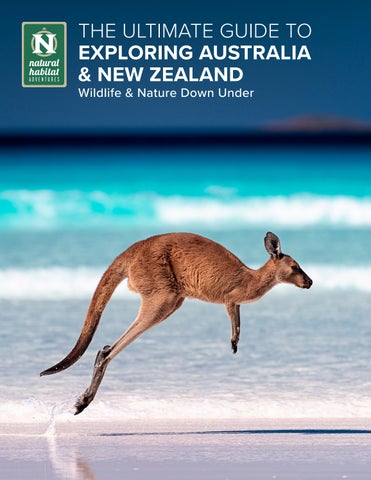
THE ULTIMATE GUIDE TO EXPLORING AUSTRALIA & NEW ZEALAND Wildlife & Nature Down Under
© J Morvell
© M Chamberlain
Australia & New Zealand Adventures • 800-543-8917
CONTENTS
2
Contents 6
WHY CHOOSE NAT HAB FOR YOUR AUSTRALIA & NEW ZEALAND ADVENTURES?
16
GEOGRAPHY & HISTORY OF AUSTRALIA & NEW ZEALAND
26
WILDLIFE OF AUSTRALIA & NEW ZEALAND
46
NAT HAB’S AUSTRALIA & NEW ZEALAND ADVENTURES
54
SUGGESTED READING
58
FREQUENTLY ASKED QUESTIONS
How to Use This e-book: • The Contents listed above are live links. Click to jump to the desired page. • Click “CONTENTS” in the lower right corner to return to this Contents page. • Other links throughout the e-book are shown in blue, bolded text.
Australia & New Zealand Adventures • 800-543-8917
CONTENTS
3
Australia & New Zealand: Unique Wildlife, Extraordinary Landscapes Few destinations rival Australia and New Zealand for wildlife encounters, where millions of years of geographic isolation have given rise to some of the planet’s most unusual animals. These island nations are home to endemic species found nowhere else on Earth—from kangaroos, koalas and platypuses to kiwis, yellow-eyed penguins and Hector’s dolphins. In Australia, vast outback plains, tropical wetlands and coastal reefs support a staggering array of life. Kangaroos and wallabies bound across open grasslands, saltwater crocodiles patrol northern floodplains and vibrant coral ecosystems teem with brilliant tropical fish, graceful sea turtles and sleek reef sharks. Farther south, eucalyptus forests shelter koalas and echidnas, while Tasmania offers refuge to rare and elusive wildlife from wombats and platypus to Tasmanian devils, spotted quolls and other nocturnal marsupials that emerge after dark. Across the Tasman Sea, New Zealand’s dramatic terrain creates equally compelling opportunities for wildlife encounters. Fjords, rocky shores and open ocean provide habitat for fur seals, dolphins and seabirds, including several species of penguins. Inland, lush forests and alpine landscapes host unique birdlife, including the nocturnal brown kiwi, and bioluminescent glowworm caves illuminate the underground darkness with a starry shimmer. Together, these regions form a natural showcase of evolution in isolation— where unusual species, varied ecosystems and striking scenery combine to create one of the world’s most compelling destinations for wildlife exploration. All of Nat Hab’s small-group Australia and New Zealand adventures and Photo Expeditions offer exciting wildlife viewing and cultural immersion. Call 800-543-8917 or visit our website to discover the Land Down Under.
Australia & New Zealand Adventures • 800-543-8917
CONTENTS
4
“It became obvious very quickly that we would not have had the same kind of experience on a self-planned trip. The combination of our Expedition Leaders’ knowledge, along with the local guides, made a huge difference in our ability to find wildlife, as did the access to various sanctuaries and unique field experiences. This is absolutely the best way to experience Australia!” -Nat Hab Traveler Donna G., Ultimate Australia Safari
© E Cerier
Australia & New Zealand Adventures • 800-543-8917
CONTENTS
5
WHY CHOOSE NAT HAB FOR YOUR AUSTRALIA & NEW ZEALAND ADVENTURES?
Australia and New Zealand are defined by contrast and isolation—two island nations where evolution has taken remarkably different paths. From Australia’s marsupials and reptiles to New Zealand’s flightless birds and rich marine life, the wildlife here reflects millions of years of adaptation and evolution. For travelers, this means an ever-changing series of encounters across deserts, rainforests, coastlines and alpine environments.
Australia & New Zealand Adventures • 800-543-8917
CONTENTS
6
Experience Australia & New Zealand on our exclusive, small-group tours. A journey through this region reveals more than unusual wildlife. Here, ancient rainforests meet vibrant coral reefs, glacier-carved fjords give way to windswept coastlines, and species found nowhere else on Earth thrive in landscapes shaped by millions of years of isolation. At Natural Habitat Adventures, we go beyond the standard tourist track to provide a deeper, more intentional wildlife experience. Our expert Expedition Leaders and local naturalist guides help interpret the landscapes and species you encounter, while small groups allow for flexible, unhurried exploration. Whether searching for wildlife in remote habitats, exploring coastal environments by boat or walking through pristine forests, each day is designed to maximize meaningful encounters. Our commitment to conservation travel—and our partnership with World Wildlife Fund— ensures that your journey helps support the protection of the ecosystems and species that make Australia and New Zealand so compelling.
© J McKenzie
Australia & New Zealand Adventures • 800-543-8917
CONTENTS
7
8 Reasons to See Australia & New Zealand with Nat Hab:
1
We Take the Hassle Out of Trip Planning When you travel on your own, you spend a lot of time competing for reservations and trying to figure out where to go and what to do. As a result, you lose precious time and miss the secret spots known only to locals. We’ve taken out the legwork and guesswork, allowing you to experience much more of the Land Down Under than most people can accomplish on their own.
Australia & New Zealand Adventures • 800-543-8917
CONTENTS
8
2
Small Groups Make a BIG Difference The best wildlife experiences usually occur in the presence of fewer people. To foster the most meaningful nature encounters, we limit the group size on our Australia and New Zealand adventures to no more than 12 travelers (and just 10 on our Southern Australia & Tasmania Photo Expedition). A small group also ensures that your needs and expectations are met with personalized care from our Expedition Leader.
© M Wade
Australia & New Zealand Adventures • 800-543-8917
CONTENTS
9
3
Scenic Flights Get You Farther, Faster On typical tours, you may lose several days crossing the country on long drives, or your travels may be restricted to fewer regions. By using strategic flights, including private charters, on our Australia itineraries, we avoid long days on rough roads and access a greater range of more secluded areas. In New Zealand, we fly by private helicopter over Milford Sound to Queenstown for unparalleled views of the lakestrewn Southern Alps, saving travelers a winding 5-hour drive.
“Learning about New Zealand’s history and Maori culture and exploring the environment and native wildlife were priceless. The helicopter was a highlight for everyone!” -Nat Hab Traveler Patrick O., New Zealand Nature Explorer
© J McKenzie
Australia & New Zealand Adventures • 800-543-8917
CONTENTS
10
4 Our Lodgings Immerse You in Nature From private villas perched above the Great Ocean Road to an ocean-view retreat on Kangaroo Island and forest cabins just steps from Mount Field National Park in Tasmania, our intimate ecolodges combine comfort and sustainability surrounded by nature. In New Zealand, Wilderness Lodge Lake Moeraki sits within a World Heritage rainforest, offering guided night walks to spot glowworms beneath star-filled skies.
Australia & New Zealand Adventures • 800-543-8917
© N Tenbrock
CONTENTS
11
5 Your Expedition Leader Is a Top Professional Naturalist Our Expedition Leaders are expert naturalist guides who bring the wildlife, landscapes and cultures of Australia and New Zealand to life. Drawing on years of experience, World Wildlife Fund resources and local connections, they provide rich interpretation, meaningful context and highly personalized care throughout your journey.
© M Meyer
Australia & New Zealand Adventures • 800-543-8917
CONTENTS
12
© J McKenzie
6 A Distinct Nature Focus with Aboriginal Perspective Nature is the primary force sculpting Australia’s diverse and dramatic landscapes, but humans have been at home here for millennia. From savanna to swamp to tropical rainforest, this is Aboriginal homeland. Through cultural encounters, including Aboriginal-owned and operated ecotourism enterprises, we witness how local people are bringing the wisdom of traditional sustainable living and land management to natural ecosystems today.
Australia & New Zealand Adventures • 800-543-8917
© J McKenzie
CONTENTS
13
7 Be Part of a Conservation Success Story By demonstrating the economic value of nature tourism and bringing visitors to observe the unique species found only in Australia and New Zealand, we show local communities the value of protecting their wild surroundings. Conservation travel is imperative to the future of nature in these destinations. And when you travel with us, you’re central to that mission.
© A Ackerman
Australia & New Zealand Adventures • 800-543-8917
CONTENTS
14
© M Cornish
8 A Commitment to Sustainability Since 2003, we have been the exclusive travel partner of World Wildlife Fund, the world’s leading environmental conservation organization. And as the world’s first carbonneutral travel company, Nat Hab offsets 100% of the emissions from your trip. This includes your round-trip flights, making your adventure as eco-conscious as it is extraordinary.
© M Cornish
Find out more about WWF’s conservation work in Australia & New Zealand
© J Sullivan
Australia & New Zealand Adventures • 800-543-8917
CONTENTS
15
GEOGRAPHY & HISTORY OF AUSTRALIA & NEW ZEALAND
Situated in the South Pacific, Australia and New Zealand are isolated from other major landmasses by vast stretches of ocean. Together, they encompass tropical rainforests, coral reefs, alpine peaks, glaciers and windswept coastlines. Yet despite their relative proximity—just over 1,000 miles across the Tasman Sea—these neighboring nations followed dramatically different geological and cultural paths. Australia is one of the world’s oldest continents, while New Zealand is a geologically young land still being shaped by tectonic forces. Understanding how these landscapes formed—and how people and animals adapted to them—offers deeper insight into the region’s natural and cultural history.
Australia & New Zealand Adventures • 800-543-8917
CONTENTS
16
© W Mitchell
Australia & New Zealand Adventures • 800-543-8917
CONTENTS
17
Australia: An Ancient Continent Australia is both the world’s smallest continent and one of its oldest landmasses, with some rocks dating back more than 4 billion years! Much of the continent has remained geologically stable for millions of years, allowing ancient landscapes to persist. Eroded mountain ranges, vast deserts and deeply weathered soils speak to a history shaped less by abrupt upheaval and more by slow transformation. Stretching nearly 2,000 miles from its tropical north to the temperate south, Australia encompasses a multitude of environments. The northern regions, closer to the equator, are defined by lush rainforests and expansive wetlands. Here, the Daintree Rainforest—the oldest tropical rainforest on Earth at over 180 million years—thrives alongside the Great
Australia & New Zealand Adventures • 800-543-8917
Barrier Reef. Located in the aptly named Coral Sea along the northeast coast, it is the largest coral reef system in the world. Farther south, the climate becomes more temperate. Eucalyptus forests, coastal cliffs and rolling grasslands support many of Australia’s most recognizable animals, from kangaroos and koalas to wombats and wallabies. Off the southern shoreline, Kangaroo Island and Tasmania provide refuge for rare and endemic species, their dramatic coastlines sculpted by the relentless force of the Southern Ocean. Australia’s biological story is inseparable from its long geological history. After breaking away from the ancient supercontinent of Gondwana more than 80 million years ago, the continent’s
CONTENTS
18
© G Boreham
© M Cornish
© A Ackerman
© J Emerson
Australia & New Zealand Adventures • 800-543-8917
CONTENTS
19
plants and animals followed their own evolutionary path. This gave rise to a surprising mix of life, including marsupials, egg-laying monotremes like the platypus, and ancient plant lineages that predate flowering species. Human history here is equally profound, marked by deep cultural and spiritual connections to Country—the Aboriginal concept that links people, landscapes, wildlife and ancestry. Aboriginal peoples have lived on and cared for this continent for more than 65,000 years, making theirs one of the world’s oldest continuous living cultures. Across Australia, more than 250 distinct Aboriginal nations developed unique languages, traditions and ecological knowledge. Australia is also home to the Torres Strait Islander peoples, whose
ancestral lands lie among the islands between northern Australia and Papua New Guinea. With a rich seafaring heritage and cultural traditions closely tied to the ocean, Torres Strait Islanders maintain a distinct identity that complements the diverse tapestry of Indigenous Australia. Many of the places we visit on our Nat Hab adventures, including the Bungle Bungle Range (Purnululu), remain deeply important to Indigenous communities. Sacred sites, rock art and ancestral stories continue to connect the Gija and Jaru peoples to a landscape their ancestors have inhabited for tens of thousands of years. Indigenous knowledge, passed down through countless generations, continues to shape conservation, land management and Australians’ understanding of the natural world.
© M Meyer
Australia & New Zealand Adventures • 800-543-8917
CONTENTS
20
© M Jensen
Australia & New Zealand Adventures • 800-543-8917
© J Morvell
CONTENTS
21
New Zealand: Islands Forged by Fire and Ice New Zealand, known as Aotearoa (“Land of the Long White Cloud”) in the Maori language, is made up of two primary islands, North and South, along with hundreds of smaller offshore isles. The North Island is shaped by geothermal activity, with volcanic plateaus, hot springs and rolling green hills. It is home to much of the country’s population and rich Maori cultural heritage. The South Island, by contrast, is defined by dramatic alpine landscapes. The Southern Alps run nearly the entire length of the island, forming a rugged backbone of more than 20 peaks exceeding 10,000 feet. Glaciers, fjords and wild coastlines combine
to create some of the most spectacular scenery in the Southern Hemisphere. Unlike Australia’s ancient, timeworn landscapes, New Zealand’s mountains are relative newcomers. Most of the Southern Alps have risen within the last 5 million years, as ongoing collision between the Pacific and Australian tectonic plates continues to build peaks, trigger earthquakes and shape the country’s dramatic scenery. New Zealand’s isolation has produced one of the most unusual assemblages of wildlife on Earth. After separating from the supercontinent of Gondwana between 85 and 65 million
© C Brokvist
Australia & New Zealand Adventures • 800-543-8917
CONTENTS
22
“The scenery was stunning everywhere we went, and the cultural insights into Maori traditions were enriching.” -Nat Hab Traveler Karen B., New Zealand Nature Explorer © C Colt
©© E Savage C Haag
Australia & New Zealand Adventures • 800-543-8917
CONTENTS
23
years ago, the islands developed largely without land mammals. In their absence, birds evolved to fill ecological roles typically occupied by mammals—becoming grazers, insect hunters and even apex predators. This gave rise to species like the flightless kiwi and the now-extinct giant moa, an enormous bird that towered 12 feet tall. Today, a high percentage of the country’s plants, animals and insects are found only here. Humans arrived relatively recently. Around 700 years ago, Polynesian voyagers settled the islands, becoming the ancestors of today’s Maori, New Zealand’s Indigenous people. They brought with them a rich cultural heritage that remains central to the nation’s identity. Maori traditions emphasize a deep connection between people and the land,
reflected in the concept of whenua—the idea that people and place are inextricably linked. European arrival in the 18th century brought significant ecological change, including the introduction of non-native species that disrupted fragile ecosystems. In response, New Zealand has become a global leader in conservation. One of its most ambitious efforts is Predator Free 2050, a nationwide initiative launched in 2016 that aims to eliminate key invasive predators—including rats, stoats and possums— from the country. Led by the New Zealand government in partnership with Indigenous Maori groups, conservation organizations, scientists and local communities, the program has already restored numerous offshore islands and protected areas, helping native birds and other wildlife rebound across the country.
© S Kuperus
Australia & New Zealand Adventures • 800-543-8917
CONTENTS
24
© M Cornish
© B Holz
© B Everson
© E Savage
Australia & New Zealand Adventures • 800-543-8917
CONTENTS
25
WILDLIFE OF AUSTRALIA & NEW ZEALAND
Australia and New Zealand are home to some of the most distinctive wildlife on Earth, a result of millions of years of geographic isolation. In Australia, more than 80% of mammals, reptiles and plants are endemic, from kangaroos and koalas to platypuses and prehistoric crocodiles. Across the Tasman Sea, New Zealand’s unusual fauna reflects a different path— one with few native land mammals, where birds evolved to fill ecological roles found nowhere else.
Australia & New Zealand Adventures • 800-543-8917
CONTENTS
26
© M Cornish
“Our Expedition Leader’s passion for the Australian animals, nature, countryside and culture was utterly contagious. It was a pleasure to have her as our guide for two weeks, and I treasured all the things she shared with us.” -Nat Hab Traveler Maria F., Australia North: Kakadu, Kimberley & the Outback
Australia & New Zealand Adventures • 800-543-8917
CONTENTS
27
AUSTRALIA’S MARSUPIALS
© A Morse
Few animals define Australia’s evolutionary story as clearly as its marsupials. Found across the continent in remarkable diversity— from kangaroos and wallabies to koalas, wombats and Tasmanian devils—these mammals evolved in isolation after branching from placental mammals more than 160 million years ago. Today, Australia is home to around 200 marsupial species, far more than anywhere else on Earth. Unlike placental mammals, marsupials give birth to highly underdeveloped young after a short gestation. The tiny newborn then continues its development in the mother’s pouch, where it attaches to a nipple and is nourished and protected. This reproductive strategy allows mothers to adapt quickly to changing environmental conditions.
Discover endemic wildlife shaped by isolation, from kangaroos to platypuses, in our Australia Wildlife Guide.
Australia & New Zealand Adventures • 800-543-8917
© C Conrad
CONTENTS
28
“Australia was whimsical and wonderful. We were at a nature preserve with emus wandering around us and koalas napping up in the trees when, suddenly, six kangaroos bounced by! I felt like I was living in a storybook.” -Nat Hab Traveler Janice H., Australia South: Tasmania, Kangaroo Island & the Great Ocean Road
© A Amsel
Australia & New Zealand Adventures • 800-543-8917
CONTENTS
29
Here are just a few of the marsupials we encounter on our Australia adventures: Kangaroo Kangaroos are among Australia’s most iconic animals, known for their powerful hind legs, long balancing tails and distinctive hopping gait. Four species of “great kangaroos”—the red, eastern gray, western gray and antilopine—range widely across the continent, alongside dozens of smaller relatives such as wallabies and quokkas. Large males can stand up to 8 feet tall and travel more than 20 feet in a single bound. As grazing herbivores, kangaroos help maintain grassland ecosystems by controlling vegetation growth and promoting new plant regeneration. Their movements also aid in seed dispersal, supporting the health and resilience of Australia’s landscapes. These highly social marsupials often gather in groups known as “mobs.”
© J Morvell
Australia & New Zealand Adventures • 800-543-8917
© J Emerson
CONTENTS
30
© R Colbert
Koala Though often referred to as “koala bears,” these adorable creatures are not bears at all. Instead, koalas are tree-dwelling marsupials more closely related to wombats and wallabies. Found in eucalyptus forests along Australia’s eastern and southern coasts, they spend most of their lives in the canopy, rarely descending to the ground. Koalas feed almost exclusively on eucalyptus leaves—an unusual diet that is low in nutrients and contains toxins, requiring specialized digestion and long periods of rest. In fact, koalas sleep up to 18–20 hours a day to conserve energy! Despite their relaxed lifestyle, koalas face serious threats from habitat loss, disease and climate change, making conservation efforts increasingly important for their survival.
© R Hopkins
Madagascar Australia & New Adventures Zealand Adventures • 800-543-8917 • 800-543-8917
CONTENTS
31
Wombat Wombats are burrowing marsupials found only in Australia, known for their stocky bodies, powerful claws and surprising speed over short distances. There are three species, including the common wombat and two hairy-nosed varieties, each adapted to different environments. Mostly nocturnal, wombats spend much of their time in extensive underground burrow systems, emerging at dusk to graze on grasses and roots. They are also famous for their unusual cube-shaped droppings—an adaptation thought to prevent the scat from rolling away, helping wombats mark territory more effectively. As “ecosystem engineers,” their digging aerates soil, redistributes nutrients and creates shelter used by other animals across Australia’s landscapes.
© M Cornish
Australia & New Zealand Adventures • 800-543-8917
CONTENTS
32
© L Bergbreiter
© M Hillman
Wallaby
Tasmanian Devil
Smaller and more compact than their kangaroo relatives, wallabies are members of the macropod family, a group of marsupials defined by their powerful hind legs and long tails. Found across Australia in habitats ranging from dense forests to rocky escarpments and open grasslands, more than 30 wallaby species have adapted to a wide variety of environments.
Tasmanian devils are the world’s largest carnivorous marsupials, found only on the island of Tasmania off the southern coast of mainland Australia. About the size of a small dog with powerful jaws and a bone-crushing bite (the strongest of any mammal!), they are best known for their eerie nighttime screeches and fierce feeding displays.
Like other macropods, wallabies carry their young in a pouch and move with efficient, bounding hops powered by spring-like tendons. They graze on grasses and foliage, helping shape vegetation and maintain ecosystem balance. Most active at dawn and dusk, wallabies are a familiar presence in Australia’s wild landscapes.
Famous for their feisty nature, devils will lunge, shriek and bare their teeth when threatened or competing over food. Females give birth to 20 to 30 tiny young that then crawl into the mother’s pouch to compete with each other for access to her four nipples. Primarily scavengers, Tasmanian devils play a vital ecological role as nature’s clean-up crew, consuming carrion and helping limit the spread of disease.
Australia & New Zealand Adventures • 800-543-8917
CONTENTS
33
Bandicoot
Potoroo
Bandicoots are small, ground-dwelling marsupials found primarily in southern Australia and Tasmania. With their pointed snouts, compact bodies and strong forelimbs, they are well adapted to digging, using their claws to forage through soil and leaf litter for insects, fungi and roots. Mostly nocturnal and solitary, they are rarely seen despite being relatively widespread.
Potoroos are small, rabbit-sized marsupials native to the forests of southern and eastern Australia, including Tasmania. Closely related to kangaroos and wallabies, these nocturnal “rat-kangaroos” forage at night, using their sensitive noses and strong forelimbs to dig for fungi, roots and insects. In doing so, they play an outsized role in forest ecosystems. By consuming underground fungi and dispersing spores in their droppings, potoroos help sustain plant communities and maintain soil health.
Unlike most marsupials, bandicoots possess a primitive form of placenta, allowing their young to develop more fully before birth—though they still continue growing in the pouch afterward. Often called “ecosystem engineers,” their constant digging aerates soil, cycles nutrients and promotes plant regeneration across the landscapes they inhabit.
Australia & New Zealand Adventures • 800-543-8917
Once widespread, potoroos are now threatened by habitat loss and introduced predators, making them an important focus of conservation efforts.
CONTENTS
34
Possum Possums are among Australia’s most widespread and adaptable marsupials, with more than 20 species ranging from the familiar brushtail and ringtail possums to gliding species like sugar gliders. Primarily nocturnal, possums spend their nights foraging in trees and on the ground, feeding on leaves, fruits, flowers and insects. Possums thrive in diverse habitats—from forests to urban areas—and play an important ecological role as seed dispersers and pollinators, helping maintain the health and regeneration of Australia’s ecosystems. Although the common brushtail possum is protected in Australia, it was introduced to New Zealand in the 1830s and has been considered a pest species there ever since.
© B Traveler
Australia & New Zealand Adventures • 800-543-8917
CONTENTS
35
© C Hawkins
MORE AUSTRALIAN WILDLIFE: Echidna Echidnas stand apart in the animal world. They appear across Australia and Tasmania and belong to a rare group called monotremes—the only mammals that lay eggs. Slow-moving and often elusive, these spiny mammals have changed little over millions of years, offering a window into one of the oldest surviving branches of mammalian evolution. The echidna’s body is covered in sharp spines and coarse fur, providing protection from predators. Using a long snout equipped with highly sensitive electroreceptors, it can detect prey beneath the soil. A sticky, rapidly flicking tongue then allows the echidna to consume thousands of ants and termites in a single feeding, grinding the insects into a paste without the use of teeth.
Australia & New Zealand Adventures • 800-543-8917
CONTENTS
36
Cassowary With their bright blue necks, helmet-like casques—a prominent horn-like structure atop the head—and powerful legs, cassowaries are among the most striking birds in the world. Found in the tropical rainforests of northeastern Australia and New Guinea, these flightless birds can stand nearly 6 feet tall and weigh more than 100 pounds, making them the secondheaviest birds on Earth after the ostrich. Despite their imposing appearance, cassowaries feed primarily on fallen fruit, swallowing many seeds whole. Often called “rainforest gardeners,” they play a vital ecological role by dispersing the seeds of hundreds of plant species across vast distances. © M Cornish
© J Emerson
Emu Emus are Australia’s largest native birds and the second-largest birds in the world after the ostrich. Standing up to 6 feet tall, these flightless birds are built for endurance and speed and can travel long distances across open landscapes, reaching speeds of nearly 30 miles per hour when needed. Found across much of mainland Australia, emus inhabit a wide range of environments, often moving seasonally in search of food and water. Omnivorous, they feed on seeds, fruits, grasses and insects. Male emus incubate eggs—often for nearly two months without eating—and raise the striped chicks on their own. © C Terry
Australia & New Zealand Adventures • 800-543-8917
CONTENTS
37
Saltwater Crocodile Saltwater crocodiles—known locally as “salties”—are the largest reptiles on Earth, found across northern Australia’s rivers, estuaries and coastal waters. Males can grow more than 20 feet long and weigh over a ton, making them formidable apex predators. Masters of ambush, crocodiles can remain submerged for up to an hour, waiting motionless before exploding from the water with one of the most powerful bites in the animal kingdom. Strong swimmers, they move easily between freshwater and marine environments, sometimes traveling long distances along coastlines and out to sea.
Dingo Australia’s only native wild dog, the dingo is a lean, agile predator found across much of the continent, from deserts and grasslands to forests and coastal regions. Introduced thousands of years ago by seafarers from Southeast Asia, dingoes have since become an integral part of Australia’s ecosystems. Typically sandy or reddish in color with a bushy tail and upright ears, dingoes hunt alone or in small family groups, preying on mammals, birds and reptiles. As apex predators, they help regulate populations of herbivores and invasive species, supporting overall ecosystem balance. Wary and intelligent, dingoes are more often heard than seen, their haunting howls carrying across Australia’s open landscapes at dusk. © J Morvell
Australia & New Zealand Adventures • 800-543-8917
CONTENTS
38
© A Morse
Platypus Found only in eastern Australia and Tasmania, the platypus is one of the most unusual mammals on Earth. Along with echidnas, it belongs to a rare group called monotremes— the only mammals that lay eggs. Platypuses also do not have nipples. Females secrete milk through specialized glands, which pools on the skin for their young to lap up. Males possess venomous spurs on their hind legs, which they use in competition during the breeding season. With its duck-like bill, webbed feet and beaver-like tail, the platypus is superbly adapted to a semi-aquatic life in freshwater rivers and streams. It hunts underwater using electroreception, detecting the faint electrical signals of prey while its eyes and ears are closed. Feeding on insects, crustaceans and small aquatic animals, it forages along the riverbed, storing food in cheek pouches before surfacing to eat.
© R Hopkins
Madagascar Australia & New Adventures Zealand Adventures • 800-543-8917 • 800-543-8917
CONTENTS
39
© A Morse
© M Cornish © L Thompson
Cockatoo Cockatoos are among the most charismatic birds of the Australasian region, a group of large, intelligent parrots recognized by their curved beaks and expressive, movable crests. While they occur across Australia, Indonesia, the Philippines and nearby islands, Australia is home to the greatest diversity, with 11 species found nowhere else on Earth. Highly social, cockatoos often gather in noisy flocks and form strong, monogamous pair bonds, returning to the same tree hollows to nest year after year. Their powerful beaks allow them to crack seeds and nuts, while their feeding habits help disperse seeds and maintain forest ecosystems.
Australia & New Zealand Adventures • 800-543-8917
CONTENTS
40
© E Savage
Honeyeater Named for their nectar-rich diet, honeyeaters have specialized brush-tipped tongues that allow them to sip nectar from flowers, though they also feed on insects and fruit. Found primarily in forests and woodlands, honeyeaters play an important role in pollinating native plants. Most honeyeaters form monogamous pairs during the breeding season, with both parents caring for the chicks. While many species remain common, others—including the regent honeyeater— have declined dramatically as native woodlands have disappeared. Conservation efforts include habitat restoration and programs that teach captive-bred birds their species’ distinctive courtship songs before they are released into the wild.
© L Thompson
Madagascar Australia & New Adventures Zealand Adventures • 800-543-8917 • 800-543-8917
CONTENTS
41
NEW ZEALAND WILDLIFE Brown Kiwi Shy and seldom seen, the brown kiwi is a nocturnal, flightless bird found only in New Zealand. Despite its status as a national symbol, the kiwi’s secretive habits mean most encounters occur under cover of darkness.
“Spotting kiwis was absolutely unforgettable! I also appreciated all of Nat Hab’s sustainability efforts.” -Nat Hab Traveler Katryn R., New Zealand Nature Explorer
Roughly the size of a chicken, the kiwi has shaggy, hair-like feathers and a long bill with nostrils at the tip—an unusual trait among birds that allows it to locate prey by smell. It forages along the forest floor for worms, insects and other invertebrates, probing the soil with its sensitive beak. Once widespread, kiwi populations declined sharply following human settlement, but ongoing conservation efforts are helping stabilize and restore this endemic species.
Meet rare wildlife, from kiwis and penguins to seals and albatrosses, in our New Zealand Wildlife Guide.
Australia & New Zealand Adventures • 800-543-8917
CONTENTS
42
Australia & New Zealand Adventures • 800-543-8917
CONTENTS
43
© S Kuperus
Royal Albatross Among the largest flying birds on Earth, the royal albatross is a true giant of the Southern Ocean, with a wingspan that can exceed 11 feet. Endemic to New Zealand, these majestic seabirds breed on remote islands and headlands, including a rare mainland colony on the Otago Peninsula. Built for life on the wind, royal albatrosses spend most of their lives at sea, gliding effortlessly for hours without flapping their wings. They feed on squid, fish and other marine prey, often traveling vast distances across the open ocean. Long-lived and slow to reproduce, royal albatrosses form lifelong pair bonds, raising a single chick over an extended breeding cycle.
Australia & New Zealand Adventures • 800-543-8917
CONTENTS
44
Yellow-Eyed Penguin
New Zealand Fur Seal
With its pale-yellow eyes and distinctive band of golden feathers sweeping around its head, the yellow-eyed penguin— known as hoiho in Maori—is one of New Zealand’s most recognizable and rarest birds. Endemic to the country and found along the southeastern coasts of the South Island and on subantarctic islands, this shy bird is among the least social of all penguin species, nesting in secluded coastal forests and scrub rather than crowded colonies.
New Zealand fur seals, known as kekeno in Maori, are the most common seals found along New Zealand’s rocky coastlines, where they haul out on boulder-strewn shores and offshore islands. They divide their time between land and sea, returning to coastal colonies to rest and raise pups. Once heavily hunted, fur seals are now rebounding, and today their presence is a familiar and lively part of New Zealand’s coastal ecosystems.
A powerful swimmer, the endangered yellow-eyed penguin forages along the seafloor for fish and squid. They can dive to depths of more than 300 feet and travel considerable distances from shore, returning to the same nesting areas each evening to rest and care for their chicks.
Powerful swimmers, these “eared” seals— characterized by the small external ear flaps visible on the sides of their heads—can rotate their hind flippers to move nimbly on land and dive to extreme depths in search of prey. They feed primarily on squid and fish, often hunting at night and traveling far offshore. © G Ciampini
© J Emerson
© J Emerson
© C Terry
Australia & New Zealand Adventures • 800-543-8917
CONTENTS
45
NAT HAB’S AUSTRALIA & NEW ZEALAND ADVENTURES
Nat Hab’s exclusive access and deep expertise in Australia and New Zealand ensure an experience you won’t find with any other tour operator or on your own. Trust us to get you there, and these extraordinary landscapes and distinctive wildlife will do the rest.
Australia & New Zealand Adventures • 800-543-8917
CONTENTS
46
Our small-group Australia and New Zealand adventures take you beyond the usual routes and into remote habitats and lesser-visited regions. Led by expert Expedition Leaders and local naturalist guides, you’ll enjoy close, unhurried encounters with wildlife and a richer understanding of the ecosystems that make this region so remarkable.
© J Emerson
Australia & New Zealand Adventures • 800-543-8917
CONTENTS
47
HIGHLIGHTS FROM OUR AUSTRALIA TRIPS:
© J Emerson
© S McNaught
Foray into national parks and explore the Great Barrier Reef, Atherton Tablelands, Daintree Rainforest, Tasmania, Flinders Ranges, Kakadu, the Kimberley, Kangaroo Island and more.
Visit Seal Bay, one of Australia’s largest sea lion colonies, on a private guided tour to watch pups nursing or playing in the surf and see old bulls scarred by territorial disputes.
Embark on a private “Dreamtime” Walk with a local Indigenous guide to learn about traditional plant use, bush food sources and cultural practices like ochre painting.
© R Jeffrey
© C Pagel
Take a private, guided kayaking tour on Tasmania’s Derwent River, paddling in search of wild platypus and other freshwater wildlife like black swans.
Descend into the dramatic limestone caverns of Marakoopa Cave in Mole Creek Karst National Park, including a sparkling display of bioluminescent glowworms.
Australia & New Zealand Adventures • 800-543-8917
Snorkel a coral cay in the Great Barrier Reef off the coast of Lady Elliott Island with sea turtles, manta rays, gentle reef sharks and huge schools of tropical fish.
CONTENTS
48
Explore all of our Australia & New Zealand adventures
© E Pritchett
© M Ranges
Survey the Red Center’s vast grandeur on a 750mile rail journey aboard The Ghan, Australia’s historic luxury train.
Tour a conservation sanctuary to see and learn about endangered Tasmanian devils, spottedtail and eastern quolls— Tasmania’s three largest carnivorous marsupials.
© M Hillman
Cruise along the Daintree River in a solar electric boat in search of crocodiles, or look for one of Australia’s rare snubfin dolphins on a catamaran ecocruise in Roebuck Bay.
© J Emerson
© M Wade
Stargaze under some of Earth’s darkest night skies and set out on guided night walks to spot nocturnal creatures like possums, echidnas, wallabies, wombats and pademelons.
Explore the surreal landscape of the beehiveshaped Bungle Bungles on a private chartered flight, then from the ground on guided hikes.
Australia & New Zealand Adventures • 800-543-8917
Learn about Indigenous culture at Uluru, a UNESCO World Heritage Site sacred to the Anangu people of central Australia, and discover ancient Aboriginal rock at Ubirr.
CONTENTS
49
HIGHLIGHTS FROM OUR NEW ZEALAND TRIP:
© S Kuperus
Explore national parks and World Heritage Sites like Fiordland, Westland Tai Poutini and Arthur’s Pass national parks and Te Wahipounamu– South West New Zealand World Heritage Area.
On little-visited Stewart Island, look for brown kiwis on a guided night walk, and view seabirds like penguins and albatrosses on a private boat excursion to nearby Ulva Island.
© S Kuperus
Cruise across glacier-carved Milford Sound aboard a chartered boat looking for penguins, fur seals and dolphins, then fly over the sound and mountains to Queenstown by helicopter.
Look for glowworms on a guided night walk near Lake Moeraki and experience some of the darkest skies on Earth. There’s even the possibility of witnessing the aurora australis in the southern sky.
Australia & New Zealand Adventures • 800-543-8917
Follow the winding Milford Road as we travel through the pointed peaks, sheer rock walls and high waterfalls of Fiordland National Park to the sea on one of the world’s most scenic drives.
© S Kuperus
Tour an authentic working sheep farm and learn from our hosts about the role these animals have played in the country’s history and their current significance.
CONTENTS
50
Explore all of our Australia & New Zealand adventures
© J Emerson
Visit a private conservation reserve and rehabilitation center for endangered yellow-eyed penguins. Found only in New Zealand, this species is one of the rarest in the world.
Experience a local Maori welcome featuring a traditional Haka performance—an authentic encounter with the Indigenous heritage and present-day Maori culture of Aotearoa (New Zealand).
Embark on a private boat excursion on glacial Lake Wanaka to remote Mou Waho Island, a predator-free nature reserve that’s home to the rare flightless buff weka.
© S Kuperus
© S Kuperus
Discover a hidden lake on the summit of Mou Waho Island, a photogenic spot where we’ll enjoy a cup of tea with the panorama of the Southern Alps on display before us.
On fall trips, stroll a remote trail to a spectacular beach to see rare tawaki penguins. Endemic to New Zealand, they are the only penguins that live in the rainforest!
Australia & New Zealand Adventures • 800-543-8917
Enjoy a private kayaking excursion on Lake Pearson, a placid high-country lake tucked between steep mountainsides, and hike the forest trails of Arthur’s Pass with a local naturalist.
CONTENTS
51
© J McNally
© M Hhillman © A Ackerman
AUSTRALIA PHOTO EXPEDITIONS:
© R de Gouveia
On our Southern Australia & Tasmania Photo Expedition, photograph a wide array of unique and intriguing Australian wildlife, plus dramatic landscapes from Tasmania’s mountains and sapphire lakes to the rugged Southern Ocean coast.
Explore all of our Australia adventures © M Hillman
Australia & New Zealand Adventures • 800-543-8917
CONTENTS
52
© F Bryla
EXTEND YOUR NEW ZEALAND ADVENTURE The ideal complement to your South Island adventure, our New Zealand North Island Pre-Trip Extension highlights include Rotorua and the Coromandel Peninsula. Explore mist-clad mountains, pristine beaches, waterfalls, geysers, mineral springs and Maori culture.
Explore all of our New Zealand adventures © A Morgan
Australia & New Zealand Adventures • 800-543-8917
CONTENTS
53
SUGGESTED READING
Deepen your understanding of Australia’s and New Zealand’s vibrant ecosystems and rich cultural heritage with these recommended reads. From compelling wildlife chronicles and ecological explorations to cultural insight and engaging memoirs, each title offers a deeper connection to the lands, people and biodiversity that make this region so extraordinary.
Australia & New Zealand Adventures • 800-543-8917
CONTENTS
54
Australia The Australian Bird Guide | Peter Menkhorst, Danny Rogers, Rohan Clarke, Jeff Davies, Peter Marsack, Kim Franklin Featuring more than 900 species, The Australian Bird Guide is the most comprehensive of its kind and contains by far the best coverage of southern seabirds. The Reef: A Passionate History: The Great Barrier Reef from Captain Cook to Climate Change | Iain McCalman Historian and explorer Iain McCalman guides readers on a journey to the Great Barrier Reef, profiling 20 people over 200 years and illustrating humanity’s drive to control, comprehend and preserve this marine environment. Platypus Matters: The Extraordinary Story of Australian Mammals | Jack Ashby Weaving his own experiences in the field with scientific facts and historical anecdotes, Ashby discusses the mysteries and myths of monotremes and marsupials and the challenges they face today. Growing Up Aboriginal in Australia | Edited by Dr Anita Heiss Personal accounts from children, teachers, authors and celebrities reveal what life was and is like for Aboriginal and Torres Strait Islander people in Australia in this anthology of unique and often heartbreaking stories. Kindred: A Cradle Mountain Love Story | Kate Legge He was an Austrian immigrant; she came from Tasmania. They honeymooned near Cradle Mountain and were inspired to preserve the wilderness where they helped pioneer an early model of conservation tourism. Australian Wildlife (Bradt Wildlife Explorer) | Stella Martin This most recent edition of Bradt’s Australian Wildlife covers mammals, birds, reptiles, amphibians, invertebrates and the marine environment, along with all of Australia’s geographic regions. In a Sunburned Country | Bill Bryson Even though Australia harbors more things that can kill you in extremely nasty ways than anywhere else, Bill Bryson adores the place, and he takes his readers on a rollicking ride far beyond the beaten tourist path.
Australia & New Zealand Adventures • 800-543-8917
CONTENTS
55
Dark Emu: Aboriginal Australia and the Birth of Agriculture | Bruce Pascoe History has portrayed Australia’s First Peoples as hunter-gatherers who lived on an empty, uncultivated land. History is wrong. This bestseller won the Book of the Year Award and the Indigenous Writer’s Prize in the New South Wales Premier’s Literary Awards. Deep Time Dreaming: Uncovering Ancient Australia | Billy Griffiths This book tells a story of physical, political and cultural challenges and discoveries, where fascinating individuals encounter and decipher ancient places, paying homage to the achievements and concerns of the Indigenous peoples it portrays.
New Zealand The Hand Guide to the Birds of New Zealand | Hugh Robertson, Barrie Heather & Derek Onley (Illustrator) This compact illustrated guide features range maps, color paintings and detailed descriptions of 374 species, including 35 recent additions. It’s the only guide officially endorsed by the Ornithological Society of New Zealand. Ghosts of Gondwana: The History of Life in New Zealand | George Gibbs This award-winning book explains why New Zealand’s flora and fauna are so different from other countries. Gibbs also reveals the deep geologic background of New Zealand’s landscapes, from narrow fjords to the southern beech forests. New Zealand Book of Beasts: Animals in Our Culture, History and Everyday Life | Annie Potts This engaging scholarly work explores New Zealanders’ relationship with native fauna, including how humans have nurtured, glorified, cherished, demonized and devoured the nation’s animals. Come on Shore and We Will Kill and Eat You All | Christina Thompson In this endearing memoir, historian Christina Thompson interweaves her personal Maori love story with tales of mostly disastrous early encounters with the Maori.
Australia & New Zealand Adventures • 800-543-8917
CONTENTS
56
The Bone People | Keri Hulme Set on the South Island, this Booker Prize-winning novel brings together three troubled individuals representing Maori and European traditions in contemporary New Zealand. The Happy Isles of Oceania: Paddling the Pacific | Paul Theroux Renowned travel writer Paul Theroux embarks on an 18-month solo journey across the South Pacific in a collapsible kayak. From New Zealand to Hawaii, he explores 51 islands, encountering diverse cultures, challenging seas, and the realities of modern life. Birnam Wood | Eleanor Catton Set on the South Island, this gripping eco-thriller features a rogue gardening group that clashes with an enigmatic billionaire over an abandoned farm. The author won the 2013 Man Booker Prize for her earlier book, The Luminaries Meet You at the Main Divide | Geoff and Justine Ross The owners of Lake Hawea Station, New Zealand’s first carbon-zero farm, share their journey of transforming the vast high-country station into a model of sustainable agriculture, where they produce wool from 10,000 merino sheep.
© S Kuperus
Australia & New Zealand Adventures • 800-543-8917
CONTENTS
57
FREQUENTLY ASKED QUESTIONS NAT HAB’S AUSTRALIA & NEW ZEALAND ADVENTURES
From the best places to spot wildlife to what gear to pack and how our trips are designed, find answers to the most common questions travelers have when planning a nature-focused adventure to Australia or New Zealand.
Australia & New Zealand Adventures • 800-543-8917
CONTENTS
58
When is the best time to visit Australia? Australia is a great destination to travel to year-round, and when to visit depends largely on the regions you plan to explore and the experiences you’re seeking. For those traveling to southern Australia, the summer months (December to February), spring (September to November) and autumn (March to May) are all great times to visit. In northern Australia, the dry season from May to October is the ideal time to visit. During this period, you can expect mild temperatures, lower humidity and minimal rainfall.
When is the best time to visit New Zealand? The best time to visit New Zealand is from spring through early fall (October to March), when milder temperatures, longer daylight hours and generally stable weather make for ideal travel conditions. Spring brings blooming landscapes and active wildlife, while summer offers the warmest temperatures and longest days. Early fall often has fewer crowds and mild weather.
What is the weather like in Australia? Australia’s climate is diverse and varies greatly across its vast expanse. In the tropical north, there are two main seasons: the wet season (November to April) and the dry season (May to October). The wet season is characterized by high humidity and heavy rainfall. In contrast, the dry season offers warm, sunny days with cooler nights. The temperate south experiences four distinct seasons: summer (December to February), autumn (March to May), winter (June to August) and spring (September to November). In the Outback and desert regions, the climate is arid with extreme temperatures—hot daytime temps, especially during the summer months, and low nighttime temps. Coastal areas generally enjoy milder climates with ocean breezes, but weather conditions can vary from warm and humid in the northeast to cooler and drier in the southwest.
What is the weather like in New Zealand? New Zealand’s weather during our travel season (October to March) is generally mild but variable, with temperatures ranging from about 45°F to 90°F. Conditions can shift quickly, especially in alpine areas, so it’s common to experience sun, wind and rain in a single day. The South Island tends to be cooler, with wetter conditions on the west coast and drier regions to the east, while sheltered areas often enjoy plenty of sunshine.
Australia & New Zealand Adventures • 800-543-8917
CONTENTS
59
What wildlife will I see in Australia? Australia is renowned for its distinctive mammals and birdlife, including an extraordinary array of species found nowhere else on Earth. From marsupials and monotremes to diverse birdlife and marine species, the country offers remarkable wildlife encounters across a wide range of habitats. In southern Australia, you may see platypuses, echidnas, possums, wombats, Tasmanian devils, quolls, fur seals, potoroos, bandicoots, kangaroos, wallabies, pademelons, koalas, emus, cockatoos and honeyeaters. In northern Australia’s Outback, you might spot wallabies, wallaroos, dingos and saltwater crocodiles. If your itinerary includes northern Australia’s Great Barrier Reef and Daintree Rainforest, you’ll see abundant marine life, including sea turtles, and scout for cassowaries and the rare Lumholtz’s tree kangaroo. Check out our Australia Wildlife Guide for more information.
What wildlife will I see in New Zealand? New Zealand’s wildlife is defined by its isolation, with many species found nowhere else on Earth. Birdlife is especially unique, including the flightless kiwi, yellow-eyed penguin and the soaring royal albatross. Along the coasts, you may see New Zealand fur seals, dolphins and other marine life. With few native land mammals, birds have evolved to fill many ecological roles, making New Zealand a remarkable destination for distinctive and often rare wildlife encounters. Check out our New Zealand Wildlife Guide for more information.
What clothing should I pack for Australia? Australia’s varied climates call for versatile, layered clothing. Pack lightweight, breathable shirts and quick-drying fabrics, a fleece or light jacket and a waterproof jacket. Comfortable walking shoes or hiking boots are essential. Sun protection is key—pack a wide-brimmed hat, sunglasses and high-SPF sunscreen. If your itinerary includes coastal areas, bring swimwear for water activities. For more details, please review our packing list and visit Nat Hab’s online Gear Store for recommended items.
Australia & New Zealand Adventures • 800-543-8917
CONTENTS
60
What clothing should I pack for New Zealand? New Zealand’s weather can be highly variable, so packing layers is essential. We recommend bringing lightweight, quick-drying clothing along with a warm fleece or insulated layer for cooler mornings and evenings. A waterproof, windproof jacket is important, as rain and changing conditions are common, especially on the South Island. Comfortable walking shoes or hiking boots are necessary. Sun protection—including a hat and sunglasses—is also important. For more details, please review our packing list and visit Nat Hab’s online Gear Store for recommended items.
What type of cuisine is Australia known for? Australian cuisine reflects the country’s diverse history and culture, blending Indigenous ingredients with influences from British colonization and waves of immigration. Dishes from Asian, Mediterranean, and Middle Eastern cultures are widely enjoyed, and fusion foods combining different culinary traditions are common. Guests will be treated to seasonal, farm-totable fare. Meals may include fresh seafood, Australian barbeque, vegetarian halloumi burgers, tropical fruit and pavlova for dessert. Special dietary needs can generally be accommodated if given advanced notice.
What type of cuisine is New Zealand known for? New Zealand cuisine reflects the country’s natural abundance and cultural influences, blending Maori traditions with European and Pacific flavors. Fresh, locally sourced ingredients are central, with an emphasis on seasonal, farm-to-table fare. Meals often feature high-quality lamb, seafood such as salmon and green-lipped mussels, and a variety of fruits and vegetables Guests may also enjoy regional specialties like meat pies and pavlova for dessert. Special dietary needs can generally be accommodated with advance notice.
What currency is used in Australia? The currency used in Australia is the Australian Dollar (AUD). Click here to check the current exchange rate for USD to AUD. We recommend having sufficient cash on hand for incidentals such as any meals not included in the itinerary (if applicable), alcoholic beverages, gratuities and souvenirs. Smaller bills work best for local purchases, as vendors often will not have change for those in larger denominations. ATMs and exchange houses are readily available at the airports in Cairns, Brisbane, Hobart and Adelaide.
Australia & New Zealand Adventures • 800-543-8917
CONTENTS
61
What currency is used in New Zealand? The currency used in New Zealand is the New Zealand dollar (NZD). Click here to check the current exchange rate for USD to NZD. We recommend having sufficient cash on hand for incidentals such as any meals not included in the itinerary (if applicable), alcoholic beverages, gratuities and souvenirs. ATMs and exchange houses are readily available at the airports in Dunedin, Christchurch and Auckland. ATMs are also located throughout most of New Zealand, though access is limited on Stewart Island and at the wilderness lodges.
Is there cell phone service or Internet connection on Nat Hab’s Australia and New Zealand trips? Internet access is typically available at our accommodations, but it may be slow and unreliable in remote areas, and cell service may be spotty. We encourage guests to unplug during the adventure to enjoy an immersive experience in nature!
How is Nat Hab’s Australia Photo Expedition different from its other Australia trips? Our Southern Australia & Tasmania Photo Expedition has an exclusive focus on wildlife and landscape photography. Your guide isn’t just an expert in wildlife and ecology—they’re skilled in photo instruction and know how to position you for the best shots, lingering longer at wildlife sightings to create more opportunities to frame and refine each shot. You’ll travel with a small group (a maximum of 10 guests rather than 11–12) of like-minded photographers, from enthusiastic beginners to serious hobbyists. Please check out our dedicated photography site, The Natural Photographer, for up-to-date articles on wildlife and nature photography—including advice for shooting in Australia and New Zealand.
Can I go on a Photo Expedition even if I’m not an advanced photographer? Absolutely. In fact, it is encouraged—Photo Expeditions are one of the best ways to learn. You’ll likely travel with other beginners and get guidance from experienced photographers and your professional Photo Expedition Leader. Whether you use a point-and-shoot on auto or a more advanced DSLR or mirrorless camera, you’ll return with a wealth of great images and new skills.
Australia & New Zealand Adventures • 800-543-8917
CONTENTS
62
Are Nat Hab’s Australia and New Zealand trips appropriate for children? Australia and New Zealand are fantastic destinations for families with both teenage and younger children. Please inquire with an Adventure Specialist about the minimum age requirement for your specific tour. Nat Hab asks any families bringing children to ensure their children behave in a respectful manner that does not disrupt other guests or the wildlife. If you’re looking for a trip designed specifically for younger children and families, consider our Family Adventures.
Can Nat Hab take our family or a group on a private Australia or New Zealand adventure? Yes! Families or friend groups can reserve entire departures on a private basis. Please call our office at 800-543-8917 for group size and pricing details.
Do you know what New Zealand’s national animal is or what its largest national park is called? Take our New Zealand Nature Quiz to put your knowledge to the test!
Australia & New Zealand Adventures • 800-543-8917
CONTENTS
63
“I am proud to travel with a company that cares about conservation and nature. I always leave Nat Hab trips feeling like I learned so much from the adventure, and I come away with a greater appreciation of nature in all forms.” -Nat Hab Traveler Jan P.,
Australia South: Tasmania, Kangaroo Island & the Great Ocean Road
Australia & New Zealand Adventures • 800-543-8917
CONTENTS
64
EXPERIENCE AUSTRALIA & NEW ZEALAND With abundant wildlife and fascinating history, a trip to Australia or New Zealand is an unforgettable adventure. Call 800-543-8917 or visit our website to learn more about our nature trips, as well as private and family options.
Australia & New Zealand Adventures • 800-543-8917
CONTENTS
65
© M Hillman
© S Moll © M Meyer