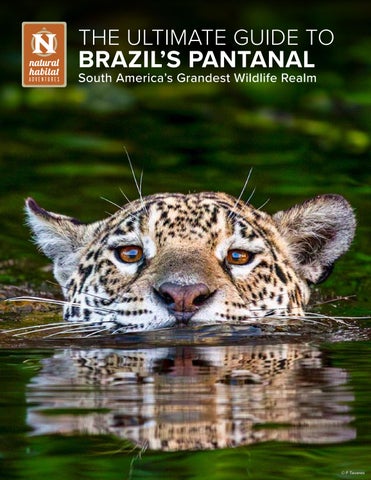
THE ULTIMATE GUIDE TO
BRAZIL’S PANTANAL
South America’s Grandest Wildlife Realm
Credit ©©F PTavares
“Thank you for making this such an exciting and memorable trip! What I loved most was the constant feeling of surprise and wonderment just around each bend in the river, or high in a tree, or crossing a road. We were constantly awestruck by the wildlife encounters and the incredible natural beauty of the Pantanal.” -Nat Hab Traveler Stefanie W., Jaguars & Wildlife of Brazil’s Pantanal
© S Simon
Brazil Adventures • 800-543-8917
CONTENTS
2
Contents 6
WHY CHOOSE NAT HAB FOR YOUR BRAZIL ADVENTURE?
16
PANTANAL GEOGRAPHY & HISTORY
22
WILDLIFE OF THE PANTANAL
42
NAT HAB’S BRAZIL ADVENTURES
46
SUGGESTED READING
48
FREQUENTLY ASKED QUESTIONS
How to Use This e-book: • The Contents listed above are live links. Click to jump to the desired page. • Click “CONTENTS” in the lower right corner to return to this Contents page. • Other links throughout the e-book are shown in blue, underlined text.
Brazil Adventures • 800-543-8917
CONTENTS
3
Brazil Adventures • 800-543-8917
CONTENTS
4
The Pantanal: South America’s Greatest Wetland Wilderness The Pantanal is South America’s best-kept wildlife secret. Stretching across more than 70,000 square miles of Brazil, Bolivia and Paraguay, this immense freshwater wetland— the world’s largest tropical floodplain and a stronghold of biodiversity—offers the continent’s most accessible and concentrated wildlife viewing. With its open landscapes and vast wetlands, the Pantanal offers exceptional opportunities for wildlife observation. The diversity is staggering—an estimated 10 million caimans, more than 650 bird species and over 100 species of mammals, including the continent’s highest concentration of jaguars. Giant anteaters, capybaras, hyacinth macaws, tapirs and howler monkeys are also found in abundance. Seasonal flooding transforms the terrain into a dynamic mosaic of marshes, forests, rivers and savannas, each supporting a different suite of life. Though much of the Pantanal is privately owned ranch land, it remains one of the most ecologically intact wetlands on Earth. Thoughtful ecotourism plays a growing role in protecting the Pantanal, offering a sustainable alternative to development. For both wildlife lovers and photographers, the Pantanal is unrivaled—a sanctuary of open skies, shimmering waterways and some of the greatest wildlife spectacles in the Western Hemisphere. All of Nat Hab’s small-group Brazil adventures and Photo Expeditions offer exciting wildlife viewing and cultural immersion. Call 800-543-8917 or visit our website to discover wild Brazil like few others will.
© H Brandao de Oliveira
Brazil Adventures • 800-543-8917
CONTENTS
5
WHY CHOOSE NAT HAB FOR YOUR BRAZIL ADVENTURE
Nat Hab immerses travelers in the farthest reaches of the Pantanal. Our small groups, expert naturalist guides and respectful, unhurried wildlife viewing foster intimate encounters in some of the region’s most secluded spots. We connect the north and south via chartered flights and explore by boat and on game drives. Add in a stay at Caiman Ecological Refuge, a 130,000-acre sustainable cattle ranch, and you have the most comprehensive Pantanal exploration available.
Brazil Adventures • 800-543-8917
CONTENTS
6
“We witnessed so many awe-inspiring sights. As a birder, I added 111 new species to my life list! The transportation—be it vans, boats or planes—was comfortable and allowed for optimal viewing, especially on the boat at Porto Jofre, where we had close encounters with jaguars and river otters.” -Nat Hab Traveler Michele L., Jaguars & Wildlife of Brazil’s Pantanal
© M Brief
Brazil Adventures • 800-543-8917
CONTENTS
7
A journey to the Pantanal is a front-row seat to one of the planet’s most prolific wildlife spectacles. At Natural Habitat Adventures, we go beyond the typical safari. Our expert guides, indepth local knowledge and unique itineraries maximize your chances of seeing elusive species like jaguars, tapirs, giant anteaters and hyacinth macaws—often up close and far from crowds. We explore remote corners by boat and by foot, with intimate access to Brazil’s most abundant ecosystems. Best of all, our commitment to conservation travel and our partnership with World Wildlife Fund ensure your visit supports long-term protection of this vital biome.
© C Zaparoli
Brazil Adventures • 800-543-8917
CONTENTS
8
© F Lessa
NAT HAB’S BRAZIL ADVENTURES 8 Reasons to See Brazil’s Pantanal with Nat Hab:
1
We Take the Hassle Out of Trip Planning
2
Small Groups Make a BIG Difference
When you travel on your own, you spend a lot of time competing for reservations and trying to figure out where to go and what to do. As a result, you lose precious time and miss the secret spots known only to locals. We’ve taken out the legwork and guesswork, allowing you to experience much more of the Pantanal than most people can accomplish on their own.
To foster the most meaningful nature encounters, we limit the group size on our Brazil nature journey to no more than 11 travelers (and just 8 on our Photo Expedition). A small group also ensures that your needs and expectations are attentively met with personalized care from our Expedition Leader.
Brazil Adventures • 800-543-8917
CONTENTS
9
© J Powell
3 The Very Best Locations for Wildlife Viewing In the Pantanal, we may see Brazilian tapir, capybara, giant armadillo, giant river otter, maned wolf, caiman and the top prize for most wildlife watchers: the elusive jaguar. But you can’t stay just anywhere in this massive marsh and expect those rewards. Our itineraries are strategically based around the best wildlife-viewing locations.
Brazil Adventures • 800-543-8917
CONTENTS
10
4 More Time in the Pantanal from Multiple Perspectives We explore three different locations in both the north and south Pantanal to fully immerse you in this UNESCO Biosphere Reserve. You’ll discover a vast mosaic of flooded marshlands, dry islands and savanna via nature walks, 4x4 drives, boat rides and canoe safaris—each mode revealing a new vantage point on the varied landscapes and their wild inhabitants.
© E Rock
Brazil Adventures • 800-543-8917
CONTENTS
11
© G Penokie
5
Private Chartered Flight from North to South Getting from the northern part of the Pantanal to the south can be a challenge. Rather than subject you to crowded commercial flights and a 10-hour drive over rough roads, we charter private planes to fly directly to Caiman Ecological Refuge. It’s not only a more comfortable and efficient option, but you’ll also get a 360° aerial view of the Pantanal.
© C Zaparoli
Brazil Adventures • 800-543-8917
CONTENTS
12
6
Our Lodgings Immerse You in Nature We choose accommodations for their superb wildlife viewing. We spend multiple nights in the remote Porto Jofre region, where more jaguars are seen than anywhere else. Another highlight is Caiman Ecological Refuge, part of an acclaimed private research, conservation and ecotourism initiative. Unlike more touristed Pantanal accommodations, this exclusive ecolodge enjoys a remote, private setting.
© C Hawkins
Brazil Adventures • 800-543-8917
CONTENTS
13
© F Tavares
7
A Commitment to Sustainability Since 2003, we have been the travel partner of World Wildlife Fund, the world’s leading environmental conservation organization. And as the world’s first carbon-neutral travel company, Nat Hab offsets 100% of the emissions from your trip. This includes your round-trip flights, making your adventure as eco-conscious as it is extraordinary.
Brazil Adventures • 800-543-8917
CONTENTS
14
8
Your Expedition Leader Is a Top Professional Naturalist Nat Hab has a well-deserved international reputation for the highest-quality Expedition Leaders. Our Brazil naturalist guides average 10 years of experience, with additional training and resources from WWF scientists. In the Pantanal, we are also joined by local guides from each lodge who are resident experts in their region’s flora and fauna.
© M Brief
Brazil Adventures • 800-543-8917
CONTENTS
15
PANTANAL
GEOGRAPHY & HISTORY
Geography and history converge in the Pantanal, one of the world’s largest wetlands and one of its most dynamic landscapes. Stretching across Brazil, Bolivia and Paraguay, the region lies within a broad, shallow basin where minimal elevation change allows the Upper Paraguay River to spread outward rather than rush downstream. Annual flooding drives the Pantanal’s evolution, depositing sediments, redirecting waterways and shaping soils over millennia. Human presence has long been part of this rhythm: Indigenous peoples and later ranching communities adapted to the seasonal pulse of water, developing ways of life attuned to a land defined not by permanence, but by continual change.
Brazil Adventures • 800-543-8917
CONTENTS
16
© F Lessa
© C Zaparoli
Brazil Adventures • 800-543-8917
CONTENTS
17
A Geologic Mosaic of Wetlands The Pantanal formed millions of years ago as the Andes Mountains rose and reshaped South America’s waterways. The low basin that emerged between the Andes and the Brazilian Shield became a catchment for seasonal rains and sediment. Today, this alluvial plain floods during the wet season and slowly drains during the dry one, creating a dynamic, ever-changing habitat. The name “Pantanal” comes from the Portuguese word “pantano,” meaning wetland, bog, swamp or marsh. This seasonal rhythm supports an astonishing array of life. With more than 650 bird species, 100 types of mammals and the world’s highest density of jaguars, the Pantanal is one of South America’s premier wildlife-viewing destinations.
Brazil Adventures • 800-543-8917
CONTENTS
18
Its network of rivers, lagoons, forested islands and grasslands hosts iconic species like capybaras, hyacinth macaws, giant otters and caimans. This vast tropical wetland is more than a wildlife haven—it’s a landscape built by water, time and human inhabitants. Covering about 70,000 square miles across Brazil, Bolivia and Paraguay, the Pantanal occupies a shallow tectonic basin where the slow-moving Upper Paraguay River spreads seasonal floods across an almost imperceptibly flat plain, reshaping channels and soils year after year. Its history is written in shifting river courses, layered sediments and the long presence of Indigenous peoples and ranching communities that have thrived amid a landscape that is never entirely dry.
Brazil Adventures • 800-543-8917
CONTENTS
19
Human Presence & Cultural Heritage Though remote, the Pantanal has long been inhabited by Indigenous peoples and later by Portuguese settlers who established fazendas (cattle ranches) across the wetlands. Many modern Pantaneiros are descendants of these early cowboys, living in harmony with the land and developing unique cultural traditions that blend native knowledge with colonial influences. Livestock still plays a central role in the region’s economy, though sustainable tourism and conservation are becoming increasingly important.
Brazil Adventures • 800-543-8917
CONTENTS
20
Despite its vital ecological value, only about 2% of the Pantanal is legally protected. Most of the region remains in private hands, making collaborative conservation with local communities and landowners essential. WWF and other organizations are working with ranchers to promote land stewardship that supports both livelihoods and ecosystems.
Brazil Adventures • 800-543-8917
CONTENTS
21
WILDLIFE OF THE PANTANAL
The Pantanal hosts the densest concentration of wildlife in South America. From jaguars and giant anteaters to caimans, capybaras and hyacinth macaws, this vast wetland offers unmatched opportunities to observe the continent’s most charismatic species in a rich and varied natural habitat.
Brazil Adventures • 800-543-8917
CONTENTS
22
© R de Gouveia
Brazil Adventures • 800-543-8917
CONTENTS
23
JAGUAR South America’s apex predator, the jaguar represents one of the Pantanal’s most visible conservation successes. As the third-largest cat in the world—after the tiger and lion—the jaguar commands attention with its powerful build and striking rosette-patterned coat. Jaguars in the Pantanal are the largest of their kind, sometimes exceeding 300 pounds and seven feet in length. They have massive heads, stocky bodies and incredibly strong jaws—the most powerful bite of any big cat relative to body size, capable of piercing skulls and crushing bones. Remarkably versatile, jaguars are excellent swimmers, agile climbers and formidable hunters of dozens of species. In the Pantanal, they are known to prey on capybaras and even adult caimans they haul from the water with astonishing strength. Though jaguars are elusive across most of their range, the northern Pantanal—particularly the Porto Jofre region—offers the best opportunity in the world to observe them in the wild. Despite legal protection, jaguars continue to face pressure from habitat loss, deforestation and conflict with ranching operations. Conservation efforts such as the Jaguar 2030 initiative, a range-wide strategy led by governments, scientists and NGOs, aim to secure connected habitats, reduce human–jaguar conflict and ensure viable jaguar populations across their historic range by the year 2030.
Brazil Adventures • 800-543-8917
CONTENTS
24
© B Corbett
Brazil Adventures • 800-543-8917
CONTENTS
25
“It’s hard to pick just one favorite moment from this wonderful adventure, but spotting our first jaguar and watching a mother jaguar with her cub were both unforgettable. I came home with fantastic photos and videos.” -Nat Hab Traveler Joyce C., Brazil Jaguar & Wildlife Photo Expedition
5 Tips to Spot Jaguars in the Wild Jaguars are famously secretive, but the Pantanal offers the best opportunity to see them in their natural habitat. Here’s how to improve your odds:
1. Look and Listen Closely Jaguars are quiet and well-camouflaged. Scan riverbanks, logs and dense foliage carefully, and stay alert for the warning calls of monkeys or birds.
2. Spot the Camouflage A jaguar’s rosette coat blends seamlessly with dappled sunlight and shadow. Train your eyes to pick out subtle patterns among tree trunks and tall grass.
3. Stay Alert for Motion © B Shepard
Look for ripples in the water, sudden movements in the brush or the flick of an ear—small signs often reveal a big cat nearby.
4. Visit During the Dry Season Waterways shrink from May to October, concentrating wildlife and making jaguars easier to find along exposed riverbanks.
5. Track Jaguars with Expert Guides Local guides and naturalists (like our Nat Hab Expedition Leaders) know where jaguars roam. Their keen eyes, experience and real-time tracking insight make all the difference.
CONTENTS © B Shepard
27
© F Lessa
CAIMAN While Brazil is home to several crocodilian species, it’s the caiman that steals the spotlight in the Pantanal. These smaller relatives of crocodiles thrive in the wetlands’ network of rivers, ponds and marshes. The spectacled caiman, named for the bony ridge between its eyes, is the most commonly encountered species. Though modest in size—typically maxing out around 7 feet long—they are one of the most abundant crocodilians in the Americas. Caimans are masterfully adapted to aquatic life. Their blue-green scales blend with their watery surroundings, and their raised nostrils allow them to breathe while almost entirely submerged. They’re frequently seen basking on muddy banks or gliding silently through shallow creeks and swamps. Despite their camouflage and stealth, caimans face numerous threats. Nest predation by dogs, foxes and large lizards like the tegu is common. Human activity—particularly hunting to procure skins to make leather—also impacts their numbers. Ironically, the growing demand for caiman skins has slightly reduced pressure on the region’s more endangered crocodiles.
Brazil Adventures • 800-543-8917
CONTENTS
28
TAPIR The South American tapir, also known as the Brazilian tapir, looks like a mash-up of several animals—part pig, part horse, with a short, flexible snout that hints at an elephant’s trunk. This odd yet endearing herbivore is one of the oldest surviving large mammals, having changed little over millions of years. As the largest native land mammal in South America, the tapir plays a crucial role in maintaining healthy ecosystems by dispersing seeds as it forages through forest undergrowth. Using its prehensile snout, it pulls leaves, shoots and fruit into its mouth with ease. Though once widespread, the tapir’s numbers have declined dramatically due to habitat loss and hunting. Today, it is classified as endangered, and sightings in the wild are rare. These solitary and shy creatures prefer dense forest and swampy lowlands, where they spend much of their time near water. In fact, tapirs are excellent swimmers and often retreat into rivers or marshes at the first sign of danger.
© F Tavares
Brazil Adventures • 800-543-8917
CONTENTS
29
“Our Expedition Leader was an incredible naturalist and photographer. His ability to imitate monkey calls, identify birds in flight and spot jaguars, ocelots and giant anteaters was phenomenal.” -Nat Hab Traveler Claudia G., Brazil Jaguar & Wildlife Photo Expedition © H Brandao de Oliveira
HOWLER MONKEY If you’re greeted each morning by a sound more
thanks to enlarged larynxes and balloon-
reminiscent of a lion’s roar than a monkey’s call,
like throats that act as natural amplifiers.
chances are you’re within earshot of a howler
Females, while quieter, may emit sharp cries to
monkey. These vocal primates are the largest
communicate with their young.
monkeys in the Pantanal, with males reaching up to 10 pounds in weight. What they lack in
Despite their powerful voices, howler monkeys
size, they make up for in sound—their booming
are surprisingly sedentary. They spend most
calls can travel over a mile, even through
of their time in the upper canopy, leisurely
dense forest.
browsing leaves and fruit, which make up the majority of their diet. In fact, while they can
Howlers are especially vocal at dawn and
eat a variety of plant materials, howlers are
dusk, using their signature roars and bellows
extremely selective feeders, choosing only
to establish territory and warn off rival groups.
the most nutritious foliage.
Males produce these deep, resonant calls
Brazil Adventures • 800-543-8917
CONTENTS
30
CAPUCHIN MONKEY The charming capuchin monkey is known for its expressive eyes, agile treetop antics and highly social nature. Adult capuchins measure up to about 22 inches in body length—with tails nearly as long—and weigh approximately 2 to 3 pounds. These diurnal primates move in social groups of up to 35 individuals, led by alpha males and females. Their habitat spans tall trees and forested corridors in the northern and southern Pantanal, where they blend life in the canopy with occasional forays onto the ground. With their nimble limbs and keen intelligence, capuchins are versatile omnivores. Their diet includes fruits, seeds, insects, small vertebrates and bird eggs.
© I Domhoff
Brazil Adventures • 800-543-8917
CONTENTS
31
Brazil Adventures • 800-543-8917
CONTENTS
32
CAPYBARA The capybara is the world’s largest rodent and a familiar sight in the Pantanal’s wetlands and riverbanks. Adult capybaras typically weigh between 77 and 130 pounds, though some individuals have reached over 200 pounds. With their barrel-shaped bodies, reddishbrown fur and expressive eyes, they resemble oversized guinea pigs—their closest relatives. These semi-aquatic herbivores are excellent swimmers and rarely stray far from water. They feed on a diet of grasses and aquatic plants, consuming up to eight pounds of vegetation daily. Capybaras also practice coprophagy, consuming their own feces to better digest tough plant fibers and extract essential nutrients. Highly social animals, capybaras live in groups of 10 to 30 individuals, led by a dominant male. Communication is constant within the herd, ranging from clicks and purrs to alarm barks and grunts. They breed during the rainy season, and the young are often seen playing near the water’s edge.
© B Corbett
Brazil Adventures • 800-543-8917
CONTENTS
33
© A Lai
Brazil Adventures • 800-543-8917
CONTENTS
34
COATI The South American coati, often nicknamed the “hog-nosed raccoon,” is a curious and agile mammal commonly found in the forests of the Pantanal. Recognizable by its elongated snout, banded tail, and rust-colored coat, the coati is an adept forager and climber. Its double-jointed ankles allow it to descend trees headfirst—much like its raccoon cousins. These diurnal omnivores spend their days foraging both in the trees and on the forest floor. Their diet includes fruit, insects, small animals and eggs, which they sniff out with their flexible snouts and dig up using their strong claws. Females and young coatis are highly social, living in bands of 15 to 30 individuals, while adult males are solitary, earning them the colloquial name “coatimundis,” from the Guarani (an Indigenous Brazilian language) word “mundi,” meaning lone or alone. Coatis use chirps, grunts and alarm calls to communicate and alert their group to danger. When threatened, they often flee high into the trees. While their main predators include jaguars, foxes and dogs, their biggest threat is habitat loss.
Explore more of the wildlife of the Pantanal in our Brazil Wildlife Guide!
Brazil Adventures • 800-543-8917
CONTENTS
35
GIANT RIVER OTTERS Sleek, social and fiercely efficient hunters, giant
occasionally small mammals. Hunting is often
river otters are known locally as ariranhas and
a group activity—otters live in tight-knit family
sometimes nicknamed “river wolves.” These
groups and rely on teamwork and constant
highly vocal carnivores are the largest members
communication through a variety of chirps,
of the weasel family, reaching up to 6 feet
whistles and growls.
in length. Alongside jaguars, they are apex predators in this ecosystem.
Once heavily hunted for their velvety pelts, giant river otters are now listed as endangered
Giant river otters live in freshwater rivers, lakes
by the IUCN. Though still threatened by habitat
and swamps, where they use their powerful tails
loss, pollution and human disturbance, they are
and webbed feet to navigate swiftly through
making a slow comeback in protected areas like
the water. Their diet consists mainly of fish, but
the Pantanal.
they will also take crustaceans, reptiles and
© F Tavares
Brazil Adventures • 800-543-8917
CONTENTS
36
GIANT ANTEATERS & TAMANDUAS Two of the most distinctive insectivores in the
pumas. It is often seen foraging in open areas, and
Pantanal are the giant anteater and its smaller,
lucky observers may spot a mother carrying her young
arboreal cousin, the southern tamandua. Both are
on her back.
members of the same family, known for their toothless mouths, formidable claws and astonishingly long
The tamandua, though smaller and more elusive, is
tongues adapted to a diet of ants and termites.
equally fascinating. Adapted for life in the trees, it uses its 15-inch tongue and powerful forearms to tear into
The giant anteater is a true icon of the region. With
insect nests. When threatened, it clings to branches
its bushy tail, elongated snout and two-foot tongue,
with its hind limbs, freeing its claws for defense. With
it can consume up to 30,000 insects per day, flicking
limited eyesight but an exceptional sense of smell,
its tongue more than 150 times per minute. Despite
the tamandua is a masterful, if secretive, predator.
its gentle nature, this diurnal animal is equipped with
Together, these unique mammals play a vital role in
four-inch claws capable of fending off jaguars and
regulating insect populations in the Pantanal.
© F Tavares
Brazil Adventures • 800-543-8917
© S Wong
CONTENTS
37
HYACINTH MACAWS The hyacinth macaw is one of the Pantanal’s most dazzling residents and the largest parrot species in the world. Measuring nearly four feet long with a wingspan up to 12 feet, these vibrant blue birds are unmistakable. Their striking plumage contrasts with bold yellow accents around the eyes and beak, making them one of the region’s most iconic and photogenic species. These social birds inhabit tall trees and palm groves near rivers and wetlands, feeding primarily on hard-shelled nuts and unripe fruit. Their powerful, flexible beaks allow them to crack even the toughest shells, while their messy eating habits help disperse seeds and regenerate forest growth. To neutralize toxins in their diet, they often consume clay from riverbanks—a natural detox that aids digestion. Macaws form lifelong monogamous pairs, often seen flying or perching together, grooming one another affectionately. While they roost communally in flocks, only one mate stays behind to incubate the eggs while the other forages.
© M Pawl-Frederico
Brazil Adventures • 800-543-8917
CONTENTS
38
© J Branson
JABIRU STORKS The jabiru stork is a towering icon of the Pantanal and holds the distinction of being the largest flying bird in the Americas. Adults stand four to five feet tall and have a wingspan that can reach up to 12 feet. While scarce elsewhere, jabirus thrive in the wetlands of the Pantanal, where expansive marshes provide prime feeding and breeding grounds. These striking birds are easily identified by their white plumage, glossy black head and beak, and a distinctive red throat pouch that swells during vocalizations. From a distance, they’re often likened to stooped figures in red neckties—a fitting metaphor for their commanding presence. Jabirus are skilled nest builders, constructing massive platforms of sticks atop tall trees—sometimes 10 feet across—where they raise two to four gray-feathered chicks. Both parents share nesting duties and fiercely protect their young. Feeding primarily in swamps, ponds and flooded fields, jabirus dine on a variety of prey, including fish, frogs, mollusks, reptiles and small mammals
Brazil Adventures • 800-543-8917
CONTENTS
39
MORE BIRDS OF THE PANTANAL Brazil’s Pantanal ranks among South America’s richest birding regions, supporting more than 650 species across its vast and diverse ecosystems. Hyacinth macaws, toco toucans and jabiru storks headline this remarkable diversity, joined by an incredible array of migratory and resident birds. For birders, the Pantanal is among the most rewarding destinations in the world.
Wood Stork
Blue-crowned Trogon
© S Wong
Toucan
© R de Gouveia
Blue-fronted Amazon
© R de Gouveia
© C Zaparoli
Great Cormorant
Brazil Adventures • 800-543-8917
© S Wong
CONTENTS
40
Roseate Spoonbill
© M Brief
Red and Green Macaw
Greater Rhea
Swallow-tailed Hummingbird
Brazil Adventures • 800-543-8917
©C Barros
© C Zaparoli
© C Zaparoli
Aratinga
© M Brief
Red-legged Seriema
CONTENTS
41
NAT HAB’S BRAZIL ADVENTURES
Nat Hab’s exceptional Expedition Leaders and years of expertise in the Pantanal region guarantee an experience you won’t find with any other tour operator or on a self-planned itinerary. Trust us to get you there, and Brazil’s stunning landscapes and iconic wildlife will do the rest!
Brazil Adventures • 800-543-8917
CONTENTS
42
“I have been on quite a few guided trips, and our Expedition Leader for this trip was the best guide I’ve ever had. Seeing so many jaguars was a highlight, but I also immensely enjoyed the flight over the southern Pantanal and the wildlife viewing at the Caiman Ecological Refuge. And the food! These were some of the best meals of my traveling life.” - Nat Hab Traveler Craig G., Jaguars & Wildlife of Brazil’s Pantana
© M Brief
Brazil Adventures • 800-543-8917
CONTENTS
43
HERE ARE JUST A FEW OF THE HIGHLIGHTS OF OUR BRAZIL TRIPS: Our small-group Brazil adventures take you farther into the wild—away from the typical tourist track. We link remote regions by chartered flights, explore by game drives and private boat rides, and stay in secluded ecolodges surrounded by nature—including the renowned Caiman Ecological Refuge, a private reserve and conservation-focused lodge.
© R de Gouveia
Explore by boat in the north, then on 4x4 safari drives and guided walks in the south. You won’t find a more varied or comprehensive Pantanal itinerary.
© K Reek
© F Lessa
Discover wildlife spots most visitors miss, plus other surprises revealed only by our naturalist Expedition Leaders, who know the Pantanal intimately.
Brazil Adventures • 800-543-8917
Alongside expert naturalist guides, make multiple boat excursions from Porto Jofre—the best place on the planet to spot jaguars in the wild.
CONTENTS
44
Enjoy a traditional Pantaneiro cowboy dinner outdoors, with spit-roasted meat and other favorite local dishes.
© F Lessa
On our Brazil Photo Expedition, an expert naturalist-photographer Expedition Leader provides personalized guidance and superlative photo ops. With just eight guests, there’s ample space for gear and optimal shooting positions.
Brazil Adventures • 800-543-8917
Enjoy an exclusive stay at Caiman Ecological Refuge, our remote and secluded base, to seek out the giant anteater, tapir, ocelot, hyacinth macaw and more.
© R de Gouveia
On clear nights, view planets and constellations through powerful telescopes during evening astronomy programs around the campfire.
CONTENTS
45
SUGGESTED READING
Deepen your understanding of Brazil’s vibrant ecosystems and rich cultural heritage with these recommended reads. From compelling wildlife chronicles and ecological explorations to cultural insight and literary fiction, each title offers a deeper connection to the lands, people and biodiversity that make Brazil—and the Pantanal— so extraordinary.
Brazil Adventures • 800-543-8917
CONTENTS
46
Tropical Nature: Life and Death in the Rain Forests of Central and South America | Adrian Forsyth & Ken Miyata Two remarkably perceptive and insightful field biologists present a vivid depiction of the tropics through 17 captivating essays, exploring the habitats, ecology, flora and fauna of the Central and South American rainforests. Into the Amazon: The Life of Candido Rondon, Trailblazing Explorer, Scientist, Statesman and Conservationist | Larry Rohter A vivid and comprehensive biography of a Brazilian explorer who advocated for the protection of the rainforest and the Indigenous people who inhabit it. Famous in his own country but little known elsewhere, he also laid over 4,000 miles of telegraph line through the Brazilian jungle. The New Neotropical Companion | J.C. Kricher This comprehensive guide, designed for the general reader, provides a structured overview of the ecology, habitats, wildlife, plants and ecosystems of Central and South America. For those not put off by Latin names and concepts like “Batesian Mimicry,” this handbook is a great introduction to the region. Tales of a Shaman’s Apprentice: An Ethnobotanist Searches for New Medicines in the Amazon Rain Forest | Mark J. Plotkin In this remarkable book, Plotkin shares his experiences documenting the usage of medicinal plants among remote Indigenous people in the Northwest Amazon. It offers a vivid portrait of the people and their environment, blending adventure with science dedicated to preservation. Dona Flor and Her Two Husbands | Jorge Amado Amado spins a satiric tale about a young cooking teacher in Salvador, the capital of Brazil’s northeastern state of Bahia. Though she remarries after her philandering ne’er-do-well first husband drops dead at the carnival, she is haunted by memories of him—and eventually his ghost. The Brazilians | Joseph Page This is a clear and compelling introduction to the country, covering politics, history, economics, culture and character. One of the many thought-provoking chapters discusses the turmoil and ecological destruction in the Amazon Basin.
Brazil Adventures • 800-543-8917
CONTENTS
47
FREQUENTLY ASKED QUESTIONS ABOUT BRAZIL’S PANTANAL
From the best places to spot jaguars to what gear to pack and how our trips are designed, find answers to the most common questions travelers have when planning a nature-focused adventure to Brazil’s Pantanal.
Brazil Adventures • 800-543-8917
CONTENTS
48
What is the Pantanal and where is it located in Brazil?
While the Amazon may be the premier wildlife destination in countries such as Peru and Ecuador, in Brazil, nothing beats the Pantanal. Part national park and part UNESCO World Heritage site, the Pantanal is a natural region encompassing the world’s largest tropical wetland. It is South America’s primary wildlife sanctuary where thousands of species reside. The Pantanal is located in the midwestern Brazilian state of Mato Grosso do Sul.
When is the best time to visit the Pantanal? The dry season (from June through October) is the best time to visit the Pantanal. These months are the coolest and vegetation is less dense, allowing for optimal wildlife viewing and bird watching. Areas of the Pantanal that flood during the rainy season become accessible, allowing for a more in-depth exploration of this biodiverse area and providing the highest chances of seeing elusive jaguars.
What is the weather like in the Pantanal? The average daytime temperature in the Pantanal during the dry season (from June through October) is around 90ºF. Mornings and evenings can be quite chilly in June, July and sometimes August, with temperatures dipping to near 40ºF. Rain is always a possibility. Temperatures and rainfall begin to increase in October as the wet season approaches.
What wildlife will I see in the Pantanal? The Pantanal is the largest tropical wetland on the planet and a region of incredible biodiversity. Jaguars, ocelots, capuchins, howler monkeys, peccaries, capybaras, giant river otters, tapirs, South American coatis, anteaters, caimans, macaws and thousands of other bird species inhabit the Pantanal. Check out our Brazil Wildlife Guide for more information.
Will I see jaguars in the Pantanal? Though jaguars are elusive animals and tricky to find because of their spotted camouflage, there is a good chance we’ll see one (or more!). Porto Jofre offers the greatest density of jaguars in the entire Pantanal, so our odds of seeing them there are high. We’ll search for the stealthy cats on private skiff excursions, where we may find them prowling, fishing or lounging by the riverbank.
What clothing should I pack for the Pantanal? Bring clothes for hot and cool weather on our trips to Brazil, as temperatures can fluctuate significantly from day to night, and rain is always a possibility. Nat Hab recommends wearing lightweight, quick-drying clothing during the day and long pants and a light jacket at night. Pack hiking boots or sturdy shoes for walks and excursions. See our Brazil packing list and check out Nat Hab’s online Gear Store for some of the key items recommended for your adventure.
Brazil Adventures • 800-543-8917
CONTENTS
49
What are the accommodations like on Nat Hab’s Brazil trips? We stay in some of Brazil’s most remote ecolodges, as close as possible to the best wildlife viewing in the heart of private reserves and wildlife sanctuaries. Rooms at ecolodges are simple and equipped with air conditioning, screened windows and ceiling fans to keep cool. Pristine wilderness surrounds many of these lodges, so don’t be surprised if you catch sight of a howler monkey in the treetops while taking a refreshing dip in the swimming pool or dining on delicious traditional dishes from the Pantanal region.
What type of cuisine is Brazil known for? Brazilian cuisine is a fusion of African, European and Indigenous influences and varies greatly by region. Most meals consist of rice and beans, root vegetables, tropical fruits, meat and fish, frequently combining savory and sweet flavors. Feijoada, the national dish, is a black bean stew served with rice and pork alongside citrus and sauteed collard greens. Guests on our Brazil trips enjoy familiar Western fare as well as local cuisine sourced from the Pantanal region, such as fresh fish dishes and tropical fruit for breakfast.
How active are Nat Hab’s Brazil trips? This trip is rated as moderate because guests must be able to walk approximately 2–3 miles over mostly flat but sometimes uneven terrain. Guests may experience long periods of walking or time in transit in hot and humid weather. On this trip, each guest can opt out of any activity; however, alternate activities may not be provided.
Are Nat Hab’s Brazil trips appropriate for children? The minimum required age for this trip is 12 years old because of full days and long transfers that can be difficult for youngsters. We strongly encourage you to call our office at 800-543-8917 to speak with an Adventure Specialist about the specific requirements of our Brazil adventures. If you’re looking for a trip designed specifically for younger children and families, consider our Family Adventures.
Is there cell phone service or Internet connection on Nat Hab’s Brazil trips? Internet access is available at all our Brazil accommodations, although Wi-Fi at Porto Jofre is slow and may be unavailable at times. Although there is cell phone service in Rio, it is limited and often nonexistent in the more remote areas of the country and across the Pantanal.
Brazil Adventures • 800-543-8917
CONTENTS
50
What currency is used in Brazil? The Brazilian Real (BRL) is the official currency of Brazil. We recommend exchanging money at a casa de cambio or major banks in Rio for the best exchange rates. Credit cards are accepted at larger restaurants, hotels and gift shops. Smaller establishments will commonly only take cash, so it’s a good idea to have enough money on hand for gratuities and other incidental purchases.
How is Nat Hab’s Brazil Photo Expedition different from its other Brazil trips? Our Photo Expedition has an exclusive focus on wildlife and landscape photography. Your guide isn’t just an expert in wildlife and ecology—they’re skilled in photo instruction and know how to position you for the best shots, lingering longer at wildlife sightings to create more opportunities to frame and refine each shot. You’ll travel with a small group (a maximum of 8 guests rather than 11) of like-minded photographers, from enthusiastic beginners to serious hobbyists Please check out our dedicated photography site, The Natural Photographer, for up-to-date articles on wildlife and nature photography—including advice for shooting in Brazil—as well as general tips on all types of cameras.
Can I go on a Photo Expedition even if I’m not an advanced photographer? Absolutely. In fact, it’s encouraged—Photo Expeditions are one of the best ways to learn. You’ll likely travel with other beginners and get guidance from experienced photographers and your professional Photo Expedition Leader. Whether you use a point-and-shoot on auto or a more advanced DSLR or mirrorless camera, you’ll return with a wealth of great images and new skills.
Can Nat Hab take our family or a group on a private Brazil adventure? Yes! Families or friend groups can reserve entire departures on a private basis. Please call our office at 800-543-8917 for group size and pricing details.
Any idea which wild cats prowl the Pantanal? How about what the largest living rodent or the loudest animal on earth is? Can you name the favorite foods of toucans, tapirs and giant river otters? Take our Brazil Nature Quiz to put your knowledge to the test!
Brazil Adventures • 800-543-8917
CONTENTS
51
Brazil Adventures • 800-543-8917
CONTENTS
52
DISCOVER WILD BRAZIL “The Pantanal is one of Earth’s great biological treasures, a place where life thrives in remarkable concentration. Conservation is working, the jaguar is coming back and this is the time to see it firsthand.” – Ben Bressler Explorer, Founder, Conservationist Call 800-543-8917 or visit our website to learn more about our Brazil offerings, as well as private and family options.
© F Tavares
Brazil Adventures • 800-543-8917
CONTENTS
53
© J Haroldson