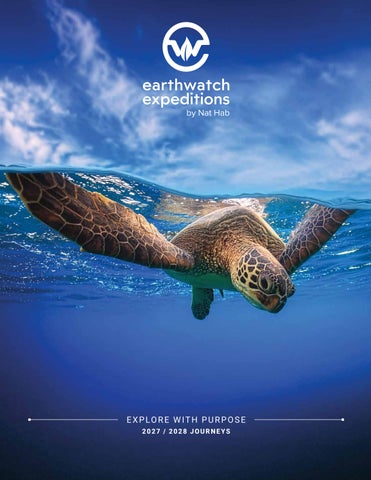
E X P LO R E W IT H P U R P O S E 2027 / 2028 JOURNEYS
A New Direction in Exploratory Travel Dear Traveler, As someone who’s passionate about nature, you may already know travel can be about more than just seeing the world—it can have a much bigger purpose. That’s why I’m excited to share our first Earthwatch Expeditions by Nat Hab catalog—and to introduce our new Managing Director, Renata Haas. With a background in environmental science and developing expeditions in Earth’s wildest places, Renata knows that to protect Earth’s precious species and habitats, we must first understand them. Since 1971, Earthwatch Institute has brought everyday people with a zest for the planet into the field alongside scientists doing crucial conservation research. In fact, Earthwatch’s pioneering model was an inspiration to me as I built Natural Habitat Adventures. Now, Nat Hab and Earthwatch have combined forces to bring Earthwatch’s legacy of participatory science together with Nat Hab’s decades of expertise creating immersive nature expeditions. Earthwatch Expeditions are built around four defining elements: You’re an active, hands-on participant doing fieldwork with top scientists, contributing to research that helps protect wildlife and wild places. You’ll gain exclusive access not available to other travelers, going behind the scenes at research sites with opportunities and perspectives few ever get. You are meticulously cared for by professional Expedition Leaders with a deep knowledge of your destination, seamlessly managing every aspect of your trip. You join an enduring legacy of conservation research, building on more than 50 years of Earthwatch’s role in expanding scientific understanding in the service of conservation. Whether you’re banding owls in Arizona, counting river dolphins in the Amazon or collaring elephants in Africa, you’ll experience nature in a way that redefines what “up close and personal” means. Earthwatch Expeditions brings science, discovery and adventure together at a whole new level— and we believe it represents an exciting new direction in exploratory travel. Come join us in the field!
Ben Bressler • Explorer, Founder, Conservationist Natural Habitat Adventures
Renata Haas • Managing Director Earthwatch Expeditions by Nat Hab
1
Table of Contents 4 6 8 10 12 14 16 18 20 22 24
Contribute to Conservation A New Way to Explore Work with Top Scientists You Are an Essential Participant Rich Itineraries Enhance Exploration Expedition Leaders Connect the Dots Be Part of an Enduring Legacy Expert Care & Seamless Service Strategically Chosen Accommodations Travel with Others Who Share Your Passion Your Role in the Research
AFRICA 26 28 30 32 34 40 42 44
Study Big Game on Safari in Kenya Tracking Black Rhinos in Kenya Namibia’s Cheetahs at Close Range Protecting South Africa’s Rhinos at Risk To Save a Rhino, Trim Its Horn Walking with Wildlife in South Africa Sustaining Elephants in South Africa Tracking Lemurs in Madagascar
CHURCHILL & THE NORTH 46 48 50 52 54
Polar Bears in Canada’s Changing Arctic Behind the Scenes with Polar Bears Up Close & Personal with Beluga Whales Tracking Orcas & Their Prey in Iceland Rethinking the Killer Whale
THE AMERICAS 58 60 62 64 66 68 74 76 78
2
Ultimate Amazon Research Adventure Following Jaguars in Brazil’s Pantanal Saving Sea Turtles in Costa Rica Bees, Birds & Wild Beauty in Costa Rica Catch, Tag & Release Sharks in Belize The Shark Fisher & the Scientist Whales, Dolphins & Whale Sharks of Baja Close Encounters with Arizona’s Forest Owls Exploring Wild Wonders of Maine’s Acadia
DISCOVER Venture into wild places, encounter wildlife up close and explore diverse landscapes on adventures that deepen your connection with the natural world.
ACCESS Go beyond a typical travel experience as you work alongside scientists in the field, gaining unmatched access to wild places and rare wildlife encounters.
PROTECT Help wildlife and ecosystems thrive by collecting field data that scientists use to restore habitat and guide lasting conservation strategies.
© D Gaspard
3
Contribute to Conservation Through Earthwatch Institute Travel to Sustain Science When you travel with Earthwatch Expeditions, your support for science reaches far beyond the days you spend in the field. At a time when research funding is increasingly uncertain, expedition proceeds help underwrite long-term field science—from equipment and permits to technicians and local research teams—so vital studies can continue year after year. A portion of your trip fee also supports Earthwatch Institute, a nonprofit that has connected the lay public with science for more than 55 years, including fully funded fellowships that give educators, students and people underrepresented in science the chance to work alongside researchers in the field. More than 80% of our program spending stays with local communities and partners, supporting conservation where the research takes place. earthwatchexpeditions.com/institute
4
5
Earthwatch Expeditions: A New Way to Explore At the Confluence of Science & Adventure Just because every corner of our planet has been mapped and investigated, it doesn’t mean there are no more discoveries to be had. On the contrary—and traveling with Earthwatch Expeditions is an exciting conduit to new knowledge about the wild world. Transforming travelers from observers into active participants in conservation, Earthwatch offers new discoveries every day. Guests work with world-class scientists to study animal populations and assess habitats, deploying innovative research and observation tools, and in the process, build findings that advance scientific knowledge, inform conservation policy and protect biodiversity. But the research is only part of the expedition. Active exploration reveals the destination beyond the fieldwork, bringing it to life through wildlife viewing, hiking, Zodiac cruises and other immersive forays. The result is a unique and deeply rewarding journey combining discovery, adventure and impact. earthwatchexpeditions.com/discover
6
© M Hillman
7
Meet Scientists Working to Save the Planet Get an Inside Perspective on These Research Heroes Behind every adventure with Earthwatch Expeditions are scientists who have devoted their lives to understanding and sustaining the natural world. They are wildlife biologists, ecologists, veterinarians and conservation researchers who have spent entire careers studying a species or ecosystem. When you travel with Earthwatch Expeditions, you work alongside them. You might help identify individual orcas in Iceland, join a wildlife veterinarian protecting rhinos in South Africa, or track lemurs with a primatologist in Madagascar. These ongoing research projects offer a window into the questions, challenges and discoveries that define a scientist’s quest. It’s a rare chance to understand conservation through the eyes of the people pursuing it every day. For a brief but meaningful time, you become part of the important team they lead. earthwatchexpeditions.com/access
8
© H Martinez
9
You Are an Essential Participant Your Contribution Moves the Research Forward Earthwatch Expeditions is focused on wildlife, wild habitats and the questions scientists pursue about them in the service of conservation. You’ll be an active, hands-on participant in these studies, making a direct contribution to the research. Many of these projects have been going on for years, even decades, and the data could not be collected without the dedicated presence of Earthwatch Expeditions participants. While you’ll also spend exhilarating time observing wildlife and natural landscapes, you play a key role in the fieldwork, whether you’re counting reef sharks in Belize, assisting with banding forest owls in Arizona, or helping wildlife vets collar elephants in Africa. While the scientists lead the projects, you are an integral partner: without you, the research doesn’t happen. earthwatchexpeditions.com/protect
10
© M Hillman
11
Rich Itineraries Enhance Exploration Your Journey is More Than a Science Field Trip Participating in science may be at the heart of your adventure, but it’s only part of your experience with Earthwatch Expeditions. Our itineraries are designed to immerse you in our riveting destinations through wildlife viewing, active exploring and naturalist-led interpretation. In South Africa, days spent monitoring elephants are paired with a classic safari in search of the Big Five. In Kenya, time with researchers is complemented by game drives in the Maasai Mara looking for leopard, cheetah, giraffe and more. Along with polar bear studies in Churchill, head out by Polar Rover, helicopter and dog sled to look for wildlife, meet Indigenous elders and search for the northern lights. Track orcas in Iceland, then explore rugged coast, thundering waterfalls and puffin colonies. Combining impactful research with multifaceted nature encounters is the unique hallmark of Earthwatch Expeditions. earthwatchexpeditions.com/itineraries
12
© F Paladino
13
Professional Expedition Leaders Connect Every Element of Your Journey While top scientists lead your field research, a dedicated Expedition Leader accompanies your group throughout the entire trip, providing end-to-end support and additional nature interpretation to enrich your experience. Your Expedition Leader connects what you learn through hands-on research to the wildlife, ecology, landscapes and cultural dimensions of your destination, charting the relationship of your fieldwork to the wider context. They’re also your host throughout the journey, taking care of travel logistics and getting to know your individual needs, leaving you free to concentrate on the research and fully enjoy your adventure. When plans must be altered due to weather or an unexpected wildlife sighting arises, your Expedition Leader is there to make the most of each day while ensuring you are meticulously cared for along the way. earthwatchexpeditions.com/leaders
14
15
Be Part of an Enduring Legacy Supporting Conservation for Nearly a Collective Century Earthwatch Expeditions and Natural Habitat Adventures bring together almost a century of combined experience at the intersection of conservation research and nature travel. Since 1971, Earthwatch has been the global leader in hands-on, participatory science. More than 1,400 studies, led by some of the world’s most important scientists, have resulted in thousands of peer-reviewed publications and policy impacts in the service of protecting our planet’s most precious species and imperiled places. Nat Hab pioneered conservation-focused nature travel in 1985, creating adventures that showcase and support the wild world. Now, as these two respected entities join forces, the Earthwatch Expeditions scientific legacy is augmented by the operational prowess and high hospitality standards Nat Hab brings to the partnership. The result is an even better experience for travelers, with an unrelenting commitment to impactful science that makes a difference for wildlife now and for generations to come. earthwatchexpeditions.com/legacy
16
17
Expert Care & Seamless Service Earthwatch Expeditions Hallmarks You Can Count On Just because research with Earthwatch happens in some of the world’s wildest places, you won’t want for comfort or care. You’re meticulously looked after during your adventure, so you can be fully engaged in the rewarding work you’ve come to do. While your project’s lead scientist spearheads your project, a dedicated Expedition Leader is with you the entire time to attend to all logistics and details, supported by a local ground crew. We’ve arranged for comfortable accommodations that don’t compromise on access and proximity to fieldwork. And while we can never predict how nature will cooperate, the expedition is designed for flexibility—even when outside conditions require us to switch course, your overall experience will be illuminating and meaningful, with our committed professional management and expertise. earthwatchexpeditions.com/service
18
© O Sinare
19
Strategically Chosen Accommodations Keep You Close to Nature & Discovery Where you stay can bring you even closer to the nature you’ve come to encounter. Our accommodations are carefully selected to enhance your comfort while providing proximity to fieldwork sites. From a wellappointed riverboat designed for Amazon navigation deep in the Peru rainforest to a secluded safari camp on a private conservancy in Kenya, from cloud forest cabins in Costa Rica to a research station in Arizona’s Chiricahua Mountains, you’ll stay in memorable locations that enhance your experience. Look for Arctic wildlife on the tundra outside the Churchill Northern Studies Center, and stay among spruce forest and rugged coast on Acadia National Park’s Schoodic Peninsula. When your lodgings are immersed in nature, you’ll have more opportunities to watch wildlife and soak in landscapes along with the important time you spend on field research. earthwatchexpeditions.com/lodging
20
© M Hillman
21
Travel with Others Who Share Your Passion Make Connections, Spark Curiosity & Find Community When you explore the wild world with Earthwatch Expeditions, you’re part of a small group of like-minded travelers who care deeply about nature and share a desire to protect it. Working side by side and making discoveries together creates connections that become an important part of your overall experience. You’ll also form personal relationships with your research team, with plenty of opportunities for questions, conversations and sharing insights about the fieldwork you’re doing, what you are observing and learning, and why it matters. You’re part of an avid cohort in which each individual’s contribution to the study is integral, and the inspiring whole is larger than the sum of the parts. In such an intimate context, fellow travelers and scientists quickly become colleagues and friends, united by a common purpose. earthwatchexpeditions.com/groups
22
© M Hillman
23
Your Role in the Research Field Science in Action Observe Animal Behavior
Document How Wild Animals Live & Interact
• • •
OBSERVE
ANIMAL BEHAVIOR
Record feeding activity, movement patterns, social behavior and predator-prey interactions Track activity patterns and habitat use Examples Include: Tracking dolphin movements or observing turtle foraging
Assess Habitats & Ecosystems Measure the Health of Natural Environments
• • • ASSESS HABITATS & ECOSYSTEMS •
Record vegetation cover, canopy structure and water conditions Conduct habitat quality surveys and monitor ecosystem change Record seasonal changes influenced by climate patterns Examples Include: Forest canopy measurements or testing water quality
Survey Wildlife Populations Monitor Wild Animals Across Landscapes
• • • SURVEY WILDLIFE POPULATIONS •
Count animals from fixed locations (point counts) or along transect survey routes on land or water Record wildlife sightings, GPS locations and environmental conditions along survey routes Estimate presence/absence, population size, distribution and trends Examples Include: Safari wildlife counts, marine mammal observations or population surveys
Tag & Measure Wildlife Help Track Individual Animals
• • • • •
TAG & MEASURE WILDLIFE
Assist researchers with non-invasive monitoring techniques used to study specific animals When necessary, assist researchers with safely capturing animals for biological measurements Record body length, weight, wingspan and other health indicators Support tagging or banding to identify individuals and track movements, growth and survival Examples Include: Owl banding, elephant collaring or turtle tagging
Deploy Camera Traps & Recorders Detect Wildlife Using Technology
DEPLOY CAMERAS & RECORDERS
• • • •
Deploy camera traps on wildlife trails Place passive acoustic recorders capturing bird calls and other animal sounds Use automated sensors to monitor elusive species continuously and non-invasively Examples Include: Collecting data to identify animals, behaviors and wildlife movements
Restore Habitats & Run Field Experiments Test Conservation Strategies in the Field
RESTORE HABITATS & RUN FIELD EXPERIMENTS
24
• • •
Assist with habitat restoration monitoring Observe wildlife responses to conservation interventions or new structures Examples Include: Elephant fence testing or reforestation
© V Romero
25
1° 00′ 29.23″ S 35° 19′ 59.35″ E
ASSESS HABITATS & ECOSYSTEMS
26
SURVEY WILDLIFE POPULATIONS
DEPLOY CAMERAS & RECORDERS
RESTORE HABITATS & RUN FIELD EXPERIMENTS
© M Chamberlain
Study Big Game on Safari in Kenya © O Sinare
Witness the Return of Wildlife in the Maasai Mara as Critical Habitat Recovers
KENYA
Nairobi Maasai Mara
Enarau Conservancy
DISCOVER Fly by bush plane into Kenya’s Maasai Mara, then safari across vast savannas in search of leopards, cheetahs, giraffes, zebras, ostriches and other wildlife.
© C Whelan
Nat Hab's Mara East Camp
TANZANIA TRIP LENGTH 9 Days / Jan–Feb & Jul–Nov 2027 TRIP PRICE From $9976 (+ $988 Internal Air) GROUP SIZE Limited to 12 Participants LEARN MORE earthwatchexpeditions.com/kenya
ACCESS
See calendar in back pages for trip dates
Expedition Highlights
Go behind the scenes with researchers, surveying wildlife behavior, checking camera traps and tracking how animals move across the recovering landscape.
Meet Your Lead Scientist Antonio Uzal, Ph.D. Associate Professor of Conservation Biology Nottingham Trent University earthwatchexpeditions.com/uzal
© A Morgan
Safari across Kenya’s legendary Maasai Mara, where lions stalk the savanna, endangered black rhinos roam, and herds of elephants, giraffes, zebras and antelope cross the sweeping plains. Then explore a community-owned conservancy, surveying wildlife and animal behavior to reveal how species use the landscape as degraded habitat recovers.
PROTECT Help reveal how restoring degraded habitat brings wildlife back, contributing data to guide efforts to reconnect a critical Maasai Mara wildlife corridor.
For full itineraries, images & videos: earthwatchexpeditions.com • Call 800-548-7555 or your travel advisor 27
0° 05′ 27.97″ N 36° 41′ 13.65″ E
OBSERVE ANIMAL BEHAVIOR
28
ASSESS HABITATS & ECOSYSTEMS
SURVEY WILDLIFE POPULATIONS
RESTORE HABITATS & RUN FIELD EXPERIMENTS
© G Berz
Tracking Black Rhinos in Kenya © N Dale
Join a Crucial Team Helping to Save One of Africa’s Most Endangered Wildlife Icons
Namunyak
KENYA
Ol Pejeta
Safari from the plains beneath Mount Kenya to the rugged Mathews Range, encountering lions, elephants and giraffes before searching for leopards and wild dogs.
© N Parkes
Nairobi
DISCOVER
TANZANIA TRIP LENGTH 10 Days / Jan–Feb, Jun–Aug, Oct 2028 PRICE Estimated from $13498 (+ Internal Air) GROUP SIZE Limited to 12 Participants LEARN MORE earthwatchexpeditions.com/kenyarhino
ACCESS
See calendar in back pages for trip dates
Expedition Highlights
Meet the world’s last two northern white rhinos, then go into the field with researchers to find and identify endangered black rhinos by examining their unique ear notches.
Meet Your Lead Scientist Geoffrey Wahungu, Ph.D. Chief Conservation & Programs Officer Ol Pejeta Conservancy earthwatchexpeditions.com/wahungu
© S Schmid
Track and monitor endangered black rhinos on the Ol Pejeta Conservancy, where their numbers have rebounded from just 20 in 1993 to more than 180 today. Then fly north to the remote Namunyak Conservancy and Reteti Elephant Sanctuary, where you’ll meet Samburu keepers caring for orphaned elephants and preparing them for a return to the wild.
PROTECT Build on Ol Pejeta’s black rhino comeback by adding to research that reveals how habitat can be restored and managed to sustain a growing rhino population.
For full itineraries, images & videos: earthwatchexpeditions.com • Call 800-548-7555 or your travel advisor 29
20° 29′ 01.93″ S 17° 01′ 53.53″ E
ASSESS HABITATS & ECOSYSTEMS
30
SURVEY WILDLIFE POPULATIONS
DEPLOY CAMERAS & RECORDERS
RESTORE HABITATS & RUN FIELD EXPERIMENTS
© B Arle
Namibia’s Cheetahs at Close Range © L Hoydic
Go Behind the Scenes with Cheetah Researchers & View Diverse Desert-Adapted Wildlife ANGOLA
NAMIBIA Etosha
Otjiwarongo
DISCOVER
Damaraland
© L Moalosi
Track desert-adapted black rhinos in remote Damaraland, then safari among cheetahs, elephants, giraffes, lions and white rhinos across a vast private reserve.
Windhoek
TRIP LENGTH 10 Days / Sep–Nov 2027 TRIP PRICE From $15658 GROUP SIZE Limited to 7 Participants LEARN MORE earthwatchexpeditions.com/namibia
ACCESS
See calendar in back pages for trip dates
Expedition Highlights
Join the team at a renowned cheetah conservation center to observe rescued cheetahs up close and monitor wildlife across the reserve alongside researchers.
Known as the “Cheetah Capital of the World,” Namibia is a global stronghold for these fleet felines. First, safari among big game and track desert-adapted rhinos in remote Damaraland, then go behind the scenes of cheetah conservation, from close encounters with rescued cats to field research on habitat restoration and human-wildlife coexistence.
Meet Your Lead Scientist Laurie Marker, Ph.D. Founder & Executive Director Cheetah Conservation Fund earthwatchexpeditions.com/marker
PROTECT Help restore wild cheetah habitat by tracking prey, wildlife and vegetation to reveal whether thinning thornbush creates healthier, more connected grasslands.
For full itineraries, images & videos: earthwatchexpeditions.com • Call 800-548-7555 or your travel advisor 31
24° 20′ 37.25″ S 31° 29′ 30.74″ E
OBSERVE ANIMAL BEHAVIOR
32
ASSESS HABITATS & ECOSYSTEMS
SURVEY WILDLIFE POPULATIONS
TAG & MEASURE WILDLIFE
© O Sinare
Protecting South Africa’s Rhinos at Risk © L Kamogelo
Follow Rhinos by Helicopter & Join Wildlife Vets in the Field for Horn Trimming
BOTSWANA Greater Kruger Ecosystem Johannesburg Tswalu Kalahari Reserve
DISCOVER Experience two distinct South African ecosystems, watching for elephants, lions, leopards, buffalo and abundant birdlife amid sweeping savannas and bushveld.
© M Jane
SOUTH AFRICA
TRIP LENGTH 10 Days / May–Oct 2027 PRICE Estimated from $26936 (+ Internal Air) GROUP SIZE Limited to 6 Participants LEARN MORE earthwatchexpeditions.com/rhino
ACCESS
See calendar in back pages for trip dates
Expedition Highlights
Assist wildlife veterinarians in the field as they trim a rhino’s horn, taking part in a conservation intervention to deter poaching that few travelers ever witness.
Take to the air for the rare chance to track wild rhinos by helicopter and get even closer on the ground. Combine this thrilling aerial experience with safari adventures as you learn to read rhino behavior and gain firsthand access to the work protecting these threatened animals. Then assist wildlife veterinarians during a horn-trimming operation designed to reduce the risk of poaching.
Meet Your Lead Scientist Ellie Milnes, D.V.Sc. Wildlife Veterinarian Lowveld Wildlife Consulting earthwatchexpeditions.com/milnes
PROTECT Help build a safer future for wild rhinos by observing their behavior from both the air and ground—learning how conservationists are working to reduce the threat of poaching.
For full itineraries, images & videos: earthwatchexpeditions.com • Call 800-548-7555 or your travel advisor 33
TO SAVE A RHINO, TRIM ITS HORN
© G Berz
In South Africa, removing rhino horns is helping to protect the animals from poachers. Just before the chainsaw revs to life in the wilds of South Africa, a rhino lies on its side, blindfolded and immobile. Surrounding it is a team of professionals— scientists, a veterinarian, field assistants—intently focused on the animal before them. The helicopter that ferried the person who darted and tranquilized the rhino has departed, while the ground team administers oxygen, takes blood, and prepares for what will come next: removing the rhino’s horn to safeguard the animal from poachers. “It’s very intense,” says Dr. Ellie Milnes, a boardcertified wildlife veterinarian and the Principal Investigator for the new Earthwatch Expeditions South Africa Rhino conservation trip. “There’s a lot of emotions, and it can look quite brutal.”
34
The blade cuts through most of the rhino’s horn—its most defining feature and, because of the illegal trade in rhino horn, its most endangering. The procedure doesn’t physically hurt the rhino. Horns are made primarily of keratin, the same protein found in human hair and fingernails, and removing it is akin to trimming your nails. But to poachers, rhino horns are lucrative black-market products, coveted by buyers in the illegal wildlife trade. That doesn’t lessen the hard truth of the matter. “To cut off the thing that defines a rhino is a hard thing to do,” Milnes says. “Even when you know why you’re doing it.”
A Teenage Obsession
Called to Medicine
Milnes was only 15 when she had her first wildlife conservation experience. Traveling from her home in rural England to Kenya with Earthwatch Expeditions, she studied flamingos at Lake Bogoria. The scientists on the expedition treated her as part of the research team, offering training and instruction before sending her into the field to collect data alongside the rest of the group. This formative experience revealed a career path she hadn’t even known existed.
Knowing she wanted to work in wildlife conservation, Milnes completed veterinary school at the University of Cambridge, then spent several years working Ellie Milnes, D.V.Sc. with large domestic Wildlife Veterinarian Lowveld Wildlife Consulting animals in New Zealand, suturing horse wounds by headlamp at midnight and managing health problems in dairy herds. The work gave her the practical large-animal experience she knew she would need before specializing in wildlife.
“They treated me like an equal, and as a teenager, I hadn’t expected that,” she says. More adventures with Earthwatch Expeditions followed. Milnes studied crocodiles in Botswana’s Okavango Delta and carnivores in Madagascar. She worked her way up from participant to field assistant in Madagascar. “It was my first glimpse into the possibility of dreaming up a career and then being in it,” she says.
Further training in zoological and wildlife medicine followed, along with conservation work involving species from chimpanzees and cheetahs to rattlesnakes and rhinos. Eventually, the career Milnes had first glimpsed as a teen became her own.
© N Chae
35
Why Trim the Horn? South Africa is home to most of the world’s white rhinos, a species classified as “Near Threatened” by the International Union for Conservation of Nature (IUCN), making what happens there critical to the animal’s future. South Africa is also at the center of the poaching crisis. In 2025, poachers killed 352 rhinos across the country. That was down 16% from the previous year, but the national improvement masked a sharp reversal in Kruger National Park, where the number killed rose from 88 in 2024 to 175 in 2025. Rhinos are poached overwhelmingly for their horns. Horn trimming attempts to reduce the reward:
36
Remove most of the horn while leaving the animal alive, and there is less incentive for a poacher to kill it. The strategy has been used for years, but measuring its effectiveness has been challenging. Rhino protection rarely depends on a single intervention. Reserves also employ rangers, surveillance, tracking dogs, aircraft, and other security measures, making it difficult to determine which investments are changing the odds for the animals. In 2025, researchers published one of the most extensive attempts to answer that question. The results offered unusually strong evidence for horn trimming.
The 78% Difference
Preparations in the Field
That study, published in Science, examined seven years of data from 11 reserves in South Africa’s Greater Kruger region, a landscape that holds roughly a quarter of Africa’s rhinos. Researchers documented 1,985 rhinos poached there between 2017 and 2023. During the same period, conservation teams trimmed the horns of 2,284 rhinos across eight of the reserves.
For Milnes, the complexity of a horn-trimming operation begins with the weather. A helicopter is generally used to find and dart the animals. Misty weather may inhibit flying. Rain creates a different problem. If the ground becomes too wet, vehicles may not be able to reach a rhino after it has been immobilized.
Where horn trimming was implemented, poaching fell by an average of 78%. The intervention accounted for just 1.2% of the money spent on rhino protection across the study area. Notably, the study did not suggest that trimming could replace rangers or other protections. Some trimmed rhinos were still killed for the horn portion remaining at the base, or for regrowth, and detecting and arresting poachers remains essential. But the findings showed that substantially reducing the amount of horn available could reduce a rhino’s risk of being killed for it.
Paperwork and equipment must be ready before anyone goes up. Permits are secured. Veterinary drugs are prepared. Vehicles and personnel are coordinated. The team calculates how much oxygen will be needed based on the number of rhinos it expects to handle. There are blindfolds, nets and chainsaws. The chainsaws need spare chains. Blindfolds must be replaced regularly because thorns and field conditions tear them up. All that preparation must happen for the relatively short period when the animal is on the ground. Once the dart takes effect, the team needs everything within reach.
37
While the Rhino Is Down For someone joining the operation, Milnes says, the sudden proximity can be startling—and exhilarating. The animal’s eyes are lubricated and covered with a soft blindfold. The team checks that the rhino has not fallen on a rock. Field assistants are essential. Milnes describes turning to the people around her and handing out jobs: “Come here, hold the oxygen, turn this blood sample for me.” Much of Milnes’ attention is on the drugs keeping the rhino immobilized. Rhinos are particularly sensitive to the potent opioids used in wildlife anesthesia, and their oxygen levels can fall dramatically. The animal must be sufficiently immobilized that it cannot move while people are working around its head, while the veterinary team closely manages its breathing, oxygenation and other physiological responses. While cutting off the horn is the most dramatic element of the operation, anesthetizing the animal and monitoring its well-being is the most fraught. Details that can seem small beside a several-thousandpound animal must be managed carefully. A stalk of grass against an eye is unacceptable, as it can cause damage. The same goes for a rock beneath its body, the fit of the blindfold, and the direction the rhino will be facing when it wakes.
How Often to Trim Once the trimming occurs, the portion of the horn that remains will regrow, though how quickly regrowth happens varies among individual animals. Milnes says nutrition, environmental conditions and genetics may all play a role, and scientists still have much to learn about horn growth. In practice, roughly 18 months is a common interval between trims. A rhino protected today can gradually become a more attractive target as its horn returns, so maintaining that protection may require another helicopter operation, another dart and another period of immobilization just a year and a half later.
38
Horn trimming cannot stop demand for rhino horn or dismantle the criminal networks behind the trade. It does not eliminate the need for rangers, law enforcement and other forms of protection, and it must be repeated as the horn regrows. The evidence does show, however, that it can sharply reduce poaching where it is used. “It’s not a permanent solution,” Milnes says. “It’s not perfect, but at the moment in this context, it’s the best option that we have.”
When Junior’s Nearby A mother with a dependent calf requires another layer of planning. Milnes works mostly with white rhinos, which can be highly social. If a cow with a young calf needs to be treated, the team generally immobilizes both animals, darting the mother first, followed by the calf, so the pair is not separated. The team tries to have them asleep and awake at roughly the same time, rather than leaving a conscious calf separated from its mother during the procedure. The same effort to reduce stress carries into other veterinary work. During rhino translocations, Milnes says, colleagues have sometimes rubbed a mother’s dung around her calf’s nose. Amid the unfamiliar smells of vehicles, people and transport, the familiar scent can help settle the animal.
Helping Hands
After the Operation
In 2027, Earthwatch Expeditions participants can join Milnes and her colleagues in South Africa, contributing directly to rhino conservation work, including helicopter scouting and horn-trimming operations. The expedition offers participants a hands-on role supporting the field team and helping to collect data during wildlife operations.
Once the horn has been trimmed and the samples collected, the veterinary team makes its final checks and begins moving people and vehicles away. It’s important that the rhino is facing away from the vehicles and that the fleet is far enough away that its noise and presence won’t disturb the animal as it reawakens. The team removes the blindfold, and the veterinarian administers the drugs to reverse the anesthesia. Shortly afterward, the rhino gets back on its feet, joins its fellow rhinos and carries on.
Just as Milnes did when she was a teenager, these participants will become essential members of the field team, helping to conduct operations and collect the data scientists rely on. “It really helps to have extra pairs of hands in the field to collect data for me, to monitor animals and to move them,” she says. She has continued to seek out such experiences for herself. In 2022, already a board-certified wildlife specialist, Milnes joined shark scientist Demian Chapman on an Earthwatch Expeditions project in Florida. She had experience handling giraffes, buffalo and elephants but little with marine animals. Working with Chapman’s team, she learned how researchers captured sharks and collected blood samples. The experience reinforced something she had learned on her first expedition: There is always more to learn.
Its horn is shorter, but it will begin growing again. If poaching remains a threat, another team may return in roughly 18 months to repeat the operation. Milnes hopes that will not always be necessary. Asked what successful rhino conservation would look like 10 or 20 years from now, her answer is strikingly uncomplicated. “We would love nothing more than to just let rhinos be rhinos in the wild,” she says. “But if there’s any intervention you can do that will prevent another rhino from being killed, then you do it.”
© N Parkes
39
28° 13′ 10.70″ S 31° 57′ 06.76″ E
OBSERVE ANIMAL BEHAVIOR
40
ASSESS HABITATS & ECOSYSTEMS
SURVEY WILDLIFE POPULATIONS
TAG & MEASURE WILDLIFE
© S Larsen
Walking with Wildlife in South Africa © C Cuthbert
On Foot with Rangers, Record Animal Sightings to Support Predator-Prey Research
SOUTH AFRICA Johannesburg
Hluhluwe– iMfolozi Park
Cross rolling grasslands, thornveld and river valleys on foot and by safari vehicle, looking for giraffes, zebras, wildebeest, warthogs and abundant birdlife.
© J Wilson
Richard’s Bay
DISCOVER
TRIP LENGTH 13 Days / Jul–Sep 2028 TRIP PRICE Call Us or See Website for Details GROUP SIZE Limited to 6 Participants LEARN MORE earthwatchexpeditions.com/southafrica
ACCESS
See calendar in back pages for trip dates
Expedition Highlights
Venture on foot into Big Five habitat off-limits to regular visitors, tracking wildlife with field rangers and recording sightings and animal behavior along the way.
Meet Your Lead Scientist Elizabeth Le Roux, Ph.D. Park Ecologist Hluhluwe-iMfolozi Park earthwatchexpeditions.com/leroux
© R de Gouveia
Leave the safari vehicle behind to walk South Africa’s unfenced Hluhluwe-iMfolozi Park, birthplace of modern rhino conservation. Enter restricted areas with field rangers, recording sightings of rhinos, elephants and more for a long-term wildlife census. After mornings on foot, head out on afternoon game drives, capped with sundowners in the bush.
PROTECT Collect census data that helps park managers protect threatened species and sustain a healthy, diverse ecosystem by tracking wildlife populations over time.
For full itineraries, images & videos: earthwatchexpeditions.com • Call 800-548-7555 or your travel advisor 41
28° 13′ 10.70″ S 31° 57′ 06.76″ E
OBSERVE ANIMAL BEHAVIOR
42
ASSESS HABITATS & ECOSYSTEMS
SURVEY WILDLIFE POPULATIONS
DEPLOY CAMERAS & RECORDERS
© C Whelan
Sustaining Elephants in South Africa © S Sipe
Assist Wildlife Researchers with Collaring Elephants & Help Scientists Monitor Herds
BOTSWANA
Greater Kruger Ecosystem
DISCOVER
Johannesburg Hluhluwe– iMfolozi Park
Safari across two of South Africa’s great wildlife reserves, exploring Hluhluwe-iMfolozi’s wooded savannas before flying to Kruger in search of the Big Five.
SOUTH AFRICA TRIP LENGTH 11 Days / May–Oct 2027 PRICE
Estimated from $22394 (+ Internal Air)
GROUP SIZE Limited to 6 Participants LEARN MORE earthwatchexpeditions.com/elephants
ACCESS
See calendar in back pages for trip dates
Expedition Highlights
Look deeper into the lives of wild elephants, using thermal cameras, rangefinders and specialized photography to recognize and follow individual animals.
Spend days with wild elephant herds in South Africa, getting to know individual animals by their ears, tusks, scars, behaviors and relationships. Encounter rhinos, lions, leopards, buffalo and more while helping scientists identify and document elephants, then join wildlife researchers for the rare chance to assist with an elephant collaring.
Meet Your Lead Scientist Elizabeth Le Roux, Ph.D. Park Ecologist Hluhluwe-iMfolozi Park earthwatchexpeditions.com/leroux
PROTECT Give conservationists a clearer picture of elephants as individuals—their movements, relationships and habitat use—to guide more targeted protection.
For full itineraries, images & videos: earthwatchexpeditions.com • Call 800-548-7555 or your travel advisor 43
21° 15′ 14.73″ S 47° 25′ 17.84″ E
OBSERVE ANIMAL BEHAVIOR
44
ASSESS HABITATS & ECOSYSTEMS
SURVEY WILDLIFE POPULATIONS
TAG & MEASURE WILDLIFE
© S Dao
Tracking Lemurs in Madagascar © D Terry
Build on 40+ Years of Lemur Research Alongside a Renowned Primatologist
MADAGASCAR Antananarivo
Andasibe-Mantadia
DISCOVER
© M Meyer
Walk Madagascar’s lush rainforests, listening for the haunting calls of indri and searching for chameleons, colorful frogs and birds found nowhere else on Earth.
Ranomafana
TRIP LENGTH 12 Days / Jun–Jul & Sep–Oct 2028 PRICE
Estimated from $13896 (+ Internal Air)
GROUP SIZE Limited to 12 Participants LEARN MORE earthwatchexpeditions.com/madagascar
ACCESS
See calendar in back pages for trip dates
Expedition Highlights
Follow acrobatic lemurs with primatologists, spending hours at close range to track where they go, what they eat and how they interact.
Encounter lemurs and other endemic wildlife in Andasibe-Mantadia National Park, then fly by private chartered plane to Ranomafana National Park. Search for indri and sifakas in the rainforest, then join primatologists building on research pioneered by Dr. Patricia Wright, whose discovery of the rare golden bamboo lemur helped spur the park’s creation.
Meet Your Lead Scientist Patricia Wright, Ph.D. Distinguished Professor Stony Brook University earthwatchexpeditions.com/wright
PROTECT Safeguard lemurs threatened by habitat change, contributing to more than 40 years of research on the effects of logging, wildfire and invasive plants.
For full itineraries, images & videos: earthwatchexpeditions.com • Call 800-548-7555 or your travel advisor 45
58° 44′ 14.83″ N 93° 49′ 08.48″ W
OBSERVE ANIMAL BEHAVIOR
46
ASSESS HABITATS & ECOSYSTEMS
DEPLOY CAMERAS & RECORDERS
RESTORE HABITATS & RUN FIELD EXPERIMENTS
© L Pengelly
Polar Bears in Canada’s Changing Arctic © G Ciampini
Search for Polar Bears & Track Environmental Change in Their Wild Tundra Habitat
HUDSON BAY Polar Bear Habitat
Churchill
MANITOBA
DISCOVER
CANADA
Explore Churchill, which is warming four times faster than the global average, as you encounter wildlife and search for the northern lights from our private viewing locations.
Winnipeg
TRIP LENGTH 8 Days / Aug & Sep 2027 TRIP PRICE From $7963 (+ $1998 Internal Air) GROUP SIZE Limited to 15 Participants LEARN MORE earthwatchexpeditions.com/polarbears
ACCESS
See calendar in back pages for trip dates
Expedition Highlights
Head onto the tundra with scientists to measure permafrost thaw, track advancing trees and deploy camera traps to capture evidence of a changing Arctic climate.
Meet Your Lead Scientist LeeAnn Fishback, Ph.D. Resource Conservation Manager Parks Canada earthwatchexpeditions.com/fishback
© A DeVries
Look for polar bears on the tundra in Churchill, one of the world’s top Arctic wildlife destinations. Explore by Polar Rover, helicopter and behind sled dogs, encounter bears and beluga whales, and learn from Indigenous community members. Join scientists in the field to study how a warming climate is transforming this northern landscape.
PROTECT Help researchers understand how Churchill’s environment is changing, adding to long-term data that can help scientists anticipate impacts on wildlife, habitat and local communities.
For full itineraries, images & videos: earthwatchexpeditions.com • Call 800-548-7555 or your travel advisor 47
58° 45′ 03.05″ N 93° 50′ 55.62″ W
OBSERVE ANIMAL BEHAVIOR
48
ASSESS HABITATS & ECOSYSTEMS
SURVEY WILDLIFE POPULATIONS
TAG & MEASURE WILDLIFE
© S Moll
Behind the Scenes with Polar Bears © J Gilligan
Join Researchers to Observe, Monitor & Help Conserve the Arctic’s Top Predator
HUDSON BAY Polar Bear Habitat
Churchill
MANITOBA
DISCOVER
© E Tobias
CANADA
Watch for Arctic foxes and hares, ptarmigan and snowy owls across Churchill’s wild tundra, then race through the boreal forest by dog sled.
Winnipeg
TRIP LENGTH 7 Days / Oct & Nov 2028 TRIP PRICE Call Us or See Website for Details GROUP SIZE Limited to 14 Participants LEARN MORE earthwatchexpeditions.com/arctic
ACCESS
See calendar in back pages for trip dates
Expedition Highlights
See polar bears through a researcher’s eyes, learning to interpret their interactions, responses and patterns during their seasonal gathering along Hudson Bay.
Why This Science Matters As the Arctic warms rapidly, the fate of polar bears becomes more precarious. Increasing our understanding of how bears behave and adapt is critical to ensuring their future.
© E Savage
Experience Churchill at the height of polar bear season, when the bears gather along Hudson Bay awaiting the return of sea ice. Venture onto the tundra by Polar Rover for close encounters, spending time with researchers who know these bears intimately, and discover how Churchill residents live alongside these iconic Arctic predators.
PROTECT Contribute to polar bear conservation by deepening understanding of their behavior and learning how bears and people coexist along the shores of Hudson Bay.
For full itineraries, images & videos: earthwatchexpeditions.com • Call 800-548-7555 or your travel advisor 49
58° 46′ 47.74″ N 94° 11′ 44.87″ W
OBSERVE ANIMAL BEHAVIOR
50
ASSESS HABITATS & ECOSYSTEMS
SURVEY WILDLIFE POPULATIONS
DEPLOY CAMERAS & RECORDERS
© P Gheorghe
Up Close & Personal with Beluga Whales © E Savage
Observe, Photograph, Listen to & Record Belugas in Canada’s Churchill River
HUDSON BAY Churchill Wildlife Management Area
Churchill
MANITOBA
DISCOVER
© P Ramsden
CANADA
Walk the tundra, Hudson Bay coast and boreal forest with expert naturalists, watching for polar bears, Arctic foxes, caribou, migratory birds and the northern lights.
Winnipeg
TRIP LENGTH 7 Days / Jul & Aug 2028 PRICE
Estimated from $9278 (+ Internal Air)
GROUP SIZE Limited to 12 Participants LEARN MORE earthwatchexpeditions.com/beluga
ACCESS
See calendar in back pages for trip dates
Expedition Highlights
Photograph belugas up close to help identify individual whales and record their behavior, then lower hydrophones to capture their underwater conversations.
Meet Your Lead Scientist Stephen Peterson, Ph.D. Director of Conservation & Research Assiniboine Park Zoo earthwatchexpeditions.com/peterson
© P Gheorghe
Travel to remote Churchill, Manitoba, where some 3,000 belugas gather in its river estuary each summer. Head out by Zodiac to contribute to longterm beluga research, then search the colorful tundra for polar bears and other Arctic wildlife. Race through the forest in a dog cart, meet local residents and watch for the northern lights.
PROTECT Study how a warming Arctic is affecting Churchill’s wildlife, adding to long-term data conservation scientists use to monitor animal health, behavior and habitat.
For full itineraries, images & videos: earthwatchexpeditions.com • Call 800-548-7555 or your travel advisor 51
63° 23′ 54.14″ N 20° 17′ 21.21″ W
OBSERVE ANIMAL BEHAVIOR
52
SURVEY WILDLIFE POPULATIONS
DEPLOY CAMERAS & RECORDERS
RESTORE HABITATS & RUN FIELD EXPERIMENTS
Tracking Orcas & Their Prey in Iceland ©S Roberts
Investigate the Diet & Behavior of This Charismatic Apex Predator
ICELAND Reykjavik
Thorsmork
Landeyjahofn
DISCOVER Follow Iceland’s rugged southern coast by land and sea, exploring thundering waterfalls, puffin colonies and rich North Atlantic waters frequented by orcas.
© D Gaspard
Heimaey
TRIP LENGTH 8 Days / Jun & Jul 2027 TRIP PRICE From $9662 GROUP SIZE Limited to 12 Participants LEARN MORE earthwatchexpeditions.com/orcas
ACCESS
See calendar in back pages for trip dates
Expedition Highlights
Join a first-of-its-kind orca study, getting up close to killer whales as they surface, aiding scientists with observing feeding behavior and recording acoustic data.
Meet Your Lead Scientist Filipa Samarra, Ph.D. Lead Investigator Icelandic Orca Project earthwatchexpeditions.com/samarra
© S Steinwall
Iceland’s orcas—also known as killer whales—are one of the populations known to hunt across multiple levels of the food chain, from fish to marine mammals like seals and dolphins. Join researchers tracking orcas from coastal lookouts and research vessels to document how they hunt, what they eat, and what that means for their survival.
PROTECT Reveal how changing prey and ocean conditions affect Iceland’s orcas, contributing to long-term research on the North Atlantic ecosystem they depend on.
For full itineraries, images & videos: earthwatchexpeditions.com • Call 800-548-7555 or your travel advisor 53
RETHINKING THE KILLER WHALE What Iceland’s Orcas Reveal About a Changing Ocean For nearly 50 years, scientists thought they understood quite a lot about orcas—at least about what they ate. Research dating to the 1970s suggested that orcas, also known as killer whales, segregated themselves by diet—whales that lived together ate together and, notably, ate the same food. Some groups sustained themselves almost exclusively on fish, especially Chinook salmon. Others hunted marine mammals like seals and porpoises. Over time, scientists determined that whales with different diets belonged to different social groups, spoke different dialects and rarely interbred. The prevailing view was simple: what orcas ate determined nearly every aspect of their lives. But those were whales from the Pacific Northwest, off the coasts of British Columbia, Washington and southeast Alaska. When marine biologist Dr. Filipa Samarra turned her attention to Iceland’s North Atlantic waters in 2008, her observations challenged that long-held view. Some of Iceland’s orcas fed almost exclusively on herring. Others hunted seals, porpoises and whatever other prey was available. Rather than strict specialists, many appeared surprisingly adaptable. “This told us that Iceland’s orcas are more adaptable and much more complicated than we realized,” says Samarra.
54
Suddenly, the old assumptions no longer fit. Why were Iceland’s killer whales so different? Why did some orcas specialize while others remained opportunistic? Could that flexibility determine which orcas thrive as the climate changes? “These are not easily answered questions,” says Dr. Samarra. “To begin to understand how populations change over time, you need long-term research.” Enter the Icelandic Orca Project. Founded by Dr. Samarra after her first Iceland research season in 2008, the project set out to build the kind of long-term record that has informed scientists’ understanding of Pacific Northwest orcas. By following individual animals over decades, the project is revealing how Iceland’s orcas live, what they eat, who they associate with and how they respond to rapidly changing conditions in the North Atlantic Ocean.
© Icelandic Orca Project
A Photo of an Old Friend At the heart of the Icelandic Orca Project is a growing catalog of individual whales. Every field season, Dr. Samarra and her team, which includes travelers with Earthwatch Expeditions, photograph killer whales around Iceland’s Westman Islands, matching each image to known individuals by the unique nicks, scars and gray saddle patches behind their dorsal fins. Over time, those photographs become life histories, revealing where Filipa Samarra, Ph.D. Lead Investigator whales travel, what they eat, Icelandic Orca Project who they associate with and, ultimately, how they adapt. “Photo ID is the foundation of everything we know,” Samarra says.
That became clear one evening after returning from the water. Samarra was reviewing photographs of a whale whose markings she didn’t recognize. She searched through decades of photo-identification records, including images collected long before the Icelandic Orca Project began, until she found a match. The whale had last been photographed 20 years earlier. In many long-term orca studies, an animal that disappears for a year or two is often presumed dead. This whale hadn’t died. It had simply vanished from view. The rediscovery raised a possibility. If researchers could lose track of an individual whale for two decades, what else had they been missing?
55
A 500-Mile Food Run The answer emerged slowly, one photograph at a time. As the image catalog expanded, researchers noticed something puzzling. Some orcas appeared in Iceland year after year. Others, like the individual that had gone unseen for two decades, seemed to vanish and were assumed dead.
ICELAND
Deeper investigation revealed they hadn’t disappeared at all. Photographs contributed to the Icelandic Orca Project by whale-watching guides, naturalists and members of the public in Scotland showed those “missing” whales were regularly sighted in the United Kingdom more than 500 nautical miles away. By matching photographs taken on opposite sides of the North Atlantic, Dr. Samarra’s team discovered that more than 30 whales regularly traveled between the two countries.
56
One orca, nicknamed Musa, spends winters feeding on herring in Iceland before appearing off Scotland each summer, where she has been observed harassing seals. If Musa and her fellow travelers weren’t sticking strictly to herring, what were they eating? Skin and blubber samples revealed that the migratory orcas had surprisingly diverse diets. While some specialized on fish and others regularly hunted marine mammals, still others appeared to do both. “We tend to think of a population as behaving SCOTLAND one way,” says Dr. Samarra. “What we’re finding is that neighboring whales can make a living in completely different ways.” The discovery challenged one of the defining assumptions in orca research.
© Icelandic Orca Project
Surprisingly Diverse Diets For decades, scientists believed diet defined nearly every aspect of killer whale society. Fish eaters stayed with fish eaters. Mammal hunters kept to themselves. Iceland’s orcas broke that mold. Dr. Samarra’s team documented whales with different feeding strategies traveling together, maintaining long-term social bonds and even producing calves together.
How Scientists Recognize & Track Individual Orcas Every killer whale has a distinctive set of markings. Researchers identify individuals by photographing the dorsal fin and the gray saddle patch behind it. Nicks along the fin’s trailing edge, scars and subtle variations in the saddle patch remain remarkably consistent throughout
For Dr. Samarra, that’s the value of long-term research. A single field season offers only a snapshot. Following the same whales over decades reveals how individuals respond as prey shifts, habitats change and the North Atlantic continues to warm. “We want to find out how resilient this population is to environmental change,” she says. “Are all the individuals able to change their diet, or is that just a capability for a select few?”
a whale’s life, allowing scientists to recognize the same individual year after year. Those identifications become the backbone of long-term research. By repeatedly photographing the same whales over decades, scientists can reconstruct where they travel, what they eat, who they associate with, when they have calves and how their behavior changes over time. Without photo identification, many of the Icelandic Orca Project’s biggest discoveries—including whales traveling regularly between Iceland and
Survivors in a Warming Ocean The answer could determine the future of Iceland’s killer whales. Specialists that depend on a narrow range of prey may struggle as ocean conditions change, while whales that can switch between prey may be better equipped to adapt. Researchers don’t yet know which strategy will prove most successful.
Scotland—would have remained invisible.
NICK DORSAL FIN
SCARS SADDLE PATCH
That’s why the Icelandic Orca Project returns to the same waters year after year, documenting individual whales across generations. Every photograph, every biopsy sample and every sighting adds another piece to the puzzle, helping researchers understand not only how Iceland’s killer whales live today, but how they’ll adapt to the North Atlantic of tomorrow.
57
4° 24′ 58.07″ S 73° 25′ 06.06″ W
OBSERVE ANIMAL BEHAVIOR
58
SURVEY WILDLIFE POPULATIONS
TAG & MEASURE WILDLIFE
DEPLOY CAMERAS & RECORDERS
© B Tetterton
Ultimate Amazon Research Adventure © G Ciampini
Track the Impacts of a Changing Ecosystem on Dolphins, Sloths, Macaws & More
ECUADOR
Marañon River
Iquitos Nauta
BRAZIL
PERU
DISCOVER Cruise remote Amazon waterways by private riverboat, searching seasonally flooded forests for pink river dolphins, monkeys, sloths, macaws, caimans and more.
© J Huckin
Lima
TRIP LENGTH 8 Days / May, Aug–Sep, Nov 2027 TRIP PRICE From $7942 (+ $528 Internal Air) GROUP SIZE Limited to 20 Participants LEARN MORE earthwatchexpeditions.com/amazon
ACCESS
See calendar in back pages for trip dates
Expedition Highlights
Track river dolphins, measure fish, set camera traps for jaguars and tapirs, and head out after dark to search for caimans and bats alongside researchers.
Journey deep into the Peruvian Amazon aboard a private riverboat, exploring wildlife-rich waterways and rainforest by skiff and on foot. Search for monkeys, sloths, macaws, and other tropical wildlife by day and night, connect with local communities, and take part in hands-on fieldwork that provides a deeper look into this vast ecosystem.
Meet Your Lead Scientist Richard Bodmer, Ph.D.
Professor Durrell Institute of Conservation & Ecology earthwatchexpeditions.com/bodmer
PROTECT Build on 30+ years of research that has helped protect Amazon reserves and guide sustainable fishing and hunting as floods, drought and extreme heat intensify.
For full itineraries, images & videos: earthwatchexpeditions.com • Call 800-548-7555 or your travel advisor 59
17° 20’ 01.05” S 56° 48’ 06.27” W
OBSERVE ANIMAL BEHAVIOR
60
ASSESS HABITATS & ECOSYSTEMS
SURVEY WILDLIFE POPULATIONS
DEPLOY CAMERAS & RECORDERS
© B de Oliveira
Following Jaguars in Brazil’s Pantanal
Cuiaba
© M Pawl-Frederico
Track the Largest Cat in the Americas in the World’s Greatest Wildlife Wetland
BRAZIL
North Pantanal Porto Jofre Reserva Santa Sofia
DISCOVER Campo Grande
Experience the world’s largest seasonal floodplain by day and night, crossing a mosaic of wetlands, grasslands, forests and islands teeming with tropical wildlife.
© C Zaparoli
Sao Paulo
TRIP LENGTH 10 Days / May–Oct 2028 TRIP PRICE Call Us or See Website for Details GROUP SIZE Limited to 14 Participants LEARN MORE earthwatchexpeditions.com/brazil
ACCESS
See calendar in back pages for trip dates
Expedition Highlights
Head out with researchers who know individual jaguars, learning to recognize the cats and observe their behavior, family relationships and cub development.
Why This Science Matters Scientific study efforts in recent years, alongside collaborative work with private landowners, have led to impressive strides in jaguar recovery, as their numbers continue to rise.
© C Searle
Search for wild jaguars in Brazil’s Pantanal, the best place on the planet to see these magnificent cats. Venture out by boat, 4x4 and on foot across this vast wetland, one of South America’s most wildliferich landscapes, encountering giant anteaters, tapirs, capybaras, hyacinth macaws and more while contributing to long-term jaguar research.
PROTECT Support jaguar conservation in the Pantanal by building knowledge of how specific cats live, behave and adapt to a changing habitat over time.
For full itineraries, images & videos: earthwatchexpeditions.com • Call 800-548-7555 or your travel advisor 61
10° 20′ 06.50″ N 85° 50′ 55.73″ W
OBSERVE ANIMAL BEHAVIOR
62
ASSESS HABITATS & ECOSYSTEMS
SURVEY WILDLIFE POPULATIONS
TAG & MEASURE WILDLIFE
Saving Sea Turtles in Costa Rica © P Credit
By Starlight, Monitor Nesting Turtles & Help Hatchlings Reach the Sea
El Jobo
Liberia Playa Grande
COSTA RICA
DISCOVER
© Paladino
Explore Costa Rica’s rare tropical dry forest, home to howler monkeys, iguanas and birdlife, and watch for dolphins, rays and sea turtles along the Pacific coast.
TRIP LENGTH 7 Days / Nov–Jan 2027 TRIP PRICE From $6942 GROUP SIZE Limited to 12 Participants LEARN MORE earthwatchexpeditions.com/turtles
ACCESS
See calendar in back pages for trip dates
Expedition Highlights
Depending on the season, monitor sea turtle nests or hatchlings on beaches at night and snorkel offshore waters by day to capture and tag juvenile turtles.
Meet Your Lead Scientist Chelsea Clyde-Brockway, Ph.D. Executive Director The Leatherback Trust earthwatchexpeditions.com/clydebrockway
© C Durr
As darkness falls on Costa Rica’s Pacific coast, sea turtles come ashore on the region’s protected nesting beaches. Participate in hands-on research with scientists working to conserve olive ridley, leatherback, green and hawksbill sea turtles, then explore by foot and kayak in search of abundant forest and marine wildlife.
PROTECT Contribute to one of the world’s longest-running sea turtle studies, advancing research that protects nesting habitats and helps endangered populations recover.
For full itineraries, images & videos: earthwatchexpeditions.com • Call 800-548-7555 or your travel advisor 63
10° 18′ 43.12″ N 84° 48′ 53.70″ W
OBSERVE ANIMAL BEHAVIOR
64
ASSESS HABITATS & ECOSYSTEMS
SURVEY WILDLIFE POPULATIONS
RESTORE HABITATS & RUN FIELD EXPERIMENTS
Bees, Birds & Wild Beauty in Costa Rica Protecting Pollinators in Monteverde’s Cloud Forest, Farms & Conservation Lands
Monteverde
COSTA RICA DISCOVER Explore Monteverde’s misty cloud and elfin forests, searching for monkeys, resplendent quetzals, hummingbirds and butterflies amid orchids and bromeliads.
© B Gonzalez
San Jose
TRIP LENGTH 8 Days / Jun–Jul & Dec 2027 TRIP PRICE From $7492 GROUP SIZE Limited to 12 Participants LEARN MORE earthwatchexpeditions.com/pollinators
ACCESS
See calendar in back pages for trip dates
Expedition Highlights
Venture into hidden mountain landscapes to collect native bees from flowering plants, survey pollinator communities and plant seedlings to restore habitat.
In Costa Rica’s highlands, hike cloud forests, explore orchid gardens and discover hundreds of native bee species. Work with scientists to study vital pollinators and their role in local livelihoods. Then visit longtime farming partners who welcome you into their homes and onto coffee and sugarcane plantations for tours and farm-to-table dinners.
Meet Your Lead Scientist Valerie Peters, Ph.D. Assistant Professor of Biology Eastern Kentucky University earthwatchexpeditions.com/peters
PROTECT Reveal how climate and habitat change affect tropical pollinators, informing efforts to protect the forests, farms and food systems that depend on them.
For full itineraries, images & videos: earthwatchexpeditions.com • Call 800-548-7555 or your travel advisor 65
16° 37′ 35.70″ N 88° 21′ 06.25″ W
OBSERVE ANIMAL BEHAVIOR
66
ASSESS HABITATS & ECOSYSTEMS
TAG & MEASURE WILDLIFE
RESTORE HABITATS & RUN FIELD EXPERIMENTS
Catch, Tag & Release Sharks in Belize Help Shape a Sustainable Future for Both Sharks & Commercial Fishing
Belize City
BELIZE
DISCOVER
Cockscomb Basin
© J Freed
Placencia
Cruise Belize’s Caribbean waters, watching for dolphins and seabirds; snorkel coral reefs alive with rays, colorful fish and other marine life; and explore tropical forests inland.
TRIP LENGTH 7 Days / Jan, Apr, Aug, Oct 2027 TRIP PRICE From $7982 (+ $528 Internal Air) GROUP SIZE Limited to 12 Participants LEARN MORE earthwatchexpeditions.com/belize
ACCESS
See calendar in back pages for trip dates
Expedition Highlights
Get hands-on with wild sharks—helping researchers bring them alongside the boat, measure and tag each animal, collect data, and safely release them back into the sea.
Explore Belize from barrier reef to tropical rainforest, coming face to face with wild sharks. Catch, measure, tag and release them to help uncover how sharks and fishing communities can thrive together, snorkel the UNESCO-listed Belize Barrier Reef—the world’s second largest coral reef—and hike the rainforest in search of monkeys and tropical birds.
Meet Your Lead Scientist Demian Chapman, Ph.D. Senior Scientist & Director Mote Center for Shark Research earthwatchexpeditions.com/chapman
PROTECT Help sharks and local fishing communities live in harmony together, adding to research that has already cut shark catch nearly in half while supporting sustainable livelihoods.
For full itineraries, images & videos: earthwatchexpeditions.com • Call 800-548-7555 or your travel advisor 67
THE SHARK FISHER & THE SCIENTIST
68
In Belize, shark fishers and scientists are finding that conservation and fishing don’t have to work at cross-purposes.
Same Gear, Different Job
Demian Chapman, Ph.D.
A collaboration was born. In 2018, Riversdale fishers began accompanying Chapman’s team into the field. By 2019, Chapman and his colleagues were hiring Hector and several others to assist with research during shark-fishing season.
In 2018, shark scientist Dr. Demian Senior Scientist & Director Center for Shark Research Chapman traveled to Riversdale, a small village on Belize’s Caribbean coast, to meet men who made their living Much of the work was familiar to the catching the animals he had spent two decades local anglers: choosing fishing grounds, setting studying. Sitting across the table was Hector longlines and hauling sharks alongside the Martinez, who had fished sharks for nearly a vessel. But instead of killing the shark for sale, decade, following in his father’s footsteps. researchers measured it, collected samples and data, attached a tag and released it. The Both men were concerned about an apparent arrangement also gave fishers a new source decline in shark populations, and each had of income while more sharks lived. Earthwatch reason to be wary of the other. Chapman reports that Belize’s shark catch fell nearly 50% had evidence that Belize’s sharks were under from 2018 to 2019. pressure. Hector and the Riversdale fishermen knew such evidence could lead to fishing restrictions and a direct hit to their livelihoods. Beverly Wade, then a senior Belize Fisheries Department official, had brought the two sides together. Her instinct was that they had more in common than not. How could they protect a finite resource on which so many species and livelihoods depended? Quickly, the conversation turned practical. The scientists were having trouble catching tiger sharks in their surveys, and the fishermen offered common-sense advice. Set the lines deeper. “That showed me exactly how helpful we could be to one another,” Chapman later said. “They know things about sharks I don’t, and vice versa.”
The Trouble with Invisible Lines
But the research aim wasn’t just to reduce commercial shark catch. The team also wanted to understand why Caribbean reef sharks were declining at Glover’s Reef, a protected coral atoll with a no-take zone where fishing was prohibited. Researchers documented a decline in the relative abundance of Caribbean reef sharks at Glover’s Reef from 2009 to 2019. A likely problem was the reserve’s boundaries. Caribbean reef sharks moved beyond them into waters where shark fishing was permitted, leading researchers to hypothesize that fishing along the edges contributed to the decline.
69
A SHARED JOURNEY From Concern to Collaboration to Lasting Protection 2014
2014–2018
2018
2021
2026
A CONVERSATION BEGINS
FISHERS JOIN THE RESEARCH
SHARK CATCH FALLS
A SEAT AT THE TABLE
NEW PROTECTIONS
Beverly Wade, Belize fisheries
Scientific research shows
Hector and Dr. Chapman
Belize government closes
Scientific information
administrator, convenes a
signs of overfishing. Dr.
develop a program in which
Glovers Reef, Lighthouse Reef,
collected by Dr. Chapman
National Shark Working Group,
Demian Chapman meets
shark-fishing community
and Turneffe atolls to shark
and shark fishers shows
composed of fishermen,
fisherman Hector Martinez,
members assist with shark
fishing. Fishermen support
that a national shark
government and scientists.
where their shared concern
research as an alternative
this initiative, because their
recovery is underway.
for declining shark
livelihood. As a result,
former fishing income has
populations sparks an
national shark catch drops by
been replaced by participation
unexpected alliance.
nearly 50%.
in research.
A Seat at the Table The scientists could identify a population trend, but changing it meant addressing fishing pressure, a move that would affect Hector and his peers. It also meant the men Chapman worked beside could no longer be treated merely as sources of local knowledge. If the research was going to change fishing rules, the fishermen needed a role in deciding what happened next. Before the Glover’s Reef study was published, Chapman and his colleagues shared their findings with the Belize Fisheries Department and the National Shark Working Group, which brings together government officials, scientists, conservation organizations and fishers. Hector joined the working group as a fishing representative and became vice chair of the Belize Shark Fishers Association. The shark fisherman Chapman had first met was now helping to collect scientific data and using it to inform decisions about the fishery. 70
Two Miles of Breathing Room The working group recommended additional protection. Belize prohibited shark fishing within a two-mile band around Glover’s Reef Atoll, Lighthouse Reef Atoll and Turneffe Atoll, expanding the waters where sharks could move without encountering legal shark fishing. Hector supported the changes. “We felt good about that because it was based on their findings that sharks were depleted in Belize,” he told Mongabay. “They gave a good reason for [making the changes] and we’re also part of that so we agreed to all of it.”
© K Flowers
EXPANDED PROTECTION A Two-Mile Buffer Zone Gives Sharks More Room to Roam BEFORE
AFTER
No additional buffer zone
Two-mile no-fishing zone
GLOVER’S REEF ATOLL 71
Different Ways of Knowing the Same Water The research partnership continued after the management changes. Earthwatch Expeditions participants now work alongside scientists and local field teams to set and haul longlines, measure and tag sharks, and collect data on their movements and numbers. Hector has continued participating in shark tagging and research, contributing to repeated surveys that become more valuable with time. Chapman compares the effort to tending a garden. “You don’t plant a garden and walk away,” he said. “You have to tend it.”
72
Shark Economics 101 Hector stopped fishing for sharks commercially after joining Chapman’s research team. Yet he has also said that if the research work disappeared, he might return to shark fishing. He must make a living, and his knowledge is valuable in multiple realms. On a commercial fishing day, knowing where sharks gather can lead to animals being landed and sold. On a research day, that same knowledge can help scientists capture, measure and release them while generating income for the fisher. “Every day that shark fishers are out on the water, not catching sharks and instead doing research, is a day you might be saving 100 sharks,” Hector has said.
Same Hands, Different Outcome None of this eliminates the underlying tension. Sharks can be ecologically important predators and commercially valuable animals at the same time. A fishing restriction can benefit a population and impose a cost on a fisher. What the Riversdale collaboration shows is that those facts do not require scientists and fishers to be at odds.
Together, this knowledge has done more than generate a better shark survey. The collaboration has reduced commercial shark catch while fishers are employed in research, brought fishermen into the production of scientific data and given them a role in turning research into new protections for Belize’s sharks.
Hector’s knowledge came from a family and community where fishing has been learned through practice and passed between generations. Chapman’s team brings tags, cameras, genetic analysis and decades of population records to Belize’s coastal waters.
73
24° 08′ 57.42″ N 110° 24′ 18.30″ W
OBSERVE ANIMAL BEHAVIOR
74
ASSESS HABITATS & ECOSYSTEMS
SURVEY WILDLIFE POPULATIONS
DEPLOY CAMERAS & RECORDERS
Whales, Dolphins & Whale Sharks of Baja Monitor Marine Life in Mexico’s Sea of Giants & Snorkel with Sea Lions
MEXICO BAJA CALIFORNIA SUR
DISCOVER Explore Baja’s desert-meets-ocean landscapes, watching for humpback whales, dolphins, mobula rays and seabirds, and snorkel with playful sea lions.
La Paz Todos Santos
TRIP LENGTH 7 Days / Nov–Feb 2027 TRIP PRICE From $6938 GROUP SIZE Limited to 12 Participants LEARN MORE earthwatchexpeditions.com/baja
ACCESS
See calendar in back pages for trip dates
Expedition Highlights
Swim alongside whale sharks to photograph their unique spot patterns, then record dolphin clicks and whale songs by lowering a hydrophone beneath the waves.
Few places bring you face to face with marine wildlife like Baja, where whale sharks, humpbacks, dolphins, mobula rays and sea lions abound. Swim, snorkel and cruise among them while working alongside scientists to document how and where they move, feed and communicate—and how they are responding to a rapidly changing ocean.
Meet Your Lead Scientist Lenin Oviedo, Ph.D. Research Associate & Associate Head Tropical Marine Mammals Ecology Lab earthwatchexpeditions.com/oviedo
PROTECT Collect data revealing how climate change and tourism growth affect marine wildlife, helping shape sustainable conservation strategies across Baja’s waters.
For full itineraries, images & videos: earthwatchexpeditions.com • Call 800-548-7555 or your travel advisor 75
31° 53′ 02.32″ N 109° 12′ 21.48″ W
OBSERVE ANIMAL BEHAVIOR
76
ASSESS HABITATS & ECOSYSTEMS
SURVEY WILDLIFE POPULATIONS
TAG & MEASURE WILDLIFE
© D Oleyar
Close Encounters with Forest Owls Find, Hold & Band Owls in the Arizona Mountains as We Study a Changing Forest
ARIZONA
DISCOVER
Sonoran Desert Tucson
Portal
Journey from Tucson’s saguaro-studded Sonoran Desert into the Chiricahua Mountains, exploring pine-oak forests, rugged canyons and the Wonderland of Rocks.
© M Hillman
MEXICO
TRIP LENGTH 7 Days / Apr–Jun 2027 TRIP PRICE From $5986 GROUP SIZE Limited to 12 Participants LEARN MORE earthwatchexpeditions.com/owls
ACCESS
See calendar in back pages for trip dates
Expedition Highlights
Come face to face with wild forest owls at research sites off-limits to other visitors, helping scientists capture, band, measure and release them.
Meet Your Lead Scientist Dave Oleyar, Ph.D. Senior Scientist HawkWatch International earthwatchexpeditions.com/oleyar
© M Hillman
Enter the hidden world of Arizona’s forest owls, following researchers into remote mountain forests after dark, where every call may lead to an elusive owl sighting or hidden nest. Help monitor whiskered screech-owls, northern pygmy owls and other species, then by day, hike the Chiricahua Mountains and explore the wildlife-rich Sonoran Desert.
PROTECT Track where owls nest and raise young, revealing how drought and rising temperatures affect their populations while guiding conservation of critical habitat.
For full itineraries, images & videos: earthwatchexpeditions.com • Call 800-548-7555 or your travel advisor 77
44° 20′ 10.60″ N 68° 03′ 30.47″ W
OBSERVE ANIMAL BEHAVIOR
78
ASSESS HABITATS & ECOSYSTEMS
SURVEY WILDLIFE POPULATIONS
DEPLOY CAMERAS & RECORDERS
Exploring Wild Wonders of Maine’s Acadia Trace Impacts of Climate Change on Hidden Wildlife & Shifting Ecosystems
Bangor
MAINE
DISCOVER Schoodic Peninsula
Bar Harbor
© J Biunno
Cadillac Mountain Acadia National Park
Explore Acadia’s less-traveled Schoodic Peninsula, from spruce forests and rocky shores to tide pools, seabird nesting islands and wildlife-rich coastal waters.
TRIP LENGTH 7 Days / Jul & Aug 2027 TRIP PRICE From $6986 GROUP SIZE Limited to 12 Participants LEARN MORE earthwatchexpeditions.com/maine
ACCESS
See calendar in back pages for trip dates
Expedition Highlights
Alongside scientists, go beyond public trails to remote sites, searching for lobster shells, crab claws and sea urchin remains left by foxes, mink and crows.
Venture beyond Acadia’s usual routes to secluded shores and spruce forests, uncovering surprising connections between wildlife, forest and sea. Search for clues left by foxes and mink, use camera traps to discover what roams the woods after dark, explore tide pools and cruise coastal waters in search of puffins, seals, whales and porpoises.
Meet Your Lead Scientist Hannah Webber, Ph.D. Marine Ecology Director Schoodic Institute at Acadia National Park earthwatchexpeditions.com/webber
PROTECT Add to more than 120 years of ecological records, revealing how a warming climate is reshaping Acadia’s ecosystems and helping park managers protect its future.
For full itineraries, images & videos: earthwatchexpeditions.com • Call 800-548-7555 or your travel advisor 79
Please read this carefully...it’s the fine print, but we think it’s important Natural Habitat Adventures (Nat Hab) operates Earthwatch Expeditions under a long-term licensing agreement with Earthwatch Institute, Inc.—a separate nonprofit that advances environmental research, science education and access to hands-on field experiences. A portion of Earthwatch Expeditions’ trip proceeds support scientists, field researchers, and equipment costs: helping sustain long-term research while expanding opportunities for scientific participation. Together, our travelers help fund the research—and the people behind it— that deepens our understanding and protection of the natural world. Terms & Conditions Earthwatch Expeditions is a travel brand operated by Natural Habitat, Inc., doing business as Natural Habitat Adventures (Nat Hab). Your booking is with Nat Hab. In these terms, “we,” “us” and “our” refer to Nat Hab. The provisions listed in this catalog summarize selected booking terms and are not intended to limit, modify or alter our full Terms & Conditions. Before booking, please review our full Terms & Conditions for Earthwatch Expeditions. Guest Trip Agreement and trip-specific payment and cancellation terms at earthwatchexpeditions.com/terms or request them from an Adventure Specialist. Nothing in these terms limits rights that cannot legally be excluded. Refer a Friend, Get Your Trip Credit! Our Earthwatch Expeditions community has a family spirit, and our guests frequently refer friends and family to us so that they too can enjoy these meaningful travel experiences. As a gesture of our appreciation, we will provide you a credit for $250 off a future trip of your own when you send us a qualifying referral who books a trip with us. To learn more, visit earthwatchexpeditions.com/refer-friend Booking Your Trip You’ll notice that Earthwatch Expeditions by Nat Hab’s groups are intentionally small, which is vital for supporting scientific research in the field on our purpose-driven expeditions. With this in mind, we thank you for understanding if a specific departure is limited in terms of available space. To Book Your Trip Call Our Office or Your Travel Advisor Our office is open Monday through Saturday. Call 800-548-7555 (U.S. & Canada) or 303-222-8861 (international), and one of our Adventure Specialists will be happy to answer your questions, check availability for the trip of your choice and process your deposit.
80
Book Online Most of our trips can be booked online—an expedient option, since our small-group departures tend to fill fast. Visit our website at earthwatchexpeditions.com, find the trip you’d like to join and click on the “Book Your Trip” button. Your spot will be reserved immediately upon submitting your credit card, but please note that online reservations are not guaranteed until an Adventure Specialist reviews your booking and processes your deposit. Our Exclusive Quality & Value Guarantee Your Satisfaction Guaranteed We guarantee your trip will meet the high expectations we set, or we’ll gladly give you a credit toward a future trip. Of course, we can’t control natural circumstances such as weather, but when it comes to the inclusions, activities, accommodations and guiding, we stand behind the quality standards we promise with what we believe is the best guarantee in the travel industry. The Best Trip at the Best Price We’re confident we offer an incomparable travel experience when you take into account our expertly designed itineraries that include unique experiences and exclusive access, our remote wild destinations, exceptionally small groups and highly qualified Expedition Leaders. But, should you come across a matching itinerary of our quality at a lower price, even within 30 days after booking with us, we will refund the difference. Rest Assured ... We Won’t Cancel! While many companies often cancel trips due to low enrollment, we don’t! This policy applies to all Earthwatch Expeditions trips and gives our travelers security and peace of mind in knowing your travel plans are virtually guaranteed. In the event circumstances outside our control force us to cancel, we will do our best to rebook you on a departure that works for you. Trip Prices Trip prices listed in this catalog are valid at the time of printing. Costs for services in the remote areas we travel to can change throughout the year, so small changes in price and itineraries may occur and will be reflected in updates on our website. All trip prices are in U.S. dollars. Trip Inclusions Each itinerary includes a variety of features and elements unique to that
specific adventure. Please consult the individual trip pages on our website for a full list of inclusions and exclusions for the trip of your choice. Deposits Our trips require a deposit, typically ranging from $500–$1500 per person, to reserve your space. The exact deposit amount for each trip, along with the cancellation policy for that trip, is listed on the individual trip pages on our website. Your deposit can be made by Visa, MasterCard, Discover, or American Express. Final Payment Final payment for most trips is due 120 days prior to departure. On rare occasions, a select trip may require final payment earlier. Please consult the specific trip page on our website for details. For your convenience, your final balance will be charged to your credit card on the final balance-due date, unless you make your own final payment online via your Adventure Portal or indicate in writing prior to the final balance-due date that you would prefer to pay by alternate means. If payment is not received by the final balance-due date, your reservation is subject to cancellation. Booking Conditions & Forms When you book one of our adventures, you agree to sign our Guest Trip Agreement, which states that you and your party have read and understood the important information in our Terms & Conditions and our Guest Trip Agreement, including a release of liability and assumption of risk, and agree not to sue Nat Hab or its affiliates, participating agents or representatives. On payment of a deposit, you agree to be bound by our Terms & Conditions. We require that these forms, including your completed Booking Form and Guest Trip Agreement, are submitted within 14 days of making your initial booking and deposit. Failure to do so may result in the cancellation of your booking with no refund beyond that which is listed in our cancellation policy. Physical Requirements Our trips are intended for individuals in good physical and mental health, with reasonably good mobility. The Physical Requirements section on each trip page on our website provides important information regarding the physical expectations for that trip. Please read this information carefully. In order to provide a fulfilling experience for all travelers, we must ensure that you are able to perform
the required physical activities for your chosen trip, determined solely at Nat Hab’s discretion. Certain trips may require that you obtain medical approval before departure, and Nat Hab reserves the right to request additional medical information and/or a physical examination prior to or during your trip as a condition of your participation. Additionally, Nat Hab reserves the right to prohibit you from joining or continuing on a trip if, in our opinion, your physical, emotional or behavioral limitations or actions pose or could pose a threat to your safety or enjoyment, or that of other guests or staff, or to the safety of wildlife. In the event you are not permitted to join a trip or are asked to leave a trip in progress as a result, there will be no refund of any portion of the trip price, used or unused, beyond that listed in our cancellation policy nor will Nat Hab be responsible for additional expenses that you incur. Your Confirmation Documents & Pre-Departure Briefing Upon booking, you will receive a confirmation email and a link to your customized Adventure Portal, which hosts initial documents, including your invoice, trip forms, air travel information, visa and vaccination requirements (if any), and more. Approximately one to two months prior to departure, you will receive a comprehensive Pre-Departure Briefing with details about the trip, destination, history and wildlife of the region, what to pack and how best to prepare. We can send your Pre-Departure Briefing electronically if you indicate this preference. These details can also be found on your Adventure Portal. Trip Cancellation & Refund Policy We understand how disappointing it can be if you are forced to cancel or change your long-anticipated adventure. But we, too, plan far ahead before each departure and continuously send nonrefundable payments to hotels and other suppliers. Therefore, we must strictly adhere to our cancellation and trip change policy for all travelers. We strongly suggest purchasing travel insurance† to help protect your trip payments in the event you must cancel or otherwise change your plans due to one of the listed covered reasons. The following are the terms of our cancellation and trip change policy: • All cancellations processed 121 or more calendar days prior to departure will incur a minimum of a $200 cancellation fee per person. Some trips
and extensions have nonrefundable deposits. Please consult the specific trip page on our website for details. • Cancellations made 61 to 120 calendar days prior to departure are assessed a cancellation fee of 50% of the entire trip price, including internal air, extensions and extra services such as hotel nights. • Cancellations made 60 calendar days or less prior to departure are assessed a cancellation fee of 100% of the trip price, including internal air, extensions and extra services such as hotel nights. • Deposits for a private booking of a scheduled trip or extension where a guest has reserved the entire or partial departure through our Make It Private program are 25% of the trip cost and are nonrefundable. All cancellations and trip change requests must be made in writing by mail or by email and received and acknowledged by Nat Hab. Travel insurance purchased through Nat Hab is completely nonrefundable after the 10-day review period. In the event either Nat Hab or the guest changes, reschedules or rebooks a trip or extension, including custom-designed trips and custom-designed extensions, for any reason, including, but not limited to, force majeure, the cancellation and trip change policy as of the date of the original booking shall remain in full force and effect. For example, for any cancellation or trip change received between 61 to 120 calendar days prior to the departure of the originally booked date, a fee of 50% of the entire trip price, including extensions, will apply for the revised date regardless of the lead time of a cancellation of the revised departure date. Similarly, cancellations or trip changes received less than 60 calendar days prior to the original departure date shall be assessed a fee of 100% of the trip price, including any extensions, regardless of the lead time of a cancellation of the revised departure date. Travel Insurance† To help protect your financial liability, we strongly suggest purchasing travel insurance. Nat Hab has arranged a plan with Arch Insurance Company designed specifically for our guests. Please see the Traveler Resources page on our website for details. We will include the cost of the Natural Habitat Comprehensive Travel Protection Plan option along with detailed information about coverage on your Adventure
Portal. Nat Hab asks for your written confirmation of intent to purchase, or confirmation that you decline to purchase, such travel insurance. All insurance purchased is nonrefundable after the 10-day review period. Medical evacuation insurance, either purchased through Nat Hab as a part of the Natural Habitat Comprehensive Travel Protection Plan or on its own, or through a third party, is required for some of our trips. Please consult the Dates, Prices & Info section of each individual trip page on our website. † The travel insurance coverage we offer is currently underwritten by Arch Insurance Company, NAIC#11150, and policies are administered by Arch Insurance Solutions Inc. A full description of coverage is available online at naturalhabitat. archinsurancesolutions.com and you may contact Arch Insurance Solutions Inc. at 1-844-872-4163 if you have questions. The travel insurance coverage we offer is subject to change. For the most up-to-date information, visit nathab.com/terms.
Getting to & from an Earthwatch Expedition Earthwatch Expeditions by Nat Hab guests are responsible for getting to and from the start and end points of their trip, which includes abiding by all government entry and exit requirements, including those related to visas, and for arriving by the designated start time on the first day of the trip. Should guests be delayed for any reason in getting to or departing from a trip, or must leave a trip early, Nat Hab is not liable for any additional costs incurred in joining or leaving the trip (such as costs for accommodations or transportation), nor will guests receive a refund for any missed portion of the trip as a result of late arrival, early departure, quarantine or other illness. Visit nathab.com/health for the most up-to-date health- and safety-related protocols. Earthwatch Expeditions Travel Desk As an exclusive service for our guests, Earthwatch Expeditions by Nat Hab offers a full-service Travel Desk that is available to assist you in purchasing international (and Alaska) air tickets and certain hotel reservations. Please note that Earthwatch Expeditions by Nat Hab’s Travel Desk does not book flights within the continental United States or Canada and cannot book flights with airline miles. Please call our office at 800-548-7555 for more details.
Document Requirements & Vaccinations In order to join an Earthwatch Expeditions by Nat Hab trip, you are responsible for obtaining and maintaining all required documents and vaccinations and accepting and following all health and safety protocols, which may be found at nathab.com/plan-trip. These can include, but are not limited to, valid passports, visas and vaccinations. Additionally, you are responsible for knowing and meeting the entry and transit requirements of all countries you will be visiting or traveling through in relation to your trip. For current passport and visa requirements, please visit travel.state.gov as well as individual country websites and/or embassies in the countries visited. For up-to-date vaccine information, please visit cdc. gov/travel. For individual country entry requirements, pleasevisit the individual country websites and/or embassies. Single Travelers We encourage single travelers to join us! If you are traveling on your own, you can request either a single room or a roommate match. Single-room accommodations are subject to a singleroom surcharge, which guarantees a private room without a roommate (where available). See individual trip pages on our website for pricing details. In order to keep our single-room surcharges as low as possible, on occasion, single rooms may be smaller than double-occupancy rooms. Single-room accommodations are not available on all trips. If you request a roommate match, we will do our best to find a same-sex roommate; however, if we cannot arrange a match, you will not be charged a single-room surcharge. Please consult specific trip pages on our website for details. Family Travel & Age Limits Earthwatch Expeditions by Nat Hab welcomes families on certain trips and offers select scheduled family departures. On certain trips and most family departures, children 15 years and older are welcome. Due to safety regulations, physical limitations and concerns regarding group dynamics, we do not allow children younger than 15 on our trips. Additionally, some trips, or specific activities within a trip, have higher minimum age requirements. We strongly encourage you to call our office to speak with an Adventure Specialist about the specific requirements of the trip you’re considering so you can make an informed decision about your child’s participation.
On all trips, the parent or legal guardian of children under age 18 must sign the Minor Permission Waiver requiring guardians to ensure that children in their care do not place themselves, other guests, staff or wildlife in harm’s way, or jeopardize the enjoyment of the trip for the group as a whole. Language Policy All of Earthwatch Expeditions by Nat Hab’s trips are conducted in English. You must have a proficient understanding of the English language in order to fully enjoy all aspects of the adventure and, most importantly, to fully understand all rules and safety instructions provided by the Expedition Leader(s). We are unable to provide translated pre-trip materials or translators during the trip. Dietary Restrictions & Allergies With ample notice, we can generally accommodate common dietary restrictions on most of our trips, such as vegetarian, dairy-free and glutenfree (though it may not be possible to accommodate celiac disease—please ask an Adventure Specialist for more information), though limitations on food variety may exist. However, given the nature of adventure travel, and the often-remote nature of our trips, we cannot guarantee that allergens or items on your restriction list will not be present at restaurants, accommodations or elsewhere during a trip. Ultimately, you must take responsibility for your own health and safety and understand that we cannot guarantee against crosscontamination or airborne transmission of allergens during the trip. Nat Hab CST# is 2066319-40 2027 / 2028 Earthwatch Expeditions Catalog Catalog designed by Charlotte Bassin. Written by Wendy Redal, Rachel Walker, Valerie Gleaton, Emily Goodheart, Renata Haas, & Ben Bressler. With contributions from Mark Hickey, LeNia Stitt, Ted Martens, Nick Grossman, Erin Lynch, Kendal Bower, Nicole Morrill, Stan Rullman, Caroline Dunn, Caroline Nassif, Dana Salomon, Rita Galdos, & Sierra Moore.
For full itineraries, images & videos: earthwatchexpeditions.com • Call 800-548-7555 or your travel advisor 81
NEW TRIP!
2027 TRIPS
DAYS
•
26 Study Big Game on Safari in Kenya
9
•
30 Namibia’s Cheetahs at Close Range
10
•
32 Protecting South Africa’s Rhinos at Risk
10
•
29
40
Walking with Wildlife in South Africa
6
•
13
10
46
Polar Bears in Canada’s Changing Arctic
10
•
29
3, 8, 13, 18, 23
52
Tracking Orcas & Their Prey in Iceland
8
•
58
Ultimate Amazon Research Adventure
8
•
7
25
62 Saving Sea Turtles in Costa Rica
7
•
64
Bees, Birds & Wild Beauty in Costa Rica
8
•
66
Catch, Tag & Release Sharks in Belize
7
•
16
74
Whales, Dolphins & Whale Sharks of Baja
7
•
16
76 Close Encounters with Forest Owls
7
•
7
•
THE AMERICAS
CHURCHILL & THE NORTH
AFRICA
PAGE
TRIP
78
Exploring Wild Wonders of Maine’s Acadia
JAN
FEB
MAR
APR
MAY
JUN
10
JUL
AUG
SEP
OCT
NOV
1, 9
11
7, 29
7
11
16
3, 21, 31
10
DEC
2, 23
1
11, 24, 3, 8, 12, 29 17 29
6
9, 16, 24, 31
6, 13 6, 19, 27 16
5, 13
22
14
23
6, 13
16
6, 13
12
10, 17, 31
7, 28
11, 25
82 For full itineraries, images & videos: earthwatchexpeditions.com • Call 800-548-7555 or your travel advisor
4, 11
15, 29
3
NEW TRIP!
2028 TRIPS
THE AMERICAS
CHURCHILL & THE NORTH
AFRICA
PAGE
TRIP
DAYS
•
JAN
FEB
15
11
MAR
APR
MAY
JUN
JUL
AUG
SEP
OCT
NOV
2, 10
12
8, 30
8
12
6
16
26 Study Big Game on Safari in Kenya
9
28 Tracking Black Rhinos in Kenya
10
30 Namibia’s Cheetahs at Close Range
10
19
9, 19
10
21
11
15
20
5, 30
11, 27
14, 30
15
2
11
2, 23
13
3, 24
15
3, 17
8, 22
2, 16
14, 28
32
Protecting South Africa’s Rhinos at Risk
•
20
40 Walking with Wildlife in South Africa
13
42 Sustaining Elephants in South Africa
11
44 Tracking Lemurs in Madagascar
12
Polar Bears in Canada’s 46 Changing Arctic
8
48 Behind the Scenes with Polar Bears
7
Up Close & Personal with 50 Beluga Whales
7
Tracking Orcas & Their Prey 52 in Iceland
8
Ultimate Amazon 58 Research Adventure
8
Following Jaguars 60 in Brazil’s Pantanal
8
62 Saving Sea Turtles in Costa Rica
7
Bees, Birds & Wild Beauty 64 in Costa Rica
8
Catch, Tag & Release Sharks 66 in Belize
7
14
14
Whales, Dolphins & Whale Sharks 74 of Baja
7
14, 21, 28
4, 11
76 Close Encounters with Forest Owls
7
Exploring Wild Wonders of 78 Maine’s Acadia
7
10
• •
3
30
21
23 1, 11, 29
27
• •
DEC
22
1, 6, 11, 16, 21 1, 8, 15, 22, 29
12, 16, 20, 29
5, 12, 19
5, 13, 21
10, 16, 1, 6, 10, 24 15, 20 21, 28
•
25
29
27
5
4, 11, 25
23
New trip offered on select dates in 2028. Call 800-548-7555 or visit earthwatchexpeditions.com for details. 8, 15, 30
6
4, 11 7, 20, 28 14
6, 14
15
20, 27
17 4, 11
29
13, 20, 27
2, 9
1
10, 17 12, 26
16, 30
© R Visram
Some trip dates and prices may change from the time of printing—please call 800-548-7555 or visit earthwatchexpeditions.com for the latest trip departures and details.
83
Churchill Iceland
Maine Arizona Baja
Belize
Costa Rica
Peru Brazil
84
Kenya
Namibia
South Africa
Madagascar
EXPLORE WITH PURPOSE Nature travel takes on deeper significance with Earthwatch Expeditions. Since 1971, Earthwatch Expeditiions has brought curious nature lovers into the field as participant researchers, working alongside scientists studying and protecting wildlife and their habitats around the world. On an Earthwatch expedition, you might track turtles, count dolphins, spot sloths, tag sharks, record owls, observe orcas, and more. Your important discoveries contribute to crucial knowledge that helps sustain wildlife and wild places.
Look What We’re Saving Together! By using FSC®-certified 100% post-consumer recycled paper in this catalog, together we are saving the following resources: 912 fully grown trees 87,200 gallons of water 386 million BTU of energy 3,290 pounds of solid waste 324,000 pounds of greenhouse gases Environmental impact estimates were made using the Environmental Paper Network Paper Calculator™ Version 4.1. For more information, visit papercalculator.org.
PO Box 3065 • Boulder, CO, USA • 80307 • 800-548-7555 • (Int’l) 303-449-3711 earthwatchexpeditions.com • info@earthwatchexpeditions.com