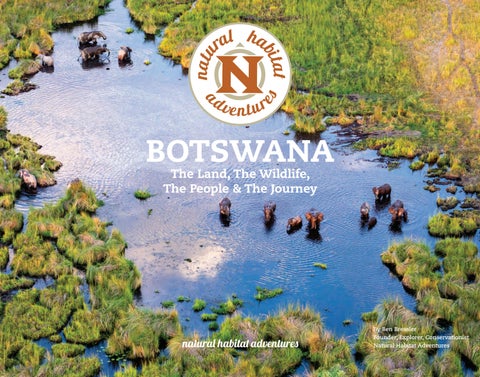
BOTSWANA The Land, The Wildlife, The People & The Journey
By Ben Bressler Founder, Explorer, Conservationist Natural Habitat Adventures
2
BOTSWANA The Land, The Wildlife, The People & The Journey
By Ben Bressler Founder, Explorer, Conservationist Natural Habitat Adventures
4
5
Printed December 2025 Copyright ©2025 Natural Habitat Adventures The right of Ben Bressler to be identified as author of this work has been asserted in accordance with sections 77 & 78 of the Copyright, Designs and Patents Act 1988. All rights reserved. No part of this book may be reprinted or reproduced or utilized in any form or by any electronic, mechanical, or other means, now known or hereafter invented, including photocopying and recording, or in any information storage or retrieval system, without permission in writing from the publishers. Notices Practitioners and researchers must always rely on their own experience and knowledge in evaluating and using any information, methods, compounds, or experiments described herein. ISBN: 978-1-5136-4499-8 Publisher: Natural Habitat Adventures Creative Director: Mark Hickey Editor: Wendy Redal
Printed and bound in the United States
6
To Laura, My first love. To Botswana, My second. -Ben
7
BOTSWANA The Land, The Wildlife, The People & The Journey
Table of Contents Botswana: A Haven for Pristine Wilderness
10
Foreward The History
12
The People
14
The Land
16
Conservation
18
The Okavango Delta—Water in the Desert
20
Chobe National Park: The Land of Giants
44
Savuti Channel: It Keeps You Guessing
66
Linyanti Reserve: A World Away
80
The Central Kalahari Game Reserve
94
Makgadikgadi Salt Pans: Ultimate Isolation
104
The Tuli Block: Safari in the South
120
Though bridges and primitive roads cross the Okavango Delta, development remains intentionally sparse. Seasonal floods still dictate movement and scale, allowing this immense wetland to function as an intact ecosystem rather than a managed or fragmented one. Photo by Dave van Smeerdijk. 8
9
10
Botswana: A Haven for Pristine Wilderness Friends often ask me for travel advice about Botswana, and my answer is never quick, because there is so much to know and understand about this matchless safari destination. Botswana is a land where nature reigns supreme—a sanctuary of unparalleled beauty and ecological integrity. It’s a vast, untamed expanse at the heart of Southern Africa. Here, wildlife roams freely as it has for millennia, across sweeping savannas, shimmering salt pans and labyrinthine waterways. In short, it’s my kind of place.
© Ondrej Prosicky
I first visited Botswana in 1990 as a young man just starting out in the travel industry. The experience was unforgettable: an abundance of wildlife, a remarkable sense of solitude, and deeply personal encounters with nature. I was hooked. While the country has evolved over the years, offering more safari luxuries, its raw wilderness remains unchanged—a testament to the country’s commitment to conservation. Botswana’s dedication to preserving its wild spaces has kept it one of the most pristine destinations on Earth. Approximately 40% of the country’s land is designated as national parks, reserves and wildlife management areas, allowing
iconic species like elephants, lions and cheetahs to thrive in their natural habitats. Its low-impact, high-value tourism model minimizes human interference while maximizing the protection of its intact ecosystems. Safaris here are not just trips—they’re intimate, unforgettable, transformative experiences. This photography book celebrates Botswana’s incredible natural wonders while addressing the vital role of conservation. It highlights the Okavango Delta, a UNESCO World Heritage Site that is a lush oasis teeming with life; the Kalahari Desert, including the Central Kalahari Game Reserve and the Makgadikgadi Salt Pans; and Chobe National Park, home to the world’s highest density of elephants, with an estimated population of 120,000. Within these pages, we also explore the Linyanti marshes and the Savuti Channel, showcasing the diverse habitats that comprise Botswana’s magic. This book is more than a tribute to Botswana’s untamed beauty—it’s a call to recognize its global significance as a model for conservation travel. Through these images, we honor the fragile majesty of this extraordinary land and invite readers to reflect on the importance of protecting it for generations to come.
11
The History Botswana’s history is a story of persistence, strategy and a bit of luck. Long before it became one of Africa’s most stable democracies, the land was home to the San people, expert survivalists who thrived in the Kalahari Desert for tens of thousands of years. Then, around the year 200, Bantuspeaking groups arrived, bringing cattle, ironworking and a new way of life. Over time, Tswana chiefdoms emerged, running things in a well-organized, cattle-based economy. In Botswana, cows weren’t just livestock: they were currency, status symbols and, quite frankly, the original social network. Fast-forward to the 19th century, and things got a little more complicated. European missionaries, like David Livingstone, showed up, while the Boers came storming in from South Africa looking for land. To add pressure, the expansionist Zulu kingdom under Shaka was shaking things up in the region. Sensing the storm on the horizon, the savvy Tswana king, Khama III, called on the British for support in 1885. Just like that, Bechuanaland became a British Protectorate, meaning the British would keep the Boers at bay, but otherwise, they did not interfere much. Unlike other African nations that were carved up and exploited, Botswana got away with a relatively hands-off colonial arrangement.
12
But the country was far from thriving. When independence came in 1966, Botswana was, to put it bluntly, broke. It had barely any roads, schools or hospitals. But, sensationally, just after independence, the nation experienced a stroke of luck that reads like a Hollywood script—diamonds were discovered. Instead of falling into the usual resource curse trap, Botswana played its hand brilliantly, reinvesting diamond wealth into education, infrastructure and healthcare. Today, Botswana is one of Africa’s most stable and prosperous nations, proving that sometimes, good leadership, strategic thinking, and a bit of good fortune can go a long way.
13
© Mark Hickey
The People Botswana is home to a rich mix of people, cultures and traditions, with a population that’s small in numbers but big in personality. The majority of Batswana (yep, that’s the plural of Motswana, a citizen of Botswana, in the Setswana language) belong to the Tswana ethnic group, which makes up about 80% of the population. These are the folks who built the powerful chiefdoms that shaped the country’s history, and they still hold onto many of their cultural
traditions—especially their deep connection with cattle, which carry such great value that they can be in some cases a better investment than the stock market. Beyond the Tswana, Botswana is also home to the San (Bushmen), the original masters of survival who have been navigating the Kalahari for tens of thousands of years. The San have an ancient and intricate knowledge of nature, tracking animals
with the kind of precision that would put any GPS to shame. Their traditional way of life, built around hunting and gathering, has been challenged by modernization, but their culture remains a crucial part of Botswana’s identity. There are also smaller ethnic groups like the Kalanga, the Herero and the Bayei, each adding their own traditions, languages and culinary flavors to the mix. Despite these cultural differences, one thing most Batswana have in common is a strong sense of community and a love for their country’s democratic traditions. Botswana takes its democracy seriously—so much so that it has one of Africa’s most stable governments. The concept of botho (a deep respect for others and communal harmony) is at the heart of daily life, making Botswana one of the friendliest places in Africa. Whether it’s a village meeting under a giant kgotla (traditional council tree) or a lively braai (barbecue) with friends, you’ll find that Batswana value open dialogue, hospitality and a good laugh—usually over a plate of sizzling seswaa (slow-cooked beef). Outside of the small villages that dot the countryside, Botswana’s larger towns offer a mix of charm, culture and regional significance. Maun, Botswana’s safari gateway city, is a lively tourism hub where safari guides, backpackers and locals mingle over cold beers and stories—true or stretched— of close-call wildlife encounters. And let’s
14
not forget the modern urban Botswana. In cities like Gaborone and Francistown, young professionals, artists and entrepreneurs are blending tradition with global influences, rocking a blend of Western business suits and colorful African prints.
© Mark Hickey
Whether it’s traditional gatherings by the fire or TikTok dance trends in the city, the people of Botswana manage to balance old and new with impressive ease. All in all, they’re a resilient, warm and innovative bunch who take pride in their country’s progress while staying true to their roots.
15
The Land
© Villiers Steyn
Botswana’s geology is a tale of ancient landscapes, hidden treasures, and some of the most valuable rocks on the planet. This country sits atop some seriously old real estate—much of its bedrock dates back billions of years to the Archean Eon. That’s right, while dinosaurs were still a twinkle in evolution’s eye, Botswana’s crust was already forming vast granite shields and greenstone belts. These ancient formations do more than just look pretty; they’re packed with minerals, making Botswana one of the world’s top diamond producers. Forget the gold rush—Botswana’s diamond boom is the real geological jackpot.
© Martin Mecnarowski
Speaking of diamonds, the country’s famous kimberlite pipes—deep, carrot-shaped volcanic structures—are what make the magic happen. These pipes, formed by explosive volcanic activity millions of years ago, brought diamonds from the Earth's mantle up to the surface. The Jwaneng and Orapa mines are among the richest diamond-producing sites in the world, and they’ve helped turn Botswana into one of Africa’s most stable economies. It’s a classic case of geology meeting good governance—because while plenty of countries have valuable minerals, not all of them turn those resources into roads, schools and hospitals.
16
But Botswana isn’t just about bling. The Kalahari Desert, which covers about 70% of the country, is a vast, sandy expanse shaped by shifting dunes and ancient riverbeds. Unlike your classic rocky desert, the Kalahari is technically a "fossil desert," meaning it was once a lush,
water-filled region. Beneath its sands lie massive underground aquifers, remnants of a time when rivers flowed freely across the landscape. Today, places like the Makgadikgadi Pans—one of the largest salt flats in the world—offer eerie, moon-like scenery where the remnants of an ancient super-lake still linger. Once upon a time, hippos and crocodiles roamed here; now, it’s mostly flamingos, adventure travelers, and the occasional lone baobab tree stubbornly standing against the elements.
All in all, Botswana’s geology is a mix of deep history, sparkling treasures and unexpected surprises. Whether it’s diamonds hiding in volcanic pipes, ancient lakebeds turned to glittering salt flats, or a desert with a secret water supply, the country’s geological story is anything but boring.
© Richard de Gouveia
Up north, the Okavango Delta flips the script on what you’d expect from a semiarid country. This massive inland delta is a geological marvel, fed by rivers that have somehow defied logic and refused to flow into the ocean. Instead, they spread out across the Kalahari sands, creating an oasis of life where elephants wade through water lilies and hippos argue over prime real estate. This seasonal floodplain exists thanks to a unique tectonic setup—movements in the Earth’s crust prevent the Okavango River from escaping to the sea, forcing it to fan out into a sprawling, wildlife-rich paradise.
17
Conservation
© Mark Hickey 18
© Ona Basimane
Botswana’s conservation success isn’t just about protecting landscapes—it’s about ensuring that wildlife and people can coexist in a way that benefits both. While many countries have struggled to balance economic growth with environmental stewardship, Botswana has made a bold choice: wilderness comes first. With just over 40% of the country designated as national parks, reserves and wildlife management areas, Botswana has created vast, unfenced habitats where elephants still migrate along ancient pathways, lions patrol floodplains, and rhinos, though heavily targeted by poachers in recent years, are being fiercely protected through relocation and anti-poaching efforts.
A major reason for this success is Botswana’s strategic approach to tourism. Rather than allowing mass-market tourism to flood its parks, the country has prioritized a high-value, low-impact model. This means fewer vehicles, a smaller human footprint, and a safari experience that feels exclusive rather than overcrowded. But more importantly, it means that the revenue generated from conservation-focused tourism is funneled back into protecting the land, funding anti-poaching initiatives and supporting local communities. Tourist dollars are not just helpful—they are vital. Without them, maintaining these vast protected areas and combating poaching would be an uphill battle. When travelers come to Botswana, they’re not just spectators—they are directly contributing to the preservation of one of the last great wilderness areas on Earth.
However, conservation in Botswana is not without its challenges. Humanwildlife conflict remains a pressing issue, particularly in rural areas where elephant herds wander through villages, sometimes trampling crops and disrupting livelihoods. For communities living on the edges of protected areas, the presence of large predators and foraging elephants can be a daily struggle. Conservation efforts increasingly focus on finding solutions that benefit both people and wildlife— whether through compensation programs, sustainable land-use planning, or creative deterrents like chili-infused fences that elephants find particularly unpleasant.
© Bob Flynn
Despite these challenges, Botswana remains a beacon of hope for conservation in Africa. It has demonstrated that with strong policies, local engagement and a long-term vision, protecting nature can be more than just an ideal—it can be an economic and cultural cornerstone. In a world where wild spaces are rapidly disappearing, Botswana stands as proof that conservation, when done right, isn’t just about saving animals. It’s about preserving the very essence of what makes a place extraordinary.
19
The Okavango Delta—Water in the Desert Shaped over millions of years by tectonic forces that redirected the Okavango River into the arid Kalahari Desert, the Okavango Delta is the world’s largest inland delta. More than a floodplain, it is a dynamic mosaic of lagoons, channels, savannas and islands, transforming the desert into a vibrant oasis teeming with life. The delta supports an extraordinary diversity of wildlife. Elephants, lions, hippos, crocodiles and leopards roam its dry sectors, while rare antelope like the red lechwe and sitatunga thrive in its watery terrain. Birdlife flourishes, with more than 400 species including African fish eagles, wattled cranes and malachite kingfishers, making it a haven for birdwatchers. Beyond its abundant wildlife, the delta is home to the BaSarwa (San) people, who have lived sustainably within its natural rhythms for generations, fostering a deep connection to the land. A network of protected areas ensures the preservation of the Okavango Delta’s
fragile ecosystems. These include private concessions, community-managed conservancies, and government-run reserves like Moremi Game Reserve, established in 1963 as Africa’s first community-driven wildlife preserve. Together, they balance conservation with sustainable tourism, providing critical habitats for wildlife while supporting local livelihoods. Carefully controlled tourism plays a vital role in safeguarding the delta. Visitors explore its wonders through intimate experiences such as game drives, walking safaris, and water-based excursions in traditional poled mokoros (dugout canoes). As you glide through the serene waters with a local poler, a sense of peace and tranquility envelops you, offering a profound connection to the delta’s natural rhythms. This captivating landscape is a testament to the success of conservation efforts, demonstrating how nature and responsible tourism can coexist in harmony.
The Okavango Delta embodies Botswana’s conservation ethos. Protected since 1963, seasonal floods still shape this living system, sustaining elephants, lions, hippos and rare wetland antelope like red lechwe and sitatunga. Photo by Roger de la Harpe. 20
Right: ut deligendust, cum aut hiliatiusto molupta tenihic aboribust a si blabo. Solese nus re Photo by Nat Hab Expedition Leader doloreped pel molor maiorr
21
22
© Juan Carlos Munoz Robredo
Shaped over millions of years by tectonic forces that redirected the Okavango River from its source in Namibia into the arid Kalahari Desert, this is the world’s largest inland delta. During peak flood stage, the delta spans more than 5,000 square miles. Yet this watery wilderness is more than a vast floodplain— it is a dynamic mosaic of lagoons, channels, savannas and islands, transforming the desert into a vibrant oasis teeming with life.
ZAMBIA
NAMIBIA Savuti Channel
Chobe National Park
Linyanti Reserve Okavango Delta
MAUN
BOTSWANA
ZIMBABWE
Makgadikgadi Pans National Park
Central Kalahari Game Reserve
The Tuli Block
SOUTH AFRICA
23
© Richard de Gouveia With a limited gene pool and a need for vast territory, cheetahs are especially vulnerable to habitat loss and human conflict, making them one of Africa’s most at-risk predators. In Botswana, roughly 2,000 cheetahs still range across the Central Kalahari, the Okavango and surrounding wildlife areas, sustained by protected, connected landscapes. Photo by Nat Hab Expedition Leader Richard de Gouveia. 24
© Lets Kamogelo
Botswana supports one of Southern Africa’s largest zebra populations. Seasonal migration between the Okavango Delta and the Makgadikgadi Pans—still possible because landscapes remain largely unfenced—helps keep that population resilient. Photo by Nat Hab Expedition Leader Lets Kamogelo.
25
Botswana’s commitment to conservation shapes the safari experience itself. By limiting visitor numbers and development, the country keeps ecosystems intact, allowing for intimate wildlife encounters on private reserves. Photo by Steve Sanders. 26
27
With intact habitat and abundant prey, Botswana’s leopards remain widespread, thanks to large protected areas and conservation policies that keep human pressure low. Photo by Nat Hab Expedition Leader David Luck.
28
In the southern Okavango Delta, Gomoti Camp sits beside a popular watering hole, where elephants, antelope and predators—from lions to leopards—move through protected wilderness. Photo by Nat Hab guest Kerry de Bruyn.
The mokoro allows quiet passage through the Okavango’s shallow waterways, revealing wetland birds, antelope and the finer details of a living delta. Photo by Nat Hab guest Kerry de Bruyn. 29
30
Spanning roughly 5,800 square miles, the Okavango Delta is a UNESCO World Heritage Site whose seasonal floods sustain one of the world’s most biologically rich inland wetlands. Photo by Roger de la Harpe.
31
A cheetah mother travels with her four nearly grown cubs just before independence, when dispersal and survival depend on territory, prey and freedom of movement. Photo by Ruzdi Ekenheim.
As some of Africa’s most highly certified guides, Nat Hab Expedition Leaders bring decades of knowledge into the bush, transforming wildlife encounters into informed, intimate experiences. Photo by Nat Hab guest Andrew Morgan. 32
Right: ut deligendust, cum aut hiliatiusto molupta tenihic aboribust a si blabo. Solese nus re Photo by Nat Hab Expedition Leader doloreped pel molor maiorr
Buffalo migrate along one of the many channels in the Okavango, using water as both corridor and refuge. Photo by Nat Hab guest Betsy Wurster. 33
Nat Hab’s electric safari vehicle, converted from a diesel Land Cruiser, moves quietly through Botswana’s wild places, reducing emissions and disturbance while advancing conservation. Photo by Andrew Morgan. 34
Regal and elusive, leopards have rebounded across Botswana since 2014, following a nationwide trophy hunting ban that has helped restore ecological balance. Photo by Nat Hab Expedition Leader Danielle Carstens.
35
A male lion rests, conserving energy between hunts. As apex predators, lions regulate prey numbers and competitor behavior, helping stabilize entire ecosystems. Photo by Nat Hab Expedition Leader Richard de Gouveia.
A skilled mokoro poler’s deep knowledge of the Delta reveals orchids, kingfishers, jacanas and the intricate life of its waterways. Photo by Nat Hab guest Kerry de Bruyn.
36
37
Built for life where land and water meet, red lechwe leap through the Okavango’s channels, thriving in the floodplain wetlands. Photo by Nat Hab guest Andrew Morgan.
Chartered flights link distant ecosystems and private conservancies without roads or heavy infrastructure, allowing travelers to move lightly between habitats while keeping vast landscapes intact. Photo by Nat Hab staff member Maya Krause. 38
Right: ut deligendust, cum aut hiliatiusto molupta tenihic aboribust a si blabo. Solese nus re Photo by Nat Hab Expedition Leader doloreped pel molor maiorr
A grazing buffalo herd stirs insects from the grass, drawing cattle egrets, ibis and oxpeckers into its path. This simple exchange reflects the interdependence of Botswana’s wild species. Photo by Nat Hab guest David Luck. 39
40
A skilled mokoro poler guides guests through Botswana’s Okavango Delta, drifting past papyrus and lilies—quiet travel that protects fragile channels and the wildlife depending on them. Photo by Dave van Smeerdijk. 41
Staying at secluded camps on private reserves allows intimate encounters with wildlife and true immersion in deluxe comfort. Photo by Nat Hab guest Kerry de Bruyn. 42
43
Chobe National Park: The Land of Giants As you cross the border from Zimbabwe or Namibia into northern Botswana, officials may ask you to wash your truck tires and shoes upon entering the village of Kasane. This unusual ritual—meant to inhibit the transmission of invasive species— marks your arrival into a new country and signals that you’ve reached one of Africa’s premier wildlife destinations: Chobe National Park.
Central to Chobe’s vitality is the Chobe River, which flows from Angola into the Zambezi, attracting massive herds of animals to its banks, particularly during the dry season. Floating quietly in a small boat as elephants and buffalo gather to drink, bathe and socialize is an unforgettable nature travel experience, offering some of the most inspiring wildlife viewing in Africa.
Established in 1968, Chobe spans more than 4,500 square miles of diverse landscapes, from the lush wetlands of the Chobe riverfront to the dry plains of Savuti and the marshy Linyanti region. While the park is famously linked to Hollywood glamour—it was a honeymoon stop for Richard Burton and Elizabeth Taylor during their second marriage to each other—it’s even better known for its extraordinary wildlife. Chobe is home to Africa’s largest elephant population, with an estimated 120,000 or more elephants roaming its vast wilderness. (I’ve seen over a hundred elephants at a single waterhole!) Herds of buffalo, giraffe and striking antelope species like sable and roan thrive here, alongside predators such as lion, leopard and African wild dog.
Chobe plays a vital role in Botswana’s broader conservation strategy. As part of the Kavango-Zambezi Transfrontier Conservation Area (KAZA)—one of the world’s largest conservation landscapes spanning five countries—the park helps maintain critical wildlife corridors and habitats across borders. Strict antipoaching initiatives and communitydriven conservation programs ensure the park’s ecosystems remain intact for future generations. Visitors to Chobe don’t just witness its remarkable beauty—they actively contribute to preserving one of Africa’s most vital wildernesses.
An elephant pauses along Botswana’s Chobe River, its massive body, long tusks and broad ears on full display—one of tens of thousands drawn here as the river sustains wildlife through the dry season. Photo by Clark Searle. 44
Right: ut deligendust, cum aut hiliatiusto molupta tenihic aboribust a si blabo. Solese nus re Photo by Nat Hab Expedition Leader doloreped pel molor maiorr
45
46
© Kim Nelson
Spanning more than 4,500 square miles of diverse ecosystems from floodplains to woodlands, Chobe is renowned for its extraordinary wildlife. It is home to Africa’s largest elephant population, with an estimated 120,000 or more elephants roaming the lush wetlands of the Chobe riverfront and beyond. Herds of buffalo, giraffe and striking antelope species like sable and roan also thrive here, alongside predators including lion, leopard and African wild dog.
ZAMBIA
NAMIBIA Savuti Channel
Chobe National Park
Linyanti Reserve Okavango Delta
MAUN
BOTSWANA
ZIMBABWE
Makgadikgadi Pans National Park
Central Kalahari Game Reserve
The Tuli Block
SOUTH AFRICA
47
Nat Hab’s custom safari vehicles feature tiered seating and unobstructed sightlines, giving every guest a window seat and the flexibility to navigate varied terrain for exceptional wildlife viewing. Photo by Nat Hab guest Kerry de Bruyn.
48
Seeing an elephant at close range is an exhilarating moment—made possible by a patient, experienced guide who reads behavior, holds position and ensures the encounter remains safe and respectful for both guests and animal. Photo by Nat Hab guest Stuart Arnold.
49
In the quiet intelligence of an elephant’s eye lies a lifetime of memory— seasonal routes, family bonds, and survival knowledge passed across generations in landscapes they have shaped for centuries. Photo by Nat Hab Expedition Leader Danielle Carstens. 50
51
A trio of elephants stops for a drink in the Okavango Delta, where nutrient-rich grass and expansive terrain support one of Africa's largest elephant populations. Photo by Nat Hab guest Stuart James Arnold.
52
Lion cubs turn a fallen tree into a lookout and playground, building strength, balance and coordination through play. Photo by Paul Sonders.
53
With Nat Hab’s Expedition Leaders, timing is everything. Deep local insight shapes each day in Botswana, positioning guests for wildlife moments—and images—few travelers ever witness. Photo by Nat Hab staff member Maya Krause.
A herd of impalas stands alert in the Okavango Delta, relying on keen senses and many watchful eyes to detect approaching predators. Photo by Nat Hab Expedition Leader Richard de Gouveia. 54
55
Days in Botswana’s wilds build true bonds as guests and Expedition Leaders share sightings, stories, and quiet moments that turn wonder into lasting connection. Photo by Nat Hab guest Andrew Morgan.
An elephant feeds on fresh mopane leaves on our Botswana safaris, where long-protected landscapes support elephants moving and feeding as they always have. Photo by Nat Hab Expedition Leader Richard de Gouveia. 56
Right: ut deligendust, cum aut hiliatiusto molupta tenihic aboribust a si blabo. Solese nus re Photo by Nat Hab Expedition Leader doloreped pel molor maiorr
Leopards remain strong across Botswana thanks to long-term conservation and intact habitat. Sightings are never guaranteed, but time spent in prime regions makes encounters genuinely possible. Photo by Nat Hab Expedition Leader Richard de Gouveia. 57
Sunset casts a soft light on a herd of Botswana’s giraffes. As the heat fades, they spread out to feed, taking advantage of the brief calm before the night shift begins on the savanna.
Nonchalant lions drink and sprawl at a watering hole as an elephant ambles past, an unremarkable moment of coexistence in a landscape shared by many. Photo by Nat Hab staff member Francisco di Poi. 58
Right: ut deligendust, cum aut hiliatiusto molupta tenihic aboribust a si blabo. Solese nus re Photo by Nat Hab Expedition Leader doloreped pel molor maiorr
A lilac-breasted roller perches in brilliant color, one of more than 400 bird species drawn to Botswana's Okavango Delta by seasonal floods and the diversity of habitats they sustain. Photo by Nat Hab guest Carolyn Downer. 59
60
Sunset at the watering hole: elephants move within matriarchal families, where older females carry knowledge of water, routes, and seasons—guiding survival, movement and care across generations. Photo by Nat Hab guest Lorraine Doyle. 61
A saturated sunset stretches across Botswana’s open sky, where clean air and vast, unobstructed landscapes intensify color as the sun drops below the horizon. Photo by Nat Hab guest Rob Haynes.
62
An elephant wades knee-deep through a flooded channel. Thanks to long-term conservation, Botswana supports Africa’s largest elephant population—estimated at more than 120,000. Photo by Nat Hab guest Mark Zukowski.
63
Patience at the watering hole rewards travelers with an intimate view of a male lion, part of a stable pride system supported by protected ranges where lions hunt and defend their territory. Photo by Nat Hab Expedition Leader Danielle Carstens.
Fleeting moments—like a lilac-breasted roller lifting off—come into focus with guides who understand timing, light, and positioning in the presence of wildlife. Photo by Nat Hab guest Bob Flynn. 64
65
Savuti Channel: It Keeps You Guessing The Savuti Channel is a place where nature loves to keep you guessing. This mysterious waterway, located in the western part of Chobe National Park, has a reputation for doing its own thing—it flows when it wants to, dries up when it feels like it, and transforms the landscape in the process. The channel’s unpredictable behavior is thanks to tectonic activity that blocks and unblocks its flow over time. Whether it’s a dry grassland or a lush watercourse, Savuti is always buzzing with wildlife action. When the channel flows, it’s like a lifeline for the region, attracting animals from miles around. Elephants, hippos and crocodiles take center stage, while herds of zebra, wildebeest and antelope flock to the water’s edge. But even in dry years, Savuti doesn’t disappoint. The open plains become a hunting ground for predators like lion, cheetah and hyena, with Savuti’s famous lion prides sometimes taking on
elephants in a high-stakes game of survival. If drama is what you’re after, Savuti delivers. This region is also home to unique landscapes that beg to be explored. Scattered across the plains are kopjes—rocky outcrops that provide shade for wildlife and panoramic views for travelers. These ancient stone piles also contain San rock paintings, offering a glimpse into the lives of the people who once thrived here over millennia. It’s the perfect mix of raw wilderness and rich history, with every corner holding a story. Chobe National Park plays a crucial role in maintaining wildlife corridors, allowing animals to migrate freely across the landscape. Strict anti-poaching measures and sustainable tourism practices ensure that this ever-changing wilderness remains a safe haven for iconic species, preserving its ecological integrity for generations to come.
Lion cubs atop a Savuti termite mound scan the surrounding plains, learning early how awareness and position matter in a place where hunting success is never easy. Photo by Stu Porter. 66
Right: ut deligendust, cum aut hiliatiusto molupta tenihic aboribust a si blabo. Solese nus re Photo by Nat Hab Expedition Leader doloreped pel molor maiorr
67
68
© Petr Polak
Located in northern Botswana, the Savuti Channel is a unique and capricious waterway that connects the Linyanti River to the Mababe Depression, flowing and drying up in erratic, decades-long cycles driven by tectonic forces. When it flows, the channel is a vital, nutrient-rich source of water for one of Africa’s highest concentrations of wildlife. It terminates in the Savuti Marsh, a major focal point for birdwatching and game viewing.
ZAMBIA
NAMIBIA Savuti Channel
Chobe National Park
Linyanti Reserve Okavango Delta
MAUN
BOTSWANA
ZIMBABWE
Makgadikgadi Pans National Park
Central Kalahari Game Reserve
The Tuli Block
SOUTH AFRICA
69
70
Water lilies drift across a Savuti channel, marking a brief window when water returns, softening the landscape and signaling a shift that wildlife quickly follows. Photo by Richard de Gouveia. 71
Zebras and antelope gather across the plains, their movements shaping grasslands, feeding predators, and keeping Savuti’s open ecosystems balanced through constant motion and grazing. Photo by Nat Hab Expedition Leader Lets Kamogelo.
An African fish eagle watches from its perch, a reliable presence near water and a signal that Savuti’s channels are flowing well enough to support fish and birds alike. Photo by Nat Hab Expedition Leader Richard de Gouveia. 72
73
74
Using dirt to block sun and insects, and keeping their young close, a herd of elephants reflects the stable family structures typical of Savuti’s well-established population. Photo by Nat Hab guest Babs Stoller. 75
Zebras spar head to head, a common display among males testing strength and rank—ritualized conflict that helps establish order without serious injury. Photo by Nat Hab Expedition Leader Danielle Carstens. 76
A male lion patrols his Savuti territory, moving through wide, open ranges where long-term conservation keeps populations strong and space for competition intact. Photo by Nat Hab guest Alex Mazunga.
77
A mature male lion bears the scars of competition and conflict, his life history written on his face in a landscape that continues to reward the strongest and most strategic. Photo by Nat Hab Expedition Leader Danielle Carstens.
78
A black-backed jackal lunges through a Linyanti watering hole after a startled bird, a brief, sharp moment that reveals the drama of survival in the Botswana bush. Photo by Nat Hab Expedition Leader Danielle Carstens. 79
Linyanti Reserve: A World Away The Linyanti Reserve is a safari lover’s secret paradise, tucked between Chobe National Park and the Okavango Delta. With its lush riverine forests, palmfringed lagoons and sprawling floodplains, Linyanti feels like a world apart. Anchored by the Linyanti River and its sister waterways, the Kwando and Selinda Spillway, this area is a lifeline for wildlife, especially during Botswana’s dry season.
Linyanti’s remoteness adds to its appeal—and the sense of adventure it offers. Visitors can enjoy exclusive activities like night drives and walking safaris, providing an up-close look at the untouched wilderness. Safari-going in Linyanti isn’t just about wildlife thrills, it’s also about sustainability. Eco-friendly practices ensure that the delicate ecosystems remain intact, preserving this magical region for generations.
Wildlife sightings here are nothing short of epic. Herds of elephants quench their thirst alongside buffalo, zebras and elegant antelope like sable and roan. Meanwhile, lions, leopards, cheetahs and African wild dogs prowl nearby, perpetuating the drama. The skies are just as lively, with carmine bee-eaters, African fish eagles and kingfishers adding their colorful flair. With fewer visitors than other safari regions of Botswana, Linyanti’s exclusivity makes every moment feel like your own private nature show.
As part of the Kavango-Zambezi Transfrontier Conservation Area (KAZA), Linyanti plays a critical role in Botswana’s conservation efforts. It protects vital wildlife corridors, allowing animals like elephants to migrate freely across borders, and it benefits from community involvement and anti-poaching initiatives. For those craving a safari off the standard track, Linyanti delivers big on adventure, exclusivity and natural beauty—all while proving that conservation and travel can go hand in hand.
The Linyanti River curves through open banks and broad channels, holding unseen life—from hippos just below the surface to birds hidden in the surrounding vegetation. Photo by Roger de la Harpe. 80
Right: ut deligendust, cum aut hiliatiusto molupta tenihic aboribust a si blabo. Solese nus re Photo by Nat Hab Expedition Leader doloreped pel molor maiorr
81
Tucked between Chobe National Park and the Okavango Delta, the remote and unspoiled Linyanti Reserve offers one of Botswana’s most exclusive safari experiences. A rich mosaic of riverine forests, palm-fringed lagoons and sprawling floodplains, Linyanti’s ecosystems sustain epic wildlife numbers, from vast herds of hoofed game to the stealthy predators that subsist on them. The 320,000-acre private sanctuary also holds some of the best birdwatching in Africa.
82
ZAMBIA
NAMIBIA Savuti Channel
Chobe National Park
Linyanti Reserve Okavango Delta
MAUN
BOTSWANA
ZIMBABWE
Makgadikgadi Pans National Park
Central Kalahari Game Reserve
The Tuli Block
SOUTH AFRICA
83
84
A giraffe’s silhouette rises against a vermilion sunset, its height and stillness defining the horizon as day fades across Botswana’s open landscape. Photo by Nat Hab Expedition Leader Gavin Lautenbach.
An adult African wild dog pauses with pups nearby, a hopeful scene for one of Africa’s most endangered predators, dependent on space and intact corridors. Photo by Nat Hab Expedition Leader Richard de Gouveia. 85
86
A lioness rests in the cool of morning, conserving energy before the day’s hunt, when coordination and timing will matter more than speed alone. Photo by Nat Hab Expedition Leader David Luck. 87
A solitary bull elephant moves quietly through the landscape, an older male traveling alone, following familiar routes carved over decades of movement and memory. Photo by Nat Hab staff member Mark Hickey. 88
A pod of hippos crowds the Linyanti River, part of a strong local population whose daily movements shape channels, fertilize waters and support the birds that follow them. Photo by Nat Hab Expedition Leader Richard de Gouveia.
89
90
Leopards succeed by choosing moments carefully, and in Linyanti their regular presence speaks to a landscape that still offers cover, prey and room to hunt. Photo by Nat Hab Expedition Leader Richard de Gouveia.
91
Nat Hab’s Linyanti Camp sits within a private conservancy, giving guests front-row access to daily wildlife movement along the river and surrounding floodplains. Photo by Nat Hab guest Andrew Morgan. 92
Between game drives, relax at Nat Hab’s Linyanti Camp, where en suite guest tents sit beside prime wildlife habitat, and elephants and hippos are frequent visitors. Photos by Andrew Morgan.
93
The Central Kalahari Game Reserve The Central Kalahari Game Reserve (CKGR) is a true giant—spanning over 20,000 square miles, it’s not only Botswana’s largest protected area but also one of the world’s most expansive wildlife havens. Lying in the heart of the Kalahari Desert, this wilderness feels like a scene out of a nature documentary. Think vast open plains, ancient riverbeds, shimmering salt pans and scattered bushveld that flip their script with the seasons—transforming from sunbaked desert to lush green paradise after seasonal rains. Wildlife here is as diverse as the landscape. You’ll spot herds of springbok, gemsbok and wildebeest trotting across the plains, with lions, cheetahs and hyenas not far behind. And let’s not forget the quirky locals: brown hyenas and bateared foxes thrive here, too. When the rainy season arrives, areas like Deception Valley and Piper Pan come alive, drawing migratory birds and wildlife in droves—it’s
like nature’s big reunion party. But the CKGR isn’t just about animals and epic views. It’s also the ancestral home of the San (Bushmen) people who have been living here in harmony with the land for thousands of years. Visitors can get a glimpse into their ancient traditions, tracking skills and their exceptionally sustainable way of life—it’s like stepping into the past while learning about the future. Thanks to Botswana’s commitment to conservation, the CKGR is carefully managed to protect both its ecosystems and cultural heritage. Its remoteness and strict policies keep this wild paradise pristine, making it the perfect playground for adventurous travelers looking to experience Botswana’s raw, untamed beauty. If you yearn for solitude, wide-open spaces and a frontrow seat on nature’s melodrama, this is the place to be.
A male lion rests on the open plains of the Central Kalahari, conserving energy between hunts in a place where prey is spread out and success depends on endurance. Photo by Ozkan Ozmen. 94
Right: ut deligendust, cum aut hiliatiusto molupta tenihic aboribust a si blabo. Solese nus re Photo by Nat Hab Expedition Leader doloreped pel molor maiorr
95
96
© Alta Oosthuizen
Botswana’s largest protected area, the Central Kalahari Game Reserve sprawls over 20,000 square miles—one of the world’s biggest wildlife havens. Lying in the heart of the Kalahari Desert, the arid landscape comprises vast plains, ancient riverbeds, shimmering salt pans and pockets of bushveld. Seasonal rains bring fresh sprouts of grass to the sunbaked terrain, attracting a surprising number and diversity of animal species, including Africa’s second-largest wildebeest migration.
ZAMBIA
NAMIBIA Savuti Channel
Chobe National Park
Linyanti Reserve Okavango Delta
MAUN
BOTSWANA
ZIMBABWE
Makgadikgadi Pans National Park
Central Kalahari Game Reserve
The Tuli Block
SOUTH AFRICA
97
Sundowners in the Kalahari mark the close of the day, as fading light settles over open plains and the desert cools. Photo by Nat Hab guest Sharon Amaya.
98
Every scar and crease in this Kalahari lion’s face points to time spent surviving one of Southern Africa’s most demanding landscapes. Photo by Nat Hab Expedition Leader Richard de Gouveia.
99
100
A lion cub lingers between bursts of activity, at an age when every interaction contributes to learning how to live on the plains. Photo by Nat Hab Expedition Leader Stuart Taylor. 101
On the Makgadikgadi Pans, Nat Hab travelers celebrate the sheer joy of exploring Botswana together. Photo by Nat Hab guest Jill Ayers.
102
Bat-eared fox pups gather at the mouth of their den, venturing farther afield as they grow more confident in Botswana’s open grasslands. Photo by Nat Hab Expedition Leader Richard de Gouveia.
103
Makgadikgadi Salt Pans: Ultimate Isolation Travel southeast from Botswana’s safari capital of Maun for about two and a half hours, and you’ll reach Makgadikgadi Pans National Park. On arrival, you’ll feel like you have landed on another planet. These endless white salt flats, spanning more than 4,600 square miles, are the remnants of an ancient super-lake that dried up thousands of years ago. In the dry season, the pans are a surreal, sunbaked expanse of shimmering salt and open skies. When the rains arrive sometime between December and March, the dry flats transform into wetlands alive with zebras, wildebeest and thousands of flamingos, turning the stark landscape into a kaleidoscope of life. I’ve camped under the open sky here, where the stars are so bright they practically hum, and every sound felt like a lion lurking behind a dune. The vastness is humbling, and the silence is broken only by the occasional calls of curious meerkats or the gentle rustle of a breeze. Makgadikgadi is a safari experience like none other—raw, remote and utterly unforgettable.
Like the Central Kalahari, the pans are also steeped in human history and culture, home to ancient human settlements and the San (Bushmen) people, who still share a deep connection to this land. Their stories and tracking skills bring the pans to life in a vivid way. Conservation efforts are vital here, with Makgadikgadi Pans National Park ensuring the protection of wildlife corridors and migratory routes. Sustainable tourism and community projects keep the balance intact, preserving this fragile ecosystem for generations to come. Whether you’re zipping across the pans on a quad bike, marveling at flamingos in flood season, or just soaking up the vast silence under the stars, Makgadikgadi is a reminder of how wild and wonderful the world can be.
A meerkat stands watch on the Makgadikgadi Pans, a small sentinel in a vast salt landscape shaped by an ancient lake and long, quiet horizons. 104
Right: ut deligendust, cum aut hiliatiusto molupta tenihic aboribust a si blabo. Solese nus re Photo by Nat Hab Expedition Leader doloreped pel molor maiorr
105
106
© Redel Brovoka
The world’s largest salt flats, spanning more than 4,600 square miles, are the remnants of an ancient inland sea that dried up thousands of years ago. In the dry season, the pans are evocative of a moonscape—a sunbaked expanse of shimmering salt. When the rains arrive, they are transformed into vital wetlands alive with zebras, wildebeest and thousands of flamingos, turning the stark tableau into a kaleidoscope of life.
ZAMBIA
NAMIBIA Savuti Channel
Chobe National Park
Linyanti Reserve Okavango Delta
MAUN
BOTSWANA
ZIMBABWE
Makgadikgadi Pans National Park
Central Kalahari Game Reserve
The Tuli Block
SOUTH AFRICA
107
Four-wheeling across the Makgadikgadi Pans allows rare access to vast salt flats, reaching remote areas where distance and openness define the experience. Photo by Nat Hab staff member Mark Hickey. 108
A remote camp on the Makgadikgadi Pans sits alone against salt and sky, offering access to one of Botswana’s most isolated landscapes, where distance defines the experience.
Inside a remote Makgadikgadi camp, rich textiles and layered cushions offer comfort within one of Botswana’s more austere environs.
109
Desert-adapted elephants cross the edges of the Makgadikgadi Pans, following wide-ranging routes shaped by seasons and long memory. Photo by Nat Hab Expedition Leader Lets Kamogelo. 110
111
As the sun drops low, a giraffe moves through the bush, browsing at heights few other herbivores can reach. Photo by Nat Hab Expedition Leader Richard de Gouveia. 112
113
Seen in profile, meerkats take turns watching the horizon, a social system that lets others forage safely across exposed ground. Photo by Nat Hab Creative Director Mark Hickey.
114
Seen up close, a meerkat colony continues undisturbed, a moment shaped by Nat Hab’s emphasis on access without interference. Photo by Nat Hab staff member Mark Hickey.
115
At sunrise, camp is still, the air cool, and the first moments of the day stretch unhurried and open. Photo by Teagan Cunniffe.
At day’s end, wildebeest regroup, trading distance for density as darkness changes the rules of the landscape. Photo by Alan Kumura. 116
117
Chartered flights link Botswana's remote, disparate ecosystems, offering travelers a full immersion and access to the country's thriving wildlife. Photo by Mark Zeman.
At the Sua Pan platform, the Makgadikgadi stretches wide, with seasonal wildlife movement and, in wet years, vast flocks of flamingos gathering across the flooded pans. Photo by Tim Hester. 118
The pans look empty, but zebras use them deliberately, trading forage for clear views, minerals, and efficient movement. Photo by Radek Borovka. 119
The Tuli Block: Safari in the South In Botswana’s southeastern corner, where the country meets the northern border of South Africa and the southern edge of Zimbabwe, you’ll find the Tuli Block—a region as wild as it is breathtaking. With dramatic landscapes, flowing rivers and an incredible array of wildlife, it’s a true treasure. The Tuli Block is a patchwork of private reserves and protected lands, all teaming up to keep its unique ecosystems and abundant animals thriving. At the heart of the Tuli Block lies the Northern Tuli Game Reserve, the largest protected area in the region, covering a whopping 274 square miles. This includes standout spots like Mashatu Game Reserve, where elephants roam freely, big cats prowl the savannas, and lush riverine forests hum with life. Here, nature takes center stage, and every turn in the track offers a scene straight out of a wildlife documentary. One of the coolest things about the Tuli Block is its focus on wildlife corridors— essential routes that allow animals
like elephants to move freely between Botswana, South Africa and Zimbabwe. By working together, reserves like Mashatu, Notwane and the Limpopo River Reserve ensure these wild highways stay open, so animals can keep doing their thing regardless of national borders. The Tuli Block is serious about protecting its wildlife. Anti-poaching patrols, surveillance technology and community education are all part of the game plan to keep species like elephants and leopards safe from illegal hunting. It’s an enormous effort, but it’s paying off. Carefully planned tourism is the integral element that makes all this possible. Visitor dollars fund wildlife monitoring, habitat restoration and those crucial anti-poaching programs. Even better, reserves work hand in hand with local communities, creating jobs, supporting schools and building a shared passion for protecting this incredible corner of Botswana. It’s conservation done right, with a little adventure and a lot of heart.
A baobab anchors the Tuli Block’s dramatic scenery, standing in a region where conservation keeps ancient landscapes and animal pathways intact. Photo by Nicole Mathesie. 120
Right: ut deligendust, cum aut hiliatiusto molupta tenihic aboribust a si blabo. Solese nus re Photo by Nat Hab Expedition Leader doloreped pel molor maiorr
121
122
© Redel Brovoka
The Tuli Block is a borderland shaped by rivers, rock and movement. Set where Botswana meets South Africa and Zimbabwe, this mosaic of private reserves protects vital wildlife corridors that ignore political lines. Elephants, predators and prey move freely through riverine forests and open savanna, supported by coordinated conservation, anti-poaching efforts and tourism.
ZAMBIA
NAMIBIA Savuti Channel
Chobe National Park
Linyanti Reserve Okavango Delta
MAUN
BOTSWANA
ZIMBABWE
Makgadikgadi Pans National Park
Central Kalahari Game Reserve
The Tuli Block
SOUTH AFRICA
123
A young giraffe’s reflection mirrors its wide-legged stance, where instinct, balance and elegance align. Photo by Nat Hab Expedition Leader Richard de Gouveia.
124
Male cheetahs form coalitions in Botswana’s open landscapes, where large, connected habitats remain essential for a species constrained by genetics and space. Photo by Nat Hab Expedition Leader Richard de Gouveia.
125
Spur-winged geese take flight, following seasonal water patterns that link life-giving wetlands. Photo by Nat Hab Expedition Leader Danielle Carstens. 126
Lions in the Tuli Block benefit from constant protection along international borders, where anti-poaching patrols have helped stabilize prides and reduce human pressure. Photo by Nat Hab Expedition Leader Richard de Gouveia.
127
Near international borders, Tuli Block conservation reduces poaching risk for elephants moving between countries along shared river corridors. Photo by Nat Hab Expedition Leader Richard de Gouveia.
128
129
In Tuli country, a black-backed jackal navigates a landscape ruled by larger predators, relying on speed and opportunism. Photo by Radek Borovka.
130
Built into the landscape, this wildlife blind in the Tuli Block brings guests close enough to feel the weight and presence of thirsty elephants. Photo by Nat Hab Expedition Leader Richard de Gouveia.
131
From a termite mound, cheetahs survey Tuli country, benefiting from open terrain and cross-border corridors that keep Botswana’s cheetah population connected. Photo by Henk Bogaard.
As the sun sets, quelea gather in the air, funneling toward a shared roost in the lone tree below. Photo by Nat Hab Expedition Leader Richard de Gouveia. 132
133
Four lionesses scan the Tuli Block landscape, using shared vigilance to keep track of prey, cubs and nearby competitors. Photo by Nat Hab Expedition Leader Richard de Gouveia.
In the Tuli Block, a pangolin’s quiet work supports the wider ecosystem, as abandoned burrows provide refuge long after it moves on. Photo by Nat Hab Expedition Leader Alex Mazunga. 134
Right: ut deligendust, cum aut hiliatiusto molupta tenihic aboribust a si blabo. Solese nus re Photo by Nat Hab Expedition Leader doloreped pel molor maiorr
Twilight marks the start of the hunt for three lionesses, when cooling air and fading light tip the odds in their favor through cooperation, timing and stealth. Photo by Nat Hab Expedition Leader Court Whelan. 135
136
Lions are indifferent to safari vehicles, treating them as part of the landscape—a nonchalance that makes close, calm encounters possible. Photo by Nat Hab Expedition Leader Lets Kamogelo. 137
138
Right: ut deligendust, cum aut hiliatiusto molupta tenihic aboribust a si blabo. Solese nus re Photo by Nat Hab Expedition Leader doloreped pel molor maiorr 139
Printed on recycled paper.