NAFF 2025 Annual Report

Page 1


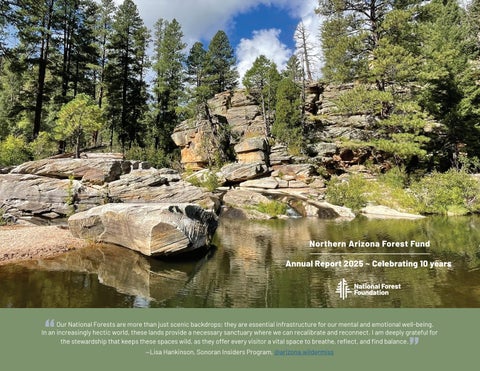
Annual Report 2025 ~ Celebrating 10 years Northern Arizona Forest Fund

Our National Forests are more than just scenic backdrops; they are essential infrastructure for our mental and emotional well-being. In an increasingly hectic world, these lands provide a necessary sanctuary where we can recalibrate and reconnect. I am deeply grateful for the stewardship that keeps these spaces wild, as they offer every visitor a vital space to breathe, reflect, and find balance.

—Lisa Hankinson, Sonoran Insiders Program, @arizona.wildermiss

NAFF Team

Leadership

Rebecca Davidson

Associate Vice President Conservation –

Mountain West Programs

Sasha Sasha Stortz

Southwest Region Director

Jeny Davis

Arizona Program Manager

Southwest Region

Kaitlin Girtin

Associate Director of Corporate Giving -

Southwest Liaison

Forestry

Trevor Seck

Arizona Program Forestry Manager

Caio Vissicaro

Arizona Program Coordinator

Luke Reents

Arizona Program Coordinatore

Chad Kim

Arizona Project Coordinator

Wood for Life

Sean Etsitty

Wood For Life Program Coordinator

Stewardship

CJ Whitted

Tonto Stewardship Coordinator

Watershed

Katie Vold

Southwest Watershed Program

Coordinator

Reflections at the Watershed’s Edge:

Ten Years of the Northern Arizona Forest Fund

Ten years ago, the Northern Arizona Forest Fund (NAFF) began as a shared idea: to invest in pine forests, high-elevation meadows, and headwater streams across the Salt and Verde watersheds to reduce wildfire risk and safeguard Arizona’s water resources. Today, as we pause to reflect on our accomplishments, it feels less like looking into an isolated spring and more like standing at the edge of a desert river steadily moving, shaped by time, care, and many hands. We are deeply grateful to the Forest Service, our partners, supporters, and the communities who have guided this work and kept it moving forward. This milestone belongs to all of us.

From the beginning, the National Forest Foundation set out to invest in shovel-ready projects that delivered meaningful benefits downstream, knowing the path would not be linear. Conditions have shifted, challenges have emerged, and the current has sometimes been strong, but the values of collaboration, stewardship, and resilience have anchored NAFF, helping us to navigate and deliver both long-term impact and meaningful near-term wins.

Together, we have created lasting ripples. Over the past decade, we have worked on 80 projects and have invested nearly $64 million in the health of forests, watersheds, and communities. Since 2016, NAFF projects have generated over an estimated 21.5 billion liters in water replenishment volume. Every single dollar has been leveraged, expanding our reach across watersheds and translating our shared vision into action on the ground.

As we look ahead, we remain energized by what lies upstream. The next chapter offers opportunities to deepen impact, strengthen partnerships, and sustain a steady flow of benefits for people and places. Thank you for being part of NAFF’s first ten years—and for continuing this journey with us.

About NAFF

The Northern Arizona Forest Fund (NAFF) is a locally focused initiative developed by the National Forest Foundation (NFF)—a nonprofit conservation organization whose mission is to transform America’s love of nature into action for our National Forests.

The NAFF works to protect and restore watersheds and forests through innovative partnerships and collaborations that engage funders and partners in a shared responsibility for the water resources and forest health. Arizona businesses, local governments, and individuals are investing in work across watersheds that improves the quality and sustainability of our shared water supply, while reducing wildfire risk, restoring crucial wildlife habitats, and enhancing outdoor recreation experiences.

Through the NAFF, the NFF strives to reach new watershed investment goals, build committed partnerships, and support healthy communities.

Photo: Liz Hastings
Rebecca Davidson AVP Conservation— Mountain West Programs Sasha Stortz Southwest Region Director
“The NAFF has become a national model of how partnerships can meaningfully advance forest and watershed restoration efforts on public lands.”

“ Over the last ten years, the diversity and growth of funding partners, the guidance and planning provided by agency partners, and the engagement of local stewardship organizations and contractors have allowed us to scale the program’s collective impact beyond what any single entity could otherwise accomplish. Working together, this program will help sustain the health and vitality of Arizona’s watersheds for future generations.”

Key Highlights

2015-Founding Year

• 2 Staff

• $230K Invested

• 2 Projects

• 14 Partners

Check out this video made in the early days of the fund!

First forestry project: Upper Beaver Creek

Reduced the threat of high-severity fire with prescribed burning and hand-thinning forest restoration on 3,740 acres in protected areas for the federally listed Mexican Spotted Owl.

Beginning of what would become a long-term program of work in Oak Creek Canyon.

First Healthy Forests and Vibrant Economies Forest Conference

Co-hosted with NFF and Salt River Project (SRP), these conferences were a novel first step in building a model that brings downstream beneficiaries together to fund, implement, and accomplish priority watershed projects, with NFF leading the work on the ground. This paved the way for the NAFF funding model.

First riparian project: Black River Headwaters

Protected over 2,000 acres of stream and riparian habitat for threatened species and reduced erosion and sedimentation into the Black River and its tributaries.

Photo: Michael McNamara
Photo: Brianne Eichmiller

First year reaching $1 million dollars of non-federal investment.

Expanding to new forests

The Aspen Creek Watershed Restoration project reduced wildfire fuel loads and restored two aspen stands on 152 acres. This project protected a critical watershed for the City of Prescott and expanded NAFF onto the Prescott National Forest.

2017 2018

Growing wildfire resilience

The Jack’s Canyon - Banfield Spring project used prescribed fire to protect a major power transmission line. The strategic location of the project area allowed the Forest Service to contain the Snake Ridge wildfire, allowing it to burn freely without putting infrastructure resources at risk.

Received the Crescordia award as a “Sustainability Champion” and the President’s Award at Arizona Forward’s 38th Annual Environmental Excellence Awards presented by the Salt River Project.

First invasive species project: Lower Salt River Riparian Restoration

Removal of invasive plants and planting native trees to restore riparian habitat on the Lower Salt River.

Recipient of Arizona Forward’s Environmental Excellence Award for Landscapes and Preserves for Lower Salt River work.

2019

Start of the Sonoran Insiders ambassador program focused on responsible recreation and conservation.

Beginning of the Green Drone youth program

Meaningfully engaged diverse high school students in the Phoenix metropolitan area in real world drone and GIS training while connecting them to college students and professionals in the STEM/conservation field.

First federally funded agreement with the U.S. Forest Service was activated, focusing on wildfire risk reduction.

2020-Five Years

• 3 Staff

• $11.8 Million Invested

• 16 Projects

• 35 Partners

Start of the Wood For Life partnership

A collaborative network of organizations and people working to share resources and a sustainable source of wood with local Tribes and Indigenous communities through forest restoration efforts.

2021

Start of the multi-year Little Green Valley Fen project

Restoration of a unique wet meadow system that will increase the sustainability of water supplies to the Green Valley and Salt River watersheds, benefiting metro Phoenix water supplies.

Started supporting saguaro replanting in the Bush Fire footprint with Natural Restorations.

2022

First recreation focused project: West Sedona Dispersed Camping

Protecting a well-loved recreation site from further damage through designated camping sites and signage.

First annual Pickin’ Up in the Pines Cleanup.
Photo: Jen Magnuson Photography
Photo: Jordan Griffith
Photo: James “Q” Martin
Photo: CVC Photography

2023

Start of the multi-year Pine Canyon steep slope forestry project

Using helicopter and ground-based thinning in steep canyon terrain, lowering the risk of catastrophic wildfire and post-fire flooding for the communities of Pine and Strawberry.

2024

Busiest forestry year yet, with over 6,000 acres treated across Northern Arizona.

2025-Ten Years

First large–scale cleanup effort:

In collaboration with ADEQ, the Oak Creek Collaborative Cleanup is canyon-wide, bringing together 15 organizations and 112 volunteers, and picking up 390 pounds of trash in it’s first year!

• 11 Staff

• $15.8 Million Invested

• 28 Projects

• 42 Partners

Completed restoration of the Highline National Recreation Trail

Nearly $1 million invested to restore over 60 miles of the historic trail.

Photo: James “Q” Martin

Ripples that Last: Enduring Programs

Oak Creek: 2015-Present

NAFF has been working with ADEQ and Pink Jeep in Oak Creek Canyon on the Coconino National Forest since the first year of the fund, starting with the Oak Creek Erosion Control Project in 2015. Since then, we have grown the work in Oak Creek to a broad program of projects that control erosion, reduce sedimentation, encourage responsible recreation, and keep Oak Creek clean.

Forestry Program: 2015-Present

Forestry and reducing wildfire risk has been at the core of the NAFF from the very beginning, starting with one project in the first year of the fund. The program has continued to grow, treating more than 16,000 acres with over 30 projects in the past ten years!

Project Highlight:

Timberline Wutpaki Trails: 2024

With the Coconino National Forest, this project restored forest health and protected communities from future devastating wildfires, while also protecting sensitive archaeological sites. All the wood from this project went to local tribal communities and nearby neighborhoods, about 5,000 cords in total, enough to heat nearly 2,000 homes for a winter season!

Photos top and right: Richie Graham Photography

Process-Based Restoration (PBR) Program: 2016-Present

Process-based restoration (PBR) techniques work with nature to heal degraded streams, reconnect wetlands, and store precious water underground. They reduce downstream flooding, filter sediment and pollutants, and act as natural buffers during drought and wildfire. The NAFF has been scaling up the use of PBR as part of a larger effort to support the vital lifeline of the west, the Colorado River.

Project Highlight: Little Green Valley Fen: 2021-Present

The Tonto National Forest, NFF, and partners are implementing a stage zero High Tech Process Based Restoration (HTPBR) project, the first of its kind in the Southwest, to restore a unique wet meadow, which will increase the sustainability of water supplies to the Green Valley watershed and the Salt River watershed, ultimately benefitting the millions of people living in Phoenix.

Check out this project video!

Photos: James “Q” Martin

Sonoran Insiders: 2019-Present

The Sonoran Insiders program began in 2019 as a collaborative effort to bridge the gap in messaging between the public and outdoor recreation and conservation professionals by leveraging the social media influence of passionate people in the outdoor community across Arizona. Ambassadors attend Insider Experiences, unique events and opportunities not available to the general public, sharing what they learn during these experiences with their followers, amplifying conservation and responsible outdoor recreation messaging to tens of thousands of people each year.

Rim Country Community Trails & Campgrounds: 2020-Present

A long-term plan for restoring and reducing deferred maintenance of several key trail networks and campgrounds within the Rim Country community near Payson, Arizona.

Project Highlight: Highline National Recreation Trail: 2020-2025

The NFF, Tonto National Forest, and other community partners invested nearly $1 million and worked to assess and implement trail maintenance, rerouting, and rehabilitation along the entire 60-plus miles of the Highline National Recreation Trail.

Wood For Life (WFL): 2020-Present

Wood For Life started in 2020 in response to the closure of the Navajo Generating Station/Black Mesa Coal Mine, which provided coal for home heating. This created an energy transition and increased demand for firewood access on National Forest lands. Wood For Life is a collaborative network of organizations and people working together to share resources and a sustainable source of wood with local Tribes and Indigenous communities through forest restoration efforts. Since the program began, NFF has been able to share over 11,000 cords of wood, enough to heat nearly 4,000 homes!

Photo left: Joe Kurle
WFL

$63.7 Million invested to-date in the health of our communities & forests through 80 projects Wildfire Resilience Treatment Implemented of trail improved 272 miles

16,7699 acres

238,100 Native trees & cacti planted

862 liters of estimated water replenished since 2016:

21.5 billion

11,746 Cords of wood shared through Wood For Life That’s

3,694 Volunteer hours. 2,097 volunteers. acres treated for invasive species Dollars Invested Per Year (in Millions)

10,986 Removed pounds of trash from Oak Creek & Tonto Creek watersheds of habitat restored acres

105K Number of people reached through Sonoran Insiders with responsible recreation and conservation messaging since 2019

651 Youth Engaged

38,978

328 acres of recreation damage restored

2025 Project Highlights

1

Protecting important archaeological resources, restoring forest health, and supporting rural communities with the Navajo Logging Camp project on the Coconino National Forest, a unique site that housed Navajo woodsmen and their families who worked for the Flagstaff Lumber Company in the early 1920s.

2

Using process-based restoration (PBR) to reconnect high elevation wetlands with the larger watershed system, benefiting downstream water supplies to local communities and supporting rare riparian flora and fauna with the Stringtown Wash-Pine Creek project on the Prescott National Forest.

3

Engaged the community through 12 events this year, including trash cleanups, replanting events, mountain bike rides, presentations, tabling, stewardship, and collaborations with two local breweries to support our vision of fostering a world where caring for forests is second nature.

4

Working in steep, hard-to-reach canyon slopes on the Tonto National Forest with helicopter logging and ground-based thinning, reducing the risk of catastrophic wildfire and post-fire flooding for the communities of Pine and Strawberry, while protecting downstream water quality for the Phoenix Metro area with the Pine Canyon Restoration project.

$15.8 Million

invested in the health of our communities & forests

4,529

Cords of wood shared through Wood For Life

2

6,140 acres

148 Cacti planted to restore Sonoran Desert habitat in the Bush Fire burn scar

2,828 volunteers

That’s enough to heat about 1,500 homes through a winter season!

5 miles of stream restored collaborative beers that benefited forestry and recreation projects. Engaged the community through events volunteer hours 586

1,087 acres

Reduced high-severity wildfire risk on of trail improved 20.9 miles

Preimplementation acres surveyed, designed & prepared for restoration in 2025

1,096 Removed pounds of trash from Oak Creek

30+ Youth Engaged & Tonto Creek watersheds

12.4K

12

Number of people reached through Sonoran Insiders with responsible recreation and conservation messaging

2025 & 2026 Projects

Our work enhances natural systems that support the Salt, Verde, and Little Colorado River watersheds. NAFF projects contribute to clean air and sustainable water supplies, healthy forests to explore, running streams to picnic along, and amazing outdoor recreation experiences.

Since 2015, NAFF projects continue to:

• Minimize erosion and sediment into streams, rivers, and reservoirs;

•Improve sustainable water flows and wetlands;

• Restore wildlife habitat and restore native plants,

• Reduce wildfire and post-fire flood risks; and

• Enhance outdoor experiences and engage communities

Photo: Julie Bridwell
Stringtown
Preacher Canyon
Countr y Trailheads

Whether you live in a mountain town or a sunny desert city, we are connected by water. Together, from large businesses to individuals, we can all help ensure that the vital connection between forests, watersheds, people, and communities remains strong for generations to come.

Turn static files into dynamic content formats.

Create a flipbook
NAFF 2025 Annual Report by National Forest Foundation - Issuu