Friday, September 25, 2026/WEEKEND NATION 1
1973-2023
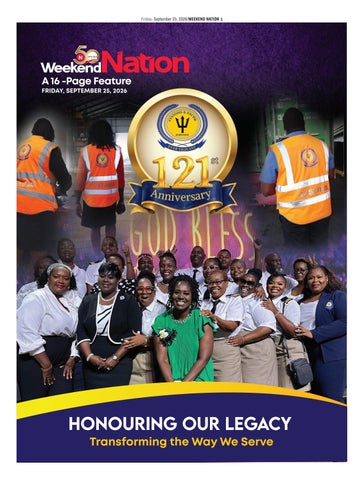
A 16 -Page Feature FRIDAY, SEPTEMBER 25, 2026
'
Friday, September 25, 2026/WEEKEND NATION 2
Honouring our legacy, transforming the way we serve STORIES BY Sandy Deane FOR 121 YEARS, Barbados Customs and Excise has played an important role in the movement of goods, the collection of revenue and the protection of the island’s borders. Since the department was established in 1905, much has changed. Work that once depended largely on paperwork, physical inspections and manual processes now includes electronic systems, technology and new ways of identifying where Customs needs to focus its attention. But while the way the work is done has changed, the responsibility remains the same: to facilitate legitimate trade, collect revenue and help protect Barbados from
M
THE HONOURABLE Ryan Straughn, MP, Minister of Finance. (FP)
essage from the Honourable Ryan Straughn, MP, Minister of Finance to mark the 121st Anniversary of the Barbados Customs and Excise Department.
When Customs works well, Barbados works better. The small business gets its stock, the manufacturer can meet an overseas order and the family can clear its barrel with confidence. That is why this department’s work matters to all of us. As we mark the department’s 121st anniversary, I thank the generations of officers who have carried this responsibility. Their service has helped protect our country and sustain our economy. My vision is a 21st century Customs Department that serves the public interest: making legitimate trade easier, keeping our borders secure, and collecting the revenue lawfully due. We must do all three well. It is important to understand that Customs does not set duty rates. It applies the rates established in law. The revenue collected under the Customs Act goes into the Consolidated Fund, Government’s main pool of public money. Those resources help finance education, healthcare, roads and support for vulnerable Barbadians. There is a direct connection between the work at our borders and the services we depend on. The public is entitled to understand that process. Whether you are collecting a package or importing a container, you deserve clear answers, consistent treatment and professional service. You should know what documents are needed, what you must pay and what happens next. We must earn public confidence through the way we serve people every day. That is what modernisation must deliver. New regulations under the Customs Act, improved clearance procedures and stronger digital services will support a more efficient department. The department’s website must make reliable information easier to find. Technology must translate into less unnecessary paperwork, time saved and greater certainty for businesses and households. Efficiency must go hand in hand with vigilance. Keeping prohibited and dangerous goods out of Barbados protects families and communities. Fair enforcement also protects businesses that meet their obligations from being undercut by those who evade them. Our officers are central to this work. Over the next three years the department will be transformed by recruitment, training and professional development. We must prepare new officers for expanding responsibilities, preserve the knowledge of experienced colleagues and provide existing staff with continued professional development. We must build on that experience and give our people the skills, equipment and support to meet the standards we expect. The Ministry of Finance will support this work. To every officer, past and present, thank you for your contribution to 121 years of service. We honour that legacy by building a department that the public can rely on, businesses can work with, and that Barbados can trust to remain ever vigilant.
prohibited and restricted goods. Today, Customs officers work in many different areas, from cargo and passenger operations to revenue, compliance, risk management and information systems. Behind each of these areas are people carrying out jobs that many members of the public may never see. Technology is helping Customs work differently, but modernisation is also about people — training staff, improving processes, working with partners and finding better ways to serve the public and the business community. As Customs marks its 121st anniversary, this special feature looks at some of the people and work behind the department, while celebrating the legacy that has brought it this far.
The Management & Staff of NASSCO Barbados extend sincere congratulations to Barbados Customs & Excise on this momentous occasion.
As you celebrate 121 years of dedicated service to the economic growth of Barbados, we are honoured to be associated with you and wish you continued success for many more years. / NasscoBarbados Nassco-barbados.com 227-6000 | NASSCO LTD. Chepstow, River Road, St. Michael, Barbados
Friday, September 25, 2026/WEEKEND NATION 3
W
ith 121 years of service to Barbados, Comptroller of Customs Lynette Padmore is steering the Customs and Excise Department towards becoming an increasingly modern, responsive organisation that works closely with the public and has the people and tools needed to meet the changing needs of Barbados.
“My long-term vision is simple,” she said. “It’s in keeping with our vision statement: to be a modern customs organisation recognised for excellence in service delivery, compliance, protection of society, and our contribution to national development.” With more than three decades in Customs, Padmore wants Barbadians to see the department as more than duties and border stops. Operating under the Ministry of Finance, Customs facilitates legitimate trade, protects society from security and safety threats, safeguard local industries and collects revenue to support national priorities. “We want our staff, stakeholders and the public to have a voice in how we move forward,” Padmore said. “That means listening, being open about how we operate and making Customs easier to engage with. We want people to know they can come to us for clear guidance and good service.” She stressed that making the system work requires cooperation. Customs must provide clear information and efficient service, while those using its services can help by providing accurate information and following the correct processes. That cooperation can mean faster clearance, fewer delays and fewer issues to resolve. “When the process works well, people feel the difference,” Padmore said. “A package arrives sooner. A business gets its goods with fewer delays. These are everyday interactions, but improving them makes it easier to do business.” One area that often raises questions among businesses and the public is how duties and levies are applied. Government provides relief and waivers in key areas, including allowances for citizens, duty-free facilities for returning nationals who have
lived and worked overseas for ten years or more, as well as concessions for hotels, tourism developments, manufacturing, agriculture and fisheries and other projects that are designed to encourage investment and growth. However, for other imported items, duties and taxes have to be applied according to customs laws. Padmore made clear that officers do not act arbitrarily, but follow established laws, government policy and regional and international frameworks, including those of the World Customs Organisation, the World Trade Organisation and the CARICOM Treaty of Chaguaramas. “The Customs Act sets out what we do and how we do it. Our job is to follow the law and help people understand how it applies to them.” To deliver on this mandate, a lot of work is happening behind the scenes. The department is strengthening its Risk Management and Post-Clearance Audit units to focus resources where they are needed most. “The aim is faster clearance and shorter turnaround times, allowing goods to move more efficiently and supporting greater economic activity,” Padmore explained. “But that efficiency must be balanced with collecting the revenue due to Government, facilitating legitimate trade, securing our borders and safeguarding local industries.” Technology is another pillar of this shift. Building on the ASYCUDA World platform introduced in 2019, Customs is now looking at more advanced digital tools, including artificial intelligence, to help identify fraud and under-invoicing. “Tools such as artificial intelligence can help our officers detect irregularities more quickly, verify information and focus their attention where closer scrutiny is needed.
Technology gives us an opportunity to work smarter and strengthen how we identify risk.” Improving the experience for arriving travellers is also a priority, especially with the busy winter travel and cruise season ahead. The department is introducing a bagtagging system at the airport to speed up passenger clearance and is working closely with partners at the ports and airport. At the centre of all these plans are the people behind the uniform. Padmore said recruitment and training remain priorities as the department addresses vacancies created by retirements. “As the work of Customs becomes more complex, our capacity has to grow with it,” Padmore said. “I want to see more officers coming into the department, alongside continued training that keeps our team at the top of their profession.” Padmore also acknowledged the pressure that comes with the job. “Our officers are called upon to make difficult decisions every day, and I do not take the demands of that work lightly. I am proud of the commitment they continue to show. We know where we want to take Customs, and we will get there together.” (SD)
LYNETTE PADMORE, Comptroller of Customs. (JJS)
Friday, September 25, 2026/WEEKEND NATION 4
C
Moving Customs forward
USTOMS IS CHANGING, and for Deputy Comptroller Natasha Morgan, that change means taking a close look at how the department works and finding better ways to serve the people and businesses that depend on it.
As Customs looks to modernise its operations, Morgan is focused on examining existing procedures, removing unnecessary steps, strengthening controls and making the clearance process more predictable for businesses and the wider public. In her role, Morgan provides executive leadership and strategic oversight, including responsibility for the Trade Directorate. Her work includes areas such as valuation, classification, origin, tariff management and trade facilitation, as well as monitoring cargo clearance times and addressing bottlenecks that can affect the movement of goods. A major focus, she explained, “is simplifying the processes while maintaining the controls needed to protect the integrity of the system”. “We are looking critically at our procedures across the cargo clearance environment, how declarations are processed, how examinations are conducted, how different agencies interact and where delays are occurring.” That review includes standardising procedures, expanding electronic processes, reducing unnecessary reliance on paper and working with stakeholders to address recurring problems. One practical step is the development of a Customs website that will give users easier access to information on tariffs, clearance procedures, frequently asked questions and new Customs regulations. Morgan is also contributing to the re-establishment of the Customs Brokers Examination, updating Customs Regulations, developing a Customs website, and advancing cargo tracking systems. For Morgan, however, technology is only part of the solution. “Technology is important, but modernisation is not simply about digitising an old process. Sometimes the process itself has to be redesigned.” She wants traders and individuals to have a clearer understanding of what Customs requires before they begin the clearance process, including the documents they need and what they can expect along the way. “Ultimately, our goal is that a compliant importer who submits an accurate declaration with the required documentation should experience a clear, predictable and efficient process.” Her work also extends beyond Barbados’ borders. Morgan has participated in World Trade Organisation, World Customs Organisation and the Caribbean Customs Law Enforcement Council meetings and workshops. Barbados is currently the vice-chair of the Executive Council of CCLEC. She said this international engagement is important because Barbados trades with the world and its Customs procedures must operate within recognised international frameworks. “For a small economy, alignment is especially important because predictability matters. An importer, exporter or international partner should be able to engage Barbados with confidence that our systems are transparent, consistent and compatible with modern international practice.” At the same time, she noted that international standards cannot simply be copied and applied without considering our own circumstances. “We have to adapt them to the Barbadian environment and ensure that what we introduce is workable for our economy, our legislation and our resources.” Morgan also believes the relationship between Customs and the private sector is valuable. She said businesses often experience operational problems from a different perspective, making their feedback valuable when the department is examining its procedures. “So stakeholder engagement helps us identify bottlenecks and understand the practical impact of our procedures.” Modernisation, she stressed, also depends on the department’s people. Morgan is committed to professional excellence and ensuring officers have the knowledge, resources and working conditions to serve the country effectively. She is also partnering with, engaging and strengthening relationships with various government
agencies, regional and international partners to help educate Customs officers and guards. As Customs marks 121 years of service, Morgan sees the next chapter as one of continued transformation. “As we celebrate 121 years of Customs service, that is really what ‘The Rise to Excellence Continues’ means to me. We honour what has been built over 121 years, but we also recognise that the next stage of the Department’s development requires us to keep evolving.”(SD)
NATASHA MORGAN, Deputy Comptroller of Customs. (JJS)
Friday, September 25, 2026/WEEKEND NATION 5
Smarter compliance, stronger borders
W
ith goods arriving in Barbados from around the world, Customs has to find a way to keep trade moving while making sure the rules are followed. For Deputy Comptroller Keisha Hope, that means having the right systems in place to identify where closer attention is needed and where goods can move through more quickly.
“We have a responsibility to ensure that the correct duties and taxes are collected, that importers comply with the applicable customs laws and regulations and that imported and exported goods comply with the Customs (List of Prohibited and Restricted Imports and Exports). This responsibility also extends to ensuring compliance with the various trade agreements to which the Government of Barbados is a signatory, including the applicable rules governing preferential treatment and market access. After 20 years in Customs, Hope has seen a significant shift in how compliance is managed. Rather than relying heavily on physical inspections and manual examination of documents, Customs is taking a more risk-based, intelligence-led and technologydriven approach. “Today, we have to ask different questions. Where is the risk? What information do we have? What patterns are we seeing? Which transactions require intervention, and which can move through the system with minimum interruption?” This approach is particularly important as the nature of international trade and the risks associated with it continue to change. Undervaluation, incorrect classification, misdescription of goods, undeclared goods and prohibited or restricted commodities are among the challenges Customs must address, alongside increasingly complex global supply chains. Hope said officers must continually develop their knowledge because “you cannot effectively manage today’s risk using only yesterday’s knowledge and methods.” Technology, she stressed, does not replace the people behind the system; rather, it enhances and complements their expertise. She noted that while technology can identify unusual transactions, patterns and potential risks, it is the knowledge, experience and professional judgement of skilled Customs officers that provides the necessary context to assess those alerts effectively. “The true strength of a modern Customs system lies in the collaboration between advanced technology and knowledgeable officers, working together to distinguish genuine risks from unusual but legitimate transactions, and to make informed, risk-based decisions.” ASYCUDA, she believes, has strengthened Customs’ ability to use information in this way, helping the department with risk assessment and selectivity rather than treating every declaration in exactly the same manner. But Hope acknowledged that technology also brings challenges, including system outages, training requirements and the need for businesses to adapt. “The system is only as effective as the processes and the people and the information support in it.” For Hope, compliance also depends on communication. Clear procedures, stakeholder consultations and training, she suggests, can help businesses and individuals understand what is required, while feedback from the community can help Customs identify where its own processes need improvement. “We want Barbadians to understand that Customs is not an obstacle. We are a partner,” she said. “We want them to recognise we are a partnership in facilitating the lawful movement of goods while ensuring that the relevant requirements are met.” Looking ahead, Hope believes Customs must continue investing in technology and data while simplifying processes and developing its officers. “Technology can support Customs, but our greatest asset remains our people.” For her, the future is about maintaining a careful balance, facilitating trade without losing sight of the responsibility to protect Barbados. “The Customs of the future should be efficient enough to facilitate legitimate trade, strong enough to protect our borders, and transparent enough that people understand and trust the process.” (SD)
KEISHA HOPE, Deputy Comptroller of Customs. (JJS)
Friday, September 25, 2026/WEEKEND NATION 6
Accounting for revenue E
VERY DUTY OR TAX paid at Customs forms part of a much bigger picture. Financial Controller Lee-Ann Mayers-Franklyn puts the scale of it into perspective:
“Roughly one in every five dollars of Government revenue comes through Customs. That is a significant contribution to the funds available to meet the country’s needs.” Behind that figure is a team of approximately 14 people who review what has been received, reconcile the figures and prepare the reports that account for the revenue. “We need to know what has come in and make sure the numbers add up,” she explained. “That gives the Ministry of Finance a sound basis for planning.” The money then becomes part of the wider pool from which Government funds healthcare, education, public safety, national security, road infrastructure and social programmes. It is not assigned dollar-for dollar to individual projects; Government determines how the overall pool is allocated according to its priorities and needs. The amount collected can also change throughout the year, depending on what is happening locally and internationally. International commodity prices, freight costs, supplychain disruptions, consumer demand and Government policy can also influence collections. Behind the scenes, ASYCUDA tracks and categorises duties and taxes, while Mayers-Franklyn’s team reviews and reconciles the information to ensure revenue is accurately accounted for and reported. For Mayers-Franklyn, accurate documentation throughout the Customs process is essential. “When the information is correct, we can make sure the right amount is collected and properly accounted for. That is important because this revenue ultimately contributes to the public services Barbadians use every day.” (SD)
LEE-ANN MAYERS-FRANKLYN, Financial Controller. (JJS)
Friday, September 25, 2026/WEEKEND NATION 7
Compliance key to protection
Celebrating 121 Years of Connecting Barbados to the Wider World
HEADQUARTERS OF THE Barbados Customs and Excise Department The Leroy Trotman Building Customs House, University Row, St Michael. (JJS)
F
OR COMPLIANCE IN THE Customs and Excise Department, getting the details right is essential to ensuring goods are properly accounted for and the correct duties and taxes are collected. Led by Assistant Comptroller Marcelle Cumberbatch, the Cargo Inventory Management Unit, the Post Clearance Audit Unit, and the Valuation Unit are viewed as critical elements of the Department. “The Cargo Inventory Management Unit, Post Clearance Audit Unit and the Valuation Unit all play an important role in Customs operations because they help ensure accurate revenue collection, facilitate legitimate trade and ensure compliance with international standards,” Cumberbatch explains.
Each unit has its own part to play.
The Cargo Inventory Management Unit regulates, monitors and audits in-bond shops, private warehouses, and transit sheds, ensuring that they understand and comply with their statutory obligations and responsibilities. Cumberbatch says the unit also approves and monitors manufacturers receiving concessions and manages the Government Warehouse.
The Valuation Unit takes on a different responsibility.
MARCELLE CUMBERBATCH, Assistant Comptroller, leader of the Compliance Directorate. (JJS)
“Valuation makes sure the government receives the true and correct revenue” she noted. The Post Clearance Audit Unit conducts audits up to 7 years after goods have cleared the ports to check transactions and recover or disburse any missing revenue. For anyone importing into Barbados, having the right information and documentation upfront is critical. Depending on the shipment, Customs may require specific permits or licenses for items like pharmaceuticals, firearms, agricultural goods, chemicals, and veterinary or plant health products. “When accurate information is provided, correct duties and taxes are collected, goods can be processed quickly, delays are reduced, costs are lowered and a fair trading environment is created,” she explains. To keep things moving, Customs actively works to remove the guesswork for the public and the business community. “We provide clear procedures that they can rely on, helping them to avoid mistakes that cause unnecessary delays or penalties,” Cumberbatch says, stressing that open dialogue is key. “Customs works closely with all stakeholders through open communication to reduce any problems that may arise in the clearance of goods.” As the Customs and Excise Department celebrates its 121st anniversary, Cumberbatch points to a vision centred on becoming “a modern Customs organisation, recognised for excellence in service, compliance, protection of society and contribution to our national development.” It is a mission her team takes to heart every day, ensuring that “The Rise to Excellence continues.” (SD)
Friday, September 25, 2026/WEEKEND NATION 8
Oh what a
I
Friday, September 25, 2026/WEEKEND NATION 9
T WAS A NIGHT of appreciation and celebration as the Barbados Customs and Excise Department marked 121 years of service with an Awards Ceremony and Gala. Held on Saturday, September 5, at the Lloyd Erksine Sandiford Centre, the evening honoured employees for outstanding performance and years of dedicated service. Here are some of the highlights from a memorable evening celebrating the people behind the work.
to the Barbados Customs & Excise Department on reaching this historic milestone. Your resilience and commitment have been instrumental in shaping Barbados’ economic success. As you celebrate 121 years of service, may your journey continue to inspire excellence and strengthen the nation’s progress.
CUSTOMS OFFICERS at the Grantley Adams airport who won the “Front-line Excellence Award” are (front row from left), Faith Williams, Customs officer III; Cheryll Watson, Customs Officer III; Leandra Gall, Customs Officer III; Jennifer King, Customs Officer II); Alecia Bovell, Customs Officer I, and Samantha Waithe, Customs officer III. (Back row from left) Tonya Gibson and Brandon Thorpe. (GP)
From the Management & Staff of
#1
Michael Greaves Associates FOR LOCAL & INTERNATIONAL MOVING & RELOCATIONS CUSTOMS BROKERS • CARGO CONSULTANTS
Carmichael House, Carmichael, St. George, Barbados, W.I. Tel: (246) 426-2417 I Fax: (246) 435-1847 Email: info@mgassociates.net I Website: www.mgassociates.net
FROM LEFT Commissioner of Police, Sonia Boyce; Comptroller of Customs, Lynette Padmore and Chief Immigration Officer, Margaret Inniss. (GP)
DEPUTY COMPTROLLER of Customs Yvonne McCaskie Waterman showing off her award for 45 years of service to the Customs Department. (GP)
CUSTOMS GUARDS IN THEIR FINEST. (From left) Michael Worrell, David Daniel, Dexter Trotman and Michael Griffith. (GP)
Big P Customs Brokers Inc. Your #1 Partner in Land, Sea and Air Transport
OUR U SERVICES UR SER E VI ER V CES Customs brokerage services Freight forwarding Freight management and consultancy services US Sky Box/Consolidation services Courier/Messenger services and more ...
1 (246) 622-1294 1 (246) 622-1295 info@bigpcustoms.com www.bigpcustombrokers.com @bigpcustomsbrokers246 @airlogixcargo246 (our sister company) CONGRATULATIONS CONGRA R TULATI RA T ONS TO TI T TH T THE E CUSTO CUSTOMS T MS & EXCISE TO EXC EX XCISE DEPARTMENT DEPA P RTM PA T ENT ON THEIR TM T EIR 121ST ANNIVERSARY TH ANNIVE V RSA VE S RY SA
As part of their 121st anniversary celebrations the Customs & Excise Department’s Annual Awards and Gala, was held at the Sir Lloyd Erskine Sandiford (LESC). Above are members of the organising committee. (From left), Cheneece Simpson, Gale Springer, Sophia Springer, Rianna Green, Makeba Barrow, Tonya Peters, Nicole Clarke, Michelle Arthur, Cheryl-Ann Warner and Anite Bovelle. (GP)
Friday, September 25, 2026/WEEKEND NATION 8
Oh what a
I
Friday, September 25, 2026/WEEKEND NATION 9
T WAS A NIGHT of appreciation and celebration as the Barbados Customs and Excise Department marked 121 years of service with an Awards Ceremony and Gala. Held on Saturday, September 5, at the Lloyd Erksine Sandiford Centre, the evening honoured employees for outstanding performance and years of dedicated service. Here are some of the highlights from a memorable evening celebrating the people behind the work.
to the Barbados Customs & Excise Department on reaching this historic milestone. Your resilience and commitment have been instrumental in shaping Barbados’ economic success. As you celebrate 121 years of service, may your journey continue to inspire excellence and strengthen the nation’s progress.
CUSTOMS OFFICERS at the Grantley Adams airport who won the “Front-line Excellence Award” are (front row from left), Faith Williams, Customs officer III; Cheryll Watson, Customs Officer III; Leandra Gall, Customs Officer III; Jennifer King, Customs Officer II); Alecia Bovell, Customs Officer I, and Samantha Waithe, Customs officer III. (Back row from left) Tonya Gibson and Brandon Thorpe. (GP)
From the Management & Staff of
#1
Michael Greaves Associates FOR LOCAL & INTERNATIONAL MOVING & RELOCATIONS CUSTOMS BROKERS • CARGO CONSULTANTS
Carmichael House, Carmichael, St. George, Barbados, W.I. Tel: (246) 426-2417 I Fax: (246) 435-1847 Email: info@mgassociates.net I Website: www.mgassociates.net
FROM LEFT Commissioner of Police, Sonia Boyce; Comptroller of Customs, Lynette Padmore and Chief Immigration Officer, Margaret Inniss. (GP)
DEPUTY COMPTROLLER of Customs Yvonne McCaskie Waterman showing off her award for 45 years of service to the Customs Department. (GP)
CUSTOMS GUARDS IN THEIR FINEST. (From left) Michael Worrell, David Daniel, Dexter Trotman and Michael Griffith. (GP)
Big P Customs Brokers Inc. Your #1 Partner in Land, Sea and Air Transport
OUR SERVICES Customs brokerage services Freight forwarding Freight management and consultancy services US Sky Box/Consolidation services Courier/Messenger services and more ...
1 (246) 622-1294 1 (246) 622-1295 info@bigpcustoms.com www.bigpcustombrokers.com @bigpcustomsbrokers246 @airlogixcargo246 (our sister company) CONGRATULATIONS TO THE CUSTOMS & EXCISE DEPARTMENT ON THEIR 121ST ANNIVERSARY
As part of their 121st anniversary celebrations the Customs & Excise Department’s Annual Awards and Gala, was held at the Sir Lloyd Erskine Sandiford (LESC). Above are members of the organising committee. (From left), Cheneece Simpson, Gale Springer, Sophia Springer, Rianna Green, Makeba Barrow, Tonya Peters, Nicole Clarke, Michelle Arthur, Cheryl-Ann Warner and Anite Bovelle. (GP)
Friday, September 25, 2026/WEEKEND NATION 10
Who does what? A
Customs, immigration and airport security: RRIVING AT Grantley Adams International Airport can mean moving through several different checkpoints, with Customs, Immigration and airport security each responsible for a different part of the process.
Having worked 43 years with the Customs and Excise Department, Assistant Comptroller Ruth Thorne, who oversees passenger operations at Terminal I, explains what each agency does and what travellers can do to make their arrival smoother. Who does what when you arrive? Immigration and Customs have different responsibilities, although travellers often confuse the two. “Immigration checks your passport, visa, and legal rights in the country,” Thorne explained. “While Customs check the physical goods, food, and currency brought into the country.” Airport security also has a different role. On arrival, security personnel help direct passengers towards the immigration area and may check whether they have completed their online travel declaration. Passengers who have not completed it can be directed to the appropriate kiosk or portal before proceeding to Immigration. What happens after you exit the aircraft? Once passengers disembark, they are directed to the immigration checkpoint, where their travel information is processed. After being granted entry into Barbados, passengers collect their baggage before
proceeding to the Customs checkpoint. This is where the Customs process begins. Passengers have the option of using the “red channel if they have goods to declare” or the “green channel if they have nothing to declare”. If the declaration is satisfactory and all Customs requirements have been met, the arrival process is complete. What is Customs looking for? Customs is concerned with the goods passengers bring into Barbados, including baggage, food, plants, animal products, biological materials, currency and other items that may be restricted or subject to duties. Customs also collects import duties on items that exceed personal duty-free allowances or goods intended for resale. Certain items require the involvement of other authorities. Food, plants, animal products and biological materials, for example, may need to be directed to the relevant health or quarantine authorities. Where does airport security fit in? Airport security has a different responsibility, particularly when passengers are departing. For outbound travellers, security checks
passengers, passports and boarding passes before they proceed through the departure process. Baggage is also screened for weapons, illegal items, excessive amounts of currency and anything else that could pose an aviation security threat. “So, their focus is to prevent any aviation threats or problems that could happen on the aircraft,” Thorne said. What documents should travellers have ready? Travellers should have their passports and other travel documents readily available, as well as information about their length of stay, flight itinerary and purpose of the visit. Receipts and descriptions for items purchased or brought into Barbados may also be required. Travellers should also declare food, plants, seeds, animal products, medications, alcohol, tobacco and currency exceeding the legal threshold. Declaring goods “Passengers should always make truthful declarations when they come in,” Thorne said. “And have all their documentation, travelling documents to hand, invoices, receipts. And this will help make the process RUTH THORNE, Assistant Comptroller. (JJS) smoother.” (SD)
Friday, September 25, 2026/WEEKEND NATION 11
The checks behind the clearance S
YLVIA ST. HILL IS ONE of the acting Assistant Comptrollers of Customs within the Trade Directorate with responsibility for Terminal II, Central Documentary Examination Unit and the Exemptions Management Unit.
SYLVIA ST. HILL, Customs Officer I. (JJS)
“When goods enter the ports, they must first be entered in the system. This system I’m speaking about is the ASYCUDA system,” St. Hill explained. Once an entry is referred to the Central Documentary Examining Unit, officers examine the information against the supporting documents. They check details such as the importer, where the goods originated, tariff numbers, CPC codes and required attachments, including import licences and health certificates. They also check that the duties have been calculated correctly. If something does not add up, Customs can query the entry and require the necessary amendments before the goods are released. For St. Hill, these checks are necessary even as Customs works to facilitate the movement of legitimate goods. The department has to balance getting goods through the ports with ensuring that the requirements governing imports have been met. “You can’t sacrifice swiftness for accuracy. So therefore, the laws take precedence.” That means goods cannot be released when required conditions have not been satisfied. “Even though we want people to have safe movement of goods, if certain requirements are not there, you can’t get the goods released.” The documentary checks also form part of Customs’ work. St. Hill explained that through the Central Documentary Examination Unit
BEHIND EVERY SHIPMENT moving through Grantley Adams International Airport is a team of Customs and Excise officers working to ensure cargo is properly processed, cleared and accounted for. Customs Officer I Debrah Kellman, who oversees cargo operations at Terminal II, says the job is about keeping goods moving while protecting Barbados’ borders. “As Customs Officer I, my role is to ensure that imports, exports, transit cargo, and other goods are handled in accordance to the conditions in the Customs legislation, while facilitating legitimate trade and protecting our borders,” she said. Kellman leads a team of Customs officers and guards assigned to the cargo facilities. She also oversees six transit sheds, including major handlers such as FedEx, DHL, Skyline, Goddard Catering Group, Aeromarine and Caribbean Aircraft Handling. When cargo is removed from an aircraft, it is transported to the cargo facility on dollies or bins and scanned before entering the shed. “Once scanning is done and there is compliance, the items are allowed to enter the warehouse, where they are stored until release,” Kellman said. Perishable goods, including fruits and vegetables, eggs, poultry, fish and live animals, are given priority for release. But not every shipment moves through without further checks. Smuggling, restricted and prohibited items, false documents and goods requiring permits or the intervention of other agencies are among the issues officers are trained to identify. Rather than examining every package, Customs uses risk management to flag shipments that need closer attention. “We have instances of not only smuggling, but restricted and prohibited items. There is also false documentation,” Kellman noted. “Persons are having false AI invoices created. Persons are replicating invoices and that also prevents the release of the cargo. Once there’s non-
compliance, then your cargo cannot be released.” That balance between protecting the country and facilitating legitimate trade is one of the more challenging aspects of the job. “It’s a technical, delicate balance,” she said. “Our first priority is to the Government and the people of Barbados to collect revenue and also protect the borders.” At the same time, Kellman stressed that Customs is not there simply to hold up shipments. “If you say your item is a computer, that’s what we’re to see when your shipment is examined.” she said. “Once all your documentation is true and correct, the item is indeed what it says it is and the relevant duties and taxes are paid, then there’s no need for us to hold up your shipment.” She also wants the public to better understand what happens when a courier package appears to be stuck at Customs. Kellman explained that Customs does not physically hold or store courier packages. They remain with the courier companies or transit sheds until the required documents, such as authentic invoices or agency permits, are submitted by the importer. “Customs doesn’t have the packages. They are still under the physical control of the courier service. You have to provide to your courier service the information that is required before Customs can give permission for those items to be released,” she said. For Kellman and her team, the work goes beyond processing cargo. “What I would want the public to know is that compliance is key,” she said. “All of us on the island are responsible for keeping the borders safe.” With many young officers on her team, Kellman holds daily briefings, peer-to-peer mentoring and coaching. That team spirit was recognised when Team Terminal 2 received the Comptroller’s Pinnacle Award at the department’s 121st anniversary gala. “It meant a lot to us, especially for those young officers who are relatively new. We
and the Exemptions Management Unit, Customs performs agency duties checking that the appropriate licences, certificates, waivers or concessions accompany certain imports. “We are protecting the country together through Customs,” St. Hill said. The documentary checks can also uncover attempts to place goods under an incorrect tariff classification, which could result in less duty being paid than is required. St. Hill noted that an importer might classify an item at five per cent when the correct rate is 15 or 20 per cent. Officers must also remain alert to prohibited or restricted goods that could threaten the country’s borders or environment. St. Hill pointed to the risks associated with people bringing in species such as snakes, which can pose a danger if introduced into Barbados. These responsibilities come together in the need to examine what is being brought into the country and whether it meets the requirements for entry. St. Hill assured Customs is always ready to facilitate trade, but that does not mean simply moving goods through without carrying out the critical checks needed. “We want to ease the trade; however, if in doing that we realise that something falls short of the regulations or rules, we have to stop it. (SD)
send them out to do examinations and they come in and they say, ‘Ma’am, this is what I found.’ It makes us feel good to know that we are indeed doing our jobs,”
Kellman said. “The big picture is always collection of Government’s revenue and protection of our borders.” (SD)
Moving Customs forward
Friday, September 25, 2026/WEEKEND NATION 12
“
WE KEEP THE BAD things out and let the good things in, that’s part of our mandate.” For Customs Officer III Frank Phillips, carrying out that mandate has become more challenging. With trade growing and the range of goods and potential threats expanding, examining everything that comes through Barbados’ borders is simply not practical.
That is where the Risk Management Unit comes in. The unit helps the Department decide where its limited resources need to be focused. “We have a limited number of staff but increased duties and complexity in things that pose danger to the country, not only financially but in things like drugs, arms, ammunition, it could be dangerous chemicals,” he said. The unit uses data to identify patterns, threats and opportunities and then provides that information to management and officers at the borders. The objective is to determine which goods, shipments or transactions require closer attention. According to Phillips, that can mean identifying a shipment as high, medium or low risk and directing officers accordingly. Customs also uses red, green, yellow and blue channels, depending on the level and type of examination required. The red channel requires 100 per cent examination of documents and goods, while green requires no examination. Yellow involves documentary checks, and blue allows for post-clearance audits. There is also
random selectivity, meaning goods can be selected for examination even when there is no specific indication of risk. The approach is designed to protect Barbados without unnecessarily holding up legitimate trade and travellers. “If you target every passenger, they will be backed up. If you target every package at the seaport, you would have a long delay,” Phillips explained. “Risk management is to apply knowledge to that data to determine what the threat level is.” Experience also plays an important role. Officers receive training and, over time, learn to recognise patterns that may require further investigation For Phillips, risk management is not something that can remain fixed while trade and the world around Barbados change. “Risk management cannot be static, it has to be dynamic,” he said. “It has to be constantly looking at challenges and new solutions and better ways of doing things both internally, because we have challenges internally, and externally.” (SD)
Keeping Customs connected BEHIND EVERY SHIPMENT cleared is a strong technology system that helps Customs process trade and keep operations moving. Manager of Information Systems Hasani Newsam oversees the Information Technology Unit. His team’s work falls into two main areas: maintaining the infrastructure that keeps Customs connected and managing the software and databases that process vital trade information. The infrastructure team handles network connectivity and server management used to transmit and store data across Customs locations. The Applications and Data team focuses on application development and database administration, managing both the front end users HASANI NEWSAM, Manager of and the back end where information is securely stored Information Systems. (JJS) and processed. At the centre of it all is ASYCUDA World, the system used to process trade information. “When ASYCUDA performs well, it has a direct impact on how quickly Customs can process transactions,” Newsam explained. “The work our team does to keep the system stable, available and efficient can mean someone receives a package sooner, a broker completes a transaction faster, or a business clears its goods with less delay.” Barbados has relied on ASYCUDA World since 2019 and is preparing for another major upgrade. Each new version is intended to address operational gaps, meet emerging technical needs and improve how the system supports the department and the public. The IT Unit is also looking for ways to make clearance easier and more efficient for the public. Online payments allow brokers to conduct transactions on behalf of clients more quickly, reducing processing time and improving the customer experience. The unit has identified areas of the supply chain where current systems do not fully track or communicate the status of goods. Newsam described these as operational “white spaces”. Customs is exploring software solutions internally, with third-party developers and with UNCTAD, the organisation behind ASYCUDA. With Customs handling large volumes of financial and trade information, security is another major concern. “Data security and network security is one of the top priorities that we have,” Newsam stressed. “Having an external actor attack us or bring us down is one of the worst situations that we could be in. It is a topic discussed almost daily, and we are mindful of international security standards and our Data Protection Act.” Customs works with government partners, including the National Cyber Security Unit and the Ministry of Industry, Innovation, Science and Technology (MIST), to help ensure the department remains available to serve the public. (SD)
FRANK PHILLIPS, Customs Officer III Risk Management Unit. (JJS)
Friday, September 25, 2026/WEEKEND NATION 13
Shifting to a digital world
A
T THE CENTRE of Customs’ digital shift is ASYCUDA World, the electronic Customs management system used to process import and export transactions, bringing changes that affect businesses, brokers and ordinary consumers.
Customs Officer II Janine Haynes, of the ASYCUDA Support Unit, explains that ASYCUDA stands for Automated System for Customs Data . “In simple terms, it provides an online platform through which Customs declarations and manifests can be submitted by importers, then reviewed and processed without relying entirely on paper documents,” she said. For Customs, the system provides a more organised way to receive and process declarations, assess duties and taxes, manage risks and monitor transactions. “ASYCUDA has shifted much of that work into a digital environment,” Haynes said. “The system supports automated calculations and risk-management processes. This means that Customs can process a much greater volume of information in a more consistent and efficient manner.” For businesses, she said, the biggest difference is convenience. “For businesses, particularly those involved in frequent international trade, time is money,” Haynes said. “Instead of having to depend entirely JANINE HAYNES, on physical documents and repeated Customs Officer II. (JJS) visits to Customs offices, many Customs transactions can now be initiated and managed electronically.” That convenience is increasingly relevant to the general public as e-commerce becomes part of everyday life. A person can order items from a business thousands of miles away in just a few minutes, but when that package reaches Barbados, it must still go through Customs. Invoice information has to be provided, duties and taxes may need to be assessed and the necessary controls applied before release. Electronic processing makes that process more efficient, reducing reliance on physical documents and allowing information to be submitted from virtually anywhere. For consumers, the technology may be largely invisible, but its impact can be felt when packages move through Customs without requiring repeated visits to an office. The same applies to barrels, which remain a familiar part of life for many families with relatives overseas. Whether filled with food, clothing or household supplies, barrels must also go through Customs procedures. Digital processing allows Customs to receive and manage information associated with these shipments while giving brokers and other users electronic means of completing the required processes. For the person receiving the barrel, however, the technology may never be seen. What matters is whether the shipment moves through Customs efficiently and whether they can receive their belongings without unnecessary administrative delays. “A more efficient Customs process can mean goods are cleared sooner, delays are reduced and businesses can get their goods into the marketplace more quickly,” Haynes said. Going digital, however, does not mean every user will find the system easy all the time. Challenges can include understanding procedures, technical problems, connectivity issues or becoming familiar with system changes. “The ASYCUDA Support Unit plays an important role in helping users overcome these challenges,” Haynes said. “The team provides assistance and guidance to customs brokers, importers, exporters and everyday users who encounter difficulties.” She stressed that support is critical to ensuring the technology delivers its intended benefits. “Digital transformation is not just about introducing technology — it is also about ensuring that the people who use that technology have the knowledge and assistance they need to use it effectively,” Haynes said. As Customs continues to modernise, she expects digital services to become increasingly accessible, with less reliance on physical paperwork. “The future is about making Customs faster, simpler and more user-friendly, while maintaining the necessary controls to protect government revenue, national security and the integrity of the border,” she said. Ultimately, she said, technology should do more than replace paper with computers. “It should make the entire trading experience easier for businesses while giving Customs better tools to do its job effectively.” (SD)
The Management and Staff of
Premier World Cargo
proudly extend heartfelt congratulations to the
Barbados Customs & Excise Department on the occasion of their 121st Anniversary.
Your vital role in facilitating trade, safeguarding our borders, and fostering economic growth continues to strengthen the fabric of our society. We celebrate this distinguished achievement with you and wish the Department continued success in the years ahead.
www. ecuworldwide.com | sales@premierworldcargo.com | (246) 233-8484
Friday, September 25, 2026/WEEKEND NATION 14
Building the people behind Customs
T
he Barbados Customs and Excise Department has an interconnected team that keeps the island’s borders secure and trade moving. Behind that team is the Human Resources Unit, responsible for making sure the department has the people, skills and support it needs.
For Senior Human Resources Officer Barbara DorantLayne, at the heart of her work is making sure “we have the right people, with the right skills, in the right positions, to support the Department’s objectives”. “Strong workforce management is about making sure we have the capacity and capability to meet those demands, through effective recruitment, training and development, performance management, succession planning and employee engagement,” she said. That responsibility is especially important in Customs, where employees work across areas including revenue collection, border management, trade facilitation and public service. Dorant-Layne said the workforce itself has changed significantly over Customs’ 121 years, reflecting changes in the work the department performs. “Traditionally, the work was more focused on inspections, documentation, revenue collection and enforcement. Today, there’s a much greater focus on technology, data, compliance, risk management, trade facilitation and customer service.” That change means employees must continue developing their skills. Human Resources therefore plays a key role in training, reskilling, succession planning and transferring the knowledge built up over decades. “I think the key is finding that balance between preserving the experience and institutional knowledge built over 121 years, while preparing our workforce with the skills needed for the future.” For Dorant-Layne, being a modern Customs officer requires more than knowing the rules. “Ultimately, the modern Customs officer needs a good balance of integrity, sound judgment, technical skills, adaptability and people skills.” As the department becomes increasingly digital, those qualities are being matched with new competencies. She said employees must therefore be comfortable using technology, working with data, solving problems and adapting as systems and processes change. This includes helping staff adjust to systems such as ASYCUDA, new legislation and new ways of working. Dorant-Layne said Human Resources works with the relevant areas to identify training needs and provide opportunities for training, upskilling and hands-on learning, while also using coaching, mentoring and knowledge transfer where needed. She believes that same approach will be important in preparing the next generation. “We need to transfer the knowledge we have today while deliberately developing the people we will need tomorrow.” Much of that work happens behind the scenes. DorantLayne said finance, IT, administration, training and other support areas are essential to the department’s daily operations. “Ultimately, what people may not see is the human effort behind the service, the planning, the teamwork, the professionalism and the commitment that allow Customs to function effectively every day.” As Customs celebrates 121 years, she believes its people remain at the heart of whatever comes next. (SD)
INTERESTED IN JOINING CUSTOMS? Start your application through the Ministry of Public Service (MPS) online portal. Visit mps.gov.bb to view vacancies and apply.
BARBARA DORANT-LAYNE, Senior Human Resources Officer. (JJS)
121 The Port of Bridgetown plays a vital role in our nation’s growth, facilitating trade and tourism, enabling industry and keeping Barbados connected. This is a testament to the visionary leadership of the Government of Barbados, the stewardship of our Board of Directors, the dedication of our management and employees and the strength of our strategic partnership with the Customs & Excise Department . We extend sincere appreciation and congratulations to you on your 121 years of dedicated service to Barbados. Together, we will continue to build on this partnership, connecting Barbados to global opportunity and moving this country forward.
Friday, September 25, 2026/WEEKEND NATION 15
Beyond the uniform
A
t the Bridgetown Port, Customs Officer I (Ag.) Gale Springer keeps cargo moving. At the Customs & Excise Sports and Cultural Club, she keeps people connected.
As part of the Customs Sea Port Operations (CSPO) team, Springer manages day-to-day port logistics across five busy transit sheds, overseeing everything from commercial goods and personal effects to vehicles and cold storage. Away from those daily operational demands, Springer serves as Public Relations Officer of the Customs & Excise Sports and Cultural Club, where she brings officers together through sports, cultural activities, community outreach, and regional events. “Customs officers contribute in many ways beyond simply checking bags, passengers and goods at borders,” she said. “We actively partner with government agencies and participate in friendly sporting competitions, team building exercises and community activities that foster collaboration and strengthen our professional relationships with other agencies.” Springer took on the Sports Club role last year, at a time when the department was seeing many experienced officers retire and an influx of younger staff. “We thought we have a lot of new staff, a lot of younger persons. You need to give them something else to do besides work. You’ve got to mix work and culture,” she said. She launched a recruitment drive and
brought about 50 new members into the club. Although she was encouraged to become president, she chose the public relations role because of the relationships she had built while reaching out to officers across the department. For Springer, the club is about much more than sporting competition. “The Customs Sports Club has a long and proud history of fostering strong relationships among officers by creating opportunities for interaction outside of the normal working environment,” she said. That spirit extends beyond Barbados. The idea of bringing Customs officers from across the Caribbean together through sport was conceived by Barbados and Trinidad and Tobago in 1959, with the first regional tournament becoming a reality in 1975. Today, the tournament is held every Easter, moving between Caribbean countries. Barbados is scheduled to host in 2029. The club has also been involved in community initiatives, including donations to district hospitals, adopting a children’s home and helping colleagues in other Caribbean islands following hurricanes and tropical storms. For Springer, maintaining those connections is an important part of public service. “First, it helps to build trust. Open communication enables the public to better
to Barbados Customs & Excise on the occasion of your 121st Anniversary. We proudly join in celebrating this historic achievement and salute the Department’s continued dedication to excellence. May the years ahead be marked by innovation, growth, and an enduring enduri ring ng success. ng suc ucccesss.
• Brokerage • Consolidator • Freight Forwarded
• Project Logistics • Consultancy Services
There is no need to look and further. Contact our Sales Team for more details today! Tel: 435-2826 | 435-2827 Calvin Alkins Customs Services: info@cacs.com.bb Se-Sash Logistics Corp: info@se-sash.com CACS Website: www.cacs.com.bb Lot 1 Crystalline Hub Mighty Grynner Highway, St. Michael.
understand the role of Customs and it increases confidence in the department,” she said. “Secondly, it encourages cooperation. And maintaining strong relationships with importers and exporters helps to facilitate legitimate trade while ensuring effective regulatory controls remain in place.” Her commitment to bringing people together was recognised at this year’s Customs awards gala, where she received the inaugural Spirit of Customs award. For Springer, however, the greatest reward is seeing officers come together. “One of the most rewarding aspects is witnessing officers come together in a spirit of unity and teamwork,” she said. “These activities help to foster camaraderie and improve morale and strengthen the bonds that make our organisation successful.” Above all, she wants Barbadians to see more than the authority the uniform represents. “Behind every customs uniform is a dedicated individual committed to serving the people of Barbados,” she reflected. “Customs officers are parents, partners, friends, neighbours and active members of society. While the uniform represents the professionalism, authority and responsibility, it does not tell the full story of who we are.” She added: “We are more than border
GALE SPRINGER, Customs Officer I. (JJS) officials. We are dedicated public servants who contribute to our communities, support charitable causes, foster regional partnerships and work together to uphold the values of service, integrity and unity.” (SD)
Friday, September 25, 2026/WEEKEND NATION 16
W
Officers dedicated to service A
ITH 36 YEARS of service under his belt, Carlyle Rowe’s journey with Customs began in 1985, when he started doing part-time work after a supervisor approached him at home to assist the department.
“I accepted. I didn’t hesitate. I went right away,” Rowe recalled. “I’d been working off and on from 1985 to 1990. And then the opportunity came for me to work in Bridgetown Port from 1990 to 1998. And I never regretted it.” When he officially joined the department, Rowe was quickly introduced to the physical demands of warehouse work, including learning on the job how to operate heavy machinery. “I remember the supervisor asking, ‘Can you drive?’ I said, ‘Nope.’ He said, ‘Well, you’ve got to drive this forklift because the auction is CARLYLE ROWE (JJS) tomorrow.’ So, I had to learn fast. I had to do things correctly.” Today, Rowe works in Government’s Warehouse, where uncollected or long-held cargo from transit sheds across the port is brought together, organised and prepared for examination and public auction. “A typical day is to report to work on time, open the warehouse. Make sure that the air is passing through. Make sure everything is in order,” Rowe explained. “There is a lot of cargo and personal effects. A number of different items are held inside the warehouse and all of this cargo is to be prepared for an auction sale at a later date.” When asked what he wants the public to understand about Customs operations, Rowe stressed that thoroughness and patience are essential. “The public should understand that Customs has its role to play and we must do it. We normally do it very effectively,” Rowe said. “Examination is a process that you have to go through. Sometimes there are delays, but Customs is performing the best way it can with the resources we have.” Asked whether he loves the job after all these years, Rowe said that’s why he turns up every day. “I definitely love my job and I go beyond to make sure that the people that I’m working with are pleased. They’re guaranteed that they can get more than 100 per cent out of me because I’m very passionate about the job I’m doing and making sure that everything is on point.” (SD)
T ABOUT 12 YEARS old, Alvere Cumberbatch had already decided what he wanted to be when he grew up: a Customs guard.
Not only did the uniform catch his attention, but he also admired a Customs guard who attended his church. “The uniform, for one, and I had a guy that used to go to the church that I used to go to. Just seeing him, the way he conduct himself, I told myself, someday I’m going to be a customs guard.” More than 40 years later, that childhood ambition has turned into a 15-year career with the Barbados Customs and Excise Department. Cumberbatch joined Customs on October 29, 2011, bringing with him previous security experience, including work with the American Embassy in Barbados and ALVERE CUMBERBATCH (JJS) abroad. But Customs gave him a broader understanding of what it means to protect the country while keeping its borders and facilities secure. Depending on where he is deployed, his duties can include profiling passengers at the airport, checking cargo, monitoring bond facilities, and using scanning equipment to identify items that should not enter Barbados. He wants the public to understand that the job involves much more than simply checking bags, noting that his responsibility extends to protecting the country by helping prevent potentially harmful goods, animals, and foodstuffs from entering. Through it all, the uniform remains just as important to him today as it was when he first dreamed of wearing it. “When I put on my clothes and people see me, I always say I am representing Customs and I have to represent Customs to my best ability.” That level of commitment was recently recognised at the department’s gala, where he received an individual award for his attendance, work ethic, and conduct over the years. Cumberbatch says he loves his job and treats it seriously. “You have to be dedicated to it.” (SD)