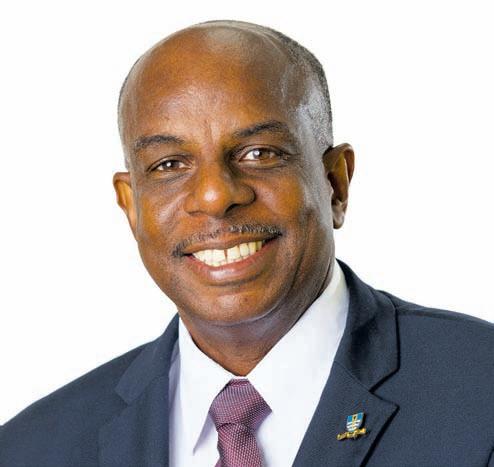
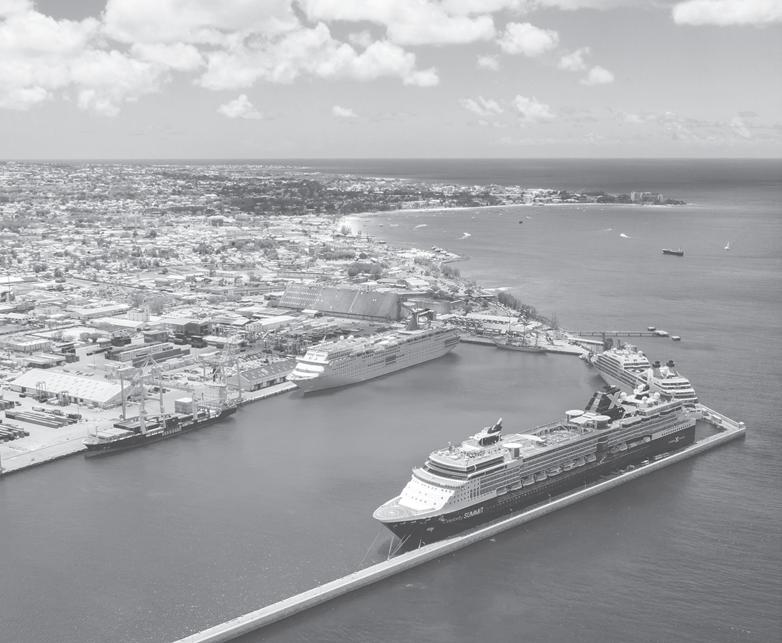
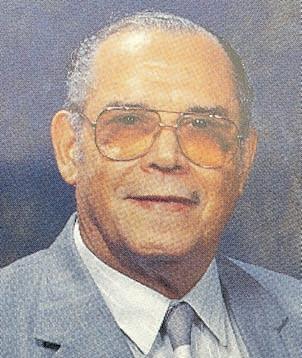
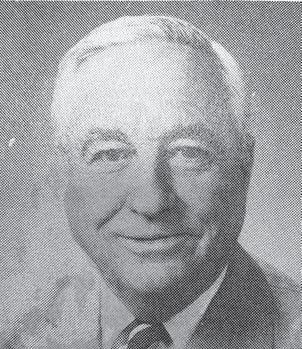
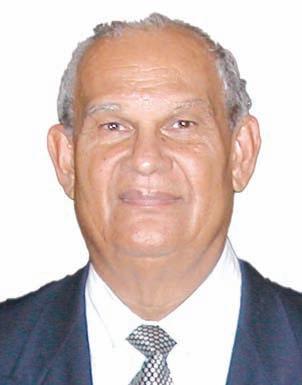
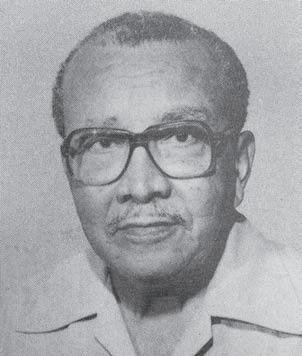
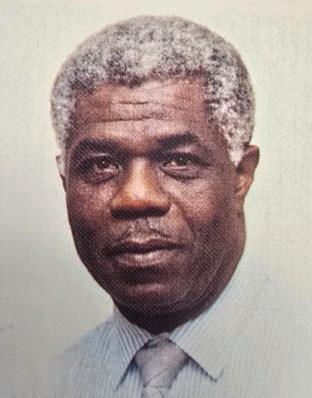
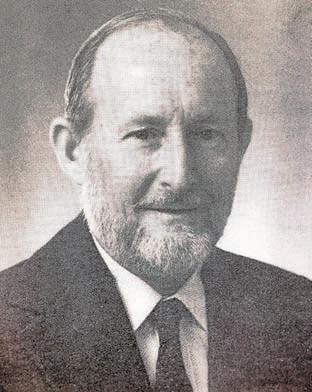
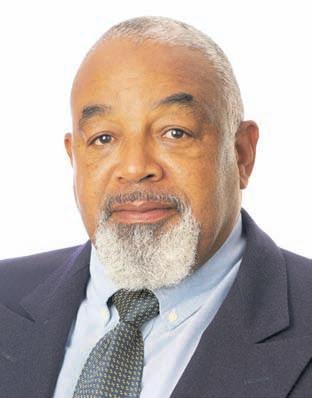
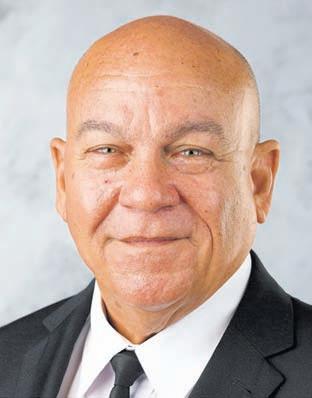
THE SHIPPING ASSOCIATION OF BARBADOS CONGRATULATES
The Shipping Association of Barbados proudly celebrates this milestone and look forward to strengthening our relationship as we continue to provide quality service to the shipping industry, ensuring growth, reliability, and excellence for years to come.
THEiR
ANNiVERSARY ON
BPI: 65 years
Stories by Sandy Deane
For 65 years, the Port of Bridgetown has been at the heart of Barbados’ growth. Every day, it connects our island to the world — bringing in food, medicine, and other essentials, welcoming visitors, creating jobs, and keeping the economy moving. Today the port is a modern operation with new technology, large container yards, and cruise ships. However, its real strength has always been its people.
Since the port opened on May 6, 1961, generations of Barbadians have helped build it into one of the Caribbean’s leading ports. Their hard work and commitment laid the foundation for what we celebrate today. Over the years, it has grown with Barbados — adapting to change, facing global challenges, and taking on a bigger role in our country’s development.
That spirit of progress continues with the opening of the new Berth 6 expansion — a $213.5 million investment and the
biggest construction project in the port’s modern history. Built by Barbadian workers and expertise, this project shows confidence in Barbados’ future and gives our island a stronger place in a fast-changing global market. At a time when trade, supply chains, and economic stability matter more than ever, the port is positioning itself as a gateway that can meet tomorrow’s demands.
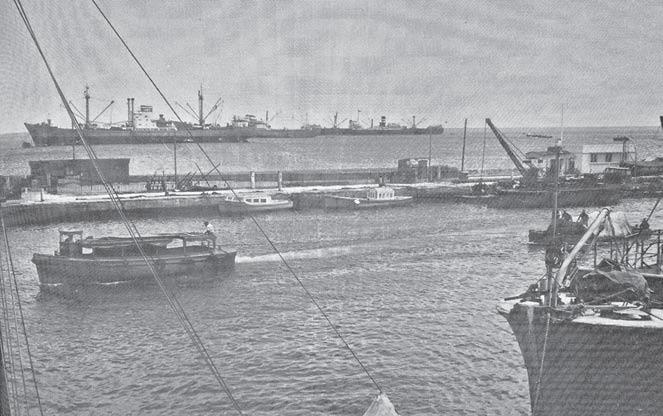
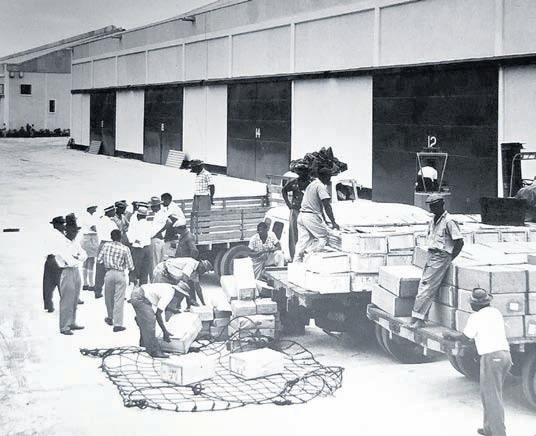
Getting here has been a long journey. Before there was a deep-water harbour, cargo was moved by lightermen rowing small wooden boats through the Careenage and Carlisle Bay. They unloaded heavy shipments by hand, in tough and unpredictable conditions. It was hard, risky work — long before cranes, container systems, and modern logistics changed the industry.
Over time, with clear vision, steady investment, and strong partnerships, the waterfront became a professional, worldclass operation. The Barbados Workers’ Union played a big part in that change,
bright future ahead
helping to improve working conditions and turn dock work into stable, lifelong careers. What was once uncertain became an industry that gave dignity, and opportunity to thousands of Barbadian families.
That legacy shows up today in the loyalty of the port’s workforce. Many employees have spent their whole working lives here, with some giving more than 40 years of service. Behind the cranes and ships are generations of men and women whose daily work keeps this island running. Much of it happens quietly, late at night and out of sight, but its importance cannot be overstated.
Today, as the global shipping industry changes, the port continues to embrace new technology while staying focused on its role in the country. Better security, new training, and modern systems are preparing workers for the future of shipping and logistics. At the same time, protecting the environment is now a priority, with new projects designed to
strengthen resilience and protect our coastline from rising seas.
This 65th-anniversary supplement celebrates that full journey — the early pioneers who built the foundation, the workers who keep operations running every day, and the leaders guiding the port into a new era. It’s a tribute not just to infrastructure and growth, but to the people whose commitment built one of Barbados’ most important institutions.
A NEW BOLD chapter for the Port
The official opening of Berth 6 was more than the completion of a big construction project. It marked a key moment for the future of Barbados itself.
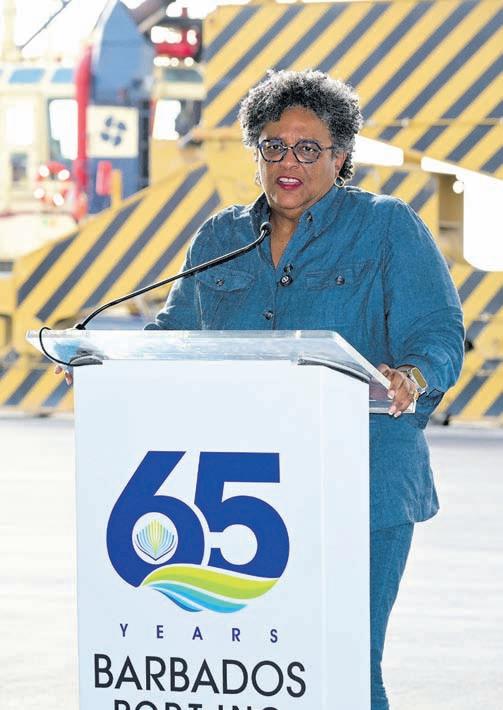
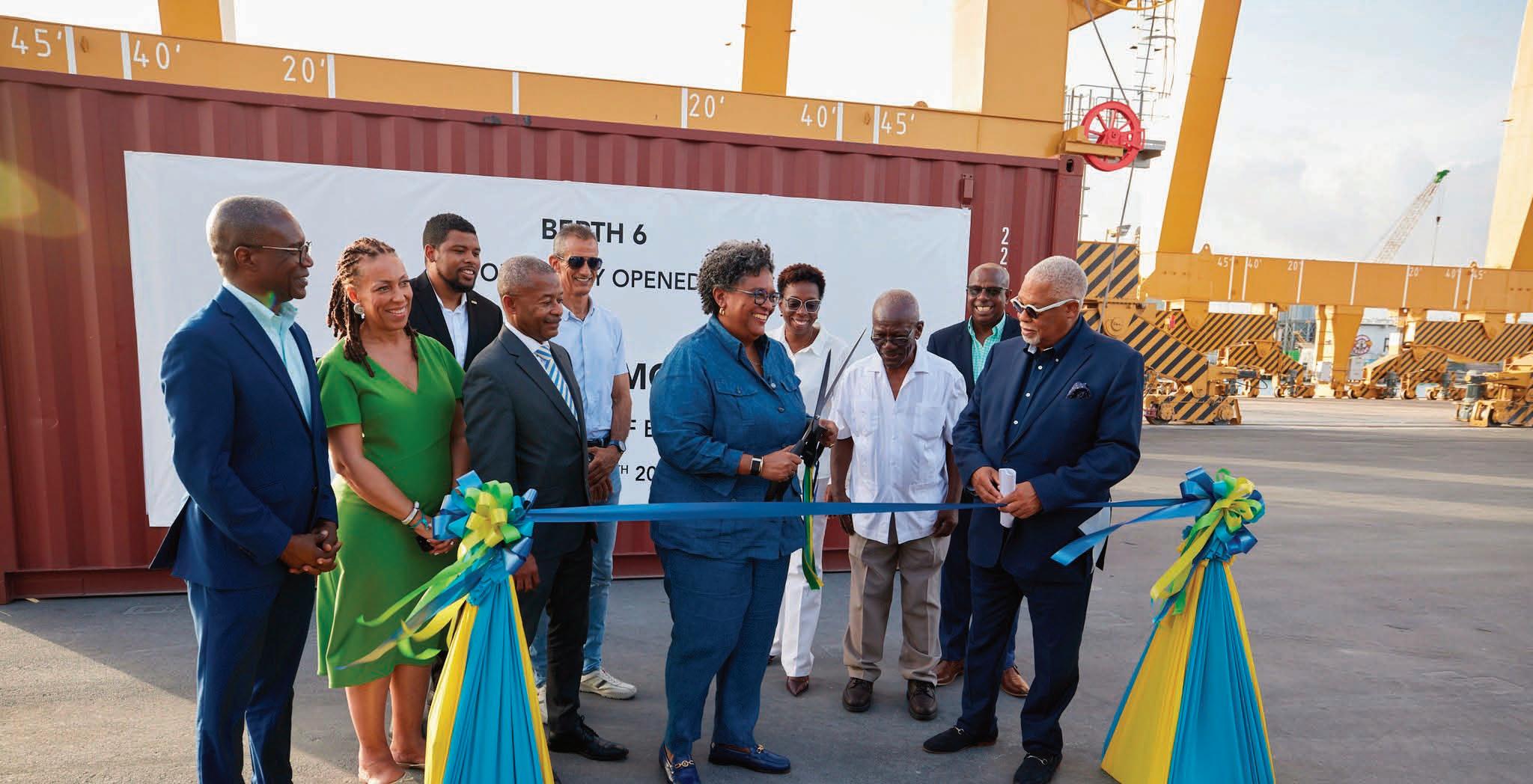
With gantry cranes towering above and the expanded port behind her, Prime Minister Mia Amor Mottley on May 28 gave a wide-ranging speech that tied the port’s past, present, and future together. She described the Bridgetown Port as one of the most important places in the country.
“I have reflected that there are very few places in this country where the acreage has a disproportionate influence on the future of this country,” the Prime Minister noted. Among those rare places, she argued, the Bridgetown Port sits squarely at the centre of national life, driving trade, tourism, revenue collection, and national security. “This acreage here is not just simply a contributor to tourism, GDP, but it is fundamentally at the heart of three things,” Mottley stated. “One, the competitiveness of this economy… secondly, revenue… and thirdly… security.”
Sixty-five years ago, when the Deep Water Harbour opened in 1961, Barbados was still approaching Independence and looking towards big economic change. On this day, that same sense of possibility filled the air again.
For Barbados Port Inc. Chairman Peter Odle, the moment was personal too. “When this port was officially opened in 1961, the celebration was
coordinated by a special committee,” he recalled. That original committee, he noted, was chaired by his father, Frank Julian Odle, who at the time served as Permanent Secretary in the Ministry of Communications, Works, and Housing.
“Who could have imagined that 65 years later, his son would be serving in the capacity of Chairman of the Board of Directors during the construction and opening of one of the largest maritime investments in this port’s history,” Odle said. He described the opening of Berth 6 as the start of a new chapter for the island’s gateway. “For those 65 years of age, it is the age at which we normally would start to slow down. For this port, however, we are only just getting started on the path to expansion and growth.”
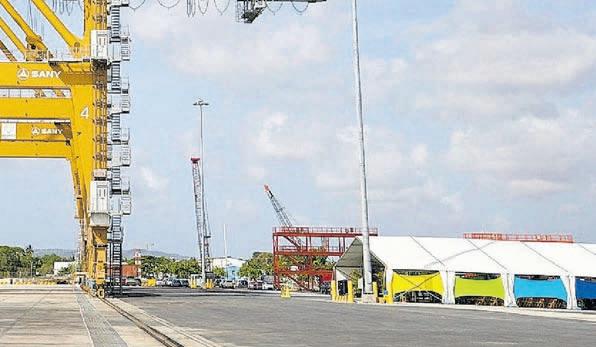
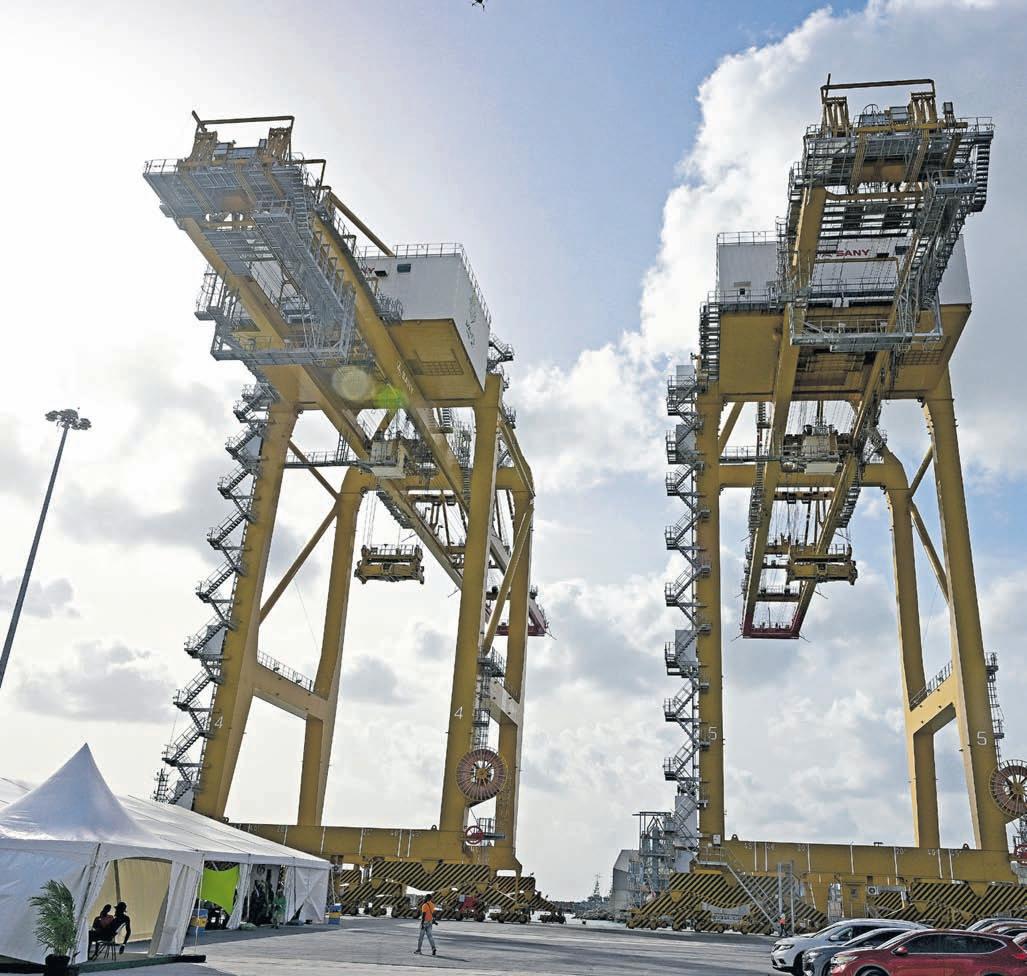
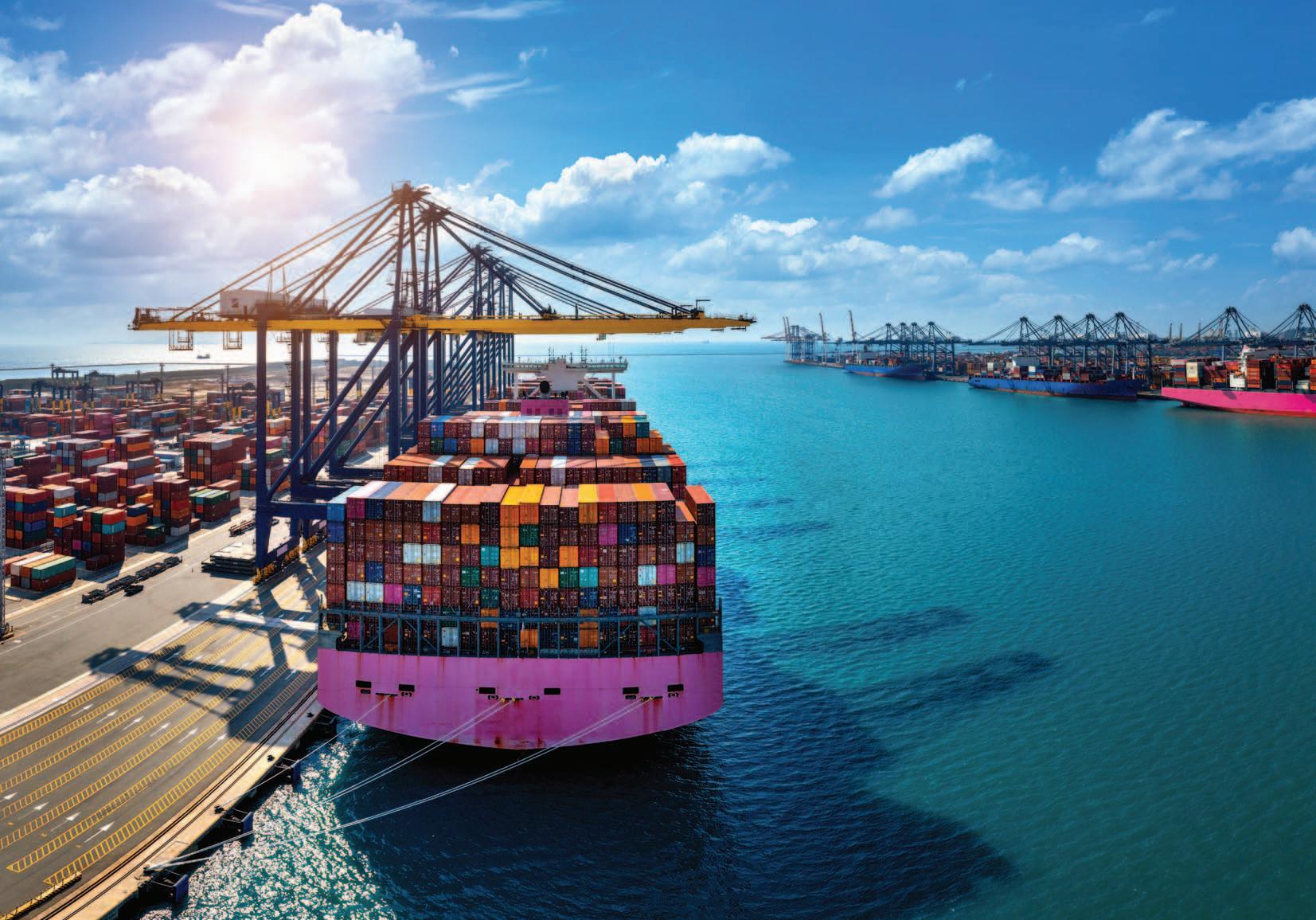
The scale of the expansion is huge. The $213.5 million project includes the new 315-metre berth, 9.4 acres of extra container yard space, upgraded electrical and water systems, and two large Panamax gantry cranes that can serve two ships at once. According to Odle, the work increases the port’s static yard capacity by 40 per cent, putting Barbados in a better position to handle more cargo while improving day-today operations. “Ports are a litmus test for national economic activity,” Odle explained. “The volume of cargo moving through this port has increased over time to the extent that we are now handling record cargo volumes.”
The Prime Minister also used
• Continued on Page 5
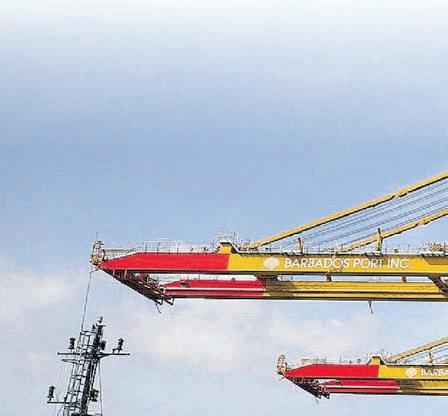
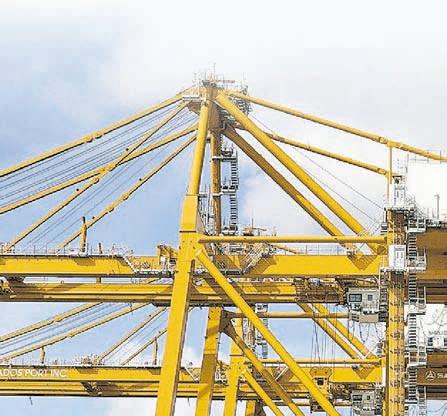
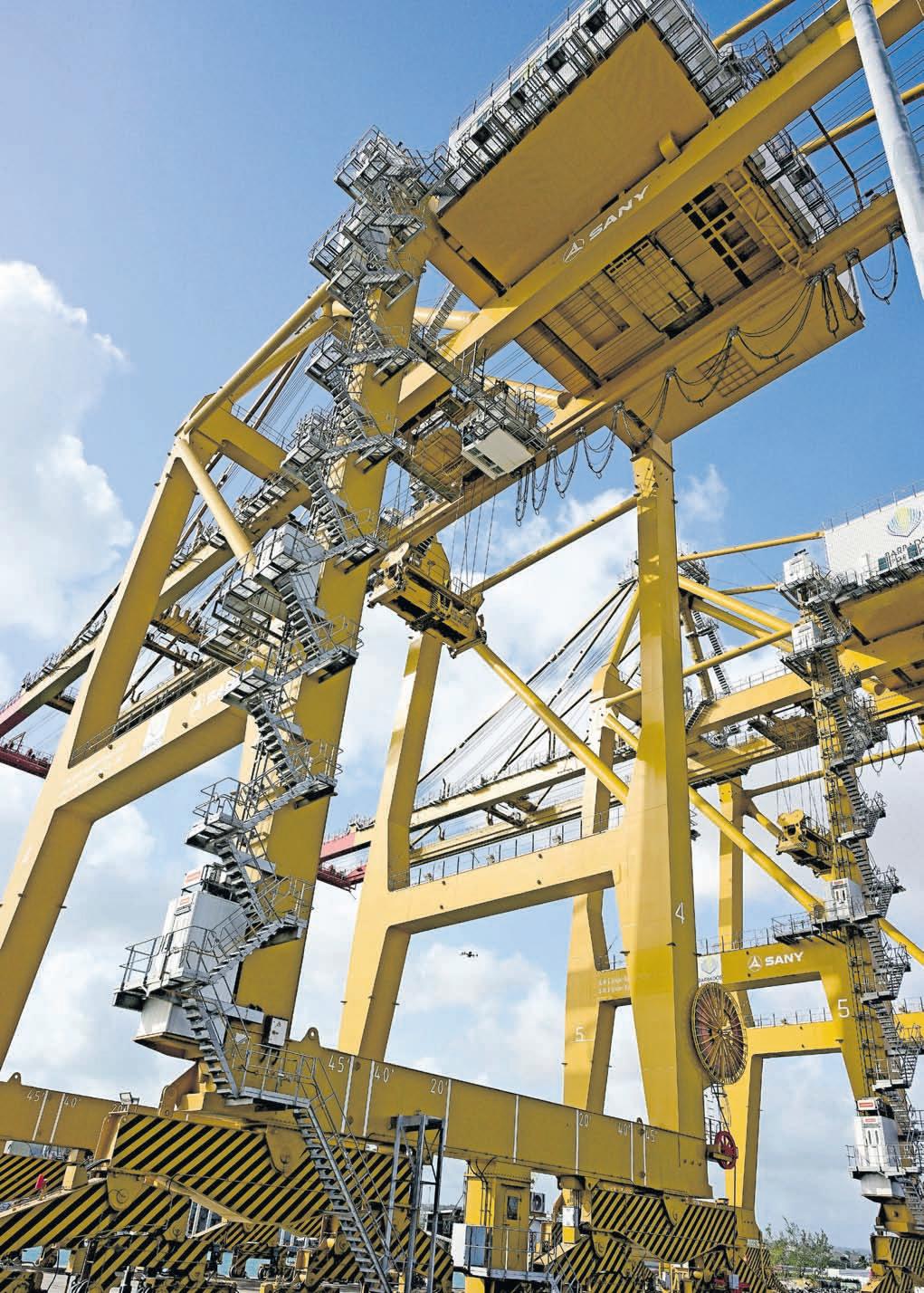
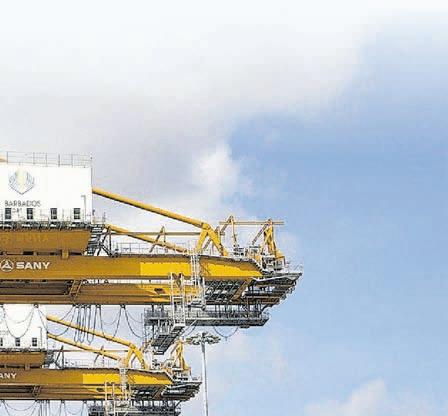
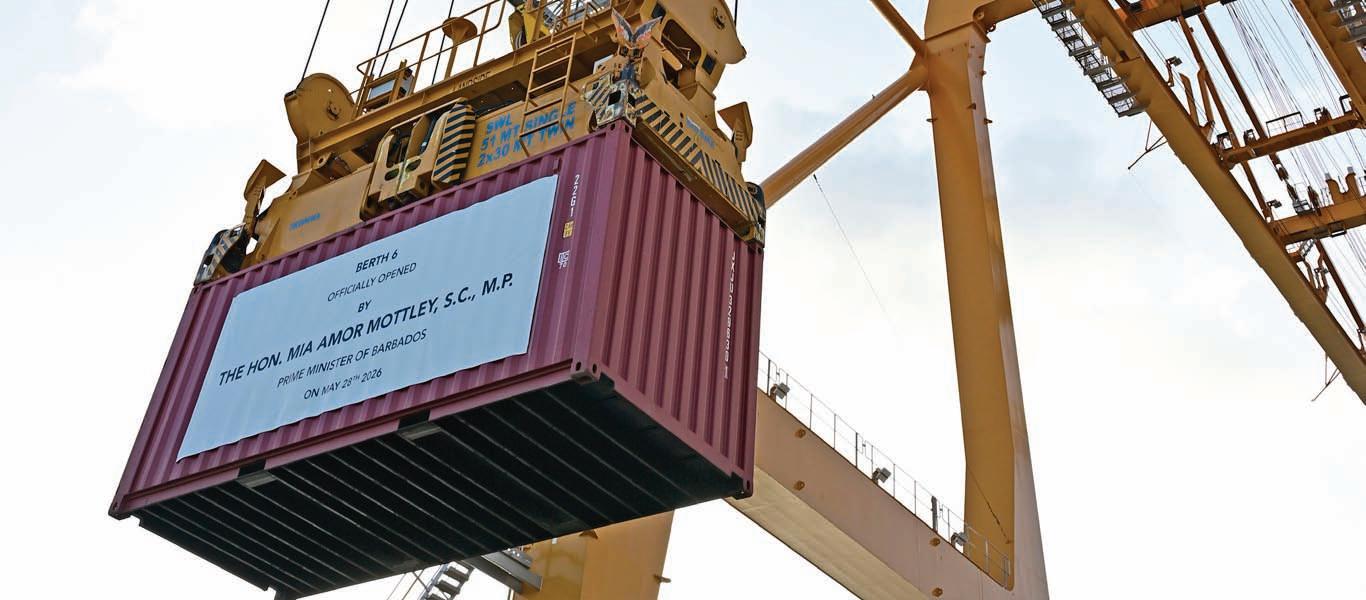
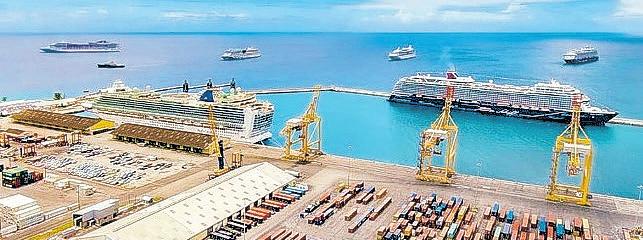
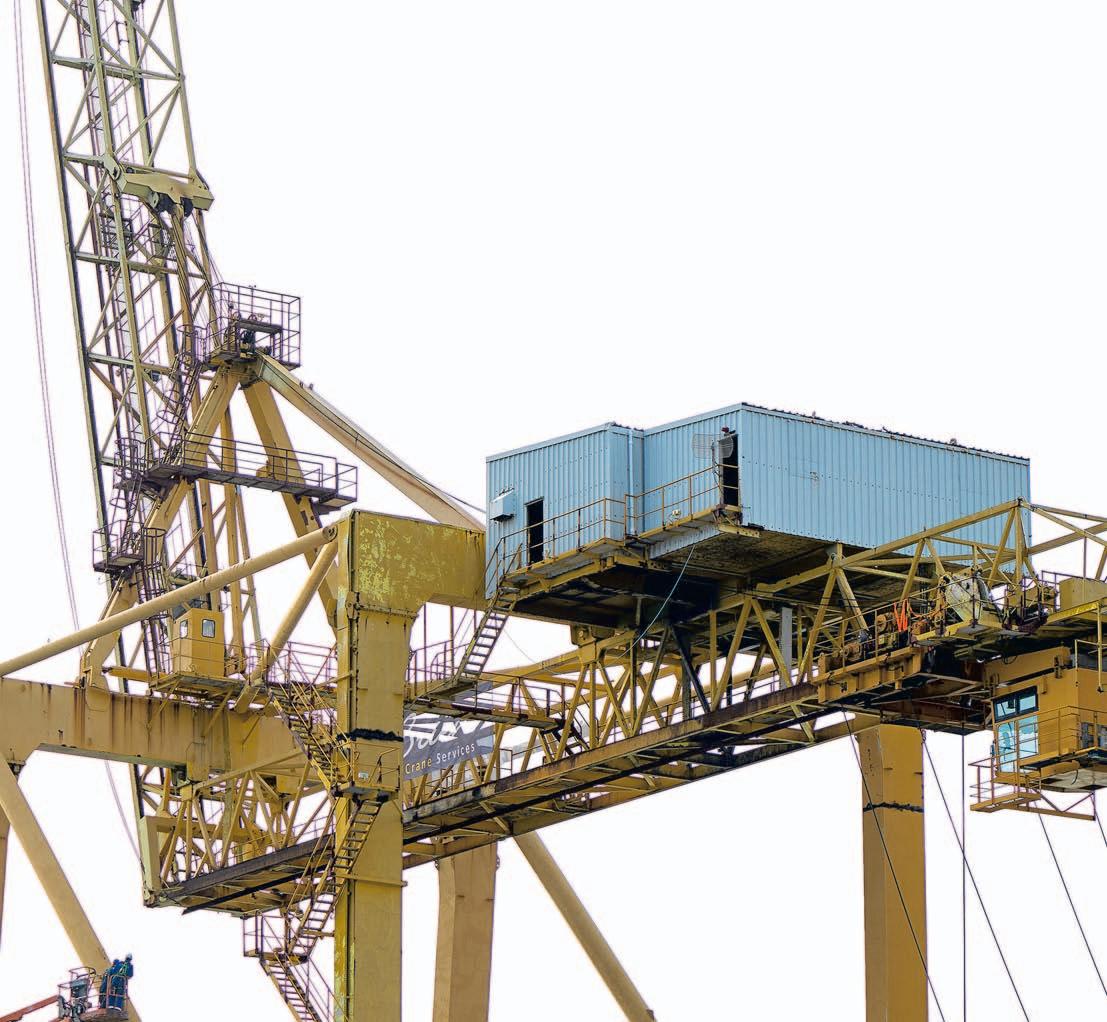
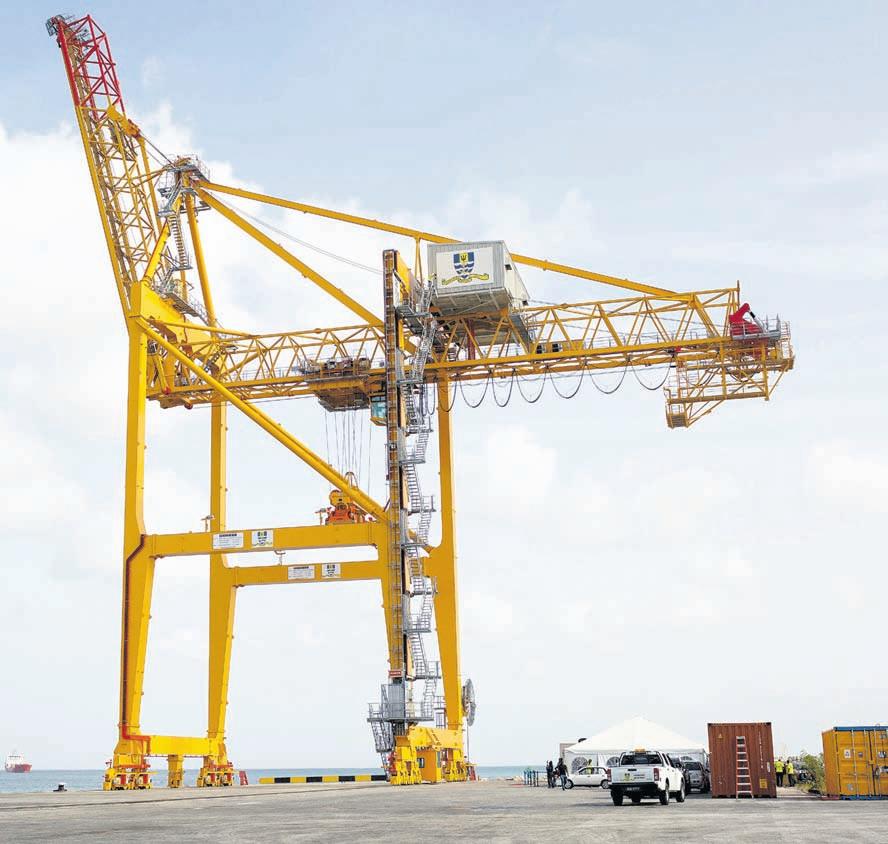
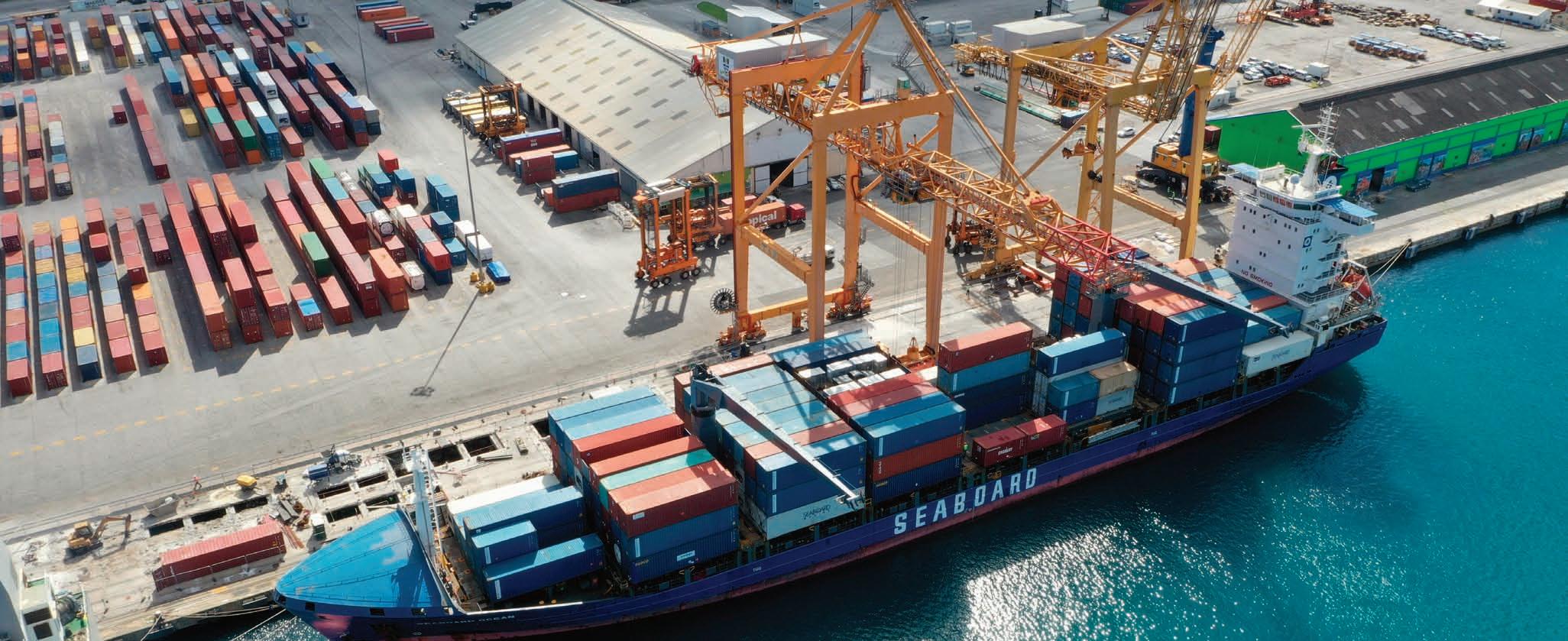
A view of the massive new gantry cranes towering over Berth 6 at the Port, which was officially commissioned by Prime Minister Mia Amor Mottley on May 28. (GP)
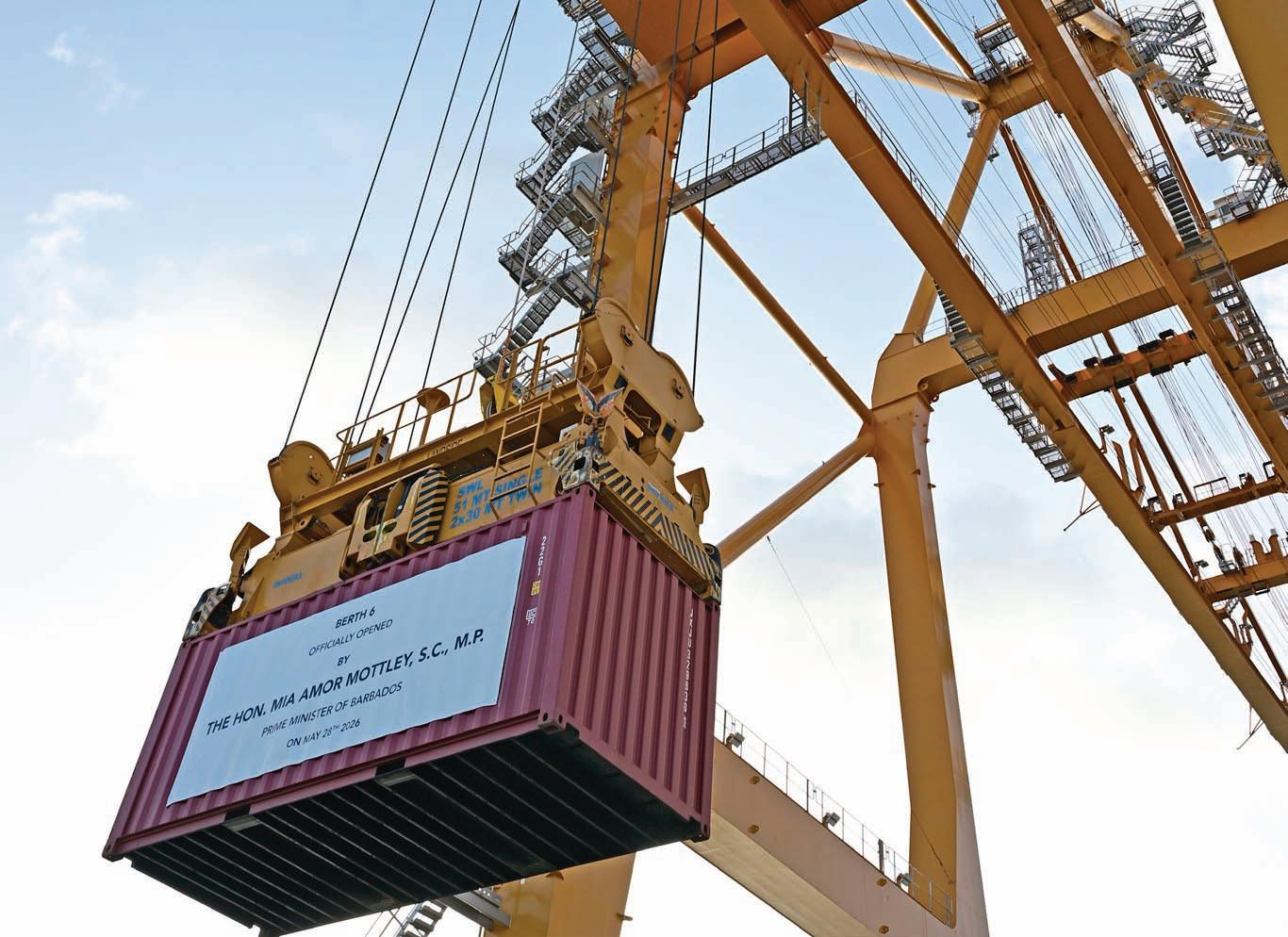
Prime Minister Mia Amor Mottley officially opens Berth 6, marking a major milestone in the continued expansion of Barbados Port Inc. (GP)
to tomorrow
Officials stand in front of the Berth 6 commemorative container following Thursday’s official commissioning ceremony at the Bridgetown Port.
• From Page 4
the event to share a wider regional plan — one where Barbados grows its role as a Southern Caribbean hub for transshipment and cruise. “We have come to use this port for transshipment purposes to other destinations as a hub,” Mottley said. “We have come to be able to see that we can still accommodate goods and people, cruise and cargo.”
She said climate change and the growing risk to northern Caribbean ports during hurricane season give Barbados a unique advantage. “The opportunity for Barbados to become a serious player in the transshipment business in the Southern Caribbean is potentially there for us because of the blessings that the Lord has given us with respect to our ocean floor,” she said.
But throughout her speech, Mottley stressed that growth must go hand in hand with strong security and accountability. “Without security, we have nothing in this country,” she warned, as she spoke directly about smuggling, illegal trafficking, and the need to strengthen container scanning and inspection systems at the Port.
To make it happen, she challenged everyone linked to the waterfront — from management and customs officers to brokers and truck drivers — to do their part to improve efficiency. “The ability for everyone to do a little more, a little better, is capable of, in a cumulative fashion, enhancing Barbados’ competitiveness,” she said.
The Prime Minister also outlined long-term plans for the Bridgetown Port, including corporatisation, more cruise infrastructure, new aggregate facilities, and better container examination systems. In one of the speech’s boldest moments, Mottley spoke about turning the land around the port into a world-class destination tied to Barbados’ cricket history, because of its location next to Kensington Oval. “It would seem to be too hard for this port which enjoys a global competitive advantage by being the neighbour to an iconic sporting ground… not tie that to what has come to define Barbados’ modern economy,” she noted.
Both speakers made it clear that environmental resilience and sustainability will guide the port’s future. “In keeping with our green maritime ambitions, at every stage of construction of this berth, we have appeared to manage our impact on the environment,” Odle said. “We will remain attuned to climate change and amend our berth design to accommodate anticipated sea level rise.”
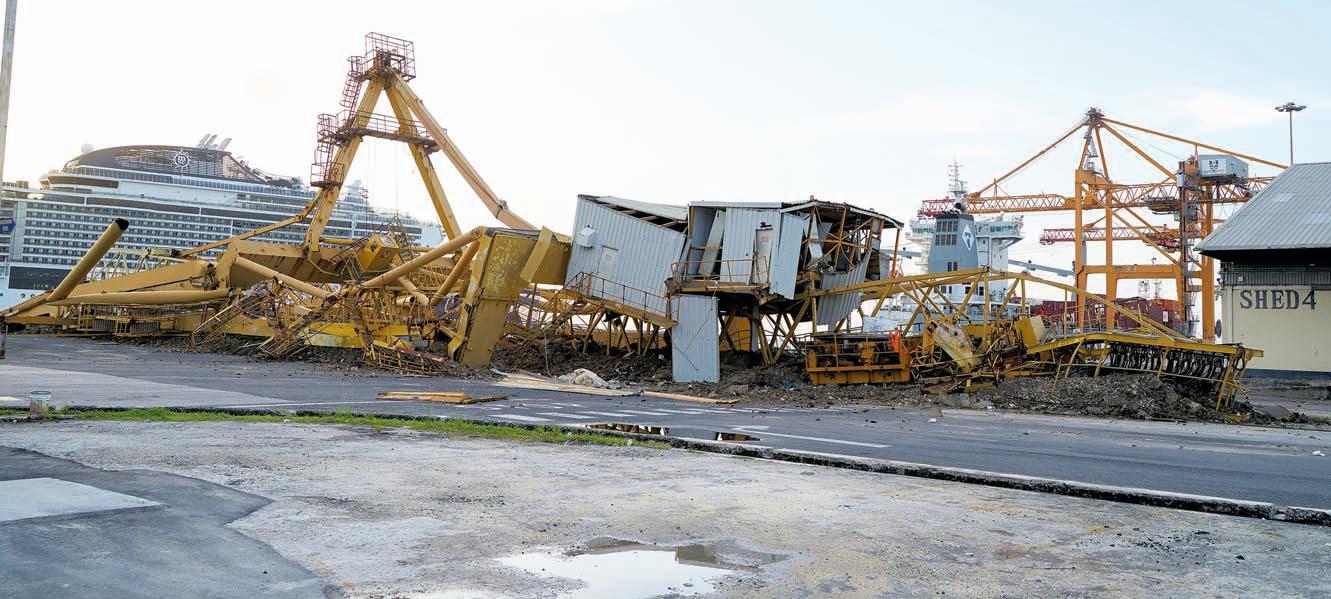
Mottley agreed, pointing to the damage from Hurricane Beryl and warning that climate resilience must guide every future project at the port. “I want to encourage the people who are responsible for the designs and the engineering to always remember that resilience and solid engineering must be at the core,” she said.
But beyond the policy talk and forecasts, the ceremony sent a deeper message about what Barbadians can do and what the country can aim for. Mottley praised the local contractors and workers who completed the project with homegrown skill. “On this occasion, we chose to go with the Barbadian company who was able to deliver,” she said. “This is no small achievement.”
That pride was clear all afternoon. Again and again, the speakers returned to one idea: Barbados must look past its size, embrace new ideas, and compete confidently in a changing global economy. That’s what Berth 6 really represents. It’s not just a new berth at the Bridgetown Port It’s a statement that even after 65 years of service, Barbados Port Inc. believes its best days are still ahead. (SD)
From left: Barbados Port Inc. CEO David Jean-Marie, InterAmerican Development Bank Country Representative Carina Cockburn, Christopher Buchannan, VP Investment Banking NCB Capital Markets, Minister of Tourism and International Transport Ian GoodingEdghill, Mark Maloney, Executive Chairman, Preconco Group, Prime Minister Mia Mottley, Barbados Workers’ Union General Secretary Toni Moore, former BWU General Secretary Sir Roy Trotman, Ian Stewart Chief Operating Officer, BPI and BPI Chairman Peter Odle. (GP)
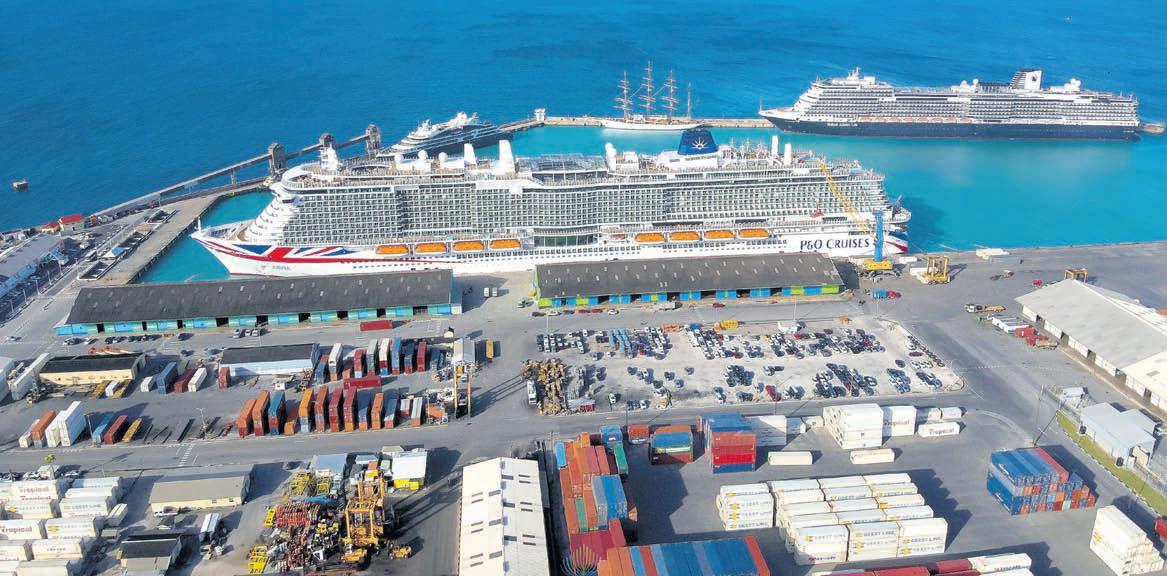
The Port of Bridgetown has taken a big step forward with the opening of Berth 6.
With a total investment of $213.5 million — covering new infrastructure, large cranes, and specialised equipment — it ranks among the biggest engineering projects Barbados Port Inc. has completed in its 65-year history. More than a construction milestone, it changes how the island handles international trade and logistics.
From the surface, Berth 6 looks like a long stretch of dock. But it’s much more than that. This new asset was built to support a clear vision for the future of shipping and cruise tourism in Barbados by easing congestion at the waterfront, speeding up how fast cargo moves, and making better use of space.
What was built
To understand its scale, Berth 6 is an elevated dock that runs 315 metres long and connects directly north of Berth 5, with a stable depth of 13 metres for ships. To support it, engineers drove concrete piles up to 42 metres into the seabed and built a strong steel wall along the seaside.
That wall has three key roles: it supports the new cranes, holds back the reclaimed land behind the dock, and helps reduce wave movement to keep the inner harbour calmer.
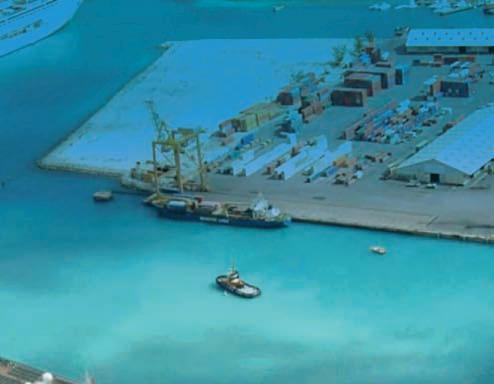
Behind the dock, the work includes 9.4 acres of new heavy-duty container yard space. It’s fully fitted with the essentials — lighting, drainage, water lines, electrical power, and 144 extra reefer plugs for refrigerated cargo.
Solving a long-standing traffic issue
For years, the Port of Bridgetown had to use the same limited berthing space for both cruise ships and cargo vessels. During the busy winter tourism season from November to April, that overlap often led to tight schedules and longer wait times for ships.
Berth 6 helps fix that by separating the two operations. It’s designed mainly for commercial cargo vessels, which frees up the other berths to handle cruise ships during peak season. With cargo ships no longer competing with passenger liners for space, the port can cut down delays and keep both sides of the business running smoothly.
Boosting stacking capacity
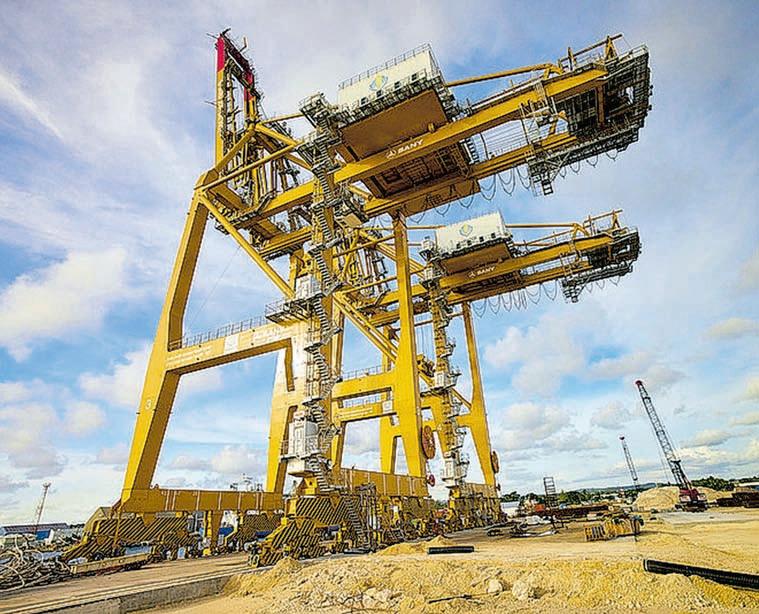
The new berth can handle two large, electric-powered Panamax gantry cranes that tower over the yard, allowing the port to service two ships at the same time.
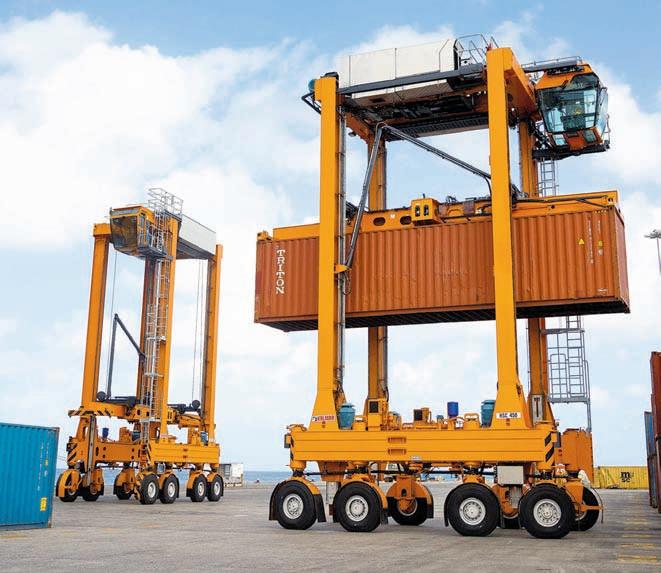
Used alongside the existing straddle carrier system, Berth 6 increases the port’s static yard capacity by 40 per cent — moving total container slots from 230 000 to 345 000.
The whole berth was also built to support Rubber-Tyre Gantry (RTG) operations. That future-ready design means the port can increase stacking even more, aiming for 460 000 container slots once a hybrid straddle carrier RTG system is added in the near future.
A timely move
Barbados is now seeing record cargo volumes to support local retail, a busy construction sector, and growing cruise homeporting. Ports show how active the economy is, and to manage the increased flow of goods, Barbados Port Inc. introduced a Priority Berthing Policy. That policy gives five of the island’s main regular cargo lines more reliable and consistent arrival times.
Berth 6 is more than concrete, steel, and new equipment. It’s a key upgrade that helps essential goods move faster, cuts costly waiting time for ships, and keeps the port running at world-class levels during peak seasons. By meeting the changing demands of global trade, Berth 6 strengthens Barbados’ place as a strong, multi-purpose hub in the region. (SD)
May 6, 2026, marked a pivotal moment in our history — the 65th anniversary of the opening of the Port of Bridgetown.
As Minister of Tourism and International Transport, it has been gratifying to lead an institution that has grown steadily and accomplished so much over its history.
This 65-year milestone is more than a symbolic commemoration. It is a celebration of the port’s remarkable progress and enduring service to our country.
I extend sincere appreciation to the employees, past and present, whose dedication has kept the Bridgetown on a path of success as a powerful economic catalyst and commercial hub. I also thank the Board of Directors and the management team of Barbados Port Inc. for the dynamic strategic leadership they continue to provide.
I salute our partners in commerce, shipping, transport, trade, logistics, border security and labour relations, and extend special thanks to our customers.
A pillar of national DEVELOPMENT
For 65 years, the port has been a pillar of national development, advancing trade, tourism and global connectivity. BPI’s success over the years reflects the strength of its people, the agility of its systems and the resilience of its infrastructure.
This year’s completion of the dedicated cargo berth, Berth 6, is further evidence of foresight, ambition and sustained commitment to transformation. This investment strengthens the port’s ability to deliver reliable, high-performing supply chain solutions to its customers while ensuring goods reach their intended markets, businesses and communities on time.
The port continues to demonstrate its readiness to improve operational efficiency and meet the demands of a changing global environment as evidence in its expanded cargo-handling capacity, its modern digital architecture and the acquisition of a green energypowered equipment fleet. In partnership with our stakeholders, we have also witnessed the introduction of multiple initiatives to increase delivery rates, reduce wait times and enhance processing through digitalisation. The Government of Barbados remains committed to building a stronger, smarter and more sustainable future for our nation while reinforcing Barbados’ standing in the Caribbean and global maritime and logistics industry.
As such, our intention is to strengthen Barbados Port Inc.’s corporate structure and business model, positioning the organisation to better access the investment needed for future asset development and capacity expansion.
We are proud to be a part of the organisation’s 65th anniversary and its ongoing mission to expand national capabilities, strengthen supply chain resilience and deliver in response to market dynamics, commercial priorities and stakeholder needs.
Message from the Honourable Ian Gooding Edghill, M.P., Minister of Tourism and International Transport, to mark the 65th anniversary of Barbados Port Inc.
the next HORIZON
The Port of Bridgetown, in its 65th year of operation, stands at a defining point in its evolution.
Ever since its official opening on May 6, 1961, it has remained at the heart of this nation, enriching lives, empowering communities and contributing to the economy through the best of times and the most difficult of times.
We’ve come a long way from that first year of operation when there were 488 vessels calls recorded with 110 342 tons of cargo imported and 7 479 tons exported. There was in addition 150 734 “long tons of bulk sugar” exported along with 8 945 “long tons of Fancy Molasses”— an accomplishment considered “a good start” in 1962.
Cargo throughput is now at its highest, exceeding 1.7 million tonnes in the last year.
The events of the past two years in particular signalled a dramatic departure from business as usual and set a new agenda where we had to reposition the port to ensure delivery on great expectations.
The Board of Directors has placed particular emphasis on modernising the organisation, while ensuring that its strategic direction remains aligned with national policy objectives and international best practice.
In support of improved operational efficiency and the intentional separation of cruise and cargo operations, we completed the development of the new dedicated cargo berth, Berth 6. The upgrade and expansion of our cruise facilities likewise remain a priority.
We completed the expansion of the Shallow Draught Marina for yachts and pleasure craft, and among the projects we are exploring are: Development of bulk handling capacities in keeping with the need of the country to import certain bulk materials for construction (cement and a range of aggregates); the development of logistics facilities for cargo, significantly improving our break-bulk and container operations, establishment of a Boat Repair Facility; commercialisation of the South and East point Lighthouses; and the generation of internal power needs through expansion of our photovoltaic systems.
The future, from our viewpoint, presents both challenges and opportunities. Our intention therefore is to charge ahead with purpose and to deliver sustained value to the country we serve, with careful strategic action and disciplined execution.
I want to take a moment on this 65th anniversary to especially acknowledge all employees, past and present. The hard work you’ve done, often behind the scenes, the systems and processes you’ve put in place, have all made a significant difference in our operations, and we are incredibly grateful for your contributions. Whether you’re managing complex projects or ensuring that no task goes overlooked, your commitment is evident in everything you do.
You might not always be in the spotlight, but your efforts do not go unnoticed. You might not always hear it, but your contributions are vital to our continued operation. Today, I say thank you for the countless ways you support our growth and development. Your dedication, reliability, and quiet strength are the foundation of our success. Thank you for everything you do.
Happy anniversary to all at the Port of Bridgetown
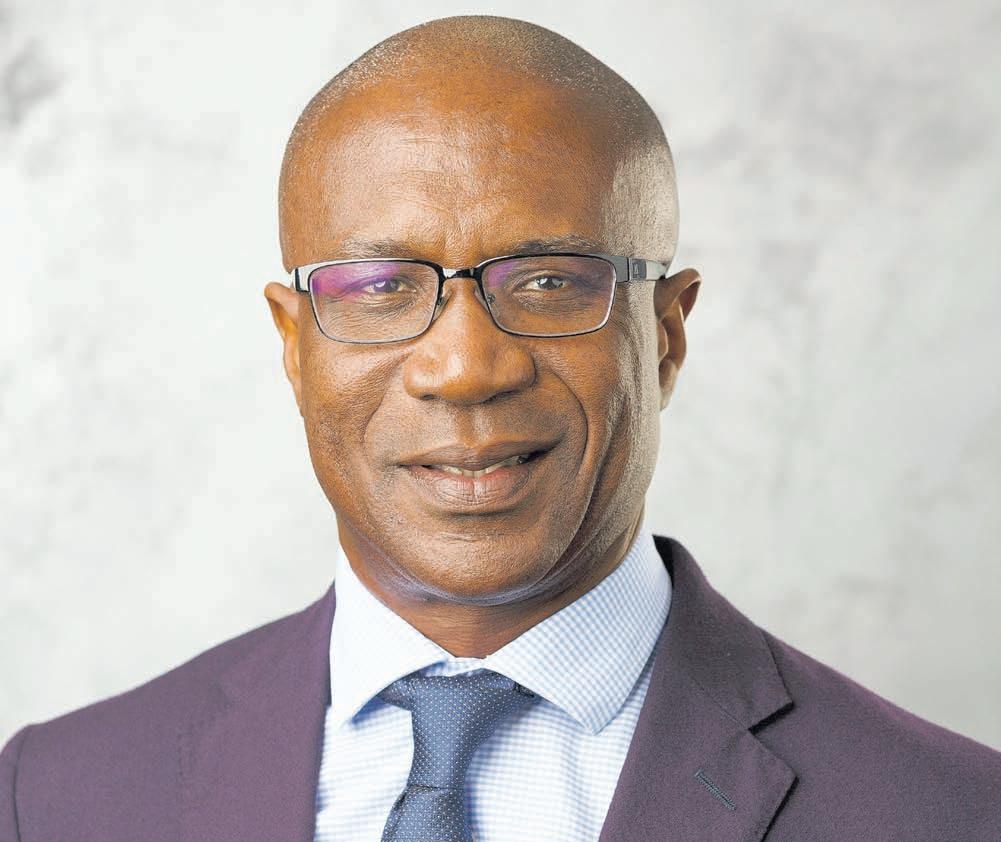
Message from Chairman of Barbados Port Inc., The Most Honourable, Peter Odle, F.B.
Defined by wisdom,loyalty, steadfastness
This year, the Port of Bridgetown is celebrating a remarkable occasion – 65 years since its official opening on May 6, 1961.
A 65th anniversary is traditionally associated with the qualities of wisdom, steadfastness and loyalty.
Looking back through our history, these words very aptly describe our remarkable journey towards this milestone.
Wisdom
When the Deep Water Harbour was constructed, it was described as “the greatest and most rewarding engineering and developmental project done by a government in Barbados to date”.
Those 1961 building blocks not only set the stage for improved import and export logistics but inspired the continuous large-scale investment and expansion that would herald the Port of Bridgetown’s transformation into the award-winning international seaport that it is today.
This a testament to the visionary leadership of the Government of Barbados, the stewardship of our Board of Directors, our partnership with the Barbados Workers’’ Union in fostering strong management-labour relations, and the dedication of our employees, past and present who worked tirelessly to shape the Port of Bridgetown.
Steadfastness
We have been fundamentally improving and reinvigorating our business to respond to shifting customer expectations and a continuously changing environment.
In the face of evolving market conditions, however, we remain committed to improving operational efficiency and reliability, strengthening regional and global connectivity and supporting sustainable growth across our cargo and cruise commercial portfolios.
We are focused on strengthening the port’s competitiveness and reinforcing its role as a resilient and sustainable gateway for trade and tourism. That means investing more in new infrastructure, digitalisation and new approaches to enhancing our skills and work.
We are excited about the opportunities ahead to extend our track record of reliability, efficiency, safety and security.
Loyalty
Our growth and expansion have always been buoyed by commitment – our commitment to our employees, our clients, our partners and our stakeholders. The Port of Bridgetown was founded on a commitment to serve its people, a pledge reinforced in multiple industry honours through the years. The numerous accolades earned include 13 Caribbean top port awards highlighting our outstanding performance in dependability and flexibility, port efficiency and productivity, growth and development, security, environmental preservation, occupational health and safety.
Over the past 65 years, we’ve delivered millions of tonnes of cargo, serviced thousands of customers, welcomed millions of visitors and built an enviable network of connections in cargo and cruise.
Every single success the port has recorded has been on the shoulders of our highly valued team. We are a 500+ workforce of many specialised disciplines, deserving of special commendation and acknowledgement. Today we celebrate our anniversary with raised expectations toward us as a dedicated team of people who can do amazing things.
To all employees, past and present, thank you for 65 remarkable years of support. We absolutely could not have done it without you. Your commitment truly makes all the difference. Let us keep it going and growing through the next 65 years.
To our customers and partners who have trusted us throughout the years, it has been an honour and privilege to work with you.
Thank you for your belief in us and our abilities to help you achieve your goals and vision of success, while always challenging us to be better.
Message from David Jean-Marie, Chief Executive Officer of Barbados Port Inc. to mark the 65th anniversary.
David Jean-Marie, Chief Executive Officer of the Barbados Port Inc. (GP)
Building the Deep Water Harbour: 1957–1961
For over 300 years, Bridgetown was a busy port of call in the Eastern Caribbean. But until the late 1950s, Barbados didn’t have a proper harbour for large ships.
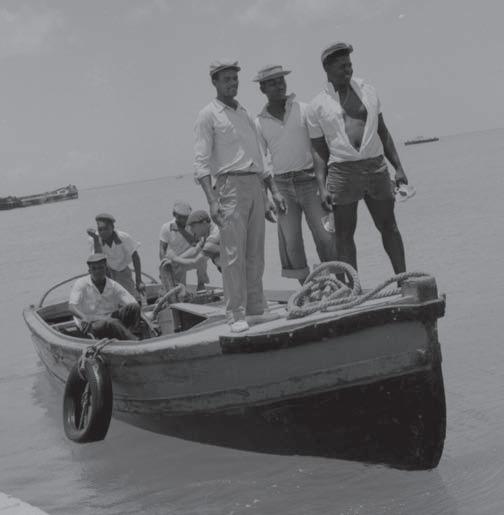
Ocean vessels had to anchor in the open waters off Carlisle Bay. Cargo was moved to shore using small wooden boats called lighters, which workers rowed back and forth to the Careenage wharf. It was slow work, and cargo was often damaged or lost in the process.
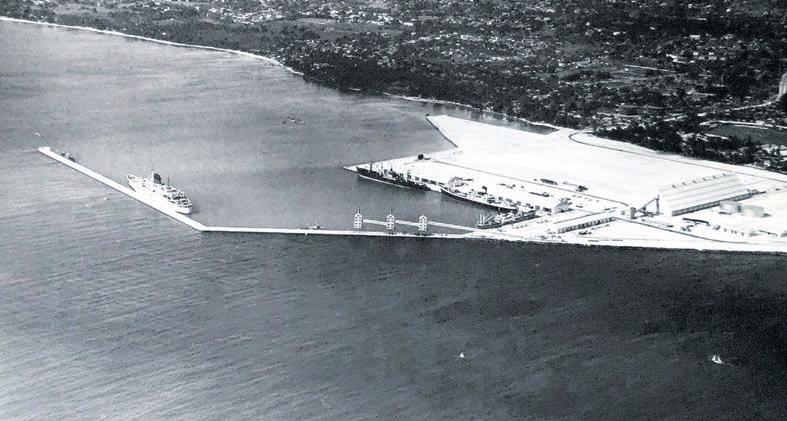
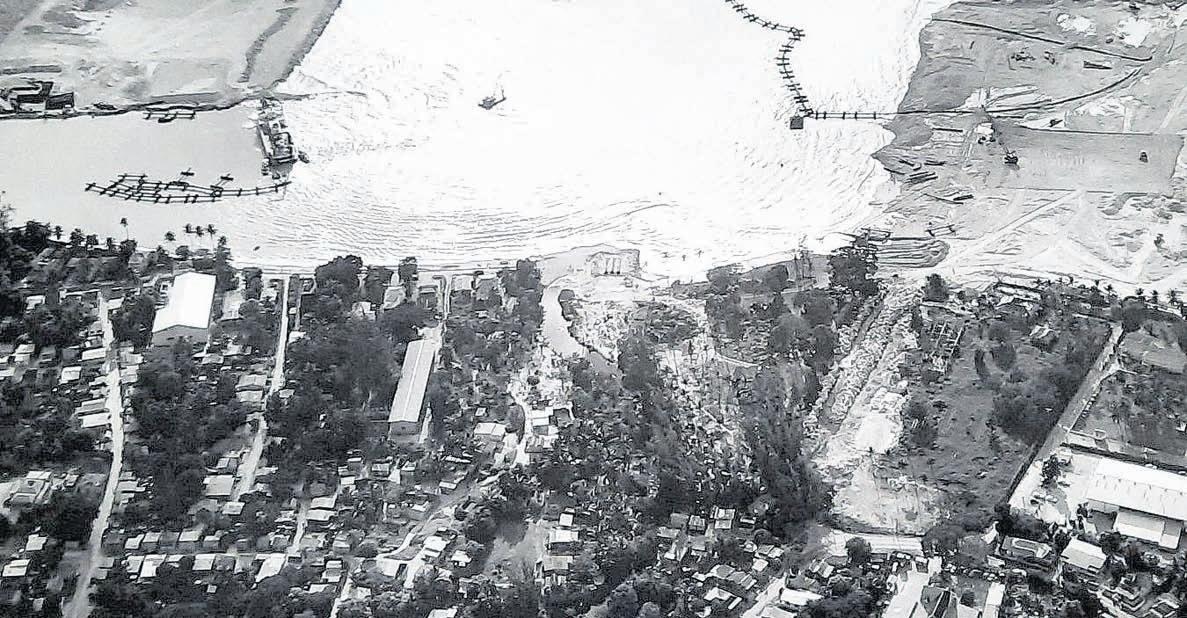
That changed in June 1957 when work began on the Deep Water Harbour. The $28 million project reshaped the coastline and set the foundation for Barbados’ modern port.
New land
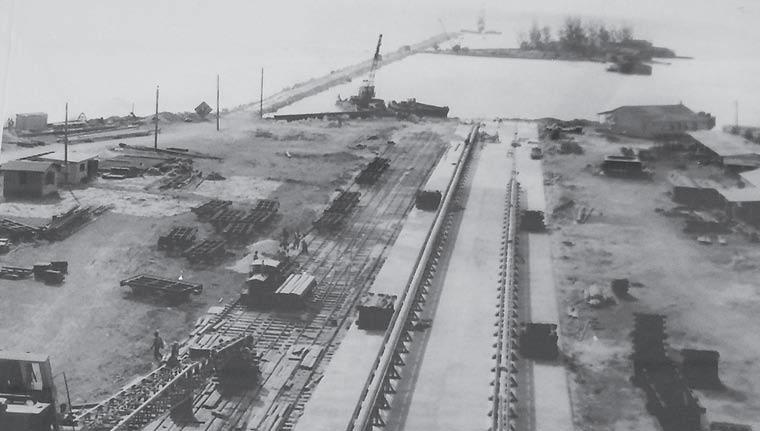
The project’s centrepiece was Pelican Island, a small offshore spot about 600 yards from the mainland where brown pelicans nested. Engineers filled in the sea outward from the Princess Alice Playing Field, connecting the island to the mainland for good. The work added more than 90 acres of new land to Barbados.
We extend our heartiest congratulations to The Directors, Board of Management & Staff of Barbados Port Inc. on the
We look forward to continuing our partnership for many more years to come! of the
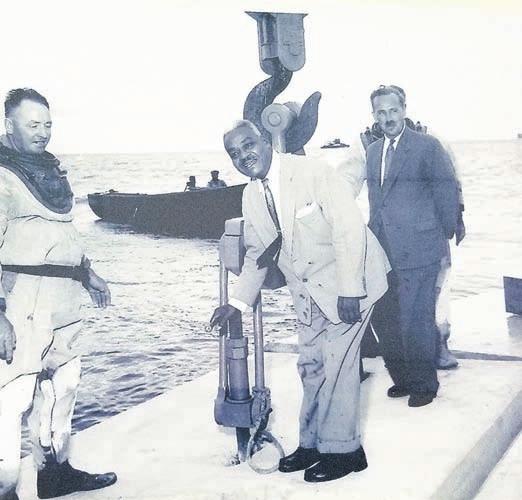
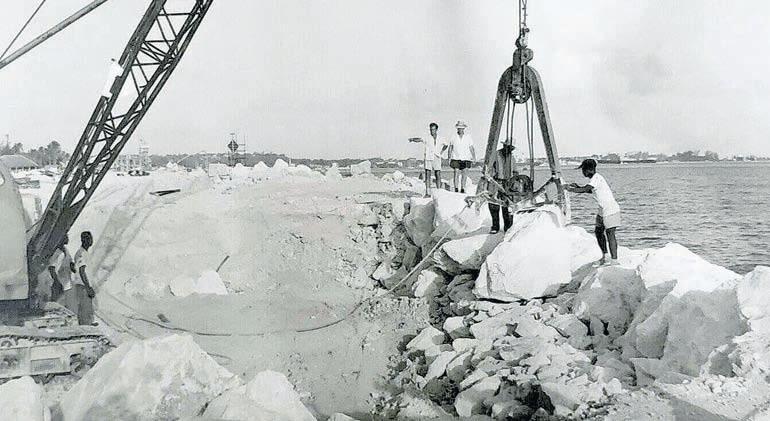
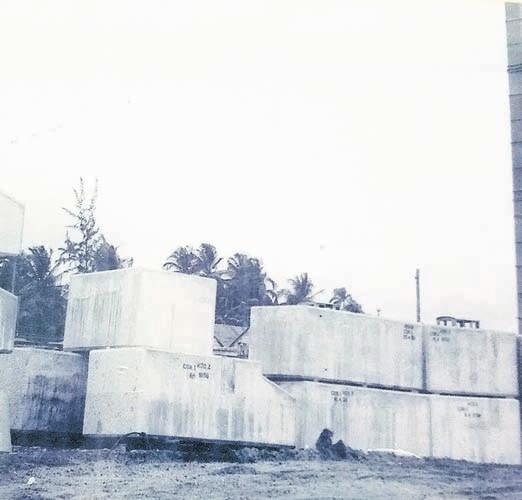
The stone for the reclamation came from inland. At Bagatelle Plantation, workers blasted rock and loaded it onto a fleet of 25 Commer trucks. For three years, the trucks ran non-stop, hauling 776 430 tons of stone and covering more than two million miles. To protect the new harbour, crews built a breakwater using nearly 30 000 concrete blocks. Some blocks weighed up to 20 tons. A batching machine made the blocks on site, and custom railway lines moved them into place. On July 23, 1960, Premier Dr Hugh Cummins placed the final block, closing the harbour’s protective wall.
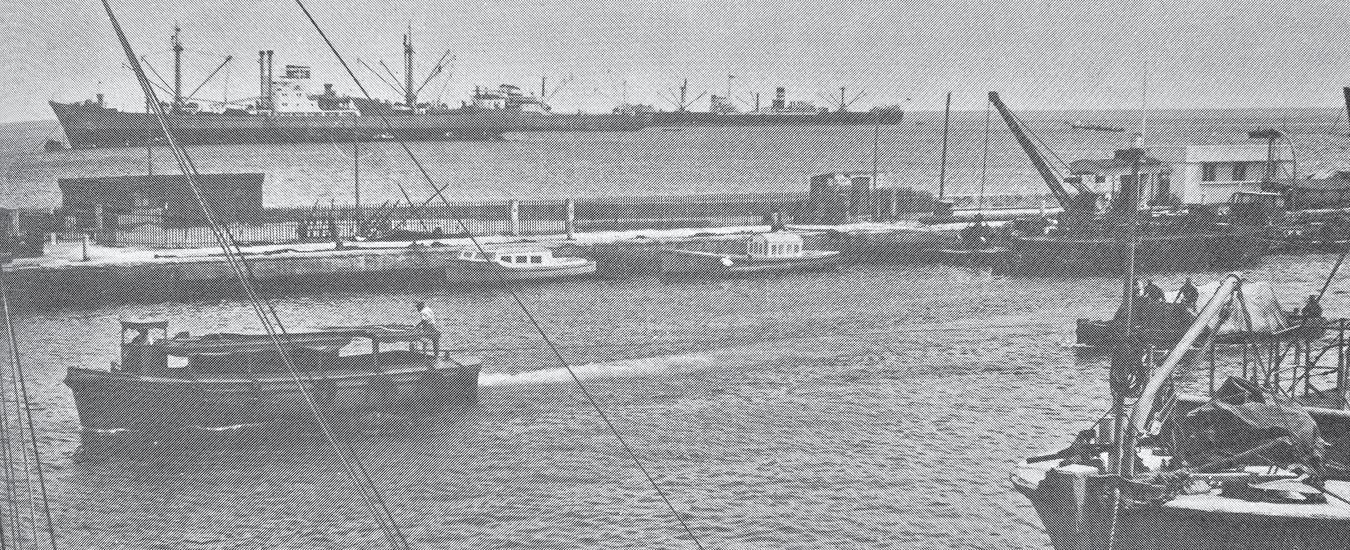
1957 - Until the Deep Water Harbour was built, the larger ships calling at Barbados anchored in Carlisle Bay. (GP)
1957 - Construction of the Deep Water Harbour commenced. (GP)
1957Cargo was transported to the Wharf at the Careenage in smaller boats, an activity which sometimes resulted in the unfortunate loss of cargo. (GP
Local workers built the port
British engineers supervised the project, but the work was done by Barbadian labour. Crews learned quickly and handled the job without a single major incident.
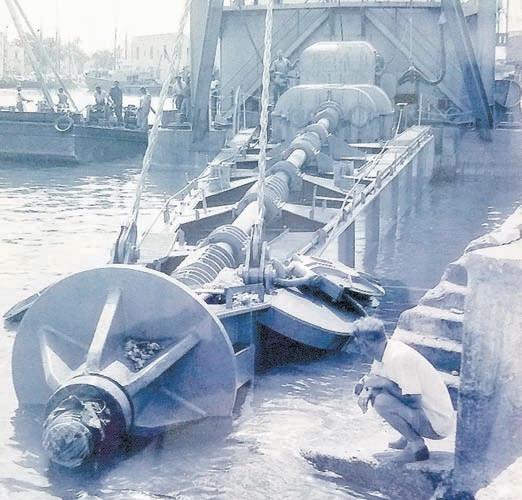
The main machine on site was a cutter suction dredger called the Barbados. At nearly $2 million duty-free, it was the largest and most expensive piece of equipment ever brought to the island at the time. It got the job done, but it was loud. Residents in Fontabelle had many sleepless nights, and some moved out temporarily to get away from the noise. When the port was dredged again in 2002, newer equipment worked with far less sound.
1959 - The ‘workhorse of the project’ used to construct the Deep Water Harbour was a cutter suction dredger. (GP)
The final stone block in the breakwater at the Bridgetown Harbour was laid on July 23, 1960, by the Premier of Barbados, Dr Hugh Cummins. (GP)
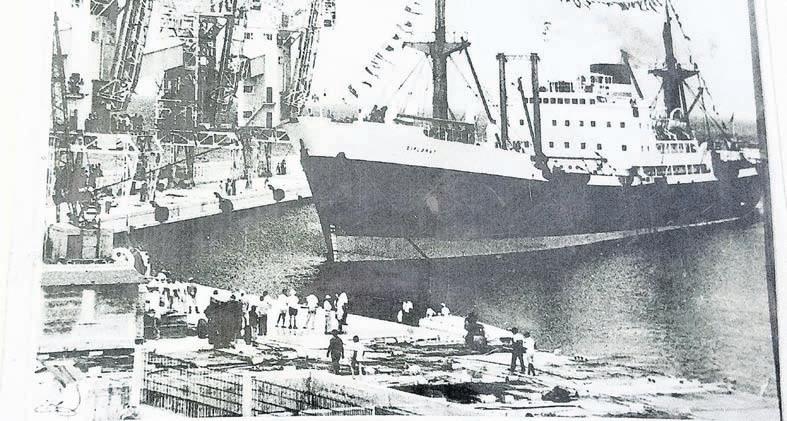
The harbour opens Ships began using the harbour quietly in early 1961. The first vessel to enter was The Tomboy, which unloaded a cargo of colas and left without ceremony. The first official arrival was the S.S. Diplomat on March 10, 1961, welcomed by government officials.
The official opening took place on May 6, 1961. Premier Sir Grantley Adams declared the facility open.
By Monday, July 3, 1961, the port was fully operational and its impact was immediate. On that day, five large vessels, docked at the same time: three freighters and two passenger ships. One of them was the S.S. Chusan, which arrived with 800 passengers and 247 tons of cargo.
That day marked the start of the modern Bridgetown Port — built through Barbadian labour, engineering, and planning. (SD)
Barbados’ first exports were recorded on March 10, 1961 when the S.S Diplomat entered the new harbour and safely berthed under the Sugar Loading Towers. (GP)
Monday 3rd July, 1961, the port became fully operational. (GP)
1959 - Stone and rubble to build the Deep Water Harbour was blasted from the quarry at Bagatelle Plantation A fleet of 25 Commer trucks worked non-stop for three years to transport
776
430 tons of stone. (GP)
1960 - Almost 30 000 blocks were used in constructing the harbour, some weighing as much as 20 tons. (GP)
1961 - The first vessel to unload cargo colas was ‘The Tomboy’. (GP)
Milestones of progress (1961–2026)
When the Deep Water Harbour opened in 1961, it did more than improve cargo handling. It gave Barbados a foundation for economic independence and set the port on a path of steady modernisation.
Over the next six decades, the port moved from manual sugar-and-sack operations to a digital, containerised hub. The changes came in phases — new land, new equipment, new systems, and a shift towards sustainability.
Here are some of the milestones that shaped the port into what it is today.
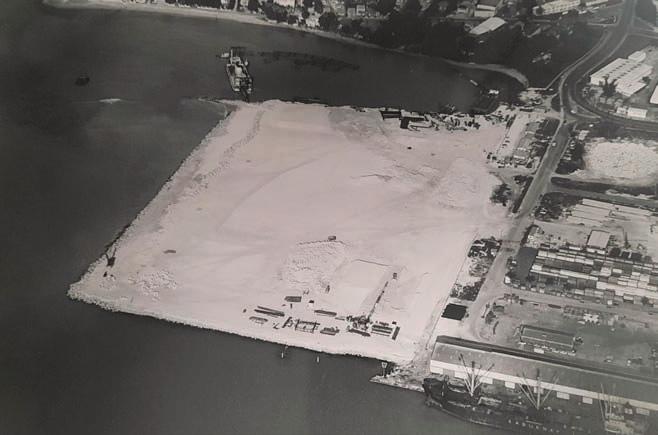
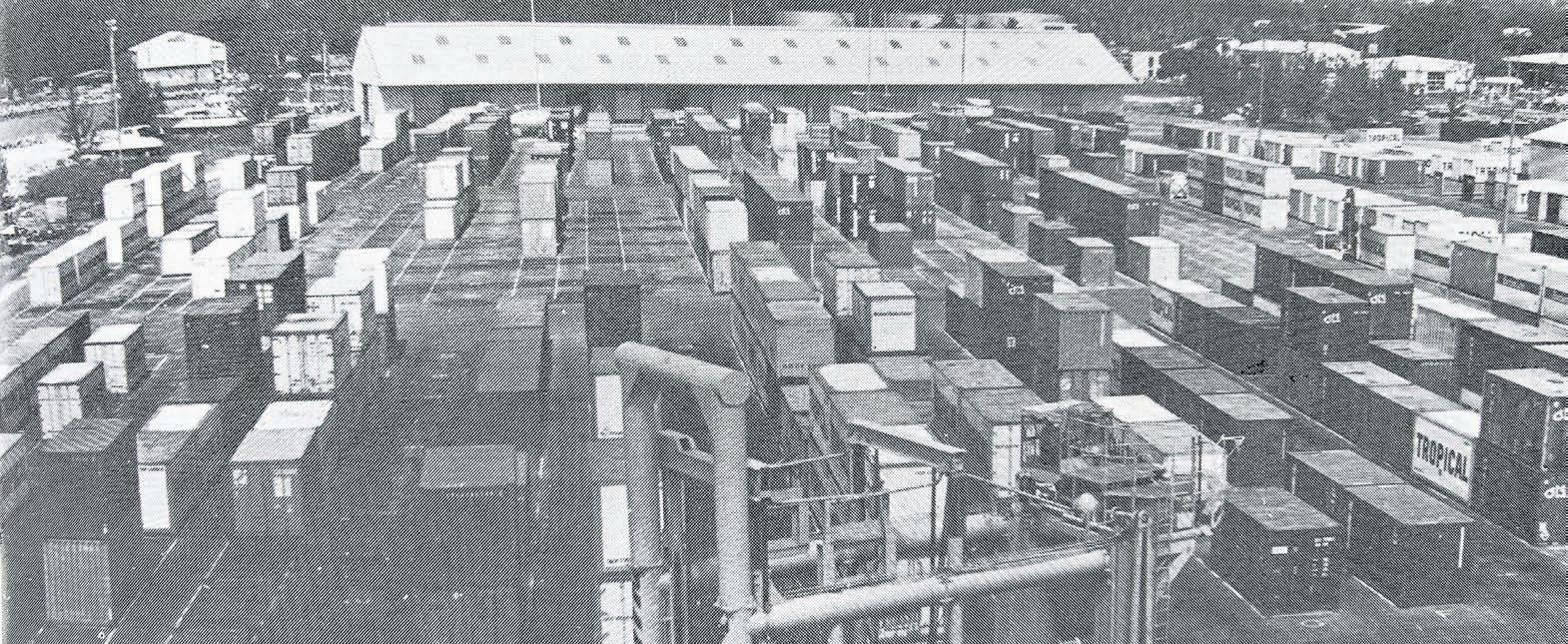
1978: Moving to containers - Global shipping was shifting to containers, and the port did too. A major upgrade added 9.3 hectares of land and built the Crossberth. This marked the move away from loose, manual cargo toward containerised freight.
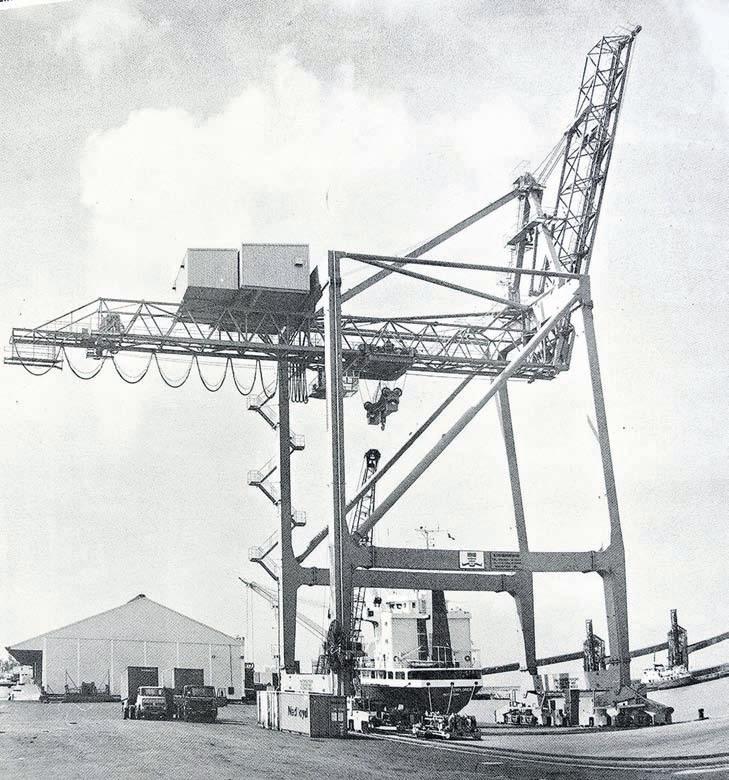
1987: Gantry Crane G1 arrives - The port’s first gantry crane, G1, changed the pace of work. It brought faster, more efficient cargo handling and helped the port win its first international “Port of the Year” award in 1992.
Major upgrades for added 9.3 hectares, were made in 1978.(GP)
The new Gantry Crane G1 was handed over to the port in October 1987. It was not put into operation as the Workers’ Union considered that it had far-reaching ramifications for operations. (GP)
Cruise Terminal opened
1994: A dedicated cruise terminal - Seeing the growth in tourism, the port converted Shed 1 into a passenger terminal. The move laid the groundwork for Bridgetown to become a homeport for cruise lines in the Southern Caribbean.
2002: Deeper channels - A major dredging project deepened the harbour channel to accommodate larger cruise ships. Material from the dredging created an additional 6.1 acres of reclaimed land. That same year, Barbados’ first tugboat, the Pelican, was retired and sunk in Carlisle Bay Marine Park, where it’s now a popular dive site.
2003: A new structure - The establishment of Barbados Port Inc. brought a new structure and the flexibility to expand and improve operations.
2020: Safe harbour and Cube Blue - During the COVID-19 pandemic, the port served as a safe harbour for stranded cruise vessels and received international recognition for that humanitarian role. That year also saw the opening of Cube Blue, the port’s new environmentally focused administrative headquarters.
the
2026: Berth 6 and the green horizon - The opening of Berth 6 marked the latest phase. The facility uses electric gantry cranes alongside hybrid and electric cargo-handling equipment. It doubles the island’s trade capacity while moving the port towards lower emissions and more efficient operations. (SD)
Port upgrades added 9.3 acres in 2002. (GP)
Electric Reach Stackers were added to
green equipment fleet in 2025. (GP)
Fruns deep at the Port
or decades, hundreds of Barbadians have built their careers at the Barbados Port Inc. For many, it’s not just a job, it has been their only employer. At a time when most people change jobs every few years, the port is different. It is known as an organisation that has a high number of longserving employees. That didn’t happen by chance. It comes from a culture where young workers come in fresh, stay for their whole working life, and feel like part of a family with a shared purpose.
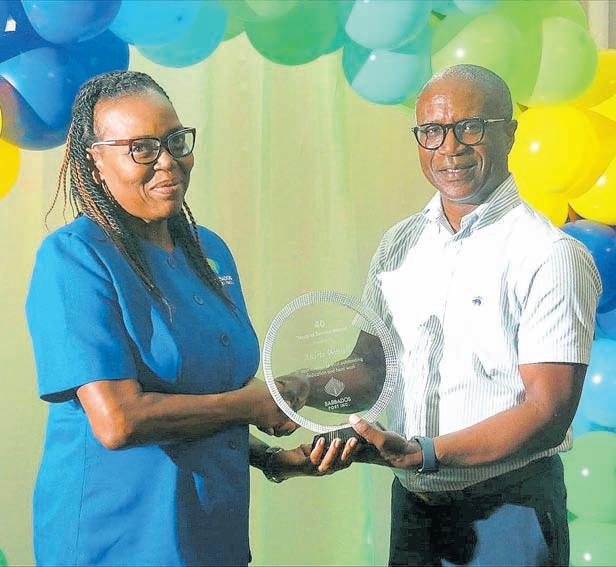
That loyalty was clear when the Port recently honoured 101 employees for hitting major milestones of 10, 15, 20, 25, 30, 35, and even 40 years of service for their unwavering commitment.
During the December 2025 awards, 21 employees passed 25 years, 35 reached 30 years, and nine hit 35 years. The most impressive were three workers who reached 40 years of unbroken service to the port.
Chief Executive Officer David Jean-Marie thanked them for keeping the port running.
“Your dedication is critical to successful daily operations here at the port. Through your loyalty and hard work, the port continues to deliver on its mandate. We truly appreciate your efforts and thank you, the employees who ensure that the Port of Bridgetown remains on a winning path,” he stated.
The port’s 65-year history has been written by the people who work there. By investing in their growth and celebrating their years of service, the port keeps a workforce that is steady and reliable.
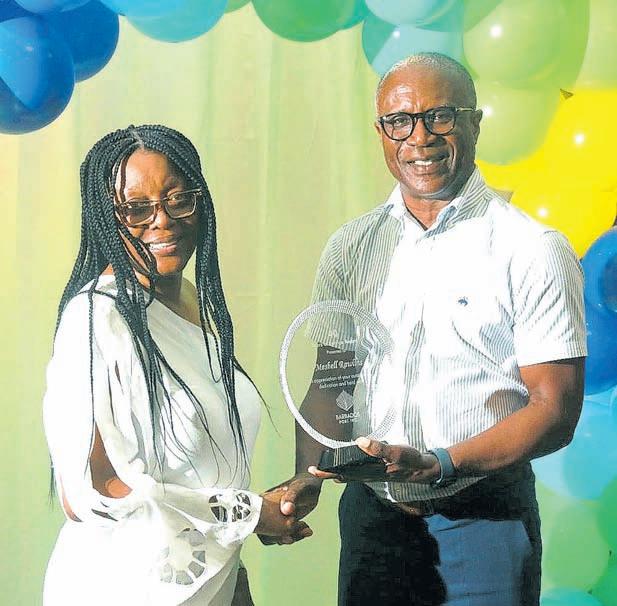
Meshell Rawlins receives her award from Chief Executive Officer, David Jean-Marie. (GP)
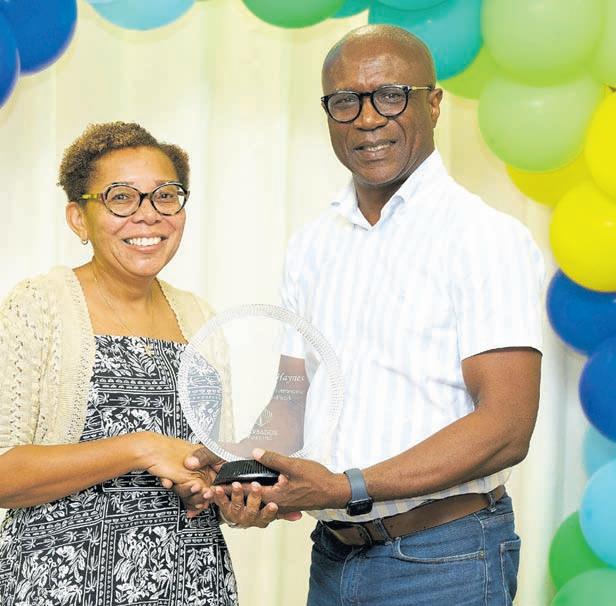
Roslyn BatsonHaynes receives her award from Chief Executive Officer, David Jean-Marie. (GP)
Andria Worrell receives her award from Chief Executive Officer, David Jean-Marie. (GP)
An unwritten story of the Port
For over 40 years, Ian Stewart has watched the Barbados Port Inc. grow from a small operation into one of the Caribbean’s main gateways. But when he thinks back to his first day on July 1, 1981, it isn’t the machines or cargo numbers he remembers first. It’s the feeling.
“The port for the general public has always been a place of interest because it’s behind a gate,” Ian recalled. “So for me it was a place of intrigue, a place where you never really visited before on the inside. But surely one of my first feelings was one of great warmth in the office... the staff was a lot smaller than now, really a family at that time.”
Fresh out of school and looking for work experience, the young Stewart joined the engineering department for a four-week
I an Stewart has witnessedthe Barbados Port evolve from handwritten cargo boards to real-time technology.
summer attachment. He was excited and curious. What he didn’t know was that those four weeks would turn into a lifelong calling.
“I thought that I was lucky in a way. Not many people would accept a little youngster to go and work in their engineering department. And I started then as a four-week attachment that has now gone over 40 years.”
After that summer, Ian stayed on as an apprentice mechanic while studying parttime at the Barbados Community College. Alongside two other young apprentices, he helped keep the port’s equipment running during a very different time for shipping and trade.
“The equipment was not as vast as we have now, but surely just as critical and important to the port,” he explained.
Over the years, he has seen huge changes. The yard went from manual work to a highly mechanised, computerised operation. Ian remembers 1981 as the turning point when the port got its first straddle carrier.
“At that time, man, that was a feat of technology which you would laugh at now!” he said with a chuckle.
“Our terminal operating system back then was a big board with cards identifying
ACADO (Barbados) Limited extends heartfelt congratulations to Barbados Port Inc. on the remarkable milestone of its 65th anniversary.
We celebrate your legacy of outstanding success and unrivaled corporate services, and we wish you continued prosperity and many more years of excellence ahead.
places of containers. Now, it’s almost laughable as we use computers to identify those same locations with real-time data.”
Today, those boards and handwritten cards are gone. Real-time computer systems now track cargo from start to finish.
“Now, as we are forced to use computers to identify those same places with much more information,” he said with a smile.
But out of all the upgrades and expansion projects, one moment remains with him.
Stewart vividly remembers the arrival of the cruise ships Britannia and Mein Schiff in 2014 — two of the largest vessels to berth at the port at the time. To fit both, the engineering team had to extend the berth fast.
“I will always remember that when the morning of arrival came, we were still sweeping the quay of residue concrete,” Ian said, the tension still palpable in his voice. “The last bollard, we were still tightening down, making sure of its attachment to the quay. I know there were lots of fluttering hearts that morning.”
Even under intense pressure, the team delivered.
“We have been challenged through the
years to do things that for small island developing states that [are] not the norm.
But we always managed to do it.”
When asked what kept him at the same organisation for his whole working life, Ian smiled.
“The maritime industry generally gets into the blood of all those who come around it. It gets under your skin. So the early mornings, the late days, the challenges day to day—and somehow every day is a different challenge—you get used to it. Every day you walk into the port, you learn.”
Now, as the Port of Bridgetown marks 65 years, Ian stands on the foundation built by the people before him.
He believes the port’s role goes far beyond cargo and cruise ships. He said as Barbados’ gateway to the world, it matters for the economy, for jobs, and for the country’s image abroad.
“We can now step on those steps that we built previously to go higher, farther,” Ian said. “I can stand proudly to say that we are a port above many. That’s something that we should be very proud of. One as a port, and two as a country.”
Ian Stewart. (GP)
The
Tof port workers and the BwU
he story of the Bridgetown Port is really the story of its workers.
Before the Deep Water Harbour opened, working on the waterfront was tough, unpredictable, and risky. Turning that work from casual, unorganised labour into a proper, respected career is a story written together with the Barbados Workers’ Union. That partnership goes back further than 1961. In the early 1900s, shipping in Barbados depended on lightermen rowing small boats out to the Careenage and Carlisle Bay to load and unload cargo by hand. When the BWU registered in 1941, maritime workers, like ship carpenters and foundry mechanics, were among the first to join. They were active in the key strikes of the 1940s, including the 1944 Barbados Foundry strike. Those actions showed the union’s strength and helped set the stage for modern workplace protections across the country.
When the modern Bridgetown Port opened on May 6, 1961, the BWU became the main voice for everyone on the docks: stevedores, longshoremen, and administrative staff. Under leaders like Sir Frank Walcott, the union negotiated agreements that changed daily life at the port. They introduced standard health and safety rules for a job that had always been dangerous. They also ended the casual labour system and replaced it with permanent jobs, fair wages, medical benefits, and retirement plans.
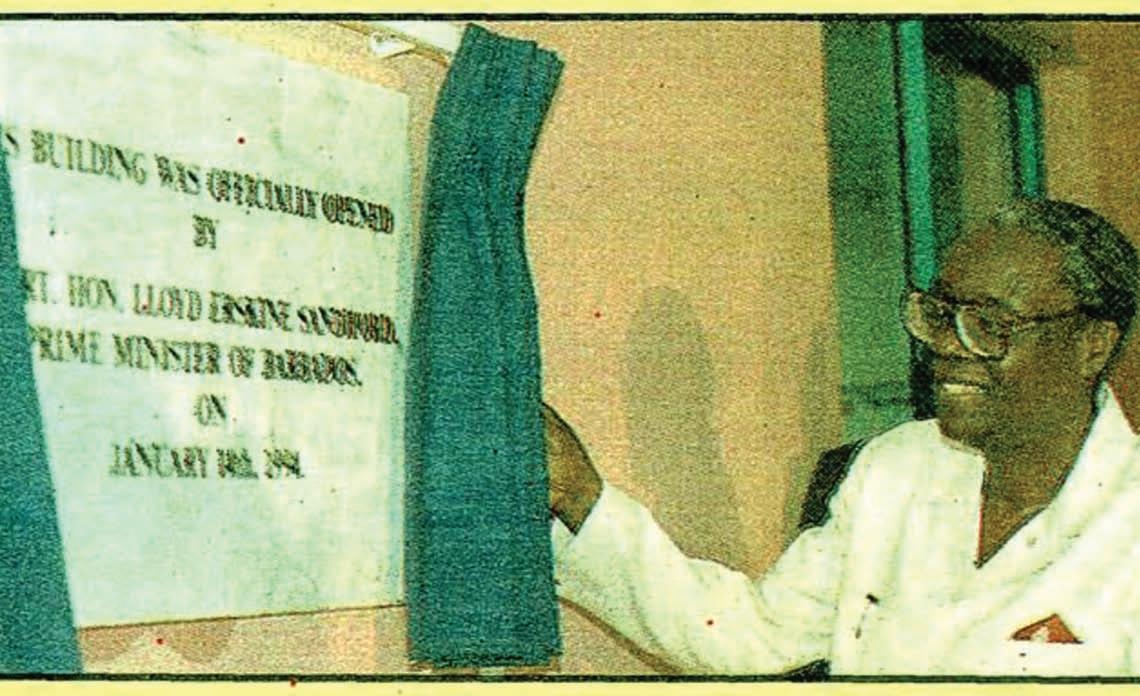
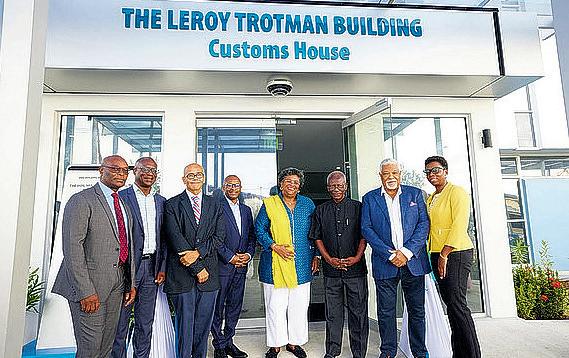
Worker development took another step forward under Sir Roy Trotman. Over 50 years, his mentorship helped countless workers move up from shop stewards into management roles. He also worked directly on renegotiating the Collective Agreement with Barbados Port Inc. and the Shipping Association of Barbados. His contribution to the port and its workers was rewarded with the opening of the newly renovated Customs House, named the Leroy Trotman Building.
Today the BWU, a member of the BPI board, still acts independently when it needs to. The union has taken industrial action to protect national labour interests, like during the 2016 Barbados Water Authority dispute. But day to day, the relationship with the port is built on mutual respect and a shared goal.
As the port invests in infrastructure, digital upgrades, and renewable energy to stay a top regional hub, it does so with a skilled, productive workforce in partnership with the BWU. (SD)
In 2024, Customs House was officially named the Leroy Trotman Building in recognition of his contributions to the port and its workers. (GP)
From manual labour to
The way cargo moves through Bridgetown has changed completely since 1961. What started as manual labour on the wharves has become a system built around machinery, speed, and lower emissions.
1961: The manual and lightering eraBefore the Deep Water Harbour opened, ships anchored in Carlisle Bay and cargo was moved to shore on small wooden boats called lighters. On the wharfs, hundreds of dockworkers used basic hoists and manual labour to load and unload sacks of sugar and other goods. The new harbour improved safety and working conditions. It also changed the labour landscape, replacing traditional lighter-men with organised port work.
1992: Rationalisation of cargo handling operations to accommodate container vessels on a 24-hour basis.
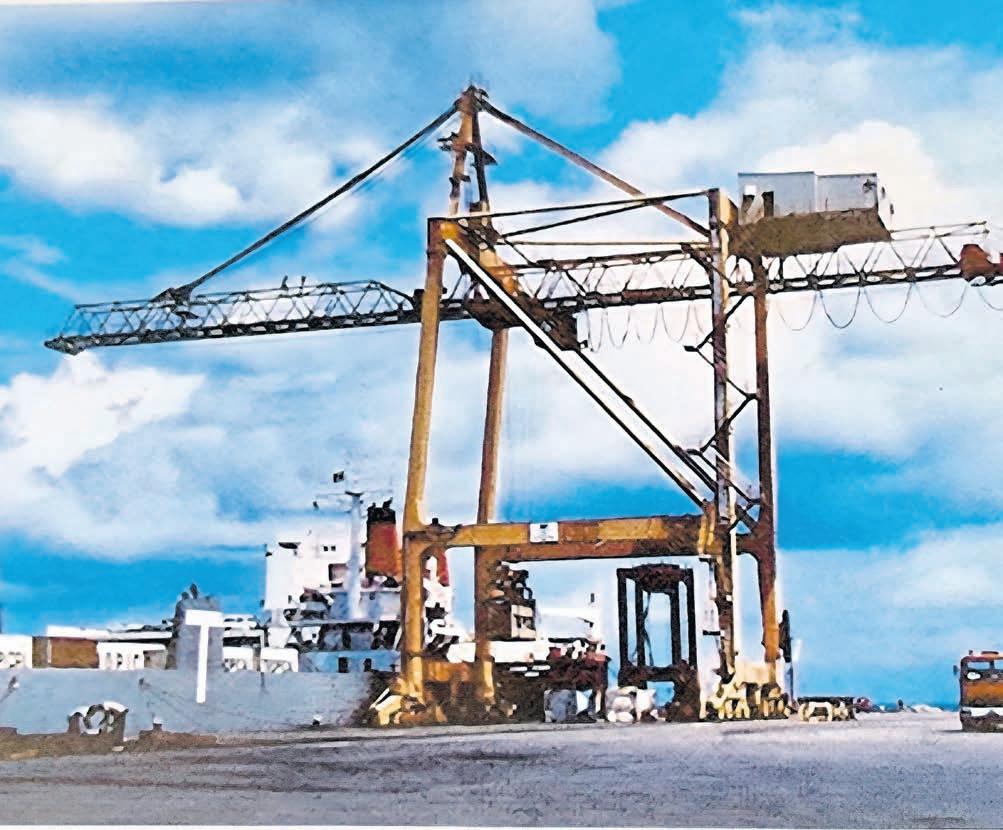
1990: Containerisation arrives - The first ship-to-shore gantry crane, G1 went into operation in 1990. Its arrival shifted the port from handling loose, break-bulk cargo to standardised containers. G1 could lift containers directly from ships to the dock in minutes. The change increased cargo throughput and helped Bridgetown win its first international Port of the Year award in 1992.
1957 - Until the Deep Water Harbour was built, the larger ships calling at Barbados anchored in Carlisle Bay. (GP)
1978: The port upgrades were in preparation for the shift from break-bulk to containerised cargo. (GP)
1990: Gantry Crane G1 went into operation. (GP)
The evolutionof cargo handling
• From Page 18
A shift towards cleaner power - G1 has since been retired and replaced with newer equipment. Berth 6 now operates with electric ship-to-shore gantry
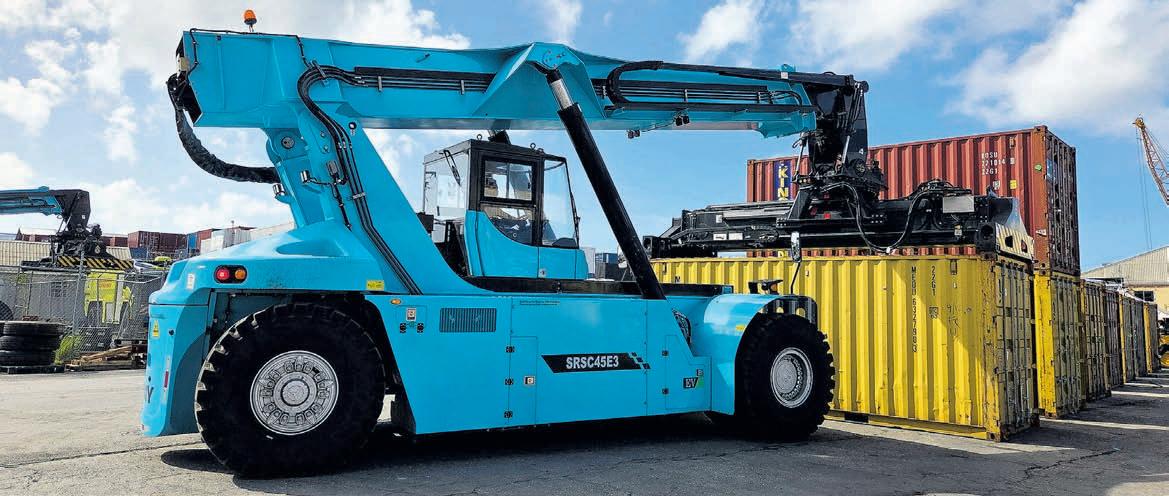
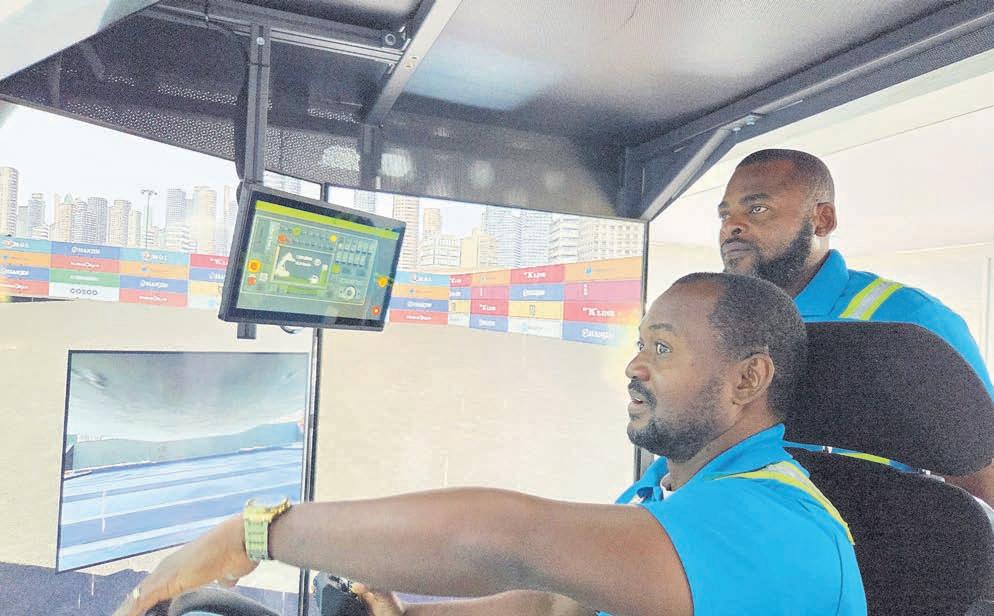
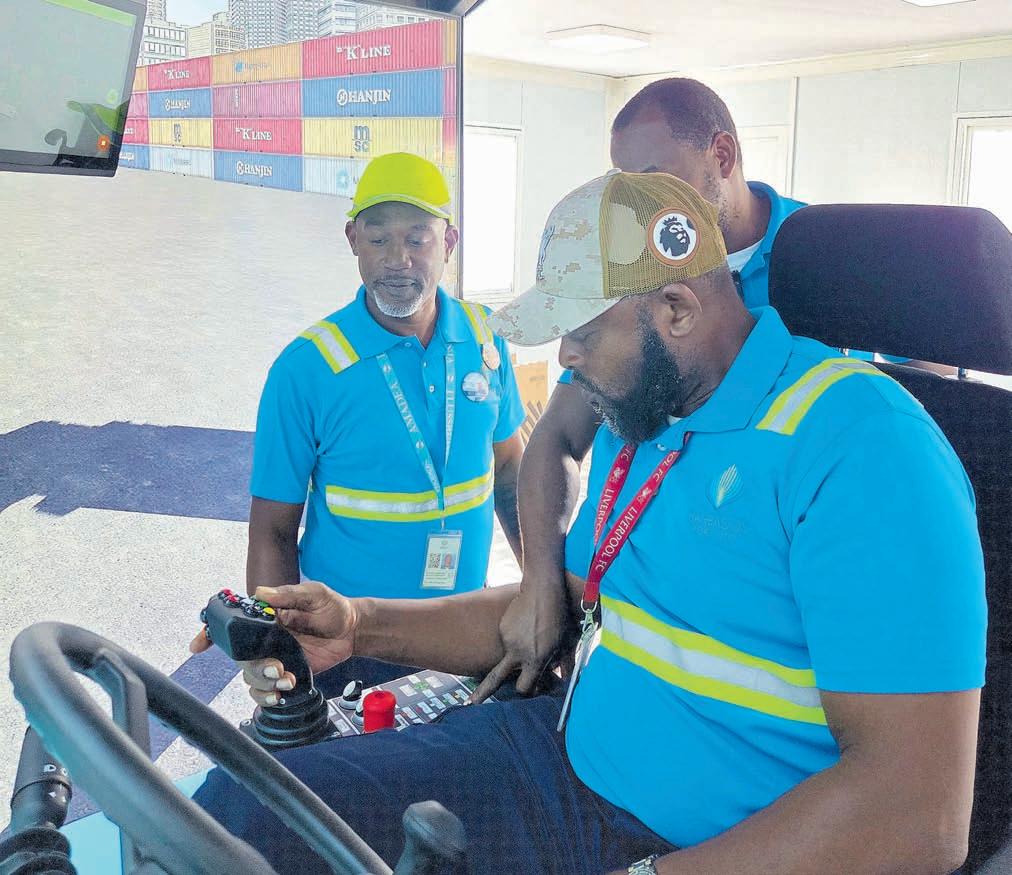
supported by diesel-electric hybrid straddle carriers. These are the first of their kind in the Caribbean. The switch to hybrid and electric equipment has cut emissions while doubling cargo capacity. Staff are also trained on simulators to improve safety and efficiency as the port moves toward lower-carbon operations.
2026:
cranes,
2015: Second gantry crane deployed. (GP)
2019: Third Gantry Crane G3 added to operations. (GP)
2021: Two new diesel-electric hybrid Straddle Carriers arrive, the first in the Caribbean. Ten more were added to the fleet. (GP)
2022: First Gantry Crane G1 retired. (GP)
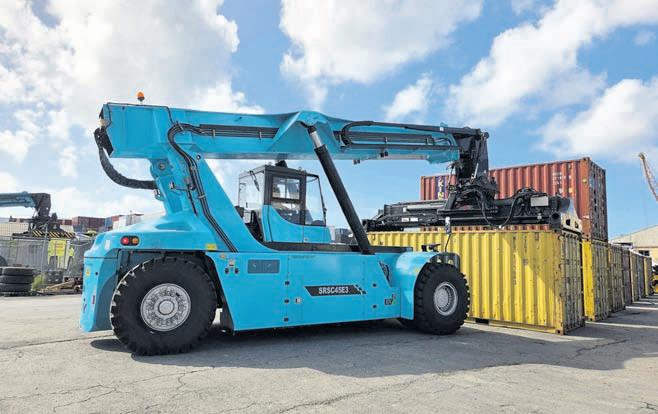
2025: Electric Reach Stackers added to green equipment fleet. (GP)
2025: Two New electric gantry cranes installed at Berth 6. (GP)
Every great journey needs someone steady at the helm. The Port of Bridgetown became the modern, digital hub it is today as a result of the vision, hard work, and leadership of the people in charge.
The of The indusTry Steering years of excellence
The BPI celebrates the Chairmen, CEOs, and Harbour Masters who have guided Barbados Port Inc. through the ups and downs of global trade.
From the pioneers who built the Port’s foundations in 1961, to today’s leaders rolling out green energy and new logistics systems, they were all determined to keep Barbados connected to the world.
As you look at the faces of past and present leadership, these are the people behind the big decisions, the tough calls, and the steady commitment that kept our gateway strong, reliable, and moving forward. (SD)
CHAIRPERSONS
HARBOUR MASTERS
This milestone is a testament to your enduring commitment to excellence and service. We celebrate your achievements and wish you continued success for many more years to come.
to present David Jean-Marie
The Southern Hub: Inside our homeporting success
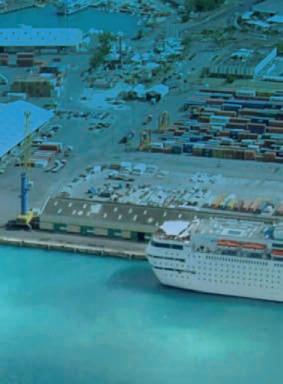
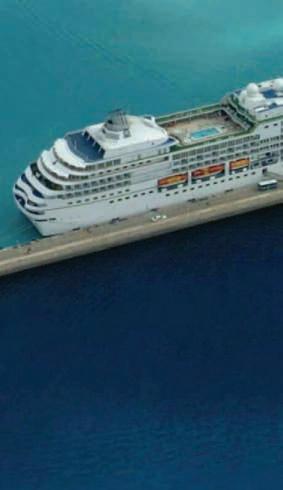
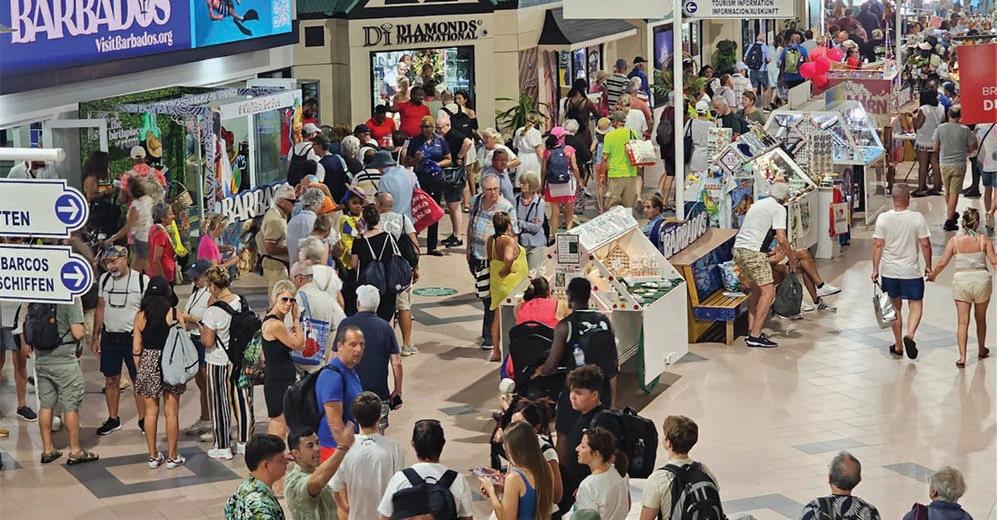
When a cruise ship stops at a port of call, passengers usually come ashore for a few hours before sailing on. When a ship uses a port as a homeport, the impact is different. Passengers fly in, stay in local hotels, eat at local restaurants, use taxis, and board the ship at that port. That difference matters. Homeporting brings higher visitor spend and a longer stay on island. The Port of Bridgetown is now the leading homeporting destination in the Southern Caribbean, and the numbers from the 2025/2026 winter season prove it.
Record growth
Between November 2025 and April 2026, the port handled 416 cruise ship calls and 817 950 passengers. That’s a 22 per cent increase compared to the previous winter season.
January 2026 was the busiest month, with 94 ship calls. On peak days, more than 12 000 passengers passed through the terminal. Today, about half of all cruise ships docking in Bridgetown are homeporting vessels, and that share is expected to grow.
Looking ahead to the winter 2026/2027 season, Princess Cruises will begin homeporting out of Bridgetown, and MSC Cruises will start a year-round programme. MSC will also deploy the MSC Europa, one of its largest ships, on southern Caribbean itineraries from the island.
Beyond Bridgetown
While the port easily handles large vessels, it has also built a strong foothold in the luxury cruise market. Brands like Ritz-Carlton Yacht Collection, Silversea, and Windstar now use Bridgetown as a base for smaller, yacht-style cruises.
To support this segment, Barbados Port Inc., worked with the Coastal Zone Management Unit to identify mooring sites along the north coast. The aim was to create boutique cruise stops without impacting marine ecology. Last season, the boutique vessel Emerald Sakara was the first to use the new moorings off Speightstown. Passengers came ashore by tender using the refurbished Speightstown Jetty.
This isn’t the first time Speightstown has served cruise passengers this way. In 2000, the SV Legacy made ten tender calls to the town during the summer.
With a restored jetty and modern planning, the port has revived that concept. By running large-scale homeporting in Bridgetown alongside smaller luxury stops in the north, the port is spreading the benefits of cruise tourism across more of the island.
Cruise and homeporting operations continue to play a key role in the port’s success and Barbados’ tourism industry. (GP)
817 950
Total cruise passengers welcomed in the 2025/26 season.
The Management and Staff of NASSCO Limited extend sincere congratulations to Barbados Port Inc. on this momentous occasion.
Passenger arrivals handled on a single peak winter day.
Percentage of current cruise calls that choose Barbados as a homeport.
As you celebrate 65 years of dedicated service to the economic growth of Barbados, we are honoured to be associated with you and wish you continued success for many more years.
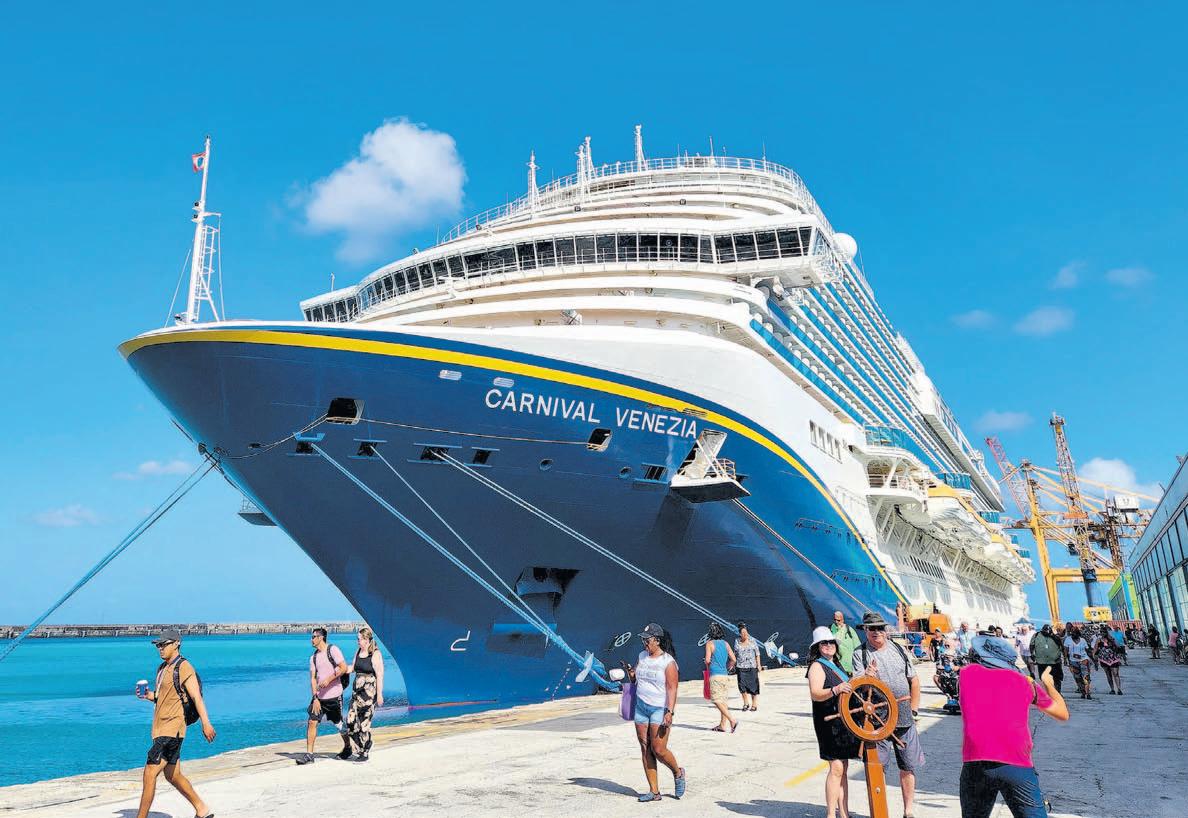
The Arvia. (GP)
years of homeporting growth in bridgetown
Steady growth, 2006 -2019
This period shows how Barbados built its position before the pandemic.
THE CHANGE IN BRIDGETOWN’S ROLE as a cruise port is visible in the numbers. Over the last 20 years, Barbados has moved from being a regular port of call to the leading homeporting destination in the Southern Caribbean. When passengers fly in, stay in local hotels, and board ships in
In 2006, the Port handled 161 ship calls and 123 642 arrivals. Some 88 000 passengers started their cruise from Bridgetown. By 2019, homeporting calls had risen to 173. Total arrivals reached 256 893 passengers, with over 160 000 embarking directly from the terminal. It was the highest figure at the time.
Pandemic disruption, 2020 - 2021 In 2020, calls dropped to 94, with 141 180 arrivals.
Global shipping paused during this period. However, Barbados remained open as a safe harbour.
In 2021, activity reached its lowest point: 61 calls and 38 213 arrivals.
2022: 155 calls and 151 004 arrivals.
Recovery and expansion, 2022 to 2026
After the pandemic, traffic returned quickly and moved past previous records.
2023: 205 calls and 328 173 arrivals — an alltime high, nearly triple the volume seen in 2006.
2025: 207 calls and 326 382 arrivals, showing sustained demand.
2026: 138 calls and 221 356 arrivals recorded in the first half of the year alone.
Bridgetown, the impact spreads across the island. The timeline below shows the growth into three phases.
s the Port of Bridgetown marks 65 years, the numbers tell the story of how it keeps Barbados moving. Every ship that docks, every bulk shipment unloaded, and every container handled is part of the trade that fuels the country. From 2016 to 2025, the annual data shows steady resilience, steady modernisation, and growing capacity.
Total Vessel Calls
— Maritime Traffic Volume
This tracks how many ships came into our waters each year. You can see the shift from pre-pandemic levels, through the drop during global disruptions, and into a steadier recovery with more efficient handling of larger vessels.
Total Tonnage Handled
— The Industrial Foundation
Measured in tonnes, this covers the heavy industrial goods that keep the country running — grain, agribulk, cement, petroleum, and more.
Total TEUs Handled
TEUs measure containerised cargo. It’s the clearest sign of consumer demand, retail activity, and the port’s regional transhipment business.
The Management and Staff of Windward Agencies Ltd. extend heartfelt congratulations to Barbados Port Inc. on the remarkable milestone of their 65th anniversary.
This achievement reflects your unwavering dedication and invaluable contribution to the economic growth of Barbados. We are proud to be associated with you and wish you continued success and prosperity in the years ahead.
In 2025, a record 125 861 TEUs were handled at the Port of Bridgetown. (GP)
A Port system built for Barbados: Moving
from ‘paper-heavy’ to
SMALL COUNTRIES, LIKE OURS, usually rely on technology designed for large ports in the US, Europe, or Asia. The systems function, but they are built for different volumes, cargo types, and operations.
Barbados Port Inc. chose a different approach. The port’s in-house Digital Innovation and Development team designed and built its own Port Community System (PCS). The platform connects Customs, Immigration, Police, Coast Guard, local businesses, and the public in one network.
Designed for a multipurpose port
Most international port systems are built for container terminals that handle one type of cargo. The Port of Bridgetown operates differently. It manages commercial freight, personal effects, cruise passengers, environmental compliance, and national security at the same time.
The Barbados PCS was built around local operations. It serves the entire country, not just container traffic.
Moving payments online
Before the system launched, paying port fees required an
in-person visit. Customers completed paper forms, waited for a cashier, and needed a stamped receipt before the gates closed at 4 p.m.
Today, 85 per cent of payments are completed online at any time. The change has reduced wait times and eased pedestrian traffic around the facility.
Blockchain validation is used for invoicing and certificates, making records tamper-proof and reducing paper use.
Clearing vessels before arrival
Vessel clearance has changed in the same way. Previously, clearing a ship required 52 paper documents sent to three agencies. Processing started when the ship docked, which caused delays on busy days.
Now, agents submit documents electronically through the Maritime Single Window while the vessel is still at sea. By the time the ship berths, clearance is largely complete. Passengers disembark faster, and cargo vessels turn around more quickly.
The system also links to international registries, allowing authorities to review the security profile of each ship, cargo, and passenger before arrival.
Improving cargo tracking and security
Cargo collection is now appointment-based. Customers receive a digital notification when their shipment is ready and book a pickup time. Without an appointment, entry is not permitted. The rule has removed queues outside the gates. For security, high-risk containers can be flagged within the system without alerting port staff. The process supports investigations while protecting port workers from unnecessary involvement.
International recognition
The system has drawn attention outside Barbados. In March 2026, the Organisation of American States awarded BPI the prestigious Maritime Award of the Americas for Digital Transformation. UN reports have cited the PCS as a model for smaller economies. European maritime publications have noted that Barbados is setting an example larger ports are now studying. By replacing paper processes with a secure, purpose-built digital system, the port has created infrastructure that supports trade and national security for the long term.
(SD)
The port’s ecosystem
When you look at the Port of Bridgetown, you see cranes, cargo ships, and cruise liners. Behind that is a network of people and agencies working together around the clock.
Barbados Port Inc. manages the facility itself. It runs with about 500 internal employees. Outside of BPI, independent agencies and private companies each handle specific parts of the operation. Together, they form the port’s ecosystem. This system manages 90 per cent of all imports entering Barbados.
Government agencies at the border
Customs and Excise operates independently of BPI The department collects duties and revenue, and works to stop illegal trade at the port.
The Immigration Department manages the entry and departure of everyone passing through the port.
Port Health provides another layer of protection. Officers from the Ministry of Health & Wellness work with agricultural and veterinary specialists to check food and cargo. Their documentary and physical inspections help keep unsafe or non-compliant items out of the national food chain.
Private sector partners
Shipping agents link the vessels to the shore. These independent companies coordinate berths, arrange fuel and supplies, and handle the paperwork needed for each visit. They make sure ships move through the port without delay.
One purpose
The Port of Bridgetown runs as a mix of public and private roles. Between them, these groups support trade, create jobs, and maintain safety standards. The goal is the same across all of them: keep Barbados competitive, secure, and connected to global trade. (SD)
DEEP ROOTS: The Port in our community
The Port of Bridgetown is our gateway for trade, but its role extends beyond that. Barbados Port Inc. invests in projects that strengthen local communities, from upgrading fishing facilities to training the next generation of maritime workers. Here are five examples of that work.
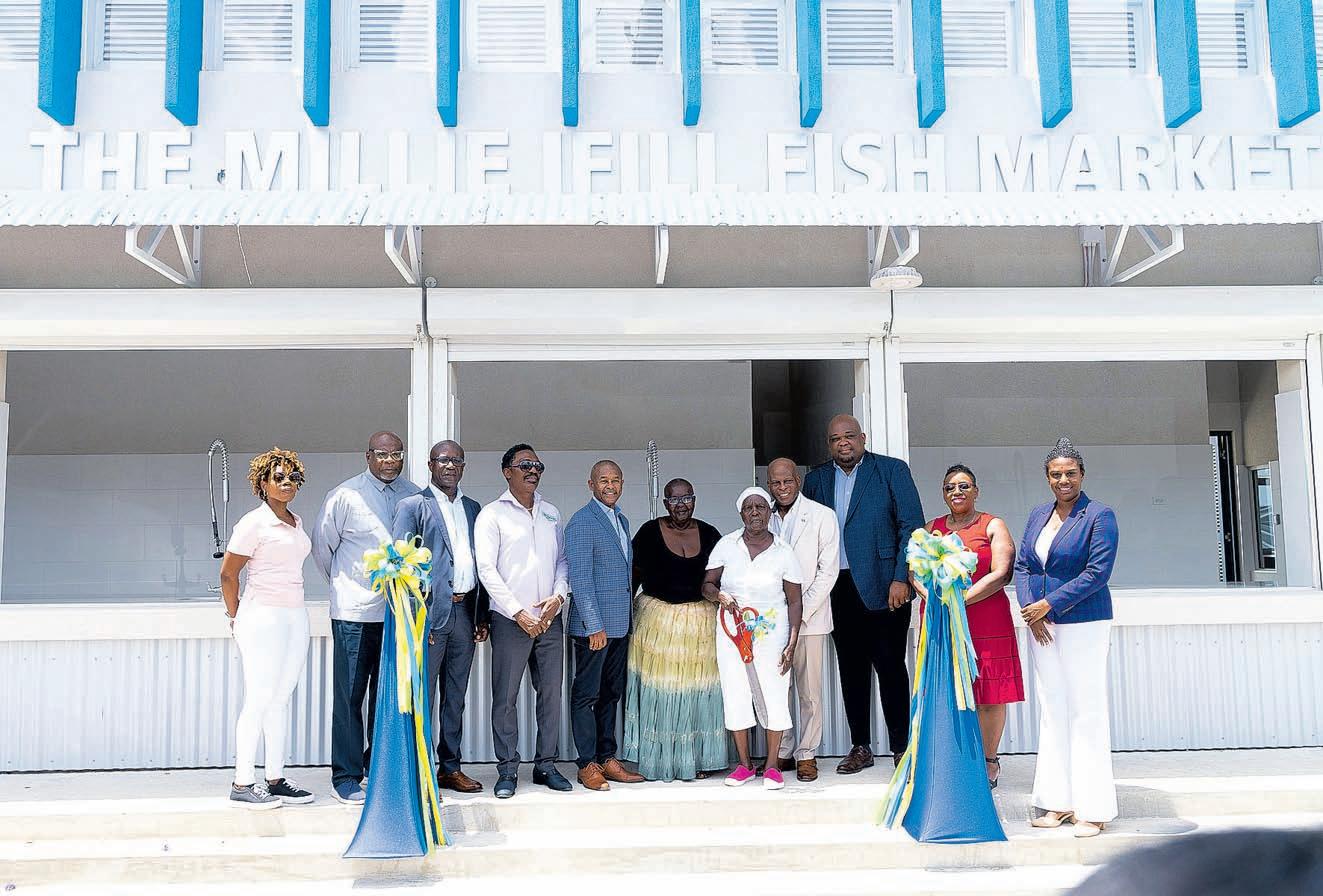
Millie Ifill Fish Market
A facility for West Coast fishers - The fish landing site at Reads Bay in Weston, St James, opened in 1997 and had fallen into disrepair. BPI rebuilt the site and reopened it on September 21, 2024, as the Millie Ifill Fish Market. The facility now includes modern processing equipment, an ice machine, improved lighting, and upgraded amenities. It honours Millie Ifill, a long-time vendor from the area, and serves as a working hub for the community.
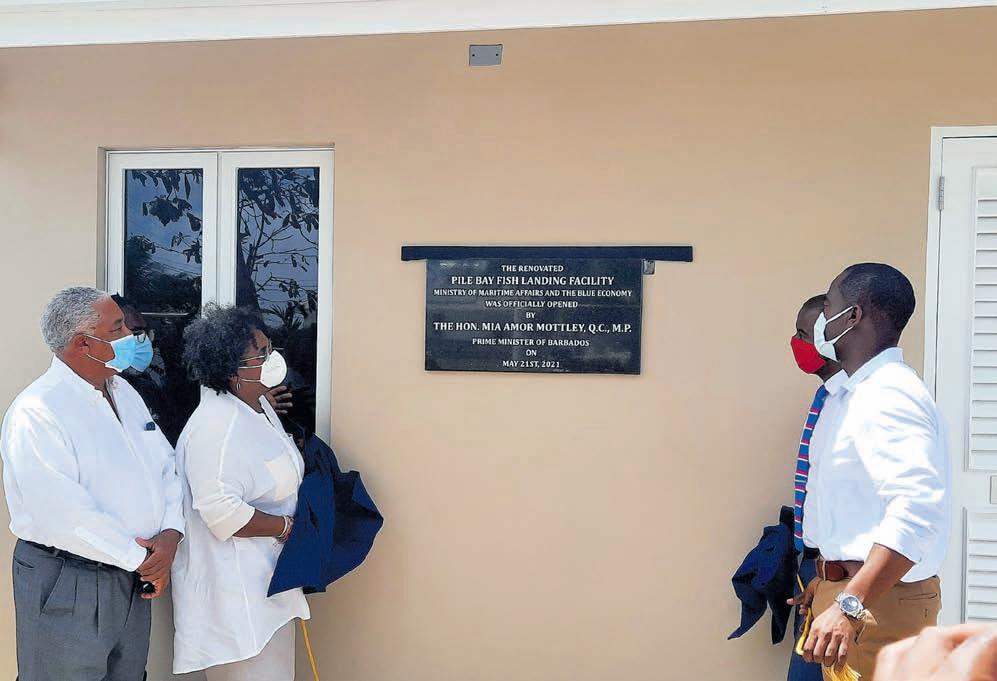
Pile Bay Fishing Facility was officially opened in May
Pile Bay Facility
Upgrades for a busy landing site - Pile Bay in St Michael has served local fishers for over 40 years. In May 2021, BPI completed a refurbishment that added new processing areas, bathroom facilities, office space, and three commercial kiosks. The kiosks give local vendors a space to prepare and sell food. Pile Bay remains one of the island’s busiest landing sites.
On behalf of the management and staff of Spoons Customs Brokers, we extend our heartfelt congratulations to Barbados Port Inc on reaching this remarkable milestone of 65 years
Your unwavering commitment to excellence has been a cornerstone of progress and success in the industry. We wish you many more years of unparalleled achievement, growth, and prosperity.
The
2021. (GP)
The BPI rebuilt and reopened the Millie Ifill Fish Market in 2024. (GP)
Shallow Draught Marina
People-centred outreach
Linking tradition with new infrastructure - In March 2025, BPI signed a Memorandum of Understanding (MOU) with the Fisheries Division and the Sand Pit Fisherfolk Association. The agreement sets the framework for a new fish landing and recreational facility at the redeveloped Shallow Draught Marina. The project integrates a 50-year fishing tradition into the marina expansion, giving local fishers a modern space to operate from.
Bridgetown Port Fire Station
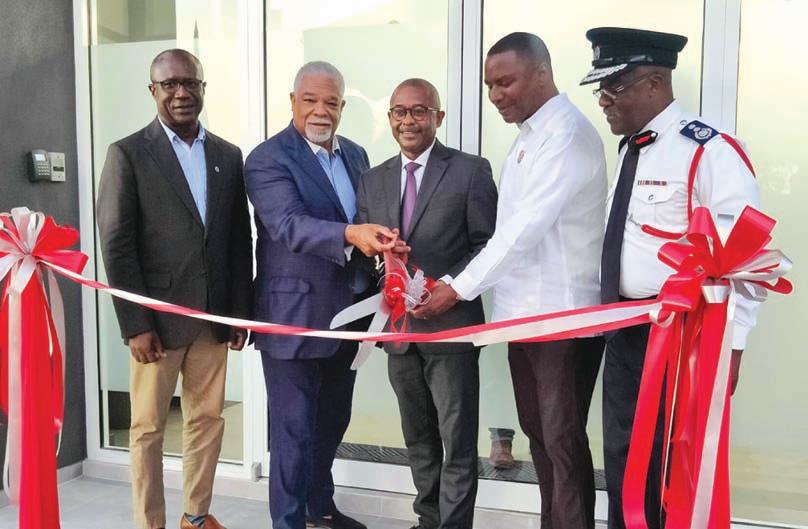
Expanded emergency coverage - In November 2023, BPI handed over a new fire station to the Barbados Fire Service. The $3.7 million facility was converted from an old workshop near the port entrance. It includes photovoltaic panels, a backup water tank, and an independent generator. Under a joint emergency services agreement, the station provides rapid response to the port and the wider Bridgetown area.
SJPI Internships
Building the maritime workforce
- Through a partnership with the Samuel Jackman Prescod Institute of Technology (SJPI), BPI runs a sixmonth internship programme for students. Participants gain handson experience across core port operations. Over the last seven years, dozens of students have moved from the programme into maritime careers. Recent participants include James O’Neale and Shawn Seales, recipients of the Minister’s Award of Maritime Excellence in 2024.
Central Customs Agency Ltd. is a fourth-generation family-owned customs brokerage firm located minutes from the Barbados Port and Customs Departments. For over 65 years, we have proudly provided trusted customs brokerage and logistics support to a diverse range of clients across Barbados.
Over decades of uninterrupted service to a broad-based clientele, we have gained extensive experience handling shipments across the retail, manufacturing, industrial, and specialized sectors — ranging from consumer goods and food products to raw materials, finished products, and large-scale industrial cargo. This breadth of experience has helped us build a reputation for professionalism, efficiency, and personalized service throughout Barbados’ shipping and logistics industry.
As Barbados Port Inc. celebrates its 65th anniversary, Central Customs Agency Ltd. is proud to recognize the Port’s invaluable contribution to Barbados’ trade and economic development, and we look forward to continuing this longstanding partnership for years to come.
Office: (246) 426-5214 | (246) 426-1327
“Weston”, Strathclyde Drive, Strathclyde, St. Michael BB11077
Email: admin@centralcustomsagency.com
From right: Barbados Port Inc. Chief Executive Officer, David Jean-Marie; Chief Fisheries Officer, Dr Shelly-Ann Cox; and President of the Sand Pit Fisherfolk Association, Rudolph Best on signing the MOU. (GP)
The Port of Bridgetown Fire Station was officially opened in 2023. (GP)
James O’Neale and Shawn Seales received the Minister’s Award of Maritime Excellence in 2024. (GP)
Guardians
of our heritagecoastal
The Port of Bridgetown handles cargo and cruise traffic, but its work also includes managing and protecting coastal landmarks and public spaces across the island.
The Chamberlain Bridge was rebuilt as a modern lift bridge in 2006. (GP)
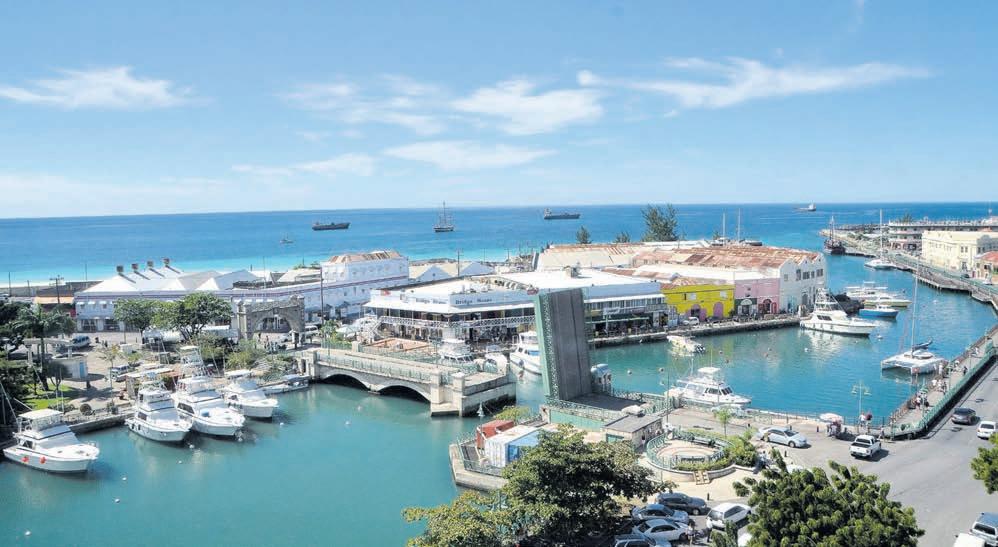
The Careenage - The Constitution River and Chamberlain Bridge sit at the centre of historic Bridgetown. The port regulates marine traffic in the area and operates the bridge’s hydraulic lift three times a day. This allows catamarans and sailboats to move into the inner basin and keeps the waterfront active.
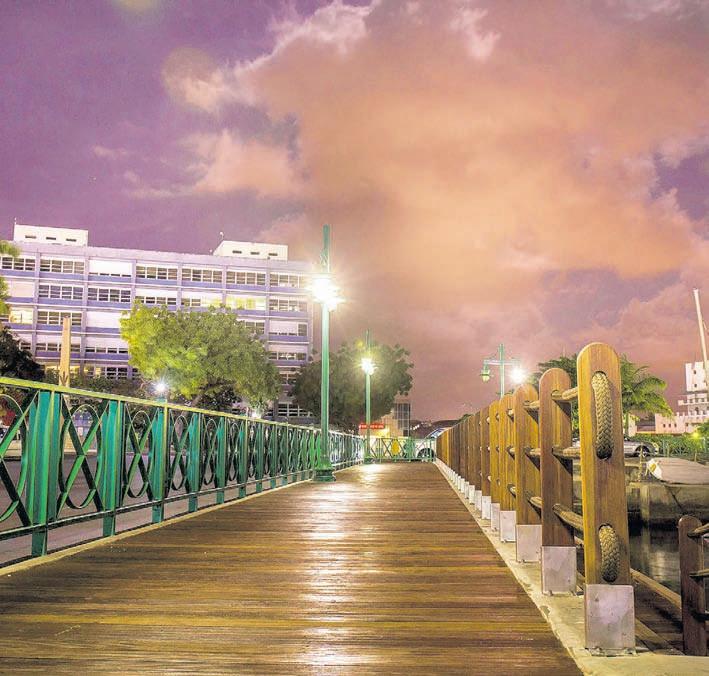
Public walkways and waterfronts - Trevor’s Way and the Wickham Lewis Boardwalk are maintained by the port for daily use. Teams handle landscaping, security, and general upkeep to keep these areas safe and accessible for residents and visitors.
Wickham Lewis Boardwalk was refurbished in 2017. (GP)
Lighthouses and northern piers - The port also looks after heritage structures along the coast. Restoration work on the South Point Lighthouse is ongoing. In Speightstown, the port works with the local community to monitor and maintain the jetty, supporting fishers, pleasure craft, and the area’s seaside character.
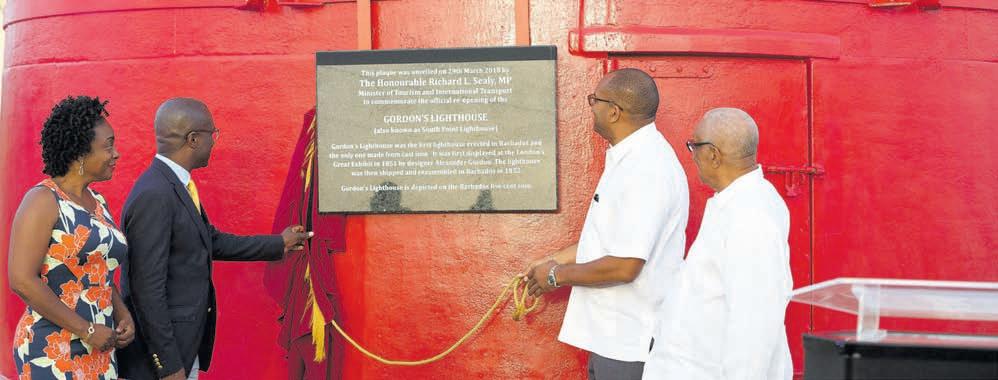
In 2018, BPI celebrated the complete restoration of Gordon’s Lighthouse, built in 1852. (GP)
We extend our heartfelt congratulations to Barbados Port Inc. on reaching this milestone.
This remarkable achievement is a testament to your dedication, resilience, and invaluable contribution to the growth and success of Barbados. May this anniversary be a proud reflection of your journey and an inspiration for continued excellence in the years ahead.
From the Management & Staff of
Email: info@mgassociates.net
Partnership driving progress
The partnership between the port and the business community will remain significant for Barbados’ future growth and resilience.
The Barbados Chamber of Commerce & Industry
The Barbados Chamber of Commerce and Industry appreciates the relationship that the business community has enjoyed with Barbados Port Inc. over the past 65 years. The port has long been an important part of Barbados’ commercial life, supporting the movement of goods, connecting business to opportunity, and helping to keep the economy functioning day by day. For the Chamber, the relationship with the port has also created an important space for engagement, cooperation and shared understanding on issues that matter to business and to the country’s development.
As Barbados Port Inc. marks this important milestone, it is fitting to recognise its contribution not only as a gateway for trade but as a valued national institution. Looking ahead, the partnership between the port and the business community will remain significant. In a changing global environment, Barbados will continue to benefit from open dialogue, innovation and practical collaboration that support trade, strengthen competitiveness and build resilience. By continuing to work together, Barbados Port Inc. and the business community can help shape a more responsive and forward-looking economy for Barbados.
The BCCI warmly congratulates Barbados Port Inc. on its 65th anniversary and wishes it every continued success in the years ahead.
& Industry
This anniversary is not only a celebration of achievements past, but a bold commitment to continued excellence in the years ahead.
Barbados Port Inc.
– R. Paul Inniss, President, Barbados Chamber of Commerce
R. PAUL INNISS . (GP)
Tributes from our PARTNERS
The Shipping Association of Barbados
The Shipping Association of Barbados (SAB) and the port have worked side by side for decades. President David L. Harding, MBE, has seen it all. He started boarding ships at the port in 1966, later chaired the port, and helped start the SAB in 1981. That long partnership has helped make Bridgetown a dependable, multi-purpose port that supports shipping across the region.
“This milestone is a special honour for me. The Barbados Port and the SAB work together to make Barbados a major contributor to the growth of regional shipping and well recognised abroad as a dependable, well-functioning port of call. As the current President of the SAB, it is my pleasure to salute the management, staff, and workers of the Bridgetown Port on its 65th anniversary. We congratulate you and assure you of our continued support as you deliver good service to importers and exporters.”
– David L. Harding, MBE, President of the Shipping Association of Barbados
The Customs Brokers Association of Barbados
For brokers, the Port is where policy turns into day-to-day work. President of the Customs Brokers Association Louis Forde praised the BPI for listening and working with brokers to improve efficiency. He said the open relationship between the two partners has built trust between both sides.
“The Port has seen massive improvements, particularly in its digital technology. Their new homegrown platform has given our sector immense influence, allowing us to see exactly what is needed to make trade work better. As the Custom Brokers Association, we congratulate the Port as they cross into the second half of the century, and we hope to grow even stronger and better together as we approach the 100-year mark.”
– Louis Forde, President, Custom Brokers Association of Barbados
The Transportation Intermediaries of Barbados
Transportation intermediaries connect local businesses to markets around the world, and they see the Port as Barbados’ main gateway. President of the Transportation Intermediaries Norman Rice points out that cargo volumes have jumped over the last two years, creating a clear case for more commercial cargo sheds. He also says the Port’s digital upgrades have put Barbados on the map for maritime innovation.
“On behalf of the transportation intermediaries, I want to extend our best wishes for continued growth, innovation, and excellence. The Port’s IT achievements have been substantial; the homegrown Port Community System has modernised operations, improved efficiency, and drastically enhanced customer service. We hope this next chapter brings even greater achievements as the Port continues to drive trade, commerce, and national development for Barbados and the wider region.”
– Norman Rice, President of the Transportation Intermediaries of Barbados
DAVID L. HARDING, MBE. (GP)
LOUIS FORDE (GP)
NORMAN RICE (GP)
Work starts then and now
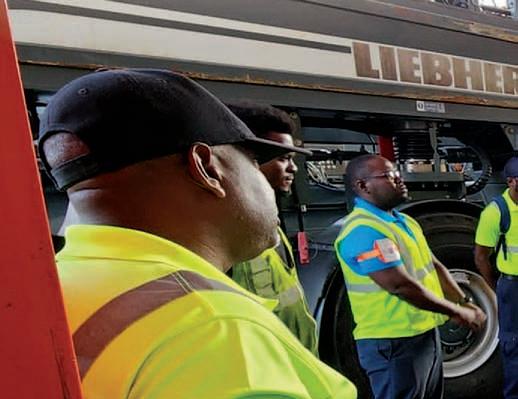
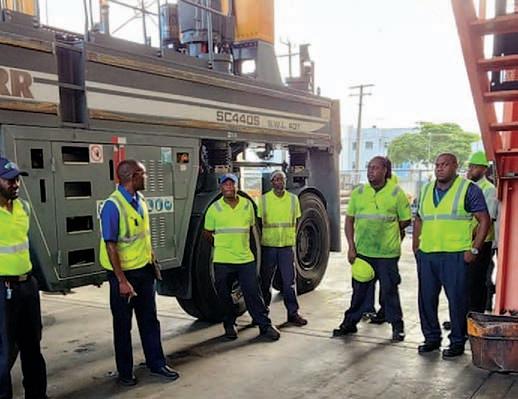
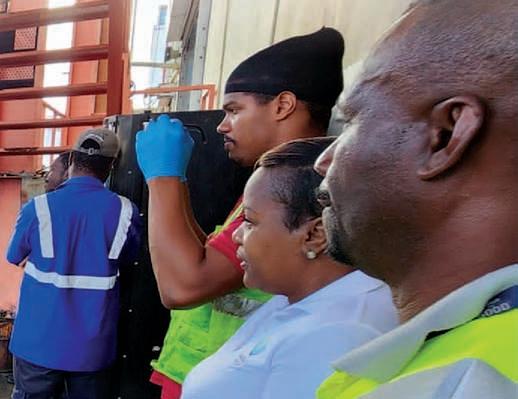
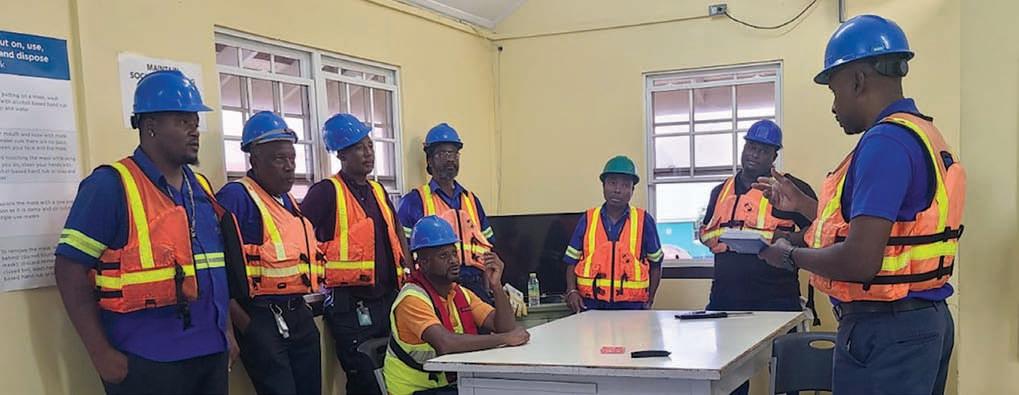
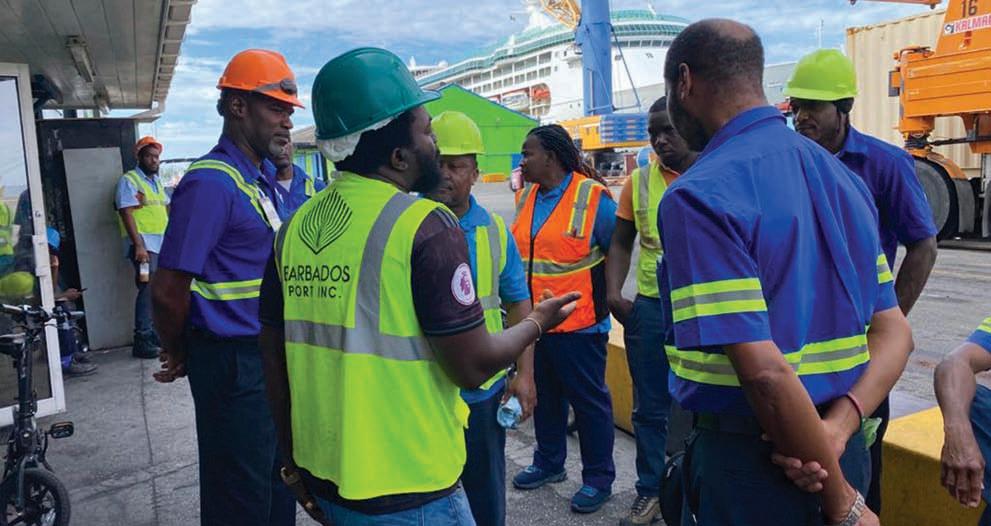
Toolbox talks are an important part of the day at the Port of Bridgetown Prior to the start of every shift, these talks are held across departmental teams to review the planned work, safety considerations and required controls. These talks foster a culture of safety and keep everyone on the same page.
Each department also conducts team briefs and debriefs as necessary.
Attendance at daily briefing meetings is mandatory for port operational departments, our partner government agencies at the port and ship agents to ensure coordination of activities and services.
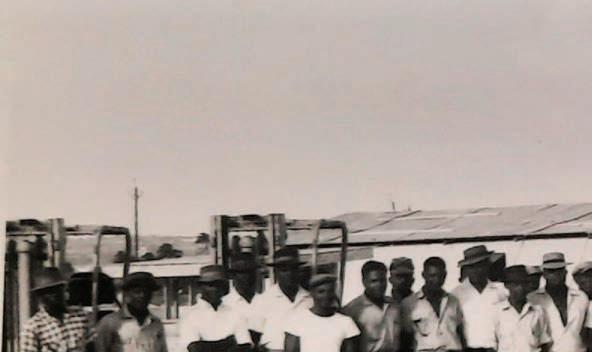
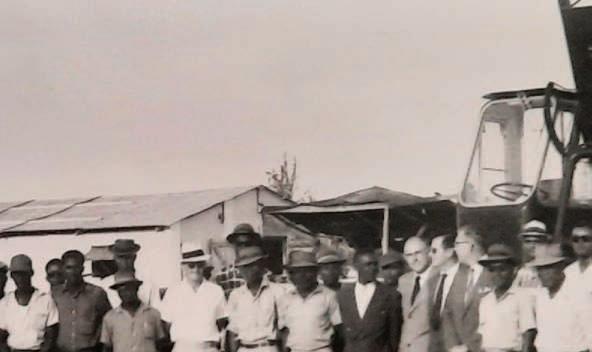
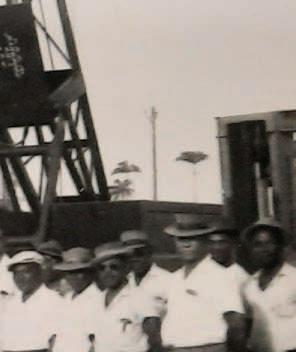
This carried through from the 1960s when port workers assembled on the quay ahead of the start of the day.
1960s
2000s
The Deep Water Harbour was built by local Barbadian labour working under the supervision of British company, Costain West Indies Ltd. Costain Drive, Pine Gardens, St Michael is named after the team who resided there during the Port’s construction.
HONOURING
our Leonard Belmar
The Board of Directors, Management and staff of Barbados Port Inc. pay tribute to former Assistant Manager, Terminal Operations, Mr Leonard Belmar, who passed away on June 2, 2026. His steady leadership and quiet dedication touched everyone who worked beside him. These tributes honour his life and the legacy he left behind at Barbados Port Inc.
A life of service, leadership and purpose
TODAY, I pay tribute to a remarkable man, Leonard Winston Belmar, who I was privileged to work alongside of and who has left an indelible mark on many.
I knew Leonard for over 36 years, and during that time, I came to appreciate the many qualities that made him such a unique and respected individual.
His willingness to serve and support those around him earned him the respect and affection of those he interacted with.
He was also a man who was not afraid to speak his mind when the occasion called for it. He spoke with honesty and conviction.
Leonard was a hard worker. He also played a significant role in training and mentoring others. Although he was a senior member of management, he never saw himself as being above the work.
Leonard will surely be missed, but his legacy will live on in the countless lives he touched and through the many acts of kindness he extended to others.
Rest easy, Leonard. Yours was truly a life well lived.
– SHELDON LAYNE – Manager Terminal Operations
The man who always had the right tool for the job
IN ANY WORKPLACE , you find specialists. But, once in a while, you find a Leonard Belmar, our very own Swiss Army knife.
When a crisis hit, he didn’t just open one blade or skill: he had the ability to flip out the exact tool needed for the job. Need a sharp eye for detail to cut through a complex problem? He had the main blade. Need to tighten up a loose process? He had the screwdriver. Need to snip a project’s loose ends? He had the scissors.
Mr Belmar, or simply “Belmar” as we all knew him, was a truly remarkable man. I had the privilege of working alongside him for more than 30 years, and throughout that time, he consistently demonstrated an exceptional level of dedication, and expertise.
Whenever there was an issue at the Container Park, Belmar was always the person we could depend on. Within minutes, he would assess the situation, identify the root cause, and have it resolved. His deep knowledge of port operations and equipment meant that he could jump onto the machinery himself, troubleshoot the problem firsthand, and get things back up and running in quick order. His skill, experience, and practical understanding of the operation were invaluable and, in my view, unmatched.
An absolute gem of a person and a multi-skilled port specialist who will long be remembered for his smile, calm demeanour and supreme knowledge.
We thank his family for sharing him with us for the last 34 years and for always being our go-to problem solver; for his boundless adaptability, and for making this port team stronger across the board.
May he Rest in Peace and Rise in Glory.
– IAN STEWART – Divisional Manager, Operations
Beyond his technical expertise, it is the memories of his personality that will stay with me forever. When everything was going well, he would call out with his familiar, cheerful “Stouteyyy!” But when things were not quite right, you could hear him bellowing “Lisaaaa!” from a distance. Those moments always brought a smile and reflected the passion and commitment he brought to his work every day.
Belmar was not only a respected manager and colleague but also a mentor and friend to many. His contributions to the Port and the people who worked alongside him will never be forgotten. Rest in peace Boss, you will be deeply missed.
– LISA STOUTE, Assistant Shed Manager
‘Eight bells have rung, farewell, shipmate.’
OUR PORT, the Port of Bridgetown, and its vessel and crew have been stricken by the taking of the Chief Mate of our vessel Mr Leonard Belmar, our shipmate and brother. The mariners of this ship are still struggling to overcome the deep regret, shock, sorrow and profound loss we feel at this devastating moment. At our comrade’s sudden passing, which has left us with an irreplaceable void, which will be an insurmountable wave of grief that we must try to overcome together. Our comrade Leonard represented the steadfast dedication and commitment to excellence, and the promotion of a unified crew.
of this ship’s crew to uphold and honour all the values and qualities our Chief Leonard exhibited and exemplified in his actions and leadership. He assisted in making the Port of Bridgetown a leader of excellence and industry, in the movement for growth and prosperity which impacts, contributes and advances the benefit and well-being of all citizens of this nation Barbados.
Someone who was always willing and never hesitated to get his hands dirty in the underbelly and bilge of this vessel, despite his rank and position. Features and qualities that embodied true leadership and the unwavering attitude and determination to face the storm head on from the bow of this vessel as our Chief Mate.
As President of the Operators Division, I reaffirm the commitment
A DEAR FRIEND, workmate, a family friend that’s Mr Leonard Winston Belmar to his last day. He had a grateful heart, that’s why he was loved by so many family and work colleagues.
He was a very fantastic, remarkable and responsible worker, who started as an operator, driving equipment such as forklifts, cranes, straddle carriers and empty container handler. He was later promoted to assistant manager. He did everything and worked hard to reach for his dreams with so much dedication and passion. He left a big contribution to our company and by extension Barbados.
Today, I am paying tribute with a heavy heart to a remarkable individual, a valued employee of Barbados Port Inc., and above all, a dear friend.
The passing of Leonard Belmar has left a void that cannot easily be filled. He was more than a colleague; he was a friend whose kindness, dedication, and positive spirit touched the lives of everyone who had the privilege of knowing him.
Throughout his years at Barbados Port Inc., he carried out his duties with professionalism, commitment, and pride. He was respected by his co-workers and admired for his willingness to help others.
On a personal level, I was fortunate to call him my friend. He was
Being committed to keeping your values Leonard, we the sailors of this ship pledge we will have “all hands on deck”. We will batten down the hatches, and we will ensure to keep the sails you have hoisted for us facing towards the strongest wind.
We will maintain the steady course you have charted for us on this journey with the same dedication and determination you exemplified.
“Eight bells have rung, the last watch is stood, rest easy, shipmate. All fast.”
– ANDERSON TODD – Operator and President Operators Division
The pain and sickness he felt inside, he kept to himself. He always had a reassuring face that said, ‘he’s okay’. I guess he didn’t want us to worry. It’s so sad we the Barbados Port Inc. family were not able to say goodbye and couldn’t help but to cry.
Thank you so much for all the memories; there are a lot of moments that we can reminisce on. Winston, you can now rest in peace and tranquility. Worry no more, we’ll be there for your family, especially your son.
– CAMERON NURSE – Docker and President Dockers Division
someone who could be relied upon in good times and difficult times alike. His friendship was genuine, his advice sincere, and his presence comforting. The memories we shared will remain with me forever.
To his family, friends, and colleagues, may we find comfort in knowing that his life made a difference and that his memory will continue to live on in our hearts. Rest in peace, my friend. Your journey here may have ended, but your impact and your memory will remain with us always.
Gone from our sight, but never from our hearts.
Love always from Anthony Marshall and family.
– ANTHONY MARSHALL, Heavy Duty Operator
THE LATE LEONARD BELMAR , former Assistant Manager. (GP)
Belmar: The heartbeat of the Container Park
of the Port
Richard Alleyne Harbour Master
I served as harbour master for nearly 30 years, managing marine services, pilotage, lighthouses, and disaster protocols across the island’s waters. It was a job where you constantly met unique challenges you’d never seen before, and you had to solve them on the spot. I watched the port reach a major turning point when containerisation fully took over, and today, with the addition of Berth 6 and new cranes, the facility has reached a fantastic stage of development. My dream was always to see the Port of Bridgetown become the ‘Singapore of the Caribbean.’ With the highly qualified, welltrained team in place today, they are perfectly poised to achieve that global recognition. I wish them continued progress.”
Louis Barrett Shed Manager (Ag) and Customer Relations Officer
I started at the port 40 years ago as a delivery clerk and worked my way right up to acting shed manager, and later served as a customer relations officer leading public tours. Working at the port was just lovely. If I could start my career all over again, I would go right back. I used to arrange evening cricket tournaments among the workers; we would finish with big celebrations of food and dancing. What is truly beautiful about the port is how they look after their retirees. Last year, they brought us all together for a special reunion day at Farley Hill with free food and music. It keeps the fellas together, some of whom I hadn’t seen since the day they retired. I wish the port all the best.”
Lemuel Smith Operator
I started to work at the port as a casual back in 1977, waiting for what we call ‘catch as catch can’. The late Sir Frank Walcott told the liaison officer, ‘Take this young man down to the port and let them give him something when the pot boil over’. I would go down in the ship hatches lifting brown cement to get a day’s work, and you would come up with all the cement all over you, nobody could even tell it’s you. I went through that era before I got a steady job. I later got a job steady as a forklift driver, but since I had a heavyduty licence, I moved on to learn to drive the Lancer boss, the Valmet, and because I had experience with the ship cranes, I was put to train on the gantry crane and the mobile crane. I got the opportunity to drive everything at the port, and I retired at 65 as a multiskilled driver. If I had to go back from young and start to work again, it would be the Bridgetown Port.”
Leonard Morris Division Head of Operations
When I look at the port today at 65, it is incredibly efficient because the operational methods have evolved so much over the years. I can honestly say the port is in excellent hands. The rich, hands-on experience of my generation has been passed down to the managers running the facility today, and every single one of them is quite capable. The port is doing exceptionally well, and I can only hope that this steady progress continues. I want to wish the entire team the absolute very best going forward into the future.”
Captain William ‘Billy’ Fergusson Director, Barbados Port Inc. (1981 to present)
“The sea is my life. I was born right where the Shallow Draught is now and learned navigation sailing with my father. In the old days, Bridgetown was just a basic port where you had to rig steam winches and derricks just to get the cargo off the ships. I saw it change from derricks, to ship cranes, and finally to containers—the three major movements of modern maritime history. I even got involved with the UK Hydrographic Office doing all the mapping and charts for the physical extensions of our harbour. We have always expanded to keep up with the times, and when I look at the future of this port, I am very, very proud because I know that future is bright.”
Lawrence Horne Signalman
I joined the port in 1970 and spent 22 of my 44 years there in the signal station as a signalman—the seafaring equivalent of an air traffic controller. If I had to choose all over again, I’d go right back to the waterfront; I just love the port. I was even named Port Worker of the Year in 1994, winning a solid gold watch I still cherish. One of my proudest moments was during Hurricane Tomas. General Manager Everton Walters drove his Pajero down to the signal station on the breakwater wall to evacuate me because the storm surge was terrifying—massive waves were launching clean over the wall and crashing straight into the sheds. I looked him in the eye and refused to leave. I stayed behind to keep the lines open and assist the Coast Guard with emergency calls through the peak of the storm. I always defend the port because it is the best place for anyone to work in Barbados. It’s in my belly.”
Almost 30,000 blocks, blasted from the quarry at Bagatelle Plantation, were used in constructing the harbour, some weighing as much as 20 tons.
The story of Barbados Port Inc. has been written in the daily grit, the shared laughter, the late-night shifts, and the fierce institutional pride of the men and women who have worked there. Here’s some insights from employees past and present.
PRESENT of the Port
Anderson Todd
Operator & President of the Operators Division
Ryan Bowen
Heavy Duty Operator & Secretary of Operators Division
Our port, the Port of Bridgetown, is celebrating its 65th Anniversary of service and commitment to this country of Barbados. On this auspicious occasion, I, Anderson Todd, alongside my crew, reaffirm our steadfast dedication to continuously making Barbados Port Inc. a leader of excellence. We seek to reflect the absolute best qualities of growth and prosperity within the boundaries of our coastline and our country. So I say to our beloved port on this momentous occasion: ‘All hands on deck’, ‘batten down the hatches’, and let us seek service excellence as we sail into the future for another 65 years. Happy Anniversary!
In this small island, Barbados Port Inc. is an integral part of our community. Many people aren’t aware of how important it is. It’s been 65 years of progress and we will continue to build on this . It’s been 28 years of learning for me and I look forward to serving the people of Barbados.
Tamisha Taylor
Junior Electrician
Regina Hoyte
Being part of an organisation that is celebrating its 65th anniversary, gives me great gratification and inspiration, especially knowing I would’ve contributed to the history of this milestone.
Security Officer & Secretary of Security Division
Jean-Marie Walton
Support Technician, Management Information Systems
As workers of Barbados Port Inc., past and present, we proudly celebrate 65 years of service and achievement. We honour those whose hard work helped build the port and remain committed to carrying that legacy forward through dedication and excellence.
We celebrate the 65th anniversary of Barbados Port Inc., a milestone that reflects decades of growth, service, and connection to the world. As a member of the committee responsible for organising this year’s celebration, I am proud to have played a part in honouring the port’s rich history and achievements. For 65 years, the port has been vital to Barbados’ trade, tourism, and economic development. This anniversary is a tribute to the dedication of past and present employees, stakeholders, and partners who have contributed to its success. May we continue to build on this legacy for generations to come.
Railways lines were laid to transport the blocks to the construction site.
From generation to generation IN THE BLOOD:
For 65 years, Barbadian families have built lives at the Bridgetown Port. Fathers bring their sons. Sons bring their children. The work passes down like a cherished family tradition. What starts out as just a job to earn a living eventually becomes a whole way of life. At the Port, workers will tell you it’s a place where years fly by in what feels like a heartbeat, and the work quickly becomes part of who you are. That is why so many families have multiple generations on staff, and why the gates that first opened in 1961 still welcome new faces from the very same households today.
For these Barbadians, the port is something much deeper than a workplace where ships dock and containers move. If you talk to the crews you’ll hear the exact same story over and over. Ask a worker how they got their start, and they will not point to a job advertisement; instead, they will tell you about the morning their father, mother, older brother, or uncle first walked them through the main gates. That first walk is often the beginning of a career that lasts a lifetime.
This unique culture of generational recruitment has quietly sustained the island’s primary gateway for over six decades. People do not just take a job at the port; they fall in love with the fast-paced, 24/7 operation, and eventually, they encourage their own to join the ranks.
To be clear, this is not a matter of nepotism. A family connection at the port does not buy anyone a free pass or an easy ride. Workers share how they grew up seeing the stability and purpose the institution provided to their kin. Many watched their parents leave before sunrise and return home tired. When they finally become a part of Barbados Port Inc. themselves, they in turn fall in love with the steady pace of port life and feel a genuine desire to protect and continue that legacy on their own.
Nobody embodies this living history quite like Rudolph Lee. As he walks through the port today, every step follows the path his father took before him, and the very same path his own sons walk now.
His family’s journey to the Port, actually started with his grandfather who worked in the wharf long before the construction of the Port. When the Port opened in 1961, Lee’s father Frank Howard made the transition from the wharf and joined the crew becoming a forklift operator. Howard spent 27 years mastering the docks before retiring in 1988, and by then, the Port had already captured the imagination of his son. Lee entered the gates in 1979, starting from the ground up, and he has been there ever since.’
“I have worked as a reserve, a messenger, a longshoreman, a docker, a reserve operator, and a junior supervisor,” Lee recalled, detailing his decades-long career. Today, he commands the deck as a senior cargo supervisor within the Terminal Operations Department. “It’s a source of pride. Barbados Port Inc. is integral to historic Bridgetown, and contributing to that heritage gives me a strong sense of purpose.”
That same sense of purpose has now been passed down to a third generation. Under his father’s watchful
I
value the connection to our national heritage, the stability of employment, and the opportunities for meaningful interaction with colleagues and stakeholders.”
eye years ago, four members of the family worked as terminal operators at the exact same time. Today, Lee watches history repeat itself with four members of his own household currently employed on the docks, including his two sons.
This is a common occurrence across the entire operation. The daily hustle on the docks is fuelled by young workers who come in raw as reserves. They start out handling the basic, heavy tasks—clearing cargo, catching lines, moving boxes, and learning the layout of the yard from the ground up until they find their true niche. They stay for their entire working lives because
Underground tunnels were constructed by Costain to facilitate exports of Fancy Molasses and bulk sugar.
the docks offer genuine stability and real opportunities to grow.
Stories like Lee’s are exactly why the port boasts a track record of career longevity that is hard to match in Barbados.
It is this unbroken chain of fathers, sons, siblings, and daughters that keeps the daily operations grounded in a unique, family-like camaraderie. Barbados Port Inc. will continue to evolve and modernise with each passing year, but one thing remains absolutely certain: the true legacy of the port will always belong to the hardworking Barbadian families who keep it moving. (SD)
RUDOLPH LEE (centre), with his son Kemo Lascelles (left) and nephew Adrian Howard (right), who are part of the five member family group currently employed at the Port. (JJS)
NEXT GEN TRAINING
Anthony Marshall has spent 30 years watching Barbados Port Inc. come alive. As a Heavy Duty Operator and Training Facilitator, his office is the cab of ship-to-shore (STS) cranes and the seat of towering straddle carriers. For the last ten years, Marshall has been teaching new operators how to handle the port’s biggest machines, passing down everything he has learned, one lesson at a time.
“To sit back and see after all those years that I could pass on the knowledge that I have of the equipment on to the newer guys, to see the guys operating at a level where they have good productivity and safety as well, it’s really a joy,” Marshall said.
Lately, Marshall’s training room looks different. It has moved from the open berths to a high-tech space with a powerful new tool: the MasterCab simulator, built by CM Labs in Montreal, Canada. It’s a big step forward for how Barbados trains its port workers.
Right alongside Marshall is Ricardo “Poppy” Grant. He’s an elite operator with 28 years on the docks — six part-time and 22 full-time. Like Marshall, Grant spends his days running the heavy hitters: gantry cranes, stacker units, and straddle carriers.
new candidates. Not everyone can handle a crane sitting high above a moving ship.
“We can gauge if we can carry on with a trainee, if he will be able to drive, a strad or not, just by bringing him to the simulator. We have had cases in the past where we went directly to the equipment and after, say, two or three weeks, we had to stop the training because the person could not continue because it was a little too difficult. With the simulator now, we could cut out that wasted time. Within a week, and a half, we could be able to tell if this person would be a good candidate.”
Inside the simulator room, the setup has a real operator’s chair and TV screens that copy the exact view from a crane cab, with real physics and controls.
“Each person that comes in here and sees the setup is so amazed. When they see demonstrations, they are like, ‘Oh, this is just the real thing!’ Everybody likes it. Everybody is trying to get a chance on it. I have got to be explaining to them, you know, it is a process!” Marshall said.
“I love my job because it gives me opportunities to drive and operate all types of equipment that’s foreign to the typical person. I love the uniqueness that every day is never the same as your tasks can vary depending on the vessel or operation. But most of all, I love that I’m a part of the country’s economy and stability as we provide a service to all Barbadians.”
Before the simulator came to the island. New operators learned straight on live equipment.
“Originally, operators were trained directly on the equipment, which is a lot riskier and a lot more expensive to do it that way,” Marshall explained. A mistake on a real straddle carrier or ship crane could shut down operations, cause serious damage, and put lives at risk.
Grant agrees the simulator protects both people and equipment. “Since the introduction of the simulator, training has become much more viable in the aspects of safety and handling. Trainees will have a better knowledge of the equipment and handling before going on the actual unit.”
The simulator is also the best test for
Barbados Port Inc.’s investments in equipment, technology and infrastructure have been matched by sustained investment in staff development and capacity building.
Beyond traditional training, the acquisition of a simulator now allows operators to train in a virtual environment, reducing the risks, costs and downtime associated with using live equipment for instruction. Hear from our Trainers how simulator training is making a difference.
That process starts with “seat time” before anyone touches real equipment. Different machines need different hours in the simulator. For a reach stacker, workers must log at least ten hours.
“At least ten hours of seat time should be enough for them to grasp the operational functions and what the unit really does,” Marshall said. For the massive Ship-to-Shore cranes that
“I could call them in, bring them to the simulator, let them get some seat time and work on the areas that they are falling down in,” Marshall said.
According to Marshall, the payoff is clear, “We can keep the level of productivity up all the time. And it will only speak good for business for the Port.” Looking ahead, Grant sees a bigger potential. He believes Marshall’s programme can put Bridgetown on the map as a training hub for the region.
move containers from global vessels, the training goes deeper.
With the simulator, Marshall says the Port can now graduate 25 to 30 qualified STS crane operators every year. And the simulator isn’t just for new trainees.
Marshall and Grant use it to help experienced operators too. If a veteran is struggling with a move or losing efficiency, they get pulled off the line and back to the screens.
“Now that the simulator has been introduced, I would like to see training and retraining programmes and extended to regional and international markets as well. With the adequate structure and programs implemented, the future of the simulation training will show an increase of efficiency in operations, which in turn creates more competitiveness amongst our counterparts in the region.”
The two trainers assure they will continue to ensure that port workers stay sharp, safe, and ready for whatever comes next.
(SD)
Barbados’ first tugboat, the Pelican was converted to a party boat called the Bajan Queen. After years of operation it was sunk on May 19th 2002 in the Carlisle Bay Marine Park, a diving spot known for shipwrecks.
Ricardo Grant (seated) demonstrating to Jamara Chandler. (JJS)
Above: Anthony Marshall (left) teaches operators how to handle the port’s biggest machines. (JJS)
steering change
Shadae Clarke: 100 feet above expectations
SHADAE CLARKE found her passion outside the classroom. For her, it started with a broken household fan.
“I was cleaning a fan and it cut me. I just saw myself bleeding. I was like, why did you cut me? From there, I just picked up the old fan and put it back together. I realised, I like this.”
That spark stayed with her. As a teenager she spent hours taking apart car stereos, televisions, and tattoo machines. Today at 32, that curiosity is her career. She is the junior electronic technician at Barbados Port Inc.
For six years, her job has been keeping the gantry cranes running. Those cranes move almost everything Barbados imports and exports. When a cargo ship docks, Clarke is on standby watching operations. If a crane has a fault, the operator calls her on the radio. She diagnoses it and fixes it right away.
It’s serious work that demands her full attention. She is often high above the docks.
“It’s extremely dangerous. One mistake can cost you your life,” Clarke explained. “But the job comes with a lot of peace, because you are 100 feet up away from everybody else. You are in a different world up there for those eight hours.”
She entered industrial maintenance as a petite young woman. That got her some looks
from her male counterparts at first, but she earned her spot fast.
“Everybody came on board, showed me stuff, helped me, and educated me,” she said. “I don’t get easy jobs. I get the same assignments the guys get, and I’m expected to perform at the same level.”
Clarke graduated with an electronics diploma from Samuel Jackman Prescod Institute of Technology and did an attachment at TT Electronics before finding her fit at the port.
“I love what I do, actually. Because, as a woman, you know, I am expected to be in certain areas,” she remarked. “Most of the time when you meet people, or people see me in my uniform, they would say, what do you do? And I would be like, I just work on cranes. So it’s a good feeling. It’s a good job, it’s a good place to work. I feel good, feel good, feel real good.”
Off the job she likes travelling, cooking, and mixing drinks.
As the port marks 65 years, Clarke believes more women should give unique roles like hers a try. “There will be a lot of people you come across that are going to say, ‘I don’t think you should do that,’ or ‘that is not for you’,” she said. “If you feel like you want to do something, you should just go for it, put your best foot forward, and do your best.” (SD)
In 2022 the Port of Bridgetown became the first port in the English-speaking Caribbean to be ISO 9001 certified.
The
Zalisia Corbin
voice
ships home
FROM THE SIGNAL clear, blue Barbados is on alert. As the Barbados Port Inc., and keeps operations link between massive carriers, and local port.
“My role is important don’t have that communication ship, the ship will just is also a radio operator explained. “There’s guys to know about it isn’t coming in. The the pilot, tug, and “It really is a great
Corbin’s path to classroom. She studied at the Samuel Jackman Technology, then did in December 2023. kept asking for work casual shifts. Her time her current service Force Reserve got berthing master. He signal station.
Today, she works that track ships in logistics and handles high-pressure work, being organised.
We have a programme and I always see to work. That tells me when it will be a busy in order. So when the pilot comes in, I’ll brief also brief the supervisor for the mooring gang and everybody will be on point.
She’s the first and right now. Her most her first solo shift.
“The day when confidence to work somebody being in enough to do what good. I did my part their job done.”
As the port marks other women are inspired at the port. Her advice your best foot forward. you. Tell you, oh, that’s look for whatever mind to. Go for it,”
Corbin: guiding home
SIGNAL TOWER overlooking the Barbados water, Zalisia Corbin only signal woman at Inc., she tracks every vessel operations moving. Corbin is the massive cruise ships, cargo fishermen coming into important because if you communication with the just be lost,” Corbin, who operator and acting linesman, “There’s no communication for the about the boat coming in or if The information also helps mooring gang. great experience. I feel great.” to the port started in the studied marine operations Jackman Prescod Institute of did a six-week internship 2023. She liked the pace and work until she got regular time as a sea cadet and service in the Barbados Defence the attention of the senior He pointed her towards the works five digital screens real time. She plans berth handles emergency calls. It’s work, but she stays ahead by
the programme before I come busy day, so I will put everything brief the pilot so he will know. I’ll and also the tug captain so
and only woman in the role most memorable moment was
I actually had enough work by myself without in the room... I felt confident what I was taught and it felt part so everybody could get
marks 65 years, Corbin hopes inspired to explore careers advice is direct: “Always put forward. Don’t let nobody limit that’s a man’s job. Always it is that you have your she advised. (SD)
Redefining roles on the
Shelly Taylor: Breaking barriers, moving cargo
SHELLY TAYLOR has spent 34 years breaking barriers at Bridgetown Port Inc. But ask her about her legacy and she just smiles.
“It hasn’t hit me yet,” she admitted. Her record says more. Taylor started at the port in 1992. In 34 years, she has cleared one path after another to become a key part of port operations.
“I’m the first female forklift driver, first female supervisor, first female senior supervisor,” she disclosed.
Today, as senior cargo supervisor, Taylor keeps daily operations on track. Each day she sets the work lists, checks cargo labels, and plans how teams should work. Once cargo is ready, she guides her staff as they help customers and send them to customs for clearance.
It’s demanding work. But she still gets back on the forklift when she can. “I still drive the forklift sometimes. I just assist by moving about the cargo when I can.”
She got her start at the port through her father. He brought her through the port gates at 28 as a trainee forklift driver. She learned the skill in six weeks.
But 1992 was not an easy time to start. She was entering a male-dominated field during a period of restructuring.
DOCKS
“I love my job!”
As one of the early women in an operational role, she knew she had to prove herself fast and she focused on the work.“I put my mind to it and focused on doing the job to the absolute best of my ability,” Taylor said.
Learning all she could and showing what she could do on the ground, she earned her place on the team. That work also made it easier for the women who came after her. Today, she has strong relationships with her coworkers. And she spends time teaching new staff.
THERE IS ANOTHER WOMAN behind the wheel at the Bridgetown Port, and she isn’t afraid of a little horsepower. Whether she is driving a forklift to shift massive disposal skips or steering a heavy port tractor across the compound, Althea Greaves is the go-to operator when there is tough, messy work to be done.
As part of the Property Management, Maintenance, and Projects team, Althea’s daily mission is the general upkeep of the port. On any given day, she can be found clearing gutters, washing down roadways, or handling heavy garbage disposal using firehoses, high-pressure washers, and her trusty forklift.
For Althea, the harder the work, the better.
I’m always willing to jump in as long as it is hard work. “I come to work, do what I have to do, and go back home. It pays me, I can pay my bills, and I love doing it. It keeps you fit. Just this past Monday, I washed the entire area in front of the main gate all by myself.
Her day starts at 5:30 a.m. “On mornings, I get my forklift, get my skip, pick my tools, and we go. We start right by the main gate, dumping cans and cleaning gutters.”
Working in a male-dominated environment is second nature to Althea, who used to do plumbing on industrial construction sites. When she first started at the port, she was placed in a traditional cleaning role, but it didn’t match her drive. “I found it boring,” she explained, “so I told them: ‘Put me with the men.’”
“The people who help me, I now pass on that help,” she said. “I feel you should pass it on. Because you’re not always going to be here.”
As the port marks 65 years, Taylor, a mother of three and grandmother, is still committed to the job. “I just love coming to work.”
For the future, her wish is simple: “My wish for the port is for it to keep moving forward, always keeping its workers at the centre of that growth and progress.” (SD)
The Port of Bridgetown is 45.5 hectares in size, the equivalent of 30 standard cricket fields.
That move set her on a path to mastering the Port’s heavy machinery. “An old gentleman taught me to drive the forklift here. Before that, I worked on trucks lifting cans. I just said, ‘You want me to drive the forklift? No problem.’ I got in, he told me what to do, and I was driving from there.”
Althea mastered it so well that she began shifting heavy skips for the cement boats and even learning to drive a massive port tractor. Her key to success is simple: “You have to be willing to work.” When asked which part of the job she enjoys most, she replied “All.”
“I come to do a job, and I will do it to the best of my ability. At the end of the work day, I feel proud of myself, because wherever I clean, anyone can see that ‘Althea went there.’” (SD)
Althea Greaves:
A DAY IN THE LIFE OF
Jeremy Bovell: Berthing Master
EVERY DAY, Jeremy Bovell climbs off a small rocking boat and onto a rope ladder hanging over the open sea. The big ship he’s boarding doesn’t stop. It keeps moving.
He climbs the wooden steps, walks to the bridge, and takes control. His job is to guide ships safely in and out of the Port. “I officially started these duties in 2018,” Bovell said. His title is Berthing Master, but most people just call him a Port Pilot. “My job is the safe berthing and unberthing of pretty much every vessel that comes into Barbados. The ships have no brakes.”
To explain why his job matters, Bovell uses a simple picture. “Imagine I had a shipment of very fragile glass to deliver to you, but I didn’t know your street or its condition,” he explained. “My role out there is to meet the ship at the start of the gap and guide it through the dips and ditches so the cargo gets to the house safely.”
It’s a lot of pressure. Bovell has to think ahead, planning how to counter every move he makes so the ship stays under control. That constant pressure brings a rush.
“I love the adrenaline rush, where you get to design the manoeuvre differently each day. But the end goal is always a safe berth.”
But that thrill also comes with nervewracking moments. Jeremy still remembers a day when a strong south current forced him to enter the harbour fast to avoid hitting the breakwater.
“When I finally got past the breakwater, the next thought was to stop the vessel,” he said. “I went dead
slow, no response. Slow, still nothing. When you have to go to full astern, you’re panicking. I could feel my heart hitting my ribs. When you finally get the vessel to stop and turn, that hype stays with you all day. I imagine it’s the equivalent of skydiving.”
It would boost our economy hugely and I would get to pilot a lot more boats,” he said. (SD)
Anthon Gilkes: Launch Driver Ag.
FOR 28 YEARS, Anthon Gilkes has watched Barbados wake up and go to sleep from the wheelhouse of a pilot launch boat. Since 2010, he has been the steady hand the island’s marine pilots trust with their lives.
“The pilot launch is the very first part of a ship coming into the port, and the very last part when it’s going home,” Gilkes explained. “My job is to judge the speed of the massive vessel, brave the wash coming off its engines, and get my little boat right alongside so the pilot can safely climb the rope ladder.”
Every shift starts with meticulous safety checks on his little pilot boat. “I check my fuel, navigation lights, steering, and especially my bilge pump to make sure the vessel isn’t taking on water,” Gilkes shared. “When you go out there a mile or more to sea, there’s no help. You have to ensure everything is in correct working order so you don’t run into difficulties.”
The job takes sharp judgment and deep respect for the elements. “Every day you’ve got the sea to deal with. Some days it’s calm, some days it’s real rough. It’s a
challenging job. But at the end of the day, I like to know I’m getting out there and showing my skill.”
That skill keeps the whole operation moving. “The pilot trusts to be in my hands when I’m going alongside, and he feels safe at all times,” Gilkes said with pride. “I love it. And I also love a lot of the young guys I train. That’s one thing I really like, passing on my knowledge to the youngsters.”
Most Barbadians don’t know that Barbados Port Inc. never sleeps. It runs 24 hours a day, 365 days a year. When cruise and cargo season peaks between January and February, Anthon’s schedule is nonstop.
“People see me coming to work on Christmas or Sundays and ask, ‘Where you going?’ Ships come every day. On Christmas Day, you can easily have five or six jobs. It gets real hectic and busy because it’s the season.”
As the port marks 65 years, Gilkes is thinking ahead. “I would like to see more cargo vessels coming to the port,” he said. “That would really be nice to boost the economy.”
• Continued on Page 11
When the Port came into full operation in 1961, 2 tourist vessels and 3 freighters berthed on that day, including the S.S. “Chusan” which brought 800 tourists and 247 tons of cargo.
Looking ahead, Bovell hopes Barbados Port Inc grows. “I want to see Barbados become a larger transit hub on a grander scale for the region.
Anthon Gilkes. (GP)
Taejon
Cadogan: Keeping the heart of the tugs beating
INSIDE THE ENGINE ROOM of the Barbados II tugboat, the temperature regularly climbs to a blistering 40 degrees Celsius. “All the engines must be working simultaneously,” explained Marine Engineer Taejon Cadogan, who endures that heat every day as he conducts his checks.
“There are fans for ventilation, but they can only do so much. You stay hydrated and you don’t spend a prolonged period down there at once, or you’ll fatigue your body. But you grow used to it.”
Cadogan joined Barbados Port Inc. on March 2, 2020. After an internship and an auto mechanics apprenticeship, he moved to the Marine Services Department. Today, he’s the one checking that the tug is in order: air conditioning, electrical systems, and the big main steering networks.
“It’s a very pivotal role,” Cadogan stressed. “Without a marine engineer, the well-being of the vessels won’t be kept up.”
His day starts early and he moves fast. First thing he checks is the bilge, the lowest point of the boat.
“You check to see if the vessel is taking on water. A simple thing like that you cannot miss,” he pointed out. “You’ve got people’s lives in your hands. A simple hydraulic leak could be a crucial mistake in a shipping operation where the pilot relies on the tugboat.”
High-pressure mechanical spaces feel normal to him. “I got used to doing it because I grew up seeing my father do it at the Barbados Coast Guard. It just became normal to me.”
As the port turns 65, he wants to see a bigger team and pass on his knowledge. “My dream is that the Marine Services Department plays a pivotal role in future regional research projects.
And his love for the work? “In my next life, I might come back as a marine engineer,” he said. (SD)
Shakem Springer: Seaman on the front line
Curtis Hurley: The guardian of the bowlines
FOR SHAKEM SPRINGER, working on the Barbados II tugboat is a childhood dream come true. “I was raised down by Pile Bay, fishing, swimming, and diving from a young age,” he shared. “Whenever I went out fishing, I used to pass the tugs and tell the men, ‘I’m going to work on that boat one day.’”
That dream took shape at Samuel Jackman Prescod Institute of Technology (SJPI) where he won the Minister’s Award for Maritime Operations in 2019. That led to a port internship. Five years later he’s a full-time staff seaman, waking up for shifts that start as early as 5 a.m.
A seaman’s day covers everything that keeps the tug alive: ship husbandry, cleaning, mopping, firefighting readiness. But when a big ship enters the harbour, Springer’s job turns to pure adrenaline.
“Our job is to assist the tug while the tug is assisting the ship,” Springer explained. “Some vessels need a pull due to the elements, and we have to take a heavy rope line from the ship and make it fast onto the tug’s bitt, a strong structure welded into the frame of the boat.”
CURTIS HURLEY DESCRIBES the Marine Services Department as his “birthplace in the port.” “I grew up in this department.” He joined in 1992 as a 17-yearold linesman and worked his way up to supervisor in 2003. Today he oversees the mooring gang.
“If a ship does not get tied up in the port, then no one else can work,” Hurley explained.
Throwing ropes might look easy to onlookers. Hurley knows the danger hidden in those heavy lines. He trains his team to respect the “snapback danger zone” — the deadly path a high-tension rope takes if it breaks.
“You got to be very vigilant.
His department also handles shoreside work, including ‘providing water to vessels’.
For Curtis, the port is more than work. “I’ve seen the port save a lot of youngsters who were going the wrong way, bringing them away from that lifestyle,” he said.
It’s one of the most dangerous jobs on the water. The force on those ropes is massive. You always have to think safety first.
Despite the risk, Springer wants Barbadians to know what it takes to keep the island supplied. “When it comes to getting your goods, the marine department is always working for you 24-7,” he said. (SD)
As the port marks 65 years, his vision is bigger: “I want to see our department branch out to manage everything marine across the island—yachts, marinas, and the careenage—so everyone can see just how big marine really is.” (SD)
1963 Teaching began at the college of arts and science of the UWI at a Harbour Site now occupied by the Shallow Draught Marina.
Taejon Cadogan. (JJS)
Shakem Springer. (GP)
Curtis Hurley. (JJS)
RYAN BOWEN believes the Bridgetown Port can stand toe-to-toe with any major maritime hub in the world.
Having visited facilities such as Belgium’s Port of Antwerp-Bruges and Southampton Port in the United Kingdom, he says Barbados consistently exceeds expectations.
“International ports have far more equipment than we do, but our system and our output are completely on par with them,” Bowen said proudly.
That confidence comes from experience. A Heavy Duty Operator, Bowen has mastered nearly every major piece of equipment on the Port, including forklifts, jockeys, straddle carriers, gantry cranes and the specialized LHM mobile crane.
His journey began at 17 when he first entered the Port gates. He secured a job at 18 and worked his way through the ranks as a clerk and docker before moving into heavy equipment operations 16 years ago. Alongside his demanding schedule, he has also been pursuing a Master’s degree in Intermodal Transport and Port Management.
TAUREAN TURTON can command the Port’s largest equipment from 170 feet in the air, but he’s just as comfortable backing a 40-foot container down the narrow cruise ship breakwater. On the docks of the Bridgetown Port, if heavy machinery is moving, chances are Operator Number 31 is driving it.
Taurean is regarded as a rare breed of operator, skilled enough to drive almost the entire fleet of heavy port equipment. For the 38-year-old, this versatile career is a childhood dream brought to life. Growing up near Westbury Road, he would look out at the massive cranes and sprawling machinery, telling himself that one day, he would be the one operating them.
His journey began in 2006, spending a decade learning the layout as a casual worker across departments before joining staff as an operator in 2016. “From the time I came in, I was really fussy about the job. I was really happy to be on staff, knowing that you’ve got to try and put your best foot forward. It is a very technical job.”
Careers as unique as the people behind them
WHEN YOU see a truck hauling a massive shipping container down the highway, it’s easy to notice only the truck. But behind that container is a high-pressure process that happens every day inside the Bridgetown Port. Jarmara Chandler is one of the specialised operators trusted with that responsibility.
Bowen’s interest in operating machinery was sparked while working as a reserve clerk.
“I heard this noise, like an airplane landing. I ran to the door and saw an older-model diesel straddle carrier. I thought, ‘Whoa, I would like to experience that.’”
Today, he says the role requires a unique blend of skill, concentration and endurance.
“The core skill down here is understanding. You have to train your body and mind to work in perfect sync to manipulate this machinery. Then you build on that with stamina. We make it look easy, but a single lapse or error can be catastrophic.”
Over his 21 years at the Port, Bowen has witnessed significant changes.
Under trainer Anthony Marshall, Taurean climbed the mechanical ladder. He mastered the forklift, advanced to the towering straddle carriers, and eventually conquered the massive container trucks better known on the docks as the “jockey.” While most might assume the sky-high cranes are his favourite, it’s the jockey that has captured his heart.
“I love the jockey. I would do it every day if I could. Reversing is where the technicality comes in. You reverse into the trailer until you hear a click, connect your red and blue lines for the air and brakes, and proceed. The most technical part is reversing a 40-foot container all the way down the breakwater. You have to watch the railings, navigate the tourists, the ship itself, and the gangway. There is a lot to factor in so you don’t go into the sea.”
When he isn’t navigating the terminal floor in the jockey, Taurean operates the newer, computerised straddle carriers. Manoeuvering these units means sitting over 50 feet in the air and driving completely sideways to keep a full field of view.
Chandler started at the Port in 1999, learning the layout from the ground up. “I started out as a casual worker. We did the grunt work, filling in where needed, and acting as auxiliary staff. Wherever there was a gap, that is where we stepped in.”
Through dedication, Chandler moved up to become a Container Handling Unit (CHU) operator, driving the massive straddle carriers. “As long as a container needs to move from the ship, that is my job,” he explained.
It’s demanding work that takes total focus. He operates from a cab suspended more than 50 feet in the air, looking straight down at the crew below.
“Driving one of these units is very tedious. You have to be exceptionally observant and patient. You are constantly watching out for everything underneath you, tracking the ground crew, and managing specific blind spots. Because of the sheer size of the equipment, safety has to be your absolute priority every single second.”
The weights he manoeuvers are staggering. A standard empty container weighs about a tonne and a half, while refrigerated containers can reach five tonnes before any cargo is loaded. Fully packed containers routinely carry up to 40 tonnes of goods.
“You are maneuvering an incredible amount of weight,” Chandler said. “With that in mind, we drive with the utmost care and a deep respect for the power of the machinery. Our training is world-class, and we never play with safety on the job.”
For Chandler, this responsibility runs in the family. He’s the third generation to work at the BPI. “My grandfather was a port worker, and my father before me was a ship worker. This is in my blood, and I feel a strong commitment to living up to the family name.”
“We are a nation that relies heavily on imports. Whether it is local businesses receiving stock or essential food items arriving for our tables, it all passes through our hands. I hope the public gains a deeper understanding of the skill, dedication, and precision our teams put into keeping the country supplied every single day.” (SD)
Operations have become increasingly mechanized, with larger equipment handling growing volumes of cargo and vehicles.
“The equipment has gotten bigger, we have more cranes, and there are fewer people on the ground, but far more work to be done,” he said.
Those responsibilities became especially important during crises such as the COVID-19 pandemic and the volcanic ash fall.
“When the country faced COVID-19 and the volcanic ash fall, we were right here, ensuring food and medicine kept flowing.”
Looking ahead, Bowen hopes to see continued growth while strengthening relationships between workers and management.
“I love my job, I enjoy the intensity, and I am proud to help keep this island running.” (SD)
“It takes a toll on your neck at first because you’re looking one way and going the other. You have to be exceptionally mindful of pedestrians, bicycles, and other operators. You also have to work hand-in-hand with the crane operators. When he is coming out with a container, you wait until he goes back in before you slide under to take the container where it needs to go, whether it’s to the local delivery lanes, the cold storage stacks, or the trans-shipment zones.”
Recently, Taurean added the ultimate certification, Gantry Crane operator. Sitting over 170 feet in the air, he commands the highest point in the city, though the view comes with serious technical responsibility.
“We leave the comfort of our homes and families to make sure that Barbados gets what it needs,” he said. “When people go to the supermarket, the pharmacy, or the car dealership, everything they look for came through our hands. To do this work successfully, you have to love it. It is a beautiful job.” (SD)
There are 8 original murals inside the Bridgetown Port which showcase life and scenes from Barbadian culture. Each measures 24 ft by 12ft and was painted by a local artist.
Jarmara Chandler, a Container Handling Unit operator never plays with safety on the job. (JJS)
Heavy Duty Operator Ryan Bowen says the Bridgetown Port is world-class. Taurean Turton has mastered the machinery. (JJS)
STEVEDORE COORDINATOR Kurt Worrell didn’t give much thought to the importance of his role at the Bridgetown Port until the island faced two of its biggest challenges. Working through the height of the COVID-19 pandemic and the volcanic ash fall of 2021 revealed just how critical frontline port teams are to national survival.
“During the pandemic, we worked directly with the cruise ships, transferring essential stores for crew members miles away from home. Then, when the curfews were lifted, seeing the very cars and transport buses we discharged moving on the streets was a real prideful moment. Outside of this acreage, you see exactly what you’ve contributed to the nation.”
That connection runs deep. Worrell has been a coordinator for three years, but he is a second-generation employee, carrying on a legacy started by his mother, who worked as an accounts clerk from the late 1970s until 2014. Worrell runs a tight operation. Long before a cargo vessel glides into the harbour, he sets out his plan, diving into complex ship plans sent by maritime agents.
“We receive plans, and those plans are read and dissected. Once we understand what we’re looking to discharge or load, we coordinate that information in a summary for the foreman. We map out where we are discharging the cargo from, how many containers we have, and the specific equipment needed. We create the action plan.”
AS WADE HOWARD stands looking at the busy flow of traffic at the Bridgetown Port, he sees his second home, a place where he has spent over two decades serving his country. But his path to becoming a skilled forklift operator was far from a straight line.
“My first day at the Port, I came in as a reserve docker. At that time, it used to be hard for me to really get jobs. Sometimes we’d come, we didn’t get a job. We’d go to other places to look for work, and then we’d return back here.”
Eventually, Howard secured his permanent spot, and began working the midnight shifts on the ships, unlashing and cleaning containers. His breakthrough came when he least expected it.
“One night, I work midnight, and the foreman tell me by tomorrow morning, you’ll be an operator. I wasn’t expecting it, but that’s the way it was. I became a forklift operator.”
The job demands constant problem-solving. “Today I’m working a car boat, discharging 144 vehicles,” he disclosed. “It’s like a massive city center car park. If a car has a dead battery or a flat tire, we coordinate technicians with jump starters to keep the line moving. Just like an airport when a flight lands, we try to keep the turnaround as smooth as possible.”
The importance of this coordination hits hardest during emergencies. Worrell recalled a time when a major local utility company urgently needed a specific fuel tank.
“If they didn’t get that tank by a certain time, the island would face severe electricity problems,” Worrell said. “We immediately went into the plans, located exactly where it was, and worked with the foreman to get it off the vessel urgently. A national crisis was averted. Everything here is treated as urgent because we are consumers too.”
“My hope is that we continue to be the trendsetters of the region, ensuring our people are able to thrive,” he stated. (SD)
While the public might see forklifts as simple machinery, driving one in a major port is intense. Howard handles everything from moving cargo in the sheds to handling massive flat racks for trucks and offloading lumber and steel vessels.
“The forklift is for moving cargo back and forth. Unstuffing containers can be a hazardous job because if you’re in these containers, sometimes you have hazardous chemicals in it. You could lose your life if you don’t be very careful. You have to keep your eyes around. We got the trucks back and forth, empty containers being moved,and cranes overhead. You have to have your neck going round from side to side.”
For Howard, the long, demanding hours, sometimes finishing a shift at 1 a.m. only to return at 6 a.m. is driven by a deep sense of national purpose.
Careers as unique as the people behind them
EVERY CAREER has a starting point, and for Michael Beckles, his journey at the Bridgetown Port began on December 12, 2018. He entered the gates as a casual worker, and his first assignment was a hands-on introduction to the fast-paced world of maritime logistics.
“My first job was a job in terminal operations where we unstuffed a 20-foot container of goods for a cruise ship on the Breakwater. It was my first day, so it was a learning curve every turn. I remember learning how to sling the cargo through the pallets, how to cut the containers, and how they go on customs.”
At first, Beckles admits he was motivated by simply earning an income. He was unemployed, out of school, and looking for steady work. With his father already working on the docks, the port offered a welcome opportunity. But what started as a way to earn a living quickly became a real passion for the maritime industry.
“Because without us, Barbados will suffer. We are the backbone for everything. The food come into this country. The tourists come into this country. Without us doing this kind of work, what would happen to the public? What would happen to the supermarkets? Their shelves would be empty.”
“We love our jobs and we love our country. I like to help and show everybody what to do, because knowledge is power.”
Now inching closer to retirement, Howard knows he will deeply miss the daily hustle of the docks “I wish the port success in everything that they do, and I hope it becomes an even better place.” (SD)
INSIDE THE 24-HOUR operation of the Barbados Port, dedicated teams work day and night to keep the island’s economic lifeline moving. Among them is Frank Edghill, an operator and deckhand who has been on the job for three decades.
Frank’s journey began in 1992. Like many of his colleagues, he started from the ground up, learning the ropes. “I started as a docker and I moved from a docker to an operator.” That early experience proved invaluable as Frank climbed the ranks to operate some of the most complex machinery at the port.
“My job entails working with cargo, strictly. Whether it be container ships, cargo in sheds, personal effects for customers, or stuff in containers, which would entail lumber, like plywood, tiles, cement, even imported cargo that would go to supermarkets and businesses.”
Handling such a wide variety of goods takes a specific mindset. Beckles says the most critical skill on the docks isn’t something you learn in a classroom.
Beyond technical skills, the demanding schedule has helped him to grow personally, especially in time management. Balancing long shifts and overtime with life outside the gates took practice. He also finds strength in the camaraderie of his rotation, which is made up largely of the younger generation of workers.
“Where all of us are within the same age bracket, we can all learn from one another.What you don’t know, I can teach you. And what I don’t know, you can teach me. We can all grow and experience the job together.”
While his daily focus is always on efficiency, he appreciates the vital role of the port during critical moments. Beckles pointed out that when the island faces a crisis, like an approaching storm, the port remains open to ensure supermarkets stay stocked and citizens get what they need. (SD)
“I operate the CHU [Container Handling Unit],” Frank explained. “Most people when they come into the port will say the big yellow things. They move the containers from the ship to the area where they will be collected, and they are also used to put the containers on the trucks to carry the groceries, or whatever is in the container to the different consignees.”
Edghill’s duties as a deckhand also include managing heavy bulk cargo. “As the deckhand, my job is to take the men on board the ship. I have to make sure we have something you call a ship plan. So I read the ship plan so I will know what containers to take off.”
Over his 34 years of service, Frank has witnessed a massive technological shift at the port which he said has its advantages. “Technology has stepped up a lot. It makes your work easier on certain things, not all. So you will still have to use your brain and your common sense.”
Frank made clear he loves his job, and though it is sometimes risky, he is proud that his team’s efforts directly impact every household and business in Barbados. “When you get to love something, you don’t look at the danger. We go above and beyond.”
(SD)
Sugar store road, North Bank Road, South bank road, Island Road, and Warehouse Road are all roads inside the Port of Bridgetown.
KIRK WORRELL
WADE HOWARD
MICHAEL BECKLES
FRANK EDGHILL
Eyes in the sky: Clyde Cox
AS TECHNOLOGY RESHAPES maritime security at the Barbados Port Inc, drone operators like Clyde Cox are leading the charge using cutting-edge tools to protect the island’s primary gateway.
For Cox, a key member of the Port’s Security Department, flying a drone is about more than pushing buttons. He says it takes focus and calm. “To operate the drones alone, it’s not only serious skill, but you have to be level-headed, and you have to know exactly what you’re doing,” he explained.
“What I love most about the role of the drone pilot is that you get a sense of ease when you are flying a drone and you’re able to see the whole area much better.”
Reaching this level of expertise took intense training. “That training brought out your ability to handle stress, your ability to handle any incident that can arise or pop up at any second. While flying a drone, you can have birds, you can have kites, you can have all kinds of distractions. You still have to be able to bring it back home and know where exactly you are at any given point in time,” he explained.
On a typical mission, preparation is everything. Cox logs in, checks the drone, tests the batteries, and co-ordinates with air traffic controllers about his flight path and altitude. Once in the air, he has to constantly scan for hidden hazards, from overhead wires and antennas to specialised anti-drone signals on international ships that can disrupt a flight.
The Port’s drone unit also serves the entire nation during times of crisis. When severe weather hits, the Government calls in the team to assist in national damage assessment efforts.
“The Drone Unit at Bridgetown Port has had the privilege on more than one occasion to step outside the port and deal with other areas. When we had the hurricane, when we had the Barbados Fishing boat rally and so. The persons who have to handle the footage after are so amazed to see what the drone can do and how the drone pilots execute their movement with such grace and stability.”
KEN ADAMS has spent 28 years at the Bridgetown Port doing what he loves most: making things work. He first walked through the gates as a young mechanical engineering apprentice and stayed for two years before moving up the ranks.
“I was the first tool man in the company,” Adams said. “Then, eventually, I wanted more. I did some evening classes, came out to be a junior mechanic, then a mechanic, then a senior mechanic.”
Today, he is a senior engineer, part of the crew that keeps the entire facility running.
Beyond national emergencies, the unit has captured history at the Port, filming the arrival of the massive new gantry cranes and the dismantling of the old sugar chutes.
Looking to the future of port security, Cox is eager to see technology and human skill continue to evolve hand in hand.
“What I would like people to know about the security in the port is that the security department is ever-changing, and we are able to embrace and have new technology,” Cox said.
“My wish is that the Barbados Port Inc. can use all new available technologies, to safeguard Barbados, the government, and the people.” (SD)
Every day he hits the ground running. “We first start the morning with a briefing for the workshop department, health and safety, the jobs that we intend to do that day,” Adams explained. “But, you know, you can’t always predict each job because things break down through the day.
The engineering department is supposed to maintain and repair all the mechanical equipment, electrical, including homes, which would be buildings, and industry department.
For Adams, the pressure is what makes the job rewarding. When asked how much he enjoys it, he immediately responds.
Without that dedication behind the scenes, the entire operation would stop. Adams made it clear that the engineering department’s role is “very, very important,” noting that, “if there’s no one to maintain or repair the equipment, then the Port stalls.”
He believes more Barbadians need to understand how the Port actually operates. “We’re always on 24-hour call,” Adams noted. “It can also be dangerous work. You have to go up to heights on our gantry cranes, for example, where you can see almost any site in Barbados.”
Adams admitted that working at those extreme heights takes absolute discipline. “But it’s only dangerous if you don’t carry out your job properly and we always put health and safety first,” Adams said. “Once you work the right way, you make sure you have all your PPE [Personal Protective Equipment] and you’re good.”
Adams is happy to see Barbados Port Inc. reach its landmark 65th anniversary and he intends to keep contributing to its development. For the Port’s next chapter, he hopes to see nothing but “bigger and better things”. (SD)
Burning bright after 33 years
THERE IS A WHOLE WORLD of unique, highly specialised jobs happening behind the gates of the Barbados Port. One of the most critical and unusual roles belongs to Elvis Smith, a man who has spent more than three decades running the Port’s incinerator.
“I was the first incinerator operator at the Port. So, I actually came into the port in 1992 and I assisted with the installation of the old incinerator. That had a lot of hydraulics in it and valves which I found very interesting. So that kept me here.”
Barbados Port Inc. has responsibility for maintaining three of the island’s lighthouses: North Point, Ragged Point and Gordon’s Lighthouse.
Over the years, Smith has watched the technology evolve from those old hydraulic valves to the cuttingedge systems of today. “The new incinerator is computerised, when you put stuff in you set the programme,” he explained. “You have to wait for that cycle to finish before you can put any more stuff in. Whereas the other one you could continue to load stuff all the time.”
As the leader of the unit, he focuses on close monitoring and keeping standards high on the ground. “My main role is operating the machine, making sure that the guys play their part in keeping the surroundings clean and tidy,” Smith said.
Handling waste management at a major international gateway requires extreme caution, sharp instincts, and a deep understanding of the machinery.
Smith said, “Safety procedures are very important here. It is a very dangerous operation; you have to be very careful. There are sensors inside the incinerator... You have to have a good mechanical knowledge and a little electrical knowledge.
With 33 years of dedicated service already under his belt at the port, Elvis Smith isn’t slowing down. Instead, he is still looking toward the future, excited to see how the gateway will continue to grow. He is looking forward to even more advanced technology and machinery at the Port. (SD)
Ken Adams keeps the gears turning
Ken Adams (JJS)
T’challa Howell and Jason Jones, are members of the six-person drone Operations Team. Inset: Clyde Cox. (GP)
Elvis Smith (JJS)
tradition of dedication
Loyal and dedicated employees are the foundation of any successful company.
Barbados Port Inc. (BPI) is one of the largest employers on the island and boasts an enviable contingent of longserving staff, many of whom have known the port as their only employer throughout their working lives.
The company may have one of the highest concentrations of long-serving employees of any organisation in Barbados.
At the end of 2025, BPI celebrated two employees who had given 40 years of service; four who had served 35 years; 15 who marked 30 years; and 11 who reached 25 years. Four employees were recognised for 15 years of service and one for ten years.
For the previous year, one employee reached the milestone 40 years of service; five reached 35 years; 20 marked 30 years and ten 25 years of service. Nine persons celebrated a 20-year journey, six 15 years and five ten years of service.
Many of the employees have not just witnessed the growth of the organisation but have played a vital role in shaping it into an award-winning international seaport that it is today.
Chief Executive Officer David Jean-Marie said, “Barbados Port Inc. is honoured to have such long-serving employees as a part of its legacy. I want to express on behalf of the Board of Directors, our appreciation to these employees, firstly on their decision to join the port team and secondly, on their commitment to staying and growing with us through the years. It is our hope that as they look back and recount memories of the path that we have traversed, that their hearts will be filled with pride at just how far we have come together.”
The completion of Berth 6 increases the container yard capacity by 40%.