E
whether historic promises from the Crown are obligations that the Canadian government is required to honour. The Six Nations alleges that the Crown failed to protect their lands, that land was improperly sold or transferred, and that the Crown mismanaged the proceeds. Indian agents were given extraordinary powers over their Indigenous wards and their lands. Many sold properties for next to nothing to friends while enriching themselves. Monies that made it into accounts for the different Indigenous Nations were often mismanaged or used for other colonizer government desires. No one should be surprised, as this has repeatedly happened in both Canada and the US. The Six Nations are not asking for the return of the land promised by the Haldimand Proclamation. We all know that getting land back is next to impossible, especially as most of the original 1,413 square miles of prime land the First Nation once owned are now inhabited by hundreds of thousands of people. Instead, Six Nations seek compensation, damages and an accounting by the government. Canada and Ontario claim they have done nothing wrong as the Proclamation wasn’t a treaty and did not establish reserve lands. Therefore, in their self-serving view, all the land transactions were legal.
ver since Europeans came to the Americas, Indigenous Peoples have had problems with their traditional territories. At first treaties, proclamations and promises were respected and honoured by the colonizers as they were only newcomers. By the way, colonizer is defined as a country that sends settlers to a place and establishes political control over it or a person who settles among and establishes political control over the Indigenous people of an area. This was the case in the Americas and other parts of the world. In a lot of cases, the local Indigenous population was allied with one colonizer or another in their wars. The Mohawk and other Haudenosaunee Nations fought alongside the British during the American Revolutionary War. This created part of Canada’s borders with the United States that we see today. It led to the 1784 Haldimand Proclamation, through which the Crown promised approximately 950,000 acres along the Grand River to the Six Nations and their descendants in perpetuity. Today, Six Nations occupies only about 45,506 acres, less than 5% of the lands they were guaranteed. So, they sued the federal government in the 1990s. More than 30 years later, their lawsuit may finally go to trial. This may have far-reaching impacts for Indigenous rights. It could determine
An historic promise is something that nations honour or there are repercussions. Going westward, a federal judge recently ruled that Canada has continued to “shirk its responsibilities” to Manitoba First Nations who signed the 1997 Manitoba Framework Agreement. This deal was designed to give land to First Nations in order to resolve historic treaty land shortages, but almost 30 years later, only about half the land has been transferred to the various First Nations that signed it. The way successive federal governments have failed to honour the agreement, Federal Court of Canada Justice Julie Blackhawk wrote in her decision, “is simply not acceptable.” “It is disheartening to see that three decades after the successful negotiation of a modern agreement aimed at settling outstanding Treaty obligations, the relationship between the parties continues to be marred by distrust and now represent[s] more broken promises,” Blackhawk asserted. “It is difficult for this court to see how the Crown is committed to reconciliation in the face of the Crown’s conduct on this matter.” The actions by the courts may actually see some of the justice, closure, truth and reconciliation that everyone desires. At least, that is the hope.
the Nation is published every two weeks by Beesum Communications // EDITORIAL BOARD L. Stewart, W. Nicholls, M. Siberok, Mr. N. Diamond, E. Webb // EDITOR IN CHIEF Will Nicholls // DIRECTOR OF FINANCES Linda Ludwick // EDITORS Lyle Stewart, Martin Siberok // STORY COORDINATOR Patrick Quinn // CONTRIBUTING WRITERS X. Kataquapit, P. Quinn, N. Fedosieieva // DESIGN Matthew Dessner // SALES AND ADVERTISING Donna Malthouse // THANKS TO: Air Creebec // CONTACT US: The Nation News, 918-4200 St. Laurent, Montreal, QC., H2W 2R2 // EDITORIAL & ADS: 514-272-3077 / ads@nationnews.ca / 514-943-6191 // HEAD OFFICE: P.O. Box 151, Chisasibi, QC. J0M 1E0 www.nationnews.ca // EDITORIAL: will@nationnews.ca news@nationnews.ca // ADS: Donna Malthouse: donna@beesum.com // SUBSCRIPTIONS: $90 plus taxes, US: $90, Abroad: $110, Payable to beesum communications, all rights reserved, publication mail #40015005, issn #1206-2642 // the Nation is a member of: The James Bay Cree Communications Society, Circle Of Aboriginal Controlled Publishers, Magazines Canada Quebec Community Newspaper Assn. Canadian Newspapers Assn. Les Hebdos Sélect Du Québec. Funded [in part] by the Government of Canada.
the Nation
3
The Widest Network Coverage! Eeyou Mobile is the first mobile network to cover the Billy-Diamond Highway, Routes 113 and 167, and access roads to communities. Stay connected across Eeyou Istchee, throughout Canada, the United States, and Mexico. Plans starting at just $25/month. Sign up today!
EEYOUMOBILE.COM 1-844-922-4492 the Nation
T
he National Day for Truth and Reconciliation on September 30 was an occasion for remembrance, learning and shared responsibility, honouring survivors of residential school and reflecting on how to support healing and resilience. The Grand Council of the Crees highlighted the legacy of a colonial system that separated Indigenous children from their families, land, language and identity. It suggested the day was an opportunity to educate the next generation through community events. The Cree Health Board shared that “healing happens together, through the relationships, teachings and supports that carry our communities forward.” Cree midwife Elizabeth Bobbish announced that a resolution to implement the United Nations Declaration on the Rights of Indigenous Peoples was unanimously adopted at the midwifery provincial level. In Ouje-Bougoumou, the Aanischaaukamikw Cree Cultural Institute launched Our Children, a temporary exhibit that takes visitors from pre-contact to the residential school era and on to Cree realities today. The exhibit will be displayed until February 5. It features information panels, relevant objects selected from its collection and demonstrations of typical residential school clothing. “It’s pretty powerful,” said Aanischaaukamikw executive director Kathy Shecapio. “I couldn’t help but cry when I looked at it. That’s our story. Tears are healing, acknowledging the story, and recognizing the impacts.” Shecapio said the exhibit acknowledges intergenerational trauma of residential schools while “honouring the strength, resilience and survival of Cree people.” Her team sewed the residential school clothing worn by the mannequins in the exhibit. Aanischaaukamikw is hosting traditional sewing ses-
sions Tuesday afternoons all season to promote storytelling and connection with cultural roots. “We have to think of future generations and what we’re teaching,” said Shecapio. “Experiencing it helps them acknowledge the remaining wounds they have. When they understand both the trauma and resilience of our ancestors, they can better understand themselves and build a healthier future.” Following Our Children, other exhibits will explore Cree legends, including those about bears. “Interpreting those legends help you appreciate the bear a little more as a sentient being,” explained Shecapio. “Aanischaaukamikw is not simply a place where the past is kept. It’s a living space where the past, present and future meet.” Guided by the mission embedded in its name, transferring traditional knowledge “from the dwelling of our ancestors,” Aanischaaukamikw is seeing an increase in school groups and other visitors. “What’s important is giving us the identity back,” Shecapio asserted. “What colonization stopped you from knowing, we give it back to you. It’s an extraordinary evolution from what museums usually do.” The message that Every Child Matters was emphasized at events across the country, including a Montreal march of hundreds of people wearing orange shirts. Cree artist Angela Ottereyes walked with her family and hosted the Cree Outfitting and Tourism Association (COTA) team for a beading workshop at Montreal’s Wachiya Store. Ottereyes said her parents – both residential school survivors – were deeply touched to see many non-Indigenous students standing outside their school to greet marchers. “When people see us walking, wearing orange, speaking our truth and honouring the children who never made it home, they learn,” shared Ottereyes. “And when they see us leading, they have an opportunity to learn how to walk alongside us.” Earlier that day, this year’s Mamu Nikantetau expedition led by Innu surgeon Dr. Stanley Vollant finished its 350-km journey at the Lachine Canal in southwest Montreal. The group of 29 mostly Indigenous participants travelled from Kitigan Zibi to Ottawa and on to the Mohawk communities of Kanesatake and Kahnawake before reaching their destination.
“We have to change the paradigm and transform this anger into a positive thing, constructive, and this kind of expedition changed lives,” Vollant told APTN. “I was proud of my grandparents, but I’m prouder now, because I walk on their path and bring people on the land, connecting them to the spirituality of Indigenous people.” Meanwhile, an international tribunal emphasized accountability. Following public hearings held in May, the seven judges of the Permanent Peoples’ Tribunal (PPT) reconvened in Montreal September 30 to conclude that Canada had committed crimes of genocide, apartheid and enforced disappearances. “These crimes continue as long as they remain unaddressed by real, rather than symbolic, change,” the judges stated. “Today, dispossession of Indigenous ancestral lands and resources continues, while children growing up on reserves become sick from lack of clean water and sanitation. There cannot be healing, truth or reconciliation in such circumstances.” Requested by the Native Women’s Shelter of Montreal (NWSM), the legally non-binding forum heard from numerous residential school survivors, including Waskaganish’s George Diamond. Over a decade after Canada’s Truth and Reconciliation Commission, NWSM executive director Na’kuset alleged that its 94 calls to action have been largely ignored. Now that the PPT’s judgment has been delivered in a 78-page document, she said, “What matters is whether that recognition leads to meaningful change.”
the Nation
STRUGGLING WITH A CRIMINAL RECORD? HAVE YOU COMPLETED THE REQUIREMENTS OF YOUR SENTENCE AND PROBATION? YOU MAY BE ELIGIBLE FOR A PARDON THAT SEALS YOUR RECORD
WE CAN HELP YOU! If you are a Cree beneficiary, the Cree Nation Government (CNG) can help you to fill out the record suspension application and if you qualify for financial assistance, the CNG may pay the costs associated with the application.
CONTACT YOUR LOCAL REINTEGRATION OFFICER ON HOW TO APPLY: Chisasibi: Eastmain: Mistissini: Nemaska: Ouje-bougoumou: Waskaganish: Waswanipi: Wemindji: Whapmagoostui:
819-855-2120 819-977-2400 418-923-2661 819-673-2400 418-745-2260 819-895-2126 819-753-2770 819-978-3300 819-929-3796
If you have any additional questions, please contact the Correctional Services Regional Office in Val d’or 819-874-2600 or contact your local Reintegration Officer
ouwahstore@gmail.com (514) 588-3162 www.ouwahstore.com 18 Fort-George Road
French-speaking teens of Eeyou Istchee.”
Waswanipi is the setting for a new novel by francophone author Patricia Raynault called Qui a vu le wâpanakîsh? For over 20 years, the anthropologist, translator and musician has spent a few months a year in the Cree communities of Eeyou Istchee, building relationships and developing an understanding of the people, the land and Cree traditions. Former Waswanipi Chief Irene Neeposh met RaynaultDesgagné during community consultations for the Grande Alliance and learned she was writing books about the places she visited. Neeposh is impressed by the trilogy published by Éditions Chauvesouris, particularly the one set in Nemaska. “I was thinking how such a book for teen readers can inspire young readers in so many ways,” Neeposh recounted. “To read, to write, to be a storyteller – and maybe more importantly, to be proud of being Cree. I asked her to consider writing one for Cree First Nation of Waswanipi and she did.” The heartwarming books follow young Nathan, whose mother is an anthropologist, as he makes friends and has adventures with a Cree boy. In the new story, Nathan learns about Cree hunting values, family and community solidarity, and how legends preserve culture. “I have seen many researchers and anthropologists come and go with genuine care for the people they come to study,” said Neeposh. “Many wanting to leave something behind, something that helps or enrich the community. I hope your books make it into the classrooms and hands of all
The Cree School Board’s Bachelor of Social Work program enjoyed a memorable week of land-based learning at Camp Louis Jolliet on Mistassini Lake recently. Led by Indigenous instructor Dr. Ann Seymour and grounded in Cree traditions, the land became a teacher for students entering the program’s second year. The experience connected professional social work and mental health practices with Indigenous approaches to wellness, healing and community. “This social work education does not ask students to leave their Indigenous identities behind,” said Seymour. “Instead, it invites them to bring those identities, relationships and teachings into their practice.” Students were encouraged to “pay attention to the medicines around them” through 30-minute meditations and journal reflections. Students shared their experiences in collective learning sessions at sunrise, midday and sunset. “Being on the land brings me back to my grandmother and memories that create a sense of comfort and belonging,” commented one student. Darlene Cheechoo, CSB deputy director general of
adult and higher learning, said it was important that students learn from Indigenous instructors on Cree land. Students used natural materials they gathered in healing bundles to support hypothetical clients experiencing a mental-health crisis.
Kebaowek First Nation announced September 29 that it would suspend consultations on a proposed nuclear waste dump at Chalk River after the Canadian Nuclear Safety Commission (CNSC) and Canadian Nuclear Laboratories (CNL) failed to fulfill critical commitments. Weeks before a court-ordered deadline to the consultation process, leaders expressed mounting concerns about insufficient funding and repeated roadblocks that made further participation in the process impossible. The proposed near-surface disposal facility is one kilometre away from the Ottawa River. It would store up to one million cubic
metres of low-level radioactive waste, the equivalent of about 400 Olympic-sized swimming pools. Federal Court Justice Julie Blackhawk has ruled that Kebaowek wasn’t properly consulted about the landfill, setting a precedent for how the United Nations Declaration on the Rights of Indigenous Peoples applies in Canadian law. The community invested extensively under the impression that CNSC and CNL would provide funding but learned in late August the money will be insufficient. Nearly a year after an appeal was made, Chief Lance Haymond suggested the other parties were delaying the process in hopes of a favourable court decision. He told the CBC their actions might result from the Carney government’s promise in June to boost nuclear energy development "at speeds not seen in generations." “We find ourselves being asked to carry the time, cost and responsibility of making right a process that Canada got wrong,” said Haymond. “That is not reconciliation and it certainly not honourable.”
the Nation
A
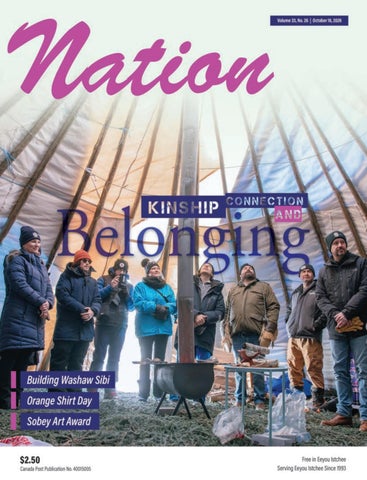
s the Cree Board of Health and Social Services of James Bay (CBHSSJB) transforms service delivery and employee support models, it is guided by the principle of Nitutâmh (“my relations”) to prioritize kinship, connection and belonging. Nitutâmh was the theme of the CBHSSJB’s recent annual report. It also informs a healing approach to staff training, aiming to foster safe and respectful workspaces and promote collaboration among colleagues. “It really comes down to relationships,” said chairperson Jeannie Pelletier. “Health care is about people and our strongest services are built when we trust one another and work together.” The board holds four three-day Nitutaamh sessions for employees annually, which Pelletier described as an “experience” rather than training. Rooted in the Cree tradition of storytelling, staff learn communication tools that can help at work and with their families. Since becoming chairperson nearly two years ago, Pelletier has advanced what she calls the Nisk model of holistic care to improve service access and health outcomes by promoting lasting relationships with care providers. Suggesting the CBHSSJB grew so quickly that services had become fragmented in silos, the Nisk model replaces the typical revolving door of doctors and nurses with dedicated multi-disciplinary teams. “We’re moving away from asking people to navigate a complicated system on their own,” said Pelletier. “When you go to our cabins in the bush, they’re open concept. There’s better communication that happens when the person is right in front of you.” Inspired by the teamwork of geese (Nisk), assistant executive director Holly Danyluk said this family-centred approach is improving attendance at appointments, chronic disease control and client satisfaction. Results were apparent when Pelletier introduced the Nisk model in her former role as director of Chisasibi’s Community Miyupimaatisiiun Centre (CMC). But she says this transition is far from complete on a regional level. A more comprehensive re-design will soon reorganize employee roles. “First you have to do an inventory,” Pelletier explained. “You know when you clean out your
the Nation
HOLISTIC GROWTH
the Nation
closet and make a big mess at the beginning before getting to the actual work? That’s the process we’ll be going through but I’m confident in the managers and staff.” With interim executive director Christina Biron, who replaced Daniel St-Amour when he retired last year, a first priority was a new agreement with the provincial government, which was achieved in August. “It brings stability and opportunity because we’ve been operating without an agreement the last three years,” Pelletier told the Nation. “It helps us plan for the long-term and respond to changing realities. It gives us a stronger foundation to improve access, renew infrastructure and support better care for future generations.”
the Nation
Several infrastructure projects across Eeyou Itschee are nearing completion or have recently opened. Waskaganish is positioned as the third regional healthcare pole, alongside Chisasibi and Mistissini. An expanded Waskaganish CMC opened last January while the Wâpimâusûkimikw birthing home welcomed its first births this summer. Construction is completed for Chisasibi’s new Elders’ home, with only its Mitchuap teepee to be finished before an expected spring opening. The $300 million regional hospital is still years away, so restorations are ongoing at the present aging facility. Primary care is expanding in all communities, supported by a network of mobile clinicians. Advancements include at-home sleep tests for respira-
tory therapy, orthotics and prosthetics service growth, and broadened speech and language therapy. Calls to the Wîchihîtuwin helpline launched during the pandemic increased by 60% this year. This growth likely reflects both escalating health and social concerns in the region and greater awareness about the free, confidential and culturally grounded resource. Callers can be referred to psychosocial services, traditional healers and other programs. “Many people are carrying a lot now, whether it’s stress, addictions, mental health concerns, housing pressures or caring for loved ones,” said Pelletier. “Our responsibility is to make sure help is available when people need it the most. It tells us people are trusting it.”
A rise in serious crimes is stretching the capacity of Youth Protection services, resulting in staff burnout and forcing the CBHSSJB to reach out to other provincial directors to house Cree youth. Pelletier said complex issues such as homelessness require extensive partnerships. “We have to invest more in prevention, encouraging people to seek help before they become evicted,” Pelletier asserted. “In medicine, you have your target you can hit most of the time. With psychosocial [issues] it’s more complex – your target is there but your dart is a bird.” Many Cree patients must still travel south for care. Montreal’s Hotel Espresso is renovating kitchen and arrival areas, with a new third-floor space for long-
term clients and their families. Pelletier hopes to develop a new area for patients staying in the city, with access to nature and the water. Having dialysis machines in each community is unrealistic for diabetes patients, Pelletier said. She emphasized healthy grocery options, safe walking paths and school presentations on Miyupimaatisiiun, the Cree vision of lifelong wellness. “Sometimes you can’t change the trajectory of somebody’s health, but you can enhance their quality of life,” said Pelletier. “It makes me proud to see that shift in how we think about care, building a system that reflects who we are as Eeyouch and organizes itself around the people and families.”
the Nation
Design Annual Reports
Translation
Apparel
Printing Corporate & Event Materials
Hoodies T-shirts
Promo Items
Backpacks
We offer a wide range of services that can assist you in the growth of your business
Retail Supplier
the Nation
514-272-3077 projects@beesum.com beesum.com
WORK ON A PROJECT THAT’S SHAPING OUR REGION ᐋ ᐋᐱᑎᓰᔅᑖᑭᓂᐧᐎᒡ ᐋ ᐱᒥᐱᐦᑖᑭᓂᐎᒡ ᐋ ᐆᐙᑎᔅᑖᑭᓂᐎᒡ ᐊᓂᑎᐦ ᐋ ᐅᐦᒋᔨᐦᒄ EXPLORE CAREERS WITH TROILUS ᓇᓂᑑᒋᔅᒑᔨᐦᑎᒥᒄ ᒑ ᒌᐦ ᐃᑖᐱᑎᓯᔮᒄ ᐊᓂᑎᐦ ᑦᕉᐃᓗᔅ
Opportunities here. For today and the future.
troilustogether.com
2026 BUSINESS EXCHANGE EXC X HANGE DA XC D DAY AY AY NOVEMBER NOV O EMBER 10 FORESTEL, VA OV V VAL-D’OR L-D’OR
REGISTER NOW
Where Cree communities, organizations and regional partners connect.
the Nation
Putting Down
Stakes
F
ollowing moving presentations at the Cree annual general assembly in August, momentum is building to finally establish a village for the Washaw Sibi community. As the long-displaced people secure Category 1A lands transferred from other Cree communities, construction may soon begin on a site near Matagami. Historically occupying lands south of Waskaganish – between La Sarre and the mouth of the Harricana River – Washaw Sibi members were divided between Hudson Bay posts on both sides of the Quebec-Ontario border when the Canadian government pushed them onto existing reserves in the 1960s. Many were forced to join the Algonquin reserve of Pikogan near Amos. While living under a different First Nation resulted in culture loss and incidents of racism over the years, official recognition in 2003 as Eeyou Istchee’s 10th Cree community sparked hopes for a permanent home.
the Nation
After studying a dozen different sites over the past two decades, a community vote in 2023 resulted in 87% choosing a spot just east of Matagami, south of the Bell River. Matagami municipal council granted access to the land, and bi-monthly meetings update progress while ground and water studies are conducted. “I can’t say we’re 100% sure it’s in Matagami, but so far it looks promising,” said Washaw Sibi Chief Annie Mapachee-Salt. “[Members] have some questions about hunting rights, but I think these are things we can work out. We already have our hunting grounds – we’re there to have a home.” Under the James Bay and Northern Quebec Agreement, Category 1A lands are designated for a community’s exclusive use. MapacheeSalt toured the nine Cree communities in 2021, asking each to transfer one square kilometre that they can’t use so Washaw Sibi would have its own protected lands. While five communities have so far agreed to this transfer, Waskaganish was asked at its recent AGA if it could donate an additional five square kilometres. Mapachee-Salt explained that many Washaw Sibi members are affiliated with Waskaganish, which has 490 sq km of Category 1A lands. A presentation to explain their request to Waskaganish was scheduled for October 20. “Our great-grandparents did come from Waskaganish,” noted Mapachee-Salt. “We’ll need to do a referendum with the community.” Washaw Sibi’s upcoming AGA in Amos, which hosts the community’s administrative office, will include a special meeting about this proposed referendum on October 28. As the community move gains traction, Mapachee-Salt has been sharing its unique history with both Matagami and Cree audiences. “There are a lot of people who still question who we are, where we are and where we came from,” she said. “Youth especially need to be informed. Many people assume we come from Waskaganish. I found a picture from 1924 of our Cree people who lived in La Sarre.” Ouje-Bougoumou was similarly transferred lands from Mistissini follow-
ing its creation in 1992. Former Grand Chief Abel Bosum – who was instrumental in establishing Ouje – is now helping guide Washaw Sibi. Bosum previously told the Nation that the Cree Nation’s political influence and the economic benefits for Matagami’s dwindling population will be keys to the project’s success. While Ouje-Bougoumou was the first community to agree to transfer land to Washaw Sibi, Chief Gaston Cooper recently expressed concerns about the JBNQA’s potential limitations. While Cree communities continue to expand, allotted Category 1A lands appear fixed. “How can we ensure for our future generations that that Category 1A land
requires a 65% quorum of a community’s eligible voters, a threshold made deliberately high to protect Cree land rights. Although 2008’s New Relationship Agreement with Canada stated the Crees would pay for a community’s establishment, O’Reilly argued that responsibility for its operations and management is an unresolved question. The ancestral rights of Washaw Sibi members in Ontario are another potential complication. Quebec and Canada also have to agree to the plan. “Annie and her group are persevering against tremendous odds,” said O’Reilly. “They should get a lot of credit for going against the headwinds. A big detail is how many people will actually move – it’s one thing to be a member, it’s another to move.” Washaw Sibi membership is estimated to be about 700. Mapachee-Salt said that with many settled in houses and jobs the number expected to initially move to the new site is closer to 200. Newly elected Youth Chief Shayna Polson is one of those determined to move and “build the 10th Cree community from the ground up.” Polson’s rousing speech at the CNG’s AGA highlighted that youth will need to do the “heavy lifting” to see their “sovereignty take shape in the soil.” She promised to ensure youth are directly involved in the planning of a modern, sustainable community, “deeply rooted in Eeyou values and respect for the Earth.” Visiting the site this summer, Polson envisioned developing a gathering place by the river as an early community-building step. Thanking Washaw Sibi’s generations of leaders for guiding them to “the edge of history,” she challenged youth to look toward Matagami’s horizon and find their role in its future. “We cannot just wait for the village to be built – we must build ourselves up to run it,” Polson said. “Look ahead 5 to 10 years. We’ll see our determination made visible, a sanctuary where our culture can flourish forever. Let’s get to work, let’s stand united and let’s build our home.”
is going to grow to meet their needs?” asked Cooper. “It’s something we need to revisit to see how we can be at an even playing field. We need to grow too.” Washaw Sibi is also advised by James O’Reilly, the Cree Nation’s lead lawyer in the titanic battle resulting in the JBNQA. Among other successful battles, O’Reilly also helped secure Ouje-Bougoumou’s rights. He suggested that Washaw Sibi was overlooked during JBNQA negotiations because members were generally assumed – even by Crees – to be a southern branch of Waskaganish. “One option is to sue, saying we’ve been here a long time and were missed by the JBNQA, just as Ouje-Bougoumou was,” asserted O’Reilly. “My strategy would be no more deals with Quebec until you agree for a new community for Washaw Sibi. The CNG has been weighing whether they can gain more from negotiations or going to litigation.” While understanding why Washaw Sibi would choose “the more diplomatic option,” O’Reilly questioned the assumption that the JBNQA’s allotment of Category 1A lands was a maximum, noting that Indigenous rights have evolved significantly in the past 50 years. He said a referendum to cede these land
the Nation
The Cree IELCC Fund is designed to fund projects/activities that foster TheThe Cree IELCC Fund is is the education, Cree culture Cree IELCC Fund The Cree IELCC Fund The Cree IELCC Fund is is designed fund designed to fund and language, asto well as designed to fund designed to fund projects/activities that foster projects/activities that foster health and wellbeing of that projects/activities that foster projects/activities foster education, Cree culture thethe education, Cree culture children and 0the to 6 and their the education, Cree culture education, Cree culture and language, well language, asas well asas and language, as well as and language, as well as families.health health and wellbeing and wellbeing ofof
r
health health and ofof children 0wellbeing to 6 and their children 0and to 6wellbeing and their children 0 to 6 and their children 0 to 6 and their families. families. All projects and activities
families. families. must also ensure that noactivities projects and All All projects and activities projects and activities AllAll projects and activities must also ensure that no children must are left behind: also ensure that no must also ensure that no must also ensure that no children are left behind: activitieschildren must be accessible are left behind: children are left behind: children are left activities mustbehind: be accessible activities must be accessible to all children, no matter activities must be accessible activities must be accessible to all children, no matter to all children, matter their level ability orno special to children, no matter toof allall children, no matter their level of ability or special their level of ability or special their level of ability or special their level of ability or special need. need. need. need. need.
al
Deadline Deadline Deadline Applications accepted monthly. Deadline
Due on theaccepted last day monthly. of monthly. each month Applications accepted Applications Applications accepted monthly. the Nation Due on the last day of each month Due on the last day of each month cepted monthly. Due on the last day of each month
e
day of each month
Scan to Scan Scan to totoOnline Apply Scan to ApplyOnline Online Apply Apply Online
Apply Online
T
he 2026 Sobey Art Award brings together artists whose practices reflect diverse cultural, regional and material perspectives from across Canada. This year’s nominees are creative talents from six regions of Canada (Circumpolar, Pacific, Prairies, Ontario, Quebec and Atlantic), and four of the finalists are Indigenous. Melaw Nakehk’o, a multidisciplinary Dene-Dënesułińe artist from Yellowknife, was selected for the Circumpolar region. Her work is featured in a special exhibition at the National Gallery of Canada in Ottawa. Nakehk’o said the exhibition brings a Dene land-based worldview into spaces where Indigenous art and technology intersect. After art school, Nakehk’o returned to the Northwest Territories, where she inherited her grandmother’s hide-tanning skills, and began working with a group of people to help spark a resurgence of hide tanning. “Being a knowledge holder is very important to me as a Dene person,” she said. “I have knowledge that I share, and that’s a part of my life that I’m really proud of.” Nakehk’o says hide tanning creates a direct relationship with the land, animals, hunters and harvesters. This connection made her increasingly aware of changes happening across the North. “Through the work that I do, you are much more observant of how climate
the Nation
changes, or developments are affecting certain parts of the environment, and how that impacts our relationship to the animals,” she explained. Nakehk’o’s caribou-hide sculptures reflect what she describes as “climate grief” in response to environmental change. “We need to be more respectful to the nature,” she said. “So, my pieces are these distorted human and animal forms in using the caribou hide.” Within her art Nakehk’o tries to describe a balance between humans and caribou, and her soft sculptures explore what happens when that balance is lost. Experimenting with new technology, including kinetic components and 3D modelling, Nakehk’o always works with traditional materials. “The foundation of my artwork is caribou hide,” she said. “And being able to incorporate new types of media into my pieces, I can see it is still being around for my people.” Nakehk’o believes new technology does not replace traditional knowledge, instead, it offers another way to carry that knowledge forward. One of her projects, presented in Venice and at
Nuit Blanche in Toronto, combines a 360-degree film with VR. “Through my artwork, I’m able to incorporate the essence of some of the stories that I heard growing up, and to share my culture, whether it’s digital, film, VR or my sculptures,” she said. Audie Murray, a Regina-based Métis and Cree artist from Flying Dust First Nation, represents the Prairies region. Using beadwork, drawing, natural materials and installation, she explores ancestral knowledge and everyday life. For the exhibition, Murray is presenting her artwork To Make Smoke installed directly onto the walls of the NGC. “It’s smudge remnants, which is a charcoal,” she explained. “I use those as a pigment that is put onto the wall. I use water from the Ottawa River, and I put that over the smudge remnants to create kind of smoky effect on the wall.” Describing her process, Murray almost renders her art mundane. It’s anything but. “I’m responding to everyday life and my experiences in the world,” she said. “With this work to make smoke, it is like a continuance of the act of smudging, which is the burning of specific medicines, but the smudging takes place in
everyday spaces – in my home, in my studio, it’s not so much like ceremony.” Murray creates her art materials from natural elements, including plants. “Right now, I’m using dried rose petals to make a watercolour pigment,” she said. “But I also work a lot with bead work as material, and repurposed items like old working gloves, old bras or socks.” Although Murray usually works by hand, she uses video and recognizes the possibilities offered by contemporary media. “Video as a form of documentation is really useful and generative,” she said. “I really appreciate that there’s experimental aspects to that.” At the heart of Murray’s practice is an understanding that culture is constantly evolving. “Culture is not static,” she said. “It shifts, it moves, and it’s important that we are able to shift and move with it and have a good heart,” she concluded. The six shortlisted artists will have their work featured in a special exhibition at the NGC, culminating in a November celebration when the winner will be announced.
30 25
of service in Eeyou Istchee
of promo items experience with certified PPPC suppliers
We offer a wide range of services that can assist you in the growth of your business
514- 272-3077 | info@beesum.com
the Nation
This season we’re ready, and for the holidays too! Before the celebrations, get vaccinated against flu and COVID. Staying up to date helps protect you and your loved ones so everyone can enjoy the season together. Talk to your healthcare worker about the vaccines you need.
creehealth.org/ fall-vaccination
C
M
Y
CM
MY
CY
CMY
K
ᐃᔨᔨᐤ CAVAC ᐋ ᐱᒥᐱᔨᐦᑖᑭᓂᐧᐃᒡ Are you a victim or witness of a criminal act? We are here to support you. Our services are offered throughout Eeyou Istchee and are strictly confidential. CALL US
1-877-342-2822
The Nation is looking for
A program offered by:
Cree Freelance Writers
Please send your resume to willnationnews@gmail.com
who are passionate about writing!
Or leave a message at (514) 272-3077 ext. 103
For women and children of Eeyou Istchee suffering from domestic violence
CRISIS LINE
HEL
P
Toll Free | Open 24/7
1 855 753-2094 creehealth.org/services/womens-shelters-robins-net
Pîpîchâu Uchishtûn | Robin’s Nest | Women’s Shelter
If you are an Indigenous woman of Eeyou Istchee and you are seeking safety and support, we are here to help you!
If you need emotional support or to learn about all the services available to you, please contact us:
ᐐᒋᐦᐄᐙᐅᐎᓐ WÎCHIHÎWÂUWIN HELPLINE 1 833 632-HELP (4357)
creehealth.org
Under the Northern Sky
M
y aunt Celine Mary (Kataquapit) Nakogee passed away September 28, aged 86. Her family will deeply miss her kindness, wonderful smile and fun nature. She is survived by her husband of 61 years, former Attawapiskat Chief John B. Nakogee and their children George, Jenny, Mary, David, Roger, Beverly, Norman and Peter. She was predeceased by her son John B. Jr. She also leaves behind many grandchildren and great-grandchildren. After the funeral, I spoke with my uncle John B. He was deeply connected to his life partner and talked about how much they loved each other. They both grew up in the North are both survivors of the residential school system. As a young girl, Celine was taken to southern Ontario to attend school and be treated for a lung disease. John B. recalled how his wife described her trip to the south. Children from farther north arrived in Attawapiskat by transport boat before more were loaded onto the craft. Boat travel was gruesome. Children got sick and latrines spilled, making a mess everywhere as they were tossed about on the heaving waves of James Bay. Celine was taken to Moosonee, where she boarded a train. She was denied a regular passenger seat, instead passing the long journey on the cold floor of a cargo boxcar. Celine’s passing was a deeply emotional event for my extended family, as she was the last of my father Marius Kataquapit’s siblings. Her younger brother, David, and older brothers Marius, Gabriel, Alex, Leo, George and Thomas had previously passed on. Their families all grew up together in Attawapiskat. Her parents were James and Janie (Wesley) Kataquapit. James was one of 23 young men who went overseas in 1917 to fight in the First World War. Many of us younger grandchildren never met our grandmother Janie; a house fire took her life in 1969. In that era, there were no modern health services in the North and childhood mortality was common. Celine’s parents lost their first two sons, William and Peter. After their surviving children arrived, they then lost their two youngest, Mary and Gregory.
the Nation
After their marriage in 1965, Celine and John B. raised their many children in the traditional culture of Ineeneenoo Peemahteeseewin (James Bay Cree life). They moved to Moosonee for a time, where John B. worked as a Social Housing Manager and later for Indian Affairs Canada. When they returned to Attawapiskat, John B. became involved in local leadership and played an influential role in the development of our First Nation. My aunt and uncle were strong advocates for childhood education and youth supports. Having survived the trauma of residential school, they knew that a healthy childhood and a quality education were essential tools to combat poverty and despair. Their advocacy and the lessons they taught their children and grandchildren helped inspire their 13-year-old granddaughter, Shannen Koostachin, to take a vocal stand for Indigenous youth. The daughter of Andrew and Jenny (Nakogee) Koostachin, Shannen was nominated for the International Children’s Peace Prize during her fight for a new elementary school in Attawapiskat. Sadly, Shannen died in a 2010 car accident, but her work lives on in Shannen’s Dream, a youth movement
that advocates for equitable funding. Thanks largely to Shannen’s efforts, the Kattawapiskak Elementary School opened in 2014. Celine and John B never stopped speaking up for Indigenous youth. Celine and John B were always proud that their children, grandchildren and great-grandchildren went on to higher education and professional careers – and because they in turn continued advocating for First Nation youth. Aunt Celine’s funeral was the first to be held at the newly opened St. Francis Xavier Church in Attawapiskat. In the absence of a local priest, local Elders Francis Hookimaw and Annabella Iahtail (both dear friends of Celine) led the Catholic service. Danny Metatawabin provided traditional song, drumming and ceremony. The service was difficult, but it was filled with so many relatives and community members who still speak Ineeneemoon (James Bay Cree). The language is filled with so much humour. People take words and ideas and use them to make everyone laugh at the things we say. As I spoke, I couldn’t help but think that Aunt Celine and her brothers were all laughing with us. Kee-sah-kee-eh-tee-nan Too-sis Sehlen (We love you Aunt Celine).
PROGRAMS FO R AN D BY FI RST NATI O N S Why Ch oose F N E E? Em p owe ri n g F i rs t N ati o n s l e a d e rs with to o l s , kn owl e d g e, a n d co n n e c ti o n s to d rive ch a n g e a n d cre ate a l a s ti n g i m p a c t i n th e i r co m m u n iti es . VI S IT U S AT: fn e e.ca/o u r- p ro g ra m s
O u r Progra m s :
› Governance – Grow an agile and innovative leadership › Entrepreneurship – Strengthen your entrepreneurial skills › Management – Boost your collaborative approach › Women Leadership – Reach your full potential › Economic Reconciliation – Co-lead a reconciliation project › Next Generation – Trail forward APPLY ANYTIME FOR 2026 PROGRAMS!
› fnee.ca/register ‹
SDG-39960
Our application process is on a rolling basis.