“ Education is power! ” A message from the Cree Nation of Chisasibi
As the new school year begins, we extend our warmest wishes to all students pursuing their education in our communities and across the South—whether you are in elementary school, high school, vocational training, adult education, college, university, or gaining on-the-job training with your employer or at the Eeyou Istchee College of Science and Technology. We wish you all immense success in your studies! Remember, you are not alone on this journey; there is a wealth of support available to you—from family, friends, and teachers to academic advisors and Indigenous student support services. Always keep in mind: “Education is power!” Embrace your opportunities and shine bright this year!
Did you know that Eeyou Istchee has its own post-secondary college? The Eeyou Istchee College of Science and Technology offers workshops, courses and learning opportunities designed for the people of Eeyou Istchee, whether you are working, looking to build new skills, or continuing your education. Through our Two-Eyed Seeing approach, we bring together Cree knowledge and Western education to support learning, careers and stronger communities.
More Learning Opportunities Also available throughout the year: Governance Workshops Grant Writing Essential Skills for Managers Excel – Levels 1, 2 & 3 Digital Literacy And more to come.
Register Online
Coming Up
Learn. Grow. Build Your Future. Scan the QR code or visit the website to explore upcoming courses and register.
Cree Language – Level 1 & 2 French Language – Level 1
eeyouistcheecollege.ca
Free Stem Course
Our Time is Now! ᔖᔥ ᐆᐦᒋᐲᔫ
I
pied and Mistissini residents are invited to visit, and I took the opportunity this year. When I visited, a huge bald eagle flew over the camp. It was awe-inspiring to all of us. I was offered smoked bear dipping made with the bear’s rendered fat. Wonderful tastes from our lifestyle as was the smoked fish (nimishtic). There have been many intermarriages throughout the years between our communities with members chang-
n many past testimonials about Canada’s Indigenous Peoples, and even to this day, the word "lazy" is often used to describe us. One only has to look at Indian Affairs documentation. I use Indian Affairs because that was what it was called before politically correct ideology attempted to beautify things. But Indian Affairs never called us lazy – though it was part and parcel of its methods of dealing with the Indigenous Peoples. They were too lazy to see to the education of Indian children. So, they gave it over to churches. We are all dealing with the repercussions of that and will be doing so for generations. Too lazy to allow different communities to remain on their own territory, the government grouped smaller ones with those that were larger. Such was the case with the Ouje-Bougoumou Cree. For decades they were forced to be a part of Mistissini First Nation. According to Indian Affairs, it was easier to serve the needs of the OJ Cree this way – pure laziness on the part of Canada. Was it coincidence that this move facilitated mining and forestry operations in OJ territory? Not likely. It was about control and doing it the lazy man’s way. The memory of the past lives on. Every year for two weeks the area where the OJ people lived back then is reoccu-
ing band affiliation according to their desires. It is a close relationship that we all enjoy. I hope you all enjoy the pictures and see the laziness of a government has ensured that connections between Cree communities remain strong in spite of a lazy practice designed to minimize our presence in Eeyou Istchee. Our past lives on and we reclaim what was done to our benefit.
the Nation is published every two weeks by Beesum Communications // EDITORIAL BOARD L. Stewart, W. Nicholls, M. Siberok, Mr. N. Diamond, E. Webb // EDITOR IN CHIEF Will Nicholls // DIRECTOR OF FINANCES Linda Ludwick // EDITORS Lyle Stewart, Martin Siberok // STORY COORDINATOR Patrick Quinn // CONTRIBUTING WRITERS X. Kataquapit, P. Quinn, A. Nambiar // DESIGN Emma Lindsay // SALES AND ADVERTISING Donna Malthouse // THANKS TO: Air Creebec // CONTACT US: The Nation News, 918-4200 St. Laurent, Montreal, QC., H2W 2R2 // EDITORIAL & ADS: 514-272-3077 / ads@nationnews.ca / 514-943-6191 // HEAD OFFICE: P.O. Box 151, Chisasibi, QC. J0M 1E0 www.nationnews.ca // EDITORIAL: will@nationnews.ca news@nationnews.ca // ADS: Donna Malthouse: donna@beesum.com // SUBSCRIPTIONS: $90 plus taxes, US: $90, Abroad: $110, Payable to beesum communications, all rights reserved, publication mail #40015005, issn #1206-2642 // the Nation is a member of: The James Bay Cree Communications Society, Circle Of Aboriginal Controlled Publishers, Magazines Canada Quebec Community Newspaper Assn. Canadian Newspapers Assn. Les Hebdos Sélect Du Québec. Funded [in part] by the Government of Canada.
the Nation
3
STRUGGLING WITH A CRIMINAL RECORD? HAVE YOU COMPLETED THE REQUIREMENTS OF YOUR SENTENCE AND PROBATION? YOU MAY BE ELIGIBLE FOR A PARDON THAT SEALS YOUR RECORD
WE CAN HELP YOU! If you are a Cree beneficiary, the Cree Nation Government (CNG) can help you to fill out the record suspension application and if you qualify for financial assistance, the CNG may pay the costs associated with the application.
CONTACT YOUR LOCAL REINTEGRATION OFFICER ON HOW TO APPLY: Chisasibi: Eastmain: Mistissini: Nemaska: Ouje-bougoumou: Waskaganish: Waswanipi: Wemindji: Whapmagoostui:
819-855-2120 819-977-2400 418-923-2661 819-673-2400 418-745-2260 819-895-2126 819-753-2770 819-978-3300 819-929-3796
If you have any additional questions, please contact the Correctional Services Regional Office in Val d’or 819-874-2600 or contact your local Reintegration Officer
the Nation
A
four-day walk to raise awareness about diabetes culminated with a grand entrance at the Cree Nation Government’s Annual General Assembly in Waswanipi August 12. The group began their journey at the Chibougamau hospital, where many Waswanipi community members travel every second day for hemodialysis treatments. The initiative was conceived as a relay walk, with the small group generally walking 10 km each day to cover the 144 km from Chibougamau to Waswanipi. Recently elected Waswanipi Chief Matthew Happyjack joined the procession on the first and final days. “At the end, we’ll bring in the dialysis patients through the doors of the general assembly to present their testimonies,” explained Happyjack. “We have a lot of people in Montreal too being treated for dialysis we’ll try to include by phone to present our resolution of support to have hemodialysis equipment in Waswanipi.” The rate of diabetes in Eeyou Istchee is growing at a rate far higher than that of the general population. The Cree Board of Health and Social Services of James Bay (CBHSSJB) revealed this year that 43% of Chisasibi’s adults live with either pre-diabetes or Type 2 diabetes. Diagnoses there have increased fourfold over the past 30 years. “These are big issues we are experiencing in the Cree Nation that are shaped by little decisions,” said the CBHSSJB’s Paul Linton at the CONNECT leadership conference in March. “How we eat, the 30 minutes of activity a day to make health a priority. We can make an impact as individuals, and we can make a difference in how we come together to be more active.” The opening of Waskaganish’s new Community Miyupimâtisîun Centre (CMC) in January added five hemodialysis treatment rooms to the region, joining those available in Chisasibi and Mistissini. In 2023, Waskaganish launched the Home Dialysis Training Centre and Respiratory Clinic to bring quicker solutions for diabetes patients. That followed a pilot project launched in 2019 enabling Waswanipi residents to operate hemodialysis machines from their own homes. Waswanipi was selected for its stable and safe water supply, which is essential for dialysis, and because the round trip to Chibougamau is three hours by car. “It’s tiring with all the travel you do, especially in the wintertime,” said Shirley Matoush, who participated in this pilot project after six months of training in Montreal. “Even
a storm cannot stop you – you have to do your treatment.” A tragic patient vehicle crash claimed the lives of four Waswanipi community members in 2024, including one travelling for dialysis. Then-CBHSSJB chairperson Bertie Wapachee described the route as “probably one of the worst highways in the province ... a risky place to be on dialysis.” Diagnosed with kidney failure unrelated to diabetes in 2013, Matoush had dialysis treatments in Ottawa and Montreal for eight months before landing a spot in Chibougamau. Since receiving a kidney transplant in 2022, Matoush has been able to resume normal activities, such as taking a vacation or participating in this community walk. “Before I couldn’t go anywhere,” Matoush said. “I just stayed home. I know what is it to be away from family a long time – being in the city is a cultural shock. I am going to the final walk to the AGA. I’m walking for everyone on dialysis. I want to help my people come home.” Chief Happyjack hopes to expedite the CBHSSJB’s plans for a dialysis unit at the Waswanipi clinic. Currently managing his Type 2 diabetes with pills, Happyjack said a fundraising campaign for local hemodialysis machines will follow the walk. “If I have community support, hopefully people will listen,” said Happyjack. “I’ll have a platform where I can talk with government. Based on the public heath stats, people in Waswanipi are aware [of treatment needs] so it’s a
matter of getting the Nation aware of it too.” Happyjack said plans for this walk began three months ago with Sol Awashish, whose 2002 diabetes awareness walk visited most Cree communities. Since then, Awashish has organized walks almost every summer, often arriving to the AGA to emphasize Miyupimaatisiiun – the Cree way of life, health and well-being. “I think we have enough rights already and if we’re not healthy, we cannot practice those rights,” Awashish said. “The physical part of walking isn’t the hardest for me. It’s the mental, emotional and spiritual part. When I walk, I think about all the people who are suffering out there.” Awashish’s son Kenneth died five years ago from complications due to diabetes. As high blood sugar levels associ associ-
ated with the chronic disease thickens the blood so it doesn’t flow regularly, patients have higher risk of heart attacks and strokes. Damaging blood vessels and nerves over time, diabetes may result in blindness or the amputation of feet or hands. As a retired public health employee, Awashish recalled the CBHSSJB being warned years ago to expand regional hemodialysis access because of diminishing availability in Montreal. His vision is for every Cree community to have their own hemodialysis machines. In addition to the long commutes faced by Waswanipi members, each hemodialysis treatment takes about four hours. Awashish highlighted that some Elders rely on transportation services between the communities, sometimes waiting hours when their ride doesn’t come on time. “I go to the hospital and I see the Elders sleeping in their wheelchairs and I don’t think that’s right,” Awashish asserted. “Every time we have a general assembly, people say we take care of our Elders. But leaving them in a hallway to wait at a hospital for two or three hours, that’s not respect.” Choosing walking as a communication platform was partly inspired by the “moccasin telegram” tradition of sharing news by sending a walker to the next camp. There’s a legend of a man named Philip Petawabano walking from Mistissini to Fort George to deliver a message between Hudson Bay posts. “I figured if walking was the way they used to do things, I’d continue the tradition,” said Awashish. “As I walk, I cry for everybody I lost to diabetes and pray for solutions. I hope my walking is not in vain.”
the Nation
WORK ON A PROJECT THAT’S SHAPING OUR REGION ᐋ ᐋᐱᑎᓰᔅᑖᑭᓂᐧᐎᒡ ᐋ ᐱᒥᐱᐦᑖᑭᓂᐎᒡ ᐋ ᐆᐙᑎᔅᑖᑭᓂᐎᒡ ᐊᓂᑎᐦ ᐋ ᐅᐦᒋᔨᐦᒄ EXPLORE CAREERS WITH TROILUS ᓂ ᒋᔅ ᔨᐦᑎᒥᒄ
ᐦ
ᑖᐱᑎ
ᒄ ᐊᓂᑎᐦ
ᔅ
Opportunities here. For today and the future.
ouwahstore@gmail.com (514) 588-3162 www.ouwahstore.com 18 Fort-George Road
troilustogether.com
The 36th International First Peoples Festival (FIPA) opened in Montreal August 4 with the world premiere of Joséphine Bacon’s documentary Nitassinan, a tribute to the Innu people, land and history co-directed and co-produced by Kim O’Bomsawin. Nitassinan later won the festival’s Canadian documentary award. Bacon also participated in the closing concert Here Stood the Tree of Peace, commemorating the 325th anniversary of the Great Peace of Montreal, when 39 Indigenous Nations signed a peace treaty with New France in 1701. This year’s festival focussed on Indigenous cinema, with La Raya by Mexico’s Yolanda Cruz and Dreams Travel with the Wind by Colombia’s Inti Jacamamijoy big winners. The Brazilian film Mundurukuyü – The Forest of the Fish Women won the Rigoberta Menchu Award, with Nunavut director Malaya Qaunirq-Chapman taking second for Nirilaurta. “Indigenous cinema is not merely an art form confined to dark theatres but a gateway to vast open skies, featuring works never before seen here from every corner of Mother Earth,” declared festival director André Dudemaine. Canadian Indigenous directors Darlene Naponse,
Zacharias Kunuk, John Henlee Weizineau and Evelyn Pakinewatik also won awards. A large delegation of Māori artists from Tahiti attended. The poet Flora Aurima Devatine, a leading figure in Tahitian literature and a driving force behind the revival of the ancestral Polynesian language, presented the documentary dedicated to her. The festival featured a wide variety of music, theatre, dance, visual arts, literature and installations. Concert performers included Anyma Ora, Pako, Q052, John Metza, Shub, Big Tones and Leonard Sumner. “By building bridges among peoples, languages and imaginations, FIPA offers a unique space for intercultural dialogue where knowledge, stories and artistic expressions converge in a spirit of openness and respect,” said Dudemaine.
a run-off election August 7. Sammy Salt-Blacksmith secured the position over Don Saganash Sr. with 55% of votes cast. The newly elected Council includes Alex Moses, Allan Saganash, Sandra Happyjack, Michael Neeposh, Laurie Neeposh, Robin Gull-Saganash and Stanley Saganash. An inauguration ceremony was held August 13 featuring the Waseskun Drummers and the passing of the eagle feathers by Ron Ottereyes and Irene Otter. “I have spent my career and my life listening and learning from our community members,” said Happyjack. “You have taught me so much I want to serve all of you to the best of my ability. The words ‘to speak as one voice’ are important to me because I will not be making any big promises for this election that no one person can deliver alone.”
Former Air Creebec president Matthew Happyjack was elected Chief of Waswanipi July 31, succeeding former Chief Irene Neeposh. Happyjack earned 59% of votes, ahead of candidate Steven Blacksmith. As none of the five candidates for Deputy Chief won a decisive majority, there was
Former Air Creebec president Matthew Happyjack was elected Chief of Waswanipi July 31, succeeding former Chief Irene Neeposh. Happyjack earned 59% of votes, ahead of candidate Steven Blacksmith. The Eeyou Eenou Police Force (EEPF) recognized its officers’ service to Cree communities
at an awards ceremony during the Cree Nation Government’s annual general assembly in Waswanipi August 10. Ouje-Bougoumou’s Bruce Wapachee won this year’s Valour Award. The late Charlie Gunner’s family also accepted an award on his behalf. Gunner was one of the “Five Great Men”, the group of Mistissini hunters who perished in a tragic cabin fire in 2015. The Distinguished Service Award went to Bianka SharlRoy, while Emilie Blais-Mercier was honoured with the Late Eric Benac Meritorious Service Award. Following an opening prayer from Police Commission Vice-Chairperson Simeon Trapper, EEPF Director Shannon Nakogee and Vice-Chairperson Trapper delivered welcoming remarks. Cree Nation Grand Chief Paul John Murdoch shared closing remarks with newly elected Waswanipi Chief Matthew Happyjack serving as Master of Ceremonies. These awards recognize acts of bravery, outstanding commitment and meaningful contributions that positively impact public safety and well-being. Community members and colleagues were invited to submit nominations to honour current and former officers who have gone above and beyond the call of duty.
the Nation
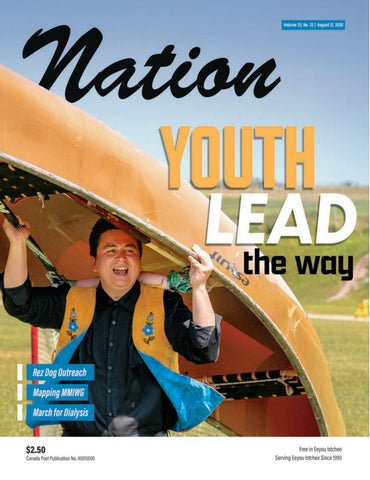
Cree Nation Youth Council hosts eventful AGA
the Nation
the
YOUTH are
READY READY
C
ombining initiatives, partnerships and discussions, the Cree Nation Youth Council’s 37th Annual General Assembly in Mistissini August 6-8 was perhaps its most ambitious. “It was a historical AGA with the updates we’ve had, showing the youth are ready to be serious in their leadership and bring their ideas to bigger tables,” said Youth Grand Chief Jade Mukash. “Getting quorum at 8:51 AM on the first day is unheard of and the reason we made such major decisions – the youth are ready.”
the Nation
Implementing its next five-year strategic action plan following years of consultation, the CNYC declared its four priorities: mental health and wellbeing, Cree culture and language, education and skills development, and leadership and governance. Mental wellness will be the focus at its next event, the annual Inspire Hope conference. Youth after youth took the mic at a four-hour open forum to voice concerns and pitch ideas, yielding 38 resolutions to strengthen governance guidelines, collaborate with other organizations and revive cultural programming. Delegates asked to reinstate the regional canoe brigade, winter journey and youth artists gathering. “I believe the Youth Councils of Eeyou Istchee Summit this spring brought a lot of youth to the forefront and made them realize their voice matters,” suggested Mukash. “Asking to remove the time limit and extend the forum showed us they’re ready to ensure their voices were being heard.”
With growing CNYC events for Crees aged 13 to 35, a new safety structure clarified oversight roles for staff, established a new three-member disciplinary committee and developed a step-bystep emergency response plan. Travel rules were tightened, with a strict code of conduct including a prohibition on alcohol consumption during official trips. Transparency measures include the public release of all meeting minutes and financial audits ahead of future AGAs. “Restorative justice is a top priority to make sure we’re prioritizing education and awareness rather than implementing event bans, giving youth the chance to redeem themselves and learn from their mistakes,” Mukash explained. Following an Elder’s opening prayer, the gathering began with fancy shawl and jingle dress dancing by Paula Menarick and Joni Boudrias. Assembly of First Nations National Chief Cindy Woodhouse Nepinak spoke about her leadership journey while federal Indigenous Services Minister Mandy
the Nation
Gull-Masty encouraged youth to explore political opportunities beyond the CNYC. A CNYC delegation attended the AFN’s AGA in July, connecting with young leaders from across Canada. Mukash anticipates more collaboration with organizations outside the region. She credits Deputy Youth Grand Chief Darius Neacappo Pelchat for building new relationships. “It’s time to create bridges for our youth,” said Mistissini local coordinator Kevin-Joseph Mianscum. “The national chief was highlighting that it’s important for Indigenous youth to stand firm together, tackling issues with the government, upholding our inherent rights. There is more opportunity out there and we shouldn’t just enclose ourselves in Eeyou Istchee.” Collaboration with Mistissini’s leadership, youth council and arts committee were instrumental in the AGA. Mianscum said weekly meetings over the past two months ensured that youth were empowered and accountable throughout the planning process.
“It was an all-hands-on-deck event,” said Mianscum. “We tried to make it the best one yet, highlighting Mistissini and all the beauty and services it provides. I want to highlight Mario Neeposh, my right-hand guy making sure things were moving and always supporting me.” The Mistissini youth council organized evening programming and lunchtime events, including bingo, arm wrestling, a gaming tournament and a portage. The first day was capped by a steak dinner and traditional gala, featuring performances by award-winning Whapmagoostui duo CerAmony along with local talent Ezekiel Neeposh, Ouwahh Music (Mitch Rabbitskin), Bob E Diamond and DJ Justin Ryan Swallow. “CNYC is seen as the fun organization but it’s an important aspect of governance to have that connection with everybody,” Mukash asserted. “That builds that trust, ensuring they’re having those meaningful conversations, to debate or see all the different aspects to decisions being made.”
CNYC gatherings have long emphasized traditional cultural activities. A new agreement with the Cree Native Arts and Crafts Association will expand opportunities for young artists and support generational knowledge transfer. CNACA’s pop-up Wachiya Store provided a local artist marketplace. A new local arts committee organized workshops throughout the first day, from wood carving to sewing and music making. Chairperson Beth Sealhunter Longchap, an award-winning artist who has long collaborated with CNACA, created a special piece for the AFN National Chief. “When I receive special orders, I always meditate in prayer,” Longchap reflected. “I looked at the woman she was and that touched me so much. I started doing little sketches but kept coming back to the first one that came so naturally. It was a sealskin flower and inside that is Eeyou medicine.” Longchap’s creation featured pink and blue sapphires, rubies and Labradorite – her favourite gem. Closed
with a cotton fabric called “the flower of life”, she beaded a little bear on one side with a dragonfly clasp because it’s born in the water before flying away. “When I explained the meaning, Woodhouse Nepinak was very grateful,” Longchap said. “I told her that our vicechair said we even look alike and she hugged me. She said she’ll wear this with pride at her meeting in October and everyone will see it on TV.” Longchap said that even though her jewellery is prominently featured at the Wachiya Store, has already created pieces for famous politicians and won CNACA’s contemporary arts award, this was a new career highlight. “I told Woodhouse Nepinak that this little girl in the bush dreamt of selling in Old Montreal one day and that dream came true,” shared Longchap. “That was my biggest dream and now making this for her was beyond my dreams. Things can go farther than the youth can ever dream about – never stop dreaming.” the Nation
SCHOLARSHIP AND GRADUATION AWARDS FOR CREE BENEFICIARIES OF THE JBNQA Annual deadline is September 30
Join our team
SCAN QR code for more information
Apply by Gestion ADC, a subsidiary of CREECO is looking to hire a PRESIDENT
August 31, 2026
EMAIL your resume with your cover letter to:
ADC Executive Committee jobs@boc-creeco.ca SUBJECT: CREECO -202601
CREECO.CA GESTIONADC.CA
WeLcOmE BaCk tO ScHoOl! The Cree School Board is pleased to welcome students, families, teachers, and staff to the 2026–2027 school year. A new school year brings new opportunities to learn, grow, reconnect, and work toward our goals. Together, we will continue creating safe and supportive learning environments where students can strengthen their knowledge, language, culture, and confidence. Wishing everyone across iiyiyiu aschii a positive and successful school year.
Rez dog
Resilience
the Nation
Mistissini volunteers change the way to care for strays
M
any First Nation communities struggle with an overpopulation of stray dogs, but organizations are now emerging to care for these animals. In Mistissini, the volunteer-led Rez Dog Alliance aims to reshape how Cree people care for man’s best friend. Though the community’s public safety department is responsible for picking up aggressive dogs, a network began developing more sustainable solutions last fall. The movement is gaining momentum, offering everything from emergency fostering to helping reunite lost pets with their families. “We’ve all seen dogs loose and roaming or being neglected or abused,” said Rez Dog Alliance founder Sheena Costain. “There have been some scary and heartbreaking situations. Back in October, there was another incident of a dog bite and I thought maybe people who are passionate about it would be interested in coming up with solutions.” Costain’s public outreach generated significant interest, but it took several months before a committed core group was organized with a unified direction. Over 20 dedicated volunteers are offering foster homes or transportation. Dogs requiring medical care can be treated by a vet tech in the group or be sent to a veterinary clinic in Chibougamau. Those needing surgeries are sent to Alma or Quebec City. Alliances with partner organizations help coordinate intervention and assessments for adoption by new homes. “There have been a few unique cases where we’ve needed to raise funds,” said Costain. “A raffle helped with raising $1,700 for the vet costs for two injured puppies. Recently a dog needed an abscess removed and the Chibougamau vet was closed. People
are so generous – we’ve already raised $600 in a couple of days.” Living in Mistissini since 2013, Costain has observed a growing overpopulation problem as the relationship with dogs increasingly evolves from hunting partner to household pet. “I think the root causes are much more complex than people give it credit for,” Costain asserted. “People say, ‘Just tie your dogs up’, but it’s not that simple. No one likes to be imposed upon. Some Elders believe dogs aren’t supposed to be inside, that it will make them weaker and not able to adapt to the elements.” Historically, Cree and other Indigenous peoples relied on dogs for pulling sleds, carrying supplies and guarding camps. These dogs were usually well cared for but left to roam freely. The Rez Dog Alliance released a video interview with Mistissini Elder John Bosum to explore this traditional cultural connection. “Our people depended on dogs in the past,” explained Bosum. “A dog would go around to where the beaver house was and if the beaver went under, he would sit there. They’d block the hole and that’s where the beaver was.” Colonization made it harder for people to care for their dogs. Many wandered loose, occasionally attacking community members. As dogs lost their place in society, some people – feeling similarly rejected – identified with their resilient spirit. “The condition of dogs in our communities is a reflection of us,” writes Dr. Michael Yellow Bird, Dean of Social Work at the University of Manitoba and member of the Mandan, Hidatsa, and Arikara Nation in North Dakota. “If they are sick, it is because we are also sick.” Some Cree communities are trying to address issues related to roaming dogs. Chisasibi Animal Care and Control works with dog owners to understand
negative impacts that loose dogs pose to the community. Dogs and cats must be registered and vaccinated against rabies every year. The International Fund for Animal Welfare worked with several Cree communities to address dog overpopulation issues. Wemindji was highlighted for its proactive approach, including a full-time animal care professional who has band council support. Costain said the Rez Dog Alliance’s spay and neuter campaign is a priority as many puppies are taken from the community for adoption. The Alliance promoted this effort and addressed misconceptions at Mistissini’s annual general assembly August 3-5. “Some people believe it changes their dog’s temperament or that females can only have a litter of puppies on their second heat,” said Costain. “We’re trying to push the message that not only is it completely safe, but dogs have happier and healthier lives when they’re spayed or neutered, especially our rez dogs.” Becoming a not-for-profit organization will enable the Alliance to apply for funding, which could result in a community dog kennel or a building where people can drop off donations. Costain envisions an adoption program where community members can give surrendered dogs new homes. In a few months, this volunteer alliance with different backgrounds and day jobs has already saved many dogs and created significant change. Costain wants people to see that every rez dog matters, whether they have homes or struggle to survive in the wild. “They are the smartest and most resilient animals,” said Costain. “They’re so full of personality. Even after some of them go through really hard things, they have the sweetest spirits and have so much love to give. They remind us of strength, survival and connection.”
the theNation Nation
er The Cree IELCC Fund is The Creeto IELCC designed fundFund is designed to fund that foster projects/activities projects/activities foster the education, Creethat culture thelanguage, education,as Cree and wellculture as and language, as well health and wellbeing ofas health and of children 0 towellbeing 6 and their children 0 to 6 and their families. families.
All projects and activities All projects and activities must also ensure that no must also ensure that no children childrenare areleft leftbehind: behind: activities must be activities must beaccessible accessible totoall children, no matter all children, no matter their theirlevel levelofofability abilityor orspecial special need. need.
e
ial
ne
Deadline Deadline
Applications accepted monthly. Applications accepted monthly. on the each month DueDue on the lastlast dayday of of each month
Scanto to Scan ApplyOnline Online Apply
WORKING TOGETHER FOR SAFER AND ENGAGED COMMUNITITES Have a project in mind that will benefit your community? The Cree Nation Government Department of Justice and Correctional Services (DOJCS) will work with you! If you have a project that could make a difference in your community, you may receive funding from one of our funds CRIME PREVENTION FUND Prevent crime and support the creation of safer communities YOUTH ENGAGEMENT FUND Empower the Cree youth while promoting their general welfare *Note: All projects must incorporate Cree culture, values and traditions.*
Be engaged. Make a difference. For more information, please contact: Celina Jimikin Support Program Officer 418-923-2661 ext: 8006 celina.jimikin@cngov.ca
www.creejusticefunds.ca Deadline to submit application:
August 28 2026 | November 2, 2026
|
February 26, 2027
the Nation
Paddle Power
T
his summer, young people in Nemaska and Waskaganish participated in canoe brigades that helped them build outdoor skills, strengthen friendships and bring back traditional regional paddling initiatives. At its 37th Annual General Assembly held in Mistissini August 6-8, the Cree Nation Youth Council resolved to reinstate the regional youth canoe brigade as part of ongoing cultural and summer programming. The initiative aims to reconnect Eeyou Istchee youth with ancestral waterways and traditional travel routes to encourage outdoor participation, teamwork and cultural learning during the summer. While the regional framework is being finalized, local canoe programs were already underway across Eeyou Istchee. In Nemaska, the Youth Council organized a summer brigade that paddled to the Old Nemaska gathering, June 21-30. Assistant head guide Arthur Esau says canoeing is more than a summer activity; it is a family tradition and a way of staying connected to the land knowledge and Cree traditions. He said the trip included 12 participants over two weeks.
“I’ve been paddling for about five years,” Esau stated. “And I’ve been guiding for about two years now.” He said the journey offered the participants both challenging and rewarding moments, as they spent long hours on the water, including one particularly hot day when they paddled the Rupert River for over eight hours. “The water was very cool,” he added. “Nice and warm, the route from Old Nemaska to Nemaska covered probably around 40 to 50 kilometres.” One of the most difficult parts of the trip came when the group had to paddle through open water in strong winds. While “kind of dangerous,” Esau said the experience was interesting and impressive. The canoe brigade was an opportunity for several first-time canoeists, who Esau said quickly became capable paddlers. “They’re very good,” he said. “When we were paddling around for fun before our departure, I told my participants to practice. So, they sat at the back of the canoe, and they were paddling so good!” The connection to canoeing tradition runs deep in Esau’s family. His great-grandfather, Alec Weistche, was a head guide for 35 years. Esau said he learned paddling from him at an early
age, and his great-grandfather continue to influence him even after his passing in 2019. “He would usually say, ‘If you are determined, it can be done,’” Esau recalled. “So, I’m following my great-grandfather’s path. All my family has been paddling since they were young. It is important to keep the tradition alive for the coming years.” Esau plans to return to the canoe brigade every year. He sees this activity as a way to build skills and connect with the land and history. Nemaska Youth Chief Brittany Moar said the traditional canoe route is more than a trip, it is a rite of passage, a teaching and “a reminder of who we are.” On August 1, Waskaganish youth took part in the 37th Annual Canoe Brigade focused on land-based learning, cultural connection and spending time together on the territory. According to the Waskaganish Youth Department, the journey began beside Kanio Kashee Lodge, as youth gathered to paddle, learn and share an experience rooted in Cree traditional knowledge and land-based skills.
ᐃᔨᔨᐤ CAVAC ᐋ ᐱᒥᐱᔨᐦᑖᑭᓂᐧᐃᒡ Are you a victim or witness of a criminal act? We are here to support you. Our services are offered throughout Eeyou Istchee and are strictly confidential. CALL US
1-877-342-2822
A program offered by:
the Nation
Forgotten Victims
B
etween 1980 and 2012, the RCMP recorded 46 murders of Indigenous women in Quebec. However, researchers from the Iskweu Project and Quebec Native Women (QNW) have identified over 200 instances of missing or murdered Indigenous women, girls, transgender and TwoSpirit people. Critics say this disparity reveals the failure of Canadian institutions to recognize the true scale of the MMIWG2S+ crisis. Released last March, QNW’s mapping project documented 124 distinct MMIWG2S+ cases (96 murders, 14 missing found deceased, and 14 active missing persons) from 1950 to 2026. By factoring in suspicious deaths and disappearances involving aggravating circumstances, such as institutional neglect, the project has collected 220 life stories. Though these numbers dwarf official homicide statistics, Iskweu Project researcher Simone Page said they represent “the tip of the iceberg.” The actual totals may be far higher, but researchers face systemic barriers to collecting data. For starters, Page said that during the “first 24 hours” of a crime being reported, many Indigenous deaths are ruled as “accidents” or “suicides,” despite community members identifying them as suspicious. Once these dismissive classifications are made, the cases are rarely reinvestigated and are not entered into MMIWG statistics. Page noted police reports often neglect to identify victims as Indigenous, particularly when identification depends on an officer’s perception. Even if the identity is recorded, she said “there’d be no way to go into the software program and keyword search
the Nation
that,” effectively turning the records into a digital “trash heap.” As well, management systems use binary gender categories, rendering Two-Spirit people invisible. For the Iskweu Project’s death data to be corroborated with government records, researchers typically require a coroner’s report. Page observed that only 2-3% of suspicious or untimely deaths in Quebec are actually investigated by the coroner’s office, due to a resource shortage. This means a large number of suspicious deaths never obtain the official documentation nec-
essary to be included in MMIWG registries. Policing in Quebec is fragmented between the RCMP, the Sûreté du Québec, and municipal and Indigenous police forces. When data migrates between these systems, cases can easily be lost or forgotten. In 2024 alone, Indigenous police opened over 2,500 violence-related cases, most of which never make it into provincial or federal statistics. The RCMP only registers cases within their specific jurisdictions, allowing many cases to fall through the cracks of other police services.
“The RCMP is siloed,” said activist and survivor Meggie Cywink. “They’re only worried about their little catchment, their little area." The community-led research approach by QNW and the Iskweu Project prioritizes direct testimony from families. Page believes a database without personal stories would be “insensitive” and contribute to “dehumanization” of victims. That said, because research depends on family reports, victims who were estranged from their families or severed by hospital and residential school systems at a young age can’t be counted in the final dataset. Some families declined to participate in the project. After years of sharing their trauma with the National Inquiry to little consequence, they chose not to continue relaying their stories. Disbelief towards Indigenous communities is baked into the Canadian legal system. Testimony about violent partners is often dismissed as hearsay and excluded from trials. QNW regards MMIWG2S+ as the latest chapter in a story of colonialism, encompassing residential schools, the Sixties Scoop and community displacement. These events severed individuals, particularly children, from their communities and Indigenous identities, resulting in many victims becoming “Jane Does” in bureaucratic records. QNW’s research found that health services and the youth protection were involved in 46% of documented disappearances. When Indigenous children were put into the hospital system, died and never returned to their families, their deaths were not added to official homicide numbers. About 75% to 80% of documented disappearances in Quebec occurred outside Indigenous communities. When Indigenous women move to cities to escape violence or poverty, they are vulnerable to coercive control and exploitation due to their lack of community ties. When such women disappear, Page said, police may say, “Well, does she use drugs? Is she homeless? Is she involved in sex work? [If ] she’s living a high-risk lifestyle, we’re not really going to look that hard.” Advocates urge the adoption of national standards on how police record Indigeneity and deal with missing persons reports. They also demand an independent Indigenous-led oversight body to monitor police conduct and reopen historical cases written off as accidental. “Families are no longer asking to be consulted as an afterthought,” said Cywink. “Families are asking to lead.”
Design Annual Reports
Printing Corporate & Event Materials
Translation
Apparel
Hoodies T-shirts
Backpacks
Promo Items
We offer a wide range of services that can assist you in the growth of your business
Retail Supplier 514-272-3077 projects@beesum.com beesum.com
the Nation
Under the Northern Sky
A
ttawapiskat First Nation wrapped up another successful Kattawapiskak Keekehwin Gathering. Held August 2-8, the event brought together members, visitors and performers to celebrate, play games and provide prize-winning events for participants. It’s an important annual event for the community, as it brings everyone together for a positive get-together to celebrate, feast and enjoy a fun atmosphere. My brother Joseph Kataquapit is on the organizing committee. He said community members wanted this year’s gathering to be about giving everyone a positive event that celebrated culture and community while also giving local youth a fun activity during the summer. There are not many opportunities for members to leave the North with their families, so Kattawapiskak Keekehwin Gathering was established as a summer gathering to bring performers and musicians to Attawapiskat. The gathering featured various bingo events, raffle prizes, barbecues, DJ dances, flea markets and daily games for children and adults. Major games included a water-based Royal Rumble, where participants competed in a lastman-standing event on a floating platform on the Attawapiskat River. Adults also took part in canoe races. A two-day mini powwow was held, led by Rosie Koostachin and her family of traditional performers and singers. Plus, a gospel jamboree took place at the end of the gathering. The event was opened with a Sunday mass led by local Elders and a closing ceremony featured a small community parade. This year’s lineup featured bands like The Flint Boys, 143 Rockband, Into Overdrive, SwampRockers and Relic Kings, as well as solo artists Shanahan & Josiah, Brayden Wesley and Ethan Wesley. Brayden and Ethan are local youth whose performances electrified the crowd. At one evening dance, local Ashton Wesley did a Michael Jackson
the Nation
impersonation with a dance routine that excited everyone. Organizers have worked hard over the recent years, and past events featured big-name rock acts like Trooper, Honeymoon Suite, Helix, Harlequin, Streetheart and Glass Tiger. Attawapiskat’s own Adrian Sutherland has made several performances at the event. This is reminiscent of when I grew up in Attawapiskat in the 1990s, when community members organized the first official powwows that brought people together for multi-day events. It was a special feeling for us young people back then because it gave us a sense of pride and self-confidence. In a world where we were constantly made to feel strange about our heritage, it felt good to have a major event dedicated to making us feel good about ourselves and our community. Unfortunately, those events didn’t happen every year and it wasn’t until
the development of the Kattawapiskak Keekehwin Gathering that it became a regular annual gathering. My brother Joseph and the planning committee shared the same feeling from those past events. They know what it feels like to be in the community during the summer and wanting to enjoy a fun celebration with family and friends. The Kattawapiskak Keekehwin Gathering brings out the best in Attawapiskat, as it encourages youth to celebrate their heritage and gives them a sense of self-confidence in who they are and where they come from. Organizers described it as a time to take away any negative energy, bring out the good in everyone and honour the event’s name, Keekehwin, which means healing. Kitchi-Meegwetch misiway (thanks very much to everyone) for hosting this great event for our community.
PROGRAMS FO R AN D BY FI RST NATI O N S Why Ch o ose F N E E? Em p owe ri n g F i rs t N ati o n s l e a d e rs with to o l s , kn owl e d g e, a n d co n n e c ti o n s to d rive ch a n g e a n d cre ate a l a s ti n g i m p a c t i n th e i r co m m u n iti es . VI S IT U S AT: fn e e.ca/o u r- p ro g ra m s
O u r Pro gra m s :
› Governance – Grow an agile and innovative leadership › Entrepreneurship – Strengthen your entrepreneurial skills › Management – Boost your collaborative approach › Women Leadership – Reach your full potential › Economic Reconciliation – Co-lead a reconciliation project › Next Generation – Trail forward APPLY ANYTIME FOR 2026 PROGRAMS!
› fnee.ca/register ‹
SDG-39960
Our application process is on a rolling basis.
e oi ne notre
ui e !
aircreebec.ca
Join our team!