published every two weeks by Beesum Communications
Stewart, W. Nicholls, M. Siberok, Mr. N. Diamond,
Ludwick
EDITORS Lyle Stewart, Martin Siberok
Malthouse
How can your promotional campaign not be seen by the Cree Nation with these
• 7,000 copies every two weeks, free to all Crees
• Distributed to every Cree community and beyond
• 13,000 web visitors on the Nation site per month
• Found in every seat of Air Creebec flights
• Award-winning news magazine since 1993
Auditor General Karen Hogan is launching an audit into federal spending regarding missing and murdered Indigenous women and girls. The decision comes after calls from MMIWG family members for accountability for the billions of dollars spent on the crisis.
Since 2019, the year the National Inquiry report was published, the Canada has committed $24.7 billion until 2031 to address factors relating to missing and murdered Indigenous women and girls.
However, advocates like Meggie Cywink point out that families still struggle to fund their own searches. That’s why over 400 family members signed a letter calling for a forensic audit, questioning why money ows to redundant committees and bureaucracy rather than frontline support.
In Cywink’s words, “There are families who can’t even a ord gas money to keep searching. Meanwhile, millions of dollars are moving through organizations, and families still don’t know where that money’s going.”
Senator Michelle Audette suggests this bureaucratic approach is meant to “muzzle a movement.” The senator also highlighted the government’s failure to ful ll the National Inquiry’s calls for an Ombudsperson or an Independent Oversight Body. This lack of external accountability allows the government to monitor its own progress.
This has resulted in the government forming task forces to continue studying recommendations that the National Inquiry already detailed years ago. Advocate Simone Page says this is a redundant measure, and an example of the government “dragging [its] feet.” With respect to the millions spent on annual reports and websites, she adds, “Unless you’re changing people’s material conditions... It’s basically just more bureaucracy.”
It has been seven years since the National Inquiry into Missing and Murdered Indigenous Women and Girls released 231 calls for justice. Despite the government’s claims of meaningful advances, research by the Nation found that federal action on these recommendations declined between 2023 and 2026.
This revelation re ects the brittle nature of progress, as the Canadian government prioritizes performative gestures over tangible reforms.
In 2023, the CBC released a report card on the government’s progress on implementing the National Inquiry Report’s recommendations.
At the time, Crown-Indigenous Relations Minister Gary Anandasangaree declared that “roughly 160” of the calls had been acted on. His claim contradicted the CBC’s report card, which said that only 114 calls were acted on, while about 115 were classi ed as “not started.”
This discrepancy stems from a difference in de nition: the government counts a call as actioned if initiatives are in the planning, analysis, or consultation stages. The CBC, and now the Nation, counts a call as actioned only when concrete changes are made on the ground.
In 2023, the CBC found that only two of the 231 calls for justice had been implemented. That number remains the same today.
The government’s self-reported data claims that 138 calls for justice were advanced by June 2025, and 163 were advanced by June 2026. But when the Nation applied the stricter standards introduced by the CBC in 2023, we found that 123 calls were classi ed as “not started” in 2025. That number fell to 117 by 2026, which marks a marginal short-term improvement. Yet, it remains higher than the 115 recorded in 2023, indicating the government’s work has regressed over the past three years.
Administrative gestures, such as hosting roundtables and producing vision documents, function as a substitute for action. While the government may track jurisdictional gaps resulting in a denial of services like mental health and housing, it consistently refrains from ending the buck-passing between levels of government.
“The government loves a matrix,” observed Meggie Cywink. “They love numbers, they love committees. There’s no practicality – just another meeting. And the government loves meetings.”
When it comes to service outcomes, the government has invested in infrastructure, such as building 80 shelters or transitory homes, and expanding highspeed internet access. However, by prioritizing pilot projects and one-o grants over permanent funding, these changes remain time-limited and fragile.
According to the 2026 Fragile Progress report, nearly half of all federal initiatives launched in response to the inquiry have already ended, or soon will. Annual funding for these initiatives is projected to drop by 51% in 2028-2029, from $3.7 billion to $1.8 billion. By introducing programs only to let them lapse, some accuse the government of enforcing austerity through expiration.
Ottawa prefers ongoing analysis over operational change for institutions requiring profound reforms, such as policing and prisons. For example: despite years reviewing classi cations that disproportionately place Indigenous women in maximum security, Correctional Service Canada has not changed the classi cation system. Meanwhile, the government has dedicated years to “co-developing legislation” around policing, rather than actually passing laws.
troilustogether.com Opportunities
ouwahstore@gmail.com www.ouwahstore.com
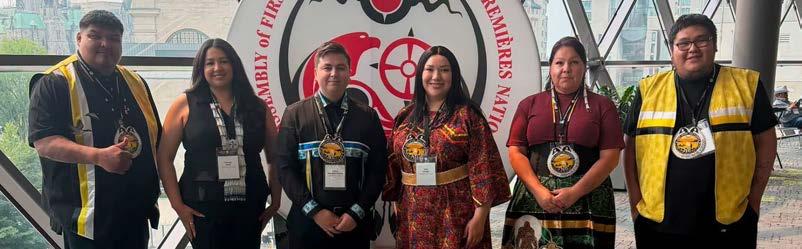
The Assembly of First Nations passed several resolutions during its annual general assembly in Ottawa July 14-16. The Cree Nation Youth Council attended to gain a broader understanding of Indigenous leadership and build connections with the AFN National Youth Council.
Among the issues discussed were resource development, child welfare, safe housing and mental wellness. An emergency resolution on the rst day called on Canada to criminalize residential school denialism.
"When people deny or minimize this history, they do more than deny the past,” said David Monias, Chief of Pimicikamak Cree Nation in Manitoba. “They reopen the wounds of survivors, they dishonour the children, they fuel anti-First Nations racism."
British Columbia AFN Regional Chief Terry Teegee said they proposed including residential school denialism in the recently passed Combating Hate Act (Bill C-9), but the Senate voted against adding it to the bill. He said anti-Indigenous racism is increasing and that the atrocities committed at residential schools need to be accepted as historical facts.
AFN Chiefs unanimously resolved to oppose the Carney government’s plans for major project approvals if they don’t conform with Indigenous rights or environmental protections. National Chief Cindy Woodhouse Nepinak denounced the federal government’s plan for an extensive legislative overhaul, including a new hub for engagement with Indigenous Peoples.
“The federal government can try and set up all the timelines that they want for project approvals, but they can’t put a deadline on First Nations
rights,” said Woodhouse Nepinak.
Facing provincial separatist movements, Chiefs representing the Blackfoot Confederacy in Alberta and Iroquois Caucus in Quebec signed an economic alliance, with other alliances reportedly being planned.
“We’re dealing with separation right now in Alberta, and Quebec and has gone through that so we want to learn from the experiences they’ve went through,” said Troy “Bossman” Knowlton, Chief of Piikani Nation and president of the Blackfoot Confederacy.
The new on-reserve drinking water legislation, Bill C-37, was also attacked by some because it removed direct recognition of Indigenous rights and reduced protections for o -reserve water sources.
“First Nations never gave up jurisdiction over water,” said Chief Sheldon Sunshine of Sturgeon Lake Cree Nation in Alberta. “It was non-negotiable, and it’s still non-negotiable today.”
uations occurring in other parts of Canada. Fire crews continue to monitor wild res in northern Quebec to ensure they remain under control.
A are-up occurred July 12 near km 58, one kilometre from the Chisasibi access road, but SOPFEU re ghters successfully contained it. At press time, the road remained open in both directions.
Around 200 active res caused occasional road closures, including on the Transtaiga Road between km 314 and km 395, Muskeg Road between km 20 (Sarcelle Junction) and km 81 (Eastmain Camp Junction), and LA-1 Access Road.
“The drought and the heat is still concerning because there hasn’t been much rain in the region,” said Tracy Iserho , CNG regional public safety o cer. “It boils down to climate change. We’re experiencing di erent weather patterns. We can’t really predict the weather anymore.”
“We literally had minutes to get on the boats and before it took our town,” said one community member. “We had to run to the beach and once we got there, it was only moments before the re jumped over the [train] track and was coming for us.”
Home to about 40 people, it appears the community was devastated by re. “We know that trees directly next to our houses were on re as community members ed by boat,” said Chief Helen Paavola.
On July 2, the Grand Council of the Crees observed National Wildland Fire ghters Day by thanking the women and men who work to protect forests and communities.
Cree communities have so far been spared the wild re evac-
In Northern Ontario, six First Nations were under a mandatory evacuation notice, including Namaygoosisagagun (Collins), whose residents ed by boat as ames engulfed their community.
“Each season, our community re departments and volunteer crews demonstrate exceptional courage, professionalism, and dedication,” shared the Grand Council. “Often far from their families and loved ones, they answer the call and face demanding, dangerous conditions to keep our communities safe.”
A World of Fantasy
Comiccon is one of the biggest events Montreal has to o er, and it’s not hard to see.
Upon arriving at the Palais du Congrés, I could already tell it’d be big this year. Even before entering the building, Con-goers were everywhere.
Once I reached the main hall, there was an abundance of shops and setups placed in their own sections. The convention was massive, and my father and I spent hours just wandering around and looking to see what to buy.
My favourite purchase of the day wasn’t mine, but my father’s. It was a mystery box. Although I was initially confused and warned Dad that he might regret it, he didn’t budge.
My father wasn’t disappointed when he opened the box. Inside were several knives, random items and the main attraction: a sword – a replica of Kasuki’s Karakuri Rasento from One Piece. Although Kasuki’s role in One Piece is minor, my father looked pretty badass with his sword.
For the remainder of the day, my dad walked around with the sword on his waist, almost as if he was in cosplay – even though he wasn’t wearing a costume.
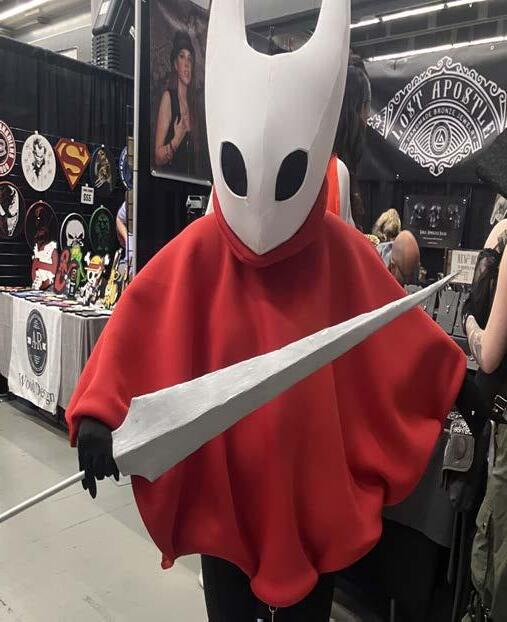
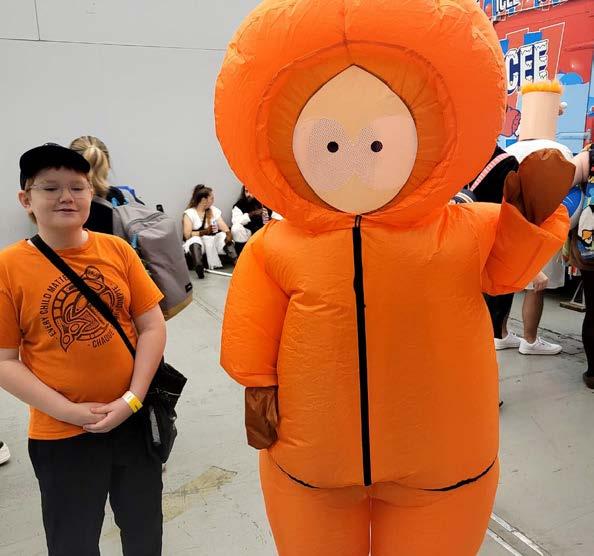
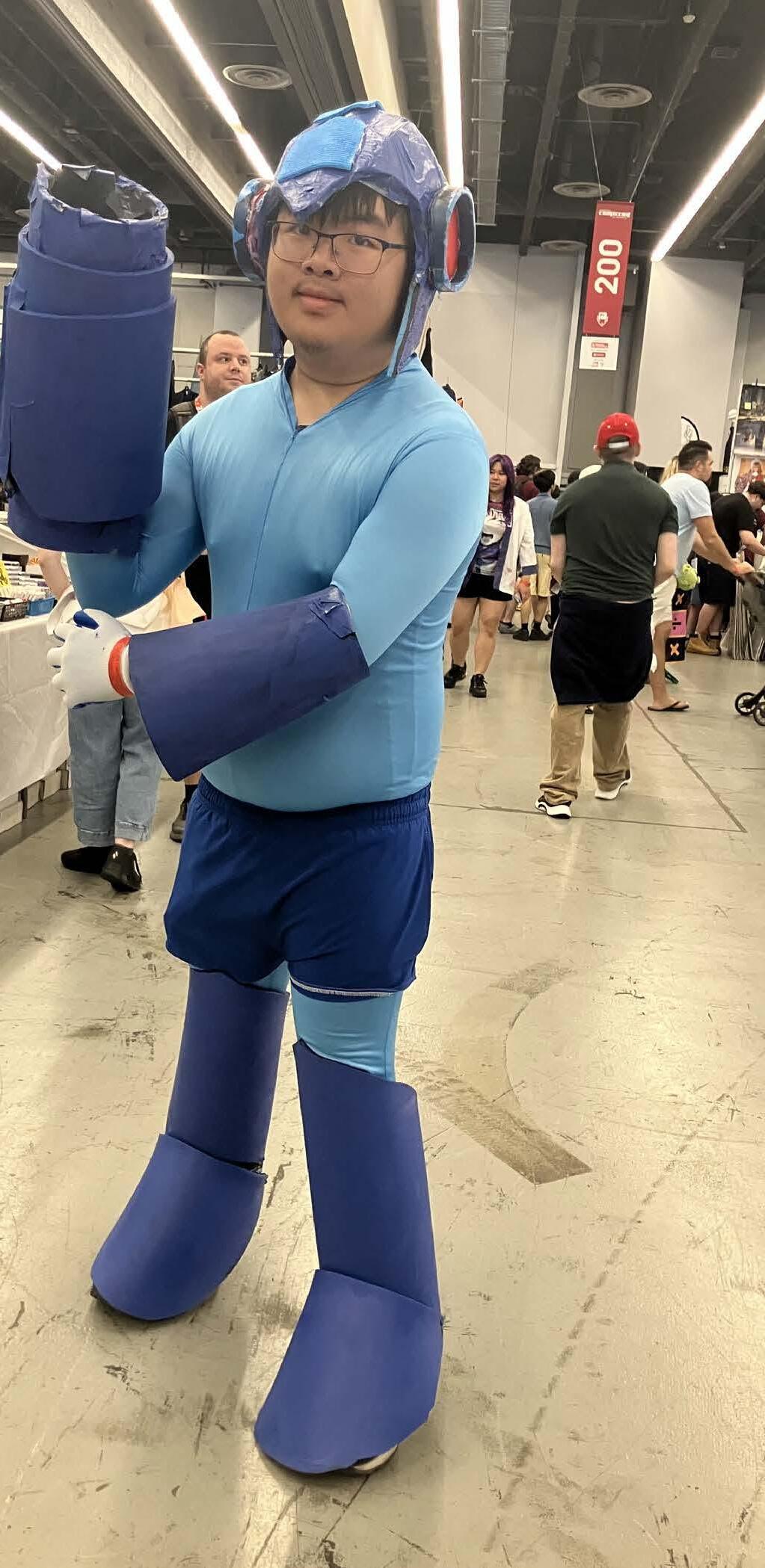
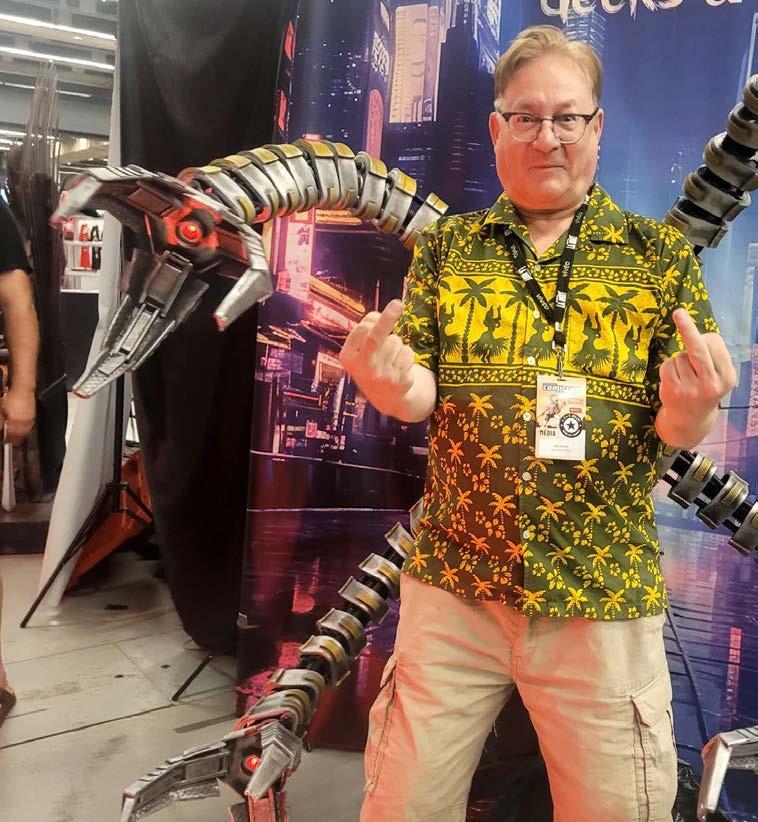
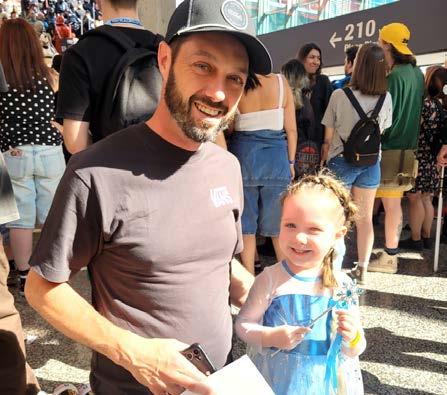
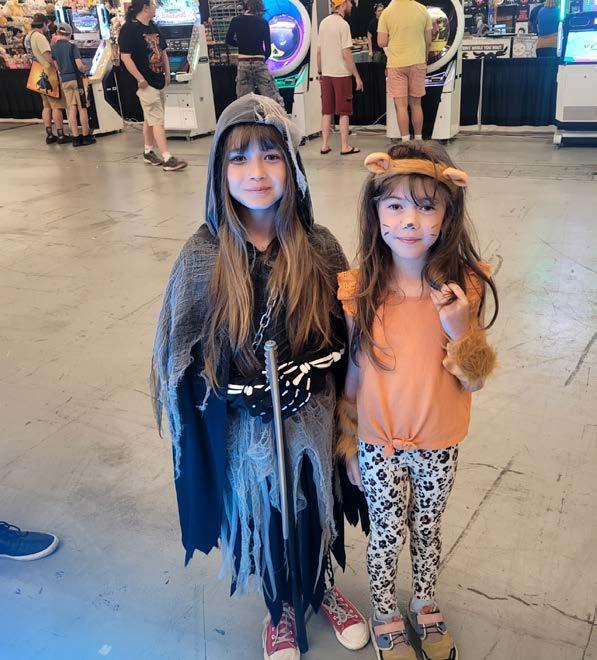
Cosplayers – including me – were everywhere. In fact, there were so many that it broke the Montreal Comiccon attendance record, with over 67,000 visitors. As we walked around, visiting each stand, I couldn’t help but think about the time and e ort fans put into their costumes.
I had a huge scar on my face, but I wasn’t the most out-of-theordinary looking person there. Still, I felt a little shy asking some fans for photos as they all looked so awesome. But very quickly my shyness disappeared, and I started asking many for photos and sel es.
I was dressed as Aoi Todo from Jujutsu Kaisen. In the show, Aoi Todo is best friends with the main character, Yuji Itadori. Due to his popularity, I thought I’d see at least a few other Todos, but that wasn’t the case. Turned out I was the only Todo, though I did count at least 10 di erent Yujis.
Just like the cosplays, the number of things you can do at Comiccon is very diverse – from shopping to socializing to gaming.
As its name suggests, the Zone de jeux indie Loto-Quebéc was an area that had set-ups and promos for upcoming games made by independent Quebec studios. While there, you could’ve sat around on bean bags or played games. Not only this, but everything was being live streamed on Loto-Québec’s Twitch channel.
Among the stores, photo-taking displays were also prominent. Usually, it’d be recreating a scene or a place from a lm, but what fascinated me the most were cosplayers dressed like the characters from certain lms.
Not only did you get to admire fans in costume, but you could meet other people you love, such as comic-book artists and writers, or even celebrities on a higher oor. Like previous years, Comiccon had a wide range of people to meet, including big names like Christopher Lloyd, aka Emmet “Doc” Brown in Back to The Future, or Sean Schemmel, who’s the voice of Son Goku in Dragon Ball Z.
Everything considered, Montreal Comiccon was probably the most fun I’ve had so far this summer. If you’re in Montreal next year, make sure to check out Comiccon 2027.
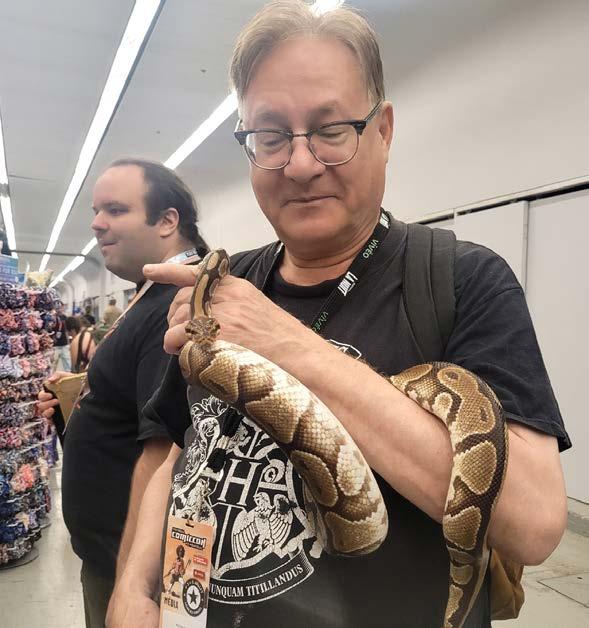
The Montreal Comiccon keeps growing. At this year’s edition at the Palais des congrès July 3-5, there appeared to be every species imaginable as most people were in costume. I better get an out t for next year just to t in.
Over 600 exhibitors o ered everything from comics (of course), to medieval armor, futuristic weapons, el n ears and garb, free arcade games to free online gaming.
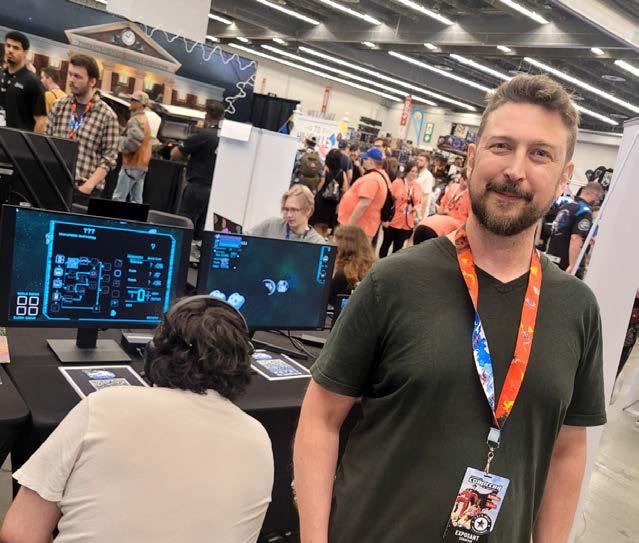
My old friend Jake Kent was one of the exhibitors. He was o ering a rst level tryout for free on the game he has developed. Many other games were on hand to try out and were being played.
There were mock battles and weapons demonstrations. One of the newest o erings were Star Wars light sabres. Wait, you say we’ve had those for years. Not like this, you haven’t. These were metal constructions that looked serious. The price was pretty serious at $100 for a simple model and most selling for over $200.
There were several booths selling these items. And there were plenty of forged swords and knives to examine. Some of them almost made me drool, but I managed to control myself.
My son Declan got to see his rst concert at the K-POP Live Experience. Though he found the sound a bit loud, he enjoyed it.
The guests were great. My favourite was Ron Perlman. You might remember him from Hellboy, Sons of Anarchy, or Fallout to name a few. Chris Noth (Law and Order, Sex and the City), Diana Lee Inosanto (Ahsoka, The Mandalorian, Bu y the Vampire Slayer) and Robert Patrick (Terminator 2: Judgment Day, Peacemaker, The X-Files) were among my favourites.
There are many opportunities to have your photo taken with some of your beloved characters in life-like settings.
Montreal Comiccon is a real pop-culture fan con that has artists and products from entertainment genres such as sci- , horror, anime, gaming in all its forms, and, of course, comic books. There is something for everyone and everything!
Next year’s Con will take place July 2-4, 2027.
More than comics
20-25
Whether you're watching the livestream at home or right in the middle of the action in Chisasibi, we wish everyone an amazing week at the Games.
Thank you to the organizations and businesses supporting this year's Eeyou Istchee Summer Games. Your generous support is giving our Cree youth the opportunity to connect, compete, and make lifelong memories!
Call and Response Res
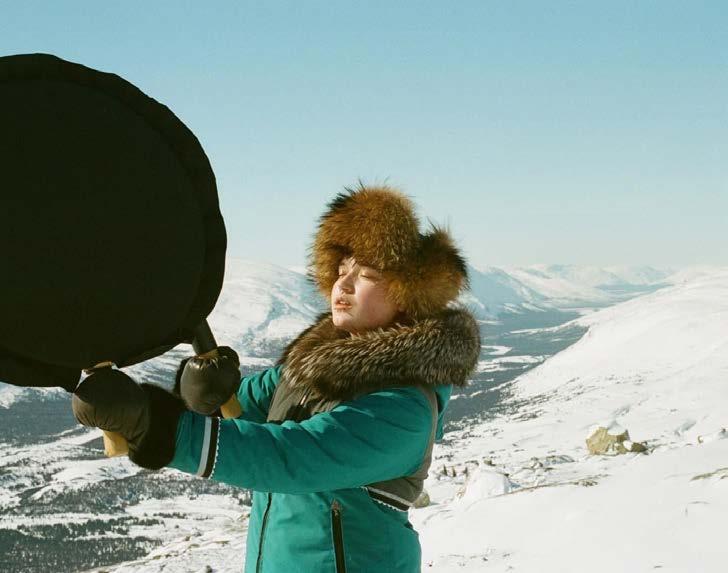
The Montreal International Jazz Festival delivered a dizzying variety of spectacular performances from acclaimed artists around the world June 25-July 4. Legendary Inuk artist Tanya Tagaq was a highlight with a transcendent improvised set July 3.
In a fascinatingly visceral performance, Tagak’s vocals shifted from seductive coos to raging screams in evocations of primordial fertility and political fury. While percussionist Jean Martin and cellist Je rey Zeigler conjured immersive soundscapes, a memorable collaborator was called up from the audience.
Throat singing is traditionally a playful call-and-response game performed by two women facing each other. So Tagaq invited 18-year-old Inuk artist Niivi onto the stage to close the show. Greeting Tagaq with a long embrace, Niivi overcame evident nerves to share a powerful ancestral art.
“We had been in contact for a while but I had never met her in person until that moment on stage,” Niivi told the Nation. “I had never seen such a huge crowd before. I felt myself freeze up even though I kept talking. Then she grabbed me and we started throat singing and everything just kind of fell away.”
Since gaining fame after collaborating with Björk 20 years ago, Tagaq has brought Inuit throat singing to the mainstream in several award-winning albums and books. This year, she recorded her seventh album, Saputjiji, and will see her novel Split Tooth produced as a stage play.
While Tagaq only began experimenting with throat singing after receiving a cassette of traditional songs during college in Halifax, Niivi has been throat singing since she was four. When a white elementary school teacher in
Kuujjuaq played a video of Tagaq in class, it was a revelation.
“It was the rst time I had been exposed to contemporary throat singing with a more alternative approach,” Niivi recalled. “It just blew my mind. She’s very punk. The way she steps into that trancelike state is something I’d like to eventually be able to do.”
Inspired by her father, rock musician Etua Snowball, Niivi played instruments around the house and wrote her rst song at age 7. As she delved into rock, punk and metal music, she also practiced throat singing with the Kuujjuaq Youth Group, who performaned at an annual local festival.
When a recording of Niivi’s folk song “No Pride in Genocide” caught the attention of a Montreal punk festival, she decided to throw a band together and y to the city. Admitting that they were terrible, it nevertheless planted a seed. The band is now nishing work on their debut album, NIVIARSIAK, to be released later this summer.
“We have throat singing on the album but it’s kind of strange because it’s also mixing a full band’s rock sound with punk and metal in uences,” said Niivi. “The opening track is a traditional song about the owl, an homage to my great-grandmother whose art form was sewing little owl dolls.”
Jeannie Snowball was a trailblazing Nunavik artist who “accidentally” became an activist after her ookpik (Inuktitut for snowy owl) doll became a government-recognized symbol for the Inuit. Coming from a long line of activists, Niivi said she was taught the importance of “using your voice to make a di erence.”
In 2020, Niivi helped her friends Tobi Nashak and Aputi Arnatuinak launch Kuujjuaq’s rst Pride festival. While Niivi’s been told it’s not in Inuit culture to be queer, she counters that the
Inuit creation story involves “two gay men and eventually a trans woman,” asserting that queerness has existed in Inuit society “since the dawn of time.”
“Every year we do the Pride parade so Inuit youth see that representation and that it’s accessible to them also,” said Niivi. “Even if it’s a slow process, as long as we exist, we’ll be making a di erence.”
Growing up in the music scene because of her father, Niivi was guided by artists like Elisapie and Beatrice Deer. She launched a tour last summer by contacting “every Inuit-led festival in every Inuit territory.” A visit to Greenland was particularly inspiring, she added, noting that their cultural revolution was sparked by the 1970s rock band Sumé.
“I feel like our culture is this one big puzzle piece that starts to come together once you’re able to connect all these di erent territories,” Niivi suggested. “Greenland has kept mask dancing and a lot of shamanic practices whereas Nunavik hasn’t but we’ve kept throat singing and Arctic winter games.”
This summer, Niivi is balancing music with helping Cegep preparatory program Nunavik Sivunitsavut develop its curriculum. Entering her third year of Cegep, she said the transition from Nunavik to post-secondary studies exposes an education gap.
Finally meeting Tagaq at Jazzfest was a welcome surprise. While the two had corresponded online, Niivi had never witnessed a live performance. Their craft is an intimate practice, and Niivi was grateful to sing with an artist she greatly admires.
“Tanya has told me she wants to support me as much as she can,” said Niivi. “She’s been one of the most important people in my career. It was exhilarating and I think there has been more people looking for my music.”
ponse
The Cree IELCC Fund is designed to fund projects/activities that foster the education, Cree culture and language, as well as health and wellbeing of children 0 to 6 and their families.
The Cree IELCC Fund is designed to fund projects/activities that foster the education, Cree culture and language, as well as health and wellbeing of children 0 to 6 and their families.
The Cree IELCC Fund is designed to fund projects/activities that foster the education, Cree culture and language, as well as health and wellbeing of children 0 to 6 and their families.
The Cree IELCC Fund is designed to fund projects/activities that foster the education, Cree culture and language, as well as health and wellbeing of children 0 to 6 and their families.
The Cree IELCC Fund is designed to fund projects/activities that foster the education, Cree culture and language, as well as health and wellbeing of children 0 to 6 and their families.
All projects and activities must also ensure that no children are left behind: activities must be accessible to all children, no matter their level of ability or special
All projects and activities must also ensure that no children are left behind: activities must be accessible to all children, no matter their level of ability or special need.
All projects and activities must also ensure that no children are left behind: activities must be accessible to all children, no matter their level of ability or special Deadline
All projects and activities must also ensure that no children are left behind: activities must be accessible to all children, no matter their level of ability or special need.
All projects and activities must also ensure that no children are left behind: activities must be accessible to all children, no matter their level of ability or special need.
to
DIGGING UP THE
By digging down to the roots of his family tree, Cole Bosum began a journey that has led to the creation of the Eeyou Istchee Genealogical Society. Since last fall, the organization is an o cial non-pro t organization, and features a website to collect, preserve and share the Cree Nation’s ancestral heritage.
“I’d like to see something that really lasts and grows,” said Bosum. “This will succeed based on people volunteering and sharing their histories and documents. I’d like to o er people a book of life where everything about their family history is available.”
A child of a mixed-race couple, Bosum knew his father had French Canadian roots but had di culty researching his mother’s Cree ancestry beyond OujeBougoumou. Exploring community graveyards, church records and the Hudson Bay Company’s archives, he eventually traced her ancestry back to the 1700s.
“One ancestor I have is German, a soldier who came with the British when the American revolution started, emigrated north to Canada and married this French woman,” Bosum revealed. “Their child ended up working at the HBC post in Eastmain. It’s interesting to know we may have cousins on the other side of the ocean.”
While the genealogical society is still in its early stages, the Facebook page has already over 500 likes. Bosum posts transcribed censuses dating back nearly a century when he’s not at his job as a CBC journalist. He plans to study at Concordia University this fall, and eventually medical school.
“The census is like a snapshot,” Bosum explained. “Sometimes they can tell a story of where people moved throughout
ROOTS
the years. People were more nomadic back then so not everybody is included.”
Although the digitization of archives in recent years has simpli ed searches, research still involves combing through old certi cates, academic journals and personal records – there’s an extensive privacy policy. Bosum hopes to collect available information into a centralized resource for Cree people curious about their family trees.
“I’d like to o er members the digitized records of all the collections,” said Bosum. “It might help people regain their Indian status or be helpful with [researching] genetic diseases – I think there will be a lot of bene t. I’ve yet to develop membership classes. I’m hoping people will volunteer as well.”
Bosum cited the extensive work of Janie Pachano from Chisasibi. Pachano’s investigation into her extended family’s genealogy traced a hereditary disease now known as Cree leukoencephalopathy (CLE) all the way back to Hudson’s Bay Company workers from Scotland’s Orkney Islands in the 1700s.
CLE targets infant brain development, causing the nervous system’s white matter to vanish. Appearing healthy at birth, symptoms start after three to nine months, typically after a fever or virus. Victims usually die within a few weeks or months. There is no cure. Risk of CLE, it’s now known, comes only when both parents carry the defective gene, which can be diagnosed through a blood test.
Pachano’s family has lost many newborns to this disease. Believing it was genetic, she began researching her family tree. Some branches reached to Mistissini and Whapmagoostui.
After volunteering to help other a ected families, Pachano was contacted by Dr. Deborah Black in Vermont. Dr.
Black had been researching the disease since working in Chisasibi in the 1980s and sent Pachano the names of all documented cases since the 1970s. After successfully tracking these family histories, Pachano received a memorable phone call from Dr. Black.
“The researchers in England said you saved them 20 years of research,” Pachano recalled hearing. “I thought there’s probably other genetic diseases around so why not do family trees for all the Cree communities. I’ve been doing that in my spare time. I think I covered all the surnames in Eeyou Istchee.”
More than 30 years of research led to Pachano to complete a 700-page book called Aayanschaa: Family Trees of Eeyou Istchee, that will soon be sent to a publisher. It will include individual family stories and an etymology of Cree surnames.
Pachano knew everyone by their Cree name when she grew up on Fort George Island. But after returning from high school in 1958 she was surprised that everyone except Elders were now known by English names. At the time, church missionaries regularly changed surnames.
The Chisasibi family name House is an interesting example. The rst to be given that name had supposedly loved tagging along on visits to the Hudson Bay trading post, wanting to visit the manager’s house. They started calling him Waskahigan (House).
“The son of the original House married my grandfather’s grandmother,” said Pachano. “His rst children were baptized with the Cree name Waskahigan but the others were anglicized with the name House so that’s the one used today.”
Her husband’s Pachano name derives from the Matthias family, whose mar-
ried sons used their Cree name as their surname. The Cox family name is connected to Peter Cock from the Orkneys but a missionary preferred the spelling change. Names like Masty and Kawapit have been shortened. Robert Kanatewat had his name changed to Robert Kay in school, which he later changed back.
“My great-grandfather’s Cree name was a nickname, ‘to leave out,’” said Pachano. “I’m told he was a lousy storyteller who always left out the important parts and the punchline. In residential school, I always said my last name was ‘Leftovers’, then it was Matthew because his rst name was Matthew.”
Fort George records go back to 1852 while Moose Factory’s extend to 1840, when Cree people started getting baptized. Some archives record only male relations and some only list Cree names. Pachano researched ancestry.com, church records and censuses. Pachano then pieced together family names during individual interviews.
“Elders have good memories and kept track of their relations,” Pachano said. “I’ve heard of two cases married legally who had the same father and di erent mothers. One couple who had a child didn’t know they were brother and sister because of all the changes in names.”
Pachano is an energetic writer. After publishing the comprehensive history Chisasibi and Its People in 2020, she followed up with a guide to Eeyou Istchee’s berries earlier this year. Now she’s nishing a book about traditional rites of passage, such as the walking-out ceremony.
“I’m reaching the end of my life so I have to keep busy to complete everything I’ve decided to do,” Pachano re ected. “It was a big chunk of my life and I did it all for free. I feel I can go quietly and happily into the next world.”
Arecent workshop in Chisasibi gathered input for an initiative exploring “Community-Led Pathways for A ordable and Resilient Housing.” The three-year project is a collaboration between the Cree Nation of Chisasibi, the Chisasibi Eeyou Resource and Research Institute (CERRI), Concordia University, and the Volt-Age Living Lab.
By combining technical solutions with community engagement and energy-planning expertise, the project addresses issues of overcrowding, aging infrastructure, high energy costs, and the impacts of harsh weather. The collaborative approach is designed to re ect the community’s unique needs, values and priorities.
“The housing situation in Chisasibi is a big problem,” said Brody Sam, a 17-year-old trainee at CERRI. “The biggest issues are mould, overcrowding and having to make additions to current housing. I’ve sometimes seen three families in one house. I heard of tenants who had to move out due to mould problems.”
A Cree Health Board housing study in 2000 documented structural damage and substandard quality stemming from the community’s relocation from Fort George Island around 1980. Damp homes and the highest rate of over-
crowding in Quebec lead to respiratory problems, decreased immunity and headaches.
In 2007, Chisasibi began nancing home purchases, construction or improvements; grants compensated for the high cost of materials. The First Nations Market Housing Fund stated that 1,000 units were required to resolve Chisasibi’s housing crisis.
The community’s rapid expansion can be witnessed in several new residential areas. In May, Eenou Eeyou Construction announced the launch of 25 new duplexes, including one built by students as part of a new training program.
“It provides an opportunity to develop local skilled workers while allowing learners to contribute to a project that directly bene ts their own community, giving their work a strong sense of purpose,” said Raphaëlle Audet, spokesperson for project partner Hardy Construction.
Chief Daisy House said that it’s a shared goal to train more community members in home building. “From starter homes to adapted units, from tiny homes to an almshouse for those without a home, housing will always be a priority,” she a rmed.
When Concordia University contacted Chief House about an initiative to improve housing quality while reducing costs, she forwarded the le to CERRI. Sustainability specialist Jason Stevens worked with Concordia to create a project proposal, which became a training opportunity for Sam.
“We’re still in the early stages of the project, trying to build awareness on mould, what causes it and how it a ects our health,” explained Sam. “We’re still trying to get information about how mould forms in these houses. Some houses are outdated. In the coming
weeks, we’ll reach out to people to see if they have mould problems and work from there.”
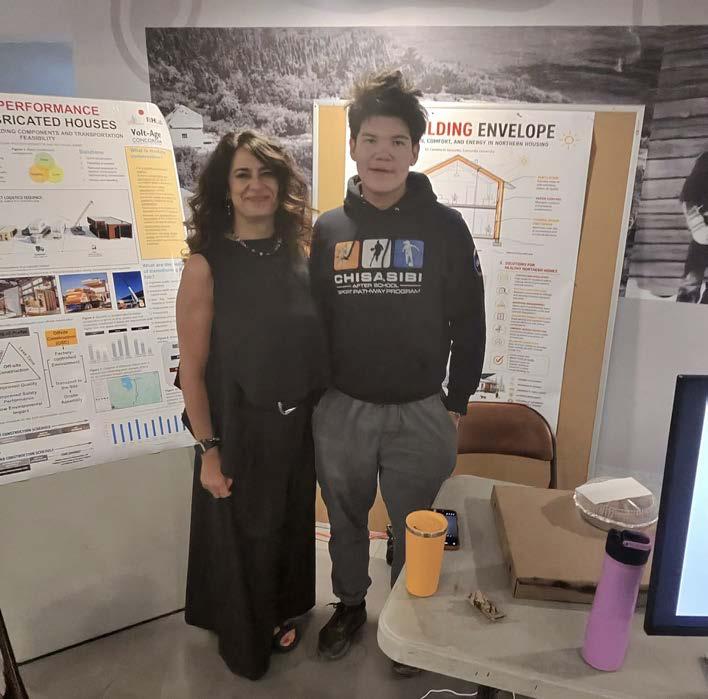
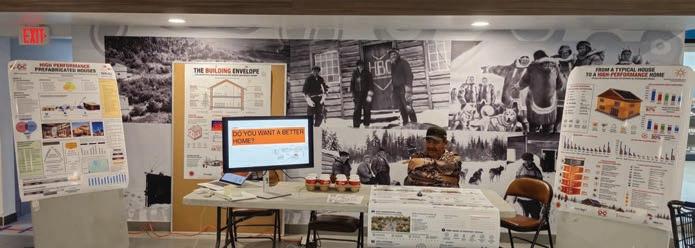
On June 25, Sam and project lead Caroline HachemVermette set up an information booth to gather perspectives about the housing situation and identify problems. Presentations focused on the building envelope, which separates the indoor living space from the outdoor environment, and explored how upgrading existing homes can result in better comfort and signi cant energy savings.
“The visit was helpful as a beginning to build trust, which is very important,” said Hachem-Vermette. “One of my goals is to bring the message that I’m working for the community and with them. The most important thing is to gather as much information as possible to build the rst housing models in our simulation that re ect the realities there.”
Funded by a research program called Volt-Age, this is the sixth “Living Lab” in Canada where teams of Master’s students co-develop community-driven solutions to decarbonization. Integrating cutting-edge technology to create more e cient buildings and systems, the program emphasizes the unique needs of Indigenous communities.
Hachem-Vermette said they will use simulation software to create digital replicas of existing buildings to evaluate current performance. This will serve as a base to compare proposed improvements.
“The simulation is quite extensive and we have proven that it can capture the realities using the climate in the Chisasibi area,” said Hachem-Vermette. “Another thing we’ve talked about is making some experiments, both in Chisasibi as well as our environmental lab at Concordia that can measure conditions from minus-40 to plus-50 [degrees Celsius].”
The process involves regular communication between Concordia and Chisasibi to continuously add feedback and revisions to developments. As the community looks at housing problems and solutions, questions are already being raised about how regional factors may impact buildings.
“There are suspicions, not proven, that because La Grande River doesn’t freeze over anymore, it remains liquid with a vapour coming o , perhaps that is a ecting the microclimate around here in some way,” said Stevens. “It’s still speculative but it is something we’re looking at.”
As the local water table is high, ditches made for drainage before construction may contribute to greater humidity if houses haven’t been built with those conditions in mind. While air exchangers and heat pumps can reduce humidity inside, Stevens suggested that they’re not always properly operated or maintained.
To keep the community walkable, new homes might build up rather than out. Stevens highlighted that storage units should be a consideration in new apartment buildings as Crees often need space for ATVs and skidoos.
The community is exploring prefabricated housing, perhaps even constructing them in Chisasibi and exporting to other Indigenous communities. As the project proceeds, it is creating career paths that will be in demand as the Cree Nation grows.
“Another thing we’re doing is training inspectors,” said Sam. “We’re trying to build a council so we can have a meeting every now and then to discuss housing problems. I’m building new connections. Caroline introduced me to maybe doing some engineering in the future.”
Under the Northern Sky
First Nation youth representatives are letting the world know that Indigenous people are ready to stand up and protect the land. Keira Spence, Kohen Mattinas and Ryan Fleming are attending the United Nations Expert Mechanism on the Rights of Indigenous Peoples in Switzerland. This special gathering is holding its 19th session from 13 to 17 July 2026 at the Palais des Nations in Geneva.
The UN Expert Mechanism on the Rights of Indigenous Peoples (EMRIP) was established to assist member UN states and indigenous communities in implementing the United Nations Declaration on the Rights of Indigenous Peoples (UNDRIP). It carries out this mission through research studies, country engagements and through annual forums every July. The annual July event provides a platform for Indigenous representatives, advocates and state governments to meet, debate and voice human rights concerns directly to the United Nations.
Although EMRIP has no authoritative power, its studies and advice are widely regarded as authoritative interpretations of UNDRIP. Canada is one of many countries that follow EMRIP guidance to draft local laws and stay informed by its reports.
This is the second international UN forum for these First Nation youth representatives. They previously attended the UN Permanent Forum on Indigenous Issues (UNPFII), held at the United Nations headquarters in New York this past spring, in April. Kohen Mattinas and Ryan Fleming attended that event with Jeronimo Kataquapit and Ramon Kataquapit as part of a First Nation youth delegation.
This time in Geneva, Kohen, Ryan and Keira were able to attend as independent First Nation youth representatives through the support of Nishnawbe-Aski Nation (NAN). Although they received some nancial support,
they had to fund much of their own travel expenses in order to attend the event. At 25 years of age, Kohen, of Lac Seul FN / Constance Lake FN, had always taken an interest in First Nation youth issues but it was the summer of 2025 during the introduction of Ontario’s Bill 5 and Canada’s Bill C5 that made them take on a more prominent and active role in advocating for environmental protection and Indigenous rights. Ontario’s Bill 5 and Canada’s Bill C5 have galvanized Indigenous land defenders due to their displeasure with these legislations that aim to fast track mining development and directly a ect the lives and futures of First Nations. Kohen believes it is important for them to attend these international forums, especially one from which Canada directly seeks advice and guidance. As Kohen explained, “the most important thing for me is in strengthening Indigenous jurisdiction so that we can have more control of our lives and our future. We need to nd our own power and regain our Indigenous jurisdiction because if we don’t, Canada and its levels of government will always have the underlying authority over everything we do”
Ryan Fleming, of Attawapiskat FN, a doctoral student at the University of Toronto, brings a wealth of knowledge and training in political science studies as well as experience in federal government research and policy roles. At 34 years of age, he explained that his background has provided a perspective on Canadian institutions and politics that has greatly assisted their youth delegation at these international events. I had a chance to speak to Ryan and he was happy to be taking part in this forum, where they could mix with other Indigenous groups from around the world facing similar situations. He reminded me that historically First Nation leaders often worked cooperatively to achieve their goals and that is how they are working together to
share ideas and o er unique perspectives as academics, youth leaders and grassroots organizers, drawing on their backgrounds of living on reserve, o reserve or in urban environments.
Keira Spence, of Moose Cree FN, is the youngest member of their group at 20 years of age and she was happy to take part in the delegation. She is an artist and land defender who is also a cofounder of Okiniwak, a First Nation youth movement also founded by Kohen Mattinas and Ramon Kataquapit. She comes from a family of leaders, including her great aunt Chief Theresa Spence, of Attawapiskat FN. She delivered an intervention at the UN EMRIP forum, which was a short presentation delivered to the gathered international audience. She was excited and proud to be taking part in this event. She explained that she wanted to empower youth and felt a great need to represent her community, her territory and especially Indigenous youth on matters as important as the future of the land they call home.
I was greatly impressed by these young representatives, as their advocacy and bravery reminded me of the work of First Nations leaders in northern Ontario in the 1970s and 1980s. Their grassroots initiative and drive to make First Nations heard reminded me of people like Andrew Rickard, who helped found the Nishnawbe-Aski Nation, or people from my home community of Attawapiskat like Fred Wesley or Elder Emile Nakogee, who took it upon themselves to represent, advocate and speak for our people.
Kohen, Ryan, Keira, Jeronimo and Ramon are a new generation of grassroots Indigenous leaders and it makes me proud to know that they are working hard to represent our people as best they can. They are doing an amazing job because they are making the world listen.