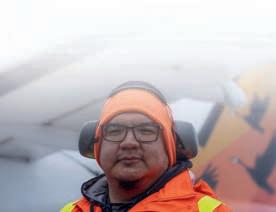
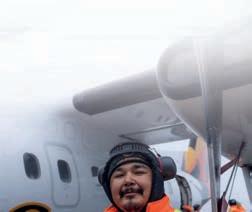
My Uncle Don needed a medical escort for checkups and tests in Montreal. I agreed to accompany him during a splendid week-long stay at the Espresso (wink emoji).
It’s amazing how many Cree are staying there these days. The food has improved with Gestion ADC, a Cree company that provides tasty and healthy meals. When not going to the hospital I pushed Don around in his wheelchair to di erent parts of Montreal, from Alexis Nihon to a little beyond the Eaton Centre.
Don enjoyed these trips for the most part, though at times I went a little fast for him. I thought these outings would be good for him after reading about how people mentally su er from con nement. It was great exercise for me as well. It led me to wonder about other Crees who have no choice but to stay in the hotel. There is no green space in that area of downtown Montreal, which has to be di cult given the ties that Crees have to the land. Perhaps this summer the Cree Health Board could organize a few picnics in a park for patients and their escorts. Being outdoors would be uplifting for many and that is always good for your health.
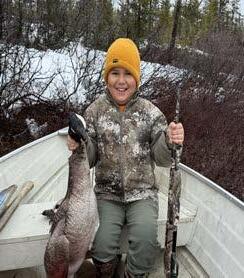
When we returned to Mistissini, I wheeled Don into his home where somebody told me that there was a lone goose at the point. I quickly borrowed a gun and headed down to the blinds, sinking in the snow while still wearing my Montreal clothes. It was a bit of shock given that it had felt like summer earlier that day when we left the city.
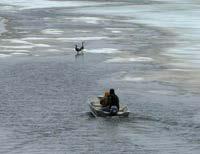
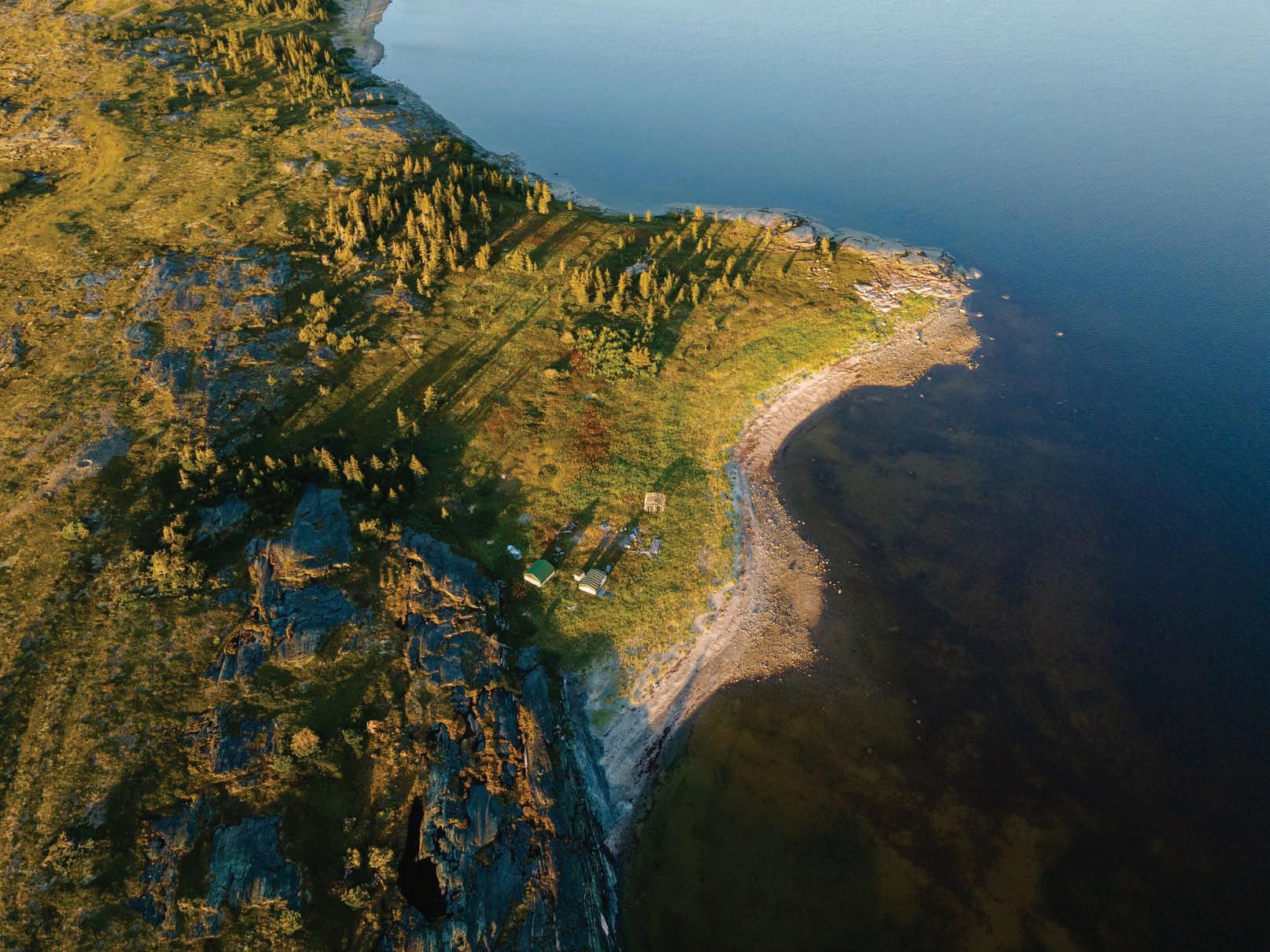
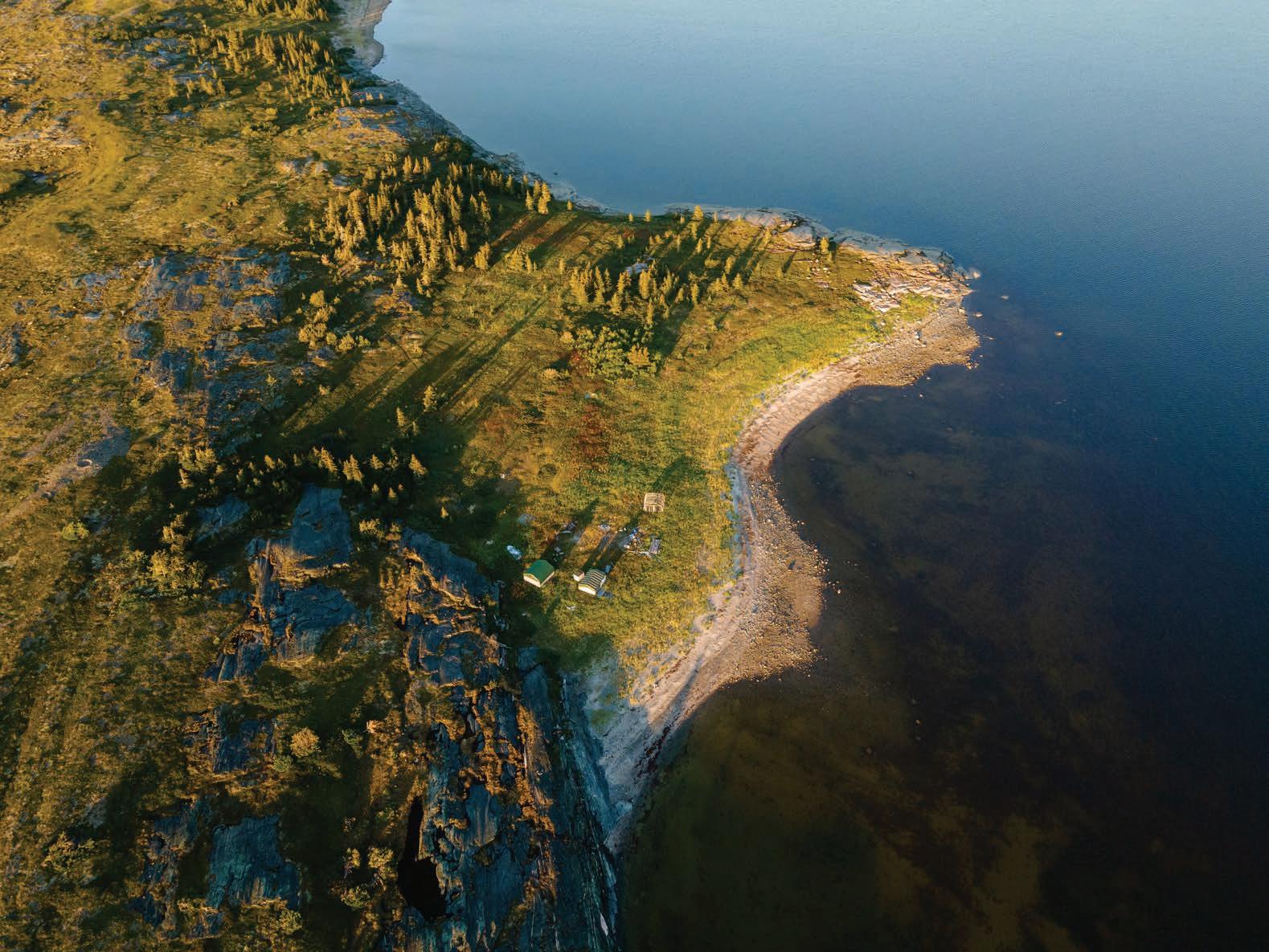
Taking my time, I shot the goose and then put the canoe in the water to retrieve it. All this within 15 minutes of arriving at the lake. It felt as if the land had welcomed me back. I was blessed. What a great feeling.
All told, I harvested two geese and two ducks. I cooked the rst goose and we took it to Chibougamau to share with my mother. Some of the leftovers went to other Cree who were happy to have a familiar taste of spring.
So, it was good feelings all around for all the right reasons. Perhaps a few of you hunters should send a goose or two to the Espresso for those Cree who can’t hunt. I’m sure the Cree Health Board would put them on a medical charter. It would be a great addition to the traditions of sharing at Goose Break, which is an essential part of the Cree way of life.
is published every two weeks by Beesum Communications
EDITORIAL BOARD L. Stewart, W. Nicholls, M. Siberok, Mr. N. Diamond, E. Webb
Ludwick
EDITORS Lyle Stewart, Martin Siberok
Kataquapit,
Aucun dossier médical requis.
Répondez aux questions avec vos propres mots. Des assistants aux réclamations sont là pour vous aider.
Un soutien gratuit, respectueux des cultures et tenant compte des traumatismes est o ert à chaque étape.
Si vous avez été admis dans un hôpital fédéral indien pendant la période où il était exploité par le gouvernement du Canada (entre 1936 et 1981), et que vous avez subi des mauvais traitements psychologiques, verbaux, physiques et/ou sexuels, vous pourriez être admissible à une indemnisation entre 10 000 $ et 200 000 $ dans le cadre du Règlement des hôpitaux fédéraux indiens.
Vous n’avez pas besoin de dossiers médicaux pour soumettre une demande d’indemnisation. Le formulaire de réclamation vous demande de fournir vos coordonnées, une copie d’une pièce d’identité émise par le gouvernement et de répondre à des questions sur votre expérience. Vous pouvez prendre le temps dont vous avez besoin. Vous n’êtes pas seul(e) dans cette démarche.
Un soutien gratuit est o ert
Des assistants aux réclamations sont disponibles partout au pays, sans frais. Ils peuvent :
• répondre à vos questions et vous aider à comprendre le processus de réclamation
• vous aider à remplir le formulaire de réclamation
• vous accompagner à un rythme qui vous convient
• vous orienter vers d’autres ressources gratuites
Les assistants aux réclamations peuvent vous rencontrer par téléphone, par vidéo, et en personne dans certaines communautés. Plusieurs sont Autochtones, et tous sont formés pour offrir un soutien respectueux des cultures et tenant compte des traumatismes.
Commencez votre demande d’indemnisation. Pour en savoir plus ou parler à un assistant aux réclamations: Appelez au 1 888 592-9101 et appuyez sur le 2 du lundi au vendredi, entre 8 h et 20 h, sauf les jours fériés Visitez https://www.IHSettlement.ca/fr
Un soutien en matière de santé mentale et de mieux-être est disponible 24 heures sur 24 par l’entremise de la Ligne d’écoute d’espoir pour le mieux-être au 1 855 242-3310 ou en ligne à http://www.EspoirPourLeMieuxEtre.ca/.
While a national Indigenous tourism agency faces funding challenges, Quebec tourism organizations continue to launch new projects for visitors in Cree communities.
According to Keith Henry, president of Indigenous Tourism Association of Canada (ITAC), a funding crisis at the organisation is raising concerns about the future of the industry.
“This is a very di cult time for Indigenous tourism in Canada,” he said. “One of the reasons that Indigenous tourism hasn’t grown e ectively in the past has been a lack of Indigenous-led coordinated strategy.”
Henry said federal funding for ITAC was reduced by 87% over the past three years – “we’re reduced to basically 0% for infrastructure,” he said – with only limited support remaining via Destination Canada.
“It’s a dramatic decrease in funding,” he stated. “It’s really going to a ect our industry at a time we should be building. This is the wrong direction.”
Henry said one of ITAC’s most important initiatives now threatened by the cuts is its Indigenous branding and accreditation program, which connects authentic Indigenous tourism with domestic and international visitors.
ITAC is asking its tourism partners to send letters of support to federal o cials, urging Ottawa to create stable, long-term investments for Indigenous tourism.
“We need them to invest in sustainable funding over multiple years,” Henry continued. “My hope is that we see at least $5 million invested per year.”
Henry hopes provinces continue to support Indigenous tourism businesses directly, yet Canada still lacks a clear national strategy and leadership structure for the industry.
“In Quebec, the Cree Out tting and Tourism Association is so critical in helping coordinate marketing and development work and opening up opportunities,” he said. “We need this industry coordination, and nobody really owns that federally.”
Despite the challenges, Henry believes the demand for authentic Indigenous tourism continues to grow both in Canada and internationally.
Re ecting on his visits to Cree communities, Henry hopes the industry can survive the crisis if governments recognize its long-term economic and cultural value.
“I really want the Cree businesses to continue to be in the importance of Indigenous tourism, their work is essential to their communities,” he said.
“I just hope people don’t lose hope in having a national organization like ITAC, and know that we’re doing everything we can to get through this crisis,” he added.
Quebec tourism leaders are preparing for a busy summer as new projects aim to strengthen sustainable travel, improve infrastructure and showcase Cree culture. Entente de partenariat régional et de transformation numérique en tourisme (EPRTNT), for example, o ers Cree businesses funding support of up to 90% of eligible costs for tourism projects.
Cree Outfitting and Tourism Association (COTA) executive director Robin McGinley said sustainability remains at the centre of the organization’s long-term vision for Cree tourism.
“We started getting trained on green stu ,” McGinley said. “And now we’re working with GreenStep to help tourism businesses have a sustainable tourism action plan. Whether that’s soap dispens-
ing machines or water ltration systems, the idea is to help tourism businesses in Eeyou Istchee do their sustainable tourism action plans with GreenStep.”
Another major initiative focuses on the Billy-Diamond Highway, where COTA is partnering with regional and government organizations to encourage more travellers to experience northern Quebec by road while also improving conditions for residents who regularly use the highway.
McGinley noted that COTA’s Niimaawin Food-for-Travel project with Cree-style meals designed for travellers has received support from both federal and provincial partners.
Alongside infrastructure and sustainability projects, McGinley highlighted the work of Wiinipaakw Tours, which o ers boat tours led by Cree captains in Waskaganish and Wemindji.
“You have a chance to maybe see belugas or seals or sometimes a polar bear,” she said.
McGinley also mentioned the Wakaaniichii Nature Interpretation Centre, which includes an aerial trail and oating cabins where visitors can stay while learning about Cree culture.
Safety planning is another focus this summer, creating risk-management plans for emergencies such as forest res or accidents.
For a decade, Chapais business owner Anna Bosum has welcomed visitors to learn about Cree traditions on the
land through her company Nuuhchimi Wiinuu Cree Cultural Tours.
“I invite people, especially students, and I teach them about Cree way of life,” Bosum explained. “Also, we are trying to keep our Cree language alive.”
When she rst launched the business, Bosum received assistance from COTA.
“They coached me and helped nd the funding for me to set up my camp,” she said. “But now I haven’t been receiving any funding. Now we try to do things in our own way.”
Her business remains small and community-focussed, operating largely through family involvement, and income comes directly from guests who participate in the cultural activities. Despite the nancial challenges, Bosum is satis ed with how the business has developed.
In her opinion, local and regional tourism organizations continue to play an important role in helping Indigenous entrepreneurs start businesses and seek funding opportunities.
“We do have in our community people who run the tourism and who help others start up own businesses,” she said.
While she did not comment directly on the ITAC’s nancial di culties, Bosum believes support systems are vital for Indigenous tourism businesses trying to preserve culture and build sustainable operations in northern communities.
The Val-d’Or Indigenous Friendship Centre is welcoming the ndings of the coroner’s report regarding the death of Pasha Ekoomiak. The anglophone Inuk and Cree woman was unhoused when she died three years ago in the Val-d’Or Hospital.
Quebec coroner Stephanie Garnache called for better coordination of services for Indigenous people who are experiencing homelessness, retaining three of four recommendations submitted by the Friendship Centre. Garnache recognized the Centre is actively working to improve quality of life, promote cultural resurgence and advance reconciliation.
“The coroner is aligning her recommendation to recognize our clinic with stable and adequate funding, aligned with the Viens Commission that had a call to action speci cally targeting Indigenous health clinics through friendship centres in Quebec,” said executive director Edith Cloutier.
While acknowledging that Ekoomiak received diligent care at the hospital, the Centre emphasized that her precarious circumstances highlighted the importance of stronger social safety nets, community partnerships and culturally grounded services. It called on the Quebec government to act promptly and sustainably to ensure appropriate funding.
The coroner’s report underscored the importance support, prevention and decriminalization. The Centre asserted that “behind every situation of homelessness lies a human life, a story, a dignity that must be recognized.”
“If we meet the needs at the frontline for our people, it’s bridging that gap because they trust the culturally safe space we o er,” said Cloutier. “Then we can connect our people to access
the more general services. It’s unfortunate it takes such tragedy to raise issues about better meeting the needs of Indigenous women homelessness which are often faced with invisibility and exclusion.”
A drinking water source on trapline W24D long used by many Cree families in Waswanipi was damaged by forestry work conducted last fall. Allan Saganash shared pictures on social media of the signi cantly disturbed site, suggesting it was likely a communication issue between the forestry consultation table and workers doing eldwork.
“I am hoping they will return to this area and clean up the mess they made around the water source,” said Saganash. “It’ll be a while before anyone can use this spring water as it may be contaminated by oil and fuel spills leaking into the water source from the melting snow.”
The Ministry of Natural Resources and forestry workers were informed of the location of this water source, which was even marked o the Cree land use mapping process completed for this hunting ground.
Saganash is a respected forestry expert who has worked for decades as a consultant between tallymen, government and industry. As a technical consultant during negotiations for the 2002 Paix des Braves agreement, Saganash asserted that har-
monization measures are not being su ciently respected.
“The CNG forestry department as a signatory needs to provide more support to the local communities to have better protection from forestry work on our family hunting grounds,” Saganash said. “I am sure this is not the only water source damaged by forestry work on the hunting grounds of Eeyou Istchee.”
Renowned Cree-Mennonite cellist and composer Cris Derksen died in a highway crash May 15 after attending the funeral of her father in Tallcree First Nation in northern Alberta, where the two-spirit artist was from.
Derksen was in the passenger seat of the vehicle driven by her wife and frequent musical, Rebecca Benson. Both drivers involved in the crash were taken from the scene with serious, life-threatening injuries.
Many called the 45-yearold Juno-nominated artist a visionary and trailblazer. Derksen’s 2015 project Orchestral Powwow became one of the de ning works of contemporary Indigenous classical fusion. Derksen founded the Indigenous Classical Gathering at Ban Centre for Arts and Creativity, and made her Carnegie Hall debut in 2024 with Orchestre Métropolitain.
“Cris was the kindest, most generous, loving, brilliant, coolest human,” said Dene fashion designer Sage Paul. “A one-of-a-kind vision-
ary. She was a collaborator and mentor to so many, and she accomplished so much. She leaves a legacy that will live forever.”
Derksen had a genre-defying sound, blending classical strings with electronica and folk music, often featuring traditional melodies with powwow drums and chants. Internationally acclaimed album Controlled Burn was heavily featured by symphonies across Canada.
“I don’t really have a genre that I fully t into, which I think is a good thing,” Derksen said in 2009. “I have an almost speci cally Aboriginal audience, an indie queer audience and an older art-folk audience. As a musician, it’s super helpful – I can play a lot of di erent venues."
After performing the music festival circuit alongside Tanya Tagaq in 2006, Derksen soon became a xture of the country’s symphony stage. Derksen’s music was commissioned by several orchestras and she had performed recently in Asia, Europe, and Australia. Last year, she was a composer for the Canadian Pavilion at the World Expo in Osaka, Japan.
Derksen performed on numerous occasions at Montreal’s First Peoples International Festival. Festival organizer Land Insights remembered her as a “virtuoso cellist, breathtaking improviser and renowned composer ... deeply convinced of the regenerative power of art to heal the wounds of the past and envision a better future for Indigenous nations.”
WNorNorthern
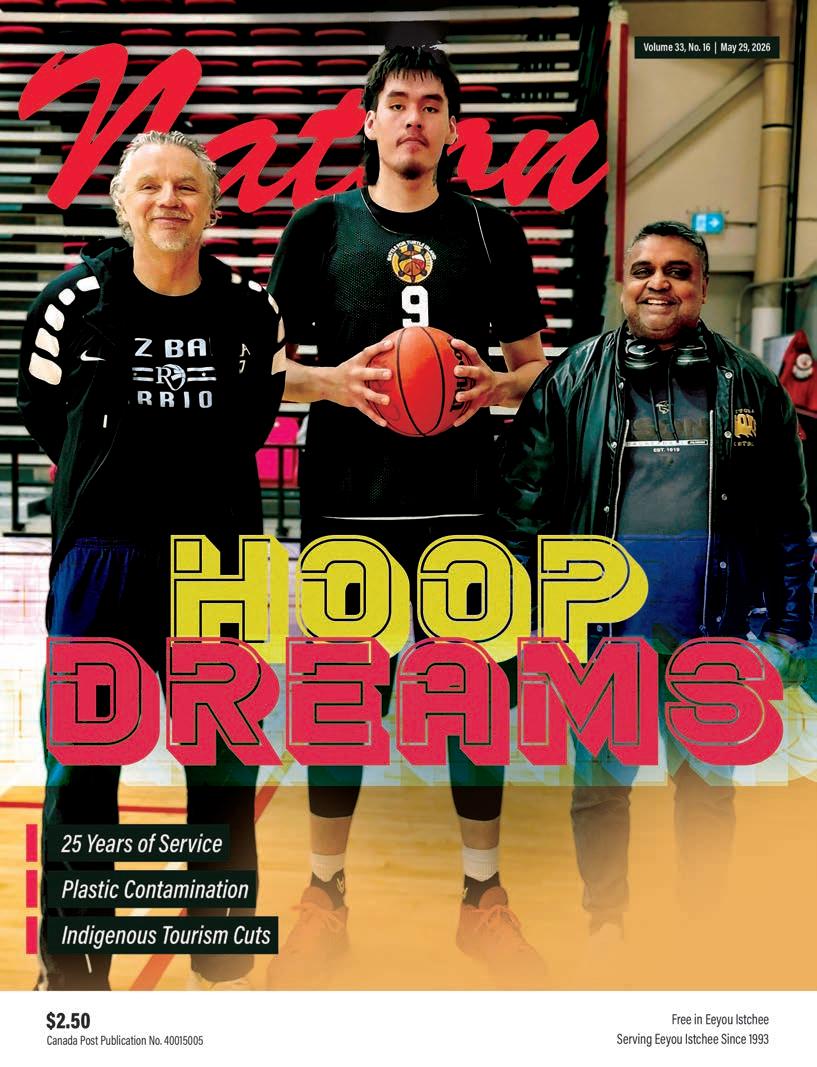
hile the Cree Nation Elite had to back out of the fourth annual Battle for Turtle Island (BFTI) in Winnipeg, Eeyou Istchee was represented by Keenan Nottaway at one of Canada’s premier all-Indigenous tournaments.
While British Columbia hosts larger competitions – the week-long All Native Basketball Tournament in Prince Rupert recently held its 66th edition – BFTI is becoming increasingly popular. This year’s tournament held May 15-17 drew winning teams from North Dakota and Burnaby, BC. Another eastern team from the Mi’kmaq Nation was a late cancellation.
Lenard Monkman, one of the event’s ve organizers, is a strong believer in the power of sports to change lives. Playing with a team composed of players from Winnipeg’s North End, Monkman aimed to make BFTI as accessible as possible, giving back to the sport that has gotten him through tough times.
“The goal is to create holistic well-being for individuals and communities,” he said. “There’s an absence of hope sometimes so this creates an environment that people look forward to. If one person from each team goes back home to coach youth, that creates a real ripple e ect across di erent communities.”
With adult and youth divisions for men and women, BFTI is developing a supportive community where youth witness the pace of higher-level play while veterans may provide mentorship and advancement opportunities.
The Cree Nation Elite was formed by William Icebound and Nolan Gunner, with nine players selected from across Eeyou Istchee and one from Fort Albany First Nation. Due to nancial constraints, the team was forced to announce its withdrawal two weeks before the BFTI but promised to bring the team there next year.
“We reached as many sponsors as we could but I understand it was a tight schedule,” explained Icebound. “We’ll try to have a wider window next year. Basketball has fallen in decline this past year. Tournaments throughout Eeyou Istchee were either delayed or cancelled because of a lack of registrations and di erent factors. We’re hoping to bring back popularity to basketball.”
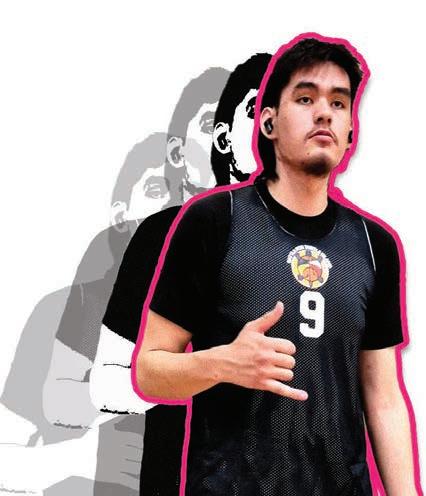
Nottaway was invited to join the team by childhood friend and point guard Eli Salt, who grew up in Pikogan before moving to Waskaganish. The 7’2” player was able to jump to a “free agent” team formed at the last minute to attend his rst out-of-province tournament. His mother and brothers were along for the 19-hour drive.
NorNorthern B-BALL
“When Keenan found out the Cree Nation Elite weren’t going, he knew he had to go to Winnipeg,” shared mother Tanya Nottaway. “He said I feel this is a door opening for more opportunities – that’s when I pushed myself, asking for sponsorships. We were able to go with that help.”
After rejecting high school coaches in Amos eager to recruit him due to his height, the 22-year-old only started playing seriously last year. Tanya said they knew he was meant for basketball but he wasn’t ready at age 13. Excited to get some exposure out of the reserve, Keenan was certainly noticed at BFTI.
He said it was an honour to play alongside 63-year-old Terry Garrow from Akwesasne Mohawk Nation, who is an inductee of the Manitoba Basketball Hall of Fame. Garrow’s
contacts in Winnipeg were so enthused by Keenan’s potential that they plan to y him back this summer for one-on-one training.
“A local coach said we need to get this kid back here,” said Monkman. “There are scouts who come watch every year from universities in the region and I know people from Terry’s group were so excited for him to train in Winnipeg with high-level trainers and coaches.”
A full-time move to join a team in the prairie city is possible. Beaming with pride for her son’s achievements, Tanya said Keenan “didn’t want to leave the place – it was where he belongs.”
Keenan’s not the only Cree with hoop dreams reaching impressive heights. Mistissini’s Nolan Gunner and Emery Matoush
have played in numerous invitational tournaments throughout North America.
While basketball in the Cree Nation is sometimes limited by the popularity of hockey, broomball and increasingly volleyball, the sport is thriving in Mistissini. This year, the community’s high school team became the rst Cree team in the RSEQ, Quebec’s regional school league, winning silver medals in the nals.
“It was an amazing season for us,” said coach Sam St-Martin. “We came back from an 11-point de cit in the semi- nal to force the overtime, beating the number-one team. That was the highlight of the season for me, watching
our players giving their all and getting the result.”
Joining the Saguenay league, which also included a team from the Mashteuiatsh First Nation, the Mistissini Screaming Eagles sometimes left before the break of dawn to travel over six hours for afternoon games on weekends. While power forward Lincoln Petawabano said it was challenging to compete after not stretching for so many hours, he was proud of their teamwork and sportsmanship.
“It was fun to nally see what it’s like to play competitively, having the chance to learn and grow with my teammates,” said Petawabano. “It was a lot faster than the Cree Nation tournaments. A little
more competitive. I can’t wait to do it again next year.”
Audrey Matoush held her own as the team’s only girl and has earned an athletic scholarship to play Division 1 basketball at a Montreal school this fall. St-Martin suggested that all his players have the potential to play college ball. Meanwhile, the Cree Nation Elite will regroup for next year’s BFTI, hoping to inspire hoop dreams across Eeyou Istchee.
“I’m trying to get every community together to enjoy the sport of basketball,” said Icebound. “That’s personally my main goal. If it does get big enough, we could host tryouts like the broomball and hockey teams do.”
The Cree IELCC Fund is designed to fund projects/activities that foster the education, Cree culture and language, as well as health and wellbeing of children 0 to 6 and their families.
The Cree IELCC Fund is designed to fund projects/activities that foster the education, Cree culture and language, as well as health and wellbeing of children 0 to 6 and their families.
The Cree IELCC Fund is designed to fund projects/activities that foster the education, Cree culture and language, as well as health and wellbeing of children 0 to 6 and their families.
The Cree IELCC Fund is designed to fund projects/activities that foster the education, Cree culture and language, as well as health and wellbeing of children 0 to 6 and their families.
The Cree IELCC Fund is designed to fund projects/activities that foster the education, Cree culture and language, as well as health and wellbeing of children 0 to 6 and their families.
All projects and activities must also ensure that no children are left behind: activities must be accessible to all children, no matter their level of ability or special
All projects and activities must also ensure that no children are left behind: activities must be accessible to all children, no matter their level of ability or special need.
All projects and activities must also ensure that no children are left behind: activities must be accessible to all children, no matter their level of ability or special Deadline
All projects and activities must also ensure that no children are left behind: activities must be accessible to all children, no matter their level of ability or special need.
All projects and activities must also ensure that no children are left behind: activities must be accessible to all children, no matter their level of ability or special need.
DRIVING
CARE
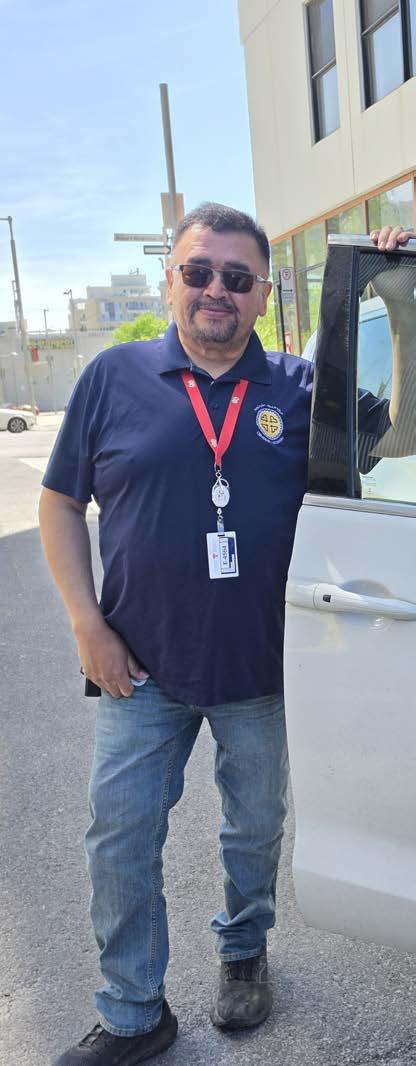
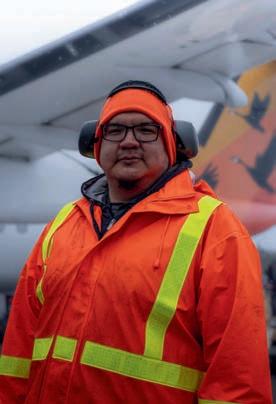
hilip Matoush recently celebrated 25 years working as a medical transport driver with Wiichihiituwin, Cree Patient Services, providing a familiar face for Crees travelling to Montreal for healthcare appoint-
“Helping others as a CPS driver has had a big impact on my life,” Matoush told the Nation. “They appreciate the communication; I can talk with them in Cree. It helps them. I nd it rewarding after I nish
Matoush moved Montreal about 28 years ago to support his wife Sharon Pepabano during her college studies. CPS was much smaller when he started working as a driver, with patients staying at boarding homes scattered throughout the city. In 2016, the Cree Health Board began working with the Espresso Hotel to centralize lodging in a more culturally safe, comfortable environment that is close to healthcare centres. The facility now welcomes about 20,000 patients and their caregivers annually for medical care and treatment not available in Eeyou Istchee. With all Espresso rooms now reserved for Cree patients, the hotel o ers nurses, Indigenous catering and kitchens for cooking, a spiritual space and an activity room. Former CHB executive director Daniel St-Amour said that ongoing renovations aim to make Espresso “a place of healing, connection and belonging.”
While the Espresso has added security features, risks remain for patients walking around its downtown location. On the morning of April 25, 58-year-old Peter Gull from Waswanipi was mugged near the hotel. Matoush said the perpetrator even tried to take the pump Gull was wearing for chemotherapy treatments.
Over the years, Matoush has served as a compassionate guide for Cree patients navigating health complications far from home. It’s not always easy calming down patients who are frustrated or angry. Sometimes he feels he has three jobs: “social worker, psychologist and driver.”
“Patients have come up to me crying that they have cancer that’s spreading and can’t even tell their family yet,” said Matoush. “They tell me stu I don’t tell anyone – it’s devastating. All I do is hug them and try to comfort them. I tell
them your family has to know. They come to me because they’re more comfortable talking to a Cree person.”
As the senior CPS driver and the only Cree now driving full-time, Matoush said services would improve with more Crees on the team. Patients have increasingly expressed frustration that many drivers don’t understand their needs.
After hearing from many patients craving traditional food roasted over the re, Matoush and Pepabano started a bush camp in 2020 at Camping D’Aoust in Hudson, about 40 km from downtown Montreal. With a group of volunteers, they organized cookouts with Cree patients that were an immediate hit.
Cree communities and organizations raised funds for a teepee and cooking supplies that enabled the project to grow. In 2022, the couple accepted Bob Patton’s o er to relocate the teepee to his family’s property on the Mohawk reserve of Kahnawake and the project quickly expanded.
The CHB and other entities helped fund the installation of two “modern teepees” as the site became a hub for cultural workshops, healing activities and numerous community programs. Unfortunately, the partnership ended three years ago.
“It didn’t work out with the project due to funding and the location so now I am at Camp D’Aoust where it all started,” Matoush explained. “I don’t want this to be a big project like last time or look for funding anymore. Still, I want to bring people together. Me and my wife Sharon love cooking traditional food and sharing with other people.”
While the project in Kahnawake became the Mohawk Cultural Community Homestead and continued to promote traditional skills, food sovereignty and cultural education, last year’s funding cuts have forced it to adapt. Matoush estimated that about $50,000 had been invested by various entities.
Although it hasn’t always been easy living so far from his ancestral hunting grounds in Mistissini, Matoush said “living in the city paid o ” by giving his children a good education. His son started at Concordia University this year, where his daughter will soon graduate with a double major.
Learning from his previous experience, Matoush wants to slowly rebuild the teepee project with family and friends. In late May, he announced the rst annual “sigabon snaugfest” with attendees encouraged to bring their own goose to Camping D’Aoust.
“The owner was happy to hear my voice,” Matoush said. “He said, ‘Come over, you guys can do whatever you want.’ I told him I just want to cook wild meat like we do back home and get away from the city. It’s so nice over there – like being in the bush.”
Despite the many conveniences of plastic products, we’re only beginning to understand the way that tiny microplastics and invisible nanoplastics contaminate land, water, wildlife and our bodies.
On May 12, the Canadian government announced it will spend nearly $2.4 million over two years to support research into the impacts of plastic pollution on Indigenous communities.
The CMEB Aims to
Help
Environment minister Julie Dabrusin said the initiative prioritizes “the leadership of Indigenous peoples to help conserve ecosystems, protect Indigenous cultures, and develop sustainable economies for future generations.”
With microplastics found in many traditional foods, there’s an urgency for research and action.
“We want to test for microplastics in sh and maybe other harvested species but the lab testing is very expensive,” said Angela Coxon, the director of wildlife management for the Eeyou Marine Region Wildlife Board.
Researchers hope to better understand First Nations’ exposure to plastics and practical methods to monitor and mitigate it. Plastic impacts Indigenous peoples across its entire life cycle, beginning with the extraction of fossil fuels used to create it. These initiatives will help identify knowledge gaps needing further study and develop a research hub to support Indigenousled research.
Lynn Konwaia’tanón:we’s Jacobs is a McGill University PhD candidate who
has worked for more than two decades on land and water stewardship initiatives. Working with university partners and the Kahnawake Environment Protection O ce, Jacobs’ eldwork will examine tire-particle pollution from the thousands of vehicles passing daily through her community.
“These new grants will allow us to build on that national conversation around plastic pollution and policy,” Jacobs said. “I’m also looking at how Indigenous peoples are engaged in governance around plastic pollution, mainly at the international level. It’s such a huge global problem and one of the greatest colonial experiments.”
While plastic use became widespread only 75 years ago, production never stopped growing. The non-biodegradable material breaks down into ever-smaller toxic particles that invade our brains, lungs and reproductive organs. One study found that quantities in brains were 50% higher in 2024 than 2016.
Jacobs is collaborating with Indigenous groups internationally to create a Global Plastics Treaty and co-founded the International Indigenous Peoples’ Forum on Plastics. Developing a legally binding instrument to curb plastic production has met with intense resistance from the petroleum industry.
“It’s very challenging to bring issues from our communities into these spaces with almost no resources,” said Jacobs. “So far there has been minimal progress in actually
Under the Northern Sky
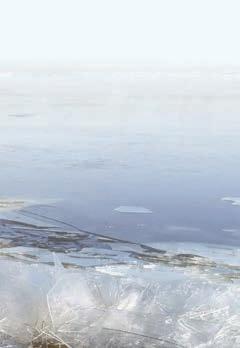
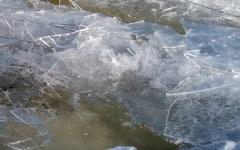
Maachestan, the Cree word for the spring breakup of river ice, is happening all along the James Bay coast. This is an important time of year for communities in the region.
Over the past few weeks, my family has been sharing regular reports of what is happening on the Attawapiskat River. It brought me back many years to when my parents, Marius and Susan Kataquapit, would discuss Maachestan with other community members.
Growing up in Attawapiskat in the 1980s, it was common to see Elders and traditional people by the riverbank as they monitored the melting ice and snow. There are so many factors that go into what might happen with the ice breakup and thaw. Everyone would comment on how much snow fell and accumulated over the winter. Was there an early freeze before the snow arrived? Was there more snow and then a late freeze at the start of winter? Then there would be questions about the spring weather and how much and how quickly it had warmed.
The community is on the banks of the Attawapiskat River, only 12 km west
of where it opens into the saltwater of James Bay. It’s why the river shores see tides that rise and fall with the oceanlike waters of James Bay. The community sits 20 feet above sea level on at
swamp land. So, when the river water rises in the spring, it doesn’t take much for ooding to occur.
The main problems arise when the river’s solid ice breaks up and begins its slow movement towards James Bay. If the moving ice jams at the mouth of the river, it prevents water from draining into the bay, causing a backup of rising water that threatens the community.
I’ve heard Elders explain that this can happen in several ways, including causing an ice dam further upriver, spilling water into a broader area and even possibly causing a ooding event with water arriving from the surrounding forest. This is a type of event Elders described in the 1950s, when they were taken by surprise as they watched the river ice and noticed rising water coming in from the woods north of the community.
I remember hearing from Elders when I was young that as long as the ice was moving, even if very slowly, then everything was safe. If the river ice stopped moving, then everyone became worried.
The worst ooding on the James
giant boulders of river ice destroyed homes and property. This event took the lives of two people and displaced an entire community. In the aftermath, the community was moved further inland and south to the new settlement of Peawanuck First Nation.
It’s important for communities to receive all support to prevent tragedies like the Winisk Flood. It is far better to prepare for the worst – even if nothing happens – than to do nothing and place everyone in danger. I thank Attawapiskat leadership for taking action to protect the community. Detailed evacuation plans are essential at this time of year.
Traditional people and leaders like Steve Hookimaw, Joe Louttit and former Chief Ignace Gull are providing rsthand observations of the ongoing Maachestan. It’s familiar to everyone to see Joe take on this role, just like his father, former Chief Reg Louttit, did many years ago.
This year’s breakup is almost nished and it seems the greatest danger has passed. There is much anxiety and anticipation when Maachestan begins, but an equal amount of relief and almost celebration when it has passed. Neepin, the Cree word for summer, can now
and Hudson Bay coasts occurred in the old community of Winisk on May 16, 1986. The ood took people by surprise as the waters overtook the community. Water arrived at people’s homes while begin.