PROGRAMS FO R AN D BY FI RST NATI O N S Why Ch oose F N E E? Em p owe r i n g F i rs t N ati o n s l e a d e rs with to o l s , kn owl e d g e, a n d co n n e c ti o n s to d rive ch a n g e a n d cre ate a l a s ti n g i m p a c t i n th e i r co m m u n iti es . VI S IT U S AT: fn e e.ca/o u r- p ro g ra m s
O u r Progra m s :
› Governance – Grow an agile and innovative leadership › Entrepreneurship – Strengthen your entrepreneurial skills › Management – Boost your collaborative approach › Women Leadership – Reach your full potential › Economic Reconciliation – Co-lead a reconciliation project › Next Generation – Trail forward APPLY ANYTIME FOR 2026 PROGRAMS!
› fnee.ca/register ‹
SDG-39960
Our application process is on a rolling basis.
EDITORIAL
The march to a police state by Will Nicholls
A
few years ago, it appeared that countries around the world were starting to work together to fight climate change, use sanctions rather than weapons, and support the rights of children and women. Then Covid hit and suddenly prices for everything went up. Even though Covid isn’t seen as a serious problem anymore, prices haven’t gone down. In Quebec, the government imposed curfews during the pandemic, the only jurisdiction in North America to take such a drastic step. Neighbours were encouraged to rat you out to police, who didn’t need a warrant to check your home. That was the start of an authoritarian state. Now, when reporters ask the police what or why they are doing something, they are referred to a media liaison officer. And no, they don’t have a name or phone number. These are police-state actions. It’s particularly noticeable in the United States. The US Immigration and Customs Enforcement (ICE) routinely detains people solely because of their skin colour. President Donald Trump rants about creating an enemies list and
says people who oppose him should be arrested. Signs of this trend toward authoritarianism are being seen here in Canada. Of course, Indigenous people have experienced this ever since Canada was created. In recent years this has taken the form of starlight rides to over-the-top police responses to peaceful protests by Indigenous activists. In Quebec, however, Premier François Legault’s authoritarian instincts are clearly reflected in his government’s proposed Bill 1, a supposed constitution for the province. Critics say it erases constitutional guarantees for the rights of the English-speaking and Indigenous communities. The introduction to Bill 1 acknowledges “the right for the First Nations and Inuit in Québec, descendants of the country’s first inhabitants, to maintain and develop their language and culture of origin….” While this sounds good, many First Nation leaders note that these guarantees are not included in the actual language of the legislation. They note that the bill was introduced without their consent or consultation, and that while
Quebec claims a right to sovereignty, the same is denied to First Nations in Quebec. Many others in Quebec are concerned. A coalition of 318 organizations across Quebec stated, “The government has not respected any of the criteria established by the United Nations for the adoption of a democratic and legitimate constitution.” They said the bill denies Indigenous Peoples’ right to self-determination, concentrates power in the National Assembly, sidelines the courts, elevates collective rights over individual freedoms and weakens civil society’s ability to challenge laws. Both the Canadian Bar Association and the Quebec Bar Association denounced Bill 1 and demanded it be withdrawn. The Canadian Branch of the International Commission of Jurists is requesting the intervention of the United Nations Human Rights Council. We often look south with smug superiority at Trump’s clear efforts to establish a dictatorship in the US, much in the same manner that his BFF Vladimir Putin has done in Russia. But make no mistake: we are on a similar path in Quebec.
P. P.
4 The Sky's the Limit 7 In Brief...
FEATURES
NEWS
VOLUME 33 | NO. 06 | JANUARY 9, 2026 P.
P. P.
EDITORIALS
P.
3 Will Nicholls
16
8
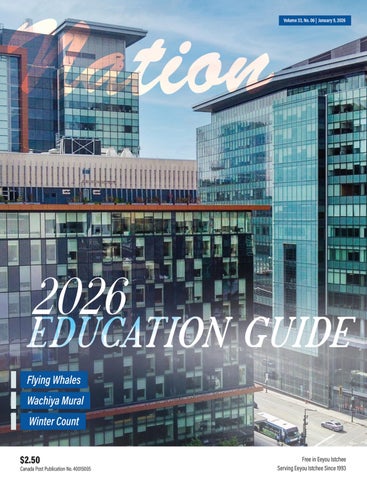
Education Guide
Wachiya's New Mural
20 National Gallery’s Winter Count exhibition
Cover Photo provided by Concordia University
the Nation is published every two weeks by Beesum Communications // EDITORIAL BOARD L. Stewart, W. Nicholls, M. Siberok, Mr. N. Diamond, E. Webb // EDITOR IN CHIEF Will Nicholls // DIRECTOR OF FINANCES Linda Ludwick // EDITORS Lyle Stewart, Martin Siberok // STORY COORDINATOR Patrick Quinn // CONTRIBUTING WRITERS X. Kataquapit, P. Quinn, J. Janke, N. Fedosieieva, J. Pashagumskum // DESIGN Matthew Dessner // SALES AND ADVERTISING Donna Malthouse // THANKS TO: Air Creebec CONTACT US: The Nation News, 918-4200 St. Laurent, Montreal, QC., H2W 2R2 // EDITORIAL & ADS: 514-272-3077 / ads@nationnews.ca / 514-943-6191 // HEAD OFFICE: P.O. Box 151, Chisasibi, QC. J0M 1E0 www.nationnews.ca // EDITORIAL: will@nationnews.ca news@nationnews.ca // ADS: Donna Malthouse: donna@beesum.com // SUBSCRIPTIONS: $60 plus taxes, US: $90, Abroad: $110, Payable to beesum communications, all rights reserved, publication mail #40015005, issn #1206-2642 // the Nation is a member of: The James Bay Cree Communications Society, Circle Of Aboriginal Controlled Publishers, Magazines Canada Quebec Community Newspaper Assn. Canadian Newspapers Assn. Les Hebdos Sélect Du Québec. Funded [in part] by the Government of Canada. // ONLINE AT: www.nationnews.ca | facebook.com/NATIONnewsmagazine | Twitter: @creenation_news With the financial support of
CMCA AUDITED
the Nation
3
NEWS
by Patrick Quinn, Local Journalism Initiative Reporter
The Sky’s the Limit Flying Whales launching airships in Naskapi skies
H
elium-filled airships are being touted as a solution to infrastructure challenges in northern communities. On December 3, the Naskapi Nation of Kawawachikamach announced a memorandum of understanding (MOU) with Flying Whales Quebec to explore the integration of its low-impact transportation solutions. Capable of transporting up to 60 metric tons and handling large or unusually shaped cargo without the need for roads or heavy ground infrastructure, the Flying Whales LCA60T airship is one solution for the logistical challenges of northern regions. Initially launching in France, the company has rapidly expanded its presence in Quebec since 2022. Plans were announced in May for an assembly centre to be built in Cookshire-Eaton, near Sherbrooke, to source markets on North and South America. “Our territory is large, remote and full of potential,” said Kawawachikamach Chief Louise Nattawappio. “Airships such as the LCA60T offer a practical way to carry out major projects while respecting the land. We value solutions that reduce environmental disturbance and create opportunities for training, employment and long-term economic growth.” The MOU with Flying Whales highlights major projects across Nuchimiyuschiiy, the homeland of the
4
the Nation | January 9, 2026 | www.nationnews.ca
Naskapi people. With the Ishkutau wind energy project in the early planning stages, the ships could be a way to transport turbine blades to the territory. Deputy Chief Nathan Uniam said there are many practical applications being considered and the community might acquire equity in the company. The partnership will also study the feasibility of a dedicated airship operations base within Nuchimiyuschiiy, with potential for pilot training and related careers. “We want to have more presence on our land and moving things about is very expensive,” Uniam told the Nation. “This could encourage building more cabins where families stayed in the past. We talked about helping us out with our main need, which is housing.” Uniam discussed transporting modular housing units from down south with the company. As an environmentally friendly and lower-cost alternative to constructing roads or even airport infrastructure, the 200-metre airships enable loading and unloading without the need to land and a range of 1,000 km. The hybrid-electric design features a lattice-style composite frame with 32 electric propellers powered by a combination of lithium-ion batteries, turbine generators, and eventually hydrogen fuel cells. Currently in the final design phase, the company hopes to run test flights in late 2027 before launching commercially in 2029.
Far more advanced than the zeppelins and blimps of the past, Quebec has invested $77 million into Flying Whales for its potential to open up isolated regions with a low carbon footprint. Assembling, testing and launching the airships at the 50-hectare Eastern Townships site is expected to create about 300 jobs. “Maybe in the future we can have one installation out here and ownership over one of the airships operated on our own,” suggested Uniam. “Having more people involved in the aeronautical industry is highly appealing. The CEO made it clear he wants to meet and work with the First Nations.” Kawawachikamach is on the same 55th parallel latitude as the Cree-Inuit communities of WhapmagoostuiKuujjuarapik, but its location near the Labrador border doesn’t enable shipping cargo by sea. While airship costs are estimated to be similar to sea freight, Flying Whales moving at 100 km/h can transport materials in days rather than weeks. Airships could overcome the logistical challenges of moving heavy towers and other equipment for renewable energy projects, either in the 96-metre cargo hold (“belly of the whale”) or attached below. Mining companies like Torngat Metals have already expressed interest. “We’re looking at wind farms as an alternative rather than having Hydro-
MARCH 2-4, 2026 RBC Convention Centre Winnipeg, MB Led by First Nations, Inuit and Métis thought leaders, a three-day gathering to understand, promote and share Indigenous histories.
10 Years Since the TRC’s Calls to Action » Reflect on progress made over the past decade » Engage in meaningful dialogue on reconciliation » Reaffirm commitment to lasting change
Hosted By:
Québec erect more dams on our lands,” explained Uniam. “The other is the practical applications within our community, like the transportation of heavy equipment and goods. It hasn’t been talked about much yet, but we have a lot of potential for rare earth minerals.” With vast potential for wind power in the Far North, Flying Whales partnered with Inuit-owned airline Canadian North in 2023 to research transportation in extreme Arctic conditions. The company has floated plans for a “modular hospital” that would fit into its cargo bay and land in northern communities for weeks at a time. “There’s no place in the world that stands to benefit more than northern Canada,” Barry Prentice, the director of the University of Manitoba Transport Institute, told Nunatsiaq News. An advocate of cargo airships for over 20 years, Prentice suggested they could deliver fresh fruit and vegetables year-round to remote communities. Chantiers Chibougamau has discussed transporting its lumber with Flying Whales since 2021. Executive director Frédéric Verreault told Le Jamésien that talks had evolved toward “the transport of kits of structures made of solid wood and assembled modules to more isolated territories, in order to meet the housing needs in northern Quebec.” While the sky’s the limit for airship applications, others pitching similar ideas have failed to get off the ground. Flying Whales appears to be ahead of over a dozen airship companies, gaining momentum with half a billion dollars of investment and teams of engineers. “We learned they’re very stringent on meeting and even exceeding the standards in the flying industry,” said Uniam. “It sounded very promising for First Nations communities like us in remote access areas of Quebec. I encourage other Nations to listen and evaluate what the potential for this project could be for their benefit as well.”
Save 5% when you register at IHHG.ca before Jan. 31st.
www.nationnews.ca | January 9, 2026 | the Nation
5
CSERT
CREE SOCIAL ECONOMY ROUND TABLE
A New Bridge to a University Education
EXAMPLES OF SOCIAL ECONOMY PROJECTS: FOR NOT-FOR-PROFIT BUSINESSES WITH A SOCIAL OR CULTURE COMPONENT 75% of project cost, up to $25,000 Training and coaching Pre-start up and start-up fees Equipment or supplies purchases Feasibility and marketing expenses FOR MORE INFO
Thrift stores Cultural & wellness camps Community markets Meals on Wheels Greenhouses Local transportation
Social Economy Advisor 418-923-2901 ext. 3409 peggy.petawabano@cngov.ca
T26-99011
www.cngov.ca
Want to take courses to get into Engineering, Business, Journalism, Psychology or the Sciences? The Kaié:ri Nikawerà:ke Indigenous Bridging Program may be for you! Join a supportive Indigenous community while completing the prerequisite courses needed and developing skills for long-term success. Funding is available.
Learn more at concordia.ca/indigenousbridging
Department of Commerce and Industry
ouwahstore@gmail.com (514) 588-3162 www.ouwahstore.com 18 Fort-George Road
IN BRIEF Overdose in Mistissini Mistissini police were notified of a possible overdose in the community December 20. Eenou Eeyou Police Force and Sûreté du Québec officers responded, finding a young man unconcious and transported him to the Mistissni clinic. He was transferred to Chibougamau hospital, then medivaced to Montreal. The EEPF reminds the public that street drugs may contain unknown harmful substances. They may be cut with opioids or other synthetic compounds to give it a more powerful high. If someone appears to be in trouble, call for help immediately. The earlier the assistance the better chance for saving a life. Speak to an agent or leave a message on the Eeyou Intelligence Drug Line at 1-833-343-7847. The James Bay Cree Communications Society livestreamed the event, with Scott Forward and his team making a presentation about their projects, and the John and MellyAnn puppets from the John and Friends children’s show making a special appearance.
Dale Cooper wins award The Ouje-Bougoumou Youth Council has bestowed the Chief Samuel Reggie Bosum Award to Dale Cooper. On Facebook, Cooper wrote, “I am truly honored to receive this leadership award and proud to represent OujeBougoumou through my leadership roles with the Cree Native Arts and Crafts
Association and Wachiya, as well as the Ouje representative on the Board of Compensation.” He added, “Much of the work happens behind the scenes and is not always visible. I want to encourage youth to know that stepping into leadership roles is a learning journey. Keep working hard, keep your head up, and continue to grow.” Cooper congratulated fellow award winners and thanked his family.
Fighting to stop Ontario’s Bill 5 Ramon Kataquapit and Michel Koostachin, both from Attawapiskat First Nation, have filed a motion with the Superior Court of Justice in Toronto to be included in a case to stop Bill 5. Nine First Nations in Ontario are challenging the constitutionality of the legislation, which allows the provincial government to override certain laws to push through development projects. The Protect Ontario by Unleashing Our Economy Act will likely be used to develop an area in northern Ontario known as the Ring of Fire – just south of their territory. Three First Nations in the Ring of Fire area have signed agreements with the Ontario government to build a road to the region.
www.nationnews.ca | January 9, 2026 | the Nation
7
FEATURES
the Nation’s
2026
I
n our Education Guide, we feature six institutions that stand out for their commitment to providing culturally sensitive and empowering education for Indigenous students, particularly those from the Cree communities. Each of these institutions offers a range of options for Indigenous students to find their path in higher education, blending academic excellence with a respect for and integration of Indigenous culture and values.
8
the Nation | January 9, 2026 | www.nationnews.ca
Education
Guide
2024-2025 from six programs taught by 85 instructors, 46 of whom are Indigenous. One FNEE initiative is the launch of a Next Generation program. Developed in partnership with five Indigenous organizations, this four-day program is designed for youth aged 18-35 who want to blaze their own trail. The program’s first cohort was launched last March in Mashteuiatsh, and the second cohort started in October in Gatineau. The third cohort will be in Montreal at HEC Montréal February 23-26. The collaboration of HEC Montréal and FNEE exemplifies a commitment to inclusive and culturally responsive education. This partnership highlights the vital role academic institutionscan play in developing Indigenous leadership.
Kaié:ri Nikawerá:ke Indigenous Bridging Program / Concordia University Concordia University is enhancing support for Indigenous students through its Kaié:ri Nikawerá:ke Indigenous Bridging Program. Launched in 2022, the university preparatory program was designed to help First Nations, Inuit and Métis students gain the prerequisite courses needed to study at the Montrealbased institution. The program, offered through Concordia’s Student Success Centre, allows eligible First Nations, Inuit and Métis peoples seeking prerequisites to enroll in said courses at Concordia. Upon successful completion of the Bridging Program, students automatically move into their chosen undergraduate degree without needing to reapply. Credits gained during the Bridging Program go towards this degree, meaning students are one step closer to graduation once they begin their undergraduate courses. Aimed at increasing Indigenous representation in science, technology, engineering and mathematics fields, the Bridging Program began by offering pathways into Concordia’s
Bachelor of Engineering. Since then, the program has expanded to include bridges into commerce, journalism, psychology and science. Jordyn Goodleaf will become the first student to transition from the Bridging Program into commerce at Concordia’s John Molson School of Business. “My goal from the first semester was to get a John Molson hoodie,” says Goodleaf. “I know it’s a small thing, but it’s a very exciting moment.” Saba Din, program coordinator of the Kaié:ri Nikawerá:ke Indigenous Bridging Program, is looking forward to seeing the program continue to grow. “We’ll also keep refining program supports and identifying opportunities that build confidence and empower Indigenous students throughout their journey,” says Din. “This means creating more pathways for success, fostering a strong sense of community, and providing the tools and resources students need to succeed not only at university, www.nationnews.ca | January 9, 2026 | the Nation
THE NATION’S 2026
As First Nations Executive Education (FNEE) celebrates its fourth anniversary, it marks not just a milestone for HEC Montréal but an achievement in Indigenous and non-Indigenous collaboration in higher education. FNEE fosters excellence by blending Indigenous knowledge with modern executive training. FNEE’s fourth anniversary event on November 21, 2025, attracted over 300 guests from academia, business and politics. They helped celebrate participants from 10 cohorts who received university attestations and certifications. FNEE has conducted 56 training sessions for more than 1,000 participants from 41 communities and 10 Nations, 66% of whom are women. They awarded 220 certificates in
EDUCATION GUIDE
First Nations Executive Education / HEC Montréal
9
but to build their careers and make meaningful contributions to their communities.” To help with the transition into undergraduate studies, bridging students follow university skills courses designed by Concordia’s Student Success Centre and participate in events at the Otsenhákta Student Centre – Concordia's on-campus resource for Indigenous students. Students also receive additional support through a weekly Indigenous-led seminar that addresses individual student needs, whether academic, social, cultural or spiritual. New horizons for Indigenous futures The creation of the Kaié:ri Nikawerá:ke Indigenous Bridging Program is one of the many steps outlined in Concordia’s Indigenous Directions Action Plan, a document which provides concrete actions to decolonize and indigenize the university. Last year, Concordia announced a tuition waiver for all First Nations and Inuit students whose territories are in Quebec. “Through the tuition waiver and the Bridging Program, Concordia is working to remove barriers to education and provide ongoing support throughout students’ journeys at the university, helping ensure they feel valued, supported, and empowered to succeed,” Din explains. Impacts beyond the classroom “Kaié:ri Nikawerá:ke,” the name of the Bridging Program, is a Kanien’kéha term that translates to “the four winds” or “the four directions.” The program was named by Katsistohkwí:io Jacco, who is Kanien'kehá:ka and part of the Bear Clan, to honour the local territories and ancestral language of the Kanien’kehá:ka. The winds represent a shift in the natural world, promoting the growth and rebirth of plant life. It is also a nod to Concordia’s four faculties, recognizing that students come from many different directions. Finally, it symbolizes the directions that students may take after their degree. Speaking about her future, Goodleaf mentions plans to one day move to New York City. “It’s not that I want to leave my community behind – I’ll always stay connected to my family and where I come from,” she explains. “But I also want to follow my dreams of living in a big city. I hope that by doing this, younger people can see that it’s possible to explore the world, pursue big goals and still stay grounded in who you are and where you come from.” Students can apply for the Kaié:ri Nikawerá:ke Indigenous Bridging Program at concordia.ca/apply. Applications close on March 1 for the 2026-2027 school year. To learn more, information sessions are offered year-round. Register today at concordia.ca/indigenousbridging.
10
the Nation | January 9, 2026 | www.nationnews.ca
intensive and conventional courses. This flexibility ensures that education is tailored to the diverse needs of students, particularly those from Indigenous communities. At UQAT, the First Peoples Service supports students’ academic and psycho-social needs. Thisservice provides tools for effective time management and assists with housing, personal relationships and other non-academic concerns. The intimate scale of UQAT allows for close relationships between faculty and students, fostering a personalized and supportive educational environment. UQAT’s initiatives and research projects are developed in close collaboration with Indigenous partners. The university’s dialogue with Indigenous people, including former and prospective students, ensures that its programs and research respond to the concrete needs of Indigenous Communities.
Algonquin College Choosing the right college is about more than academics. It’s about finding a place where you feel supported, respected, and connected. At Algonquin College, Indigenous students are welcomed into a vibrant community that values culture, tradition and personal growth. Algonquin College is located on the traditional unceded territory of the Anishinàbe Algonquin People, and that connection to land and heritage is woven into campus life. With close to 200 programs across Ottawa, Pembroke and AC Online, the College offers flexibility for students who want to study on campus or online while staying connected to their communities. As one of Canada’s most respected and innovative polytechnic institutions, Algonquin College offers a wide range of programs for anyone seeking a degree, diploma, or graduate certificate. Commitment to flexible, community connected learning is matched by a strong network of supports that ensure Indigenous learners can thrive both academically and personally. Students have access to Indigenous counsellors, student support officers, hous-
ing assistance and food security programs. Financial help is available through bursaries, and there are opportunities for employment, entrepreneurship, applied research, and career networking. Opportunities are created and offered to focus on building leadership skills within the Indigenous student population that include public speaking, event planning, networking, and meeting potential employers. These resources are designed to help learners succeed academically and personally. The heart of Indigenous student life on the Ottawa campus is the Mamidosewin Centre, which means “meeting place” or “walking together.” It’s a welcoming space where students gather for cultural activities, ceremonies, feasts, and celebrations. Throughout the year, the Centre hosts drum circles, guest speakers and social events that bring First Nation, Inuit and Métis traditions to life. The Pembroke campus offers its own unique gathering spaces, including a Medicine Wheel Garden for reflection and learning. Algonquin College regularly hosts dozens of events focused on Truth, Reconciliation and
www.nationnews.ca | January 9, 2026 | the Nation
THE NATION’S 2026
Primarily a French-language institution, UQAT offers courses in English for Indigenous students across diverse fields of study. This commitment to inclusivity is reflected in the university’spractice of forming small cohorts and signing agreements with Indigenous communities and organizations, including various Cree groups. UQAT’s School of Indigenous Studies is the only university department in the province wholly focused on Indigenous studies. Its multidisciplinary focus reflects UQAT’s commitment to integrate Indigenous perspectives and knowledge into higher education and has contributed to the development of advanced Indigenous studies programs, including graduate-level offerings such as master’s and PhD programs. The university offers a range of teaching methods, including on-site community classes, remote learning, hybrid formats, and both
EDUCATION GUIDE
Université du Québec en Abitibi-Témiscamingue
11
Indigenization led by Knowledge Keepers and Elders. This past year included hide tanning workshops, language workshops, art sessions, retreats, career fairs, and building a traditional birch bark canoe. These experiences help students strengthen cultural identity while building skills for the future. Leadership opportunities are another highlight. Programs like the Niganizi Indigenous Student Leadership Retreat and roles within the Mamidosewin Centre give students a chance to grow, connect and make a difference. At Algonquin College, your education is about more than earning a credential. It’s about belonging, thriving, and walking your path with confidence. Visit algonquincollege. com and explore what’s possible.
12
the Nation | January November 9, 2026 28, 2025 | www.nationnews.ca | www.nationnews.ca
Photo of:
With its significant Indigenous student population, Canadore College is a hub for cultural diversity and educational excellence. Its commitment to Indigenous education and support is evident across its campuses and in its specialized programs. With campuses in North Bay and Parry Sound, Ontario, Canadore has around 750 Indigenous students, making up about 15% of the total student population. This diverse student group includes Ojibway, Oji-Cree, Cree, Algonquin, Métis, Mohawk and Inuit, highlighting the college’s role as a melting pot of Indigenous cultures. The First Peoples’ Centre at Canadore is more than just an academic facility, it’s a vital cultural and support hub for Indigenous students. It offers a range of services, from comprehensive academic support to cultural programs. The Centre also engages in recruitment, promotion, and community outreach
projects, extending its impact beyond the college walls. Canadore offers various learning paths. Last year, over half of the Indigenous learners attended on-campus programs, while others studied at Indigenous partner campuses or in their home communities. Many chose part-time learning, indicating the college’s flexibility and commitment to accessible education. A standout initiative at Canadore is the Kikandaaswiwin Mookiisin (KM) Indigenous STEAM Program. Developed in partnership with Actua, this program helps Indigenous youth enter high skill fields like Science, Technology, Engineering, Arts and Mathematics (STEAM). KM emphasizes the importance of Indigenous identity and perspectives in these fields, offering students not only academic growth but also a renewed confidence in their cultural heritage.
First Nations Technical Institute First Nations Technical Institute (FNTI) is an Indigenous-led post-secondary institute located on the Tyendinaga Mohawk Territory, offering culturally grounded education that blends academic excellence with Indigenous Knowledge. FNTI delivers certificates, diplomas, degrees, and micro-credentials designed to prepare learners for meaningful careers while remaining connected to community, culture, and identity. Rooted in Indigenous worldviews, FNTI weaves culture into every aspect of learning through land-based teachings, ceremony, language, Elders, and Cultural Advisors. Programs
are delivered in a respectful, inclusive environment where Indigenous ways of knowing are honoured alongside industry and academic standards. Learners at FNTI are supported through strong wrap-around support, including academic advising, cultural and wellness support, peer mentorship, and individualized guidance throughout their educational journey. Whether learners are returning to school, upgrading skills, or pursuing a new path, FNTI offers a supportive, community-centred learning experience that empowers success.
www.nationnews.ca www.nationnews.ca www.nationnews.ca || November December | January28, 12, 9, 2026 2025 | the Nation
THE NATION’S 2026
Canadore College
EDUCATION GUIDE
Quebec Premier Robert Bourassa
13
YOUTH SECTOR
SABTUAN Sabtuan Adult Education Services (SAES) helps adults learn job skills to get better jobs. Here's what we do: GENERAL EDUCATION Finish high school, improve reading and writing, and get a diploma. VOCATIONAL TRAINING Learn job skills like fixing cars.
LOCAL ASSISTANCE & INTER-COMMUNITY PROGRAMS CSB ensures educational access while preserving iiyiyiu values. Programs include local educational assistance during cultural activities and inter-community sports and schooling. HOMEWORK HELP Offers one-on-one tutoring, after-school groups, and online resources for students. MOZAÏK PORTAL A tool for parents to track their child's school progress. OFF-COMMUNITY PROGRAMS The CSB supports JBNQA Cree Beneficiaries with advanced skills or special education needs by providing access to schools outside the 9 Cree communities. 14 the 14 the Nation Nation | October 17, 3, 2025 2025 || www.nationnews.ca www.nationnews.ca
LANGUAGE AND LITERACY Get better at speaking and writing in Cree and French. WORK AND LIFE SKILLS Mix work experience with classroom learning. SAES helps adults grow personally and professionally.
The Cree School Board (CSB) helps people of all ages with their education. We support kids in school, offer classes for adults, and help college and university students reach their goals. CSB focuses on iiyiyiuiyihtiwin (iiyiyiu culture), community, and support to ensure everyone succeeds from early school years to after graduation. We have job opportunities for teachers, professionals, and support staff. Join us and be part of a caring community. Parents, you can also get involved in your child's education. Contact your school for more details.
POST-SECONDARY
HIGHER LEARNING kapataao | Higher Learning department helps students continue their education after high school in their community. Here's what we do:
Post-Secondary Student Services (PSSS) helps students who want to go to college or university. Here's what we do: GUIDANCE COUNSELING We help students pick courses, careers, and apply to colleges and universities. STUDENT SUPPORT We help with personal, social, medical, and family issues. We offer workshops on budgeting, time management, stress management, and study skills. FINANCIAL ASSISTANCE We provide money for living expenses, travel, tuition, and textbooks. RESOURCE CENTRES We have centres in Montreal and Gatineau with libraries, computer labs, and study rooms. PSSS is here to help students succeed in their education and future careers.
CREATE AND MANAGE PROGRAMS We partner with organizations to create and run programs, such as the Cree Teacher Training Program (McGill University) and Springboard to College programs: Iyeskuwiiu Springboard to DCS (John Abbott College) and Springboard to Nursing (CBHSSJB and John Abbott College). SUPPORT STUDENTS We give students resources and help them succeed, including learning on the land.
BE PART OF SOMETHING SPECIAL. WALK WITH US. VISIT OUR WEBSITE!
JOB OPPORTUNITIES
Wachiya gets 16
the Nation | January 9, 2026 | www.nationnews.ca
Artist Jessica Danyluck adds something special to the store Photos and Story by Will Nicholls
W
a mural
achiya has come a long way since it first opened in Old Montreal in August 2024. Their motto is strengthening Cree visibility through culture, art and community. Wachiya is operated by the Cree Native Arts and Crafts Association (CNACA), an organization that promotes Cree artists, artisans and the Cree communities themselves. Part of their mission is to “preserve, promote and enhance the heritage of the Eeyou/Eenou Nation while encouraging contemporary means of expression that maintain Cree culture, values, traditions and skills.” To do this, they opened Wachiya (located at 79 St. Paul E) and from the start it was a success. The changes they have made in a short time are amazing. Walking into Wachiya, you will notice that the art gallery and store have merged. Not only are the displays of art and artisans’ creations there to show off their beauty, but now there are plaques that share the story of the artists and artisans and provide an insight into the Cree culture that defined the pieces. You get a feeling of being part of the creative process. Such is the case of Jessica Danyluck, a young artist Wachiya invited to create a mural of her design in the store. It was interactive as she did the work live in front of people in the store. Danyluck is from the Cree Nation of Wemindji. Family was a big part of her life. She mentioned that Earl Danyluck was her grandfather and her mother was Nancy Danyluck. “I’ve been practicing art since I was a young kid,” she said. “I feel really proud of where I started and feel my inner self would be really proud of where I am now.” Danyluck added that CNACA played an important role for her as “an upcoming and emerging artist.” She said they gave her a lot of support and help to become more competent in her profession as an artist. Last year, Wachiya approached Danyluck about painting a mural. After several meetings to discuss the project, she said the only direction she was given was that it should represent practice within Eeyou Istchee. With that in mind, Danyluck said the mural “was all my own designs and concepts.” The mural is a wonderful addition to Wachiya, and we recommend checking it out. Plus, take some time to look at the store’s offerings. If you see something you like, you might want to buy immediately. Ouje-Bougamau Chief Gaston Cooper asked about a black hat his wife had admired and found it had already been sold. As many pieces are handmade and unique you may never see that piece of work again. Plenty of pieces would be great as gifts for various occasions – birthdays, graduations, Valentine’s – or simply something special just for yourself.
| the Nation
17
For, by, and with Indigenous peoples By affirming a representative and forward-looking Territorial Acknowledgement, UQAT has reiterated its commitment to shaping the future together with First Peoples, and is proposing concrete action through education and research by: Recognizing Indigenous knowledge and promoting Indigenous perspectives and languages throughout its academic programs
Prioritizing research and program development related to the needs of Indigenous nations
Creating scholarships for Indigenous students
Training and sensitizing UQAT staff to Indigenous issues and realities
Creating spaces where Indigenous languages are visible and alive
FIND OUT MORE:
uqat.ca/indigenous
The Future Generations Foundation call for organizations to apply for funding is now open. Funding is available for education, healing, language, culture, and community wellness programs, led by and for First Nations. Applications for organizational funding closes January 16, 2026.
APPLY NOW
EEYOU-EENOU CHISKUTAMAACHEWIN SCHOLARSHIP PROGRAM
info@fgfoundation.ca www.fgfoundation.ca 1 (888) 268-0520 All First Nations can apply. Qualified Donees and Registered harities organizations are eligible to access funds.
Are you a Cree beneficiary thinking of attending university? You may be eligible for a scholarship! The Eeyou-Eenou Chiskutamaachewin Scholarship Program — made possible by the Eenou-Eeyou Community Foundation and the Cree School Board — incentivizes Cree students attending university in the fields of:
MEDICINE, NURSING, SOCIAL WORK, OR EDUCATION. APPLY TO UNIVERSITY TODAY! For more information, reach out to: Cree School Board Post-Secondary Student Services.
psss@cscree.qc.ca
ARTS
Embracing the Cold Indigenous art prominent in National Gallery’s Winter Count exhibition
by Patrick Quinn, Local Journalism Initiative Reporter
T
he National Gallery of Canada explores the many colours and contradictions of our coldest season in its newest exhibition. Winter Count: Embracing the Cold is the first major collaboration between the gallery’s Canadian, European and Indigenous curatorial departments. Featuring over 160 works spanning two centuries, the exhibition is named for the tradition among many Plains peoples to record the passing of each year with a single image painted onto buffalo hide, a reminder of how the land shaped the rhythm of their lives. It’s also the title of a large installation of tipi covers from Cree artist Duane Linklater, which feature markings alluding to residential school unmarked graves and fill an entire room. The Ottawa gallery was in the process of acquiring Linklater’s work when the curators began planning this exhibition, which opened in November and runs until March 22. “In my Omaskêko Cree culture, if we were to translate how old are you, that would literally be saying how many winters are you,” explained Linklater in the exhibition’s catalogue. “If we are looking at a lifetime of a person, that person is half winter, the sort of way I look at it.” Wahsontiio Cross, associate curator of Indigenous art, named Wendy Red Star’s Winter, from her Four Seasons series, and Krystle Silverfox’s Spear Game as other priority pieces she wanted to include. Red Star’s striking piece playfully critiques museum dioramas that portrayed cultural habitats perpetuating the myth of the “vanishing Indian”. Adorned in
20
the Nation | January 9, 2026 | www.nationnews.ca
traditional regalia from her Crow Nation, the artist’s wintery self-portrait is surrounded by Styrofoam snowballs and bird ornaments. “She is in these landscapes that are very obviously staged,” said Cross. “She is engaging with the history of representation, but she is her own subject. So, she has taken back that agency.” Silverfox’s installation features 16 brightly coloured spears or “snow snakes” flying through the air at different angles. Drawing inspiration from her Northern Tutchone culture in the Yukon, the work evokes the excitement of throwing the snow snake the longest to win the game. Since creating its Indigenous Ways and Decolonization department in 2022, the gallery has hired more Inuit staff than any other southern gallery. The first Inuk to hold a permanent curatorial position at a Canadian institution is Jocelyn Piirainen, originally from Iqaluktuuttiaq (Cambridge Bay).
In developing Winter Count, Cross and Piirainen worked extensively with senior curators Katerina Atanassova and Anabelle Kienle Ponka to select artwork that occasionally enabled provocative juxtapositions of artistic narratives from different times and places. “In our opening room, there’s a large painting by Kent Monkman,” said Piirainen. “All of Kent’s work looks at how Indigenous peoples have been portrayed in historical paintings, especially with his character of Miss Chief at the forefront. To the left of this work, we have two historical Canadian paintings we definitely wanted to have that relationship between.” Commenting on Paul Kane’s portrayal of a settler journeying by dogsled with two Indigenous guides in the distant background, Monkman inserts his powerful and flamboyant alter ego into Charged Particles in Motion, hurtling past the overturned sled of a settler. Knowing contemporary Indigenous artists who have challenged domi-
nant myths about the Great White North would be highlighted, Atanassova said she chose works from settlers that would provide appropriate contrast. The exhibition’s catalogue illuminates how settler artists often produced nostalgic imagery that misrepresented Indigenous communities. “There was always this concentric idea of starting from the Indigenous systems and building that backward,” said Ponka. “We whittled it down to seven themes so there would be juxtapositions and dialogue that ultimately would make our visitors think about winter in a different way.” Several works by famous artists Claude Monet and Camille Pissarro are interspersed with Canadians like Marc-Aurèle de Foy Suzor-Coté and Maurice Cullen, who were inspired by the Parisian Impressionists to paint outside in the frosty air. Atanassova said artistic interpretations of the season demonstrate evolving outlooks over time. “The development of winter as a subject in Canadian settler art reflects broader shifts in artistic styles, cultural identity and national consciousness,” shared Atanassova. “Encompassing both the inhospitable surroundings and the warmth of the community ... we find powerful hints of our collective and individual identities.” Ponka reflected on how works from the Ontario-based Group of Seven have recently been scrutinized for their romanticization of nature and alleged erasure of Indigenous narratives. She said, “Art’s relationship to colonial history underscores the need for a more inclusive understanding of the landscape.” Eastmain-born artist Shirley Cheechoo’s painting Cleaning Moose Hide draws from memories of her childhood as part of her healing process following residential school, pushing the boundaries of naturalistic expression by distilling forms to their most essential elements. She later gained widespread acclaim for her theatre and film work, founding the Weengushk Film Institute on Manitoulin Island, Ontario. The exhibition features a wide range of First Nations and Inuit prints, sculptures, ceramics and textiles, including a traditional pair of Cree mittens. More recent additions, like the brightly coloured Mother Hubbard Parka, demonstrate the influence in Inuit communities of a fur-trading family that came from Alaska in the 1930s. Loans from Toronto’s Bata Shoe Museum reveal stylistic similarities between Inuit boots and other circumpolar Indigenous nations. Regional differences can be observed between sealskin-based coastal garments and those with caribou fur found more inland. Ivory snow goggles show the artistic ingenuity of the Inuit. “I hope people walk away feeling that connection between the artworks in the show and a connection that so many artists have to their ancestry and to their culture,” said Cross. “Visitors are very surprised and delighted by how these artworks come together.”
March 1, 2026 2026
October 1, 2026 2027
www.nationnews.ca | January 9, 2026 | the Nation
21
www.underthenorthernsky.com
UTNS
Under the Northern Sky
Stand with First Nation leaders by Xavier Kataquapit
O
n December 2, during a Special Chiefs Assembly hosted by the Assembly of First Nations in
ise consultation, but the reality is that
Ottawa, chiefs from across Canada
governments are moving ahead without
It almost seems like we are help-
real engagement with First Nation lead-
less against this bulldozer of wealth
ers. They hold fancy press photo events
and power, yet our First Nation leader-
promoting various projects involving
ship has shown bravery, resilience and
First Nations without proper consultation
strength in addressing this trend. We
before these bills were passed and proj-
tend to forget that much of our country’s
ects committed to. This is an example of
wealth is already controlled and owned
divide and conquer.
by other countries and we are tied to the
unanimously adopted an emergency resolution to uphold the current oil tanker ban on the Pacific coast and to demand the withdrawal of an agreement to build a new oil pipeline to the BC coast. Both federal and provincial governments have been doing their best to
Federal and provincial leaders prom-
AFN National Chief Cindy Woodhouse
Europe, Latin America and now here in our own backyard.
hip of the economic American elephant
divide and conquer in rapid-fire meetings
Nepinak criticized the federal govern-
with First Nations across the country in
ment and Prime Minister Carney for fail-
We also forget that our government
negotiating agreements and handing out
ing to consult with First Nations and
leaders and the billionaire class that
money. Prime Minister Mark Carney and
over cuts to investments in First Nations.
controls most of what happens is not
Alberta Premier Danielle Smith signed
Carney, who was invited to the AFN
interested in fighting global warming so
a memorandum of understanding on
event, promised to continue meeting
they can make more money. This is for-
November 27 to co-operate on energy,
with First Nations and that no project
saking us all to a future of horrific weath-
opening up the prospect of an exemption
would move ahead without agreement
er and storms, floods, forest fires and the
from First Nations.
destruction of carbon sinks, poisoning of
south of the border.
Study at Canadore College
from the tanker ban to support a major
The Liberals were elected over the Canadore offers culture-based programs with a focus on history threat and oftradition US tariffs from US President
our rivers, lakes and air while pushing
Indigenous Wellness andDonald Trump. Once in power, Carney
There is hope because we have many
pipeline.
First Nations are pushing back on
back on democratic rights and freedoms.
the federal government’s Bill C-5 and Addictions Prevention
pushed through a budget that promotes brave young people and Elders fighting to Indigenous Preparatory Ontario’s Bill 5. The legislation allows Studies resource development that rewards the protect the land, the water and the crearapid development of projects across the very wealthy. tures on Mother Earth. Consider supportcountry without free, prior and informed The federal government also pushed ing these First Nation youth movements students make up consent with First Nations. The lawsIndigenous a major increase in military at: Here We Stand – Call To Action, Youth of through Canadore’s Student Population. threaten to turn back hard-won conser- spending, which increases the proba- Rising Together and Okiniwak. We need Our students like it here! vation, environmental and union rights bility of We have one of theconflicts. HIGHEST to Indigenous involvement in armed stand with our First Nation leaders student retention rates in Canada. and features the invasion of First Nation It seems the right-wing trend is mov- and our Youth movements. They need us
15%
lands. 22
ing across the world, currently through
canadorecollege.ca/FPC
the Nation | January 9, 2026 | www.nationnews.ca
more than ever.
North Bay, Ontario
ᐃᔨᔨᐤ CAVAC ᐋ ᐱᒥᐱᔨᐦᑖᑭᓂᐧᐃᒡ
Are you a victim or witness of a criminal act? We are here to provide support. Our services are offered throughout Eeyou Istchee and are strictly confidential.
CALL US
1-877-342-2822 A program offered by:
S PLUS WE AIMHAUT HIGHER
NOUS VISONS PLUS HAUT
HIGHER
ofitez des tarifs PAAR, jusqu’à % de Rabais sur les billets !
T R
rtaines Conditions s'applique* Profitez des tarifs du PAAR, jusqu’à 75% de Rabais sur les billets ! Certaines Conditions s'applique*
BEC.CA AIRCREEBEC.CA 1-800-567-6567 7-6567
Take advantage of the RAAP Discounts, up to 75% OFF ticket prices! Certain conditions apply*
Follow our journey!