Your 2nd dose dose of of vaccine is essential. essential.
The combined effect of two doses ensures longer-lasting The combined effect of two doses ensures longer-lasting and better protection against COVID-19. and better protection against COVID-19. Getting your 2nd dose of vaccine is a must. Getting your 2nd dose of vaccine is a must.
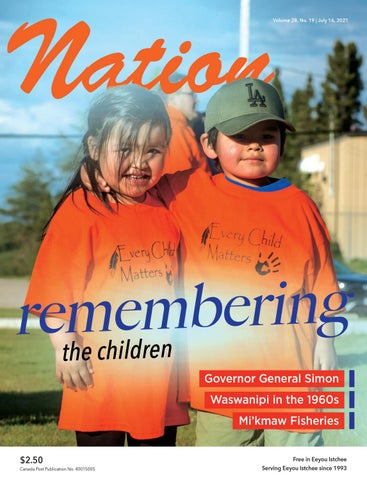
CONTENTS 10 Canada Day Cancelled
EDITORIAL 4
Responses
NEWS Vaccinated and vigilant
5
A regal representative
6
IN BRIEF
9
FEATURES Indigenous communities have been coming together to grieve and seek solace in ceremony
18
Documenting the end of an era
Mourning Canada Day
10
The way things were
18
Fishing for a living
21
PUZZLES REZ NOTES
Events
24
Memories of the past
25
UTNS Sobriety chronicles
21
Fisheries plan Photo by Gerardo Salazar
26
Editorial
Responses by Will Nicholls
T
he fallout from the recent discoveries of unmarked graves of children who attended residential schools in Canada has far-reaching consequences and a variety of responses. In Eeyou Istchee, communities removed the Canadian flag for the month of July. Some communities even did this before the July 1 Canada Day holiday. Elsewhere in Canada, both Indigenous and non-Indigenous peoples debated whether Canada Day should be celebrated, canceled or marked as a day of remembrance. While anti-Canada Day marches and protest were held in Eeyou Istchee and other First Nations, many non-Indigenous communities and cities held them also. Some were small while others saw thousands join in across the country. In some places statues were pulled down and defaced. Some First Nations chiefs have condemned those actions. Chiefs Ron Sam (Songhees First Nation) and Rob Thomas (Esquimalt First Nation) in a Times Colonist op-ed stated, “Anyone who par-
ticipated in this recent act of vandalism has no cultural role or right to act or speak on our behalf.” On the other hand, former Senator Murray Sinclair feels that the statues shouldn’t be replaced as they were an example of “colonial gloating”, and they were “monuments to a failed genocide.” The unmarked graves were an eye-opener for many Canadians. The Truth and Reconciliation Commission and even the murdered and missing women and girls were just news items that didn’t seem to catch the Canadian psyche. However, children’s hidden deaths grabbed hold of the Canadian conscience and understandably so. As humans, we try to protect and cherish children. Many Canadians are questioning their relationships with churches, asking why there is a lack of accountability and discussion about the residential school system. Some have even left the churches they attended and supported for most of their lives feeling angry and betrayed.
ANYONE WITH INFORMATION ABOUT
CAN CALL
1-855-547-5938
A MURDERED OR MISSING INDIGENOUS WOMAN, TRANS PERSON OR TWO-SPIRIT PERSON
Roman Catholic, Anglican, Methodist, Presbyterian and United churches ran residential schools. The Catholic Church ran about 70% of the schools but has done little to acknowledge their deeds. Some have expressed their anger at the churches by defacing doors, smashing windows or even burning them down. Five churches have been burnt beyond possibility of repair. Many First Nations leaders have condemned these actions. But many Canadians tacitly defend the vandalism as justifiable retribution. The head of the BC Civil Liberties Association, Harsha Walia, commented, “burn it all down” in reference to the churches. The Union of BC Chiefs supported her position. Of course, Prime Minister Justin Trudeau was quick to respond, unlike fulfilling his promises of safe drinking water or implementing the 94 calls to action of the Truth and Reconciliation Commission. September 30, known as Orange Shirt Day, will be an official holiday renamed as the National Day for Truth and Reconciliation. It was enacted in early June shortly after the discovery of the unmarked graves. At least three sites have been found to date. Some funds have been made available to search for sites by both federal and provincial governments. Trudeau has also named Mary Simon, an Inuk woman, as Canada’s first Indigenous Governor General. Though it is mostly a ceremonial position, it holds out hope for some. One of the powers of the Governor General is to give royal assent to enact Canadian laws and bills – no previous office holder has ever refused to do so.
the Nation is published every two weeks by Beesum Communications EDITORIAL BOARD L. Stewart, W. Nicholls, M. Siberok, Mr. N. Diamond, E. Webb EDITOR IN CHIEF Will Nicholls DIRECTOR OF FINANCES Linda Ludwick EDITORS Lyle Stewart, Martin Siberok PRODUCTION COORDINATOR AND MANAGING EDITOR Randy Mayer CONTRIBUTING WRITERS M. Labrecque-Saganash, S. Orr, P. Quinn, B. Powless DESIGN Matthew Dessner SALES AND ADVERTISING Danielle Valade, Donna Malthouse THANKS TO: Air Creebec CONTACT US: The Nation, 4529 CLARK, #403, Montreal, QC., H2T 2T3 EDITORIAL & ADS: Tel.: 514-272-3077, Fax: 514-278-9914 HEAD OFFICE: P.O. Box 151, Chisasibi, QC. J0M 1E0 www. nationnews.ca EDITORIAL: will@nationnews.ca news@nationnews.ca ADS: Danielle Valade: ads@nationnews.ca; Donna Malthouse: donna@beesum.com SUBSCRIPTIONS: $60 plus taxes, US: $90, Abroad: $110, Payable to beesum communications, all rights reserved, publication mail #40015005, issn #1206-2642 The Nation is a member of: The James Bay Cree Communications Society, Circle Of Aboriginal Controlled Publishers, Magazines Canada Quebec Community Newspaper Assn. Canadian Newspapers Assn. Les Hebdos Sélect Du Québec. Funded [in part] by the Government of Canada. | www.nationnews.ca | facebook.com/NATIONnewsmagazine | Twitter: @creenation_news
4 the Nation July 9, 2021 www.nationnews.ca
CMCA AUDITED
C O V I D - 1 9 U P D AT E
by Ben Powless
Vaccinated and vigilant Covid cases down nationally, even as fourth wave surges elsewhere
T
he Cree Health Board said that until more people get vaccinated, including young children, Covid prevention measures would remain in place, especially with the spread of new variants. The health board also encouraged people to take advantage of newer, less-intrusive gargle testing available at all community clinics when returning to Eeyou Istchee. All Cree communities have now fully vaccinated at least 70% of their adult populations. Wemindji has the highest rate at 90% while both Mistissini and Waskaganish trail the pack at 71%. Still, the rate of full vaccination is nearly double the average (37%) in the general population across Canada. Among 12-17-year-olds, 97% have received their first dose in Waskaganish, while only 57% of this age group in Waswanipi have had a shot. As of mid-June, fully vaccinated individuals were exempt from all mandatory self-isolation requirements when returning to Eeyou Istchee from outside communities. Otherwise, unvaccinated travellers were still required to isolate 10 days when returning from communities at risk.
Canadians and permanent residents who are fully vaccinated no longer need to complete the 14-day quarantine when returning to the country
Deconfinement measures remained the same, allowing for indoor gatherings of 50 people and outdoor gatherings of up to 150. Case counts continued to fall across Quebec and much of the country, with average daily case counts below 100 in Quebec, the lowest numbers since August 2020. Eeyou Istchee, Nord-du-Québec, and Abitibi-Témiscamingue were all reporting no active cases, while Saguenay–LacThe ability to travel internationally again is closer now than it has been in almost a year and a half
Saint-Jean reported only three active cases. Vaccinations also proceeded across Quebec, with over 81% of those 12 and up receiving at least a first dose, and 37% receiving both doses. Quebec Health Minister Christian Dubé said there wouldn’t be another lockdown if there was a fourth wave, but that individuals may be required to show proof of vaccination to access certain services. Public health officials expected an upturn in cases as people head back to work and school in the fall, and as variants continued to spread. While cases were declining across Canada, another wave of the pandemic was being felt elsewhere around the world. Parts of Asia, Africa and Latin America saw the rise of the highly contagious Delta variant. Even places that had previously done well, including Australia, are now under strict restrictions to prevent further spread of the virus. Canadians and permanent residents who are fully vaccinated no longer need to complete the 14-day quarantine when returning to the country. Travellers will be forced to show electronic proofs of vaccination through a new government app, as well as meeting other requirements. Prime Minister Justin Trudeau announced that other measures to reopen the US-Canada border would be rolled out in the coming weeks.
www.nationnews.ca July 9, 2021
the Nation 5
Editorial News
A regal representative by Patrick Quinn
6 the Nation
Mary Simon appointed Canada’s first Indigenous Governor General
T
he appointment of Inuit leader Mary Simon as Canada’s first Indigenous Governor General July 6 came at a judicious moment. “I can confidently say that my appointment is a historic and inspirational moment for Canada and an important step forward on the long path towards reconciliation,” said Simon during the press conference to introduce her as the representative of the British monarchy and Canada’s official head of state. “Indeed, my appointment comes at an especially reflective and dynamic time in our shared history.” Born in 1947 to an Inuk mother and a white fur trader father, Simon was raised in Kuujjuaq along with seven siblings and had a traditional Inuit upbringing heavily influenced by her maternal grandmother. After completing her schooling, Simon worked with CBC North before beginning a long career advocating for Indigenous rights. Elected secretary to the board of directors of the Northern Quebec Inuit Association, she helped negotiate the 1975 James Bay and Northern Quebec Agreement – the first modern treaty that entrenched constitutional safeguards for Inuit people of Nunavik and the Cree of Eeyou Istchee. In 1982, Simon was elected president of Makivik, the corporation created to administer the agreement’s funds in Nunavik. That year, she played a role in the negotiations that entrenched Indigenous and treaty rights in the repatriated Canadian constitution. That and Simon’s numerous subsequent efforts to promote Inuit self-determination rendered her a central figure in the struggle for the rights of Indigenous people. “Hearing her first words in Inuktitut, proudly stating where she’s from and who her family members are – that just changes the game for so many people who might not imagine themselves in leadership roles,” said Inuit Tapiriit Kanatami President Natan Obed, who represents Inuit across Northern Canada. “Her identities and her values will be on full display for the time she serves. And Inuit can be proud that Mary is there representing our culture.”
Obed was part of an advisory group that considered the candidacies of more than a hundred people after former astronaut Julie Payette resigned as G-G in January in turmoil over allegations she presided over a toxic working environment. With Simon’s extensive qualifications and knowledge, Obed says Simon’s appointment wasn’t “exclusively a diversion tactic” for Prime Minister Justin Trudeau to score political points in the wake of the national trauma caused by the discovery of hundreds of unmarked graves at former residential school sites. Inspired by oral history and her grandmother’s dream of reuniting Inuit around the world, Simon contributed to the creation of the Inuit Circumpolar Conference in 1977 that brought Inuit from Canada, Alaska, Greenland and later Russia together for the first time. She became the first Inuk to serve as Ambassador for Circumpolar Affairs, during which time she negotiated the creation of the Arctic Council and served as Canada’s ambassador to Denmark. More recently, she founded the Arctic Children and Youth Foundation and has developed important policies and programs supporting the environment and other key issues affecting the North. Among numerous distinctions, Simon is an Officer of the Order of Canada and recipient of the Governor General’s Northern Medal, the Gold Order of Greenland and the National Aboriginal Achievement Award. In her new role as the Queen’s representative, she will be responsible for bestowing similar honours to others, resolving constitutional matters and potentially dissolving Parliament in the event of an election. While several Indigenous leaders saluted Simon’s accomplishment, the Native Women’s Association of Canada (NWAC) pointed out in a statement that she “is being asked to serve the senior role in what is still a colonial system of governance.” NWAC added that “it is time for the government to get out of the way to allow Indigenous people to manage their own affairs,” suggesting that the departments of Crown-Indigenous Relations
and Indigenous Services should be Indigenous-led. “The governor general has an obligation to not be partisan, but they also have an obligation to speak out on social justice issues,” commented Cindy Blackstock, executive director of the First Nations Child and Family Caring Society. “Because if you’re not able as the Queen’s representative to speak out against social and economic injustices, what is the purpose of this?” In Quebec, Simon’s inability to speak French caused some controversy. Frenchlanguage instruction wasn’t offered at the federal day school she attended in her youth, but she promised to study French in order to conduct her duties in both official languages, as well as Inuktitut. A compensating factor, said Mary Ellen Turpel-Lafond, the director of the Indian Residential School History and Dialogue Centre at the University of British Columbia, is that Simon’s familiarity with the legacy of residential schools and day schools will help Canada grapple with their continuing impacts on Indigenous people across the country. “Governor General Simon is someone who has had to make space to be heard in places where Indigenous women have been excluded, silenced and ignored,” added Turpel-Lafond. “She has done so, not by yelling or pushing, but by being consistently kind, brilliant and thoughtful, thus formidable.” While Simon acknowledged the pain and suffering caused by colonialism, she said she didn’t see any conflict about being the Queen’s representative in Canada. With her mixed heritage and worldly experiences, she will focus on advancing reconciliation among the peoples of this land. “These experiences allow me to be a bridge between the different lived realities that together make up the tapestry of Canada,” Simon said. “I can relate to all people no matter where they live, what they hope for or what they need to overcome. The past is something that we have to come to terms with, but I am going to look forward to ensure Canadians together will build a better Canada.”
www.nationnews.ca July 9, 2021
the Nation 7
Statistics Canada Statistique Canada is hiring for the recrute pour le Recensement de 2021! 2021 Census! Apply now!
Postulez dès maintenant au
www.census.gc.ca/jobs
www.recensement.gc.ca/emplois
Sharpen your skills and gain marketable, professional experience.
Perfectionnez vos compétences et acquérez une expérience professionnelle utile.
In Brief Mistissini church vandalized In two separate incidents, a window was broken and obscene words spray-painted on the doors of St. John the Evangelist, Mistissini’s Anglican church. The broken window was discovered June 26 while the spray paint appeared three days later, according to Reverend George Westgate. Westgate told the Nation that the vandalism may be in reaction to the recent discovery of 215 unmarked graves in Kamloops, BC, and the remains of 751 mostly children discovered at another residential school in Saskatchewan, which sparked protests and vigils across the country ahead of Canada Day. Also, a number of churches have burnt down in recent weeks, presumably in response to the discoveries of the graves associated with residential schools. “My heart is breaking for the children and the youth in the community,” said Westgate. “If they came to me I would say I forgive you. But at the same time, they’re crying out for help. My heart breaks for all of my Cree brothers, and Indigenous brothers and sisters across the great nation from coast to coast to coast, and I pray we can move forward towards a good road of truth and reconciliation walking together.”
starting in 2021. The holiday, to be known as the National Day for Truth and Reconciliation, was first proposed by the Truth and Reconciliation Commission in 2015 to honour residential school survivors, families and communities, and to ensure public commemoration of the history and legacy of residential schools. The holiday builds on grassroots support for Orange Shirt Day, established in 2013 by residential school survivor Phyllis Webstad on September 30, which has seen broad participation across the country honouring residential school survivors and victims. The holiday was included in Bill C-5, which passed on June 3 and comes into effect August 3. “We have taken steps to address the Truth and Reconciliation Commission’s Calls to Actions,” Canadian Heritage Minister Steven Guilbeault said in announcing the holiday. “However, we recognize that there is still much work to do as a country to make progress on our shared path of reconciliation. This includes acknowledging the harm residential schools have done to Indigenous Peoples. By establishing a National Day for Truth and Reconciliation, we will have a day every year to reflect and honour the survivors of residential schools, ensuring they are never forgotten.”
Radio initiative reaches nationwide On June 30, over 500 radio stations across Canada took part in a full day of programming focused on sharing stories from Indigenous leaders, residential school survivors, Elders, musicians and teachers. Some of the featured speakers included Orange Shirt Day founder Phyllis Webstad, author Tanya Talaga and artist Isaac Murdoch. The broadcasting initiative was organized by the Gord Downie and Chanie Wenjack Fund, which was founded by Tragically Hip singer Downie before his death in 2017 as an organization to amplify stories about reconciliation and residential schools. “Many Canadians were shocked to learn of the remains of 215 children buried in Kamloops and now growing numbers at other residential school sites, something Indigenous communities have known – and shared – for years,” said Sarah Midanik, President & CEO of the Gord Downie & Chanie Wenjack Fund in a statement. “We hope that ‘A Day To Listen’, and the ongoing work that we do at DWF, begins a new chapter in our recon-
ciliation journey so that no Canadian is ever shocked again by the horrors inflicted upon Indigenous Peoples.”
Pride walk in Ouje A Pride walk took place June 25 in Ouje-Bougoumou, drawing dozens of community members for the second year in a row. The event was organized by LGBTQ2S (Lesbian, Gay, Bisexual, Trans, Queer and Two-Spirit) youth and sponsored by the Ouje-Bougoumou Cree Nation’s Executive, the Wellness Department, and the Ouje Youth Council. In addition to the walk, the event featured bracelet making, a flag-making contest, a barbeque, and drawing a large rainbow flag in the band office parking lot. Several candidates for the Cree Nation Government elections also attended to show support. On last year’s walk, organizer Ancita Allain told the CBC that LGTBQ2S youth in the community had seen that other places were organizing events and wanted to do something. That event drew in youth and supporters from as far as Mistissini. Last year also saw the first two-spirit walk in Mistissini in September, drawing a few dozen people.
New national holiday The federal government passed a bill establishing a new statutory holiday on September 30 of every year, www.nationnews.ca July 9, 2021
the Nation 9
Features
Discovery of hundreds of unmarked graves at residential schools lead to calls to cancel July 1 celebrations
A
s the number of undocumented graves of former residential school students continues to climb across Canada, Indigenous communities have been coming together to grieve and seek solace in ceremony. The Cree Nation respectfully invited Eeyou Istchee communities to stand in solidarity with residential school victims and survivors by taking down their Canadian flags for the month of July and wearing orange on Canada Day. “These past few weeks were a sombre reminder of this country’s not-so-distant past and clearly demonstrates the need for Canada to deal with its colonial past before we can collectively heal as a Nation,” stated Grand Chief Abel Bosum. “It is also our hope that during this time we can begin to reflect upon our collective actions as we respond to these troubling revelations so we can move forward and find ways for our communities to heal.” As Quebec’s first two residential schools were located at Chisasibi’s former location on Fort George Island, Chief Daisy House called on governments and churches to share their records about the children who attended these and other schools to bring a sense of healing and closure. Plans are ongoing to search the former school sites on Fort George Island, supported and guided by local Elders groups. “The youth council in my community has requested that Canada Day activities be cancelled this year, as a way to honour both the children who never returned home as well as the survivors who still carry the scars,” House shared. “We have heard survivors share horror stories about their experiences in residential school and it is not a surprise that many of these heroes have taken their stories to their graves.” The calls to dampen Canada Day celebrations followed the discoveries of 215 unmarked graves at a former residential school in Kamloops, BC, as many as 751 graves at Marieval Indian Residential School in Saskatchewan, and another 182 grave sites discovered by the aq am community at the St. Eugene’s Mission residential school near Cranbrook in southern BC.
10 the Nation July 9, 2021 www.nationnews.ca
Mourning Canada Day by Patrick Quinn | Photos by Gerardo Salazar
12 the Nation July 2, 2021 www.nationnews.ca
“You can never fully prepare for something like this,” Chief Jason Louie of the Lower Kootenay Band, a member of the Ktunaxa Nation, told the CBC. “We were robbed of future Elders. Those children, if they had not passed away, could have been Elders and teachers in our communities, the keepers of knowledge. It’s devastating.” By the time of this last announcement on June 30, calls had steadily been growing across the country to cancel Canada Day celebrations the following day. Several cities and organizations muted their celebrations entirely while several others revised their plans to reflect a more sombre mood. Thousands of people marched in various cities to honour Indigenous children impacted by residential schools, many wearing orange and carrying signs declaring sentiments such as “no pride in genocide.” When discussing the tragic discovery in Kamloops at a meeting to plan their next events, the Chisasibi Youth Council had determined it wasn’t the right time to organize their typical festivities for Canada Day. “We thought it was time to take a pause on celebrating Canada Day,” said Chisasibi Youth Chief Steven Tapiatic. “When someone passes away or there’s a death in the community, we usually shut everything down on that day of the funeral to show respect for the deceased and the family affected.” The Chisasibi Youth Council led the community’s candlelight vigil June 30. With cultural and spiritual guidance from local Elders, a sacred fire was lit for two nights ending July 1 at 11:59 pm, with tobacco available for offerings. “A lot of members in our Youth Council felt sad, angry and confused or lost because many of my members have children who are three to five years old,” Tapiatic told the Nation. “When they heard that the youngest body found was three years old, it really hit home for them. They couldn’t imagine their kids leaving and never coming back and never knowing what happened.” As community radio station CHFG broadcast live from the Mitchuap fireplace, Reverend Jacob Sealhunter led the ceremony alongside the Heart
www.nationnews.ca July 9, 2021
the Nation 13
Even once vaccinated, Evenyou once vaccinated, still need you stillyourself. need to protect to protect yourself.
14 the Nation June 18, 2021 www.nationnews.ca
Let’s work together to keep respecting health measures so we can protect each other. Let’s work together to keep respecting health measures so we can protect each other.
www.nationnews.ca July 9, 2021
the Nation 15
of the Land drum group and a speech from Chief Daisy House. Yellow hearts marked a map of the community sidewalk, where residents were encouraged to meet with their candles, stuffed animals and radios to listen to the broadcast. They also encouraged people to bring out their Elders and help them get comfortable. “It’s opening old wounds from residential school survivors, but we are a very strong community,” said Tapiatic. “Parents are having a hard time explaining what happened to kids – there’s no guide on how to talk about what’s happening right now. The best way for us in Chisasibi is prayer and drumming.” Tapiatic explained that the Council’s intention isn’t to disrespect to Canada or Canada Day, but rather to devote their energies to coming together “to find guidance and support for our people to truly heal from what is happening right now.” Chisasibi wasn’t the only community to commemorate the impact of the residential school legacy. At their community saaptuan, OujeBougoumou hosted a candlelight vigil June 30. Nemaska also hosted a community event July 1 called “Honouring Our Children & Youth Day”, which featured an “arrival by canoe re-enactment” and candlelight vigil in addition to summer games and fireworks. Whapmagoostui resolved that instead of celebrating Canada Day, a special day would be observed on July 2 to honour residential school survivors and those who never made it home. The northernmost Cree community also held a “remembrance walk for the lost children” on July 1. Orange shirts were given out and lunch served after the walk. “Since we felt it was inappropriate to celebrate Canada this year, we decided to dedicate this July 1 to our children and our youth,” stated Chief Clarence Jolly. “We will also honour our Cree strength, our resilience, and remember the lives of the ones who unfortunately did not come home.”
16 the Nation July 9, 2021 www.nationnews.ca
Jean-yves Soucy
by Patrick Quinn, Photos provided by Robin Philpot of Baraka Books
Waswanipi touchingly documents the end of an era
A
new book chronicles a young man’s first impressions of Waswanipi in 1963, two years before the Hudson’s Bay Company trading post closed and people dispersed from the community’s former location. Award-winning author Jean-Yves Soucy’s Waswanipi, posthumously published by Baraka Books, provides a vivid account of traditional Cree life with witty, touching prose. Soucy recounts his summer job as an 18-year-old fire warden making canoe patrols with two Cree guides, Tommy Gull and William Saganash. Saganash’s son Romeo contributed the book’s afterword and persuaded Soucy to write his story at a chance meeting around 2009, insisting he “got to see the end of an era.” “I would have liked the chance to thank Jean-Yves Soucy while he was still alive for this account, not only for having honoured William’s memory but for reminding us how things were back then, in the early days of our relationships with such different peoples,” Romeo Saganash writes. “Soucy makes us realize the extent to which the region’s development has taken off since his first trip there.”
From the first pages arriving in Eeyou Istchee aboard a small floatplane, Soucy’s writing is infused with youthful wonder as he embarks upon adventures with curiosity and empathy. He goes waterskiing with Simon Ottereyes, develops a crush on a young missionary nurse, and earns the respect of his two guides as he is gradually welcomed into their community. Gull and Saganash are portrayed throughout the story as generous, funny and wise. Although Gull doesn’t speak English, it’s the latter whose voice emerges most clearly. An example of their sense of humour is glimpsed as they treat Soucy’s prejudiced and curmudgeonly colleague to particularly exhausting days of portages in the densest woods. When Soucy asks Saganash if he believes in spirits after Gull tosses a pinch of tobacco in the water, he diplomatically responds, “Why not? It’s like having a spare oar.” As the friendships develop, the narrator is invited to Sunday picnics with the Saganash family and presented with moose-hide moccasins from Mrs. Gull that never leave his feet. “The first excursion is just like the two months to come: a carefree exis-
18 the Nation July 9, 2021 www.nationnews.ca
tence among a welcoming, steadfastly optimistic people who have a contagious thirst for life,” writes Soucy. “It’s different in how it conceives of the world, of time, and of the place given to humankind in the universe, by its definition of property, by the obligation to help each other.” The old Waswanipi village ran 500 metres along the island’s shore, a trail of tents and small cabins from the trading post to the chapel and dispensary. When Soucy’s colleague hurts his back, they visit the ice-house – two metres of water frozen in the winter and insulated with a thick layer of sawdust, used to store fish caught by the locals that is collected by floatplane twice a week for commercial sale. Explorations through the woods and waters yield regular lessons from the Cree guides. Often, they’d be hunting tips, such as allowing a wounded animal to rest before pursuing it. A wedding near summer’s end brings a weekend of revelry but also some sad reminders of racist rules that render the Crees “second-class citizens”. Only the white men are permitted to purchase beer for the wedding, while the local men must remove all remnants
the way things were Romeo Saganash, Photo by Suzanne Méthot
of alcohol afterwards in case the RCMP investigate. Soucy’s friend Simon, who attends residential school in Sault Ste. Marie, is torn between two civilizations – although he is a good teacher of Cree language and societal norms, he reduces certain traditions to bygone superstitions, “legends invented around the fire.” In a meditative mood following a berry-picking expedition, Gull laments that their world is changing. With the government taking away the children every fall, they no longer go to the winter hunting grounds or know how to live in the forest. “Being without traditions is like descending a rapid in a canoe without a motor and without a paddle,” adds Gull. Saganash responds that there’s no longer money in trapping and no longer sufficient space from the surrounding white man’s world. There’s no turning back – the Crees can no longer live as they did. However, he says “school is perhaps a necessary evil” to know the white world so they can confront and negotiate with them, therefore learning a new way to live as Crees. Waswanipi is both a breezy summertime read, a slim and lively book that can be devoured in an afternoon, and a story
brimming with big ideas to be savoured slowly. Soucy demonstrates great storytelling with an impressive memory for details and the translation is expertly handled by Peter McCambridge. It’s a valuable resource from an anthropological perspective, helping both Cree readers to learn about a valuable part of their own history and outsiders “to get to the heart of the Cree soul”, as Soucy puts it. Romeo Saganash emphasizes in the afterword that the book’s events occurred just before things changed drastically for the Crees. “Back when I was a child, every young Cree dreamed of living the traditional life, of pursuing the age-old traditions, of absorbing all the knowledge handed down from generation to generation,” writes Saganash. The book carries priceless insights about William Saganash, who died five years after the story’s events, when Romeo was just seven. Soucy explains that Romeo has no memories of the old Waswanipi village and few of his father. None of William’s boys were able to leave residential school to attend his funeral. “I admired him like a child awaiting his turn to be like his father,” Saganash
states. “Like him building canoes, patiently crafting snowshoes I still consider works of art, carving his paddles and all the other tools he needed to live the traditional Cree life.” After leaving residential school, Saganash promised himself to first live a life walking in the footsteps of his father and ancestors in the bush and then to make peace with whoever had shut him in that “linguistic, cultural and political prison”. He sought to continue his father’s legacy by being a provider, which prompts him to ask whether his illustrious political career was ultimately determined by his father’s untimely death. “And so I negotiated agreements on behalf of my community, for my nation, to provide for people in my own fashion,” Saganash writes. “I often wonder if my own fate changed with my father’s... From that carpet of fir branches in a tent on the shores of the Mishagomish, I eventually grew up to become a Member of Canada’s Parliament. There, my attempt to make peace failed. But that’s another, as yet unfinished, story.”
www.nationnews.ca July 9, 2021
the Nation 19
CREE JUSTICE FUNDS
2021-2022 CALL FOR PROPOSALS CRIME PREVENTION FUNDS
YOUTH ENGAGEMENT FUNDS
To prevent and combat crime in Eeyou Istchee by
To empower and engage youth by promoting positive
addressing the underlying causes
lifestyle choices that reflect our cultural values
FUNDING PRIORITIES
Prevention of Violence
Alcohol/Drugs Abuse and Addiction
Prevention of Crime
Addressing Trauma and Mental Health
TO APPLY CONTACT: Desiree Ottereyes, Justice Funds Administrator
and Correctional Services 20 Department the Nation Julyof9,Justice 2021 www.nationnews.ca
P: 819-978-3300 F: 819-978-3301
info@creejusticefunds.ca www.creejusticefunds.ca
Community
Fishing for a living Three First Nations in Nova Scotia launch fisheries plans by Ben Powless
T
he Mi’kmaw communities of Acadia First Nation, Bear River First Nation and Potlotek First Nation have all developed moderate livelihood fisheries and have moved to implement them, both with and without government approval. Acadia and Bear River First Nations launched a joint fishery for elvers (baby eels under 10 cm in length), known as katew in the community. The plan, developed in April, allows for up to 115 kg of elvers to be harvested on any of the 19 watersheds in the area, with a maximum of 35 kg per person. Harvesting is to be done with hand nets, fyke nets, elver pots and elver traps. The Department of Fisheries and Oceans (DFO) currently has an experimental elver fishery that allows for 10,000 kg to be caught, covering 30% of the available fishable habitat, worth $38 million in 2018. While the current plan does not include eels, the plan says that they may be covered under a fishery in the future. The plan, posted on Acadia First Nation’s website, says the communities are establishing this fishery as an interim management plan, and that they intend to document the upstream migration of elvers on select-
ed rivers to identify potential locations for a future elver fishery on those rivers. Acadia and Bear River First Nations did not respond to a request for comment. The DFO confirmed that it had received the communities’ plan but had not approved it, with a spokesperson for the department saying: “At this time, DFO has not authorized any moderate livelihood fishing plans for elvers, but the Department is in active discussions with treaty communities that have developed fishing plans.” While the Committee on the Status of Endangered Wildlife in Canada lists American eels as threatened, the communities maintain that eel populations have been increasing since the late 1980s, and that record catch levels in 2018 “indicate that this species can support some support level of Mi’kmaq livelihood harvest.” Potlotek First Nation announced its own moderate livelihood fishery starting in June, which would see the
community able to set 700 lobster traps during the regular lobster season on and near Cape Breton Island. “We didn’t sign any agreements – I told my community members that we wouldn’t. Through talks, we were able to come to an understanding with DFO,” said Potlotek Chief Wilbert Marshall in a statement. “We know that this is an interim measure, but it is a good first step. We will be working with DFO to see that the needs and expectations of our communities are met, in relation to the number of traps currently allocated,” Marshall continued. The plan comes after Mi’kmaw harvesters saw their gear and equipment seized last year, when non-Indigenous fishers attacked the moderate fishery operations of numerous Mi’kmaw communities. “I have been clear to the Minister that 700 traps is insufficient. We want to see our people be able to earn a good, honest living.
For us, that included doing so through what has been a part of our culture since time immemorial – fishing,” said Marshall. In response, Fisheries Minister Bernadette Jordan commented on the community’s plan, saying in a statement, “This marks an important step forward that demonstrates Canada’s willingness to listen to the individual needs of communities, to support their vision, and find common ground that maintains a sustainable fishery and sees community members on the water and able to sell their catch. “In working together to implement this moderate livelihood fishing plan, we will lay the groundwork for future advancements,” Jordan said. “Reaching this understanding, which recognizes the rights and interests of Indigenous communities, will help to further advance Potlotek’s vision of self-determination and economic self-reliance.”
www.nationnews.ca July 9, 2021
the Nation 21
For more info... Jordan’s Principle Office Cree Board of Health and Social Services of James Bay (CBHSSJB) 418-923-3355 x42186 18tcr.jordans.principle@ssss.gouv.qc.ca creehealth.org/jp
Individual Applications for Eeyou Istchee
The legacy of Jordan River Anderson
Jordan was born in Norway House Cree Nation, Manitoba in 1999, with multiple disabilities and stayed in the hospital from birth. When he was 2 years old, doctors said he could move to a special home for his medical needs. However, the federal and provincial governments could not agree on who should pay for his home-based care. Jordan passed away in the hospital at the age of 5. In 2007, the House of Commons passed Jordan’s Principle in memory of Jordan. Today, Jordan’s Principle is a legal obligation, which means it has no end date—it will support First Nations children for generations to come.
Is your child eligible for Jordan’s Principle? Current eligibility criteria under Jordan’s Principle are: • 0 to 18 years old • Must have a band number (or parents’ band number, if not yet assigned)
24-hour Jordan’s Principle Helpline
1-855-572-4453 Your child does not have to have a disability to be covered under Jordan’s Principle.
LeArN FrOm ThE LaNd!
Where can you pick up a fresh copy of your Nation every two weeks? – – – –
Let’s cheer these amazing businesses listed below…
Nation is available there!
Chisasibi Coop | T: 819-855-2828 Retro Daze Café | T: 819-855-1847 Miichiwaap Restaurant | T : 819-855-2430 The Yummy Cook Out | T: 819-855-2241
– Whale Mart
in Whapmagoostui – Wemindji Community Store T: 819-978-3656
in Chisasibi – Eastmain Grocery Store T: 819-977-0283
in Wemindji
– Nemaska Grocery T: 819-673-2525
in Eastmain in Nemaska in Waskaganish – Smokey Hill Grocery T: 819-895-2727
– Meechum Reg’ T: 418-923-3217
in Mistissini in Waswanipi
– Waswanipi Grocery T: 819-753-2514
Always available for download at:
in Oujé-Bougoumou – Casey’s Depanneur and Gaz T: 418-745-3211
nationnews.ca
www.nationnews.ca July 9, 2021
the Nation 23
Puzzles Crossword
H
ere’s another edition of the Nation’s puzzle page. Try your hand at Sudoku or Str8ts or our Crossword, or better yet, solve all three and send us a photo!* As always, the answers from last issue are here for you to check your work. Happy hunting.
PREVIOUS SOLUTION: A R E A
C A P E R
A L I C E
C O M A
I V A N
M I L L W R I G H T N E R D
B A L L A D S O R D E R L Y
S T R T A R T I A T E L A A C I T M A S T E S
K E E L C H A L E T
I N S E T O N E
O S R A A G P E
M P O R P I R S E H O S A N T L E T R A E S R O T P I P I R I N L E E D
A Z A L E A S M A T I L D A
D A T E
A N O N
M Y R A
R E C I T A T I O N
E M O T E
S I D E D
E A S E
D R E W
1 2 3 4 ACROSS 1 Mountain goat's 14 perch 17 5 Something to debate 20 21 10 Anagram for 23 "beat" 14 Circle overhead? 27 15 La Scala offering 33 34 35 16 Blacken on the 39 38 grill 17 Emanation 43 44 18 Timothy Bottoms 49 plays a law stu- 48 dent in this 1973 51 film (with "The") 57 58 59 20 Pine or cedar 22 Talkative 62 23 Mournful chime 66 24 Monotony 27 Once around 69 the track 29 The element carbon, e.g. 33 Deli meat 65 Went horseback 36 Bit of baby talk 66 Player's cards 37 Gaming cubes 67 Long-extinct 38 Lunch hour birds 39 Blow up, in a 68 "You bet!" way 69 Breakfast staple 42 West ender? 70 To the left, at 43 Water-filled ditch sea 45 Balloon filler 71 Long journey 46 Wiped the slate clean DOWN 48 Carried out, as 1 Wheel stopper laws 2 Harmful house50 Fishing hold gas equipment 3 "___ Again 51 Tree-covered (Naturally)" 53 Western wear (1972 #1 hit) 57 Tear into 4 Silverback, for 60 Most desirable one 62 Snake oil 5 Hit the bottle salesmen, e.g.
STR8TS Easy
Previous solution - Medium
5 6 8 7
7 8 1 9 7 8 2 6 9 7 8 6 4 4 5 3 8 2 1 3 3 2 4 5 4 3 1 2 6 4 2 3
7 8
2 5 4 7 1
7 6 5
1
4 7
3 4
5 7 7 2
You can find more help, tips and hints at www.str8ts.com
© 2021 Syndicated Puzzles
9
9 3
6
7
8
9
10
15
11
12
13
30
31
32
55
56
16
18
19 22 24
28
25
26
29 36
37
40
41
45
42
46
47
50 52
53
60 63
54
61 65
64
67
68
70
71
Copyright 2021 by The Puzzle Syndicate
6 7 8 9 10 11 12 13 19 21 25 26 28 30 31 32 33 34
Dizzying designs Gusto Steamed state Cancer-causing substance Red-faced Rhythmical accent Magi's origin Deuce taker Some fish bait Love interest Fencing words Armoire feature Coconut flavored cocktail Office neckwear One to grow on? Give for a bit "___ Like It Hot" Before long
35 40 41 44 47 49 52 54 55 56 57 58 59 61 63 64
It's out on a limb Fudged the facts Put up Facing Eager, long ago Muddy Blood giver Stevie Wonder's "My Cherie ___" San Diego slugger Smooth and glossy Masseur's target Kind of carpet Told all "Hey...over here!" Pinnacle Bustle
SUDOKU
No. 281
8
5
2 4 1 3 5 4 2 3 3 5 2 6 7 5 4 6 6 7 8 9 9 7 8
3 4 1 8 7 5 6
No. 281
Tough
2 7 1 3 8 6 5 9 4
9 2 5
8 6 7 9 2 7 8 9 6 4 6 2 9 4 1 3 5 8 4 9 5 8 6 2 4 1
How to beat Str8ts – Like Sudoku, no single number can repeat in any row or column. But... rows and columns are divided by black squares into compartments. These need to be filled in with numbers that complete a ‘straight’. A straight is a set of numbers with no gaps but can be in any order, eg [4,2,3,5]. Clues in black cells remove that number as an option in that row and column, and are not part of any straight. Glance at the solution to The solutions will be published here in the next issue. see how ‘straights’ are formed.
24 the Nation July 9, 2021 www.nationnews.ca
Previous solution - Medium
© 2021 Syndicated Puzzles
L A S T
by Margie E. Burke
4 8 6 5 7 9 1 3 2
9 3 5 4 1 2 7 6 8
7 9 8 1 5 4 3 2 6
6 5 4 8 2 3 9 1 7
1 2 3 6 9 7 8 4 5
3 6 7 9 4 5 2 8 1
5 1 9 2 6 8 4 7 3
8 4 2 7 3 1 6 5 9
To complete Sudoku, fill the board by entering numbers 1 to 9 such that each row, column and 3x3 box contains every number uniquely. For many strategies, hints and tips, visit www.sudokuwiki.org If you like Str8ts check out our books, iPhone/iPad Apps and much more on our store.
Rez Notes
Memories of the past by Sonny Orr
I
’m driving my granddaughter around the beach for no other reason than just to get out of the house and enjoy life. We stop and the little one takes off towards the shore, then turns around in joy squealing to get away from the small waves that gently wash up onto the sands where the Great Whale River meets Hudson Bay. I think back to times on the shores of Fort George Island where we did the same thing, except with a lot fewer kids my age, as many of my friends had gone back home for the summer. I knew them during the long school months and grew up with them, my friends from other towns. The summers went by as usual, long days and short nights. Soon, the first sign of fall would appear and so would the planes filled with kids from the other communities arriving for the new school year. For eight years, we grew up together, but they would leave every summer. I knew that they didn’t like the idea of leaving home just to go to school for 10 months of the year.
Over a century of forced education and child abuse by a system designed to do that, it’s something I wish on no child
For us, the locals who lived in town, their arrival meant seeing old friends and making new ones. It was a cycle that didn’t seem to have an end. Then when we got older, we would disappear to finish school in the south, which was yet another scary experience for all of us. Today on that beach, I thank our wisdom, tainted by the past, to do what we should have been done a long time ago – stay in town and finish school, without having to leave against our will. But it didn’t happen that way. Over a century of forced education and child abuse by a system designed to do that, it’s some-
ᐅᕙᓂ ᐱᒋᐊᕐᐳᖅ ᓄᓇᕕᒃ Nunavik Starts Here
thing I wish on no child. No child should ever endure this ever again. We get back on the ATV and head down the beach and watch others enjoy zipping in and out of the foaming waves. It’s fun, and I wish this could go on longer, and so does my granddaughter, so we do another spin around the beach. The only thing I feel guilty about are the exhaust fumes from my half-litre engine, but that guilt dissipates quickly. Summer showed up for eight hours and we weren’t going to waste time indoors, mosquitos or no mosquitos. I think of my old school chums
ᐃᓂᓕᐅᕐᓃᑦ RESERVATIONS 1 800 361-2965
and bet that they are doing a similar thing – getting away from the heat and remembering the past that won’t leave our memories. In the future, no child will have our kinds of memories, just the ones that last forever with all the smiles. After a quick trip to the toilet and a fast bite of a hot dog, the little one is all refreshed. She points at our matching orange hoodies and says “same-same”. Yes, samesame, but never the same again. I know the future is way brighter than it has ever been, and I hope it stays that way for a long time.
ᖃᖓᑦᑕᔫᓂᒃ ᐊᑦᑕᑐᐊᖃᕐᓂᖅ CHARTERS 1 800 661-5850
www.nationnews.ca July 9, 2021
the Nation 25
&B
T
Bannock & Sobriety chronicles Tea
by Maïtée Labrecque-Saganash
I
will reach my third year of sobriety at the end of July. I still believe it was the best decision I’ve ever made to honour and respect myself. Sometimes, I did the sober thing out of anger, out of spite against so-called Canada. The other day, a woman offered me a glass of wine, which I politely declined. She then told me that it was rare to see a sober Indigenous person. That is when I realized that no matter what I do, non-Native folks will still project stereotypes onto me. No matter how I try to present myself, people will still assume I am a drunk because of my ethnic background. So, I might as well be sober for my well-being and myself, not for them. Being unapologetically happy and healthy is a radical act of resistance against this colonial state. I hold on to this statement when things get rough. It hits home even more, now that thousands of Indigenous children are being found on residential school sites. Canada has tried and still tries so hard to break our communities, but I personally will not give them the pleasure of falling apart. Being healthy is the greatest honour I can offer the residential school survivors of my family, but it also has done wonders for my personal growth. I am now able to keep a job, to nurture relationships that are important to me and to find the will to get out of bed every morning. I reflect a lot on what it means to be the child of someone who survived genocide and my purpose when confronting the historical traumas my family still
Being raised by broken people was not easy; it is still not easy even as a 26-year-old.
carries. Being raised by broken people was not easy; it is still not easy even as a 26-year-old. At the end of the day, I am in this world, and I deserve love and happiness. If no one is going to give them to me, I will give them to myself. Sobriety didn’t fix everything but it’s definitely a great tool to have. Before getting sober, I attempted to use or drink in moderation. I relapsed a couple of times, but I persisted. Healing is not linear. As long as you keep trying and are aware of
how your drug or alcohol intake affects your life, it is still progress. There is power in saying that I am thriving despite what my family had to go through. There is power in knowing that I have the right tools to break vicious cycles of pain and trauma. I thought I was not able to do it, because it is what this country tried to make me believe. But I am capable of joy and healing. You are too.
We have been present since 1939. All members of the large Deshaies' family are by your side today and will also be for the better days to come.
26 the Nation July 9, 2021 www.nationnews.ca
Your Northern Airline of Choice
Air Creebec is operating by respecting and exceeding the rules with extensive cleaning and disinfecting of the aircraft, social distancing on board and at all service counters. We encourage everyone to respect the rules and to stay safe.
For the latest Air Creebec updates, please visit aircreebec.ca/covid19
CURRENTLY OPEN FOR PROJECTS for 2021-2022 fiscal year
In partnership with Solidarity Alliances and the Ministère du Travail, de l’Emploi et de la Solidarité sociale
PROGRAM OBJECTIVE To alleviate poverty in Eeyou Istchee, in order to allow all Crees to have the resources, means, choices, and powers necessary to maintain their economic independence, and to be able to participate fully in the development of their Nation.
PRIORITY FUNDING AREAS
Poverty & Exclusion
Health & Nutrition
Education
WHO CAN APPLY? • Local/Regional not-for-profit corporations • Cree Nation Bands and Departments • Local/Regional Aboriginal organizations • Related research organizations • Not-for-profit corporations • Private sector organizations* *Organization must not profit from the program.
SUBMISSION DEADLINE
CONTACT
August 31, 2021
Nellie W. Gray, Funding Administrator @: nwapachee@cngov.ca P: 418-923-2330 | F: 418-923-2674
or until all funds have been depleted for approved projects submitted prior to this deadline date.
CREE NATION GOVERNMENT Department of Social and Cultural Development