Come study with FNTI today! September 2021
(Virtual Learning) • Early Childhood Education • Mental Health and Addiction Worker • Social Service Worker • First Peoples’ Aviation Technology - Flight
To learn more,
visit: www.fnti.net 1.800.267.0637, ext. 156
APPLY TODAY!
CONTENTS 10 Taking his last flight
EDITORIAL 4
Curfew justice
NEWS A race against time
5
Inviting Indigenous voices
7
IN BRIEF
9
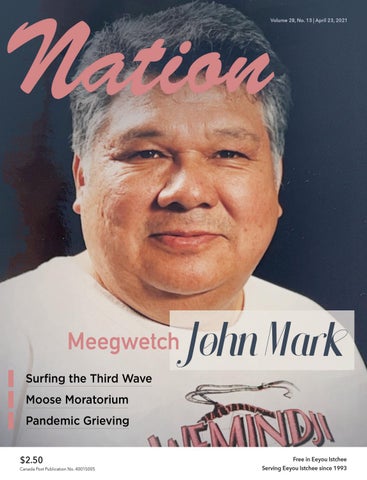
FEATURES A tribute to John Mark
Losing a pioneer
10
Goose Break survey
20
Moose moratorium?
26
PUZZLES UTNS
32
Pictures of the past
20
Geese return North, but early spring raises ice worries
33
T&B Community
Thoughts on grief & death
Photo provided by Geraldine Mark
26
Hunting ban at La Verendrye
34
Editorial
Curfew justice by Patrick Quinn
M
ontreal’s return to an 8 pm-to-5 am curfew April 11 was greeted by a large protest in the city’s Old Port, culminating in a small minority setting fires and breaking shop windows. Most of the 1,000 or so protesters defying the curfew had dispersed when police forces closed in. Imposed in January during swiftly escalating pandemic-related hospitalizations, the curfew had been pushed back to 9:30 pm shortly after clocks changed for daylight savings time. With days getting longer and warmer, experts warned that people would resist staying inside while the sun still shone. While outbreaks in early April have resulted in emergency lockdown measures in the Quebec City and Gatineau regions, infection rates in Montreal remain relatively stable. The earlier curfew for the metropolis was framed as a preventive response to the more contagious Covid variants. The province defends its “yo-yo” approach to restrictions as balancing physical with mental health. However, after a year of growing pandemic fatigue, there are signs that the government has pushed too far. “The curfew is a measure that overshoots the mark in that it restricts rights and freedoms in a way that is not justified or reasonable,” said Cara Zwibel with the Canadian Civil Liberties Association. “How effective is this kind of punitive approach where we fine people for doing things that pose no threat to public health?” With no evidence showing curfews have any impact on limiting the virus, extending it further is proving counterproductive. Epidemiologist Prativa Baral told
As the only jurisdiction in North America with a curfew, Quebec’s paternalistic approach has been derided as “authoritarian theatre” CBC the curfew change was “more performative than science-based” as “the virus doesn’t stop operating before or after a certain hour.” Many public health experts say the risk of gathering outdoors is low. Researchers at the London School of Hygiene and Tropical Medicine found that 96% of coronavirus clusters were associated with indoor settings, with the rare outdoor examples mostly connected to mass gatherings. In densely populated Montreal, parks and other public spaces are a necessary antidote to small living quarters. Getting outside is vital for people’s mental health and an effective harm-reduction strategy for those in crowded households. Grassroots organizations have highlighted the curfew’s devastating impacts on undocumented workers and women in abusive relationships. Homeless people were exempted from the curfew only after a court challenge and the death of Inuk Raphaël André, who froze to death hiding from the police. The pandemic’s well-known impacts on disadvantaged populations are exacerbated by this curfew. People in poor neighbourhoods are more likely to be frontline workers stopped by police, and reports of harassment are common. For Indigenous and Black people in particular,
these police encounters can be traumatic. Involving police in public health matters sets a disturbing precedent, particularly in Montreal where police have a history of racial profiling. On the weekend the curfew returned to 8 pm, police were witnessed targeting people of colour and viciously attacking a man drinking in a park. As the only jurisdiction in North America with a curfew, Quebec’s paternalistic approach has been derided as “authoritarian theatre.” Instead of employing tools like rapid Covid tests and ventilation detectors that have helped other regions, the province instead seeks scapegoats to conceal its own negligence. While increasing infections among younger people is worrisome, they will continue to gather with or without a curfew. The resulting sleepovers and other clandestine behaviours only put people at greater risk. As our too-brief summer approaches, people will be outside as much as possible, as always. Whatever the government’s intention, preventing this fundamental desire is unrealistic. Applying any curfew creates unnecessary conflict – extending it to 8 pm is unjust, and unjustified.
the Nation is published every two weeks by Beesum Communications EDITORIAL BOARD L. Stewart, W. Nicholls, M. Siberok, Mr. N. Diamond, E. Webb EDITOR IN CHIEF Will Nicholls DIRECTOR OF FINANCES Linda Ludwick EDITORS Lyle Stewart, Martin Siberok PRODUCTION COORDINATOR AND MANAGING EDITOR Randy Mayer CONTRIBUTING WRITERS M. Labrecque-Saganash, X. Kataquapit, P. Quinn, B. Powless DESIGN Matthew Dessner SALES AND ADVERTISING Danielle Valade, Donna Malthouse THANKS TO: Air Creebec CONTACT US: The Nation, 4529 CLARK, #403, Montreal, QC., H2T 2T3 EDITORIAL & ADS: Tel.: 514-272-3077, Fax: 514-278-9914 HEAD OFFICE: P.O. Box 151, Chisasibi, QC. J0M 1E0 www. nationnews.ca EDITORIAL: will@nationnews.ca news@nationnews.ca ADS: Danielle Valade: ads@nationnews.ca; Donna Malthouse: donna@beesum.com SUBSCRIPTIONS: $60 plus taxes, US: $90, Abroad: $110, Payable to beesum communications, all rights reserved, publication mail #40015005, issn #1206-2642 The Nation is a member of: The James Bay Cree Communications Society, Circle Of Aboriginal Controlled Publishers, Magazines Canada Quebec Community Newspaper Assn. Canadian Newspapers Assn. Les Hebdos Sélect Du Québec. Funded [in part] by the Government of Canada. | www.nationnews.ca | facebook.com/NATIONnewsmagazine | Twitter: @creenation_news
4 the Nation April 23, 2021 www.nationnews.ca
CMCA AUDITED
C O V I D - 1 9 U P D AT E
by Ben Powless
A race against time
Third pandemic wave surges as vaccination rates pick up steam
C
anada is in a punishing third wave of infections, even as vaccines continue to be administered at growing rates. Noting that cases were climbing in Ontario at an “alarming rate,” the Cree Health Board (CHB) strongly urged members to get their second vaccine dose before Goose Break. They confirmed that 10,158 people had received a vaccine so far, representing 77% of those eligible. Cree health officials said they aimed to allow more travel after Goose Break. “The health benefit from being out on the land during Goose Break outweighs the risk associated with being at our traditional camps, especially if we do what we can to protect ourselves by following the Bush Camp Protocol developed by the Public Health Department,” the CHB said in a statement. The only areas that were regarded as safe to travel were Regions 10 (Norddu-Québec), 17 (Nunavik) and 18 (Eeyou Istchee). Travel to all other areas required mandatory self-isolation upon return. The curfew in Region 10 has been lifted, allowing for indoor and outdoor gatherings of two households, businesses allowing in one person per household, and restaurants opened for dining of a maximum two adults per group. All Cree communities remained in Phase 4 of deconfinement measures. Quebec’s daily infections peaked at 1,800 recently, returning to levels last seen in January. More than 2 million doses of vaccine have been administered in the province, four months after it started its inoculation program. The province announced extended emergency measures until April 25 for the Outaouais, Chaudière-Appalaches and Quebec City. Canadian health officials confirmed the first case nationally of a rare but potentially fatal blood clot after a Quebec woman received the AstraZeneca-Oxford vaccine. Over 300,000 doses of that vaccine have been administered. The blood clot does not appear to affect people over 55, and every province and territory has suspended its use in patients under 55.
In the United States, the US Food and Drug Administration and Centers for Disease Control and Prevention recommended suspending the use of the Johnson & Johnson vaccine after detecting a rare blood clot in six patients, out of 6.8 million who received the vaccine. While the vaccine has been approved in this country, none have been delivered to Canada by its US manufacturer. Canadian officials said they were closely monitoring the decision. In total, over 8.5 million vaccine shots have been administered in Canada, with over 20% of the population receiving at least one dose. The Nation reached out to Indigenous service organizations to see how they have been affected by Covid precautions. Christina Gull, Team Leader for the Robin’s Nest Women’s Shelter in Waskaganish, said that Covid has not impacted their ability to deliver services. She says the precautions in place are very strict, which includes a gate that requires a letter from the CHB to enter. Otherwise, they are following Cree Nation guidelines and protocols, including social distancing. Nathalie Fiset, Administrative Coordinator for the Val-d’Or Friendship Centre, said that Covid restrictions forced the centre to invest in a new, much-larger location for Willy’s Place, a dry shelter for the homeless and intoxicated, since their previous space was too small to allow social distancing. The centre also separated the services they offer between different locations, while continuing to offer an on-site medical clinic with a doctor and nurse to treat patients. Those taking competency classes were moved to another location. However, all events have been paused, unless staff members feel they can be done safely. “We implement teams and share apps and OneDrive to allow people to work remotely and have adopted the workfrom-home policy by the government, unless they need direct access to service members,” Fiset added. They also provide masks for anyone entering, and require
standard measures like handwashing, social distancing and signing in. The Montreal Friendship Centre has also implemented measures allowing for a maximum of 10 community members in their space, for a maximum of two hours. Between those two-hour time blocks, the staff disinfects the centre. Additionally, everyone entering must wear a mask, receive a temperature check, and sign in and out. Their drop-in day centre amenities are still available, including showers, laundry and washrooms, as well as a daily breakfast program, lunch program, food baskets and deliveries. The centre’s street-patrol teams also remain active as a necessary service but has had to adapt to social distancing measures. All recreational activities have been paused.
www.nationnews.ca April 23, 2021
the Nation 5
1-800-361-1402
Newmont Éléonore would like to wish a safe and resourcing time out on the land for the upcoming goose break. Enjoy the spring season hunters! “When you have shot one bird flying you have shot all birds flying, they are all different and they fly different ways but the sensation is the same and the last one is as good as the first.” - Ernest Hemingway, Fathers and Sons, 1933
6 the Nation April 23, 2021 www.nationnews.ca
News One hospital’s efforts to make services more accessible to Indigenous patients by Ben Powless
Inviting Indigenous voices
A
fter the death of Joyce Echaquan last September, many health providers across Quebec questioned their treatment of Indigenous patients and analyzed the barriers to care they may face. The McGill University Health Centre (MUHC) in Montreal founded an inclusivity committee six months ago, focused on making the hospital more accessible for the Indigenous and other minorities. Under the Quebec Health Act, every public health institution must have a patients’ committee with the goal of protecting and defending user rights and working to improve care in the institution. Brian Esau of Waskaganish was one of the patients asked to sit on the MUHC committee. “It is important to have that representation – so they will know what Indigenous patients encounter,” Esau told the CBC in an interview. “It is difficult being far away and not at home. A patient does better when they are treated well. When they are treated unfairly – they don’t do as well. It makes it more difficult being in Montreal. This is why I agreed to join the committee.” Pierre Y. Hurteau has served on patient subcommittees for 13 years, including as chairperson. He told the Nation about a moment when he realized the hospital sys-
“It is important to have that representation – so they will know what Indigenous patients encounter” - Brian Esau tems could be doing more for Indigenous patients. “We were aware that there were problems with Indigenous people in the health system in Quebec, there were a few signals given by Joyce Echaquan and others. And myself, as a patient, I was in the ER and next to me was a Cree couple, and I sensed they were feeling a bit strange, and I sort of said how can we make the hospital environment more user-friendly to Indigenous people.” For instance, Hurteau identified challenges for northern dialysis patients during the pandemic. “There’s no dialysis treatment up North and they have to stay down south, because it’s two or three times a week,” he noted. “Normally pre-pandemic they would go back every three months and then return for treatment, but now they haven’t been up North to see their fami-
lies. We hope someday they can get more treatment where they live.” That’s when the committee recruited Esau, a dialysis patient, and started with the first phase of the accessibility initiative, which began with translating a user committee pamphlet into Mohawk, Cree and Inuktitut. A second phase will ensure that way-finding signs around the hospital are translated into Indigenous languages and more Indigenous art will be exhibited in the hospital. Hurteau is hopeful that, “we will be more aware with the presence, for instance, of the patient from up North on our committee, their concerns and issues with the health system, and the ways we can improve the care they receive.” To join the patients’ committee or submit feedback to the MUHC, visit muhc.ca/ patientscommittee.
www.nationnews.ca April 23, 2021
the Nation 7
2021 Spring Goose Hunt Message 2021 Spring Goose Hunt Message In previous messages to the Cree Nation just prior to our annual Goose Hunt, the importance of our people returningIn toprevious the land—to Eeyou to Istchee—during thejust Goose Hunt wasannual emphasized. It wasthe in order for us to advantage messages the Cree Nation prior to our Goose Hunt, importance of take our people return2021 Spring Goose Hunt Message of the to renew connection to source of our and ourIttraditions. Thefor land, Eeyou ing opportunity to the land—to Eeyou our Istchee—during thethe Goose Hunt wasculture emphasized. was in order us to take Istchee, advantage
hasof the source oftoour wisdom, the source of our traditional knowledge, and theThe source our values the opportunity renew connection toprior the source of our culture our traditions. Eeyou Istchee, Inbeen previous messages totraditional the our Cree Nation just to our annual Gooseand Hunt, the importance ofland, ourofpeople returnandhas connections with Eeyou one another. Because ourGoose connection with our traditional is order soand fundamental, we refer it been source of our traditional wisdom, the source our traditional knowledge, theus source of advantage our values ing to thethe land—to Istchee—during the Hunt of was emphasized. It land was in for to take as “sacred”. and connections with one another. Because our connection with our traditional land is so fundamental, we refer it of the opportunity to renew our connection to the source of our culture and our traditions. The land, Eeyou Istchee, as has“sacred”. been the source of our traditional wisdom, the source of our traditional knowledge, and the source of our values This year, as we continue to be diligent in our efforts to keep our people safe and healthy during this Covid-19 and connections with one another. Because our connection with our traditional land is so fundamental, we refer it pandemic, weasclearly have another to encourage return Eeyou Istchee. Especially This year, we continue to beimportant diligent inreason our efforts to keep our ourpeople peopletosafe andtohealthy during this Covid-19 as “sacred”. thispandemic, year again,we asclearly it continues to be a safe place reason to be during the pandemic. have another important to encourage our people to return to Eeyou Istchee. Especially this it continues to diligent be a safeinplace to be during the pandemic. Thisyear year,again, as weascontinue to be our efforts to keep our people safe and healthy during this Covid-19 Although there are serious concerns now about the spread of variant forms of the virus, and concerns about another pandemic, we clearly have another important reason to encourage our people to return to Eeyou Istchee. Especially surge in casesthere throughout Quebec, we must continue tospread do what haveforms beenof doing for more a year. We have Although concerns of we variant the virus, and than concerns about another this year again, are as itserious continues to be anow safeabout placethe to be during the pandemic. developed and guidelines that address own realities in our territory, our own circumstances. surge in laws, casesmeasures throughout Quebec, we must continueour to do what we have been doingand for more than a year. We have OurAlthough people have done their part to support these initiatives the benefit of virus, us. Let usconcerns continue to respect developed laws, measures and guidelines that address ourfor own realities inofour territory, and our own circumstances. there are serious concerns now about the spread of variant forms ofallthe and about another theOur recommendations that come from our own public health experts and we will get through this pandemic in good people have done their part to support these initiatives for the benefit of all of us. Let us continue toWe respect surge in cases throughout Quebec, we must continue to do what we have been doing for more than a year. have health. the recommendations that and come from our own public health experts andinwe will get through thisown pandemic in good developed laws, measures guidelines that address our own realities our territory, and our circumstances. health. Our people have done their part to support these initiatives for the benefit of all of us. Let us continue to respect Even if being on the land is eventually a safer place to be because of the pandemic, let us remember to continue to the recommendations that come from our own public health experts and we will get through this pandemic in good exercise the caution that we would when travelling to our camps. That kind oftocaution is to E ven ifallbeing on the and landcare is eventually a safernormally place toshow be because of the pandemic, let us remember continue health. especially this year earlier warm show weather which is causing our lakes That and kind riversoftocaution thaw is exerciseimportant all the caution and because care that of wethe would normally when travelling to our camps. earlier usual. us is listen to one aanother, let us listen to our of Elders, and let uslet rely our Cree traditional especially important this year because of theplace earlier weather which is causing our lakes and to rivers to thaw E venthan if being onSo, thelet land eventually safer towarm be because the pandemic, uson remember continue to knowledge to stay safe. earlier than usual. So, let uscare listen to we onewould another, let us show listen when to ourtravelling Elders, and let us rely on ourkind Cree exercise all the caution and that normally to our camps. That oftraditional caution is knowledge to stay safe. especially important this year because of the earlier warm weather which is causing our lakes and rivers to thaw Enjoy your time on the land. May it be a time of renewal for you, a time of gratitude for what we have achieved, and earlier than usual. So, let us listen to one another, let us listen to our Elders, and let us rely on our Cree traditional a time of your resolve and keep doing what wefor must toaensure continued safetywe and health. Enjoy time ondetermination the land. May to it be a time of renewal you, time ofour gratitude for what have achieved, and knowledge to stay safe. a time of resolve and determination to keep doing what we must to ensure our continued safety and health. Enjoy your time on the land. May it be a time of renewal for you, a time of gratitude for what we have achieved, and a time of resolve and determination to keep doing what we must to ensure our continued safety and health.
ᐊᓄᒋᐱᔮᓯ ᐋᓂᐅᒡ 2021 ᐃ ᑎᒫᒑ ᐃᓐ ᐊᓄᒋᐱᔮᓯ ᐋᓂᐅᒡ 2021 ᐃ ᑎᒫᒑ ᐃᓐ ᐊᓄᒋᐱᔮᓯ ᐋᓂᐅᒡ 2021 ᐃ ᑎᒫᒑ ᐃᓐ
ᐅᑖᐦ ᐃᔑ ᐅᑖᐦᒡ ᒫᐦᒡ ᐧᐃᐦᑎᒫᒑᐧᐃᓐ ᑳ ᐧᐃᐦᑎᒧᐧᐋᑭᓂᐧᐃᒡ ᐄᔨᔨᐅᒡ ᐋᐧᒫᔮᐦ ᐅᑎᐦᒋᐱᔨᒡ ᐆ ᒑ ᓄᒋᐱᔮᓯᐧᐋᓂᐅᒡ, ᓈᔥᒡ ᐊᒋᔅᑎᒫᐧᐋᔨᐦᑎᒡ ᐄᔨᔨᐅᒡ ᒥᓐ ᐋᐅᑖᐦᒡ ᐃᔑᒫᐦᒡ ᒋᐧᐋᒡ ᐊᓂᑖᐦ ᒥᔪᔅᑭᒥᒡ - ᐄᔨᔨᐤ ᐊᔅᒌᐦᒡ - ᒫᐧᑳᒡ ᐆ ᐊᓄᒋᐱᔮᓯᐧᐋᓂᐅᒡ ᒋᐦᒋᐦᑳᓈᑯᐦᑖᑭᓂᐤ ᓈᔥᒡ ᐊᑎᑎᐤ᙮ ᐋᐅᒄ ᐆ ᐅᑖᐦ ᐃᔑ ᐧᐃᐦᑎᒫᒑᐧᐃᓐ ᑳ ᐧᐃᐦᑎᒧᐧᐋᑭᓂᐧᐃᒡ ᐄᔨᔨᐅᒡ ᐋᐧᒫᔮᐦ ᐅᑎᐦᒋᐱᔨᒡ ᐆ ᒑ ᓄᒋᐱᔮᓯᐧᐋᓂᐅᒡ, ᐊᒋᔅᑎᒫᐧᐋᔨᐦᑎᒡ ᐧᐋᐦᒡᐄᔨᔨᐅᒡ ᒋᐦᑐᑖᑭᓂᐅᒡ ᒌ ᑐᑎᒥᐦᒄ ᒥᔨᐧᐋᐧᐃᓐ ᐅᔅᒋᐦᑖᔨᐦᒄ ᐊᓂᑎᐦ ᒋᐦᒋᐦᑳᓈᑯᐦᑖᑭᓂᐤ ᑳ ᐅᐦᑖᒋᐦᐅᔨᐦᒄ ᐊᔅᑎᔨᐦᑎᐧᐃᓂᐤ ᒥᓐ ᐋᒑ ᐃᔑ ᒋᐧᐋᒡ ᐊᓐ ᐊᓂᑖᐦ ᒥᔪᔅᑭᒥᒡᒑ - ᒌᐄᔨᔨᐤ ᐊᔅᒌᐦᒡᐊᓐ- ᐋ ᒫᐧᑳᒡᐃᔑ ᐆ ᒋᔅᒑᔨᐦᑎᒥᐦᒄ ᐊᓄᒋᐱᔮᓯᐧᐋᓂᐅᒡ ᐊᑎᑎᐤ᙮ ᐋᐅᒄ ᐆ ᑭᔮᐦᐅᑖᐦ ᒫᒃ ᐃᔑ ᐊᓐ ᐅᑖᐦᒡ ᐄᔨᔨᐤᒫᐦᒡ ᐆ ᑳᐊᔅᒌ, ᐄᔨᔨᐤ ᐊᑯᑎ ᐊᐦᑎᑯᐦᒡ ᐄᔨᔨᐤ ᑭᒑᐦᑖᐧᐋᔨᐦᑎᒧᐧᐃᓐ, ᐋᐦᑎᑯᐦᒡ ᐄᔨᔨᐤ ᐧᐋᐦᒡ ᒋᐦᑐᑖᑭᓂᐅᒡ ᒑᐱᒫᑎᓯᐧᐃᓐ᙮ ᒌᐧᐃᐦᑎᒫᒑᐧᐃᓐ ᑐᑎᒥᐦᒄ ᐊᓐ ᒥᔨᐧᐋᐧᐃᓐ ᒑ ᒌᐊᔅᒌ ᐅᔅᒋᐦᑖᔨᐦᒄ ᐊᓐ ᐋ ᐅᑎᐦᒋᐱᔨᒡ ᐃᔑ ᒋᔅᒑᔨᐦᑎᒥᐦᒄ ᐊᓂᑎᐦ ᑳ ᐊᓂᑎᐦ ᐅᐦᑖᒋᐦᐅᔨᐦᒄ ᐊᔅᑎᔨᐦᑎᐧᐃᓂᐤ ᐧᐃᐦᑎᒧᐧᐋᑭᓂᐧᐃᒡ ᐄᔨᔨᐅᒡ ᐋᐧᒫᔮᐦ ᐆ ᒑ ᓄᒋᐱᔮᓯᐧᐋᓂᐅᒡ, ᓈᔥᒡ ᐊᒋᔅᑎᒫᐧᐋᔨᐦᑎᒡ ᒋᔅᒑᔨᐦᑎᒧᐧᐃᓐ ᑭᔮᐦᐋᐄᔨᔨᐤ ᐊᐦᑎᑯᐦᒡ ᐊᓐᐊᓂᑖᐦ ᐋ ᐃᔑ ᒋᔅᑖᔨᐦᑎᒥᐦᒄ ᑭᔮᐦᐊᔅᒌ ᐧᐋᐦᑎᓂᒥᐦᒄ ᐊᓂᑎᐦ ᐋᐦᒡ ᒥᔪᒋᔅᒑᔨᒥᑐᔨᐦᒄ᙮ ᐊᓐᐊᓂᑎᐦ ᐋ ᐃᔑ ᒋᔅᒑᔨᐦᑎᒥᒄ ᑭᔮᐦ ᒫᒃ ᒥᓐ ᐊᓐ ᐱᒫᑎᓯᐧᐃᓐ᙮ ᐆᒥᔪᔅᑭᒥᒡ ᐊᔅᒌ, - ᐄᔨᔨᐤ ᐊᑯᑎ ᐊᐦᑎᑯᐦᒡ ᐄᔨᔨᐤᒋ ᑭᒑᐦᑖᐧᐋᔨᐦᑎᒧᐧᐃᓐ, ᐋᐦᑎᑯᐦᒡ ᐄᔨᔨᐤ ᐄᔨᔨᐅᒡ ᐃᔑ ᒋᐧᐋᒡ ᐄᔨᔨᐤ ᐊᔅᒌᐦᒡ - ᒫᐧᑳᒡ ᐆ ᐊᓄᒋᐱᔮᓯᐧᐋᓂᐅᒡ ᒋᐦᒋᐦᑳᓈᑯᐦᑖᑭᓂᐤ ᐊᑎᑎᐤ᙮ ᐋᐅᒄ ᐆ ᒥᔪᔅᑭᒥᒡ ᐄᔨᔨᐤ ᐊᔅᒌ ᒋᔅᑎᒫᐧᐃᓐ, ᐧᐃᐦᑎᒥᐦᒄ ᐊᒋᔅᑎᒫᐅᐦᒡ” ᒋᔅᒑᔨᐦᑎᒧᐧᐃᓐ ᑭᔮᐦ ᒑᓈᔥᒡ ᐊᐦᑎᑯᐦᒡ ᐊᓐᐊᓐ ᐋ ᑭᔮᐦ ᐃᔑ ᐋᐅᒄ ᒋᔅᑖᔨᐦᑎᒥᐦᒄ ᑭᔮᐦ ᐧᐋᐦᑎᓂᒥᐦᒄ ᐋᐦᒡ ᒋ ᒥᔪᒋᔅᒑᔨᒥᑐᔨᐦᒄ᙮ ᐊᓐ ᐋ ᐃᔑ ᒋᔅᒑᔨᐦᑎᒥᒄ ᐧᐋᐦᒡ ᒋᐦᑐᑖᑭᓂᐅᒡ ᒌ ᑐᑎᒥᐦᒄ ᒥᔨᐧᐋᐧᐃᓐ ᒑᐋ ᒌᐃᔑ ᐅᔅᒋᐦᑖᔨᐦᒄ ᐊᓐ“ᒥᔪᒥᔨᐧᐋᐧᐃᓐ ᐋ ᐊᓂᑎᐦ ᐃᔑ ᒋᔅᒑᔨᐦᑎᒥᐦᒄ ᐊᓂᑎᐦ ᑳ ᐅᐦᑖᒋᐦᐅᔨᐦᒄ ᐊᔅᑎᔨᐦᑎᐧᐃᓂᐤ ᒥᔪᔅᑭᒥᒡ ᐊᔅᒌ ᓈᔥᒡ ᒋᔅᑎᒫᐧᐃᓐ, ᐋ ᐊᔅᒌ ᐃᔑ ᐧᐃᐦᑎᒥᐦᒄ “ᒥᔪᒥᔨᐧᐋᐧᐃᓐ ᑭᔮᐦ ᒫᒃ ᐄᔨᔨᐤ ᐊᓐ ᐄᔨᔨᐤ ᐱᒫᑎᓯᐧᐃᓐ᙮ ᐆ ᑭᔮᐦ ᐊᔅᒌ, ᐋᐅᒄ ᐄᔨᔨᐤ ᐊᑯᑎ ᐊᐦᑎᑯᐦᒡ ᐄᔨᔨᐤ ᐊᒋᔅᑎᒫᐅᐦᒡ” ᑭᒑᐦᑖᐧᐋᔨᐦᑎᒧᐧᐃᓐ, ᐊᓂᑎᐦ ᐋᐦᑎᑯᐦᒡ ᐄᔨᔨᐤ ᐊᓅᐦᒡ ᐧᐹᐳᐦᒡ, ᐊᔅᑯ ᒫᐧᑳᒡ ᐊᐱᒥᐱᔨᒡ ᐆ ᐊᔅᑯ ᐃᔮᒻᐦ ᐋ ᐋᐱᑎᓰᔅᑖᑭᓂᐅᒡ ᐋ ᐧᐃᐦᑐᑖᑭᓂᐧᐃᒡ ᒑ ᒌ ᒥᔪᑭᓂᐧᐋᔨᒥᐦᑯᒡ ᐊᔅᑏᔨᒥᓂᐅᒡ ᒋᔅᒑᔨᐦᑎᒧᐧᐃᓐ ᑭᔮᐦ ᐊᐦᑎᑯᐦᒡ ᐊᓐ ᐋ ᐃᔑ ᒋᔅᑖᔨᐦᑎᒥᐦᒄ ᑭᔮᐦ ᐧᐋᐦᑎᓂᒥᐦᒄ ᐊᓂᑎᐦ ᐋᐦᒡ ᒋ ᒥᔪᒋᔅᒑᔨᒥᑐᔨᐦᒄ᙮ ᐊᓐ ᐋ ᐃᔑ ᒋᔅᒑᔨᐦᑎᒥᒄ ᑭᔮᐦᐊᓅᐦᒡ ᒑ ᒌ ᐧᐹᐳᐦᒡ, ᒥᔪᐱᒫᑎᓯᒡ ᒫᐧᑳᒡ ᐋᔅᑯ ᐊᐱᒥᐱᔨᒡ ᐆ ᔮᐦᔮᐧᐋᔅᐱᓈᐅᓐ Covid-19 ᑳ ᐃᔑᓂᐦᑳᑖᒡ, ᒥᔪᓂᔅᑐᐦᑎᒧᐧᐃᓐᐦᒡ ᒋᐧᐃᐦᑎᒫᑎᓈᓐ ᐃᔮᒻᐦ ᐋ ᐋᐱᑎᓰᔅᑖᑭᓂᐅᒡ ᐋ ᐧᐃᐦᑐᑖᑭᓂᐧᐃᒡ ᒑ ᒌ ᒥᔪᑭᓂᐧᐋᔨᒥᐦᑯᒡ ᐊᔅᑏᔨᒥᓂᐅᒡ ᒥᔪᔅᑭᒥᒡ ᐄᔨᔨᐤ ᐊᔅᑯ ᐊᔅᒌ ᒫᐧᑳᒡ ᓈᔥᒡ ᐊᐱᒥᐱᔨᒡ ᒋᔅᑎᒫᐧᐃᓐ, ᐆᑭᔮᐦᐊᔅᑯ ᐋᐅᒄ ᐋ ᐃᔑ ᐧᐃᐦᑎᒥᐦᒄ “ᒥᔪᒥᔨᐧᐋᐧᐃᓐ ᐊᒋᔅᑎᒫᐅᐦᒡ” ᐋᓰᐦᒋᒥᒋᐦᒡ ᒑ ᒌ ᐋᔅᑯ ᐃᑐᐦᑖᒡ ᐊᓂᑎᐦ ᐆᐄᔨᔨᐤ ᐊᔅᒌᐦᒡ᙮ ᒫᓲᐊᑳ ᒥᓐ ᐅᑳ ᐊᑎᔥᐱᐦᑖᔮᒡ ᐅᑎᐦᒋᐱᔨᒡ ᐄᔭᐱᒡ ᐊᔥᑯ ᑭᔮᐦ ᒑ ᐊᓂᑏᐃᔨᒥᓈᓂᒡ ᒌ ᒥᔪᐱᒫᑎᓯᒡ ᒫᐧᑳᒡ ᐊᐱᒥᐱᔨᒡ ᔮᐦᔮᐧᐋᔅᐱᓈᐅᓐ Covid-19 ᐃᔑᓂᐦᑳᑖᒡ, ᐋ ᒥᔪᓂᔅᑐᐦᑎᒧᐧᐃᓐᐦᒡ ᒋᐧᐃᐦᑎᒫᑎᓈᓐ ᐊᐃᔑᓈᑯᐦᒡ, ᐋᑳᐊᓂᑏᐃᔨᒥᓈᓂᒡ ᑯᔥᐱᓈᑎᐦᒡ ᒋ ᑖᓂᐅᒡ ᒫᐧᑳᒡ ᐊᐱᒥᐱᔨᒡ ᐅ ᔮᔮᐧᐋᐊᔥᐱᓈᐧᐃᓐ᙮ ᐋᓰᐦᒋᒥᒋᐦᒡ ᒑ ᒌ ᐃᑐᐦᑖᒡ ᐊᓂᑎᐦ ᐄᔨᔨᐤ ᐊᔅᒌᐦᒡ᙮ ᒫᓲᐊᑳ ᐋᒥᓐᐧᐃᐦᑐᑖᑭᓂᐧᐃᒡ ᐅ ᐊᑎᔥᐱᐦᑖᔮᒡ ᐅᑎᐦᒋᐱᔨᒡ ᐄᔭᐱᒡ ᐊᔥᑯ ᐊᓅᐦᒡ ᐧᐹᐳᐦᒡ, ᐊᔅᑯ ᒫᐧᑳᒡ ᒐᐊᐱᒥᐱᔨᒡ ᐆᐊᔥᑯ ᐊᔅᑯ ᐃᔮᒻᐦ ᐋ ᐋᐱᑎᓰᔅᑖᑭᓂᐅᒡ ᒑ ᒌ ᐋ ᒥᔪᑭᓂᐧᐋᔨᒥᐦᑯᒡ ᐊᔅᑏᔨᒥᓂᐅᒡ ᐊᐃᔑᓈᑯᐦᒡ, ᐋᑳ ᑯᔥᐱᓈᑎᐦᒡ ᒋ ᑖᓂᐅᒡ ᐊᔥᑯ ᐆᒫᐧᑳᒡ ᐊᐱᒥᐱᔨᒡ ᐅ Covid-19 ᔮᔮᐧᐋᐊᔥᐱᓈᐧᐃᓐ᙮ ᑭᔮᐦ ᒑ ᒌ ᒥᔪᐱᒫᑎᓯᒡ ᒫᐧᑳᒡ ᒐᐋᔅᑯ ᐊᐱᒥᐱᔨᒡ ᔮᐦᔮᐧᐋᔅᐱᓈᐅᓐ ᑳ ᐃᔑᓂᐦᑳᑖᒡ, ᒥᔪᓂᔅᑐᐦᑎᒧᐧᐃᓐᐦᒡ ᒋᐧᐃᐦᑎᒫᑎᓈᓐ ᐊᑎ ᒫᒃ ᐋᐦᐋᐧᑳᐅᐦᒡ ᐆ ᐋ ᐃᔑ ᐊᔨᒫᔨᐦᑎᒥᔨᑯᔨᐦᒄ ᐊᓐ ᐋ ᐃᔑ ᒥᓯᐦᑖᐱᔨᒡ ᓂᓈᐦᑯ ᐋ ᐃᔑᓈᑯᐦᒡ ᐆ ᔮᐦᔮᐧᐋᔅᐱᓈᐧᐃᓐ ᑭᔮᐦ ᐊᓂᐦᐄ ᐋᓰᐦᒋᒥᒋᐦᒡ ᐊᓂᑏᐃᔨᒥᓈᓂᒡ ᒑ ᒌ ᐃᑐᐦᑖᒡ ᐊᓂᑎᐦ ᐄᔨᔨᐤ ᐊᔅᒌᐦᒡ᙮ ᒫᓲᐊᑳ ᒥᓐ ᐅ ᐊᑎᔥᐱᐦᑖᔮᒡ ᐋ ᐅᑎᐦᒋᐱᔨᒡ ᐄᔭᐱᒡ ᐊᔥᑯ ᐋ ᐊᑎ ᐃᔑ ᒫᒃ ᔮᔨᒫᔨᐦᑎᒥᐦᐃᑯᔨᐦᒄ ᒧᔅᒋᐱᔨᒡ ᒥᓐ ᑯᑎᐦᒃᐊᓐᐅᑎᐦ ᑯᐹᒃ ᒥᓯᐦᑖᐱᔨᒡ ᐊᔅᒌᐦᒡ, ᔭᔨᑖᐃ ᐳᓃᑖᐤ ᐊᓐᐆ ᑳᔮᐦᔮᐧᐋᔅᐱᓈᐧᐃᓐ ᐃᔑ ᑐᑎᒥᐦᒄ ᐅᑖᐦ ᐋᐦᐋᐧᑳᐅᐦᒡ ᐆ ᐋ ᐋ ᐃᔑ ᐋ ᐃᔑ ᓂᓈᐦᑯ ᐋᑳ ᐋ ᐃᔑᓈᑯᐦᒡ ᑭᔮᐦ ᔕᔥ ᐊᓂᐦᐄ ᐊᐃᔑᓈᑯᐦᒡ, ᐋᑳ ᑯᔥᐱᓈᑎᐦᒡ ᒐ ᒋᐊᔨᒫᔨᐦᑎᒥᔨᑯᔨᐦᒄ ᑖᓂᐅᒡ ᐊᔥᑯ ᒫᐧᑳᒡ ᐊᐱᒥᐱᔨᒡ ᐅ ᔮᔮᐧᐋᐊᔥᐱᓈᐧᐃᓐ᙮ ᐊᐧᐃᔅᑖᐦ ᐹᔨᑯᐱᐳᓂᐦ ᐃᔑ ᐸᒋ ᐅᑖᐦᒡ᙮ ᐅᔑᐦᑖᓈᓂᐤ ᐧᐃᔨᓱᐧᐋᐧᐃᓐ, ᒑ ᐃᔑ ᓈᓈᑭᒋᐦᑖᔨᒄ ᑭᔮᐦ ᐳᓃᑖᐤ ᒫᒃ ᒋᐦᒋᓂᐧᐋᐱᐦᑎᔨᐧᐋᐧᐃᓐ ᒥᓯᓂᐦᐄᑭᓐ ᐋ ᐃᔑ ᔮᔨᒫᔨᐦᑎᒥᐦᐃᑯᔨᐦᒄ ᐋ ᐃᔑᒋᐦᒋ ᒧᔅᒋᐱᔨᒡ ᒥᓐ ᑯᑎᐦᒃ ᐅᑎᐦ ᑯᐹᒃ ᐊᔅᒌᐦᒡ, ᔭᔨᑖᐃ ᐋᑳ ᐊᓐ ᑳ ᐃᔑ ᑐᑎᒥᐦᒄ ᐅᑖᐦ ᔕᔥ ᐊᓐ ᐊᑎ ᒋᔮᓂᐤ ᒑᐋᐦᐋᐧᑳᐅᐦᒡ ᐃᔑ ᒥᔪᔨᑯᔨᐦᒄ ᐅᑖᐦ ᐋᐦᑖᔨᐦᒄ ᐃᑖᐦᒑ, ᑭᔮ ᐊᓐ ᐋ ᐄᔅᐱᐦᐄᑯᔨᐦᒄ᙮ ᒋᑏᐃᔨᒥᓂᐅᒡ ᐧᐃᔨᐧᐋᐤ ᒋᐦᑐᑎᒧᒡ ᐅᔮᔨᐤ ᑳ ᐊᐧᐃᔅᑖᐦ ᐃᔑᐋᐸᒋ ᐅᑖᐦᒡ᙮ ᒋᐦᒋ ᐅᔑᐦᑖᓈᓂᐤ ᒑ ᐃᔑ ᓂᓈᐦᑯ ᓈᓈᑭᒋᐦᑖᔨᒄ ᑭᔮᐦ ᑭᔮᐦ ᒫᒃ ᐆ ᒋᐦᒋᓂᐧᐋᐱᐦᑎᔨᐧᐋᐧᐃᓐ ᒥᓯᓂᐦᐄᑭᓐ ᒫᒃ ᐹᔨᑯᐱᐳᓂᐦ ᐆ ᐃᔑ ᐊᔨᒫᔨᐦᑎᒥᔨᑯᔨᐦᒄ ᐊᓐ ᐧᐃᔨᓱᐧᐋᐧᐃᓐ, ᐋ ᐃᔑ ᒥᓯᐦᑖᐱᔨᒡ ᐋ ᐃᔑᓈᑯᐦᒡ ᔮᐦᔮᐧᐋᔅᐱᓈᐧᐃᓐ ᑭᔮᐦ ᐊᓂᐦᐄ ᐃᔑᐋ ᒥᓯᐧᐋᒥᔪᔨᑯᔨᐦᒄ ᒑ ᒌᐋ ᐧᐃᒋᐦᐄᑰᔨᐦᒄ᙮ ᒫᒃ ᑭᔮ ᐳᓂᑖᐤ ᐆ ᐋᐊᔅᒌᐦᒡ, ᐃᔑ ᒋᔅᑖᔨᐦᑎᒥᐦᒄ ᐅᔮᔨᐤᑭᔮᐦ ᑳ ᐧᐃᔨᐧᐋᐤ ᐃᔑ ᐱᒋᔅᑎᓂᐦᒡ ᐊᓂᒌᔕᔥ ᐊᓐᐱᑯᓵᔨᐦᑖᑯᓯᒡ ᒋᔮᓂᐤ ᒑ ᐃᔑ ᐅᑖᐦ ᒧᔅᒋᐱᔨᒡ ᐋᐦᑖᔨᐦᒄ ᐋᑳ ᐃᑖᐦᒑ, ᐊᓐ ᑯᐹᒃ ᐋ ᐄᔅᐱᐦᐄᑯᔨᐦᒄ᙮ ᒋᑏᐃᔨᒥᓂᐅᒡ ᒋᐦᑐᑎᒧᒡ ᐅᔮᔨᐤ ᑳ ᐃᔑ ᔮᔨᒫᔨᐦᑎᒥᐦᐃᑯᔨᐦᒄ ᐃᔑ ᒥᓐ ᑯᑎᐦᒃ ᐅᑎᐦ ᔭᔨᑖᐃ ᐋᑳ ᐳᓃᑖᐤ ᐊᓐ ᑳ ᐃᔑ ᑐᑎᒥᐦᒄ ᐅᑖᐦ ᒥᔪᐱᒫᑎᓯᐧᐃᓂᔨᐤ ᑳ ᐋᐱᑎᓰᔅᑎᐦᒡ ᑭᔅᒋᐦᐧᐃᒡ ᒑ ᒌ ᐋᑳ ᓵᐳᔅᑭᒥᐦᒄ ᒫᒃ ᐆ ᐋ ᐅᑎᐦᒋᐲᐦᔨᑯᔨᐦᒄ ᐃᔑ ᐱᑯᓵᔨᐦᑖᑯᓯᒡ ᒥᓯᐧᐋ ᒑ ᑳᒌ ᐧᐃᒋᐦᐄᑰᔨᐦᒄ᙮ ᒫᒃᐧᐃᔨᓱᐧᐋᐧᐃᓐ, ᐳᓂᑖᐤ ᐆᒑᐃᔑ ᐋ ᒋᔅᑖᔨᐦᑎᒥᐦᒄ ᐅᔮᔨᐤ ᑳ ᐃᔑ ᐱᒋᔅᑎᓂᐦᒡ ᐊᓂᒌ ᐊᐧᐃᔅᑖᐦ ᐹᔨᑯᐱᐳᓂᐦ ᐃᔑ ᐸᒋ ᐅᑖᐦᒡ᙮ ᒋᐦᒋ ᐅᔑᐦᑖᓈᓂᐤ ᐃᔑᐃᔑ ᓈᓈᑭᒋᐦᑖᔨᒄ ᑭᔮᐦᒥᔪᐱᒫᑎᓯᐧᐃᓂᐦᒡ᙮ ᒫᒃ ᒋᐦᒋᓂᐧᐋᐱᐦᑎᔨᐧᐋᐧᐃᓐ ᒥᓯᓂᐦᐄᑭᓐ ᒥᔪᐱᒫᑎᓯᐧᐃᓂᔨᐤ ᑳ ᐋᐱᑎᓰᔅᑎᐦᒡ ᑳ ᑭᔅᒋᐦᐧᐃᒡ ᒌ ᓵᐳᔅᑭᒥᐦᒄ ᐋ ᐃᔑ ᐅᑎᐦᒋᐲᐦᔨᑯᔨᐦᒄ ᐊᓐ ᒋᔮᓂᐤ ᒑ ᐃᔑ ᒥᔪᔨᑯᔨᐦᒄ ᐅᑖᐦ ᐋᐦᑖᔨᐦᒄ ᒑ ᐃᑖᐦᒑ, ᑭᔮ ᐊᓐ ᒫᒃᐋ ᐆᐄᔅᐱᐦᐄᑯᔨᐦᒄ᙮ ᒋᑏᐃᔨᒥᓂᐅᒡ ᒥᔪᐱᒫᑎᓯᐧᐃᓂᐦᒡ᙮ ᑭᔮᐦ ᐧᐃᔨᐧᐋᐤ ᒋᐦᑐᑎᒧᒡ ᐅᔮᔨᐤ ᑳ ᐊᑎ ᒫᒃ ᐃᔮᐱᒡ ᑕᔨᐦᒄ ᐊᓂᑖᐦ ᒥᔪᔅᑭᒥᒡ ᐋ ᒥᔪᑭᓂᐧᐋᔨᐦᑖᑯᓯᔨᐦᒄ ᐊᑎ ᐆ ᐧᒫᑳᒡ ᐃᔑ ᐱᒥᐱᐦᐃᑯᔨᐦᒄ, ᒋᔅᒋᑖᐤ ᒫᒃ ᒧᔥ ᐆ ᒑ ᒌ ᐃᔑ ᐃᔑ ᐱᑯᓵᔨᐦᑖᑯᓯᒡ ᒥᓯᐧᐋ ᒑ ᒌ ᐧᐃᒋᐦᐄᑰᔨᐦᒄ᙮ ᐋᑳ ᒫᒃ ᐳᓂᑖᐤ ᐆ ᐋ ᐃᔑ ᒋᔅᑖᔨᐦᑎᒥᐦᒄ ᐅᔮᔨᐤ ᑳ ᐃᔑ ᐱᒋᔅᑎᓂᐦᒡ ᐊᓂᒌ ᑐᑎᒥᐦᒄ ᐃᔮᐱᒡ᙮ ᐅᑎᐦ ᐆ ᐊ ᐃᔑ ᐄᔮᐧᑳᒥᔨᐦᒄ ᓈᔥᒡ ᒋᔅᑎᒫᐧᐃᓐ ᐆ ᐧᐹᐳᐦᒡ ᐧᐃᐱᒡ ᐋ ᐅᑎᐦᒋᐱᔨᒡ ᑭᔮᐦ ᐋ ᒋᔅᒋᑖᐤ ᐋᐳᐧᐋᔮᒡ ᐊᑎ ᒫᒃ ᐃᔮᐱᒡ ᑕᔨᐦᒄ ᐊᓂᑖᐦ ᒥᔪᔅᑭᒥᒡ ᐋ ᒥᔪᑭᓂᐧᐋᔨᐦᑖᑯᓯᔨᐦᒄ ᐃᔑ ᐱᒥᐱᐦᐃᑯᔨᐦᒄ, ᒫᒃ ᐊᑎᑎᐤ ᒧᔥ ᐆ ᐧᐃᔨᐱᒡ ᒑ ᒌ ᐃᔑ ᒥᔪᐱᒫᑎᓯᐧᐃᓂᔨᐤ ᑳ ᐋᐱᑎᓰᔅᑎᐦᒡ ᑳ ᑭᔅᒋᐦᐧᐃᒡ ᒑ ᒌ ᓵᐳᔅᑭᒥᐦᒄ ᒫᒃᐊᑎ ᐆ ᐆ ᐋ ᐧᒫᑳᒡ ᐃᔑ ᐅᑎᐦᒋᐲᐦᔨᑯᔨᐦᒄ ᒥᔪᐱᒫᑎᓯᐧᐃᓂᐦᒡ᙮ ᐋ ᑐᑎᒥᐦᒄ ᐋᐴᐱᔨᒡᐃᔮᐱᒡ᙮ ᓵᑭᐦᐄᑭᓐ ᒫᒃ ᐃᔑ ᓯᐱᐦ᙮ᐄᔮᐧᑳᒥᔨᐦᒄ ᓂᑐᐦᑖᑐᑖᐤᓈᔥᒡ ᒫᒃ, ᒋᔅᑎᒫᐧᐃᓐ ᓂᑐᐦᑎᐧᐋᑖᐧᐃᓂᒡ ᒋᓵᔨᐅᒡ ᐊᔅᐸᔨᐦᒧᑎᑖᐤ ᐄᔨᔨᐤ ᒋᔅᒑᔨᐦᑎᒧᐧᐃᓐ ᐅᑎᐦᑭᔮᐦ ᐆ ᐊ ᐆ ᐧᐹᐳᐦᒡ ᐧᐃᐱᒡ ᑭᔮᐦ ᐋ ᐅᑎᐦᒋᐱᔨᒡ ᑭᔮᐦ ᐊᓐ ᐋ ᐋᐳᐧᐋᔮᒡ ᐊᑎᑎᐤ ᐧᐃᔨᐱᒡ ᐃᔮᐧᑳᒥᓯᐧᐃᓂᐦᒡ ᒑ ᓵᑭᐦᐄᑭᓐ ᒌ ᑕᔨᐦᒄ ᑖᔨᐦᒄ᙮ᐊᓂᑖᐦ ᐋ ᑭᔮᐦ ᒫᒃᒥᔪᔅᑭᒥᒡ ᓯᐱᐦ᙮ ᓂᑐᐦᑖᑐᑖᐤ ᒫᒃ, ᓂᑐᐦᑎᐧᐋᑖᐧᐃᓂᒡ ᒋᓵᔨᐅᒡ ᐊᔅᐸᔨᐦᒧᑎᑖᐤ ᐊᓐ ᒫᒃᐄᔨᔨᐤ ᒋᔅᒑᔨᐦᑎᒧᐧᐃᓐ ᐊᑎᐋᐴᐱᔨᒡ ᒫᒃ ᐃᔮᐱᒡ ᐋ ᒥᔪᑭᓂᐧᐋᔨᐦᑖᑯᓯᔨᐦᒄ ᐊᑎ ᐆ ᐧᒫᑳᒡ ᐃᔑ ᑭᔮᐦ ᐱᒥᐱᐦᐃᑯᔨᐦᒄ, ᒋᔅᒋᑖᐤ ᒧᔥ ᐆ ᒑ ᒌ ᐃᔑ ᐃᔮᐧᑳᒥᓯᐧᐃᓂᐦᒡ ᒌ ᑖᔨᐦᒄ᙮ ᑐᑎᒥᐦᒄ ᐃᔮᐱᒡ᙮ ᒑᐅᑎᐦ ᐆ ᐊ ᐃᔑ ᐄᔮᐧᑳᒥᔨᐦᒄ ᓈᔥᒡ ᒋᔅᑎᒫᐧᐃᓐ ᐆ ᐧᐹᐳᐦᒡ ᐧᐃᐱᒡ ᐋ ᐅᑎᐦᒋᐱᔨᒡ ᑭᔮᐦ ᐋ ᐋᐳᐧᐋᔮᒡ ᐊᑎᑎᐤ ᐧᐃᔨᐱᒡ ᒥᐧᔮᔨᐦᑎᒧᒃ ᐋᐦᑖᔮᒄ ᒥᔪᔅᑭᒥᒡ᙮ ᑭᒫᐦ ᐃᔅᐱᔨᒡ ᐆ ᒑ ᒌ ᐃᔮᔮᒄ ᒑ ᒌ ᐅᔅᒋᐦᐄᓲᔮᒄ, ᒑ ᒌ ᐃᔮᔮᒄ ᓂᓈᔅᑯᒧᐧᐃᓐ ᐊᓐ ᑳ ᐃᔑ ᐱᑯᐦᐧᑖᓱᔨᐦᒄ, ᐋ ᐋᐴᐱᔨᒡ ᓵᑭᐦᐄᑭᓐ ᑭᔮᐦ ᒫᒃ ᓯᐱᐦ᙮ ᓂᑐᐦᑖᑐᑖᐤ ᒫᒃ, ᓂᑐᐦᑎᐧᐋᑖᐧᐃᓂᒡ ᒋᓵᔨᐅᒡ ᑭᔮᐦ ᐊᔅᐸᔨᐦᒧᑎᑖᐤ ᐊᓐ ᐄᔨᔨᐤ ᒋᔅᒑᔨᐦᑎᒧᐧᐃᓐ ᑭᔭᐦᒥᐧᔮᔨᐦᑎᒧᒃ ᒑ ᒌ ᐃᔮᔮᒄ ᒑ ᒌ ᑐᑎᒫᒄ ᑭᒫᐦ ᐊᓐᐃᔅᐱᔨᒡ ᓲᐦᒑᔨᐦᑎᒧᐧᐃᓐ ᒌ ᑐᑎᒫᒃ ᒑᐊᓐ ᐋ ᐄᔮᐧᑳᒥᓯᔨᐦᒄ ᐋᑳ ᑳᑯᔅᐱᓈᒋᐦᐄᑯᔨᐦᒄ ᐋᐦᑖᔮᒄ ᐆ ᒑ ᒌ ᑳᒋᒡ ᐃᔮᔮᒄᐃᔭᐱᒡ ᒑ ᒌ ᒑᐅᔅᒋᐦᐄᓲᔮᒄ, ᒌ ᐃᔮᔮᒄ ᓂᓈᔅᑯᒧᐧᐃᓐᒑ ᐊᓐ ᐃᔑ ᐱᑯᐦᐧᑖᓱᔨᐦᒄ, ᐃᔮᐧᑳᒥᓯᐧᐃᓂᐦᒡ ᒑ ᒌᒥᔪᔅᑭᒥᒡ᙮ ᑖᔨᐦᒄ᙮ ᒥᔪᐱᒫᑎᓯᐧᐃᓂᐦᒡ ᐋ ᐃᑐᐦᑖᔨᐦᒄ᙮ ᑭᔭᐦ ᒑ ᒌ ᐃᔮᔮᒄ ᒑ ᒌ ᑐᑎᒫᒄ ᐊᓐ ᓲᐦᒑᔨᐦᑎᒧᐧᐃᓐ ᑳᒋᒡ ᐃᔭᐱᒡ ᒑ ᒌ ᑐᑎᒫᒃ ᐊᓐ ᐋ ᐄᔮᐧᑳᒥᓯᔨᐦᒄ ᒑ ᐋᑳ ᑯᔅᐱᓈᒋᐦᐄᑯᔨᐦᒄ ᒥᔪᐱᒫᑎᓯᐧᐃᓂᐦᒡ ᐃᑐᐦᑖᔨᐦᒄ᙮ᑭᒫᐦ ᐃᔅᐱᔨᒡ ᐆ ᒑ ᒌ ᐃᔮᔮᒄ ᒑ ᒌ ᐅᔅᒋᐦᐄᓲᔮᒄ, ᒑ ᒌ ᐃᔮᔮᒄ ᓂᓈᔅᑯᒧᐧᐃᓐ ᐊᓐ ᑳ ᐃᔑ ᐱᑯᐦᐧᑖᓱᔨᐦᒄ, ᒥᐧᔮᔨᐦᑎᒧᒃ ᐋᐦᑖᔮᒄᐋ ᒥᔪᔅᑭᒥᒡ᙮ ᑭᔭᐦ ᒑ ᒌ ᐃᔮᔮᒄ ᒑ ᒌ ᑐᑎᒫᒄ ᐊᓐ ᓲᐦᒑᔨᐦᑎᒧᐧᐃᓐ ᑳᒋᒡ ᐃᔭᐱᒡ ᒑ ᒌ ᑐᑎᒫᒃ ᐊᓐ ᐋ ᐄᔮᐧᑳᒥᓯᔨᐦᒄ ᒑ ᐋᑳ ᑯᔅᐱᓈᒋᐦᐄᑯᔨᐦᒄ Mandy Gull Dr.ᒥᔪᐱᒫᑎᓯᐧᐃᓂᐦᒡ Abel Bosumᐋ ᐃᑐᐦᑖᔨᐦᒄ᙮
Grand Chief/Chairperson Dr. Abel Bosum Grand Chief/Chairperson ᑖᒃᑎᕐ ᐊᔨᐱᓪ ᐹᔑᒻ ᒋᓵᐅᒋᒫ ᑳᓐ/ᑖ ᑎᐱ ᐃᓐ Dr. Abel Bosum ᑖᒃᑎᕐ ᐊᔨᐱᓪ ᐹᔑᒻᐅᒋᒫᐤ ᒋᓵᐅᒋᒫ ᑎᐱ ᐃᓐ ᐅᒋᒫᐤ Grand ᑳᓐ/ᑖ Chief/Chairperson ᑖᒃᑎᕐwww.nationnews.ca ᐊᔨᐱᓪ ᐹᔑᒻ 8 the Nation April 23, 2021 ᒋᓵᐅᒋᒫ ᑳᓐ/ᑖ ᑎᐱ ᐃᓐ ᐅᒋᒫᐤ
Deputy Grand Chief/Vice-Chairperson Mandy Gull Deputy Grand Chief/Vice-Chairperson ᒪᓂᑏ ᑳᓪ ᑎᔮ ᒋᔅᑯ ᐋᑦ ᒋᓵᐅᒋᒫ ᑳᓐ/ᑎᔮᒋᔅᑯ ᐋᑦ ᑖ ᑎᐱMandy ᐃᓐ ᒪᓂᑏ ᐅᒋᒫᐤ Gull ᑳᓪ ᑎᔮ ᒋᔅᑯ ᐋᑦ ᒋᓵᐅᒋᒫ ᑳᓐ/ᑎᔮᒋᔅᑯ ᐋᑦ ᑖ ᑎᐱ ᐃᓐ ᐅᒋᒫᐤ Deputy Grand Chief/Vice-Chairperson ᒪᓂᑏ ᑳᓪ ᑎᔮ ᒋᔅᑯ ᐋᑦ ᒋᓵᐅᒋᒫ ᑳᓐ/ᑎᔮᒋᔅᑯ ᐋᑦ ᑖ ᑎᐱ ᐃᓐ ᐅᒋᒫᐤ
In Brief Waswanipi firefighters battle dump blaze Firefighters in Waswanipi are asking the public not to set fires at the municipal dump 15 km north of the community after a close call nearly started a forest fire April 12. When firefighters arrived, the flames had begun spreading to the surrounding forest. The dedicated crew quickly dug a wide trench ahead of the fire and were able to extinguish it after a three-hour battle. “I was really surprised how fast the fire was travelling in the brush,” said Waswanipi fire captain Frank Dixon. “We were scared it was going to create a bigger forest fire. It would have gone out of control because it’s all dry. The snow melted very fast, and the winds are very heavy.”
While dump fires happen about 15 times a year, this was the first time Dixon witnessed one spread to the forest. This time of year is the most vulnerable for forest fires because the region is full of dead grass and dry wood that can quickly ignite. Not only are dump fires dangerous and toxic, putting out the blaze leaves the community at risk in the event a house fire develops. If the fire had spread in the forest, the consequences could have been disastrous. The fire department signalled the incident to Quebec’s forest fire prevention organization, SOPFEU. Although there was no provincial fire ban in place at the time, fire risk had been high or extremely high in many areas in the preceding week. “Please stop making [dump] fires, because you
don’t know how much it drains us out physically and mentally,” said Dixon. “It’s very hard work. It might create a forest fire, which it did yesterday.
Earth Day 2021 With public events discouraged across the country, Earth Day Canada organizers are asking people to be active at home this year. Celebrated every April 22 since 1970, Earth Day is a globally recognized event that has features large gatherings to raise awareness of environmental issues. Among other activities, organizers urge individuals to eat in season and reduce food waste, switch to LED lights at home, purchase reusable items instead of single-use plastics like cups and
straws, recycle batteries, and grow home vegetable gardens. EarthDay.org will also host three days of online workshops, panel discussions and performances April 20-22. The events are free and open to anyone via their website. As well, Montreal’s Ciné Vert is also launching an annual environmental documentary series, which runs until April 24. More information is available at cinevert. org
In Brief
Three days of online workshops, panel discussions and performances April 20-22
Have a safe and enjoyable Goose Break. Have a safe and enjoyable
Goose Break.
ᒑ ᐃᔮᒀᒥᓰᔮᒄ ᑭᔮᐦ ᒑ ᒥᔻᔨᒧᔮᒄ ᒑ ᓅᒋᐱᔮᓯᐙ ᓂᐎᒡ᙮
www.nationnews.ca April 23, 2021
the Nation 9
Features
10 the Nation April 23, 2021 www.nationnews.ca
Photos provided by Geraldine Mark
Former Wemindji Chief and Air Creebec founder John Mark takes his last flight
losing a
pioneer by Ben Powless
T
he Cree Nation is mourning the loss of John Mark, a former Chief of Wemindji who played a pioneering role in the establishment of many important entities in the Cree Nation, including Air Creebec. “John Mark, together with many other genuine pioneers of our modern Cree Nation, was an important part of many of the successes that our Cree Nation achieved in its earliest and most difficult years,” stated Grand Chief Abel Bosum. “Like a true pioneer, he sacrificed so much personally in order to lay a solid foundation for future achievements of our Nation.” Well known for his “wicked sense of humour”, it was fitting that Mark passed away April 1, Bosum remarked. He expressed the Cree Nation’s condolences to Mark’s wife Frances, their family and the community of Wemindji.
www.nationnews.ca April 23, 2021
the Nation 11
“May John’s memory continue to be a blessing to all who loved him and all who knew him. Farewell my friend!” - Grand Chief Abel Bosum
“The Cree Nation owes a tremendous debt of gratitude to John Mark for his energy, his commitment and for his dedication to the cause of ensuring that our Treaty would be fulfilled for the benefit of all of us and for our future generations,” Bosum said. “May John’s memory continue to be a blessing to all who loved him and all who knew him. Farewell my friend!” Mark was Chief of Wemindji in its earliest days when the community moved from the mouth of the Old Factory River in 1959. In the 1960s, Wemindji was accessible only by boat or plane and the radio telephone connecting it to the outside world sometimes wouldn’t work for days at a time. “There were no roads out of the community,” Mark told Digital Museums Canada in 2009. “The mail could be delayed for six weeks during freeze-up and then again at break-up. We needed an airstrip, so we built one with volunteer help. That whole project cost under $1,000.”
12 the Nation April 23, 2021 www.nationnews.ca
www.nationnews.ca April 23, 2021 the Nation 13
14 the Nation April 23, 2021 www.nationnews.ca
“John’s experience in all fields of the Cree world was vast and he brought his knowledge and expertise to the Council” - Nishiiyuu Council of Elders
CNG Executive Director Bill Namagoose recalled that Mark was one of the original leaders to take a stand against Quebec’s hydroelectric “project of the century” in the 1970s, which paved the way for the James Bay and Northern Quebec Agreement. Mark remained active in many Cree entities, including serving more than 40 years on the Board of Compensation. He was a valued member of the Nishiiyuu Council of Elders since its formation and continued to attend virtual meetings until less than two weeks before his passing. “John’s experience in all fields of the Cree world was vast and he brought his knowledge and expertise to the Council,” Nishiiyuu wrote in a statement. “His contributions were valued and appreciated. His love of laughter eased the stress of long meetings – he was a people person and was a friend to many.”
www.nationnews.ca April 23, 2021
the Nation 15
Wishing everyone a safe Goose Break
16 the Nation April 23, 2021 www.nationnews.ca
www.nationnews.ca April 23, 2021
the Nation 17
We all want to know more about COVID-19 vaccination There are many reasons to get vaccinated, including protecting ourselves from the complications and dangers caused by infectious diseases, but also to stop the return of infectious diseases that are avoidable through vaccination. The COVID-19 vaccination campaign now underway is aimed at preventing serious complications and death from COVID-19. We also use vaccination as a way of protecting our healthcare system and getting back to a more normal life.
When did the vaccination campaign start? COVID-19 vaccination in Québec began in December 2020 with the delivery of the first vaccine doses. Because the availability of vaccine is limited, categories of people deemed at higher risk of developing COVID-19 complications have been given priority. As more vaccine becomes available in Canada, the categories of recipients will be extended.
Order of priority of recipients of COVID-19 vaccines 1
Vulnerable people and people with a significant loss of autonomy who live in residential and long-term care centres (CHSLDs) or in intermediate and family-type resources (RI-RTFs)
2
Workers in the health and social services network who have contact with users
3
Autonomous or semi-autonomous people who live in private seniors’ homes (RPAs) or in certain closed residential facilities for older adults
4
Isolated and remote communities
5
People 80 years of age or older
6
People 70 to 79 years of age
7
People 60 to 69 years of age
8
Adults under 60 years of age who have a chronic disease or health problem that increases the risk of complications of COVID-19
9
Adults under 60 years of age who do not have a chronic disease or health problem that increases the risk of complications, but who provide essential services and have contact with users
10
Everyone else in the general population at least 16 years of age
What supply strategy was used to acquire the vaccines? The Government of Canada signed advance purchase agreements for seven promising COVID-19 vaccines with the following companies: AstraZeneca, Johnson & Johnson, Medicago, Moderna, Novavax, Pfizer and Sanofi Pasteur/GlaxoSmithKline. The purchases are conditional upon approval of these vaccines by Health Canada. To date, the Pfizer and Moderna vaccines have been approved for distribution in Canada. Soon, other vaccines from these companies will be used to speed up COVID-19 vaccination.
What types of COVID-19 vaccines are being studied? There are three types of vaccine currently being studied.
1
2
3
mRNA vaccines: These vaccines contain part of the RNA of the virus which has the ability to make the S protein located on the surface of the virus. Once the RNA messenger is inside our cells, they make proteins similar to those on the surface of the virus using the instructions provided by the RNA messenger. Our immune system recognizes that this protein is foreign and produces antibodies to defend itself against it. The RNA fragment is quickly destroyed by cells. There is no risk that this RNA will alter our genes. Viral vector vaccines: These contain a weakened version of a virus that is harmless to humans. Once in the body, the vaccine enters our cells and gives them instructions to make protein S. Our immune system recognizes that this protein is foreign and produces antibodies to defend itself against it. Once in the body, the vaccine enters our cells and gives them instructions to make protein S. Our immune system recognizes that this protein is foreign and produces antibodies to defend itself against it. Protein subunit vaccines: These contain non-infectious fragments of proteins that mimic the envelope of the virus. Our immune system recognizes that this protein is foreign and produces antibodies to defend itself against it.
Will an mRNA vaccine alter our genetic code? No. Messenger RNA does not enter the cell’s nucleus or come into contact with the nucleic DNA. As such, it cannot alter our DNA in any way.
How do COVID-19 vaccines work? When someone receives the vaccine against the virus that causes COVID-19, their body starts to defend itself against the virus. An immune reaction occurs which neutralizes the virus producing antibodies and activating defense cells. Most COVID-19 vaccines in development prompt the production of antibodies to block protein S; the protein that allows the virus to infect the human body. This prevents the virus from entering and infecting human cells. The virus that causes COVID-19 is composed of strands of ribonucleic acid (RNA) genetic material surrounded by a crown-like envelope with proteins that include the S (spike) protein, hence the name “coronavirus.”
What side effects can be expected from injection with the COVID-19 vaccine? Some minor side effects may occur, such as redness or pain at the injection site and fatigue, fever or chills. These symptoms are less common among vaccine recipients over the age of 55, are usually benign and do not last long.
Why did it take 40 years to develop a flu vaccine but only nine months for one against COVID-19? Past efforts, particularly during the SARS epidemic in 2003, advanced coronavirus vaccine research and accelerated the fight against COVID-19. There are currently over 50 COVID-19 vaccines undergoing clinical trials around the world, the result of unprecedented scientific cooperation. Considerable financial and human resources have been invested in the development of vaccines that meet regulatory requirements in such a short span of time. Public health and regulatory authorities in many countries, including Canada, are working hard to ensure that as many safe and effective COVID-19 vaccines as possible become quickly available to their populations.
Why are two vaccine doses required? The second dose “reminds” the immune system to continue producing antibodies and ensures long-term protection. In current circumstances, where COVID-19 is spreading very fast, administration of the second dose may be delayed somewhat to be able to vaccinate more people with the first dose.
As of now there are no known serious side effects from mRNA vaccines. While other random problems may arise, such as a cold or gastroenteritis, they are not related to the vaccine per se. Because the vaccine does not contain the SARS-CoV-2 virus, it is not capable of causing COVID-19. However, people who come into contact with the virus in the days leading up to their vaccination or within 14 days of receiving the vaccination could still develop symptoms and get the COVID-19 disease. As such, following health measures remains important until such time as a majority of the population has been vaccinated.
Québec.ca/COVIDvaccine 1 877 644-4545
I
t’s April, and across Eeyou Istchee the geese are returning as Cree communities prepare for Goose Break. In some communities, however, an early spring has created dangerous ice conditions. The Nation reached out to public safety officers and Cree Trappers’ Association (CTA) representatives in each community to find out if there had been any goose sightings or harvest and to get an update on safety issues.
20 the Nation April 23, 2021 www.nationnews.ca
Goose Break survey
Geese return North, while early spring raises ice worries
by Ben Powless
Chisasibi
Chisasibi Trappers’ Association’s Local Administrator Reggie Bearskin confirmed the first goose harvest April 6, after sightings the previous weekend, though the person who shot it was not known at press time. Bearskin advised people to be very cautious with the ice, not to go near the mouth of the river or to hunt in the bay, saying that the snow was melting as well. A public safety representative for Chisasibi declined to comment.
Eastmain
According to Betty Tomatuk of the Eastmain Local Cree Trappers’ Association, the first goose sighting was reported April 6, with Johnny Tomatuk taking the first goose April 9. Public Safety Officer Ivan Gilpin said that the river was closed April 12 for monitoring and evaluation. “Every year we monitor the ice through the fast-melting ice and snow. We always have a team monitoring the Eastmain River, this year we have no choice but to close the river,” Gilpin said.
Even though this is a few weeks earlier than normal, Gilipin said it shouldn’t affect Goose Break, with a helicopter going into use April 13 to transport materials and starting to transport people to camp where necessary April 18.
Mistissini
The first goose was caught April 9 by Louise MacLeod, who uploaded a photo to social media, after the first sightings were reported April 6. Public Safety Coordinator Jason Shecapio said that snow and ice conditions are worrisome this year. “We had a late freeze-up for Mistassini Lake, it was mid-January, so in mid-March it had been frozen just two months. It was pretty mild for the half month of March and April, so it’s kind of worrisome for the ice.” Shecapio advised people to avoid the ice if they’re not comfortable with it, and that they would be checking ice results and informing community members. He also pointed out that with the snow melt-
ing at a fast rate, it would be best not to build big fires around camps. “I think it’s going to be a dry season with snow melting at a fast rate. We usually have snow until the end up May, but now mid-April a good amount of snow is already melting away.”
Nemaska
When contacted, the Nemaska Local Trappers’ Association said there had been no goose harvest or sightings yet. A representative of the Nemaska Public Safety Office said there were no concerns with ice safety at this time.
Ouje-Bougoumou
Representatives from the OujeBougoumou Local Trappers’ Association and Public Safety department were not available to respond.
Waskaganish
Waskaganish Local Trappers’ Association Administrator Karilynn Blackned confirmed the first goose harvest April 7, with
www.nationnews.ca April 23, 2021
the Nation 21
EY F
E
P LC F C W HY
LL
We would like to let the public know goose break is near and we all love to go out hunting, practicing our traditional way of life.
Ice is never 100% safe. The best advice is to stay off it: • :::::: :::: :::: :::: :::: :: ::::: :: :::: :: ::: :::: ::: :::: :: :::: ::: :::: :: :::: :: • ::::: ::: :::::: :::::: ::::::: :: :::: ::::::::::: ::: :xp::::: :::: :: :::::: • K::p :::: :::: :::::::::: p::h: :: ::::::: ::: ::: ::::: ::::::::g :: ::: :: ::gh: • I: ::: ::: h:::::g :::h :::: ::: :: :::gh:::: b: :::: ::: :: ::: :::: ::: ::::: • M::: :::: :::: :::::: ::::: fi::: b::::: g:::::g :: :h: ::: :::h :::: :::-::: Thank you for being safe! ALWAYS THINK ABOUT SAFETY! 22 the Nation April 23, 2021 www.nationnews.ca
Mistissini’s first goose was caught April 9 by Louise MacLeod
Neil Diamond’s goose decoy
five geese being taken by Bertie Small at the Mshigabi River near the Ontario border. Community Safety Officer Ruben Blackned said his office was monitoring the ice conditions and that there was no need to panic. Ice conditions were still driveable for camps, but that they are monitoring the ice thickness daily. He said there was one area not recommended for travel in the Shepanic area. Blackned said people travelling to their camps should follow all CTA guidelines and to not travel alone.
Waswanipi
When reached, a representative for the Waswanipi Local Trappers’ Association said that they had recorded their first sighting April 6 but had no harvests at that point. No representatives of Waswanipi Public Safety were available to respond.
Wemindji
Victor Blackned of Wemindji Public Safety department confirmed that ice conditions were poor this year. “We usually have an Elder talk to the public, but ice conditions are slowly deteriorating. It’s been like this along the coast every year but it’s getting bad,” he said. Blackned advised hunters against going south and to follow the guidelines published on the Cree Nation Government website.
Whapmagoostui
Whapmagoostui Local Trappers’ Association Administrator Melvin Masty confirmed that there had been no sightings of geese yet and said that they had no information on ice conditions.
www.nationnews.ca April 23, 2021
the Nation 23
EY F
E
P LC F C W HY
LL
We would like to let the public know goose break is near and we all love to go out hunting, practicing our traditional way of life.
We need to let everyone know about gun safety and how to handle a gun: • :: ::: ::::::::: : ::: :: ::: :::: :::: ::: :::::: ::::::: • ::::: :::: :::: :: :::: :::::: :::::: :: ::: ::::: • P:::: ::: ::: :: :::: :::::::::: ::v:: :::v: : ::: ::::::: :::: :::: :::: ::: :: :::::::: • :: ::: ::: :::: :::: w::: : ::: :: :::::: : :::: :::: :::: b: :::::v:::: :: ::: ::::: • T:::: :::: :::::::: ::: :::::: :::: :: ::w :: :::::: : ::: :: ::/::: :: ::::::: w::: ::: ::: :: ::: :::: • : :::: :: ::: ::::: :::::::: : ::: • W::: ::: :::: b::: :::: :::::::: :::: :::: :::: fi::::: :: :::::: ::: :::::: :: : :::: ::::: Thank you.
24 the Nation April 23, 2021 www.nationnews.ca
www.nationnews.ca April 23, 2021
the Nation 25
Community
Moose moratorium? Proposed hunting ban at La Verendrye reserve highlights conservation effort by Patrick Quinn
A
fter raising concerns for decades about over-harvesting by sports hunters in La Verendrye wildlife reserve, Anishinabe chiefs reached an agreement-in-principle with the Quebec government April 2 that establishes a moratorium of at least one year on moose hunting. “This process of negotiation is on the right track,” stated Algonquin Anishinabeg Grand Chief Verna Polson. “There are details that still need to be worked out and consultation with the members must take place before the interim measures and a final agreement are concluded.” Both sides of the negotiating table expressed a desire to prevent a repeat of recent hunting seasons, when checkpoints installed by the Algonquins of Barriere Lake caused tensions with sports hunters, sometimes resulting in inter-
26 the Nation April 23, 2021 www.nationnews.ca
vention from provincial police. Located in the middle of the reserve, the community has been alarmed by the declining moose population for years. “It’s part of our culture and spirituality,” said Anishinabe negotiator Lucien Wabanonik. “It’s our main food source for many of our communities who go to the land every time they can. Some of our people still stay on the land all year round – traditional diet is still very important in our nation.” While the Barriere Lake community typically harvests 20 to 25 moose a year, sports hunters have reportedly been taking close to 100 in the annual four-week season. Although an aerial survey made last winter found about two moose per 10 square kilometres, compared to three in 2008, comprehensive data hasn’t been collected since 1994. The moratorium would lead to more comprehensive moose population studies. It could also develop knowledge sharing and resource conservation awareness. Although Wabanonik told the Nation that early response to the proposed agreement is positive, new Barriere Lake Chief Tony Wawatie has concerns over whether sufficient protective measures are in place. Wabanonik says full community consultations are necessary before a final agreement is signed with the government. While Quebec stated in a press release that a return to current standards may happen by 2024, depending on study results, he is skeptical. “I don’t think it will come back to the way it was,” Wabanonik said. “The hunters have been saying for many years that climate change is real. The ticks are also causing a lot of damage in the moose population, so those issues need to be monitored closely.” Further north, the Cree also have significant concerns about Eeyou Istchee’s moose population. In collaboration with the Ministry of Forests, Wildlife and Parks, the CNG conducted an aerial survey of southern regions in February, but results are not yet available. The Cree Trappers’ Association (CTA) is working on a moose management plan that will seek to align traditional cultural values with a changing society and environment. Like many regions across Canada, uncontrolled over-harvesting with ever advancing vehicle and weapon technology is causing steep declines in this species.
“Obviously the modes of travel and methods of hunting have changed,” said newly elected CTA President Thomas Jolly. “I tell people who sometimes get moose excessively at our family trapline, I’m not proud of what you did. Anybody can chase down moose with a machine that goes over 100 miles an hour.” Tallymen raised concerns in recent years about unauthorized hunting of vulnerable caribou and moose populations, not just from outsiders but among Crees themselves. While tallymen are traditionally be consulted by hunters as they’re responsible for all harvesting activities on their traplines, it’s becoming harder to control who is accessing the territory. “The tallyman will more than welcome you to ensure your safety is taken care of,” Jolly told the Nation. “People can think of it a little differently – it’s not trying to sneak in and take out what you can. We all want to know who goes in the bush. In case anything happens, we’ll know they’re there.” Jolly favours better education about proper hunting customs, saying he wants to review the programs offered in secondary schools and at Cégep de Saint-Felicien that teach bush survival skills and other fundamentals of the Cree traditional lifestyle. “People need to know the significance and the reason behind what we’re doing,” Jolly asserted. “With moose management, there are several documents produced by the CTA I plan to go back to. One of them is the traditional hunting law. It literally lays out the rules you should think about when you go out hunting.” Respectful management of the land and its living resources is central to this approach, including proper disposal of unused meat and bones. However, moose numbers are also impacted by numerous environmental factors, including climate change and industrial development. “We were discussing the effects of climate change at our board meeting,” said Jolly. “It causes a disturbance when any kind of industry goes up. When they do a mining study, they don’t do research outside of a radius of 10 km, but what if you dump stuff in the river that goes down to the bay?” Since the James Bay and Northern Quebec Agreement was signed in 1975, the northern limit of the moose range has gone from the Broadback and Eastmain watersheds to as far north as Whapmagoostui. That’s why Lucien Wabanonik says it’s necessary to work with other nations to advance Indigenous-led solutions. “Of course, we want to have better control of our land management and our resources, have a real say in the decision-making in those areas that touch our people,” Wabanonik said. “We need to move forward and have that protection for the habitat and all the natural resources. It’s all linked together – we can’t separate any one of those elements in nature.” www.nationnews.ca April 23, 2021
the Nation 27
28 the Nation April 23, 2021 www.nationnews.ca
ᒥᓯᐙ ᒑ ᐃᔮᒀᒥᓯᔮᒄ ᑭᔮ ᒑ ᒦᓯᒋᓯᔮᒄ ᐋ ᓅᒋᐱᔮᓱᐙ ᔮᒄ
We hope that hunters will remain in the territory of Eeyou Istchee during this coming spring Goose Break. We strongly encourage everyone to take part and comply with this prevention measure for the safety or our wellbeing, our people, and most importantly our elders.
2021-2022 Cree Trappers Association Memberships re now available! Please see your local CTA officer
Support your association! Members benefit from the subsidies and programs in their respective communities. Please see your local CTA office for all the details
Whapmagoostui Melvin Masty 819-929-3528
Nemaska Steven Neeposh 819-673-2030
Chisasibi Reggie Bearskin 819-855-2878
Mistissini Stanley Mianscum 418-923-3276
Wemindji Abraham Matches 819-978-3005
Oujé-Bougoumou James Neeposh 418-745-2901
Eastmain Betty Tomatuk 819-977-2165
Waswanipi 819-753-2322
Cree Trappers Association Headquarters Waskaganish Eastmain 819-977-2165 Karilynn Blackned Bla www.nationnews.ca April 23, 2021 the Nation 29 819-895-2030
Your Northern Airline of Choice
Air Creebec is operating by respecting and exceeding the rules with extensive cleaning and disinfecting of the aircraft, social distancing on board and at all service counters. We encourage everyone to respect the rules and to stay safe.
For the latest Air Creebec updates, please visit aircreebec.ca/covid19 www.nationnews.ca April 23, 2021
the Nation 31
Puzzles Crossword
H
ere’s another edition of the Nation’s puzzle page. Try your hand at Sudoku or Str8ts or our Crossword, or better yet, solve all three and send us a photo!* As always, the answers from last issue are here for you to check your work. Happy hunting.
PREVIOUS SOLUTION: C E D E D S E R A B O O M
O X I D E
A I M E R
C L I N I C T R A R E L A T M I G C A L E S I N K N C E E E T
H E N U S V E A R P O N R E O S U S S I R K
A L T O
C A I S S G O A N G S E L A L D I M P I S N E
E N V O I D O T E B R E E
S E E
A R A U R G N A A T T R E B S C T O V E L A D O S S E S S P A A L
B U B B L E J E T
E L L A
D E E N
N O N E
D E E M
B L I N I
E A V E S
S M E L T
1 2 3 4 ACROSS 1 Up to the task 14 5 Come from ___ 17 18 9 Flat floater 14 Stir up 20 15 Symbol of peace 16 One way to read 24 17 Lingerie tops 28 29 19 Tossed over the shoulder 34 20 Tavern perch 38 21 Icicle former 23 Black 42 43 24 Scale deduction 47 26 Endocrine, e.g. 46 28 Crispy cookie 50 51 31 One-time link 53 54 34 Kiss member since 1973 61 62 35 Braille bit 65 36 Pekoe packet 38 Colony members 68 39 Candle topper 41 Snoop (around) 42 Sonora snooze 44 ROFL alternative 68 Gas additive 45 Party snack 69 Bothersome one 46 Pay-___-view 70 Adjusts, as a 47 Step up the pace clock 50 Shady problemsolver DOWN 52 Perched on 1 Pendulum paths 53 Petty quarrel 2 Wake maker 55 Failed fireworks 3 VIP car 57 Divine for water 4 1920's-30's 61 Linda Lavin role lawman 63 Astonishment 5 Big fuss 65 Wood-turning 6 Foolishness tool 7 Declare firmly 66 Eye layer 8 Call it quits 67 Rebel Wilson 9 Some four-year film, "___ It degs. Romantic" 10 Bold poker bet
by Margie E. Burke 5
6
7
8
9
15
10
11
12
13
31
32
33
58
59
60
16 19 21
22
25
26
23 27
30 35
36
39
37
40
41
44
45
48
49 52
55
56 63
57 64
66
67
69
70
Copyright 2021 by The Puzzle Syndicate
11 12 13 18 22 25 27 28 29 30 32 33 34 37
Traffic circle Sticky buildup High-strung Foundry waste Blood clotting aid Visibly embarrassed Jungle dweller Wish granter Between different religions Old Spoonful, say Quite a while Shocked reaction Naval Academy locale
40 Slow-flowing syrup 43 Invoice add-on 48 Billy of "Almost Famous" fame 49 Took a bus 51 In need of scratching 53 Shopaholic's delight 54 Surveyor's map 56 Plunge headfirst 58 Like Solomon 59 Transmitted 60 Small lizards 62 Sushi selection 64 Slugger's need
SUDOKU AND STR8TS WILL BE BACK NEXT WEEK
32 the Nation April 23, 2021 www.nationnews.ca
www.underthenorthernsky.com
RezUTNS Notes
Under the Northern Sky
Pictures of the past by Xavier Kataquapit
O
ne of few benefits of social media is the sharing of old photographs from the past. Recently, I’ve come across several black-and-white photos that highlight my home community of Attawapiskat from the 1930s, 1940s and 1950s. I remember seeing some hard copies of these old photos when I was a boy. I recall my parents and my aunts and uncles commenting on these old images in our family gatherings and doing their best to remember the names of the people pictured. I’ve always had an interest in Meesee-naw-pees-kee-eh-kan, the Cree word for camera. I enjoy the way a photograph preserves a moment of the past to show future generations what life looked like back then. My parents Marius and Susan did their best to preserve a record of our family history and my family still has a collection of photos of our past. They did their best to keep some sort of camera around the house, but the difficulty was in getting those images in print. There were several steps involved. The camera had to be in good working order, you needed to have a roll of film handy, and after taking pictures, someone had to send them south to be processed with the hope the photos wouldn’t be lost in the mail on their return. All those steps meant that getting any images at all was a big deal. It got a little easier in the 1980s when disposable cameras became available.
But even then, there was nowhere to process a roll of film in the North. Even though we took many pictures most of them never came to be because they were never sent out to be developed. When I travelled to Toronto on my Grade 8 school trip in 1988, mom and dad gave me money to purchase disposable cameras. As a naive 13-year-old, I bought a dozen cameras and snapped pictures of everything. Then I brought the used cameras back North without realizing I could have developed them while I was away. Mom had to randomly select some film rolls for development as the cost was too great to do them all. In the 1990s, photography got even easier as more people were moving back and forth between the city and Attawapiskat, so there was always someone we could count on to drop off films and then bring them back. In the 1980s and 1990s, many of us discovered Polaroid cameras. It was like magic for us to take a photo and instantly have it appear in our hands. When I started working in media in the late 1990s, I purchased a 35mm film camera. I had to learn about lighting, ISO, aperture and shutter speeds. Once I shot photos, I still had to visit Royal Studio in Timmins to have my film developed. Every picture was precious to me because of the amount of work and care it required.
ᐅᕙᓂ ᐱᒋᐊᕐᐳᖅ ᓄᓇᕕᒃ Nunavik Starts Here
ᐃᓂᓕᐅᕐᓃᑦ RESERVATIONS 1 800 361-2965
When it came to media printing, this was a science that I left to the professionals who manually cropped, processed, treated and scanned my best pictures before embedding them in the layout for a magazine, newsletter or newspaper. I felt like I had entered the space age with my first digital camera, a two-megapixel Fujifilm. I still had to limit my photography as it only had an eight-megabyte memory card. Soon after, I graduated to a three-megapixel camera and then a ground-breaking 10-megapixel Olympus Digital SLR camera in 2006. Today, much has changed in terms of memory capture and storage. My Nikon camera and my latest Android smartphone camera dwarfs anything I used in the past. My digital library has grown to thousands of images stored on multiple hard drives over several terabytes. I now snap as many pictures as I desire. The problem these days is in taking the time to review and observe the images I’ve captured, which are stored in a hidden digital world, instead of in visible, physical form. Sometimes I miss the old days when a visit to someone’s home often ended up sitting around looking at family albums. As much as I enjoy new technology, I am still amazed when I discover an old and faded black-and-white image online of my community and the life and people it captured from so long ago.
ᖃᖓᑦᑕᔫᓂᒃ ᐊᑦᑕᑐᐊᖃᕐᓂᖅ CHARTERS 1 800 661-5850
www.nationnews.ca April 23, 2021
the Nation 33
&B
T
Bannock & Thoughts on grief and death Tea
by Maïtée Labrecque-Saganash
I
feel a huge amount of empathy towards people who have lost loved ones during the Covid pandemic even though I could not fully understand. The guidelines around viewings and burials makes the whole experience even more painful. My uncle Alain passed away recently. After surviving three comas, organ failures and a kidney transplant, he left us at 71 years old. The man was a fighter and he told us he was not afraid to die, which is somehow comforting. Last summer, he was still fishing despite his poor health. He loved it and some of my fondest memories of him are when he would take my brother and me fishing. I will have to get out of isolation to go to Quebec City and then start my isolation over again while grieving alone at home. Covid is not making it ideal. I have been thinking of grief and my own mortality lately, because it is natural and a human experience. The fact that
we’ve had to adapt our customs around death and funerals because of the pandemic got me wondering about traditional ways of saying goodbye to our loved ones. The book Naskapi: The Savage Hunters of the Labrador Peninsula by Frank G. Speck has an entire section on our traditional beliefs. It was first published in 1935, so some of the terms are outdated, but it gives great insights into how we traditionally perceived the afterlife and cared for the dead. Speck wrote of cîpay meskeno, the ghost trail, and the notion of the Star-Soul theory. Our ancestors believed that the Milky Way is composed of the deceased returning to the stars. “That the abode of souls of the deceased is in the sky, that they manifest themselves there in the form of stars, that they travel over to the Milky Way, that they congregate in a dance and illuminate the night sky as the Northern Lights, are
indications of the fundamental eschatology of the peoples of the Northeast,” Speck observed. It’s comforting to know that my loved ones had such a beautiful journey home to the stars after they left this earth. One soul, cîpay, goes to the stars and the other soul, ahcâhkw, stays within the bones. Speck also discusses how we buried our loved ones facing a lake and cleared the trees in front of the sepulture so they could see who passes by. My own grandfather, William Saganash, is buried facing the O’Sullivan River. It would be nice to bring those customs back and to have our own Cree morticians who would know how to care for the dead in the communities. For the record, I know I personally would like to be prepared for my journey to the stars according to traditions, facing a body of water.
John Mark
He was a mentor and a friend, always ready to offer direction and advice. He will be missed… All of us at CCDC would like to offer our sincere condolences to John’s family and friends. We acknowledge and appreciate the valuable contribution he brought to our organization. Robert Baribeau | President/CEO | Cree Construction & Development Company
We have been present since 1939. All members of the large Deshaies' family are by your side today and will also be for the better days to come.
34 the Nation April 23, 2021 www.nationnews.ca
Some kids aren’t doing well. Inviting them for an outdoor activity can do them good.
Discover more ideas Québec.ca/ payattention
Did you know that the people and communities of Eeyou Istchee have our own CRA-registered Community Foundation? Like other community foundations across Canada, the
To date, the Foundation has raised close to $2 million from
Eenou-Eeyou Community Foundation provides support for
foundations, corporations, individuals, and other donors.
a wide range of charitable projects all across Eeyou Istchee,
These donations have been put to work in projects across
supporting the development of a strong civil society
Eeyou Istchee, including:
non-profit sector for our nation. Our goal is to promote
■ A grant to the Cree School Board which provides
the social and cultural development priorities of the Cree Nation of Eeyou Istchee. A volunteer Board of Directors, made up of Cree government
increased internet connectivity for students and strengthened distance education ■ Funding of the “Usdadaaouw: Let’s Build” project,
and civil society leaders, and a small professional sta�f
which has helped launch five youth-led community
lead the Foundation’s activities. Granting decisions are
art initiatives
made by the Board, in consultation with Cree institutions. The Foundation is registered with the Canada Revenue Agency and follows its strict rules and regulations for charitable organizations. The Foundation’s work focuses on confronting the issues that are most pressing for the people of Eeyou Istchee, and six specific funding areas have been developed. These are: ■ Education
■ Provision of healthy food to vulnerable Elders during Covid-19 ■ A very special cultural education program in which Elders teach youth about traditional fishing practices, and the catches are given to local Elders in need Through initiatives like our $40,000,000 “Casting Our Net Wider” campaign, we are committed to providing strategic support to a broad network of Cree organizations and enabling the �low of new ideas and projects that
■ Youth development
will enhance community development and help us build
■ Culture
our future.
■ Health and social services ■ Housing ■ Community development
To find out more about the Eenou-Eeyou Community Foundation, please visit our web site at www.creefoundation.ca