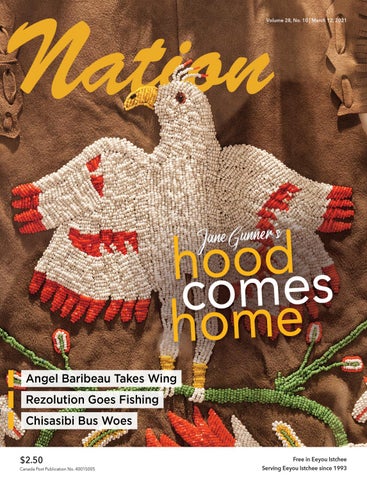
CONTENTS 10 Cree Nation repatriates traditional hood The permanent return of a 170-year-old beaded hood from the Lachine museum
18
Gespe’gewa’gi: The Last Land
EDITORIAL The personification of a river
NEWS Covid cases dropping
5
Blowing in the wind
7
IN BRIEF
9
FEATURES Reclaiming the past
10
Fishing with the Mi’qmaq
18
Paving the way
20
School-bus frustrations
23
PUZZLES REZ NOTES
Arts
4
24
Isolation blues
25
UTNS A legacy of kindness
20
Angel Baribeau’s new single
Community
23
Out-of-service school buses
Photos provided by the McCord Museum
26
Editorial
The personification of a river by Will Nicholls
T
he “personhood” granted to municipalities and corporations has always stuck in my craw. After all, they seem to be exempt to the rules of law compared to those who actually are born, drink their mother’s milk and learn the rights and wrongs most humans are taught. As a real human, your actions and the consequences are not the same as those for these “persons.” If we compare what happens to a person who commits the crime of selling something fraudulently and then enjoys the resulting proceeds – one goes to prison and the other faces a fine. We’ll give you one guess whether it’s the paper person or the one who gave their mother birth contractions after a nine-month period. In the past, forestry companies that clear-cut areas in Eeyou Istchee they weren’t supposed to were fined $5 per tree. The paltry penalty still allowed that corporate “person” to make a handsome profit, while the rest of us who committed the same crime would have experienced a much different lifestyle. The concept of personhood – for entities other than actual persons – extends far beyond corporations in other places. In India, for example, it can include temples, churches, mosques, hospitals, universities, colleges, railways, village councils, rivers, and all animals and birds. This makes personhood a little more interesting. If we considered our forests, rivers and wildlife as persons worthy of rights, our relationship with our environment might change a bit. In fact, the Innu of Ekuanishit are using this very strategy to protect the Magpie River, which is central to their lives, culture and way of life. So, with the
support of some local elected officials, the band council passed a resolution granting personhood to the Magpie. The Innu are supporting the river in return for sustaining their lives. Indeed, the river has always been a person for them. Pier-Olivier Boudreault, a conservation biologist associated with Canadian Parks and Wilderness Society, said this is not the first time a river has been granted personhood, but it’s a first for Canada. David Boyd, a human rights and environmental lawyer with the United Nations,
said that municipalities and corporations have been granted legal personhood so granting the same rights to a river isn’t as strange as we might think. Indeed legal personhood for the Magpie River could see the environmental movement have enough power to overcome the exploitation of other “persons” who have no consideration for future generations of naturally born persons.
the Nation is published every two weeks by Beesum Communications EDITORIAL BOARD L. Stewart, W. Nicholls, M. Siberok, Mr. N. Diamond, E. Webb EDITOR IN CHIEF Will Nicholls DIRECTOR OF FINANCES Linda Ludwick EDITORS Lyle Stewart, Martin Siberok PRODUCTION COORDINATOR AND MANAGING EDITOR Randy Mayer CONTRIBUTING WRITERS X. Kataquapit, S. Orr, P. Quinn, B. Powless DESIGN Matthew Dessner SALES AND ADVERTISING Danielle Valade, Donna Malthouse THANKS TO: Air Creebec CONTACT US: The Nation, 4529 CLARK, #403, Montreal, QC., H2T 2T3 EDITORIAL & ADS: Tel.: 514-272-3077, Fax: 514-278-9914 HEAD OFFICE: P.O. Box 151, Chisasibi, QC. J0M 1E0 www. nationnews.ca EDITORIAL: will@nationnews.ca news@nationnews.ca ADS: Danielle Valade: ads@nationnews.ca; Donna Malthouse: donna@beesum.com SUBSCRIPTIONS: $60 plus taxes, US: $90, Abroad: $110, Payable to beesum communications, all rights reserved, publication mail #40015005, issn #1206-2642 The Nation is a member of: The James Bay Cree Communications Society, Circle Of Aboriginal Controlled Publishers, Magazines Canada Quebec Community Newspaper Assn. Canadian Newspapers Assn. Les Hebdos Sélect Du Québec. Funded [in part] by the Government of Canada. | www.nationnews.ca | facebook.com/NATIONnewsmagazine | Twitter: @creenation_news
4 the Nation March 12, 2021 www.nationnews.ca
CMCA AUDITED
C O V I D - 1 9 U P D AT E
by Ben Powless
Covid cases dropping Concerns mount over new variants as vaccine rollout continues
C
ovid-19 case numbers are rapidly declining across Quebec, though there is renewed worry as new variants are beginning to spread across the country, which the Cree Health Board (CHB) called “extremely contagious.” So far, these variants have been identified in five regions, including AbitibiTémiscamingue. Health Canada officials noted that 1,257 cases of the UK variant had been detected, along with 99 from South Africa and three from Brazil. Some experts warn that the variants seen in Brazil may be able to re-infect people who have recovered from a previous Covid-19 infection, while it is still unknown how the vaccines may affect the new variants. Quebec health authorities said they expect variants to become the dominant strain by late March or early April. That news comes as 9,734 people have received their first dose of the vaccine in Eeyou Istchee, representing over 72% of the eligible population. That number includes 2,715 people in Chisasibi, 2,013 in Mistissini and 1,158 in Waskaganish. The CHB was pushing people to get vaccinated in early March so that as many as possible receive their first dose before the shipment of second doses arrives in late March or early April. Some people have already their second shot to prevent doses from going to waste. CHB Information Officer Corinne Smith said the Moderna vaccine comes in vials that contain 10 doses which can’t be stored long after opening. While this has led to some vials spoiling, the CHB has made leftover doses available to Elders on a priority list to ensure they did not go to waste. In some communities, they have started to schedule 10 patients to receive the vaccine in a single day to prevent any extra doses. The CHB is planning to vaccinate Cree outside the region, including post-secondary students and Cree School Board (CSB)
9,734 people have received their first dose of the vaccine in Eeyou Istchee, representing over 72% of the eligible population.
employees, as well as long-term patients in Montreal, with more information to come soon. In Mistissini, the local clinic teamed up with the fire department to offer a drive-through vaccination, according to Marie-Josée Morin, the community’s vaccination lead. People stayed in their car to receive the vaccination, then waited 15 minutes to ensure there were no adverse reactions. “It worked really well,” Morin said. “We’re getting stronger and working together to make it happen, and it works.” She said they were able to get more people to come in this way. Morin said they would resume the practice in the third or fourth week of March. Details will be provided online, in posters, and on local radio. In Montreal, there were two new Covid-19 cases reported among Cree members who had travelled there for medical appointments in January. The CHB reported that the individuals were tested before returning, and were asymptomatic but isolating in Montreal, with no known contacts in Eeyou Istchee. This brings the total number of cases to 119. Ouje-Bougoumou and Mistissini were moved into Phase 3 of deconfinement, allowing for outdoor gatherings of 75 people or 10 households and indoor gatherings of 25 or three households. The rest of the Cree communities moved back into Phase 4 of deconfine-
ment, allowing for outdoor gatherings of 150 and indoor gatherings of 50 people. Travel between Eeyou Istchee and Region 10 (Nord-du-Québec) and Region 17 (Nunavik) was still considered safe. However, travel to all other regions of Quebec and Ontario was still considered at-risk, requiring a14-day quarantine upon return. The CSB announced that most schools had received laptop loans for Secondary 4 and 5 students and are distributing laptops to all secondary-level students. Mistissini students were scheduled to be able to return to full-time in-class instruction by March 8. All adult educational programs also resumed, while regional programs at Sabtuan Regional Vocational Training Centre were to resume March 10. The CSB said that it was planning for spring break for post-secondary students and for Goose Break “with public health considerations at the forefront of decision-making.” The United States authorized a third vaccine from Johnson & Johnson. Health Canada approved a two-dose vaccine from AstraZeneca and Oxford University, making it the third vaccine to be authorized in Canada. Quebec was reporting under 600 daily new cases, a low not seen since last September. Overall, Canada’s total confirmed cases rose over 870,000, with 22,000 deaths, and just under two million receiving the vaccine.
www.nationnews.ca March 12, 2021
the Nation 5
6 the Nation March 12, 2021 www.nationnews.ca
News
Hope on the street Resilience Montreal to get permanent homeless shelter by Patrick Quinn | Photo provided by Nakuset
J
ust before announcing that Resilience Montreal would receive $3 million from the Quebec government for a permanent homeless shelter, Nakuset still couldn’t believe it was really happening. “It’s $3 million, not $3?” the director of Resilience Montreal and the Native Women Shelter remembers asking. “It was perplexing because after working in the community for over 20 years, no one has ever bought a building for us. I don’t think this has ever happened to any other Native organization. It never happens!” It’s the result of a collaboration between Nakuset and Ian Lafrenière, the former Montreal police officer who was appointed Indigenous Affairs Minister in October following the death of Joyce Echaquan. Like many, Nakuset was initially skeptical of his appointment but can’t deny he’s getting results. “I was questioning why they would think it would be appropriate to have a former police officer running Indigenous services,” Nakuset recalled thinking. “He’s on a roll. I’ve worked with other political people and with Ian it’s happening. I [told him], ‘For a white man, you actually came through.’ I’m still pinching myself.” Since November, Lafrenière has announced $15 million in funding to improve Indigenous access and trust in the healthcare system as well as a new joint patrol that pairs police with social workers from the Native Friendship Centre to help intervene in cases involving Montreal’s Indigenous community. “There was an urgency to act [before the offer expired],” said Lafrenière regarding the Resilience funding. “The pressure is so high [because] buildings are getting extremely costly. We need resources close to Cabot Square.”
Although Quebec had previously announced an additional $600,000 contribution, it wasn’t expected to be enough for real estate in downtown’s west end. Since November 2019, Resilience has served as a much-needed day centre for the area’s predominantly Inuit homeless after the Open Door shelter was forced to relocate a year earlier. However, it was always known that the former restaurant housing Resilience would be soon demolished to make room for luxury condos. Fortunately, their lease has been extended until April 2022, providing valuable time to make the necessary upgrades to the new building for a smooth transition. “We spent a long time trying to find another building,” Nakuset told the Nation. “There’s a place that would be a fantastic alternative to what we have now. It’s in the vicinity and a beautiful building – it would feel like a wellness centre. We still have a lot of work to do but it’s a huge stress off our backs.” The City of Montreal is also contributing to the new building, while seven foundations are collectively covering $1.5 million of its operating budget over three years. “Beyond providing a meal, a shower, a safe place to rest for those experiencing homeless, [Resilience Montreal] is creating a community for people who are excluded from society, a community where they feel safe,” said Tasha Lackman from the Foundation of Greater Montreal. Quebec’s curfew has been particularly catastrophic for the city’s homeless population, whose increasing numbers have faced exceptional vulnerabilities since Covid. In late January, a 51-yearold Innu man, Raphaël Napa André, was
found frozen to death steps away from the Open Door a week after it had been forced to close overnight. While a court eventually ruled homeless people exempt from the curfew, there had been growing calls for warming tents, like those used by Red Cross whenever there are humanitarian crises around the world. Nakuset collaborated with Lafrenière and Michelle Audette to lobby the city for a tent in Cabot Square, which was initially permitted for only two weeks but later extended until March 31. The centre has attracted numerous supporters, including volunteers from the Missinak Indigenous women’s shelter in Quebec City, who braved a snowstorm to help the tent open on time. “Can you imagine if you’re a homeless person and someone travels three hours to come take care of you?” Nakuset marvelled. “It’s mostly Indigenous people at the tent. They feel the Raphaël André memorial tent is for them.” The Native Women’s Shelter staff are overseeing the initiative at night, even choosing to keep it open until the metro opens an hour after curfew ends. With Adirondack chairs, a wood floor and heaters, the space can accommodate 16 people at a time although some nights over 40 arrive – one night there were also four dogs. Nakuset is hoping to add nurses and additional staff to attend to frostbite and interact with those waiting outside. Although visitors are sometimes brought by police or leave by ambulance, Nakuset said the project has gone very smoothly so far. She believes the successful partnership in implementing the tent helped lead to securing the major funding for Resilience Montreal.
www.nationnews.ca March 12, 2021
the Nation 7
For more info... Jordan’s Principle Office Cree Board of Health and Social Services of James Bay (CBHSSJB) 418-923-3355 x42186 18tcr.jordans.principle@ssss.gouv.qc.ca creehealth.org/jp
Individual Applications for Eeyou Istchee
The legacy of Jordan River Anderson
Jordan was born in Norway House Cree Nation, Manitoba in 1999, with multiple disabilities and stayed in the hospital from birth. When he was 2 years old, doctors said he could move to a special home for his medical needs. However, the federal and provincial governments could not agree on who should pay for his home-based care. Jordan passed away in the hospital at the age of 5. In 2007, the House of Commons passed Jordan’s Principle in memory of Jordan. Today, Jordan’s Principle is a legal obligation, which means it has no end date—it will support First Nations children for generations to come.
Is your child eligible for Jordan’s Principle? Current eligibility criteria under Jordan’s Principle are: • 0 to 18 years old • Must have a band number (or parents’ band number, if not yet assigned)
24-hour Jordan’s Principle Helpline
1-855-572-4453 Your child does not have to have a disability to be covered under Jordan’s Principle.
8 the Nation March 12, 2021 www.nationnews.ca
In Brief Students denounce discrimination at Bishop’s University Members of the Indigenous Cultural Alliance, a student group at Sherbrooke-based Bishop’s University, are denounced practices and attitudes that they say constitute harassment, discrimination and whitewashing at the campus during a press conference February 25. Among the complaints, the group says that Indigenous professors are underrepresented on campus; a Quebec Human Rights Commission report identified only two Indigenous faculty members at the university between 2016 and 2019. One student, Mistissini’s Nikki Baribeau, served as the vice-chair of the university’s Task Force on Equity, Diversity and Inclusion before stepping down over “bullying and dis-
respect” from the task force leadership. Cassey Perley, Indigenous representative for Bishop’s Student Resource Centre, said that professors retaliated against Indigenous students who corrected them, according to an APTN report. Bishop’s students pointed to $5.9 million in provincial funding for the Kwigw8mna ‘Our House’ project to build an Indigenous space and resource centre. According to the Centre for Research-Action on Race Relations (CRARR), which supported the student group during the media event, nearly 80% of that space will instead house administrative offices. Baribeau told APTN that Indigenous students were not given an opportunity to be part of the planning or decision-making process in the project. In response, Bishop’s Principal Michael Goldbloom told APTN that the university was committed to address-
ing systemic racism and to “advance equity, diversity and inclusion in all aspects.”
Feds anger Indigenous fishers The First Nations Child and Family Caring Society (FNCFCS) has filed its ninth motion arguing Canada is not compliant with a Canadian Human Rights Tribunal (CHRT) ruling which states First Nations families on reserve and in the Yukon are not being provided equitable child welfare services. The federal government has issued its guidelines on how it expects Indigenous fisheries operating under the “moderate livelihood” framework to operate within the existing commercial fishery seasons. The guidelines call for communities to devel-
Air Creebec is operating by respecting and exceeding the rules with extensive cleaning and disinfecting of the aircraft, social distancing on board and at all service counters. We encourage everyone to respect the rules and to stay safe.
For the latest Air Creebec updates, please visit aircreebec.ca/covid19
op “Moderate Livelihood Fishing Plans” that would be authorized by the Ministry of Fisheries and Oceans – a key demand by non-Indigenous commercial fishers. The new regulations are a response to Sikekne’katik First Nation launching its own self-regulated “moderate livelihood” fishery, which led to confrontations with commercial fishers in 2020. Sipekne’katik Chief Mike Sack urged Mi’kmaw communities in the Atlantic region to reject Ottawa’s position and said his community will continue to operate its fishery outside of federal fishery seasons in 2021, according to CBC. In 1999, the Supreme Court of Canada affirmed the Indigenous right to fish in pursuit of a “moderate livelihood” within conservation restrictions, but the concept was never explicitly defined by the federal government. Since then, Ottawa has spent over $500 million to get Indigenous bands to be part of the commercial fishery. Without federal permission, Indigenous fisheries are unable to legally sell their catch to licensed buyers. The Assembly of Nova Scotia Mi’kmaw Chiefs say that the government’s conditions are unacceptable, and part of a colonial approach to the rights that were upheld by the Supreme Court.
In Brief
www.nationnews.ca March 12, 2021
the Nation 9
Features
10 the Nation March 12, 2021 www.nationnews.ca
Photos provided by the McCord Museum
by Patrick Quinn
RECLAIMING THE PAST Cree Nation repatriates traditional hood from the Lachine Museum
T
he Cree Nation is celebrating the permanent return of a 170-year-old traditional beaded hood from the Lachine Museum, where it had resided for over 70 years. Grand Chief Abel Bosum announced the repatriation accompanied by two descendants of Jane Gunner, who is believed to have owned the hood around 1850 as the wife of the Chief of Mistissini. “The significance of this act of repatriation is that it returns our stories to us,” stated the Grand Chief. “By repatriating objects such as these, we ourselves become more whole. Repatriation of our cultural treasure is a profound act of decolonization.” This type of hood would be worn during ceremonies, such as weddings or the return from an important hunt. Bringing home this cultural artifact signifies for Bosum a reconnection with ancestors and ancient traditions that can be used for educational purposes at the Aanischaaukamikw Cree Cultural Institute (ACCI) in Ouje-Bougoumou. “This beaded hood speaks to us in ways that it cannot speak to anyone else,” explained Bosum. “For the Cree people, it is full of meaning that touches us in a very deep way. The repatriation of the Gunner Hood represents an important step in ensuring the transmission of our Cree culture to our future generations as well as honouring the traditional customs of our people.” Before the cultural institute began searching worldwide museum catalogues in 2011, it was believed that these hoods might only exist in the memories of Elders. As this type of headdress hadn’t been seen in Cree communities since the mid-20th century, ACCI’s research intended to highlight the important traditional roles of Cree women – for example, women chosen to be hood bearers had special teachings passed onto them. “This beaded hood is embedded in a rich cultural tapestry, a rich social landscape and a rich universe of Cree history,” asserted Bosum. “We can trace how we are connected to them. They are not, for us, abstract www.nationnews.ca March 12, 2021
the Nation 11
12 the Nation March 12, 2021 www.nationnews.ca
“The simple fact that we have all of these objects here is evidence of colonialism... Indigenous Peoples’ access to their collections is something really important. I’m not talking at this point about repatriation, but simply the fact that they can actually connect or reconnect with the materials of their cultures.” - Jonathan Lainey, Curator, McCord Museum
artifacts of history – they are tangible reminders of where we came from and who we are.” Research by Paula Menarick identified the fragile, elaborately decorated Cree hood’s connection with the Gunner family and successfully reunited it with family members in Mistissini in 2016. At the time, Gunner’s granddaughter Dinah Simard said the visit was “like meeting my Gookum [grandmother].” “It was a powerful, emotional moment,” recalled the ACCI Director at the time, Sarah Pash. “When the family said they would be happy for it to come back home to the territory, we started working in earnest with the City of Montreal and the museum to try to make that happen.” The hood made of wool, cotton and glass beads was donated to the Lachine Museum in 1948. It was in poor condition before being restored by the Centre de conservation du Québec about 15 years ago. When the Cree Nation Government asked Montreal for its repatriation in 2019, it was viewed as an opportunity to advance the city’s reconciliation process with First Nations. “By retrieving this item that carries such an important historic significance, the Cree community will retrieve a symbol of its heritage and of the expertise of its ancestors,” stated Montreal mayor Valérie Plante. “We’re happy to demonstrate that it can be done with kindness, openness and mutual respect.” Aanischaaukamikw opened in 2011 with the intention of decolonizing through self-representation. As a central repository for vital artifacts, documents and traditional teachings, it is designed specifically for cultural preservation, conservation and knowledge transfer. At the same time, international attitudes toward repatriation began to shift. In 2019, Bill C-391, An act regarding a national strategy for repatriation of Indigenous human remains and cultural property, passed to the Canadian Senate, though it died on the order paper when a federal election was called in October that year. At the Canadian Museums Association national conference in 2019, the Indigenous Repatriation Handbook was launched to help participants navigate the inherent complications of these processes.
“We’re in this era of decolonizing museums and heritage work,” explained Pash. “We can make decisions about our heritage ourselves. All the work done in Eeyou Istchee is from the stance that heritage is our right to express and access. This act of repatriation is part of that broader context.” While museums have collected “cultural artifacts” for centuries, many have been forced to rethink longstanding imperial biases as Indigenous communities increasingly reclaim their histories. Growing Indigenous empowerment has resulted not only in greater control over their own cultural histories but also a stronger Indigenous influence in mainstream institutions. Last year, Jonathan Lainey became the first Indigenous curator of one of the country’s largest collections of Indigenous archeological and historical artifacts – housed at the McCord Museum in Montreal. With over 16,500 objects documenting nearly 12,000 years of First Nations, Inuit and Métis history, Lainey (a member of the Huron-Wendat Nation) is tasked with reinterpreting the collection and making room for Indigenous perspectives. “The simple fact that we have all of these objects here is evidence of colonialism,” Lainey told the CBC. “Indigenous Peoples’ access to their collections is something really important. I’m not talking at this point about repatriation, but simply the fact that they can actually connect or reconnect with the materials of their cultures.” The Cree Nation may just be beginning this process of reconnecting with cultural materials scattered throughout the world’s museums and personal collections. Aanischaaukamikw continues to seek other significant Cree artifacts, such as a painted caribou hide clothing that has been identified in Ontario. “We know things have been leaving our territory for centuries ever since European incursions,” Pash told the Nation. “Of course, because of its personal connection and strong community connection, this hood was prioritized. There are other items now that are being looked into for possible repatriation but there’s still a lot of research to be done before we specifically identify items.”
www.nationnews.ca March 12, 2021
the Nation 13
We all want to know more about We Weall all want want toto COVID-19 vaccination know knowmore moreabout about COVID-19 vaccination COVID-19 vaccination There are many reasons to get vaccinated, including protecting ourselves from the complications and dangers caused by infectious diseases, but also to stop the return of infectious diseases that are avoidable through vaccination. The COVID-19 vaccination campaign now underway is aimed at preventing serious complications and death from COVID-19. We also use vaccination as a way of protecting our healthcare system and getting back to a more normal life.
When did the vaccination campaign start? COVID-19 vaccination in Québec began in December 2020 with the delivery of the first vaccine doses. Because the availability of vaccine is limited, categories of people deemed at higher risk of developing COVID-19 complications have been given priority. As more vaccine becomes available in Canada, the categories of recipients will be extended.
Order of priority of recipients of COVID-19 vaccines 1
Vulnerable people and people with a significant loss of autonomy who live in residential and long-term care centres (CHSLDs) or in intermediate and family-type resources (RI-RTFs)
2
Workers in the health and social services network who have contact with users
3
Autonomous or semi-autonomous people who live in private seniors’ homes (RPAs) or in certain closed residential facilities for older adults
4
Isolated and remote communities
5
People 80 years of age or older
6
People 70 to 79 years of age
7
People 60 to 69 years of age
8
Adults under 60 years of age who have a chronic disease or health problem that increases the risk of complications of COVID-19
9
Adults under 60 years of age who do not have a chronic disease or health problem that increases the risk of complications, but who provide essential services and have contact with users
10
Everyone else in the general population at least 16 years of age
What supply strategy was used to acquire the vaccines? The Government of Canada signed advance purchase agreements for seven promising COVID-19 vaccines with the following companies: AstraZeneca, Johnson & Johnson, Medicago, Moderna, Novavax, Pfizer and Sanofi Pasteur/GlaxoSmithKline. The purchases are conditional upon approval of these vaccines by Health Canada. To date, the Pfizer and Moderna vaccines have been approved for distribution in Canada. Soon, other vaccines from these companies will be used to speed up COVID-19 vaccination.
What types of COVID-19 vaccines are being studied? There are three types of vaccine currently being studied.
1
2
3
mRNA vaccines: These vaccines contain part of the RNA of the virus which has the ability to make the S protein located on the surface of the virus. Once the RNA messenger is inside our cells, they make proteins similar to those on the surface of the virus using the instructions provided by the RNA messenger. Our immune system recognizes that this protein is foreign and produces antibodies to defend itself against it. The RNA fragment is quickly destroyed by cells. There is no risk that this RNA will alter our genes. Viral vector vaccines: These contain a weakened version of a virus that is harmless to humans. Once in the body, the vaccine enters our cells and gives them instructions to make protein S. Our immune system recognizes that this protein is foreign and produces antibodies to defend itself against it. Once in the body, the vaccine enters our cells and gives them instructions to make protein S. Our immune system recognizes that this protein is foreign and produces antibodies to defend itself against it. Protein subunit vaccines: These contain non-infectious fragments of proteins that mimic the envelope of the virus. Our immune system recognizes that this protein is foreign and produces antibodies to defend itself against it.
Will an mRNA vaccine alter our genetic code? No. Messenger RNA does not enter the cell’s nucleus or come into contact with the nucleic DNA. As such, it cannot alter our DNA in any way.
How do COVID-19 vaccines work? When someone receives the vaccine against the virus that causes COVID-19, their body starts to defend itself against the virus. An immune reaction occurs which neutralizes the virus producing antibodies and activating defense cells. Most COVID-19 vaccines in development prompt the production of antibodies to block protein S; the protein that allows the virus to infect the human body. This prevents the virus from entering and infecting human cells. The virus that causes COVID-19 is composed of strands of ribonucleic acid (RNA) genetic material surrounded by a crown-like envelope with proteins that include the S (spike) protein, hence the name “coronavirus.”
What side effects can be expected from injection with the COVID-19 vaccine? ome minor side effects may occur, such as redness or pain at the injection site and fatigue, fever or chills. These symptoms are less common among vaccine recipients over the age of 55, are usually benign and do not last long.
Why did it take 40 years to develop a flu vaccine but only nine months for one against COVID-19? Past efforts, particularly during the SARS epidemic in 2003, advanced coronavirus vaccine research and accelerated the fight against COVID-19. There are currently over 50 COVID-19 vaccines undergoing clinical trials around the world, the result of unprecedented scientific cooperation. Considerable financial and human resources have been invested in the development of vaccines that meet regulatory requirements in such a short span of time. Public health and regulatory authorities in many countries, including Canada, are working hard to ensure that as many safe and effective COVID-19 vaccines as possible become quickly available to their populations.
Why administered are two vaccine under the Québec Immunization doses required? The second dose “reminds” the immune system to continue producing antibodies and ensures long-term protection. In current circumstances, where COVID-19 is spreading very fast, administration of the second dose may be delayed somewhat to be able to vaccinate more people with the first dose.
As of now there are no known serious side effects from mRNA vaccines. While other random problems may arise, such as a cold or gastroenteritis, they are not related to the vaccine per se. Because the vaccine does not contain the SARS-CoV-2 virus, it is not capable of causing COVID-19. However, people who come into contact with the virus in the days leading up to their vaccination or within 14 days of receiving the vaccination could still develop symptoms and get the COVID-19 disease. As such, following health measures remains important until such time as a majority of the population has been vaccinated.
Québec.ca/COVIDvaccine 1 877 644-4545
For ALL WOMEN who are 50-69 years old
ᐋᒋᔦ ᓃᒋᓴᓂᔅᐧᑫᒻ
Wachiyeh Niichisaniskwem! ᐐᐱᒡ ᒋ ᑳ ᐹᐱᐦᔮᐅᒡ ᑭᓓᕌ ᐳᔅ ᑭᔮᐦ ᓲᕕ ᐁᕌ ᐃᐦᑖᐎᓐᐦ ᒋ ᑳ ᓈᓂᑐᒋᔅᒑᔨᒫᑲᓅᐎᒡ ᐃᔅᒀᐆᐦᒡ ᐅᑑᑑᔑᒻᐦ ᑳ ᒧᐎᐙᒡ ᐋᐦᑯᓯᐎᓐ ᐎᔨᒡ wîpich chi kâ pâpihyâuch kilerâ pus kiyâh sûvi erâ ihtâwinh chi kâ nânituchischâyimâkanûwich iskwâûhch utûtûshimh kâ muwiwâch âhkusiwin wiyich
or
! will be coming soon
to offer breast cancer screening in Eastmain, Wemindji, Chisasibi, and Whapmagoostui You will receive a letter from the Public Health Department
ᒌᔨ ᐋᐹᔨᑯᔒᓐ ᒋ ᑳ ᐎᔮᔨᐦᑎᒻ ᒑ ᒋ ᓈᓂᑐᒋᔅᒑᔨᒫᑲᐐᔨᓐ ᑳ ᒧᐎᐙᒡ ᐋᐦᑯᓯᐎᓐ ᐐᔨᒡ chîyi âpâyikushîn chi kâ wiyâyihtim châ chi nânituchischâyimâkawîyin kâ muwiwâch âhkusiwin wîyich
GETTING SCREENED FOR BREAST CANCER IS YOUR CHOICE! For women aged 35-49 years old
If you have a biological family history of breast or ovarian cancer, check with your doctor for more information about the best time to get screened.
&
Tour Dates
Mistissini + Oujé-Bougoumou +Waswanipi: Planned to start in June 2021 / Waskaganish + Nemaska: Planned for Fall 2021
EASTMAIN
WEMINDJI
CHISASIBI
WHAPMAGOOSTUI
Monday, March 8 to Thursday, March 11
Friday, March 12 to Wednesday, March 17
Thursday, March 18 to Thursday, April 1
Dates to be determined
CMC: (819) 977 0241 Edna Mark Stewart, CHR Ext. 24201
CMC: (819) 978-0225 Laurie Ann Georgekish, CHR, Ext. 23202
CMC: (819) 855-2744 Doris Duff, Ext. 22212
CMC: (819) 929-3269 Emilyanne Fleming
For more information: Cheryl Swallow, CHR #22710 Patricia Bobbish #22709 Stephanie Ratt #22055
For more information: Shannon Natachequan, CHR
To learn more : creehealth.org/services/breast-cancer-screening Facebook: Cree Health - Breast Cancer Screening
16 the Nation March 12, 2021 www.nationnews.ca
By CBHSSJB Public Health Chishaayiyuu Department
Should I be screened for breast cancer? Clara Bus, which brings a mobile mammogram machine to Eeyou Istchee, will be coming in March to visit Eastmain, Wemindji, and Chisasibi to offer breast cancer screening. The mobile mammogram machine travels to Whapmagoostui by the Sophie Air plane. Every 2 years, women aged 50 – 69 receive a letter from the Public Health Department of Cree Health Board, inviting them to be screened for breast cancer. Some of you ladies may be wondering:
What is breast cancer screening and why might it be important for me? Breast cancer screening is a test that checks for hidden signs of breast cancer before any symptoms – like a lump in the breast - appear. A mammogram machine takes X-ray images of different angles of your breast. A radiologist will look at these images and determine if you need follow up testing.
possible. 1 in 4 women who have regular mammograms will need follow up testing that is not necessary. These false alarms can lead to unnecessary travel, tests, stress and anxiety. This happened to Nancy Voyageur, from Mistissini, who needed to take sick leave from work due to stress while waiting for her results. On the other hand, Georgina McLeod from Mistissini was able to detect breast cancer early, before she had any signs or symptoms, by getting screened. Her cancer was then treated successfully. When looking at both pros and cons, experts agree that breast cancer screening is a good choice for women between 50-69 years old. The Public Health Department of the Cree Health Board recommends that all women between ages 50-69 be screened. If you are between the ages of 35 and 49 and have a family history of breast cancer or ovarian cancer, ask your doctor about the best screening options for you.
If the doctor decides that follow up is needed, you will be sent to Val-D’Or Hospital for a few days for more testing. These tests may include another mammogram, an ultrasound, or an invasive biopsy (sample of tissue) to determine if cancer is really there.
If you would like to be screened but will be out of town or unable to make your appointment with Clara Bus or Sophie Air, please inform your local Chishaayiyuu CHR to make other arrangements.
Deciding to participate in breast cancer screening is a personal choice and it’s important to have all the information you need to make the right decision for you.
For more information, contact your Chishaayiyuu CHR, follow us on Facebook, or check out our website on breast cancer screening. On our webpage, you can watch video testimonials from Nancy and Georgina to learn more about their experiences with screening.
Screening can reduce your chances of dying from breast cancer since it allows you to start treatment as soon as possible. It does this by catching breast cancer early enough before it has a chance to get worse.
Please be assured that we will follow all precautionary measures for COVID-19 to keep you and ourselves safe!
There are also cons to breast cancer screening that are important for you to know. The mammogram images are not 100% conclusive, meaning that a false alarm is
www.nationnews.ca March 12, 2021
the Nation 17
Fishing with the
Mi’qmaq Photo by Lisa M. Roth
by Ben Powless
18 the Nation March 12, 2021 www.nationnews.ca
Gespe’gewa’gi: The Last Land documents the hard-won fishing rights of Listiguj
I
t’s just after midnight on the opening day of snow-crab season, which means it’s time to go to work. The captains start up their boats, and head out from their home in Listuguj, Quebec, through Chaleur Bay, heading to the Gulf of St. Lawrence to catch crab and exercise their inherent rights. This is the dramatic setting of Gespe’gewa’gi: The Last Land, a new 13-part documentary produced by Rezolution Pictures for APTN. The series introduces viewers to the crews of several fishing boats operated by members of the Mi’gmaq people of Listiguj, as well as the community and the history of the local fishery. Viewers meet Captain Peter Martin of the Je’gopsn as he sets out on a nine-hour trip, reaching his destination north of PEI shortly after sunrise. There, crew members prepare to place their crab traps in the water. However, before they can get underway, there are mechanical issues. The boat must return to port for repairs. The work is hard, relentless and dangerous. The crew is out for two days, barely sleeping. But their elation is tangible once they start bringing in the crab from the ocean bottom. Not only will they earn an income, the entire community also benefits. Viewers see just how tight-knit and supportive the community is of the fishery. Viewers learn that the history of fishing in Listiguj is fraught with violence and challenges that the community members have had to overcome. The series looks back to when Indigenous people there were not allowed to fish. Elders relate the stories of community members becoming more emboldened and assertive as they strike out to keep alive fishing traditions. That all culminates in a violent police raid in 1981, when the Quebec government sent in the Sûreté du Québec to shut down the nascent salmon fishery. Several community members were injured, and others arrested. But Quebec’s plan backfires. Anticipating another raid, the community organized and set up blockades. The dispute is captured in Alanis
Obomsawin’s acclaimed 1984 documentary, Incident at Restigouche. Eventually, the dispute ends up in court. An almost 20-year legal battle turned into a landmark decision for all Indigenous peoples, beginning when Donald Marshall was arrested for eel fishing. Ending up in the Supreme Court of Canada, Marshall won his case, with the court recognizing the right of Indigenous fishers to a moderate livelihood. This is the start of commercial fisheries in Listiguj, and where the Gespe’gewa’gi story really begins. Co-director and executive producer Ernest Webb, of Chisasibi, wanted to show viewers that, “We’re all the same, we’re all trying to make a living, put food on the table and raise our families, and these fisher people are taking advantage of a resource they have rights to.” Webb and his team initially travelled to Listuguj to meet some of the captains and community members and establish a relationship to make sure everyone would be comfortable filming in their homes, at their work, and on the boats. “I’m very thankful that the community members opened their hearts and lives to us,” he said. Coming from James Bay, Webb said he took for granted the ability to go hunting and fishing, and that for him it was exceptional to see how Listuguj had to fight against government repression to follow their traditions. Webb said the series addresses issues happening across Canada, as communities push to make a living from their rights to harvest, despite the pushback from the government and non-Indigenous communities, as recently witnessed in Nova Scotia. “Maybe their neighbours can see what they’re trying to accomplish and see what they’re trying to do not as a threat but as a kindred spirit and trying to do the same thing for their families.” Watch Gespe’gewa’gi: The Last Land on APTN or on its new online streaming service. www.nationnews.ca March 12, 2021
the Nation 19
Arts
Paving the way Angel Baribeau uses their music to help the youth by Patrick Quinn | Photos provided by David Hodges
C
ree singer/songwriter Angel Baribeau is back with a second single and video from the hit EP, For Those I Love(d). “Wish We Were Older” has already reached number one on the Indigenous Music Countdown and its music video amassed over 33,000 views in less than two weeks.
While the powerful pop song belies its melancholy with propulsive energy, the video tells a tale of love and loss passed through generations. Depicting an older woman reminiscing about her love of another woman, a stirring montage illustrates joyful moments of their relationship with beautiful shots of summertime in Montreal and the surrounding countryside. “I wanted to provide positive imagery for anybody who watches the music video, because I didn’t grow up with a lot of healthy representation of what Indigenous queer people are,” Baribeau told the Nation. “That’s kind of my main goal, work toward providing positive representation for youth in Eeyou Istchee and youth in general.” While Baribeau now openly identifies as non-binary and prefers to be 20 the Nation March 12, 2021 www.nationnews.ca
referred to by they/them pronouns, they have discussed the importance of music in their life to express their struggles as an Indigenous, two-spirited person. It has been a journey of self-acceptance for the 20-year-old artist but Baribeau is thankful that society is becoming more open to diversity. “The world I grew up in is not the same we’re growing up in now!” Baribeau exclaimed. “I’m super happy to see there’s a lot more dialogue in my communities about queer, two-spirit folk. If you don’t have space, then creating space. I definitely think our collective consciousness as Eeyouch/Eenouch is broadening to once again include folks like me.” Baribeau explained the video concept in a meeting with director Patrick Shannon, cinematographer Alexandre Fortes and
both their managers. They discussed key themes to include within the story, which helped inform the settings and actors chosen. “I had a concept in my head and told everybody in that initial meeting what I wanted to see come to life – what was great was I did see it come to life,” said Baribeau. “I was there during the filming – it was really cool! In my brain, I could not have imagined it turning out as well as it did.” Shannon, also known as Nang ’uulas, is an Indigenous film director from Haida Gwaii and the founder of InnoNative film production company. He came to Montreal, where Baribeau currently resides, a month before the video shoot last summer to discuss details about the storyline and scout filming locations. “This music video recounts a lifetime of true love between an elderly two-spirit Indigenous couple,” shared
Shannon. “The challenges, the joy, the raising of a family in a community where that isn’t common. It’s sombre but beautiful — and a reminder that everyone can find love and bring beauty into this world.” Featuring an all-Indigenous cast, Baribeau described the honour of working with so many strong women in the video production and the pleasure of discussing their lives and experiences. It was also an opportunity for an unexpected family reunion, when Baribeau’s cousin Kenny arrived for a shoot at their apartment with his daughter Mekhi Wagoush. A particularly striking part of the video showcases Montreal’s Old Port at night, with the young lovers rotating high above the city in the giant Ferris wheel. Baribeau said it was one of their favourite memories from the shoot, despite almost losing their beloved guitar. “We were filming a scene behind the Ferris wheel and I’d put my guitar down because the scene didn’t require it,” Baribeau recalled. “Then we wanted shots inside the Ferris wheel – I was standing outside with my cousin. When they came out it dawned on me, we didn’t have the guitar anymore. My cousin goes into a sprint all the way to the other side and found it luckily.” Baribeau is appreciative of Chris Robertson and Brianna Oversby for assisting with locations. Robertson’s family cabin was the setting for another of the shoot’s highlights, when actress Tealey Ka’senni:saks Normandin made the crew fried bread in a scene inspired by a famous 1990s film. “Patrick and I had discussed being inspired by the film Ghost, the scene where [Demi Moore’s character] is doing pottery, so we thought we should do the same thing but with fried bread,” explained Baribeau. “It gave us a great excuse to have a bunch of fried bread after.” Baribeau said it’s been heartwarming to witness the enthusiastic reception to their music and being able to provide inspirational representation for Indigenous queer youth. Currently back
in Mistissini for an artist residency with Mikw Chiyâm, the arts education program provided by non-profit organization inPath, Baribeau is teaching in the exact room they graduated from. When inPath co-executive director David Hodges toured the Cree Nation in 2014 with an early version of the N’we Jinan mobile music production studio, Baribeau had to be forced into the workshop. However, when the album Eeyou Istchee was released following the tour, it was Baribeau’s featured vocals that propelled it to number one overnight on the iTunes Canada charts. Although the Mikw Chiyâm program was piloted the next year in Mistissini, it took a long time before Baribeau could see a future for themselves in the arts. Now a confident multimedia artist, Baribeau is the first former Mikw Chiyâm student to become an artist-in-residence. They have previously completed residencies in songwriting and visual arts in different communities. “It’s a privilege to be around young minds in this kind of setting, especially when I’m sharing my own knowledge,” said Baribeau. “Now I’m here to do another music/poetry/spoken-word/ sound-space workshop and help them create their own spoken-word pieces paired with another local Cree artist, Christian-John Monias [aka Cjay Griz] from Chisasibi.” As Baribeau works on a full-length album, they look forward to eventually touring Eeyou Istchee and anywhere else they’re invited. As an artist and educator, Baribeau hopes that by others seeing people like them succeed, they would realize their existence is valid and they are not alone. “I’d like to encourage people from Eeyou Istchee to attend Mikw Chiyâm celebrations,” Baribeau concluded. “It’s their youth putting messages out there in the world that they want their communities to see. I wouldn’t be where I am without all the other artists around me. There are so many artists in Eeyou Istchee – we’re a Nation of artists!”
www.nationnews.ca March 12, 2021
the Nation 21
FROM JANUARY 23 TO MARCH 27, 2021
CREEHEALTH.ORG/WINTERACTIVE
Be
WINTER ACTIVE Let’s Build a Strong and Healthy Cree Nation
MAKE PHYSICAL ACTIVITY PART OF YOUR DAILY LIFE Outdoor activities in fresh air help us face the challenges of the COVID-19 pandemic. THIS WINTER, LET'S GET OUTSIDE.
For more information on activities in your community, contact: WALLY RABBITSKIN, PPRO Physical Activity, Public Health (CBHSSJB) 418-923-3355(42365) Cell: 418-770-3975 wrabbitskin@ssss.gouv.qc.ca
Community
School-bus frustrations Out-of-service buses create woes for Chisasibi students by Ben Powless
S
everal school buses in Chisasibi that serve both the James Bay Eeyou and Waapinichikush Elementary schools have been repeatedly out of service over the winter. Facebook pages for the schools and community discussion groups document the problem. Community members and bus drivers share information online about whether the buses are running on a particular day. Three buses have been repeatedly unavailable since February.
Wadden asks parents for “their understanding and patience in this time,” explaining that it is difficult getting parts as inter-community travel is prohibited. “People are frustrated for things to get back to normal,” he allowed. There is limited seating on the buses because of
That company owns over 375 vehicles and runs bus services across Quebec, along with some in Ontario. Gingras-Shecapio won the school board bus contract in 2014, underbidding other bidders by $200,000. The contact came with a commitment to provide 22 new vehicles as well as eight
“People are frustrated for things to get back to normal” - Mark Wadden, Community Education Administrator, Cree School Board Mark Wadden, the Cree School Board’s Community Education Administrator in Chisasibi, said that the bus absences affect the school’s attendance records on the days they are out of service. Wadden said he has yet to hear any complaints from parents, though he was aware of posts on social media.
pandemic restrictions across the province that force children to be spaced apart, Wadden added, saying that parents who have the means are encouraged to drive their children to school. The buses are owned and operated by GingrasShecapio, which is in turn owned by Quebec-Citybased Groupe Swiftrans.
vehicles for emergencies. Gingras-Shecapio offered service to all Cree communities except Whapmagoostui. Mistissini’s William Phillip Shecapio is the company’s vice-president. He said harsh winter conditions pose many mechanical problems in the fleet’s newer vehicles, which rely on the diesel exhaust fluid used to reduce air pol-
lution. The fluid can freeze in very cold weather. “The buses we have are 2020 models, the most updated ones, and everything is all computerized,” Shecapio explained. “Nowadays when you change or replace a part, you have to configure the computer in that vehicle.” Shecapio said that with the cold weather and the pandemic, bringing in mechanics from other communities and finding rental space to do mechanical work have been extra challenges. He said it is also difficult to find workers. “We’re really working hard for the needs of the community. My team in Chisasibi, they’re working very hard,” Shecapio reiterated. He said that the buses were dealt with and should be back in service. Wadden said that Gingras-Shecapio continues to provide a good service for the community, even with all the extra challenges.
www.nationnews.ca March 12, 2021
the Nation 23
Puzzles Crossword ACROSS 1 Trapper's device 6 "You ___?" 10 Shot in the dark 14 Time punctuation 15 "A Death in the Family" author James 16 Hefty horn 17 Highly capable 18 Prom attendee 19 Turing portrayed in "The Imitation Game" 20 Checkout slip 22 Really dislike 24 Purse part 26 Potsie's pal 27 Bothersome bug 30 Take to court 32 Give some slack 34 Convention voter 38 Go up against 39 Zoo structures 41 Roswell sightings 42 Lantern filler 44 Garage job 46 Ice Age mammal 48 Like some humor 49 Architect's output 51 Ratched or Pilbow 53 Campfire sound 55 Back off, in battle 59 Big name in IRAs 60 Soldier's stance, with "at" 62 Circle spokes 63 Part of A.M. 64 Gets one's goat 65 "All kidding ___ ...."
H
ere’s another edition of the Nation’s puzzle page. Try your hand at Sudoku or Str8ts or our Crossword, or better yet, solve all three and send us a photo!* As always, the answers from last issue are here for you to check your work. Happy hunting.
PREVIOUS SOLUTION:
A S S A Y A L G A
L U R E
I R I S
P O T S H S S O U E T E A D S E O M N O C A D O B E A L L X E S
H E A R S T A V E
L A M E N T T E N E M E N T
A B O R R I S E E T I C S E R G R E E D A T A S T U T T E P E E D I S L N E I C C V A L U E V E R R A D E
B O U E N A C G E E R E C R A R R A A T U M
I N S A T I A B L E
A C E D
S E R E
S H A M E
T A R O T
F I N E
T O D O
S N O W
STR8TS Medium
4
Previous solution - Easy
7
4 5
6 2 4 7
1 2 3 7
8 9 4 1
1 5 8
9 8 6
You can find more help, tips and hints at www.str8ts.com
© 2021 Syndicated Puzzles
5
3
3
4
5
6
7
8
9
10
14
15
16
17
18
19
20
21
22
24 27
28
29
32
40
36
37
57
58
41 44
43 46 49
35
26
34 39
42
13
31
33
38
12
23
25 30
11
45
47
50
48
51
53
54
52 55
56
59
60
63
64
65
66
67
68
61
62
Copyright 2020 by The Puzzle Syndicate
66 Garden invader 67 Farm workers? 68 One of the Monkees
10 Upholsterer's tool 11 Garden bulb 12 Embarrass 13 Cause of ruin DOWN 21 Darth's daughter 1 Leave a mark on 23 Fill, and then 2 Junction point some 3 "The Black 25 Walter who Stallion" boy starred in "Mrs. 4 Boxing ring Miniver" borders 27 ___ jacket 5 Give the right 28 Brain section (to) 29 Part of BYOB 6 Drum sounds 31 "___ whiz!" 7 Sensitive sub33 Endured ject, to some 35 Not too many 8 Requirement 36 Sightseeing trip 9 What Ike Godsey 37 TV sports ran award
40 Aardvark's tidbit 43 Went under 45 Release a fastening band 47 Coercion 49 Lying facedown 50 Starbucks offering 52 Expunge 53 Stick in one's ____ 54 Have coming 56 Do magazine work 57 Campaign worker 58 Bleacher feature 61 Workout segment
SUDOKU
No. 274
3
2
6 9 8 5 8 7 6 4 2 3 3 1 4 9 6 5 1 2 4 1 3 2
7 9 8 1 2 3 4 5
6 7 8 5 4 3
3 9 8 2 5 7 6
2 3 3 4 5 7 6 9 8 7 9 6 8 5
No. 274
Very Hard
3 2
8
7 6 1 7
5 3 9 2 7 8
How to beat Str8ts – Like Sudoku, no single number can repeat in any row or column. But... rows and columns are divided by black squares into compartments. These need to be filled in with numbers that complete a ‘straight’. A straight is a set of numbers with no gaps but can be in any order, eg [4,2,3,5]. Clues in black cells remove that number as an option in that row and column, and are not part of any straight. Glance at the solution to The solutions will be published here in the next issue. see how ‘straights’ are formed.
24 the Nation March 12, 2021 www.nationnews.ca
2 6
6
1
9 4
4 5 6 1 7 2 8 3 9
9 7
4 3 2 5
Previous solution - Tough
3
© 2021 Syndicated Puzzles
S E A L
by Margie E. Burke 1
2 7 8 9 3 4 6 5 1
1 3 9 5 8 6 2 7 4
6 8 5 4 1 9 7 2 3
7 1 3 8 2 5 9 4 6
9 2 4 3 6 7 5 1 8
8 9 2 7 4 1 3 6 5
3 4 7 6 5 8 1 9 2
5 6 1 2 9 3 4 8 7
To complete Sudoku, fill the board by entering numbers 1 to 9 such that each row, column and 3x3 box contains every number uniquely. For many strategies, hints and tips, visit www.sudokuwiki.org If you like Str8ts check out our books, iPhone/iPad Apps and much more on our store.
Rez Notes
Isolation blues
by Sonny Orr
I
t’s been several days in isolation as I sit here surfing YouTube and trying to figure out what to watch. I’ve eaten about everything on the restaurant menu several times as I try not go stir crazy and jump out the window into the inviting snow outside. Yes, I am a victim of today’s circumstances. And just like everyone else in the rest of the world, I must comply with Covid-19 regulations – which I wish we had followed right away last year, but in hindsight we couldn’t do anything about it anyway. Coming back to earth, I’m watching another YouTube video of SpaceX trying to take off this time. They’re just fueling the spacecraft and I’m hoping that it won’t crash when it comes back down to earth like the last couple of times. Then I’m wondering who’s that wandering around in the hallway, so I open the door and see the security guards looking my way. I go “oops” and put my mask on. Then I decide to turn on the TV for change – Coronation Street of all things. I never really watched this venerable soap opera before even though it’s been on since I was a wee boy. It’s probably older than I am. It looks like the people are good actors so now I’m actually enjoying it. This quarantine is getting to me. I need some air, but you’re only allowed to go out and have a cigarette with your personal bodyguard and I didn’t buy any
I’m happy that my isolation is in a nice hotel and the food is good, but I haven’t seen anyone for days. Facebook doesn’t count. I’m developing a British accent talking back to the characters on Coronation Street.
cigarettes before I got shipped down here on a medevac. This was my first time in an ambulance, and my first time in an air ambulance. It was nice but cramped. Then I spent several hours waiting for my triage in the emergency ward in the Valley of Gold. I had numerous tests done, including three Covid ones, which I found cleaned up my nostrils quite nicely. I guess I’m not due for a cold or flu for some time because I have by now ingested numerous medical remedies, none of which contained any alcohol. I guess I can’t complain that much since I haven’t tested positive and should feel lucky that I was treated in time for my malady. I’m happy that my isolation is in a nice hotel and the food is good, but I haven’t seen anyone for days. Facebook doesn’t count. I’m developing a British accent talking back to the characters on Coronation Street. Back home, the temperature is dropping, the wind is rising, and the snow-
ᐅᕙᓂ ᐱᒋᐊᕐᐳᖅ ᓄᓇᕕᒃ Nunavik Starts Here
ᐃᓂᓕᐅᕐᓃᑦ RESERVATIONS 1 800 361-2965
banks keep drifting higher. I worry about my family’s little ones, thinking that they aren’t as skilled with the shovel as I am. I should have taught them when they were babies to go out there and shovel since it’s a way of life here. Some skills need to be taught once, like setting a fishnet or shooting a .22 rifle. Actually, I take that back – just closing the door would be nice since not everyone realizes that a closed door is good enough to keep the cold out. Just to let everyone know that I’m doing fine. Once again, I did not write a word of this column using a keyboard, instead I dictated my thoughts using a voice-to-text program. I’m hoping my message gets out without too many errors – or that my editors can figure out what I meant to say. All of you stay healthy. Follow the Covid guidelines and we’ll get out of this mess sooner rather than later.
ᖃᖓᑦᑕᔫᓂᒃ ᐊᑦᑕᑐᐊᖃᕐᓂᖅ CHARTERS 1 800 661-5850
www.nationnews.ca March 12, 2021
the Nation 25
www.underthenorthernsky.com
UTNS
Under the Northern Sky
A legacy of kindness by Xavier Kataquapit
A
ttawapiskat is mourning the loss of two Elders who were deeply loved and admired by many in the community. My Aunt, Theresa Kataquapit, was a kind matriarch to her family and encouraged and supported those around her quietly with openness and love. My Uncle, John Paulmartin, was a highly respected hunter and trapper who raised his family to become strong capable individuals and he taught so many of us to be good and hard working through his quiet example. Neither Theresa nor John held major political positions in the community, but they greatly influenced many lives during their lifetimes. Aunt Theresa was born and raised in the Iahtail family. Her parents Joseph Iahtail and Mary (Wabano) Iahtail raised their traditional family along the banks of the Ekwan River system north of Attawapiskat. She grew up learning all the skills of survival on the land. Aunt Theresa was a very spiritual person who followed the Catholic religion and understood its similarities to our traditional beliefs. She raised her family in Attawapiskat with her husband Gabriel (my father Marius’ brother) and she followed her children as they pursued their secondary education in Timmins, Ontario. She was there for her boys every day as a rock of strength, wisdom and love in unfamiliar lands. It must have been difficult for her to leave her husband Gabriel for long periods of time while he minded the homestead in Attawapiskat. They realized it was a good thing to do in the name of education and the results
are proven in the eight boys who have grown into strong, kind and capable men. Their sons Robert, Brian, Steve, Jeffery, Ron, Eric, Norman and Lindy all carry the kindness, good humour, openness and strength of their parents. They also have maintained their parents’ language, culture and traditions. Aunt Theresa took the time in Timmins to connect with Indigenous programs and services that helped other young people from the James Bay coast and northern Ontario. In everything she did, Aunt Thesesa shared our unique form of Cree humour. At one point she was featured in a cast of Cree puppeteers dedicated to language teachings. Her husband, a traditional James Bay fiddle player, shared that same sense of fun and I can imagine all the times they must have shared around the jigs and reels they played when they were young. Uncle John, who is an older brother to my mother Susan, was born and raised on the Nawashi River to the strong and proud Paulmartin family. The Paulmartin clan was a tight-knit group of hard-working individuals headed by their parents Xavier Paulmartin and Louise (Chookomolin) Paulmartin. The Paulmartin men were excellent hunters and trappers, and Uncle John became famous in our community as one of the best in his generation. His skill was so great that he was known as “Meeheegun”, the Cree word for wolf, which hunters respected and honoured. He married Mary Louise, who was part of the Koostachin clan from Lakitusaki (Lake River). They raised Margaret, Clara, Bessie, Linda, Steve, Norbert, Laurette,
Michael, Terry and Hubert to become as equally talented and capable as their parents. Unfortunately, their son Paul died as a child. This was another family that saw the father hold their house in Attawapiskat while their mother guided the children in Timmins. Uncle John worked all his life, whether it was out on the land with traditional pursuits or by taking on modern technology as an electrical technician in the community. He was a quiet man who reminded me of his father, our grandfather Xavier Paulmartin. When Uncle John did share his stories, he was a library of knowledge and history about his family and our people. He shared and passed on much of this vast knowledge to his children, grandchildren, great-grandchildren and other young hunters and trappers. Aunt Theresa and Uncle John were the same in many ways. They quietly influenced many individuals over their lifetimes that their contributions helped to shape our community. They led by example through their constant work ethic, their connection to their faith, their respect of the land and the love of their families, their community and anyone else who came into their lives. Although they are gone, I know they will remain in the hearts and minds of all their children and their many grandchildren and great-grandchildren. KitchiMeegwetch Toosis Tenes nesh-tah Nookoomis Chon, Kee-sah-kee-eh-teenan.
We have been present since 1939. All members of the large Deshaies' family are by your side today and will also be for the better days to come.
26 the Nation March 12, 2021 www.nationnews.ca
Take self-isolation seriously In the fight against the spread of COVID-19, you must stay home: • in case of symptoms • after testing • if the test is positive • after returning from a trip • after being in contact with someone who’s tested positive
Québec.ca/selfisolating 1 877 644-4545
Cree individuals (JBNQA Beneficiaries), at least 18 years of age, or Cree Local Governments and their development corporaaons
No arrears of any kind or nature with a Local Government Meet relevant credit criteria *Certain condiaons apply to the construcaon of eligible housing units.
Submit applicaaon with Local Housing Administrator
Review applicaaon and make recommendaaons
Confirm that file is complete and all condiaons are met
Process applicaaon for subsidy with Treasurer of Cree Naaon Government